RESILIENCE HUBS
Resilience Defined In the fields of climate adaptation, emergency management, and community development, the term resilience has frequently been coopted as a reactive metric—a measure of how quickly a community can "bounce back" from a disaster. However, the Resilience Hub Collaborative (RHC) believes in, and functions from, a complete paradigm shift: true community resilience is rooted in a sense of belonging, collective care, and community self-determination. To effectively establish and operationalize Resilience Hubs, practitioners, policymakers, and community members have the opportunity to reframe their baseline understanding. Resilience is not an episodic response mechanism; it is an enduring, holistic state of localized health, connectivity, and strong social infrastructure.
the RHC believes in, and functions from, a complete paradigm shift: true community resilience is rooted in a sense of belonging, collective care, and community selfdetermination
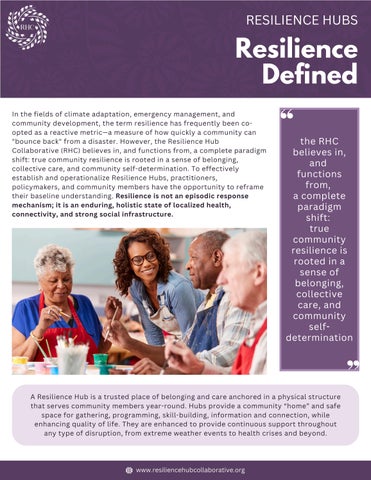
A Resilience Hub is a trusted place of belonging and care anchored in a physical structure that serves community members year-round. Hubs provide a community “home” and safe space for gathering, programming, skill-building, information and connection, while enhancing quality of life. They are enhanced to provide continuous support throughout any type of disruption, from extreme weather events to health crises and beyond.
www.resiliencehubcollaborative.org
WHY RESILIENCE IS HOLISTIC, YEAR-ROUND, AND PEOPLE-CENTERED Resilience must be conceptualized as a continuous, quality-of-life-focused everyday practice rather than a contingency plan for a worst-case scenario or disaster. True resilience and preparedness cannot be separated from daily well-being and community connectivity. This holistic approach to resilience addresses systemic, chronic stressors—such as structural poverty, food insecurity, social isolation, and public health disparities—alongside acute shocks. Unfortunately, in most resilience-centered efforts, the primary focus has been on the shocks and community well-being, connection, health, and joy are set on the backburner. This is not the case with Resilience Hubs. Resilience Hubs center a holistic and comprehensive approach to resiliencethey focus on social connection, social services, economic well-being, programming, safety, and relationship-building, while also ensuring spaces and systems are improved to anticipate and accommodate a disruption and ultimately help communities thrive throughout recovery. Infrastructure alone does not protect a neighborhood; human relationships do. The core of the RHC’s definition of resilience is the deliberate cultivation of social connectivity, community cohesion, and collective care. When community members share a deep sense of belonging and mutual accountability, they build social infrastructure that cannot be engineered by top-down governance. Connectivity ensures that people feel like they are cared about and matter. It helps enhance the sense of belonging and the feeling of safety. And when conditions shift into disruption, the foundation of connection and care ensures that community members are supported, provided with assistance, checked-in on, and have a trusted space to gather.
www.resiliencehubcollaborative.org
WHY TRUE RESILIENCE IS NOT DISASTER-CENTERED Conventional disaster management frameworks contain an inherent flaw: they are hyper-focused on the disruption itself. They treat the disaster as an isolated, neutral event and evaluate success based on structural fortification and immediate emergency response. Reframing resilience requires explicitly dismantling this disaster-centered bias.
DISASTER-CENTERED APPROACH (REACTIVE) Activation: Triggered strictly during a catastrophic event or declaration of emergency. Focus: Emergency shelters, short-term survival, and physical fortification. Leadership: Top-down command-andcontrol structures led by external government or municipal agencies. Community Role: Residents are treated as passive recipients of aid or casualties needing rescue
PEOPLE-CENTERED RESILIENCE (RHC) Activation: Active year-round; seamlessly shifts operational modes based on context. Focus: Systemic root causes, everyday quality of life, and social cohesion. Leadership: Community-owned, community- operated, and locally selfdetermined. Can be supported by government and external partners but through the community filter. Community Role: Community members are active leaders, caretakers, and planners of their own resilience networks and Hub.
When an approach is disaster-centered, it ignores the reality that vulnerability is created by systemic inequities. A flood or heatwave does not create disparity; it exposes it. A community facility such as a shelter that sits empty until an extreme weather event occurs cannot foster the deep, everyday trust required to manage a crisis effectively. If community members do not know or trust a facility on a sunny stress-free day, they are highly unlikely to turn to it during a major disruption.
www.resiliencehubcollaborative.org
RESILIENCE IN RELATION TO RESILIENCE HUBS Because Resilience Hubs are deeply woven into the neighborhood's fabric, they provide a yearround "third space"—a trusted environment outside of home and work. This ongoing presence establishes a reliable infrastructure where resources are continuously shared, skill-building occurs naturally, and community-led initiatives thrive. By existing as a constant fixture, the Hub becomes an active asset that elevates local quality of life during steady state (non-disruption), which directly translates to increased adaptive capacity during disruption. By acting as a reliable, nontransactional communal anchor, a Resilience Hub transforms passive community members into active participants in an ecosystem of collective care, building a foundation of trust and safety long before a disruption or crisis occurs.
www.resiliencehubcollaborative.org
THE CRITICAL NEED TO REFRAME RESILIENCE FOR HUB DEVELOPMENT Reframing resilience is not an academic exercise; it dictates how capital is allocated, how partnerships are forged, and how community spaces are designed. Without this reframing, investments in resilience and Resilience Hubs run the risk of generating high-tech, underutilized emergency shelters that fail to empower the community. At the RHC, Resilience Hubs are "For Community, By Community, and In Community." Conventional resilience planning and metrics favor technical solutions like concrete sea walls or commercial generators while neglecting the heart of true resilience, the community. Reframing resilience concentrates decision-making power within the community itself, shifting from a model of municipal paternalism to one of community self- determination. This shift builds local leadership capacity, ensuring that decisions reflect the authentic cultural and physical priorities of the neighborhood. A key element of reframing resilience also connects to the disruption of funding silos. Historically, funding streams have been rigidly divided between emergency mitigation grants and community development funds. Reframing resilience as a holistic, year-round endeavor enables practitioners to combine these disparate resources and weave in health, education, economic well-being, and community services. It justifies spending emergency resilience capital on Hubs that provide daily youth services, digital literacy, and nutritional support, recognizing that a socially integrated community is inherently a climate-resilient community. The work of building a Resilience Hub is fundamentally an act of cultivating a holistic ecosystem of care for sustained, liberatory transformation. By ensuring that a hub focuses on everyday connectivity, belonging, and systemic wellness, it naturally develops the robust adaptive capacity required to help communities thrive through any type of disruption. To continue your learning journey, please click on one of the following” Resilience Hubs: What is a Resilience Hub? Resilience Hubs: Six Core Components Resilience Hubs: Three Resilience Conditions
CC BY-ND 4.0: This work is licensed under a Creative Commons Attribution-NoDerivatives 4.0 International License (CC BY-ND 4.0). You are free to share, copy, and redistribute this material in any medium or format for any purpose, provided you do not alter, transform, or build upon the material and you give appropriate credit. Please cite this work as follows: Baja, K. (2026) Resilience Defined. Resilience Hub Collaborative. www.resiliencehubcollaborative.org
www.resiliencehubcollaborative.org