RESILIENCE HUBS
What is a Resilience Hub? Resilience Hubs are trusted ‘third spaces’ where community members feel safe and supported on a daily basis
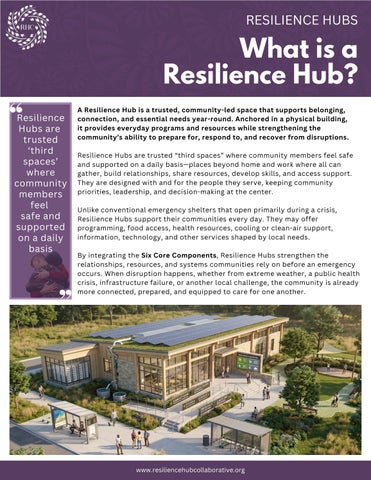
A Resilience Hub is a trusted, community-led space that supports belonging, connection, and essential needs year-round. Anchored in a physical building, it provides everyday programs and resources while strengthening the community’s ability to prepare for, respond to, and recover from disruptions. Resilience Hubs are trusted “third spaces” where community members feel safe and supported on a daily basis—places beyond home and work where all can gather, build relationships, share resources, develop skills, and access support. They are designed with and for the people they serve, keeping community priorities, leadership, and decision-making at the center. Unlike conventional emergency shelters that open primarily during a crisis, Resilience Hubs support their communities every day. They may offer programming, food access, health resources, cooling or clean-air support, information, technology, and other services shaped by local needs. By integrating the Six Core Components, Resilience Hubs strengthen the relationships, resources, and systems communities rely on before an emergency occurs. When disruption happens, whether from extreme weather, a public health crisis, infrastructure failure, or another local challenge, the community is already more connected, prepared, and equipped to care for one another.
www.resiliencehubcollaborative.org
Resilience Hub Basics The "Who, What, Why, and How" WHO Resilience Hubs are for community, by community, and in community with a non-negotiable prioritization in frontline communities. Hubs are intended to serve all members of a community—including seniors, youth, people with disabilities, and those experiencing houselessness—within a specific neighborhood or geographic area.
WHAT A Resilience Hub is a community-managed “third space” anchored in a physical building that is enhanced to provide continuous support and care. It acts as a community "home" to facilitate belonging, skill-building, and resource sharing and functions across Three Resilience Conditions (operational states).
WHY Resilience is holistic, not hazard-based. Traditional top-down emergency systems often struggle to meet the needs of frontline and intentionally marginalized communities. This has stunted the effectiveness of proactive action, disaster response, and recovery for decades. Resilience Hubs strengthen local capacity by centering community leadership, social connection, and the root causes of vulnerability. Because they support everyday needs—such as food access, health, connection, and resource sharing—they help communities become stronger and better prepared which improves overall resilience.
HOW Resilience Hubs are planned, designed and implemented in a phased approach which includes the Six Core Components and the Three Resilience Conditions. All Six Core Components are essential in Hub development although all six do not need to be fully developed before a Hub begins operating. Development is an inclusive process that involves communityled design, assessments, strategic partnerships, and creative funding. www.resiliencehubcollaborative.org
Ultimately, a Resilience Hub is more than a building. It is a commitment to enhance social infrastructure and community self-determination. By weaving together the Six Core Components with the Three Resilience Conditions, community-led Hubs evolve from neighborhood anchors into proactive engines of community care and well-being. They ensure that when the next disruption arrives, the community does not have to wait for external assistance. Instead, they can rely on their local Resilience Hub that has supported their daily needs all along. Resilience Hubs are not only built to survive an extreme event–they are designed to help communities thrive every single day.
Now that you know what a Resilience Hub is, it’s important to understand the Six Core Components and the Three Resilience Conditions (operational modes). These are the foundational ingredients that determine whether a site is a true Resilience Hub and are what set a Hub apart from a community center or conventional emergency shelter. To continue your learning journey, please click on one of the following: Resilience Hubs: Resilience Defined Resilience Hubs: Three Resilience Conditions Resilience Hubs: Six Core Components For more information, visit www.resiliencehubcollaborative.org
CC BY-ND 4.0: This work is licensed under a Creative Commons Attribution-NoDerivatives 4.0 International License (CC BY-ND 4.0). You are free to share, copy, and redistribute this material in any medium or format for any purpose, provided you do not alter, transform, or build upon the material and you give appropriate credit. Please cite this work as follows: Baja, K. (2026) What is a Resilience Hub? Resilience Hub Collaborative. www.resiliencehubcollaborative.org
www.resiliencehubcollaborative.org