RESILIENCE HUBS
Three Resilience Conditions Resilience Hubs are neighborhood nodes of connectivity, care, resources, supplies, and safety. They are community-led spaces of belonging, connection, and support. In order to serve a community year-round and holistically, Resilience Hubs must act like chameleons —shifting their form and function based on what takes place within their environment and responding accordingly. At the Resilience Hub Collaborative, we categorize these shifts into Three Resilience Conditions or operating modes. When working with or managing a Resilience Hub, it is essential to understand how a Hub functions in each condition and what site and staff adjustments are needed to support community members from one condition to the other. The transition between these conditions is fluid. For example, a day may start in steady state yet as temperatures rise in the late morning, a heatwave might start and escalate into disruption by mid-afternoon, especially if the energy grid fails and people are without adequate cooling solutions. As the grid recovers and temperatures lower, the condition may shift into recovery and require targeted support for community members who are more vulnerable and/or have suffered health-related impacts from the high heat. Proactively planning for and understanding what is necessary in each of the Six Core Components, as they relate to the Three Resilience Conditions, is the difference between a project that looks good on paper and one that actually supports community, helps people thrive, and saves lives.
www.resiliencehubcollaborative.org
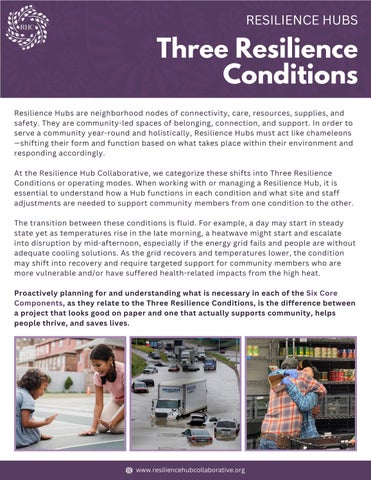
STEADY (NON-DISRUPTION) Steady state is the condition communities are in most often. Although there are no large community-wide disruptions present, there are still everyday stressors that impact community members’ quality of life and access to resources and services. Steady state is focused on addressing those needs while preparing for disruption and recovery. Hubs act as a "third space" for youth programs, elder care, food initiatives, and workforce development. It builds the social cohesion necessary for community to support one another.
DISRUPTION (SHORT OR LONG TERM) During extreme events and disruptions such as extreme heat, flooding, winter storms, hurricanes, power outages, health emergencies, chemical spills, and active shooter situations among many others, a Resilience Hub transforms. The Hub provides clean water, cooling and warming, accurate real-time information, reliable power (often via solar and storage), supplies and resources, and gathering space. Disruptions can be shortterm (ex.extreme heat day) or long-term (ex. public health pandemic).
RECOVERY (POST-DISRUPTION) After the immediate danger passes, a Resilience Hub serves as the staging space for recovery which can be short-term or long-term. Neighborhood-based Hubs help community members access resources and supplies, navigate insurance and post-disruption assistance programs, access tools and materials, and obtain information for locating loved one. Hubs provide space for accessing trauma-informed services and care in a place community members already trust.
To continue your learning journey, please click on one of the following: Resilience Hubs: Resilience Defined Resilience Hubs: What is a Resilience Hub? Resilience Hubs: Six Core Components
CC BY-ND 4.0: This work is licensed under a Creative Commons Attribution-NoDerivatives 4.0 International License (CC BY-ND 4.0). You are free to share, copy, and redistribute this material in any medium or format for any purpose, provided you do not alter, transform, or build upon the material and you give appropriate credit. Please cite this work as follows: Baja, K. (2026) Three Resilience Conditions. Resilience Hub Collaborative. www.resiliencehubcollaborative.org
www.resiliencehubcollaborative.org