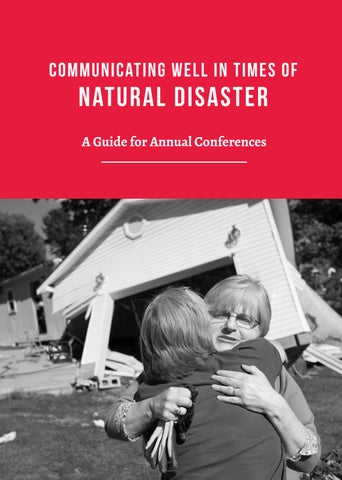
Communicating Well in Times of
Natural Disaster A Guide for Annual Conferences
Contents 4 Responding to disaster 8 Communications readiness 13 Getting assistance from UMCOR & Other United MEthodist Agencies 19 review 21 Additional Resources
2
The Rev. J.F. Lacaria surveys flood damage in the kitchen at Clendenin (W. Va.) United Methodist Church. Photo by Mike DuBose, UMNS.
Volunteers from Pea Ridge United Methodist Church in Huntington, W. Va., sort flood relief supplies at New Vision Depot in Beaver, W. Va. The depot is the main hub for disaster relief ministry of the West Virginia Conference of The United Methodist Church. Photo by Mike DuBose, UMNS. 3
Responding to Disaster Conference Disaster Response falls on the shoulders of the Conference Disaster Response Coordinator (CDRC), but there are so many ways that Conference Communicators can enhance the work of the CDRC, and in doing so invite the entire conference to witness to their faith and live into their membership vows in the aftermath of a disaster. Strategic communications in times of disaster can also introduce the Church to new people and make space for building bridges with communities in new ways. With some advanced planning, and by using resources already in their tool chest, conference communicators will be ready to respond with compassion and hope in times of natural disaster. First and foremost, conference communicators need to be familiar with their CDRC and the Conference Disaster Response plan. UMCOR provides excellent training for Conference Disaster Response Coordinators, and it is important to note that there is also a disciplinary role for conference communicators in times of natural disaster:
¶ 633.22 Responsibilities of the Annual Conference 22. To appoint annual conference disaster response coordinators to assist UMCOR to encourage the formation of an annual conference disaster response committee that relates to the annual conference board of global ministries, and includes when possible, member of the General Board of Global Ministries from the annual conference. The membership of the Disaster Response Committee may include district disaster response coordinators and the conference director of communications or the member of the commission on communications. Annual conference and district disaster response coordinators shall receive training at least once a quadrennium.
If you, or select members of your commission, have not yet received UMCOR Disaster Response training (which is different from ERT training), please reach out to your CDRC. Most annual conferences follow the UMCOR recommendation that district disaster response coordinators/teams are the first ones to respond. Once it is determined that more assistance is needed the District Superintendent makes a request to the CDRC. Each Annual Conference Disaster Response team has a flow chart, be sure to review and if necessary, make adjustments so that you can stay in the loop for communications needs.
4
The Rev. Paul Mateer (wearing cap) greets members of a former youth group who are helping distribute flood relief supplies from the gymnasium at Richwood (W. Va.) Middle School. Photo by Mike DuBose, UMNS.
Insider conversation The reality is that responding to a disaster can be demanding. So it is important that a communications plan is in place to prepare you and your communications team to: • Raise awareness of the ways that your conference responds in times of natural disaster, • Provide support for pastors and local communities affected, • Convey important information to protect lives and • Start to raise funds for rebuilding during the relief and recovery stages.* *Making a plan for how funds will be collected and distributed will entail some conversations with your Conference Treasurer, Director of Connectional Ministries, CDRC and others. By having a strategy in place before a disaster happens things will flow more smoothly later.
5
Types of natural disasters: Left to right: Hurricane Gafilo (WikiImages); Colorado forest fire (David Mark); flooding in New Orleans after Hurricane Katrina (David Mark); tornado damage in Moore, Oklahoma (15299). All images from Pixabay.com.
No two disasters are the same. Each disaster has different phases. Each phase requires a different type of response. So, be flexible. The following is an excerpt from the UMCOR Early Response Team (ERT)1 training manual:
Definition of a Disaster • A disaster is any specific event that results in overwhelming physical, economic and/or emotional damage to a community. • Results in significant harm to people and property • Disrupts normal pattern of living • Overwhelms a community’s ability to respond • Affects individuals, families, neighborhoods, communities, regions
Types of Disasters: • Natural disaster: Storms, earthquakes, wildfires or other natural phenomena • Technical disaster: Careless, accidental or intentional abuse of the environment • Economic disaster: Sudden loss of income due to shifts in the local economy • Civil disaster: Riots or civil disturbances in a community • Accident: Traffic accidents, fire or other tragic occurrences • Other: Pandemics, terrorism, war 6
Phases of a Disaster Readiness: The initial phase of a disaster is readiness. It is planning how to respond when an emergency or disaster occurs and working to marshal the resources to respond effectively. These activities help save lives and minimize damage by preparing people to respond appropriately when an emergency is imminent or hits and becomes a disaster. Rescue: Rescue/emergency is the phase that covers the period during and immediately following a disaster. During this phase, public agencies provide emergency assistance to preserve life and property. Relief: Relief immediately follows the rescue/emergency phase and sometimes the two activities may coincide. During the relief phase, work is done to help prevent any further damage from occurring. Families may be allowed to return home at this time or may still be in temporary housing/shelters if homes are significantly damaged. Conference personnel are beginning to assess the damage and the conference’s ability to respond and provide long-term assistance if needed. Recovery: Recovery follows the time of providing relief work. It continues until all systems return to normal or near-normal operation. Short-term recovery restores vital life support systems to minimum operating conditions. Long-term recovery may go on for months—even years—until the entire disaster area returns to its previous condition or undergoes improvement with new features that are less disaster-prone. Review: Review occurs after each phase and at the completion of a recovery effort. Participating organizations and agencies come together and discuss what worked well and what did not. From these discussions there is usually a recommendation to the communities on ways to improve response for the next event. 1
From Early Response Team: Providing a Caring Christian Presence in the Aftermath of Disaster, Student Manual © 2019 United Methodist Committee on Relief, General Board of Global Ministries.
The Rev. Ricky Duncan (right) of Johnson Memorial United Methodist Church and parishioner Randall Lester help remove flood debris from the home of a neighbor in Alderson, W. Va. Photo by Mike DuBose, UMNS. 7
Communications readiness
The Cherry River flows past Fenwick (W. Va.) United Methodist Church. Photo by Mike DuBose, UMNS.
Keep phone numbers of members of your communications team/commission in an easy-to-access place. These will be the people you will rely on when a disaster occurs. Consider alternate ways of communicating. Would your team work well with WhatsApp? How about Slack or Messenger? Having a thread that allows people to respond to and search may be helpful in the initial days of a natural disaster. Encourage your team to participate in ERT (Early Response Team) training. This gives you a common language with the conference disaster response team and allows you to have an UMCOR badge, which may give you access to areas that most of the public is not prohibited from in the first days after a disaster. Check with your state authorities, the State Press Club, etc. regarding media passes. If they do not issue media/press passes, then design your own. (See the example to the right.) Determine with your CDRC the types of disasters most likely to occur in your conference. For some it will be flooding, for others hurricanes. Others include tornadoes, earthquakes or fires. Consult www.ready.gov for some tips and ideas for your region of the country. 8
Consider what messaging could go out to the conference and local churches around these dates: • United Methodist Volunteers in Mission (UMVIM) Sunday [date determined by the annual conference link to resources] • UMCOR Sunday (the 4th Sunday in Lent) resources Have a conversation about how information will flow in times of natural disaster. From the CDRC? The DCM? When will the bishop be brought in for statements to the conference? How will you communicate with the conference? Will you use Facebook Live? Memes and graphics? The website? Perhaps have some graphics pre-made and ready to be finalized and posted when the time comes. Do you have a plan to keep yourself and others on your communications team/ commission and staff safe? You and your personal safety are of utmost importance. Consider what other communicators in your jurisdiction could be called on to handle social media in case you are without access due to power outages or cell service outages.
When a natural disaster is about to affect your annual conference In consultation with the DCM/Bishop and CDRC consider messaging via predetermined outlets. • Consider having a webpage ready to go up with opportunities for local churches to report damage, if appropriate and/or to take donations. • Have memes ready to share via social media. • Does your annual conference have SMS text messaging? What is the message you’d like to send? What is the time frame that would be appropriate? • See about being added to the VOAD (Voluntary Organizations Active in Disaster) calls — or find out who will provide you with updates. • Charge batteries, have media ID ready, and double-check your home/personal safety plan.
During the Natural Disaster Your safety is first and foremost. Let the weather channel anchors stand out in the storm, you find a safe place to be. Do an evacuation if mandated. Contact colleagues for support. Now is a time to rest and be ready — the next few days could be pretty busy.
The Rescue Phase: the first 48-72 hours(ish) While ‘thoughts and prayers’ are nice, now is the time to lift up those who are on the front lines. The Rescue Phase is the time before ERT (Early Response Teams) respond. This is a time for public agencies to provide emergency assistance. 9
Assist the CDRC with appeals for shelters, flood buckets, health kits, etc. as the need arises. Provide a support role, listen, learn and start strategizing. The first 2-3 days you can try to go out and take pictures, but this is a critical time for search and rescue, so don’t be in the way. If you go out, do be sure to have credentials with you. Once you have been briefed about the damage, consult with those on the Conference Disaster Response team about a media plan. If there has been a loss of church property or loss of life, you or a local church pastor or District Superintendent may be asked by media (news, TV or radio) to respond. Refer to your disaster response plan to determine who your spokesperson should be. Be prepared to consult with them with appropriate responses (See the West Virginia January 2016 magazine). Communicate with your communications team/commission. Those who were not affected may need to be brought in to write stories, take pictures or handle social media. Consult with a neighboring communicator for support (both emotional and workrelated are important). Each annual conference has a conference communicator. They are a wealth of information and support. IF you serve in a conference next to where a natural disaster occurred, why not pick up the phone and call (or text) your colleague to offer encouragement and/or support? Natural disasters can be traumatic events. We can all use someone to pray with and talk things through with when times are tough.
Relief Phase This is when things can be really busy for you as a communicator. Consider the priorities for communicating with your constituents. This list is bigger than you may think. Constituents can include: • Clergy and those serving local churches • Local church trustees • Members of local churches • People in the community surrounding local churches • Those who have been displaced and are seeking shelter • Those who have been trained to serve as ERTs • Family members of those who are in disaster areas • Voluntary Organizations Active in Disaster (VOAD) partner agencies • Who is missing from this list? 10
As you can imagine, those in and outside the disaster area will have different needs. For those inside a disaster area finding a safe, sanitary and secure place to stay is of utmost importance. For those who live outside the disaster area, we have found that most people desperately want to help. This is when people really want to (and are more likely to) respond, so provide a pathway for generosity. The truth of the matter is that clothing and furniture drives are often called the second natural disaster. Financial gifts are the most helpful because they allow organizations to purchase whatever is needed.
Rebecca Michalski picks out clothing for a family friend at Rainelle (W. Va.) United Methodist Church from among items donated for those affected flooding in the area. Most of the items ended up in a dumpster a week later. Picture by Mike DuBose.
That being said, do offer words of encouragement — thoughts and prayers really do matter. So do uplifting Bible verses. Favorite hymns are also appropriate. UMC Discipleship has a number of prayers that could be customized for local churches to use during the first few weeks. Consider asking your DCM or another trusted clergy person not personally affected by the disaster to provide some customized worship resources. This is a good time to go out and take pictures for future publications or social media. Your CDRC can identify local churches to visit and the local church pastor/lay leader can provide the background context. 11
How to take pictures during a natural disaster These are some tips I learned from following Mike DuBose around after the WV floods in 2016. ➤ Do not impose yourself on the situation. This is not about you, but about the people who have survived a natural disaster. Be sensitive to their situation. ➤ Do not have people line up for group pictures. Pictures are much more interesting with people in them doing what they do. ➤ Be sure to introduce yourself to those present (a good reason to have a media pass and ERT badge). Be sure to write down their names and where they are from. Because this is an event it is considered news, so you most likely will not need a release. But you should share who you are. ➤ Take lots of pictures — out of hundreds, there will be a dozen keepers.
Marsha Fogus (right) is comforted by the Rev. Melissa Shortridge at her home in White Sulphur Springs, W. Va. Fogus’ garage was moved off its foundation and her home was heavily damaged by floodwaters. Photo by Mike DuBose, UMNS.
12
Getting Help from UMCOR & UM agencies
The Rev. Dan Lowther helps lead disaster response ministries of the West Virginia Conference of The United Methodist Church as New Vision Depot in Beaver, W. Va. Photo by Mike DuBose, UMNS.
If you have been personally affected by the natural disaster, call for assistance. UM News/ UM Communications or a communicator from a nearby annual conference should be a first contact. There will be several agencies involved in responding to the disaster. These agencies working together are your state VOAD (Voluntary Organizations Active in Disaster). Find out when the daily calls are and listen in to grasp the scope of the work being done. Some agencies will only be in your area for a week or two, others won’t arrive until the recovery phase begins. The United Methodist Church bridges both worlds. We have churches in most communities, so we will have church members and clergy affected by the disaster. We will have ERT (Emergency Response Teams) seeking to provide relief. They are guided by the CDRC. 13
I wasn’t even officially on staff in West Virginia when a 1000-year flood hit. After assessing the situation, I knew I needed help, so I called UM Communications. Tim Tanton and Jennifer Rodia, who were reassuring and encouraging. I was pleasantly surprised when they were able to send Mike DuBose right away to take pictures. My time traveling the disaster area with Mike and the Assistant to the Bishop was so helpful and allowed us to have success raising awareness and money for our recovery phase, which lasted over four years! I also received a call from a neighboring communicator who offered his assistance. Probably my biggest regret was not inviting him over — his experience and perspective would have been so helpful. I was in way over my head, but I let pride get in the way.
For United Methodists the relief phase is a time for helping people return to a home that is safe, sanitary and secure. It is also a time for assessing the damage. One of the most important things to remember is WE are UMCOR. UMCOR, United Methodist Committee on Relief, is all of us. Yes, there is a very small paid team in Atlanta who coordinate grants and training for Disaster Response teams, but WE are UMCOR. So when we say UMCOR is coming what we mean is WE, the Church, are responding with compassion thanks to the connection of millions of people and over 30,000 churches around the world! This is the connection at work and worth celebrating! The United Methodist Committee on Relief U.S. Disaster Response (UMCOR USDR) seeks to alleviate suffering caused by disasters that strike within the United States and its territories. With a “communities own their recoveries” philosophy, UMCOR supports local efforts to accomplish immediate relief and long-term recovery while providing for volunteers to offer compassionate ministry in the aftermath of disasters. In partnership with disaster response ministries and coordinators in U.S. annual conferences, UMCOR journeys with affected communities throughout a disaster’s cycle, including disaster preparedness, relief, response, recovery, and mitigation.
(UMCOR United States Disaster Response)
Your bishop can make an emergency grant request ($10,000). All other fund requests from UMCOR will go through a grant process that is guided by your CDRD and DCM. Some conferences have included funding for short-term communications support in their grant requests. If your disaster is high-level or catastrophic, consider this as an option. United Methodist Communications also provides contextual and relevant support for advertising your disaster response fundraising efforts. Contact Poonam Patodia (ppatodia@umcom.org) or Greg Petree (gpetree@umcom.org) to discuss options.
WVUMC Assistant to Bishop, JF Lacaria, at one of the flood shelters with a therapy dog and handler. Photo by Mike DuBose, 2016.
14
The Relief Process The relief process for United Methodists looks something like this:
Note that not all teams being sent out by your CDRC are mucking out homes or going through rubble. Some teams are trained to provide spiritual care in shelters or at food pantries/day sites in the disaster areas. Find out how you can support them and lift up their work. While pictures are always a great way to share the story of how your conference is stepping up to support the survivors of the disaster, we would not want to share the faces of those receiving spiritual care. One final note about the relief stage, if you go out to the disaster area you need to be self-sufficient. Take your own water, food, snacks, etc. Do take boots and rain gear, and plastic bags to put mucky clothes in after you’ve waded around town. Do not expect to be able to purchase supplies when you are in areas affected by the disaster. Self-sufficient truly means self-sufficient. If you are going to have to be away overnight, you may need to pack a sleeping bag or make sure that you have arrangements in a nearby community. Hotel rooms will be very hard to find and should be set aside for survivors and their families. Take extra batteries for cameras and do not expect to have cell phone service everywhere you go.
15
Recovery phase Here is where the CDRC and VIM (Volunteers in Mission) teams take over. If this is a major disaster then UMCOR will train construction team leaders and case workers while volunteers will start to come in from around the country to help rebuild homes and lives. You may have some churches or parishes in your annual conference that partner to rebuild a home. Your disaster recovery team will have celebrations and house blessings as families are returned to their homes. All of these are great photo opportunities, and because the recovery phase can last for years it is important to find ways to celebrate the ongoing commitment to recovery. Funds are still needed, but so are volunteers. Your VIM coordinator may ask you to help them create a flyer to send to different conferences or to partner agencies, such as Mennonite Disaster Relief. So, a quarterly update would be appropriate through the first year of the Recovery phase. It would also be worthwhile to assist the CDRC and VIM teams so that they can make a special report at annual conference. We created a print publication six months after the flood and sent it along with a poster to every church in the conference (Download the West Virginia January 2016 magazine to learn about what we did in West Virginia after our 1000-year flood.) It can seem “out of sight, out of mind” so put the quarterly check-ins on your calendar! Consider scheduling a day once a month to go out and take pictures of the work being done or send someone from your communications commission to a house blessing to take pictures and be part of the celebration.
Homeowner (left) participating in house blessing. Her home was entirely rebuilt by volunteers. Picture by Deborah Coble. 16
Thanking volunteers and donors It is also time to have another conversation with your CDRC, CDM’s and Conference Treasurer. How are you thanking the people who have donated money to your disaster response efforts? We made cards with pictures from the recovery efforts and sent one to everyone who gave at least $5. These were hand addressed and signed by various people on staff at the conference center. Over 800 people received thank-you notes, and we raised nearly $1.6 million in six months. This was all gifts from individuals, the UM Foundation of West Virginia and other annual conferences, and does not include UMCOR grants. Pretty amazing how $5- and $100- dollar gifts add up and make a huge impact! (See an example of a thank-you card.) So much to celebrate! Our West Virginia Conference Disaster Recovery Recap from December 2020: While hard to believe, it has been nearly 4 1/2 years since the June 23, 2016 storms and flood disaster that impacted 44 of WV’s 55 counties, 12 of which were in the federally declared disaster zone. The National Weather Service reported that three large, organized storms converged on the region that day producing massive damage and what was characterized as a 1,000-year flood. Just over $4 million was spent in the region, from UMCOR grants as well as direct contributions largely through the West Virginia Annual Conference and The UM Foundation of WV, Inc. Over 2,000 individual volunteers on 135 mission work teams averaged 5 workdays with a value of labor over $1.5 million, including our bishop and her cabinet. Representing the West Virginia Conference, our disaster recovery team oversaw repairs to 120 homes, 104 rebuilds, 29 full new builds, and reconstruction and repair activity with several churches. Case managers closed 185 cases. (Excerpt from the final report by Reverend Jack Lipphardt, Director of 2016 Flood Disaster Response)
The rest of the story: the disaster recovery team that oversaw the work was a paid staff of 6 people: 2 Case Managers, 2 construction managers, a Director of 2016 floods Disaster Response and an Executive Director of Disaster Response. And of course, many, many volunteers. 17
Poster sent to every church in the conference 6 months after the flood as a way of showing the work done by the People of The United Methodist Church. View poster and billboard examples designed in collaboration with United Methodist Communications. Contact ppatodia@umcom.org or gpetree@umcom.org to find out how UMCom can assist.
The West Virginia Annual Conference used images and reports of recovery efforts to create thank-you cards. They sent out over 800 cards, which raised nearly $1.6 million dollars in donations. Image is a mockup of the thank-you card to sent to donors and volunteers. View larger. 18
Review A home that was sheared in two by floodwaters stands open to the elements in White Sulphur Springs, W. Va. Photo by Mike DuBose, UMNS.
While I am grateful that we haven’t had to respond to significant flooding here in West Virginia since 2016, our Conference Communications team continues to be strategically intentional. In partnership with our CDRC and VIM coordinator we are expanding the ways that we can respond. We all agree that preparedness is one of the most important gifts we can give the conference. So, we look for the experts, the people who have survived a flooding event and learn from them. This video was recorded showing how a simple piece of plywood can be used to keep flood waters out of a church basement, saving the church significant damage. It worked for Alderson UMC it can work for other churches in the connection too. Given the concerns and realities of global warming, West Virginia is preparing for even more flooding in the years ahead of us. Our state VOAD gathering, held each September, features conversations with hydrologists and scientists here in West Virginia who are helping us to be better prepared. It was helpful as the conference communicator to be present at the gathering so that I can prepare with strategic intent, rather than a hurried response. 19
This document was written for the US Conferences in particular but may be easily adapted for local and district church leaders as they respond to a natural disaster in their context. I hope it can be adapted for Central Conference communicators as well. Much of the preparation of this document has been a review of some of the best practices learned in the field in West Virginia in 2016 and again in 2017-2018 while ‘on loan’ to the Florida Conference following Hurricane Irma. These practices have been shared to encourage and assist colleagues in conferences over the past 6 years. I hope that you find these thoughts helpful, and if you have additions or suggestions, please contact me! Great care has been taken to include resources from UMCOR (United Methodist Committee on Relief) and VOAD (Voluntary Organizations Active in Disaster). These organizations are ‘the boots on the ground’ and provide direct support to communities in times of natural disaster.
•
The Rev. J.F. Lacaria surveys flood damage at Clendenin (W. Va.) United Methodist Church. Photo by Mike DuBose, UMNS.
20
Additional Resources & Training Opportunities Volunteers unload flood relief supplies at New Vision Depot in Beaver, W. Va. The depot is the main hub for disaster relief ministry of the West Virginia Conference of The United Methodist Church. Photo by Mike DuBose, UMNS.
• The National Voluntary Organization in Disaster (N-VOAD) provides a number of resources for communicating well during a disaster. Get 10 “Tips for communicating during a Disaster.” • N-VOAD also provides a library of resources to help you prepare for an emergency. • FEMA provides additional communication training. • Severe Weather Preparedness Week is set by each state. These severe weather preparedness resources are from Missouri and Kansas, which observed this week in mid-March in 2023.
This resource was prepared by Deborah Coble in association with United Methodist Communications. • For questions or to share additional information, contact: Dcoble@wvumc.org or ResourceUMC@umcom.org.
• For general Annual Conference Communicator support, contact: Royya James at Rjames@umcom.org.
21