Tools: 4-H Gifts and “Know, Teach, Learn” benefits and uses:
ASSET MAPPING tools for discovering
INDIVIDUAL
• Practice putting on an “asset lens” when seeing our selves, group, and community • Builds trust and relationship between participants • Enables a team or group to clearly see and activate its collective gifts, talents, and priorities, which it can use as “ingredients” in planning projects, solving local problems, or organizational development
GIFTS & SKILLS Powerful, sustainable community change occurs when neighbors combine their strengths to act together upon what they most care about. Communities are at their strongest and safest when
neighbors are well connected and actively contributing their skills and talents. Rooted in these principles, Asset-Based Community Development (ABCD) offers a lens for seeing communities and neighborhoods as filled with assets rather than defined primarily by their needs. Research led by ABCD founders John McKnight and Jody Kretzmann identified six categories of local assets commonly drawn upon by residents in their change efforts: individual gifts, associations, institutions, physical space, economy and exhange, and stories/culture.1 The creative processes local groups have developed for discovering, documenting, and activating these assets have become known as “asset mapping.”2 Research has also shown that these efforts consistently center the individual gifts of local residents, especially marginalized neighbors whose gifts have become hidden under labels of deficiency such as “poor,” “at risk,” “homeless,” or “disabled.” The following 4-H Gifts and Know, Teach, Learn tools offer two simple, energizing ways to begin revealing, celebrating, and activating the individual capacities within any group while also collectively putting on an “abundance lens” for seeing one’s community through new eyes to better utilize the many untapped resources already present in every neighborhood. 1. Kretzmann & McKnight, Building Communities From the Inside Out. (1993).
2. For more on ABCD and asset mapping, see this Asset Mapping Overview & User Guide.
o
i e: d rc Stu u e So ild e ag an W Im rb U
Feel freel to adapt these exercises to your own place and culture. Be creative, play, and have fun!
4-H GIFTS EXERCISE Time Required: 10–45 min ( depending on variations) The 4-H Gifts Exercise is an excellent introduction exercise for a group of neighbors, committee, or organizational team. It builds a sense of community among group members, empowers the team to recognize its collective gifts, and moves them from needs thinking to strengths thinking.
PREPARATION
1. Gather materials. • • • •
Sticky notes Colored thin/fine-point markers Printed gifts handout (one per person) A pleasant-sounding bell or timer (optional)
2. Prepare the space.
Set out sticky notes and markers on the tables that will be used. Create the “Gifts Wall,” an area on a wall (or large standing whiteboard/hard surface if no wall is available) with four sections. In large letters, label each section: Head, Hands, Heart, Human Connection. You can give it a name like “Our Gifts Inventory,” “Our Gifts,” “Abundance Wall,” or something else creative! When determining size, the larger the group, the larger the space. Estimate that you will need space for each participant to post approximately three to five sticky notes.
PROCESS
1. Introduce the process to the team, group, or committee. (5 min) Explain that we all bring special gifts to any group of which we are a member. And if we recognize each other’s gifts, we can creatively combine them to make the team stronger and more successful.
2. Describe the gift categories, asking the group if they need any clarification.
(10 min)
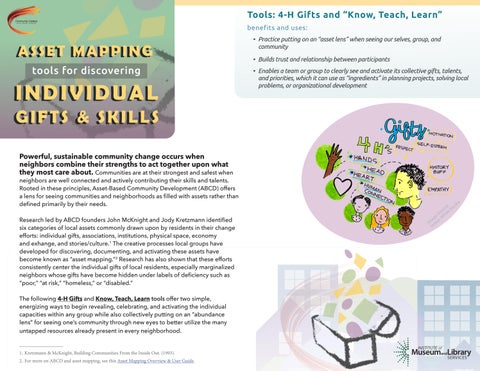
Gifts of the Head: Knowledge that you have in a particular area like child development, health care, or history of the neighborhood. Includes abilities associated with learning, knowledge, organizational capacity, or numbers, and skills related to thinking and planning. Examples: art, movies, history, birds. Gifts of the Hands: Any gift, talent, or ability having to do with the hands or body. Physical skills you would be willing to offer or teach. Examples: carpentry, photography, painting, bicycle repair, athletic skills.
Gifts of the Heart: What are your passions? What stirs you to action? What would you walk across hot coals for? Examples: the environment, civic life, children. Gifts of Human Connection: How are you good at connecting with people or connecting people to each other? What are the things you do to stay connected to our community? Examples: starting conversations, keeping in touch with/ checking on people, remembering peoples’ names or details, throwing parties, joining an interest group, working behind the scenes to support events or gatherings. 2
Image Source: April Doner
3. Think about individual gift inventories.
(5 min)
Propose silent time to allow everyone the opportunity to think about and write their own gifts of the head, hands, heart, and human connection on their handout.
4. Have gift conversations/interviews.
(10–20 min)
Split the group into pairs or groups of three to five. Ask everyone to share with their partner/group which of their gifts of the head, heart, hands, and human connection they have written down that they consider to be the most valuable or that they most enjoy giving in community. These “most valuable” gifts should be listed on the sticky notes, one per note, in marker along with the gift-bearer’s name. Encourage everyone to choose partners they know the least in the room as a way of gaining new relationships and of practicing hospitality (“welcoming the strangers” into our lives and community). Here are some questions that can help surface these gifts: What activity do you find yourself losing all track of time when you are doing it? What talent or skill does it give you the most joy to give? What do others tell you they most appreciate about you as a friend, colleague, or family member? It can be helpful to let people know when you have reached the halfway point, so pairs can be sure to switch or groups can make sure everyone has a chance to speak. TIPS:
Pairs or Groups? Grouping people in pairs can allow more in-depth conversation in a shor-
ter time period of 8–10 minutes. Using small group of three to five can allow people to learn more gifts more quickly, but it takes more time—10–20 minutes.
Pair Gift Interviews. If in pairs, have one partner interview the other about their most valuable gifts and write down one gift per sticky note, along with the person’s name.
5. Regroup and reflect. (Round 1) (5–15 min)
Bring the group’s attention back to the whole. (You can use the bell as a friendly signal.) Briefly ask a few people to share about their partner and their partner’s gifts. If you have time, you can also invite others to call out gifts they heard that they found particularly surprising, inspiring, or interesting. Next, ask for reflections on these questions: What was it like to talk about your gifts? What was it like to ask about someone else’s? Source: April Doner
watch
for INSPIRATION / DISCUSSION
An Indigenous Perspective on Gifts In this 3-minute video, Malidoma Some from Burkina Faso in West Africa, shares a powerful indigenous paradigm of personal gifts. Use this video to spark conversation about the connections between gifts and pathways to both personal and community growth, resilience, and liberation. An excerpt:
“Dagaaba people believe that no one comes into this world for no reason. That we come into this world carrying a gift and with a purpose to deliver that gift in the brightest way possible. Life in community is necessary to bring out those gifts. It takes community to see the beauty, the gifts that the person is carrying.”
TIP:
THINGS YOU CAN DO WHEN YOU KNOW SOMEONE’S GIFT 1. Locate opportunities in the community or within your group, committee, or organization where the person could give their gift. 2. Remind them of their gift on a regular basis in passing and in specific situations where you are helping them figure something out. Catch them off guard.
6. Group posts gifts on the Gifts Wall.
(10 min)
7. Regroup and reflect. (Round 2)
(10 min)
Now, it’s time to collectively celebrate all of the gifts in the room and create your group’s first “abundance inventory”! Ask everyone to go up to the Gifts Wall and post their gift sticky notes there. (This is a good time to remind everyone to write their names on each sticky note and be sure that they listed all of the “most valuable” gifts, one per note.) Encourage everyone to also “browse” the wall take a moment to look at what gifts others are putting up and, if they have a few moments to spare, connect with someone about a gift they posted that they find interesting or useful.
After everyone has had a chance to add their gifts to the wall, come back together and reflect as a large group on the assets you have uncovered,and how they could be beneficial to the group or team with questions such as these: Is there anything we are missing?
Do we have some similarities here? Differences?
What did you learn from this introduction exercise?
3. Tell people who are in regular contact with the person about their gift. Encourage them to acknowledge it when they see the person give it. 4. Ask the person to tell you a story about a time they used their gift and something good happened for someone else. 5. Introduce the person to others by first describing their gift. 6. Help the person identify times during their workday when they are giving their gift. MORE at “20 Things You Can Do When You Know Someone’s Gift” by Community Animators
Groups will often share how awkward it is at first both to ask about others’ gifts and to talk about their own, but that it became more natural with practice. While knowing and using our neighbors’ skills, gifts, and passions used to be common, we have fallen out of practice. So it is natural for it to feel awkward, but the reward for pushing through the discomfort is discovering the hidden abundance in each other and our community while also deepening our relationships!
How might we be able to utilize some of your gifts with this group in the future? How might we use others’ gifts?
Any other comments or feedback? TIP:
If you have a very large group and limited time, hold this conversation in groups of three to five for 5–10 minutes, then spend 5 minutes hearing highlights from various groups on their discussion.
8. Closing and next steps. (5–10 min)
Thank everyone for taking the time to explore their gifts. You can mention any theme or phrase that has emerged as particularly inspiring or important for the group through 4
Source: April Doner
STORY of PRACTICE
Free Library of Philadelphia The Free Library of Philadelphia Community Catalyst Grantee team incorprated the 4-H Gifts Conversation into their IMLS-funded project enlisting residents to uncover and connect gifts and assets in their neighborhood. The conversations and gatherings that resulted had a profound and lasting impact on the way that neighbors, library staff, and organizational partners view the neighborhood and each other and activated fresh opportunities for collaboration, relationship-building, and problem-solving in the community.
Source: Free Library of Philadelphia
this exercise, or your own personal statement of what this process has meant for you, and how you see it being of value to the group, committee, or larger work you are doing. Next, explain or (if you have time, brainstorm with the group) any “Next Steps.” (You could also propose that the next time you meet, “next steps” on how to use your gifts and learning be a topic of discussion, and leave people with a printout of the below ideas to thinkspark their ibrainstorming between now and the next time you meet.
9. Collect and document!
(10 min)
After the session, be sure to capture all of the gifts that were named and keep this as an ongoing asset for your work. See below for ideas.
“I think the ABCD approach created an opportunity for people to present their authentic self. The questions about the gifts of the head, hands, and heart gave a more positive focus and helped people open up. When I start my own business, I will use these questions for my interviews.”
LaShon Jackson, Neighborhood Ambassador and Resident Consultant Team Member
LEARN MORE: Paschalville Partnership’s Toolbox for Library Community Catalyzers
VARIATIONS
OPTION A: If you’re working with a group that knows each other well, ask them to name one another’s gifts in each category.
OPTION B: After the exercise, encourage everyone to interact with the Gifts Wall. They
can make “matches” for themselves or for others based on the gifts they see. (It could be for personal use or an opportunity they see for that gift to be useful in your group, neighborhood, or organization.) People who like to categorize things can rearrange the gifts in a way that might make them more useful and meaningful to the group.
OPTION C: For a shorter version of this exercise, skip Step 3 and move people into pairs with
8–10 minutes to interview one another about their four or five most valuable gifts (at least one per category). Then, bring it to the large group and ask several people to share with the group their partner’s most interesting, inspiring, or surprising gift. Leave Step 6 (putting sticky notes on the wall) as an action people can take after the session.
OPTION D: Feeling artsy? Choose sticky notes shaped like a head, heart, hand, or symbol that means connection, or different colors for each gift category. 5
Here are some examples of next steps you and your group might take after the 4-H Gifts Exercise.
INTERNAL (To build connectivity, exchange, and strength within your group, committee, or organization) • Hold a “Know, Teach, Learn” session to further connect and exhange your gifts. (See next page.) • Post the physical Gifts Wall where that the group will pass by it often. Commit to checking it often as a source of inspiration and reminder about the resources you have to offer each other. (You can even add to it as more gifts become clear!) • Share a photo of the Gifts Wall with the group as a celebration of everyone’s gifts and as a platform for them to utilize the gifts personally or for collective projects. • Create a shared digital document such as a Google Sheet. • Get people with shared or complementary gifts together for a meal. • Begin a ritual of learning about, showcasing, or using one group member’s gift at the beginning of each meeting. • Meet again to discuss: How can we get into the habit of discovering, naming, exploring, and utilizing each other’s gifts? Where are there opportunities to build this into our processes, projects, and culture? What practices or policies might we let go of that block us from seeing or using our gifts?
Source: April Doner
POSSIBLE NEXT STEPS
EXTERNAL (To cultivate connectivity, exchange, and strength outside of your group, committee, or organization) • Experiment with weaving Gifts Conversations into existing or new community-facing meetings, events, or other activities. For example: intake processes with your clients or new members, icebreakers at meetings or events, or adding gift questions to interviews or annual staff reviews. • Meet with community “connectors” you know in a given neighborhood to explore how they might like to use or adapt this process for unearthing neighbors’ gifts and building community. (Or what practices they are using to do this.) • Schedule a follow-up (and possibly ongoing) discussion: How can our group or organization more intentionally and concretely discover, celebrate, utilize, and/or invest in the gifts of surrounding neighbors in your work? How can we use our resources or power to make this invisible abundance visible? What are we doing that covers up, ignores, or sidelines local neighbors’ gifts that we could stop doing?
Source: Jeder Institute
Building on the “4-H Gifts Inventory,” this exercise connects and activates the gifts and talents within a group while building relationships and community.
KNOW, TEACH, LEARN Time Required: 60–70 min
PROCESS
Source: Mike Green, Henry Moore, and the Jeder Institute
Once you have used the 4-H Gifts Exercise to discover the gifts that a group of individuals has to offer their community, you will find yourself with a long, exciting list of talents laid out on a Gifts Wall. How do you create the opportunity for these gifts to be activated and used within your group?
1. Introduce the process to the team, group, or committee. (5 min)
Explain that the next step after learning to talk about gifts and unearthing gifts is to connect them so they can become useful.
2. Ask everyone to decide which of their gifts they are most
passionate about sharing with others. Write “Gifts” at the top left(10 min) hand corner of the paper.
Used in various forms by neighbors across the world, the “Know, Teach, Learn” tool offers a simple and powerful framework for discovering how these gifts can be productive and powerful together.
3. Ask the group to come forward and create a “master
list” of gifts they are willing to share. If you have just done the 4-H Gifts Exercise, you can ask the group to simply call out the gifts they came up with. As they call them out, write them in the “Gifts” column, one per row. Once all the gifts are listed, write the words “Know,” “Teach,” and “Learn” across the top of the flip-chart paper, creating (10 min) three columns. Underline the gifts to create a grid.
PREPARATION
1. Gather the materials: • Flip-chart or large poster paper • Thick colored markers
4. Ask each person to write their name in the box on the grid, according to:
2. Prepare the space.
What they know about What they could teach others What they want to learn
Place the flip-chart paper on a wall or sturdy easel. The paper should have plenty of room around it for people to approach and interact with. Have extra paper and surfaces on hand in case the group wants to list more gift and talents during the process. 7
(15 min)
5. Encourage matching! Invite the group to connect with people who match with their gift offers and requests. (15 min)
6. Ask the group: How could you see yourself using this in your work/community? You can also invite reflections on any “aha’s” or lessons learned from this exercise.
Source: Jeder Institute
(10–15 min)
TIPS & VARIATIONS Add an “Availability” box at the far end of the grid to allow participants to name when and how they are available to share their gift. (If the group comes up with an alternative column that would serve their purposes best, add it!) To do this exercise virtually, split participants into pairs to hold a 4-H Gifts Conversation, then bring everyone back and ask them to either call out the gifts or fill in this digital Know, Teach, Learn template. Combine Know, Teach, Learn and 4-H Exercise with Open Space and World Cafe tools to move a group from discovery into concrete, immediate action. This could be done at a one- or two-day event or convention for community members or organizational participants. • Use 4-H Gifts Exercise as a lively check-in for participants to get to know each other while unearthing their skills, abilities, and talents. • Use Know, Teach, Learn Exercise to start connecting gifts named in the 4-H Gifts Exercise. • Hold an Offers and Needs Market to build a system for barter and exchange. • Host a World Cafe discussion (two to three rounds of discussion in small, rotating groups) to better understand the dimensions of an issue and what people would like to work on. • Run an Open Space process to invite individuals to name their passion or priority they are ready to act on, find others who share their priority, and plan actions together.
If you are a paid professional, try partnering with a community member to facilitate this session, or “lead by stepping back” even more by encouraging them to facilitate it themselves, with whatever background support they need from you. 9
ADDITIONAL RESOURCES The Community Catalyst Asset Mapping Toolkit: INTRO:
Asset Mapping Overview and User Guide
TOOLS:
1: Individual Gifts and Skills (this document) 2: Resident-led Associations 3: Institutional Assets 4: Agency-Led Asset Mapping
CCI Stories of Practice:
Woodland Zoo/Seattle Youth Climate Action Network Emory Rose Archives Library Free Library of Philadelphia Catalyst Toolkit
Additional Resources: Facilitator Resources: World Cafe/Open Space Technology/Offers and Needs Market Discoverables, Not Deliverables/The Art of Participatory Community Building (Jeder) How to do a Skills Inventory in Your Neighborhood (McKnight) Frequently Asked Questions About Gifts from Helping Professionals (Anderson) Video: Adelita’s Gifts: The Power of Asking the Right Questions (Mather) Video: Making the Invisible Visible (Harges) www.abcdinstitute.org (Asset-Based Community Development Institute) TO LEARN MORE about the IMLS Community Catalyst Initiative, visit www.imls.gov/cci This toolkit was prepared by the ABCD Evaluation Team for the IMLS Community Catalyst Initiative, composed of faculty from the Asset Based Community Development Institute. Lead Author: April Doner