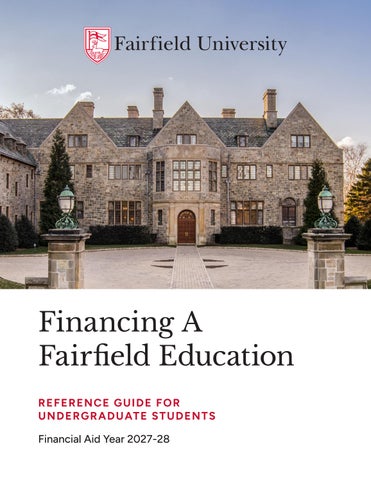
Financing A Fairfield Education REF ERE N CE G U I D E F O R UND ERG R AD U AT E S T UDE N T S Financial Aid Year 2027-28
Table of Contents AN INVESTMENT FOR A LIFETIME
3
FINANCIAL AID CHECKLIST FOR FIRST-YEAR APPLICANTS Important Filing Dates Payment & Payment Plan Deadlines
4
AFFORDING YOUR FAIRFIELD EDUCATION
5
FAIRFIELD’S UNDERGR ADUATE ESTIMATED COST OF ATTENDANCE Direct Expenses Indirect Expenses DETERMINING FINANCIAL AID ELIGIBILITY Calculating Federal Financial Aid Need Calculating Institutional Financial Aid Need Determining Your Financial Aid FAIRFIELD UNIVERSITY SCHOLARSHIP & FINANCIAL AID PROGR AMS FEDER AL STUDENT AID Federal Pell Grant Federal Supplemental Educational Opportunity Grant Federal Work Study Program Direct Subsidized Loan Direct Unsubsidized Loan
6
7
8 9
HOW TO APPLY FOR A DIRECT SUBSIDIZED/UNSUBSID IZED LOAN How To Apply Loan Disbursement
10
HOW TO APPLY FOR PLUS & ALTERNATIVE LOANS
11
YOUR FINANCIAL AID OFFER my.fairfield & The Financial Aid Portal
12
FREQUENTLY ASKED QUESTIONS
13
USEFUL CONTACT INFORMATION
14
FAST FACTS
15
2
3
An Investment for a Lifetime Success isn’t just something Fairfield University students strive for—it’s something they achieve. Just ask some of our 45,000+ alumni who are thriving across the globe in a wide range of careers, from business and engineering to healthcare and communication, and everything else in between.
If you have further questions after reading this reference guide, please do not hesitate to contact us at:
A Fairfield education is an investment in your future—one that holds great value and offers a deep academic experience that goes beyond the classroom and the Commencement stage and stays with you throughout your career.
OFFIC E OF FIN ANCIAL AID
Fairfield University is committed to every aspect of your education, including helping you afford it. This reference guide is intended to assist you and your family in understanding the financial aid process and the various financing options available to you as a Fairfield student. It also features an easy-to-follow checklist so you are aware of the required filing process and its corresponding deadlines.
3
Fairfield University Aloysius P. Kelley, S.J. Center 1073 North Benson Road Fairfield, CT 06824
203-254-4125 finaid@fairfield.edu fairfield.edu/finaid
Financial Aid Checklist for First-Year Applicants Financial Aid Notifications If the FAFSA and CSS Profile are received by the stated deadlines, applicants will receive their estimated financial aid offers by:
Important Filing Dates: (Please abide by the deadlines listed below.) Early Action & Early Decision I Applicants • FAFSA: December 1 • CSS Profile: December 1 • Noncustodial Profile: December 1 (If Applicable)
• • • •
Early Decision II & Regular Decision Applicants • FAFSA: January 15 • CSS Profile: January 15 • Noncustodial Profile: January 15 (If Applicable)
BY JA N UA RY 15 •
• •
PAY MEN T & PAY MEN T PL A N D E A D L INES
Confirm you have completed both the FAFSA and CSS Profile. Our school codes are FAFSA-001385 and CSS Profile-3390. Make any necessary application corrections. Submit all requested documents via IDOC or Fairfield’s Financial Aid Portal: fairfield.edu/netpartner
For more information, please visit: fairfield.edu/bursar. July Fall semester bills sent via e-bill to all students and authorized users. Full-time undergraduate students are provided with an option to enroll in a semester-based, monthly payment plan administered by Nelnet Campus Commerce. For more information, please call Nelnet Campus Commerce toll free at 800-609-8056 or visit our website at fairfield.edu/bursar.
B EFO RE M AY 1 • •
•
Review your financial aid offer via Fairfield’s Financial Aid Portal. Accept or decline the financial aid offer via the Financial Aid Portal: fairfield.edu/netpartner Review that all necessary documents have been submitted via the Financial Aid Portal.
August 1 Payments due in full for fall semester.
BY AU G US T 1 •
Early Decision I: January Early Action: February Early Decision II: February Regular Decision: April
Last date to submit requested verification documents. The request for all required documents will be posted to the Financial Aid Portal: fairfield.edu/netpartner
November Spring semester bills sent via e-bill to all students and authorized users. December 31 Payment due in full for Spring semester.
4
Affording Your Fairfield Education Financing a Fairfield education can be viewed as a partnership among the following parties:
T HE FA MILY
T HE G OV ERNMEN T
The parents and student will be primarily responsible for financing a Fairfield education. Although each family will approach their financing option(s) differently, you should create a plan that covers your student’s cost of attendance over a four-year period. Determining the right financing options is not easy, but you should keep in mind the various resources—educational savings plans, monthly payment plans, savings, current income, and/or loans.
The government plays a vital role in providing resources—grants, work-study, and loans—to help families finance an education.
T HE PRI VAT E S EC TO R There are organizations and agencies that offer scholarship and loan funding to students. All of these sources, sometimes solely and often in tandem, make investing in a Fairfield education possible for thousands of students each year.
T HE U NI V ERS I T Y Through its scholarship and grant programs, the University makes its own significant resources available to qualified students and their families.
HEL PFU L W EB S I T ES: Create a FSA ID The FSA ID (username and password) must be used to log in to certain Department of Education websites. The FSA ID will give you access to Federal Student Aid’s online systems and will serve as your legal signature. Your FSA ID can be created at studentaid.gov/fsa-id/create-account/ Free Application for Federal Student Aid (FAFSA) This is the application that students must complete to apply for federal financial aid. This must be done annually and by the required deadline. The FAFSA can be completed at studentaid.gov CSS Profile (Only Needed in Year 1) This application is required for all full-time students and must be completed by the required deadline for consideration of need-based institutional aid. The CSS Profile can be completed at cssprofile.collegeboard.org Fairfield University Financial Aid To get additional and updated financial aid information, please visit fairfield.edu/finaid
5
5
Fairfield’s Undergraduate Estimated Cost of Attendance Direct Expenses1
First-Year Resident Living On Campus
First-Year Resident Living Off Campus
Upper-Class Resident Living On Campus
Upper-Class Resident Living Off Campus
Full-Time Tuition2
$61,390
$61,390
$61,390
$61,390
General Fee
$1,025
$1,025
$1,025
$1,025
Orientation Fee (First-Year Only)
$425
$425
n/a
n/a
Average Living Expenses3 4 5
$10,278
$10,278
Housing
$13,134
$13,134
Food
$8,430
$8,430
$8,430
$8,430
Books/CM/Supp/Equip6
$1,175
$1,175
$1,175
$1,175
Transportation
$1,150
$1,550
$1,150
$1,550
Miscellaneous Expenses
$1,500
$1,500
$1,500
$1,500
Totals
$88,229
$85,773
$87,804
$85,348
Indirect Expenses1
1
Direct Expenses and Indirect Expenses are two vital parts of the “Cost of Attendance” or budget. All financial aid packages are developed using a cost of attendance. Direct Expenses are charges that a student will incur on their billing statement from the Bursar’s Office. Indirect Expenses are other costs that a student will incur on their own while attending Fairfield University. The amounts factored into the indirect expenses are only averages of what a student may spend.
2
Tuition is based on a student’s anticipated full-time enrollment. If a student fails to enroll full time, their financial aid eligibility will be recalled.
3
Housing cost based on average cost of on-campus housing and food charges are based on a 3 meal a day plan. Charges may vary depending on the type of housing the student is assigned and meal plan selected.
4
Housing and food allowance for a student who lives with their parents is estimated at $10,278 for housing and $8,430 for food and is considered an indirect expense.
5
Housing and food is an indirect expense when a student resides at the beach.
6
Books/CM/Supp/Equip means books/class materials/supplies/equipment.
6
Determining Financial Aid Eligibility
7
C A LCU L AT IN G INS T I T U T I O N A L A ID NEED Take the student’s Cost of Attendance and subtract the Expected Family Contribution to calculate a student’s institutional “Financial Aid Need.”
D E T ERMININ G YO U R FIN A N CI A L A ID Fairfield University commits significant funds to support University scholarships and grants. University resources are allocated on a competitive basis. Please keep in mind, Fairfield’s resources are not sufficient to meet the full need of every student and/or to provide institutional aid to all students.
Fairfield University uses two formulas to determine a student’s financial aid eligibility. These formulas are Federal Methodology (FM - SAI) and Institutional Methodology (IM EFC).
A student, if eligible, will be offered a merit scholarship from the Office of Undergraduate Admission. Need-based financial aid is evaluated and allocated by the Office of Financial Aid. University need-based aid is estimated pending verification of the data that was submitted on the financial aid applications.
The Student Aid Index (or SAI) is calculated once they have completed the FAFSA. The Expected Family Contribution (or EFC) is calculated after they have completed the CSS Profile. Both reflect a family’s financial circumstances and ability to contribute to their student’s educational cost for the academic year.
Your financial aid package may include one or a combination of the following: Federal Pell Grant, Federal SEOG, Federal Work-Study, federal student loans (subsidized and/or unsubsidized loan funds), state grant, and University merit scholarship and/or University need-based grant.
Federal aid (e.g. federal grants, loans, or work-study) is allocated based on the Free Application for Federal Student Aid (FAFSA). The FAFSA uses the federal methodology to determine aid eligibility. Fairfield University’s financial aid resources are allocated using information collected from the CSS Profile. Institutional Methodology is a more complete needs analysis. Fairfield University believes that the IM needs analysis more accurately and equitably measures a family’s financial strength and ability to pay for college. Generally, the formula assumes that educational costs will be paid using a combination of current income, savings, and future earnings. However, each family makes its own decisions on how to meet the costs of college.
C A LCU L AT IN G FED ER A L FIN A N CI A L A ID NEED Take the student’s Cost of Attendance and subtract the Student Aid Index to calculate a student’s federal “Financial Aid Need.”
7
Fairfield University Scholarship & Financial Aid Programs University grants and scholarships are based on academic performance and demonstrated financial need. Approximately 93% of our first-year students are receiving some form of financial assistance.
MERI T SCH O L A RS HIP S All first-year candidates for admission will be considered for merit scholarships, whether they have applied as an Early Action, Early Decision, or Regular Decision candidate. Decisions regarding the scholarship will be made at the time a student is admitted to the University. Fairfield University offers several merit scholarship programs. The students who will be considered for these scholarships are those who have excelled academically and have made the most of the opportunities presented to them through high school, their community, or local organizations.
From its founding, Fairfield University has been committed to providing educational opportunities to motivated students of diverse social and economic backgrounds. To support this endeavor, Fairfield administers a comprehensive distribution of financial aid using its own financial resources, state and federal funds, and private programs. Funds are granted on the basis of both merit and need to supplement the resources of students and their families.
The scholarship amounts range from $15,000 - $32,000 per year, and are renewable for eight consecutive semesters of full-time undergraduate enrollment provided students maintain a required GPA. There is no separate application for merit scholarships.
U NI V ERS I T Y A ID Need-based aid is offered after a thorough analysis of a family’s ability to pay. A student’s need is the difference between the total cost of education and the family’s ability to contribute to these expenses as determined by the CSS Profile. University need-based aid can vary and may be offset by other forms of University aid. Fairfield invests a substantial portion of its own resources for student aid but is unable to meet the full demonstrated need of all students. University need-based aid will remain the same for eight consecutive semesters of undergraduate enrollment provided that a student maintains full-time status and maintains satisfactory academic progress (SAP) as per Fairfield University policies.
8
Federal Student Aid
9
The FAFSA must be completed each academic year to be considered for any of the following aid programs.
FED ER A L PEL L G R A N T This grant is offered under strict eligibility requirements. The FAFSA is used to determine a student’s eligibility for this federal grant program and is intended to assist high-need students. Factors such as a student’s enrollment status and Student Aid Index also determine aid amounts.
FED ER A L S U PPL EMEN TA L ED U C AT I O N A L O PP O RT U NI T Y G R A N T This grant is for students with exceptional need. Funding is limited and priority is given to the neediest students. Students must also qualify for the Federal Pell Grant.
FED ER A L WO RK S T U DY PRO G R A M This program offers eligible students an opportunity to earn money by working part-time on campus or in a community agency. Students may work no more than 19 hours per week and are paid weekly based on the number of hours worked. These funds typically cover out-of-pocket expenses and are not applied as a direct credit toward tuition expenses.
D IREC T U NSU B S ID IZED LOA N The terms of this loan require that the borrower repay, with interest, this source of financial assistance. This program is referred to as unsubsidized because the federal government does not subsidize, or pay, the interest on this loan when a student is in school. Interest on unsubsidized loans begins to accrue after the funds are disbursed to the school. Students have the option to defer the interest payment and instead, capitalize the interest while in school.
Visit our website at fairfield.edu/fws for more information on the Federal Work Study Program, eligibility requirements, and policies.
D IREC T SU B S ID IZED LOA N The terms of this loan program require that the borrower repay, with interest, this source of financial assistance. This program is referred to as subsidized because the interest subsidy is paid by the federal government while the student is in school. Interest will not accrue on this loan during a six month grace period, which is after either graduation or enrollment of five or fewer credits.
Repayment of federal direct loan principal and interest begins six months after the student ceases at least half-time enrollment, and generally extends over a 10-year period. The amount borrowed is subject to origination and guarantee fees as determined by the Department of Education. You may speak with a Financial Aid counselor regarding repayment options.
To qualify for the Direct Subsidized Loan a student must exhibit financial need after all other aid is applied to the student’s Cost of Attendance (COA).
For more information on the Direct Loan Program and interest rates, visit studentaid.gov.
9
How to Apply for a Direct Subsidized/Unsubsidized Loan H OW TO A PPLY
LOA N D IS B U RS EMEN T
Step One: Complete the Free Application for Federal Student Aid (FASFA) at studentaid.gov. Use school code # 001385.
•
If you are a first-time borrower at Fairfield University, your loan will not disburse until you have completed the required Master Promissory Note (MPN) and Entrance Counseling, which can be found at studentaid.gov.
•
Your loan will be disbursed according to a schedule established by Fairfield University and federal guidelines. It will be made in two installments and transferred electronically to your University account.
•
The total amount of the funds (minus any origination fees) will be outlined in the Notice of Loan Guarantee and Disclosure Statement provided to you by the Department of Education.
Step Two: If selected for verification, a student’s financial aid file must include all required documents, a confirmed aid offer, and a completed verification. Step Three: After May 1, complete both the Direct Loan Master Promissory Note and Entrance Counseling at studentaid.gov. Step Four: Log into NetPartner and either accept or decline loans.
• For all loans where the first disbursement is made on or after 10/1/20 and before 10/1/27 the origination fees are as follows:
Step Five: Financial Aid administrators will originate Direct Loans and request loan funds. Students will be notified of approved Direct Loans by mail and/or email with a Notice of Loan Guarantee and Disclosure Statement provided to you by the Department of Education.
1.057 % for Direct Subsidized Loans and for Direct Unsubsidized Loans. 4.228 % for Direct PLUS Loans (for both parent borrowers and graduate and professional student borrowers).
Dependent Undergraduate Students
Dependent Undergraduate Students whose parent(s) have been denied a PLUS Loan and Independent Undergraduate Students
1st Year
$5,500–No more than $3,500 of this amount may be in subsidized loans.
$9,500–No more than $3,500 of this amount may be in subsidized loans.
2nd Year
$6,500–No more than $4,500 of this amount may be in subsidized loans.
$10,500–No more than $4,500 of this amount may be in subsidized loans.
3rd and 4th Years (each)
$7,500–No more than $5,500 of this amount may be in subsidized loans.
$12,500–No more than $5,500 of this amount may be in subsidized loans.
Maximum Total Debt from Stafford/Direct Loans Upon Graduation
$31,000–No more than $23,000 of this amount may be in subsidized loans.
$57,500–No more than $23,000 of this amount may be in subsidized loans.
10
11
How to Apply for PLUS & Alternative Loans How does my parent apply? Parents can go to studentaid.gov to complete a credit check and Master Promissory Note. It will be important for the parent to log into the application using his/her FSA ID. Does a FAFSA need to be submitted in order to borrow a PLUS Loan? Yes! A FAFSA, applicable to the academic year in which the parent/student would like to borrow, must be submitted. In addition, eligibility and the approved loan amount will be confirmed by the Office of Financial Aid. What is the interest rate? To view the current PLUS Loan interest rate and terms, visit studentaid.gov.
A LT ERN AT I V E LOA NS
The amount a student can borrow in federal loans is limited. There are times when a family needs to cover the financial gap that exists between what the student is receiving in financial aid and the cost of education. This section provides more information on various financing options to cover a possible financial gap.
It is recommended that students consider borrowing with federal loans before alternative loans. Federal loans provide various repayment terms and conditions which may be more beneficial to borrowers than some alternative loans. There are many different types of alternative loans, each calculated with varying interest rates and repayment terms. Alternative loan options can be found at: fairfield.edu/loans or elmselect.com.
D IREC T PLUS LOA N What is a Direct PLUS Loan? PLUS Loans are for parents to help pay for education expenses for dependent undergraduate students who are enrolled at least half time in a degree-granting program. The parent applying for a PLUS Loan should not have adverse credit history. If a parent cannot secure a PLUS Loan, he/she may apply for this loan with an eligible endorser, or a student may be eligible for an additional Federal Direct Unsubsidized Loan. You can apply after May 1.
The Office of Financial Aid will certify any alternative loan at the request of the borrower, provided they are eligible. However, it is up to the borrower to determine which alternative loan best fits their needs. It is recommended that undergraduate student borrowers seek a credit-worthy cosigner to help obtain low rates and fees. If you have any questions about loans, please contact the Office of Financial Aid at finaid@fairfield.edu or 203-254-4125.
Please contact the Office of Financial Aid for more information. How much can my parents borrow? The annual limit on a PLUS Loan is $20,000. The lifetime aggregate per student is $65,000.
11
Your Financial Aid Offer Financial aid offers are based on the following assumptions: •
The information provided on all aid applications and documents is complete and accurate. • Student will be enrolled full-time for each term. • Student will not change grade levels during the academic year. • Student is in good standing with the University. • Student maintains satisfactory academic progress (SAP)*. • Student is enrolled as a degree-seeking undergraduate student. If the student learns of any outside scholarships or other assistance they will receive during the academic year, or if the student withdraws from the University or changes enrollment level, it is their responsibility to inform the Office of Financial Aid immediately. Financial aid offers are subject to change at any time.
M Y. FA IRFIEL D & T HE FIN A N CI A L A ID P O RTA L
* The Satisfactory Academic Progress (SAP) policy includes a qualitative and quantitative measure of a student’s progress. The qualitative measure must establish a minimum grade point index standard. The quantitative measure must establish a maximum time-frame for a student to complete their program and a minimum number of credits a student must satisfactorily complete each year. For students to be eligible for federal, state, or University need-based financial aid, they must be in good academic standing and must make satisfactory academic progress (SAP) toward a degree. SAP is measured at the end of each academic year and is based on both pace of enrollment and academic performance at the time of measurement.
University email and my.fairfield are the official means of communication between Fairfield University and a student. Enrolled students are assigned a NetID and are responsible for managing both their my.fairfield and University email account on a regular basis. Admitted students are invited to access their financial aid and scholarship information using Fairfield’s Financial Aid Portal: fairfield.edu/netpartner. The Office of Financial Aid sends all correspondence to the student, not the parent. After first-year orientation in June, the Office of Financial Aid will send all communications to the student’s University email address. It is expected that students will be responsible for the management of financial aid notifications and discuss with a parent(s) if desired. Students can view and make decisions on financial aid offers in the University’s Financial Aid Portal and can view any required verification documents. At the beginning of sophomore year, all financial aid notifications will be sent by University email. The Financial Aid Letter specifies the student’s financial aid offer from Fairfield University. This offer is for one year only. With the exception of merit scholarships, University need-based grants and need-based financial aid amounts offered are estimated until the file, if selected, has been verified.
For more information on SAP policies, please refer to the University’s SAP Standards at fairfield.edu/sap.
12
Frequently Asked Questions
13
Who is eligible for financial aid?
What if I am not eligible for need-based financial aid?
All students are eligible to apply for financial aid. There are no absolute income cutoffs that disqualify a family from applying since family size, total assets, and other circumstances bear on the determination of eligibility. However, a student must be enrolled as a matriculated student at Fairfield University taking six or more credits per semester.
For families who do not qualify for need-based financial aid, additional plans are available to help you finance a Fairfield education. These include the Tuition Pay Monthly Payment Plan, the various loan programs supported by the Federal and State governments, and loan programs offered by banks and other agencies. When will I learn about my financial aid award?
U.S Citizens or Eligible Non-Citizens who complete the following steps by posted deadlines are qualified to receive a financial aid package, which can include federal, state, and institutional aid. International students are encouraged to apply for financial aid by completing the CSS Profile at cssprofile.collegeboard.org by the application deadline.
If the FAFSA and CSS Profile are received by the stated deadlines, applicants will receive their estimated financial aid offers by: • Early Decision I: Early January • Early Action: February • Early Decision II: February • Regular Decision: April Transfer applicants are notified on a rolling basis. Upperclassmen (sophomores through seniors) are notified by early June.
Is my financial aid automatically renewed every year? No. Because family circumstances and demonstrated federal need changes from year to year, you must reapply for financial aid every year by completing the FAFSA by the stated deadline. Students receiving University grants or scholarships may receive financial aid for a limit of eight consecutive semesters of full-time undergraduate enrollment provided they maintain eligibility. However, the CSS Profile only needs to be completed in a student’s first year.
13
Useful Contact Information O FFI CE O F FIN A N CI A L A ID
FED ER A L S T U D EN T FIN A N CI A L A ID
For additional information on the financial aid programs and services offered through the Office of Financial Aid, contact:
Additional information about federal student aid programs may be obtained by calling the U.S. Department of Education’s toll free Information Center at:
OFFICE OF FINANCIAL AID Fairfield University Aloysius P. Kelley S.J. Center 1073 North Benson Road Fairfield, CT 06824-5195 Telephone: 203-254-4125 Fax: 203-254-4008 finaid@fairfield.edu fairfield.edu/finaid
800-433-3243 | 8 a.m. to 12 a.m. EST | Monday–Friday
OT HER FA IRFIEL D U NI V ERS I T Y O FFI CES
OT HER IMP O RTA N T W EB S I T ES
Office of the Bursar (Student Account Information) McAuliffe Hall, Room 301 Registrar Aloysius P. Kelley S.J. Center Office of Undergraduate Admission Aloysius P. Kelley S.J. Center
FA IRFIEL D U NI V ERS I T Y FIN A N CI A L A ID CO D ES FAFSA: 001385 CSS PROFILE: 3390
203-254-4095
203-254-4288
Federal Student Aid
studentaid.gov
Internal Revenue Service (IRS)
irs.gov
Social Security Administration (SSA)
ssa.gov
State of Connecticut Department of Higher Education
portal.ct.gov/ohe/for-students
Monthly Payment Plan Information Payment Plan
fairfield.edu/paymentplans
Fast Web Scholarship Service
fastweb.com
U.S. Department of Health and Human Services
bhw.hrsa.gov/loansscholarships
203-254-4100
Office of Athletics Walsh Athletic Center
203-254-4216
University Main Number
203-254-4000
14
15
Fast Facts 2026-27
#9 Job Placement, Nationally
Founded 1942, by the Jesuits 5,464 Undergraduate Students
1,697 Graduate Students University Schools • John Charles Meditz College of Arts and Sciences • Charles F. Dolan School of Business • Marion Peckham Egan School of Nursing and Health Studies • School of Engineering and Computing • School of Education and Human Development
“Top 1% for Long-Term Value” – Georgetown University’s Center on Education and the Workforce
U ND ERG R A D UAT E P O P U L AT I O N PRO FIL E: Percentage of the incoming class that received a merit scholarship, need-based financial aid, or a combination: Over 90% States Represented: 39 Countries Represented: 34 *SAT Scores of Middle 50% of Admitted Students: 1320-1420 *ACT Composite Score of Middle 50% of Admitted Students: 29-33 * Admission to Fairfield is test-optional
Estimated Tuition: $61,390 Estimated Room and Food: $21,564 Estimated Fees: $1,025 Student to Faculty Ratio: 12:1 Undergraduate Majors & Minors: 55 Interdisciplinary Minors: 36 Graduate Programs: 50+ Study Abroad Programs: 50+ NCAA Division I Athletic Teams: 20 Number of Club Sports: 25+ Student Clubs and Organizations: 100+ Reported Placement Rate for the Class of 2025: 97%
15
FINANCIAL AID
Fairfield University 1073 North Benson Road Fairfield, CT 06824-5195
203-254-4125 finaid@fairfield.edu fairfield.edu
55476_10.26