Changewi l lc ome ,wi t hRe v ol ut i onorEv ol ut i on. . . Whi c honear ey ouwai t i ngf or ?
FAHARI-LIBERTAD Fa-ha-ri: (noun) Dignity, respect, a good reputation. Derived from the language of KiSwahili.
Li-ber-tad: (noun) Spanish for FREEDOM! The Fahari-Libertad is committed to printing the political, social, and economic views and concerns regarding people of color here at SUNY New Paltz. It is published in the spirit of cultural unity as well as bringing about the spiritual unification of all people. The main goal of the Fahari-Libertad is to enrich and educate all with knowledge and enlightenment. We accept anyone who is truly committed to these goals to work with us.
Mission To seek knowledge, truth, and unity with pride.
Contact Us The Fahari-Libertad SUNY New Paltz Student Union Building, Rm. 323 New Paltz, NY 12561 Email: faharilibertad@gmail.com Facebook: Fahari Libertad Magazine Blog: faharilibertad.blogspot.com Twitter: @Fahari_Libertad Copies of the Fahari-Libertad can be found in the SUB, the MLK Center, the Black Studies Dept., The Lecture Center, and the Fahari Office (SUB 323), along with various residence halls.
The Family President Brittany Askew Editor-In-Chief Jada Young Vice-President/ Historian Makeba Hall-Wilson Layout Editor Malissa Williams Cover Design Lamar Mack Josette Ramnani Nicole Rivera Eryka Morales Kamoy Joseph DaShawn Wilson Jay Herrera Staff Writers Jordan Taylor Luana Kay Horry Jay Espy Roger Whitson Faisal Awadallah Manuel Tejada Mosi-Chachawi Cait O’Connor Wilza Descardes Alexis Turner Cody Hill Guest Writers/ Contributors Alexis White Krista Creacy Danielle Adames “Another bitter black woman” Alumni Contributors Regina “Reggy” Rivers Student Euclyn Williams Advisor Shatera Gurganious Faculty Advisor Dr. Karanja K. Carroll
The Fahari-Libertad is currently seeking staff writers, copy editors and photo editors. A major/minor in Journalism/English is NOT a requirement. Please inquire via email at faharilibertad@gmail.com. LIBERTAD
1
From the President’s Desk Hey Everyone,
There has been one question on my mind for a very long time: what is the definition of beauty? This whole idea and definition of beauty has been buzzing around long before I was even born. Personally, I feel that the definition of beauty has to deal with beauty from within. Over the years, I have learned that the prettiest person can have the ugliest personality. This goes to show that looks aren’t always everything. However, in society today, it seems to be that looks and “being beautiful” is what matters the most to people.
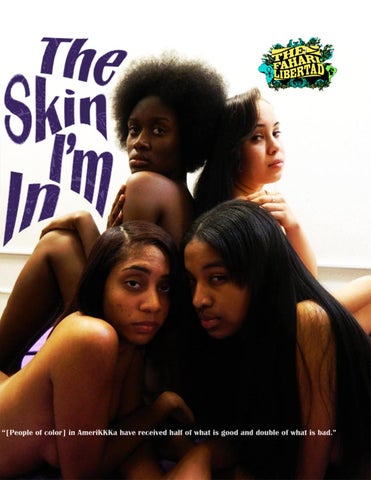
We decided to title this issue “ The Skin I’m In” because a lot of people are not comfortable in their own skin. They are so consumed with fitting into the norms of society that they often lose sight of themselves. One of the major themes of this issue is beauty and we attempt to redefine what beauty really means. We also discuss the things that people do for beauty.
While you read through this issue, just think about what is your definition of beauty? What makes you feel beautiful? This goes for guys as well. Even though most guys may not use the word beautiful when referring to themselves, just think about what makes you feel really good. Everyone has to discover their inner beauty whether they use the term beautiful or not. I hope from reading this issue you will learn more about yourselves as well as your peers around you. Happy reading and see you all next issue.
Brittany S. Askew
President, Fahari-Libertad
2 FAHARI
From the Editor-In-Chief’s Desk Hey there Fahari Fam, I hope you all are well and living as the beautiful, unique miracles that you have been designed to be! Now, let us get into the topic of beauty, shall we? Most people (hopefully) know that “beauty” is as much as a social construct as is gender. Within this society and most others around the world, beauty is constructed through a very particular lens. In most cases, “beauty” is defined under the construction of whiteness; so the whiter you are, the better. That is why you see the skin complexion of so many Black celebrities being whitened on countless magazine ads/ covers all over the world. However, there too exists a paradox in the “beauty of skin complexion,” one where white women (and men) obsess over having “tanned” skin. If you’ve seen one episode of the Jersey Shore, then you know exactly what I am talking about. Beyond whiteness though, beauty is defined in society under the confines of body size/shape/weight. Beauty is also defined through hair textures, facial features, able-bodiedness, etc. My simple response to this is: don’t believe the hype! Everyone, beauty is as beauty does. Outward beauty means nothing! It really, truly does. What truly makes you beautiful is the quality of your heart, your spirit, and the work that you can produce with the lives that you have been given. To have such a focus on the physical being is counterproductive and unnecessary because the physical being is temporary; it changes and it definitely does not last forever. So why spend so much time on attempting to make that better looking when you can make your heart, your spirit, and your work better in quality? My one piece of advice for all of you is to know that you are, no matter what you look like, beautiful. You are beautiful because you are a miracle in its purest form. Think of all of the things that had to come together in order for you to exist as you do now. The only “work” you need to do on yourself is to make sure that you are living a beautiful life; make sure that you have a beautiful heart and a beautiful spirit. Everything else will fall into place for you. I promise! Read all of the work within this magazine, from “The Family” list of staff and guest writers, to the very last poem on the very last page. You will be a better person because of it.
Always with love, Jada Young Editor-in-Chief, Fahari-Libertad
LIBERTAD 3
From the Vice president’s Desk Hello Fahari family I’m a bit nervous to be writing my first editorial as Vice-President of Fahari-Libertad, but for my first editorial what can be better that the topic of beauty!? Think about the clothes we wear, the accessories we purchase, the insecurities we have, and most importantly the way that we judge other people. By examining our daily actions, it becomes obvious that no matter whom you are, in some way, shape, or form, the standards of beauty that society portrays has affected your life at some point. For people of color, the topic of beauty can be contentious. Let’s be real, the standard of beauty is typically a white one, leaving People of Color on the other side of the spectrum. The title of this issue is The Skin I’m In, because as Black people, we are often rejected on the sole basis of our skin. My brother, Kanyé West said “they [white people] made us hate ourselves and love they wealth.” He hits the nail on the head because most of us are so caught up on someone else’s standard of beauty that we don’t acknowledge the skin we are in. Therefore, it becomes especially necessary for people of color to redefine and readdress what it is to be beautiful. Although this issue is called The Skin I’m In , the topics discussed in this magazine are beyond “skin deep.” So while reading these articles, feel free to get mad, to be frustrated, or sad, but be sure to allow yourself to be challenged and think about who you are.
Forever Fahari, Long live Libertad,
Makeba Hall-Wilson Vice-President, Fahari-Libertad
4 FAHARI
The Skin I’m In INSIDE THIS ISSUE 7 What Really Makes You beautiful 8 Her True Beauty 9 Achieving Peace 10 Death Of Dating 11 Myth of the Big Booty Ho 12 Grandma, I’m Graduating! 13 Back To Black 14 To My Love 15 Hairitage 16 What Is The Definition Of Beauty? 18 Beauty Is Pain 20 Things Women Do For Beauty 21 “Untitled” 22 Beauty if What You Make It Out to Be 23 The Beauty of Thicknificence
What The #@$%? 27 In Response to “Blinded” 30 The Date
Poetry 33 Sonnet to Commercialism 34 Fertile Ground 36 “Untitled” 38 We Are the Chosen Ones 39 Barbie 40 Beauty 41 I Am… ME 42 To Be Ugly 43 Man The Fuck Up! 44 A Toast To Where I’m From
LIBERTAD 5
6 FAHARI
What Really Makes You Beautiful By Jada Young, Editor-In-Chief When I went home for White Supremacy Day (better known as Misgivings to some and Thanksgiving to most others), my younger sister kept playing “What Makes You Beautiful” by One Direction. After hearing it more often than I would personally listen to it myself, I began to like it; I liked it more than I would, in my conscious mind, ever want to! I even purchased the $1.29 song from iTunes. Yeah, ya’ll. It got that serious! Not long after listening to it on my own accord, I began to really listen to the lyrics. For those who may not know the song, it’s about the singer(s) singing about a girl who “lights up [their] world[s] like nobody else…” This girl, though, “[doesn’t] know she[’s] beautiful.” Clearly, I suppose, the song is meant to praise the girl’s humility and meekness, even at the thought of the possibility of her own beauty. Cute, right? Well… Not so much. Even understanding the intended message behind the song, we cannot pretend that it is in any way inspiring. Really, it is problematic for most little girls (who make up the band’s fan base) across the world. For one, since the message of the song is that the girl of the singer(s) desire is beautiful because she doesn’t know that she is, that very idea will be reinforced through the thoughts and actions of young girls all around the world who themselves are fans of One Direction. Simply, young girls may begin to at least subconsciously believe that it is good to not feel that they are beautiful because the payoff would be that their “humility” makes them attractive to a potential mate. This is a terrible message to instill in young, impressionable girls: to value one trait (pseudo-humility) over another (“beauty”). The most glaring problem of this song is the promotion of the age-old, tired, annoying, and confining understanding of beauty as being purely physical. When One Direction sings “You're turning heads when you walk through the door” or “Don't need make-up/ to cover up…” or “Everyone else in the room can see it, everyone else but you” what they are really doing is promoting and reaffirming the idea of the “importance” of physical beauty. This fact alone, for me, leaves the song to be more problematic than it makes it non-problematic. While folks like my younger sister think that this song promotes a positive message to young girls, it doesn’t. What young people (and adults) around the world need to recognize is that beauty is not defined or confined by the exterior. How can it be? Why should it be? Since the exterior of any person is ever changing with the times and with the environments, why would the beauty of someone be defined through something that can’t last forever? “Beauty,” then, must be something that can be sustained, it has to be something that lasts longer and means more. It has to be something that is defined from what is within a person. That is something that needs to be taught to young girls and women around the world. Otherwise we will see young people continue to work their outer-selves to a point of no return and then leave their inner-selves to be as hollow as a drum. People, keep living and making the lives of other people around you better. Keep loving, keep inspiring, keep teaching, keep caring. That is what really makes you beautiful. Not hair flips, not make up, not shoes, not weave. Not anything but the work that you do in the world.
LIBERTAD 7
Her True Beauty Racism affects people’s lives because it negatively influences an individual’s perception of themselves. Depending on how you view certain situations, will affect your opinion. That is why everyone has different ideologies because we all function and think differently. Race was created in order to establish a separation amongst each individual. Women generally in our society are belittled and as the years progress the cruelty towards them intensifies. As years pass the struggles for women prolong due to all the limitations our society enforces them with. As for lesbians, the cruelty becomes even more excessive because society views them as unholy imposters that are simply trying to achieve the dominate masculine traits, when in actuality they are just being themselves. Our society already devalues women, so imagine how lesbian women are treated and viewed. Living in a youth-obsessed culture is not easy, especially when you have reached an old age. Old women are considered menaces to society because they are viewed as incompetent, due to the lack of beauty and youth they can no longer deliver. Growing up in a confederate town and looking the way I did, was not completely normal. In fact, it was out of the norm because it was an all white town. I first moved to Springfield, Massachusetts when I was six years old. As a child I was very out going and loving towards my mother. Being my mother’s youngest baby boy drove me to become a momma’s boy. I was always attached to my mother that’s why we have always been so close. Living in Springfield, required my family to make some adjustments. Some of the adjustments were, going to church every Sunday, being part of the choir, doing community service, going to the food pantry to feed the homeless, and playing football on the weekends. These adjustments were all new to
8 FAHARI
By Jay Herrera, Staff Writer
me, especially traditions are opposite to the ones we had to follow. The culture and traditions that people had in Springfield were so much different to the ones here in the state of New York. My mother’s mentality, thought process and perception were all taken away. Taken away by malicious brain washing, that belittled her existence and made her insecure. I remember while my mother watched all of her afternoon soap operas, she would always comment after seeing a beautiful slender woman, “I wouldn’t talk to anyone if I looked like that.” This evidently meant that she in fact wasn’t beautiful because she didn’t look like the woman on television. This was where my mother’s perception was taken away. Her selfassurance was no longer there because she wasn’t on television nor did she fit the dominate race. The dominate race in our present society is White and if you don’t fall into that category then you are not part of the norm. You are basically viewed as a menace to society because anything different provides hope for things to change. I am lead to believe that our society does not want change. All of these beliefs and immoralities became my mother’s norms. My mother today classifies herself as a White women because to her she believes White is beautiful and the only thing beautiful. In fact, beauty comes from all cultures and ethnicities. She gave up the fight, she got tired of arguing for equality and simply decided to blend in. I’ve decided to stand out, that’s the difference between my mother and I. Living in Springfield provided me with the view of how European’s view life and what some of their norms are. Racism shaped my life for the worst when it occurred but for the better because it motivated me to want to do something about it. I won’t give up the fight, what I’m doing is setting things right for future generations.
Achieving Peace By Caitlin O’Connor, Guest Writer After coming to grips with an eating problem that I’ve had since the age of seven, I’ve finally taken real, actual steps to fix the problems I have with food and love myself at the same time. Food has been my friend and my enemy for so many years, and I’ve used it as a crutch through overwhelming anxiety, depression, sadness, boredom, or fear. Even today, with all the resources which I know I have, I still, at times, find it hard to break that cycle. College makes it tough to monitor myself, to control and keep track of intake, and to find real support that sticks. But I’ve learned that nobody can make me give in, nobody can make me hate the skin I’m in- except for myself. I choose which messages I receive with my whole heart, and I choose to let it affect me or to filter it out. Nobody has ever called me fat, but that doesn’t mean anything. I guess I could say that my size has always deceived people--and what I mean by that is, when I go shopping and pick up the size 10 or 12 jeans, my friends are confused. “I always thought you might be like, a size 6! Wow,” are responses I’ve gotten so, so many times. But no, I’m a size 10 and I’m damn proud of that number. Though I still struggle with eating, I do my best every day to make sure I feel proud of the body I have, because I’m well aware that it is so capable of so many amazing things. In the past, I’ve hurt it too much, and I’ve destroyed it with things that I thought could either bring me confidence or help me escape. Those days are over. I will learn to love the skin I’m in, no matter how many white indented lines run over my thighs or between my legs from fluctuating back and forth, growing and shrinking. No matter how many scars I still have from punishing myself for the body I felt trapped in for so long, and no matter how many times I tell myself I hate my skin or my stomach or my really pointy nose. I am stronger than my mind which tells me to give up; I am stronger than the voice inside telling me I will never be beautiful. By who’s standards is it decided whether or not I am a beautiful person? In order to accept the skin I’m in, I have to develop my own standard. I am stuck inside this body for the rest of my natural life, and it is up to me to take care of it. I do not want to spend the rest of my life feeling ‘stuck’ with my body and my physical self, but I want to feel blessed for the things I do have--my incredible, wondrous, mysterious, healthy and functional body included. LIBERTAD 9
Death of Dating (Part One) Review
Death of Dating
Program Response
By Brittany S. Askew, President The program overall was very successful and we had a great turnout. However, I would like to have seen more guys there. The fun part of the program was in the beginning when we had the one minute speed dating activity. I was afraid to say outrageous things to someone I didn’t really know but, it was easier than I thought. The person went right along with what I was saying. I told him that I just wanted to have sex and he completely agreed. However, he was disappointed at the end to find out that we were assigned to say outrageous things and just seeing the look on his face was priceless. I also enjoyed the discussions that took place during the program. It seemed that people had a lot to say about dating and how it is dying. The discussion was actually very insightful. Overall, I really enjoyed the program. I was afraid that people would not come out but, they actually did. At the program, there were a lot of laughs and a lot of different perspectives. This just goes to show that this topic is very prevalent especially when it comes to living on a college campus. 10 FAHARI
Myth
of the
Big Booty Ho
By Makeba Hall-Wilson, Vice-President “Look at that Ass, mama can I hit it?” As a black woman, I see myself as beautiful. My hips, my lips, and legs are a gift given to me from my mother, and her mother before her and so on. When I look into the eyes of my sister, I see the same beauty. Women are the carriers of life; Every human being on this earth, before birth, has lived inside a woman. Unfortunately, when I walk down the streets of my neighborhood, it becomes obvious that the men in my own community don’t see the same sacred light. I got a big butt and nice legs right? So fuck that “carriers of light feminist Oprah Winfrey” shit. Living in Flatbush, Brooklyn, I have had men I do not know grab me, I have been followed home, I have been yelled at, cat called, and cursed out. It’s just a hazard of leaving my house. Why? Because despite the fact that I have been raised with dignity, despite the fact that I am getting an education, and trying to move out the hood, ultimately, these men look at me and see a big booty ho. It wouldn’t matter if I was wearing church clothes, or hooker heels; every Black woman at some point has fallen victim to the myth of the Big Booty Ho. While the video vixen is a relatively new phenomenon, the hyper-sexualization of Black women, and the degradation of our bodies has prevailed historically. Throughout history, we see that white slave owners raped the black women they enslaved; we see that these same slave owners used black men as chattel while slave owners forced them to sleep with black women to “breed.” Historically, we see that the “father of gynecology,” Dr. J Marion Simmons performed experimental surgery on the sexual organs of Black women without anesthesia because Black women were seen as subhuman. The list of atrocities opposed upon on Black women goes on, but the most famous atrocity in history is the story of Saartijie Baartam, a khoikoi woman brought from Cape Town to London in 1810.She went to London with the belief that she would acquire fame and fortune, but when she came to London, she was viewed as a cirrus freak. Having never seen the body of a Black woman, Europeans were fascinated by Baartman because of what they viewed as an usually large behind, large breast and long inner labia (all features not uncommon for a Khoikoi woman). They would pay large amounts of money to see Baartman walk around scantily dressed in a cage. Sadly, even after her death, her sexual organs and brain were displayed in the Musee de l'Homme in Paris until as recently as 1985. The West has always held a sickening fascination with the body of the Black woman. Baartman is a symbol of the degradation and hypersexualization that black women face today. The worst part of this oppression is that we have been brainwashed into believing the hype. In Hollywood, celebrities fatten their lips, hips, and behinds in an almost subconscious backwards homage to the black woman. Our full-figures are no longer necessarily the object of ostracization and we are caught in a tangled web. The black woman’s body is the object of desire, but not for our own satisfaction. History repeats itself: dollar bills are thrown at our ass in music videos. In the media, we are displayed as loose whores. It has gotten so bad that in our communities, Black men chase this big booty ho in the media and ignore the real woman. Sadly, now many Black women have bought into the hype too. We as women are so used to being objectified, that we base our worth on our figures. However, this dangerous marginalization was set up so that we are devalued. Now, women who don’t have the stereotypical voluptuous body, seek plastic surgery to accomplish the stereotype. We, as black females, are the number one growing minority in plastic surgery, with some Black woman going as far as seeking black market surgeries of butt injections, filling their bodies with silicone and cement. I do not want to live in a world where my daughter’s greatest insecurity is what her Butt looks like. I do not want to live in a world where the only dark skin woman my daughter sees is shaking her ass in the videos. And seriously, I’m going to need all these motherfuckers to let me leave my home without being followed. As Black woman, we need to open our eyes and see what the Myth of the Big Booty Ho has done to the identity of black woman as well as our community. The Myth of the Big Booty Ho was invented to take away the power that all Black women inherently have. I refuse to accept the lies told about me. We, as Black women, are not whores; we are not loose women. We are a beautiful tapestry of people who come in all shades and body types. LIBERTAD 11
Grandma, I’m Graduating! By Euclyn “Euke’ Joint” Williams, Student Advisor
I can still remember my first time interacting with anything Fahari- related. Having my mentor and former Fahari president, Vixon explain to me the relevance and importance of this magazine.
I can still remember being elected to Public Relations Chair of this beautiful magazine in the Television Lounge at Shango Hall.
Four years later, I bid adieu to the campus and the magazine that taught me so much. It is so hard to say goodbye to something I’ve put my heart and soul into. How many other publications promise to voice your opinion, unfiltered?
I hold my time here at New Paltz close to my heart. I got to work with the most eccentric and amazing people ever here. I'm proud of Fahari, and I know that I’ll continue to be proud post graduation.
Although I’m sad to leave, I’m glad I had this extra semester to help cultivate this new generation of Fahari-ites and Libertaders. I know I’m leaving the Fahari-Libertad in good hands. I can tell by the fervor in their eyes and the conviction in their voices that the legacy will carry on. This is not the end, but a brand new beginning. And I will never forget where I first found love... In the pages of a magazine.
12 FAHARI
Back To
Black
By Josette Ramnani, Staff Writer
I don't know what possessed me last year to dye my hair. I am Indian and Black, and as such, my signature black hair has graced my scalp all my life. I am a restless person, constantly looking for quick and superficial ways to shake life up, as to avoid implementing the meaningful changes that would truly transform my life. I tried a relaxer when I was 12 years old; the curls eventually pushed out of the strait-jacket I attempted to confine them with. I tried some highlights, haircuts, a tattoo, but at the end of the day, I was the same conventional, brown-haired, brown girl I always was. Last year, I made my first trip to India. I have always felt like somewhat of an outsider to both the Indian and Black world but going to India confirmed my feelings of isolation. I am a far cry from a native, blatantly so, and if it wasn't for my dark hair, many Indians wouldn't even know that I am Indian. When I came home, I had even more trouble adjusting back to my American reality than I did to the Indian one. In addition to being Black and Indian, I am part white. I have white friends, but my consciousness is not orientated toward that perspective, or at least I consciously try to ensure that it isn't. I am Black, but I live in a white suburb, and am uncomfortably isolated from the Black community closest to me. Most of my isolation is selfimposed, though some stems from my upbringing, my interests, and my appearance. Of those 3, the last one is the only one seemingly under my control. Going blonde was not a conscious decision to alter or hide my identity; at the time it seemed like a harmless experiment. I was bored, I never did anything so drastic to my hair before, and I just wanted to know how it would look. I wouldn't call it my finest hour and it definitely didn't provide me with some sort of magical transformation. Still, it was a decision I do not regret; I needed to make it. I learned more about myself that year than I had in a while. Whether or not being blonde has anything to do with that is up for debate. My thought process underwent a series of transmutations, until finally I had a nervous breakdown and dyed it back to black.
At first, I thought that being blonde would make me more outgoing and extroverted; as if blonde hair would lift the neurotic and melancholic cloud that has followed me most of my life. To an extent, it worked, but was I really me without that cloud? Could I really be content with a life of superficial dalliances that blondes seemed so apt to partake in? I will admit, I caught “Beyoncé syndrome.” I wanted some of that confidence, I wanted to be fierce. But being blonde isolated me from myself and my sexuality, and it's hard to be confident when you feel uncomfortable in your skin, which I did when I was blonde. Funny, seeing as I dyed my hair in hopes of feeling more comfortable, making me more unlike myself only furthered my feelings of being unattractive. Self-image aside, my biggest problem with being blonde was feeling like a “race-traitor.” Initially, I decided to go blonde because I could; my skin is light enough to the point where it wouldn't look completely unnatural, though my roots said otherwise. Plenty of Black girls wear their hair blonde, but with more Black girls being comfortable with natural hair nowadays, I was clearly not. Of course, I did not dye my hair under the pretense of making myself less Black. The blonde hair made it less easy for people to identify me as Black, and that would piss me off. I want people to know I am Black and Indian, so why did I think it necessary to look like a white girl? Of course, no one would say this to me to my face, and maybe I was being too critical of myself, but the argument felt valid and hit a nerve. It hit me that I wasn't dying my hair blonde because society devalues Black beauty, but because I do. Societal expectations don't mean much of anything if they don't take hold of you. People are not really as judgmental as we expect them to be, but I am. I hold myself to impossible standards of beauty, fail, and then blame myself for not reaching them. I look in the mirror sometimes and am just sick of being me, and perhaps that feeling will surface throughout my entire life. But the minute I dyed my hair back to black I remembered what it was about me that made me so interesting, beautiful, and me. I felt more beautiful than I did all year. Underneath the blonde mess was the person I had grown to miss, still an insecure mess, but more centered than I was before. So as hard as I was on myself for betraying my status as a brunette, it all served aLIBERTAD purpose to get 13me to appreciate my natural beauty, and bring me back to my roots.
Back when I thought you were beautiful, I was always giggling. But now as the full weight of your lies comes to rest on my chest, taking the wind from my lungs, my breathy laughter is replaced by a denser substance. All I wanna do is smoke, and if I ain’t smoking, I wanna be sleeping. Talking. Is too much, breathing reminds me of the weight on my Chest, watching people reminds me I'm not with them. I feel numb. Doing things that make me feel alive hurts, like eating and dancing. I used to think you were beautiful. I fell in love with the smoothness of your skin, the fullness of your lips, and the way that you smiled. That smile melted me to pieces. I loved you. I love you. I loved you. And every day I was with you, I yearned to be near you. The same smile that once warmed my heart now has shattered this heart to pieces. I question every embrace, every time you said you cared, every time you said you were hanging with the boys. I question the foundation of my love. And now the smile that warmed my heart holds no beauty. I see venom within your dimples and a knife within the hands waiting to hold me. Falling in love with you made me grow as a person. I wanted you to know one day the effect you have on me and my disposition. I loved u with everything that made me me, I gave so much more than I could afford to give. And now as I disentangle myself from your sweet web of lies, I hope to grow stronger still. But for now, My spirit, body, and soul are worn down. from~ Another bitter black woman 14 FAHARI
Hairitage
By Anonymous
I didn’t stay for the entire program. My feelings were too tied up in the first video that was played. The kinks and curls in my tiny Afro began to straighten at each hateful word against them. Of course, when I went to the program, I knew there would be natural hair-bashing. I was also aware of the constant weave bashing. But to hear those hateful comments from my OWN men…men of color…the men I surround myself with every day in college (aka this higher place of learning) was just way too much for my fragile roots to handle. These are the men who will father the future generations of Black children—specifically Black girls— who will grow up to hate whatever they do to their hair because of the outside commentary. One male proclaimed himself to be “anti-afro” and another went on and on about how much he hates weaves because it’s a “sexual barrier.” Uhm, okay?! So then, what do you want? I hope and pray the comments were just for show, but somewhere in my heart I felt sincerity in those negative comments. I also realize that this is a reality within the Black community and it’s something I will strongly fight against in my struggle for my people. Black women should love their natural hair, and if they choose to wear weaves, they should be proud of their weaves! I love extensions and I love the hair beneath it. I need my brothers to see the beauty in this as well. I would definitely love to see this program continue on campus. Next time, the white community on campus should be interviewed as well. How do they view Black hair? That would be very interesting considering they are the majority of the campus. Also, PLEASE get rid of the weave-centered questions. It’s offensive. Every Black woman does not wear weave. The people who do wear weave are attached to it emotionally and should not be badgered during the entire interview. It’s a point of interest, but there’s so much more to discuss when it comes to black hair and its history in both Africa and America. I left after the “history of locs.” I loved that piece. Too often, people don’t understand the hair’s importance to people who loc their hair for spiritual reasons…hair is the closest energy source on our bodies to the spiritual realm above us; the hair and the head are the highest temples of our bodies. This was great to learn. There is energy in our hair and we take pride in it (this is where the sensitivity in black women about their hair probably stems from). Please, keep this in the line-up of the program!
LIBERTAD 15
What Is The
Definition of Beauty By Kamoy Joseph The saying goes, “beauty is in the eye of the beholder,” but is it really? Society has drilled this image and perception of beauty in our heads for years. Blonde hair, blue eyes, and a petite frame, are all we see selling us the latest fashion trends and products. How are we to define beauty, when it is being defined for us? I am a firm believer in the saying, “beauty is in the eye of the beholder” because over time I have realized that beauty does not lie on the exterior but it is an interior trait that allows the exterior to exude beauty. Before coming to New Paltz, I was guilty of making judgments on the way people would wear Afros, and certain clothes that placed them at the center of African thought. As I took more black studies courses, and eventually declared the major, a new meaning and perception of beauty became clear to me. Mainstream media is responsible for placing this Eurocentric idea of beauty in the heads of many individuals because the mainstream media is controlled by the ideas of European-descended people. This leads to the certain divide between groups of people because it places the idea of differences at the center of our everyday living. For example, the light skin vs. dark skin divides in the African-American community. The aforementioned issue is a result of what we see and are taught about what is considered beautiful according to the media and eventually society. This article is not to place the blame of the certain divides among people of color in the hands of European descended people, but rather acknowledge that African people have been taught to adapt to these ideologies and have been forced to avoid their traditional ideologies and customs of beauty.
16 FAHARI
Upon searching the work beauty in Google, two definitions of the word beauty were found: A combination of qualities, such as shape, color, or form that pleases the aesthetic senses, esp. the sight. A combination of qualities that pleases the intellect or moral sense. My question is, who determines what is pleasing to the eye? We can be taught to think what is pleasing to the eye, but if we were really to have everyone describe his or her idea of beauty it would be different. The mainstream media cannot define the beauty because the m edi a do es not represent the general public. Media is a reflection of the government and the ideals of the society the media messages are placed. My definition of beauty is, being comfortable with who you are inside and out. I would say that it took me quite sometime to grasp my own concept of beauty, because I was told by society that I was not cute or attractive because of my weight. They are not to blame, that is just how elements of the Eurocentric worldview taught them to think. Just like they place the idea of people with lighter skin are superior to those who are darker then them. This aforementioned notion has come from Eurocentric ideals relating back to the days of enslaved Africans. Lighter Africans would be house slaves, serving and performing house chores, while the darker Africans would be in the field, completing more bearing tasks. The house slaves were seen as better or superior to the field slaves because they were in the house, and ultimately treated better than the enslaved Africans with darker skin.
How To Actually Be A Beautiful Woman By Helena Andrews originally posted on XO Jane at xojane.com Referred by Jada Young, Editor-in-Chief There’s a post over at Thought Catalogue called “How To Be A Beautiful Woman” that’s obviously supposed to be tongue in cheek as it lays out all the stereotypical checks on the pretty girl to-do list: Be “naturally” thin, be blonde, be sexy but not slutty, be not gross, be perfect. Unless you’ve never watched TV, gone to the movies or flipped through a magazine — basically opened your eyes and looked at things — those subliminal messages about unattainable universal beauty are impossible to escape. Reminds me of the time my 8th grade class took a field trip to the Museum of Tolerance and the tour guide made everyone choose to go through either a door marked “Prejudiced” or one marked “Unprejudiced.” Guess which door we all chose? Guess which one doesn’t open? Same thing goes for beauty. There are women who buy into the bullshit and those who claim they don’t (and have the hairy pits to prove it), but how can you really not? And I’m positive hairy armpits are the jam to someone, somewhere. At least I hope so. Because, winter. Often, we allegedly enlightened grown women assume that each one of us has tattooed Maya Angelou’s “Phenomenal Women” across our sagging boobies in invisible ink. Of course we know beauty comes from within. Duh! That it comes from confidence. That beauty’s only skin deep. It’s in the eye of the beholder. And all of the clichés your health teacher taught you. But how do we actually carry that out into the world? I’ve never been told straight out that I’m hideous. My face is pretty symmetrical, but my eczema-ravaged skin has always been splotchy. In high school, my nickname was Olive Oyl. Also I regularly got called a “transvestite” for no tangible reason I can think of. I didn’t kiss a boy until the eleventh grade and not again until college. But somehow throughout all that (which honestly isn’t pretty pat in high school), I just thought everyone else was behind the curve. Seriously. Even when I was crying my eyes out in the girl’s bathroom after some little bitch called me a “man” I can remember thinking, “Someday.” But why? It’s not like I was crazy confident. I wasn’t. I was a skinny black nerd in “Gapp” jeans with a bad press and bowed legs. Beautiful wasn’t something I heard on a regular basis, but I still felt it. Funny thing: I recited Maya Angelou’s “Phenomenal Woman” to an auditorium full of hungry high schoolers as part of this lunch break art program (did I mention I was a nerd) and I actually understood every line at 16. No I wasn’t “cute” — although yes I did fit a “fashion model’s size”– but the last words in the ending couplet — “That’s me” — made sense. Maybe it’s because I was an only child who got to spend hours on end with herself or because of my excellent first ballet teacher or the plethora of black dolls in my bedroom. Carrying around the ease and comfort in that line is what’s given me more “I feel beautiful” days then “meh” days ever since. But that’s me. That’s how I roll. It’s different for every woman and after all the dust from debating the damage of impossible-to-reach beautiful standards settles we’re left here — dusty. Do you stare at yourself in the eye in mirror for a few seconds every morning (guilty) or sit quietly in a chair while concentrating on your body for a minute a day (my mom)? How do you become a beautiful woman?
LIBERTAD 17
Beauty is
Pain
By: Luana Kay Horry (on behalf of Beauty Lab), Staff Writer “Beauty is pain.” We all know the cliché. But how far do other cultures of the world take this simple cliché? Some take it to an extent that most Americans would see as extreme…weird… ridiculous…or even painful. And who becomes the victims of these beauty practices? Women, of course! Women all around the world- Asia, Europe, and Africa- undergo some of the most unique beautification processes that, from the outside looking in, are very hard to understand. In Asia, women were pressured to have small feet. To solve the issues of not naturally having feet that were three inches in length, women paid a large amount of money to have their feet bounded. Foot binding is a process that began in a girl’s infantry until her four toes are folded backwards in a way that her foot is as tiny as possible. This disallows any further growth but men found this attractive. It was once even a sign of family wealth. Mainly in African countries, and some in South America, the lip disc is perceived as beautiful. Again, this starts at a very early age. Women (and men) wear these discs as lip rings and it has the same affect to the mouth that a gage has to an ear. Although this is seen as being very attractive, it can result in disease and an irreversible stretching of the skin. 18 FAHARI
Neck rings, mostly worn by women on the continents of Asia and Africa, give the illusion of a beautiful, elongated neck. This is seen as beautiful and also gives the observer the impression of wealth. The rings simply push against the person’s collarbone and ribs in opposite direction but don’t really alter the neck size. These rings are worn as early as age two and have become great tourist attractions. Corsets, worn in European countries during the 16th century, alter the torso so that a woman’s body would appear to be of two separate parts. This became attractive in that women were to have flat stomachs and illusionary bustier ‘top and bottom.’ Women would sometimes remove their ribs to better display the extreme effects of the corset. Scarification, popular among the Karo tribe in Southern Ethiopia, is the practice of scarring a woman’s stomach with a blade of some sort and leaving it to create permanent whelps. This is usually done in a particular pattern. These scars become important to a Karo woman because it is a sign that she
is at the point of maturity (similar to how menstruation is regarded in Western women); this means that she is ready for marriage, childbearing, and being a part of the tribe. Most importantly, it’s seen as beautiful. The men love this. The more elaborate the scars, the more attractive the girl becomes. It has become a newer trend in East Asia to experience eyelid blepharoplasty. This alters their traditionally categorized ‘Asian eyes’ so that they may have a double eye lid—one more similar to that of European women. This surgery makes women into what they see as beautiful because of the Americanization of certain Asian cultures. Asian women now have the chance to have larger eye lids. At this point, we expect you to be twisting and turning your face into various expression of confusion. We, in the West, do not understand these concepts of beauty. Questions in your mind may include: “why can’t men accept women for how they are?” or “is it really worth all of that pain to attract a man?” Those are questions we must ask ourselves. American mainstream beauty tactics are physically painful and can sometimes take a toll on us emotionally. If we look at our magazines, it’s the Victoria Secret models or the tiny size zero Continued on Page 21
Amber Riley on Accepting Herself: I’m Not Going to Hurt Myself to Be a Size Two By Britni Danielle originally appeared in Clutch Magazine at cluchmagonline.com Referred by Jada Young Editor-in-Chief Body image and weight is a struggle for many women, but when you’re an actress governed by Hollywood’s rigid beauty standards, being outside the norm can not only limit your success, but can do a number on your self-esteem. In MTV’s new show, This Is How I Made It, the network takes a look at how some of the entertainment industry’s brightest talents achieved their dreams. In an upcoming episode, former Glee standout Amber Riley discusses how she became a household name. In one poignant scene, Riley discusses how being a young, plus size black actress in Hollywood nearly shattered her self-image. She tearfully recounts: Hollywood is a very hard place to be in. It really is. Being the person I am, you know, the size I am, being a woman, being a black woman, there’s not a lot of roles for us. After I did St. Sass…I was being offered the girl who sits in the corner and eats all day, the girl who wanted to commit suicide because she was fat. It was never anything that I felt had a good ending. I never wanted to play a character that hated herself. I wanted people to know that those aren’t the only kinds of roles for women like me. Normal girls. Going to the auditions and having the casting directors say, ‘I think you need to lose a little weight,’ I couldn’t understand why people couldn’t accept me for who I was and the rejection started wearing on my self-esteem. That’s when my mom and I decided to stop. …I’m not gonna conform and hurt myself and do something crazy to be a size two. My parents always instilled knowing that you’re beautiful and knowing that you’re fearfully and wonderfully made and no one can tell you who you are. You know who you are. I’m a healthy person. I have great friends around me that are positive and I think that’s the key to life is making your own path. Set your own rules because there is no set rule, there is no set look, there is no set anything. You make your own rules in your life. You make your own decisions. Riley, who recently finished a stint in the Broadway musical Cotton Club Parade, serves as a role model to many young girls who may be struggling to accept themselves. Her advice, “to make your own rules” serves as a wonderful reminder to all women no matter what they look like or field they pursue.
LIBERTAD 19
Things Women Do for Beauty By Brittany S. Askew, President
In today’s society, women will do (or sacrifice) anything in order to keep up with society’s norm of beauty. It gets to the point where they would even sacrifice their health just to look good. Just to look “beautiful” on the outside some women:
won’t go to the gym because they feel that they will sweat their weave out or their fresh wash and set will get butt implants to have the ideal “big booty” will get breast implants to be more attractive perm their hair (which we all know has harmful chemicals) wear tons of makeup which can clog up pores and lead to skin ageing use cosmetics that can lead to skin cancer
The list goes on and on. However, women often fail to realize that you will not feel beautiful on the outside until you feel beautiful on the inside. Inner beauty is really important because it is ultimately what makes a person genuinely happy. If you are unhappy with your inner beauty, you will be unhappy with your outer beauty as well. As a result, women do all of these bizarre things to their bodies in order to be happy when they really aren’t. In my opinion, society needs to reevaluate its definition of beauty so that women can start to think more about their health and inner beauty rather than what makes them feel beautiful for the moment. No matter how much makeup they put on or how big their butt implants are, they still won’t feel beautiful because beauty comes from within. Natural beauty is the only true beauty.
20 FAHARI
Continued from Page 18
girl that has been airbrushed to perfection—at least American ideas of perfection. We undergo constant dieting, hair maintenance (from cuts, to weaves, and perms), painful waxing of body hair, make-up, anti-aging procedures, and worst of all; the constant comparison with women who we will NEVER be. Plastic surgery on our breasts and the shots of collagen into our faces and asses are just plain scary. Let’s not mention the pain of the high heels, or the painful clothes we try to fit into. How about the pain in our skinny wallets? No matter how much money it costs, we try to fit into the extreme and weird category of beautiful in America. Let us remember that both the Ethiopian girl with the scars, and the girl with the double eyelid, may also find what American women do as weird. Trying to fit in is always weird. It is equally painful. It doesn’t matter if you’re here or miles across the ocean, any definition of beauty that alters you is a painful one.
You know that old saying, “beauty is in the eye of the beholder”? Well, it’s true, although it has sort of become a cliché. There’s no one way to be beautiful, and don’t you ever let someone tell you any different. I know that in this day and age, it takes great courage to stand firm in such a conviction, especially when the general idea of beauty is defined by the images we see in magazines and on our TV screens. I want to commend the SUNY New Paltz community (clubs and organizations) for promoting the unique characteristics that makes each of us beautiful, and for encouraging young women to look beyond mass media and into their hearts for the true definition of beauty. We must continue to be accepting and understanding individuals, because even if you feel you have it all—the looks, things of material value—ultimately you become a slave to these things and that same person you are oppressing might have freed themselves of it. Look beyond the exterior and love people for who they really are. Isn’t life more than the clothes on our backs or how long or short our hair is? Whether it’s curly, straight, kinky, thin, thick, red, blond, or black? Just do what makes you happy and whatever makes you feel beautiful. Whether it’s decorating cards for victims of Hurricane Sandy; volunteering at a homeless shelter; or wearing red lipstick. Just live for yourself and don’t allow society to oppress you (I should really take my own advice). I probably haven’t met you yet, but I think you’re beautiful even for taking your time out to read this message. You’re beautiful when you cry, when you laugh, when you scream at someone…because these are all human emotions. You beautiful because you were born into this world and it happened for a reason. You’re beautiful because there will never be any other YOU. There’s beauty all around. Beauty in nature, the stars, and the people we love. There’s a reality, a world out there, full of beauty. "Remember how in that communion only, beholding beauty with the eye of the mind, he will be enabled to bring forth, not images of beauty, but realities (for he has hold not of an image but of a reality), and bringing forth and nourishing true virtue to become the friend of God and be immortal, if mortal man may." -Plato By Tanique Williams, Staff Writer
LIBERTAD 21
Make it Out To Be By Alexis Turner, Guest Writer
Being wrong and young is hard to admit at times. One of the things I’ve learned is that it’s okay to ask for help, being young and still learning. People make mistakes all the time. But without learning from a mistake or asking for guidance, serious problems can be caused. Not just for you but for others around you who are affected by the choices you make. Since I can remember, I have been picked on because of my weight. It’s been rough going through it, but I know at the end of the day, it’s not right. Being made to feel the way I did and still do at times, I used to ask myself, “What is beauty?” You see all these celebrities thin or thick who are always trying to lose weight for a part, or getting weight-loss surgeries. Being bullied because of my weight at the young age I was, I didn’t know what the true definition of beauty was. Now, everyone has their own definition and that I know for a fact. I do think I have a reasonable and healthy definition of what beauty is. Beauty isn’t about looks. Beauty isn’t about looking like a star, or being thin or trying to resemble someone else you may know. It mostly comes from the inside. That is where it begins, at least. I used to think I have to be someone I’m not to impress people to satisfy them and live up to their standards. What about my expectations? What about how I feel? I feel like I shouldn’t have had to cry all those years and shed those tears for those people who bullied me. It was a waste of my time and energy and I was trying to fit in where I didn’t feel like I belonged. People who call themselves ‘role models,’ celebrities/stars, looking up to them was the last thing I should have been doing. It only leads to more pain but it also helped me see the main problem. Something I would never want to be. What was my main problem? My main
22 FAHARI
problem was that I was trying so hard to be something I was not. I was trying to be “someone” just to make everyone else happy. Losing weight for other people and to look good or to look like a celebrity isn’t the right thing to do. It is most definitely not the message I want to send to other people who were bullied or still are being bullied because of their weight. You should want to do it for yourself and no one else. Feeling good about yourself is one thing and accepting yourself is another. It’s also the key to happiness and love in life. Loving yourself is everything. You don’t need to be a star to do all that, nor do you need to be at any certain weight or resemble anyone you think is prettier than you. Beauty starts from within your heart, with acceptance, loving yourself, and not needing to depend on anyone else for approval. All that matters is how you think of yourself. No one else’s thoughts matter. You can be sitting in this world alone with barely any friends and still be judged by people who you don’t even know you. It still happens to me every day. But I don’t let it bother me because beauty is what’s on the inside and if someone wants to judge me, let them. What’s on their inside is quite ugly then. My thoughts are the only ones that matter because I have to live with myself; not with those who choose to judge me. I come so far from the road to being bullied and having low self-esteem. My dad always told me that “we [my family] love you for who you are, not for someone you’re trying to be.” I want to say thank you, dad. Those words will forever stick with me. They have helped me so much with becoming a stronger person and finding my true beauty. So my advice to people is everyone is beautiful. It’s how you want to look at and present yourself and whether you want to accept yourself.
The Beauty of Thicknificence By Regina Rivers, Editor-in-Chief 2008-09, Alumna Contributor
You see them in the movies, on the covers of magazines, and in the videos; you can’t escape them. Marketing and advertising coupled with mass media consumerism alters your thinking. You begin to doubt yourself with self-loathing phrases denigrating the structure of your face, frame, your cheap wardrobe and decide that you are not the beautiful man or woman that God created you to be. You are nothing like the perfect model on TV, or the sex icon covering People Magazine, or the hip-swiveling diva in the music videos. Despite success of full-figured powerhouses, the plus-size revolution hasn’t triggered yet. Then I came across this movie, Phat Girlz, starring Monique and Joyful Drake. This 2006 comedy follows the life and times of Jazmin Biltmore, a plus-sized aspiring fashion designer and retail sales associate. She lives with her veggie nibbling cousin, Mia, who is a skinny-yetcurvy personal trainer. Jazmin wins a trip to Palm Springs and is accompanied by Stacy, her reserved, voluptuous best friend, and Mia. While the two women watch Mia flaunt herself in front of a Nigerian doctor, Tunde, all are shocked to find out that he has eyes for Jazmin. Tunde and his friends find Stacy and Jazmin the most beautiful women in America. As for Mia, her thin appearance that is considered the norm has the Nigerian men questioning how sick she must be. In America, big is big. How many women can I think of have been taunted and ripped to shreds because of their weight? All for the love of trying to conform to standards of beauty that end up being nonexistent because you hope that the world will finally give you what you feel entitled to…sadly it never will. In Tunde’s culture and case, women bountiful in shape show how rich they are and are labeled as a Thick Madame. This phrase will remain significant for Jazmin. What I appreciate about this movie is the message of thin not always being in. Fat was changed to PHAT: Pretty, Hot, And Thick, and it was magnificent. I know I’m not the only one who has dealt with battles of the self or with others. My parents have always told me how cute and nice looking I was and taught me how to take care of myself. Yet, kids were crude fools whose words remained floating in my psyche for some time. My brothers always told me how pretty I was and threatened to dismember anyone who said otherwise; I thought that was their jobs as older siblings. There were also few who made it clear to me that I would never be as pretty or as skinny as they were. Such verbal assault lead to desires of punching, kicking, and bashing with objects…thank goodness I chose the writing path. After jumping in and out of writing and poetry and telling those negative nuances where to go and how to get there, the Thicknificent revolution began taking its shape within myself. Back to the movie, Tunde treats Jazmin so much like a lovely lady; she finds it too good to be true. Stacy and her friend, Akibo, are busy getting *ahem* sensually acquainted with each other. Jazmin still suffers with her self-esteem
Continued on Page 24
LIBERTAD 23
Continued from Page 23 after Tunde’s reminders of the beauty in not only her features but also, her personality. While he kindly tells her that being a size 5 is impossible for her, he encourages her to want to change her appearance for herself and not for the approval of strangers (I know right, they ain’t paying her bills…but I digress). After going off on Tunde and having a nervous breakdown, Jazmin looks at herself in the mirror in all her jiggly glory and tells her reflection, “You are a dime girl, and don’t you forget it!” She was a new woman, a fat-tabulous woman! When she returns back to work, she bypasses her manager to talk to the buyer of the department store, and her dreams of launching her plus-size fashion line unfold, and Thick Madame was born. A year later, she went national. Jazmin eventually gets her man, Tunde, Stacy gets her man, Akibo, and Mia has a new goal: to pack junk in her trunk so she can get a man who is a rich Nigerian doctor. This movie forced me to look at myself in a new light! I, too, have jiggle in my walk and sass in my talk. While enrolled at New Paltz, my friends and classmates would have many talks about the appearance of women. Hips and backsides were at the forefront and I looked at my girls, smiled and responded, “I can’t control my jigglitations!” It received positive feedback. As long as I’m looking and feeling healthy and my make-up and outfits are on point, I don’t have a problem with my jigglitations or my thicknificence…and neither should you!!!
24 FAHARI
Artwork by Faisal Awadallah
Artwork by Alexis White
LIBERTAD 25
WHAT THE #@$%?! INSERT FOUR LETTER EXPLETIVE OF YOUR CHOICE
26 FAHARI
In Response to “Blinded” By Jordan Taylor, Staff Writer Cody Hill, Guest Writer The purpose of this article is strictly to express our opinions in response to the article “Blinded” in the October 2012 ninth issue of the Avant-Garde magazine. This is in no way intended as a personal attack on the character of the author of the article, or the magazine as a whole. With that being said, let us begin. “Blinded” is supposed to be “a commentary on social privilege and what it means,” (Wilkinson) but I feel like it misses the whole idea of understanding social privilege. In discussing social privilege, we understand that everyone in this life has problems, and we understand that intelligent, straight, middle class white people can have problems too. The argument we make is not that people who fall in these privileged groups do not have issues or problems. The point is that not only does the society in a sense worships these groups by praising them in the media and infecting the masses with these subconscious ideas, but also how the worship gets institutionalized in the structural systems of the society. We understand that white people still have to work to get what they want in life; that things are not just literally handed to you on a silver platter, but it is clear that Black people will have to work harder, and this is just for tangible success. Black people will still be viewed as a threat and intimidating by society. These expectations, these dominant narratives are not expected of white people (controlling for gender, sexual orientation, income, etc.) and play into how others of various social standings that AfricanAmericans see themselves subconsciously. The discussion of social privilege is not to invalidate or question the successes of privileged people; it is spark solutions to the problem of low expectations and prejudice for the other underprivileged groups. By pointing out that you are white and you also had to work for your position is just avoiding the actual problems that exist. We all understand that white people, straight people, males, etc. do not just wake up successful; we are capable of understanding the concept of people working hard for what they want. To address that as if we can’t understand how any white person has problems is insulting to me personally because it is as if I am incapable of critical thought. This argument just seems like an excuse to avoid focusing on the real problem of the social Continued on Page 28 LIBERTAD 27
Continued from Page 27 inequity. Talking about how much work you still had to do, even with your whiteness, works as if you are excusing yourself from being a part of the oppressive factors of the society. Also, having African American and PuertoRican family members just seems like an irrelevant point that touches onto the discussion of color-blindness. Social oppression is not the same thing as feeling sad or having your feelings hurt. The defensiveness with which the author approached her commentary on privilege is, in itself, a huge display of privilege - she was told that her privileged kept her from understanding some specific issues faced by marginalized groups of people, and instead of accepting and analyzing that fact, or attempting to use her privilege to be an ally, she re-centered the conversation to be about her own personal feelings, which neither educates the public about these issues of privilege and oppression, nor contributes any legitimate analysis of the problems at hand. Approaching and telling a person that they are privileged and need to understand and analyze that is not an attack or insult, but a simple fact. In order to be an ally to anyone, be it people of color, queer and Trans folks, people with disabilities, etc. you must acknowledge your privilege, and what that really means in order to actively and consciously work against it. Whiteness and cisgender-heterosexuality are systems of oppression that surround us constantly and manifest in all of our institutions and interactions. Simply stating “I know I am privileged” does not negate the fact that in practice, you exercise that privilege in ways that undermine the experiences and voices of marginalized groups of people. To state that you “have gay friends” does not exempt you from accountability regarding your heterosexual privilege. Having a black family member does not mean that you are automatically exempt from accountability regarding racism and white privilege. Friendship with a person who possesses a specific marginalized identity is not enough, and in fact is problematic if you continue to reduce your friend to the one facet of their identity for which they are oppressed, in an attempt tokenize this person as a pawn to prove to others that you are progressive. The instinct that is mentioned at the end of the article stating that we are all humans and we all bleed red is a fact, but the colorblind statement should be at another time. For now, I am open to having discussions of privilege and colorblindness if this article sparks opinions in anyone else.
28 FAHARI
Dr. Martin Luther King Jr. Day 2013 From Overseer to Officer: Surveillance and Control in Communities of Color Political Prisoner Letter Writing Campaign
Free Food! Free Giveaways!
Time: 7:00pm Location: LC 102 Date: Monday, February 4, 2013 Sponsored by The Martin Luther King Jr. Day Committee, Department of Black Studies, the Black Student Union, Sankofa Africa Organization, the African Women’s Alliance, FahariLibertad, New Day Ensemble, Alpha Phi Alpha (ΑΦΑ) Fraternity Incorporated LIBERTAD 29
The Date A short, fiction story by Jada Young, Editor-In-Chief I’m nervous. So nervous that I can’t even put on my eyeliner in a straight line. What am I doing? I don’t even wear make-up! Why did I agree to go on this… this date? Damn! There goes my eyeliner. Messed up. I have to start over. Again! Maybe I should cancel this date. I don’t even look good in this dress. Since when do I even wear dresses? Why did he ask me on this… this date? Malcolm. What a name. What a man. What a smile. Remembering his smile, I realized why I said yes to him. I’ve never seen a smile so bright, with a man so nice to match. I never met a man who… who wanted me. Maybe I should go on this date. I mean, I really do want to feel wanted by a man. Especially one as beautiful as he is. I’ll go. Yeah, I’ll go. I began to clean the eyeliner off of my eyelid (and my cheek) when I heard a knock on the door. “Oh no” I whisper. “Could he really be here… he has to be like an hour early.” I thought as I looked at the clock on my cable box. “Damn! He’s right on time…” I thought to myself. But I can’t let him see me like this… I look like I got scratched across the face by a black panther. I quickly scrubbed my face clean as Malcolm repeatedly and anxiously rang the doorbell. “Coming!” I yelled and ran to the door. I stopped at the door and fixed my clothes before I answered. Feeling butterflies, I slowly opened the door, expecting to see only his smiling face, but instead I saw a bouquet of beautiful roses and Malcolm’s golden smile. Stunned, all I could do is stare. “Sanaa,” he chuckled. “Aren’t you going to let me in?” “S-S-Sorry.” I laugh nervously, “Come in” “Sanaa, you… you look beautiful.” Malcolm says staring at me “Wow.” “Umm.. Haha. Thanks… I uh…tried wearing make-up, but it uh… didn’t work.” “Well, that’s great, because you don’t need any make up. Your beauty radiates through you naturally.” I could do nothing but stare at him. Beautiful? Me? Sanaa Owens? Really? “Sanaa?” he laughs. “Sorry… I… uh… don’t really know what to say to… that” “Thank you is the usual answer.” He smiled. “But um.. here.” He handed me the flowers. “These are for you.” Wow. I can’t. He’s perfect. He wants me? 30 FAHARI
He smiled as I stood there again, stupidly. Not saying anything. “So, shall we leave?” He asks. “Yeah… We shall” Malcolm reached for my hand and we walked together out of my apartment and in to his car. Of course, the car ride was an awkward one. I read on an online magazine that it is better that women order something light at dinner… like a salad. But I didn’t. I ordered the biggest, meatiest steak on the menu. He did the same. Are we perfect for each other or am I just imagining? Yeah, I’m just imagining. So, I may as well ride this date out for as long as I can… who knows when I’ll get one again. I mean damn, it took me 25 years to get this date! . .
. After awkward conversations, both steak and broccoli in my teeth, and dropping my fork and knife on the floor twice, I made it through the date. Now, we’re sitting in his car waiting outside my apartment. I know I have to talk to him. Damn. What am I going to say. “Sanaa…. I like you. I like you a lot. You’re intelligent, funny, spontaneous, genuine, and beautiful. I want to see you again. And again. And again.”
“Malcolm… I … I don’t know what to say… I’ve never been called beautiful before. I’ve never been desired by a man. I’ve never… had this… or anything like it before.” “Sanaa… you are beautiful. You are the most beautiful woman I know. Please know that. I want you to trust me. Can we go out on a second date?” .
.
.
Our dates continued. Our bond strengthened, and Malcolm became the man that I love and trust more than anyone. Before him, I never felt beautiful. I never felt that I could be worth love, especially romantic love. But he loves me and I love him. On May 19th, 2009, Malcolm asked me to marry him. On February 16, 2012, we welcomed our daughter, Nala, into the world. I found love. LIBERTAD 31
{}
Poetry 32 FAHARI
Sonnet to Commercialism By Roger Whitson If you're ill, or need a thrill, take a pill. And men if your libido has grown cold, Buy Viagra a lot of it is sold. Go get some and give your lover a thrill. When it's too hard to empty your bladder, And you don't have the cash but have the will, Go beg, borrow or steal a purple pill, For this could be a serious matter. If you can't sleep, they're cheap, buy one of these And when you awake you will feel better, You will forget that you are a debtor.
My Idea of
And buy one of these if you start to sneeze.
By Nitya Pillai Referred by Kamoy Joseph
And buy one of those if you soil your clothes. And buy one of these if you are obese.
Beauty is the sensation of your heart skipping a beat, when eyes full of mischief glance at you... Beauty is the smile which appears on your lips, when you think of the way he smiles at you... Beauty is in the heart which touches another Beauty is tender hands holding each other Beauty is strong arms holding you warm Beauty is in water, beauty is in weather, Beauty is in air, beauty is in life Beauty is in love, beauty is in wind... Beauty surrounds you days and nights Yet no one knows beauty's heights...
LIBERTAD 33
Fertile Ground by Jay Espy Fertile ground
So before they devour
Feed me your warmth
our
Mother earth
Fertile ground
You give me peace
Lend me your hand for guidance
and tranquility
For you have done great things for me
in times of despair
in times of despair
And dryness
Never have you done me wrong
Your highness
I have followed you through the Nile Where you led me to victory
Fertile ground
each and every time
My lips have become pure with your
Your treasure of gratitude greeted me at the
kiss of growth
gates of transcendence
from the fertile soil of mother Isis
with patience
Better named Aset Her soil spreads beyond the horizon
So be patient
The blue sky tickles the sun's rays from
remember that
Ra
We are agents
one of many
So may this
Among all of us is the
day be the first
spirit of love
of new creation
and power
Of new life Of new energy From the fertile grounds of Mother Earth
34 FAHARI
Sonnet at Cemetery By Roger Whitson I visit my family cemetery At Cedar Grove in state of Tennessee. My nearest and dearest kin sleep within, Not to know sorrow nor happiness again, Never to feel loving lips, nor arms again. Their ears are stone deaf to the words in the wind Which whispers mournfully in cedar trees. I'm sure the sleepers here had thoughts like these. Here in this graveyard white marble angels gleam. I wonder if these sleepers can dream? In this lonely glen of owl and den of fox, These graves are covered over with thyme & phlox. I, too, will sleep here with my moldering kin In a house of clay, in a satin-lined box
Artwork by Alexis White
True beauty By Jean Pullman Referred by Kamoy Joseph
True beauty is in the way she laughs True beauty is in her eyes True beauty is how she acts True beauty is inside True beauty is unseen True beauty is only felt True beauty is not mean True beauty is herself True beauty can't be cruel True beauty is bare True beauty within you True beauty is always there True Beauty can't be covered with makeup True beauty means true love True beauty can't be baked up True beauty is the flight of a dove True beauty has no flaws For True beauty is all that matters after all
LIBERTAD 35
By Krista Creacy Christina Aguilera sang
and maybe I’m not perfect but that’s okay
you are beautiful no matter what they say
right?
Yes, words can’t bring me down --
I’ve been told
but they can.
less gut
see
less pudge
I've got this thing in my room called a mirror
less looks
it was designed so I could see myself clearer
less real
but the media has continually told me lies
more looks
playing tricks on my eyes
more love
tellin’ me
more Barbie appeal
I got some extra fat in my thighs
...
too large so I’ll never take the crown or win the prize
fuck Barbie
but Maya Angelou said I’m a phenomenal woman so still I rise
I’m takin’ my ass to Arby’s
I’ve been told I’m not “perfect” I’m “too fat” my feet are “too big” my smile isn’t quite right my eyes are kinda chinky my natural hair is “too kinky”
so maybe I’m not thin or trim and I haven’t been to the gym in about … yeah my body is more of a curve than a straight line and I wear a size 9 ..and a half
and I’ll be in Fat Bob’s after the party
My hair is a lil’ too big, wild and curly and it'll never be straight enough the curls will never be perfect like Shirley -Temple’s and neither will I but I am all my imperfections and that’s what makes me beautiful
My laugh is too loud but I won’t quiet it for you I’ve got too many curves to ever be a size 2 and if any of you think so, I bid you adieu
And I can’t really see when I smile And umm you see the way my teeth are lined up
36 FAHARI
and I’ve broken a few combs in my day
Background Photography by Wilza Descardes
It took a long time
Realize
Too many names and negative opinions for me to
Through real eyes
redirect my thoughts
All the real lies you’ve been told
recollect my self
Break the mold
and finally resurrect my confidence and realize that my imperfections make me
I’m gonna represent And re present myself
the perfect Krista
to the world
I used the pieces of me
I’m only a quarter of the girl I used to be
To create peace within me
only half of the woman I’m destined to be
Pieces of a puzzle and when put together is me now that I’ve got
but double the size of the woman I’m ”supposed to be”
peace of mind
I may not be fit for fashion model size
let me give you a piece of mine
so I just gotta improvise, never compromise cuz at the end of the day, I’m just a beautiful me
Forget too fat or too skinny who are you? Goldie locks and the 3 little bears Comparing our bodies to Oatmeal, beds and chairs how about I’m just right or better yet I’m R.E.A.L Realistically Embracing Alllll Ladies
Look back in that mirror on the wall Stare until your pupils become pupils And you can teach yourself the real definition of beauty
Photography by Wilza Descardes
LIBERTAD 37
We Are the Chosen Ones By Jay Herrera All the bright Christmas trees implying me and you are not superiority. With all of the hypocrisy, they try and blind me. My intelligence is unpredicted and miss-conflicted because all in life is possibilities. You and I genetically are proven to be the chosen ones labeling us as the most conflicted ones. Enough with the lies for you have been the cause of many people’s ancient cries. What you describe is what we should not aspire; my assets are true beauty. As the curls fall down my ears, the reflection of the mirror provides me with the proof. It is clear that there's no need to complain for we are able to achieve what we perceive. Concentrate on how to find the path to achieve your purpose because the only one that can limit your successes is you. Their hypocrisy has created our present democracy. You validate your wrongs with things that don't sustain strong. Enough is enough; this madness can no longer prolong. You exemplify everything that's negative and I’m speaking from my first person narrative. This is not the right heritage, we can't manage. We're simply an evolution from one simple molecule; isn't that cool? The norms of our human race have been erased and tainted because the power they would not share; leaving us with a blank stare. No history, no future, nothing now is ever secure. You need to mature in order for our names to be cleansed. Don't continue the cycle because after each generation what they do to us is always recycled.
38 FAHARI
Artwork by Faisal Awadallah
Barbie By T.R. Referred By Luana Horry That's what's beautiful; that's what's considered 39"bust, 18"waist, 33"hips
beautiful
If Barbie was a real woman, that's what her measurements would be
6 years old, self-conscious, not liking what I see in
39"bust, 18"waist, 33"hips
the mirror
When I was young all I ever wanted to play with was Barbie dolls
I don't look like what's beautiful; I'm not beautiful
Everywhere I would go I would see them
I grew up, threw away dolls
In the stores, on TV, in magazines
I don't have to see perfection anymore
I begged my mom for one, just one, that's all I asked for
But I still don't look like the Barbie dolls that I
I got what I asked for
took everywhere with me, that I looked up to, that
I played with her and after a certain time I wanted
I wanted to be
to be her
I still don't look like what's beautiful; I'm not beautiful
But I couldn't; I looked nothing like her
39"bust, 18"waist, 33"hips But I'm working on it; I'm working on loving what
Blue eyes, pale skin, long blonde hair, perfect
I see in the mirror
body, beautiful
Trying not to look like what I saw in the stores, on TV, in magazines
She could be anything she wanted; doctor, teacher,
Trying not to look like the doll that I played with
police woman
when I was young I don't want blue eyes, pale skin, long blonde hair,
Compared to brown eyes, brown skin, short nappy
a perfect body
hair, fat, ugly
I'm starting to like my brown eyes, brown skin, short nappy hair, a little too much body
I couldn't do anything right; lazy, stupid, scared
Now, I don't to be Barbie I want to be me
I didn't want to look like the black dolls; they were
39"bust, 18"waist, 33"hips
nothing like the dolls I saw on TV; nothing like the dolls I wanted to be
LIBERTAD 39
Beauty
by Danielle Adames
What makes her prettier than me? Her ability to put on makeup? Her natural beauty? Her sexy curves? Her winning personality? Her talent? Why does it bother me so? I see the same thing in the mirror but why do I feel flawed? Does one beauty diminish the other? Can everyone be beautiful? Why not?
Sonnet for Jesse Stuart By Roger Whitson
Jesse Stuart you are a troubadour For your sonnets are filled with melodies Of beetles and crickets, and honeybees. You revered Robert Burns and what is more. Your surname's Scotch, too, O bard of folklore. You're the best poet Kentucky begot. You make rhyming look easy, though it's not. You wrote your sonnets while working outdoors. You sang of true love, friendship and laughter. You sang of mountain shacks and mountain feuds. You sang of cutter-plows and solitude. You sang of your life and the hereafter. This simple rhyme is the best I can do. And I pray my lay does justice to you.
40 FAHARI
Ballad
Beauty of Melanin By Jordan Taylor
The skin I’m in,
I am….ME By DaShawn Wilson
Appears to be thin But its meaning is so deep Bathed in melanin
The way I walk Talk And carry myself makes me beautiful
The paint of nature Passed down by my ancestors
Haters? Love ‘em That means you’re doing something right
Its meaning sucked away,
Keep your head up baby
By the hate of trespassers
NEVER be normal Always stand out of the crowd
The coating so perfect Covering every corner of my being Its power so recognized They judging before greeting
They tell me it’s bad Glorifying the white Nature disagrees She says the dark, has the might.
Being different is beautiful Look in the mirror Tell me what you see I know what I see A man who is beautiful even if he’s A little heavy, rambunctious, silly, and somewhat flamboyant I’m not afraid to be me I know who I am Black Gay And LOVING IT!
The Skin I’m in Appears to be thin, But its meaning is so thick
LIBERTAD 41
To Be Ugly By Josette Ramnani To be ugly is to be
It is not your beauty that
human
captivates me.
I know that, now
It is your deep, dark
I revel in the
deformities that keep me
grotesque,
fixated and beholden
Beauty seems artificial, vulgar even.
to your repugnant splendor.
In nature mechanics trump
Cease and Desist By Regina Rivers, Poet and Alumna Writer (talk about having a bad day) Should I subject my tongue to a futile battle where your status reigns supreme while I suffer alone as an ignorant, subordinate, inferior being? Reminding thee of my weakness for the human kind The upmost of sincerity is so hard to come by. I already drown myself in the depths of my mistakes Your cancerous venom, my self-esteem takes! Playing the victim was not part of my plan, yet playing your toy falls within your command.
aesthetics blood pulses, eyes twitch the human body full of gross little intricacies. Find the beauty in hideousness of humanity Stop trying to render the ugliness mute. Find an aberration in the pulchritude.
42 FAHARI
Mood swings and headaches my heart feels wholly. But please tell me, what qualifies you towards others, to bully?
Man The Fuck Up! By DaShawn Wilson
Shut up Man up Be a man Sissy Punk Pussy Faggot Wuss Cunt Flamboyant Feminine Weak ass nigga Only girls cry I heard these words I didn’t understand why I can’t be Me Care free Emotional Loving Caring A
Artwork by Alexis White
Man
LIBERTAD 43
I never claim a separate place, a space where I lay my head and entertain
“A Toast To Where I'm From� by: Mosi-Chachawi
A severity a dialect objectivity Standing up for myself seems natural yet still I fear for my existence in my own dwelling. My home, my life, my family my beliefs, that don't match up with theirs, No understanding from them, that I'm not the little boy they raised, But grew up into a man that they would never claim I love them too much to ever ask them to change, But every time I step through the front door, my closet is where I aim. Unjustly portrayed in their heads, Faggot, is the first word they yell. Locked behind the bars on my windows I gaze to the sunset thinking that this can't be life, this can't be truth, I can't be .. At home in this prison where freedom lacks self-expression, Where common sense is found inside of a book that denounces my flesh ...at home where the same mouth that kissed me goodnight, is the same mouth that referred to me as the mistake. The mistake that god made, The face that resembles mine. All I ever wanted, was to look in the mirror and like I saw, but the simple task of finding solace within myself brings tears to my very eyes. No. I don't feel at home, at, well home, it's simply because I don't belong there. I'm still searching for that comfortable spot. But for now I'm just wandering, between my home and a hard place.
44 FAHARI
e h T t e e M y l i Fam
Brittany Askew, President
Makeba Hall-Wilson,
Editor-In-Chief
Faisal Awadallah
Wilza Descardes
Secretary
Staff Writer
Photographer
Malissa Williams,
Lamar Mack,
DaShawn Wilson,
Tanique Williams,
Layout Editor
Cover Editor
Public Relations
Public Relations
Vice President/ Historian
Luana Kay Horry
Jada Young,
LIBERTAD 45
46 FAHARI
LIBERTAD 47
e h T t ee ily M am F
Dr. Karanja K. Carroll, Faculty Advisor
Kamoy Joseph,
Euclyn Williams, Student Advisor
Emily Imbert,
Josette Ramnani
Staff Writer
Staff Writer
Staff Writer
Nicole Rivera,
Jay Herrera,
Jordan Taylor,
Staff Writer
Staff Writer
Staff Writer
48 FAHARI
Changewi l lc ome ,wi t hRe v ol ut i onorEv ol ut i on. . . Whi c honear ey ouwai t i ngf or ?