
/ LIFE & STYLE IN JERSEY





Scan the code to find out more
SPACIOUS LIVING SPACES | DIGITAL COMMUNITY PLATFORM | PRIVATE BALCONY | CAR CLUB FULLY FITTED KITCHENS | STYLISH BATHROOMS | CONCIERGE | PRIVATE STORE ROOM




In the office, it’s a bit of a running joke that the theme of each issue is rarely adhered to. I suppose it’s the nature of the beast. As a local magazine on a small island, it’s difficult to pull together an entire issue that revolves around one thing without severely alienating anyone who doesn’t happen to care about the topic we’ve collectively decided is interesting that month. This is, in part, how we arrived at “form”.
I/ LIFE & STYLE IN JERSEY
EDITOR
EMMA PALLENT emma@factory.je
ADVERTISING & SALES
CERI BAKER ceri@factory.je
FLO BALDERSON flo@factory.je
n the long and short of it, it’s pretty much the broadest brief we’ve ever set ourselves. It’s shape, structure and the version of a thing that it has currently settled into. Arguably, that’s almost anything in the present. Conveniently, this meant almost anything we wanted to publish could be made to fit.
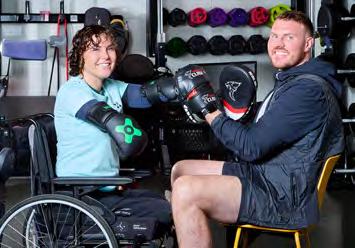
In practice, what emerged as most interesting were stories where something is in the process of finding its form. There’s Lily McGarry, building up her boxing skills after recovering from a quadruple amputation (page 110). There’s Make Waves, the sustainable deodorant brand founded by two entrepreneurs who met at KPMG in Jersey, which we’re told is now the market leader in sustainable deodorant and is rolling out into 370 Boots stores across the UK (page 28). There’s the Geopark, applying for UNESCO status and attempting to formalise a wider understanding of the importance of our island’s geology on page 26.
There’s also Rubie Le Masurier, reflecting on the formation of a voice that will, with any luck, carry her into an opera career (page 70). Even the tech supplement, which we’ve expanded considerably in this issue, is essentially an exploration of what form work, education and entrepreneurship might take next. It has its own editor’s note, partly because it grew large enough to warrant one, and partly because years of inflicting AI-related monologues on my friends in pubs has taught me that the general public is not quite as interested in it as I am (page 35 for those that are).
ENQUIRIES/SUBMISSION editorial@factory.je DISTRIBUTION distro@factory.je ACCOUNTS accounts@factory.je
@GALLERYMAGAZINE
PUBLISHER BEN DAVIES ben@factory.je hi@factory.je
Elsewhere, Flo walks us through eco swaps and takes on the challenge of creating a recipe from a SCOOP mystery box (page 64), while Maggie fields a question from a reader who married young and finds themselves wondering about the road not taken (page 85). The fitness fashion shoot on our cover is in here from page 78 too, which I suppose is form in its most literal sense.
We hope you enjoy this one as we welcome in the summer. See you at the tail end of it.















Old Bagz 22
Gallery writer Nyah Schiessl introduces the upcycled tote bag brand she launched with her grandma, an idea hatched over a sandwich in the living room.
Make Waves 28
We caught up with Oli and Owen, who dreamed up their sustainable deodorant brand while working as accountants at KPMG. Now market leaders, they’re rolling into 370 Boots stores nationwide.
Discover JOY Retreat 34 Flo reviews Jersey’s hidden wellness sanctuary, tucked between the trees in yurts at St Aubin.
The Long View 32
The Atlantic Hotel reveals how it married sustainability with luxury to become the only EarthCheck Silver certified hotel on the island.
Shift
35
Wondering where the world is heading? Find out from leaders in industry and education in our brand new tech supplement.
Gallery’s Gorgeous Garden Guide
54
From hidden gardens to the outdoor products everyone’s talking about, our guide has you set for a summer spent outside.
Gallery Café
64
We headed to Gallery Café in St Aubin, the restaurant everyone’s raving about.
In Her Corner
110
We sat down with Lily McGarry, quadruple amputee survivor, and Nick Campbell, former Scottish heavyweight champion, to talk about what fitness and strength really mean.

JAY ALLEN
speaks on the importance of sourcing fashion on-island, from local retailers supplying good men’s clothes. Pg. 72

MAGGIE BAIN
tackles a question from a reader who married early, and is now thinking about the road not taken. Pg. 85

FLO LEACH
writes extensively over our pages, on food, the environment and trying out being a showgirl. Pg. 68

NYAH SCHIESSL
tells us all about her sustainable small business Old Bagz, which turns unwanted fabrics into gorgeously upcycled totes. Pg. 22

TOBY BALDERSON
our resident tech writer, scraped all the data from our upcoming election campaigns, converted them into a CSV, and plotted candidates on graphs for everything from cliché density to “AI suspicion”. Pg. 50

DANNY EVANS
brings us another great fashion shoot, capturing fitnesswear in St Brelade’s Bay gym with models Naomi and Laura. Pg. 74

DAISY TAYLOR
speaks to Slabs, Jersey’s very own punk rock power group. Pg. 114

RYAN THOMAS
allows his comedic mind to run wild with thoughts of estate agents, bumper stickers, yogurts, mushrooms and Winnie the Pooh. Pg. 31
EDITORIAL CONTRIBUTORS
Jay Allen
Maggie Bain
Flo Leach
Toby Balderson
Laura Morel
Emma Pallent
Nyah Schiessl
Daisy Taylor
PHOTOGRAPHY/ILLUSTRATION
Bam Perspectives
Max Burnett
Oliver Doran
Danny Evans
Carl Gallie
Kasia Guzak
Andy Le Gresley
Natalie Mayer
Richard Miles
Emma Pallent
Flo Balderson
Ryan Thomas Callum Thorne
Wilfrid Wood
CAN YOU CREATE? contribute@gallery.je
Sure, you might share photos of your food or have a portfolio on Behance, but why not get a little joy from seeing something in print! We’re always looking for contributions from people who are passionate about subject matters close to their hearts. Become a contributor and get paid for your content.
FEATURE WE PROFILE ISLANDERS editorial@gallery.je
If you are an artist with work to exhibit, an entertainment organiser with an event coming up, a business with some exciting news or a new product to feature, get in touch. We’re keen to feature anything captivating that will be of interest to the good people of Jersey who flick through a Gallery each edition.
19TH JUNE–24TH JULY
Liberty Bus employee interrupted the journey of the service on route 8 in St Peter on Thursday when he saw some ducklings had fallen into a cattle-grid. The driver was praised by Facebook users after news of the incident, with comments such as “absolute legend,” and “quality dude.” Other users suggested the driver should be nominated for an award.
24,600
3
in income support was fraudulently received by a Jersey couple who failed to mention they owned two mortgagefree properties in Ireland together worth more than €500,000 and generating around €3,200 in rental income each month. They were jailed for 18 and 12 months respectively.
years was the sentence given to a “serial thief” who stole charity donation tins while on bail for other offences. The assailant was caught red handed at his home address, with four empty tins that had gone missing several days earlier.
£1904.67
is what the owner of Alvin’s Hot Stuff Pizza was ordered to pay by the Petty Debts Court in relation to a personal loan agreement dated 10 February 2022. Alvin Aaron, who is also standing in this year’s General Election, did not attend the hearing. The same business was ordered earlier this year to pay a former delivery driver almost £4000 in unpaid wages.
was the highest bid received for a 1.5-inch lock of Bob Marley’s hair at a JC Auctions sale in Jersey, against a guide of £20,000-£25,000. A signed autograph was thrown in, but to no avail. “Collectors love owning a genuine part of their heroes,” auctioneer Paul Fraser had said beforehand. 6000

Appleby’s residential team in Jersey is made up of experienced practitioners with a commitment to delivering a highquality, cost-effective service in a friendly and approachable manner. The combined experience of our lawyers and conveyancers is vast. This is a major advantage for our clients when resolving, on their behalf, the legal issues that arise in property transactions.
To learn more visit applebyglobal.com/services/property


JOHN BISSON
+44 (0)1534 818 024 jbisson@applebyglobal.com
KATE WESTWATER Counsel Property
+44 (0)1534 818 474
kwestwater@applebyglobal.com


JEFF O’BOYLE Partner Property
+44 (0)1534 818 028 joboyle@applebyglobal.com


PLEASE TOUCH BY PAIGE LE GEYT
CCA Galleries International
Thursday 30th April
CCA Galleries International presented the first solo exhibition by Jersey artist Paige Le Geyt, whose tactile abstract works explored themes of neurodivergence, repetition and sensory

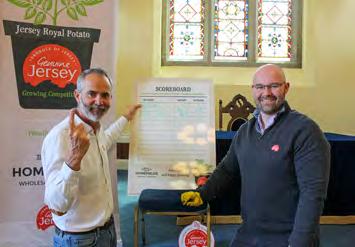
20TH ANNIVERSARY OF THE GENUINE JERSEY ROYAL GROWING COMPETITION
St Ouens Parish Hall
Friday 15th May
The public gathered for the weigh-in of the annual Genuine Jersey Royal Growing

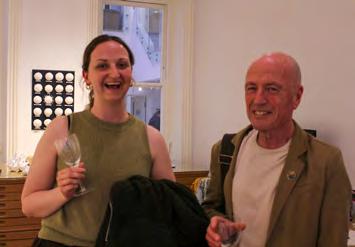
experience. Le Geyt developed her practice while studying for her Foundation Diploma in Art and Design at Highlands College, where she was subsequently invited to remain as Artist in Residence. Her work combined abstract form with highly textured surfaces created through careful and repetitive processes that reflected both the meditative and challenging aspects of living with OCD and autism. Central to


Competition at St Ouens Parish Hall to find out which parish produced the greatest spuds, and to champion the little local growers competing in the primary schools division. This year’s winners were the Rainbow Room from Rouge Bouillon School, who grew an impressive 844g of Jersey Royals. Unfortunately for Gallery, the luck from their smashing success in the media side of the competition the previous year


the exhibition was an invitation for visitors to physically interact with the artworks – an intentional departure from traditional gallery conventions. Through the interplay of organic forms and structured geometric elements, her work explored tensions between chaos and control, obsession and resolution, and identity and perception. In 2024, Le Geyt received both the Summer Prize and the RBC Emerging Artist Award at the Jersey Summer Exhibition.

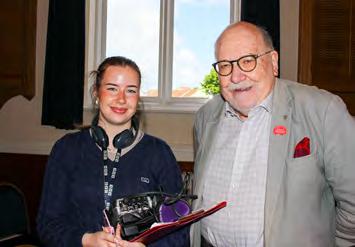
proved to have run out, having only produced a single chit weighing in at a measly 19g after their potatoes had a fateful run-in with blight a month prior and never recovered. Marking two decades of the competition, the event continued to celebrate the island’s most iconic crop and the friendly rivalry between parishes, schools and media outlets alike, all united by a shared love of Jersey’s favourite potato.





REFRAMING DEMENTIA PRIVATE VIEW
ArtHouse Jersey at Capital House
Thursday 14th May
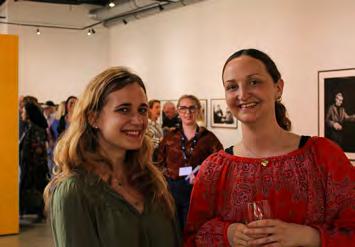
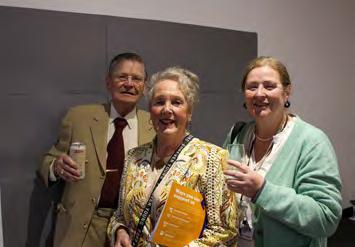
ArtHouse Jersey and Dementia Jersey presented Reframing Dementia, a powerful photographic exhibition that brings together a series of deeply human portraits of nine




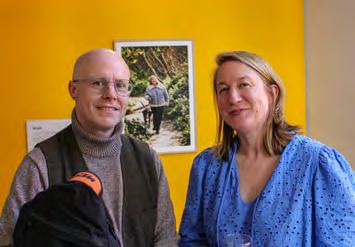
Islanders living with dementia. The work was created by five Channel Island photographers – Paul Chambers, Sophie Darwin, Oliver Doran, Étienne Lainé and Natalie Mayer – each bringing a distinct visual approach, united by a shared commitment to dignity, collaboration and authenticity. The exhibition challenges common perceptions of dementia, instead offering an intimate and respectful insight



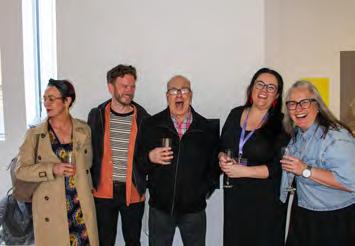

into the lives, personalities and stories of those living with the condition. By placing collaboration at the heart of the project, the photographers worked closely with their subjects to create images that felt honest, considered and deeply personal. The launch took place on Thursday 14th May from 5:30pm to 7:30pm at ArtHouse Jersey at Capital House, offering an opportunity to view the work and meet those behind it.






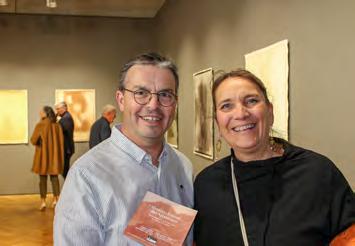

Private & Public Gallery
Friday 15th May
2026 marks the bicentennial year since the very first photograph was made by French inventor Joseph Nicéphore Niépce, and to commemorate this auspicious occasion Private & Public Gallery


The Terrace at L’Horizon
Friday 15th May
L’Horizon Hotel & Spa invited guests to Sunset Sessions, an intimate evening on the terrace marking the start of the summer season at St Brelade’s Bay. As the sun dipped over
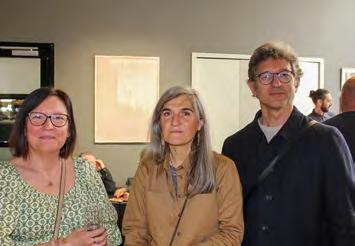

showcased the works of internationally acclaimed contemporary French artist and photographer Isabelle Delevallee. Using one of the earliest printing techniques, Gum Bichromate, Delevallee created a series of beautiful images taken in Jersey, Sark and Brittany. The artist worked with natural materials and her own hand-mixed dyes to produce photographs on cotton that looked more like paintings than prints. To provide wider


the bay, attendees enjoyed seasonal dishes, champagne and live saxophone music in a relaxed, unhurried setting by the sea. Designed to feel less like a formal event and more like a summer ritual, the evening offered a chance to slow down and savour the long, golden hours of early summer. With a small and thoughtfully curated guest list, the gathering delivered


historical context, the exhibition also featured rarely seen works by another leading French photographer of the 20th century, Claude Cahun, who lived for many years in Jersey, courtesy of Jersey Heritage Trust. The exhibition opened on Friday 15th May and ran for three weeks, offering a rare and richly layered celebration of photography’s enduring power and possibility.


good company, good food and the kind of easy atmosphere that defines the best evenings spent by the water. Sunset Sessions took place on Friday 15th May on the terrace at L’Horizon, and guests were welcome to bring a plus one. It marked the perfect opening note to a season of seaside indulgence.


ArtHouse Jersey has announced the launch of the new ArtHouse Jersey Portrait Award, opening submissions to artists across Jersey and the wider Channel Islands ahead of a major exhibition running at Capital House from January to April 2027.
The award celebrates contemporary portraiture in all forms, and comes with a first prize of £1,500, and two runner-up prizes of £500. Entry is free, with submissions open until 30th September 2026. The competition is open to anyone aged sixteen and over with a strong connection to the Channel Islands, and the award welcomes work
across all media, from painting and photography through to sculpture and mixed media. Selected works will form part of a wider exhibition showcasing both local and international portrait artists.
In a close-knit island community, portraiture feels particularly well suited as an art form that both connects and reveals artist and subject alike. The result will be an exhibition filled with the work of both emerging and established talent, encouraging artists at all stages of their careers to submit work.
More information and submission details can be found via ArtHouse Jersey.







Plémont Bay will become a stage this summer. Brainchild of Corey Ceccarelli, the Velvet Vibrations movement emerged from the idea of unseen frequencies or vibrations that connect all of us, and how this mirrors the nature of water. By focusing on the ocean, the performance has an environmental focus, recognising the sea as a resource and “living entity”. The project invites the public to feel their connection to water through art, hoping to encourage care, respect and a sense of responsibility.
The live performance will unfold over approximately 60 minutes at low tide. It will begin with natural acoustics, followed by the gradual movement from dancers and performers entering the space. Sculptural elements and visual gestures will later proceed, accompanied by live music. “The performance builds into a collective moment of presence,” Corey explained, “before dissolving quietly back into the landscape.”
Jersey-based artists from all creative backgrounds will take part, including visual artists, dancers, musicians and interdisciplinary performers. International artists will contribute through pre-recorded works, film, sound, poetry and visual pieces, which become part of the wider narrative, amongst the natural amphitheater of Plémont Bay’s cliffs and caves.
The event is free and open to the public.
This summer, the Jersey Opera House presents an exciting programme of music, theatre and culture, offering something for every audience to enjoy. From a free international opera screening to world-class live music and a nostalgic West End comedy hit, the season promises unforgettable live entertainment in the heart of the Island.
On Wednesday 15 July, audiences are invited to experience Robinson Crusoe as part of the free Opéra sur écrans screening from the Opéra de Rennes. Featuring the music of Jacques Offenbach, this comic opera combines imagination, humour and striking visuals, brought to life by the Orchestre National de Bretagne under the direction of Guillaume Tourniaire. Directed by acclaimed theatre-maker Laurent Pelly, the production offers a witty and poetic interpretation of Daniel Defoe’s celebrated story. Sung and spoken in French with French surtitles, the screening begins at 7.30pm and admission is free.


Music lovers can look forward to an exceptional evening on Friday 17 July as internationally acclaimed jazz-funk pioneers Shakatak return to Jersey for a live performance as part of the new LIVE AT… concert series. With more than 40 years of success, over 50 albums and a global following, the band’s unmistakable blend of jazz, funk and soul continues to captivate audiences worldwide. Led by original members Bill Sharpe, Jill Saward, Roger Odell, George Anderson and Keith Winter, Shakatak promise a dynamic evening of groove-driven classics and musical excellence. Tickets range from £32–£37.

From Wednesday 12 to Saturday 15 August, the smash-hit West End comedy The Last Laugh arrives at the Opera House. This critically acclaimed production imagines legendary comedians Tommy Cooper, Eric Morecambe and Bob Monkhouse sharing a dressing room as they reflect on life, laughter and legacy. Warm, nostalgic and packed with unforgettable humour, The Last Laugh has been praised as “joyous” and “comedy heaven” by critics and audiences alike. Tickets range from £36–£42.
Discover the full programme at www.jerseyoperahouse.co.uk


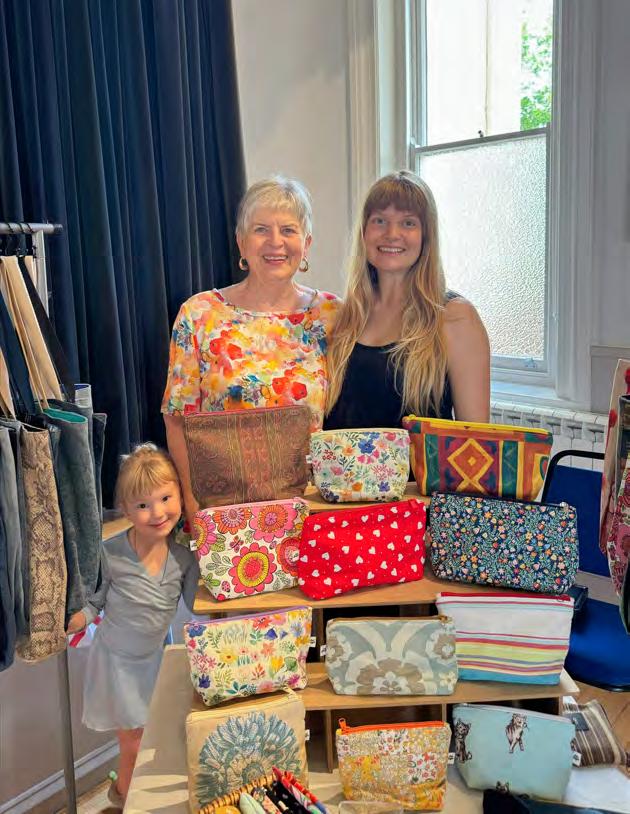

Old Bagz, an upcycled tote bag brand, began over a sandwich in a living room, between a grandmother and granddaughter navigating retirement and maternity leave, with time to fill and something creative to pursue. What started as a small, shared project became an experiment in reworking recycled fabrics into something new.
Sally Clarke and Nyah Schiessl bring complementary strengths to the process. With a background shaped by time at fashion college, Sally Clarke brings a technical understanding of construction, while Nyah approaches each piece with a more instinctive eye for colour and combination. Working with materials that have already lived a life, the duo produce pieces that are both functional and considered, allowing the fabric to lead and the process to follow.
Read on to discover the story behind Old Bagz, how the grandmother-granddaughter dynamic plays out day to day, and what they have learned from one another along the way.
Where did Old Bagz begin?
Old Bagz began quite simply - over a sandwich in Grandma’s living room. With one of us retired and the other on maternity leave, we found ourselves with a bit of time on our hands and a shared urge to create something. The idea was thrown out there to make tote bags from recycled fabrics as a little project.
The first few were made and we fell in love with the process. We were hooked on hunting down different fabrics and giving them a second life. Somewhere along the way, we jokingly called ourselves “Old Bagz”, and the name just stuck.
How does the grandmother-granddaughter duo dynamic actually play out day to day?
The dynamic between us plays out much the same as it always has, just with slightly bigger projects. Some of my favourite childhood memories are being at Grandma’s house, where there was always an abundance of snacks and crafts. My cousins and I would pile into the living room, eating, crafting, and causing chaos. In many ways, not much has changed.
I still go to her house every Thursday, and I usually leave with a full belly, a new jumper knitted by her, a handful of sewing patterns to try out myself, and a stash of fabric I’ve unearthed from her ever-growing fabric cupboard.
We share a passion for making. Grandma taught me how to knit, crochet, and sew. There was a brief teenage phase where it wasn’t very ‘cool’ to craft with your Grandma. But now I have a daughter of my own, it’s become something much more meaningful. Spending that time together, learning new skills, and passing them down to my own children feels incredibly important.
What draws you to using pre-loved?
Sustainability is at the heart of it for us. It just makes sense - why buy new fabric when there’s so much beautiful, often much higher-quality material out there waiting to be loved again? By choosing to recycle fabrics, we hope we can inspire others with what’s possible for creating. Such a simple swap goes a long way for the environment.
I feel like we go back to our hunter gatherer roots when we are rummaging around at places like Acorn or Hospice charity shops. There’s nothing like finding an amazing piece of vintage tapestry or a cushion cover that would make the PERFECT bag. You never know what you’re going to find, and that element of surprise sparks new inspiration with every bag we make.
Working this way allows us to keep our costs down too, which means we can price our bags affordably. And by sourcing most of our materials from local charity shops, we’re able to support them in return, which has become a really important part of the process. When they see Grandma walking through the door they know she means business.
Do the materials tend to lead the design, or do you usually have something in mind before you start?
We are definitely inspired by each fabric individually. For example, we might come across a small amount of a beautiful fabric that would make incredible makeup bags, or glasses cases. Other times though we will find very large amounts of a particular fabric, meaning we will get a few larger tote bags out of it and think about how we can incorporate the fabric with others we already have in our collection. We tend to keep our designs simple with a focus on practicality and durability, and let the fabric do the talking.
There’s something quite personal about fabrics that have already lived a life. Is that something you think about when you’re making? All the time! There’s something really intriguing about working with upcycled fabrics. It’s hard not to imagine where they’ve come from, who owned them, what they were part of, and why they were let go.
I feel like we go back to our hunter gatherer roots when we are rummaging around at
places like Acorn or Hospice charity shops.
There’s nothing
like
finding an amazing piece of vintage tapestry or a cushion cover that would make the PERFECT bag.
I’ll often go round to Grandma’s to see what she’s been making for an upcoming market, and she remembers exactly what each piece was“Tablecloth, wall tapestry, bedspread, sarong.”
We wonder about the stories behind them, and why something so lovely ended up in a charity shop - what it meant to someone before it found its way to us. When we sell at markets, those stories seem to come full circle. People will say things like, “My aunty had curtains just like this,” or “That one reminds me of a shirt my mum always used to wear.” And suddenly the fabric sparks a memory or a conversation.

What have you learned from each other through doing this?
We obviously come from different generations, so we learn a lot from each other in that sense. When grandma was younger, she went to fashion college and got lots of experience in the industry. I always love learning about what that was like. Nowadays humans tend to rush things. We see something on social media and think ‘I want that now’ and more often than not you can buy it in a heartbeat. I think the speed of modern living puts people off trying to make even simple things from scratch.
I’ve certainly learned a lot about slowing down, appreciating handmade work, and ensuring I make time for my creativity even in a fast-paced world. I still have so much to learn, and Grandma inspires me every day… I hope I continue to create for as long as she has and inspire my grandchildren to do the same.
Grandma would say she is more ‘technical’ than creative, and I’m more creative than technical. It’s a good combination of traits, because if I have an idea, Grandma knows how to make it happen, and if I need bringing back down to earth, she will show me what is realistic. Where she teaches me to think practically, I teach her new combinations of patterns and colours in fabrics that she would never dream of putting together. She promises me it’s not ugly just… ‘different’.
Where do you see Old Bagz going next? Online! Having a place people can go to browse and buy online is definitely the next step for us. We’ve found our rhythm with local markets and events, but with growing interest from across the UK and even further, it feels like a natural progression.
@oldbagz
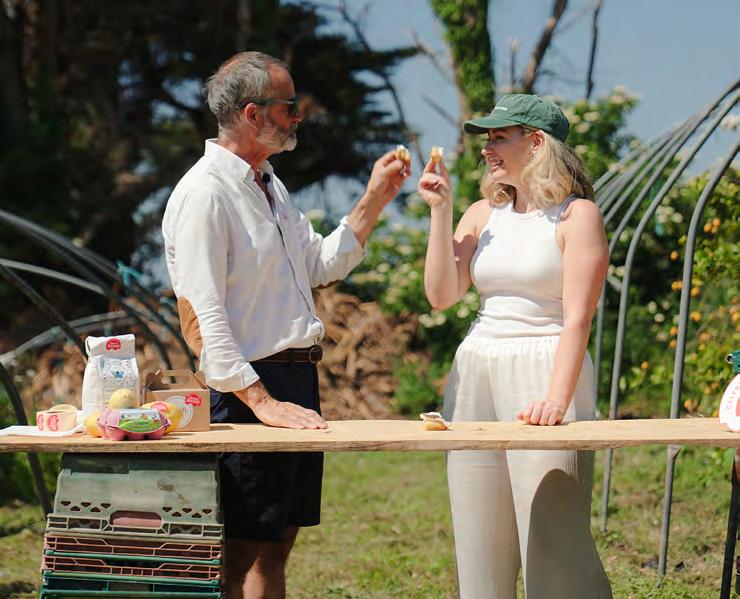
This year Genuine Jersey is celebrating their 25th Anniversary. To mark the occasion they have collaborated with Dough to create a Genuine Jersey cookie with ingredients which have been made, grown, caught and reared by their Members, of which Dough is one. The Lemon Meringue cookie is going to be on sale at Dough throughout June and combines the ingredients and expertise of seven of Genuine Jersey’s 200+ Members.
The cookie itself has a generous portion of La Cote Distillery Limoncello Lemon Curd nestled in the middle and is topped with a delicious swirl of italian meringue, torched in house so that it’s as close to a lemon meringue as you can get! The curd has been made by Katherine Jauncey Culinary, using the juice from the locally grown lemons used by La Cote Distillery to make their Limoncello, added to make the cookies just that extra bit special.

The flour in the cookie is grown and milled, using a traditional stone mill, at Le Tacheron Farm in St Saviour. Run by the Le Maistre family this traditional farm uses working horses wherever possible to minimise their impact on the environment and to reduce soil compaction. When they can't use horses we use lightweight machinery to minimise their carbon emissions.



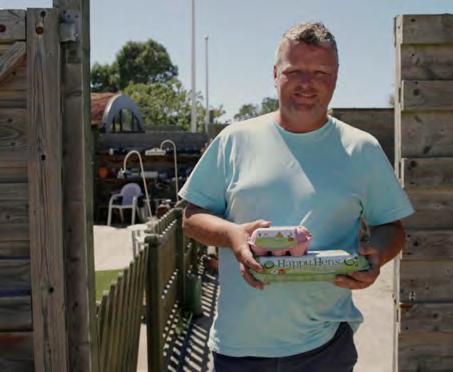
Since Dough first opened she’s been working with Allan at Happy Hens who supplies her with her eggs directly. You can find Happy Hens eggs in their colourful boxes at retailers throughout the island.

Culinary,
Since starting up her business making jams, chutneys and preserves Katherine has utilised a tonne of ingredients that would have otherwise been wasted. She’s used the lemons from the process of making the limoncello to make the curd within the cookie.

The only grain to glass distillery on island, Alex and Thea have made the limoncello used within the curd. They use Joe’s lemons to make this delicious liquor which features as part of their range of locally made gins, vodka and other spirits.

The Member who needs no introduction and the brainchild behind the lovely cookie, Dough! They’ve been a Member since 2024 and are huge advocates of celebrating all things local wherever possible.
Jose Freire, St John
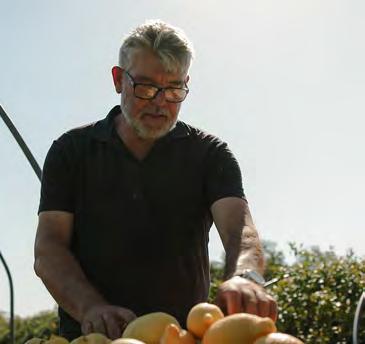
Joe’s lemons were central to the inspiration for this cookie, a great way to show people how diverse the island's farming landscape is. Joe is perhaps most well known on island for his beautiful peonies and luscious strawberries which can be found islandwide and bought directly from his bright and colourful honesty box in St John.
Butter Jersey Dairy, Islandwide
All of Dough’s cookies feature Jersey Dairy butter so this was an easy one to include.

Genuine Jersey was founded in 2001 by a group of producers who saw value in offering shoppers distinct and unique local goods. The Association was formed to celebrate local artisans, farmers, bakers, growers and craftsmen, ensuring that their products can be easily recognised as being made in Jersey through the Genuine Jersey brand. The distinctive logo can be found only on members’ produce as a symbol and guarantee of local provenance.
HALF A BILLION YEARS
It’s no secret that we live on a beautiful island, but to understand it purely in this way would be only scratching the surface. Beneath Jersey lies a story half a billion years in the making, with rocks older than animal life on land, and evidence of lava frozen mid-pour into hexagonal columns. Mudstones were laid down in a mountain desert back when the island was nowhere near where it sits today, drifting somewhere else entirely on the slow conveyor belt of the planet’s tectonic plates. For most islanders, the landscape is just a landscape, such as the view from a coast path or the wall of a familiar bay. The Jersey Island Geopark team would quite like to change that.
Since 2021, Jersey Heritage has been building the island’s case for designation as a UNESCO Global Geopark, a project that pulls in the whole bailiwick. “UNESCO’s Global Geoparks Network recognises places that have exceptional natural and cultural heritage, are valued locally and which are managed sustainably,” the team explained. “Jersey ticks all those boxes.” Built from the ground up through public and stakeholder consultation, the application would land Jersey in a rather exclusive club of around 250 Geoparks scattered across more than fifty countries. Until then, it sits officially in ‘aspiring’ status, which sounds a bit like waiting to hear back from a very prestigious university. What’s actually at stake is bigger than pride and a shiny badge. Designation would make Jersey UNESCO’s landscape equivalent of a World Heritage Site, with a direct line to the United Nations and a global community of expertise to tap into.
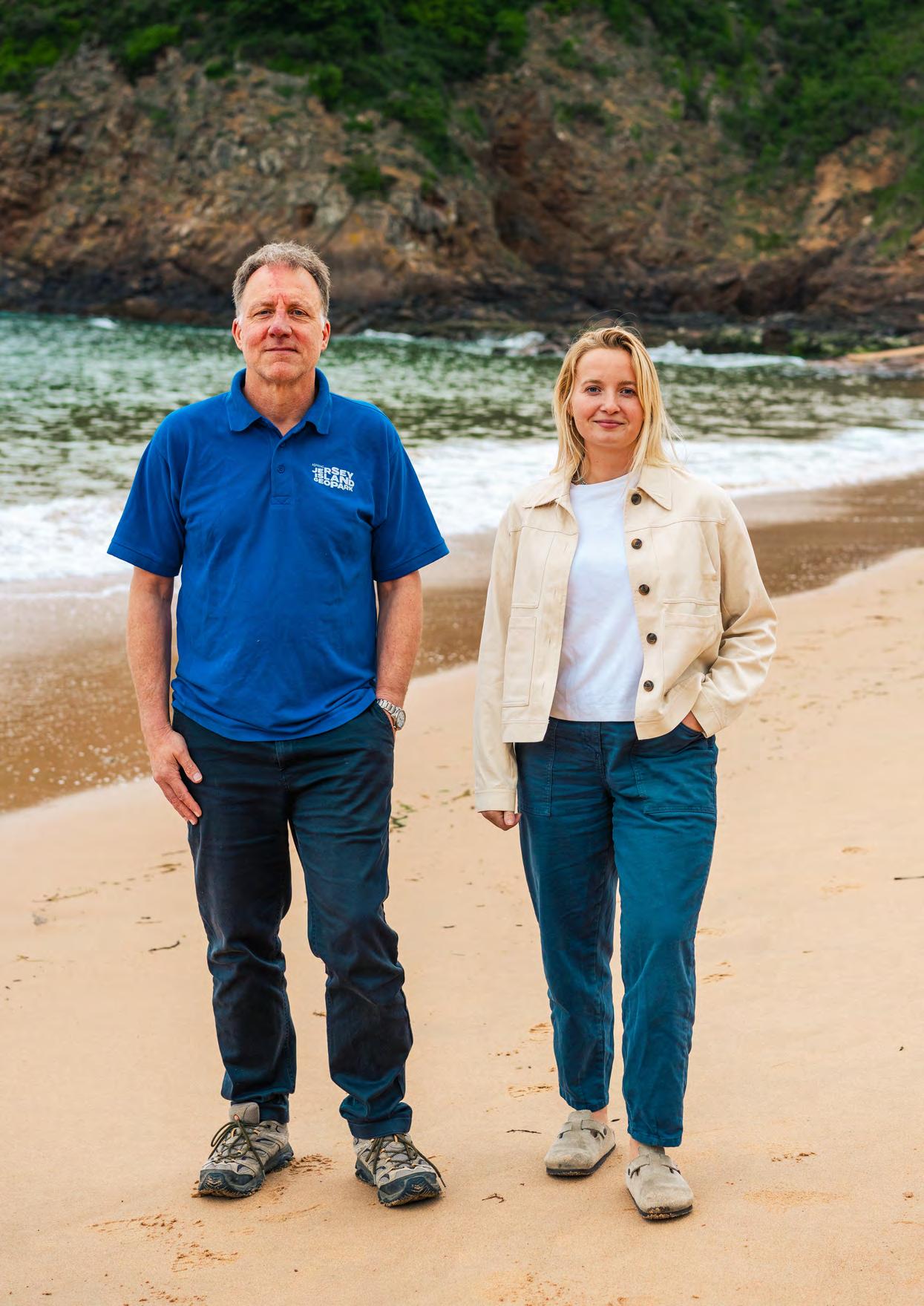
“Jersey has landscapes, infrastructure and facilities that match (often exceed) those found in other parts of the world,” said Paul, who leads the initiative. “Becoming a Global Geopark is international acknowledgement of something that most islanders are already aware of, namely, that when it comes to history, culture, biodiversity and a range of other attributes, Jersey is world class.” The earliest submission window is October 2027, UNESCO assessors are expected to drop in for a visit in 2028, and there are 101 criteria to tick off along the way. No pressure.
For Paul, the whole thing is a long loop finally closing. “As a teenager my friends called me Rockman and I went on to study geology at university,” he recalled. “I then spent decades working in the media and then government but the passion for local geology never died. The opportunity to join the Geopark team and promote Jersey’s landscapes to a local and international audience has brought my life full circle.” That media background colours how he thinks about engagement. “Being a UNESCO Geopark is just as much about people as it is geoheritage.”
Working alongside him is Meg, who came at the role from a different direction entirely. “This role brings together everything I care about in a job: science, education, community engagement, conservation, and lifelong learning, all centered on Jersey’s unique landscapes,” she explained. She studied environmental science, came back to the island to finish her master’s in island biogeography, and landed at the Geopark team. Her focus is reaching a wider audience. “Making Jersey’s geoheritage accessible is about both physical access and understanding,” she said, which in practice covers everything from guided geowalks above ground to filmed footage of sites lying twenty metres underwater.
Words: Emma Pallent Photography: Callum Thorne
Ask either of them to pick a favourite geosite and the answers turn surprisingly personal. For Paul, it has to be Maîtresse Île at Les Minquiers, which, he said, “packs so much into such a small area. This islet has our oldest rocks (about 630 million years), is visually stunning and displays nature in its rawest form.” It’s the whole Geopark idea in miniature, geology tangled up with prehistoric monuments, fishing, quarrying and navigation.
For Meg, Anne Port is one of her showstoppers (she understandably struggled to pick just one). “Ancient lava flows cooled, contracted, and fractured into hundreds of polygonal columns,” she explained. “These formations are reminiscent of world-famous sites such as the Giant’s Causeway in Ireland and the basalt columns of Iceland.” Both, rather charmingly, also flag La Solitude, Paul because it’s a half-billion-year-old mountain-desert mudstone that might one day cough up the world’s oldest land fossils, and Meg because it’s the dog-walking route from her childhood, where an outcrop of Rozel Conglomerate first sparked her curiosity about why Jersey looks the way it does.
“UNESCO’s Global Geoparks Network recognises places that have exceptional natural and cultural heritage, are valued locally and which are managed sustainably,” the team explained. “Jersey ticks all those boxes.”
While the application grinds through its procedural stages, the rest of the programme is moving at a clip. Recent highlights include a French archaeological survey of the Violet Bank near Seymour Tower, geological mapping of the offshore reefs, and a partnership with Channel Islands Coop to put curriculum-linked resources into schools.
There’s also a film, titled A Symphony of Creation, which “was developed to interpret Jersey’s geological story through an emotional and immersive lens,” Paul said, “using music, movement and natural landscape to bring deep time to life.” Scored by an orchestra conducted by Alex Conway of the London Incidental Orchestra and shot along Jersey’s coastline, it has racked up over 100,000 views. A full geopark guide and a coastal guidebook which follows the Visit Jersey Tidal Trail are due out within a year.
All this just goes to prove that Jersey’s geology is a story, written across ground that walkers, climbers and curious children have been wandering across all along, mostly without stopping to think about how it got there. For anyone wondering whether to begin delving back into our island’s geological past, Meg’s answer is pretty low stakes. “Get in touch. Give us a call or send us an email! We’re always happy to chat. You don’t need to be a geologist, just a connection to the island and a passion for its story.”
Discover more at jerseyislandgeopark.org.je, or pop into the Visitor Centre at Jersey Museum.


If you’re picturing the people behind one of the UK’s most-loved sustainability startups, you’re probably not imagining two ex-KPMG accountants ribbing each other senseless on a Tuesday-morning Zoom. But that’s Owen Machon and Oli Batiste, co-founders of Make Waves. The two turned a KPMG friendship into the UK’s favourite refillable antiperspirant, with a 370-store Boots launch just around the corner taking their direct-toconsumer product onto high-street shelves nationwide.
They’re quite possibly the only people in cosmetics whose CV’s begin “ACA qualified.” “We’re both accountants by trade,” Oli deadpans. “Which is quite depressing. And quite an unusual origin story for a consumer goods company.”
The two met at KPMG in Jersey around 2015. Owen, who moved to the island from Mansfield aged two, was a local through and through (bar the fine print of not technically qualifying for “Jersey Bean” status). Oli was a Londoner spending five years in


the Channel Islands before heading back to the capital. They became friends, and then the best part of a decade later, business partners. Today, Owen still lives in Jersey, Oli’s back in London, and between them they’ve built one of Britain’s most respected challenger beauty brands.
The idea came partly from Oli’s own habits. “I’ve always been a bit of a hippie,” he admits. He’d been making his own deodorant for years, getting Owen to sniff-test it (verdict: “not bad, pretty good”). Eventually, sitting in Jersey, the pair started asking themselves why nothing on the shelf seemed to be any good. Singleuse plastic was piling up, natural deodorants performed poorly under the duress of tough client pitches, and supposed “sustainable alternatives” had a penchant for greenwashing.
Like any accountant by trade, they ran the numbers. Then, they spent 18 months and roughly 50 formulations turning Oli’s homemade paste into something that could sit on a shelf next to Dove. The result is a stick formulation that’s solid until it touches your skin that provides high antiperspirant performance with a completely natural base formulation. “It’s not a prescription-grade product,” Oli explains, “but it’s really effective, especially for people who haven’t found anything that works for them before.”
The name “Make Waves” shares connotations with Nike’s “just do it.” “It doesn’t actually have a direct connection with the sea,” Oli says. “It was more like, do something different. Don’t just follow the status quo.” That said, Jersey did shape the ethos. “You’re down the beach, coming out of the surf, and seeing litter just kills you. That framed our mindset: what business can we create that actually has shared value with the planet?”
The result is a product that is entirely manufactured in the UK, with applicators made from 100% recycled plastic, and refills that are 100% recyclable. Suppliers are either B Corp certified or running on closed-loop water and solar. The supply chain was built so deliberately that when Marie Claire ran a brand-wide sustainability audit, Make Waves (less than a year old at the time) beat brands ten times their size to the 2024 award.
Being accountants has given them an unexpected edge against competitors. “No one wants to talk to you when you’re a startup,” Owen says. “But when we told suppliers we were accountants, they trusted that we understood the numbers, and took a chance on us.” That chance has paid off: Make Waves shifted around half a million refills last year, holds a 4.9 on Trustpilot across more than 2000 reviews, and is a member of 1% for the Planet.
“You’re down the beach, coming out of the surf, and seeing litter just kills you. That framed our mindset: what business can we create that actually has shared value with the planet?”
What they admitted they didn’t have was a marketing background. Cue the agency carousel, with five different agencies in eighteen months, including a web design team that walked off the job at 5pm on launch day. “Owen essentially built the site himself,” Oli says, still slightly haunted. They’ve since assembled a tight network of advisors and an agency model that lets just the two of them run the whole show, full-time.
Their biggest breakthrough moment came last December, when Make Waves won Breakout Beauty UK, the inaugural Boots and TikTok Shop-backed accelerator. “We didn’t think we were going to win,” Oli says. “I looked at Owen and he was welling up. It was a big moment.”
The grand prize was a listing in ten Boots stores, but after looking at the data, Boots came back with a very different number. “They turned around and said: no, no, we want to give you 370,” Owen says. “All the data is suggesting you’re the market leader in refillable antiperspirant. We want you to have a massive launch.” Make Waves rolls into Boots stores nationwide this July, including, naturally, the Jersey branch. (“Can you imagine if we forgot Jersey? So awkward.”)
There’s little time to celebrate, with Owen’s second child due about a month after launch (his first arrived around the brand’s original 2023 debut, which also wasn’t planned). Both men, in Oli’s words, “probably look about ten years older” since they started on the long-road to becoming a successful startup, but they’re still laughing and, by their own admission, having an absurd amount of fun. “People always want you to tell them how awful starting a business is,” Oli says. “And yeah, it’s hard. But it’s really good fun. You get to wake up and work with people you actually like. That’s quite rare.”
wearemakewaves
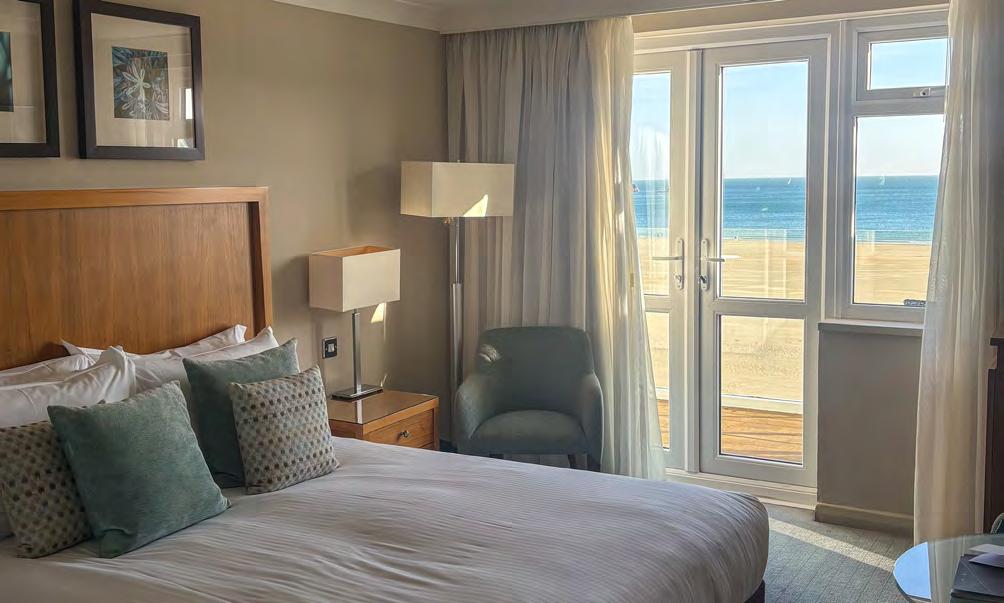
I DIDN’T KNOW I NEEDED
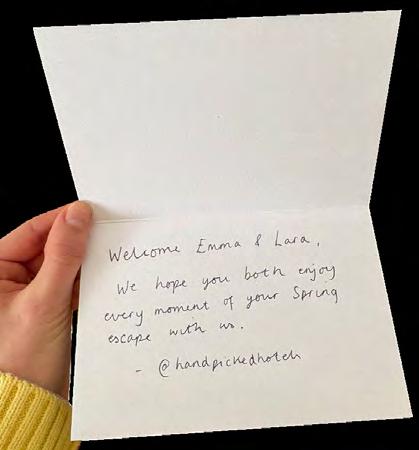
The L’Horizon invited us to spend the night as part of their Spring Staycation package: dinner on the Terrace, an overnight stay overlooking St Brelade’s Bay, followed by a gorgeous breakfast in the morning. It was a glorious experience that I didn’t know I needed until I was there. I stepped out onto the balcony in the late afternoon sun, and I distinctly remember the air carrying that first scent of summer, the kind that takes you by surprise one day and makes you realise winter is finally over. The whole thing felt dreamy and luxurious, like stepping away from the responsibilities of the everyday into my own little safe haven by the sea.
As a general rule of thumb, I’m very much a ‘the more the merrier’ kind of person, so I was delighted to find that the L’Horizon had also invited two influencers and their partners for drinks, dinner and a morning hopping between the sea and their sauna. Joining us was Nyah Schiessl, a column writer for Gallery and a Jersey-based influencer talking about all things motherhood and coming back to nature, along with Becky Barnes-Barrington, also known as the Jersey Cowgirl. Sometimes on press trips like these, there’s an air of awkwardness as you’re all dropped at the same table, everyone struggling to break the ice. Lucky for us, this wasn’t necessary; the moment we stepped down for drinks we were comfortable, even before the first sip of our cocktails.
The great thing about drinks at the L’Horizon is that you know you’re signing up for quality. The presentation is high-grade, and the cocktails taste even better. They’re the calibre of drinks that make it harder to wake up foggy the next morning, and can be enjoyed overlooking the bay within the shelter of the glass walls of their indoor area, or outside en plein air on their newly renovated terrace, fitted with firepits, comfortable seating and (coming soon) live music till the sun sets.
Dinner was exquisite. The menu was packed to the brim with seafood favourites, making it extremely difficult to pick what to order. For starter, I went for half a dozen No.1 Jersey Oysters, served with lemon and a chardonnay mignonette. Our wine pairing was [white from Villa Saletta, the Hands family’s Tuscan estate, and description].
For the main, I had a tuna steak from the specials, cooked pink, on a bed of seasonal green veg. If I were to pick again, I probably would have swapped to the chateaubriand which Becky and her partner shared, served with triple-cooked chips, cherry tomatoes and confit shallots, alongside peppercorn sauce, béarnaise and a rich red wine jus. Clearly they knew what they were doing with that one. We were all so full by the time we’d finished starters and mains that we couldn’t possibly fit in a dessert, but for those with a sweet tooth, there were options such as a dark chocolate panna cotta, blueberry cheesecake and a baked Alaska.
Sufficiently food-coma’d, we headed upstairs for a restful night’s sleep. I enjoyed a pre-bed shower in the spacious en suite, with just the right amount of water pressure. My hair’s long, and I’ve stayed in one too many hotels with shower bottles filled with detergent that somehow acts as shampoo, body wash and conditioner all at once. I was so pleasantly surprised by the quality and scent of the hair and body products in the L’Horizon showers that I actually took pictures of them all to see if I could source a similar product for my home (Noble Isle, The Greenhouse, if you were wondering: notes of tomato leaf, bergamot and honeysuckle with a hint of mint and melon; vegan friendly, paraben and sulphate free).


After taking advantage of the luxury of time and applying my skincare with more care than I usually give the regime, I put on my protective hair serum and prepped my hair for heatless curls the next morning.
In a perfectly idyllic review, I’d write that I awoke to the sound of birds and the sea, as the rising sun filtered through my curtains to fill the room. This wouldn’t actually be true though, as the L’Horizon has incredibly effective blackout blinds, and I slept like a log. I awoke to a quickly silenced iPhone alarm which I swiftly panictapped before getting into the mindset of stretching, getting up, and smelling the morning air on the balcony.
In a perfectly idyllic review, I’d write that I awoke to the sound of birds and the sea, as the rising sun filtered through my curtains to fill the room. This wouldn’t actually be true though, as the L’Horizon has incredibly effective blackout blinds, and I slept like a log.
We headed down for breakfast, which was buffet style, with the option to order popular brunch dishes such as Eggs Benedict and avocado toast. If I were to do this again, I’d probably have taken the morning off to truly enjoy a slow morning by the sea, relaxing in the spa, perhaps even indulging in a massage, and properly waking myself up for the day with a dip in the springtime sea before warming up in the sauna. Unfortunately, we needed to be back in St Helier by 9am, returning to reality and leaving our bubble of luxury and leisure for desks and monitors. Regardless, it was everything we didn’t know we needed. And I suppose leaving early means we’ve left something new to experience next time.





There are few places in Jersey more beautiful than the gardens at The Atlantic Hotel, and the luxurious experience of stepping out into them feels even better when you realise this hotel stands out amongst the crowd for its protection of the landscape in which it sits. Decades of overlooking St Ouen’s Bay have clearly influenced Patrick Burke, the hotel’s owner, to nurture a strong relationship with wildlife and the natural environment. Over the years he has partnered with Durrell on rewilding projects, and has committed to getting The Atlantic EarthCheck Silver certified, making it the only hotel in the Channel Islands to hold the accolade.
This is harder work than it seems. Every minute detail needs to be thought about, from the larger things, such as serving local produce, cultivating gardens and giving guests the option to offset the carbon emissions associated with their stay, to the smaller ones, like the refillable cosmetic dispensers that have replaced thousands of plastic bottles a year, or the process of washing the towels.
For Patrick, the turning point came on what should have been one of the proudest dates in the hotel’s calendar. On 7th May 2020, The Atlantic ought to have been celebrating its fiftieth anniversary; instead, the country was in lockdown and the building stood empty.
“Sustainability was always part of my thinking, but the pandemic crystallised everything for me,” he says. “My wife Treena and I were standing on the terrace and there was nobody here, at a time of year when the hotel would normally be busy. It was a profoundly moving moment which led me to question everything we do.”
“That period of reflection led to a sense of real clarity that we have a responsibility, not just to the business, but to our environment, our people and this very special hotel we’re privileged to look after.”
What followed was a partnership with EarthCheck, one of the most rigorous sustainability accreditation bodies in the global travel and tourism industry, and a forensic audit of every process in the hotel. To this day, The Atlantic has retained its Silver accreditation for three consecutive years, and remains the only hotel on the island to hold it.
Much of that ethos runs through the kitchen. At Ocean Restaurant, head chef Will Holland’s commitment to local suppliers and farmers shapes every menu, with kitchen scraps composted fullcycle into the gardens and ingredients like Jersey Royals grown on site. Will was one of the first to champion ex-dairy Jersey cows for beef, devising thoughtful, creative preparations, and he forages local beaches for

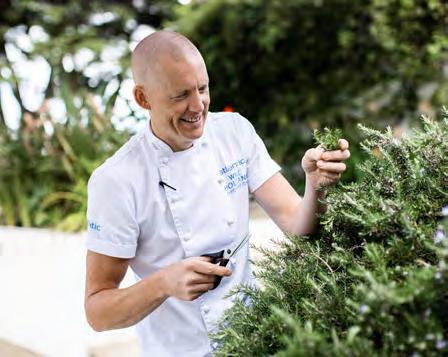
sea succulents to bring into his dishes. Collaborations with the wider community of suppliers run throughout the year, from dinners showcasing La Mare Wine Estate to The Fisherman’s Catch Dinner, a bespoke seafood menu sourced exclusively from local waters via Fin and Feather, and a Jersey Tea Farm visit followed by a tea-inspired Afternoon Tea back at the hotel.
The Atlantic is also a Considerate Collection member of Small Luxury Hotels of the World, an accolade reserved for businesses that have made meaningful commitments to their community, culture and location. A big part of that has been the hotel’s long-running relationship with Durrell, which has taken on new dimensions through the Rewild Carbon programme, a scheme funding the planting of native trees in Brazil’s Atlantic Forest. “Durrell is a world-class organisation which Jersey should be incredibly proud of, and we are thrilled to bits to have them as our philanthropic partner,” Patrick says. To date, the hotel has raised over £70,000 for the charity, with the Rewild Carbon initiative allowing guests to balance the
carbon emissions produced during their stay. “What’s more, the main focus of their work is on The Atlantic Forest in Brazil,” Patrick adds, “which seems like a good fit!”
Pull on the thread of why this matters so deeply at The Atlantic, and you discover that family is at its centre. Patrick’s father built the hotel, and Patrick has been running it for over forty years. “I’ve never felt like the owner of The Atlantic, more a custodian,” he says. “There’s a real sense of legacy and responsibility that comes with that.” Ashley, the hotel’s Marketing and Communications Manager, sees that thread running through the team too. “There is this real sense of a family’s legacy and sense of place here that comes through everything that the rest of the team does. It feels ingrained in that drive here.”
“My wife Treena and I were standing on the terrace and there was nobody here, at a time of year when the hotel would normally be busy. It was a profoundly moving moment which led me to question everything we do”
“There’s no doubt in my mind that The Atlantic Hotel sits on the finest site in The Channel Islands and the views are certainly world class,” Patrick says, a sentiment Ashley echoes. “Sitting in this setting, you can’t not want to protect this and care about it. It just seems natural to want to make this something that can be here for many years in a sustainable way, and to have our guests experience it in that way as well.”

Set above the sweeping coastline of Jersey’s west coast, The Atlantic Hotel blends refined comfort with a deep sense of place and legacy.
The only hotel in The Channel Islands with Earth Check Silver Status and one of a select few British outposts of ‘The Considerate Collection’ of Small Luxury Hotels of the World.

Discover more

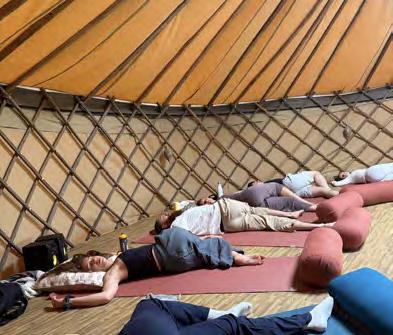


We remained in the yurt for a rich and immersive cacao ceremony. Drums and chants echoed as cacao was passed around the circle, the music filling the space effortlessly. The yurt’s size allows for an intimate yet expansive group experience which is perfect for shared moments like this.
Jersey’s Hidden Wellness Sanctuary
Tucked away in St Aubin, amongst the trees, you’ll find Jersey Organic Yurts Retreat - a sanctuary that feels worlds away from everyday life. From the moment you arrive, there’s an instinctive exhale. Nature surrounds you as you wander towards the yurts, with only birdsong and the faint murmur of the outside world breaking the silence. Through the trees, glimpses of Jersey’s coastline and St Aubin's Fort reminds you of where you are - yet somehow, it feels like you’ve travelled much further than ten minutes from home. There’s a quiet sacredness here, an energy that immediately shifts something within you.
Our retreat began in the larger yurt with a yin yoga session led by the wonderful Ruby. With a calm and grounding presence, she guided us through gentle stretches, allowing everyone’s nervous system to soften and reset. The space itself was thoughtfully equipped with mats and bolsters, inviting us into deeply restorative, almost dreamlike poses - I found myself drifting in and out of a peaceful, meditative state.
Reflecting on the experience, Ruby shared, “It was such a beautiful place to teach yoga in. It felt really spacious and had such a wonderful grounding energy for everyone to settle into the practice.” We remained in the yurt for a rich and immersive cacao ceremony. Drums and chants echoed as cacao was passed around the circle, the music filling the space effortlessly. The yurt’s size allows for an intimate yet expansive group experience which is perfect for shared moments like this.
As evening drew in, we were guided to our yurts for the night. A slightly smaller version of the main space, it felt less like traditional glamping and more like a boutique retreat suite. Thoughtfully designed, each yurt includes everything from power sockets and full-length mirrors to armchairs and comfortable double beds. It strikes a perfect balance between immersion in nature and modern comforts.

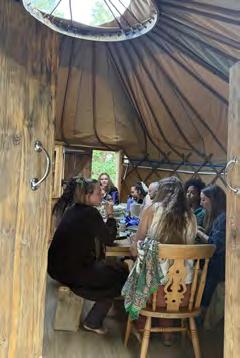
What makes the experience even more special is the fireplace within each yurt, fully stocked and ready to create a warm, cosy atmosphere. It’s these small yet meaningful details that elevate the stay.
Fellow retreat guest Mia Bourne described it perfectly: “I instantly felt at home at JOY Retreats - more connected to myself and to nature. The yurts are so homely and spacious; it’s a wonderful place to gather.”
The versatility of the space is part of its magic. Designed with intention, it can transform to suit a variety of experiences. At one point, we cleared the yoga mats to make way for Naomi, who brought the space to life with an ecstatic dance session. The energy shifted beautifully as music filled the yurt and everyone moved freely.
Naomi reflected, “I loved playing music and seeing everyone dancing in the shala. It’s a great space and it didn’t feel like Jersey at all. It felt completely off-grid, and despite the storm outside, we were warm and cosy.”
The retreat also features a spacious, open-plan kitchen which was a true hub for connection. Fully equipped with everything needed for group catering, it centres around a large communal table, encouraging conversation and shared moments over food. Another guest, Imogen, shared that this was her favourite part: a place that fostered a genuine sense of community and togetherness.
Overall, JOY Retreats embodies everything you would hope for in a retreat space. Every detail reflects the care and vision of its’ founders, Corrine and Pedram, whose passion is evident throughout. In a time where community-focused, alcohol-free experiences are becoming increasingly valued, JOY Retreats is offering a space that supports this growing shift towards wellness, connection, and conscious living.






@gallery~% Gallery/Jersey/26/6/1/supplements/shift

# SHIFT — Design System > Gallery Magazine’s spring 2026 technology supplement. A progressive editorial design language built around industry’s adoption of emerging technology.


We were given **no codebase, no Figma, and no existing design system**. The visual language below is derived from:
1. The full editorial text (tone, vocabulary, references, recurring metaphors)
2. The Gallery magazine running header conventions visible in the PDF text extraction (`W
|
| SPARK: TECH SPECIAL`)
3. Editorialdesign conventions for British lifestyle/ culture supplements (think *The Gentlewoman*, *Monocle*, *MacGuffin*, *Real Review*)








## Articles in the supplement
| # | Article | Form |
1 | Editor’s letter | Single-column intro, signed `EP` | 2 | **Industry, Rewired** | Three-up Q&A feature (Hiizzy, Switch Digital, C5 Alliance) | 3 | **Misc: Crypto for Dummies** | Satirical primer — Bitcoin, Ethereum, Memecoins, Stablecoins, NFTs, AI Coins | 4 | **Reading Between the Bios** | Data-journalism piece on the 92 candidates for the States Assembly | 5 | **How far can citizen developers really go?** | Long-form investigation, multiple sources |
README.md ← you are here · all the foundations colors_and_ type.css Tokens — colours, type ramp, spacing, radii, rules, motion SKILL.md How an agent should use this system

emma@gallery~% github/AI/vibecoders
How technology is changing the way we work
Gallery/Jersey/26/6/1

Shift 2026
TECH SPECIAL


EDITOR
EMMA PALLENT emma@factory.je
ADVERTISING & SALES
FLO LEACH flo@factory.je
PUBLISHER
BEN DAVIES ben@factory.je

Seeing as we’re currently living through the biggest technological shift since the internet, we thought it was probably time to introduce a tech supplement into the Agenda side of the magazine. This will either make for an interesting read, or confirm that everyone at 10 Minden Street has finally disappeared into a niche echo chamber of existential dread.
Although, “existential dread” might be overstating it slightly. Mostly, we’re just living through a moment where nobody is entirely sure what the future is supposed to look like anymore. Employment, education, creative work, professional services, entire industries; everything suddenly feels a little more fluid than it did five years ago. Whether you sit firmly in camp austerity or camp augmentation, most people seem to agree there will still be a place for human beings somewhere in the equation, even if that place eventually involves being nutritionally sustained in a pod like a background extra in The Matrix.
Jokes aside, we used this issue as an opportunity to speak to some of the island’s leading voices across finance, compliance, marketing, property, software, data and technology, asking not just where things are heading, but what is already changing right now. Less “when will the robots take over?”, more how workflows are evolving, what businesses can suddenly offer clients that wasn’t possible a few years ago, and where human judgement still matters most.
Elsewhere in the section, we take a deeper look at the future of entrepreneurship in tech, and whether the “citizen developer” dream actually holds up beyond the marketing pitch. Tech writer Toby Balderson also put his data analysis skills to work by scraping more than 35,000 words from this year’s General Election candidate bios into a CSV file for analysis, scoring candidates on everything from “AI suspicion” and cliché density to optimism levels and ego score, before plotting them somewhere between fiscal and social ideology. Democracy, but with spreadsheets.
And finally, we’ve taken the liberty of relocating Misc into the tech section for this issue. If you’re heavily invested in crypto, consider this your advance warning.
PUBLISHED BY
Enjoy.
10 MINDEN STREET
ST HELIER JE2 4WR FACTORY

Technology is reshaping every industry, but how that change unfolds (and what it asks of the people leading it) varies hugely from one sector to the next. In this feature, we speak with three professionals whose day-to-day work has been transformed by digital tools, automation and AI.
From rethinking how property is bought and sold, to redefining what a modern marketing agency offers, to embedding AI governance into core business strategy, each shares a different perspective on the opportunities, and careful judgements, that come with being tech-forward today. Their answers reveal what's changed, where human input still matters most, and what's now possible.
How is technology changing the way homes are bought and sold day-to-day, and how does your platform approach differ from a traditional estate agency model?
Historically, selling a home has depended on using an intermediary. Without that, there was effectively no route to market for most people. What technology has changed is access.
Hiizzy enables sellers to list their own property and reach buyers directly — something that wasn't possible before without going through a traditional agent. It also integrates with Places. je, so sellers can now achieve the same level of market exposure as any local agency listing. It's not just about improving the process — it's about opening it up.
We built Hiizzy on a simple premise: there must be another way to sell property that reflects how people already use technology in other parts of their lives. We've developed a high-tech, selfservice listing journey, supported by AI, that guides sellers through bringing their property to market in a structured and intuitive way. It's not about replacing the existing model, but offering an alternative that gives people greater control, transparency and direct access to the market.
Despite that shift, where does human input still matter most in the process for your clients?
Human input still plays an important role, but it's no longer about controlling the process. In practice, most users are comfortable managing the key aspects of a sale themselves — setting a price, handling enquiries and conducting viewings. Many value that direct involvement. Where human input really matters is in supporting the use of the platform itself.
Because Hiizzy represents a new way of selling property, our customer service focuses on helping users feel confident using the technology — answering questions, providing reassurance and being available when something isn't immediately clear. It's less about telling people what to do, and more about ensuring they feel supported in doing it themselves.

1In Jersey, where trust and service standards are high, that balance works well — giving clients independence while ensuring they're never left without help when they need it.
What can you now offer sellers or buyers through your platform that wouldn't have been possible a few years ago?
What's changed most is the level of choice now available. Not so long ago, bringing a property to market almost always meant committing to a traditional percentage-based commission model, regardless of how involved you wanted to be. There was very little flexibility. Today, sellers can take a more active role — listing their own property, managing viewings and engaging directly with buyers — while still achieving full market exposure. We've seen sellers complete a sale for as little as £185 using Hiizzy — something that would previously have involved significantly higher costs.
For buyers, it also creates a more direct experience. They're often speaking to the person who knows the property best — the owner — which makes conversations more transparent and efficient. Ultimately, what's now possible is choice: how involved to be, how to present a property and how to manage the process — supported by technology that makes that independence viable.
hiizzy.com
Allan Wood and Lewis Buckley, co-founders of Hiizzy

Kezia Lightfoot, Head of Communications, Switch Digital
What's changed most in how you work day-to-day?
Marketing has evolved from being viewed as a largely intangible discipline to one that is now highly measurable. From high-level metrics like page views, to in-depth customer journey analysis, businesses are now far better equipped to see the commercial value that good marketing strategy delivers.
Technology has played a major role in this. We now have countless tools that mean we can more effectively demonstrate the impact of marketing plans. As a result, marketing has increasingly earned a seat around the boardroom table and is now seen as a key part of business strategy, which I think is hugely exciting.
It's also opened up new communication channels. Historically the customer journey was far more linear, moving from awareness to consideration and ultimately purchase through a limited number of channels. Today a multi-channel journey across a range of platforms is more common. Particularly in a business-to-business environment, potential clients might engage with an organisation for 18 months before making an active enquiry.
Understanding customer behaviour is essential, and technology gives us the ability to track and analyse in ways we never could before.
Where does human judgement still matter most?
While data and automation provide greater visibility and efficiency, emotional intelligence and a real understanding of people remain essential to effectively capture attention and build engagement.
We're all familiar with AI-generated content. It's jarring when a brand claims you're important to them, but the message itself is clearly automated. While AI can support faster execution, relying on it too heavily can create messaging that feels disconnected. Great marketing taps into how people feel. That requires emotional context, storytelling and a real understanding of a brand's values and how other humans engage with that story and those values.
While businesses now have access to more information than ever before, more data in isolation doesn't always lead to better decisions. Identifying the right insights, validating them and understanding the context behind them still depends heavily on human experience and expertise.
“More data in isolation doesn’t always lead to better decisions”.
Building strong partnerships is vital. We work hard to really understand our clients' objectives, needs and longterm goals, as we know this is when we deliver the most successful outcomes.
What can you now offer clients that you couldn't a few years ago?
We have invested in building a team of senior leaders and specialists, alongside adopting automation and AI to help streamline operational processes.
The marketing landscape is evolving rapidly, and it's our job to make sure our clients keep pace. For us, it's about using the technology available to remove time-consuming processes, improve cross-agency collaboration and provide better data visibility. This allows our team to focus on deeper strategic relationships. Ultimately, the strongest brands are built on authenticity, trust and long-term client value, something that human specialists remain best placed to deliver.
Clients today want more than an agency; they want a strategic partner they can trust. They are looking for experts who understand both commercial performance and how to build and grow an impactful brand. They also want to be able to talk to humans who have the benefit of hindsight and experience.
kezia@switch.je


John

What's changed most in how you work day-to-day?
The biggest shift has been the pace and scale at which AI is being adopted, often ahead of formal governance. A few years ago, AI was still treated as experimental or niche. Today, it's increasingly embedded in everyday operations — sometimes through centrally managed systems, but often through tools adopted directly by teams and individuals.
Day-to-day work now involves far more emphasis on structure, oversight and accountability. With the EU AI Act coming into force, the conversation has changed from "can we use AI?" to "how do we prove we're using it responsibly?". That means thinking much earlier about data quality, risk classification, transparency and human oversight, rather than bolting governance on after the fact.
AI is no longer viewed as a side project. It's being treated as a core business capability, much like information security or service management — and that fundamentally changes how organisations plan, deploy and manage it.
Where does human judgement still matter most?
Human judgement matters most in deciding what AI should be used for, and how much control is appropriate. The EU AI Act is risk-based by design, recognising that not all AI carries the same implications. Determining whether a use case is high-risk, limited-risk or minimal-risk is not something that can be automated — it requires contextual understanding, ethical consideration and business insight.
People also remain central to accountability. Regulators expect clarity around ownership: who is responsible for the data, the model, the decisions AI supports, and the approvals behind them. That human layer of responsibility is critical, particularly in higher-risk applications where transparency and oversight are essential.
Ultimately, AI governance isn't about box-ticking. It's about applying judgement proportionate to risk — setting guardrails that enable safe, effective use without stifling innovation.
What can you now offer clients that you couldn't a few years ago?
What's changed is the ability to help organisations navigate AI maturity in a structured, credible way. A few years ago, conversations were largely about experimentation and potential. Today, there's a clear regulatory framework, evolving standards and far greater clarity about what "good" looks like.
We can now help clients move beyond ad-hoc adoption towards demonstrable, auditable AI governance. Standards such as ISO/IEC 42001 provide a practical way to embed governance across the full AI lifecycle, while aligning closely with the intent of the EU AI Act.
The conversation has changed from ‘can we use AI?’ to ‘how do we prove we’re using it responsibly?
This allows organisations not just to innovate, but to do so with confidence — showing regulators, customers and stakeholders that AI is being used responsibly. In practical terms, that means better prioritisation of use cases, clearer ownership, stronger assurance and, ultimately, a more sustainable approach to AI as it becomes part of everyday business.
If you'd like to discuss your AI governance options or any other aspect of your AI journey, please contact John at john.gamble@c5alliance.com.





Given this supplement has allowed ample room for discussing the way AI is changing the way we work across many industries, it felt right to focus on education and how this shift is manifesting in the classroom. AI is already transforming what's possible in schools, from acting as an on-call tutor who can explain complex academic problems in language a student understands, available 24/7, to giving teachers powerful new ways to plan lessons and create high-quality materials tailored to specific examination specifications.
Alongside these opportunities, we also need to be thoughtful about how AI is used. Studies have shown that over-reliance on AI to produce outputs can result in mental atrophy, or the wearing down of the parts of the brain we used to rely on to do those tasks. When we offload the exercise, we downgrade the muscle. I once read an article that compared using AI to do the work for you to saying, "I went surfing today", when really you just stood on the beach and watched someone else surf. You still can't surf.
For many, their years spent in education are the most mentally stimulating of their lives. When your brain is still forming, it helps to stretch and train the muscle that acts as the backbone for achievements later on. The exciting question for schools is how to harness AI's huge potential to enrich learning, while making sure students still develop
the cognitive skills they'll need to thrive, both as future employees fluent in AI and as independent thinkers.
I was speaking to a friend, who is a teaching assistant in a secondary school in Jersey, about the dilemma. She mentioned she was finding it difficult to get some of her Year 9 students to bother doing their maths during the lesson. After trying to convince them that it was a really useful skill they would need in life, they told her it wasn't, because if they didn't know in the future they'd just ask ChatGPT. It reminded her of being in school herself and saying she didn't need to learn mental maths because she could just get a calculator to do it for her. Her teacher replied that she wasn't always going to have a calculator in her pocket. Of course, now we do.
On June 26th, Jersey College for Girls is hosting a conference that will explore the way AI is reshaping the education sector and, crucially, how schools can move quickly to harness the opportunities it offers while retaining their academic rigour. Education in an AI World, sponsored by R3nquist, brings three leading voices on AI in education to Jersey for a day of presentations and workshops: one programme for students, and another for teachers, parents and professionals interested in how new technology is influencing the learning of the next generation.
The event is organised by Simon Lewis, Assistant Headteacher at JCG, and grew from a sense that AI's effect on schools deserves the same attention that its effect on workplaces has received, and that JCG is genuinely excited to lead that conversation on the Island. The numbers have been moving fast. An Oxford University Press survey of 2,000 UK teenagers in August 2025 found that eight in ten are already using AI for schoolwork, and fewer than half felt confident they could tell whether the information they were given was true. "This isn't necessarily a new problem," Simon says. "Five years ago, I couldn't tell whether a student had completed their homework, or whether a parent or a tutor had done it for them. What's different now is that it's amplified. AI is available everywhere, all the time." Used well, that constant availability is a remarkable gift to learners, and the focus of the conference is on how schools, students and parents can make the most of it.
"There are so many opportunities here that we're keen to explore," Simon says. Students and teachers can use AI to build websites that bring their learning materials to life and share them with others. "A Year 9 student showed me a site they had made just this week." Teachers can create AI agents to take on administrative tasks, freeing up more time to spend with students. AI can open up genuinely independent learning, letting students fill gaps in their knowledge or move at pace through new material, and it can plan, organise and resource revision in great detail. For teachers, it offers the ability to create high-quality teaching materials tailored to specific examination specifications. "We want the students to get to the point where they can engage in that heavy lifting of learning more quickly," Simon says, "but we don't want them to be offloading the necessary neural work in order to learn and develop their brains." The aim is for AI to act as an on-call teacher and a powerful learning partner, rather than a stand-in for the thinking itself.
The line-up of speakers presents three different angles. Dr Kaitlyn Regehr, associate professor of digital humanities at University College London and author of the international bestseller Smartphone Nation, has fed into the UK's Online Safety Act and advised the House of Lords, the Metropolitan Police and the Children's Commissioner. Her keynote, Algorithms and the Attention Economy: How Schools and Students Can Take Back Control, brings the question of algorithmic literacy into a classroom context, looking at how the patterns young people have learned from social media shape the way they now engage with AI. Simon sees this in school, noting that "students are using AI as they might use Snapchat. They'll literally type in a few keywords or characters." This talk explores how the language used in prompts shapes the quality of the output, a skill that, once developed, opens up far richer ways of working with these tools.
Amelia King, Director of Digital Transformation at Dulwich College London and author of Thinking with AI, will explore what happens in the brain during AI use, how learners can use AI productively to deepen rather than dilute their thinking, and the habits they should avoid. Dominik Lukes, a Lead Business Technologist at Oxford's AI Competency Centre and author of Beyond ChatGPT: The State of Generative AI in Academic Practice, takes the longest view, with research on what he calls the cognitive revolution. This focuses on how we are changing the wiring of our brains and how we actually think when we use AI.
The third theme has attracted exploration and evidence recently. In June 2025, MIT's Media Lab published a preprint, Your Brain on ChatGPT, in which 54 participants wrote essays with ChatGPT, with a search engine, or unaided, while EEG sensors tracked their brain activity. The ChatGPT group consistently showed the weakest brain connectivity, weaker memory recall and the lowest sense of ownership over their work. Simon points to this kind of research as a reminder of why how we use AI matters as much as whether we use it. "The group given free access to AI cognitively did not make as much progress, and in fact the free use of AI reduced their cognitive engagement in comparison with the other groups.”
With the right approach in the classroom, AI use can be designed so it strengthens learning rather than substitutes for it. Rather than googling a topic such as cymatics and wading through pages of information, a student can ask AI for a quick summary before digging deeper and comparing specific perspectives in a more targeted and immediately accessible way.
Nevertheless, "the ability to have a massive amount of knowledge and understanding, and to dig deep into things that you might not have been able to previously,” is hugely encouraging. With the right approach in the classroom, AI use can be designed so it strengthens learning rather than substitutes for it. Rather than googling a topic such as cymatics and wading through pages of information, a student can ask AI for a quick summary before digging deeper and comparing specific perspectives in a more targeted and immediately accessible way.
The workplace expectation is moving in one direction, with AI tools enabling employees to become more productive, more independent and capable of performing to a higher standard than people at their level have previously been able to achieve. Schools have a real opportunity, and a responsibility, to prepare students to step into that world with confidence. The sponsor of this event, R3nquist, will use their opening address to talk about wanting future employees fluent in using AI alongside other tools. The environmental cost is also on the agenda, with a dedicated session.
The conference runs from 09:15 to 15:25 on Friday 26th June, with a parallel programme for Year 12 students and an evening session with Amelia King for parents. Tickets are available via Eventbrite. "At JCG we're really excited to explore what AI can offer learning, and we're holding this conference to bring leading thinkers and experts together so we can spark an Island-wide conversation about the huge positive benefits AI could bring to education," Simon says. “At the moment we're in the area where we just don't know what the future will look like, but hopefully on the 26th we'll get a bit of a steer on it.”
Education in an AI World takes place on Friday 26th June, 09:15-15:25, at Jersey College for Girls.

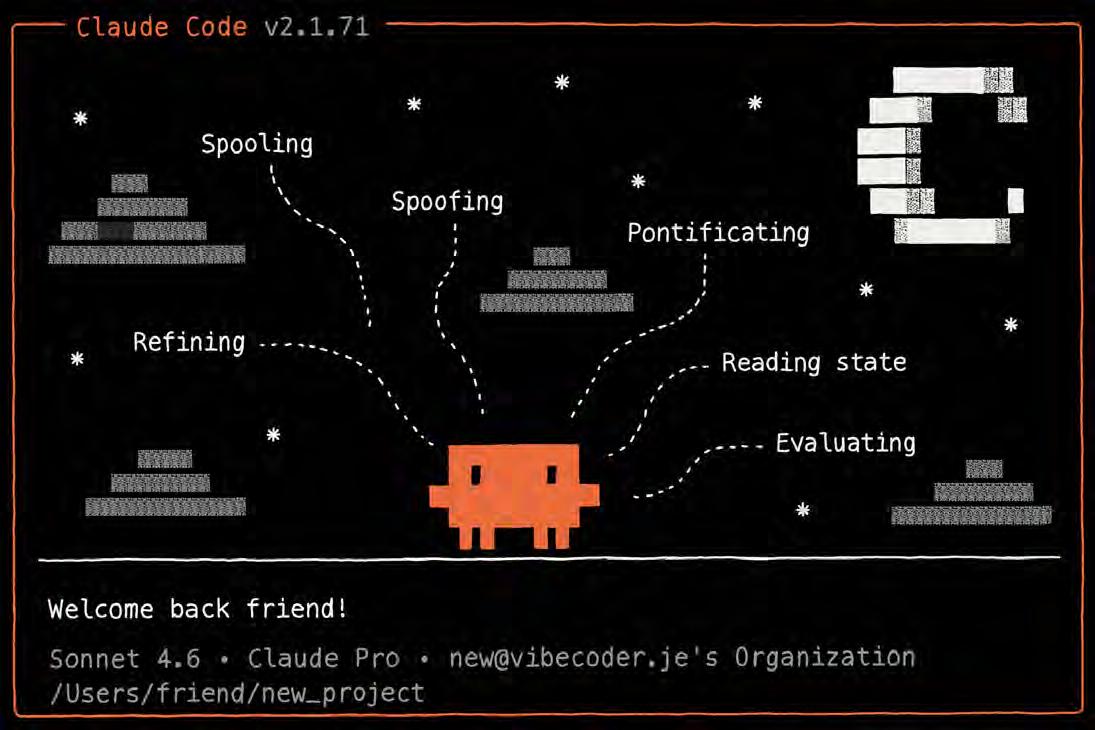
AI tools now promise that anyone can build their own software, no coding required. I rabbit-holed into the marketing pitches on both sides to figure out how far citizen developers can really go.
Words and Illustrations: Emma Pallent
Every small business has a version of the same problem: a bit of recurring admin that takes hours, that nobody enjoys, and that an AI tool ought to be able to handle. For most of the last decade, fixing that would have meant hiring a developer, or accepting that the cost versus time trade-off made it not worth automating. The new promise of AI is that the business owner, or an employee, can build the fix themselves without knowing how to code, in an afternoon, for the price of a couple of streaming subscriptions. The question is whether that promise is real.
I tried to find out last summer. My task was straightforward: extracting key information from publicly available PDF contracts of sale, and putting the data into a spreadsheet. Doing it manually took several days. It was the kind of mindless admin task that gives you way too much space with your own thoughts, and by the time I’d gone A-Z I was ready to give it all up and go off-grid in the Sahara Desert, living like the Fremen in Dune.
To save myself the grief, I tried running the PDFs through ChatGPT to extract the data. Unsurprisingly, the spreadsheet came back riddled with hallucinations. Luckily, due to the AI’s Americanised nature, addresses such as Maple Grove stuck out like a sore thumb against the Jerriais road names of Jersey.
When I told my sister, who studied computer science, what I’d been trying to do, she steered me away from using a large language model (LLM) such as ChatGPT or Claude as the engine of the task itself. Use those programmes to write your deterministic code, she said, with an OCR reader. Deterministic means software that does the same thing every time, the same way, and tells you clearly when it fails. LLMs are probabilistic, so if they don’t know the answer, they’ll guess what the correct one could plausibly look like. In my case, this meant fictional roads in Jersey named after tree species.

GLOSSARY
LLM(largelanguage model):Thekindof AIbehindChatGPT andClaude.Trainedon hugeamountsoftext, itworksbypredicting whatwordshould comenextbasedon whatit’sseenbefore. Greatatwritingand conversation;badat mathsandatknowing whenit’swrong.
OCR(optical character recognition):Turns imagesoftextinto textacomputercan actuallyread.Scana contractasaPDFand OCRiswhatmakes thewordsinside searchable,ratherthan justapicture.
Probabilistic: Softwarethatmakes itsbestguessbased onpatternsrather thanfollowinga fixedrule.LLMsare probabilistic,whichis whytheysometimes getthingswrongin confident-sounding ways.Theoppositeof deterministic.
What followed was months of on-and-off trial and error with my colleague Ben, around our other work, as we discovered new tools. Eventually, Claude Code, Anthropic’s coding agent, came out on top. It changed the playing field. What used to take weeks to produce and occasionally worked could suddenly be built in hours and, after testing, appeared to work every time.
It’s an intoxicating promise: faster, cheaper, no developers required. The people building this way are called citizen developers (anyone without formal software engineering training who’s building functional business applications). The marketing pitch for no-code tools like Claude Code is that whole categories of work that used to require expensive technical hires can now be handled in-house, by whoever has the appetite. Lovable, a similar tool to Claude Code, ran an advert on the London Underground late last year with the slogan “From Idea to Live in Minutes.” That is, in essence, the dream.
The reality, when you actually try to ship something to users, is different. This piece is an investigation into what happens between the marketing and the moment of going live, from inside the experience, with advice from people who’ve worked in this field for decades.
Having gotten rid of the problem of not knowing how to code, the first real problem I ran into wasn’t a technical one. It was that I had absolutely no way of knowing whether what I’d built was safe, or… legal. Don’t people always bang on about protecting data? Is the data stored in my app secure? Does this make me a data controller, and if it does, how do I register as one? Is my privacy policy adequate? (It wasn’t. The agent had called on ChatGPT to produce a convincing but threadbare policy written for America, a jurisdiction with significantly more lax data protection laws than Jersey.) The moment I started thinking about taking what I’d built out of the realms of what felt like a dirty secret running locally on my laptop to other people, I realised I had no confidence I wasn’t on the rough road to getting sued for negligence.
In Jersey, there isn’t a specific AI law yet, so the legal side of things follows the Data Protection (Jersey) Law 2018 (DPJL), which mirrors GDPR. A business handling personal data is almost always the data controller, which holds a lot of weight: responsibility for what happens to that data sits with the business owner, not with the AI provider. Personal data, under the DPJL, is broader than people assume: names, email addresses, IP addresses and employment history all count. A subset called special category data covers more sensitive ground, such as biometrics, medical history and religious beliefs, and triggers stricter rules still.
There’s also the question of where that data physically ends up. When a citizen developer in Jersey builds something with Claude Code, the data their app collects will be stored on servers somewhere in the world; the location of which depends on whatever backend the developer wires up. This matters because Jersey law has rules about sending personal data outside the island, and places such as the US don’t automatically count as somewhere safe enough to send it. A booking tool holding client names, or an app processing contracts of sale, could be breaking the rules from the moment the first customer uses it, without the
Anthropic:The companythatmakes ClaudeandClaude Code.Oneofthe handfulofbigAIlabs, alongsideOpenAI (ChatGPT)andGoogle.
Citizendeveloper: Anyonebuilding softwarewithout formaltrainingasa softwareengineer. Couldbeabusiness ownerautomatingtheir admin,oramarketing managerknocking togetheraninternal toolfortheirteam.
ClaudeCode: Anthropic’scodingtool. Youtellitwhatyou wantinplainEnglish; itwrites,runsand editsthecodeonyour computer.Assumes you’rewillingtolearna littlealongtheway.
person who built it ever realising. While the fix is straightforward, the citizen developer has to be aware of the legalities of cross-border data transfers in the first place.
This isn’t any different from what any other business owner handling customer data has to deal with, but if the process feels more like prompting than programming, it would be easy to assume the rest is as straightforward as creating the product. The main barrier wasn’t business-related admin, it was not knowing how to code… right?
The gravity of it makes you think: if an architect chose a new plaster and the building fell down, is the fault the architect’s, or the manufacturer of the material? In the vibe coder’s case, it’s apparent. Anthropic’s commercial terms place the responsibility for evaluating whether outputs are appropriate squarely on the customer, including “where human review is appropriate, before using or sharing outputs.” The legal shifting of responsibility has already been done. It’s the equivalent of the manufacturer of the plaster turning round and saying “this material may not always hold”; in normal commerce, nobody would trust it. With no knowledge of coding (essentially no history working with plaster), the question is whether the citizen developer reads what they’re agreeing to, and whether they’re equipped to verify what they’ve built, when the answer is that they have to.
Datacontroller: Legally,theperson responsibleforhow someone’spersonal datagetsused.Ifyour appcollectscustomer emails,you’rethe controller.Ifsomething goeswrongwiththat data,it’sonyou,not theAIthathelpedyou buildit.
DataProtection (Jersey)Law2018): Jersey’sdataprotection law.Modelledclosely onGDPR.Therulebook ifyouhandleother people’spersonal informationhere.
GDPR: TheEU’sdata protectionlaw,inforce since2018.Themostcopieddataprotection frameworkintheworld.
Personaldata(under theDPJL):Broader thanmostpeople think.Names,email addresses,phone numbers,IPaddresses, employmenthistory, photos—anything thatcouldidentifya livingperson.Ifyour apptouchesit,you’re handlingpersonaldata.

DerekCrous
Co-founder,Peresys·soldtoASXfirm2011 Decadesofshippingsoftwareintoindustries wheretheconsequencesofgettingthings wrongarefelt.
Derek Crous is the person I spoke to who has spent the longest sitting with that kind of question. He co-founded a South African financial markets technology company called Peresys in 1997, building trading software for regulated markets, and ran it for over a decade before it was acquired by an Australian firm in 2011. He’s spent his career shipping software into industries where regulations are tight, because the consequences of getting things wrong are painful.
When his daughter, a data analyst in the tech industry, first expressed an interest in a technology career, Crous impressed upon her the importance of working hard at the fundamentals: understanding the language, good architecture and clean code. Then, earlier this year, after assessing new capabilities in Claude Code, he sat her down and told her the world had changed. The fundamentals would still stand her in good stead, but an understanding of the power and limitations of generative AI tools meant she could become productive far faster, and learn along the way. “It’s now at a point where if you put the guardrails in place and are really quite crisp and clear as to what you’re asking AI to write,
the quality of the code that comes out is very good. You do need to check its assumptions regularly, but it does a good job.” It’s a remarkable thing to hear from someone who spent forty years writing code by hand, or as a CTO managing the teams who did. But Crous is clear about where the line sits. “There still has to be human accountability for everything that goes out there. We’re using these new tools. You can’t turn round when your new application eradicates data or exposes private data and say, ‘oh, I’m so sorry, the AI did it.’”
Crous framed the shift with a metaphor: “Everybody who wants to build an application is going to have to become a little manager,” he says, “because you’ve got a staff member now that is working for you 24 hours a day, doesn’t leave, doesn’t need sleep, doesn’t have attitude. But you’ve still got to make sure that it’s delivering exactly what your expectations are, because it will do the best it can no matter what it knows.”
A manager doesn’t do every task themselves, but they’re accountable for the people who do. Their job is to set direction, keep an eye on the work and step in when something looks wrong. When someone on their team makes a mistake, the responsibility still lands on the manager, not the junior who pulled the trigger. The citizen developer is the manager, whether they realise it or not. What Crous suggests in place of reading the code is a “finely grained mesh of testing and user acceptance testing”: checking the system from every angle, including the edge cases where it might fail, enough to show an auditor they’ve done a fair degree of stress-testing.

The other thing that became clear once I started building was that I wasn’t building in an empty market. If a citizen developer goes into a project thinking of developing a product with commercial value across multiple industries or businesses, they’ll soon realise that the tools they’re competing against, when they try to sell their product to a Jersey business, are pretty formidable.
No-code/ low-codetools:
Softwareyoubuild byclickingand describingrather thanwritingcode (no-code),orby workingvisually withdrag-and-drop blockspluswriting formulasand expressionswhere needed(low-code).
Deterministic:
Softwarethatdoes thesamething everytimeandtells youclearlywhenit fails.Acalculatoris deterministic:2+2 alwaysgivesyou4.
Hallucination(AI): WhenanAImakes somethingupand presentsitasfact.In thispiece,it’swhen ChatGPTinvented Jerseyaddresses thatsounded plausiblebutdidn’t exist.AItools hallucinatebecause they’rebuilttogive youaconfident answer,evenwhen theydon’tactually know.
DanHare
Continuum·Alteryxspecialist·Jersey
“Thedata’sneverreliable.Youhavetodosomethingbeforeyou startusingit.”
Dan Hare, who runs the Jersey data consultancy Continuum, has spent years implementing low-code platform Alteryx for clients across the island. Alteryx is deterministic by nature and flags bad data sources rather than hallucinating around them. Users can drag building blocks of pre-written code around to extract meaningful analysis of their company’s data, within the security of an enterprise-level product that has been vetted and tested by professional engineers. It costs around four and a half thousand pounds per user per year, and it’s aimed at analysts inside businesses that have meaningful data to work with.
Microsoft’s recently launched App Builder, embedded inside Microsoft 365 Copilot at around twenty-five pounds per user per month, lets employees describe an app in plain English and Copilot generates it, with the data secured by enterprise-grade infrastructure an individual citizen developer could not realistically replicate. Encryption, identity management, intrusion detection and a dedicated security operations team are all wired in by default. For internal tools serving employees of a business that already has Microsoft 365, App Builder is genuinely competitive.
MichaelFrisby
Be-Cloud·TheMicrosoftGuy·Jersey
“Thebigplatformswilltakecareofalotofthesecuritypiecesanyway.”
Michael Frisby, who has spent thirty years selling Microsoft technology to small and mid-sized businesses, across both Microsoft and the Microsoft channel through Cobweb, Vuzion, Infinigate and now BeCloud, hammers this point down hard. “The big platforms will take care of a lot of the security pieces anyway,” he says.
The cold reality is that most small businesses aren’t lying awake at night thinking about how to integrate a vector database into their workflow. They’re thinking about getting overdue invoices paid.
Vectordatabase:
Atypeofdatabase designedforAItools tosearchthrough quickly.Usedwhen youwantanAIto findrelevantcontent fromabigpileof documents.Inthis piece,anexample ofthekindof jargonmostsmall businessesdon’t needtocareabout.
The other issue is that for many projects, the audience just isn’t ready for them. Frisby points out that “the adoption of Microsoft Cloud within businesses of less than 25 users is just under 10%.” Hare adds that “the data’s never reliable. You have to do something before you start using it.” The cold reality is that most small businesses aren’t lying awake at night thinking about how to integrate a vector database into their workflow. They’re thinking about getting overdue invoices paid.
You might think your tool is the best thing in the world. Perhaps it’s elegant, and does something useful. But does it solve a problem your prospective customer is actively trying to solve, or is it something you’ve just gotten a bit obsessed with? I once spent a couple of days building what was, in my opinion, a beautiful booking tool, perfectly catered to the whims and personality traits of a friend who runs a freelance business. It was miles better than his current system, which was based on sporadic emails, phone calls and a haphazardly maintained diary. When I tell you, he literally didn’t use it, because he preferred the way he was doing it before. Market = zero. Are you trying to build motorbike engines for cyclists?

People who have spent years in software development undoubtedly have an edge because they know how to use the tools effectively. Pair that with their experience in the field to know what works and what doesn’t, and you’ve got the difference between an author and a non-native English speaker using ChatGPT to help them write. The former knows the sentence structures, clichés and ChatGPT-isms to look for and edit out; the latter, without experience, may struggle.
The expertise gap matters, but it isn’t always where you’d expect. A Jersey digital agency that’s been building websites and software for businesses on the island for decades published an article on common citizen developer issues: AI-generated code containing security flaws, the need to review with rigour, and the importance of stewarding the systems produced. Their proposal is that if you’re interested in building your own platform, they can chat over your ideas with you and use Lovable to help you create it while ensuring it’s safe. The piece ends with an invitation to come and have a chat, and weigh up the pros and cons of going out on your own with no-code.
It appears to be a happy medium between the two pitches, but then, I suppose, “don’t ask the barber whether you need a haircut.” The Lovable advert wants you to spend money vibe-coding an app. A web design agency publishing accountability-gap content wants you to come to them. Both motives are perfectly reasonable, and produce useful outcomes in different contexts. But at the end of the day, the citizen developer reading either of them is being marketed to, even if it’s dressed up as advice.
The defence of the citizen developer pitch, beyond all this, is that built into the nature of agentic coding tools are certain guardrails. They automatically wire up to managed authentication services like Auth0 where needed, even if you’d never heard of it before. Payment processors like Stripe handle card data so the citizen developer doesn’t have to, and databases come with encryption and access controls built in. Anthropic’s most recent updates to Claude Code introduce more security-by-default than was there even a year ago. None of these reach enterprise-level protection, but they’re not nothing.
Reporter’snote·narrowlyavoided Seeker,onReplit.
BeforediscoveringClaudeCode,IbuiltatoolcalledSeeker onReplit.ItanalysedCVsandmatcheduserstoLondon lawfirms.AssoonasIconsidereddeployingit,IrealisedI’d becomeresponsibleforusers’employmenthistoriesand professionalaspirations—personaldataundertheDPJL, withalltheobligations.
WhenIaskedReplit’sAIagenttocovermelegally,itcalledon ChatGPTtodraftaprivacypolicy.Thepolicywasrudimentary atbestandwrittentotheGDPRstandardsofAmerica,which areconsiderablymorelaxthanJersey’s.Ionlycaughtit becauseIaskedasecondAItofactcheckthefirst.
Specialcategory data:
Thestrictersubset ofpersonaldata: medicalrecords, biometrics,religious beliefs,sexual orientation,ethnicity. Touchthisandthe rulesgettougher.
Threeoptionsnowonthetable
1/BuildityourselfwithAItools(ClaudeCode, Replit,Lovable…).
2/Builditwithalow-codeplatform(Alteryx, PowerApps…).
3/Stayinsidethemajorplatformsanduse whattheyoffer.
The instinct to distrust the new way of doing things can also be misplaced. Frisby remembers selling cloud services in the midto-late 2000s to businesses who insisted that having a server under someone’s desk that they could point to, with flashing lights coming out of it, was safer than moving to the cloud. The sceptics had the security argument backwards: “having your data sitting in the cloud with all the security around it was always much more secure than a server sitting under somebody’s desk that could have a cup of coffee spilled over it at any point in time.” The analogy only goes so far. The cloud was a genuine step up in security because the infrastructure was built and maintained by specialists, so it doesn’t directly map onto the move towards citizen development. But it’s worth noting.
Lovable: Acompetitorto ClaudeCode,aimed atpeoplewho wantawebapp withoutlearning anythingtechnical. Describewhatyou want;itbuildsthe look,databaseand loginscreensand putsitonline—all insideLovable’sown ecosystem,which iswheretheapp staysunlessyou reconfigureitafter thefact.
Agenticcodingtool: Doesn’tjustspitout snippetsofcode foryoutocopy andpaste;goes offanddoesthe workitself,creating files,runningtests, catchingandfixing itsownmistakesas itgoes.ClaudeCode andLovableareboth agentic.
The firm presumably had a decent budget, and the consultant was presumably paid and certified. The data was still leaking. A thorough citizen developer, with the security tooling and AI coding agents available now, would probably have done a better job. The variable, in every case, seems to be rigour.
The assumption that paid professionals are always categorically safer doesn’t quite hold either. Is the guy who claims he’ll get your website up and running in 24 hours really doing a better job at checking the security than an AI coding agent would in that time? While researching this piece, I heard about an established Jersey law firm whose conveyancing records (client names, sale prices, internal notes on specific deals) were sitting on a publicly accessible URL because the professional who had built their system years ago hadn’t configured access controls. The firm presumably had a decent budget, and the consultant was presumably paid and certified. The data was still leaking. A thorough citizen developer, with the security tooling and AI coding agents available now, would probably have done a better job. The variable, in every case, seems to be rigour.

The question sitting underneath this investigation is whether the citizen developer wave is actually the revolution it’s being marketed as, or another moment that feels world-changing while it’s happening and turns out to be something less grand.
ChatGPT helping us do our work felt revolutionary at the time, but it didn’t change the game astronomically, because it was something we could already do ourselves. Image generators feel similar; we could always have taken the photo. Apps feel different because there is a strong barrier to entry: knowing how to code is a rare skill. Now everyone has access to it, and it feels like the next big thing. But is it? Or are we just going to oversaturate the market with apps that feel and function the same as the AI slop appearing all over the internet, endless variations of “this is not just a to-do list, it’s a journey towards intentional living.”
I sometimes wonder if software developers see what’s being produced right now and feel the way I do when an article submission tells me at least three times that something is “not just x, but y”. Every vibe-coded website winds up with the same Tailwind defaults, curved buttons and a near-black background with a purple gradient bleeding behind the hero text. It’s competent design, but it’s also the visual equivalent of an em dash.
Most apps seem to work best when they complement a real-life business that solves a real problem. A rent-to-own business could come up with a brilliant app that helps customers track their savings toward a deposit, but the app would be a curiosity rather than a business if the rent-to-own service itself wasn’t already there. This may be where citizen development has room to thrive in the future: inside small businesses that have never had the budget to hire a developer at a hundred pounds an hour, but can afford eighty pounds a month for a Claude Code subscription. The tool is there to serve the business, but the business is the bit that people pay for.


A thorough citizen developer, with a commercial brain, the appetite to deal with legal and regulatory risk, and the willingness to learn and understand the tools properly, will probably end up building better products than some of the IT consultants currently being paid thousands for run-of-the-mill landing pages. It’s an uncomfortable truth that a lot of people across different industries are facing in different fonts right now.
The risk of the citizen developer marketing pitch is that it will cause people to sleepwalk into serious issues with data protection, and the specific jurisdictional legal obligations that come with shipping software to real users. All the professionals I spoke to were careful, during my conversations with them, not to come across as sticks in the mud. Hare paused at one point to say so directly, because his own company has been using AI throughout its work. Since we spoke he had only grown more enthusiastic, coming back from an Alteryx conference in Florida describing a community electrified by the newest tools, and work that would once have taken four days now taking one. Crous shared the same sentiment, explaining that AI coding tools have allowed him to explore product ideas he’d never had the time to look at before. He said that we all have to embrace these tools, not resist them. Their voices were structurally cautious by default, having worked in heavily regulated industries throughout their careers, but their advice was to participate carefully, not to put your head in the sand and wait for the world to move on without you.
Provided care is taken, or you’re lucky enough to have someone with experience willing to help you, there’s no fundamental reason a citizen developer shouldn’t experiment. Keep it hidden away running locally if you have to, but these platforms are now genuinely competitive for internal tools, and they’re always worth learning to use. The legal exposure is real, the regulatory obligations are real, but both are manageable with the right attention and it is possible to ship something defensible. Whether what gets built is safe is always going to come down to the person building it, not the software that helped them. The variable, as it was with the leaking law firm, appears to be less about credentials than rigour.
Provided care is taken, or you’re lucky enough to have someone with experience willing to help you, there’s no fundamental reason a citizen developer shouldn’t experiment. Keep it hidden away running locally if you have to, but these platforms are now genuinely competitive for internal tools, and they’re always worth learning to use.





BDO Jersey
Thursday 21st May
We headed to Tekex’s latest event at BDO Jersey, showcasing some of the innovative work emerging from the tech industry.
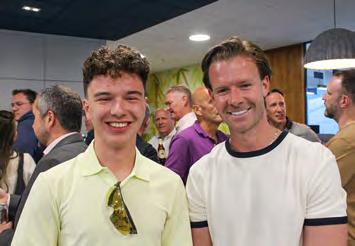


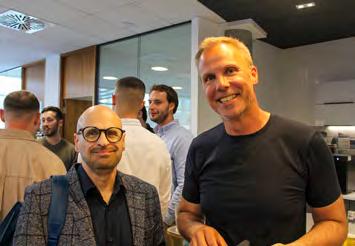

Alongside start-ups spanning music, rentto-own, and financial services, the evening was visited by Chris Sheldrick, founder of What3Words, who shared the story behind his idea (living in the countryside and never being able to get a takeaway successfully delivered to his house). He explained how the concept





evolved, initially gaining traction in Mongolia before reaching the UK through emergency services’ adoption and promotion of the system. It was an excellent opportunity for everyone to come together, learn more about the new businesses being built, and consider how they could potentially shape our future.

Words: Toby Balderson

It’s that time again. Election season. Circular Economies. Island Life. Self-Sustaining. DFDS. Housing. My letterbox and my social media is full of it. Honestly, I mostly try to ignore it. But I thought, wouldn’t it be interesting to actually analyse everything that our new cohort of potential leaders have to say.
There are ninety-two candidates standing for the States Assembly. Each has a bio on vote.je, somewhere between four hundred and three thousand words of who-I-amand-what-I-stand-for, hand-tooled (or, increasingly, ChatGPT-tooled). That's around 35,000 words in total, roughly the length of a slim novella. Not an insignificant dose of self-promotion. Naturally, I scraped the lot and exported it to a csv for analysis.
What I wanted to know, broadly, was: what are these people actually saying behind the buzzword bingo fug. You don't get the texture of an election from headlines and hustings. Those are filtered. You get it from the documents the candidates wrote themselves, where they have unlimited space and zero editorial pressure. So I did what any reasonable person would do, which is run them all through a battery of Python scripts on a Saturday afternoon and pretend it counts as work.
I scored each bio for:
Sentiment how disgruntled does the candidate sound?
"AI suspicion" (this counts em dashes, colon lists, LLM giveaways)
Cliché density frequency of buzzword bingo Ego score (the ratio of I/me/my to we/us/our)
Political positioning on a fiscal × social quadrant
For the prominent candidates I overrode the bio-derived political score with a researched version, using public records, party platforms and local press, because politicians don't always say what they mean. (According to the analysis, Sam Mézec's bio reads centre-right. The man is the leader of Reform Jersey.)
The collective platform of the 92 candidates, ranked by trigger-phrase mentions, looks roughly like this: economy and business (380 mentions), housing and cost of living (326), families and young people (283), transport (260), healthcare (228). Then a gentle slide through education, tax, environment, heritage and government reform.
This is, broadly, a sensible list of things to worry about. It is also, broadly, the same list of things politicians have worried about since I was at school.
One topic conspicuously missing from the conversation: artificial intelligence. Across
all 92 bios, only four candidates mention AI at all, and never in more than a single phrase. Steve Luce gets the most extended mention with twelve words, “technology and Artificial Intelligence (AI) will create opportunities to find new and rewarding careers in both the private and public sector”.
Maybe I’m biased, but in my view, the technological shift that is coming is likely to be seismic and none of our prospective leaders seem to be aware of that, much less have a plan for it. We have a huge opportunity to capitalise on it now. Instead we have candidates that are urging us to spend less on technology, looking at you, Alan Breckon.



Even broadening the lexicon to capture every reference to digital, technology, automation, data, machine learning, innovation and cyber, the entire technology category sits towards the bottom of the chart, sitting below crime and policing and below agriculture and food. Make of that what you will.
The most common stock phrase across all ninety-two bios is "our island home" (27 mentions). Joint runners up: "common sense" and "value for money" (12 each). "Hard-working families" makes a respectable showing.
The AI-suspicion leaderboard contains a couple of names you'd expect: candidates with extremely tidy bios, no anecdotes, a fondness for tricolons, and the structural cadence of a university graduate’s CV. I won't name them, because the score is a heuristic, not a verdict, and some humans naturally write like robots.
For the morbidly curious: the most accessible bio, with a grade-7 reading age, perfectly legible to a Jersey schoolchild, belongs to Inna Gardiner. The least accessible, in postgraduateseminar territory at grade 19, belongs to Malcolm Ferey, whose bio I had to read thrice and with a glass of wine to fully understand.
Quadrant Election bios are written to reassure, not to declare. So the fiscal-social quadrant of bio rhetoric is misleading by design. Sam Mézec leans on "investment", "growth" and "reduce red tape" in his bio, clearly pitching to centrist voters. His record, famously, is firmly left. When I overlaid the rhetoric chart with a researched-record version, his dot moved 1.35 points across the chart, the biggest gap in the field. Treasury Minister Elaine Millar, whose bio talks about public services and infrastructure, moved equally far in the opposite direction. On the record she's been openly campaigning for spending discipline and a smaller public sector.
The arrows on that chart are an article in their own right. Almost everyone is a bit more centrist in their bio than they are in the chamber. Reform Jersey candidates in particular cluster polite and centrist on the rhetoric chart, then pull noticeably down-and-left when you overlay the party's actual platform. You have to admire the discipline of it. They've all been to the same media training day.
I don't think any single chart here tells you who to vote for. That isn't what data does. But laid on top of the leaflets and the hustings, it might give you a slightly sharper sense of what each candidate actually represents, where they think the conversation is, and where their personal pitch sits relative to their public record. Polling stations are open from 8am to 8pm on Sunday 7 June. Thirty-five thousand words of bios await. Read them critically.
Methodology, per-candidate scores and interactive dashboard at electricsheep.design/election
Data scraped from vote.je on 4 May 2026. Sentiment via VADER per-sentence. AIsuspicion is a composite heuristic, not a verdict. Fiscal × social positioning derived from lexicon scoring on bios and overridden with a researched score for the 34 prominent candidates using States Assembly Transcripts, party platforms and local press.
mis·cel·la·ny mi-sə-lā-nē Shift edition
1. a miscellanies plural : separate writings collected in one volume b : a collection of writings on various subjects
2 : a mixture of various things
Cryptocurrency. Even the word is enough to make your eyes glaze over. It drags up memories of being stuck in the smoking area with a man wearing a quarter zip tossing buzzwords and abbreviations into the air with the vigour of a rotating impact sprinkler system. The worst part is that their imaginary currency isn’t accepted at The Royal Yacht yet, so all your toil to keep the conversation up long enough for a free drink is in vain.

Bitcoin is probably best described as the cryptocurrency equivalent of a sourdough starter. Created in 2009 by the mysteriously named Satoshi Nakamoto, Bitcoin was originally pitched as an alternative to banks and government-controlled money. In reality, it became a way for people to have an excuse to stare at graphs.
The key thing to understand about Bitcoin is that nobody uses it to buy things anymore, because everyone’s too terrified it might increase in value. This means Bitcoin has successfully evolved into an investment vehicle based entirely on the fear of future regret. If someone owns Bitcoin, they will eventually tell you it’s “digital gold,” governments are afraid of it and you’re still “early”. It’s the cryptocurrency most envied by Gen Z because they were around ten years old when it launched and didn’t have the financial literacy to realise that if they invested their £2 a week pocket money in it back then, they’d probably be millionaires now. “Damn the older generations, they got all the good opportunities,” they’ll say, as they gas you in a cloud of Lost Mary. The millennials who didn’t buy Bitcoin, or didn’t buy enough, will tell you that they almost bought loads in 2013, but didn’t for some reason or other, such as forgetting their password, or spending it on a Chinese.
At times, it can all feel very inaccessible, and like a kind of religious cult, a bit like the tech bro’s version of the hippie movement. Nobody can fully explain how any of it works, let alone translate into layman’s terms, and yet everyone speaks with the confidence of the next underground silicon valley overlord just waiting to be discovered on their grassroots podcast.
For the benefit of normal people who are in disbelief that modern adulthood has metamorphosed into a world where you must nod politely as someone without a developed prefrontal cortex explains “decentralised finance”, here is a simplified beginner’s guide to the major types of cryptocurrency, and the kinds of individuals who develop emotional attachments to them.
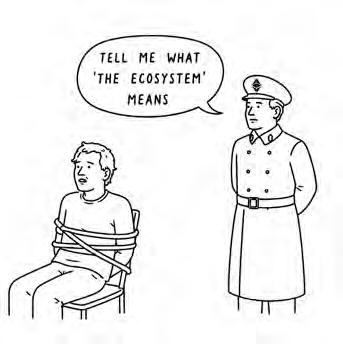
If Bitcoin is digital gold, Ethereum is the cryptocurrency of a networking event. The face of Ethereum is Vitalik Buterin, who if you search up on google images, looks exactly like someone who would invent a new financial system by accident while trying to fix his laptop. Where Bitcoin mainly exists to hold value, Ethereum is a blockchain (don’t ask) and people can build applications on top of it. These are called “smart contracts,” which are just like normal contracts, except they traded fountain pens, waxed seals and the archaic written word for code that is expensive and crashes occasionally.
Ethereum enthusiasts use phrases like “layer two scaling,” “gas fees,” “token utility” and “the ecosystem,” which you don’t need to understand, because most people using them don’t either. Their main purpose is to make ordinary conversations feel like hostage situations. If they had existed during the Cold War, discussing them would have been a highly successful Soviet torture method.
Stablecoins are cryptocurrencies specifically designed to not behave like cryptocurrencies. Normal crypto prices move up and down so violently they resemble a heart monitor during a medical emergency. Stablecoins attempt to solve this by linking themselves to traditional currencies like the US dollar, on a 1:1 basis.
This immediately raises the question: what’s wrong with normal money that you can actually spend then? The answer is generally long, complicated and not meant to be understood because the person with three monitors is trying to confuse you enough that you fold your hand and follow them blindly. Still, stablecoins are useful inside crypto because they allow traders to focus on their mental health and inner chi, by temporarily stopping emotionally spiralling every time the market collapses due to Elon Musk tweeting a frog emoji or rumours of an imminent economic apocalypse. They are, in other words, the financial equivalent of eating a piece of dry toast after a heavy night out.


Memecoins are cryptocurrencies based on internet jokes, which is exactly as reassuring and stable as they sound. These coins often feature dogs, frogs, or anything that could have laser eyes photoshopped onto them, and these badly drawn cartoon animals are the love child of someone who was equally invested in financial markets and Twitch livestreams.
Unlike Bitcoin or Ethereum, the appeal of memecoins is that they make no serious attempt to appear serious. It’s the illiterate, picture-book version of The Hitchhiker’s Guide to the Galaxy, for a generation that lost the ability to read. Their value is based almost entirely on vibes, memes, and whether a billionaire has tweeted recently.
This is why people can become millionaires overnight from something called “PepeMoonRocketCoin,” whilst others lose their life savings because a man on YouTube wearing LED sunglasses shouted “TO THE MOON”. Memecoin communities refer to themselves as “families,” or “armies,” which is kind of heartwarming until you realise their shared activity is financial arson.
The Weird Picture Ones
NFTs were digital images people briefly convinced themselves were simultaneously revolutionary investments and champions of the arts and culture. For a period of time that historians of the future will hopefully study carefully, adults spent enormous amounts of money buying online pictures of monkeys, blobfish-esque ‘digital pets’ and pixelated cartoon characters that look like they were drawn with the thickest brush on Paint back in the dark ages of Microsoft.
Despite the fact that anyone could screenshot these images and have them saved to their computer, owners insisted this wasn’t “just a JPEG”, because the blockchain proved they officially owned it. Critics pointed out this was a bit like paying £300,000 for a receipt proving you own a photocopy of a Minion.
Celebrities and brands became involved. People quit their jobs to become “NFT consultants,” despite the fact that nobody really understood what this meant. The market collapsed basically overnight, which was unfortunate for all the poor lost souls that had previously described their beta-looking cartoon as “a blue-chip asset”. The most famous example of the failed NFT trend currently is the viral post on Logan Paul’s NFT “0N1 Force”, which looks like a cross between a bumble bee and a power ranger. Originally purchased for roughly $635,000 in August 2021, it has plummeted in value to approximately $155 as of early 2026, a loss of over 99%.


AI coins combine two things almost guaranteed to attract investor attention: artificial intelligence, and people who get rich suspiciously quickly online (without acquiring any practical skills). For years, cryptocurrency projects were content being ‘blockchain-based’, which worked wonderfully until they realised the general public still didn’t know what this chain of blocks was, and that it hadn’t totally changed civilisation in the way they initially hoped. Tech culture, however, survives through perpetual reinvention, and as soon as this buzzword lost its euphoric glow, ‘AI’ stepped onto the scene.
Suddenly, every crypto startup on earth began claiming to be “revolutionising decentralised machine intelligence infrastructure,” which sounds super impressive until you translate it into plain English and get “we added ChatGPT to a spreadsheet and made a logo with neon gradients.” The genius of AI coins is that they operate in a perfect fog of collective intimidation, with both artificial intelligence and cryptocurrency feeling damn right complicated enough to most people. Combining the two creates a level of technological confusion so dense that investors often assume it simply must be valuable, because no one at the dinner table can confidently explain it.
This is how otherwise intelligent adults end up investing thousands into projects with names like “Holoworld” or “Pieverse”, despite the websites looking like they were designed by a teenage boy who’d just discovered cyberpunk films and pre-workout powder simultaneously. The average AI crypto pitch usually contains an unnecessarily aggressive font, a glowing wireframe and the phrase “democratising intelligence,” and founders speak with absolute conviction about “autonomous AI agents,” despite the fact that their actual product remains elusive and, to be honest, functionally indistinguishable from the first version of Siri.


The olive has become The Hidden Garden Company's specialism. The nursery offers a broad range, from neat potted specimens for a patio to vintage trees with gnarled, sculptural trunks that have been growing for well over a century.



Photography: Andy Le Gresley
The olive tree has a way of changing a garden. A flash of silver-green foliage, a twisted trunk catching the light, a touch of the Mediterranean even on a grey Jersey afternoon. For the team at The Hidden Garden Company, it’s their secret weapon.
The nursery has been transforming Jersey gardens for 13 years. It was founded by Jules Walker in tribute to her parents, both keen gardeners, and that sense of personal legacy still shapes the way the business is run. Her eye for detail is evident across the site - in the rows of mature and semi-mature specimens, in the careful pairings of shrubs and conifers, and in the steady, considered way the nursery has evolved over the years.
Alongside Jules is manager Tim Dolling, a qualified horticulturist who has been at the nursery for more than 12 years. Tim oversees the day-to-day running of the operation and personally selects every Italian specimen on site. Twice a year, he travels to Tuscany to choose trees by hand, working with the family-run nurseries that have shaped his sourcing for over a decade. Whether you're an experienced gardener with a clear plan or starting from scratch, Tim is happy to advise on anything from a single statement tree to a full planting scheme. He'll visit your garden, get a feel for the space, and walk you through the stock at your own pace.
The olive has become The Hidden Garden Company's specialism. The nursery offers a broad range, from neat potted specimens for a patio to vintage trees with gnarled, sculptural trunks that have been growing for well over a century. Used as a lined avenue, a courtyard centrepiece or a single feature on a terrace, the olive brings something few other trees can match: evergreen silver-green foliage, a striking twisted form, and a stately presence that suits both formal and informal gardens.
Beyond the olives, the nursery is well known for its mature trees, hedging and instant-impact screening - large-headed specimens and trellised greenery that can soften an unsightly view or lend a sense of maturity to a new garden almost overnight. For clients who don't want to wait years for a garden to settle in, it's a practical solution as much as an aesthetic one.
The Hidden Garden Company supplies both garden professionals and private clients across the Island, and Jules and Tim have built a reputation for taking time over each project. It remains a personal business, and one that has earned its place among Jersey's most respected horticultural addresses Visit the nursery to see the collection for yourself, or get in touch to arrange a consultation.
thehiddengarden.je


Behind a high wall on St Aubin's inner road, a Regency villa and its remarkable garden are about to open their gates for one Sunday only.
Every day, thousands of commuters drive past Seafield House without the faintest idea it is there. Screened by a dense canopy of pines and evergreen oaks, the elegant Regency villa and its garden have managed the rare feat of staying hidden in plain sight, an unexpected green pocket between two of the island's busiest roads. On Sunday 28th June, the gates open for one afternoon as part of JAYF's Open Gardens scheme.
The house dates back to 1809, when Jersey's Newfoundland cod trade was at its swaggering peak and a particularly successful operator, François Giffard, decided he wanted something more impressive than the average merchant's pile. Giffard was a banker, a merchant and (by the standards of the day) an obliging smuggler. He chose a stretch of dune overlooking St Aubin's Bay, hired an architect, and built himself a Greek revival villa he called Beau-Mur.



Maxwell Vandeleur Blacker-Douglass bought Seafield in 1921 for £7,000. He was the great-grandfather of the current owner, Richard Miles, who lives at Seafield with his wife Sarah and clearly relishes his role as the latest in a long line of custodians.
The architect was Robert Lugar, and Marcus Binney, writing in Country Life in 1989, drew a particular comparison between the southern rotunda, which rises forcefully above the parapet, and the pepperpot corners John Nash deployed along Regent Street and the Strand, suggesting Lugar may have been working under Nash's influence. The result is unusually fine: a triumphal arched portico of Ionic columns on the northern front, flanking wings on either side, and that lovely curved southern face from which Giffard could keep an eye out for his returning fleet.
Maxwell Vandeleur Blacker-Douglass bought Seafield in 1921 for £7,000. He was the great-grandfather of the current owner, Richard Miles, who lives at Seafield with his wife Sarah and clearly relishes his role as the latest in a long line of custodians.
The original Regency design - island flower beds with soft, serpentine edges - still sets the rhythm. From the formal lawns below the house, the view opens out and is framed, theatrically, by a magnificent pair of Canary Island date palms (Phoenix canariensis) standing sentinel at the far end.






Trees are the great passion here. Richard traces it back to a childhood spent in a treehouse perched in the family's ancient Black Poplar, now Jersey's oldest and largest, still standing after decades of storms.
Trees are the great passion here. Richard traces it back to a childhood spent in a treehouse perched in the family's ancient Black Poplar, now Jersey's oldest and largest, still standing after decades of storms. Straddling a fastflowing public watercourse that marks the parish boundary between St Lawrence and St Helier, it rises more than sixty feet, its trunk gargantuan.
There is a lovely detail underfoot that most visitors would walk straight past. The gravel paths are edged with chunks of Brazilian gneiss, stone hauled back across the Atlantic as ballast in the holds of Jersey's cod-trade ships returning from Rio de Janeiro. Through a doorway and you are into the Victorian walled garden, full of roses, cutting flowers and vegetables, with its immaculate box-edged beds. A venerable Italian fig is making a determined bid for freedom from the elderly glasshouse that has been trying to contain it for decades.
Beyond, the planting becomes wonderfully exotic. Under a sheltering canopy of evergreen oak, bay and Monterey pine, underplanted with camellias and variegated hollies, sudden clearings open up where these tender species thrive in Jersey's mild micro-climate. There is a loquat (Eriobotrya japonica), an Indian bean tree (Catalpa bignonioides), a pair of Wollemi pines (the so-called "dinosaur tree"), and a Peruvian pepper tree (Schinus molle) grown by Richard himself. Tree ferns (Dicksonia antarctica) lend a prehistoric note. An ancient Arbutus produces the white flowers and red fruits that, elsewhere in the world, are turned into the powerfully alcoholic madroño liqueur. There is even a hardy banana (Musa basjoo), the species whose stems are stripped in Japan to make a particularly fine paper. The undoubted star, though, is a Monkey Puzzle of cathedral proportions, towering to roof height. Family lore has it that
Richard's mother thought the original purchase price of £60 was an extravagance. Several decades on, it stands as a useful lesson in patience and the long view.
The Open Garden scheme is the flagship fundraiser for the Jersey Association for Youth and Friendship (JAYF) a charity that has been quietly doing essential work on the island since 1961. JAYF provides safe, affordable, supervised accommodation for young adults aged 18 to 25 who would otherwise be homeless. It currently runs five hostels in and around St Helier housing 29 residents, and demand is at its highest ever, driven by rising rents, family breakdown and the lingering effects of the cost-ofliving crisis. Homelessness in Jersey is rarely the visible, rough-sleeping kind, it is more often the hidden version, sofa-surfing or sleeping in cars between friends. JAYF offers stability for young people who need a stepping stone back into education, training or employment. Every ticket sold and every cream tea served at Seafield goes directly towards keeping those hostel doors open.
Seafield House, St Lawrence, opens by kind permission of Mr and Mrs Richard Miles on Sunday 28th June. Admission £7.00, under 12s free; cream teas £5.50. Tombola and free nature walk; credit cards accepted; regret no dogs. Parking is very limited: please use the Glass Church car park (strictly from 2pm onwards, courtesy of the Reverend Phil Warren) and walk in. Note that there is no access from Victoria Avenue: entry is from the inner road, St Aubin's Road, only.
To find out more about JAYF and its work, visit www.jayf. org.je, or follow on Facebook at /JAYFJSY and Instagram at @jayf_gardens.









HAPPY COCOONING ESTATE ROUND 76 TRAVERTINE
Garden furniture sets complete with a built-in fire table - every essential in one swoop.
Bauformat
£499.00

CASSIS BISTRO SET
Made for a cosy garden corner. Pebble
£599.00

Raised pots and plant stands for balconies and porches, adding depth and dimension to compact spaces.
Pebble
£59.00 (small)/£89.00 (large)

Why not?
Blue Diamond
£49.99

PACIFIC AUSTELL NATURAL WOOD SMALL LANTERN TABLE LAMP
A cut above your average garden lantern.
Romerils
£44.99

Three sizes to suit every space.
Pebble
£90.00 (small), £160.00 (medium), £320.00 (large)

OUTDOOR MAST LIGHT
Crafted from hot-dipped galvanised steel, this mast light is fully weatherproof with a rugged, rustic finish.
Pebble
£50.00


CRACKLE GLASS ORB STAKE
Yes they come in rainbow too. Blue, Diamond
£9.99

BIRD BATH - CONTEMPORARY WHITE
Attract the more discerning visitor to your garden.
Ransoms
£139.99
PACIFIC COSIPILLAR DOME OUTDOOR HEATER SANDY BEIGE
All the warmth of a firepit, none of the mess.
Romerils
£899.99
HEAVY DUTY DECORATIVE FEEDING STATION
Feed the birds, tuppence a bag. Blue Diamond
£69.99

NOVA, GALAXY LED CANTILEVER PARASOL
Shade by day, light by night.
Romerils
£1,199.00


SOLAR GARDEN LIGHTS
Made for warm summer evenings. Voisins
£13.95
MULTI INSECT BEE & BUG HOUSE
Do your bit for the pollinators. Ransoms
£24.99


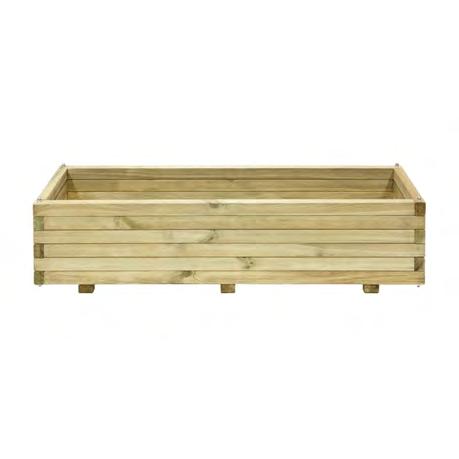
HEDGEHOG HOUSE
Lend the hedgehogs a hand. Ransoms
£39.99
RECTANGULAR PLANTER 120 X 40CM
Gifts for the green-fingered.
Romerils
£105.95
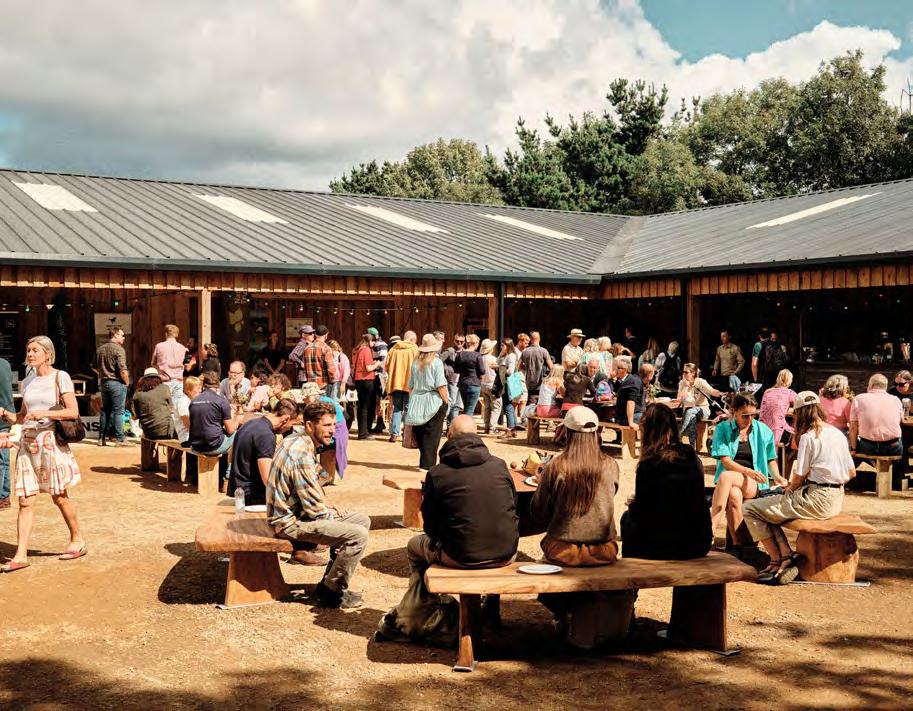

Words: Emma Pallent Photography: Max Burnett + Natalie Mayer
There’s a particular kind of frustration that comes with knowing your island grows extraordinary food and still finding yourself wheeling a trolley past plastic-wrapped asparagus flown in from Peru. Getting Jersey to the stage where it can feed itself comfortably is a noble goal, but we’re not going to get to those numbers with systems that make getting food onto local plates patchy, scattered across honesty boxes, farm shops and word-of-mouth. Just the other day a friend and I were saying it feels impossible to source locally grown, healthy food at a reasonable price without literally quitting your job to do so. We were incredibly excited when we found out that Taylor Smythe and her team are trying to fix that.
Working with Farm Jersey to help local growers, fishers and producers find a direct route to market, she’s spent the past months pulling together what will be the island’s first proper fortnightly farmers market, opening at Le Tâcheron Farm on 27 June and running every other Saturday through to the end of September.
The premise is simple. “If people could go to a place and know that everything there was literally picked that morning, from someone who’s within a mile of your house and can speak to you about how they’re growing it,” Taylor says, “I think people would want to support that.”
What sets the market apart from a supermarket aisle is exactly what supermarkets have spent decades training us out of, which is seasonality. There won’t be the wide variety of everything you’d imagine at Waitrose. Rather, the offer changes with what’s actually ready. Joe Freire’s lemons, for instance, are local and abundant right now, but the season ends in June. “We really want to encourage people to cook what grows here,” Taylor explains. At the time of writing, she said, “we have asparagus, and it’s only here for another four weeks. It’s absolutely delicious, but when it’s gone, it’s gone.”
Le Tâcheron itself is a bit of a quiet marvel. The farm grows its own cereals, mills them on-site and has a bakery turning that flour into bread that you can smell from the field it came out of. “I don’t think it gets more local than that,” Taylor says. Around the bakery, a rotating cast of vendors will set up every other Saturday: Myke’s Mushrooms from a young couple growing varieties in Grève de Lecq, meat

Le Tâcheron itself is a bit of a quiet marvel. The farm grows its own cereals, mills them on-site and has a bakery turning that flour into bread that you can smell from the field it came out of.
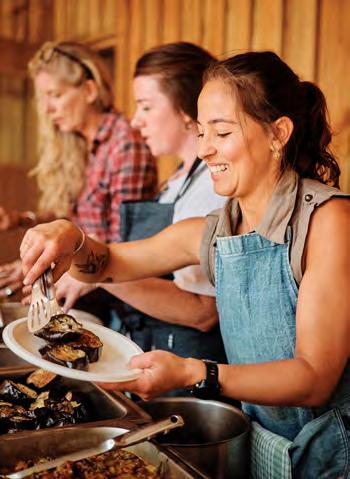
from Panigot Farm where Jeremy Hughes breeds and rears animals outdoors, freshly baked goods, soft fruit from a new strawberry farm in St Martin, seafood, fresh flowers and good coffee. Dough Jersey will be selling a special cookie made with Joe Freire’s lemons for Genuine Jersey’s 25th anniversary; the last of them will go at the opening market.
A different chef will cook at each one, with the single rule of cooking up only what’s available on market day. The first hot food menu for the market will be from The Pantry by Kismet on 27th June.
There’s also the Huddle Van, a mobile education hub from Sarah Taylor and Sean Guegan, a converted van selling produce and artisan goods while hosting talks from nutritionists and farmers, recorded for a

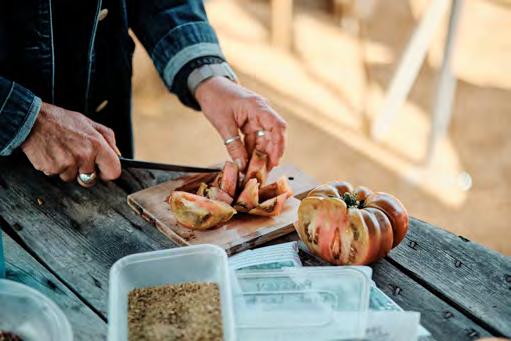
podcast. Live music, vinyls playing, picnic tables, lambs, pygmy goats, working horses and a book stand will also populate the area. Whilst there will be parking on site, if you choose to cycle or walk up you’ll be rewarded with a free Jersey Wonder from the bakery on entrance, which is more than a good enough reason to extend your day out with a beautiful sunny commute both ways.
The idea is to create an environment where people come to browse and get things, but end up staying. “We want to create an atmosphere,” she says. She hopes people connect over fresh pastries and coffee, joining together in community to support the farmers that we need throughout the year, not just when supply chains wobble. “Part of being a tight knit small island community is really looking after each other,” Taylor says, “not just in times of crisis.”
The market also helps as a signal for growers, who need to know there’s demand before they commit to another polytunnel, field or season. By turning up and showing that there is appetite for fresh, nutritious, local, seasonal food, Taylor believes local food production could plausibly double. Beyond that, the Farmers Market provides a one-stop shop for those who are busy in the working week and want to pick up all their local sustenance for the week ahead in one go. Depending on demand, she imagines going weekly at Le Tâcheron, or holding a midweek evening market in town next summer, somewhere like Parade Gardens or outside CafeJAC.
If it’s the future you want, the ask is pretty small. Put it in the diary, bring a shopping bag and eat fresh asparagus (or a Dough cookie).
@jerseyfarmersmarkets
Le Tâcheron Farm, La Rue De Dielament, Trinity, JE3 5HX. 10am-2pm, on 27 June, 11 July, 25 July, 8 Aug, 22 Aug, 5 Sept, 19 Sept. The event is sponsored by Butterfield.

Cooking from a mystery box of ingredients
It feels poignant to be writing this article on Beltane - the transition from spring to summer. A time to celebrate the natural world, seasonal living and a return to the warmth. After a long winter, I really wanted to celebrate the abundance of fresh, beautiful food which can be found close to home and grown on this island.
If you have been keeping up with the recent addition of the food column to Gallery, you might have noticed a pattern of partnering with different local companies round the island. We have tried delicious red wine from Dunell's, sipped on stinky bay beer with our fried chicken and now this issue, I am partnering with the wonderful Scoop (The Sustainable Cooperative), based in St Lawrence.
There is no calmer, more wholesome place to do your shopping. I walked inside to be greeted to the sounds of Mamma Mia and stacks of fresh hummus with freshly baked sourdough. A total foodie paradise. The challenge for this article was to celebrate ingredients which can be grown locally. Kasper, Scoop’s owner, handed me a basket of ‘mystery’ ingredients - rainbow carrots, bulgur wheat (which I only just discovered can be grown on the island), fragrant herbs, cauliflower, and fruit. From that, I went home and began to build a menu.
Lately, I have been loving my ottolenghi food and wanted to do something totally vegetarian. I wanted this spread to feel nourishing and vibrant, rooted in whole foods and designed to be shared. The inspiration was to make the kind of meal you might want to eat after emerging from a mushroom ceremony at a retreat. The glazed - post haze, all loving and all connected hours where you just want to be at one with the land. I also wanted it to be fairly achievable (I had some feedback of some slightly stressed out fried chicken goers last month). This recipe will be slow, steady and beginner friendly. I hope you enjoy the peace of cooking Jersey ingredients and find a way to connect to your land, take deep belly breaths and fully immerse yourself in the process. I would recommend the song ‘Float’ by The Hip Abduction to serenade this experience.


Cauliflower
Ingredients
- 1 whole cauliflower
- 50g butter
- 1 tbsp olive oil
- 1 tsp ground cumin
- 1 tsp garlic powder
- 1 tsp smoked paprika
- 1 tsp turmeric
- Salt
Method
•Preheat the oven to 180°C fan.
•Bring a large pot of salted water to the boil and cook the cauliflower for 8–10 minutes. Drain and allow to steam dry.
•Melt the butter with the olive oil in a pan, then add the spices and gently cook for 1–2 minutes to release their flavour.
•Place the cauliflower in a roasting tray and spoon over the spiced butter.
•Roast for 45–60 minutes, basting occasionally, until golden and tender.
Cucumber & Za’atar Chopped
Ingredients
- ½ cucumber, finely chopped
- 1 cup cooked bulgur wheat
- Handful of micro-greens
- Handful of whole mint leaves
- Handful of parsley, chopped
- ½ shallot, finely chopped For the dressing
- Juice of 1 lemon
- 1 tbsp olive oil
- 2 tsp za’atar
- Salt and pepper
Method
•Cook the bulgur wheat using a 1:2 ratio (1 cup bulgur to 2 cups water). Simmer for around 12–15 minutes until tender. You can add a stock cube for extra flavour. Allow to cool slightly.
•Combine all salad ingredients in a large bowl.
•Whisk together the dressing ingredients, season to taste, and toss through the salad.
Ingredients
- ⅔ block feta
- 2 tbsp Greek yoghurt
- 1 tbsp olive oil
- Juice of ½ lemon
Method
•Blend all ingredients until smooth and creamy.
•Spread onto a plate and top with chopped parsley and dukkah.
Green Tahini Sauce
Ingredients
- 1 heaped tbsp tahini
- Large handful of parsley
- 1x clove garlic
- Juice of ½ lemon
- Salt
- Water (to loosen)
Method
•Blitz all ingredients together, adding a splash of water at a time until you reach a smooth, silky consistency.
•Taste and adjust seasoning as needed.
Roasted Carrots with Whipped Feta
Ingredients
- Rainbow carrots, halved lengthways
- 2 tsp cumin seeds
- Olive oil
- Drizzle of honey
- Salt
Method
•Preheat the oven to 180°C fan.
•Toss the carrots with olive oil, cumin seeds, and a pinch of salt.
•Roast for 25–30 minutes until tender.
•Drizzle with honey and return to the oven for a further 10–15 minutes until caramelised.

On an island where familiar faces are never far away, the rather wonderfully named Gallery Cafe offers something increasingly rare: a sense of quiet separation from Jersey life. Looking out across St Aubin’s Marina with a cold drink in hand, it is difficult to imagine a better way to spend a Thursday afternoon. Warm sunlight floods the terrace, giving the café the feel of a hidden little sun trap by the sea.
Many islanders may remember the space as the old Harbour Gallery, where the café previously sat upstairs. After 13 months of renovation, the building has been completely transformed, with the café now thoughtfully relocated to the ground floor to make it more accessible while still retaining its calm, welcoming atmosphere.
We were greeted by Seb and Aneta, the pair behind the café, whose warmth immediately set the tone for the afternoon. Keen to trust the experts, we let them guide us through the menu while we scanned a promising-looking specials board filled with seasonal dishes and local ingredients. Aneta explained that everything is made fresh each day and cooked to order - something that became obvious from the first plate that arrived at the table.
We started with the fresh crab salad, served alongside crispy potatoes and a bright, citrusy dressing. The dish felt balanced and generous without being too heavy. Next came the avocado toast: thick slices of sourdough topped with crispy chorizo, feta, and a perfectly poached egg that burst into a rich golden yolk at the first cut. It was simple, comforting food done exceptionally well. There is a real sense throughout the menu that everyday ingredients are treated with care and are elevated without becoming overcomplicated.
The underdog was the roasted broccoli. Served on a bed of what we spent several minutes trying to identify as some sort of impossibly
moreish white sauce, none of us guessed it was whipped goat’s cheese. Creamy, salty, slightly sweet, and scooped up with crunchy sourdough, it was one of those dishes you keep returning to long after you were already full. In fact, it inspired a recipe later in this very magazine.
The underdog was the roasted broccoli. Served on a bed of what we spent several minutes trying to identify as some sort of impossibly moreish white sauce, none of us guessed it was whipped goat’s cheese. Creamy, salty, slightly sweet, and scooped up with crunchy sourdough, it was one of those dishes you keep returning to long after you were already full.
Finally, we tackled the smashed burger, this was a classic done right. The locally sourced Jersey beef was juicy and well seasoned, the burger dripping with flavour without crossing into messy excess, while the chips arrived perfectly crisp. By this point, we were completely full, but somehow still found room for dessert.
Aneta emerged smiling from the kitchen carrying pear and almond tart alongside a baked cheesecake. The tart was delicate and comforting, while the cheesecake, as Ben perfectly described it, “tasted homemade with a crumbly yet moist base.”
What makes Gallery Cafe special is not just the quality of the food, but the feeling it leaves you with afterwards. We left full, relaxed, and genuinely looked after. Seb and Aneta clearly know exactly what they are doing, something reflected in the effortless flow of the service and the calm confidence of the entire space. With fair prices, generous portions, and a menu celebrating colourful local produce, Gallery Cafe feels like exactly the kind of place Jersey needs more of.
@GalleryCafeAndBistro


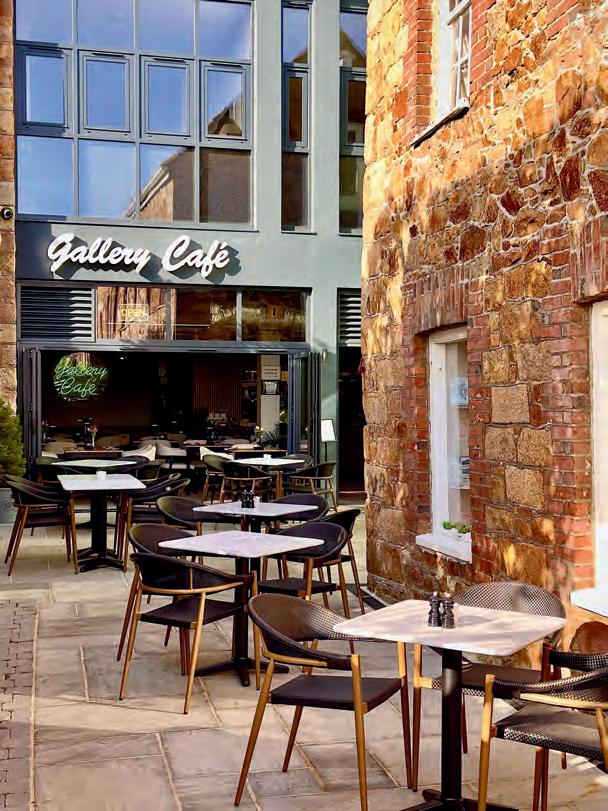




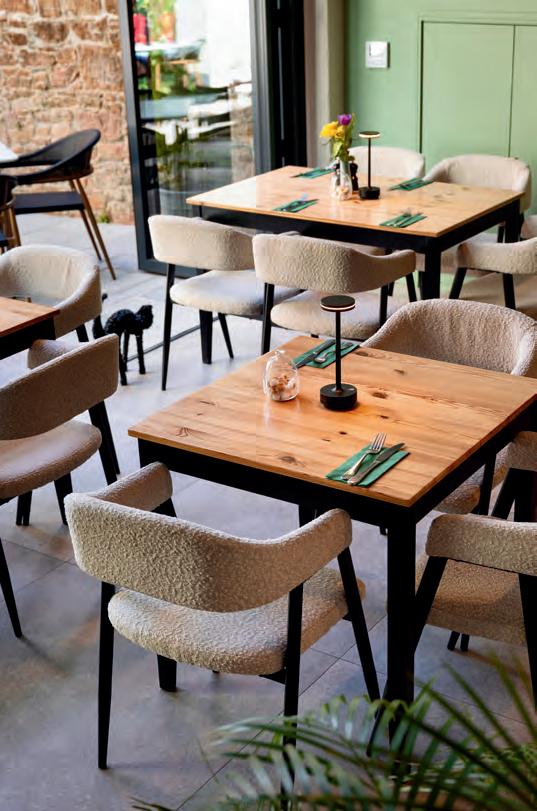




Words: Flo Leach Photography: Danny Evans
I have a core memory of being five years old and sobbing outside a gymnastics class because I couldn’t do a cartwheel. In my little mind, that instantly ruled out any future Olympic career so there was no point. From that point onwards, dance classes, gymnastics and anything remotely performance-based were avoided like the plague.
As I’ve gotten older though, I’ve started to realise how much we forget to play. Somewhere between tax returns, work deadlines, dinner plans and the endless pursuit of self-improvement, fun quietly slips down the priority list. My mum - an art therapist, has spent years telling me to reconnect with my inner child, and for the longest time I thought that meant healing, reflecting and doing the deep emotional work. This has been important but recently, I realised it might also mean simply trying something new for the joy of it.
That’s what led me to Tor and the hoop. Tor is the owner of Showgirl Sass and Uberedge, dance companies focused on empowering women through movement, creativity and confidence. Walking into the class felt completely out of my comfort zone. I thought of little Flo, the girl who was terrified of performing yet always watched from the sidelines imagining a life where she could.
We worked through some beginner moves, with Tor demonstrating first (making it look painfully easy) before I stumbled through behind her. I listened carefully as she told me to move my left leg here or let my right arm go there. As Tor guided me through the flow, I eventually found myself in what she called the “Showgirl Pose”; firmly placed in the hoop, arms stretched wide and chin tilted upwards. Turns out, there was a showgirl in there after all.
The Aerial Hoop combines isometric holds with bodyweight gymnastics so you are really working your entire body. I glided through the rest of the class (or at least I’d like to think I did) trusting my body to hold me in place. What surprised me most was the confidence I left with afterwards. With the right guidance, I felt composed, feminine and strong.
Tor has built something really special with Showgirl Sass. The class felt equal parts empowering and peaceful, it is a space where women can express themselves freely while trying something completely new. Alongside hoop classes, Tor also teaches pole, burlesque-style movement and Uberedge Dance. She has lots of exciting things coming up like ‘White Collar Pole’ which is a 10 week course for complete beginners. It includes 20 pole classes and 8 Masterclasses from industry professionals to help you get ready to showcase your new skills to your friends and family in a private event at The Drift.
If you’ve ever wanted to try something that scares you a little, this might just be your sign. You can find Tor and her classes at showgirlsassjersey.com
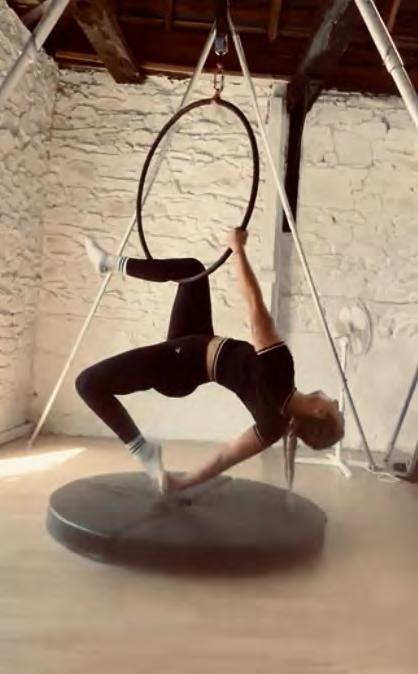


Rubie Le Masurier is fifteen, in Year 11 at JCG, and the newly crowned PwC Jersey Young Musician of the Year. Her route to the title at the Jersey Opera House this February took her through a series of competitive heats and several years of steadily building experience, both on and off the island. Listening to her speak about her work, it is clear that the title marks one stage of a much longer plan.
Rubie began singing more or less as soon as she could speak. “I sang all the time,” she recalls. “Anywhere and everywhere I’d be singing.” Her parents quickly noticed how easily she picked up melodies, even in languages she hadn’t been taught. At five she learnt I Can Sing a Rainbow in French, and soon after her father phoned Imogen Nicholls MBE, the founder of Jersey’s Musical Originals singing school and herself a former professional opera singer. Rubie joined the school alongside two other girls her age, and has been training there ever since.
What begun as a hobby took on a different weight when, as a young teenager, Rubie started entering international competitions. “Singing only started feeling real for me when I started competing in competitions abroad,” she explained. “I ended up doing quite well in them, so that gave me motivation to be a singer in the future.” She had won the junior solo competition of the Llangollen International Eisteddfod in Wales, and in 2024 sang in the semi-finals of the BBC Young Chorister of the Year, where she was mentored by Aled Jones and performed Dear Lord and Father of Mankind on national television. The PwC title, awarded in February, is the latest in a steadily lengthening list.
Her winning PwC programme was put together with her singing teacher and chosen to play to both her strengths and her temperament: Handel’s Ombra mai fu, the Habanera from Bizet’s Carmen, the folk song My Bonney Lad, and Hamilton Harty’s Sea Wrack. “It was handcrafted by me and my singing teacher to what I love singing and what I can sort of sing well,” she explained. The Habanera was her favourite of the four. “There’s a whole world of emotion behind it, and I can just properly act it.” The choice points to something central about how she approaches her craft. “Emotion is a big factor in singing for me. You can’t perform without the emotion. It goes hand in hand.”
Technically, Rubie is what is known as a contralto, or low mezzo, a relatively rare classification, and one with significant implications for the kind of repertoire she will spend her career singing. “In opera, they use your voice type to help them cast you into a role,” she said. While classical and operatic work is her focus, she moves comfortably across a much broader range, including oratorio, jazz and reggae.
For the past year, Rubie has been travelling to London to train with Janice Chapman, the Australian-born soprano and Professor of Voice at the Guildhall School, whom she describes as “one of the world’s leading vocal teachers.” Rubie’s approach to learning new repertoire is methodical. Technique and words come first, then the backstory of the song, and only after that the word
Words: Emma Pallent
painting and the emotional layering. “I really start loving the song when I can focus on the performance and emotion of it” she said.
There is a perfectionism in how Rubie talks about her work, but also a hard-won composure. The nerves, she said, tend to live in the run-up to a performance rather than on the stage itself. “When I actually did the performance, it wasn’t nerve-wracking at all. I was totally in it. I didn’t even think about the nerves.” The greater challenge, she explained, is the toll of a long day’s singing, when she worries about being unable to give an evening audience her full standard.
Looking ahead, the plan is a bachelor at a conservatoire after sixth form, followed, she hopes, by a two-year master’s. The eventual goal is a well known place in an opera world. She is realistic about how that industry works, and is keeping her options open. “I’m opening my mind to the actual backstory of opera,” she said. “Opera directing and production, opera composition, opera house stuff. So I could fall back on that if I’m tired of being a constant opera singer.” She also intends to take courses in conducting and adjudicating, with a view to widening her range further still.
When you’re with the music, your headspace is completely in it... I love sharing that with other people.
A patience runs through all of this. Rubie is well aware that an operatic voice takes time to develop, and that her own is still in the process of arriving. “I’m going to feel different in ten, fifteen years,” she said. For now, the focus is on the work in front of her: refining her technique, expanding her repertoire, and learning to inhabit roles such as Carmen, Octavian in Der Rosenkavalier and Auntie in Peter Grimes, all of which she has her eye on for the future. What she returns to, when asked why she sings, is something more straightforward. “When you’re with the music, your headspace is completely in it,” she said. “I love sharing that with other people.”
Asked about the venues she would most like to perform in one day, Rubie’s answer comes without hesitation: the Royal Albert Hall and the Metropolitan Opera House in New York. The road from a Jersey rehearsal room to either is a long one. To help with bridging the gap, Rubie has created a singing page on Instagram (@rubie_sings. acc) to share her work with the world. Rubie, by every indication, is in no rush and knows exactly where she is going.
@rubie_sings.acc
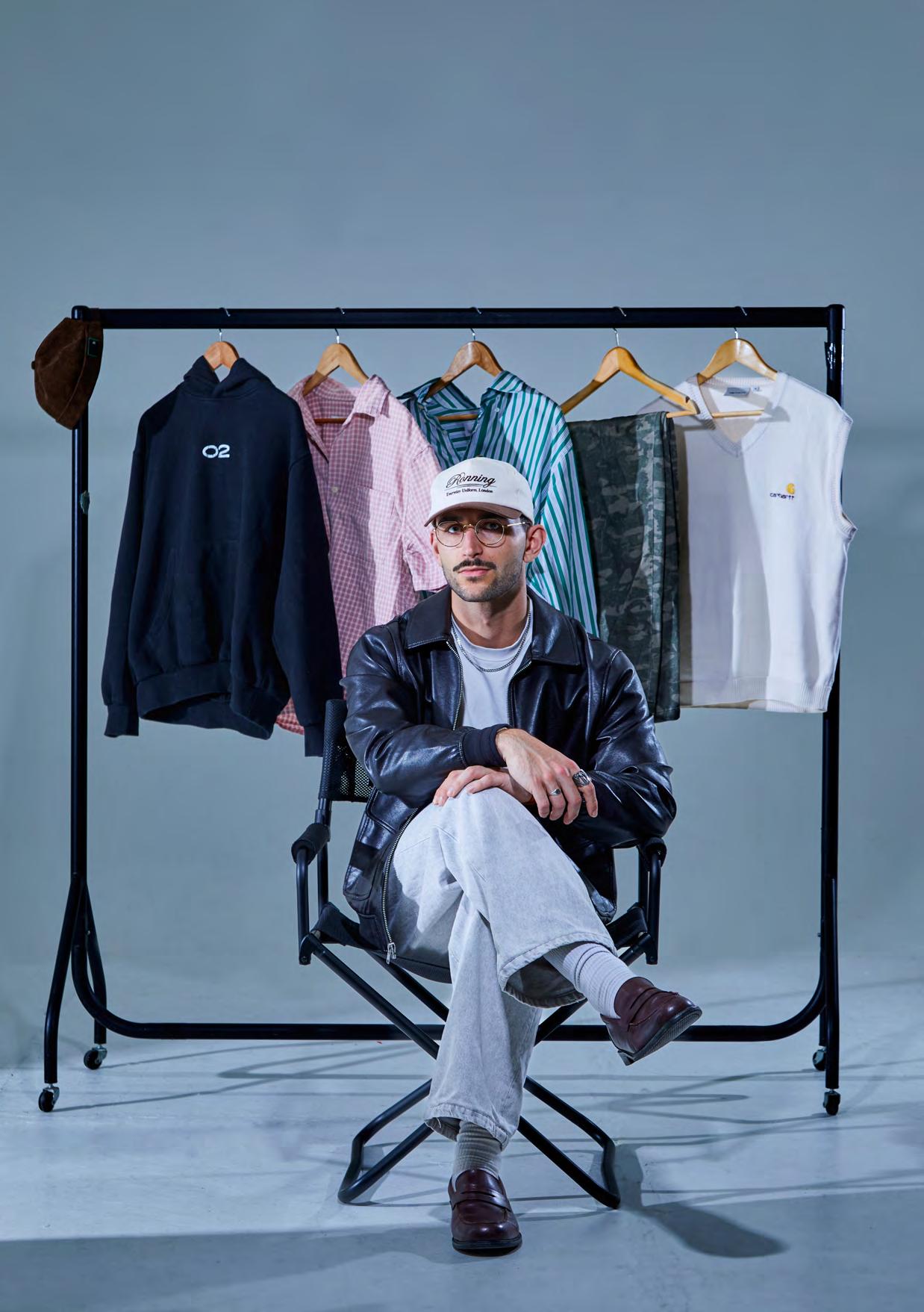
This month, we’re delighted to welcome Jay Allen to the pages. A young Jersey-based content creator with a growing following on TikTok and Instagram, Jay approached us wanting to write about men’s fashion on the island, specifically the quality, considered options available to young people that offer a real alternative to fast-fashion and the habit of always buying online. In the piece below, Jay shares his thoughts on identity, individuality and why local independent stores are shaping the way his generation dresses.
Words: Jay Allen
Fashion has always been more than just clothing. For young people, it is the identity of the individual, the confidence that develops who you are, and the self-expression to be true to yourself all woven into one outfit. What we wear says something before we even speak, and for many of us, fashion has become a way of showing personality without having to explain ourselves at all.
One of the biggest shifts in the fashion of today is the move away from dressing for trends alone and instead dressing for individuality. We no longer want to wear clothes simply because of a “cool” trend. We want pieces that feel unique and authentic to who we are. A simple outfit can become memorable through the way it is styled. The shape of the trousers. The texture of the jacket. The fit of a hoodie or the way the jewellery and the footwear complete the look. Fashion today is less about perfection and more about creating something that feels unequivocally and naturally “you”.
Streetwear has played a huge role in shaping this mindset. What was once seen as “messy” or “rugged” by previous generations has now blended into everyday fashion. You can see people mixing relaxed jeans with smart structured jackets, trainers with tailored trousers, or oversized knits with clean outerwear. The historical line between smart, casual and streetwear has almost disappeared, creating a new style language that feels effortless while still being expressive. We want outfits we can wear to the pub, into town, out for dinner or even while creating content online without feeling the need to completely change who we are depending on the occasion.
Social media has, of course, accelerated this. Platforms such as TikTok and YouTube have changed how fashion is discovered and consumed. We are constantly exposed to creators from around the world who show new ways of styling clothes. Instead of relying on magazines or traditional advertising, our generation has a space to look towards relatable personalities online for inspiration — experimenting with silhouettes and building confidence through fashion. Fashion content now feels more accessible and intimate because it comes from real people who actively connect with their community.
At the same time, Jersey itself presents its own challenges when it comes to fashion. For years, younger shoppers, such as myself, have felt a disconnect from the clothing options available on the island. A lot of retail spaces continue to stock styles that feel outdated and out of touch with what young people actually WANT to wear. As a result, we turn to online shopping for stylish fits and more expressive options. The downside is that online shopping removes the best part: the experience of discovering that little hidden gem you never knew you needed, taking pictures in the mirror of the changing room, and taking it home THAT DAY.
This is why independent stores that understand youth fashion have become so important. Shops like Tib Street and Consume stand out because they stock clothing that genuinely resonates with us here in Jersey. The pieces they carry feel unique. Modern silhouettes. Clean shapes and sizes. Sleek seams and wearable designs that combine both comfort and individuality. These are the kinds of clothes that fit naturally into everyday life whilst still blending those smart/casual/streetwear aesthetics.
As someone who creates fashion content on platforms like TikTok and Instagram myself, I have seen how much confidence clothing can give people. It’s personally given me a space to express who I am through wearing and styling my desperately-inneed-of-more-space wardrobe.
As someone who creates fashion content on platforms like TikTok and Instagram myself, I have seen how much confidence clothing can give people. It’s personally given me a space to express who I am through wearing and styling my desperately-inneed-of-more-space wardrobe. Fashion is not about wearing the “right” thing or fitting into a certain aesthetic. It is truly about feeling comfortable in your own skin, what you choose to wear, and genuinely owning that choice. Confidence often comes from authenticity, and when we dress in a way that fully reflects who we are, it changes the way we carry ourselves.
Fashion should never feel restrictive. It should feel creative and personal and freeing. Clothing is about our identity, our comfort and having the confidence to express ourselves exactly as we are.
@jay.allen3 @jayallen.3
Summer dressing should feel joyful, effortless and just a little escapist and this season, Nautilus is delivering exactly that energy.
Think playful prints, breezy cottons, dreamy holiday silhouettes and pieces designed for sunshine-filled days that turn into long balmy evenings. The new collection feels like a suitcase packed for somewhere fabulous: colourful, relaxed and impossible not to feel good in.
Compagnia Fantastica brings a dose of fun with its mermaidprint co-ord, giving serious beach-club energy, while Fransa keeps things easy and wearable with embroidered stripes, classic denim and the cutest cherry tee imaginable. For occasion season, Raishma’s floral dresses and elevated co-ords strike that perfect balance between glamorous and effortless, ideal for weddings, summer parties and holiday dinners under the stars.
There’s also plenty for the true sun chasers. One Season’s lightweight handprinted shirt dresses and embroidered kaftans are made for barefoot luxury, whether you’re poolside, beachside or heading from breakfast straight to the sea. Marella’s linen shell dress delivers understated chic in the most timeless way, while the Dream Greek Dress practically belongs wandering through whitewashed streets with oversized sunglasses and a spritz in hand. Fresh, feminine and full of wanderlust, Nautilus has summer style officially sorted.











This summer, fashion is feeling softer, cooler and infinitely more expressive and nowhere captures that mood better than Manna.
The boutique has long been the insider destination for women who want fashion with personality: pieces that feel directional without trying too hard, luxurious without losing their sense of fun. And this season’s edit might just be one of their strongest yet.
There’s a distinctly effortless energy running through the rails right now. Think washed textures, oversized silhouettes, artful prints and that perfectly undone “I just threw this on” aesthetic the Scandinavians do so well. American Vintage brings its signature relaxed French cool with soft cotton basics, lightweight knits and easy layering pieces designed for long summer days. Meanwhile, Essentiel Antwerp continues to dominate the dopamine dressing movement with joyful colour, bold florals and statement pieces that somehow still feel wearable.
Then there’s Munthe, delivering the kind of Copenhagengirl energy fashion editors can’t get enough of right now, feminine but sharp, romantic but cool. Floaty dresses sit alongside tailored separates and unexpected details that make every outfit feel elevated.
For those wanting something a little more playful, Traffic People is leaning into vintage-inspired glamour with silky fabrics, retro cuts and prints made for rooftop cocktails and summer weddings, while Baum und Pferdgarten continues its reign as the queen of eclectic Scandi dressing: metallics, colour clashes and fashion-forward silhouettes included.
And perhaps that’s what Manna does best. It doesn’t follow trends in the obvious way. Instead, it curates collections that feel individual, confident and just ahead of the curve, the kind of pieces people stop you to ask about.










For the ultimate skate-meets-surf, beachlife aesthetic, Madhatter remains the island’s go-to destination. A long-time Jersey favourite for surfers, skaters and anyone drawn to that laid-back coastal lifestyle, Madhatter has perfected the art of effortless summer cool.



ISEA SUNGLASSES
A strong sunglasses game is nonnegotiable in summer. From £44.
MENSWEAR
The menswear department is packed with leading surf and lifestyle brands including Rip Curl, Quiksilver, Passenger and Volcom.
WETSUITS
With wetsuits for men, women and children from trusted brands including O’Neill and Rip Curl, Madhatter has every level of surfer covered, from complete beginners to seasoned wave chasers. From £50.
More than just a surf shop, it’s a one-stop destination for everything needed to make the most of island life. From coolers to clothing, boards to sunnies, the shop perfectly captures that carefree, salty-air energy we all want a little more of. Whether you’re heading for sunrise surf checks, beach BBQs or just dressing like you might, these are the summer essentials worth getting excited about.



LADIESWEAR
Madhatter’s womenswear edit blends relaxed coastal style with trend-led fashion, featuring brands including Rip Curl, Billabong, Rhythm and Passenger. Think easy layers, throw-on dresses and off-duty beach chic.
SURFBOARDS
Whether you’re catching your very first wave or upgrading your setup, Madhatter stocks boards for every ability level from sought-after brands including SharpEye, Bradley, Firewire, Pukas and Thunderbolt.
REEF FOOTWEAR
Easy summer slides, beach sandals and everyday flip-flops from Reef. From £27.



DRYROBE
A local essential. Madhatter stocks a huge range of Dryrobes for adults and children in multiple colours and sizes, perfect for post-surf warmth, sea swims and breezy beach evenings. From £90.
WANDERLUST JEWELLERY
Delicate layered necklaces, beachy bracelets and everyday earrings. Effortless, sun-kissed styling starts here. From £29.
YETI
For beach days done properly, the YETI collection includes everything from premium drinkware and cool boxes to outdoor accessories built for adventure. From £20 to eyewatering.

When Coop Mobile signed on as Connectivity Partner for this year’s JET Jaunt, it wasn’t just a sponsorship – it was a clear expression of what community means in practice.
The JET Jaunt is one of Jersey’s most brilliantly bonkers fundraising events. Organised by the Jersey Employment Trust in partnership with Lupine Racing, it challenges teams of two to race from St Malo to a European destination in just four days – this year, Rome. There’s no set route, no flights and no hitchhiking; less package holiday, more organised chaos. With mystery checkpoints revealed at the start line, teams must think on their feet, adapting plans as they go and relying on creativity, resilience and teamwork to make it to the finish.
It’s this unpredictability that makes the event so compelling. One moment competitors might be navigating rural France with limited transport options; the next, they’re negotiating overnight trains or rerouting entirely to make up lost time. Every decision counts, and every mile travelled brings them closer not just to the finish line, but to making a meaningful difference.
Behind the adventure lies a genuinely important cause. Each team is encouraged to raise a minimum of £750, with all funds going directly to the Jersey Employment Trust – a charity that supports Islanders who have a disability or longterm health condition to secure and sustain employment. For many participants, it’s this purpose that drives them forward when the journey becomes challenging.
That’s where Coop Mobile comes in. As official Connectivity Partner, it will equip every participating team with travel eSIMs, ensuring seamless mobile coverage throughout the race. Whether navigating a rural French backwater, catching a last-minute train in Turin or crossing the finish line in Rome, teams will be able to stay connected without the hassle of physical SIM cards or the risk of unexpected roaming charges.
In an event defined by movement across borders, that reliability is more than a convenience – it’s essential. From accessing maps and travel updates to staying in touch with teammates, organisers and supporters back home, connectivity becomes a critical part of the experience. It allows teams to share their journey in real time, bringing
friends, family and the wider community along with them. It’s also what makes the partnership such a natural fit. The JET Jaunt is exactly the kind of environment eSIM technology was designed for – fast, flexible and borderless. For Coop Mobile, a service built on honest pricing, contract-free flexibility and strong community values, this is an opportunity to demonstrate its product in a setting where it has genuine, practical value.
CI Coop Chief Marketing Officer David McGrath describes it as a chance to showcase eSIM technology in a “practical and exciting context” – and that’s precisely what this partnership delivers. Rather than a logo on a banner, it’s a product playing a meaningful role in the experience itself, supporting participants every step of the way.
From JET’s side, the impact is just as significant. Fundraising and Relationship Lead Georgia Hodgson highlights how important it is for teams to be able to navigate, communicate and capture their journey as it unfolds – particularly with new challenges expected in this year’s edition. Reliable connectivity helps remove one layer of uncertainty, allowing participants to focus on the adventure ahead.
It’s this unpredictability that makes the event so compelling. One moment competitors might be navigating rural France with limited transport options; the next, they’re negotiating overnight trains or rerouting entirely to make up lost time. Every decision counts, and every mile travelled brings them closer not just to the finish line, but to making a meaningful difference.
For those watching from Jersey, there’s something quietly powerful in that. CI Coop’s CEO Mark Cox describes the JET Jaunt as capturing the spirit of the cooperative movement: collaboration, adventure and people going the extra mile for a good cause. A local mobile provider supporting a local charity, using technology to connect Islanders as they race across Europe – it’s a partnership that feels both practical and purposeful, rooted in shared values and a commitment to community. The JET Jaunt has always been about pushing people beyond their comfort zone. With Coop Mobile keeping every team connected along the way, 2026 is set to be its most ambitious and memorable edition yet.
If you’re thinking of taking part, head to www.jet.co.je and click the pink JET Jaunt logo. The finish line is in Rome. The cause couldn’t be closer to home.

GALLERY FASHION JUNE/JULY 2026

Location:





I got married young and now sometimes I wish I were single. What should I do?
Rest assured, there are many people who at times have thought about being single. Fleeting, lingering, or persistent thoughts are perhaps signs you are not on the same page as each other in that moment.
Does this mean this is the beginning of the end?
Not necessarily. However, if left to fester, the bond between you will start to become undone. The longer it is left unattended, the harder it will be to reconnect. So take those thoughts as signs to make more of an effort and nurture your relationship.
Young love is a powerful force. It is hard for many to explain their romantic attraction and addictive urges of love. This is due to the instinctive workings of the primitive love centre in the brain. It works at any age and pulls us towards pairbonding and reproduction. This is Mother Nature working her magic
While in this warm and fuzzy state, it is only natural to daydream and imagine your future life together. Forming pictures in your mind will sustain you, but can also keep you blinkered to the reality of your life. Unfortunately, when the shades come off, people are often hit with the harsh reality that many situations are out of their control. Picture-perfect now looks like disappointment, anxiety and unhappiness.
But what happens if you’ve never expressed these dreams to your partner? Wouldn’t you essentially be denying them the opportunity to co-create? Yet you choose instead to punish them for unmet, unknown expectations. This could present itself as premeditated resentment, causing a disconnect.
Maturing together doesn’t always come easily for some couples. Growth can appear in some areas—emotionally, behaviourally, or in mindset—but lag in others. Recognising an occasional sidestep requires paying attention to what is actually happening, and calls for an honest conversation about the shift within the relationship. As long as you both maintain the same relationship goals, equilibrium and harmony should prevail.
Unfortunately, not recognising how important stabilisation is may allow a disconcerting restlessness to enter the partnership. Comparisons to other couples start to happen—‘they have more fun’, ‘they’re so into each other’, or highlighting differences in material wealth. Either way, one or both of you start to feel the pressure of not matching up, and not being ‘good enough’.
Dissatisfaction has a way of seeping into all areas of our life if we allow it. We can beat ourselves up about the decisions we made. And almost without our awareness, all
the negative aspects of our life become accentuated. Memories of ‘life before’ start to pop up in our consciousness. Not surprisingly, a more fun and carefree lifestyle starts to feel much more appealing.
Inevitably, the waves of discontent flow into the bedroom. What was once passionate and spontaneous now becomes predictable and mundane. We start latching onto possible causes: inexperience, not being adventurous, or even thoughts of sexual incompatibility. The idea that we are missing out on a better way of life only adds to the lacklustre energy within the bedroom.
But is single life always greener? Not necessarily. Many singles talk endlessly about the difficulties of finding suitable potential partners—let alone ‘The One’. Their descriptions of soul-destroying online dating efforts would turn anyone off. And yet the biological clock keeps ticking and the pressure mounts. Not surprisingly, when they do find a spark, many decide it’s better to settle than to be seen as alone. Adopting a mindset of ‘anyone is better than no one’ allows them to settle into a comfortable partnership.
And so there you have it — your dilemma can be viewed from many perspectives. There is no right or wrong, but rather a personal choice.
So make a decision about what you want, and then pour your energy into it. Give it everything you have. Kick out the bad habits and start anew. This means sitting down together, laying everything out on the table, and agreeing to talk everything through until you find a workable solution.
That said, genuine effort does not always fix things. If you have exhausted all recommendations, yet still feel trapped or feel unhappy most of the time –then leaving may be the right choice. Not because being single is better, but because being in a marriage that drains you isn’t fair to either person. Ask yourself: are you growing through this, or just surviving? If it’s survival then give yourself permission to explore separation with professional support.
Commit to your choice.

If you’ve got an anonymous relationship question you’d like to ask, scan here to send it to us for a future edition >
For Private Consultation at The Mind & Body Rooms, Charing Cross, St. Helier, or Zoom, message Maggie at maggie@barenakedcoach.com or visit barenakedcoach.com


In an industry often dominated by trends, filters and fast fixes, Melanie Roberts from Skinworks brings something refreshingly grounded to aesthetics: nearly two decades of medical experience, a deep understanding of patient care and an unwavering focus on safety.
Originally graduating as a nurse from Leeds University in 2003, Mel spent years working in intensive care within the NHS in Liverpool before taking her career overseas to Australia. “Intensive care nursing was always my speciality,” she explains. “Australia was an incredible experience professionally and personally.” It was during this time, back in 2009, that she first discovered aesthetics and undertook her initial training.
A move to Jersey in 2014 saw her return to intensive care while also working as a Rapid Response nurse in the community. But balancing shift work with family life eventually led her back towards aesthetics, an area she had always found both fascinating and rewarding.
“Very quickly, I realised combining my medical skills and clinical insight with aesthetics was a really great fit,” she says. “It meant I could offer treatments that were safe, professional and genuinely patient-focused.”
Today, Skinworks has grown into one of Jersey’s most trusted names in aesthetics, with Mel building the clinic around one very clear idea: accessibility. “I wanted aesthetics to feel approachable and available to everyone,” she says. “Busy mums, shift workers, dads, people juggling work and life. Offering evening and weekend appointments was really important to me.”
That medical background also shapes how she approaches every treatment. “Aesthetic medicine is still medicine,” she says firmly. “You’re dealing with anatomy, complications, infection control and patient safety. It’s so important people understand that.”
It is a topic Mel feels passionately about, particularly as conversations around safety and regulation within aesthetics continue to grow. “At the moment, there’s very little lawful regulation preventing non-medical practitioners from injecting, and honestly, that’s scary,” she explains. “But things are slowly changing.” Her advice for anyone considering treatment is simple. Check qualifications. Ask questions. Do your research.
“If someone is registered with the Nursing & Midwifery Council, General Medical Council or General Dental Council, you can search for them online and confirm they hold active medical registration,” she says. “Also ask about insurance. And
don’t be afraid to ask where they trained medically. Certificates on a wall don’t necessarily mean anything.”
As a registered member of the Joint Council for Cosmetic Practitioners [JCCP], Mel believes regulation is vital for the future of the industry. “The JCCP exists to protect the public and ensure practitioners meet strict safety standards and continue ongoing training. Treatments like Botox are medical procedures and should absolutely be treated that way.”
Despite the clinical precision involved, Mel’s treatment philosophy is surprisingly simple: less is more.
“A great result is when someone looks fresher, healthier and more confident, not like a different person,” she says. “People don’t necessarily want to look ten years younger anymore. They just want to look good for their age.”
And contrary to popular belief, injectables are not always the answer. “Simple things like hydration, SPF, good sleep and skincare really are the foundation of great skin,” she says. “Sometimes the best approach doesn’t involve injecting at all.”
“At the moment, there’s very little lawful regulation preventing non-medical practitioners from injecting, and honestly, that’s scary,” she explains. “But things are slowly changing.”
She also understands why first-time clients can feel overwhelmed. “Social media makes it look like everyone needs fillers, Botox, lasers and every treatment under the sun,” she laughs. “But they don’t.”
Her advice? Start with a consultation and find a qualified practitioner you trust.
“There should never be pressure. A good practitioner will take time to listen, explain options and guide you properly.”
For Mel, aesthetics has never been about vanity. “You can never underestimate what confidence does for someone,” she says. “It impacts every part of life.”
And while she may no longer work in emergency medicine full-time, helping people feel better in themselves remains just as rewarding.
“There’s honestly no better feeling than seeing a happy patient walk back into clinic feeling more confident,” she says. “I may not be saving lives anymore, but if I can give someone even a small boost in confidence, then I’m one very happy injector.”
skinworksjersey.com

At The Laser Centre, the focus isn’t on chasing trends or promising miracles. It’s about knowing what works, understanding what suits each individual, and offering treatments that are grounded in experience, medical expertise and results that speak for themselves.
In a world full of “must-have” miracle creams and social media beauty fads, The Laser Centre has built its reputation on something far more valuable: trust. Julie Naidu and her team have created a clinic where cosmetic treatments feel less intimidating, more personal and refreshingly honest. No hard sell, no one-size-fits-all approach, just expert advice and tailored treatment plans designed around real people and real skin.
That’s probably why The Laser Centre has become such a trusted name in Jersey. While the aesthetic industry moves fast, Julie has always made sure TLC stays one step ahead, investing in the latest technology, updating techniques and constantly refining what’s on offer. It’s not about having the newest gadget for the sake of it, but about bringing in treatments that are proven, effective and genuinely worth clients’ time.
Take skincare, for example. The clinic’s medicalgrade American skincare range offers significantly higher active ingredients than typical high street products, delivering professional-level quality without the luxury price tag. It’s the kind of practical, results-driven approach clients love: better formulations, stronger performance and no unnecessary markup.
That same thinking runs through every treatment offered at TLC. From advanced laser technology for tattoo removal and pigmentation, to Hydrafacial and anti ageing peels, the emphasis is always on treatments
that deliver visible results. Their injectables are carefully selected too, with only tried, tested and trusted market leaders making the cut. One of the most popular additions is Radiesse, an innovative long lasting lifting filler that stimulates the skin’s own collagen production while restoring volume, offering a fresher, more natural finish. Julie calls it the face refresher!
Then there’s Plasma Pen, one of TLC’s standout treatments and still something of a hidden gem in Jersey. Introduced by Julie back in 2018, long before most clinics had even heard of it, Plasma Pen offers non-surgical skin tightening for areas of loose skin and remains one of the most exciting treatments in the clinic’s line-up and now working alongside the new micro needling device, the “WOW” facial, and the ever popular wrinkle relaxers.
And behind it all is the wonderful Julie herself. Jersey born and trained, Julie is a registered nurse whose career has taken her to Australia and then onto theatre management at Bon Air, before bringing her expertise to build The Laser Centre. Established in 1997 in partnership with Consultant Plastic Surgeon Mr Donald McNeill. Julie continues to train internationally, to stay at the head of the game, regularly attending IMCAS Paris, the worldrenowned International Master Course on Ageing Skin, and is a member of the British Association of Cosmetic Nurses and also the British Medical Laser Association. In short, (and very reassuringly) she knows her field inside out.
Conveniently based at Lido Medical Centre with easy parking and a local prescribing doctor, The Laser Centre combines clinical credibility with a warm, approachable atmosphere. It’s cosmetic care without the clichés, and beauty treatments with real substance behind the style.
thelasercentrejersey.co.uk



Scented Candle + Natural Wax Melts
Willow
I recently connected with Willow Candles to swap out my everyday scented candles, after learning more about paraffin wax and its impact on indoor air quality. I tried their Bergamot, Lavender & Ylang Ylang candle, made from a natural blend of soy and coconut wax. It burns cleanly while filling the space with a long-lasting scent. They also recommended their natural wax melts as a non-toxic alternative, these were equally effective, with a gentle aroma which brings a sense of calm into the home (something we all need more of!)

Beans Exhale
If I’m honest, I’d drink any coffee in the morning, and would probably at least weigh up the pros and cons of consuming a brew laced with cyanide pre-9am. But as a four cups before 11am kind of person, we sourced this Exhale Organic House Roast, which is branded as “ridiculously healthy coffee.” Apparently, just one brewed cup of this coffee has the equivalent antioxidant power of 12 punnets of blueberries, 55 oranges or 1.8kg of kale bought fresh from a UK supermarket.
Whilst this isn’t unusual for coffee, which is already a top antioxidant source by nature, Exhale does genuinely put a lot of effort into boosting their antioxidant levels beyond other coffees. They prioritise sourcing, light-ish roasting and lab testing for polyphenol content, pesticides and mycotoxins. This product may not exempt me from kale for the rest of my life (a girl’s gotta dream), but it’s smooth, full-bodied without the bitterness, and definitely a step up from Nescafe Gold at nuclear strengths.
I swapped my usual suncream for Evolve Beauty’s reef-safe, non-nano zinc oxide SPF, the difference was immediately noticeable. Formulated with beautifully nourishing ingredients such as prickly pear cactus and lingonberry stem cells, it feels deeply hydrating and sits really well under makeup. Unlike traditional sunscreens, which can often leave a heavy or oily residue, this formula feels lightweight and comfortable on the
*Evolve can be purchased at Alma Sana x Willow Candles

Sunless Glow 3-in-1
Gradual Tan Evolve
I've tried a couple of Evolve's products already and enjoyed everything about them. The packaging and product both look and feel quality, and it's reassuring to see a brand marketed as sustainable that's actually produced in the UK, rather than racking up air miles to manufacture elsewhere and cut costs. Most "sustainable" beauty brands have a vague vibe, one or two recyclable bottles, and a fiveyear runway to being acquired by a multinational company with a penchant for greenwashing. Evolve has a third-party-verified B Corp score in the top tier, product-level Scope 3 emissions data, organic certification and a founder-led independent UK operation, a substantially higher bar than most.
The result is skincare that makes you look good and feel good. This Sunless Glow 3-in-1 Gradual Tan leaves skin feeling pampered and soft, with shea butter, carob and papaya doing the heavy lifting. Honestly, the best part is that it can live in your desk drawer at the office and be applied as quickly as moisturiser. Swipe it onto your arms in the morning, let it soak in, and you've got a subtle, sun-kissed glow by the afternoon (all without smelling like a Lotus biscuit). For something deeper, layer a couple of coats before bed: it comes out white and dries clear, so there's no risk of transferring streaky brown pigment onto light sheets.
*Evolve can be purchased at Alma Sana x Willow Candles

My first thought when this toothbrush arrived was a small double-take at the "made in China" label on the handle. Bamboo is primarily grown in Asia, fair enough, and the handle itself is actually plastic styled to match the genuinely compostable bamboo head and castor oil bristles. The plastic is a practical call rather than a cop-out: real bamboo wouldn't hold up long-term in a wet bathroom, where it would warp, crack and harbour mould within months. The packaging is a highlight too, adorned with an illustration drawn by an actual human, Ingrid Winkler, and is sturdy enough that you can easily reuse it for extra storage rather than binning it.
No electric toothbrush is ever going to match a £3 manual bamboo brush on raw footprint, and it's worth being honest about that upfront. But measured against the electric category it's actually competing in, the Zen Bamboo holds its own. It's USBrechargeable with a 30-day battery life, a serious leap over the 2–3 day cycle you get from an Oral-B, which means fewer charges and less energy drawn over its lifetime. The compostable heads are where it really earns its keep: stacked against an Oral-B, where every spent head is a chunk of mixed plastic destined for landfill, the Zen Bamboo chips away at the waste pile with each swap. Sustainable Tomorrow is putting in genuine work to live up to its name, and for anyone trading in an Oral-B, it's an easy, low-friction upgrade.


TLC Home now operates across four distinct service pillars: Bespoke, Flexx, Staging Services and Reupholstery Services, each addressing a different way people live with and think about furniture. At the centre of its latest offering is Flexx, a streamlined, online self-service rental model designed to sit alongside the studio’s design-led offering.
While both involve rental furniture, the distinction is intentional. Flexx offers flexible, designconscious access to well-made pieces for everyday living, while Staging remains a more curated, hands-on service focused on presentation, transformation and specific property outcomes. Read on to hear from Brontey Luxo-Piazza, a designer at TLC Home, about what to expect from their newest offering.
Can you tell me how TLC/Flexx came aboutwhat gap were you seeing that led to this offering?
Flexx came from seeing a clear gap between buying furniture outright and making do with temporary solutions that often lacked quality or character. We were meeting clients who wanted their homes to feel beautiful and considered, but who also wanted more flexibility, whether that was because they were relocating, renovating, between homes, or simply not ready to make every furnishing decision a permanent one.
How does the model work, from initial enquiries through to installation?
Flexx is designed to be simple and accessible. Clients browse the collection online, choose the pieces that suit their space and the term they need, and we take care of the practical side from there - preparation, delivery and installation. It is intentionally different from our Staging Services, which is a more hands-on, design-led rental service where the focus is on curating the overall look and feel of a property for presentation.
What does “circular rental furniture” actually look like in practice - how do you handle, reuse and rotate pieces over time?
For us, circular rental furniture means building longevity into the model from the start. Pieces are chosen because they are well made, visually timeless, and capable of being cleaned, repaired, refreshed or reupholstered over time. When furniture comes back, it is assessed carefully before it goes out again, so the system is about genuine reuse and renewal rather than simple churn.
Who is the typical TLC/Flexx client, and what are they usually trying to solve?
The typical Flexx client is usually trying to solve a practical lifestyle need, but still cares deeply about how their home looks and feels. They may be relocating, furnishing for a defined period, between homes, or simply wanting more flexibility without compromising on design.
A Staging client is slightly different. They are usually looking to present a property in the best possible light, whether for sale, rental, marketing or a particular commercial objective, so the emphasis is less on selfservice flexibility and more on visual transformation and strategic presentation.
Why does this model make sense in Jersey specifically? Jersey is a place where people value quality, presentation and service, but it is also a place where people’s living arrangements can shift quite quickly. Relocations, renovations, temporary living situations and changing family circumstances all create a need for flexibility, and Flexx responds to that in a way that still feels elevated and
design-conscious.
At the same time, Jersey also has a strong need for wellpresented properties, which is where Staging naturally sits as a separate but complementary service.
How do you ensure the furniture still feels considered and design-led, rather than purely functional?
That comes back to the TLC design eye behind all four pillars. Even though Flexx is a simpler online model, the furniture still has to feel calm, beautiful, comfortable and well judged. We never wanted it to feel like a purely functional rental scheme, it only works if it still feels genuinely design-led. With Staging, that design layer becomes even more active, because the service is specifically about creating the right impression in a space.
What does “Live Beautifully, Own Less” mean to you in a practical sense?
To me, it means separating the idea of living well from the idea of owning everything outright. A beautiful home is about how a space feels to live in, not simply whether every item has been permanently purchased. Flexx offers people a more flexible route to that, without sacrificing warmth, comfort or quality.
Do you have developers or commercial clients using TLC/Flexx as well as residential clients?
Flexx is primarily designed as an online residential offer, but there is certainly relevance beyond that in the right circumstances. That said, where a project becomes more presentation-led, more tailored or more transformationfocused, it often sits more naturally within our Staging service instead.
To me, it means separating the idea of living well from the idea of owning everything outright. A beautiful home is about how a space feels to live in, not simply whether every item has been permanently purchased.
Where does sustainability sit within this - is it a driving force or a by-product?
It is both, but I think it is strongest when it is built into the structure of the business rather than used as a slogan. Flexx supports a more circular way of living with furniture, and Reupholstery strengthens that same thinking from another angle, that good pieces should be looked after, renewed and kept in use for longer.
What have you learned since launching it, and how do you see it evolving?
One of the biggest lessons is that clarity matters. People respond very well when they understand what Flexx is and what it is not. Going forward, I see Flexx becoming more refined and more visible, while staying clearly distinct within the wider TLC world alongside Bespoke, Staging and Reupholstery services.
@tlchome.co

As outdoor spaces increasingly become an extension of the home, thoughtful design, comfort, and functionality have never been more important. We caught up with design duo Macy Glover and Nina Govan to talk all things outdoor living, from statement seating and contemporary outdoor kitchens to the standout collections transforming gardens and terraces this season at the Outdoor Living showroom at Bauformat Jersey.
Cane-line continues to establish itself as one of the standout brands to watch in contemporary outdoor living. Known for its timeless Scandinavian design, exceptional craftsmanship, and innovative materials, the brand effortlessly combines comfort, durability, and elegance. From sculptural dining pieces to relaxed lounge collections, Cane-line creates furniture designed to enhance outdoor spaces while withstanding the demands of everyday living and all-weather conditions.
“One of my standout favourites this season is the ‘Bliss’ collection,” says Macy. “I’m drawn to its minimalist Scandinavian design and the way it feels both contemporary and understated. The clean lines and muted colour palette — from deep forest green and soft putty tones to earthy red — give the collection a warmth that works beautifully across different environments. Crafted in durable, powder-coated aluminium, Bliss is designed for both indoor and outdoor use, with a flexibility that allows it to sit just as naturally on a private terrace as within larger commercial spaces.”
“The Gem Lounge Chair is definitely one of our top picks this season,” says Nina. “It’s a truly unique piece that brings personality, comfort, and a sense of relaxed luxury to any outdoor space. The swivel function adds an extra layer of

flexibility, while the range of contemporary colours allows it to work beautifully in so many different settings. Whether styled as a statement piece or as part of a larger lounge arrangement, it perfectly captures the effortless elegance of modern outdoor living.”
Another highlighted brand is Fogher, specialists in elegant outdoor kitchens that continue to redefine alfresco entertaining. Combining sleek Italian aesthetics with durable, high-performance materials, the kitchens are designed to withstand the elements while delivering a seamless outdoor cooking experience all year round. The collection also stands out for its beautifully considered colour palette, with sophisticated shades such as sage green and rich rust orange bringing warmth, depth, and personality to outdoor spaces, making the kitchens just as aesthetically striking as they are functional.
For Nina Govan, Showroom Manager – Interiors and Outdoor Living, the collections perfectly reflect the way people are choosing to live today. “Outdoor spaces have become an essential extension of the home. Clients are looking for designs that feel both sophisticated and comfortable - spaces where they can entertain, unwind, and enjoy outdoor living all year round. Our bespoke collections capture this perfectly, blending thoughtful design with exceptional quality.”
Have you visited the Interiors and Outdoor Living showroom by Bauformat Jersey? Located on the corner of New Street in St Helier, the showroom is a must-visit destination for anyone looking to elevate their outside space, the Summer.





Looking for a well maintained home occupied by hard working, style conscious individuals - who, after a busy day at the office, would love to sit back and relax on me. A sustainable, handmade sofa. Rented through TLC/Flexx for the time period of their choosing.
Find out more at tlchome.co or visit us in store to discuss how TLC/Flexx could work for you. Live beau tifully, own less.

RENTERS | RELOCATORS | STYLE SHIFTERS | DRESSING

Looking for a way to reduce your carbon footprint? Introducing

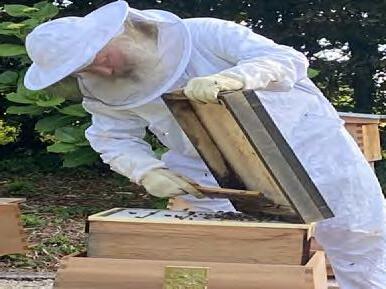
With SustainaBee, we believe in creating a world where business can actively contribute to environmental sustainability while making a real difference in protecting our pollinators. SustainaBee offers businesses a unique opportunity to actively participate in environmental sustainability through corporatesponsored beekeeping initiatives. By supporting local beehives, companies not only reduce their carbon footprint but also contribute to biodiversity, ecological balance, and corporate social responsibility.
Through our bronze, silver, and gold corporate membership tiers, businesses can directly contribute to hive management, pollinator conservation, and sustainable honey production, ensuring a thriving future for bees and the environment.
Why your support matters
By joining the Jersey Honey Company, you will demonstrate a commitment to sustainability by integrating beekeeping sponsorship into your CSR strategy. You'll raise awareness of pollinator conservation and climate action, while strengthening your corporate reputation.
Employee engagement in hands-on sustainability initiatives.
Interactive beekeeping sessions, educational workshops, and conservation activities give employees firsthand experience with sustainability. These initiatives enhance corporate culture, encourage team building, and promote a deeper understanding of environmental responsibility.
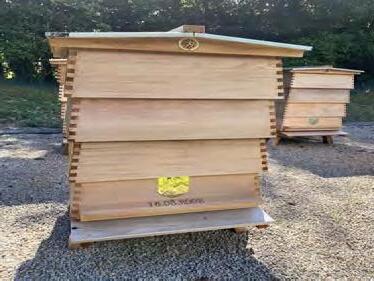

Why not support a fully branded company beehive?
A company-sponsored beehive serves as a tangible symbol of your commitment to sustainability. Your branded hive represents a direct investment in pollinator conservation, providing an opportunity for ongoing engagement and visibility in sustainability efforts, strengthening local ecosystems, and increasing bee populations.
Which sponsorship suits you?
Bronze Tier Community Supporter
Your contribution would play a vital role in supporting a local beehive without having to leave the office. Your support will be promoting ecological awareness and corporate social responsibility. Your dedication to protecting pollination contributes to a more sustainable future.
Silver Tier Corporate Engagement Partner
Through this partnership, your company directly supports the maintenance and health of a local beehive, enhances biodiversity, promoting ecological awareness and corporate social responsibility, employee engagement in hands-on sustainability initiatives. Your leadership in corporate sustainability sets a benchmark for responsible business practices.
Gold Tier Elite Sustainability Partner
— fully branded company beehive
Through this distinguished partnership, your organisation is making a measurable impact by supporting the health and nourishment of local beehives, enhancing biodiversity and sustaining essential pollination efforts, promoting ecological awareness and corporate social responsibility, the maintenance and wellbeing of a local beehive, the preservation of biodiversity and ecological balance, employee engagement in hands-on sustainability initiatives, supporting a dedicated fully branded company hive, strengthening local ecosystems and increasing bee populations, championing corporate sustainability and responsible environmental practices. Your company's leadership in sustainability serves as an inspiration for the future of responsible businesses. Gerald Durrell once said that "the ecosystem is like a delicate spider's web, and we are tearing great big holes in it." Today, we present an opportunity to repair one of those holes. Join SustainaBee today.
Choose your sponsorship tier and take meaningful action towards a greener future. For more information contact the Jersey Honey Company on 07797 774488 or email shaun@jerseyhoney.com


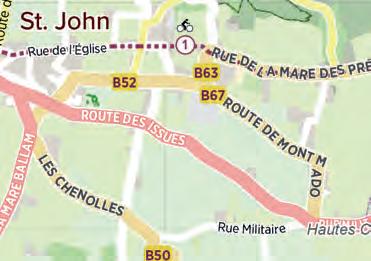


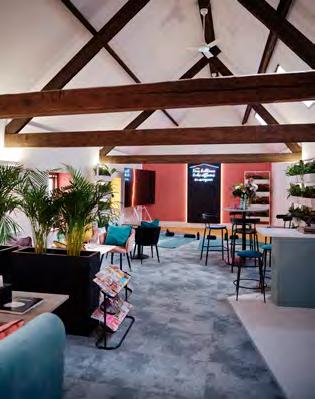
Inside House of Champions, Jersey’s bold new members club for modern entrepreneurs
There’s a new energy arriving in Jersey’s business scene, and it doesn’t look anything like the traditional office. Tucked away at St Andrew’s Place, behind the doors of a beautifully restored three-storey building, House of Champions is redefining what a workspace can be. Part members club, part creative hub, part entrepreneurial community, it’s a place designed not just for working, but for connecting, collaborating and genuinely wanting to spend time there.
At the centre of it all is founder Fiona Wylie, whose vision for the House was always about something bigger than desks and meeting rooms. “At its heart, House of Champions was never designed to be just a coworking space,” Fiona explains. “We wanted to create something far more human. A place where ambitious people could feel supported, inspired and connected.”
That idea became the foundation for the entire project. A home for founders, freelancers, creatives, consultants and growing businesses looking for flexibility without isolation. “We kept coming back to the idea that brilliant ideas rarely happen alone,” she says. “They happen in conversation, in collaboration, in those moments between meetings.”
And in many ways, Jersey feels perfectly positioned for a space like this right now. “People are working differently,” Fiona says. “More people are building flexible businesses, freelancing, creating content, launching side projects or scaling brands remotely from the island. They want flexibility, but they also want community.” It’s that blend of ambition and belonging that House of Champions leans into so naturally. Walk through the doors and it feels noticeably different from the typical office environment. Softer. Warmer. More considered. “We wanted people to instantly exhale when they walk in,” Fiona says. “To feel welcomed rather than intimidated. Energised rather than boxed in.”
The interiors play a huge role in creating that atmosphere. Following a full-scale renovation, the building now balances elegant design with an easy, lived-in comfort. There are calm corners for focused work, collaborative areas for conversation, creative studios and beautifully styled communal spaces that feel more boutique hotel than business centre. “The interiors were never an afterthought,” Fiona explains. “We wanted every detail to contribute to how people feel in the space. So many offices are functional but soulless. We wanted this to feel elevated but approachable.”
Even the name itself reflects that thinking. “The word ‘champions’ means something broader to us than simply winning in business,” she says. “It’s about championing ideas, creativity, ambition and each other.” And the “House”

part was equally important. “We never wanted it to feel cold or corporate. It needed warmth, personality and a sense of belonging.” That sense of flow extends throughout the building itself, with each floor designed to carry a slightly different mood and rhythm.
“Some spaces are quieter and more focused, others are more social and collaborative,” Fiona explains. “The building unfolds almost like a story as you move through it.” And while work sits at the centre of the concept, House of Champions intentionally blurs the lines between productivity, creativity and lifestyle. “This absolutely was designed as more than a workspace,” Fiona says. “Modern work and life are much more blended now. People want spaces that support the full rhythm of their day.”
That might mean starting the morning with a wellness session, recording a podcast in the afternoon, hosting a client meeting, then staying for an evening drink or event afterwards. “Content and storytelling are such a huge part of business now,” Fiona says. “We didn’t want the House to only support traditional working. We wanted it to actively support creativity too.”
And ultimately, it all comes back to collaboration. “I genuinely think collaboration is everything now,” she says. “The most exciting businesses come from people crossing industries, sharing ideas and building relationships.” It’s a philosophy quite literally written on the walls of the building: Alone we can do so little; together we can do so much. For Fiona, that quote captures exactly what she hopes House of Champions becomes. A space where unexpected conversations spark opportunities, where ambitious people inspire one another and where work feels energising again. “One of the things we’re most excited about is seeing partnerships and ideas emerge naturally within the House,” she says. “The kind of conversations you could never plan.” And while launching a project of this scale inevitably came with moments of doubt, Fiona credits the people around her for helping bring the vision to life.
“Honestly? I questioned whether I could pull it off all the time,” she laughs. “But I’ve always surrounded myself with people who are experts in their field and who believed in the vision.”


So what does success look like one year from now? “I’d love for it to become a real hub for Jersey’s creative and entrepreneurial community,” she says. “A place where people feel we’ve genuinely contributed to the growth of their business, wherever they are on their journey.” More than anything though, she hopes members simply feel the energy of possibility when they walk through the doors. “To arrive on a Monday morning and feel excited for the week ahead,” Fiona says. “To find your people here. To stay longer than you meant to because you’re deep in conversation with someone you’ve only just met.”
And perhaps that’s exactly what makes House of Champions feel so exciting. Not just because it’s changing where people work. But because it’s quietly changing how they want to live, create and connect too.
This edition’s Agenda special contains updates and advice from Jersey’s legal professionals

Cohen Family Law is at the forefront of developing modern approaches to family law in the Island. Alexandra is particularly passionate about exploring alternative ways of resolving family disputes which, in many cases, can avoid the need for lengthy court proceedings altogether.
In recent years, family lawyers in England and Wales have increasingly embraced processes such as Arbitration and Early Neutral Evaluation, particularly in complex financial matters and highly emotional children cases. While these approaches are still relatively uncommon in Jersey, Alexandra is keen to explore how they can serve as alternatives to more traditional forms of dispute resolution, such as Mediation and Financial Dispute Resolution (“FDR”) hearings, offering clients greater flexibility, privacy and control over outcomes.

Family Arbitration has been used in England and Wales for several years and can provide a very useful and practical route for couples wishing to avoid the cost, delay and stress of contested court proceedings. It can be especially helpful where there is an irresolvable issue - such as the treatment of non-matrimonial property - where only a costly final hearing before the court could otherwise resolve it.
Arbitration differs from other methods of dispute resolution because it is both voluntary and binding. It is a method of voluntarily resolving the dispute in a binding manner through the joint appointment of a private judge (the Arbitrator).
The position in Jersey
England and Wales have a specific family Arbitration scheme, which operates under the Arbitration Act 1996. Jersey does not have a dedicated family scheme, but we do have the Arbitration (Jersey) Law 1998. Nothing in that Law appears to prevent it being used as the framework for family Arbitration.
The process that could be used.
The couple together with their respective lawyers would firstly need to agree on the private judge (Arbitrator). It would usually be the case that the judge would be chosen from a group of trained arbitrators probably from a barrister’s chambers in London and often someone who has judicial experience.
The couple would then need to agree to be bound by the Arbitrator’s decision and agree to make full and frank disclosure of their respective financial positions. In some cases, court proceedings may already have been started, and it would then be necessary to agree not to continue with those proceedings.
Depending on the nature of the issues, the Arbitrator can hear evidence, call witnesses and, decide disputed facts, unlike the FDR process where a judge gives an indication of likely outcomes to help parties settle, but does not decide disputed facts.
What are the advantages of using Arbitration?
In addition to the ability to choose their judge, the couple can also retain their own lawyers throughout the Arbitration process. This is not the case with services such as Family Mediation Jersey, where lawyers are not present during the discussions with the mediator. Even in Jersey, the Arbitration process can be completed far faster than going to court, which inevitably means lower legal costs. The Arbitration process is also completely private.
Will there be a written decision, and can it be enforced?
As part of the process, it will be agreed that the Arbitrator will put the decision in writing and will give reasons for it. This can be extremely useful for the couple and is not something that it always available using other FDR methods. Under Article 29 of the Arbitration (Jersey) Law 1998, the Royal Court can be asked to enforce an Arbitrator’s award, and it appears this can be used in family cases.
Can there be an appeal?
The decision of the Arbitrator will be contained in what is called a Consent Order and once both parties have agreed to it then it is very difficult to appeal. A more difficult situation would arise if one of the parties did not agree with the decision and contrary to the Arbitration agreement attempted to appeal the decision of the Arbitration. However, given the overriding objective of the court to bring finality to litigation and the fact that Arbitration is voluntary and there would be an agreement in place where both have agreed to be bound by the decision it would be extremely difficult to lodge any appeal.
The Arbitration process even in England and Wales is still relatively new but there is evidence to suggest that it is an extremely effective means of resolving particularly financial disputes in a speedy and cost-effective way.
An unfortunate reality of family law disputes is they can take a heavy emotional and financial toll, especially those involving children. The disputed issues can range from issues such as where a child should live, how often each parent sees the child, or whether a child can move to another country. Early Neutral Evaluation (“ENE”) offers a way to address these issues without lengthy and emotionally charged court proceedings. It can also help resolve disputes involving wider family members, such as grandparents, again avoiding the need for court proceedings.
What is an ENE?
This is a voluntary process whereby both parties agree to a neutral 3rd party evaluator to assess the issues between them. The evaluator is normally a lawyer who has expertise in children matters such as a suitably trained English barrister. The big difference between an ENE and Arbitration is that the parties are not obliged to follow the evaluator’s recommendations during an ENE and therefore the process is non-binding.
The ENE process can save both time and legal costs and most importantly, it is less adversarial than going to court. This is crucial in cases concerning children. The evaluator will offer an objective and impartial perspective on the issues, and it allows potential solutions to be discussed between the parties and their lawyers.
What issues are best resolved by an ENE?
The ENE can be suitable for all child disputes such as who the child should live with, contact issues, specific issues such as schooling and cases where one parent wants to move the child to a different jurisdiction. The ENE can offer insights into how the court will typically handle such cases and assist the parties to navigate the legal and emotional complexities involved.
In family cases, it is becoming increasingly important to encourage all potential methods of resolving disputes outside the traditional court process. At Cohen Family Law, Alexandra has all the necessary skills to advise on the most suitable form of alternative dispute resolution for clients’ individual circumstances, offering practical, tailored advice focused on achieving constructive and effective outcomes (which are nearly always the best outcomes for clients).
Alexandra has also written a number of other articles exploring alternative dispute resolution in family law, which can be found on her website cohenfamilylaw.je.
Spend a few minutes talking to Appleby Partner John Bisson and you quickly get a sense of just how much Jersey’s property market has changed over the past half century. Having spent more than 50 years at Appleby, he’s seen it all - market booms and slowdowns, changing regulations and a steady shift in what clients expect from their lawyers.
But this isn’t just a story about experience. It’s about what happens when that experience is shared, built on, and carried forward.
Appleby’s property team has grown into one of the island’s most well-regarded practices, handling everything from high-end residential transactions to complex commercial deals. What really sets it apart, however, is how the team works together. There’s a strong sense that no one operates in a silo - clients benefit from a group of lawyers who regularly share knowledge, compare notes and bring different perspectives to the table.
That team dynamic is a big part of why clients keep coming back. They’re not just getting legal advice; they’re getting the combined insight of people who understand the local market inside out and know how to navigate it smoothly. A key part of that strength is the wider team around the partners. Kate Westwater, as Counsel, plays a central role, bringing deep experience, sound judgement, and real consistency across matters. Kate is a trusted support not just for clients but within the team itself. Alongside her, the contribution of Conveyancing Managers Michel Bougeard and David Le Brocq adds another practical layer of expertise, helping to keep transactions moving efficiently and ensuring that the detail is always covered. Then, of course, there is incredible support from Legal Executive Allison Kidson and Secretary Tracey Le Falher.
Strengthening an established practice
Against that backdrop, Jeff O’Boyle’s arrival as a partner feels like a natural next step. Rather than changing direction, it’s about adding to what’s already there. He brings his own experience and specialisms, along with a fresh perspective that complements the existing team.
Importantly, Jeff isn’t stepping into something new - he’s joining something established and helping to strengthen it further. His presence adds depth and ensures the team is well placed to meet the demands of an increasingly busy and sophisticated property market. He will drive the use of technology as an addition to existing ways of dealing.
One of the most interesting aspects of this next chapter is the opportunity to work closely with John. It’s not often you get to learn alongside someone with that level of experience. The value goes beyond technical knowledge - it’s about judgement, relationships and an instinct for how to handle complex situations.
At the same time, it’s a two-way exchange. Combining John’s decades of insight with Jeff’s more recent market experience creates a balance that works in everyone’s favour, particularly clients. It means advice is grounded, but never stuck in the past.
That’s especially important in today’s market. Jersey’s property landscape has become more complex over time, with tighter timelines, more informed clients and increasing expectations around speed and clarity. Whether it’s residential or commercial work, there’s a growing need for lawyers who can think ahead, spot potential issues early and keep things moving. Appleby’s team is well equipped for that. The mix of longstanding experience, strong internal support and new energy means clients get a service that is both steady and responsive.
Looking ahead, that balance will only become more important. The strength of the team lies in its people - those who have shaped it over decades, and those who are helping to take it forward.
It’s a combination that gives clients real confidence. And in property, that still counts for everything.



What does a typical day look like for you?
The day has a habit of evaporating, so I tend to squeeze in whatever exercise I can at the start. That usually means a 5am alarm for gym or a jog – which is a lot easier at this time of the year! Before I get into the office at around 08:30, my powers of negotiation have already been warmed up too – by my four-year-old, who usually has firm views about what she will wear to nursery and the contents of her lunchbox. My day can then include anything from calls and emails with counsel, the court and colleagues involved in the file; analysing an opponent’s argument; researching and preparing a client’s written case; catching up with team colleagues about the path of a dispute or application; preparing for a court filing and everything in between. No two days are ever the same in the Dispute Resolution team, which I think is half the fun!
Talk us through how you got to where you are now in your legal career.
I began my career in a junior role in the litigation team of another offshore firm. I had just finished university having obtained a criminology with law degree and, as luck would have it, found myself in a busy litigation practice, a sub-division of which looked after the firm’s criminal defence practice. I loved it. In the intervening years I supported the lead advocates with their attendances at HMP La Moye and the courts and all aspects of running the defence. I set myself the goal of becoming a qualified lawyer and embarked on that journey at the same time as moving across to commercial litigation. I then spent a total of six years studying to obtain my GDL and LPC (two years each, remote, while working) and the Training Contract with Ogier. My practice has been quite varied since qualifying, ranging from trust, company, insolvency, negligence, contract and regulatory issues, to name a few.
What support has Ogier provided during your career and qualification journey so far?
Ogier has been instrumental in helping me to achieve the goals that I set myself, professionally and personally, since joining the firm. Line management, the HR business partners and Talent and Development colleagues were open and encouraging. Their flexible and supportive approach made a real difference, particularly as I completed my LPC part-time and the Training Contract, at the same time as having my eldest little girl. It has taken a great deal of determination and commitment to get to this point, but it has been a rewarding challenge and, with Ogier’s support, one that I have been able to manage alongside family life.
How does Ogier’s culture support your professional and personal commitments?
Ogier’s culture values people and understands that commitments extend beyond the office. Flexible working isn’t just encouraged, it’s really part of how we work dayto-day. That level of trust and support has made all the difference for me, enabling me to balance my professional responsibilities with both family life and my studies, which has been absolutely crucial in recent years.
With technology playing an ever-increasing role in legal practice, embracing change and being open to new tools is a core skill and an essential part of everyday life as a lawyer.
What does the modern lawyer look like to you?
To me, the modern lawyer is someone who not only has strong technical expertise but also values collaboration and adaptability. With technology playing an everincreasing role in legal practice, embracing change and being open to new tools is a core skill and an essential part of everyday life as a lawyer.
We’ve also seen positive changes in the profession that create opportunities for greater diversity and inclusion, such as the introduction of the SQE route to qualification, which I hope will continue to open doors for those from different backgrounds and circumstances. It’s also encouraging to see the industry moving towards more supportive and flexible environments for working parents, something which I have experienced firsthand.
What do you think the future holds for the next generation of lawyers like yourself?
Naturally, given the stage and pace at which it is being adopted in all walks of life, AI must feature in my answer to this question. It still seems too early to say how much AI will impact the careers of the next generation. However, in my opinion, in order to thrive, a next generation lawyer will need to be open to such changes, while continuing to develop the core legal skills that remain at the heart of our profession.
For more information about careers at Ogier, visit ogier.com/careers
What a strange thing it seems to put love and inheritance in the same sentence.From personal experience, conversations with friends, colleagues and clients, I know we will talk about almost everything else in a relationship — careers, holidays, children, finances, where to live — but inheritance is often the conversation couples avoid.
Usually because people think: We’ll deal with it later...Life is busy...Work takes over... Children arrive. And making a will somehow ends up sitting in the category of important, but not urgent. But if you stop for a moment and think about the below questions, can you say for certainty:
Who would inherit the house? What happens if one partner dies unexpectedly?
Who would make decisions if someone lost capacity?
Would children from previous relationships be protected?
Would your family actually know what your wishes were?
For many couples there is assumption that it would go to the other, or that the surviving spouse would know what I want, however this is not possible unless you have spoken about it.
Unfortunately, life — and modern family life especially — is rarely that straightforward.
Relationships have changed but many legal arrangements have not The traditional family structure that existed decades ago no longer reflects many modern relationships. Today, couples are:
• living together before marriage,
• remaining unmarried long term,
• buying property together,
• having children later in life,
• entering second marriages,
• and blending families from previous relationships
Family life has evolved enormously, but many people’s legal arrangements simply have not kept pace. This can create real difficulties when illness, separation or death happens unexpectedly.

The common law marriage myth
One of the most common misconceptions I hear is: ‘We’ve lived together for years, so surely everything automatically passes to me’. Many people still believe in the idea of a common law husband or common law wife. But common law marriage does not exist in the way many people think it does. Without proper planning, unmarried partners can face uncertainty around: property, finances, inheritance, and even access to information or decision-making. For families already dealing with grief, this can come as a huge shock.
Love becomes more complicated when money is involved
Most inheritance disputes do not begin because families are greedy. They begin because people are emotional, grieving and unsure what someone would have wanted. Modern estates are also far more complicated than they once were. Many now include:
• jointly owned homes,
• pensions,
• investments,
• online businesses,
• cryptocurrency,
• digital assets,
• family loans,
• and children from different relationships.
When wishes are unclear, loved ones are often left trying to piece things together themselves. Even close families can find themselves in conflict when expectations differ. In blended families especially, balancing the interests of a current partner, children and extended family can become incredibly difficult without clear instructions in place. What feels fair emotionally is not always straightforward legally.
Estate planning is no longer just for older generations
Traditionally, wills were something people associated with retirement or later life. That is changing. Many people in their 30s and 40s now have:
• mortgages,
• children,
• savings and investments,
• businesses,
• online accounts,
• digital photographs,
• and valuable digital assets.
For some families, an online life alone contains financial and personal information that loved ones would struggle to access if something unexpected happened. Estate planning today is less about age and more about responsibility.
No couple enjoys discussing worst-case scenarios. But avoiding the conversation does not avoid the risk. In reality, the families who cope best are often the ones who had the practical conversations early — calmly, openly and before a crisis forced decisions to be made under pressure. A properly prepared will is not simply about distributing money. It can:
• protect children,
• reduce stress for loved ones,
• avoid unnecessary disputes,
• clarify intentions,
• and ensure the right people can step in when needed.
There is still a tendency to see wills and estate planning as gloomy or pessimistic. In reality, they are often one of the most caring things a person can do. People insure homes they hope never burn down. They save for retirement decades in advance. They protect phones, passwords and bank accounts. Making a will is no different. It is simply part of protecting the people you love and making life easier for them if the unexpected happens.
The families who cope best after bereavement are not always the wealthiest. Often, they are simply the ones where conversations happened early, wishes were clear and practical arrangements had already been made. Because when love, money and inheritance collide, clarity matters far more than people realise.

Our boutique firm blends technical excellence with warmth and empathy, which sets us apart.
Why Choose Us?
Expert Legal Support: Clear, straightforward advice and practical solutions across all areas of family law, including divorce, child arrangements, financial disputes, and pre/postnuptial agreements.
Human Approach: No stuffy suits or confusing legal jargon. Just down-to-earth support from people who truly listen and care.
Modern, Tech-Savvy Service: We use the latest technology to make your experience as smooth and convenient as possible.
Transparent, Fair Fees: Expect honest discussions about costs, with no surprises.
Because family law is personal, so is the way Cohen Family Law works - clients are guided and supported through their significant life changes. We make their complex situations easier, not harder.


There are so many reasons to make your will. If you’ve bought a house, have children, are married, in a civil partnership or are living together, it’s time you made your will. Getting it done will give you peace of mind, and we’ll guide you through the process. We’re your kind of law firm.
To find out more, call 760760, email probate@lgl.je or visit www.lgl.je Do the right thing by your family. Make your will.
ABOUT CHRIS HILLIER
Chris Hillier is an experienced, pragmatic and wellknown family lawyer in Jersey. He is the Head of Family Law at Ingram Advocates, specialising in divorce and matrimonial finance, and private and public law children matters. Chris also advises on Lasting Powers of Attorney (LPA) for private clients.
Chris has an interest in mental health issues affecting individuals and their liberty. He is a member of the Mental Health Advocates Panel, representing the interests of those who are admitted to hospital on either a voluntary or involuntary basis in Jersey.
Here, Chris discusses the recent matrimonial case of O v P [2026] JRC056, which was heard in the Royal Court of Jersey’s Family Division earlier this year, and published recently.
The husband (O) and wife (P) had been married for 26 years and separated in 2024. O was 53 and P was 10 years older. The parties had 3 adult children. The former matrimonial home (FMH) had been sold, and after various payments had been made, the net balance of £469,138 was held in escrow. A property in another country was valued at €530,000, but the parties could not agree on its value, or about selling it. Decree nisi (the conditional order of divorce), had been granted in 2025. After adding in further assets (and if the other property sold), there would be between £853,000 and £881,000 to divide.
The judgment shows the challenges faced by the Court when needing to rehome two households and consider a lack of financial information in certain areas. For example, O confirmed that he had made payments to his mother rather than paying mortgage arrears on the FMH, and P felt that a loan of £145,000 apparently owed to O’s parents had been “fabricated” by him, to make his financial position seem graver than it was. Given his financial astuteness, the Court did not find O’s explanation of making payments to his mother, credible.
• How to divide the funds remaining from the sale of the former matrimonial home;
• the Petitioner husband’s earning potential given his previous high earning capacity,
• the status of the ‘loan’ made to the Petitioner by his parents;
• how a pension lump sum of £290,000 received by P was spent;
• a joint tax debt of £80,000 from 2019, and
• whether a spousal maintenance award should be made to the wife…It was.

The Court considered the principle of an ‘add back’. This is where the Court is asked to look at “excessive, unjustified spending by one party” and potentially take it into account by reducing the financial award to that party. As the Court rightly noted, add back does not actually recreate money, so caution is necessary. The Court concluded that O had disposed of more than £150,000 of matrimonial funds after he had issued divorce proceedings. It therefore decided to add back into the matrimonial ‘pot’, the sum of £152,215 that O was found to have paid to his mother, bringing the joint assets to £1,005,000.
The legal fees owed by each party to their lawyers in this case were sizeable. P’s fees were almost £87,000 (£25,000 remaining unpaid), and O’s fees were £135,000. The Court was critical of how both parties had conducted themselves in the litigation and reminded us that the “winner” in family law matters does not receive their costs as of right. The Court awarded the wife 55% of the matrimonial assets, spousal maintenance and care of the family dog, given that she intended to remain in Jersey and the husband was more likely to leave.
This interesting case is a salutary lesson about the danger of diverting assets in divorce proceedings. Honesty (and accurate disclosure) is always the best policy.
This article does not constitute legal advice.
We’re here to support you and your family through life’s most challenging moments. With care, understanding, and clear guidance, our team works to help everyone move forward towards the best possible outcome.
→ Separation
→ Divorce
→ Children law
→ Matrimonial finance



At JTC Law, the future of law is not about technology replacing tradition, but combining innovation with mentoring, commercial awareness, human connection and sound legal judgement.
The firm continues to grow at rapid speed and has a purposeful intention of being shaped by talented people, fresh perspectives and a clear commitment to developing the next generation of legal professionals. As the legal market becomes more technology-driven, lawyers must continue to learn, collaborate and grow alongside these changes.
We spoke to April Hargreaves, Associate in the firm’s Investment Funds and Corporate team, whose career reflects the energy and ambition behind JTC Law’s continued evolution. April’s journey reflects what sets JTC Law apart: a modern mindset, investment in people and a determination to keep evolving. As the firm grows, so does its next generation of talent. At JTC Law we don’t rely on legacy, we build it.
What attracted you to a career in law and what brought you to JTC Law? It started with watching too many courtroom dramas and thinking law looked very glamorous. Thankfully, I discovered there’s much more to law than dramatic cross-examinations and people shouting “objection”.I realised what really appealed to me was that the fact that lawyers help people solve problems.
Whether supporting a complex transaction or protecting business interests, you work with people who genuinely value your advice. That sense of purpose is what drew me in.
JTC Law stood out because it combines high-quality international corporate and funds work with the backing of the wider JTC Group. The culture was the deciding factor: collaborative, approachable and genuinely invested in helping people succeed.
How has your role developed since you joined JTC Law?
Since joining, I’ve taken on more responsibility, built confidence and had more direct client interaction. Junior lawyers are trusted from day one, encouraged to contribute meaningfully and take ownership of work, which accelerates development.
I’ve especially valued the balance between high-quality work and strong client relationships. It’s fast-paced, but collaborative, and that has helped me grow both technically and commercially.
What have been some of the most important learning experiences in your career so far?
One of the biggest lessons has been realising that no lawyer knows everything, and that’s completely normal. Law is a profession of constant learning, and some of the biggest lessons come from the busiest, most challenging moments.
Tight deadlines and complex matters can be daunting, but they build confidence. I’ve learned the value of staying calm under pressure, thinking commercially and remembering that legal work is always a team effort.
How have colleagues or mentors supported your development?
The people around you make a huge difference. I’ve been fortunate to work with colleagues who are not only technically strong but also supportive and approachable. At JTC Law, seniors encourage junior team members to ask questions, share ideas and take ownership. That balance of guidance and responsibility is invaluable.
What are your career ambitions, and how do you see JTC Law helping you achieve them?
To keep progressing by developing technical expertise, commercial awareness and trusted client relationships. I want to continue building experience, learning from leading professionals and growing within this forwardthinking business.
Long term, I’d like to progress into a senior associate and eventually partner role, while also mentoring junior lawyers. Having benefited from strong support myself, I’d like to give that back as my career develops.


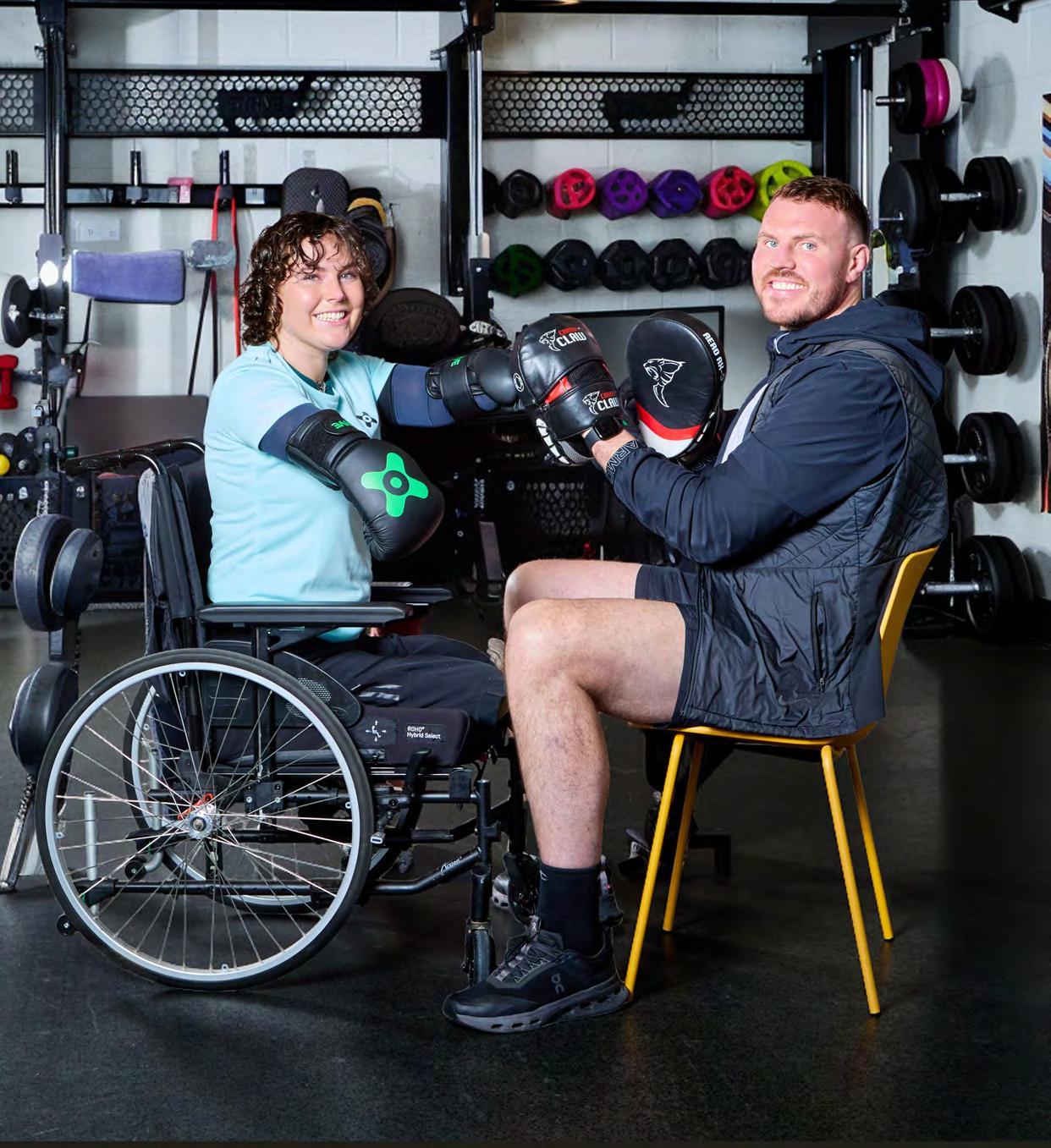
Lily McGarry is 24, a former Jersey College for Girls pupil and Cardiff medical student, a TED speaker, and, as of six months ago, a boxer. She trains on Fridays at Strive, the 32,000 square foot gym near the airport, with Nick Campbell, the former Scottish Heavyweight Champion. They are currently working through eight rounds of a minute and a half. When they started in January, they began at four one-minute rounds, which Lily describes as “nothing, really.” She is humble about most things.
The boxing began, like a lot of what she is doing right now, with her looking for something specific and somebody saying yes. She had been looking for cardio she could do sitting down. Running, before her illness, had kept her mood good when little else would, and she missed it. “Being in the wheelchair, I was just really keen to do something that would get my heart rate up,” she said. “Something I can do whilst I’m sitting down.”
In January last year, in her second year of medicine at Cardiff, she was hospitalised with meningococcal septicaemia, survived two cardiac arrests, spent three months in a coma and woke up a quadruple amputee. She has spent the time since rebuilding, and she is openly bored of being looked at in the street with pity. The TED Talk, when it lands, will address this directly. “My main message is that disability isn’t an identity. People need to see people living in different bodies for who they are, rather than what they look like.”
Nick was at Strive when she came in. He had spent eight years as a professional rugby lock at Glasgow Warriors and Jersey Reds, returned to boxing in 2017, won the Scottish Heavyweight title in 2022, and spent his last years in the ring training in camps with Tyson Fury, Anthony Joshua and Joseph Parker. He retired at the start of this year and now coaches full-time. They were introduced over coffee. “I don’t think she actually knew that I boxed, or had ever boxed,” he laughed. “I said, well, I could maybe do some boxing sessions with you.”
In those first few sessions, he was clear about what he wasn’t going to do. “I was aware she probably gets a lot of pity, and I didn’t want her to feel like that’s the vibe I was giving off. I’d want people to treat me like anybody else.” So he kept things light, and pushed. “I had quite severe heart failure probably nine months ago,” Lily said, “so I didn’t know whether I was going to get chest pain or what to expect. But my heart’s recovered fine.” Six months on, they are doubling the volume and the round length, and Nick suspects there is more in the tank. “We’re just gradually pushing her every little bit. She gets stronger every time we’re in the gym together.”
What has surprised him, after a career around elite athletes, is something else. “People are a lot more capable than they look. You look at somebody and think they’re going to be defined by a disability, or by something that’s gone wrong, and that’s not true. You just need to find a different way of pushing them. Coming from a professional sporting background where everybody’s expected to push themselves as hard as they can, that’s been the biggest thing I’ve taken. Everybody’s adaptable, no matter what’s put in front of them.”
My main message is that disability isn’t an identity. People need to see people living in different bodies for who they are, rather than what they look like.
There is, in his account of their working relationship, very little that sounds like work. “I don’t really feel we’ve got a working relationship,” he said. “It’s just two mates training together. I don’t look at Lily as a client.” Lily talks about the team at Strive as a second family, and credits Nick with coaxing her into swimming at the academy pool, which she had been nervous about in public. “Nick told me it doesn’t matter what other people think,” she said, and the advice seems to have travelled beyond the pool.
She talks about how society values independence at the expense of human connection, and about how much kindness she has seen in the last sixteen months. “You don’t have to let what happens to you define you. Your reaction to it, and how you move forward, is more how you should define yourself.” She, characteristically, deflects when the conversation turns to what comes next. “I’d definitely like to keep the boxing going.” At the time of writing she is in London being fitted for her first pair of prosthetic legs. The boxing will resume on her return.



TUCKED AWAY IN ONE OF JERSEY’S MOST BEAUTIFUL LEAFY-GREEN VALLEYS, VALLEY ADVENTURE CENTRE HAS LONG BEEN THE ISLAND’S GO-TO DESTINATION FOR ADRENALINE, OUTDOOR FUN AND UNFORGETTABLE DAYS OUT. BUT THIS SUMMER, THINGS ARE GETTING EVEN BIGGER, BOLDER AND MORE EXCITING.
Because Valley Adventure isn’t just climbing ropes and zip wires. It’s become something much more: a full-blown adventure hub for kids, families, businesses, friend groups and anyone wanting to swap screens, emails and routine for fresh air and laughter.
For parents wondering how on earth to survive six weeks of summer holidays, Valley’s legendary Holiday Adventure Camps may just be the answer. Designed for children aged 8–14, the camps are packed with enough action, energy and mud to guarantee one thing: happy, tired children by bedtime.
From single-day bookings to full multi-week adventures, the camps combine confidence-building challenges with good old-fashioned fun. Think aerial trekking, zip wires over trees and pond, laser combat, archery, obstacle courses, giant swings and the kind of outdoor freedom kids rarely get enough of these days.
But what makes the camps really special is that hidden underneath all the excitement is something genuinely valuable. Kids leave with more resilience, more confidence, new friendships and a stronger sense of teamwork, even if they think they’ve just spent the day having the time of their lives.
And then there’s the beach days!
Because naturally, Valley Adventure decided dry land wasn’t enough.
Their Valley Sea Adventure experiences are bringing a whole new side of the island into play, giving groups the chance to explore Jersey’s incredible coastline by kayak, Mega SUP, Bell Boat or through the wildly fun sport of coasteering. Yes, that’s climbing, scrambling, swimming and leaping your way around hidden coves and rocky coastlines in a wetsuit and helmet. Equal parts exhilarating and challenging, in the best possible way.
The Mega SUPs, meanwhile, look set to become the island’s funniest group activity. Imagine trying to paddle one enormous board with your friends while somebody inevitably falls in within the first five minutes. Team bonding has never been so entertaining.

And speaking of team bonding, Valley Adventure is also becoming a serious hotspot for corporate socials and teambuilding events. Forget awkward trust falls in a conference room, this is team building with zip wires, obstacle races, axe throwing and paintball.
Whether companies want a half-day social, a full-scale away day or simply an excuse to get out of the office and do something genuinely memorable, Valley can tailor experiences around groups of all sizes. There’s even marquee hire and catering options available, meaning your “quick work social” can evolve into one of the best days of the year.
Perhaps the biggest headline of all, however, is Valley’s upgraded obstacle course officially receiving recognition as a British Obstacle Sport Training Centre.
Yes, Olympic-level obstacle racing is officially having a moment.
With Obstacle Racing joining the Modern Pentathlon at the Los Angeles 2028 Olympics, Valley Adventure is now one of the few places offering certified training facilities right here in Jersey. Their upgraded 15-element course is designed for everyone from serious athletes to stag dos, school groups and brave parents trying to prove they “still have it.”
Spoiler alert: they usually don’t.
But that’s exactly the charm of Valley Adventure. It’s not about being perfect. It’s about getting involved, trying something new, laughing at yourself and embracing a little adventure again.
And in a world increasingly lived through screens, notifications and schedules, that might just be the most valuable thing of all.
valleyadventure.je 638888



Combining specialist knowledge, personalised service and a genuine passion for sport, we are Jersey's trusted destination for athletes, fitness enthusiasts and active families alike. Specialising in all aspects of sport and fitness, with dedicated ranges for running, cricket, hockey, netball, racquet sports and gym training.
We offer professional gait analysis using advanced treadmill technology, to assess your running style, helping identify the footwear best suited to your biomechanics, comfort and performance. Come and view our an extensive collection of premium running shoes from industry-leading brands including Asics, Brooks, HOKA, Adidas and Saucony. Proudly locally owned.
733429
glmsportsje@gmail.com


Meet Slabs, Jersey’s very own punk rock power group. You might not know the name yet – but you will. They’re new, but not new to this. Built from Bulletproof, Hold Your Fire, and Jaded Things, they’ve been tearing up the punk scene since the early 2000s: seasoned punks with a fresh edge.
My first encounter with Slabs was that of a fever dream. Ultimately I never thought I could say that I’d interviewed a punk rock band in a bunker in Greve De Lecq, alas that is exactly what happened. Shrouded by a canopy of cob webs, and guarded by a wall of amps, our meeting was a creative collision of great effect: taking the form of an interview, band rehearsal, and photoshoot. Upon our arrival, whilst Kasia set up for the imminent photo shoot, and the band milled around tuning guitars, I absorbed my surroundings, considering the tone for the interview ahead. Having heard of an ominous bunker in the depths of Greve De Lecq in which local bands practice, I have to say it was precisely what I expected. Empty bottles stacked up like soldiers along an old work surface, ashtrays scattered around like ornaments, and yet it felt like the perfect environment to get to know Slabs.
Established post covid, in 2023 the formation of Slabs brought together members of Bulletproof, Hold Your Fire, and Jaded Things with the concept of a Channel Islands supergroup taking hold. Having all worked together previously in some capacity, Slabs unites members in an exciting new collaboration. Comprising bassist Lee, drummer Eddie, guitarist Nick, and vocalist and guitarist, James, together the outfit leans into hardcore-tinged riffs, biting political lyrics, and punching basslines. Bassist Lee expands on how the four all joined forces: ‘myself and Eddie have been in most of the previous bands…we bonded straight away from the first practice at a bunker in Fort Regent all those years ago (when Bulletproof didn’t even have a name). James was a bit younger than us, he was a cracking singer in his previous band, so we asked him to join forces to make a supergroup , same with Nick…we asked him to help out and bulk up the sound.’ With all members having established their creative careers in their own right, Slabs is a mutation of the bands that have come before it. Leaning into that ‘classic punk rock sound with tweaks of metal’, Slabs are establishing themselves with heavier tones, and more angsty fuel than ever before.
With a plethora of original tracks under their belt — albeit unreleased — the subject matter behind Slabs’ songwriting sparked a morbid curiosity in me to dig deeper. Watching the outfit rehearse, zoning in on tormented and bewildering lyrics, it quickly became clear that Slabs’ songwriting twists between tales of serial killers, conspiracy theories, and social struggle. Songwriter and bassist Lee revealed the catalysts behind his words: ‘Conspiracy theories are my number one — from when the Twin Towers came down, global warming, the elites, and the puppet governments around the world controlling everything. Second, when you switch on the TV or radio, the stations become echo chambers repeating the same stories of war and fear. It’s full on for a lot of people, but they still follow and listen. Finally, serial killers are fascinating. I’m not a sick person, but I like watching what makes a person kill’. James emphasised this further, explaining: ‘That last song we played — that was about Fred West. It’s called West Side Story’. Slabs’ songwriting offers an intriguing dive into Lee’s mind, using music as an outlet for conspiracy theories and tales of serial killers alike. There’s an intensely dark narrative running throughout, tying devilishly well into the hardcore-inspired sound that Slabs are crafting. As Lee puts it: ‘There’s a lot to sing about’.
Words: Daisy Taylor
Photography: Kasia Guzik
Having witnessed Jersey’s music scene, particularly the punk scene over the last two decades, the band indulge me in their thoughts on Jersey’s current musical landscape. To which James and Lee regard that it is ‘non-existent’. Drummer Eddie circles back to say that ‘I think there’s bands out there, there’s just nowhere to play’. Reminiscing on the days where there used to be fifteen or twenty venues, Lee surmises that there’s now just three or four, namely ‘Blue Note, St James’, Splash, and The Sundown’. Reflecting on the closure of major venues that were once a pivotal part of Jersey’s music scene, Slabs calls to blame venue closures for the demise of rising Jersey bands. Afterall, gigging off island is becoming more and more far-fetched ‘it’s got quite expensive to go away– even getting paid you’re losing hundreds and hundreds of quid taking your equipment over’. Lee talks of the days in previous bands, travelling over to Guernsey for the notorious Chaos Festival run by Guernsey bikers (the Green Men): ‘they used to pay for us to come over which was really nice, and they’d give us drinks all night as well. Then it all just stopped. There were no more people coming over to the island.’ He pins this to Condor Ferries, as they reduced their sailings, making travel between the islands less frequent and increasingly expensive.
So after nearly three years in their current form, Slabs are getting ready to throw down a DIY EP or album. ‘The last band we were in we just did an album DIY. We didn’t release it or anything, we just handed it out’. Alas, as the days of CDs are becoming closer and closer to extinction, Slabs will ultimately find their way as all bands must do, to major streaming platforms like Spotify. We discuss the heightened accessibility of music, making things way too easy for consumers, and, in a way, infinitely harder for artists. ‘Back in the day you could sell millions and millions of records, and you’d be in number one for weeks and weeks, and now you can sell 100,000 records and you’re at number one– it’s a quick turnaround’. As for social media, after 6 years, Lee is breaking back into the digital realm, with one thing in mind ‘because I need to give the people the music’. With a singular desire to use Facebook and Instagram as promotional tools, Slabs are prepping to bring their future releases and gig announcements to the social media realm.
Slabs are raring to bring the noise from their bunker rehearsals to the main stage, with potential support slots in the coming months. ‘We’ll have a handful of local gigs just supporting, until it feels right to go away or expand,’ says Lee. He also spoke about the exciting prospect of Jersey and Guernsey collaboration gigs: ‘We’re in talks with other bands in Guernsey to put on an interisland gig. There are a lot of great musicians and bands across the islands we’d love to play with and show to a Jersey crowd. It can get a bit same-y hearing the same cover bands every weekend or fortnight.’
Built from familiar names and faces but driven by a new energy, Slabs are widening the space for punk rock on the island with a refreshing disregard for expectation. You can expect them in local venues over the coming months, delivering sets full of piping original tracks teamed with a refusal to conform to the mainstream cover circuit. Expect biting narratives drawn from conspiracy theories and tales of terror, paired with shrieking hardcore riffs and pummelling basslines: unfiltered, untamed, uncompromising.
































CARS. BIKES.BOATS. VANS.








































CARS. BIKES.BOATS. VANS.











KIM LE BRUN ADVANCED SKIN & BEAUTY
Give your skin back its snap at Kim Le Brun Advanced Skin & Beauty. Experience unrivalled results for youngerlooking, radiant skin with our advanced facial offerings, Excelight IPL machine, and professional skincare ranges. Relax in a calm environment whilst our professional treatments are tailored just for you. Unwind, refresh and recharge – it’s all about you and your skin’s best self!
KIM LE BRUN 07797 719700. kimlebrun.je
kim@kimlebrun.je @ Kimlebrun.skin


TEETH WHITENING TREATMENT £149*
We all want nice white teeth and professional home whitening is a great way to improve your smile in a safe and quick way. Your home whitening kit will consist of custommade bleaching trays and 2 syringes of professional whitening gel. Book your appointment online. *Terms and conditions apply, visit our website for more information www.paradedentalpractice.co.uk
THE PARADE DENTAL PRACTICE
24 The Parade, St. Helier 01534 725520 admin@paradedentalpractice.co.uk


NAUTILUS
Step into Nautilus, a brilliant boutique where timeless elegance meets modern flair. From effortlessly chic staples to head-turning statement pieces, every item is thoughtfully curated with love and a keen eye for style. Expect impeccable tailoring, distinctive design, and luxurious fabrics; all chosen to flatter and inspire. Nautilus is brimming with unique finds to elevate your wardrobe.
39

BONITA
Experience the brilliance of Bonita Hair & Beauty Salon, where style meets elegance. Our expert stylists and beauty professionals deliver exceptional haircuts, colour, facials, and more, tailored to enhance your natural beauty. Relax in our luxurious, welcoming space and leave feeling radiant, confident, and refreshed. Bonita is your go-to destination for flawless beauty and personalised haircare.
BONITA
Hotel De France, St Saviours Road 01534 720081 bonitahairandbeauty.com


PENNYFEATHERS
Pennyfeathers is an aesthetic skin specialist clinic based at the Lido Medical Centre, offering advanced, resultsdriven treatments in a calm, clinical setting. Known for the signature Pennyfeathers Protocol Facial and IvanMed Microneedling, Penny combines expertise with personalised care to transform skin health. Treatments also include electrolysis and FreezePen Cryosurgery for unwanted hair and benign skin lesions.
PENNYFEATHERS,
2.4a Lido Medical Centre, St Saviour Penny@penny-feathers.co.uk www.penny-feathers.co.uk


THE GOOSEBERRY BUSH
The Gooseberry Bush is a unique Family-fun business of 36+ years! We enjoy stocking lagenlook, fun & comfortable clothing for all shapes & sizes, in bright bold designs for Summer & Winter. Jewellery, scarves & footwear is blended with the fashion per season. The Interiors area boasts a wide selection of affordable linen & cotton cushions, throws & rugs to compliment any home and scents to match. Any Furniture can be collected & taken straightaway in the back of a car! Service with a Smile!
THE GOOSEBERRY BUSH
Rue de Haut de l’Orme, Trinity (just behind Rondels Farm Shop) 01534 726224

THE LASER CENTRE
Julie Naidu RGN LNP BACN BMLA.
Julie has been specialising in facial aesthetics for 28 years which has been a lifelong interest in the positive enhancement of physical and mental well-being. We only use the best market leading products to treat frowns, wrinkles, face, neck and hand rejuvenation and so much more. So if you need a little freshening up after summer, then please get in touch and trust in experience.
THE LASER CENTRE
Lido Medical Centre (2.4 B) 01534 888272 info@thelasercentrejersey.co.uk www.thelasercentrejersey.co.uk


MORE THAN A HAIRCUT...
Lads’n’Dads Barbers isn’t just a haircut, it’s your new favourite hangout. Whether it’s your little man’s first trim or you’re after a fresh fade, our friendly barbers have you covered. From modern cuts to timeless classics, sit back, have a laugh, and leave looking sharp. Great cuts, great vibes, and a place where everyone’s welcome. And guess what? We’re growing! If you’ve got the skills, the banter, and the passion for great hair, we’d love you to join our team. See you in the chair – or maybe behind it!
LADS’N’DADS 1 Wharf Street, St Helier ladsndads.co.uk


Discover our award-winning boutique salon situated in a rural, tranquil location, offering privacy and parking. The salon is praised by clients for its peaceful surroundings, expert beauty practitioners and bespoke beauty formulas. Services include; Microblading for Eyebrows, SemiPermanent Eyeliner, SylfirmX Skin Rejuvenation, Pevonia Skincare, Intimate Hot Waxing, Manicures & Pedicures, Massage and Reflexology.
THE BEAUTY HOUSE
4 Roc Annick, La Rue es Bouefs, St Mary 01534 789000 www.thebeautyhouse.je


THE COLOUR ROOMS
Come and explore The Colour Rooms Art Gallery and Studios... A welcoming and vibrant creative hub in the heart of Beaumont at the roundabout. Discover monthly inspiring exhibitions, sign up for art classes led by experts in their field, connect with others and develop your creativity in our relaxing and beautiful gallery. Find the perfect piece of art for your home or workspace to add individuality and focus. At The Colour Rooms, colour is not just a theme, it is at the heart of everything we do. Come and be inspired.
THE COLOUR ROOMS
La Route de la Haule, Beaumont 07829 908090 thecolourrooms.art@gmail.com www.thecolourrooms.co.uk

MADHATTER
Dive into the weird, wild, and wonderful world of Madhatter, Jersey’s original surf and skate shop since 2013. From street to sea, we’ve got everything you need to ride with style. Based in St Helier and St Brelade, we’re all about keeping it genuine, original, and fun - for a life lived well. We stock the world’s best brands for boards, threads, and vibes – welcome to Madhatter. www.thecolourrooms.co.uk


Get moving with Rock’n’Road, your ultimate destination for all things running, hiking and exploring. We’ve got the gear to fuel your passion. For all runners from beginners to marathon and beyond we have top-tier running shoes, apparel and gear that go the distance. Hikers can find the best kit, from waterproofs to camping stoves. Expert advice, unbeatable selection, and performance-driven products make Rock’n’Road your go-to shop for all your adventures.
ROCK N ROAD RUN CO
Unit 7, Liberty Wharf, St Helier 01534 608056 info@rocknroad.je rocknroad.je


MAGIC TOUCH
Number one in Jersey for specialised high-quality embroidery and printing, turning your logo or design into stylish apparel that stands out. Whether for business or personal use, Magic Touch adds a professional, customised flair to every piece. Elevate your brand today with unique, expertly crafted clothing and merchandise from Magic Touch. Minimum order of one item for most orders.
MAGIC TOUCH
87 St Clement’s Rd 01534 766845 sales@magictouchjersey.com
MADHATTER.JE
41 Halkett Street, St. Helier 01534 733388
La Route des Genets, St. Brelade 01534 510616

WINDMADNESS
Windmadness is your ultimate online destination for adventure sports. Discover quality brands for Kitesurfing, Wakeboarding, Wingfoiling, Paddle Boarding and more. Whether you’re chasing waves, harnessing with the wind, or exploring calm waters, we’ve got all the equipment you need. Trusted brands, expert advice, friendly and passionate team, everything to fuel your passion for the ocean.


HEAD TO THE VALLEY
Valley Adventures, nestled in a stunning secluded valley, offers thrilling activities for kids’ parties, hens, stags, and corporate days all year round. With a huge range of brilliant activities from zip lines and climbing challenges to paintballing and coasteering, our experienced team delivers fun, safe, and unforgettable experiences for all ages. Perfect for celebrations or team bonding in nature’s most beautiful playground. Book now!
VALLEY ADVENTURE CENTRE
Mont a la Brune 01534 638888 valleyadventure.je @valleyadventure info@valleyadventure.je


It Might Get Loud at Island Music, and that’s exactly how we like it! From awesome guitars and punchy bass to soaring brass, smooth keys, booming drums, and elegant orchestral gems, we’ve got all the gear to make your sound unforgettable. Come play, jam, and find your sound with us.
ISLAND MUSIC
72 Bath Street St Helier 01534 870053 @islandmusicjsy

WINDMADNESS
486074 / 07700324294
windmadness.com info@windmadness.com


Now Open! - “The Pantry - by Kismet Cabana” is your new go-to for flavour-packed frozen meals and fresh local produce. Stocked with love, grown in Jersey, and made for real life. Pop in for premium convenience food with global soul, rooted in our island home. Based at La Haule - sign up for the scoop at ThePantry.je
THE PANTRY - BY
La Haule Farm, Le Mont au Roux, St. Brelade 07700809863 www.thepantry.je


Looking fab is easy with Bertie’s Suits & Co. Whether you’re after a bespoke suit, formal rental, or gearing up for a wedding or black tie event, they’ve got you covered. Their expert tailoring ensures a perfect fit, so if you’re dressing for a special event like Ascot or just want to look sharp at the office head to Bertie’s. COMING SOON - Complete your look with handcrafted custom shoes, designed to match your style. Experience timeless sophistication and personalised service at Bertie’s.
BERTIE’S SUITS
13 Burrard St, St Helier 01534 742 007 hello@bertiessuits.com bertiessuits.com

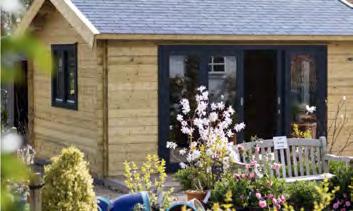
THE HIDDEN GARDEN CO.
The Hidden Garden Co. brings expertise and elegance to your outdoor space. From lush hedging and privacy screening to mature trees, shrubs, and small plants, we’ve got your greenery covered. We also specialise in all aspects of fencing, gates, decking, sheds, chalets, and garagescombining craftsmanship and quality. Whether you’re growing a garden or building a backyard escape, we deliver beauty and know-how in every detail.
THE HIDDEN GARDEN CO.
La Rue de la Scelletterie, St Lawrence 01534 865615 thehiddengardenjersey@gmail.com www.thehiddengarden.je


ALL PETS
A proudly independent veterinary practice in the heart of St Peter’s. Run by a passionate, female-led team, they offer twenty minute appointments, same-day bookings, home visits, and a ‘Fear Free’ approach to care. From your first visit to lifelong support, All Pets is trusted by pets, chosen by their owners.
ALL PETS Manor Farm Barn, La Route Du Manoir, St.Peter 01534 745999 info@allpets.je

SunWorks, established in 2013, is Jersey’s leading provider of solar photovoltaic (PV) systems, battery storage, and electric vehicle (EV) charging solutions. We also offer top-tier roofing and re-roofing services. With over 600 local installations, SunWorks empowers homeowners and businesses to reduce energy costs, achieve energy security, and enjoy a strong return on investment—driving Jersey’s transition to a renewable energy future.
SUNWORKS 01534 498822 info@sunworks.je www.sunworks.je


You’ll find sustainable indoor and outdoor furniture, handpicked interior accessories, free styling tips and a warm welcome. Shop top brands such as Ligne Roset, Vincent Sheppard and Ethnicraft in an approachable and relaxed atmosphere. We are looking forward to welcoming you soon to rejig your home, so you fall in love with it again.
LANDES INTERIORS
Rue de la Croix au Maître
St Martin, JE3 6DJ 01534 854634 landesinteriors.com

GET CREATIVE WITH YOUR WINDOWS


COMPLETE FACILITIES
Complete Facilities is the company that cares, about our clients, our people, and the planet. From sparkling floors to perfectly working fire alarms, we keep Jersey running smoothly. Proudly local and eco-minded, we clean, fix, maintain, and brighten spaces, all while making life easier and keeping our island community at the heart of everything we do.
COMPLETE FACILITIES
One Trafford House, L’Avenue Le Bas 01534 871100
completefacilitiesjersey.com info@cfl.je

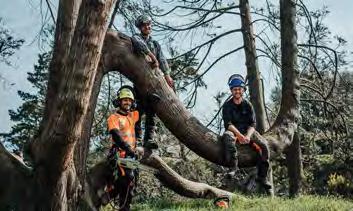
TREE MATTERS
Tree Matters have been caring for Jersey’s trees for over 20 years. From emergency storm call-outs and safe tree removals to pruning, surveys, planting and hedge care, the experienced team puts preservation first wherever possible. Trusted by homeowners, businesses and local authorities, Tree Matters is known for safe, responsible work and rapid response when nature strikes, all delivered with passion, professionalism and respect for Jersey’s landscape.
TREE MATTERS
St Lawrence. 07797 827298 Joel@treematters.je treematters.je
At Creative Windows, we bring over 30 years of experience to every project; designing and installing elegant timber, PVC and aluminium windows, doors, bespoke conservatories, lightweight tiled roofs, and home extensions. We don’t just upgrade homes, we enhance lifestyles with lasting quality and tailored design. Enjoy interest-free credit, keep your money working for you, while we work on your home. Book your free design consultation today.
THE CREATIVE WINDOW AND CONSERVATORY CO. 07797 863779 contact@creativewindows.co.uk creativewindows.co.uk


G WOOD JOINERY
G Wood Joinery specialises in designing and creating furniture, windows, doors, staircases, fence, decorative panels and kitchens.Also we do 3D kitchen projects. Our team is made up of long-serving highly versatile craftsmen, whose knowledge and enthusiasm help turn your ideas into reality. Our workshop is equipped to deal with projects of varying levels of complexity. We can work with you to match existing mould details, help with architectural renovations or heritage works and deliver custom-designed projects.
G WOOD JOINERY
Shop 1, Hansford Close, La Route de St. Aubin, 07829811184 www.gwoodjoinery.com