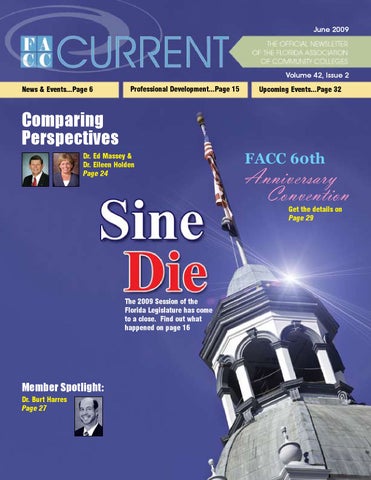
June 2009
Volume 42, Issue 2 News & Events...Page 6
Professional Development...Page 15
Comparing Perspectives Dr. Ed Massey & Dr. Eileen Holden Page 24
Upcoming Events...Page 32
FACC 60th
Anniversary Convention Get the details on Page 29
The 2009 Session of the Florida Legislature has come to a close. Find out what happened on page 16
Member Spotlight: Dr. Burt Harres Page 27
www.FACC.org
June 2009 CURRENT I
FACC Board of Directors EXECUTIVE COMMITTEE President Will Benedicks, Tallahassee Community College President-Elect Martha W. Williams, Valencia Community College VP for Regions & Chapters Dennis Storck, Gulf Coast Community College VP-Elect for Regions & Chapters Gary Sligh, Lake-Sumter Community College VP for Commissions Bianca Rodriguez, Valencia Community College VP-Elect for Commissions Byron Todd, Tallahassee Community College Immediate Past-President Carol Quinn, Pensacola Junior College COMMISSION CHAIRS Administration Pat Profeta, Indian River State College Adult & Continuing Education Margie Williams, Chipola College Career & Professional Employees Debi Jakubcin, Valencia Community College Equity Imani Asukile, Pasco-Hernando Community College Facilities John Barbieri, Indian River State College Faculty Sheryl Peterson, St. Petersburg College Global Initiatives Ed Bonahue, Santa Fe College Institutional Advancement Chris Thomes, Gulf Coast Community College Institutional Effectiveness, Planning and Professional Development Juanita Scott, Pensacola Junior College Instructional Innovation Jeannine Burgess, Palm Beach Community College Learning Resources Marian Smith, Central Florida Community College Occupational & Workforce Ed Libby Livings-Eassa, Indian River State College Retirees Harry Hodges, Florida CC at Jacksonville Rural Campuses Tanya Harris-Rocker, Lake Sumter Community College Student Development Geoffrey Fortunato, Seminole Community College Technology Melanie Jackson, South Florida Community College Trustees Nancy Watkins, Hillsborough Community College CURRENT June June 2009 2009 I CURRENT
H
ello FACC: The state budget crisis, the change to the Florida College System, the influx of students and the normal work load finds my year as your president both exhilarating and trying. I have a new appreciation for how much you do and how you are doing it despite the rise in student enrollment and what, at best, can be called trying circumstances. I have also learned a bit as Executive Director, Michael Brawer, and I travel about the state visiting chapters, colleges and commissions. One of the things I learned is that using the CCLA acronym is okay, but not having what it stands for come immediately to mind in a presentation can be embarrassing. Just for the record it means the College Center for Library Automation. Another learning point is that try as we might sometimes things fall through the cracks. For example, Carol Hashey (FCCJ) a Career and Professional Employee Commission member won the commission’s 2006 exemplary practice essay writing contest with her entry entitled, “What Was My Inspiration for Continuing My Education.” She was not properly recognized in Current at the time. Carol Hashey your recognition is long overdue; but here it is. Well done! My last learning point to date was explained to me after my presentation to the Learning Resources Commission.
It is that library and learning support personnel, not just librarians, are members of the Commission. I understand that now just as I understand life is a continuous learning lesson, especially for me. Not only is communication, at times, a learning lesson for me, it is also a priority. One of the ways I hope to open up a dialogue with membership is to take advantage of the new FACC homepage. I am in the process of having a President’s email link placed on the FACC homepage (under Contact Us) so that members can email me directly with issues they deem important. If you feel the need to discuss an issue or idea please feel free to contact me. I would like to hear from you. In other areas of improvement, we are still in the process of assembling the editorial board for resumption of Visions, the Journal of Applied Research for the Florida Association of Community Colleges. If you have an editorial expertise or would like to be considered as a discipline review reader I encourage you to contact me. Also, please keep in mind the “Power of One.” Membership growth remains vital to FACC. If you feel as I do about FACC then we all need to try and bring in one new member. To increase membership it has to have value and to that end FACC has placed a renewed focus on what we do for our members through legislative interaction, exemplary practices and professional development (look for an exciting all new annual conference format). Our Executive Director and I have been speaking to the “Power of One” across the state. If you have not heard us yet, rest assured you will.
FACC •• Making Making a a Difference Difference One One Life Life at at a a Time Time FACC
Contents
FACC Board of Directors
Region I Dianne Kostelny, Northwest Florida State College
16
Cover Story: Sine Die—End of Session Legislative Report 2009 Regular and Extended Session Highlights
Departments:
2 4 6
President’s Message Message From the Executive Director/CEO News & Events
Chapter Headlines, Kudos, Commission Corner, Region Roundup
15 Professional Development 32 FACC Calendar
Features:
24 Comparing Perspectives
Dr. Ed Massey and Dr. Eileen Holden give their take on the Florida College System and becoming a college president.
26 Unprecedented Gift Assures New Depths in FKCC Underwater Education
At a time where cut-backs are the norm, Florida Keys Community College announces monumental expansions and improvements to its diving program thanks to an unprecedented $1 million bequest.
27 Member Spotlight: Dr. Burt Harres
Dr. Burt Harres has admirable professional experience, an accomplished education and dedication to the Florida Association of Community College.
27 FACC Members Receive NOVA Scholars Award
FACC and Nova Southeastern University announce two scholarship winners for the FACC/Nova Scholars Award.
28 21 Ways to Great Customer Service
The Telephone Doctor Nancy Friedman lists a number of ways to produce better relations in your customer serivce.
29 FACC Anniversary Convention
The Anniversary Committee is hard at work planning a celebration to honor the Association’s 60 years of service to colleges and their employees.
32 Convention Service Project Plans
Plans are beginning to be formulated for the Convention Service Project and FACC is looking for your help.
CURRENT is published by the Florida Association of Community Colleges. Advertising, news releases, and other communications should be sent to the FACC, 113 East College Avenue, Tallahassee, Florida 32301, or by email at publications@facc.org. The views and opinions expressed in CURRENT are not necessarily those of the Florida Association of Community Colleges, its members, directors, or officers. www.FACC.org
REGION DIRECTORS
Region II Mike Hutley, Santa Fe College Region III Molly Dykes, Seminole Community College Region IV Mary DiTaranto, Manatee Community College Region V Rhea Cemer, Indian River State College COMMITTEE CHAIRS (Ex officio) Bylaws Bill Mullowney, Valencia Community College Finance, Human Resources & Retirement Issues E.H. Levering, Miami Dade College Legislative Committee Don Payton, Seminole Community College Membership Development Co-Chair Mike Pelitera, Indian River State College Membership Development Co-Chair Jean Scheppers, Central Florida Comm.College Member Services Sylvia Campbell, Pensacola Junior College Planning and Development Tina Hart, Indian River State College Policy & Advocacy Committee Eileen Holden, Polk Community College EX OFFICIO MEMBERS Chancellor, Florida College System Willis Holcombe, Florida College System Council of College Presidents Chick Dassance, Central Florida Comm. College FACC Foundation Board Andre Hawkins, Indian River State College Parliamentarian Melanie Jackson, South Florida Comm.College Florida Association of Community Colleges Michael Brawer
Mission Statement
The Florida Association of Community Colleges is the professional association for Florida’s 28 public community colleges, their Boards, employees, retirees, and associates. The mission of the association is to actively promote, democratically represent, support, and serve the individual members and institutions in their endeavors to provide their students and the citizens of Florida with the best possible comprehensive community college educational system. June 2009 CURRENT I
The FACC Foundation—Our Quiet Support Behind the Scenes
U
nder other duties as assigned, I have the honor of sitting on the FACC Foundation Board of Directors and functioning as its Executive Secretary. The latter sounds important but it just means that I take the notes and prepare the minutes and meeting summary, along with a few other chores. The Florida Association of Community Colleges Foundation, Inc. formed on June 4, 1991, almost exactly 18 years ago. The Foundation provides charitable and educational aid in the form of financial resources, scholarships, and other services to the Florida Association of Community Colleges and its members. Over the years, the Foundation has done some pretty good things and we hope it will get even better. You may not know that the Foundation purchased the property for the construction of the first permanent home for FACC in Tallahassee at the old Martin Luther King Blvd. location. The Foundation provided interest free loans to colleges and staff who suffered losses during the 2004 hurricane season. It has been integral in providing resources for the renovations of our building purchased in downtown Tallahassee (the old Florida Medical Association building) to the tune of over $50,000. These funds were used to renovate the 4th floor of the building for use by colleges as well as the conference room. Recently, the Foundation board approved $4,000 worth of support to I CURRENT June 2009
install an A-V system in the FACC conference room. Most importantly the Foundation sponsored the 21st Century Summit—a statewide initiative conducted by legislators and college members about Florida’s present and future. It has also allocated $2,000 toward the 60th Anniversary Gala this November at the FACC Annual Conference. Your FACC Foundation will begin in 2009-10 to embark upon its other objectives and goals which will include the following: • To promote education and other related activities for students, faculty, staff and others related to the Florida Association of Community Colleges • To encourage professional development, learning and dissemination of information through activities of the Florida Association of Community Colleges • To support such purposes as educational scholarships, awards, recognitions and benevolent and bereavement acknowledgements The Foundation is going to embark on its first “official” and structured capital campaign this year. It is planning a direct mail campaign in addition to other fundraising activities such as a silent auction at the annual conference, and point-of-sale contributions. Due to the hard work of Foundation Chair Andre Hawkins, the Foundation has secured its first point-of-sale donor, Duffy’s Sports Grille (duffysmvp.com). Duffy’s has numerous locations between Brevard and Broward counties. They have designated the third Thursday of every month as FACC Family Night at two locations in St. Lucie County in the Indian River State College area. Ten percent of all revenue on those nights from people who present the
FACC/Duffy’s flyer (see page 14 or online at FACC.org) will be sent to the FACC Foundation. It is expected that we will expand this to all Duffy’s locations over the next year. We will also be soliciting other point-of-sale opportunities. Your suggestions are welcome. As you can see, many changes are on the horizon for the FACC Foundation. Plans are being drawn to use Foundation resources as they have been historically. However, we are also planning to offer conference scholarships and other resources for members to participate in FACC professional development activities. This will provide members in need of a little financial assistance to offset travel or other expenses. We will also be adding a “contribute now” button to the FACC web site. We certainly will appreciate any support you can provide.
FACC Staff Executive Director/CEO Michael Brawer mbrawer@facc.org Associate Executive Director for Membership and Programs Marsha Kiner mkiner@facc.org Director of Administration Eileen Johnson eileen@facc.org Executive Assistant Publications Coordinator Tina Ingramm tingramm@facc.org Membership Information and Database Coordinator Adrienne Bryant abryant@facc.org FACC • Making a Difference One Life at a Time
www.FACC.org
June 2009 CURRENT I
News & Events Chapter Headlines Chipola Honors Retirees With FACC Lifetime Memberships
Polk Meet and Greet
Chipola College FACC Chapter honors recent retirees Lindsay Roach, Mary McClendon and Robert Trammell
On Thursday, April 23, 2009, FACC President Will Benedicks, Michael Brawer, and Marsha Kiner visited Polk Community College for a 2 hour “Meet & Greet.” FACC members and nonmembers listened to an informative presentation on membership dues and how these dues benefit FACC. Michael Brawer also presented on legislative items currently underway in Tallahassee that could affect the community colleges. Adrienne Bryant came earlier in the day and presented on the new membership database and email capacity through the FACC website. Door prizes and ice cream Jakhui Duran hands out sundaes were tickets for door prizes at the enjoyed by all. Polk Chapter Meet and Greet.
The Chipola College FACC Chapter honored their retiring employees recently with FACC Lifetime Membership Awards. Retiring this year from Chipola are Articulation Coordinator and Honors Advisor Lindsay Roach, History/Social Science Professor Mary McClendon and Special Assistant for Development and Alumni Affairs Robert Trammell. The
honorees were recognized for their many accomplishments and their dedication to Chipola and to FACC at the college’s annual Retirement Luncheon. The luncheon is co-sponsored by Chipola FACC, Chipola Council of Educators, Chipola Faculty Association and the Career Employees Association.
Florida Community College at Jacksonville Chapter Paints the Town! On April 25, 2009, the FCCJ Chapter of FACC sponsored a team of 30 faculty, staff, and students at the 16th annual Paint the Town! During this event, teams from throughout the community volunteer to help refurbish a selected community. This year, over 60 organizations with over 850 volunteers painted over 30 houses in the East 21st Street neighborhood. The team had a great time and the owner of the house we painted, Cynthia Ross, was very appreciative of our efforts! Thanks especially to our CASS students for their participation! Faculty, staff and students from FCCJ make a great team to help refurbish the community. I CURRENT June 2009
FACC • Making a Difference One Life at a Time
News & Events
Daytona State Engages Members With High-Carb Fundraising Event It was Fat Tuesday in more ways than one, but bellissimo! is the only way to sum up the Pasta Dinner fundraising event, hosted by the Daytona State College chapter of FACC in mid-February. Falling the day before Ash Wednesday, the event drew hundreds of the College’s staff and faculty, who packed the Goddard Theater to partake of an Italian repast created by David Weir and Jeff Conklin of the Hospitality Management program. A silent auction offered a wide variety of FACC-Daytona State President items, from jewelry and make-over gift certificates Charlene Latimer, who co-chaired the event with former President courtesy of the Cosmetology Department to fine Susan Johnson, and Daytona State art by faculty members. College President, D. Kent Sharples But a major focus of attention was the long were pleased with the outpouring of buffet table filled with delicious desserts that were assistance, as well as attendance on sale and part of a contest to determine the at the Pasta Dinner. campus bake-off champion. Net proceeds totaled $1,878.89 and the bake sale turned a profit of $171, with the auction generating $968. More than 40 member volunteers dedicated their time and talents to putting on the fund-raising event. Bake-Off Contest winners were: 1st Place, Jennifer Wright, for her Banana Cake with Carmel Frosting and Toasted Pecans; 2nd Place , Ana Blaine, for her Tres Leches (Three Milks Cake); and 3rd Place, Susan Johnson, who served up Mini Cheesecakes FACC-Daytona State President Charlene Latimer, who co-chaired the event with former President Susan Johnson was pleased with the outpouring of assistance, as well as attendance at the Pasta Dinner. “Several people have made comments about when we do this next year they want to get involved,” she said. “Those types of comments occur because of the great job so many of you did before, during and after the event.” “It was an evening of excellent food that included those great desserts, good conversation and wonderful bargains with the silent auction. This type of event shows what a successful chapter we can have when we all work together.”
Palm Beach Community College Chapter Raises Money For FACC Scholarship Fund
Shoppers peruse the titles at the 9th Annual Book Sale, sponsored by FACC’s Palm Beach Community College Chapter. www.FACC.org
The 9th Annual Book Sale on the Lake Worth campus raised a total of $2,640 during the two-day event on April 13 and 14. The sale, sponsored by the Palm Beach Community College chapter of the Florida Association of Community Colleges (FACC), has raised a total of approximately $18,000 since its inception in 2001, with profits going into the FACC Scholarship Fund.
Miami Dade College Chapter News
MDC FACC Members
The FACC Employee Scholarship Drive at the Miami Dade College InterAmerican Campus held a Dish of the Month fundraiser. There were barbeque chicken wings, brown rice, Quinoa Stuffing (the Dish of the Month), homemade cupcakes, sodas, and Italian and Cuban breads. As part of the featured Dish of the Month, the recipe for the Quinoa Stuffing was shared with those who wanted to try their hand at making this dish at home. The committee had a net profit of $100 toward the scholarship for this year. “This was our first effort at a lunchtime fundraiser and it was very successful” reported Dr. Jermaine Brown, Co-Chair of the Fundraising Committee. The unofficial word is that the committee is working on a possible vegetarian or summer Dish of the Month for May.
Brevard Community College Inductions
Brevard Chapter President Stephanie Lubno inducts Kathy Driver-Kelly.
June 2009 CURRENT I
News & Events
Kudos IRSC Instructor Named 2009 ABE Teacher of the Year Indian River State College instructor Judy Bracken has been named the recipient of the Commission on Adult Basic Education’s (COABE) 2009 Edgar M. Easley Award to the Outstanding Teacher of the Year. Bracken is an adjunct instructor in the Indian River State College GED Department. Bracken has worked at the College for more than 20 years and has been in adult education for more than a decade. Bracken is highly enthusiastic and passionate about helping others improve their lives through education. “Judy has touched the lives of Adult Basic Education students like no other, creating Wellness programs for students to grow and use life-applicable teaching methods and online delivery to help all students grow academically,” shares Associate Dean of Developmental Education Anthony Iacono. “She has taught our students to dream and turn those dreams into reality.” The Edgar M. Easley Award is given to a practitioner with five or more
Dr. Ed Massey presents Judy Bracken with the 2009 Edgar M. Easley Award.
years of adult education teaching experience who participates in school and community activities. This award is given to an individual who understands the characteristics of the adult learner and who is committed to the adult/continuing education profession. The 2008 ABE Teacher of the Year recipient was IRSC instructor Ed Musgrove, making this the second year in a row that an IRSC instructor has been honored with this award.
NFCC Recognizes Employees For Professional Development With ‘Above and Beyond’ Award North Florida Community College employees gathered in the courtyard of the NFCC Walter L. Bishop Administration Building April 28 for the NFCC Courtyard Party. The gathering honors all NFCC employees for their contributions to the college, recognizes NFCC’s Above and Beyond award recipients and honors employees for years of service to NFCC. Receiving an NFCC Above and Beyond Award were Debbie Bass, Career Education Advisor and Coordinator of the Displaced Homemaker’s Program, of Madison and Efrain Bonilla, NFCC Developmental Math instructor, of Lake City. The awards are given each year to NFCC employees, one staff member and one faculty member, who go above the call of their regular jobs to assist students, I CURRENT June 2009
Efrain Bonilla and Debbie Bass receive NFCC Above and Beyond Award
to assist their colleagues or to benefit the college. Also recognized during the ceremony, as retirees, were Lorraine J. Brown, Larry Bell, Gerri Bucher, Enid Kozlowski and Sheila Hiss for their many years of service to the college.
Mentors Program Produces Leaders Three of the six recipients of PascoHernando Community College 2009 Dr. Felisha R. Barker Memorial Outstanding Leader Awards were active members of the institution’s faculty and staff to the Student Mentor Program. The PHCC Mentor Program serves approximately 40 students per year. The second year of the program serves as a retention by assisting students to comfortably adjust to college. The Felisha R. Barker Memorial Outstanding Student Leader Awards are the most prestigious honor bestowed on a PHCC student by the Student Activity Department. The awards recognize students who have demonstrated outstanding leadership. “There is no better way to measure success than to see students flourish socially and academically”, says student activities coordinator and mentor Jessica White. U. S. Marine Corp and Vietnam veteran, William Barnes was the first student to enroll in the PHCC Mentor Program a year ago. Barnes helped form the Men of Excellence student organization and coordinated a Black History Month Photo Exhibit. He is also a member of the Human Service’s Club. Mentee Jesse Tucker utilized his leadership in the East Campus Crusade for Christ Organization to take the club from an almost inactive state to a 5-star student organization in one year. Tucker and his mentor were recognized earlier this year as Mentor/Mentee of the Month. Mentee Gil Nunez II is the consummate team player. For the past two years, Nunez is described as the student leader anchor of the West Campus Student Activities Office and Student Government Association. He assisted in setting up for various activities and utilized his talents to serve as a disc jockey, the PHCC mascot, and an airbrush tattoo artist at many campus events. Continued on page 9 FACC • Making a Difference One Life at a Time
News & Events
Kudos Dr. Mary Locke Receives National Award of Distinction A twenty-seven year employee of Mary G. Locke, Ph.D., Vice President/ the College, Dr. Locke has previously Provost of Instructional Services and FACC served as Executive Director of the member at Indian River State College, IRSC Foundation, Dean of Institutional was recently recognized with the national Advancement, and Executive 2009 Administrator Award of Assistant to the President. Distinction from the Phi Theta Promoted to Vice President Kappa (PTK) Honor Society. of Instructional Services in The award was presented to 2000, she serves as Provost Dr. Locke at the Phi Theta of the IRSC Main Campus Kappa National Conference and oversees the College’s for consistently demonstrating four branch campuses, exceptional support of IRSC Baccalaureate programs, students and their active educational and student involvement in the Nu Iota support services, enrollment Chapter of the PTK honor Locke management, marketing and society at IRSC. The Award recognizes college administrators throughout public relations functions. An alumna of IRSC, the Fort Pierce resident earned the nation for outstanding effectiveness a Bachelor’s Degree, Master’s Degree in in encouraging student scholarship, Public Administration, and Ph.D. in achievement, leadership and community Educational Leadership from Florida service through participation in Phi Theta Atlantic University. Kappa.
Hillsborough Community College FACC Chapter Awards Ron York Scholarships Florida Association of Community Colleges (FACC) Hillsborough Community College Chapter awarded the Ron York Scholarship to two students. Ron York was a student advisor and SGA advisor at HCC for many years. Hongyi Chen was HCC’s summer 2008 recipient of the Ron York Scholarship. She is an Engineering Major and is planning to transfer to USF after obtaining her A.A. degree from HCC. Wei Chen was HCC’s fall 2008 recipient of the Ron York Scholarship. She is a Business Major and plans to transfer to USF after obtaining her A.A. degree from HCC.
Pictured from left to right (Front Row): Glenna Ross (FACC Treasurer), Janet Stevenson (FACC President), Wei Chen(recipient), Carolyn Curtis(FACC member), Second row: Dr. Mary Bendickson (FACC member), Brent Ellis(FACC member)
Got News? Help Current stay current. Send us your kudos, chapter news, story ideas, Letters to the Editor or questions. You can send your news and articles to Tina at tingramm@facc.org. We are looking forward to hearing from you. www.FACC.org
Mentors Program continued from page 8. In addition to the mentees recognized as Outstanding Student Leaders, mentee Robbie Burnett was recognized for being a Student Ambassador. She is active in her campus student government, along with having served as North Campus Phi Beta Lambda Treasurer and President of the college wide Delta Epsilon Chi marketing organization.
Bob Graham Distinguished Service Award The Bob Graham Award is given each year to one student, one faculty/ staff member, one community supporter, and one SGA/SAB/ CAB advisor who have Schroeder provided distinguished service to a community college. These four awards are considered the highest recognition bestowed by FJCCSGA. The winner of the Bob Graham Award truly typifies the community college spirit. The Bob Graham Award recipients have gone the extra mile, made the extra effort, or provided the right ingredient that has made our college campuses the great institutions that they are. Mr. Steve Schroeder is the proud recipient of the FJCCSGA 2009 Bob Graham Award. All year long Mr. Schroeder has worked hard to ensure FJCCSGA had all the legislative support needed. His willingness to work with students across the state, and setting aside time to clarify legislative matters has been invaluable. His service to FJCCSGA shows his exemplary commitment to the students of Florida, and it is why he is the recipient of the Bob Graham Award. The Bob Graham Award was presented to Mr. Schroeder at the 2009 State Conference Awards Banquet. On behalf of the community college students of the State of Florida, I thank Mr. Steve Schroeder for truly being the best of the best! June 2009 CURRENT I
News & Events
Commission Corner Student Development
Excellence in Instructional Innovation Award Presented
The Student Development Commission hosted their 42nd Annual Conference: “Providing Connection and Direction”, May 13-15 at Valencia Community College. This event featured informative and engaging presentations focused on improving the services that we offer to all students in Student Affairs. Dr. Joyce Romano and Dr. Kaye Walter began the conference with their enlightening presentation: “The Power of Big Ideas”. The week was also highlighted by excellent concurrent sessions featuring presentations on “how to do more with less”, improving retention, articulation tools, leading in multi-cultural environments, using technology to build student community, and life-career planning. UCF Rosen College of Hospitality graciously hosted the Exemplary Practice presentations and served as one of 13 sponsors for this great event. In this challenging financial time, the Student Development Commission believes that the need to collaborate, share ideas and best practices, as well as network and brainstorm ways to continuously improve the “student experience” is needed more than ever. We look forward to our September Board meeting as well as the FACC Convention in November.
ways to engage your on-line learners. Palm Beach Community College’s Synopsis of the presentation: FACC Chapter is proud to announce Most online courses rely on asynchronous that our Professor Bobette Wolesensky learning tools (discussion boards, blogs, won the Excellence in Instructional chat rooms, and email) Innovation Award at the to foster interaction, Instructional Innovation collaboration and student Commission Joint skill development. As Spring Conference. webcams, more robust She will be presenting internet connections, and her award winning online multi-user web presentation Innovative conferencing services become Practice/Program Title: more available, it’s important Use of Web Conferencing for online educators to work Tools to Enhance to integrate synchronous Online Learning at the learning tools into their FACC Convention in instruction. In this program, November. an online communication During her instructor will describe and presentation several demonstrate how she uses students joined in Wolesensky web conferencing as a tool using Breeze, webinar for facilitating interaction, software, to share their providing students with “real-time” experience in their online course. It was presentation experiences, and for building very enlightening to hear their take on the a sense of community in her classes. The course and their wishes for other online results of her use of synchronous online faculty to use webinar software to provide meetings for large and small group sessions a true face-2-face classroom experience will be presented, along with suggested online. At the convention in November strategies for helping others adopt this she and her students will demonstrate this exciting technology. This will be a musttechnology in their online classes. see presentation if you are trying to find
The Career and Professional Employees Commission and Student Development Commission Partner For Spring Conference Direction” The Career and Professional Employees Commission was thrilled to partner with the Student Development Commissions spring conference titled, “Providing Connection and Direction” on May 13-15, at Valencia Community College. The opening session titled “The Power of Big Ideas” was an opportunity for us to see where our colleges could go. Will Benedicks our FACC President and Michael Brawer had a very informative final legislative update. The other highlighted 10 I CURRENT June 2009
sessions were an excellent chance to learn and grow as career and professionals with topics presentations such as Mastering Crucial Conversations, An Introduction to DISC: Fours Styles of Behavior CPEC joins the Student Development Commission for lunch and Communicating Using the MBTI. presentations and then enjoying a We also joined the Student delicious lunch served to us by the college. Development Commission on Friday at We look forward to seeing you all at the UCF Rosen College of Hospitality the Convention in November. sharing in their Exemplary Practice FACC • Making a Difference One Life at a Time
News & Events
Learning Resources Spring Conference: Learning Success with Learning Resources
Central Florida Community College hosted the FACC Learning Resources Commission’s Spring Conference at the Klein Conference Center on the Ocala Campus, February 27, 2009. (The Learning Resources Commission represents libraries, learning resource centers, learning labs, learning enrichment and support centers, encompassing administrators, faculty, professional, career service staff and tutors.) This year’s theme, Learning Success with Learning Resources, drew over 60 presenters and attendees from 19 colleges and CCLA. CFCC’s President, Dr. Dassance, welcomed the group, and Mike Brawer and Will Benedicks delivered the FACC and legislative update. Presentations included: User-Center Design to Improve Services and Websites by Dawn Aguero and Margaret Murphree, CCLA; Updates to the MLA Style Manual by Nora Rackley, Lake-Sumter Community College; Using Visual Rhetoric to Engage Student Learning by Keith Fowlkes, Seminole Community College; and A Training Program for Learning Support Services Tutors by Josh Murdock, Valencia Community College. Mercedes Clements, Head Librarian, Daytona State College, provided the keynote address Making a Difference One Life at a Time. www.FACC.org
The afternoon was given to topic tables with participants rotating every 20 minutes to a new table and topic. Nora Rackley, Lake-Sumter Community College, shared a marketing strategy to connect the college community through favorite books. Patricia Profeta, Ph.D., Indian River State College, discussed mentoring, developing professional skills, shadowing leaders and testdriving potential positions in succession planning. Jagat Guru Kaur, KRI Kundalini Yoga Teacher, Orlando, taught us to use our breath to release stress, clear our minds, and increase focus and vitality. Chad Mairn, St. Petersburg College, provided a trend-spotting workout. Nancy Edwards and Meg Hawkins, Manatee Community College, demonstrated their online “Library Lab” and “Library Tips” in Angel CMS. Dava Tobey, Central Florida Community College, shared a home-grown online writing center in Angel. Jametoria Burton, Norine Katich, and Trima McCowan, Florida Community College Jacksonville, presented the new Library and Learning Commons at Deerwood Center, which combines services of the library, academic tutoring labs, and student computing. The quality of the presenters, informative with topics relevant to all aspects of learning resources was cited as the highlight of the day.
FACC Commission for Health Care Educators in the Works The Florida Association of Community Colleges (FACC) is exploring the possibility of a Healthcare Education Commission. Although all FACC member institutions provide healthcare educational programs, FACC does not have a Healthcare Education Commission. While several commissions provide limited networking and professional development opportunities for healthcare educators, none address the unique role and special considerations of the healthcare educator. In addition to the networking opportunities, the commission would address the following issues: • Shortage of healthcare providers in all areas • Shortage of qualified faculty • Limited clinical space • Special considerations for limited access programs within Open Door Institutions • Licensure examination pass rates • Decreases in funding and other resources If health care professionals are to be effective in helping ameliorate the problems they face, a FACC Healthcare Education Commission could add a powerful voice in addressing the complex nature of the shortage of healthcare providers and the unique nature of healthcare education. A Healthcare Education Commission would provide a venue to network, share best practices and engage in professional development. To this end, the development of a Healthcare Education Commission in FACC with participation from health educators in all community colleges is vital to the future of health education in Florida. Like FACC, this commission will be open to all who participate in Health Care education; administrators, faculty and staff. To express interest in the formation of this commission or for more information contact: Carolyn Lytle, MSN, RN, Tallahassee Community College, lytlec@ tcc.fl.edu June 2009 CURRENT I 11
News & Events
Commission Corner continued from page 11. Technology Commission Spring Conference a Success The 2009 FACC Technology Commission Spring Conference, held at South Florida Community College from April 16 – 17, was a joint conference with five other commissions: Equity, Faculty, Institutional Effectiveness, Planning and Professional Development, Instructional Innovation, and Rural Campuses. We had many exciting presentations, such as “SMARTHINKING: Helping Students On and Off Campus with 24/7 Online Tutoring”, “Find the Spielberg in You” and “Increase Student Learning Through the Use of Multimedia.” Exhibitors included Capella University, Smarthinking, Telvue Corportaion, and Wimba. The highlight of the event was our Keynote speaker, Dr. Will Holcombe, Chancellor of FL College System whose message, “Keeping the Community in Our Colleges” was enjoyed by all. At the closing general assembly, Dr. Angelique Smith from Valencia spoke about a very timely subject: “Web 2.0: The Media is Us.” We also hosted the Excellence in Technology Award
Paul Lafavi, Chair-Elect of the Technology Commission, presents on “Finding the Spielberg in You” at the Technology Commission Spring Conference. Presentations and will announce the winner at the FACC Annual Convention. The purpose of the award is to recognize individuals who have used technology to create solutions to benefit any aspect of the community college operation.
Administration, Occupational and Workforce Education, and Facilities Commissions Joined by Region V in Successful Joint Spring Conference Twenty-four of the 28 colleges in the Florida College System were represented with over 100 registrants at the Spring Conference hosted by Indian River State College (IRSC) May 14 and 15. The Capital Improvement Program in conjunction with FACC Administration, Occupational and Workforce Education, and Facilities Commissions gathered at IRSC’s new Public Safety complex for eight breakout sessions as well as three general sessions. The Conference was also joined by Region V. Session focuses included “Resource Efficiency Solutions,” “Grant Development: Chasing the Elusive Dollar,” and “Succession Planning.” Attendees enjoyed a general session to kickoff the event with Lisa Cook, Director of Facilities Planning and Budgeting and Traci Steen, AVP Facilities Planning & Government. Attendees received a FACC Legislative update from FACC Executive Director/CEO, Mike Brawer and a special message from FACC President, Will Benedicks. A special afternoon panel focusing on “Good Jobs, Green Jobs” delivered an important perspective as to what we must all do “to make a down payment on the green economy” while addressing current legislation, trends, and economic development 12 I CURRENT June 2009
John Barbieri, Chair of Facilities Commission presents Dr. Ed Massey, President of IRSC, with appreciation award for continued support of FACC. as affects “green jobs” and education. Also addressing the conference with a special welcome was Dr. Ed Massey, President of Indian River State College. The final event featured a tour of IRSC’s Treasure Coast Public Safety Complex – a unique 50-acre, eightbuilding comprehensive training facility that focuses on meeting the needs of criminal justice, fire, emergency management, human services, and paralegal professionals.
Institutional Advancement Commission Holds 2009 Spring Conference
IAC Chair Chris Thomes welcomes participants to the IAC 2009 Spring Conference “Branding to the Internet Generation” was the theme of the Institutional Advancement Commission 2009 Spring Conference hosted by Central Florida Community College (CFCC) in Ocala, May 20-21. Chair elect, Dr. Joe Wallace (CFCC) put together a timely series of workshops, emphasizing the use of social networking in college communications. Dr. Charles Dassance, president, CFCC, welcomed participants to the conference. He indicated that the Council of Presidents will begin a public image campaign for the Florida College System. “We may be calling upon you to help us out. As the mix of how we’re funded changes, Institutional Advancement becomes more important. The image that each community college has in its community is important in getting community support.” Mike Brawer, Executive Director, FACC, provided participants with an overview of the FACC’s mission, membership, and a legislative update. Workshops were conducted on Branding to the Internet Generation, a case study covering the development of Gator Nation, which was presented by Joe Hice, University of Florida; Smart Branding Using a Collegewide Style and Media Guide with Lois Brauckmuller and Barbara Trebilock, CFCC; From Tintypes to Digital – Photography 101 for the Nonphotographer with Alan Youngblood; Branding to the Internet Generation Through Social Networks with Chris Gent, Kissimmee Utility Authority. The commission’s business meeting focused on the 2009 IAC Excellence Awards and a commission name change. The call for entries will go out late July with an August deadline. Vice-chair Susan Kessler is coordinating the awards. Members of the Commission voted to change its name to Communications and Marketing Commission (CMC). FACC • Making a Difference One Life at a Time
News & Events
Region Roundup Region I Reports Successful Conference On Friday, April 17, 2009, Region I FACC members met at Northwest Florida State College (NWFSC) for the Region I Spring Conference. All five Region I schools were represented including FACC COO, Marsha Kiner, Vice-President for Regions and Chapters Dennis Stork, VP-Elect for Regions and Chapters, Gary Sligh, and Past President Carol Quinn. The meeting started at NWFSC’s Learning Resources Center Conference room with a Continental Breakfast. After welcoming everyone with a presentation on changes at NWFSC, Dr. Richburg introduced Julie Terrell, the Director of the Choctawhatchee Basin Alliance who gave a thorough presentation on Estuaries—Going, Going, Gone! How would this impact you? Dr. Richburg and Dr. Gary Yancey then gave a timely legislative update with discussions from participants. A candy competition by Region chapters concluded the morning’s activities with one group taking home extra sweets. Participants then moved to the K-Bldg. Gallery for lunch. Before it concluded, Dr. David Schjott (2000 Professor of the Year Winner) gave an energetic presentation on Dealing with Difficult People in the Workplace. Participants then moved into K-Bldg for a dynamic performance by NWFSC’s Show Choir. Participants were then shuttled by James “Sudy” Suderman and Mike Van Dyke to Public Safety’s Driving Pad where police vehicles, a fire engine, etc. are kept. Ronnie Bishop demonstrated the Slip and Slide with a police car and participants like Gwen Street actually tried weaving backwards through cones and did use the siren. Renee Johnson was in charge of DUI simulation goggles and participants drove Easy Go’s to simulate how they would drive under the influence. Brian Shonk, Associate Dean of this program, had participants www.FACC.org
Above: Region I Spring Conference attendees participate in group discussion. Right: Pictured from L to R are Amy Watts, Betsy Hanson, and Jan Faubel
hold a fire hose with the full force of the water and hose down a cement wall as well as participants who came to close to this activity. Hot participants were then shuttled back to the KBldg Gallery to cool down and splurge by creating their own ice cream sundaes while watching downloaded pictures of the entire day’s activities. Sylvia Campbell was given a plaque in appreciation for her fabulous year as Region I’s 2008 Director. One Region 1 Lifesaver Award was given to April Leake for her help with the chapter completion and for decorating the space pens that were given to the workshop’s presenters. Eight more were delivered the following week to FACC chapter members that went the extra mile helping make this day sensational. The conference ended with chapter sharing and door prizes for all. Thanks to all who helped make the Region I Conference a success!! June 2009 CURRENT I 13
News & Events
Region Roundup continued from page 13. The Essence of Change: PHCC Hosts Region IV Conference Change was in the air at the Region IV Conference on April 24 at PascoHernando Community College. Nearly 70 attendees packed the Conference and Instructional Center from PHCC, Edison State College, Hillsborough Community College, Polk Community College, Manatee Community College, St. Petersburg College, and South Florida Community College. Attendees enjoyed a day of professional development and engagement in conversations about the changes Florida’s community colleges are facing. The highlight of the conference was the President’s Roundtable, featuring Dr. Katherine Johnson, president, PHCC, Dr. Norman Stephens, Jr., president, South Florida Community College, and Rob Wolf, senior vice president, Hillsborough Community College. They discussed how their colleges are handling
the new state college movement, the economic downturn the state of Florida is dealing with, and fielded questions from conference attendees. Other sessions included changes in student activities and engagement, leadership and change: reflections and strategies, change your attitude and change your life, and psychosocial change. Michael Brawer, Executive Director and CEO, FACC, presented the legislative update and the keynote presentation,
FACC: Now and In The Future. The session covered the current state of FACC, its role in the Florida College System, and its plans for the future regarding professional development, awards and recognition, and advocacy. As a community service project for the conference, attendees collected donations for the humane society on each of their campuses. Two full truckloads of supplies were donated to the Pasco and Hernando County Humane Societies, demonstrating the generosity of our region’s college employees during tough economic times. Both organizations were extremely grateful for the overwhelming support.
FACC Region III Spring Conference June 24, 2009 Seminole Community College Oviedo Campus 2505 Lockwood Blvd, Oviedo, FL 32765 REGISTRATION FEE $30 (before June 18, 2009) LATE REGISTRATION FEE $40 For more information please contact, Molly Dykes, (407)971-5011 14 I CURRENT June 2009
FACC • Making a Difference One Life at a Time
Pasco-Hernando Community College President’s Institute Gains Insight into the Role of FACC In March the the operation of Pasco-Hernando the Council of Community Presidents, the College President’s role and function Institute traveled of the Division to Tallahassee of Community for an in-depth Colleges, and a discussion of discussion of the legislative affairs. Florida College The President’s System legislation. Institute, created Members of PHCC’s President’s Institute during their At the Capitol, by Dr. Katherine stay in Tallahassee institute members Johnson, met with Reps. Seth President, PHCC, is a carefully selected McKeel and Will Weatherford, and group of 18 employees, including staff observed the Committee on Higher and faculty, who represent all areas Education’s proceedings. In addition, of responsibility from the College’s institute members sat in on the Council three campuses. The institute offers of President’s monthly meeting at an opportunity to expand personal Tallahassee Community College’s awareness and continue professional Capitol Center. development. Members of the institute were The President’s Institute was able to gain a better understanding of welcomed to the Florida Association the critical role FACC employees and of Community Colleges office by members play in guiding the events Michael Brawer, Executive Director and that shape the future of each of Florida’s CEO. Dr. Johnson, Steve Schroeder, community colleges. The visit was an college attorney, PHCC, and Brawer, incredible opportunity for members to along with other community college improve professional skills, meet new governmental representatives and contacts, and be educated on legislative lobbyists, spoke to the group on issues impacting community colleges. numerous topics. The topics included
Leadership Gainesville Leadership Gainesville is a year-long community leadership program of the Gainesville Area Chamber of Commerce designed to identify, educate and develop leadership skills. Each year, approximately 40 individuals are selected to participate following completion of a competitive application process. It is primarily a course for emerging leaders, but it is not a starting point. The Leadership Gainesville program provides future leaders the opportunity to develop leadership skills by networking with individuals in the community that represent business, law, religion, civic groups, the arts, minority organizations, education, health care, government, human services www.FACC.org
Leadership Gainesville attendees spend time in House Chambers with Lt. Governor Jeff Kottkamp
and volunteer organizations. Prior to joining the Leadership Gainesville program, participants are expected to have established careers, demonstrated talent and leadership qualities, and participated in community activities.
Sylvia M. Thomasson Educational Leadership Enhancement Program
(left to right) Chuckie Delano (CFCC), Melissa Rushton(PHCC), Heather Staggs(PHCC), Sandra Anderson(PHCC), Connie LaMarca(CFCC), Michelle Balon(PHCC), Wendy Neeld(CFCC), Scott Pennington(LSCC), Christy Jones(CFCC), Tammy Castello(LSCC), Nora Rackley(LSCC), Jane Miller(LSCC)
Designed to strengthen management skills and to provide an avenue for the identification of future leaders in the Florida college system, the 2008-2009 Sylvia M. Thomasson Educational Leadership Enhancement program once again afforded participants numerous opportunities for professional development. The nine participants in this year’s consortium program, which include Central Florida Community College, Lake-Sumter Community College, and Pasco-Hernando Community College, learned about leadership styles and leadership strategies as they listened to and interacted with the college presidents, administrators and faculty members from all three institutions. A session on strategic planning included a case study that encouraged participants to use their newly developed skills in a problem-solving arena. Participants increased their knowledge of the legislative process as they took part in two events: the FACC Annual Convention and a multi-day trip to Tallahassee where they were able to observe state government in action while they met with lobbyists and legislators. June 2009 CURRENT I 15
COVER
End of Session Legislative Report
2009 Regular and Extended Session Highlights
T
he Florida College System can claim a major victory in the 2009 budget debate. The session began with news that Florida’s General Revenue receipts continued to lag earlier expectations and that the State faced a shortfall of more than $6 billion as compared to fiscal year 2008-2009. Members of the House and Senate struggled with the contentious issues of cutting expenditures, closing sales tax “loopholes,” increasing fees, increasing revenues from gambling, and spending anticipated federal stimulus funds as a means to balance the budget. The original budgets proposed by the House and Senate reflected the shortfall, with cuts to our programs running as high as 20% in some areas. The message articulated by the presidents, trustees, lobbyists and other college staff, and by the Division of Florida Colleges – namely, our continued open door policy, tremendous growth in enrollment, and the important role the system will play in the State’s economic recovery – resonated well with the Legislature. By the end of session, we were successful in achieving an operational budget that was essentially level compared to 20082009 in total dollars but greatly reduced in recurring revenue. In addition, we received a tuition increase of 8% to help fund our growth during the coming year. Florida still faces serious economic challenges. While the rate of revenue decline appears to have slowed, most observers expect that mid-year budget adjustments will be necessary later this year or early in 2010. A particular challenge for Florida’s colleges is the fact that so much of our base funding is now composed of non-recurring revenues. The Legislature’s prudent decision to spend only one-half of the 2-year federal economic stimulus money will help cushion further declines in State 16 I CURRENT June 2009
revenues. The system’s PECO (fixed capital outlay) facilities request was fullyfunded ($84.2M). The total amount of PECO funds available for the 2009-10 fiscal year is one of the lowest amounts in recent memory. This was unfortunate at a time when the construction industry is being looked to for help in the economic recovery of the State and construction prices are down. The state’s economic condition did not permit funding of the Facilities or Philip Benjamin matching grant programs. On the substantive front, the system’s two main legislative initiatives were both approved by the Legislature. The Florida College System bill, a compromise implementing the recommendations of the Florida College System Task Force and the State College Pilot Project, kept our system of two and four-year institutions united under one governance umbrella. The bill puts in place a process for colleges to branch out into the baccalaureate market while retaining their essential character of providing open-door access at the lower division level while responding to community need for upper division courses. The other primary initiative, legislation designed to bring Florida’s student records laws into conformity with the federal FERPA statute, was unanimously approved by both the House and Senate.
Appropriations Proviso, Implementing, and Conforming Bill Issues The Legislature has three methods to reflect decisions made in the General Appropriations Act (GAA) process. Proviso: This is language attached to a specific appropriation and directs or authorizes how the funds can be expended. Implementing bill: An implementing bill provides instructions to enact specific provisions in the GAA language or proviso by changing the law on a temporary basis for one year. This is necessary because the courts have ruled the GAA cannot contradict current law; however, there may be a need to temporarily suspend some provisions of law. Conforming bill: a conforming bill may also go along with the GAA. It is different from the implementing bill in that it makes permanent changes to Florida laws. In summary, proviso language and implementing bills are law for only
FACC • Making a Difference One Life at a Time
COVER one year and then they expire, while a conforming bill is a permanent change in Florida law. Florida College System Baccalaureate Issues • Modifies the method for state funding2 to be “as provided in the General Appropriations Act.” Conforming SB 1696, Section 31. Florida College System Issues • Federal Stimulus Funds: provides contingency language for receipt of funds; authorizes the Governor’s Office to submit budget amendments, if necessary, to adjust the allocation of the federal funds consistent with the funding level from all funds provided in the GAA; and authorizes the Department of Education and Board of Governors to establish reporting requirements for recipients of the federal funds. Proviso. GAA page 6, Section 2. • Higher Education Challenge Grants Philip Benjamin Notice to Donors: requires notice of state match delay for colleges and state university challenge grant donations. Conforming SB 1696, Section 32. • Higher Education Challenge Grants Notice to Donors: requires notice of state match delay for colleges and state university facilities and operating challenge grant donations. Conforming SB 1696, Section 29. • Higher Education Challenge Grants Project Starts: allows colleges to spend existing donations for facilities projects. Conforming SB 1696, Section 29. • College Severance Payouts: limits all college, state university, and Board of Governor employee (including presidents) severance payouts from state funds to one year of the employee’s annual salary. Conforming SB 1696, Section 2 for presidents and Section 34 for college employees. • Flexibility in College Fees: removes requirement that the www.FACC.org
College System Appropriation SB 2600 Statewide
2009-2010 General Appropriations Act
Lottery – Recurring
$116,959,158
Lottery – Non-recurring
$0
CCPF (including these 3 subcategories)
$812,454,563
Internet Connectivity
$1,447,382
OCNF (New)
$4,602,842
Workload (Nonrecurring GR)
$29,124,808
Ready to Work
$0
Workload (Recurring GR)
$0
Federal Stabilization Funds
$82,588,573
Baccalaureate
$8,804,529
Baccalaureate (New)
$400
Baccalaureate Federal Stabilization Funds $730,272
Commission on Community Service
$589,845
Distance Learning
$324,668
Adult Handicapped
$1,211,867
Facilities Matching
$0
Philip Benjamin Matching
$0
PECO
$84,221,380
PECO Sum-of-Digits
$15,988,860
PECO Joint Use
$0
TOTAL SYSTEM ALLOCATION
$1,041,127,082
Student Fees
$669,213,699
(includes 8% increase)
Note: The Conforming Bill, SB 1696, contains language permanently removing the requirement that we use the 10-15% flexibility portion of our tuition fees for security purposes.
TOTAL FUNDS AVAILABLE
amount of tuition and fees charged from 10 to 15 percent above the standard tuition and fees be spent on safety and security. Conforming SB 1696, Section 8. • GI Bill Deferment of Tuition and Fees: authorizes a deferment of tuition and fees for veterans enrolling under the new GI Bill. Conforming SB 1696, Section 10.
$1,710,340,781
• Distance Learning Reporting: changes the reporting time for distance learning fees from “academic year” to “fiscal year.” Conforming SB 1696, Section 8. • Financial Assistance Student Database: requires institutions participating in FSAG (need-based aid) to report to DOE before Continued on page 18. June 2009 CURRENT I 17
COVER
End of Session Legislative Report continued from page 17.
o Restates allowance for marriage to result in residency classification o Requires institutions to establish residency appeals committees with three members to consider student appeals of residency determinations. Determinations to students in writing, with reasons NOTE, under the Board of Governor’s fees, a university can implement a differential out-of-state fee for students from bordering states, grad students who are .25 FTE grad assistant, or grad student on full fellowship. • CLAST Exam: will no longer be offered by DOE, and instead the DOE and Board of Governors are to select a national test to replace it, expected to be the SAT/ACT. Students may still • Funding Level: authorizes award amounts to be set in the GAA for FY 2009-10 for achieve a GPA of only one year. The amount established for 2009-10 is the same level as 2008-09 and 2.5 on designated is set in the GAA by credit hour. Any increase in fees must be paid for by the student. coursework. The Conforming SB 1696, Sections 15 and 16. college president is to • Dropped Classes: requires the institution to refund to the state within 30 days after establish a committee the end of the semester any funds received for courses dropped by a student or courses to consider waivers. from which a student has withdrawn after the end of the drop and add period, unless Conforming SB the student has been granted an exception by the Department. Such exception includes 1676, Section 20. a verifiable illness or other documented emergency unless the institution’s policy is to
February 2010 information on their student loans – including guarantor, lender, amount, total of loans. Conforming SB 1696, Section 27. • First Generation in College: requires recipients to demonstrate financial need as required for FSAG. Conforming SB 1696, Section 25. • Residency - Conforming SB 1696, Section 7. o Clarifies that initial enrollment is the first day of class o 12 months of residence must be continuous o Requires affirmative decision on residency, documented by written or electronic verification with two or more documents. Two tiers of documentation
listed in statute, mostly tracking current state regulations, but not exactly o Requires any reclassification to provide clear and convincing documentation that supports permanent legal residency in this state for at least 12 consecutive months, such as documentation of full-time permanent employment for the prior 12 months or the purchase of a home in this state and residence therein for the prior 12 months while not enrolled. o States that a dependent child can be reclassified upon parents qualification of permanent residency, if in high school or after.
Bright Futures Issues
refund the cost of the courses. The Department shall notify eligible recipients of the provisions during the registration process. Conforming SB 1696, Section 18. • Credit Hours: effective with students funded in the 2009-10 academic year and thereafter, students must earn at least 24 semester credit hours or a prorated number of hours if the student was enrolled less than full time, in the last academic year. If a student fails to earn the minimum number of hours required to renew the scholarship, the student shall lose his or her eligibility for renewal for a period equivalent to one academic year. Such student is eligible one time to restore the award the following year if the student earns the hours for which he or she was enrolled at the level defined by the Department and meets the grade point average for renewal. Students must be notified of this provision during registration. Students must reimburse or make satisfactory arrangements to reimburse the institution for the award amount received for courses dropped after the end of the drop and add period before the student may receive a Bright Futures award for the next term. Conforming SB 1696, Section 14. • Expense Awards: removes college-related expense awards for academic scholars. Conforming SB 1696, Section 15. • Gold Seal Conversion: eliminates option for conversion of Gold Seal Awards to Medallion Awards. Conforming SB 1696, Section 17.
18 I CURRENT June 2009
Other Issues • Excess Hours: requires a 50% tuition surcharge after 120% of required credit hours for resident students at state universities. This will impact our students who transfer to the SUS, and the colleges must notify students regarding the provisions of the law upon initial enrollment. Conforming SB 1696, Section 11. •Libraries: requires DOE to collaborate
FACC • Making a Difference One Life at a Time
COVER
•
•
•
•
•
•
with SUNLINK, CCLA, FCLA and the Florida Electronic Library at the Department of State to provide a plan for establishing an on-line union catalog that is capable of searching the combined library holdings of K-12 public schools, universities, community colleges and public libraries. Proviso, Specific Appropriation 81. Distance Learning Consortium: requires DOE to establish a virtual curriculum marketplace to assist school districts in the provision of online or digital content. DOE is authorized to negotiate with the Florida Distance Learning Consortium or private providers. This shall be financially selfsupporting through authorized fees for purchase of digital assets or courses. Proviso, Specific Appropriation 125. Distance Learning DOE: adds to coordination duties the Florida Knowledge Network and other distance learning initiatives. Conforming SB 1676, Section 4. Scholarship Programs: there are changes to specific scholarship programs for teachers and others in Conforming SB 1696, sections 18-24. FIRN: provides that community colleges may requisition FIRN services from DOE who can then pass on savings for internet access services. In the past this was paid for out of DOE funds, now it must be paid for out of individual college budgets. Conforming SB 1676, Section 3. Appropriations to Private Colleges and Universities: Authorizes appropriations to private colleges and universities to provide access to residents seeking postsecondary education, to fulfill the state’s need for graduates in specific disciplines. Requires expenditure plans and reports. Conforming SB 1696, Sections 31. K-12 Items of Interest: districts may not allow any travel out of
www.FACC.org
state without approval by the school board; no state funds to pay for cell phones; elected superintendents salaries are reduced by 2% and non-elected are reduced by 5%. Conforming SB 1676, • State Employee Salaries: state employees have not received a raise in 3 years and this year those who earn $45,000 or more will see a 2% salary reduction. Proviso, SB 2600, Section 8. Substantive Bills Passed in the 2009 Legislative Session Bills which were passed by the legislature will now be sent to the Governor to sign, veto, or to become law without his signature. Pursuant to Article III, Section 8, of the Florida Constitution, “Every bill passed by the legislature shall be presented to the governor for approval and shall become a law if the governor approves and signs it, or fails to veto it within seven consecutive days after presentation. If during that period or on the seventh day the legislature adjourns sine die or takes a recess of more than thirty days, the governor shall have fifteen consecutive days from the date of presentation to act on the bill.” Most bills are passed during the last week of session and have not been signed by the President of the Senate and the Speaker of the House. Once signed, the bills are presented to the Governor for his action. This often takes a number of weeks. Bills are sent in groups to the Governor to allow time for review in their final form. The Governor then has a 15 day period from the day each bill is received to take action. Please note that this is a preliminary report. A final report will be provided after all bills have been acted upon. Florida College System CS/CS/SB 2682 by Pruitt and HB 7083 by State College Committee • Establishes the Division of Florida Colleges within the Department of
Education. • Defines the institutions which comprise the Florida College System and the counties that make up each institution’s service area. • Establishes new names for the following colleges: o Daytona State College o Edison State College o Florida State College at Jacksonville o Indian River State College o State College of Florida, Manatee-Sarasota o Northwest Florida State College o Polk State College • Authorizes a community college to change its name to “college” or “state college” if it has been authorized to grant baccalaureate degrees and has been accredited by the Southern Association of Colleges and Schools (SACS) to do so, or, alternatively, with boardof-trustees and State Board of Education (SBE) approval. • Requires a college whose local board approves a name change to seek a statutory name change in the year following such a name change. • Revises the primary mission of the community colleges to include upper level instruction and awarding baccalaureate degrees as authorized by law. • Requires colleges to maintain an open-door policy for lower-division programs. • Requires colleges to continue to offer lower level associate degree programs after receiving approval to offer a baccalaureate degree. • Requires a college seeking to offer an initial baccalaureate degree to receive approval from the State Board of Education. • Authorizes colleges to award baccalaureate degrees in accordance with law. • Repeals section 1004.73, Florida Statutes, relating to the establishment of St. Petersburg Continued on page 20. June 2009 CURRENT I 19
COVER
•
•
•
•
•
College as an accredited baccalaureate degree granting institution and section 1004.23, Florida Statutes, creating a State College Pilot Project. Retains St. Petersburg College’s authority for their board of trustees to approve/provide baccalaureate degrees as determined to be necessary for its service area. Requires the statewide articulation agreement to provide for the admission of Associate of Arts (AA) degree graduates to a state college or university. Provides that community college AA degree graduates are to receive priority over out-of-state students for admission to an institution within the Florida College System (FCS) for upper division programs. Provides criteria for the evaluation of a baccalaureate degree proposal: o Maintaining an open-door admissions policy for lowerdivision courses o Responding to local workforce needs o Submitting a budget and enrollment plan exhibiting cost savings to students and the state in comparison to state university and private institutional costs o Documenting sufficient classrooms, equipment, and library holdings o Submitting a curriculum plan o Providing a plan of action if the program is terminated and o Providing a plan for achieving Level II accreditation from SACS; Provides for exceptions from the requirement for State Board of Education approval of baccalaureate degree programs under certain conditions and after the college has been offering baccalaureate degrees three years. Once conditions are met, the college may request approval from the SBOE to authorize the BOT to approve subsequent baccalaureate degrees. The Division of Florida Colleges
20 I CURRENT June 2009
End of Session Legislative Report continued from page 19. reviews eligibility criteria and makes a recommendation to the SBOE who has the final decision to authorize colleges to approve their own baccalaureate degrees. • Conforms other sections of law to reflect the new name of the Division of Florida Colleges and to the name changes for specific colleges. Distance Learning HB 7121 by Education Policy Council and CS/SB 844 by Oelrich • Provides a definition of distance learning and clarifies that only students enrolled in courses meeting this definition can be assessed the distance learning fee. It defines distance learning as “at least 80 % of the direct instruction of the course is delivered utilizing some form of technology when the student and instructor are separated by time, space, or both.” • Clarifies information about the placement of the catalog link for the Florida Distance Learning Catalog on an institution’s website. • Establishes the Florida Distance Learning Consortium in statute and assigns specific duties. Though the Consortium has been in existence for 13 years and serves both the state universities and the community colleges, it has never been statutorily assigned duties with accountability until now. These duties include: o Management and promotion of the Florida Higher Education Distance Learning Catalog o Development of a plan for a streamlined, automated, online registration process for undergraduate students o Negotiation of statewide preferred licensing agreements to reduce costs for institutions who choose to participate (this is optional, not mandatory) o Develop and operate a central instructional content repository
o Develop a plan for promoting and increasing the use of open access textbooks to reduce costs for students
Student Education Records (FERPA) HB 7117 Education Policy Council and CS/SB 2426 Detert • This is a highly technical bill, understood primarily by the college’s general counsels. In very general terms, FERPA gives college students and the parents or legal guardians of primary and secondary students the rights to control the disclosure of their (or child’s) “education records” to others; inspect and review their own (or child’s) “education records;” and seek amendment of their (or child’s) “education records.” • Conforms Florida law to federal law and provides rulemaking authority to the State Board of Education for the K-12 system (rulemaking authority for colleges and universities already exists). Student Education Records (FERPA) HB 7119 Education Policy Council and CS/SB 2374 Detert • Restates the longstanding public records exemption for education records for all public education sectors, now using the established FERPA definition of “records that are directly related to a student and that are maintained by an educational institution,” with FERPA exceptions. • Provides for disclosure of education records as permitted by FERPA. • Provides for public records exemption for applicant records for public postsecondary institutions. Applicant records of students who do not enroll are not education records under FERPA, but may contain many of the same records (academic transcripts, disciplinary reports, disability, etc.) maintained for enrolled students, which are confidential and exempt. FACC • Making a Difference One Life at a Time
COVER • Provides Florida College DBOTs with appropriate authority stating, “[e]ach public postsecondary educational institution may prescribe the content and custody of records and reports which the institution may maintain on its students and applicants for admission,” replacing the prior language which gave this authority to the State Board of Education. Nursing Education HB 1209 by Grimsley and CS/SB 2284 by Haridopolos • The bill as originally filed removed the licensure requirement that Florida nurses graduate from Florida Board of Nursing (FBON) approved programs. It added terminology to allow licensure for students graduating from “eligible” programs and defined “eligible” programs as nursing programs offered by a school district, community college or state university, entities licensed by the Commission for Independent Education, or institutions in this state with national accreditation as recognized by the U.S. Department of Education. • The bill was significantly modified to maintain the role of the FBON in the program approval process and significantly reduced FBON rule-making authority. • The bill added to Florida Statutes most of the current FBON rules for program approval to ensure quality programs and quality graduates, including but not limited to: o Placing in statute that programs that have not met pass rates on the National Licensing Exam (NCLEX) shall remain on probationary status until achieving compliance. The program must achieve compliance within 2 consecutive years after being placed on probation by the FBON. o Maintaining $1,000 program application fee. www.FACC.org
• The bill grandfathers in program approval for programs approved through June 30, 2009 unless they are on probationary status due to inadequate student performance on the NCLEX. Those programs have until July 1, 2011 to comply or they will be terminated. • Requires a report from all approved programs to include: o Affidavits certifying continued compliance and the provision of documentation about each nursing program for the prior academic year. o The number of student applications received, the number of qualified applicants, and the number of students accepted. o The number of program graduates; graduate pass rate on the NCLEX; retention rates; and accreditation status, including identification of the accrediting body. • Requires that the FBON shall publish the data on its internet website including each program’s approval or probationary status and the information shall be made available in a format that allows interactive searches and comparisons. • Requires the Florida Center for Nursing and OPPAGA to submit a report to the legislative leadership and Governor’s Office by February 2010 addressing data, the approval process, numbers of applications, denials, etc. This is for the purpose of evaluating the effectiveness of the bill in producing more nursing graduates. Education Dollars for Duty CS/CS HB 685 by Proctor and SB 442 by Fasano • Clarifies that the Education Dollars for Duty (EDD) program is for an active drilling member of the Florida National Guard and requires the member to continue to serve for the period specified in
•
•
•
•
• •
•
•
•
their enlistment or reenlistment contract instead of for 3 years after the exemption is granted. Authorizes the Department of Military Affairs to pay the full cost of tuition and fees for required courses. Expands eligibility to those seeking a master’s degree; those with more than 15 years service; and to those who have not completed basic military training. Eliminates the State Tuition Exemption Program (STEP), and corresponding reference for fee waivers. Extends the program to include nonpublic institutions accredited by the Commission on Colleges of the Southern Association of Colleges and Schools. Expands the program to include payment for college-preparatory courses. Limits the amount the Department pays to the average tuition and fees at a public postsecondary institution or public vocationaltechnical program. Removes certain restrictions on those who have 15 years or more of military service, creditable toward retirement, and on those who have not completed basic military training to make it more competitive with programs in other states. Extends residency status to all active drilling members of the Florida National Guard; not just to those participating in the education programs. Inactive members of the Florida National Guard and members of the Individual Ready Reserve (IRR) would not be eligible to participate. The member’s obligation to reimburse the Department applies regardless of whether the obligation was incurred before, on, or after July 1, 2009. Continued on page 22. June 2009 CURRENT I 21
COVER Community College Student Fees CS/ CS SB 622 by Oelrich and HB 739 by Chestnut • Allows a Florida College System District Board of Trustees to establish a transportation access fee to provide transportation services for students. • This fee may not exceed $6.00 per credit hour • An increase in the transportation fee may only occur once each fiscal year and must be implemented beginning in the Fall Term • The transportation fee shall not be included in calculating the amount a student receives from the following: o Florida Academic Scholars Award o Florida Medallion Scholars Award o Florida Gold Seal Vocational Scholars Award Career and Adult Education CS/CS SB 1616 by Oelrich and HB 7079 by Education Policy Council • Renames the Division of Workforce Education, the Division of Career and Adult Education
Thank You to the FACC Legislative Team Thank you to Susan Lehr, Florida Community College Jacksonville and the FACC Legislative Committee: Don Payton, Chair, SCC Steve Schroeder, PHCC Jim Roy, SJRCC Guy York, SFC Ed Woodruff, SPC Matt Holliday, ESC Laura Gallagher, NFCC Sharon Crow, DSC Victoria Hernandez, MDC Bill Mullowney, VCC Erin McColskey, PBCC Larry Bracken, PJC Jeff Schemberra, NWFSC Pat Dix, HCC Traci Steen, MCC Barbara Pippin, BC Brian Beatty, IRSC 22 I CURRENT June 2009
End of Session Legislative Report continued from page 21. • Amends career academy funding language to reflect industry certifications • Refines membership of State Apprenticeship Advisory Council • Amends requirements for the General Education Diploma to allow an elective credit in lieu of a performing arts credit. • Repeals section 1003.431, F.S., relating to career education certification. • Requires OPPAGA to conduct a study comparing public and private career training programs NOT on the targeted occupations lists. Review to include student outcomes including: o Program completion and licensure passage rates o Placement rates and wages earned, including sampling of students o Impact of self employment on wages , and impact of commissions on wages o Comparison of demand rates to other professions o Cost-effectiveness of state funding versus financial assistance, including cost to student o Review of the funding model for school district workforce programs to ensure equity among districts and access to these programs for students. Retirement CS/CS/HB 479 by Schenck and CS/CS/CS 1182 by Fasano The Bill is directed at prohibiting so-called “double dipping” by retirees of the Florida Retirement System (FRS). The terms of the bill apply to any person retiring from a state funded (whether in whole or in part) retirement system. This includes the various optional retirement programs. The effective date of the bill is July 1, 2009, but most provisions have an effective date of July 1, 2010. • The Bill redefines termination as
occurring “when a member ceases all employment relationships with an employer, however:” o For retirements or DROP termination dates on or before June 30, 2010, if a retiree returns to work for an FRS employer within 30 calendar days, termination is deemed not to have occurred. o For retirements or DROP termination dates on or after July 1, 2010, if a retiree returns to work for an FRS employer within 6 months, termination is deemed not to have occurred. o A Leave of Absence is considered a continuation of the employment relationship except for a leave of absence without pay under the disability retirement provisions of Law. • Special provisions relating to disability retirements are retained from current statute. • Persons who retire or terminate DROP participation on or before June 30, 2010 are eligible to return to work after 30 calendar days and may draw salary/compensation. The retiree may draw retirement benefits beginning 12 calendar months after the termination date. Retirees may return to work as an adjunct instructor for not more that 780 hours during the first 12 months of retirement (after laying out for 30 days) and draw both compensation and retirement benefits. Exceeding the 780 hours will result in suspension of benefits until a 12 month exclusion is met. • For persons retiring or terminating DROP participation on or after July 1, 2010: o If a retiree returns to work in any capacity for an FRS employer within 6 months, termination is deemed not to have occurred and such person is not considered a retiree. o After meeting the definition of termination, i.e., severing all employment relationships with FACC • Making a Difference One Life at a Time
COVER the employer and sitting out 6 months, the retiree may return to work for an FRS employer and draw both compensation and retirement benefits.** o Re-employed retirees are NOT eligible to re-enroll in FRS. o Employers are required to make contributions as though the employee were enrolled. • The Bill imposes repayment penalties for employees and employers who violate certain terms and requires notice from each in the event of re-employment beyond that permitted within the bill. ** There was discussion of this issue on the floor of the House. The House sponsor indicated that a July 1, 2010 or later retiree could not draw both compensation and retirement benefits for a period of 1 year after termination. This is an issue of interpretation that will ultimately have to be decided by FRS or the Courts. Interested persons are advised to consult with their Counsel or Human Resources Department. • There are provisions relating to the elected officers class which are not discussed in this summary for the sake of brevity. Department of Business and Professional Regulation CS/CS/CS/ CS HB 425 by Plakon • Barber Applicants: Eliminates the requirement for barber applicants to do a practical demonstration, so only a written test is now required. Sections 19 and 20, page 21. • Interior Design Exemption: exempts from licensure those who work in kitchen design and related areas like at Home Depot, etc. Sections 24, page 23. • Hospitality Education Program: Section 47, on page 67. Not sure if postsecondary is eligible, information from the division is requested. www.FACC.org
FACC Membership Development Conference July 9-10, 2009 • St. Petersburg This conference is designed to assist chapter and commission leaders in designing, developing, and executing a membership development plan. Strategies on marketing, recruitment, and member retention along with best practices for a successful campaign will be shared. Don’t miss this exciting and beneficial conference
Featured Speaker: Nanci Schwartz, The CommConnection
Nanci Schwartz is a seasoned communications professional who offers clients comprehensive and far-reaching communications strategy. Her 20-plus year background in broadcast news reporting and producing, public and media relations, political and crisis communications and event planning provides the expertise for creating the big picture approach clients need to maximize their key messages to customers, employees, media, partners and other important audiences. Early Registration (through 6/8/2009)
$129.00
Membership/Board of Directors Combination Early Registration (through 6/8/2009)
$159.00
Cancellation Policy: Full refund issued 7 days prior to event. 50% refund up to day before event. No refund issued for no-shows or cancellations the day of event or prior.
Hotel Information:
Sirata 5300 Gulf Blvd. • St. Petersburg, FL 33706 (800) 344-5999 Rate: $109/night single/double Rate: $119/night studio Rate: $129/night one bedroom suite Reservation Deadline: June 8, 2009. Please identify yourself with “FACC Meeting.” Please note: Self parking is free.
Click Here to register online now.
June 2009 CURRENT I 23
By Christy Taylor Staff Writer
FEATURES
T
he path to a career as a college president is not quick or easy. For those who want to be successful, it is a road paved with experience, initiative and perseverance. Indian River State College President Dr. Ed Massey and Polk Community College President Dr. Eileen Holden agree the destination is worth the effort and the preparation it takes to reach the top makes a president effective. Massey and Holden come to the president’s chair with different experiences. Massey has been president at IRSCC since 1988 and Holden was inaugurated at PCC in 2007. Massey’s career has been built in Florida while Holden spent some time in Washington and Texas before coming to the Sunshine State. Comparing the perspectives of these two presidents makes for interesting commentary on the evolution of Florida’s Community College System as well as
sage advice for upcoming administrative leaders. As a biology professor in 1973, Dr. Massey first came on staff at Indian River State College. The foundation for Florida’s Community College System was solid but there was some question as to how the state should govern it. The State Board of Education created the State Board of Community Colleges to help coordinate the 28 colleges in the system and provide them an avenue for advocacy. Massey says the move has played out well for the system, which is respected throughout the country as the number one in the nation. “There is tremendous opportunity for professional development and growth in the Florida Community College System,” Massey said. “It is a good system to develop in, move up and become a toplevel administrator.”
In his three decades of experience with the system, Massey says the area that has seen the most change is in the use of technology. In 1973 there were no computers and the most advanced piece of equipment teachers had at their disposal was an overhead projector. Today’s growing, more sophisticated technology tools are changing the face of the classroom. “Technology is changing the way teachers teach and provides a means to better address the way students learn. With gaming and text messaging such a part of our culture, learning styles are becoming more visual and tactile,” Massey said. To remain relevant, Massey says, institutions must continuously offer avenues for professional development to their professors. Offering training opportunities, curriculum updates and access to the latest technology assists teachers in staying current. “Before the boom in new technologies, professional development was important, but not as critical as in ge le ol C e today’s world,” Massey said. at St River 988. 1 in President, Indian t en id es Pr Dr. Eileen Holden’s passion for SC’s third • Appointed IR education began as a 7th and 8th grade loyee of IRSC ity rs ve Language Arts teacher. After receiving ni • 33-year Emp U e Biology from th ne ri a M in e re her master’s degree, she applied • Master’s Deg i p ip ss si for a faculty position at Houston of Southern Mis illsaps College M om fr e Community College in Texas and was re eg ience d at y tr • Bachelor in Sc is em ch io hired to teach in the Developmental b k in evolutionary or w te ua d ra g Studies department. • Post a Association id or Fl e “I loved it and saw the difference th Duke University om fr for Excellence rd a w A t’s en community colleges make in people’s id • Received Pres 5. 9 9 1 in of n es g tio le ia ol oc C lives,” Holden said. Florida Ass of Community Award from the e ic rv Se As another witness to the technology ed sh Distingui • Received the . 0 explosion of the 1980s, Holden 0 0 2 leges in Community Col agrees that advancements have helped
24 I CURRENT June 2009
FACC • Making a Difference One Life at a Time
FEATURES shape today’s educational landscape for the better. Holden taught Adult Education and says this group especially has seen benefits like improved English, Reading and Math skills thanks to developments in educational software. Holden made the move from instructor to administrator when coming to Palm Beach Junior College (later changed to Palm Beach Community College) in 1987 as a Program Manager. She was promoted to Division Chair and then Dean for Academic Affairs at the Lake Worth campus and then moved to Broward Community College as the District Vice President for Academic Affairs. Holden says she draws on that experience now as President at PCC. “Palm Beach Community College and Broward Community College are large, multi-campus, complex institutions and the experience was an excellent foundation for me to come to Polk and help implement the vision to expand access to higher education throughout Polk County,” Holden said. For anyone with sights set on becoming a college president, Massey and Holden say start now. Look at every opportunity as a chance to learn about the way an institution operates and do not be afraid to ask questions. Seeking out mentors and volunteering for tasks that can offer insight into different areas of administration are two ways to get ahead. “Don’t just take a position, go beyond the job and even ask to be put in places that offer real learning experiences,” Massey said. “Use this time to hone your skills and observe new things.” Massey comments that a president is responsible for all areas of the school, and whenever possible, administrators should consult with departments they may not know much about to start learning. For example, observing in the media relations office may offer strategies for dealing with the press or spending time on a development project can offer hands-on opportunities to sharpen fundraising skills. Massey says he gained invaluable experience when IRSC’s previous president invited him to become the main liaison for legislative issues. www.FACC.org
President, Polk Community College • Became PCC Presiden t in February 2006 • 23 years of community college experience • Vice President for Acad emic Affairs and Tec hnica l Education at Broward Comm unity College (2001-2006 ) • Program Manager, Divisio n Chair and Dean of Academic Affairs at Palm Beac h Community College (1987-2001) • Bachelor’s and Master’s degree in Education • Doctorate in Higher Ed ucation Administration • Current Chair of the Po licy and Advocacy Comm ittee
“The former president did not like that process and he asked me to help get this done,” Massey said. “It’s an eye-opener to testify before committee on a legislative issue.” Holden suggests a way to prepare for the next step is to find mentors who are experts in their fields and soak up their knowledge. Finding someone to shadow who is part of the curriculum or budget approval process, for example, can help with the quest to understand how the college works. “I’m a believer in doing your current job well; that sets the stage for whatever else you want to pursue,” Holden said. “Take advantage of the richness of our system. If you want to learn about the Florida College System, get involved in all aspects of the system including business affairs, student services and academic affairs.” Both presidents say that attending Florida Association of Community College events and meetings is one of the best ways to get that much-needed experience. Massey has chaired the Council of Presidents multiple times and always encourages staff at Indian River State College to get involved in FACC events. “I would advise everyone to take advantage of every opportunity that FACC provides. I credit FACC for allowing people to get off of their
respective campuses and interact with individuals from other colleges,” Massey said. Attending FACC meetings can also help build camaraderie among staff from the same college, Massey suggests. He says sending large groups from the same college to FACC events gives them the chance to get off campus and relate to each other better. They always return energized and focused on working together. “If you stay on your own campus all the time, that’s not good. I learned more about the college system from attending FACC meetings and events, then anywhere else,” Massey said. This will be Holden’s second year chairing the Council of Presidents Policy and Advocacy Committee and the experience has opened her eyes to the need for advocacy and strong relationships with Legislators. The Chairman position is one that, like everything else, is best fulfilled when coupled with experience. “It really takes a year to understand the roller coaster of the legislative process,” Holden said. “If we do not advocate for ourselves, no one else will. Having a vehicle or forum to identify issues is very important. We can celebrate our accomplishments as a system, and make sure we tell our story, especially in a time of budget cuts and declining revenue.” June 2009 CURRENT I 25
FEATURES
A
t a time where cut-backs are the norm, Florida Keys Community College is able to announce a monumental expansions and improvements to its diving program, thanks to an unprecedented $1 million bequest. The Florida Keys Educational Foundation, a direct-support organization of FKCC, will recognize the generosity of scuba diving forefather James E. Lockwood, Jr. during a ceremony on Friday, May 15, 2009 at 4:00pm at the Dive Lagoon on the Key West campus. The college’s school of diving will be named the James E. Lockwood, Jr. School of Diving and Underwater Technology for its historic benefactor. The gift will enable FKCC to expand its already stellar diving program into a nationally recognized curriculum that will integrate marine science and diving to further support the needs of local, regional, national and global constituents. FKCC will offer workforce education and re-education in areas such as underwater welding, hyperbaric medicine, port security, aquaculture, coral reef mapping and restoration. “This gift is going to allow us to pursue a wealth of exciting new initiatives to modernize our program,” says Marine Sciences Director Dr. Patrick Rice. “We’re going to purchase new, high-tech equipment, modernize our existing gear, and develop new curricula. We’ll also be able to extend our support to our Middle and Upper Keys Centers with the purchase of mobile training equipment.” The dedication ceremony will include remarks from local, state, and national dignitaries. There will be presentations on the history and the future of college’s dive program, as well 26 I CURRENT June 2009
as diving demonstrations by students in the lagoon, also referred to as the underwater classroom. Representatives from two organizations that were also funded by Lockwood’s estate will be in attendance: DiveHeart and Shake-ALeg Miami. Both organizations help children, adults, and veterans with physical, developmental, and economic challenges through diving. FKCC plans to partner with both groups to set up new programs to certify and train individuals with disabilities. The Florida Keys Educational Foundation will pay tribute to the life of
Mr. Lockwood and the legacy he has left to the field of diving and underwater film. “This gift is an excellent example how the interest and generosity of one person can make a dramatic impact on an educational institution’s educational offerings,” says Deborah Solow, FKCC’s Vice President of Advancement. “James E. Lockwood, Jr. will touch the lives of thousands of our students in the years to come”. For more information about FKCC’s Diving program, visit www. fkcc.edu/academics/schoolofdiving.da.
Above: FKCC administrators, faculty, staff, board members, and students gather around the sign for the newly dedicated James E. Lockwood, Jr. School of Diving & Underwater Technology. Right: Mr. Michael Brawer, Dr. Jill Landesberg-Boyle, FKCC President, and Dr. Will Benedicks at the Lockwood Dedication. FACC • Making a Difference One Life at a Time
FEATURES
Member Spotlight: Dr. Burt Harres
D
r. Burt Harres has an impressive résumé. His professional experience is complimented not only by an accomplished education but also by dedication to the Florida Association of Community Colleges. Harres is the Vice President of Instruction/ Provost, West Campus of Pasco Hernando Community College and was the Provost of the North Campus prior to his current position. He has also held faculty positions, such as Dean of Student Services (Dale Mabry Campus) and Dean of Academic Affairs (Brandon Campus) for Hillsborough Community College. Harres earned a Bachelor of Science in Education from Southeast Missouri State University, a Master of Science in Education from Indiana University and a Doctor of Philosophy from the University of Florida. A FACC member since 1982, Harres has been active by serving on the Board of Directors from 1987 through 1996 and holding offices of President (1995), President-Elect (1994) and Vice President (1993). He has chaired a number of committees including the Administration, Bylaws, Legislative and Leadership Committees. He was
recognized for his FACC service with the Distinguished Service Award (1997) and Outstanding Board Member Award (1991). In 1996 he was given Honorary Life Member status. Harres has been a member of the FACC Foundation since 1998. “Burt Harres has been a very dedicated member of FACC and the FACC Foundation, Inc Board of Directors,” FACC Foundation Chair Andre Hawkins said. “As a member of the FACC Board of Directors during my term as President, Burt was selected as the FACC Board Member of the Year for his distinguished service during the 1991 year. Burt has been a member of the FACC Foundation Board for many years and currently serves as the ViceChair. Burt has displayed continuous dedication and support to both FACC and the FACC Foundation, Inc. His input and forward thinking have been significant to the development over the years of FACC and the FACC Foundation.” Would you like to nominate someone for the Member Spotlight? Please send the nominee’s name, contact information and a few reasons why you think they should be recognized to Tina at tingramm@facc.org
FACC On the Court FACC staff helped out in the concession stand during the State Basketball Tournament at Chipola College. Pictured are: Tina Ingramm, Eileen Johnson, Trisha Jack, Adrienne Bryant, Michael Brawer, and Marsha Kiner. www.FACC.org
FACC Members Receive NOVA Scholars Program Scholarship
F
ACC and Nova Southeastern University, Fischler School of Education and Human Services have just announced two more scholarship winners for the FACC/Nova Scholars Award. Both Donna Kosloski of Valencia Community College and Barbara Larson of Hillsborough Community College will receive full scholarships for the Doctor of Education program at Nova Southeastern University. The FACC/Nova Scholars Award offers a tremendous benefit to FACC members interested in pursuing either a Master’s Degree or Ph.D/Ed.D. Since its inception in the fall of 2007, a total of eight FACC members have been awarded full scholarships. Initially, FACC and Nova partnered to offer FACC members a 15% tuition discount on graduate programs. In the fall of 2007, the partnership expanded to include scholarship opportunities through the Scholars Award. Applicants are required to submit a 3-5 page (masters program) or 5-10 page (doctoral program) essay demonstrating evidence of participation and/or implementation of an innovative program or practice and provide two letters of recommendation. Congratulations to Donna Kosloski and Barbara Larson! For more information on the FACC/ Nova Scholars Program, please visit the FACC website at www.facc.org.
June 2009 CURRENT I 27
FEATURES
By Nancy Friedman, The Telephone Doctor OK! OK! Yes, there are certainly more than 21 ways to GREAT customer service, but rather than overwhelm you, we wanted to start out with a palatable number. And 21 sounded like a good number to me. Any one of these tips will produce better relations in your customer service. Here we go.
1. Smile! Right. Don’t kid yourself. Just as it can be seen in person, it can be heard on the phone. So as NIKE says - “Just Do It!” 2. Say something nice at least once a day to someone. I was at the St. Louis airport a while back and the skycap came up to me and said, “Are you going first class - or does it just look that way?” That was over 10 years ago and it still seems like yesterday. People remember nice things - just as they remember the not so nice things. 3. Don’t ever argue with a customer. You’ll lose every single time. Don’t even get into the ring with them. 4. If you’re sending something to a customer via any method, consider adding a short personal note. Items received without any note or mention of the transaction are perceived as cold and rude. A simple “Thank you” on company notepaper will do the trick. It says you stopped to do something special. 5. Use “WE” statements when possible rather than YOU. We is consultative and feels friendlier. And it’s far less confrontational. 6. See someone walking into your store/branch/location/office? Say “HELLO” loud and clear. Ignoring people, even fellow employees, isn’t good customer service. 7. Keep the fences in your organization low. We all know there needs to be rules, guidelines and policies. However, when there are so many of them, they can make doing business difficult. It’s not worth it. 8. Be a double checker. Often, we can miss something or not know all the details. Most people appreciate hearing, “The last time I checked, we were out of stock on that; however, let me DOUBLE CHECK for you.” That particular statement is so comforting. Everyone loves a double checker. 9. We cannot do 2 things well at once. If you’re working with a customer, on the phone or in person, then focus on that person. Trying to type, or file, or do some paperwork while you’re communicating with a customer is dangerous - and rude. 10. If your attitude stinks, change it. No one – absolutely no one – wants to be connected with someone with a bad or negative attitude. 11. Respond rapidly. When you receive information from a client, it’s a good thing to let them know you did receive it. That’s good communication. 12. Extend a firm handshake when being introduced to a customer. And FIRM is the key word. That loose, fish like handshake is not a sign of confidence. FIRM is key. 13. Thank you notes are still thought of as GREAT. Take the time to jot several off to new, or better yet, older clients. 14. Use your name when you answer the phone. Everyone likes to know who they’re talking with. 15. Use your listening skills more often. We all like to talk, mainly to show off how much we know. But listening to what the customer knows is much better. Let others have the stage. 16. It shouldn’t take 2 people to give good customer service. Learn how to handle the situation yourself rather than trying to get rid of it by shipping it off to a co-worker or supervisor. 17. Show some empathy or sympathy when a customer complains. Doing or saying nothing when they feel they have a problem will put you in the doghouse fast. 18. Learn to say, “I am sincerely sorry for what happened” or something that will allow the customer to feel that you are apologizing. That quick, “Sorry ‘bout that” statement sounds as though you’re throwing the statement away. 19. Be prepared. If you’re in customer service, or any front line position, expect things to happen. Be prepared is not just for the Boy Scouts. It’s for anyone who works with customers. Prepare for the unexpected. 20. When in doubt, leave it out. Writing a letter to a client? Or calling them. If you’re in doubt of using a certain word, leave it out or use something else. 21. This is reserved for you to put in your own customer service tip.
28 I CURRENT June 2009
FACC • Making a Difference One Life at a Time
FEATURES
M 60th Anniversary FACC Convention Nov. 18-20, 2009 International Plaza Orlando, FL
ake plans now to attend the 60th Anniversary FACC Convention in Orlando this November 18 – 20th at the International Plaza. The Anniversary Committee is hard at work planning a celebration to honor the Association’s 60 years of service to our colleges and their employees. This year’s Convention will showcase a newly enhanced program. Committed to realigning Convention with the goals of the Association, the FACC leadership redesigned Convention to focus more on professional development. On Thursday, November 19th, the schedule will consist of four Concurrent Sessions dedicated to exemplary practices/ educational sessions. In years past,
. . . s e i r o m e M r Share You
. to be involved u yo ts an w e te t years? If sary Commit bilia from pas ra o The Anniver em m C C photos any FA e want it! Old w , it Do you have e ar at sh u’d like to ital copies th you do and yo nventions (preferably dig s that can be s Co d other item from previou an ) ed rn tu lease to be re are needed. P n o ti do not have n ve n o C uinn at ughout dent Carol Q si re P t displayed thro as P te to Immedia submit items du. cquinn@pjc.e
www.FACC.org
Convention’s central theme was its series of meetings. This year, all commissions will hold their business meetings prior to the start of the professional development (exemplary practice) sessions on Thursday. Each registrant will have the opportunity to attend at least four sessions which will result in an increase in the number of exemplary practice presentations and educational sessions one can attend throughout the Convention. Other changes to the Convention schedule will include Wednesday’s Opening Session beginning later in the day and culminating with an exciting Exhibit Hall Grand Opening and Reception. Attendees can expect many surprises in the exhibit hall this year! It will be bigger and better than ever. Our sponsors and exhibitors support the Association and its members. They believe in education and they are committed to FACC. This year, we will have many more opportunities for members to interact and network with our vendors. Join your colleagues and friends as they come together to showcase their best practices, share their knowledge, and debate the new and exciting system changes on the horizon! Don’t miss the 60th Anniversary Convention!
June 2009 CURRENT I 29
“VACANCY PENDING APPROVAL” Florida Association of Community Colleges — Meetings and Membership Services Coordinator Job Description Job Location: Tallahassee, FL Reports to: Executive Director/CEO and Associate Executive Director Job Classification: Administrative Pay Classification: Exempt, salary (no overtime) Salary Range: ($30,000 – 50,000 annually) Supervisory Responsibilities: none Work Hours: 8:00 am – 5:00 pm, Flex time may be requested The Meetings and Membership Services Coordinator is responsible for the planning, organization, and implementation of the Association’s and Council of Presidents regular meetings including the statewide convention. The incumbent serves as the meetings manager and works with the CEO and Associate Executive Director on all aspects of meeting and event planning including site selection, meeting room accommodations, catering needs, and other on-site logistics as determined by the goals and objectives for workshops and meetings.The incumbent will work directly with the Associate Executive Director to develop and coordinate a variety of other membership programs, projects, and responsibilities. Duties and tasks for this position include but are not limited to: CONVENTION PLANNING • Serve as on-site manager for all events and functions of the FACC annual Convention/Conference • Research and recommend sites for the annual convention of the Association. • Assist with the process for soliciting educational session presentations • Assist with coordinating the planning committee and volunteers for convention duties • Assist with preparation of convention printed program • Facilitate sales of exhibit space and sponsorships • Coordinates contractual arrangements with entertainment, audio-visual, decorating, and exhibit services companies. • Assist with determining registration fees, exhibit fees, and sponsorship amounts; • Procures door prizes and other member benefits MEETING PLANNING • Serve as on-site manager for all meetings of the FACC and Council of Presidents. • Coordinate audio-visual needs for all meetings. • Assist with agendas, contact presents/speakers, and work with executive committee and/or standing committee chairs to ensure program is successful. • Assist CEO in planning annual Convention Trustees Meetings and Legislative Summit. • Research and recommend sites for meetings of the Association and Council of Presidents • Assists with negotiation of hotel contract and monitors the contract process to assure adherence to FACC policies and addendum. • Work with staff to assure accurate production, 30 I CURRENT June 2009
•
printing and distribution of meetings and convention publications and materials. Conduct meeting planning training as needed for chapters, commissions, regions, and other entities of the association.
MEMBERSHIP DEVELOPMENT • Assist with preparation of annual membership development plan. • Facilitate the annual Membership conference with membership development committee chairs and associate executive director. • Assist with membership development strategies with Chapters and Commissions • Facilitate, as needed, the work of the Membership committee chair • Provide membership development resources via the Web site’s toolbox for membership development. MEMBER SERVICES • Assist with developing an annual plan for identifying new member services. • Facilitate the membership services committee to vets ideas and opportunities brought to the Association for member services. • Assist with maintaining the Nova and Capella tuition discount programs. • Research and identify other member benefits, services and programs Minimum Qualifications: Associates degree in event planning, business, education or related field and three years experience in an education institution or association planning meetings and conventions. A bachelors degree may substitute for two years of experience. Must have the ability to plan and perform multiple tasks simultaneously, and have a strong customer service work ethic. Must possess high level organizational and communications skills. Must demonstrate professional written and oral communication, and be proficient with operating personal computers and Microsoft Office products. Basic knowledge of web site management is required. Essential Skills: Ability to work in a traditional office environment under routine working conditions; perform job duties in a variety of meeting settings including offices, conference rooms, and public spaces; ability to travel to meetings independently throughout the state; ability to work early morning and evening work as required; ability to lift and/or move up to 25 pounds and sit for long periods of time during the day; vision and manual dexterity sufficient to operate computer systems for long periods of time during day; hearing sufficient to understand conversation both in person and on the telephone is required. This position is pending Board of Directors approval. Interested applicants should submit a resume with three references, a cover letter, and one other writing sample (250 words max) via email only to mbrawer@facc.org. Resumes will be accepted through June 30, 2009. Faxes or postal mail submissions will not be accepted. FACC • Making a Difference One Life at a Time
Academic Affairs, Student Affairs, Business/Administrative Affairs, IT, and Career professionals are encouraged to submit proposals for educational sessions that focus on critical issues related to higher education Submissions on the following themes/topics are encouraged:
Proposal Deadline September 4, 2009 One complimentary registration per presentation is included. For more information on how to submit a proposal, visit us at www.facc.org
www.FACC.org
• • • • • • • • • • • • • • • • •
Business Partnerships The Florida College System Student Development Enrollment Management Teaching and Learning Leadership Career Development/Assessment College Preparation Baccalaureate Degrees and Community Colleges Technology Research and Evaluation Inclusiveness/Equity International Education Issues Retirement Economic Recovery Workforce Development Testing and Evaluation June 2009 CURRENT I 31
June
Current Published Council of Presidents June Business Meeting Region III Spring Conference
6/01/09 6/04/09-6/05/09 6/24/09
Independence Day-FACC Offices Closed Membership Development Conference Board of Directors Meeting
7/03/09 7/09/09-7/10/09 7/10/09
July
August September
Deadline for Current Articles
8/20/09
Labor Day-FACC Offices Closed Legislative Planning Summit Council of Presidents September Business Meeting Board of Directors Meeting Current Published Deadline for Current Articles
9/07/09 9/09/09 9/10/09 9/11/09 9/14/09 9/21/09
Council of Presidents October Phone Conference Current Published
10/07/09 10/16/09
Deadline for Current Articles Veteran’s Day-FACC Offices Closed FACC 60th Anniversary Convention Council of Presidents November Business Meeting Thanksgiving-FACC Offices Closed
11/09/09 11/11/09 11/18/09-11/20/09 11/18/09 11/26/09-11/27/09
Current Published Winter Holidays-FACC Offices Closed
12/11/09 12/21/09-01/01/10
October November December
Convention Service Project Plans
VP-Elect for Regions and Chapters Gary Sligh Needs Your Input for Project Ideas Plans are already beginning to be formulated for this fall’s Convention Service Project. You may remember that in past years we collected books and puzzles for the Early Learning Coalition of Orange County and last year gathered a mound of school supplies and backpacks for the Boys and Girls Clubs of the Suncoast. With economic times continuing to impact the most vulnerable folks in our communities, it is more important than ever to combine forces and make a difference in Florida. We will be choosing an organization in the area represented by Region V this year, so if you have ideas of projects or beneficiaries, I would love to hear those. In addition, if you would be interested in serving on a committee to oversee this year’s project, please contact Gary Sligh by e-mail at slighg@lscc.edu. We will communicate as a committee by electronic mail, so you won’t have to use any of your travel funds for this committee. I would like to have representation from throughout the state, so your region directors may be contacting you to help out. Please join us in promoting this year’s Convention Service Project! 32 I CURRENT June 2009
FACC • Making a Difference One Life at a Time