THE OFFICIAL NEWS SOURCE OF THE ASSOCIATION OF FLORIDA COLLEGES July 2012
Volume 45, Issue 3
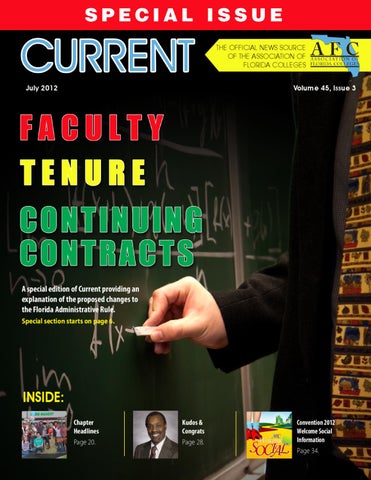
A special edition of Current providing an explanation of the proposed changes to the Florida Administrative Rule. Special section starts on page 6.
INSIDE: Chapter Headlines Page 20. www.myafchome.org
Kudos & Congrats Page 28.
Convention 2012 Welcome Social Information Page 34. July 2012 CURRENT I 1
PRESIDENT’S MESSAGE
AFC Board of Directors EXECUTIVE COMMITTEE President Gary Sligh, Lake-Sumter Community College President-Elect Byron Todd, Tallahassee Community College
AFC Keeping Active By Dr. Gary Sligh, AFC President
S
o much is happening at AFC this summer that we needed to create a special, extra edition of Current just to keep up with all the activities that are taking place. I hope you find this special edition helpful as you plan for your own summer activities both in AFC and in your personal vacations. The big summer headline is our Membership Development Conference scheduled for July 12-13 at the lovely Jupiter Beach Resort. A hard working committee has been preparing for months to deliver a fun and instructive program to participants in July. Expect to learn a lot about how to conduct a great membership campaign in your local chapters, and be prepared to gain a lot of expertise related to leadership and the retention of members as well. I hope every chapter will be represented; 2012 is the perfect year for us to surpass the 10,000 member mark and really make our voices heard as an association! Registration is ongoing for our Certified College Professionals Program. Our first group of participants met in Tallahassee in May in conjunction with our AFC Joint Commissions Conference. That group shared an exciting day of information and interaction as 2 I CURRENT July 2012
they began their journey towards professional certification. If you want to know more about the program or have an interest in joining our next session, visit our AFC website for enrollment information. CCP will be meeting at Jupiter Beach on July 11th just prior to our Membership Conference. New participants are always welcome! AFC has been especially active in the last month or so in helping to facilitate discussion revolving around possible changes to the structure of Continuing Contracts for faculty in Florida’s College system. Many of you may already know that the State Board of Education is considering making changes to the current structure and has asked the Council of Presidents to create a draft for discussion. AFC has worked closely with the Council of Presidents, the Council of Instructional Affairs, and our own AFC Faculty Commission to make sure that information is flowing and that our system will be well served by any decisions that are made by the state board. Keep an eye open for further updates as this process continues. Your AFC Board of Trustees will meet on July 11th in the afternoon
VP for Regions & Chapters Pat Barfield, Chipola College VP-Elect for Regions & Chapters Shelby Fiorentino, Valencia College VP for Commissions Joe Wallace, College of Central Florida VP-Elect for Commissions Christina Will, St. Johns River State College Immediate Past-President Evelyn Ward, Chipola College COMMISSION CHAIRS Administration Rhea Cemer, Indian River State College Adult & Continuing Education Daisy Vulovich, State College of Florida Career & Professional Employees Debi Jakubcin, Valencia College Communications and Marketing Chris Thomes, Gulf Coast State College Equity Stan Stone, Valencia College Facilities Robert Flores, South Florida State College Faculty Jim Lansing, Broward College Healthcare Education Alice Serey, Indian River State College Institutional Effectiveness, Planning and Professional Development Rob Gregg, Pensacola State College Instructional Innovation Paul Cutlip, St. Petersburg College Learning Resources Daniel Hood, Indian River State College Occupational & Workforce Ed Eileen Storck, Indian River State College Retirees Joanne Hutton, Brevard Community College Rural Campuses TBD Student Development Joseph Sarrubbo, Valencia College Technology Paul Lefavi, Indian River State College Trustees Sean Alveshire, Broward College
...Continued on page 4 AFC • Making a Difference One Life at a Time
CONTENTS
JULY 2012
IN THIS ISSUE 2
President’s Message Dr. Gary Sligh
5
Executive Director/ CEO Message Michael Brawer
6
AFC Public Statement
8
The Council of Presidents Perception
9
Observations From the Public Meeting
10
Faculty Commission Statement About Possible DOE Rule Changes
34
25
Executive Summary About Continuing Contracts
Follow the Yellow Brick Road to the AFC Welcome Social
News From Region IV: To Be Healthy, Eat Chocolate Region III Happenings
36
2012 Calendar
26
14
Side-by-Side
CHAPTER HEADLINES
Report From the Region V Conference
16
A Bit of History on Tenure in America
20
Santa Fe College
21
Chipola College
11
19
Membership Development Conference AFC Community Service Project
29
32
2013 AFC Cruise Invitation
30
Visions Call For Submissions
32
Building Leadership Skills Through the
33
AFC Certified College Professional Program
www.myafchome.org
Florida Gateway College
COMMISSION NEWS 26 Facilities Commission
College of Central Florida 22
Indian River State College Seminole State College
23
Daytona State College
REGION UPDATES 24 Broward College Hosts AFC Region V Spring Conference
KUDOS CONGRATS 28 Florida Keys Community College Chooses DC College CEO as Sixth President Dr. Jeffery Allbritten Named Next Distric President of Edison State College
July 2012 CURRENT I 3
...Continued from page 2
AFC Board of Directors (continued)
to continue the important work of overseeing the Association’s business. All regions, commissions, and special committees of the Association are present for these board gatherings. Give some thought this year to increasing your connection to AFC. Maybe you will want to run for an office in 2013 at your chapter, region, commission, or even statewide officer level. Getting involved as a leader of our Association will provide very valuable experience in whatever future career goals you may nurture. Speak to any current member of the board if you want to learn more. Wherever you go in the Florida College system, you will find strong leaders who credit AFC with some of the experience that helped them achieve greater things. We do live in the most beautiful state in the union, so make sure that you take some time this summer to splash in the ocean, visit a theme park, eat some fresh fruit, or enjoy your favorite outdoor event while the sun is shining. Happy Summer from AFC!
REGION DIRECTORS Region I Kevin Peddie, Tallahassee Community College Region II Debi McElroy, Santa Fe College Region III Charlene Latimer, Daytona State College Region IV Sheryl Peterson, St. Petersburg College Region V Xiao Wang, Broward College COMMITTEE CHAIRS (Ex officio) Bylaws Bill Mullowney, Valencia College Certified College Professional Program Jeff Peters, Palm Beach State College Will Benedicks, Tallahassee Community College
Dr. Gary Sligh AFC President
Community Service Jamie Rothberg, Pasco-Hernando Community College Finance, Human Resources & Retirement Issues Stanley Stone, Valencia College Legislative Jim Roy, St Johns River State College Member Services Juanita Scott, Pensacola State College Membership Development Alex Perez, Lake-Sumter Community College Planning and Development Tina Hart, Indian River State College Policy and Advocacy John Grosskopf, North Florida Community College
Hillsborough Community College Palm Beach State College
Wellness Debi Jakubcin, Valencia College
Support the AFC Foundation and help pay down the mortgage of the AFC Building. CLICK HERE to make an online donation.
EX OFFICIO MEMBERS Chancellor, The Division of Florida Colleges Randy Hanna The Florida College System Council of Presidents Joe Pickens, St. Johns River State College AFC Foundation Board Andre Hawkins, Indian River State College
Submit your news and articles for the next issue of Current to Tina Ingramm at tingramm@ myafchome.org before July 20. 4 I CURRENT July 2012
Parliamentarian Dan Rodkin, Santa Fe College Association of Florida Colleges Michael Brawer, CEO CURRENT is published by the Association of Florida Colleges. Advertising, news releases, and other communications should be sent to the AFC, 113 East College Avenue, Tallahassee, Florida 32301, or by email at publications@ myafchome.org. The views and opinions expressed in CURRENT are not necessarily those of the Association of Florida Colleges, its members, directors, or officers. AFC • Making a Difference One Life at a Time
EXECUTIVE DIRECTOR/CEO MESSAGE
It Takes a Village to Deal with the Tenure and Continuing Contracts Issue By Michael Brawer, AFC Executive Director/CEO The overwhelming response to the AFC’s role in the tenure and continuing contracts issue has been favorable, thankful, and overall supportive. This is one issue where we recognized early that it was a no-win situation; the train had left the depot and the Administrative Rule (6A-14.0411 Employment Contracts for Instructional Employees) that governs the issuance of continuing contracts and post-tenure review was going to be revised, with or without our involvement. So, we knew we had to take some swings on behalf of our membership and that we needed a win in this, but we knew it was not going to be as a result of becoming the opposition. We carved out a role as a sounding board and messenger to the faculty membership by forming a workgroup and engaging our Faculty Commission. The AFC workgroup came together quickly. It included AFC President Gary Sligh (LSCC), AFC President-elect Byron Todd (TCC) , and AFC VP-Elect for Commissions Christina Will
(SJRSC), all from the faculty side of the house, 2011-12 AFC Legislative Chair Jim Roy, Faculty Commission Chair Jim Lansing (Broward College), Jeanne Miller, College Attorney (FSCJ), Don Payton, Director of Government Relations (SSC), and President Joe Pickens (SJRSC). Also, the Council for Instructional Affairs under Chair Burt Harres (PHCC) did a yeoman’s job of researching how each college is addressing continuing contracts and post-tenure review. An Executive Summary of that compendium is included herein as well as a link to the comprehensive document. This special edition of “Current” is one of the strategies we adopted to help provide a clear message about what’s going on regarding this issue. We are also posting other resources and information to our web site, some of which are included in this publication. Additionally, I was asked to read a formal statement into the record at the public meeting on this issue held on June 5 and FSCJ by the Division of Florida Colleges and Chancellor Randy Hanna. (See the entire public statement starting on page 6.) The final vote on the revised rule by the State Board of Education will likely occur sometime in October. I assure that the AFC will remain at the table and continue to be a resource and sounding board for the effort.
www.myafchome.org
July 2012 CURRENT I 5
F A C U LT Y TENURE CONTINUING CONTRACTS One of the biggest issues facing college faculty right now is the future of continuing contracts. AFC has been monitoring the proposed changes to the Administrative Rule concerning Continuing Contracts and has voiced your concerns at every step of the process. Following is a selection of articles, commentary and position statements to help you understand the issue and the changes that may occur.
Public Statement provided by Michael Brawer, CEO, Association of Florida Colleges, June 5, 2012 at the Florida Department of Education Workshop on the revision to SBR 6A-14.0411 Written by Dr. Gary Sligh, 2012 AFC President, Lake Sumter Community College and Michael Brawer
I
am here today as the Chief Executive Officer of The Association of Florida Colleges. The AFC is “the professional association of Florida’s 28 public community and state colleges, the Division of Florida Colleges, their Boards, employees, retirees, and associates.” With over 8,000 members, the mission of the association is “to actively promote, represent, and support, members and institutions as they provide their students and the citizens of Florida with a world-class college system.” Our Association’s role on this issue is not to establish a position for or against it. We recognize that change is imminent. Our purpose today is, as such, to inform you that the AFC is uniquely positioned to provide information and guidance in the current discussions regarding Faculty Continuing Contract and status issues. Recognizing that the Faculty Commission or the Trustees Commission of the AFC, both constituent parts of the Association may choose to make their own statements of position regarding the issues of continuing contracts and multi-year contracts, the AFC will seek to make comments focused on post-tenure review issues for faculty. Our concern is that this process remains reliable, that it is valid, and that it remains under the local control of each institution and its policy-makers. A US Department of Labor Guide entitled “Testing and Assessment: An Employer’s Guide to Good Practices” discusses numerous aspects of employee assessment from assessment construction to legal implications of the uses of the results. Some key points made in the guide to advise employers about assessment issues are: 1. What is the clear purpose of the assessment? Is it professional advancement, or promotion, or something else? 2. What is the assessment designed to measure? Is it ability, work styles, or effectiveness? 3. What is the assessment designed to predict? Is it level of job performance, managerial potential, outcomes outside the total control of the employee, or even tenure? 4. What format will be used for the assessment? Observation, summative review of outcomes, or customer survey input? 5. What is the level of standardization, objectivity, and quantifiability? Will the assessment tools and procedures be applied consistently? Will adequate training be provided? Are the outcomes truly measurable? The guide also discusses the importance of any assessment being both reliable and valid. In the world of assessment, reliability refers to how dependably or consistently an assessment measures a characteristic or
6 I CURRENT July 2012
AFC • Making a Difference One Life at a Time
outcome over numerous applications. Validity refers to what outcomes or characteristics the assessment measures and how well that measure represents characteristics of performance. In other words, if the same measure of outcomes results from different assessments is that an indicator of a similar level of performance among those evaluated? In any high stakes assessment process, specifically one related to the matter being discussed today, it is most vital that these issues be considered. This is not only to assure that the employee is properly and fairly evaluated, but to also assure that the employer is protected if any high stakes decisions are rendered from the assessment results. The 28 colleges in the Florida College System have always been heavily invested in implementing procedures to assure the effective assessment and evaluation of all faculty. The process begins for Annual Contract instructors, and continues on throughout their career, after becoming Continuing Contract instructors. The Council of Instructional Affairs of the Florida College System has compiled an excellent compendium of these processes in place throughout the state system currently. Furthermore, through our regional accrediting body, the Southern Association of Colleges and Schools, Commission on Colleges, every college in the system must already have in place a robust system of Student Learning Outcomes assessment in order to remain accredited. This SLO movement has been in place now for over a decade, and the Florida College System has distinguished itself in the region for the excellence of its assessments within Associate in Arts programs. SACS Comprehensive Standard 3.5.1 states, “The institution identifies college-level competencies within the general education core and provides evidence that students have attained those competencies.� A similar standard governs oversight of all Associate in Science S workforce programs. College curriculum is organized around programs of study, as opposed to sequential course delivery of educational components as seen in the K-12 system. Students are guided to take certain required courses as part of their general education core and as the basic components of a particular workforce degree program, but students may also exercise a good bit of freedom regarding how those requirements are met. For instance, a student may meet a basic science requirement by taking a biological science or a physical science course. In such an instance, the entire science curriculum is designed so that a student who graduates from the institution will have attained certain core science competencies from various places in order to assure he or she is well grounded in science. www.myafchome.org
For that reason, it must be recognized that Student Learning Outcomes as an assessment measure must be based on competency attainment across the core curriculum and a wide range of courses, and not just an individual course. This crosscurricular approach assures the competencies are measures of higher level attainment, and allows students to be exposed to them frequently and at various times in order to achieve mastery. Using the analogy of the science courses again as an example, students may begin to demonstrate application of scientific principles in a basic level biology course but may not be expected to achieve mastery of higher level skills covered in an Anatomy and Physiology or Microbiology course. College-level instructors thus rely on a complex web of collaboration in order to deliver an effective college curriculum. As a result, assessment of an individual instructor based on course-level Student Learning Outcomes may not be effective in a college curriculum. Therefore, an important element used to assess faculty in such a setting would be a measure of the effectiveness of skills in collaboration and cooperation in designing and maintaining a comprehensive curriculum that will lead to student success. Other factors distinguish college faculty from those of other assessment systems. Most full-time faculty in the system teach a full range of courses in their respective disciplines. An English instructor may teach developmental courses at various levels, freshman composition and introduction to literature, as well as higher-level writing and composition courses. The best of these teachers is not so much focused on how to teach a particular course but in how to provide instruction in a wide range of skills to a wide range of students over the course of their college curriculum in English. Therefore, individual course-level outcomes must remain flexible in order to best serve a diverse population of students. An important issue in designing curriculum and subsequently assessing instructor performance based on them for community and state colleges is the heavy reliance upon part-time adjunct instructors. Full-time faculty must oversee the assessment of Student Learning Outcomes in this broader context to make sure that adjunct instructors who are less connected to the system have adequate guidance and can see their instruction in the context of the larger curriculum system. Our most seasoned full-time instructors are those best able to integrate all these various levels of experience and connectedness into a comprehensive curriculum. Finally, I have contacted numerous other state college association directors to learn more about how this matter of continuing contracts, tenure, and post tenure review is handled ...Continued on page 8 July 2012 CURRENT I 7
FROM THE COUNCIL OF PRESIDENTS
The Council of Presidents Perception By Joe H. Pickens, J. D. Chair, FCS Council of Presidents
The concerns of some Legislators and education officials regarding faculty continuing contracts at Florida College System (FCS) institutions has been simmering since 2011. Efforts by all concerned have only temporarily satisfied the concerns. Currently the Governor’s office, senior executive staff, the State Board of Education (SBOE) and Legislative leadership have all expressed interest in reviewing the process of awarding of contracts, post-tenure review, evaluation measures and the process to deal with substandard instructor performance. Various media sources continue to fuel the issue.
the process by, AFC has been invaluable to the COP.
The SBOE is currently going through the process of reviewing and revising the continuing contract rule; the Association of Florida Colleges (AFC) and the Council of Presidents (COP) are working directly with the SBOE in developing the rule. The goal is to craft a fair and reasonable rule to protect our faculty and respond to the concerns. The input from, and participation in
Rest assured that the COP in conjunction with AFC Leadership, the AFC Faculty Commission, DOE staff and the full weight of those combined resources will work tirelessly to develop a rule that allays the concerns expressed by others but, most importantly, protects our systems faculty.
At a recent SBOE meeting the Chair offered a “Friendly Suggestion” regarding the rule development. She suggested that the FCS should be proactive in developing something concrete and meaningful for input into the SBOE rule in order to avoid the possibility that “It would be done for us”. This is a clear indication that we, the FCS cannot simply do nothing, or just say NO. In many ways, this is akin to conducting an Academic Exercise in a Political Environment.
PUBLIC STATEMENT continued from page 7
elsewhere. With few exceptions, I have learned that most states do not even have a statute or state rule to guide this process. However, all of them strongly indicated that that local control provides each institution authority to establish such processes and measures. This local control is vital as we move into an era of concrete institutional strategic missions, plans and measures, and will assure that faculty assessments are uniquely appropriate for meeting outcomes at those colleges. Most other states like most private sector employers clearly recognize that one size does not fit all and that limited government interference allows them to be maximally efficient and effective in their assessment processes. When K-12 practitioners began to design Student Learning Outcome assessment, both here in Florida and throughout the country, one of the resources that they used was the broad range 8 I CURRENT July 2012
of scholarship already in place because of this movement’s start in colleges throughout the nation. The colleges of the Florida College System take great pride in the established work done in this area. We strongly suggest and recommend its continued use for consideration both as a way of assessing and evaluating academic programs, but as a way of assessing and evaluating the collaborate work of faculty in the Florida College System. Again, we urge emphasis on reliability and validity in any assessment, a focus on cross-curricular outcomes not just course outcomes, and the maintaining of institutional control over the processes and measures established. Thank you for opportunity to speak today and the Association of Florida Colleges hopes to remain an engaged and involved resource with this process as it moves toward completion. AFC • Making a Difference One Life at a Time
FROM THE AFC PRESIDENT-ELECT
Observations from the Public Meeting Held June 5, 2012 at FSCJ By Byron Todd, Tallahassee Community College AFC President-Elect The meeting started with the Chancellor talking about his concerns of the post-tenure review process not being the same at all the colleges. My impressions are that he believes that this is a way that some colleges can fix problems at their respected institutions. However, my belief is that colleges should have local control of their situation because they know what works best for them. There are twenty-eight (28) colleges and each should be separate to meet the needs of their community. The requirements should be broad, but each of the colleges should have the authority to solve their problems based on the community needs. That is local control used in the best way possible. The meeting was very good with members from the faculty as well as administration presenting very strong arguments why continuing contracts are needed in the college system. The faculty provided a lot of details explaining that the post award review occurs at their college already and that they can be dismissed from their respected colleges now with cause. There were many comments made about the difficulty of maintaining records on all students and the significant cost associated with the learning gains both pre and post. www.myafchome.org
Rules should be specific, giving authority to the local boards to enforce the policies. Making the rules too specific will take away the ability of the colleges’ to handle situations that are unique to them. The time frame for issuing a continuing contract should be between three to five years. With this flexibility the college will know if the faculty member is worthy of a continuing contract. A longer waiting period takes away from those that are ready to take on the full responsibilities that are required of a faculty member besides just teaching classes.
The requirements should be broad, but each of the colleges should have the authority to solve their problems based on the community needs. That is local control used in the best way possible.
Rules should require that the local board approve the faculty position description with the job responsibility area consisting of classroom effectiveness, professional growth, and community service. Each year the annual contract must be evaluated in each of the three areas mentioned above and must have a satisfactory evaluation before the continuing contract is awarded. Once the continuing contract is awarded the process does not stop. The faculty member must maintain the same standards that made it possible to receive the continuing contract with more responsibilities to mentor and be a part of the college committees’ structure. If these standards are not met, the faculty member can return to annual contract status or even worst, be dismissed. July 2012 CURRENT I 9
Faculty Commission Statement About Possible DOE Rule Changes By Jim Lansing, Broward College AFC Faculty Commission Chair 1. Continuing contract Students are served best when colleges expect and support the highest level of professionalism in faculty. Continuing contract status bolsters faculty professionalism by ensuring academic freedom in the classroom. Academic freedom carries with it duties along with rights Weakening continuing contract status could be harmful to students since the recruitment and retention of high quality faculty could be compromised. The recruitment and retention of students in Florida schools could be similarly affected. It seems unclear how the rule change language will affect colleges that have collective bargaining agreements. 2. Multi-year contract. The need for multi-year contracts, the programs for which they are to be used, and the circumstances in which they should be used, or not used, are issues that have not been fully described or discussed. 3. Post Tenure review. Faculty members support and embrace the concept of rigorous and continuing post tenure review and evaluation. The criteria for this review include professional development activities, research and creative works, and service to the college
Further Explanation:
and community. Many of the colleges already have rigorous mechanisms in place. Additionally, many colleges already have a structured method for removal of tenured faculty for cause that has been used effectively. 4. Questions that have been heard from faculty members: a. Is the rule change legal? A local senator said that a significant change required legislative action. b. Could a rule change cause a law suit, and might AFC be involved? • FEA has started a new lawsuit based on a DOE rule change. c. Will the Supreme Court’s immanent decision about the FEA lawsuit regarding the 3% salary payback for retirement affect this issue? It is based on protections in the state constitution for union contracts that have allegedly been violated. d. Could problems arise with SACS COC accreditation in the areas of 3.7.4 (academic freedom), and 3.7.5 (faculty role in institutional governance)? e. Will changes affect current or future faculty?
Click on the title below, if you would like to find out more about the history of Continuing Contracts.
2009
The Widget Effect by The New Teacher Project
EFFECT
E TA c k n o w le d g e naenssd DilG I W E re u H a T r N a ti o n a l F in Ttoe a c h e r E ff e c ti v e Ou nces D if fe re Act on oed embarg
009 n e 0 1, 2 u n t il ju
Da nie l
10 I CURRENT July 2012
We isb erg
Sex ton • Su san
er • Jen nif
Mu lhe r
Focuses on research for the K-12 system.
Post-Tenure Review and Just-Cause Termination in U.S. Public Institutions of Higher Learning: A Legalistic Examination by Robert K. Robinson, PhD, SPHR, Geralyn McClure Franklin, PhD and Miiorad M. Novicevic, PhD
Ke eli ng n • Da vid
AFC • Making a Difference One Life at a Time
Florida College System institutions have established various and unique processes to select, nurture, and evaluate faculty members, both before and after the issuance of continuing contracts. These processes are widely accepted and recognized throughout America’s system of higher education.
An Executive Summary of The Florida College System’s Practices of Selecting, Nurturing, and Evaluating Faculty Before and After the Issuance of Continuing Contracts A review of the document, Florida Administrative Code 6A14.0411, District Board of Trustees Policies, Administrative Procedures, and Excerpts from Faculty Union Contracts Regarding the Issuance of Continuing Contracts, reveals that each institution in the Florida College System is in compliance with Florida Administrative Code 6A-14.0411 Issuance of Continuing Contracts. Uniformity exists with each institution’s adherence to subsection (1) of this rule which states that “[i]n order to be eligible for a continuing contract, faculty must meet the following minimum requirements: (a) Completing of three (3) years of satisfactory service in the same college during a period not in excess of five (5) years with such service being continuous except for leave duly authorized and granted. (b) Recommendation by the president and approval by the board for a continuing contract based on successful performance of duties and demonstration of professional competence.” Boards of trustees exercise their authority for local control when uniquely applying subsection (2) of this rule which indicates that “[o]ther criteria for a continuing contract that colleges may consider including, without limitation, educational qualifications, efficiency, compatibility, character and capacity to meet the educational needs of the community, and the length of time the duties and responsibilities of this position are expected to be needed.” This executive summary will highlight illustrative practices implemented by Florida College System institutions that pertain to selecting, nurturing, and evaluating faculty before and after the issuance of continuing contracts. Selecting Faculty The faculty selection process at Florida College System institutions typically begins with advertising a vacant position in a variety of media that will attract a broad-based pool of applicants and ensure that individuals who apply for faculty positions are treated equitably without regard to their age, race, religion, color, gender, national origin, marital status, or disability and/or any other factor protected under applicable federal, state, and local civil rights laws, rules, and regulations. A concerted effort is made to assure that each applicant for a faculty position is selected on the basis of qualifications, merit, and professional ability. Institutional guidelines regarding required faculty credentials and adherence to criteria outlined by the Southern Association of Colleges and Schools, Commission on Colleges are followed by each Florida College System institution. ...Continued on page 12
www.myafchome.org
July 2012 CURRENT I 11
EXECUTIVE SUMMARY continued from page 11
A faculty screening committee is appointed, usually by the institution’s president, to identify finalists whose credentials, experience, and skills demonstrate a learning-centered philosophy that aligns with the college’s mission, vision, and values. Faculty screening committees vary in size but are usually comprised of continuing contract faculty, academic administrators, career/professional/technical positions, and an equity officer. Once the screening committee has reviewed all applications, the top candidates for faculty positions are interviewed, initially by phone, teleconference, or in person, with final interviews almost always conducted on-site. In addition to answering standardized questions, finalists for faculty positions are usually required to deliver a “mock lecture” as a means of demonstrating their instructional knowledge, skills, and abilities as well as a command of their academic discipline. The faculty screening committee’s chair, through administrative channels, recommends to the president the individual who most closely meets the qualifications, experience, and skills needed for the vacant faculty position. Pursuant to Florida Statutes 1012.315, 1012.465, and 435.04, Florida College System institutions’ human resources staff conduct pre-employment screening of potential faculty to ensure their eligibility for employment. Upon making a determination of an individual’s eligibility for employment, the institution’s president will submit a recommendation to the board of trustees for final approval. Nurturing Faculty Florida College System institutions nuture newly-hired faculty in a variety of ways including: • Assigning an experienced faculty member as a mentor • Orientation sessions • Requiring new faculty members to participate in regularly scheduled professional development activities designed to help new faculty understand the college’s culture; learn how to utilized learning styles to improve student success; effectively use technology such as learning management systems; and become familiarized with college resources to support student learning and success such as academic advising and counseling, financial aid, tutorial services, and student activities/organizations • Meeting regularly with academic deans, department chairs, and administration to discuss progress based on classroom observations, mentoring experiences, data on student retention and success rates, and professional development plans for continuous improvement • Enrolling in courses that provide information about the history and evolution of higher education/community 12 I CURRENT July 2012
colleges in America; foundations for classroom management and assessment of student learning outcomes; inclusion and diversity of students; and the effective use of academic technology • Engaging in professional development through programs, conferences, seminars and other activities which update and upgrade competencies designed to enhance instruction and promote student learning Evaluating Faculty Each Florida College System institution has clearly defined and published policies and procedures that pertain to the evaluation of faculty performance. Although the evaluation processes may vary among institutions, the demonstration of successful performance is key to a faculty member’s receiving and maintaining continuing contract. Florida College System institutions’ faculty performance evaluation procedures involve a multi-faceted process designed to evaluate and encourage continuous improvement in areas such as: • Teaching effectiveness as determined through success and retention rates as well as administrative evaluations and student observations of classroom performance • Scholarship as determined through earning advanced degrees, attendance/presentations at conferences, publications, and related academic activities • Service to the college determined through participation on committees and work groups designed to improve student learning, retention, and success • Service to the community determined through activities designed to improve and/or support the college’s service district including economic development endeavors and partnerships with local school districts, businesses and civic organizations Florida College System institutions use standardized evaluation forms as part of the faculty performance evaluation process. Faculty are evaluated regularly by an appropriate administrator in accordance with published procedures. In many instances, Florida College System institutions include student observations as part of a faculty member’s performance evaluation. Faculty performance evaluation forms are signed and dated by the individual being evaluated and the evaluator and retained in the faculty member’s official personnel file Two of the more innovative approaches to evaluate faculty being considered for continuing contract are the portfolio system and individualized learning plans. A faculty portfolio is used as a basis to document readiness for continuing contract. Characteristics of an effective portfolio process include a faculty AFC • Making a Difference One Life at a Time
member’s participation in portfolio training, development and submission of a professional development plan, and participation in the annual faculty performance review. Items included in a faculty portfolio are a professional vita; evidence of teaching learning/effectiveness; documentation of professional development; evidence of service to the college, students, and the community; and summary comments that an individual believes are relevant to support the awarding of continuing contract. An individual learning plan is developed by a faculty member in collaboration with an academic administrator. The individual learning plan clearly identifies what a faculty member wants to learn, achieve or accomplish during the pre-continuing contract process that will improve student learning. This plan, expressed through specific faculty learning outcomes, is based on a faculty member’s genuine need and desire to improve teaching, (counseling and librarianship, as applicable) and thereby enhance student learning. Faculty learning outcomes demonstrate essential competencies that pertain to assessment, inclusion and diversity, learning-center teaching strategies, outbased practices, and the scholarship of teaching and learning. At most Florida College System institutions that use faculty portfolios and individual learning plans, a committee comprised of faculty who possess continuing contracts, administrators, and staff evaluates each faculty portfolio or individual learning plan and submits a report that becomes one of the elements used to determine if an individual is to be recommended for continuing contract.
with continuing contracts are required to participate in a robust professional development program that continues to enhance their professional competencies and engages them in continues improvement processes that result in student learning. Florida College System institutions have board policies, administrative procedures and, in some instances, faculty union contracts that address the removal of a faculty member from continuing contract, the return of a faculty member from annual contract to continuing contract, and due process requirements. Conclusion Each institution in the Florida College System is in compliance with Florida Administrative Code 6A-14.0411 Issuance of Continuing Contracts. Florida College System institutions have established various and unique processes to select, nurture, and evaluate faculty members, both before and after the issuance of continuing contracts. These processes are widely accepted and recognized throughout America’s system of higher education. The evaluation processes utilized throughout the Florida College System not only emphasize faculty performance, but also focus on the impact that faculty performance has on student learning. CLICK HERE TO READ THE FULL COLLEGE-BY-COLLEGE SUMMARY.
It is a misconception that once individuals are awarded continuing contract, that they are no longer required to retain high standards of performance and engage in professional development activities. Florida College System institutions have board policies and administrative procedures that require that faculty who possess continuing contracts must be regularly receive a performance evaluation. Faculty www.myafchome.org
July 2012 CURRENT I 13
Side-by-Side Compare the current State Board of Education Rule regarding continuing contracts with the proposed revision. Florida Administrative Code 6A-14.0411 Issuance of Continuing Contracts (CURRENT RULE) Continuing contracts are to be awarded for service in a full-time faculty capacity as determined by the college consistent with the following rules. (1) In order to be eligible for a continuing contract, faculty must meet the following minimum requirements: (a) Completing of three (3) years of satisfactory service in the same college during a period not in excess of five (5) years with such service being continuous except for leave duly authorized and granted. (b) Recommendation by the president and approval by the board for a continuing contract based on successful performance of duties and demonstration of professional competence. (2) Other criteria for a continuing contract colleges may consider including, without limitation, educational qualifications, efficiency, compatibility, character and capacity to meet the educational needs of the community, and the length of time the duties and responsibilities of this position are expected to be needed. Colleges shall provide in writing to faculty a copy of the criteria for a continuing contract. (3) The continuing contract shall be effective at the beginning of the annual college contractual periods. (4) Each employee issued a continuing contract shall be entitled to continue in a faculty position at the college without the necessity for annual nomination or reappointment until the employee resigns except as otherwise provided in this rule. (5)(a) The college may dismiss an employee under continuing contract or return the employee to an annual contract upon recommendation by the president and approval
by the board. The president shall notify the employee in writing of the recommendation, and upon approval by the board, shall afford the employee the right to a hearing in accordance with the policies and procedures of the college. As an alternative to the hearing rights provided by college polices and procedures, the employee may elect to request an administrative hearing in accordance with the guidelines of Chapter 120, Florida Statutes, by filing a petition with the board within twenty-one (21) days of receipt of the recommendation of the president. (b) Upon consolidation, reduction, or elimination of a community college program or restriction of the required duties of a position by the board. The board may determine on the basis of the criteria set forth in subsections (1) and (2), which employees should be retained on a continuing or annual contract and which dismissed. The decision of the board shall not be controlled by any previous contractual relationship. In the evaluation of these factors, the decision of the board shall be final. (6) Any employee holding a continuing contract who accepts an offer of annual employment in a capacity other than that in which the continuing contract was awarded may be granted an administrative leave of absence pursuant to the college’s administrative rules. Specific Authority 1001.02(1), (9). 1012.83, 1012.855 FS. Law Implemented 1012.83 FS. History–Formerly 6A-8.33, Repromulgated 12-19-74, Amended 12-9-75, 2-14-77, 12-2677, 7-16-79, Formerly 6A-14.411, Amended 7-20-04.
Florida Administrative Code 6A-14.0411 Employment Contracts for Instructional Employees (PROPOSED RULE) District Boards of Trustees shall develop and maintain a policy governing the issuance of continuing contracts and other employment contracts for full-time instructional employees. The term ‘instructional employees’ includes full time faculty and other positions as defined by the college. Continuing contracts and multiple year contracts may be awarded to selected instructional employees as determined by the college consistent with the needs and policies of the college and the following rules: (1) In order to be eligible for a continuing contract selected 14 I CURRENT July 2012
instructional employees must meet the following minimum requirements: (a) Completion of at least five (5) years of satisfactory service in the same college with such service being continuous except for leave duly authorized and granted. Each District Board of Trustees shall establish criteria and conditions which must be met before a continuing contract may be awarded.
AFC • Making a Difference One Life at a Time
(b) Recommendation by the president and approval by the board for a continuing contract based on successful performance of duties, demonstration of professional competence pursuant to criteria established by the District Board of Trustees and college need. (c) Each District Board of Trustees may establish full-time instructional positions that are not eligible for continuing contract. (d) Each District Board of Trustees may establish other criteria for the award of continuing contracts. Colleges may consider including, without limitations, educational qualifications, efficiency, teaching effectiveness, compatibility, character and capacity to meet the educational needs of the community, and the length of time the duties and responsibilities of this position are expected to be needed. (2) Each District Board of Trustees may establish eligibility criteria for the award and maintenance of multiple year contracts for instructional employees. (3) Each District Board of Trustees may establish other criteria for the award of multiple year contracts. Colleges may consider including, without limitations, educational qualifications, efficiency, teaching effectiveness, compatibility, character and capacity to meet the educational needs of the community, and the length of time the duties and responsibilities of this position are expected to be needed. (4) Colleges shall provide instructional employees with a written copy of the criteria for a continuing contract or multiple year contract. (5) Each employee issued a continuing contract or multiple year contract shall be entitled to continue in an instructional position at the college without the necessity for annual nomination or reappointment until the individual resigns from the continuing contract, or the multiple year contract, or the multiple year contract expires, except as otherwise provided in this rule. (6) Each District Board of Trustees shall establish postaward performance criteria for instructional employees under continuing contract. Periodic review of continuing contract faculty shall contribute to their continuing growth and development and include, but not be limited to, such factors as evidence of: • Effective teaching practice • Student learning and feedback
• Continuing professional development • Currency and scope of subject matter knowledge • Service to department, college and community (a) The college may terminate an instructional employee under continuing contract, or return the employee to another contract status, for failure to meet post-award performance criteria pursuant to Section (6), for cause in accordance with college policies and procedures upon recommendation by the president and approval by the board pursuant to college policy. The president shall notify the instructional employee in writing of the recommendation and shall afford the instructional employee with the right to formally challenge the president’s recommendation to the board prior to board action in accordance with the policies and procedures of the college. The decision of the board shall be final. (b) The college may remove an employee from continuing contract or multiple year contract status by termination or return to another contract status for failure to meet the postaward performance criteria established pursuant to section (6) of this Rule. In each event, the instructional employee shall be entitled to challenge the action only through the college’s instructional employee grievance process or the applicable college dispute resolution process. (c) The college may dismiss an instructional employee under continuing contract or multiple year contract upon consolidation, reduction, or elimination of a college program, insufficient teaching load or restriction of the required duties of a position by the board. The board may determine on the basis of the criteria set forth in subsections (1) and (2), which instructional employees should be retained on the continuing or multiple year contract and which shall be dismissed or returned to an annual contract. The decision of the board shall not be controlled by any previous contractual relationship. In the evaluation of these factors, the decision of the board shall be final. (7) Any instructional employee holding a continuing contract or multiple year contract who accepts an offer of annual employment in a capacity other than that in which the continuing contract or multiple year contract was awarded may be granted an administrative leave of absence pursuant to the college’s administrative rules.
To read the entire rule as shown in the Florida Administrative Code, CLICK HERE. www.myafchome.org
July 2012 CURRENT I 15
A Bit of History on Tenure in America The American Association of University Professors (www.aaup.org) maintains the consummate authoritative resource on numerous issues and challenges of higher education teaching. Although, the emergent issue in Florida revolves around continuing contracts and post-tenure review, we must not lose site of the reasons for tenure systems in higher education. The following historical abstracts are worth the read and provide insight into the thinking of our forefathers, so to speak, from figuring out how to deal with similar matters almost 100 years ago.
1915 Declaration of Principles on Academic Freedom and Academic Tenure At the December 1913 meetings of the American Economic Association, the American Political Science Association, and the American Sociological Society, a joint committee of nine faculty members was constituted to consider and report on the questions of academic freedom and academic tenure, so far as these affect university positions in these fields of study. At the December 1914 meeting of these three associations a preliminary report on the subject was presented by the joint committee. At the meeting of the American Association of University Professors in January 1915, it was decided to take up the problem of academic freedom in general, and the president of the Association was authorized to appoint a committee of fifteen which should include, so far as the members were eligible, this joint committee of nine. The committee was therefore constituted as follows: Edwin R. A. Seligman, Chairman, Columbia University (Economics) Richard T. Ely, University of Wisconsin (Economics) Frank A. Fetter, Princeton University (Economics) James P. Lichtenberger, University of Pennsylvania (Sociology) Roscoe Pound, Harvard University (Law) Ulysses G. Weatherly, Indiana University (Sociology) J. Q. Dealey, Brown University (Political Science) Henry W. Farnam, Yale University (Political Science) Charles E. Bennett, Cornell University (Latin) Edward C. Elliott, University of Wisconsin (Education) Guy Stanton Ford, University of Minnesota (History) Charles Atwood Kofoid, University of California (Zoology) Arthur O. Lovejoy, Johns Hopkins University (Philosophy) Frederick W. Padelford, University of Washington (English) Howard C. Warren, Princeton University (Psychology) 16 I CURRENT July 2012
AFC • Making a Difference One Life at a Time
In view of the necessity of investigating an incident at the University of Pennsylvania, Professor Lichtenberger resigned in August 1915, and was replaced by Professor Franklin H. Giddings, Columbia University (Sociology). Professor Elliott, having been elected chancellor of the University of Montana, resigned in October. Professor Ford resigned in December, on account of inability to attend the meetings of the committee. The committee of fifteen had scarcely been constituted when a number of cases of alleged infringement of academic freedom were brought to its attention. These cases were not only numerous, but also diverse in character, ranging from dismissals of individual professors to dismissal or resignation of groups of professors, and including also the dismissal of a university president, and the complaint of another university president against his board of trustees. The total number of complaints laid before the chairman of the committee during the year was eleven. As it was impossible for the committee to command the time or the amount of voluntary service necessary for dealing with all of these cases, those which seemed the most important were selected, and for each of these a subcommittee of inquiry was constituted. In the case of the University of Utah the special committee began work in April and published its report during the summer. In the case of controversies at the University of Colorado, the University of Montana, the University of Pennsylvania, and Wesleyan University, the committees of inquiry have their reports either completed or in an advanced stage of preparation. The general committee has had several meetings and has advised the committees of inquiry upon questions of principle and of method and procedure; but it has not, as a body, participated in the investigations of facts, and the committees of inquiry alone are responsible for their respective findings of fact. The general committee has, however, examined these special reports, and, accepting the findings of the subcommittees upon questions of fact, has approved their conclusions. Three cases for which the committee was unable to secure investigating committees of this Association have been reported, after some preliminary inquiries, to the appropriate specialist societies; one case, arising at Dartmouth College, to the American Philosophical Association; one at Tulane University, to the American Physiological Society; and one at the University of Oklahoma, to the American Chemical Society. The committee of fifteen has conceived it to be its duty to consider the problem of academic freedom as a whole and to present a report thereon. Such a report is herewith submitted. The findings of special committees which have not already been printed will be presented in due course.
The safeguarding of a proper measure of academic freedom in American universities requires both a clear understanding of the principles which bear upon the matter, and the adoption by the universities of such arrangements and regulations as may effectually prevent any infringement of that freedom and deprive of plausibility all charges of such infringement. This report is therefore divided into two parts, the first constituting a general declaration of principles relating to academic freedom, the second presenting a group of practical proposals, the adoption of which is deemed necessary in order to place the rules and procedure of the American universities, in relation to these matters, upon a satisfactory footing. TO READ THE ENTIRE ARTICLE CLICK HERE.
1940 Statement of Principles on Academic Freedom and Tenure In 1940, following a series of joint conferences begun in 1934, representatives of the American Association of University Professors and of the Association of American Colleges (now the Association of American Colleges and Universities) agreed upon a restatement of principles set forth in the 1925 Conference Statement on Academic Freedom and Tenure. This restatement is known to the profession as the 1940 Statement of Principles on Academic Freedom and Tenure. The 1940 Statement is printed below, followed by Interpretive Comments as developed by representatives of the American Association of University Professors and the Association of American Colleges in 1969.The governing bodies of the two associations, meeting respectively in November 1989 and January 1990, adopted several changes in language in order to remove gender-specific references from the original text. The purpose of this statement is to promote public understanding and support of academic freedom and tenure and agreement upon procedures to ensure them in colleges and universities. Institutions of higher education are conducted for the common good and not to further the interest of either the individual teacher or the institution as a whole. The common good depends upon the free search for truth and its free exposition. Academic freedom is essential to these purposes and applies to both teaching and research. Freedom in research is fundamental to the advancement of truth. Academic freedom in its teaching aspect is fundamental for the protection of the rights of the teacher in teaching and of the student to freedom in learning. It carries with it duties correlative with rights.
...Continued on page 18
www.myafchome.org
July 2012 CURRENT I 17
HISTORY OF TENURE continued from page 17
Tenure is a means to certain ends; specifically: (1) freedom of teaching and research and of extramural activities, and (2) a sufficient degree of economic security to make the profession attractive to men and women of ability. Freedom and economic security, hence, tenure, are indispensable to the success of an institution in fulfilling its obligations to its students and to society. Academic Freedom 1. Teachers are entitled to full freedom in research and in the publication of the results, subject to the adequate performance of their other academic duties; but research for pecuniary return should be based upon an understanding with the authorities of the institution. 2. Teachers are entitled to freedom in the classroom in discussing their subject, but they should be careful not to introduce into their teaching controversial matter which has no relation to their subject. Limitations of academic freedom because of religious or other aims of the institution should be clearly stated in writing at the time of the appointment. 3. College and university teachers are citizens, members of a learned profession, and officers of an educational institution. When they speak or write as citizens, they should be free from institutional censorship or discipline, but their special position in the community imposes special obligations. As scholars and educational officers, they should remember that the public may judge their profession and their institution by their utterances. Hence they should at all times be accurate, should exercise appropriate restraint, should show respect for the opinions of others, and should make every effort to indicate that they are not speaking for the institution. Academic Tenure After the expiration of a probationary period, teachers or investigators should have permanent or continuous tenure, and their service should be terminated only for adequate cause, except in the case of retirement for age, or under extraordinary circumstances because of financial exigencies. In the interpretation of this principle it is understood that the following represents acceptable academic practice: 1. The precise terms and conditions of every appointment should be stated in writing and be in the possession of 18 I CURRENT July 2012
both institution and teacher before the appointment is consummated. 2. Beginning with appointment to the rank of full-time instructor or a higher rank, the probationary period should not exceed seven years, including within this period full-time service in all institutions of higher education; but subject to the proviso that when, after a term of probationary service of more than three years in one or more institutions, a teacher is called to another institution, it may be agreed in writing that the new appointment is for a probationary period of not more than four years, even though thereby the person’s total probationary period in the academic profession is extended beyond the normal maximum of seven years. Notice should be given at least one year prior to the expiration of the probationary period if the teacher is not to be continued in service after the expiration of that period. 3. During the probationary period a teacher should have the academic freedom that all other members of the faculty have. 4. Termination for cause of a continuous appointment, or the dismissal for cause of a teacher previous to the expiration of a term appointment, should, if possible, be considered by both a faculty committee and the governing board of the institution. In all cases where the facts are in dispute, the accused teacher should be informed before the hearing in writing of the charges and should have the opportunity to be heard in his or her own defense by all bodies that pass judgment upon the case. The teacher should be permitted to be accompanied by an advisor of his or her own choosing who may act as counsel. There should be a full stenographic record of the hearing available to the parties concerned. In the hearing of charges of incompetence the testimony should include that of teachers and other scholars, either from the teacher’s own or from other institutions. Teachers on continuous appointment who are dismissed for reasons not involving moral turpitude should receive their salaries for at least a year from the date of notification of dismissal whether or not they are continued in their duties at the institution. 5. Termination of a continuous appointment because of financial exigency should be demonstrably bona fide. TO READ THE ENTIRE ARTICLE CLICK HERE. AFC • Making a Difference One Life at a Time
Membership DEVELOPMENT
CONFERENCE Join chapter and commission leaders in beautiful Jupiter Beach for the 2012 Membership Development Conference.
JULY 12-13, 2012
Jupiter Beach Resort • Jupiter Beach, FL Book online at www.jupiterbeachresort.com or call 1-800-228-8810. Use group code: AFCMEM0710 Rate: $119/night single or double
In an effort to uphold and continue supporting the needs of our community, the Association of Florida Colleges (AFC) will sponsor the West Palm Beach Veterans Affairs Medical Center Fisher House, as our service project at this year’s membership conference in Jupiter. The Fisher House, as it’s known as, operates in 57 locations throughout the United States and Germany, is a “home away from home” for families of patients receiving medical care at military and VA medical centers. Fisher Houses aim to keep families together during a difficult time while reducing or eliminating the cost of lodging.
Please show your support on behalf of AFC by bringing donated items to the AFC Membership Development Conference. Office Supplies: Staple Foods: Household Products: Stationery, sticky notes, Non-perishable food Batteries, paper printer paper, printer items: individual snacks towels, facial tissue, ink (32 black/33 color), (snack cakes, pudding, liquid dish soap, staples, paper clips, black applesauce, chips), dishwasher detergent, markers (Sharpies) crackers, ravioli/pasta, laundry detergent, canned goods, canned fabric softener, fabric Miscellaneous Items: soda, juice, cereal, softener sheets, paper DVDs, Wii games, X-Box spices, salad dressing, coffee cups, coffee games, Gift Cards (grocery, condiments. stirrers, paper plates retail, Wal-Mart, Target, (no Styrofoam please), phone, gas). napkins, plastic eating utensil, disposable cups.
Learn more about the Fisher House by visiting their website. CLICK HERE for a direct link. www.myafchome.org
July 2012 CURRENT I 19
CHAPTER HEADLINES SANTA FE COLLEGE
Santa Fe College is part of a national initiative to engage community college students in civic learning and democratic practice, called The Democracy Commitment. The goal is that every graduate — in every program — will have had an education in democracy while at Santa Fe. During the Spring 2011 Term, TDC@SF offered a series of educational forums each month about the 2012 elections and the election process. Our chapter has supported 3 so far this year. Michael Brawer and Marsha Kiner visited our campus on March 20th. Michael Brawer gave the Legislative Update that was “hot off the press” and answered questions and concerns. Our own Marsha Kiner spoke of what AFC has done for her and what it means to be a member. Our executive council cooked up a southern lunch of pulled pork sandwiches, slaw, and all the fixin’s. The meeting was very well attended and most appreciative of the update. Our chapter supported Santa Fe College’s Spirit Station for the March of Dimes Walk. With a western theme, we handed out recyclabe bags, water, bananas and oranges to the 5,000+ walkers. Region II Conference was a huge success. The entire region was represented by all five colleges. We started the morning with a welcome from Dr. Sasser and Dr. Sligh. We were enlightened, engaged and entertained by all the presentations throughout the day from Persimmons to Boogie Boards. Our very own Dr. Jerry Johnston, 2011 POY gave us a short rendition of his winning presentation about persimmons and their babies and how they relate to raccoons and turtles. He even made persimmon cookies. John Hartzog from Florida Gateway College did a presentation on “Boogie Boards” which are really a modern day etch-a-sketch. Florida Gateway College uses these in their testing center. In the afternoon, we were enlightened with a legislative update from Michael Brawer and a Valic presentation by Debbi James. At lunch we were entertained by one of Santa Fe’s music faculty playing our new Steinway piano. We had a little free time throughout the day to network with our friends and peers from our sister colleges. It was a perfect day. Thanks to everyone who came. Our annual Spring Fling picnic was well attended on May 24th. We cooked burgers, dogs, and veggie burgers and had all the trimmings with chips, baked beans and drinks. We had 4 sessions of Zumba and gave away lots of prizes. It was a beautiful day in the Oak Grove. 20 I CURRENT July 2012
AFC • Making a Difference One Life at a Time
CHAPTER HEADLINES CHIPOLA COLLEGE
Chipola College honored three of its retirees at the recent end-of-year luncheon. Margie Williams, Student and Disability Services Advisor, was honored for 26 years of service. Pat Ward, Custodian, was recognized for 7 years of service. Tony Baker, Custodian, was honored for 9 years of service. Chipola President Dr. Gene Prough presented resolutions from the college board of trustees citing each retiree’s accomplishments. Retirees were presented Chipola Gold Cards which provide lifetime admission to college events. Williams and Ward were awarded life-time memberships in the Association of Florida Colleges (AFC). The event was sponsored by AFC, Council of Chipola Educators (CCE), Chipola Faculty Association (CFA) and Career Employees Association (CEA).
FLORIDA GATEWAY COLLEGE
Florida Gateway Chapter of AFC has been busy over the past few months with charity drives, legislative discussions, fundraisers, and Region II Spring Conference. Six members of our chapter attended the Region II Spring conference on April 20. On April 25th, we were honored to have Michael Brawer, AFC CEO/Executive Director address our chapter highlighting the legislative process and the most recent legislative session. The Annual Relay for Life was held on April 27 and 28th with our chapter supporting this fundraiser. We raised $2,55 to fight cancer and were well represented by members of our chapter who walked throughout the night and into the morning. May 4th was Florida Gateway College’s graduation day and the chapter sold roses to friends and families of the graduates. Over 150 roses were sold. On May 10-11 Florida Gateway’s math professor, Paula Cifuentes represented our school at the Joint Commission Conference in Tallahassee where she gave a presentation on FGC’s QEP “Math Up”. Also on May 24th, the chapter held an on-line cake auction to raise chapter funds as well as our scholarship fund. Total sales for this exciting auction totaled $268.00. In addition to all those activities, the Chapter made some changes to our by-laws to keep us up to date with current college policies. Our membership chairperson, Shama Battles has designed a membership awards recognition program as part of our drive to increase membership.
www.myafchome.org
Clockwise from top left: Margie Williams, Pat Ward and Tony Baker receive a resolution from Chipola President Dr. Gene Prough. The resolution, in honor of their retirements, cites the accomplishments of their careers.
COLLEGE OF CENTRAL FLORIDA CHAPTER
On April 26, 2012 The CF AFC chapter hosted a luncheon at which Carson Faris, founder of Grace Place, was guest speaker. Grace Place is the only local, privately funded facility established and operated by women for women in recovery in Ocala. Ms. Faris’ commitment to recovery and her dedication to carrying the message of her program of recovery was evident throughout her talk. .
Pictured (from left to right): Debbie Cook, chapter historian, Tracy Dobbins, chapter V.P., Shana Miller, chapter secretary, Ms. Faris, guest speaker and founder of Grace Place and Susan Dagg, chapter treasurer presenting the personal hygiene and household items donated to Grace Place by the CF chapter.
Send your chapter news to tingramm@myafc.org July 2012 CURRENT I 21
CHAPTER HEADLINES INDIAN RIVER STATE COLLEGE
IRSC’s chapter was very productive in the post-legislative period as it sponsored educational luncheons, community service events, and various social and civic engagement activities. Luncheons. Dr. Edwin Massey, IRSC President, presented a postlegislative session update at the chapter’s luncheon on March 29, in a panel that included Dr. Barry Keim, Vice President of Administration and Finance, and Mr. Andrew Treadwell, Executive Assistant to the President. On April 26, the Retirees Commission sponsored a luncheon where Jane Howard, Professor Emeritus, presented travel tips and stories in the “The Mysteries of Travel.” The meeting also kicked off the chapter’s May-June service drive, Project Lil’ Feet, in partnership with the St. Lucie County Fire District. The project aims to provide children in need, ages five and younger, with a new pairs of shoes. Community Service. On April 7, members tested their bowling skills at St. Lucie Lanes in Port Saint Lucie in the Bowl for Babies, with proceeds benefitting the IRSC March of Dimes team. Members also walked in the chapter-sponsored March for Babies, at IRSC’s St. Lucie West Campus on April 14. Throughout the entire month, the chapter generously donated to the cause via the Dollar Makes a Difference campaign. Social and Civic Engagement. On April 28, various women of the chapter participated in Women in the Outdoors, at Quail Creek Plantation in Okeechobee, a day of outdoor learning activities that included archery, Dutch oven, fishing, photography, self-defense, yoga, and more. On May 11, members participated in the Paddle Board and Kayak Adventure, an event organized by the chapter at Jaycee Park in Fort Pierce. On May 23, the chapter sponsored a Voter Registration Drive held at The River Shop Bookstore on IRSC’s main campus with St. Lucie County’s Supervisor of Elections on hand to register new voters and update voters’ information.
After “The Mysteries of Travel” luncheon.
Members participating in Bowl for Babies;
Walking in the March for Babies.
SEMINOLE STATE COLLEGE
On May 15, 2012 the Seminole State Annual Membership Appreciation Luncheon was held at Seminole’s Lake Mary campus. We had a catered lunch from Nature’s Table of soup, salad, cookies and drinks. There were approximately 60 members in attendance. 22 I CURRENT July 2012
AFC • Making a Difference One Life at a Time
CHAPTER HEADLINES DAYTONA STATE COLLEGE
The Daytona State College chapter has been engaged in some exciting activities to support students, create new friendships among members, and enrich the Book Scholarship Fund, which provides textbooks for AFC members. For starters, we invited College employees to support the women’s and men’s basketball teams at a home doubleheader. AFC members gathered to cheer on our student athletes and hand out free popcorn as well as literature about AFC. To enrich our cultural lives, we also hosted a Dinner and a Play event. Members relaxed over dinner at a local restaurant and then watched the College drama students perform in a musical titled Urinetown, a very funny play! This event was a delightful opportunity for AFC members and their families to get to know one another better as well as to support the College Arts Program. Our most recent activity was a Mother’s Day Flower Sale to raise money for the members’ scholarship fund. The Chapter worked with two locally-owned businesses, Slingerland’s Nursery and Angell and Phelps Chocolates, to offer DSC employees the opportunity to buy a Mother’s Day gift. The gift package consisted of a live plant and box of chocolates, decoratively wrapped and delivered by member volunteers. The sale was a great success; we took advance orders and sold out extra packages in two hours. People were begging for more. As a result, we raised $546 for the Book Scholarship Fund, provided people with unique gifts, and had a great time working together. We plan to hold this event next year.
Choose Your Channel To Stay Connected with AFC: Find us on Facebook. CLICK HERE
Follow us on twitter. CLICK HERE
Transforming the Learning Experience
Join us on LinkedIn. CLICK HERE
Learner Focused Innovation We’re committed to transforming the learning experience and creating a world where everyone has the opportunity to excel. We help over 8 million people discover what is possible through our innovative learning solutions. Discover Desire2Learn® Learning Suite 10 combining the industry’s most feature rich, flexible and sophisticated learning environments with an incredibly simple, intuitive and engaging user experience. For more information visit www.Desire2Learn.com or call us today at 1.888.772.0325.
REGION UPDATES BROWARD COLLEGE HOSTS AFC REGION V SPRING CONFERENCE The Association of Florida Colleges (AFC) Region 5 Spring Conference was held on Central Campus on April 27. Broward College President J. David Armstrong, Jr. welcomed our colleagues from Miami Dade, Palm Beach State and Indian River State colleges. Unfortunately, Florida Keys Community College was unable to attend. “I have been a lifelong member of this association and I know the value that it brings and the opportunities for professional development and support for our 28 institutions to have a presence in Tallahassee and protect the interests of our employees,” President Armstrong said. The outstanding conference was organized by Broward College’s Dr. Xiao Wang, who is the Region 5 Director, chapter President Anne Berman, and members. As Dr. Wang said, “We believe that together we can ensure student success.” AFC Executive Director/CEO Michael Brawer acknowledged that “This is one of our most significant regions.” He gave an informative update on the legislative session and the 65 “bills of substance” that had an impact on us as a state college and as its employees. “We presented
NOV- Title V AdR1 :Layout 1 4/18/12 10:29 PM Page 1
PULL uP UP A ChAir CHAIR Pull AND join JOIN An AN elite ELITE And grouP GROUPof OFleAders. LEADERS
a pretty good case for the college system being the workhorse in the workforce,” Brawer said. Informative presentations were delivered in concurrent sessions throughout the day and a concluding event in the evening took place at the college’s Tigertail Lake Center. Article by Rivka Spiro, Broward College Promotion & Public Relations
Nova Southeastern University’s Abraham S. Fischler School Understand, internalize and apply concepts of Education would like to invite youleadership to attend the Florida and and skills in the 2012-2013 and International Academy International Florida Chair Academy Program toChair be held for the Program. first time inHaving worked with leaders from from colleges and universities its history in over Fort 7,000 Lauderdale, Florida October 14th - 19th.worldwide, Join the Fischler of Education, the will Association Colleges, over the pastSchool 21 years. This program assist youofinFlorida addressing the large and the Academy Leadership andfrom Development and help “grow”you to number of leadersforwho are retiring your college and allow the next talent generation of academic develop management plansleaders. and foster future leaders.
You won’t want to miss it, so we’ll be saving you a seat. You won't want to miss it, so we'll be saving you a seat.
Tobi Coleman Debbie Nellis XXX-XXX-XXXX | XXX@XXXX.nova.edu 480.461.6270 800.986.3223 ext. 28437 leadershipacademy@chairacademy.com debbien@nova.edu
24 I CURRENT April 2012
AFC • Making a Difference One Life at a Time
REGION UPDATES NEWS FROM REGION IV: TO BE HEALTHY, EAT CHOCOLATE.
Region IV colleagues shared good ideas, good food and a good time at the AFC Region IV Spring Conference on April 13 at St Petersburg College’s Seminole Campus, in Seminole, Fl. The diverse agenda included topics of interest to everyone, including serving Veterans, going green, planning retirement, becoming a leader and dealing with students, diversity and technology. Of course--of great interest to all--CEO Michael Brawer provided an update and summary of legislative issues which was both timely and thoughtprovoking. In addition, Dr. Kelvin Thompson, a national leader in creating blended courses from Florida’s own University of Central Florida, taught over 80 instructors how to design and teach blended courses. Sponsors also offered a range of products. We were pleased to have Smarthinking share information concerning online tutoring and Capella University was ever-ready to discuss degrees to further one’s career. However, the most unique offering was from sponsor Xocai Healthy Chocolate, who taught everyone about getting healthy through eating CHOCOLATE! Now that was really good news! The bottom line is that our time together was very informative, included presents (door prizes!) and encouraged eating chocolate! What more could anyone want?
REGION III HAPPENINGS Daytona State College hosted the Region III Spring Conference on Friday, April 6, 2012. Sixty members from Brevard CC, College of Central Florida, Daytona State College, Lake Sumter CC, Seminole State College of Florida and Valencia participated in a day of professional development, networking and fun. Some of the highlights of the day were; legislative update by Sharon Crow, overview of the Certified College Professional Program by Marsha Kiner and a fun and interactive session on motivation by our keynote speaker, Dr. Joy Lewis, Daytona State College. Especially note-worthy was a tour of the Southeast Museum of Photography and a discussion by author and photographer, Gary Monroe on this book, “The Highwaymen.” Participants also worked out their minds and bodies with a networking activity in the morning www.myafchome.org
then after lunch a physical activity break led by DSC wellness instructor Deborah Stelling. The region service project “Put a Cork in it “was a huge success along with the rest of the conference. July 2012 CURRENT I 25
REGION UPDATES REPORT FROM THE REGION V CONFERENCE
The Association of Florida Colleges Region V Spring Conference was recently held on Broward College’s Central Campus, April 27th, 2012. Broward College’s President David Armstrong welcomed colleagues from Miami Dade, Palm Beach, and Indian River State colleges. The outstanding conference was organized by Dr. Xiao Wang, who is the Region V director, Chapter President, Ann Berman, and other AFC members. As Dr. Wang said, “We believe that together we can ensure student success.” AFC Executive Director/CEO, Michael Brawer, gave an informative update on the Legislative session and the 65 “bills of substance” that had an impact on the state college system and its employees. “We presented a pretty good case for the college system being the workhorse in the workforce,” said Brawer. The keynote speaker is Dr. Gary Sligh, the AFC President. Informative presentations by administrators, faculty, and PTS from four Region V colleges were delivered in concurrent sessions throughout the day, and a concluding event in the evening took place at the Tigertail Lake Recreational Center.
COMMISSION NEWS FACILITIES COMMISSION
The Facilities Commission has initiated recruiting and development tours. The tours are conducted at the Beacon LED manufacturing plant. Beacon is a subsidiary of Hubble Lighting located in Bradenton, Fl. The tour has two parts, a classroom educational component and a walk through of the manufacturing facility. The tour includes a working lunch. The first tour was on February 21st with 14 college facility members in attendance. The members were from State College of Florida, Polk State College, and South Florida State College. The second tour was held in conjunction with the Facilities Commission Spring Conference. The conference was held at South Florida State College on April 26th, with 75 attendees participating.
Upcoming Commission Sponsored Events • Table Top Presentations: Disaster Preparedness: First will be held at Santa Fe College, June 22. • Construction CEU’s • OSHA Training • Online Management Training 26 I CURRENT July 2012
AFC • Making a Difference One Life at a Time
Career Opportunities in Geomatics Surveying and Mapping the Future
Surveying and Mapping (Geomatics) is a HIGH PAYING and REWARDING profession requiring a 4 year degree. Geomatics uses cutting edge technology to map the features of the earth using laser scanning, satellites, robotics, sonar, planes, boats and many other sophisticated tools and software to acquire and process data.
How can My Daughter or Son get into Geomatics?
They can either apply to enter FAU or UF as a freshman or obtain an AA from a Community College in Florida and transfer into a Geomatics Program.
SCHOLARSHIPS AWARDED Websites with further information: http://www.fsms.org/careers.cfm http://sfrc.ifas.ufl.edu/geomatics http://www.cege.fau.edu
FSMS is committed to assisting individuals seeking training and education in the field of surveying and mapping. Call the Administrative Office at 800.237.4384 for more info. Carl E. Johnson Memorial Award Established by the Carl E. Johnson family in the 1970’s and is a full tuition scholarship for students enrolled in the Geomatics Program at UF. Criteria gives priority to students who reside in the Charlotte, Collier, Hendry and Lee counties. Second priority given to students who reside in South Florida. Third priority is statewide. Community Foundation of North Florida Endowment Established in 2006 to provide financial assistance for select students to aid in their collegiate education for purposes of becoming licensed members of the surveying and mapping profession in Florida. Florida Surveying & Mapping Society Endowed Scholarship Established in 1990 through the University of Florida Foundation to assist UF students in their Geomatics Program. Funds awarded in the fall and spring semesters. www.myafchome.org
Florida Surveying & Mapping Society Scholarship
BENEFITS OF CHOOSING THIS CAREER PATH HIGH starting salaries DEGREE IN GEOMATICS from University of Florida or Florida Atlantic University BE YOUR OWN BOSS ~ (Approximately 70% of grads own their own company in 5-7 years)
Fund, Society Inc. Florida Surveying & Mapping Scholarship Fund Established in 1968 and devotes its resources to assist deserving students needing financial aid to obtain an education in the field of land surveying and other businesses and professions connected therewith. Paul T. O’Hargan Memorial Scholarship Fund Established in 2002 to honor Mr. O’Hargan. Applicant must be enrolled in or accepted into a program of study pursuing a degree in surveying and mapping. Annual award through an essay contest each March. Chapter Scholarships The following Chapter scholarships were established by each individual Chapter and are solely managed by them respectively: Central Florida Chapter – Gerald McNair Scholarship Fund Florida Crown Chapter – Walter J. Reinhardt Scholarship Fund Manasota Chapter – Manasota Chapter Scholarship Fund Tampa Bay Chapter – Tampa Bay Scholarship Fund West Central Florida Chapter – William Atwood Scholarship Fund July 2012 CURRENT I 27
KUDOS CONGRATS FLORIDA KEYS COMMUNITY COLLEGE CHOOSES DC COLLEGE CEO AS SIXTH PRESIDENT After months of sifting through dozens of candidates through extensive reviews, online interviews, town hall forums, and ultimately formal interviews, the Florida Keys Community College Board of Trustees has selected the sixth president for the GUEVERRA 46-year-old institution. Dr. Jonathan Gueverra, Chief Executive Officer of the Community College of the District of Columbia, was the board’s unanimous choice. With island roots, a New England education, and an impressively effective track record in numerous leadership and faculty positions at nearly a dozen colleges, Gueverra was determined to be the best fit for the future of FKCC. The two other finalists were Dr. George Bishop, Vice President for Academic Affairs and Learning Support at Gulf Coast State College, and Dr. Allen Witt, President of the South Shore Campus of Hillsborough Community College. Originally from Trinidad and Tobago, Gueverra has a Doctorate of Education and a Masters of Business Administration from the University of Massachusetts, as well as a bachelor’s degree from Providence College and an associate degree from Newbury
College. In 2009, he was recruited from his position as Provost at Northern Virginia Community College’s Alexandria Campus to lead the creation of the District of Columbia’s first community college, which was built from existing programs under the capital city’s university. In three years under his leadership, enrollment tripled, programs and locations expanded and over $10 million of outside funds were raised. Gueverra has also served on numerous boards, including the American Association of Community Colleges, the New England Educational Assessment Network, the Alexandria and Arlington Chamber of Commerce, and Washington DC’s Economic Development Partnership Board and Workforce Investment Council. In 2008, he was awarded a “Lifetime Achievement Award” from Wentworth Institute of Technology and a “Highly Commended Award” at the Literati Network Awards for Excellence. “We are very excited to have someone with Dr. Gueverra’s experience, energy, and enthusiasm, lead FKCC to the next level,” said Ed Scales, Chairman of the Board of Trustees. Gueverra will succeed Dr. Larry Tyree, who is retiring on June 30 after a 45-year career in the community college industry including nine presidencies and 11 community colleges.
DR. JEFFERY ALLBRITTEN NAMED NEXT DISTRICT PRESIDENT OF EDISON STATE COLLEGE The Edison State College District Board of Trustees today unanimously selected Dr. Jeffery Allbritten as the next District President of Edison State College. The Board of Trustees voted to offer Dr. Allbritten a contract that includes a base salary of $263,850 ALLBRITTEN plus benefits, which are valued at 28 percent of the base salary plus a car allowance of $1,000 per month. The total contract is approximately $350,000 with negotiations ongoing. No starting date has been finalized for Dr. Allbritten to take over as the fourth District President in Edison’s 50-year history. “This entire process is the result of a communitywide, collaborative effort,” said Ann E. Berlam, Edison Board chair. “We are extremely pleased to welcome Dr. Allbritten to the Edison State College family.” 28 I CURRENT July 2012
Berlam was joined by Trustees Brian Chapman Jr., Randall T. Parrish, Julia G. Perry, Braxton C. Rhone, Marjorie Starnes Bilotti, Christopher T. Vernon and Eddie Webb III in voting for Dr. Allbritten. Edison State hired Academic Search, Inc. in January to conduct a national presidential search. The process drew 41 applicants from across the country. A 13-member Presidential Search Advisory Committee, chaired by Berlam, narrowed the list to nine candidates last month. The committee then interviewed the nine candidates and chose five finalists. Dr. Peggy Kennedy and Dr. Eric McKeithan withdrew from consideration due to other professional opportunities. The three remaining candidates included Dr. Allbritten, President of Macon State College; Dr. Eugene Giovannini, President of GateWay Community College; and Dr. Joseph Sarnovsky, Executive Vice-President and Chief Financial Officer at Seminole State College. AFC • Making a Difference One Life at a Time
8 Day Southern Caribbean Carnival Freedom Day Saturday (3/23) Sunday (3/24) Monday (3/25) Tuesday (3/26) Wednesday (3/27) Thursday (3/28) Friday (3/29) Saturday (3/30) Sunday (3/31)
Port of Call Fort Lauderdale, FL Fun Day At Sea Grand Turk La Romana Curacao Aruba Fun Day At Sea Fun Day at Sea Fort Lauderdale, FL
Arrive
Depart 4:00 p.m.
7:00 a.m. 9:00 a.m. 2:00 p.m. 8:00 a.m.
2:00 p.m. 5:00 p.m. 11:00 p.m. 4:00 p.m.
8:00 a.m.
Interior Cabin: $939.33* per person Outside Cabin: $1,089.33* per person Balcony Cabin: $1,469.33* per person (*Includes cruise rate, port charges & taxes) “Inquire about Early Saver, Past Guest, Senior Rates, etc. to see if you qualify for a lower rate.”
Additional information can be found at: http://www.comesailawaycruises.com/rw/cruise/1575 or by contacting: Mary Graves at mgraves@cruiseplanners.com • 850-456-7676 Carol Quinn at cquinn@pensacolastate.edu • 850-484-1749 www.myafchome.org
Reservations will be accepted as long as cabins are available. Posted rates are good through June 14, 2012. $50 per person would be required at time of booking $250 payment must be received by October 14, 2012 Final payment by January 2, 2013 Full refund if you cancel prior to January 2, 2013 Group amenities to be determined at a later date July 2012 CURRENT I 29
CALL FOR SUBMISSIONS THE JOURNAL OF APPLIED RESEARCH FOR THE ASSOCIATION OF FLORIDA COLLEGES IS ACCEPTING SUBMISSIONS FOR
VISIONS
SUBMISSION DEADLINE: AUGUST 2012
Visions is published annually for members of the Association of Florida Colleges (AFC) and reports on issues that have implications for Florida’s College System. Visions provides a professional forum for the exploration of issues of concern to Florida’s College System. At this time AFC is accepting articles for consideration in all areas of the Florida College System including applied research, what works in either the classroom or the office, and exempleary practices. Article submissions: 3 - 8 pages in length/MLA Style Inquiries may be addressed to: Dr. Will Benedicks, VISIONS Managing Editor benedicw@tcc.fl.edu 850-201-8170
30 I CURRENT July 2012
AFC • Making a Difference One Life at a Time
Digital Content and Resources Right at Your Fingertips! McGraw-Hill Campus Library gives you universal single sign-on and automatic registration to our teaching and learning resources. Gain full and easy access to our vast array of digital resources – 1,500 e-texts and instructor resources that let you build richer courses from within your chosen LMS! What makes us different? ff fferent? t /FWFS DSFBUF BOPUIFS BDDPVOU MPHJO PS QBTTXPSE UP access McGraw-Hill content. t 0OF DMJDL BDDFTT UP UIPVTBOET PG UFBDIJOH BODJMMBSJFT across all disciplines – at no charge. t (SBEF TZODISPOJ[BUJPO CFUXFFO .D(SBX )JMM BTTFTTment platforms, including ConnectŽ and ALEKSŽ.
Enjoy simplifi simplifi fied ed access to the highest quality, mediarich content and adaptive learning and assessment engines for faculty, students and institutions – today!
Visit www.mhcampus.com to learn more. McGraw-Hill Campus – Discover what’s possible
Your benefits, your future at Capella University The education alliance between the Association of Florida Colleges and Capella University means you have access to a bachelor’s, master’s, or doctoral degree program—and to powerful benefits, too:
• 10% tuition discount on Capella courses • Free Capella webinars—with tips and techniques for work and life
An accredited*, online university, Capella offers respected degree programs and unrivaled support for working adults. You’re ready to move forward. See how your benefits can help make it happen. Visit www.capella.edu/facc, or call 1.866.736.1746. Capella University is accredited by The Higher Learning Commission and is a member of the North Central Association of Colleges and Schools (NCA), www.ncahlc.org.
*ACCREDITATION:
CAPELLA UNIVERSITY: Capella Tower Tower, 225 South Sixth Street, Ninth Floor, Minneapolis, MN 55402, www.myafchome.org 1.888.CAPELLA (227.3552), www.capella.edu
July 2012 CURRENT I 31 11-5724
By Karinda Barrett, Ph.D.
A
t a time when many college administrators, faculty, and staff are nearing retirement, starting a new professional development opportunity like the Certified College Professional Program offered by the Association of Florida Colleges is a great opportunity for current college employees to grow and prepare for the soon-to-be vacated positions. On May 9th, the Association for Florida Colleges offered the first course, the Leadership Skills Development Workshop. The workshop was held at the Association offices and focused on leadership skills, ethics and communication. Michael Brawer and Dr. Gary Sligh, President of AFC, welcomed the group and led introductions. Dr. Walter Smith presented on leadership skills, using the founders of Florida’s Historically Black Colleges, the Magnificent 12, as examples of outstanding leaders. Dr. Smith also provided some important gems for developing leadership skills including: • “Exposure is what makes the leader” • “Leadership depends on the quality of the followers” • “Great Leaders are born and made”
Dr. Charles Dassance led the segment on Ethics in Leadership, focusing on servant leadership. Dr. Dassance encouraged the group to consider learning about a candidate’s ethics in the hiring process through scenarios during the interview and reference checks. He shared that in his experience, the reason he had to fire people was because of a breach in trust. Dr. Dassance provided questions that lead to some useful ways of considering one’s ethics: • What are my most important values and ethics? • Does my calendar reflect that? • What would my subordinates and peers say my ethics are? • Are there people who will tell me the truth? • What could this organization ask me to do that would cause me to quit my job? After lunch, we took a tour of the AFC building and then Deanna Mills from Marketdone presented on Leadership Communications. The first course was a great opportunity to develop leadership skills and prepare for the future.
He encouraged participants as they step into new positions to get a basic sense of the organization, the mission and mechanisms for input.
Karinda Barrett, Ph.D. Tallahassee Community College Director for the Center for Teaching, Learning and Leadership
REMAINING 2012 CERTIFIED COLLEGE PROFESSIONAL PROGRAM COURSES: Certified College Professional - Legislative Process and Advocacy Course
7/11/12
Certified College Professional - The Florida College System Course
9/13/12
Certified College Professional - Building Community & Customer Service Course 32 I CURRENT July 2012
10/30/12 AFC • Making a Difference One Life at a Time
AFC Introduces a new opportunity for professional development
Certified College Professional Program The Certified College Professional (CCP) Program will provide AFC member with the opportunity to earn a designation related to their work as a college professional, and expose them to content and experience they may not be able to obtain elsewhere. The CCP program provides significant value-added benefits for membership in the AFC and enhances the AFC’s role as the primary professional development provider for the Florida College System.
“I can think of nothing more important to a college than investing in the professional development of our people. I am excited about the opportunities this program will give participants from our college to learn from colleagues at other colleges.” —Dr. Jim Murdaugh, President, Tallahassee Community College Application Criteria: • You have been a member of the Association of Florida Colleges (AFC) for at least one year • You have been employed full-time by a Florida College System institution for at least 3 years, and you have at least one year of experience in your current position at the college • You are committed to upholding the AFC Certified College Professional “Standards of Conduct” • Your college president will suport your effort to earn the CCP
CLICK HERE to find out more about the program or to register.
www.myafchome.org
July 2012 CURRENT I 33
Follow the Yellow Brick Road to the
October 31, 2012
COS CON TUME Prize TEST! awa s will b rd e best ed for th cost ume e s.
9pm - Midnight
63rd Annual AFC Convention October 31 - November 2, 2012 Innisbrook Hotel, Palm Harbor, FL 34 I CURRENT July 2012
AFC • Making a Difference One Life at a Time
Hotel Info: Innisbrook Hotel, 36750 US Highway 19 N, Palm Harbor, FL 34684 (800) 492-6899 Room Rate $119/night for double Reservation deadline is September 27, 2012
July
Certified College Professional - Advocacy Course Board of Directors Meeting 2012 Membership Development Conference Current Article Submission Deadline
7/11/12 7/11/12 7/12/12 - 7/13/12 7/20/12
August September Current Published
8/17/12
Current Article Submission Deadline Certified College Professional - Florida College System Course Board of Directors Meeting Current Published
9/7/12 9/13/12 9/14/12 9/28/12
October
Certified College Professional - Building Community & Customer Service Course 10/30/12 Board of Directors Meeting 10/30/12 63rd Annual AFC Convention 10/31/12 - 11/2/12
November December
Current Article Submission Deadline
11/9/12
Current Published
12/7/12
Help AFC Total 10,000 Members by the end of 2012 AFC’s got the tools you need to reach and recruit new members. Head over to the Membership Toolbox to get started. CLICK HERE.
AFC Staff Executive Director/CEO • Michael Brawer • mbrawer@myafchome.org Associate Executive Director for Membership and Professional Development• Marsha Kiner • mkiner@myafchome.org Director of Administration and Finance• Eileen Johnson • ejohnson@myafchome.org Executive Assistant/Publications Coordinator• Tina Ingramm • tingramm@myafchome.org Membership Information & Database Manager• Adrienne Bryant • abryant@myafchome.org Staff Assistant• David Schrenk • dschrenk@myafchome.org
36 I CURRENT July 2012
AFC • Making a Difference One Life at a Time