February 2010
Volume 43, Issue 1 President’sMessage...Page Message, Page22 President’s
Executive Director/CEO Message, News & Events...Page 8 Page 4
Calendar...Page 23
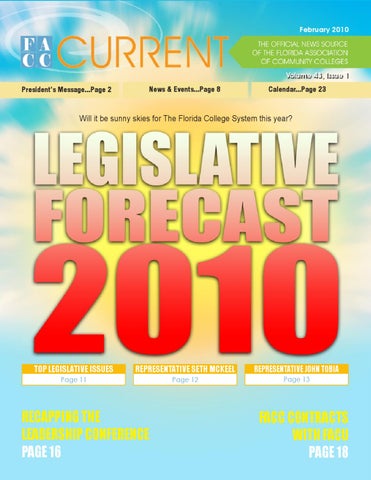
Will it be sunny skies for The Florida College System this year?
TOP LEGISLATIVE ISSUES Page 11
REPRESENTATIVE SETH MCKEEL
RECAPPING THE LEADERSHIP CONFERENCE PAGE 16 www.FACC.org
Page 12
REPRESENTATIVE JOHN TOBIA Page 13
FACC CONTRACTS WITH FACU PAGE 18
February 2010 CURRENT I
FACC Board of Directors EXECUTIVE COMMITTEE President Martha W. Williams, Valencia Community College President-Elect Evelyn Ward, Chipola College VP for Regions & Chapters Gary Sligh, Lake-Sumter Community College VP-Elect for Regions & Chapters Mary DiTaranto, State College of Fl, Manatee-Sarasota VP for Commissions Byron Todd, Tallahassee Community College VP-Elect for Commissions Juanita Scott, Pensacola Junior College Immediate Past-President Will Benedicks, Tallahassee Community College COMMISSION CHAIRS Administration Pat Profeta, Indian River State College Adult & Continuing Education Daisy Vulovich, State College of Fl, Manatee-Sarasota Career & Professional Employees Cara Bennett, Central Florida Community College Communications and Marketing Joe Wallace, Central Florida Community College Equity Lonnie Thompson, Seminole State College of Fl Facilities Phil Scala, St. Petersburg College Faculty Jim Lansing, Broward College Institutional Effectiveness, Planning and Professional Development Juanita Scott, Pensacola Junior College Instructional Innovation Diane Bifano, Palm Beach State College Learning Resources Jametoria Burton, Florida SC at Jacksonville Occupational & Workforce Ed Jayme Rothberg, Pasco-Hernando Community College Retirees Nancy Buhl, Palm Beach State College Rural Campuses Imani Asukile, Pasco-Hernando Community College Student Development Susan Lewis, Florida SC at Jacksonville Technology Melanie Jackson, South Florida Community College Trustees David Talley, Palm Beach State College
CURRENT February February 2010 2010 I CURRENT
Martha Williams, FACC President
Membership Is Goal One!
G
reetings! I’m amazed at how quickly time has flown since we convened in November. We left Orlando with a renewed sense of commitment and dedication. The Convention afterglow continues as we plan for the coming year as well as face the challenges that the 61st year will bring. Together, we pledged to remember the time honored traditions of the past while we forge ahead—FACC: Shaping Our Future! Indeed, what a great moment in my personal and professional life to be sworn in as president of this great Association and to present three important facets that we will focus on this year under a program we’ve entitled, Membership is Goal One! Of course, you’ll hear more details about this umbrella program and each facet, but allow me to briefly describe each one. We are extremely proud that more than 8,000 of our colleagues across this great state are members of the FACC, but we can certainly increase that number significantly. So, the first facet under Membership is Goal One - is increasing the number of members in our Association. As I asked at Convention, “Would it not be great to enter next year’s [2010] Convention with 10,000 members on our Association roll?” Should each chapter pledge to increase their membership by a mere 25% we could reach this modest goal by November 2010. I’m hoping that you and your chapter are discussing plans now and implementing strategies for increasing our membership. This is why we launched our plan to increase membership by featuring a Membership Workshop at the recent Leadership Conference; we want to celebrate mid-year accomplishments when we meet at the Membership Development Conference in July. It’s my desire to help each chapter and commission to remain vital, grow and develop. The next facet is increasing the number of service oriented projects and programs sponsored by our chapters and commissions. This is not a new venture; we have responded greatly to the needs of our members and
communities, particularly when disasters have occurred. But, we can do more together. To facilitate our efforts under this facet, I’ve asked Mary DiTaranto, our VP-Elect of Regions and Chapters, to chair a committee that will help chapters and commissions generate ideas for service projects and programs. We will later highlight and celebrate those who have heeded this clarion call to service. The plans for establishing a Leadership Academy is the final facet. Through the academy, we will be able to provide on-time workshops, courses or seminars that will offer our members continuing education credits. We can also provide workshops on leadership development and encourage those members who aspire to become officers on the state, local, regional or commission levels. It is true that leadership is not really about being elected or appointed to an office. The office does not teach someone how to be a leader. Leadership is an attitude cultivated over time. Yet, we can provide workshops and seminars that will enhance our natural skills. In order to remain successful, the Association will need strong leaders and visionaries at the helm. Do you have a purpose and the ability to follow that purpose to get the results you desire? Do you set goals and achieve them? Do you know how to plan? If so, we want you to consider becoming a leader. Dolores Teter, former Member Services Chair and Dennis Storck former VP of Regions and Chapters have graciously accepted to chair this important new committee. Talk about getting a lot of things done in just a year. Well, those are the major plans for this administration. But not any of it can be accomplished without you, the member. More importantly, not any of it would be meaningful if not for you and our common desire to succeed. Ralph Waldo Emerson said, “The reward of a thing well done is to have done it.” Later, the Nike conglomerate made famous their slogan “Just Do It!” based upon Emerson’s philosophy. That is the mantra that will propel our great Association to meet the challenges of this new decade – the will to do and do it well – together, FACC: Shaping our Future! Thank You, Martha Williams .
FACC •• Making Making a a Difference Difference One One Life Life at at a a Time Time FACC
Contents
FACC Board of Directors February 2010
Cover Story:
Legislative Forecast 2010: Substantive Legislative Issues 12 Local Focus Secures the Future of Florida’s College System 13 Protecting Open Access From Budget Concerns and 11
Limited Funding 14
Perception: FACC’s Legislative Update for Members
Departments:
2
President’s Message
4
Message From the Executive Director/CEO
8
News & Events
REGION DIRECTORS Region I Pat Barfield, Chipola College Region II Melanie Brown, St. Johns River Community College Region III Jean Scheppers, Central Florida Community College Region IV Robin Robinson, Polk State College Region V Jeannine Burgess, Palm Beach State College COMMITTEE CHAIRS (Ex officio) Bylaws Bill Mullowney, Valencia Community College Community Service Mary DiTaranto, State College of Fl, Manatee-Sarasota Finance, Human Resources & Retirement Issues Stan Stone, Valencia Community College Leadership Academy Co-Chairs Dennis Storck, Gulf Coast Community College Dolores Teter, St. Petersburg College
10 FCCAA Corner
Legislative Committee Erin McColskey, Palm Beach State College
23 FACC Calendar
Membership Development Co-Chair Lela Elmore, Santa Fe College
Features:
6
Call for Submissions: Visions
Membership Development Co-Chair Shelby Fiorentino, Valencia Community College Member Services Angie Jones, Pensacola Junior College
15 Get Your News In the News
Planning and Development Tina Hart, Indian River State College
16 2010 Leadership Conference
Policy & Advocacy Committee Eileen Holden, Polk State College
18
Furlong Named Interim President FACC Contracts With FACU PHCC President Elected to SACS Board Santa Fe College Chapter Holds Carnation Sale
19 IRSC Emergency Management Students Aid Relief Efforts in Haiti 20 Indian River State College Launches 50th Anniversary Save the Date: 2010 Joint Spring Commission Conference 22 Thank Yous From the Front Lines
Wellness Committee Debi Jakubcin, Valencia Community College EX OFFICIO MEMBERS Chancellor, The Division of Florida Colleges Willis Holcombe, The Florida College System Council of Community College Presidents Chick Dassance, Central Florida Comm. College FACC Foundation Board Andre Hawkins, Indian River State College Parliamentarian Melanie Jackson, South Florida Comm.College Florida Association of Community Colleges Michael Brawer, FACC
CURRENT is published by the Florida Association of Community Colleges. Advertising, news releases, and other communications should be sent to the FACC, 113 East College Avenue, Tallahassee, Florida 32301, or by email at publications@facc.org. The views and opinions expressed in CURRENT are not necessarily those of the Florida Association of Community Colleges, its members, directors, or officers. www.FACC.org
February 2010 CURRENT I
I
t’s important that we focus our legislative efforts on the issues and challenges that we face here in Florida. With the expiration of the federal stimulus funds after FY 2010-11, our college funding is facing yet another huge deficit. The perfect storm of the new property tax reductions passed a few years ago, a downturn in the national economy affecting investments and other nonliquid assets held by the state, and the declining sales tax general revenue collections in Florida has forced our state legislators to struggle with funding for all state supported efforts. According to a 2009 report by the Project on Student Debt, published in the Chronicle of Higher Education, 48 percent of Florida college and university students graduate with a student loan debt that averages $18,621. US Education Secretary Arne Duncan recently called on the US Senate to overhaul student lending, saying that the banking industry has had “a free ride from taxpayers for too long” and adding that Sallie Mae, the largest lending firm, leaders have enriched themselves as college students pile on college debt. “Working Americans pay while bankers get rich,” Duncan said in a prepared statement. “Sallie Mae executives have paid themselves hundreds of millions of dollars in the last decade while teachers, nurses, and scientists -- the backbone of the new economy -- face crushing debt because of runaway college tuition costs.” Duncan’s remarks on the student loan debate came as the administration attempts to end the program that utilizes I CURRENT February 2010
private lenders as middlemen for federally backed loans. Federally guaranteed loans are up a record 6 percent according to the US Department of Education, to $53.1 billion. One possible light at the end of the tunnel which could help ease the sting of more state cuts is an initiative making its way through Congress. The US House of Representatives made a statement last year and passed a student loan reform bill as part of HR 3221, the Student Aid and Financial Responsibility Act, standing up to the banking lobby. The Senate, however, is still struggling to present its options in this regard, so the reform effort so far has gone nowhere. Our own Senator Bill Nelson appears to be supportive of most of the initiative, which also includes the American Graduation Initiative for community colleges. But on the student loan issue, Nelson seems to be siding with the banking industry to block student loan reform issues. For years, banks have earned a pretty penny playing middle man for the government. The student applies to a designated government lender for a loan. The government guarantees the loan to the lender via Sallie Mae. The lender is subsidized by the government for offering the low-cost loan, and in addition services it and earns the interest and collection fees. If the student pays the loan, the lender wins; if the student defaults, the lender wins. The House version eliminates the bank subsidy to make risk-free, government backed loans. It also expands direct lending to students by making money available through their colleges, eliminating the middle-man banks. The Congressional Budget Office estimated last year that the country could save about $80 billion over the next decade by ending the subsidized, private lending system. The real bottom line to this story is the bottom line – a huge chunk of profit for the banks will be gone. The savings
from this profit will allow the government to redirect it to a number of need based aid programs to get more students into higher education and help fuel our economy and workforce. By holding out on this provision, Sen. Nelson and others are preventing other positive aspects of HR 3221 from being implemented, specifically the American Graduation Initiative’s federal support for colleges, and the proposed increase to the Pell grant up to $500 per student annually. With student tuition accounting for a higher portion of our per student cost, the latter certainly will go a long way for our students and our colleges. Let Senator Nelson know how you feel and put an end to free financial aid for the banking system made on the backs of our students.
FACC Staff Executive Director/CEO Michael Brawer mbrawer@facc.org Associate Executive Director for Membership and Professional Development Marsha Kiner mkiner@facc.org Director of Administration and Finance Eileen Johnson eileen@facc.org Executive Assistant Publications Coordinator Tina Ingramm tingramm@facc.org Membership Information and Database Manager Adrienne Bryant abryant@facc.org Staff Assistant David Schrenk dschrenk@facc.org FACC • Making a Difference One Life at a Time
Florida colleges served more than 845,000 students in 2009
T
he Florida College System had a year of “evolution and accolades,’’ culminating with prestigious statewide and national recognitions for Miami Dade College President Eduardo J. Padrón, who was selected as Florida Trend magazine’s Floridian of the Year and as one of Time magazine’s Top 10 college presidents. That’s the summation for 2009 from the state’s Department of Education in a statement released Tuesday. Florida’s colleges served more than 845,000 students in 2009, an increase of 9.6 percent from the previous year, and early enrollment indicators predict another jump in enrollment in 2010, the release said. “The doors to our colleges remain open as they continue to provide the necessary skills essential for today’s workforce,’’ said Willis N. Holcombe, chancellor of The Florida College System. “Often times, entry into our system is the first opportunity for students to achieve higher education, and I’m proud of the work our institutions have done to provide a quality education to a diverse student body during tough economic times.’’ Despite budgetary challenges, The Florida College System led the southeast region last year in graduation and progression rates, and maintained top ranks nationally for leading America’s more than 1,200 community colleges in
an array of degree categories. For the seventh year in a row, Florida’s community colleges were among the nation’s top producers of associate degrees and the number of associate degrees awarded to minority students, health professions and related sciences degrees, according to Community College Week’s annual Top 100 report conducted by the National Center for Education Statistics. The caliber of students within The Florida College System remained strong last year, with 92 outstanding college students being honored as members of the 2009 Phi Theta Kappa All-Florida Academic Team. The team consisted of exemplary students representing all of Florida’s 28 system colleges, one independent college and one independent university. The students were chosen based on their exceptional academic achievement, leadership and dedication to community service. With the signing of a new GI Bill providing more than $62 billion in assistance nationwide, veterans with three years of active service are qualified to receive numerous benefits, including full tuition and fees, a monthly housing allowance and $1,000 a year for books and supplies. The new bill, combined with state efforts to communicate its benefits, resulted in a 76 percent increase in veteran enrollment in Florida colleges.
Faculty: Be a Professor of the Year Finalist Nomination forms are now available for the 2010 Professor of the Year Award Competition held by the FACC Faculty Commission. The Professor of the Year winner will receive a $1,000.00 award. Distinguished Professor is the title awarded to the other finalists who will receive $250.00 awards. Semifinalists will be selection from portfolios submitted by e-mail, and will make presentations at the Faculty Commission Spring Conference at Valencia Community College, April 15-16, 2010. Finalists will make presentations at the State Convention, November 17-19, 2010. Contact Heidi Marshall, 2010 Faculty Commission Vice-Chair, hmarshal@fscj.edu or Jim Lansing, 2010 Faculty Commission Chair, jlansing@ broward.edu. Nomination forms for the 2010 Professor of the Year Competition will also be found on the Faculty Commission page on the FACC Website.
2010 FACC MEMBERSHIP CONFERENCE July 15-16, 2010 Marriott Hollywood Beach 2501 North Ocean Dr. Hollywood, FL 33019
Let’s get moving! FACC is here to support your efforts in a healthier YOU. What will it take to get you moving? I hope it is your personal choice to make your body healthier for you and not the doctor telling you to lose weight or suffer some serious consequences. There is an extreme obesity epidemic in the United States. We need to stand up and take action now. FACC and the Wellness committee are here to help you. More to come, so stay tuned……………. In the mean time, get MOVING…… www.FACC.org
Take advantage of the FACC Room block rate: $109.00 per night Call now for your reservation: 1-866-306-5453 or direct: 954-874-2291 Reseration Deadline: June 14, 2010 February 2010 CURRENT I
Call for Submissions: Visions The Journal of Applied Research for the Florida Community Colleges System Resuming Publication in 2010 Visions is published annually for members of the Florida Association of Community Colleges and reports on issues that have implications for Florida’s community colleges. As such, Visions provides a professional forum for the exploration of issues endemic to Florida’s community colleges and provides a proactive voice for the community colleges of Florida. At this time, the FACC is accepting articles for consideration in all areas of community college applied research. Material intended for publication and other inquires may be addressed to: Will Benedicks, Visions Managing Editor Tallahassee Community College 444 Appleyard Drive Tallahassee, FL 32304 PH: 850-201-8170 benedicw@tcc.fl.edu
Visions Editorial Committee Members: Judith Bilsky Florida Department of Education 325 West Gaines Street Tallahassee, FL 32399 PH: 850-245-9452 Judith.bilsky@fldoe.org
Kimberly Batty-Herbert South Florida Community College 600 West College Drive Avon Park, FL 33825 PH: 863-784-7329 Batty-herbertk@southflorida.edu
Martin Gonzalaz Pensacola Junior College 1000 College Blvd. Pensacola, FL 32504 PH: 850-484-1707 mgonzalaz@pjc.edu
Xiao Wang Broward College 3501 SW Davie Road Davie, FL 33314 PH: 954-201-6522 xwang@broward.edu
William Bozeman University of Central Florida College of Education PH: 407-823-1474 Bozeman@mail.ucf.edu
Michael Reiner Florida State College at Jacksonville 3939 Roosevelt Blvd. Jacksonville, FL 32202 PH: 904-381-3750 mreiner@fscj.edu
NOVEMBER 17-19, 2010 jACKSONVILLE HYATT RIVERSIDE Room Block Rate: $119.00 Deadline for Hotel Reservations: Oct. 21, 2010 Make your reservation now! Call (904) 588-1234 or (800) 233-1234
I CURRENT February 2010
FACC • Making a Difference One Life at a Time
High Impact Technology Exchange Conference, July 26-29, 2010 in Orlando, FL
HI-TEC is a unique national event, for community and technical college educators and stakeholders seeking professional development, educational materials, collaborative ventures and insights to develop and advance the technical workforce of the 21st century. Join us! www.FACC.org
www.highimpact-tec.org
February 2010 CURRENT I
News & Events Chapter Headlines CCLA Chapter Cookbook For a fun fundraiser in 2009, The College Center for Library Automation’s FACC Chapter published its first chapter cookbook titled Favorite Adventures in CCLA and DLC Cuisine. This delicious idea came from 2009 Membership Chair/Treasurer Suzy Brand, who also hand-sketched the cookbook illustrations. Every sketch cleverly hides a mischievous little frog. Finding this frog is as much fun as the recipes are delicious! Recipes in six categories were contributed by FACC members and nonmembers at CCLA and DLC (Distance Learning Consortium). Some recipes were submitted with a story about the recipes’ origins or a special memory from the contributor. To promote the sale of cookbooks, a tasting was hosted by the FACC Activities Committee, highlighting recipes from each cookbook category. The tasting was a hit and the cookbooks completely sold out! The money raised from sale of the cookbooks will be turned around for use by the CCLA/DLC Chapter for FACC events.
Family Receives Special Holiday Cheer The Lake City Community College (LCCC) Florida Association of Community Colleges (FACC) in December each year provides a deserving recipient with holiday cheer and gifts to help brighten their lives. The family who was in receipt of the generous gestures provided by students, faculty and staff was a family of six that lost their home in a fire; they were all there when it burned, but managed to make it out alive. FACC teamed up with Suwannee River Parrot Head Club to help this family out. The family received gifts for the children and parents to warm their hearts and food for the Christmas holidays to warm their bodies. FACC would like to take this opportunity to thank each and everyone who participated in order to bring some joy to a most deserving family during this special time of year. I CURRENT February 2010
Larry Cretul Attends FACC Chapter Meeting Larry Cretul met with FACC’s Central Florida Community College chapter members on Nov. 12, 2009 at their monthly chapter meeting. Rep. Cretul was an excellent speaker that left our members both informed and entertained.
Miami Dade College Chapter Helps Haiti Left to right (sitting then serving) Zelda Rivas, Glory Winters, Ana Montejo, Ofelia Perez, Elmer Brown (far right corner).
The collaborative fundraising for Haiti event by MDC FACC and the Support Staff Council (SSC) at the InterAmerican Campus raised $230 for Haiti.
South Florida Community College FACC Chapter Swears in 2010 Officers Dr. Stephens swore in the 2010 FACC officers during the FACC general meeting.
FACC • Making a Difference One Life at a Time
News & Events
Commission Corner Student Development
Convention 2009 Gives Birth to a New Commission
Greetings from the Student Development Commission, we hope everyone had a restful holiday break and the New Year finds you healthy and happy. Enrollment is up, students are breaking down the doors to start classes and we are all working with more students then we ever dreamed possible. Doing “more with less”: less funding, less personnel, less resources; we are all faced with these issues at each and every one of our colleges and campuses. The Student Development Commission has the answer to helping you deal with these “less” stresses. Join us for the 43rd Annual Student Development Spring Conference hosted by Florida State College at Jacksonville, May 19 – 21, 2010 in Jacksonville, Florida. The theme of this year’s conference is “Looking Ahead – New Goals and Dreams”. Facing our challenges as student development practitioners as we move into the dimensions of the State College System, we need to explore our roles and how we will fit our new culture. At the spring conference you can look forward to networking with other practitioners, learning new and innovative ways of working with our ever changing student population and just enjoy the opportunity of growth and professional development. Registration will be open soon and you will be able to link to our web site and registration information through the FACC web site very soon. Please stand by….”Looking Ahead – New Goals and Dreams” is headed your way. We hope you will join us.
The efforts of Carolyn Lytle of Tallahassee Community College and others resulted in the provisional launch of a new and welcomed Healthcare Education Commission during the 2009 FACC Convention. Community college faculty and staff have rallied around the formation of this new commission as it meets a felt need for collaboration among those interested in healthcare education. As the fledgling commission met to begin the process of organization, several tasks were accomplished including the selection of officers, drafting of the mission statement, and other requirements for the creation of a new FACC commission. The following is a summary of our progress to date: Mission Statement: The mission of the Healthcare Education Commission is to support the goals and objectives of the Florida Association of Community Colleges and to promote legislative awareness, professional development, and recognition of best practice in healthcare education. Commission goals: Goals will be determined annually by the executive
committee and will align with those of the Association and the VicePresident for Commissions. Goals for provisional year will focus on fulfilling the requirements set forth in the FACC bylaws for new commissions. Spring Commission Meeting: The consensus of members present was that a more central location of Orlando and support of the FACC home office would be beneficial for the new HEC. Therefore our spring meeting will take place April 15 and 16, 2010. More information will follow as it becomes available. During the formative first year of the Healthcare Education Commission, we hope to recruit from among the current FACC membership and to draw new members to FACC. Although many commissions have common interests, until now we have not had a venue to address the issues that are unique to healthcare education. We look forward to growing this commission with the involvement of the fine faculty and staff that provide excellent healthcare programs throughout the State of Florida.
43rd Annual Student Development Spring Conference Florida State College at Jacksonville May 19 – 21, 2010 Jacksonville, Florida www.FACC.org
February 2010 CURRENT I
News & Events
Commission Corner Retirees Commission Update Following a much-appreciated annual luncheon provided by FACC, our members gathered for our annual business meeting. Thanks to Michael Brawer and Marsha Kiner for joining with us to only provide us with news and plans for FACC in 2010, they shared with us ideas on what we can do as retirees to move FACC forward. We can all participate by taking part in our college chapters’ activities e.g. legislative, membership, fundraising, social, etc. Start now and be sure to document your activities so that your chapter can apply for our Chapter Exemplary Practice Award. We’d like to see more applications for this award in October. The RC is looking for volunteers to review and update our commission bylaws.
Please contact Joan Young at gramdocj@ aol.com to offer your expertise with this important project. Thanks go out to Harry E. Hodges, Jr. for his outstanding leadership as our commission chair for 2009, Dolores Teter for her role as Secretary/Treasurer and member of the RC Exemplary Practice Award along with Betty Palmer. Welcome to our new officers for 2010, Vivianne Bonsall, Chair Elect and Joan Young, Secretary/Treasurer. Thank you to all FACC members who purchased tickets for another wonderful basket provided by Harry E. Hodges, Jr. with a donation from Joan Young and to Richard Snipes for his time helping at the commission table.
Administration Commission Announces Exemplary Practice Award The Administration Commission announces its 2010 Exemplary Practice Award called Leading by Example. The award enables you to share and to highlight an exemplary leadership practice in your department, area, division, or college. The award packet lists the components necessary to submit your exemplary practice. Your institution may submit an innovative new practice or improvements to an established practice. We invite you to participate in the 2010 Exemplary
Practice Award Program by completing and returning the submission packet. Entries must be postmarked or emailed by March 12, 2010. The presentations for the exemplary practice will take place at the Spring Conference on April 1516. The winner will be announced at the Annual FACC Convention. If you have any questions about the process or if you need an online packet, please contact Pat Profeta at 772.462.7590 or at pprofeta@irsc.edu.
FACC Raises Money for Haiti Relief FACC members, as your 2010 Service project chair I am proud to report that the Haiti Relief service project was a great success. After the Call to Action Letter went out in January our chapters immediately jumped onboard to see how they could help. Some of the chapters focused on their Haitian community or other avenues with fundraisers to collect money, cloths and medical supplies while others choose to collect money for the state wide collection of monetary funds. Some of our schools did this as a college wide project. The Earthquake affected so many of our students and employees and this gave them an avenue to help 10 I CURRENT February 2010
and I feel that the Message of Hope from FACC was well received. The FACC state office has collected approximately $1,700 which will be sent to Doctors without Borders to be used for Haiti Relief. A number of you wrote to me that if this is not a reason and a benefit for being a member of FACC, I don’t know what is. I have to agree with this statement. We are a community that comes together in a time of crisis. I look forward to serving as your Service Project Chair and will be working with our committee to have some great service projects at the Membership Conference and the Annual Convention.
Highlighting the Music Division The diversity within the Florida Community College Activities Association from Academics to Arts to Athletics to Governance provide the students well rounded co-curricular experiences. The Music Division of FCCAA is one of seven divisions and has been chosen as the highlight of this article. The Music Division holds an annual Symposium each January at one of the universities in the state. This year we are being hosted by the University of North Florida and will move to Florida Atlantic next year. During the symposium some students compete in the Student Artist Competition for an opportunity to win scholarships. The scholarships are provided by universities that are members of the Florida Association of Schools of Music (a great partner for us). During the 3 day symposium the students are in workshops with university faculty members and some professional musicians. There are concerts by the host school, the winners of the Student Artist Competition and a final concert with all of the students. Over 350 students and directors take part in the event that provides a new insight for many and a fantastic opportunity to showcase and hear the talent of our Florida College System students.
FACC • Making a Difference One Life at a Time
A
bout half of the Colleges in our system have lobbyists who are in Tallahassee for any Legislative activity that impacts the colleges. FACC’s Legislative committee includes these folks and others. The Lobbyists have been working with their legislators and legislative staff on many issues, and working with the Council of Presidents to develop legislation as well as position statements on legislation that has been filed already. The chart below shows the issues identified as of the last Council of Presidents meeting.
Florida College System 2010 SUBSTANTIVE LEGISLATIVE ISSUES
Support the concept of planning, but not stopping progress as the planning process is created. Data used by College System to support new programs and degrees should be model for planning at all levels. Recognize the ability of local Boards of Trustees to make wise decisions on operational and programmatic issues.
Started as a local bill for Santa Fe students to access to local bus services in cooperation with the University of Florida, the legislation could support other Colleges if similar bus service is available. Support SB 208 by Oelrich and HB 255 by Chestnut.
Legislation passed in 2009 decoupled tuition from the award, but was only effective for one year. While the award amount declines as a result, this action addresses the increase in funding needed while still serving qualified students. In tough budget times, this action is needed. www.FACC.org
Several bills essentially change the current State system from a defined benefit to a defined contribution plan. Most positions funded by State dollars are well below the private sector average. A “selling point” in attracting the best and brightest to work in Government is the benefits available. Caution is urged in any retirement system changes.
The College System has collaborated with K-12 and the State Fire Marshal to reach agreement on legislation that will provide cost efficiencies, eliminate unnecessary reports, eliminate duplicative inspections, clarify fire code inspection responsibilities and provide site plan documents needed by local fire officials. Support HB 531 by Weinstein and SB 1074 by Wise.
Community Colleges that have changed their names now seek statutory codification of those changes. Initially Palm Beach State College and Seminole State College are included. Central Florida Community College, Lake City Community College, and Pensacola Junior College are among those considering changes as well, and may be added. Support HB 245 by Bernard and SB 436 by Baker.
Support higher graduation standards that will reduce remediation needs for recent HS grads.
Legislation passed in 2009 requires students to repay the scholarship for any class dropped. The Colleges refund the cost to the State whether or not the student actually repays. Legislation has been filed in the House that would require the Colleges to send the State only those funds actually collected by the College. Support HB 667 by Tobia.
Cannot support SB 228 by Wise or HB 353 by Patterson allowing certain public technical schools to become “colleges” unless • SACS accreditation is obtained prior to use of term “college.” • Local School Board approves and local governance addressed • Degrees are limited to AAS • State Board of Education review process mirrors the Florida College System baccalaureate approval process, including review of alternative proposals. • Clarification of the Department of Education, Division of Florida Colleges role in coordination and oversight of all public Associate degrees. February 2010 CURRENT I 11
LEGISLATIVE FORECAST 2010:
By Christy Taylor
Local Focus Secures the Future of Florida’s College System Representative Seth McKeel discusses how Florida’s Community Colleges are the foundation of enhancing the state’s economic outlook.
I
t was a tough year in the 2009 The fluidity of the community session of the Florida Legislature. college approach allows communities The nation’s steep economic to rebound quickly, by offering degrees downturn led the state into double-digit and certifications where needed. The unemployment, a billion dollar hole recession permanently changed Florida’s in the Medicaid budget and significant employment landscape as employers, deficits in property values resulting in both small and large, were forced to less funding for educational programs. cut costs and eliminate positions they As 2010 begins, and the legislature determined non-essential. However, starts gearing up, things may seem a as recession survivors find new ways to little sunnier. By no means have things be productive, additional employment gotten back to normal, but opportunities are being modest signs of economic created. Community colleges improvement have given greatly assist in this evolution legislators a ray of hope process by being the first ones as they step back into the to provide innovative training chamber and get to work. and instruction needed to fill Rep. Seth McKeel, Rthese positions. District 63, will be helping Most legislators make decisions on issues understand that scenario affecting higher education and recognize the state’s Rep. Seth McKeel as the Chair of the State hopes of adapting to the new Universities & Private Colleges Policy economic reality falls on the shoulders Committee, and as the Vice Chair of of workers who will need to learn new the State Universities & Private Colleges skills and trades. From Pensacola to Appropriations Committee. As the Key West, Community Colleges act as state continues to push forward through the go-to-people for facilitating that economic slowdowns, McKeel says retraining. The FACC’s ability to unite Community Colleges in particular will 28 different colleges may be the system’s lead the way. biggest asset. McKeel says this unified “One of the greatest strengths of the approach has been very effective when Florida College System is its ability to communicating with members of the enable Florida’s workforce. Community House and Senate. Colleges are best positioned to be able “Historically, the colleges have to do that, with their local focus and done a good job advocating with ability to meet the economic needs of one voice and I would encourage the community,” McKeel said. them to continue with that level of 12 I CURRENT February 2010
“One of the greatest strengths of the Florida College System is its ability to enable Florida’s workforce. Community Colleges are best positioned to be able to do that, with their local focus and ability to meet the economic needs of the community.” —Rep. Seth McKeel, Chair of State Universities & Private Colleges Policy Committee communication,” McKeel said. “It will be very important for all community colleges to advocate for one core mission. Now is the time for everyone to stick together.” Though there will be major budget considerations, and cutbacks in the upcoming session, McKeel says that he and his colleagues recognize the importance the state’s base budget funding has in keeping the door opens for community colleges to provide access to everyone. It will be challenging to provide for projected enrollment growth with the necessary funding reductions of a balanced budget, but the State will do what it can. McKeel says he also hopes to offer assistance in areas outside of the subject of funding, such as passing legislation to pave the way for the emergence of new programs in growing industries. One example would be in healthcare, by helping create an environment where additional nursing candidates will be able to be educated and employed, to fill the state’s shortfall. Shaping the future could not be a more accurate description of the mission for Florida’s Community Colleges this year. Assisting students by providing open access to education is exactly what the state needs. Come legislative rain or shine, the FACC member’s mission is clear and the forecast for a brighter tomorrow is within reach. FACC • Making a Difference One Life at a Time
LEGISLATIVE FORECAST 2010:
By Christy Taylor
Protecting Open Access From Budget Concerns and Limited Funding Professor turned politician Representative John Tobia is spreading the word in Tallahassee that the Florida College System needs financial attention.
T
he Florida College System gained an enthusiastic supporter when Rep. John Tobia, RDistrict 31, was elected to the Florida House in 2008. As a professor at Valencia Community College, Tobia’s election changed his milieu from the classroom to the Capitol, but never altered his views of higher education. Through his 10 years as a teacher, Tobia came to understand and appreciate what Florida’s community colleges have to offer. The skills learned and degrees attained at this localized level have an immediate impact on both the students and the community, by providing trained workers with true marketable skills. In addition, the open access to a quality education for students, some who may not have had the chance to continue their learning otherwise, is immeasurable. “The impact that the state college system has on the lives of firstgeneration and non-traditional students is immense,” Tobia said. “Adults who attend a community college leave two years later with a skill that is vital to the marketplace.” As the colleges continue to be the backbone of America’s post-recession rebirth, Tobia says the strength of the system is found in its ability to be flexible and dynamic. As the colleges listen to the leaders of their communities and meet its needs by providing high-priority courses and www.FACC.org
“How can we maintain a high quality of instruction and student services in such a difficult financial environment? The simple and honest answer is, we can’t. We are having to do things we never thought we would have to do before.” —Rep. John Tobia, Community College Caucus
The problem is exaggerated with classes, such as new nursing programs or enhancements to computer science further inspection of the budget degrees, students have flocked to the numbers. Tobia says when the state admissions offices for enrollment. The cuts the system’s budget by 7%, the Florida College System cut is actually greater. With educated over 845,000 never an increase of funds to students last year, which coincide with the increase in was an increase of 9.6 admissions, the net result of a percent from 2008. 7% cut is more equivalent to Projections for 2010 will 10% or higher. put those numbers even As the state feels the higher. effects of the financial pinch, Most industries chances of increased funding would celebrate such for the Florida College System Rep. John Tobia record growth, but for the are low. To fill in some of Florida College System the gaps, Tobia says the state admission increases are received with needs to look to additional funding some caution. With the state’s budget sources such as off-shore drilling taxes planning in crisis mode, and education and additional gaming partnerships but one of the largest line-items, some even with these new revenue streams fear lack of funding on an already (which are still a year or more away over-stressed system will be too great. from enactment) there will still be Tobia understands and is at work in shortfalls. Even when the financial Tallahassee to make the case for colleges reserves get back to a somewhat normal to get the support they need. state, for Florida’s colleges to receive “How can we maintain a high the support they need, there will need quality of instruction and student to be a change to the way the money services in such a difficult financial is distributed. Tobia would like to see environment? The simple and honest the Florida College System’s funding answer is we can’t. We are having to do allocations to mirror that of elementary things we never thought we would have education, with the funds to student to do before,” Tobia says. For example, increase ratio more accurate. to accommodate more students some of “My goal is to get the funding of Florida’s community colleges are starting the community colleges like that of Kclasses as early as 6 a.m. and offer 12. Not equal to the amount they have, additional online courses to make class Continued on page 14 sizes manageable. February 2010 CURRENT I 13
Rep. John Tobia...Continued from page 13 but using the same type of formula where the funding is proportional for new students,” Tobia said. To build support for the issues facing Florida’s schools, Tobia has organized a Community College Caucus where college presidents and trustees are able to build relationships with legislators and help them better understand the way the system works. The kick-off event for the Caucus is a morning coffee on the 22nd Floor of the Capitol scheduled for March 3, 2010. Invitations have been sent to the House members, 40 members of the Senate, the 28 college presidents and the Board of Trustees. A good turnout will help create the connections between the colleges and the legislators, who directly control funding decisions. “We want to educate the legislators on the basic issues affecting the system. If they don’t want to believe me, then
maybe they will from hearing the community college presidents, with their economic and academic insight,” Tobia said. Victims of their own success, Tobia says he greatly admires the ability of Florida’s community college presidents, and their schools, to continually do more with less. Even with limited budgets, their number one mission is to assist the students and Tobia says that shows where the heart and focus of the institution lies. “When you ask university presidents what is important to the, they will respond with what they would like to see the school do,” Tobia said. “When you ask a president of a community college the first words out of their mouth is always what they would like to see done for the students.” In addition to spreading the word to political colleagues about the
importance of the Florida College System, Tobia has also been busy filing legislation that will help the colleges. Each representative can sponsor up to six bills per session, and three of Tobia’s bills are related to higher education, such as HB 667 which will require students who receive the Bright Futures Scholarship to reimburse schools for courses they drop. Still a relatively young representative, Tobia hopes to build his leadership in the House, and as his influence grows he promises to keep issues of the Florida College System his top priority. Helping colleges find the assistance they need to providing quality education to students, support to their communities and stability to the economy will continue to be his goal. “First and foremost the mission is the same, providing access to everyone,” Tobia said.
ADVOCACY NEWS:
FACC’s Legislative Update For Members PERCEPTION is the legislative update newsletter of the Florida Association of Community Colleges. It is distributed electronically regularly when the Florida Legislature is in session to Florida’s 28 community colleges including Presidents, Trustees, faculty, staff, and administrators as well as other professionals associated with the profession.
receive each issue. Instead, PERCEPTION is now available via email (or fax) to the Publications Representative at each chapter (usually Tuesday morning) and to each college president. It is the responsibility of the Publications Representative to make copies of each issue of PERCEPTION and distribute them to all chapter members.
PERCEPTION is published once each week during Florida Legislative Sessions (usually Monday evenings) to inform FACC members of legislative events, issues and concerns. It is also published during Special Session of the legislature when appropriate.
Members who wish to receive PERCEPTION directly via e-mail should send an email to eileen@facc.org indicating that they wish to subscribe to the PERCEPTION e-mail list. In the subject heading put: “Subscribe to PERCEPTION List.” If you wish to be removed from the list, send an email with subject: “Unsubscribe.” This list will be used for the distribu¬tion of PERCEPTION ONLY.
Hard copies of PERCEPTION are no longer mailed to chapters for distribution since the information contained in each issue is outdated by the time chapters 14 I CURRENT February 2010
ive
gislat
Issue
8
Ŷ
on
cepti
C Per
FAC
ION
SS E SE
Ŷ
Ŷ
09
, 20 pril 27
A
l 27,
Apri
2009
1 e le or to the r toe th feag rent .org se reP ŶPlea of the Cur www.facc es sue te at issu
is si of C web planation rt and for FAC po ex n. for an d in this re formatio se e in discus legislativ r othe
sues TIV any is final ISLA r 09, m LEG for 20 e floor fo ng the 2009 ni th ssion lar se move to ed, mea ence D!! E EN e regunning to unresolv to confer th TH of n gi k TO ai go ce OST are be lls rem have to al wee nferen ALM the fin ly, bills any bi will in co ce e into air. Slow wever, m rent, and it out main eren e ffe e mov ho to re erence airing the conf at a As w n up in th mbers, ns are di fore nf n n e ntinue et co public co from th e with, be ess whe e are ofte remai both Chaate versio dg ip oc bu liv w in pr Sen can nceled adersh eak, nvote oval ystem and ge S mbers ca is that le e that they et appr s, so to sp ing no House ittee. dg Colle n ha includ or orida , both C sumptio et packagtes the bu osed do billion g rs comm as cl nd di the Fl $1.7 t recurrin se staffe d to st weeke ns. The te a budg lly expe d behind over ou cu relate tio pa gotia usua gotiate of just inues to week, H n the e at Issues ed. This appropria ing to ne tice and en twee that the cont Late last e are ne t. ttl the S osal es be unse gs on th ate are try mon prac n things come ou ed by dget prop t growth. differenc erein was tin th opos e th mee and Sen is a com ever, whe they do en bu pr th ow m g llm n is ndin House for enro s to show e proble erage gr House ittee. Th me. How em whe The av l of fu n Th io th su e leve gaming. nsideratio g scenar the two. of rolling comm ittees re change cking s d ort th in n a tra supp ulus an ith little co ree fund betwee ree-year comm antage to w is r t th ues to ,w e th l stim , belo for thei dget disadv contin e federa s by 20% to provid -point bu growth, no weeks (PBCC) ill direct t am th s gh t id te nd m ge ey C fu at w st ei a m rollmen rs fro FAC ram Colle e pa McColsk a link th th r The ing dolla ge prog munity en to show ar of en rmula. fo es rin fo rr cking J) and E ll includ recu unity colleion of Com s, and th ion one-ye sidents tra en h bi CC et re ve be Lehr (F sis. Eac comm the Divis ate budg nsiderat ncil of P co d an we ha y ba aske and Sen took into r the Cou e bills go to Sus a weekl s. of th te House ios only wed unde most al thanksrmation on e websi ar ci at ribed scen nally follo desc bill. Spe cking info d the Sen y tio el di tra fectiv of each this tra ouse an BA’s ve ef us ning eH s with m th we ha the stat aintai llege Since ary with work in m ation fro ws co rm at allo summ al hard l bill info AA) iso th du ia ns (G tions bill prov ps indivi the offic a tio ca ision s ia ia 0; ha ropr Appropr ting bill 09-1 udes prov AA; you to e bill App ent in incl s. Th to G eral erence – Implemen velopm hours; refers nf s’ fund – e Gen llege BA de r excess A’s and Senat 00 is in co nference A co B r no fo B r co fo ns 26 e w fo in ls rg al SB . t ne iatio 02 is ll. C s surcha language GAA ropr oesn’t lis se SB 26 ing bi ing D in the n App nform es; addres % fund catio erence – proceed. ished that Ed co e 85 os nf to r Edu establ igher on purp strikes th d fees m 10 Highe 54 is in coarch 2009 nts as ate H ; tuiti on an amou – Sen ncy for ithdrawal t tuiti amount fro SB 27 ed by M ed se fix ce w to at en ov side appr BOT ’s use the tures confer fines re ents who. D Fu e in th CC 96 is ries; rede k by stud salary Bright orizes irement rposes. ’s B 16 sets ; auth pu qu CS/S ent’s sala s paybac one-year g bill; both t fees tes the re security re id entin osals lege d Futu youts to pres le studen implem ol pa right A prop ll on GAA; de r safety an for B ts leave all B ing for C ition House ing bi the that tu nd lely fo ce – nform ount in so en co restric uires A er lus fu vision A C nf t; Req es cost-p upper di se C e the am in the G in co en ou is t m H ov d 03 d us elop to se ce – 15% ab tablishe HB 50 ic Dev m SUS anes DBOT to es nferen nom in co % below e tuition d Eco nding fro authoriz 07 is th 10 ing; tion an BA fu HB 50 ry from e sum of va Educa uples t-up fund ove th may ncil on OE; deco l of star % ab ou m 15 C ve te B to S le ns Sys priatio proved by consistent lege ap a Col ll Appro ra Florid 83 in Fu equent be ovides fo dard. HB 70 and subs 35%); pr ove stan ab (+ initial division 15% to r w uppe % belo 10 from
Issue
8 Ŷ
FACC • Making a Difference One Life at a Time
Get Your News Into the News Submitting Information for Current Current is published five times each year: Pre-legislative (February), Post Legislative (May), Membership (August), Pre-Convention (October), and Post Convention (December). To be considered for publication, articles must be submitted by the specified deadline (see calendar on the FACC website). Commissions, Chapters, Regions, and Committees are encouraged to submit regular reports of activities. Articles submitted should not exceed 300 words in length. Articles should be sent as file attachments (WordPerfect, Microsoft Word or Rich Text Format) via email to publications@facc.org. Please do not paste the article into the email message as this requires extra formatting. Please use only TIMES NEW ROMAN font. Do not insert graphics, wallpaper or images. Articles also may be submitted on CD in WordPerfect or Microsoft Word (CDs cannot be returned). To ensure accuracy, information will not be accepted via tele¬phone. Make sure your article includes the “five W’s”--Who, What, When, Where and Why. Along with the article/photo, please send a contact name and phone number. Photos may be submitted in either black and white or color as glossy prints or in digital format. Captions should be submit¬ted with each photo and firmly affixed to each picture. Do not write on the face or back of photos submitted. Photos www.FACC.org
cannot be returned. Digital photos should be submitted in minimum of 300 DPI resolution, and minimum image size of 4 x 6 inches. Photos downloaded from websites (low resolution) are not compatible with printing and cannot be used. Photos taken with film and transferred to CD are low resolution. Please send the original prints instead of digital scans. Please do not paste or insert photos into documents. They cannot be used in this format.
FACC reserves the right to edit, alter, and/or condense all items submitted for publication. To submit articles: Email: Tina Ingramm at publications@facc.org Or mail to: Current 113 East College Ave. Tallahassee, FL 32301
Captions should be submitted with digital photos as separate text documents taking care to indicate which caption goes with which digital photo file. FACC reserves the right to reject photos not submitted as outlined above. FACC receives more than 100 articles and press releases prior to each publication. As a result, not all articles submitted can be printed; however, we make every effort to fairly represent all of our colleges and their FACC Chapters. Achievements of individual FACC members receive particular attention. February 2010 CURRENT I 15
N
early 100 people attended the 2010 Leadership Conference at the Renaissance at the St. Johns County Convention Center. Chapter, region, and commission leaders assembled to discuss the roles and responsibilities of each level of leadership in the Association. FACC Executive Director Michael Brawer began the conference by highlighting the Association’s strong role in advocacy and leadership opportunities for its members. He informed the attendees that the Conference would enlighten them about their new leadership roles in their chapters, regions, and commissions while providing them with valuable information to take back to their campuses to share with others. He also highlighted the Association’s evolving member services which includes monthly webinars and email. Membership, Wellness, Service, and the establishment of a Leadership Development Academy were shared as the major goals and focuses of the year by FACC President Dr. Martha Williams. President Williams outlined her vision for each area and encouraged each member to join with her in promoting the Association’s goal of reaching 10,000 members. A discussion on the membership goal for the year was facilitated by the 2010 Membership 16 I CURRENT February 2010
Chairs Lela Elmore and Shelby Fiorentino. They distributed gold stars to each chapter with current membership numbers and goals for the year. All chapters were asked to increase their membership by 20%. The Membership Development Conference will be held July 15 and 16 in Hollywood, and all members were encouraged to save the date. Service is one of the major goals for 2010. The devastation in Haiti and the impact it had on many of our employees and students was not missed by the Association. In January, the Association put out a call to action to the membership for help for Haiti. FACC answered the call. Service Projects Committee Chair Mary Di’Taranto thanked everyone for their participation in any and all efforts for the Haiti Relief Project. Leadership development was highlighted through an activity which identified the traits of good leaders. Leadership Academy Co-Chair Dr. Dolores Teter led a discussion on defining leadership and the various traits of leaders. Co-Chair Dennis Storck also led the attendees through a fun leadership quiz which helped them determine their leadership type. Regions and Chapters Vice President Dr. Gary Sligh led a discussion on roles and responsibilities that are vital to the success of FACC. Vice
President for Commissions Byron Todd also led conference attendees through a session on commission leadership where he provided an overview of the commission structure, accountability, and activities. VP-Elect for Regions and Chapters, Mary Di’Taranto, and Juanita Scott, VP-Elect for Commissions also assisted in facilitating a strategic planning session where the groups were split up and asked to develop goals and objectives for the year. Developing strategies, priorities, and planning for the year are fundamental processes needed for a successful year as a chapter, region, and a commission. Awards Committee Chair Evelyn Ward reviewed the new Awards Criteria for the year. The major changes relate to the Region and Commission of the Year Awards. The new criteria requires an End of Year Report and will allow for the offering of multiple awards for Regions and Commissions. Similar to the revamped chapter awards for 2009 which allowed more chapters to be recognized for their work, the new criteria will expand the number of awards and the recognitions for regions and commissions. Several topics were discussed on Friday including FACC’s key substantive legislative issues for 2010. Executive Director Michael Brawer and Jim Roy, Director of Governmental Relations & FACC • Making a Difference One Life at a Time
Special Projects at St. Johns River Community College provide an overview of the upcoming legislative session and the system budget request. VP for Chapters and Regions Dr. Gary Sligh led a brief discussion on the Association name change. All chapters were asked to seek input from their members about the possibility of a name change. Dr. Sligh also asked each region to allow for this issue to be a part of the discussions at each spring meeting. Another highlight of the conference included a panel discussion by past Association Presidents on leadership and FACC. The past presidents spoke to the personal and professional benefits they gained from their service to the Association in a variety of roles and leadership positions. They encouraged each leader present to mentor someone back on their campuses and to seek mentors themselves. As 2005 Past President Jeff Peters told the group, “For all that you put into FACC, you will get so much more in return.� Thank you to everyone who attended the conference from Brevard Community College, Broward College, Central Florida Community College, Chipola College, College Center for Library Automation, Daytona State College, Edison State College, Florida Keys Community College, Florida State College at Jacksonville, Gulf Coast Community College, Hillsborough Community College, Lake City Community College, Lake Sumter Community College, Miami Dade College, Northwest Florida State College, Palm Beach State College, Pasco-Hernando Community College, Pensacola Junior College, Polk State College, St. Johns River Community College, St. Petersburg College, Santa Fe College, Seminole State College of Florida, South Florida Community College, State College of Florida, Manatee-Sarasota, Tallahassee Community College and Valencia Community College!
www.FACC.org
February 2010 CURRENT I 17
Furlong Named Interim President Thomas E. Furlong, who retired from SPC in February 2009, became SPC’s Interim President on Jan. 1. Furlong, 62, was Senior Vice President, Baccalaureate Programs and University Partnerships, when he retired. “I am honored that the Board of Trustees has entrusted me with this great responsibility at this important moment in the history of St. Petersburg College,” Furlong said. “I am very excited to re-join the SPC team as we transition from our long-time president to our new permanent president,” he said. “I am truly delighted to have this opportunity to work with our outstanding students, faculty members and staff during the coming months.” Furlong came to SPC in August 2001 to develop the college’s new Thomas E. Furlong four-year program and to oversee the University Partnership Center. When he retired in February of 2009, the college had more than 4,000 baccalaureate students, 2,000 baccalaureate graduates and 27 majors. Before coming to St. Petersburg College, Furlong was Deputy Executive Director for Educational Services of the Florida Community College System. He was Vice President for Educational Services at Tallahassee Community College from 1987 to 1995, where he served twice as acting president. From 1984 to1987 he was executive director of the Florida Postsecondary Education Planning Commission — the PEPC Commission — and worked with the state’s community colleges and its universities. He directed PEPC’s research toward the first State Master Plan for Postsecondary Education and Supplements and was cited by the governor and the Cabinet for having “contributed significantly to the progress of higher education in Florida.” A psychology major at Philadelphia’s La Salle University in the late 1960s, he holds a master’s in Counselor Education and a Ph.D. in Postsecondary Education Management from Florida State. A Florida resident since 1969, Furlong is married and has five children.
Santa Fe College FACC Chapter Holds Annual Carnation Sale On February 10, 2010, Santa Fe College FACC Chapter flooded the campus with carnations. The Chapter sold almost 3,000 flowers and distributed them to different people at all the campuses. This is the Chapter’s biggest fundraiser of the year. The leftover flowers did not sell were donated to the residents of The Villages, a retirement community. 18 I CURRENT February 2010
FACC Contracts With FACU FACC Executive Director and CEO Michael Brawer is pleased to announced that we have signed an administrative services contract with the Florida Association of Colleges and Universities. The FACU is a professional association comprised of the presidents of three institutional sectors – the Florida College System, State University System, and Independent Colleges and Universities of Florida. The FACU actively promotes and represents issues that impact all three sectors and coordinates leadership among the 71 institutional member presidents. Former FACU Executive Director Dr. Tom Furlong began negotiating the support plan with the FACC late last summer. When Dr. Furlong was named interim president at St. Petersburg College late last fall, the need to fill the administrative void became more urgent. The one-year, $28,000 contract will provide FACU with staff support for monthly teleconference meetings, records maintenance, meeting planning assistance, and distribution of their quarterly newsletter. The FACU Board of Directors, currently chaired by PBCC president Dr. Dennis Gallon, is working on a plan to hire a new executive director to represent the organization. David Schrenk, FACC Staff Assistant, will serve as the FACU point of contact.
PHCC President Elected to SACS Board Pasco-Hernando Community College President Katherine Johnson, Ed.D., was recently elected to a three-year term as a board member of the Commission on Colleges of the Southern Association of Colleges and Schools. “The commission represents 800 member institutions of higher learning,” said Dr. Johnson. “It is an honor to serve as a trustee of this prestigious organization that seeks to improve colleges and advance higher education throughout the southeast.” The board serves as the recognized regional accrediting body for institutions of higher education that award degrees in 11 southeastern states. The mission of the organization is to enhance educational quality and improve the effectiveness of institutions. Through its accreditation and reaccreditation processes, the commission ensures that institutions meet standards established by the higher education community that address the needs of society and students. Dr. Johnson’s term on the board runs through December 2012. FACC • Making a Difference One Life at a Time
IRSC Emergency Management Students Aid Relief Effort in Haiti With experience in disaster relief gained through the Indian River State College Emergency Management program and fluent Haitian Creole language skills, Cleauberdy Brenovil and Jean Estiva Charles are uniquely qualified, well prepared humanitarian aid specialists now responding to the devastating earthquake in Haiti. The two students are on site in Port Au Prince helping to plan and coordinate operations between aid organizations and assisting in the distribution of food and water at a logistics center. The two IRSC Bachelor’s Degree students left for Haiti on January 20 under the auspices of the Eagles Wings Foundation (EWF), a disaster relief organization which works closely with the Red Cross and other organizations. Brenovil, 27, and Charles, 43, are well prepared to respond to the challenges of earthquake relief in an international setting. The two IRSC students participated in the College’s
Summer Institute for Disaster Relief and Humanitarian Assistance in Eastern Europe. The two-week program in Macedonia engages students in scenariobased training in earthquake response testing their ability to cope with limited resources, language barriers and civil military relations. “The IRSC students practiced interaction with military units, conducting search and rescue operations, providing disaster medical care, and serving the needs of the local population,” said Dr. Paul Forage, the IRSC Associate Professor who coordinates the College’s Emergency Management Program. “The training prepared Brenovil and Charles for exactly the situation they are facing now in Haiti.” IRSC conducts the international program in cooperation with the U.S. Military Academy at West Point, the Citadel in South Carolina, the Northwest Missouri University and other institutions.
The students will communicate with emergency management experts at IRSC through a suitcase sized satellite communications unit. The unit was funded through a federal U.S. Department of Justice grant to IRSC to facilitate training and provide handson experience with communications procedures during an emergency. Brenovil, of Jensen Beach, and Charles, a Fort Pierce resident, are enrolled in the IRSC Bachelor’s Degree program in Public Safety Administration. The experiences of the two students in Haiti will merge practice with theory, augmenting their studies at the College’s Treasure Coast Public Safety Training Complex. The 50-acre Complex serves as the site for certificate and degree programs in emergency management, criminal justice, fire science, paralegal, and human services, as well as continuing education for professionals in these fields from around the state and nation.
Helping Florida colleges meet their facility design and construction needs CONSTRUCTION MANAGER DESIGN/BUILDER GENERAL CONTRACTOR
“Working with Mathews on our challenging Health Education and Science Center was a real delight. This CM firm really knows how to meet tough budgeting, scheduling, quality, and campus logistics issues in a “Win-Win” approach. This project was a TOTAL SUCCESS!” Mr. Glenn W. Little, SFCC Vice President for Administrative Services
SFCC Health & Science Education Center www.FACC.org
$ 9.7 million 58,000 Square Feet Contract: Construction Management @ Risk Architect: STH Architectural Group
One N. Dale Mabry Hwy. # 820, Tampa, Florida 33609 813-801-6474 252 W. Marion Ave. #122, Punta Gorda, Florida 33950 February 2010 CURRENT I 19 941-639-4210 www.mathewsconstruction.com
Indian River State College Launches 50th Anniversary With Giant 50
FACC is hosting this year’s Joint Spring Commission Conference in Orlando at the Valencia Criminal Justice Institute Auditorium.
April 15 – 16, 2010 Registration Fee: $69 Indian River State College students, faculty and staff form the human “50” to mark the college’s milestone anniversary.
Over 900 Indian River State College students, faculty and staff formed a giant 50 to kick-off the Florida college’s 50th Anniversary year. With the Pep Band playing John Philip Sousa marches and blue and gold cards in the College’s signature colors to hold over their heads, the 5’s and 0’s took their places on the field adjacent to the Kight Center for Emerging Technologies, the College’s tallest building. Four stories up, photographers captured the historic event. Throughout 2010, IRSC will be “Celebrating 50 Years of Innovation,” in commemoration of half a century of exceptional growth and progress, including the evolution from a small junior college into a comprehensive community college and now one of Florida’s first four-year state colleges. Events throughout the year will recognize the College’s contributions to what has historically been called the Treasure Coast and focus on IRSC’s leading role in the region’s transition to the Research Coast.
Hotel Information: Radisson University Hotel Orlando, 1724 Alafaya Trail, Orlando FL 32826 (407) 658-9008 Rate: $84 Reservation Deadline: March 25 Commissions participating include: Administration Adult and Continuing Education CPEC Faculty Health Care IEPPD Learning Resources Occupational Workforce Rural Campuses Technology Agenda Thursday, April 15, 2010 11:00 a.m. Registration 1:00 p.m. – 2:30 p.m. Joint General Session 2:30 p.m. – 5:30 p.m. Commission Professional Development Workshops 6:00 p.m. – 7:00 p.m. Welcome Reception Friday, April 16, 2010 8:30 a.m. – 12 noon Commission Workshops 12:00 p.m. – 1:00 p.m. Group Lunch 1:00 p.m. – 4:30 p.m. Commission Business meetings
20 I CURRENT February 2010
FACC • Making a Difference One Life at a Time
www.FACC.org
February 2010 CURRENT I 21
22 I CURRENT February 2010
FACC • Making a Difference One Life at a Time
March April
Council of Presidents
03/03/10-03/04/10
Council of Presidents Region I Conference FACC Joint Spring Conference Region V and Instructional Innovation Spring Conference Deadline for Current Articles
04/07/10-04/08/10 04/09/10 04/15/10 04/23/10 04/26/10
May
Council of Presidents Phone Conference Communications and Marketing Commission Spring Conference Current Published Student Development Commission Spring Conference
05/05/10 05/12/10 05/17/10 05/19/10
Council of Presidents Region III Spring Conference
06/04/10 06/24/10
Membership Development Conference Board of Directors Deadline for Current Articles
07/15/10 07/16/10 07/30/10
Current Published
08/20/10
Region II Spring Conference Deadline for Current Articles
09/17/10 09/20/10
Current Published
10/15/10
June July
Deadline for Current Articles FACC 61st Convention
ADVERTISE IN CURRENT
Current is published five times each year: • Pre-Legislative (February 19) • Post-Legislative (May 17) • Membership (August 20) • Pre-Convention (October 16 or 30 days before FACC Annual Convention) • Post-Convention (December 10) www.FACC.org
2010 ADVERTISING RATES: Full page (8.5” x 11”) - $750 Half page (8.5” x 5.5”) - $375 (horizontal only) One quarter page (2.75” x 4.25”) - $270 Business card (2” x 3.5”) - $200
11/12/10 11/17/10-11/19/10 READERSHIP: 30,000+
SPECIFICATIONS: Magazine-PDF, Full Color
AD DEADLINES: April 30 August 2 September 20 November 8
CIRCULATION: Distributed to every FACC member and all 28 community colleges throughout the State of Florida
CONTACT: FACC, Tina Ingramm 113 East College Avenue Tallahassee, FL 32301
2010 RATE CARD
August September October November
February 2010 CURRENT I 23