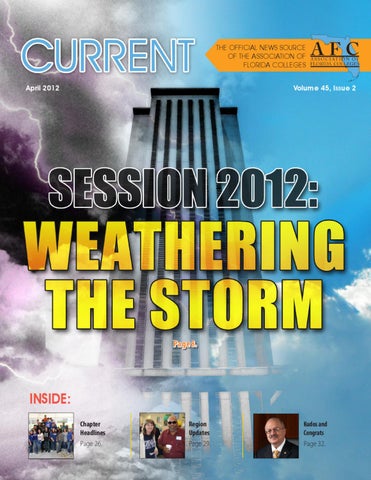
THE OFFICIAL NEWS SOURCE OF THE ASSOCIATION OF FLORIDA COLLEGES April 2012
Volume 45, Issue 2
Page 8.
INSIDE: Chapter Headlines Page 26. www.myafchome.org
Region Updates Page 29.
Kudos and Congrats Page 32. April 2012 CURRENT I 1
PRESIDENT’S MESSAGE
AFC Board of Directors EXECUTIVE COMMITTEE President Gary Sligh, Lake-Sumter Community College President-Elect Byron Todd, Tallahassee Community College
Springtime Plans By Dr. Gary Sligh, AFC President
S
and Michael Brawer headed up the pring is always a great work of our Legislative Committee time to work at a college in the important work of organizing here in Florida. The high our response and helping support humidity of summer has the advocacy that takes place not quite come to visit, many of our by our Council of Presidents, students are anticipating the end of college legislative liaisons, and their time with us with excitement trustees. Many of our members of moving on to a university or into have been involved in briefing the work-world, and we can begin sessions and have followed the to anticipate the new ideas of the Association’s Perception in an effort coming academic year. Every to stay abreast semester of change and is a new ...the Association of express our opportunity opinions. Many to change Florida Colleges has thanks to all the someone’s been busy this spring folks who have life. been involved in I must working on behalf of this mammoth admit, our colleges to address effort! however, that Spring also spring also the challenges of means regional brings the the 2012 Legislative conferences. challenges For five Fridays, that come Session beginning on with another March 30th at budget year Tallahassee Community College and the changes that come as and ending on April 27th at legislation is introduced, discussed, Broward College, our hardworking and enacted. These issues have region directors under the guidance a real impact on the quality of our of AFC Vice President Pat Barfield work moving forward. have been busy bringing together You will not be surprised to our local chapters for professional know that the Association of Florida development and good times. I Colleges has been busy this spring love the regional impact of AFC working on behalf of our colleges because it gives the executive to address the challenges of the 2012 legislative session. Jim Roy ...Continued on page 4 2 I CURRENT April 2012
“
a”
VP for Regions & Chapters Pat Barfield, Chipola College VP-Elect for Regions & Chapters Shelby Fiorentino, Valencia College VP for Commissions Joe Wallace, College of Central Florida VP-Elect for Commissions Christina Will, St. Johns River State College Immediate Past-President Evelyn Ward, Chipola College COMMISSION CHAIRS Administration Rhea Cemer, Indian River State College Adult & Continuing Education Daisy Vulovich, State College of Florida Career & Professional Employees Debi Jakubcin, Valencia College Communications and Marketing Chris Thomes, Gulf Coast State College Equity Stan Stone, Valencia College Facilities Robert Flores, South Florida Community College Faculty Jim Lansing, Broward College Healthcare Education Alice Serey, Indian River State College Institutional Effectiveness, Planning and Professional Development Rob Gregg, Pensacola State College Instructional Innovation Paul Cutlip, St. Petersburg College Learning Resources Daniel Hood, Indian River State College Occupational & Workforce Ed Eileen Storck, Indian River State College Retirees Joanne Hutton, Brevard Community College Rural Campuses TBD Student Development Joseph Sarrubbo, Valencia College Technology Paul Lefavi, Indian River State College Trustees Sean Alveshire, Broward College AFC • Making a Difference One Life at a Time
CONTENTS
APRIL 2012
29
IN THIS ISSUE 2 President’s Message
Dr. Gary Sligh
5
Executive Director/CEO Message
Michael Brawer
7
Register now for the Certified College Professional (CCP) Program
8 31
CHAPTER HEADLINES 26
Broward College AFC Chapter Raises Money
CCLA Chapter News
Valencia College AFC Chapter Helps Keep Central Florida Warm.
27
Indian River State College
Northwest Florida State College AFC Chapter
Legislative Recap and Impact of the 2012 Session
28
AFC Joint Commission Spring Conference
College of Central Florida Chapter
Florida Gateway College
34
Save the Date: 63rd AFC Annual Convention
Palm Beach State Chapter on the Move!
35
2012 Calendar of Events
Seminole State College
www.myafchome.org
REGION UPDATES 29 Region I Region Spring Conference Schedule COMMISSION NEWS 30 Register Today for the Student Development Commission Conference 31 Joint Commission Conference Information 32 Facilities Commission Spring Conference KUDOS CONGRATS 32 Miami Dade College President Receives One of Higher Education’s Highest Honors April 2012 CURRENT I 3
...Continued from page 2
AFC Board of Directors (continued)
board and staff an opportunity to experience the rich variety that our colleges represent for AFC members. Make sure that you take your new chapter members to these types of events whenever you can to get them excited about the larger work of our Association. Commissions, working with AFC Vice President Joe Wallace, also use spring to gather for business meetings, best practice demonstrations, and professional development related to the different jobs that folks perform throughout the year. From Facilities Commission at South Florida to our Joint Commissions Conference in Tallahassee to Student Development in Orlando, AFC proudly supports the concept of sharing our precious resources and learning together how to improve our colleges. And even as the spring breezes blow, I am starting to think about our Membership Conference at the Jupiter Beach Resort in July. There we will focus on one of my main goals for the year – Y10K – reaching 10,000 members in our Association by the end of 2012. With all that our Association has to offer, we certainly want to recruit new members in each of our chapters to even further enhance our work as an Association. So whatever the flavor of your springtime experience, be it graduation, travel, or even impending retirement, make sure that AFC is part of your plans. Take some time to enjoy the beautiful Florida weather and recruit a co-worker to join you in AFC for 2012.
REGION DIRECTORS Region I Kevin Peddie, Tallahassee Community College Region II Debi McElroy, Santa Fe College Region III Charlene Latimer, Daytona State College Region IV Sheryl Peterson, St. Petersburg College Region V Xiao Wang, Broward College COMMITTEE CHAIRS (Ex officio) Bylaws Bill Mullowney, Valencia College Certified College Professional Program Jeff Peters, Palm Beach State College Will Benedicks, Tallahassee Community College Community Service Jamie Rothberg, Pasco-Hernando Community College Finance, Human Resources & Retirement Issues Stanley Stone, Valencia College Legislative Jim Roy, St Johns River State College
Dr. Gary Sligh AFC President
Member Services Juanita Scott, Pensacola State College Membership Development Alex Perez, Lake-Sumter Community College Planning and Development Tina Hart, Indian River State College Policy and Advocacy Joe Pickens, St Johns River State College Wellness Debi Jakubcin, Valencia College EX OFFICIO MEMBERS Chancellor, The Division of Florida Colleges Randy Hanna The Florida College System Council of Presidents Katherine Johnson, Pasco-Hernando Community College
Santa Fe College AFC Chapter Seminole State College AFC Chapter
Parliamentarian Dan Rodkin, Santa Fe College
Tallahassee AFC Chapter
Association of Florida Colleges Michael Brawer, CEO
Support the AFC Foundation and help pay down the mortgage of the AFC Building. CLICK HERE to make an online donation. 4 I CURRENT April 2012
AFC Foundation Board Andre Hawkins, Indian River State College
CURRENT is published by the Association of Florida Colleges. Advertising, news releases, and other communications should be sent to the AFC, 113 East College Avenue, Tallahassee, Florida 32301, or by email at publications@ myafchome.org. The views and opinions expressed in CURRENT are not necessarily those of the Association of Florida Colleges, its members, directors, or officers. AFC • Making a Difference One Life at a Time
EXECUTIVE DIRECTOR/CEO MESSAGE
Legislative Session 2012: Behind Closed Doors By Michael Brawer, AFC Executive Director/CEO
“The game you are watching is not necessarily the game that is being played.
T
his quote was used at regular intervals this investment plan bodes focus on an alarming trend year by your AFC Legislative Chair, Jim in the Florida Legislature - the expanded reliance “El Capitano” Roy, from St. Johns River on conforming bills to move forward substantive State College. Jim, the SJRSC Director of policy. This trend violates the tenets of open Governmental Relations AND Orange Park Campus government and the right of the public to speak in Provost, spent 28 years in the Navy as an officer reference to law and budget changes proposed by and also worked for many years in the Capitol as the the Legislature. Most egregiously, it also makes it chief legislative aide for now Senator John Thrasher. impossible for us to lobby. Jim knows a little about legislative “strategerie”, as a Cotterell’s reference was specifically regarding former US president might say, a conforming bill, HB 5005, by the and is loaded with experience House Budget Committee. The life This trend violates and perspective on this part of of the bill began on February 2 and the business. we looked at it and found nothing the tenets of open Jim used the above quote significant about the FRS employer government and the regularly to keep our lobbying contribution rates cited therein. This right of the public to team in check and on task so “actuarial” bill is filed every year to we wouldn’t lose focus and set the rates. Similarly, SB 2006 speak in reference get distracted by what we from the Senate Budget Committee to law and budget were actually seeing happen covered several of the same changes proposed by actuarial determinations but the daily in the Capitol. And he couldn’t have been more dead two bills were not identical. So, on the Legislature. accurate in his assessment. February 23, the bills were referred Unfortunately, sometimes even to conference. This is when groups knowing what is going on doesn’t help us fight the of senators and house members come together to good fight. “negotiate” differences in similar bills. It languished A recent article in the Tallahassee Democrat by in conference until March 9, day 59 of the legislative retiring political correspondent Bill Cotterell sums session. Then, it popped out of the conference with up the use of last minute, 11th hour tactics to a dramatic “adjustment” to the employer contribution pass substantive legislation without going through for FRS members in the investment plan or optional the usual committee process. His particularly retirement plans of almost 33%. cogent piece regarding late-filed changes to the Referring back to Jim’s prognostication, the employer contribution rates for FRS members in the conference committee meetings are in public, but
“
a”
...Continued on page 6 www.myafchome.org
April 2012 CURRENT I 5
...Continued from page 5
to change law without being fully vetted in the the decisions are made behind closed doors before legislative committee process. Often, conforming the meeting even occurs. We lobbyists have no bill issues will have little direct connection to an opportunity to speak at the conference committees appropriation, and just become a vehicle to pass or participate in the back door discussions. We as substantive legislation and avoid a lobbying group know we the committee referral process. do a pretty good job, but Conforming bills Unfortunately, although somewhat very few lobbyists in any devious in practice, there is sector have the mojo to get however make nothing legally or administratively into legislative leadership on permanent changes wrong with the use of conforming day 59 of session and stop to Florida law and bills in this manner. Driven by a train. There just wasn’t powerful legislative leaders like much we could do. have become common budget chairs, conforming bills In 2012 there are 35 practice in order to become trains that are virtually conforming bills; in 2011 change law without impossible to slow down. there were 44. Usually, The result is suddenly out of there are only three or four being fully vetted nowhere, the employer retirement such bills. These types of in the legislative benefit contribution was cut bills are traditionally done by a significant amount. Talk in conjunction with an committee process. about a slap to your retirement appropriations bill but only planning. With no or minimum 18 of them this year have pay raises over the last few years, and with three that connection. Conforming bills make changes to percent yanked out of your pockets last year for statutes to conform them to directives contained in retirement, public employees like you have little the General Appropriations Act (budget). Historically, ability to make up the difference at this time. I such changes are made via “proviso” language or urge you to let your local legislators know how you implementing bills, which impact law only for the feel about this clandestine process and encourage life of the budget, usually one year. Conforming them to dissuade legislative leaders from the use of bills however make permanent changes to Florida conforming bills in this manner. law and have become common practice in order
“
a”
Help AFC Total 10,000 Members by the end of 2012 AFC’s got the tools you need to reach and recruit new members. Head over to the Membership Toolbox to get started. CLICK HERE.
Submit your news and articles for the next issue of Current before May 28. Email your news to Tina Ingramm at tingramm@myafchome.org Look for the special issue of Current in your inbox on June 18. 6 I CURRENT April 2012
AFC • Making a Difference One Life at a Time
AFC Introduces a new opportunity for professional development
Certified College Professional Program The Certified College Professional (CCP) Program will provide AFC member with the opportunity to earn a designation related to their work as a college professional, and expose them to content and experience they may not be able to obtain elsewhere. The CCP program provides significant value-added benefits for membership in the AFC and enhances the AFC’s role as the primary professional development provider for the Florida College System.
“I can think of nothing more important to a college than investing in the professional development of our people. I am excited about the opportunities this program will give participants from our college to learn from colleagues at other colleges.” —Dr. Jim Murdaugh, President, Tallahassee Community College Application Criteria: • You have been a member of the Association of Florida Colleges (AFC) for at least one year • You have been employed full-time by a Florida College System institution for at least 3 years, and you have at least one year of experience in your current position at the college • You are committed to upholding the AFC Certified College Professional “Standards of Conduct” • Your college president will suport your effort to earn the CCP
CLICK HERE to find out more about the program or to register.
February 2012 CURRENT I 7
Prepared by Association of Florida Colleges Legislative Committee Writing Team Leaders: Erin McColskey (PBSC), Susan Lehr (FSCJ) and Ed Woodruff (SPC)
W
ith one minute to spare, the Florida Legislature adjourned sine die at 11:59 PM on Friday, March 9, 2012. A total of 2052 bills were introduced, although only 292 passed both chambers. There was good news and bad news for Florida higher education in the 2012 session. In general, the Florida College System survived with only minor appropriation losses. The $70 billion dollar budget included a 2.8 percent increase for the Florida College System over previous year’s budget, and both the House and the Senate agreed to a 5 percent tuition increase. The Governor has the option to accept or reject the proposed tuition increase. However, if he uses his veto pen, Florida Statute provides College Boards of Trustees with the ability to increase tuition based on the consumer price index, which is 3 percent this year. The state universities faced a far more volatile session, absorbing an almost $300 million cut in funding, expected to be replaced by using fund balances, and dramatic tuition increases. Two universities were granted permission to charge market value for tuition. In addition, the Legislature agreed to the creation of a 12th state university. Perhaps one of the most difficult aspects of the session was the record number of conforming bills (35) which added pages of law to both the House and Senate appropriations, along with a number of bills that will have a dramatic impact, if signed into law. A bill revising the general education requirement for all of higher education will have a significant impact on college and university curriculum. The required number of general education hours was lowered from 36 to 30. Foreign language requirements must now be met as part of lower division work, which could be problematic for older returning students and could reduce completion rates. Distance learning, student advising (FACTS), and on-line education libraries were consolidated into one state-wide entity. A pilot distance learning project, targeting students who have begun but did not complete a degree, was also created. This funded project will be carried out by two universities and two colleges, and could have a significant impact on future distance learning activities. There were several subtle, but important, changes in the Florida college governance system and calls for additional studies regarding higher education governance. The Higher Education Coordinating Council (HECC) will be an important body to watch, as recommendations for Florida College System governance could be considered. The lack of Public Education Capital Outlay funding continued to create problems for the Florida College System, with only very small amounts ($5.3 million) available for all 28 colleges. No projects were funded out of PECO dollars but cash was added to fund certain colleges’ projects. The final PECO list was completely different from those passed in each chamber’s initial budgets. And, as a result, half of the colleges received no funds for renovation or remodeling. 8 I CURRENT April 2012
AFC • Making a Difference One Life at a Time
Finally, for the first time in recent legislative history, of over 300 gubernatorial appointments slated to be confirmed by the Senate, only seven were confirmed. All other appointments including hundreds of college and university trustees were not confirmed. The Governor must reappoint within forty-five days, or the appointments expire, in which case boards may not have a quorum. Even though the Session ended on March 9th, the Legislature is heading back to Tallahassee immediately. The Florida Supreme Court rejected the Senate’s redistricting plan, causing a special session to be called for Wednesday, March 14, 2012 for the purposes of redesigning several Senate districts. There is hope that the Florida economy will begin to rebound and that next year’s session will have a more positive impact on Florida’s one million state college students. General Appropriations Act (GAA) 2012-13, HB 5001 Statewide Funding In general, funding for the Florida College System and the Community College Program Fund (CCPF) was slightly increased for 2012-13 from the 2011-12 level. Lottery funding was up significantly from $130,359,158 to $180,808,060 for an increase of $50,448,902 or 39 percent. The Legislature offset this by a fund shift reduction of a like amount from General Revenue. Three million in non-recurring funding was not restored, but $2.1 million in annualization of appropriations from 2011-12 was appropriated. Operating costs for new facilities was provided at $5,204,247. FUNDING BY CATEGORY The Legislature again reduced Issue Funding 2011‐12 Funding 2012‐13 funding in the Community College Program Fund to reflect a change Community College Program Fund $130,359,158 $180,808,060 (CCPF) ‐ Lottery in Florida Retirement System Community College Program Fund employer contributions that will (CCPF) ‐ GR $893,092,474 $870,982,214 be charged for members of the Adults with Disabilities $1,030,830 $876,206 CCORP and the Investment programs in 2012-13. The changes Student Fees 8% increase 5 % increase should have no net impact on the Facilities Matching 0 0 funds available for operations. In addition, the Legislature Phillip Benjamin Matching 0 0 provided approximately $32.7 PECO General Revenue $1,440,000 $0 million to individual colleges Lottery CO & DS TF $18,776,420 $69,098,805 resulting in an overall increase in PECO $82,648,517 $0 state funding of $28.3 million or a Total Total $102,864,937 Total $69,098,805 net increase of 2.8 percent. The After veto: $XXX,XXX,XXX Legislature also authorized local boards to increase tuition by up PECO Sum‐of‐Digits $8,088,000 $5,377,488 to 5 percent. With the inclusion First Generation Matching ‐ Lottery $1,397,017 $1,327,166 of the potential increase in tuition receipts of $45.5 million, the overall College Reach Out Program $1,000,000 $1,000,000 potential increase in funding will Displaced Homemakers $1,816,434 $1,816,434 amount to 3.8 percent. Excluding the potential Public Financial Aid increase from tuition, three colleges Lottery $45,100,892 $45,100,892 Student Loan Operating TF $3,250,000 received less state funding in 2012 General Revenue (FSAG) $100,404,923 $86,206,955 13 than the college had received Total Total $145,505,815 Total $134,557,847 in 2011-12. One college had a Florida Distance Learning Consortium zero percent change in funding FACTS $590,000 (increase of $1,748). The maximum increase in state dollars was 20.9 Florida Virtual Campus This is the FCS share. SUS share $10,963,647 (FDLN,FACTS,CCLA,FCLA) is in the SUS budget. percent. Twenty-two colleges had a net change of less than 3.2%. If 2 + 2 Partnerships, SUS and FCS $3,000,000 $3,000,000 all colleges increase tuition by the ...Continued on page 10
www.myafchome.org
April 2012 CURRENT I 9
...Continued from page 9
maximum of 5%, then all colleges will experience an increase in funding. Depending on an individual college’s funding for retirement adjustments, operating cost for new facilities, lottery, legislative initiatives, and tuition the range of increase will be from 1.3 percent to 15 percent. Funding for the College Center for Library Automation was removed from being part of the CCPF allocation. The $12.8 million was transferred and appropriated as part of the new Florida Virtual Campus line item. Funding was continued for the 2+2 partnership initiative at the level of $3 million for distribution to colleges and universities. APPROPRIATIONS PROVISO, IMPLEMENTING, AND CONFORMING BILL ISSUES The Legislature has three methods to reflect funding decisions made in the General Appropriations Act (GAA) process. “Proviso” is language in the General Appropriations Act attached to a specific appropriation which directs or authorizes how the funds can be expended. An implementing bill is a substantive bill which provides instructions to enact specific provisions for a GAA appropriation or proviso by changing the law (Florida Statutes) temporarily for one year. This is necessary because the courts have ruled the GAA cannot contradict current law; however, there may be a need to temporarily suspend some provision of law. A conforming bill is also a substantive bill which may “travel” with the GAA. It differs from the implementing bill in that it makes permanent changes to Florida Statutes. In summary, proviso language and implementing bills are law for only one year and then they expire, while a conforming bill makes a permanent change in Florida law. While the Governor may veto the entire appropriations act or exercise his veto by “line item,” he does not have “line item” veto in a conforming or implementing bill but must act on the entire bill. Bills which are passed by the Legislature are sent to the Governor. The Governor may sign, veto, or allow a bill to become law without his signature. Because the Legislature has now adjourned the 2012 Session, the Governor has fifteen consecutive days from the date he receives a bill to act on that bill. Leadership of the Legislature staggers sending bills to the Governor in order to provide time to fully review the content/impact of bills. If all bills that passed during a Session were forwarded at the same time, such a review would not be possible. Following are the appropriations and Florida College System related bills passed this session: • HB 5001, General Appropriations Act • HB 5003, Appropriations Implementing Bill • HB 5201, Higher Education Conforming Bill Another term that is heard or read as the Session draws to a close is “Conference Report.” When the Senate and House of Representatives pass different versions of a bill and they are not able to agree upon common content through the amendatory process, each house appoints members (“conferees”) to a conference committee on the bills. The committee members negotiate the differences between the bills and present a mutually agreed upon version to both houses. This product is called a “Conference Report” which may only be accepted or rejected, but not amended, by each house. Although the General Appropriations Act and its related bills are commonly conferenced, there has been a growing tendency for other important bills to also be conferenced. This year, in addition to the GAA and Implementing Bills, there were 35 conference report bills. TUITION AND FEES CONTAINED IN HB 5001, THE GENERAL APPROPRIATIONS BILL Florida College System (FCS) Tuition • Proviso following Specific Appropriation 108, General Appropriations Act: Beginning with the Fall 2012 semester, tuition and fee rates are established for the 2012-2013 fiscal year as follows: • For advanced and professional, postsecondary vocational, college preparatory, and educator preparation institute programs, standard tuition for residents and nonresidents shall be $71.98 per credit hour for residents. For nonresidents, the out-of-state fee shall be $215.94 per credit hour in addition to the standard tuition of $71.98 per credit hour. • For baccalaureate degree programs, the standard tuition shall be $91.79 per credit hour for students who are residents. 10 I CURRENT April 2012
AFC • Making a Difference One Life at a Time
• For programs leading to a career certificate or an applied technology diploma, the standard tuition shall be $2.33 per contact hour for residents and nonresidents and the out-of-state fee shall be $6.99 per contact hour, in addition to the standard tuition.
Adult Education – Tuition • Proviso following Specific Appropriation 108, General Appropriations Act: For adult general education programs, block tuition will be assessed in the amount of $45 per half year or $30 per term for residents. For non-residents, the out-of-state fee shall be $135 per half year or $90 per term, in addition to the standard tuition. This reflects a continuation of the 2011-12 fees. PROVISO RELATING TO THE COMMUNITY COLLEGE PROGRAM FUND CONTAINED IN HB 5001, THE GENERAL APPROPRIATIONS BILL Adult General Education Program Transfer • Proviso following Specific Appropriations 104 and 106, General Appropriations Act: Contingent upon agreement between the Putnam County School Board and the St. Johns River State College, funding and operational responsibility for the adult general education program shall be transferred from the district to the college by July 1, 2012. Other Standard Proviso Relating to the Operational Budget • Proviso following Specific Appropriation 108, General Appropriations Act: Standard language relating to the following issues are included: • The requirement to submit an operating budget included details for planned expenditures for baccalaureate programs and the source of funds. • Language regarding the statutory fee increase if the tuition and fees specified in the General Appropriations Act become law. • Language relating to fee waivers for Workforce Development Education. • Reporting requirements for adult general education programs. • Language relating to flexibility for each college board of trustees to make adjustments to the operating budget. BACK OF THE GENERAL APPROPRIATIONS BILL SECTIONS RELATING TO THE FLORIDA COLLEGE SYSTEM • Section 12: Authorizes specific colleges to acquire or construct certain facilities from non-PECO sources. This approval allows the college to request operating cost for new facilities from the state in a future legislative budget request. • Section 13: Provides a total of $250,000,000 in funding from GR and Lottery to cover the shortfall in PECO bonding revenue. Reverts $250,000,000 in un-issued PECO bond authorizations. Section 13 addresses the outstanding $250 million Public Education Capital Outlay funding issue by replacing the bonded monies with cash. While this potentially alleviates the cash-flow issue, colleges will need to wait on the official go-ahead from the Governor and the Commissioner before moving forward with additional projects/ contracts. To be clear however, the Department of Education recommends that new contracts/projects should remain on hold for now, except for those involving life-safety issues. HB 5003, THE 2012-13 IMPLEMENTING BILL There were no provisions relating to the Florida College System contained in this year’s Implementing Bill. CONFORMING BILLS Conforming bills usually appear late in Session, often in conjunction with the adoption of a chambers appropriation bill. Such bills are necessary to “conform” certain provisions of the law to the directions contained in the General Appropriations Act (GAA) about how appropriated funds are to be expended. A conforming bill ...Continued on page 12 www.myafchome.org
April 2012 CURRENT I 11
...Continued from page 11
makes permanent changes to Florida law, while an Implementing bill makes changes in law only for the life of thee GAA, one year. In previous Legislative Sessions conforming bills adhered to long standing procedures requiring that the bill specifically address items connected to the GAA. Over the past several years it has become common practice to insert substantive bill language into the conforming bill that have a blurry connection to the GAA . This practice has the effect of changing law without the change language being vetted in the legislative committee process. The effect is that this practice limits or eliminates any lobbying effort on the issue. In addition the number of conforming bill has grown from 3 to 5 bills in a session to a record number of 44 bills in the 2011 session, and 35 bills in the 2012 session, 17 of these have no companion bill. With eight year term limits, a number of elected officials with limited legislative history appear to view this practice as “business as usual.” HB 5201, HIGHER EDUCATION CONFORMING BILL FOR THE 2012 LEGISLATIVE SESSION Auditor General Reporting Requirements Relating to Florida College System and State University System Institutions • HB 5201 Higher Education Conforming, Section 1, adding paragraph (j) to subsection (7) of section 11.45, Florida Statutes: Requires the Auditor General to notify the Legislative Auditing Committee if a college or university fails to take full corrective action in response to an audit recommendation that was included in the two previous financial or operational audit reports on the institution. Authorizes the Joint Legislative Auditing Committee to request the institution to provide a written explanation of why full corrective action has not been taken on the recommendation and, if the response is deemed insufficient, to require the chair of the governing body of the institution, or the chair’s designee, to appear before the Committee. If the Committee determines there is no justifiable reason why the institution has failed to take full corrective action on the recommendation, the Committee may direct the Department of Financial Services to withhold funds until the institution complies with the recommendation. South Florida Community College Name Change • HB 5201 Higher Education Conforming, Section 3, amends paragraph (z) of subsection (3) of section 1000.21, Florida Statutes: Authorizes South Florida Community College to change its name to South Florida State College effective upon the Southern Association of Colleges and Schools (SACS) granting accreditation of the college’s baccalaureate degree programs. Restrictions on Severance Pay Provisions of Employee Contracts • HB 5201 Higher Education Conforming, Section 4, amending subsection (47) of section 1001.64, Florida Statutes, and adding subsection (48) to that section: Requires severance pay provisions included in employee contracts at public universities and public colleges to conform with s. 215.425, Florida Statutes, which limits such pay to 20 weeks of compensation. Provides further that severance pay may not be provided when the employee is fired for misconduct. New language in subsection (48) requires each board of trustees to use purchasing agreements, state contracts, or to enter into consortia and cooperative agreements to maximize purchasing power for goods and services. The goal is to achieve a 5-percent savings on existing contracts through the use of new cooperative arrangements or new consortium contracts. Creation of the Florida Virtual Campus • HB 5201 Higher Education Conforming, Section 14, creating s. 1006.73, Florida Statutes: The Florida Virtual Campus is established which consolidates the Florida Distance Learning Consortium, FACTS.org, the Florida Center for Library Automation (FCLA), and the College Center for Library Automation (CCLA). Funding for the Florida Virtual Campus is evenly split between the Florida College System and the State University System. As part of the reorganization, FACTS.org is no longer required to provide career planning to k-12 students. Primary responsibilities of the Florida Virtual Campus are to provide access to online student services 12 I CURRENT April 2012
AFC • Making a Difference One Life at a Time
and library support services, serve as a statewide resource and clearinghouse for postsecondary education distance learning courses and degree programs, and increase student access and completion of degrees. Joint oversight for the Florida Virtual Campus is assigned to Florida College System and State University System Chancellors who shall establish the governing and reporting structure, staffing, and operating budget for the Virtual Campus. Sections 2, 7, 8, 9, 13, 14, 15, 16, 17, 18, 21, and 22 of HB 5201, the Higher Education Conforming Bill also make changes relating to the creation of the Florida Virtual Campus and the de-authorization of the current entities of the Florida Distance Learning Catalog, Florida Distance Learning Consortium, FACTS.org, the Florida Center for Library Automation (FCLA), and the College Center for Library Automation (CCLA). Degree Completion Pilot Project • HB 5201 Higher Education Conforming, Section 15, creates s.1006.735, Florida Statutes, effective upon the bill becoming law: The Pilot Project is designed to recruit, recover, and retain adult learners who have “stopped out” of college prior to attaining a degree. Students must have left college in good standing and have successfully completed college level coursework in multiple semesters. Returning students are to be assisted in obtaining degrees aligned with high-wage, high-skill workforce needs of the State. The Degree Completion Pilot Project is established within the Florida Virtual Campus with four public institutions in the Pilot. They are the University of West Florida as the lead institution, the University of South Florida, Florida State College at Jacksonville, and St. Petersburg College. The institutions are to submit a detailed project plan by August 1, 2012 to the Legislature and begin implementation in the 2012-13 academic year. The sum of $2,500,000 is appropriated for the Pilot Project. Florida College System Baccalaureate Degree Approval Process • HB 5201 Higher Education Conforming, Section 19, deletes current subsection (6) and renumbers current subsection (7) as subsection (6) of section 1007.33, Florida Statutes: Removes current language authorizing a college to apply for an exemption from State Board of Education approval of new baccalaureate degree programs. Requests for approval of future baccalaureate degree programs must be made to, and approved by, the State Board of Education, which is the current practice. Summer Bright Futures Pilot Program at the University of Florida • HB 5201 Higher Education Conforming, Section 20: Clarifies that a Bright Futures Scholarship Award recipient attending the University of Florida may receive an award for two semesters or the equivalent per fiscal year including the summer semester. This language may be expanded to include institutions in the Florida College System if the pilot project shows students will attend in the summer term. Increase in the Student Fee for Capital Improvements (CIF) • HB 5201 Higher Education Conforming, Section 21, amending section 1009.23, Florida Statutes, to: Allows a local board of trustees to increase the charge for the Capital Improvement Fee over time from up to 10-percent of tuition to as much as 20-percent of tuition per credit hour for resident students. The maximum increase in any given year remains limited to $2 per credit hour over the prior year. Fee Exemption for Workforce Education Program Students • HB 5201 Higher Education Conforming, Section 23, amending subsection (1) of section 1009.25, Florida Statutes: Amends language to specify that exemptions from tuition and fees, including lab fees at a school district, Florida College System college, or state university apply to students in workforce education programs and not postsecondary career programs. Excess Hour Surcharge • HB 5201 Higher Education Conforming, Section 24, amending sections (2) and (7) of section 1009.286, Florida Statutes: ...Continued on page 14 www.myafchome.org
April 2012 CURRENT I 13
...Continued from page 13
For First Time In College (FTIC) students who enroll in the State University System in 2012-13, and who maintain continuous enrollment, a 100% tuition surcharge is established for hours over 110% of the required number to receive specific baccalaureate degrees. Currently enrolled students who maintain continuous enrollment continue to be grandfathered under the provisions regarding excess credit hours at the time the student was an FTIC. NOTE: Does not expand the excess hour surcharge to include students attending Florida College System institutions. Bright Futures Scholarship Eligibility Requirements • HB 5201 Higher Education Conforming, Section 25, amending sections (2) and (7) of section 1009.531, Florida Statutes: Provides that high school students graduating in the 2012-13 academic year and thereafter will have 2 years instead of 3 years to accept an initial award. Students will have 5 years after high school graduation to receive renewal awards. Grounds for an extension of one year to renew an award are specified as a verifiable illness or other documented emergency. To be eligible for an initial award or to renew an award, students will be required to submit a Free Application for Federal Student Aid. Currently, only initial award applicants are required to submit the form. Bright Futures Gold Seal – Renewal Awards and Gold Seal Awards • HB 5201 Higher Education Conforming, Section 26, amending subsection (3) of section 1009.532, Florida Statutes: Limits use of the Bright Futures Scholarship to 100 percent of the number of credit hours to complete an associate or baccalaureate degree program, or a postsecondary career certificate program for students initially eligible in the 2012-13 academic year. Florida Gold Seal Vocational Scholars awards are limited to 100-percent of the hours required to complete one of the following: applied technology diploma programs (up to 60 credit hours or the equivalent), technical degree or career certificate programs (not to exceed 72 credit hours or the equivalent). Bright Futures Award Amounts to be Specified in the General Appropriations Act • HB 5201 Higher Education Conforming, Section 27, 28, and 29: Specifies that the award amount for each Bright Futures Scholarship Program shall be the amount set in the General Appropriations Act. Removes existing language tying the award amounts to tuition and fees. Restrictions relating to secondary school career credits are removed. To receive the Florida Medallion Scholars Award or the Florida Gold Seal Vocational Award, home school students are required to complete a program of community service work the same as are public high school students. NOTE: An Increase in the Grade Point Average for renewal of Bright Futures awards was not included in the Final Version of the Bill Review of Significant Findings in an Audit at a Public Meeting of a Board of Trustees • HB 5201 Higher Education Conforming, Section 35, amending section (2) and of section 1010.30, Florida Statutes: Provides that if a Florida College System institution has a significant finding in an audit, the board of trustees shall conduct an audit overview during a public meeting. Co-Enrolled Student Funding and Fees • HB 5201 Higher Education Conforming, Section 36, amending section 1011.80(10), Florida Statutes: Authorizing students who are co-enrolled in core curriculum courses for credit recovery or dropout prevention during 2012-2013 and do not have a pattern of excessive absenteeism or habitual truancy or a history of disruptive behavior in school, to be reported for funding for up to two courses per student. These students are exempt from being charged adult general education tuition. Contract Language for Administrative and Instructional Staff • HB 5201 Higher Education Conforming, Section 37, amending section 1012.83, Florida Statutes, to: 14 I CURRENT April 2012
AFC • Making a Difference One Life at a Time
Requires that each contract or employment agreement, or renewal or renegotiation of an existing contract or employment agreement which contains a severance pay provision must include the following provisions in the contract: • A requirement that severance pay provided may not exceed an amount greater than 20 weeks of compensation. • A prohibition of provision of severance pay when the officer, agent, employee, or contractor has been fired for misconduct, as defined in s.443.036(29), by the unit of government.
Restrictions on the Remuneration of Florida College System Presidents and Administrative Employees • HB 5201 Higher Education Conforming, Sections 38, and 39 Continues for fiscal year 2012-13, the current restrictions against using state appropriated funds in excess of $200,000 to pay the salary of presidents or administrative employees. HB 5101, K-12 EDUCATION CONFORMING BILL FOR THE 2012 LEGISLATIVE SESSION Educational TV and Radio • Removes educational radio from exemptions and support in law, while allowing educational television to continue. Charter Schools • Changes calculation of administrative fee charged for charter schools with 75% or more exceptional students Department of Juvenile Justice • Amends funding, via the Florida Education Finance Program (FEFP) Reading • Creates new emphasis on improving reading in k-12 system, with new standards and requirements, including need to use certified reading coaches K-12 Facilities • Creates K-12 Facilities Funding Task Force to address equitable funding for charter and public schools. PROPOSED COMMITTEE BILL, (PCB) A Proposed Committee Bill (PCB) is a bill that is written by a substantive committee as a result of an interim committee project or at the request of a member serving on the committee. In past sessions a PCB would be published early in the session, then discussed and voted on in the committee of origin, given a bill number and referred to committees of jurisdiction for discussion and debate. The bill rose or fell on its merits as determined by the committee process. It was understood that PCB’s had leadership and or committee chairman backing and would be difficult to amend. Never the less, the process provided the public and interested parties the opportunity for input prior to final legislative action and, hopefully, resulting in better legislation. This year, PCBs affecting postsecondary education were introduced later than usual in the session. One 30plus page bill, with significant Higher Education policy changes, was released on day 49 of the 60 day session, and was scheduled on the agenda of its only committee of reference three days later on day 52. If this practice continues and grows, as has been the experience with the conforming bill process, the ability to affect system changing legislation will be severely impacted. BILLS THAT PASSED Note: The first bill number shown is the bill that passed. The number and bill sponsor in the parentheses was the companion bill. Postsecondary Education: HB 7135 by the House Education Committee and Proctor (CS/CS/SB 1366 by Gaetz and the Budget Subcommittee on Higher Education Appropriations and Lynn) ...Continued on page 16 www.myafchome.org
April 2012 CURRENT I 15
...Continued from page 15
Many sections of statute are created and amended as follows: • SUS Planning and Performance • Requires that the Board of Governors (BOG) strategic plan address • goals and objectives for the SUS and each constituent university, but also each university’s contribution to overall system goals and objectives. • performance metrics and standards common to all institutions and standards and metrics unique to each institution, depending on the institutional mission. • Establishes a formula for state university performance funding for engineering and technology programs that have high employment outcomes. • FCS Planning and Performance • Directs the State Board of Education (SBE) to clarify the mission statements of each FCS institution and its role within the system as a whole, including • the role of each institution in baccalaureate degree production and establish criteria for baccalaureate degrees service delivery areas. • performance metrics and a plan that specifies goals and objectives for each FCS institution. • FCS Baccalaureate Degrees • Amends the language related to FCS institution notice of intent to propose a baccalaureate degree program to • include independently-determined workforce demand and unmet need data • repeal the unused provision allowing FCS institutions to bypass SBE approval for additional baccalaureate degrees • require evidence that there have been discussions with SUS and other regionally accredited providers in the service area. • Requires each FCS institution offering baccalaureate degree programs to annually report its status using specific performance and compliance indicators. • Authorizes the SBE to require modification or termination of baccalaureate programs offered by FCS institutions. • STEM Plan • Requires the SBE, in consultation with the BOG and the Department of Economic Opportunity (DEO) to adopt a unified state plan for Science, Technology, Engineering, and Mathematics (STEM). • FCS issues • Allows the SBE to ask FCS District Boards of Trustees to evaluate the performance of presidents based on system, as well as institutional, goals. • Authorizes the Commissioner or his/her designee to conduct a review or investigation at any College if such College takes actions inconsistent with sound financial, management or academic practice. • AA student advising • Requires the Articulation Coordinating Council (ACC) is to have each FCS student identify a desired baccalaureate degree, by institution of interest, by time the student earns 30 credits. The FCS institution must then notify the student of degree program prerequisites. • General Education • Revises general education and foreign language requirements beginning with students initially entering a FCS institution in 2014-15 • Reduces the requirement from 36 semester credit hours to 30 semester credit hours for an associate or baccalaureate degree. • Requires the SBE and the BOG to jointly convene faculty committees to identify statewide general education core course options. General education core course options must consist of a maximum of five courses within each of the subject areas of communication, mathematics, social sciences, humanities, and natural sciences. 16 I CURRENT April 2012
AFC • Making a Difference One Life at a Time
• Requires competency in a foreign language, pursuant to s. 1007.262, F.S., to obtain an Associate in Arts degree.
• Student information on careers • Requires the DEO to annually, beginning December 31, 2013, prepare an economic security report of employment and earning outcomes for degrees or certificates earned at a public postsecondary educational institution. Report must be provided to public high school and postsecondary students. • Private sector student data • Requires all private postsecondary institutions to submit student-level data to appropriate state level entities for each student that receives state funds. Acceleration Options, CS/CS HB 7059 by K-20 Innovation (CS/CS SB 1368 by Gaetz) • Creates Academically Challenging Curriculum to Enhance Learning (ACCEL) • Requires K-12 principals and school districts to establish eligibility for ACCEL options and the process for parents to request participation. Extensive work for principal and district. • At minimum, each school must offer the following ACCEL curriculum enhancements and acceleration options: whole grade promotion, mid-year promotion, subject matter acceleration, virtual instruction in higher grade level subjects and Credit Acceleration Program (credit by exam). Also lists other options. • Replaces the Inter-institutional Articulation Agreement with the dual enrollment articulation agreement. Requires FCS president to develop and implement jointly with school districts a comprehensive dual enrollment agreement. • K-12 Student and parent rights, requires notification of options for early or accelerated high school graduation. •
Early High School Graduation • Option to graduate early once completed 24 credits in specific courses. • Defines “graduating” in less than 8 semesters or the equivalent. • If graduate early, can get Bright Futures scholarship for spring college term. • Allows districts to receive funding for students who obtain more than 6 credits per year (e.g. end-ofcourse Algebra I without taking course). • Requires parents to be advised of options, requires high schools to notify parents if student is eligible to graduate early. • Students may participate in all high school activities, class ranking, graduation, etc.
• End-of-Course Assessments • Establishes performance based budgeting for Algebra 1, Biology 1, and Geometry courses for students who pass assessments (begins in 4th year of administering the end-of-course exams). • Requires the assessment for Algebra I to be administered four times each year, beginning with the 2012-13 school year. As of the 2011-12 academic years, Algebra I is the only must pass end-of-course assessment. Per current law, Biology I and Geometry assessments will also be “must pass” beginning in the 2012-13 school year, but the bill does not require four administrations of those assessments. Accordingly, they will only be administered three times per year. • Dual Enrollment • Eliminates the exemption from FCS admission standards for secondary students taking a college-level course outside of the dual enrollment program. A student who is enrolled in postsecondary instruction that is not creditable toward a standard high school diploma may not be classified as a dual enrollment student. • By eliminating this exemption, the bill prohibits the practice of “credit in escrow,” which allows a high school student, who does not qualify for dual enrollment, to enroll in and pay for college courses that do ...Continued on page 18 www.myafchome.org
April 2012 CURRENT I 17
...Continued from page 17
•
•
•
•
•
•
•
•
•
•
• •
•
not count toward high school graduation. In the past, credit was held until the student graduated from high school and enrolled in postsecondary. If a student enrolls in a postsecondary course and graduates from HS before that course is completed, the student may not register through dual enrollment. They may apply and take the course but would be required to pay tuition and fees. For dual enrollment eligibility the bill requires a 3.0 GPA and minimum score on a CPT established by SBOE. Continued eligibility is 3.0 GPA in HS and the GPA established by the postsecondary institution. Students may lose eligibility if they are disruptive to the learning process. Eligibility for initial and continued enrollment in career certificates dual enrollment courses must include a 2.0 HS GPA, exceptions may be granted on an individual basis if educational entities agree and those terms are in the articulation agreement. Colleges may impose additional requirements, which must be in the dual enrollment articulation agreement. Establishes that course requirements and curriculum standards taught on the high school campus must be identical to those taught on campus and include same materials. The college must advise the school district of materials requirements as soon as that information becomes available but no later than one term before a course is offered. Faculty and curriculum standards must be consistent with SACS. Faculty must be treated the same as all other college faculty (evaluation, handbook, etc.) Faculty must observe the procedures and deadlines of the postsecondary institution for the submission of grades. The bill prohibits the combination of dual enrollment courses and other high school courses. This prohibits a school district from offering dual enrollment credit to a portion of students within a class (including advanced placement), even though all students are performing the same coursework. (Repeals 1007.272). Students are required to choose which credit they wish to pursue at the beginning of the course. The bill clarifies that district school boards may not refuse to enter into a dual enrollment articulation agreement. Provides that a FCS institution may limit dual enrollment participation based upon capacity. Any limitation based upon capacity must be clearly specified in the dual enrollment articulation agreement. Requires the School District to annually assess the demand for dual enrollment and provide that information to each partnering postsecondary institution. Prohibits discrimination against dual enrollment courses. Clarifies that grade discrimination against dual enrollment courses is prohibited. Requires postsecondary institution to assign letter grades to each student in dual enrollment and that grade will be posted to the student’s high school transcript by the school district. Requires district superintendent and FCS president to develop a comprehensive dual enrollment articulation agreement with each appointing members to serve on a joint committee for the development of such agreement. Elements of the agreement are specified.
• Early Admission • Student must enroll in a minimum of 12 college credit hours per semester but may not be required to enroll in more than 15 college credit hours per semester. • Each home schooled student requires an articulation agreement with the college; the elements are specified. • Career Themed Courses • Defines career-themed course – leads to an industry certification. • Provides that students completing a career-themed course must be provided opportunities to earn postsecondary credit if the credit of the career-themed course can be articulated to a postsecondary institution approved to operate in the State. NOTE: this could be utilized by private postsecondary institutions as a recruitment effort. Colleges should work with districts to articulate as much as possible. • Provides that partnerships with postsecondary institutions shall be delineated in articulation agreements and career and professional academy courses or career-themed courses that add postsecondary credit. 18 I CURRENT April 2012
AFC • Making a Difference One Life at a Time
• Changes existing strategic 5 year plan required to be coordinated by the school district to be a 3 year plan – working with workforce boards, postsecondary institutions, etc. • Adds requirement for the 3 year plan to be developed jointly by the local school district, regional workforce boards, economic development agencies, and state approved postsecondary institutions to include: 1003.491 (3) (q)“strategies to redirect appropriated career funding in secondary and postsecondary institutions to support career academies and career themed courses that lead to industry certification.”
• Bright Futures • A student, who graduates from high school midyear, must apply no later than August 31 of the student’s graduation year in order to be evaluated for and, if eligible, receive an award for the current academic year (Spring Semester). • A student who receives an initial award during the spring term shall be evaluated for scholarship renewal after completion of a full academic year, which begins with the fall term. Preeminent Universities, HB 7129 by Education Committee (CS/CS/SB 1752 by Oelrich and Lynn) • Establishes the criteria for State Universities to become universities of Academic Excellence and National Universities of Preeminence. • Allows Universities that acquire the national status of Preeminence to establish market rate tuition and fees that are differentiated from other Florida public Universities • Allows these universities to establish their own core courses of 9-12 hours, and accelerated credit is excluded. Accelerated credit may, however, count towards graduation. Postsecondary Education (USF Polytechnic / Florida Polytechnic University), SB 1994 by Budget Committee This legislation eliminates a regional campus of the University of South Florida (USF) and establishes a new state university. Since 1988, USF has had a regional campus (first “USF Lakeland” and, since 2008, “USF Polytechnic”) on a joint-use campus owned by Polk State College in Lakeland. In 2011, the Board of Governors established a “path to independence,” whereby the regional campus could achieve independence after first gaining campus-level SACS accreditation as a part of the USF system and achieving certain other benchmarks. This legislation supersedes that BOG plan, creating a new institution and eliminating the regional campus. • Creates a new state university, Florida Polytechnic University, focused on STEM and STEM-related fields. • Requires that USF continue to serve all of the current, regional campus students through a “teach-out,” thus allowing those students to complete USF degrees locally. • Assigns all space on the joint-use campus to Polk State College as space is vacated by USF’s “teach-out.” • Designates the University of Florida as an advisory institution to the Florida Polytechnic Board of Trustees and President in matters related to accreditation and administration. Personnel Records SB 878 by Benacquisto (CS/HB 1465 by Caldwell) • Amends provisions of law relating to limited access personnel records of Florida College System employees, ostensibly to conform with Regulations and law relating to SUS employees. Specifies what records are considered limited access and opens non-academic evaluations to public inspection • Provides that such limited access records include only: • Records containing information reflecting academic evaluations of employee performance; however, the employee and officials of the institution responsible for supervision of the employee shall have access to such records. • Records maintained for the purposes of any investigation of employee misconduct, including, but not limited to, a complaint against an employee and all information obtained pursuant to the investigation of such complaint; however, these records become public after the investigation ceases to be active or when the institution provides written notice to the employee who is the subject of the complaint that the institution has either: 1. Concluded the investigation with a finding not to proceed with disciplinary action; ...Continued on page 20 www.myafchome.org
April 2012 CURRENT I 19
...Continued from page 19
2. Concluded the investigation with a finding to proceed with disciplinary action; or 3. Issued a letter of discipline. • Records maintained for the purposes of any disciplinary proceeding brought against an employee; however, these records shall be open to inspection by the employee and shall become public after a final decision is made in the proceeding. • Records maintained for the purposes of any grievance proceeding brought by an employee for enforcement of a collective bargaining agreement or contract; however, these records shall be open to inspection by the employee and by officials of the institution conducting the grievance proceeding and shall become public after a final decision is made in the proceeding.
State Information Technology HB 5011 by Appropriations Committee, Grimsley • Creates the Agency for State Technology (AST) and authorizes a transfer of all records, property, funding balances, administrative authority and administrative rules from the Agency for Enterprise Information Technology to the Agency for State Technology. • Establishes the Agency for State Technology within the Executive Office of the Governor making the head of the agency the Governor and Cabinet. Provides requirements and duties for the executive director of the executive agency, who will be the state’s Chief Information Officer (CIO). • Requires the CIO and Agency for State Technology to develop an Information Technology Strategic Plan for Florida that establishes a mission, goals, and objectives for the use of information technology in state government information and services; the plan shall be submitted to the House Speaker and Senate President beginning October 1, 2013 and biennially thereafter. • Defines the duties and responsibilities of the AST, including inventory of state’s information technology resources and the provision of project management oversight of the state’s agency data center consolidations. • Repeals statutory provisions relating to the Agency for Enterprise Information Technology. Protection of Vulnerable Persons CS/CS/CS/HB 1355 by Dorworth (CS/CS/SB 1816 by Benacquisto) • Currently child abuse and sexual abuse laws require all adults to report child abuse to the Florida Child Abuse Hotline when a caregiver (definition only includes parent, legal custodian, adult household member, etc.) commits abuse. The bill amends child abuse reporting laws by providing that all adults must report child abuse committed by any person, not just caregivers. • Establishes a $1 million fine (for each violation) for any Florida College System institution, state university, or nonpublic college, university, or school, whose administrators knowingly and willfully, upon receiving information from faculty, staff, or other institution employees, fail to report known or suspected child abuse, abandonment, or neglect committed on the property of the institution, or during an event or function sponsored by the institution, or who knowingly and willfully prevent another person from doing so; or whose law enforcement agency fails to report known or suspected child abuse, abandonment, or neglect committed on the property of the institution, or during an event or function sponsored by the institution. Retirement, HB 5005 Conference Report • Establishes the Employer and Employee contribution rates for both the Defined Benefit (Pension) plans and the Defined Contribution (Investment) plans. • The amount contributed by an employee in either plan remains at 3%. • For the defined contribution (Investment) plans, the employer contribution rate has been lowered.The Legislature is reducing the employer contribution over time, with the goal of having the contribution to the pension plan and the investment plan be the same. Retirement, CS/HB 7079 by Patronis (CS/CS/SB 2024 by Government Oversight) • Clarifies language as it pertains to Defined Contribution (Investment) plans. Provides the ability for Investment plan members to withdraw funds from plans three months after termination. • Provides that Investment plan members can withdraw 10% of the invested funds one month after termination if retirement age defined as being age 65 or vested after eight years whichever is later. 20 I CURRENT April 2012
AFC • Making a Difference One Life at a Time
• Clarifies participation in DROP by employees who elect to participate after July 1, 2011 as being age 65 or the requisite number of service years. Veterans and Military Omnibus Bill CS/CS/SB 922 by Bennett (CS/CS/977 by Nelson and other House and Senate Bills) • Amends the Florida “Service-Disabled” Veteran Business Enterprise Opportunity Act by opening the provisions to all veterans of wartime service (as defined in state statute and federal law). (See also SB 152/ HB 977) • Provides requirements, definitions and provisions relating to requirements in public contracting/vendor preference • Requires priority registration at public higher education institutions for recipients of G.I. Bill benefits or their spouse or dependents if the institution has any priorities for course registration until such eligibility for the G.I. Bill expires. (See also HB 45 by Smith) • Encourages private institutions to implement the same plan • Contains many provisions relating to further expanding Florida’s reputation as the most veteran and military friendly state in the nation, but unrelated to educational issues • NOTE: One provision removed from the final bill (also contained in SB 164/ HB 131) would have allowed ANY veteran who attended the physical location of a public higher education institution to be classified as a resident immediately for in-state tuition rates. Priority Course Registration for Veterans, CS/HB 45 by Smith (SB 94 by Fasano) • Requires that if a public institution of higher education offers priority course registration to any segment of students, then the institution must also provide priority course registration for veterans of the United States Armed Forces receiving education benefits under the G.I. Bill or to their spouse or dependent children receiving those benefits transferred from the veteran, until those benefits expire • Encourages private institutions to provide similar priority registration as the public institution requirements College Credit for Military Training, HB 347 by Harrell (SB 532 by Altman) Requires the Board of Governors (university system) and the State Board of Education (Florida College System) to adopt rules and procedures enabling members of the military and veterans to earn academic credit at public higher education institutions for college level training and education acquired while serving our nation. Digital Learning, CS/CS/HB 7063 by K-20 Innovation Subcommittee and Stargel (CS/CS/SB 1402 by Gardiner) Applicable to institutions that have charter schools or are virtual providers under section 1002.45, Florida Statutes. • Refers to digital technology in public education and public charter schools. • Further clarifies virtual education, expands virtual offerings to K-5th grade and defines blended learning courses. • Strengthens criminal penalties for fraudulently misrepresenting identity when taking exams for others. • Clarifies funding for virtual instruction. Administrative Authority, CS/HB 7055 by Gaetz, M. (CS/SB 1312 by Gaetz, D.) • In response to the Florida Supreme Court decision in Whiley v. Scott, clarifies Legislative authority to organize and delegate powers of the administrative departments (executive state agencies) to be directly supervised by the Governor. • Clarifies oversight of the administrative policy and rulemaking granted to such departments, which must be conducted according to the Administrative Procedure Act (APA), and ensures that non-elected agency heads serve at the pleasure of the Governor and cannot exercise any power independent from the Governor’s direction and supervision. Legal Notices, CS/CS/HB 937 by Workman (CS/CS/SB 292 by Bennett) • Requires legal notices to be placed, at no extra charge, on a newspaper’s website the same day it is published ...Continued on page 22 www.myafchome.org
April 2012 CURRENT I 21
...Continued from page 21
in the paper. Newspapers charging for online access are required to provide a free ‘link’ to view the legal notices. • In addition to publishing legal notices online at the newspaper’s website, newspapers are required to place the notice on a statewide repository website (www.floridapublicnotices.com) to be established and maintained by the Florida Press Association. • Limits the rate that may be charged for certain government notices required to be published more than once. Electronic Filing of Construction Plans, CS/HB 387 by Ahern (CS/CS SB 600 Bennett) Provides for the electronic filing of construction plans if a building code administrator or building official provides for electronic filing. Includes construction plans, drawings, specifications, reports, final documents or documents prepared or issued by a licensee. The licensee may date and electronically sign and seal the document. The licensee may electronically transmit the document for approval. Building Construction and Inspection, CS/CS/SB 704 by Bennett (CS/CS/HB 651 by Davis) (Sent to Governor 03/08/2012. Governor must act on this bill by 03/23/12) • Clarifies that bid openings must occur in public meetings (note that State Requirements for Educational Facilities already had this requirement) • Allows building code administrators and building officials to approve electronic filing of building plans and related documents • Allows fire safety inspectors with five years of experience to sit for the building code inspector or plans examiner exams. • Addresses a variety of issues related to contractor licensing. • Provides local governments with greater flexibility in notifying code violators of violations. Environmental Regulation, CS/CS/CS/CS/HB 503 by Patronis (CS/CS/CS/SB 716 by Bennett) • Creates, amends, and revises prior Florida Statutes related to environmental regulation and permitting by local, state and federal for the purpose of development. • Among the provisions that impact Florida’s colleges, the act authorizes expedited permitting for certain commercial or industrial development projects that individually or collectively create a minimum number of jobs. Denial of development permits from agencies will require written notice to the applicant and rationale for denial of permit based on applicable ordinance, rule or statute. Public Records, CS/ HB 629 by Hooper (CS/SB 916 Oelrich) Relating to the inspection or copying of public records: • Defines the term “telephone numbers” to include home telephone numbers, personal cellular numbers, personal pager telephone numbers and telephone number associated with personal communication devices. • Expands current law which provides for public record exemptions for identification and location information of certain public employees and their spouses and children to include their dates of birth. Included among the categories of employees identified is current or former human resource, labor relations, or employee relations directors, assistant directors, managers, or assistant managers of any local government agency or water management district whose duties include hiring and firing employees, labor contract negotiation, administration, or other personnel-related duties, • Specifies that the exemptions apply retroactively. Financial Emergencies: SB 368 by Gaetz (HB 7031 by the House Economic Affairs Committee and Hukill) • This bill allows entities in a state of financial emergency to consult with other governmental bodies regarding the consolidation of administrative and support services. Plans created to end a financial emergency must include provisions implementing any consolidation, sourcing, or discontinuance of administrative direction or support services. In addition, this bill provides that governing board members who fail to resolve a financial emergency may be suspended from office by executive order. The bill also amends the approval process for special assessments designed to improve business and historic districts in municipalities. • The bill indirectly affects Florida College System institutions if specific costs and services (building inspections, fleet management, insurance, IT and purchasing) can be coordinated to save taxpayer dollars. If a District Board of Trustees fails to resolve a financial emergency, Board members would be guilty of malfeasance and 22 I CURRENT April 2012
AFC • Making a Difference One Life at a Time
neglect of duty and subject to removal. (Cosmetology) Business and Professional Regulation, CS/CS 887 by Business and Consumer Affairs Committee (CS/CS/SB 1252 by Jones, D.) • Revises continuing education provider and course approval procedures for cosmetology • Revises procedures for cosmetology licensure by endorsement; allows anyone licensed in another state to receive a license in Florida. The board may not require proof of educational hours if the license was issued in a state that requires 1,200 or more hours of pre-licensure education and passage of a written examination. This does not apply to applicants who received their license in another state through an apprenticeship program. • Authorizes the performance of cosmetology and specialty services in a location other than a licensed salon under certain circumstances. Dental Hygienists, SB 1040 by Bogdanoff (CS/HB 1313 by Corcoran) (Presented to the Governor on March 8, 2012. Governor must act on this bill by March 23) • Revises the examination process for graduates of accredited dental hygiene programs or colleges, and specifies that the examination shall be the Dental Hygiene Examination produced by the American Board of Dental Examiners, Inc. (ADEX). • Permits dental hygienists to administer local anesthesia, under the direct supervision of a dentist, to adult patients. Department of Health will provide anesthesia certification. To obtain this, the hygienist must complete a 60 hour course in the administration of local anesthesia offered by an accredited program, and must also be currently certified in basic or advanced cardiac life support. Radioloical Personnel: CS/HB 309 by Oliva (CS/SB 376 by Flores) • Creates a new licensure type called the “specialty technologist” for a licensed radiologic technologist, adding a skill modifier called the “specialty technologist” to the existing radiology technologist license. • provides guidelines for the titles and title abbreviations that specialty technologists may use to designate the various certifications they hold in Florida. • authorizes DOH to issue a certificate by endorsement to practice as a specialty technologist and collect a nonrefundable fee not to exceed $100 if the applicant demonstrates that he or she is currently certified or registered by a national organization in an advanced, post primary, or specialty area. Continuing Education for Athletic Trainers and Massage Therapists: HB 4163 by Hudson (CS/SB 1258 by Benacquisto) Eliminates the requirement for athletic trainers, licensed or certified pursuant to Part XIII of Chapter 468, Florida Statutes, and massage therapists, licensed or certified pursuant to Chapter 480, Florida Statutes, to complete a continuing education course on HIV and AIDS as part of biennial re-licensure and recertification. Reducing and Streamlining Regulations: CS/ HB 517 by the Committee on Business and Consumer Affairs (CS/CS/SB 762, by Hays) • Establishes general licensing provisions for the Department of Business and Professional Regulation, including the authority to charge licensing fees. Provides an inactive licensee may change his or her status to active provided the licensee meets all requirements for active status, pays the appropriate fees, and meets all continuing education requirements. • Reduces regulatory requirements for professions and businesses, and streamlines regulatory functions primarily for programs under the Department. Only professions that involve colleges are listed below, including: • reduces the required continuing education requirements to reactivate an inactive license to only one cycle of hours required, instead of the hours required for the years the license was inactive; • decriminalizes specified violations of several professional boards’ rules and administrative requirements that currently carry second-degree misdemeanor fines and penalties; • allows greater reciprocity of architect licensees and modifies the internship requirements to make ...Continued on page 24 www.myafchome.org
April 2012 CURRENT I 23
...Continued from page 23
Florida consistent with other states to improve licensing mobility for architects; amends ss. 468.8317 (home inspector license), 468.8417 (mold assessor remediator license), 477.0212 (cosmetologist license), 481.217 (architect or interior designer license), 481.315 (landscape architect license), 489.116 (contractor license), and 489.519 (electrical contractor license).Florida Statutes, reducing the amount of continuing education a licensee must complete to the equivalent of one renewal cycle before reactivating an inactive licensee. • The bill decriminalizes violations of administrative rules and certain statutes by amending the criminal penalty provisions of specific practice acts. State attorneys may still file criminal charges against a licensee for more serious violations. The applicable regulatory board will still be able to impose administrative discipline against a licensee for violating administrative rules under the following statutes: Florida Board of Auctioneers, under s. 468.389(1)(j), F.S. Florida Real Estate Commission, under s. 475.25(1)(e), F.S. Florida Real Estate Appraisal Board, under s. 475.624(4), F.S. Barbers’ Board, under s. 476.204(1)(i), F.S. Board of Cosmetology, under s. 477.029(1)(i), F.S. •
• Authorizes distance learning courses as an acceptable alternative to classroom instruction for renewal of a real estate instructor permit; provides that distance learning courses are under the discretion of the school offering the real estate course; and requires distance learning courses to adhere to certain requirements. Department of Health, CS/CS/CS 1263: by Hudson and the Health and Human Services Quality Services Committee (CS/SB 1824 by Garcia) • Changes which impact FCS include: • Changes the requirement for a Certified Nursing Assistants certification applicant to complete the curriculum developed under the Department of Education to a curriculum developed by the Enterprise Florida Jobs and Education Partnership grant. That group will set the minimum score established by rule of that board on the nursing assistant competency exam. • Transfers the nursing student loan forgiveness program from Department of Health to the Department of Education. • Requires the Board of Nursing to deny a program application for a new pre-licensure program if the institution has an existing program that is on probationary status. • Places the regulatory board for emergency medical technicians and paramedics under the Department of Health, Division of Medical Quality Assurance. Certification of 911 Public Safety Telecommunicator: CS/ HB 1227 by Drake (CS/SB 514 by Dean) • Waives the requirement for certification as a 911 public safety telecommunicator for sworn state-certified law enforcement officers that have passed the 911 public safety telecommunicator exam if: • The officer is selected by the chief executive of their agency and • The officer performs as a 911 public safety telecommunicator on an occasional or limited basis • Changes the exam from one “administered” by the Department of Health to one “approved” by the Department Communications Services Taxes, CS/HB 809 by Grant (CS/CS/CS/SB 1060 by Bogdanoff) • Updates and modernizes a number of definitions related to the communications services tax. • Creates a Communications Services Tax Working Group, housed for administrative purposes, within the Department of Revenue. • consists of 9 members chosen from the Department of Revenue, Industry representatives, counties, and municipalities • to review national and state tax policies, Florida tax revenue history, bonding issues, fairness of laws, and options. • to prepare a report by February 1, 2013. Regional Workforce Boards, CS/HB 7023 by Business and Consumer Affairs Subcommittee (CS/CS/SB 1398, Gardiner) 24 I CURRENT April 2012
AFC • Making a Difference One Life at a Time
• Provides for at least fifty percent of the Title I funds for Adults and Dislocated Workers that are passed through to regional workforce boards to be allocated to and expended on Individual Training Accounts (ITAs) unless a regional workforce board obtains a waiver from Workforce Florida, Inc. • Expands the list of allowable expenditures for ITAs to include books and fees of training providers and other training services prescribed and authorized by the Workforce Investment Act of 1988. • Limits the total membership of each local regional workforce board to the minimum membership required under Federal law. However, upon approval by the Governor the local elected official may appoint additional members. Requires that a private nonprofit provider and a private for-profit provider be appointed to the board, if a public education or training provider is represented. • Requires each member and the executive director or designated person responsible for the operational and administrative functions of a regional workforce board to file a disclosure of financial interest if they are not already required to file a financial disclosure according to law. • Provides authority for the Governor to remove any member of a regional workforce board for cause. • Requires workforce boards to provide the greatest possible choice of training providers to those who qualify for training services. Prohibits a board from limiting the choice of training providers based upon cost, location, or historical training arrangements, but allows a board to restrict the amount of training resources available to any one client. • Requires that any contract between a regional workforce board and a member of the board, or a contract between a board and a relative of a member or employee of the board, has to be approved by a two-thirds vote of the board after a quorum is established. Any such contract in excess of $25,000 must also be approved by Workforce Florida, Inc. • Requires Workforce Florida, Inc., to evaluate the development of a single, statewide workforce-system brand for Florida and submit a report to the Governor, the President of the Senate, and the Speaker of the House of Representatives by November 1, 2012. • Provides that state workforce services participants in an adult or youth work experience activity are considered employees of the state for the purpose of workers’ compensation coverage. Disabled Parking Permits, CS/SB 226 by Margolis (CS/HB 27 by Julien) Provides that fines for parking in a handicapped space shall be waived if a person provides to law enforcement agency or parking enforcement specialist or agency who issued the citation proof of valid disabled parking permit • Allows law enforcement officer or parking enforcement specialist to confiscate disabled parking permit from any person who fraudulently obtains of unlawfully uses a disabled parking permit Reemployment Services (Rehab and Injured Workers Training), Conforming Conference Bill CS/HB 5203 • Transfers responsibilities for training and education of injured workers to the Department of Financial Services and authorizes them to contract with one or more third parties to administer functions of training and education. • Requires that persons or firms selected to administer reemployment services may not have a conflict of interest. • Prohibits a rehabilitation provider who contracts with the department to provide injured employees reemployment assessments and other services from also providing training or education to the injured employee. Public Records/Donor Identity/Publicly Owned Performing Arts Centers, SB 570 by Ring (HB 351 by Moraitis) • Creates a public records exemption for information that identifies a donor or a prospective donor to a publicly owned performing arts center should the donor wish to remain anonymous. It is projected that anonymity of donors under this bill would encourage an increase in donation to the arts. • A “publicly owned performing arts center” is defined as: “A facility consisting of at least 200 seats, owned and operated by a county, municipality, or special district, which is used and occupied to promote development of any or all of the performing, visual or fine arts or any or all matters relating thereto, and to encourage and cultivate public and professional knowledge and appreciation of the arts.” www.myafchome.org
April 2012 CURRENT I 25
CHAPTER HEADLINES BROWARD COLLEGE AFC CHAPTER RAISES $1,623 WITH VALENTINE’S DAY FLOWER FUNDRAISER
Valentine’s Day is a special occasion at Broward College as it marks the annual AFC fundraiser. People purchase flowers that are delivered personally to each recipient’s desk with a personalized card and a warm smile. This year we sold $2,913 worth of red, pink and white carnations and netted $1,623. We also implemented a new online option for employees to purchase flowers for all campuses, making it easier for distribution. Our North Campus in Coconut Creek sold the most flowers with almost $1,000 in sales. Special Thanks to Claudia Forero our AFC Secretary / Publications at North Campus for her diligence, care, and her genuine high level of professional standards that helped to make our sales what they were. South Campus VPs, Emilia Colageo and Lori Albrizio did an outstanding job selling and distributing the flowers well ahead of schedule. Central campus’s VPs Vernon Jones and Dalila Rodriguez sold many and also donated left-over flowers to deserving students. At the Willis Holcombe Center Rick Leffel, Angel Rodriguez and Timothy Thornton were invaluable in preparing and delivering the many flowers on Valentine’s Day. This annual initiative was a huge success thanks to everyone’s hard work and generosity. Student life and other departments offered their untiring assistance. We could not have done it without everyone’s help; it is a true group effort. The boxes of flowers that were left over from the sale were used to brighten the day at a local senior assisted-living community. Carnations were handed out to the residents, who were very pleased to receive a flower on Valentine’s Day.
CCLA CHAPTER NEWS 2012 MEMBERSHIP DRIVE CCLA’s AFC Chapter, held a St. Patrick’s Day membership drive on March 15th. Membership applications and benefit information were provided before a staff meeting, along with cupcakes, snack mix and punch. Green, of course, was the color of the day. One of our 2012 chapter goals is to achieve 75% membership. With a little luck of the Irish, we will! CHAPTER FOOD DONATION A continuing service project for CCLA’s AFC Chapter, is our food collection box. When the box is full of non-perishable items, the search for a home begins. During these tough economic times, finding a home is never hard. The food box has been donated to local food pantries and individual families in need of a helping hand. We may never know how much that box of cereal or jar of peanut butter meant to someone, but, each donation is making a difference in the lives of those in our community.
THE VALENCIA COLLEGE AFC CHAPTER HELPS KEEP CENTRAL FLORIDA WARM
The AFC Valencia Chapter joined forces with One Warm Coat, a national nonprofit organization that assists in the donation of coats to bring warmth to those in need during the winter. The AFC Valencia Chapter set up collection boxes in strategic locations across the college and asked Valencia employees and students to donate their gently worn coats and jackets. The drive resulted in donating more than 13 boxes of jackets to the Orlando Union Rescue Mission. Joe Nunes, chapter president of the AFC Valencia Chapter, commented that, “donating one warm coat was a simple and easy way to show those in need that someone cared. Thank you to those from the Valencia family that shared warmth with those less fortunate this year.” 26 I CURRENT April 2012
AFC • Making a Difference One Life at a Time
CHAPTER HEADLINES INDIAN RIVER STATE COLLEGE
The first quarter of 2012 was a particularly active time for the AFC’s IRSC Chapter as members participated in luncheons, fundraisers, community service, and socials. Assistant Professor Ray Carpenter challenged AFC members to make a New Year’s resolution to “Check Credit Reports!” at January’s luncheon; Associate Dean Casey Lunceford presented “The Mozart Effect” on the effect of classical music on the brain and development at February’s luncheon, in support of a March of Dimes fundraiser. Chapter members donated money to support student scholarships on Jeans and Jersey Day on February 2, held in conjunction with a tailgate fundraiser. (Photo 1) The chapter also raised money for student scholarships through the sale of carnations on Valentine’s Day. (Photo 2) In an ongoing community service effort through May to support currently serving U.S. troops at home or abroad, the chapter is sending coupons to troops towards helping them curtail living expenses; the project is called Troopons – Coupons for Troops. Chapter members also generously volunteered their time at various service points during the NJCAA Championships held at IRSC’s Main Campus, March 7-10. On February 8, 2012, members wore pink in support of Breast Cancer Awareness and attended a special IRSC Women’s basketball game which brought additional awareness as team members also wore pink. (Photo 3) On March 22, chapter members also enjoyed a pre-season Major League Baseball game – the New York Mets versus the Houston Astros – at Digital Domain Stadium in Port Saint Lucie.
1
2
3
NORTHWEST FLORIDA STATE COLLEGE AFC CHAPTER NWFSC MAKES WAY FOR DUCKLINGS After two hilarious trial runs and three successful rubber duck sales events NWFSC AFC Chapter is optimistic about the November 9th Duck$ for Buck$ fundraising event. Students, staff, and faculty can purchase a rubber duck for $3.00 to keep, decorate, love, and cherish. For an additional $2.00 they can enter their duck in a race down the Robert E. Green Science Building water feature. Thus far 100 ducks have been sold and over $300 collected to fund scholarships and service projects. NWFSC DUCK HUNT The NWFSC AFC Chapter hosted a free duck hunt game at the October 19th SGA Fall Festival to tie in with the upcoming rubber duck race Duck$ for Buck$ fundraiser. AFC Chapter members dressed in hunting gear to volunteer at the duck hunting table while other volunteers worked a nearby table selling rubber ducks. Students, staff, and faculty attempted to knock rubber ducks off Raider megaphones with NERF guns. All participates earned a Rubber Duck Hunting License and anyone who managed to actually dislodge a duck won a prize. As a sign of the table’s popularity, over two hundred duck licenses were issued that day.
April Leake, Robin McNeill, and Kathy McNair pose at the NWFSC AFC Duck Hunt table for the SGA Fall Festival President Terry Comeau and Retiree Mark Hilton prep ducks for a trial run as President-Elect Kelly Miller and Legislative Liaison Sudy Suderman watch.
Choose Your Channel To Stay Connected with AFC: Find us on Facebook. CLICK HERE www.myafchome.org
Follow us on twitter. CLICK HERE
Join us on LinkedIn. CLICK HERE April 2012 CURRENT I 27
CHAPTER HEADLINES COLLEGE OF CENTRAL FLORIDA CHAPTER
The College of Central Florida AFC chapter sponsored a luncheon for the judges of the annual Mr. and Ms. CF scholarship gala. Twenty-four contestants representing various student activity groups from across the college entered the contest.
Pictured are CF president, Dr. Henningsen, and the winners, Dennis Rogasta and Jamiera Franklin, each received a $1000 scholarship.
PALM BEACH STATE CHAPTER ON THE MOVE!
In February, a group of members on each campus met to listen in on the 2012 Legislative Update Conference Call to learn about what’s happening in Tallahassee and what to be looking out for during this session. Our chapter has been collecting books for our annual book sale, which will take place April 1012. This member scholarship fundraiser made more than $2,700 last year. Book prices start at .50 cents and it’s a popular event among the Palm Beach State family and community. We are also gearing up for another fundraiser, the annual online auction (April 1719), which raised more than $1,370 for the chapter last year. The chapter also kicked off a membership campaign during Development Day March 22 for staff and faculty. We are hoping to increase our membership as part of the statewide Y10K campaign. 28 I CURRENT April 2012
FLORIDA GATEWAY COLLEGE
The Florida Gateway College Chapter of AFC is supporting some charitable organizations this spring. The Chapter will be participating in the annual March of Dimes walk in Olustee Park. In addition to the walk, the chapter sold candy bars which generated a $250 donation to the March of Dimes. Another fundraiser is being held in the form of an Online Cake/Dessert Auction with the proceeds going to Relay for Life. The chapter will also have a booth set up at Florida Gateway College (FGC) Association of Florida Colleges the Relay where we will (AFC) chapter started off the year with installation of new be selling decorative hats officers. Pictured from left to right: Gail Burdick, Secretary, for the theme of the event. Amie Smith, Treasurer, Christine Boatright, President-Elect, The proceeds from the hat Becky VanHoek, President, and Dr. Brian Dopson, Dean of Arts sales will go to Relay for and Sciences, who performed the swearing in ceremony. A faculty appreciation lunch was held following the swearing in Life. ceremony. It’s almost graduation time and every year our chapter sells roses for family and friends to give to their graduate. This is one of our annual chapter fund raisers.
SEMINOLE STATE COLLEGE
Magic Wheels vs. Team Seminole Final score 38 – 5 (ouch again)
15 AFC members volunteer to work the 28th Annual Dream Auction. The event raised close to $286,000 to help support scholarships for deserving students. AFC • Making a Difference One Life at a Time
REGION UPDATES REGION 1
Region I held their annual region conference at the Florida Public Safety Institute on March 30th 2012. A total of 44 individuals from Chipola College, Pensacola State College, Northwest Florida State College, Gulf Coast State College and Tallahassee Community College enjoyed a day of food, fun, and fellowship as well as several demonstrations on defensive tactics and firing simulations from academy instructors. The group was also given a State of the Association update from AFC President, Dr. Gary Sligh, as well as an overview of the legislative session highlights from, AFC Executive Director, Michael Brawer.
REGION SPRING CONFERENCES REGION II
REGION IV
REGION V
April 20, 2012 at Santa Fe College
April 13, 2012 at St. Petersburg College
April 27, 2012 at Broward College
Santa Fe College 3000 NW 83rd Street Gainesville, FL
8:00 AM - 5:00 PM 3501 SW Davie Road Davie, FL 33314
View details and register online at www.MyAFCHome.org, or CLICK HERE.
COMMISSION NEWS
Membership DEVELOPMENT
CONFERENCE
Join chapter and commission leaders in beautiful Jupiter Beach for the 2012 Membership Development Conference.
JULY 12-13, 2012 Jupiter Beach, FL
Book online at www.jupiterbeachresort.com or call 1-800-228-8810. Use group code: AFCMEM0710 Rate: $119/night single or double Reservations must be made by June 10, 2012 30 I CURRENT April 2012
AFC • Making a Difference One Life at a Time
COMMISSION NEWS
AFC
JOINT COMMISSION SPRING CONFERENCE
May 10 -11, 2012 Tallahassee Community College 444 Appleyard Drive • Tallahassee, FL 32304
This will be an informative slate of events featuring exemplary practice programs, workshops and sessions to help facilitate professional development.
Participating Commissions Administration
Equity
Learning Resources
Career & Professional Employees
Healthcare Education
Occupational & Workforce Education
Communications & Marketing
Faculty Institutional Effectiveness, Planning, and Professional Development
Hotel Accommodations: aloft Tallahassee Downtown 200 North Monroe Street, Tallahassee, FL 32301 Call (850) 513-0313; ask for the Association of Florida College Block. Rooms are $119.00 a night Deadline to Book is April 20, 2012
Technology
Certified College Professional Program Leadership Course May 9, 2012
The two-day conference registration rate is $85.00. A one-day registration cost is $65. The registration and conference information are available on the AFC website at http://www.myafchome.org
Register Online now at MyAFCHome.org www.myafchome.org
April 2012 CURRENT I 31
COMMISSION NEWS
Facilities Commission Spring Conference April 26, 2012 • 8:00 AM - 4:30 PM South Florida Community College Click here for the Registration Form
KUDOS CONGRATS MDC PRESIDENT RECEIVES ONE OF HIGHER EDUCATION’S HIGHEST HONORS The recent weeks of major accolades and honors for Miami Dade College (MDC) President Dr. Eduardo J. Padrón continue with the nationally respected higher education leader receiving the coveted 2012 TIAACREF Theodore M. Hesburgh Award for Leadership Padron Excellence. The award is named in honor of the Reverend Theodore M. Hesburgh, C.S.C., president emeritus of the University of Notre Dame and former member of the TIAA-CREF Board of Overseers. A nationally renowned educator and world humanitarian, Father Hesburgh is considered one of the most influential figures in higher education in recent history. The award, which President Padrón will officially receive during the annual meeting of the American Council on Education (ACE) March 12 in Los Angeles, recognizes leadership and commitment to higher education and contributions to the greater good. It is presented to a current college or university president or chancellor who embodies the spirit of Father Hesburgh, his commitment and contributions to higher education and society. The award is administered by 32 I CURRENT April 2012
the TIAA-CREF Institute and presented at the American Council on Education annual meeting. “Dr. Padrón is remarkable with a collaborative leadership style that reinforces the need to network within an institution and throughout the surrounding community,” said Stephanie Bell-Rose, managing director and head of the TIAA-CREF Institute. “This, coupled with the ability to bring innovative vision to his role and a positive impact nationally for higher education, makes him a model Hesburgh award winner.” Dr. Padrón has served as president of Miami Dade College, the nation’s largest institution of higher education, since 1995. His energetic leadership also extends to many of the nation’s leading organizations. He is the chair of the prestigious American Council on Education and immediate past chair of the Association of American Colleges and Universities. He also is chair of the board of the Miami Branch of the Federal Reserve Bank of Atlanta and serves on the boards of the Council on Foreign Relations and the Business/Higher Education Forum among other major, national organizations. During his career, he has also been selected to serve on posts of national prominence by six American Presidents, most
recently as chair of the White House Initiative on Educational Excellence for Hispanic Americans by President Obama. Padrón was also recently named one of TIME magazine’s “10 Best College Presidents,” one of the eight most “influential college leaders” in the U.S. in the Washington Post and the “Floridian of the Year” by Florida Trend magazine. President Padrón is the recipient of dozens of major awards during his four decade career. Most recently, he was awarded the “2011 Centennial Academic Leadership Award” from the Carnegie Corporation, “2012 National Citizen Service Award” from Voices for National Service and the “2012 Sand in my Shoes Award” from the Greater Miami Chamber of Commerce. Internationally, President Padrón’s accomplishments have been recognized by numerous nations and organizations including the Republic of France, which named him Commandeur in the Ordre des Palms Académiques; the Republic of Argentina, which awarded him the Order of San Martin; and Spain’s King Juan Carlos II, who bestowed upon him the Order of Queen Isabella. In 1993, MDC received the first Theodore M. Hesburgh Award for excellence in teaching and learning. AFC • Making a Difference One Life at a Time
Career Opportunities in Geomatics Surveying and Mapping the Future
Surveying and Mapping (Geomatics) is a HIGH PAYING and REWARDING profession requiring a 4 year degree. Geomatics uses cutting edge technology to map the features of the earth using laser scanning, satellites, robotics, sonar, planes, boats and many other sophisticated tools and software to acquire and process data.
How can My Daughter or Son get into Geomatics?
They can either apply to enter FAU or UF as a freshman or obtain an AA from a Community College in Florida and transfer into a Geomatics Program.
SCHOLARSHIPS AWARDED Websites with further information: http://www.fsms.org/careers.cfm http://sfrc.ifas.ufl.edu/geomatics http://www.cege.fau.edu
FSMS is committed to assisting individuals seeking training and education in the field of surveying and mapping. Call the Administrative Office at 800.237.4384 for more info. Carl E. Johnson Memorial Award Established by the Carl E. Johnson family in the 1970’s and is a full tuition scholarship for students enrolled in the Geomatics Program at UF. Criteria gives priority to students who reside in the Charlotte, Collier, Hendry and Lee counties. Second priority given to students who reside in South Florida. Third priority is statewide. Community Foundation of North Florida Endowment Established in 2006 to provide financial assistance for select students to aid in their collegiate education for purposes of becoming licensed members of the surveying and mapping profession in Florida. Florida Surveying & Mapping Society Endowed Scholarship Established in 1990 through the University of Florida Foundation to assist UF students in their Geomatics Program. Funds awarded in the fall and spring semesters. www.myafchome.org
Florida Surveying & Mapping Society Scholarship
BENEFITS OF CHOOSING THIS CAREER PATH HIGH starting salaries DEGREE IN GEOMATICS from University of Florida or Florida Atlantic University BE YOUR OWN BOSS ~ (Approximately 70% of grads own their own company in 5-7 years)
Fund, Society Inc. Florida Surveying & Mapping Scholarship Fund Established in 1968 and devotes its resources to assist deserving students needing financial aid to obtain an education in the field of land surveying and other businesses and professions connected therewith. Paul T. O’Hargan Memorial Scholarship Fund Established in 2002 to honor Mr. O’Hargan. Applicant must be enrolled in or accepted into a program of study pursuing a degree in surveying and mapping. Annual award through an essay contest each March. Chapter Scholarships The following Chapter scholarships were established by each individual Chapter and are solely managed by them respectively: Central Florida Chapter – Gerald McNair Scholarship Fund Florida Crown Chapter – Walter J. Reinhardt Scholarship Fund Manasota Chapter – Manasota Chapter Scholarship Fund Tampa Bay Chapter – Tampa Bay Scholarship Fund West Central Florida Chapter – William Atwood Scholarship Fund April 2012 CURRENT I 33
Hotel Info: Innisbrook Hotel, 36750 US Highway 19 N, Palm Harbor, FL 34684 (800) 492-6899 Room Rate $119/night for double Reservation deadline is September 27, 2012
34 34 II CURRENT CURRENTApril April2012 2012
AFC • Making a Difference One Life at a Time
April
Region II Spring Conference Facilities Commission Board Meeting Facilities Commission Spring Conference Region V Spring Conference
4/20/12 4/25/12 4/26/12 4/27/12
May
Certified College Professional - Leadership Course Joint Commissions Spring Conference Council of Presidents Conference Call Student Development Commission Spring Conference Current Article Submission Deadline
June
5/9/12 5/10/12 - 5/11/12 5/11/12 5/16/12 - 5/18/12 5/28/12
Council of Presidents June Annual Meeting with FACU, ICUF and SUS 6/6/12 - 6/8/12 AFC Legislative Committee Retreat 6/14/12 Current Published 6/18/12
July
Certified College Professional - Advocacy Course Board of Directors Meeting 2012 Membership Development Conference Current Article Submission Deadline
August September
7/11/12 7/11/12 7/12/12 - 7/13/12 7/20/12
Current Published 8/17/12 Current Article Submission Deadline 9/7/12 Certified College Professional - Florida College System Course 9/13/12 Board of Directors Meeting 9/14/12 Current Published 9/28/12
October
Certified College Professional - Building Community & Customer Service Course 10/30/12 Board of Directors Meeting 10/30/12 63rd Annual AFC Convention 10/31/12 - 11/2/12
November December
Current Article Submission Deadline
11/9/12
Current Published 12/7/12
AFC Staff Executive Director/CEO • Michael Brawer • mbrawer@myafchome.org Associate Executive Director for Membership and Professional Development• Marsha Kiner • mkiner@myafchome.org Director of Administration and Finance• Eileen Johnson • ejohnson@myafchome.org Executive Assistant/Publications Coordinator• Tina Ingramm • tingramm@myafchome.org Membership Information & Database Manager• Adrienne Bryant • abryant@myafchome.org Staff Assistant• David Schrenk • dschrenk@myafchome.org www.myafchome.org
April 2012 CURRENT I 35