BECOMEan
EICC BUILDER The work of the Institute, both in reaching skeptics as well as in resourcing the Church for faithful witness to the Gospel, is made possible by the prayer and support of committed Christians from all across Canada. Would you consider making a tax deductible gift to the EICC so that the ministry might be further developed and strengthened? EICC Builder Program: The planning, budgeting for and delivery of resources are supported most effectively through our EICC Builders program. EICC Builders are friends of the ministry who have committed to an automatic and regular monthly support arrangement. This is easily and securely arranged through our donor management partner, Canada Helps. Simply visit our website at www.ezrainstitute.ca, click on the blue button and follow the step by step instructions. Canada Helps will do the rest. Each month, on the day you have selected, they will automatically collect your donation and issue your tax receipt. You may discontinue these arrangements at any time. Non-recurring gifts: We continue to welcome and invite your periodic gifts. These can be made directly to the EICC by way of cheque or credit card using the form below. A postage paid envelope is enclosed. Your one time gift can also be made via Canada Helps as above, in which case the form below is unnecessary. You may not be entirely familiar with the work of the EICC. If this is the case we would again invite you to visit our website at www.ezrainstitute.ca where you can download our “Mission, Vision, and Activities� document. There you will find the character and purposes of the Institute clearly outlined. On behalf of the board and staff of the EICC we thank you in advance for your prayerful consideration.
BECOMEan
EICC BUILDER
TEAR OFF AND PLACE IN ENVELOPE
I will support the EICC with a gift of: $50.00 $100.00 $250.00 $Other My cheque payable to the EICC is enclosed: Name on card: Card number: Expiry date: Month Year Signature: Tax Receipt should be issued to: Name: Address: Address: City: Province: Postal Code:
EZRA INSTITUTE FOR CONTEMPORARY CHRISTIANITY 9 Hewitt Avenue, Toronto, ON M6R 1Y4
OR... I will use VISA
Mastercard
SPRING 2013
Ezra Institute for Contemporary Christianity
CHRISTIANITY FOR SKEPTICS THE SUMMER FELLOWSHIP Westminster Chapel at High Park and the Ezra Institute for Contemporary Christianity are pleased to present the 2013 Summer Fellowship teaching series. The Summer Fellowship has been a mainstay of evangelicalism in Toronto for the past fifty years. Through this series we desire to educate, encourage, and equip believers and skeptics to come to a deeper and richer understanding of God and His Word. This year the series will take on an apologetics focus as we look at "Christianity for Skeptics".
SPEAKERS/TOPICS Andrew Sandlin Are Christian sexual ethics outdated? Joe Boot Can Religion and State be separate? Victor Shepherd Why does God allow good people to suffer? Michael Haykin Can history teach us anything? Scott Masson Is Jesus the only way to God?
EVERY WEDNESDAY IN JULY 7 P.M. Westminster Chapel at High Park, 9 Hewitt Avenue, Toronto, M6R 1Y4 Ezra Institute for Contemporary Christianity
SPRING 2013
CENTRE FOR MENTORSHIP AND THEOLOGICAL REFLECTION “THE CROSS IS OUR THEOLOGY” — MARTIN LUTHER CENTRE’S FOUNDER: DR. DENNIS NGIEN
APOLOGETIC & EVANGELISTIC PREACHING: MAKING SENSE OF OUR FAITH
SATURDAY, JUNE 8, 2013 6:30 PM -9:30 PM
BAYVIEW GLEN CHURCH (300 STEELES AVE. E., THORNHILL, ON) DR. ALISTER McGRATH
WELCOME
TO AN EVENING OF FEASTING, FELLOWSHIP, AND FEEDING!
PROFESSOR AT LONDON UNIVERSITY AND SENIOR RESEARCH FELLOW AT OXFORD UNIVERSITY “LEARNING FROM C.S. LEWIS HOW TO MAKE SENSE OF THE CHRISTIAN FAITH”
REV. JOE BOOT
SENIOR PASTOR OF WESTMINSTER CHAPEL AND FOUNDER OF EZRA INSTITUTE OF CONTEMPORARY CHRISTIANITY, AUTHOR, AND EDUCATOR “THE BATTLE OF THE AGES: ONEISM VERSUS THE TWOIST GOSPEL”
SPEAKERS
DR. DENNIS NGIEN
CENTRE’S FOUNDER AND PROFESSOR OF SYSTEMATIC THEOLOGY AT TYNDALE UNIVERSITY COLLEGE & SEMINARY “WHAT IS SO GOOD ABOUT THE GOSPEL?”
THE CENTRE’S LEADERSHIP AWARD RECIPIENT: DR. KEN GAMBLE, PRESIDENT OF MISSIONARY HEALTH INSTITUTE, TORONTO ADMISSION: FREE. NO REGISTRATION NEEDED
CENTRE FOR MENTORSHIP AND THEOLOGICAL REFLECTION
FOR FURTHER INFORMATION PLEASE CONTACT: DR. DENNIS NGIEN AT DNGIENCENTER@GMAIL.COM OR VISIT WWW.DENNISNGIENCENTRE.CA
SPRING 2013
General Editor
JOSEPH BOOT EICC Founder
JOSEPH BOOT
6
Editorial: Jennifer Forbes
8 18
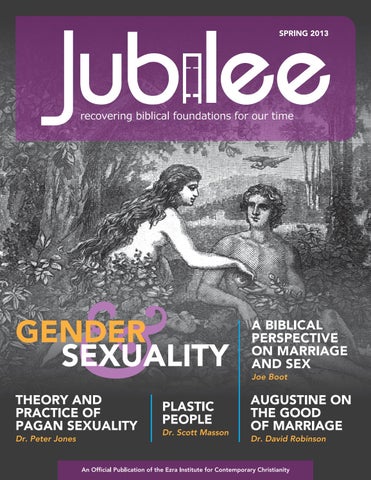
Plastic People: Dr. Scott Masson
A Biblical Perspective on Marriage and Sex: Rev. Joe Boot
26
Theory and Practice of Pagan Sexuality: Dr. Peter Jones
34
Augustine on the Good of Marriage: Dr. David Robinson
40
Resource Corner
Jubilee is provided without cost to all those who request it. Jubilee is the tri-annual publication of the Ezra Institute for Contemporary Christianity (EICC), a registered charitable Christian organization. The opinions expressed in Jubilee do not necessarily reflect the views of the EICC. Jubilee provides a forum for views in accord with a relevant, active, historic Christianity, though those views may on occasion differ somewhat from the EICC’s and from each other. The EICC depends on the contribution of its readers, and all gifts over $10 will be tax receipted. Permission to reprint granted on written request only. Canada Post Publications Mail Agreement Number: PM42112023 Return all mail undeliverable to: EICC, 9 Hewitt Ave., Toronto, ON M6R 1Y4, www.ezrainstitute.ca
Ezra Institute for Contemporary Christianity
To receive Jubilee please visit, www.ezrainstitute.ca/jubilee Or write to us: EICC, 9 Hewitt Ave., Toronto, ON M6R 1Y4. jubilee@ezrainstitute.ca
SPRING 2013
JUBILEE EDITORIAL: ISSUE 8 PAGE NO.
6
JENNIFER FORBES JENNIFER FORBES serves as both the Director of Safe Families Canada and the Director of Development for the Ezra Institute for Contemporary Christianity. Originally from London, Ontario, she is now based out of Toronto. Jennifer holds a BA in International Development from York University.
Of the many troubling aspects of Canadian culture, perhaps the most jarring is that we are confronted daily with the redefinition of something very intrinsic to us as human beings: our sexuality. From the media to the classroom, from the workplace to institutions of power, ideas and practices of sexuality are being expressed, debated, paraded and changed.
The task of the church in our historical context then, is to identify the errors in belief, thought and practice which we may have unwittingly adopted as a means of justifying our failings in this critical area. This edition of Jubilee seeks to be of help pointing out many of these errors explicitly, so that we can see sin clearly and turn away from it in repentance and faith.
Traditional views are out, so-called ‘progressive’ views are in, and, despite the incessant discourse of the champions of sexual liberation, people remain confused - confused about who we are as human beings, what it means to be male and female, and what the parameters are for healthy relationships and sexual expression.
The purpose here however is not only to speak words of caution or correction, but to rejoice in the goodness of marriage. Marriage is strongly guarded in Biblical law and celebrated in Biblical songs and poetry. The author of Hebrews admonishes us toward the ideal: “let marriage be held in honor among all, and let the marriage bed be undefiled” (Hebrews 13:4). As God’s people, may we create a culture which exalts and revels in the goodness of God’s blessing of male and female, protects our own chastity and that of others, supports and creates conditions for healthy God-centred marriages that are a witness to the world and a foretaste of heaven, and embraces the blessing and responsibility of raising children for God’s glory.
In John 8, scripture makes clear that Satan is a liar and the father of lies. There is no truth in him and he loves to deceive us. Confusion leads us away from the giver of life and truth, God, and instead to “teachers to suit [our] own passions” as we “turn away from listening to the truth and wander off into myths” (2 Timothy 4:3-4). When the Church is deceived, it cannot fulfill its prophetic witness to the world to proclaim the Word of truth and the Kingdom of God which is at hand. A confused church loses its saltiness and ceases to be the light of the world and a city on a hill (Matthew 5:14). As Christians we must develop a view of human sexuality, manhood, and womanhood from an examination of scripture. We need to begin with an understanding of who God is, and then we can know our identity and purpose in the world in relation to Him. Scripture provides all we need for this understanding. To go along with the tide of ‘progressive’ and ever-changing philosophies of men or to rest on mere tradition is both unacceptable and doomed to fail. We must thoroughly probe the whole counsel of God to understand the purpose and parameters of sexuality. When we do, we discover that scripture lays out plainly that human sexuality is intrinsic to the created order and that God’s intent for it is happiness, blessing, and offspring; it is a gift. Rejection of this gift is the source of relational chaos and disorder; it is vandalism and not freedom.
SPRING 2013
Contributors to Jubilee, Christians all, are aware of the deep struggles that many of our readers will be experiencing with past and ongoing sexual sin. The subject matter discussed in this edition of Jubilee will no doubt stir up personal pain or conviction for many. It is not our desire to be a source of pain. Our intent rather, is that men and women would be pointed to the shed blood of Jesus Christ, which alone can break the bond of sexual sin. No sin is too great to hold us in its grip: neither adultery, nor homosexuality, promiscuity, pornographic addiction nor any other sexual sin. We are not freed from sin and addictions easily, but the Scriptures are efficacious in directing us to fulfill the task if we are willing to obey and do what we are called to do. Jesus commanded amputation as the antidote to lusting (Matt. 5:2830). We must remove all sources of provocation far from us in order to put off the desires of the old man and present our members as instruments of righteousness to God (Rom. 6:12-13). It is never adequate to simply stop practicing a sin;
Ezra Institute for Contemporary Christianity
Editorial: Issue 8 7
we must replace it with appropriate godly living. This is God’s prescription for overcoming slavery to sin and is a tested method taught by truly biblical counsellors (Eph. 4:20-24). As believers we are given the Holy Spirit to convict and empower us and we urge all believers not to quench the Spirit (1 Thess. 5:19) but to embrace the Spirit’s healing and sanctifying work, so that we may be transformed into the likeness of Christ. We would counsel those who struggle with ongoing sexual sin to seek appropriate Biblical accountability and support in the priesthood of believers to be set free from these struggles. For “in all these things we are more than conquerors through him who loved us” (Romans 8:37). In Christ Jesus alone can we find healing; only he can restore our broken sexuality and make us whole persons. “Now to him who is able to do far more abundantly than all that we ask or think, according to the power at work within us, to him be glory in the church and in Christ Jesus throughout all generations, forever and ever. Amen” (Ephesians 3:20-21).
“A confused church loses its saltiness and ceases to be the light of the world and a city on a hill (Matthew 5:14)”
In this edition of Jubilee, our contributors address topics on: the current cultural effects of shifting ideas of sexuality and the impact of pagan spirituality upon human sexuality; beliefs and practices surrounding sexuality in church history; and the biblical pattern of sex and marriage.
Ezra Institute for Contemporary Christianity
SPRING 2013
PAGE NO.
8
DR. SCOTT MASSON DR. SCOTT MASSON is a Fellow at the Ezra Institute for Contemporary Christianity. A native of London, Ontario, Scott studied English and History at Huron College, U.W.O., before living abroad for 12 years. During that time, he pursued further studies in Germany and England. He gave his life to Christ in 1995, while a first-year doctoral student at the University of Durham, England. As Associate Professor of English Literature at Tyndale University College, Scott specializes in the areas of hermeneutics and literary theory. He serves as the Associate Pastor at Westminster Chapel for College and Careers and is involved in the start up of Westminster Christian Academy. Scott lives in Toronto with his wife Christa and daughter Grace.
PLASTIC PEOPLE – Exchanging Beauty for Ashes THE BIBLE DEFINES IDOLATRY AS the ‘exchange of the truth about God for a lie’ and the ‘worship and service of the creature rather than the Creator, who is blessed forever’.1 Although it is embarrassing, the idolatrous worship of inanimate objects we read about in the Old Testament is not surprising. We quickly distance ourselves from it because we sense the shame of the Bible’s mockery of something so patently irrational. Yet people in a materialist age such as ours have little trouble identifying with the same impulse so long as it transpires under another name. We readily equate the possession of money and finely-crafted goods with power, and the world seems united in its agreement that power is a prime motivation for human activity, and an acceptable one at that. This is true in the field of economics as well. For all their differences both Marxism and capitalism place central importance on material goods. The only difference between us and the peoples of old then seems to be that we possess too great a sense of pride literally to bow down to the things we worship. We dignify ourselves by standing up. Of course, this only conceals the prostration. What remains a bit more distasteful about the idolatry the Bible depicts for a culture like ours that is steeped in the evolutionary myth of human progress, with its historical narrative of an ascent from the material to the rational and the bodily to the spiritual, is the connection of its idolatry with ancient fertility gods – with sex. It is there in the Biblical narrative, and throughout the ancient peoples of the world. This is surely evidence of their primitivism, we scoff, an instance of our superiority and their superstition. HOMO ADORANS When the Christian does so however he encounters an uncomfortable fact. The chief metaphor that the Bible uses for true, godly worship has sexual overtones: the covenant bond of marriage between God and his people. This covenant metaphor as an illustration of true faith appears throughout the Bible,2 perhaps most famously in
SPRING 2013
Paul’s analogy of the husband-wife relationship in Ephesians 5.22-33, but no less significantly in Revelation 21.2, when the people of God, the heavenly Jerusalem, descends ‘as a bride adorned for her husband’. The Bible thus reveals an important fact that the secular academy overlooks. The best definition of human nature is not the homo sapiens of the Enlightenment scientist, but homo adorans. Our distinctive characteristic is not to know, but to worship. With that in mind, the Westminster Shorter Catechism acknowledges the centrality of the first commandment3 in its first line: ‘the chief end of man is to glorify God, and to enjoy him forever.’ That this is not to be understood in an abstract ‘spiritual’ sense,4 and that it applies directly back to the marital relationship between husband and wife is evident in the words of the marriage ceremony in the old Book of Common Prayer (1662): ‘with my body I thee worship.’5 The Puritans’ sense of the moral rectitude of loving one’s spouse shines forth. G.K. Beale, in summarizing the importance of true worship, explains that it also has a practical consequence. What we worship transforms us into its image: All humans have been created to be reflecting beings, and they will reflect whatever they are ultimately committed to, whether the true God or some other object in the created order. Thus… we resemble what we revere, either for ruin or restoration.6
Thus the ‘worshipers of the true God reflect his image in blessing’, whereas idolaters receive ‘a curse by becoming as spiritually inanimate, empty, rebellious or shameful as the idol is depicted to be.’7 IN IMAGO DEI As we know, the image that Christians reflect is that of Jesus Christ. ‘He is the image of the invisible God.’8 We are also told that God is love.9 In the Trinity, we understand the mutual ‘cleaving together’ and indwelling of the Father, Son and Ezra Institute for Contemporary Christianity
Plastic People – Exchanging Beauty for Ashes 9
Holy Spirit through all eternity. There was unity in diversity. God experienced perfect love before the creation of the universe. But we can observe something more specific about this in the creation account of Genesis 1. In the first twenty five verses, we observe that by his Word, God exercises his dominion over his creation. He does so through the process of differentiation and order. He subdues the waters and the darkness, separating them to create land and sky, day and night. He then fills the day and night (sun, moon, and stars) and the sky, land and sea (different kinds of birds, animals, plants, and fish). He does so by naming them. In the account of the creation of man, we’re given an array of important and very similar details. We learn that God creates man in his image.10 We learn that that image is also differentiated: male and female together comprise the image. Finally, we learn that we are to be fruitful and multiply, and to exercise dominion over the earth, and all the creatures therein. In the account of man’s creation, we thus see a mirror image of the previous twenty five verses. It is presented as a chiasmus. In verses 1-25, God subdues and fills; in v. 28 the order is reversed: ‘be fruitful and multiply and fill the earth and subdue it.’11 In the account of the flood in Genesis 6-9, which is brought about because of God’s wrath at human sin, we read not only of a forty day deluge, but of God’s curse upon the earth that he had blessed. The curse takes the form of undoing the differentiation and filling of the earth of Genesis 1. God collapses what he had separated and pronounced good. Genesis 7.11 states that ‘all the fountains of the great deep burst forth, and the windows of the heavens were opened.’ The water rises from below and descends from above. As a consequence, we see a process of homogenization. In Genesis 7.21, we are told that ‘all flesh died that moved on the earth, birds, livestock, beasts, all swarming creatures that swarm upon the earth, and all mankind’. We hear echoes of both Genesis 1 and Genesis 7 in Paul’s words in Romans 1.18-28. Paul speaks of the ‘wrath of God against all ungodliness and unrighteousness of men, who by their unrighteousness suppress the truth.’ The deep irony in their claim of wisdom reveals itself in the manifest folly of idolizing material goods (v.22Ezra Institute for Contemporary Christianity
23). Therefore, they receive the curse of futility in their bodies by worshiping themselves rather than God, ignoring the differentiation of the sexes (vv. 26-27) in their sexual acts. By acting against God-ordained differentiation, there is no blessing, no procreation and, consequently, no dominion. Life becomes utterly futile. IDOLATRY IN ‘GENDER IDENTITY’ AND ‘SEXUAL ORIENTATION’ With the deep compatibility established between 1) the identity of men and women ‘in imago Dei’; 2) the blessing of lifelong fidelity between a husband and wife in the covenant of marriage and 3) the true worship of God, we need to consider the development of two neologisms, which themselves embrace a whole subset of others, that have become current in the past few decades: gender identity and sexual orientation. Many uncritically accept them. However, since both biological sex and marriage are a human reflection of God’s own person and activity, any alteration to the specifics of either sex or marriage is necessarily a form of assault on the faithful worship of God.
“By acting against Godordained differentiation, there is no blessing, no procreation and, consequently, no dominion. Life becomes utterly futile.”
In this instance, the theological transgression takes the form of an assault on the very notion of a God-defined human nature. This should not surprise us. If the chief end of man, represented in Christian marriage, has been thwarted through earthly means, then we should expect that human nature should be similarly defrauded. And if so, it is a human rights violation of the first order. With that in mind, we should consider what Francis Schaeffer observed in 1968, at the onset of the sexual revolution, about the tenor of what was then called homosexual politics: in the name of equality, it tends to obliterate male-female distinctions. This does not entail that we should have no compassion for those who struggle with these desires. But much modern homosexuality is an expression of the current denial of antithesis. It has led in this case to an obliteration of the distinction between man and woman. So the male and the female as complementary partners are finished. This is a form of homosexuality which is a part of the movement below the line of despair. In much of modern thinking, all antithesis and all the order SPRING 2013
10 Plastic People – Exchanging Beauty for Ashes
of God’s creation is to be fought against – including the male-female distinctions.’12
This of course renders not only human communion impossible, but also true communion with God. INCLUSIVENESS: THE DISCRIMINATION AGAINST DIFFERENTIATION
“Since marriage is defined by God alone, any alternative is metaphysically impossible. Since sex is defined by God alone, the blessing (of children) is physically impossible.”
SPRING 2013
Not long ago, people thought of themselves in biblical categories, either as male or female, single or married. The latter two designations seem like opposites, and in one sense they are, but a closer look reveals that they are not equal opposites. Unlike marriage, the category of singleness could refer to more than one situation indiscriminately without moral judgment. One could be unmarried or a widow, for instance, and be accounted ‘single’. In these designations, there was no acrimony or hint of oppression. Even among gay activists, even twenty years ago there was not a hint of the injustice of the exclusivity of the institution of marriage, let alone a cry of oppression. It was something reserved for ‘breeders’. One’s sexual activity was never considered to be a function of one’s ontological identity either. Human self-definition was as impossible as self-begetting. Nary a thought was given to enshrine the right to self-definition as a ‘human right.’ Now it is difficult not to be conscious of ‘gender identity’ or what has been called ‘sexual orientation’:13 many people immediately think of themselves in terms of being gay, straight, or bi-sexual. People speak of being in ‘partnerships’ rather than marriages, and the formal designations of singleness and marriage are fast disappearing.14 The boundaries around human sexual identity and sexual activity have become blurred as the departure from the biblical view of marriage continues both inside and outside the church. The change has culminated in gay ‘marriage’. Gay marriage is no longer an oxymoron or category mistake: it symbolizes not only how plastic the terms of human identity have become in the past two decades, but how rapidly a political and societal blessing has been demanded for something that neither God nor our biological nature can bless.
Rarely has the hubris of man been more in evidence than in this: Since marriage is defined by God alone, any alternative is metaphysically impossible. Since sex is defined by God alone, the blessing (of children) is physically impossible. The new plasticity in the Western world has created something like a cyborg people, still rooted in a natural identity of male and female but often understanding themselves in terms at odds with it. The very term ‘gender identity’ was first used in 1966 by doctors at Johns Hopkins to help explain to the public the novel gender reassignment surgery that first transformed someone into what we would now call a transsexual.15 Now, allegedly to avoid ‘discrimination,’ it is the term which is being used to define everyone. These are the borderlands between a Christian worldview and a thoroughly anti-Christian worldview. A new civilization, with a new language and a new law and a new Lord, is being asserted. Even among Christians, a new generation has grown up whose thinking and sense of personal identity has been ‘queered’. In short, as one writer has put it, we have become ‘Plastic People’.16 The fact that laws have now been brought in to inculcate and enforce the new terms; that mandatory educational policies have been crafted to transmit them;17 and that academic and governmental policies have been brought in to professionalize them, should not confuse us about their stability or rootedness in reality. They are just attempts to cool the plastic and offer the veneer of continuity inherent in institutions. QUEER THEORY To sketch out the intellectual and social transformations that have taken place in such a brief span of time, we would really need to venture into fields little known in Christian scholarship, let alone the wider church community. Queer theory is often a compilation of Continental philosophy,18 a Marxist suspicion of power, Freudian psychology, Nietzschean moral teaching and post-structuralist views of language. There is no time to get into them in anything other than a cursory manner here, so a focus on one figure will need to suffice. Ezra Institute for Contemporary Christianity
Plastic People – Exchanging Beauty for Ashes 11
Michel Foucault, perhaps the most cited scholar in the humanities today, is undoubtedly the key figure in the transformation. Foucault engaged in cultural studies in a way that rejected traditional historiography and sociological analysis. Above all, rather than engaging in the fundamentally conservative activity of understanding and recovering the meaning of what had happened in the past (including in its texts), which assumes that it can be and was understood at the time, Foucault’s scholarship assumed the malignance of past forms of understanding and sought to disrupt them. In other words, Foucault made social activism the primary purpose of the scholarly endeavor. By questioning the basic comprehensibility of the past even to those who lived at that time, and by charging them with simply preserving the power structure of an arbitrary worldview as if it were foundational (i.e. as if it were true) he broke ranks with the idea that the past should in any way shape the present – the view of time immemorial. His logic was this: if all reality is simply a social construct, then why should the social constructs of the past prevail upon the present? OUR CHRISTIAN WORLDVIEW AS THE COLONIALIST OF THE MIND For Foucault, the mindset of the past was the pre-eminent source of injustice. His project sought to emancipate the present from the past in the most radical way, by deracinating all the accumulated cultural and religious understandings that had come to form Western consciousness from our language, by separating our words from the Word. The foundational understandings of human identity were his foremost concern, because rooted in our understanding of human nature were attenuated all our notions of subjects such as truth, beauty, goodness, justice, and morality. That is because human identity had been predicated in the West upon its rootedness in the personal nature of the triune God, in whose image men and women are made. For that reason, the policies of political correctness which began in the 1980s (and the Human Rights tribunals which soon transformed to operate according to their dictates) are inseparable from Foucault’s project. Political correctEzra Institute for Contemporary Christianity
ness should in no way be confused with an odd form of politeness; it should be understood as a root-and-branch reconstruction of the developed cultural assumptions of the polis, and in particular the reversal of what Christianity had done to reforge human identity in accordance with the terms of Christ’s kingdom. In other words, it presented an antithetical agenda to the Great Commission, which entailed obedience to everything God had taught. FREEDOM While it is becoming increasingly clear in our day that obedience to the legislation of a different kingdom, complete with new laws and a new language was the invariable consequence of Foucault’s seemingly esoteric scholarly endeavors, the new legalism was not presented in such terms. It announced itself in terms of a ‘creative endeavor’ characterized above all by freedom. In a 1983 interview, Foucault made it clear that he endorsed Nietzsche’s radical views on selfcreation. Sartre and California’s New Agers had gone awry, he suggested, because they had introduced the notion of ‘authenticity,’ implying that one had to be faithful to one’s true self. In fact, there was nothing within or without to which one had to be true – self-creation had no such limits. It was about aesthetics, not morals; one’s only concern should be to fashion a self that was ‘a work of art.’19
“Foucault’s scholarship assumed the malignance of past forms of understanding and sought to disrupt them”
For that reason, the notion of ‘coming out’ is part of the parlance of queer writers – it is the celebration of the act of a new creation by the artist, a new birth he celebrates for him/herself. ‘Coming out’ may sound like a wholly individual experience. In one sense it is. Yet because this notion of gender is at odds with biological sex and the family, it is a celebration that queer theorists insist everyone must celebrate. For as Peter Sanlon notes (somewhat confusingly using the word gender for sex): Queer theorists seek for a freedom from the limitations of gender itself. Only when humanity understands itself as construed not by biological realities, but malleable sociological relations, will homosexuality be able to be enjoyed without heterosexual oppression. The assumptions latent in a presupposed biological bias towards heteroSPRING 2013
12 Plastic People – Exchanging Beauty for Ashes
sexuality must be Queered sufficiently that they may be discarded.20
ing the raison d’être of our schools, social agencies and legal system.23
For this freedom to be truly free, queer theorists require that everyone worship it.
What Figure 1.0 shows is a nexus of characteristics that describe those who have privilege, power, access, and resources. The further one is from the centre, the more structurally oppressed one is. What must be understood is that one’s personal conduct is irrelevant to the case of injustice being made. If one is a white, male, heterosexual, ablebodied, wealthy, U.S. born English speaker, then one is ipso facto a structural oppressor, and as such must be extirpated from that position in order to bring about social justice.
COMPULSORY AMBIGUITY AND THE RETURN TO PAGAN ANDROGYNY
“In the Christian worldview, because there is an understanding that final judgment belongs to God, there is no necessity for immediate reckoning of all injustice. This is one of the foundations for Western freedom”
Because those who promote Foucault’s agenda deny that the world is God’s creation, they also deny that there is a predestined meaning or foreordained pattern in the universe, or in human nature. So long as this remained an esoteric view, its sheer irrationality and absurdity would have rendered it impotent. After all, it entails that life is meaningless and purposeless, and that thinking was itself a vain exercise. But once it attained the status of truth in the academy, which it gained through a constant appeal to victimization, it had an immediate practical consequence which we can best see by comparison. In the Christian worldview, because there is an understanding that final judgment belongs to God, there is no necessity for immediate reckoning of all injustice. This is one of the foundations for Western freedom, the limitation of vengeance in the lex talionis, and the understanding of God’s final judgment. But as Albert Camus observed, in the anti-Christian universe:
According to such a view, only whites can be racist.25 The immediate response to such an assertion might be to conclude that it is simply a form of race-baiting. But while that is true, that is only the beginning of its malignance. For the effect of what we now call ‘identity politics’, which cloaks its own naked prejudice in the robe of ‘justice’26, is utterly to subvert the common law tradition, in particular its emphasis upon the equality of each and of all before the law.
This explains both its oppressive character and the speed of its development. Guilt in a sociallyconstructed universe is not related to committing an offence– as we shall soon see, Christians are of the caste that are already structurally guilty – it is a function solely of a failure to zealously promote social justice.
This is also its most bitter irony: in the name of defending the rights of oppressed minorities, the most vulnerable minority, the individual and his rights, have been annihilated. This is no small thing. The integrity of every human being, and his immunity from the absolute and coercive power of the State, lies at the heart of all true human rights legislation, from the movement to abolish slavery to the movement to acknowledge the full equality of women before the law and in the political system.
Coupled with the clear attack on Christian truth in every area of life, it marks the return to the worship of what Peter Jones calls the pagan sexual ideal, androgyny.22 Nowhere is this clearer than in the so-called ‘web of oppression’ which is presented to undergraduates throughout many universities, which underlies the contemporary thrust of social policies amongst progressives, and under the auspices of ‘social justice’ is fast becom-
The movement could not be in greater error. It is anti-social and unjust. The English common law brought the theological belief that every human being is made in the image of God into the legal and political fabric of English-speaking nations, enshrining both its rights and its freedoms. One of the magnificent features of the common
…the judgment pronounced by history must be pronounced immediately, for culpability coincides with the check to progress and with punishment.21
SPRING 2013
THE INJUSTICE OF ‘SOCIAL JUSTICE’ AND ITS OPERATIVE DENIAL OF CHRIST’S ATONEMENT
In short, the social justice movement saws off the branch it purports to stand upon.
Ezra Institute for Contemporary Christianity
Plastic People – Exchanging Beauty for Ashes 13
[Figure 1.0 – the Web of Oppression]24 law tradition is precisely its antipathy towards the very idea of ‘group rights.’ Group rights invariably entrench the power of an identifiable group, and empower them unjustly against all others. There is another, thoroughly insidious implication which every person in the Western world is currently sensing: the power of the State is immeasurably enhanced (and even demanded) by the movement to embrace ‘social justice’. For the instant that collective rights are acknowledged, not only are individual rights destroyed, it requires that the government take on the role of Lord and judge: firstly in establishing a hierarchy of victim groups, and secondly in involving itself in the arbitration of their disputes. In Canada, we call their organs ‘Human Rights Tribunals’. And perhaps the most nefarious of all its consequences is the fact that we can increasingly observe that the law bends towards those who agitate the most, particularly those willing to go Ezra Institute for Contemporary Christianity
so far as to break the law. As Mark Steyn observes: In some of the oldest free societies in the world, the state is not mediating speech in order to assure social tranquility, but rather torturing logic and law and liberty in ever more inane ways in order to accommodate those who might be tempted to express their grievances in nonspeechy ways.27
Many Christians have been duped into adopting this same agenda, precisely because in its appeal to equality they have been deceived that the social justice movement, promoting group rights, follows the precedent set by Christians who fought against social injustices in the past: chiefly, the ill-treatment of other races and women. In this, they often work with the humanists in seeking to create a public square which allegedly espouses moral neutrality.
“Without God’s ordained sexual norm, the curse of human sinfulness must invariably result in sexual exploitation and perversion”
Yet God is not morally neutral, nor should His spouse, the church, be. The difficulty with the indiscriminate appeal to equality is that the SPRING 2013
14 Plastic People – Exchanging Beauty for Ashes
broad categories it includes (race, gender and sex, spirituality and religion, sexual orientation, ability, national origin/ language, socioeconomic status) are not equal, let alone comparable. Racism and sexual discrimination are truly abhorrent because they treat people who bear the image of God, which every person does, as if he or she did not. But in those instances, the fight for equality is thoroughly in accordance with the notion of individual equality before the law in the common law tradition.
“Above all, we must preach the gospel of the kingdom, and disciple the nations in all areas of life as our priestly calling.”
But individual sexual practices cannot all be treated as equivalent, let alone comparable, to racism and sexual discrimination. The mistake lies precisely in the irrational terminology of gender identity and sexual orientation. Sexual acts should not be deemed synonymous with ontological states, as the Foucauldian terminology would have it, but as forms of moral or immoral actions. They are categorically different. We can see how damaging the categorical mistake is in its effect. To speak of monogamous marriage between a man and a woman as inherently oppressive is simultaneously to dispense with any and all the foregoing notions of sexual exploitation or violation that were defined by normativity of marriage. We have a perfect illustration of this in the extraordinary recent popularity of the “Fifty Shades” novels. What in the past had normally been considered to be sexually violent and to exploit women has become highly desirable, particularly among women!28 What had long been socially cursed has suddenly become blessed. And we can see a literal explosion in human trafficking, prostitution, and child pornography. And we also see the reverse has become true. The sole exception to the blessing of undifferentiated sexual conduct is the growing stigmatization of what had previously been considered normal. We thus have a new morality, which the Human Rights priesthood and the public educational establishment oversees: it states the orthodoxy and pronounces the blessing of all sexual practices except the one that God has differentiated and blessed. Without God’s ordained sexual norm, the curse of human sinfulness must invariably result in sexual exploitation and perversion.
SPRING 2013
Freedom thereafter is nothing but unbridled licentiousness. This is clear when one notes that the arguments advanced in favour of gay marriage are precisely the same as those used to promote paedophilia: 1) Paedophilia is innate and immutable. 2) Pederasty is richly attested in many different cultures throughout history. 3) The claim that adult-child sexual relationships cause harm is greatly overstated and often completely inaccurate. 4) Consensual adult-child sex can actually be beneficial to the child. 5) Pederasty should not be classified as a mental disorder, since it does not cause distress to the pederast to have these desires and since the pederast can function as a normal, contributing member of society. 6) Many of the illustrious homosexuals of the past were actually paedophiles. 7) People are against intergenerational intimacy because of antiquated social standards and puritanical sexual phobias. 8) This is all about love and equality and liberation.29
Some will bristle at the association, but since the standard of justice is the blunt instrument of ‘equality,’ it is difficult to imagine why the push for gay marriage would not be followed by the legitimization of any and all other sexual practices, to the effect that the law will wholly depart from any sense of justice that accords with the promotion of the social good, the love of God or of neighbor. This may be an unfair criticism however. A just society was never the aim of Foucault’s social justice. BEAUTY INSTEAD OF ASHES Christians need to become more aware of the fact that conforming to the dictates of queer theory, accepting or adopting the unbiblical concepts of ‘gender identity’ or ‘sexual orientation,’ entails departing from treating all people as equal image bearers of God. Privileging a self-proclaimed group of victims is not treating them with equity. These terms are not just neologisms, they are the product of a thoroughly anti-Christian theological framework. Ezra Institute for Contemporary Christianity
Plastic People – Exchanging Beauty for Ashes 15
The new language cannot be ignored. Even if that were desirable, it is quite clear that queer theorists will not allow that. It is at odds with their understanding of human freedom. Christians need to speak out against these changes out of love for God, their neighbor, and for the sake of the children who are presently being indoctrinated in it. It is plain from the documents that emerge from these educational authorities that a new compulsory form of religious education is being conducted, which like the cults of old makes sexual initiation30 a compulsory and integral part of its system.31 I would strongly urge Christian parents to remove their children from the public school system, and demand of their elected officials that their taxes go to the school of their choice. God has charged parents – and no one else – with the responsibility to educate their children.32 Above all, we must preach the gospel of the kingdom, and disciple the nations in all areas of life as our priestly calling. The familiar words of Isaiah 61 impress on us an eschatological meaning: The Spirit of the Lord God is upon me, because the Lord has anointed me to bring good news to the poor; he has sent me to bind up the brokenhearted, to proclaim liberty to the captives, and the opening of the prison to those who are bound; to proclaim the year of the Lord’s favor, and the day of vengeance of our God; to comfort all who mourn;33
In Luke’s Gospel, having just withstood the devil’s temptation in the wilderness, a place of judgment throughout Scripture, Jesus read from this very passage and pronounced that ‘Today this scripture is fulfilled in your hearing.’34 As God’s faithful covenant partner, Jesus announces the advent of the kingdom of God. An old hymn put it this way: ‘A second Adam to the fight/ and for our rescue came.’35 The Lord’s promise to His people in Isaiah 61 is that He shall “bestow on them a crown of beauty instead of ashes, the oil of joy instead of mourning, and a garment of praise instead of a spirit of despair. They will be called oaks of righteousEzra Institute for Contemporary Christianity
ness, a planting of the Lord for the display of his splendour.”36 This is not a future promise; it is an announcement of the splendor of victory wrought at Calvary. God’s grace shall similarly be rendered to His people in the midst of a time of judgment. We should not ignore the dichotomy in the words. They speak of the same event, ‘the year of the Lord’s favour and the day of vengeance of our God’. We live in a time of great shaking, which I see as a different sort of differentiation. The church is being purified, while it is simultaneously under the assault of all manner of false teaching. It is being asked to speak the tongue of Babylon the Great, which it must not do. In the midst of that, we can trust in God’s promise that this is for ‘the removal of things that are shaken—that is, things that have been made—in order that the things that cannot be shaken may remain. Therefore let us be grateful for receiving a kingdom that cannot be shaken, and thus let us offer to God acceptable worship, with reverence and awe, for our God is a consuming fire.37 What we do know is the certainty of the outcome: the cataclysmic finale of the Book of Revelation, that tale of two cities, foretelling the destruction of the whore of Babylon the Great in ashes, mourning and despair, and the nuptials of the new Jerusalem in beauty, joy and praise. Thanks be to God.
“let us be grateful for receiving a kingdom that cannot be shaken, and thus let us offer to God acceptable worship, with reverence and awe, for our God is a consuming fire.”
1
Rom. 1.25 Cf. Hos. 1-3; Ezek. 16; Isa. 54. 3 Exod. 20.2-3. ‘I am the Lord your God who brought you up out of the land of Egypt. You shall have no other gods besides me.’ 4 Rom. 12.1 ‘present your bodies as a living sacrifice, holy and acceptable to God, which is your spiritual act of worship.’ 5 Cf. 1 Cor. 7.3-5. 6 G.K. Beale, We become what we worship: a Biblical theology of idolatry (Apollos, 2008), 22. 7 ibid, 21-22. 8 Col. 1.15. Cf. Jn. 14.8-11a; Heb. 1.3a. 9 1 Jn. 4.8-12. 10 The grammar is actually plural, ‘Let us create man in our image, after our likeness,’ a reflection of the work of the whole Trinity in creation. 2
SPRING 2013
16 Plastic People – Exchanging Beauty for Ashes
11
y thanks to Dr. David Robinson for bringing this M to my attention. 12 Francis Schaeffer, The God Who Is There, 36. 13 The state of California in fact is henceforth requiring its judges publicly to identify their sexual orientation. Clearly justice is considered to be a function of one’s ‘orientation’. Can there be equality before the law when one’s orientation so disorients justice? http://www.weeklystandard. com/blogs/california-asks-judges-gay-orstraight_631857.html 14 The designation ‘mademoiselle’ designating a woman as unmarried is going to be pronounced officially verboten by the government in France henceforth: http://www.france24.com/ en/20120222-france-strikes-out-mademoisellecoup-feminism 15 The terrible psychological consequences for those who have had their identity ‘reassigned’ is testified by the former Psychiatrist-in-chief at Johns Hopkins: http://www.firstthings.com/article/2009/02/surgical-sex--35 16 Peter Sanlon, Plastic People: How Queer Theory is Changing Us (Latimer Studies 73), 2010. 17 New Ontario Premier Kathleen Wynne has just brought back, as her first act, the Equity and Inclusive Education Strategy that her predecessor abandoned, which would normalize alternative sexualities from the age of 8. For further details: http://www.campaignlifecoalition.com/index. php?p=EIE%20Detail 18 Charles Taylor describes the main feature of contemporary Continental philosophy as the study of man ‘as a self-interpreting animal’ Human Agency and Language: Philosophical Papers 1 (Cambridge University P., 1985), 45. 19 John Coffey, Life after the Death of God: Michel Foucault and Postmodern Atheism (1996; available from http://www.jubilee-centre.org/document.php?id=15.) 20 Peter Sanlon, Plastic People: How Queer Theory is Changing Us (Latimer Studies 73, 2010), 14. 21 Albert Camus, The Rebel, An Essay on Man in Revolt (New York: Vintage Books, 1956), 241. 22 Peter Jones, ‘Androgyny: The Pagan Sexual Ideal’ JETS 43/3 (Sept. 2000), 443-469. 23 Progressives are not confined to a political party. It is more of a theological movement. As I write, the British Prime Minister David Cameron has just pushed through a motion to legalize gay marSPRING 2013
riage over the objections of the vast majority of his own party, and the strong objections of the established church in England. He is convinced of the rectitude of his actions, much like the U.S. President, because both men tellingly believe that they will be judged well by ‘history’. There is no such person. 24 Bob Mullaly, “The ‘Web’: The Multiplicity, Intersectionality and Heterogeneity of Oppression” in Challenging Oppression and Confronting Privilege (Oxford: Oxford University Press, 2009), 188-219. 198. 25 In a package that is given to teachers by the Toronto District School Board called “Teaching about Human Rights: 9/11 and Beyond,” it states that “While people in different contexts can experience prejudice or discrimination, racism, in a North American context, is based on an ideology of the superiority of the white race over other racial groups.” Only two groups would ever admit to such beliefs: white supremacists and disciples of Foucault. The difference is that the one group adopt it sadistically, to oppress and punish their inferiors; the others do so masochistically, to oppress and punish themselves. The primary thrust of the TDSB’s policy is a symptom of a new religion which seeks to propitiate cultural guilt. It constitutes a new form of atonement, a social constructivist scapegoat. 26 The socially-constructed designation of ‘justice’ does not make a thing just. In fact without an appeal to a coherent, universal sense of justice, it invariably has the opposite effect. As George Orwell once observed of similarly totalitarian regimes, “Political language ... is designed to make lies sound truthful and murder respectable, and to give an appearance of solidity to pure wind.” George Orwell, “Politics and the English Language,” in Why I Write (London: Penguin, 2004), 120. 27 http://www.steynonline.com/4409/gagging-ussoftly Steyn’s illustration is wonderful: “If a Muslim says that Islam is opposed to homosexuality, Scotland Yard will investigate him for homophobia; but if a gay says that Islam is opposed to homosexuality, Scotland Yard will investigate him for Islamophobia.” 28 http://www.forbes.com/sites/ timworstall/2012/08/02/mommy-porn-sells-betterthan-childrens-books-and-a-shock-for-twilightsEzra Institute for Contemporary Christianity
Plastic People – Exchanging Beauty for Ashes 17
stephenie-meyer/ Cf. Dr. Michael Brown’s case here: http://townhall.com/columnists/michaelbrown/2011/08/26/ why_are_we_surprised_with_the_push_for_pedophile_rights/page/full/ 30 Note the disturbing and thoroughly confusing posters used to promote equity: http://www.tdsb. on.ca/_site/ViewItem.asp?siteid=10471&menuid= 34019&pageid=28961 31 The Toronto District School Board, in its policy document ‘Equitable and Inclusive Schools’, asserts that it alone has authority over the curriculum, for “depending upon parent/guardian/ caregiver discretion, shifts this responsibility from the school to the parents/guardians/caregivers and fosters a poisoned environment contrary to the TDSB Human Rights Policy.” No exceptions in the name of religious freedom will be tolerated: “For example, if a parent asks for his or her child to be exempted for any discussions of LGBTQ family issues as a religious accommodation, this request cannot be made because it violates the Human Rights Policy.” 32 Dt. 6.4-7. 33 Isa. 61.1-2. 34 Lk. 4.16-21. 35 John Henry Newman, ‘Praise to the Holiest, in the Height.’ 36 Isa. 61.3. 37 Heb. 12.28-29. 29
Ezra Institute for Contemporary Christianity
SPRING 2013
PAGE NO.
18 REV. JOE BOOT
REV. JOE BOOT is the founder of the Ezra Institute for Contemporary Christianity and the Senior Pastor at Westminster Chapel at High Park, Toronto. Before this, he served with Ravi Zacharias for seven years as an apologist in the U.K. and Canada, working for five years as Canadian director of RZIM. A theology graduate of Birmingham Christian College, England, Joe earned his M.A. in Missiology with the University of Manchester. His apologetic works have been published in Europe and in North America and include Searching for Truth, and Why I Still Believe. His forthcoming book, titled The Mission of God, is scheduled to be published in 2013. Joe lives in Toronto with his wife Jenny and their three children Naomi, Hannah and Isaac.
SPRING 2013
A Biblical View of Marriage and Sexuality FOR MOST YOUNG PEOPLE TODAY in our cultural moment, navigating what healthy, fulfilling, human sexuality really means is like working a mine-sweeper in the Atlantic during World War II – highly problematic and highly dangerous. The agents of a revived paganism have their incendiary devices laid within the public school curriculum, the media, in the entertainment industry and throughout the corridors of political power and all cultural life. This open conspiracy is making for social chaos, confusion and, in many cases, total ruin, as biblically illiterate generations discover the consequences of the pagan worldview and its implications for sexuality. Instead of a healthy recognition of the beauty and joy of sexual intimacy within marriage between one man and one woman, unity in diversity, the norm is now seen as adultery (with the added convenience of no-fault divorce), fornication, co-habitation, homosexuality, bi-sexuality, various expressions of pan-sexual androgyny and an ever-expanding list of other perversions. The human casualties are not just those who practice sexual immorality, but the aborted children who are now effectively offered as political ‘sacrifices’ to the sacred feminine, the goddess of earth (the planet being her body) who demands total emancipation and self-realization – her feminist priesthood in the political class believe these sacrifices are necessary for ‘love,’ ‘freedom’ and ‘social justice.’ As we pass our children through the fires to Molech, what is vulgar, lewd and debauched is counted entertainment as Baalism likewise regains strength. Thus ’50 Shades’ of the pornographic is everywhere marketed, capturing those as young as thirteen in debilitating addiction, lobotomizing the mind and rendering impotent the body. The pornographic cult feeds the ‘human right’ of prostitution which in turn profits the ‘industry’ of sexual slavery, as young women are callously abused as objects for consumption. Gender identities are multiplied
exponentially in accord with any sexual predilection or inner fantasy of identity, embracing Karl Jung’s transpersonal, occult psychological theories still masquerading as science. Immorality is publicly celebrated, out, loud and proud, as what for centuries was considered deviance is legalized, celebrated, and given the label ‘marriage’ as part of the redefinition of the family, sexuality and personhood. Just as biblical marriage is a symbol and sign of the gospel, the relationship of Christ to his church, homosexual ‘marriage’ functions now as the new sexual ‘sacrament’ of the pagan re-envisioning of god and human identity. This ‘progress’ continues unabated, whilst sanctities are laughed at and spat upon, and biblically faithful believers are victimized as ignorant bigots, or mentally ill resisters of the new liberation of man from the evil restraints of Christian morality, to the freedom of acting in accordance with ‘nature.’ These ‘doubters’ are outside the new community and must be silenced. So those bold enough to speak out against the coming sexual utopia risk the wrath of the cultural elite and trial in their heresy courts for crimes against the new humanity and the divine rights of the collective. Yet with all this hostility to the beauty of the gospel – depicted for us in the marriage relationship – the Christian still has no right to despair. There is nothing essentially new in any of the sexual practices described above; even the multiplication of genders can be found in Native American pagan spirituality from whence the progressives derive their term ‘two spirited.’ The rate of cultural change is new, brought about by changes in technology and communications, but there remains nothing new under the sun. Man, in rebellion against God, conspires and plans against the Lord, but his Babel tower is always brought to nothing (Psalm 2). The Christian faith has been here before. It defeated paganism in the ancient world, and since then has cast it Ezra Institute for Contemporary Christianity
A Biblical View of Marriage and Sexuality 19
down wherever the faith is proclaimed and lived with integrity. Paganism will again be defeated in the West if the church will be faithful. To do so requires patient obedience and the rebuilding of God’s order laid down in his word. How can we rebuild a healthy Christian understanding for our time? We must begin with our understanding of the doctrine of God as it relates to marriage. Peter Jones writes: When God created the world and sanctified it by making distinctions, he imprinted his own person on the way things are. God’s own mysterious person gives ultimate expression to the notion of exclusive, faithful communion between separate beings. For the God of theism is a Trinity. God the Father, God the Son, and God the Holy Spirit are three distinct persons bound in eternal communion. Together they collaborated to create the material universe and it is that divine image that the universe reflects. Christians know God in a union comparable to marriage. As in marriage – a relationship in which neither partner abandons his or her identity, but both are nevertheless united in deep intimacy – so, too, we human creatures can maintain our differences with God and still have a true and living union with the creator.1
God’s tri-personal communion, the interpenetration of the Trinity, where distinctions are maintained, without the loss of oneness or unity, is basic to defining the normative pattern of the created good of heterosexual intimacy in covenantal faithfulness. This theological basis for God-glorifying, relationally satisfying and nondestructive human sexual relations is the foundation of the Christian understanding of marriage and human sexuality. However it is certainly fair to say that this has not always been adequately reflected in the history of the church’s teaching and example. SEX AND THE HISTORY OF CHRISTIANITY As a result of the church’s inconsistency, misunderstandings of the Christian view have led to ignorant caricatures or completely erroneous characterizations being accepted by people unfamiliar with the biblical material. Contrary then to populist opinion, the scriptures everywhere encourage sexual intimacy in marriage as a GodEzra Institute for Contemporary Christianity
given good and a true blessing. The biblical texts make plain that within the marriage covenant, sex is positively endorsed. For example, the writer(s) of Hebrews declares, “Marriage is to be held in honour among all, and the marriage bed is to be undefiled; for fornicators and adulterers God will judge” [Hebrews 13:4]. In 1 Corinthians 7:3-5 St Paul positively instructs married couples to show romantic affection to each other by regularly engaging in sexual relations and not depriving each other, since each has authority over the body of the other in the marriage covenant. Likewise, there is no doubting the romantic and sexually erotic nature of the Song of Solomon exploring young love in marriage (cf. Proverbs 5:15-19). Clearly, right from Genesis 2, God’s original plan for humankind was marital and sexual fulfilment in the “one flesh” of the marriage relationship that would result in the propagation of the human race. It is then somewhat surprising that church history shows that Christians have not always fairly represented the scriptural view. In the patristic era, for example, the impact of dualistic philosophies, in the form of Gnosticism, Manicheanism and neo-platonism, exerted varying degrees of influence on the Church Fathers (who were usually not natural fathers), leading some of them to espouse a kind of sexual asceticism that denuded marriage, sex, or both, of their biblical glory, tolerating them as acceptable only to materially-minded and less ‘spiritual’ believers. Most of the Church Fathers recognised that marriage was an honourable, God-ordained institution. However, the general tone one detects toward marriage and sex was largely one of ‘concession’ to human weakness for those unable to embrace celibacy or a ‘continent’ (celibate) marriage, rather than a positive endorsement and celebration of God’s created order and purpose for sexual fulfilment in marriage. Origen (185254), not always the most biblical of the Fathers, went well beyond Scripture and foolishly thought the serpent had seduced Eve sexually and so concluded that sexual activity must be inherently wrong, since it was then the basis of actual sins; this is fanciful and unbiblical storytelling clearly derived from pagan influences. It was a common theme in pagan antiquity to have a sexual origin for sin – we see this in Greek thought in
“Paganism will again be defeated in the West if the church will be faithful. To do so requires patient obedience and the rebuilding of God’s order laid down in his word.”
SPRING 2013
20
A Biblical View of Marriage and Sexuality
“the Puritans, were really responsible for the elevation of the significance of sex and romance within marriage in Western culture.”
Plato’s myth of the original ‘androgynous’ man, which now sounds remarkably contemporary! Even the noted Ambrose, a mentor to Augustine, thought marriage a galling burden. To refrain from marriage was thus seen by many as more holy, demonstrating a greater piety, and the great Augustine himself thought that, though marriage is good and ordained of God for the propagation of the human family, if couples could refrain from sex whilst married, that was a better state (of continence) because he was uncomfortable with the intense and passionate physical activity that accompanied sex. Not surprisingly, this notion of ‘spiritual marriages’ gradually died out during the fourth century, but it laid the intellectual framework for the later development of the Roman Catholic teaching requiring celibacy as compulsory for clergy. Whilst it is always possible to over generalize, it is hard to see much improvement in medieval thought. Attempting to restrain ‘lust,’ the Roman Catholic Church steadily developed numerous prescriptions that led to restrictions on marital sex on no less than five days in seven – Thursday through Monday. Given the, at times, widespread sexual misconduct of monks and friars, the hypocrisy did not go over well with the people. Abstinence was required in memory of departed saints, the Virgin Mary or the events of Holy week. No doubt the devout really looked forward to Tuesdays! Regardless of these foolish prescriptions, the time was notably promiscuous. Pope Boniface (d. 625) bemoaned the English attitude toward sex: “[they] utterly refuse to have legitimate wives and continue to live in lechery and adultery.” Mercifully, the Reformation’s refocus upon Scripture brought great change for Christianity in the attitude toward marriage and sex. The reformers emphasized marriage as the highest Christian ideal which, combined with their forceful rejection of clerical celibacy, raised the status of sexual intimacy and marriage significantly. John Calvin in particular taught that the primary purpose of marriage and sex is not merely propagation of the human family but social intimacy. He affirmed that marriage and intercourse is, “undefiled, honourable and holy since it is a pure institution of God.” And that, “God declares him-
SPRING 2013
self the guardian and avenger of conjugal fidelity.” He considered lifelong celibacy ‘rashness’ that tempts God unless it is a gift of grace and considered mandatory celibacy tyrant and diabolical.2 Though it may sound strange to some, it was the primary heirs of John Calvin, the Puritans, who were really responsible for the elevation of the significance of sex and romance within marriage in Western culture. They likewise recognised that sex in marriage was not only for propagating the race but also for marital joy and pleasure. We should not be surprised by this since they regarded Scripture as the final authority for faith and practice. Certainly they were also noted for taking seriously the penal sanctions for sexual sin in Scripture, but not because they had a negative attitude toward sex. On the contrary, it was because they so highly valued the gift of marriage and the ordination of God regarding the sacred nature of sexual relationships, that they protected it by law. For them sex was not simply necessary, it was a God-given blessing. Indeed, far from a prudish pietism, the Puritans, as illustrated in the work of Thomas Hooker (1586-1647)3, truly expressed ardent passion in regard to conjugal love and they regarded attempts at sexual abstinence for married couples as blind zeal and folly. They were frank, strongly sexed and not without romance. So where did the stale myth of prudish Puritanism come from? The Victorian era is responsible for the false caricature of Puritanism, portraying them as cold, passionless and unromantic. This neo-puritanism of the nineteenth century, marked by prudery and frigidity was actually a product of the anti-Christian ‘Enlightenment.’ The rise of humanistic rationalism exalted reasoning and denigrated other aspects of the human person; feelings and emotions were repressed beneath a façade of stylized manners and rationality. Anything was permitted for the rationalist elite so long as it was appropriately concealed. Prostitution and pornography were rampant in Victorian England – the aristocracy, in particular, were often known for debauchery and lechery. Women were largely thought to be lacking in sexual desire, except prostitutes, and wives were required to endure, not enjoy, sex. Prudery reigned as pregnant women were expectEzra Institute for Contemporary Christianity
A Biblical View of Marriage and Sexuality 21
ed to stay in their homes to avoid displaying the results of intercourse and women were denied access to reading that might be sexually enlightening, even Shakespeare! Sex could certainly not be discussed in polite company. The results of this false piety were not good for marriage and did nothing to strengthen the marital bond – quite the opposite. By trying to eliminate the joy of sex from marriage, the Victorian code degraded the sexual impulse and weakened the marital union. In direct contravention of Scripture, the enlightenment man, viewing himself as ‘incarnate reason,’ and women as emotional flakes, patronized, degraded and subjugated women as irrational and inferior. As such they were treated as mere ornaments amongst the middle and upper classes, neither working nor having legal rights, totally dependent on making a good marriage that was often a matter of family convenience rather than love. Marriage was essentially denied passion and passion was regularly denied legitimacy. This was far from the biblical and Puritan vision of sex, marriage and women. In the Puritan era (up to the eighteenth century), in England and early America, women enjoyed legal protection, managed the home and often the business alongside their husbands or alone when their husbands were frequently away, sometimes for years at a time. They were mothers but also managers, insurance brokers, and overseers of businesses in manufacturing and shipping. The Victorian rationalism and prudishness that diminished the status of women and reduced them to romanticised objects for ‘love novels’ meant that several generations of Protestant theologians distorted the Reformation view of sex and only indirectly discussed the issues of marriage without any clear reference to it. The Enlightenment’s subtle contempt for women also led to the women’s rights movement, which in rightly correcting a number of wrongs, morphed into radical feminism, placing women not alongside men in their rightful place, but in competition with them. Feminism has since sought to reverse the God-ordained pattern by the masculinisation of women and the feminization of men to the ultimate unhappiness of both, fermenting the contemporary confusion of gender identity. Thus when people see biblical faith as responsible for the undervaluing of women, they do not see clearly. The biblical doctrine Ezra Institute for Contemporary Christianity
paints the wife as not only mother, teacher and counsellor, but also the competent manager who takes over business affairs if needed, so that her husband can assume public office as a civil magistrate; in the words of Proverbs 31:23, he can “sit in the gates,” that is, preside as a ruler or judge. Clearly, the woman of Proverbs 31 is very different from the pretty doll of the Age of Reason, as well as the competitive, desert boot-wearing masculinised feminist of the twenty-first century who is out to prove she can bear arms and take on the role of a man, as though no differences existed between men and women. The twentieth century then, in reaction to Victorianism, saw a radical pagan revolution in sexuality that abandoned all former mores of constraint, including fidelity in marriage, drifting toward extreme libertarianism that approves of almost any sexual practice so long as it is consensual. THE BIBLICAL VISION OF SEX AND MARRIAGE A helpful place to go for a consideration of the Bible’s view of marriage and sex is the law of God. The purpose of the seventh commandment: “Thou shalt not commit adultery,” is to protect marriage and the sanctity of sex. As in every other area, human beings will either live under the law-order of God in terms of his creative purpose, in which is our highest joy to submit and find our humanity, or we will live in rebellion to his word which always leads to judgment and the fruit of misery. The attempt for man to be as God is very clearly manifest in his rejection of God’s divine pattern for sexual expression. Where authority and submission are denied to God and his covenant of marriage, everyone serves themselves and exploits the other – the aging wife is abandoned; the husband whose income drops or who is no longer sexually ‘exciting’ is deserted for a better opportunity.
“Sex could certainly not be discussed in polite company. The results of this false piety were not good for marriage”
The mutual submission of the body in marriage, one to the other, is part of God’s structure for blessing, community and unity. Only as we understand the biblical picture of marriage as relational intimacy within diversity, can we begin to understand the beauty, sanctity and joy of sexuality as a reflection of the community of love in the Godhead. As a result, true biblical religion will lead to a proper, fulfilling and ‘other’-centred view of SPRING 2013
22 A Biblical View of Marriage and Sexuality
“the Christian faith gives us a pure, satisfying and demonstrably stable and rewarding context for sexual expression”
sex; false religion will produce self-centred, selfgratifying perversion. The apostle Paul makes this connection clear in Romans 1:22-25. Scripture here makes plain that there is a close connection between religion and sex. When people turn away from God to self-worship they end in idolatry expressed by a worship of their own sexual vices. In refusing to worship the Lord God as creator, with all generative power, humanity starts to worship their own sexual and generative powers. Having rejected the Lord of glory, people are left restless and alienated from God, others and even themselves (personal disintegration), with a deep religious hunger. This emptiness they then try to fill with often perverse sexual experience as a substitute God. We see from ancient religions and fertility cults that as men and women seek to exalt themselves, God’s judgment in allowing man’s rebellious passions to take their own course, they increasingly dishonour and degrade their own bodies. Our pornographic culture seeks to glorify the body and allegedly honour it, but ends up openly dishonouring it in public disgrace. Sexual vice becomes an object of worship whilst shame and humiliation are elevated to a courageous way of life. In existential worship of ‘the moment’ the spirit of transgression becomes a religious principle. By contrast, the Christian faith gives us a pure, satisfying and demonstrably stable and rewarding context for sexual expression. Genesis, the foundation stone of Scripture, in chapter 1, affirms the equality of the sexes, made in the image of God, and in chapter 2 affirms the complementarity of the sexes. Both of these truths form the basis of marriage. We are also told there of the human need for companionship: “it is not good for man to be alone”. We are social beings made in God’s image, with the capacity to love and to be loved. We are likewise told that God made a helper and companion suitable for man who would also be his sexual partner – the two would become “one flesh” in sexual union and their consummated love would result in the pro-creation of children. The Genesis account is a remarkable and historical one. The first man Adam is put into a deep sleep and taking from his side, a special work of creation takes place as the sexes become forever differentiated by the creation of the female, Eve.
SPRING 2013
Adam, waking up, is presented with a reflection of himself, part of himself, complementing him. God gives her to Adam, a moment still reflected in the wedding ceremony, much as my wife Jenny was presented to me by her father: “This is now bone of my bone and flesh of my flesh; She shall be called ‘woman’ for she was taken out of man.” She was not made out of nothing; nor was she made from the dust of the ground, but she was taken out of man, a fellow human being – diversity within unity. Jesus and Paul affirm this creational order in their teaching on marriage and divorce, family, and church government. In marriage there is a leaving (by the man) to cleave to his wife in covenant commitment and they become one flesh, consummated in the interpenetration of sexual union where the two again become one. Unity is therefore possible because of diversity. The creation account thus protects against the distortions of bestiality, homosexuality, lesbianism, as well as transvestite and androgynous confusion. Jesus fully endorses the Genesis account of marriage, introducing his teaching with a quotation from Genesis 1:27, and concluding with the emphatic declaration:“What God has joined together, let man not separate” (Matthew 19:4-6). There is clearly a unity here but not an indivisibility lacking distinction – since man can illegitimately separate this hallowed sanctity. Our culture today is seeking to separate, both socially and ontologically, what God has joined. There can therefore be no question that male and female gender and heterosexual sex is a divine creation and that heterosexual marriage is a divine institution, expressing fidelity to the divine intention. Any other form of sexual expression is thus a total breach of God’s purposes declared by our Lord. The scriptures envision no other kind of marriage or intercourse since God provides no other alternative. The man will leave to cleave to his wife. Any other kind of sexual activity is thereby emphatically under his righteous judgment. Marriage is thus sacred and hallowed. Sex is to be enjoyed and celebrated as the union of two persons of the opposite sex in the mystery of unique community – the basic foundation of all human community and society, out of which children are born, fulfilling God’s creative manEzra Institute for Contemporary Christianity
A Biblical View of Marriage and Sexuality 23
date to be fruitful, multiply and fill the earth. The union is physical, emotional and spiritual, reflecting the relation of Christ to his church. DARWIN, DE SADE AND THE ROOTS OF TODAY’S SEXUAL REVOLUTION The historically recent departure in the West from the biblical and Puritan view of marriage and sex finds its roots in the falsely-labelled Enlightenment (a pagan revival of nature worship), when a concerted effort was made to define all things in terms of man and his reason as the measure of all things, including sexuality. This project, only now fully manifesting its fruits, was greatly accelerated by two influential figures. The first was Charles Darwin, through whom the re-emergence of evolution as the way of defining man and the universe became the majority report. Many of the ancient Greeks had been evolutionists and various forms of the idea had always been present in Western thought. This time the evolutionary faith manifest itself as Darwinism, offering naturalistic speculation and biological hypothesis for the origin of man from primordial goo in an undirected process to his present state. Reproduction was central to a Darwinian vision of nature and humanity. Thus, sexual instinct and selection played a vital role in Darwin’s explanation of human evolution. Freud was likely guided by Darwinism in his theory of the twin drives of libido and thanatos – the basic human drive being to copulate with the mother and to eat the father (sex and death – aggression). Today socio-biologists and evolutionary psychologists (behaviourists) appeal to Darwinism in making sex and reproduction the most important explanation of human behaviour. As human organisms we are carriers of DNA, and our behaviour is the unconscious drive of genes to make more DNA. Bringing sexual reproduction to centre stage in explaining human behaviour, however, is not a new idea – it was popular over one hundred years ago. The modern European historian Richard Weikart of California State University in his book From Darwin to Hitler writes: By pushing reproduction into the limelight, Darwinism helped spawn new ways of thinking about sexuality and sexual morality…Darwinism spawned the eugenics movement, whose primary Ezra Institute for Contemporary Christianity
goal was to increase the biological quality of the human population by controlling reproduction. Since many Darwinists wanted to revise all human institutions to speed up evolution… evolution became the new arbiter for sexual morality: whatever improved biological quality was morally good, while whatever hindered it was evil. In 1911, Eduard David told a conference of sexual reformers, ‘in the realm of sexuality everything is moral which serves the upward evolution of the species.’ Many Darwinists agreed with David and argued on this basis for serious revisions – or sometimes the complete overthrow – of traditional ideas about sex, marriage, and the family.4
At this time, the ‘reformers’ were not agreed on the practical measures to achieve their goals, but what they were agreed on was that Christian sexual morality was detrimental to the health of the human species. Though the eugenic theories of the twentieth century have been discredited and largely abandoned in their old forms, the determination of evolutionary theorists to free man from all moral constraints to act in terms of ‘nature’ remains the same. Weikart notes,
“The union is physical, emotional and spiritual, reflecting the relation of Christ to his church.”
Their proposals for sexual reform were, in fact, wildly divergent, ranging from free sex to monogamy (with loopholes) to polygamy. Some even called on evolutionary ethics to justify homosexuality. Evolutionary ethics thus seemed to offer proponents just about whatever sexual morality they preferred.5
Helene Stocker, another leading Darwinian thinker, formed the ‘League for the Protection of Mothers’ and proposed sexual liberation as a program of sexual reform. Leading Darwinists supported her League which constructed a worldview synthesizing Darwinian monism and Nietzscheanism. The opening sentence of her article, “On a New Ethics” is overtly pantheistic and pagan revealing the religious nature of what pretended to be science: If one believes in the eternal Becoming in the flow of evolution, and holds struggle for the father of all things, then one can only see the moral task of humanity as seeking ever new, higher forms of morality’… she explained to fellow monists that her organization was attempting to tackle sexual and marriage reform “in the spirit of modern evolutionary theory.”6 SPRING 2013
24 A Biblical View of Marriage and Sexuality
Others held that nature proved that the human ‘animal’ could not be naturally monogamous given that most organisms only pair off for one breeding season or until offspring are born. Thus they felt marriage a social construct, an empty institution that could be abandoned after the honeymoon or birth of the first child. Another Darwinian sexual reformer, Max Nordau argued for the loosening of the marriage bond to bring it into harmony with ‘nature’ – he advocated that people start to behave much more like animals in their sex life, which remains the dominant argument from evolutionary ethicists today. Weikart concludes his assessment of evolutionary sexual ethics:
“Against this onslaught, a lawless church, professing to believe the Bible, while abandoning the sovereign God and his law-word for humanism, is totally helpless.”
In their view, sexual morality – like all morality – was only valid inasmuch as it was useful to advance the evolutionary process. No matter how much Judeo-Christian baggage some of them still carried about, they had effectively replaced God with evolution as the source and arbiter of sexual morality.7
This argument is a panacea that can justify anything. Homosexuality could be justified here on the basis that it ‘appears in nature’ and is useful for reducing the human population and carbon emissions, etc. The point is, ideas have consequences! With a blind, unconscious sex drive identified as the explanation for human behaviour (including rape), biological determinism, that sees humans as organisms merely seeking to pass on their DNA, leads to radical relativism in the moral sphere and the collapse of the ideas of justice, criminality, human responsibility and normative sexual conduct. The second figure who has greatly influenced the sexual revolution and spirit of the age is the Marquis de Sade, the French aristocrat and pervert from whose name we get the term sadism. Humanism always begins with a denial of the fall of man and an affirmation of the inherent goodness of humanity in direct contradiction to Christ. It affirms beauty and goodness as being pre-eminent amongst people, then quickly ends up despising truth, goodness and beauty in favour of the opposite. Instead of enjoying the good gift of sex in its God-given context, gaining licence becomes the objective, and the beautiful is polluted as far as possible.
SPRING 2013
The contempt for true goodness and beauty was turning morality upside down amongst the aristocracy and in the courts of Europe from 16601800; it was even polluting the church where orgies were regularly held in abbeys and convents. It was into this environment that the infamous Marquis de Sade was born in 1740. Many of the things he did were widely practiced but he spent thirty-two years of his life in prison and insane asylums for his licentious criminality that was openly blasphemous, sacrilegious and homosexual. Delight in open sin was a predilection of the time, and for de Sade an obsession. Openly acknowledging his practice of coprophilia,8 de Sade was logically and simultaneously anti-God and anti-man. He wrote, “The idea of God is the sole wrong for which I cannot forgive mankind.” Identified as a forerunner of existentialism, nihilism and Freudian psychoanalysis (identifying sex as motive force), he chose corruption and evil like Camus after him, because God is good. De Sade, an advocate for birth control, had a death wish for humanity. He felt France was overpopulated and he opposed all laws that might restrict the freedom to do evil. Women, he thought, belonged to all who claim them since marriage must be destroyed and perversions must be used to prevent births. Himself a homosexual, he favoured abortion and infanticide, much like our own culture, and he considered cruelty (sadism and masochism) a genuine pleasure. In his famous pamphlet “Yet another Effort Frenchmen, if you would become Republicans” he advocated the elimination of Christianity, whilst theft, incest and sodomy be tolerated. As men with no religion do, he asked ‘What should we do with Law?’ Men without a sovereign God can only follow nature which, for de Sade, alone dictated virtues and vices. He opposed capital punishment and laws even against murder whilst wanting incest and sodomy made into law; acts which he spoke of with satisfaction and impassioned vehemence. Yet most of the things practiced and celebrated by de Sade are publicly practiced and advocated today. One social critic sums up his influence effectively: The world of Sade is all around us. It colours our media, television and the films. It is an undercurrent in modern life…it appears everywhere in what Gallagher has termed our pornographic Ezra Institute for Contemporary Christianity
A Biblical View of Marriage and Sexuality 25
culture, in which sex is separated from the family and pro-creation and reduced to irresponsible pleasure. Modern sexual expression bars honest treatments of sexuality and has made sexual androgyny “the dominant cultural message”… we miss the meaning of much of the 20th Century if we neglect the relationship between the ‘hard’ and ‘soft’ pornography of our time and the spirit of revolution. Its premise is also that of the Marquis de Sade: abolish God and law, reduce all things to equality, and man will then be free to enjoy himself.9
CONCLUSION: THE WAY FORWARD Against this onslaught, a lawless church, professing to believe the Bible, while abandoning the sovereign God and his law-word for humanism, is totally helpless. Modern ‘evangelicals’ who have recently blessed same sex unions are blasphemously blessing the world of de Sade. Although the homosexuality promoted by de Sade is only one sexual sin amongst many, the activists’ power and influence in culture today has made it one of the most critical issues of our time and the battle front for the preservation of not only freedom of speech but the very idea of normative human identity, sexuality, gender and family. The relentless assault on the family in a culture of sexual license and homoerotic propaganda is producing a generation of children who are growing up with no idea what a family is like. Clearly then, this is not just a philosophic or theological matter that can be left in an abstract world of ideas. What we believe about sex matters: More than half of the children in Europe are born to unwed mothers. In Sweden, 54 percent of all children are born out of wedlock. In Norway, the figure is 49 percent, in Denmark, 46 percent, and in Iceland, it is over 65 percent. And in America, 27.6 percent of children are born to white mothers and 68.8 percent of children born to black mothers, are out of wedlock. Over 43 percent of all children born in America will live in a single parent home sometime in their childhood.10
Into this culture, having the signs of death and decadence all over it, God reminds us that he made them male and female: “for this cause a man shall leave his father and mother and be joined Ezra Institute for Contemporary Christianity
to his wife and the two shall become one flesh.… what God has joined let no-one put asunder.” 11 We live in a culture that is dying and deserves to die. Our calling, in the midst of this self-destructive impulse and will to death, is both to declare God’s righteous judgement upon sin and to speak the word of life, health, strength, truth and righteousness through the gospel, by which all things are made new. For the Scriptures declare that if any man is in Christ he is a new creature – the old has gone, the new has come! Moreover, we must live it out consistently for our world to see clearly that there is a better way, a way that leads to life, health and peace, not death and judgment. As we live and work in terms of God’s word, by the power of the Spirit in our family homes, schools, universities, communities and workplaces, we can see God’s renewing power at work, his regenerative grace restoring lives and communities. As we do, we must pray, ‘thy kingdom come, thy will be done on earth, as it is in heaven.’
“Modern ‘evangelicals’ who have recently blessed same sex unions are blasphemously blessing the world of de Sade”
1 Peter Jones, The God of Sex: How Spirituality Defines Your Sexuality (Colorado Springs: Victor, 2006), 132. 2 Graham Miller, Calvin’s Wisdom: An Anthology Arranged Alphabetically (Bath: Banner of Truth, 1992), pp. 205-206 3 See, Leland Ryken, Worldly Saints: The Puritans as they really were, (Grand Rapids: Zondervan,1986) pp. 39ff 4 Richard Weikart, From Darwin to Hitler: Evolutionary Ethics, Eugenics, and Racism in Germany (New York: Palgrave Macmillan, 2004), p. 130 5 Ibid, p. 130 6 Ibid, p. 132 7 Ibid, p. 144 8 Sexual interest in feces. 9 For a study of de Sade’s thinking and its effect upon our culture see, R. J. Rushdoony, Noble Savages: Exposing the worldview of the pornographers and their war against Christian civilization (Vallecito, CA: Ross House Books, 2005). 10 Alan Sears and Craig Osten, The Homosexual Agenda: Exposing the principle threat to religious freedom today (Nashville: Broadman and Holman, 2003), p. 90 11 Matthew 19:5-6
SPRING 2013
PAGE NO.
26
THE THEORY AND PRACTICE OF PAGAN SEXUALITY
DR. PETER JONES
DR. PETER JONES holds an MDiv from Gordon-Conwell Theological Seminary, a ThM from Harvard Divinity School, and a PhD from Princeton Theological Seminary. Dr. Jones grew up in Liverpool, England and was a childhood friend of John Lennon. For seventeen years, he was Professor of New Testament in Aix-en-Provence France at the Faculté de Théologie Réformée. While there, he wrote La deuxième épître de Paul aux Corinthiens (Paris: Edifac, 1992), a commentary on 2 Corinthians. While in France, he was actively involved in church-planting and served as the president of the board of a newly formed Christian school. In 1991, he returned to the United States, where he taught New Testament at Westminster Seminary until December, 2002. He is now Director of TruthXchange (www. truthxchange.com), a non-profit organization dedicated to helping Christians understand the rise of neo-pagan spirituality. He has written The Gnostic Empire Strikes Back (1992), Spirit Wars (1997), Gospel Truth/Pagan Lies (1999), Capturing the Pagan Mind (2003), Cracking DaVinci’s Code (2004, co-author, James Garlow), Stolen Identity (2006) and The God of Sex (2006). Peter Jones is an ordained minister in the Presbyterian Church in America, and is married to Rebecca (Clowney) Jones. They have seven children and ten grandchildren. For recreation, Dr. Jones enjoys playing jazz piano and golf (3 handicap).
SPRING 2013
Editor’s note: This article is excerpted from the larger monograph, “The Theory and Practice of Pagan Sexuality.” SEXUAL RELIGION Behind politics and sociology is religion. Atheistic Marxism claimed to be free of religion but its spiritual barrenness probably contributed more than anything else to the general collapse of the Soviet system in Russia and elsewhere. So appropriately, the anti-religious have recently “got religion,” the materialists have discovered spirituality. The new religious consciousness does not call for massive metanoia. Men and Matter, already the reigning monarchs of Marxism, do not repent. They simply accept divine epithets. Watch how they do it. The American Humanist Association, a classic bastion of atheism, now states, without the least hint of embarrassment: …the battle for humankind’s future must be waged and won in the classroom by teachers who correctly perceive their role as the proselytizers of a new faith: a religion of humanity that recognizes and respects the spark of…divinity in every human being. The classroom must and will become an arena of conflict between the old and the new—the rotting corpse of Christianity…and the new faith of humanism.1
The humanistic prose now throbs with spirituality. The same has happened to Mikhail Gorbachev, the last leader of the Soviet Empire, and a pure product of the atheistic Marxist system. He now preaches a certain form of religious conversion: We need a new synthesis that incorporates… democratic, Christian and Buddhist values… which affirms such moral principles as…the sense of oneness with nature and each other…a kind of Ten Commandments that provides a guide for human behavior…in the next century and beyond. 2
The materialist has become a mystic! Former Marxist, Vaclav Havel, president of the Czech Republic now wants to “lift the Iron Curtain of the Spirit,” by discovering what all the religions have in common. In this way, through “the divine revolution,” we will save the planet.3 What must not be missed, though, is that, at the same time, the revolution is turning both to the liberation of sex and to the rediscovery of religion—that is, pagan religion which promotes pagan sex. And why not? The two are intimately connected, joined at the hip, a formidable twosome. Radical feminists speak of the need of a change of consciousness, which is seen as spiritual transformation. Thus, while the modern justification for sexual liberation in its popular, highly successful versions is often associated with “civil rights,” its ultimate legitimation proceeds from the age-old dogmas of pagan religion. Charles Pickstone, a radical Anglican priest sets the tone, in his book The Divinity of Sex: “sex is the spirituality that reveals the sacramental richness of matter.” This pagan believer, masquerading as a Christian minister, in the words of his reviewer, “forsakes Christianity’s transcendent God for a neopagan pantheism, with the distinction between Creator and Creation collapsed, and sex the religious experience of choice.”4 In this newlook Christianity, beds become altars and altars become beds, as in old paganism. In order to understand the modern obsession with sex, we need to locate its deepest, religious level, which, according to the thesis of this paper is religious paganism. THE ESSENCE OF PAGANISM Pagan religion and biblical orthodoxy ultimately represent the only two possible religious options, namely, the esoteric and the exoteric, the god within or the God without. To be sure, there are multitudinous variations. The many Ezra Institute for Contemporary Christianity
THE THEORY AND PRACTICE OF PAGAN SEXUALITY 27
religious expressions confusedly mix elements of both in differing doses and mind-numbing computations. However these two represent the pure, mutually exclusive forms. They express the two worldviews that have given rise to the classic theological distinction known as the “Antithesis.” While it is true that human beings have much in common since all are created in the image of the God, there are, however, according to the Bible, but two accounts of the nature of reality, “the truth” and “the lie,”5 which bestow in history its great and significant drama. There are not three hundred and sixty five different ways to God. There is one way to God and one way (with many variations) to eternal folly—and these two are mutually exclusive. “Can fresh water and salty water flow from the same spring?,” asks James.6 “Can a fig tree bear olives, or a grapevine bear figs? Neither can a salt spring produce fresh water.” The answer is obvious. Just as you cannot mix oil and water, so you cannot mix paganism and Christianity, esotericism and exotericism. The God of the Bible cannot be both the God of the Bible and, at the same time, a card-carrying member of the divine pagan pantheon. This is the reason for Christian exclusivity, which, it should be noted, is in deep continuity with the Old Testament, as Robert Wilken, professor of religion at the University of Virginia, correctly notes. The disobedience of Shadrach, Meshach and Abednego who refused to worship the pagan king, Nebuchadnezzar because they could not “serve and worship any god except their own God,”7 was based on the principle of the first commandment: “You shall have no other gods before me.”8 Thus the exclusivity of biblical religion is at least as old as the Bible, not the invention of twentieth century, bigoted, rightwing fundamentalists, as the popular press likes to present it. Already Abraham Kuyper in The Stone Lectures, Princeton Seminary, in 1898, warned about “the fundamental contrast [that] has always been, is still, and always will be until the end: Christianity and Paganism.” J. Gresham Machen, a Presbyterian theologian in the 1920s warned of the flood of naturalism [his synonym for paganism] bursting upon the church through so-called “Christian” liberalism. “The great redemptive religion which Ezra Institute for Contemporary Christianity
has always been known as Christianity is battling against a totally diverse type of religious belief... The movement designated as “liberalism”… [which is] rooted in naturalism—that is, in the denial of any entrance of the creative power of God...”9 In other words, Machen saw in German Protestant liberalism a denial of biblical theism. PAGAN SEXUALITY “It’s just about sex” is a theme also heard, though expressed with different terms, in recent theological debate about the role of women in the Church. Often dismissed as peripheral, and of no real concern to “the Gospel,” we have nevertheless recently seen gender liberation produce massive changes in the way people speak about God, reconfigure the family, justify homosexuality, and mistranslate Holy Scripture—all in the name of “the Gospel.” All this is to say that we must exercise great care when dealing with these holy things. Sex is a lot more “central” than many seem to admit, and its dismissal as marginal sometimes suggests a superficial understanding of what “the Gospel” really involves.10 For sexuality and theology represent a dynamic pairing. The Bible indicates this. The first thing the Genesis account tells us about the creation of Man is that Man is made in God’s image.11 The second thing underlined, of all the things the text could have told us, is that the human race is divided into male and female. Moreover, the male/female relationship is not abrogated in the accounts of the New Creation, where it functions as an essential picture of the eternal covenant bond between Christ and the Church, as well as a human image of the personal distinctions within the divine trinity.12 These issues of sexuality are of utmost importance, as pagan sexuality surely proves.
“we have nevertheless recently seen gender liberation produce massive changes in the way people speak about God”
Within the limitations of an article format, I will attempt to show that as it re-creates reality, paganism has at least two major goals in the area of sexuality: 1. pagan theory seeks the justification of sexual license and choice by the elimination of any sense of objective guilt, and, 2. pagan sexual practice, by overturning creational norms seeks to demonstrate and embody the “truth” of pagan spirituality. In other words, for point 2, sexual perversion expresses a major theological
SPRING 2013
28 THE THEORY AND PRACTICE OF PAGAN SEXUALITY
commitment of the pagan worldview, and is not merely an interesting or superficial footnote, and therefore has a major place in the pagan cultus. This will also be shown in a third section which will analyze the theoretical/theological justification for sexual perversion. I. THE JUSTIFICATION OF SEXUAL LICENSE VIA THE THEORETICAL ELIMINATION OF OBJECTIVE GUILT
“Your only calling here is to devote yourself, with active willingness, to the denial of guilt in all its forms”
Some examples of how such a theoretical denial of guilt has been “successfully” applied in the sexual realm should be noted. A. A Freudian Pro-Abortionist Ginette Paris, a Jungian analyst, in her book The Sacrament of Abortion,13 “spiritualizes” abortion by including it within the worship of the pagan goddess Artemis, the ultimate expression of the autonomous woman. In a chapter entitled, “The Cure for Guilt,” Paris proposes that women assume responsibility for their actions in order to “restore to abortion its sacred dimension.”14 Presumably, by calling something spiritual, guilt will disappear. B. An Evangelical Lesbian In the well-known New Age A Course in Miracles, “Jesus” is claimed to have revealed to Dr. Helen Schucman, a New York Jewish psychologist that “the son of God [the true believer]…cannot sin,”15 for “…[t]he Holy spirit cannot punish sin. Mistakes he recognizes, and corrects them, but sin he knows not.”16 The denial of sin is everywhere present in this monistic system but it is still only a secondary goal. The whole point of the book, and of everything this “Jesus” says, is the denial of guilt. Says “Jesus”: “Your only calling here is to devote yourself, with active willingness, to the denial of guilt in all its forms.”17 This “Jesus” continues: “Do not make the pathetic error of “clinging to the old rugged cross.” The only message of the crucifixion is that you can overcome the cross.18 Virginia Mollenkott, an “evangelical” lesbian authoress, owes her new spirituality and guilt-free homosexuality to [among other things] A Course in Miracles. She asks in a recent book: So how does a fundamentalist who believes she is essentially and totally depraved become
SPRING 2013
transformed into a person who knows she is an innocent spiritual being [with no guilt] who is temporarily having human experiences? The answer is: through a long and gradual process involving the study of hermeneutics; a great deal of dreaming and learning to interpret those dreams; extensive journaling; psychological use of the I Ching and the Tarot to learn something about the movement of my unconscious mind; agonizing struggles with A Course in Miracles;… and some mildly mystical experiences.19
C. Degenerate Moderns Further examples of theory that seeks to justify perversion can be found is the fascinating study by E. Michael Jones, Degenerate Moderns: Modernity as Rationalized Sexual Misbehavior. 20 Jones claims that the locomotive driving much of modern social science has been the production of “scientific” theory and data to justify the personal deviant sexual behavior of its creators. Jones analyzes the histories of Mead, Kinsey, Keynes, Picasso, Freud and Jung, and argues that their essential methodology consisted in placing desire before truth rather than truth before desire, and in developing theories about life whose main objective is to silence guilt.21 D. Degenerate Ancients In the history of the Church, sexual deviancy can often be found at the source of theological aberration. In the fourth century Chrysostom is reputed to have said that immorality is the mother of all heresies. However specifically accurate that statement might be, it does indicate how much an early Church Father saw the deep relationship between sexuality and theology. And there was cause for such a judgment. In the second century, according to ecclesiastical tradition, immorality was one of the causes of the rise of Gnosticism in the Church. Marcion, the protoGnostic heretic, was probably excommunicated from the Church by his father, a bishop, because he seduced a virgin.22 It is doubtless the case that all Marcion’s speculative theology, conceived in order to demonstrate that the Old Testament law and the Old Testament God were not binding on true, spiritual Christians, was actually a vast attempt to justify his own wrong-doing. Marcion chose another god, whom he called the “alien God,”23 the “good redeemer” rather than subjectEzra Institute for Contemporary Christianity
THE THEORY AND PRACTICE OF PAGAN SEXUALITY 29
ing himself to God the Creator who, through law and creation’s structures, defined sin. This God Marcion called “evil.”24 With an incisive, ironic pen, Tertullian describes Marcion’s god as “a prevaricator of truth.” He goes on: “A better god has been discovered who never takes offense, is never angry, never inflicts punishment….He is purely and simply good….And so satisfied are the Marcionites with such pretenses, that they have no fear of their god at all”.25 As Marcion, as well as the other examples cited above indicate, the long and arduous reconstruction of another religion and another god is often undertaken in order to avoid the guilt implicit in sexual deviance. The apostle Paul makes the connection present in the above examples, seeing pagan theory as a theoretical justification of moral perversion. While in Romans 1:21-24, sexual perversion is the result of wrong thinking about God, in Colossians 1:21 it is the cause: “Once you were… enemies in your minds because of your evil behavior.”26 Obviously, since pagan theory and practice are so inextricably tied together, for Paul, while, in the final analysis, he states that theology precedes ethics, in practice he observes ethical perversion tends to seek its theoretical justification in the pagan lie.27 II. PAGAN SEXUAL PRACTICE AS THE EMBODIMENT OF THE “TRUTH” OF PAGAN SPIRITUALITY A. The Deconstruction of Normative Heterosexuality Pagan religion at its deepest level promotes both the deconstruction of normative monogamous heterosexuality and the normalization and idealization of sexual deviancy because it is a frontal attack on God the Creator. Moral sexual pluralism and the deconstruction of normative heterosexuality do not simply belong to the present and the future. In ancient pagan Greece the relativization of all forms of sexuality was an everyday affair, and bisexuality was held to be quite normal. Such notables as Socrates and Plato considered pederasty—the love of young boys by mature men—the high-
Ezra Institute for Contemporary Christianity
est form of sexuality. However, as the young boy became an adult he was expected to marry and have children, while at the same time maintaining pederastic “love-relationships.” According to a recent study of homosexuality in the ancient world, “in Greek culture it was understandable for people to fall in love; feelings were not seen as inappropriate but rather were tolerated perhaps more than public erotic behavior between a man and a woman.”28 Interestingly such sexual diversity was achieved in ancient Greece against the background of a social and philosophical diminution of the importance of the family. In militaristic Sparta the state was considered more important than the family, and Plato taught that children belonged more to the state than to their parents. Indeed he believed the most effective city government or army would be realized if males were involved in pederastic relationships.29 Clearly families, wherever they spring up, then as now, inhibit the power of the state,30 reinforce heterosexuality, and model gender role differences.31
“Interestingly such sexual diversity was achieved in ancient Greece against the background of a social and philosophical diminution of the importance of the family”
In the last generation of the twentieth century, the deconstruction of normative heterosexual patriarchal32 monogamy, has proceeded at an astonishing pace. The family is threatened, divorce is rampant, and confusion with regard to sexual identity amongst the young is pandemic. I have tried to document this elsewhere.33 But no one wants to live in the ruins of deconstruction. A new paradigm must be constructed that gives “liberated” sexuality both social acceptance and spiritual significance. Of course, nothing to do with the “spirit” is really new, so chic, futureoriented social engineers keep one eye firmly on the past. And from the past, and from all parts of the world, comes time and again the pagan sexual paradigm of androgyny. B. The Androgynous Ideal Through time and space a commonplace of the pagan cultus is the emasculated priest. The great expert in comparative religions, Mircea Eliade, argues that androgyny as a religious universal or archetype appears everywhere and at all times. Religions with the myth of a bisexual creator are to be found in ancient Mesopotamia, the ancient Indo-European world as well as in the myths SPRING 2013
30 THE THEORY AND PRACTICE OF PAGAN SEXUALITY
of Australian Aborigines, African tribes, South American Indians and Pacific islanders.34 From a bisexual creator flows the religious ideal of physico-spiritual androgyny, especially as expressed in the worship of the Goddess. A YOUTH CULTURE OF BISEXUALITY AND HOMOSEXUALITY
“without much awareness of these elitist theories and the deep, spiritual stakes involved, the media moguls are doing quite a job massaging the sexual fantasy-world of America’s youth”
No doubt without much awareness of these elitist theories and the deep, spiritual stakes involved, the media moguls are doing quite a job massaging the sexual fantasy-world of America’s youth. The “gay” and mainstream press are now documenting a disturbing trend. Young people are declaring themselves “homosexual” at earlier and earlier ages. The young are embracing bisexuality. Observers note “a growing trend [in contemporary youth culture]…to refuse to define their sexuality ….Youth today want more representations of a fluid sexuality that rejects definitions of ‘gay’ or ‘straight.’”35 My own experience confirms it. My children in the public school have fifteen year-old lesbian Wiccan friends. Also when I recently lectured in an upper middle-class conservative town, a teacher confirmed to me that the local high school was made up of three groups of children: small group of openly-practicing homosexuals, a small group of self-consciously heterosexual conservatives, and a large middle group of kids with deep insecurities and ambiguities about their sexual identity.36 Traditional values are not winning. On the cutting edge of culture and in the high schools of the land they are losing big time. In a moral climate where democratic theory has recently freed itself of transcendent values and theistic underpinnings in favor of polyvalent pagan practice, nothing, short of a spiritual revival, can stop the rot. Though promoted as an issue of civil rights, the dimensions of the homosexual/androgynous revival are much broader than mere contemporary civic or chic theory. The close connection between pagan esoteric spirituality and androgynous sexuality that can be demonstrated across time and space helps explain the contemporary scene. It should come as no surprise that the revival of pagan religion in our day should be
SPRING 2013
accompanied by a stark reappearance of pagan sex. In other words, homosexuality is not merely biological destiny [though many believe it is]. Its extension and acceptance are not merely the good and just applications of democratic and human civil rights [though most people would only see it in that light]. If the connection with pagan spirituality is correct, homosexuality has a deeply religious component, whether any particular homosexual is aware of it and whatever the causes of such a lifestyle.37 A particular religious commitment is always accompanied by a particular sexual theory and practice. One does not need to invent some kind of scarlet, conspiratorial thread to explain this unusual agreement. One merely needs to point to the logical and theological inevitability of monistic belief working itself out in all the domains of human existence, and especially in the domain of sexuality.38 THE NEW PAGAN “CHRISTIANITY” How could such notions enter the Church? The truth is that in our day of pluralistic tolerance, paganism has been allowed to germinate within the Church, especially in the form of egalitarian pluralistic, pro-choice, very tolerant sexuality. So a new sexuality, alien to everything the Church has known,39 is now forcing itself onto the Church to the great surprise of many. With vigorous ecclesiastical promotion of androgyny and homosexuality, we have clear proof that monistic paganism is masquerading in the Church as Christian theism. It has been tried before. As noted above, Hippolytus reports how the Naasenes imposed their adopted pagan worldview upon Holy Scripture. In their integration of the worship of the goddess Cybele with Christian teaching, they actually espoused the pagan account of reality, arguing that “Attis has been emasculated, that is, he has passed over from the earthly parts of the nether world to the everlasting substances above, where, he says, there is40 neither female nor male, but a new creature, a new man which is hermaphrodite.” In the operation, the Christian worldview was jettisoned and the pagan worldview took its place.
Ezra Institute for Contemporary Christianity
THE THEORY AND PRACTICE OF PAGAN SEXUALITY 31
CONCLUSION—THE DEATH OF GOD AND THE DEATH OF HETEROSEXUALITY This paper has had two parts—1. Paganism, and 2. Pagan Sexuality. The thesis behind this structure has sought to show that pagan theology produces pagan praxis, in particular in the domain of sexuality. To conclude this study, I would briefly like to suggest that our most recent history serves as a living laboratory wherein this thesis has been largely demonstrated, for we have lived through a period when the normative God of Scripture and the scriptural norms for sexuality were declared “dead.” From our vantage point at the end of the century we can see clearly that such apostasy from God and from the biblical notions of gender is pagan to the core, and has engendered in the space of one generation, in “Christian” America, a major transformation, viz., a torrential flood of the kind of spirituality and sexuality that is so obviously the product of age-old occultic paganism. Understanding the real agenda of this radical theology helps establish what is not always perceived, viz., the close association between theology and sexuality, and the manner in which the one affects the other. Though the evidence stares us in the face, I will risk unnecessary repetition—the last thirty years, when America abandoned theism and embraced paganism, are also the years that have produced the most radical piece of social engineering in America’s entire history—the deconstruction of normative biblical heterosexuality41 and the revival and pagan idealization of homosexual androgyny. Clearly God is interested in sex, otherwise why would Satan be so passionately committed to its deconstruction. The sexual distinctions hardwired into creation, recalling the absolute distinction between the Creator and his work, are ripped out of the body politic as so much detestable oppression, in just the same way as the patriarchal God of Scripture is eliminated from respectable “cutting-edge” theology and even from public speech in some evangelical schools. How many well-meaning Christians have failed to see the essential importance of the sexual revolution for the deconstruction of a theistic worldview? They have espoused gender liberation in the name of
Ezra Institute for Contemporary Christianity
Christ, only, too late, to discover a culture “liberated” from God. 1
he Humanist (1983), the journal of the American T Humanist Association. 2 Mikhail Gorbachev, The Search for a New Beginning: Developing a New Civilization, (HarperSan Francisco), cited on the State of the World Forum web page, info@worldforum.org. 3 Vaclav Havel, “The Divine Revolution,” Utne Reader (July-August, 1998), 56-7. 4 Charles Pickstone, The Divinity of Sex: The Search for Ecstasy in a Secular Age (New York; St. Martin’s Press, 1997, reviewed by John Attarian in Culture Wars (March, 1998), 46ff. Pickstone is retracing the steps of Ezra Pound who left the theism of Presbyterianism to seek spiritual freedom in Paris in the 1920s. He believed that sex, creativity and mysticism were part of the spiritual quest, that “one comes to the divine through the senses,” and so engaged in a life of debauchery in order to test his theory but his “quest” ended in failure. See E. Fuller Torrey, The Roots of Reason, Ezra Pound, and the Secret of St. Elizabeths (New York: Harcourt Brace Jovanovich, 1984), 115, cited in Peter C. Moore, Disarming the Secular Gods: How to Talk So Skeptics Will Listen (Downers Grove, IL: InterVarsity Press, 1989), 45. 5 Romans 1:25. 6 James 3:11. 7 Daniel 3:28. 8 Exodus 20:3. See Robert L. Wilken, “Serving the One True God,” Either/Or, 49. 9 J. Gresham Machen, Christianity and Liberalism (New York: MacMillan Company, 1923), 2. The title itself states the thesis, though Machen was careful to distinguish between liberalism and liberals. 10 This is not to say that are no secondary issues in this whole debate. 11 Genesis 1:27: “So God created man is his own image, in the image of God he created him; male and female he created them.” 12 Ephesians 5:22-33. 13 Ginette Paris, Sacrament of Abortion (Dallas, TX: Spring Pubns, 1992, Cited in Jeffrey Burke Satinover, “Jungians and Gnostics,” First Things 46 (October, 1994), 48. 14 Satinover, ibid., 48. 15 Helen Schucman, A Course in Miracles: Text (Huntingdon Station, NY: Foundation For Inner
“From our vantage point at the end of the century we can see clearly that such apostasy from God and from the biblical notions of gender is pagan to the core”
SPRING 2013
32 THE THEORY AND PRACTICE OF PAGAN SEXUALITY
Peace, 1975), 377. Ibid., 375. 17 Ibid., 262. 18 Ibid., 47. 19 Sensuous Spirituality: Out From Fundamentalism (New York: Crossroads, 1992), 16. See also p. 97, where she says: “a person…can develop a more independent form of spirituality…through starting or joining an alternative spirituality group such as a witch’s coven, a Course in Miracles study group, or a twelve-step group.” 20 E. Michael Jones, Degenerate Moderns: Modernity as Rationalized Sexual Misbehavior, (San Francisco: Ignatius, 1993). 21 E. Jones, ibid., 121: “…one might say that all modernity, all the creators of the intellectual artifice that is the modern age, were bent on nothing more than a rationalization of apostasy, with sexual rebellion as its vehicle.” Jones cites an insightful comment from Rushdoony, from his book, The Politics of Guilt (1970), who says: “The reality of man apart from Christ is guilt and masochism….In the politics of guilt, man…will progressively demand of the state a redemptive role. What he cannot do personally, i.e., save himself, he demands that the state do for him” (E. Jones, 122-123). 22 See Adolf von Harnack, Marcion: The Gospel of the Alien God (Durham, NC: Labyrinth, 1990), 16, citing Hippolytus [170-236 A.D.]. Both Harnack and Helmut Koester, Introduction to the New Testament: Volume Two: History and Literature of Early Christianity (Philadelphia: Fortress Press, 1982), 329, dismiss this as a “malicious polemical invention,” though Koester recognizes its important “symbolic meaning.” 23 Irenaeus, Against Heresies, 3.3.4. 24 Kurt Rudolf, Gnosis: The Nature and History of an Ancient Religion (Edinburgh: T&T Clark, 1983), 63. 25 Tertullian, Against Marcion 1:27. 26 In the Greek text, the causal connection is not as strong as in the NIV translation. 27 Romans 1:25. 28 Martti Nissinen, Homoeroticism in the Biblical World: A Historical Perspective (Minneapolis: Fortress Press, 1998), 61. See also David F. Greenburg, The Construction of Homosexuality (Chicago: University of Chicago Press, 1988), 148 and 15—“Pederasty did not lurk in the shadows of Greek life, it was out in the open.” 29 Plato, Symposium, 178E, The Loeb Classical 16
SPRING 2013
Library (Cambridge, MA: Harvard University Press, 1975), 103. 30 Is this the real threat of those awful patriarchs? Certainly, down the ages the revolutionaries such as Jean-Jacques Rousseau, the French Revolution, Marxism and modern fascism have wanted to get rid of the patriarchal family—see William Norman Grigg, Freedom on the Altar: The UN’s Crusade Against God and the Family (Appleton, Wisconsin: American Opinion Publishing, 1995), 61-67. 31 Interestingly, this text of Plato is cited in Konrad Heiden’s Der Fuehrer: Hitler’s Rise to Power (Boston: Houghton Mifflin Company, 1944), 741, to show that Hitler’s militarism embraced the classical notion of homosexuality. On this see Scott Lively and Kevin Abrams, The Pink Swastika: Homosexuality in the Nazi Party (Keizer, OR: Founders Publishing, 1995), xvii. These authors document that the Hitler Youth organization was popularly called the “Homo Youth”—p.2. It is also interesting to note the Nazi interest in state breeding as an element in their theory of government. 32 I mean by patriarchy the ultimate responsibility of the husband and father for the good of the family unit. I do not mean to say that every expression of patriarchy in the past is without reproach, and I certainly believe that Christ’s revelation of the Father/Pater brings the full and perfect understanding of patriarchy that challenges our sinful and fallible expressions of it, but I do affirm that in this created order of flesh and blood, patriarchy is God’s design for the human race. I do not believe the myth of original matriarchy and goddess worship. 33 Peter Jones, Spirit Wars, 177-196. 34 Mircea Eliade, editor in chief, The Encyclopedia of Religion, Volume I (New York: MacMillan, 1987), 276. 35 Lambda Report (January-February, 1998), 5. 36 See an article on Kate Bornstein My Gender Workbook in The Washington Blade (February 13, 1998), where sexual fluidity is the subject: “I hated my body for 50 years,” says Bornstein. “As a boy, part of the reason I hated it was because it was a boy body and it had a penis and everything. I was anorexic from high school on, seriously anorexic, hospitalized and all that. Then I lived for a year as a woman. Then I learned to hate my body as a woman body. When I finally Ezra Institute for Contemporary Christianity
THE THEORY AND PRACTICE OF PAGAN SEXUALITY 33
stopped being a woman and started being a transsexual Lesbian, I learned to hate my transsexual Lesbian body … I’m just starting to say, ‘Yeah, my body’s six feet tall, my arms are long, my jaw is kind of square, I have stubble on my face because I couldn’t afford all my electrolysis, I’ve got a pot belly from time to time -- but you know what? I like my body.’ Most people think I’m attractive and that stuns me.” T his newfound self-acceptance, Bornstein says, is “amazing,” adding, “I think it comes from frying my brain enough that I don’t have to listen to social standards. That’s what I hope all the questions in the workbook will do, is fry people’s brains so they don’t have to bow down to what anyone else says about them.” 37 This can be seen in the apparently innocuous statement of a contemporary homosexual academic who affirms “the fact that human sex is not a strictly binary category”—see Martti Nissinen, Homoeroticism in the Biblical World, 12. From the fact of physical and sexual perversions, Nissinen actually argues for moral and spiritual relativism. 38 Cc. G. Jung, Mysterium Coniunctionis: An Inquiry into the Separation and Synthesis of Psychic Opposites in Alchemy : Bollingen Series XX: transl. by R. F. C. Hull: (Princeton: Princeton University Press, 1970), 244-5, identifies this same phenomenon, though not directly associated with sexuality. He states: “Anyone familiar with the spirit of alchemy and the views of the Gnostics in [the writings of the church father] Hippolytus will be struck again and again by their inner affinity.” But he notes that the alchemists “could have known nothing of Hippolytus, as his Philosophumena, long believed lost, was rediscovered only in the middle of the nineteenth century in a monastery on Mount Athos.” It is interesting that in this same context, Jung states his indebtedness to the alchemists as those “who first put me on the track of a psychological interpretation”— ibid., 249. 39 Except, of course, at the time of Gnosticism. 40 Hippolytus, Refutation of All Heresies 5:2: The Anti-Nicene Fathers (Grand Rapids: Eerdmans, 1971, 49. 41 I do not wish to suggest that everything in America was biblical—but that is another story.
Ezra Institute for Contemporary Christianity
SPRING 2013
PAGE NO.
34 DR. DAVID ROBINSON
DR. DAVID ROBINSON is a fellow of the Ezra Institute for Contemporary Christianity, and an associate pastor at Westminster Chapel. David has a Ph.D. in Theology from the University of St. Michael’s College (at the University of Toronto), where he studied the history and theology of Early Christianity. His doctoral dissertation translated and analyzed an early Christian commentary on the book of Revelation. He has presented papers at various academic conferences and has published articles in Studia Patristica, Worship, Humanitas, and Revista Vida y Espiritualidad. David also teaches courses in historical theology and church history at Tyndale University College. David lives in Toronto with his wife, Megan, and two children, Samuel and Leah.
Augustine on the Good of Marriage I WARN THE STUDENTS in my course on Patristic Theology that one of the problems with the Church Fathers is that they were not actual fathers. With few exceptions, most were bishops who idealized the ascetic life and emphasized celibacy. Augustine was a partial exception. Although he never married, he lived with a concubine for over fifteen years before his conversion to Christianity and he had a son. By all accounts, the three of them were a happy family. His concubine, whom he never names in his Confessions, was a Christian and appears to have raised their son, Adeodatus (“gift from God”), in the Christian faith. While living in Milan, Augustine’s mother finally arranged for his marriage to another woman and his concubine was sent back to North Africa, where she vowed a life of celibacy in a convent. Augustine remembers her departure, “my heart, which was deeply attached was cut and wounded, and left a trail of blood.”1 Adeodatus remained in Milan with his father. They went to church together to hear Ambrose preach and, when Augustine finally turned from Plato to Christ, they were baptized together. Adeodatus died shortly thereafter. By this time, Augustine had already broken his engagement and was now committed to a life of celibacy. Marriage and celibacy was a hot button issue in the late 390s.2 A monk in Rome named Jovinian was teaching that marriage and virginity are equally holy estates. The church’s response was swift. Jovinian was excommunicated by synods in Rome and Milan. Jerome wrote a two-volume treatise Against Jovinianus,3 in which he zealously defended the supremacy of virginity and so maligned marriage that many of his contemporaries worried his view was more Manichean than Christian. (Manicheism was a pseudo-Christian religion which banned marriage.) Jerome later
SPRING 2013
explained that his treatise was hyperbolic because he was writing to defeat an opponent, not to instruct a disciple.4 Even so, his account of marriage could not represent the Christian view. In the year 401 Augustine wrote a pair of treatises that propose a middle path between Jerome and Jovinian. He defended marriage in On the Good of Marriage and he argued for the supremacy of celibacy in On Holy Virginity.5 We may disagree with Augustine’s view of the superiority of virginity; however, his defence of marriage sets out a theological basis for the inherent goodness of marriage. In fact, his theology of marriage provided the basic framework for the traditional Western view of marriage. The following article outlines Augustine’s theology of marriage, which is based on what he identified as the three goods (bona) of marriage: children (proles), fidelity (fides), and sacrament (sacramentum).6 Our contemporary culture has sought to redefine marriage by denying these three goods. THE THREE GOODS OF MARRIAGE Augustine considers the three goods of marriage in several works; however, his initial and fullest account is in On the Good of Marriage.7 The three goods are children, fidelity, and sacrament. Augustine usually lists the three goods in this order, with sacrament consistently appearing last. Émile Schmitt suggests the order reflects the ascending value of each good, so that the sacramental character of marriage is the greatest good.8 With that in mind, let’s consider each good in turn. Children (proles). Augustine states at the outset of his treatise On the Good of Marriage: “the first natural bond (copula) of society is that of husband and wife. God did not create them as separate individuals ... but he created one from the Ezra Institute for Contemporary Christianity
Augustine on the Good of Marriage 35
other, making the side, from which the woman was taken and formed, a sign of the strength of their union.”9 Augustine argues that this first natural bond of society is not an end in itself. It’s procreative. Since children are the fruit of sexual union (concubitus), sex cannot be viewed as evil. On the contrary, it’s commanded: “Be fruitful and multiply and fill the earth” (Gen 1.28).10 Augustine concludes, “the union (copulatio) of male and female for the sake of having children is, then, the natural good of marriage.”11 The union of husband and wife in marriage is potentially procreative, which means the call to marry is also a call to parent. Husband and wife are also father and mother. Fidelity (fides). The second good of marriage is fidelity or conjugal chastity (castitas coniugalis).12 (Chastity should not be confused with celibacy.) Mutual fidelity sustains the marital bond between husband and wife. Augustine has sexual fidelity primarily in view here; however, it is not simply a prohibition on adultery. Fidelity requires mutual submission in the bedroom (cf. 1 Corinthians 7). Augustine maintains that performing one’s conjugal duty is not a sin.13 He adds that marital fidelity is good because it bridles sexual promiscuity: “in itself sensuality has the unbridled weakness of the flesh, but from marriage it has the permanent union of fidelity.”14 Fidelity, when observed, curbs sexual promiscuity, prevents procreation outside of marriage, and provides the optimal opportunity for children to be raised and nurtured within the natural bonds of the family. Thus, fidelity is not only an inherent good of marriage, it’s a social good. Sacrament (sacramentum). Augustine sees marriage as a sacrament in two ways: (1) as a sacramental sign (signum) and (2) as a sacramental bond or covenant (vinculum; foedus).15 The sacramental significance of marriage can be inferred from the citation and application of Genesis 2.24 in the New Testament: “Therefore a man shall leave his father and his mother and hold fast to his wife, and they shall become one flesh.” Paul cites Genesis 2.24 in Ephesians 5.31 and then adds, “this mystery is profound, and I am saying that it refers to Christ and the church” (Eph 5.32). (In Augustine’s Latin translation, the word sacramentum was used to translate the Greek Ezra Institute for Contemporary Christianity
word mystērion.) Marriage is a sacrament because it signifies the relationship between Christ and the church. This allows Augustine to read Genesis 2.24 typologically. The first marriage between Adam and Eve prefigures the last marriage between Christ and the church: When [Christ] slept on the cross, he bore a sign, yea, he fulfilled what had been signified in Adam: for when Adam was asleep, a rib was drawn from him and Eve was created; so also while the Lord slept on the cross, his side was transfixed with a spear, and the sacraments flowed forth, whence the Church was born. For the Church, the Lord’s Bride, was created from His side, as Eve was created from the side of Adam.16
Just as the first union between Adam and Eve signified the union of Christ and his church, so every Christian marriage signifies Christ and his church. In this way, marriage is a sacramental sign. Marriage is also sacramental because it is a covenant. The husband and wife make a vow of fidelity, “till death us do part.” When Jesus was asked about divorce, he cited Genesis 2.24 and then added, “so they are no longer two but one flesh. What therefore God has joined together, let not man separate” (Matt 19.6; cf. Mark 10.9). The marital bond is sacramental because it has been forged by God and the indissoluble permanence of that bond signifies the indissoluble bond between Christ and the church. Commenting on Paul’s exhortation to husbands and wives in Ephesians 5, Augustine writes: “Beyond any doubt the reality signified by this sacrament is that the man and the woman united in marriage persevere inseparably in that union as long as they live ... this is, after all, what is preserved between Christ and the Church, that while Christ lives and while the Church lives, they are not separated by any divorce for all eternity.”17 Thus, for Augustine, temporal marriage has eternal significance because it is a symbol of the eternal union of Christ and his bride.
“Just as the first union between Adam and Eve signified the union of Christ and his church, so every Christian marriage signifies Christ and his church.”
AN AUGUSTINIAN RESPONSE TO OUR CONTEMPORARY CULTURE According to Douglas Farrow, the traditional Western view of marriage has been defined by Augustine’s three goods (children, fidelity, SPRING 2013
36 Augustine on the Good of Marriage
“If marriage is viewed as nothing more than a legally and publicly recognized pure/close relationship, then children, fidelity, and the sacramental bond are no longer definitive of marriage.”
and sacrament): “even in its civil dimensions, marriage was viewed as a threefold cord, the strength of which lay in the intertwining of these goods.”18 This threefold cord has been severed in Canadian society. The cord was cut in 2005 when the Canadian parliament passed Bill C-38, which redefined marriage as “a lawful union of two persons to the exclusion of all others;” however, the cord had already been wearing thin for some time. I suspect few Canadians, whether they attend church regularly or not, would define marriage according to Augustine’s threefold cord of goods. What likely resonates with most Canadians is what sociologists call “pure relationship theory” or “close relationship theory.”19 According to these theories, relationships are not defined by external criteria (such as Augustine’s three goods or traditional wedding vows), but by a subjective criteria determined by the couple. J. H. Harvey defines a close relationship as “a relationship that has extended over some period of time and involves a mutual understanding of closeness and mutual behavior that is seen by the couple as indicative of closeness.”20 In other words, a pure or close relationship is a relationship “that has been denuded of any goal or end beyond the intrinsic emotional, psychological, or sexual satisfaction that the relationship brings to the adults involved.”21 The relationship depends upon the mutual satisfaction of subjective needs. When the relationship fails to meet those needs, it ends. There can be little wonder why divorce is so common. If marriage is viewed as nothing more than a legally and publicly recognized pure/close relationship, then children, fidelity, and the sacramental bond are no longer definitive of marriage. For example, a married couples’ mutual understanding of closeness may or may not include marital chastity. Also, once Augustine’s threefold cord is severed and marriage is viewed in terms of pure/ close relationship theory, who’s to say same-sex unions should not be legally recognized? If two men are committed to a mutual understanding that defines their relationship, why not recognize their relationship as marriage? When the Ontario Superior Court determined in 2003 that Canadian law was discriminatory because it did not recognize same-sex unions, it assumed that marriage was a pure/close relationship:
SPRING 2013
Through the institution of marriage, individuals can publicly express their love and commitment to each other. Through this institution, society publicly recognizes expressions of love and commitment between individuals, granting them respect and legitimacy as a couple. This public recognition and sanction of marital relationships reflect society’s approbation of the personal hopes, desires and aspirations that underlie loving, committed conjugal relationships.22
Marriage, as the court sees it, is an institution that allows the public recognition of a couples’ expression of love and commitment. The relationship itself is defined from within, dependent upon the couple’s mutual understanding of love and commitment. Marriage is now founded upon “personal hopes, desires, and aspirations.” No external criteria are imposed on the relationship, although monogamy is implied (“a couple”). How would Augustine respond to this redefinition of marriage? To begin, he would remind Canadians that marriage cannot be redefined because it has been instituted by God. He suggests Jesus attended the wedding at Cana “to assure us that marriage was His own institution.”23 As such, marriage is defined by external criteria. It’s not simply a public or legal recognition of a couple’s expression of love and commitment, whatever that may be. Without the threefold cord of goods, marriage ceases to be marriage. The goods of children and fidelity are made either optional or denied outright in the current view of marriage. Although marriage is a fruitful union, the good of children has become optional in our society. This good is impossible in samesex unions. Likewise, the good of fidelity is also optional. A couple may or may not vow to forsake all others. Augustine recognized that not all marriages are fruitful. Not all couples are able to conceive, so children are not a necessary good. The denial of the second good of fidelity, however, is a denial of marriage itself. Open marriages are not marriages and marital infidelity breaks the marriage covenant. I note above that Augustine saw the sacramental significance of marriage as the most important good of marriage. Marriage is a deep mystery, which signifies the relationship between Christ and his bride, the church. Thus, Paul can write, Ezra Institute for Contemporary Christianity
Augustine on the Good of Marriage 37
“as the church submits to Christ, so also wives should submit in everything to their husbands. Husbands, love your wives, as Christ loved the church and gave himself up for her” (Eph 5.2425). The deep mystery of marriage is that the woman is a sacramental sign of the church and the man is a sacramental sign of Christ. The intimate, indissoluble union of husband and wife is a sacramental sign to the world of the intimate, indissoluble union of Christ and the church. Christians cannot recognize same-sex marriage because it has no sacramental significance. The union of two men or two women has no sacramental correspondence to Christ and the church. Marriage, by definition, is a sacramental union of one man and one woman. Any union void of this deep mystery is, by definition, not marriage. CONCLUSION I would not recommend reading Augustine for reliable counsel on sexuality. While his view on human sexuality is closer to the biblical perspective than some of his contemporaries, he still falls short of what Scripture teaches (see endnotes 6 and 13 below). Nevertheless, Augustine defended marriage at a time when many Christians were placing undue emphasis on celibacy. He defended marriage on exegetical and theological grounds, and so must we. The theological mooring of marriage has been severed in our culture. As we seek to mend marriage, we must recover Augustine’s threefold cord of goods: children, fidelity, and sacrament. 1
onfessions VI.14.24. (English translation: Saint C Augustine: Confessions, trans. Henry Chadwick, Oxford World’s Classics [Oxford: Oxford University Press, 1992], 109). 2 See David G. Hunter, Marriage, Celibacy, and Heresy in Ancient Christianity: The Jovinianist Controversy, Oxford Early Christian Studies (Oxford: Oxford University Press, 2006); idem, “Resistance to the Virginal Ideal in Late-FourthCentury Rome: The Case of Jovinian,” Theological Studies 48, no. 1 (1987): 45–64. 3 Adversus Jovinianum (English translation: NPNF2, vol. 6, 346-416 [http://www.ccel.org/ccel/schaff/ npnf206.vi.vi.I.html]). 4 Letter 48.13 (NPNF2 vol. 6, 72 [http://www.ccel.
Ezra Institute for Contemporary Christianity
org/ccel/schaff/npnf206.v.XLVIII.html]). English translations of both treatises can be found in Marriage and Virginity, vol. I/9 of The Works of Saint Augustine: A Translation for the 21st Century, ed. John E. Rotelle, trans. Ray Kearney (Hyde Park, NY: New City Press, 1998). 6 This article does not consider Augustine’s view of sexuality, which certainly falls short of the biblical view. Peter Brown notes, “Augustine never found a way, any more than any of his Christian contemporaries, of articulating the possibility that sexual pleasure might, in itself, enrich the relations between husband and wife” (The Body and Society: Men, Women, and Sexual Renunciation in Early Christianity [New York: Columbia University Press, 1988], 402). Augustine was troubled by the affect sexual desire has on human behaviour and relationships and he wrote extensively on concupiscence and the libido. As he saw it, the disharmony between sexual desire and the will was evidence of original sin. A concise account of his view on sexual desire can be found in City of God 14.16-28. Victorian translators found Augustine’s description of prelapsarian sex in City of God 14.26 so titillating, they left it untranslated (see NPNF1, vol 2, 281 [http://www.ccel.org/ccel/ schaff/npnf102.iv.XIV.26.html]). 7 Augustine gives significant attention to the three goods in his Literal Commentary on Genesis IX.7.12 and his treatise On Marriage and Concupiscence I.10.11, 11.13. For a complete list of references to the three goods in Augustine’s corpus, see Émile Schmitt, Le mariage chrétien dans l’oeuvre de Saint Augustin: Une théologie baptismale de la vie conjugale (Paris: Études augustiniennes, 1983), 232–33. 8 Le mariage chrétien dans l’oeuvre de Saint Augustin, 223, n.33. 9 On the Good of Marriage 1.1. English translation: “The Excellence of Marriage (De bono coniugali),” in Marriage and Virginity, vol. I/9 of The Works of Saint Augustine: A Translation for the 21st Century, ed. John E. Rotelle, trans. Ray Kearney (Hyde Park, NY: New City Press, 1998), 33 (cited hereafter as WSA I/9). 10 On the Good of Marriage 1.1-2.2 (WSA I/9, 33-34). 11 On Marriage and Concupiscence 4.3. English translation: “Marriage and Desire (De nuptiis 5
“Marriage, by definition, is a sacramental union of one man and one woman. Any union void of this deep mystery is, by definition, not marriage.”
SPRING 2013
38 Augustine on the Good of Marriage
et concupiscentia),” in Answer to Pelagians, II, vol. I/24 of The Works of Saint Augustine: A Translation for the 21st Century, ed. John E. Rotelle, trans. Roland J. Teske (Hyde Park, NY: New City Press, 1998), 30 (cited hereafter as WSA I/24). 12 On the Good of Marriage 4.4-6.7, 10.11 (WSA I/9, 35-38, 42). 13 On the Good of Marriage 6.7 (WSA I/9, 38). Augustine does write, however, that “complete abstinence is more meritorious” and “demanding [sex] more than is necessary for procreation is a venial sin (culpae venialis) [i.e., pardonable]” (ibid.). As he interprets 1 Corinthians 7.28, 36-38, sex for pleasure rather than procreation is “excusable” (secunda venia) (ibid., 6.7, 10.11). In this regard, Augustine does not faithfully present the biblical perspective on sex. 14 On the Good of Marriage 5.5 (WSA I/9, 37). 15 Schmitt, Le mariage chrétien dans l’oeuvre de Saint Augustin, 221–32. 16 Explanations of the Psalms 127.4 (NPNF1 8, 607 [http://www.ccel.org/ccel/schaff/npnf108. ii.CXXVII.html]). 17 On Marriage and Concupiscence 10.11 (WSA I/24, 35). 18 Farrow, “Rights and Recognition,” in Divorcing Marriage: Unveiling the Dangers in Canada’s New Social Experiment, ed. Daniel Cere and Douglas Farrow (Montreal and Kingston: McGill-Queen’s University Press, 2004), 110–11. 19 Daniel Cere, “War of the Ring,” in Divorcing Marriage: Unveiling the Dangers in Canada’s New Social Experiment, ed. Daniel Cere and Douglas Farrow (Montreal and Kingston: McGill-Queen’s University Press, 2004), 9–28. 20 J. H. Harvey, Odyssey of the Heart: The Search for Closeness, Intimacy, and Love (New York: Freeman, 1995), 7. 21 Cere, “War of the Ring,” 12. 22 Halpern v. Canada (6 June 2003), Court of Appeal for Ontario, Docket C39172 and C39174, paragraph 5 (cf. Cere, “War of the Ring,” 12–14). 23 Tractates on the Gospel of John 9.2 (NPNF1 vol. 7, 63 [http://www.ccel.org/print/schaff/npnf107/ iii.x]).
SPRING 2013
Ezra Institute for Contemporary Christianity
39
Ezra Institute for Contemporary Christianity
SPRING 2013
RESOURCE CORNER How Then Shall We Answer - Hardcover This book represents Joe Boot’s summa apologetica. Bold, imaginative and instructive, it is written for a general audience rather than for a specialized one. The prose is remarkable not only for evident wisdom in the field of apologetics but also for the distinctive way the author does it. With various imageries and anecdotes, Joe provides a clear, engaging articulation of a fresh set of perspectives on several topics. Full of biblical and theological insights, and written with an evangelistic heart, this book serves to nourish the faithful, stimulate good arguments for the seeker and build a strong rational basis for the causative relation between faith and reason, the former being the presupposition of the latter. With rigor and relevance, Joe constitutes a seminal apologetic that enables readers to grasp the signs of divine transcendence, and to apprehend, or rather to be apprehended by the beauty of Christ. (Dennis Ngien PhD, from the foreword)
Why I Still Believe - Softcover In Why I Still Believe, apologist Joe Boot provides a readable introduction to presuppositional apologetics for the average layperson. This approach assumes that the Christian and non-Christian come to the discussion of faith with worldviews--sets of presuppositions--that are miles apart, so that there is little common ground on which to build an objective argument of rational proof. In this conversational survey of his own intellectual and spiritual journey, Boot invites the non-believer to step inside the Christian worldview to see whether or not it makes sense. Along the way he builds a coherent argument for the truth of Christianity. He also examines the non-Christian worldview, showing how it ultimately fails to make sense of the world.
Searching For Truth - Softcover (also available in Urdu) This book provides reasonable answers to questions asked by people who have vague but deep longings to know God. Starting with basic human convictions about the world and moving ultimately to the need for salvation through Jesus Christ, Boot also addresses questions about suffering, truth, morality, and guilt. He offers answers to those asking for a credible and logical explanation of the Christian faith
How Then Shall We Answer Conference Series 2011 - CD Complete audio content from the second conference in the ‘How Then Shall We Answer’ Series. In this six disc audio CD package, Dennis Ignatius, Jeffery Ventrella, and Joe Boot tackle the question of Christianity and culture. Track titles are: The Meaning of Culture; Living in Sin...Well; Christ and Culture; The Greatness of the Great Commission; and the Closing Charge. Also included is an impromptu Q&A session with Jeffery Ventrella and Joe Boot.
SPRING 2013
Ezra Institute for Contemporary Christianity
The Great Debate - DVD On January 30, 2010, in Cobourg, Ontario, Rev. Joe Boot and Dr. S Clare Rowson met for The Great Debate. Moderated by Bob Spooner, long time member of the Cobourg Municipal Council. The Great Debate examines the existence of God and the meaning of life.
How Then Shall We Answer Conference Series 2010 - CD The audio for the first conference in the ‘How Then Shall We Answer’ Conference Series. Topics covered in this six-disc set include: an understanding of the family in the context of God’s sovereignty and social design; the family’s calling under the Great Commission; the family’s history in Canada; bio-ethical issues, such as genetic engineering; the relationship between the Law of God and civil law; and the role of the State according to the Bible.
The Cathedral Builder - Softcover “The rule of law is a cathedral we have to build brick by brick.” So spoke Chief Justice John G. Roberts in his first major public address. But how are those bricks to be laid, and upon what foundation? Ezra Institute Fellow and esteemed legal scholar Jeffery Ventrella explains how the rule of law is a key to discovering and implementing true and lasting cultural beauty, and explores how that rule of law is established in culture. Softcover.
The Trouble with Canada...Still! A Citizen Speaks Out - Softcover Canada suffered a regime-change in the last quarter of the twentieth-century, and is now caught between two irreconcilable styles of government: A top-down collectivism and a bottom-up individualism. In this completely revised update of his best-selling classic, William Gairdner shows how Canada has been damaged through a dangerous love affair with the former. Familiar topics are put under a searing new light, and recent issues such as immigration, diversity, and corruption of the law are confronted head on as Gairdner comes to many startling—and sure to be controversial—conclusions. This book is a bold clarion call to arms for Canada to examine and renew itself…before it is too late.
FOR PRICING AND ORDERING INFORMATION
online: www.ezrainstitute.ca Ezra Institute for Contemporary Christianity
SPRING 2013
SPRING 2013
Ezra Institute for Contemporary Christianity
Ezra Institute for Contemporary Christianity
SPRING 2013