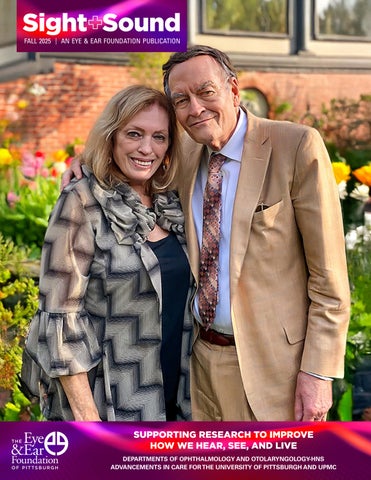
Fall 2025 | AN EYE & EAR FOUNDATION PUBLICATION
SUPPORTING RESEARCH TO IMPROVE HOW WE HEAR, SEE, AND LIVE DEPARTMENTS OF OPHTHALMOLOGY AND OTOLARYNGOLOGY-HNS ADVANCEMENTS IN CARE FOR THE UNIVERSITY OF PITTSBURGH AND UPMC
Fall 2025 | AN EYE & EAR FOUNDATION PUBLICATION
3 4 5 6 7 8 9 10 11
BOARD HONORS AL MUSE WITH NEW FUND TO SUPPORT DEPARTMENTS AMID FEDERAL GRANT CUTS TRANSFORMATIVE PHILANTHROPY AND INNOVATION IN PITTSBURGH’S MEDICAL AND CULTURAL LANDSCAPE EYES ON WHEELS: BRIDGING THE GAP IN COMMUNITY VISION CARE BRINGING HEARING CARE TO THE COMMUNITY: THE COMMUNICATION VAN INITIATIVE HEARUP: EMPOWERING THE COMMUNITY THROUGH ACCESSIBLE HEARING CARE THE DR. HIRSCH ENDOWED LECTURESHIP: ADVANCING HEARING SCIENCE AND FOSTERING EXCELLENCE IN OTOLOGY CELEBRATING INNOVATION: THE 2025 WIEGAND ENTREPRENEURIAL AWARD RECEPTION EMPOWERING FUTURE SCIENTISTS: INSIDE THE DEPARTMENT OF OPHTHALMOLOGY’S SUMMER RESEARCH PROGRAM REMEMBERING CHARLES C. COHEN: A FOUNDING PILLAR OF THE EYE & EAR FOUNDATION
SIGHT + SOUND: CELEBRATING INNOVATION AND PHILANTHROPY Dear Friends, As we continue to grow and evolve, Sight + Sound remains a vital way for us to share the incredible momentum happening across our Departments—and to recognize the people who make it all possible. In this issue, we’re proud to highlight stories of donors who give generously, and the remarkable successes emerging from the Departments of Ophthalmology and Otolaryngology-Head & Neck Surgery at the University of Pittsburgh and UPMC. Their support is fueling groundbreaking research, expanding access to care, and helping us attract and retain world-class talent. Recent advances include cutting-edge gene therapy research aimed at restoring hearing in patients with genetic forms of deafness, and optogenetics innovations that hold promise for restoring high-resolution vision in individuals who are blind. These breakthroughs are not only reshaping treatment possibilities—they’re also a direct result of the philanthropic spirit that drives our mission forward. Whether it’s restoring sight, improving hearing, or advancing surgical techniques, these stories reflect the deep connection between philanthropy and progress. We hope you’ll find inspiration in the work being done—and in the people behind it. With sincere gratitude,
Lawton Snyder Chief Executive Officer The Eye & Ear Foundation Articles written by: Lisa A. Goldstein, Senior Writer & Editor, The Eye & Ear Foundation Photography: Kelsey M. Muchnok, Content Strategist, The Eye & Ear Foundation
EEF Board Members attending a Muse Prize dinner. From left: Hank Beukema, Dr. Margaretha Casselbrandt, Dr. José-Alain Sahel, B. Gordon Nelson, Al Muse, Larry Gumberg, Dr. E. Ronald Salvitti, Carole Kamin, and George Fechter
BOARD HONORS AL MUSE WITH NEW FUND TO SUPPORT DEPARTMENTS AMID FEDERAL GRANT CUTS
T
he Eye & Ear Foundation Board of Directors has taken action to support funding cuts by creating the Al Muse Recovery Fund.
At a recent meeting, the Board paused to remember Al Muse, a founding member of the Eye & Ear Foundation, who passed away in May. He was also a former chair and the longest serving Board member. Following a Board meeting discussion about “significant reports of Federal indirect cost cuts and grant cancellations,” Board member George Fechter spoke with fellow Board member Larry Gumberg. They promptly decided they wanted to make a statement to faculty and staff “that we are and always have been full partners with the Departments,” and while we wouldn’t be able to make up for the enormity of loss, we
could do something and show solidarity,” Fechter said. Gumberg agreed, and Board members E. Ron Salvitti, MD, Chuck Brodbeck, and Jeff Markel soon joined. In short order, a commitment was made for over $200K. “This will be part of a larger initiative which is ongoing to make a difference,” Fechter said. It was decided that the fund would have special meaning by bearing Al Muse’s name. The self-appointed committee vote was unanimous, and his family has agreed to the naming. “Al would have embraced our action, and, I am sure, have been modest about his name being on the fund,” Fechter said. “Our Board involves long service and deep friendships,” Fechter said. “We
are unwavering in our dedication to providing resources to advance science to address the human condition. We look forward to a day of restored funding and uninterrupted science. In the meantime, we are doing all we can to minimize the impact. That’s who we are.”
The Eye & Ear Foundation
3
TRANSFORMATIVE PHILANTHROPY AND INNOVATION IN PITTSBURGH’S MEDICAL AND CULTURAL LANDSCAPE
T
he Eye & Ear Foundation of Pittsburgh is honored to announce that Daniel G. and Carole L. Kamin are supporting the new Pittsburgh Hearing Institute in the Department of OtolaryngologyHead & Neck Surgery at the University of Pittsburgh School of Medicine with a $1 million gift for the new Daniel G. and Carole L. Kamin Endowed Research Fund for Hearing Loss. The Pittsburgh Hearing Institute, which will eventually reside on the sixth floor of the UPMC Mercy Pavilion, will change the face of hearing research and clinical care here in Pittsburgh and around the globe. Peter Santa Maria, MD, PhD, Divison Chief of Otology & Neurotology, who recently came from Stanford, will lead the Institute. He and José P. Zevallos, MD, MPH, FACS, Chair of the Department of Otolaryngology-Head & Neck Surgery, are recruiting individuals with renowned expertise in the field to develop treatments for different kinds of hearing loss and hearing-loss related conditions. The Pittsburgh Hearing Institute will also be training leaders around the globe-- with a focus on the developing world -- on techniques that will help people with common conditions that affect learning and career development, like otitis media. Dan and Carole Kamin are longtime supporters of the Eye & Ear Foundation. Their son, Michael, recently joined his mother as a member of the Board of Directors. Additionally, Dan and Carole were one of the first principal gifts to the Vision Institute, naming the lobby and atrium of the building that opened to great acclaim in 2023. The Kamins are renowned philanthropists who were honored in November 2024 with the Outstanding Philanthropists award by the Association of Fundraising Professionals Western Pennsylvania Chapter because of their many donations. One of these donations is a $65 million transformational gift to the Carnegie Science Center. In recognition of their gift, the Science Center is now named in their honor.
4
Fall 2025
The Eye & Ear Foundation
Their generosity has been crucial to many Pittsburgh organizations, including the Carnegie Museum of Natural History, Ladies Hospital Aid Society, Heinz History Center, Pittsburgh Symphony, Boy Scouts of Western PA, and the Center for Research and Practice in Addiction and Recovery at UPMC Mercy, which helps individuals with recovery from opioid addictions.
The Kamins are renowned philanthropists who were honored in November 2024 with the Outstanding Philanthropists award by the Association of Fundraising Professionals Western Pennsylvania Chapter because of their many donations.
EYES ON WHEELS: BRIDGING THE GAP IN COMMUNITY VISION CARE
F
or years, the Eyes on Wheels program has been using a very old, beat-up minivan to transport all the equipment they need for their eyeVan free mobile health clinics. Finally on its last legs, it is being replaced with a van being donated by the Falconi Family of dealerships, a group of family-owned car dealerships in Southwestern Pennsylvania. The dealerships are part of Angelo Falconi’s legacy. “We feel strongly that local businesses, supported by the community, should support the community,” said Ed Morascyzk, president of the organization. “We take our commitment to be an integral part of the community very seriously.” As a person dealing with inherited vision issues, Morascyzk has had the opportunity to work closely with the UPMC Vision Institute. He has seen firsthand that “all involved are dedicating to providing world-class vision services to our community.” Eyes on Wheels is dedicated to eliminating barriers to eye care for patients in the Western Pennsylvania area. It was established as Guerrilla Eye Service in 2005 by Jake Waxman, MD, PhD, and medical students at the University of Pittsburgh Medical School. Every month, Eyes on Wheels hosts three missions at various community clinics
and participates in a handful of large-scale screening events throughout the year. Morascyzk, individually and on behalf of the Falconi organization, welcomes the chance to be part of this “great initiative,” adding, “Providing a vehicle which will deliver vision services is a perfect match, taking advantage of the strengths of both organizations.”
“We take our commitment to be an integral part of the community very seriously.” Ed Morascyzk
The Eye & Ear Foundation
5
BRINGING HEARING CARE TO THE COMMUNITY: THE COMMUNICATION VAN INITIATIVE
T
he Eye & Ear Foundation held a key exchange event on Tuesday, September 16th at the UPMC Mercy Pavilion, future home to the Hearing Institute. Catherine V. Palmer, PhD, Director, UPMC Audiology, officially accepted the keys to the new Communication Van from Ozzy Samad, President of Brother’s Brother Foundation (BBF). BBF donated the van to the Eye & Ear Foundation to be used in the community to provide support to improve communication through clinical and research activities. This will include free hearing screenings and testing as well as free hearing aids. In addition, the University of Pittsburgh’s Department of Communication Science and Disorders faculty will utilize the van to bring research projects out into the community to better understand the needs of people experiencing speech, hearing, language, and voice challenges. Dr. Palmer was joined by UPMC audiologists and members of the faculty in the School of Health and Rehabilitation Sciences, including Dr. David Beck, Interim Dean. “The Communication Van is officially on the road providing hearing care, including free hearing aids in neighborhoods around the greater Pittsburgh area as well as reaching out to our rural neighbors,” Dr. Palmer said. Elaine Mormer, PhD, CCC-A, Professor in the Department of Communication Science and Disorders, has been teaming up with rural community pharmacies. The plan is to partner with them to have a hearing clinic in their parking lot once a month to really expand reach. This will likely not start until spring. Recent Communication Van visits have included Sharpsburg’s Roots of Faith events, City Theatre Community Connects. Future plans include partnering with the Carnegie Library, local schools focused on underserved youth, and the Special Olympics. While the Special Olympics has always provided hearing testing, the Communication Van will allow on-site hearing aid fitting and care for athletes who need hearing aids or already have hearing aids that need maintenance. “We’re very much following the model of our EyeVan colleagues as we’re teaming up where events are already happening for people who are under resourced and need access to these services,” Dr. Palmer said.
6
Fall 2025
The Eye & Ear Foundation
Early detection and treatment of hearing issues can dramatically improve communication, social engagement, mental health, and overall quality of life. For children, identifying and treating hearing problems early can support communication and learning. Many individuals face significant barriers to hearing and communication care, including transportation challenges, lack of funds since hearing aids are not typically covered by insurance, or simply not knowing where to go or who to trust. By eliminating the need to travel to a traditional clinic or research lab, the Communication Van brings professional hearing and communication evaluations straight to neighborhood centers, senior residences, schools, and community events – meeting people where they are. “The Communication Van covers a big gap for people who have access to care-related issues,” said Lawton Snyder, CEO of the Eye & Ear Foundation. “We have wonderful facilities and services within our hospital system; however, it is difficult for some people to get to us. This brings the care to the community and gives people an opportunity to get the same level of service they could get if they had the ability to make it to us on a regular basis.” Not surprisingly, patients have responded to the van with excitement. The van’s colorful design gets it noticed. Any service related to hearing is provided – including hearing testing, hearing aid fittings, hearing protection, and even showing people smartphone capabilities like speech-to-text. “Our colleagues in speech, voice, and language will be using the van similarly,” Dr. Palmer said. Specifically, Dr. Will Evans (SHRS) is interested in expanding care for individuals with aphasia (speech and language problems common after stroke) who may not access this essential care because of insurance, travel and transportation issues. The Van is unique because it serves many different communication needs in from both a clinical and research perspective. Colleagues who run large research programs will be using the van to move that research out into the community. Amanda Hampton Wray, PhD, CCC-SLP, continued on next page
Lawton Snyder, CEO, EEF; David Beck, Interim Dean of the School of Health and Rehabilitation Sciences, Pitt; Catherine Palmer, PhD, Professor and Chair, Department of CSD, Pitt and Director of Audiology, UPMC; Ozzy Samad, President, Brother’s Brother Foundation (BBF); Laura Kelly, Vice President of Communications & Development, BBF; Liam Carstens, Vice President of Programs, BBF; Craig Smith, Director of Development, EEF
continued from previous page
convinced Dr. Palmer of the importance of this. Her research on stuttering has changed the landscape, yet in the studies, the kids are primarily children of university professors because that is who can come to the lab. “We need a much broader look when we’re trying to do research that’s actually going to impact care,” Dr. Palmer said. “We’re really excited to do that.” Dr. Palmer talked about interviewing friends with vans. “It’s always a hearing van, very specific, and usually obtained through research projects,” she said. “When the research funding ends, the van sits idle. It really helped us to talk to our colleagues to think about how we’re going to do this differently. It’s because of the Eye & Ear Foundation and Brother’s Brother commitment that there will be ongoing funding for these efforts. If you don’t have that in place, it’s nice for a year and then it’s gone. That won’t be the case here.”
The Brother’s Brother Foundation has been working with mobile clinics and community organizations like EEF and UPMC because, “from our perspective, they’re really the ones making the impact on the ground,” Samad said. “The need locally here is quite honestly in many ways just as apparent as it is in far off lands.” The van is highly customized. Brother’s Brother worked with the Audiology group and the faculty in Communication Science and Disorders to design every nuance of the inside. They even went to the factory so Dr. Palmer could convey what she wanted. An example is the lift in the back of the van. A patient thought they would not be able to get their hearing tested in the Communication Van because of their wheelchair. Dr. Palmer was able to tell them, “Yes you will.” “This is something simple we might take for granted that is extremely meaningful to those who are in need,” Samad said. Follow the Communication Van on Instagram @communicationvan.pitt or Facebook @communicationvan.pitt.
HEARUP: EMPOWERING THE COMMUNITY THROUGH ACCESSIBLE HEARING CARE
I
n a community-driven initiative called HearUp, the Eye & Ear Foundation is looking to raise $150,000 a year to provide hearing care, including professionally fit hearing aids to people who otherwise cannot afford this care. Hearing aids and associated services often are not covered by Medicare and are rarely covered by private health insurance, so even people who have health insurance may not have access to the care they need. The UPMC Audiology group and University of Pittsburgh Communication Science and Disorders group team up with the Eye & Ear Foundation to provide hearing care including hearing aids at several free clinics every month. These year-long services ensure ongoing support for individuals who may need hearing aid repairs and also provide access to free batteries. In addition, the team
provides hearing aid fittings at the two-day Mission of Mercy event each year. The cost of providing these hearing aids and services is significant. Communication is essential to the human condition and hearing is foundational to human communication. People living with untreated hearing loss may find daily interactions exhausting. Whether it is a job interview, doctor’s appointment, interacting with family, or simply understanding instructions, hearing well can be the difference between inclusion and isolation and independence vs dependence. Untreated hearing loss is linked to a variety of health outcomes including increased depression, anxiety, risk of falls, and cognitive decline. continued on next page The Eye & Ear Foundation
7
continued from previous page
What makes HearUp especially meaningful is its community-powered model. While the need is great, the cost of change is surprisingly manageable. Even small donations add up to make a life-changing impact. Each contribution – no matter the size – will become part of a larger effort to restore dignity, opportunity, and connection for people in our community. Donations are tax deductible. To make a sound investment, donate online or send a check to the Eye & Ear Foundation. To learn more visit us at @communicationvan.pitt on Instagram and @Communication Van on Facebook.
THE DR. HIRSCH ENDOWED LECTURESHIP: ADVANCING HEARING SCIENCE AND FOSTERING EXCELLENCE IN OTOLOGY
T
o honor the enduring impact of Dr. Barry Hirsch, a recently retired and beloved physician whose life and work have profoundly shaped our community and institution, the Eye & Ear Foundation has established the Barry E. Hirsch, MD Lectureship in Otology. This endowed lectureship will bring distinguished speakers to the Department of Otolaryngology-Head & Neck Surgery at the University of Pittsburgh to share insights into the practice of otology, foster dialogue around future directions of care, and inspire promising talent in the field—continuing the legacy of learning and empathy that Dr. Hirsch embodied. This initiative was made possible through a generous contribution directed by his wife, Dr. Jean Harwick, whose shared commitment to education and excellence in medicine reflects the very spirit of this lectureship. Their support laid the foundation for what we hope will become a lasting tribute to Dr. Hirsch’s values and vision. This is the first time an endowment has been created for hearing science, a fitting tribute to Dr. Hirsch’s remarkable career and lifelong dedication to the field. Dr. Hirsch spent his otology career in Pittsburgh, dedicating decades to the care of patients, the mentorship of young physicians, and the advancement of medical knowledge. He is known not only for his clinical excellence but also for his extraordinary kindness and easygoing nature—qualities that made him a trusted colleague,
8
Fall 2025
The Eye & Ear Foundation
cherished teacher, and deeply respected member of our medical community. He also served nationally as president of the American Neurotology Society. “Dr Hirsch was a skilled surgeon and clinician who was responsible for training many in our field and he always promoted bringing in outside ideas to Pittsburgh,” said Peter Santa Maria, MD, PhD, Professor, Division Chief of Otology & Neurotology. “This endowment preserves this legacy in a perfect way, by facilitating thought leaders to come here and share with our trainees and faculty.” To support this endowment to honor Dr. Hirsch’s legacy and strengthen our mission to advance hearing science and patient care, you can donate online or mail a check to the Eye & Ear Foundation.
“In my 40-year career in otology/ neurotology, I have seen remarkable advancements. It is our hope that this lectureship will bring leaders to our great institution to continue to train, teach, and inspire the next generation of clinicians and researchers.” Barry E. Hirsch, MD
CELEBRATING INNOVATION: THE 2025 WIEGAND ENTREPRENEURIAL AWARD RECEPTION On Monday, September 15, the Eye & Ear Foundation hosted a distinguished reception in Pittsburgh to honor the recipients of the Bruce and Barbara Wiegand Entrepreneurial Research Awards. The event welcomed Bruce and Barbara Wiegand, Department Chairs, and this year’s awardees—two pioneering companies developed by the University of Pittsburgh and UPMC clinical and research teams.
Traditionally treated with surgical ear tube placement, Earflo offers a non-invasive, at-home alternative that has shown strong efficacy in clinical studies. Earflo is currently in the final stages of product development and has earned international recognition for its innovation. In fact, EarFlo is on Time Magazine’s Top Inventions for 2025.
The awards, established by the Wiegands, are designed to support translational research with commercial potential in the fields of ophthalmology and otolaryngology–head & neck surgery. Uniquely structured as venture philanthropy investments, the awards are given directly to companies, reflecting the donors’ intent to accelerate innovation and impact. Importantly, any return on investment from these ventures will be reinvested into the Foundation’s mission—fueling future research, innovation, and discovery. This structure was deeply important to Bruce and Barbara Wiegand, who envisioned a sustainable cycle of innovation where philanthropic dollars could generate lasting impact.
A spinout from the Department of Ophthalmology, NetraMind is developing AI-powered tools for multimodal image analysis to diagnose and monitor age-related macular degeneration (AMD) and diabetic retinopathy (DR)—two leading causes of blindness. NetraMind’s platform enables early detection and precise monitoring through advanced imaging analytics.
EARFLO, INC. The company was founded by a team of biomedical engineers and ENT specialists, including Peter Santa Maria, MD, PhD, Vice Chair of Translational and Clinical Research. Earflo is a pediatric-focused medtech startup addressing otitis media with effusion, a common and costly condition affecting millions of children annually.
NETRAMIND INNOVATIONS, INC.
The company was founded by four faculty members from the Department of Ophthalmology: Dr. Jay Chhablani, MD, Professor of Ophthalmology, Director of Clinical Research at the UPMC Vision Institute, and Vice Chair of Clinical Trials; Dr. Kiran Kumar Vupparaboina, PhD, Research Assistant Professor; Dr. Sandeep Bollepalli, PhD, Research Assistant Professor; and Dr. José-Alain Sahel, MD, Distinguished Professor and Chairman of the Department of Ophthalmology. Their AI-driven solution includes both clinical and research-focused platforms and is designed to be costeffective and scalable. NetraMind is preparing for pilot trials and FDA submissions in the coming year. The Eye & Ear Foundation
9
EMPOWERING FUTURE SCIENTISTS: INSIDE THE DEPARTMENT OF OPHTHALMOLOGY’S SUMMER RESEARCH PROGRAM
B
y participating in the Vision Site at the Hillman Summer Academy, the Department of Ophthalmology increases its visibility and leadership in Vision Science, enriches its educational mission, supports broader goals, amplifies its community outreach, and cultivates future talent. The Vision Site is one of nine sites, all of which “strive to provide cutting edge research and career preparatory experience to a diverse group of highly motivated high school students who are pursuing higher education and careers in STEM fields, especially research and medicine,” said Yuanyuan Chen, PhD, Assistant Professor of Ophthalmology and the Vision Site head. The Department has been participating in this program for five years, hosting 6-9 students each year. Over 55% of the students are from underrepresented backgrounds, supported with lunch cards, bus passes, and a $2400 fellowship for their commitment. Funding is supported by the Eye & Ear Foundation and Hillman Foundation attributed to Dr. José-Alain Sahel, Chair of the Department. Lasting about seven weeks, the curriculum is welldeveloped and includes a full week wetlab bootcamp led by Dr. Chen and Kate Davoli, MDiv-HTL (ASCP)cm, Laboratory Manager for Tissue Culture and Histology Research cores at the University of Pittsburgh School of Medicine, teaching basic skills on bench. This is followed by full-time lab research experiences with mentors in each lab but mainly from the Department of Ophthalmology.
10 Fall 2025
The Eye & Ear Foundation
Final day presentations, awards, and a closing ceremony round out the program. “This year, the students attended our Vision Research Day and Department retreat,” Dr. Chen said. “Their attendance to our Department activities helped them merge into the daily life of research professions.” Jackie Tang, a high school senior, wanted to participate in the program so she could gain real research experience, which is rarely available for high school students. With her mentor, Dr. Kun-Che Chang, she learned the basics of lab etiquette and worked on her ability to carry out experiments. Since she was not very familiar with the subject of the research she worked on, she said it was “super helpful” to have her mentor available to explain anything she found confusing. Jackie’s research focused on the effects of the growth factor IGF-1 on retinal ganglion cell axon outgrowth. She was also able to help some of the other lab members with their experiments and observe a lot of interesting and more complicated experiments. The program further convinced Jackie to pursue a career in the sciences and helped her realize she really enjoys research – something she was not sure of before. She plans to attend university to study biology and then pursue a career in medicine. “I think this program is truly amazing and provided me with an unforgettable experience,” Jackie said. “One continued on next page
continued from previous page
thing I think people (mainly students) should know about the program is that it’s actually not as stressful as it may seem and is really fun. When I was applying, I was a little bit scared that it would be too much work, but everyone is very kind and understanding and want to see the students succeed.” Another participant, Aubrey Sudor, is a high school junior who wanted to be exposed to what it would feel like to have a job, especially in research. She worked with Tobii Pro 3 glasses, which tracked her real-world eye movements. Now she is thinking of becoming a neurologist, “since my research was more in trying to understand why our brains create those movements, and I liked that concept,” she said. The program is “worth the time,” she added. “At first, it seems like it will be very long and tiring. It ended up being the complete opposite! It was very fun and educational and every day I did something different.” J. Patrick Mayo, PhD, Assistant Professor in the Departments of Ophthalmology and Bioengineering, was Aubrey’s mentor. He got involved with the program because he likes introducing young people to science. “I think the world of research is vastly broader and more interesting than they realize,” he said. “I also like to give people an opportunity that they might not otherwise have access to. And it’s fun to have a “young person” in the lab.” Dr. Mayo spent a few hours each week introducing Aubrey to the project, explaining why it was important, and discussing their role in the research. This high-level discussion was always accompanied by more technical discussions of how to carry out the project, collect and analyze data, and how to properly document their scientific progress (and presentations). The data that Aubrey collected are being used to study the prevalence of different types of eye movements during natural visual behavior. “These measurements are critical for guiding basic research because they help point to the most relevant behaviors during everyday experiences,” Dr. Mayo explained. “These are most often the behaviors that patients also have difficulty with if and when visual deficits develop.” Previous students have been admitted to CMU, UCLA, Brown, Pitt, Allegheny College, Boston University, and Brandeis University. Many have come back to the Department to continue research training after starting college.
REMEMBERING CHARLES C. COHEN: A FOUNDING PILLAR OF THE EYE & EAR FOUNDATION Charles C. Cohen (“Chuck”), a founding member of the Eye & Ear Foundation Board, passed away on August 27, 2025, following a brief illness. Chuck, along with Al Muse and James Knowles, was instrumental in establishing the Eye & Ear Foundation through thoughtful collaboration with the University of Pittsburgh and UPMC. His vision and leadership helped lay the groundwork for the Foundation’s enduring mission and impact. “Yet, beyond his professional accomplishments, Chuck will be remembered most for his kindness, humor, wisdom, and unwavering dedication to his family and community,” said Lawton Snyder, EEF CEO. “His legacy lives on in the countless lives he touched and the institutions he helped shape—including ours.” The family kindly requested that anyone wishing to honor Chuck’s memory can do so by donating to the Eye & Ear Foundation of Pittsburgh. “Our hearts go out to his wife Michele, who also served as a member of the Eye & Ear Foundation Board,” Snyder said. “Please join me in honoring Chuck’s remarkable life and legacy. He will be deeply missed.”
The Eye & Ear Foundation
11
NONPROFIT ORG U.S. POSTAGE
PAID
PITTSBURGH, PA PERMIT NO. 612
eyeandear.org
203 Lothrop Street Supporting Research to Improve how we Hear, See, and Live Suite 251 EEI Pittsburgh, PA 15213 412.864.1300 O 412.864.1305 F
If you no longer wish to receive our newsletter, please submit requests to our mailing address, or email optout@eyeandear.org. The official registration and financial information of the Eye & Ear Foundation may be obtained from the Pennsylvania Department of State by calling toll free, within Pennsylvania, 1-800-732-0999. Registration does not imply endorsement.
The Eye & Ear Foundation of Pittsburgh is a nonprofit 501 (C)(3) organization. Our mission is to support the research and academic efforts of the Departments of Ophthalmology and Otolaryngology-Head & Neck Surgery at the University of Pittsburgh. Donations to support our research initiatives can be made online at eyeandear.org or by returning the enclosed envelope. For more information on the Foundation, our research, or the articles in this newsletter, please contact Katherine Troy, Director of Operations, at katherine@eyeandear.org or 412-864-1300. Medical Disclaimer: The Eye & Ear foundation does not assume any responsibility or risk for the use of any information contained within the newsletters. Reliance on any information available through the newsletters is solely at your own risk. All information and content found in this newsletter were created for educational purposes only. The newsletter is not intended as, or as a substitute for, professional medical advice, diagnosis, or treatment. Always seek the advice of your physician or another qualified health provider with any questions you may have regarding a medical condition. Never disregard professional medical advice or delay in seeking it because of something you have read in the newsletters. We encourage you to view our full disclaimer by visiting the eyeandear.org website.
WAYS TO DONATE ONLINE eyeandear.org
Eye & Ear Foundation 203 Lothrop Street Suite 251 EEI Pittsburgh, PA 15213
SCAN
Supporting research to improve how we see, hear, and live.