Working with
Making Space for Creative Growth in Essex Screen Industries and the Music, Performing and Visual Arts Sectors Report
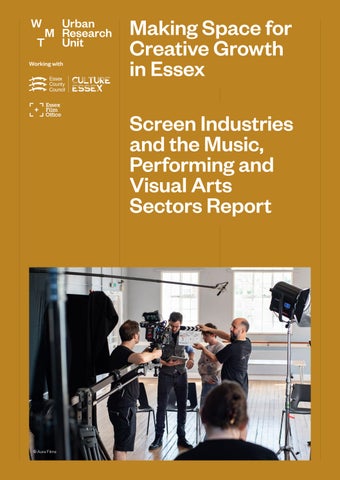
© Aura Films
Contents 00 Executive Summary 4 01 Introduction 7 02 The Case for Cultural and Creative Spaces
14
03 Essex’s Creative and Cultural Landscape
23
04 Opportunities for Cultural and Creative Spaces
36
05 What’s Next 50 Appendix 52
This report was commissioned by Culture Essex. Culture Essex is managed by the Essex County Council Cultural Development Service. We Made That
Making Space for Creative Growth
2
00 Executive Summary
Project caption 9 Acts of Care at The Care House Project. © Rhiannon Faith Company. Photo by Foteini Christofilopoulou. We Made That
Making Space for Creative Growth
3
Executive Summary
Cultural spaces for Essex’s growing creative economy Essex, a county with a dynamic history and diverse landscape, is poised to become a cultural production powerhouse for its high-growth Screen Industries and music, performing, and visual arts sectors.
UK government plans to spend £35 billion on high growth creative industries by 2035.
This report establishes clear opportunities to support these industries through strategic investment in physical spaces, aiming to unlock creative growth, generate high-quality jobs, and enhance social well-being across the region.
sub-sectors, which are poised for further investment through the UK Industrial Strategy, a convergence of private investment, and the UK’s position as a significant market and exporter globally for the arts, music, and film and TV sectors.
From evidence to action The report provides a blueprint for cultural infrastructure development, directly responding to the ambitions of the Essex County Council Cultural Strategy 2023 and the Shaping the Future of Essex’s Creative Sector: Evidence and Action Roadmap 2025. By identifying optimal locations and development needs for new or improved cultural spaces, this study ensures planned infrastructure catalyses sustainable, inclusive growth across Essex, strengthening the UK’s position as a global creative superpower.
A 2025 survey of Essex creative industries revealed that 47% of organisations perceive a lack of adequate workspace as a barrier to fulfilling their potential, with 46% anticipating increased space needs within the next year. This underscores the urgency for action to address infrastructure gaps.
Essex has seen a 71% growth in film production jobs and a 50% growth in post-production jobs between 2018-2024, alongside significant growth in computer game businesses. Similarly, music, performing, and visual arts businesses have shown a 27% growth from 2018-2025, with notable increases in artistic creation (+11%), performing arts (+22%), and support activities to performing arts (+75%).
Essex’s dynamic creative and cultural landscape is already specialised in high-potential
Braintree
Uttlesford
Colchester
Tendring
Harlow
Essex has 268 spaces powering its high growth creative industries.
Chelmsford Epping Forest
Maldon
Brentwood Basildon
Rochford Southend-on-Sea
Thurrock
Castle Point
© House of AEIOU Essex provides a total of 268 spaces for cultural production and consumption supporting the Screen Industries and the Music, Performing and Visual Arts sectors. We Made That
Making Space for Creative Growth
4
Executive Summary
This growth is supported by strategic regional alliances like the Thames Estuary Production Corridor (TEPC), which recorded 42% Screen Industries growth from 2016-21. A recent global downturn in the film and TV industries requires a considered approach to investment to ensure Essex remains competitive. Mapping Essex’s cultural infrastructure mapping exercise revealed 268 spaces supporting these sectors across Essex, with 156 for cultural production and 112 for cultural consumption. While major urban hubs like Southendon-Sea and Colchester demonstrate high concentrations of creative activity, areas like
“What we really need to focus on is the content ideas and the creation hubs, because ideation is really important because without that we’ve got nothing.” — Film studio developer Royal Opera workshop © Philipp Ebeling
Basildon and Brentwood may face capacity bottlenecks due to a disparity between creative spaces and jobs. Evidence also shows strong synergies between cultural spaces, education hubs and transport corridors, creating a strong talent pipeline and access to quality jobs. This audit provides evidencebased opportunities to address disparities, ensuring future infrastructure investment is targeted and capable of anchoring creative talent in the county:
© Aura Films
“I’m a big believer in shared spaces and shared resources where possible.” — Film-maker based in Essex We Made That
1. Small-medium-scale flexible studio space for Film and TV: Repurposing existing assets to efficiently deliver small-tomedium-scale, accessible, and flexible studio spaces. 2. Affordable creative Workspace: Transforming underutilised buildings in town centres and on industrial land into affordable creative workspace. 3. Back-of-house facilities for the performing arts: Enhancing existing back-ofhouse facilities and adapting Making Space for Creative Growth
nearby industrial space for production and storage. 4. Mid-sized arts and performance venues: Protecting existing mid-size venues and opening new spaces in under-utilised or formerly closed town centre spaces. 5. Spaces for business incubation and creative skills development: Creating hubs for business incubation and development of creative skills. A further set of projects should be undertaken to unlock a broad range of spaces for culture: – Developing a more robust resource guide for the film and TV industry in Essex. – Making outdoor spaces available for culture. – Creating a space directory for the performing arts. – Leveraging planning policy to support cultural and creative spaces. – Commissioning a market assessment of a multipurpose, large scale live music venue. 5
01 Introduction
The Essex Serpent © Apple TV + We Made That
Making Space for Creative Growth
6
01. Introduction
Providing spaces for Essex’s creative and cultural communities This report establishes clear opportunities for supporting Essex’s high-growth cultural and creative sectors through access to physical spaces for the Screen Industries and Music, Performing and Visual Arts sectors. Robust evidence is used to identify clear, actionable opportunities for unlocking creative growth. Making Space for Creative Growth in Essex directly responds to the ambitions set out in the Essex County Council Cultural Strategy, and the strategic opportunities set out in Shaping the Future of Essex’s Creative Sector Evidence and Roadmap.
Driving Essex’s creative growth Supporting cultural spaces is a critical requirement to advance the county’s vibrant creative economy. Responding directly to the ambitions set out in Essex’s Cultural Strategy, and the strategic opportunities identified in Shaping the Future of Essex’s Creative sector, this study identifies optimal locations and development needs for new or improved cultural spaces, specifically targeting high-potential subsectors: Screen Industries, and music, and performing and visual arts. The creative industries are a dynamic economic engine, crucial for both national prosperity and local community well-being. By attracting investment in infrastructure, the creative economy in Essex can drive prosperity, create high-quality jobs, and enhance social well-being. The report provides a robust evidence base for targeted action, ensuring planned infrastructure catalyses sustainable, inclusive growth across the county.
The Essex County Council Cultural Strategy, 2023 Sets out the council vision and ambitions in 2023, striving to deliver across four key principles: enriching the cultural and creative sector; empowering the sector by supporting collaboration, amplifying by increasing engagement and diversity, and growing the sectors by increasing innovation and sustainable growth.
Shaping the Future of Essex’s Creative Sector: Evidence and Action Roadmap, 2025 Provides an evidence base for the impact and position of the cultural and creative industries, setting out 6 strategic opportunities for Essex’s creative growth.
Making Space for Creative Growth in Essex, 2026 (This report) Serves as a blueprint for what spaces are needed to develop the Screen Industries and the Music, Performing and Visual Arts sectors, responding to the strategic opportunity to support high-potential sub-sectors.
We Made That
Making Space for Creative Growth
7
01. Introduction
Why focus on cultural and creative spaces? The Shaping the Future of Essex’s Creative Sector: Evidence and Action Roadmap report identified that access to physical space is preventing Essex creative businesses from growing in the county.
47%
46%
said their organisation lacks adequate workspace to fulfill their potential
felt the space needed by their organisation would increase over the next year
A survey was carried out in 2025, with 102 members of the Essex creative industries, identifying cultural infrastructure needs. Almost half said that inadequate workspace was holding them back from fulfilling their potential, and that their needs for space would increase over the next year.
“I’d love to have a creative space or hub in my local town of ClactonOn-Sea where there are individual offices/rooms which people in the creative industry can rent affordably so the whole building is full of creatives.” - Creative freelancer, Essex
© Basildon Tech Art Festival
We Made That
Making Space for Creative Growth
8
01. Introduction
Which are the highest growth sub-sectors? Screen Industries
In Essex, the number of businesses in film and TV production has risen by a third (34%), and photographic businesses and post-production businesses by a fifth (19% and 20%) since 2018. Computer game businesses in Essex also grew significantly from 5 to 20, albeit from a low base.
Number of Creative Businesses, Essex
Film and TV related activities have grown significantly since 2018 but are currently impacted by global industry challenges.
Business Change in Essex, 2018-2025
Year
Between 2018 and 20125, creative employment has overall risen specifically in film and TV production, post-production and distribution.
+34% Film and TV production businesses 2018 - 2025
Number of Creative Businesses, Essex
A downturn or flatlining in employment figures in some sectors between 2023 and 2024 reflects global challenges in the Screen Industries.
Jobs Change in Essex, 2018-2024
Source: UK Business Count, ONS and BRES, ONS. We Made That
Year Making Space for Creative Growth
9
01. Introduction
Which are the highest growth sub-sectors? Music, Performing and Visual Arts sectors Number of Creative Businesses, Essex
Creative business numbers have grown across the board since 2018, and employment is recovering postpandemic.
Business Change in Essex, 2018-2025
Since 2018, there has been a notable increase in Essex in the number of registered businesses in the majority of sub-sectors, notably the largest sub-sectors artistic creation (+11%), performing arts (+22%), and support activities to the performing arts (+75%).
+32% Music, Performing and Visual Arts jobs 2020 - 2024
Jobs Change in Essex, 2018-2024
Number of Creative Businesses, Essex
Employment in these subsectors was impacted significantly by the pandemic, but overall is growing again, with employment rising by a third (+32%) from a low in 2020, to the latest figures collected in 2024.
Year
Source: UK Business Count, ONS and BRES, ONS. We Made That
Year Making Space for Creative Growth
10
XX. Section Title 01. Introduction
What Title Page is cultural Sub-Title infrastructure? Braintree Uttlesford Colchester
Cultural infrastructure refers here to the spaces and buildings in which cultural activities take place. This includes spaces for the production (making) of culture, the consumption (showcasing) of culture, and the supply chain activities which support both production and consumption. Places of consumption and production are defined in this document as follows, with examples overleaf:
Harlow
Tendring
Chelmsford
Epping Forest
Maldon
Brentwood Basildon
Rochford Southend-on-Sea
Thurrock
Castle Point
Essex provides a total of 268 spaces for cultural production and consumption supporing the Screen Industries and the Music, Performing and Visual Arts sectors.
Key Screen Industries:
Consumption: Places where culture is experienced, participated in, showcased, exhibited or sold. For example, museums, galleries, theatres, cinemas, libraries, record stores and historic cultural sites. These are expected to be publicly accessible or bookable in some way.
Film and TV production studio Screen post-production studio Prop and costume making and hiring space Set and exhibition design and building space Cinema Education space: Screen Industries
Production: Places of creative production, where creative work is made, usually by artists, performers, makers, manufacturers or digital processes. These are often tied to a specific business. For example creative workspaces, performing arts rehearsal spaces, music recording studios, film and television studios and industrial and light industrial units used by creative and cultural businesses. Cultural production is supported by the supply-chain sub-strata which provide materials and services for cultural production. This study focusses on mapping facilities serving the Screen Industries and Music, Performing and Visual Arts creative economies in line with the study’s objectives of supporting high-growth creative subsectors. The typologies mapped were selected to align with DCMS Standard Industrial Classification (SIC) Codes for these industries, and previous mapping studies.
Animation and video game creation studio Music, Performing and Visual Arts: Arts centre Makerspace Museum and public gallery Dance performance venue Dance rehearsal studios Theatres (including theatre rehearsal studios) Live music venue Music rehearsal studio Music recording studio Artists’ workspace Creative workspace Creative co-working desk space Education space: music, performing or visual arts *Note some of these spaces may serve multiple industries, so this break down is indicative.
We Made That
Making Space for Creative Growth
11
Supply chain sub-strata
Cultural production
Cultural consumption
01. Introduction
Galleries: The Minories Gallery, Colchester
Theatres: Harlow Playhouse
Live Music Venues: Colchester Arts Centre
Music Recording Studio: Hamford Studio, Harwich
Dance Rehearsal Studio: Adagio School of Dance, Brentwood
Screen Post-Production Studio: Hellfire, Southend-on-Sea
Cardboard Tube Manufacturer: Essex Tube Windings, Tilbury
Storage for Film & TV: CAMA AssetStore, Southend-on-Sea
Metal Fabricators: Architectural Metal Fabricators, Basildon
Examples of cultural infrastructure across Essex’s value chain
Cultural infrastructure in Essex This mapping exercise identified 268 spaces supporting the Screen Industries, and the Music, Performing and Visual Arts sectors mapped across Essex. Essex has 112 cultural consumption facilities which provide spaces for artistic expression, experimentation, and innovation. Examples of Essex’s existing cultural consumption facilities include Focal Point Gallery, West Cliff Theatre, and Hot Box Live Events. There are 156 cultural production facilities in Essex, such as studios and recording and rehearsal facilities where Essex’s artists and cultural producers generate art, music, sculpture and other creative forms. This includes artist workspaces, such as the blokhouse in Southend-on-Sea, arts centres like Metal Culture, screen post-production studios like Hellfire Video Production, and music recording studios like Card Trick Music, and workshops for the Royal Ballet and Opera House and Mercury Theatre. We Made That
Making Space for Creative Growth
High House Production Park in Thurrock provides a dynamic creative industries hub, which brings together mixed production facilities, including film and TV studio space, artist workspace, and theatrical production workshops through a partnership with key creative organisations and the public sector, demonstrating how dynamic production facilities can be blending to create creative industries led growth and skills development. Note: Facilities such as community halls do not form part of the scope of this study, although their important functions are recognised in creative participation and creative education. It is important to note the limits of cultural infrastructure mapping. In addition to types of spaces not captured in this view, timing of mapping means that some newer spaces may not be captured, and this map does not record spaces which have been lost. Future sector surveying could provide a more granular picture of provision across the borough, and the capacities and challenges facing individual spaces. 12
02 The Case for Cultural and Creative Spaces
Backstage Centre © Philipp Ebeling We Made That
Making Space for Creative Growth
13
02. The Case for Cultural and Creative Spaces
A regional cultural and creative powerhouse In Essex, the Screen Industries and Music, Performing and Visual Arts sectors are showing significant growth. A national focus on the creative industries creates a significant opportunity for Essex to attract investment, develop these high growth creative sectors, and contribute significantly to the UK’s position as a global creative superpower.
National context The UK Government’s 2025 Creative Industries Sector Plan highlights Screen Industries and Music, Performing and Visual Arts as frontier industries with high growth potential, aiming to increase annual investment from £17 billion to £31 billion by 2035. £31bn annual investment from the UK Government by 20351 +22% all spending on film and high-end TV in 20252 £1.5bn from DCMS to save cultural venues3
References 1. UK Industrial Strategy Creative Industries Sector Plan, 2025. 2. BFI Research and Statistics Unit, 2026. 3. UK Industrial Strategy Creative Industries Sector Plan, 2025. 4. Thames Estuary Production Corridor Roadmap for Growth, 2024. 5. Thames Estuary Production Corridor Roadmap for Growth, 2024. 6. UK Business Counts, ONS. 7. UK Business Counts, ONS.
We Made That
Making Space for Creative Growth
© UK Industrial Strategy
14
Regional context
Local context
Essex already has strategic regional alliances in place to support sector growth, notably the Thames Estuary Production Corridor (TEPC), and the Screen Alliance East with Hertfordshire. Devolution further empowers local ownership of strategies and development.
Essex’s dynamic creative and cultural landscape is already specialised in the highest-potential creative sub-sectors. Essex is home to established cultural organisations, the recently formalised Film Office, and a growing network of creative hubs.
+42% Screen Industries growth in TEPC 2016-214
+30% Screen Industries businesses in Essex 201820256
£820 million added to economy by TEPC5 2025 launch date of Screen Alliance East
© Thames Estuary Production Corridor
We Made That
Making Space for Creative Growth
+27% Music, Performing and Visual Arts businesses in Essex 2018-20257
© Mercury Theatre
15
02. The Case for Cultural and Creative Spaces
The Screen Industries
This includes: Film and TV production Largely small independent film and video production business based in Essex and freelance workers working locally, nationally and internationally. Plus other productions filming in Essex.
Animation for Film, TV and commercials Innovative micro-businesses supported by a pool of freelancers and sub-contractors.
Post-production and Visual FX Micro-businesses like Hellfire Video Production, and a pool of freelancers, working across visual effects, sound recording, colour grading and editing.
Gaming and eSports production Homegrown businesses like Dlala Studios, and a pool of independent freelancers and micro-businesses.
Digital and creaTech Technical and digital innovation at the cutting edge of new technologies.
Supply chain This includes music and sound operators and specialists, photographers, set and costume design studios, casting agencies, craft services and logistics companies.
Skills development Essex’s Screen Industries are supported by specialist educational spaces including Basildon’s Centre for Digital Technologies, University of Essex’s Centre for Film and Screen Media, and School of Computer Science and Electronic Engineering, and the Knowledge Gateway which focusses on business incubation.
We Made That
Making Space for Creative Growth
16
02. The Case for Cultural and Creative Spaces
The case for the Screen Industries The Screen Industries boasts a combination of significant private and public sector investment, a national policy focus, and a growing track record in Essex: Growing specialisations: Key sub-sectors have grown significantly in Essex between 2018 and 2024, with jobs in film and TV production up 71% and jobs in post-production up 50%.1
Targeted public sector investment: £75 million Screen Growth Package and a £30 million Video Games Growth Package from the UK government.4
Growing production spend: UK film and high-end TV production spend was £6.8 billion in 2025, up 22% from the previous year highlighting the sector’s significance to the UK economy.2
Strong tax incentives: Competitive tax measures, including an enhanced rate for UK visual effects costs and an Independent Film Tax Credit, are in place to stimulate international collaboration and attract productions.5
Growing inward investment: Private inward investment and high end TV delivered £5.8 billion, or 85% of combined investment, showing the UK’s world leading reputation for film and TV.3
1 2 3
We Made That
Business Register and Employment Survey, ONS. BFI, 2026. BFI, 2026.
Making Space for Creative Growth
4 5
UK Industrial Strategy Creative Industries Sector Plan. As above.
17
02. The Case for Cultural and Creative Spaces
Music, Performing and Visual Arts This includes: The performing arts
Museums and galleries
The performing arts captures anything from theatre, dance, music and spectacle shows, with organisations like Essex-based theatre company Paper Birds.
Museums and galleries from the Minories to Southend Central Museum employ staff in varied roles from curation to education, to facilities management.
Visual arts Artists working in visual fields such as painting, drawing, ceramics, sculpture, printmaking, video, largely freelancers.
Technical support Facilities from theatres to art spaces, require a variety of technical roles, such as lighting and sound engineers, and other staff to ensure the smooth operation of these facilities.
Music and sound recording
Supporting creative activities
Micro-businesses and freelancers creating, producing, and recording for music, film, TV and podcasts.
This includes costume and prop making, set design, sound design, and photography.
Skills development Essex’s Music, Performing and Visual Arts Sectors are supported by specialist educational spaces including East 15 Acting School, University of Essex Campus, Colchester, Colchester Institute, and ROM Theatre Arts. However, recent closures and reductions in arts courses have also reduced breadth of provision.
We Made That
Making Space for Creative Growth
18
02. The Case for Cultural and Creative Spaces
The case for Music, Performing and Visual Arts The Music, Performing and Visual Arts sub-sectors in Essex have an increasing presence in Essex, supported by global reach, and increasing national investment: Increasing presence: Between 2018-2025 there has been a 27% growth in the number of Music, Performing and Visual Arts businesses in Essex.1 Significant economic contribution: The UK is the third biggest music market, and second largest art market globally, with the theatre sector contributing nearly £1 billion in GVA annually.2
Transformative capital investment: DCMS committed to national spending to safeguard and improve cultural spaces, including a £85m Creative Foundations Fund.4 Committed Arts Council England funding: 13 National Portfolio Organisations (NPOs) in Essex receive annual funding to support creative excellence.5
Dedicated growth packages: £30 million UK Music Growth package, and an industryled levy on tickets to add £200 million for grassroots infrastructure nationwide.3
1 2 3
We Made That
UK Business Counts, ONS. UK Industrial Strategy Creative Industries Sector Plan. As above.
Making Space for Creative Growth
4 5
UK Industrial Strategy Creative Industries Sector Plan. Essex County Council Cultural Strategy, 2022.
19
02. The Case for Cultural and Creative Spaces
The supply chain effect The creative industries serve as a powerful engine for wider economic impact through the creative supply chain, which includes the goods and services that support creative production and consumption at various stages. This extends the economic benefits of creative sector investment far beyond the core creative sector itself. Spending in the wider economy
National Theatre © Garry Knight The National Theatre in London is supplied by 200+ businesses annually, and generates £43m added value along its supply chain. In one year, the National Theatre employed 1,900 freelance workers on top of its regular workforce of 1,178.
Across the entire UK, the total creative supply chain spend was estimated at £127bn in 2019.1 Much of this spend spills over into the wider economy: in London for example, 50% of supply chain spend falls outside of the creative industries. This means that for every £1 that the creative industries contribute to the UK directly, a further £0.5 is supported through supply chain spending .2 This spending could be on anything from catering, to buying materials which are used on creative productions. Job creation in the wider economy National research shows that creative industries directly support job creation and freelance employment in the creative sector, and indirectly support job creation in the wider economy. For every 10 jobs that the creative industries directly support, a further 7 are supported elsewhere in the economy as a result of supply chain multiplier effects.3 Examples range from jobs within hospitality for touring film and TV production, all the way to technical, admin and IT support for creative industries activity. 1 2 3
Souvenir Scenic Studios © We Made That Souvenir Scenic Studios manufactures theatrical scenery and props, using a pool of freelancers who can be brought into support the company’s regular team which includes engineers, draughtsmen and administration roles, as well as skilled labour such as carpenters.
Greater London Authority, 2019. Oxford Economics, 2021. Oxford Economics, 2021.
We Made That
Making Space for Creative Growth
20
02. The Case for Cultural and Creative Spaces
The supply chain effect in Essex
Bob and Tamar Manoukian Production Workshop © Philipp Ebeling
Sculpture Studios © Philip Ebeling
The Royal Opera House’s Purfleet facility at High House Production Park supports the UK’s massive creative economy by constructing complex, life-sized stage sets, acting as a major hub for employment, vocational training, and theatrical export - houses a 40,000 squarefoot open workspace to accommodate the construction.
Aden Hynes Sculpture Studios in Basildon creates props for Film, TV, theatre, theme parks and exhibitions. Working in all mediums, the studio purchases significant quantities of materials such as polystyrene, clay, fibreglass, and plaster from local suppliers.
Frankenstein Ship Construction © Heritage Marine and Netflix
Mercury Theatre © Craig Fuller
Heritage Marine in Maldon has evolved from a traditional shipyard into a specialist provider for Film and TV. Their vast portfolio of projects includes designing and constructing a full-sized 120ft rigged vessel for the 2025 Netflix Frankenstein movie.
The Mercury Theatre in Colchester acts as a regional production hub for the theatre and performance industry in Essex, driving the circular economy by managing high-demand set construction and storage at their workshop. Through plans to expand into a dedicated warehouse, the theatre aims to provide a shared resource for the creative sector, enabling the recycling of props and sets and reducing transport-related carbon emissions.
We Made That
Making Space for Creative Growth
21
03 Essex’s Creative and Cultural Landscape
Harlow Art Trust © Essex County Council We Made That
Making Space for Creative Growth
22
XX. Section 03. Essex’s Creative Title and Cultural Landscape
An overview: Page Title cultural Sub-Title infrastructure in Essex This cultural infrastructure mapping exercise provides an overview of the physical spaces across Essex that support the Screen Industries and Music, Performing and Visual Arts sectors. By identifying the location and type of 268 cultural infrastructure spaces, and how they relate to key population and educational clusters, creative employment, transport connectivity and deprivation, opportunities can be identified to maximise the impact of existing creative clustering, and support provision in cultural ‘cold spots’.
A snapshot 268 spaces for Screen Industries and Music, Performing and Visual Arts, including:
19 Theatres
13 Animation and Video Game Studios
10 Artists Workspaces
2 Dance Rehearsal Spaces
68 Music Recording Studios
9 Prop and Costume Making and Hiring Spaces
We Made That
Making Space for Creative Growth
23
Braintree Uttlesford Colchester
Tendring
Harlow
Chelmsford
Epping Forest
Maldon Brentwood Basildon
Rochford Southend-on-Sea
Thurrock
Castle Point N
0
20km
Key Screen Industries: Film and TV production studio Screen post-production studio Prop and costume making and hiring space Set and exhibition design and building space Cinema Education space: Screen Industries Animation and video game creation studio Music, Performing and Visual Arts: Arts centre Makerspace Museum and public gallery Dance performance venue Dance rehearsal studios Theatres (including theatre rehearsal studios) Live music venue Music rehearsal studio Music recording studio Artists’ workspace Creative workspace Creative co-working desk space Education space: music, performing or visual arts *Note some of these spaces may serve multiple industries, so this break down is indicative. We Made That
Making Space for Creative Growth
24
XX. Section 03. Essex’s Creative Title and Cultural Landscape
The creative Page Title lifecycle: Sub-Title from cultural production to consumption Of the total 268 spaces mapped, 156 are for cultural production and 112 for cultural consumption.
Braintree Uttlesford Colchester
Tendring
Harlow Chelmsford
Epping Forest
Maldon
Brentwood Basildon
While the data highlights a production heavy focus – the 6:4 ratio between production and consumption spaces is still a healthy split, suggesting the county as a major engine for creative output. Production spaces, such as recording studios and makerspaces, are often clustered near industrial estates and key transport links in areas like Epping Forest, Brentwood, and Thurrock, while the consumption spaces like theatres, galleries and cinemas act as cultural anchors in urban centres like Colchester, Chelmsford, and Southend-onSea. By identifying how production hubs rely on industrial space and transport connectivity, we can better protect these workspaces from displacement and find an avenue for local creatives to display or perform their work in local venues. This approach helps strengthen the creative pipeline, ensuring that work produced in industrial corridors finds a home in cultural centres.
We Made That
Rochford Southend-on-Sea
Thurrock
Castle Point N
0
20km
Key Cultural consumption Cultural production
A significant amount of creative production occurs in shared workspaces. However, many specialised facilities like recording studios, makerspaces and prop and costume workshops are often housed within broader industrial or commercial sites. Because these spaces are often shared with non-creative businesses, the building or estate they may be located in is not always captured as separate asset in this audit.
Making Space for Creative Growth
“What we really need to focus on is also the content ideas and the creation hubs, because ideation is really important because without that we’ve got nothing.” - Film studio developer
25
03. Essex’s Creative and Cultural Landscape
Benchmarking creative density across Essex The following table shows how cultural infrastructure provision in the different local and unitary authority areas compares with one another. In each case the table compares the Local Authority cultural infrastructure distribution per 100,000 residents and further analysis per 1,000 creative employees and freelancers working in Essex. While these figures highlight a concentration of cultural
assets in larger urban centres like Southend and Colchester, the data also reveals significant disparities in infrastructure density relative to the local creative workforce. For example, areas with low density of creative space but high creative populations such as Basildon or Brentwood will face a greater risk of ‘capacity bottlenecks,’ where local talent lacks the physical space required to scale. Whereas, areas like
Maldon show a high density of space per creative worker, suggesting potential for these locations to act as secondary hubs for creative development. This insight allows for targeted infrastructure investment where the gap between the number of creative professionals and available workspace is widest, ensuring that growth is supported by adequate physical provision across every borough.
Lowest ranking
West
South West
North East
South East
Mid
Proposed Unitary Authority + Local Authority/Borough
1 2
Highest ranking
Number of Spaces
All people (Census 2021)1
Spaces per 100,000 population
All creative employees (BRES 2024)2
All creative freelancers (Census 2021)
Estimated totals of creative employees + freelancers*
Spaces per 1000 creative workers (employees + freelancers)
Brentwood
9
77,047
11.7
1,500
755
2,255
4.0
Maldon
10
66,208
15.1
500
480
980
10.2
Chelmsford
32
181,523
17.6
3,000
1,457
4,457
7.2
Castle Point
6
89,587
6.7
500
422
922
6.5
Rochford
7
85,661
8.2
600
598
1,198
5.8
Southend-on-Sea
52
180,686
28.8
1,500
1,601
3,101
16.8
Braintree
12
155,268
7.7
1,750
1,076
2,826
4.2
Colchester
48
192,715
24.9
3,000
1,584
4,584
10.5
Tendring
14
148,292
9.4
900
790
1,690
8.3
Basildon
23
187,571
12.3
4,000
985
4,985
4.6
Thurrock
17
176,000
9.7
1,000
751
1,751
9.7
Epping Forest
13
134,980
9.6
1,500
1,359
2,859
4.5
Harlow
6
93,328
6.4
700
425
1,125
5.3
Uttlesford
19
91,341
20.8
1,250
1,073
2,323
8.2
Census 2021: Data from Office for National Statistics BRES 2024 - Business Register and Employment Survey: Data from Office for National Statistics
We Made That
Making Space for Creative Growth
26
03. Essex’s Creative and Cultural Landscape
Infrastructure distribution, deprivation and access
Mid South East North East South West
While major urban hubs like Southend-on-Sea and Colchester demonstrate high concentrations of creative clusters, they also overlap with areas of higher relative deprivation. This positioning is not merely geographic; it is strategic. By situating cultural assets within these corridors, the region can leverage connectivity to major transport arteries (such as the A12, A127, and strategic rail lines) to catalyse growth.
Unitary Authority + Local Authority/Borough
West
The following table shows how the distribution of cultural infrastructure in Essex reveals a critical relationship between creative opportunity and socio-economic geography.
Number of Spaces
Index of Multiple Deprivation (IMD) Rank 2025*
1 car or van in household (Census 2021*)
Brentwood
9
24,256
0.43
Maldon
10
19,105
0.35
Chelmsford
32
22,473
0.41
Castle Point
6
18,555
0.39
Rochford
7
24,229
0.39
Southend-on-Sea
52
15,676
0.44
Braintree
12
18,740
0.38
Colchester
48
18,928
0.42
Tendring
14
10,518
0.43
Basildon
23
16,141
0.42
Thurrock
17
15,793
0.42
Epping Forest
13
21,164
0.42
Harlow
6
14,649
0.41
Uttlesford
19
25,089
0.35
*(IMD) Rank 2025: English Indices of Deprivation *Census 2021: Data from Office for National Statistics Note: A high IMD ranking concludes higher levels of deprivation
Lowest ranking
Crucially, this proximity to public and private transport infrastructure helps bridge the access gap for residents in areas of higher deprivation, transforming these locations into accessible ‘hubs’ for employment and training. By aligning creative investment with transport-rich, high-need areas, Essex is effectively utilising its cultural infrastructure to provide a sustainable pipeline of opportunity, ensuring that local creative industries remain both inclusive and connected to the wider economic ecosystems of London and the Thames Estuary.
We Made That
Highest ranking
“So, you could have somewhere and it’s in the middle of nowhere, but if people can’t get there, that’s no good because A, your artists and the creatives are going to pay a fortune to get in and out. And B, not everybody drives and not everybody can pay 25 quid to get a return ticket into London from our part of the county.” - Theatre representative, Thurrock
Making Space for Creative Growth
27
XX. Section 03. Essex’s Creative Title and Cultural Landscape
The talent Page Title pipeline, educational Sub-Title and clustering synergy The data highlights a strong clustering effect, particularly in key urban and educational hubs like Colchester, Chelmsford, Thurrock and Southend. By situating cultural assets in close proximity to universities and colleges with specialised creative sector training, these areas foster a vibrant ecosystem that supports talent development, collaborative innovation, and a steady pipeline of creative output, effectively bridging the gap between academic training and professional cultural practice.
“A lot of the talent pipeline for the gaming and animation industry exist with educational institutes at the moment – I’m a stakeholder in a local college and we work with most of the educational institutes in the area.” – CEO of an independent games studio, Braintree We Made That
Braintree Uttlesford Colchester
Tendring
Harlow Chelmsford
Epping Forest
Maldon
Brentwood Basildon
Rochford Southend-on-Sea
Thurrock
Castle Point
N
0
20km
Higher and Further Education Spaces 1. University Centre South Essex, High House Production Park 2. South Essex College, Thurrock Campus 3. South Essex College, Southend Campus 4. Colchester Institute, Braintree Campus 5. East 15 Acting School Loughton Campus 6. University of Essex Centre for Film and Screen Media 7. University of Essex Centre School of Computer Science and Electronic Engineering 8. South Essex College, Centre for Digital Technologies 9. Anglia Ruskin University- Chelmsford Campus 10.USP College - Seevic Campus 11. USP College - XTEND Digital Campus 12. USP College - Palmer’s Campus 13. University of Essex Knowledge Gateway 14. Performers College, Essex Campus 15. Colchester Institute, Colchester Campus 16. DP College of Performing Arts 17. ROM Theatre Arts (Validated by University of Chichester)
Making Space for Creative Growth
28
XX. Section 03. Essex’s Creative Title and Cultural Landscape
Sector-specific Page Title patterns, growth Sub-Title hubs and infrastructure gaps Screen Industries The screen sector aligns clearly with Essex’s major transport corridors and urban centres, with clusters seen in Colchester, Basildon, Thurrock, and Southend-on-Sea. These clusters are defined by a concentration of education and post-production facilities, suggesting that production is currently anchored in a few high-density hubs. However, the geographic gap between these concentrated hubs and the wider county indicates the potential to support networked production infrastructure outside of the main hubs and capitalise on strategic partnerships the Screen East Alliance, and the Thames Estuary Production Corridor.
Braintree Uttlesford Tendring
Colchester Harlow Chelmsford Epping Forest
Maldon
Brentwood Basildon
Rochford Southend-on-Sea
Thurrock
Castle Point
Density of Screen Industries spaces
N
0
20km
More than 20 spaces Up to 15 spaces Less than 10
Music, Performing and Visual Arts sectors
Braintree Uttlesford
The map reveals a highly dispersed landscape, with activity spanning from the urban centres of Chelmsford and Colchester to the corridors of Epping Forest and Uttlesford. While this highlights a rich and widespread cultural presence, engagement with the sector also exposes a lack of specialist infrastructure within these clusters. The current reliance on major landmark venues overlooks the “missing middle” of affordable dance and theatre rehearsal studios, production workshops and back-of-house facilities essential for professional growth.
We Made That
Tendring
Colchester Harlow Chelmsford Epping Forest
Maldon
Brentwood Basildon
Rochford Southend-on-Sea
Thurrock
Density of Music, Performing and Visual Art spaces
Castle Point
N
0
20km
More than 10 spaces Less than 10 spaces Less than 8 spaces Up to 5 spaces
Making Space for Creative Growth
29
Key Screen Industries: Film and TV production studio Screen post-production studio Prop and costume making and hiring space Set and exhibition design and building space Cinema Education space: Screen Industries Animation and video game creation studio Music, Performing and Visual Arts: Arts centre Makerspace Museum and public gallery Dance performance venue Dance rehearsal studios Theatres (including theatre rehearsal studios) Live music venue Music rehearsal studio Music recording studio Artists’ workspace Creative workspace Creative co-working desk space Education space: music, performing or visual arts *Note some of these spaces may serve multiple industries, so this break down is indicative.
“The way in which the cultural ecology works across South Essex in particular, because of the train line and the A13 and the A127, it connects everything up that way. The home of live music has been Southend. So what you find is that those musicians have all congregated at that end of South Essex.” - Arts organisation, Thurrock
We Made That
Making Space for Creative Growth
30
03. Essex’s Creative and Cultural Landscape
Ongoing development and pipeline projects Through a combination of major housebuilding and infrastructure schemes and committed cultural and creative funding, Essex’s context is becoming increasingly favourable to investment in cultural and creative spaces. Equally, investment in cultural space will ensure the success of these initiatives. Essex’s New Garden Communities A significant level of housebuilding is planned across Essex, much of which will be delivered through the creation of new garden towns and villages requiring dedicated infrastructure. This includes the proposed development of Tendring Colchester Borders Garden Community, involving 7,500 new homes which will grow Colchester’s population by around 15%. Chelmsford’s Garden Community would create 10,000 new homes, facilitated by the construction of a new train station and roads. Furthermore, the Harlow and Gilston Garden Town will deliver 16,000 new homes across 4 neighbourhoods.
Strategy, based on the principle of ‘culture on your doorstep’, identifying the need for space for local cultural activity, and local and regional gaps for cultural infrastructure which could be located at the Garden Community. Public Arts and Culture Funding Priorities Arts Council England (ACE) – Tendring and Basildon are designated ACE Priority Places, 2 of 54 places nationwide designated as in need of boosted cultural investment, based on the strength of the existing creative sector, and historic underinvestment in culture and creativity. – Creative People and Places funding has been allocated towards Creative Basildon, Creative Tendring, and Start Thurrock. National Government Arts Everywhere Funding has been allocated to these Essex spaces for capital improvements: – £1m for Firstsite, Colchester for essential capital improvements and partnering with Signals to develop a flexible creative space. – £500k for the Natural History Museum, Colchester. Pride in Place Funding
Embedding Culture in Growing Communities
Up to £20m has been allocated over 10 years to the following places in Essex to spend according to local priorities, with culture potentially playing a role:
In many but not all of these schemes, cultural space is recognised as a key component of new, vibrant communities, creating space for creative industries to grow, creating reasons for new residents to choose these communities, and spaces for people to come together and connect.
– Greenstead, Colchester – Laindon and Chalvedon, Basildon – Shoeburyness, Southend-on-Sea – Clacton-on-Sea, Tendring – Canvey Island, Castle Point – Harlow Town
A new £34 million Arts and Cultural Quarter is under construction in Harlow. Funded by Levelling Up Fund money, it will support the regeneration of Harlow town centre, introducing new and upgraded cultural spaces, including flexible live performance and exhibition space, a music school and recording studio, and expanded facilities for the Harlow Playhouse. The developers of the Tendring Colchester Borders Garden Community have developed a Cultural We Made That
Making Space for Creative Growth
31
03. Essex’s Creative and Cultural Landscape
Ongoing development and pipeline projects Key
Across these locations, there is the potential to leverage ongoing investment to support cultural infrastructure.
Flagship Garden Communities Pride in Place locations Priority locations for ACE funding Borough boundary
N
0
20km
Braintree
Uttlesford
Colchester
Tendring
Harlow Chelmsford Epping Forest
Maldon Brentwood Basildon
Rochford Southend
Thurrock Castle Point
We Made That
Making Space for Creative Growth
32
XX. Section 03. Essex’s Creative Title and Cultural Landscape
From Title Page evidence to action: Sub-Title what are we learning and what can we do about it? Essex is experiencing a pivotal moment for its creative economy, defined by a successful production base and a growing network of educational and urban hubs. However, this growth is currently uneven. While major centres act as cultural anchors, smaller hubs can miss out on investment, and the lack of visibility and connectivity to production spaces risks stalling potential. This audit provides evidencebased opportunities to address these disparities ensuring that the future infrastructure investment is targeted, evidenceled and capable of anchoring creative talent in the boroughs that need it most.
Address capacity bottlenecks Boroughs like Basildon and Brentwood have a disparity between creative space and jobs; targeted affordable workspace may be required to unlock potential.
Level up through connectivity Aligning cultural investment with the transport corridors and public transport networks will help mitigate deprivation and improves access to creative jobs.
Better production and consumption spaces
Decentralise growth
Supporting production requires better protection for industrial workspaces and stronger links to public-facing cultural venues.
The mapping shows potential for secondary hubs outside of the main centres. Targeted support in these areas will create a more distributed creative economy.
We Made That
Making Space for Creative Growth
33
Strengthen the talent pipeline By deepening the synergy between educational clusters and industry, Essex can ensure a seamless transition for graduates into the local creative workforce.
Scale the ‘missing middle’ Address the shortage of rehearsal and production facilities to allow local creative practice to scale professionally.
Build a creative destination Developing and promoting a cohesive portfolio of cultural assets strengthens the county’s reputation, attracting investment and talent to Essex.
Leverage incoming investment Major housebuilding schemes can impact the creative economy by recognising their importance in placemaking.
Support creative scale-ups Providing flexible, professional space enables early-stage creative businesses to scale and mature locally.
We Made That
Making Space for Creative Growth
34
04 Opportunities for Cultural and Creative Spaces in Essex
© Philipp Ebeling We Made That
Making Space for Creative Growth
35
04. Opportunities for Cultural Space in Essex
Priority opportunities for cultural and creative space Responding to the evidence gathered, and feedback from the sector, five key opportunities have been identified as well as five supporting projects which can bring these opportunities to life 1. Small-medium-scale flexible studio space for film and TV
2. Affordable creative workspace
3. Back-of-house facilities for the performing arts
4. Mid-sized arts and performance venues
5. Spaces for business incubation and creative skills development
What else will support cultural and creative space? Developing a more robust resource guide for the film and TV industry in Essex
Creating a space directory for the performing arts
Leveraging planning policy to support cultural and creative spaces
Making outdoor spaces available for culture
Commissioning a market assessment for a multi-purpose, large scale live music venue
We Made That
Making Space for Creative Growth
36
04. Opportunities for Cultural Space in Essex
1. Small-medium-scale flexible studio space for film and TV Repurpose existing assets to efficiently deliver small-mediumscale flexible studio space for Film and TV. +71% growth in film production jobs1 +50% growth in post-production jobs2 1 film studio in Essex, the Backstage Centre
Why is it needed? Despite Essex’s wealth of Screen Industries talent, an under-supply of relevant infrastructure hinders film production and opportunities for emerging local talent. Investing in affordable, smallto-medium scale studio and production space makes filmmaking easier to access for emerging talent and independent filmmakers, creating the space to develop exciting new work. Recent global pressures on the Screen Industries including the impact of the US writers’ strike, disruptor streaming models, and the collapse in advertising revenue have impacted independent and freelance filmmakers the hardest.1 The large, high-spec studio model is increasingly unprofitable due to a global oversupply, where significant investment by major production companies into large film studio space is not met by demand from large productions. This means that in Essex, a smaller studio approach which focusses on the necessary requirements, caters to smaller scale productions, and builds in flexibility to the changes in the industry, is likely to be far more profitable and deliverable. Given the film industry’s mobility, a lack of appropriate local facilities means talent will travel elsewhere, causing Essex to lose out to studios across the UK.
1 BRES, ONS. 2018-2024. 2 BRES, ONS. 2018-2024.
1 Economics Observatory (2025.) ‘Why is the UK film and television sector struggling?’. Available at: https://www. economicsobservatory.com/why-is-the-ukfilm-and-television-sector-struggling
We Made That
Making Space for Creative Growth
Types of spaces – Small-to-medium-scale, accessible and flexible studio spaces: Basic requirements typically include minimum one sound stage, workshop space, and office space, which can all be used flexibly, requiring a minimum of 500m2. – Adapting existing assets: Rather than building new, facilities can be most easily and swiftly delivered through adapting existing assets such as warehouse space, and utilising temporary structures, providing a cost effective and quick way to bring new space to market. – Specialised facilities as required: Further specialisation would be determined by factors such as the needs of the sector, the operator’s commercial model, or the requirements of the site, for example post-production facilities, soundproofing, or equipment hire.
Ideal locations – Proximity to educational facilities, to support skills development – Co-location with or development of existing facilities, such as the Backstage Centre – Accessibility by public transport for workers and young people without a car – Accessible by road network to support access for production vehicles and crew 37
Aria Film Studios Anglesey, Wales Aria Film Studios is a mediumscale studio in rural North Wales, offering two fully sound proofed sound stages at 900m2, and 600m2. Supporting facilities including production offices, a makeup studio, workshops and green rooms. Located within easy access to North Wales’ diverse landscapes from seaside to mountain, it provides a basis for filming on location, with location scout services supporting the business model. Accessible by rail in 2hrs from Liverpool and Manchester, it has been used by diverse production companies. Relevance for Essex: A small-scale flexible studio model which is deliverable in a rural yet well connected location.
© Aria Film Studios
Backstage Centre Purfleet, Essex The Backstage Centre is located within High House Production Park, a dynamic creative industries hub which brings together artist studios, film production facilities and scenery production for the Royal Opera House. It is a state-ofthe-art facility hosting an 875m2 sound stage with extensive rigging capacity and additional facilities including production offices, dressing rooms, a green room, a prop-making workshop, rigging workshops, CAD suite, dance studio. It partners with South Essex College to deliver technical skills training. Relevance for Essex: A model in Essex for a centre of excellence and technical training for the Screen Industries.
We Made That
© Backstage Centre
Making Space for Creative Growth
38
04. Opportunities for Cultural Space in Essex
2. Affordable creative workspace
Transforming underutilised buildings in town centres and on industrial land, into affordable creative workspace. Affordable workspace, artists’ workspace, and flexible workspace are hardest to find according to creatives in Essex.1
Why is it needed? Affordable workspace is the cornerstone of a resilient creative and cultural economy in any area. To retain the region’s talent, provision of affordable longterm and temporary creative workspaces are essential. Long-term space can be achieved by acquiring vacant industrial or town centre buildings, or through long term leasing of under-utilised publicly owned buildings on peppercorn rents, offering stability for artists and organisations to thrive. Temporary space can be achieved through a proactive approach to meanwhile uses, with landowners offering up their spaces on an affordable ‘meanwhile’ basis while looking for a longer term more commercial tenant. Targeted funding for feasibility studies, site purchase, renovation, and fit-out is crucial to transform structures into viable creative spaces, with additional revenue funding ensuring operational longevity. Utilising tools like Creative Land Trusts can secure these assets in perpetuity, protecting them from market volatility. This strategy can enable Essex to optimise underutilised assets, retain vital skills, and revitalise town centres, ultimately anchoring the creative community in Essex to drive long-term economic and cultural vitality.
Types of spaces – Creative studios: Tenants have a variety of spatial needs, requirements typically range from small creative studios, from 11-32m2, to large spaces 32-500m2 which might be subdivided or shared, alongside desk-based studio spaces. – Flexible spaces for collaboration and workshops: These spaces foster cross-sector networking and provide a professional environment for freelancers who work remotely but require occasional in-person facilities. – Transforming under-used assets: Proactive repurposing of vacant or under-used council-owned sites to provide low-cost space to encourage artistic production. – Integration with industrial land: Industrial land units, estates, and business parks often provide generous floor plates and flexible footprints, and allow for clusters of creative businesses.
Ideal locations – Proximity to education clusters to capture the talent pipeline – Location in town centres is advantageous for accessibility and town centre revitalisation – West of Essex where there is a higher density of creative workers but under supply of workspace
1 Shaping the Future of Essex’s Creative Sector, 2025. We Made That
Making Space for Creative Growth
39
Parndon Mill Harlow, Essex A historic watermill transformed into a vibrant creative hub, providing affordable studios and workshops for artists, makers, and small businesses. The facility prioritises a collaborative environment, flexible floor plans that allow for diverse production methods, from sculpture and metalwork to digital design, supported by an on-site gallery exhibition space. Relevance for Essex: A good model for maximising underutilised historic buildings in growing towns to create a cost efficient, permanent base for the creative workspace, ensuring local talent can scale without the prohibitive overheads of commercial leases.
© Parndon Mill
Primary Radford, Nottingham An adaptive re-use of a school building, providing multidisciplinary workshops, project spaces, and darkrooms. As a registered charity supported by Arts Council NPO, the facility operates on a co-operative model, offering subsidised studios and shared technical equipment to lower entry barriers and sustain long-term professional practice. Its recent acquisition of the site from the council is designed to ensure its long-term creative use. Relevance for Essex: A scalable template for repurposing surplus public buildings into secure, lowrent workspaces that foster professional development and creative retention.
We Made That
© Primary
Making Space for Creative Growth
40
04. Opportunities for Cultural Space in Essex
3. Back-of-house facilities for the performing arts
Enhancing existing back-of-house facilities and adapting nearby industrial space for production and storage space. “We don’t need to build anything else, we just need to use what we have better.” - Theatre producer, Essex
Why is it needed? Expanding rehearsal, workshop and production capacity is crucial for more Essex spaces to evolve from hosting performances to actively creating them. This shift firmly anchors high-quality design, construction, and technical roles within the county. Currently, a lack of accessible storage often forces companies to scrap durable assets. Providing expanded, reliable storage will encourage touring and resident companies to base their operations in Essex, confident in having the necessary infrastructure to house their sets and costumes. Shared storage will also open the possibility of companies to share, hire, and reuse kit, reducing financial barriers for smaller organisations and keeping production costs low. Essex already has fantastic set building, costume and prop making capabilities, but these have reached capacity, leading to Essex companies turning down work, which is taken by organisations outside Essex. Performance companies report that rehearsal space with technical facilities is difficult to access in Essex, leading to them travelling out of county. Growing this production capacity will enable Essex-based talent to fully develop their projects locally without outsourcing production requirements to other regions.
We Made That
Making Space for Creative Growth
Types of spaces – Enhanced workshops: Adapting existing underused industrial warehouses or estates into multi-disciplinary workshop spaces. These provide the necessary footprint for the heavy manufacturing and assembly required for modern set, costume and prop design, with facilities such as outdoor yard and loading space, delivery access, power supply and rigs and heavy lifting equipment. – Shared storage hubs: Implementing scalable storage solutions, ranging from on-site units at local theatre locations to larger regional “library” facilities, allowing sets to be shared and reused across the county from accessible locations. – Technical rehearsal facilities: High-specification studios that offer the technical requirements such as minimum 10x10 span, minimum 4m height, acoustic treatment, spring flooring, and ventilation - needed to support professional-level production development.
Ideal locations – Adapting existing performance venues across Essex – In close proximity to existing performance venues and cultural anchors. Eg: Southend-on-Sea, Colchester, Chelmsford
41
CAMA Assetstore Southend-on-Sea, Essex A specialised asset management facility providing professional storage, inventory tracking, and logistics for film and TV productions. By evolving from secure storage into a comprehensive set and prop library, the site facilitates the circular economy, allowing productions to reuse materials and optimize operational overheads. Relevance for Essex: A scalable blueprint for circular production that empowers the region to lead in sustainable creative practices, establishing a shared-resource infrastructure that reduces both costs and environmental impact.
© CAMA AssetStore
Lyric Theatre Belfast, Northern Ireland A flagship venue that integrates high-performance standards with optimised back-ofhouse operations. The onsite construction workshop is specifically designed for energy efficiency, utilising highspecification thermal insulation and precision environmental controls to reduce waste and lower the carbon footprint of intensive set-building activities. Relevance for Essex: A technical benchmark for modernising production workshops, showing how sustainable infrastructure can lower costs and improve the environmental performance of regional venues.
We Made That
© Lyric Theatre
Making Space for Creative Growth
42
04. Opportunities for Cultural Space in Essex
4. Mid-sized arts and performance venues
Protecting existing mid-size venues, and opening new spaces in underutilised or formerly closed town centre spaces. “The spaces are reducing in Essex, if we’ve got nowhere to play, artists are going to leave. You know, that’s just an absolute nonsense. So you’ve got to protect these spaces, you’ve got to invest in the spaces, you’ve got to give them somewhere to go.” - Director of an independent music venue in Essex.
We Made That
Why is it needed? Grassroots and mid-sized venues are critical for nurturing the talent pipeline and providing space for experimentation and developing new work. They serve as vital spaces where new artists first perform, emerging artists showcase their work to new audiences in smaller galleries, or local performance venues host touring shows and school productions. However, creative professionals across various sectors report a variety of challenges affecting these spaces, ranging from significant cost pressures affecting live music venues and a pervasive lack of small and midsized venues due to closures, to an inability to make optimal use of existing facilities.
Types of spaces – Small-mid sized live music venues: with appropriate technical facilities, bar space, and back-of-house space, and outdoor space for breaks and queuing if necessary. – Small-mid-sized gallery space: (100m2-150m2) gallery space with clear spaces for showing work, and appropriate storage and administration space. – Existing theatres in Essex: Existing theatres in Essex, with enhanced technical facilities to enable them to host a wider range of productions, and saving them from threat of closure.
Fortunately, relatively small investments and strategic initiatives can effectively unlock these spaces for both creatives and audiences, simultaneously helping venues achieve greater financial sustainability, thereby amplifying their impact in a costeffective manner.
Ideal locations – Town centres, in locations which are easily accessible for audiences including by public transport – For live music, locations which can prevent conflict arising from noise – For gallery space, this should be in close proximity to creative education institutions, to create opportunity for emerging artists – Existing theatres across Essex Making Space for Creative Growth
43
Colchester Arts Centre Colchester, Essex Colchester Arts Centre is a 300-400 capacity venue, which repurposes an old church into a performing arts venue. Their regular programme of events ranges from music, comedy shows, beer festivals and folk clubs. Over the years, they have opened their doors to at the time unknown artists Coldplay, Eddie Izzard, The Killers, and Bill Bailey and many more. A key anchor in the community, they support technical skills development through partnerships with local schools. Relevance for Essex: An exciting venue bringing life to the town centre, and supporting emerging artists and skills.
© Colchester Arts Centre
Quench Gallery Margate, Kent Quench is an artist-run project space and gallery, which was created with the aim of giving artists and curators and opportunity to develop new work and put on exhibitions. The venture is not-for-profit and all proceeds from art sales go directly to artists. The gallery also hosts one-off events in the gallery such as screenings and performances, and pop-up opportunities for local practitioners, to make art more accessible. They are passionate arts education for children, running summer schools, workshops, gallery tours and a youth club. Relevance for Essex: Small, artist-run space which has an out-sized impact on access to the arts and creative participation.
We Made That
© Quench Gallery
Making Space for Creative Growth
44
04. Opportunities for Cultural Space in Essex
5. Spaces for business incubation and creative skills development Create hubs for business incubation and development of creative skills. ~50% of vacancies in the creative industries are hard to fill due to skill shortages1 83% of creative hubs in Essex reported new collaborations and 75% generated new products2 1 in 3 creative workers in Essex are freelance 3 96% of businesses in Essex are ‘microbusinesses’ 4
Why is it needed? The UK Government’s Creative Industries Sector Plan (2025) strongly emphasises the need to accelerate innovation-led growth and cultivate a resilient, skilled, and diverse workforce fit for the future. Crucially, the screen sector continues to face ongoing skills shortages, particularly in technical roles and among mid-to-senior-level games developers, and the performing arts sector reports technical skills shortages, while skills provision in these relating to these critical roles is contracting in Essex.
– Spaces for hands-on learning: Spaces for practical creative skills development, focussing on technical skills to support the screen and performing arts industry, and partnering with local creative organisations to provide practical training routes. – “Incubator-driven” spaces: that focus on start-ups/ collaboration, accounting for necessary privacy and hightech equipment requirements.
Standard “co-working” models often prove incompatible with commercial operations like game development due to stringent security and confidentiality contracts with high-profile partners, necessitating locked, private environments where screens are shielded from outsiders. Therefore, dedicated spaces for business incubation and creative skills development in Essex are vital to foster home-grown talent, improve talent retention from schools and FE/HE institutions, and promote essential knowledge and skills exchange within the sector
1 UK Industrial Strategy Creative Industries Sector Plan, 2025. 2 Mapping Creative Hubs in Essex, 2023. 3 Estimated through comparison of freelancer figures in ONS Census, 2021; and BRES, ONS, 2024. 4 UK Business Counts, ONS, 2024. We Made That
Types of spaces
Making Space for Creative Growth
Ideal locations – In proximity to educational clusters to support talent retention and build employment pathways from education – Located within key creative clusters to build practical links with existing creative organisations for hands-on learning – Accessible by rail and road infrastructure to enable access to a wide workforce, with hybrid options 45
University of Essex Knowledge Gateway Colchester, Essex Located at University of Essex’s Colchester Campus, the Knowledge Gateway has grown to become a regional centre for innovative businesses since 2010. It is an SME hotspot, with Parkside and the Innovation offering a range of options for businesses, and the Games Hub at Parkside – developed in partnership with Essex County Council – offers an educational programme and shared studio space to uncover the developers of the future. Relevance for Essex: An existing model for co-location of creative industries and business support to grow the sector locally.
© University of Essex
‘Make it Here’, Film Barking and Dagenham East London The ‘MAKE IT HERE’ programme is an initiative, funded by the borough’s film studios operators MBS/Hackman, designed to build a set-ready workforce and robust supply chain to support East London’s growing film industry and ensure the local community benefits. Driven partly by necessity due to the lack of local skills, the programme provides hands-on experience and practical knowledge in realworld film environments where participants can learn by doing. Relevance for Essex: Connects creative industries growth to local opportunity.
We Made That
© Film Barking and Dagenham
Making Space for Creative Growth
46
04. Opportunities for Cultural Space in Essex
What else will support cultural and creative spaces? To ensure that use of existing spaces can be maximised, and a broad range of creative sector challenges are addressed, noncapital projects should also be undertaken to unlock Essex’s cultural spaces.
Developing a more robust resource guide for the Film and TV industry in Essex Build on the early success of the Essex Film Office location directory by expanding the directory to include more sites; add resources that clarify the permissions and processes required to shoot in Essex locations; and signpost to local supply chain businesses that can support productions on locations, ensuring these resources are promoted effectively to the industry. This creates incentives to draw productions to Essex’s diverse landscapes and unlocks the supply chain effect in rural locations.
Making outdoor spaces available for culture Streamline licencing and booking processes at local authorities for outdoor spaces, recognising beaches, high streets, parks and piers as venues for culture and creativity, which encourages participation and brings life to our towns, cities and rural places. Support this with resources which help communities know what is required to run an event outdoors, making it easier for anyone with a good idea to put on an outdoor event. This can support arts organisations and communities to put on festivals, events, performances and parades.
Creating a space directory for the performing arts Create a directory of performance, rehearsal and production spaces which highlights studio capacity, technical capabilities, and streamlines the booking process. Enhance usability by aligning technical infrastructure – shared kit, or small tech improvements which unlock the venues’ capabilities. This can support artists to access affordable rehearsal space, and enhances the ability of local, national and international comedians, dance, music and theatre acts to tour across the county, unlocking creative and economic activity outside of Essex’s main cities.
We Made That
Making Space for Creative Growth
47
04. Opportunities for Cultural Space in Essex
What else will support cultural and creative spaces?
Leveraging planning policy to support cultural and creative spaces Embed culture in the planning process to support delivery of cultural facilities improvements, planning for culture through town centre masterplanning processes, responding to the needs of local communities. Leverage tools such as Section 106 and the Community Infrastructure Levy (CIL), to capture developer contributions towards cultural venues.
Commissioning a market assessment for large scale live music venues Research highlighted there may be gaps in the availability of larger scale, music venues: a large scale classical music venue, and a multi-purpose music and entertainment venue, but there was a recognition of potential risks in developing either option. Further scoping is therefore required, through a market assessment for a multi-purpose, large scale live music venue, which assesses likely utilisation and demand.
We Made That
Making Space for Creative Growth
48
05 What’s Next
Sounds Good Festival © Essex County Council We Made That
Making Space for Creative Growth
49
05. What’s Next
Delivering the opportunities in partnership There is a period of change in local government in Essex, and different possible scenarios, each of which will require collaboration and innovation from various partners, to realise the opportunities set out in this document. Who
How
Mayoral Combined Authority
The Mayoral Combined Authority is responsible for driving forward the vision and bringing together networks, sector representatives, and investors to catalyse opportunities. They can support by amplifying the sector and its identity and coordinate cross-area master planning to stimulate new investment.
Local government
Local authorities can drive the delivery of cultural spaces by embedding proculture policies in planning, allocating council-owned properties for creative use, and leveraging planning contributions (S106 and CIL) for new and affordable cultural infrastructure.
Central government
Central government supports cultural spaces through dedicated capital funding programmes for arts and cultural institutions, grants for regeneration projects that include cultural infrastructure, and by influencing national planning policy to protect and create creative workspaces
Higher and further education institutions
These institutions can contribute by offering their own facilities for creative production and training, partnering in the development of specialist creative workspaces, and undertaking research into innovative and sustainable cultural infrastructure design.
Essex Cultural Ambassadors and the wider cultural and creative sector
Advocating for the need for suitable spaces, identifying underutilised assets, informing design requirements based on practitioner needs, and promoting existing cultural venues to a wider audience.
Developers and investors
Integrating affordable creative workspaces into mixed-use schemes, providing capital for innovation and acquisition or leasing of sites for creative uses.
We Made That
Making Space for Creative Growth
50
Appendix
Appendix 01. Introduction
Developing this study Our approach Making Space for Creative Growth was developed through mixed methods research including cultural infrastructure mapping, reviewing existing evidence, identifying opportunities for cultural and creative spaces, and testing these with creative and cultural professionals. Cultural infrastructure mapping and needs assessment
– Mapping Creative Hubs in Essex (2023) – Counting Culture, Made in Essex (2026) – ‘More than a Place’: The Vital Role of the Creative Industries and Where They Need to Thrive, ASELA (2021) – Thames Estuary Production Corridor, Road Map for Screen Industries Growth (2023) Engagement with the cultural and creative sector Initial development needs were tested and refined through engagement with Essex’s creative and cultural creative sector, to inform the opportunities set out in this report: – 1x Workshop with Screen Industries professionals. – 1 x Workshop with Music, Performing and Visual Arts – A series of 1:1 interviews with industry experts.
Focussed mapping of existing cultural infrastructure assets specifically supporting Screen Industries and Music, and Performing and Visual Arts across Essex was carried out through ‘web-scraping’ to search places located on Google Maps, online searches, and reviewing existing datasets such as the one compiled for Mapping Creative Hubs in Essex. An initial needs assessment was carried out through: – Identifying clusters of creative spaces – Overlapping mapping data with socio-economic data and new development pipelines to Identify specific gaps in current provision and articulate development needs. Understanding the evidence The following datasets were reviewed to understand how Essex’s cultural infrastructure landscape relates to creative sector density and socio-economic data: – Business Register and Employment Survey, ONS (2024); – UK Business Count Data, ONS (2025); – Datasets accessed via ACE Culture and Place Explorer including Index of Multiple Deprivation, Car Ownership. Existing reports were reviewed to further understand existing assets, and development needs for Essex, including:
We Made That
Making Space for Creative Growth
52
London Unit 21 Tower Workshops 58 Riley Road London SE1 3DG +44 (0)20 7252 3400 Manchester Jactin House 24 Hood Street Ancoats Manchester M4 6WX +44 (0)161 9743206 studio@wemadethat.co.uk wemadethat.co.uk
All images used are for illustrative purposes and certain images may require permission or a license to use if this document is published online or used for public use. Images will need to be credited where appropriate and permissions or licenses sought where necessary.
We Made That LLP is registered in England and Wales. Reg no. OC367789