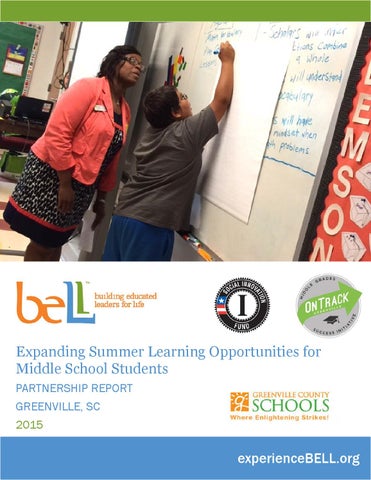
Expanding Summer Learning Opportunities for Middle School Students PARTNERSHIP REPORT GREENVILLE, SC 2015
experienceBELL.org
“Our goal is to bridge that transition between elementary school and middle school. We find that many of our scholars lose one to two months of academic progress over the summer, and scholars in the BELL program gain one to three months of academic progress, especially in reading. We aim to have these students start sixth grade two to five months ahead of where they would have been, to build confidence, and to give them a good start to their middle school career.” - Chad Maguire Assistant Principal at Woodmont Middle Assistant Director of Summer Program Operations for BELL
“The Social Innovation Fund is committed to scaling and building the evidence of innovative, community-based programs. Through OnTrack Greenville, Greenville County’s middle school students, who are at risk of dropping out, will receive the tailored support they need to not only stay in school but to thrive.” - Lois Nembhard Deputy Director Social Innovation Fund Corporation for National & Community Service
1
Summer Learning Partnership Report
Partnership Design This report describes the summer learning activities & outcomes of a partnership between BELL (Building Educated Leaders for Life) and OnTrack Greenville, a community-wide initiative led by the United Way of Greenville County and Greenville County Schools to ensure all middle school youth stay on track toward high school graduation. BELL is a nonprofit organization that partners with schools and community organizations to expand learning time for students in grades K-8. Our mission is to transform the academic achievements, self-confidence and life trajectories of children living in under-resourced communities. Because BELL believes that all children can learn, we recognize students as “scholars.” Summer learning activities play an important role in a child’s academic success, as well as their social, physical, and emotional development. Studies show that, without summer learning activities, children tend to lose reading and math skills, gain weight, and face increased risks of negative social behavior. By the time a child completes the 8th grade, summer learning loss can account for up to 2/3 of the academic achievement gap between children from low-income families and their higher-income peers. OnTrack Greenville began this summer and focused on Berea, Lakeview, and Tanglewood middle schools in the high-need White Horse community. The BELL summer learning program aimed to help students boost their reading and math skills, self-confidence, social skills, while encouraging healthy lifestyles and engaging parents in their child’s education. The program was offered at no cost to families. The summer learning partnership helped scholars – particularly those who were struggling academically strengthen the foundational academic skills they need to advance to the next grade and to begin the new school year ready to excel.
137 Rising 6
156 76%
Scholars Enrolled Grades Served Total Hours of Summer Learning Average Daily Attendance
+1
Average Reading Gain, in Months
+1
Average Math Gain, in Months
100%
Teachers reporting that scholars increased their self-confidence
97%
Parents reporting that scholars enjoyed their summer learning experience
85%
Parents reporting they became more involved in their scholar’s education
2
"This is an evidence-based strategy to increase the graduation rate among middle school students.” Ted Hendry President United Way of Greenville County
✎ PROGRAM GOALS
BELL, the United Way of Greenville County (UWGC), and Greenville County Schools (GCS) worked together to eliminate the summer opportunity gap, accelerate students’ reading achievement, and close the achievement gap. Program goals included: ¤ Increase scholars’ literacy and math skills. ¤ Strengthen scholars’ self-confidence & social skills. ¤ Increase parental engagement.
✎ PROGRAM MANAGEMENT
BELL worked with partners to recruit, select and train program leadership teams consisting of a Program Manager, Program Assistant and Instructional Coach. The Program Manager was responsible for setting and fulfilling program goals, supervising staff, and engaging parents. The Instructional Coach served as the primary academic officer, overseeing assessment and ensuring instruction remained consistent with curricula and program goals. The Program Assistant managed logistics, attendance, and parent interactions. Most program leaders also served as school or district employees. BELL was responsible for delivering the summer program model, managing quality, and measuring outcomes. The national nonprofit leveraged its capacity for program design & planning; scholar data management; staff recruitment, hiring & training; assessment & evaluation; payroll & finance; distribution of curriculum & supplies; fundraising; and information systems.
✎ PROGRAM STAFFING & TRAINING BELL collaborated with GCS and host sites to identify and recruit high-performing teachers to lead academic instruction, enrichment instructors to lead afternoon activities, and teaching assistants to support classroom activities.
Program Managers and Instructional Coaches participated in BELL’s comprehensive leadership training, including online e-learning (BELL University), webinars, and classroom-based training. With assistance from BELL, they took the lead in training program staff, including teachers and teaching assistants, who also completed e-learning courses. Training focused on the summer learning program model, utilizing assessment data to drive instruction, effective teaching practices, collaborative teaching, and behavior management.
✎ SCHOLARS SERVED GCS and school principals selected scholars from feeder pattern elementary schools based on academic need (test scores, grades, teacher recommendations) with a focus on scholars performing in the lowest quartile. The school district supported the enrollment process by distributing information about the program and encouraging parents to enroll their children. BELL facilitated enrollment efforts by creating and collecting multilingual enrollment forms, creating scholar files, clustering scholars, maintaining communication with parents, and tracking scholar engagement. Scholars Enrolled
Avg Daily Attendance
Berea Middle
50
71%
Lakeview Middle
34
79%
Tanglewood Middle
53
78%
137
76%
School
Total
✎ FAMILY ENGAGEMENT
Family involvement was a key component of the program, and staff members provided updates to parents on their children’s progress and challenges through phone calls, progress reports, and a mid-program Open House. All parents were invited to attend a Closing Ceremony celebration, at which scholars performed skits, songs, and presentations about their summer learning experience.
3
Partnership Checklist Summer Program Management
¤
Academic Curricula & Supplies
¤
Enrichment Curricula & Supplies
¤
Student Enrollment & Attendance
¤
Staff Recruitment
¤
Staff Training
¤
Quality Assurance & Technical Support
¤
Field Trips & Community Service
¤
Parent Engagement
¤
Assessment & Evaluation
¤
¤ ¤
¤
¤
Classrooms & School Facilities
¤
Snack & Meal Service
¤
Philanthropic Funding
¤
¤
School Funding
¤
Transportation to and from school
¤
4
Program Design ✎ CORE ESSENTIALS & VALUES The BELL Summer program is designed to serve scholars who are performing below grade level and who lack access to high-quality learning opportunities outside of school. The model is guided by principles of effective summer learning, including (1) a culture of high expectations; (2) partnerships to magnify impact; (3) an exceptional learning environment, including a 1:10 staff to scholar ratio; (4) teaching excellence; and (5) relevant & engaging learning experiences that broaden scholars’ educational horizons while developing 21st Century skills. Scholars and staff were expected to model core program values: Excellence, Collaboration, Learning, Respect, Courage.
✎ THEMES All summer long, scholars were encouraged to Be Extraordinary, the program’s motto. Activities focused on college- and career-readiness, healthy lifestyles, and community engagement were woven into academic and enrichment programming. During College Pride Week scholars learned about the college experience and how success in school is connected to success in life.
✎ PROGRAM SCHEDULE The BELL Summer program delivered academic and social enrichment for 6.5 hours per day, 4 days per week, for 6 weeks. The program started on June 15 and concluded on July 24. The daily schedule started at 8:00 and ended at 2:30. In sum, the program expanded learning time by up to 156 hours. The summer learning model included the following core elements:
Breakfast + Community Time: Scholars enjoyed a
nutritious breakfast provided by partner schools. After breakfast, scholars participated in team-building activities to build social skills and strong relationships with peers and staff.
Sample schedule
Literacy Instruction: BELL equipped teachers with a powerful toolkit of teacher’s guides, scholar workbooks, access to technology and assessment data, and professional development to prepare them for delivering the greatest academic impact in a concentrated summer learning program. Each content area was scoped out to provide educators with details on whole group, small group, and individualized instructional methods in a rigorous, engaging, and scholar-centered learning environment. Certified teachers led 90 minutes of literacy instruction using curricula drawn from Scholastic’s Comprehension Clubs and Guided Reading Program and Traits Writing . Instruction focused on the priority skills critical for student success: phonemic awareness, phonics, fluency, vocabulary, and comprehension. Curricula incorporated stories of contemporary figures and their journeys of struggle, perseverance, transcendence, and transformation and was organized around four social justice and learning platforms – define the self, become resilient, engage others, and build capacity – which provided a framework for scholars to chart their own development. Writing activities helped scholars become capable, confident writers. The curriculum was based on the six traits of writing – Ideas, Organization, Voice, Word Choice, Sentence Fluency, and Presentation.
Math Instruction: Certified teachers led 90 minutes of
math instruction using curricula with targeted intervention modules to build conceptual understanding, problem solving, and mathematical skills. Scholastic’s Do The Math helped scholars develop the skills they need to compute with accuracy and efficiency, the number sense they need to reason, and the ability to apply their skills and reasoning to solve problems. It incorporated eight research-based instructional practices for scholars who need additional support: Scaffolded Content, Explicit Instruction, Multiple Strategies, Gradual Release Routines, Student Interaction, Meaningful Practice, Assessment & Differentiation, and Vocabulary & Language.
5
Lunch & Recess: Scholars spent 45 minutes
eating a healthy lunch and engaging in organized physical activity during recess.
Enrichment Courses: After lunch, Enrichment
Teachers and Teaching Assistants led two 45-minute enrichment activities each day. Enrichment courses were designed to foster critical 21st Century skills like teamwork and leadership, increase selfconfidence, and expose scholars to new subjects, opportunities, and career paths—particularly those that relate to the STEM fields.
Enrichment Courses S.T.E.A.M.
Dance
Minecraft
P.E.
Coding (STEM)
Field Trips: Each week, scholars participated in
field trips that blended learning and enjoyment. Such trips support scholar learning by exposing scholars to diverse ideas, people, and places, and nurturing increased empathy, tolerance, and criticalthinking skills.
Digital photography
Field Trips Bob Jones University Gravatopia
Furman University Roper Mountain
Upcountry History Museum
Impact Measurement The BELL Summer program sought to produce the following outcomes: Scholars will gain at least one month of academic skills, on average, instead of experiencing summer learning loss. At least 75% of scholars will demonstrate improved self-confidence and social skills. At least 75% of parents will report that they became more engaged in their child’s education. To measure performance against these outcomes, program leaders used the following tools:
✎ COMPUTER-ADAPTIVE ASSESSMENTS
Teachers used STAR Enterprise Assessments, by Renaissance Learning, on a pre- and post-program basis. The assessments are built for measuring progress against Common Core standards. Scholars completed both the STAR Reading and STAR Math assessments. The multiple-choice assessments, administered via computer, laptop, or tablet, “adapt” based on scholar responses to assessment questions. For example, if a scholar selects the correct answer, the next question becomes more difficult; if the scholar answers incorrectly, the next question becomes easier. The adaptive quality of these assessments enables staff to hone in on the specific learning needs of each scholar. It also allows staff to group scholars according to common needs and deliver small-group, data-driven instruction.
✎ ATTENDANCE DATA
BELL managed scholar enrollment and tracked attendance data in an online Scholar Management System powered by Salesforce.com. Scholars were expected to attend at least 80% of the time, given the strong positive correlation between learning time and academic and social outcomes. Program leaders integrated enrollment and attendance data with staffing and quality indicators to optimize the learning environment.
✎ TEACHER SURVEYS
Partners used a teacher and teaching assistant survey instrument to assess program implementation and efficacy from the perspective of instructional staff. Teachers and teaching assistants completed the anonymous survey at the end of the program, which included questions regarding scholars’ progress, training, curricula, program staff and service, and parent engagement.
✎ PARENT SURVEYS
Partners employed a parent survey instrument to assess parent observations of scholar improvement, program quality, and parent satisfaction. Parents completed the anonymous survey on-site during the final week of the program.
7
Scholar Achievement ✎ ACADEMIC GROWTH Gains in reading and math skills are an important indicator of student success because they provide a measure of how much a student has progressed up the proficiency ladder at a time when most children are not engaged in structured learning activities. A full grade level contains ten months of skills development (i.e., based on an average school year of learning from September – June). To put it another way, a gain of one month is equal to what an average student learns in 10% of a school year. Teachers utilize formative assessments from the start of the summer to understand each scholar’s learning needs and to inform individualized learning plans.
Assessment data from the end of the BELL Summer program show that scholars gained an average of one month of reading skills and one month of math skills. Scholars’ academic growth demonstrates that participating in summer learning activities has a positive impact on achievement and eliminates summer learning loss. The data also suggests that summer learning opportunities may have the greatest academic and social impact on scholars who are struggling in school and who lack access to the camps, travel, and other enrichment experiences that play a formative role in the development of children from higher-income families.
ACADEMIC GROWTH IN THE BELL SUMMER PROGRAM VS SUMMER LEARNING LOSS -2
-1
0
1
2
+1 Month of Reading Skills
Skills Gained, in Months
+1 Month of Math Skills
-2 Months of Summer Learning Loss Experienced by Disadvantaged Students Without Summer Learning Opportunities* -2
-1
0
1
2
* Sources McCombs et al. (2011). Making Summer Count: How Summer Programs Can Boost Children’s Learning. Rand Education & The Wallace Foundation. Cooper, Harris (2003). Summer Learning Loss: The Problem & Some Solutions. ERIC Clearinghouse on Elementary & Early Childhood Education.
8
âœŽâ€Ż SELF-CONFIDENCE & SOCIAL SKILLS
Scholars’ academic success requires self-efficacy skills, determination, and social skills, including an ability to communicate clearly and work well with others. Teachers and parents consistently reported that scholars’ participation in BELL Summer program helped them make important gains in these areas. Such a positive impact can be attributed to a culture of high expectations, high-quality staff, a small scholar to staff ratio, and an individualized learning environment.
âœŽâ€Ż PARENT & TEACHER ENGAGEMENT & SATISFACTION Teachers and parents consistently reported that the BELL Summer program was of high quality and met or exceeded their expectations. Teachers reported that the program structure and resources helped scholars achieve the goals set forth for them. They also reported that working as a teacher in BELL Summer helped them develop their professional skills. Parents reported that the model boosted their involvement in their child’s education – an outcome that is proven to have significant long-term impact on student achievement in school and beyond.
PARENT & TEACHER SURVEY RESULTS Parents report:
#
94%
90%
"
97%
"
85%
" # " !
98%
96%
Teachers report: #
100%
100%
$ "
100%
"
100%
0%
25%
50%
75%
100%
9 Â
THE GROWTH MINDSET This summer, program staff and scholars focused on cultivating a growth mindset. In a growth mindset, scholars believe that their most basic abilities can be developed through dedication and hard work — brains and talent are just the starting point. This view creates a love of learning and a resilience that is essential for short- and long-term achievement. BELL’s culture of high expectations, staff modeling, and transforming mistakes into positive learning opportunities are some of the strategies used to strengthen scholars’ growth mindset. End-of-program surveys suggest that this approach is resonating with scholars, as 91% of parents reported that scholars showed improved abilities to overcome challenges, and 89% of teachers reported that scholars exhibited a growth mindset.
10
Public & Private Funding ✎ UNITED WAY OF GREENVILLE COUNTY (UWGC) The UWGC was awarded a Social Innovation Fund grant from the Corporation for National & Community Service to jumpstart the OnTrack Greenville initiative. The federal funds are being matched twice by UWGC and a collective of private donors, including Hollingsworth Funds, the Community Foundation of Greenville, and the newly formed Greenville Partnership For Philanthropy, which has committed support for OnTrack Greenville from The Daniel-Mickel Foundation, Fluor, Corporation Gilreath Family Fund, The Graham Foundation, John I. Smith Charities, Jolley Foundation, Lockheed Martin, Piedmont Health Foundation, F.W. Symmes Foundation, and ScanSource Charitable Foundation.
✎ GREENVILLE COUNTY SCHOOLS The school district contributed in-kind resources, including utilizing classroom space, utilities, janitorial services, and daily breakfast and lunch. The school district also provided daily bus transportation to and from the program for scholars who needed it, which was supported with SIF funding.
✎ BELL
BELL raised additional philanthropic funding from national sources to develop program innovations, build local sustainability, and cover a portion of program expenses: - - - - -
The Edna McConnell Clark Foundation The Wallace Foundation Target Leon Lowenstein Foundation William Randolph Hearst Foundation
- News Corp.
Contact Us Jerri Haigler
Executive Director, Carolinas Jerri.Haigler@experienceBELL.org (704) 706-7122
Carolinas Leadership Council Cammie Hauptfuhrer, Chair
Philanthropist & Community Activist
Joe Kluttz
Partner, K&L Gates, LLP
Mary Kluttz
Former Lower School Academic Dean, Trinity Episcopal School (retired)
Dr. Donald Martin
Former Superintendent, Winston-Salem / Forsyth County Schools (retired); Professor of Education at High Point University
Walter McDowell
Chair, Business for Education Success & Transformation (BEST NC) & Former CEO, Wachovia (NC & VA)
Claire Tate
Community Advocate & former Executive Director of Partners in Out-of-School-Time (POST)
Carolinas Partners Blue Ribbon Commission on the Prevention of Youth Violence, Wilmington Charlotte-Mecklenburg Schools (Read to Achieve Grade-Level Reading)
Devonshire Elementary School, Charlotte First Presbyterian Church/Westerly Hills Academy, Charlotte Huntingtowne Farms Elementary School, Charlotte Lakewood Elementary School & Duke Office of Durham and Regional Affairs, Durham Martin Luther King Middle School, Charlotte OnTrack Greenville (United Way of Greenville County & Greenville County Schools)
Project LIFT, Charlotte Winston-Salem/Forsyth County Public Schools (Read to Achieve Grade-Level Reading & Middle School partnerships)
experienceBELL.org