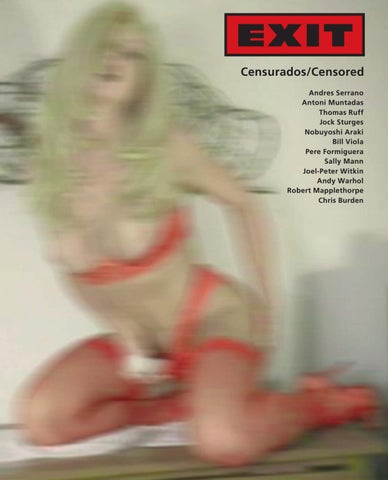
EXIT Censurados/Censored Andres Serrano Antoni Muntadas Thomas Ruff Jock Sturges Nobuyoshi Araki Bill Viola Pere Formiguera Sally Mann Joel-Peter Witkin Andy Warhol Robert Mapplethorpe Chris Burden
D E R O S N E C
EXIT
Exit, imagen y cultura, es una publicación trimestral de Olivares y Asociados S.L. Exit, Image and Culture is published quarterly by Olivares & Associated, S.L.
Director / Editor Rosa Olivares / editor@exitmedia.net Director adjunto / Managing Editor Seve Penelas / exit@exitmedia.net Coordinación editorial / Editorial Co-ordination Dena Ellen Cowan / redaccion@exitmedia.net Equipo Asesor / Advisory Committee Liliana Albertazzi, Susana Blas, Daniel Canogar, Marta Gili, Felipe Hernández-Cava, Juan Antonio Ramírez, Marie Loup Sougez Diseño / Design Adrián y Ureña, S.L. Jefe de publicidad / Advertising Manager Rocío Sánchez (Tel. 661 30 37 64) Suscripciones / Subscriptions María Regueiro / circulacion@exitmedia.net Administración, redacción y publicidad / Main Office San Marcelo, 30 · 28017 MADRID · ESPAÑA. Tel. +34 91 404 97 40 · Fax +34 91 326 00 12 Email: exit@exitmedia.net - Website: www.exitmedia.net Distribución / Distribution España: EXIT (María Regueiro) · Tel. +34 91 404 97 40 · Fax +34 91 326 00 12 · circulacion@exitmedia.net Internacional: IDEA BOOKS · Nieuwe Herengracht, 11 · 1011 RK AMSTERDAM · NETHERLANDS. Tel. +31 20 622 61 54 · Fax +31 20 620 92 99 info@ideabooks.nl • Portugal: ASSIRIO & ALVIM, Editores e Livreiros - Departamento Comercial · Rúa de Arroios, 154-B. 1150-056 LISBOA · PORTUGAL Tel. +351 21 330 06 90 · Fax +351 21 330 06 99 · assirio.antonio@clix.pt • México: Editorial GUSTAVO GILI de México, S.A. Valle de Bravo, 21 · 53050 NAUCALPAN, Edo. de MÉXICO. Tel. +52 55 60 60 11 · Fax +52 53 60 14 56 · ggili@prodigy.net.mx Suscripciones y números atrasados / Subscriptions and back Issues. EXIT - Aptdo. Postal / P.O.Box 14665 · 28080 MADRID Tel. +34 91 404 97 40 · Fax +34 91 326 00 12 · circulacion@exitmedia.net Todos los derechos reservados. Ninguna parte de esta publicación puede ser reproducida o transmitida por ningún medio sin el permiso escrito del editor All rights reserved. No part of this publication may be reproduced or transmitted by any means without written permission from the publisher. © de la edición: Olivares & Asociados, S.L. © de las imágenes, sus autores © de los textos, sus autores © de las traducciones, sus autores © de las reproducciones autorizadas, VEGAP. Madrid 2002 EXIT es miembro de la Asociación de Revistas Culturales de España, ARCE Impreso en España • Impreso en Gráficas Varona. Salamanca ISSN 1577-272-1 · Depósito legal: M 247- 2000
Andres Serrano
Sumario / Contents
16
Editorial. Esto no se mira, esto no se toca, esto no se dice Don’t look at that, don’t touch this, don’t say that. Rosa Olivares
24 104
Andres Serrano Entre el desafío, el riesgo y la provocación Between Challenge, Risk and Provocation Barbara Pollack
Cuando las formas se convierten en conceptos When forms become concepts Rosa Olivares
142
Wojnarowicz
56 62 66 72 76 86 92 98 118 125
Indice de artistas Index of Artists
Muntadas Jan Saudek Jock Sturges Pere Formiguera Andy Warhol Thomas Ruff Nobuyoshi Araki Joel-Peter Witkin Chris Burden Bill Viola
I
N T E R V I E W
Between Challenge, Risk and Provocation Barbara Pollack
For more than a decade, Andres Serrano has been America’s favorite whipping boy, the artist who, for better or worse, has become the target of the public’s love-hate relationship with contemporary art. Serrano’s classic image, Piss Christ (1987), may not have launched the Culture Wars, but certainly fanned the flames when it was “discovered” by members of Congress in 1989. Since then, he has churned out bodies of work that uncannily return the favor, by targeting middle-brow sensibilities and disrupting zones of comfortability that infuse our expectations of high art. I met with him on the eve of the opening of his latest show, ironically titled America, at Gimpel Fils in London this fall. The setting was an editing studio where the film, Leo’s Fantasy, a documentary about the making of Serrano’s 1996 series The History of Sex at the Groninger Museum in Holland, is nearing completion. BP: At the time you did Piss Christ, at least in New York, there were many artists doing work about the identity politics and the body. There were penises all over the place, or so it seemed, yet your image of a crucifix set off the biggest controversy.
AS: I’ll tell you a story. During that time, I met an artist in San Francisco who said to me that he had been to a dinner the night before with a bunch of artists who were griping about Piss Christ. They did not understand why so much attention had been focused on Piss Christ, since they had been trying to do provocative work for many years. You see, when you are trying to be provocative it doesn’t work. Whereas many artists have been confronted with controversy surrounding their work which was not necessarily their intent at all. It was certainly true for me with Piss Christ. I was 37 when I made Piss Christ and the controversy really took place 2 years later. Before Piss Christ, I had a very limited audience. I had my supporters but I was certainly not very well known outside the New York art world. So, it was a very strange feeling for me to wake up one day and find myself being denounced in Congress. I have always said it was a very Kafkaesque experience. BP: When you were making that work, were you conscious that it was going to be provocative? Was it provocative to you?
E X I T Nº 8-2002 44
Andres Serrano The Interpretation of Dreams (White Man’s Burden), 2000 Cibachrome, silicone, plexiglass, wood frame, 152 x 126 cm
MARCUS HARVEY La obra de Marcus Harvey, Myra (1995), fue uno de los detonantes de la polémica en torno a la exposición Sensation, Young British Artists from the Saatchi Collection, que tuvo lugar en la Royal Academy, Londres, 1997. Harvey presentó un retrato de grandes dimensiones de Myra Hindley, una mujer condenada en 1965 por la participación en una serie de asesinatos de niños y jóvenes que conmocionaron a la sociedad británica. El retrato, realizado 30 años después y con Myra todavía en la cárcel, estaba inspirado en una fotografía en blanco y negro de la ficha policial de la asesina en serie que salió reproducido en la prensa numerosas veces. Pero no fue sólo la elección del personaje retratado lo que enardeció a la opinión pública, fue el método de su realización la gota que colmó el vaso: reducido el rostro a una distribución de zonas blancas, grises y negras, Harvey recurrió a la colaboración de numerosos niños para que impregnaran sus manos de pintura e imprimieran sus huellas en las zonas seleccionadas para acabar conformando el retrato de la asesina. Tras tensos debates, la exposición se inauguró con fuertes medidas de seguridad y con el retrato de Myra incluido, pero ese mismo día sufrió los atentados de dos personas distintas, dos artistas airados que en el espacio de una hora lanzaron tinta y huevos sobre la obra y que inmediatamente fueron arrestados. Jaues Role, artista londinense de 48 años, una vez puesto en libertad declaró a la prensa que llevó seis huevos y lanzó tres o cuatro antes de ser apresado por un policía: “Hay momentos en los que tu deber es hacer algo, si no, la próxima vez será incluso peor, tendremos una imagen de la tortura actual”. La obra tuvo que ser retirada, restaurada y recolocada en la exposición con un cristal protector. Seve Penelas
The work by Marcus Harvey, Myra (1995) was one of the sparks setting off the controversy surrounding the exhibition Sensation, Young British Artists from the Saatchi Collection, which took place at the Royal Academy, London in 1997. Harvey presented a large format portrait of Myra Hindley, a woman condemned in 1965 for participating in a series of murders of children and teenagers that shocked the British society. The portrait, made 30 years later and with Myra still in prison, was based on a photograph in black and white from the police file on the serial killer that was published in the newspaper several times. But it was not the choice of the person portrayed in the photograph alone that infuriated the public; the straw that broke the camel’s back was the method used to produce it: by reducing the picture to a distribution of white, grey and black zones, Harvey resorted to the collaboration of numerous children who impregnated their hands with paint and stamped their prints on the selected zones until the killer’s portrait was composed. After tense debates, the exhibition was inaugurated with the presence of significant security measures and with the portrait of Myra included, but that same day it was damaged by two different people, two angry artists who, within and hour, had thrown ink and eggs at the work and were immediately arrested. Jaules Role, a 48-year-old London artist, made a declaration to the press right after he was released, “There are moments when you must do something about it. Otherwise next time we will have even worse, we will have a picture of the actual torture.” The work had to be removed, restored and set up in the exhibition again with protective glass. Seve Penelas
E X I T Nº 8-2002 80
Marcus Harvey Myra, 1995 Acrylic on canvas, 396 x 320 cm. Photo: Stephen White Courtesy Jay Jopling/White Cube, London
CHRIS BURDEN 747 5 Enero 1973 Los Angeles, California
En torno a las 8:00 horas de la mañana, en una playa cercana al Aeropuerto Internacional de Los Angeles, hice varios disparos con una pistola a un Boeing 747. Chris Burden Extractos de Chris Burden, Blocnotes éditions, Paris, 1995
747 January 5, 1973 Los Angeles, California
At about 8 a.m. at a beach near the Los Angeles International Airport, I fired several shots with a pistol at a Boeing 747. Chris Burden Excerpts from Chris Burden, Blocnotes éditions, Paris, 1995.
Chris Burden 747 January, 5, 1973 Los Angeles, California, USA Cortesía del artista E X I T Nº 8-2002 118
E X I T Imagen y Cultura Revista trimestral / Quarterly Magazine. Año 2 - Número 8 Noviembre / Diciembre / Enero / 2002-03 • PVP España: 20 Euros