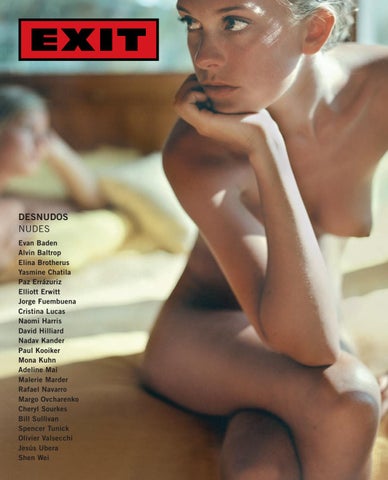
DESNUDOS NUDES Evan Baden Alvin Baltrop Elina Brotherus Yasmine Chatila Paz Errázuriz Elliott Erwitt Jorge Fuembuena Cristina Lucas Naomi Harris David Hilliard Nadav Kander Paul Kooiker Mona Kuhn Adeline Mai Malerie Marder Rafael Navarro Margo Ovcharenko Cheryl Sourkes Bill Sullivan Spencer Tunick Olivier Valsecchi Jesús Ubera Shen Wei
Yasmine Chatila. The Blondie Teen - Greenwich Village, Tue 6:27 p.m., 2007. Courtesy of the artist.
Naked in the Museum, Models in the Studio Sergio Rubira
In 1989 the Public Art Fund commissioned a New York public art project to the Guerilla Girls, who thought of occupying some billboards in the Big Apple with the results of some of the statistics they regularly carry out as part of their artistic practice. They selected a specific study case that could be extrapolated, deciding to begin with an individual case in order to raise questions about the general state of affairs. So they focused on the Metropolitan Museum of Art, an encyclopaedic museum that has served as a model to construct the discourses of many others. They also looked at the Met’s modern art sections. The results answered one of those inconvenient questions that have been asked by many artists, historians, critics and curators who have worked from feminist premises: “Do women have to be naked to get into the Met. Museum?” The statistics seem to say so: “Fewer than 5% of the artists in the modern art sections are women, but 85% of the nudes are female.” To design the ad for the billboard they appropriated one of the canonical nudes from the history of art, Jean-AugustDominique Ingres’ Grande Odalisque (1819), despite the fact that it is in the Louvre rather than the Met. The Louvre is another one of the museums, perhaps the first, to participate in the construction of the story of Great Art. The Guerilla Girls covered the nude’s head with one of the gorilla masks that they use in
E X I T Nº 53-2014 26
their public appearances to conceal their identity. Nevertheless, the Public Art Fund rejected the project. The excuse purported to dismiss it was quite absurd, that it was inappropriate, or in other words, it was indecorous. They claimed that it might offend someone because the handle of the fan the woman from the harem with the guerrilla head was holding was phallic, a fan that was not an addition but already part of the original picture, about which no one had complained before, at least there is no existing evidence of such a complaint from the conservative 19th century or the avant-garde 20th century. However, they did not deem the content of the survey—or the nude itself—to be inappropriate. At least they did not use this as a reason for not supporting the project, although it could be surmised that the question and its answer were actually what bothered them since it directly attacked the art history establishment, which is partly based on the narratives that museums create. Seeing that the Public Art Fund rejected the project, the Guerrilla Girls purchased advertising space on New York City buses, although the bus company ultimately refused to place the ads because they believed they were too suggestive. Apparently, this time the nudity was the reason for the censorship. Years later, when the Guerrilla Girls were invited to participate in the 2005 Venice Biennial, they revisited
Elina Brotherus. Artists at Work 2, 2009. Courtesy of the artist.
Adeline Mai. Weighlessness series, 2010. Courtesy of the artist.
Mona Kuhn. Gaze II, Evidence series, 2006. Courtesy of the artist and Pilar Serra.
Mona Kuhn. Gaze II, Evidence series, 2006. Courtesy of the artist and Pilar Serra.
JO RGE FUE MBUE NA
Wood Stories aborda una de las nuevas prácticas de experimentación social en el mundo y que representan estilos de vida alternativos en comunidades autosuficientes bajo el movimiento “rewilding”. Estas comunidades tienen como objetivo renaturalizar las zonas rurales abandonadas y despobladas con la esperanza de recuperar la naturaleza y la vida salvaje, junto con la generación de actividades económicas innovadoras que hagan sostenible ese territorio y la oposición activa a la destrucción de la naturaleza por la construcción de grandes infraestructuras. Para William A. Ewing la aparición de la fotografía supuso una nueva toma de conciencia de la imagen propia, pero con un precio: la separación del “yo” del propio cuerpo. Jorge Fuembuena, mediante una poética exaltación de estas comunidades “rewilding”, contradice esta teoría de Ewing, sus retratos reúnen nuevamente el “yo” con su cuerpo. Su peculiar y distintiva forma de mirar, claramente influenciada por la herencia pictórica occidental, produce retratos estéticamente sublimes, capaces de mitificar por sí mismos el amor y respeto a la naturaleza como origen, admirar su fugacidad y vulnerabilidad y glorificar la esencia regenerativa de la relación de estos sujetos con el medio, pero también con sí mismos, reagrupando instantáneamente identidad y cuerpo, condición y existencia, si es que alguna vez estuvieron separados. La fotografía reproduce, si puede (re)producir algo, un acontecimiento, una circunstancia, un contexto. Y estas imágenes ilustran una singularidad, encapsulan situaciones y contextos particulares. Más que al sujeto en sí mismo, la fotografía, evidencia la naturaleza del sujeto. En Wood Stories los retratos revelan precisamente eso, su condición, sin tapujos, sin prejuicios, austeramente. Estos retratos, llenos de tensiones narrativas entre lo político y lo social, generan un recorrido visual que parte de la aparente fragilidad de los cuerpos, pero que se ve enfrentada a la contundencia de la condición de los retratados. Este desequilibrio encuentra su armonía en el compromiso de honestidad que las imágenes ofrecen. Porque, si estas fotografías son algo es honestas, sinceras: no esconden pero tampoco exponen. Evidencian la condición de los sujetos, son su condición. PEDRO VICENTE
Wood Stories explores one of the new experimental social practices in the world, which consists in alternative lifestyles in self-sufficient communities that belong to the rewilding movement. These communities aim to renaturalize abandoned or depopulated rural areas in hopes of recovering nature and wildlife, to regenerate innovative and sustainable economic activities and to actively oppose the destruction of nature for the construction of large infrastructures. To William A. Ewing the appearance of photography led to a consciousness of self-image, yet at a price: the separation of the “self” from the body. Through a poetic exaltation of these rewilding communities Jorge Fuembuena contradicts Ewing’s theory. Fuembuena’s portraits reunite the “self” and its body. His original way of seeing, clearly influenced by western pictorial references, renders aesthetically sublime portraits capable of mythologizing a love of and respect for nature as origin, admiring its fleetingness and vulnerability, and glorifying the regenerative essence of the relationship between these subjects and the environment, but also with themselves, instantly regrouping identity and body, condition and existence, if indeed they were ever separated. If it can (re)produce anything, photography reproduces an event, a circumstance, a context, and these images illustrate a singularity. They encapsulate particular situations and contexts. Rather than revealing the subjects themselves, photography reveals their nature. In Wood Stories this is precisely what the portraits reveal in an open, unbiased and austere way, the subjects’ condition. These portraits—full of partly political, partly social narrative tensions—generate a visual overview that arises from the apparent fragility of the bodies, but that is seen confronted with the power of the condition of the people portrayed. This imbalance finds its harmony in the compromise of honesty that the images offer. Because, if anything, these photographs are honest, sincere: they neither hide nor expose. They reveal the condition of the subjects, who are their condition. PEDRO VICENTE TRANSLATED BY DENA ELLEN COWAN
E X I T Nº 53-2014 134
Jorge Fuembuena. Sol, WOOD STORIES series, 2013. Courtesy of the artist, Addaya Art Contemporani and La New Gallery.
Wood Stories
E X IT I ma g en y Cu l t ur a / I ma g e & Cu lt u re R e v i s ta tri m e st r al / Q u a rte r l y Ma g a z i ne • Añ o 1 4 - # 5 3 F e b re ro / M a rz o / Ab ri l 2 014 • PV P Es p aña : 25 E ur o s