The Exeter School Alumni Magazine


Where the story began

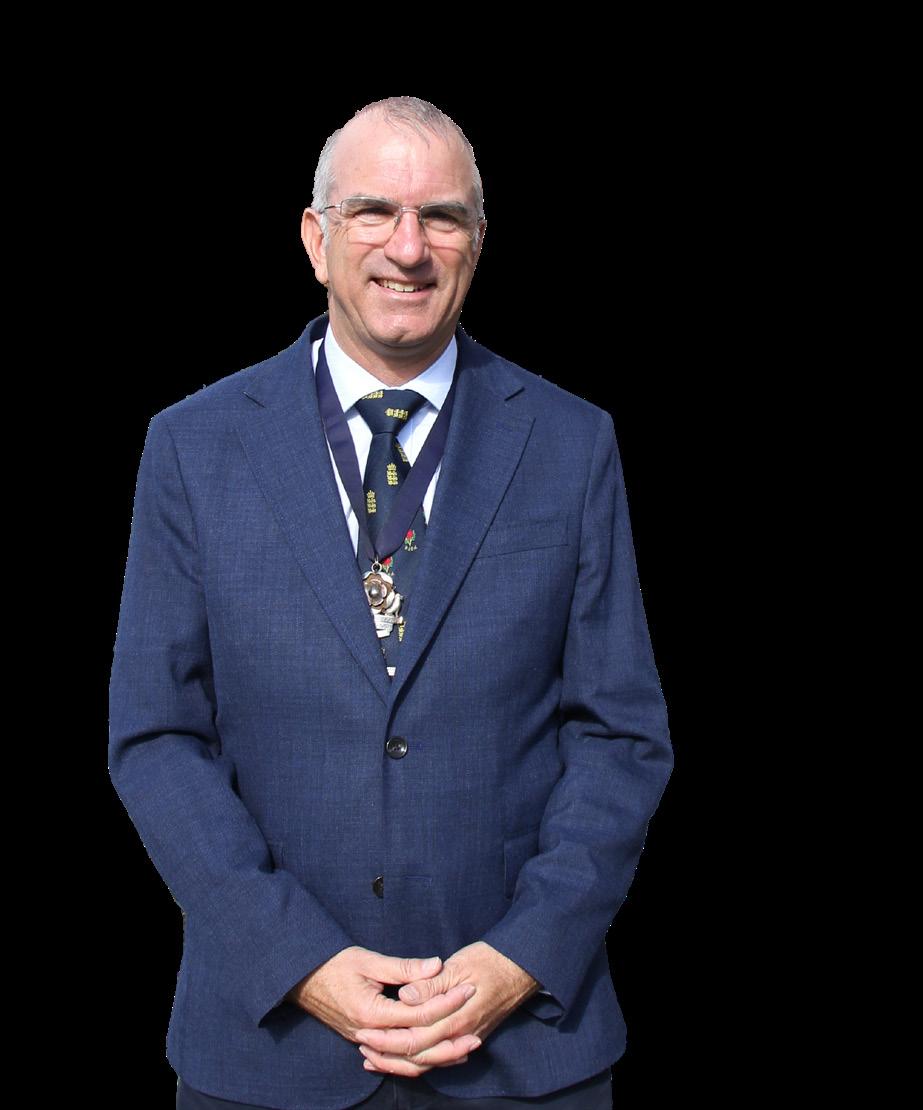
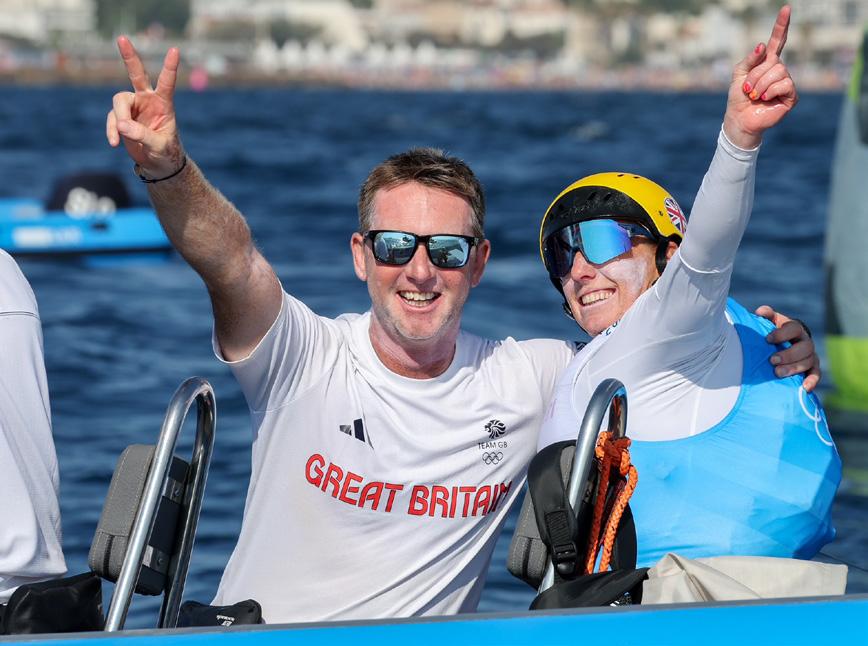

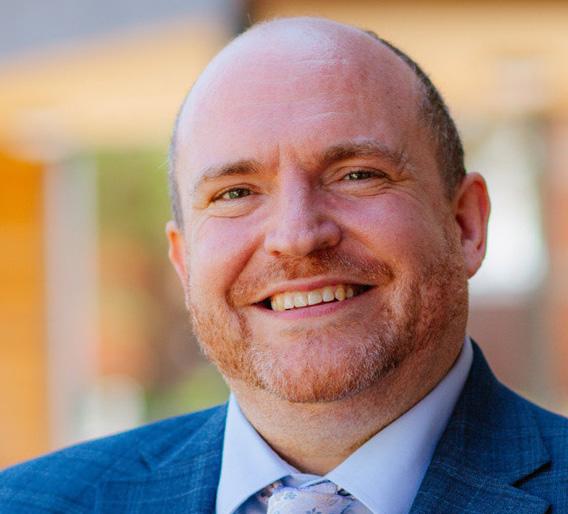
Welcome to this year’s edition of The 1633. After serving for many years at Exeter School, it is always a pleasure to see this magazine arrive. I enjoy reading about the achievements, adventures and reflections of Old Exonians, many of whom I have had the privilege to teach. This year, serving as Acting Head, it feels especially poignant.
I can say with even more confidence that Exeter School remains true to its core principles; firmly rooted in our proud tradition while also being humble, ambitious and forward-looking. Above all, we are a deeply human school, a place where staff, pupils and parents work in close partnership, and where pupils are at the centre of every decision we make. As many of the stories in this edition show, an Exeter School education is about far more than grades alone. Alumni remember friendships,
As ever, it’s a great privilege to highlight such a variety of stories –from rekindled friendships, discoveries in the archives, to OE successes in a vast range of fields –and we are always keen to hear and share your news. I very much hope you enjoy this issue of the magazine, and that it brings you closer to the school and our community today, wherever you may be.
I’m very grateful to the many individuals, both within the immediate school community and more widely, who work closely with the OE community. Whilst
challenges overcome, opportunities discovered and the confidence gained from trying something new.
OE Major Rebecca Glover (2004-2013) returned to school this year to talk about her experience rowing the Atlantic. She spoke of the importance of being able to stretch oneself further to achieve incredible, inspirational things, but how this was only possible because her team and community had a culture that allowed them to fall back safely when they failed. To pick themselves up and go again. This is exactly what we value at the school today.
In my Acting Head role, I am also, of course, something of a warm-up act for Dr Adrian Rainbow, who will take up his Headship this September. Adrian and I are in regular contact, and I know he is keen to get to know our alumni community. He looks forward to meeting many of you at school events in the years ahead and to becoming part of the continuing Exeter School story.
Exeter School is in a very strong position and yet, like all independent schools, we are navigating a changing landscape. Given the additional pressures some families are under, strengthening our bursary provision remains a key priority in the coming years. Bursaries have also been central to our mission and history. They enrich our community and change lives. I know personally how transformative education can be, and during my time at Exeter School I have seen first-hand the impact an Exeter School education can have on bursary-supported pupils.
One of the great pleasures of this role is seeing how quickly Old Exonians feel at home when they return to the school site. Buildings evolve, fashions change, but the sense of belonging endures. Thank you, as ever, for your continued support of the school and for remaining such an important part of the Exeter School family. Once an Exonian, always an Exonian.
Graham Bone Acting Head
there, sadly, isn’t enough space here to thank them all, I should like to mention Ali McGeown (staff, 2023-present), who always does such superb work on this magazine and other communications; Claire Priday (staff, 2025-present), whom those of you attending our events will hopefully have met; and Kevin White (1953-1961) and Richard Fryer (staff, 1974-2024) for their continuing sterling work in the archives.
Thank you to all those who have contributed stories, attended events, or generously given their time and expertise over the past
year. Particular thanks must go to those who support our bursary fund. The school remains committed to our heritage in ensuring that young people from the local area who are eager to learn and ready to excel, but who cannot join us without financial support, have an opportunity to come here. Please do get in touch if you would like to find out more about how you can help support future generations of Exonians. But for now, happy reading!
Alice Holohan, Director of Development and Alumni Relations
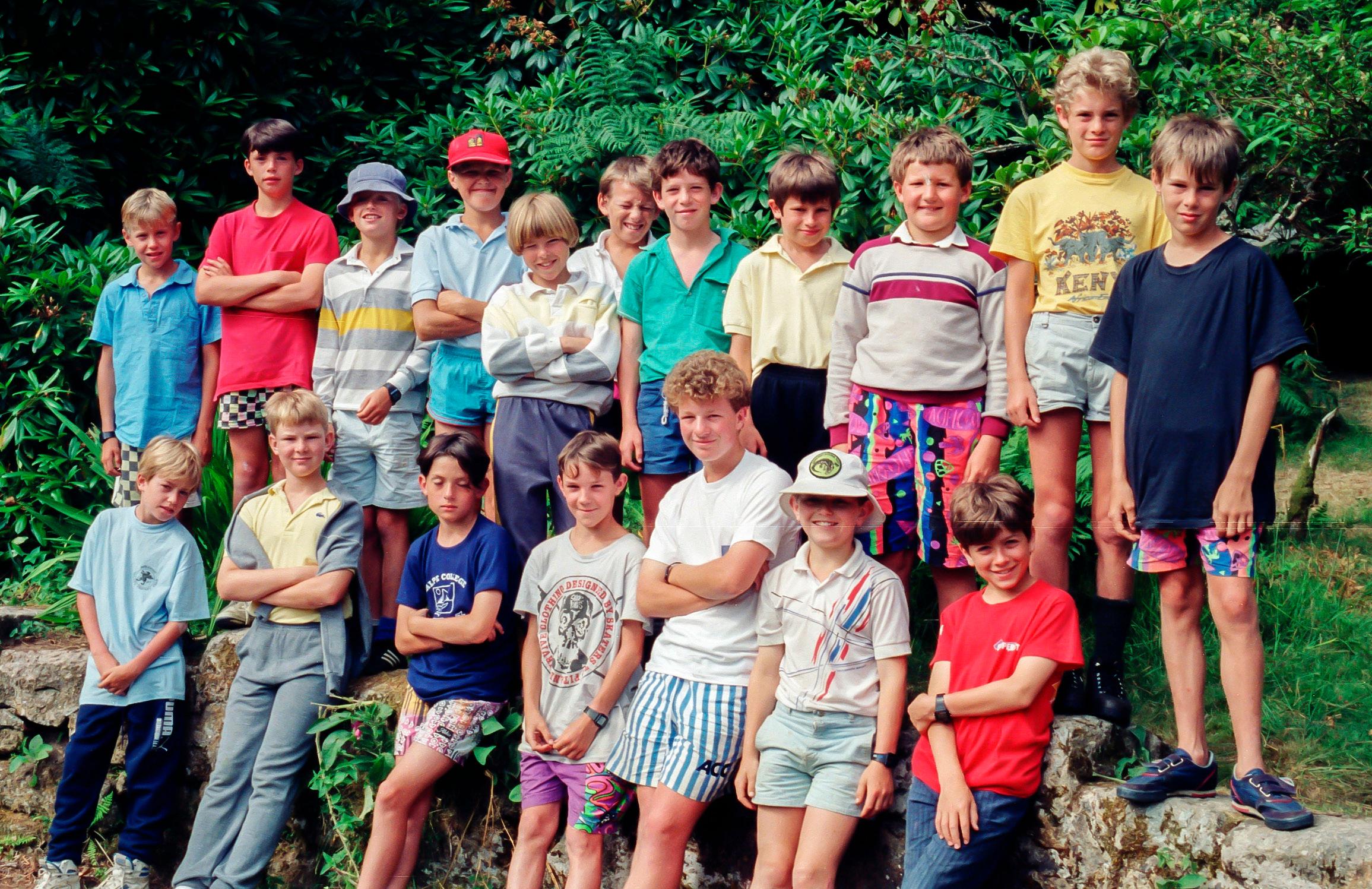
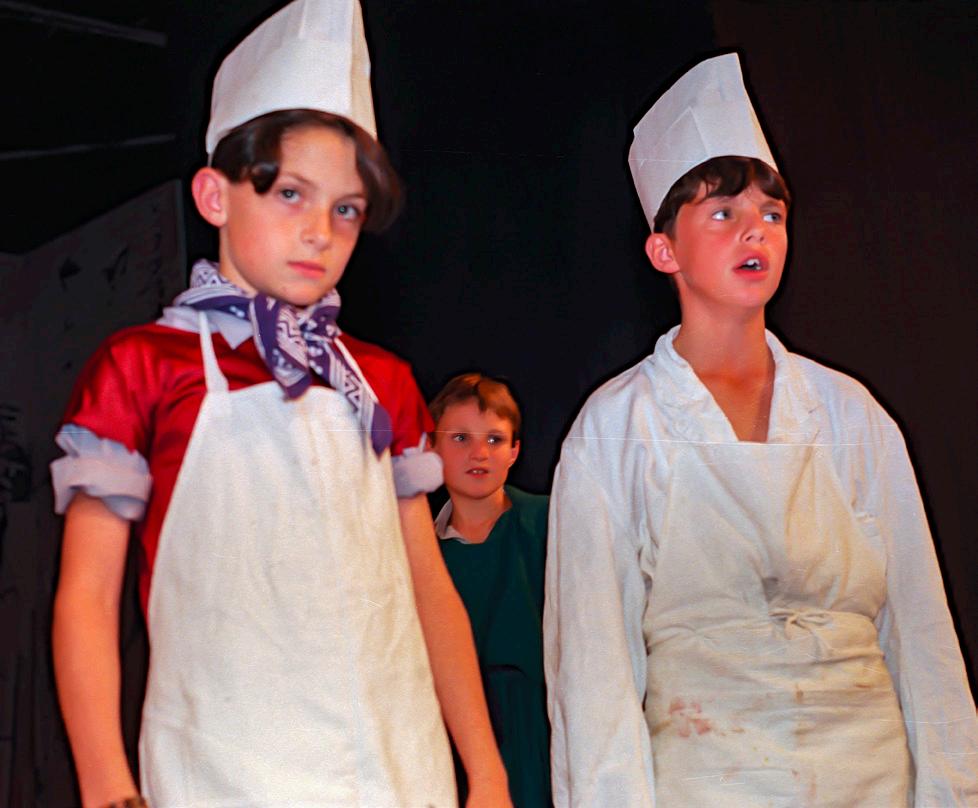
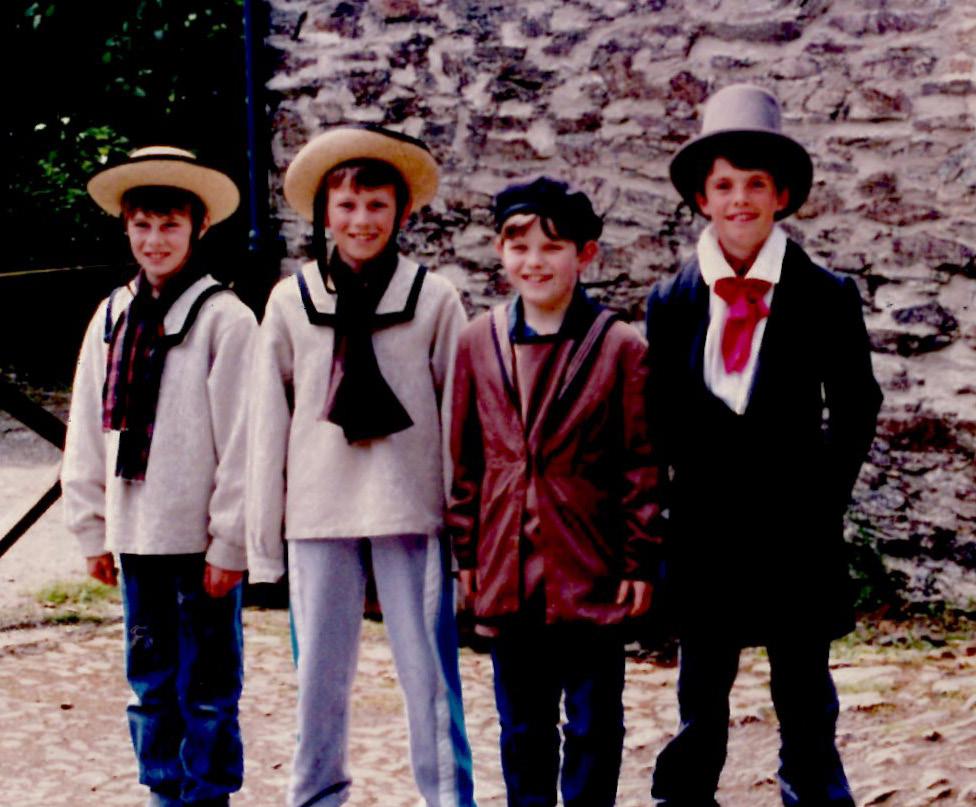
Despite being one of Britain’s most recognisable actors, with an impressive filmography and starring in Netflix mega-hits such as The Crown, Matthew Goode (1985-1996) remains one of the most refreshingly self-questioning people you could meet.
With a wealth of film and television credits to his name, Matthew is now seldom asked to audition, a testament to his established reputation in the industry. Something that could be said makes the process of landing a role easier, yet Matthew suggests it takes something away from the thrill of being offered the part, and knowing how hard one has worked for it, “There’s something about that which galvanizes you for a job if you’ve been through several terrifying auditions.”
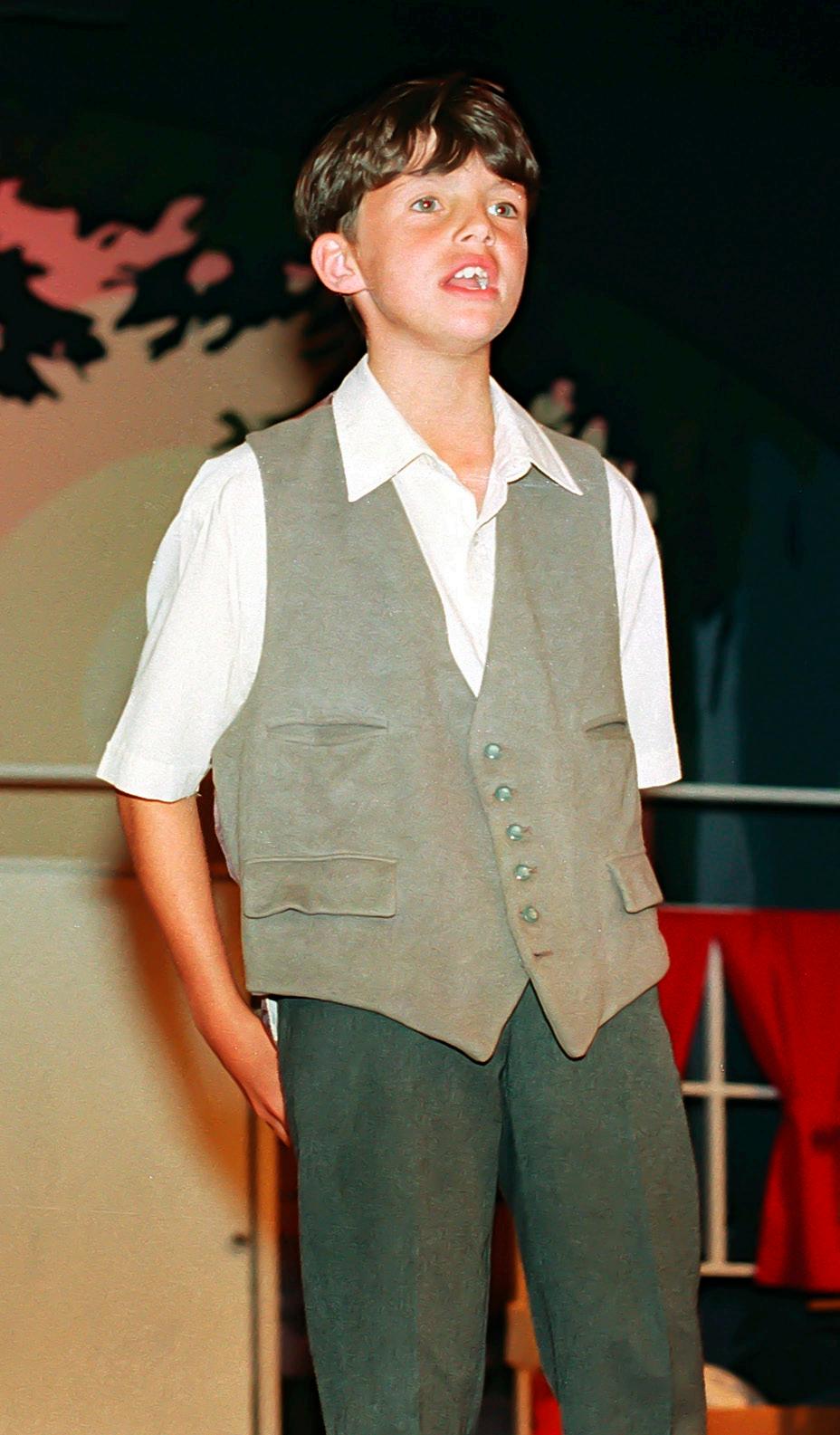
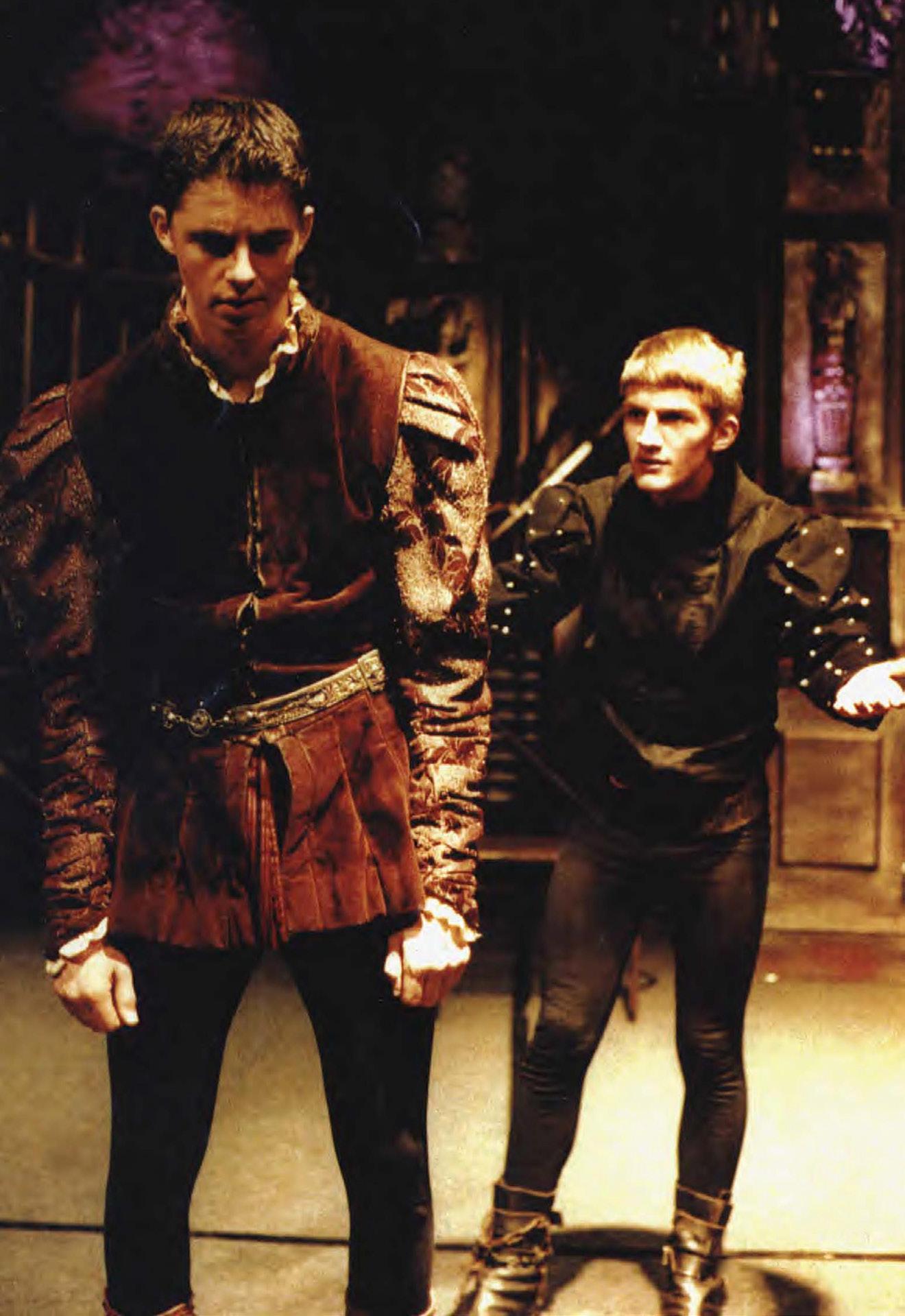
At school, Matthew was a strong sportsman, but his talent for acting was also evident, with leading roles as The Young Covey in Sean O’Casey’s The Plough and the Stars (1994) and Buckingham in William Shakespeare’s Richard III (1995). These were both under the directorial ship of former Head of Drama, Stephanie Chrupek (staff, 1990-2014), whom Matthew would have first known as Stephanie Trampmore, before she married her husband Andrzej Chrupek (staff, 2003-2014). Stephanie and Andrzej were the formidable team that brought incredible productions to the stage during their time at Exeter
“There’s something about that which galvanizes you for a job if you’ve been through several terrifying auditions.”
School and pushed their pupils to give stellar performances. Matthew sums up his admiration for Stephanie in just a few words, “God love her, she was a great teacher.”
Matthew’s mother also played a significant role in influencing his journey towards acting. He recalls she directed a company of actors called The Campion Players, an Exeter-based drama group active from the 1960s to the early 2000s. He says, “They put on plays at The Barnfield and The Northcott, or the village hall in Clyst St Mary, so I would be around; there was an element of people laughing, smoking, drinking, and I thought, this seems great. They seem naughty. They seem fun. There’s something about that.”
When asked whether acting was his main focus in terms of a career, Matthew fondly remembers a friend of his mother’s, Ian Ritchie, “He was a cool guy, we’d chat and he
made it all seem quite exciting. He helped Stephen Daldry, I think he might have even paid for him to go to drama school. I just sort of fell into it. There was an element of everyone thinks that I should do this, so I’ll go for it. And if it doesn’t work out, I’ll need a plan B. But I never really had a plan B.”
Matthew’s teachers, mother and those she associated with, clearly influenced his path into acting, but unlike young actors today who have a camera on their phone, a ring light and “audition in their kitchen with a self-tape”, Matthew’s journey was more traditional. University followed school, after a pivotal moment when Matthew was standing in line awaiting his A Level results, “Neil Gamble (staff, 1992-2003) was my Headmaster at that point, and I’ll always be grateful to him. I was obviously looking nervous, he shouted across to me, ‘you’re fine, Matthew, you’re in, you got what you
need.’”
That summer, Matthew readied himself for the start of his drama degree at Birmingham University. He put himself down for accommodation in Chamberlain Hall, to share with fellow Exonian, Mark Scoble (1991-1996), whom he remains great friends with to this day. Matthew describes his university days as being “a brilliant time” and an opportunity to “grow up and become far more independent.”
As a boy from the rural setting of Clyst St Mary, finding himself in Birmingham was “a stark difference” to the surroundings of his childhood.
Matthew’s growing independence is apparent with a decision made in his third year; to pursue a postgrad course at the Webber Douglas Academy in London, which came about partly thanks to university friend Gary. “My flatmate had been in a hospital drama, I think Children’s Ward on Channel 4, when he was much younger. He had enrolled at the Webber Douglas Academy on the post-grad course. I don’t want to sound awful, but I’d seen Gary act. And I was like, bloody hell, if Gary can get in, then I’ve got a shot!”
With finances tight, Matthew chose the one-year post-grad course; a decision that nearly led to a disappointing final outcome when the students were set to perform for potential agents. “It was a glorious week of weather and only one proper agent turned up. I think there’s a stigma against the one year courses as well. Even some of our teachers had the mindset of ‘what can I possibly teach them in one year?’ Luckily, Simon Beresford was that agent, partly because he was friendly with Carol Ziegler, my voice coach at the school. She’d given him a slight tip off… there’s this guy, he’s an idiot, but you might like him.”
Simon Beresford, who has gone on to represent Matthew for the majority of his career, also recognised the undeniable talent that his astute voice coach saw.
Since leaving drama school, Matthew’s career has gone from strength to strength, starting with his breakout role in 2004, starring alongside Mandy Moore, in Chasing
Liberty. His charm and refined good looks have made him a natural fit for numerous period pieces, but his acting ability has ensured he hasn’t been typecast. On each new job, Matthew comes with an expectation that those around him are there to support one another in honing their craft. He says, “I won’t name any names, but there are actors who believe they’re the star. They don’t give you much access to them and don’t really want to share the screen with you. That’s a shame because for me, we’re a company. You take the job incredibly seriously, but with amusement. When you get a great bunch of actors together, it’s like rowers, it just clicks. Everything makes that perfect sound.”
This dedication to his craft was put to the test when Matthew received a call from Paramount+, the production company behind The Offer (2022), just a week before it was due to start filming, with the news that Jake Gyllenhaal had pulled out. Without a second thought, and a lot
of lines to learn, Matthew went on to perfectly embody Robert Evans, the suave, sharp-witted Paramount Pictures studio chief, amid the stormy production of The Godfather
One could talk endlessly about Matthew’s plethora of great roles and notable people he has worked with, to name but a few; Sir Anthony Hopkins in Freud’s Last Session (2023), Keira Knightley and Benedict Cumberbatch in The Imitation Game (2014), Nicole Kidman in Stoker (2013) and Colin Firth and Julianne Moore in the exquisite A Single Man (2009), but still his modesty remains resolute. When asked if he knew the moment his career was on the right track, Matthew simply replies, “I still don’t know.”
A defining moment in Matthew’s career came in May 2025 with Scott Frank’s, Dept. Q , playing embittered and straight-talking detective, Carl Morck. Matthew previously worked with writer-director Scott Frank in 2007 on another crime thriller, The Lookout – and he relished the
“I wanted to tell John [Davidson] how brilliant he was. And we are a cumulative effect of his incredible nurturing, which you don’t see when you’re in it.”
opportunity to do so again, “Scott and I hadn’t worked together for a
when his own wife, Sophie, is endearingly mentioned at any given
in seconds”, and after one setback Matthew famously fled, walking three miles home before being ushered back to face the music.
Senior school brought a roll call of giants; Graham Skinner (staff, 1965–1972) and Martin Rodgers (staff, 1979-2009) who led outstanding hockey sides, Mike Wilcock (staff, 1986-2020) and Les May (staff, 1974-2007) inspiring his love of cricket, and also John Poustie (staff, 1990-2013), who Matthew describes as “a legend” without hesitation. “A history master and cricket-tour

Exeter School is proud to count among its alumni those working in film and television, some at the beginning of their journeys to others now well established in the industry. The 1633 was delighted to speak with a selection of Exonians working both behind and in front of the camera.
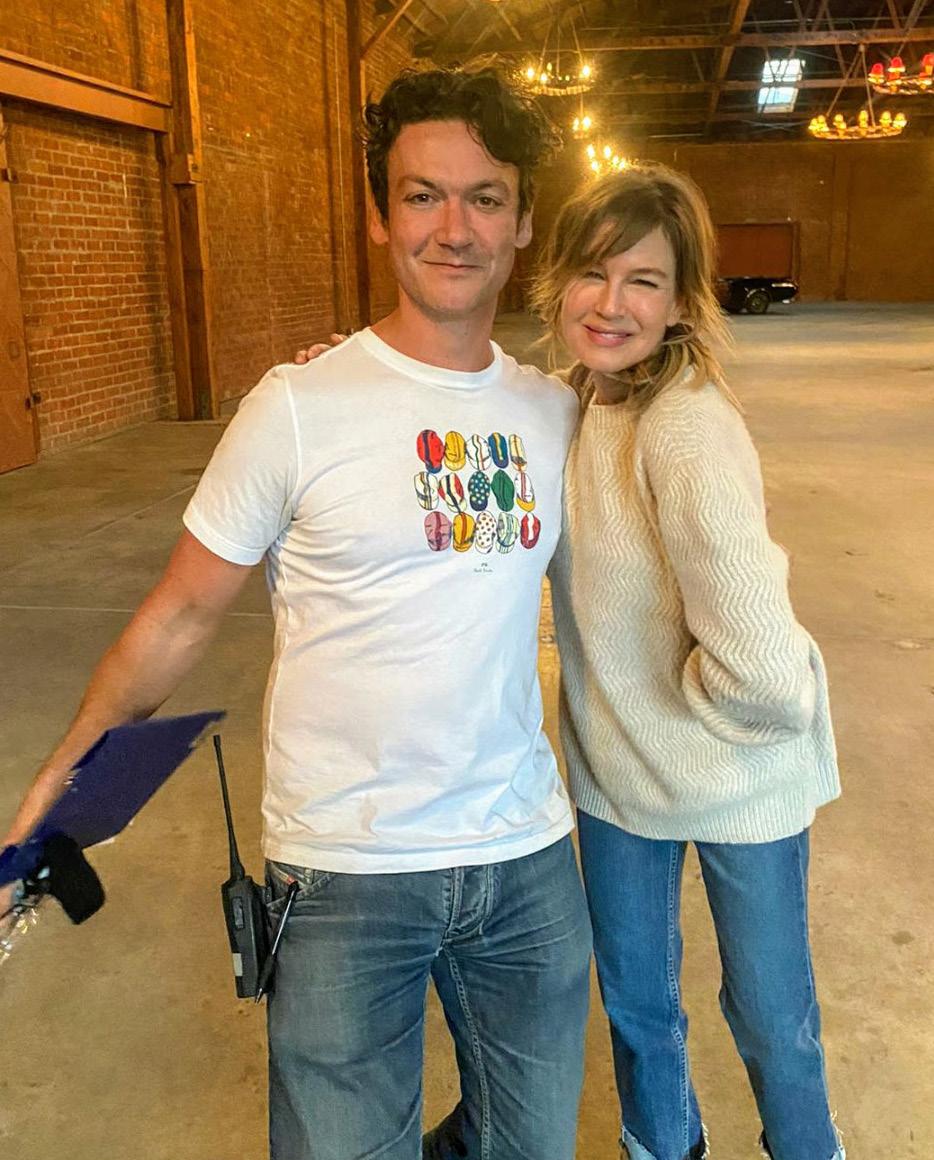
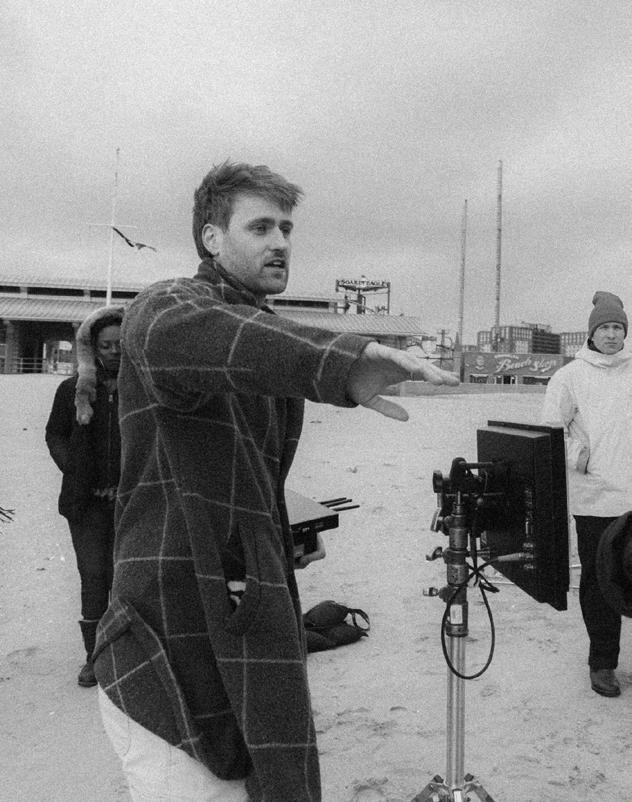
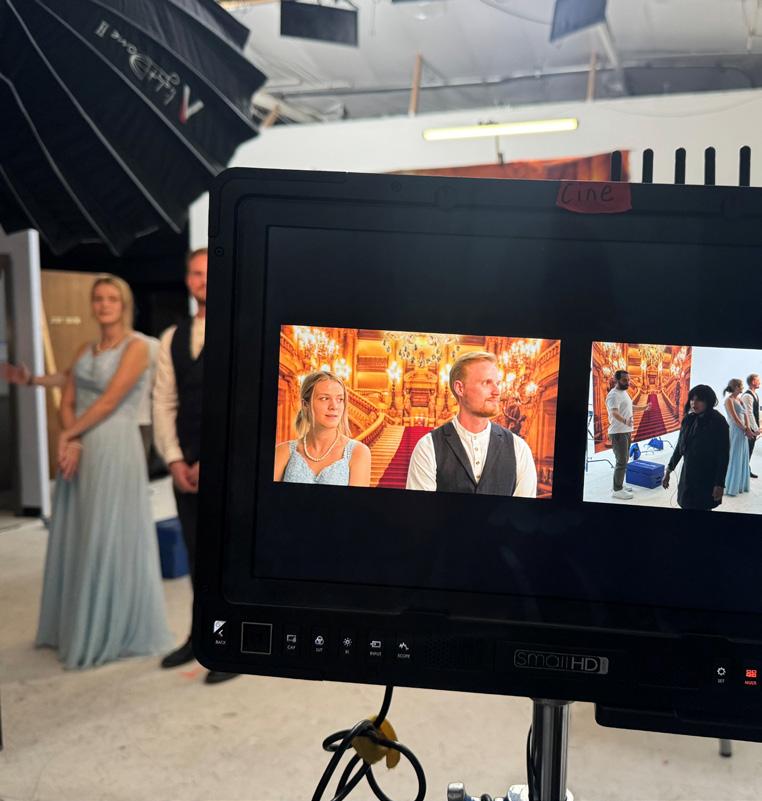
Jake is a founding partner and creative lead at Lugnut Films (instagram.com/lugnutinc/), a Los Angeles-based production company known for high-quality automotive and factual TV content for broadcasters in the US and beyond.
The 1633: Was there a particular moment during your life or time at school that inspired you to pursue a career in film and television?
Jake Cardew: It wasn’t a single defining moment so much as a gradual discovery while I was at school. Through English and drama, I realised I was far more interested in storytelling and how things were put together than in being the one performing. I quickly learned that I enjoyed writing and the technical elements of productions (and also that I was a terrible actor!) which turned out to be a very useful realisation.
T1: After finishing school, how did you take your first steps into the creative industry?
JC: I began my career in local television in Plymouth, which was an invaluable place to learn the basics and understand how productions really come together. From there, I moved to London to work with MTV, where I was exposed to larger productions and a faster-paced creative environment.
T1: Could you tell me more about LugNut and your role within the company?
JC: I founded LugNut Films so I could have more creative control over the projects I make. The company develops and produces television series, documentaries, and commercials, and we’ve been lucky enough to win a number of awards along the way; although we’re still very much hunting that Oscar. My role spans development, production, and direction, working on projects from their earliest stages through to final delivery.
T1: Have you always wanted to live outside the UK, or did your career lead you abroad?
JC: My career very much led me abroad. Working in film and television has taken me around the globe, from working with A-list talent such as Renée Zellweger to meeting personal heroes like rugby legend Martin Johnson. Moving to Los Angeles felt like the realisation of a long-held dream, making it to Hollywood and placing myself at the heart of the industry I had always admired from afar.
T1: What would you say is one of the most challenging aspects of your work?
JC: One of the biggest challenges is balancing creative ambition with practical limitations. The challenge is finding ways to protect the creative core of an idea while working within constraints of time, budget and logistics.
T1: Is there a standout highlight or proudest moment from your career so far?
JC: The moments I value most are those where I’ve been part of a team of people all striving to achieve a common goal. The dream of making my own feature film continues to burn bright, with my first screenplay currently being taken to market by my agent. I’m hoping to cast another Old Exonian in the lead role, but you’ll have to wait until the premiere to find out who!
T1: What memories do you have from your time at Exeter School? Are there any teachers who particularly influenced or inspired you?
JC: I have very positive memories of my time at Exeter School. John James (staff, 1984-1989), my English teacher, played a huge role in developing my passion for writing and storytelling, while Nick Stimson (staff, 1984-1991) in the drama department encouraged creativity and exploration.
T1: What advice would you give to a young person hoping to break into the film and television industry?
JC: Stay curious and get involved in making things as early as possible. You
don’t need to have everything figured out straight away. Be persistent, learn from setbacks, and don’t underestimate the value of teamwork.
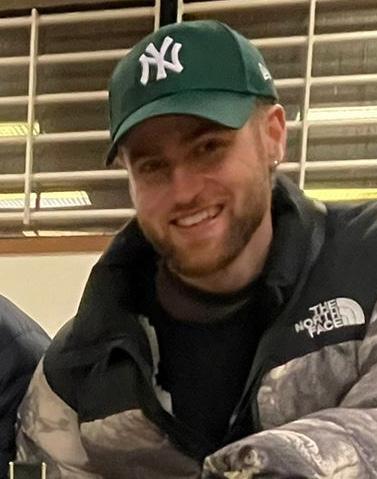
At the time of writing, Owain is finishing his final semester at New York University Tisch School of the Arts. He has directed a short film in the UK inspired by his work in London prisons, and is preparing a Bristol-based thesis feature developed with young people experiencing homelessness.
The 1633: Could you please give a brief overview of what you’ve been up to and how your course has been going?
Owain Astles: I’m now in the final semester of my course at NYU Grad Film in New York. Last year, I directed a short film as part of my course, back in the UK. The film stars Freya Mavor who appeared in Channel 4’s Skins from 2011-2012, and a full cast of actors with lived experience of incarceration. We’ve now finished the film and have begun submitting it to film festivals in the US and Europe. Right now, I’m preparing to shoot my thesis film, this will be a feature film set in Bristol, developed in collaboration with a group of young people that all have lived experience of homelessness.
T1: Have you continued to enjoy New York City and do you feel you’ve now fully adapted to living in a big city?
OA: New York is a unique city. I love its vibrancy. On the subway, you can experience live music, dance shows, standup comedy, sermons… there’s always something going on so you can’t be bored. It’s also extremely diverse; Queens is the most linguistically diverse place per capita in the world.
T1: What has been a highlight of being at NYU, whether that be something from the course itself or with the friendships you’ve made?
OA: Definitely the friends and collaborators I’ve made. NYU Grad Film has students from across the globe. We also benefit from having professors that are some of the most fascinating filmmakers in the world, from Spike Lee to Kasi Lemmons, I’m very grateful to learn from such talented artists.
T1: Would you recommend studying abroad to other young people and do you have any tips for keeping homesickness at bay?
OA: Yes, definitely, whether that’s New York, Europe, Asia, or wherever you’re drawn to. I’ve been lucky to have been exposed to so many new perspectives through studying abroad. I’ve definitely experienced homesickness, too. I keep in touch with friends from home frequently, and I come back to the UK during the summer which helps.
T1: Who in the film industry do you feel inspired by or look up to?
OA: Mike Leigh’s approach to working with actors has been a big influence in my work. Andrea Arnold’s aesthetic, humanistic approach and freedom has been an influence from a young age. From within NYU, Spike Lee’s passionate filmmaking of resistance has always been an inspiration. More recently, the team behind Sing Sing (2023), the film starring Colman Domingo about a prison-based drama group has been a major influence on my way of working.
T1: What are your plans/hopes for the future?
OA: I’m moving back to Bristol temporarily this year to begin work on my thesis film. I plan to move back to New York after that and begin building my career in the city. Ultimately, I just want to make films that are creatively distinct and that have social importance, created in collaboration with communities.
T1: Do you feel your time at Exeter School helped shape the path that you’ve taken?
OA: The most important thing I took from Exeter School is a solid group of friends that I’m still close with now. It’s been a privilege to see how everyone’s grown in the years since Exeter School.
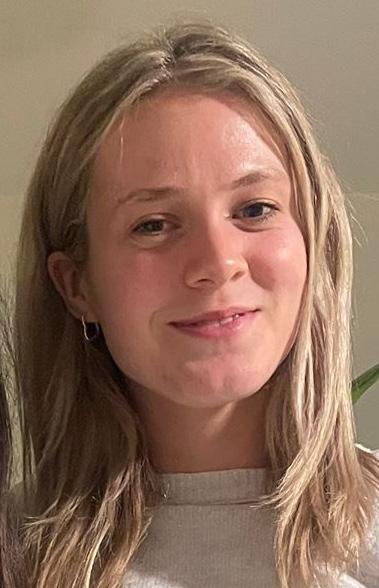
Harriet has been training at the Stella Adler School of Acting in Los Angeles and is building her career in film and television.
The 1633: Looking back on your time at Exeter School, what memories or experiences stand out most to you?
Harriet Bridgwater: I have so many good memories of Exeter School. I always look back happily on the plays we did, especially The Lion, The Witch and The Wardrobe and Lord of the Flies. I used to look forward to exploring a new play every year. I also loved the sport, playing rounders on the field in summer or hockey fixtures in the spring, with sausages and chips for match tea afterwards.
T1: What led you to pursue acting and ultimately train at the Stella Adler School of Acting in Los Angeles?
HB: I did as much acting as I could in Exeter; Shakespeare classes, theatre festivals and immersive theatre. Ultimately what led me to Stella Adler was getting into the National Youth Theatre in 2020, which opens so many opportunities. I auditioned in London, got into Stella Adler, and was fortunate
enough to train in Los Angeles with the aim of getting into film and television work.
T1: How has life in LA been so far, both personally and professionally?
HB: LA has been incredible and I have grown so much through my time here. It’s also been challenging and unpredictable, I’ve been here through the SAG-AFTRA strike and the Palisades and Altadena fires. However, LA is still thriving with independent cinema. I’ve found a path collaborating with a new generation of filmmakers, and a film I shot last year will be screened at The Chinese Theatre as part of the Golden State Film Festival.
T1: What challenges have you encountered in the acting industry, and how have you learned to navigate them?
HB: One of the biggest challenges is the unpredictability, it really is feast or famine. With the thriller feature film I just shot, I was cast just as my sister came to visit and had just over a week to learn a featurelength script. Having a more stable form of income alongside acting has really helped, and I’m also directing a horror short film I wrote with the non-profit after-school programme “Team Prime Time” with ten- and eleven-year-olds.
T1: Who do you most admire within the industry, and why?
HB: One of my favourite directors is Lynne Ramsay, everything she creates is raw and captivating.
T1: Looking ahead, what are your hopes or aspirations for the futureboth in your career and beyond?
HB: I’m currently extending my visa. I’m excited to work on bigger sets and create more of my own work. I would love to come back to the UK at some point and dive into the industry there as well.
Richard is the founder of Floating Harbour Productions
(floatingharbour.co.uk) a Bristolbased film company known for its versatile work ranging from Netflix documentaries like Last Breath (2019) to small, socially and environmentally conscious projects.
The 1633: Could you please give a brief overview of how Floating Harbour began and what still excites you most about the work you do today?
Richard da Costa: It’s been quite a long and convoluted journey. I did a drama degree at Birmingham University and then worked as an actor from 1992 until 2008. Alongside acting, I started a business doing corporate work with actors, and I was also writing and directing theatre. I became increasingly interested in working behind-thecamera and began buying computers, lights and cameras to capture productions on film.
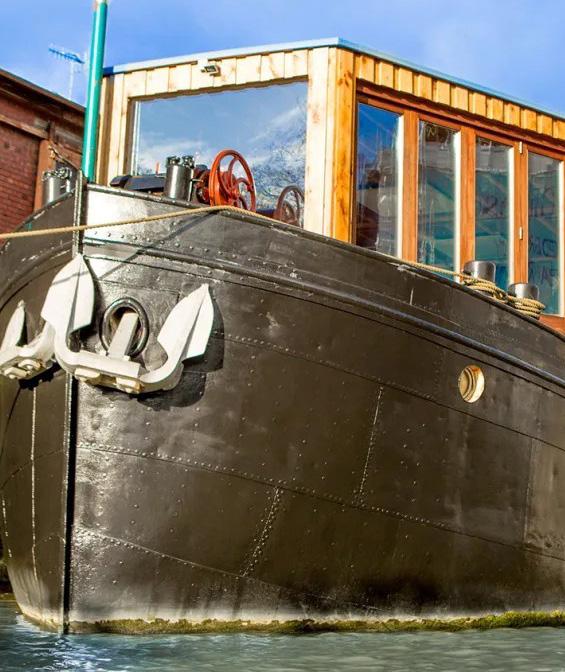
Over time, the film side grew bigger, and I realised I had to make a choice. In 2011, I made the jump and started Floating Harbour. The name came from a boat I bought in Bristol’s Floating Harbour, which stays at the same level despite the tide. It felt like the perfect name for a creative but safe space.
We’re a small production company, but we’ve done everything from big Netflix documentaries like Last Breath to smaller projects. I’d describe us as frontline, battlehardened and hardworking. It’s a tough business, but there is never a dull moment.
T1: Sustainability runs through much of what Floating Harbour stands for. Why is that so important to you and how do you see it shaping the future of filmmaking?
RDC: It’s much more motivating to work hard on things you care about. We try to make as much of our work as possible about issues that matter – climate change mitigation, environmental areas and habitat destruction – while still being a commercial company. We’ve built a reputation in that area, although we’re not niche and are also guns for hire. Sustainability in film is definitely a challenge, there’s travel
and consumption involved, but being based on a boat has made us more aware of things like water usage. These considerations are very present for us.
T1: You work from the Dutch barge studio. What’s something people might be surprised to learn about working in such an unusual space?
RDC: One of the most surprising things is that it’s not that different from working anywhere else – maybe a little nicer. We have a dedicated internet line, a lot of solar, and we’re connected to the mains. We have a studio, offices and a meeting room. Functionally, it’s the same as any premises, just a more interesting space.
T1: Are there teachers that you were particularly fond of at school?
RDC: Absolutely. Nick Stimson
(staff, 1984-1991) was a phenomenal drama teacher, passionate and incredibly good at what he did – he really pushed us in the right way. Jon Tibbs (staff, 1982-1989) went above and beyond in terms of support and stayed a good friend after I left. At a time when things at home were sometimes challenging, having great friends and teachers made a huge difference to me.
T1: What does it mean to you now to be part of the alumni of Exeter School?
RDC: It’s still important, even though it was a long time ago. My time at the school was massively formative. Having a caring environment, opportunities and a high quality of education helped equip me for everything that has come since. I have hugely positive memories of my time there.
“Having a caring environment, opportunities and a high quality of education helped equip me for everything that has come since.”
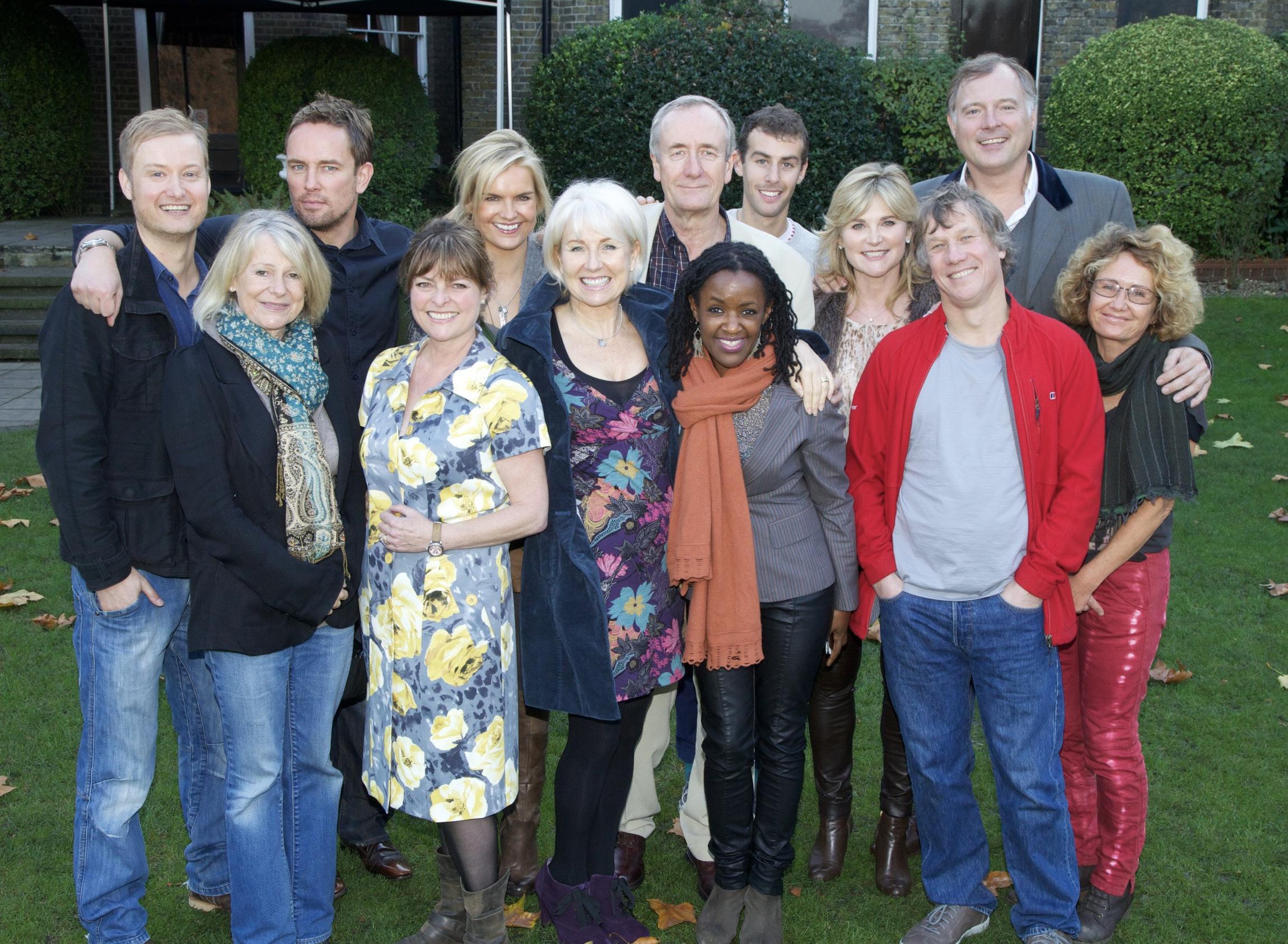
Exeter School sparked a lifelong curiosity that led Leger (1958-1966) into an extraordinary career at the BBC. His journey offers a candid and compelling glimpse into a life well lived.
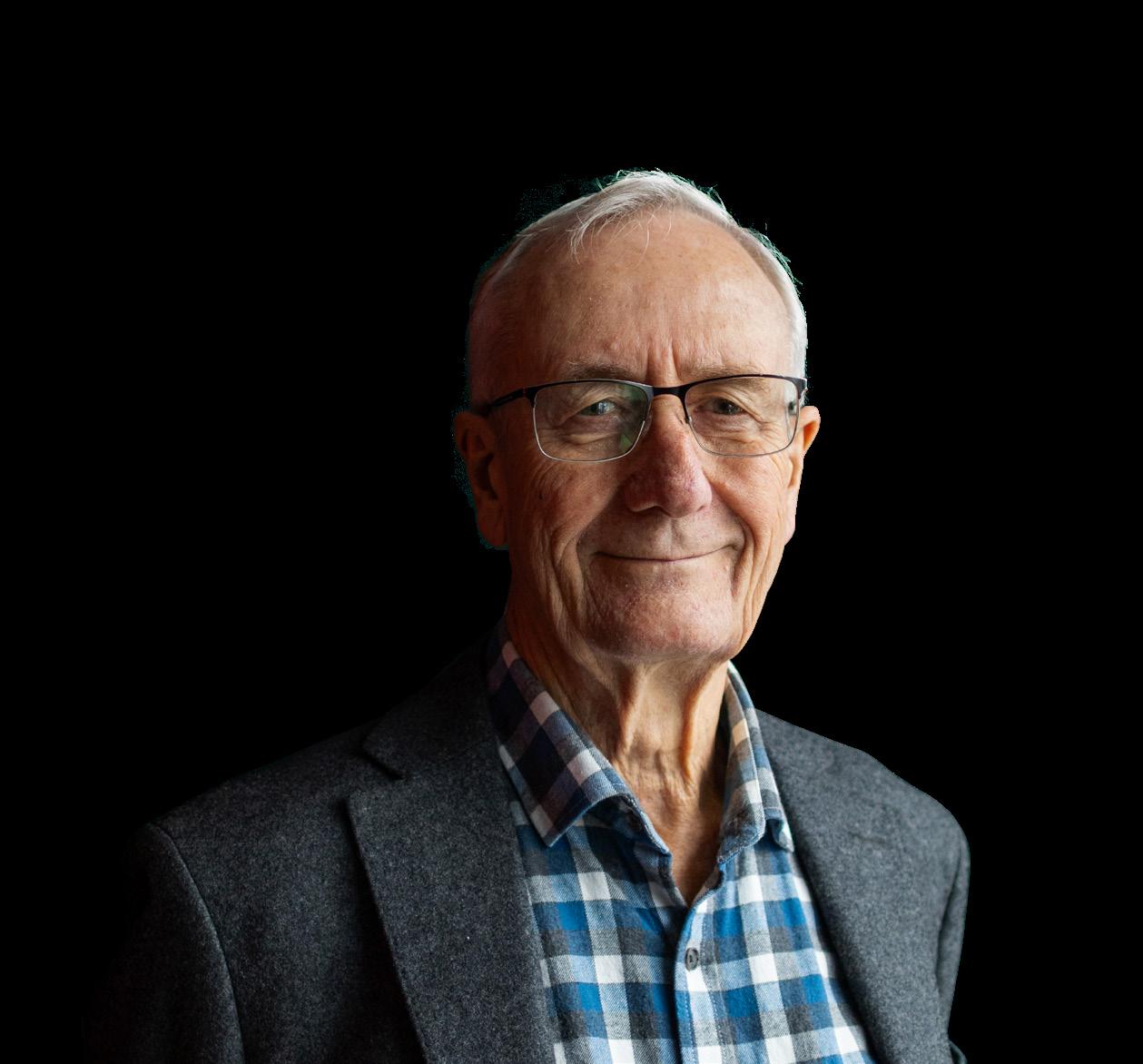
Alex Leger (19581966) has always been disarmingly honest about his beginnings at Exeter School.
One of his earliest memories is walking into Bob Jenner’s (staff, 19571988) geography lesson at the age of eleven and hearing the extraordinary advice, “whatever you do, don’t be a chicken!” A “chicken,” he was told, was someone stuck in the middle of the class, neither top nor bottom. “I can honestly say that for the first two years at school, my great ambition was to become a chicken because I was always at the bottom of the
School was about more than just academics. Gatherings outside the chapel created a powerful sense of belonging. “There were only about 400 boys then so we could all stand within earshot… I felt part of the school - we were as one.”
Not every aspect was idyllic. “I remember watching the rugby along Lower Drive. I hated it.” Saturday afternoons were wet and cold, and
he “couldn’t wait for the match to be over.” Yet where rugby failed to inspire, shooting did. “My sport was shooting, I wasn’t a very good shot, but I was good enough to become captain of the school team.” Trips to Bisley were highlights. “You were given responsibility for your own rifle to look after for the five days, and you could go out shooting at any time.” That trust mattered.
Even more formative was the CCF and a Royal Navy Flying Scholarship. “We learnt to fly in Tiger Moths at Cambridge Airfield.” Built in the 1940s, he explains, the aircraft were “very easy to fly but difficult to fly well.” The precision and discipline required would later resurface in an entirely different arena.
Looking back, he is clear about the school’s lasting gift. “What Exeter School gave me was a curiosity about life. It made me aware there was a whole exciting world of action and adventure out there, and I was insatiably curious.”
That curiosity led Alex far from Devon. After leaving school he spent a year in the Solomon Islands with Voluntary Service Overseas (VSO), teaching on a remote mission station. “Most of the time I was on my own as the only white teacher there,” he recalls. Living close to nature, he learnt to rub fire and kill fish with his teeth. At the time, he wondered if the year had been wasted. Only later did he see it differently.
“I always thought my VSO year was wasted until I got into television, and then I realised it was the bedrock. I knew something that others didn’t.”
University followed, then the army. Though he gained places at both Sandhurst and Cranwell, he chose the army because he was “becoming aware that I was more interested in people than things (like aeroplanes). The army is all about people, so the army it was.” He enjoyed Sandhurst immensely but sensed he would not rise high in a military career. So, he took what he had learned – discipline, leadership, decisiveness – and moved on.
The seed for his future had been planted much earlier. As a student,
he would slip into the television room before supper. “On a Monday and Thursday at 5:05pm, it was Blue Peter, and every so often they’d do something really exciting.” Watching John Noakes complete a four-mile freefall parachute jump “whetted my appetite for programme making even then.”
After leaving the army and joining the BBC in a management role, Alex applied for a six-month attachment in children’s programmes. “I didn’t know it when I applied but I got lucky; it was for Blue Peter, and that was the start. That was in 1975.”
Alex’s BBC journey had initially begun with an interview he has never forgotten. Alex remembers walking into Broadcasting House and immediately feeling at home, the smell of the floor polish was the same as in the army. Even so, he admits
he “didn’t give a particularly good interview,” distracted by a thick file on the interviewer’s desk. At the end, curiosity got the better of him, and he asked who it belonged to. The reply stunned him, “It’s your mothers!”
Although Alex knew his mother, Miranda, had worked at the BBC, he had not realised how successful she had been, the youngest radio talks producer in Bush House at 23, later Deputy Press Officer, and involved with Woman’s Hour. “She was a remarkable person,” Alex says.
When he arrived at Blue Peter, he felt he belonged almost immediately. “From day one I thought the Blue Peter office was totally disorganised,” he laughs, yet the programme was drawing millions more viewers than the Nine O’Clock News. Its success, Alex says, was “all down to the editor, Biddy Baxter… and she was a
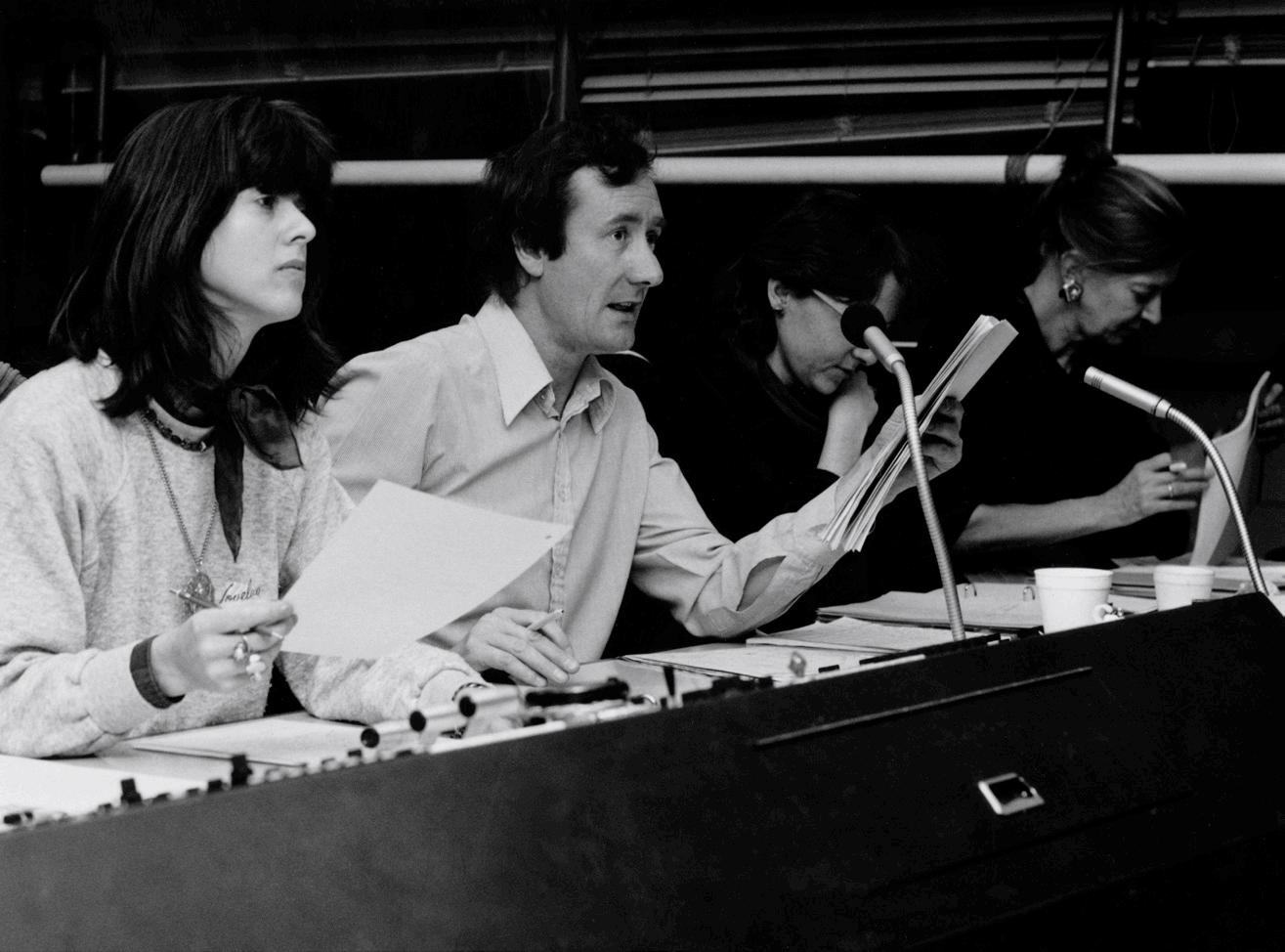
“What Exeter School gave me was a curiosity about life. It made me aware there was a whole exciting world of action and adventure out there, and I was insatiably curious.”
formidable lady.”
“My work attachment went well because the one thing I had learned from the army was how to obey orders. And when Biddy commanded, she expected instant action and obedience.”
When an assistant producer role became available, “I didn’t have to apply because Biddy just asked if I wanted it! That wouldn’t happen these days.” He accepted and began a 36-year career on the programme.
Directing live television revealed a hidden strength. “Studio directing was all down to your reactions or ‘motor skills’.” The same coordination Alex had developed flying Tiger Moths and Chipmunks now served him in the gallery. “The first time you sit in that seat is a huge responsibility.” Under Baxter’s exacting eye, “Biddy would make a note of anything you got wrong and comment during the show and afterwards”, he directed around 100 live programmes without a disaster. “It was quite stressful,” he admits, but deeply satisfying.
Over time, Alex moved increasingly into filming. He went on to make over 600 programmes and films during his 36 years. His projects ranged from extreme physical challenges for presenters to major overseas appeals covering famine, floods and humanitarian
crises. Authenticity mattered above all. “We used to try and get into the soul of the presenters. That’s what filming was all about and why I liked it so much.”
One of Alex’s most memorable adventures on Blue Peter involved presenter Matt Baker and a daring hang-gliding challenge. Matt had been set the task of attempting a tandem hang-gliding height record with world-class pilot Judy Leden, but Alex insisted that he first learn to hang-glide himself. After only a few days of intensive training, Matt was already flying solo to around 100 feet.
During one early training session at Darley Moor Airfield, things did not go quite as planned. Instead of the expected short flight, changing wind conditions suddenly lifted Matt much higher than intended, sending him soaring to around 800 feet. Watching anxiously from the ground, his fiancée at the time, Nicola Mooney, reportedly turned “as white as a sheet.” Miraculously, Matt missed the airfield’s high barbedwire fence and came down safely in a small tree.
About a year later, Matt and Judy successfully completed their planned challenge, climbing to 11,500 feet and setting a new tandem hanggliding height record. For Alex, moments like this captured the

essence of Blue Peter ; real courage and absolute determination, leaving an unforgettable memory for the viewers, as well as the team.
Alex reflects warmly on what made Blue Peter endure. “In a nutshell it was the combination of Biddy Baxter, Edward Barnes, and Rosemary Gill. Above all, the programme had a total empathy with the audience.” Baxter would spend entire transmission days coaching presenters “until their eyes shone with understanding.” If they believed in it, viewers would too.
After 36 years, the time came to leave. With Broadcasting House being relocated to Salford and increasing layers of procedure, Alex felt the change. When colleagues began carrying his bags and joking that he was ‘old enough to be my dad’, he took the hint. “So, the time was ripe for me to retire.” There was no bitterness. “Unlike some people who feel bitter at the end of their careers, I didn’t have anything to complain about. I had had a wonderful life.”
Retirement prompted reflection and, ultimately, a book. “I had to write it. I’d been on a roller coaster, and every year was more exciting than the last. When I retired it was like falling off a cliff. I had to write everything down.” Once finished, he felt complete. “As soon as I had written the book, I never wanted to produce another programme ever again.”
Living in Topsham, with “no desire to go and live anywhere else,” Alex looks back with gratitude. His advice to young people remains characteristically straightforward, “You’ve got to have an edge and be good at it. So go out and experience life.”
From once aspiring merely to become “a chicken,” to the steady creative force behind hundreds of programmes that shaped generations. It is difficult not to be moved by someone who can say, simply and sincerely, that he’s “had a wonderful life.”
Alex’s book, Blue Peter: Behind The Badge, can be purchased on Amazon –https://tinyurl.com/AlexLeger
OE grants of up to £250 support Exonians taking on inspiring projects – from enhancing their studies to making a real difference in their communities, at home and abroad. The 1633 caught up with two recent recipients to hear about their inspiring work.
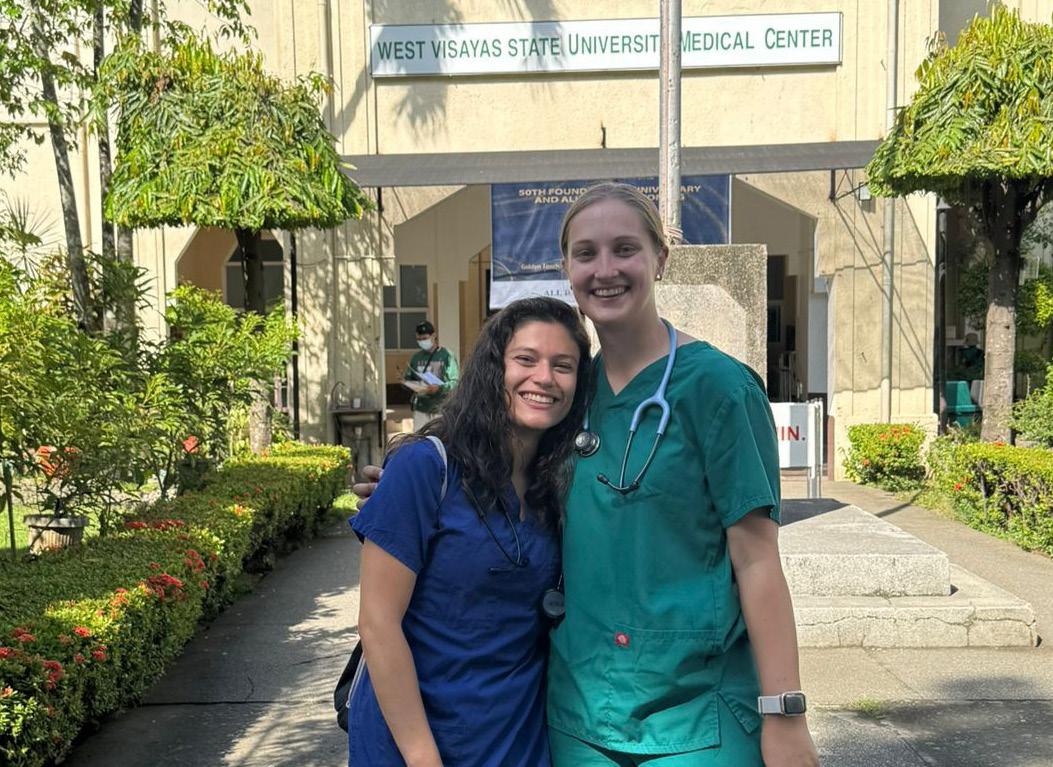
Harriet Jenner
For my final year at medical school, I had the opportunity to undertake an elective placement where I spent six weeks in Iloilo city, the Philippines. The placement was divided into two three-week blocks, during which I rotated through the Anaesthetics Department, Intensive Care Unit (ICU) and Emergency Department (ED). The hospital, a tertiary teaching centre, serves both public and private patients, and provided valuable insight into the challenges of delivering healthcare in a resourcelimited setting.
During my time in anaesthetics, I observed a wide range, including those rarely seen in the UK, such as an omphalocele repair in a five-day
old baby. My ICU and ED rotations further emphasised the impact of socioeconomic barriers on healthcare access, with many patients presenting late with advanced disease, unable to afford treatment.
This elective was both clinically enriching and personally transformative. It broadened my understanding of global health, improved my adaptability in unfamiliar clinical environments, and reinforced my aspiration to pursue a career in anaesthesia. Beyond the clinical experience, I was also fortunate to explore a new country and immerse myself in its rich and vibrant culture.
The OE Grant significantly helped to cover travel and accommodation expenses, and I am very grateful for the support from Exeter School.
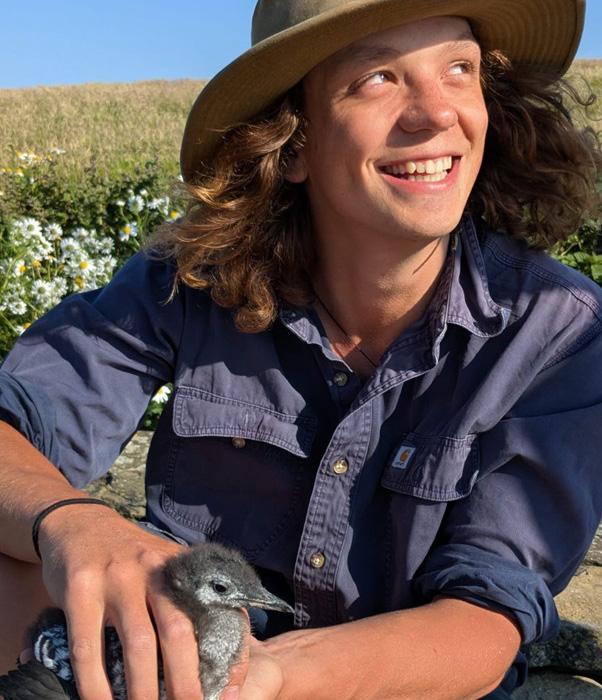
Last winter I took up a six-month residential volunteering placement with the RSPB on Orkney, an archipelago of islands off the northeast coast of Scotland. I was primarily working with the Orkney Native Wildlife Project, which aims to eradicate stoats, they are an invasive non-native species. I worked outside in all weathers on the moors and coastline, conducting monitoring surveys and checking trap lines. The OE grant hugely helped with such an amazing opportunity, by covering travel expenses, for which I am very grateful.
Orkney naturally has no native terrestrial predators, making it a vital stronghold for several groundnesting waders, birds of prey and its own endemic species. For example, it holds 20% of the UK’s hen harrier population despite only making up 0.4% of the UK’s land mass and it holds the largest breeding density of curlews in Europe. The islands are also home to the endemic Orkney vole species. Since the start of the project, curlews have experienced a 21% population increase in Orkney compared to a 13% decline across the rest of Scotland, hen harrier nesting success has increased by 59% and signs of vole activity have increased by 218%.
Since completing my volunteering placement, I was offered the role of a conservation trapper, and I now live and work on Orkney full time.
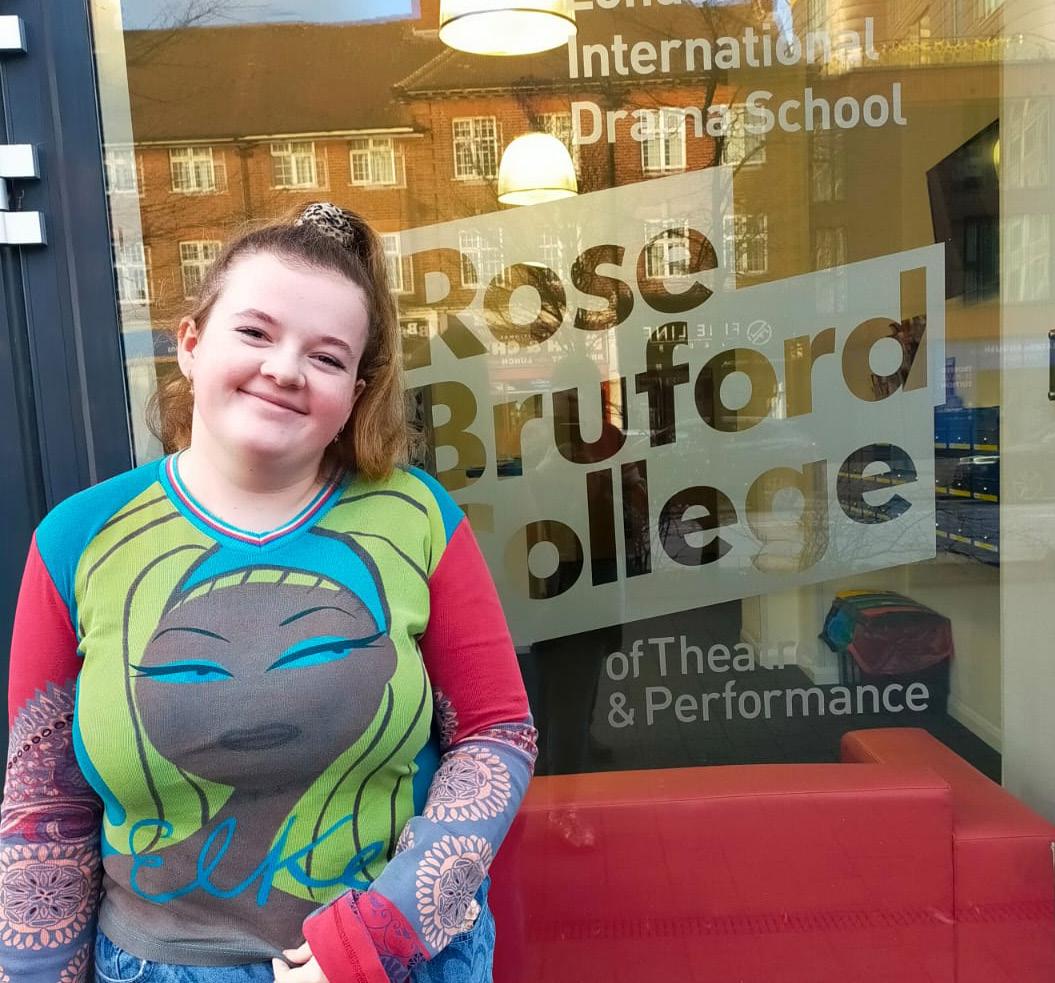
Darcy Beau Hedden (2014-2025), left a lasting impression at Exeter School with her talent in both music and acting, so it’s fitting that she’s now pursuing her craft at the renowned Rose Bruford College in London. Here we find out more about Darcy and how she’s getting on.
The 1633: Could you please give a summary of where life has taken you since your time at Exeter School and was there something that helped you to choose this path?
Darcy Beau Hedden: After leaving Exeter School last summer, I have started studying for a degree in Actor Musicianship at Rose Bruford
College. When I first started looking at options after sixth form, I knew that I wanted to go to drama school and would only consider going to university if I wasn’t successful. After a long audition season, I earned a place at Rose Bruford which also happened to be my top choice. I wasn’t only impressed by an extensive list of alumni (Gary
Oldman, Stephen Graham and Jessica Gunning) but also by the beautiful campus and friendly staff and students. Initially, I applied for acting and musical theatre courses but since I play the French horn I decided to take a chance and apply for an actor musicianship course which combines both music and acting.
T1: What time does your day start at Rose Bruford College and what does a typical day look like for you?
DBH: Each day is very different, and I have a lot of contact hours. My days mainly start at 9am with a couple of days starting at 10.30am which is quite a treat for me! Days tend to range from 9am to 6pm with some going on until 7.30pm. I love that there’s such a wide range of classes, such as music to singing, to the poetic body. A typical Thursday starts with ‘Voice’ where we’re currently focusing on building a vocal routine – spinal rolls, breathing, lying on the floor in semi-supine and stretches which I wasn’t convinced by at first but have grown to love! We then have poetry where we focus on consonants, vowels and how to use our voices to enhance our poems. I’m currently reading “Warming Her Pearls” by Carol Ann Duffy. Straight after this is ensemble where we focus on working as a group. This includes an intensive physical warm up; we’re currently finding a shared rhythm as a group and
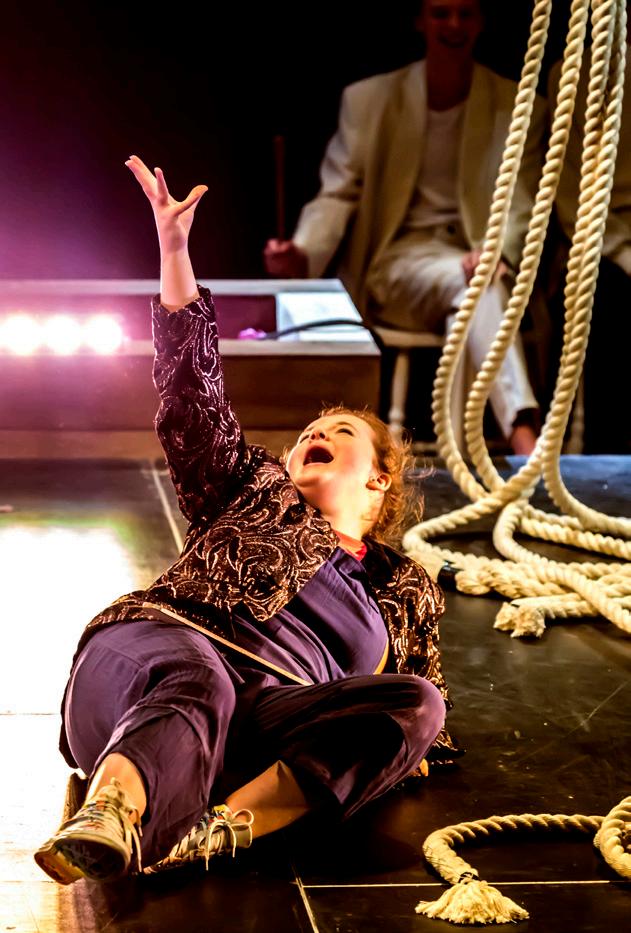
working with a drum beat. Finally, we have ‘Acting’ where we’re exploring Meisner Technique, which I find very interesting! One of my favourite classes during the week is ‘Pop Arrangement’ – we use our own arrangements and instruments to turn a pop song into a completely different genre. Last week we turned Apple by Charli XCX into swing jazz with me as vocalist and a brass band accompaniment!
T1: How did your love for acting start, and was there a teacher at Exeter School who especially inspired or supported you?
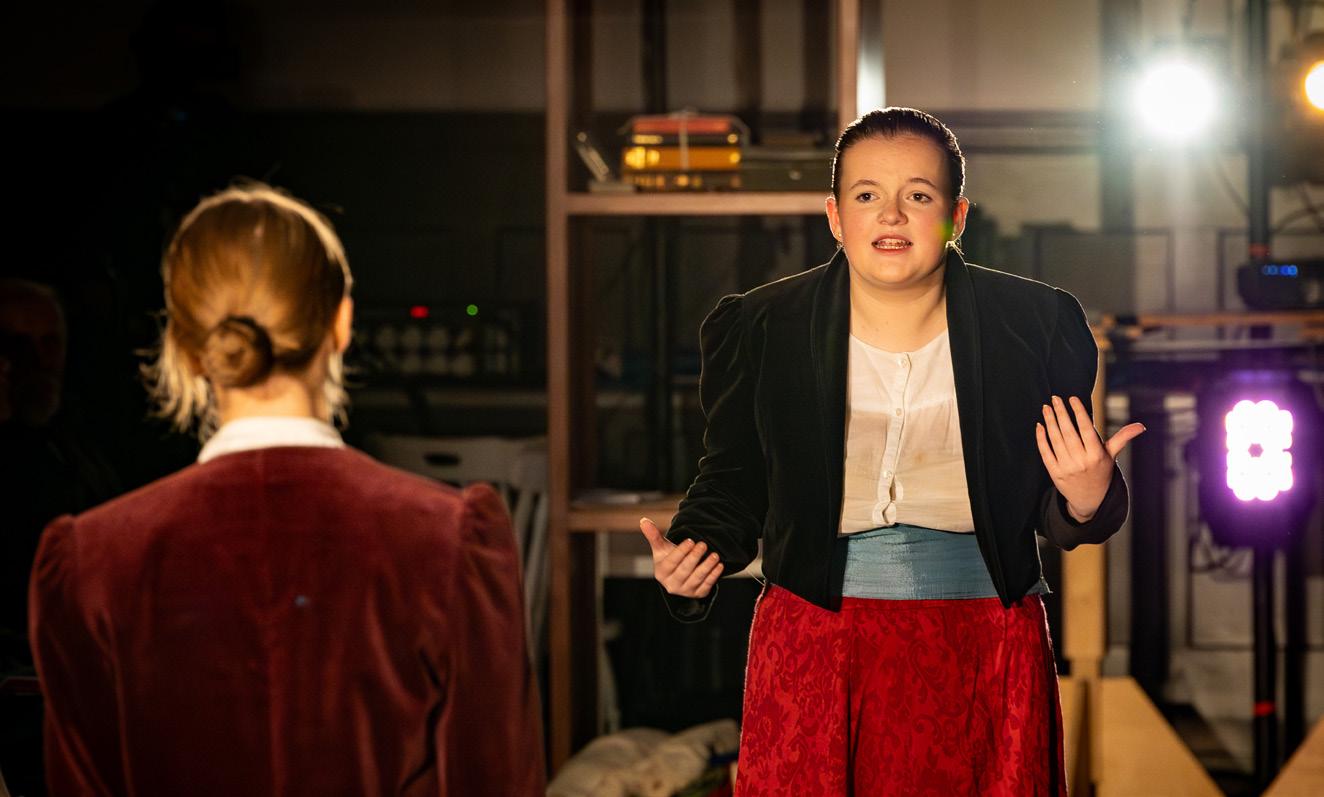
DBH: My love for acting started when my mum signed me up for musical theatre classes at a local theatre group when I was about four. When I joined the junior school in 2014, I didn’t take part in any of the drama club productions until Lower Two (Year Five) when I appeared in the school’s production of Julius Caesar The following year when I played the Nurse in Romeo and Julie t I developed a love for comedic acting. I took part in all the senior school productions – Little Shop of Horrors, A Midsummer Night’s Dream and Blue Stockings. In terms of music, I started to play the French horn during Lower Two (Year Five) when another pupil and I were convinced to take it up due to a lack of French horn players! When I joined the senior school, I joined Maxi Brass and Symphony Orchestra which were
“I still can’t believe that the French horn was the final ingredient that got me into drama school!”
really fun to play in. My love for jazz singing was encouraged by Head of Music, Mr Tamblyn, who always supported me, even though my application for Rose Bruford wasn’t a typical music course. I still can’t believe that the French horn was the final ingredient that got me into drama school!

T1: Outside of your studies, what interests and hobbies do you have?
DBH: As I’m only half an hour from the West End I often find myself watching plays and musicals. I’ve been able to see ten times the amount than I usually would be due to distance and young people’s tickets schemes. I’m currently taking part in the National Theatre’s Young Writers scheme, writing a play about the entertainment industry. I’m also writing a sitcom about tourism in Devon called Grockles. At Rose Bruford we have a festival every year that showcases student’s work, so hopefully that will be showcased next year!
T1: What does it mean to you to be part of the alumni of Exeter School?
DBH: Being part of the alumni reminds me of my grandpa, Peter Gregory (1948-1953), who went to the school. He passed away when I was a baby, but I always think how proud he would have been of me. He also provided the blueprint for one of the stained-glass windows in the Butterfield Hall, another heartfelt reminder of him.
John Spivey (staff, 1981-2001) and Norman Shiel (staff, 1975-2004) together bring nearly fifty years of teaching experience at Exeter School. While neither missed the early mornings after leaving, their fondness for the camaraderie among colleagues and dedication to their pupils remains truly heartwarming. We hope you enjoy this glimpse into school life from the 1970s through to the noughties.
Norman Shiel (staff, 1975-2004)
The 1633: Could you please give an overview of your role at Exeter School.
Norman Shiel: I was appointed as a Classics master, in January 1975, after Bertie Bagnall (staff, 1929-
1970) had filled in the vacancy for the first term; I also did some sports coaching. I stayed because it was such a wonderful place and became Head of Classics in due course, was a Housemaster in Daw House, coached cricket teams and tried my best in all sorts of ways, and against opposition, to introduce football. The hockey people didn’t like it, but after
I left guys like Giles Ashman (staff, 1997-present) managed to bring it in as a mainstream sport. I saw this as a fulfilment of one of my dreams – I had to do it on the side in my spare time and on inadequate surfaces.
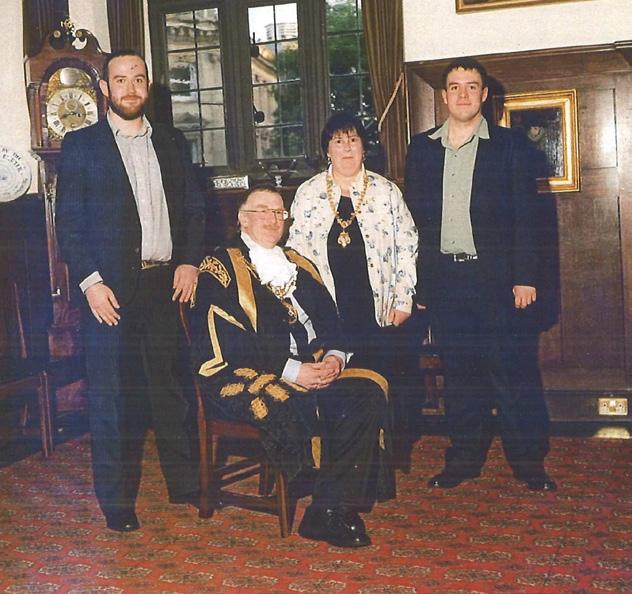
I liked the way you could have the flexibility to join in. I got in the habit of doing the props for plays, and went on on the occasional outing. This included a School House trip to London with Richard Fryer (staff, 1974-2024), and saw The Black Mikado, starring Floella Benjamin, whom I got to know very well when I was Lord Mayor and she was Chancellor at the University of Exeter.
My final year at the school was 2004, I was diagnosed with MS, so had an enforced retirement through ill health. I carried on but after a few years it became apparent that full time teaching wasn’t a realistic option, not just for me but for the staff. I took early retirement with the school’s blessing. The plus side is I could be fully committed to the Lord Mayoralty when it came along.
T1: What was school like for staff and pupils?
NS: It was wonderful, rose-coloured spectacles or not. There was a gentle, zany, relaxed happiness. There was a feeling we were all in it together and we enjoyed what we did. There was far less of an obsession with getting all your things done on time, spreadsheets to monitor this, that and the other. The man who appointed me was widely regarded as being too nice to be a Headmaster. Robin Hone (staff, 1966-1979) was the son of a Bishop and was caring, compassionate, and thoughtful. He was far too nice really, a great man to work with and work for. He happened to be a classicist so that helped!
I remember coming down for my interview from the frozen North, born in Blyth, school in Newcastle, university in Durham, so this was the tropics! In the mid-70s, the summers were so long.
T1: Can you think of any memories or achievements that particularly stand out?
NS: I look back now as a person with MS who struggles to walk from
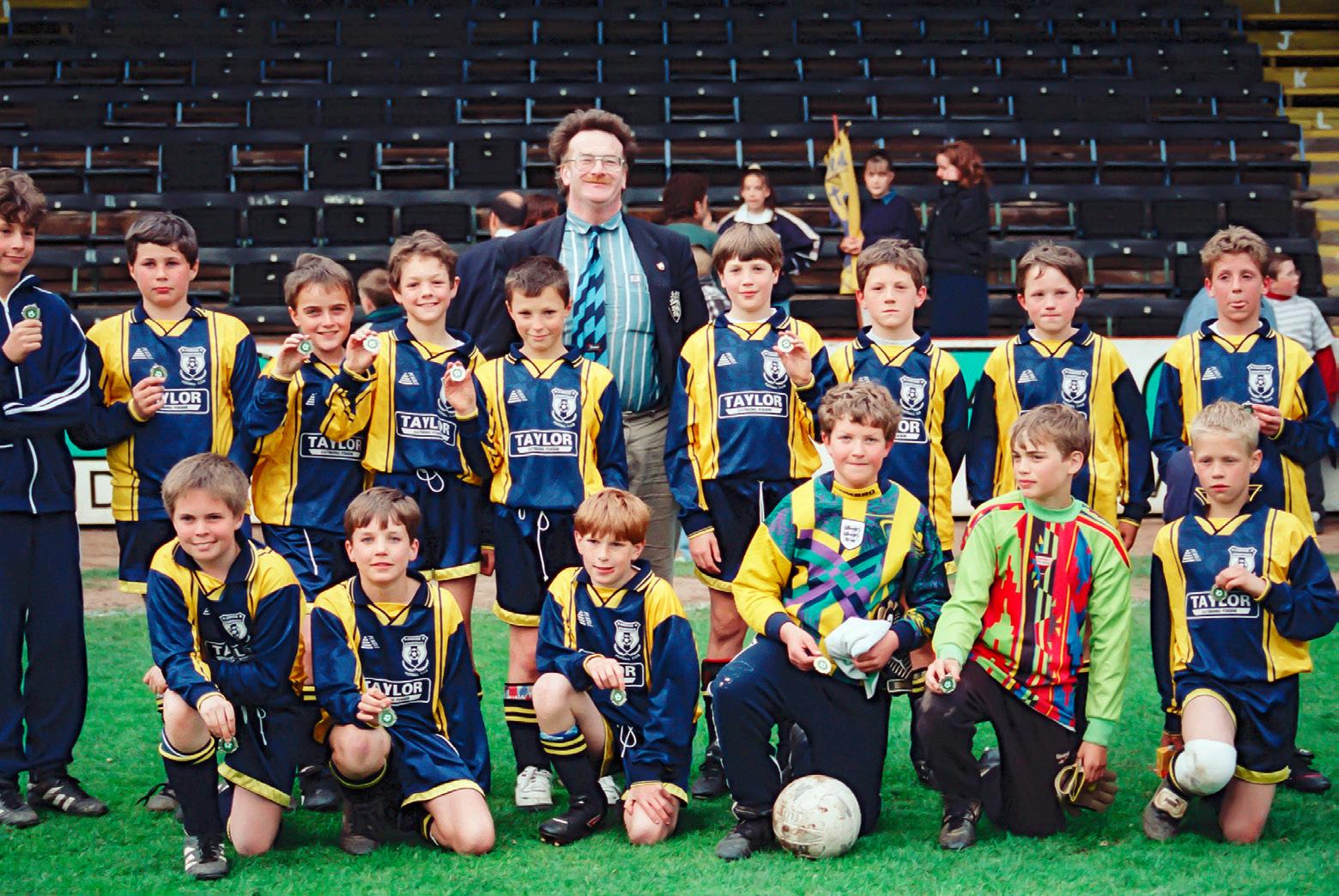
one side of a room to the other, so scoring two tries against the 1st XV when I was a young teacher was very memorable. The young staff, plus a few outsiders took the 1st XV on and held our own against them. I could play cricket well, being a fast bowler.
I liked all the gentle eccentrics I’ve taught over the years. You think “gosh, that was an experience”. Some of them were brilliant, and you feel privileged to have taught someone significantly better than you are.
T1: What do you miss about Exeter School?
NS: When I left, I was pleased because by then the stress and strain of doing things as well as I could with a disability was too much, so at first I felt a flood of relief when I could lie in
and take my time over breakfast. My wife, Bridget (staff, 1992-2017) had carried on teaching: she’d taught in the junior and then in the senior school.
I missed my pupils; I really liked my pupils. In the early days, there were no girls and no female teachers except in the junior school, so it was interesting to see how it changed over the years.
T1: Do you keep in touch with former colleagues?
NS: On day one, I was introduced to the other person starting, Derek Mollart (staff, 1975-2004), he later took over from Dennis Dyson (staff, 1960-1994) as Head of Biology. Derek looked as though he’d just come out of a hippy commune, we’re different but we get on well. We meet for lunch at least once a month and reminisce about all sorts.
Former Head of English and Head of Buller, Chris Finn (staff, 20032005) lives about two streets away. We used to meet up a lot until his wife took ill.
I enjoy the OE dinners and I try to come to them when I can to meet former pupils and see what they have to say and what they look like now.
T1: What does it mean to be part of
Then and now
the alumni of Exeter School?
NS: I can look back with some pride on those that I’ve had the chance to engage with. I’ve had one or two of them say, “you’ve made a difference”, or “it was because of you that I’ve now got this particular job”. I used to greatly love having middle aged people coming up saying, “hello sir!” There’s no teacher that’s universally loved, but I got the feeling that if anyone saw me, they wouldn’t run and hide. They always call me sir, the only two that haven’t are my own two sons, who were at Exeter School. I always tried to model myself on my own teachers that had enriched my life.
T1: Since leaving Exeter School where has life taken you?
NS: I was city councillor, and a magistrate. I taught online and occasionally face-to-face for the Open University. Plus, there were different
“We have a nice old cat, and for the first time in my life I have a big garden.”
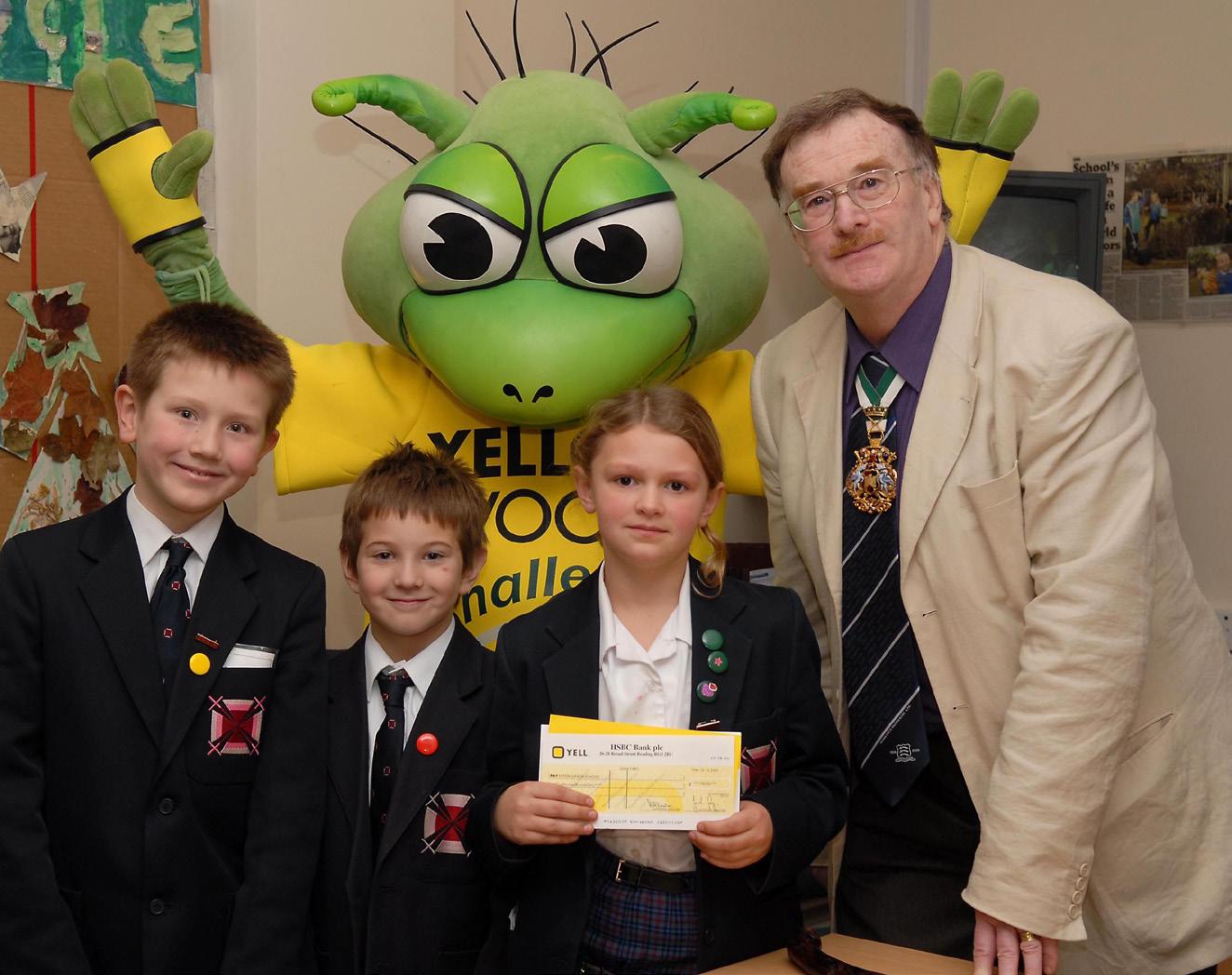
committees. Life was not by any means empty, but the big dominant force of Exeter School had gone. I was sworn in as the Lord Mayor of Exeter in May 2006.
T1: What does a day in your life look like now?
NS: It’s very peaceful now, I’m a crumbling geriatric who tries to stay sane. We have a nice old cat, and for the first time in my life I have a big garden, which was a godsend during lockdown. It’s just Bridget and I, there’s still the odd charity committee and I talk to different groups, generally about my year as the Lord Mayor. Our children and grandchildren, three boys and one girl, (first girl in my direct line for 100 years!), come to visit, and we FaceTime often.
and now
(staff, 1981-2001)
The 1633: What led you to the world of teaching?
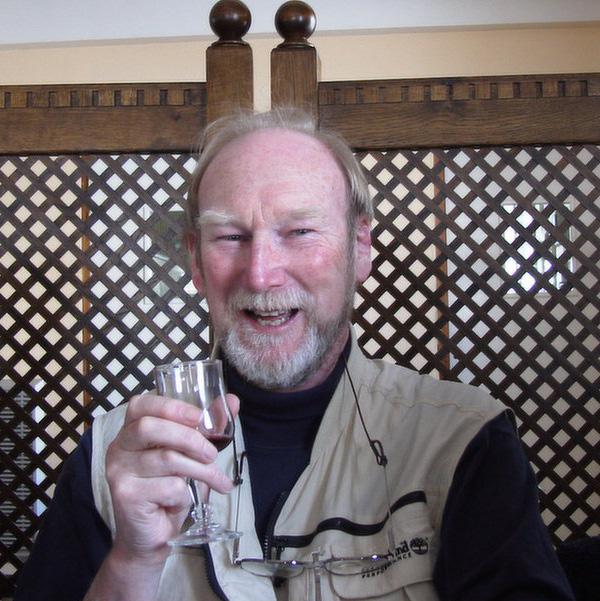
John Spivey: My favourite teacher at school was my physics teacher, so I became a physics teacher. For my first teaching role I was headhunted at university, and shipped out to Kenya to help in a boarding school. I left in 1971 and hunted for jobs on the way home on the ship. I then had a lovely job at the British School in Brussels as Head of Science. I came back to do a master’s degree at St Luke’s in Exeter, taught at Tiverton High School for a bit, and then applied to Exeter School. I had Lab P1 for 20 years.
T1: What was school like for staff and pupils?
JS: It was a huge contrast to Tiverton High School, but similar to the school in Kenya. I found discipline very straightforward at Exeter School, and from that point of view a bit more relaxing. My son, Jason Spivey (1985-1988) came to the school. He’s gone on to be successful in the world of finance in London and my daughter, Kate, works in an antiquarian bookshop and is very happy.
T1: Can you think of any memories or achievements that particularly stand out?
JS: I used to say to pupils who took part in Ten Tors, “in your school life you’ve probably sat through 16,000 lessons and I bet you won’t remember any of them in detail, but you will remember doing Ten Tors.” I can remember walking across Dartmoor and Exmoor in some detail, but I don’t remember any of the lessons I taught!
T1: What do you miss about Exeter School?
JS: I certainly don’t miss the tyranny of the timetable and having to be at lessons from 8am. I miss the companionship of the staffroom; particularly our own science staffroom, and I miss the lunches.
“Exeter School has been here a very long time; you become part of the history.”
T1: Do you keep in touch with former colleagues?
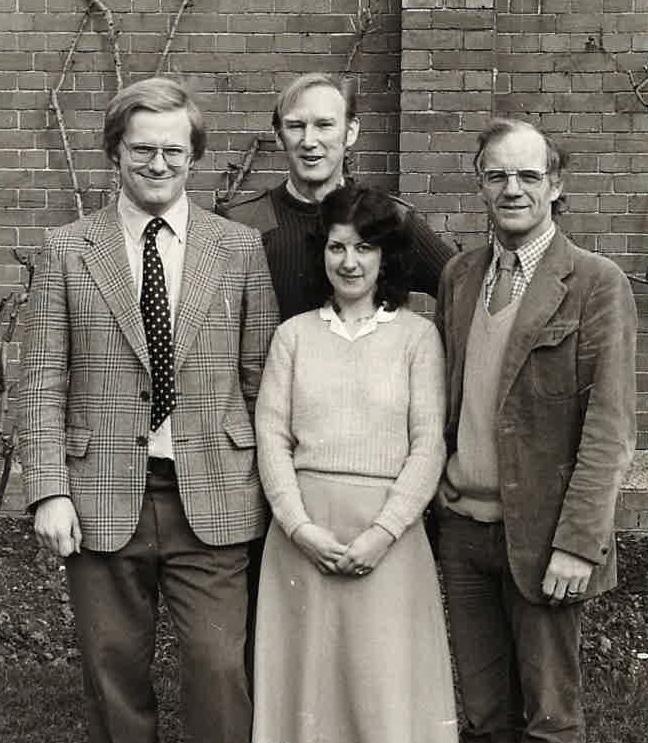
JS: Sometimes John Davidson (staff, 1976-2018), but mainly David Seddon (staff, 1988-2006). David and I were together at the school in Brussels. After I’d been here a few years, Headmaster Geoffery Goodall (staff, 1979-1992) asked me if I thought David might like to teach at Exeter School.
T1: What does it mean to be part of the alumni of Exeter School?
JS: Exeter School has been here a very long time; you become part of the history, and I feel I’ve contributed something to the school. We always got very good results in physics. There were two lads in my class, one got the best marks in the country, and another one was fourth. In my first A Level group, there were 10 in the group and seven became doctors.
T1: Since leaving Exeter School where has life taken you?
JS: Literally around the world, I’ve been around the world three times.
I went with a university friend to Antarctica and also with him to 80 degrees north. We’re flying to La Paz for a month and touring Bolivia, a few years ago we explored Southern Greenland together. I love anywhere mountainous. Whilst I was teaching at Exeter School, I did a job swap and taught in Queensland for a year… I wish it had been longer.
T1: What does a day in life look like now?
JS: We have a dog, and for the last fifteen years I’ve been heavily involved in the Millenium Green at Thorverton – I’m now chairman of this. We’ve got a fairly large garden, which takes quite a bit of upkeep. We’ve still got the campervan; I’ve always had these. My fiancée (since the millennium!) Ros and I, went around the coast of Wales this year. I’m still doing plenty of photography and am in touch with former pupils who were interested in this when I was their teacher.
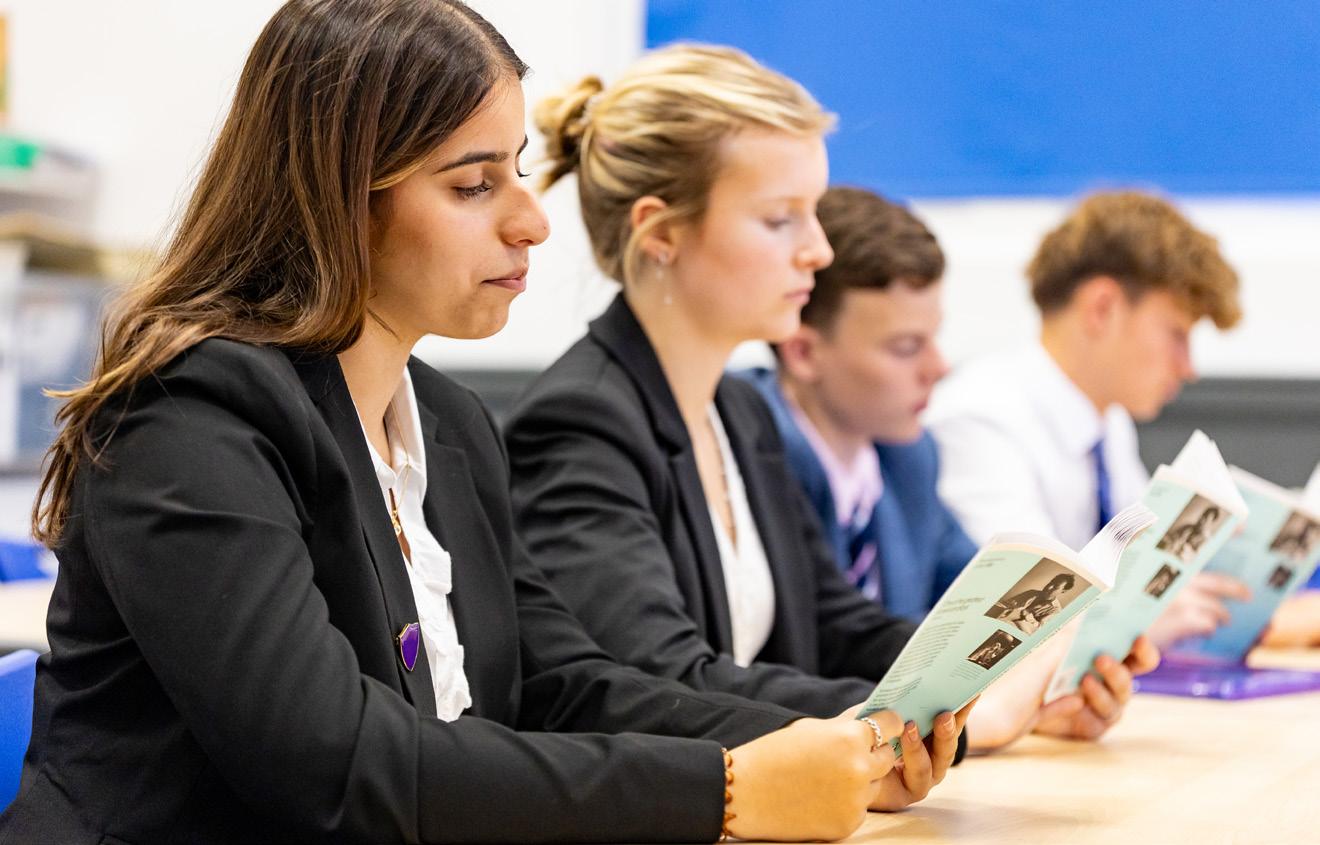
Throughout the year, there are various opportunities to share your time and expertise with current pupils. The Alumni and Development office would be thrilled to welcome you back to Exeter School to help with the events below – we are deeply grateful for any help our alumni community can provide.
Here are a few key areas where your support would be greatly appreciated.
• Two events for the Upper Sixth in early September – gap year panel, where recent leavers return to share their gap year experiences, and I Wish I’d Known That, where former pupils discuss their transitions to university or the world of work, reflecting on the things they wish they’d considered during those stages.
• Lower Sixth futures conference in February/March – we ask the Lower Sixth what career areas they are interested in and invite alumni representing the top 12 choices to come back in and talk about their sector. For this event we look for
alumni who are established in their sector and who can offer a broad perspective to our pupils.
• Careers Convention in early February – our flagship careers exhibition style event invites professionals from key industries to engage through informative conversations with our pupils and their parents.
Our Careers Pathway Adviser, Melanie Szender, is also organising industry-focused events. If you’d like to share your career experiences, we’d love to hear from you.
• Interview assistance at our Upper Sixth interview scheme event in October, as well as support for
university and degree apprenticeship interviews.
• Mentoring and advice – the Alumni and Development office has seen an increasing number of career advice requests from sixth form pupils and recent leavers. Connecting them with alumni in relevant fields has proven incredibly valuable, whether through email, phone, or video calls. If you’re willing to offer your time in this way, please contact the Alumni and Development office to register your interest – your support is greatly appreciated!
• Ad hoc talks – with a busy academic schedule and numerous co-curricular activities, it’s wonderful to have alumni return to school for talks, whether in clubs, house meetings, or subject lessons, and it really benefits our pupils.
• Careers podcast and videos – we are looking for volunteers to share their career journey for our junior and senior school pupils, by answering a few questions about their career journey and their current role. If you’d be happy to take part, please email careers@exeterschool.org.uk.
• Speech Day – we are always interested in hearing from alumni who would be happy to deliver a short, inspiring message to our pupils on Speech Day.
• Exonian Lecture – The Exonian Lecture is a highlight of our alumni calendar, and we’d love to hear from those eager to share their work or achievements with a diverse audience for an hour, followed by a Q&A.
While we may not be able to accommodate every expression of interest, we warmly encourage you to share any ideas for the alumni community. Please do keep us updated on your career progress and areas of expertise – it’s incredibly valuable to our volunteering programme.
If you’d like to get involved, please don’t hesitate to get in touch – alumni@exeterschool.org.uk. Thank you.
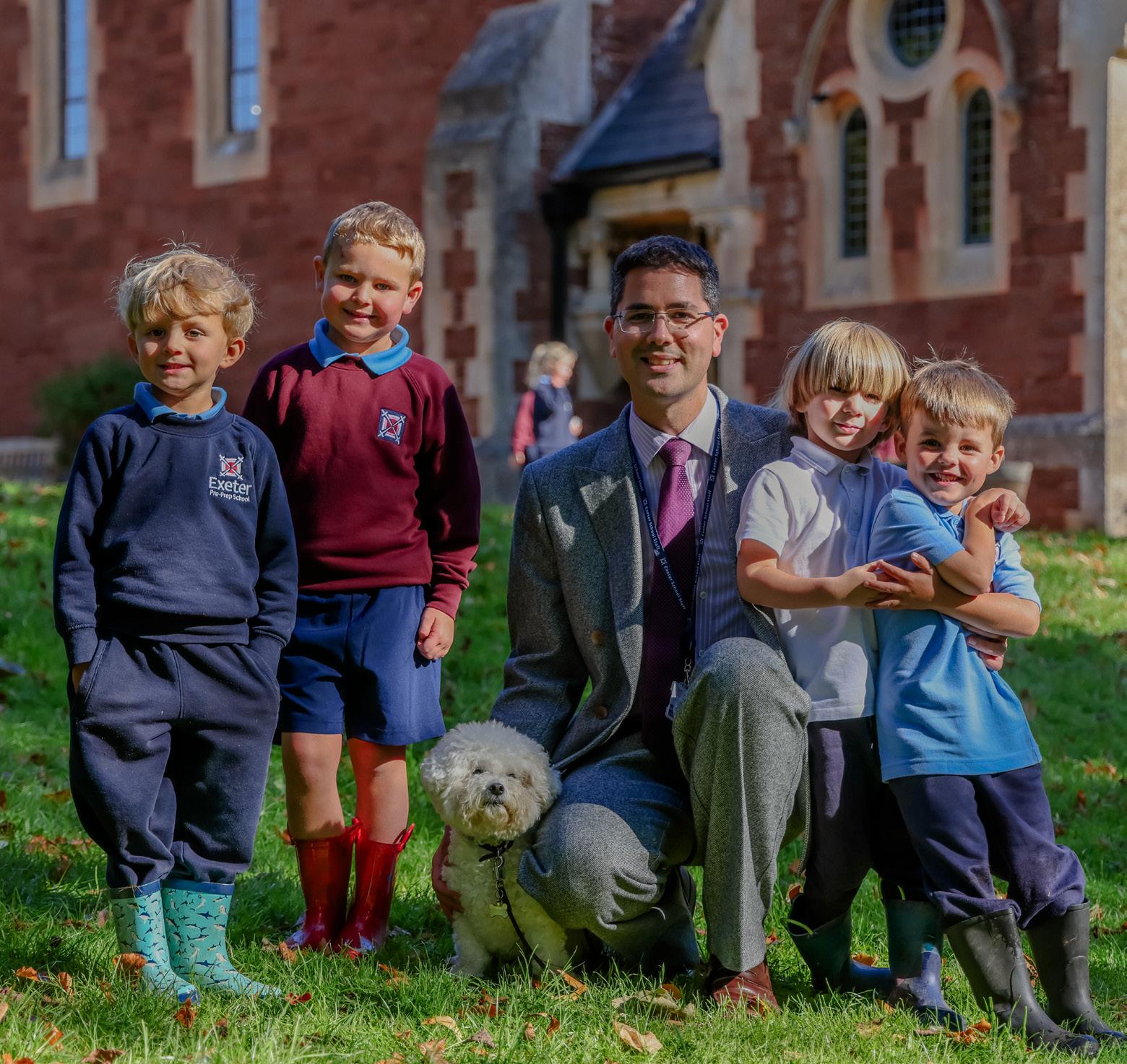
Daniel Ayling couldn’t be more suited to his role of Head at Exeter Pre-Prep School, which is a warm, welcoming and nurturing environment for children beginning their educational journey.
Inspired by the encouragement to join his local grammar school and shaped by the wonderful teachers who guided him, Dan discovered his passion for education early on. That spark eventually led him to the role he now describes as his dream job.
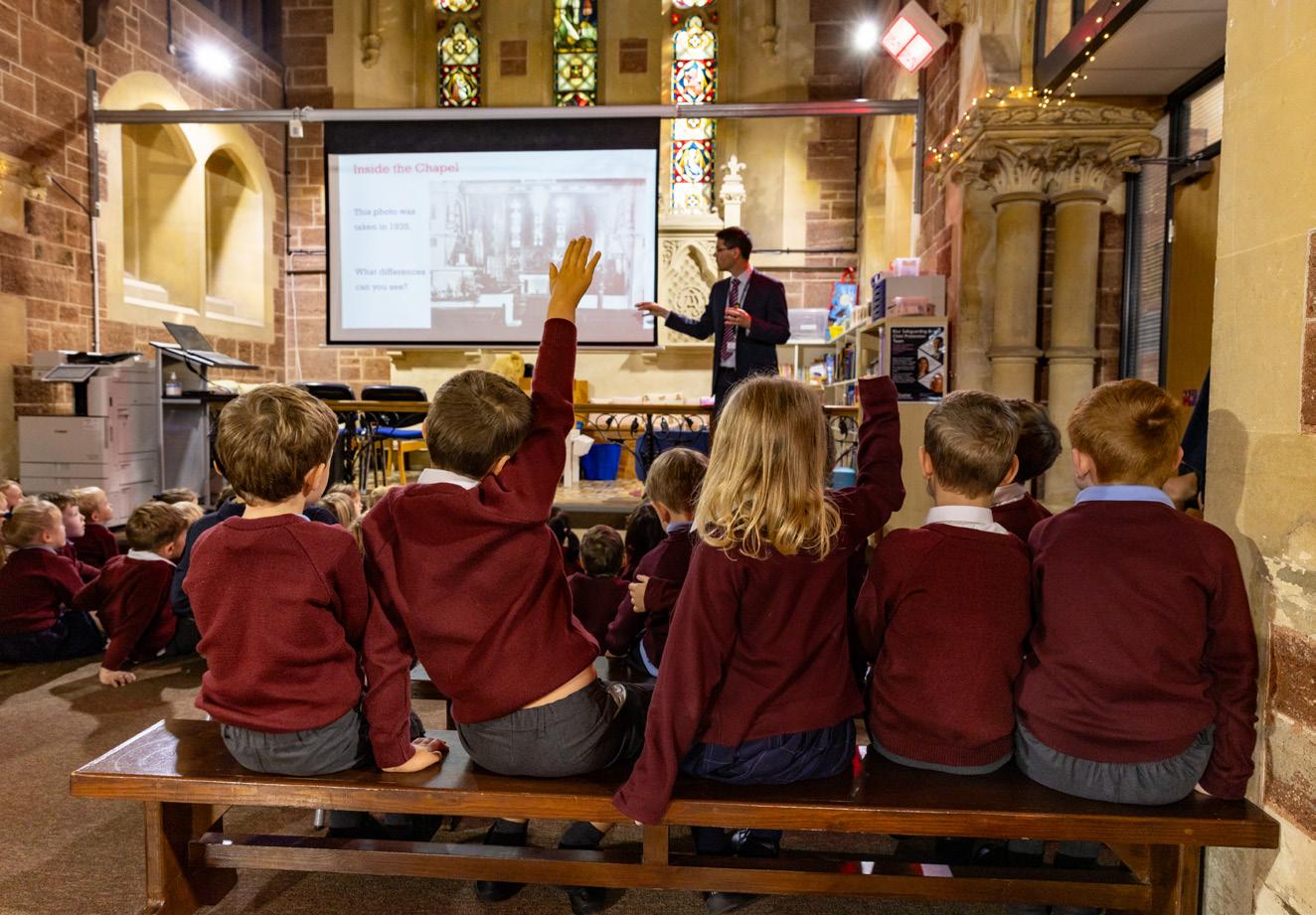
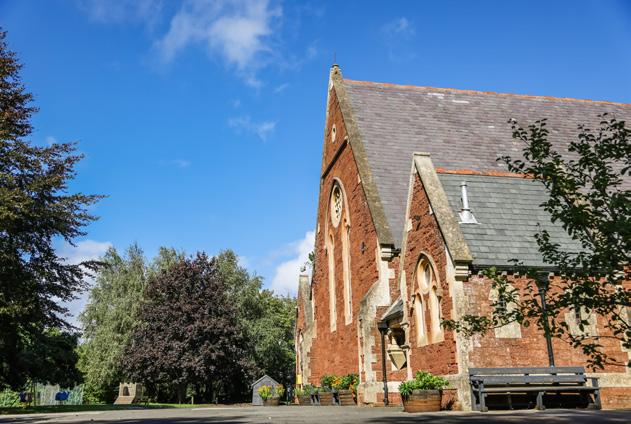
We were delighted to sit down with Dan in the beautiful former chapel – a space that has, for many years, echoed with the happy footsteps of children skipping through its doors.
The 1633: Could you tell us a little about your own educational journey?
Dan Ayling: I was born and raised in South West London and started my secondary education at a state comprehensive school. Halfway through the second year, an English teacher called my mum in and said that I should try for Sutton Grammar School for boys, so I sat an entrance exam for one place that had become available in Year 8 and got in. I feel like that was a big turning point in my life, as it threw me into a world of high performing academic pupils. I was very happy there and stayed through to the sixth form, I then earned a place at Cambridge University to study Education with English at Homerton College.
T1: How did you get into teaching?
DA: I always wanted to be a teacher from a very young age because I loved school and was really inspired by many of my teachers. After graduating, I did my teacher training at Cambridge, then got my first job at a small village primary school in Cambridgeshire teaching Year 1. I met my husband at university, and we soon decided to move back to London, which was when I went into private education, more by chance than anything. I taught Year 2 at The Study, a fantastic little prep school in Kingston. After a couple of years, I was ready to try something bigger and moved to Greenacre School in Surrey, an all-through girls’ school. In my mid-thirties, I moved to Manor House, another all-girls’ school in Surrey, as Deputy Head of the junior school, and after three happy years, I got my dream role at the same school as Head of Pre-Prep and Nursery.
T1: What made you move to the South West?
DA: I have family in Devon and, in 2018, when my husband was offered a job as Assistant Principal of a large sixth form college in Taunton, we decided to relocate to Tiverton. This was around Easter time, so I took a maternity cover position near my home at Blundell’s Prep, teaching Year 3. Our bichon frisé puppy, Ruffles, also joined the family shortly after we arrived in Devon. After Blundell’s, the opportunity came up to be part of a team opening a brand-new special school in Tiverton, which was really exciting and something I had always wanted to try. Being Deputy Head of an 11-16 free school academy for autistic students through the Covid years was definitely outside my comfort zone – a steep learning curve but also very rewarding.
T1: And how did you come to work at Exeter Pre-Prep School?
DA: When I saw the advert for Head of The New School, as it was called back in 2021, it was too good an opportunity to miss. I remember driving to the school and thinking,
“My mum was a single parent and a self-made businesswoman; she’s always been a huge inspiration.”
“Wow, that looks magical,” which is the reaction most people have when they come here. I really enjoyed both the interview days and was over the moon when I was offered my dream role again. And I’ve loved pretty much every minute since. It really is the best job in the world and I’m very proud of the school.
T1: Who or what have been your biggest influences as an educator?
DA: My mum was a single parent and a self-made businesswoman; she’s always been a huge inspiration, and many other women have gone on to influence me.
T1: For those who may not know it well, how would you describe the ethos of Exeter Pre-Prep School?
DA: It’s very warm and friendly, a place of happiness and lots of fun. We have high academic standards; the children work hard and play hard. They come skipping into school in the morning and go home tired but
happy at the end of the day. We’ve got an incredibly strong team of staff here; they’re really the secret weapon. We all look after each other, and we work hard to make sure that we protect the delicate balance that comes with being such a small team.
T1: How do you foster a love of learning so early on in a child’s school journey?
DA: Lots of play, lots of free choice, getting to know the children’s interests. Putting in that learning ethic right from the start is important; all children read aloud
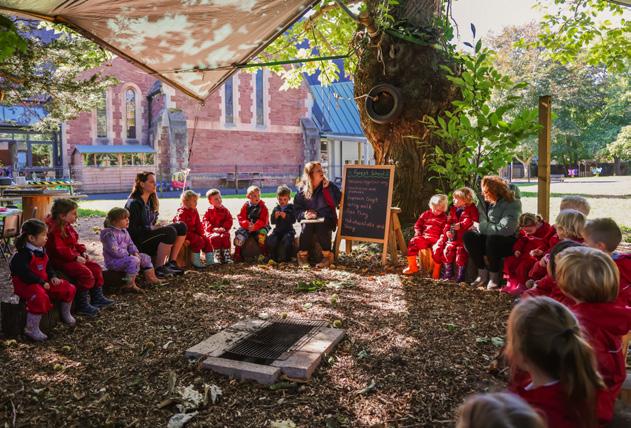
to an adult every day, even in the nursery. As children get older and move into Key Stage 1, we increase the level of challenge and tailor as much as we can to each child, so they never get bored.
T1: How do outdoor learning and the school’s setting contribute to the children’s experience?
DA: Hugely – we’re incredibly lucky to be housed in a converted chapel building with beautiful grounds, which have a real wow factor. The children are very proud of the building and love learning about the history of the school when we run a Heritage Open Day in September. The grounds are equally important; the space we’ve got for a small school is incredible – one acre with mature trees, green spaces and a tennis court, all situated on a quiet, private road; we call it ‘an oasis of calm’.
T1: What’s the best part of your day at the pre-prep?
DA: On a Friday, each teacher chooses a ‘star of the week’, and those children are invited to have lunch with me in my office the following week with a friend. It’s a lovely chance to chat to them individually and get to know them better. They are often hilarious and, of course, they’re always delighted to see Ruffles, who is now seven and serves as our school therapy dog.
T1: Finally, what do you like to do to relax in your spare time?
DA: I love music and going to the theatre – I used to do quite a lot of choral singing but don’t have much time for that lately. I still collect CDs and vinyl. I also find reading, doing crosswords and eating out help me to relax.
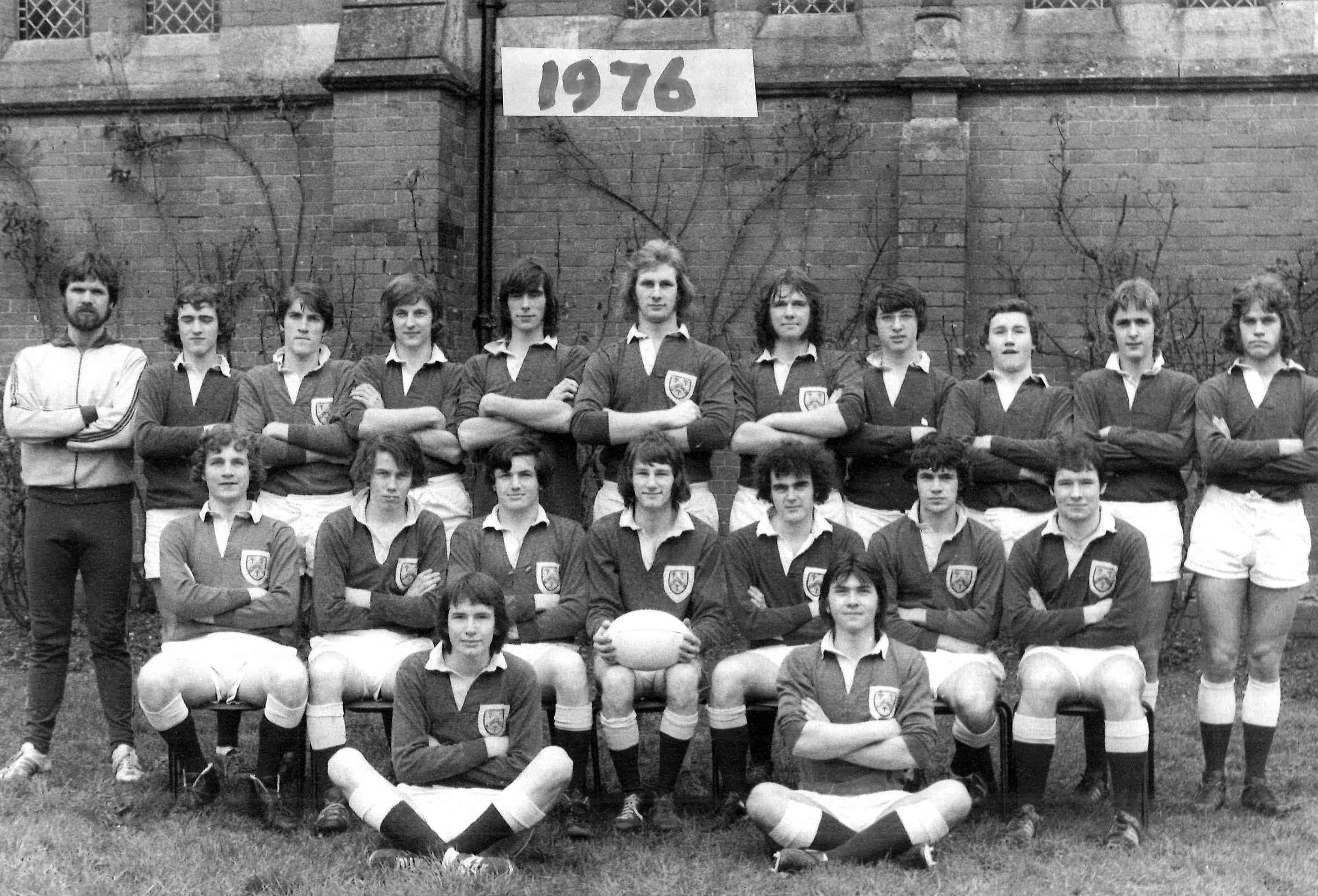
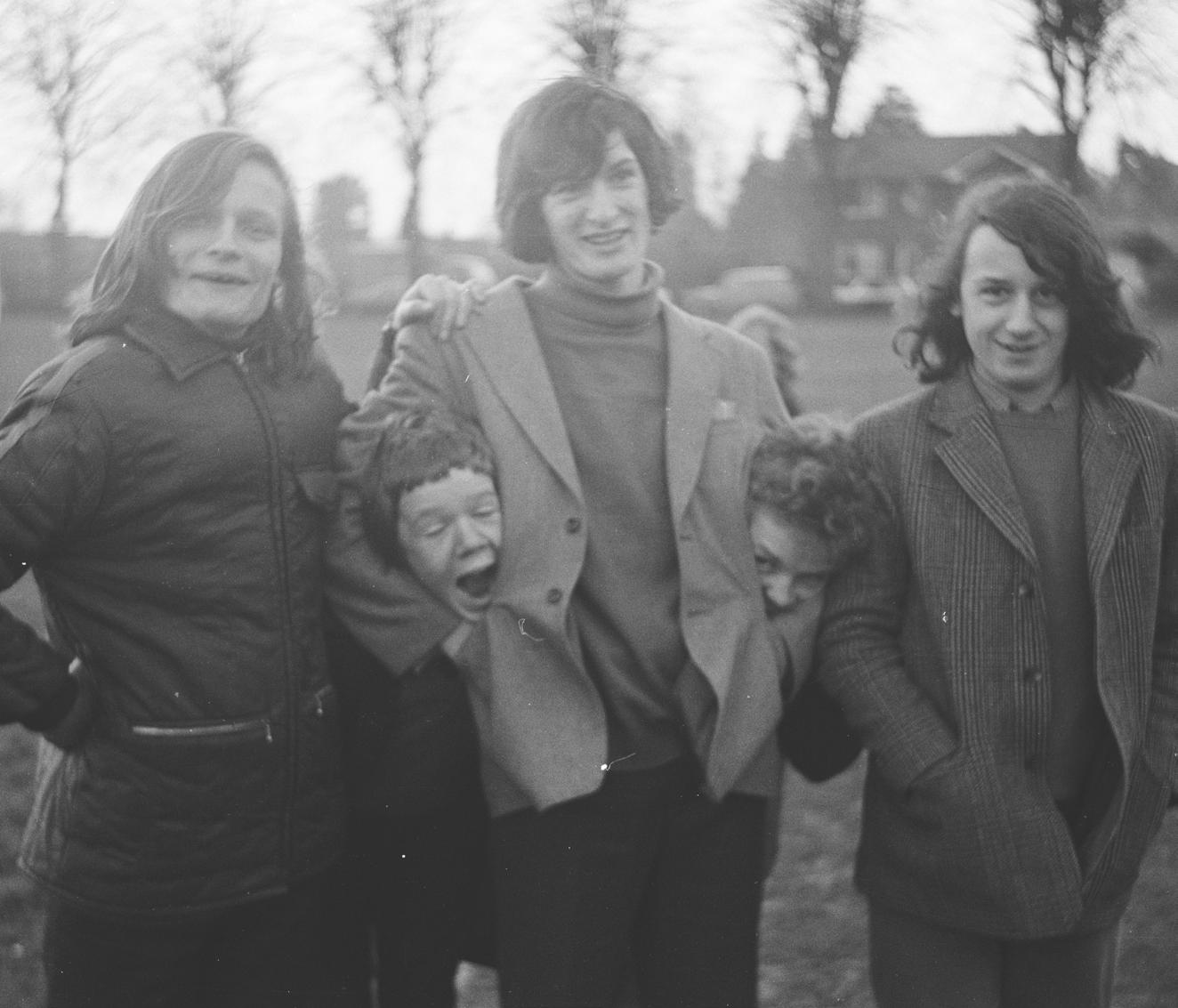
Derek Long (1970-1977) is Senior Vice President of the Affordable Housing Institute in Boston, Massachusetts, where he works on World Bank projects in Ukraine and Pakistan. He invented the campaigning meme against the “Bedroom Tax” and has worked across Whitehall, Westminster and the wider public sector. Like his father, former governing body member Chester Long, Derek also became a council leader. Here, Derek shares his memories of school life in the 1970s.
It’s September 1970. The sixties have suddenly crumbled. No Beatles, no World Cup, no Wilson. Like the world, Exeter School is embarking on an uncertain transition. Things are already in motion. Saturday morning school has just ended, along with mandatory Latin. The teaching staff is becoming more diverse.
The cohort who had “good wars” like Geoff “Gobby” Brice (staff, 1960-1982), John Gabe (staff, 19401972), Bob Brooks (staff, 1960-1980) and Chaplain Norman Davey, was beginning to shrink. Increasingly, graduates from post Robbins Report universities, such as Ian Wright (staff, 1970-2005), altered the accents and attitudes in the staff room. The Oxford experiences of Headmaster, Robin Hone (staff, 1966-1979), mingled with Liverpool College of Art graduate Pete Reid (staff, 1969-1973). At a time when boys’ hair length was an issue, it was rumoured that Pete was once asked by Hone to get his hair cut!
What stands out today, is the effort this group of immensely talented individuals put in to truly educating us. In addition to running junior
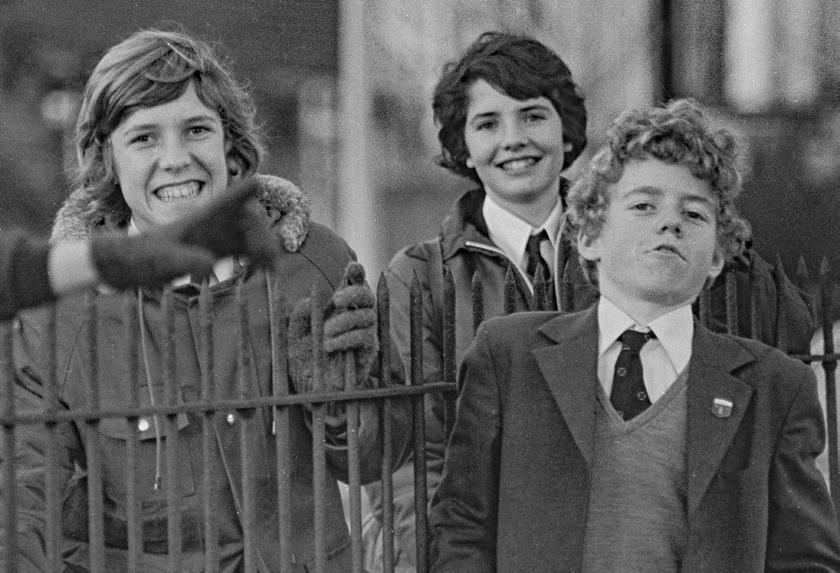
rugby, George Ayres (staff, 1961-1993) and Dennis Dyson’s (staff, 1960-1994) packed trips around Yorkshire and a subsequent visit to Stonehenge, which opened worlds to us that I now revisit with my grandson. I recall George thoughtfully contriving academic tasks in the holidays to expand my reading. Under the cover of history, David Revill (staff, 1965-1998) taught the principles of archaeology when it was a largely unknown field. Harry Guest (staff, 1972-1991), a man who could speak eight or nine languages, was a real poet – in English and Japanese. What a thrill to receive his comments on one’s own chicken scratches.
The 1976 summer sixth form disco
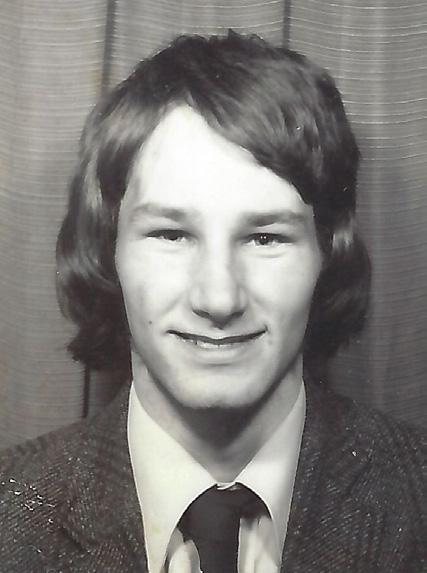
was subtitled the Pyrotechnics Ball, owing to the use of explosive flash boxes on top of highly flammable stage blocks. In an unrelated quantum event, fire extinguishers from across the school spontaneously appeared for a night in the sixth form common room. The ambition of more formal school musical performances provided unrivalled opportunities. Stand outs included; Carmen, West Side Story and Oliver! Singing bass in 1972’s Fauré’s Requiem in a darkened Exeter Cathedral remains a powerful memory.
The slow traverse towards coeducation was characterised by musical collaborations, such as Carmen, with local girls’ schools.
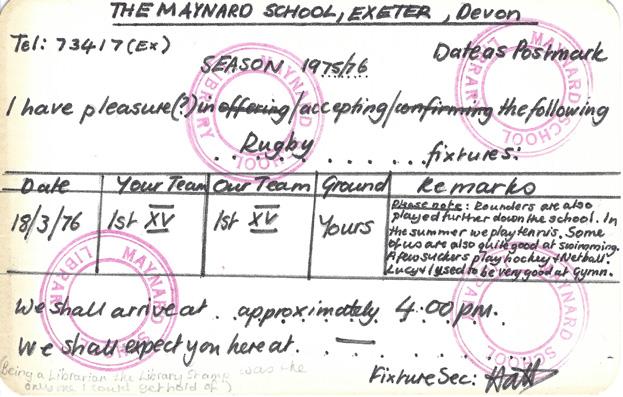
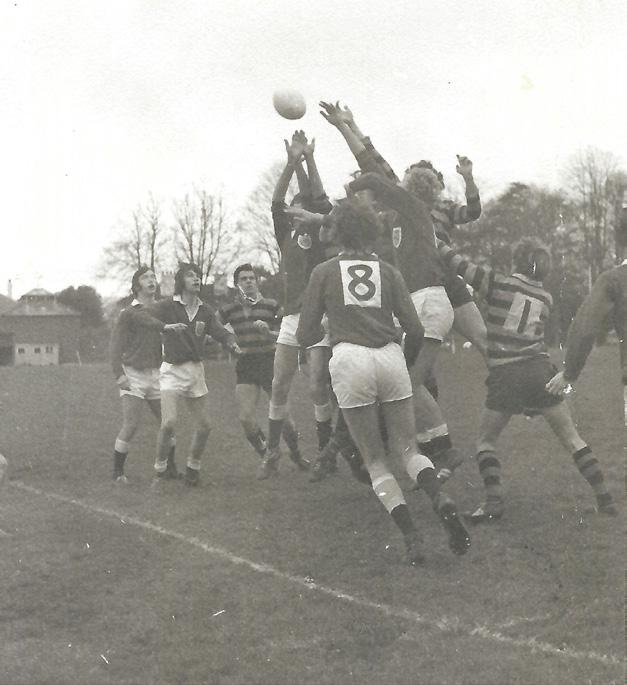
Economics was taught jointly with The Maynard School in the mid70s, as were the broadening general studies classes. Less well known is the school’s contribution to women’s rugby, marked by the precedentsetting 1976 tie between the Exeter XV and The Maynard.
The school’s atmosphere was positive, with pupils of remarkable talent, at times jaw-droppingly so – an English Literature A Level achieved in only two terms, whilst running a computer business. Lovely Ivor Clarry’s (staff, 1952-1979) Latin classes – vitae prodesse, non morti. Dave Lee’s (staff, 1968-2000) School Mathematics Projects classes – the statistics still paying off today. Les May (staff, 1974-2007) giving up his time at Christmas to bother about a lost soul.
In truth, the Masters didn’t always get it right. We pupils didn’t always play the game. Some people were variously lost along the way. Yet, I remain clear that I was fortunate to be a pupil at a time when many City Scholars on free school meals, like me, could prosper. Achieving the same opportunities today for pupils in every school remains a challenge for us all.
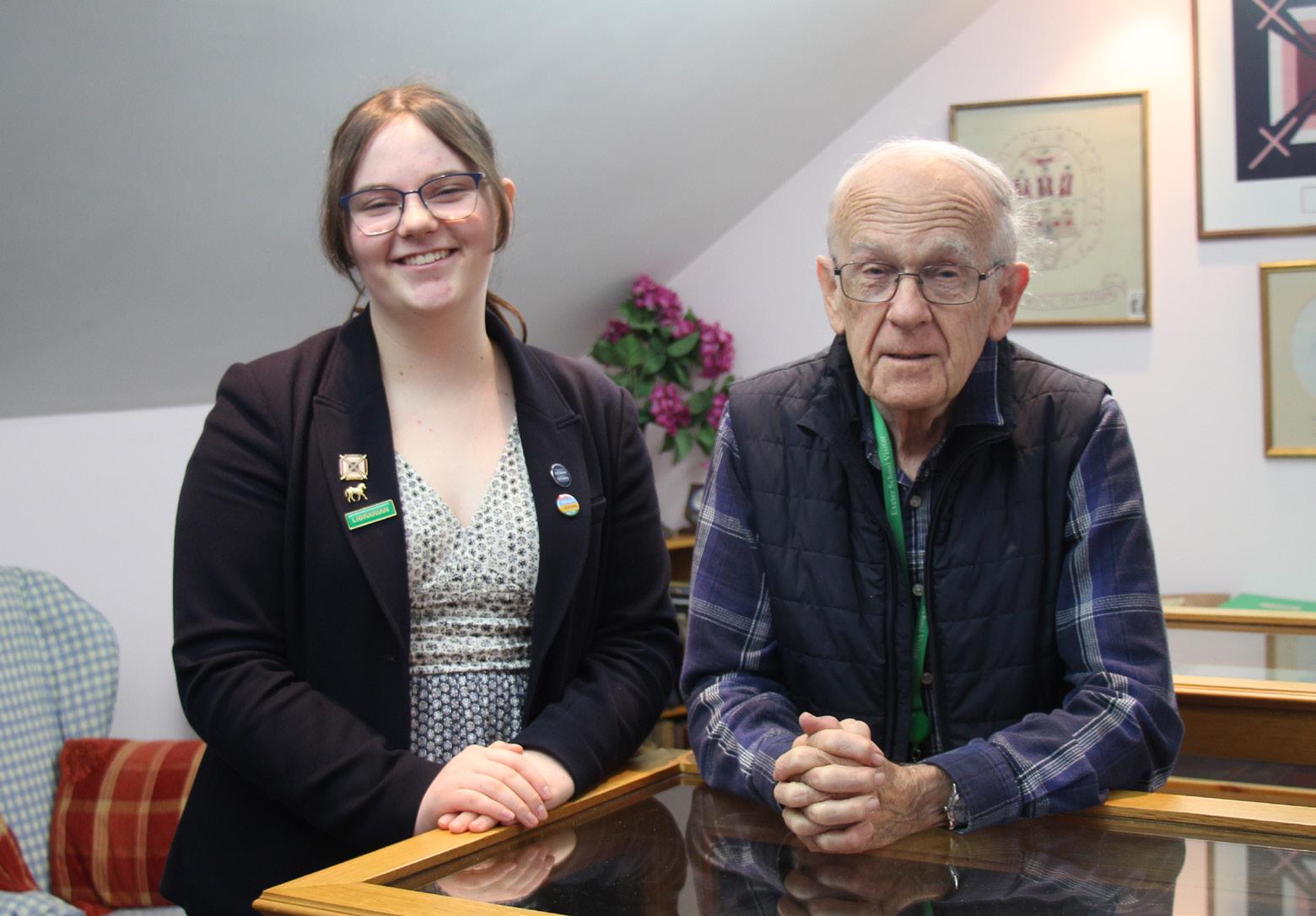
Lily, our library and archive prefect hailing from North America, brings a rare kind of joy to the Exeter School archive. Most Tuesdays, she can be found almost without fail, among the shelves and display cases, working alongside archivist Kevin White (1953-1961). Together, they share a relentless passion for history, and the alumni department could not have wished for a more dedicated advocate for the archive.
“I find my Tuesdays up in the archive to be one of my favourite times of the week,” Lily says. “Those two rooms are my favourite part of the school. It’s calming, almost meditative, and I love introducing people to it.”
Lily’s love of history was sparked in a slightly unconventional way. While her parents fed her non-fiction books growing up, it wasn’t until a visit to Mount Vernon, the restored home of George Washington, that history truly came alive for Lily. “It was amazing to think that the people you read about in school walked up the very same stairs as you,” she recalls. “That’s when I realised history isn’t just in the past, it’s part of the present.”
Lily’s path to the Exeter School archive began serendipitously when she came across a 1970s vinyl record, showcasing Exeter School’s Choral
“I find my Tuesdays up in the archive to be one of my favourite times of the week.”
Society, at her local recycling centre and brought it to Kevin. “I had no idea we even had an archive!” she laughs. That one discovery sparked a weekly habit that has lasted ever since, and now, with each trip, she uncovers various treasures; from admissions books dating back to the 1850s to a
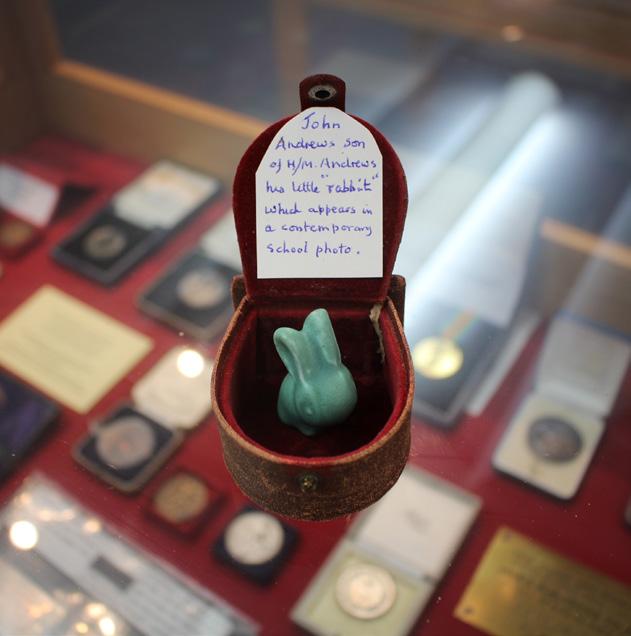
little jade bunny that seems to move on its own.
“What’s amazing is the stories Mr White can tell,” she says warmly. “He remembers everything; the layout of the school, the drama department when it was the PE block, former pupils’ antics. The Exeter School archive isn’t the archive without him.”
Lily delights in the small surprises too. “I love the quirky things, like the jade bunny from a school trip –it’s locked up, but I swear it moves sometimes. And the beatings books. Rather shocking, but they show just how much education has changed over the last hundred years.”
Lily’s enthusiasm has extended beyond her weekly visits. She helped organise an archive exhibition with the art department, shares the archive with pupils who might never have explored it, and champions the idea that history should be part of everyday school life. “I think it’s so important we keep that link,” she says. “There are so many stories to tell.”
Beyond Exeter School, Lily intends to carry her passion onto university, where she will study creative writing and classical civilizations at the University of King’s College in Halifax, Canada. “History will always follow me,” she says. “Even in creative writing, you can’t escape it; you always have to research, explore, imagine the past.”
Lily and Kevin remind us that history is best experienced as much as it is studied, and that a shared love for the past can create extraordinary connections across generations.
To visit the archive, please get in touch –alumni@exeterschool.org.uk or call Ali on 01392 458932. We would love to see you!

Thank you to Bruce Stoneman (1953-1960) for setting this crossword.
Across
5. Annual events. (9).
10. Madagascan arboreal primates (similar to monkeys), with fox-like snouts. (6).
12. Goods carried by a ship, aircraft or large motor vehicle; load; freight. (5).
13. Small, hibernating, furry-tailed rodents, resembling baby squirrels in appearance and habits; named for their long, dormant winter period. (7).
14. Anagram of “THE CLASSROOM”, which is where the answer teaches. (12).
15. Relegate to a lower position; reduce in rank; downgrade. (6).
16. Tourist resort in Florida, which is the site of Disney World; Florida’s busiest airport. (7).
18. Effs and blinds; says something bleepworthy; uses bad language. (6).
21. Unintended holes causing drips for plumbers to fix or intended disclosures of secret information by whistleblowers. (5).
23. Proofreader’s “keep it”; Latin imperative “let it stand”. (4).
25. First birthday for a nonagenarian. (9).
26. Young swan. (6).
28. Formerly known as East Pakistan, it’s the only country in the world that ends with the letter “h”. (10).
29. A dispute or fight open to all comers and usually with no rules; chaotic brawl involving all those present; fracas. (4-3-3).
31. Polite request; “the magic word”; partner of “thank you”.(6).
33. World’s largest land carnivore. (5,4).
34. Pulmonary organ where inhaled air goes. (4).
35. Cerebral organ; grey matter; intellectual capacity. (5).
37. Small handheld tool for a plasterer to spread with or a gardener to dig with. (6).
39. Small, ferocious, carnivorous freshwater fish of South America that attacks and kills living animals. (7).
41. Delivery results which usually appear in newspapers above the obituaries. (6).
43. Spotlessly clean and tidy; in apple-pie order; pristine. (5,3,4).
45. Thick, sweet liquid medicine that is taken to treat coughs and sore throats. (7).
47. Choose by vote. (5).
48. Half a dime; U.S. 5-cent coin. (6).
49. System of government by all the people, for all the people, through elected representatives; power of the people. (9).
1. Spring that spouts steam and hot water, like Old Faithful in Yellowstone National Park. (6).
2. Cry of pain. (4).
3. Dishonest schemes; frauds to look out for online; con jobs.(5).
4. Portable chronometer that’s strapped
for time. (10).
5. Spanish shop selling wine and sometimes groceries. (6).
6. dn. and 46. dn. Body of water linked to the Mediterranean Sea by the Suez Canal. (3,3).
7. Rough-and-tumble; rowdy shenanigans; boisterous roughhousing. (9).
8. Phoenix’s American state, home of the Grand Canyon. (7).
9. Metal pins for holding meat in position while it’s roasting; shish kebab holders; brochettes. (7).
11. Wales’ largest and longest established National Park. (9).
17. Riverless, mountainless and forestless Caribbean island whose name means “old” in Spanish; “land of 365 beaches”. (7).
19. Gun dog which fetches the game a hunter has shot; popular pet with golden being the most common colour. (9).
20. First name of the eponymous fictional Detective Chief Inspector Morse in the novels of Colin Dexter, which were adapted for a series of T.V. dramas. (9).
22. Fortified complex in the centre of Moscow that is now the seat of government in Russia; citadel. (7).
24. Large boat that drags a widemouthed, cone-shaped net along the seabed, to catch fish. (7).
27. Largest living primate. (7).
29. Difficult to believe and unlikely to be true; unconvincing; cock-and-bull. (3-7).
30. Describing the fruit from the tree of knowledge in the Garden of Eden, which God decreed that people must not eat, or they will die; prohibited. (9).
32. Not of natural origin; made artificially. (9).
35. Anglicized American term for a racing sledge that’s mechanically steered and braked (for two or four people), that slides over ice. (7).
36. An abbreviation consisting of the first letters of each word, in the name of something; ASAP (as soon as possible), for example. (7).
38. Large, broad-winged, fish-eating raptor, found worldwide; fish eagle. (6).
40. George Frideric ------ (1685-1759), composer of baroque music, who was born in Germany but became an English citizen and is remembered for the most famous of all oratorios, Messiah. (6).
42. Cornish speciality. (5).
44. Black disc made of hard rubber that’s used in ice hockey instead of a ball. (4).
46. See 6. Down.
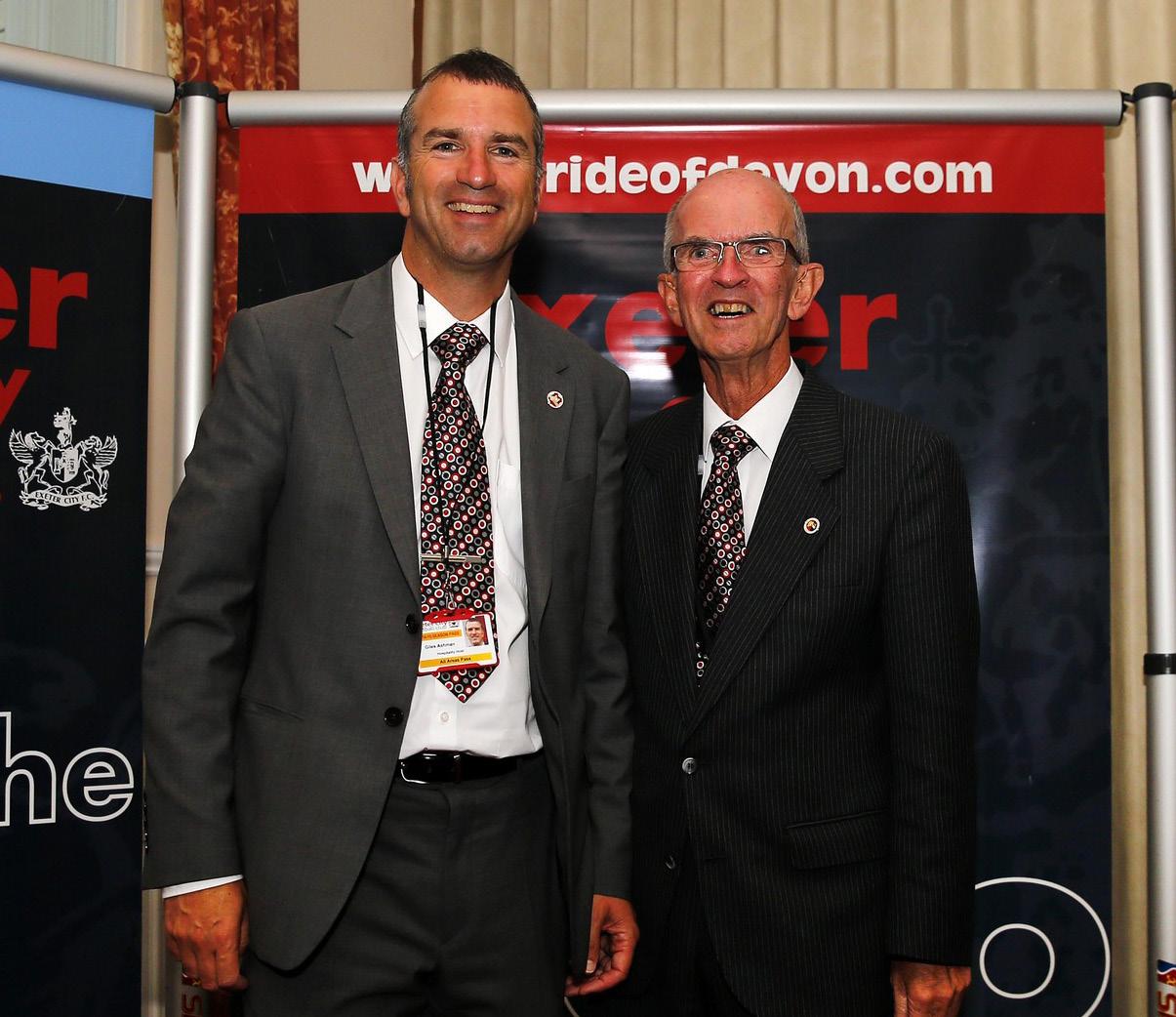
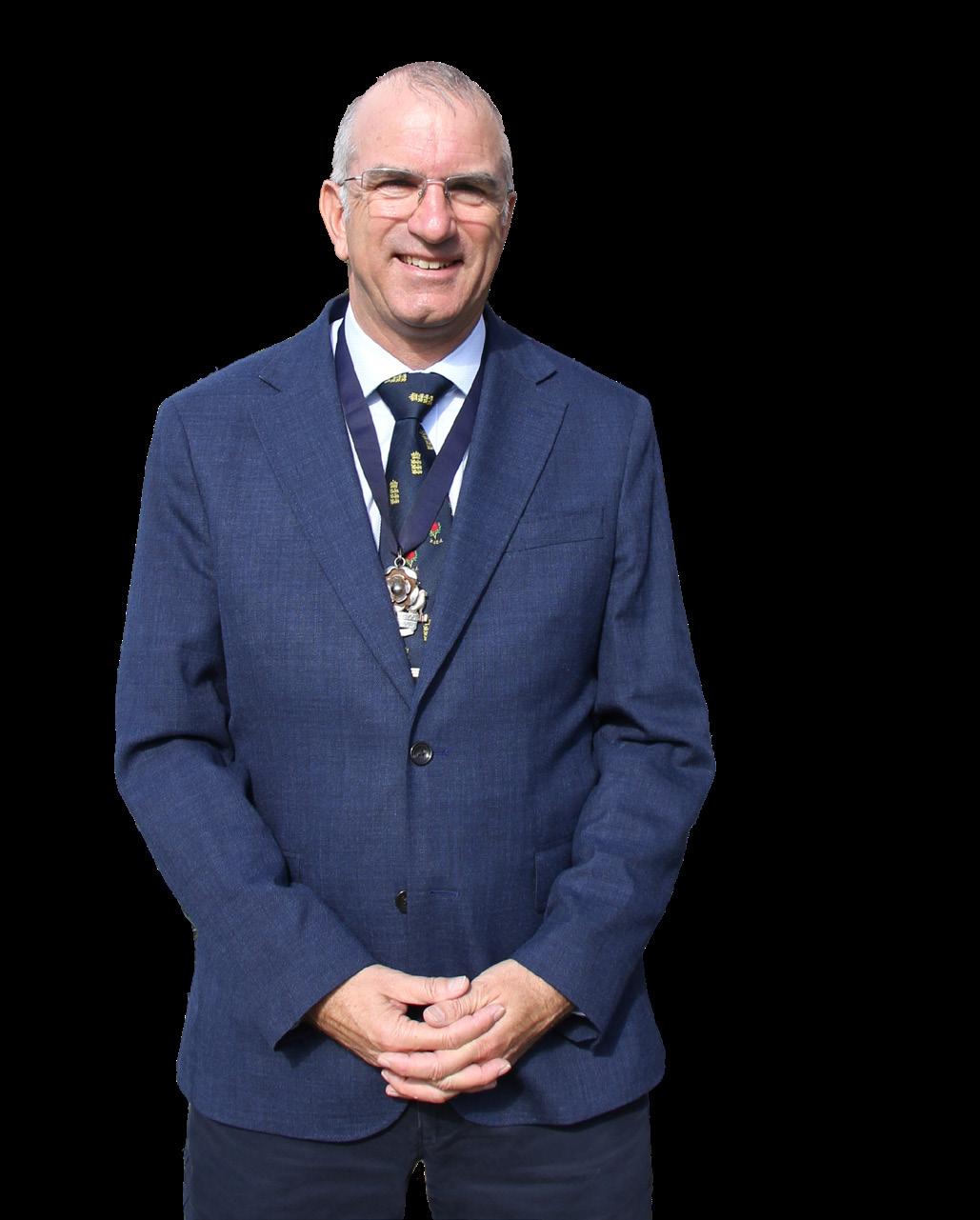
Giles Ashman (pupil, 1982-1987 and staff, 1997-present) has frequented the field at Exeter School for many seasons, combining his love of teaching with a dedication to developing young athletes.
He has led football and cricket programmes, promoting a seven-to-eighteen pathway that now includes girls’ cricket. Beyond the school, as Chairman of the English Schools Cricket Association (ESCA), Giles has championed opportunities for young cricketers; umpiring, coaching, and advancing the game nationwide.
The 1633: Could you tell me a bit about your role at Exeter School?
Giles Ashman: I was a primary trained teacher and when the school went co-educational in 1997, the plan was that every year group was going to have a parallel class thereby necessitating an additional teacher. I primarily got the job because I’d taught in a state school, so had experience of teaching girls’ games. They were short of cricket staff in the senior school, so as soon as I arrived, I ran a cricket team for the under 14s. I was a classroom teacher but did a lot to support the games programme.
In 2000, the opportunity came to do some senior games, and I became Head of Football and still have the privilege of being so. Cricket was always one of the major sports in the school, so that’s always been my number one interest in school sport. Under Andy Mason (staff, 20042023) we were very keen to have a real seven to eighteen approach to cricket. Girls’ cricket replaced rounders about ten years ago.
T1: What are your hopes for sport at Exeter School going forward, especially for girls’ sports?
GA: The mantra I had with Kate
Wright in the junior school (staff, 2018-2023) was ‘sport for all with an opportunity for excellence’. Recognising that we’ve got some talented sports people, and that our first teams have a high profile, it is important that the younger pupils aspire to play for these teams.
We have to realise that youngsters have conflicting opportunities at the weekend, trying to get them to value being part of a team and getting them to commit is a challenge. It also doesn’t help if our opponents become increasingly weak or struggle to match the requirements that we need in our fixtures. That may necessitate having to look at travelling further afield. Back in the day, John Poustie (staff, 1990-2013) and I wouldn’t have thought twice about travelling to Bryanston School for the cricket because it was a good fixture.
When my father passed away, I was delighted that he left some money to the school, and I was given a major say in where that money went. This gave the school the opportunity to have a second astro wicket on the top square, thereby allowing more cricket for pupils of all ages to be played.
T1: As chairman of the ESCA, what does your role involve?
GA: ESCA is responsible for the national finals for the under 11s to under 15s. We benefitted in the junior school so much from the U11 hardball, we got to the national finals five times and actually won in 2009.
There was an ICEC (Independent Commission for Equity in Cricket) report in June 2023, that accused cricket of being a classist and elitist sport, far too dominated by independent schools, which has created huge challenges. Since the turn of the century, there has been plenty of focus on girls’ cricket but not enough on boys’
cricket in state secondary schools. Freddie Flintoff has shown in his BBC series, Field of Dreams, that given the opportunity, cricket can be enjoyed by anyone, anywhere. It’s not the nature of the game that’s the issue, but rather the lack of opportunity across the board. ECB (England and Wales Cricket Board) could have done so much more in the last 20 years to address this issue. Of course, independent schools are dominating because we’ve got a responsibility to parents paying
promote state school cricket in Devon by excluding the independent schools in the U13 boys’ county cup. We were pleased with the increased participation and extend further in honour for me is following on from my father, who was Chairman of ESCA in 2000.
friend of the school; he used to hold U11 county cricket trials at the school and umpired the Devon Dumplings game.
T1: What do you enjoy most about working with young athletes at Exeter School?
GA: It’s the opportunity to work in an environment where you’re doing something you really enjoy, primarily it’s the shared love of sport with the pupils. I’m doing my hobby in a professional environment, be that coaching the 1st XI football team or umpiring the 1st XI cricket team.
T1: Have you noticed any exciting changes or developments in girls’ sports recently?
GA: The main difference is the profile of women’s sport in the media. You’ve got the Lionesses, the Red Roses, the Women’s World Cup in cricket. There are role models to aspire to now. To help retain girls’ interest helps stem the tide of girls dropping out of sport.
In cricket at Exeter School, you have both girls and boys playing together. This gives it a unique place in the school’s sporting programme and long may it continue.
Katie Donovan (2013-2022) and Andrew Donovan (2013-2020) are living proof of how talent, passion, and opportunity can combine to create extraordinary sporting journeys. Both have represented the Philippines at international level, yet their cricketing roots trace back to the fields and coaching at Exeter School.
Katie’s love of cricket has its roots in Christchurch, New Zealand, where she and Andrew first grew up. “My brother and I would always play with a tennis ball and plastic bat in the garden. He played at school, but I only played hockey and netball at that point,” she recalls. When her family moved to East Devon in 2013, she joined the same cricket club as her brother and quickly discovered a natural talent. “We’d watch matches at the Somerset County Ground. I remember an overseas player bowled so fast he took a wicket, and the middle stump tumbled all the way back to the keeper! I thought, ‘That is so cool, I want to bowl like him.’ Meeting players like Ellyse Perry made a huge impression on me, and my dad also played cricket, so maybe it’s in the genes.”
Andrew started playing at the age of 12 and quickly developed a passion for the game. “I didn’t really
“Most of my fondest friendships, memories, and experiences come from sport, from school tournaments to travelling the world to play or coach cricket.”
take cricket seriously until 2020 when I went to Australia for a season. Playing at a higher level in a very sports-driven culture pushed me to improve and gave me insight into my potential,” he says.
Katie made history when she became captain of the Philippines women’s team at just 20. “It was surreal. One of my Exeter CC teammates joined
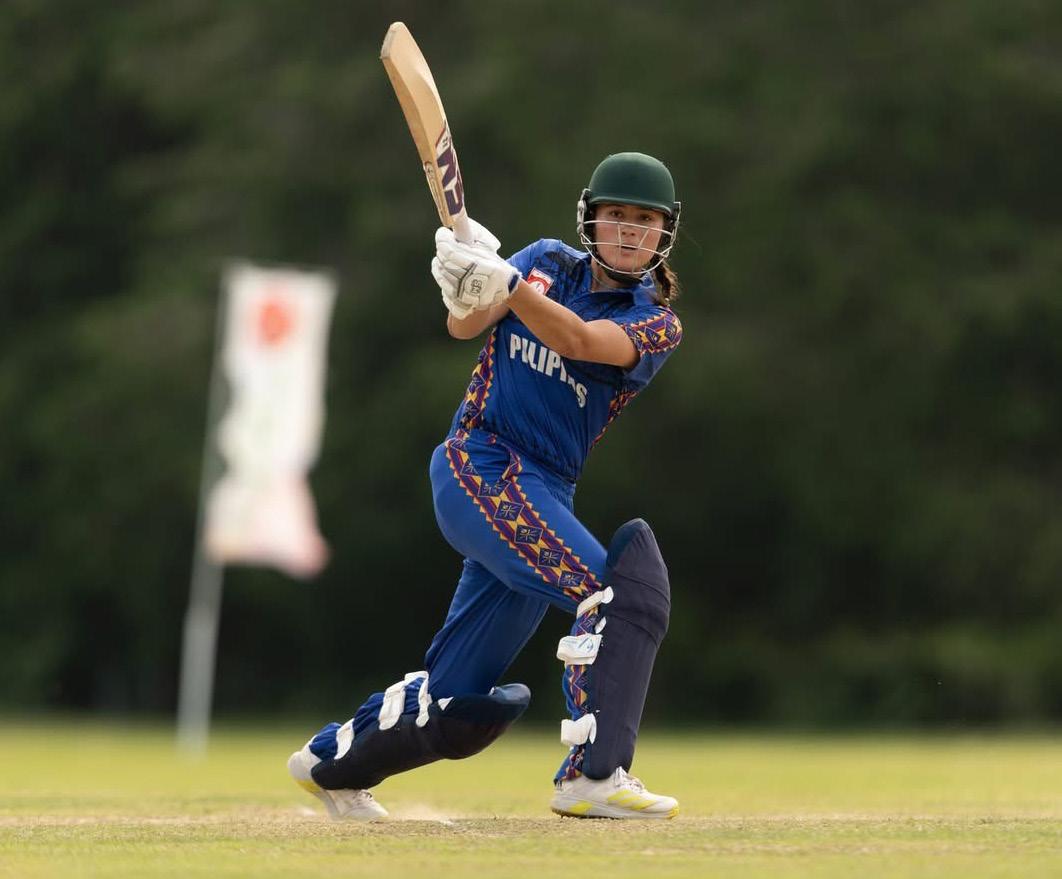
the inaugural Croatian women’s team, and a friend jokingly suggested I play for the Philippines. Long story short, the CEO called and asked if I’d captain the team. I said yes immediately, because my dad always says, take opportunities when they come!” She had just a month to prepare, drawing on advice from her Devon coaches, family friends, her dad, and her brother.
Leadership, Katie believes, requires a mix of “strong communication, leading by example
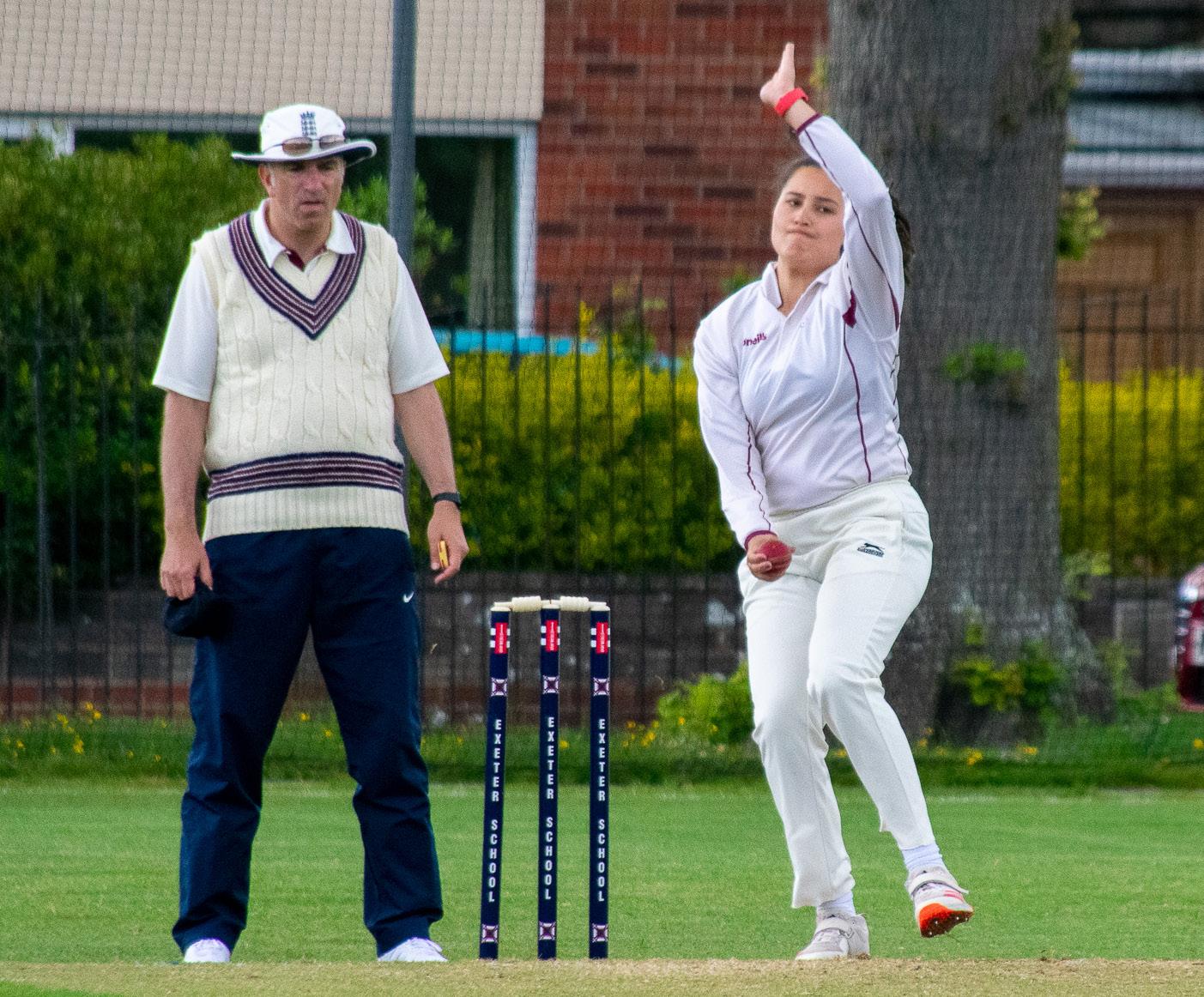

both on and off the field, a team-first mindset, being motivational, having confidence, and respecting the game, team, and nation’s values.”
Andrew’s international moment came with record-breaking impact, “Scoring 122 off 54 balls for the Philippines, my fastest-ever century, was memorable. I had floated around the lower order, so when I walked out to bat at four with us two wickets down, it was my opportunity to prove myself.” Representing the men’s national team has been “surreal and a privilege. Cricket is growing at grassroots level in the Philippines, and being part of that growth is amazing. Meeting other athletes with Filipino heritage around the world and making lifelong friends has been incredible.”
Both siblings credit Exeter School with helping shape their journeys. Katie recalls how her junior school teachers encouraged a girls’ cricket team and introduced her to Devon Girls Cricket, kick-starting her career. “Julian Fawkes (staff, 2008-2015), Andy Mason (staff, 2004-2023), and Giles Ashman (staff, 1997-present) taught me the basics. A teacher arranged a game against Blundell’s, and at 14 I toured Cape Town with the Devon Women’s U21 team – an amazing learning experience the school supported during term time.” Andrew highlights the broader support for extracurricular activities, “Exeter School gave me the chance to play the cricket I loved around the country with schoolmates. It’s created so many fond memories.” He laughs
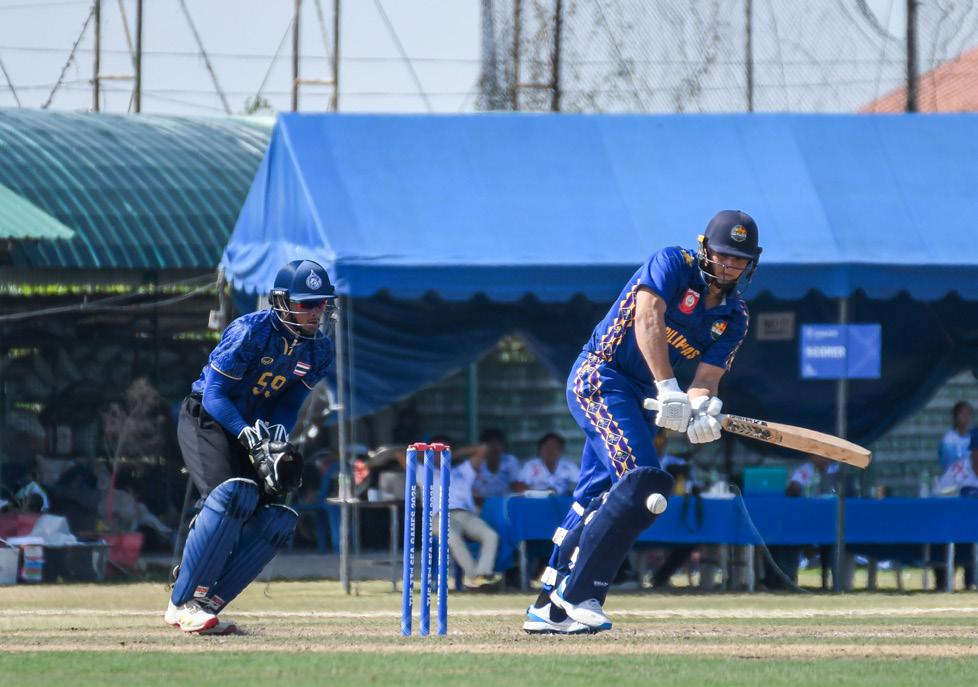
as he adds, “Probably not what you’d expect, but I’ve always loved cricket teas at the end of the first inningsthey’re a proper feed and something everyone looks forward to!”
For both Katie and Andrew, cricket has been about more than runs and wickets. “Most of my fondest friendships, memories, and experiences come from sport, from school tournaments to travelling the world to play or coach cricket,” Katie
reflects. Andrew agrees, “Sport has always been part of my life. When I’m not on the cricket field, I’m playing other sports. It’s a great way to stay active, learn life skills, meet people, and have fun.”
From Exeter School’s playing fields to international cricket, Katie and Andrew Donovan exemplify how early passion, strong support, and seizing opportunities can turn talent into achievement. Their stories show that sport is as much about camaraderie, life skills, and memories as it is about records and scores.
“Scoring 122 off 54 balls for the Philippines, my fastest-ever century, was memorable.”
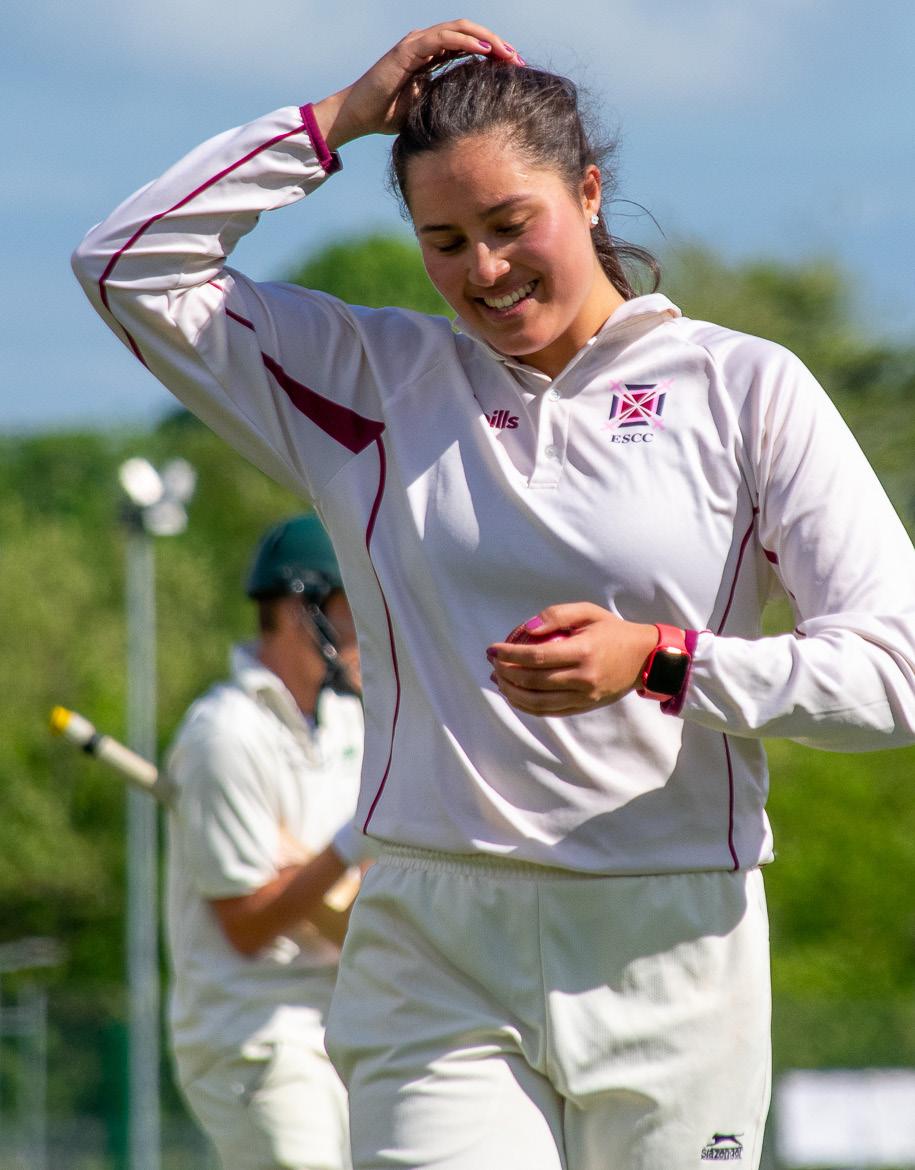

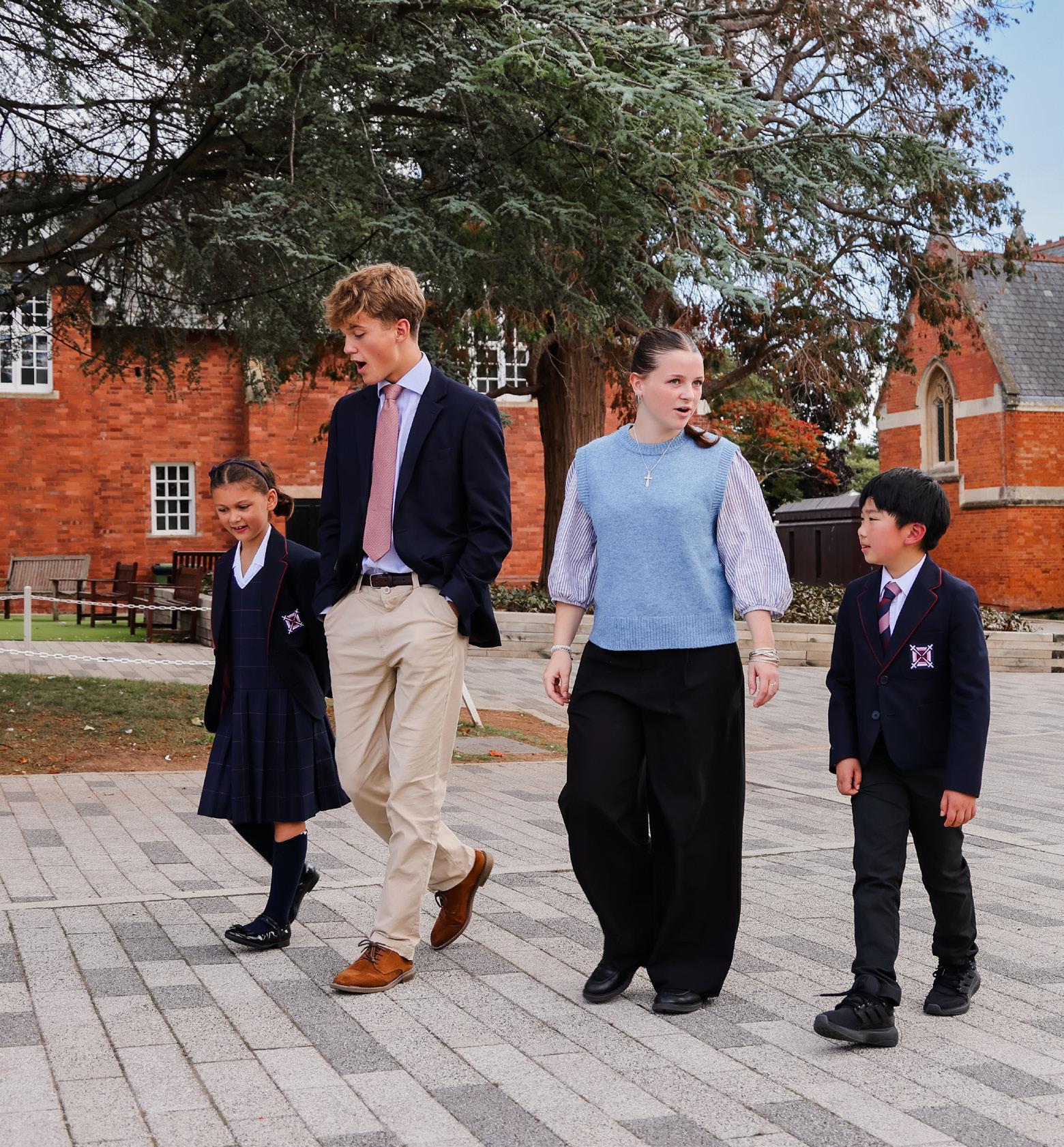
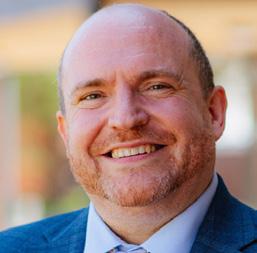
Acting Head, Graham Bone (staff, 2003-present) shares his thoughts on excellence in education at Exeter School and the experiences that make our school community so special.
The 1633: What does excellence in education mean to you?
GB: When we talk about excellence in education at Exeter School, it means different things to different people, but there are common threads for all. Our outstanding academic achievement is central, but not the only example of excellence. Since I’ve been here, I have seen countless pupils successfully
apply to competitive universities; top international colleges; music conservatoires; performing arts schools; choral, sporting or other performance scholarships and the list goes on. Recently we’ve had some success in highly prestigious competitive degree level apprenticeships, at Dyson, Airbus, JP Morgan to name a few. Our staff are all dedicated and committed to
supporting pupils on their varied journeys, and they in turn work hard in order to achieve fantastic outcomes and destinations.
There’s a clear academic excellence pathway for pupils at Exeter School and that’s been the same since I first started 20 years ago, but also beyond that academic learning, it’s about education in the broader sense. That includes individual and team sporting success; in the time that I’ve been here, a huge number of successes at regional and national level in major sports; rugby, hockey, netball, cricket. We also have some fantastic results in our other sports; equestrianism, swimming, shooting, and football.
Successes continue in music and drama, the number of pupils that we get through to national youth theatre places every year is incredible. The majority of pupils come out of LAMDA, introduced relatively recently, with merits or distinctions and of course musically we’ve had people go on to study music at the Royal College of Music in London. Each year we have a good number of pupils reaching grade 8 and then some going on to diploma level. Outside the classroom, we have pupils from CCF who go on to join and serve in the forces, those who develop a love of adventure through DofE or Ten Tors.
When I have the pleasure of meeting former pupils they talk with joy about their time at school, the confidence, the skills, how transformational their experience was, whether that leads them to a career in leadership, service or charity, the skills that we equip them with allows them to flourish in their lives beyond school.
When we talk about excellence in education it is very much about looking at what happens after they leave us, and how successful they are in their lives, how rounded they are as young men and women, and what positive contributions they can make to society.
T1: Thinking back to when you first joined in 2003, what were your first impressions of the school, and how has it changed since then?
GB: I came from teaching at a grammar school and Exeter School maintained that academic tradition of stretch and challenge within the classroom, with the support and care that we give our pupils. It’s also the things that we offer outside the classroom, the range of activities and the sports and clubs, events and opportunities that really stood out as a positive. If anything, that part of the school has grown further as we’ve invested in infrastructure and staff to provide pupils with more opportunities every year.
The other impression that I got was the warmth from the staff, how much it felt like a community of staff working for the benefit of the pupils, to raise their aspirations, to support them on their journey, to find whatever spark ignites the curiosity of a particular child and then nurturing that so they go on to flourish. That hasn’t changed and is a key part of what makes an Exeter School education.
T1: What moments or memories stand out most vividly from your two decades here – the ones that really capture what Exeter School is all about?
GB: There are a few things that we do which really capture us, some are big and some of them are small. It’s the small things for some pupils which really seem to make a difference. I’m always so impressed with our informal music concerts, we have fantastic show piece events, in the Cathedral, in the chapel, which are big, grand events but our informal concerts can feature pupils who have perhaps only just started to learn a musical instrument. You see pupils of all ages and the cooperation and friendship that those pupils and staff have with each other is wonderful; it’s a fantastic thing to go and see. That pupil is supported and they can see where they’re going on their musical journey.
The 1633 challenge is fantastic; Ten Tors and outdoor education is a huge part of the school. It builds resilience, and develops team work, friendships and memories. We have more pupils that want to take part in Ten Tors than spaces available,
so a few years ago we introduced the concept of The 1633, meaning all pupils who stay through the training get to do their own mini Ten Tors, they walk across the Moor, navigate and camp, they have checkpoints but they’re not escorted by staff, so they get that authentic experience even if they’re not lucky enough to make it into final teams. Again, it’s our staff thinking creatively to recognise the efforts and time devoted by the pupils.
T1: What do you think has helped the school maintain its sense of community throughout its long history?
GB: Schools and education, more broadly, is a human endeavour, it relies hugely on the staff – the staff and the pupils are the school. The buildings have a history, the grounds and the buildings allow opportunities to take place, but it’s the staff that facilitate those opportunities. Having a dedicated team of staff is integral to the success of any school. A school is community in the deepest sense of the word.
We’ve got teachers who are passionate about the children in their care, allowing a child to feel safe, feel heard and feel supported, means that we can then go on and do the other things. We can challenge those pupils and push them a little
bit harder on Dartmoor, in lessons, to get the very best from them. We can help build their resilience and expand their comfort zone, that relies on a dedicated team of hardworking staff; teaching staff, yes but also our operations and professional services staff, grounds staff, catering staff, are all here with the singular goal of supporting each child on their journey with us and helping them to find a pathway where they can flourish in later life.
T1: Dr Adrian Rainbow joins as Head in September 2026 – what kind of school do you think he’ll be stepping into?
GB: The school is in a great place; it’s a really exciting time. We’re just completing a few projects that have been in the pipeline for a while, we’re embedding the changes to the pastoral care system and changing the shape of the school day.
From September 2026, we are delighted that Exeter School will take on the responsibility for educating cathedral choristers. Working with Exeter Cathedral, the school will become the new educational home for the chorister body. This closer partnership will provide our pupils with new experiences and fresh opportunities. I am excited to see where this takes us in the coming years ahead.
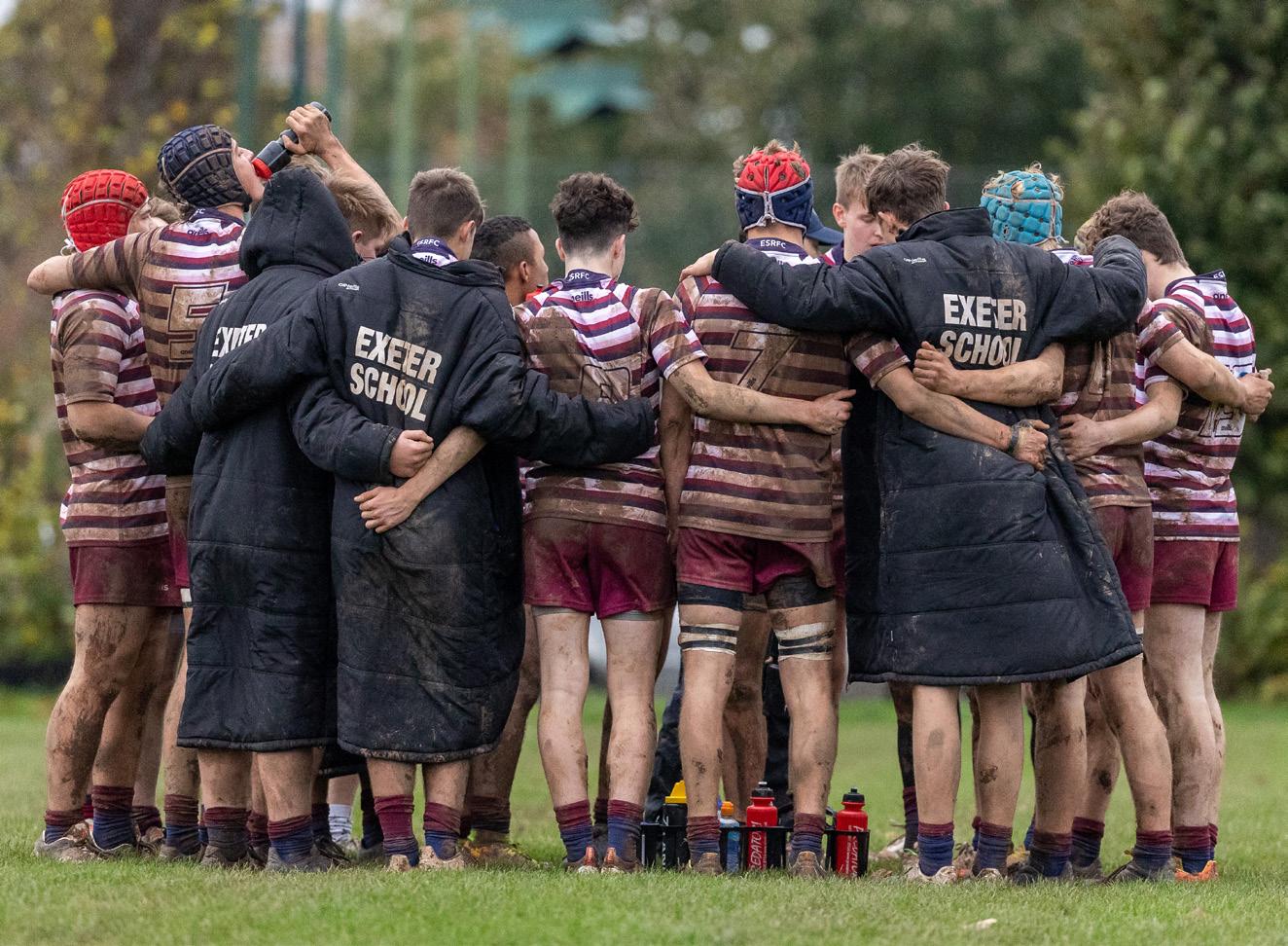

Agift in your Will, even a small percentage once you have taken care of those closest to you, can make a profound difference to the future of our school and to the next generation of Exonians.
Legacies have always been important to the school. Founded in 1633 thanks to bequests from individuals including Thomas Walker and Elizabeth Dowrich, the school continues to benefit from this tradition of giving today. These deeply personal gifts create opportunities for generations to come.
Most legacy gifts are left for ‘the general charitable purposes’ of the school. This allows us to direct funds to the areas of greatest need, such as providing bursaries and widening access to an Exeter School education.
If you would prefer your gift to support a specific area of school life, we would be very pleased to discuss this with you to ensure that your wishes can be met.
If you are considering leaving a gift in your Will, you will need the following details:
– charity name: Exeter School – charity number: 1093080
All UK legacies made to the school from your taxable estate are exempt from inheritance tax because the school is a registered charity.
In addition, if you leave a minimum of 10% of your net taxable estate to charity, your inheritance tax rate may reduce from 40% to 36%. The school recommends consulting a solicitor regarding any matters concerning your Will.
We recognise that leaving a legacy is a very personal matter, but if you do wish to let us know that the school is remembered in your Will we would be delighted to have the opportunity to thank you.
If you have any questions about leaving a legacy to the school please get in touch with Liz Williams, Director of External Relations, at esw@exeterschool.org.uk or +44 (0)1392 307080. Thank you.

And, if you have questions about other types of giving to the school, or would like to make a donation today, please get in contact with Liz or find further details on our website

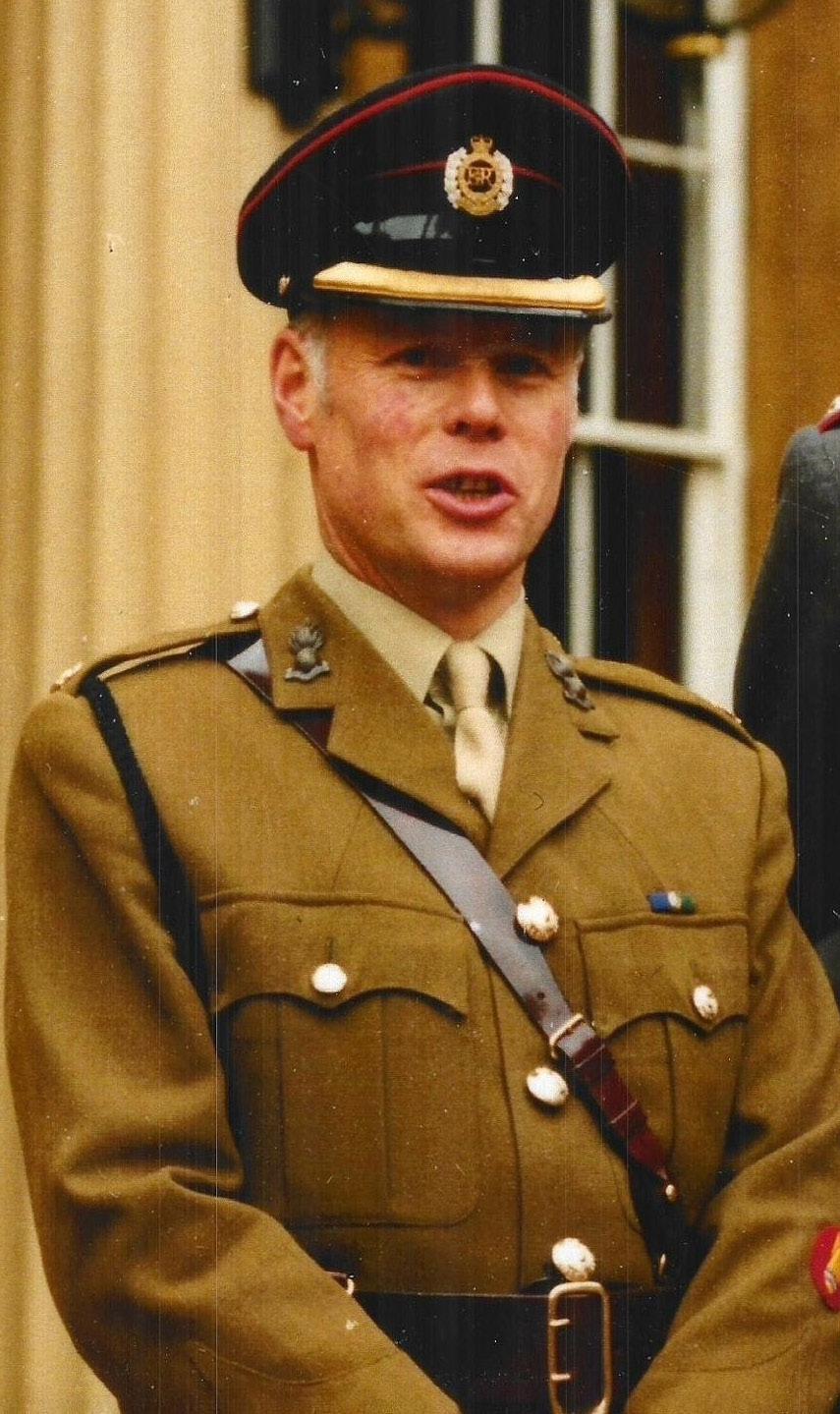
We are very grateful to all Old Exonians and friends of the school who have remembered the school with a gift in their Will. One OE who did just that was David Hough (1956-1959). David joined his brother, Tony, at the school in the early 1950s. He travelled to Exeter each morning on the 8.04 steam train from Newton Abbot, as one of the school’s “Train Boys”. This experience fostered a long-standing interest in railways, whilst his membership of the school’s CCF prompted a similarly long-lived involvement with all things military. David left school after taking his O Levels and trained as an architect
at Portsmouth University. He returned to Devon to join an architectural practice in Exeter. It was whilst working in Exeter that he joined the Territorial Army. He remained a member when he moved to London, and went on to gain a commission. He finally retired with the rank of Major, and filled his retirement with the rallying of classic cars and morris dancing. He was an enthusiastic supporter of OE events.
David passed away in 2024, and left a gift to the school in his Will, which has been added to the school’s bursary fund. His generosity will enable future generations of Exonians to join the school he loved, and benefit from the education we provide here –just as he did.
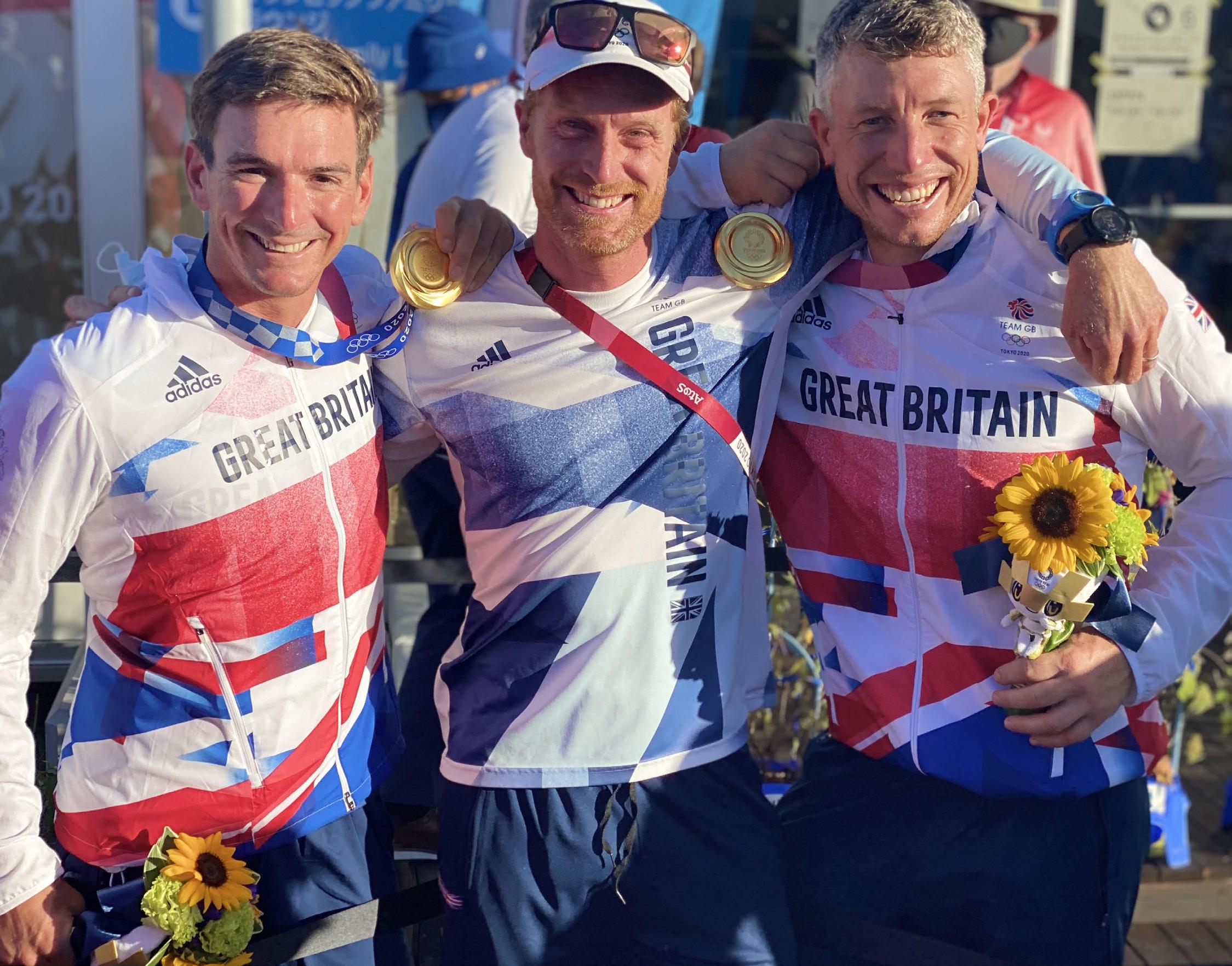
Ian Williams (1990-1995), Stevie Morrison (19901997) and Ben Rhodes (1994-1999), all originally from Exmouth, have gone on to enjoy successful careers in international sailing. Each comes from a family of prominent Exe Sailing Club members, and Stevie and Ben can still often be found relaxing at the club today.
During their school years they played a full role in school life, achieved strong A Level results, and held leading roles in the CCF Naval section. Both Ben and Stevie have since returned to Exmouth with their own families.
“Since retiring from the Olympic sailing team I have worked as a professional sailor and television commentator and pundit. I still enjoy travelling the world and racing at some of the top professional sailing circuits. I have also been involved as a coach for Team GB at the last two Olympics. At the Tokyo Olympics I coached Charlotte Dobson and Saskia Tidey, and at the Paris 2024 Olympics I was lucky enough to coach kite sailor, Ellie Aldridge to a gold medal. Alongside my coaching I enjoy working for SailGP (Sail Grand Prix), a global sports league as a commentator which gives me a great opportunity to promote the sport I love.”
Stevie has also commentated for America’s Cup racing. Jokingly he says, “I have still yet to use any of the skills I learnt from school but may yet one day have a proper job!”
“Over the past decade, my journey from athlete to coach with the British Sailing Team has been both
challenging and rewarding. Since retiring from Olympic competition in 2013, I’ve had the privilege of working with incredibly talented sailors who have, in turn, helped me grow and develop as a coach. Reflecting on this period, one of the highlights was guiding Dylan Fletcher and Stuart Bithell to a Gold medal in the 49er class at the Tokyo Olympics. Watching them win by just one meter in the final race was an unforgettable moment, a testament to their dedication and hard work. Our team has also achieved success in numerous World and European Championships, accomplishments that reflect the collective effort and determination of the athletes and support staff.
“A particularly fulfilling aspect of my role has been involvement in initiatives like “Crew for Gold”, which aims to enhance our women’s skiff program. The program explores talent transfers from other sports, and it’s been exciting to contribute to this innovative approach to broadening our talent pool.
“Recently, I’ve taken on a leadership role within the team as we look towards the 2028 Olympic Games in Los Angeles. Balancing this demanding job with family life, especially with two young kids, would be much more challenging without the unwavering support of my wife. Her understanding allows me to help young sailors as they strive to fulfil their potential, something that I find incredibly satisfying.
“Throughout this journey, I’ve learned that success doesn’t come from individual brilliance but from a team’s collective effort and passion. I am fortunate to work alongside such dedicated athletes and colleagues who inspire me every day. It’s an ongoing journey, one that I’m grateful to be a part of, as we continue to strive for excellence in British sailing.”
“I’ve pursued a career in sailing since ‘retiring’ from the legal profession 20 years ago. My primary goal when turning professional in 2005 was to compete in and try to win
the America’s Cup. The first step on what I always knew would be a narrow and treacherous path, was to get to No.1 in the Match Racing World rankings and win the World Match Racing Tour (WMRT). This I achieved in 2007, and I felt set to move into the America’s Cup scene after the 32nd America’s Cup in Valencia in 2017. Unfortunately for me the Cup took an unexpected turn, first with what is known as a Deed of Gift Match in huge multihulls in 2010, and then two America’s Cups in catamarans (2013 and 2016) which also precipitated a move to ‘foiling’, where the boat’s hull(s) are lifted clear of the water by hydrofoils. I was left scrambling a bit, trying to learn the required multihull skills to break into a team in the new era.
“That took me down the route of competing in the Extreme Sailing Series, a series of events in 40ft multihulls, whilst still competing on the WMRT in monohulls. In 2016, the WMRT moved into catamarans, using the M32 platform, and I spent most of my time competing in that class of boat; match racing and fleet racing with my own sponsored team, and also sailing with a private owner in the US.
“For about three years I sailed almost exclusively in the M32 catamarans, before the World Match Racing Tour reverted back to monohulls around the time that the Covid pandemic put the brakes on
the majority of professional sailing for most of 2020 and 2021.
“Since the pandemic, my career has moved into a different phase. I have abandoned any lingering hope of sailing in the America’s Cup (too old now) but I did get a chance to experience the next best thing, coaching the Ineos Britannia Team, including Exmouth lad Ben Cornish, for the 37th AC in Barcelona. I have also been coaching the Danish team on the SailGP circuit in foiling 50ft catamarans for the last 3 years. I have really enjoyed the coaching, although at times I feel a bit like Ted Lasso, trying to coach foiling sailboats with little personal experience of foiling. I also still race occasionally on the World Match Racing Tour and sail with private owners in monohulls and catamarans; so, I continue to compete in some sail racing which I still love doing.”
Ian has won a record nine WMRT championships and was named the 2024 Yachting Journalists’ Yachtsman of the Year.
Our thanks go to former commodore and current member of Exe Sailing Club, and former physics teacher and Head of the CCF Rex Frost (staff, 1979-2007), for so generously putting together this wonderful article.

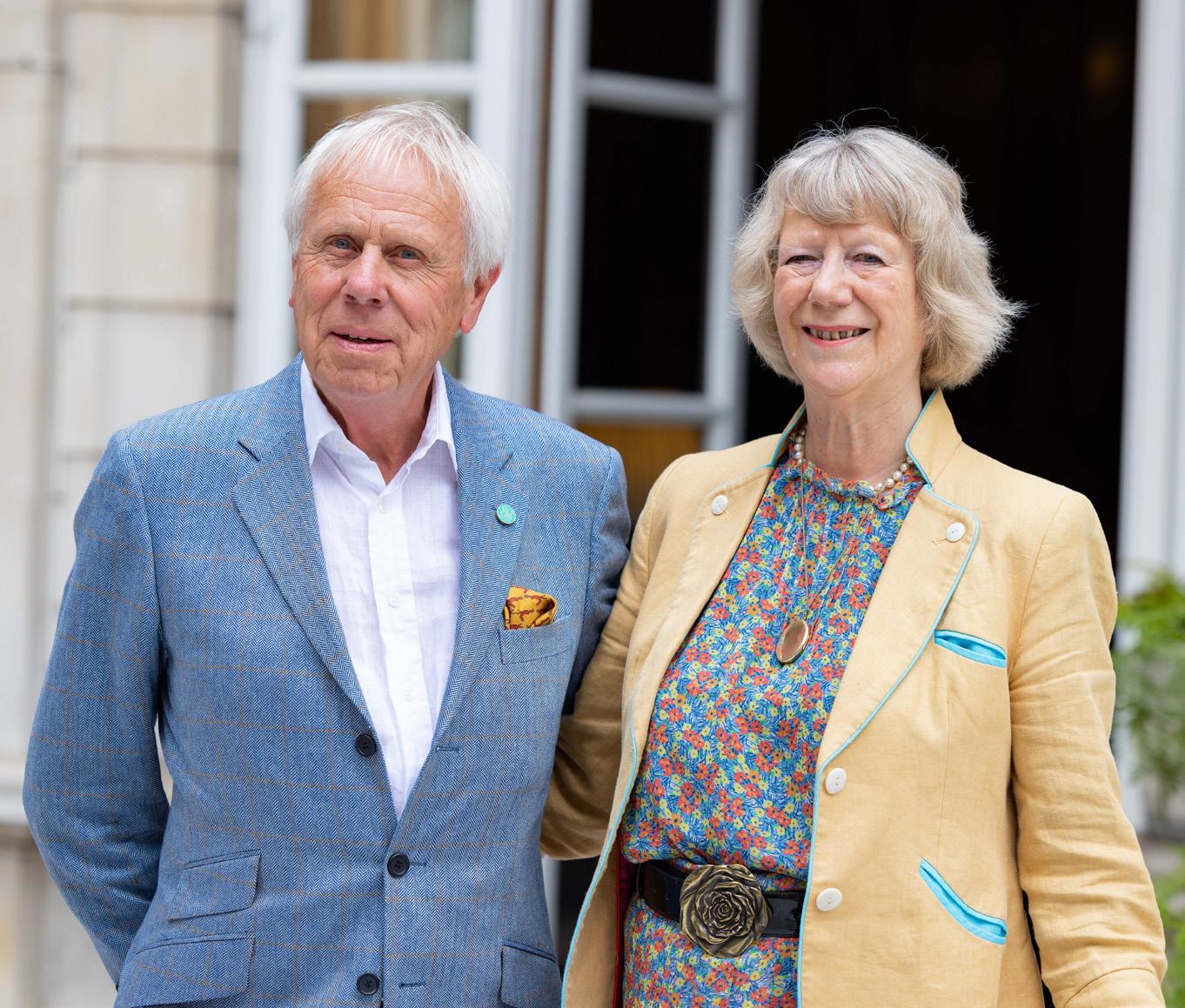
Born at Poltimore House in August 1947, Philip Maunder (1958-1964) grew up in a military family, with a Royal Navy father and a highly decorated grandfather who served in both World Wars.
Passing the 11-plus and joining Exeter School just after his 11th birthday proved pivotal, followed closely by meeting Susan Summerfield (St Margaret’s, 1955-1964) at 15; they married in 1969 and celebrated their 57th wedding anniversary this year. His lifelong love of drama began in his teens with the Topsham Young Stagehands, where young people from Exeter schools explored
performance and improvisation under the guidance of Miranda Leger, mother of Alex Leger (19581966) and wife of Jake Leger (staff, 1951-1967). One production even caught the attention of Westward Television and was broadcast on Christmas Day; a formative and unforgettable experience. This interest in drama and the spoken word continued throughout Philip’s life, with involvement in productions across several counties.
Professionally, Philip built a
career in insurance, moving from the north of England back south before founding his own brokerage in Dorset in 1979. He retired from this firm last year, having achieved his aim of supporting and educating his family. Community service ran alongside his working life, with extensive involvement in civic organisations, business groups and freemasonry.
After returning to Devon in 2019, Philip became deeply involved with the English Speaking Union, eventually serving as Chairman of its Devon and Exeter branch, then as a trustee and Chairman of the international charity. This role brought extraordinary experiences, including attendance as an official guest at major services at Westminster Abbey, Prince Philip’s memorial service, and the funeral of HM The Queen – an honour he describes as incredible.
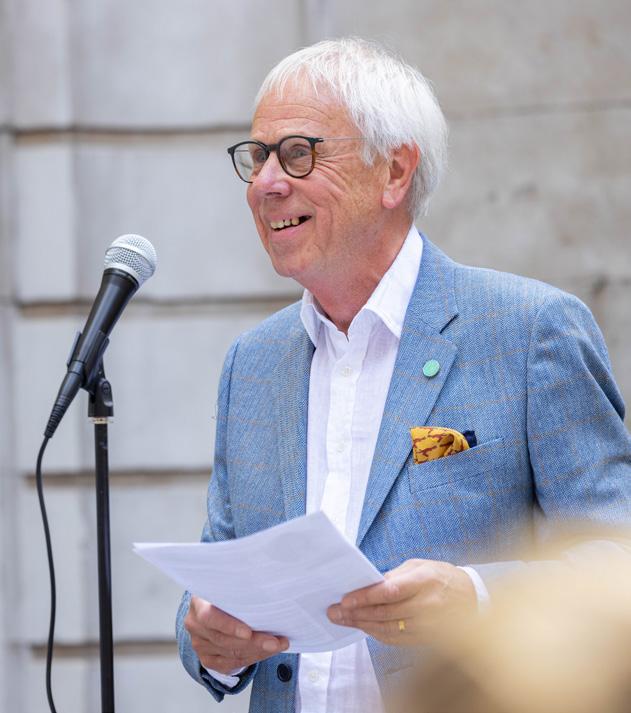
“My association with freemasonry continues. I am a past Worshipful Master of the Old Exonian Lodge, meeting at the school, where we take our membership very seriously but have an enormous amount of fun. We run a specific bursary which provides financial assistance for pupils where appropriate. Our son Ben (19901992) is also a past-Master of the Lodge and, although now living and working in Toronto maintains a close interest in its activities. Anyone interested in finding out more about the OE Lodge is very welcome to enquire.”
It’s always a pleasure to host events and reconnect with so many alumni, both on campus and further afield. You can find details of upcoming events on the school’s website at exeterschool.org.uk/alumnievents.
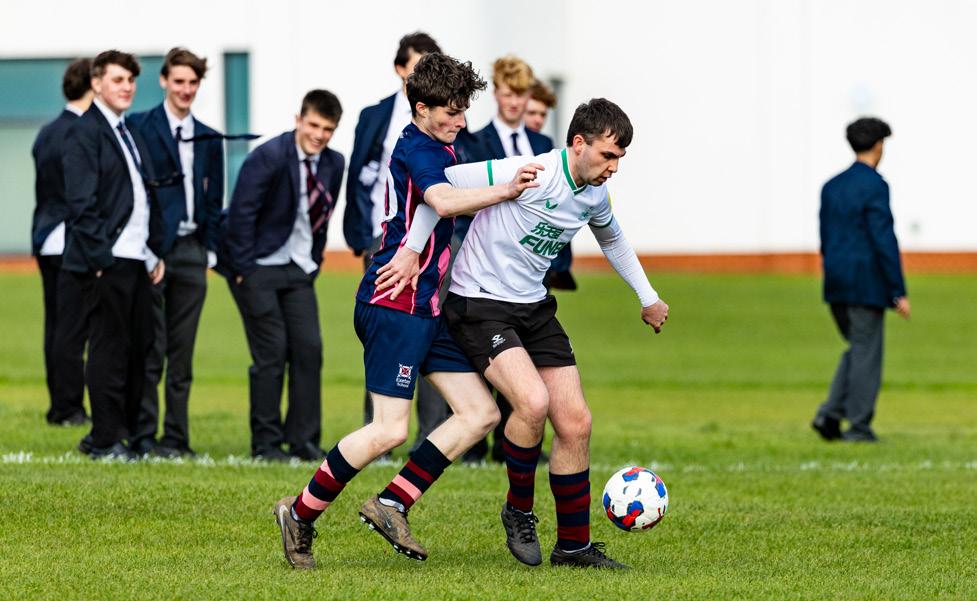
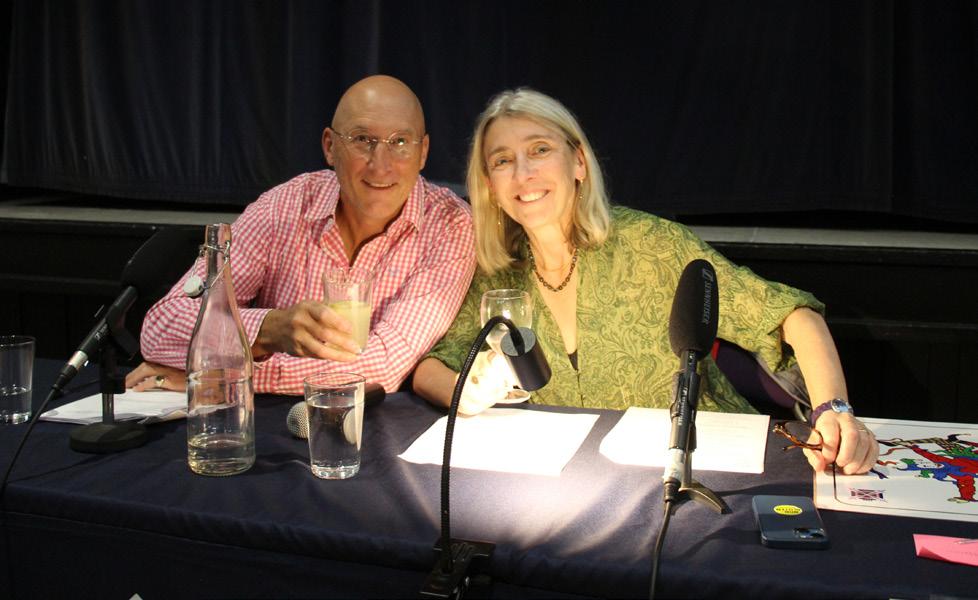
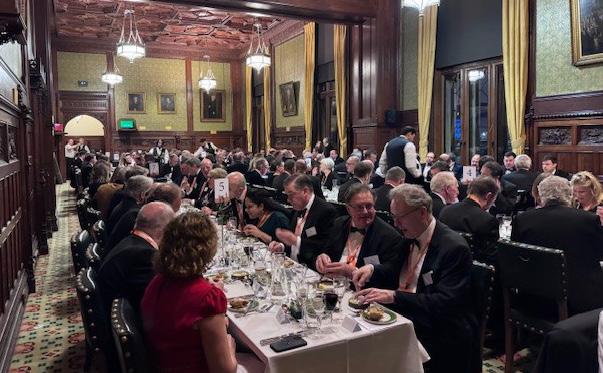
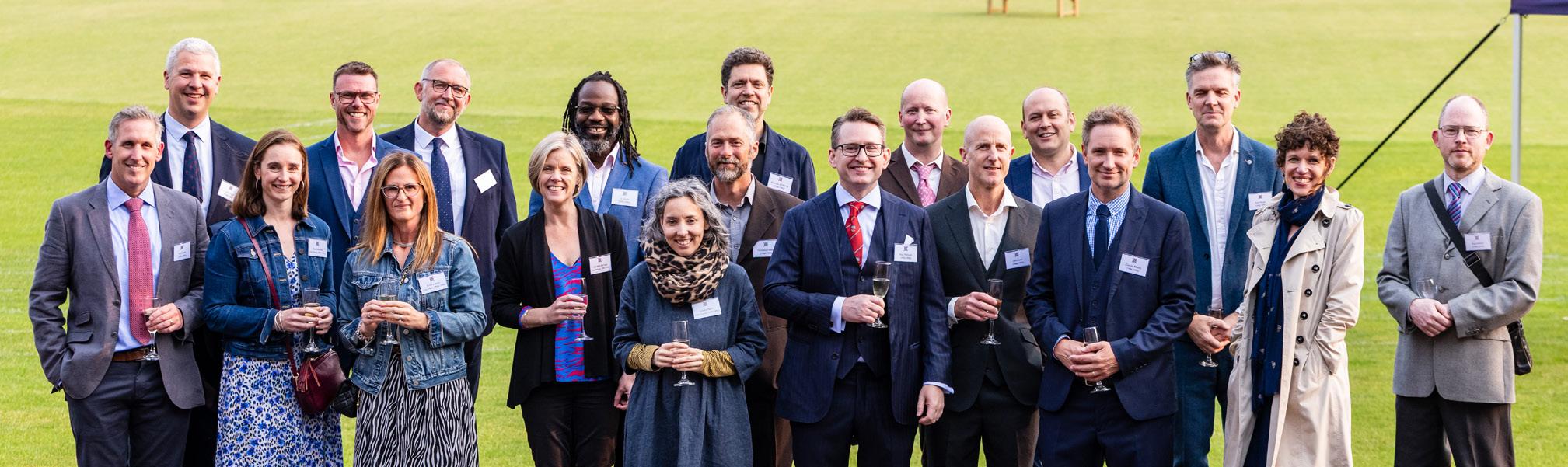
Whole school open morning
Saturday 26 September 2026
Si xth form open evening
Thursday 5 November 2026
Whole school open morning
Friday 22 January 2027
Exeter Pre-prep open morning
Wednesday 24 February 2027
Summer open evening
Thursday 6 May 2027
Exeter Pre-prep open morning
Thursday 3 June 2027
Whole school open morning
Wednesday 16 June 2027
Please get in touch with Liz Williams, Director of External Relations, to find out about our admissions events –esw@exeterschool.org.uk.
We’re delighted to share the latest news from across the Exonian community. Whether you left Exeter School recently or many years ago, we always enjoy hearing your news, so please do keep us updated with your achievements and milestones.
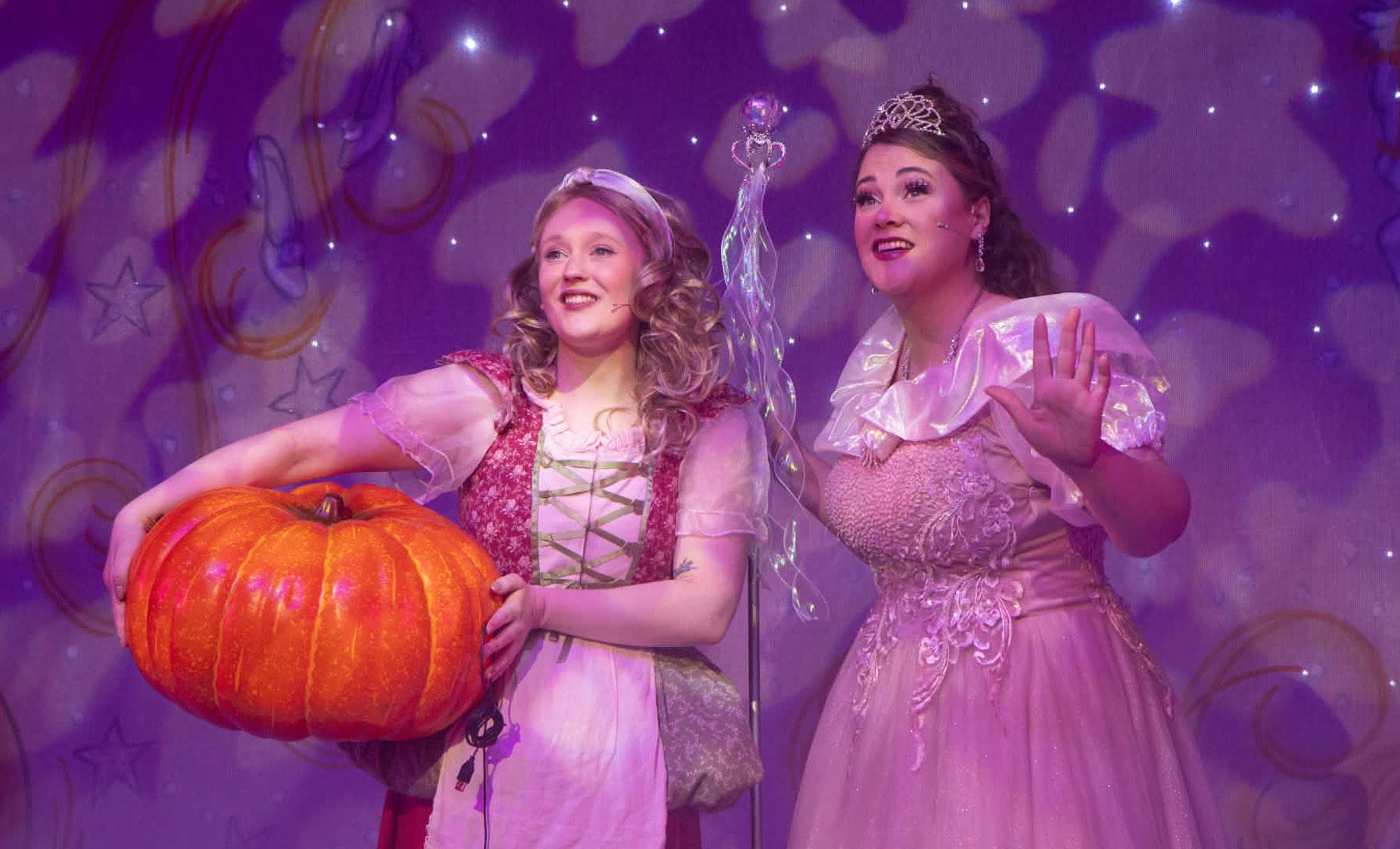
Another exciting and busy year of theatre. Firstly, I had a complete u-turn character wise from the lovely Fairy Godmother I played in Cinderella last year, playing Miss Hannigan in Annie at the Northcott Theatre, followed by Chitty Chitty
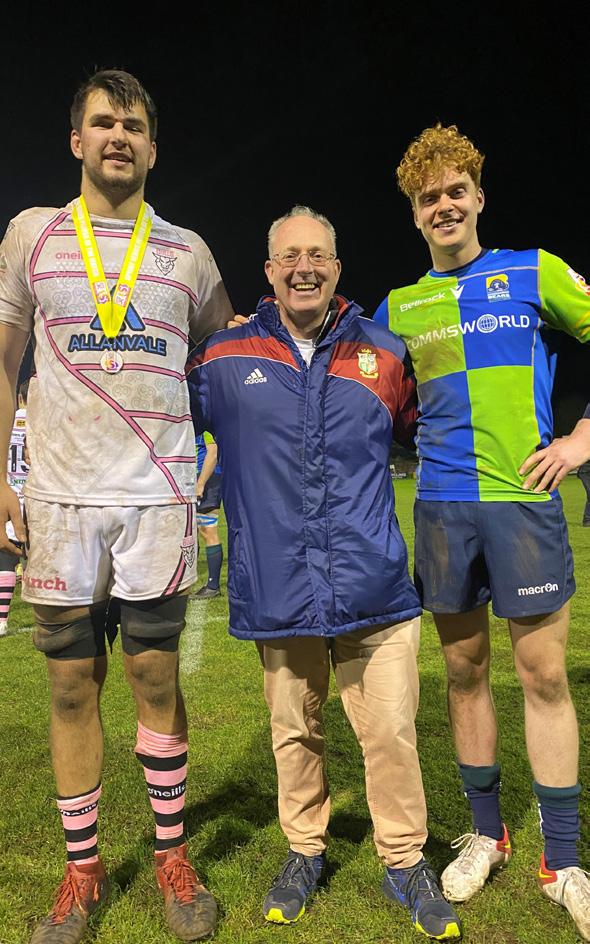
Bang Bang, at the same venue. Theatre is a huge part of my life; I dedicate a lot of time and energy to keeping my passion for performing alive. I also volunteer on the Exeter Musical Society committee, as I truly believe in the importance of local theatre and giving back to the community that makes it possible.
Since being appointed as an Orthopaedic Consultant in Fife, Scotland in 2007, I developed an interest in enhanced recovery and service redesign. In 2018 I performed the first day case total hip replacement in Scotland and now lecture nationally and internationally on the subject. I am currently Orthopaedic Specialty Adviser to the Chief Medical Officer (Scotland) and Clinical Lead for the South East Scotland Trauma Network. As a youth rugby coach, I coached players who achieved caps at National U16, U18 and U20 levels for Scotland and coached players in FOSROC super series colours (please note I am 5ft 10inches). Married with three children, living near St Andrews, Fife.
– full story on website
Peter, Consultant Eye Surgeon at the West of England Eye Unit, The Royal, Devon and Exeter Hospital, was recently celebrated for pioneering major changes in the management of eye conditions, now adopted across the UK and internationally.
Under his supervision, nurse practitioner Brian Kingett delivered the first sight-saving eye injection in 2008, a role previously reserved for doctors. Despite initial resistance from regulators, pharmaceutical companies, and consultants, an audit of the first 2,000 injections presented at the 2011 World Congress of Eye Hospitals proved their safety and efficacy. To mark the 18th anniversary, the unit named the injection rooms in his honour.
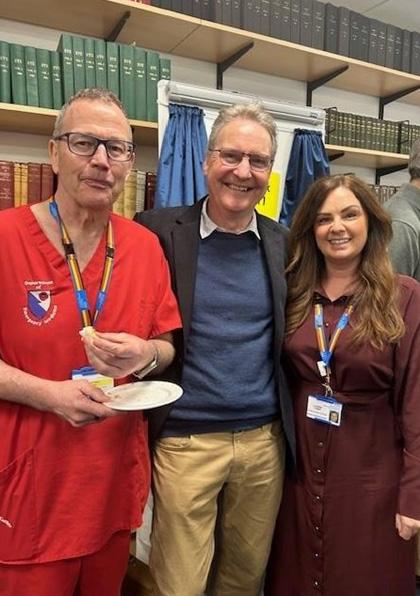
I am now Chairman of Topsham Bridge Club. We are a very friendly club playing duplicate bridge and we welcome new members, especially OEs.
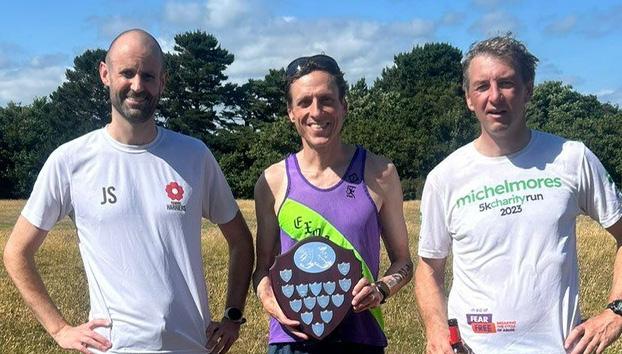
– full story on website
A sweltering Saturday on 28 June 2025 saw the much-anticipated annual Old Exonian cross-country race return. This point-to-point course between the clifftops of Exmouth and Budleigh Salterton spans just under 4 miles with a 220m elevation gain, pitting Old Exonians against Old Heleans, former pupils of Hele’s School.
Two debutants for the Old Exonians, Simon Bryant (1985–1992) and Robert Dempster (1985–1992), joined James Saddler (1994–2005) at the front, running in a tight peloton with the lead frequently alternating. Close behind were Old Heleans John McCawley and Rees Jenkins (1988–1993). Navigating the caravan park safely, Simon, known to his Hampshire clubmates as the “Crosscountry King”, attacked, with James matching his pace and Robert slightly behind. Written by James Saddler
I was looking through my photographs and found this picture of Basil Selley (staff, 1958-1994) that I had taken at an alumni dinner in 2006. Basil’s smile took me back to my maths A Levels, and I was reminded of his great enthusiasm for the subject.
He was instrumental in developing the innovative School Maths Project (SMP) together with seven other schools including Charterhouse, Marlborough College, Sherborne School and Winchester College.
SMP was part of the new mathematics movement of the 1960s, and we worked on areas such as set theory, graph theory and logic. I even made an 8mm colour film showing the proof of Pythagoras. I do hope his pupils will enjoy seeing his picture.

Rob Pepper is a British artist, educator, and author known for his distinctive pen-andink drawings and commitment to creative education. As Principal of Art Academy London, he has played a pivotal role in transforming the institution into a thriving independent art school, now serving over 3,000 students and employing more than 100 artists. Under his leadership, the Academy achieved validation for their BA Fine Art and Contemporary Portraiture through the Open University and opened a new campus next to Tate Modern in 2024, establishing it as a central hub for contemporary art education in London.
– full story on website
After 56 years, I thought it was high time to break radio silence. One excellent piece of advice from geography teacher Bob ‘Boris’ Jenner (staff, 1957–1988) was to avoid procrastination - regrettably, I often failed to follow it. After school, I spent a fun year as a bus conductor for Exeter City Transport before studying German at Cardiff University (1970–1974), including a year in Oberursel. I visited West Berlin at the height of the Cold War, briefly stepping into East Berlin via Checkpoint Charlie.
I played lead guitar in rock and semi-pro bands for 56 years, performing at venues including the Savoy, Highclere Castle and Café Royale.
I worked for 36 years at the Home Office on social policy, crime and international matters, including 1979–1981 at 10 Downing Street, travelling with Mrs Thatcher and meeting President Carter. I vividly remember playing carols on a guitar at her staff Christmas party where she ordered Bernard Ingham to “get Steve a chair!”, which I politely declined.
After retiring at 60 I was a magistrates’ assessor and school governor, helping a struggling school achieve OFSTED excellence.
James has turned his passion for the sea into a career with Royal Caribbean Group via the Royal Caribbean UK Cadet Program, a fully sponsored three year cadetship that prepares young mariners for life at sea. To read more about James’ career – https://www.royalcaribbeangroup.com/from-marine-cadet-to-second-officer.
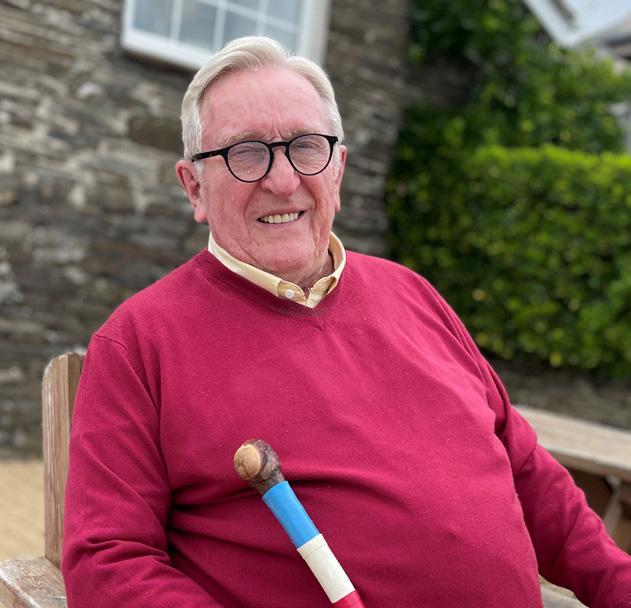
Last year, Emma Gilboy, daughter of proud alumnus Richard Spiller, got in touch to request an older version of the school logo for her father’s 80th birthday cake. Our archivist, Kevin White (1953-1961), was delighted to help, especially as he and Richard had been at school together. Kevin located a prefect’s badge preserved in the archives, and we sent Emma an image to feature on the cake. Emma later shared that her father “was really pleased with the cake and remembered Kevin well.” A big thank you to Emma for getting in touch, it’s always an honour to be remembered fondly by our alumni.
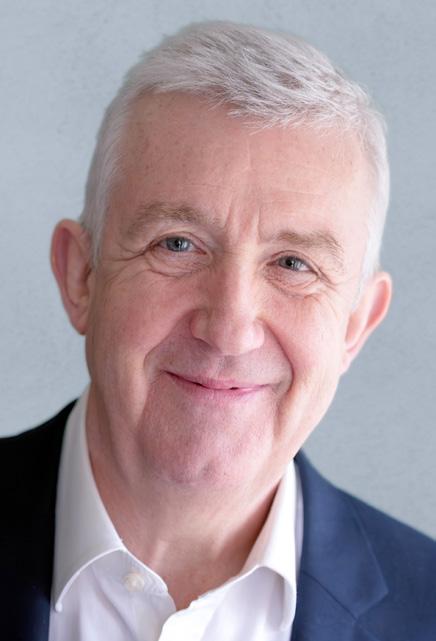
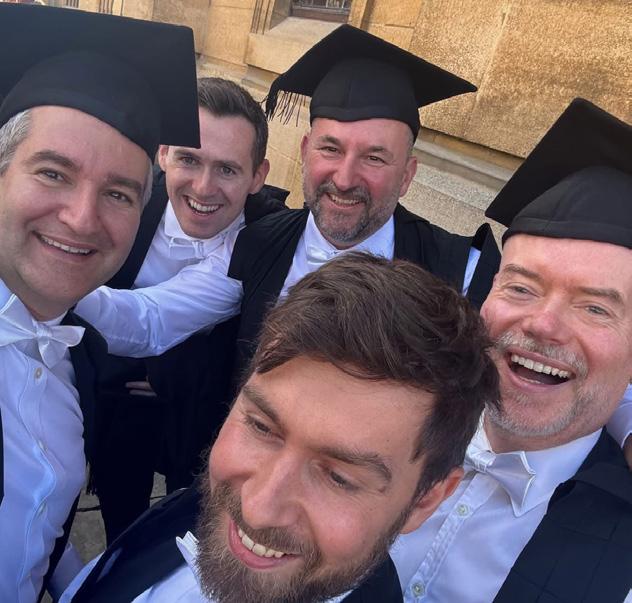
“Iain lives in Sydney, Australia and has done for several decades and I live in Hampshire. We hadn’t seen each other for more than 25 years. We have been studying for the past year on a post graduate diploma in Artificial Intelligence for Business at Saïd Business School at Oxford University. It’s a small world, and lovely to have been back studying together again having left school 31 years ago!”
A memorable near-disaster at Exeter School drama occurred in 1976 on the last night of A Midsummer Night’s Dream (Britten version). Musical Director, Godfrey Slatter (staff, 19711981) had engaged a harpist from Teignmouth with a beautiful antique French harp adorned with plaster flowers. The scenery for the final act had to be hastily built in the interval.
As the curtains opened, overexuberant Third Form fairies pushed the flats forward. Chris Maidment (staff, 1973-1977), winding the curtains in darkness, had removed his intercom headphones and didn’t hear my pleas. The flats fell slowly between the curtains, landing gently on the flowers, or maybe a millimetre off. Amazingly, the harp survived undamaged, and the harpist eventually played for us again.
The 1976 show also saw the inauguration of my remotecontrol electronic lighting system, constructed at the request of the master in charge of drama to save the school the expense and hassle of repeatedly hiring equipment from The Northcott Theatre. The “intercom”, a last-minute add-on thrown together out of my spares box, was swiftly upgraded to allow two-way communication!
I attended Exeter School briefly and really enjoyed my time there. I have had many different careers over the years from hospitality to entertainment. I’ve been a communications consultant for over 15 years and have become fascinated by the way the eight generations alive today communicate. I was inspired to gather research for my book, Generationally Speaking, just after the pandemic and was delighted to see it finally published in November 2025. It’s got me thinking about writing another… when I can find the time. If you’d like to find out more or purchase Alastair’s book, you can do so here – https://tinyurl.com/ GenerationallySpeaking.
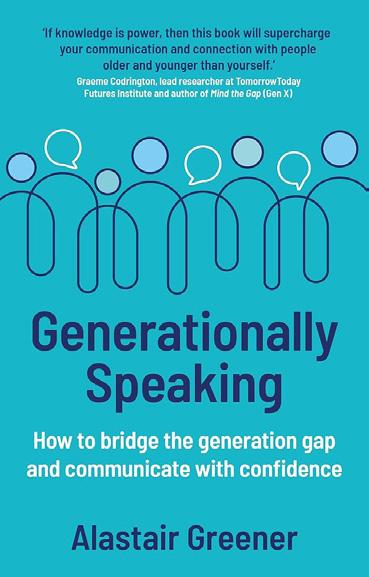
Long-standing friends and former pupils Mark and Robin have had their short letters included in this year’s Unpublished Letters to the Daily Telegraph. Mark has also had two letters published in the Financial Times. Robin credits the influence of several Exeter School teachers, including Ivan Cole (staff, 1960-1971) and John Gabe (staff, 1940-1972), for shaping their love of language and letter-writing. I’m No Expert, But… Unpublished Letters to the Daily Telegraph, vol. 17, edited by Kate Moore, is out now.
Luke Stitson, who works as a Research Manager at Dyson, last year had the pleasure of another OE, Matthew Lomas, joining his team. Luke says, “Matt was in our team for a six-month rotation as part of his degree with the Dyson Institute. It was great reminiscing and figuring out which teachers we had overlap with!”
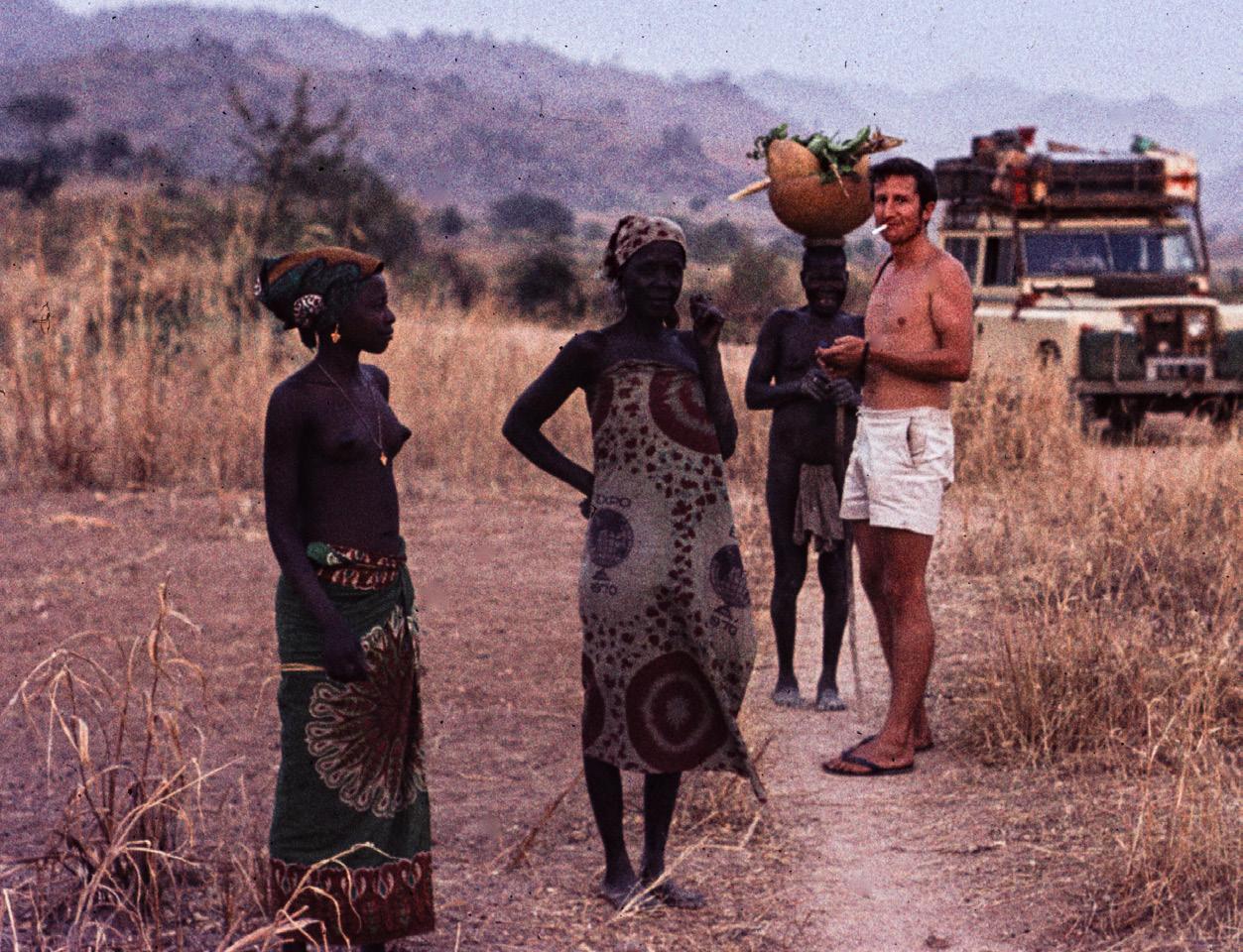
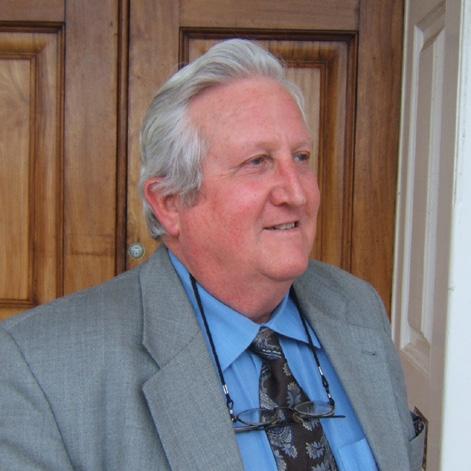
Wendover (1952-1964) – full story on website
I much enjoyed reading Richard “Dickie” Snailham’s (staff, 1957–1965) article in last year’s The 1633. One outstanding memory from my time at Exeter School was being part of the “Andorra or bust” expedition he organised for a small group of Fifth Formers. We travelled in a VW Combi – it was huge, fun and a wonderful experience.
Years later, returning from a contract in Malawi, a colleague and I drove back to the UK across Africa, including the Sahara. On 30 December 1971, in Kisangani DRC, we were astonished to meet Richard, then a lecturer at Sandhurst, planning a Congo River expedition. His book A Giant Among Rivers omits this extraordinary encounter.
(2022-2024)
I got my private pilot’s licence during A Levels in 2023. After A Levels I spent late 2024 to early 2025 “hour building”, clocking a legal amount of flying experience to start the commercial course. In April 2025, I started a six-month full-time theory course in Gloucester, consisting of 13 subjects with a 75% passing grade each. Subjects studied were meteorology, human physiology and psychology, specialised helicopter-based physics and air law, amongst others. During this course the school, Castle Air Academy, provided me with many opportunities to get up close and personal with helicopters such as the navy’s Merlin
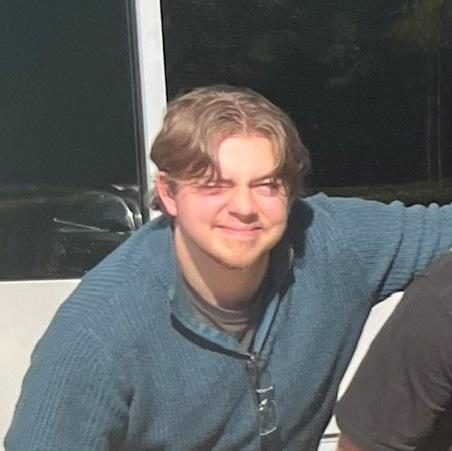
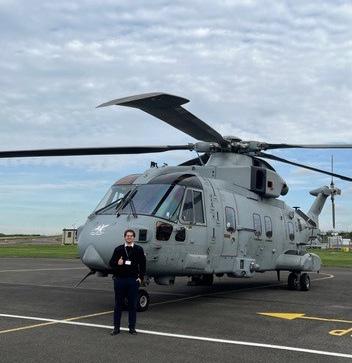
helicopter. I took a flying course of 35 flying hours, also in Gloucester, with a school called Heliflight UK, including flying at nighttime, and passed a six hour long flying and knowledge skills test with an examiner to get my commercial licence.
1982-1991)
Former teacher Lawrence Sail (staff, 1982-1991) has been a freelance writer since he left Exeter School, publishing collections of poems “gliding from the personal and political to the thoughtprovoking and heartrending”.
When we arrive, it is sunny enough to throw faint shadows but with drizzle too, enough for footprints to hold in the soil.
The loveliest place in the world boasts the leaflet describing the famous crime writer’s house overlooking the estuary.
The first page has drawings including a feather, a fern, a bottle from a chemist’s, a watch, a rope, shells – but which are admissible?
The plan of the interior shows nine rooms. No X, no chalk outline – but note the areas closed to visitors.
The map of the exquisite gardens has twenty-eight locations. The cemetery is for pets only. The body in the boathouse is pure fiction.
Her husband (a black and white photo of them both) was also a dealer in clues, in Egypt mostly. She herself once went missing.
And now a distant steam train whistles huskily from the wood –another line of enquiry, the ghost of a call from the dead.
Lawrence Sail

From Double Takes, a new collection of poems, published on 25 June 2026 (Bloodaxe Books, £12.99).
– full story on website
For A Levels I took biology, chemistry and geography, and did a year of English in Lower Sixth. I was active in the naval section of CCF, as well as netball, swimming and tennis outside school. After leaving, I took a year out, working in a hotel and other jobs to save money.
At the end of January 2025, three friends and I flew to Bangkok and travelled around Southeast Asia, then up the east coast of Australia. It was an amazing experience I highly recommend. After travelling, I spent the summer at home and am now studying biomedical science at the University of Bath, pursuing my interest in the human body and the many career options it offers.
My advice to pupils choosing A Levels is to pick subjects you enjoy –they can guide you toward a career that makes you happy.
I am now retired after 38 successful years in recruitment, the last 21 having been with Robert Half, the global finance and accounting specialists, with the last three years spent working in the Netherlands. I am looking forward to catching up with my OE pal Justin Wilkes (1976-1983) who has also retired after a successful career in PR running his own highly successful business.

Hugh and wife Ali welcomed baby boy Rowan on 21 December last year. An early Christmas present for them both!
When Kirk looks back over his life, one word recurs again and again: blessed. His journey has encompassed early responsibility, professional risk, personal loss, and remarkable business success, guided throughout by faith, gratitude, and positivity.
Kirk began his education at Bramdean School, then Exeter School at 13, excelling as a rugby winger and citing Mr Leger (staff, 1951-1967) as his most influential teacher. Leaving at 17, he moved to London to join the family clothing business, gaining experience as a manager at Bourne & Hollingsworth. His father died when he was 19, shaping his independence and resilience. By 25, newly married with a daughter, he balanced career and family, later moving into asset management. By 30 he was a top lender at Bowmaker, before founding Armada Asset Finance in Exeter in 1974.
Kirk’s talent lies in listening, understanding people, and practical problem-solving. Family remains central, he has two daughters, two
grandsons, and his Topsham office, which he moved to in 2006, is full of family photographs.
His advice, “Concentrate on the other person. Really care about them. Success will follow. Gratitude multiplies. For young alumni, find what you are good at, what you enjoy, and build from there.”
We’ve made every effort to include all the news we’ve received but apologise if any updates have been inadvertently overlooked. If something has been missed, please don’t hesitate to get in touch, and we will do our best to rectify this. We also encourage you to stay in touch – hearing from our alumni is always a delight!
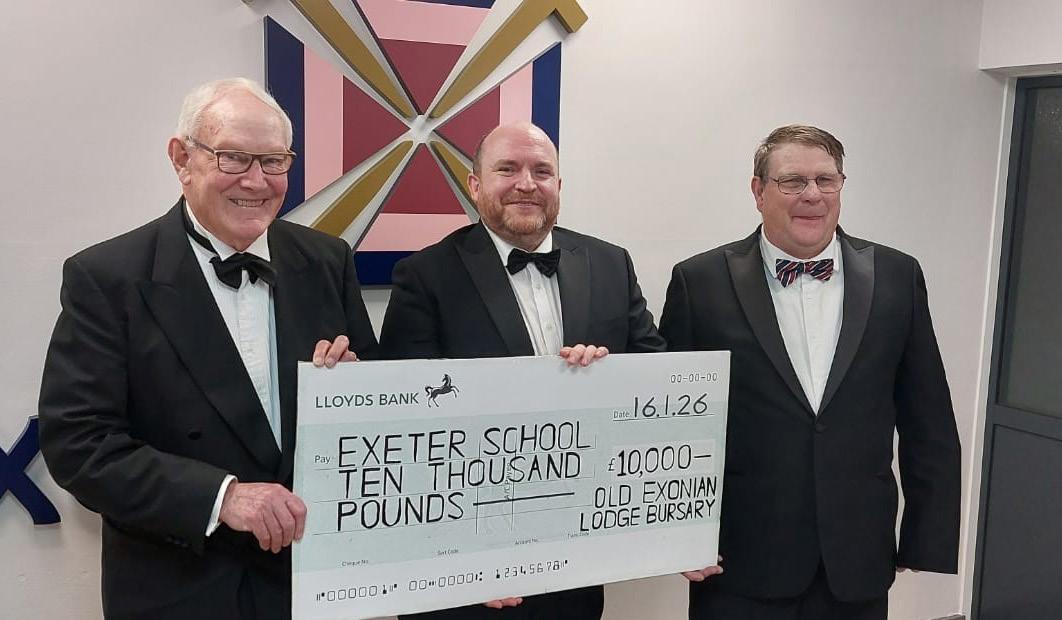
Our sincere thanks to Richard Jacobs (1952-1956) and Richard Gliddon (on right) for their generous donation of £10,000 to the Exeter School bursary fund. Acting Head, Graham Bone (in middle), warmly welcomed and expressed his gratitude for this wonderful support to the school.
The school is sad to announce the passing of the following Exonians. A ★ symbol indicates that a fuller obituary has been published on the school website, at www.exeterschool.org.uk/obituaries.
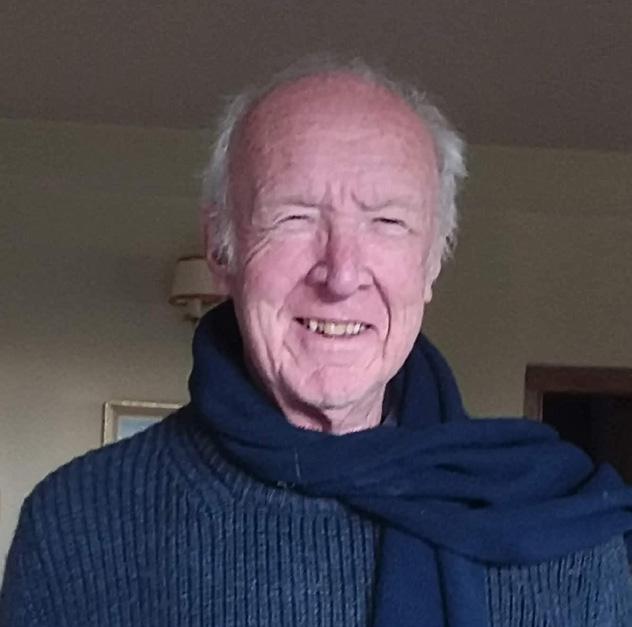
(Daw, 1957-1961) 1944-2026
Born on 22nd February 1944 Trevor joined Exeter School in the Lower Fifth in 1957, following his brother, Malcolm (1949-1954) in Daw House. An excellent shot, he represented the school in the Gale and Polden match at Bisley in 1959 where he was a cadet pair with George Cann (1952-1961). He was awarded a Charles Goff Prize for oral French in the Middle Fifth.
Upon leaving school Trevor became articled to an Exeter firm of solicitors, Stone & Son, in 1960. He qualified in the mid-sixties and spent most of his life in the London area. Trevor is remembered by his wife and daughter as a devoted family man and a lifelong musical enthusiast, who became an accomplished pianist.
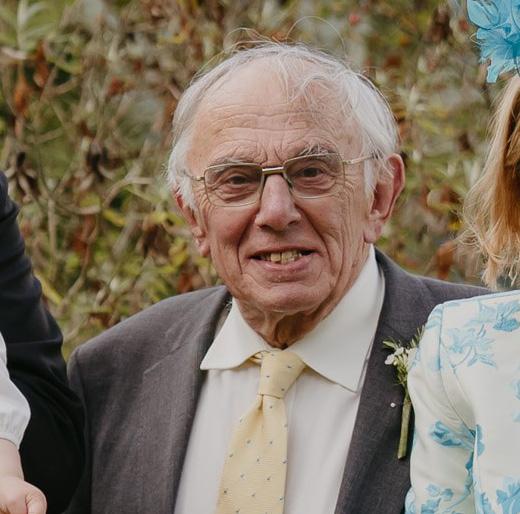
(School House, 1949-1955) 1938-2025
James “Alan” Tooley Chaffe passed away 6th June 2025, aged 87.
My father always spoke fondly of boarding at Exeter School, in a world quite different to today. Just as rationing was ending, health and safety had yet to begin, with his recollection of full contact boxing against the teachers (in which he claimed he knocked his teacher to the ground) and being lowered out of his bedroom at the top of the school tower tied to a piece of rope as part of a fire-drill.
Claiming to not be the most academically gifted, he focused more on sport, gaining a love for rugby at
(Raleigh, 1965-1972) 1953-2024
Nick Field died in December 2024 in his hometown of Catania, Sicily. Nick had lived there for many years having married a local girl, Victoria. They had two sons, Ayrton and Dylan. OEs from the time will remember
school which he took with him through to playing for Buckfastleigh and Paignton, and on to be a supporter of Exeter Chiefs, even before they hit the big time. However possibly his biggest claimed school achievement was taking the long jump record, breaking his ankle in the process.
After school my father returned to his native Buckfastleigh to contribute his entire working career at its sheepskin and leather tannery, as had his father and grandfather before him. This was only briefly interrupted by a fear of nepotism leading to him attending what is now Loughborough University. He met my mother, Pearl Javin, at a barn dance in the South Hams, they married in 1971, before waiting seventeen years to have me, their only child, in 1988. My mother’s love of horses rubbed off on my father as they took up event horse ownership after my mother’s retirement from riding herself. Constantly by her side, my father lovingly cared for my mother in her final years before she passed away in 2023. His devotion was something we are both enormously thankful for and in admiration of. In his final years my father got to spend much of his time with his grandchildren Edward and Charlotte, in both the UK and New Zealand, visiting the latter just a few months before he passed. He stayed remarkably healthy right up until the last few weeks of his life and will be sorely missed.
James Chaffe (Drake, 1999-2001), Alan’s son
Nick not only as captain of the 1st V1 tennis team, but perhaps more for his luck with the young ladies as he left the rest of us in awe of his prowess.
A group of OE friends gathered to celebrate his life, Nigel Ralph (19611972), Richard Coles, Andrew Walker (1965-1970), Jon Spencer (1967-1972), Tim Parrott (1965-1970), Jerry Row (1967-1971), Tony Macan (1967-1970) and Gerry Binmore (1965-1972).
Gerry Binmore, Nick’s friend
Jean Jenner (wife of Bob Jenner, staff 19571988) 1929-2026
Freddie Cuthbert (Acland, 2002-2009) 1990-2025
Brian Reeves (School House, 1950-1956) 1939-2025
Dr Anthony Robson (School House, 1945-1949) 1932-2025
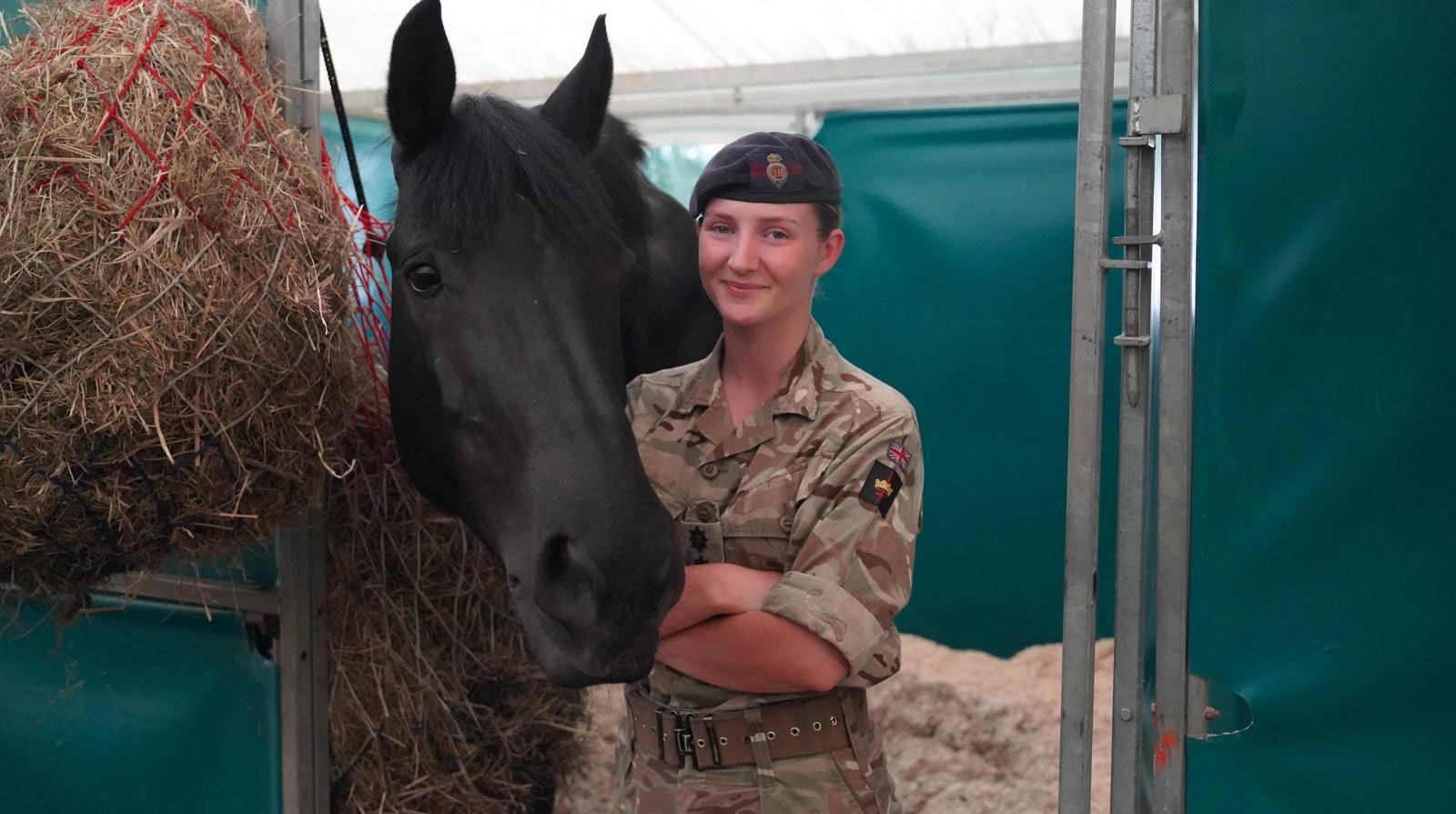
Captain Elizabeth (Lizzie) Godwin will be remembered by all who knew her as a woman of exceptional determination, courage, and generosity of spirit. She forged a remarkable career in the British Army, becoming a trailblazer not only for her generation but for those who will follow.
Raised in Devon, Lizzie’s time at school was marked by energy, enthusiasm, and a commitment to making the most of every opportunity. She excelled academically and on the hockey field, and heard of the school’s connection to the Army through the CCF. After attending a three-day course at Okehampton Camp, she returned with a bruise the size of a tennis ball on her arm, speaking of how demanding it had been but how much she had loved it – she had found what she wanted to do. She went for the “Baby Board” at age 15, securing her place at Sandhurst and a sixth form scholarship at Trent College.
Lizzie went on to study nursing at King’s College London; her time in the NHS instilled a resilience and empathy that became defining features of her leadership.
Her time in Officers’ Training Corps at university further confirmed that her career lay in the Army. She went on to the Royal Military Academy Sandhurst, where she won the Sword of Honour in 2020 as the best cadet of her intake. That same year, she became the first female officer commissioned into The Life Guards, part of the Household Cavalry.
Lizzie’s career was defined by excellence and service. She served as a troop leader in both armoured and mounted roles, earning a reputation as a talented, resourceful, and compassionate officer. Her achievements included leading a medal-winning Cambrian Patrol team, representing the Army in hockey and polo, and serving as a trustee of The Life Guards Association charity.
Her time with the Mounted Regiment brought some of her most memorable achievements. She played key roles in the funeral of Queen Elizabeth II and the coronation of King Charles III, where she commanded a division of mounted soldiers. She later served at the Army Training Regiment Pirbright, inspiring new recruits with the same passion and integrity.
Lizzie also gave generously of her time to the school, speaking at the Lower Sixth Futures Conference in 2024 and delivering an outstanding Exonian Lecture in 2025.
Above all, Lizzie will be remembered as a deeply kind, selfless, and driven individual. Her sudden death leaves a profound loss to her family, friends, and colleagues. Yet her legacy endures – in the barriers she broke, the people she inspired, and the example she set of service, humility, and quiet strength.
An interview with Lizzie was the lead feature in the 2025 edition of The 1633, and her 2025 Exonian Lecture can be viewed on the school’s YouTube channel.
Bob Poynter MBE
(School House, 1948-1954) 1934-2025
John Allen (School House, 1965-1970) 1952-2023
Harris
(Drake, 1944-1947) 1927-2024
Arthur Emlyn Dawson Harris was born on 7th January 1927 to William and Ann at Barnard Castle, Co. Durham. His father’s work with the Ministry of Works, Ancient Monuments Division, meant that the family moved around the country a great deal.
Arthur received his schooling at Caernarfon, Devonport, Bishop Wordsworth’s Salisbury, and Exeter School. Holidays were spent on his cousin’s farm near Salisbury helping with essential war work. With the ‘39-45 war coming to an end in Arthur’s final year, the recommendation was for him to study for a BSc at Exeter University before being inducted to officer training and National Service with the Royal Army Education Corps at Sandhurst.
Through a connection with the minister of his church in Exeter, ex-forces padre Robert Kerr, Arthur visited Belfast. It was there that he
Neil McBurney (Raleigh, 1947-1953) 1940-2023
met Hazel Robinson. They were married in 1952 and set up home in Bristol. Arthur was employed by Lloyds Bank, studying for banking exams and a course in Cybernetics at Bristol University in the evenings.
Moving to Broxbourne in Hertfordshire, Arthur went to work at head office as a founder member of the research and development group. Then came a series of posts, banking inspector, pay service, machines department, city computer centre, clearing, and general management. During these years he played a part in ushering in the era of computerisation, and the cashpoint. As Chairman of the Inter-Bank Committee, he pioneered the sort code which appears on cheque books and bank cards.
Throughout Arthur’s working life his commitment to the bank was strictly nine-to-five. His primary allegiance was to the teachings of Jesus Christ. He served as secretary and treasurer to churches in Broxbourne, and later Tunbridge Wells.
With retirement looming, Arthur renewed his studies: on religion at London University, Third World Studies with the Open University, and finally the Southwark Ordination course. In 1986 Arthur was appointed Priestin-Charge at St Michael and All Angels Withyham with All Saints Blackham.
A second retirement came a decade later; he and Hazel went to live in The Close at Salisbury where they entered fully into the life of the cathedral. The move to Crowborough came in 2012, and ever keeping with the times, Arthur installed solar panels on his home there. In 2024 Arthur and Hazel celebrated 72 years of marriage, together with their growing family.
Arthur will be remembered for the conscientious way in which he carried out his responsibilities, for his deep thinking, and for his outgoing personality - always seeking to inspire and encourage others.
William Harris, Arthur’s son
(staff, 1982-1994) 1932-2025
George Garner, aged 93, died peacefully on 11th August 2025 in Shardlow Derbyshire. George taught maths at Exeter School from 1982 until his retirement, following an earlier career as an airline pilot (flying Boeing 707s for British Airways) and before that as a jet fighter pilot in the RAF. He may be remembered for teaching A Level statistics but also for his involvement in the RAF CCF and encouraging many of us to gain experience in a Chipmunk, flying from Exeter airport.
Following retirement George continued to support students with maths tuition at Exeter University and at Duchy School in Bradninch, but also enjoyed other hobbies. He loved model making and particularly enjoyed flying his radiocontrolled aircraft, he was the president of the BBC (Bradninch Bowling Club!) for several years and remained very active in other community groups. Following the death of his wife Gwyneth in February 2025, he moved to live in Shardlow close to his son Dan and his family.
A memorial service was held at St Disen’s Church in Bradninch on the 28 October which was attended by a few colleagues from Exeter School, and the family have taken great comfort in the messages from other staff who were unable to attend.
Dan Garner (Collins, 1986-1993), George’s son
Dr David White ( Daw, 1959-1966) 1947-2025
Gordon Newbery (Buller, 1944-1952) 1933-2025
(Drake, 1951-1956) 1939-2026★
Anthony John Hooper, known as Tony, died on January 25, 2026.
Tony was born on 12 February 1939 in Seaton, Devon, the youngest of three children. He was brought up, unusually for the time, by his mother in a chilly house in Marlborough Road, Exeter.
Val Hibbard, Tony’s second cousin, whom he loved dearly until her death in 2020 aged 99, helped him gain a bursary to Exeter School, where she was the Headmaster’s secretary. One of Tony’s earliest school memories was running late for a lesson, colliding with the headmaster’s wife and sending her flying. He narrowly avoided suspension but not “six of the best”. In time he settled down and became a valued member of the school hockey team, occasionally mentioned in match reports as the winning goal scorer.
After leaving school Tony undertook National Service. A skinny lad of 5’ 5” and just seven and a half stone, he nevertheless threw himself into army life. Stationed in Germany, he surveyed Soviet submarine activity and later told stories of hiding from Russian patrols on the frozen East-West border, vibrant
John L. Owen (Drake, 1942-1952) 1933-2025
cafés with American GIs, and even encountering Elvis Presley during his own service.
On returning to England, he began a career in banking. After a lively couple of years working in Jersey he returned to the mainland, and in 1963 met Rosalie. They married four years later and welcomed their children Lucy and Andrew. The family lived in Sussex and Somerset before settling in Upton St Leonards near Gloucester, their home for 46 years.
For Tony, being a bank manager was less about pounds and pence and more about investing in people. Colleagues valued the supportive environment he created, and customers appreciated his kindness and guidance.
A Devon boy at heart, Tony later returned to Exmouth where he and Rosalie built another happy chapter of life. Sailing, golf and watching sport, especially Gloucester Rugby, brought him great enjoyment. After retiring from Lloyds Bank, he served for twenty years as treasurer of the Friends of Gloucester Cathedral and supported local charities including Rotary in Stroud.
Family meant everything to Tony and Rosalie. They welcomed Lucy’s husband Robin and his children Jim, Jo and Katie, Andrew’s partner Yo, and later their grandchildren Sam, Alfie and Aggie, who brought enormous pride and joy.
When Tony’s cancer returned in 2023, he met it with quiet acceptance. He remained comfortable at home, cared for lovingly by Rosalie and surrounded by his family.
Tony will be remembered as funny, charismatic, quietly charming and unfailingly kind and compassionate to everyone he came in contact with. He had a rare gift of connection and will be greatly missed by the family and friends who adored him.
Lucy, Tony’s daughter
Christopher King (Crossing, 1947-1954) 1937-2025
(School House, 1950-1956) 1937-2025★
Chris was born in Edgbaston on 8th July 1937 and spent his early childhood in Moseley, Birmingham, where he lived with his mum and dad and his elder brother Peter, who he always called Pete.
He attended two private schools in Birmingham before boarding at Exeter School in 1950. Chris loved sport and achieved full colours in rugby, hockey and cricket. With the CCF Air Force he gained a flying scholarship, first flying gliders and then obtaining his PPL flying Tiger Moths at the age of 17. He then completed a three-year course at Cranwell (76 Entry), studying war and military studies alongside flying training. The year report famously read that “76 entry will amount to nothing”, yet two went on to become Chief of the Air Staff - one of them was Chris’s best man.
His first tour was in Aden with 8 Squadron flying Hunters for three years. Chris loved the Hunter, often saying it was the best aircraft ever built, and particularly enjoyed lowlevel flying.
While on leave in Nairobi he first met Christine when he joined a group of friends for dinner at a Chinese restaurant called The Pagoda. When the bill arrived on the lazy Susan it stopped in front
Neil McBurney (Raleigh, 1947-1953) 1940-2025
Robin Davis (Goff, 1985-1992) 1974-2025
of Chris and, without hesitation, he paid for everyone. Christine was very taken with his style. They met only a few more times that year, including a Battle of Britain cocktail party and a trip to the Ngorongoro Crater, before Chris returned to Aden and Christine to her work as an air stewardess with East African Airways. They became engaged on Valentine’s Day in Nairobi and married in England in September 1962.
Chris later flew Lightnings with 111 Squadron at RAF Wattisham, including appearing at the Paris Air Show with the Red Arrows. Later tours flying Hercules aircraft included leading sixteen aircraft in formation to Germany and back, watched by HM The Queen and Prince Philip, and carrying out famine relief in North Africa.
After a full career he retired at 55 with the rank of Wing Commander.
Chris loved sailing, fly-fishing on the River Coln, and cricket. He and Christine sailed together for over 23 years, cruising the South West coast, the Channel Islands and Brittany, and were active members of the Royal Dart Yacht Club.
In later years they moved to Exmouth to be closer to family. Chris leaves Christine, his wife of 62 years, their son Simon, daughter Karen, three grandchildren Laura (20072009), Jenna (2010-2012) and Harry (2007-2016), he managed to meet Luca, his great grandson, shortly before he died.
Chris was a wonderful man –bright, cheerful and full of humour – and Christine will always be grateful for the happy life they shared together.
Kazie Collison, Christopher’s daughter
Timothy Heald (Raleigh, 1968-1970) 1953-2025
(Crossing, 1954-1962) 1943-2025★
Christopher John King was born on 15th June 1943 in Bridgwater, Somerset, to Leslie and Betty King. Their house was bombed, so the family moved to Cullompton in Devon, where Chris learned to love country life and developed a particular interest in birdwatching.
Chris attended Exeter School where he excelled as a middledistance runner. He was a regional champion and competed at national level on the track at 800 and 1500 metres. His love of athletics never diminished and he would often watch Seb Coe and Steve Ovett reruns on YouTube.
He met and married Jane, who was studying to be a nurse at Hammersmith Hospital. They had three children, Sally, Peter and Andrew, while Chris worked for Air France at Heathrow.
Chris, Jane and the family enjoyed holidays in Abersoch and family gatherings in Ashford and Melbourne. Chris entertained the children by illustrating his storytelling with wonderful drawings and cartoons. He wrote funny poetry and built the biggest sandcastles on the beach. While most fathers used a child’s bucket and spade, Chris used a garden shovel to create castles with moats, dinosaur footprints and even
a huge boat that he and the children could sit in until surrounded by the incoming tide.
Chris and Jane separated in 1978. By then he had been promoted to Airport Station Manager, dealing with passengers including notable VIPs such as the President of France and Michael Jackson.
He married Françoise whom he met at Air France and they had a son Edward and daughter Emma. Chris and Françoise separated in 2010. Chris ended his working life in 2003 when he retired as a Specialist Senior Consultant for Air Logistics for Syntegra.
Chris’s daughter Sally married in France in 2010, and Chris attended the wedding with Sally’s Aunty Jane (known as Janie to avoid confusion) and moved to live with her in Melbourne. Later he moved to Melbourne in Derbyshire and quickly became part of the community, joining the male voice choir, the local U3A and the Footpaths Group. He enjoyed many walks and holidays with Janie and family.
Chris was remembered as an athlete, artist, musician and creative spirit. He played guitar and piano, carried a kazoo in his pocket to entertain people, and even appeared playing it on BBC Radio Derby. He continued writing humorous poetry illustrated with cartoons, including a collection for his granddaughter Georgia.
Christopher’s life was well lived. His death was unexpected after a short illness. He enjoyed simple pleasures, country walks, music, holidays, and dancing in the kitchen to Rod Stewart’s Great American Songbook.
Chris leaves five children, Sally, Peter, Andrew, Edward and Emma, four grandchildren, Roarke, Sophie, Daniel and Georgia, and two great grandchildren, Rumi and Gabrielle.
Janie Carroll, Chris’s partner
Paul Saunders (Raleigh, 1957-1967) 1949-2025
Douglas Courtney (Drake, 1939-1944) 1927-2025
(former Governor, 1968-2010)
John was brought up in Cardiff and educated at Penarth Grammar School during the Second World War, an experience that left him with many stories to share.
His work brought him to Exeter
Colin Reed (Crossing, 1950-1954) 1937-2025
in 1956, to subsequently be joined by his new bride Stella the following year. He stumbled into local politics almost immediately due to Stella being a parish counsellor campaigning for local services. Once elected to the Exeter city council in the mid-60s he quickly became a governor of Exeter school where he remained an active member of the governing body for almost 40 years. He undertook this role with great pride and diligence. Along with all the meetings involved, he was determined to attend every Speech Day, concert, drama performance and any other event he was invited to with great enthusiasm right up until his health prevented him continuing. Over his many years as Governor, he saw many changes in the education system and the school itself.
His political life took him on to become Mayor of Exeter and leader of the city council where he made many positive changes to the city. During this time, he remained a dependable and committed Exeter School Governor.
John Palmer (School House, 1965-1972) 1953-2024
He was devout and dedicated, a loyal and loving family man whose Catholic faith played a huge part in his life. A man of drama, compassion and kindness. He was fervently invested in the many causes he represented. He was passionate about education and altruistic with it, diligently attending and contributing to governor meetings as well as spending time keeping up to date with any educational changes. Those that knew him well, knew he had a twinkle in his eye, bringing humour to many of those governor meetings.
His devoted and loving wife of 67 years, Stella, died just nine months before him, both of them leaving four children, thirteen grandchildren and thirteen great grandchildren. One son and seven local grandchildren attended the school.
Monica Cowling and Julia Webber, John’s daughters
(Daw, 1962-1969)
1951-2025★
Imet David at Exeter School when we were both 11 years old. He had come from Ladysmith Primary School. We first became friends when, in our second term, we had to sit together at the front of the geography class because we had been
equal bottom in the first term. After a change of teacher, we both improved –David rather more than I did. He went on to win an Exhibition in Geography at Cambridge.
David seemed good at most things. He was a soloist in our first Christmas music concert at St Mark’s Church, a fine competitive swimmer and tight-head prop to my hooker in the colts’ squad. When hockey was introduced, he became a quality player, later playing at Cambridge and for Sidmouth. He also rowed at Cambridge and began sailing at Exe Sailing Club, crewing in my Cadet dinghy. At first, he questioned why we kept tacking rather than sailing straight to the mark, but he quickly became an excellent crew and raced in Cadet National Championships.
David met Vicki Reed at a sailing club barbecue on Dawlish Warren. They married in 1973 and soon moved to Sydney with P&O, living in an apartment overlooking Manly Beach and travelling to work by ferry. Although David loved Australia, they later returned to England.
After a period in London, he joined the Inland Revenue in Exeter, becoming a tax specialist. In 1990 he joined an accountancy practice in Truro as tax partner, later helping establish Robinson, Reed, Layton. Sailing remained a constant passion. He crewed successfully in Merlin Rockets and sailed widely with friends, including the Ionian, Aegean and Antigua Week. David and friends sailed from the Canaries to and around the Cape Verdes, he was only sick for the first three days of the five-day passage in gales! Holidays in France and family life were central, especially after the arrival of twin daughters Polly and Ruth in 1983.
In retirement David and Vicki returned to Devon, settling in Sidmouth where he enjoyed sailing, gardening and his model railway. David was a good man, a man of honour, always with a good sense of humour and a twinkle in his eye. He was a rock to all who knew him.
Hedley Saunders (Goff, 1957 -1969), David’s friend
Christopher Edwards (Crossing, 1953-1960) 1941-2024
Graham Boxall (Daw, 1956-1964) 1945-2024
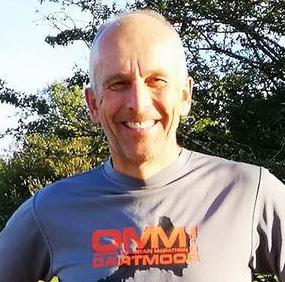
(Drake, 1969-1980) 1962-2020
Charlie’s time at Exeter School, with his brother Chris (1970-1981) and a warm strong family, inspired a life saturated with kindness, love of family, community and the outdoors. It was sadly cut short aged 58 from an
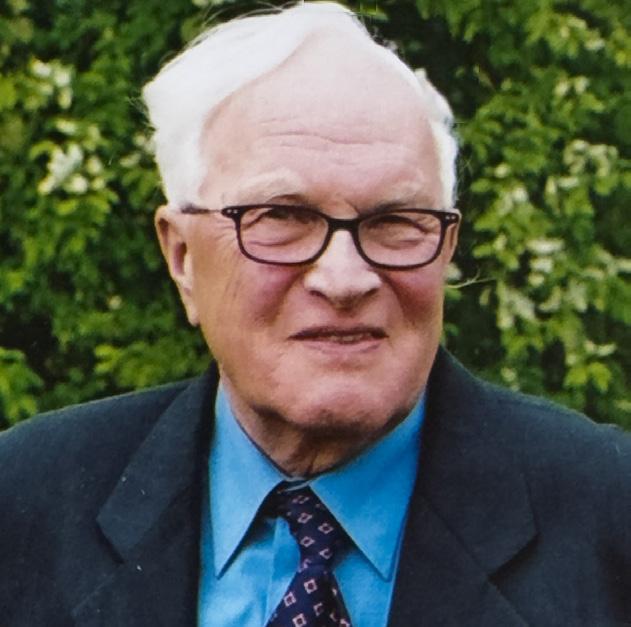
(Drake House, 1937-1945) 1927-2025★
Keith Edmonds (School house, 1950-1957) 1940-2024
unexpected cardiac event whilst cycling. Charlie studied medicine at St George’s, London University and after early jobs in Surrey he returned to Devon to work as a GP in Plymouth. Along with his wife Helen he raised his children Sam and Rosie. Close to his parents, John and Margaret, in Exeter, siblings Nicki, Ginny and Chris, nephews and nieces. Charlie was often in the kitchen bringing family and friends together over good food, exchanging recipes with Ginny.
The seeds sown by his school cross country and Ten Tors pursuits led to a passion for running and leaping bogs and streams – his long legs flying. Charlie was a keen member of Dartmoor and Tavistock running clubs especially the Hash House Harriers where he became ‘Grand Master’, clocking 1,000 runs the week he died. He clinched mountain marathons and, proudly, a sub-3-hour London marathon. He was always happy on the water too, windsurfing and dinghy sailing. Starcross Sailing Club days yielded to Helen’s home community in Salcombe, where together they tackled a tippy
Robert was born in Exmouth in August 1927. The house backed on to the Exe Estuary, which was a great place for a small boy to swim, row, sail and fish. Robert gained his love of steam trains at an early age and would ride with the engine drivers on the trains which took goods to Exmouth Docks. Aged eight, Robert moved to Lympstone with his family and he enjoyed his childhood playing in the fields around the village and as he didn’t have a watch, he would rely on the chimes of the church clock to know when it was time for tea.
Robert joined Exeter School when he was ten and he recalled how, during the war when the school couldn’t ring the swinging chime bell to mark the beginning and end of classes, he was asked to sound a bugle instead. During the war he would be on fire watch duty and as Robert was over 14, he was given a rifle and blank cartridges which he would load. When the air raid siren sounded, they initially had to run to private houses where they were billeted. Eventually it was decided it was safer for the boys to stay in the school than
National 12, ‘Paradocs’; always striving to do better, pushing to the limits, occasionally on the edge of being out of control. He loved that his children Sam and Rosie followed in his footsteps, running, cycling, kayaking and of course supporting Chelsea FC.
Charlie became interested in addressing social inequalities, health and wellbeing through access to the outdoors. ‘Charlie’s Voyage’ is a legacy that enables young people from Tavistock Youth Café to sail with the tall ships charity The Island Trust founded by his Uncle Dick.
Whatever the endeavour, eyes twinkling with mischief and a tremendous sense of fun he engaged with patients young and old, family, community and friends. He was generous with advice, with a keen sensitivity to fairness and defending this. Charlie was a man with huge warmth and capacity to care for others. He made everyone feel safe and held, by leading and enabling.
On, On Charlie.
Helen Lloyd, Charlie’s wife
run around in the open. After the Blitz in Exeter, they didn’t know about the damage so caught the train to school as usual and walked from Polsloe Bridge to school, where they were then sent home again.
After leaving school Robert completed his National Service as a Corporal, and then started his career as a medical laboratory technician in the pathology lab at Exeter hospital. He married Joyce in 1964, and they settled into family life in Lympstone with their daughters Margaret and Anne (Maggie and Annie). Robert offered many years of loyal service to the village, in various roles: sea scout leader, parochial church council member, school governor and parish councillor.
Robert was a much-loved husband, father and grandad. A polite and kind gentleman, capable and disciplined yet warm and with a sense of humour. He died peacefully in his sleep at his nursing home in Budleigh Salterton, having celebrated his 98th birthday a few weeks earlier.
Maggie West, Robert’s daughter
Andrew Page (Daw, 1990-2000) 1981-2025
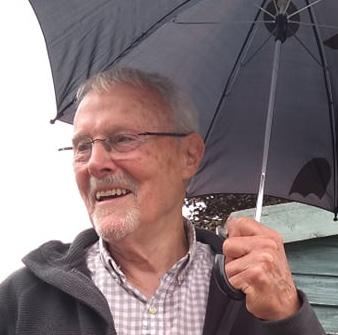
(former staff, 1969-1973) 1938-2025★
Peter was born in Birkenhead on 25th July 1938. In a life spanning more than eight decades he visited many places, did many things and touched the lives of many people. During the war he

(Crossing, 1969-1980) 1962-2020
It is hard to imagine a better memorial for Steve Richards than the booklet that his parents, David and Virginia, put together after he died in 2020 in Thailand, during Covid. It comprises messages they received from Steve’s partner Dtim and from many friends.
These include eight OEs:
To visit Andrew’s tribute page supporting Hampshire and Isle of Wight Air Ambulance, please go to –https://andrewpage.muchloved.com/
Ray Astin (Daw, 1955-1956) 1937-2025
spent time in Knutsford with his grandmother. He remembered the chains of a loose barrage balloon damaging the back wall of their house and how upset he was when the iron railings at the front were taken to make armaments. His playground was the streets and bomb sites, and Saturday morning cinema where he and his friends emerged full of whatever action had been on the screen.
His love of the outdoors was fostered by his mother Edith who took him on walks and bus rides around the Wirral. Later he explored further afield on his bike. At Rock Ferry High he became known for mimicking the voices and footsteps of masters so convincingly that pupils
Dexter Perrott (1973-1980), Andy Brabyn (1969-1978), Bill Sykes (1972-1980), Mark Brend (1974-1980), Craig Ritchie (1973-1980), Richard Kay (1973-1980), Cliff Glanfield (1973-1980) and Nick Townsend (19731980). Dexter kept in closest touch with Steve, visiting him regularly in Thailand and becoming a conduit for news.
Steve threw himself 100% into any project he pursued, serious or ludicrous, and saw surreal humour in all of them. Playing Boogie-Woogie piano in Topsham pubs. Ten Tors, in a team that did it faster than any had before. Installing a punch bag in his bedroom to train for a rumoured scrap at a disco; there was no such fight. ‘Rubber legs’ Elvisstyle dancing. Singer of Ramones songs in school punk band the P.D. Cycling from Land’s End to John
were often fooled. Peter studied at Birkenhead Laird School of Art and later in Liverpool where he met John Lennon. Some of John’s paintings, if they survive, contain Peter’s brush strokes as he was often asked to “do a bit for me”.
After teacher training, he travelled by scooter to Plymouth to begin teaching at Southway Comprehensive School, having turned down an offer to spend a summer season drumming with John and Paul.
Music remained part of his life, and he played in bands for many years. He also loved walking – from the Lake District and Wales in his youth to the South Downs Way and Offa’s Dyke later in life – always carrying a camera and often painting the landscapes he
O’Groats via every National Park. In Greece eschewing a tent for cardboard. Contending that a 100-metre sprint would offset the effects of each cigarette. Proving he could still hack it in his 40s by cycling from London to Topsham in 36 hours. Later walking the South-West Coast Path in one go. Achieving his life’s ambition, as Craig cast it, by moving to Thailand and living an ex-pat’s life. Finding his raison d’être there in immense cycle tours in Laos and to Singapore. Pursuing an eccentric project to raise a large concrete obelisk using only wooden levers.
Steve was a self-professed libertarian constrained by addiction. Steve’s Exeter School friends started meeting again from 2013, during his annual visits to the UK. He expressed freely his love for us. Suffering from cancer near the end of life, he wrote to Dexter of
saw.
A move to Exeter brought a teaching post at Exeter School and later Whipton Barton Middle School, where he taught for many years. He was an excellent and highly regarded teacher, remembered for his humour, kindness and creativity.
Curious about everything, Peter loved exploring towns, photography, art, comedy and conversation. He had a gift for laughter and always found amusement in the absurdities of life.
He leaves his wife Karen, five sons and six grandchildren. Five of whom are girls as the boys seem to have missed a generation.
Karen Reid, Peter’s wife
a ‘dramatic regime change in my mind… an interesting intellectual and spiritual experience’. Always a reader, he spoke of a Walden-like ‘fantasy of living in a single room cabin with a fire and a self-prepared rabbit in the oven’. ‘The Coast No Man Can Tell’, a song by Bill Fay, was played at Steve’s funeral. He had written of a ‘quiet acceptance’ of the ‘road to the coast’.
The OEs named above had an unforgettable Zoom meeting, days after Steve died. Several marked his fifth anniversary in a London pub he knew. We miss him.
A copy of the memorial booklet on Steve is held in the Exonian Centre.
Richard Ivimey-Cook (1975-1980) joined other OEs in marking Steve’s fifth anniversary in London.
With thanks to the OEs mentioned for preparing this obituary.
Dr Edward Reader (Crossing, 1951-1957) 1938-2025
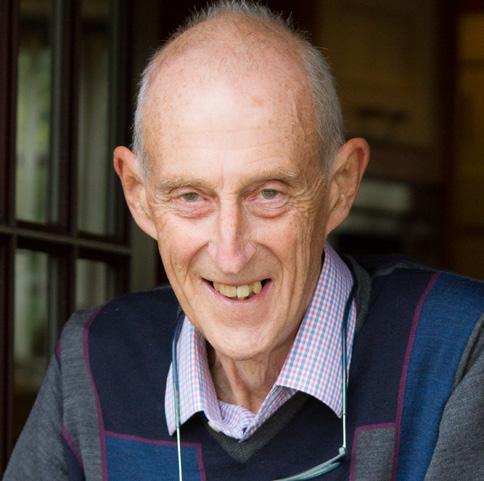
Taylor (School House, 1959-1963) 1946-2021★
Although born in Torquay, Philip’s early years were spent at West Moors, near Bournemouth. In 1959 he was sent to boarding school at Exeter, but in the summer of 1962,

(Goff, 1973-1980) 1962-2025
Pete Townsend had a quiet strength, an absurdist sense of humour, and a deep Christian faith that, he said, first crept up on him over a few weeks as a teenager. These things stood him in good stead throughout his life.
Pete formed friendships while at school that
Miles Butler (School House, 1966-1971) 1952-2025
John Heywood (Raleigh, 1949-1955) 1937-2025★
when only 16, his father died suddenly. Philip found this very hard to cope with and, although he returned to Exeter to start his A Levels, he did not complete them. Back home he took a job in a local restaurant which he thoroughly enjoyed, especially the day he met the Beatles when they came in for lunch.
In 1964 he began a four-year National Diploma in Catering and Hotel Management at Bournemouth Catering College. After graduating in 1968, he joined Myddleton Hotels as a management trainee at the Savoy Hotel in Bournemouth, before becoming Manager of the Sackville Hotel in Hove in 1970 at the age of 24. That same year he married Vivienne, whom he
endured for life. He shared accommodation in London with Exeter School friends, Mark Brend (1974-1980) and Nick Townsend (1973-1980 – no relation), until he met and married Jennie in 1994. A few years later Pete and Jennie moved to Devon with their two children, Chanan and Milo. They lived in Willand, not far from Pete’s early childhood home on the family farm in Bickleigh.
Easily sparked with family or friends, Pete’s sense of humour would show in a low-key, almost guttural remark or two, followed by quaking and emergent chortling. It would infect the room. He was an exceptionally good laugh.
Pete was an avid archivist. From his teenage years he not only wrote a diary but kept multiple items (gig tickets, programmes, cuttings, etc.) that supported the record. Music was a huge interest, from Led
had met in 1966 at Bournemouth College. In 1973 Philip went on to manage the Balmer Lawn Hotel in the New Forest and became a proud father to a daughter, Katie, in 1976. In 1978 he moved to the Linton Lodge Hotel in Oxford, where a second daughter, Amy, was born in 1980. That year he also opened the Ladbroke Mercury Hotel in Bracknell and was awarded the prestigious accolade of Master Innholder. In 1983 he moved to Edinburgh to manage the Ladbroke Dragonara Hotel. Constant moves prompted Philip and Vivienne in 1985 to buy their own small hotel in Sheffield, which they ran together until 1999, before moving to Hope to run Underleigh House, a
Zeppelin through punk to grunge. He catalogued the numerous bands in their various line-ups that formed in the late-1970s in Exeter. He had a good voice and sang both as a chorister in Exeter Cathedral and in one of those bands. Later, Pete helped lead music in several churches, singing and playing guitar.
Pete’s record-keeping reflected an incredible capacity to be organised and across all the detail. His professional life was as a quantity surveyor, and this suited his abilities perfectly. Among other projects he worked on the Jubilee Line extension.
Pete was diagnosed with Parkinson’s disease in 2001, when Chanan and Milo were still young. Obviously, this was a shock and a great challenge – for Pete and everyone close to him. But he faced the future with courage and quiet dignity.
successful, award-winning B&B, in semi-retirement.
Philip had a great love and knowledge of music, particularly pop from the 60s and 70s, owning his own jukebox since the mid-70s and winning Radio 2’s Pop Master quiz in 2010. He was also keen on amateur dramatics, a passion that began at Exeter School with his first role as Sneer in Sheridan’s The Critic and continued with local theatre groups in later years.
Diagnosed with pancreatic cancer in 2016, Philip outlived a prognosis of 6 to 12 months, surviving over four and a half years with dignity and determination. He died peacefully at home the day after his 75th birthday.
Vivienne Taylor, Philip’s wife
He continued to work until 2009. His Christian faith took a knock when he was diagnosed, but he came through this and it subsequently remained strong to the end.
As Pete’s health gradually declined, he had support from church, friends, and above all Jennie and his family. Pete remained in touch with several Exeter School friends until the end of his life: Mark Brend, Pete Davis (1967-1978), Dave Hodges (1974-1980), Dexter Perrott (1973-1980), Steve Petherick (1971-1978) and Nick Townsend. He died at home surrounded by his family.
Pete is very greatly missed.
Written by Jennie, Pete’s wife, their children, Chanan and Milo, and Exeter School friends, Mark Brend, Dexter Perrot and Nick Townsend.
“Tony”
(Raleigh, 1949-1955) 1938-2026
(Goff, 1957-1965) 1946-2026
Stephen died peacefully at Royal Devon and Exeter Hospital on 31 January. Stephen was a keen member of Exeter School’s shooting team and went to Bisley with the sport. He leaves his twin Stephanie, sister Heather, daughter Heleena, son Dominic and grandchildren. Much loved and missed.
Philip Woolley
(Crossing, 1977-1983) 1965-2026
You will, perhaps, be saddened to hear of the passing of Phil Woolley, who died suddenly at the end of 2025. Phil was a great guy. We somehow progressed over
1952-2024
our school time from mocking his cello playing, dodgy elbow skin, nearly burning down the CCF hut, to high speed teenage fun and games in the back of an open flat bed van at midnight on the road to Stoke Canon, and while other friends came and went, he was a mate for good.
As I headed off to Oxford in defiance of my impoverished scouser heritage, Phil having blown his A Levels started work behind the counter at Lloyds Bank in Sidwell Street. Moving to the High Street he began dealing in securities and this would lead to him joining James Capel stockbrokers in London, before moving to New York, then Hong Kong and finally Singapore, by which point he had made enough money to retire by the end of his twenties.
Before long Phil decided he wanted to realise his plans to earn a degree in mining engineering and headed off to Camborne School of Mines. The “old man” of the course, Phil’s dodgy A Levels didn’t stop him winning a first class degree and multiple prizes, before he signed up to mine copper in Mount Isa, Queensland. This was the height of
Graham, known to some as ‘Bryl’, came to Exeter School from Stoke Hill Junior in 1963, leaving in 1970. He was in the school choir and sang a solo in Exeter Cathedral. He played hockey at school and carried this on into the RAF who he represented in goal at the Olympic Stadium in Berlin. He had joined the RAF in a clerical role in 1972, retiring from the computer department as a Squadron Leader in 2001. Graham’s career with the RAF took him to the tiny Indian Ocean island of Gan for 9 months, then Germany, Oman during the Gulf War and Denmark where he played squash for a local team. After the RAF he continued working in computing in the private sector.
He is survived by Gill, his wife of 46 years, and their three children Greig, Giles and Gemma.
Nigel Walkey (Collins, 1963-1970) and Chris Tett (Drake, 1963-1970), Graham’s friends
the minerals boom, and within a few years, Phil had made more ££’s than he knew what to do with, and a decade ago he retired again to Otterton.
Replacing golf with photography, Phil showed great talent and was on a photography field trip when a sudden onset cardiac problem cut short his life at the age of 60.
Phil was the godfather of my son. To undershoot A Levels, make his fortune twice over in two different professions, but still be confused by his Mum for a sack full of rubbish on her front lawn when he had collapsed drunk, Phil was a legend. To oversee my chronic illness for 45 years and be outlived by me would have made him laugh himself stupid; and to end up having his wake in Exeter Golf and Country Club, the same room where we attended dodgy discos as 15-yearolds, had a charm all its own. “Do you remember when…” Yes, and I always will. If you had shared with Phil at 18 how his life would turn out he would never have believed you.
Paddy Storrie (Daw, 1976-1983), Philip’s friend
We are very grateful to the following individuals who made gifts to the school between April 2025 and the end of March 2026, or who have remembered the school with a gift in their Will. It is no exaggeration to say that your support changes lives – thank you.
David Mahoney (1942-1946)†
Anthony Robson (1945-1949)†
Malcolm Brook (1949-1954)
Michael Fermor (1951-1956)
John Jago (1949-1956; staff, 1966-1996)
John Imlach (1950-1957)
Ian Tweedie (1952-1959)
Neil Downes (1953-1960) and Mary Downes
William Finnie (1956-1961)
Richard Spiller (1956-1961)
Gordon Twinberrow (1957-1962)
Nigel Mansfield (1958-1963)
Peter Wilkinson (1953-1963)
Dair Farrar-Hockley (1960-1965)
Robin Trewartha (1958-1965)
Richard Barrett (1957-1966)
Robert Johns (1960-1966)
Alex Leger (1958-1966)
Michael France (1962-1968)
Julian Brandling-Harris (1962-1969)
Gordon Seward (1963-1969)
Martin Smith (1963-1970)
Michael Bevington (1965-1972)
Jon Spencer (1967-1972)
Nicholas Treble (1966-1972)
Anonymous (1964-1972) and spouse
Tim Dashwood (1968-1973)
Nick Hearder (1967-1973)
Matthew Towill (1968-1973)
Anonymous (1966-1973)
Chris Bush (1963-1974)
Muriel Ellerington (1971-1974)
Giles Emerson (1964-1974)
Mark Lightowler (1967-1974)
Ian Miller (1967-1974)
Anonymous (1969-1974)
Paul Harrison (1968-1975)
Paul Thomas (1968-1975)
John Wheeler (1964-1975)
Stephen Hodder (1969-1976)
Martin Stone (1969-1976)
Peter Hutcheson (1970-1977)
Nick Brown (1971-1978)
Richard Gilpin (1974-1978)
Andrew Hayward (1971-1978)
Steve Hardwick (1968-1979)
Paul Beckett (1973-1980)
Andrew Bulley (1969-1980)
Richard Pidsley (1973-1980)
Steve Perring (1977-1981)
Stephen Chester (1976-1982)
Emad George (1976-1982)
Peter Kumik (1976-1982)
Fred Mayall (1971-1982)
Peter Pereira Gray (1974-1982)
Ian Rosevear (1975-1982)
Duncan Sankey (1976-1982)
Alastair Ward (1977-1982)
Wendy Barratt (1982-1983)
Charlie Cleverly (1981-1983)
Eddie George (1977-1983)
Ian King (1977-1983)
Jonathan Webber (1978-1984)
Tony Pinn (1978-1985)
Tony Venn (1982-1985)
Philip Waggett (1979-1985)
Mark Wells (1979-1985)
Darren Welsman (1980-1985)
Paul Bolden (1976-1986)
Edward Dunstan (1980-1987)
Matthew Stibbe (1982-1987)
Paul Darnley (1982-1988)
Rob Foale (1982-1989)
Ross Saunders (1984-1989)
Anonymous (1987-1989)
Jasper Westaway (1983-1990)
Sarah Wood (1988-1990)
Toby Quartley (1986-1992)
Daniel Smith (1989-1993)
Paul Cann (1987-1994) and Kirsty Cann
Gareth Croft (1987-1994)
Julian Philpott (1992-1994)
Luke Roberts (1989-1994)
Caroline Burrage (1993-1995)
Ash Retter (1985-1996)
Richard Macnair (1992-1997)
Tim Creswick (1996-2002)
Alex Mortimore (2000-2005)
Hugh Collins (2005-2010)
Parents
Vasile Badescu and Lucia Popescu
Nicholas and Rebecca Batchelor
Raymond and Annie Bond
Ko Brodie and Hiroe Sato
Nigel Byott
Xiuyun Cao
Anthony and Sharon Cockayne
Richard and Sarah Creek
Martina Egedusevic
Francesco Ferrari and Karen Brookes-Ferrari (staff, 2014-2021)
Michael and Lisa Gibbons
Steven and Ruth Hughes
Chris and Tina Lomas
James and Jane Maunder
John and Jennifer McMillen
Rupert and Jessica O’Connell
Ralph and Eleanor Rayner
Warren and Tracy Taggart
Nathan and Claire Tamblyn
Gerald and Ellie Waugh
Katherine White
Anonymous
Staff
David Hughes (1984-2002),
Shirley Hughes and Peter Hughes (1985-1992)
John Allen MBE (1969-2007)
Brian Moore (2000-2024)
Ailsa McGregor (2023-2025)
Louise Simpson (2020-2025)
Graham Bone (2003-present)
Miles MacEacharn (2018-present)
Ali Dunning (2019-present)
Liz Williams (2020-present)
Alice Holohan (2021-present)
Bethan Rose (2022-present)
Akemi Anjo (2023-present)
Jonny Titchin (2023-present)
Anonymous
Friends
Beverley Meeke (governor, 2005-2017)
Philip Mullins
John Mullins
Marjorie Oda-Burns
Marcus Paul
Richard Taylor†
The Exonian Lecture
The Exonian Quiz
Old Exonian Lodge No. 9000
Trusts and Foundations
St John’s Hospital Educational Foundation
Record Scholarship Trust
All care has been taken to ensure the accuracy of this list. However, if any error has occurred please accept out apologies and notify the Alumni and Depment office so that we can amend our records.

Make a gift and change a life
Contact Liz Williams, Director of External Relations, at esw@exeterschool.org. uk or +44 (0)1392 307080, or visit our website: bit.ly/ MakeAGiftAndChangeALife



“We bought and sold through Savills. Quick and discreet, the entire process was seamless.”
Fiona, recently moved with us
Contact your local Exeter office today to see how we can help you.
01392 455 700