EXETER SCHOOL
4.
12.
4.
Unusual alumni careers
8.
School news
12.
A force for good
13.
Going green
14.
Transforming lives
16.
Alumni events
18.
A passion for the ocean
20.
News of Exonians
24.
OE Club
25. Obituaries 28.
18. i
Forthcoming events
We are sending this issue of The 1633 by post to all Exonians whose addresses we have except those who have specifically requested to receive copies of publications electronically. If you would like to receive future issues electronically, then please visit the ‘supply and update your details’ page of the alumni section of the School website. Alternatively, telephone Karen Dart, the Alumni Officer, on 01392 458941. This magazine and The Exonian can be read within the alumni news pages of the School website.
@ExeterSchoolUK Exeter School Alumni Exeter School Alumni (Old Exonians)
01392 458941 | alumni@exeterschool.org.uk Exeter School Alumni Office | Victoria Park Road | Exeter | EX2 4NS www.exeterschool.org.uk/alumni This publication is produced by Exeter School and printed by Brightsea Print Group. We welcome stories for consideration. Contributions may be edited for content and length. Issue 12 Autumn 2019
2
What a start to the year it has been! We kicked off with over 80 recent leavers returning to School in early September for a drinks reception before moving on to our most successful OE Day ever a few weeks later. It was amazing to see over 200 OEs and their families visit the School. You can see more details and pictures from our latest events on page 16. We used OE Day to create our video #YourExeterSchool, which celebrates all that it means to be a part of the Old Exonian Exeter School Community. Look out for the video on our website and social media pages; it’s heart-warming and really worth a watch, thank you to everyone who took part. I am very proud to announce the launch of our Bright Futures Bursary Fund in this edition of the magazine. This fund will transform lives by helping to increase the number of bursary places for deserving children. Bursary provision is vital to the School and is something the Headmaster, Governors and I are very passionate about. We were once a school with many pupils on a bursary place through Government funded schemes; many OEs benefited from these schemes and changed their lives. You can read more about this in our feature on page 14. Whilst these schemes no longer exist, we still believe bursary places are important. We want to do more to make an impact in the city and change
lives through the great education you know Exeter School provides. I hope that many of our alumni share in our passion; you can find out more about the Bursary Fund and how to support it in the brochure included with this magazine. Finally, I am thrilled to introduce a new member of the team joining Karen and me in the Alumni Office. Marie Johns joins us (pictured above) as our Alumni and Development Assistant and will be playing a vital role in growing our wonderful volunteer programme along with many other things. Welcome Marie. Rachael Magee - Director of Alumni and Development
It was a pleasure to welcome so many OEs back to School at the beginning of this academic year for both the 2019/2020 Leavers’ Reception and then the brilliant OE Day. We were thrilled to see hundreds of alumni and their families enjoy a lovely day; thank you to everyone who attended and made it such a special occasion. It has been a busy start to the year and many of you have already volunteered your time to support our pupils, we are most grateful to all our knowledgeable volunteers who make such a difference to life at Exeter School. I am pleased that we are sharing details about our Bright Futures Bursary Fund in this issue; it’s an initiative which will allow the School to provide transformative educational experiences for more deserving pupils, I hope you find it of interest. Bob Griffin - Headmaster 2019 leavers Head Girl Beth Pittman and Head Boy Ben Harvey
3
small groups of discerning travellers on tours of one or several days. My company offers a host of different one-day themed tours, and multiday tours too, and areas that I take guests to include Devon, Cornwall, Somerset, Dorset and Scotland.
Job title: Owner and tour guide of Unique Devon Tours Can you summarise briefly what your job entails? I am a driver tour guide, and take
Job title: Environmental Consultant for Askew Land and Soil (specialising in soil science and land planning). I also work part-time as SW Rep for Surfers Against Sewage, Eco Learning and Education Advisor for Proud to be Green, and as Director of Earth Minutes Can you summarise briefly what your job entails? As an Environmental Consultant, I work as a soil surveyor and data processor, and write Agricultural Land Classification reports. With this, I specialise in grading land to ensure soil is managed sufficiently for rail, highway, residential and renewable projects. What is a typical day like for you? My week-day regime largely varies having both office and site work. I also travel a lot, so a typical day for me solely depends on the current
4
What is a typical day like for you? Every day is different, but my latest tour gives you an idea. I picked my guests up from their hotel then we drove to Tintagel to visit the castle. We headed to Port Isaac, had a pub lunch and then we headed along the coast to see some of the beautiful scenery. I dropped them to their hotel in Cornwall and over the next few days we explored places of interest in the very west end of Cornwall, before heading back to Devon for a couple
more days of touring. How did you get into your job? I came up with the idea when I was about 10 years old, but never did anything with it until later on in life. At the age of about 40 I decided to return to my pipe dream, and set up my company. I don’t have any specific tour guiding qualifications, but I do have the attributes to be a tour guide, and work and life experience that I’ve gathered along the way has proved invaluable to the success of my business. Twice I’ve made it into the final of the Wanderlust World Guide of the Year Awards, and last year was voted the Top UK Guide. I’ve certainly found my niche in life!
project that we’re working on. I work on my other roles in my spare time and during weekends. How did you get into your job? After my Geography (BSc) degree, I applied for a Junior Environmental Consultant role and have worked my way into the role of an Environmental Consultant after a year of fulltime employment. I also gained work experience during my A Level and degree with BBC Countryfile and Original Style, which ensured I could branch my environmental research into more creative sectors (such as film production) which has benefitted my other roles too. Was there anything you learnt at Exeter School that you think has helped you in your career? Exeter School encourage me to work hard academically as well as to stay proactive with getting involved in
extra-curricular activities. So, this definitely taught me how to manage my time efficiently so I could work in multiple employment, voluntary and creative sectors at once.
Job title: Survival Instructor and Wilderness Guide for Survival School Ltd Can you summarise briefly what your job entails? The usual office work, but the main emphasis is the teaching of ancient skills learned from our ancestors in woodland and wilderness environments. I also
Job title: Professional Athlete (Cricketer) at Somerset County Cricket Club Can you summarise briefly what your job entails? It entails playing a lot of cricket (!) during the summer months. We play in a variety of competitions, being 20/20, 50 over and championship competitions. Over the winter months my job can look very different or very similar. Quite commonly professional cricketers will travel to warmer climates to continue playing cricket. Or the alternative involves lots of fitness and strength and conditioning alongside indoor training in preparation for the upcoming season. What is a typical day like for you? On a typical playing day I would be at the ground around two hours before the start of play to physically prepare and practise. I would then play the day of cricket with one or two breaks throughout the day. Then I’ll focus on recovery. Rehydrating and eating well alongside a trip to the pool or a stretch to ensure physical recovery.
study experimental archaeology, lead expeditions and work in the media, specialising in radio, TV and magazine articles.
University but have been running my own company (Survival School Ltd – www.survivalschool.co.uk) for over two decades.
What is a typical day like for you? Most days are spent either teaching bushcraft and archaeological skills or researching them. No two days are the same, but as soon as I can get out of the office then it is down to fire lighting, buckskin shirt making, shelter building and foraging from the hedgerows.
Was there anything you learnt at Exeter School that you think has helped you in your career? Nearly everything I learned at school I use on a regular basis. Latin names for plants, Chemistry for fire lighting and water preparation, French for travelling, English for teaching, Maths for accounts, Physics for constructions of woodland shelters and so much more. Perhaps the best things to come from my time at Exeter School are an appreciation of people, fun in every possible situation and an understanding that no matter what people say, education is the best possible evolution of humans anywhere on the planet.
How did you get into your job? I learned my trade from working with exceptional ethnographic specialists from across the world. Whether they are hunter-gatherers from Borneo or nomadic tribesmen from the Sahara, I’ve tried to absorb as much of their skills, knowledge and lifestyles as possible. I have just completed my Master of Arts in experimental archaeology at Exeter
The winter looks very different. I would arrive at the county ground for a conditioning session which could be running, cycling, swimming or rowing. I would then have some downtime and prepare for a gym session in the afternoon. After I would catch up with the Physio briefly. How did you get into your job? It was a very gradual process. Starting from Junior School cricket, into men’s cricket and academy cricket followed by a contract. In all honesty it was a moment I was surprised at, but overwhelmed with joy as I knew that all my hard work over the years had paid off. Fortunately I haven’t had to do any qualifications at all for my job. Although there are many optional courses you can do around cricket to be involved such as coaching courses, sports analysis and physiotherapy.
the most valuable learnings I have taken from Exeter School are the social skills I developed whilst I was there. I learnt communication and public speaking skills which aid me on and off the field. Also leadership development from my senior prefect role and throughout my sporting career through school has helped me with captaincy and other roles with the cricket club.
Was there anything you learnt at Exeter School that you think has helped you in your career? Over and above any qualifications,
5
Job title: Driver for Sporting Bears Motor Club Can you summarise briefly what your job entails? I don’t receive any funds for what I do, every single penny we raise goes directly to children’s charities across the UK. I am a driver with the Sporting Bears so I am responsible for taking
Job title: Risk & Security Manager, Institute for War & Peace Reporting Can you summarise briefly what your job entails? We have offices or programs in about 30 countries, supporting journalists and citizen activists in the pursuit of universal freedom of expression. Nearly all of them are affected by conflict and/or oppressive governments. It is my job to keep our staff and partners as safe as possible while still being able to do their job in difficult and dangerous circumstances. What is a typical day like for you? I try to keep on top of the situation in all our countries, and will spend a good portion of the day reading reports from our offices as well as news reports and more in-depth analysis from geopolitical news services. I’ve recently conducted an organisation-wide risk analysis trying to identify all the risks we face and how to deal with them – this ranges from pretty dry office insurance to being shot or kidnapped. I’m also
6
children and families for “Dream Rides” in my classic minis. I also help load the vehicles for their rides and advise people about the best car to go out in.
safety concerns and our route, then we begin our rides with a tireless team on the booking desk and drivers whizzing in and out all day with smiling passengers.
I compete in motorsport with my 1969 Morris Mini van and have raised money with that as well.
How did you get into your job? I approached the Sporting Bears at Carfest. In order to obtain the motorsport positions I had to complete various driving qualifications such as an ARDS test and a motorsport licence. It is also imperative that you work on the vehicle beforehand and keep it in tip top condition.
What is a typical day like for you? A “typical day” depends on what sort of event we are running: Dream Rides or Miles for Smiles. Dream Rides are fundraising ventures where we take out passengers after they have donated for a ride. Dream Rides have raised over £2 million for children’s charities. Miles for Smiles involves taking out the families of ill children, they are a totally inclusive event where we can take all children regardless of their disability; we bring winches and a range of vehicles to suit everyone. We always begin the day with a driver’s briefing so we can ensure that everyone is clear about
Was there anything you learnt at Exeter School that you think has helped you in your career? Public speaking is the most valuable skill I learnt at Exeter School and is a tool I use daily. It is one of the most valuable skills a person can possess.
rolling out an app that helps staff stay informed about dangerous situations near them – it’s really important to use the best technology to achieve business aims and part of my job is keeping on top of that. How did you get into your job? After Exeter School I read War Studies at King’s College, London before joining the army as an officer. I spent five years in the army before doing some project management work and then went into humanitarian disaster relief, responding to things like the Ebola epidemic in Liberia. I decided to take a Masters in Photojournalism (a longstanding interest) and then found myself here, so it’s a culmination of all my different experiences. I think having a range of experiences and skills is really important, it makes you more employable. For example if you’re an engineer, great, but if you’re an engineer who speaks French, you’re more employable, and you’re also a water and sanitation
expert? You can work all over Europe and large parts of Africa. Was there anything you learnt at Exeter School that you think has helped you in your career? Lots! I think I learned a lot about personal responsibility at Exeter and taking a big part in CCF really set me on a path to join the army, and it’s changed my life.
off-shore Marine Parks and Deep South.
Job title: Extended Range Trimix Instructor for Blue O Two Worldwide Dive Travel Can you summarise briefly what your job entails? Running, guiding and instructing onboard liveaboard diving boats based in the Red Sea. We cover the majority of the Red Sea all the way from the Northern Wrecks, Straits of Tiran and all the way down to the
Job title: Trainee Commercial Airline Pilot, Aviation South West Can you summarise briefly what your job entails? I’m training to be a Commercial Pilot at flight school, based at Exeter Airport. I have already completed the first stage gaining my Private Pilots Licence and I’m now in Groundschool sitting 14 exams in the next six months. What is a typical day like for you? At the moment my days are pretty structured which is unheard of in the aviation world! I head into Exeter Airport for 7.30am and take my seat for the next eight hours. This is the only written exam stage of the course with the rest of it more hands on flying. I am studying 14 different topics from human performance to engines and aircraft general knowledge. Groundschool is on another level altogether in terms of intensity from university! During July and August I spent most of my time up in the sky
What is a typical day like for you? I start at 5.30am to prep paperwork and conduct checks for the first dive. We brief the guests and get in the water by around 7am. I can be diving anything from 60m cargo-ship wrecks to shallow reefs and drop off walls packed with coral and sharks passing by. After I will usually be blending Nitrox and Trimix gases for the technical divers in preparation for the next dive. We dive again at around 11am and at 3pm. Conditions permitting, we will also conduct a night dive and then I get on with completing all the day’s paperwork! How did you get into your job? What made me stand out for this position was my experience of working as a diving instructor in the UK for two years. In the industry there is a saying: “If you can dive in the UK, you can dive anywhere”.
If you have trained in the UK in some of the most dark, hostile and challenging conditions, diving anywhere else is going to be easier. I am also qualified to guide and teach specialised technical decompression diving. I wanted to work in Egypt so sent my CV to every company I could find within the Red Sea. I must have sent it to over 50 and I only heard back from Blue O Two who had a vacancy for a technical instructor. My experience of UK diving, technical qualifications and high standard of training made me very employable despite my young age for such a role. Was there anything you learnt at Exeter School that you think has helped you in your career? I can say that the self discipline and communication skills taught to me at Exeter School have prepared me to deal with the demands and requirements of people within a high risk, high stress work environment.
as part of my hour building so I took the opportunity to visit Wales, the Isle of Wight and Land’s End a few times. How did you get into your job? Aviation is in my blood, my father is a retired Virgin Atlantic Captain and my mother a former British Airways Cabin Crew. I had always enjoyed joining my dad on any trips I could when I was growing up. During my studies in Economics at Queen Mary, University of London I was successful in applying to the University of London Air Squadron. It can be a long journey to finally get on a course like I’m on. Flight schools are not cheap and can cost anywhere between £60,000 to over £120,000. Gaining experience in leadership, decision making, working under pressure and being able to multitask efficiently are all key skills to becoming a pilot. Being able to think outside the box and the ability to work as part of a team are also imperative.
Was there anything you learnt at Exeter School that you think has helped you in your career? At Exeter School you’re very lucky to be able to join the CCF where the RAF is a great addition to your CV if you wish to go into aviation. The amount of extracurricular activities available is without doubt a fantastic opportunity as it really shapes you as a person. After all, if you’re sat next to someone in the flight deck for 12 hours you want to have something to talk about!
7
1.
2.
3.
4.
5.
8
6.
1. Radio One podcast for Young Enterprise team Exeter School Lower Sixth Former Eddy Lister featured on BBC Radio One’s podcasts, Life Hacks, talking about his Young Enterprise (YE) team’s Mindfulness card game. The YE team devised the game as a way of tackling anxiety and entrepreneurial Eddy contacted the radio station as a way of promoting his product. Lower Sixth Formers James Broderick and James Heard joined YE Advisor Ian McGregor on the trip to BBC Broadcasting House, London, where Eddy was interviewed by broadcaster Katie Thistleton. 2. Legato in Liguria Thirty-six pupils, five staff and two bus drivers made the 26-hour journey to Liguria for the biennial Music Tour. The group enjoyed sightseeing, singing and swimming as well as copious quantities of ice cream. 3. Welcome to the jungle 24 Upper Fifth and Lower Sixth pupils enjoyed the experience of a lifetime, completing an expedition on the stunningly beautiful island of Borneo. Diving, trekking and wildlife spotting: the two weeks were packed with beautiful weather and amazing moments. The tour complemented their Geography and Biology studies. 4. A double celebration Pupils, parents and staff are celebrating an excellent set of A Level and GCSE results. At A Level, 35 pupils scored three or more A* or A grades, with almost a quarter – 21% - of all results at A*. 54% of all grades
were A* or A, with 81% at A*, A or B. At GCSE, almost three quarters of all grades were 9-7 grades. 37 candidates scored ten or more 9-7 grades and 67 candidates scored eight or more A*-A/9-7 grades. 5. Exeter School Speech Day 2019 Exeter School welcomed Guest of Honour, the founder of Surfers Against Sewage, Chris Hines, to its annual Speech Day. Chris gave an insightful talk on how he began campaigning to improve our coastlines, inspiring pupils, parents, teachers and governors on the evening of 19 September. Chris spent time with Junior School, Senior School and Sixth Form pupils, including the School’s EcoSoc, answering many questions and enthusing them about ways they can make a difference. 6. Learning the lingo Ross Saunders (1984-1989) discussed his work in television advertising with Saatchi & Saatchi in the latest careers talk for Modern Languages pupils. Having studied German and Russian A Levels at Exeter School, (the latter he completed from scratch in two years), he went on to take both languages at Oxford, as well as studying Czech. And Czech was the key to him being offered a job straight from university in advertising in Prague, and his subsequent career creating TV commercials for household brands in several countries. He spoke of the creative side of his work, taking the skeleton of an idea for a commercial from a company, and finding ways to make it a reality which will increase sales.
9
7.
8.
10. 9.
11.
10
12.
7. The changing face of work Ed Walker (1999-2004) gave a talk to the Crossing Club about his work for Deloitte and the changing face of the workforce, workplace and work itself. He highlighted the speed at which technology has advanced over the last century and how it will continue to advance at an accelerated rate. This led into the future of Artificial Intelligence and which areas of work may soon be carried out by robots. A very topical discussion followed as well as some excellent questions. 8. Heads together Pupils and staff welcomed Louise Simpson for a flying visit from Brazil in October following the HMC Conference. She joins the School as the new Head in September 2020 following Bob Griffin’s retirement after 17 years. 9. Work placement in Beijing Sixth Former George Heard enjoyed the opportunity of a lifetime on an all inclusive work experience placement in China thanks to the generosity of leading educational consultant Julian Fisher (1993-2000). He spent three weeks in Beijing, working on a variety of projects, learning about the local working environment and understanding how entrepreneurs are succeeding in today’s China. This is the first work experience placement of its kind offered to a pupil by one of its alumni and Sixth Formers currently studying Business Studies or Economics were invited to apply for the opportunity.
Studies pupils that she approached him for a placement resulting in an eye-opening summer placement at Orbex, Europe’s leading space launch company. “Chris took work experience to a new level as he gave me a golden ticket into the business world. International travel, a board meeting, networking with business superstars and the exploration of a space launcher factory floor, are only a few aspects,” said Imogen. 11. Sports sponsorship for school Exeter School sports teams are delighted to be supported by leading businesses from across the county. The 1st XI girls’ hockey team is sponsored by Westerly BMW; Exeter Jazzercise - Exeter Fitness Studio is supporting the 1st VII netball team; and O’Neill’s Sportswear is sponsoring the 1st XV rugby team. 12. Poet laureates for Exeter Junior School Exeter Junior School ran a poetry competition in honour of National Poetry Day from which two Poet Laureates have been announced. English and Drama Coordinator Mrs Pettet was delighted to receive over 160 entries tackling the theme of ‘Truth’ and introduce the very first Exeter Junior School Poet Laureates from Lower Two: Monty Houghton and Sienna Mitchell.
10. Out of this world! 2019 leaver Imogen Goodfellow was so interested in alumnus Chris Larmour’s talk to A Level Business
11
sorts of events and we try to use this community as a force for good in anyway we can.
Entrepreneurial alumni Myles Hopper and Giles Humphries, who co-founded eco friendly meal box company Mindful Chef, launched their first ever UK wide Coastal Clean event on 14 September 2019. The event was designed to encourage everyone to get involved and help clean up a beach near them. We caught up with our alumni to learn more about it. Tell us a bit about the event and how it all worked? On 14 September we decided to put our community to the test. We asked customers up and down the country to become local beach champions and hold a beach clean of their own where we sent them everything they would need. Why did you want to do this? Being from Devon and spending many summers on the beach, we know only too well the increasing problem with plastic. We are a proud B Corporation - a global movement of businesses trying to change the way companies operate. Rather than focussing solely on profit we work towards the betterment of people and the planet too. We have an amazing community at Mindful Chef who want to get involved in these
12
How did the first time go and will this be an annual thing? The response was incredible! We had 121 beaches all over the UK taking part - from Land’s End to Scotland and lots of beaches in between. Over 1,000 people took part and we cleaned over 12,500L of rubbish. To put that into context that is the same amount as 25,000 small plastic bottles in one day. How does this fit with your main business? We send food every single week in our boxes and there are certain ingredients that have to be sent in plastic. We are working with some of the best minds in the UK to combat this and trial alternative packaging to reduce our reliance upon plastic. We’ve made some great improvements but haven’t hit our target of 100% plastic free. In the meantime we wanted to keep the plastic conversation at the forefront of everyone’s minds so decided to organise a national beach clean. Why do you think it’s important to run events like this?
It’s difficult sometimes to feel like you’re making an impact when you do things on your own. Coming together as a community to do something like a beach clean - even for just one day - can have a huge impact on the environment. The best thing since the beach clean is we’ve had hundreds of emails from participants who have sent in pictures of them continuing to clean their beaches in the following weeks. What’s next for Mindful Chef? So our next big community event is really exciting and taking place soon. Each year we run a Reverse Advent Calendar just before Christmas. The idea is really simple - you place one food item into a Mindful Chef box each day throughout December. Send it back to us, free of charge, we then distribute all of those items through our charity partners to soup kitchens, after school programmes and the homeless. Last year we donated around 20,000 items and this year we hope to donate over 100,000. We’re inviting anyone, you don’t have to be a Mindful Chef customer to take part, and have lots of schools also taking part. If anyone is interested please get in touch via hello@mindfulchef.com
Going green Exeter School is taking steps to ensure its environmental stewardship is an inspiration to the school community Pupil-led Eco Soc is a newly-formed environmental society, under the direction of Assistant Director of Music Tom Brimelow and School Chaplain Reverend Tom Carson. As part of the school’s drive to re-use, recycle and reduce waste, pupils recycle pens which are donated to Nourish, Exeter’s first zero-waste store, on Magdalen Road. All pens are given to TerraCycle, whose aim is to recycle the ‘non-recyclable’, with profit going to Topsham Primary School. The pupils also collect batteries in a similar scheme called the Big Battery Hunt. All of the school’s food waste and glass are recycled and single-use plastics have been removed from the Sixth Form vending machines and the catering provision, under the
helm of Catering Manager Michelle Hendrick. The School has introduced meat-free Thursday which started off once every three weeks but as of September is once a week due to its popularity with pupils and staff. This is in keeping with a UK Committee on Climate Change report which recommended a 20% decrease in meat consumption and an increase in the consumption of plant-based proteins. Exeter School’s new facilities are built to BREEAM standards: this is the leading industry specification, which follows a sustainability assessment method for all projects. Several years ago, the School installed solar photovoltaic panels on two buildings, and there is a solar thermal system which pre-heats the
swimming pool water; an air source heat pump heats the pool itself. The School also has a rolling programme of window improvements, LED light installation and improving insulation to reduce energy consumption, under the stewardship of Operations Manager Craig Stewart. The School’s grounds are treated with organic products, including seaweed, instead of fertilisers whenever possible. Organic waste, such as grass cuttings, is mulched and re-used where possible and when pesticides are used, they are limited to controlled areas. Electric options for maintenance equipment, to reduce fuel use, have also been introduced. Tom Brimelow said pupils and young people in general are only too aware of the dangers of climate change: “Their readiness to engage with these crucial issues is rejuvenating, as is their belief that action is not only the responsibility of governments and corporations, but falls to all of us today. I hope that the promulgation and propagation of a sustainable ethos will stay with our pupils throughout their lives.”
13
Emad George
Over the years, hundreds of pupils have benefitted from an assisted place at Exeter School, with over 580 pupils on a scholarship, bursary or one of the government schemes that were in place from the 1940s to the 1980s. These schemes meant that many pupils were able to enjoy an Exeter School education which they would not otherwise have been able to afford. It meant that the School was supporting and working with pupils from its closest communities in Exeter and these places encouraged a diverse pupil community, something which we still value and consider important today.
Eddie George
As the School launches the Bright Futures Bursary Appeal we take a look back at how these places impacted on our pupils. We chatted with four OEs who share what it meant and means to them to have attended Exeter School on an assisted place. Eddie George (1977 – 1983) was able to join the School on a scholarship following his brother (Emad) through the gates at Manston Terrace. He sees his six years at School as incredibly valuable, an experience that has continued to impact on his life well after leaving. He sees himself as coming from a “very ordinary background” and would not have gone on to lead the life he has
14
had without having attended Exeter School on a scholarship. “I wouldn’t have the friends I do now, or have gone on to the university I did without Exeter School. Those friendships will be life-long connections. Many of these connections have helped me in business as well, I see the opportunities I received as a child as life-long benefits.” Eddie studied Computer Science at Imperial College London and later went on to achieve an MBA from the Open University; he now runs his own fintech company, NewFinance. Eddie’s brother Emad (1976 – 1982) attended the School as part of the county assisted place scheme. He felt that it was more than just the academic experience that was beneficial. “It was the social and cultural experiences and environment I was suddenly exposed to that was as enriching as the academic.
Attending Exeter School doesn’t guarantee success but it certainly provides you with more opportunities to succeed. It offers you a broader vision of what you can be. Before Exeter School I certainly had lower expectations of what I wanted to do.”
captained the hockey 1st XI; opened the batting for the cricket team and played two games for Devon Schools at rugby and hockey. He was Head Prefect in his final year and fondly remembers laughter and good friends in the common room.
Emad became interested in medicine at the age of 15 and credits his teachers with encouraging him. It was a school trip to Cambridge University that inspired him to apply and he was successful in his application to read Medicine at St John’s College. Emad went on to specialise in Diabetes and Endocrinology and is currently a Consultant at Imperial College London Diabetes Centre based in Abu Dhabi.
“I’m very proud to have been at Exeter, its impact has been positive. These include some excellent teachers; school trips to Europe, specially one to Rome with Mr (“Harry”) Bagnall – the smells, sounds and tastes are as vivid today as they were when I was 15 – the CCF, the pleasure of playing in committed, talented sports teams and most importantly, making friendships which have endured.
David Evennett (1954 – 1966), who as well as being an OE, was a School Governor for 12 years and a parent, remembers his excitement at receiving an assisted place. “I had done my 11+ and found out I had been awarded one of just three places. I was amazed, absolutely delighted and proud.” David relished all the experiences that Exeter School offered. “I feel so lucky at all the opportunities I had, playing sport, being a prefect, the travel and skills; I never would have got a glider’s pilot licence without the CCF! The School taught me great values, sometimes it is the little things, politeness, discipline, that make you who you are, If I hadn’t have come here I would never have become the person I am and my children would not have experienced all these wonderful opportunities as well.” David went on to study at King’s College London and enjoy a succesful career as a dentist.
“It’s thrilling to see how the School has developed over the years and, of course, become co-ed: a place to be extremely proud of.”
Peter Gorley (1953 – 1961) was unaware of the significance of the tests he was sitting as a boy, he reflected that achieving a place at Exeter School “must have meant a great deal to my parents, and certainly opened up life to me after an urban prep school in Putney.” Peter was an active pupil, where sport was a particular passion. He played as a full-back in the 1st XV rugby team;
Peter studied Modern Languages at Fitzwilliam College, Cambridge and has had a varied career including time as an academic at London Business School and an independent consultant in training and organisational development. In more recent years Peter has indulged his passion for French wine writing a book and an e-guide about the wines and winemakers of the Languedoc region. These are just a snapshot of the hundreds of pupils who were able to attend Exeter School thanks to financial support. Government assisted places no longer exist and any assisted places are supported by the School and through generous philanthropy. We believe bursary places are vitally important, a part of our values, and allow us to continue to enrich our pupil experience. We hope to grow and sustain the amount of assisted places we can provide through our Bright Futures Bursary Fund. If you would like to learn more about this fund, please see the enclosed leaflet or contact the Alumni Office (all contact details are on the inside cover).
15
1.
3.
16
2.
4.
1. Recent Leavers Reception for 2018 and 2019 Leavers, 6 September 2019 We had a great start to the academic year with over 80 recent leavers from the classes of 2018 and 2019 returning to Exeter School for the Leavers Reception. The first event of the year was a wonderful evening where the sun finally came out and staff enjoyed chatting with our newest cohorts of alumni about their plans for university, work and gap years. We can’t wait to hear more of what they are up to over the course of the year at future alumni events. 2. OE Day, 21 September 2019 Exeter School celebrated its most successful OE Day in many years with over 200 alumni and their families enjoying the day. We were thrilled to have so many OEs back at the School, celebrating their time, enjoying tours, reminiscing over archive displays, taking a dip in the pool or trying their hand in the shooting range, not to mention sampling the best of our Exeter School catering. Attendees were treated to a range of excellent sport with rugby and hockey matches taking place across the day. Thank you to everyone who came and made the day so special, we look forward to the next one! Be sure to keep an eye out for the invite so you can book early as we had to shut bookings due to the popularity this year. Thank you to our sponsors Westerly BMW. For more photos from the day please see the School website alumni pages. 3. Class of 1989 30th Anniversary (Part of OE Day), 21 September 2019 On OE Day, we were delighted to host a large group from the class of 1989 who were celebrating their 30th anniversary. For many it was the first time they had been back to School since they left and they enjoyed special celebrations to mark the day. One attendee – Alex Graeme (1984 – 1989) – shared his thoughts on the day:
“I was quite anxious about attending the reunion, as I know others were – I hadn’t stepped foot in the School since the day I left after my A Levels. Talking to some trusted friends from School beforehand helped give me the confidence to go for it, and I went along for the day. “The reunion was far more than I ever could have hoped for. Seeing one face after another that I recognised instantly, having not seen most of them for 30 years, was quite a thing, and there were warm greetings all around. What struck me as really interesting was that whilst at School there was a very obvious hierarchy, however 30 years later we’re all equal. After the reunion those that could headed off to the pub, and the evening turned into a late one, such was the good feeling amongst us. We now have a group on Facebook with nearly 40 of us in it, and future gatherings are already being organised. It was a very positive experience and I’m grateful to the Alumni Office for the huge amount of work that they put into it. I hope the success of our reunion will encourage future year groups to get in touch with the School to run their own.”
If any other OEs would like to talk about celebrating their own milestone anniversaries, please do get in touch with the Alumni Office. 4. Exonians Edinburgh Reunion, 8 October Exeter School headed northwards for a brilliant evening in Edinburgh for our latest alumni event, joined by the Headmaster Bob Griffin and Head of Sixth Form Ali Marsh. We were delighted to have such a great crowd of Exonians from across the decades, with some of our most recent leavers from 2019 having a drink and a chat with alumni who left the School in the early 50s. It was lovely to see some familiar faces and some brand new ones too as for many attendees this was the first Exeter School alumni event they had been to. Thank you to everyone who came and we look forward to seeing you again in the future.
17
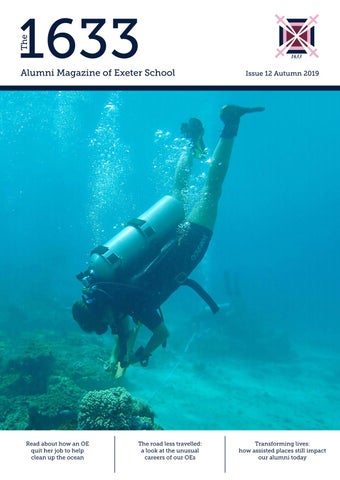
Last September Sally Chalk (2010 – 2012) quit her job as a Senior Account Executive within the advertising industry to pursue her passion about marine conservation. She spent two months volunteering with the Marine Conservation Philippines and shares her story with The 1633. The issue of sustainability and particularly the impact that plastic is having on planet earth is inescapable. We see it regularly featured in the news, see businesses trying to find ways to reduce wastage and limit the use of plastics, and are constantly
18
told of the ways we must cut down ourselves at home. It can be confusing and certainly guilt inducing and it was these feelings that drove Sally to want to learn more about the impact of plastic pollution and the health of the world’s oceans. She took a brave step to leave her job in London in order to broaden her knowledge and try to make a difference. Growing up on the Devon coast, Sally said she had always had a passion for the ocean and learnt to scuba dive when she was just 15 years old. When she was able to take the time out from her day
job she found Marine Conservation Philippines and signed up for a two-month volunteer project. Flying out to the Island of Negros Oriental she took part in daily reef surveys, sometimes diving in dangerous conditions, mangrove restorations and community projects including teaching the local children about marine life and the effects of plastic pollution. It was an eye-opening experience as Sally describes. “The fact of the matter is, what the media tell us is unfortunately the ugly truth. Our oceans really are getting contaminated and if we don’t change our habits it won’t get any better. It was heart-breaking to see the beautiful ocean I fell in love with as a child with my own eyes grossly poisoned by plastic.” Much of her volunteering was spent doing beach clean ups, which are certainly not the glamorous coastal strolls along paradise beaches you often see on social media. In the reality Sally describes, they’re tiring, hot and smelly marches picking up used nappies and dead animals among the never-ending piles of waste. Hours can be spent cleaning up the beaches only to return the next day to find them in exactly the
same state. “This is the reality of how much rubbish is really out there and how much work there is to be done. “I used to believe that the plastic leaking into the rivers and subsequently the oceans was all down to lazy people not recycling or throwing their rubbish away efficiently. But it’s much more than that. Every stakeholder in the plastic puzzle has a contribution to the issue and they all have their own obstacles to overcome.” What she found particularly shocking was the barriers large corporations and governments face in trying to be greener and reduce waste. It is something she feels is not widely communicated with the public and she only realised what great challenges there are after she spoke with the mayor of the local provenance of San José. He described a scheme he wished to impose, in which locals could bring in 1kg of washed up waste in return for 1kg of rice grains, a seemingly simple and mutually beneficial project. But the challenge lay in what to do with the waste brought in, as there was no place for it to go.
Sally shares some tips on how to cut down on plastic use, all of us can play our small part in helping to reduce wastage and damage to our oceans. “Every single one of us can adopt one small change to our daily routine to create a world of change. Simple steps can include:
• Properly disposing of cigarette butts • Buying in bulk whenever possible • Reusing food and drink containers and
Land is needed for farming in order to feed the local population and no nearby islands would take the waste for similar reasons, plus the funding to deal with the waste was just not there as any government funding was needed to improve current living conditions. This demonstrates that whilst there are willing and innovative ideas out there, the issues around reducing plastic are complex. There is certainly no single solution to single-use. After her time in the Philippines, Sally is now back in London and working for Consider which markets and fundraises for not-for-profit companies where she gets to support many charities, including some environmental organisations close to her heart. She continues to take part in protests against plastic pollution and spread the word to friends and colleagues. “What I’ve learnt and experienced during my two months’ volunteer work has seriously changed my outlook on plastic and opened my eyes to some hard-hitting realities. But it’s not all doom and gloom. I can now use my new knowledge and passion to do good for both organisations in the UK and abroad.”
• Refuse, reuse or recycle all plastics I once saw something that said “Oh it’s only one straw. Said one million people.”. It’s something that’s really stuck with me for how easy it is to think of the bigger impact doing one good (or bad) thing can do!”
cutlery
• Eliminate the use of single-use plastics (straws, cotton buds, plastic bags, etc.)
• Switch to more sustainable products (bamboo toothbrush, shampoo bars, coconut scrubbers)
19
1.
2.
3.
4.
20
5.
1. Lucy Palk (2005 – 2016) has just completed her final year at Reading University, took on the Three Peaks Trek challenge in July this year to raise funds for Action Against Hunger. Action Against Hunger is a global humanitarian organisation whose mission is to create a world free from hunger, for everyone, for good. Congratulations to Lucy for completing the gruelling challenge which saw her climb three mountains across the UK (pictured at the top of Mt Snowden) in just under 30 hours and raised over £600 for charity. If you would like to learn more about Lucy’s challenge and Action Against Hunger you can check out her fundraising page – https://threepeaks2019. everydayhero.com/uk/help-lucy-palk-raise-money-foraction-against-hunger-and-tre 2. Daniel Ahl (1981 – 1987) (pictured far right) was part of the Over 50s Great Britain Tennis Team at this year’s World Championship Competition, held in Lisbon, Portugal. Daniel, who was the number one and team captain, won three out of the five matches, and the team played and won against Denmark, Portugal and Israel, losing to Germany and Argentina. 3. Graham Skinner (1965 – 1972), Exeter School’s hockey development coach, took part in the 2019 European Hockey Championship held in Belgium during the summer heatwave. Graham (pictured left) captained his England Masters team to silver, narrowly losing the final to the Netherlands. Graham said: “Although we were disappointed to lose the final, the silver was a great achievement. Hockey offers participation at all ages and all levels, from leisure to international, junior to very senior and always in a friendly and sociable atmosphere.” 4. Mark Bendell (1979 – 1987) has been a volunteer with the Scouts since his 18th birthday and was recently awarded the Silver Acorn award. This is the second highest service award within the Scouts and is awarded for a minimum of 20 years of specially distinguished service. In practice it is usually 30 years and is subject to local nomination and national approval. Approximately 2% of scouting adults in
6.
Exeter (5 in about 300) hold a Silver Acorn or above – huge congratulations to Mark for such a remarkable achievement. Mark has previously been both a Cub and a Scout Leader and directed the Exeter Scout & Guide Show. His role is now within adult support and he has managed the Exeter Scout and Guide Shop for 15 years during which time they have returned £100,000 in surplus to Exeter Scouts! 5. Emma Askew (2006 – 2015) (who you will see in our unusual careers feature) created and released a short film entitled Breakwater. As a part time rep for the national ocean conservation charity, Surfers Against Sewage, Emma wanted a more creative way to engage people with the importance of ocean conservation and how they can help. The film, which premiered at Exeter’s own Phoenix in the summer, aims to humanise the subject of marine litter by exploring three individual case studies from different societal sectors. It investigates how humans can become desensitised to this issue and why we as humans should care about marine litter. You can view the trailer by searching for #TheBreakwaterMovement on YouTube. 6. Hugh Robjohns (1972 – 1979) was conferred as an Honorary Doctor of Technology at a graduation ceremony in July 2019 at the University of the West of England (UWE Bristol), in recognition of his contribution to the public understanding of science and technology. Hugh has been the Technical Editor for Sound On Sound magazine - the world’s best music technology publication - for 22 years. He has also contributed to a large number of technical magazines and other publications, given numerous presentations and lectures at professional trade conferences all around the world, as well as at many consumer-oriented events and exhibitions, and for colleges and universities throughout England and Wales. Hugh also continues to deliver specialist bespoke training on various aspects of professional audio to clients which have included the BBC, Sky Television, and ITN in the UK, and many other broadcasters in Ireland, Estonia, Malaysia, South Africa, Germany, and elsewhere.
21
7.
8.
9.
11.
22
12.
7. Amy Glover (2002-2009) and Rob Trobridge (20032009) On 22 June 2019, 2009 leavers Amy and Rob married at All Saints Church, East Budleigh. They met in the Fourth Form and celebrated their wedding day with many school friends with both bridesmaids and ushers as Old Exonians! After studying Modern Languages at university, Amy spent a placement year working for Champagne Jean Vesselle in Bouzy, France. She fell in love with the food and drink industry and when she returned to the UK, she joined Tesco and completed the international buying graduate scheme. She joined the John Lewis Partnership in 2016 and is currently a buyer commercially responsible for the Waitrose meat category. Rob has made his lifelong passion a career and is now a UKCC level 3 dressage coach based at his yard in Hampshire. 8. Daisy Hawkins (2011 – 2019) Well done to Blue Boy award recipient Daisy Hawkins. In 2016, Daisy started a scheme called Happy Bags: this free initiative delivers bags full of toys, puzzles and games for children in hospital, mainly in the Bramble Ward of The Royal Devon and Exeter, opposite the school. Hospital can be such an overwhelming and scary experience for many children, so the aim of Happy Bags is to bring a smile to their faces. Daisy has energetically fundraised for, made and delivered over 160 bags to date. Initially, she funded this venture herself, but she has also raised over £500 with the help of friends and family and by using the JustGiving crowd-funding site. Her entrepreneurial and resourceful spirit has also secured some generous donations from toy shops, including The Entertainer and This Is It. In the coming years, she is hoping to expand the Happy Bags scheme to other hospitals nearby. 9. Freddie Crowley (2008 – 2014) returned to Devon conducting the New Oxford Consort in September. It was part of the second edition of their now-annual choral weekend based in Chagford and Gidleigh with eighteen singers ascending on Devon from all over the country for a weekend of exciting music making in the two parishes. Proceeds from the concert were used to make a donation to St Michael’s, Chagford, and the remainder will go towards the New Oxford Consort’s future projects.
columns for SUR for many years providing sound advice based on their experience and knowledge of caring for animals. They stress they are not vets and that their advice has always been about “care and not cure”, but it has provided comfort and knowledge to many locals around them. Peter and Erny are well known in the international community for both their writing and charity work. They have had varied and exciting careers in the military, television and publishing which took them all over the world before they settled in Spain. 11. Lawrence Sail (staff 1982 – 1991) Congratulations to former teacher Lawrence Sail who has a new book of poetry, entitled Guises (Bloodaxe Books) which will be out on 20 February 2020. Lawrence has been a freelance writer for 28 years and his latest book marks his thirteenth collection of poems. His work Waking Dreams: New & Selected Poems (Bloodaxe Books, 2010) was a Poetry Book Society Special Commendation. He is also the editor of The Heart’s Granary, a selection of poetry and prose from fifty years of Enitharmon Press (2017). His publications include the anthology First and Always: Poems for Great Ormond Street Children’s Hospital, two books of essays and a memoir of childhood. 12. #ExeterSchoolteatoweltravels We are thrilled to have received so many fantastic pictures of OEs taking their Exeter School tea towel all over the world from Copenhagen to Florence to Amsterdam. The Alumni Office is running a photo competition inviting alumni to take a photo with an Exeter School Tea Towel (available from the Alumni Office) and prizes will be awarded for the most creative picture and the furthest afield. The competition closes in the New Year so where will you take yours? Share photos via email alumni@ exeterschool.org.uk or on our social media channels with the hashtag #ExeterSchoolteatoweltravels. Thank you to everyone who has taken part so far!
10. Peter Harrison (1946 – 1950) recently celebrated in his local paper SUR in Spain, where he and his wife reside. He was interviewed about providing 30 years of pet advice and support to locals. He began writing a pet advice column in 1989; he and his wife Erny were running a kennels business and becoming increasingly aware of the need to share information about caring for pets when living out in Spain in a very different climate to the UK. Both Erny and Peter have been writing
23
RS A NEW ERA ITH ALUMNI ENTE W NT ME GE GA EN Dear All,
tion outlined the inten may recall that we 13 33 20 16 in e e Th fic of Of ni on mmer editi ed the Alum ish bl ta es sly ol ho iou Readers of the su Sc ev The activities pr d Exonian Club. e majority of the th ts and er en ov ev n to wind up the Ol of ke e ta m ly it has not on e the program e as re tim at inc th to ce le ab sin and o been e Club, but has als undertaken by th munity. m co ni m alu Exonian et much more activities for the es were being m tiv jec ob ’s ub Cl e that th operate as a ittee concluded ed for the Club to ne no s r 2019 wa e The Club’s comm er th d M on 21 Septembe Alumni Office an passed at the AG s wa n tio effectively via the lu so re nsequently, a the School. separate entity. Co nsfer its assets to tra d an the Club ub Cl e tanding between to wind up th andum of Unders or the m th Me wi a alt s, de es ly oc nsultation pr reement not on ag is Th ar. School’s e ye As part of the co e th th o outlined s agreed earlier in nding up, but als wi y an h a new on ug and the School wa ro ts th se s as tion of Exonian y of the Club’s ta rit en cu es se pr d re an d r an fe trans presentatives gagement than 12 alumni re ring continued en e su or en m or of no n of tio up en e int mad ael Magee, Direct Board. This will be ould contact Rach sh e or m rn Alumni/Advisory lea to e ested or would lik eterschool.org.uk and anyone inter ions, at rfhm@ex lat Re ts ni um Al d an yment of OE Gran of Development application and pa e th le nd ni@ m ha ll alu wi to directed e Alumni Office apply should be Going forwards th mation on how to or inf d an es iri and any enqu e k mmittee who giv exeterschool.org.u ub officers and co Cl e e th th by th wi ed t re sly ag gagemen s were unanimou to expand its en All these change e as it continues fic Of ni um Al e to th their full support mmunity. co ni m alu ian on Ex
mmittee The OE Club Co t Retiring Presiden Robin Thomas – Retiring Chairman James Brown –
24
y Retiring Secretar Peter German – r re ing Treasu Chris Bush - Retir
David, who was a member of Crossing House, sadly passed away at the age of 58 after a two-year battle against brain cancer. He retained fond memories of his time and friends from Exeter School, having represented the School at all levels at rugby and hockey.
David Lancaster (Crossing House 1972 – 79) 1960 – 2019
David graduated from Reading University with a degree in Horticulture and spent most of his career with ADAS in a consultancy capacity advising farmers on considerate environmental crop management and in later years advising farms and national food manufacturers on “field to
plate” supply chain integrity and traceability. David lived in Lincolnshire and although he never returned to live in Devon, he remained passionate about everything West Country, and was a great supporter of the School, Exeter Chiefs and Exeter City. David leaves behind a widow Pat, who he met at Reading, and two daughters, Kate and Rebecca. David will be remembered with great fondness and respect; he was a true gent, loyal and committed to all he met, and a wonderful family man.
Husband of Jane for 48 years, father of four and grandfather of nine, Alan Wardrop passed away aged 74. Alan played rugby for Exeter School’s 1st XV cricket and hockey teams. He also played cricket for Devon under 19s and went on to take more than a hundred wickets for Sidmouth’s
1st team in 1965. Alan captained the team in 1981 when they were second in the Devon League and was a member of the team which won the League in 1988. A keen fly fisherman who tied his own flies, Alan was Deputy Head of Care at the West of England College for 20 years.
Dennis Smith was a boarder at Exeter School. His main sports interests were hockey and cricket. He studied accountancy and worked for Nat West and a number of commodity and investment firms in
the city. He did his national service with the RAF. Dennis married Janet in 1957 and they have a son and a daughter. Dennis retired in the mid 1990s.
Alan Wardrop (Goff House 1957 – 1962) 1944 – 2019
Dennis Smith (School House 1944 – 47) 1931 – 2019
We were deeply sorry to hear of the passing away of the following alumni: Christopher Urch: 1974-1977, John Prior: 1959-1964, Bob Horne: 1947-1953, Clive Brace: 1957-1963, Julian Piper: 1958-1964, Andrew Bray: 1962-1969, Ali O’Brien: 1975-1981, Peter Fry: 1950-1960 and William Jupp: 1947-1958 Details of alumni who have passed away, including obituaries where they have been shared, can be found on our website.
25
OE Sport OE Team: Top Row L-R Anna Starling (2009 – 2019) Jess Wright (2012 – 2019) Bottom Row L-R Emily Moudiotis (2011 – 2019) Becky Trelawny (2008 – 2019) Anna Johannson (2007 – 2018) Tabi Evans (2014 – 2019) Demelza May (2014 – 2019) Beth Pittman (2011 – 2019) Liv Ziegler-Evans (2007 – 2018) Lauren Sampson (2008 – 2019) Mollie Tettenborn (2007 – 2018)
A tough start for OEs Exeter School Girls’ Hockey 1st XI v OEs The OEs were prepared for this year’s game, attending a brief training session before the game and discussing their in-depth game plan. They started with energy and high ball pace. Pre-season training had left the 1st XIs a little jaded and they were slow to match the OEs’ movement. As the game progressed, the pressure from the School increased and Exeter gained a solid foothold. The break through
In April, I spent five weeks teaching English in rural Cambodia at the Hope Agency. The school provides English lessons for the local children to help them build on the lessons they receive at the local school. All of the teachers at the Hope Agency spoke English as a first language which meant that the quality of English taught was brilliant. I taught a range of pupils from children aged five who were complete beginners learning the phonics, to teenagers hoping to study at the English speaking universities in Cambodia. This was more challenging than I had expected, with me needing to learn
26
eventually came with Lauren Hughes scoring following a penalty corner. In the second half, the School had the lion’s share of the possession and Molly Tettenborn in the OE goal was the saviour on a good number of occasions. The OEs still retained their threat when counter attacking, but their minds were drifting to their after match entertainment and no further goals were scored. Thank you to all the OEs for returning to challenge the School. School 1 – OEs 0
how to form sentences properly. I also spent time working with one of the interpreters, who was older than me at the time which was quite a novelty; she is studying Psychology at the local university and wants to be a teacher when she graduates next year. It was really amazing to genuinely feel like you are helping the children at the school, with the majority of them living in absolute poverty due to their families being fractured by the Khmer Rouge, the genocide that destroyed much of Cambodia in the 1970s.
Teaching at the school was challenging and self-directed; being thrown in the deep end teaching a class of energetic seven-year-olds the colours and shapes on my first day and planning lessons with the other volunteers. Thanks to generous donations, the lessons followed the Oxford English teaching plan which gave great direction to our lessons. Cambodia is an amazing country, and having spent time travelling to the different provinces I have gained appreciation of the history and the hardship the Cambodian people have faced and still face. Thank you to the OE Club for being so generous with the grant they gave me!
the surgeons and anaesthetists in theatre, mainly as part of orthopaedic surgery.
Daniel Wride (2005-2012)’s medical school elective exploring trauma and emergency medicine in urban Mexico In February/March 2019 I spent a month on elective in the Cruz Verde Norte emergency clinic in Guadalajara, Mexico. An elective is a part of the final year of medical school where medical students are given the opportunity to organise a period of experience in any aspect of medicine, anywhere on the planet. I decided on Mexico because I have a particular interest in the area of anaesthetics, trauma and emergency medicine, and Mexico offered exposure to cases that I might never see again in my career. The medical placement was an absolutely incredible experience. I was able to get really hands on and involved in a huge range of major and minor trauma cases including, but not limited to, road traffic accidents, stabbings, gunshot wounds, industrial accidents, scorpion stings and much more. I was also able to assist
Medicine is certainly practised differently in Mexico, and their healthcare system faces challenges both similar and completely different to our own NHS. Many Mexican hospitals, in particular those that are governmentfunded, have issues with their supply of equipment and medicines, such as morphine (a strong painkiller that is used a lot in surgery and trauma in the UK). The use of antibiotics is also a rather different proposition to the UK: in the UK we are becoming more and more strict on when we use antibiotics, and what we use them for, because of the growing problem of antibiotic resistance. In Mexico, antibiotics are prescribed (for want of a better term) liberally. Medical student training is also structured very differently there, and students are often expected to do 24-36 hour shifts in the emergency clinic. I did a few of these and I can safely say I am grateful that UK medical students do not have to go through it! Alongside the medical experience, I learnt a new language that I had never spoken before, met some incredible healthcare staff, and made friends for life. I spent a further four weeks travelling through Mexico, Colombia and the Galapagos islands, which was as incredible as it sounds! If any prospective medical students would like to ask me anything else about the elective, or any aspect of medical school or university for that matter, feel free to email me at danwride123@gmail.com.
27
Exeter School’s Bright Futures Bursary Fund Inside this magazine you will find details about the launch of our Bright Futures Bursary Fund. This fund is already helping to support free places at the School for deserving pupils and we are grateful to all those in our community who are already supporting us, but we want to do more. Providing more assisted places to children who will flourish here is of huge importance to the School. Supporting our community is central to our values and this fund plays a pivotal role in allowing us to do this. We hope our alumni will find the enclosed leaflet of interest and consider getting involved. You can complete the form with the leaflet or contact the Alumni Office for more information. We look forward to hearing from you.
Forthcoming Events We really hope to see you at one of our events this year. We will be adding more events to the calendar and you will find all details including how to book on the School website. For any further details, please don’t hesitate to get in touch with the Alumni Office – contact details on the inside front cover. Friday 31 January
Architect Exhibition (contact the Alumni Office for details)
Tuesday 11 February
Cambridge Reunion Dinner: book via box office
Thursday 5 March
Oxford Reunion Dinner: box office opens in December
Friday 20 March
OE Quiz Night: box office opens in January
Monday 23 March
Boys’ Hockey/Football (contact the Alumni Office for details)
Friday 24 April
OE medicine, dentistry and veterinary networking evening (contact the Alumni office for details)
Thursday 7 May
OE Golf Day (contact the Alumni Office for details)
Tuesday 19 May
London Reunion Dinner: box office opens in January
Saturday 27 June
Bob Griffin’s Celebration Prosecco Cream Tea (contact the Alumni Office for details)
Wednesday 1 July
London Business Networking: box office opens in May
EXETER