FALL 2026
FIVE ICONIC EXETER CLASSES ∙ THE RESIDENTIAL SCHOOL TEACHER'S LIFE ∙ FORWARD, TOGETHER
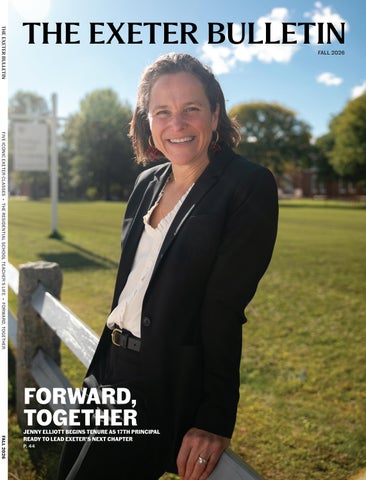
FORWARD, TOGETHER FALL 2026
JENNY ELLIOTT BEGINS TENURE AS 17TH PRINCIPAL READY TO LEAD EXETER’S NEXT CHAPTER p. 44
FALL 2026 ! CONTENTS
FEATURES
Five Iconic Exeter Classes
Our nonexhaustive, highly subjective list of courses that make an Academy education like no other. Yes, “Death Chem” is on it. Sarah Pruitt ’95
28
The Residential School Teacher’s Life
Principal Jenny Elliott walks and talks with students on the path. !. 44
“As your principal, I will work with you, day in and day out, like industrious bees in our shared hive, to carry out our mission.”
Documenting a day with History Instructor Nolan Lincoln. Jennifer Wagner
34
Jenny Elliott, principal, p. 44
Forward, Together
Jenny Elliott begins tenure as 17th principal ready to lead Exeter’s next chapter. Patrick Garrity
44
Bookmark This Page!
Cover: Principal Jenny Elliott; Photography by Christian Harrison
The new digital edition of The Exeter Bulletin — including Class News & Notes — is live! Same great stories, plus video, photo galleries, audio and more. Spot a as you read this print issue? That’s your cue: There’s more to see, hear or watch online.
bulletin.exeter.edu
2
The Exeter Bulletin
The View From Here
Volume CXXXI, Issue no. 1
5
Principal Jennifer Karlen Elliott
Around the Table
Correspondence ∙ Principal’s letter ∙ Inside the writing life with Paul Yoon ’98 ∙ Exonians in review ∙ Christie Charles ’27 shares her experience on Exeter’s program in Ghana ∙ Office tour with Director of Counseling & Psychological Services Dr. Szu-Hui Lee ∙ Associate Dean of Multicultural Affairs Hadley Camilus reflects on his decade at the Academy ∙ Exoniana
17
The Academy
Opening week of school ∙ Orientation ∙ Sean Davis ’92 puts philanthropy to work ∙ Campus news ∙ War stories with veteran Bob DeVore ’58 ∙ Exeter’s new fall sport: mountain biking ∙ Lamont Gallery fall exhibit ∙ An economics podcast from Drona Gaddam ’27 ∙ The making of a captain
Director of Communications Robin Giampa Editor in Chief Jennifer Wagner P’24
Dr. Stephanie McGrath ’94 studies dogs and aging. p.53
51
Connections
Conservation ecologist Nigel Pitman ’88 ∙ Veterinary neuroscientist Dr. Stephanie McGrath ’94 ∙ Photographer Russ Schleipman ’67 ∙ Events around the world
61
Class News and Notes
103
Memorial Minute Philippe André Thurneyssen
104
Finis Origine Pendet
Class Notes Editor Cathy Webber Contributing Editor Patrick Garrity Staff Writers Adam Loyd, Sarah Pruitt ’95 Production Coordinator Ben Harriton Designers Rachel Dlugos, Andrew Hall, Jacqueline Trimmer Photography Editor Christian Harrison Communications Advisory Committee Daniel G. Brown ’82, Robert C. Burtman ’74, Dorinda Elliott ’76, Alison Freeland ’72, Yvonne M. Lopez ’93
TRUSTEES President Kristyn A. McLeod Van Ostern ’96 Vice President Suzi Kwon Cohen ’88 Jeffrey N. Bannon ’77, Bradford “Brad” Briner ’95, Samuel “Sam” Brown ’92, Jennifer Karlen Elliott, Elizabeth A. “Betsy” Fleming ’86, Ira D. Helfand, M.D. ’67, Paulina L. Jerez ’91, Giles “Gil” Kemp ’68, Zemin “Will” Li ’90, Eric A. Logan ’92, Cornelia “Cia” Buckley Marakovits ’83, Christine M. Robson Weaver ’99, Genisha Saverimuthu ’02, Michael J. Schmidtberger ’78, Marshall A. Smith ’87, Rhoda K. Tamakloe ’01, Belinda A. Tate ’90, Seisei Tatebe-Goddu ’01, Janney Wilson ’83
THE EXETER BULLETIN (ISSN No. 0195-0207) is published four times each year: fall, winter, spring and summer, by Phillips Exeter Academy, 20 Main Street, Exeter, NH 03833-2460 Tel: 603-772-4311 Periodicals postage paid at Exeter, NH, and at additional mailing offices. Printed in the USA by Cummings Printing. The Exeter Bulletin is sent free of charge to alumni, parents, grandparents, friends and educational institutions by Phillips Exeter Academy, Exeter, NH. Communications may be emailed to the editor at bulletin@exeter.edu. Copyright 2026 by the Trustees of Phillips Exeter Academy. ISSN-0195-0207
Seniors bonded over improv-style games in the Goel Center during fall orientation. p. 19
Postmasters: Send address changes to: Phillips Exeter Academy, Records Office 20 Main Street, Exeter, NH 03833-2460
2
THE EXETER BULLETIN
SEASON YEAR
THE VIEW FROM HERE
Picture This It’s the first week of fall term and Ava Chung ’29 and Lilli Kerluke ’29 are aiming their cameras at a bookshelf in the Frederick R. Mayer Art Center. Their assignment is to experiment with the camera’s manual settings. They adjust the aperture, then the shutter speed, then the ISO, to see how their choices a!ect the outcome. Both students take photos on their cell phones every day, but Kerluke says, “I want to perfect my craft and learn more about what goes on inside the camera (more than our eyes can see)!” Closing that gap is what Adam Hosmer, an art instructor and the chair of the Art Department, loves about teaching ART 205: Photography I: Composing Concepts. “So many students come to the class not really knowing what it’s going to be,” Hosmer says. “Then they realize that they already have a fairly developed visual language when it comes to photography. They start to see themselves as artistic in a way that they didn’t before.” ●
3
Lamont Gallery | 2026-27 Exhibitions Home Sweet, Somewhere September 1 - November 21, 2026
Home Sweet, Somewhere is a contemporary exploration of the spaces we call home. This exhibition invites the viewer to see how the architecture around us becomes a vessel for memory, emotion and our subconscious. Seth Clark, The Escapist, 2025, wood, steel, acrylic, paper, brass and polystyrene, courtesy of the artist
Works by Nicole McLaughlin January 5 - March 6, 2027
MakerFest Showcase March 30 - April 16, 2027
MakerFest Showcase celebrates the work of various creative and innovative makers within the Phillips Exeter Academy community, specifically those working within its campus maker space, the Design Lab. Jaiyu Wang ’25, Flower Face, 2024, laser-cut acrylic
Annual Student Art Show April 30 - June 6, 2027
Investigation, research, risk-taking and drive; the annual student art exhibition showcases the creative outcomes from a period of highly focused artmaking by Phillips Exeter Academy students. Ari Li ’27, Differentiable, 2026, photographs mounted on foam core Jack Moran ’26, Ecosystem, 2026, stoneware and live plants
As a first generation Mexican-American, Nicole McLaughlin is heavily influenced by her multicultural upbringing and her childhood memories of visiting her mother’s hometown of Cuernavaca, Mexico. She continues to draw inspiration from Mexican ceramics, textiles and cultural traditions in hopes of showing how her life has been shaped by a collision of two cultures. Nicole McLaughlin, De Mi Vientre, 2024, ceramic, cochineal, tencel and wool
Lamont Gallery Frederick R. Mayer ’45 Art Center The Lamont Gallery is open to the public by appointment. Please visit our website to learn more and make a reservation. exeter.edu/lamontgallery | gallery@exeter.edu | 603-777-3461
Around the Table Global Initiatives This summer, 73 students broadened their horizons on experiential learning trips to five countries. p. 11
From treetop bridges to World Heritage slave castles, students and adult leaders explored Ghana's history together.
FALL 2026
THE EXETER BULLETIN
5
AROUND THE TABLE / CORRESPONDENCE
The Community Exchange Letter to the Editor Your feature (“America at 250: Why Studying U. S. History Matters,” summer 2026) was very welcome. I taught and researched U.S. history for 43 years, and Exeter largely determined my choice of lifelong vocation. In the winter of 1955, I was a lower in Frank Broderick’s world history class. He awakened in me a fascination with the past and a determination to continue studying history. He was a masterful teacher whom I have tried to imitate. As I have reminisced about Frank, I came to appreciate how exemplary the history faculty of Exeter was in the 1950s. As students, we knew that Henry Bragdon and Donald Cole were known well beyond the bounds of the Academy. Like thousands of young Americans, we read Bragdon’s textbook, History of a Free Nation. What I did not appreciate in 1955 was how prescient Exeter’s history faculty was. Before the civil rights awakening in the 1960s, Exeter’s historians anticipated the sea change in the interpretation of America’s past. In 1959, Broderick authored the first biography of W. E. B. Du Bois. In the 1940s, as an undergraduate at Princeton, Broderick worked on behalf of civil rights and the admission of Black men to Princeton. (And he had the support of Robert Wicks, dean of the Princeton Chapel and, later, Exeter school minister.) Winthrop Jordan, another
Exeter historian in the 1950s, authored the history of racial thought, White Over Black, a landmark book which won the 1969 Bancroft Prize for the preeminent publication in U.S. history. (By the way, both Broderick and Jordan were Andover graduates.) In the article, you quote Justice Willliam Brennan: “We remain imprisoned by the past as long as we deny its influence in the present.” At Exeter, Broderick, Jordan, Bragdon and their colleagues liberated us from the past. For while we discovered the authentic past in their classrooms, we were ironically and simultaneously exposed to the false: We were regularly assigned chapters from Samuel Eliot Morison and Henry Steele Commager’s The Growth of the American Republic, a widely used college-level text. These authors wrote that slaves were happy, healthy, well treated and elevated from the level of African barbarism. And slaves, in turn, gratefully revered their masters. In the classrooms of Exeter, we discovered that Morison and Commager was not history but an artifact of the American past.
Reviews of the new digital Bulletin are in! Thanks for the online edition ... makes the Bulletin better than ever. Bill Buck ’57 Online version of the PEA Bulletin is a welcome improvement. Let’s get some little movies on there! Noel Evans ’64 Good for us! Rob Abbot ’70 Very welcome development, and the digital edition is extremely well executed.! Jamie Broderick ’72 It looks great — thank you and!congratulations! Paul Sullivan ’73
Q
This online version of The Exeter Bulletin is awesome! … Having the class notes online is great.! I entered in the name of a classmate, and — BLAM! — there it was. Too cool :-) Tim Kuo ’77 Great news — this is the version I didn't know I needed! Kitty Balay ’81 Looks fantastic! Bravo! Juliet Eastland ’86 What a wonderful development! I'm quite glad for this addition and very pleased that the print edition is not going anywhere. Thank you for your excellent stewardship of the Bulletin. Natalie Kablaoui ’09
What’s the best department on campus?
Watch the video at bulletin.exeter.edu to find out.
Jack Marietta ’58
Can you guess which department Nova Seals, instructor in English, picked?
We want to hear from you! The Exeter Bulletin welcomes story ideas and letters related to articles published in recent issues. Send your remarks for consideration to bulletin@exeter.edu or Phillips Exeter Academy, The Exeter Bulletin, 20 Main Street, Exeter, NH, 03833. 6
THE EXETER BULLETIN
FALL 2026
“...gratitude, love and joy are too often underappreciated and de-emphasized as unserious distractions or unnoticed extras. I think that is a mistake. Gratitude, love and joy are expansive, infectious and deeply motivating. They serve our pursuit of excellence and learning.”
PRINCIPAL’S LETTER
The Pursuit of Betterment
O
ne of my go-to questions to members of our community that has prompted the most illuminating, crisp and aligned set of responses is: What makes Exeter Exeter? As I have pledged to be a student of this place and its people, I am eager to engage in conversations, dig into historic materials and make sense of written responses to deepen my appreciation for and understanding of what is core and enduring. As a student and teacher of history, I am amazed by how regularly the responses I have received circle back to John and Elizabeth Phillips’ 1781 Deed of Gift and the transformative vision conveyed through and enabled by Edward Harkness’ 1930 gift to the Academy. The most oft-cited replies include one or all of these phrases: Harkness, knowledge and goodness, youth from every quarter, non sibi and academic excellence. I have always been drawn to learning communities that prize academic excellence. These vibrant and magnetic communities cultivate and celebrate high standards, determined work ethic, palpable curiosity and an enduring love of learning. They attract learners who love school and are drawn to a challenge like moths to a light.
In my remarks at Opening Assembly, I shared my admiration for our community’s dedication to excellence, my worries about conflating perfection and excellence, my commitment to cultivating a context that supports their ambition and nurtures their well-being, and my perspective that toggling between the seriousness and lightheartedness of our endeavors will develop cognitive agility, stamina and resilience. My sense is that these comments tracked with how many of our community members have come to think about the dogged and persistent pursuit of betterment. It was a later comment in my address that elicited a positive reaction and sparked more subsequent chatter from students and colleagues. I o!ered that in learning communities that prioritize excellence, “gratitude, love and joy are too often underappreciated and de-emphasized as unserious distractions or unnoticed extras. I think that is a mistake. Gratitude, love and joy are expansive, infectious and deeply motivating. They serve our pursuit of excellence and learning.” This angle appears to have struck a chord, and I will take this feedback as instructive and directive. I could not feel more grateful to get to lead this community at this time. I am excited to meet and learn from the many devoted members of the extended Exeter community. Thank you for your warm and inviting welcome. This will be the adventure of a lifetime! —Jenny Karlen Elliott FALL 2026
THE EXETER BULLETIN
7
AROUND THE TABLE / INSIDE THE WRITING LIFE
Dog Days
Novelist Paul Yoon ’98 in conversation with English Instructor Emeritus Ralph Sneeden
W
“I write books because there are writers who didn’t just inspire me but shaped me and saved me.” 8
THE EXETER BULLETIN
FALL 2026
Novelist Paul Yoon'98 with his 12-year-old Labrador and muse, Oscar
You experiment with an animal’s perspective in the story “War Dogs,” which appeared in The New Yorker magazine in October 2024. Was that the first time you probed the interwoven lives and fates of people and animals? Animals, in particular, dogs, have been pacing around my fiction for the past decade or so, mainly because a dog, Oscar, entered my life, for the first time, about 12 years ago. This might sound silly, but he changed what I notice first whenever I’m out and about: the animals we coexist with, everywhere. In Etna you dive a lot deeper, making the dog our first-person narrator. The mysteries of
laura van d(n )(rg
ar, displacement, exile, the plight of the diaspora, the refugee’s journey — readers of Paul Yoon’s work will recognize these circumstances as the forces that set his stories and novels into motion. His latest book, Etna, however, is his first attempt at approaching these themes from an animal’s perspective. Our narrative guide this time is a trained military dog whose present-day odyssey in an unnamed country is motivated by a postwar search for sanctuary, an idea of home filtered through memory and trauma. One of the strangest and most haunting books I read recently was Tarka the Otter, written by Henry Williamson between 1923 and 1927, nearly 10 years after surviving the trenches of Ypres, Arras and the Somme. Like Yoon’s, it is not a children’s book. It’s a harrowing third-person narrative that traces the arc of a river otter’s life in England’s West Country. I admit that I enjoyed being subsumed into the otter’s physical world, but I was not expecting to think about myself. This is what great fiction — and boldly imaginative writers like Williamson and Yoon — can do. Normally I like to savor novels while I’m reading them, to draw out the experience, put them down for a day to steep in their worlds. But it was nearly impossible to turn away from Yoon’s mirror, where an animal’s experience, its rhythm of violence, survival and poignancy is a heartbreaking commentary on humanity too. Frank Bruni underscored this recently in The New York Times, steering his weekly editorial conversation with Bret Stephens directly to Etna as “a gorgeous reminder of our ability to look searingly and soulfully at who we are and who we’ve become.” I suspect this is why the critics’ and public’s (even non-doglovers’) reception of the novel has been panoramic, fierce and enthusiastic. I caught up with Yoon as his book tour/launch was winding down, and he was preparing to start his second year as an assistant professor at Williams College.
communication and distance we had to imagine in “War Dogs” are pulling the sled, if you will; they are the lifeblood of this new novel. What tilted you toward committing fully to this project? Even though I never really considered myself a “dog person,” Oscar has become one of my best friends, and so I suppose it was inevitable I would eventually go “full dog.” But I wasn’t actively considering it for a longer project until I saw articles about organizations in Ukraine that re-enter areas that have been decimated by bombs to try to save as many of the animals left behind as possible. Reading about those heroes, something inside of me broke. It can be a beautiful thing: that we humans are at the center of this stage called life. But I think especially in the past few years, as I read about, and witness, how we treat each other and this world, and as the world enters one war after another, I felt a real human fatigue; I really needed a break from humans. I started to wonder what would happen if I pushed us aside on the stage. And I happened to look down at my 12-year-old, 75-pound Labrador’s paw on my lap, and things started to take shape from there. I noticed that you cite John Berger’s book King as an inspiration in the notes section of Etna. I recall that Berger’s work has fueled your aesthetic and your writing life — the Into Their Labours trilogy, Lilac and Flag, specifically. I’m also thinking about his influential 1977 essay “Why Look at Animals?” which addresses the diminishment and exile of animals. Other than its being a story about a dog, what is it in King and perhaps across Berger’s work that you’re channeling, paying tribute to, responding to? Once in a while, a writer just hits you, you know? It’s like they found some secret window into your heart and you feel everything. And Berger did that for me, in my early 20s. I love how resilient his characters are. No matter the circumstances, they persist and endure and fight and find moments of joy. I also think Berger was one of the first writers I encountered in adulthood where there was often a magical element in the work: A ghost could wander into the story and the matter-of-factness of his prose style —this is how it is, dear reader! — allowed me to fully commit to the world. Or a novel could be narrated by a dog and you’re fully in it. I also love his love of the natural world, and the genuine heartbreak he was able to capture in terms of how we are actively destroying it. I was thinking of all this while writing Etna. I write books because there are writers who didn’t just inspire me but shaped me and saved me. Even though I never got a chance to meet him, I wanted to acknowledge what his writing did for me: He made me want to be a better human. In the same way that having Oscar in my life makes me want to be a better human. Your personal essay about Oscar in Alice Hoffman’s anthology (The Best Dog in the World: Essays on Love) was really moving … and also a flirtation with a new genre, nonfiction.
Paul Yoon'98
It’s an essay about him, but it’s about you, too, your relationship with your parents. Did writing Etna give you permission to try something new, or was it the other way around? It was the other way around. I think writing nonfiction for the first time, weirdly, gave me the courage — or opened a door — to try something totally new to me. I don’t really write nonfiction. I love reading it — and I love reading your essays, Ralph — but I have no interest in writing in that genre. When I build a story, my go-to is the realm of fiction. But Oscar has always been a deep mystery to me — and with that has come deep love — and so when I was asked to contribute to that anthology, I gave it a shot. What else came from opening the door to nonfiction? Trying out that new form gave me the courage to try another new form, which was creating an animal narrative — or a narrative that completely repositions point of view. One that, I hope, nudges us and says, “Hey, humans, stop and look around.” A narrative which, I have to say, felt insane even as I was writing it. Who would want to read this? Would they find value in this? I truly believed in this project but I was definitely scared that I had leapt too far — that no one would take it seriously, even though I was taking it very seriously. But I think in that fear and insanity, there was a danger in what I was building that felt raw and real and mysterious and creative and inspiring. And so I kept at it, with Oscar asleep beside me on the couch, every afternoon, until I finished the book. –Ralph Sneeden has written two books of poetry and a collection of essays (The Legible Element), and has published new work in The Sewanee Review. He taught English at the Academy from 1995 to 2022. FALL 2026
Etna is Paul Yoon’s sixth work of fiction. His books have received the Young Lions Fiction Award, NPR Best Book of the Year and the Story Prize. Yoon is also a recipient of a Guggenheim Fellowship and an Award in Literature from the American Academy of Arts and Letters.
THE EXETER BULLETIN
9
AROUND THE TABLE / WORKS
Exonians in Review
The latest publications, recordings and films by Exeter alumni and faculty When We Walk By: The Workbook: A 30-Day Guide to Understanding Homelessness and Becoming Part of the Solution Don Burnes ’59, with Kevin F. Adler North Atlantic Books, 2026
Ambassador Robert P. Jackson: My Journey From Paris to Vienna Robert P. Jackson ’75 Arlington Hall Press, 2026
The Hydrogen Atom: Doorway to Quantum Physics, Its Symmetries and Radiative Shift G. Jordan Maclay ’59 World Scientific Publishing, 2026
Rick Sowash: A Pirate’s Christmas & Other Holiday Selections, EP Greg Kostraba ’84, pianist, with Suzanne Bona and Josh Aerie RSP Records, 2024
Rest in the Heart Alfred K. LaMotte ’66, with Rashani V. Réa Self-published, 2026
Anna May Wong: An Intimate Portrait Shirley Jennifer Lim ’86 Harry N. Abrams Inc., 2026
From Lab to Launch: A Step-by-Step Guide to Bringing Discovery and Innovation to Market Davis Farmer ’70 Advantage Books, 2026
Pivoting from Blue: One Year of Death, Divorce and Discovery Skip Van Gardner ’88 Palmetto Publishing, 2026
Stories From the Front Row: Reflections on a Lifetime in Squash Rob Dinerman ’72 Self-published, 2026 “Home of the Brave, Land of the Free: The Star-Spangled Banner's Contested History,” article Mike Hoffheimer ’73 Nebraska Journal on Advancing Justice, 2026 10
THE EXETER BULLETIN
A Tender Age: A Novel Chang-rae Lee ’83 Riverhead Books, 2026
Strange Land, multimedia performance Greg Brown ’93, composer, with English Instructor Todd Hearon, Brian Cohen, Nightingale Vocal Ensemble, Juventas New Music Ensemble, Jonas Budris Boston Museum of Science, September 23, 2006
FALL 2026
The Next China Is Still China: An Insider's Playbook for Winning in the New Era Joe Ngai ’93, with Nick Leung Scribner, 2026 The Sixth Bureau, podcast Drake Bennett ’94, host, with Jordan Robertson Bloomberg News, 2026 Tu Cabello and the Crown Act, short documentary Claudia Cruz ’96, director and executive producer Reynolds School of Journalism, 2025 A Killer Story, documentary series Josh Levine ’96, executive producer HBO, 2026
“Patterns in veterinary perimortem observations suggest mechanisticallyobscure, deathcorrelated, physical phenomena,” paper Lee von Kraus ’99, with Kathleen Cooney, Ken Gorczyca, Lori Kogan ResearchGate, May 2026 Recession: The Real Reasons Economies Shrink and What to Do About It Tyler Goodspeed ’03 Basic Venture, 2026 “The Good Thing,” “The Virtues of Giving Up,” essays Lindsey Aldrich Jordan ’17 Southampton Review, Summer/Fall 2026 Lifelines Volume 14, 2026
Jaded Falls Tom Ormondroyd ’96 Drummers House Publishing, 2026 The Black Madonna: Icon of Resistance and Nourisher of Souls Christena Cleveland ’98 Hay House, 2026
Submit your work Alumni are encouraged to advise the Bulletin editor (bulletin@exeter.edu) of their own publications, recordings, films, etc., in any field, and those of their classmates, for inclusion in future Exonians in Review columns.
STUDENT VOICE
A Homecoming
Christie Charles ’27 reflects on the ways a summer visit to Ghana altered her understanding of ancestry and history
Christie Charles ’27 participated in Exeter’s Global Initiatives summer program in Ghana. The nine-day trip took students and adult leaders from the bustling capital of Accra to the UNESCO World Heritage slave castles. Central to the trip was exploration of Ghana’s history in the transatlantic slave trade. The following is Charles’ reflection on the experience.
B
efore traveling to Ghana, I wrote that I wanted to connect with my ancestry. What I did not realize was that ancestry is not something waiting to be found. It is something already living inside you. As an African American, I grew up learning about Africa primarily through absence. I knew where my ancestors had been taken from, but not where they had lived. I knew the history of slavery in America, but very little about the cultures, nations and people that existed before it. Africa often felt less like a place and more like a missing chapter. In Ghana, that chapter suddenly had faces.
It had music. It had laughter. It had people who greeted me as if I belonged. One of the first things I wrote in my journal was, “My people.” Those two words surprised me. I had expected to feel like a visitor. Instead I found myself surrounded by people who looked like me, moved like me, laughed at the same things I laughed at. For the first time in my life, I experienced what it felt like to be completely immersed in Blackness without it being defined by struggle or difference. It simply was. That feeling followed me throughout the trip. I saw it in conversations with Ghanaians. I heard it in the rhythms of drums. I felt it in crowded streets, shared meals and unexpected moments of kindness. I found myself noticing pieces of familiarity in places that should have felt foreign. The experience became even more profound when we visited Cape Coast Castle and stood before the Door of No Return. History suddenly became intimate.
Christie Charles ’27 says, in Ghana, “history suddenly became intimate.”
This summer 73 students broadened their perspectives with experiential learning trips to five countries as part of Exeter’s Global Initiatives program. See more photos online at bulletin.exeter.edu
Standing there, I thought about the millions who left through that doorway without the possibility of return. I thought about generations of descendants, myself included, growing up oceans away from the place their stories began. Later, I wrote a poem called “The Door of Return.” In it, I reflected on something that struck me deeply: My ancestors left through a door of no return, but somehow I had come back. Not because I knew exactly where my family came from. Not because I suddenly understood everything about my heritage. But because for the first time, Africa no longer felt like an abstraction. It felt real. It felt human. It felt alive. And, in a way that surprised me most, it felt familiar. Throughout the trip I kept returning to the idea of firsts. My first time outside the United States. My first time on the African continent. My first time experiencing a place that felt connected to my history in such a direct way. Yet many of those firsts felt strangely like returns. One journal entry ended with the words, “This was simply homegoing.” I think that sentence captures what Ghana ultimately meant to me. I did not leave Ghana with all the answers to questions about identity. If anything, I left with more questions. But I also left with something I did not have before: a sense that my history extends beyond oppression, beyond loss, beyond the stories I learned in textbooks. I left with a deeper understanding that my heritage is rooted not only in survival, but also in culture, creativity, joy, resilience and belonging. For that gift, I am incredibly grateful. Christie Charles ’27 is a club member of Word! and Pendulum, writes for The Exonian and MATTER Magazine and plays on the girls tennis team. She is also a published poet and dedicated researcher focusing on Alzheimer’s disease.
FALL 2026
THE EXETER BULLETIN
11
AROUND THE TABLE / WELLNESS
Comfort Zone
A look inside Director of Counseling & Psychological Services Dr. Szu-Hui Lee’s office
F
or the past 13 years, Director of Counseling & Psychological Services Dr. Szu-Hui Lee has been helping Exonians navigate the demands of schoolwork, life away from home and the timeless, yet ever-evolving challenges of adolescence. While she spends much of her day listening, Lee’s office tells its own story of her upbringing, interests and approach to her work. 12
THE EXETER BULLETIN
“We as counselors have a unique opportunity to engage with students,” Lee says. “In a very evaluative world, our role gets to just be a great listener, a partner, a guide and a mentor, in some ways. And I think that’s such a unique experience that we get to do that with them.” Before arriving at Exeter, Lee counseled adults. “I would find myself meeting with my clients,” Lee says, “and
FALL 2026
think, Oh gosh, I wish we had met a little earlier, because some of the knots I was trying to help adults untangle actually started when they were much younger.” She says there’s never a dull moment working with teenagers: “The students keep me on my toes and challenge me clinically, and at the same time they are so wonderful. It makes my work really rewarding.” ●
→ “I want the students to feel a sense of calm when they come to my office. I don’t have the overhead lights on, I’ll have the diffuser going. I’ll meet them outside the office and let them walk in first, that shows I’m taking their lead before we’ve even begun our session.”
→ “These are fidgets that the students like to play with when we meet. They’ll make all kinds of designs out of these magnetic beads. You can see someone has organized them by color. Some people get really offended when they come in and they’re in a different shape, like: ‘Who touched my artwork? Who’s been in your office?’ They all think that they’re my only client.”
→ “My husband took these photos during our travels. We’ve been to Taiwan multiple times where I have a big extended family. I tell my kids stories about my family in Taiwan all the time, so when they get there the transition is easy because they’ve heard about their aunties, they’ve seen their pictures, they’ve eaten some of the food. That immediate connection and bond is there.”
→ “I immigrated to California from Taiwan when I was 10 years old. I was a first-generation college student and when I left for graduate school in Ohio my father gifted me this scroll. The translation is ‘persevere for a moment and the winds will calm and the waves will settle; take one step back and the sea is wide, the sky is vast.’ I think my dad knew my journey ahead would not be easy, and he wanted me to know the value of slowing down, the need to keep perspective and that everything will be alright.”
FALL 2026
THE EXETER BULLETIN
13
Hadley Camilus, associate dean of multicultural affairs
AROUND THE TABLE / FACULTY VOICE
Retention Takes a Village Hadley Camilus, associate dean of multicultural affairs, on his transformative decade at Exeter
14
THE EXETER BULLETIN
A
s I begin my 10th school year at the Academy, I'm thinking about a few critical moments that helped me get to this point. On a hot afternoon in July 2017, I pulled up to the Wentworth parking lot on Court Street in a U-Haul truck that needed maintenance. That was on the heels of hauling furniture with a handful of helpers out of the single-family home I rented in Worcester, Massachusetts, for the previous 18 years. Unfortunately, most of the volunteers couldn’t make the trip to Exeter — leaving my brother-in-law, my wife and her best friend as the moving crew. I stared at my new home, Wentworth Hall, hoping that if I looked at the building long enough, everything in the truck would just magically appear in the apartment. After a few minutes, delusion gave way to my stark reality. It was time to get back to work. As I painstakingly slid out of the driver’s
FALL 2026
seat to lift the latch off the rear cargo door, an angel appeared — actually, two of them. They were father and son, Sean and Angelo Campbell, my new neighbors. After a quick introduction, they volunteered to help, going as far as carrying my washer and dryer up two flights of stairs into our apartment. They even refused to accept compensation afterward. I was floored by their generosity of spirit. The next day I found a bouquet of fresh flowers resting on my door with a welcome note from a neighbor (Meg Foley, then a history instructor, now dean of faculty). It was the first time anybody had ever welcomed me into a community in that manner. After receiving an email dinner invitation a couple of days later from another colleague (Math Instructor Panama Geer, now chair of the department), I was convinced that the Academy had made some type of coordinated grand retention effort. To date, nobody has confirmed my suspicion.
Coming into this role, I had a goal of seeking collaborative opportunities with different departments. Before I could canvass the community, a colleague from the Theater Department (Sarah Ream) reached out with a cool idea. She wanted to develop a staged play-reading series for students with marginalized identities, particularly students of color. I hadn’t even been here a full month and she seemed to trust my instincts and guidance. And to boot, she offered my 4-year-old daughter a cameo in the first play to be held on the main stage in The David E. and Stacey L. Goel Center for Theater and Dance. After the initial rush of goodwill, the shock of working at an elite boarding school in a predominantly white state slowly crept in. Long-suppressed insecurities about race and class resurfaced unexpectedly. I found myself not being able to employ tried-and-true methods to connect with students. On a regular basis, I was grappling with feelings of being an outsider in one form or another. Students reflected on visiting parts of the world I hadn’t heard of. Growing up in a working-class household, my family didn’t travel much. Many students didn’t get my humor. Some remarked that I was intimidating, which was feedback I had never received from youth. Several colleagues had terminal degrees and were published. I had yet to complete my master’s degree and my claim to fame was developing a leadership conference at my alma mater. Few people nodded in acknowledgment as I spoke in different settings; they just stared, seemingly bewildered about a point that I felt was abundantly clear. Faculty meetings often felt hostile. The words people used were scrutinized in a way that I had never experienced. Students coming through the Office of Multicultural Affairs wanted immediate solutions to longstanding grievances that weren’t simple to resolve. I also didn’t always agree with the solutions they proposed. There were eyes on me everywhere in town. I couldn’t find a restaurant with flavorful food, or a capable barber. Suddenly, sleep began to elude me. Within months, I no longer felt like my confident self anymore. After a club meeting one night in my first or second year, I resolved that maybe PEA wasn’t for me. While sitting with that thought, a colleague (English Instructor Willie Perdomo) suggested we link up off campus to hang out sometime. Days later, we were seated at a restaurant in town, chopping it up.
“My work here inspired me to start a podcast, Identity-N-Me, which has deepened my understanding of how people experience their social identities.”
I understood his humor. We laughed and talked about our roots and shared appreciation for hip-hop, among other things. Afterward, he suggested dining together with our wives — both of whom are Puerto Rican. As I waited to sit at his dining room table during that gathering, a can of Café Bustelo, my Haitian mom’s preferred brand of coffee, came into view in his kitchen. No wonder he felt familiar, I thought. The delicious dinner his wife prepared further confirmed my instincts. That connection offered a boost, but I was still trying to get my swagger back. As I sat in OMA one day, a new hire (Director of Equity and Inclusion Stephanie Bramlett) walked in and asked if I wanted to take a ride to the University of New Hampshire. I accepted her invitation. We visited a federally funded program that supported underserved college students. Coincidentally, my first job out of college was also with a governmentsubsidized initiative in Worcester. The position confirmed that my life’s work was to advise and support students with marginalized identities. Bramlett didn’t explain why we ventured to UNH that day. I chalked it up to divine intervention. Since then, we’ve hung out plenty of times in a variety of venues, and I always manage to glean some wisdom from her. I’d be writing for a while if I recounted every interaction and act of kindness that resulted in my decade-long tenure in the Office of Multicultural Affairs — a department that embraces all of me. I can be myself there in ways I didn’t think were possible professionally prior to working here. Deep dives that I call “riffs” with my OMA and Office of Equity and Inclusion peeps act as daily professional development. My next door neighbor in the office (Jennifer Smith, international students coordinator) and I regularly check in for “Monday Mash-ups” and “Tuesday Turn-ups” where we talk through random ponderings and life. And finally, my supervisor (Dean of Multicultural Affairs Sherry Hernandez) encourages me
regularly to lead initiatives and pursue professional development opportunities. At my last job, growth wasn’t encouraged in the way that it is here. My work here inspired me to start a podcast, Identity-N-Me, which has deepened my understanding of how people experience their social identities. I’ve interviewed several colleagues and a few former students, and featured Director of Counseling and Psychological Services Dr. Szu-Hui Lee — another central figure in my renaissance here — on a handful of episodes. After recording conversations for a few years, I’ve paused on that project to work on a memoir. My desire to write it was put in motion when Bramlett asked me to lead a discussion of The Prince of Los Cocuyos by Richard Blanco, which was assigned as a common read here several years ago. I was fortunate to meet and spend time with Blanco during his visit later that evening at Perdomo’s place. More recently, I’ve started linking up off campus with a few colleagues affectionately known as the “Cornifellows” that have me laughing so hard that I’m either left crying or gasping for breath. It’s wonderful to end my week with people who can relate without explanation. In sum, this experience has been hard yet transformative. A decade later, I’m still at the Academy because different people reached out in different ways when I needed a boost, or affirmation. I’ve thanked them many times for their selflessness and show of care. I’m walking around these days “on 10” because of my community. Never underestimate the power of outreach, or a kind word. Retention truly takes a village. Hadley Stena Camilus is the associate dean of multicultural affairs at the Academy and has been co-chair of the MLK Committee. He earned a bachelor’s degree in American history from Clark University and a master’s in academic advising from Kansas State University.
FALL 2026
THE EXETER BULLETIN
15
AROUND THE TABLE / EXONIANA
Making Your Mark
Generations of initials and graffiti — some sanctioned, most not — adorn campus. Is your brand still here? Where did you scrawl your name before you left? Two places this ’95er knows for a fact his name still endures. One, a deep slashing carving on Ms. Carbonell’s Harkness table, which my nephew accidentally found a few years back while sitting in my old seat, and which I’ve personally verified. Then another, in Sharpie, inside a desk drawer that formerly lived on the second floor of Webster but is now in the basement of Phillips Hall, discovered accidentally by my own son, now a lower, just this past year. John Tsien ’95
Students sign a Hahn Center support beam.
English class. Mr. Kane’s Harkness table was COVERED with carvings. It was magnificent. The one that always caught my attention (it was like the John Hancock of that table): Citizen Kane. David Nitzschke ’93
So many initials were carved in the branches of that magnificent tree that once stood in front of the library. It was fondly known as the FacBrat Tree, since generations of facbrats had climbed it and left their mark. Brian Morgan ’88 (Hon.)
The rafters of Fisher Theater. Also, if my memory is correct, John Kane encouraged us to sign his Harkness table. Anne Pinard ’99
Fisher Theater’s stairwell! I can’t post a photo in the comments, but that’s the one I’ll remember the most. Stephanie Wachter ’12
I have a pic of my name carved into a pull-out desk that I found at our last reunion, but I know that I carved it into many desks, on many tables across many buildings, at least one next to my brother Tim’s ’79. I guess I was a secret vandal! Libby Nunez Houghton ’93
Responses originally shared via email or on social media.
It was fun to see my name (along with my crewmates’) up in the rafters of the Saltonstall Boathouse when we returned for our 25th reunion in 2023. Making hype banners and posters was a highlight of racing season and was one of the many things that made us feel like we were part of a larger and longer tradition. Katie Edwards ’98 My roommate and I wrote our names in glow-in-the-dark nail polish in our prep year dorm room. You could only see them when the lights were o!. Leah Kotok ’97
Do You Remember?
16
THE EXETER BULLETIN
From the Editor Exonians have long been challenged to leave their mark at the Academy — and some have taken that charge more literally than others. When contractors tore down walls and pulled up floors during the Academy Building’s current renovation, they found that dozens of students from the 1960s had scrawled their names or initials on support beams during an earlier makeover. A beloved European beech tree on the library lawn — cut down in 2017 — bore hundreds of initials of those who spent a century climbing its trunk and limbs. For those courageous Exonians who owned up for this article, thank you. The Dean of Students office would like a word. ●
We would never encourage students to stay up all night before a big exam, but … we know it happens sometimes. Did you ever pull an all-nighter? Email your reminiscences to bulletin@exeter.edu. Select responses will be published in the next issue of the Bulletin.
FALL 2026
The Academy Return to School As Exeter begins its 246th year, we wondered, what does a prep do those first days on a new campus? p. 18
New and returning students gather outside Cilley Hall to play Cilley Ball on move-in day.
FALL 2026
THE EXETER BULLETIN
17
THE ACADEMY / OPENING OF SCHOOL
It’s a Plan!
The first days of fall term – unpacked
18
THE EXETER BULLETIN
FALL 2026
What do students actually do their first week of school? A lot. After the excitement and nervousness of move-in and family goodbyes, the calendar fills up with dorm meet-and-greets, tryouts and, of course, classes. Here’s what a schedule might look like for a new ninth grader.
PHOTO & ILLUSTRATION BY JEN BOUMIS
Students and alumni connected over games and conversation before the first day of classes.
ORIENTATION
Getting in Step
Exonians bond over icebreakers, improv and alumni wisdom
A
fter three terms on campus, lowers at the Academy have found their footing at the Harkness table, tackled the new world of Exeter math and cracked the code of a byzantine block schedule. Beating a jump rope? That’s harder. Twenty feet of nylon humbled a squad of Exeter 10th graders, but not even soggy weather dampened spirits on the latest edition of class day activities. Now in its 10th year, the orientation program — made possible through the support of a generous donor — allows members of each grade to meet or reconnect before the school year commences. Exeter preps and lowers negotiated a series of icebreaker activities — including that tricky jump rope — presented by a team from the University of New Hampshire’s Browne Center for Innovative Learning,
an experiential program that fosters team building, communication, empathy and trust. The upper and senior classes each encountered something new. Eleventh graders heard from a group of Exeter alumni who returned to campus to talk about their experiences at the Academy and beyond, and how they have found meaning and purpose in their lives through a variety of paths and opportunities. Seniors were put through their paces by professionals from iO Theater Chicago, who led a series of improv-style games to enhance skills around listening, responding and collaborating — reinforcing the Academy’s core values in the process. By the end of the day, any awkward silences and nervous smiles had yielded to the shared comfort of adolescents being together. ● FALL 2026
THE EXETER BULLETIN
19
“Non sibi is not something we do after we have a successful career — it’s something that can be integrated into a career."
Lake Zhou ’27, Sean Davis ’92 and Minnie Kim ’27
THE ACADEMY / NON SIBI
Finding Purpose, Solving Problems Sean Davis ’92 tackles the affordable housing crisis through philanthropy
L
ooking back, Sean Davis ’92 can count many fellow Exonians who have played a role at pivotal moments in his career. The pattern started with one of his first jobs, at Advent International, the Boston-based private equity firm founded by Peter Brooke ’48. After nearly a decade working in finance in the U.S. and Latin America, Davis moved to Florida to be closer to his young daughter. He saw the move as a chance to switch gears and find more meaning in his work. Drawing on his experience as an Exeter alumni volunteer, Davis launched himself into development and fundraising work with various nonprofits, including The Salvation Army and The Lord’s Place, a social impact organization working to support homeless people in West Palm Beach. “I had a front-row seat to see how terrible our country was in terms of poverty, homelessness, foster care, just across the board,” Davis says. “When you lifted the hood, it was horrific.” Then in 2010, Warren Buffett, Bill Gates and more of the world’s wealthiest
20
THE EXETER BULLETIN
individuals committed to giving away at least half of their fortunes to charitable causes in their lifetime or in their wills. It was a bold pledge, and one that gave Davis his next life-changing idea. “I remember thinking — here’s a massive amount of philanthropy that we could put to work,” Davis says. In 2015, Davis founded Merton Capital Partners with the mission to help deploy large-scale philanthropy to address some of the most pressing challenges facing the United States, including the lack of affordable housing. According to the National Low Income Housing Coalition, the nation is experiencing a shortage of more than 7 million affordable and available rental homes. Davis partners with local philanthropists, developers and community leaders through the Merton Community Housing Project to address the workforce housing crisis in West Palm Beach and provide permanently affordable rents for the community’s essential workers, such as police officers, teachers and civil servants. In his efforts, Davis has enlisted advice and support from a number of Exonians including Chuck Harris ’69,
FALL 2026
who founded the philanthropic organization Blue Meridian Partners, and Gil Kemp ’68, a dedicated philanthropist who is now a senior adviser for the Merton Community Housing Project. Davis has also turned to a younger generation of Exonians eager to pair real-world work experience in the private equity world with a sense of giving back. Each summer, Exeter pairs current Exonians with alumni and parent mentors in the workplace in a wide range of fields, including marketing, fashion, finance and ophthalmology. The program, managed by Exeter’s Global Initiatives Program, was expanded over the past few years thanks to the efforts of Instructor in Science Anne Rankin ’92, a former Bates-Russell Distinguished Faculty Professor. Davis has employed several current Exeter students and recent graduates as research interns through the program. Last summer’s interns, Lake Zhou ’27 and Minnie Kim ’27, met regularly with Davis via Zoom to gain insight about his career and about Merton’s work. They also connected with past interns, as well as Kemp and other members of Merton’s advisory team. “Working at Merton showed me it is possible to do meaningful and interesting work while also working for a good cause,” Zhou says. “It showed me that non sibi is not something we do after we have a successful career — it’s something that can be integrated into a career to make it successful.” In serving as a mentor, Davis also appreciates the opportunity to help younger Exonians find the type of rewarding career he has created for himself. “Young people’s hearts are naturally attached to this kind of work,” Davis says. “They’re just geared toward finding impact. These problems of homelessness and housing, they’re very hard to solve, and very few people have solutions. So when we say, ‘Hey, we have a solution,’ that inspires kids.” ●
NEWS
Allergy Alert
Thirty-two million Americans have food allergies. Sami Koltur ’27 is one of them. “A few years ago, a reaction turned dangerous enough that it took multiple doses of epinephrine to bring under control, and that's why I built this,” she says, referring to Allergense, a smart spoon that detects food allergens in real time. Koltur designed the electrochemical sensor, filed and received approval on a provisional patent, and hopes to one day bring it to mass market. Koltur's design features 14 tiny electrodes on the tip of the spoon that alert the user via an app if an allergen is is detected in the food.
Equitable Exeter Experience
Petra Eskandar ’29 and Euphoria Yang ’27 enjoyed s’mores at the principal’s house during this year’s Equitable Exeter Experience, a three-day preorientation program for students with backgrounds that are underrepresented on campus.
Faculty Appointments
TYLER CALDWELL
Dean of Academy Life Caldwell has served as an English instructor, dorm head of Main Street Hall, ninth-grade program coordinator, director of the Exeter Humanities Institute, co-director of the Center for Teaching & Learning, and has coached crew, boys soccer and girls lacrosse. In this new role, Caldwell will oversee Exeter’s residential, day student and advising programs.
MATT HARTNETT
Dean of Community Life Hartnett is the Bradbury Longfellow Cilley Professor of Greek, an instructor in classical languages and former department chair and dean of residential life. In this newly created role, Hartnett will oversee student conduct and community values.
KATE HERNANDEZ
Dean of Academic Affairs Hernandez is an instructor in science, dorm head of Bancroft Hall and former associate dean of residential life.
SEAN CAMPBELL
Big Red Digit
2,326 Number of packages received at the mailroom in the five days leading up to, and including, the first day of classes. On a single day, 669 packages were received.
Design Lab Director Campbell is an instructor in computer science. As Design Lab director, he will lead the physical move into the new lab in the renovated Academy Building, establishing both the space and the program.
ILDIKO SZEKELY
Director of Accommodations & Learning Support In this new position, Szekely will focus on the Academy’s compliance with applicable disability law and supporting students who are entitled to accommodations or support under that law. FALL 2026
THE EXETER BULLETIN
21
THE ACADEMY / VETERAN
War Stories
Bob DeVore ’58 reflects on his life of military and public service
I
“ “If you’ve never been shot at, it’s a very different feeling. You have no idea how you’re going to react.”
’ve always been a believer in service,” Bob DeVore ’58 says. A veteran of the Air National Guard, he doesn’t just mean in the military. In advance of Veterans Day, DeVore joined Emeritus Instructor of History Jack Herney ’46; ’69, ’71, ’74, ’92, ’95 (Hon.) at the Class of 1945 Library to talk about the way his experiences early in life, during Vietnam, and throughout his business career ingrained a sense of devotion to others. Growing up in Indian River, a small northern Michigan community, DeVore watched his parents work long hours at the family’s modest inn during summers, when vacationers flocked to the area’s lakes. Seven days a week, the couple opened the restaurant at 7 a.m. and often closed at 1 a.m. “My mother taught me a very, very important lesson, and it served me really
Bob DeVore ’58 in the Bates Room of the Class of 1945 Library
22
THE EXETER BULLETIN
FALL 2026
well in my businesses,” DeVore recalled, referring to a career that has included leadership roles in health care management consulting and insurance, among other industries. “She said, ‘There’s two components of good service. One is production, and the other is hospitality.’” DeVore attended a four-room schoolhouse and helped at the inn however he could. His path to Exeter began when a customer, whose children attended the Academy, met DeVore at a sailing summer camp and suggested he apply. At the Academy, DeVore found non sibi embedded in the institution’s philosophy and its people — among them his ski coach, Bob Bates. A renowned mountaineer and longtime English instructor, Bates was also, as Herney pointed out during a discussion with DeVore in the library’s Bates Room, a veteran of the U.S. Army. But Bates never shared much about those years with DeVore. “That is consistent with most World War II guys,” DeVore said. “They just don’t talk about it.” Back then, he added, “We didn’t really have the respect for the mental side of what happens. And if you’ve never been shot at, it’s a very different feeling. You have no idea how you’re going to react until it happens.” DeVore learned firsthand. After earning bachelor’s and master’s degrees in architecture from Harvard University, he received a traveling fellowship and
Exeter Salutes
Each year, the Academy gathers to hear from Exonians who have served or are serving in the armed forces. To learn more about the November 2026 Exeter Salutes program or to add your military status to Exeter’s official record, visit exeter.edu/alumni/ exeter-salutes.
studied Buddhist temples in Asia in 1965. To supplement his stipend, he worked as a deckhand in Saigon on an ammunition barge. The Vietnam War was well underway by then. He recalled one time anchoring in the Saigon River off a picturesque village and thinking he had seen fireworks illuminating its sand beach, palm trees and homes with thatched roofs. A sergeant informed him otherwise. “He grabs the back of my neck and throws me down on the deck,” DeVore recalled. “He said, ‘That’s automatic weapon fire.’” When he returned to the States, DeVore enlisted in the Massachusetts Air National Guard. His time in Vietnam reinforced that he wanted to fly. “If I’m going to go to war, I’m going to be in an airplane. I’m not going to be in a foxhole,” he said. He was assigned to a construction squad as an engineering officer in the 101st Tactical Fighter Group. DeVore recounted a time he boldly told a colonel that their squadron wasn’t making the most of its talent. They had “Ph.D.s from MIT and Harvard cutting grass,” he said. Instead of rebuking DeVore, the colonel asked him for suggestions. With help from some of those Ph.D.s, DeVore developed a computer model that matched airmen with tasks better suited to their backgrounds and skills. When the Guard switched from F-84s used in the Korean War to more modern F-100s for Vietnam, DeVore used his model to lead an aircraft transition program. It worked so well that it became the standard across the Air Force. DeVore was honorably discharged as a first lieutenant in 1972. He believes the U.S. would benefit from mandating two years of public service after high school — in whatever form, as his mother might say, a young person can be most productive. — Benjamin Cassidy
For the first time, Exeter mountain bikers will compete in a nine-race schedule.
SPORTS
Mountain Biking
Exeter’s newest fall sport takes to the trails
F
or more than four decades, cycling at Exeter has involved thin tires on paved roads. This fall, with area schools struggling to consistently field enough riders, Big Red is taking a different path — mountain biking. “Mountain biking is incredibly popular in our area, and increasingly popular throughout the U.S.,” says Don Mills, the former cycling coach now leading the nascent mountain biking program. “It offers a different set of challenges than cycling. While power and endurance are still key aspects, traversing different terrain and obstacles opens up the sport to a variety of riders.” Mills is a natural bridge between the sports. He began racing bicycles when he was 15 and eventually joined an elite amateur road cycling team, while also competing in mountain biking and cyclocross. He later transitioned to triathlons and has completed five Ironman races. Exeter is particularly well positioned for the sport, with easy access to the varied terrain of the Academy’s trail system and nearby Fort Rock and Stratham Hill Park, the squad’s home course. The off-campus venues offer riders a place to gain endurance and opportunities for more technical riding as their skills develop. “Fort Rock is really a premier destination for mountain bikers,” Mills says. “It has a series of green, blue and black trails, which offers us a great chance for building skills and practicing obstacles that we will see in the racing circuit.” Big Red will compete in the Northern New England Mountain Biking League against other area schools in a nine-race schedule leading up to a season-ending league championship. “We are really excited about the opportunity mountain biking creates for our students,” Director of Athletics and Physical Education Jason Baseden says. “It gives kids a chance to try something new, challenge themselves in a different way and discover a sport they can enjoy well beyond their time at Exeter.” — Brian Muldoon Watch the team practice at Fort Rock at bulletin.exeter.edu FALL 2026
THE EXETER BULLETIN
23
THE ACADEMY / EXHIBITION
The Architecture of Place The Lamont Gallery explores the meaning of “home”
P
eering through a small window, curious visitors to the Lamont Gallery can glimpse an intricately detailed scene, built in miniature and hidden inside the wall. The illusory piece by artist Patrick Jacobs is part of “Home Sweet, Somewhere,” the gallery’s fall exhibition, which grapples with the question, What do we mean when we say, “home”? The show, on view through November 21, brings together five artists who “unravel and reconstruct aspects of the home,” says Pam Meadows, curator and gallery director. “Floating chairs, portholes to domestic vignettes and anthropomorphic dwellings are just a few examples of the disarming illusion and subtle unease that the artists play with.” The theme is particularly poignant for a school where 81% of students live on campus, far from home. “I have tried to put myself in the shoes of our students and what I might have felt leaving one place for another,” Meadows says. “I hope that as I lead Harkness discussions with students over the course of the term, we can share how ideas of home fluctuate and their experiences of journeying to Exeter.” ● 24
THE EXETER BULLETIN
FALL 2026
ARTISTS Elizabeth Alexander Seth Clark Kevin Frances Eben Haines Patrick Jacobs
↑
Site Specific Brooklyn-based artist Patrick Jacobs spent 50 hours constructing his piece in the gallery. Jacobs is “both an artist and a magician,” Meadows says.
←
and you didn't even know enough to be sorry, by Elizabeth Alexander
View more of the exhibition at bulletin.exeter.edu
→ The Escapist, by Seth Clark FALL 2026
THE EXETER BULLETIN
25
Listen as Gaddam chats with Tom Sossnoff about his online trading platforms thinkorswim and tastytrade at bulletin.exeter.edu.
Drona Gaddam ’27 in his Abbot Hall dorm room
THE ACADEMY / SCENE AND HEARD
The Real Returns Show Podcast
Drona Gaddam ’27 translates complicated economics for the masses
S
haking off the busyness of a typical Exeter day, Drona Gaddam ’27 settles into his dorm room in Abbot Hall and within minutes he’s interviewing Nobel Prize-winning economist Paul Milgrom about the theories and practices of sellers and bidders at auctions. Conversations with experts in the fields of economics, finance and policy amid a school day has become routine for Gaddam. Several times each term he produces The Real Returns Show, a podcast that seeks to translate often complicated current economic events into layman’s terms. The show is broadcast on YouTube
and Spotify and syndicated on Radio Nyra, a streaming network catering to people of Indian and South Asian descent living in North America. The network boasts more than 100,000 weekly listeners. Gaddam, a native of Columbus, Ohio, says he became fascinated with economics as a middle schooler. He grew curious about the behavior of certain economic measurements during COVID. “There was a point in the pandemic, from a public health perspective, when things weren’t getting better, but somehow the financial and economic markets were starting to rebound,” he says. “I thought that was an interesting
Gaddam credits the Harkness pedagogy for giving him the confidence to interface with some of the most well-respected economists in the world. 26
THE EXETER BULLETIN
FALL 2026
contradiction and one that I spent a lot of time researching.” Gaddam’s dad encouraged him to turn this personal research into something he could share with the world, especially people like his parents, who are first-generation immigrants. “I saw that the South Asian immigrant community didn’t have the same access to become literate in economics or had a more difficult time navigating the economic or civic systems in this country,” he says. “Being able to provide insights while also making it palatable for a broader audience has always been a crucial focus.” After arriving at Exeter, Gaddam assembled a small team of like-minded Exonians to build on the vision. To date, Gaddam, Lake Zhou ’27, David Liu ‘27, Kaylee Gong ’28 and Gaddam’s childhood friend Jake Lifer have researched, produced and promoted over 150 episodes, interviewing the likes of former Federal Reserve Vice Chair Randal Quarles and Nobel laureates Milgrom and Oliver Hart. Gaddam credits the Harkness pedagogy for giving him the confidence to interface with some of the most well-respected economists in the world. “I approach these conversations with nuance, asking questions — pushing deeper when called for— to get to the core of a topic, which is really what a Harkness discussion is too,” he says. “I always have the table in mind.” Perhaps it’s no wonder that in the show’s early days, Gaddam booked Exonians Jeff Kreisler ’91 and Alvin Liu ’03 as two of his first guests. “Having those initial interviews showed me I could do this, and the rest has snowballed from there,” he says. “When I send an email to invite a guest to the show, I still get this feeling that the likelihood of this person responding is crazy. But when they do, and we start a dialogue, you realize these are normal people who are easy to talk to.” Gaddam says he hopes to market elements of the show as educational materials to spark conversations in economics classes everywhere — including a pilot program at the Academy this school year. ●
SPORTS
The Making of a Captain Student-athletes share their thoughts on leadership
E
xeter students are given many opportunities to learn the skills needed to become captain of a college sports team — through Harkness discussion, competition, mentors and formal leadership training programs. This year, 13 Exeter alumni are serving as captains of their college teams. We caught up with two captains as they started their fall seasons to get their takes on leadership.
these two hours of our day,” Riccardi says of daily practice. “I get to spend time surrounded by people that I love and respect so much, and I’m truly grateful for that.” Enthusiasm and reliability are trademarks of Riccardi’s leadership style, whether hyping someone up before a tough erg workout or giving a fist bump after a strong performance. “I want to pay that forward and be someone that anyone can lean on,” she says, “regardless of year or position on the team.” At Exeter, Riccardi says, she learned to become comfortable communicating, stepping forward and sharing her voice. “You learn what it means to build one another up while also pushing one another to your limits,” Riccardi says. “What being a leader has come to mean to me is playing to everyone’s strengths — being able to bridge the gaps, making sure everyone is heard and allowing everyone to contribute to the team.”
IZZIE RICCARDI ’23
Cornell women’s rowing Riccardi, who joined Exeter rowing as a lower shortly after the COVID-19 pandemic, remembers finding an immediate sense of community. Upperclassmen who supported her development in the sport, she says, helped her through the college recruitment process and remain trusted advisers today. When Riccardi arrived at Cornell, Katya Davis ’20 was captain of the rowing team and became a mentor. “She texted me right after I committed and was so welcoming,” Riccardi says. “It was amazing to have her as a role model when I was a freshman — to see what her leadership style looked like and learn from that. … She is someone who I still lean on for advice.” Establishing a foundation of mutual respect and identifying common team goals has been central to building a positive team culture at Cornell, Riccardi says. The other key element is joy. “We are so lucky as athletes to have
XAVIAH BASCON ’23
Harvard football Within the Swampscott High School community, Bascon found leadership role models who showed him the value of supporting others without seeking recognition. He also points to Exeter head football coach Panos Voulgaris, who welcomed him to the Academy for a postgrad year and created a sense of family that has stayed with him. “I really try to give my teammates that family vibe,” Bascon says. “I want them
“What being a leader has come to mean to me is playing to everyone’s strengths — being able to bridge the gaps, making sure everyone is heard.”
to feel that they can approach me with anything they have going on, football or otherwise.” Exeter challenged him to become more independent, he says, and to learn how to balance different parts of his life. “Exeter definitely helped me learn what it meant to become an individual and a man,” Bascon says. “Balancing school, football, faith, relationships — Exeter was really the first place I had to navigate that on my own, and it definitely prepared me for my journey.” As the lone Harvard football team captain — a tradition the program has held since 1946 — Bascon empowers his teammates to take active leadership roles. “We have so many other guys on the team that are great leaders,” he says. “That’s allowed me to get more people involved. You go that much further as a team when you are playing for the man next to you.” Football demands an enormous amount of preparation for relatively few opportunities to compete, Bascon says. Film sessions, lifting, practices, off-season workouts — that’s a lot of work for a 10-game schedule. Managing players through it all is a big part of his job as a captain. “It’s all about having that next-play mentality,” Bascon says. “Through football you learn how important the process is to everything. Staying true to the commitment, being disciplined and remaining dedicated. When you carry that through life, you start to value everything that you put into it more than the actual product itself.” ●
FALL 2026
THE EXETER BULLETIN
27
Our nonexhaustive, highly subjective list of courses that make an Academy education like no other. BY SARAH PRUITT ’95 ILLUSTRATIONS BY SALLY WAITE
Y ICONIC EXETER CLASSES 28
THE EXETER BULLETIN
FALL 2026
ou may have noticed that the word “iconic” pops up everywhere these days, including in restaurant reviews, celebrity fashion coverage and K-pop hits. It got us thinking — what makes an Exeter class iconic? Some might say longevity: triedand-true course offerings that have remained popular and relevant for students over generations. Others might say difficulty: classes that cram two years of study into one or require herculean feats of research, writing, revision, problem-solving, analysis or all of the above. Many might say that great teachers, and the charisma they bring to the Harkness table, are what truly make classes iconic. Or they might be classes whose topics are so unusual, you could find them only at Exeter. We took all of these definitions into consideration, and what follows is our nonexhaustive, highly subjective list of five iconic Exeter classes. They bear little resemblance to each other, yet they each represent what makes Exeter courses stand out among peer institutions’ offerings, making them — in our opinion — worthy of celebration.
BIO485: MARINE BIOLOGY The relationships and interactions between marine organisms and their environment are studied in class and in the field. Field trips to estuarine and rocky intertidal habitats allow students to become familiar with organisms and to employ techniques often used by marine biologists.
THIS LONG-RUNNING COURSE checks all the boxes for icon status — particularly because it expands the traditional classroom and immerses students in the rich natural landscapes just a short drive from Exeter’s campus. New Hampshire’s Atlantic coastline might be the shortest of any state, but we make up for it with more than 235 miles of tidal estuarine shoreline along the state’s bays and rivers — all teeming with marine life waiting to be explored. Instructor Emeritus in Science Rich Aaronian introduced Exeter’s first marine biology course in the 1970s (along with an equally iconic course in ornithology), and the class is still going strong today. Students in BIO485 ride in the famous “Red Dragon” vans on excursions to tidal pools at Odiorne Point State Park in Rye, mudflats and salt marshes in Hampton and Seabrook, estuaries such as Great Bay and dune systems at Plum Island. They also explore organisms attached to the floating dock at the
“I notice things like the organisms feeding on the seaweed, and a crab scurrying for shelter underneath a rock to maintain the moisture on its gills. I see a whole world operating beneath my feet that went unnoticed until I took this class.” LUVY DANIELSON ’27
Coastal Marine Laboratory in Newcastle, operated by the University of New Hampshire, and take boats from Saltonstall Boathouse down the Squamscott River to collect plankton. “One of the common themes in marine biology is zonation, and how the abiotic environment — the physical environment — affects where organisms live,” says Science Instructor Sydnee Goddard. “We measure the physical environment, and we collect organisms, and then talk about it. I think it’s nice for students to see what is living in their backyard.” From these excursions, students bring back organisms such as worms, mussels, crabs, snails and algae, which are kept alive in a cold room and a wet table with circulating seawater. These organisms are used not only in BIO485, but also in introductory biology courses studying the diversity of life. In addition to their numerous off-campus adventures, students use the 90,000-gallon coral reef tank in the lobby of Phelps Science Center to study how different types of coral function in a reef environment (albeit on a tiny scale). Despite living less than a mile from the beach in Rye, Luvy Danielson ’27 came to view the seacoast region in a whole new way after taking BIO485 last year. “Now when I walk down to the beach, I notice things like the organisms feeding on the seaweed, and a crab scurrying for shelter underneath a rock to maintain the moisture on its gills,” Danielson says. “I see a whole world operating beneath my feet that went unnoticed until I took this class.” FALL 2026
THE EXETER BULLETIN
29
ENG500: SENIOR ENGLISH In the final sequential course in the English curriculum, writing assignments continue to focus on various forms of essay writing, culminating in a sustained exploration of a topic or theme — the Senior Meditation or an equivalent capstone assignment. Readings continue to grow in complexity of subject matter and style.
WHERE EXETER’S HISTORY DEPARTMENT has the mighty “333,” English has the senior meditation. While not technically a required common assignment in the English Department, writing a meditation — defined as a “sustained exploration of a topic or theme” relating to personal experience — has for decades served as the capstone of a student’s Exeter English studies. Though the timing of the assignment has varied, current students now write their meditations in the fall term of senior year in ENG 500: Senior English. Virtually every senior is required to take ENG500, and nearly half of all instructors in the English Department teach at least one section. Reading assignments are up to the teachers; some assign past meditations or other personal essays, while many choose William Shakespeare’s Hamlet, an ideal (if tortured) model for the self-investigation students must do in their own writing. “The first line of Hamlet is, ‘Who's there?’” says English Instructor and Steyer Distinguished Professor Brooks “It’s called a Moriarty ’87. “That's the quesmeditation, but tion the students are asking of themselves.” it’s also kind of Writing the senior meditameditative to write.” tion is only part of the challenge,
however. It is designed to be delivered orally, in front of classmates or even a larger audience of community members. Around 20 to 25 students are selected to read their meditations on Wednesday mornings in the winter and spring terms at Phillips Church and Multifaith Center. The selected meditations are also collected and published annually, thanks to a fund established for that purpose to honor the life and memory of Shannon Nissa Bailey Powers ’97, who died of complications of cystic fibrosis in 2003. “By their senior year, students have moved through a lot of personal narratives; they've moved through a lot of analytical essays,” says Woodbridge Odlin Distinguished Professor of English Todd Hearon, who directs the meditation program. “The meditation gives them the opportunity to combine the two in a kind of self-searching way, where their own life becomes the text and their own story becomes preeminent.” Owen Welch ’26, who delivered his meditation in Phillips Church last spring, was accustomed to completing big assignments at the last minute — even his 333 — but he had a different experience in ENG500. “The meditation was just so fun to write that I just plugged away at it whenever I had a free moment,” Welch told The Exonian last spring. “It’s called a meditation, but it’s also kind of meditative to write.”
OWEN WELCH ’26
“THIS CLASS WAS ICONIC!” We feature five iconic Exeter classes, all of which are currently offered at the Academy. There are many, many more, all taught by unforgettable instructors both past and present. The simple query, “What are Exeter's most ‘iconic’ classes?” yielded 100plus responses on social media. Here are a few: 30
THE EXETER BULLETIN
FALL 2026
Most iconic is hands down Ornithology with Mr. Aaronian. Margaret Kraus ’18
Mr. Woolley’s Latin class. More casualties than Caesar’s Wars. Sam Maruca ’73
Upper year English with legendary Mercy Carbonell Deirdre Salsich ’03
MATHEMATICS 3-4 OK, this is not actually a class — it’s a set of problems (837 problems, to be exact) that form the backbone of the distinctive curriculum known as Exeter Math. This collaborative, discussionbased learning method explores a series of themes that weave throughout the math courses each student takes, including optimization, symmetry, parametric motion, vector thinking, mathematical modeling and more.
“We care a lot about creating classes where kids feel like they can be confident.”
MATHEMATICS 3–4, THE THIRD problem set in the series, covers topics in precalculus and trigonometry as well as more advanced ideas found in calculus, linear algebra and multivariable calculus. Most students encounter the problems in their third year studying math at Exeter, but their entry point varies. “Math 330 is the last course that is a graduation requirement, so pretty much everybody takes classes that are in our Math 3–4 book,” Math Department Chair and Raymond W. Ellis Distinguished Professor Panama Geer says. Since the department began using Exeter Math in the late 1990s, thousands of Exonians have been introduced to the various memorable characters — all with gender-neutral names — who populate the problem sets. There’s Alex the geologist (who appears in Math 1–2 and later in Math 4–5), who’s in the desert and wants to know the fastest route to buy an ice-cold Pepsi (optimization). Or Pat and Kim, who are talking on the phone during a thunderstorm, and hear the thunder both through an open window and through the phone. “Basically, the problem develops real-world geometric understanding of the concept of a hyperbola,” Geer says. Students over the years have embraced the characters, even dressing up as “Alex the geologist” for Halloween. But Alex, Pat, Kim and the rest of the crew are only part of what
makes studying math at Exeter unique. It’s also the personalized PANAMA GEER, MATH DEPARTMENT CHAIR curriculum, and the fact that students are always being evaluated to ensure they’re at the right place in their studies. “We care a lot about creating classes where kids feel like they can be confident and thrive in the material,” Geer says. “They’re all integrated topics, so it’s not really about where you start. It’s just what you're ready for at a particular time.”
The Experience of Religion Sarah Appleby ’97
The fetal pig in bio ... we busted our butts for that one! Edward Pfeiffenberger ’74
Art of Protest [with Christine Robinson], sitting outside. Oh, the wonderful memories. Monty Avenenti ’95
Humor in Writing with Mr. Matt Miller T.J. Hodges ’14
TEST YOURSELF: MATH 3-4, PROBLEM #112
Jamie rides a Ferris wheel for five minutes. The diameter of the wheel is 10 meters, and its center is 6 meters above the ground. Each revolution of the wheel takes 30 seconds. Being more than 9 meters above the ground enables Jamie to see the ocean. For how many seconds does Jamie see the ocean? To see the solution, visit bulletin.exeter.edu.
Literature and the Land with Mr. Greer. The bird calls and field trips and all the thoughtful feedback. What a way to spend senior spring! Debby Herbenick ’94
FALL 2026
THE EXETER BULLETIN
31
CHE411/421/431: ACCELERATED CHEMISTRY This course is designed for those students who have not had a previous full-year, laboratory-based chemistry course. Because this course covers two years of chemistry in three terms, students should expect that this course will progress at a more rapid pace and demand a greater degree of independent study than the typical one-year science course.
DESIGNED FOR STUDENTS WHO PREFER their learning to go at warp speed, CHE411/421/431 takes two years of chemistry studies — from basic molecular structure through kinetics and all the way to advanced electrochemistry — and packs them into one. Given the punishing pace, it’s not surprising that current students refer to the sequence as “Death Chem.” “The name is not accurate — nobody dies, of course,” Science Instructor and Steyer Distinguished Professor Albert Léger says. “It’s fastpaced, it’s exciting. The sense of discovery is way high because every day is something new.”
“It teaches you to study in completely new ways, independent of memorizing or senseless grinding. The class really rewards a good, intrinsic knowledge of the process, rather than just how you get to the answer.” SOFIE SALEN ’27
To enroll in the class, students go through an application process, including demonstrating a high level of physics and math proficiency. When spring comes, they will be prepared to take the AP Chemistry exam — after only three terms of study. “I still take time for them to help each other,” Léger says. “But they all understand that they need to keep up.” Sofie Salen ’27, who took Accelerated Chemistry last year, enjoyed the collaborative lab-focused format and pace of the class. “It teaches you to study in completely new ways, independent of memorizing or senseless grinding,” Salen says. “The class really rewards a good, intrinsic knowledge of the process, rather than just how you get to the answer.” For Léger, challenging students to grow in new ways — while giving them the necessary support from teachers and peers — is what makes this intimidating course so valuable. “For some of these students, it’ll be the first time they struggle,” he says. “They learn to push through, to ask questions, and to understand that it’s OK to struggle a little bit and not get it perfect the first time. That’s bigger than chemistry.”
“THIS CLASS WAS ICONIC!” Handsome Ransome Lynch, Math 5. Just back from his sabbatical in Hawaii. Doug Grover ’69 32
Mr. Smith’s 60’s class! It had a soundtrack! We all got copies of the mixtape at the end of the term! I really wish I still had that tape. Vanessa Adriance ’98
THE EXETER BULLETIN
FALL 2026
Zen Buddhism and Social Ethics with Mr. Vorkink, for sure. English Literature with Mrs. McGuinn, and Irish Literature with Mr. Mangan. Iconic! Meg Blocker ’97
English with Mr. Heath. Who’s with me, ’84?? Paige Smith Orloff ’84
FIELD COURSES (999s) Qualified students who have exhausted the related course offerings in a particular discipline may petition to add a field course as part of their program. Field courses involve advanced and, in appropriate measure, independent study in a field of special interest and competence.
THOUGH EXETER MAY OFFER MORE than 450 courses, some students still want a little something … extra. The Academy’s Courses of Instruction defines a course with the number 999 as “an independent field course or tutorial.” What that means, essentially, is that, once their diploma requirements are fulfilled, Exeter students can follow their academic interests and passions as deeply as they want to. Other high-level courses at Exeter — 590s, 690s, 700s and the like — are dictated by what a teacher wants to teach, or what a department wants to offer to fill out its curriculum. By contrast, 999s are the ultimate in student-directed learning: a small group of students, or even a single student, working with one instructor on a subject of their choosing. Science Instructor and Director of Studies Jeanette Lovett says, “590s are typically teacher-driven, while 999s are very much student-driven.” To undertake a 999, students must petition the dean of faculty, prepare a course content proposal and get the instructor, adviser and department chair to sign off. Sometimes 999s grow into permanent additions to the Academy’s course catalog. Two popular biology electives, BIO588: The Genetic Basis of Cancer and BIO650: Malaria: Exploring Bioinformatics and Next-Generation Sequencing, began as 999s. These courses are not for everyone. Only a small percentage
Spanish with Mr. Buisan, he was great! Jerome Palmore ’84
Probability with Clements (played poker in one class) and pig practical with Polychronis Laura Schwartz ’82
Prep Spaz? The Barge! Alexander Lee ’93
“The 999 class was the perfect opportunity to push myself further.”
of students who graduate from Exeter will complete a 999. But those who do may find the course one EZEQUIEL MARTINEZ ’27 of the most rewarding of their time at the Academy. Last winter, eight students took THR999, a field course in advanced musical theater performance. Co-taught by Theater and Dance Instructor Lauren Josef and Kris Johnson, Michael V. Forrestal, Class of 1945, Chair for the Department of Music, the course gave students a deeper understanding of ways to act effectively while singing and how to bring meaning to the music — lessons they channeled into a performance at the end of the term. Ezequiel Martinez ’27, one of the students who developed the idea for the class, was inspired to keep his musical theater training going after earning his first principal role in an Exeter production. “The 999 class was the perfect opportunity to push myself further,” Martinez says. “Its design allowed us to explore standard audition pieces while diving into song selection and acting while singing. It felt like a college-level course.” Sarah Pruitt ’95 is a senior writer-editor at Exeter and a staff writer for The Exeter Bulletin.
Cytology and Histology with Ekstrom. Missing Links with assorted English faculty. Latin 11 with Wooley. Terry Cowdrey ’78 FALL 2026
Write to us at bulletin@exeter.edu and give us your take! THE EXETER BULLETIN
33
The Residential School
Teacher’s Life
A day with History Instructor Nolan Lincoln 34
THE EXETER BULLETIN
FALL 2026
by jennifer wagner
photography by christian harrison
In April 1956, The Exeter Bulletin published “Greener Grows the Grass,” a thoughtful essay written by English Instructor John B. Heath on the life of an Exeter teacher. Heath illuminated the complexities of the job and the many roles our instructors play in and out of the classroom: a teacher, of course, but also an adviser, a coach, a dean, a parent and so much more. More than 70 years later, Heath’s description, while needing to be updated to include women and girls, still holds. To honor the work of our faculty, we spent a September day with Nolan Lincoln. He teaches history, is dorm head in Wentworth Hall, coaches varsity soccer, serves as assistant dean of community life and, with his wife, Christy, is raising two children. Here is a day in his life.
FALL 2026
THE EXETER BULLETIN
35
WALK KIDS TO SCHOOL AND DAYCARE
To explain what a teacher at Exeter does, English Instructor John Heath wrote in 1956, one would have to show “that he is human, though sometimes his students and those other preoccupations, his children, do not seem to realize it — human in the sense of needing, like everyone else, a reasonable compromise between work and play, routine and variety, job and family, frustration and achievement, obscurity and recognition. If you tickle him, he laughs; if you prick him, he bleeds.”
MEET WITH DEAN MATT HARTNETT
36
THE EXETER BULLETIN
FALL 2026
FALL 2026
THE EXETER BULLETIN
37
38
THE EXETER BULLETIN
FALL 2026
TEACH HISTORY CLASS
“His main concern, of course,” Heath wrote in 1956, “is his classroom teaching. ... When a class is just right — the boys are attentive; no one, not even the teacher, looks surreptitiously at his wristwatch; even the silent member of the class has something to say; the illustrative joke gets more than a polite laugh; the bell rings unnoticed, the boys, excused, do not bolt, but leave slowly and perhaps reluctantly — he is sure that there is no better way to make a living.”
FALL 2026
THE EXETER BULLETIN
39
GRAB LUNCH, WALK DAUGHTER HOME FROM SCHOOL
SNEAK IN QUICK WORKOUT
40
THE EXETER BULLETIN
FALL 2026
COACH SOCCER PRACTICE
“The teacher at Exeter probably coaches,” Heath wrote in 1956. “He may coach dramatics, for instance, or debating, or riflery. If he is interested in athletics — interest is more valuable than skill — he coaches, say, club soccer in the fall, and club baseball in the spring. He finds that coaching four afternoons a week takes time, and occasionally he prays for rain; but ordinarily he finds that the time is well spent. It gives him a regular chance for exercise, or, if he is feeling old, at least for some fresh air. It gives him a chance to see the boys, and the boys a chance to see him, outside the classroom. It gives him a chance to do a different kind of teaching. Even if he takes his coaching very seriously it gives him a kind of comic relief from the pressures of his dormitory and classroom. Probably his worrying about how to break a three-game losing streak, or whether to use Strongarm as pitcher or shortstop, has the therapeutic value of relieving his anxiety about Hollowhead’s chances of passing Latin.”
FALL FALL 2026 2026 THE THE EXETER EXETER BULLETIN BULLETIN
41 41
DORM DUTY IN WENTWORTH HALL
42
THE EXETER BULLETIN
FALL 2026
“On duty officially every third or fourth night in the dormitory,” Heath wrote in 1956, “he checks the boys in and sees that they keep reasonably quiet, do a reasonable amount of studying, and go to bed reasonably early, so that he can too. During an evening on duty he will probably fetch one boy to the telephone for a call from home, try to solve one tankemptying algebra problem, ask one boy on the fourth floor to stop bouncing his lacrosse ball, give one boy library permission to study history and another boy late permission to finish his Latin, and tell one Lower Middler at ten-thirty-five to stop admiring himself in the bathroom mirror and go to bed.”
Read John B. Heath’s full essay from 1956 at bulletin.exeter.edu
BACK TO APARTMENT; PREP FOR TOMORROW
FALL 2026
THE EXETER BULLETIN
43
Jenny Elliott begins tenure as 17th principal ready to lead Exeter’s next chapter By Patrick Garrity
Forward, Together 44
THE EXETER BULLETIN
FALL 2026
FALL 2026
THE EXETER BULLETIN
45
T
hree hours before the biggest speech of her professional life, Jenny Elliott, Exeter’s new principal, was feeling the heat. To be fair, it was the heat of the room, not the moment, that had raised her heart rate. She was at a yoga studio in downtown Exeter, the thermostat set to 98 degrees, doing her best to get some elevation on her three-legged dog pose. Sweat is the currency of hot yoga. That Elliott was up before the sun trying to master utkatasana and anjaneyasana ahead of her first Opening Assembly address will surprise no one who grew up with her, studied in her classroom, worked alongside her or simply crossed her path. Elliott’s preferred gear is fifth. Getting up to speed in her first year at the Academy is not a worry. Rather, where she steers is her primary focus in these early days of her principalship. “It’s fun being with so many sharp, motivated, capable people in such strong teams, and imagining the possibilities,” she says. “I think harnessing and probably trying to be more disciplined about
our strategy and what we can tackle [is most important]. We're trying to get clear on what our goals are and how can we pursue them doggedly without trying to take on too much.” Named last November as Exeter’s 17th principal to follow the eight-year tenure of Bill Rawson ’71; ’65, ’70 (Hon.); P’08, Elliott takes charge of an institution in excellent health by every meaningful measure amid the uncertainty of how technological advancements like artificial intelligence are hastily transforming education. As Exeter approaches the 250th anniversary of its founding, the Academy, and secondary and higher ed, are nearing a critical junction. “This is a tremendously exciting moment for education,” Elliott says, quickly adding, “It’s exhilarating and sometimes daunting. “It’s going to require a lot of work and reckoning and grappling. I really believe that these are some of the words we’re going to need to use to navigate the next several years.” Elliott insists this work and her tenure will be a distinctly collective effort. She calls herself “a team player who is
drawn to thorny challenges, collaborative endeavors and audacious goals, keenly aware of how much more you can accomplish when you build positive team culture and momentum around a shared mission.” President of the Trustees Kristyn McLeod Van Ostern ’96 referred to her as “a leader who listens deeply [and] collaborates naturally,” in announcing Elliott’s appointment. Eimer Page, Exeter’s assistant principal, spoke of an administrative team retreat during the summer, when Academy leaders got their first glimpse of working with their new boss. “She encourages her team to reflect closely on our strengths and to pay attention to patterns and blind spots that might cause us to overlook perspectives, forge ahead without considering nuance or miss an opportunity to offer a better pathway,” Page says. At least one former colleague believes the “team player” now occupying the principal’s office in Jeremiah Smith Hall is a genuine superstar. “In baseball, there is an expression of excellence: the five-tool player,” says John Palfrey ’90, who worked hand in glove
Principal Jenny Elliott addresses the community during Opening Assembly at the start of the 2026-27 academic year.
46
THE EXETER BULLETIN
FALL 2026
Assistant Principal Eimer Page, Dean of Students Ashley Taylor, Elliott, Dean of Faculty Meg Foley and Director of Equity and Inclusion Stephanie Bramlett
“She encourages her team to reflect closely on our strengths and to pay attention to patterns and blind spots that might cause us to overlook perspectives, forge ahead without considering nuance or miss an opportunity to offer a better pathway.” with Elliott at Phillips Academy when he was Andover’s head of school and she was its dean of students and assistant head of school for residential life. “They can hit for power, they hit for average, they can run, they can field, and they can throw. She is a five-tool player when it comes to living and serving at a boarding school. “She really did everything: She advised, she lived in a dorm, she coached, she taught, she was a dean. There’s nothing she wouldn’t do for the kids and for the community. She sets a very high bar, and others are inspired to meet it alongside her. I certainly was.”
The Other Phillips Jennifer Karlen Elliott, 50, grew up in suburban New York City, the third of four children. She was introduced to independent schools when her older brother attended Andover. “Boarding school was not something that my family had known about or had really considered,” she says, but her brother persuaded their parents to let him go away to school. His visits home, which often included friends from school, hooked her. “I loved the ways that he and his friends could swiftly move between
serious conversations and playful conversations,” Elliott says. “And I loved the way they talked about school. They loved school. They really were into school. And I remember thinking: I’m like that. I love school.” Elliott says her brother’s academic shadow was long, so she dove into the other parts of school life once she arrived at Andover as a 10th grader. She played field hockey, squash and lacrosse. She served on the board of the school’s radio station. She was earnest about fulfilling the value of non sibi, which Andover shares with Exeter, through performing and leading community service. And she bled blue. Recounting a story at a recent student assembly about her experience as an athlete with the ExeterAndover rivalry, she acknowledged that her field hockey team’s zeal got the best of them in her senior year. “I shaved an A in the back of my head,” she recalled. “I had pretty long hair, and I put it up and just shaved this big old A in the back of my head. My parents were like, ‘What in the world?’ I came up here all confident that we had this strong team and showed up, and I had a huge A in my head. And we did not win that game.” After graduating from Andover in 1994, Elliott earned a bachelor’s degree in history from Dartmouth College and
a master’s degree in elementary education from Lesley University. After teaching stops at four schools, she returned to Andover in 2010, starting a 12-year run as an instructor in the History and Social Science Departments, adviser and coach and, later, as assistant head of school for residential life and dean of students. Three of her four sons graduated from Andover. (The fourth is a ninth grader at Choate Rosemary Hall.) Elliott knows her past on the blue side of the Phillips rivalry can be awkward around her new home. In her retelling of a high school anecdote, her reference to “Andover-Exeter” games elicited groans from the assembly audience. But she is certain the schools’ common principles, enduring missions and deep mutual respect greatly outweigh any sporting feud. “The student and the educator in me know how aligned these institutions are,” she says, “and know how much they share in terms of values and know the potential of these two institutions, that if and where these two institutions decide to push or decide to lead, what that can look like. To my mind, that's not complicated or tricky at all.” Palfrey traveled the other direction on Interstate 495 in the hallowed rivalry, graduating from Exeter and serving as
FALL 2026
THE EXETER BULLETIN
47
A Principal Priority Tackling artifical intelligence's pitfalls and potential In setting priorities, Principal Jenny Elliott keeps high on her list how the Academy might incorporate generative artificial intelligence into the campus and the classroom. She addressed the topic during her Opening Assembly remarks and was asked about it during a Student Council conversation two weeks later. “I think there are real risks to our learning,” she told the students, reflecting a recent MIT study that warned about signs of “cognitive surrender” as students come to rely on chatbots for answers. “I don’t think any of you, I don’t think any of us, signed up to join this community to engage in a cognitive surrender, right? That’s not what we’re looking to do here.” The study, which Elliott distributed to faculty and her administrative team, went further, warning that an “overreliance on chatbots can have a range of significant negative consequences — diminishing critical thinking, weakening memory, eroding confidence and undermining mastery.” The study acknowledged, however, “the potential of these technologies to augment work across campus is immense.” These competing truths cause what Elliott calls “dissonance internally that’s really uncomfortable.” “How do we support each other through that?” she asked the students. “I think that is the work of a school. We are fortunate that we have these student-teacher ratios in class and in advising groups and in dorms. We have these contexts and spaces to engage in these conversations. What I really, really don’t want to do is avoid this and pretend that it’s not happening.” Elliott added: “AI is going to force us to clarify what really matters and force us to be explicit and deliberate about the skills and competencies that we believe our students need in order to feel prepared for their next chapter.” To that end, Elliott has formed an operational AI committee to study the technology’s potential outside the classroom while tasking the faculty Curriculum Committee with specific efforts for this school year that include assessing the campus community’s current use of AI, facilitating listening sessions, promoting literacy around the platforms and developing a set of guiding principles and an institutional position statement. “Together, we will define responsible and discerning use and grapple with the ethical, artistic, environmental, sociocultural and pedagogical challenges these technologies pose,” Elliott says. “We will rely on our values to guide our efforts. At a time when the rapid expansion of machine learning rattles our conception of being, doing and contributing, we get to uplift our most essential human strengths and build our human intelligence.”
48
THE EXETER BULLETIN
FALL 2026
Andover’s head of school from 2012–19. “We’re at once cousins and rivals, Andover and Exeter graduates,” he says. “That means a lot — and it’s an important relationship. She didn’t go to Exeter, so she will have to learn about its special ways. But she knows about the founding values, just as family values would be familiar to cousins in an extended family.” Elliott is absorbing the Exeter ethos. “The exciting part for me is that there’s a lot about Exeter that is uniquely Exeter that I am getting to know and I am so appreciating,” she says. “I’m struck in every conversation how quickly my conversation partner wants to dig into substance. We move beyond superficial swiftly, and we get into thinking about enduring core ideas and values and what are the big questions we need to be interrogating. And that seems to hold if I’m talking to a new student, an alum, a former trustee or a faculty emerita — it’s a consistent pattern, and it makes every conversation engaging and interesting.” Student Council leaders presented gifts to Elliott during a September assembly. The gifts included a traditional corn bristle broom that the students told her she will need when fall E/A arrives and she calls on Big Red to “sweep” the Blue. “I am so behind this,” Elliott told them. “I will be delighted to sweep any floor for Exeter.”
A Perfect Fit When Rawson announced in February 2025 that the 2025–26 school year was to be his last, the Trustees vowed to conduct an inclusive and comprehensive search for his successor. Trustee Janney Wilson ’83 headed a search committee that included other trustees and current and former faculty, and was supported by Perrett Laver, a global executive search firm. At the time, Elliott was midway through her third year as head of student and academic life at Choate, a position she left Andover to accept in 2022. She was not necessarily looking for another new challenge so soon, but she had made a short list of schools that would tempt her should the opportunity surface. “That set of schools had to do with values, had to do with size, had to do with resources in terms of access; I was drawn to school communities that were committed to creating access,” she says. In considering whether to go through the application process, “It was more of a gut check of myself, like: Are you willing to put yourself out there? Are you willing to go for this? Are you willing to take this risk?” she says. “I knew it was a risk. I knew it would be something that would hurt if I didn’t make it very far in the process or if I didn’t get it.” Her husband, Grant, knew of her admiration for Exeter. So did her boss, Choate Head of School Alex Curtis. And Palfrey, a mentor, was certain she was the right person for the moment. “I told her that her incredible skill set, her lived experiences and all that she has done to prepare was exactly what I thought Exeter needed in 2026,” Palfrey recalls.
Elliott says, “I texted John immediately, and he reminded me: ‘Well, you’ve been talking the talk for some time. Let’s go. You’ve got to go for it.’" Exeter’s search connected the committee with over 400 educators and included conversations with members of the Academy community — faculty, staff and alumni — about what they believed were priorities to consider in choosing the school’s next leader. Elliott says she came to appreciate that the search committee “was asking and listening to understand the needs of its community.” She adds: “What I committed to myself was I was going to be entirely transparent and authentic in that process; I committed to being clear about who I was, what I cared about, what I wanted to do, so that at the end of the day, whether I was hired or I was not, I could feel good about giving the hiring committee an opportunity to make an informed decision. And if it was a match, I could know: All right, I’ve been really straight up with you about what I care about. I don’t have to be somebody else.” What she cares about most are students. She told them at Opening Assembly: “I delight in young people. You are the source of my optimism and the very best part of my work. You are the very best part of this community.” She displays those sentiments in every campus interaction. She spent move-in day in September on an hourslong loop around campus, visiting dorms and saying hello to each student and family she
“Working with students gives her genuine energy and joy,” Page says of Elliott, walking the path.
found. She beat the sun to Phelps Stadium last month, snapping photos before dawn with groggy teens at the senior sunrise gathering. When a student recently fell ill, Elliott was one of the first to hop in her car to visit the hospital. She told the students they can expect to find her studying alongside them as she works to complete her doctorate from Vanderbilt University, and she plans to host students regularly at her residence, Saltonstall House.
She leads with a smile that is impossible not to return, and she gives each student her undivided attention. That quality will make her late for appointments but on time for the adolescents in her care. “She has so much experience that parallels theirs — a boarding student herself who juggled sports, clubs, dorm life, friendships, family expectations, leadership and academics — that she can speak in ways that feel genuine and insightful,”
“I delight in young people. You are the source of my optimism and the very best part of my work. You are the very best part of this community.”
Principal Elliott chats with Student Council leaders following a September assembly.
FALL 2026
THE EXETER BULLETIN
49
Page says. “Hearing her talk about having PGs over at her house, or hosting affinity groups, or seeing her show up at the football game with her dog, I can see that working with students gives her genuine energy and joy.” Elliott appreciates that she is the principal to all Exonians — present and past. Working as a dean of students or a history teacher did not include that responsibility. The Academy has more than 23,000 living alumni, each with a different Exeter experience, many with their own ideas for what the school needs. Elliott values that connection and the wisdom that comes with it. She also understands that she must lead the school as it exists today, with her attention ultimately on the students entrusted to Exeter and the questions they are asking now.
Hard, Not Harsh Elliott says caring for students’ needs is not in conflict with Exeter’s renowned rigor. She knows that every student who applies for admission seeks a challenge. Academic excellence will remain a tenet of the Exeter experience, and A’s will remain hard to come by. “Here at Exeter, we dream big, we aim high and we work hard,” she told the Opening Assembly audience. She added that any tension between fostering excellence and promoting well-being is born out of a misperception that excellence implies perfection. “There’s a difference between hard and harsh,” she says. “I want our kids to know that; to graduate from this place being like, ‘I have looked hard in the eyes, and I know I can do this.’ But I also want them to know that when hard comes, they don’t
have to do it by themselves. I don't know many grown-ups who do it all by themselves. It’s foolish to believe you should do it all by yourself. I want our kids to learn that early and not the hard way.” Elliott has spent most of her life in spaces where the pursuit of excellence and the integrity of hard work are part of the fabric. She is both a product and a proponent of those worlds. She has come to appreciate the need to flex other muscles simultaneously. “As humans, whether you want to admit it or not, we love to play,” Elliott says. She notes that at Stevenson School in California, where she previously taught, part of the mission is to lead a joyful life. “How do we create space for that?” Elliott says. “How do we create space for levity and recognize that we can still be very serious people? That we can think of ourselves as intellectuals and academics and be playful, and that that’s OK.” Elliott says she wants graduates to describe Exeter as an inclusive and supportive community where they learned to stretch themselves, where they embraced challenges and where they explored their range. An Exeter where, she says, “They identified where their strengths were, but they were not afraid to tap into their vulnerabilities and areas of growth. And they felt like in those moments there were always supportive resources around them, and adults who were standing steady by them.”
A Shared Mission In her Opening Assembly remarks, Elliott struck a respectful balance between honoring Exeter’s grand past and looking
“There’s a difference between hard and harsh,” she says. “I want our kids to know that; to graduate from this place being like, ‘I have looked hard in the eyes, and I know I can do this.’ But I also want them to know that when hard comes, they don’t have to do it by themselves.”
toward a hopeful future. The founding values in the Deed of Gift and the Academy’s overriding mission are as familiar as the alphabet to the dozens of faculty emeriti and three former principals in attendance. To a new principal, in a new home, they are a call to action. “As your principal, I will work with you, day in and day out, like industrious bees in our shared hive, to carry out our mission,” she told the assembly. Elliott vowed to prioritize students’ well-being and sense of belonging along with their academic excellence, and challenged the community to “prove — to each other and the world — that we can examine our assumptions, consider a wide range of perspectives and engage constructively with each other” in an era of division and polarization. When she spoke of the challenge AI presents to educators and learners alike, she promised the students that they would graduate with “sophisticated understandings of productive tools” but also with “the uniquely human qualities, values and strengths that will prepare you to positively engage in and constructively impact your next community.” Palfrey says no one is better to help Exeter navigate the “thorny challenges” ahead. “I think about the way that she has been able to meet the moment so many times,” he says, “coming up with ideas and experiences that were just right for a challenging time.” As Elliott finished her address, one observer in the front row appreciated the moment in a way only a mother could. “After Opening Assembly, my mom said to me, ‘I just wish Mrs. Miralia could see you right now,’” Elliott says. “And I was like: ‘Mrs. Miralia? I haven’t thought of Mrs. Miralia in years.’ Mrs. Miralia was my sixth-grade teacher who had also been my older brother and my older sister’s sixth-grade teacher. And she apparently had a conversation with my parents because she was trying to figure out what to do with me because I had a fair amount of energy. “So they asked me to run the principal's office during lunch. As a sixth grader. Because I loved it, and I really wanted to keep it organized and keep the trains running, and I didn’t mind missing out on lunch. My mom said, ‘Mrs. Miralia would be so pleased, Jenny, that you figured out what to do with your energy.’” Patrick Garrity is a deputy director of communications at Exeter and a contributing editor to The Exeter Bulletin.
50
THE EXETER BULLETIN
FALL 2026
Connections Lab work Veterinary neurologist Dr. Stephanie McGrath ’94 studies dogs to better understand human aging. p. 53
Dr. Stephanie McGrath ’94 and one of the more than 500 dogs enrolled in Colorado State University's Brain Health Study.
FALL 2026
THE EXETER BULLETIN
51
CONNECTIONS / NON SIBI
In Service to the Rainforest
Conservation ecologist Nigel Pitman ’88 helps preserve one million acres of tropical forest each year
A
recent commute to work social scientists get to know the local for Nigel Pitman ’88 ended communities; all groups are supported in a 52-hour boat ride. That by cartographers and logistics experts. was after traveling from his When the groups reconvene, together Chicago home to Manaus, with local stakeholders, they coma city in central Brazil. But Pitman is pare findings to determine the best used to such treks. As a senior conserapproach for that particular location. vation ecologist at the Field Museum “We’re looking for solutions that make sense for the people who’ve in Chicago, he visits the Andes Amazon multiple times a year. been protecting that land for “One of the joys of my generations,” Pitman says. “So work,” Pitman says, “is I get we spend a lot of time explorto see areas of the Amazon ing different scenarios with that are still incredibly well them and then making sure their voices are heard when preserved.” Although his rapid we deliver our report to the inventories team is helping to fortify conservation Nigel Pitman ’88 minister or president.” efforts before the threats of It’s methodical work that mining, logging and wildfires arrive, sometimes lasts decades, but the team he acknowledges that “it’s an emerhas helped to preserve an average gency out there.” Deforestation can have devastating effects on local food production, plant and animal habitats, human rights and climate change. The team focuses on vast, largely roadless expanses that local and fed- “I’m an expert,” he adds, eral governments and indigenous federations want to protect but lack “but if you drop me into information about. During the discovparts of the Amazon, ery period, Pitman and his colleagues I’m just as confused as visit for two to three weeks. The biologists head to the forest while the anyone else.”
Nigel Pitman ’88, a peccary, and daughter, Silvia, in Bahia, Brazil
52
THE EXETER BULLETIN
FALL 2026
of one million acres each year. They are actively working on six areas in Guyana, Peru and Brazil that together eclipse New Hampshire in size. Pitman’s passion for ecology did not stem from his Exeter days. But he says the conservation work feels like a natural extension of one of the most important takeaways from Exeter: “There are so many ways to honor non sibi, and it has been my good fortune to work in the service of Amazonian forests, rivers and people.” Pitman also recognizes that the skills he mastered in humanities classes, including the rigorous study of texts, clear writing and respectful and vigorous debate, were “quietly preparing” him for his career. During a yearlong break after his freshman year at Princeton, Pitman worked at a park in Costa Rica, where he “fell in love with tropical forests” and learned to speak Spanish. (He’s now also fluent in Brazilian Portuguese.) He returned to Princeton to earn a bachelor’s degree in ecology and evolutionary biology with a specialty in Amazonian trees. His field calls for a sense of humor, he says, given that the Amazon is home to half a trillion trees and 16,000 species. “I’m an expert,” he adds, “but if you drop me into parts of the Amazon, I’m just as confused as anyone else.” Pitman went on to receive his Ph.D in botany and plant biology from Duke. He joined the Field Museum as a contractor in 2001, while living in South America. In 2013, he moved to Chicago for a one-year fellowship at the natural history museum and never left. He says he enjoys the intellectual challenge of justifying the protection of land to government officials and others, but he is most content in the wilds of the rainforest — the more remote, the better. “Instead of seeing lots of roads and agriculture and forest being cut down,” Pitman says, “what we get to see is forest to the horizon in every direction. That’s just such a joy.”—Sarah Zobel
Dr. Stephanie McGrath ’94 hopes her research will help guide targeted therapies for dementia and Alzheimer's disease.
VETERINARY NEUROSCIENCE
Paws and Reflect
Stephanie McGrath ’94 studies dogs to better understand human aging
H
undreds of dogs and Because dogs’ genetic diversity closely their owners bound, mirrors humans’, the McGrath team’s trot or amble into the findings could help unlock the mysterColorado State University ies behind human cognitive disorders Veterinary Teaching like dementia and Alzheimer’s disease. Hospital each year for a medical checkup “Dogs can have naturally occurring diseases of aging, like heart, liver and that includes agility tests and games of kidney disease, cancer or dementia — hide-and-seek. But veterinary neurologist Dr. Stephanie McGrath ’94 isn’t diseases we also see in humans,” McGrath teaching old dogs new tricks — says. “One long-term goal with she’s studying how their brains the information we collect is to change as they age. see how closely it mirrors simMcGrath is director of CSU’s ilar diseases in humans. It’s a Brain Research Center and a new model for understanding lead researcher on the Brain human disease.” Health Study, a regional cohort Because dogs live in the of the Dog Aging Project, a Stephanie McGrath same home environments as their human companions national program and collabo- '94 and are exposed to similar ration of dog owners, scientists and veterinarians studying dogs over stressors like heat, cold and indoor air decades. The Dog Aging Project spans quality, they provide particularly valuresearch sites at colleges and univerable insights. They also age faster than humans, making it easier to study cogsities around the country; more than nitive health, McGrath says. 50,000 dogs have participated since the project began in 2014. CSU’s Brain Health Study has enrolled The research is not only aimed at more than 500 dogs ages 1 and older. helping dogs become healthy agers. McGrath’s 2-year-old black Lab, Lulu,
is a study participant. “We’re sending the research team lots of information” about her, she says. During their visits to the veterinary hospital, the dogs have their blood drawn (it’s eventually analyzed for biomarkers that indicate signs of early cognitive issues), have DNA samples taken, and have an MRI and a spinal tap, all under anesthesia. Testing includes examining each dog’s gait and memory tasks, which usually include treats. “The dogs love it,” McGrath says. “They play lots of games, get tons of pets.” When dogs die, their brains are donated for further research. A Latin American Studies major, McGrath didn’t intend to study medicine. Her career path changed after she graduated from Columbia University. She credits Exeter with fostering an ability to think creatively about pursuing her passions. “Most veterinary students pursue their degree because they love animals,” McGrath says. “What drove me was learning anatomy and the systems of diseases.” After receiving her Doctor of Veterinary Medicine from Michigan State University, McGrath studied neurology. “Neurology and neurosurgery are the same disciplines in veterinary school,” she says. “I liked that I could perform surgery while also studying the nervous system.” She joined CSU as a clinical veterinary neurologist and associate professor of neurology in 2008. At CSU, McGrath works on the Brain Health Study with neurotoxicologist Dr. Julie Moreno, who analyzes McGrath’s data to explore parallels in the human brain and inform treatments for pediatric brain cancer. Early results are promising. “The brain of a dog with dementia mirrors what we see in the earliest stages of Alzheimer’s disease in humans,” McGrath says. “That gives us a chance to better understand the disease in dogs and use those insights to guide targeted therapies.” She is also directing clinical trials on the effects of certain medications on the canine aging process. One focuses on using the immunosuppressant rapamycin to treat dogs with brain tumors. Another, performed in conjunction with the Institute of Cannabis Research, looks at the effects of CBD on dogs with epilepsy. The ultimate reward of her work, McGrath says, is “helping both the animals we took an oath to help … and the person at the other end of the leash.” —Debbie Kane
FALL 2026
THE EXETER BULLETIN
53
CONNECTIONS / ASTRONOMY
Shooting for the Stars
Russ Schleipman ’67 reverse engineers 1923 telescope for today’s backyard astronomers
R
uss Schleipman ’67 is accustomed to seeing the world through a lens. An award-winning commercial photographer who found his calling in the darkroom at the Academy, he has captured scenes for the likes of RTX, Rockresorts, Sikorsky, the Vatican and Vera Wang. His assignments have taken him around the world, from Tiananmen Square in Beijing to MontSaint-Michel in France, always seeking the beauty in the unexpected details.
Russ Schleipman ’67
54
THE EXETER BULLETIN
But for the past two decades, he A perfect blend of art and science, has been equally captivated by the the piece encased the optical elements view through a different type of Newton’s classic reflecting of lens — one that requires telescope within gracefully no focusing, and no travel sculpted botanical elements beyond a stroll to the backand featured a working sundial. yard. Schleipman has champiFewer than 100 were produced, oned the revival of the Porter one of which resides in the Garden Telescope, an elegant National Museum of American Art Nouveau sculpture created Russ Schleipman ’67 History in Washington, D.C. Today Schleipman’s comin 1923 by Russell W. Porter, an architect and artist often called the pany, Telescopes of Vermont, produces father of amateur astronomy. near-perfect replicas. “Russell Porter was a real giant among astronomers and artists,” Schleipman says. In the 1920s, Porter set out to invent a telescope that could make a view of the heavens more accessible to amateur stargazers, but his work had a lasting effect on astronomy far beyond the garden. Many of his movements from that project, such as a split-ring equatorial mount, found their way into his next, the 200-inch Hale Telescope at the Palomar Observatory in California. Schleipman’s father, Fred, drew him into this endeavor. A skilled machinist and instructor for the engineering program at Dartmouth College, Fred fell in love with the garden telescope upon first seeing it at the Springfield Telescope Maker’s museum in Vermont in the late ’70s. He was certain he could modernize it. It took 30 years to persuade the museum to let him try. Complicating matters even further was the fact that the original patterns were lost. “The whole thing had to be reverse engineered,” Schleipman says, “to create the patterns to make the castings. And there’s shrinkage when you cast bronze and as it cools. So to match the existing dimensions, the patterns had to be a little bit bigger, which all required a lot of computer design work.” Russ and Fred recruited a team of optical engineers, machinists and pattern makers from foundries in New Hampshire, Maine and Montana to
FALL 2026
“And on a nice half moon, with cross light and rubble and texture, you could look at [the moon] and feel like you’re there.”
The handcast bronze replica of the Porter Garden Telescope stands 66 inches tall.
join their cause. They were lent the original telescope for just three weeks, during which they were able to scan it and begin creating new patterns. They worked through the meticulous casting of more than 30 unique components and hundreds of machining operations in which thousandths of an inch made all the difference. After years of refinements, the team was successful. To date, 40 of the handcrafted new telescopes exist. The reborn telescope, captured in all its glory in Russ’s photographs on the company website, is exquisite, perfectly proportioned and engraved with delicate botanical details. Made entirely of
hand-cast bronze, it stands 66 inches tall with its pedestal and weighs approximately 110 pounds. A 6-inch f/4 mirror and 50- and 75-power eyepieces deliver satellite-grade views of the moon, Jupiter, even Saturn’s rings. “The moon fills the circular field in the eyepiece almost concentrically, just almost a perfect fill at 75 power,” Schleipman says. “And on a nice half moon, with cross light and rubble and texture, you could look at it and feel like you’re there. You’d say, ‘Gosh, this is kind of like what the folks who landed there saw as they were approaching it. It’s close, it’s crisp, it’s beautiful.’” Over the years, the telescope has
dazzled the astronomy world and art collectors alike. It even landed Schleipman five minutes with Queen Elizabeth II, who went to the Chelsea Flower Show in London to see a replica. When Fred Schleipman died a couple of years ago, Russ was left to shepherd the legacy of the resurrected garden telescope. He says he now spends about half his time marketing the company, traveling from his home in Yarmouth Port, Massachusetts, to do demonstrations for potential clientele. Then he goes back behind the camera, shooting landscape work on Cape Cod and waiting to see where his next assignment will take him. —Danielle Cantor
FALL 2026
THE EXETER BULLETIN
55
Memorial Minute
Philippe André Thurneyssen
Instructor in Modern Languages, Emeritus (1919–2014) Philippe André Thurneyssen was widely regarded as a precise, competent and deeply professional teacher, demanding and always fair. Known for encouraging his students to reach high standards, he combined careful preparation and methodical organization with a dry wit that skillfully cajoled students into producing their best work. At the time of his retirement in 1984, Stephen G. Kurtz, the principal of Phillips Exeter Academy at the time, described Philippe as standing “squarely in the fine old tradition of Exeter teachers,” noting that he brought to his classes a love of the French language and culture shaped by his upbringing and education in France and Switzerland, and sustained after his arrival at the school in the fall of 1970. Born on February 19, 1919, in Paris, Philippe spent his childhood primarily in Paris and Versailles, with formative summers on the east coast of France. Beginning at the age of 15, he spent several summers in Scotland perfecting his English, a preparation that would serve him well after his arrival in the United States in 1949. He pursued a couple of business studies in Neuchâtel, Switzerland, until the outbreak of World War II, when he was drafted into the French army. During the war years, Philippe served with distinction, first in the French Resistance and later, following the liberation of Paris, as a tank commander in the Free French Army under General Leclerc, participating in the liberation of Strasbourg and the campaign into Germany. After the war, he worked for American Express in Paris and New York, where he met his wife, Ellen Purves, to whom he was married for 48 years. In the 1950s, while supporting a young family, Philippe worked in a variety of occupations before
d i s c ove r i n g h i s vo c ation as a French teacher in 1960. He taught at two other New England schools before joining Phillips Exeter Academy, where he taught until his retirement in 1984. From 1961 to 1972, he spent his summers at Middlebury College, completing his formal education with a master’s degree in French literature. At Exeter, Philippe was a deeply engaged member of the school community. As a dormitory adviser in Cilley Hall, a varsity skiing and cross-country skiing coach, and a longtime cycling coach, he shared his discipline, energy and practical skills with generations of students. Former colleagues recall him as Philippe André Thurneyssen consistently cheerful and engaging. He served the earlier France and deepened his sense of historical continuity. He expressed school generously on numerous committees, including the Attendance gratitude that this period allowed Committee, Prize Day Committee and him not only to gather memories, but Executive Committee, and was widely also to acquire knowledge and form considered opinions, qualities that respected for the sense of endeavor marked his teaching throughout his with which he approached every institutional responsibility. career. Philippe’s teaching was continually Philippe Thurneyssen died at age 96, on June 6, 2014, in Greensboro, renewed by reflection and inquiry. A Vermont. Through his years of sersabbatical and a summer spent living once again in France, rather than vice at Phillips Exeter Academy, his warmth, discipline and intellectual visiting, allowed him to reconnect with the language, political life and curiosity enriched the lives of all who knew him and set a standard of exceldaily rhythms of his country of birth. lence for those who followed. ● Living with relatives, observing contemporary debates in the press and on television, traveling widely, and renewing long-standing family connections, he returned with sharpened insights into French culture and sociThe Memorial Minute excerpted here ety that he brought back to his stuwas written by Fermín Pérez-Andreu dents. Particularly meaningful to him (William Woodbridge Teaching Chair and was time spent with extended family, instructor in modern languages and culincluding an elderly aunt whose vivid tures). The remarks were presented to the recollections connected him to an faculty at its meeting on April 14, 2026. FALL 2026
THE EXETER BULLETIN
103
FINIS ORIGINE PENDET / STUDENT WRITING
Drawn Outward
Between my fingers— a line, fine as a thread of glass, cast forth. The sea is indistinguishable from the sky, a thin veil of grey light spreading, until the world seemed to float unanchored. The bait is sent into the stinging glow of the sun, into the fresh, salt-laden blue, away from the clingy, fishy humidity, radiating from the market away from the shoal of mackerel, eddying about the dinghy
to refuse the solidity of matters, to let go of the proximity, and rather follow what melts as if suspended, trembling on the verge, uncertain, whether to form or dissolve. A tightening, a slight disturbance comes, the rod bows and loosens, and my back bends with it not to hold, but to send,
Jayden Oh ’28 was recognized with a Lamont Younger Poets Prize for this poem in May. The prize honors poems of exceptional promise written by preps and lowers, and commemorates the dedication of English Instructor Rex McGuinn to student poetry at Exeter.
further and further into that incessant flux.
Thus the hand learns—
Thus I cast again—
104
THE EXETER BULLETIN
FALL 2026
ILLUSTRATION BY NICOLE XU
Your Legacy. Their Future. Phillips Exeter Academy prepares young people to lead lives shaped by goodness, knowledge, and care for others. By choosing to include Exeter in your will, you can put a lifelong commitment of non sibi into action while meeting your financial goals. Become a valued member of the Heritage Circle today and support generations of future Exonians with a lasting gift to the Academy.
For more information: Holly Hedeman, director of planned giving plannedgiving@exeter.edu exeter.edu/plannedgiving
PHILLIPS EXETER ACADEMY 20 MAIN STREET EXETER, NH 03833-2460
#BEATANDOVER
Recipient: If this magazine is addressed to an Exonian who no longer maintains a permanent address at this home, please email us (records@exeter.edu) to update our records. Thank you.
NOV 12-13, 2026 24 hours. One rivalry. Every donor counts. Starting November 12, Exeter will face Andover in an online giving challenge. Every gift, at every level, helps build Exeter’s momentum and brings us one step closer to victory. Make your gift and help Exeter claim another win.
exeter.edu / ea challenge