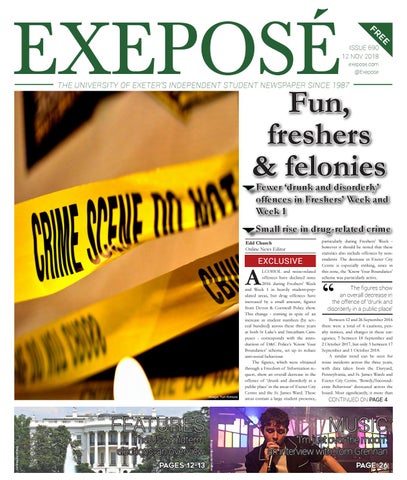
exeposé Fun,
FR
E
E
ISSUE 690 12 NOV 2018 exepose.com @Exepose
THE UNIVERSITY OF EXETER’S INDEPENDENT STUDENT NEWSPAPER SINCE 1987
freshers & felonies
Fewer ‘drunk and disorderly’ offences in Freshers’ Week and Week 1 Small rise in drug-related crime
Edd Church Online News Editor
EXCLUSIVE
A
Image: Yuri Kimura
Image: Alexander Kellner
Image: Ad Meskens
pages 12-13
The figures show an overall decrease in the offence of ‘drunk and disorderly in a public place’ Between 12 and 26 September 2016 there were a total of 6 cautions, penalty notices, and charges in these categories; 7 between 18 September and 2 October 2017, but only 3 between 17 September and 1 October 2018. A similar trend can be seen for noise incidents across the three years, with data taken from the Duryard, Pennsylvania, and St. James Wards and Exeter City Centre. ‘Rowdy/Inconsiderate Behaviour’ decreased across the board. Most significantly, it more than
CONTINUED ON PAGE 4
MUSIC
FEATURES
The USA midterm elections: an overview
LCOHOL and noise-related offences have declined since 2016 during Freshers’ Week and Week 1 in heavily student-populated areas, but drug offences have increased by a small amount, figures from Devon & Cornwall Police show. This change - coming in spite of an increase in student numbers (by several hundred) across these three years at both St Luke’s and Streatham Campuses - corresponds with the introduction of D&C Police’s ‘Know Your Boundaries’ scheme, set up to reduce anti-social behaviour. The figures, which were obtained through a Freedom of Information request, show an overall decrease in the offence of ‘drunk and disorderly in a public place’ in the areas of Exeter City Centre and the St. James Ward. These areas contain a large student presence,
particularly during Freshers’ Week however it should be noted that these statistics also include offences by nonstudents. The decrease in Exeter City Centre is especially striking, since in this zone, the ‘Know Your Boundaries’ scheme was particularly active.
“I’m just over the moon”: an interview with Tom Grennan
page 26
Devonshire House, Exeter, Devon, EX4 4PZ
News Editors Print: Jaimie Hampton & Gwyn Wright Online: Edd Church & Hannah Stevenson news@exepose.com Comment Editors Print: Isabelle Gray & Deepa Lalwani Online: Bea Fones & Josh Gammage comment@exepose.com
Arts + Lit Editors Print: Lauren Newman & Tabi Scott Online: Emily Pirie & Kristina Werner artsandlit@exepose.com Music Editors Print: Aaron Loose & Alex Wingrave Online: Jaysim Hanspal music@exepose.com Screen Editors Print: Ben Faulkner & Chloe Kennedy Online: Harry Caton & David Conway screen@exepose.com Science Editors Print: Scarlett Parr-Reid Online: Lara Andreski & Finn Candy sciandtech@exepose.com Sport Editors Print: René Bahar & Josh Brown Online: Luke Clarkson & Ben Hart sport@exepose.com Chief Photographer Chelsea Lee photography@exepose.com Copy Editors Peter Firth, Charlotte Forrester & William Harrop Proofers Fenton "Woof Woof" Christmas, Haroon 'Roo' Khan, Lil Jenks, Sira Charbel, Megan Frost, William Harrop, Aakz Karri, Richard Ainslie, Tabi "Cheesy Chips" Scott, Neha Shaji, Harri Caytun, E. Xela, Dorothea Christmann, Jonny Hitchens, Hugo 'from Surrey' deWynter, Deepa Lalwani, Aaron 'Screw' Loose, Bry Gooch, Charlotte Forrester, René #Rozzy5eva Baker, Sarosha Byrne.
@exepose facebook.com/exepose issuu.com/exepose Advertising Kate Watkins kate.watkins@exeterguild.com (01392) 722607 The opinions expressed in Exeposé are not necessarily those of the Exeposé Editors nor the University of Exeter Students’ Guild. While every care is taken to ensure that the information in this publication is correct and accurate, the Publisher can accept no liability for any consequential loss or damage, however caused, arising as a result of using the information printed. The Publisher cannot accept liability for any loss or damage to artwork or material submitted. The contents of this, unless stated otherwise, are copyright of the Publisher. Reproduction in any form requires the prior consent of the Publisher.
Students vote against iExeter Digital Check-in PAGE 5
COMMENT
Do we have a student drinking problem? PAGE 8
FEATURES In Flanders' fields: the history of Remembrance Day PAGE 11 Image: PxHere
Lifestyle Editors Print: Bethan Gilson & Rhiannon Moore Online: Katie Baker & Rowan Keith lifestyle@exepose.com
time when a recent Guardian editorial discussed whether advancing trans rights could be counterproductive to the aims of feminism, claiming that "Women's oppression by men has a physical basis, and to deny the relevance of biology when considering sexual inequality is a mistake". A response by Guardian US journalists said that the editorial "promoted transphobic viewpoints"; the two of us are inclined to agree, although it remains clear that if not approached respectfully such 'debates' can serve to dehumanise the very people whose lives are under discussion, and only incite further disparity in an already fractured political and ideological landscape. Moving on to lighter topics, Arts + Lit are providing an insight into the world of Spain's forgotten female artists (page 22). Continuing that theme, Screen vouch for the virtues of foreign cinema (page 30), whilst we gave our Music writers space to express their love for their favourite international artists (page 24) - to anybody who hasn't been playing the new Christine & the Queens album non-stop since it came out, this is your official wake-up call. Trying to cut down on plastic? Science has got you covered over on page 35. Otherwise, if Sport is more your thing, then over on page 38 we take a long look at the career of Lewis Hamilton. Whilst you're here, we'd also like to make a small clarification from Issue 689, page 1, where a headline described Matthew Hedges as a 'lecturer' - he is in fact a postgraduate researcher and PhD candidate. That's about all from us for now; we'll see you in two weeks' time! Love, Megan and Graham
Image: David Tyers
Features Editors Print: Niamh Elstone & Neha Shaji Online: Chloë Edwards & Bryan Knight Foreign Correspondents Co-ordinator: Ellie Cook features@exepose.com
H
EY there, reader. It's us again, just checking in (not digitally, though - we're not about that iExeter check-in life). Picture us, wading bravely through a sea of mid-term deadlines to bring you 40 pages of real page-turning antics. Of course, November isn't all fun and games - sometimes student antics can highlight real-world issues. For example, the classic Exeter pastime of decorating statues with a plethora of traffic cones can lead us to question Britain's colonial past. Arts + Lit ask, should we really be commemorating people like Redvers Buller, whose actions we can no longer look back on in a positive light (page 20)? We also take a look at 'trigger warnings', and whether they have a place in higher education. It's also a time for reflection. While we can argue at length about whether aspects of our history are savoury or not, there are some things that we can probably agree should not be forgotten, and the loss of human life to conflict is certainly one of those. This issue comes out just one day after Armistice Day, and whilst Features details the history of 11 November (page 11), Comment asks whether it is more pertinent to respect sacrifice with the white poppy, not the red (page 7). Elsewhere in Features, we keep it current with an intensive look at the USA midterms (pages 12-13). Meanwhile, in light of recent legislative proposals across the pond, Lifestyle weighs in on the debate around gender binaries, their normalisation as part of Westernised culture, and how one can go about superceding limiting and embedded constructs (page 17). This comes at a
NEWS
Image: MaxPixel
Editors Print: Megan Davies & Graham Moore Deputy: Fenton Christmas & Katie Jenkins Online: Harry Bunting & Natalie Keffler editors@exepose.com
Editorial
t gtth
Image: JeshootsCom/Pixabay
EXEPOSÉ
SCIENCE Dispelling the superfood myth PAGE 36
CHECK OUT OUR WEBSITE! There are even more great articl es on the Exeposé website. From the latest university news to current affairs, music and theatr e reviews and more, visit us at www.exepose.com
Worldwide university news UK Universities face bankruptcy
A
N investigation by The Independent has revealed that several British universities face financial collapse. The paper understands that the number of such institutions lies in low single figures. Reforms introduced since 2010, such as the trebling of tuition fees and the lifting of the cap on student numbers, have led to fierce competition to attract students. In a sign of the tougher conditions that the higher education sector is facing, several universites are relying on "bridging loans" to stay afloat. On Tuesday 6 November, Michael Barber, who chairs the Office for Students (OfS), warned that no university is "too big to fail". The higher education regulator has warned that financially struggling universities will not be rescued by the government. Unions have warned that closures will cause damage to local communities.
T
Tuition fee cut proposed
UITION fees in England’s universities could be cut to £6,500, it has been reported by the BBC. It has, however, also been reported that higher fees of up to £13,500 could be introduced for some subjects. The fee increase has been suggested for certain degree subjects, such as medicine or the sciences, on the basis that they lead to higher graduate earnings. Arts and humanities are also significantly cheaper to run than sciences, which require more advanced technology and more contact hours. Universities have argued that cuts would create a two-tier system with a lower status for arts and humanities. The changes are believed to be under serious consideration by the Prime Minister, who called a review of post18 education and funding in February. However, this is not a conclusive decision, as cuts to tuition fees will not be decided on until next year.
Candian professor's suspension in review
T
HE Canadian Association of University Teachers (CAUT) is reviewing the suspension of Derek Pyne, a professor at Thompson Rivers University (Canada). Pyne believes that he was suspended after criticising his colleagues and the institution. His study looks at the rewards between publishing in predatory journals compared to traditional journals. According to David Robinson, executive director of CAUT "there's a kind of perverse incentive for some academics to publish in these predatory journals, maybe because almost all the reward systems in the university tend to focus more on quantity over quality". Thomson Rivers University has stated that they will not be participating in the investigation.
Indian professor rejects position
A
RESPECTED Indian historian, Ramachandra Guha, announced he will not be taking up his position at Ahmedabad University, following pressure from the right-wing ABVP student group. Earlier last month it had been announced that Guha, a biographer of Gandhi, was set to join the university as a professor of humanities. However, the ABVP protested to the university that Guha’s writing was “critical of India’s Hindu culture”. Following the protests from the ABVP, Guha tweeted he would no longer be taking the position “due to circumstances beyond [his] control”. The university denies being pressured by the ABVP, who are aligned with India's ruling party. Image: Sandeep Pranavamr Stories by Gwyn Wright (News Editor) and Ellie McGarahan, Jodie Coughlan and Hannah Seeckts (News Team),
News
3
NEWS EDITORS: Jaimie Hampton Gwyn Wright
New regulator seeking more data on Prevent
Gwyn Wright News Editor
C
Questions from colleagues were really, really useful because they highlighted. misconceptions
Counterterrorism Unit followed by a question and answer session. The presentations by Abu Ahmed and Andy Ferris focused on the broader national context surrounding Prevent. Ahmed acknowledged that Prevent is not universally popular and has been criticised by some for allegedly stigmatising Muslim communities. He claimed there has not historically been enough data provided by the programme, and that this needs to change. Both Abu Ahmed and Andy Ferris pointed out that the programme also seeks to prevent far-right terrorism, with Ferris adding that, in Devon, far-right referrals exceed referrals related to Islamist extremism.
The Students’ Guild continues to monitor the Prevent agenda
Mike Shore-Nye, Registar & Secretary
The event also featured presentations by Abu Ahmed, Head of Counterterrorism Communications at the Home Office, Andy Ferris from the Southwest
Grace Frain, Guild President
In response to a question about the Students’ Guild’s non-compliance with Prevent, Lindsay stated that the
University work closely with the Guild executive management and see risk assessments, adding that the OfS will press harder for student participation on Prevent and that closer co-operation may be ‘a matter of time.’ The idea, which labelled Prevent as a ‘discriminatory’ programme ‘based on racial profiling’, was voted on by 205 students, with 71 per cent of those voting for the idea in 2015. Attendees also raised concerns that there was insufficient evidence to suggest that Prevent does reduce radicalisation, and that it would not always be clear what student behaviour would be most effectively dealt with through a Prevent referral. Mike Shore-Nye, Registrar and Secretary, told Exeposé: ‘’I think today’s event was really valuable, and it was
great to hear from the police and the Home Office. I think it helped de-mystify our Prevent duty more, and reiterated the importance of safeguarding.’’ ‘‘I think that some of our questions from colleagues were really, really useful because they highlighted the potential misconceptions and potential concerns, and what we’re trying to do is provide reassurance so that this is something that we can work on together. I think these events are really helpful and it certainly helps frame our thinking and we need to continue to build on them in the future.’’ Grace Frain, Guild President, told Exeposé: ‘‘The Students’ Guild continues to monitor the Prevent agenda, the University’s actions in relation to it and any changes in our obligations towards it. We welcome student involvement in helping shape what this looks like.’’
Student Idea for Town Crier passes Mark Kermode named Honorary Professor Graham Moore Editor
A
STUDENT Idea entitled ‘the Guild should have a town crier’ passed with 86.4%, out of 140 votes on 30 October. The idea proposed that “[t]he dissemination of Guild announcements, which currently is usually dispensed through Twitter, Facebook, and email, in its current form does not allow for those who merely wish to listen in Devonshire House instead of utilising the internet. A perfect solution would be the creating the position of a town crier for Devonshire House.” The Idea suggested that the town crier could report on such occurrences
as election results, sales in the Ram, “nearby highwaymen and bandits”, and regicide. The Idea received more comments than the other ideas on the Guild Ideas page. One comment stated that “[o]ur safety as a student body is severely compromised by a lack of such a warning system. Should the Vikings return will we be found unprepared and feasting at Pret? I should hope not. This is a clear agree from me.” Yet not all responses adopted this tone; another student suggested that if we want Student Ideas to be taken seriously and actually acted on by the Guild then we need to vote down jokey ideas like this one.” The student who submitted the Idea told Exeposé that “it felt as though the
traditional Guild communications were not effective or immediate enough. I’m not saying they have a communication problem, but it could be improved.” They continued that their Idea was “in many ways” a reaction to the lack of communication around the Student Ideas system itself, which has recently undergone changes. The new system only opens for specific periods of time, with the next proposal period opening on 12 November. The student said that they would have been unaware of the Ideas timeframe, had they not gone out of their way to submit an idea themselves. Commenting on this new system, they said that while they understood the logic behind periodic voting they thought the changes were “suppressive in some ways”.
Lou Aubay News Team
F
ILM critic Mark Kermode has been appointed as an honorary professor in the university’s film studies department. He is currently the chief film critic for The Observer, has his own film review column in The Guardian, and has contributed to numerous radio programmes, magazines and documentaries. He is also a musician, and his last piece, ‘How Does It Feel?’, relates to
his musical misadventures. Professor Andrew Thorpe, Pro Vice-Chancellor and Executive Dean of the College of Humanities, said; ‘’We are very excited about Professor Kermode joining the film studies department at Exeter as an Honorary Professor and building closer links with him through our teaching programmes and research.’’ ‘’Professor Kermode’s passion for film and outstanding ability to explain film history and production in an entertaining way has made him one of our most respected critics and broadcasters.’’
It felt as though the traditional Guild communications were not effective Student Idea creator
Image: Exeter Student Guild
Responding to criticism about whether their Idea was too “jokey”, the student said “I think students enjoy an organisation that doesn’t take itself too seriously.” They did admit that “in hindsight, and upon further research, highwaymen do not appear to be a pressing issue in Exeter.”
Image: Matt Deegan
Image: University of Exeter
HRIS Lindsay, Director of Governance and Compliance at the University, updated students and staff on 31 October about changes to the implementation of Prevent, a counter-terrorism programme initiated in 2015. A new regulator, the Office for Students (OfS), which replaced the Higher Education Funding Council for England (HEFCE) on 1 April of this year, are asking for more data and information from higher education institutions and evidence of ‘active implementation’ by the University. In practice, this means that more information is being provided about which staff have and haven’t received Prevent training, and that the precise number of students being referred to Prevent is now being asked for. Lindsay also highlighted that Exeter’s Prevent programme is now more closely linked
to the university’s wellbeing and safeguarding teams. Prevent is one of four elements of the government’s broader counter-terrorism strategy known as CONTEST, and seeks to de-radicalise people at risk of further radicalisation and terrorist activities. Under the Counter-Terrorism and Security Act 2015, it places a duty on higher education institutions to have ‘‘due regard to the need to prevent individuals from being drawn in to terrorism.’’
4
12 NOV 2018 | EXEPOSÉ
NEWS
New student accommodation to open from 2020 Megan Davies Editor
T
HE largest accommodation built on the Streatham campus since 2012 has been given final approval by Exeter City Council. The East Park development should open between September 2020 and September 2021. Its 1,182 bedrooms form a part of plans to add 1,500 rooms to the campus. Other residences which are being developed include Spreytonway, next to Lafrowda and St German’s, and Moberly. Consultation documents state that the City Council “wishes to see at least 75% of student growth accommodated in purpose-built student accommodation to minimise pressure on existing residential areas.” East Park will be located behind the Business School and Lafrowda, in what is currently a field. The approval was made public on 1 November, even though a majority of comments to the City Council were objections. Commenters raised concerns about disruption to residents during works and losing a nature area. They also addressed a lack of car parking, the design of the buildings (and
whether these are carbon neutral), traffic and access to the site, and noise pollution. Mike Shore-Nye, Registrar and Secretary at the University said: “We are delighted to receive approval for our plans. The East Park development will create more high-quality, on-campus accommodation for our students, reducing the pressure on the city’s hou-
sing stock whilst strengthening our commitment to offer an excellent student experience. “We will liaise closely with the local community to ensure the development process is a success for everyone. The East Park development is a significant project for the University which forms part of our ambitious Capital Strategy to invest in our campuses, estate and
infrastructure over the next 10 years.” According to the UPP website, “the bedrooms have been designed with a focus on enhanced health and wellbeing by minimising noise and light pollution.” Universities Partnership Programme (UPP), which currently manages Lafrowda among others, will be responsible for the bulk of the works -
this includes design, building, funding and operation. The University is planning to open the new accommodation blocks in two phases between September 2020 and September 2021.
This news is a testament to our existing bespoke, long-term partnership with the University Sean O’Shea, UPP
Image: University of Exeter
Sean O’Shea, Group Chief Executive Officer of UPP, said: “This news is a testament to the strength of our existing bespoke, long-term partnership with the University. Since 2009, we have delivered and operated circa 2,500 high-quality and affordable purpose-built student residences on campus. “Through the proposed development, we will help the University to maintain and enhance its reputation for delivering an internationally excellent education. We look forward to continuing to support the University’s strategic objectives and taking another step forward in this close relationship.”
Figures reveal falling crime rates during Freshers’ CONTINUED FROM FRONT
... halved in the St. James Ward from 14 in 2016 to just 5 this year, and in Exeter City Centre decreased from 50, to 37, to 29 in each respective year.
The red boundary will be a visual reminder of the Public Spaces Protection Order Devon & Cornwall Police
Parallel to this is the numbers for ‘street drinking with rowdy or nuisance behaviour’ which decreased from 10 to 7 across the three-year period. There were no reported incidents of street drinking in the Pennsylvania Ward in 2018. Conversely, there was a minor overall increase in drug offences. 7 offences in 2016 increased to 10 in 2017, and then dropped back down to 8. The drug offences were mostly concentrated in the Exeter City Centre area, in which there are potentially a mixture of both students and non-students. In some instances, the numbers peaked in 2017. For example, noise incidents in Pennsylvania increased from 4 in 2016 to 7 in 2017, before steeply falling this year to 3. Similarly, drunk and disorderly numbers peaked at 10
in 2017, but also dropped to 3 in 2018. Drug offences were also at their highest in 2017, at 10 overall. These interim increases potentially represent the figures which prompted Devon & Cornwall Police to take such measures as ‘Know Your Boundaries’, trialled for the first time this year. Devon and Cornwall Police put the campaign in place in order to tackle these issues, and anti-social behaviour in general. “The red boundary will be a visual reminder of the Public Spaces Protection Order [PSPO]”, their website reads. “The PSPO aims to mitigate behaviours that are likely to have a detrimental effect on the quality of life of those in the locality, as well as provide safety to those frequenting the area.” The lines were supplemented with signs reminding the public of the PSPO, and how to abide by it, remaining in place for the period in and around Freshers’ Week. People in breach of these lines could see sanctions such as a £1,000 fine or bans from clubs and bars around the city. Rory Cunningham, University of Exeter Community Liaison Officer, said: “We greatly value our relationship with our neighbours and the vast majority of students are proud and responsible members of their community. We work closely with Exeter City Council and
Devon and Cornwall Police to support students and keep them safe and tackle any problems. These statistics for 2018 cover all incidents, and not just those related to students, but they correlate with our observations about the start of term and we have had positive feedback about students from local residents.
The vast majority of students are proud and responsible members of their community Rory Cunningham, University of Exeter Community Liaison Officer
“We have been communicating with students in new and creative ways to support good citizenship early on in the year. Initiatives like the ‘Know Your Boundaries’ project, led by PCSO Turner, have also helped to promote positive behaviour in the city centre. The University is also a proud member of the ‘Best Bar None’ initiative – a national scheme supported by the Home Office and aimed at promoting responsible management and operation of alcohol licensed premises. Our affiliation with the scheme has helped us to proactively engage with a range of licensed venues and promote positive drinking behaviour.”
Image: ExeterDaily0 (Pixabay)
NEWS
EXEPOSÉ | 12 NOV 2018
5
Students vote to get rid of iExeter Digital Check-in Edd Church Online News Editor
A
STUDENT Idea calling for the end to the recently-implemented iExeter Digital Check-in system passed with 89.6% of the 487 voters selecting a ‘yes’ option. This Idea, ‘Stop iExeter Digital Checkin’, was ratified on Tuesday 30 October by Democracy and Governance Council and has been passed up to the Guild executive for action.
I have better things to do and to worry about than losing my visa because this app doesn’t work properly
International Student
The Student Idea description listed several grievances people had with the system including Tier 4 visa-holding stu-
dents having their residency status at risk, and the concerns over some students not having the required smartphones for the app. “As a Tier 4 visa student, not attending lectures can lead to losing a visa”, one student commented. “I attend all my lectures, but the online check-in has not worked no matter what (I tried fixing it in all possible ways). I am tired of having to go to the closest information point, which is not in the same building where all my lectures are run to check-in manually. I have better things to do and to worry about than losing my visa because this app doesn’t work properly.” Some students expressed their dislike for the system based on the required technology: “I don’t have a cell phone and would also defo be down for not living in an episode of Black Mirror.” Another comment simply asked,
“Ever read 1984?” Other students, however, disagreed. “It should be kept”, said another student. They continued: “If you actually ask a tutor, or academic who’s put it into place, it’s to do with mental well being of students. This is not in place to make ‘black marks’ against students. If you miss lectures, but catch up on ELE, the system tells them that you have logged in and what you’ve looked at. It’s also in place to prevent students “going off the map”, for lack of a better phrase.” In response to the vote results, VicePresident Education Warren BinghamRoberts announced that he is planning a ‘public forum’ for Exeter Students’ Guild’s stance on the iExeter Digital Check-in system. Bingham-Roberts suggested that the forum, which is in its very early planning stage, is to allow discussion
Uni announces new Arts and Culture Director Alex Wingrave Music Editor
S
ARAH Campbell, the Head of Learning Programmes and Deputy Director for Learning and National at the Victoria & Albert Museum, has been named as the University of Exeter’s first Associate Director for Arts and Culture.
I am thrilled to be joining such a prestigious academic insitution
Sarah Campbell
Campbell will co-ordinate with Professor Stephen Hodge, Academic
Director of Arts and Culture, and Naome Glanville, Arts and Culture Coordinator, to establish both a new Arts and Culture team and a new Arts and Culture Strategy for the University. The Strategy’s mission is to “Activate Creativity” by working with creative partners across the South West. Ms Campbell said: “I am thrilled to be joining such a prestigious academic institution and having the opportunity to co-deliver the Arts and Culture Strategy.’’ ‘‘The University of Exeter is world-class in its research and teaching, and its commitment to arts and culture makes for a rich and stimulating learning environment.”
and debate about the issues students have with the system which was introduced at the start of this academic year.
Improving the ease by which students engage with University processes is one of my manifesto priorities
Warren Bingham-Roberts, VP Education
Shadow Council, the chief scrutiny board for sabbatical officers, was informed of the plan for the event by the VP on Wednesday 31 October. Councillors raised concerns over the proposal, asking the VP why he wanted to hold a “debate” considering students had already voted against the check-in system. “It’s the single most voted-for idea on the system”* , said one councillor in response to Bingham-Roberts’ statement that ‘only around 500 students voted’ for the idea.
With regard to his future plans, Bingham-Roberts told Exeposé: “I am currently considering how best to take the Student Idea forward in a constructive way that addresses students’ concerns about the digital check-in system. I want to ensure that students have the opportunity to feed into this process, and so I’m looking at how best to achieve this, with an open forum type event being one of the options considered to allow for direct student input. Improving the ease by which students engage with University processes digitally is one my manifesto priorities for this year, and therefore the experience of students with the system will be at the forefront of our approach.” *For clarification, “Stop iExeter Digital Check-In” was the most voted-on student idea of this academic year so far. However, historically, ideas have had more votes.
‘Being Human’ Festival to be held throughout November Gwyn Wright News Editor
T
HE Being Human Festival, which calls itself the United Kingdom’s “only national festival of the humanities”, will showcase several events in Exeter during November. The Being Human Festival is led by the School of Advanced Study and the University of London, in collaboration with the Arts and Humanities Research Council and the British Academy. Several events in connection with the festival are set to take place throughout November. On 15 November, an event on ‘Staging Suffrage’ will feature “per-
formed readings of Edwardian suffrage play The Pageant of Great Women”. On 17 November, an interactive event exploring the archeology and history of meat consumption will be held at Exeter Cookery School, while the RAMM museum will host a collection of Exeter’s archeology.
Academics and research partners have planned a series of free, varied and interactive events
Dr Sanja Djerasimovic,
‘Walking the Exeter Dead’, an event exploring the history of the city through its deaths, disasters and diseases, will take place in the Rougem-
ont Gardens on 24 November, while events on ‘Ingenious Soil’ and ‘Devon in Translation’ are occuring throughout the month. Dr Sanja Sjera Djerasimovic, who co-ordinates the University’s Being Human events said: ‘‘We are extremely excited to be the South West hub of the festival. Academics and research partners have planned a series of free, varied and interactive events which showcase the fascinating research happening at the University of Exeter. “There really is something for everyone. People can explore how nonnative animals came to the UK, the suffragette movement, the history of meat eating and take a tour of Exeter’s spookiest places.’’ Image: University of Exeter
Image: Exeter Northcott
Hailey .M Tshuma National Union of Students exp: 09/09/19
10% OFF Ts & Cs apply
EXEPOSÉ | 12 NOV 2018
7
Comment
COMMENT EDITORS: Deepa Lalwani Isabelle Gray
The housing conundrum Harry Caton Online Screen Editor
I
T’S November 2017, and I’m a blissfully naïve second-year. Along with three friends I’ve committed to finding a house, somewhere in the general vicinity of Exeter. To our minds, anything will do, provided there’s WiFi and a toilet. I had a house in first year, but the process behind that was in the hands of a more-competent friend – we’re in charge now, we titter to ourselves, cracking our knuckles with entrepreneurial glee. You shouldn’t rush into things. Sounds trite, doesn’t it? Perhaps the student housing market is ever-soslightly too rapid in its movements to recommend the caution of a normal human. You’re a student, darnit, and to
your nascent mind, housing is all part of the common three-jagerbombsthanks rush. But the gist remains true. When our little group set about it, my instinct was something akin to that erratic mess in the club – spiralling all about and making plenty of noise, while saying nothing at all. Becoming that hyperactive mess is sincerely unproductive. I jump on every website, bring up house after house after house, and yet the deluge on my end is baffling. I start looking and stop thinking.
Nothing is permanent, and everything can fly out the window On the flip side, one of my friends doesn’t seem to care. If I’m too manic, he makes another classic student presumption: that everything will just
fall into place. When people come at complex issues on fundamentally different wavelengths – even the minor, unspoken things – problems will arise down the line. Talk to the people you’re supposed to be spending a year with. From this point, my case becomes quite particular. Another friend drops out for a year abroad – suddenly, we’re down to three-person houses. Be prepared for crises; until these things are set in blood, nothing is permanent, and everything can fly out the window. Thankfully, we finagle our way into another housing deal. Lord knows, given the extortionate nature of student housing, there’s at least something going around. But whatever happens, get that contract signed. It’s now early-2018, and we’re catapulted into more of the proverbial. We sit on the house for a while, verbal confirmation seeming just
enough. Meanwhile, that first friend refuses to send me his identification and details. He withholds – for perennially-unclear reasons – for another two weeks. Then the landlord drops the house out from under us. We scrabble and mope, while our friend turns up late for viewings and shoots down our ideas. Eventually, he drops out as well. Let me outline this for the everanxious student. Adulting is terrifying, and it’s understandable to freak out once you’re given the keys to a ride you don’t quite understand. So many places, dates, times. When are you all available for a viewing? Is the landlord a nightmare? Do you know what your housemates are thinking? These can all be worked through with at least some degree of simple reasoning. The golden ticket of a still-available two-bedroom eventually comes to our aid; we take it,
Image: Diliff
slightly worse for wear by the byzantine proceedings’ end. I’ve three pieces of advice for those just about to enter the student housing hellscape. First, do your research. There’s a lot out there, and whittling it down is hardly fun. But it’s necessary – getting a lay of prices, areas, and housing features are things that you’ll care about quite profoundly come next year. Likewise, be prompt. I speak from experience – no one likes a layabout. Be active and efficient, and you can rest when it’s done. Finally, talk to your friends. At the end of the day, this is a transaction, and all must be on board every step of the way. Ultimately, we made it through by just being honest. If you’re unhappy, say so. Don’t let the growing antipathy that comes out of miscommunication spoil it all.
War of the poppies Emma Hussain Contibutor
N
OVEMBER has begun, and the Royal British Legion Poppy Appeal is in full swing. In schools, public workplaces, and on television, anyone who’s anyone has donned the red poppy. In fact, the poppy has become so ingrained in our society that it is considered a political statement not to wear it. In 2015, there was outrage when Jeremy Corbyn floated the idea of wearing a white poppy to the cenotaph. (In the end, he wore the conventional red, and will again this year.) Earlier this month, Exeposé reported the debate raging on campus over Quaker Society’s selling of white poppies. In this context, we should ask ourselves why red poppies are considered the apolitical norm, from which any deviation is disrespectful and radical.
The red poppy symbolises a simplistic, us-versus-them narrative When the Poppy Appeal was founded after the First World War, its goals were simply to raise funds for
veterans and commemorate fallen soldiers. In the nearly 100 years since, Remembrance Day has taken on a decidedly militaristic tone. The wearing of the poppy has become synonymous with supporting British military action abroad; if the poppy supports soldiers’ heroism, it comes with an implicit message that we owe it to them to keep fighting. In 2010, six veterans of the Falklands and Northern Irish conflicts wrote to The Guardian expressing their discomfort with this subversion of Armistice Day: “A day that should be about peace and remembrance is turned into a month-long drum roll of support for current wars.” In a warped way, the Poppy Appeal has also normalised the idea that veterans should live off charity. If it’s truly about respect, wouldn’t a better way for this country to honour the people who fight for it be to have state-funded aid for them and their families? The rhetoric around traditional red poppies refers vaguely to the heroism of veterans while distancing itself from the violence of their actions. By not mentioning the damage our foreign
policy has inflicted upon communities elsewhere in the world, the Poppy Appeal facilitates government attempts to downplay the controversy of these operations. The red poppy symbolises a simplistic, us-versus-them narrative, creating a one-sided remembrance
Image: Nankai
which hides the messy reality of war. As early as 1926, the white poppy movement emerged as a way of honouring civilian and military victims of all wars without buying into the inherent
military nationalism of the (red) Poppy Appeal. But proponents of the white poppy are clear that their message is not one which means any disrespect to the army. Instead, they are widening the scope of who we honour in our collective remembrance. This is in fact in line with historical commemorations; there are many Axis graves from the Second World War on Allied soil, including in Exeter Cemetery. The white poppy has made some headway as the conversation around modes of remembrance grows more high-profile each year. Their distributor, the Peace Pledge Union, hopes that at least 100,000 white poppies will have been sold by 11 November. At least 30 schools have offered them this year, and St John’s Ambulance leaders have for the first time decided to allow their first aid volunteers to wear the white poppy if they wish. An increasing number of people are also choosing to wear both poppies; red for remembrance of victims of past wars, and white for the hope for a peaceful future. However, the white poppy still faces mass opposition. Many shops refuse to stock them,
and their presence within the establishment is still contentious. The fact that the mere expression of opposition to the red poppy is interpreted as disrespect to the armed forces makes this conversation all the more difficult to have. But when we think about the Poppy Appeal, we should think about the purpose of commemorating war. At its core, it should be about a desire to prevent a repeat of the same horrors. This leads pacifists to mark Armistice Day with alternative forms of commemoration, such as contacting local representatives with concerns about the arms trade or supporting worldwide Veterans for Peace marches.
The goal of a world without war is key to the white poppy movement The goal of a world without war is central to the white poppy movement, and money raised from sales funds campaigning and education in nonviolent approaches to conflict. This kind of pacifist commemoration feels more relevant to a world in which, 100 years after the ‘war to end all wars’, hundreds of thousands of people are still haunted daily by conflict.
8
COMMENT
12 NOV 2018 | EXEPOSÉ
Meme of the Mo(n)th Neha Shaji Features Editor
A
FTER a solid 12 years of catechism classes and church, I was taught to be drawn to the light - so I personally think it’s natural that I am drawn to the glowing and delightful notion of the moth meme. The moth meme is, in essence, not a singular meme or photograph but rather an overarching concept. Moths are scientifically attracted to the light and, in an absurdist way, this is incredibly hilarious. The moth is not attracted to a certain sort of light – it is no high-rolling electric light insect or a pathetic excuse for six legs that flies into everything – the moth is interested in all forms of light. Twitter, and the inferior meme platform Facebook, have thousands of images tagged #mothmeme. Once you sift through the low-quality content that fails to understand the concept of light and instead have moths fly into
people, or things, or the oh-so-funny anti-meme of the moth flying into the window – one arrives at some excellent compositions. Some make witty historical allusions, others characterise the moth as a nervous junkie trying to score a light-filled hit.
There is no reason for this moth not to receive the fame he did
The meme apparently initially achieved infamy after a photograph of a giant moth circled Reddit and other forums this past summer. There is no reason for this moth to not receive the fame he did. He is a large, distinguished moth with large, expressive eyes – he looks like he would be called Sir Cecil Mothworthy, longing after his lover Sandra Lampoon. He looks both passionate and wanting at the same time, possibly leading Redditors to theorize that he went after the light. Why would moths become such a
relatable and widespread meme? Perhaps because of two angles that connect the moth meme to the human condition: firstly, the relentless seeking of light. We, in this hyper-capitalist society, are always striving for the betterment of ourselves in any way: the light could be academia, money, or landing a graduate job. Secondly, the futility of hurtling into the light source provides a salty existential tang to the meme – the moth would die when he achieves his desire. It’s all tied together by the air of mystery – scientists still cannot accurately determine the actual reason as to
why moths are drawn to light sources. Theories range from using the moon to orient themselves during night flights, to moths literally wanting to have sex with lamps. To be honest, I think moths really do deserve all the love that comes with these memes. Moths are often regarded as the butterfly’s rather ugly cousin, the one that you would rather not squish and put into a coloured glass slide above your living room fire. Another variant of the moth meme has also come into existence: the anti-moth-meme. These introduce the character of a bat, who often alludes to having eaten said suicidal moth or wanting to do such a
thing, drawing on other memes such as the car slapping salesman meme. Beavers have also been brought into the equation, but with regards to their interminable desire for logs instead.
The futility of hurtling into the light provides a salty existential tang Whatever the reason for moth memes achieving such popularity, be it due to existentialism, absurdism, or amusing insects, I will always regret not taking up the opportunity to dress as a sexy moth this Halloween.
Images: Max Pixel, Josch13 (Pixabay)
////////////////////////////////////////////////////////////////////////////////////////////////////////////////////////////////////////////////////////////////////////////////////////////
The student drinking problem
Carys Wilkinson Contributor
I
N a 2016 survey conducted by The Tab, Exeter University ranked as number 16 in a list of the UK’s heaviest-drinking universities. This ranking may easily have changed by now but there is still no disputing that out of roughly 150 universities across the UK, Exeter is certainly up there as having some of the heaviest student drinkers. The topic of excessive drinking is on everyone’s minds after the recent inquest into the death of a 20-yearold Newcastle University student who died after a night out in December 2016. Alcohol is very closely linked with university – the legal drinking age is 18, and it is roughly around that age that many people go to university. Of course, I don’t pretend that students have never drunk before they come to university and many people are already familiar with alcohol and the effects that come along with it. However, with university comes a freedom not often afforded at home. At university, there are no parents waiting to nag you or tell you off for how much you’ve drunk and sometimes, no one sober enough to look after you if you really need it. With the freedom of university comes the responsibility of having to
moderate yourself and this is where the problem lies. A survey of undergraduates across seven universities in England revealed that over 50% of students were either hazardous or harmful drinkers, and a further 10% were “probably alcohol dependent”. This individual responsibility and autonomy is only made harder when societies and groups begin to have initiation-style events. In 2006, an 18-year-old student at Exeter died following an initiation ceremony for the Golf Club, and following the inquest, Exeter University banned all student society initiation ceremonies. On top of this, students in the Athletic Union have to sign a code of conduct that was specifically aimed at reducing the drinking culture closely related with sports teams.
sure to drink in social situations such as sports socials is not unique to one team or club and is endemic across societies as a part of university culture. It is important here to note that drinking as part of a team or society is not by any means wrong in itself and is both fun and inclusive if done safely. The problem starts to arise when people feel like they have to drink to conform or to be included. Alcohol is not necessary to have fun and make friends, no matter how much it might feel like that sometimes. Speaking to a friend who recently decided to stop drinking (with the exception of a glass or two at special occasions) it became clear that alcohol can very easily become a crutch
With the freedom of university comes the responsibility of moderation
However, the question remains of whether this rule is still being enforced today or whether enough time has passed that the university is beginning to slip back into its old ways. In the last few months, both the Exeter University Rugby Football Club and the Hockey Club have come under attention for alcohol related incidents. Yet the pres-
to lean on for people who are perhaps less confident in social situations. An alcohol dependency is no less a problem because it is present in a student, stereotypically viewed as an almost comically alcohol-dependent individual. It doesn’t have to manifest in typical ways, but rather can be something as subtle as drinking at any social situation to boost confidence and feel more relaxed.
The problem arises when people feel like they have to drink
It is very hard to find a solution to these problems. Do we ban alcohol completely? No. Frankly, that’s ridicu-
lous and will only encourage illegal alcohol consumption and fear of seeking help should a problem arise. Can we measure alcohol consumption and cut people off when they’ve had too much? Again, no. This simply isn’t practical. So, what can we do? It takes something big to scare people into taking action. A fellow student, who would prefer to remain anonymous, told me that after they ended up in A&E highly intoxicated and barely lucid twice inside a 12-month period, they decided to take a break from drinking. Honestly, I’m unsure exactly what the best solution is here. We can educate people on the dangers of drinking but most students already know them, we just choose to ignore them. We can make sure to enforce punishment for any one person or any society that pressures people either physically or emotionally into consuming alcohol. We can make it clear that alcohol can be consumed safely and in moderation while still giving the buzz and feeling that everyone is after but really, it’s no quick fix and any solution will take time and effort on everyone’s parts to form. It needs to happen, though - and perhaps before we see something worse than a trip to A&E. For more information: www.nhs.uk/live-well/alcohol-support/binge-drinking-effects/
Image: kaicho20 (Pixabay)
EXEPOSÉ | 12 NOV 2018
Reigniting academic interests
Anne Chafer Contributor
I
’VE always loved September. When I was a kid, I used to count the days until I’d be going back to school, crossing them out on a calendar as they flew by. I still feel excited by the prospects of each new academic year. Needless to say, that has died down by November. There’s always that midterm slump, isn’t there? I start realising how I’m going to be behind schedule soon. Suddenly, there are a million articles I should have read. Deadlines are looming. I start feeling like I can’t be bothered to even start catching up.
It’s not often that we remind ourselves why we chose to do this
Image: Tanja Cappell
Lectures might as well be the only thing that is quiet about life on campus - university is a fast-paced environment. It’s not often that we stop and try to remind ourselves of why we chose to do this. Do we love what we’re studying? I’m not talking about enjoying every single step of the process. Things will be tough sometimes. But every once in a while, it’s good to distance yourself from what you’re doing in the moment to keep an overarching perspective on your academic choices. And if there’s something you think would make your
uni in the first place. Lecturers and researchers are the ones who keep universities alive. They are good people to talk to if you feel like you don’t know why you are studying your subject anymore. And sometimes, the books and articles they can recommend outside of your course might even be more interesting than any of the compulsory reading. (I’m not encouraging you to skip your compulsory reading. I’m not). You might find you actually enjoy the subject, but you enjoy a particular way of approaching it that’s not covered in the module. Go and find that on your own! It will keep your interest for the subject alive and make compulsory content more bearable.
We’re at university because we want to learn, and that’s what matters
matter to you along the way, than leaving with a 1st and no passion for what you did in the past three years whatsoever. We’re at university because we want to learn, and that’s what matters. Sure, do your coursework, but learn the way that works for you. Investigate that obscure, random anecdote that was mentioned in your seminar. Research things you’re interested in. Give that twenty-page article a chance before you dismiss it - page ten might make you want to read the whole book. Be open-minded and don’t be afraid to communicate with your professors. And question what you’re doing and why you’re doing it. My American Literature module makes me so happy in the long run, that I feel like all the stress pays off. With deadlines approaching, remind yourself of why you are doing this. And make sure it’s exciting enough to make everything else worth it.
In my opinion, it’s better to end up with a 2:1, having learnt things that
Image: Homero Nunez Chapa
The social network
James Sutton Contributor
I
degree more exciting, it’s worth going for it: switching from single to combined honors is something I’ll always be thankful for. But I think that if there’s something that can really reignite your love for your subject, it is a good lecturer. There is little praise for the figure of the lecturer, yet they can have a massive impact on the way you view your module, your degree and academia in general. Probably everyone will agree that it’s very easy to tell when someone just wants to be done with what they are talking about, thus creating an apathetic atmosphere in the room. Similarly, though, we have the other end of the spectrum. I remember two particular lecturers in one of my modules who were so passionate about what they were talking about that in both cases I left the room thinking that this is what I would like to do in the future. Mind you, I had never considered a career in academia before. I guess this piece is a big thank you to all those academics who get their passion across to the whole lecture theatre. It must be daunting, knowing you will either make forty people very interested in what you’re talking about, or drive them to drowsiness. So it amazes me that there are so many people who do manage to make us engaged and interested - if you’ve ever had one of these lecturers, you will know what I mean. There is nothing like getting out of a lecture feeling like that was the reason you even wrote that personal statement to get into
’M sure every student is used to nagging parents telling them to get off their phones and join the “real world”. Many adults, generally in the generations older than millennials, would say that young people spend too much time on social media. Is this true, or is dedicating large swathes of your day to social media a necessity nowadays? We live in an age of consumption and no, I don’t mean the disease where your body wastes away, though I’m sure this is what some parents will think will happen to you if you don’t get off social media and go outside. I mean that young people these days are constantly consuming - taking in information, processing it, and using it to inform our everyday life. Before the internet, information about the world was predominantly
obtained from TV - before that, newspapers. Both of these sources are finite, but the internet is not. There’s an abundance of information available to us that just wasn’t there for our parents and grandparents when they were young. Social media provides an easy medium through which to consume this information. It’s offered to us in an accessible, interactive way, encouraging engagement and enriching our lives.
Confining ourselves to echo chambers leads to complacency One of the most common arguments in favour of social media is that it enables us to stay connected with people we know but, for reasons such as going to university, are physically removed from. Whilst this is a huge pro, I would also argue that an important aspect of social media is being able to make connections with people we don’t
know. Through this, we get something that’s incredibly valuable - exposure. There’s been a trend recently of universities not giving platforms to controversial speakers because their views don’t align with that of the general student population. Confining ourselves to echo chambers leads to complacency and a lack of empathy; it is only when we engage with differing ideas that we can understand where others come from and enable our own opinions to be more informed and our arguments better formulated. Social media does just this. Its nature means we’re constantly connecting with people we may not usually interact with in everyday life, and in doing so we learn more about the world and the people in it. Whilst I would argue that social media enabling consumption is a good thing, I would also say that many of us do it too much. Constantly wanting to be up to date, FOMO, and other factors can lead to us spending several hours
a day scrolling and browsing. Thus, it’s also important to make sure you take some time offline. Appreciate the world around you, give your brain a rest and a chance to recharge.
Social media enables us to live better informed, more empathetic lives Social media has become something of a social necessity. University societies do all their organisation on Facebook, keeping up with Snapchat stories means you stay up to date with people’s lives, and Twitter can be both entertaining and informing. However, I think it is something more than just a social necessity. I believe that it enables us to live better informed, more empathetic, enriched lives, and for that it shouldn’t be demonised. Tell that to your parents next time they tell you to get off your phone…and rather than being the lazy kid, you’ll be the pretentious one!
COMMENT
9
THE SABB
Rosie McDonagh VP Activities
T
HE last few weeks, I have been organising a charity week called Make a Difference. The aim of the week is to raise as much money as possible for as many charities as possible, and to raise awareness about all the amazing initiatives happening on campus and in the local community. Throughout the week we are encouraging societies to put on fundraising events and the Guild are organising a number of speaker events. For example, Body Society are donating what they collect at their training sessions to BEATS, ESV and Cancer Research UK. Guide Dogs for the Blind Association are also coming in to speak and they’re bringing some dogs with them! All the charity societies will be in the Forum throughout the week, advertising what they do and how they impact the local community, so make sure you have a look at what they’re doing! As it’s Movember as well, we are collaborating with the AU to bring you Move for Mo in the Forum on Thursday. Students will be attempting to row, cycle and ski 60km every hour to raise awareness about male suicide. Moreover, there will be a number of initiatives running this week as well; we are collecting for Exeter Food Bank by the Sabb office in DH1 and collecting shoeboxes filled with toys to donate to Operation Christmas Child who send them to Eastern Europe. The week will culminate in RAG’s Jailbreak on the Friday morning and the afternoon will see the Forum transformed into a Pudsey Party to celebrate and raise money for Children in Need get ready for doughnuts, Domino’s and ducks as well as sweets, stalls and Sponge the Sabb. Make sure you come along and get involved! You can really Make a Difference to someone’s life. For more information on Make a Difference Week, visit the Students’ Guild website: https://www.exeterguild.org/ activities/fundraising/mad/
personalised.clothing/exeterguild Looking to order great quality, personalised stash for your group, campaign or society? Yazzoo is the Students' Guild partner for all your student stash needs, at incredible prices. Fast Delivery - No Minimum Quantity - Bulk Discounts - Printed and Embroidered with your Custom Design.
C
M
Y
CM
MY
CY
CMY
K
EXEPOSÉ | 12 NOV 2018
11
Features
FEATURES EDITORS: Niamh Elstone Neha Shaji
Beyond the poppies I
Rhiannon Moore, Lifestyle Editor, discusses the value and history of Remembrance Day
"
N Flanders fields the poppies blow, between the crosses, row on row”. When John McCrae wrote these lines in his now highly famous poem, there wasn’t a Remembrance Day. The First World War wasn’t to end for another three years. But these very words have led to what we see now in the UK as a day of remembrance, or ‘Poppy Day’, of people who have fought and died in conflict.
Poppies have been sold each year to fundraise for employment and housing of veterans People have worn red poppies since 1921, when the Royal British Legion sold nine million poppies raising a mindblowing £106,000 in November of that year. Since then, poppies have been sold each year to fundraise for employment and housing of veterans. Fast forward to the 21st century and every November brings with it ‘poppy fascism’ and ‘poppy policing’, where those who don’t wear a poppy to remember those who have fought and died in wars are shamed and abused. Over recent years there has been some contention surrounding those who don’t wear a poppy, wear one that isn’t the classic red of the Royal British Legion, or even those who don’t wear it in the right way. Some prefer to wear white poppies associated with the Peace Pledge Union, signifying respect to those who fought but emphasising the commitment to peace. There are also purple poppies for animal victims of war, and black poppies for remembering Black, African, and Caribbean communities who contributed to the war effort. Whichever poppy you wear, however you wear it, if you don’t wear one out of choice, or you simply forget to wear one by the time 11 November comes around, a far greater issue lies at the very root of the annual Poppy Appeal than ‘poppy policers’ seem to believe. The question of government funding, and of veterans who had fought for Britain not receiving the necessary and just benefits from the government. A 2016 investigation by The
Independent found that the annual number of mental disorder pay outs to military veterans had increased by 379% in a space of six years. Those who spoke to the newspaper claimed that “unlike those with visible injuries, the men and women left with the ‘hidden wounds’ of mental trauma are being left to struggle against an Armed Forces Compensation Scheme determined to give them as little as possible.” One veteran who was diagnosed with Post Traumatic Stress Disorder (PTSD) after serving in Iraq and Afghanistan slammed the lack of support given by the government: “They don’t care. The fact that you have fought for your country, done three combat tours, that counts for nothing. “The visible injuries that they can’t argue with - the lost limbs - they will pay straight away. But the non-visible injuries, they don’t want to give you a thing.” The British Legion are doing an excellent job at supporting troops and their families through the annual Poppy Appeal – but ultimately it should not be their responsibility to offer this support and should instead be the responsibility of the very government who sent them to fight. The Poppy Appeal and the British Legion are filling a vacuum, hence, left by the government – when ideally they should be only adding to the funds given. In 2016, a massive £47.6 million was raised by the annual Poppy Appeal, which equated to 31.5% of the charity’s total £151.3 million income for that year. With this money, the Royal British Legion provides welfare including: information, advice and support for current and former troops and their families, as well as independent living. This includes the funding for six care homes being run for veterans who need extra support and are at 94% occupancy with over 700 people being cared for. To put it simply, these are things which the government should be providing to the people they’ve sent out to, not a charity – the United Kingdom has nationalized several things to the benefit of the people, and there is no reason as to why veterans should not receive extra benefits considering the
support they have provided the country in wartime. Whilst many veterans and families get aid from the government in the form of benefits and council tax relief, the majority of the concessions offered actually comes from companies and charities such as the Royal British Legion – it is of course, convenient and excellent that these are offered – but it shouldn’t have reached the point that the kindness of citizens becomes a necessity for people to live with the support they need. The support provided should be a constant amount, rather than increasing or decreasing based on the generosity of the population that November. The Royal British Legion, and any charity for that matter, should be there to provide extra support: life-changing holidays for veterans and families, events for people to meet others in the same situation, and funding for research of PTSD and other debilitating effects of war. It should be support on top of sufficient, basic needs provided for by the state. It should not be necessary that they spend this money on adequate care for veterans, personal emergency alarms and care homes because it is not provided by the UK government.
The annual number of mental disorder pay outs to military veterans increased by 379% in a space of six years
To reiterate – we are discussing fundamental basics which should be paid for by the people in power who sent these troops to fight, rather than by citizens (especially in the immediate aftermath of war where civilian losses would also be high). Organising the UK’s spending is not an easy job by any means, but in 2017 the Queen’s yearly income nearly doubled to £76.1 million and has since increased again for the coming financial year to £82.4 million. This money funds her royal duties and renovations to Buckingham Palace. It is highly alarming to consider this number alongside the very people who are named ‘heroes’ for risking their lives for ‘Queen and country’. These are the ones left suffering with debilitating
mental and physical illnesses, and according to the charity Veteran Assistance UK, there are approximately 13,000 veterans that are homeless. Whilst it is true that the royal family brings a large amount of money into the country, it’s impossible to look past the fact that the Queen’s salary is almost double the amount the Poppy Appeal raises each year. This money is just for one person, not the 2.6 million UK Armed Forces veterans living in the UK (according to the Annual Population Survey 2014) or the 13,000 homeless ex-troops.
The Queen’s salary is almost double the amount the Poppy Appeal raises each year Although I believe that the work of any charity is a generally good thing, the government has placed far too much responsibility on the Royal British Legion to support veterans after they have been utilised. This is totally unacceptable. This is not what charities should be here to provide; they should increase support rather than be what is practically the sole source of provision. The Legion should be using donations and money raised by campaigns such as the annual Poppy Appeal to fund extras, bonuses and luxuries – not fundamental basics such as care homes for those suffering with the effects of the conflicts they have been sent to fight in. Frankly, it is absolutely horrifying to see the state completely fail to care for veterans or their families once they’ve been used. The Royal British Legion is a charity. That is to say, they are set up to help and raise money for those in need. However, the responsibility should not be almost solely placed on them. It’s not the wearing of a poppy, or the nonexistence of a poppy, or the wearing of multicoloured poppies that is the issue: the problem lies with a series of governments who have failed to provide adequate support for those who had been conscripted into the wars. Image: Vlademar Fishmen
The use of the poppy on Remembrance Day was influenced by the poem ‘In Flanders Fields’, written by Lieutenant Colonel Jack McCrae
In Flanders fields the poppies blow Between the crosses, row on row, That mark our place; and in the sky The larks, still bravely singing, fly Scarce heard amid the guns below. We are the Dead. Short days ago We lived, felt dawn, saw sunset glow, Loved and were loved, and now we lie In Flanders fields. Take up our quarrel with the foe: To you from failing hands we throw The torch; be yours to hold it high. If ye break faith with us who die We shall not sleep, though poppies grow In Flanders fields.
12
12 NOV 2018 | EXEPOSÉ
FEATURES
American midterms Features Editors gave their opinions on the state of American politics before the midterm vote Neha Shaji
I
HAVE a cautious optimism that the elections will turn out in favour of bringing the United States back from the far right it is slipping deeper into. I am, however, quite cautious – campaign material I’d seen from my friends in the United States outright attacked other candidates on personal issues rather than the political. This really does astound me, as the American voting system encourages candidates to vote on the basis of issues rather than party lines, leading to the large population of single issue candidates. Thus, ideally, the American voter should be thinking in terms of propositions and issue based voting
yet the majority of attack ads regularly aired on mainstream television focus on personal failings or verbal slipups of candidates. This even applies to Trump: where his gaffes, or toilet paper sticking on his shoe is given far more coverage than the very real and terrifying policies the Trump government is instating. Biased coverage could shift any election, regardless of who is being targeted by the channels this time. As detached and nihilistic I may be about politics in the United States, it is impossible to ignore the impactful role media plays in the country – on both sides of the political aisle.
T
HE American midterm elections are a chance for American political opinions to surface once more. As the time for elections crawls ever closer many influences must be weighed to have any hope of judging what the outcome may be of these essential elections. For instance, in North Dakota many Native American voters who would generally vote democrat are prevented from voting due to a restrictive law which states that voters must have street addresses whereas many Native American reservations have post box numbers instead. The federal judge Daniel Hovland claimed that turning
Niamh Elstone over this law so close to the elections was a bad idea because it may “confuse” voters. The Independent says that “According to studies commissioned by Native American rights groups, roughly 35 percent of that population does not have an acceptable ID with a residential address.” This discrimination against a minority community is sadly not a stand alone event leading up to the elections. As tensions rise in America, there have been a surge in posters reading “It’s okay to be white” in an attempt to convince voters to push for anti-immigrant policies. They have been found in many major institutions
including Harvard University, Tufts University in Massachusetts, and the University of Vermont. These signs in coherence with the recent shooting of 11 Jews in a synagogue and of two African Americans in a supermarket has raised tensions days before the essential election which will determine Trump’s level of power over the next two years. With these high tensions and the mistrust between candidates and voters, this is an exceptionally critical and sensitive time when American voters can make a difference in the running of their country. Image: Prawny
‘I think we have reason to be hopeful’
M
Edd Church, Online News Editor, spoke to Dr Naomi Howell ahead of the midterm vote
IDTERM election season has hit the United States of America. With issues from clean water to healthcare on the ballot, for many Americans this is a crucial time in which they can make their voices heard by the political elite. One such American, making her voice heard from right here in South Devon, is Dr. Naomi Howell—a University of Exeter English academic specialising in Middle Ages Romance Literature. “I generally go for Democrat”, she begins. “I am from California, so I am not in the minority. I’m hoping, a lot of people are hoping, for a large turnout this time.” In popular culture, the United States of America is almost synonymous with democratic tradition and voting. But for a nation with such a reputation, it is striking that US midterms have not seen a voter turnout greater than 50% for over a century. What is also striking is the sizeable purple folder which Dr. Naomi carries with her. She explains that it has her ballot papers nested i n s i d e , alongside her notes on what to vote
for. “I try to research things, ask what other people think…” In response to my surprise at the sheer size and length of the ballots, Dr. Naomi tells me that they are A3sized in the voting booths. “They are anonymous, but since I am an absentee I just have to trust that the person who processes my name and address is not going to use that against me, or doxx me. There’s been a lot of that in the runup [to the elections].” The United States’ electoral system has historically come under fire for being obtuse, discriminatory, and confusing. It is curious indeed that someone with both a long voting history and a PhD would need to do so much research just to be able to vote. “There are some right-wing republicans who want to make this quite complex and confusing”, she responds, “It is very different in the UK, isn’t it?” American ballots see voters deciding a stance of specific propositions as well as various governmental positions. Dr. Naomi says that these are often phrased
in a very “tricky” way. After sifting through several sheets of paper, she refers to one densely-worded proposition: Number 4. “Authorises bond funding construction at hospitals providing children’s healthcare initiative statute”, how much does this tell you?” she asks, exasperatedly. Legal jargon being the norm on ballot papers is one key difference between British and American elections. A solution, Dr. Naomi argues, would be having a national holiday on voting days. She continues: “People work! It’s tough… You may have kids to look after. […] With measures like compulsor y ID for voters, the people who will most be impeded from voting are in poor
communities, in minority populations, in immigrant populations as well. Even if you were born in the United States and are a citizen you would still be more vulnerable to being stopped voting.” The low turnout suddenly seems less mysterious. Rather, it seems to be partly the result of ballots containing language which appears to have been lifted directly out of a law textbook. Dr. Naomi feels “very strongly” about voting, “I know how much people have to fight for it and I also know the amount of effort, money, fraud and so on some parties are willing to use to stop people. And that is because it does have some value.” She admits, however, that she feels like it “doesn’t have enough value. Massive reform is needed.” Talking about President Trump’s recent claims that he could take away someone’s citizenship via executive order, she said that this rhetoric makes “a whole group of people who would protest his actions feel vulnerable, and that they are maybe not the best spokespeople since they may be
singled out.” Such a political climate, Dr. Naomi suggests, significantly affects voting. “Immigrants can be very frightened of seeking medical or legal advice. I bet it’s intimidating, and I’m sure it would result in people not voting.” Contrastingly, she goes on to say that “it definitely has the effect of emboldening people who are joining this racist bandwagon. They’re joining because there’s this exuberance, this mobilisation. Some people have always had these beliefs…” On the other side of the political spectrum, she draws attention to the fact that Bernie Sanders was laughed at even by “left-wing people” in the US for having “crazy” ideas like nationalised healthcare in 2016. The democrats, according to Dr. Naomi, have a “long history of apologising for views which are so obviously ethically superior.” With the results of the election just around the corner, Dr. Naomi declares that she is both anxious and hopeful after the “wake-up call’ that the 2016 presidential election was to a lot of Democrats. “I don’t tend to be an optimist, but I think we have reason to be hopeful.”
Image: United_States_Capitol
FEATURES
EXEPOSÉ | 12 NOV 2018
13
Neha Shaji and Niamh Elstone, Features Editors, have a look at the
MIDTERM MAYHEM POLLING ISSUES Image: Léa Esteban
Petr Kratochvil
M
ARICOPA County in Arizona has a history of election problems. This year was no different. At three election centers I visited for Arizona PBS, an early morning computer glitch meant that most voters weren’t shown on the electoral roll. At a fourth, a printer issue meant a long delay for issuing ballots. There’s mixed reaction to this. Some blame voter suppression, but others blame incompetence and are angry that it allows such a narrative of bias to grow. The voters I spoke to wanted their voices to be heard. Unfortunately, after being turned away, their choices may not be counted.
Owain Evans, Walter Cronkite School of Journalism MA student
S E N A T E
H O U S E
NOTABLE WINNERS
Ron DeSantis, Alexandria Ocasio-Cortez, Office of Senator Ted Cruz, Elizabeth Forma, Laurie Shaull
C
M
Y
CM
MY
CY
CMY
BUY - EARN - REWARD
K
YOUR STUDENTS’ GUILD LOYALTY SCHEME S I M P LY P R E S E N T YO U R U N I C A R D AT THE TI L L EARN
4
FOR EVERY
£1 SPENT WITH THE GUILD
lifestyle
MUSIC
ARTS + LIT
STUDY BREAK
screen Image: Image:495756, Pexels Pixabay
Image: KlausHausmann
positive vibrations
IS PRINT MEDIA WHAT MAKES A DEAD? THE DEBATE CLASSIC?
22 21
18
Image: Gerald Geronimo
Image:: Steven Pisano
red, dead, and two streets ahead
The EUROPEAN music scene
24
30 study break
Image: Focus Me
32
16 -18
20 - 22
24 - 26
28 -30
32
LIFESTYLE EDITORS Rhiannon Moore Bethan Gilson
ARTS + LIT EDITORS Lauren Newman Tabi Scott
MUSIC EDITORS Alex Wingrave Aaron Loose
SCREEN EDITORS Chloe Kennedy Ben Faulkner
STUDY BREAK Puzzles by Alfred and Katie 12 NOV 2018 | EXEPOSÉ
lifestyle
#hashtag #campaigning
Natalie Tongue explores the extent to which hashtag campaigns have been successful in creating change
E
VOLVING from topical labels to a form of activism, hashtags are a constant symbol on social media. I’ve never been a fan of the hashtag as a form of categorisation (such as #halloween). However, the recent rise in the use of hashtags as a mode of activism has earned my respect.
THIS CAMPAIGN EXCEEDED MERE AWARENESS The well-known #MeToo campaign is one of the greater successes of the hashtag. This movement, against sexual harassment and assault, brought attention to a commonplace issue that needed awareness. With the Office for National Statistics showing that more than 80% of victims did not report their assault to the police, the #MeToo campaign was an important player in demonstrating support and solidarity for victims so they do not feel as though they cannot share their stories. To an extent, this campaign exceeded mere awareness, as it began to hold men in positions of power accountable for the harassment and assault they have committed, bringing an element of justice where the actual justice system has failed us. Along similar lines, the use of the hashtag
campaign was helpful for a specific case of sexual abuse: convicted serial child molester Larry Nassar. 265 women came forward to testify against the doctor who, in his capacity working with the Team USA gymnastics team, subjected athletes to regular abuse. Olympic gymnasts, Simone Biles and McKayla Maroney were among his victims, using the #MeToo to reveal their experiences. Posting on Twitter, Maroney stated: "Wherever there is a position of power, there seems to be potential for abuse ... Our silence has given the wrong people power for too long, and it's time to take our power back." Although this particular campaign proved successful, those against such figures as Roy Moore and, more recently, Brett Kavanagh have failed to entail legal justice. In this light, it seems easy to ask: what was it all for? What does talking about injustice actually do? It can be hard at times to feel inspired to engage in political debate when the people in power Image: @MihaiSurdu ignore it, and politics follows
the same line of disappointment. However, the hashtag campaign has a great impact on individual cases that are ignored by mainstream media and aren’t addressed by political figures. Recently, I have come across the Danye Jones hashtag, whereby his family members, and other concerned individuals are telling the unheard story of a suspected lynching of the son of Melissa McKinnies, a Ferguson activist. From stumbling across this hashtag, I began to read articles on the story, leading me to find similar incidents of suspicious deaths surrounding the activists in Ferguson since 2014. Thus, in the case of underreported incidents hashtags can have an instrumental impact on bringing attention to disregarded issues. However, while this may bring some comfort to the family of such victims, knowing that there are people who care out in the world, it leads me to question whether this is not just a watered-down form of justice replacing the legal and political justice victims of hate crimes deserve.
The coffee debate
With social media full of hashtags and political activism, it is sometimes hard to be shocked by new stories. Although still generating the much-needed discussion, the #MeToo campaign has definitely settled in terms of how much debate and outrage we take from the stories attached to it. So do we have a crisis of apathy? Do we become numb to the political and social issues that hashtags campaign for? Do we just see it, feel bad and then scroll past without shedding another thought to it? Is becoming aware that bad things are happening enough if you don’t do anything about it? What can we even do about it?
DO WE SEE IT, FEEL BAD, THEN SCROLL PAST? Overall, while I may have given a cynical impression on our possible impact on politics, I do believe hashtags are important in bringing attention to areas that need it and spreading political issues to a wider audience than news outlets may be able to. This being said, political awareness only goes so far. It is time to engage in politics in any way we are able; perhaps a bit more than hashtag campaigns.
Lifestyle writers go head-to-head in the battle between Starbucks and Costa Pro-Costa you to get both energised and cosy at the ISTEN, I’m not here to attempt to desame time. throne Starbucks. Well, not entirely. It Second, and most important, is the range. is true their Pumpkin Spice Latte is abStarbucks has four Christmas drink opsolutely delicious and popular things tions. Costa has ten. If the deliare popular for a reason. But cious, seasonally appropriwhen those bells start to ate gingerbread latte or jingle, and the weather the new caramelised becomes crisper, Costa orange hot chocolate just gets me. Whilst doesn’t do it for you, the mere quality then maybe the litof Costa’s Autumn tle smiling cookie and Christmas you get with every drinks are far supedrink will. rior and far cosier, And even if you I do concede it’s a (wrongfully) disagree matter of subjectivwith my completely ity - so note my other Image:@brucemars correct opinion, then at (totally correct) points. least buy someone else a Firstly, we have to Image: @NathanDumlao coffee or a hot chocolate. After mention the availability. Costa all, it’s Christmas. is on campus, Starbucks isn't. When you need your caffeine fix after a long 15 minAmelia Chisholm utes studying in the library, Costa is there for
L
Pro-Starbucks enjoyed at any temperature – piping hot, HILST I am fully aware that Starrefreshingly cold, or even as tepid as your bucks is part of Big Coffee, and false love for other coffee shops. But we is probably draining my all know that this weather requires soul, et cetera, and so on. My the warmth of a hot drink. boyfriend thinks pumpI am completely comkin spiced latte's taste mitted to Starbucks instead like lightly when autumn rolls spiced urine. But I around and can attest put away all the this by long and tediparts within me ous taste testing that that Lana Del Rey no other themed would not be drink could comproud of during pare to the pumpkin autumn, give in to spiced latte (all while capitalism, and conmy boyfriend stands nect myself to an IV there rolling his eyes). drip of pumpkin spice. But of course, Christmas I am not certain what arrives, the air gets colder, and pumpkin spice actually is: but Image: @BrigetteThom all of a sudden it’s a free-for-all with the the beautiful, strangely sweet amalnew Costa caramelised orange hot chocogamation of spices and cinnamon could be lates. ground up twigs and insects and I would Neha Shaji, Features Editor probably still 'down it' like a fresher. It’s best
W
exhibit
|
lifestyle
EDITORS: Bethan Gilson and Rhiannon Moore
Gender trouble
12 NOV 2018 |
17
Rhiannon Moore, Lifestyle Editor, explores the ways in which we can all move away from the gender binary
W
HILE he may not be the President of the UK, we are still constantly horrified and dismayed by President Trump’s opinions and movements against individuals who are transgender and gender non-conforming. There have been protests in America against Trump and his proposals, notably the recent move to narrowly define “sex” by Health & Human Services in the US and his poorly researched beliefs presented on his Twitter account attempting to ban transgender individuals from serving in the military - a move which was ultimately blocked by federal court. It is quite obviously a scary time for many people in the US and beyond, especially for trans and gender non-conforming people, who are slowly experiencing their very identity being ripped from them.
GENDER NONCONFORMING PEOPLE AREN'T A NEW THING I’ve been considering the different ways in which myself and other cis individuals can offer support and make things easier on those who are feeling their identities threatened. I spoke to gender nonconforming people and read article after
article, and whilst voting, campaigning and protesting are so important, the way our society reinforces the gender binary is one major factor at the root of the problem. Despite popular belief, trans and gender non-conforming individuals aren’t exactly a new ‘millennial’ thing: the idea of a ‘third gender’ has been recorded as far back as 2000 BC. It seems as if we’re about 4000 years behind on smashing the gender binary to pieces. One very simple thing to do is add your preferred pronouns to your social media pages. Whilst this doesn't seem as if it’s an effective tool to completely move away from the concept of a gender binary, it does provide support for people who may be non-conforming. This small act means that trans people do not have the sole responsibility to display their pronouns. It's a step toward making it normal to not assume someone’s gender based on a name or a profile picture.
The winter trends
If you’re cis, you have the privilege to opt out of displaying your gender identity understand this privilege, but don't opt out of the pronoun discussion. Secondly, start using ‘they/them’ more often! Despite what many people would have you believe, using they/them as a singular third person pronoun is, in fact, grammatically correct. It also sounds far less annoying than repeating ‘he or she’ all the bloody time about someone of indeterminate gender. Until you know the pronouns of the individual, using they/them means you limit the chances of causing someone dysphoria and also you’re taking steps to remove the gender binary by not assuming a person’s gender based on their gender per formance. Of course, if someone lets you know they prefer a specific pronoun, use what they are Image: Sharon McCutcheon comfortable
R
Madelayne Goodall and Megan Cammidge give you the rundown on winter fashion
W
E'RE now officially November IN which rywhere! For the harsh upcoming winter months, means it’s time for the winter wardrobe we think animal print on jumpers is a staple. Throw to make a reappearance. This year, in- on a pair of jeans and an animal print combo for a stead of bundling up in a hundred old jumpers, try bold, but easy look. Can’t bear to part with your sumthese style tips to keep warm, but also mer dresses? Try layering them stay fashionable on campus. up with a simple turtleneck or We’re loving teddy bear coats; basic thermal underneath the perfect balance beand pair it with ankle tween style and comfort. boots for a kicking look. Come those 8:30 starts, A great money saver as you’ll make everywell as a daring look. one believe that you If the layering guise haven’t just chucked tickles your fancy, any old thing on after but you left your sumsnoozing your alarm mer dresses at home, a three times. And the black corduroy pinafore best part? It’s so soft dress is diverse and aland snug it feels like you lows you to mix and match haven’t even left your bed. colourful base layers. Alternatively, faux fur coats Image: @JennyRussell Finally, jumper dresses are easy make a statement - easy to dress and versatile; ideal for those hungover up or down making it perfect for a balance between effortless study days and those wild days when you can’t bear to move from your bed nights out. If you want to go the extra mile, faux fur let alone think about your outfit. Just slide on some tights to finish off the look. headbands are giving off totally cute vibes. We hope these tips come in handy and have Another on our list is animal print. If you’ve not been living under a rock, animal print is eve- fun trying them out!
E
C
with.
BY NOW, THIS SHOULD BE A COMPLETELY OUTDATED CONCEPT Finally, and this one isn’t completely appropriate for most of us university students, but stop those gender reveal parties! As soon as you make a huge display over the biological sex of a fetus, you are instantly linking genitals to gender. Pink balloons flying out of a box sets limitations on a child before they’re even born. Additionally, these gender reveal parties are not at all inclusive of those who are biologically intersex - blue for penis, pink for vagina, what colour for someone with chromosomes that don’t match what they have between their legs? These parties are a fairly new phenomenon and whilst it’s lovely to celebrate pregnancy and birth, these parties are placing unborn babies in two strict circles based on how society believes gender and sex should be matched. By now, this should be a completely outdated concept, but unfortunately it isn’t, so wherever you can, make an effort to not give in to societal ideas of gender. 4000 years too late is better than never.
I
P
E
Harry Caton, Online Screen Editor, presents his autumn spiced shortbread INGREDIENTS: • • • • • • • • • • • • • •
200g plain flour 75g caster sugar 150g unsalted butter 1tbsp ground cinnamon 1tsp ground ginger 1tsp ground cloves 1tsp ground nutmeg Pinch of salt (optional) splash of brandy 120g condensed milk 150g unsalted butter 60g golden syrup 150g caster sugar 80g digestive biscuits, crumbled
Images: Petr Kratochvil, Ronmar Lacamiento
METHOD: 1. Preheat the oven to 180°C, and line a 20x20cm (or smaller) tin with baking paper. 2. Prepare the spiced shortbread. Mix all of the dry Image: Becca McHaffie ingredients in a bowl. Then, cook the butter over a lowmedium heat, until it starts to turn a nutty-brown. 3. Pour the butter into the dry mixture, stirring all the while until combined, then spread it into the prepared tin. Pour a splash of brandy (optional), refrigerate for five minutes, then place in the oven for 30 minutes. 4. Prepare the caramel. Place all of the ingredients into a pan over a medium heat. Once melted, turn up the heat boil it until the mixture becomes glossy and consistent. Be careful of bubbles, if too hot! 5. Once out of the oven, pour the caramel over the shortbread, then scatter over the crumbled biscuits. Cool for 20 minutes, then refrigerate for at least 20 more, until entirely set.
exhibit
|
EDITORS: Bethan Gilson and Rhiannon Moore
lifestyle
12 NOV 2018 |
It's giving me good vibrations
18
Yudy Wu discusses the recent Sainsbury's decision to sell vibrators in store and online
S
AINSBURY'S are taking a step towards sex positivity by selling three lowpriced vibrators: the Rose Gold Bullet, £8.00; Rose Blush Bullet, £12.00; and the Aura Silver Vibrator and Massager, £15.00. These vibrators are manufactured by RocksOff, which is a sex toy brand that sells their products most commonly in Ann Summers and Simply Pleasure and are now moving over to Sainsbury’s.
IT'S 2018 AND WE'RE STILL NOT OVER THE AUBERGINE AND CUCUMBER JOKES Does this actually mean anything? This is definitely not the first time that general retail companies put sex toys on their shelf. Back in 2014, Boots began selling sex toys from Durex; then in 2016, you could get a bullet vibrator in Poundland for just £1! However, if you head to Boots and Poundland in the city center of Exeter today, you will find very little – Poundland is filled with a terrible smell and cheesy Christmas decorations as usual, and there’s nothing related to your sexual wellbeing at all. In Boots, you can find two whole shelves of condoms and lube in the 'Sexual Health' section - there are only some pleasure rings and a tiny vibrator in the corner. Both Boots
The story was and Poundland’s action started off a little covered by very few bit controversial which led to a lot of heated mainstream media, debate online. However, as the trend dies, but we all know that those sex toys just disappear with it along once they publish a with the discourse of normalising sexual piece about sex, the pleasure (especially amongst women). comment section will What’s more, the Sainsbury’s in Exeter’s definitely not be petty. Guildhall only gives you a sad, single Comments like “I thought row of 'Sexual Wellbeing' products to that's what aubergines select from, hidden in the bottom of were for!” are taking up the the shelf, surrounded by tons of comment sections of those footcare products. Where are that are actually reporting all those vibrators? It could on the matter. It's shocking be that Sainsbury’s thinks that it’s 2018 and we are still Exeter is not ready yet, so not over the aubergine and they didn’t make Exeter’s cucumber jokes. Of course, it's store have vibrators available. definitely helping people realize But there’s genuinely nowhere that having sexual desires isn’t to find them: if you go online unhealthy and that people can to the Sainsbury’s website and be relaxed enough to make jokes enter your postcode, it’s still about it. unlikely that they’re selling Exeter’s Simply Pleasure staff them, and you’ll just see “no commented, saying: “If people search result” for vibrators. actually want it [sex toys], they For retail companies, they come in adult sex shops and buy can claim that they are it.” Indeed, if we are not ashamed doing this for people’s of our sexuality, and actually sexual wellbeing; but Image: Charles Deluvio trying to understand it a little, we it could also be simply should stop making sex toys such utilising society’s a big deal. They don’t need to be a slightly raised sexual controversy or a taboo. We need to start awareness in recent facing our sexuality, stop hiding from it years to make a profit.
Christmas conundrum
Two Lifestyle writers debate when it's appropriate to begin Christmas celebrations
W
C
ITH Halloween and Bonfire Night HRISTMAS is the favourite holiday of the out of the way, it’s time to toss those year for many of us students – and not pumpkins in the bin and get that just because of the excuse to gorge on tree up! Some may say it’s too early, but they’re turkey. It’s a chance to relax, visit family, and wrong. Who doesn’t love the lead up to Christ- cover the place with tinsel – but does it really mas? Christmas markets, lights, films, carol sing- need to start so soon? Usually I’m all for geting... The list is endless. It’s that time ting a head start on things, but when of the year where families come you’re seeing advent calendars together, everyone is in good in Sainsbury’s before you’ve spirits and bad days don’t exeven decided on your Halist because we know Christloween costume, I think it’s mas is just around the cora teensy bit too much. Not ner. The only bad thing is to mention that most of that it goes too quickly us are drowning in deadand before you know it lines at this point. It can’t we’re in January feeling just be me that feels like poor, a little chubby from the armies of smiling snowthe amount of food we’ve men are rubbing it in my face indulged and miserable about a little. And besides, do we really Image: Kelvin Balingit those upcoming January exams. So want to contaminate the joy of the the best thing to do is start celebrating Christfestive period with assessments and essays? mas early; not only does it prolong that festive If I hear as much as a whisper of Mariah Carey feeling but gives you enough time to buy those before December then I’m sorry, but Christmas presents without feeling stressed; it’s a win-win is cancelled. You can have too much of a good situation. Let the festivities commence! thing after all. Izzy Cole Sophie Norton
like Exeter’s Sainsbury's are with their shelf.
IT'S HELPING PEOPLE REALISE HAVING SEXUAL DESIRE ISN'T UNHEALTHY Ultimately, this could be a sign that more and more people have realized the importance of our sexual wellbeing – or at least they are making an attempt to. It is a significant move towards embracing and normalising female sexuality. In a world where women are constantly sexualised in the media, it seems about time that we allow them to be sexual beings.
Image: Sharon McCutcheon
Warm this winter
Bethan Gilson, Lifestyle Editor, gives her top tips for keeping warm in your student house
T
HE clocks have gone back and the temperature has gone down. Winter is coming. As poor students. we're tasked with the challenge of seeing just how long we can go without putting the heating on before we freeze to death. So, here's some cost-effective ways to beat the cold and not break the bank this Winter. Cosy blankets My housemates and I keep a stockpile of coloured fluffy blankets in our living room to chuck on when we're feeling extra freezing. Not only are they super cosy, but they dress up what tends to be a really drab student living room and let's face it, we're all about that cute aesthetic. Making your living room look more inviting will also encourage your housemates to spend more time in it, and extra bodies means extra body heat. Hot food and drinks Winter means all kinds of fun things in the food and drink department. Make sure you're having hot meals and drinks to help
warm you up in the colder months. I'm thinking lots of winter-y soups and stews, easy to make with veg, herbs and spices. I like to bulk-make a meal at the beginning of the week and heat up portions as I go along because juggling coursework and extra curricular commitments is challenging and it can be difficult to find time to prep a warm meal every night. Lots of hot drinks are also a must: it's hot chocolate season, so that's essential, and will give you a sugary kick as deadlines approach. Hot water bottles A hot water bottle is a student essential. Boil the kettle, fill up your bottle, get into bed and under your duvet and you'll forget all about the fact your room is so cold you can see your breath. Another great move is to put a hot water bottle under the covers before you go to bed so your bed is warm in time for you to go to sleep. Also, you can get a pretty patterned water bottle cover (mine is leopard print) - again, think of the aesthetic.
Image: Oscar Sutton
Economics degree
Technology degree
/pwccareersuk Arts degree
@pwc_uk_careers @pwc_uk_careers Science degree
History degree
pwc uk /careerspwc
Geography degree
pwc.co.uk/careers Valuing difference. Driving inclusion. © 2018 PricewaterhouseCoopers LLP. All rights reserved.
AW-050152_170x268_Exeter-Ad.indd 1
27/09/2018 12:16
LAW CAREERS FAIR TUESDAY 13 NOVEMBER 2018 1PM – 4PM GREAT HALL AND SANCTUARY, STREATHAM CAMPUS Sponsored by
VACATION SCHEMES I TRAINING CONTRACTS I FURTHER STUDY
To view a list of exhibitors visit:
www.exeter.ac.uk/lawfair
arts + lit
And they all fall down
Neha Shaji, Features Editor, reveals the colonialist guilt behind Exeter’s statues
T
HERE is a statue on the intersection of New North Road on the way to town of a man on a horse: the infamous Redvers Buller, often crowned with a traffic cone and inscribed with the details of his achievements. It’s said to be contributed by Buller’s “countrymen in Britain and abroad”. Several countries are mentioned here – notably, all of them excolonies, and when one looks at Buller’s history, they see that he was famed for fighting in the Ashanti conflict. The Ashanti conflict where British soldiers utilised a rumour that the (black) native population “conducted human sacrifices” as an excuse to invade, practically obliterate the population, and take their resources. But Buller was an ordinary imperialist in the times he lived – there are statues in Britain of slave owners and imperialists responsible for death and destruction worldwide. As the British population awakens further to their own history, movements have started up across the country: ‘Rhodes Must Fall’, where Oxford University students campaigned to pull down a statue of Cecil Rhodes, a notorious imperialist and white supremacist. Similar movements have risen across the country – in Bristol, a petition was launched to change the
name of Wills Memorial Hall. It was named after a slave owner – Henry Wills, who was a notorious owner of both a tobacco company and human beings. However, the Rhodes statue was voted to be kept on considering that the university would lose millions in investments had the statue been pulled. Such movements have risen up in several other places worldwide, notably South Africa, a nation ravaged by apartheid and home to far too many statues of Rhodes and other figures involved in the racial supremacy discourse that led to apartheid. Harvard Law School had also partaken of the movement, and perhaps ironically – several Rhodes scholars have also called for the scholarship to be renamed and the statues removed. Perhaps more than the statue, the question that rises is where do these donations come from, to these high-profile universities recruiting students from all over the world? Donations from institutions such as U.S. Christian organizations that promote pro-life and anti-immigrant beliefs are openly given to Oxford and Cambridge Universities, whilst older universities and those in port towns have received donations from the slave trade. Several of these universities and towns have statues
of these beneficiaries, where at the time it would have been a statue of a donor it is now common knowledge that these people had been involved in horrific atrocities. Should they be pulled down? Personally – sure. However, the United Kingdom has hundreds of statues, of people with varying degrees of involvement in genocide, slavery, and colonialism. Even Winston Churchill, on the fiver, is responsible for one of the biggest famines in India - yet there are hundreds of statues of him. It is not practical to pull down every statue, considering the backlash at this time could result in civil disturbances and riots. Yet people need to be made aware of the issues surrounding these donors and politicians, and of the movements that rose up to raise awareness of them. Plaques could be installed under the statues, and instead of stating any financial achievements or benefits, they would proclaim the issues around them – that they had been involved or led in some of the worst moments of British history. Institutions that possess such statues are often incredibly wealthy – plaques and descriptions would be well within the budget. It could be argued that the places do
not need to install plaques or have to explain anything; yet especially as institutions of history and learning, it is owed to the people who are descended from these victims of genocide, slavery, and colonialism that walk under these statues every day.
Image: Graham Horn
Don’t pull the trigger
O
Rowan Keith, Lifestyle Editor, discusses trigger warnings in academia
VER the last few years, trigger warnings have been appearing in many areas of our lives- on social media, on television and, most recently, in academia. Whilst many students are glad to have these warnings, there are some who believe this places limits on what is available to study, stopping us from studying the ‘classics’, apparent essentials to a meaningful degree despite being written several hundred years ago. However, these protests are deeply problematic and reek of privilege.
THESE PROTESTS ARE DEEPLY PROBLEMATIC AND REEK OF PRIVILEGE For starters, we all need to get over the idea that it is essential to study the classics. Academia has come on leaps and bounds since the 1950s in defining what the canon is and widening it to include more authors and academics from marginalised backgrounds, but there is still a lot of work to be done and
stating that studying the classics is more important than a student’s wellbeing can only set us back. As students, we too often feel forced to compromise our mental health for our academic studies, and the University’s wellbeing services are often too oversubscribed to cope. Trigger warnings simply function to let a student know that sensitive matter will be taught, they in no way stop it from being taught. Academic freedom remains unrestricted and a student’s mental health remains respected. One of the major concerns for those who think trigger warnings have ‘gone too far’ is that they allow students to avoid having to study material that challenges their own beliefs, therefore limiting their academic growth. This is not the case. For most students, trigger warnings expand rather than limit their engagement with a topic. By giving them a chance to prepare for
the emotional toll that studying a particularly sensitive topic may have on them, students are able engage with the material far more. Trigger warnings are symbolic of a wider movement in academia to make allowances for those students who suffer with mental health issues. Allowing students to have absences for mental health or to leave a seminar because of their mental health sends an extremely important message. Universities teaching students to value their mental health is far more valuable than any classical text they could teach them. Sending students into the world of work feeling comfortable enough to take days off for mental health can ultimately only lead to a far more accepting, productive and healthy society. For many, if a subject matter is triggering and detrimental to their mental health, it is because they are all too familiar with it and
TRIGGER WARNING
the assumption that there will be gaps in their knowledge by choosing not to study such subjects is both insensitive and naive. Furthermore, the assumption that any piece of art can fully encapsulate the experience of any sort of abuse is completely unfounded. In fact, most texts that deal with sensitive topics address the impossibility of capturing them, and assuming that one can ever really understand these topics in their entirety is actually incredibly dangerous. Students should be trusted to know what they can handle and what they cannot, and if this does hinder them they have made that choice and can take responsibility for it. Ultimately, those who are arguing against trigger warnings have the privilege of not needing them, and end up silencing marginalised groups in order to push their own agenda. People should not have to defend the validity of their own lived experiences. To prioritise studying a text which addresses sensitive matters over the wellbeing of those affected by such matters is probably missing the point the text is trying to make.
exhibit
|
arts + lit
EDITORS: Lauren Newman and Tabi Scott
12 NOV 2018 |
21
Rekindle the love
P
Arts + Lit writers discuss the eBooks vs. paperbacks debate
ICTURE the scenario. The library has one solitary copy of that precious book you need to send your essay airborne. But some random person has borrowed it already, and according to the filing system, isn’t obliged to return it until sometime after the Chinese New Year. You fume in silence as your dreams of a 2:1 topple like broken Jenga blocks. Research doesn’t need to be difficult. In fact, it can be democratic. eBooks give everybody access to the valuable texts that enrich our thinking and power our writing. The right to know something, however silly or important, is no longer in the grubby paws of the enterprising prat who copped the book first. Instead, it’s at the fingertips of the world; providing you have a decent internet connection to download a digital copy, of course. Then there’s the ecological concerns. A hardcover is not innocent, Waterstones is not nice, and The New York Times has a lot to answer for. In America, the combined publishing and newspaper industries chew up over 125 million trees
each year. The paper harvesting process coughs out around 40 million metric tons of carbon dioxide. That’s the equal to the total emissions of 7.2 million cars. But there is an alternative. From 2004 to 2006, over 200 million eBooks were downloaded from two online resources: Project Gutenberg and the World eBook Fair. ePublishers Weekly estimates these sales saved three million and 200 trees. The decrease in physical book sales mean less carbon dioxide was pumped into our fragile atmosphere. But bankrupting independent booksellers won’t solve the environmental crisis. Today, most paper is harvested from sustainable plantations containing small diameter trees that need to be chopped down anyway. But it would be unforgivable to do nothing. On 2 November, a Met Office report
found that UK heatwaves are lasting twice as long as 20 years ago. To be scared sh*tless by impending environmental catastrophe is no longer alarmist.
UK HEATWAVES ARE LASTING TWICE AS LONG AS TWENTY YEARS AGO Now, I’m not telling you to trade in your beloved copies of vintage Austen for cheap PDFs. A glowing screen can’t replace the complex relationships we build with battered paperbacks, either. But consider this; one extra tree absorbs as much as 48 pounds of CO2 per year. Multiply that by a few extra million and the defining crisis of our age suddenly becomes a little more manageable. Aaron Loose, Music Editor
Image: Maxpixel
WRITERS’ CORNER Falling Alexia Oerter Rain shed from the clouds gathering, Spring showers blooming green or Grey needles swept by the wind. Leaves thinning to brown, Brittle under the sharpening air This crumbly blanket a sombre presage or a sign of renewal upcoming. Then the snow started falling, Flakes first waltzing with the current and Drifting until they hit ground and rest, Until spring uncrowns winter again. Falling, a promise of revival, Yet twin to failing when either written or meant The weather or simple accident A feeling or deliberate amusement this need to rise from where they’ve fallen down below or this sense of a breathless body in freefall feeling like it belongs up above, skin tingling with the want to be brought back to its rightful place; but if falling is revival, I’ll gladly embrace the fall.
Image: Pamela Kelly
Image: Peter Heeling
G Image: U.S. State Department
ONE are the days where exquisite leather-bound classics would adorn a mahogany library, but my bedroom is still piled high with worn paperbacks that I, a notorious hoarder, will never throw away. There are so many options these days for where to get your reading material – from the Amazon Kindle, to the nook, to the iPad or even the newspaper apps on your phone. Certain digital forms definitely have their merits in certain situations, for example when I’m done flicking through social media, I will turn to the BBC News App. But print media isn’t dead, no matter how many ereaders and apps they throw at us, the trusty paperback cannot be defeated.
PRINT MEDIA ISN’T DEAD, NO MATTER HOW MANY EREADERS AND APPS THEY THROW AT US There is something magical about opening a brand new book for the first time; being
able to flick through the physical pages, fold down the corners when you need to stop or get to a page with a quote you like. If it’s one of your favourites, you can take pride in how worn out the book becomes from carrying it around and reading it many times; or take pride in the pristine condition you keep it in.
THERE IS SOMETHING MAGICAL ABOUT OPENING A BRAND NEW BOOK Sure, they may take up more room in a suitcase, but nothing beats reading a book by the pool on holiday – a screen just isn’t the same. What’s more, you end up with multiple screens for different purposes: an iPad is good for watching Netflix and writing up notes, but when it comes to reading a book or news article, not as good for books… so then you must buy an e-reader too. Also, what better way to kill time in the airport than scour the shelves of WHSmith. Books can come from a variety of sources
– taken out from a local library, bought second hand in a charity shop, or brand new in Waterstones or on Amazon. You can loan a book to a friend or buy them one as a present – something you can’t do with eBooks. And what about magazines and newspapers? You can get the basic news online, but if you want juicy gossip, a magazine is perfect for a long train journey. The same applies to newspapers, but for slightly less salacious updates.
WHAT BETTER WAY TO KILL TIME IN THE AIRPORT THAN SCOUR THE SHELVES OF WHSMITH? Why change what isn’t broken? There is a reason Waterstones’ reported an 80% increase in annual profits earlier this year – the e-book just can’t compete with the real thing. Long live the over-stuffed, colourful bookshelf! Rosie Shepard
In Memorium Catherine Llloyd His days of youth, Of days gone by, A man of truth. Vitality long departed, Through grey of age, Suave and regarded, As devoted in uniform beige. Hands of a craftsman, Wronged by his nation, Only a fraction, Of those abandoned at their stations. Charlatans and the duplicity, that govern our psyche, let us rid ourselves of this toxicity, return to a time of virtue, god almighty. As they look upon, Those who served, An era bygone For all that they deserved. The lost generation, Who sacrificed free-will Who led us to elation Let us stand in memorial still. My ancestors stand with me, Through trial and tribulation, I never flee, To honour their memory is my vocation. My blood is theirs, I search for their truth Laid bare, I am their fountain of youth.
exhibit
|
arts + lit
EDITORS: Lauren Newman and Tabi Scott
12 NOV 2018 |
22
RETROSPECTIVES
Las Sinsombrero
Image: Pedro A. Gracia Fajardo
Image: Pedro A. Gracia Fajardo
Katie Jenkins, Deputy Editor, examines Spain’s forgotten female artists
S
HE was a close friend of Federico García Lorca. Described as half-angel by Salvador Dalí. Attained immense artistic success during her exile in Argentina. Yet, amongst her European compatriots, she remains largely unknown: her name only recently re-uttered amongst feminist scholars and the odd scribble of graffiti. Most ironically perhaps was that it was she, the painter Maruja Mallo, who coined the term of Las Sinsombrero: the adopted name for Spain’s nowforgotten female artists.
LAS SINSOMBRERO MARKED THE “GOLDEN AGE” OF SPANISH FEMALE ART “In those days everyone wore a sombrero. It was an indicator of social distinction,” reminisced Mallo in a later television interview. “But one fine day, it occurred to Federico [Garcia Lorca], [Salvador] Dalí, Margarita Manso… and I to take off our sombreros because we thought they were stifling our ideas. As we crossed the Puerta del Sol, people threw stones at us, insulting us as if we had made a discovery like Galileo or Copernicus.” In many ways, a “discovery” it was. Come Mallo’s anecdote, the cult of Las Sinsombrero – literally translated as ‘the hatless women’ – was born. For many at the time, the term was used derogatively: an insult against those perceived to be narcissists, communists or those who didn’t subscribe to gendered expectations. Yet, to modern scholars it is synonymous with the artistic movement of the 1920s and 30s, encompassing such writers, philosophers and painters as Concha Méndez, María Zambrano and Marga Gil Roësset respectively. For writer Felipe Alcaraz, Las Sinsombrero marked
Image: Primer Plano
the “golden age” of Spanish female art: the conceptual moment in which a conglomerate of women was adding tangibly to the national artistic discourse. Indeed, their success seemed palpable. Novelist Rosa Chacel was likened to Virginia Woolf; actress Josefina de la Torre was a contact of Marlene Dietrich’s; Zambrano won both the coveted Principe de Asturias Awards and Cervantes Prize. They worked and were intimate with the generation’s male counterparts. Novelist María Teresa León was married to writer, Rafael Alberti; Méndez was romantically involved with director Luis Buñuel; writer Ernestina de Champourcín’s poetry was included in anthologies alongside Luis Cernuda and Lorca. Nonetheless, in the following decades, their fame was not only eclipsed but swallowed by that of their male contemporaries: an imbalance that is yet to be redressed if publication sales and academic dialogues are anything to go by.
A CONGLOMERATE OF WOMEN WAS ADDING TO THE NATIONAL ARTISTIC DISCOURSE Yet, why have they been forgotten? The Spain of the early 20th century was a country in transition: a transition as political as it was gender-oriented. As Tània Balló theorised in her book on the women, the loss of Spain’s last foreign colonies in 1898 led to what was termed “the Spanish problem”: a debate surrounding national identity that in turn engendered “the feminine problem”. The industrial revolution, the First World War and blossoming feminist movements in England and the United States sparked fresh international debate on the status of women, one that became internalised in 1914 as feminist pioneers such as Clara Campoamor gained notability. Their impact seemingly materialised with the establishment of the First Spanish Republic in 1931. That same year, the first three women (including Campoamor) were elected to
Congress while months later female suffrage was granted. In theory, it was to be a formidable era for female emancipation. Yet, as academic Mercedes Gómez Blesa highlighted: “The Republic represented a dual enlightenment. An enlightenment to a political ideology full of liberties that [Las Sinsombrero] helped to inaugurate. But, on the other hand, it presaged a realisation of the true feminine condition.”
IN THEORY, IT WAS TO BE A FORMIDABLE ERA FOR FEMALE EMANCIPATION Such a realisation was perhaps manifested sooner than anticipated. The outbreak of the Civil War in 1936 and the subsequent dictatorship of Francisco Franco forced many artists into international exile. Whether by force or via their own will, many of Las Sinsombrero spent a large swathe of the era in Latin America or other parts of Europe where their work, although ongoing, was tinged with symptoms of their solitude. Works such as Méndez’s poem, Me Gusta Andar de Noche (‘I Like to Walk at Night’), Chacel’s novel El Barrio de las Maravillas (The District of Wonders), and Léon’s autobiography Memorias de la Melancolía (Memoirs of Melancholy) depicted a nostalgia and isolation that could easily be interpreted as their own doomed search for artistic recognition. Although many of them returned to their homeland, decades of tyrannical censorship had exacted a heavy toll. For José Antonio Mesa, the director of the cultural centre Generación del 27, exile led to the “silencing” and “marginalisation” of all artists of the era. “But in the case of the women, it was worse still,” he says. “The fact that they were exiled alongside the fact that they were women signified their complete inexistence in the literary history of the century.”
FEMINIST SCHOLARSHIP... HAS MADE A PERCEPTIBLE EFFORT TO REDISCOVER THEIR WORKS Nonetheless, their obscurity is lifting albeit gradually. Feminist scholarship over the last three decades has made a perceptible effort to re-discover their works, incorporating them back into the Spanish canon. Still, many female creatives remain buried in obscurity. As Balló printed on the cover of her book, “Without them, history is incomplete.” Not only, perhaps, was she referring to Spanish literary history, but also that of the world, whose silence is as complicit as it is deafening.
Image: Jutta
P
NEIL GAIMAN
LEASE can I talk to you about Neil Gaiman? I know you’re all probably extremely busy, and there’s probably a deadline looming on the horizon, but this will only take a moment. After all the godfather of oddity has so much to recommend him. For starters, his work covers an astonishing range of genres and subjects. Send-ups of gothic horror, grand graphic novels populated by living myths, beautifully melancholic children’s stories #- you name it, he’s written it. His 2016 work, The View from the Cheap Seats, includes essays on making art, refugees, and playing the kazoo with Stephen King. This sort of stuff should be on your reading lists. Besides Neil Gaiman‘s sheer range of writing, his unique perspective makes his work worth treasuring. Every story takes the unusual and unlovable and turns it into something rich and strange. His books encourage us to find ourselves in the strange boy left to grow up in a graveyard, the lost girl who wishes she was somewhere else entirely, the longlost brothers who unearth their buried history. They champion those individuals who don’t quite fit. Perspectives that are sourced from societal margins are valuable. The strangeness of Neil Gaiman gifts us the power of the hidden and forgotten. He reminds us of the importance of turning the picture the other way up. Even if you don’t have the patience, or time to read one of his more expansive books, I encourage you to watch one of them. Many of his creations have been turned into films or serialised; try Stardust, American Gods, and the marvellous Coraline. They’re good as a literary kickstart. Alternatively, check out one of his short story collections. Smoke and Mirrors contains such gems as a detective noir Beowulf retelling and a truly chilling version of Snow White. The graphic novel version of some of his short fiction, The Problem of Susan and Other Stories, is coming out in 2019. Just don’t ask me to pick my top five Neil Gaiman books. It would be, in the much-quoted words of the great man himself, “like picking the five body parts you would most like not to lose”. Maria Bell
LIFESTYLE
|
ARTS+LIT
|
MUSIC
|
SCREEN
LIKE OUR FACEBOOK PAGE /EXEPOSEEXHIBIT
music
Now That's What I Call A Classic! T
Image: qimono
Katie Fox sings the praises of the compilation album juggernaut
HE Now That’s What I Call Music! franchise holds a special place in my heart. From the age of 8 to 14, it paved the way for my love of music today. In an era before the takeover of streaming services like Spotify, Apple Music and Tidal, the Now! franchise was, and perhaps still is, a way for children and teenagers to discover a range of popular new music. I remember sitting on the floor of my room, listening to 2008’s Now! 71. I skipped through a lot of songs, especially the string intro to Coldplay’s 'Viva La Vida', until one day I let it play a little longer and I was introduced to what is still my favourite song and favourite band of today. 35 years after the first album was released, the franchise hit its 100th edition. It's already the fastest-selling album of the year, having shifted 176,000 copies in a week. It seems odd that these compilation albums still prove to be so popular in today's streaming era. Cars, laptops, and sound systems are usually manufactured without inbuilt CD players
nowadays, thanks to the ubiquity of Bluetooth and auxiliary inputs. However, we should remember Now! albums are aimed at a younger generation. Brand Director Peter Duckworth says that most people get their first Now! album between the ages of nine and ten. Parents often won't allow their children to have smartphones, so compilation albums are a great way of giving kids access to current music.
A NOW! ALBUM WILL ALWAYS TOWER OVER STREAMING SERVICES
Image: Frank Schwitenberg
Working together with EMI, Virgin set out to fill their Now! albums with all the greatest hits, but they were limited by which artists were on their respective labels. Warner-signed artist Madonna, for example, has never featured on a Now! album. Its impressive that this series proved to be so popular when it missed out on half an era of music through their inability
Around the world
to work with Sony, Warner and other big labels. Naturally, streaming services give us access to a far wider range of music. With both professionally and personally curated playlists to suit any mood, whether it’s for a party, a workout or a playlist of instrumental songs to help you study, streaming takes the lead in comparison to the two disc compilation album. But a Now! album is a time capsule. While songs on playlists are constantly being deleted and replaced, Now! albums are churned out three times a year, leaving the owner with memories connected to that specific time and place. It might be the album you played on repeat at your 11th birthday party, or the one that soundtracked your family holiday to France. Whatever the occasion, it will always have a special connection that towers over the everchanging hit lists on streaming services. To keep up with the times, Now! has launched an app and a TV service. I doubt we’ll be seeing the end of this beloved franchise anytime soon.
Music writers explore the vibrant European music scene
W
HAT do you think of when you consider Iceland’s music scene? Do you rave about the eclectic discography of Björk? Perhaps you remember when Of Monsters & Men’s ‘Little Talks’ entered the UK charts, or when ambient rockers Sigur Rós featured in an advert for BBC’s ‘Planet Earth’. Undoubtedly, Iceland’s mainstream music is an eccentric, if not slightly sanitised, representation of the small and mighty island. Yet if you look below the surface of this stereotype, you will find a thriving matriarchal rap scene. Artists like the bubble gum trap queen Alvia Islandia, and feminist rap collective Daughters of Reykjavik, are forcing Icelandic rap into the mainstream, delivering messages of Pussy Riot-like empowerment over trap beats colder than an Icelandic winter. As well as pushing topical boundaries, these artists experiment with darker genres; musicians like Countess Malaise incorporate horrorcore into hard-hitting songs about sexual assault. ‘Skip a Case’ is a warped, gothic trap track with a menacing message for assailants. It’s exciting that, in a world where female rappers are frequently pitted against each other, this little island is paving the way for solidarity between female rappers. But this is merely the beginning for Iceland’s matriarchal rap scene, with its defiant message of female empowerment. Bryony Gooch
A
M
S a nation, we are lazy with music - rarely veering into the unknown. However, I would insist on looking across the channel to the French music scene, one that’s just as vibrant as ours. For a familiar approach, give Louane a listen. This 21 year-old actress and The Voice semi-finalist puts out digestible, lyrically driven pop music. Her self-titled album plays host to a roster of pared-back pop with catchy melodies. Similarly, singer-songwriter Indila has produced hypnotic hits like 'Dernière Danse' and 'Tourner Dans Le Vide' that are definitely accessible too. Let's also not forget Christine & the Queens. Off the back of her 2017 Brit Award, Héloïse Letissier remains a favourite on radio playlists. With hits like 'Tilted', her synth-pop combines French and English lyrics to produce abstract electronica. My favourite, however, is Kanye West collaborator Stromae. The Belgian (I know its cheating) creates heavy electronic hits such as the international acclaimed 'Alors en Dance' and social commentary 'Carmen'. With radio and Spotify playlists saturated by Anglicised music, it’s easy to forget the wealth of international music waiting to be discovered. We need artists like Letissier to continue to seep into radio, as a constant reminder that it just feels so cool to sing in French. Jess Leaf
ENTION German music to many people and it’s likely that they’ll think of Rammstein, Kraftwerk, or Nena and her 99 red balloons. The reality, however, is that Germany’s music scene is bustling with various movements, which have plenty to offer to the wider world. In the last few weeks alone, the lineup for 2019’s ‘Rock am Ring’ festival in Nuremberg announced that among British names such as Foals and The 1975 are a broad selection of German acts such as Die Ärtze; arguably a reflection of the mix of English and German-language music circulating the country today. In the mid-20th century, East and West Germany both provided very different music from their respective territories. West German music took influence from the UK and USA, with its own brands of rock (dubbed Krautrock), and Neue Deutsche Welle serving as a branch of new wave that peaked in fame in the mid-80s. On the other side of the Iron Curtain, Ostrock, or rock from the East, tended to be more conservative and classical than Western styles. As Germany was beginning to reunify, synthpop and Eurodance became prominent genres. Today German music continues to give the scene its best shot, with Cro, Milky Chance, Mark Forster, Benne and Clueso some of the current most notable names. Chloë Edwards, Online Features Editor
Image: thesupermat (Wikimedia), Raphael Silva (Pixabay)
exhibit
|
EDITORS: Aaron Loose and Alex Wingrave
music
Independent Spirits
12 NOV 2018 |
25
Music writers show off their favourite up-and-coming acts
Images: The Great Idea, The Tin Pigeons
make one's hips move, whilst soothing the listener with their more melancholy songs like 'Elevator Music'.
THE TALENTED DUO MAKE YOU WANT TO HEAD-BANG
I
F you are searching for a cocktail of rock, soulful harmonies, and exceptional guitar riffs then look no further than The Great Idea, a band consisting of Jack Petheram and Henry Boston-Crayfourd. The talented duo provide an eclectic mix of rock and pop in their music, which makes you both want to headbang and look pensively out of a train window, pretending you are in a music video. The band has released two EPs and four singles since 2017. Their debut song, 'Fall from Grace', encapsulates their harmonious mood, introducing a beautiful choir at the end that perfectly complements the punchy guitar. Their album Angelo Diablo has the power to
Their new music video for 'Can you Feel It Now', set in Los Angeles, captures the band's fun nature and ability to enrapture the audience with their catchy songs. It is a music video of colour and vitality. By contrast, the first song of Truce has haunting loops. The rocky guitar playing has been replaced by gentle remixes, whilst Jack's deep voice can be heard in the background. The Great Idea have an enthusiasm and raw talent that will get them far. As they both manage to combine university work with impressive music making, it is clear that they are going to grab the music industry with their great ideas. Emily Pirie, Online Arts + Lit Editor
T
HE Tin Pigeons are a two-piece indie band based around Rutland (the UK’s smallest county, which is sadly proud of its lack of McDonalds) consisting of lead vocalist and guitarist Fraser Norton and bassist Tom Quemby. Through touring the full length of the UK, from Brighton up to Glasgow, and releasing their earliest tracks on self-managing music platforms such as Soundcloud, the band have gained an impressive following, despite being independent of a record label. Impressively boasting more than one million streams on Spotify, The Tin Pigeons are ruling the indie scene, gradually performing at more and more venues across the country
The Instrumentals Megan Frost finds joy in playing the flute
D
ESPITE always being an avid fan of music growing up, I never had the commitment or the attention span to resume the tedious recorder lessons most children are forced to do in primary school. It wasn’t until I embarked upon secondary school education that I spontaneously decided to start learning the flute. I put my name down on a sign-up sheet passed around in class without considering the reality of the situation. Before I knew it, I was attending weekly lessons and progressing my
Image: Megan Frost
way through the 'Abracadabra Flute' book for beginners. Despite its mishaps, which included reciting scales day in, day out in parrot fashion, and breaking my flute on the day of one of my exams, it opened up social connections. I met one of my closest friends from simply bonding over which one of us would have to let the teacher know we needed to leave a lesson halfway through; it's a memory we still laugh about to this day. Other highlights have included performing pieces at concerts within an octet, and making my own compositions using Sibelias for my GCSE in Music. For my younger self, flute lessons became both a refuge and a creative space away from ordinary school lessons.
About halfway through my time at secondary school, I decided to get extra lessons outside of school, because I yearned to improve and start doing higher grades; I often got distracted during lessons in school and lost the willpower to practice. It was during these lessons that I became introduced to what seemed like an exciting novelty to me at the time; different periods of music, including the Romantic period. It was this era of music, spanning hundreds of
composers from Beethoven to Brahms, which I became mesmerised by when listening to, and which my playing style quickly leant towards. One of my favourite pieces that I learnt was French composer Gabriel Fauré’s 'Sicilienne', which my teacher recommended to me. This made practising scales and sight-reading seem even more monotonous, yet I continued as I knew it would be help me progress to mastering the pieces I wished to play simply just for enjoyment.
I BECAME MESMERISED BY THE ROMANTIC ERA OF MUSIC When I left school, I was apprehensive about my ability declining without having the help from my teacher there. I went from having my teacher’s piano accompaniment to fall back on in times of uncertainty, to a bare lonely shrill again; the flute usually seems incomplete as a solo instrument to myself. With this in mind, I joined Exeter University Modern Orchestra (EUMO) as I felt it wasn’t an overly competitive environment, with its emphasis on playing for pure enjoyment within a group. Despite never reaching the highest level or fulfilling my wish to learn the flute parts to Peter and the Wolf, my love for the flute means I will always be involved with music and would one day hope to resume lessons.
and supporting exciting bands such as Fickle Friends and OUTLYA to get their music heard. The uplifting, positive, and groovy vibe of tracks, such as ‘Wild’ and ‘Always the Same’ are reminiscent of the pumping atmosphere of a wild house party and crazy summer festival days. After receiving national recognition from BBC Introducing, The Tin Pigeons have performed at Reading & Leeds Festivals, Boardmasters, and Y Not, allowing them to demonstrate their vibrant on-stage sets which are a must-see for any music fan. On their ‘YOU’RE NO FUN’ tour this autumn, they will be showcasing their most well-known tracks such as ‘Sparks’ from their 2016 EP, and hopefully some new additions. You can catch them in Bristol on 24 November to experience their bouncy, entertaining set. Having been lucky enough to watch them perform several times over the past few years in intimate venues, I can say this is the best time to watch them in an up-close and personal setting as they will undoubtedly rapidly progress to bigger arenas. Ariane Joudrey
Remember This? SIMON & GARFUNKEL BRIDGE OVER TROUBLED WATER JANUARY 1970
A
S a pretentious student, my choice for this issue’s Remember This was sparked by discovering an original vinyl copy of in a charity shop Bridge Over Troubled Water by Simon & Garfunkel. Released in 1970 their final studio album has exceptional lyricism, with songwriter Paul Simon producing both heartbreaking love songs with bouncy ballads. The eponymous 'Bridge Over Troubled Water' and 'The Boxer' are almost whispered by Art Garfunkel, weaving stories of lost love and failed human endeavour. In contrast, 'Cecilia' and 'Baby Driver' have foot-tapping guitar and drums underlying beautiful lyrics. The production on this album is incredibly varied from racecar engines in 'Baby Driver' to traditional Peruvian music in 'El Condor Pasa'. This should come as no surprise given the quality of other albums such as The Graduate, but Bridge Over Troubled Water is truly magnificent - and my top pick from Simon & Garfunkel’s repertoire. Will Byford
////////////////////////////////////////////////////////////////////////////////////////////////////////////////////////////////////////////////////////////////////////////////////////////
exhibit
|
EDITORS: Aaron Loose and Alex Wingrave
music
12 NOV 2018
Finding what you're looking for
| 26
James Garbett sits down with Bedford rising star Tom Grennan to talk success, FIFA and playing the O2
"
Image: Alexander Kellner
T
OM won’t be a minute, he’s just on the phone to his mum”. If there had been any false assumption that fame had made Tom Grennan forget his Bedford roots, they were quickly dashed aside by his tour manager as I entered Grennan’s dressing room, shook his hand and casually perched myself next to him. The 23-year-old’s success is rather extraordinary: he's grown from featuring on Chase & Status’ 'All Goes Wrong' to dropping his own hit album and performing to enormous crowds across the UK. His debut, Lighting Matches, was released in July to positive reviews and great commercial success, as listeners easily connected to his emotive lyrics and distinctive voice. When I asked the singer-songwriter how he found the reception to the album, he looks as if he still can’t quite believe it himself: “I was blown away and I’m just over the moon at the response really, I still can’t quite believe it." As we talked about the conception of his album,
it became abundantly clear that Grennan found it a rather natural and instinctive process. “Sometimes it's melodies first and sometimes it’s the lyrics first, it’s just what feels right to me really. Even ending the album with 'Little by Little Love', it just felt right, I don’t really have a reason for it. It’s just what works really”.
I'M STILL OVER THE MOON AT THE RESPONSES. I CAN'T BELIEVE IT When I asked him about the metaphors that feature prominently throughout the album, he gave a similar answer, revealing that he often trusts his feelings when it comes the composition, revealing 'Barbed Wire' was an idea that just popped into his head. Grennan’s plan was never to be a musician, but it was when he began performing at gigs
during his university days that his career began to take shape. I asked him if there was a moment when he knew that the life as a musical artist was for him: “From the start. From the moment I was on stage I knew I loved performing and taking this energy from the crowd. The fan reaction is amazing, it’s weird and it’s crazy, they’re showing me love every day. Selling out the Academy is just a f****** amazing feeling.” I got the impression it all feels innate to Grennan. Talking about his use of strings and brass, he states it was a stylistic choice he wanted from the beginning. Several questions I had planned to as were quickly forgotten as Grennan and I discussed how far he’s come. The moment when he first heard his song on the FIFA 18 soundtrack makes his face crack into a wide grin as we briefly discuss the video game, before we move on to the first time he heard his hit 'Found What I’ve Been Looking For' played on the radio. “It’s just cool, it’s just so f****** cool, I was
in Camden, I had a gig there and I ran outside and told my mates to put the radio on, just sat in the van and cranked up the volume to max.”
SELLING OUT THE O2 ACADEMY IS JUST AN AMAZING FEELING A few hours later, when Grennan emerges onto the stage to rapturous applause, it’s clear that his natural talent is on display: with just a guitar and his voice, he silences the crowd. Even when a brief audio hiccup delays the show, it’s not enough to hinder the young troubador. "We’ll just do it acoustic then. It’s still going to be the best gig of your life”, he shouts to the audience. Grennan imbues the O2 Academy Bristol with an electric atmosphere and the reason he's had such success is clear. For him, this all feels natural.
Editors' Picks
Image: Epitaph ; Konichiwa,;Definitive Jux; Hit Channel
Holy Hell (2018) by Architects
Honey (2018) by Robyn
Labor Days (2001) by Aesop Rock
Best in Show: Lil Pump, O2 Academy Bristol, 19 Novermber
screen
Love at first sight
Image credits: Imdb; Imdb; Imdb; the cinephiliac
Screen writers discuss the moment they first fell in love with film
Jaws (1975)
Keeping Mum (2005)
A
LMOST all my early memories of film are the same: the continual renting of a real DVD from an actual shop, talking my parents into buying snacks, and sitting in the living room with the whole family to watch it. As the youngest of four siblings, it’s unsurprising that I first fell in love with film as a child watching the extremely nonage appropriate black comedy, Keeping Mum. It was the first film I had seen in which the setting, language and characters were incredibly familiar, and yet the plot was still absurd enough to enchant my nine-year-old brain. To this day, Keeping Mum remains my favourite film. The cast is objectively incredible - Maggie Smith, Rowan Atkinson, Kristin Scott Thomas and Patrick Swayze all play starring roles, and play them damn well - the plot and humour remains current and engaging over a decade and dozens more viewings later. However, it is the characters that keep me coming back, and every time I do there is a new character, relationship or experience I can now relate to. The personal levels of this film remain touching and incredibly relevant despite the caricatured setting and the even more bizarre plot. This film taught me the value of comedy, gave me my love for British film and instilled an enduring respect and adoration of Maggie Smith, all of which are integral to me as a viewer today. Rowan Keith, Online Lifestyle Editor
I
F you are familiar with Kermode and Mayo’s Film Review podcast, you will know that Kermode frequently mentions that the film Jaws is not about a shark. My Dad has listened to this podcast for years, and ten-year-old me was very confused when she overhead a man shouting about how a shark film was not even about sharks. After hearing this, I asked if I could watch this non-shark shark film – and it has stuck with me to this very day. At ten, I loved how the film made me scared but also made me want to watch more. In a weird way, I loved that a film could scare me so much that I would dream about sharks swimming around the ladder to my bunk bed. Jaws spurred the beginning of my interest in studying film. I love that films can have underlying stories much more complex than they appear on the surface. Most of all, I love Jaws because it was the first of many ‘Friday night film nights’ with my Dad. The memories I have of waiting until my younger sister was asleep, and then sneaking downstairs really quietly, will always make me smile. Jaws was the first of my Friday night films, and began an obsession with film that remains to this day. Jaimie Hampton, News Editor
Peter Pan (2003)
T
HE 2003 remake of Peter Pan (directed by P. J. Hogan) was the first moment I fell in love with film. It was one of my favourite movies as a child and I obsessively watched the behind the scenes featurettes almost as much as the film itself. Visually, Peter Pan is stunning and each aspect of Neverland has magical qualities, such as the bubble-gum pink clouds that the children can bounce on. Neverland was meticulously planned and purpose built in huge sets and the level of detail and planning was something I had taken for granted as a young viewer. While the illusion of cinema was eventually shattered as I grew older, what lay behind it was still intriguing. I still find the film beautiful despite the aging effects.
I STILL FIND THE FILM BEAUTIFUL DESPITE THE AGING EFFECTS The sound track for the fairy dance scene helps it remain a magical and timeless sequence. Since Peter Pan, I have always been curious about how the world of the film has been constructed, and I am always more excited by practical effects and sets than the reliance on CGI that we have today. Lizzie Quinn
the Royal Tenenbaums (2001)
I
FIRST watched Wes Anderson’s The Royal Tenenbaums in 2012, when I was only thirteen years old. Around this time, I started listening to more alternative music that personally interested me, rather than whatever was fed to me by my surrounding culture. I watched movies that were more niche or out of the way, recommended by friends and creatives I admired. By the time I finished the famous ‘Needle in the Hay’ scene in The Royal Tenenbaums, I knew I loved film. Things like shot composition, editing, use of music, things that I had thought about in passing but never properly, were coming to the forefront of my mind and forcing me to acknowledge the potential of the medium. It was aesthetically aggressive towards its viewer, but totally beautiful. Equal parts jealous of his skill and wanting more of the same, I spent the better part of the next fortnight watching every Wes Anderson film so far released, and saw both The Grand Budapest Hotel and Isle of Dogs on opening day at cinemas. I wouldn’t say I am the biggest Wes Anderson fan – he is not even my favourite director – but I am wholly indebted to him for giving me the love for film that I still hold today. Ryan Allen
Editors’ Picks Columbus (2017) Images: Exeposé; Imdb; Imdb; Film-Rezensionen.de
Stomping Grounds (2018)
Sing Street (2016)
exhibit
|
EDITORS: Ben Faulkner and Chloe Kennedy
screen
12 NOV 2018
Cinematographer Spotlight
|
29
Evan Phillips writes an ode to industry legend Roger Deakins
Image: David Torcivia
Roger Deakins: Won the Oscar for Best Cinematography in 2018 for Blade Runner: 2049
F
ILM is a collaborative art, more so than almost any other. It is also rarely thought of as such. Categorisations flit between flighty auteur visionaries like Stanley Kubrick, roaming around the set being horrible to everyone in the name of artistic vision, and acting performances so all-encompassing that you can describe something as simply, ‘a Tom Cruise film’ or ‘an Eddie Redmayne film’ and get an all-in-one plot synopsis and recommendation. But a film needs more than direction and performance to be a film, and without a camera and a Director of Photography
(or cinematographer, if you’re feeling pretentious) a film is not a film at all, it’s an open-air theatre production with no audience. Without doubt, if we were to decide on the Kubricks, the Spielbergs or the Sorkins of the DP world, that archetypal master of their craft would be Roger Deakins. He’s almost certainly the only DP that most casual film goers would be able to name. But for those unfamiliar, Roger Deakins was born in 1949 in Torquay and, during his early years, focussed his artistic efforts into his main interest painting. He went on to study graphic design in Bath, where he first picked up a camera and quickly gained an interest in photography more seriously. This led him to the National Film and Television School and, after graduating, he worked as a documentary cameraman in Zimbabwe and other African countries, before making his feature debut as cinematographer in America in 1990 with Mountains on the Moon. A lasting relationship with the Coen brothers began shortly after and, to date, Deakins has been DP on the majority of the Coen’s work. The collaboration has spanned
twelve films total, including Blood Simple, Fargo, and No Country for Old Men. He has also worked with Sam Mendes as DP for Skyfall and with Denis Villeneuve, shooting Prisoners, Sicario, and Blade Runner: 2049, the latter of which won him his first Academy Award, after a staggering 13 nominations for best cinematography over a 21 year period. What is interesting about Deakins’ work is that he is a remarkably accomplished and capable cinematographer with a strangely malleable style of shooting. Whereas Hoyte Van Hoytema’s eye-popping wide angles or Yorgos Lanthimos’ crazed whip-pan are trademarks of their style, Deakins instead opts for a much more flexible approach to shooting; substance over style. Take the gnawingly tense traffic jam scene from Sicario, and an equally tense confrontation between Deckard and K in 2049 as examples. The scene from Sicario draws on long shots that move between the stationary cars and through them at times; emphasising the freedom of the camera to juxtapose our constrained protagonist Kate, immobile and unable to move from her own stationary car. Deakins also uses his camera to ratchet up
the tension where necessary, allowing cars to pass by the frame slowly to block the view of both the audience and our protagonists as they both try to spot the bad guys. It’s a superb instance of camera movement to create and sustain drama, and Deakins plays the scene like a master. Then there’s the scene from 2049, where Deckard and K fistfight in an abandoned auditorium while a holographic stage show blinks and flickers in and out of existence behind them. Here, Deakins stays with K for the first few moments until Deckard enters and is then jumped by K, who appears out of the darkness between bursts of light and colour from the stage. As Deckard goes on the offensive, Deakins moves behind him and with every punch that echoes around the room, the camera moves with Deckard as K reels backwards, granting weight and momentum to an otherwise stationary punch-up. It demonstrates Deakins’ greatest talent as a cinematographer: a true commitment to serving the scene above all else. “You’ve got to know why you’re doing it, it’s got to mean something.” Roger Deakins, your work means a lot.
Chilling Adventures of Sabrina Chloe Kennedy, Screen Editor, reviews the recent Netflix remake of the teenage witch
CHILLING ADVENTURES OF SABRINA Creator: Roberto Aguirre-Sacasa 2018, 10 episodes
A
NETFLIX reboot of 90s classic Sabrina the Teenage Witch, now called Chilling Adventures of Sabrina, takes on a much darker and aesthetic tone to the original series. Fronted by Kiernan Shipka (you’ll know her face from Mad Men), Sabrina is a half-witch, half-mortal teenager who must choose whether to follow the Devil, or be with her mortal friends come her ‘Dark Baptism’ on her 16th birthday, which will transform her
Image: IMDb
into a full witch. Its an obvious metaphor for growing up: will you choose to stay in the childhood realm where it is safe, and your mum makes you tea, or will you face the demons of the adult realm? Sabrina lives in the small town of Greendale with her two aunts after her parents mysteriously die – sounds unfortunate? Well Sabrina really does encounter a series of unfortunate events throughout her transition and deliberations about attending the Academy for Unseen Arts (a.k.a witch school). Despite moments of expositional dialogue, Netflix’s Sabrina takes on a much darker horror tone than the original, chipper 90s series ever did. All the fun witch-stuff you want is there: strange going-ons in the woods, blood curses, black cats, covens, magic – what is there not to enjoy? Well it does seem a little confused in regards to its own tone. It seems to touch on darker matters, then skims over them fairly quickly, as if the writers are too scared to go there themselves. But for a first season, perhaps this can be excused. In the dark-age of 2018, we can take it. The show’s darkness is where its strength lies, and where the aesthetics are the most effective. Who doesn’t love a bit of screen-distortion to create hands that are slightly too big, and ominous smoke rising from the ground of your witch-house?
Performances from the cast as a whole are brilliant, though. Shipka is flawless, and her aunts (played by Lucy Davis and Miranda Otto) are outstanding contrasting characters. Michelle Gomez, who plays possessed Miss Wardell is red-lipped, seductive, and intelligent, possessing every frame she enters too. The visual style of the witch-spaces is maybe the strangest part of the show. What lets it down a little is the high-school spaces – it becomes hard to believe that Sabrina’s boyfriend Harvey (Ross Lynch) is any more of a character than just a boy she kisses some-
The wachowskis
Y
times. The dark tones of mortal life are swept over a little in favour of witch-life, where the dynamics and struggles with identity between her close friends could be more interesting. Instead, we catch ourselves craving the drama of the witch-side, the depth and darkness is much more thought out and seductive. But it is exactly this seduction of this world that makes the show binge-worthy. With a little more thought it could be exactly the show we need for this time of year – a dark feminist show with a nice cat in it.
Images: Gaypost.it
OU might not instantly recognise the names Lana and Lily Wachowski – but I guarantee you know their work. Including, but not limited to, Cloud Atlas and The Matrix as well as producing hits such as V for Vendetta (incidentally some of my favourite films), the sisters are known for their high concept sci-fi flicks. Apart from Jupiter Ascending. We don’t talk about Jupiter Ascending. My particular adoration from their works stems from their ability to make experiences seem simultaneously intimate and universal. Being trapped in a world of binary code (The Matrix spoilers, sorry) acts as an apt metaphor for both social convention, and the gender binary. If women don’t get the recognition they deserve in the industry, then trans women are even less lauded. The Wachowskis are incredibly gifted women, and I can’t wait to see what they do next. Amelia Chisholm
exhibit
A
|
screen
EDITORS: Ben Faulkner and Chloe Kennedy
Red dead realism
12 NOV 2018
|
30
Jacob Heayes evaluates the cinematic realism of Red Dead Redemption 2
S I was riding through the vast swathes of American countryside on horseback, on the cusp of dusk, it was only sensible to head back towards camp. Alternatively, it could have been worthwhile to detour into the woods for a last-minute hunt. I didn’t have time to make up my mind. An ear-piercing scream punctured the air. A wounded man hidden in the grass, begging for help, clutching his arm. I came to a halt and interrogated the man - of course, it was a deadly snake bite that had caused his woes. I decided to act charitably, donating a health cure from my satchel. Thanking me, the man drank the cure and stumbled off towards the nearest town. There was no indication that this was anything more substantial than a brief, arbitrary encounter engineered to test my honour. I was sorely mistaken. Hours later - long after I had forgotten about that fleeting moment of generosity - I rode into the humble town of Valentine to upgrade my weapons for an upcoming heist. How surprising then to overhear two friends discussing a random act of kindness. The word ‘snake bite’ even came up in conversation. Walking over, one of the men immediately turned and
began to embrace me. That very same man I saved in the wilderness. As an act of repayment, he offered to put my chosen upgrade on his tab. The gunsmith knew he was a loyal customer. He even told me his name. Norbert. And so once again, we parted ways, having now given the other something significant. This intricate series of events is just one of several ‘random’ exchanges and encounters one might experience during their time with Rockstar’s sandbox epic Red Dead Redemption 2. Whilst there are plenty of thrilling scripted missions forming the beating heart of the narrative, it’s these unexpected interconnected moments that leave a true lasting impression after I’ve quit. It would be remiss to ignore the several past attempts in the medium to create this sense of organic, player-driven story- t e l l ing. Who could forget initially wandering out into the snowscapes of Bethesda’s Skyrim trusted with the freedom to abide or ignore your objectives?
Or, of course, Rockstar’s own wildly successful Grand Theft Auto franchise? Yet they have crafted here such a powerful sense of verisimilitude, and such a convincing illusion of consequence, that Red Dead Redemption 2 doesn’t just surpass its predecessors but signify an unprecedented leap into bridging the interactivity of video games with the refined narrative structure of cinema. The player is thrust into a living world that reacts to their trivial movements and decisions. Indeed, the player is given such agency and freedom of response, the possibilities can often feel gleefully overwhelming. The drawback to this is Rockstar’s rigid devotion to realism at every turn, resulting in a final product that could easily prove to be as alienating as it is spectacular. Arthur Morgan (the central protagonist) requires strict maintenance through regular eating, drinking, and sleeping routines. The process of looting bodies and cupboards -
Image: TheOneAndOnlyGeordie
typically streamlined into an instant button press - is now accompanied with a lengthy and lifelike animation, discouraging ingrained habits to loot everything in sight. There’s even a weapon maintenance system where guns can jam if you don’t frequently clean them with specialised oil. The ‘cinematic camera’ introduces a widescreen aspect ratio and dynamic camera angles, further obfuscating its strict classification as a ‘video game’. Yet, these systems highlight a critical omission from the cinematic palette - editing. These real-time systems reveal Rockstar’s ultimate goal to be immersion, not replication. Each and every design choice strengthens the invisible connection between player and world, no matter the cost of tedium or (dare I say) ‘fun’. Inevitably, this results in Rockstar borrowing from familiar cinematic linguistics - an opening entrenched in deep snow, akin to The Hateful Eight, or a drunken mission hilariously utilising abrupt jump cuts. Red Dead 2 nonetheless possesses an abundance of interactive systems and player choice that cinema cannot. This is undeniably a video game that simultaneously functions as great creative cinema.
A certain je-ne-sais-quoi
H
Catherine Lloyd argues why we should pay more attention to foreign cinema
OLLYWOOD. The institution that towers over film culture, with a dominance that seems impenetrable; an everlasting reign. With the oversaturation of US-centric narratives, cinema is no longer multilateral. Foreign film is overlooked, underappreciated, and met with disdain. Foreign directors have to direct in English just to be noticed by the awarding establishment. Whilst foreign films have their own respective arthouse festivals – Cannes, Berlin, and Venice – that champion their talent, the most prestigious accolade the Oscar - has alluded them. Hollywood has always been dominated by a pre-packaged formula to wholesale to the oblivious masses. Today, this takes the shape of blockbuster action franchises – but this has been systemic for decades. Most notably, US post-war flicks were conventional in form, prioritising seamless cinema and relying on a formulaic approach. A long shot, then a two-shot, then a single followed by another single shot. Tiresome, eh? Transitions were the same, transitions would always be a dissolve; audiences were forced to watch the actor walk to every scene. The French New Wave revolutionised the stale formula of Hollywood. French cinephiles deviated from conventional cinema with jump cuts, camera movement and freeze-frames. Archaisms were gone. Their older counterparts had preestablished rules, one being never
to jump cut due to the fear of mismatching scenes. The new wave movement toyed with expectation, exploring the spatial and temporal. They wanted editing to be noticed, not abiding to Hollywood etiquette. These films tore up the rulebook; they are influential in all realms. The modern-day montage sequence may never have existed - can you imagine? Foreign films developed the camera-stylo theory, with films being less dictated by the big studios and more so by visionary directors. With unencumbered camera movement, no longer were cameras static – tracking from all angles made the audience feel fully immersed. This unorthodox approach altered perceptions, leading to the Hollywood new wave soon after.
FOREIGN FILMS UNDERPERFORM AT THE OSCARS However, until foreign films still underperform at the Oscars; is cultural nuance lost in translation, or are we belligerently opposed to reading subtitles? With the advent of digital distribution, the marketplace is overcrowded; movies are battling for screen space. The Oscars maintain their image as being only a narrow spectrum of film culture, as niche foreign films are tainted as being not economically vi-
able. It’s more than viewers not being bothered to read subtitles, as we’ve seen through television there is a growing appetite for foreign programmes. The best hope for circulation of foreign visionaries is television, with genre-driven dramas adored by audiences. The Bridge – a Scandinavian noir crime series – heralded for its brilliance, so much so that it was remade for American audiences. Really? Accessibility is needed – otherwise foreign brilliance is lost in the clatter of the internet. Amplify their artistry; distributors and exhibitors need to be in tune with this need. A beacon of hope has developed in the form of foreign film initiatives, like Picturehouse Central in London being a flagbearer for foreign narratives. The emergence of foreign economies led to a watershed in 2004, with the international box office exploding by 44%. But with everbuilding aweness of critically acclaimed foreign films, such as Ida, Amour and A Fantastic Woman, is Hollywood overhauling itself? I think not. The thinning of foreign film distribution was the result of the 2008 financial crash but also the systemic bias in US film culture. Hollywood was ready, poised for action. Rolling out its blockbusters across national borders with simultaneous worldwide releases. Once overreliant on Western star-power to drive a film by virtue of name alone: Hanks, Cruise, Streep, De Niro could guarantee big ticket sales alone.
Hollywood could no longer afford to make a long-term investment in ‘star-power’, interests were changing. Hollywood resorted to ‘effects’ as the driving force – an easy bet. Franchises, superhero flicks, and action Sci-Fi’s – the bigger the better. US film hegemony is thriving; even going to the lengths of building an international empire, with Fox’s international production arm, acquiring local language films. The time is now for revolutionary change, just as the French New Wave mavericks revolutionised cinema.
Image: IMDb
We are YOUR independent student media! EXEPOSÉ Exeposéééééééééé ééééééééééééééééééé éééééééééééééééééééééé éééééééééééééééééééé éééééééééééééééééé ééééééééééééééééééééé ééééééééééééééééééééééé ééééé ééé éé ééé ééé ééééééééé é ééé éé éé Géé ééé qééé ééé? Dééé éé éé éééé éé ééééééé@éxééééééééé
87.7FM
Xpression FM
ééééé éé jééé éééé ééé é éé éééééé éééé éé ééé é ééé ééé éééé Yéé ééé ééééé éé éé é é éé 87é7éé ééé xééééééééééé
XTV éé éééé ééééééé Té é ééééé ééé ééé éééééééé éééé ééééééé ééé ééé éé ééé é étfééé; éééé ééééé fi éé éé éé é ééé éééééééééééééé XTV éééé éé é ! é ééé’éé éééééééééé éé ééé é é éé ééééé é é ééé é é éé é é éééééé é é éé éééééééé é fiéé éé éé ééé Géé é Wéééééé éé jééé ééé!
Sign up to all three medias for just £30! Ask any committee member for more information
exhibit
|
32
study break
| 12 NOV 2018
STUDY BREAK CROSSWORD
SUDOKU
Down
Across
1 1 Commemoration - memory - recollection 2 (11) 3 8 Small Mediterranean fish (7) 4 9 Quoted - mentioned (5) 10 Cornfield plant worn in 1 Across (on 12), 23 5 (5) 6 11 Lured - led on (7) 7 12 Part of the week when 1 Across is observed 13 every year in the UK, 23 (6) 14 15 Happy to have (4,2) 16 18 General - common (7) 17 19 Piece of metal struck to recognise bravery 18 etc. (5) 19 21 Riled (anagram) - layabout (5) 20 22 Faze - rattle - unsettle (7)
Summary - review (5) Temperamental (5) Chaos - disorder (6) Public music performance - article (anagram) (7) Observed - seen (7) Finished - concluded (5) University grounds (6) Confuse - puzzle (7) Pilots - aviators (7) Killed - murdered - died (6) Nape of the neck (6) Interrogate aggressively (5) Lesser - young person (5) Funeral song - ridge (anagram) (5)
23 Phrase in the poem Recessional adopted for 1 Across - few letters go (anagram) (4,2,6)
trivia corner 1. Which condition were vibrators invented to cure? 2. How many adaptations have there been of a star is born? 3. which city will begin hosting f1 races from 2020? 4. Which us election year was branded the year of the woman?
ANSWERS
5. which novel won the man booker prize this year?
Viking ambush after a Viking warrior was injured by a thistle According to legend, Scottish warriors were able to escape from a Trivia: 1. Hysteria, 2. Four, 3. Hanoi, 4. 1992; 5. Milkman; 6.
6. why is the wild thistle scotland’s national emblem?
Minor, 20 Dirge. 7 Campus, 13 Nonplus, 14 Aircrew, 16 Fallen, 17 Scruff, 18 Grill, 19 Down: 1 Recap, 2 Moody, 3 Mayhem, 4 Recital, 5 Noticed, 6 Ended, 23 Lest We Forget. 12 Sunday, 15 Glad of, 18 Generic, 19 Medal, 21 Idler, 22 Unnerve, Across: 1 Remembrance, 8 Anchovy, 9 Cited, 10 Poppy, 11 Enticed,
34
12 NOV 2018 | EXEPOSÉ
Science
SCIENCE EDITOR:
Scarlett Parr-Reid
Is it wheely worth it?
Driverless cars are inevitable, writes Megan Davies, Editor, but do their benefits outweigh the risk? Image: Mikes Photos
B
ACK in the days of brick phones and letter-writing, mobile communication was a privilege and the realms of touch screen computers and smartwatches were a distant fantasy. As if the transition from the Rolls-Royce to the Ford Escort was enough, then came the Audi R8 and the not-so-mini Electric Mini. Technology has now taken us several steps further: driverless cars are slowly making their way onto the roads. It is widely predicted that, in a few years, they’re going to be a big deal. Most trials have been held in the US, but this is not exclusive. Germany passed legislation in 2017 that regulates driverless cars, paving the way for a more widespread use. It’s even been argued that driverless cars have a clearer road ahead of them in the UK, Germany, Singapore (and others) than in the US, because laws differ so much between US states. Arizona and California have been leading the
way in allowing tests on public roads.
Driverless cars save 19-22% of fuel compared to regular cars And there is much to say that this is justified: driverless cars have been shown to be much more efficient on many levels. Andreas Malikopoulos, of the University of Delaware, has been researching driverless cars using control theory, which deals with systems and the outputs they can produce. Malikopoulos describes several innovations brought on in driverless cars. For example, self-driving cars could eliminate the need for traffic lights, instead connecting to each other to avoid crashes while also using a minimal amount of fuel. He also describes that driverless cars could integrate a formula to enable their adjusting their speed.
Where the speed limit changes, they would be able to work out the optimal acceleration or deceleration to both save fuel and avoid rear-end collisions. On top of that, Malikopoulos describes how driverless cars save 19-22% of fuel compared to regular cars, and reduce time of travel: they are 26-30% faster, according to his studies. But self-driving cars aren’t perfect by any means, and trials have not always been successful. The aforementioned trials in Arizona, in particular, garnered international attention when a 49-year-old woman was fatally struck by a self-driving car, while pushing her bike across the road. There was a driver inside the car, which was operated by Uber. However, footage of the car showed the driver visibly distracted - a police report later found that she was watching ‘The Voice’ shortly before the crash. The report says that “This crash
would not have occurred if Vasquez would have been monitoring the vehicle and roadway conditions and was not distracted.”
Overall, people preferred saving humans and sparing as many lives as possible Seemingly every piece of writing on the ethics of driverless cars links them to the trolley problem - for the non-philosophy students among us, the trolley problem asks: “Imagine you’re standing near some train tracks and see a tram approaching. If it continues on its way, it will kill five people. But you’re standing near a lever: if you pull the lever, the tram will change tracks and hit just one person.” So when this question is adapted to driverless cars, this seemingly unlikely
scenario becomes much more real. In particular, researchers from the MIT Media Lab, created the Moral Machine. They ask who a self-driving car should kill, given the choice between the passenger and one of a range of options: this could be a successful business person, a known criminal, a group of elderly people, a herd of cows, or a group of pedestrians. They found that overall, people preferred saving humans and sparing as many lives as possible. They tend to want to save the youngest and the elderly. Nevertheless, there was a wide variation in responses, especially between geographical regions. The other question, then, is who does the blame lie with in the event of a crash?
We are going to cross that bridge any time now Moral Machine Team
Data can be collected, via Blockchain technology, and accessed by relevant parties - both operational (manufacturers, other autonomous vehicles, service centers and so on), and decision-makers (insurance companies, and government and legal authorities). Raja Jurdak from CSIRO and Salil S. Kanhere from UNSW, who propose this blockchain-based framework, go even further, arguing that data from smart homes and smart grids. There isn’t a clear answer to these questions, nor does it appear to be clear how capable driverless cars will be to make decisions. But we need them learn quickly - as the Moral Machine team says, “Never in the history of humanity have we allowed a machine to autonomously decide who should live and who should die, in a fraction of a second, without real-time supervision. We are going to cross that bridge any time now. “Before we allow our cars to make ethical decisions, we need to have a global conversation to express our preferences to the companies that will design moral algorithms and to the policymakers that will regulate them.”
SCIENCE
EXEPOSÉ | 12 NOV 2018
35
The final straw Typhaine Autier reports on the latest steps made to tackle plastic pollution Europe is finally ready to take decisive and coordinated actions to curb excessive plastic wastage, as they voted for a complete ban on items that can be easily replaced with non-plastic alternatives. With hopes of collecting and recycling 90% of plastic bottles by 2025, and to completely ban single-use plastics by 2021, the European Union is leading international efforts and setting an example for other countries around the world. Single-use plastics such as plastic cutlery and plates, cotton buds, straws and balloon sticks are still widely used around the EU and their complete ban will be a long and challenging process.
Europe contributes 15,000 tonnes of the 8 million tonnes of plastic in our oceans Sir David Attenborough - a naturalist and narrator of Blue Planet II, has been a major contribution to the pub-
lic’s understanding of climate change is hoping to spark change in our habits, encouraging everyone to take small actions like picking up rubbish at beaches.
There are plans to recycle 90% of plastics and ban single-use plastics by 2021
the only two countries that have not signed the ‘G7 Ocean Plastics Charter’ following the Paris Agreement of 2016. In order to reach a common goal, all countries must work together and
show their citizens how every small action can have a significant cumulative impact.
The alarming consequences of plastic pollution are reaching a tipping point, soon becoming irreversible. To control our impact and prevent further damage, some 250 organisations responsible for 20% of the plastic packaging produced around the world have committed to reduce waste and pollution. The public is also reaching out to political leaders using marches and protests as a way to attract attention, thus forcing them to take actions. However, not every country is working towards tackling plastic pollution. The United States and Japan are
Images: Hans and LillyCantabile (Pixabay)
F
OR many years now, climate change has been at the heart of our political environment; scientists have been warning us about the irreversible effects our way of life is generating. The ubiquitous and frequently used plastics available today are having a major impact on animals’ lives, particularly marine species. Each year eight million tonnes of plastics enter the oceans, of which 15, 000 tonnes are tossed in European waters only. This pollution we produce is potentially damaging for us too, because plastics break down in smaller and smaller pieces that can end up in the fish we eat. Alarmingly, plastic bottles currently account for 20% of all the plastics currently polluting the oceans, and it takes 450 years for them to biodegrade completely. The way plastic pollution has spiralled out of control is becoming a major topic of discussion, and public actions undertaken recently have led leaders of the European Parliament to vote for a new environmental bill.
Injectionless diabetes
Laura Butula analyses a new one-off injection-free diabetes treatment
A
S our medicinal and technical understanding evolves throughout the 21st century, a group of doctors in the Netherlands have serendipitously discovered yet another method to target a prevalent disease, type 2 diabetes. This procedure, named REVITA-2, lasts only a short hour and aims to stabilise blood sugar levels of patients with this specific kind of diabetes.
95% of grownups are diagnosed with Diabetes type 2 Type 2 diabetes (T2D) is a disease
that causes high blood sugar levels, and is influenced by several factors including genetics, lifestyle, and access to healthcare. It is also known as adult onset diabetes, as 90-95% of grownups diagnosed with diabetes have type 2 instead of type 1; however, children are becoming increasingly susceptible to T2D as well. Generally, those with the malady cannot produce enough insulin, or they are resistant to it, meaning that blood sugar regulation is defective and glucose is likely to build up in the blood. Genetic (often monogenic) mutations contribute to this by making the pancreas less able to yield insulin. So, if T2D runs in the family, one is more
prone to developing it. Although this plays a major role in diabetes development, having an unhealthy diet and not exercising regularly arguably impact the severity of the disease. Therefore, prevention and treatment must target both heredity factors and sedentary routines, or obesity may follow, accompanied by further risk of heart attack, kidney failure and even blindness. Overall, diabetes cases caused 1.6 million deaths globally in 2016. Alongside this extreme figure, REVITA-2 offers a hopeful prospect of an injection-free diabetes treatment. It is a form of Duodenal Mucosal Resurfacing (DMR), which is an en-
doscopic procedure that includes the insertion of a miniature hot-water balloon through the mouth of a patient, in order for the compartmentalised liquid to burn the mucous membrane of the small intestine – a process known as hydrothermal ablation. The technique directly targets the outer duodenum cells of the stomach in order to alter levels of nutrient absorption and hormone production, as these two factors particularly control blood sugar levels. A new mucous membrane grows in just two weeks, allowing gastroenterologists to study the impact of the new research with endoscopic cameras and to cogitate apparent successes or limitations to the treatment.
The procedure involves insertion of a miniature hot water balloon
Image: Stevepb, (Pixabay)
Prior research from the REVITA-1 study states that original results produced “significant, beneficial changes in blood sugar in patients with poorly controlled type 2 diabetes”; however, REVITA-1 was performed with 39 volunteers from Amsterdam, whereas
REVITA-2 studied 50 patients, establishing a slightly more reliable data collection. Fortunately, both procedures are minimally invasive and have exhibited positive results in just one year after treatment, with patients having lowered blood sugar levels and losing an average of three kilograms.
A new mucous membrane grows in just two weeks, allowing endoscopic study These outcomes have encouraged authorities to certify another REVITA-2 trial, this time incorporating 100 volunteers from around the world. In order to evaluate the goal of the practice (to postpone or avert the use of insulin injections), this future test will include volunteers who have not yet injected insulin. With the optimistic effects of REVITA-2, perhaps the 375 million people currently living with T2D will be familiarised with the simple procedure, and hopefully the inclusivity of the second trial will support accessible treatment that focuses on decreasing the regularity of T2D.
36
SCIENCE
12 NOV 2018 | EXEPOSÉ
How super are superfoods?
Katie Jenkins, Deputy Editor, dispels some of the myths about so-called ‘superfoods’
W
ELLBEING is an expensive business: one usually goggle-eyed and glooping with cosmetics, self-help books, and some possible donkey testicles that may or may not offer immortality. Then, of course, there’s food. Not just any food, but superfoods. To many experts, the word is about as useful as a bikini in a snowstorm, dismissed purely as a ludicrous marketing ploy. Yet for others, its triviality adopts a far more insidious tinge, not only propagating an ill-informed idea of its health benefits, but possibly even a dangerous one.
Nutritionist Stephanie Kay labels them a ‘meaningless gimmick’ When so steeped in controversy, why have superfoods been so lauded? Defined by the Oxford English Dictionary as “a nutrient-rich food considered to be especially beneficial for health and well-being”, it is this very association with clean eating that has enhanced both their popularity and
W
profitability. Foods such as wheatgrass, quinoa and chia seeds have all been referred to as superfoods with a hefty price tag to match. Rich in antioxidants, the molecules contained within them inhibit the cell-damaging capacities of oxidation, thus allegedly reducing the risk of illnesses, such as cancer and heart disease. So far, so grab-me-a-gojiberry-good. Yet, when it comes to the actual science of the issue, the term becomes somewhat more problematic. Nutritionist, Stephanie Kay has gone so far as to label the concept a “meaningless gimmick”, creating “unrealistic expectations for consumers”. Nutrition expert Karishma Palsetia echoed her concerns, arguing: “Much of the hype around super foods is actually just supermarketing. There are new fashionable foods with high prices, but in reality they are no better for your body than other, often cheaper, products.” Scientist, Dr Emma Beckett has agreed,
highlighting a study in which it was found that apple sauce had just as many antioxidants as acai pulp, “but no one’s going to believe that apple
Image: Ellaolsson ( Pixabay)
sauce is a superfood”. So contentious is the concept that in 2007, the EU introduced a ban on its usage, prohibiting the branding of items as ‘superfoods’. The law came in
among worries that the term required standardisation: specific evidence that could indeed justify a food’s claim to be ‘super’. 11 years later, and still the debate rages. Recent discussions, however, have touched upon a more troublesome claim: that the concept is not only a marketing “gimmick” but fundamentally ill-informed. Speaking recently to ABC Health and Wellbeing, Dr Beckett asserted that too many antioxidants (as found in ‘superfoods’) can instead serve as pro-oxidants: molecules that would actually accelerate the pace of cell-damaging processes.
A 2007 EU ban prohibited branding of items as superfoods What’s more, the sheer range of antioxidants makes it impossible to comment on the real benefits of superfoods. “The difference between
Time for change
having antioxidants in a thing and how the antioxidants get into your blood is questionable, and they don’t really have a lot of that evidence.”
Many antioxidants are actually prooxidants, promoting cell damage Can we argue, therefore, that superfoods exist? 18 years into the 21st century, and the answer still seems unclear. Should you be an avocado aficionado or an acai adherent, the general consensus seems to be to go forth and prosper, albeit with one palm buried in your overdraft and the other fumbling for further study on the concept. Ultimately, however, the theme can perhaps be best concluded by Dr Beckett: “If we live in a polluted city, if we eat high-fat foods, if we smoke, if we drink, all those things that we know are bad lifestyle habits, [those] generate [risks]. So instead of going, ‘let’s put antioxidants in to cancel out the bad effects’, how about we think about avoiding those bad habits to start with?”
Ludovico Vermier explores the origins of Daylight Saving Time
OULD time still exist if we didn’t measure it? Ask the importance of time to an Olympian before a race. Ask the importance of time to a patient who just learnt they don’t have much of it left. Ask a mother the importance of time as she goes into labour. Ask a student the importance of time as the lecturer runs on for too long. The illusion of time as the indefinite progress of existence controls everything from our Amazon deliveries to the days we have left on this planet.
Putting clocks back and forward seasonally is called ‘Daylight Saving Time’ As the European Government attempts to standardise time, the question of ‘Daylight Saving Time’ has been called into question. This is when time moves back an hour every October and forward an hour every April: a concept we often complain about, due
to its rude entrance to our daily lives. However, many do not understand the implications of this concept.
We can enjoy eight extra days of sunlight during the winter months Back in 1907, a man by the name of Wilfred Willet gave some thought to the importance of time. He realised that when he came home from work in the summer the sun was still out, but when he returned home in winter the streets were already dark. This concept was in no way new, but Willet was the first to realise its true defects. He argued that by moving time backwards we could gain exposure to sunlight for one extra hour of the day. Although initially not very intriguing, this was 210 extra hours of sunlight exposure over the course of October to April. In other words, by shifting the general population’s routine one hour back on one single night they can enjoy eight extra days of sunlight during
the winter months. He submitted his idea and within a couple of years, the Summer Time Act of 1916 was passed. Nowadays the change of hour seems pedantic but its benefits are seldom considered, after all, time is money. Think about the savings from not having to light an entire country for an extra eight full days. There are other benefits too, since more daylight hours have been seen to improve happiness and allow for more time for people to pursue leisure activities outside.
More daylight hours can improve happiness , making more time for leisure At the end of the day the decision to standardise time changes a fundamental quantity that dictates our lives. Time models can change the way our lives pan out and the decisions we make every single day. Whether or not the implementation of a standardised European time model will improve lives is a matter that only time will tell.
Image: Alexas_fotos (Pixabay)
ve ha ? or ass 60 y p er ar ov on 5, ssi r 2 ce de on Un a c
d an
s rn tu re
st lea f f at
s gle sin
o t ge 1/3
Bristol to Exeter &
Plymouth
24/7 @flyswfalcon
* Terms and conditions apply. All information correct as of November 2018, liable to change without further notice.
38
SPORT
12 NOV 2018 | EXEPOSÉ
Lewis Hamilton: Saint or Sinner? SAINT
A
S the dust settles on the confirmation of Lewis Hamilton’s fifth world title, the Mercedes driver has firmly secured his status as one of the sports greats: level with Juan Manuel Fangio and only behind Michael Schumacher in number of world titles. The performance of the Mercedes car in Mexico, where Hamilton trailed home a distant fourth behind a dominant Max Verstappen and the two Ferrari’s counts for very little, as his position as World Champion was mathematically secured with two races still to go. Many have stated that this has been Hamilton’s best world title winning season, where after four years of Mercedes dominance in the turbo-
Image: Morio (Wikipedia)
hybrid era, Ferrari finally emerged as a consistent challenger, with a car that for large parts of the season has been equal to, if not better than, the might of the Silver Arrows. Hamilton is Formula One’s only current bona fide celebrity figure, mixing in social circles stretching from Hollywood actors, to the most famous fashion designers and models, something which has at times been used against him by his detractors. However, the lifestyle works for Hamilton. He turns up on a race weekend, as calm and collected as ever and now, at 33 years of age, seems to be putting in world class performances week after week.
He turns up on a race weekend calm and collected
Lewis the driver is in many ways similar to Lewis the man; composed but stubborn and assertive when needed. He does things his own way on and off track and it pays dividends. Coupled with his natural raw speed and one of the best cars Formula One
has seen in recent times, in the Mercedes AMG car, success was always going to come for Hamilton.
Hamilton has now started to fully study the circuits
However, it has been the spellbinding laps and overtakes throughout Hamilton’s career that have seen him earn the status he now has in the pantheon of F1 greats. From the masterful race craft in Germany this year in difficult conditions, that saw him climb from 14th on the grid to win as his great rival Sebastian Vettel aquaplaned out of the race, to the stunning lap in Singapore that saw him take pole position at a track where Mercedes had been around a quarter of a second down on both Red Bull and Ferrari going into qualifying, this season has been vintage Hamilton. His record of 81 pole positions so far in his career is the best in the sport, with his 71 wins only beaten by the legendary Michael Schumacher’s record of 91. Hamilton’s career is al-
most a highlight reel of the sublime, moments that will be etched into F1 history. His move around the outside of then teammate Nico Rosberg at Suzuka in 2014, in some of the worst conditions seen in modern Formula One. His masterful drive to victory at Silverstone in 2008, again in the pouring rain, where he won by 68 seconds, lapping everybody except second and third place. Then of course there was Interlagos in 2008 - perhaps the most dramatic moment in 21st century Formula One - where he snatched his first world title from Ferrari’s Felipe Massa on the very last corner of the race. So, where does Lewis Hamilton vary from the other undoubtedly talented drivers on the grid? More recently, it has been the newfound meticulous study that he has added to his already impressive natural talent. Lewis himself has admitted this year that he has now started to fully study the circuits he is racing at down to the fine margins of the best breaking points on the
track, along with taking a more active role in the set up of his own car, in similar vain to his great hero Ayrton Senna. If he continues with this approach and Mercedes continue to produce a competitive car, then Hamilton is well on his way to doing what many have long thought would be unachievable for anyone in the sport, equalling Michael Schumacher’s record of seven world titles.
Alonso leaving the team that Hamilton would abandon just a few years later when the going got tough. This led to a career’s worth of awkward relationships with any teammate that refused to be subservient to him, invariably leading to Hamilton receiving the kind of preferential treatment he had so feverishly protested in his debut season. The following year he would win his first title in extremely fortunate (and somewhat suspicious) circumstances, passing Timo Glock’s mysteriously slowing Toyota at the final corner of the final race of the season before an incident the next year would reveal his true colours. In 2009, Hamilton could only finish a measly fifth in the Championship and his petulance showed when he lied to stewards about deliberately letting another car pass under safetycar conditions. The following three years would provide a true barometer of Hamilton’s ability as he failed to crack the top three of the Driver’s Standings and once again flouted the sport’s rules by leaking telemetry data in 2012. Whilst he would later find himself in the unrivalled best car on the grid and collect four more world titles,
his behaviour towards Nico Rosberg once again showed his more deplorable child-like hypocrisy as he consistently defied rules, conventions and orders only to cry wolf when his rival did anything mildly controversial. Hamilton was constantly at fault for the disagreements he frequently sought to escalate (such as publicly stating Rosberg was ‘no longer his friend’) and it was the German who came out on top – winning the 2016 title and retiring with dignity. This left Hamilton free to dominate by default with no challenge from submissive teammate Bottas or from his rivals stuck in far inferior cars.
Image: Flickr/Jen_ross83
Harry Scott-Munro Sport Team
SINNER Philip Hadley Sport Team
J
ACKIE Stewart captured somuch of the essence of racing – and life – in the title to his first-rate autobiography, ‘Winning is not Enough.’ In Formula One, it is not simply enough to take the chequered flag, you must also win the hearts and minds of racing fans with sportsmanship and charisma. Whilst this may seem overly sentimental, the strong affinity between driver and spectator is what has elevated F1 as a sport – with the likes of James Hunt, Nigel Mansell and Jenson Button becoming beloved household names in Britain.
who routinely ignores journalists in favour of his phone during press conferences. Despite clinching his fifth world title, he has not earned the right to be remembered as a true authentic sporting legend. Whilst the two most genuinely talented drivers of this generation – Sebastian Vettel and Fernando Alonso – cut their teeth driving for minnows BMW Sauber and Minardi respectively, Hamilton made his F1 debut driving for McLaren, then one of the best teams on the grid. In his first season he gave an early indication of his entitled ego, managing to fall out with team manager Ron
He showed his child-like hypocrisy as he denied the rules Whilst Lewis Hamilton is arguably more talented than his countrymen, he is undeniably inferior as a man. A whiny, allegedly tax-avoiding, arrogant individual, Hamilton’s own autobiography hit bookshops when he was just twenty-two and contained all the insight one would expect from a man
Image: Wikipedia/Morio
Dennis (who had carefully nurtured Hamilton for a decade) and Alonso almost immediately. History should remember this as a season of missed opportunities as Hamilton’s inability to co-operate and compromise with his teammate cost McLaren the Drivers’ Championship.
The Englishman lied to stewards about letting another car pass The pair both finished a single point behind Kimi Raikkonen, and to
His actions prevent him from achieving the greatest accolade of all Whilst the statistics may herald Hamilton as a five-time champion, his actions on and off the track prevent him from achieving the greatest accolade of all – the people’s champion. When it comes to being a Formula One legend, Lewis Hamilton provides the ultimate proof that winning is simply not enough.
EXEPOSÉ | 12 NOV 2018
EUAFC 0-0 Hartpury 1s
CONTINUED FROM BACK This direct play did result in Exeter being caught offside several times in quick succession. Play was paused for a while after Hartpury’s Thomas went down after a collision, but the physio soon saw to his shoulder injury and the game recommenced. A series of attacks by Hartpury almost yielded an opening goal - a shot from distance by Kelly was too straight, and landed squarely in Koscien’s arms, and a little later Kelly put in a cross to Davidge’s head that went wide of the post.
Koscien played a sweeping role, charging the ball on several occasions
A quick break down the left and cut back into the box provided another scare for the home team, but the ensuing shot was blocked by the defence. Koscien was forced to play in a sweeping role, coming out of his goal and charging the ball several times to get to through balls ahead of Hartpury counter-attacks. However, it
didn’t take long for Exeter to respond to these attacks with some of their own in the last minutes of the firsthalf.
The second half began with a much slower pace
Sharpe played a good lob to Hawkins, who then put it in for Ambler who had a shot at goal that was just about blocked. Najafi had a shot soon after that proved fairly harmless, but heralded the end of the first half as the referee’s whistle went. The second half began with a much slower pace, neither team pushing too hard for goal until the 54th minute when Hartpury tried a desperate shot from well out that the keeper caught with ease. Another Hartpury foul near the visitor’s penalty area led to a speculative attempt from Hawkins’ free kick, but it was deflected narrowly over the bar. Koscien was called on again to make a save, and delivered, blocking a fine shot by Mbunga. The referee then made a questionable call when he
gave Hartpury a free kick in a dangerous position for a handball by Sharp, but it was dealt with by the home side. Exeter substitute George O’Neill made a good run down the left wing and won a corner for the Greens. The corner was punched out by Rivers, and so was the next corner that Exeter got soon after, with the home attack unable to quite get a head to the ball despite their best efforts. As the last ten minutes of the match approached tempers on both sides boiled over when Hartpury substitute Franklin pushed over Jack Blanks from behind, giving Exeter a free kick. An ambitious tackle from O’Neill against a Hartpury forward sparked a similar reaction and a booking from the referee. Davidge got off a good shot for the Reds, forcing Exeter goalkeeper Koscien to make a great save. As the final minutes played out, both sides pushed as hard as they could for goal. Luke Barner got a harsh yellow for apparent obstruction when the ball hit him on its way back to the keeper for a free kick. The visitors threatened to steal the game
SPORT
39
at the death, shooting wildly and bombarding the Exeter goal with the match almost over. Injury-time came and went, and the final whistle blew with neither team managing to win the game, but within the context of the league this was a great result for the home side.
The 1s did well to hold Hartpury to a draw
Exeter gained a much-needed point to help close the gap between them and Swansea University at the foot of the BUCS Southern Premier table. Hartpury have gotten off to a good start this season, second in the league, and the 1s did well to hold them, and will be looking to use the result to lever some momentum with the aim of improving results. EXETER: Koscien, Langley, Jones, Jenkins, James, Sharpe, Barner, Banks, Najafi, Ambler, Hawkins. HARTPURY: Rivers, Kelly, Page, Grimes, Staten, Thomas, Ford, Alder, Mbunga, Davidge, Harrison.
's in a er pt n a r C o c
Caught in lacrosse-fire
All images: Rory Selvey
René Bahar, Sport Editor, sat down with Clare Jansen and Ellie Shepherd of Exeter University Lacrosse Club BUCS Lacrosse 2018-2019 Premier South P
W
L
Pts
Cambridge 1s
5
5
0
15
Exeter 1s
5
4
1
12
Oxford 1s
3
2
1
6
Bristol 1s
6
1
4
4
Cardiff 1s
All images: Rory Selvey
Bath 1s
5
4
1
0
3
4
4
0
E
XETER University Lacrosse Club is the largest mixed lacrosse club in the UK whilst also being one of the biggest mixed sporting clubs on campus. Last season, both the men’s and women's 2s, and the women's 4s, won their respective leagues, with the women's 2s also achieving a BUCS knockout finalist status. Spotlight fixtures are held throughout each term which focus on each team’s biggest game. Not only does EULC rank highly on the pitch, but their socials have proven popular.
Spotlight fixtures are held throughout the term Speaking to the female Club Captain, Ellie Shepherd, it's clear that the club are "working hard to train the men and women’s beginner teams to play for competitive rankings in the SEMLA and SW Leagues" with "all seven teams across the club looking to excel towards another year of high achievements." One of the big draws for lacrosse is the close relationship the men and women’s teams have. Shep-
herd stressed how "lacrosse really is a mixed club with very little divide between the two sides. While teams train individually and the games themselves are very much different, on the social side there are always mixed events held before socials, allowing for key integration between the two squads."
The introduction of mixed lacrosse has also enhanced the social side of the club. They train once a week with an ongoing tournament being held throughout the year. The mixed season is topped off with a BBQ and a "big final tournament held in summer term." Catching up with Clare Jansen, the Women’s 1s captain, gave an insight into the workings of the top team in the club. She explained how the season has started very well so far: "this year we have a new coach who has come over from America, so he has
been working to change our play to the American style which is much less rigid than the traditional lacrosse we are used to." This change has clearly made massive improvements to the team as they are currently sitting second in the Premier South league, having beaten Bath, Cardiff and Bristol convincingly. An unfortunate loss to last year’s BUCS finalists, Cambridge, knocked them down to second although they are "hoping to challenge them for the top spot when we play them again at home on 28 November – not a game to be missed."
In light of this, Jansen is adamant that "BUCS gold is definitely the ambition'. However, they 'have had some tough competition from Nottingham, Durham and Cambridge" but, having played them in a tournament at the start of the season, she feels that they
"are definitely up for the challenge." Women’s lacrosse also boasts some future shining stars, with first years Eliza White, Liv Thomas, Charlie Catterall and Poppy Waller all making regular appearances in the 1s. Thomas and Waller have also played the sport at national level, with the former aiming to play for England in the U19 World Cup in Canada this summer and the latter already cementing her position in the Wales senior squad. Jansen also represented England in the U19 Home Internationals Series. The future looks good for EULC.
BUCS gold is definitely the ambition for the 1s this season Asked what her favourite thing about membership of the club was, Jansen highlighted how it "is definitely the number and variety of people you get to meet. There is a lot of integration within the club as girls from the 1’s coach the lower teams with the addition of inter-team joint socials." After winning 13-4 against Bristol 1s at Topsham last Wednesday, the 1s continue their BUCS journey this week as they face Bath away.
Sport
12 NOV 2018 | EXEPOSÉ
40
SPORT EDITORS: René Bahar Josh Brown
Top draw
An important point for EUAFC as they hold Hartpury to a draw at Topsham
Image: Rory Selvey
Men’s Football Exeter 1s ......................................0 Hartpury 1s ..................................0 Josh Devaraj Sport Team
I
T was under the threat of rain that the Exeter 1s kicked off against their Hartpury counterparts on Wednesday at Topsham - the home team in their traditional green and white strip, and the visitors sporting red. Exeter started with the ball, and it was with energy that the greens first tested the Hartpury defence, which held strong and managed to hold the line
pushing right back against the Exeter back four. The momentum of the game soon shifted, however, and a returning onslaught of attacks from the visitors kept the Exeter 1s on the defensive, before Lee Sharpe and Owen Jones combined, finally managing to get the ball up and out after a threatening opening stage. The visitors made little distinction between the ball and the man dribbling it, so when Arthur Ambler was fouled in the 5th minute it was only the first of many questionable challenges made by Hartpury. Barely two minutes later the Greens were fouled again, and the Hart-
pury man responsible punished with a yellow card. Exeter’s first chance on goal came from Matt James soon after. After his shot was safely picked up by Rivers, the Hartpury keeper, it served to fuel the resolve of the home side.
There was no doubt that this had been Exeter’s day
Yasha Najafi came close to scoring for Exeter when he got his head on a cross swung in from the edge of the box, with the ball only narrowly kept
from the goal by a defender on the line.
The game settled into a rhythm that Exeter dominated
The visitors then slowed down play considerably, trying to recover from the pace of the Exeter attacks. A promising Hartpury attack went out for a corner. After being whipped in by Page, it fell to Thomas, but his rasping shot was deflected by the Exeter defence, giving the visitors another corner. The outcome of this was no more successful than the first, and the Greens were able to clear
it away. Hartpury had their first shot on target 15 minutes in, with Mbunga going for goal from just outside the area. The shot posed no trouble for Chris Koscien in goal, however. Exeter quickly regained their previous attacking emphasis, and an opportunity almost opened up when Jones threaded a delicate through-ball to Jimmy Hawkins down the left wing, but the play was closed down by the visiting defenders. At the 20-minute mark, Exeter shifted their play to a more direct system, playing the ball forward quicker from the midfield.
CONTINUED ON PAGE 39
For live scores and in-depth reports, follow us on Twitter @exeposesport CONTINUED ON PAGE 31