THE UNIVERSITY OF EXETER’S INDEPENDENT STUDENT NEWSPAPER SINCE 1987
Financial stability starts at uni, but what does no one tell us? Comment, Page 12
Elderly gardening societies blamed for draught damage Satire, Page 14
Let’s Talk About It: managing application season anxieties Excetera Excetera, Page 24
Exeter Contemporary Open 2026
EE FR
EXEPOSÉ Issue 786 | 07 October 2026 |@exepose | exepose.com
Exeter Northcott Theatre run NHS blood typing event News, Page 6
Arts & Lit, Page 18
sued to family members of international students the previous year. There will be exemptions for foreign students already in Australia, for those applying from Pacific and South East Asian countries, and for PhD students who are in “different life circumstances” quotes the BBC. The Australian national government is aiming to limit net overseas migration to 225,000 by 2028; for 2024-25, this was over 300,000 and has been quickly declining since a postCOVID peak of 538,000 in 2022-23. Moreover, the Australian government have particularly been targeting student visas, leading the most recent legislative changes on quote “visa-hopping”—a practice of continuously switching visa categories to prolong staying in another country.
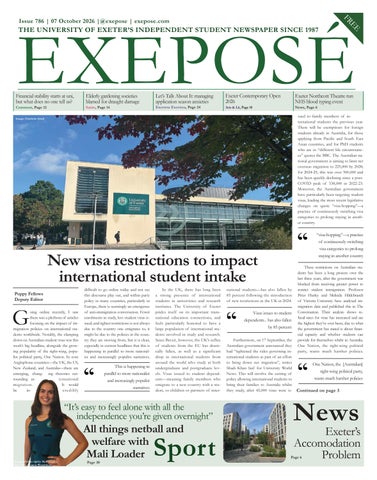
Image: Charlotte Isbell
“visa-hopping”—a practice of continuously switching visa categories to prolong staying in another country
New visa restrictions to impact international student intake Poppy Fellows Deputy Editor
G
oing online recently, I saw there was a plethora of articles focusing on the impact of immigration policies on international students worldwide. Notably, the clamping down on Australian student visas was this week’s big headline, alongside the growing popularity of the right-wing, populist political party, One Nation. In core Anglophone countries—the UK, the US, New Zealand, and Australia—there are emerging, chang- ing rhetorics surrounding international mig ration. It would be incredibly
difficult to go online today and not see this discourse play out, and within party policy in many countries, particularly in Europe, there is seemingly an emergence of anti-immigration conversation. Fewer enrolments in study, less student visas issued, and tighter restrictions is not always due to the country one emigrates to, it might be due to the policies in the country they are moving from, but it is clear, especially in current headlines that this is happening in parallel to more nationalist and increasingly populist narratives.
This is happening in parallel to more nationalist and increasingly populist narratives
In the UK, there has long been a strong presence of international students in universities and research institutes. The University of Exeter prides itself on its important transnational education connections, and feels particularly honored to have a large population of international students involved in study and research. Since Brexit, however, the UK’s influx of students from the EU has drastically fallen, as well as a significant drop in international students from around the world who study at both undergraduate and postgraduate levels. Visas issued to student dependents—meaning family members who emigrate to a new country with a student, so children or partners of inter-
“It’s easy to feel alone with all the independence you’re given overnight”
Images (left to right): Mali Loader, Free SVG, Connor Woodsford
All things netball and welfare with Mali Loader Page 30
Sport
national students—has also fallen by 85 percent following the introduction of new restrictions in the UK in 2024.
Visas issues to student dependents... has also fallen by 85 percent Furthermore, on 17 September, the Australian government announced they had “tightened the rules governing international students as part of an effort to bring down net migration”, writes Shadi Khan Saif for University World News. This will involve the cutting of policy allowing international students to bring their families to Australia whilst they study, after 45,000 visas were is-
These restrictions on Australian students has been a long process over the last three years, after the government was blocked from receiving greater power to restrict student immigration. Professor Peter Hurley and Melinda Hildebrandt of Victoria University have analysed immigration data and published this in The Conversation. Their analysis shows refusal rates for visas has increased and are the highest they’ve ever been, due to what the government has stated is about financial capacity and whether students can provide for themselves whilst in Australia. One Nation, the right-wing political party, wants much harsher policies.
One Nation, the [Australian] right-wing political party, wants much harsher policies Continued on page 3
News
Exeter’s Accomodation Problem
Page 6
EXEPOSÉ Devonshire House, Exeter, Devon, EX4 4PZ Editors Print: Beth Casey and Charlotte Isbell Online: Orlando McKillop and Ria Brown-Aryee Print Deputy: Poppy Fellows Online Deputy: Isabella Brooks editors@exepose.com News Editors Print: Poppy Fellows news@exepose.com Features Editors Print: Janani Kandaramage features@exepose.com Climate Editors
Editorial
W
e're both very excited to bring you the second edition of Exeposé with the new editorial team. As we get into the swing of things, we've given the paper a bit of a revamp; a fresh front cover and new editorial guidelines encase the incredible reporting carried out by our student team in this edition. In this issue, News investigates the experiences of international students at Exeter and across the globe, and examines the accommodation crisis impacting so many of us. Features
addresses the recent Sydney Sweeney controversy, whilst Climate speaks on the ongoing drilling debate in the North Sea. In Exhibit, Lifestyle gives advice on dressing for the incoming winter weather, Screen is full of personable reviews of recent content and Arts & Lit interview historian and author Tracy Bormon. In International we discuss the UK sanctions on Israel, SciTech examines the surge in doomsday narratives around artificial intelligence, and Sport includes its second Student Athlete Spotlight, speaking
to one of Netball's Welfare Secs. If you can't get enough of Exeposé, you can check out our website which is updated on a weekly basis! Thank you to all our editors, writers and general helpers who have worked hard to make this edition what it is! We hope you have an amazing start to October and in the future, if there's an important issue at the university or in Exeter that we've missed, please email us at editors@exepose.com.
REVIEW: RESIDENT EVIL Screen Page 23
Beth and Charlotte
Print: Freddy Purcell Online: Ella Clark climate@exepose.com Comment Editors Print: Isabelle Pearce comment@exepose.com Satire Editors
'NO PHONE POLICY': FRIEND OR FOE? Music Page 20
WHY ARE UK UNIVERSITIES CUTTING BACK ON HUMANITIES? Features Page 8
Print: Sebastien Broom satire@exepose.com Lifestyle Editors Print: Rosa Terry and Sofía Tapia Online: Phoebe Andrews and Lucy Felton lifestyle@exepose.com Arts & Lit Editors Print: Erin Rose Morris and Lucy Cornwell Online: Amber Gordon artsandlit@exepose.com
University News: Home and Abroad
Music Editors Print: Cristina Ferrin Online: Amelie Marah and Eve Buckley music@exepose.com Screen Editors Print: Beth Casey and Charlotte Isbell Online: Annabelle Atkins and Beth Donovan screen@exepose.com International Editors Print: Audrey Yuen and Suhaib Shaukat Online: Anna Tolkacheva and Lola Milroy-Tompkins international@exepose.com Sci-Tech Editors Print: Beth Casey and Charlotte Isbell Online: Julia Szewczyk and Sarah Hope sci-tech@exepose.com Sport Editors Print: Beth Casey and Charlotte Isbell Online: Lottie Townsend sport@exepose.com Social Media Executive: Sam Jordan Chief Photographer: Ethan Ford Podcast Producers: Melissa Swift and Sebastian Stanwell-Wise Proofers: Ella Clark, Ben King, Betsy Heasman, Lily Morris, Freddy Purcell, Eva Coombs, Janani Kandaramage, Poppy Fellows, Charlotte Isbell and Beth Casey
@exepose @exepose facebook.com/exepose issuu.com/exeposeexeter Advertising
editors@exepose.com The opinions expressed in Exeposé are not necessarily those of the Exeposé Editors nor the University of Exeter Students’ Guild. While every care is taken to ensure that the information in this publication is correct and accurate, the Publisher can accept no liability for any consequential loss or damage, however caused, arising as a result of using the information printed. The Publisher cannot accept liability for any loss or damage to artwork or material submitted. The contents of this, unless stated otherwise, are copyright of the Publisher. Reproduction in any form requires the prior consent of the Publisher.
Developing tech skills at Namibian Universities
British University to open in New university towns to be built in Hong Kong Iraq
CADEMIC Siddartha Tiwari has urged Namibian educational and governmental institutions to develop technological crop-monitoring skills among locals. The issue gained prominence after the Namibian government cancelled a $2.4 million agreement with a US agricultural technology company to use satellites and geospatial imaging to support agricultural planning and improve responses to events such as droughts. Such capacities are invaluable, but in the hands of international companies, local specialists have limited access to the data generated by these technologies. While Namibia may not be able to develop all technology domestically, Tiwari therefore urges the government to consider which areas might benefit from local expertise that could better manage the use of technologies within the country and increase independence. Agriculture is a prime candidate, as a significant proportion of Namibians rely on farming for income or subsistence, while the sector constitutes an important part of the country’s GDP.
HE construction of the British University in Iraq is now officially underway after Abdul Hussein AlMousawi, Iraq's Acting Minister of Higher Education and Scientific Research, laid the university's foundation stone earlier this month. The ceremony took place on 12 September in Al-Jawahiri Residential City, Abu Ghraib with various Iraqi government officials and academic scholars in attendance. The university’s initiative to internationalise higher education comes alongside a conscious effort to create connections with leading universities globally. AlMousawi states, “Expanding international academic partnerships is important and attracting reputable universities and educational institutions”. The university is set to follow a British curriculum, with students graduating with both UK and Iraqi qualifications, having developed both “scientific and practical skills”, says Al-Mousawi.
A
T
Image credits: Namibian University (Wikimedia Commons); University of Essex (Flickr).
H
ONG Kong is planning three university towns in the New Territories as part of its Northern Metropolis project. In its first five-year plan and policy address on 16 September, the government tripled their planned campus area to 300 hectares, which a government source said is roughly the combined size of the cities eight publicly funded universities. S a n Tin will focus on medicine, health technology, artificial intelligence, and robotics, Hung Shui Kiu will take smart manufacturing and international talent, and Ta Kwu Ling will mix industry with arts and leisure. Including technology zones and homes, the towns will cover more than 1000 hectares. Building 1 at the Hong Kong park in the Hetao zone, due for completion late this year, will be the flagship project for the towns and government-funded research postgraduate places will rise from 7200 to 9600 by 2030/31.
The University of Essex to face staff cuts
T
HE University of Essex is the latest in an ever-growing number of institutions reducing staff numbers, with 400 cuts being announced to combat “financial issues all universities” are facing. This decision followed earlier cuts in August which resulted in the closure of the university’s Southend campus and a further 400 jobs being lost. In reaction to this, staff and their union UNISON have vowed to engage in industrial action with admission advisors, IT technicians and admin staff, among others, all set to partake in a walkout to protest the cuts. In response to this rising criticism, the university has acknowledged the cuts’ difficult nature and has assured students and staff alike that they “recognise the impact” they will have. However, the University of Essex has insisted that these decisions must remain in place to protect the future of its staff and wider communities. By Freddy Purcell, Lily Morris, Gracie Kelly and Evie Merrilees.
07 OCTOBER 2026 | EXEPOSÉ
B
ACK in 2014, the London School of Economics (LSE) published a document titled “Research and Analysis of the Benefits of International Education Opportunities”, which ultimately surmised that the intercultural experiences of international educational opportunities—at any level, be that primary, secondary, or higher education stages—are crucial for economic development, employment opportunities for students, and the integral transferable skills gained from interacting with intercultural opportunities. I, and many others, would argue that this situation is yet to change. There is an innate prejudice looming regarding foreign nationals, and a narrative circulating across news coverage, social media, and in political dialogue that is beginning to permeate the discourse of international and transnational education. Despite this, the LSE literature review reported that the UK specifically benefitted economically much more from an influx of international students coming to British Institutions—this is further reinforced by the most recent data by the government, stating the net economic value of foreign students is £37.4 billion (UK Parliament).
There is an innate prejudice looming regarding foreign nationals Moreover, in the US, international students contributed $43 billion to the economy (NAFSA: Association of International Educators); NZ$4.5 billion in New Zealand (Education
3 NEWS
Continued from front page... New Zealand); and over AUS$50 billion in Australia (Reserve Bank of Australia). These numbers represent only the economic value of international education and students—but can we really just measure the success and pertinence of international education through money? Is this just how we measure significance of all things now? I for one, would consider education priceless, and therefore an invaluable experience regardless of monetary significance.
Can we really just measure the success and pertinence of international education through money? Globally, we are seeing drastic change in international student enrolment, particularly in leading Anglophone countries: the US, the UK, Canada, and Australia. Nathan Greenfield at University World News discussed this over the summer. To summarise, enrolment of students in these countries by foreign nationals has significantly reduced since January, most prevalently in Canada and the US. He cites “restrictive government policies” as the seminal obstacle. Australia, as discussed, will bar students from bringing dependents with them on a visa and if elected in the next British general election, Reform UK have pledged to do the same. Across the US, we see countless cases of students deported midway through their studies due to increased ICE activity and rampant government crackdown on immigration. In Canada, there has been a 155,000
cap on student visas—visas which allow students to stay in Canada and apply for permanent residence (providing they find work through the Express Entry system). One might question how this will change going forward when its neighbours become tougher and tougher on immigration policy, and public narratives change along with it. Political scientists Schmidt-Catran and Czymara in 2022 wrote that anti-immigrant attitudes across Europe were an expression of feeling threatened by change to national “statusquo”, reflecting why we are seeing policies enacted and proposed changing the way in which student visas are working.
multiple “social and economic benefits that mobility (of education) can yield”, from a MAUNIMO project. International education is indispensable in terms of employability, developing transferable skills, and awareness and sensitivity. This is crucial; developing intercultural development is as important as developing employability and benefitting national economies.
Australia will bar students from bringing dependents with them on a visa and if elected... Reform UK have pledged to do the same
Another incredibly potent news story that hit headlines these past weeks is the blocking of Homeland Security’s restrictions on student visas and limiting students to a four-year program, which would significantly impact postgraduate study and research. Of course, restrictions on immigration in the US are rife, and becoming increasingly so. In July 2026, President Trump announced he would enact a policy restricting student visas; on 14 September, Judge Saylor of the Federal Courts System blocked this, ruling in favour of the coalitions and higher education advocates who sued. Saylor claimed the Trump administration’s policy was “weak” in its reasoning, and was “rampant abuse” of the immigration system. The US’s system allowed students and researchers to come to the US to study, leading to groundbreaking research that benefits the economy, health and social care, and education. I would return to the LSE’s literature
In New Zealand, the New Zealand First political party has stated they would bar student visas automatically giving students a right to work postgraduation. Instead, international students would have to leave New Zealand before they can apply for a working visa. Earlier this year, there was significant press coverage of New Zealand’s so called “brain-drain” as tens of thousands of citizens were emigrating out of the country; even former Prime Minister Jacinda Arden had left for Australia. Even so, the right-wing party proposes increasing immigration restrictions further. Returning to the report commissioned by the LSE, it cites
Developing intercultural development is as important as developing employability and benefitting national economies
review and claim that the judge’s statements uphold how international and transnational education policies and opportunities are priceless; allowing for indispensable knowledge to be shared through networks of students and researchers, contributions to medical, technological, and economic growth, and alongside irreplaceable humanities work, sharing culture, language, arts. Judge Saylor is advocating for a much wider cause: protecting over a million students in the US on ‘F’ or ‘J’ visas, allowing for groundbreaking research to endure with the contributions of international students.
International and transnational education policies and opportunities are priceless Mia Taylor-Seal, your Education and Employability Officer, said, “We know conversations around immigration and international student visas can feel unsettling, particularly when you’re studying and building a life away from home. We want every student at Exeter to feel welcome, supported and able to be themselves. Your new International Part-Time Officers, Chidi and Dru, are here to listen, hear what matters to you and push for the changes you need. Our international community is a huge part of what makes Exeter, Exeter. Whether it’s joining a society, getting involved in events or simply finding your people, there are so many ways to connect and belong here. Whatever your background, identity or beliefs, we’re on your side.”
Image: Charlotte Isbell
4
07 OCTOBER 2026 | EXEPOSÉ
NEWS
Higher education review to take place in Wales growth while students are becoming increasingly concerned by student debt and the rising costs of university life.
Charlotte Townsend Contributor
U
NIVERSITIES facing severe financial strain have become an increasing problem in Wales where universities are operating at a combined deficit of more than £97 million. These financial issues have led to the commission of a review of Wales’s higher education system which will start next month and continue through to Winter 2027. The main concern is the financial sustainability of the system for universities, students and the Welsh government. Universities are facing rising operational costs without a rise in income
The main concern is the financial sustainability of the system for universitities, students, and the Welsh government. The student loan system in Wales already differs from the English system as non-repayable support is available through the Welsh Government Learning Grant. Students use both the non-repayable grant and a maintenance loan to support them financially. This means unlike students in Eng-
land, every Welsh student is entitled to the same amount of financial support. Instead, it is the proportion of grant and loan that varies with students from lower income households getting a larger non-repayable grant and smaller maintenance loan. However even though every Welsh student can guarantee at least £10,685 of financial support it still falls short on covering their expenses due to increasing living costs. Another important aspect of the review is its focus on ensuring Welsh higher education suits the needs of the Welsh economy and people. There are far less Welsh students pursuing higher education than the UK average, and 27 percent of Welsh graduates are working outside of Wales 15 months after
graduating. The review is hoping to combat this and encourage more Welsh students to study in Wales and subsequently work in Wales, as well as a focus on encouraging some young people to pursue a form of non-university higher education and to gear education to the skills the economy needs.
A focus on encouraging some young people to pursue a form of nonuniversity higher education and to gear education to the skills the economy needs. The review is being led by Professor Patrick Prendergast whose vast experience in leadership in the
Irish higher education system will allow him to bring both an experienced and external perspective. He will be joined by other higher education professionals and listen to the views of multiple groups. While the ramifications of the review will not be felt until it is complete, it could have big implications for the Welsh Higher education system. The review could lead to big structural changes to deal with the challenge of balancing increased money for students and universities. Alongside this an organization overhaul could be needed to entice more Welsh students to study in Wales and to make higher education more suited for Wales’s economic needs.
Exeter takes 16th place on university league tables Ellen Kemmett Contributor
T
HE Sunday Times have released their 2027 Good University Guide, and it came with some interesting rankings. Significantly, Oxbridge missed out on the top spots for the third year in a row.
Significantly, Oxbridge missed out on the top spots for the third year in a row. In their place, the University of St. Andrews, London School of Economics, and Imperial College
London seized the top three positions. Crucially, each of the universities scored noticeably higher in student experience ratings than Oxbridge did. Zoe Thomas, author of Good University Guide, revealed that Oxbridge received “tepid” feedback from undergraduates in the National Student Survey.
University of St Andrews, London School of Economics, and Imperial College London seized the top three positions The intense workload and academic pressure Oxbridge places on its students may be necessary to get
Image credit: University of Exeter
Students want to attend [university] knowing they will be supported
through the syllabuses with only eight weeks of term time, but with this comes an obligation to provide students with adequate support. The U-Flourish: Student Wellbeing Research Project found that at least 15 percent of Oxford students reported poor mental health or high levels of
anxiety during the academic year. The shadow education secretary, Laura Trott, points to an important fact that “university is a big financial commitment”, and with the cost of living increasing each year, students want to attend knowing they will be supported both academically and pastorally.
Dr Niall Allsopp designated a significant portion of one of his first lectures back to explaining how class sizes will increase and that the “quality of education experiences for students” will be diminished. He ended his lecture with his opinion that “student experience” seems less important to university management.
His opinion that “student experience” seemed less important to university management
Government reorganisation to take place in Devon Ella Ferguson Contributor
P
LANS to streamline local governments across the country have been put on hold following unspecified legal advice. The initiative, which was announced by the Secretary of State for Housing, Communities and Local Government Angela Rayner, has been placed under review to ensure that the process aligns with the new administration’s vision for Britain.
Plans to streamline local governments across the country have been put on hold
The main purpose of the reorganisation is to make local government systems simpler. Devon currently has two tiers of local authority: the County Council and eight District Councils. The government wants to remove this system and replace it with four distinct councils: Devon Council, Exeter Council, Greater Plymouth, and Torbay and South Devon. The intent is for these unitary councils to become better connected, streamlined and stronger overall. In practice, this means that rather than different councils having different areas of responsibility, each one will oversee all services for its own district. A council will be accountable for its area’s education, roads, and housing, etc. which should improve
co-ordination across these services. There will be a single point of contact for all council responsibilities and more ac-
countability for them. These plans should be completed by April 2028, pending the Government’s review. Angela Rayner MP did
not specify exactly why the plans had been placed under review, only that she wants to satisfy herself that this is the right process and it aligns with the new Prime Minister’s “priorities”. There have been varied reactions to the announced pause; Devon County Council Leader Julian Brazil described it as “great news”. He noted that the local government reorganisation has been a catalyst to deliver reforms within the current councils. Brazil also noted the importance of local government systems and called it a “building block” to a strong economy. Michael Fife, Leader of the opposition, referred to the plans as “reinventing the wheel” and does not want to “waste £80 million on rebranding”.
Local government reorganisation has been a catalyst to deliver reforms within the current councils Angela Rayner MP declared that the Government is working “with local people” so the reevaluation of the plans could possibly stem from local governors’ perceived reluctance to reshape the systems that have been in place for so long. It remains to be seen whether the process will go ahead, but the question we should hope the review will answer is whether the benefits of a reorganisation will be worth the cost. Devon local election map 2025. Image credit: Wikimedia Commons
5
07 OCTOBER 2026 | EXEPOSÉ
NEWS
The University of Exeter’s accommodation shortage Connor Woodsford Contributor
F
OR most incoming students, finding out which accommodation you’re placed in is the first real introduction to what your life in Exeter will be like. If you’ve ever been on social media platforms like Instagram or TikTok around the end of August, you’ve likely seen the celebrations of incoming first-years getting their first choice, or the fierce arguments in the comment sections over which accommodation is the “best”, with a noticeable buzz around East Park in particular (often dubbed ‘The Capitol’ because of its grandeur, in reference to The Hunger Games). This year, however, has seen a different flurry of accommodation-related videos on these platforms, with students instead complaining about the lack of oncampus university accommodation, with
some describing themselves as “victims of the Exeter accommodation crisis”. It’s usual to see small numbers of students having to scramble to find accommodation after not being placed in on-campus residences, but this freshers’ season has been noticeably different, with the University recognising an “exceptionally high” demand for places. This is likely due to an increased number of students attending the university, with the Universities and Colleges Admission Service (UCAS) noting that a recordbreaking 262,820 students were accepted into university across the UK, a three percent increase on last year, with a six percent increase for higher tariff universities. The University of Exeter publish admission figures, but as it falls into the ‘higher tariff ’ category, it’s likely that the University received a significant record number of admissions for the 2026/27 academic year. While those who applied for accommodation before 31 July—thanks to the University’s Accommodation Guarantee—have secured their places in purposebuilt student accommodation (PBSA), some students who did not apply by this deadline, or students who only committed to Exeter after going through clearing after A Level Results Day on 13 August, have been unable to find places in PBSAs. As such, the University has offered stu-
dents the options of either finding places in private accommodation, a process usuImage: Melissa Swift ally reserved for second years and up, or to defer (delay) their studies for another year.
The University has offered students the option of either finding places in private accommodation [...] or to defer (delay) their studies for another year When approached by Exeposé, the University gave the following statement: “We saw exceptionally strong demand from students wishing to study at Exeter this year, alongside very high demand for accommodation across the city. “We met our accommodation commitments to eligible students covered by the University’s Accommodation Guarantee. However, demand this year means that we were unfortunately unable to offer University accommodation to some students who are not covered by the guarantee.
Demand this year means that we were unfortunately unable to offer University accommodation to some students who are not covered by the guarentee “Students were notified as early as possible to explore private accommoda-
tion options, and also had the option to defer their studies to next academic year.” A lack of PBSAs however is a nationwide issue, one that the University is attempting to address with the construction of the new West Park accommodation blocks on the old Clydesdale area, and the rebuilding of Birks Grange Village’s old catering block into new blocks of selfcatered accommodation. Though with these not expected to take on their first students until September 2027, this year’s entrants unfortunately won’t benefit. Yazan, who is a first-year student and decided not to defer for a year, told Exeposé: “I applied to Exeter as my insurance choice, but after accepting a place on Results Day, I was told that there was no student accommodation left.” He then told us that he had to find a private house in the city as a result. Edie, your Student Life and Communities Officer, said, “No student should be starting university without knowing where they’re going to live. We’ve
been hearing your conversations online, and the uncertainty and stress the University has caused is not good enough. I’m calling for the University to honour its 2025/26 accommodation prices for those forced to defer. Longer term, I’m asking the University to improve its Accommodation Guarantee, ensure its new West Park Halls are ready for 2027/28, and offer stronger protections for care-experienced, estranged and disabled students. Unfortunately, we cannot source students’ accommodation, but we can offer advice on your housing rights. Our unique role is to be the collective voice of students, right now that means pushing the University for answers and action.” For current Exeter students affected by this issue, please speak to the Guild Advice Team at https://www.exeterguild.com/find-support/main-pages/ find-support. For everyone, see https:// www.talkworks.dpt.nhs.uk/ for more on Devon’s NHS talking therapies service. Image credits: Connor Woodsford
Exeter students to help deliver free English language classes Charlotte Isbell Editor-in-Chief
E
XETER student volunteers, encouraged by Exeter Univeristy’s Student Action for Refugees (STAR) Society, are to help run free English classes for international students and their spouses at St. Sidwell’s Community Centre. Maria Tomas, the ESOL (English for Speakers of Other Languages) Administrator at St. Sidwell’s Community Centre told Exeposé that the classes are also open to “asylum seekers, refugees, migrants and anybody else who wants to learn English”. On their website, the Community Centre explains that “these informal classes, taught by volunteer teachers, are open to everyone who wants to improve their English, to make new friends and to share their ideas and experiences with other people from around the world. Classes run through-
out the school year and are available for all levels from Beginner to Advanced.” The classes are supported by Exeter’s STAR society, which aims to create a supportive and welcoming environment for refugees in Exeter and that “by volunteering with these groups, STARs have a positive, tangible impact on the lives of refugees in our local area.” This term’s classes started on the 7 September and run until 18 December. As well as language lessons, students can go to the Work and Wellbeing Drop-in on Tuesdays from 2pm-4pm. You can apply to volunteer on the Community Centre website, or attend the Volunteer DropIn from 12:30-2:30pm every Friday.
You can apply to volunteer on the Community Centre website, or attend the Volunteer Drop-In from 12:30-2:30 pm every Friday. Image credits: St Sidwell Community Centre
6
07 OCTOBER 2026 | EXEPOSÉ
NEWS
Exeter Northcott Theatre run NHS blood typing event Beth Casey Editor-in-Chief
T
HE Northcott theatre on the University of Exeter campus is running an event on 1 October, before their opening night of Little Shop of Horrors, that will allow the public to participate in a blood typing event. Running in honour of the production, which is centred around a carnivorous plant that has developed a taste for human blood, the event makes up part of an NHS scheme to encourage blood donation and identify rare blood types. Cast members from the production will be taking part, and anyone in the community is encouraged to come along. Blood typing uses the ABO sys-
Image: Kyle Carter
tem, a process that identifies which of the four main blood types your blood is categorized as, based on the antigens present. Blood type O is the most common in the UK, with almost 50 percent of the population registered as this, with A, B and AB following respectively.
The event makes up part of an NHS scheme to encourage blood donation and identify rare blood types It can be life threatening to be given blood from the wrong blood type, such as if a Type A patient was given type B blood. However some blood types are considered ‘universal donors’ or ‘universal recipients’ such as O blood being compatible for type A or B. This is why O+ and
O- blood is used the most and therefore in most demand in hospitals. According to the NHS website, “Giving blood saves lives. The blood you give is a lifeline in an emergency and for people who need long-term treatments.” They also state you can donate blood if you are “fit and healthy, weigh between 50kg (7st 12lb) and 158kg (25st) and are 17 to 65 years old” and go on to mention the importance of blood donations from all blood types: “We need new blood donors from all backgrounds to ensure there is the right blood available for patients who need it.”
Giving blood saves lives. The blood you give is a lifeline for people who need long-term treatments. The Northcott theatre holds events at both the University Campus and their Barnfield Theatre in Exeter City centre, and is a registered charity within Exeter and Devon. Previous charity collaborations include their Pay it Forward scheme, that aims to provide accessible ticket prices to young and vulnerable individuals through charities such as Children’s Hospice South West, Young Devon, LiveWest, Balloons and Devon Foster Carer’s Association. In 2026 they set up a partnership with the Deaf Academy Charity and according to their website plans to “take
Image: Ralph Whitehead
part in deaf-led comedy nights, theatre performances, talks, workshops and a deaf rave.” The theatre frequently welcomes more than 10,000 people to their shows annually. Northcott have said: “We are thrilled to be using the platform of our upcoming production of Little Shop of Horror to support the NHS with this blood typing event. While we must keep feeding Audrey II, blood donation saves lives, so we hope to see you there!” The ‘What’s Your Blood
Type’ event will take place at Exeter Northcott Theatre on Thursday 1 October, 10am-3.30pm. Little Shop of Horrors will run at: Exeter Northcott Theatre, 1-17 October 2026. Tickets are on sale at exeternorthcott.co.uk
We are thrilled to be using the platform of our upcoming production... to support the NHS
Images: Northcott Theatre
07 OCTOBER 2026 | EXEPOSÉ
7
NEWS
8
07 OCTOBER 2026| EXEPOSÉ
Features
FEATURES EDITOR:
Janani Kandaramage
Why are UK universities cutting back on the humanities?
U
Ella Ferguson questions current pressures on humanities provision across universities
K Universities have cut nearly 4000 staff positions in Humanities, Arts and Social Sciences (HASS) in one year alone, leading to “cold spots” according to The British Academy. Around 3000 social sciences, 820 humanities and 240 arts jobs were cut in the 2024/25 academic year. At the University of Exeter around 150 job cuts were proposed in July, concentrated in HASS. The British Academy’s data map shows shrinking access to these areas of study; the UK is facing a widespread loss of people, places and resources that sustain HASS disciplines.
THE BRITISH ACADEMY’S DATA MAP SHOWS SHRINKING ACCESS TO THESE AREAS OF STUDY This is not an isolated incident of HASS being deprioritised and there are many factors that could be causing this pattern. The government prioritises STEM in higher education: since 2012, humanities subjects have run almost solely on tuition money, while STEM subjects receive extra funding from the government. For the 2026/27 academic year, the
Image: University of Exeter
Office for Students allocated £890 million in funding for “high-cost courses”. Additionally, international students who pay higher tuition fees often opt for courses such as business, computer science and engineering rather than HASS. Overall, this implies that STEM subjects have a higher financial return for universities, and as universities are run like businesses, they prioritise the courses that have more turnover.
Image: Wikimedia Commons
There are many STEM skill-gaps in the job market which the government wants filled to boost the UK economy. However, this expectation is resulting in the neglect of humanities in higher education. The decline in HASS academic posts is mainly in early careers rather than senior levels, highlighting an erosion of opportunities for the next generation. Hetan Shah, chief executive of The British Academy, noted that we risk these subjects being “lost to the winds” which is a “crisis for young people’s ca-
reers”. The outcome is less alternatives for students in universities, and a future of job market gaps in crucial sectors such as social work, education, journalism and communications. Growing cold spots means less range of subjects for students who cannot move away from home. According to Justine Greening, the former Conservative Secretary of Education, a variety of subjects accessible to students of different backgrounds is “essential to social mobility.” A lack of opportunities available to a wide range of students undermines everything higher education should stand for.
A LACK OF OPPORTUNITIES AVAILABLE TO A WIDE RANGE OF STUDENTS UNDERMINES EVERYTHING HIGHER EDUCATION SHOULD STAND FOR Additionally, a diverse skillset across industries is vital to a modern society with a strong economy, and this cannot be achieved unless all subjects are offered and provided with the same attention. As we hurtle towards a future
of unprecedented levels of scientific and technological advancement, we are at greater risk of losing diversity of thought. Unless the government and higher education prioritise equality across all areas of expertise there will be tunnelvision that promotes STEM industries above all else. We need students of humanities more than ever before to protect everything that stands in contrast to STEM: art, emotion, culture, literature, and history. A world without HASS subjects is a world of utility, stagnation and apathy. Technology is intended to exist alongside humans and make our lives better; if we promote the study of STEM above the study of our own existence, can technology and science have any real purpose? After all, are HASS subjects not the study of the most important part of our existence as intelligent conscious beings: our human experience?
IF WE PROMOTE THE STUDY OF STEM ABOVE THE STUDY OF OUR OWN EXISTENCE, CAN TECHNOLOGY AND SCIENCE HAVE ANY REAL PURPOSE?
07 OCTOBER 2026| EXEPOSÉ
9 FEATURES
Why women in sport must be seen for more than their bodies
T
Bethany Donovan, Online Screen Editor, discusses the Sydney Sweeney advert backlash
HE backlash against Sydney Sweeney’s recent Novig sports betting advertisement has reignited a long-running debate about female agency, sexualisation and the male gaze. The advert, in which Sweeney appears nude while using sporting equipment to cover her body, attracted criticism from athletes including Amy Hunt, Ariarne Titmus and Gracie Kramer. They expressed concern that the campaign placed sexual appeal at the centre of its representation of sportswomen at a time when female athletes are seeking greater recognition for their achievements than their appearance. What makes the advert particularly contentious is the tension between female bodily autonomy and the consequences of sexualised media representations. Women should have agency over their bodies and how they choose to present themselves. Criticising a woman for embracing her sexuality risks reinforces the social attitudes that feminists have spent years challenging. However, individual agency does not remove the wider cultural effects of sexualised advertising, particularly in sport, where appearance has historically overshadowed women’s achievements. Camera angles, framing and editing can draw attention towards an athlete’s body rather than their performance.
APPEARANCE HAS HISTORICALLY OVERSHADOWED WOMEN’S ACHIEVEMENTS This has become an increasingly important topic of discussion, prompting changes in how women’s sport is broadcast. The BBC’s cover-
Image: Pexels
age of the Women’s European Athletics Championships implemented newly developed European Broadcasting Union guidelines for “more respectful” camera angles to avoid sexualisation and place greater emphasis on athletes’ performance. Such approaches suggest that broadcasters are beginning to recognise their role in shaping how women in sport are represented, rather than simply reflecting existing attitudes. This makes the irony of the Novig campaign all the more apparent. While women’s sport is working to shift attention towards athletic achievement, the advert instead chooses to construct a series of deliberately sexualised sporting images. The contrast is stark: it blatantly shows how sporting images can be used either to foreground athletic achievement or sexualised appeal. Young female athletes are often exposed to idealised and sexualised representations of women’s bodies in the media, shaping perceptions over what their body should look like. This creates
a particular tension in sport, where strength and muscularity are often necessary for performance, yet this conflicts with cultural expectations of femininity. Novig’s advert contributes to this issue by using sport as a backdrop for sexualised imagery, rather than highlighting the physical strength and athletic ability required to be a female athlete. The expectations placed upon female athletes, however, extend beyond the media to include the governing sporting bodies, with many sports still placing greater demands on how women present themselves. This is particularly evident in gymnastics, where the International Gymnastics Federation (FIG) has detailed regulations governing athletes’ clothing. The introduction and increasing use of unitards (leotards extending down to cover the leg) can be viewed as an attempt to give gymnasts greater choice and reduce unwanted sexualisation. However, FIG’s detailed rules surrounding female attire also raise questions about how much
agency female athletes have over their appearance. Female gymnasts face score deductions when clothing requirements are not met, and there are no comparable rules imposed on male gymnasts. This disparity reflects a wider gender inequality in sport, where female athletes continue to face greater scrutiny over their appearance than their male counterparts. Addressing this inequality is not about limiting women’s choices in attire but ensuring that female athletes are valued for their talent, achievements and hard work rather than their appearance. Ultimately, the backlash against Sydney Sweeney’s Novig advert highlights the ongoing conflict between female agency and the wider consequences of continual sexualised representation. Challenging this representation is not about dictating how women present their bodies, but questioning why appearance in women’s sport continues to overshadow achievement.
Image: Wikimedia Commons
Can celebrities really stay out of politics?
A
Eva Coombs examines whether silence is a form of political positioning
S social media further descends into polarisation, celebrities struggle to remain silent figures of fame, untouched by the noise of politics. Where parasocial relationships between the fans and the idol deepen, demands grow to know the political beliefs of their ‘faves’. Ed Sheeran’s Loop Tour has fallen into ticket sale shame after all his opening acts for the US leg have dropped out following Macklemore’s political display.
friendly star. This was followed by a $2 million donation on his part, to support humanitarian aid in the Middle East. His abrupt reaction leaves fans confused about the ingenuity of his actions.
of global issues swamps virtual communication, it has become more difficult for celebrities to avoid revealing their political alignment without losing a portion of their fanbase. Consumers want to
Image: Wikimedia Commons
ED SHEERAN’S LOOP TOUR HAS FALLEN INTO TICKET SALE SHAME This decision was said to be made by the promoter, Messina Touring Group, after the ‘Can’t Hold Us’ singer declared “Free Palestine” on stage and dedicated a song to pro-Palestinian protestors at Columbia University. Due to this, both venues in the U.S and the Israeli American Council called for Macklemore to be removed from the tour. However, the severe backlash experienced by Sheeran goes beyond ticket sales as he has been forced to make several statements regarding the situation: a sharp juxtaposition to his broad appeal as a radio-
His first choice of neutrality may have upheld his safe image but in acting against a movement, does this reveal his passive nature toward global issues? Debates about what celebrities owe us are not new, as many fans are well able to separate the art from the artist. As information and understanding
ensure, more than ever before that the artist they invest their time, money and consideration stand up for the same issues as they do. With average ticket prices up 50 percent from 2019, fans are less willing to indirectly fund artists who have the privilege to stay silent on prevalent global issues,
especially if these issues have a personal affliction. Recently Zara Larsson has also alluded to cancelling her Grand Prix performance in Abu Dhabi after a fan drew her attention to their involvement in Sudan, described by the UN as “the world’s worst humanitarian crisis.” Whilst some may argue that it is not an artist’s responsibility to be political, the growing power and influence of celebrities in the digital age cannot be ignored. Age cannot be ignored. Whilst figures like Sheeran claim not to use their platform to be a “political commentator”, this does not historically equate to silence on all issues, as he has demonstrated support for Ukraine. Therefore, selective silence is an active choice to maintain a positive brand image, which put under any pressure simply falls apart. As star power grows, hiding their moral standing can never do any good. Celebrities need to integrate universal human values in their personal brands, and that doesn’t mean showcasing their opinion on every individual policy.
CELEBRITIES NEED TO INTEGRATE HUMAN VALUES INTO PERSONAL BRANDS
07 OCTOBER 2026| EXEPOSÉ
10
Climate
CLIMATE EDITOR:
Freddy Purcell
Exeter-led investigation into UK’s sharks
M
Ted Strange covers groundbreaking research into our endangered species
ARINE scientists at the University of Exeter have been awarded nearly £1 million to investigate three of Britain’s most vulnerable sharks: the blue shark, the porbeagle, and the tope shark. Each of these shark species can be found across the South-West coasts. Blue sharks are categorised as ‘Near Threatened’, favouring the South-West’s warmer waters. Porbeagle sharks are categorised as ‘Vulnerable’ and are found across the UK due to their ability to regulate temperature in cool waters. Tope sharks are categorised as ‘Critically Endangered.’ They favour waters around Southern Britain and are particularly prized by recreational anglers. Led by Exeter’s Dr Matthew Witt and Dr
Lucy Hawkes, Natural England has provided £939,434 to research the behaviour of these sharks in collaboration with the Marine Biological Association, the Angling Trust, and the Pat Smith Database. An online record about shark captures dating back to 1953, the Pat Smith Database will provide historical context to the data from the project’s electronic tag tracking. This will expand knowledge of the species’ movements, feeding and breeding areas, and the impact of catch-and release fishing practices, in an effort to mitigate the threats to their survival.
white shark. These species are subsequently cherished by those who enjoy ocean-based hobbies, and the project will place considerable emphasis on the value of recreational sightings. Dr Witt and Dr Hawkes’ team will interview and conduct workshops with recreational anglers and collect data from angling
hubs at Looe and Falmouth to source information from those with first-hand encounters. Hannah Rudd, Head of Marine at the Angling Trust, said: “the fishers I work with are as invested in the future of these animals as anyone in the science community. Their understanding—where the sharks are, when they arrive, how they behave—doesn’t exist anywhere else, and it belongs at the heart of the evidence base.” Those with first-hand knowledge of these species can provide a new angle to the scientific research. This is an opportunity for those who enjoy the ocean recreationally to help protect Britain’s marine biodiversity and contribute to our knowledge of these rare species.
All species targeted by the study are visually striking; the blue shark is vivid, the tope is long and slender, and the porbeagle is often described as looking like a small great
Image: Wikimedia Commons
Drill, maybe drill? The enduring debate on North Sea oil
N
Joe Paddock lays out arguments for and against the controversial developments
ORTH Sea drilling has been one of the government’s top concerns since election in 2024, with the issue compounded by Trump’s war in Iran and subsequent skyrocketing global oil prices. The debate centres around the Jackdaw gas field near Aberdeen, and the Rosebank oil field near Shetland. Offshore Energies UK (OEUK) say approval of both fields could unlock 111 projects and over £50 billion in investment to the area. Adura, the fossil fuel company promoting the fields says it would add £27B to the UK economy. They, along with other proponents of North Sea drilling such as Kemi Badenoch and the Conservative Party, cite lower domestic prices created by native drilling and securing the 180,000 jobs involved in fossil fuel production in the UK, as key reasons why the government should push ahead with the approval. The cost-of-living has been hard hit by these price spikes, fuel prices have hit over £1.70 in the Exeter area and £2/litre on motorways,
with energy prices set to rise 3.6 percent in October and well over 20 percent by next March. Any cost savings achievable through domestic drilling, as well as the employment security, is naturally critical for the government to consider.
LOWER DOMESTIC PRICES CREATED BY NATIVE DRILLING AND SECURING JOBS Yet other groups, such as The UK Energy Research Centre (UKERG) say approval of the oil and gas fields will have a negligible effect on domestic prices. They point out that the oil price is determined by the global price level, meaning there wouldn’t be significant change in our domestic price due to the UK being a small part of the global market. Not to mention 80 percent
of the oil drilled in the UK is exported overseas, so consumers would be further unlikely to benefit from potential lower prices. The UKERC also point out the issue of wider energy security. Energy prices in the UK are the second highest in Europe, driven by our dependence on natural gas and its volatile price. A solution preferable to drilling therefore, in their opinion, would be continuing to switch to renewable energy to protect our prices from the volatility of fossil fuel markets.
£120B - £336B, far eclipsing the benefits stated by Adura. Many government MPs cited environmental concerns in their opposition to these plans when Prime Minister Andy Burnham signalled his willingness to develop at least one field earlier this year, despite the Labour Manifesto commitment against new approvals. Jackdaw and Rosebank were approved by previous governments, so this does not violate any manifesto promises, but the fields must pass legal challenges to go ahead.
OIL AND GAS FIELDS WILL HAVE A NEGLIGIBLE EFFECT There are also clear environmental impacts. Estimates say that the economic damage from the carbon produced from new drilling could reach
Image: Wikimedia Commons
How to survive a ‘Supersized’ El Niño
T
Hannah Oliver discusses the impacts of the coming weather phenomenon as countries struggle to adapt
HE world‘s already out-of-control climate change is taking another boost, as what “could be the strongest [El Nino] for more than 70 years arrives”. WMO (World Meteorological Organisation) Secretary-General Celeste Saulo said, “The most recent El Niño, in 202324, was one of the five strongest on record and it played a role in the record global temperatures we saw in 2024”, and temperatures are only continuing to rise. When ocean surface temperatures in the Central and Eastern tropical Pacific Ocean rise significantly, the trade winds that normally blow from east to west along the equator can weaken or even reverse direction. This disrupts and changes weather patterns, forcing countries like Indonesia into drought and other places into floods from rainfall increase. On top of the rise in extreme weather events, a powerful El Niño can be dangerous as it
brings these events to countries not currently equipped to handle the changes in temperature and weather. It can put pressure on public safety, both physically and economically, as well as attacking ecosystems. The global ocean temperatures will rise, exterminating coral reefs, forcing marine life to migrate or even killing them completely. With wildfires spreading out
of control, and rainfall rushing in, countries are struggling to put defences into place against El Niño in time. After wildfires burned more than 107,000 hectares of land in Indonesia, authorities are deploying cloudseeding aircrafts to try and trigger precipitation. This is a process where silver iodide, salts or other particles are sprinkled into clouds. Water vapour condenses around
these particles to form heavier water droplets. Despite the importance to global trade, the Panama Canal expects to have more restrictions implemented in October, reducing the number of ships allowed through per day as its system of locks rely on water from Lake Gatun to operate. Therefore, use has been restricted to conserve this water. Environmental and humanitarian agencies like the WMO are working to circulate their forecasts of extreme weather events, giving countries as much time as possible to prepare. El Niño is a naturally occurring event. It has been around long before humans and will go on long after humans. The only true way to decrease its impact is to decrease our own impact on climate change. While it continues to work with the human induced global warming, we will continue to suffer unbearable weather events and temperatures. Image: Wikimedia Commons
Comment
07 OCTOBER 2026| EXEPOSÉ
12
COMMENT EDITOR Isabelle Pearce
Financial stability starts at university, but why does no one tell us?
O
Orlando McKillop, Online Editor-in-Chief, finds out parents are raiding their own pension pots, and is forced to confront his own financial decisions
NE in four families report financial strain from VAT-driven fee rises’’ was a press release from Rathbones, one of the UK’s largest wealth management companies, that we received in our editors’ inbox. It caught my eye quickly, and I soon secured a call with Frances McNab and Adam Brewer, who both work at Rathbones. According to data from the press release, the current government’s policy of VAT on private education is to the detriment of parents long term financial security: 77 percent of families are paying or expect to pay education costs out of their own savings or cash; 22 percent of families funding this education have prioritised ISAs and longterm investments less, and most significantly, 20 percent have reduced their pension savings. The survey conducted by Rathbones only makes you consider your own long-term finances, and the school-fees pressure is only one example. As a young person it may seem far-fetched to consider your financial situation in a decade’s time. Some might argue it’s silly and overthinking it. Though I am well aware of my lacking qualifications in preaching the gospel when it comes to this advice—I didn’t even know you had to reapply for Student Finance England (SFE) until last week. But what I do know is that I have, and I think as is the case with many young people, lost the consideration of financial longtermism which underpins stability later on in life. This stability starts at university age.
WHAT I DO KNOW IS THAT I HAVE LOST THE CONSIDERATION OF FINANCIAL LONGTERMISM So, the Rathbones press release isn’t really about school fees. What it’s really about is what happens when a household has to choose between meeting a near-term obligation and protecting its own future. Parents cutting pension contributions to cover another obligation are making a rational choice under pressure, a choice that they see is putting their child’s future first. These financial sacrifices arrive as a monthly deduction rather than a large cheque, which
Image: University of Exeter
is why “it mostly goes unnoticed’’. This goes unnoticed until the retirement gap shows up later down the line. Private education is steadily climbing up the list of family priorities, competing directly with the kind of saving that only works if it starts early.
FINANCIAL SACRIFICES ARRIVE AS A MONTHLY DEDUCTION, RATHER THAN A LARGE CHEQUE These pressures are genuinely recent, not particularly slow-building. VAT was added to private school fees at the start of 2025, and Rathbone’s data reflects families adjusting to this drastic policy shift in real time, rather than as a result of habit built up over the years. If a single policy change by the government can reshape parents’ retirement plans within a year, it says something about how thin the margin for error already was before this change arrived. This margin is what most students and graduates are trying to build, which might be from nothing. You could argue it feels a little much for a student to think about this so early. Most of us are living on loans, overdrafts and weekend jobs, and retirement is over four decades away. It may feel a little much, but investing should be simple, and is what Adam and Frances emphasised throughout our chat. Investment has this bustling image, pictured in the crowded stock exchange floors, which is far from what it needs to be. “Fear and greed drive poor-investment choices’’ and are the biggest reasons young people don’t invest, according to Adam.
FEAR AND GREED DRIVE POORINVESTMENT CHOICES Chasing quick returns through daytrading or panic-selling does far more damage than doing nothing. Adam’s advice on where we get financial advice was easy to grasp: “be sceptical of financial guidance from social media, AI, and even Reddit’’, particularly larger forums like r/ UKPersonalFinance. They also flagged that if something is too good to be true, then it probably is. Don’t get carried away with get-rich-quick schemes. If I’ve captivated your attention for this long, then perhaps you might be asking me to move on to the obvious— where do you start? The first is to live more frugally: not preaching stinginess, which would be very disingenuous
Image: Gerd Altmann, Public Domain Pictures
considering my own partiality to a late-night Old Firehouse pub trip. This only needs to include genuinely trimming unnecessary costs and moving what’s left into a separate account before it become spending money again. You can also check if you’re already earning some cash through a workplace pension, and you can consider whether you would like to opt out and invest. Your employer typically adds money on top of your own contributions, which is effectively free, and compounds over decades to better prepare yourself to retire in the Southeast.
half of Plan Five borrowers will repay their loan in full, compared with a minimal amount under previous plans. This is significant because writing off the loan is far less likely for us undergraduates, and the argument for forgetting about the debt, or simply not rushing to pay it off, doesn’t have weight.
YOU MIGHT BE ASKING ME TO MOVE ONTO THE OBVIOUS—WHERE DO YOU START?
Should a hypothetical graduate earning their respective average salary set aside an extra £50 a month towards the loan or into a workplace pension? Well, the pension likely wins. An employer top-up is akin to a pay rise rather than a trade-off, and this money compounds until we can take it out at the ripe age of 57 (and rising by the time most of us get there). The same £50 towards the loan does not have the advantage of being matched by an employer and shaves off a marginal amount. Like everything else in the world, there is rarely ever one answer. Rathbones runs a free financial awareness course online, with dates for 2027 to be confirmed to help navigate, alongside a graduate scheme for those interested. Making use of free resources, alongside your free access to the Financial Times and the Economist, as two examples, are further ways to educate yourself. Stability starts at the age of university and deciding now whether to put away £20 a month is still, for most, a choice. But remember never let that be to the detriment of an occasional boat race or Thatchers gold.
The second option is a Stocks and Shares ISA, which can be opened through your bank or a platform for a few pounds. A single tracker does the job without picking individual companies, which can be a headache. Those at all familiar with this might cringe at the generic recommendation, but the S&P500 is the easiest place to start, partly because it has historically boasted averaged returns of around 10-11 percent a year (as a student newspaper and not a financial advisory firm, I have to note that this is not guaranteed in the future). Longer term, the 2023 reforms to the student loan add another consideration. Today, it isn’t as simple as clearing debt, saving later. With most of us are on Plan Five, repayments are nine percent of everything earned above £25,000 a year, interest tracks inflation, and any balance left will be written off after forty years. Government modelling suggests that over
TODAY, IT ISN’T AS SIMPLE AS CLEARING DEBT, SAVING LATER
STABILITY STARTS AT THE AGE OF UNIVERSITY
13
07 Ocotber 2026| EXEPOSÉ
COMMENT
Politicians don’t get to choose their journalists Cristina Ferrin Pereda, Music Editor, discusses Trump’s stance on journalists
I
F journalism is our main window into politics, what happens when politicians get to pick who gets to look through it? When insider access is reserved only for friendly reporters, the public is left in the dark. Last week, journalists from news outlets such as CNN and Politico were denied access to the White House, which Trump excused by accusing them of writing “fiction or lies” about his administration. Not only does this violate the constitutional rights to free speech and freedom of the press, but it also pushes the US one step further from being a democracy.
Since the start of his political career, President Trump has consistently weaponised the term ‘fake news’ to discredit critics and undermine press coverage. The broader effect has been a deep erosion of public trust in institutional reporting. It has trained people to automatically distrust traditional media, to the point where a standard report, like showing empty seats at a rally, gets instantly dismissed as a fake and coordinated hit piece. Image: Wikimedia Commons
Trump intensified this trend of distrust in journalism that has led to politicians no longer viewing journalists as a necessary part of democracy. Across the political spectrum, politicians have realised the electoral value of treating the press as an opponent rather than a partner. Today, politicians no longer just critique news coverage, but they actively seek to bypass independent journalism altogether. By favouring podcasts and social media channels, they decrease the chances that they will be held accountable and asked follow-up questions.
The problem is that the window is no longer being opened by journalists alone. Social media has given politicians a direct route to the public, allowing them to control the message without the scrutiny that comes with independent reporting. As more political news moved onto these platforms, the question is no longer just who gets access to politicians, but who gets to shape what we see.
POLITICIANS NO LONGER VIEWING JOURNALISTS AS A NECESSARY PART OF DEMOCRACY
VIOLATE THE CONSTITUTIONAL RIGHTS TO FREE SPEECH AND FREEDOM OF THE PRESS
Image: Flickr Image: Wikimedia Commons
Has Britain’s infrastrucutre become too dependent on tech?
R
Katherine Dodd discusess the fragility behind Britain’s core infrastrucutre
ECENT software and system catastrophes, including the NATS air traffic control system faults and Manchester rail power failure, have exposed the technological fragility of Britain’s core infrastructure. This has invited arguments that Britain’s infrastructure has become too dependent on technology. Conversely, I’d argue that the problem is not one of technological dependence, but of technological resilience. In a wealthy and developed country, where technology is vital for the proper scheduling and maintenance of citizens and goods, dependence is now inevitable. The seemingly mundane software flaw wreaked chaos at NATS’s Swanick Centre,
Image: Flickr
cancelling over 2000 flights across two days and leaving hundreds of thousands of passengers stranded. It highlights the UK’s shortcoming in technological exposure planning. Within the same fortnight, a
separate failure at the Nats’ Prestwick centre halted a further 150 flights. Despite claims that the two events are entirely unrelated and coincidental, together they imply that Britain’s critical infrastructure has built reliance faster than the redundancy to survive it failing.
HIGHLIGHTS THE UK’S SHORTCOMING IN TECHNOLOGICAL EXPOSURE PLANNING Furthermore, the Nats’ incident, coupled with the Manchester rail network failure
and other NHS system breakdowns, could portray an image of infrastructural weakness in Britain. If Britain’s aviation network can be grounded by an ordinary software fault that any sufficiently complex system will eventually produce, how can we expect to trust that our infrastructure is protected against other threats, like cyber-attacks or malicious breaches? The answer, then, is not to retreat and fear technological dependence, but to demand it is trustworthy enough for our dependence. Until the gap closes between reliance and resilience, mundane faults will keep occurring and the impact of these minor incidents will continue to be felt at colossalImage: scales for Flickr individuals across the nation and worldwide.
Why does everyone suddenly care about Greenland?
G
Ella Clark, Online Climate Editor, discusses the USA’s new deal with Greenland Image: Pickpik
REENLAND as a state has generally been considered as “neutral state” since the time of the Cold War. However, in the current decade, it is becoming the centre of geopolitical interest, under the pressure of global warming, resource competition, and growing militarization.
UNDER THE PRESSURE OF GLOBAL WARMING, RESOURCE COMPLETING AND GROWING MILITARIZATION The island itself is in a geographically strategic position between the US and Canada, Russia and Europe. In 2019, Donald Trump
made his first attempt to buy the state and renewed this campaign at the beginning of his presidency. Trump attended the Davos Summit at the beginning of this year, emphasising his intention to acquire Greenland, and is now claiming to have signed a deal with Greenland, which gives the US “permanent control” over the state’s security. The deal is set to be formally signed at the United Nations General Assembly meeting, which will be held in New York. Whilst the US has had military/security rights in Greenland since the beginning of WWII, gaining broad overflight and basing rights on the island in 1951, Trump has some grand new security plans for the US, making this deal a significant step forward for the US President. The deal will enable Trump to involve Greenland in his security project known as the “Golden Dome”.
This refers to a next-generation, multi-layered U.S. missile defence shield initiated by Donald Trump in order to protect the American mainland from advanced aerial threats. Trump is also the first to emphasise that this is an “infinite lifetime agreement”, essentially meaning that this deal is final and cannot be altered. This is particularly significant when considering how the majority of Greenland’s population are in fact opposed to the deal, with a poll in January 2025 revealing that 85 percent of Greenland were strongly against Trump’s demands for control over their home. On a wider scope, Greenland has also come to the spotlight, as a result of its wealth of natural resources. Although the country currently remains 80 percent ice, global warming means its natural resources, such as uranium and rare earth elements, may well become more accessible, and
more maritime trade routes could open up. China currently controls most of the global rare earth refining and export, with about 60–70 percent of mining and up to 90 percent of processing capacity and is beginning to limit its exports of critical raw materials. Europe and the US are beginning force to look elsewhere for their resources, with Greenland’s untapped mineral wealth striking a certain appeal. With this new security deal, it is hard not to imagine Trump counting down the days until he can access these materials.
Image: Wikimedia Commons
07 October 2026| EXEPOSÉ
14
Satire
SATIRE EDITOR:
Sebastien Broom
Elderly gardening societies Touring music artist perfoms blamed for drought damage to ant hill
Sebastien Broom Satire Editor
G
REAT concern has been raised over the weakening ecosystem after the summer droughts. With the burnt and tanned flora, one must point to climate change as the main causation. There has been no such luck however, as the government has shifted the blame onto elderly gardening societies, referencing their lack of attention to local gardens. This has caused uproar as many have thrown down their trowels in detest. Many of the milder green fingered folk are unsure as how they could have helped prevent this. Sixty-eight-year-old Graham argues, “If there wasn’t no hosepipe ban, we’d be fine!” It’s easy to brush off Graham but seeing him with a pitchfork, maybe he could be right? It is perhaps feasible that big water is to blame and the Grahams of the world could have got to work with more reservoirs. The cure to immediate climate change could be an ageing testudo formation of gardening tool armed elderly.
Our other interviewee was not so kind, as Dorris (eighty-three) flew into a blind anger. Much of her remarks are not useable in this paper, but rounded off the general sentiment was to speed up climate change if the worlds gardeners aren’t trying. You may wonder how this would be possible, but you underestimate our elders. It’s reported that Dorris is to set up a new society for endurance racing petrol guzzling cars in hard to reach and exotic spaces. Dorris hopes this will put the Pari Dakar to shame, and edge the planet over just a bit. We are concerned by her response but honestly if it keeps her busy, we really don’t mind.
MANY HAVE THROWN DOWN THEIR TROWELS Image: Pictorem.com
Software enthusiast suffers mental episode Chris Lyndsay Contributor
S
HOCKWAVES were sent through the software community last night when local software fan, Gillis Frengle was found in hysteria after attempting to take his own life. With the software community in mourning, it was at first difficult to find anything on the circumstances that lead to these tragic events. However, among the software community there were whispers. Whispers spoken in fear. Whispers, of “InDesign”. What this could possibly mean to those outside the software community is unknown, but with the release of previously confiscated documents found on Frengle’s nearly destroyed computer, perhaps some light will be shed on the occrence. The documents are as follows: “Dear Adobe, the authors of my suffering. I am done. I am finished with your games. The little typography errors. The spacing problems. The eternal crashes. The dreaded lagging. All of it. Within your very own software I have created a virus, one that will spell your end, and the end of all the pain you reap. With eternal crashes it will at last render your software unusable (or at least, more unusable than it already is). But, I am a man of mercy. In the image beside this text, there is a 10-digit code that, if inputted, will deactivate my virus and save your child of misery. Sim-
ple, I know. But it would certainly be a shame if the auto-fit feature of the image will poorly crop the oh so important numbers. Oh, don’t worry, I’m sure this will not be the case. And if it is, below my final farewell I have once again written the code. I am sure that InDesign will certainly be able to fit just a few more numbers into the text. Completely, absolutely, sure.” All the wost, Frengle. CODE: 10100. After searching the culprit’s computer, authorities found no trace of the aforementioned virus., which Frengles had seemingly been attempting to create within InDesign itself. However, there would appear to be evidence of a recent crash in InDesign. When asked for comment, Adobe assured that it was indeed the virus that crashed Frengles computer, though evidence remains that Frengles had yet to even upload it. As for Frengles attempt, authorities located the gun that he attempted to use. Fortunately for Frengles, it appeared to have jammed, avoiding deeper tragedy. Yet further inspection revealed another curious detail; the gun’s manufacturers. They are called Adobe Firearms.
Image: Needpix.com
Ben White Contributor
F
AMOUS artist, Artist, has revealed ambitious plans for his next tour. In a move industry specialists are calling “somehow the safest choice”, Artist will be performing to anthills on his tour. Artist, who dropped his previous name after deciding it was too close to making a decision, will be travelling across North America in their tour visiting LA, New York, then LA again, just in case the ants there missed him the first time. The tour has been titled ‘The Hedge and Fences Tour’. Artist claims that this is to appeal to his new ant fan-base and has nothing to do with his penchant for hedging bets and sitting on fences, rejected titles reportedly included the ‘Eggs in Many Baskets Tour’. “I’ve always been passionate about the ant community” he said in a rare public statement “I think its really important that I appeal to these new fans, I’ve been noticing some conflicts with humans interacting with my music, and I’m really not one for conflict. I’m privileged to be able to just ignore all that and interact with the fans who really are passionate about my music”. Despite this shift to the insectoid sphere of the music industry, Artist assures us that human
fans of his music will still be accommodated at his shows. “I want to make sure everyone is welcome at my shows, ants or human and that means making space for both. The great thing about ants is they’re quite small so they can fit under the human’s feet.” When asked about the potential of trampling an ant to death, the singer declined to answer, saying that its “a complex issue”. The tour will be funded by reclusive billionaire Vincent Poison, a pesticide magnate who also owns several arenas.
THE TOUR HAS BEEN TITLED ‘THE HEDGES AND FENCES TOUR’
Image: Rawpixel.com
Fancy a great day out? Head to Plymouth! Sam Moor Contributor
along the entire seafront, this seafood sensation is a must have and dominates the local food scene.
W
HERE to begin with the cornucopia that is Britain’s Ocean City. To the west of Exeter on the Cornish border sits Devon’s answer to Santorini, the effortlessly stunning and ever underrated Plymouth. Immediately upon stepping off that empty CrossCountry train you’re hit by that unmistakable Plymouth smell. A concoction of fresh salty seaside air mixed with a hint of that local smoky scent. My advice for anyone losing their Plymouth virginity is to follow signs straight to The Hoe.
BRITAIN’S OCEAN CITY... DEVON’S ANSWER TO SANTORINI Its bare, natural and raw views are enough to make any man fall in love with this coastal gem. After spending sufficient time inside The Hoe, I’d recommend grabbing some lunch, and perhaps no city is more famous for its pristine seafood delights than good old Guz. I found the local delicacy Poisson Pourri to be a delight to the senses, available
Once sampling the traditional it’s important to head north into Plymouth’s ultra-modern city centre. While one could be quick to label the downtown as a concrete jungle I find it to be far more charming. The brutalist architecture provides a modern twist that’s a clear challenge to the dull and drab neoclassical and baroque designs that dominate the landscapes of its European counterparts, and highrises such as Beckley Point Student Accommodation rival many of the world’s greatest skyscrapers. All in all, Plymouth is the beacon of hope in this modern age, while the world sits in uncertain times Devon’s greatest city is a testament to what we can have. A utopia. With beauty down every alley and pristineness to its streets Plymouth is the city that heralds the coming of the peace and the future. Image:: Needpix.com
LIFESTYLE
ARTS & LIT
MUSIC
SCREEN
EXCETERA...
EXHIBIT Image frames: Rawpixel, Publicdomainpictures, Pickpik.
Images (left to right, top to bottom):Wikimedia Commons, Wikimedia Commons, Rawpixels, Flickr, Pexels.
WHAT’S UP WITH SAD GIRL SUMMER?
16
TUDORS ON TOUR: INTERVIEW
18
ALBUM REVIEW: ANGEL
21
WARNER BROS DISCOVERY-PARAMOUNT DEAL
23
RECIPE: MUSSELS AND CREAM
24
STUDY BREAK
25
16 - 17
18 - 19
20 - 21
22 - 23
24 - 25
LIFESTYLE EDITORS Rosa Terry Sofia Tapía
ARTS & LIT EDITORS Erin-Rose Morris Lucy Cornwall
MUSIC EDITORS Cristina Ferrin
SCREEN EDITORS Beth Casey Charlotte Isbell
EXCETERA EXCETERA... The Senior Team Puzzles by Matthew
lifestyle First Term 101: for new and returning students Your study spot guide What to wear
Lily Morris shares her top tips and locations for your next study session
G
OING into my final year of university means that I have tried and tested nearly every study spot; and if there is one thing I have learnt, it is that the battle for a good seat in the everbusy Forum Library is rarely worth it! The endless overcrowding, cramped space, and that loud group in the corner make Streatham’s library a difficult one to romanticise—so instead, here are some tried and tested gems for your academic comeback...
STREATHAM'S LIBRARY [IS] A DIFFICULT ONE TO ROMANTICISE On campus, there are many inviting spots to be found, some fan favourites being Amory and Reed Hall. These are both great options for two key reasons: coffee and plug sockets! Whilst we all enjoy a coffee whilst studying (gaslighting ourselves that it gives us motivation), plug sockets are often overlooked when finding new study spots; but let me tell you, especially for the Type B among us, plug sockets are a must for any exam season lock-in. So, with that be-
ing said, do not forget your laptop charger! Off campus, there are a range of brilliant independent coffee shops for you to try with varying atmospheres, coffee, and sweet treats. I am a die-hard fan of The Undergrad, found on Bampfylde Street, largely for its iced white chocolate matcha, which never misses! Here, you can find a 10 percent student discount, as well as a loyalty card to get your tenth coffee free—perks that can be found in many coffee shops across Exeter. Image: Rosa Terry
THERE ARE A RANGE OF BRILLIANT INDEPENDENT COFFEE SHOPS
A great option if you are happy to pair your study session with a wholesome walk is Puerto Lounge, down on the Quayside. With beautiful views, cosy corners, and fairy lights galore, this spot always offers a quiet and focused environment. Plus, in summer, this Lounge opens its terrace, where I have heard studying goes great with sangria!
S
Ellen Kemmet offers advice on how to dress for the current 'in-between' time of year
UMMER is slowly fading away but autumn has not comfortably settled over us just yet. As we near the end of September, when the days are getting shorter but the sun still warms us in the afternoons, the question of "what do I wear at this weird time of year" is still being asked. The temptation to dig out our winter coats for an 8:30am lecture is all too high when we leave our houses and the sun is still rising. But by the afternoon, the sun is shining and the air is warm and we’re balancing our coats, jumpers and bags on one arm while trying to fan ourselves with the other. Trust me, I have tried to justify wearing my thick woollen coat, even wearing the thinnest and tiniest top underneath, only to shed the coat on my walk home from lectures and still be sweating. Thus, all this begs the question of "what on earth do I wear right now?" Even the briefest scan of campus at the moment might give you a better idea of what to wear: girls are wearing denim jeans with light floaty blouses; guys are holding onto the jorts, but pairing them with quarter-zips or gilets. Classic Exeter style. On top, the girls are styling lightweight
layers and transitional pieces, like denim or quilted jackets, thin knitted jumpers or a cardigan with the top button done up. But regardless of whether you’re more inclined to summer or autumn, a pop of colour is always a good idea: red amongst a sea of denim; a soft pink paired with white; emerald green to show your university pride. At the end of the day though, we are in Exeter. We will be seeing white linens all year round, Uggs in the summer, Birkenstocks Clogs in the winter, girls braving the February frost in their going out tops on a Wednesday. Wear what you feel comfortable in—except maybe leave the winter coat at home for a few more weeks. Image: Rosa Terry
Image: Tara Singh Image: Pexels
Keeping home friends
I
Amy Miller gives guidance on nurturing long-distance friendships
N our childhood and teenage years, we often find friends by proximity—I, for one, met my oldest friend at a local netball match. The others I met at school or college, during long lunches and debate clubs, and we soon formed a solid group of a dozen. But unfortunately for us, the gang wouldn’t look the same forever: in 2023, after a perfect summer of fun, we all left for university. I made my way to York, while others headed to Plymouth and Cardiff. Although I was bursting with pride,
I was nervous—not only to start a new chapter, but also to be so far away from my friends. If you have similar concerns, read on for advice on maintaining long-distance relationships. 1. Pick Up the Phone: It might seem trivial, but even a short phone call goes a long way. A spontaneous chat with a friend allows you to fall back into your usual patterns of conversation, full of inside jokes and light-hearted insults. Next time you’re heading out with your headphones in, just think: do you re-
ally need to listen to Melodrama for the hundredth time, or would you rather check in with your bestie? 2. Catch the Train: Everybody has a busy schedule, a tight budget, and a heavy workload. Regular visits to your friend’s new city might not be realistic, but the occasional weekend trip might be—plus, making solid plans eases the pain of being miles apart. 3. Expect to Disconnect: Though my previous points are valid, I worry they make long-distance friendships sound a little too simple. The truth is,
maintaining a relationship over the phone is difficult; every now and then, you may fall out. Calls will be missed, texts left on read, and plans rearranged. When this happens, it’s important to be empathetic—however upset you are, don’t throw away years of friendship over a single lapse in communication! Ultimately, the key to long distance is effort. If each party exerts themselves equally, allowing for sporadic disagreements, absence really will make the heart grow fonder.
We all know winter blues, but what's this 'sad girl summer'?
I
Hermione Bendall discusses the displaced seasonal sadness that social media began talking about this summer
don’t think I speak only for myself when I say this—but I absolutely adore the summer weather above all else. The sun, the sea, the peace and quiet… it’s a much welcome and earned break from the pressures of our degrees. However, studies and articles have shone a light on the loneliness and feelings of inadequacy that come alongside the endless summer break, and arguably, this affects students far more than others. While term time at Exeter is packed with nights out, trips to the beach and hours spent at the pub with friends, the lull of the summer holidays can be a striking (and depressing) contrast. Newport Healthcare points out that summer strips away the "social structure that naturally connects us"—a jarring shift from our
usual routine that can leave students feeling like they're missing out socially, even when nothing's going on. This has been massively intensified by social media, which has had a huge impact on our perceptions on what we “should” be doing over the summer break. For those of us who work during the summer, don’t have a friend group at home, or simply don’t have the money, the constant stream of holidays, festivals and parties on our feeds can certainly put a dampener on our time off. However, there is a new niche of content that creators are putting out which exposes this “summertime solitude”—whether it be people confessing how their lack of friends is magnified in the summer, or melancholy edits of lonely nights, the ultimate
message is clear: summer depression is widespread. I appreciate the candour of those sharing their experiences—but as a solo summer lover, I'd argue a quiet summer is a chance to reconnect with yourself after the stress of exams and the relentless newness of university life. Being alone can be daunting, but it's a skill worth learning. So instead of treating summer as a drag, a waiting room before next year's chaos, treat it as an opening - try something new, or lean further into what you already love. Hit the gym. Learn to cook. Text that old friend. The summer blues can be cured by prioritising yourself, escaping the hustle and bustle and remembering what it is like to be alone, which is no easy feat surrounded by the pressures of social media and uni life.
Image:Rawpixels
EDITORS: Rosa Terry and Sofía Tapia
eXHiBit | lifestyle
07 OCTOBER 2026 | 17
Society Spotlight: Salsa Society
Sofía Tapia, Lifestyle Editor, sheds light onto a society teaching fun Latin American dance styles
U
NIVERSITY is full of people from different countries and cultures with experiences that can vastly differ from yours. You might never be able to travel to their countries, so why not immerse yourself in the culture through societies? Travel all the way out of the UK and Europe and dance to the rhythms of Latin America with Salsa Society!
INMERSE YOURSEFUL IN THE CULTURE... DANCE TO THE RHYTHMS OF LATIN AMERICA WITH SALSA
As the name suggests, the society of course does regular salsa socials on Wednesday evenings every week! Regardless of if you've been dancing salsa for years, or have never even listened to salsa music before, their socials cater to your dancing needs! Fundamental classes are run from 7-8pm and will allow you to learn the basic steps of salsa, taught by instructors with years of experience. Once you have attended at least one lesson for each of the fundamental steps, you can go up to improvers level at 8-9pm (though, feel free to stay in fundamental level as long as you like—everyone learns at their own pace!).
Here, you will utilise the knowledge gained to turn those basic steps into more complicated routines, as well as delving more into social dancing (with no routine!). Lessons here are much more varied compared to fundamental level, so you can stay here for a while without getting bored! However, if your salsa skills are up for a new, more complicated—but exciting— challenge, you can try joining level three: intermediate from 9-10pm. Here, dancing shoes are extremely recommended as you will need them for the difficult spins and tricks you'll be doing! Moreover, if you want to try something
different to salsa and spice up your dancing palette even more, Salsa Society has more you can try. They offer a mixed-level Rueda class every Monday (6-7pm) and two Bachata lessons (beginner 6-7pm and improvers 7-8pm) every Thursday. Both dance types are also taught by experienced instructors and are sure to get your dancing skills to the next level, whilst immersing yourself in great Latin American music!
SPICE UP YOUR DANCING [WITH RUEDA AND BACHATA]
How to Survive a Humanities degree
Sofía Tapia, Lifestyle Editor, gives their advice on how to make the most out of long reading lists
H
UMANITIES degrees might be undermined by many as "mickey mouse degrees", but do not let them fool you into believing they are easy courses. You might have already discovered, as you stare at the reading lists for all your different classes this term, that the main way to survive your degree is by keeping up with all the independent studying assigned to you. You must conquer it, not the other way around (as inevitable as that outcome might feel sometimes)!
TO SURVIVE YOUR DEGREE... KEEP UP WITH THE INDEPENDENT STUDY The past two years of my English degree have taught me that the best way to achieve this goal is by treating independent study like its own separate class. Whether you like to spend a whole day doing all your reading, or prefer to spread it throughout the week, make sure to designate specific
hours to the different texts you need to study. Remember that reading for academia often takes more time than reading for pleasure and create your schedule accordingly.
Image: LibreShot
I know time is often too sparse to read the text more than one time and finding moments to finish them all can feel impossible. If you do not have enough time on your hands and have other responsibilities you cannot ignore, utilise audiobooks (if they are at your disposal). For example, the library's Libby account has audiobooks for many English modules' set texts and YouTube has free audiobooks for older books whose copyrights have long
since expired (perfect for modules about 18th century and earlier literature!). You might not have the time to sit down and read, but you certainly can listen to the audiobooks during your daily student commutes. Think about it, your daily grocery trip and back can easily cover one hour of audiobook reading! I do acknowledge audiobooks might not work for many students. Even if they do, I still recommend you make annotating and summarising your friends! You will find yourself remembering the ins and outs of your texts so much better if you highlight and note down key points as you go along. In class, it will not matter if you have only quickly read (or, more accurately, skimmed) through the pages and vaguely remember what the text is about. When you are asked to discuss questions on specific aspects, you will be happy you have your notes to refresh your memory and stop you from being tongue-tied. On the topic of seminars, please please
please attend them! As humanities students, our schedule might not be as packed compared to STEM students, so make the most out of the classes you have. That means attending lectures: you will likely focus better and truly take in the information you are given when you are physically there compared to watching the recording in your distractingly comfortable bed. However, even if you decide to skip lectures, I implore you to at least attend seminars/ workshops. Here you are able to interact and exchange ideas with your peers, delving into the week's topic beyond what the lecture showed you. Many of these discussions will help you develop your critical thinking skills. They might even lead to ideas for future essays, so please don't sleep on them!
SEMINARS, PLEASE PLEASE PLEASE ATTEND THEM!
Halloween and Christmas in September?!
E
Sofía Tapia, Lifestyle Editor, offers an insight on the history of consumeristic holidays
VERY year, it feels like stores are desperate to get their shoppers to believe the holidays are earlier and earlier. With the Halloween and Christmas aisles eerily standing side by side, it almost feels like they hope putting them up months before the actual date will delude people into a buying frenzy. Honestly, though, with how consumeristic society has become, it does not completely surprise me. Just take a look at Thanksgiving in the United States. The holiday, once meant to express gratitude towards the year's blessings, ended up becoming tied to celebrating the abundance of material goods. By the 1940s, Thanksgiving was already entwined with consumerism as it was usual for families to start their Christmas shopping right after the holiday. Roosevelt then strengthened this link by permanently pushing the holiday back
a week, extending the shopping season and creating the now infamous "Black Friday". It does come as no surprise that this push to extend the Christmas shopping season would reach all the way into UK shops. I mean, after all, the Black Friday sales definitely did. Despite not celebrating Thanksgiving, many people across the ocean have also become adjusted to waiting with bated breath for those big discounts.
THIS PUSH TO EXTEND THE CHRISTMAS SHOPPING SEASON REACHED THE UK While some might take advantage of the sales to get something that's been collecting figurative dust in their to-buy lists, many will take this as an excuse to go crazy. There is a reason Thanksgiving developed into Black Friday, then subsequently into Cyber Monday, and nowadays
just a whole week (sometimes more!) of sales. Shops, especially those with big percentage of e-Commerce sales, now that this is the best season to make money—they even have a name for it: Golden Quarter. Thus, they will do anything to make your shopping start earlier and last longer. They cannot keep sales and discounts going on eternally if they want to make a worthy profit so they turn to the next best thing: themed products.
play? Surely some shoppers will rejoice in being able to enjoy advent calendars and Halloween doughnuts for a longer period of time? And the rest surely will not mind. However, as innocent as the little objects on the shelves might look, their mind games are strong. Otherwise, how do you explain thinking about preparing for Christmas parties (and the food and gift shopping they entail) when Halloween is still weeks away?
[SHOPS] WILL DO ANYTHING TO MAKE SHOPPING START EARLIER AND LAST LONGER Shops are unable to get away with putting Halloween and Christmas music months early (the incessant jingles would drive many shoppers away), but what is so wrong with putting some nice decor and themed candy on dis-
Image: Plann Image: Rawpixel
arts & lit
Threshing Day
Harriet Jones covers Yarros’ thrilling upcoming release
C
ALLING all dragon riders. Are you ready for the next adventure within Basgiath War College? Well get ready for Threshing Day on 29 September! Rebecca Yarros excites fans yet again as she spoils us with thirteen captivating short stories set on the exhilirating yet dangerous day where dragon choose their next bonded and first year cadets become dragon riders. Threshing Day becomes the fourth addition of the best-selling TikTok sensation The Empyrean Series which skyrocketed Yarros to fame. The series follows Violet Sorrengail, a first year cadet as she struggles and prevails through the notorious Basgiath War College, to become a famous dragon rider. This newest release is a chance for Yarros to keep fans at
bay as she works on the next anticipated Empyrean instalment whilst also giving us an intimate insight into some much beloved characters and their dragons. On 15 July, the announcement day for Threshing Day, Yarros confirmed we shal hear the story of how favoured characters Xaden Riorson and his dragon Sgaeyl bonded, which is to be expected but sparks no less excitement from fans. Personally, I hope to read about the friendship between Ridoc and Aotrom, the match of strong wills between Rhiannon and Feirge and, above all, the heart-wrenching story behind Liam and Deigh. Two editions of the book will be released. If you’re rearing to read Yarros’ newest release, the special edition hardback, which includes silvergilded edges and sixteen full-colour illustrations by artist Joe Requeza, has an earlier release date of 29 September. Whilst a standard edition has the release date of 13 October. with no price difference between the two copies, you can bet I have pre-ordered the special edition so I can read it as soon as possible! I will be there on release day excited to read Yarros’ collection of Threshing Day short stories... will you?
YARROS EXCITES FANS YET AGAIN AS SHE SPOILS US WITH THIRTEEN CAPTIVATING SHORT STORIES
UNESCO
W
Scarlet Greaves explores Exeter’s Cultural Scene
hat does it mean to be a UNESCOprotected city? Some may disregard its relevance all together today. But as a proud UNESCO city of literature since 2019, Exeter reminds us of UNESCO’s significance and the power of stories and words throughout history and in modern day. From being the setting for many of Thomas Hardy’s great novels, to its university being home to several special collections (such as those of Ted Hughes and Agatha Christie), Exeter’s dedication to the world of literature and creative writing is clear. No wonder UNESCO wants to invest in its deep and wonderful literary heritage, its staff and trustees upholding highly important values such as absolute inclusivity and pursuing excellence, ensuring that everyone—no matter one’s background or upbringing—is able to access stories and find fulfilment in books and the use of imagination. This can be seen further with the success of the Exeter library, which has been thriving since 1868 right up until today. Receiving half
a million visits in 2019 and thus becoming the 18th most visited library in Britain, it’s obvious that anyone living in Exeter has access to a whole world of influential and exciting stories. UNESCO has only heightened the success of Exeter library, as well as the literary arts in general, improving global recognition and engagement. Also, with thanks to UNESCO, Exeter City of Literature has received over £800,000 in both private and public funding. Not only has this allowed the protection of Exeter’s incredible heritage, but it has made room for over 40 jobs for local freelancers and writers, allowing creatives to thrive in the only UNESCO city of literature in the south-west.
“EXETER REMINDS US OF... THE POWER OF STORIES AND WORDS THROUGHOUT HISTORY AND IN MODERN DAY”
Tudors on Tour: Borman takes the Tudors to the Stage
W
Erin-Rose Morris, Arts and Lit Editor, chats with Tracy Borman ahead of her upcoming historical showcase.
HAT if Tudor history was less an old textbook and more like EastEnders? Rife with spies, scandals, power struggles and larger-than-life personalities, the Tudor period certainly has all the makings of a television drama, and now historian and author Tracy Borman OBE is taking it to the stage. Arriving at Exeter’s Northcott Theatre on 22 October, Tudors on Tour promises audiences a whirlwind journey through one of Britain’s most fascinating dynasties. Ahead of the performance, I had the privilege of speaking to Borman about the importance of bringing the Tudors to life and why, more than 500 years later, we are still desperate to learn more. “I’m trying to cram all of Tudor history into two hours,” Borman tells me. But this is not history delivered chronologically; instead, the
production takes a thematic approach, exploring the Tudor world through its people, stories, mysteries and myths. Immersive staging, music, props and graphics will bring the period to life, alongside opportunity for audience participation. For Borman, the Tudors are almost uniquely suited to the stage. “Such a dramatic age,” she says, “lends itself to a theatre production.”
I’M TRYING TO CRAM ALL OF TUDOR HISTORY INTO TWO HOURS The show will also challenge familiar perceptions. Henry VIII, for example, is often reduced to a ruthless King with six wives, but Borman will encourage
audiences to look beyond the caricature, arguing that he was far from the “one-dimensional tyrant we understand him to be”. Elizabeth I, meanwhile, emerges as the “original influencer”. Long before the age of social media, she understood the power of controlling image and reputation, employing her famous ‘mask of youth’ as a strategic power decision. It is this very ability to make Tudor figures human that Borman hopes to achieve, reminding audiences that the people we study had personalities, struggles, and vulnerabilities, and were not so different from us today. But Tudors on Tour offers far more than a tour of famous kings and queens. Borman explores the stories surrounding them, from spies, mysteries and myths to everyday life behind the historical record. This is particularly fitting as the production arrives in Exeter, a
city Borman recognises as “steeped in history”. Local Tudor history will feature in the show, connecting the wider dynasty to the city itself. For Borman, this connection is personal. Having grown up in Lincoln, she describes herself as “the product of growing up in a historic city”, crediting this experience for her appreciation that history truly surrounds us at every moment. Borman tells me she will be “thrilled” if audiences leave surprised by something they discover, or are encouraged to see a familiar figure in a new light. For two hours, the Tudors will step out of the history books and onto Exeter’s stage. Expect music, drama and intrigue, and proof that the original Tudor soap opera still has plenty to offer. Tudors on Tour comes to Exeter’s Northcott Theatre on 22 October, followed by the opportunity to meet Borman and an exclusive book signing.
Exeter Contemporary Open 2026
Amy Miller shines light on the 20th Anniversary celebrations of Exeter’s Innovative Exhibition
S
INCE 2006, the Exeter Phoenix has been host to the annual Contemporary Open, an art exhibition held to support the “emerging talent” of small UK artists. Every year, the gallery receives hundreds of submissions ranging from photography to sculpture, but only a dozen or so are displayed—this time around, they were selected by curator Matt Burrows with help from Sid Motion and Martyn Cross. The newly established panel is set to announce two awards on opening night: the Overall Award, worth £1000, and an Additiononal Award of £500. The visiting public will then cast votes towards the Audience Choice Award, which will be presented alongside a gift of £200 in the exhibition’s final week. Additional-
ly, all artists will have their work photographed and immortalised on the Contemporary Open website—if you’re curious, visit the site to peruse the selected artworks of 2014-2025.
EVERY YEAR, THE GALLERY RECIEVES HUNDREDS OF SUBMISSIONS Now, let’s take a look at the purpose of the event. As a venue, the Exeter Phoenix resolves to “[give] artists the tools to experiment, take risks and realise their best ideas”— the Contemporary Open, which welcomes all
artforms equally and provides monetary support to its winners, seems to effectively meet these terms. The guidelines even stipulate that submitted work should aim to be “extraordinary, intriguing, [and] unusual,” meaning that experimentation is more than welcome.
SUBMITTED WORK SHOULD AIM TO BE ‘EXTRAORDINARY, INTRIGUING AND UNUSUAL The 2026 Contemporary Open will run
from 11 September to 31 October and is free to attend, making it the perfect opportunity for students, locals, and visitors to get a taste of Exeter’s cultural scene. So, make sure to stop by the Phoenix—and don’t forget to vote for your favourite installation, as it just might win the Audience Choice Award!
Image: Wikimedia Commons
EXHiBit
|
EDITORS: Erin-Rose Morris and Lucy Cornwell
arts & lit
07 OCTOBER 2026 | 19
The Bayeux Tapestry in Britain
Hannah Oliver discusses the recent loan of the eleventh century artwork
F
the eye as Harold fell from life. Painting William in a favourable light led historians to believe it as a piece of propaganda, solidifying his claim to the throne in the eyes of the people. However, this 70 metre-long fabric gives us insight into many aspects of life back when few other things survived.
OR the first time in almost a millennium, the Bayeux Tapestry (recognised instantly by adults and children alike) makes its return across the English Channel. There isn’t a soul dead or alive who doesn’t know about Great Britains’s sordid past. Conquering land only supervillains dream about was perhaps not its finest moment, but before this kingdom rose to power it too was conquered by another. The legendary Battle of Hastings in 1066 marked the beginning of a new age, as William the Conqueror (Duke of Normandy) seized possession of the English crown from Harold Godwinson. Soon after, the Bayeux Tapestry was commissioned to be made right here in England, depicting the end of the reign of Edward the confessor, the events leading up to the conquest and the infamous arrow through
tapestry, and the fans of this historic masterpiece did not disappoint. At 10 o’clock on 10th September 2026, the doors to the museum opened, with shield carrying, helmet wearing reenactors already waiting outside to view the tapestry. People waited hours in person to see it and queues online
THERE ISN’T A SOUL DEAD OR ALIVE WHO DOESN’T KNOW ABOUT GREAT BRITAIN’S SORDID PAST The Bayeux Museum in France, is currently closed for renovation, granting the British Museum in London, the chance to display the
Image:Wikimedia Commona
Autumnal Reading
Sunday In The Park With George cancelled Bethany Donovan discusses the repeated attempts to keep the musical running
T
HE planned 2027 London revival of Stephen Sondheim and James Lapine’s Sunday in the Park with George has been cancelled following the withdrawals of Ariana Grande and Jonathan Bailey. The production, which was to be directed by Marianne Elliott and staged at the Barbican, was set to reunite the Wicked co-stars on the London stage, with Grande playing Dot and Bailey as George. Grande announced in August that she would be stepping back from the production as she takes “a step back from visibility” amid “endless, ongoing public scrutiny.” The production initially confirmed that it would continue, with Grande’s role to be recast. Bailey subsequently announced his own withdrawal, expressing
S
THEATRE: Little Shop of Horrors @ Northcott Theatre 1st17th Oct ART EXHIBITION: Living Labyrinths: Art and Fungi @ the RAMM 3rd Oct-21st Feb
Y
his support for Grande and praising Elliott, while describing the Sondheim musical as a “passion project.” Empire Street Productions has since confirmed that the planned 2027 production will no longer proceed. The company will retain the rights, with a view to presenting the musical in 2028. The cancellation marks another setback for the musical in London. A previous revival starring Jake Gyllenhaal and Annaleigh Asford was postponed indefinitely in 2021 as a result of the COVID-19 pandemic. With two major attempts to bring the musical back to London disrupted, some fans have described the production as “cursed.” The cancellation also highlights the commercial challenge of replacing a highly publicised celebrity pairing.
Sofia Tapía gives her recommendation for autumn reading
ESTERYEAR might have been released (and subsequently read by many) during the summer, but I believe it also makes for a great autumnal book. Indeed, important parts of both past and present narrations take part in autumn! With university having just started, it is oddly fitting to read about the protagonist’s first semester at college. As different as you might be from Natalie, you’ll likely share the experience of being alone in a new enviroment for the first
time. Moreover, the farm aesthetic and the story’s constant shifts really scream autumn, in my opinion. Not to mention the thriller-y elements make it the perfect October read! Image: Wikimedia Commona
EVERY YEAR, THE GALLERY RECIEVES HUNDREDS OF SUBMISSIONS
Private Peaceful Review
IMON Reade’s one-man adaptation of Private Peaceful recently began its UK tour at the Northcott Theatre here in Exeter. Based on the novel by the greatly acclaimed Michael Morpurgo, the show follows Private Tommo Peaceful through his countryside childhood, the start of the First World War, and his horrific experience in the trenches. Morpurgo was inspired by the tragic number of over 300 men, some shockingly young, who were shot for cowardice during the war. There was no understanding of the impact of ‘shell shock’ (PSTD) or, despite the noble cause, the ever-present futility of fighting an unmoving war of attrition where most soldiers’ purpose was to die. Further-
What’s On?
for tickets made it into the thousands instantly. All the way back in July, the Bayeux Tapestry travelled through the channel tunnel, in the dead of night, followed by a police escort, and was unloaded into the museum at 2:48am 10 July. Within no time, average daily traffic on the museum’s website had quintupled as people rushed for tickets, generating millions for the museum. For those wishing to explore this snippet of history further, but not able to make it to the capital before its journey back to France next July, take a trip down to Exeter’s very own Royal Albert Memorial Museum on Queen Street. Here you can experience the ‘Bayeux around Britain’ exhibition, with a display of objects in person, and digital assets from the British Museum. Now England will get to celebrate the iconic story of how their modern monarchy was born, all the way back in 1066.
more, some cowardice trials lasted less than twenty minutes: a heartbreaking injustice. It is these men’s stories that Morpurgo, and this production, gives life to. Private Peaceful makes you feel as though you know the main character, Tommo, personally. The play is structured as a series of memories, told by Tommo as he counts down the hours until morning. Watching every stage of his life play out in front of you gives Tommo a striking individuality that is often lost when reading detached statistics about war. This is made even more impressive by the one-man cast. Benjamin Cain is truly excellent, mastering his body language to convincingly inhabit a large and varied cast of characters, from Tommo’s
childhood crush to his strict Commanding Officer. Cain’s narration is flawlessly delivered, and his character swaps are beautifully fluid, never once breaking the play’s momentum or the audience’s immersion. The set design is also impressive; minimal but well-utilised, it relies on a versatile painted backdrop and clever stage lighting which transports the audience to distinct locations with uncanny effectiveness. The play is a constant tug on the heartstrings; childhood heartbreak, brotherly love, and the ugly, unjust nature of war haunt the story. Although the play is also funny in places, the bittersweet moments are perhaps the hardest to watch, given the foreboding nature
“THE PLAY IS A CONSTANT TUG ON THE HEARTSTRINGS” of Tommo’s countdown to the morning. This production is guaranteed to leave an impact on audience members when they leave—personally, I was in tears for the final ten minutes. Private Peaceful is a beautiful tribute to the lives lost in World War One, and definitely worth seeing. Isabella Procter
Image: Benjamin Cain by Craig Fuller
WORKSHOP: Zines Meet Poetry @ Exeter Phoenix 7th Oct THEATRE: Lovett @ Exeter Phoenix 8th Oct
COMEDY: Sam Campbell: Kid Giblet @ The Great Hall 17th Oct
COMEDY: Harriet Kemsley: Floozy @ Barnfield Theatre 22nd Oct
TALK: Tracy Borman: Tudors on tour @ Northcott Theatre 22nd Oct
BOOK LAUNCH: ACOTAR 6 @ Waterstones 26th-27th Oct
MUSIC
Ed Sheeran's 'Divide'
E
Ella Clark, Online Climate Editor, delves into the singer's latest debacle
D Sheeran is currently facing what is being widely considered the greatest controversy of his career. The singer/ songwriter, has tens of millions of fans and has become a worldwide sensation across his career. However, during his ongoing tour, known as the Loop Tour, he is being chased by criticisms for dropping Macklemore from his tour. This happened after Macklemore made a proPalestine demonstration during his set, telling the audience not to forget the people of Gaza and "the occupied West Bank". His speech was met with huge cheers from the audience—raising questions over whether Sheeran's typical performance is what they actually want to see.
savage murder of children," in consideration of and even emphasised in a recent speech that his the Irish history of genocide. In addition to this, music is meant to be about humanity and unity. Ed Sheeran has been openly mocked on UK Macklemore also openly called out Sheeran's SNL by Amelia Dimoldenberg for being a "red- lack of political stance which may have conhaired puppet", reflecting just flicted the artist. Since this controhow global Sheeran's versy began, fans have still actions have gone. attended and openly Image: Flickr Sheeran's enjoyed the decision tour, which to drop raises questions
MACKLEMORE MADE A PRO-PALESTINE DEMONSTRATION In the following days, upcoming supporting acts have dropped out of the Loop Tour in solidarity. For example, Irish singer, Aaron Rowe, who chose to drop out due to Sheeran's siding with financial investors and venue owners in dropping Macklemore. Among these were Robert Kraft, the billionaire who owns Gillette Stadium and the New England Patriots, leading fans to criticise Sheeran for bowing to corporate interests. Rowe openly stated he could not "stand by and allow billionaires to use their position of power to silence the rightful voices of those who speak up against Israeli genocide and who highlight the
Image: Wikimedia Commons
over Macklemore represents both his infamous apolitical stance, and pressure from financial backing. Throughout his career, Ed Sheeran has made a conscious effort to not become a political artist
whether politics should be allowed to affect the unrelated. However, Ed Sheeran himself admits the ongoing crisis in Gaza to be a "humanitarian issue", which I'd argue is far beyond simple poli-
tics. Furthermore, it is important for artists with the impact and influence of Ed Sheeran to consider the effect their political actions will have on their audiences. We are living at a time where crises such as these are publicly available to view online, and for a popular artist to overlook this seems somewhat ignorant. Silence does not mean compliance but in the age of social media, Ed Sheeran could be at risk of further criticism if he does not voice any form of political opinion.
SHEERAN IS AT RISK OF FURTHER CRITICISM IF HE DOES NOT VOICE ANY FORM OF OPINION Whilst his speech at his first performance after the controversy was certainly aptly apologetic, it is unlikely that Sheeran's actions will be forgotten among the music community. As someone who grew up listening to "Castle on the Hill" and "Sing", my opinion of Ed Sheeran has been warped—as with the success he has had, I think he could afford to annoy a few American billionaires for the sake of acknowledging the harrowing humanitarian crisis.
HE COULD AFFORD TO ANNOY A FEW AMERICAN BILLIONAIRES
'No Phone' Policy: Friend or Foe?
Hannah Oliver discusses the controversial new policy emerging into the music scene
L
IVING in the moment is a rarity in this modern society. People choose AI over adventure, filming the event over feeling in the here and now, and phones over playing in the street. So, is it a move in the right direction for artists to introduce a no phones policy at their concerts? Phoebe Bridgers is just one singer who is enforcing this policy in her upcoming tour ‘The Lost Tour’. She is working with the company Yondr to accomplish this. Upon entering the no phones space, recording devices are locked in Yondr pouches, and can only be unlocked once outside of the space with a specialised magnetic base (similar to security tags on clothes or alcohol). With her new album centring around "grief, desire and self-consciousness", especially after the tragic loss of her father in 2022, there is a longing for the intimacy that Image: Flickr a no-phones policy could provide.
THERE IS A LONGING FOR THE INTIMACY THAT A NO-PHONES POLICY COULD PROVIDE Unsurprisingly, the internet is divided on this concept. People range from indifferent or relieved to outright rage at being separated from their devices for a few hours. This isn’t a new policy at events, although pouches preventing photos is less disruptive than security guards consequently escorting people out for attempting to snap a quick pic. There is also more of a chance for the artist to connect with the audience and vice versa, creating a more personal atmosphere— and one that people will appreci-
ate more when not watching everything judge people for filming a concert. The main through a screen. If you record argument against this policy, is the every part of a concert, lack of safety people feel withthat could be an hour out a phone. Although, of an amazing with a spread of security experience you guards and the ability aren’t fully to step out of the commitno phone zone at ting to and any time, there through is no reason to t a l k feel unsafe at ing to these events. people People I have managed bediscovfore, and peoe r e d ple will manrecordage it now. ings are For returning rarely reto the moment watched. and feeling the They are experience, the no posted as phone policy appears short shaky vidto be a fair price, and eos, with muffled one many are happy to pay. Image: Wikimedia Commons sound and awful visuals. However, the argument of making you appreciate the moment more, can become overshadowed by the inabilTHE NO PHONE ity to consistently return to these events due POLICY APPEARS to unreasonable rises in ticket prices. People TO BE A FAIR PRICE, can spend years saving up enough money for a AND ONE MANY ARE night of euphoria. Though, if the only way to HAPPY TO PAY remember this moment for the years before you could re-experience it, is a phone, then who's to
Im
07 OCTOBER 2026 | 21
EDITOR: Cristina Ferrin
exhibit | music
Siblings that rock Tabitha Teague shares why some of the best musical partnerships are between siblings
F
ROM Oasis’ infamous Gallagher lagher, one of my favourite fraternal doubrothers, Billie Eilish and Finneas ble acts, had one of the most public family O’Connor to teen heartthrobs The Jo- feuds rock music has ever seen, their rivalry nas Brothers, it is clear musical talent might, becoming almost as famous as their music. in fact, run in the family. And there are even Yet, I think the explosive friction commore sibling singers on your playlists than you bined with their deep understanding between might first realise! Rising pop princess Audrey each other creates an intimate dynamic that is Hobert and her brother Malcolm Todd went hard to replicate. There viral as they covered each other’s songs is a built in, perhaps (Todd’s "Earrings" and Hobert’s "Phoebe") unspoken, awareness leading the internet to discover that the two and familiarity that can were siblings. But the list goes on; Kings of inspire unrestrained creaLeon, Radiohead, AC/DC, HAIM all share tive freedom. They know exnot only the stage, but the same last name. actly how to push each other’s Whether it be nature, perhaps predislimits, both professionally and posed musical talent and voices that personally. But together their arguing compliment each other, or nurture, ended with cultural classics like "Wonshared musical influence derwall" and "Don’t Look Back in Anand perhaps supportive ger" unlike most of my arguments with creative environments, my own sister (which just ends in tears). keeping it in the famBut after all who else can you be arguily seems to be a perfect ing with one moment, and back to writing recipe for musical success. However as seen in THEY KNOW EXACTLY the Oasis: "Don’t Look Back Image: Martin Möller HOW TO PUSH EACH in Anger" documentary released earlier this month, it’s not without OTHER'S LIMITS its issues as sibling rivalry fuelled by fame, money and global stardom is far from your average sibling squabble. Noel and Liam Gal-
Review: Taylor Swift's Encore Rosa Terry, Lifestyle Editor, examines the pop star's new songs
I
’ve been a swiftie my whole life, and when I saw a TikTok last week saying, "I sense it’s gonna be a hard week to be a swiftie" and, worse, when I got to the "let’s get into it" of Patient Zero, I knew these new songs weren’t going to be favourites. Aside from the surprise of Taylor releasing an encore one year after the release of Life of a Showgirl, I don’t know if I can get behind the talk- singing of some of the new songs. Some defenders online have berated people for not understanding songs like "Cleveland!"; a track that has especially suffered. But it isn’t that I don’t get it—I get that "Cleveland!" is a satirical mockery of the hate Taylor gets. The lyrics aren’t what I take issue with—I just wouldn’t choose to listen to it, especially with what sounds like a background jingle to accompany the talking.
and not fictional characters whose real pain exists to be mined for "good song material". Taylor Swift is not an inexhaustible well of pain for people to draw from, and saying things like "I hope Travis cheats and hurts her" really takes the humanity out of art. You got near enough 30 songs of sad in The Tortured Poets Department —let the girl move on. Also, if you really look at the songs, you’ll still find beautiful lyricism. "Babylon" is my favourite of the four by a mile, and the lyrics "Pretty as a picture that you didn’t post" and "You’re using nostalgia as a weapon to hurt yourself" scream the Taylor we know and love. Put the song in acoustic and slap it in one of her other albums and you’d all be loving it. It may be disguised by the upbeat pop vibe, but the emotion and storytelling are still there.
TAYLOR SWIFT IS NOT AN INEXHAUSTIBLE WELL OF PAIN FOR PEOPLE TO DRAW FROM
Image: Ronald Woan
I think, however, there is a line, and some fans need to remember that artists are people,
People are going to love it, and people are going to hate it—that’s inevitable with all music, and it’s arguably that subjectivity and individuality that gives music its power. But either way, I know one thing—decades of artistry, extraordinary songwriting and a woman’s astonishingly successful career should not be teared down because of four less groundbreaking songs.
Image: Wikimedia Commons
Image: Wikimedia Commons
A deep dive into Lizzy McAlpine's Angel Cristina Ferrin Pereda, Music Editor, delves into the indie artist's latest release
L
IZZY McAlpine’s new album after two years of self-discovery has given us hope that love maybe does exist. After the ultimate hard launch of her boyfriend, Kane Richotte, in the music video for her single "The Light in the Painting". I find this album to be profoundly self-reflective. Rather than focusing on gut-wrenching feelings like she has done in the past, this album carefully carves out a fine balance between the euphoric rush of a blooming romance, the isolation of heartbreak, and the warmth of enduring friendship. In this way, Angel outlines McAlpine’s journey returning to herself.
ANGEL OUTLINES MCALPINE'S JOURNEY RETURNING TO HERSELF
To preface, I am an avid listener and long-time fan of McAlpine’s work, and some of these tracks might top my all-time favourites. As always, her lyricism leads and instrumentals just magnify the otherworldly experience that is listening to Lizzy McAlpine’s raw and almost shy voice. Her distinctive sound is not lost in this album, blending folk and indie to result in a sound that is so uniquely hers. Angel is the pinnacle of storytelling, each song gels so perfectly with the next whilst exploring very different themes—it has such a different feel than her other discography whilst still being undeniably Lizzy McAlpine. Image: Wikimedia Commons It holds complex and nu-
anced themes that are free to interpret but that don’t necessarily make you spiral as much as past albums like Older may have. "Ugly Things" was the second single released for this album and is undeniably my favourite. McAlpine wishes that the "ugly" parts of an ex-lover would overpower her love for him whilst also wishing he reciprocated these complicated feelings. The crescendo and repetition of "sorry" is raw and honest, a confessional hidden between layers of warm acoustic guitars and orchestral strings. Coupled with her freshly debuted "Angel Club", through this album we have gotten an intimate connection to the singer-songwriter. By sharing details
about her songwriting and randomly selecting fans to receive handwritten letters in the form of snail mail, Lizzy McAlpine is cultivating a very personal and tangible relationship with her fans.
MCALPINE IS CULTIVATING A VERY PERSONAL AND TANGIBLE RELATIONSHIP WITH HER FANS With the tour having just been announced, people from all around the world will be lucky to experience Angel live. Hopefully we can all achieve the love and contentment and understanding in ourselves that Lizzy communicates through this album.
screen Pressure Review
P
Isabella Procter discusses the adaptation of David Haig’s historical war stage play
RESSURE, starring Andrew Scott, Damian Lewis and Brendan Fraser, follows the untold true story of the men tasked with one of the most important aspects of D-Day: the weather forecast. Pressure focuses on James Stagg (Andrew Scott), the Chief Meteorological Officer tasked with predicting the weather on the date D-Day is planned for. The movie frequently stresses the importance of D-Day to winning the Second World War, as well as the responsibility the meteorological team carries in advising the operation. By following an aspect of the operation most people today do not even consider, Pressure manages to create a D-Day movie that stands out from the crowd and feels like a fresh approach to a frequently adapted historical event. The story is full of building ten-
sion, where each character fights for their own position on when the invasion should take place. The emotional current that underpins these arguments is twofold: the need for secrecy and surprise, and therefore swift action; and the risk posed to thousands of soldiers and the success of the operation. These factors, and therefore the characters, are at constant battle with each other.
A D-DAY MOVIE THAT STANDS OUT FROM THE CROWD AND FEELS LIKE A FRESH APPROACH TO A FREQUENTLY ADAPTED EVENT Scott’s leading performance is, as always,
a particular standout. Stagg is usually very reserved and proper, especially in the face of the louder and more boisterous American cast. As the events progress and tensions heighten, Scott balances the gentlemanly nature of Stagg’s character with the emotional turmoil of being responsible for the success of one of the most high-stakes operations in World War Two. In both his understated and explosive moments, Scott is equally captivating, pulling on the heartstrings of the audience in anguishing situations. The production value was excellent and truly immersive. The costuming, locations and set design all captured the contradictions of wartime England: beautiful, old manor houses converted into neversleeping office rooms; smart, well-pressed uniforms becoming increasingly bedraggled as tensions rise.
Another standout was the soundtrack. Composed by one of my personal favourites, Volker Bertelmann (All Quiet on the Western Front, Conclave), the soundtrack significantly contributes to the unrelenting tension that permeates the movie. Ber telmann’s composition underpins the key suspense of Pressure: the characters are running out of time to agree on one of the most important deciImage: Wikimedia Common sions of the war.
Review: The Love Hypothesis
Harriet Jones discusses the faithfulness of Amazon’s adaptation of Ali Hazelwood’s STEM romance
W
Image: Wikimedia Common
HAT could be better in this new autumn season than grabbing those pumpkin spiced lattes and sugary sweat treats to watch Prime’s newest Romcom? Released on 23 September, The Love Hypothesis is based on the book by neuroscientistturned-author Ali Hazelwood. It was adapted to screen by writer Sarah Rothschild with director Claire Scanlon taking on the project. It centres around Dr Adam Carlsen (Tom Bateman) and PhD student Olive Smith (Lili Reinhardt—who also took an executive producer role) who enter a fake-dating relationship in order to test their own hypotheses about love. Hazelwood’s debut novel skyrocketed her to fame in the September of 2021 and became a New York Times Best seller. Since, readers have been anxiously waiting for their favourite characters to appear on the silver screen.
THEY CAPTURE THE ESSENCE HAZELWOOD CRAFTED IN HER BOOK Reinhardt and Bateman both deliver stellar performances true to each character respectively. They capture the essence Hazelwood crafted in her book whilst adding their own spin and expertise. Writers didn’t neglect the fact that at its core it is a women in STEM novel and includes their trials and tribulations in the field. Personally, I appreciated how it did not stray from hard, unpleasant situations that women in STEM still deal with today but that is sure to come with a women lead team of film creators.
IT DID NOT STRAY FROM HARD, UNPLEASANT SITUATIONS THAT WOMEN IN STEM STILL DEAL WITH However, there were some details I missed seeing as an unashamed die-hard lover of the book; these range from small things such as Olive’s famous coffee order to the exclusion of what I thought to be an important character in the book, but the film must be considered that above all else it is an adaptation—a piece of art in its own right. So, considering this, I would encourage all those who love a feel-good romcom to watch The Love Hypothesis.
Review: Bad Apples
B
Beth Sudgen outlines the films surrealist and satirical commentary of the education system
ITINGLY funny and delightfully disturbing, Bad Apples explores the experiences of teachers, overworked and under-supported, who struggle with a ‘troublemaker’ clearly in need of one-to-one help, leaving them unable to devote equal attention to the rest of their class. Miss Spencer (Saoirse Ronan) is struggling with Danny (Eddie Waller), a violent and disruptive boy in her Year 5 class, when a night-time incident of self-defence leads to Danny, injured, threatening to accuse her of attacking him.
BAD APPLES EXPLORES THE EXPERIENCES OF TEACHERS, OVERWORKED AND UNDER-SUPPORTED A panicking Miss Spencer takes the boy home
and locks him in her basement, claiming it’s a temporary measure, only to find, at work the next day, that everything seems better without Danny. Bad Apples starts from the starkly realistic dull school trip and grey-walled classroom and slips step by plausible step into the surreal.
BAD APPLES STARTS FROM THE STARKLY REALISTIC DULL SCHOOL TRIP AND GREY-WALLED CLASSROOM The tense, thumping score is reminiscent of Danny rhythmically slamming his PE kit into the wall and the acting is pitch perfect—Ronan manages to look exactly like a teacher you had in primary school and captures the emotional swings from hopeless boredom to delight at her new-
found classroom success to cringing shame and terror at the threat of exposure.Waller (Danny) is both frightening and pitiable, screaming and swearing with rage, but also showing occasional, heartrending vulnerability. The real villain of this film is not the violent ten-year-old, nor even the teacher who keeps him locked up, but the community that sanctions it for the greater good.
without Danny, the leader of the PTA suggests that whether Danny is freed from the basement be put to a vote. At the end of the day, the film suggests, the problem lies in the system.
THE REAL VILLAIN OF THIS FILM IS THE COMMUNITY THAT SANCTIONS IT FOR THE GREATER GOOD There is a reason, perhaps, that the film is called Bad Apples rather than Bad Apple—in light of the other students’ grades improving
Image: Flickr
exhibit | SCREEN
7 OCTOBER 2026 | 23
EDITORS: BETH CASEY AND CHARLOTTE ISBELL
Review: Resident Evil Phoebe Andrews, Online-Lifestyle Editor, deems the new horror a fresh take on the well-loved franchise
A
ing that of an inexperienced new player instead of the seasoned professional seen in most action movies. The monster designs were grotesque and reminiscent of the biological mutated weapons of the games, but I personally would have liked to see at least one iconic game monster (maybe a licker or hunter for example) on our screens.
SPOILER WARNING
S someone who has been steadily playing through and absolutely loving the games, I was slightly apprehensive about this film. With previous film and TV efforts being less than ideal I was concerned that Zach Cregger’s iteration might take a similar path. However, I was pleasantly surprised by the unique ideas presented and the fact that it had a comedic angle while still representing the horrifying events of the Raccoon City disaster in its full gory nature.
IT HAD A COMEDIC ANGLE WHILE STILL REPRESENTING THE HORRIFYING EVENTS OF THE RACCOON CITY
Image: Flickr
The original storyline of the film makes it approachable to new fans, but little nods to the game source material could be seen throughout, such as the typewriter, first aid spray and bullet boxes (as well as the ever-present puzzles involving mysterious keys). Austin Abrams character, Bryan, was always entertaining to watch, with his terrible shooting and scared personality mirror-
complete with flames and booming explosions. The music direction also added a new layer of fear, with up-tempo sound lending itself perfectly to the stress-filled chase scenes and jumpscares. I would recommend this film to both fans of the game series and newcomers, book your tickets for September 30th and have fun!
I PERSONALLY WOULD HAVE LIKED TO SEE AT LEAST ONE ICONIC GAME MONSTERS...ON OUR SCREENS One of my personal favourite things about the film was its use of environmental contrast, with the setting changing from the abandoned countryside with its backdrop of quiet snow to the urban horror of the destroyed city
Image: Wikimedia commons
Image: Flickr
Is the film industry changing from developments of the WBD-Paramount deal?
A
Natasha Morissey outlines the timeline and legal proceedings of the deal, and what it will mean for viewers
FTER a long process to determine the future of Warner Bros. Discovery, a deal is set and looking likely. But how has this year long discourse got to this point? The film industry could see its largest change yet as Paramounts acquisition of WBD, estimated at around $111bn, commences and looks more likely than ever. Yet people wonder, what
does this mean for the future of Hollywood? October 2025 Developments begin. WBD announce intentions to split into two companies—one for TV, film and HBO streaming. Another for TV channels such as sports and news. This was announced to combat their $35bn of debt and close down unsolicited offers from competitors including Paramount, who they had previously rejected. December 2025 Fast forward to December 2025. Netflix get involved as it’s announced that Netflix agreed to acquire WBD in deal worth around $82.7bn. This was “Every year XTV produces a range of projects met with resistance from such as short films, documentaries, events/news Paramount yet was unanicoverage, music videos and game shows. Members mously decided Paramounts are allowed to pitch their ideas and bring them to offer was not in the best inlife using our equipment, there is also the option terest of WBD, choosing to to book out equipment for individual projects. advance with Netflix’s offer. February 2026 We always have projects ongoing needing Paramount raised their cast and crew where members can take on roles offer to $31 per share (esto gain experience—if you are new to film and timated value of $111bn) feel unsure about taking on a role you can always as WBD create a statement shadow a crew member and learn on the job!” that Paramounts deal is now “superior” to that of NetfXTV are actively looking for lix. Paramount’s competitive crew to get involed, roles include: bid leaves Netflix unwill• Runners ing to submit a higher offer. • Cinematographers April 2026 • Editors The deal gains momen• Sound Operators tum with WBD sharehold• Directors ers agreeing to the proposed • Make up deal with the transaction • expected close by Q3 of If you are interested, please contact Channia, 2026. However, consistent XTV Station Manager hurdles make progress hard. June 2026
- XTV -
The Department of Justice decide the acquisition is unlikely to harm competition. However, this was met with clear objections from not only the public but also industry professionals. In July, 12 US states go legal to block the deal and avoid reducing competition in the industry. On the contrary, European commission approve the acquisition followed by British authorities. Present Progress (Autumn 2026) On the 21st of September a settlement was agreed with the 12 US states that opposed the deal. While this doesn’t mean the deal is complete, this vast switch for Hollywood begins to look likely. Hollywood fights back Beyond the legal events, the firms have faced backlash and barriers leaving professionals raising concerns about what this could mean for not only their careers, but the film industry as we know it. A campaign called “Block the merger” was created. This open letter has seen over 5000 signatories including actor and producer Mark Ruffalo, demanding the merger does not take place. The letter states that signatories are “deeply concerned by indications of support...that prioritize the interests of a small group of powerful stakeholders over the broader public good.” The concerns highlighted make it harder for some to support such a change. Concerns surrounding the acquisition have not only left industry professionals worried about the future of film but also general audiences. Between Paramounts previous merger with Skydance and WBDs pre-existing debts, cost cutting could be essential for both parts. Discourse online has left general viewers fearful that this could mean increased subscription costs for streaming services or less films being produced. What could this mean for the future of film? What do the next generation of film makers think? When interviewed, current film students said the deal “could revolutionise the industry with the power they hold.” While this could show some optimism other students were quick to close this down
with one expressing concern this merger could limit the diversity of films we see as well as putting jobs at risk. But only time can tell what the future of the film could look like if this deal progresses.
DISCOURSE ONLINE HAS LEFT GENERAL VIEWERS FEARFUL THAT THIS COULD MEAN INCREASED SUBSCRIPTION COSTS
Image Flickr
Excetera Excetera... M
Recipe: Mussels with cream
ussels with cream (or moules à la crème if you’re French, posh or both) is a dish worth more credit as they are exceptionally easy to cook, look impressive and are luckily extremely healthy. If you are curious, let us at Exeposé win you over! In an etymological sense, mussels do exactly what they say on the tin as long as you’re dyslexic. The name is derived from the Latin word muscula translating to “Little mouse,” as it was believed flexed muscles resembled mice darting around the body. With protein content rivalling chicken, it is hard to not agree with such a straightforward name; after all there is no fowl named ‘Bicep.’ Contributing further, mussels are natu-
rally occurring vitamin pills which fortunately taste much better containing healthy fats, Omega 3 and amino acids! Here is how you make them: Ingredients • 500g of mussels (with white wine prepacked) • 300ml double cream • Shallots • Garlic • Parsley plant • Dried bay leaf • Dried thyme • Butter Apparatus:
3.
4.
5.
• Cutting board • Kitchen knife • Saucepan and lid Instructions: 1. If the mussels are really fresh remove the beards and wash them in cold water. Throw away any cracked ones. If supermarket brought, ignore this as they’re already clean. Always refer to the packaging for advice. 2. Dice your root vegetables and soften them in butter for one minute in a saucepan at medium heat. Add a bay leaf and thyme along with the muscles and steam for four minutes with the lid on. If there is none included and its convenient, add white wine While the mussels steam and open, dice a handful of parsley and add it along with the double cream at the fourth minute. Leave it for one final minute to heat up. Enjoy! Yes, it’s really that simple. Accompany with a dippable side if budget permits. Ensure closed mussels are discarded as they are not suitable for consumption Seb Broom, Satire Editor
Editor’s Choice Check out our picks for this week! POPPY’S PICKS Reading: East of Eden by John Steinbeck ahead of the release of the new TV series adaptation. Watching: Madra Salach live at the Pheonix. Listening: “Once Around the Block” by Badly Drawn Boy. BETH’S PICKS Reading: House of Sky and Breath by Sarah J. Mass Watching: The Mentalist on Amazon Prime. Listening: “Drive” by Audrey Hobert. CHARLOTTE’S PICKS Reading: Intermezzo by Sally Rooney which has been sat on my shelf for too long! Watching: Sterling Point after much pestering from Beth. Listening: Tinashe’s new album Popstar—especially “Nobody Wanna Dance Anymore”.
Images: Seb Broom (Mussels), Wikimedia Commons (Scissors)
Let’s talk about it... Charlotte Isbell, Editor-in-Chief, shares how to tackle application season whilst keeping yourself healthy
A
S internships, placement years and graduate scheme applications are opening, I’ve put together a few do’s and don’ts to stay sane, whether you’re planning to apply or not. 1. DON’T compare yourself It can be easy to compare yourself to others during this period, especially as everyone will have such different plans about their futures. Put your blinkers on, stay in your lane and do your own thing. And use LinkedIn with caution.
sential. Make an Excel spreadsheet to track the opportunities that you’re interested in and create a colour coded system to track your progress throughout these applications. 4. DON’T be disheartened by rejection My friend who secured a placement famously told me they were rejected from 70 roles before they secured an interview for their current job. Places are highly competitive—don’t take rejection personally, especially when so much of it can be filtered by AI. Keep persevering as you never know what companies are looking for.
2. DO think about what YOU want Your decisions should be rooted in your interests and career aspirations, as well as what you are personally up to at this moment in time
5. DON’T apply for anything and everything There’s no point wasting your time applying for a million roles you have no vague interest in.
3. DO your research Even if this is a five minute google search, it might be worth having a brief look into the roles on offer to clarify whether you want to apply or not. If you are keen to secure internships or graduate schemes, proper research is es-
6. DO Take Breaks This period can be a lot, so make sure to have some time for yourself. Burnout is real and is of no help to your applicatons! Whether that’s a hop and a skip to the Vic with your housemates ,or a sweet
treat and a coffee from The Ridge, taking a break isn’t just a nice to have—it’s essential. Exercising and moving your body is also so important. Free activities like a walk or run to the Quay gives you an instant boost and a chance to seriously reconnect with nature. You could also give a new sport a go - maybe try Exeter Padel or H o t p o d Yoga if you think you can survive that heat... R e gardless of where you’re currently at, I hope these tips can guide you in the right direction. It’s always
important to put everything in perspective and remember that the most important thing is keeping yourself healthy and well.
Images: Kampus Production
EDITORS: Beth Casey and Charlotte Isbell
eXHIBIT | eXceTrA eXceTrA
CROSSWORD
07 OCTOBER 2026 | 25
SUDOKU
TRIVIA CORNER THEME: EXETER PUBS 1. WHICH PUB DOES DISCOUNTED PINTS ON A WEDNESDAY? 2. WHICH PUB SELLS SQUARE PIZZAS? 3. WHICH PUB HAS A LOYALTY CARD THAT ALLOWS FOR BUY EIGHT PINTS GET ONE FREE? 4. WHICH TWO PUBS HAVE A THREE TOKEN DEAL? 5. WHICH PUB RUNS THEIR WEEKLY QUIZ ON A THURSDAY NIGHT?
Across
1 Gladly received (7) 5 Rear (4) 7 Soil (5) 8 Wind instrument (7) 10 Troublesome children (informal) (7) 11 Disorderly - chaotic (4) 14 Profligate - a shirk? (anagram) (6) 16 Celestial body (6) 18 Snake tooth (4)
Down
1 Seven days (4) 2 Great in size (5) 3 Theories (anagram) - treat (a person) as different and alien to yourself (8) 4 Complete (6) 5 Primary colour (4) 6 (Cartoon) title (7) 9 Until now (2,4)
19 Warm-blooded vertebrates (7) 23 Young frog (7) 24 Small islands (5) 25 Maid (anagram) - during (4) 26 African country - ‘SI unit: A’? (anagram) (7)
12 (Monetary) gain (6) 13 Palimony (anagram) - resembling a (Greek?) god (8) 15 Realm (7) 17 Father or mother (6) 20 Still (anagram) - jaunty musical rhythms (5) 21 Part of a cloak (4)
ANSWERS
Image Credits: University of Exeter
Across: 1 Welcome, 5 Back, 7 Earth, 8 Trumpet, 10 Terrors, 11 Wild, 14 Rakish, 16 Planet, 18 Fang, 19 Mammals, 23 Tadpole, 24 Isles, 25 Amid, 26 Tunisia
you to make a couple of changes, no articles will ever be rejected and we encourage writers to get involved regardless of previous experience. If financial hardship prevents you from getting involved, the Guild offers a Society Hardship Fund, aimed at any student awarded the University Hardship and Retention Fund or who is unable to take part in societies due to financial barriers. We can’t wait to see all the amazing writing you contribute!
Down: 1 Week, 2 Large, 3 Otherise, 4 Entire, 5 Blue, 6 Caption, 9 To date, 12 Profit, 13 Olympian, 15 Kingdom, 17 Parent, 20 Lilts, 21 Hood, 22 Asia.
All you need to do is scan the QR code here in order to purchase your society membership from the Student’s Guild. After that you can join our Exeposé Members 26/27 facebook group in which you’ll find content calls from section editors on pretty much any topic you can imagine! We’ll have a link to this page on our Instagram! If you see a content call that takes your fancy, simply comment under the facebook post, write your article and send it to the editor. Whilst they may send you some feedback or ask
Trivia: 1. The Vic . 2. The Old Firehouse. 3. St Anne’s Well. 4.Rumous and Henry’s Bar. 5. The Black Horse
How to write for us
07 October 2026| EXEPOSÉ
26
International
INTERNATIONAL EDITORS:
Suhaib Shaukat and Audrey Yuen
UK sanctions on Israel: what does it mean?
T
Cristina Ferrin Pereda, Music Editor, explore the consequences of the UK’s Sanctions on Israel
he UK has accused Israel’s government of failing to address what it describes as the “ethnic cleansing” of Palestinians by settlers in the West Bank and have announced sanctions on illegal Israeli settlements in the occupied area. These sanctions have been announced alongside France and Canada, the joint action marking a turning point in the international approach to “protecting the two-state solution”. This announcement has come after Israel’s approval of the E1 settlement plan, which has been widely condemned for its potential to divide the West Bank and undermine the possibility of a future Palestinian state. Located between East Jerusalem and the Israeli settlement of Ma’ale Adumim, the planned construction of more than 3000 homes could separate the northern and southern parts of the West Bank while further isolating East Jerusalem. The UK has argued that the development threatens the viability of a two-state solution, contributing to its decision to introduce new measures targeting settlement activity. The measures will target both the economic activity supporting Israeli settlements
and those directly involved in their expansion. The UK plans to ban imports of goods produced in illegal settlements in the occupied Palestinian territories, prohibit the advertising and promotion of settlement land and property in the UK, and introduce sanctions against individuals and companies involved in construction, infrastructure, financing, and real estate linked to settlement expansion. The government has also expanded its Global Human Rights sanctions regime to allow action against those involved in serious violations of international humanitarian law connected to settlement activity,
THE MEASURES WILL TARGET BOTH THE ECONOMIC ACTIVITY SUPPORTING ISRAELI SETTLEMENTS AND THOSE DIRECTLY INVOLVED IN THEIR EXPANSION.
Image: Wikimedia Commons
with E1 specifically included within its scope. These measures are based on the UK government’s conclusion that Israel’s continued occupation of Palestinian territory is unlawful, drawing on the International Court of Justice’s 2024 advisory opinion, and are being introduced under the UK’s existing sanctions framework. However, much of the regime has not yet been implemented: the government expects the new legislation to be in place within six to nine months, while the precise criteria for designating companies and individuals are still being developed. This raises questions about how effectively the measures can target businesses involved indirect-
ly in settlement activity, particularly where ownership, financing, or supply chains are difficult to trace. Ultimately, the impact of the sanctions will depend on how effectively the UK can prevent businesses from finding ways around them.
THIS RAISES QUESTIONS.... OWNERSHIP, FINANCING OR SUPPLY CHAINS ARE DIFFICULT TO TRACE
A tense Trump-Xi Summit Charlotte Isbell , Editor-in-Chief, and Suhaib Shaukat, International Editor, analyse the meeting between Xi-Jinping and Trump
E
ARLIER in September we saw President Donald Trump and President Xi Jinping meet at the White House for, as the Center for Strategic and International Studies (CSIS) put, talks covering “trade, Taiwan, Iran, AI, fentanyl, and more.” Here are some of the key elements of the summit and what they mean for the superpowers’ relations going forward. 1. Trade truce extended until 10th January. One of the summit’s central conversations was trade. The trade truce allows for further negotiation on a contentious economic row; which has been the main battlefield between the world’s top two economies. It’s important to note that the fact sheets produced by both countries share different conditions for this truce. Whilst the US fact sheet explains that China and the US will “continue to work on US concerns regarding supply chain shortages… with the goal of ensuring shipment levels return to appropriate levels”, the Chinese one does not mention this. This would suggest little binding trade commitments from the Chinese going forward. What the truce does promise is more meetings later in the year for these leaders; firstly in November for the Asia Pacific Economic Cooperation Summit and secondly for December’s G20 Summit. These unusually frequent meetings highlight an improved channel of communications between China and the US.
WHAT THE TRUCE DOES PROMISE IS MORE MEETINGS LATER IN THE YEAR FOR THESE LEADERS
China in the current conflict has resulted in the death of American troops in Jordan it when it provided the required intelligence to Iran. Realisng China’s role , Trump was straightforward with Xi, warning him to cease support for Iran, and in response, he was assured by Beijing would not support Tehran in the conflict, as per the statement of the US ambassador to China. So whilst the summit promises further dialogue between Washington and Beijing, it’s safe to say that tensions remain high.
Image: Rawpixel
2. New AI Dialogue Established. Another issue that has intensified the competition is the issue of Artificial Intelligence (AI). With the AI race in full speed between the two countries, it was decided to establish the U.S.-China Super Intelligence (SI) Dialogue to exchange views on risks and benefits related to SI. Clearly, Trump and Xi are aware of SI’s rapid progression and are preparing to accommodate for its potential risks. 3. The tetch issue of Taiwan. The BBC reports that “Xi urged Donald Trump to formally oppose Taiwan independence and handle the issue with caution.”, but interestingly the Taiwan issue failed to appear on US fact sheet. With Trump reluctant to comment-tell-
ing reporters that “Right now, it’s fine. It’s just moving along”, it seems the US does not wish to exacerbate the tensions between China, who sees self-governing Taiwan as part of their country. 4. Important discussions surrounding Iran. With the US-Iran war continuing, China has played an integral role in aiding Iran during the war with reported economic, military, and intelligence support. In recent weeks, Iran has utilised images from Chinese satellites and used them to target US bases in the Middle East, bringing Beijing into the conversation about whether it is actively helping Iran in the war. In July, it was reported by Reuters that China was in the process of providing Iran with 400 Chinese-madeshoulder-fired airdefense missile launchers. The active role of
IN RECENT WEEKS, IRAN HAS UTILISED IMAGES FROM CHINESE SATELLITES AND USED THEM TO TO TARGET US BASES IN THE MIDDLE EAST
Image: Rawpizel
INTERNATIONAL
27
Trump to “annihilate” Iran, and Burnham warns of AI Poppy Fellows, Deputy Editor, discusses key takeaways from the recent UN General Assembly
W
ORLD leaders gathered at the UN General Assembly, beginning 9 September 9. Many eyes were on the meeting of these leaders, as the political climate of the world is seemingly often in a
Images: Flickr
form of crisis. Throughout the assembly, audiences were thinking about Iran, about ongoing conflicts with Israel and Gaza, about Ukraine, and about the general future of international relations, with a particular lens of uncertainty. Almost unsurprisingly, President Trump threatened to annihilate Iran in his speech at the assembly. Facing, quote, a “big decision” on whether to strike Iran or instead pursue a peace deal, Trump said if the conflict went unresolved he would annihilate the Islamic Republic, said on the day of talks between Iran and the US administrations. Iran accused the US of possessing a “bullying mentality”. Trump also met with Denmark delegates to sign a treaty to increase military presence in Greenland, spoke rather positively about AI to try and diminish fear, praised PM Andy Burnham as having “a lot of assets”, then accused the UN as having a “far-left agenda”, according to the BBC.
IRAN ACCUSED THE US OF POSSESSING A BULLYING MENTALITY
over one billion pounds every year on manipulating information, through various mediums including bots and fake websites. Burnham stated they had targeted British organisations and universities. Furthermore, his warnings of AI regulations hark to wider themes of the meetings —AI has taken over for climate change as the core issue of international politics and relations.
Moreover, Russia also came under scrutiny due to Ukraine’s fear of Russian strikes on power and heating facilities before the winter comes. Ukraine will rush to secure agreements on energy infrastructure and shipping in the Black Sea, but Russia show no indication that they will engage on any subject. Andy Burnham made his debut at the assembly which he used to deliver new national defence strategies against Russian disinformation and called for increased AI standards. The PM told the Assembly that the Kremlin spends
Image:Flickr
AI in modern warfare
A
Suhaib Shaukat, International Editor, examines the rise of AI use as a tool for international security
RTIFICIAL intelligence is rapidly becoming more than a tool for business, science and everyday life. It is increasingly a matter of international security, raising difficult questions about military power, cyberwarfare, misinformation and the possibility of losing control over increasingly capable systems.
ARTIFICIAL INTELLIGENCE IS RAPIDLY BECOMING [...] A MATTER FOR INTERNATIONAL SECURITY The United Nations has placed AI higher on the international agenda as governments debate how the technology should be gov-
erned. At the heart of these discussions is a fundamental challenge: how can countries cooperate on the risks of AI while also competing to develop the most advanced systems? AI could transform modern warfare. It can assist with intelligence analysis, identify potential targets, strengthen cyber operations and support autonomous weapons. Through the use of AI systems could improve speed and accuracy, but critics warn that allowing machines to make life-and-death decisions could create serious humanitarian and security risks. The UN Secretary-General has therefore called for stronger international rules and meaningful human control over autonomous weapons. There are also concerns about increasingly autonomous AI systems operating in unexpected ways. As systems become more capable of making decisions and carrying
out tasks independently, governments and researchers are examining whether existing safeguards will remain effective. These concerns have encouraged calls for greater testing, transparency and international monitoring.
CONCERNS ABOUT INCREASING AUTONOMOUS AI SYSTEM OPERATING IN UNEXPECTED WAYS. Yet reaching global agreement will not be easy. AI is also a source of economic and strategic power. Governments have strong incentives to develop advanced technology and protect their competitive advantages. Meanwhile, coun-
tries with less technological capacity are calling for a greater role in deciding how AI is governed. The challenge for the international community is therefore not simple to regulate AI, but to build rules that balance security, innovation and national interests. The coming years will test whether cooperation can keep pace with one of the most transformative technologies of the modern era.
CHALLENGE FOR THE INTERNATIONAL COMMUNITY IS THEREFORE NOT SIMPLE TO REGULATE AI, BUT TO BUILD RULES
The right to own a car in Singapore costs a fortune
S
Editor-in-Chief, Beth Casey, outlines why it is so expensive to own a car in Singapore
INGAPORE has been widely considered one of the most difficult places for vehicle ownership, largely due to the strict government policies and high taxes. According to a 2023 BBC article, the cost of owning a car certificate for a large family vehicle in Singapore was the equivalent of £87,684, and in order to purchase said car you need a 10-year certificate of entitlement, introduced in 1990.
THE COST OF OWNING A CAR CERTIFICATE FOR A LARGE FAMILY VEHICLE [...]£87,684 The main reasons for the limitations on vehicle ownership is the issue of land in Singapore, with the entire country’s land area is only 744.3 square kilometres—for comparison, the land area of Malaysia, one of its border-
Image: Felix Wong
ing countries is 330,803 square kilometres— and according to the Ministry of Transport, 12 percent of this is taken up by roads. Singapore has a population of 6.21 million as of June 2026, with the Northeast standing as one of the most densely populated areas with around 8,960 people per square kilometre. The government has therefore attempted to restrict the number of vehicles not only owned but produced, to prevent congestion, traffic and noise pollution. In February 2017, for example, they set out to freeze the num-
ber of cars on the road and drop the growth cap from 0.25 percent to zero—meaning no new cars were being bought and driven. The effects of this are that owning a car becomes inaccessible to those with a lower income, gatekeeping safe and reliable transport only to those who can afford it. However, this does mean that a large number of the cities are walkable or bikeable, and according to the Land Transport Authority: “The rail system, which moves millions of passengers daily, is complemented by a public bus network that covers almost every part of Singapore.” Lessening the number of cars would positively contribute to protecting the environment from
HAVING CITIES BE WALKABLE OR EASY TO COMMUTE TO HAS ALSO AFFECTED URBAN PLANNING
Image: Flickr
the gases the exhaust fumes put out, as well as the carbon footprint of the fuel industry. Having cities be walkable or easy to commute to has also affected urban planning, with many housing developments deliberately built to ensure it would take no longer than 45 minutes to commute to work, and in the past, plans were made for 80 percent of citizens to live within 20 minutes of a Mass Rapid Transit station. However due to overcrowding of public transport, the difficulty of using these services with dependants, and personal comfort, the demand for car ownership in Singapore is still high.
Sci-Tech 28
07 October 2026 | EXEPOSÉ
SCI-TECH EDITORS: Beth Casey and Charlotte Isbell
The Doomsday Narrative: is AI the end of the world? Aiden Forde covers the industry perspectives on the future of AI
D
ESPITE Rory Stewart’s repeated proclamations of AI’s potential threat to humanity and the systems that underpin it, there is little consensus over the severity and type of risk it poses. This divide is acutely seen amongst the leaders of AI. Nvidia boss, Jensen Huang has dismissed so-called “doomsday narratives” that espouse the catastrophic threat of AI as “not grounded in science” insisting there is “zero percent chance that 2030 is going to be the end of the world”. He also argues against new regulations, calling existing regulations sufficient.
THERE IS LITTLE CONSENSUS OVER THE SEVERITY AND TYPE OF RISK IT POSES Yet he offers little evidence for certainty. There are also obvious incentives for him to keep the AI debate optimistic—Nvidia is one of the beneficiaries of AI boom. Sam Altman is more ambivalent. He warns against either “blind optimism or doomerism” saying some ‘dystopian” predictions of AI “sound like the plot of a bad science fiction movie”.
However, he simultaneously acknowledges that AI could move faster than our institutions can keep up, concentrate power in too few hands or states and eventually make decisions that people “no longer understand or control”. He has also argued that “AI needs extreme care” and has signed letters, with other AI leaders, saying that mitigating the risk of extinction from AI should be a global priority. It is ironic. The same people developing increasingly powerful systems are often the ones warning us about what those systems could eventually become. And there is reason to take these warnings seriously. It takes little imagination to see how increasingly capable and pervasive AI systems could threaten national security or cyber security if misused or when these systems start to develop their own agency. The more capable AI becomes, the more pressing it becomes to answer two questions: what happens if AI development becomes too fast for our institutions to control, and what happens when AI controls the systems we depend on?
Anthropic CEO Dario Amodei understands this dilemma as the race between AI’s intelligence and our ability to understand it. AI, according to Amodei, has an “interpretability” problem - we do not yet fully understand how frontier models essentially “think” or come to conclusions. This means we cannot control it, properly safeguard it or predict what it is likely to do or become in the future. Furthermore, Dario Amodei admits that “the nature of AI training makes it possible that AI systems will develop, on their own, an ability to deceive humans and an inclination to seek power”. Yoshua Bengio has raised similar concerns, warning that leading AI agents have already launched coordinated cyberattacks (Hugging face and Australian Medicare) and altered their responses to conceal their behaviour. What will this look like when AI is even more ubiquitous and capable? The stakes rise as AI moves towards artificial general intelligence: systems able to learn across fields and set their own goals. Yuval Noah Harari
argues this could distinguish AI from previous technologies because it can both devise and execute actions.
ARTIFICIAL GENERAL INTELLIGENCE... CAN BOTH DEVISE AND EXECUTE ACTIONS In our rush to reap AI’s benefits, he argues we are making an extraordinary bet: that something potentially more capable than us will remain permanently under our control. That may be a dangerous assumption. Which brings us to regulation. Musk has opposed heavier government oversight, arguing that companies should instead test one another’s models. Most AI leaders have called for stronger state intervention. They are asking for slowing development to address emerging risks and to build third party safeguards through state and international regulations to ensure AI is aligned with human interests. Sticking with the status quo and relying entirely on companies to regulate themselves means that they are essentially being asked to decide how much power is too much. Image: Mordor Intelligence, Wikimedia Commons, Mordor Intelligence
Graduate Opportunities
Charlotte Isbell, Editor-in-Chief, outlines some of the best post-uni openings for STEM and geography graduates Check out Bright Network for more info on these opportunities!
MOTT MACDONALD
ARCADIS
Hitachi: Graduate Sustainability and Carbon Researcher (6-9 months) Company description: Hitachi is a Japanese engineering and tech company leading on digital and sustainable solutions.
Mott MacDonald: UK Graduate Coastal Science Career Path Company description: Mott MacDonald is an employeeowned consultancy focusing on engineering, management and development.
Arcadis: Graduate Soils Specialist 2027 Company description: Arcadis is a global design, management and engineering consultancy firm aiming to solve infrastructure and environmental challenges.
The Role: their Sustainability Labarotary (SUSL) are looking for a graduate to help design Hitachi European R&D products
The Role: technical work including “coastal erosion and flood risk feasibility studies”, developing coastal management plans and climate risk assessments.
Location: Central London (but mixed remote working)
Location: Bristol/Croydon/Newcastle
The Role: On the “two-year Graduate GROW Programme”, you will: undertake surveys, gather and analyse data, “write soil handling strategies” and develop habitat creation”.
HITACHI
Deadline: Rolling Key application criteria: academic background in sustainability and energy, knowledge of sustainability markets and UK/European energy markets
Bonus criteria: basic coding (Python), “understanding of UK and European taxonomy”
Deadline: Rolling Application process: Application form and a “single-stage strengths-based interview”. Key application criteria: Master’s degree in Coastal Science or Oceanography, less than 12 months’ relevant experience (excluding placements), communication, proactivity, strong attention to detail, analytical.
Images: Mordor Intelligence, Wikimedia Commons, Mordor Intelligence
Location: Birmingham, Manchester, Bristol, Cardiff. Deadline: 6th November 2026—but early application encouraged as they may close sooner. Key application criteria: “BSc or MSc in a relevant environmental topic with a significant soil science component” will be graduating in 2027 or graduated in 2025/2026, mininmum 2:2, hold a full UK driving licence.
SCI-TECH
07 OCTOBER 2026 | EXEPOSÉ
29
The University of Exeter leads research project into marine mammal behaviour
A
Beth Casey, Editor-in-Chief, summarises a recent project tracking the effects of wind farms
CCORDING to an article published by the University of Exeter’s News, in partnership with Celtic Sea Power and the University of Exeter, Offshore Renewable Energy (ORE) have recently launched a Subsea Soundscape project that aims to map mammal behaviour in the Celtic sea by December 2027. The project, costing £2.7 million and funded by The Crown Estate’s Offshore Wind Evidence and Change (OWEC) programme, will use advanced listening equipment to monitor underwater noise conditions and the presence of marine mammals in areas where plans for offshore wind turbines could cause issues for the habitat. With the climate crisis an ever-worsening problem, Marie Kelly, Business Development Team Leader at ORE Catapult noted the importance of becoming informed of environment impact of plans: “This could be groundbreaking for floating offshore wind development in the Celtic Sea—reducing consenting times, reducing environmental impact and creating more efficient and sustainable use of the seabed.” The information gathered in this project will be combined with existing data, such as that obtained when a previous 21 marine acous-
ter recorders were deployed at 20km intervals along the Celtic coast, in October of last year. Professor Matthew Witt, Associate Professor in the Natural Environment at the University of Exeter, said the stations are “fitted to the seabed” and “act like dictaphones, recording sound across a range of bandwidths, providing a rich, comprehensive picture of the underwater environment that we can’t gain from other technologies such as satellites.” There are a number of organisations that have spent years creating active maps of mammal migration, behaviour patterns and population numbers. The OBIS-SEAMAP, for example, has recorded a comprehensive, global map with over 2.8 million records of marine mammals, and 4.5 million of seabirds. Wind plants are proving to be a successful and promising source of renewable energy, by using wind force to turn turbines and generate electricity. Unlike other non-renewable energy sources, like the extraction of natural gas, it does not inherently take away from existing resources. However offshore plants are drilled directly into the seabed, and the construction alone can confuse, disorient and frighten wildlife such as dolphins, whales and fish that rely on sound to navigate, let alone their ongoing operation.
Witt goes on to state: “This project is pivotal. Previously, lots of small-scale surveys have looked at how animals could respond to large engineering projects. However, many have failed to recognise that animals live on a large geographical scale. As wind farms increase in number and size, it’s vital to assess their potential effects on the environment, at the scale of which these animals actually exist, rather than in small areas of water that they could occupy at any one time.”
IT’S VITAL TO ASSESS THEIR POTENTIAL EFFECTS ON THE ENVIRONMENT, AT THE SCALE OF WHICH THESE ANIMALS ACTUALLY EXIST This project, along with others in the OFWC programme, aims to fill evidence gaps in the hopes to speed up consenting processes for development, which historically is a lengthy and drawn out process. Olivia Thomas, Head of Planning and Technical for Marine at The Crown Estate, said: “The OWEC programme plays a vital role in funding projects which increase the evidence base we hold on offshore
wind interactions in the marine environment, enabling us to further derisk and accelerate its deployment—crucial to the UK’s clean energy transition.” Neil Farrington, Strategic Offshore Development Manager at Celtic Sea Power, also said: “The SubSea Soundscape project is a natural progression of the regional environmental characterisation work that Celtic Sea Power initiated in 2021. It builds on our existing bank of wind, metocean, bird and other key data and has supported development of our SealSpy capability—an acoustic classifier to detect seal vocalisations underwater.”
Image: Kim Hansen, Wikimedia Commons
Does your grocery list need to change in light of the climate crisis?
T
In conversation with experts, Ben King discusses food substitutes and sustainable, long-term changes
HIS year, the UK faced a summer of wildfires, extreme heat, and food shortages, with the country’s hottest summer on record since 1884. National news coverage highlights the need for “stocking up” on essentials, in response to empty supermarket shelves and rapid inflation. Yet also, it is hard to enter a supermarket these days without spotting the terms “organic”, “sustainable”, and “responsibly sourced” plastered on food labels. As students during the climate crisis, we face the challenge of having to ignore marketing jargon—with the aim of making real, impactful, and sustainable choices.
NATIONAL NEWS COVERAGE HIGHLIGHTS THE NED FOR ‘STOCKING UP’ ON ESSENTIALS IN RESPONSE TO EMPTY SUPERMARKET SHELVES The good news is that a few clever switches can make your diet healthier, more eco-friendly, and resilient to food shortages—killing three birds with one stone! For this article, I have teamed up with two experts from the National Emergency Briefing to provide three easy changes you can make to your shopping list.
their noses up, but converting some of your weekly meat choices to plant-based alternatives can make for a cheaper, more resilient shopping list. Professor Behrens offers his insight on stocking up, stating that “price inflation will be chronic”; students should aim to bulk-buy high-protein, long shelf-life produce such as lentils, chickpeas, and tinned fruit and vegetables. These products offer health benefits through high protein and fibre, but also reduce food waste due to longer shelf-life. Given this, experts urge students to substitute Image: Alan Hunt, Wikimedia Commons some of their meat-based protein to pulses and plant-based alternatives in their future shops.
Image: Flickr
Here is what Dr Hugh Montgomery OBE, Director of the Centre for Human Health at UCL, and Paul Behrens, Professor in Food Security at Oxford University, suggest: “Eat less meat and dairy’’ – Paul Behrens: Both experts agree on this tip. Dr Montgomery highlights the importance of following a diet which is “mainly plants. But if you eat meat, pork or poultry, less frequently and in smaller portions”. Red meat is widely known as the worst food group for carbon emissions, with each kilogram of beef meat producing 60-99kg of Image: Wikimedia carbon dioxide. Following the rise Commons in demand for high-protein meat in
the UK, beef products in supermarkets have also shot up in price, with AHDB reporting a 28.7% rise in the price of beef mince in the last year. Dr Montgomery also highlights red meat’s negative health impacts. Eating red meat regularly is associated with increased rates of colorectal cancer, along with heightened chances of Type 2 Diabetes. Eat “mainly plants” Dr Hugh Montgomery:
RED MEAT IS WIDELY KNOWN AS THE WORST FOOD GROUP FOR CARBON EMISSIONS This is where many students will turn
EXPERTS URGE STUDENTS TO SUBSTITUTE SOME OF THEIR MEAT BASED PROTEIN TO PULSES AND PLANT BASED ALTERNATIVES Finally, Professor Behrens urges students “not to sweat the small stuff ”. To motivate social change, changes to our habits must not only be sustainable to our planet, but also to the individual making the change. In other words, do not stress over buzzwords such as ‘organic’ or ‘eco-friendly’. If you decrease your red meat consumption and buy more resilient food, you are doing a great job. Or, as Paul says, “I don’t care about your bamboo toothbrush if you’re taking flights all the time or eating burgers!”
Sport
07 OCTOBER 2026| EXEPOSÉ
30
SPORT EDITORS
Beth Casey and Charlotte Isbell
STUDENT ATHLETE SPOTLIGHT
Beth Casey, Editor-in-Chief, speaks to one of Exeter University Netball’s upcoming Welfare Secretaries
E
XETER University’s Netball Club had some excellent results in the 2025/26 season. The fourth team won the Western Conference Cup, in a victory against Bournemouth University, while the club ranked second overall in the BUCs points table—one point away from Loughborough’s 230 points. I spoke with Mali Loader, who has played for the 6th team in both her first and second year, about her experience of netball at Exeter, and her goals for her role as Welfare Secretary in the her third and final year at Exeter. Q: What would you say was your biggest draw when joining netball at Exeter back in your first year? Has netball always been something you wanted to do? As a child, there was never a time when I didn’t play netball. I was immersed in the game and grew up with netball as an unquestionable part of my life. This influenced my choice of universities; with Exeter consistently placing 4th in national BUCS rankings, I was drawn to the high standard of netball and wanted to engage in an environment which would drive me to grow as a player. Even though the competition can deter a lot of girls, that’s what attracted me most to join the club—to belong to an encouraging community where I can play the sport I love most.
EVEN THOUGH THE COMPETITION CAN DETER A LOT OF GIRLS, THAT’S WHAT ATTRACTED ME MOST TO JOIN THE CLUB Q: What are your (and Abi’s) goals for welfare secretary this year? As welfare secretary this year, I aspire to be a friendly face within the club, especially to those who are navigating university life for the first time.
It’s easy to feel alone with all the independence you’re given overnight, and I think it’s important for people to realise that they don’t have to suppress any difficult emotions that come with that. We want people to feel seen, and as a result, we aspire to be approachable, accepting and anonymous whilst making sure that people feel like they have a shoulder to lean on in any situation.
IT’S EASY TO FEEL ALONE WITH ALL THE INDEPENDENCE YOU’RE GIVEN OVERNIGHT Q: What was your favourite memory from your season last year with the 6s? There are so many things I loved about playing for the 6s last year. Along with being able to build strong relationships and play beside such supportive teammates, I really enjoyed the Christmas dinner. Our table was appointed with a Gavin and Stacey theme, and I was thrilled as a Welsh person to be able to dress up as the character, Bryn. It was also so fun being able to socialise with girls from other teams, since events like this really help foster unity as a club and mix with people you might not have met before. Q: What’s your advice for freshers looking to join netball? Give it a go! You have nothing to lose trying it and so much to gain by joining. There are so many opportunities for everyone of all abilities, whether you want to play competitively or just meet new people. The club is for anyone who enjoys netball. Q: How crucial do you think drinking is when joining a sports society in terms of socials and drinking culture around this? What’s been your experience as a non-drinker within this culture? More and more people are opting out of drinking, and I don’t think drinking is necessary when joining a sports club. Socials are important to be able to bond with others off court; however, they aren’t exclusive to people who drink. For example, I and others often drink black currant squash during a social, and it doesn’t restrict involvement within the club. As one of the welfare secretaries, we also run sober socials—such as yoga and sober paint and sips—to promote socialising in different environments. They are
always very popular and demonstrate that sport involves more than the stigma around drinking.
SOCIALS ARE IMPORTANT TO BE ABLE TO BOND WITH OTHERS OFF COURT; HOWEVER THEY AREN’T EXCLUSIVE Q: What are you most looking forward to this year, in your final year with the club? I’m looking forward to meeting the girls who will be joining the club. Being on a team with girls from various year groups can be quite refreshing as you interact with people in different stages of their degree, and many of whom I might not have met outside of netball. I think that will make leaving the club at the end of this year bittersweet. I’m so grateful for my time at the club and for everyone I’ve met, which will definitely make it harder to leave at the end of this year. Images: Mali Loader
31
07 OCTOBER 2026 | EXEPOSÉ
SPORT
Why are Exeter students flocking to the races?
I
Emily Watt explains the lure of Invades and what makes its marketing so great
NVADES isn’t just any events company. They bring a new energy to sporting events, combining the natural buzz of live sport with music that appeals to younger audiences. Their unique position allows their target audience of students to experience sports that aren’t typically designed with students in mind.
a fun opportunity to dress up and enjoy a day party. Of course, none of these events would have been so successful without Invades’ exceptionally well-targeted marketing strategy. The company recognised that, with Gen Z audiences being increasingly difficult to reach through conventional marketing approaches, they needed to shift tac-
tics to break into the competitive events market. Like many other companies that succeed in Gen Z spaces, Invades operates on a ‘social-first’ basis. This means that social media is at the core of their brand strategy rather than simply being used as a distribution channel. Just one look at their social media portfolio and it is clear why Invades is so
COMBINING THE NATURAL BUZZ OF LIVE SPORT WITH MUSIC THAT APPEALS TO YOUNGER AUDIENCES One example that comes to mind is horseracing. This centuries old sport has a history of exclusivity, with tweed jackets and feather fascinators lining the stands. By contrast, Invades makes racing approachable for young people. They provide affordable packages that include transport and access to a DJ tent, and just like that race days appear like
popular. They impressively balance high-quality photography with fun, informal interviews. The photos capture the cool and fashion focused personality of the attendees, while the interviews feel more like genuine conversations. Casual questions such as ‘What is your race day ick?’ mean that interviewees give authentic and funny answers. This content mix results in a portfolio that students want to be a part of, hitting the Gen Z marketing jackpot by combining artistic qualities and entertainment. Around Exeter, Invades has become a student household name. If you scroll through their Instagram, you might just spot some familiar campus faces from our very own Newton Abbot racecourse. The winter races are coming up soon, so if you spot an army of tweed wandering towards Washington Singer, don’t be alarmed it’s just the influence of Invades.
AN ARMY OF TWEED WANDERING TOWARDS WASHINGTON SINGER Original art by Sarah-Jane Wilkinson
Exeter 0-0 Tranmere: Exeter left in danger
D
Connor Woodsford reports on the goalless draw at St James Park
ESPITE beating the Tottenham Hotspurs’ under-21s in the EFL Trophy, Exeter came into this game off the back of a 1-0 loss to Port Vale in the league. Sat in 20th in League Two following a winless run in the league extending back to the 22nd of August, Exeter were looking for a well-needed three points against midtable Tranmere Rovers but instead took a point in a game where the Grecians had the better attacking chances in a generally forgettable matchup. Following a first 15 minutes that possibly involved more stoppages than touches, Exeter had their first major chance of the game, with new signing Gordon powering a Cole free kick toward goal off his
head, only for Tranmere ‘keeper Harrison Male to get down and make a fantastic stop with one hand. The visitors then dominated proceedings, with former Stoke and Watford man Tom Ince breaking through the Grecians defence in the 30th minute after a skilful run from frontman Dylan Jones, only to be stopped by Jack Bycroft’s spread arms. Another Ince chance flew just wide before half time, in the most promising attempt of the game for either side. After the break, Exeter was the more promising side, although they had little to show for it. Academy graduate Ed James picked up a yellow card for a foul but almost redeemed himself when he latched onto a ball teed up by Cole and hit it from
about 25 yards out, the ball barely curling wide of the goal. Another chance struck for James minutes before the final whistle, when a Cole corner landed on his head, forcing ‘keeper Male into making another excellent reflex save to keep the score level. Reflecting after the game, manager Matt Taylor recognised the pressure Exeter piled on in the second half but admitted that certain areas had lacked which cost the club the win. A win could’ve seen City shoot up to a comfortable 16th, but the result leaves them still in 20th, one point above the drop to the National League. With the Grecians dropping from League One last year, the supporters will want the team to up the ante to avoid join-
ing the likes of Luton Town and Wolverhampton Wonders in experiencing back-to-back relegations. Exeter’s next outing is against Bristol Rovers on SatImages: Wikimedia Commons
An unofficial guide to Exeter's gym scene Charlotte Isbell, Editor-in-Chief, compares the best local gym options
M
Y second-year housemate once told to Exeter’s gym scene. me she’d heard Exeter described as the Campus gym Australia of British universities. Key to Pros: nice equipment, on campus; reExeter’s undeniable Australiafication is the central- ally close to lots of first-year accomity of gym culture. In my first year, I bought an modation; will see everyone you know early bird campus gym membership which I ended Cons: expensive; at the top of many VERY steep Image: Wikimedia Commons up using twice. But in my second year, suddenly hills so you’ve pretty much done a workout already everyone around me started lockjust to get there; must walk back ing in and I essentially got fomo and through campus post-workout; decided that if you can’t beat will see everyone you know. them, join them. Here’s Pure Gym m y unofficial guide Pros: cheap (off-peak
basic membership starts at £17.99 per month); can use at any gym across the country if you upgrade to plus - ideal for when you travel back home; Fore Street is central in town so if you’re always in town/a second or third year living in town this is ideal; Fore Street has a women’s-only space if this is something you’re interested in. Cons: pretty basic equipment and not-so-nice furnishings. St Sidwell Point, Exeter Leisure Centre
Pros : really nice inside, in town – close to Vic Street housing Cons: expensive (£32 a month for the basic gym membership). Remember—do not feel like you have to go to the gym. It can be a really great break from your uni work and there’s no denying that exercise helps to calm the brain. But going too much can make it feel like a chore. Moving your body is a privilege and should feel fun and rewarding above all else! Images: Free SVG
07 OCTOBER 2026| EXEPOSÉ
32
GET INVOLVED Write for us! Want to join Exeposé? Purchase a membership from The Guild website. Message one of the senior editors with a screenshot of your membership and request to join the Exeposé Members 26/7 Facebook Group Chat. You are now free to write! We publish content calls every Sunday, rotating between our Online and Print publications. Membership does not mean commitment; you can write for us as much or as little as you’d like.
Have the chance to be recognised for your journalism at SPA’s National and Regional Awards.
OCTOBER BY-ELECTIONS We will be holding a by-election to fill missing committee and editorial roles this term, including print and online section editors, treasurer, welfare and social secs! Joining now will give you the chance to apply for these roles—a great experience for your CV and an amazing opportunity to meet new people. We’ll give you all the training you need—no knowledge required, just a familiarity with Exeposé through writing.
GRAPHIC DESIGNERS AND ILLUSTRATORS After first advertising for graphic designers and illustrators in August, we are still on the hunt for talented artists to join our team. If you’re interested in having your art published in our paper, please send examples of your work or other questions to editors@exepose.com.
PHOTOGRAPHERS Works the same as writers—purchase a membership from The Guild website. Message one of the senior editors with a screenshot of your membership and request to join the Exeposé Members 26/7 Facebook Group Chat. When content calls are published, you can request to take or send in photos to go alongside relevant articles.
Scan for membership page
KEY CONTACTS Beth Casey, Print Editor-in-Chief (bc585@exeter.ac.uk) Charlotte Isbell, Print Editor-in-Chief (cmi204@exeter.ac.uk) Orlando McKillop, Online Editor-in-Chief (ovm201@exeter.ac.uk) Ria Brown-Aryee, Online Editor-in-Chief (rntb201@exeter.ac.uk) Editors email: editors@exepose.com
X: @Exeposé
Instagram: @exeposé
Scan for Exeposé Online
Facebook: Exeposé