Comment
27 MAY 2026| EXEPOSÉ
12
COMMENT EDITOR Isabelle Pearce
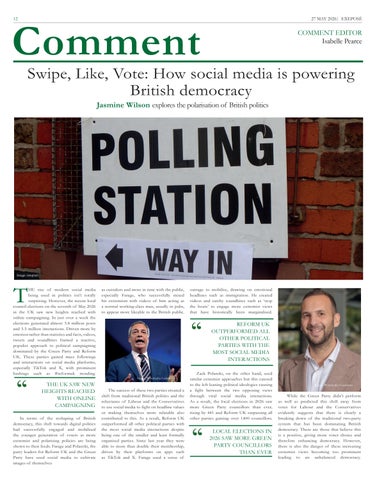
Swipe, Like, Vote: How social media is powering British democracy Jasmine Wilson explores the polarisation of British politics
Image: rawpixel
T
HE rise of modern social media being used in politics isn’t totally surprising. However, the recent local council elections on the seventh of May 2026 in the UK saw new heights reached with online campaigning. In just over a week the elections generated almost 3.8 million posts and 5.5 million interactions. Driven more by emotion rather than statistics and facts, videos, tweets and soundbites framed a reactive, populist approach to political campaigning dominated by the Green Party and Reform UK. These parties gained mass followings and interactions on social media platforms, especially TikTok and X, with prominent hashtags such as #reformuk trending.
THE UK SAW NEW HEIGHTS REACHED WITH ONLINE CAMPAIGNING In terms of the reshaping of British democracy, this shift towards digital politics had successfully engaged and mobilised the younger generation of voters as more extremist and polarising policies are being shown to their feeds. Farage and Polanski, the party leaders for Reform UK and the Green Party have used social media to cultivate images of themselves
as outsiders and more in tune with the public, especially Farage, who successfully mixed his extremism with videos of him acting as a normal working-class man, usually in pubs, to appear more likeable to the British public.
outrage to mobilise, drawing on emotional headlines such as immigration. He created videos and catchy soundbites such as ‘stop the boats’ to engage more extremist views that have historically been marginalised.
REFORM UK OUTPERFORMED ALL OTHER POLITICAL PARTIES WITH THE MOST SOCIAL MEDIA INTERACTIONS Image: Wikimedia Commons
The success of these two parties created a shift from traditional British politics and the reluctance of Labour and the Conservatives to use social media to fight on headline values or making themselves more relatable also contributed to this. As a result, Reform UK outperformed all other political parties with the most social media interactions despite being one of the smaller and least formally organised parties. Since last year they were able to more than double their membership, driven by their platforms on apps such as TikTok and X. Farage used a sense of
Zack Polanski, on the other hand, used similar extremist approaches but this catered to the left leaning political ideologies causing a fight between the two opposing views through viral social media interactions. As a result, the local elections in 2026 saw more Green Party councillors than ever, rising by 441 and Reform UK surpassing all other parties gaining over 1400 councillors.
LOCAL ELECTIONS IN 2026 SAW MORE GREEN PARTY COUNCILLORS THAN EVER
Image: Wikimedia Commons
While the Green Party didn’t perform as well as predicted this shift away from votes for Labour and the Conservatives evidently suggests that there is clearly a breaking down of the traditional two-party system that has been dominating British democracy. There are those that believe this is a positive, giving more voter choice and therefore enhancing democracy. However, there is also the danger of these increasing extremist views becoming too prominent leading to an unbalanced democracy.