FR
The South West’s Best Student Publication 2025
EE
ISSUE 784 27 MAY 2026 exepose.com @exepose
THE UNIVERSITY OF EXETER’S INDEPENDENT STUDENT NEWSPAPER SINCE 1987
2026 Climate FictionPrize Page 18
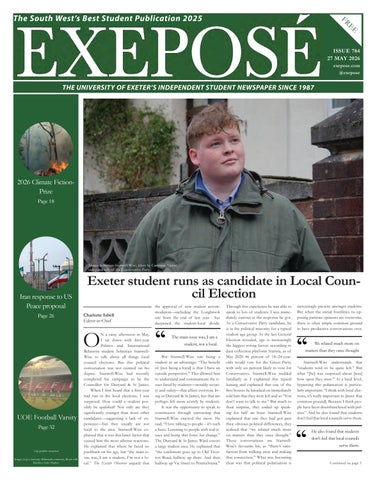
Image: Sebastian Stanwell-Wise, taken by Cameron Alpine independently of the Conservative Party.
Iran response to US Peace proposal Page 26
Exeter student runs as candidate in Local Council Election Charlotte Isbell Editor-in-Chief
O
UOE Football Varsity Page 32
Cap graphic: rawprizel Images (top to bottom): Wikimedia commons, Brush with Bamboo, Susie Hughes
N a rainy afternoon in May, I sat down with first-year Politics and International Relations student Sebastian StanwellWise to talk about all things local council elections. But this political conversation was not centred on his degree. Stanwell-Wise had recently completed his campaign to be the Councillor for Duryard & St James. When I first heard that a first-year had run in the local elections, I was surprised. How could a student possibly be qualified? Not only are they significantly younger than most other candidates—suggesting a lack of experience—but they usually are not local to the area. Stanwell-Wise explained that it was this latter factor that caused him the most adverse reactions. He explained that where he faced no pushback on his age, but “the main issue was, I am a student, I’m not a local.” The Exeter Observer argued that
the approval of new student accommodation—including the Longbrook site from the end of last year - has deepened the student-local divide.
The main issue was, I am a student, not a local. But Stanwell-Wise saw being a student as an advantage: “The benefit of [not being a local] is that I have an outside perspective.” This allowed him to understand and communicate the issues faced by students—notably security and safety—that affect everyone living in Duryard & St James, but that are perhaps felt more acutely by students. It was the opportunity to speak to constituents through canvassing that Stanwell-Wise enjoyed the most. He said, “I love talking to people – it’s such a buzz. Listening to people with real issues and being that force for change.” The Duryard & St James Ward covers a large student area. He explained that “the catchment goes up to Old Tiverton Road, hallway up there. And then halfway up Vic Street to Pennsylvania.”
Through this experience he was able to speak to lots of students. I was immediately curious at the response he got. As a Conservative Party candidate, he is in the political minority for a typical student age group. As the last General Election revealed, age is increasingly the biggest voting factor: according to data collection platform Statista, as of May 2026 46 percent of 18–24-yearolds would vote for the Green Party, with only six percent likely to vote for Conservatives. Stanwell-Wise nodded familiarly as I explained this typical leaning and explained that one of the first houses he knocked on immediately told him that they were left and so “You don’t want to talk to me.” But much to their surprise, they ended up speaking for half an hour. Stanwell-Wise explained that one they had got past their obvious political differences, they realised that “we related much more on matters than they once thought.” Those conversations are StanwellWise’s favourite bit, as “there’s satisfaction from walking away and making that connection.” What was becoming clear was that political polarisation is
increasingly present amongst students. But when the initial hostilities to opposing partisan opinions are overcome, there is often ample common ground to have productive conversations over.
We related much more on matters than they once thought Stanwell-Wise understands that “students tend to be quite left.” But what “[he] was surprised about [was] how open they were.” At a local level, bypassing this polarisation is particularly important: “I think with local elections, it’s really important to [meet that common ground]. Because I think people have been disenfranchised with politics.” And he also found that students don’t feel that local councils serve them.
He also found that students don’t feel that local councils serve them.
Continued on page 3