exeposé
FR
E
E
ISSUE 704 28 OCT 2019 exepose.com @Exepose
THE UNIVERSITY OF EXETER’S INDEPENDENT STUDENT NEWSPAPER SINCE 1987
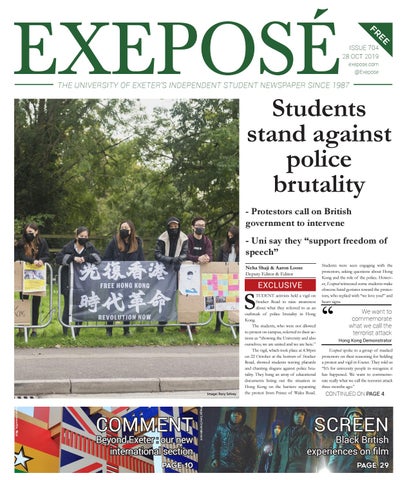
Students stand against police brutality
- Protestors call on British government to intervene
- Uni say they “support freedom of speech”
Neha Shaji & Aaron Loose Deputy Editor & Editor
S
Image: Rory Selvey
Beyond Exeter : our new international section page 10
Image: Sony Entertainment
Image: KarrenROe, Flickr
COMMENT
EXCLUSIVE
TUDENT activists held a vigil on Stocker Road to raise awareness about what they referred to as an outbreak of police brutality in Hong Kong. The students, who were not allowed to protest on campus, referred to their actions as “showing the University and also ourselves, we are united and we are here.” The vigil, which took place at 4:30pm on 22 October at the bottom of Stocker Road, showed students waving placards and chanting slogans against police brutality. They hung an array of educational documents listing out the situation in Hong Kong on the barriers separating the protest from Prince of Wales Road.
Students were seen engaging with the protestors, asking questions about Hong Kong and the role of the police. However, Exeposé witnessed some students make obscene hand gestures toward the protestors, who replied with “we love you!” and heart signs.
We want to commemorate what we call the terrorist attack Hong Kong Demonstrator Exeposé spoke to a group of masked protestors on their reasoning for holding a protest and vigil in Exeter. They told us “It’s for university people to recognize it has happened. We want to commemorate really what we call the terrorist attack three months ago.”
CONTINUED ON PAGE 4
SCREEN
Black British experiences on film page 29
News Editors Print: Louis Donohoe & Henry Jones Online: Emma Hussain & Pete Syme news@exepose.com
Features Editors Print: Jaysim Hanspal & William Harrop Online: Bryan Knight & Kate Norman Foreign Correspondents Co-ordinator: Maddie Baker features@exepose.com
Arts + Lit Editors Print: Cherry-Anastasia Boroceanu & Zach Mayford Online: Ariane Joudrey & Greta Sanna artsandlit@exepose.com Music Editors Print: Richard Ainslie & Bryony Gooch Online: Megan Frost & Stephen Ong music@exepose.com Screen Editors Print: Jonathan Chern & Samuel Thomson Online: Jacob Heayes & Abi Taphouse screen@exepose.com Science Editors Print: Elinor Jones & Scarlett Parr Reid Online: Sira Charbel & Tom Dormer sciandtech@exepose.com Sport Editors Print: Josh Brown & Nick Powell Online: Ben Bampton sport@exepose.com Chief Photographer Rory Selvey photography@exepose.com Copy Editors Charlotte Forrester & Catherine Lloyd Proofers Jess, Pete, Sam, Kamila, Catherz. Will, Freya Insoll, Richard, Ella Shadwell, Zach, Hash Brown, Owain, Puzzle Man, Fozz, Comic Book Guy, George, Donna, Lucy, Ben "can't read" Lang
@ exepose facebook.com/exepose issuu.com/exepose Advertising Kate Christlow kate.christlow@exeterguild.com (01392) 722607 The opinions expressed in Exeposé are not necessarily those of the Exeposé Editors nor the University of Exeter Students’ Guild. While every care is taken to ensure that the information in this publication is correct and accurate, the Publisher can accept no liability for any consequential loss or damage, however caused, arising as a result of using the information printed. The Publisher cannot accept liability for any loss or damage to artwork or material submitted. The contents of this, unless stated otherwise, are copyright of the Publisher. Reproduction in any form requires the prior consent of the Publisher.
Students protest University's responses to climate change
PAGE 3
COMMENT
Housing crisis: are estate agents really that terrible? Probably. PAGE 9
FEATURES The blueprint to decolonising the education system PAGE 13 Image: thedigitalartist, pixabay
Lifestyle Editors Print: Izzy Cole & Anna Romanovska Online: Amy Butterworth & Emily Pirie lifestyle@exepose.com
a sterling appreciation of the most influential black artists of all time (pg. 24). From Sade’s whispered sophistipop to Kendrick Lamar’s leftfield jazz inflected polemics, it’s a true celebration of pioneers who changed culture forever. Continuing that good work, Screen (pg. 29) present a necessary appreciation of the ways in which British Cinema has recorded and witnessed to Black lives and stories, from Babylon to scuzzy sci fi flick Attack the Block. Tired by the endless sea of male professors in STEM? Science (pg. 35) have got you covered on page, where you will find a loving celebration of the great women whose work provides the bedrock of modern scientific venture. Otherwise, if Sport is more your scene, flip over to page 38, where we mull over the often entwined histories of athleticism and activism. Black History Month is coming towards its end. However. activism is not just for October. That’s not progressive; it is nodding in the direction of a catastrophe without offering any practical solution. We can argue about whether our educational systems are institutionally racist. But if we are to bring real structural change to universities, then we must be prepared to work all year round to bring a better future into being. More to the point, many of us- let’s just say white people- need to accept our status as the beneficiaries of a system intended to elevate one race above all others. It's as simple as that. That's all from us; see you in two weeks! Godspeed, Aaron & Iszy
Image: Prosthetic Head
Comment Editors Print: Kamila Bell & George Clark Online: Olly Haynes & Gaia Newman comment@exepose.com
W
INTER may have arrived, the battered boiler is coughing and Joker might be the most profitable film in the evergrowing history of incel biopics. Still, life in Exeter is not all terrible and godless. You have just picked up a new copy of Exeposé, after all, and what a tasty issue we have prepared for you! As you have already noticed, our front page story focuses on the student demonstrators who are fighting for the human rights of Hong Kong citizens. If you are unclear about the ongoing situation in the city, the demonstrator's eloquent words are essential reading. Our front and page 4 have all the details. Elsewhere, Features speak to Tina Verhaege, BME Network Chair, who offers a trenchant blueprint for tackling the University’s ongoing struggle to address its diversity failures. In light of the 23 Oct report on racial harassment, which recorded 559 reports of harrassment at 159 publicly funded universities, the least you can do is listen up. You can also turn to News (pg.3) for a sharp summary of its worrying findings. Meanwhile, Comment (pg. 8) & Lifestyle (pg. 17) have joined their considerable forces to tackle our ongoing Brexit uncertainty, the lack of support of EU students, and the terrible psychological impacts of living in constant uncertainty. There is some lightness to be found, though. Arts + Lit (pg. 20) interview Dr. Emily Hauser, author of the fêted Golden Apple trilogy about the act of focalising history’s forgotten feminine voices. Our Music editors and Afro Caribbean Society joined up to create
NEWS
Image: pixabay, Bjonsson
Editors Print: Isabelle Gray & Aaron Loose Online: Harry Caton & Ellie Cook Deputy: Anne Chafer & Neha Shaji editors@exepose.com
Editorial
Image: Benjamin Evans
EXEPOSÉ
Devonshire House, Exeter, Devon, EX4 4PZ
SCIENCE
Exploring the concept of eco-anxiety PAGE 34
CHECK OUT OUR WEBSITE!
There are even more great articl es on the Exeposé website. From the latest university news to current affairs, music and theatr e reviews and more, visit us at www.exepose.com
Worldwide university news Ulster University goes cashless
U
LSTER University’s plan to become completely cashless across its campuses is being supported by Barclays, the UK bank brought in to manage the financial infrastructure at the University. With 27,000 students at campuses in Belfast, Coleraine, Jordanstown and Derry, the University believes rapid advancements in technology will catalyse a growing trend in higher education towards greater sustainability and use of worldleading technologies. This vision comes at a time where students are more engaged with such changes, less reliant on traditional payment systems and greatly concerned with security, which a cashless system is said to bring.
Cardiff offers LGBTQ+ housing
C
ARDIFF University has become the first in Wales to offer LGBTQ+ accommodation, following the likes of Birmingham, Sheffield and the University of the West of England, Bristol, who offer similar schemes. The accommodation is being offered to those students who would feel most comfortable living with other LGBTQ+ students and allies. One first year Cardiff student now living in the accommodation stated that she feels safer for this option as it extended opportunities to meet others from the LGBTQ+ community: "you know you aren’t living with other people who are homophobic". While it has come under criticism for ‘segregation’, the University compares the option to its single sex housing and Welsh speaking accommodation options.
Bristol Uni student found dead
Graduate premium at a loss
S
TUDIES by the Higher Education Statistics agency (HESA) and Warwick University have found that the claimed earnings boost that can be provided by a university degree has declined over the past twenty years. The decrease in this “graduate premium” may also be a side effect of the increased number of people advancing to university in recent years. A 2018 IFS study found that 130,000 men ended up worse off after completing certain degrees. Taj Nathwani has emphasised that the benefits provided by a degree are not solely financial, though it still remains a major investment for young people. The findings come after an IFS study last year revealed that more than 130,000 men are enrolling on university courses that leave them worse off in future earnings early in their careers than non-graduates.
T
HE University of Bristol has confirmed the death of a second-year undergraduate student. Alex Willis, aged 21, studied neuroscience at the institution. The University expressed sadness reporting the student's death: "we have offered our support to Alex’s family and friends, and our thoughts and sympathies are with them all at this very difficult time. 'We know the profound impact that the death of one of our students can have on our students and staff. We would encourage any members of our community who are affected by this news to make sure they contact university wellbeing services for help, as well as seeking support from their own friends or family.” As many as 13 students are thought to have taken their own lives while studying in Bristol in the last three years.
Image: Stan Zurek
Stories by Elinor Jones, Anna Romanovska, Natalie Tongue, and Bryony Gooch
News
3
NEWS EDITORS: Louis Donohoe Henry Jones
Students say University climate promises are “empty words”
Emma Hussain & Louis Donohoe
Online News Ed & News Editor
A
GROUP of students staged a sit-in in the Forum on Monday 21 October, calling on the University to divest from fossil fuel companies ahead of the university’s plans to address demands on a white paper. Almost 100 students were involved in the sit-in, which began at approximately 1:10pm on Monday afternoon and lasted 30 minutes. Students held placards and information leaflets detailing the University’s current investment and the changes they would like to see. Organisers led chants echoing those heard at the previous Climate Strikes in Exeter town centre, and one student used a megaphone to announce at regular intervals: “We are the Exeter university climate strikers and this is an emergency. We’re here to demand that the University acts on the climate emergency, and stops investing in fossil fuels.” The University’s investments in companies such as Shell and J.P. Morgan gained attention last academic year when protestors at the Penryn Campus campaigned for divestment, and were the subject of attention at this protest. In May, Divest Penryn suggested that the University’s endowment fund held
shares worth over £2 million in fossil fuel companies. This week, the University will publish a white paper detailing their plans for tackling climate change, and Monday’s protestors hope to see divestment brought in as a top priority. Co-organiser Ben Dalton confirmed that lecturers in the climate emergency working group had indicated that “the more student pressure there was around the time of the vote taking place, the more likely they were to adopt some of the more radical proposals.” According to Dalton, these proposals include divestment, an annual carbon budget for lecturers to limit emissions produced from air travel, and a change to the “highly polluting” gas system in the University laboratories. The dominant sentiment amongst protesting students was frustration at the University’s perceived hypocrisy. Following protest action around divestment last year, Vice-Chancellor Sir Steve Smith declared a University-wide Environment and Climate Emergency on 20 May. However, students at Monday’s protest expressed disappointment with the University’s lack of concrete action. Languages student Max Davies said: “I think there’s a big difference between talking the talk and walking the walk. And up until now the University has been talking a good game, but we
haven’t really seen any proper changes. They’ve said they’ll announce some Masters programme, and they’ll fly a green flag or something. At the end of the day, as long as money keeps going to fossil fuels, and we don’t take actual action it doesn’t make any difference.”
The more student pressure, the more likely they are to adopt the proposals Ben Dalton, co-organiser of strike
Nora Webster, also studying Languages, agreed: “You can’t call yourself
an institution dedicated to morality and the bettering of young lives when you’re directly funding fossil fuels. It doesn’t mean anything. It’s just empty words.” A University spokesperson described their current progress in ethical investments saying, “we recently appointed Rathbone to manage our investment portfolio and a major factor in our decision was to improve our ethical investments. We worked closely with our students to appoint Rathbone and want to ensure that our investments
have a positive impact on our community and society as well as provide good returns to invest in education. “The Presidents of the Students’ Guild in Exeter and Union in Cornwall will be involved in monitoring the new ethical investment policy, and students will also be on a new management group so they can have their say on the policy as it evolves over time.” The University’s response to the White Paper is predicted to be published on 11 November.
Image: Louis Donohoe
College officers express concerns around New flats planned at student awareness of Enlitened Exeter ambulance centre David Fallshaw Senior Reporter
P
LANS for a new city centre University accommodation has caused concern this week as the number of purpose-built student residences looks set to rise once more. The proposal put forward by The Watkin Jones Group would see a number of existing buildings on the edge of St Luke’s Campus including Exeter’s Ambulance Station demolished and replaced with a mixture of studio and cluster flats set within a five-storey block. The Group proposes 154 bed spaces in a combination of 37 studios and 117 cluster rooms. However, controversy has arisen about both the lack of co-living accommodation as well as maintaining a healthy student-resident relationship. In a recent statement the leader of
Exeter City Council, Cllr Phil Bialyk stated that new student flats should include accommodation for everyone, and that the Council has been in contact with developers about its proposal for co-living to create balanced communities in a city centre location. There is no reference however as to whether co-living will be considered as part of the application in the Watkins Jones Group bringing the very proposal into contention. In order to prevent issues of anti-social behaviour “management staff, security staff would be on hand 24 hours a day…to create a highly managed environment” whilst measures of closing external courtyards at 10pm will aim to prevent behaviour issues in the city and to nurture a healthy student-resident partnership. Whether the proposal will go ahead will be decided by the Exeter City Council Planning Committee at a later date.
Aaron Loose Editor
L
AST Tuesday, College Officers expressed concerns about the Enlitened app during the first Academic Executive meeting of the new term. Enlitened was discussed as part of the meeting agenda. Penny Dinh, VP Education, chaired the meeting. Tim Quine, Deputy Vice Chancellor, was in attendance to answer the College Officers’s questions about the app. Aysha Majeed, Medicine and Health College Officer, was unfamiliar with the Enlitened app. Majeed first learnt of the app the day before the meeting, and further added that there was no promotion of the app on the St. Luke’s campus. Quine acknowledged Majeed’s recommendation to improve the promotion of the app across all campuses and
colleges. Leo Webb, Life and Environmental Sciences College Officer, also expressed concerns that the app would “step on the toes” of academic representation. Webb further added that Enlitened presented yet another channel to think about inside an already complex system of student feedback. At the end of the discussion, Col-
Image: Megan Davies
lege Officers were given two tasks: to show students how to download the app and to gather student feedback on the app’s general effectiveness. A University spokesperson discussed their plans with Enlitened stating, “We are piloting the Enlitened App as one more way to listen to student views, provide supportive information and improve student experience.”
4
28 OCT 2019 | EXEPOSÉ
NEWS
“Democracy is not happening in Hong Kong”
CONTINUED FROM FRONT They explained further about what they referred to as a “terrorist attack”, letting Exeposé know how in a town called Yuen Long “on the 21st of July, there was a protest by pro Hong Kong supporters. And a group of what we called white shirts, gang members, came into the tube station where these protesters had been going home and started hitting them. They weren’t just protestors there though, they had women, children, the elderly. It turns out later with CCTV footage the police had known about this attack and let
this happen. There’s a famous picture even, of a policeman with his hand on the shoulder of one of these white shirts. It was one of the first times we openly see the police selectively enforcing the law.” They had petitions to sign, referring to how the international community could place pressure on world leaders. They emphasised the importance of getting through to governments, “especially the British government which has more of a responsibility than others in this case.” There were students of other nationalities also protesting in solidarity, including a Belgian national
Lebanese protest goes forward despite conflict over approval Pete Syme Online News Editor
S
TUDENTS carried out a demonstration in solidarity with the ongoing protests in Lebanon despicte conflicts over approval. The protest took place outside the back of the Forum on Thursday afternoon. Holding signs written in both English and Arabic, the placards had slogans like “One Lebanon” and “Respect Existence or Expect Resistance” as they also played Lebanese music and danced along. Saad, a Law student who was at the protest, explained the situation to Exeposé: “Lebanon have a sectarian political system, where every seat has its own political party. They can only have people of certain demographics in certain roles. So, for instance, the Prime Minister can be a Sunni Muslim, the Speaker has to be a Shia, and so on. About a week ago, after the fires that ravaged our country, the government had put a tax on WhatsApp calls. People felt they had enough, and took to the streets. “We understand that Exeter is not a very diverse university, and we wanted to make our voice heard here in solidarity as many of us couldn’t go to the London protests. We don’t have too many Lebanese students but students
from other Arab countries have joined us in this protest.” However, there was some controversy surrounding the situation because the protest was not sanctioned by the Guild. Saad told us that “the Guild didn’t approve of our protest because we weren’t a Guild-affiliated society, as in MENA Soc (Middle Eastern and North African Society). The Forum Information Desk told us today that we couldn’t hold the protest inside either and that we would have to cancel it, but we held it here.” A Guild spokesperson clarified that “as the group of students involved were not part of an affiliated society and no official request had been made for a protest to be held, the Students’ Guild did not either approve or not approve the protest.” The University also gave a statement on the event, saying “we understand that a small demonstration about the situation in Lebanon did go ahead in the Piazza outside the Forum but was not able to take place inside because the right procedures had not been followed. Our top priority will always be the safety of our students, staff and visitors which is why we expect protestors to contact us in ad-
who told Exeposé “This is a great example of democracy not happening and human rights not being applied to citizens. I think it would make me very hypocritical to travel all the way to a foreign university to learn about the law… then not stand for them in practice.” This is the third event Hong Kong supporters had attempted to hold on campus. The first was a protest outside the Forum steps, and an unsuccessful flash mob in the Forum which did not go through due to protocols not being adhered to. When Exeposé queried the University on this protest taking place off
prevent any risks, as they could be arrested in Hong Kong for participating in these protests. When questioned on the risk, one protestor described his reasoning to participate as “because it is right, it is the right thing to do. Just because someone is oppressing you doesn’t mean we shouldn’t use our voice and our rights and our freedom to voice our beliefs. Equally, the counter protestors have a right to protest against us, but we are here to exhibit our right.” Another student described their motivation to protest as simply “because it’s home.”
University responds to national racial harassment report Louis Donohoe & Emma Hussain News Editor & Online News Editor
T
HE University has responded to the Equality and Human Rights Commission’s recent report on racial harassment in UK higher education. In an email sent to all students, Vice-Chancellor Sir Steve Smith outlined action the University will take to tackle the current situation. The email stated: “We act immediately and decisively when incidents occur but we certainly do not underestimate the size of the problem or the distance we still need to travel.” The email cites the University’s 2018 BAME student survey, where 28 per cent of respondents said they had experienced racial harassment in teaching rooms, 26 per cent in residential halls and 19 per cent in social spaces. The Vice-Chancellor’s email detailed the work which has been undertaken over the last 18 months led by
the Provost and the Equality and Diversity Inclusion team, including establishing reporting tools, involving senior leadership, and delivering targeted training on inclusion and unconscious bias. Future actions will include setting up a BAME-led Taskforce with resources to provide specific support for BAME staff, a discussion of the attainment gap at the next Senate meeting, and a collaboration with Georgetown University in Washington, D.C., an institution with “considerable experience in improving Equality, Diversity and Inclusivity in higher education.” The Equality and Human Rights Commission’s report reflected that there have been 559 recorded complaints of racial harassment over a three-and-a-half year period across all 159 publicly funded universities, while more than half of staff described incidents of being ignored or excluded because of their race.
One in 20 students left their studies due to racial harassment, and just a third of the students who reported experiencing racial harassment reported it to their university. Katie Heard, VP Welfare and Diversity told Exeposé: “We cannot expect change if we don’t educate our members that racism is wrong and, working alongside the university, provide the tools to prevent and report it. “We have implemented EDI training into staff and volunteer training as well as organising workshops to educate society committees to be more inclusive. We have a long way to go but are committed to a culture change within our student body. “We have already embarked on conversations regarding the complex nature of the reporting systems and how we can make these more accessible. A lack of reporting isn’t a success; it’s a clear indicator of the root problem, and this is something that we aim to address within our year of office.”
Organisers ‘over the moon’ with Boob Ball Emma Hussain Online News Editor
E
Image: Louis Donohoe
campus, a spokesperson said “The Hong Kong students chose a protest location just off the Streatham campus and our Estate Patrol team worked with the students to ensure it was a safe environment to demonstrate. We support freedom of speech and the right to protest within the law. Our top priority will always be the safety of our students, staff and visitors which is why we expect protestors to contact us in advance and work with our excellent Estate Patrol team to set up any demonstrations.” The majority of the students were masked and explained how they were trying to
XETER’S Uni Boob Team have raised £805 for breast cancer awareness charity CoppaFeel! through their flagship Boob Ball tournament. Held on Thursday 17 October in the University Sports Hall, the dodgeball tournament saw 16 teams, most representing clubs and societies, battle it out to become Boob Ball champions. Men’s Lacrosse were ultimately
able to reclaim their 2017 title as winners. The event is now in its fourth year, and all team sign-ups were reserved in 24 minutes. A record amount was raised which organisers described themselves as “over the moon with”. Uni Boob Team President Ellen Pickett said: “Boob Ball is always a really fun and engaging event which helps destigmatise the issue with its lighthearted tone. Aside from being overwhelmed with the interest and generous donations, it was great to see people getting into the spirit of it so well.”
CoppaFeel! campaigns to encourage people to check themselves regularly for signs of breast cancer The Boob Team have plenty planned for the rest of the year. “We hope to run another Boob Ball tournament in February, and you can also expect a collaboration event with Movember to mark World Cancer Day on 4 February. We’ve also been in talks with the Lacrosse Club, Women’s Rugby, and Body Society about joint projects for terms two and three, so watch this space!”
LIFESTYLE
|
ARTS+LIT
|
MUSIC
|
SCREEN
LIKE OUR FACEBOOK PAGE /EXEPOSEEXHIBIT
ABOUT US
Invasion provide Bespoke International City Breaks for Societies, Groups & Individuals DESTINATIONS
Amsterdam, Barcelona, Berlin, Budapest, Dublin, Edinburgh, Krakow, Paris, Prague, Rome
WHAT’S INCLUDED?
Transfers
Flights / Coach
Accommodation
Superstar Reps
Optional Extras
To find out more information and book a trip visit Invasion.com Invasion | Invasion.com | 0161 312 3459
28 OCT 2019| EXEPOSÉ
7 COMMENT
Comment
COMMENT EDITORS: Kamila Bell George Clark
Think about me: wellbeing workshops
Clemmie Ovenstone Contributor
I
N October, Exeter University revealed its plans to introduce wellbeing workshops, “which offer a wide range of practical tips, techniques and support”, aimed at addressing concerns raised by students. This is a welcome step, given recent data by YouGov, which shows that mental health issues affect one in four students. In all likelihood, this number will further increase as the stigma attached to mental health diminishes. Workshops seek to ensure that mental health support is not left out in the cold and that “invisible illnesses” are recognised. Wellbeing is not something that should be taken for granted. The pressure is high as more and more students come to university and disclose a mental health issue; in fact, five times as many first-year students reported mental health issues in 2016 than 2006, according to findings made by the Institute for Public Policy Research.
Well-being is not something that should be taken for granted The transition from school to university, leaving home and taking on independence is no mean feat. Overnight you move away from home and
are planted in a new environment where there is lots of peer pressure to be having fun all the time, keeping up with deadlines which approach thick and fast and attaining a 2:1 or above. Added pressures, be that financial or emotional, can make this change profoundly more challenging.
All students can access strategies and engage in open dialogue The wellbeing workshops are an innovative solution to high levels of mental health under-funding. They give advice, helpful strategies and a non-judgemental, safe space where students can raise concerns and share their feelings and insights with others who may be experiencing something similar. Support ranges from dealing with exam stress, managing the demands of perfectionism and overcoming panic attacks, to name but a few. This is facilitated by Psychological Therapies and AccessAbility pathways. The workshops, which take place in the Reed Mews Wellbeing Centre offer a much-needed oasis amidst the hustle and bustle of daily university life. Workbooks have also been developed which address the same issues. This is another way, through a different format, to access the advice in a more confidential manner which many students will find more comfortable.
Image: mohamed hassan, pxhere
It would be good to see the workshops expand to include further advice. Sport and time in the outdoors is a great way to improve psychological wellbeing: The University of Exeter have done research on this themselves and found that people who spend two hours a week in nature are more likely to report good health. This helps to reduce stress and clear one’s head so would be make a great topic for a workshop.
It would be good to see the workshops expand further Rising demand for greater wellbeing services for serious mental health concerns has prompted our university to provide more services to students. Three senior NHS mental health practitioners are based on Streatham Campus to support students with severe mental health problems. This move is “first of its kind to place a dedicated, specialist NHS community mental health team on campus to address the mental health concerns of students, says John Lilley, the community service manager for Devon Partnerships NHS Trust. While this initiative is important for the university to have in place, it is also expensive and not all students require this level of support. Workshops are a relaxed means of dealing with significant under-funding of mental health provisions. In this environment, all students can access strategies and engage in open dialogue to deal with daily worries that may not necessarily require professional help which is already significantly strained. While it is indeed undoubtedly important to have adults and
Image: Wokandapix, Pixabay
professionals to speak to, it is also necessary to have people your own age to confide in. Initiatives led by students for students encourage greater dialogue. Mind Your Head Society is one of Exeter’s wellbeing societies. They raise awareness, host events and work in close collaboration with the Wellbeing Centre. It would be useful if this partnership could be extended so that the leaders of Mind Your Head and other wellbeing societies collaborate with sport and academic societies which have a vast student base. Students are more likely to confide in their friends, so we all need to be better equipped to deal with mental health. Toolkits distributed on social media platforms or via email can provide information for housemates on how they can help fellow students who are experiencing difficulties. They could also provide information on who they themselves can seek advice from in order to help their friends. Catching problems early is key. It would be good to see further initiatives in providing extra support to those beginning their journey at Exeter by expanding pastoral care in each accommodation. Halls of residence become students’ home away from home; where students eat, sleep and socialise and where well-being issues can be identified. It is also likely that individuals will
open up where they tend to feel most relaxed: in their halls. While the Residence Life Team do make the rounds, I feel a more effective way to get those struggling to speak up requires a more personal approach. Regular discussion groups where students can drop in as well as a welfare advisor in each hall could help in this regard.
Catching problems early is key It is clear that the university is chronically-underfunded when it comes to our wellbeing services, especially in light of more and more students coming forward with mental health concerns. While there are bigger issues to be addressed and greater collaboration is certainly needed to tackle student well-being, these workshops are definitely a step in the right direction.
É If these issues affect you, you can get in touch with: Wellbeing Workshops: http://www.exeter. ac.uk/wellbeing/support/workshopsandwebinars/ Wellbeing Services: exeter.ac.uk/wellbeing Exeter Nightline: 01392724000
8
28 OCT 2019| EXEPOSÉ
COMMENT
Brexit, Exeter and the EU Anna Romanovska Lifestyle Editor
O
H Brexit, the ever-growing thorn in the EU student’s life. Not only is it the epitome of uncertainty, but it has also raised quite a few questions on the UK’s approach to accepting outsiders as a government and as a people. I’m quite lucky, due to the high quantity of UK nationals living in the Czech Republic, the UK has seemingly struck a deal with our government protecting the interests of Czech nationals living within the UK. Therefore, I may be rather safe following the UK’s exit from the European Union. In the first term of my second year, I was going through a mentorship programme provided to me by the Wellbeing services. Originally a support system for other concerns, the sessions quickly turned into a series of receiving advice on how to deal with the uncertainty of Brexit. This experience forced me to realise just how much the probability and volatile nature of Brexit has affected my mental health. I can assure you I am not the only one. I’m sure I’m not the only one who thinks the University seems to have
fallen into a pattern of saying that they are trying to reassure students, yet are failing to transform their words into actions. Sending e-mails three times in one year is not a suitable substitute for a solid provision of support.
The University are failing to transform their words into actions Though the University has provided some levels of guidance, the same simply cannot be said for the Guild. As a governing entity that is supposed to represent its students, there has been no focus on EU students struggling with the uncertain possibility of a Brexit deal. They have emailed, but it has not been helpful enough. On the website, there is no direct subsection providing advice to students. Instead, there is a link to the University’s Brexit information page, located on the sliding panel of ‘highlights’ on the introductory page. Not only have they not made it a permanent post that can be easily accessed, but they made their lives easier by reusing the outdated University FAQ page. I’m sorry, I didn’t realise that the possibility of not being wanted in this country required minimal effort. I would love to reuse
the EU settlement scheme applications my friends have sent off, but that’s kind of wrong, and probably illegal. Not to mention that EU students have faced a cold wall from UK students when the issue of Brexit has come up. “You chose to come here, so don’t complain” is a statement I have heard one too many times. It makes us feel unwanted and unheard. The majority of the time, the reasons why international students study abroad follow the narratives of wanting better graduate prospects, a better life, being unable to study in their home country due to language barriers or their country having a stingy government that does not invest in the development of their education system. Furthermore, expressing such animosity towards EU and other international students has a heavy impact on our mental health. Yet, the University and the Guild, though they speak up every once in a while,
Image: Dunk, Flickr
are not helpful at all. I realise if this was to be brought up directly with them, they would tell us to report such incidents. However, as with most indirect discrimination, finding the evidence would be near impossible. What we need is a guiding policy set by the Guild on the yays and nays of approaching issues of Brexit and other immigration related problems. Not to sound incredibly harsh, but the general, white, British ‘Exetah’ student will have no clue how insensitive they can sound without some guidance.
The University and the Guild continue to stay silent
To conclude this overview of my experience, I believe that what we require is a big arrow showing us all the support the University and Guild can offer us, if there is any. We also need both institutions to start listening to us, rather than assuming what we may require should Brexit actually happen.
/////////////////////////////////////////////////////////////////////////////////////////////////////////////////////////////////////////////
What do you need to Hallo-wean?
Elen Johnston Contributor
W
E all have bad habits. Whether that’s running late, eating out too often, procrastination or missing those dreaded 8:30am seminars. This doesn’t make us failures; it makes us human. This is not however approval for these habits to become our new routines. If you are genuinely ill, or accidentally knock yourself out getting out of bed too quickly (as I’ve done before!), it’s okay to miss your 8:30am seminars. Still, that does not mean you should get into a habit of having a daily interaction with the snooze button. However, it is also important to remember that we are only human. We don’t have to become 5am dwellers either, just remember to eat a proper breakfast and 7am will suffice. One thing all of us can remember from Freshers’ Week (if nothing else) is the free food. Walking up Forum hill it was impossible to avoid the discount vouchers thrown your way. Many of us
were far too polite to reject any offers, at least, that’s the excuse we used anyway.
It was impossible to avoid the discount vouchers thrown your way
the morning but too much sugar can lead to afternoon crashes. These are particularly inconvenient when trying to be productive in your afternoons. This has led me to reluctantly reconsider my daily sugar intake, replacing my snacks with fruit and vegetables which I was also lacking. I still must admit that a spoonful of
For the first time, I had experienced Dominos reduced to reasonable prices, an opportunity that surely could not go to waste. Although today student discount is still available to some extent, these discounts did not last forever. This has left many of us including myself in need of establishing some healthy and affordable food routines in place of the innumerable cheap takeaway deals that had been floating around campus. Speaking of unhealthy food habits, my most shameful is consuming too much sugar. Most people can relate to having one too many biscuits with their cuppa in Image: Petr Kratochvil
Nutella makes fruit taste a lot better.
Too much sugar can lead to afternoon crashes My final bad habit relates to my first, and to the rest in many ways. Getting up early is important, but to do so getting enough sleep is vital. Working till 11pm but watching YouTube videos or Netflix till 2am is not a successful or productive choice. Whether you are watching a film with a tub of Ben and Jerry’s ice-cream or coming back at 3am from a night out, you will suffer from lack of sleep the next day. This I know from experience.. A great night with friends is not one to miss, but if you have an 8:30am seminar the next morning or even an essay due, it may be best to go out another day.
Image: Marco Verch, Flickr
It is also important to remember that we are only human Now all these habits are far from extremes but are experienced by most of us at some time or another. This Halloween I will be trying to ween myself off some of these bad habits and I hope you do so too. Finding a balance between work, socialising and taking out the bins can be hard and can take time to establish. With the fright of deadlines looming getting into better habits now will make the rest of the year a lot less scary.
EXEPOSÉ | 28 OCT 2019
COMMENT
9
o Me m f m o th e n e th
WAGatha Christie: the meme that united Britain Molly Cleary Contributor
O
N 9 October 2019 was the day the world changed forever. Coleen Rooney, formerly most well known in conjunction to her footballing husband, became not only a wordsmith capable of creating BAFTA level drama, but exhibited the meticulous planning, precision and patience of a Private Investigator. Never again would the humble ellipses be looked at in the same way.
The scandal united, momentarily, our bitterly divided country
Would Shakespeare have been bold enough to have ten of them preceding the most scandalous reveal of all time? Would he have been so brave? I think not.
The excitement that Coleen’s statement generated online was astounding: the scandal momentarily united our bitterly divided country with its many different intersections of interest.
This story is truly the meme that just keeps on giving
You might be a football fan, a HELLO magazine reader or you might, in the words of Pam from Gavin and Stacey “just love the drama.” Either way, this story is truly the meme that just keeps on giving. In a world where the political realities of Brexit are more terrifying than any trick that Halloween could offer, this
scandal became social media’s perfect treat. Recently, insights into celebrities’ private lives have become polarised: you either digest every morsel of information on Love Islanders via Snapchat clickbait or instead watch celebrities place themselves behind an impenetrable wall, clear of social media. Rooney’s piece was radical in the sense that her statement (on the Notes for iPhone app of all places) allowed her to use her own social media platform not to deny controversy but to start it.
The question of the best meme is almost impossible to decide
And, left in the hands of the British public, the whistle blew and the match for the title of the greatest meme commenced. Some went for a classic format: “Imagining the Vardy
household right now, Rebekah shrieking blue murder, Jamie’s on his ninth Red Bull of the morning, kids are crying”. However, others bathed in the endless possibilities of cultural crossovers. One of the best being the Coleen Rooney x Olenna Tyrell crossover, of the “I want her to know it was me” type, another being the more cultured and literate: “Last minute shake up to my end of the decade list of important publications by women named Rooney” because really, who didn’t read Normal People over the summer? The question of the best meme
is almost impossible to decide on what many are hailing the best day of the internet since its inception. The part of the scandal that spoke to people most seemed to be the amateur level of detective work that Coleen undertook: like the super sleuth investigations you might do when you’re trying to work out if someone is sending a Snapchat to just you, or everyone on their contact list. Coleen Rooney, in announcing her work to the world showed us that maybe footballers’ wives are just like us, trawling through the views of our Instagram stories for months on end, waiting for that one person to watch it.
Images L-R: stux (pixaby), mohamed mahmoud hassan (publicdomainpictures)
////////////////////////////////////////////////////////////////////////////////////////////////////////////////////////////////////////////////////////////////////////////////////////////
Nightmare on Sidwell Street
Yay Estate Agents
Nay Estate Agents Zach Mayford Arts & Lit Editor
A
ROUND this time in my first year, I was balancing several spinning plates: a cringeworthy academic servitude I thought necessary to fit in, enough shifts in Domino’s that I could literally assemble a pizza box with my eyes closed, and an endemic lack of organisational skills. This meant that I had quite a detached relationship with prospective estate agents, leaving the logistics to my capable and high-functioning housemates-to-be. Like a war reporter, I glimpsed the confrontations from afar (email screenshots in the group chat), and interviewed busy combatants in passing, as our troubled posting crumbled around us. As a war reporter would, I’ll share my story. Our second-year house, like many residential houses in Exeter, was old. Not only was it old, it was category two, listed building old. It reminded me of my Gran’s house, in that it was essentially a large cottage, yet we found it in a student-packed terrace in St James. While it seemed charming and roomy, that veneer grew cold, damp and cracked with the ceiling. Say what you like about apartments or halls - at least
Lafrowda is warm and double glazed, unlike a lot of withering Exeter townhouses. Leaks, cracks and draughts might seem like architectural problems and not estate agent problems, but in a way, they’re both. Estate agents, as a middle ground between private landlords and massive student accommodation companies, often offer the worst of both worlds. They lack the time and attention capacity of a private landlord who might just have a couple of properties and the ability to pop round on short notice to fix things. Despite existing in a contentious moral sinkhole, most private landlords are humans. They therefore have a personal touch and individual accountability in the cold material reality of student housing. The Exeter estate agent scene seems somewhat of an oligopoly. When one in every 14 residences in Exeter is a student property, local estate agencies can get bloated and they can get stretched. However, they don’t have the infrastructure or the resources of a university-owned complex or a national accommodation firm. The tragic thing is, if you want to live in a house whilst studying at the University of Exeter, estate agents might be an unavoidable ill.
Kamila Bell Comment Editor
O
Image: oatsy40 (flickr)
Image thumbs: ArtsyBee (pixabay)
CTOBER may feel like a ridiculously early time to be planning your housing for next year, but in Exeter now is the prime time to grab the best deals. Many student houses have already been listed online for the 2020/2021 student housing brawl that in other words, is simply just a desperate scramble to find an okay house to squander your money on with people you have only known for a few weeks. Do not despair. Although estate agents have a bad reputation, especially when it comes to student housing, they can be a useful tool to use to your desire when on this goose chase of finding a house, likely to consume the next few weeks of your life. If you and your mates are so set on a house you don’t even feel the need to view it in person (although I do not condone this) online viewing will be your best friend. The various estate agents scattered across this city offer website listing which can prove useful for quick and easy scanning of what houses are available in the area. Website links shared to listings of “ooo this one has
bills included” or “this one doesn’t have granny wallpaper” are convenient opportunities to discuss with your future housemates what you want from a house next year. Estate agents’ website listings also provide an opportunity to discuss budgets, with clear rent costs per week highlighted under each listing for your perusal. An added bonus and a necessary evil of going through an estate agent rather than a private landlord when looking for a student house, is the security and safety of a tenant letting agreement contract. This may just sound like a lot of long words pushed together, but it will act as a fully encompassing contract of what you can expect from your landlords and what they expect from you. Everything from what you can/ cannot stick on the walls to the condition the property should be left in once you depart. An even more vital part of this contract is the security it can provide you for the substantially large deposit each of you will have to fork out for your chosen student house. They may not always be the speediest with responses, but with the security provided and with estate agent fees made illegal last year, why would you not now favour them?
EXEPOSÉ | 28 OCT 2019
Beyond Exeter Welcome! This new section aims to broaden the scope of our content and provide a space for international students to voice their opinions on topics that matter to them. We are looking for students from other countries, living and/or studying here for the duration of their degree to write about issues that affect them. If you want to contribute, please get in touch by emailing editors@exepose. com or messaging our Facebook page.
Anna Romanovska Lifestyle Editor
O
N 10 October, the German news paper Welt published an interview with Brandon Lewis, the UK Secretary of State. Within it, Lewis stated that those who would fail to apply for the EU Settlement Scheme by December 2020 would be subject to full immigration enforcement. There is no doubt an issue of communication between the UK government and EU nationals. Welt reported that of the 140,000 Germans living in the UK, only about a third were registered for the EU Settlement Scheme. There is a growing worry that
Limits to our future?
many EU nationals residing within the UK do not know about the need to apply for the scheme by December 2020. Furthermore, the incoming high school graduates of EU nations will miss out on their opportunity to move to the UK hassle-free. I was incredibly lucky to have graduated in 2017, allowing me to complete my university studies within a tight margin of time.
Brexit has limited the landscape of people’s futures My graduating cohort is the last group to be able to do so without worrying about our immigration status during our studies. The cohort below us will be the last group to reap the benefits of a Home/EU fee status and tuition fee loan eligibility. What Brexit has essentially done for those younger than me is limit the landscape of their futures. Those who will be graduating in two years will only be able to complete their studies with strong financial support.
This has thus made Brexit a class issue for EU nationals. However, this implementation of immigration enforcement brings an issue of British national interest to light. Should the UK adopt these measures, they may be at risk of endangering their own people. UK nationals residing abroad in EU nations may then be subject to immigration enforcement within the countries they are living in. Why? Because the UK government currently holds several agreements with select EU nations, guaranteeing the safety of EU nationals within the UK, as long as UK nationals abroad are also protected from immigration enforcement. The implementation of full immigration enforcement would thus directly violate such agreements, leaving the UK residents within EU countries unprotected. Many of the UK nationals living abroad have stayed away from the UK for a while. Many of them were even denied a vote in the Brexit referendum due to their inability to return to the UK. Therefore, by adopting these measures,
The government needs to rethink its approach to immigration To conclude, I believe the government truly needs to rethink its approach to immigration enforcements on EU nationals, not only to protect its own citizens, but also to maintain the freedoms its stands for. Simply put, the EU nationals have been swept into a corner for too long now. They need to be supplied with the information they require and be shown that they are, in fact, heard. If you, as an EU student, are worried about the impact of Brexit, look up the organisation The3Million, an organisation that informs and advocates for the rights of EU nationals within the UK.
The precarity of protest
S
OLIDARITY is an interesting notion when you’re protesting for someone back home. The impetus to do something now, the desire to be involved, to support is offset by the worry that you are still a stranger in a country hostile to immigrants.
As an immigrant, your freedom of protest is an unsaid limitation People back home stressed to me the importance of keeping my head down. It is difficult when you consider volatile situations at home or in countries you wish to stand beside. I have been involved with and photographed in protests for the past four years regarding situations not just locally, but around Kashmir, India, Palestine, Syria and other countries. However, it
is important to balance solidarity with security, and keep in mind that as an immigrant your freedom of protest is an unsaid limitation.
A show of solidarity for someone could be a rejected visa for another However, this is a result not only surrounding a personal responsibility to (for students) the thousands of pounds paid into our education, but a responsibility of this country’s hostile attitude towards immigrants. “Go back home, then!” is a common response, regardless of whether you are protesting due to injustice here, or due to a situation at home, or in other countries. The attitude towards British students in solidarity with other countries is certainly different from the attitude towards foreign students making a noise about something back home.
Legal restrictions on protest are certainly an unfair distinction between citizens and non- citizens - several foreign visas and student visas for the UK essentially forbid any strike action by limiting the amount of hours you can take off, or skipping contact hours when it comes to student protests. It only contributes to further feelings of alienation and displacement, personally -where politically you cannot vocalize
EDITOR
Anne Chafer
A COFFEE WITH...
all the UK government has proved is that they do not hold much empathy for those who have decided to move their whole lives to a different country.
////////////////////////////////////////////////////////////////////////////////////////////////////////////////////////////////////////////////////
Neha Shaji Deputy Editor
BEYOND EXETER 10
for neither home nor away. Organisers of these protests should also keep this in mind before requiring people on visas to engage in metaphorical fire-setting. The precarious situation an international student is in means that what is a show of solidarity for a home student could be a rejected visa application for another.
Images L-R: Harry Caton, Giselle Garcia
Giselle Garcia Dramaturg and writer
Anne Chafer Deputy Editor
G
ISELLE Garcia is an academic, now working on her PhD. She grew up in the Philippines and currently lives in Totnes. Her interests relate to adaptation, power relations and space in performance amongst others. My questions for her were related to university environments in different countries and to her own experience. Garcia is interested in the politics of power; are there power dynamics between national and international collectives? She says yes: “Social [immigration] status indicates levels of power that affect how you operate within your field. This is difficult, it’s a matter of ease of access and influence.” And the best way of fighting these power imbalances, she says, is not to “simply sing kumbaya diversity and inclusion”, but to put structural initiatives for equal access to resources in place. Concepts such as a “home country”, or a place “that I am from” are complicated to negotiate. Garcia says that “these words are so confusing because they’re all different. And the forms we fill out don’t take the nuances of these terms into consideration.” Finally, what advice would she give to someone studying in a foreign country? She’s “still stumbling through. What I can tell you is what my high school best friend from home told me when I broke down the other week: It doesn’t matter that you are a woman from a developing country, and are therefore ‘less’. Don’t focus on that. People who blame things on what they can’t change are looking for an excuse to fail. Nasa tao yan. ‘Your mettle is in the kind of person you are.’” This interview has been edited for length and clarity. Find the full version on exepose.com
12
Features
28 OCT 2019 | EXEPOSÉ
FEATURES EDITORS: Jaysim Hanspal William Harrop
Identity, pride and Black History Month Will Harrop & Jaysim Hanspal, Features Editors, and Lucy Morris, contributor, highlight prominent black members of the LGBTQ+ community. Lucy Morris on online creator Kat Blaque
A
MERICAN activist and online creator Kat Blaque is the perfect example of queer, black excellence. She began her YouTube career in 2010 and has built an online community around queer education and activism. In the face of severe online trolling, Blaque continues to speak out on gender, sexuality, politics, race and relationships. She is openly polyamorous and dares to break the taboo on transgender sexual experiences. Indeed, her composure in the face of adversity is awe-inspiring. Growing up, she not only had to grapple with her gender identity but faced systemic and everyday instances of misogynoir. Blaque says this is what gives her a unique perspective from which to advocate social justice: ‘‘I’m a woman, I’m black, I’m curvy and I’m trans. There are a lot of things that I deal with. When I talk about those things, I am literally talking about my embodiment of these intersections.” Images (left to right): Elsa Dorfman (wikimedia commons), WEBN-TV (flickr)
Blaque fights transphobia, misogyny and racism with passion and thoughtfulness in equal measure. She collaborates with other women of colour and trans creators to ensure she raises others up with her; this is what makes her platform so deserved. Blaque’s mission to educate and advocate is inherently valuable, but it is made all the more vital by those who seek to tear it down.
She breaks the taboo on transgender sexual experiences With her inboxes overflowing with vitriol, we must choose to be active allies to women like Blaque. We must outnumber the trolls sending death threats. We cannot do this simply by consuming the art of LGBTQ+ black figures. Blaque has addressed in her videos that the passive ‘support’ of white, cisgender liberals is not enough to protect LGBTQ+ people of colour. Whether Kat Blaque continues to safely inhabit her online space partly depends on active allyship. Amplifying oppressed voices is not a favour. If you are truly an ally, it is nothing less than mandatory.
I
Will Harrop, Features Editor, on Audre Lorde
N an emotional tribute following Audre Lorde’s death in 1992, American author and academic Barbara Christian said of her legacy that “we split her into separate parts: white feminist lesbians respond only to her lesbianism; blacks to her race activism; literary critics to
Jaysim Hanspal, Features Editor, on Laverne Cox
I
first saw Laverne Cox in Orange is the New Black. Her role playing trans woman Sophia Burset is the first time I remember seeing a trans character portrayed in a popular television show. Cox is also a woman of firsts; she was the first openly transgender person to be nominated for a Primetime Emmy Award in any acting category, as well as the first to be on the cover of Time magazine, Cosmopolitan magazine, and to have a waxwork of herself at Madame Tussauds. Cox has not had an easy life. After attempting to take her life at age eleven and gradually building up her career in Hollywood, she has now become a trans activist, focusing particularly on discrimination and violence against people of colour in the trans community, where historically black people have often faced stigma in addition to at home. In an interview on show Katie on January 2014, she said, “the reality of trans people’s lives is that so often we are targets of violence. We experience discrimination disproportionately to the rest of the community. Our unemployment rate is twice the national average; if you are a trans person of colour, that rate is four times the national average.” her poetic craft…” While as a poet and essayist Lorde was prolific in the movement of celebrating black female pride, her sexuality is often left out. Christian’s point that we should celebrate all aspects of her identity equally honours Lorde’s struggle with the multiple layers of her identity during a time when difference was isolating. Lorde grew up in the 1950s as the daughter of West Indian immigrants to New York. Alongside the oppression she experienced being a black woman in America, another prominent theme in Lorde’s poetry and literature is the loneliness she felt as a black lesbian. In an interview in 1982, Lorde recollected that she felt lonely both as a lesbian fkjkain-
That same year she joined a campaign against laws in Arizona which allows police to arrest anyone suspected of prostitution, but which she felt was often used to target trans women of colour.
We experience discrimination disproportionately In an article she wrote for Time magazine called “When I Need Hope, I Look to the History of Black Brilliance” Cox talks about her black heroes, opera singers Leontyne Price and Marian Anderson who faced debilitating discrimination in the US, not unlike the discrimination Cox has experienced herself. Price was famously inspired by Anderson’s singing at a recital in Missouri when she was nine years old. These figures in African American history created a cycle of inspiration, and for Cox they are a true gift; “When I need hope, I often look to history—specifically the history of black artistic excellence in America.” There is no doubt that Cox is a trailblazer in both the LGBTQ+ and the black community, and her activism has helped dissolve the stigma that so many trans African Americans face.
in the black community and as a person of colour in the gay community. Lorde’s work articulated the isolation and silences society inflicted on people who didn’t fit into just one category, writing in 1984: “those of us who stand outside the circle of this society’s definition of acceptable women… know that survival is not an academic skill. It is learning how to take our differences and make them strengths.” In 1970 Audre acknowledged her homosexuality in her book Cables to Rage, after which she identified herself as “a black feminist lesbian mother poet”.
Among Audre’s invaluable work in representing and erecting a platform for LGBTQ+ people of colour, is her founding of Kitchen Table: Women of Color Press with fellow black lesbian feminist Barbara Smith in 1980. This organisation was instrumental in giving a platform to female writers of colour and members of the LGBTQ+ community who otherwise would have struggled to find an outlet for their voices.
EXEPOSÉ | 28 OCT 2019
FEATURES
13
Addressing the empire in the room T
Neha Shaji, Deputy Editor, dissects the issue of decolonising the university curriculum
HE contemporary debate around decolonising the curriculum was driven from primarily academic circles to an organised student movement around April 2015, when a statue of the British coloniser Cecil Rhodes was removed from the University of Cape Town. There is now, in institutions across the UK, a charged debate around decolonisation of academic courses, spanning the nature of this structural change, to the very definition of decolonisation itself. This piece explores decolonisation as an institutional movement, rather than a series of disjointed academic upheavals, and engages with the reasoning as to why some critics may have an issue with the discussion. One of the immediate targets for decolonising is of course, the undergraduate curriculum, most pressingly in humanities subjects such as English and History. The acumen here is evident: students are coming in from historically colonised curriculums in schools (which will take far longer to change, as centralised as a national curriculum seems to be), and first year modules are a gateway into providing further perspectives. The demographic makeup of the British university has also slowly shifted away from the traditional upper middle class white body, with more students across ethnic, international and class borders attending. These changes in demographics, and the sensitivity and relevance of these students’ academic experiences is also another motivator for change to be driven from the first year onwards. The question remains on what the process behind decolonising a curriculum actually consists of. However, this is an outlandishly substantial academic question, and to even begin to tackle it in a newspaper piece one should look at how the curriculum looked like in the first place. Of course, universities are often painted as having a left leaning stance – but leftist academics do not a leftist institution make. The dynamic of power is the most insistent concept here, and for a rudimentary example, take the English curriculum: the literary canon is blindingly white, and this is due to the domineering and hegemonic exertion of Western society’s military and civil power upon itself and the rest of the world. Decolonising this aspect of the English curriculum would be to not only look at which authors
are studied in these modules, but why they are studied. The curriculum does not extend to what is only on paper and exam booklets however; the seminar room is also ripe for appraisal and discussion (cue everyone staring at the brown kid in Orientalism week). Whilst the lack of academics of colour is a question that needs to be confronted nationally in terms of unequal opportunities, how these sensitive topics are taught need attention too regardless (at this point) who they are taught by. These topics include addressing generations of historic trauma, such as in how slavery, Empire, the partition of nations and genocides are taught. What seems to be a dry historical fact to memorise for one student could be a far more personal concept to another. This is one of the motives for the decolonising movement to have an element of solidarity between staff and students; as an optimistically closed feedback loop would assist academics in deciding how teaching itself should be delivered when it comes to such personal issues.
Decolonising is not prescriptive, it’s an ongoing dialogue across all of academia There is of course, a fair share of counter-argument against decolonisation, which revolves around fears of ‘cancellation.’ The thought process here is understandable; several take a closer look at authors and see problematic aspects.
This can lead to a fathomable trepidation about some probable cataclysmic academic disruption that primes the entire literary canon for instantaneous obliteration. However, decolonisation in itself has never had a prescribed set of ‘must do mustn’t-do’ doctrines that must be adhered to – it’s an ongoing dialogue that should involve academics from all disciplines engaging with their curricula. Simply, decolonisation is not cancellation. It is a shift in perspective and addition of viewpoints, and it is a study of absences and obfuscated voices. It does not mean removing Jane Eyre from the dazzling cornucopia of romance literature but instead questioning the portrayal of Bertha Mason, and the shadowy figure of Jamaican plantations and opaque wealth looming over the plotline. Decolonising a History curriculum does not mean Churchill is obliterated from academia and every student that graduates in 2028 will not know whose military strategy it
was that assisted Britain in defeating Nazi Germany. It means that Churchill is studied, and studied thoroughly, and that students could not spend four years in a university and not once encounter a paper on the various atrocities Churchill and Attlee were responsible for in the global south.
Oxford may decolonise but it will still have a stone likeness of Rhodes
This is, ultimately, a discipline specific discussion involving academics taking collaborative looks at their own subjects and courses. However, this does not mean institutions would be able to take a wide step back and raise their hands in a shrug – Oxford University can decolonise their modules until every aspect of Empire is addressed but it will still have a stone likeness of Cecil Rhodes looming over students as they pass under him. Yet here too, decolonisation does not necessarily mean plucking Rhodes from his enclave and demolishing the statue. It would mean addressing why Rhodes stands on top of Oriel College, where he got the money to donate to the College and his scholarships, and thus tackle the global power dynamics and the history of Empire which led to his commemoration. Further questions could then be posed; such as why these statues are on abnormally high plinths, and perhaps
Images top to bottom: Prosthetic Head, William Veerbeek.
radically, why not bring them down and place them in context with both their donations, and their actions. Decolonising is a staff movement, a student movement, and ideally a studentstaff movement. It is paramount to realise here that it is not an easy, or quick solution to the wider questions of disparity – institutions cannot present a decolonised curriculum and suggest all racial, gendered, and class inequalities have been solved. If a new marking scheme would take a couple of years to put into place, a change to curriculum will potentially take just as long – and those engaging in it should be supported financially and emotionally. Especially for those invested personally in the issue of colonial relations with regard to academia, this endeavour may seem fatiguing, exhausting, and alienating – regardless as to whether or not it’s now nationally or institutionally approved of. Moreover, decolonisation should be an ongoing conversation, something to consider each time reading lists are updated and discussed, rather than a quick one-shot answer to a question affected by centuries of politics and power. Institutions should be proactive when it comes to decolonisation instead of treating it like an academic pursuit which they have ‘encouraged’ departments to engage in. Indeed, institutions should not tokenise the attempt of decolonising a curriculum either; just because it may one day be an Ofsted requirement does not mean a decolonised/decolonising curriculum is one to parade to attract students, but rather be considered a just and balanced one. Here too, the precarity of academics and students should be perceived and acknowledged. Decolonisation is an endeavour universities should partake wholly in, and a verbal commitment to it should not be separated from the situation of the messianic student activist calling for a statue to fall, or the beleaguered academic starting the first step of an academic upheaval.
14
FEATURES
28 OCT 2019 | EXEPOSÉ
Exeter's BME Network A
Exeposé Features Editors interview Tina Verhaeghe, BME Network Chair
S we near the end of Black History Month, Jaysim Hanspal and William Harrop, Exeposé Features Editors, got in contact with Tina Verhaege, BME Staff, Students and Allies Network chair, for her perspectives on diversity issues at the University of Exeter and the importance of observances like Black History Month at university. BME Network is a solidarity and representational group of students and staff that consults with and is involved in decision making at our institution. Recently, the Network met with the University to discuss addressing diversity gaps at Exeter and how BME students can feel involved in the way they address them. As issues affecting BME students are often not well represented at universities, organisations like BME Network do essential work in providing a voice and a platform.
Q: What is the hardest part of your job? A: Not feeling that the urgency I feel about these issues is reflected in the actions and language of those who can make a difference. It makes me feel incredibly sad to try and engage with people, especially those in leadership here, on these issues and be ignored. It is demoralising as it takes incredible bravery to broach these topics with them. What keeps me going is the fact that I honour those who have fought for my freedom by keeping the fight going and I desperately want to see my kids and all future generations have a better experience than I did because of the work we do now. The BME attainment gap, lack of racial diversity in senior management, disappointing management of racist incidents and general institutional racism is more than just a statistic to me; it is something that I and others live through. I can't stand injustice
and watching things progress slowly is incredibly difficult. Another aspect would be trying to reconcile the urgency I feel about the issues with the apathy and bureaucracy of the system. These issues are more than statistics to me, they are people's lives. When I hear about the Black Attainment Gap, all I can think about is the black students on campus investing in their education but who are statistically going to achieve less than their white peers. I feel sad for the past, present and future students. Another big driver for me is in wanting to see an environment in which my children are not immediately at a disadvantage in the future just because their mum was black! We honour those who went before us by advancing the work against injustice. Q: What advice would you give to BME students who may feel excluded or unsupported at university? A: Find your people in the first instance. There are several initiatives on the campuses for BME students and a big factor in the debilitating power of racism is the way it identifies isolated individuals. In my opinion, there has never been a better time to be BME on our campuses as now- take advantage of the initiatives around such as our BME Staff, Students and Allies Network, BAME Law Society, ACS and other similar student societies to speak up. It is also important to keep speaking until you find the correct person or group who will stand by you. Speak to your personal tutor or trusted academic but if they are not as angry as they are at the issue you are approaching them with, keep talking. Come and talk to us any time, we fight alongside each other for palpable change.
I can't stand injustice... watching things progress slowly is incredibly difficult Tina Verhaeghe, BME Network
I was an International student here and I remember being one of three Black girls in all the lectures and we ended up being friends. It was wonderful being with people I felt I could be myself with but it was
extremely lonely feeling alien in most places, feeling out of place if they weren't there. I am an outgoing and chatty person so I do feel for the BME people who felt the same but were more reserved. There is no shame in finding people who feel comfortable to be around as yourself! Go where you are accepted and welcomed so you can thrive.
Finally, know that you are not alone. You are not imagining the feeling of being out of place. Put your head down and be excellent in all you do. Look after yourself physically, mentally and emotionally. I do this by finding like-minded people that I can laugh with after someone told me my short afro was like pixie hair. I also go to the gym, I love all workout classes led by Sol on campus and highly recommend it. I also have a voluntary monthly appointment with a counsellor to check in on my mental health. Q: How can BME students utilise the BME Network? A: We hate institutional racism and are not afraid to have difficult conversations with the University. We have these conversations because we love this University and want it to advance in leaps and bounds to tackle the issues. If you are ever going through something or have an idea that would benefit the BME community, contact us! There is no problem too big or too small, if you need support we are here for you. I know how it feels to struggle but not have anyone around you who truly understands and we exist
to make sure that no one else ever has to feel that way again. Q: Do you feel that the University's handling of issues impacting BME students has been sufficient? A: I feel that there isn't an acknowledgement that the governance structures as they exist in the University and the Guild are incapable of creating an inclusive environment. Committees lacking diversity will make noninclusive decisions and I am not surprised to see how poorly we are faring when it comes to inclusivity. I have not seen these issues treated with urgency and as the crisis they are as yet which is what is needed for change that can be seen and felt. Q: What more do you think should be done by the Guild to promote Black History Month? A: Letting the Black students and staff plan it in the first instance. I know that the racial diversity in Guild staff is horrifically lacking and it is not surprising to me that we have another situation of a lot of effort with the right intentions but lack of effectiveness. Letting the Black community be a core part of the planning process. It makes me shudder to think of the normalcy of predominantly white committees organising Black History Month.
Speak up when you see any injustice, no matter where you are Tim Verhaeghe, BME Network
Q: In your opinion, how can students support diversity on campus? A: Add your voice to the campaign! If you hate racism and want to make a stand against it, join a network or society that is working towards this. We need your voices to be successful. Someone pointed out that groups like ours tend to be viewed as the ‘radical minority,' and disregarded. We need to work together to show that more of the University's students and staff are fighting for changes to institutional racism than not. There are some staff and student initiatives on campus that
you could join as well. Our network is open to anyone who wants to do something about the racism on our campuses. Speak up when you see any injustice no matter where you are. I have a friend who was walking down Queen Street in town and a man followed her making monkey noises the whole way into town. No one came alongside her to make sure she was okay. That whole horrific experience would have been dissipated by one brave person being a good ally and asking if she was okay and telling her that no one else on the street thought this was okay. The same applies for any racist, sexist, homophobic, transphobic and generally hateful incident or comment you come across. I have had racist experiences and I know how they knock the breath out of you - you just need someone to be strong while you compose yourself.
Finally, know that you.are not imagining the feeling of being out of place
Tina Verhaeghe, BME Network
Q: Do you think that the university itself is doing enough towards decolonising Exeter's curriculum? A: This is another instance where I feel the issue is not being approached as a crisis that needs immediate and urgent attention. The Provost Commission has had this on their agenda since their inception I believe but I have not seen any result from this if I am honest. I know of a group of academics are meeting on campus to discuss this and I am eager to see grassroots initiatives that have the necessary skills and experience be funded and supported by the University. I also don't see our research practises being decolonised which, in my opinion, is a key element to success in this exercise. It is my opinion that if at the research stage, the self-driving cars had used research expertise from all walks of life, the initial result may not have been unable to see darker people and the Data Science and AI curriculum would have needed less decolonisation.
É
If these issues affect you, you can get in touch with: BME Network: bmestaffnetwork@exeter. ac.uk Plymouth & Devon Racial Equality Council: www.plymouthanddevonrec.org.uk/ Student's Guild Advice Unit: www.exeterguild.org/advice/welfare/ Images L-R: Tina Verhaege, BME Network, Facebook
lifestyle
MUSIC
ARTS + LIT
STUDY BREAK
screen
Image: Jebulon, Wikimedia Commons
Image: Catherine Coden, Flickr
20
Image: Piqsels
18
PUBLIC DISPLAYS OF AFFECTION: YAY OR NAY?
GOLDEN VOICES: INTERVIEW WITH DR EMILY HAUSER
Image: Hans Hillewaert, Wikimedia COmmons
REPORTING FROM THE LONDON FILM FEST
ACS celebrate BLACK MUSICIANS
24
study break
28
32
16 -18
20 -22
24 -26
28 -30
32
LIFESTYLE EDITORS Izzy Cole Anna Romanovska
ARTS + LIT EDITORS Cherry-Anastasia Boroceanu Zach Mayford
MUSIC EDITORS Richard Ainslie Bryony Gooch
SCREEN EDITORS Jonathan Chern Samuel Thomson
STUDY BREAK Puzzles by Matthew & Neha 28 OCT 2019 | EXEPOSÉ
lifestyle
You're such an alcoholic
Izzy Cole, Lifestyle Editor, explores the damaging effects of alcohol trivialisation
I
'M familiar with alcohol on a night out. Do you want a drink? Sure. Shots? Aw go on then. But whilst this might seem the norm for most students, it’s a norm which nobody really questions. University is known for an intense drinking culture: Freshers' Week, socials and the ability to go out on whatever night you choose. Though this can seem exciting at first, there seems to be an underlying pressure to feel as though you have to reach for the booze at every social event
Image: Tembela Bohle (Pexels)
in order to fit in. It is this pressure which can create quick assumptions about those who opt to stay in or choose not to drink alcohol at all. Such assumptions are usually centred around being ‘boring’ or not making the most of the university experience.
WHY DO WE CONFORM TO THE VICIOUS CIRCLE TO ALCOHOLISM?
Since drinking has become such a social norm not only at university but also in general life, when someone says no to that glass of wine or ‘I’ll pass on that shot’, the refusal is more frowned upon than those who carelessly drink and damage their bodies. Such irony has created a distorted expectation that drinking excessively leads to some sort of social acceptance and respect for being able to consume large quantities of alcohol. But this is an acceptance which is only temporary. Whilst on the night out you may feel like king of the night for being able to down six pints faster than your friends, chances are that this will be old news by tomorrow
morning in which the only thing you thinking about is how hungover you feel and whether it was worth it: which, in most cases, is a no. At this point you’ll say you will never drink alcohol again, but before you know it, it’s the weekend and it’s round two. But why do we conform to this vicious circle? It’s as though alcohol is a thief that steals all our control and the things most valuable to us: our mental and physical health. What’s more we don’t seem to mind, and also seem to praise those who are thieved of the most. For example, within the younger generation, there is an increasing tendency to call friends an ‘alcoholic’ when they have reached an unhealthy level of drinking. Similarly, students even call themselves an "alcoholic" after drinking too much. Whilst this is becoming a trending term, it is not criticised but simply seen as a trivial statement. Students seem to attach this label to their friends without realising what effective such loose wording can have. Dampening down the issue of alcoholism creates a warped perception that drinking large amounts of alcohol in one go is okay because "that’s what happens at uni". But these excuses can be damaging and encourage unnecessary
and excessive drinking habits. Students may feel they have to live up to this expectation of being the ‘alcoholic’ in their friendship group because that’s their title or what they’re known for. Though, back at home are you known as this to your parents? Probably not. Alcohol creates this elusive fantasy of happiness, confidence and carefree attitude in which the stress and anxieties of normal life are suddenly abandoned for a night. It is this fantasy everyone is chasing, but is a fantasy in which there is no destination to reach. Drinking alcohol won’t magically improve your confidence in the long run, nor will it provide an endless supply for contentment. But one thing it will do is deter your health and knowing your limits is therefore key in ensuring you enjoy alcohol responsibly and cautiously. So next time someone asks if you want to do a shot or two, remember that yes is not the only answer.
É
If these issues affect you, you can get in touch with: Nightline: 01392724000 Student Minds support group: exeter@studentminds.org.uk Wellbeing Services: exeter.ac.uk/wellbeing
Not my fix of Netflix
N
Freya Insoll looks at the way the company approaches to sensitive topics
ETFLIX is the streaming giant on everyone’s lips. Over the past couple of years, Netflix has found itself at the centre of a number of cultural controversies. From fat-shaming to sex worker stigmatisation, Netflix’s own original productions just keep seeming to miss the mark. In the era of #MeToo and increasing cultural awareness and sensitivity, does Netflix need to look at how it can change its output to match with contemporary standards? As a self-confessed TV addict, I immediately hopped onto the Netflix bandwagon following its meteoric rise to prominence in the early 2010s. It wasn’t hard to become hooked on the wide-ranging digital library of noughties classics; old favourites such as Friends and Midsomer Murders were available at the click of a button. It was with the gradual arrival of Netflix originals that opinion began to polarise, some shows were utterly adored, others reviled. Shows such as Orange is the New Black, Stranger Things and Narcos gained instant cult status, drawing in legions of adoring and dedicated fans. These shows were hailed as pushing boundaries,
increasing LGBTQ+ awareness and providing authentic plot lines. The producers and writers seemed to have formed a credible and thoroughly modern format of digital TV. So where did it go wrong?
NETFLIX'S LACK OF ORIGINALITY WON'T STIMULATE CHANGE
It wasn’t long until Netflix’s ethics and moral standards were coming into question: shows such as 13 Reasons Why (and its accccusation of glorification and glamorisation of suicide in a high school setting) suggested producers were utilising highly sensitive topics in a tokenistic and cheap manner. With a large and impressionable teenage audience, such glossing over of fundamental topics of mental health and educational pressures appeared somewhat reckless. Critics similarly accused Netflix of utilising important issues as the cheap butt of jokes: in Insatiable (a series depicting the social transformation of ‘fatty Patty’ from overweight teenager to
slim beauty queen) the catchphrase ‘skinny is magic’ was claimed to be detrimental to the body positivity movement. In order to tackle these pervading issues, Netflix needs to start recognising the critiques of its viewership and take on board suggestions for change. In the past Netflix executives have been dismissive of viewer concerns, on the topic of 13 Reasons Why (and its controversial renewal for a second series), Reed Hastings, Netflix CEO, commented on the furore, ‘it is controversial. But nobody has to watch’, a statement demonstrating a complete lack of understanding or desire to change. Perhaps the methods of show concept formulation are part of the problem; Netflix often relies on analysing information generated by user viewing habits in order to replicate and work on the premise of previously successful shows. Now with over 100 million subscribers, they have a huge amount of data to work with and a streamlined idea of what will garner the most views. Maybe it’s this lack of organic thinking that is causing Netflix to lose its touch; a lack of originality will not stimulate growth or change, and the
constant recycling of previously successful concepts will stifle creativity. Perhaps unsurprisingly, the most watched programmes have been the most criticised. While Netflix still holds a dear place in my heart, I wish it was less of a guilty pleasure. Netflix needs to step its standards up and take heed of audience issues. They have produced some fantastic TV in the past couple of years (Sex Education being a personal favourite), but this is painfully counteracted by the slew of problematic programmes. So, please Netflix, listen to us viewers and let me get back to binge watching with a clear conscience.
Image: Pietro Jeng (Pexels)
exhibit
|
lifestyle
EDITORS: Izzy Cole and Anna Romanovska
28 OCT 2019 |
17
How does Brexit make EU feel?
Anna Romanovska, Lifestyle Editor, platforms the voices of unheard EU nationals in the UK
U
NLESS you have been hiding in a nuclear bunker for the past four years, chances are you probably know what the phenomenon of Brexit is. However, it means a completely different thing to the EU nationals living in the UK. Though its impact upon the domestic population and political climate is undeniable, to us, Brexit has become a symbol of uncertainty and displacement. There are people within the UK who have lived here for years, yet their established lives in the UK are at risk due to the volatile nature of this country’s approach to immigration.
DO CHECK IN ON YOUR AFFECTED FRIENDS
and in no way have the capacity to take care of all of the EU students at Exeter. I simply wish the University itself got its hands dirty in providing the support we need. In order to gauge an idea of how my EU peers feel about the limbo that Brexit has become, I decided to gather some opinions. By choosing to provide the statements rather than quoting parts of them, I am hoping to present the raw emotion of these accounts. For too long, we have been overlooked and so this is an opportunity for everyo n e to
years, and despite having a Polish passport I do consider myself to be British. Having a Polish passport has meant a lot of uncertainty, I applied for the EU Settlement Scheme and despite living here for 15 years, I was told I haven’t been here for the minimum five years and will have to reapply. I’m graduating this year and I’m hoping to do a PGCE at Exeter, however who knows if that will be possible and accessible after Brexit. I can’t see myself moving back to Poland, Eng-
Furthermore, with the new but mostly repeated possibility of an extension, we, not only as students but also as EU nationals, are finding ourselves abandoned in a field of uncertainty. There is no way to know if Brexit will be dropped on our heads next week or five years down the line, which is making our career planning a lot more difficult than it should be. Those hoping to apply for postgraduate courses have no idea if they will be able to afford the tuition or be eligible for loans for the whole of their studies.
THE UNIVERSITY HAS A HANDS-OFF APPROACH TO EU STUDENT SUPPORT migrant. The University has adopted a hands-off approach to providing a support system for EU students. Not to mention that the Wellbeing services themselves are already stretched thin
BREXIT HAS BECOME A SYMBOL OF UNCERTAINTY AND DISPLACEMENT Drama Student
Has the University provided support?
The latest communication from the University was detailed in an email on the 17 October which encouraged to 'contact their wellbeing services if you need further support.' Many of us are choosing to stay in denial about the possibility of a UK exit from the European Union, whereas others remind themselves of it every single day. Both of these approaches are damaging coping mechanisms and the university needs to become aware of how this is impacting the day-to-day lives of its students. The University also stated that appointments would be offered from 4 November to help with Settlement Scheme applications. However, I would even go so far as to say that academic provisions are also need to be in place for those struggling, be it with the Settlement Scheme, financial issues or other problems that come with being an im-
have any help with it. The Settlement Scheme has given me a sense of security, but at the same time, is this truly permanent? Couldn't the scheme be cancelled if the circumstances change? All the steps I've had to take to get to this point of emotional stability, I have had to figure out myself, navigating through the government website. The only things I have heard from the University have been that "European students are very important to us, adding positively to the culture that makes our international learning community so unique.", but I don't see that being materialised into actual mitigating schemes." Anne Chafer, 3rd Year English and
directly land engage is my with our voichome, but es and to show like I keep sayImage: MediaModifier (Pixabay) other EU students that ing, who knows what they are not alone. will happen. In terms of supIf you yourself want to enhance the support port from the uni, I don’t think there’s really provided to your EU national friends, check in been much, if any. As far as I remember all on them from time to time. As our situation is I’ve received is an email saying that tuition quite unique from that of domestics, we often fees will remain the same for current students fear being shot down if we voice our strugafter Brexit. I just checked my inbox to make gles. Let them know they’re welcome in the sure and there is one email, ‘Preparing for UK. The following statements have been gathBrexit’, which was sent out in February. Then ered over the course of two weeks. However, again, there’s not much they can do, no one it is important to note that many of them were knows what’s going to happen and I’m sure given before the Parliament’s decision to ask once there is some concrete information, the for an extension and so reflect the expected University will be able to provide more addate of the UK’s exit from the European Union: vice." the 31 October. Anna Gnap, 3rd Year Psychology Our voices, heard Student "Brexit is so unpredictable and the uncertainty is certainly not helping matters. I was "At the moment I feel safe enough that I born in Poland but have lived here for 15 will be able to stay after Brexit, but I didn't
As an EU student, Brexit has had a very real impact on my life and plans. I think the worst has been the uncertainty. When I started my degree in September 2017, more than a year after the referendum, absolutely nobody (seemed) to have an idea what was going on or what was going to happen. Until I entered the first deadline for Brexit passed, I kind of feared my tuition fees would go up and I would have to leave halfway through my degree. Not only because I couldn't afford to pay international student fees but because I would also no longer be eligible for governmental support (e.g. tuition fee loans) if classified as an international student. That was stressful. I think I only got a notice from the University about Brexit mid-way through my first year. They have updated me regularly since then though, as much as possible because nobody actually knows what's going on, but including sign-posting to university updates, Wellbeing services and the EU settlement scheme application, that's been good. I have never personally experienced hostility (save for a few awkward experiences at work with customers who sometimes were convinced the Commonwealth would return to being a global empire), of course academia largely sees benefits of being in the EU! I still feel a bit unwelcome as an EU citizen - knowing half the country voted to leave this union, which, for all its flaws, has stayed true to preserving European peace for decades, it's not exactly a good feeling. I definitely thought I'd live and work in the UK for a few years at least but now I just want to get out. I won't miss going home and everyone asking "So, what about Brexit?" Cat Fischer, 3rd Year Sociology and Philosophy with Psychology FCH Student
exhibit
|
EDITORS: Izzy Cole and Anna Romanovska
lifestyle
28 OCT 2019 |
18
Please, get a room
Amy Butterworth, Online Lifestyle Editor, deciphers whether public display of affection is an issue or not
I
T is an unspoken societal rule: PDA (Public Displays of Affection) is weird: save those gross lovey-dovey moments for the bedroom. A morning commute wouldn’t be amiss without our British ‘stiff-upper lip’ attitude to an overly-aggressive snogging session, as passive-aggressive tutting from onlookers accompanies the (frankly) revolting sounds of lips smacking – ever heard of misophonia? In a similar vein, walking into your shared kitchen at a uni house to be greeted by an intense make-out provides a different experience to your morning cornflakes. But holding hands, a quick peck – they’re hardly offensive.
PDA CAN BE AN ATTEMPT TO ENHANCE SELF-IMAGE IN A BRO-ISH MANNER While we should be free to express our love in any way we wish, you also have to be aware that not everyone in the vicinity consents to seeing whatever lewd actions are happening. Some of the reasons that people engage in PDA leave a bad taste in my mouth (or rather, on my lips). It can be an attempt to enhance self-image in a bro-ish manner – “wow, you’re getting off with her, she’s super hot!” Or it’s a sign of insecurity within one’s relationship;
think coupley photos on Instagram which act tacked for not kissing when being heckled. as a photogenic façade to problems underlyGay couples are equally hypersexualised and ing the relationship. fetishized as they are demonised and critiUnsurprisingly, many women fear that PDA cised when engaging in PDA. For a straight will make them “look like a slut” as relationcouple, holding hands is normal, yet for LGship expert Dr. Nicole Martinez asserts: BTQ+ couples, this seemingly simple mo“females of all ages who are ment of PDA acts as a milestone, affectionate in public, or perhaps even a symbol who are the initiator, against the internalare viewed difised heteronormaferently than tivity and tacit if a male did homophobia the same in modern thing”. It’s society. It’s a double that refrain standard that hothat a mophobes man can endlessly get brochant: “do points what you for his like, I just gratuitous don’t want lewd expresto see it”. Not sions, whereas cool. women are perSome believe petually shamed that PDA is intensely for engaging in anymeaningful in any relathing alluding to a freedom tionship, not just for LGBTQ+ Image: Priscilla Du Preez (Unsplash) in their sexuality. couples. There’s the science that Furthermore, same-sex couples are even proves we need human touch (when couples more afflicted, as we recall the gay couple in touch, the stress hormone cortisol drops and London who were verbally and physically atthe bonding hormone oxytocin heightens),
but there’s also something philosophical about it. When connecting in a public space, these actions send a message of: “I want you here, right now, always, in whatever context” which can deepen and enhance feelings of affection in a relationship.
I DIDN'T WANT TO BE SHAMED FOR WANTING TO EXPRESS MY LOVE I have personally experienced a deep disconnect between public and private affection in a previous relationship. When PDA was completely dismissed (and justified as not wanting to make other people uncomfortable), it left me feeling invalidated within my relationship, unwanted. A partner’s near-disgust at the thought of PDA can be incredibly damaging to self-esteem, especially when neither party voices their opinions on the matter. Therefore, it’s an essential discussion that every couple should have; it’s about compromise – negotiating what each member of the relationship is comfortable with in terms of public physical affection, and not shaming the other for where their boundaries lie. I do like a peck in public, and I really didn't want to be shamed and ridiculed by a partner for wanting to express my love.
The Fake it to Make it theory
N
Danielle Darrah reflects on her first year experience so far
O matter who you are, how confident, how independent or how optimistic, change will always be a daunting obstacle that will loom in every aspect of our lives. Personally, although the butterflies that I encounter with every new and unfamiliar move or event are powered by an excitement for the opportunity and experience that may lay ahead, they are also laced with a fear of the unknown.
CHANGE WILL ALWAYS BE A DAUNTING OBSTACLE LOOMING IN OUR LIVES September has seen Fresher’s Week come and go (featuring the unfortunate cancellation of the Freshers' Ball) and October has brought new and returning students into a routine of several cups of coffee alongside their nine am lectures. However, as a new student, I was apprehensive as to how easy it would be to not fall into the trap of the pressure to 'make friends for life' in the first few weeks of being enrolled at university.
Whenever I’ve felt nervous or anxious, I theory more, I begin to question whether have almost never failed to put my 'Fake It to the best way to get through Make It' theory into practice. This theory unevents is to mask how I feel. earths the idea that regardless of Had I used it during the how nervous or overwhelmed Fresher’s Week events, I you are, by masking these most likely would’ve emotions with self assurbeen sucked into ance and optimism, the appealing not only through idea of trythoughts but also ing to be through clothfunny, ing, hair, make fashionup and even able and music, your enter tainconfidence ing all the will begin to time - attemptrise and the ing to be the friend initial emothat everyone wants tions you to have. Although this felt will bemay work for some gin to fade people, it becomes as the matedraining when you want rialism brings to talk about the worries you the tenacity or queries that you have you need to thrive in and feel as though you need stressful or new places. to put a brave face on. In these Image: Ian Dooley (Unsplash) However, as I explore my moments, masking how you feel
is one of the worst things you could do - talk to someone about it and let yourself become slightly more vulnerable. It is these times that ultimately bring people closer together.
MASKING HOW YOU FEEL IS ONE OF THE WORST THINGS TO DO IN SOME MOMENTS The 'Fake It to Make It' theory comes in handy with situations such as a job interview, an exam or public speaking when you need the boost of any kind of positive emotion possible to help you through a nerve-racking event. The theory will remain close to my heart and will no doubt be used time and time again, but I have become aware of how vital it is that we stay true to ourselves. We shouldn't feel any kind of pressure, especially in an environment that is, or will become, a second home to many, to change for anyone or anything. There is enough change happening as it is and you are so much better off embracing what makes you who you are and what you want to be.
arts + lit
Giving a voice to ancient women D
Cherry-Anastasia Boroceanu, Arts + Lit Editor, speaks to Dr Emily Hauser on her Golden Apple Trilogy
R Emily Hauser, is a lecturer in Classics and a successful writer of the Golden Apple Trilogy. Her work mainly focuses on giving a narrative to ancient women in epics like the Iliad and the Odyssey. The trilogy is the first major rewrite on the Iliad from a woman’s perspective. Q: What is the significance of the titles for your trilogy, For the most beautiful, For the winner and For the immortal? A: Each of them retells Greek myths they come from a series of stories that has something to do with them. The reason why I gave For the most beautiful’ its title is because those were the words that were inscribed on the Golden Apple during the judgement of Paris. After this, with the symbol of the Golden Apple in mind, I wanted to continue the series with the books narrating a different side of the Golden Apple therefore gave them a similar title that echoes the different themes. The first one is thinking about female objectification and beauty. The second one talks about what it takes for a woman to win in a man’s world. The third one is thinking about mortality through poetry and war, which is the major vessel for men to achieve immortality. It is also looking at the Amazons, like Wonder Woman, the ancient reception of it. I try to bring out the different themes surrounding women and ancient myths.
I AM AWARE OF THE PRIVILEGES I’VE HAD, THE EDUCATION AND BACKGROUND Q: Where did you get the inspiration for the Golden Apple Trilogy? A: The inspiration came from Margaret Atwood, The Penelopiad. I was doing my PhD at Yale and I was in my first year, taking a class on the invention of the classic, which was basically looking at the discourse around classicism. One of the things we read was Atwood’s Penelopiad, and I really enjoyed it. The Odyssey from Penelope’s point of view and perspective. But then why has no one done this for the Iliad? The Iliad is typically seen as a very male epic around war and men’s deed and yet there are many important women, not just Helen of Troy, so I was thinking that there were these important women and no one really told their story. I asked my professor instead of writing a research paper, I could do a creative project and so that’s how I wrote the first chapter of ‘For the most beautiful’ and kept going. It has since then informed my teaching, such as the module that I’m doing right now - Women Writing Classics. We are looking at women’s perspective in writing clas-
sics. You can do a creative response, which is what I want to pass on like what my professor allowed me to do. Q: I understand that you focus on the voices of women in the trilogy, and the stories of women are told, why is that so? A: I’ve been interested in women’s voices in the ancient world for a long time. As a woman studying classics, I have been very aware of the privilege that I’ve had, the education and the background that I’ve had and realising that just how little women had in the ancient world, so I’m really interested in trying to recover their voice. It is something that I do in my academic work and in my creative writing. As an academic, I look at what women poets said about themselves and about their agency and voice. For these women in the ancient world, I felt like fiction is such a great way to imagine ourselves in the past and give someone a voice who never had one. We can take these great epics like the Iliad or Argonautica and we can take a story that has always been told from a male’s perspective and use fiction as a vehicle to rewrite it from a woman’s point of view, so it is like a way of giving them that agency that they didn’t have in the ancient world. Q: Would you consider your trilogy as a classics piece or a work that touches base with feminism? A: I think you can say that it is informed by feminism, the very idea of taking a woman’s perspective and giving her a voice as a program-
matic statement. I wouldn’t say that I am trying to be feminist in a way that is beating over your head, but that it is informing a new way and there are so many different ways of reading. And also for me, this is a way to do outreach for classics, broadening the participation, not just to women but to anyone who never had access to classics or education in classics. They could read my novels and know about a whole new world of mythology and be very fascinated by it and want to read more. A lot of girls will
in your trilogy? A: Having had a thorough ground in classics, especially for the later books when I’ve moved away from the Iliad, the challenges were being true to that world and also creating a gripping story. That is particularly important for me as a classicist, half of the project was really about outreach, but it’s also about someone reading this and learning something as well. So I don’t really want to make too much up but at the same time, a plot has its own requirements and drive and so there were moments when you have to decide if this is what the character wants or be true to what the Iliad has or what a woman in the ancient world would have done. I tried to see different ways of fidelity in the ancient world, the first one sees how women are generally bound by their lack of agency, exactly how they would have been back then, struggling, trying to have agency but they didn’t have any. The second one, you see the women breaking out, allowing her to do her own thing, it is based, in some way on the ancient texts. She has free reign over what she does. It is really about what I want women to do and what they could have been and trying to do both of those.
I TRY TO BRING OUT THEMES SURROUNDING WOMEN AND MYTHS be growing up, thinking that Greek myths might not have much to do with them, as most of them are about war and immortal glory and they won’t be able to connect. I get a lot of feedback from the readers and it is amazing to know that especially girls and women that they feel like they have a stake in the ancient world and a voice that I can connect to. Q: What are some of the challenges that you have encountered when trying to give backstories and a voice to the women characters
Q: Is there anything that you want to say to budding writers who want to take inspiration from classics and turn it into modern adaptations? A: I would say ‘do it!’, it is an amazing time to be doing it right now, there are so many modern adaptations. There are tonnes of people reworking classics. It is a really fertile moment right now. If you have an idea or an angle, go for it, it is really exciting. Also, don’t expect perfection first time round, it is really just about getting your ideas down on paper and having fun, playing around with it. Once you have the words down, then you can do the crafting. Image: Cherry Anastasia
exhibit
|
arts + lit
EDITORS: Cherry-Anastasia Boroceanu and Zach Mayford
28 OCT 2019 |
21
Outlets in academia
T
Josh Fundafunda finds time to stress the importance of creativity in a busy schedule
IME seems to hold more value amidst the hours of lectures and research to be done. How often do we take time to indulge in our passions? Beyond Netflix binges or YouTube marathons (though enjoyable), I wonder how much time do we invest in ourselves? Lately, I have made an effort to devote more time to hobbies, and my only regret is not beginning sooner. Taking time for your interests and hobbies should not seem like a chore. I am very passionate about writing, and make sure to write in what free time I have as often as possible (in pieces like these). However, because of the nature of my course, the lines between how I write personally and academically tend to blur. Thus, writing never seems like a true hobby, nor an academic necessity. Beyond my struggles to distinguish my voice as a writer, I have all the more reason to indulge in a hobby outside of coursework.
I HAVE ALL THE MORE REASON TO INDULGE IN A HOBBY OUTSIDE OF MY COURSWORK However, as I’m sure many of you are aware, the days can feel short with all the labs, essays, books, theories and problems to solvewhere is the time to find, let alone refine, a
E
hobby? Balance and moderation is key, albeit easier said than done. Juggling all aspects of your life can be difficult enough without this addition, and now may not be the time to begin. Sacrifice becomes necessary, but I believe there is something for everyone. Of course hobbies can be found in all manner of places. A good starting point is art. Artistic expression and the opportunity to produce your own creation is truly priceless, and something to be experienced individually. I found that drawing captivated me. What began as a late-night binge of boredom, has truly turned into a long term passion. Nevertheless, It was important I understood the process I was getting myself into, and that I was under no time constraints whatsoever. I, quite literally, have all the time in the world. The goal of improvement is motivational enough to warrant practice in my free time, but I understand it won’t be achievable in a few days, weeks or months. By creating more reasonable goals, the ongoing desire to accomplish motivates in and of itself: small achievements are rewarding, yet there is always room for improvement. For instance, over the past few months I have studied anatomy in an attempt to understand the body in realistic terms, so I can portray it artistically. However, while I have improved on one front I am still a novice concerning perspective and proportion work – there’s
always room for improvement. In my case, the learning process is the core of my passion, but nonetheless important for any hobby, artistic or otherwise. Being able to leave a mark in any form serves as a tangible method to measure yourself.
I truly cannot stress enough the importance of your hobbies, especially in creative outlets in university.
Personally, I tend to struggle with quantifying my progress, and will often discard anything which might fail to reach my standards. Towering standards form a tough hurdle to deal with, and I still fall back into poor habits, often expecting the unreasonable. I remind myself there is no need to rush, and success is about wellbeing as well as productivity.
Time seems to fly past especially as the weeks drag onwards. But if I can pass on one piece of advice it would be to make time: find some academic downtime when you can, and most importantly when you want to.
Outrage art
Image: Pxhere
Will Evans reacts to the weird and wonderful Extinction Rebellion artistry
XTINCTION Rebellion – the climate change activist group that has quickly garnered public attention through its protests – has been dominating headlines since earlier this year in their cause to initiate radical environmental action. Not only does the group protest in acts of massive public disruption which may be mistargeted – as in the recent Canning Town protest (though this protest was not officially endorsed by Extinction Rebellion it was carried out by members of the organisation and has been understood to be associated with the movement) – but they are also producing and performing outrageous art for their cause.
with their heads in nooses. Does art like this truly aid the protest or is it simply generating more controversy? Reactions to the image on the Art for Extinction Rebellion Facebook page are mostly ones of upset with one commentator, Margie J Baldock, writing “Great so what’s their proposed action they’d like to see?”
Perhaps the most controversial and arresting example is the image of three protesters in Cologne standing on blocks of ice
Aside from the upset caused by the art, there is a further suggestion that it is not useful in actually setting
out positive and productive aims and actions that can be used to solve the issues at hand. Onlookers see the problem but they do not see any ideas for change or hope for the future.
DOES ART AID THE PROTEST OR DOES IT SIMPLY GENERATE CONTROVERSY? However, this is not to deny the cultural impact that Extinction Rebellion has succeeded in creating through their protest and creation of outrage art pieces. The public is undeniably awake to the imminent threat of climate change and are gaining awareness of what must be done if we hope to control the damage that we have inflicted on the planet. In a recent performance from just lthis month, participants
graffitied public buildings with negative silhouettes of their hands with washable chalk spray before marching to police stations and turning themselves in with their red hands. This performance protest simultaneously generates interest and controversy, causes institutional disruption and foregrounds the necessity of taking responsibility in the climate crisis. By targeting government buildings and the police force, this protest takes the cause directly to the organisations that have the power to initiate widespread and national change, unlike the ineffective and polarising Canning Town protest which achieved nothing but alienating working class commuters. It seems that there is a middle ground to claim. Outrage art cannot just be outrageous: it should say something more too. Art alone does not make a political movement either. Without effective protest that gathers support rather than alienates the public from the cause – political art will be ineffectual and only met with criticism. On the other hand, when done well outrage art will succeed in not generating outrage toward the protestors but outrage toward the problems being highlighted and can be utilised to mobilise positive and impactful change. Image: Timothym
exhibit
|
arts + lit
EDITORS: Cherry-Anastasia Boroceanu and Zach Mayford
28 OCT 2019 |
22
Black British Booker
A
Neha Shaji, Deputy Editor, explores the controversial Man Booker Prize decision
recent headline on Bernardine Evaristo and Margaret Atwood having jointly won the Booker Prize read “Booker judges split between huge event novel and obscure choice.” Atwood’s The Testaments and Evaristo’s Girl, Woman, Other are excellent works in their own right, yet headlines tended to emphasise the ‘revolutionary’ antics of the judges, in awarding two authors the prize. Indeed, Evaristo being the first Black woman to win the Booker prize seemed overshadowed by the surprising fact that the £50,000 prize was actually a double win. Evaristo’s Girl, Woman, Other follows several Black womxn across a layered historical timeline, with characters that seem deliciously dynamic, rather than vessels for critical theory or static symbols. Her protagonists were blemished yet relatable and her writing (which some did not favour) gently skirted indiscernible lines between poetry and prose. Girl, Woman, Other drapes the story across the characters rather than the timeline, with an estimated coming-together at the end for a familiar touch. It’s not a massive doorstop of a book but fills the space between the lines with tales of solidarity, colloquial turns of phrase, and lightly-to-extremely relatable womxn.
USERS ON TWITTER HAD QUESTIONED THE BOOKER EFFECT Atwood’s The Testaments, whilst not as wellreviewed as The Handmaid’s Tale, was in itself a magical and expectedly clairvoyant sequel set fifteen years after the latter, narrated by three female characters. However, the coverage around the win tended to lead to the highlight of the day not being the women or their writing but the framing of the judges’ decision like a literary Sophie’s Choice. The question then inexplicably became, as opined in Guardian and Telegraph
pieces, a struggle between prose and politics, with Atwood as a popular choice and Evaristo a hallmark of, according to The Guardian, “British publishing at last eager for diverse voices.” The tendency by the media to relegate Evaristo as a ‘diverse voice’ essentialises and racialises her writing, and whilst the narrative certainly is connected by and centres Blackness, her novel also deals with other aspects, such as queerness, immigration, ageing, motherhood and feminism. The wording of the split between ‘obscure choice’ and ‘huge event novel’ again calls into question the very judging process of the Booker prize; judged by a writer, two publishers, a literary agent, a bookseller, a librarian and a chairperson appointed by the Foundation. Whilst the concept of such a prestigious award being designated by an undoubtedly select committee can and has been questioned, it is certainly not a question of popular or public vote. The Booker is judged by the quality of the novel, and whichever opaque criteria literary prizes are generally awarded through, rather than whichever novel occurs a cult following around it, or which people seem to prefer. It is interesting how Evaristo is the writer condemned to ‘diverse voices’, obscurity and politics. Evaristo is a prolific author and advocate in the UK, and the immediate comparison to an internationally bestselling novel should not have been
drawn. She authored eight books, spanning verse novels to poetry, and has been commended by The Times, had a novella adapted into a BBC Radio 4 play and won the EMMA Best Novel Award (Ethnic Multicultural Media Award). Atwood is certainly more famous, having already won the Booker once. She is also experiencing a resurgence after the popular The Handmaid’s Tale TV series has begun, and now rebooted; however, the degree of their fame is not what the coverage around the Booker should have been about. The Guardian piece refers to the decision as “having it both ways”, and whilst the piece had amended the poorly chosen headline, Evaristo’s apparent obscurity and diversity often gets mentioned in this and other pieces. Yet Atwood’s sequel is just as grippingly revelatory and far more on-thenose when it comes to its politics, The Testaments and its comparative lack of nuance simply contributes to the aspect of the amplified political cautionary tale being emphasised further in it. Hence, it seems that Evaristo’s conversation around race and feminism in Britain is what sets it as somehow more of the diverse and political choice, compared to a literal apocalyptic scenario predicting a dystopia if we didn’t reconsider our political choices. This remains one of the most difficult issues around writing on race and dramatizing collective existence in a systematically racist society – an ‘established’ political topic can be written about on an individual basis whilst even the mere
mention of race relegates fiction to social justice element. Evaristo should be commended for being the first Black woman to win the Booker prize, not have headlines and think-pieces imply Blackness itself (and British publishing ‘suddenly’ thirsting for diverse writing) is what led to the award. The conversation around race is not what made Girl, Woman, Other a Booker prize winner, it is the craft of writing and the construction of a heavily layered story that gave it that status.
EVARISTO IS THE FIRST BLACK WOMAN TO WIN THE BOOKER BUT THE INTEREST IS NOT NEW Whilst academia and literary critics question literary prizes, the methods of judging, and the criteria of awarding a prize; it’s also time for reviewers to self critique and to admit that a novel can be both ‘diverse’ but also a fantastic piece of writing; these are not mutually exclusive criteria. I’m not saying that journalists should dispossess the question of race in their reviews, but rather to address the question instead of essentialising it as a be-all-end-all. Users on Twitter had questioned the ‘Booker effect’ (that the winner of the prize would enjoy incredible literary success due to the presentation of the award) due to the double award. I don’t think it was the double award that exacerbated the effect, but the discourse around the decision in the media It seemed sadly predictable when one considers how the coverage was skewed to an ‘established’ winner and an ‘obscure’ choice – when a photo came up of a shelf displaying the Booker prize winners, with two copies of Girl, Woman, Other lying on top of a table covered in stacks of The Testaments.
Up-and-coming black creators
B
Image: Penguin Twitter
Bryan Knight, Online Features Editor, spreads the word on a hot new podcast, Receipts
LACK History Month is not only a time to reflect on the vibrant history of black people, but it is also an opportunity to recognise talented individuals of the present. I believe that the Receipts Podcast is due such recognition. The podcast was launched in 2016 and is currently hosted by Tolani Shoneye, Audrey Indome and Milena Sanchez. Every week the three women share their funny anecdotes, discuss the day’s topical issues and offer advice to listeners in the segment titled ‘Your Receipts’. The podcast has amassed a substantial number of listeners and influence in just a few years. The key to their success lies in their authenticity. Since their launch, they have discussed issues ranging from sexual abuse and
racism to exes and cuffing season. Any topic you can think of – they’ve explored it. As well as delving into such topics, the hosts do not shy away from sharing their own personal struggles. The podcast has gained a reputation for being ‘unfiltered’ and has entertained listeners with its unforgettable ‘laugh out loud’ moments.
THE KEY TO THEIR SUCCESS LIES IN THEIR AUTHENTICITY AND THE RANGE OF TOPICS The hosts, originating from Ghana, Nigeria and Columbia, have attracted a predominantly black and female listenership. This past
year, the podcast has gone from strength to strength and has finally caught the attention of major broadcasters and distributors. Last year they released a series of podcast episodes for BBC Radio 1Xtra, and recently they signed an exclusivity deal with Spotify. For black women, this podcast offers a safe space in which they can share similar experiences and enjoy hours of endless laughter. The three hosts deserve credit for their championing of women and minorities and their ability to open up dialogue on such difficult and, at times, awkward topics. The Receipts Podcast has become an unmissable weekly staple and I highly recommend to all. You can catch new episodes of the Receipts podcast every Wednesday on Spotify. Image: Pixabay
MUSIC
The hall
Members of African Caribbean Society reflect on some of history's greatest black artists
T
R
M
Images (L to R): Charlotte Webb, Thilo Parg, Alexander W. Cabrall
RACY Chapman is an American singer and IHANNA came into the spotlight with the Y mother introduced me to Sade Adu, and she remains an songwriter born in 1964. Best known for the dancehall-inflected hit ‘Pon De Replay’ in iconic British-Nigerian singer songwriter whom I have adiconic folk-rock song ‘Fast Car’, she is recognisa2005. Since then, she has gone to release eight mired since I was 13. Sade is most notoriously known for her ble by her trademark dreadlocks and what some could studio albums, won nine Grammys, and achieved a songs ‘Smooth Operator' and ‘The Sweetest Taboo’ which, without any categorize as an androgynous voice. For a substantial net worth of $600 million. However, her success has surprise, happen to be my favourite songs. I remember the first time I portion of my childhood, I believed Chapman to be not just come from her music. The launch of Fenty heard Sade was in the car on my way to school when my mother put male based on her rich contralto vocals and remember Beauty saw Rihanna break through the beauty indusin a CD and the first song that had played was ‘The Sweetest Taboo’. being shocked, to say the least, upon discovering that try with huge success, and she has also branched into I instantly fell in love. The beat, the sound, something was just difher name was Tracy and that she was, in fact, female. fashion. Rihanna has made it clear that she is not just a ferent. I had envisioned myself in the 1920s going on a mysterious Although not overly animated, Chapman is an outsinger and entertainer, but a businesswoman. adventure in a city like New York searching for the love of my life. spoken advocate for socio-political issues as well as genRihanna came from the tiny island of Barbados with Even today I still picture myself in that scenario. That is what der equality. This can be heard in many of her hit songs a dream. Now, as of this year, she has been named by I love most about Sade’s music. She has the ability to make you such as ‘Subcity’, which beautifully alludes to the wideForbes as the world’s richest female singer. Yet she has imagine and almost create your own visuals to her music. When spread predicaments of many in the working class. In 'Subnever forgotten her roots; she annually returns to Barmy mother told me who was singing, I was surprised to hear city', Chapman directly accuses the government through bados for festival season, attending the island’s covthat she was Nigerian; it had been very different to any other melancholic melodic guitar and harmonica chords. eted Crop Over, and frequently incorporates reggae and Nigerian artist’s song I had ever heard before. In that aspect, A more explicit cry on social prejudice can be heard in dancehall into her music. Songs like ‘Man Down’, ‘Work’, Sade brought a different type of sound to the Nigerian comher 1988 single ‘Talkin’ Bout A Revolution’ which inspires and ‘Rude Boy’ are proudly inflected with creole language munity. turnabout through a revolution while criticizing the present and culture. Sade’s music is very smooth. Her sound is soft and elsituation of social classism in lyrics such as “wasting time in In two years, Rihanna's Fenty Beauty has accomplished egant, ironically slow but fast paced; it makes you feel like the unemployment line." what many beauty brands have completely ignored, proyou are travelling back in time. Sade’s song ‘Smooth OpChapman grew up in Cleveland, Ohio with her mother and viding products for all skin types and tones. Black women erator’ stayed on the American pop charts for six months sister. She was hyper-aware of the struggles that her mother have often struggled to find products, particularly foundaand her 1984 debut album Diamond Life was awarded faced as a single black woman in 1970s America. Growing up, tion, that matches their skin tone. Over the last few years, a Grammy for best new artist. Sade also received a she faced discrimination from other chilwe have seen a big push for beauty brands to feature prodGrammy for her single ‘No Ordinarily Love’ and is still dren due to her skin tone. ucts that are more diverse in colour and that look as good on loved by many artists such as Chapman went on to study dark skin tones as they do on pale Drake, Kali Uchis and Kelly Anthropology and West Afskin. Additionally, in her fashion Rowland to this day. rican studies in college, and brand, Rihanna has partnered Most importantly, Sade's this is arguably where her paswith conglomerate LVMH for her influence has not been sion for racial issues stemmed fashion line, bringing in a revebound by music, but from. nue of $48 billion - she is the first by her unique style Outside of race and genand only black woman to achieve and cool attitude, der, Chapman also supports such a feat. She is an inspiration and because of this major charities such as the because she shows young black she remains a true inAmerican Foundation girls what it truly means to be an spiration! for AIDS Research. entrepreneur. Sonia Okechukwu Damilola Lawal Camara Inglis
Images (L to R): Domino, Young Turks, RCA Victor,
Editors' Picks Angel Pulse (2019) by Blood Orange
Magdalene (2019) by FKA twigs
Calypso (1956) by Harry Belafonte
Image: Nicolas Volcker
Alexander Völcker
Best in Show: Loyle Carner, 13 November @ The Great Hall
exhibit
|
MUSIC
EDITORS: Richard Ainslie and Bryony Gooch
28 OCT 2019 |
25
of fame
A celebration of Black History Month
B
EGINNING her career almost three decades ago with Destiny’s Child in 1990, Beyoncé continues to serve us hit records, which have had significant impact on society, especially within the black community. In 2016, Beyoncé released her sixth studio album titled Lemonade, from which she released the single ‘Formation’. The lyrics addressed stereotypical characteristics of black people, such as afros and wide noses, stating how she loves this about her people. This was especially touching to the black community. Finally, someone was celebrating black features instead of trying to tear them down and conform to white ideologies of beauty. Furthermore, the music video featured black girls of all skin tones. And they were made to look beautiful.
BEYONCÉ ACKNOWLEDGED DARKSKINNED WOMEN AND THEIR VALUE This was particularly touching because it is a well-known fact that dark-skinned men and women continue to have incredibly poor representation in the music and fashion industry. In doing this, Beyoncé acknowledged dark-skinned women and their value. Showcasing black beauty is not something Beyoncé shies away from anyway: this year she released the single ‘Brown Skin Girl’ and social media was flooded with proud black girls celebrating their skin colour and heritage, whether dark or light skinned. Society has often made black features and dark skin seem undesirable. Yet Beyoncé, a strong black woman worth $400 million, made a song dedicated to every single stereotype that has been considered unattractive about black people – “nappy curls”, “braids”, “dark melanin” – and flipped the script. Beyoncé emphasised that blackness is truly beautiful and something to be proud of, even if society may make you feel otherwise. This song quite literally turned negatives into positives and became an anthem for every single black woman in the world. Beyoncé has also used her platform to
speak on what was politically important to her and her people. Strikingly, at the end of ‘Formation’, a young black boy is featured dancing in front of mostly white police officers. The words “stop shooting us” are spray painted onto the wall behind him. It is a brief nod to the political climate in America, where many white police officers were and are still shooting and killing unarmed black men. Her acknowledgment of this tension is so subtle in the video yet incredibly powerful because it confirmed to the black community that she felt the racial tensions and would comment justly. In 2018, ‘Formation’ was recognised for the masterpiece that it is, winning a Grammy for Best Music Video. Queen Bey is a living legend and regardless of whether you are a stan or not, her influence and contribution to black people is undisputable and the use of her vast platform for the empowerment of her people is nothing but incredible. Camara Inglis
K
ENDRICK Lamar has not only become one of the biggest names in rap, but a major social activist in providing social awareness and tackling injustices in America. The Compton-born rapper grew up writing lyrics about his struggles in the hood. His exposure to the Compton community and his father’s involvement with a gang exposed him to violence and misfortune starting at a very young age, and as a result became the basis for Kendrick’s conscious rap. Kendrick’s eventual release of his debut album under the independent record label Top Dawg Entertainment, titled Section. 80, gathered large amounts of notoriety which only grew as he released his 2015 album, To Pimp a Butterfly, followed by 2017's DAMN; both winning Grammys for Best Rap Album, while DAMN also made history as the first non-jazz or classical album to earn a Pulitzer Prize. Despite Kendrick’s continued growth and success, he has not shied away from addressing politically controversial issues whether that be in his music,
performances or interviews. To Pimp A Butterfly was deemed one of the most “intensely politicised, alienating mainstream albums”. One of the lead singles, ‘Alright’, became a powerful anthem for the Black Lives Matter campaign against police brutality, while the album more widely addressed the high-profile deaths of Trayvon Martin, Michael Brown and Eric Garner. The Compton rapper’s controversial 2016 Grammy performance of 'The Blacker the Berry’ sparked many discussions. The band played inside a locked jail cell followed by a giant bonfire and ending with a large image with the word “Compton” over a map of Africa. The performance made mainstream news, sparking a range of discussions from racialised self-hatred to injustice in the American judicial system.
KENDRICK HAS NOT SHIED AWAY FROM ADDRESSING POLITICALLY CONTROVERSIAL ISSUES Not only does he push the envelope for politically conscious rap in the modern era, but he has also made a significant difference in his community. His mere portrayal of success provides inspiration for many African American youths that there is an alternative method to joining gangs, which became synonymous with the Compton area and elsewhere in America. He also continues to give back; in 2013 he donated $50,000 to help improve music facilities within his old school, this being one of the many examples of Kendrick’s continued generosity and will to help the people of Compton. Overall, Kendrick Lamar has donated hundreds of thousands of dollars to the Compton School District’s spots, school music and other programs, with the unspecified amount illustrating Kendrick’s humbleness and continued help in silence. Therefore, while conscious hip-hop and social justice continues to take strides forward, Kendrick Lamar Duckworth remains a trailblazer. Samuel Dagunduro
Images (L to R): rocbeyonce, Kenny Sun
///////////////////////////////////////////////////////////////////////////////////////////////////////////////////////////////////////////////////////////////////////////////////////////
exhibit
|
EDITORS: Richard Ainslie and Bryony Gooch
music
Hear the world
28 OCT 2019
|
26
Amy Butterworth, Online Lifestyle Editor, reviews the World Music Choir's forum performance
O
N Thursday 24 September, the University of Exeter World Music Choir performed three songs from different periods of Black History, in commemoration of Black History Month. The choir sings secular songs from around the world, and their dedication to inclusivity, through welcoming both an international and non-student cohort of singers, makes them a fitting initiative to represent a sense of belonging to a global community. Choir director Alise says, on how music can work to unite nations: “once you have sung someone’s song and been touched by it you cannot treat them as ‘the other’. In singing the songs of our relations all over the world we feel privileged to gain a small touch of their souls and an overwhelming experience of our common humanity.” The choir, therefore, treat each song with such care and compassion, in order to truly pay homage to the people who
created the songs and sung them, which the choir now has the privilege of learning and then transmitting the message onwards.
CHOIR DIRECTOR ALISE DISCUSSES HOW MUSIC CAN WORK TO UNITE NATIONS Their first song was Ke Arona, which was a song that acted as a symbol of resistance to Apartheid in South Africa. The lyrics mean “All power to the people, the power is ours/ Our advance has made our enemies retreat”, and with such exuberant, powerful lyrics come sonically resonant melodies. Polyphonic movement with crunchy harmonies filled the audience with an aura of shared experience. The second song was the impressive Kakilambe – a traditional song from the Baga Peo-
ple from West Guinea, with the choir performing an adaptation of an arrangement by Canadian choir director Brian Tate. Kakilambe is the name of a West African spirit of protection who appears once a year in the form of a mask which dances for the village, growing to a height of five meters. The choir succeeded in celebrating three moments in Black History. The choir concluded their performance with a rendition of 'Hold On', which was composed during the American Civil Rights Movement just in the
Pitch perfect
Image: World Music Choir
last century. It was taught to the choir director by Black Voices, an all female, all black, acappella quintet originally formed in Birmingham.
Exeposé Music Writers evaluate Pitchfork's top 200 albums MODERN VAMPIRES OF THE CITY
A
LTHOUGH Modern Vampires of the City is without a doubt a cracking album, I am doubtful as to whether it deserves to be as high as number seven on Pitchfork's list. Described by Koenig as “very much the last of a trilogy,” the album aims to be a departure from the familiar sound of Vampire Weekend and Contra, while also tackling deeper, more mature themes. This Grammy-winning album is carried largely by the exquisite work of art that is 'Hannah Hunt', which is also focussed on in Pitchfork’s justification of its ranking. The emotion and pure musical skill that is demonstrated in this standout track is truly breathtaking. I believe it is owing to this one song that MVOTC has ranked this high. Although somewhat justified by the album’s experimental nature, for me it is not groundbreaking enough to be ranked as such a defining album of the decade.
Sophie Stoakes
YEEZUS
K
ANYE West’s 2013 album Yeezus opens with a grating cacophony of distorted, industrial noise, before transitioning into a heavy and pumping electronic beat. Just like that, Mr West sets the bar for the rest of the album, an experimental and even genius work that sent shockwaves through the music industry. With the release of Yeezus, Kanye managed to create a near-revolutionary sound that no other hip-hop artist had managed at the time, making it clear why Pitchfork chose to give the album the number fifteen spot on their list of the top albums of the decade. My only dispute with this choice is regarding the albums Yeezus lost to, particularly Kanye’s earlier album My Beautiful Dark Twisted Fantasy, which in my opinion is just marginally worse than Yeezus, feeling like a slightly more bloated and conventional album than its tight and damn-near perfect successor. William Thornton
THE IDLER WHEEL
F
IONA Apple’s entirely acoustic album, The Idler Wheel […], is a force to be reckoned with. Pieced together by Apple’s raw vocals, clattering percussion and piano. This is a tempest of an album. Its place amongst Pitchfork’s top five picks seems out of place in a top four filled dominantly by rap. But Apple has longed served as muse to rappers due to her ability to build a whole song around a singular phrase delivered at a rapid-fire pace. Even Kanye West once quipped that he wanted to “be like the rap version [of Fiona Apple].” The Idler Wheel […] features some of Fiona’s most brutal hooks and intimate confessions that convey siren-like power and a poet’s grasp of language. Apple’s placement in the top 5 finally acknowledges both her influence and her talent in one swoop. Her fourth album helped form this decade and no doubt will continue to sculpt the next.
Isabella Marcantonio-Houghton
MELODRAMA
L
ORDE'S 2017 sophomore record Melodrama was described by Pitchfork as "Heartbreak, hedonism, and the perils of fame" – , which places 14th out of 200 in the ‘Best of the 2010s’ list. For me, it’s hard to disagree that this album is top 15 calibre. Opening track and lead single ‘Green Light’ establishes the coming-of-age tone this record showcases throughout, all to a thrilling conclusion of pop-brilliance. Deeper cuts like ‘Sober II (Melodrama)' add a sense of drama and emotion with an orchestral melody despite it technically serving as a reprisal track for the equally superb ‘Sober’. The album closes with a spectacular 1-2 punch of euphoria intersected with lower moments of key self-reflection that truly encapsulate the brilliance of Lorde and Melodrama. This album is brilliant. It deserves its place in the upper echelons.
Harry Edmundson
Images (L to R): XL, Def Jam, Clean Slate and Epic, Universal Lava and Republic, all from Wikimedia Commons
////////////////////////////////////////////////////////////////////////////////////////////////////////////////////////////////////////////////////////////////////////////////////////////
CAREERS FAIR PLACEMENTS I GRADUATE JOBS I FURTHER STUDY I INTERNSHIPS I INTERNSHIPS I PLACEMENTS I GRADUATE JOBS I INTERNSHIPS PLACEMENTS I GRADUATE JOBS I FURTHER STUDY I PLACEMENTS I GRADUATE JOBS I FURTHER STUDY I SCIENCE I GRADUATE JOBS I INTERNSHIPS I PLACEMENTS I GRADUATE JOBS I FURTHER I GRADUATE JOBS I TECHNOLOGY I FURTHER STUDY I 11.30am – 3.00pm PLACEMENTS JOBS I INTERNSHIPS I GRADUATE JOBS I FURTHER STUDY I I GRADUATE JOBS I INTERNSHIPS I FURTHER STUDY I JOBS I INTERNSHIPS I PLACEMENTS I GRADUATE JOBS I FURTHER PLACEMENTS I GRADUATE JOBS I FURTHER STUDY I PLACEMENTS JOBS I ENGINEERING I INTERNSHIPS I PLACEMENTS STUDY I INTERNSHIPS I FURTHER STUDY I PLACEMENTS I Streatham Campus INHIPI PLACEMENTS I PLACEMENTS I GRADUATE JOBS I FURTHER PLACEMENTS I GRADUATE JOBS I FURTHER STUDY I PLACEMENTS I JOBS I INTERNSHIPS I PLACEMENTS I GRADUATE JOBS I FURTHER GRADUATE JOBS I FURTHER I PLACEMENTS I JOBS I INTERNSHIPS FURTHER STUDY NTERNSHIPS I MATHS I GRADUATE JOBS I INTERNSHIPS I PLACEMENTS I GRADUATE JOBS I FURTHER STUDY
Tuesday 5 November 2019 Great Hall and Sanctuary
Sponsored by:
www.exeter.ac.uk/stemfair
Economics degree
Technology degree
/pwccareersuk Arts degree
@pwc_uk_careers @pwc_uk_careers Science degree
History degree
pwc uk /careerspwc
Geography degree
pwc.co.uk/careers Valuing difference. Driving inclusion. © 2018 PricewaterhouseCoopers LLP. All rights reserved.
AW-050152_170x268_Exeter-Ad.indd 1
27/09/2018 12:16
screen
Best of the Fest: LFF 2019 Jacob Heayes, Online Screen Editor, reports from the BFI London Film Festival
Festival favourites include Knives Out, Zombi Child, Ema, A Beautiful Day in the Neigbourhood, The Irishman and Marriage Story
T
HE BFI London Film Festival (LFF) - the festival circuit’s little cousin - has rolled around for another year accompanied by yet another stellar selection of titles ready to grace big (and small) screens. Despite its smaller stature compared to the global heavyweights of Toronto and Venice, LFF’s positioning in October makes it not too dissimilar from a greatest hits album for festival films of months past. Exeposé attended the festival’s closing weekend and attempted (perhaps recklessly) to cram in as many anticipated films as we could. Let’s take a look at them, shall we?
dance sequences. Accompanied by one of the year’s best soundtracks from electronic visionary Nicolas Jaar, this is a totally beguiling experience and one of the festival’s best.
MARRIAGE STORY SUCCEEDS IN ITS UNDERSTATED AND HONEST DIALOGUE
KNIVES OUT IS SO ENTERTAINING IT SHOULD BE LOCKED UP First up is Rian Johnson’s crackling murdermystery Knives Out, a film so entertaining it should be locked up until it’s learnt to be more conventional. Framed around the murder of a crime novel titan, Johnson assembles an impressive ensemble cast of megalomaniacs and neoliberals, all predictably possessing a motive to kill. Set in a lavish mansion aptly likened to a “living Clue board”, the game is quickly afoot once contemporary gentleman sleuth Benoit Blanc (played by an effervescent Daniel Craig) is assigned to the case. Knives Out brilliantly pays homage to detective classics of old whilst establishing its own distinctive set of players and mysteries, making for a mightily satisfying experience. Alongside genuinely brilliant modern twists and provocative insights into intergenerational family dynamics, the film is crammed with punchy dialogue and narrative knots so clever, you’ll have to resist the urge to applaud at their unraveling. Simply put, this was an immensely enjoyable experience. In the festival spirit, the next film was a complete gearshift. Bertrand Bonello’s
entrancing postcolonial horror Zombi Child burst out of this year’s Cannes with suitable praise. Bonello effortlessly blends two starkly contrasting settings - 1960s Haiti and presentday Paris - with distinctive aesthetic palettes and pronounced editing. Following both a Haitian man who is transformed into a ‘zombi’ slave post-mortem and an all-girls boarding school, Zombi Child taps into local folklore and genealogical ideas to great success, even if its abstract execution may not be palatable for all audiences. Nevertheless, it’s available free to students for a limited time on MUBI; with such originality and flair, it’s an easy recommendation. Few things are as delightful as uncovering a masterpiece-to-be, a film that bursts with brilliance and raw emotional power, yet is still barely a word on anyone’s lips. Such is the case with Pablo Larraín’s Ema. The Chilean filmmaker made a name for himself with No (2012), The Club (2015) and most recently, Jackie (2016) headlined by a stunning Natalie Portman. Ema is yet another stylistic evolution for Larraín and arguably the crown jewel of his filmography to date. Mariana di Girolamo delivers an astonishing lead performance as the titular character, an interpretive dancer working for her husband’s company whilst grappling with the departure of her newly adopted son. On top of this compelling foundation, Ema layers powerful material on sexual liberation and self-expression under oppression, largely expressed through spellbinding extended
A surefire awards contender is Marielle Heller’s A Beautiful Day in the Neighborhood, a poignant study of a jaded Esquire journalist (Matthew Rhys) who interviews - and is subsequently fascinated by - beloved American children’s television host Fred Rogers (Tom Hanks). It’s little surprise that Hanks is joyous to watch as Rogers, exuding a bountiful capacity for warmth and kindness that shoots straight to the audience’s heart whenever he’s on-screen. Yet, it’s Heller’s ingenious direction that cements this film as essential. Rather than adhering to biopic convention and adopting one of several possible ‘safer’ approaches, A Beautiful Day places Rogers on the periphery of the narrative, instead focusing largely on Rhys’ Lloyd Vogel and his troubled family life. Rogers’ inherent moral values and optimism pits him as an antagonist of sorts to Vogel, who initially can only see his goodness as artifice. Delving into elements of surrealism and menace as Vogel’s uncertainty and emotional strife grows, Heller’s film is about as unorthodox a take on the material as one could expect. For that, it’s one of my favourite celebrity studies of recent memory. Martin Scorsese’s The Irishman has been the subject of discussion and debate for years. Veering over-budget with revolutionary de-aging effects and an epic 209 minute runtime, only a new-age company like Netflix, who have no requirement to comform to a traditional cinematic format, would ever dream of funding this type of dream project. It’s a genuine miracle The Irishman exists; it’s unbelievable that it’s also one of the best films of Scorsese’s prestigious career. Robert De Niro, Al Pacino and Joe Pesci are unanimously on top form in a decades-spanning saga that explores toxic masculinity, loyalties and the inexorable passage of time with levity and melancholy in equal measure. The Irishman is absorbing beyond belief thanks to Thelma Schoonmaker’s peerless editing and the masterful craft behind its depiction of 20th century
America. It’s rare to see a mainstream film with such demanding narrative density; never mind one that also feels so complete and rewarding by its closing minutes. It’s almost a tragedy few will experience this in cinemas, but dim the lights on a Sunday afternoon, and The Irishman won’t disappoint.
Saving the best for last, we finally saw Noah Baumbach’s relationship drama Marriage Story, also debuting on Netflix later this year. Led by two almighty performances from Adam Driver and Scarlett Johansson, Marriage Story follows a tumultuous coastto-coast divorce process ridden with manipulative lawyers, custody concerns and the challenge of keeping up appearances. Much like Baumbach’s other works, this film greatly succeeds in its understated and honest dialogue that captures the hilarity and tragedy of the everyday. Everything from tiny inflections in the performances to escalating mono/duologues evoke a visceral reaction from the audience, be it laughter or tears. Driver and Johansson are absolutely sensational throughout. Their authentic chemistry electrifies Baumbach’s alreadyimpressive script to new heights, delivering what might be the finest two hours of cinema all year. To say much more would give away its surprises, but Marriage Story is a nobrainer recommendation and sweetly capped off a fantastic festival.
Images (clockwise): A Beautiful Day in the Neighborhood (Sony), Marriage Story (Netflix), The Irishman (Netflix), Mariana
exhibit
|
Black British lives in cinema
|
29
Luke Masters looks at the history of Black British representation on screen
B
LACK British cinema is a multifaceted field, covering a variety of themes and spanning genres. Think of Attack the Block (2009), a sci-fi with black British talent at its core, in a story about a group of teenagers fending off an alien invasion of their South London estate. Contrast this with Bullet Boy (2004), a story of its protagonist Ricky’s struggles when he becomes caught up in gang violence in his community, after being released from prison. Last month saw the release of The Last Tree, the second film by Shola Amoo, a drama about a British Nigerian teenager coming of age with his mother in inner-city London, after being raised in foster care in idyllic Lincolnshire. The film has been highlighted as refreshing portrayal of lack British masculinity, contrasting with the urban dramas which have been an important part of black British cinema for the past 30 years. Amoo’s compassionate storytelling and his vocal discussion of a continuing need to promote Black British talent in front of and behind the camera, establishes him as a voice to follow in the future.
THE FILM IS A REFRESHING PORTRAYAL OF BLACK BRITISH MASCULINITY The first films made about Black people living in Britain came in the 1960s, but it wasn’t until 1975 that Pressure, the first feature, was made. Telling the story of a secondgeneration teenager, politicised by alienation and institutional racism inflicted by whitedominated British society, it also examines the differing attitudes of first and secondgeneration immigrants to their treatment by the British state. Black British cinema of the 70s and 80s is markedly independent,
usually working thematically alongside community action and activism, to help articulate a response to the politics of Thatcher’s Britain. Babylon (1980) is an interesting contrast, using its protagonist’s struggling to achieve his dream of becoming a Sound System star to put London’s Black Community on screen, providing a different image than that presented in the tabloids. The establishment of Channel 4 in 1982, alongside the growth of independent collectives, provided greater resources and a platform for black productions. Playing Away (1986) was one of the first productions fully funded by Channel 4, playing upon racial stereotypes in a comedy about a match between a cricket team from Brixton and one from a Suffolk village. Channel 4 often provides opportunities for platforming Black voices in the industry continues to this day, with this month seeing commissions for a video series by gal-dem, as well as showcasing a series of short films exploring theme of ‘Black Britain’. The 1980s also saw Black actresses in the forefront for the first time, leading productions like Burning an Illusion (1981) showing Pat navigating her relationships, placing its focus on character development rather than being purely a political drama. But it wasn’t until 1995, that Ngozi Onwurah became the first
CAMPUS CINEMA PRESENTS
CAMPUS CINEMA PRESENTS
MIDSOMMAR
AD ASTRA
DATE - Tues 29 Oct TIME - 18:00 & 21:00
DATE - Sun 3 Nov TIME - 18:00 & 21:00
Black British female director to have a film receive a theatrical release. It would take nine years for this happen again, with Amma Asante’s 2004 awardwinning debut A Way of Life. It would take Asante nine more years to release her second feature Belle (2013), releasing a United Kingdom (2016) shortly after. Asante’s filmography thrives from her nuanced, characterheavy style, putting unknown aspects of Black British history on screen, whilst achieving mainstream success. Despite concerns being first raised in the 1990s and 2000s, about frustration over the achievements of the 1980s not materialising into loyal audiences, there is lots of progress still to be made. Writing in 2017,
MAGGIE CHEUNG
////////////////////////// Image: Roger Wo
AGGIE Cheung has been absent from cinema screens since 2010, but her footprint on Asian cinema leaves sizable traces and some of the roles she played are nothing short of iconic. The Hong Kong-born actor broke out when she starred alongside Jackie Chan in 1984’s Police Story. Though her background was in action films, Cheung proved her gravitas in the 1990s. Most notably was her frequent casting in Wong Kar Wai’s hypnotic dramas, including 2000’s In The Mood For Love, which still stands - two decades later - as one of the best performances of the century. Cheung’s versatility has been stated time and time again, taking roles in various genres and employing different acting styles. She has played the ‘damsel in distress’ and the matriarch, vulnerable yet strong. She internalises her characters and, to use the cliché, disappears into her roles. In 2004, she became the first Asian female actor to win any prize at the Cannes Film Festival, for her role as a recovering addict in the film Clean. Jonathan Chern, Screen Editor
after the seminal ‘Black Film, British Cinema’ conference, Nadia Latif highlighted the need for the industry to invest more in both black mainstream commercial cinema, but also ‘radical, aesthetic-driven, and proudly black (in any sense of the word) filmmaking.’
THE INDUSTRY NEEDS TO INVEST IN ‘RADICAL, AESTHETIC-DRIVEN, PROUDLY-BLACK’ CINEMA’ David Oweyolo, in 2016, famously highlighted the ‘talent drain’ in the British industry caused by structural problems which mean a dire lack of projects with black casts and crews are financed and distributed. The film industry has changed significantly since 2016, with some measures being taken to increase diversity throughout the different levels. The BFI Film fund, was restructured in 2018 to better nurture diverse film-makers in the early stages of their careers, by helping fund, then assist independent productions to gain distribution and compete in film festivals. It reported that 29 per cent of projects it funded had a BAME Writer, Director, or Producer, exceeding its 20 per cent target. But the structural racism in the industry hasn’t evaporated. In the same article, Nadia Latif argues that although online spaces are allowing a new wave of black British filmmakers to have their voices heard, the prevalence of digital platforms will not address mainstream inequality and help black British cinema achieve the prominence it deserves. Images L-R: Crawford Films Ltd., Optimum Releasing
Going on in e x et e r
E M
28 OCT 2019
EDITORS: Jonathan Chern and Samuel Thomson
screen
Chaplin at Exeter Phoenix
XETER’S own Bill Douglas Cinema Museum is teaming up with Exeter Phoenix to premiere Charlie Chaplin Lived Here - a documentary exploring exploring Scottish filmmaker Bill Douglas and his lifelong obsession with Charlie Chaplin. Blending archive footage, shot by Douglas in 1969 with present day interviews and excerpts from Chaplin’s autobiography this highly experimental documentary takes you on a journey between the past and the present and
Image: P.D. Jankins
frames the childhood memories of Chaplin, which were heavily tied to places no longer present. The documentary (45 mins) will be preceded by a screening of the Charlie Chaplin classic, Pay Day, and followed by a discussion with the filmmakers, Sean Martin & Louise Milne. For more information check out Exeter Phoenix or Bill Douglas Cinema Museum on social media! Sat 2 November 2019 14:30 £5 for students
exhibit
|
EDITORS: Jonathan Chern and Samuel Thomson
screen
28 OCT 2019
Celebrating 40 years of Alien
|
30
Olivia Garrett considers the impact of a science-fiction masterpiece
F
ORTY years, three sequels, two prequels, two terrible crossovers and over a billion dollars made worldwide, it’s time to revisit the classic sci-fi horror, Alien (1979). Tense, terrifying, disgusting, scientific, sexualall of these words can be applied to the film. Its seamless blend of sci-fi setting and visuals with the music and plot structure of a horror makes it a film that defies category and subverts expectations.
ALIEN MAKES HISTORY WITH GROUND BREAKING DESIGNS AND GENRE-DEFINING CHARACTERS Even if, like me, you didn’t name your car The Nostromo and you don’t get annoyed at the sight of every ginger cat, the chances are the word ‘alien’ brings the same mental image to every single one of you. That of a bloody and bone-like xenomorph (because it was made from actual human bones) bursting through John Hurt’s chest followed by Veronica Cartwright’s shriek of terror. Even without the chest-bursting, Alien would have cemented its place in movie history,
with its groundbreaking designs and genredefining characters, every scene just screams iconic. Who can forget the tag ‘in space no one can hear you scream’, or the face hugger with acid blood, or the first time you see the grown xenomorph’s glistening, dripping teeth? The xenomorph’s design, created by H.R. Giger, is one of the main reasons for this movie’s intense cultural impact. Originally conceived through a combination of human, animal and biomechanical images, the xenomorph is what pushes the film away from cheery Star Trek vibes and into a more serious tone. As the filmmakers have stated it is a symbol for rape and forced impregnation through to its dark adult aesthetic and phallic shape, this creature resonates as a cultural and cinematic menace. A menace that has been referenced, emulated and downright copied throughout
cinema history- think about Predator, The Arrival or the Chitauri from Avengers, and I count at least three chest burster parodies from Shrek 2, Despicable Me, The Simpsons and many more. As the film’s namesake, of course the alien is important. However, it would be ridiculous not to point out the significant and groundbreaking effect Sigourney Weaver has had on women in the film industry. As John Hurt birthed the alien, she, with her steely and sure performance as Ellen Ripley, birthed the space heroine. The first of many clever, selfassured, tough but maternal, attractive but pretending not to be, mostly brunette women who find themselves in a sci-fi or fantasy world full of danger. Do you think we’d have Sarah Connor or Trinity or Katniss Everdeen without Ripley? No. Her cutthroat attitude, perseverance and ingenuity propelled female characters into
another level of romance-less independence and survival.
THE XENOMORPH IS WHAT PUSHES THE FILM AWAY FROM CHEERY STAR TREK VIBES And yes, I do know there’s a scene where she’s in her underwear, and yes that does annoy me, but I didn’t say the film was perfect; I’ve already mentioned how much I hate the cat! Anyway, the sight of this awesome woman blowing up and then ejecting into space this enormous, murderous alien is reason enough to watch and love this film. It has so many moments that make it worthy of its renown and explain why it has lasted so long, so if you’ve never seen it, take a break from Hocus Pocus this Halloween and get prepared to have nightmares about parasites for the next six months. Images (left to right): Blastr, 20th Century Fox
Jump scares and rocking chairs Sally Denning looks at the bloody history of the horror game
A
S long as I’m still playing games, I’ll always remember my first introduction to horror gaming: my brother, seven years older than me, bought the first Resident Evil game of the series. I was ten at the time and enticed by the bad acting and voice overs in the opening cutscene - which I think added to its charm. Then there was the cutscene of the zombie on the floor, I wasn’t scared of it, but at the time I remembered thinking it was groundbreaking. I then got the opportunity to play Resident Evil when I got my first PlayStation and I have never looked back since. The horror genre has changed a lot since the zombie on the floor in Resident Evil, jump scares have been a consistent factor, but they aren’t very effective if you don’t have the right environment. One game that managed to achieve this is the Silent Hill series, with its eerie town setting (called Silent Hill), covered in fog and inhabited with monsters. But it’s when you hear the air raid siren and you get sucked into this alternative world, the that fear
begins to kick in. The whole setting of the dream world looks like a boiler room, with blood on the walls and the sounds of windows smashing and screams at random times, and when you run to the sound there is nothing there, making you question if you really did hear those sounds.
WHEN YOU HEAR THAT AIR RAID SIREN, THE FEAR BEGINS TO KICK IN Another factor that makes a great horror game is firstperson view, games such as Outlast and Observer, both made by indie companies, and whilst not very good graphically and with clunky controls, both have been successful. The use of first-person perspective gives the gamer a personal feel to the game, and makes the gamer feel that they are a part of the game. One thing that both games have is that their character cannot wield a weapon which adds to the player’s sense of helplessness in the situation.
Image: Capcom
It would go amiss not to talk about gore and how it is appealing to the gamer. Since the games of Mortal Kombat, gore has been a big part of horror games.
GAMERS ARE LOOKING FOR SOMETHING MORE THAN BLOOD AND GORE Back in the 90s when Mortal Kombat was released, it was controversial and there were notable attempts to get the game banned. This catapulted violent, gory games like Mortal Kombat and Doom into the limelight; but now blood and gore are no longer controversial, and don’t work as a form of perverse marketing. Both Doom and Mortal Kombat are filled with blood and gore, both series seem to have fallen out of favor w i t h
gamers due to recent lackluster releases, and with the indie boom of games with more emphasis on story, such as Outlast, gamers are looking for something more than blood and gore. I am now 33 years old and I still play horror games, which have vastly changed since I first started. If we look at the games that started the survival horror genre - such as Resident Evil - they have moved on with the times. In 2017 Resident Evil 7 showed that Capcom is keeping up with the times by having first person view and relying on more survival instinct than other games. Horror in games is forever evolving with new ideas and new hardware, such as VR, the horror in games will not be going anywhere anytime soon.
Image: Midway
exhibit
|
32
study break
| 28 OCT 2019
STUDY BREAK CROSSWORD
SUDOKU
Down
Across Across 1 Hoax - practical joke (5) 4 Intense fear (6) 7 Tailed amphibian - went (anagram) (4) 8 Open clue (anagram) - riches (8) 9 Stylish (7) 10 Penny, for example (4) 11 Unclaimed post (4,7) 13 (Threatening) sign (4) 14 (Orange-skinned) gourd fruit (7) 16 Disturb - trouble (8) 18 Legendary boat - Ben Affleck film (4) 19 Supernatural - col cut (anagram) (6) 20 Handle (5) 4 Frequent - spook (5)
1 2 3 4 5 6 10 11 12 14 15 17
Topic (5) I mean hint (anagram) - chiefly (2,3,4) Clever clogs (4-3) Frequent - spook (5) Regret (3) Showy plants - his cord (anagram) (7) Winning position in chess (9) Hellish - infernal (7) Storm (7) ET pit (anagram) - petty (law) (5) Darkness (5) Flightless bird (3)
ANSWERS
TRIVIA CORNER Test your fruity and meaty knowledge! 1. tRUE OR FALSE: BROCCOLI WAS ARTIFICIALLY CREATED 2. What US state is famous for their juicy peaches? 3. What is the scientific name of the plant used to make liquorice? 4. What drink did snoop dogg make famous? 5. WHat is generally eaten in the UK the day before ash wednesday? 6. which fruit can tenderize meat?
6. Pineapples 1. True 2. Georgia 3.Glycyrrhiza glabra 4. Gin and Juice 5. Pancakes Night, 17 Emu. Orchids, 10 Checkmate, 11 Demonic, 12 Tempest, 14 Petit, 15 Down: 1 Theme, 2 In the main, 3 Know-all, 4 Haunt, 5 Rue, 6 Occult, 20 Treat. 11 Dead letters, 13 Omen, 14 Pumpkin, 16 Unsettle, 18 Argo, 19 Across: 1 Trick, 4 Horror, 7 Newt, 8 Opulence, 9 Elegant, 10 Coin,
ABOUT US
Invasion provide Bespoke International City Breaks for Societies, Groups & Individuals DESTINATIONS
Amsterdam, Barcelona, Berlin, Budapest, Dublin, Edinburgh, Krakow, Paris, Prague, Rome
WHAT’S INCLUDED?
Transfers
Flights / Coach
Accommodation
Superstar Reps
Optional Extras
To find out more information and book a trip visit Invasion.com Invasion | Invasion.com | 0161 312 3459
Science
34
Animal corner
T
ARDIGRADES, or water bears, are some of the most resilient animals on Earth. They can survive temperatures from -200 degrees celsius to 148.9 degrees celsius, pressures six times greater than the deep oceans, decades without water and even the vacuum of space.
Tardigrades can survive temperatures from -200 degrees to 148.9 degrees celsius It seems their radiation resistance properties may now also be useful to humankind; a tardigrade protein that provides resistance to X-rays known as Dsup was implanted into human cells by researchers at the University of Tokyo in 2016. The protein “prevented the animal’s DNA from breaking” due to radiation or desiccation and reduced X-ray damage by around 40 per cent. Ingemar Jönsson, an evolutionary ecologist, speculated that this discovery could pave the way for radiation protection for workers in nuclear facilities, as well as possibly radiationresistant crops which could be grown on Mars.
A tardigrade protein gives resistance to X-rays, ensuring that DNA doesn’t break
Image: Studiodobs, Flcikr
What is certain is that the tardigrades’ incredible resistance offers a lot of opportunities for the future. Let’s start exploring.
Rebekah White presents some of the many scientific theories behind Arachnophobia
A
large, leggy spider is crawling around on your bedroom floor. You are in the opposite corner of the room screaming bloody murder. Your friend says it cannot possibly harm you, but you already know that, and this is not why you are having a meltdown. You have no idea why you are. Scientists have tried to understand arachnophobia. While some argue it is purely cultural - e.g. you see someone else acting frightened, so you react to their fear - other studies have shown it is built into us when we are born. Indeed, scientists have found that people who are fearful of spiders notice them extremely suddenly. They react to them quickly through the fight-or-flight response, too. This shows they genuinely recognise spiders as ‘threatening stimuli’.
Recognising spiders as a threat is part of evolution
SCIENCE EDITORS: Scarlett Parr-Reid Elinor Jones
Eco-anxiety
Anna Romanovska, Lifestyle Editor, uncovers an under-explored climate crisis
E
VER find yourself worrying about the impending doom of our environment? Do you constantly hold feelings of guilt when you do something that may harm the environment even slightly? Does the lack of ecological awareness of your government and global corporations stress you out? Well, chances are you are experiencing the phenomenon called ‘eco-anxiety.’
Despite no diagnosis, climate change is very real Though it is not an official mental disorder or a clinical diagnosis, it is still a very real problem that haunts many, especially children. Our planet soon becoming unliveable within the next few years feels imminent, and will no doubt cause surges of fear and anxi-
It has been suggested that this is a product of human evolution, where arachnophobes seeking a spider-free environment would have less of a risk of being bitten by a venomous spider. While this may be a disproportionate fear, the panic these creepy crawlies cause may just be a result of evolution after all.
ety amongst the children who are now finding it difficult to foresee a plausible future. Graham Lawton, a Huffington Post commentator, has dubbed eco-anxiety as a “rational response to the state of the climate.” I can’t help but agree. With the United Nations saying that we have 11 years to make a change before it is too late, a state of panic is the most acceptable response, rather than continued ignorance. However, there has been some criticism from climate change sceptics and anti-green ‘activists,’ calling eco-anxiety and the panic induced by environmental activists. I have no sympathy for this view. Our planet has been detrimentally harmed by humans ignoring their impact on the environment. This ignorance of our elders, peers and predecessors has dumped the responsibility of
saving our planet onto our shoulders. As Greta Thunberg has said, our house is on fire. So, I would recommend using your eco-anxiety to talk about what we, as a society, can do to help the environment.
As Greta Thunberg has said, our house is on fire Make small switches in your life to reduce your carbon footprint. Raise your voice when more harm is done to our biodiversity, as occurred in the Amazon. Most importantly, talk to each other and collaborate. By supporting one another in adopting an environmentallyconscious lifestyle, we may be able to alleviate some of our eco-anxiety.
Gender dysphoria Ferdinand Boucher discusses biological sex organ and brain development
G
ENDER identity is an important issue in society, yet a biological understanding of it is not clear. It is important to define clearly sex and gender: two terms which unfortunately are frequently misused in today’s political and scientific context, yet which have two very distinctive definitions.
There’s imbalance between anatomy and self-perception Image: Schmidsi, Pixabay
Vincent Plant outlines the striking qualities of Tardigrades and how these might be harnessed
28 OCT 2019 | EXEPOSÉ
The biological sex of an individual refers to a person being either male or female based on their genetic (chromosomal) makeup and their genitalia. The term gender is harder to define, as it is to do with how someone identifies, how a person fits in with the social norms, activities and attributes that are commonly associated with men and women. These two definitions are taken from the World Health Organisation (WHO). Whilst for many people sex and gender go in unison, for some there is an imbalance between anatomical body structure and self-perception. A collective term for these individuals is “transgender”, whilst others will relate to terms such as gender dysphoria (GD) or gender incongruence. This is
not to do with the individuals’ sexual orientation, but rather to do with their sexual identity. It is important to clarify some background scientific context; both males and females have varying levels of testosterone and oestrogen (amongst an array of other hormones). It is then dependent on these respective levels whether a male or female sex shall develop in the embryo. Until recently, this was the limit of our understanding. With new and ongoing research, the levels of these two hormones appears to also be affecting the gender of individuals. Therefore, terms colloquially used such as ‘a feminine man’ or ‘a masculine woman’ may have some biological underpinning to them. It is commonly understood that males and females, in terms of their sex, are physically different.
Male and female brains differ The main anatomical differences between these are their genitalia and the brain. Investigating how these physical changes occur may lead to advances in the understanding of gender dysphoria, whereby gender and sex are mismatched.
Exploring the biochemical development of the genitalia highlights the differences between males and females, notably how testosterone elicits the pathways of male development in an embryo. Prior research on this topic involving people with Androgen Insensitivity Syndrome, a condition where the testosterone receptor is mutated and faulty (therefore the normal effect of testosterone doesn’t occur), has observed that gender dysphoria is present, as the body is genetically male but anatomically female.
Biochemical development highlights differences Image: Rebekah White
It is also known that the structure of male and female brains differ; people with gender dysphoria have a brain structure more comparable to the sex to which they identify. Research shows there is a disparity between the brains of people who are genetically and anatomically male who identify as male compared to those who identify as female, meaning there is a multi-factoral underpinning of gender identity, with the need for further research to elicit the biochemical mechanism of this condition.
EXEPOSÉ | 28 OCT 2019
SCIENCE
Not all scientists are...
35
Elinor Jones, Science Editor, showcases Exeter's female scientists battling gender norms Professor Lora Fleming
A
S Director of the European Centre for Environment and Human Health (ECEHH), branch of the College of Medicine and Health based at the Truro Campus, Professor Lora Fleming, who also works as the Chair of Oceans, Epidemiology and Human Health at the Medical School, is a prominent academic in the field of ocean science, health and big data. With over twenty years’ experience, Professor Fleming has championed the use of large data sets and interdisciplinary research to progress the field of
Professor Sarah Gurr
S
UPPOSEDLY inspired by a book about fungi in her school library, Professor Sarah Gurr has thrived on the challenge of a male dominated field since her undergraduate degree, earning her positions such as President of the British Society for Plant Pathology and Professor of Molecular Plant Pathology at the University of Oxford. Leading an internationally renowned group in fungal sciences, Gurr also has time to inspire the next generation, teaching undergraduates fascinating lectures in microbiology, sprinkling the content with amusing anecdotes
environment and health, achieving the Ocean and Human Awards from the Edouard Delcroix Foundation. Whilst she is leading the H2020 funded ‘BlueHealth’, she aims to explore connections between blue environments and health and wellbeing. Through SOPHIE (Seas, Oceans and Public Health in Europe), Fleming is establishing a network for greater awareness and research in Europe and further afield. Fleming’s work has inspired an emerging area of interdisciplinary public health and climate science, including recent work that found that living near the sea results in more positive mood.
Professor Karen HudsonEdwards
about being a scientist and how things going wrong is what is needed to move research in the right direction. As Professor of Food Security at the University of Exeter College of Life and Environmental Sciences has come after significant roles, such as predicting future natural disasters, in a report commissioned by the Government in 2012 Her new position sits within the Food Security and Research Land Alliance between universities across the South and West of England and Wales, an important coalition in the protection of crops and farmland.
Dr Katie Lunnon
W
ITH roles as both Editor for GeoHealth and Editorin-Chief for Environmental Mineralogy and Biogeochemistry Section of Minerals, Professor Karen Hudson-Edwards has transcended a field that is often stereotypically defined as male. Hudson-Edward's work on the character and geochemical mobility of mines has been recognised by highprofile organisations such as the Eden Project, Science Museum, the Royal
H
AVING finished her PhD just over ten years ago, Dr Katie Lunnon, Associate Professor in Epigenetics at the College of Medicine and Health, has quickly made a name for herself in the neuroscience field, winning numerous awards for her work on markers of methylation (changes to DNA that don’t alter the genetic code but alter how it is read) in dementia, such as the Alzheimer’s UK Research UK Young Investigator of the Year in 2017. Dr Lunnon’s work crosses several disciplines, using cutting edge
Society, and National Environmental Research Council. Working across the globe, Hudson-Edwards has studied dam failures, mines, their mineralogy, and how best to manage them, reducing their impact on the local environment and the people who live and work in surrounding areas. Karen’s work as a geochemist and minerologist with the Camborne School of Mines aims to lessen the impacts of mining on both the land and on human health, focusing on sustainability of such practices, whilst mitigating the damage caused by mines. She continues to support students, ever excited to hear from budding researchers.
techniques to study these methylation changes to aid the search for biological markers of dementia.
Lunnon's cutting edge work crosses disciplines Her work is also investigating the profile of brains of people with dementia to gain a better understanding of the epigenetic changes that may occur due to methylation, including whether these changes occur in the mitochondria, the power houses of the cells, especially in the Alzheimer’s form of the disease.
End of maths as we know it, maybe Callum Dinnett dissects the current issues surrounding mathematical proving
A
NUMBER theorist from Imperial College London has stated that he believes that many mathematical proofs, which form an integral chunk of published mathematics, are wrong. Professor Kevin Buzzard was attending the Interactive Theorem Proving conference in Oregon, where he outlined this concern that ‘mathematicians are not checking the details and I [Buzzard] have seen them wrong before.’ He also noted that authors sometimes refer to unpublished works and that some of these works never go on to appear.
Maths has become overdependent on old papers Buzzard’s opinion is that mathematics has become overdependent on old papers, in that if a senior mathematician
cites from, or builds upon, an old paper then other mathematicians m a y
just assume the proof is true, so won’t check it themselves. In this case, Buzzard references a
proof of Fermat’s Last Theorem published in 1990s and posits that nobody completely understands it. However, before all of mathematics burns to the ground and the field descends into chaos, Buzzard suggested a solution. He remarked that mathematicians need to start relying more on technology to verify even the oldest of proofs, resolving the worry of mistakenly trusting un-reviewed papers. Professor Jeremy Avigad of Carnegie Mellon University is similarly minded about proofs, with Avigad believing that proof verification technologies still need improvement; but if we can pass those challenges, further benefits could
be obtained from a technological approach.
Mathematicians need to rely more on technology Buzzard and Avigad use the example of Lean, a proof verification software which amongst other things allows mathematicians to use previously established proofs in the program, meaning
that when entering the research at a later date, they would more quickly be able to find any pre-existing materials on the content, increasing the speed and efficiency of mathematical research. So, despite the dire thought that some of the building blocks of modern mathematics may be incorrect, there is a light in the future in the use of technology to verify all mathematics. However, it may still be a few decades away. Images L-R: Wallpoper, Wikimedia Commons, Fajarbudi86, Pixabay and Skiprat101, Flickr
Yeah, we'll prove it
aths So, I hear all m as we know it is wrong...
LIFESTYLE
|
ARTS+LIT
|
MUSIC
|
SCREEN
LIKE OUR FACEBOOK PAGE /EXEPOSEEXHIBIT
28 OCT 2019| EXEPOSÉ
Making history
SPORT
37
Josh Brown, Sport Editor, looks at sport's lengthy relationship with civil rights following Ian Wright's comments
A
THLETES are often elevated to demi-godlike status in the public eye. This is seldom a good thing – their personal spaces are often infringed upon, their lives exposed, analysed and critiqued by the media, and their social media feeds either worshipped or abused depending on the most recent performances. But in more recent years, athletes have used their platforms to protest discrimination more blatantly – as Ian Wright said following England’s fixture in Bulgaria that was marred by racial abuse, “We have got a generation of players, not just black players, of people who will not tolerate it anymore. My generation was the generation of turn the other cheek, of Martin Luther King. This is the by any means necessary generation, the Malcolm X generation. They have their own platforms now”.
This is a by any means generation of England players IAN WRIGHT
It would be easy to view athlete activism as a modern phenomenon. In truth, the two are historically entwined as far back as records go. The Telegraph summarised that in 532 AD, during chariot races in Constantinople, rival drivers asked Emperor Justinian to pardon two of their followers who had been condemned to die. He refused, and six weeks of rioting followed and 30,000 people died. ‘Modern’ activism can be dated as far back as 1883, with Colin Kaepernick taking a knee and Raheem Sterling taking a stand being just the most recent events in the struggle for equality. 1883 saw the owner and manager of the Chicago White Sox, Cap Anson, to Ohio for an exhibition game, and demand that his opponents Toledo not play Moses Fleetwood Walker, an African-American catcher. Toledo manager Charles Morton took a stand and started Walker (despite the latter being injured and supposedly not fit to play). Walker became the first African-American MLB player in 1884, but three years later Anson was able to influence other club owners to ban black players from professional baseball. The Society for American Baseball Research, who have covered Anson extensively, wrote that Anson’s beliefs were “hardly unique at the time, within baseball or in the country at large, but his prominent position made him a major factor in segregating the game.” The case of Jesse Owens – the
black sprinter who competed in the 1936 Olympics in Nazi Germany, and won four gold medals – is the most famous of the 1936 Games, though American Milton Green, French fencer Albert Wolff and basketball players from Long Island University all opted against participating in the Games entirely. Mack Robinson, the sprinter who finished second behind Owens in the 200m, could only find employment as a street sweeper upon returning home in California – and protested by wearing his Olympic jacket while working in a white neighbourhood in the evenings. The 200m final was again a place of protest in the 1968 Olympics, with Tommie Smith and John Carlos – gold and silver medallists respectively – stepping onto the podium without shoes, and decked all in black, they raised their fists above bowed heads to produce one of the most striking sports photographs ever captured. Sport went hand-in-hand with the American Civil Rights Movement, spearheaded by Martin Luther King. The Supreme Court case of Clay v. United States saw a conviction for Muhammad Ali – for refusing to report for induction into the US military during the Vietnam War – overturned; his local draft board had rejected his application for conscientious objector classification that had initially been upheld by the circuit court. The Court found that Ali’s beliefs were founded on the tenets of the Muslim religion as he understands them – a fact that was seemingly ignored in the lower courts – and other high-profile athletes came out to support him in Cleveland, in 1967. Ali was the first to protest the draft, in a war that civil rights activist Sonia Sanchez wrote was “disproportionately killing young black brothers – here was this beautiful, funny, poetical young man standing up and saying no! The heavyweight champion, a magical man, taking his fight out of the ring and into the arena of politics, and standing firm. The message that sent!”
Sport flowed handin-hand with the US Civil Rights Movement in the 1960s Fast-forward to 1996, and Denver guard Mahmoud Abdul-Rauf was suspended by the NBA for not standing during the national anthem. There was a compromise this time – he was allowed to close his eyes and look downward during the anthem – AbdulRauf said a Muslim prayer to himself
during this time – though trespassers trumpeted the national anthem in his mosque, while just after the turn of the millennium his home was burned down by arsonists.
There is clearly institutional incompetence in European football It was the start of protests in America against the flag, and the national anthem – Kaepernick said after the game to NFL Media in August 2016 that he was not “going to stand up to show pride in a flag for a country that oppresses black people and people of colour”. Kaepernick came under fire from Donald Trump – a man who, along with his father, faced lawsuits in 1973 by the Justice Department for refusing to rent to black men and women, as reported in the New York Times - for his actions, and has been without without a club since leaving the San Francisco 49ers in March 2017 despite being available to play. Much has been made of institutional incompetence with regard to racism in Europe. The FA’s £10,000 fine for Millwall – found guilty of racist chants during an FA Cup tie back in August this year – characterises this; for context, Leeds were fined 20 times that for their ‘spygate’ affair by the same
institution in February. Where institutions have failed, players have protested – the #Enough campaign organised by the PFA (Professional Footballers Association) was the first step in a ‘longer campaign’ to tackle racism in football. It featured a boycott of social media for 24 hours to highlight the abuse that players receive. But ultimately, tokenistic movements do little to win over sceptics. Whereas a previous generation of England players were criticised at every opportunity for off-the-pitch incidents – Wayne Rooney being drunk at a wedding was enough of a controversy for The Sun to report it – the likes of Raheem Sterling and Tyrone Mings are actively using their platforms to call out racism, and to support others to make sport a more inclusive place.
Sterling & Kaepernick are highprofile athletes fighting against discrimination But it requires institutional sup-
port; the mess in Bulgaria is but the latest in a series of discriminatory events in a long history of sport. But with a modern generation of players who are more determined than ever to make a difference, the institutions now must act for the good of the game – to take substantial, meaningful actions to stamp out anachronistic attitudes that clearly still permeate, and damage, the sports so popular in today’s world. Ignorance is no longer an option, and the very integrity of sport is at stake. Institutions must seek the support of these athlete activists, and avoid chastising them. Image (top to bottom): KA Sports, Bundesarchive Photos
38
28 OCT 2019 | EXEPOSÉ
SPORT
EURFC 23 -
FROM THE EDITORS
S
E
ANDY Park has played host to some memorable fixtures in recent years, but this one might just have topped the lot. Though a bruising, engrossing game to watch, it was one that Exeter will have been largely disappointed with for sections of the game. Both sides were content to kick long to each other, favouring a direct, safer approach in treacherous conditions that perhaps favoured the visitors. Exeter were forced to dig deep to find a late second wind, but they did so in exquisite fashion. If the first 79 minutes had been somewhat forgettable, the last 60 seconds were anything but. Arthur Relton’s powerful run from deep drew Exeter level – a true moment of quality in the fixture – and I suspect Exeter might have been happy with the draw. Step forward, Harry Bazalgette – as Sandy Park held its breath, Bazalgette exhaled, and produced a stunning kick to convert the extra points from just inside the touchline. The roar of noise from a crowd sent into raptures is one of those ‘I was there’ moments, and will long live in the memory of those who abandoned any chance of getting into Wednesday TP to witness it. Bazalgette’s kick will rightly take the plaudits, but there were lots of positives early in the evening too – including a new look EUWRFC putting together a relatively strong performance only to eventually come up short against an excellent Edinburgh side. For a club who lost a majority of members over the summer, it was no small feat for Exeter’s women to compete for large durations of the game against the Scottish visitors who had international representatives in their ranks.
URFC earned a valuable win as they fought back from eight points down to beat Leeds Beckett in the second instalment of the North vs South double header. Miserable conditions, combined with a poorly functioning set piece, kicking game, and ill-discipline contributed to a Leeds Beckett enjoying a healthy lead at the break, but Exeter ultimately found a late second-half response. The home side were keen to avenge Beckett’s Championship semi-final victory last season, and they were roared on by a crowd making a huge noise. Gaining early momentum proved difficult early on as their set piece faltered. Inside the first seven minutes, Exeter had conceded a free-kick and scrum at their two lineouts, and a free-kick and penalty at Beckett’s two scrums. Though they would win the penalty that opened the scores from a well-executed lineout and drive, their set piece troubles left them in perilous danger after another lost lineout gifted Leeds the ball five yards out. Defensively, Exeter had started well though and Beckett had no ideas of
Scoring three tries at Sandy Park will hopefully do more than be fond memories for the side; despite still being winless, performances are improving drastically week on week and it's surely only a matter of time before they secure their first victory. A final word must go to the crowd, who turned up in numbers on a wet and windy Wednesday night despite the journey. Bazalgette said in his post-match interview opposite that it made all the difference, and it would be difficult to disagree with him. If you had to write a script for a home varsity fixture, this was probably what you'd have come out with. Exeter led the game for a total of around 11 minutes - going ahead early through Bazalgette's penalty before being pegged back by the visitors. Most of the game pales into insignificance because of how it ended, but to be honest, EURFC probably wouldn't have wanted it any other way.
Words: Josh Brown, Olivia Gomez and Nick Powell Images: Giler Media and Rory Selvey
Defensively, Exeter started well and Beckett struggled to break through For a team that had scored 187 points in four games, at nearly 47 points per game, Exeter were missing a surprising number of opportunities, handed to them by poor Beckett handling in soaking wet conditions, as they knocked on a further two occasions in their own half, with Exeter’s attacks both resulting in 22m dropouts for the visitors. But the game, and crowd, roared into life as Beckett broke up the left touch
line. Will Lewin was one pass away from giving Beckett the first try of the game through James Gulliver, before Richard Capstick intercepted and gave it to Lewin’s opposite number Relton, who burst 60 metres up the field before being brought down. Again Exeter had the position, but again they lost it. Lewin was now able to chase his fly-half Steffan James’ long kick up-field, and put enough pressure on Luke Mehson who handed Beckett a five metre scrum after carrying over his own line. The traditional Chiefs chant rang around the stadium, from the vocal EURFC supporters club, but Gulliver got his try, driving over from a yard out to give Leeds the lead. The crowd did have something to cheer though, as Lloyd failed to extend the gap to seven. That looked to be it for the half, as Exeter kicked off into Beckett territory with only a few minutes remaining, but a bizarre bounce off the head of Mehson allowed Beckett to burst up-field. Exeter recovered, but before Beckett fly-half James slotted a well-taken drop goal to leave them eight points down at the
EUWRFC 15 -
E
Sandy Park held its breath, and Bazalgette delivered in some style
how to breakthrough. But the green and white’s set-piece demons would haunt them again as they conceded a penalty off their own scrum which Beckett captain Lloyd slotted over. Discipline was also a key issue for Exeter. Though Beckett had been relatively ineffectual in attack, penalties had kept them in the driving seat and they escaped coughing the ball up in their own 22 as Exeter infringed.
UWRFC fell to a 41-15 defeat at Sandy Park in the first instalment of the North v South double header at Sandy Park on Wednesday night. The new look side – coming after the Club lost a majority of playing members over the summer – featured just four of the side that started last season’s BUCS Final at Twickenham. But despite falling behind early to the first of several tries from Meryl Smith, who broke forward from a scrum to score after nine minutes, Louise Baker levelled the scores for Exeter. Following a crunching tackle from Izzy Bowran, Edinburgh’s Flavell spilt the ball and Baker ran free of the Edinburgh defence. Both conversions for each side were missed to leave the scores level at 5-5.
competitive rugby, but the visitors were soon ahead in fortunate circumstances – Exeter seemed to have defended the move resolutely, and when Watkins fumbled the ball by the tryline looked to have escaped the pressure – but her dive had enough momentum to allow her to scramble underneath the ball just before it hit the floor, preventing a knock-on and instead giving the Scottish outfit the lead. Eight minutes later, at the half-hour mark, Edinburgh added to their lead – Smith skipping around the last tackler to score a try on the counter.
Despite falling behind early, EUWRFC recovered to level through Louise Baker
And three minutes after that, the visitors countered straight from kick-off, as captain Law powered her way through the Exeter defence to score, making the score 24-5 once Smith added the arrears. It would get worse for Exeter before half-time, as the Edinburgh onslaught continued – Young profiting from a spell of possession to score. Smith’s conver-
Exeter held firm for the opening 20 minutes, and it was an entertaining encounter with both sides playing good,
Edinburgh's onslaught before half time took the game out of Exeter's reach
sion was the final score before half-time. With rain lashing down, Exeter showed immense character to produce a valiant second-half showing they can look back on with pride. They scored a deserved try just three minutes in as flyhalf Emma Johnson bundled the ball over after several strong drives to lift the mood in the stands and on the pitch. Any hope of a comeback may have been short-lived – Edinburgh added a sixth try ten minutes into the second period, but it was a positive period nonetheless – ball retention was much improved and on another day, Exeter might h a v e profited from their best spell with more points on the board. It was an excellent showing from the forwards
NORTH VS SOUTH DOU
EXEPOSÉ | 28 OCT 2019
SPORT
21 LEEDS BECKETT break. The dreadful weather and difficult first half did little to dampen the fans’ spirits, with a party atmosphere greeting Exeter’s players ahead of the second 40. And after conditions deteriorated further in the half-time break, the opening minutes of the second-half were set to be defined by who could win the kicking battle, an area Leeds had the better of in the first half. But they fumbled in their own 22 following an early kicking exchange and now Exeter had the position they had craved. Forwards driving on in the danger area, something which had been so effective in getting them scores last season, proved too much for Beckett,
and Richard Capstick went over to bring Exeter back to within one point, after Bazalgette added the extras. His superb long range penalty brought Exeter back within one again as the sides exchanged penalties, but their hard work was undone within a minute of the restart though, as Leeds substitute Kieran Davies jinked his way through a number of Exeter tackles before a beautifully weighted kick fed Lewin for a deserved try. New Beckett kicker James did convert, but failed to emulate Bazalgette’s long ranged kicking heroics for his next kick which went wide from a similar distance. Beckett still seemed to be in relative control, but when he missed another kick a few minutes later, there was a sense that it could prove costly. That sense was heightened when Bazalgette brought Exeter back within touching distance with five minutes to go with another good kick, but it was his next kick that will be remembered for years to come The scrappy last quarter, albeit the one quarter Exeter had the better of, seemed to
POST-MATCH INTERVIEW be fizzling out for a Beckett win before Joe Elderkin took an up and under before feeding Relton who screeched clear of the Beckett defence from halfway to score a try wide on the left-hand side. It meant Exeter were given a chance to snatch a hugely important victory if they could score from the following conversion, which was placed right by the lefthand touchline. Bazalgette stepped up with a superb kick and there couldn't have been a bigger contrast from the eerie silence in his preparation as the collective crowd willed the ball over, to the wild celebrations that followed the incredible victory. EXETER: Cutbill, Fowke, Johnson, Yates, Jaiani, Capstick, Slade, Schroter. Yarnell, Bazalgette, Mehson, Elderkin, Tarling, Relton, Williams. Replacements: Phillips, Strainge, Richardson, Addison, Fethney, Di-Chio, Scardamaglia, Bond. LEEDS BECKETT: Leat, Routledge, Percival, Okafor, Wadden, Brown, Gulliver, Francis. Lloyd, James, Robinson, Venables, Stephens, Lewin, Coyle. Replacements: Nuku, Hancock, Ayaji, Collins, Etete, Grant-Adamson, Davies, Dixon.
41 EDINBURGH in difficult conditions, and after Edinburgh conceded two penalties, Exeter scored a third try – forcing their way over from the lineout. Lizzie Hanlon was the player who took the ball over the line, but as part of a group collective at the maul. In truth, it was no less than the home side deserved out of sheer perseverance.
It was a positive second-half and on another day, they might have profited Edinburgh threatened, and showed their quality, but Exeter held firm until four minutes from the end, when Edinburgh’s – and the game’s – final try was scored; Phillips went over the line on the right-wing to cap off an impressive showing from the visitors. Speaking after the game, Grace Addison added that "To have so many people support us was massive. It was a tough game that didn't go as we'd hoped but we're proud of the effort and commitment everyone put in. We're excited to see where this season will go as we're builing week-on-week!"
39
THE TEAMS EXETER: 8. Lauren Hill 7. Phae Leveridge 6. Tilly Burn 5. Hollie Cunningham 4. Kiki Kemp 3. Ellie Steer 2. Lizzie Hanlon 1. Jess Thomas
EDINBURGH 8. Evie Gallagher 7. Eva Donaldson 6. Emmaline Nelsen 5. Alison Glass 4. Nicola Howat 3. Sarah Donnelly 2. Anne Young 1. Elliann Clarke
9. Katie Topley 10. Emma Johnson 11. Grace Addison 12. Izzy Bowran 13. Louise Baker 14. Lilly Goddard 15. Ruby Wilkinson
9. Rachel Law © 10. Meryl Smith 11. Jessica McClintick 12. Amy Watkins 13. Emily Flavell 14. Beatrice Phillips 15. Laura Keay
Replacements:
Replacements:
16. Aerial Darling 17. Lauren Wills 18. Jeanine Stephenson 19. Libby Jones 20. Natalie Guy 21. Ashleigh Pattynama 22. Abby Woolett 23. Rebecca French
16. Alice Savage 17. Rebecca Levine 18. Beth Thompson 19. Elissa Burr 20. Rachel Phillips
BLE HEADER 23/10/19
Josh Brown, Sport Editor, talked to man of the moment Harry Bazalgette after the game. N the immediate aftermath of the most dramatic end the North vs South double header could possibly have experienced, Exeposé Sport met with the man who won Exeter the game. He was very quick to credit the visitors' display: "They came out really strong, and gave us a really good first-half, but credit to the squad - we put ourselves in a position to come back, and stuck at it really well. With five minutes to go we held in there and Arthur (Felton) scored an important try." It would have been easy to let heads drop after Leeds took what felt like an unassailable lead of eight points with ten minutes left, but Bazalgette turned the game on its head first with a penalty to bring Exeter within five points, and then to win the game with the very last kick once Felton ran over. He confesses he was "pretty relieved" to see the ball fly over the posts, from what was an extremely difficult kick from the left-hand touchline. It wasn't just the angle, but the distance, that Bazalgette had to contend with, but his quality shone through to give Exeter an important victory. In his words, Leeds were "definitely unlucky not to come away from the game with anything - they put in a really good performance", but somewhat philosophically quipped that "that's rugby! It's just what happens" regarding Exeter's late surge. The emotional drain on the Beckett players was clear to see at full-time; this was a game they put everything into only to fall apart in the dying moments. Moving forward, Bazalgette says that "we know we've got a lot to improve on - we're not where we want to be and we don't see ourselves as that championship winning side at the moment. But we know what we've got to do, we've got lots of time to improve and most importantly, we've got the talent to achieve our goals."
I
The team has unwavering belief in their own system Certainly, the character shown by the home side on Wednesday night is enough to suggest that this is a core of players who have unwavering belief in their own system and in each other, as a side who refused to panic in the last few minutes as the game got close. It was the confidence and calmness that perhaps the Leeds side lacked, as they desperately cleared their lines instead of trying to maintain possession to run the clock down. He gives a final word to the immense support EURFC received on the night, highlighting its importance: "the support is massive. There's nothing quite like it in terms of the motivation it gives you and I thought the crowd were top class."
Sport
28 OCT 2019 | EXEPOSÉ
40
SPORT EDITORS:
Sunday night blues
Josh Brown Nick Powell
Exeter miss out on deserved point as Brooklands MU claim late victory
Image: Rory Selvey
Men's Hockey Exeter 1s.......................................2 Bath 1s..........................................3 Nick Powell Sport Editor
E
XETER’S Men’s Hockey team’s wait for a first home win of the season in the National Premier League goes on as they were beaten by Brooklands in a thrilling game at the Nando’s. Exeter took an early lead through Rhys Bradshaw after a great show of skill by Duncan Scott teed him up brilliantly, in a dominant opening period. But Brooklands equalised at the end
of the first quarter and grew into the game as the sides headed into half-time level. Brooklands took the lead for the first time heading into the final quarter and although Exeter did equalise through James Ferguson, their Manchester-based visitors took the three points with a late winner. Exeter headed into the game eyeing up a victory against their fellow strugglers, with both teams on one win ahead of what was expected to be a tight game. They made the perfect start after Captain Scott showed his class to slide the ball through the defence and set up Rhys Bradshaw for the game’s opening goal.
Contributions throughout allowed Exeter to reach the end of the first quarter in good shape, and Brooklands were feeling the heat, reduced to ten men and later warned for chatting back to the umpire. But the visitors struck back after a shot from the top of the circle found the ball in the inside netting. Though Exeter continued to create chances, it was the moment that Brooklands needed and they were back in the game as the match reached half time. The action continued in an end-toend manner after the break, but Exeter weren’t able to create as many opportunities as they had in the first period. Defensively they had looked rela-
tively solid, but scrappy play and half clearances in the D, handed possession to Brooklands and they made no mistake of punishing Exeter to take the lead for the first time.
Exeter responded brilliantly, and Ferguson scored a deserved equaliser Exeter responded brilliantly, firstly as nice work from Tom Brooks in the D saw a Brooklands player chop away at his stick. The resulting corner smashed off the crossbar. Soon, however, Exeter were level as
Ferguson’s excellent finish brought them back on terms heading into the last quarter. It was Brooklands who took command though, pinning Exeter into their territory and forced an outstanding save from goalkeeper Seager-Green before they blasted over the bar. And it was the Manchester side who struck the decisive blow minutes later as scrappy play resulted in a penalty flick which was scored leaving Exeter requiring a huge effort in the last seven minutes. They battled valiantly and dominated that period, Brooks and Carson both going close to gaining an equaliser but 3-2 was how it ended.
For live scores and in-depth reports, follow us on Twitter @exeposesport CONTINUED ON PAGE 31