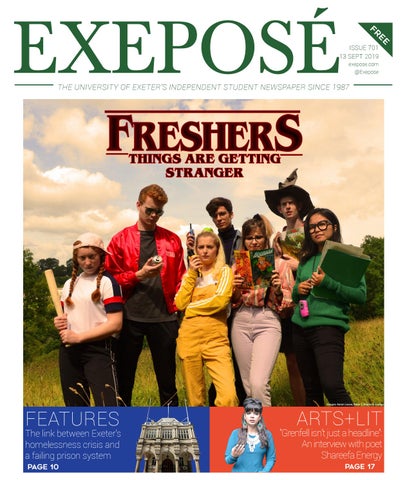
exeposé
FR
E
E
ISSUE 701 13 SEPT 2019 exepose.com @Exepose
THE UNIVERSITY OF EXETER’S INDEPENDENT STUDENT NEWSPAPER SINCE 1987
FEATURES
The link between Exeter’s homelessness crisis and a failing prison system PAGe 10
Images: Aaron Loose, Peter T, Shareefa Energy
ARTS+LIT
“Grenfell isn’t just a headline”: An interview with poet Shareefa Energy PAGE 17
EXEPOSÉ
Devonshire House, Exeter, Devon, EX4 4PZ
Editors Print: Isabelle Gray & Aaron Loose Online: Harry Caton & Ellie Cook editors@exepose.com News Editors Print: Louis Donohoe & Henry Jones Online: Emma Hussain news@exepose.com Comment Editors Print: Isabelle Gray comment@exepose.com Features Editors Print: Jaysim Hanspal & William Harrop Online: Bryan Knight Foreign Correspondents Co-ordinator: Maddie Baker features@exepose.com Lifestyle Editors Print: Izzy Cole & Anna Romanovska Online: Amy Butterworth & Emily Pirie lifestyle@exepose.com Arts + Lit Editors Print: Cherry-Anastasia Boroceanu & Zach Mayford Online: Ariane Joudrey & Greta Sanna artsandlit@exepose.com Music Editors Print: Richard Ainslie & Bryony Gooch Online: Megan Frost & Stephen Ong music@exepose.com Screen Editors Print: Jonathan Chern & Samuel Thomson Online: Jacob Heayes & Abi Taphouse screen@exepose.com Science Editors Print: Elinor Jones & Scarlett Parr Reid Online: Sira Charbel sciandtech@exepose.com Sport Editors Print: René Bahar & Josh Brown Online: Ben Bampton & Nick Powell sport@exepose.com Chief Photographer Rory Selvey photography@exepose.com Copy Editors Kamila Bell, Charlotte Forrester & Catherine Lloyd Proofers Jaysim Hanspal, William Harrop, Jonathan Chern, Henry Jones, Iszy Gray, Aaron Loose, Owain.
@ exepose facebook.com/exepose issuu.com/exeposeexeter Advertising Kate Watkins kate.watkins@exeterguild.com (01392) 722607 The opinions expressed in Exeposé are not necessarily those of the Exeposé Editors nor the University of Exeter Students’ Guild. While every care is taken to ensure that the information in this publication is correct and accurate, the Publisher can accept no liability for any consequential loss or damage, however caused, arising as a result of using the information printed. The Publisher cannot accept liability for any loss or damage to artwork or material submitted. The contents of this, unless stated otherwise, are copyright of the Publisher. Reproduction in any form requires the prior consent of the Publisher.
Editorial
W
ELL, here we go! Welcome to another year at the University of Exeter. It doesn’t matter if you are a Fresh or a little more worn down and returning for another year of TP Friday - you deserve the best year possible! So what does Exeposé actually do? Well, we elect a new editorial team every year. Our content ranges from coverage on campus life to groundbreaking studies on defending oneself from maraudiing seagulls. We also meet to proof pages and eat Domino's every other Friday. Sounds alright, doesn’t it? We put out a new print issue every fortnight during term time, and our intrepid website keeps on running all year round. So, if writing the headlines is an idea that fires you up, pop down to our stall in the Forum any day this week. We will be the lot in the green surrounded by newsprint! Our editorial team are a friendly sort and will be more than happy to answer your questions about getting involved. There’s also a number of our events you can check out during the week- the suave board on the right has all of the answers! We have a jampacked issue for you, so let’s get right into it. On News (page 4) we have ten fire questions with, Joff Cooke,: the new CEO of the Guild. Turn over and get to know him as closely we did. Comment discusses money management in first term (page 6) and the prospect of third year economic students becoming seminar tutors to first years (page 7). What do you Fresh think? (By the way, get used to being called Fresh – in fact, accepting it will do you even
better). Over in Lifestyle, the writers formerly knowns as Fresh reminisce on their uni experiences so far, detailing times in halls, night-time fails and more (page 14-15). Speaking of Exeter culture, Music takes us through the Exeter nightlife, as well as some of our contributors giving us a glimpse into their summer through their favourite tracks (page 20). Science offer their finest recommendations for literature, while also explaining the therapeutic work reading does for your mental health (page 29). Meanwhile, Sport give us all the dish with Matt Taylor, chief of Exeter City F.C. on his role (page 32) . Back over in Arts + Lit, the incredible Phoebe Waller-Bridge is discussed (page 16). Strong women in film is additionally covered in Screen’s iconic feature, Girls On Film, this time the equally iconic Abbi Jacobson and Ilana Wexler of Broad City (page 25). And finally, Features has compiled a plethora of fascinating pieces, including an investigation into the homelessness situation in Exeter (page 10). All in all, there is tons for you to get through. Exeposé is always welcoming new writers, or proofers or whatever you fancy! Even if you have never written but had an inkling of curiosity, just go with it and give it a chance. Joining a society, Exeposé or otherwise is always a great way to get involved. All of us here at the paper wish you a lovely year and we hope to see you at our Freshers' events!
E
v
E
N
T
s
MONDAY -WELCOME TO EXEPOSÉ 10:00-12:00 M&D ROOM TUESDAY -MEET EXHIBIT 11:00-13:30 EXEPOSÉ OFFICE -SPORTS WRITERS WORKSHOP 14:00-15:00 DH2 CONFERENCE ROOM -XMEDIA DISPOSABLE CAMERA PUB CRAWL 19:30 THE RAM WEDNESDAY -CAUGHT SHORT: XMEDIA FILM FESTIVAL 12:4515:00 NEWMAN RED LECTURE THEATRE THURSDAY -MEET CURRENT AFFAIRS 11:00-13:00 EXEPOSÉ OFFICE -NEWS WRITERS WORKSHOP 14:00-15:00 DH2 CONFERENCE ROOM -MUSIC SHOWCASE: FRESH VOICES 19:00-22:00 THE EXONIAN FRIDAY -XMEDIA PICNIC 11:00-15:00 CATHERDAL GREEN SUNDAY -COFFEE AND CAKE WITH THE SCIENCE TEAM 11:00-14:00 ARTIGIANO'S
Isabelle & Aaron
Worldwide university news Sharp spike in unconditional offers
UCU call for major uni admissions review
CAS Chief Executive, Clare Marchant, has voiced her concerns over the “worrying” scale of unconditional offers by some UK universities. With 38 per cent of students receiving unconditional offers in recent years, critics have described this as part of an annual scramble to fill both places and university pockets. Marchant referred to unconditional offers as a “recruitment tool”. The acceptance of the offers are further incentivised, at some universities, by added extras including free iPads and discounted fees. The UCAS Chief Executive encouraged teens to take advantage of the “buyers market for students”, as many university courses are under subscribed. Instead, he advised students to take their time to look elsewhere through clearing to enrol on courses with “better prospects”.
N “overhaul of university admissions is long overdue” said the head of the UCU (University and College Union) lecturers’ union, Paul Cotterel, as universities consider whether to have students apply for places after they get their exam results. The review questions whether the system of predicted grades, which are often unreliable, gives an unfair advantage to privileged students, and encourages unconditional offers that can pressure students into accepting them. Nicola Dandridge, Chief Executive of the Office for Students Watchdog , said the move could “remove barriers to disadvantaged applicants” and aid transparency. They will launch their own review of admissions later this year.
U
A
Goldsmiths Uni ban beef from campus
G
OLDSMITHS, University of London, has banned the sale of beef in its on-campus eateries as of September 2019. Scientists investigating the environmental damage of farming have found that avoiding animal products is the single best way to reduce human environmental impact. The beef ban is part of a larger attempt by the university to become more environmentally friendly. Goldsmiths has also begun reducing singleuse plastics by adding a 10 pence levy to bottled waters and disposable plastic cups. Joe Leam, the president of Goldsmiths’ union, said: “Banning beef is a bold move. Phasing out plastics and going to fully renewable energy are brilliant too."
Students swap pints for cappuccinos
A
LBERTAY University in Scotland has closed its Student Union bar because students increasingly prefer coffee to beer. They say alcohol sales have fallen by two-thirds since 2014. It is understood to be the first university bar in the UK to stop selling alcohol because of falling demand. A university spokesperson said that those students who do drink could continue to do so at neighbouring Dundee University. A recent study by University College London found that the proportion of 16 to 24-yearolds who do not drink alcohol has increased from 18 per cent in 2005 to 29 per cent in 2015. Stories by, Richard Ainslie, Freya Hide, Natalie Tongue and Henry Jones
Images (LtoR): Alex Blandford, Engin Akyurt
3
13 SEPT 2019 | EXEPOSÉ
NEWS
Questions raised over University’s living wage committment
Students launch app to help users find the best Freshers’ events Emma Hussain Online News Editor
A
group of Exeter students and graduates have created an app to help students discover events in the city. Officially launching this Freshers’ Week, Motive is the brainchild of developer Mitch Robinson, a 2019 Computer Science graduate, and designer Louis Evans, a second-year Computer Science undergraduate. Responding to feedback that Facebook has become too saturated with events, Robinson told Exeposé that Motive aims to “encapsulate everything that a student might want to do.” The team have worked with the Students’ Guild and the Exeter Civic Council to integrate a range of events into the app, including both nightlife, bars, clubs and numerous other activities. Given the enormous number of events on offer in Freshers’ Week, the Motive team want to help new students figure out which events are popular, while also helping societies find interested new members. Once they have signed into the
app using their Facebook account, the ability to both ‘like’ events and add them to a personal calendar will create an events ranking. Robinson told Exeposé in a statement, “You’re not just going into Facebook blind, you actually have a view of what your peers think is good.” In addition, the team hope to increase visibility for Guild society events. “The biggest club promoters can just determine where people go, and societies just get a little bit left out. We want to help societies reach the right people.” Robinson developed Motive last year as his dissertation project. The team behind it have benefitted from Google grants, as well as financial and technical support from Think Try Do, the student start-up incubator based at the Innovation Centre. Think Try Do offers up to a thousand pounds to projects pitched to them by students. The Motive team said the incubator have offered them invaluable help, including social media workshops and business advice. The Motive app is live now, and is available for free download on both the Apple and Google Play stores.
Henry Jones News Editor
S
TUDENTS are questioning the University’s commitment to paying the living wage following the release of a table of living wage university employers that included Bath and Bristol yet did not mention Exeter. CitizensUK, a community organising group, published the table in a tweet on 10 August. Exeter replied to the tweet saying “we support and pay the Living Wage. We regularly review and make changes to our pay scales to reflect this.” The data was gathered by The Living Wage Foundation. According to the Foundation’s website, over 93 per cent of business have earnt Living Wage accreditation since the system began. According to the University’s website, the decision resulted in a demonstrable increase in employee’s take home pay. The first point on the University’s payscale in July 2019 is 25 per cent higher than it was before the University adopted the Living Wage in January 2014 and is 7.8 per cent higher than the lowest point on the national payscale.
Image: Benjamin Evans
Despite paying its employees living wage, the University is not accredited by the Living Wage Foundation. Exeposé understands this is because the university doesn’t have a policy that ensures outsourced staff are also paid to this standard. Roles that are outsourced include cleaning staff and some of the security team. A University of Exeter spokesperson said: “The University of Exeter began paying the Living Wage from 1 January 2014 (extended to casual workers in August 2018) and this has benefitted over 300 directly employed staff
and several hundred casual workers. We do not currently insist that companies we work with or contract to pay the Living Wage but consider a range of workforce issues as part of any procurement process. We do, however, ensure that any third party agency workers who, for example, provide additional cleaning or catering services receive the Living Wage. We have not sought accreditation from the Living Wage Foundation as there are no additional benefits to our staff but do keep under regular review.”
Jacob Rees-Mogg to speak on Exeter campus
Exeter charity receives grant How to stop seagulls from stealing your chips to end homelessness
Aaron Loose Editor
tinued to explain the collaborative nature of the project, stating that “the way support is designed and delivered will XETER based collaborative lead to structural changes in the way charity CoLab have announced homelessness is addressed and undertheir receipt of a grant to de- stood. No one agency can end homevelop a citywide Exeter Homeless Part- lessness – it has to be a collective effort nership. This grant, provided by inter- with everyone being involved.” national wellbeing and equality focused CoLab, who also focus on the faccharity Comic Relief, is to fund the protors surrounding homelessness ject for three years. including addiction, reThis endeavour, called A habilitation, and reSafe Place to Be, is procovery, will create jected to be designed a Homelessand led by the local ness Charter, community and foand Action cuses on the engageGroups. The ment and mobilisalatter will test tion of local groups alternative and people experiencstrategies as to ing homelessness. The fundraising, enPartnership is collaborative, gaging, and mobilisas with CoLab’s existing ethos, Image: jj merelo flickr ing local communities. connecting those with experience of Exeter has seen a sharp rise homelessness with local businesses, in homelessness over the past year. The voluntary groups, and community sec- charity St Petrock’s revealed in January it tors to bring about immediate positive had been seeing over 80 people a day rechange in the circumstances of those quest help. Typically it would see around affected. 45 to 65 people a day. The reason beFiona Carden from CoLab Exeter hind the surge is unknown, but the charexpressed her delight at being awarded ity says the rise is not just being seen in the grant from Comic Relief. She con- Exeter but across the country.
J
ACOB Rees-Mogg, the MP for Northern Somerset and Leader of the House of Commons, will speak at the University on the Friday of Freshers’ Week. Mr Rees-Mogg will appear at Newman Blue, a lecture theatre located in the centre of Streatham campus, and will speak from 5pm until 6pm. The talk is organised by the Exeter University Conservative Association (EUCA). In a statement posted on their Facebook page, the EUCA said they were delighted to host Mr. Rees-Mogg. The announced conversation topics include Brexit and the future of the Conservative Party. Mr. Rees-Mogg has visited the University several times over the years. His previous visits include a 2016 reception at the Batman Lecture Theatre, as well as an appearance at a 2014 DebSoc event, where he argued for the legacy of the British Empire as a positive contribution to international culture- a view that runs contrary to much of mainstream academic postcolonial scholarship.
Neha Shaji News Team
E
Louis Donohoe News Editor
R
ESEARCHERS at the University of Exeter have found an effective method at keeping seagulls from stealing human food. Researchers studied the effects of staring at seagulls as they approach food by placing a bag of chips on the floor near a human and comparing how long it took them to walk up to it when the human watched and when they looked away. The average time for the seagulls to approach when being stared at was 21 seconds longer than when they weren’t. The researchers tested 74 gulls. Of which only 27 attempted to go for the food. The remaining 47 either flew away after the food was presented or did not approach the ground. Of the 27, only 19 completed the being watched compared with not being watched trial. The lead author, Madeleine Goumas, spoke to the University saying “Gulls are often seen as aggressive and willing to take food from humans, so it was interesting to find that most wouldn’t even come
near during our tests”. The study comes after the decline of the species generally, but an increase in the number of interactions with humans due to the presence of gulls in urban areas. The study revealed that the majority of gulls would not approach food near a human and those that did took significantly more time when they were being looked at. However, the study also found that the gulls’ approach time varied widely. Some were reported to touch the food within 10 seconds whether or not they were being watched. Whereas some others did not complete their approach after being looked at. The results conclude that understanding the variation in behaviour can help inform conservation strategies when managing conflict between humans and wildlife.
Image: steve, Wikipedia Commons
4
13 SEPT 2019 | EXEPOSÉ
NEWS
Exeter Student Ambassdors visit eight per cent more private schools since 2013 Louis Donohoe News Editor
T
HE University has revealed that its visitations by ambassador groups has increased for independent schools, whilst the number of state schools being visited has not seen as much change. Information obtained by Exeposé reveals the changes in University ambassador visits from 2012-17. The
information shows a low of 174 total schools visited in 2012/13 compared with the highest in the 2015/16 of 255.
The University of Exeter has one of the lowest state school intakes in the country..
The data for 2013/14 revealed 85 per cent of the schools being
visited were state schools. Whereas in 2015/16 and 2016/17 this number dropped to 75 per cent The number of independent schools being visited in these years increased from 34 to 65 from 2013/14 to 2015/16. The 2016/17 data showed a decrease in the total number of schools visited from 255 in the previous term down to 193. The University attributed this decline to restructuring of the team that was undertaken.
Coming in at ninth lowest with 69.1 per cent of the students coming from a state school. The lowest is the University of Oxford with 57.4 per cent.. The University stated that “visits to schools and colleges are only one part of the support that the University provides as part of its commitment to widening participation and outreach activities. These include, but aren’t limited to, the Exeter Scholars scheme,
residential programmes for Year 10 and 12 pupils, on campus visits and tours, and attending careers events and events across the country.” Furthermore, “the University has also established the Exeter Centre for Social Mobility which brings researchers and practitioners together to promote its commitment to helping students realise their full potential through access to higher education.”
Joff: I think we need to be careful in using blunt sticks like one particular measure of one particular event on one particular issue to judge a whole thing. Is that an issue in itself of one event that we only had that sort of turnout? Yes, quite c l e a r l y.
having just had an early briefing on it that lessons have been learnt and I would feel confident that if we had a similar challenge, that the management process. is much improved/ But as for the philosophical question of should we be inviting Hopkins, if you ask me as Joff Cooke at the pub with my friends, I’d give you a far more open answer. But I think need to be careful as the CEO in terms of protecting the rights of the student leadership. My response is always no one on the staff team was elected to support the students so it is our job every year to work out how to work with the elected leadership and not to cast judgement on them- that’s the electorate’s job to decide that. So when Loose you get to someone like Katie Hopkins, we have a duty to protect free speech and a duty to protect the wellbeing of students as well. My job as CEO will be to manage those things with the leadership. If the leadership want to take a firmer line on something, then again it will be my job as CEO to advise them. É: What is the best thing about studying at university? Joff: It has to be that event that someone says it has changed their life. If it isn’t, it’s a very expensive way to spend three to four years, isn’t it? It’s very easy when you’re an elected sabbatical and you come in here five days a week to be passionately involved in this sort of stuff, but the students have courses! Nothing is more important than that. We have to keep that in mind as students union. É: Why is it a Guild, as opposed to a union? J o f f : My first interaction
with the Sabbatical officers was at their training day in Plymouth, and that was my first question to them, why are we a Guild? I don’t know. The most important thing for me is that we be clear with students about what we are and what we actually provide.
“I have been called a change agent”: Seven questions with Joff Cooke, the new CEO of your Students’ Guild
Aaron Loose & Isabelle Gray Editors
I
T’S not every day that you snag a chat with the Chief Executive of your students’ union. After Tracey Costello stepped down in February, the Guild launched a two month recruitment process to find a successor ready for her final week in August. Joff Cooke, who previously worked as the CEO down the road at our Penryn Campus, was the candidate. His CV includes a stint as an NUS Regional Officer and a ten year stretch as a Manager of Student Engagement at the University of Bournemouth, where he oversaw developments in student engagement. Exeposé caught up with Joff in mid August. Having just concluded a bustling first week on job, the self-described change agent was eager to outline his vision for a more transparent and open Students’ Guild.
É
É: How did you get your start working in student unions? Joff: When I was a student I was an agitator. I was one of those people who were never happy with the Students’ Union. It really started when I had an issue with my accommodation and I went down to the SU and nobody there was particularly helpful at all. So I stood to be elected and suddenly realised how hard it was on the other side. It’s driven by the fact that I am passionate about fairness and getting the right thing for people at the right time in the right way. É: Why do you think, in your own words, that you were specifically chosen for this position? Joff: I was very clear through my process that if you want a steady pair of hands to keep the ship on course as it is as the moment, don’t appoint me. Because I am someone who has been called a bit of a change agent; I question everything
about how it’s done at the moment. My ambition is always to be if we’re doing something and we aren’t aiming to be the best in the world at that, why are we doing it? And when you want to be best in the world, we need to find out what other people are doing and how they are doing it. I’m very much an outward person who looks out at what’s going on in the rest of the world, and how we can learn from that. It’s right down to thinking about how good is the Guild is as good as it can be for everyone, not just the privileged few, not just those who walk through our door, but those who we never see.
I am passionate about fairness and getting the right thing for people in the right way
É: In what in your view, does the Guild need to improve in its service to students? Joff: My early thoughts are that there is an issue with transparency and trust. Some of the stuff I’m just picking up here is that perhaps in the past the Guild hasn’t been as good at that as they could be, so I’ll very much be pushing to be much more transparent in what we do. We are all human, and I like to work in a high trust environment where we accept that we do make mistakes, but when we do, we hold our hands up and move forward in partnership together. I don’t get the sense at this institution at the moment that there is the same connection that I would expect to see between the Guild and its members in a really successful student’s union- or student’s guild. É: Less than 5.5 per cent of the student population voted in the March referendum on whether the Exeter Guild was to remain the National Union of Students. Does the Guild have a student engagement problem?
Image: Aaron
Are there reasons for that? Potentially. Is student engagement one of them? Also is the time of year it happened, also is the question whether the NUS is actually relevant enough to students on the ground nationally? A Guild is not a space, it is not a building, it’s not the staff, a Guild is a sum of the students and the members within it. I always worry when you have students who talk about the Guild as another being because they haven’t talked about what they can do to be a part of it.
There’s an issue with transparency. The Guild hasn’t been as good as it could be
É: What is your view on right-wing pundit Katie Hopkins’s controversial visit to campus in February? Was the Guild right to approve it? Joff: It would be unfair of me at this stage to comment on the actions of my predecessor. Of course, I will be reviewing that as a very high profile case about how the Guild behaved in terms of managing the process, and I am confident
If you don’t get involved, the Guild cannot get stronger and become more relevant to you
É: Why should our new Freshers get involved in their Guild? We must recognise that a university experience is first and foremost an academic experience. But there is so much more than that outside that if you don’t get involved in it will be an opportunity missed. We get it constantly from people who leave university that their own regret is that they didn’t do more outside of their course. If you don’t get involved, the Guild cannot get stronger and become more relevant to you.
Image: Exeter Students’ Guild
EXEPOSÉ | 3 JUN 2019
The Exeposé Talk: Sir Steve Smith and Janice Kay
Image: Aaron Loose
Megan Davies & Aaron Loose Contributor & Editor
If we were “a business”, we would build more Holland Halls
Sir Steve Smith
We'd have to drop from an average of three As to three Bs
Sir Steve Smith
13 SEPT 2019| EXEPOSÉ
6
Comment
COMMENT EDITOR:
Isabelle Gray
The proof is in... the chicken box?
Neha Shaji Contributor
O
N the 15 August it was announced that the new proactive measure to reduce England’s rising knife crime statistics was to print #knifefree and “inspirational stories” of those who left knives behind, on boxes of fried chicken. This strategy, presented on social media, seemed to be the brainchild of Twitter user @patelforwitham. Unfortunately, Twitter user @patelforwitham happened to be the appointed Home Minister in the UK Cabinet and thus, this looked like an actual governmental decision. You don’t need to excitedly repeat it again and again, feverishly indulging in debates on whether or not this campaign is “borderline racist”. The intended and tongue in cheek racism of this preventative measure is not borderline racist but aggressively crosses said border several times over, like a Leave-voting pensioner getting in their final expenses-paid trips to Spain. Yet humour aside, it is important to not just consider this a well intentioned but sadly misfired method of campaigning for what you may consider an ultimately good cause. This reeks of deliberate stereotyping
of the cruelest nature, and pins the tragedy of rising knife crime rates to the mere factor of race. It does not consider, even, that several knife related incidents stem from drug dealing and the gangs indulging in it. However, you don’t see the government targeting Jack Wills-clad, Pret-frequenting, universityeducated middle class white men for whom cocaine and MDMA tend to be a lifestyle and artistic choice. Instead, newspaper opinion columns blame grime and drill music, whilst online commentators draw painfully obvious caricatures of absent fathers in “certain communities” they all but name. It begs the question then - what is the Johnson government getting out of wasting money on ugly stereotypes, which are evidently only going to create racial tension? The answer is in the last three words of the previous sentence.
Wasting money that is only going to create racial tension The need of the moment is to uplift communities, to reopen the countless youth centres closed down due to austerity, stop racially profiling
on the streets and schools and get teens back in education. It is to question why communities do not trust authority figures or the police, and perhaps consider what role “random” stop and searches may play in this mistrust. Of course, it would be incongruous of a government bent on creating a hostile i
g ma
e: m
r wr
o n g, f
li c k r
environment to uplift communities of ethnic minorities when they could just as easily demonize them. Former Home Secretary, Sajid Javid’s role in knife crime prevention consisted of no cartoonishly puerile stunts like the chicken boxes. Instead, he focused on punitive measures, giving the police
more power and increasing penalties on being caught with knives, even for children as young as thirteen who were being stopped on the streets and cuffed. This too, was a tactic focused on demonizing and punching down rather than spending money on positive measures. Last year, Amnesty International condemned a matrix held by London Met. Police of individuals listed as “gang nominals” likely to indulge in crime, 78 per cent of whom were Black, when only 27 per cent of those known by police to be contributors to serious youth violence were Black. The chicken boxes, as harmlessly stereotypical as they may seem to the white commentator - contribute to the attitudes surrounding knife crime, and the demonizing of Black youth which has led to several tragic custody deaths of unarmed men. I wanted to end the piece on a somewhat hopeful note; detailing what this government could do to help bring down knife crime statistics instead of this stunt. In writing this and putting down to paper the sheer racism and cruelty in placing the responsibility for repeated governments’ failures on a community the governments have failed - I am certain you, and
the government are aware that people exposed to this violence have been suggesting ideas for years. That it is not ignorance on the part of the Home Office but a deflection catering to the desire for a scapegoat, any scapegoat, but preferably an ethnic minority, please.
A tactic focused on demonizing and punching down
Perhaps the right note to end on is to bring attention to how these failings have been taken up by concerned citizen groups, like has happened so often when governments fail minorities, as with Grenfell. These groups include the youth focused trio Word on the Curb, who engaged in a campaign around the Home Office’s move. Hayel Wartemberg, Ndubuisi Uchea and Shiva Tarbhaker have gathered thousands of responses to this chicken box stunt from members of the London public, including practical ideas on how to reduce knife crime. They, according to an interview in The Guardian, plan to pack these suggestions into the offending chicken boxes - and send them straight back to the government they came from.
////////////////////////////////////////////////////////////////////////////////////////////////////////////////////////////////////////////////////////////////////////////////////////////
The reality of managing your money
Kamila Bell Copy Editor
W
HETHER you’ve spent all summer working and saving, have been travelling and are eagerly awaiting that student loan to drop or are simply hoping to have your interest-free overdraft approved, money has more than likely crossed your mind with anticipation for the coming year. Unfortunately, the somewhat cliché saying “Money makes the world go around” is only going to feel more real as you enter this first term of life away from home. Your initial budgeting scheme will most likely become one of trial and error. Trialing that fourth night out in a row only to be accompanied with the error of thinking that “this time I won’t drink at the club, just a couple at the flat before we go
out”. Surprisingly, it will more than likely be the non-alcohol related expenses that will sneak up on you. It will take the form of the four memberships you buy during the freshers fair, for the societies you swear you are going to attend for the rest of the year. Or that mid-afternoon Deliveroo order you just needed to get because you couldn’t stand the sight of food up until that moment but you’re still too hungover to add hot water to that last Pot Noodle at the back of your cupboard. Fear not, what follows is not meant to discourage or dissuade you from having a first year to remember, I simply hope to offer you advice that ensures your impending ‘FOMO’ does not send you plummeting into your student overdraft. Cooking for one will start to feel like a drag as you soon realise that
supermarkets are not set up for solo dining, finding yourself still eating leftovers from three meals ago. However, aiming to cook in small
Budgeting will begin as a trial and error process groups a couple of times a week will not only help you bond as a flat but is also a more cost-effective method for dinner preparation, with the added bonus of less washing up. Supplementing your student loan with part-time employment can help reduce your stress of spending on things that aren’t necessities. With Exeter being a university city, many employers are happy for casual parttime staff. Many jobs can also come
with an added bonus of discounts where you are working that can only help your bank balance further. Do not (high emphasis here) undervalue a night in. A night in the flat can be as much fun as one out and is more than likely one you will remember as being more distinctive than the fifth consecutive Cheesy’s you’ve attended. An evening of watching movie recommendations with flat mates, eating two for £1 bags of popcorn from the market place, is not only a cheaper night, but the steadier paced drinking might just mean you make your 9am lecture the next morning. At the end of this I will say that money management is all autobiography. How you choose to
Image: michelle l.marquez, flickr
spend or save your money is entirely your decision. It may do a Houdini on you as you slip into your student overdraft but that is not something to be afraid of, think of it as a buffer to stop you getting into trouble and providing you with that helping hand before that next installment of your maintenance loan drops.
13 SEPT 2019 | EXEPOSÉ
COMMENT
Academic promotion or imposter syndrome? Anne Chafer Contributor
T
HE department of Economics at the University of Exeter will be running, for another year, their Economic Scholars scheme. This allows third year students with an “outstanding academic track record” to teach seminars to first year students. “The idea is to allow our top students to get some experience in teaching small groups, supervised by the module lead”, says Carlos Cortinhas, Deputy Head of Economics, in the promotional video for the scheme. The role aims to open doors to up-and-coming scholars, giving them the possibility to work closely with their department. The job description details that the role will not require the scholar to give more than three seminars every week. They will be trained before starting and will get ongoing mentoring for the duration of the teaching. The role will be paid, although the exact salary isn’t specified. The candidates are expected to send a cover letter and a transcript of their grades, and the selected scholars will be trained sometime between Freshers’ Week and Week
Two. But is it a good idea to have third year students as seminar tutors? The promotional video brings up a point in favor of the scheme which is worth considering: third year students will understand what it is like to be a first year much better than an already established academic. But what would unite a fresher and a third year would precisely be the fact that neither is an expert in their field. And this is not the only problem with the scheme: a very worrying one is that the student is suddenly faced with the pressure of exhibiting the level of a researcher who will at least have completed a Master’s, and more often than not a PhD too. This is practically a recipe for impostor’s syndrome. In addition, there is the question of what training will be given and what form this will take. Is it sensible to pretend that a week of training before term is enough to replace the teacher training courses that most lecturers have to undertake before being offered an academic position? And if students can become teachers this easily, what does this mean for overqualified academics looking for teaching jobs, which are already scarce enough? What the Economics Scholar scheme
introduces is a slippery slope that might easily end up devaluing teacher training courses, if other universities follow its example.
Is it reasonable to throw a third year student into employment like this?
In the United States, it’s not new for students to take on jobs in their department while studying for their undergraduate degree. Cal Newport talks about the benefits of getting a Image: giovannacco. pixabay
position as a paid research assistant in his book How to Win at College, for example, but what makes this different from the Exeter scheme is that these jobs in North American colleges don’t usually involve dealing with students. And yes, the role might develop “a lot of crucial skills for going out into the world of employment”, as Robbie Georgel, who was a Scholar in 2018/19, says in the video, but is it reasonable to throw a third year student into the world of employment like this, instead of, say, through a summer internship? Georgel also mentions how the scheme helps the student “balance the workload of teaching and studying at the same time”. This is problematic – how healthily can these workloads be balanced, especially in third year? Undergraduates often take on part time jobs, but not many involve university-level
teaching. And while it could be more enriching to one’s career than a retail job, the salary may not be competitive. The exact pay is not made explicit anywhere, but it’s likely to be less than that of an established academic. Arguably, the third year students won’t be getting enough out of the scheme. And for a first year, the quality of education they get will inevitably be lower, no matter how much effort the Economics scholars put into it, so they won’t be getting as much for their money. After last year’s pension strikes, which affected lecturers and students alike, schemes such as this one only accentuate the systematic problem that English higher education has; the shift from a university model focused on learning and research to a corporate business institution. The budget cuts in academia, such as the one this scheme clearly demonstrates, are combined with the expansion of private student housing et al., to make clear where the priorities of the University of Exeter as an organisation lie. Therefore, this scheme, with all its problems, becomes only another inevitable, predictable step in the transformation of the capitalist higher education institution.
CONTEMPORARY CHOIR ,
JOIN US!
Rehearsals 5-6:30pm every wednesday!
Freshers' Week - Taster Sessions Weds 5-6:30pm, M&D Room Fri 11-12pm, M&D Room
"The friendliest, happiest, and most accepting choir to be in!" "Best New Society"
"Best Engagement with the University"
"Student Group of the Year"
SOCIETIES COUNCIL AWARDS 2018-19
EXTUNES AWARDS 2018-19
EXETER GUILD AWARDS 2018-19
University of Exeter Contemporary Choir
@execontempchoir
@execontempchoir
7
Only
ÂŁ1
Dis ver Exeter by electric bike
per 20 mins1
Find them around the city including University of Exeter Streatham and St Luke’s campuses Download the nextbike app to register, rent, ride & return
@CoBikesElectric
co-bikes.co.uk
13 SEPT 2019 | EXEPOSÉ
9
Features
FEATURES EDITORS:
Slipped under the radar
Jaysim Hanspal William Harrop
Features Editors discuss worthy stories they think haven’t received the media attention they deserve
B
Y way of introduction, the Exeposé Features team have dug deep to keep you informed on outsider stories that aren’t in mainstream news.
Saving the planet in Africa William Harrop, Features Editor This summer, Europe was scorched by a record shattering heatwave as temperatures soared as high as 38.7C here in Britain. Whilst this all serves as a striking call for action on climate change, the news seems relatively bereft of encouraging news, beyond the UK government declaring a ‘climate emergency’. Elsewhere, however, this couldn’t be further from the truth. Africa’s efforts to combat the creeping threat of environmental degradation offer some of the world’s most inspiring signs that we can tackle climate change if we work together. Few countries in Africa display this better than Ethiopia which, in July of this year far surpassed the world record for the most trees planted in 12 hours by planting 353 million trees across the country. Whilst afforestation might not be the ‘solve all’ problem it is often believed to be, Ethiopia has made great strides towards restoring its lost forests. This isn’t a project in isolation either. Ethiopia is
one of 20 African countries who signed the 2017 African Forest Landscape Restoration Initiative, pledging to restore 100 million hectares of forestland. This is especially encouraging when considered alongside a recent UN report stating that restorating lost forests can help remove up to two-thirds of human-produced carbon.
Ethiopia has made great progress in restoring its lost forests
Africa is also home to perhaps the most impressive environmental project ever conceived; the Great Green Wall. This scheme, initiated in 2007, is the brainchild of the African Union and involves planting an 8,000km long, 15km thick patchwork of productive green landscapes sprawling across 11 African countries from West to East Africa. Although only 15 per cent complete, the scheme’s aim of preventing the spread of the Sahara Desert is already showing signs of success. Green land along the wall sports more resilient soil, whilst also stimulating the local economy by providing jobs and food stability. Africa’s collaborative commitment to the environment is something the rest of the world, Europe in particular, should seek to imitate.
Rising intolerance in the UK Jaysim Hanspal, Features Editor London, as one of the most ethnically diverse cities in the world, represents for many a mentality of open-
Image, left to right: Kate Holt/Africa Practice, Arno Mikkor Flickr, Stephen McCarthy/Collision via Sportsfile
mindedness and progression, with 37 per cent of the population born outside the UK. However, despite its multiculturalism, there isn’t always a sense of acceptance between different communities in the capital. In 2017, the number of arrests made for terrorist-linked offences rose 68 per cent and since then high-profile cases like Shamina Begum have frequented our television screens. This is accompanied by a significant rise in Islamophobic behaviour with a 40 per cent increase in hate crimes just days after events like the London Bridge terrorist attack and the EU referendum. However, the issue seems much more systemic than blatant racism.
40 per cent rise in hate crimes after events like the London Bridge terrorist attack
This racist rhetoric is reflected in the opinions of powerful politicians like Boris Johnson, who has been quoted describing Muslim women who choose to wear burqas as “letter boxes”. Activist Amal Bider, who recently was at the forefront of a campaign against racism at Goldsmiths University, reaffirms that “We have a Prime Minister who is Islamophobic, and who is allowed to get away with that. There is no room for us in society.” With what seems like all the odds against you, what can we as a society possibly do to combat this prejudice? Recently, Prime Minister of New Zealand
Jacinda Ardern condemned mass shooters in Christchurch as terrorists as opposed to the “shooter” label that is often given to white supremacists. Her conduct set an example for other world leaders on sensitivity, and our responsibility to help support other communities. Allowing Islamaphobic rhetoric is not just a sideeffect of a new far-right-led society, but further evidence that we are choosing to move backwards. Regardless of race or ethnicity, allowing the marginalisation of a community reflects a toxic attitude which only appears to be growing more acceptable in this new political environment.
The Freedom Dividend: Yang’s $1,000 Pledge Bryan Knight, Online Features Editor With the 2020 elections looming, the news cycle is inundated with headlines meticulously analysing the big players such as Joe Biden and Bernie Sanders. However, if you blinked during the previous two debates, you may have missed rising-star Democrat candidate Andrew Yang. Having never previously held political office, entrepreneur Yang has amassed a huge online following. The candidate has created momentum for himself primarily due to his advocacy of a ‘freedom dividend’ – a policy that’s come to be the raison d’étre of his campaign. The freedom dividend, pledged by Yang, promises to give all adult Americans $1,000 per
month without any requirements. Whilst this idea may seem radical, it has frequently been touted since the founding days of the United States. Yang proposes this dividend as a way to offset the looming social and economic consequences facing modern-day America, as a result of the technological takeover or, as some experts refers to it, the “fourth industrial revolution” . The candidate has frequently warned of the havoc being caused by technological firms, as they shift from human labour in favour of automation.
Yang, promises to give all adult Americans $1,000 per month without any requirements The freedom dividend promises to not only act as a social equalizer for Americans but also provide a safety net for many families and individuals who will be empowered to exploit their entrepreneurial and creative capabilities. The Roosevelt Institute has conducted research into universal basic income and has estimated that the American economy could grow by $2.5 trillion per annum as a result. Like most policies, however, universal basic income has come under great scrutiny from all ends of the political spectrum. Having recently qualified for the September primary debates, Yang’s campaign has exceeded the expectation of many political commentators. This fringe candidate is definitely one to watch.
13 SEPT 2019 | EXEPOSÉ
FEATURES
10
Exeter Prison’s revolving door Bryony Gooch, Music Editor, investigates the homelessness crisis within Exeter's prison system
W
ALKING around Exeter, it is impossible to ignore large numbers of homeless people in the city. During the day you’ll see them on the streets, trying to scrape together enough money for a meal. As you stagger back home at night, you’ll encounter their sleeping bags huddled in doorways. Exeter is not exempt from the country’s homelessness crisis; these are the most vulnerable people in the city. But a proportion of these people are victims of a “revolving door” in and out of Exeter Prison. According to statistics from homelessness charity Julian House, between 2018 and 2019, a shocking 51.3 per cent of all releases from prison came out to “unsettled accommodation” with a significant proportion having “no housing options”, contributing to Exeter’s street homelessness problem. On discovering the gravity of this crisis, I sought to understand why this was happening and what could be done to stop it.
2018-2019, 51.3 per cent of prisoners were released to "unsettled accommodation" Overcrowded and underfunded, Exeter is like all prisons across the country. The Class B male local resettlement prison contains those sentenced in the large locality of Devon, Cornwall, Dorset and Somerset. In response to an FOI request sent to the Ministry of Justice for HMP Exeter’s reoffending statistics, I was told that “reoffending information since September 2015 on those released from individual prisons has not been consistently recorded on central systems.” This shocking revelation that the government have lost track of re-offenders indicates a shift from prisoner rehabilitation. Further flaws in the penal system can be found in the prison’s May 2018 Inspection. HMP Exeter was placed under an “emergency protocol” for
prisoner safety highlighting high levels of self-harm and drug abuse. It was also the location of six self-inflicted prisoner deaths between 2016-18.
"A lot of these people come onto the streets having no support network "
Interestingly, in a 2019 progress report for HMP Exeter, the only area of improvement since 2016 was the rehabilitation and release planning which moved from “not sufficiently good” to “reasonably good”. This scheme allowed prisoners to develop their skill-sets, formulating plans beyond release. Which, surely, should have helped ex-offenders prepare to enter society and find work. But why are there still so many ex-prisoners homeless and ending up back in the system? To understand the plight of homeless ex-prisoners, I spoke to an experienced homelessness prevention support [BG1] worker who stated that it was not uncommon to come across homeless ex-prisoners in Exeter. Many were prolific burglars, others were tied into drug use – criminal offences that can double as a form of survival for the homeless. I asked why so many people were still coming out of prison homeless, despite improvements to the prison’s rehabilitation services. “A lot of these people come out onto the streets having no support network” the support worker noted. Therefore, it was easier to fall in with the same people they met on the inside and re-offend. “A lot of the guys I’ve encountered have come from the care system”, suggesting that those with a background of institutionalisation could find themselves in and out of these same institutions their whole life. After all, in 2015 it was estimated that 23 per cent of prisoners across the UK came from the care system. They went on to
comment on how a lack of funding in social and mental health services contributed to the homeless crisis we face today, and the issue of Exeter’s revolving door. Further evidence of austerity affecting homelessness became apparent when I spoke to St Petrock’s, a charity in Exeter helping the homeless survive the streets. Over the past five years, the charity has seen a 40 per cent rise in visitors. Shockingly, on the day I visited, they told me they now helped around 100 people a day. So what has caused this rise in Exeter’s homelessness?
Over the past five years St Petrocks has seen a 40 per cent increase in visitors
Without providing an oversimplified response to this question, it helps to look at Exeter’s housing market. Exeter is the tenth most expensive city in the UK to live in, with a housing market catering primarily to university students. It goes without saying that student housing is lucrative and more appealing to landlords than social housing; a landlord could individually charge four students £115 per week for accommodation and make around £1,840 per month. Meanwhile, social housing has the stigma of antisocial tenants with
precarious economic circumstances. Indeed, signing up for social housing can be difficult for exprisoners. According to Devon Home Choice, Exeter City Council’s primary route into social housing, while those in prison can apply for the Devon Home Choice Register, “their application will be placed in Band E (No housing need)… and they will be suspended from bidding until 56 days prior to release.” With a lack of housing opportunities and support, it is no surprise so many become homelessness. Additionally, Julian House commented, “it is as challenging as ever to reintegrate offenders into society”, especially those entering the benefits system. On release, prisoners are given a £46 Discharge Grant, which is supposed to tide them over until they find economic stability or sign up for Universal Credit; yet the process for has changed. What used to take 10 days to assess applications and receive money now takes four weeks for the first payment to be received, which means ex-prisoners have the difficult task of making £46 last four weeks. So what hope is there for exprisoners coming out of the system onto the streets? In August 2018, HMP Exeter commissioned
Julian House to provide 20 units of dispersed supported housing accommodation across Devon and Cornwall. While they are aware that this does not meet the demand of housing homeless ex-prisoners, the charity’s service department manager Fynn Clarke stated in a comment for Devon Live “If the service isn’t provide [sic] by Julian House then they would be homeless when they live [sic].” The state’s dependence on charitable support highlights an inability to care for those coming out of its institutions.
Ex-prisoners are faced with the difficult task of making £46 last four weeks
While difficult to succinctly summarise the complex issues of the penal system’s failures, as well as the city’s wider homeless issue, this study of Exeter's homeless crisis illustrates one way in which austerity has reduced state services to a shell of their former selves, leaving charities to fill in the gaps. Charities such as St Petrock’s, Sanctuary, and Julian House provide a support system for society’s most vulnerable people. Without them, a lot of people would not survive on the streets, let alone find the opportunity to leave them.
É
If these issues affect you, you can get in touch with:
Julian House: admin@julianhouse.org. uk St Petrocks: stpetrocks.org.uk/ rg.uk Wellbeing Services: exeter.ac.uk/wellbeing
Image: useche70
NO CONTRACT OR JOINING FEE Membership includes FULL ACCESS to: • 4 gyms • 2 pools • 100+ instructor led & virtual classes a week • 4 virtual studios • Queenax functional training system • Indoor cycling • Racquet sports • Running track • Free induction and 6 week programme • Free parking* *Free parking not available at Pyramids
£25 per month with no contract or joining fee, plus the ability to freeze your membership outside of term time. Join us at Freshers Fair for fantastic membership offers available for ONE DAY ONLY plus challenges and activities to enjoy on the day.
Call
01392 401050
now to join, you’ll love getting fit with us!
1 PRICE, 7 CENTRES
£25.00 Managed by Legacy Leisure on behalf of Exeter City Council
PER MONTH
The XETER DENTAL CENTRE in the Heart of Exeter City Centre Open seven days a week and late night Thursday See online for a full range of
Image: stux 6789 immagini
dentistry services: Check ups
•
Hygiene
•
Orthodontics
•
Teeth whitening
•
Facial aesthetics
•
Emergency treatment
•
Crowns/veneers
•
Implants
•
Sedation
•
Specialist periodontics
•
Endodontics
17 CASTLE STREET, EXETER, DEVON EX4 3PT
Emergency appointments available for registered and non registered patients Finance packages available Book online at www.exeterdentalcentre.co.uk Telephone 01392 272350
Image: Our Golden Age
•
lifestyle
MUSIC
ARTS + LIT
STUDY BREAK
screen
Image: stocksnap, pixabay
Image: stocksnap, pixabay
Image: digital341, pixabay
FUnding fires and fallouts
14 14
the uniall of on a tell exeter life uni of exeter
18 Image: Steam Pipe Trunk Distribution Venue,
girls on film
the british rap scene
21
Image: Edwardx, wikipediacommons
study study break break
25
26
14 -15
16 -18
20 -21
24 -25
LIFESTYLE EDITORS Anna Romanovska Izzy Cole
ARTS + LIT EDITORS Cherry-Anastasia Boroceanu Zach Mayford
MUSIC EDITORS Bryony Gooch Richard Ainslie
SCREEN EDITORS Jonathan Chern Sam Thomson
26 STUDY BREAK Puzzles by Matthew and Isabelle 13 SEPT 2019 | EXEPOSÉ
lifestyle
DEAR FRESHER M
Exeposé Lifestyle writers guide you thro
HOW TO: NIGHTLIFE
F
RESHERS' is like the trial run for the rest of uni so it’s a great time to make mistakes, learn but most importantly have fun, as cheesy as that sounds… Safety: mundane but the most important thing for nights out. Make sure you have phone numbers of at least three people you’re going out with or living with and Apple Taxis and never go home alone.
FRESHERS IS LIKE A TRIAL RUN FOR THE REST OF UNI Don’t set expectations: there have been plenty of nights ruined because they haven’t turned out as I hoped and the best nights have been either spontaneous or the ones I haven’t thought much of. So, particularly during Freshers', go with the flow Open mindedness is key: saying yes is important as well as bringing a positive attitude. It’s a good time to go out for your comfort zone so be open to new things, whether that’s going clubbing all together or having a kebab at the end of the night. However, don't pressure yourself into doing anything that you really don't want to. It’s all part of the uni experience… Finally, FOMO can be a massive guilt trip to go out but I promise you this one night you don’t go out will happen a thousand times. Ria Kalsi
Image: Alexas_Fotos (Pixabay)
Image:
Alexas_Fotos (Pixabay)
LUXURY LIVING
L
ET this be a cautionary tale of clubbing gone awry: if you, rendered incoherent by fluorescent VKs (an Exeter club staple) stumble across the steep steps of Napier Terrace on your descent from Fever at 3am… don’t risk it. It's a recipe for disaster. Let’s set the scene: three newly-christened fresher misfits, swept up in the strobe-lights of Fever’s luminous dance floor; all risking liver failure and revelling in a hedonist night of excess. Woefully inundated with music that one can only describe as mature, cheddar cheese. Amid the looming inevitability of the next day’s blues and in our inebriated state, we clamber out in our sweat-ridden glam-rags, with all of our glitter flushed away. We happen upon the dreaded Napier Terrace, unbeknownst to us this would be calamitous. Without rationale, in a collective slur, we agree to traverse the steps. Cut to the three of us: bum-sliding down, our legs had succumbed to fatigue.
SAFETY IS THE MOST IMPORTANT THING FOR NIGHTS OUT The next half hour is foggy; all I remember is my friend anointing the Exeter city pavement with vomit, making her mark on our new home. I, so awestruck by the puke before me, did not register that my drunkenness had caught up with me. Face-first, I slammed into the concrete pavement; a wave of excruciating pain hit. A busted lip, near concussion and a scar is all I had, because my dignity had truly escaped me. Catherine Lloyd, Copy Editor
W
HILST first year seems but a distant memory, I can look back nostalgically to my time in Rowancroft, the overpriced, silverfish-infested university accommodation inhabited mainly by medics who only seem to have a vocabulary of two words: ‘funnel’ and ‘shoe’. Everyone had told me that living in halls was the best thing about university and that first year was the best year of your life, and whilst I’m usually wary of such bold claims, I predicted that this was going to be my year. I arrived with my car-load of stuff, optimistic but anxious about who I’d be living with, and concerned that they might find me a tad weird. However, just like in one big family, we all had our quirks, and for that reason it worked. My flat was the real-life cast of Fresh Meat: the posh one who spends his whole life talking about the gym and girls, the studious blonde who drinks a lot, the one who spends all his time sleeping and never attending lectures but somehow is still in university, the caffeine-fuelled over-thinker who successfully ruins her life on many an occasion (me), and Paul Lamb The Invisible Man. Though it took me too long to realise, this dysfunctional family made me settle in to university life, teaching me that I need to laugh at myself more, that you can’t always trust what’s in your wine bottle, and that we’re all as weird as each other. And to never, ever mix Dorritoes and vodka. All in all, don't fret if you don't find your family away from home. Your people will be hiding away elsewhere. Elinor Jones, Science Editor
A
FEW tips about living in halls... Remember the walls are always thinner than you think. If you are questioning whether your flatmate can hear your post night-out antics – they probably can. Alternatively you can find out the hard way as everyone in Old Lafrowda did.
Image:
Joseph Pearson (Unsplash)
Don’t leave your door unlocked when you go home for Christmas. Your flatmates will turn your room upside down and hide your mattress. Never under any circumstances leave your tea towel out. Before you know, it will be lathered in your flatmates vomit and questionable looking brown stains. Don’t s**t where you eat. You’ll 100% regret it when you walk into the kitchen and see last nights mistake munching on their Weetabix Be prepared. You'll need to buy your own loo roll in shared bathrooms. My fellow flatmate refused to partake in this ESSENTIAL purchase and religiously went to the Forum library for a number two. Don’t bring your bedroom into the kitchen, I don’t think my flatmate ever recovered from walking into a one-night stand taking place on our LITERAL kitchen table. Georgia Shepherd
exhibit
|
EDITORS: Izzy Cole and Anna Romanovska
lifestyle
ME...
DEVON RAPE CRISIS Helpline: 01392 204 174 Email: support@devonrapecrisis.org.uk REED MEWS WELLBEING CENTRE Phone: 01392 724381 Email: wellbeing@exeter. ac.uk Website: http://www.exeter.
ough the perils of first year
SURVIVING ON CAMPUS
I
’VE always found the Freshers’ Fair a daunting prospect. More so for the lone, unsteady first-year most likely to attend it. Having schlepped your way up the first of Exeter's many hills, you arrive at a sight that hardly inspires encouragement: a too-busy forum, with too much to do now – let alone to plan across your year – while you've not the first clue where to go. That initial purposelessness is an unfortunate theme of the Fair. At my first Freshers', in September 2016, I had no clue what to do, who to speak to, or what seized my faintly ambivalent passions.
FRESHERS IS A TIME TO SPARK INTEREST, NOT EXHAUSTION Questioning some grizzled, hungover 20-something amongst the din hardly seemed appealing to wide-eyed me. However, there’s no actual rush. Some pick up on this more easily than others. Choose a stall. Move over. Talk. Don’t feel pressured to hang around. Remember, you've no need to join anything just yet – the entire process can be completed online. The people you'll speak to are there only to offer ideas. In that first week, I stared these stalls down, brimming with uncertainty. I never had the stomach to approach, terrified of snap decisions. Don’t do what I did. A brief chat does not mean commitment; you can work your future out later. Freshers' is a time to spark interest, not exhaustion. Harry Caton, Online Editor
I
HAVE a tendency to do the opposite of whatever a direction tells me to do and it was this unfortunate defect that led me to leave ten minutes to find the Business School. I was an English student – all I knew were the jovial, if creaky, corridors in Queens. Confidently, I asked a student who looked more at grips with geography than I. He pointed vaguely in the direction of the bottom of Forum Hill. A building stretched out in the direction of his airy hand and I sped down, entering a room which had a similar number to my timetabled venue. I sat triumphantly at the front of the hall and wondered why none of my friends took
13 SEPT 2019 |
15
ac.uk/wellbeing/contact/ EXETER SEXUAL HEALTH CLINIC Phone: 01392 276892 Unit 4 Sidwell Street, Exeter, Devon, EX4 6NN
WELLBEING AT UNI
T
this module. They're so lazy, HE term Emily Black I thought pompously, look"Freshers ULL disclosure: Freshers' Week was not ing at unfamiliar faces as the Week" will the best week of my life. Nor was my lecture began. I began taking likely conjure up first year of university the best year of notes, and somewhere around images of large my life. Despite what many people will tell the ten-minute mark I realized parties, endless you, uni can be disappointing. But that’s this lecture was talking about streams of students on okay. I struggled for a long time getting used forms of government in the early nights out and freshly- to being at Exeter, trying to find my place and modern period. I was timetabled in formed groups of friends enjoy it as much as everyone else seemed to for a film lecture. They didn't have making their way onto campus be. Truth be told, I was embarrassed. But, films in the early modern period. together. But what happens the towards the end of the year, I realised that Of that I was sure. Did I do the morning after these gatherings, or it was nothing to be embarrassed about. I righteous thing and march out of when you feel alone in the crowd at learned to do my own thing. Gaining so much the Amory Building (which I'd misa club? independence, I fell into my own routine of took for the Business School?) Or Whilst a thrilling start to the working at a pub, going to exercise classes raise my hand and excuse myself? I university experience, Freshers and studying. Then, towards the end of the choose not to go into it here, and if is simultaneously a lesson year, it got better. my notebook has an hour’s worth of in loneliness. The contrast notes about early modern governments, between living at home with we'll say no more about it. familiar faces, alongside Neha Shaji family and moving in smaller OST people endure an allfriendship groups, and then nighter out of necessity being thrown into a sea of new the only way that certain faces can be overwhelming at University is like a giant lucky dip, and deadlines can be completed is the best of times, often forcing us sometimes you get a Cadbury’s creme egg through a caffeine-induced delirto feel the need to establish ourselves and that’s great. But, sometimes - like me - you ium spanning from sunset to sunin new ways. The energy required get a dried-up highlighter. My advice for first rise. For me, this was not the case; to constantly keep meeting new year, is to take this dried-up highlighter and Image: rawpixel (Pixabay) I had methodically planned my allpeople and staying busy may OWN IT. If uni isn’t quite what nighter a whole week before my first exam. But feel draining, but like any other you expected, then don’t why did I do that? And more importantly, why aspect of university life, it is panic. As someone would I choose to do an all-nighter? all about adjustment. who has come Bizarrely enough, as a uni student, I have An epiphany out the other never been in a position which required me to worth sharing is to side, I assure relinquish my precious hours in bed. Due to my not place pressure you it does exquisite time-management skills (and love of upon yourself to get better. It sleep) I have never experienced the fabled allconstantly be might seem night study hysteria. Thus, an evening was set, having a great hopeless for a friend was called, and we embarked on this time and being a while, but study all-nighter -my first ever- together. surrounded by there are so An empty library meant we could blare people. It is ok to many new music at whatever volume we wanted, of take your time to opportunities course we ordered pizza – it all felt quite illicit find your footing at university. in a place that’s normally so clinically silent. in social circles, If your original When it reached around 5am, mid-flashcard discover how you path doesn’t revising, we watched the sun rise above the enjoy spending time work out, then take Image: Free-Photos (Pixabay) trees enveloping Forum hill, and frantic keywith people and where another route. And board tapping was replaced by the sound of you meet those you get along remember, uni is a big birds chirping. It would be a tender memory if with. Tackling loneliness can involve place. There are always people the dread of impending exams hadn’t been at anything from going to a society social, inviting out there who have the same struggles the foreground of my mind! a course-mate out for lunch, to calling a friend as you. Amy Butterworth, Online Lifestyle Editor from home: do it on your terms. It’s ok to have Abi Taphouse, Online Screen Editor time to yourself, there’s no rush.
M
F
I STRUGGLED FOR A LONG TIME TRYING TO FIND MY PLACE
arts + lit
Exeter’s creative hotspots New to Exeter? Our Arts + Lit Writers show you the cultural sights
C
OMICS often offer childhood memories, but unfortunately, are now hard to findbut don’t fret, here’s a chance to relive the memories of wanting to be a hero – the Final Frontier, on Paris Street next to the bus depot. From DC to Marvel, and many more, this store is stocked with an unbelievably wide range of comic books and collectibles. There is definitely something for everybody. For comic book fans, the Final Frontier runs a subscription scheme: subscribe to it to stay up-to-date and never have to miss out on your favourite series again. As for comic beginners, the Guardians of the Final Frontier are here to save the day. Jim, one of the Guardians of the Exeter store shares great insight to find your perfect match. Jim paired me up with Wonder Woman and honestly, it was perfection. In the comic book world, Wednesday (new comic arrival day) is crowned the most important day of the week. The Final Frontier is often packed with readers, especially on Wednesdays- many comic book lovers crowd into the store, not only to pick up their comics but also to chat, sharing what they are currently reading and what’s new. (Need not worry about spoilers though, this community of enthusiasts are very aware of the no-spoiler rule!) Starting off from the Plymouth store, to Exeter then to St Austell in Cornwall, the
founder of Final Frontier, Julian Shelford, has created a huge comic community and has made it his mission to expand it. The Final Frontier hosts events throughout the year, including Free Comic Book Day and our very own Sci Fi and Comic Convention – DevCon! Speaking of which, DevCon is coming up on 13 October, 2019 (Sunday) from 10am-5pm Plymouth Guildhall (PL1 2AA). Join in on the South West Cosplay Championships and meet some special guests who starred in Dr Who! Cherry-Anastasia Boroceanu,
F
ORGET the labyrinthine trappings of the lightless Forum Library, or the myriad, identical Waterstones that gather in inexplicable proximity around town. The Exeter Town Library is one of the most important resources for the bibliophile student. Far from the mundane functionality of campus, it’s a space that serves many ends: community hub, café hangout, and comfortable reading den. Secluded, yet somehow smack dab in the centre of town, the library can function as a retreat from the hurries of campus life. Here, location is advantageous. Reading and working at your own pace is so much easier without the academic crunch hanging over you. Equally, unlike the Waterstones stores in which the relaxation surcharge is one overpriced coffee, there’s no guilt in reading without concern for time or payment – though the
perennial reader’s café remains. Even more important is what’s on offer. As a research tool, it’s invaluable; another collection of literature, it may fill the gaps in your ever-mounting reading lists. Moreover, where campus consolidates primarily dry academic resources, the Town Library stocks itself with a wider range of material. The YA literature, comic books, and genre fictions absent elsewhere are here aplenty. As we grow into a populace that recalls free libraries as flimsy bits of mid-2000s childhood nostalgia, it’s worth reminding ourselves of their existence. Showing that the institution of the town library is alive and in-use is vital to its survival, whether it’s state-run, or an independent charity (Exeter is the latter). Sit down, get comfortable, and read – it’s always the least you can do. Harry Caton, Online Editor
Image: Cherry-Anastasia Boroceanu
Freshers’ Week Discount: 10% off merchandise at the Final Frontier (Exeter) with a valid University ID Image: David Smith
Building Waller-Bridges Erica Barnes charts the meteoric rise of the UK’s breakout dramatist
W
E are all in awe of Phoebe WallerBridge. As writers, viewers, television lovers, we grew up on the coattails of funny women Victoria Wood, Dawn French and Miranda Hart. Who are we to resist the Waller-Bridge dream? To understand her as a phenomenon, you have to know Fleabag. We all know Fleabag — the show was picked up in a media hurricane, transcending the digital basement of BBC Three to watercooler chat. It’s a dark, hallucinatory sitcom with no fourth wall (Jim Halpert eat your heart out) and no barriers. Yet it’s the uncompromising realism that makes it really work. This isn’t Ken Loach realism. It lacks the saturated cinematography and, admittedly, any awareness of social class. Fleabag is realist because its characters are real — real, because they are flawed. Its titular protagonist is selfish. She’s a thief, a self-destructive sexaholic and overall mess. With Fleabag there is no patriarchal condemnation, only self-identification. It’s okay for us as women to feel like
‘bad feminists’, as Fleabag labels herself. Some days the theory’s too thick, the misogynist too sexy — another absurd reality for Fleabag.
THIS AUTHENTICITY GOES BEYOND IDEOLOGICAL SLIPUPS It’s a staple of Waller-Bridge’s writing. Her adaptation of Killing Eve is a dizzying, high stakes spy romp — a feminist James Bond, finally delivered. Hyperactive anti-villain Villanelle (Jodie Comer) luxuriates in the breathy death rattles of her victims, whilst a captivated Eve (Sandra Oh) hunts her from MI6’s London. Still, it’s a Waller-Bridge production. There’s a recurring motif of Sandra Oh’s Eve sitting on the toilet. This is probably not the whole reason why Sandra Oh won her Emmy, but it feels essential. Like a smart-arse fairy godmother, Waller-Bridge gives permission for women to be real, flawed and most importantly, still
loved. They have bowel movements and miscarriages and inconvenient sex drives. WallerBridge takes the dirty and makes it mundane; then she takes the mundane and makes it sensational. Waller-Bridge’s appeal must lie past the so-called niche of a feminist writer. It was Daniel Craig, the on-screen embodiment of white male machismo, who requested her wit for No Time to Die . She is more than a sum of her parts; “female” is not a genre. Fleabag and Killing Eve are simply solid in their audience appeal. Clinically, they fulfil most the required audience needs in the fickle world of online streaming. Something as easily meme-able and visually appealing as Fleabag’s Hot Priest (Andrew Scott) easily reels in clicks. It helps that everything in the Waller-Bridge Universe is glamourous;
it exists in the upper middle-class bubble of its creator, as an opulently ignorant escapism. Audiences enjoy the fantasy that a teacher and a civil servant can afford a sizable house in London — the most unrealistic part of Killing Eve. WallerBridge’s appeal depends on a dichotomy. She gives humour in the dreariest of plots, and psychological realism in rose-tinted settings. These juxtapositions make twenty-minute episodes so much larger; they can only be felt and not understood.
Image: Magog the Ogre
exhibit
O
|
arts + lit
EDITORS: Cherry-Anastasia Boroceanu and Zach Mayford
Poetic Energy
13 SEPT 2019 |
17
Zach Mayford Arts + Lit Editor interviews promising new poet Shareefa Energy
UR editor caught up with Shareefa Energy, a London-based South Asian poet. The up-and coming orator goes from strength to strength, winning awards, working with BBC 1 on her Grenfell poetry, and publishing her debut collection this winter.
connecting with people. The role of the artist and the writer is to connect to people’s hearts. Sometimes people just read and scroll past, but if they hear
BEING AN ARTIST IS LIKE BEING A YOUTH WORKER SOMETIMES
Q: So after winning the UK Entertainment Best Poet Award in 2017, and performing at festivals this summer, you’re about to publish your debut novel Galaxy Walk with Burning Eye Books- now that you’re getting involved with the press, have you noticed any difficulty changing from performance poetry to the page? A: It’s been a learning curve, because I write as an orator. It’s been challenging at times, because I might deliver with a rhythm that I’m used to, and my friends have to remind me, Shareefa you’re not going to be in someone’s living room when they’re reading this, you need to change it. So I was like okay cool- at times you have to compromise, you have to think about the reader, and about how they’re going to receive it, rather than how you always recite. All the poems I’ve selected I’ve had to change them from the performance, so they sit better on the page.
THE ROLE OF THE ARTIST IS TO CONNECT WITH PEOPLE’S HEARTS At the same time, I’ve retained the messages and the authenticity. I’ve tried to be true to myself as well, and not just feel like I need to adhere to this white middle class way of writing poetry. I feel like as a South Asian woman from a migrant family living in England, there’s ways that we talk that carry through to my writing. I want people to hear that. Q: Absolutely. I saw that you did a lot of work for Grenfell following the fire? Researching an article on British rap, I read that Big Zuu called the people’s response to Grenfell “better than the government’s”. What’s your take on the relationship between art and activism? A: I think it’s important because you’re reaching a different audience- you’re
interview that really stuck out to me: when you said: ‘they don’t see the tower every day like we do’. I thought that in the same way the poetry could remind people, and keep people switched on to issues, even if they don’t see them first-hand.
Image: Shareefa Energy Youtube
the emotion in your voice, and the passion, sometimes it gets through to people who might not usually empathise. It might help someone see from a different perspective. The role of rappers, creatives, and artists who’ve got involved with Grenfell is important, from Stormzy, to Lowkey, to people like Big Zuu. It’s very important, and as a poet, my voice can add to that. Q: There’s a line in your One Show
A: Definitely- it’s a way to make things more visual for people that aren’t connected. Like, for a lot of people, Grenfell is just a headline. But people are impacted by it to this day, like the families, survivors, the community, and they can’t get away from it. You need to be reminded of them, because tomorrow everyone might be talking about something else, and they get left behind. Poetry is a way to keep people informed, so they understand that it’s a long-term campaign that needs long-term support. It’s how we, as artists, use our voices to support it. Q: And it’s similar with your poem ‘Balance for Better’, for International Women’s day? There was a line about how Women of Colour make safe spaces, and I guess poetry can help? A: As a performer who’s part of The Yoniverse, collective of South Asian female poets, that’s the reason why our collective was ever created: for other South Asian females who might feel unsafe. It’s for them to feel represented- it’s about finding somewhere to feel comfortable. Youth clubs are there for people to feel comfortable, and to speak on issues safely, maybe domestic violence at home. They can talk with people and form a community. Being an artist is like being a youth worker sometimes, just that you can reach more people and include more people.
Q : There’s that side to the University, but also the Creative Writing Society and the Afro-Caribbean society hosted a Women of Colour poetry night with great success. I guess poetry is important in spaces where people don’t feel represented? A: Especially with spoken word- it gives a platform to a lot of people from ethnic minority communities to come and step forward, and think “here’s a safe space for us, we’re allowed to be orators and speak on issues that’s affecting us,” you know? Whether it’s about challenging white privilege working in an office or whatever, it’s about having a space where someone can say “you know what? This is what I’ve gone through today, and I’m taking off my coat and performing at this venue, and speaking my experiences into a microphone, speaking my truth”. For a lot of people, it’s very therapeutic. It’s a place where you can challenge institutions and break barriers, from the education system to the publishing world.
Image: Leo Webb
FRESH VOICES FREE LOCAL MUSIC AND POETRY Freshers’ Week, Thursday 8pm at the Exonian Exeposé, Creative Writing Society, and Campus Bands bring you a showcase of some of Exeter’s brightest lyricists: linguistic innovators who bend words to their wills. Music, poetry, and performance are all part of the same spell-binding spectrum, so let’s celebrate them together! From spoken word to hip-hop and singer-songwriters, come along and listen to some Fresh Voices! It all kicks off from 20:00 in the Exonian, on 99-101 Fore Street.
Image: Creative Commons 0
exhibit
|
arts + lit
EDITORS: Cherry-Anastasia Boroceanu and Zach Mayford
13 SEPT 2019 |
The price tag of Notre Dame
18
Natalie Tongue sifts through the ashes and receipts
F
rance stood still in grief on the 15 April, 2019 as the great Notre Dame burned. The auburn sky, masked by smoke, marks the fall of one of Europe’s most renowned landmarks, central to Parisian hearts. To all who enjoy basking in architectural magnificence, the desolation of Notre Dame was a heavy loss. “It’s hard to overstate the prominence of Notre Dame in the French psyche,” Clémence Michallon wrote for The Independent the night of the fire. “No one ever expected to grieve for Notre Dame.” As the city ground to a halt, billionaires searched their pockets and made themselves heroes of the hour. “I will donate to its reconstruction, I will revive Notre Dame”. FrançoisHenri Pinault and Salma Hayek promised €100 million. Pledges of money flew in from all angles. 16 April, 2019. L’Oreal, the Bettencourt Meyers family, and the Bettencourt Schueller Foundation promised a donation of €200 million for the repair of the Cathedral. It comes as no shock that billionaires enjoy stock-piling their wealth over donating to humanitarian causes. A Twitter account targeting Jeff Bezos for his extortionate wealth has recently become popular, attracting over 38,000 followers. Bezos has a net worth of $165 billion,
and as the Twitter account @HasBezosDecided observes, the IFPRI believes it would cost $11 billion to end world hunger annually. The multi-billionaire has not ended world hunger. I don’t imagine he will do so any time soon. I suppose, then, the only surprise that comes with billionaires donating to the reconstruction of a cultural piece of the Parisian skyline, is that they are willing to part with any money in the first place.
Theresa May tolled the bells at Westminster Abbey, and promised to support efforts to reconstruct the building. Isn’t it ironic that the UK pledged to support reconstruction efforts of a Cathedral, yet every single soul left homeless after the Grenfell fire goes ignored? Yet the nearly 5,000 rough sleepers in Britain as of Autumn 2018 go ignored? Yet every person relying on foodbanks, the number of which has increased by 19 percent since the previous year, goes ignored? Evidently the ‘Magic Money Tree’ May claimed didn’t exist can always grow so long as the fruit isn’t for the working class or People of Colour.
ARCHITECTURE IS A MORE DESERVING CAUSE THAN THE IMPOVERISHED The Catholic Church is one of the wealthiest organisations in the world. With the means to restore the Notre Dame one hundred times over, the Church has yet to announce plans to pledge anything itself, instead watching regular people donate for their beloved building to be repaired. The billionaires who did offer a share of their pennies are yet to keep their word. Senior press official at NotreDame said “the big donors haven’t paid. Not a cent”. Instead, the majority of funding has so far come from donations to the Friends of Notre Dame charity.
Image: Michal Osmenda
[ART]ificial intelligence
Ariane Jourdey, Arts +Lit Editor, inspects the concerns of technological advancements
A
RTIFICIAL intelligence provides an efficient way of manArtificial intelligence (AI) is the endeavour to understand and recreate human intelligence using machines. AI: More Than Human is an extraordinary art and technology exhibition which opened at The Barbican in London this summer. Part of its ‘Life Rewired’ season, More Than Human explores “what it means to be human in a digital era”. The exhibition evokes thoughtfulness and an almost outof-body contemplation of not only our lives as
Image: Ariane Jourdey Image: Ariane Jourdey
humans, but the technological lives we create. When entering the exhibition, Steve Goodman’s 5 Channel Audio supports the background noise and sets the atmosphere for your experience. It is inspired by the Jewish myth of the Golem of Prague - a magic figure who protected the Jewish community before turning against its creator. The sound piece explores the possibility of artificial intelligence using humans to assemble itself and then becoming indifferent to the needs it was intended to serve. Reminiscent of Shelley’s The Modern Prometheus or Frankenstein, the development of artificial intelligence is moving its way into literature and art as an expression of society’s suppressed anxiety about the threats that AI may present in the future. The fears surrounding the modern notion of AI have origins in Gothic tradition, blending the boundaries between the dead and the living. Sigmund
Freud’s theory of the Uncanny explores this – something that is both familiar (human) and unfamiliar (machine). Robots such as Minsky’s tentacle arm (the first visually responsive, computer controlled mechanical arm), and Brook’s Roomba (bug-inspired robot vacuum cleaner) are illustrative of this transgression between what is human and what is not human.
DOES IT MEAN THAT HUMANS ARE LOSING CONTROL TO SELF-THINKING ROBOTS? AI developments challenge our preconceived notions the ‘natural’ in our day-to-day lives. The technology gives us the ability to evolve beyond natural methods. It gives us the potential to eradicate illnesses, produce new food groups and even extend life. Lauren McCarthy, who contributed the video work to the exhibition, believes that “There is always a hopeful element in my projects. For me, it’s about the grey area where you are not sure what to think. Instead of being asked to react immediately, you can sit down
and figure out which parts feel worrying, exciting, hopeful.” Creators of artificial intelligence have begun using neural networks which mimic human brain function and can be trained to recognise images, patterns or numbers, and then apply their deductions to form conclusions. This has led to the development of self-driving cars and has sped-up the process of cancer diagnoses. Machines are doing the work of humans, and at an even better rate. Once again, this provokes the uniquely human fear that the majority of jobs will, in 30 years-time, be automated and mechanised. Aging the world and making the most of the technology available to us in order to make human life better. However, does it also mean that humans are losing control and placing it in the hands of self-thinking robots? The question gives endless fuel to artists and dystopian fiction writers. For example, in Veronica Roth’s Divergent, the aptitude test, what is essentially artificial intelligence, decides who a person will be for the rest of their life, thereby taking that control, freedom and choice away from the individual. To what extent should we really be concerned about our technological evolutions? Do the benefits outweigh our fears?
exhibit
|
3 JUN 2019
music
Because we know pavements aren’t kind to phones...
| 19
Emily Reader looks at Florence + the Machine's ever-growing, introspective discography
get 24hr gadget replacement once your claim has been approved.*
Find out more at:
endsleigh.co.uk/personal/gadget ALBERT HAMMOND
C
Yours to Keep October 2009
M
Y
CM
MY
CY
CMY
K
Image: Rough Trade Records
Welch released as Florence + the Machine.
I
T has been a decade since Florence her first album
being an obvious nod to a particuImage: covermesongs Looking back at each lar event, there is of the four albums, it is clear a more abstract quality to that they are indicative of Florence’s own per- the experiences and emotions she sonal j o u r n e y . But rather conveys. These have in turn linked to than each Florence’s developing aesthetic both a l b u m in her clothing and her music videos.
10 %
OFF ** Use promo cod e
Images(L(LtotoR): R):300, A Boy is a Gun, Columbia; 300; covermeImage Mercury Records, songs covermesongs
Editors'
Boomtown Rats (1977) by Boomtown Rats
REMEMBER THIS?
W
Anything’s possible. FEVER (2019) by Megan Thee Stallion
SU19
Best in Show: Gaz Coombes, 13 June @
ITH 2006’s Yours to Keep, Albert Hammond Jr, the trusty rhythm guitarist for The Strokes, launched his solo career. What Hammond crafted was a record that was at once distinct from his
Endsleigh Insurance Services Limited (Company No. 856706) (FRN 304295) is authorised and regulated by the Financial Conduct Authority. This can be checked on the Financial Services
Register by visiting their website at https://register.fca.org.uk/ Both are registered in England at Shurdington Road, Cheltenham Spa, Gloucestershire GL51 4UE. /////////////////////////////////////////////////////////////////////////////////////////////////////////////////////////////////////////////////////////////////////////////////////////// *Once your claim is approved **Terms and conditions apply
music
Midnight Fever
Image: Davor Cengija
Elinor Jones, Science Editor, takes a look into Exeter's thriving nightlife
I
T'S approaching 9pm; time to answer the inevitable question asked, in unison, by all your new flatmates: “where are we going out tonight?” Here, I prepare to impart my wisdom of the good, the bad, and the ugly of Exeter nightlife. It’s only logical to start with the most infamous club in Exeter, Timepiece, or TP as you’ll affectionately start calling it a few weeks into term. When entering TP, it’s important to understand that you will lose your mates at some point, due to the three different floors and deadly staircases. The downstairs bar sometimes hosts live bands or a cheesy disco, offering a good Abba medley. The middle, and biggest of the floors, plays pop and chart music, keeping everyone happy with an appearance from ‘Mr Brightside’. Moving up to the sweat pit that is the upper floor, we have the Grime, Hip-Hop and charts room.
to be the same, except for Salsa Tuesdays. Moving swiftly to Unit 1, there are two nights that prove most popular with students. The best (in my opinion) is Cheesy Tuesdays, which does what it says on the tin, playing bangers from Disney to McFly; nothing to dislike. After last year’s growth in popularity, Thursday night’s Quid’s In requires early queuing and speedy ticket-buying. While showcasing a decent, if not predictable,
range of chart music, drink enough of the cheap booze and the music will quickly become irrelevant. In my early days at Exeter, I used to frequent Fever. Made up of two rooms, one of supercheese and the other of some unidentifiable genre (which I believe is trying to be House), it is either too busy or completely empty. It is safe to say that I’ve rarely been back since.
I should probably mention The Lemmy, our student union club, however it’s the only club I’ve never really visited. After a brief lull in popularity last year, I’ve heard their Saturday nights are back to their legendary status, selling out their LOST events regularly.
THURSDAY NIGHT'S QUIDS IN REQUIRES EARLY QUEUING AND SPEEDY TICKET BUYING
Image: Liz Greenberg
Before I leave you to decide how you want to spend your night, here is an honorary mention to some of Exeter’s more independent clubs. If you like sweat, not having to worry about your wardrobe, nights dedicated to R’n’B, Grime and Hip-Hop, and occasional appearances from international DJs, Move is the place to be. Cavern is another cool venue, hosting popular live bands and club nights. Fridays and Saturdays are, respectively, Rock and Indie nights; so long as you aren’t a purist regarding what these genres stand for, these nights can prove to be good fun. Last but not least, is The Vaults. With its cheesy playlist and a chance to do shots with someone from Made in Chelsea, you must go once in your time at Exeter.
IT'S IMPORTANT TO UNDERSTAND THAT YOU WILL LOSE YOUR MATES After a few visits to the top floor I guarantee you’ll be able to predict all the songs to come. Despite Wednesday’s fearsome reputation as the sporting societies’ watering hole, TP nights tend
///////////////////////////////////////////////////////////////////////////////////////////////////////////////////////////////////////////////////////////////////////////////////////////
The best summer yet Exeposé Music Writers discuss the anthems that shaped their summer
T
HIS summer has been one of thick molasses vocals, lyrical transparency and dispelling toxic energy. Brent Faiyaz – of ‘Sonder’ fame – gifted us with his latest honeyed offering, ‘Fuck the world (Summer in London)’ and the track is soul-food at its essence. From the bleary sound bites that precede Brent’s distorted vocals to the warped beat, Brent lulls you into a trance-like state. Erring between a heavy reverb and a languid tempo, Brent speaks his truth: a critique of free-riders, sham friends and status seekers. Brent calls for a purge of toxicity, and I’m in need of one. Mark Ronson also captured the pulse of my summer with the title track of his fifth studio album, featuring Lykke Li: ‘Late Night Feelings’. The silky funk steel drums hark back to an era of lovelorn disco. An anthem of ill-fated summer rendezvous, ruminating at 3am and dance floor amnesia; both tracks will forever be etched into my personal and tonal memory of summer 2019. Catherine Lloyd, Copy Editor
V
AMPIRE Weekend’s Father of the Bride embodies summer road-trip vibes, full of kitschy melodies and energetic rhythms. If the previous records encapsulated the mood of wintery East-Coast college life, then Koenig’s move to the West-Coast with his new-born son explains the sonic aura of an endless Californian summer. Opening with ‘Hold You Now’, reminiscent of summercampfire songs with a chirpy melody and acoustic guitar pairing. This transitions into sunny surf guitar in 'This Life' amidst tragic lyrics: “You've been cheating on, cheating on me / I've been cheating on, cheating on you”. Similarly, the country-adjacent ‘We Belong Together’, featuring Danielle Haim, feels hopeful and jokey like a summer-camp song, but sardonic in comparison to the rest of the album as they sing of turbulent relationships. Koenig’s ability to not take himself too seriously is what makes the album so deliciously summery and should definitely feature at your next summer BBQ or road-trip .
Images: (top to bottom): Ed Schipul, Sven Manguard, Thomas Rix, Brent Faiyaz
Amy Butterworth, Online Lifestyle Editor
N
OTHING brings the heat like an Avalanche. The plunderphonics group’s first album remains an utterly ambitious cocktail of samples-only, copyrightbe-damned eclecticism. Smashing genres together with abandon, funk loops drift into pitched-up gospel choirs drift into flamenco. 'Flight Tonight' electrocutes with the deployment of French rap collective Saïan Supa Group, while 'Electricity' roots grimy basses in otherwise-disco stylings. The album itself, however, progresses without seams, one long tune. Since I Left You carries with it the raw glow of the summer, made portable. It’s in that sampled affect, so many bright, disparate sources coalescing in increasingly abstract formations. The album resembles the exotic, rootless environment of a greenhouse; with a dense sonic humidity, the temperature never drops even as the days grow dimmer. As the first vocal sample assures with no little confidence, “have a drink, have a good time, welcome to paradise…” Harry Caton, Online Editor
exhibit
|
EDITORS: Richard Ainslie and Bryony Gooch
music
13 SEP 2019
Something's Great about Britain
| 21
Zach Mayford, Arts + Lit Editor, takes a survey of the British rap renaissance
B
RITISH rap music is always evolving, but Idris Elba summed it up aptly by saying this: "For a long time we emulated America, we even rapped in American accents, because we thought it was cooler. Now, we don’t even listen to American rap as much. We have our own labels, we have our own stars. It feels very healthy."
IN TERMS OF COOLNESS, STORMZY BROUGHT IT BACK FROM THE BRINK This quote, a hot take from Hot Ones, the show with hot questions and even hotter wings, illuminates the dynamism and explosive organics of today’s British scene. When asked to name a top five dead or alive UK rappers, Elba’s selection included Stormzy, a figure requiring no explanation or introduction. Here's one anyway. Stormzy, by now a UK mainstay, epitomises the emergence and dominance of British rap, particularly the grime sub-genre, in the musical mainstream. Rocketing to fame from his fire in the park ‘Shut Up’ freestyle, Michael Omari Owua .Jr, better known as Stormzy, claimed the first No.1 grime album ever with his debut full-length Gang Signs and Prayer in 2017. In terms of coolness, Stormzy brought it back from the brink. Many who become household names overnight get labelled over-rated or memey, and for a time Stormzy was. However, by a variety of means he’s cemented his place in the UK rap hall of fame, as Idris sagely suggested. In fact, as a case study, Stormzy is a great example of just how multi-faceted UK rappers have become, in their work and their personae. Aside from the music, which has consistently been pretty cold, the rapper is socio-politically exemplary, and an absolute powerhouse. From starting a BME focussed publishing house, Merky Books, to providing a pro-BME scholarship fund, for which he was slated in the media, to calling out racism in policing, such as attitudes towards the Notting Hill Carnival,
Stormzy continues to shed light on British inequity and prejudice. Surely his headlining Glastonbury and getting everyone to chant ‘f*ck the government and f*ck Boris’ along to his No.1 single 'Vossi Bop' did more for progressive UK politics than Jeremy Corbyn’s speech in the same festival did two years prior. The underdog voices and relatable content, not to mention relatable accents, are exactly what makes British rap so exhilarating. Perhaps these and other factors led Stormzy and the rest of the 2019 Mercury Prize judges to select three rap albums for their prestigious shortlist: Little Simz’s Grey AREA, Slowthai’s Nothing Great about Britain, and Dave’s Psychodrama. At the tender age of 25, Little Simz reaches new musical echelons with this, her third studio album. World-buildingly introspective, technically flawless, and absolutely scorching, Grey AREA ticks all the boxes in 35 minutes plus change. But don’t listen to me: listen to Kendrick Lamar, who called her ‘one of the illest’, or Simz herself, who soliloquises that she’s JAY-Z on a bad day, Shakespeare on my worst days’. More importantly, listen to the album. And Slowthai. Slowthai, Slowthai, Slowthai. A breath of fresh air, a middle finger, and a gobful of tea n biscuits. The Northampton native bursts with character, from his sensitive, reminiscent teariness, to his brash anti-authoritarianism that
spun mosh pits this summer from Glastonbury to Boomtown, and had crowds shouting ‘f*ck bullies’. Thai reconciles those ever-divergent beasties, coolness and earnestness, and on Nothing Great about Britain, it's so intoxicatingly tachycardic that Ladbrokes have it at 5:1 to win the Mercury Prize. Those odds place him second, just behind the loveable Dave at 3:1. Basically, British rap breaks expectations and pushes boundaries year to year. For such a small set of islands, we truly do have a diverse and unruly bouquet of rap scenes. These span across all of our regions, from the rise and fall of Astroid Boys in South Wales, through to Bugzy Malone and Aitch in the burgeoning Manchester circuit. From Lady Leshurr’s catchy bangers from Birmingham to Ocean Wisdom’s spellbinding world-class double-time flows out of Brighton’s boisterous stoner rap collective High Focus, it’s not just London rappers who are stepping up their game.
SLOWTHAI. A BREATH OF FRESH AIR, A MIDDLE FINGER, AND A GOBFUL OF TEA N BUSCUITS Five or ten years ago, who could have imagined Section Boyz bringing Drake out on stage as a surprise guest? Or Slowthai hopping on Tyler, the Creator’s new album, as well as teasing a track with Denzel Curry? Or Vince Staples, a wildly successful Cali rapper, citing Wiley as a chief influence? All I’m saying is that in this age, the age of multi-platinum transatlantic hits like Skepta and A$AP Rocky’s 'Praise the Lord (Da Shine)', British rap is something to be proud of. We live in a golden era for the scene, with great things to come from not so Great Britain. Images (L to R): NRK P3, Paul Hudson
Editors' Picks Images: Warner Music, EMI, Tramlines Festival
African Giant (2019) by Burna Boy
Brown Rice (1975) by Don Best in Show: No Hot Ashes @ Cherry Cavern, 25 September
BBC Music Day
ON 26 September, Exeposé and XpressionFM are hosting BBC Music Day at the Lemon Grove. Four up-and-coming local artists will be performing as part of the BBC's national celebration of music. Ciaran Austin, Emily Howard, The Club Brothers, and Joanna Cooke will all be flexing their musical muscles. Doors open at 6pm, and it promises to be a fantastic evening. Tickets are £6 and will be available on the Guild's official website. It's one of the biggest music events of term one- and not to be missed! Image: Owen Bush
REMEMBER THIS? THE CRANBERRIES Everybody Else Is Doing It, So Why Can't We? March 1993
P
ICTURE this: the year is 1993. You’ve just brought home Everybody Else Is Doing It So Why Can’t We? from HMV. You put it in your CD player and hear The Cranberries ring out for the first
Image: Island Records
time. What a time to be alive. Though I wouldn’t be born for another six years, my favourite album has undoubtedly had a significant impact on my life and formed the basis of much of my early listening. The Irish rock band’s debut album, for me, has it all. O’Riordan’s distinctive voice and stellar vocals. The band’s flawless music. Classic songs like 'Dreams' and 'Linger', as well as lesser-knowngems to discover like 'Sunday' or 'Wanted'. The Cranberries’ first full-length album still feels as fresh and as exuberant as it did on release. So following the 25th anniversary of this spectacular album last year, make sure you have a listen. Sophie Stokes
ABOUT US
Invasion provide Bespoke International City Breaks for Societies, Groups & Individuals DESTINATIONS
Amsterdam, Barcelona, Berlin, Budapest, Dublin, Edinburgh, Krakow, Paris, Prague, Rome
WHAT’S INCLUDED?
Transfers
Flights / Coach
Accommodation
Superstar Reps
Optional Extras
To find out more information and book a trip visit Invasion.com Invasion | Invasion.com | 0161 312 3459
screen The Summer scoop
Neha Shaji picks out her favourite flavour from this Summer’s box office
T
HE past four months have presented the tepidly awaited blockbuster car chases (Hobbes and Shaw), surprisingly touching superhero sequels (Far From Home), and some quietly released charms in corn exchanges. Midsommar, The Lion King and Blinded by the Light are three productions varying sharply in content and execution, yet between them showcasing a apparent theme with releases this year: amalgamation, whether in genre, sound or animation.
locals prepare for the eponymous ritual. Whilst the strangeness of the setting and practices could have contributed to easy, campy frights; the horror actually relies upon the frail and desperate relationship between the two leads.
MIDSOMMAR REMAINS VISCERAL YET UTTERLY BEAUTIFUL Combining horror with other genres is rarely done well, and whilst I remain confused till now whether Midsommar was meant to be as amusingly disturbing as it was, the production pulled it off. Florence Pugh and Jack Raynor head to a Swedish village which seems at first affably quirky, yet creeps toward hairraising oddness as the
Image: Disney
Image: A24
The film remains visceral yet utterly beautiful with pastel backdrops amidst growing unease; as writer-director Ari Aster weaves what could have easily been a romantic tragi-comedy into the uneasy landscape of horror. The Lion King was unashamedly an exercise in technical prowess, yet even that facet seemed to disappoint when a snippet of the song ‘Hakuna Matata’ was released, with dead-eyed, animatronic looking characters and the vocals somewhat out of sync with the robotic
mouth movements. In the film however, the technical marvels were overshadowed by an unexpected mixture of a star-studded soundtrack and the pathos of the original Shakespearean tragedy which the cartoon was loosely based on. Several songs, which in the original animated film were jolly, capering tunes become almost elegies of despair, such as the aforementioned ‘Hakuna Matata’ song and motif. Donald Glover and Beyonce manage to transcend the quite obviously CGI settings by making their duet an individual, personal piece more tied to the artists than the characters - whilst keeping the audience grounded to the ongoing story. Lion King certainly was breath-taking, but perhaps more so to the slightly-older, somewhat-sadder child audience of the first film. Blinded by the Light was a gem from British household name Gurinder Chadha, a playful yet poignant marriage of Bollywood and Bruce Springsteen. The visuals should have been bleak, as it was the story of teenage British-Pakistani Javed (based on the real journalist Sarfraz Manzoor) set during the 80s, rife with Thatcher’s poverty-inducing policies and the National Front movements. Newcomer Viveik Kalra plays the shy Javed, whilst Kulvinder Ghir seems to have been born to play the role of a
stereotypical blustering Asian father made obstinate by trying to get along in an alien and unfriendly country.
A PLAYFUL YET POIGNANT COLLAB OF BOLLYWOOD AND BRUCE SPRINGSTEEN Yet Chadha makes music the centre of the film, and whilst Springsteen should have been just as incongruous to a Luton teenager as massive billboards of lyrics is in a British coming-of-age film, it blends in whilst also feeling slightly out-of-place. That motif however, was the theme of the film, depicting the exuberant freedom of college alongside the suffocating pressure of an expectant Asian household and the difficulty of fitting in both places, and thus neither.
Image: Warner Bros Pictures
Going on in exe
H
OW is a film-lover, like yourself, going to satiate your cinematic appetite in a place like Exeter, you may have asked yourself on your drive down last weekend. ‘Exeter’ or ‘Devon’ do not usually feature as buzzwords at the BAFTAs or locations for an acclaimed gritty TV drama. But fear not as we have prepared for you the snappiest whirlwind tour of Exeter’s best cinema spots! First up we’ve got the Bill Douglas Cinema Museum – Exeter’s campus is rumoured to have the highest tree-to-student ratio in the country, but one thing we can tell you for sure is that it has the best cinema museum of any univer-
sity campus. Located next to the Old Library, the museum is host to one of Britain’s largest collections of artefacts from cinema history! Another Exeter hot s t o p includes
T h e Phoenix,
which is known as one of Exeter’s prime social hubs. If you don’t know it for the phenomenal nights they put on, then you’ll know it for Studio 74 – where gems from the indie world are screened and short film festivals are hosted. Aside from
this, The Phoenix makes large and important contributions to the South West’s filmmaking scene. Of course, our very own Campus Cinema has to be included. E x e t e r ’s cheapest cinema projects films in the M&D room each Sunday and Tuesday evening. Each film is £2 for members and £3.50 for non-members, so be sure to sign up at Freshers’ Fair! Exeter’s array of cinemas includes the
superb Picturehouse, showing both mainstream and indie flicks, and it even has a bar! And finally XTV, if you’re interested in being on the other side of the screen, this is the place to be. Whether you’re an actor, director, writer, or just want to have some fun, XTV is the place to gain some experience. In fact, us lot at Exeposé are teaming up with XTV to bring you a festival of short films (more on that on the next page)! If you’re a humanities student look out for emails for film discussion groups. If you have forsaken the School of Humanities, fear not, as you are still welcome to join! Images (LtoR): David Conway, Derek Harper
exhibit
|
screen
EDITORS: Jonathan Chern and Samuel Thomson
Call of moral Duty
13 SEPT 2019
|
25
Harry Caton, Online Editor, questions the morality systems in play on big-budget shooters
G
AMES have always invested in morality. From Civilisation’s vision of betterment through progress, to Call of Duty’s militarist power fantasies, the industry has long used mechanical interaction to play off whatever keeps us awake at night. However, ‘morality’ has come to mean something else in big-budget media space. The ‘morality systems’ that developed throughout the 2000s to the present were the result. Far from mechanical interrogation, video game morality has so often become sugar-dusting of pseudothoughtfulness over mechanical reality.
Image: trthegamecritique.com
Take critically-lauded games like Mass Effect (2008) and Infamous (2009). Here, morality is a prescribed binary, a back-of-the-
box feature. For the former, this comes through its conversation tree (‘paragon’/‘renegade’ options for good/bad), while the latter presents quandaries to the player every so often (kill/ help a bystander). These choices are framed as binaries. Good/bad plot consequences are colour-coded; each game demarcates them as red and blue. There’s little tangible difference in terms of gameplay, these presupposed ideas of morality only another layer to the game.
GAME MORALITY IS OFTEN SUGARDUSTING OF PSEUDOTHOUGHTFULNESS Moving away from this means looking at what ‘morality’ actually means. Cultural theorist Ian Bogost notes that “video games develop values, strategies, and approaches to the practice of play”. Mass Effect and Infamous rely on destruction as their primary values and strategies. Your character is not, however, a sociopathic pyromaniac. The games fashion their ‘moral choices’ as fundamentally apart from how their interactive values. Their antecedents continue this; Bethesda’s Fallout games (2008-16) allow a purportedly ‘good’ character to indulge copious violence, while the Dishonored games (2012-7) judge their good/
bad metrics on whether the player has killed under/over 20 per cent of a level’s population. It’s hardly saint-like.
SPEC OPS REMOVES THE PRETENCE THAT MORAL CHOICE AFFECTS CORE PLAY We might ponder more consistent interactions of morality and mechanics. The Heart of Darkness-inspired Spec Ops: The Line (2012) initially plays out the same – it is, after all, a violent shooter. Despite this, Spec Ops offers little in the way of ‘choice’. Instead, it dissects these power-fantasies, spinning out their consequences. Here, the morality is the mechanics, with no reframing. Your character grows increasingly deranged and psychopathic in his manner. A player-operated ‘White Phosphorus’ attack results in hideous casualties. There are no ‘good’ options. In its denouement, the game near-begs you to stop internalising its modes of play. Spec Ops opts to remove the pretence
that ‘moral choice’ affects core play. It asks us to focus on what games actually do. This year’s Call of Duty promises to “make you question your own morality” – while offering White Phosphorus as a ‘killstreak’ reward. Titles such as Mass Effect and Infamous, despite their genuine commitment to eloquent storytelling, only reproduce these mechanical ideas. Big game developers need to think more acutely about this stance. The morality games present needs to come from the play itself, and not simply the choices grafted on top.
Image:godisageek.com
CAMPUS CINEMA PRESENTS In
DATE - Tues 17 Sept TIME - 18:00 & 21:00
Abbi jacobson and ilana glazer
C
OMEDIANS Abbi Jacobson and Ilana Glazer changed the sitcom game with their Amy Poehler-produced series Broad City, whose final season aired earlier this year. Always a little overlooked by British audiences, Broad City is nonetheless loved for the hilarious and unashamed frankness that sets it apart within the saturated genre of ‘twenty-somethings getting by in New York Image: Getty Images City’. Glazer and Jacobson developed the show themselves from web series to TV, writing, directing, producing and starring. Their whole crew appreciate their slightly wacky energy - allowing their team creative licence has led to their show’s simultaneous authenticity and uniqueness. Their brand of comedy feels very specifically theirs. The show came to an end as the creators’ lives began to line up less and less with those of their on-screen alter egos. Luckily for us, Glazer and Jacobson are only in their early 30s, so we can expect more firstEmma Hussain, Online News Editor rate comedy from the duo.
Caught Short: Xmedia Film Festival
FREE / DROP IN / DROP OUT / HAVE FUN
R
OLE up to Newman Red this Wednesday of Freshers where we at Exeposé will team up with XTV to bring you a short film festival! Films will include XTV original productions as well as early shorts from well-known directors. Admission is free and the atmosphere will be warm and friendly so drop in if you’re interested in films, or in getting involved with XMedia!
Spiderman: far from home
Image: Sony Pictures Entertainment
CAMPUS CINEMA PRESENTS
yesterday DATE - Sun 22 Sept
TIME - 18:00 & 21:00
Image: Universal Pictures
CAMPUS CINEMA PRESENTS In
booksmart DATE - Tues 24 Sept TIME - 18:30 & 21:00
FRESHERS’ WEEK Wednesday 18 September Image: Wikipedia
12:45 - 15:00
CAMPUS CINEMA PRESENTS
Newman Red, Peter Chalk
Toy Story 4
FREE Admission
DATE - Sun 29 Sept Image: Disney
TIME - 18:30 & 21:00
study break
| 13 SEPT 2019
exhibit
|
26
STUDY BREAK CROSSWORD
1. On Which Exeter street is the RAMM Museum located? 2. How many sonnets did shakespeare write? 3. In which year was Exeposé first published? 4. What are Exeter Graduates formally called?
6. what are the two best-selling pop albums of all time?
21 Snake, 22 Head. . Eyeglass, 12 Withdraw, 14 Deliver, 16 Running, 17 Flying, 19 Fresh, Down: 1 Scar, 2 Amaze, 3 Trainee, 4 Racing, 5 Pleat, 6 Anagram, 7 25 Warthog, 26 Greed. 13 Indeed, 15 Crumbs, 18 Helpful, 20 Nest, 23 Rev, 24 Eliminate, Across: 1 Start, 4 Replace, 8 Avalanche, 9 Age, 10 Keen, 11 Natural,
ANSWERS
Trivia corner- Freshers’ Edition
5. How much Did Sir Steve Smith Receive in salary in 2018? Trivia: Captain Steven Hiller 2. 154 3. The Boomerang Nebula 4.
Down 1 Mark left by a wound (4) 2 Stun (5) 3 Apprentice - learner (7) 4 Sprinting - hurrying (6) 5 Fold in cloth (a 6 of the word ‘plate’) (5) 6 Word formed by the letters of another in different order - ‘mar a nag’ is one of the answer (7) 7 Monocle (8) 12 Pull back (8) 14 Bring (a parcel) (7) 16 In the ___, competing with a chance of success (7) 17 Moving through the air (6) 19 New - novel (5) 21 Anaconda, for example (5) 22 Chief - principal (4)
Peanut 5. 9 meters Canada 6. Michael Jackson, Thriller and The
Across 1 Begin (5) 4 Put back (7) 8 Landslide (of snow, say) (9) 9 Get older (3) 10 Eager (4) 11 Based on nature (7) 13 Certainly (6) 15 Bits (of bread) - goodness! (6) 18 Useful (7) 20 Bird’s home (4) 23 Charge (up) an engine (3) 24 Get rid of (9) 25 Wild African pig (7) 26 Gluttony (5)
Down
Eagles, Their Greatest Hits 7. Arena
Across
SUDOKU
7. Which famous indie rock singer almost started XTV?
GET THE STAGECOACH BUS APP PLAN
YOUR TRIP
BUY
MOBILE TICKETS
TRACK YOUR BUS
UNLIMITED
student
bus travel
in Exeter
FROM JUST
* Annual Unirider valid until 12 June 2020. Price based on an online annual ticket valid in Exeter. Prices in other regions may vary.
89p PER DAY*
r e d i r i n u e n i l n o buy
Science
28
13 SEPT 2019 | EXEPOSÉ
SCIENCE EDITORS:
Elon Musk’s mind games
P
Scarlett Parr-Reid Elinor Jones
Laura Butula discerns the significance of Elon Musk’s Neuralink in the world of AI
OLYMATH Elon Musk is yet again the mastermind of a promising technological creation, one that aims to establish a different type of cooperation between humans and artificial intelligence (AI). The recently unveiled multi-million-dollar project, Neuralink, is a unique braincomputer interface (BCI) that allows people living with neurological injuries or diseases to control artificial body parts by communicating with AI and collecting data through neuronmonitoring electrodes. The way this works is not as complicated as it may seem; four eight millimetre holes are drilled into a patient’s skull so that four nanometre-wide threads containing the electrodes can efficiently pass through brain tissue, receive information and initiate commands.
Almost 3,000,000 neurones can be monitored in any individual patient Neuralink hopes to implant almost 3,000 electrodes during each surgery, meaning that almost 3,000,000 neurones can be
Image: Geralt, Pixabay
monitored in any individual patient - a far more impressive number than any previous BCIs involved in clinical trials. So far, Musk disclosed that the company has managed to get a monkey to control a computer with its brain. No biggie. Don’t be fooled into imagining that humans will soon be able to be power smartphones or laptops just by staring vacuously at devices. Apparently, human trials are to be conducted in 2020. Anyone up for the latest robotinstigated operation? If so, you would undergo an invasive surgery performed by an apparatus that resembles a sewing machine, inserting six threads into your brain per minute whilst avoiding contact with your blood vessels. Musk says he aspires for the procedure to be as straightforward as laser eye surgery soon.
Although this is a major step for Musk into the world of BCIs, there are many more forms of interface that link the human brain to processors, for example BrainGate.
Musk aspires for the procedure to be as straightforward as laser eye surgery soon Nevertheless, the entrepreneur anticipates that the Neuralink device will have unmatched packaging density and flexibility, as well as an impressively high bandwidth. This would ensure speed efficiency between brain signals and external activity, as well as
minimizing the risk of surgical infections due to the plasticity of the threads. Interestingly, some say that Musk is envisioning - and designing - a third layer of the human brain, one that “will enable anyone who wants to have superhuman cognition to have it”. Naturally, the threat of augmented individuals or AI despotism persists. Dependency, data hacking and distribution inequality are only a few of the concerns that one must deliberate when encompassing humans and AI into a clinically-related function. The concept of a device habitually gathering and accumulating data to provide a service sounds almost innocent, until you realise that AI involved in BCIs has an infinite capability to adapt to novel information - an acclimatisation that could create a sense of personality for the device itself.
Then again, the establishment of a project like Neuralink is significant to the dominance of humans over AI, as Musk himself says there is a chance that AI could view humans the same way we view house pets, and so cautiously inventing mind-reading technologies could be our head-start. As the world now waits for the FDA’s approval of human clinical trials, patient privacy and health are being refined so as to make Neuralink a technological advancement used exclusively for the advantage of people living with motor neurone diseases.
Neuralink can allow those with neurological injuries or diseases to control body parts Maybe it’s too soon to say that the mercurial futurist has done it again, but Elon Musk is, undeniably, changing the world. Let’s just trust that Neuralink won’t setup a ‘survival of the fittest’ scenario between our own brains and the devices reading them.
A giant leap on from Apollo 11? I
Harry Caton, Online Editor, outlines the legacy of the 1969 moon landing
N 1969, man touched down on the moon. More precisely, an American man did. The tension between these two things - of humanity and nation - has coloured so much of that legacy across its fifty years. The project that would see humanity’s most profound step beyond our earthly bonds was fundamentally of its time - when nations regularly flexed their geopolitical muscle in displays of techno-military prowess. The moon landing has always been a subject of both strident optimism in scientific humanity, and nationalist obsession. It’s an American flag on that noman’s soil, after all. We live in a different world today than in the Sixties, but it’s hard not to notice that tension in the years ever since. Just look to the major steps in space travel following the Apollo 11:
where 1976’s Viking Lander on Mars was a symbol of America succeeding where the Soviets had failed, 1998’s completion of the International Space Station saw an apparent objective to show how cross-disciplinary space travel could also cross borders themselves. However, as large, private companies such as SpaceX and Orbital Sciences have made valuable steps cheapening and expanding the remit of space exploration, both claim a large amount of their profits from defence technology contracting. What have these 20th century tensions
got to do with today? You have to wonder if we ever took the right lessons from landing on the moon. Donald Trump’s call for a “Space Force” is the most bizarre per mutation of its legacy, meshing it with absurd and blatant militarism. If space is the final frontier, then that frontier seems to be one of war. As government funding has waned – each year following the end of the Cold War has seen NASA’s
budget decrease – public enthusiasm has diminished. What is the legacy of Apollo 11 if its human scientific achievement is relevant only when framed in military ends?
If space is the final frontier, then that frontier is one of war When we talk about the future of space travel, let’s try to raise the profile of the projects that do more than just promise military might. Deep-space imaging projects, such as ESA’s LISA, will allow us to know more about space-time itself, looking far beyond the pale blue dot of humanity. Likewise, renewable energy, a research necessity in space, has applications back on earth – a Chinese project to transport solar energy back to
Earth by 2050 is one answer to proliferating energy crises. Moreover, space travel has become a project of collaboration, springing up multiple groups beyond NASA. Collaboration between Europe and China for the 2007-2011 MARS-500 mission provided vital data in the recording of space travel’s human elements. Likewise, consistent efforts by the US to ban American scientists from working with Chinese counterparts have received huge pushback from whole global scientific communities. In an increasingly complex world, the grand projects of yesteryear seem further away than ever. There’s worth, however, in reflecting on these achievements. Let’s look to the good humanity as a whole can do - not as military powers in a state of war, but as people that can always do more. Image:WikiImages, Pixabay
EXEPOSÉ | 13 SEPT 2019
SCIENCE
Reading is healing
29
Scarlett Parr-Reid, Science Editor, praises the power of reading for mental wellbeing
I
N an age where you can control your TV with your voice, command Alexa to play your favourite music, and people walk the streets phones-in-hand, engrossed in a virtual world, why bother picking up the tangible entity that is a book? Why not just watch TV instead? Surely, there is enough reading with all these textbooks and all this coursework.
Frank Tallis' The Incurable Romantic is a gold mine of psychiatry
Tallis’ The Incurable Romantic is a gold mine of psychiatry and insightful conversations from clients. 24 hours flashed by.
So, I perched under the tree in the romantic evening sun touring the human mind and what it is to be psychologically overcome by love. What does it mean to be love sick and obsessed, convinced of reciprocity where it doesn’t exist? Frank
to the main meal; Stephen King’s The Shining had me rifling through the pages at light speed. This was my first ever horror book. I’d like to say, “why in the hell would you move into this godforsaken hell hole?”, but I’ll just say this: “read this
I'd forgotten that my friends were far away and that the days were long Having devoured this, I moved on
book and quiver in your boots”. Suffice it to say, I tossed and turned copious times that night. But what I hadn’t noticed and can say with hindsight, is that I’d forgotten that my friends were far away and that the days were long. Naturally, I picked up Psycho by Robert Bloch
through words, just like in Laura Freeman’s The Reading Cure.
next. I’m fine. Not disturbed in the slightest, and definitely not watching the Netflix adaptation, Bates Motel. Books have the power of perspective. Books are adventures, thrills and joy all rolled into one. Books provide healing
Homo Deus, but I can’t think of anything better for the mind. Books are company. Books ask questions. Books make you feel connected to the world as it once was, now is, and might be.
Im
ag e: P ixa ba y
I remember back in primary school when the long-awaited summer holidays came around and all my fantasies of sleepovers, trips to theme parks and travelling abroad were sickeningly close to fruition, my teachers thought they’d nudge me towards a final piece of homework. For a moment I winced. In front of me spelt out the words “Summer Reading Challenge” and “Read as many books as you can over six weeks!”. For context, I was one of those “I’ll just watch the movie” kind of people and preferred spending time on the computer or playing out. Fast forward six weeks and I’d been left spellbound by witchcraft and wizardry in the halls of Hogwarts, gained a few too many crafty ideas from Jacqueline Wilson’s Tracy Beaker and been consistently
enchanted by the beauty of Michael Morpurgo’s The Butterfly Lion. Today, when the lengthier university summer holidays make an appearance, it’s easy to feel isolated if you’re the only one left in a student house as I was, thinking only of the overwhelming number of hours spent without the company you’ve seen all year round. That was me. Then I realised I’d stacked up fourteen dusty companions beside my bed ready to be unleashed.
Books make you feel connected to the world as it once was, now is, and might be When my feelings are jumbled and the last conversation I had was to the Tesco delivery driver, I pick up a novel or short story and somehow my feelings are not just my own. I’m no longer trapped in my own head. I have the superpower of living multiple lives with the turn of a page. I have a lot to think about reading about the Greek Gods in Mythos and human evolution in
To read or not to read...?
Elinor Jones, Science Editor, reviews best selling science books to read before you die BEING Mortal by Atul Gawande
An essential reading for our time, Gawande explores deeply the notion of living and dying, as we face a modern miracle due to ever-improving health care. In a journey across time and continents, Gawande discusses how our views towards aging, frailty and dying are changing, challenged by the systems we have in place to manage our mortality. Reflecting on both personal tragedy and suffering seen in practice, the bestselling author marries the science and psychology of care with a struggling health system to identify key issues that need to be solved to allow us all to have both a good life and a good death. This book is inspiring and moving, a necessary read for anyone interested in how and why we are all here.
Our views towards aging, frailty and dying are changing The Man Who Mistook His Wife For A Hat by Oliver Sacks In a concoction of humour, strange medical conditions and fabulous writing, Oliver Sacks recounts stories that explore the mysteries of the human condition. The book sheds light on patients often forgotten or dismissed in science as freakish case studies, all who have a vital part to play in advancing therapies for complex neurological disorders.
The book sheds light on patients often forgotten in science Whether a patient presents with
extreme Tourette's or cannot identify his wife's face from inanimate objects, Sacks provides an intimate insight into the lives and conditions that shaped his work. This book is a funny collection from the man described as one of the greatest neurologists in living memory.
Bad Science by Ben Goldacre A broad overview of the phenomenon that is pseudoscience, Goldacre acts as a detective identifying malpractising, dishonest and money-making doctors, researchers and drug companies, whilst training the general public to spot poor science in all its forms. From debunking myths about how Big Pharma works to testing out theories of homeopathy, Bad Science packs a punch in increasing transparency in medical and scientific research, care and business through both humorous and concerning case studies . The only thing that could improve
this book is a more positive outlook on the scientific world - we aren't all bad!
Goldacre acts as a detective identifying malpractising doctors The Incredible Unlikeliness of Being by Alice Roberts:
Charting our history from sea squirts to intelligent humans, Roberts explores the history, anthropology and archaeology of the Homo sapiens, as well as the debates that have existed over time about how we got here and how we are made.
You can hear her voice through the pages A fabulously detailed overview of our biology and our relatedness to the
rest of the animal kingdom. Having heard Roberts talk about the book, you can hear her voice through the pages, with a passion for imparting biological and anthropological knowledge leaping out at you with every description and careful diagrams. . Three honourable mentions These are more medical and autobiographical but thought-provoking nonetheless:We would love to hear any suggestions of popular science books! This Is Going To Hurt by Adam Kay
The Language of Kindness by Christie Watson
When Breath Becomes Air by Paul Kalanithi
30
SPORT
A Rose amongst the Ferns
René Bahar, Sport Editor, discusses where England's Netball World Cup fell apart
A
FTER cruising through the group stages, with highlights including a 90-24 win over Samoa, Tracey Neville’s Roses were looking in fantastic shape in the Vitality 2019 Netball World Cup. The athleticism of Serena Guthrie in the centre court, combined with the unflappable partnership of Helen Housby and Joanne Harten, seemed like it could well be a winning combination for the Commonwealth Gold medallists.
The combination of Housby and Harten looked infallible Topping their group saw England come face to face with New Zealand - who only narrowly lost by one goal to Australia in their group stages – in the semi-finals. After their crushing defeat in coming fourth at the Commonwealth Games, New Zealand had something to prove. This responsibility fell onto head coach, Noeline
Taurua. After only accepting the role in August 2018, Taurua had less than a year to turn the dwindling Ferns around. And this is exactly what she did. The curse of the semi haunted the English Roses once again, as this was their eighth consecutive semi-final exit.
Another England team failed at the semi-final stage - a familiar story However, their determination and attitude cannot be faulted. After going 5-0 down in the first couple of minutes, Tracey Neville’s side managed to claw themselves back into the game, and by half time, they had gained a two-goal lead. Despite Harten and Housby being on impeccable form throughout the tournament, they somewhat looked rattled by Taurua’s Silver Ferns. Neither looked like they wanted to take a shot so resorted to passing the ball out of the circle to
reposition. With the eagle-eyed Laura Langman, a Silver Ferns veteran, hot on Guthrie’s toes on the edge of the circle, the passes out of the circle were easily intercepted and a turnover produced. Although England were not converting in their attacking end, the Roses defence of Geva Mentor and Ebony Usoro-Brown worked tirelessly against two extremely accurate Ferns' shooters. Maria Folau, a Kiwi legend in her own right, put on a shooting display that even the best defenders in the world would struggle to contain. Her accuracy and confidence is second to none, and made Mentor and UsuroBrown’s job near impossible.
New Zealand legend Maria Folau put on an epic shooting display However, for me, the player of the match on that day was Ameliar-
anne Ekenasio. Her spectacular high arching shot saved New Zealand from World Cup defeat. Her movement around the circle allowed for Folau to shoot from her preferred range as well as utilising her own chances when necessary. Sloppy passing and lack of confidence were fundamental in the Roses’ loss to the Silver Ferns. Ultimately, they got beaten by the better team on the day. Despite winning the third-place play-off, bronze remains a big disappointment for England’s women. Hopefully, this will only fuel their desire for being on top once again. New Zealand, however, did not see their journey stop there. They proceeded to produce an exceptional performance in the final, beating rivals the Australian Diamonds by 52-51. By anyone’s standards, in just 11 months, Noeline Taurua turned the Ferns' prospects around. From coming 4th at the Commonwealth Games, to becoming World Champions, the Silver Ferns deserve their moment of glory.
Freshers' focus
AU clubs give a taste of what to expect in the coming year to potential newcomers
E
13 SEP 2019 | EXEPOSÉ
Netball
T
Touch rugby
XETER University Netball Club pride ourselves on being an inclusive, efficacious and closeknit club that balances on-court success with academic achievement. With over 400 members and two promotions in the 2018/19 season, the 2019/20 season is set to bring greater success and better opportunities The club accommodates every ability, experience and level of play. Six teams compete in the BUCS leagues - with our 1s gaining promotion to the Premier South. Our other BUCS teams compete in the Western divisions. The club also runs its own UniLeague competition, composed of two divisions of EUNC members. UniLeague 1 is a competitive league between teams whilst UniLeague 2 offers a social-league setting. There are also weekly opportunities for those who would like to coach and umpire. Every Wednesday, the whole club is invited to Hole in the Wall to celebrate in the success of each team. This is integral to our club ethos, as it encourages connections between members and teams alike to ensure the coherency of the club. So, come along to our trials during Fresher’s Week and find your home at EUNC.
OUCH is a non-contact, mixed gender sport played six-a-side. With over 250 members, EUTRC is the largest touch club in the northern hemisphere, enabling you to get involved in a sport growing fast both in the UK and internationally. We pride ourselves on welcoming those with no prior experience as well as pushing and improving our high performance players in a competitive and friendly environment. We train and compete in mixed teams every week. As a non-BUCS sport, we have our socials every Friday and compete on Saturdays, giving members flexibility. We boast an impressive record of athletes representing their countries globally, with players achieving great success at European Championships and earning World Cup medals! On top of this, many of our members are involved in the England Scholars set up - testament to the hard work of both the club and its members.. Most importantly, EUTRC goes on tour every year! We’ve previously ventured to the sunny climes of Valencia and Barcelona, enjoying time to bond and compete in the sun! At EUTRC we welcome all abilities, and we look forward to seeing you at our sessions.
Image: EUNC
Image: Exeter Touch Rugby
E
Canoe
XETER University Canoe Club is the perfect club for anyone wanting to try something new, develop existing skills, or explore all that the South West has to offer. Exeter has access to some of the best white-water and surf in the country and we make the most of this through weekly trips. Throughout the year, we also run several weekends away to locations such as rivers in south Wales, Cardiff International White Water Centre, the Tryweryn river in north Wales, and Polzeath in Cornwall for our annual inter-university surf kayaking weekend. The year finishes with our much-anticipated summer Alps trip. If you’ve got a competitive side, we compete in BUCS in Canoe Polo, Wild Water Racing and Slalom as well as at regular inter-university Polo competitions, and various Flatwater races. Members enjoy the use of all necessary equipment and can take advantage of expertise and training run by more experienced members. If you are keen to advance, we offer discounted qualifications and there are plenty of opportunities to hone your skills: at pool sessions, polo training sessions, competitions and river trips. On top of all this, we have a range of weekly socials. Come to a taster session and give it a go! Image: EUCC
Tale of the tournament: Preliminaries stage 1: England 64-32 Uganda England 70-34 Scotland England 90-24 Samoa
Preliminaries stage 2: Jamaica 48-56 England Trinidad and Tobago 46-72 England South Africa 47-58 England
Semi-final: England 45-47 New Zealand
Bronze medal play-off: South Africa 42-58 England
Taurua addressing the New Zealand media. Image: Grant Stantiall (Flickr)
SPORT
Grecians back on the march CONTINUED FROM BACK Football League not under the ownership of a company or an individual, are instead run by the Supporters’ Trust, and have been since 2003. Prominent members of the Supporters’ Trust were appointed as directors of the club following the takeover 16 years ago, with Julian Tagg – present in 2003 – still chairman of the club. When people talk about City doing things differently, they mean it – Exeter were trailblazers of the trust ownership model now adopted by clubs such as Wrexham and Chester. They “demonstrated what we think football clubs should be all about – a long-term proposition for people who care about the club” in the words of Kevin Rye of Supporters Direct.
We have got to be the best version of Exeter City that we can be
MATT TAYLOR
What could have been an immensely difficult transition in the post-Tisdale era for Exeter City was managed seamlessly
by Taylor. He says himself “when I took over, not too much changed. We’ve had a good squad here for a few years so we’re looking to build on that – any new players have got to be tough, and physical in terms of the distances they cover, but when we can play football we have to. We can’t be a team we’re not – and we’ve got to be the best version of Exeter City that we possibly can be. Hopefully that can be a successful one.” Last season, City fell agonisingly close to another shot at promoting via the PlayOffs, with both 2017 and 2018 including a trip to Wembley Stadium for the Grecians under former boss Paul Tisdale. With the relative strengths of the squad, and the stability of the manager, expectations in those seasons were considerably high. With the club going through a transition into Taylor’s tenure, there was less pressure last season to achieve promotion. But the manner in which they missed out – drawing 0-0 on the last day of last season, away at Forest Green Rovers (who would go on to lose their semi-final against Tranmere) was a frustrating end to a positive season. Although the loss of top-scorer
Jayden Stockley to Preston North End in January ultimately proved significant, with replacement Ryan Bowman taking a few weeks to find his feet in League 2, the Grecians added smartly last season and most of these players will be looking to kick on. Nicky Law, signed from Bradford on a free, won a majority of the end of season awards and proved as astute a signing as League 2 has to offer. His ball retention in midfield is a great asset for a side in League 2 that aim to play a possession-based approach, and his creativity is vital for Exeter this season. Randell Williams, signed permanently from Watford, is an energetic winger who will be looking to add goal contributions and consistency to his game this year. With the release of defenders Troy Brown and Luke Croll over the summer, there’s also a huge chance for Aaron Martin to truly establish himself as a firstchoice centreback; the combative defender was used largely as a rotation option last season. Emulating the successes of yesteryear will be no mean feat, however – Forest Green Rovers have been on an upward spiral over the last few years and will.be
strong again this year. Bradford City seem too big a club not to return immediately back to League 1, where they were relegated last season. Even the weaker clubs in recent years, like Cambridge United, have added to their squads this year smartly – the U’s signed Jack Roles from Spurs until January as a minimum – to make the league more competitive. And this season, League 2 is graced by Salford City, the Class of ‘92’s footballing project that has now sprawled into association football with a budget the size of a small Championship club. Salford are unlikely to be troubled by relegation fears in the same way most clubs that come up from the National League are. League 2 might seem a world away from the glory nights of the Premier League for England’s elite. But at its heart, it’s a competitive, passionate league, with more technical and tactical nous than it’s often given credit for. It’s also been the hunting grounds of young players that have gone on to bigger things – the name of Ethan Ampadu will be one most Chelsea fans will be familiar with, but Matt Grimes, Jayden Stockley and Jordan Storey are just three of the players that have
31
come through at Exeter and have gone on to play in the Championship, with Grimes now at Swansea City and Preston North End home to both Stockley and Storey.
Law proved an astute a signing as you'll see in League 2 Regardless, Taylor encourages everyone to “just try it. I’m sure students come from areas with football teams!”. With GrecianSoc being the main body for City supporters on campus, there’s clearly a hunger for league football on campus. Time at university is short – but three or four years is more than enough to fall in love with a new side. Taylor encourages students to “come down to the Park, have a look around, and if you enjoy it, keep coming back! It’s a good day out, it’s social, it’s a great club to be at. Try the League 2 environment and you might get hooked!” Exeter are at home to Port Vale on Tuesday 20 September, before returning to St James Park on 28 September against Grimsby.
EURFC alumni key to Chiefs' ambitions
F
Harry Scott-Munro previews the season ahead for Exeter Chiefs, looking at some familiar names in Exeter
OR Exeter Chiefs, last season again represented a case of so near yet so far, with a 37-34 defeat to Saracens in a pulsating Twickenham final. Despite now appearing in four successive Premiership finals, Exeter have only won one, an extra-time victory over Wasps, with their defeats all coming against Saracens. This season, despite the additional pressures of losing key players to the World Cup in Japan, the Chiefs are expected to continue their status as one of the dominant forces in the English game alongside Saracens. Despite the loss of winger Santiago Cordero, the little Argentine whose footwork and running ability received so much adulation from fans and pundits alike, Exeter have acted shrewdly, with the arrival of genuine world class talent in the form of Scottish fullback Stuart Hogg.
Image: Owain Evans
With two Lions tours and 67 Scottish caps, his arrival into the Chiefs squad has set pulses racing, with the tantalising prospect of him linking up with the likes of established internationals Jack Nowell and Henry Slade seen as the crucial next step in the Chiefs’ development from Premiership to European title contenders. Exeter have only once advanced beyond the group stage of the Champions Cup in 2016, where they lost 25-24 to Wasps. Progression from a pool including Glasgow Warriors, Hogg’s former club, La Rochelle and Sale Sharks is well within the abilities of this Exeter squad. It is now up to them to deliver on their undoubted promise and take the next step as a European contender. Exeter University will also be looking to continue its history of current and former students progressing into the professional ranks of the Chiefs, with alumnus Sam Skinner firmly in the mix for a place in the Scottish World Cup squad at the time of writing. With the imminent departure of scrum-half Nic White to his native
Australia as he presses for continued international honours, it represents a growing opportunity for former Exeter students Skinner and Jack Maunder who, alongside utility forward Richard Capstick, have made the transition into to Chiefs' Premiership side. After both performing strongly at the recent U20 World Championships in Argentina, the next stage for Maunder and Capstick is to continue that development into the Chiefs senior side and establish themselves as regulars as the season progresses.
fixture against Paul Gustard’s everimproving Harlequins side. With both teams still likely to be without their international contingents as the World Cup quarter-finals get underway in Japan, the match will provide an early opportunity to both teams fringe players, allowing the likes of Capstick to take their place alongside established first choice players such as Don Armand.
There's a growing chance for former Exeter students
These early rounds, as clubs deal with the loss of their star international players will be crucial, with the onus on those squad players to deliver early victories for momentum to be built for the rest of the season. With the Chiefs fortunate to be blessed with arguably the strongest squad depth in the country, mixed with the determination of the likes of Ben Moon and Harry Williams to prove Eddie Jones missed a trick in not selecting them for Japan, Exeter find themselves in a position of strength where other big hitters may well struggle. If Chiefs are to break through into Europe's elite and challenge Saracens’ Premiership domination, this may well be the best chance they will get.
For fly-half Sam Morley, this season offers a season of development, learning his trade from club legend Gareth Steenson and the young incumbent in the 10 jersey of Joe Simmonds. In Simmonds, Morley has a player who has trodden a similar path to learn from and develop alongside; with chances in the Premiership Cup, a competition in which the Chiefs young guns usually excel, to hone his skill in a starting jersey. Exeter’s Premiership campaign begins on 19 October with a tough home
The early rounds of the Premiership will be crucial
Club profile: • • • • • • • • •
• •
• •
•
•
Founded: 1871 League: Premiership Rugby Highest finish: winners (2016/17) Stadium: Sandy Park Capacity: 12, 921 Captain: Jack Yeandle Director of Rugby: Rob Baxter Chairman: Tony Rowe OBE 2018/19 placement: runners-up (first in the league season, lost in the final vs Saracens) Recent finishes: runners-up in 2015/16 and 2017/18 Highest European Champions Cup finish: quarter-finals (2015/16) Relegations: 1 (1994/95) Recent honours: RFU Championship winners 2009/10, LV Cup champions 2013/14, Aviva Premiership champions 2016/17, Anglo-Welsh Cup champions 2017/18 The Chiefs are the only side to win the top four tiers of English rugby Notable EURFC alumni: Henry Slade, Sam Skinner, Jack Maunder, Sam Maunder, Richard Capstick, Tom Lawday.
Images: Mary Youlden & 1966666 (both Pixabay)
Sport
13 SEP 2019 | EXEPOSÉ
32
SPORT EDITORS:
Park Life
René Bahar Josh Brown
Matt Taylor, Exeter City manager, speaks to Exeposé Sport
Image: Gary Brown
Josh Brown Sport Editor
EXCLUSIVE
A
FTER a bright start to the 2019/20 season – three wins and a draw at the time of writing – Matt Taylor says that it’s very much a case of building on a strong start in the Grecians’ League 2 campaign. “The league won’t settle down until the halfway stage”, Taylor states, so “expectations and aims haven’t really changed much from the start of the season. We want more in terms of goal return – on Tuesday night (20 August, 0-0 vs Oldham Athletic) we created enough chances to win that game of football. It’s all about building on that platform going
into the rest of the season.” Taylor’s tenure at City began last season, taking over from the then-longest serving manager in the Football League Paul Tisdale, and started in a similar fashion – three wins and a draw from the first four games, before another draw and two defeats took their record to an impressive six wins – and 20 points – from the first ten games. A similar record – especially given the difficulty of City’s fixtures – would represent a great start to the season. City have added to the squad with a variety of new additions with striker Nicky Ajose being perhaps the biggest name. However, Taylor has strengthened in key positions too as goalkeeper Lewis Ward has come in from Reading to replace the outgoing academy prod-
uct Christy Pym, who moved onto Peterborough in the summer transfer window, while Tom Parkes has proven a deft addition in at centre-half. Robbie Cundy and Jayden Richardson also came in on loan – the latter an exciting right-back from Nottingham Forest – to give a new dimension to City’s play. Taylor credits them for “settling in well” throughout the season so far. Again, he asserts that it’s difficult to know too much about any side until halfway through the season, but says it’s “a sign of strength” when squad players come in during a labourious League 2 season and make the right impact. “The foundations are there, but this is a brutal league – we know that – but it doesn’t mean too much at the moment; we want to keep picking up points. There’s lots
to look forward to, but we aren’t getting carried away.”
Football is a long term proposition for people who care about the club
KEVIN RYE, SUPPORTERS DIRECT
Alongside a settling squad, at the helm there is definitely a manager still settling into his first ever professional role. It’s definitely something the former centre-back is relishing: “It’s a good job, there’s no reason why you can’t enjoy it. You’ve got the pressures of winning games of football, which we’re all judged on, but it’s a good working environment with a good set of players, a fantastic
support staff behind me and we’re all trying to do the right things”. For those aware of City’s impressive academy record, Taylor’s words will be music to the ears – saying one of his focuses is “developing our younger players” while still “promoting the right image for the club”. It’s part of a wider push for success across all spheres at the club – maintaining the club’s strong footballing philosophy and sticking to it at first team level. Ultimately, however, Taylor knows that “ultimately, you’re judged on results and where you finish in the league – and at 5pm every Saturday I want to be stood there having successfully gained three points”. Exeter, one of the few clubs in the
CONTINUED ON PAGE 31
For live scores and in-depth reports, follow us on Twitter @exeposesport CONTINUED ON PAGE 31