exep sé
FR
E
E
ISSUE 693 14 JAN 2019 exepose.com @Exepose
THE UNIVERSITY OF EXETER’S INDEPENDENT STUDENT NEWSPAPER SINCE 1987 Graham Moore & Megan Davies Editors
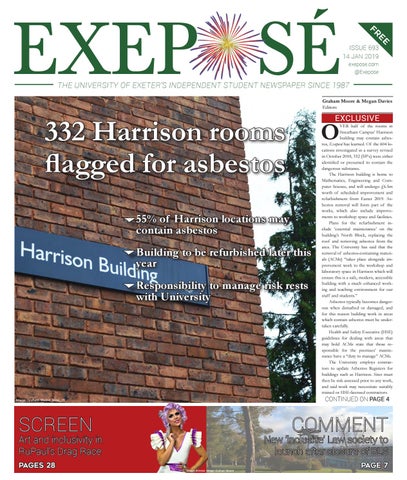
332 Harrison rooms flagged for asbestos
EXCLUSIVE
O
55% of Harrison locations may contain asbestos Building to be refurbished later this year Responsibility to manage risk rests with University
CONTINUED ON PAGE 4
Image: Graham Moore; Nora_29
SCREEN
COMMENT
Art and inclusivity in RuPaul’s Drag Race pages 28
VER half of the rooms in Streatham Campus’ Harrison building may contain asbestos, Exeposé has learned. Of the 604 locations investigated in a survey revised in October 2018, 332 (55%) were either identified or presumed to contain the dangerous substance. The Harrison building is home to Mathematics, Engineering and Computer Science, and will undergo £6.5m worth of scheduled improvement and refurbishment from Easter 2019. Asbestos removal will form part of the works, which also include improvements to workshop space and facilities. Plans for the refurbishment include ‘essential maintenance’ on the building’s North Block, replacing the roof and removing asbestos from the area. The University has said that the removal of asbestos-containing materials (ACMs) “takes place alongside improvement work to the workshop and laboratory space in Harrison which will ensure this is a safe, modern, accessible building with a much enhanced working and teaching environment for our staff and students.” Asbestos typically becomes dangerous when disturbed or damaged, and for this reason building work in areas which contain asbestos must be undertaken carefully. Health and Safety Executive (HSE) guidelines for dealing with areas that may hold ACMs state that those responsible for the premises’ maintenance have a “duty to manage” ACMs. The University employs contractors to update Asbestos Registers for buildings such as Harrison. Sites must then be risk assessed prior to any work, and said work may necessitate suitably trained or HSE-licensed contractors.
New ‘inclusive’ Law society to launch after closure of BLS Image: dvsross Image: Graham Moore
PAGE 7
Devonshire House, Exeter, Devon, EX4 4PZ
News Editors Print: Maddie Baker & Gwyn Wright Online: Edd Church & Hannah Stevenson news@exepose.com Comment Editors Print: Isabelle Gray & Deepa Lalwani Online: Bea Fones & Josh Gammage comment@exepose.com Features Editors Print: Niamh Elstone & Neha Shaji Online: Chloë Edwards & Bryan Knight Foreign Correspondents Co-ordinator: Ellie Cook features@exepose.com
Arts + Lit Editors Print: Lauren Newman & Tabi Scott Online: Emily Pirie & Kristina Werner artsandlit@exepose.com Music Editors Print: Aaron Loose & Alex Wingrave Online: Bryony Gooch & Jaysim Hanspal music@exepose.com Screen Editors Print: Ben Faulkner & Chloe Kennedy Online: Harry Caton & David Conway screen@exepose.com Science Editors Print: Scarlett Parr-Reid Online: Lara Andreski & Finn Candy sciandtech@exepose.com Sport Editors Print: René Bahar & Josh Brown Online: Luke Clarkson & Ben Hart sport@exepose.com Chief Photographer Chelsea Lee photography@exepose.com Copy Editors Peter Firth, Charlotte Forrester & William Harrop Proofers Ish!, Haroon Khan, Maddie Baker, Gwyn Wright, Fenny C, Harvey Carton, William Harrop, Bethan Gilson, Katie Jenkins, Edd Shaji, Neha Church, Aaron Loose, Harry Bunting, Richard Ainslie, Ben Faulkner, Johnny Chern, Deepa Lalwani, Chloe Kennedy.
@exepose facebook.com/exepose issuu.com/exepose Advertising Kate Watkins kate.watkins@exeterguild.com (01392) 722607 The opinions expressed in Exeposé are not necessarily those of the Exeposé Editors nor the University of Exeter Students’ Guild. While every care is taken to ensure that the information in this publication is correct and accurate, the Publisher can accept no liability for any consequential loss or damage, however caused, arising as a result of using the information printed. The Publisher cannot accept liability for any loss or damage to artwork or material submitted. The contents of this, unless stated otherwise, are copyright of the Publisher. Reproduction in any form requires the prior consent of the Publisher.
have the comprehensive guide to 2019's 'ones to watch' (page 24), ranging from sadcore (we are reliably informed by our Music editors that 'sadcore' is, in fact, a valid music term) staple Lana Del Rey to ex- viral sensation Joji. Truly, 2019 seems set to offer something for everyone. Okay, fine, let's make some resolutions: let's appreciate more music and more art; let's give ourselves a break (especially if we made it to that 8.30 seminar!), but most importantly, let's stand up for ourselves for once. Or, if (for some entirely unfathomable reason) you're not quite ready to let go of 2018, pop on down to Arts + Lit, who are offering a full retrospective of the year's standout moments in the arts world (page 20). Since BLS was closed last term, Comment ask: how can the society that replaces it become more inclusive (page 7)? They also look at the issues involved with taking on part-time work to complement your studies (page 9). Inclusivity is also very much on our minds in Sport, as we discuss diversity in football in light of recent abuse levelled at Raheem Sterling (page 38). In Features, we examine how new discoveries in DNA help us understand Indian heritage (page 12), and are adding to related ideological debates. Meanwhile, Science take a look at innovations in space exploration, artificial intelligence and how we can fight childhood leukaemia (pages 34-6).
USS to engage in new pension valuation PAGE 4
COMMENT
The balancing act: higher education and part-time work PAGE 8
FEATURES Former gang members on New Year's Honours List PAGE 13
Image: Michael Reeve
Image: NASA
Lifestyle Editors Print: Bethan Gilson & Rhiannon Moore Online: Katie Baker & Rowan Keith lifestyle@exepose.com
S
O what’s your new year’s resolution? We wish we could tell you that this year, we’ll keep our houses Marie Kondo levels of clean, we’ll hand in assignments days in advance, and we’ll exfoliate three times a week. But let’s be honest: that’s hardly realistic. Perhaps the only thing we'll be cutting out of our lives this year will be the last semblances of any faith in the UK's political system. If it's a choice between that and chocolate, we know what we're going for. If 2018 was a bit of a rollercoaster, then 2019 has the potential to be one of two things. It could a long and torturous drop, the like of which we haven't been subjected to since Skrillex first impinged upon our eardrums; or it could be 'the climb', as promised by Miley Cyrus. Incidentally, both Skrillex's debut and Miley's 'The Climb' are set to celebrate their 10th anniversary in the coming year, which just goes to show that - even if those do seem like simpler times - life has always been full of ups and downs. So if our time at university can seem stressful - especially when exams week has just finished! - we can take solace in the fact there's always going to be another mountain, and you'll always need to make it move. Sometimes that mountain is just your 8.30 seminar, but hey - it still counts, right? Thankfully, not everybody here at Exeposé is quite as jaded as us - if you're looking for a more positive approach to self-improvement in 2019, Lifestyle are bringing the fireworks over on page 18. As if that weren't enough, Music
NEWS
Image: Hao Xing
Editors Print: Megan Davies & Graham Moore Deputy: Fenton Christmas & Katie Jenkins Online: Harry Bunting & Natalie Keffler editors@exepose.com
Editorial
t gtth
Image: Owain Evans
EXEPOSÉ
SCIENCE To boldly go: New Horizons and the Ultima Thule flyby PAGE 34
CHECK OUT OUR WEBSITE! There are even more great articl es on the Exeposé website. From the latest university news to current affairs, music and theatr e reviews and more, visit us at www.exepose.com
Happy New Year! Megan and Graham.
Worldwide university news Bangor Chemistry BSc under threat
B
ANGOR University is currently consulting whether to close its Chemistry BSc. Along with many universities in the UK, Bangor is taking in less students, leading to financial strain. Vice-Chancellor John G. Hughes pinpointed their decline in students to the UK-wide population dip in 18 to 20-year-olds and the competition between universities for less students. Bangor has had to make up for their inevitable funding short-fall, with the Chemistry BSc as the next target for cuts. £8.5 million was cut last year and a further £5 million is to be saved this year. Despite ranking 8th in the UK and being the only Chemistry course to offer some teaching in Welsh, the BSc is at risk. In the meantime, the Welsh Language Student’s Union president has ensured ‘students’ voices’ will be heard in talks discussing the potential closure.
Sussex to close Pharmacy Master's
S
USSEX University are to close their MPharm in mid-December, confirming that no new students will be taken on in 2019. While MPharm has only been offered in Sussex since 2016, students across the UK have been applying for Pharmacy less and less and Sussex has also experienced a low up-take. Since September, Sussex has been consulting whether to close its MPharm and reached the decision to close the course only recently. The university issued a statement saying that current MPharm students ‘will be supported as they transition into the workplace’. But students are concerned that the consultation process was too short and conflicted and that employers may view their, now cancelled, degree in a more negative light still have not been answered fully.
Antisemitic graffiti causes controversy
A
JEWISH professor’s office has been spray-painted with derogatory language and symbols at Columbia. The case, which allegedly left students 'deeply uncomfortable', is currently under investigation. Ramsay Eyre, a 19-year-old student in the student council, explained that being ‘at one of the world’s largest and most liberal universities’ , you think that ‘this kind of thing can’t happen’. An email to students and staff in the immediate aftermath of the attack ‘failed to reference Jews or antisemitism’, but it did mention other communities who have been targeted in recent weeks. This act comes just months after the massacre in Pittsburgh that targeted Jews at the Tree of Life synagogue. The incident has occured at a time in which antisemitic incidents in the US, which rose by 37% in 2017, according to the FBI.
Students killed in Sudanese protests
A
T least five students have been killed in anti-government protests in Sudan. This was during demonstrations against rising bread prices and lack of commodities. Several universities have been closed until further notice. Amnesty International have called for an investigation into the killings of unarmed protesters. These demonstrations were triggered on 19 December by a government decision to raise bread prices from one to three Sudanese pounds. On 30 December of last year, academics at Khartounm University called for President Omar AlBashir to step down and for a transitional government to be formed. Academics' protests have continued since then. Stories by Maddie Baker (News Editor), Louis Donohoe and Ali Manshi (News Team) Images: N Chadwick and lc3105 /
News
3
NEWS EDITORS: Maddie Baker Gwyn Wright
Guild ‘investigating’ Council issues
Katie Jenkins Deputy Editor
A
GUILD investigation is currently underway following the revelation that there are two different versions of their governing document in circulation. The Memorandum and Articles of Association (M&AA) currently used by Guild employees are different to those filed with Companies House: the UK’s official, government-affiliated company registrar. This has caused confusion amongst Guild Councillors who raised concerns about the Guild’s governance in a meeting on the issue in December. Speaking with Exeposé at the time, one Guild Councillor stated that the situation was “a mess.”
There is no difference between the Guild Council sections Students’ Guild statement
In a statement released on 9 January, the Guild confirmed that they are
currently investigating the discrepancies between the two documents. However, they said that “there is no difference between the Guild Council sections” and as such it has been “operating on the same terms for the last three years.”
Consulting will define the scope, function and regulations for student governance
Students’ Guild statement
They added that they are “working to ensure that the current structures in place for student governance are effective as an interim solution” while a larger governance review is carried out. Consultations for a longer-term solution will begin in February and will involve “consulting with students on proposed bylaws based on current policy and practice, that will define the scope, function and regulations for student governance at the Students’ Guild.” The outcome of that process will be put to Guild Council for approval at the earliest opportunity. The Guild Council meeting in
December was originally intended to delegate official authority to specialist councils. As the meeting was adjourned following confusion over the M&AA, the Guild has confirmed that this business will be put to Guild Council this coming month. One Guild Councillor said it was “gratifying to see the admission of this necessity”. They also added that the announcement of a wider consultation is “welcome,” expressing hopes that it will be “broad-based and deep-reaching.”
A
UNIVERSITY and College Union (UCU) ballot on academic pay, the gender pay gap, and casualisation is to open on 15 January. The ballot will ask members whether or not they are prepared to take strike action, and if they are prepared to take action short of a strike in order to have their demands reached. Action short of a strike, in this case, may include a marking boycott. The UCU are giving this ballot to members in order to decide how best to implement their current aims, decided at the recent Higher Education Committee (HEC) special conference. The HEC, comprising of five higher education unions, settled on a ‘Joint Higher Education Trade Union National Claim’. This included asking universities for a commitment to ending the gender pay gap for the ‘whole workforce’ by 2020, expressing concern
over Vice-Chancellor and senior pay, workloads, casualisation, and a £10 per hour living wage for all higher education staff. After the strike ballot that took place in the Autumn 2018 term, which failed to reach the required 50% turnout, the HEC resolved that as part of the casualisation, equality, pay and workload campaign, the UCU would re-ballot branches in the new year. Notes from the conference remarked how, while only eight institutions reached 50% turnout, ‘many branches’ had turnouts of 35% or more. The UCU website reads, ‘Conference resolves to […] re-ballot branches in the turnout range 35-50%, allowing other branches to opt in’. Campaigning has been announced for the ballot, and conference further stated that the ‘issue will not go away’. Should the ballot turnout reach 50%, the UCU may have its second national strike in two academic years. Last year, the union successfully balloted
“Had the discussion been included on the meeting’s agenda the Guild would have ensured at a staff member was present with this authority.” In the closing paragraph of the statement, the Guild said that Guild Council meetings for the current academic year will be held under a new meeting procedure. This is to be agreed by the Chair of Trustee Board at a later date.
I can see no reason for the Guild to obfuscate that the present staff member was unprepared Guild Councillor
However, they raised concerns over the statement’s claim that in the original meeting “there was not a Guild Staff member present to support the Chair.” The Guild Councillor slammed the claim as “objectively false and a needless statement. “I can see no reason for the Guild to
Academics to vote on pay and conditions strike Edd Church Online News Editor
obfuscate that the present staff member was unprepared to deal with what [all those present] believed to be an issue of legality.” A Guild spokesperson has defended the original statement, clarifying: “The statement refers to the attendance of a senior staff member able to discuss with authority the Guild’s Memorandum and Articles of Association.
14 days of strike action in protest of a new pension deal which many academics disapproved of.. A spokesperson for Exeter UCU told Exepose; ‘‘The value of higher education pay has declined by 21 per cent in real terms since 2009; our dispute rests on universities’ failure to improve on the 2 per cent pay offer made at pay talks last May. “We argue that the offer from the Universities and Colleges Employers Association (UCEA) does not adress the dramatically declining value of higher education pay. ‘‘The increasing casualisation of work is troubling; living on a fixedterm contract has huge reprecussions on wellbeing, financial security and the professional development of staff on these contracts. ‘‘ The University stated that they have nothing to add on the matter at this time. The Students’ Guild said: ‘‘We don’t have a comment until we know the results of the vote.’’
Image: Graham Moore
Digital poetry map project set to open Natalie Keffler Online Editor
T
HE University of Exeter’s Professor Andrew McRae is leading the project ‘Places of Poetry’, which is due to be the country’s first crowd-sourced poetry map, with the plan for it to be launched in Spring. This project is due to reflect on national and cultural identities across England and Wales, with the map containing verse inspired by place, heritage and identity, and celebrate the diversity and personalities of these locations. The poetry map is based on a set of county maps that were published alongside Michael Drayton’s early seventeenth-century epic poem Poly-Olbion. Places of Poetry has been developed alongside the Poetry Society, and
Image: University of Exeter
will address writers of varying experience, as well as all different heritage sites. The project has been funded by the Arts and Humanities Research Council, the Heritage Lottery Fund and Arts Council England, whilst also being supported by other partnerships, including The Poetry Society and Ordnance Survey. In the lead up to the launch, this project will be offering support to schools and heritage organisations wishing to engage with the Places of Poetry project. McRae has said of the project “this will be a fantastic way for people to think about what the places and histories of England and Wales mean – and mean to them. Well over a million people in these countries write poetry every year, so we want to see their poems of place, heritage and identity.”
4
14 JAN 2019 | EXEPOSÉ
NEWS
Students lead archaeological study
USS engaging in new Harrison asbestos pensions consultation poses potential risks
Bea Fones Online Comment Editor
Gwyn Wright News Editor
A
TEAM of experts, led by University of Exeter students, are hoping to uncover the past of one of Devon’s oldest buildings; Old Forde House in Newton Abbot – a grade 1 listed building, which is currently home to Teignbridge District Council. A new archaeological study will investigate the prehistoric, Roman and medieval history of the building, formerly used by royalty and nobility. Little is known about the area before the construction of the Jacobean manor house in the mid-16th century. Forde House claims an illustrious history, having at various points played host to King Charles I, Oliver Cromwell and William of Orange. The team hopes to discover previously unknown structures beneath the house and its grounds with the help of volunteers from the local community and Teignbridge Council, in the largest non-invasive archaeological investigations to have been carried out in the centre of Newton Abbot. Third-year student Dan Brock, who is leading the work, said: “We hope this research will give us a much better understanding of how Newton Abbot developed, and the buried archaeological features within the grounds of Old Forde House [...] protected from urban development and agricultural exploitation since the construction of the first house at the site during the mid-sixteemth century. The project will also provide valuable information as to how best the site should be managed in future and will be used to encourage the local community to engage with the historical development of the area.” The team of five students – first, second and third year undergraduates - will use state-of-the-art equipment to measure where medieval field boundaries lay by measuring fluctuations in magnetic fields.” Cllr Humphrey Clemens, Teignbridge’s District Council’s Executive for Planning and Heritage, said: “We look forward to welcoming the group of experts from the University of Exeter for their studies at Old Forde House… I would also like to thank Teignbridge officers who have helped in arranging the site visit from the University. There’s been lots of preparation going on behind the scenes and this is something special for Teignbridge to host an archaeological survey at Old Forde House.”
D
ISCUSSIONS began on 2 January about a new valuation of the Universities Superannuation Scheme (USS), a pension scheme for university staff. USS are indicicating are not seeking to implement the recommendations of the Joint Expert Panel (JEP), which was set up by Universities’ UK (UUK) and the University and College Union (UCU) and which published its first report in September, in full. The report in September suggested increasing the contribution rate from 8% to 9.1% for employees and from 18% to 20.1% for employers. The methodology of the new valuation does not appear to have changed from that of the 2017 valuation, which was at the centre of last year’s UCU strike. This is despite the fact that the JEP report criticised the methodology of the 2017 valuation. The USS have said on their website that they will consider the JEP’s recommendations in isolation but not in full.
They have stated that the JEP’s report did not give enough consideration to market data and the extra financial risks that would be incurred if it was implemented, which UUK have since asked the USS to assess and address. The trustee is also consulting with UUK on ways in which contributions may automatically increase if investment returns in the short term prove lower than expected. A spokesperson for Exeter UCU told Exeposé: ‘‘JEP was set up to provide an easy resolution. It said its proposals were a short-term compromise designed to be accepted by USS and other parties as quickly as possible. The rest of the JEP report contained a much wider-ranging critique of the Scheme’s valuation methods and assumptions. USS not only ignored this critique, and they are now admitting that even the short-term compromise would be unacceptable.’’ A University of Exeter spokesperson said; ‘‘The valuation process is at an early stage, but it is encouraging to see this information. We are currently considering the consultation document’’
Mother and daughter graduate on same day Natalie Tongue News Team
L
ESS than a year on from collecting their undergraduate degrees at the University of Exeter, Martha Abley-Mallett and her daughter Israel Gayton once again graduated together. Mrs Abley-Mallet found an interest in embarking on higher education as her children grew. The mother of five was home schooled from the age of 11, but completed an access course and took a psychology degree at the University of Exeter. Her daughter studied English at Exeter full-time while Abley-Mallett balanced her degree alongside caring for her other four children. Gayton’s mother was careful not to infringe upon her daughters university experience, stating that “when
you are young and at university for the first time you want your own experience so I’ve been careful not to intrude on that”, but nevertheless “we were able to share experiences as we studied”. Following their first shared graduation in 2017, both women began teacher training, and graduated together with a PGCE in the winter of 2018. AbleyMallett completed her PGCE within Exeter College and the University of Exeter and has gone on to teach psychology at the college. Gayton took her PGCE in English, and is now working at Uffculme School in Devon. Mrs Abley-Mallett said: “it’s now so wonderful we both have jobs in fantastic institutions in Devon- which we are both really enjoying.” The pair celebrated with a family party following the graduation ceremony.
Image: University of Exeter
CONTINUED FROM FRONT According to HSE guidelines, materials present in buildings such as Harrison with a high chance of containing ACMs may not be presumed asbestos-free unless there is strong evidence for such a conclusion. This accounts for a high proportion of ‘presumed’ materials in Harrison, and the levels of risk which must be assumed for work within the area.
Asbestos was a common building material in many of our older buildings University of Exeter
47 of Harrison’s marked asbestos locations have been since been removed as a matter of priority. However, 47% of Harrison’s asbestos locations remain in place. A large proportion of these locations remain ‘presumed’ due to inaccessibility. According to the HSE, the intrusiveness of asbestos surveys ‘depend on what is reasonably practicable for individual properties’, and are therefore limited by accessibility. The decision to conduct a more intrusive and extensive survey, into areas which were not initially accessible, rests with the dutyholder, in this case being the University. A spokesman for the University of Exeter said: “The University holds the health and safety of our staff and students in the highest priority. Asbestos was a common building material in many of our older buildings and in accordance with the Asbestos Regulations 2012 the University keeps a
Image: Derek Harper
record of all known asbestos within its buildings, and has an annual programme to monitor its condition. “The University has an ongoing programme of asbestos removal throughout the Estate and will be embarking on a removal project within the Harrison Building starting in the early part of [this year]. It is important to stress that there is no health risk to those using these areas of Harrison, and staff and students will be relocated to suitable alternative spaces for the duration of the works.” Offering further clarification regarding the removal of ACMs in Harrison, the University stated that “As part of work to the Harrison building, asbestos will be removed by specialist contractors. Ensuring the safety of research and teaching is a priority for the project team, who will follow all safety precautions, statutory regulations and health and safety guidance. Students and staff will be able to use Harrison safely while this work is ongoing.
This work will remove all sprayed asbestos from Harrison
University of Exeter
“During the works to remove it spaces will be sealed off and there will be constant inspections to ensure the area is safe for those using the building. This work will remove all sprayed asbestos from Harrison.” “As part of the works all necessary surveys have been completed, as happens before any intrusive works to older buildings on campus.”
We are YOUR independent student media! EXEPOSÉ Exeposéééééééééé ééééééééééééééééééé éééééééééééééééééééééé éééééééééééééééééééé éééééééééééééééééé ééééééééééééééééééééé ééééééééééééééééééééééé ééééé ééé éé ééé ééé ééééééééé é ééé éé éé Géé ééé qééé ééé? Dééé éé éé éééé éé ééééééé@éxééééééééé
87.7FM
Xpression FM
ééééé éé jééé éééé ééé é éé éééééé éééé éé ééé é ééé ééé éééé Yéé ééé ééééé éé éé é é éé 87é7éé ééé xééééééééééé
XTV éé éééé ééééééé Té é ééééé ééé ééé éééééééé éééé ééééééé ééé ééé éé ééé é étfééé; éééé ééééé fi éé éé éé é ééé éééééééééééééé XTV éééé éé é ! é ééé’éé éééééééééé éé ééé é é éé ééééé é é ééé é é éé é é éééééé é é éé éééééééé é fiéé éé éé ééé Géé é Wéééééé éé jééé ééé!
Sign up to all three medias for just £30! Ask any committee member for more information
Hailey .M Tshuma National Union of Students exp: 09/09/19
10% OFF Ts & Cs apply
EXEPOSÉ | 14 JAN 2019
7
Comment
COMMENT EDITORS:
Isabelle Gray Deepa Lalwani
Creating an inclusive society
Neha Shaji Features Editor
I
WILL not dwell on the BLS scandal – that has taken too much emotional energy, not from just myself, but from several BAME students at Exeter who saw it, dissented against it, and just when one thought one could forget it, the society is closed down. The review board stated that undesirable aspects of the society included “an overall lack of diversity, affordability and referenced an exclusive and elitist atmosphere”, and made it clear that a new society with a separate name could be formed.
But a new society can, of course, be inclusive and diverse to an extent. Perhaps operating closely with the new Provost commission, a potential new law society could provide social media training to committee members, and enforce guidelines on budgets and event ticketing so that the environment is far less exclusive and ‘glitzy.’
The new law society should collaborate with under-represented groups
Working further with minority group societies such as African-Caribbean Society, or Asian Society, a possiA new society can, ble new law society could expand their membership as well as conduct events in of course, be inclusive tandem with these societies, or Feminist and diverse Society, or LGBT Society. This prospective society could potentially participate So, Bracton II: Here We Go Again. with these groups that are drastically A spokesperson for the University said under-represented in the law, and thus that “the Students’ Guild and the Uni- develop both the society, and society versity are confident that the new society in the future. This year’s committee has will ensure that current and future stu- flourished well in organizing events with dents have a society that is truly inclu- Women in Law, and the African-Caribsive, and can all be proud of.” But how? bean Society, as well as being open about This seems to be a tragic reiteration of their work with the Guild and efforts to the oversight that was made again and improve diversity. This should continue, again regarding racial insensitivities or and in the same thread, as a part of a sopublicized incidents at Exeter. Either ciety’s initiative rather than as a knee-jerk response to horrifying racism. leaving it entirely up to stuExeter students have dents to implement posicome up with a new tive change in a new initiative, Exeter society, or the preBAME Law. vious enforceThis group proment of strict motes diversity guidelines and in law, and asdiversity ofsists students ficer quotas in assimilating into one society: is academia. This this now Excould be the eter’s binary in group of people ensuring that their that the new law sociBAME students are Image: Queen-Of-Cute / DeviantArt ety would do best to learn not targeted? A middle from (although truly, it breaks ground needs to be found between severely spoon-feeding diversity my heart that it was left up to BAME to adults, and turning a blind eye to any students to create a society to support themselves, after such a vile incident). issues that may arise in the future.
Running events with this new outreach edging the wider issues that led to this would also provide the group with a di- kind of thinking. One fears that a more diverse membership may lead rect way to engage with each Image: Wp Paarz/Flickr to a feeling of resentment other and benefit the stuamongst certain student populace. dents, as enforced The new sociquotas and sudety would also denly-strict scrubenefit from intiny have never viting speakers worked well. It that are chamdoes not seem pions in huenough to heavman rights law, ily scrutinize refugee rights, the committee or lawyers who of a new law socidefend BAME peoety, which will, fingers ple facing prejudicial crossed – try their best to situations. With such an eximprove “inclusivity.” Yes, this ceptional budget, it only seems right that they use it to support the aca- is a step, but several more are needed. demic populace before it is spent on socials. In short, the new society should inSocieties must deed acknowledge the reasons which led accept a decolonising to the closure of Bracton Law, instead campus and country of focusing on the action of the closure itself: expand and diversify rather than But the way forward is, I suppose, rehash and repeat. slow. I would suggest that the founders Their budget should of this new, inclusive law society speak support students before it to students in addition to listening to the support offered by the Guild and is spent on socials University. They need to speak to the students who voiced their hurt and disYes. Perhaps these actions may en- tressing experiences at the Exeter Unsure that members of an Exeter soci- masked rally, those who were adamant ety are self-aware enough to understand that the BLS scandal was not a problem that advocating genocide to your most exclusive to a singular society, but to a intimate companions is, perhaps, not the student mindset. The new society must appreciate way to go about achieving a first-class degree. A Freedom of Information re- that the closing and subsequent reopenquest I sent to the University stated that ing of Bracton Law was a far smaller offence than the racial slurs hurled in there were eight reported incidents of racism from September 2016 to Decem- private – we need to reflect on what a ber 2018 (and one can only guess how society can do for a campus, not merely many un-reported) – only one of these consider what a committee can do for was Bracton’s. Six of these were serious a society. To be truly all-encompassing, enough, apparently, to warrant discipli- a university society (and not just a law nary action: Bracton is at fault for one society) will have to accept a decolonisincident, but the others should not be ing campus and a decolonising country where inclusivity is slowly but indisputswept under the rug. Hence, one may be excused for ably managing to creep into academia, thinking that it just does not seem and I am cautiously optimistic that this enough to punish a society for actions new law society will manage to do just of certain members without acknowl- that. Image: Sarah Ader
THE SABB Rose Ahier VP Welfare and Diversity
S
EXUAL harassment is a problem on our campus. The Guild and the Devon Rape Crisis and Sexual Abuse Services are creating a short film to document the experiences of people who have experienced sexual harassment during their time in Exeter, capturing the types of incidents and the impacts. We will be filming Monday 21 January from 10am-4pm in the Guild Conference room. The room is on the floor above DH2 and it will be signposted – please see the @ExeWelfare Facebook page. We’d like to encourage as many people as possible to come forward and take part in the film. We have a variety of ways for people to take part so they feel safe and in control. You can talk direct to camera, have your face obscured or just have your voice used. We’re asking people who want to take part to do a little reflection beforehand so you can be prepared to talk about: • What happened • What impact it had – immediately and afterwards • If you told anyone about it or reported it. If not, why not? And what would make you more likely to report it in the future. During the filming, there will be staff from Devon Rape Crisis and Sexual Abuse Services and professionals on hand to offer support, answer any questions, and to accompany you into the filming room if requested. The filmmaker, Perran Tremewan, has done a lot of work in this kind of area and is very sensitive and understanding in how he works with people. If you have any questions about the filming, you can contact Mandy from Devon Rape Crisis (mandy@devonrapecrisis) or myself (vpwelfare@exeterguild.com). If you’ve been affected by any of the issues in this column, the following contacts can help: Devon Rape Crisis 01392 204 174 support@devonrapecrisis.org.uk The Wellbeing Centre 01392 724381 wellbeing@exeter.ac.uk Exeter Nightline Student-run listening service Open 8pm-8am 01392 724000
8
COMMENT
14 JAN 2019 | EXEPOSÉ
Working it out Bethan Gilson Lifestyle Editor
D
ECIDING to get a parttime job at university is by no means an easy decision to make. As students, we all know that a bit of extra cash is invaluable, but that doesn’t stop us worrying about the implication working will have on our grades and social lives. I’ve worked alongside my studies since the beginning of my second year. As much as I grumble about having to get up early on the weekend, based on my experience, I would highly recommend getting a part-time job as a student.
I know I’m going to be losing study time to work
If I’m being completely honest, I probably wouldn’t be able to maintain the lifestyle I lead at university without the extra money I get from working. Okay, I’m not exactly living like Kim Kardashian, but with Exeter prices, my
student loan just about covers my rent and bills with a little extra left over for food. My wages mean I can afford that coffee date or extra night out. It’s a universally acknowledged truth that most friendships are solidified when drunk in the toilets, so without my wages my (already pathetic) social life would crumble.
Having a part-time job has encouraged me to be disciplined with my work Furthermore, in the immortal words of Carrie Bradshaw, “I like my money right where I can see it… hanging in my closet”. Ditto, Carrie. As sad as it sounds, being able to buy clothes that I like makes me happy. Creating outfits is a fun form of self-expression for me, but a hobby that I’d never ask or expect my parents to fund. There’s something liberating about being able to support yourself and give yourself nice things, and earning my own money is an important way for me to assert my independence. Also, having a part-time job means
that I get to experience a different part of Exeter which I probably wouldn’t have otherwise. It’s so easy to get caught up in the student bubble and forget that there’s a whole world outside of it. Through my work friends I’ve learnt about pubs, restaurants, shops and events in and outside of Exeter that wouldn’t have been on my radar as a student. I think it’s important to have a diverse range of friends and working has introduced me to interesting, fun and talented people who have only enriched my university experience. Admittedly, when the weekend approaches and I know I’m going to be losing study time to work, it makes me feel very anxious. Whilst I’ve never really fallen behind as such, it has made me feel overwhelmed trying to balance a job with societies, academic work and looking after my physical and mental health on top of that. Even though the thought of going to work can be anxiety-inducing, I find that once I’m actually there it’s a massive stress relief. Obviously, everyone’s
brain works differently but for me it’s a welcome opportunity to pour my energy into something that isn’t overthinking essays or panicking about reading.
Image: Deepa Lalwani
Having a part-time job has also encouraged me to be far more disciplined with my work. I know I lose study time on the weekend so I make sure that my weekdays are as productive as possible.
It also gives me a nice routine, which is good for me to construct a plan around. I work as a waitress so it’s a long shift on my feet, with the emotional labour of being pleasant all day. I come home from work very tired and smelling like coffee and bacon (in the worst possible way). It’s a weekend job so sometimes the thought of dragging myself to a party on a Saturday night is unbearable. But I manage it and having work the next day gives you a good excuse to end the night early and go get food, which we all know is the best part anyway. Obviously, in an ideal world I wouldn’t have to work. Nobody really wants to work, but my point is that not only is it manageable, it can have a really positive impact on your university experience. If you’re looking for a part-time job, I’d suggest scouring the social media pages of local, independent businesses for advertisements, the Career Zone or online employment websites such as MyTutor for more flexible working hours.
////////////////////////////////////////////////////////////////////////////////////////////////////////////////////////////////////////////////////////////////////////////////////////////
Dad, can you do my tax return please?
Flo Garnett Contributor
M
OST people agree that university is an indispensable introduction to adulthood. With rent to pay and coping with the shocking realisation that not every house has the magic capability to make laundry and half-filled mugs of tea disappear (thanks Mum), student life certainly eases us into ‘real’ life. Yet although 43% of students claim that life as an undergraduate has taught them how to budget, the majority remain perplexed about how to manage their finances. Whilst academic terms may come and go at a terrifying pace, we can sleep easy knowing that every year a timetable will materialise telling us where to be and when. Tutors habitually offer gentle reminders of deadline dates creates a bubble in which if you do what you’re told, you’ll be fine. As the countdown to graduation quickens and the prospect of having total responsibility feels more daunting than liberating, the fear
of that bubble bursting can be overwhelming. After waving goodbye to the days of lie-ins, and arriving in a world where an alarm clock holds absolute author-
Image: Quincemedia /
ity, reminiscing upon your student-self (easy-going and blissfully ignorant of the horrors of taxes and debt) triggers nauseating nostalgia. Ensuring that students understand the basic foun-
dations of money management would not only tick one item off the long graduate to-do list but would also prevent an epidemic of financial phobia. For those studying Economics, computing the coefficients of Absolute and Relative Risk Aversion might seem a walk in the park, especially after being taken through the theory by a world-class professor, but whilst defining these terms may get you a first in your degree, taking out a mortgage cannot be achieved through a couple of hours spent cramming in the library. Statistics show that one in two students doesn’t understand their loan agreement, whilst a whopping 70% are unaware of the interest rate on that loan. If students are unable to get to grips with such simple concepts whilst at university, it seems unrealistic to suggest enlightenment will come overnight after graduation day. In September 2015, financial education was introduced as a key component of the National Curriculum at Key Stage 3 and 4. Yet two years on, take-up by schools was only 40%.
Teachers reportedly lack confidence in delivering lessons on the topic, whilst some believe that beginning financial education at such an early age is premature. While I can see the difficulty in teaching eight-year-olds the intricacies of budgeting or bankruptcy, venturing into your twenties without fully understanding the difference between debit and credit cards, or the dire implications of a poor credit rating, will undoubtedly leave you ill-prepared for adult life.
The prospect of having total responsibility feels more daunting
When asking friends who recently graduated whether attending a money management course at university would have been something that, in retrospect, they would have subscribed to, I was surprised by their enthusiasm. None were deterred by the mundane-sounding enigma that is APR: better to learn about it in a lecture hall than the hard way. Organisations like The Money Charity visit schools and colleges all over the country, holding workshops
which educate young people on the importance of maintaining control of their finances and providing them with a crucial understanding of the money management techniques that they will soon need. Whilst I am not advocating the addition of a mandatory module to the third year schedules when spare time is already in short supply, I for one, (ignorant as I am of all things financial, being an English student) would be happy to sacrifice a couple of hours at the pub to attend a similar training course. If it’s tailored for adults-to-be and it prevents me from desperately scrambling for the weighty tome of Taxes for Dummies following my initiation into the working world, you can count me in. Learn more about personal finance and money management at: The Money Advice Service https://www.moneyadviceservice.org.uk Money Saving Expert https://www.moneysavingexpert.com
EXEPOSÉ | 14 JAN 2019
COMMENT
Memeing is believing
Molly Cleary Contributor
I
F you have not yet been asked whether you have watched Bird Box, it begs the question of if you’ve been coincidentally living out the films dystopian premise, partaking in a house lock-down with no contact with the outside world over the Christmas holidays. Netflix claims that in the short days since its Boxing Day release, over 45 million people have used the streaming service to watch Sandra Bullock flee from the clutches of the nameless, faceless monsters whose presence triggers the population to kill themselves.
Memes are the most truly liberated form of expression The most striking thing about the Bird Box phenomenon is not it’s overwhelming popularity, but rather the fact that you don’t actually need to watch it in order to contribute
to conversations about it. Since its release, the memes of Sandra Bullock’s character, blindfold-clad with arms outstretched, has been appropriated for just about any and every purpose. Is plunging headfirst into January exams feeling a bit like being blindfolded while manoeuvring down some raging rapids? Well, no need to rush to make that meme, it’s already been done. So too has the nod to Dry January, that sees the protagonist trying her hardest not to see the all too terrifying reality of the rosé wine aisle. The root of the film’s meaning has been hotly contested; is Bird Box about mental health? Or is it about parenting and a crippling fear of motherhood? Or is it, despite the platform it exists upon, warning us that social media
is the devil? Specific subject matter aside, Bird Box exists on the premise of both attempting to fight your demons but also being blind to reality; it’s no surprise this subject matter has been
moulded to fit just about any ‘relatable’ scenario into a meme. The allure of this film is the buzz that was created in its wake; before I had even thought about watching it I
knew the premise, had seen the opening stills made into memes and learned essentially the entire plot through the promotional trailer. Bird Box has become, through the power of the meme, a film that you do not need to watch in order to know. Saturated in the meme format, the film’s terrifying realities complete their lifespan by instead summing up how we all feel about that one flatmate who seems blind to doing their own washing-up. It is no surprise that the transformative power of the Image: Deepa Lalwani meme, that of channelling human nature’s tendency to take life’s most terrifying aspects and instead, morphing it into humour, works perfectly when applied to Bird Box’s apocalyptic world. In a sense, it could be said that
9
o Me m f m o th e n e th
memes are the most truly liberated form of expression; that is to say, that they are anonymous, not created for profit, and mostly untraceable back to their true origin. With this in mind, is there a chance that the existence of these Bird Box memes is perhaps not the usual spontaneous occurring, but instead, a purposeful and genius marketing ploy, infiltrating one of the most popular mediums of the internet? After all, these are the days of huge multi-million pound corporations attempting to befriend us by cascading behind witty Twitter accounts as if their brand has a personality of its own - the same world wherein Netflix itself habitually creates and spreads memes designed solely to promote its own content. If the advent of Bird Box memes is no accident, it spells change in the way films are received altogether. Does it mean the critical reception of a film is now less important than the amount of buzz it generates on Twitter? Bird Box has broken records as Netflix’s biggest film success, but it seems it would have never made it down the river without the help of the meme.
////////////////////////////////////////////////////////////////////////////////////////////////////////////////////////////////////////////////////////////////////////////////////////////
Can I get a break from politics?
Nirbhey Jain Contributor
W
HETHER you spent your New Year’s Eve sober with family or the opposite with friends, not many would choose to start off 2019 debating Brexit. After all, New Year’s Eve is a celebration carried out in most countries; it’s what unites most of the world in a day of celebration. Why ruin it by bringing up something as divisive as Brexit? In 2016, the UK held a non-binding EU Referendum where 51.9% of people voted to leave the EU. The result brought up many concerns regarding fake news, Northern Ireland, and immigration, all highly divisive topics that split the UK. Decent arguments can be made for both sides of the referendum, and like with many issues, there isn’t a clear answer. Sadiq Khan, the pro-Remain Mayor of London, openly declared that the New Year’s Eve fireworks display was an attempt to show the world that the UK should continue to be open-minded after we leave the EU in March, and encouraged MPs to reflect on the sort of country they want to live in. This was followed by a very pro-EU fireworks display, with the words ‘London
is Open’ being said in seven European languages. For me, what is concerning is the London Mayor’s decision to give into the emerging trend of politicising apolitical events for political gain. Whether it’s The Simpsons, college students dancing, or YouTube Rewind, politics is infecting everything. Usually this is carried out by corporations who want financial gain, but this time it is politicians spending our money to express a view most people voted against. This not only is a waste of our money, it shows the world how divided we are as a country. Furthermore, it reduces any leverage we have left, and completely ignores the actual issues. The Brexit referendum was not a failure because of racists, or close mindedness, it failed because of the flaws in pure democracy: fake news, extreme politicians, and a lack of education provided to the people regarding the EU and the referendum. The fact that this referendum took place goes to show how misinformed most politicians and news networks are regarding the views of the people they apparently represent or inform. These are the is-
sues that need to be tackled, and a second referendum would not change anything unless they are addressed. Khan defended the ‘spectacular’ fireworks display, which cost the ma-
Image: Nora_29 / Pixabay, Rjd0060 / Wikimedia Commons
jority pro-Leave public £2.3 million, by claiming it was an effective way of showing that London will remain “open-minded” after Brexit: this is an important message, considering the surge in hate crime post-referendum. However, politicising a firework display
isn’t going to change ignorance; after all, if political views were that easy to change, Khan might have a higher approval rating. The fact of the matter is this: the people paid London £2.3 million to celebrate the start of the new year, and this stunt did nothing but show that London is not open-minded, especially to opposing opinions, and ruined what could’ve been a happy start to 2019. Politicians such as Khan need to keep calm and carry on exploring their options, including the potential of a second referendum, or not following through with the non-binding 2016 vote. Bringing up Brexit in one of the few moments of worldwide celebration is just sad. That said, it would be a bit naïve for me to take what Khan said at face value. It’s no secret that May’s Brexit negotiations have so far resulted in a deal so bad, it united both sides of the Brexit debate. In an attempt to woo MPs before the big vote in Parliament about the deal, the Prime Minister used her New Year’s message to talk about this issue. It is reasonable to assume the fireworks display was meant to be the response from the proEU side. I find it very hard to believe
that firework displays, or open-video messages, actually change any MP votes - if they do, we really need to question our political system.
Why ruin the start of the new year by bringing up Brexit? As a German citizen, Brexit doesn’t scare me. Brexit is unpredictable but if the negotiations showed anything, it’s that the EU has the upper hand and I can rely on it to protect me and my education. A clear concern is the recent surge in hate crime: though the figures are hard to dispute, the cause of this surge is debatable. It would be unwise to wholly blame the Leave campaign for racism rather than the underlying xenophobic views held by some people in this country. Whether you agree with Brexit or not, the power struggles within the government are evident everywhere: in Theresa May’s New Year message, the fireworks display, or even just one minute of PMQs. But in this time of division, let’s not forget who we are: residents of one nation, and people who should be mature enough to put our differences aside to celebrate the start of a new year.
C
M
Y
CM
MY
CY
CMY
BUY - EARN - REWARD
K
YOUR STUDENTS’ GUILD LOYALTY SCHEME S I M P LY P R E S E N T YO U R U N I C A R D AT THE TI L L EARN
4
FOR EVERY
£1 SPENT WITH THE GUILD
EXEPOSÉ | 14 JAN 2019
11
Features
FEATURES EDITORS: Niamh Elstone Neha Shaji
Fasting forums: fad or to fear? Olivia Powell talks about the dangerous rise of forums dedicated to fasting.
C
ONSIDER the quotes: “I mentioned it to someone who doesn’t have a clue… I can picture her saying to other friends that she’s starving herself.” “I’m starting a five day water fast… want to join me? We can encourage each other.” “I planned to fast for 30 days and I broke on day f***ing six…not sure how I’m going to reach my goal if I break this easily.” If you were to guess that these quotes came from those struggling with an eating disorder, you would be wrong. Instead, they are from a fastgrowing subreddit (r/fasting) devoted to weight loss via fasting (as in, eating below 500 calories per day or outright not eating anything) that already boasts over 127,000 subscribers. The socalled ‘fasting community’ post on the subreddit multiple times a day, with special pinned posts dedicated to both daily fast updates and weekly meals used to break their fasts. It all seems a little cult-like, especially considering there is an us vs. them mentality between those that fast and those that don’t. However, the real problem lies with the fact that this subreddit is allowed to exist; recently, Reddit banned a subreddit called ‘ProED’ for promoting unhealthy lifestyle ideas.
The so-called fasting community post on the subreddit multiple times a day It is important to note that the ‘Pro’ in this forum does not necessarily mean those on the forum were promoting anorexia as a life choice, and instead were there for people seeking eating disorder support – a symptom of internet culture is that many support forums are nicknamed ‘Pro Ana’ forums, even if they are pro-recovery and deal with a multitude of other eating disorders e.g. bulimia, EDNOS, binge eating disorder. A new subreddit has popped up to replace ProED, and so they run the risk of being banned again. The cyclical nature of harmful
Content Warning: article contains in-depth discussion of eating disorders. forums on the internet is haunting and heartbreaking: it only takes one ban before two similar sites sprout up, like a digital hydra. Yet, if a forum for those with eating disorders is banned, why isn’t a forum that promotes not eating for extended amounts of time? Are they not essentially the same thing?
By banning a subreddit, you do not automatically cure all those on it
EDAnonymous, the replacement forum, is not a place where deathly thin girls post pictures of themselves and share tips and tricks of how to lose weight. The rules of posting ban anyone from encouraging others into dangerous habits or posting ‘thinspiration’ pictures, and instead users seek support about their triggers, insecurities and everyday life. Compared to the fasting community, in some ways they are far healthier. When users post about feeling weak and not eating, they are met with comfort and support – users saying they know how they feel, but they should try to eat something, or at least attempt to drink something with electrolytes in. The risks of not eating are not shied away from – users talk very bluntly about their digestive, dental and other physical issues, often seeking to turn their symptoms into dark humour. There is no romanticisation here. When users post in fasting subreddits, they are met
Image: Mauricio Campino
with a different kind of encouragement – even when their fasts have been going on dangerously long. One user posts about his 31-day-long fast as ‘inspiration’ for others, to prove that ‘they can do it too’. In the comments, users flock to them, eager for tips and tricks. People are constantly looking for ‘fasting buddies’ (something reminiscent of a toxic practise shared by those with EDs – an ‘ana buddy’ is someone who is supposed to hold you accountable for going against your ‘diet’) and between Christmas and New Year there were countless posts about fasting for the six days between them in order to ‘counteract’ the amount consumed at Christmas dinner – a very common behaviour in people with eating disorders. Certainly, there are issues with forums dedicated to eating disorders – they are not all like EDAnonymous with strict rules about what can and cannot be posted, and can very easily spiral into toxicity as eating disorders are rooted in perfectionism and control. However, it is important to note that those with eating disorders will very often find other outlets to talk about their behaviour – by banning a f o r u m you do
not automatically cure all those on it. Additionally, who better to support those with eating disorders (apart from a therapist or psychiatrist) than others with eating disorders? In a YouTube video by Of Herbs and Altars (aka Dorian Bridges) entitled ‘The TRUTH About Pro Anorexia Forums’, Bridges speaks about the support she got from these forums when she was sick. As she puts it “there just something another sick person can give you that no-one else can…you just want someone who gets it…to be there and hold your hand”. Whilst the best outcome would be for all the people who frequent this forum to be ultimately cured and happy, this is unfortunately not a realistic goal.
Websites should not ignore unhealthy eating patterns On the other hand, r/fasting is also a support forum, but in a very different way. Whilst the users here undoubtably face the problems those on EDAnonymous do whilst fasting, they are seen as problems to be overcome rather than warning signs that they are harming their bodies. It is strange, then, that this
If you have been affected by any of the issues mentioned in this article, the following resources are available: Student Health Centre, Reed Mews, Exeter, EX4 4QP 01392 676606 Wellbeing Centre Reed Mews, Exeter, EX4 4QP 01392 724381 wellbeing@exeter.ac.uk BEAT www.beateatingdisorders.org. uk particular forum has not been shut down due to promoting unhealthy lifestyle decisions. The FAQs of the forum highlight that fasting is not part of an eating disorder as it is a “voluntary admission of food” whilst eating disorders “have a psychological component”. Certainly, not all those who fast have eating disorders, but it is hard to imagine that there are not any among those who can receive boundless praise for not eating for extend periods of time that don’t struggle with some kind of eating disorder. At the end of the day, banning forums like these will not necessarily do anything – those with eating disorders will find other outlets to express themselves by, and those who fast, for whatever reason will continue to do so. What should happen, however, is that those who are struggling should have appropriate resources for getting support, medical or otherwise. Websites, instead of encouraging fasting as a lifestyle choice, should not ignore unhealthy and often dangerous behaviours in the name of physical rather than aesthetic health. Indeed, it seems that such choices should be accompanied with appropriate physical and mental health resources and equipped with the same rather than draw a harsh distinction between an eating disorder and fasting when elements of the former can carry on into the latter.
12
14 JAN 2019 | EXEPOSÉ
FEATURES
You can’t deny the DNA N
Ali Manshi analyses new genetic discoveries in Indian heritage
EW technology used to analyse DNA has led to a stark revelation regarding India’s origins. This was brought to light in the recent study The Genomic Formation of South and Central Asia, authored by geneticist David Reich of Harvard University. Hindu right-wingers have continuously and explicitly claimed that Indian civilization originates from people known as Aryans (different from the mid-twentieth century European definition of Aryan): a nomadic tribe of horse riding, cattle rearing warriors who spread throughout India and Europe. They have been known to be responsible for the apparent Indo-European languages that exist today. Many 19th century European ethnographers believed them to have conquered Europe.
The second set of immigrants in India were the Aryans from European Steppe
New research challenges the notion that Indians originated from Aryans altogether. This has intensified debates and sparked conversation around the growing development of technology used to analyse DNA. Throughout the 1990s and early 2000s, studies of DNA were highly contentious because observations of skeletal remains were easily contaminated by the DNA of living people. Reich collaborated with Professor Svante Paablo in 2006. Paablo’s set of protocols prevented contamination from slipping through due to the emergence of ‘next generation sequencing technology’ : When an organism dies the DNA in its cells begins to break down- over time it splits into smaller chunks as well as accumulating other forms of damage. It also gets contaminated with vast amounts of microbial DNA from the wider environment. The new sequencing machines could be used to isolate the human genetic material from the bacterial DNA and then stitch together the tiny fragments into a readable sequence. Reich decided to incorporate this new technology into the lab at Harvard. He used the next generation sequencing to power through genome after genome. In 2012, Reich and his colleagues spotted that northern and central Europeans appeared to have received genetic input from a population related to Native Americans. In some areas
of Europe, around 75% of the ancestry of existing populations is due to mass migration from the people of the Steppe on Europe’s eastern periphery around 5000 years ago. The theory of mass migration had gone out of favor among some scholars however; Reich’s fascinating research revealed that mass migrations were much more common in history than previously thought. Take for example Reich’s research into the Beaker phenomenon. In Britain, the Beakers replaced a whopping 90% of the existing ancestry. The most recent study on the subject carried out by David Reich was published in March 2018. It was coauthored by 92 scholars from all over the world. The study shed light on two major migrations into India in the last 10,000 years. The first migration, surprisingly and unexpectedly originated from the Zagros region in South Western Iran which brought agriculturalists and herders to India between 7000 and 3000 BC. The first Indians were descendants from Africa who reached India 65,000 years ago. They merged together to create a Harappan civilization. The African roots were corroborated through rock carvings found in India. Known as petroglyphs, these wall carvings were discovered atop the hillocks in the Konkan region of Western Maharashtra. The majority of the images etched on the rocky flat hilltops remained unnoticed
for thousands of years. Hidden beneath layers of soil and mud, were carvings of animals, birds and human figures. Experts believe them to have been created in pre-historic times and are possibly the oldest ever discovered.
Hindu right-wingers oppose the idea of and the term ‘Aryan migration’ from textbooks
The group that discovered the petroglyphs was led by Sudhir Risblood and Manoj Marathe. They discovered petroglyphs in around 52 villages in the area but only five villages were aware they existed. Dr Shrikant Pradhan, a researcher and art historian who has studied petroglyphs closely said that the art was clearly inspired by things people observed at the time. The crucial indicator that implies that there was a migration, was that there were depictions of animals like rhinoceroses and hippos which aren’t found in India but Africa. As new research has emerged, the arguments regarding India’s heritage have intensified. Hindu right wingers are leading fervently on the opposing side. They have campaigned to remove the term “Aryan migration” from textbooks and have attacked India’s leading historians. The reason for this is that by accepting that Aryans were not the first inhabitants in India and that the Harappan civilization existed long before their arrival, it undermines the
belief that neither Aryans nor the Vedic Culture were the pioneers of Indian civilization and that its earliest sources in fact originated in Africa and Iran. India’s Junior Minister was quoted in the media saying: “Only Vedic education can nurture our children well and make them patriots who have mental discipline.” This stress on the importance of Vedic culture also has weight in the debates regarding the Muslim conquerors of India. By implying that Vedic Culture is in fact not native to India, it puts Aryans on equal ground with Muslim migration. In a tweet, ruling party MP Subramanian Swamy attacks Reich’s research, claiming, “these are lies, damned lies”. In an interview with the BBC, Reich said: “I am actually very pleased to be a part of introducing this discussion. I think that scientists have been anxious about discussing differences among populations in public, even though the work they do is about differences among populations and learning about their history. The anxiety is about possible misuse of data –for good reason.” He highlighted the “opportunity for interpretational bias” within science and he thinks that “the genetic data are very seriously constraining the models that are possible right now”. He implies that the future will remain entirely unpredictable; more revelations will be most likely to be made pending new research and the probable development of new technology. He adds: “There’s a
David Reich
Image: Kris Snibbe
lot to be done”. Next generation sequencing technology is becoming more widely used, even in the UK. Research carried out by The University of Manchester revealed that a pair of mummies in the Manchester Museum are in fact half-brothers. The mummies were discovered in 1907 and date back to around 1800 BC. Egyptologists have long since debated the origins of the two mummies and whether they were related or not. The hi-tech DNA test lay to rest the mystery behind the two mummies. Dr. Konstantina Drosou, of the School of Earth and Environmental Sciences at the University of Manchester who conducted the DNA sequencing, said in a statement: “It was a long and exhausting journey to the results but we are finally here.”
Reich incorporated new technology to isolate the human genome from bacterial DNA
The technology has also been used to analyse the evolution of ancient diseases. A team of scientists called the Molecular Archeological Group at the University of Wisconsin-Madison have carried much research within the region of Anatolia using new generation sequencing technology. Dr Caitlin Pepperell, Professor of Microbiology at UWM was able to analyze the evolution of pathogens in Anatolia. She was able to determine that high population density in the Anatolian cities resulted in a faster rate of evolution, transformation and transmission of disease. With respect to the wider, copious research that has been carried out since the invention of new generation sequencing, one thing is clear; the advancement in technology has redefined the way that DNA is analyzed and will be analyzed for years to come. The questions that were thought to be unanswerable are beginning to get answered. Ideas that were supposedly nuanced or dubious are becoming more clearly exposed as either fact or fiction. The mysteries about the past are being solved and technology is becoming more readily available and more advanced. It is true that as the use of technology rises, ideas are being challenged and debates intensified. However, it is one step forward in education and our ability to provide strong evidence to support informed research.
EXEPOSÉ | 14 JAN 2019
FEATURES
13
‘I’ve come from the same mess as you’ Former gang members on Honours Lists indicate progress, says Bryony Gooch, Online Music Editor
; Open Clipart -Vecto rs
Certainly, re-joining his family’s church and enrolling in the London South Bank University for BA (Hons) Business Administration were strident steps in the right direction for his own personal growth, with his degree being one of the key foundations leading to the establishment of the Box Up Crime youth boxing club that he started in the boroughs of Barking and Dagenham. The aim of this venture being to keep young children off the streets by teaching them the discipline-based sport of boxing. Having previously shown talent at the sport in his youth, before his involvement
When he found out about his OBE, he noted that while humbled by the achievement, “it’s for these young kids to show them that I’ve come from the same mess as you.” Indeed, what makes Addison’s story so noteworthy
s: Murr aytheb
The aim of this venture being to keep young children off the streets
in gangs, the idea of Box Up Crime is not necessarily to teach self-defense (the skills he teaches are non-contact), but to put their energy to more productive use. Addison would also argue that religion has been a heavyweight influence in changing his path. He has been upfront about how the church has helped him, owing the dream that triggered his change to God: “I believe God spoke to me and told me [that] if I carry on living this life, this is where I’m going to end up. God’s telling me I can do all things”, he recounted in a BBC interview. Since then he has become a more active member in the church’s community, giving frequent speeches – after the Barking Brawls in 2016 he gave a sermon about how speaking out in faith can change reality. In Addison’s eyes, it is not simply religion or boxing. He believes there are many similarities between the impacts of religion and boxing. “You’re hitting them with discipline. You’re hitting them with morals. You’re hitting them with respect”, he pointed out, highlighting the potent effect he believes the pairing can have on youth.
Image
I
F you had told Stephen Addison back in 2012 that he would find his name on the 2019 New Years Honours List, he probably wouldn’t have believed you. Previously involved in gang violence in the London borough of Barking, Addison had a change of heart in 2012 following a nightmare predicting that he would one day find himself in a prison cell. It was clear from this point that a drastic change would have to occur. But it would turn out that how he changed his life would have a wider effect on the youth in his area.
is the sense of redemption; once he was one of the gang members causing issues in his local community, but now
he fights against youth gang involvement. Certainly, gang violence has become a larger concern in the past year, as he confessed that he’s “lost seven kids in the space of a year that have been murdered. We’ve seen 131 murders in London.” It is clear that the growing number of deaths is a large motivator for Addison, having lost a close friend to gang violence growing up. While premonitions of a future in prison may have motivated him to leave his gang, and religion may have given him a new sense of salvation, Addison understands the dangers of youth gang culture, as well as how gang crimes such as violence, fraud, and drug dealing have ravaged his area. London has had a long history of knife crime and gang violence, but recently the issue has grown more prevalent; knife crime has reached an alltime high, and there has been an increase in acid attacks over the past few years. It has been a notoriously difficult struggle for the Met over the past year to reduce
the number of fatalities from occurring, trying to implement Glasgow’s method of combatting such crimes, which saw a drastic turnaround from being one of the most violent cities in Europe. Addison was not the only knife crime activist on the list, however. Former heavyweight boxing champion Mark Prince lost his 15-year-old son Kiyan in a fatal stabbing, and since then has set up the Kiyan Prince Foundation with the aim of educating thousands of pupils across London of the dangers of gangs and knife crime. Prince himself also puts forward boxing as an alternative, with his ‘I have a dream’ initiative teaches boxing in combination with weekly workshops tackling the topics of gang life and substance abuse.
London has had a long history of knife crime and gang violence The fact that there are two knife crime activists on the honours list is arguably less of a coincidence and more of a message of appreciation towards the grass roots approaches in steering young people away from gangs and knife crime, and Addison’s own story proves there is hope, and you can indeed change. But at the same time, as Addison has pointed out, there is still a long way to go to make a big difference.
This is your Trumpdate Niamh Elstone, Features Editor, gives you an update on Donald Trump’s zero-tolerance policy
W
ELCOME to 2019; where a billionaire hotel owner is president of the United States of America, North Korea is ruled by a nuclearbomb-building dictator and global warming is still a very real threat. It’s not all bad though, at least we can leave Baby Shark in 2018… maybe? If you haven’t seen in the news, a n y
Image: MaxPixel
social media platform or heard anyone talking about it… where have you been? Donald Trump still wants to build his wall. After his exceptionally inhumane detainment of migrant children, some of whom died in incarceration and some, once released, no longer recognised their own families, Trump still thinks he hasn’t added enough cruelty to an already very cruel world. Trump is adamant that to ‘make America great again’ – was it ever so great in the first place? – he must physically build a border with Mexico. Firstly, I think most
of us can agree that there are more important things that the President of the United States could be focusing on, such as gun control, preventing human trafficking and if he could re-join the Paris agreement that would be great too. Trump was voted in primarily for creating an ‘acceptable’ outlet for American racism and xenophobia by portraying the concept of a ‘great America’ which to many of his voters essentially means a white America.
Trump has created a country which induces fear in those seeking refuge May I remind you America that almost all of your ancestors were themselves immigrants, Native Americans were here long before your first familial relations ever touched
American soil. ICE has become a feared name in recent years with families in turmoil as hundreds of people are being arrested or deported. Former First Lady Laura Bush wrote in a Washington Post op-ed that “I live in a border state. I appreciate the need to enforce and protect our international boundaries, but this zerotolerance policy is cruel. It is immoral, and it breaks my heart”. It seems that a lot of Americans didn’t know exactly what they were getting into when they voted for Trump in 2016. His zero-tolerance policy has resulted in some shocking statistics. According to Vox, at least 2,700 children were separated from their parents between 1 October, 2017 and 31 May, 2018. Furthermore, the Department of Homeland Security confirmed that of the total 2,700 minors taken away from their families, 1,995 of them were
separated between 18 April and 31 May alone. An HHS spokesperson told The New York Times that 11,000 children are currently in federal shelters.
Trump was voted in primarily for creating an ‘acceptable’ outlet for American racism So, in summary, Trump has created a country which induces fear in those seeking refuge and shelter. The US is no longer the home of the American Dream where hard work and being a good citizen results in your success, Trump will still have you deported if you were not born in America. I suppose it is up to you to decide whether Trump has achieved his goal to ‘make America great again’. As far as I’m concerned, I’m counting down the days until he is kicked out of office - for good.
EXETERGUILD.COM/RAM
@THERAMBAR
C
M
Y
CM
MY
CY
CMY
K
DAYS R U T A S T ON O H S E E R RINK D A Y GET A F U OU B Y N E H W DRINK
BU Y A U O Y N E H T CHER W U O V S I REE SHO H F T R T U N E O S Y M PRE TO CLAI . &Cs apply rday d on Satu Only vali
s. T
lifestyle
MUSIC
ARTS + LIT
STUDY BREAK
screen Image: Ajale/Pixabay
Image: Max Pixel
Veganuary verdict
switch on televised theatre
17
22 Image: Film4 Productions
Image: Beatriz Alvani
Review: The favourite
the stars of 2019?
24
29 study break
Image: Focus Me
32
16 -18
20 - 22
24 - 26
28 - 30
32
LIFESTYLE EDITORS Bethan Gilson Rhiannon Moore
ARTS + LIT EDITORS Lauren Newman Tabi Scott
MUSIC EDITORS Aaron Loose Alex Wingrave
SCREEN EDITORS Ben Faulkner Chloe Kennedy
STUDY BREAK Puzzles by Alfred and Katie 14 JAN 2019 | EXEPOSÉ
lifestyle Escaping the abyss S
Anna Romanovska sheds a light on how to cope with the January blues
O, you’ve found yourself at that point of the year again. The Christmas celebrations are long gone, and you only just managed to part ways with your New Year’s Day hangover. The bright lights and laughter seem to have magically disappeared, replaced by the doom-and-gloom of the ‘January blues.’ The pile of unopened revision on your desk now serves as an unpleasant reminder of the upcoming term as you become more aware of the unthinkable: the days of Netflix binging and overeating are over, and the ghost of study past begins to haunt your mind. Starting a long term off with an exam week can seem immensely daunting. The days of home-cooked food and lie-ins are replaced by sleepless nights and microwaveable meal deals. You may find yourself stuck in a lifeless limbo, floating between your bed and campus, all while attempting to navigate your way through your many (or very few) exams without breaking down too much. But fear not, for once your exams end, you will only have a couple of weeks until your next stress wave!
the limited amounts of vitamin D the English All in all, it feels like the pain university sun can offer. Try to organise an outing with a often brings just won’t end, so it’s no surprise friend or simply go for a refreshing walk down that such a thought is bound to bring out a to the Quay. couple of tears and a desire to retreat to your Even a simple plan for the near future could bed for the day. Although it’s difficult to simply give you something to look forward to cast away the dark and dreary January days, as you endure the colder months. there are some things you can do to Look forward to the future help alleviate the discouraging trips to Exmouth that come misery that often comes with with the warmer spring the beginning of the year. temperatures or see if First and foremost, rethere are any concerts member to find the time or gallery openings for a little bit of self-care. It’s near Exeter that you can important to allow yourself look forward to. to breathe whenever you However, another feel overwhelmed, so sim(and often forgotten) asple comforting activities such pect of the January blues is as watching a movie, reading a Image: quimono the feeling of failure and hopebook or taking a bath are great at lessness that can sometimes come allowing your mind to switch off for a litwith the New Year. Perhaps you haven’t fulfilled tle bit. Furthermore, although the darker days any of the New Year resolutions you set out make your room seem a lot more appealing, it’s for yourself for the previous year. That is comimportant to get out of the house from time to pletely okay. I hardly know anyone who has time for a change of scenery and to soak up
Winter warmers
Edd Church, Online News Editor, discusses winter homelessness
W
ing homeless people socks, items which are HILE many of us were day drinkoften in short demand according to Beauty ing and overfeeding ourselves Banks. “Socks provide comfort, warmth, proat home over Christmas, around tection from the cold and help prevent dis300,000 people were living in temporary, ineases – wet socks are a breeding ground for secure, or no accommodation across Britain. bacteria”, they said on social media. While Exeter, and the UK as a whole, has a homeit, like many homeless charity initiatives, is lessness problem. a sticking-plaster on the gaping wound of According to Homeless Link, Exeter has British poverty—it is a reliable way to make the worst rates of rough sleepers in Devon a difference to the quality of at least and the second worst in the South one person’s daily life. West behind Bath. In combinaHowever, some chartion with an increasing affordity drives, while well-meaning, ability problem across much perhaps miss the mark a bit. of England, it is obvious that The ‘sleep-out’ is one examthere is a serious threat to ple, which sees people spend the average Briton’s basic a night sleeping rough for human right to a private charity. What this often results and safe dwelling. There are in is social media posts of smilseveral ways we can help stem ing middle class students spendthe flow of this problem. Giving Image: Leroy Skalstad ing a night in sleeping bags with their money to a charity, donating items mates who end up finding the experience, to a shelter, or going directly to rough all in all, not too bad. Arguably, dry feet Janusleepers. ary is miles ahead of other popular schemes Recently, non-profit organisation Beausuch as the ‘sleep-out’, given that the former ty Banks launched ‘Dry feet January’ in an maintains the spotlight on the issue. attempt to provide the homeless with clean Sleeping rough isn’t an edgy alternative and unused socks. The group pairs up with lifestyle, or a bucket list challenge item— it’s food banks and shelters in order to distribone of the hardest situations to live with. So, ute basic products such as razors or deoput down your sleeping bags, go and buy dorant, emphasising the right to personal some socks, and make a difference without hygiene. the need for gratification. Their latest campaign is aimed at giv-
managed to carry through with every single resolution they set out for themselves for that specific year. It may just be that those particular plans did not suit your needs or wellbeing, so forgetting one, two, or all of your resolutions will not mean the end of the world. You managed to get through the year, and that’s the most important resolution for us all. So, don’t fret, and take care of yourselves. Two dreary months are worth the sunny semifreedom that awaits us all in the Spring. If you can get through the deadlines, exams and excessive amounts of pot noodles, then surely you can survive the darkest time of the year. If you have been affected by the January blues, you can contact: Reed Mews Wellbeing Centre, EX4 4QP 01392 724381 wellbeing@exeter.ac.uk Exeter Nightline 01392 724000
A bit of winter-y thirst Nicky Avasthi analyses the phenomenon of cuffing season
A
dear, is he still around?" These inquisitions H, Cuffing Season. Also known as are categorically the absolute worst. SoluWinter. “During the Fall and Wintion? Get cuffed to someone nice enough ter months, people who would for a few months; long enough to be able normally rather be single or promiscuous to respond with "Oh, Auntie Beth I have find themselves, along with the rest of the settled down - you can expect a June wedworld, desiring to be ‘cuffed’ or tied down by ding!"; "Funny you should ask, Uncle Ned, a serious relationship. The cold weather and I’ve actually just settled down with the nicprolonged indoor activity cause singles to become lonely and desperate to be cuffed.” est young lady"; "That strapping young man This, dear reader, is the charming is old news, Grandma Rhi, I’m seeing definition for Cuffing Season that a strapping older man now!" Honhas been provided by the everestly, I can see why people would trusty Urban Dictionary. go to such lengths to be able to There is certainly someavoid these awkward converthing to be said for the phesations. nomenon of Cuffing Season, Another plausible causaparticularly within student tion of Cuffing Season is the circles. It’s difficult to pin bitingly cold weather. It’s only down exactly what it is that human nature to want someone causes people to start pairing to snuggle up with and watch the Image: Joanna Nix up as soon as the clock strikes Oclatest season of A Series of Unfortutober, but I do have my suspicions. nate Events when the outside world is too In my opinion, a major contributing faccold. Not to mention, we’re students and tor is the inevitable family gathering most heating is expensive - so why not just invest of us attend over the winter break. At this in a portable (human) heater, even if it’s only gathering you’ll get the usual suspects for a short while. (weird aunts, nosy uncles, well-meaningAll of this is not to say that real relationbut-ultimately-wrong grandparents) pesships can’t come to life in these cold cuffing tering you, asking "Why haven’t you settled months. However, if, like me, you’re usually a down yet?", "Are you going to be introducridin’ solo kinda person but find yourself uning us to a nice young lady soon?", "How’s expectedly catching feelings for someone, that strapping young man you were seeing, squash that down like there’s no tomorrow.
exhibit
|
lifestyle
EDITORS: Bethan Gilson and Rhiannon Moore
14 JAN 2019 |
Animal-friendly January?
17
Bea Fones, Online Comment Editor, discusses her experience with 'Veganuary'
SOBER OCTOBER SAW ME DOWNING SHOTS AS SOON AS THE CLOCK STRUCK I avoid cow’s milk, dairy spreads and yoghurts - it’s just the dreaded cheese and eggs to phase out – as well as having a lax attitude when it comes to shopping and eating in restaurants. Meanwhile my boyfriend, a dedicated gym-goer and semi-regular visitor to Sidwell Street KFC, is taking the slightly less drastic challenge of… Vegetarianuary? But I’m pretty sure that the first thing he’s doing in February
is heading to Co-Op for a decidedly nonveggie meal deal. Is this a widespread thing amongst those who go temporarily vegan, or vegetarian, or take on any diet or lifestylebased challenge for January or any other month? Sober October saw me downing shots at a Halloween party as soon as the clock struck midnight, and I know I’m not the only one. Does restricting ourselves, especially if we aren’t enjoying the change, simply cause us to fall back into old habits once the month is over? Perhaps, like me, you’re thinking along the lines that eating fewer animal products is simply more sustainable and want to give veganism a go. Maybe you’re well and truly in it for the animals – either way, ethical reasons are one of the biggest motivators for sticking with the lifestyle change. I’m a bit embarrassed to admit it amongst all the Veganuary hype, but I think the reason the lifestyle has never fully stuck for me before is that I’m not fully invested in the ethical reasoning behind it. Maybe I’m heartless, but the ever-cited vegan activist documentaries like Earthlings and Image: rawpixel
I
T'S been nearly seven years since I stopped eating meat, and I have to say that I don’t miss it (usually); this month, I’m taking on Veganuary for the first time. The initiative, launched in the UK in January 2014, encourages people to go vegan for the first month of the year, to “reduce the suffering of animals, help the planet and improve personal health.” With a website offering vegan recipes, advice and information, it takes just a few clicks to take the pledge and dive right in. But at the end of the month, how effective really is Veganuary at getting people on board with a plant-based lifestyle?
Trendy 2019
R
Rhiannon Moore, Lifestyle Editor, predicts this year's fashion trends
A
FTER the longest year ever, we have search into ‘fast-fashion’, and where best to finally made it from 2018 to 2019. buy the most sustainable clothing without Took us long enough. I’m here to breaking the bank. This trend has definitely give you a quick rundown on all the fashion followed us into 2019, with Meghan Markle trends I expect to see this year, from Janu- being a crucial example for us all to follow in the journey to find sustainable ary all the way through to fashion. Try charity shops or December. Are you ready? do some online research Here we go: about the best places to First, we have big, find eco-friendly fashstatement earrings. ion. I’m not talking Silk and satin hoops – that was tops have slipped very last year. their way back in In the year of without us notic2019 I reckon we ing. Silk camisoles need to be leaning are great for pairing towards big, leather, with high-rise dark jeans dangly earrings. This and black heeled boots. style is great for wearing They are the perfect lowkey with smart-casual clothes, Image: Shattha Pilibut addition to a night out. The perhaps a light blazer and perfect ‘jeans and a nice top’ ¾-length crepe trousers. Think a ‘cocktail-night chic’ look. Whatever look we all know and love. I reckon I’ll save you wear them with, they are really popular this one for the summer months though. There you have it! The three trends I right now. Next I have something a little different. think will be making an appearance in 2019. In 2018 there was a lot of discussion and re- Happy New Year!
less that I would be missing eating animal products, but more that I’m uncomfortable with not being able to eat something.
Cowspiracy don’t really do it for me. Whilst those documentaries are certainly hardhitting, something about guilting people into following a certain lifestyle - especially when it’s peppered with problematic comparisons to slavery and genocide they've never really sat right with me. There’s no doubt that veganism can do great things for your health too, by incorporating more plant-based foods, and making you step away from ready meals. Being more mindful of what goes into your food can give you more energy, get you cooking more creatively and even save your purse strings if you’re savvy about it. But for a lot of us, especially those without the know-how about replacement foods and essential nutrients, it can mean being a bit hungry and dissatisfied. There’s another aspect to it which some people might not stop to consider – for those of us with a history of eating disorders, there can be a danger in choosing to follow a more restricting diet. I’ve found that one of the more challenging things about veganism so far this month, and in the past, is
E
EDUCATING YOURSELF ON ENVIRONMENTAL ISSUES CAN ONLY BE A GOOD THING Perhaps the most important thing with challenges like Veganuary is that we learn from them – and it can’t be denied that the team behind the initiative is helping to spread the word. Educating yourself on environmental issues can only be a good thing and who knows; if it doesn’t stick this month, it may do one day in the future. It’s difficult to go from eating a diet completely inclusive of animal products to being fully vegan overnight. For some, it works – for others, a gradual transition is more effective. I don’t know whether I’ll stick with veganism once January is over. But I’m taking steps to take small actions to make a bigger difference – like recycling, donating unwanted clothes to charities and buying local and organic. At the end of the day, going fully vegan would be another positive step – but for me and many others, it might require an extra push.
I
C
P
E
Harry Caton, Online Screen Editor, presents his apple and currant blondies INGREDIENTS: • • • • • • • •
115g unsalted butter 115g caster sugar 2 medium eggs 170g plain flou 2 granny smith apples, cored 80g currants 100g white chocolate 100g dark chocolate, roughly chopped into small chunks
METHOD: 1. 2.
3.
4. 5.
Preheat oven to 190/170°C fan. Line a (roughly) Image: Becca McHaffie 20x20cm baking tin with greased baking paper. Melt white chocolate and butter over low heat, until smooth. Remove from heat. Grate, process, or finely chop the apples. Whisk eggs and sugar in a bowl, before sieving in flour and mixing together. Fold in the butterchocolate mixture. Stir the apples, currants, and dark chocolate into the batter, then pour into tin. Smooth over. Place in preheated oven for 35-40 minutes. Leave to cool for at least 10-15 minutes, then slice into squares.
Images: Petr Kratochvil, Ronmar Lacamiento
exhibit
|
EDITORS: Bethan Gilson and Rhiannon Moore
lifestyle
14 JAN 2019 |
18
Ditching the diet Bethan Gilson, Lifestyle Editor, explores why we should quit counting the calories this January
T
HE new year has dawned and with it has brought the pressure to find a New Year’s resolution. January can be seen as an opportunistic time for self-betterment and this, in theory, can have a positive impact on our physical and emotional health. But, what’s concerning is that the majority of resolutions for women tend to be about resolving the way we look.
STOP USING FOOD AS REWARD AND PUNISHMENT I’ve fallen victim to it myself. Whilst I certainly have my fair share of insecurities, I’ve always been pretty comfortable with my body. I’ve by no means loved it, but my jiggly thighs have never really caused me too much concern. However, as I’ve gotten older that contentment is dwindling. Increasingly I’ve felt the force of a society and a media that dictates how a woman’s body should look and it feels like we can never win. We’re taught to be skinny and strive for a thigh gap, to get to the gym and be toned and muscly, to have Kardashianstyle curves. In my own experience, and the experiences of the women close to me, it seems to have caused a kind-of obsessive behaviour
surrounding calorie-counting and gymming. We’ve all had that internal conversation… “I’ve had x number of calories for lunch so I’ll have less for dinner”, constantly controlling our calorie consumption, regardless of how hungry we are. Three weeks ago, in a low moment I decided that I would go on a diet and that 2019 would be the year I finally got thin. So, I downloaded a calorie counting app, calculated how many calories I was allowed a day and committed myself to a life of vegetables and running. No more Pringles for me. I’ve never been any good at diets. As soon as I know I can’t have something, it makes me crave it more and I feel hungry until I get it. I always thought it was a personality trait but it’s a common experience. How many of us have gone on an unhealthy binge after assigning ourselves to a diet? “I’ll start the diet on Monday”, chime a chorus of women all over the country, after what they perceive to be a ‘mess up’. They strain from a diet plan and satisfying a craving, leading them to binge on other unhealthy things that they might not have Image: Ethan Sexton
craved in the first place. We need to ditch the diet culture. We need to stop using food as reward and punishment. This is the argument of Dr Laura Thomas who is calling for us to adopt the concept of 'intuitive eating’. Intuitive eating is an evidence-based practice that encourages people to reconnect with their bodies and listen to its signals for what it needs. Much like when a baby cries to let you know it’s hungry, your body has its own way of communicating with you. Thomas argues that it’s about helping people to stop overthinking how we consume food and to eat what we want when our body wants it. Sounds pretty simple right? Right. But the process is complicated when we think about the patriarchal forces that have an interest in keeping us tired, quiet and hungry, a point that Thomas herself raises. As a nutritionist, Thomas says that most women fear that intuitive eating will cause them to put on weight and become fat, but she argues that it’s a much healthier attitude than the diet culture that causes us to micromanage our food consumption. Plus, our bodies are more
clever than we give them credit for. If it senses it's had too much salt or sugar, it tends to crave fruit and water-based foods, so it all balances out by itself.
WE ARE LIVING THROUGH A BODY POSITIVTY REVOLUTION Furthermore, we need to move away from fearing fat and we need to reconsider what we perceive to be fat. We are living through a body positivy revolution. With the popularity of Jameela Jamil's I Weigh campaign, more and more women are using their platform to discuss body positivity and the issue of unattainable beauty standards and air-brushing in the media. We are gradually realising that capitalism profits from our hatred of our bodies because it can sell us a solution, so loving our bodies is an important part of the revolution. With this in mind I decided that this year I'm ditching the diet culture. I deleted my app and instead followed five new body-positivity Instagram accounts. My new new year's resolution is to trust my body; to be kind to it and to pour my efforts into my family, my friendships and things that bring me more happiness than counting my calories.
New year, new (slightly improved) you Lifestyle writers give you some helpful resolutions to make 2019 your year
H
I
T
HIS year, I’m making less of a resolution and more of OW many of us are guilty of spending hours glued to our N order to improve my mental health and work on my relationa promise to myself – I will face at least one fashion or phones every single day? Scrolling through social media ship with exercise this year, I’ve made a resolution to go outside beauty fear each month of this year. and comparing our lives to anyone and everyone, from more. The aim is to do at least one outdoor activity per week Whilst I do enjoy the aesthetic I’ve cultivated for mymajor celebrities with perfectly crafted and filtered feeds to and leave my phone at home for that time. I’ve found over the self through the years, I’ve more recently noticed that girl you met in the club toilets once who always last few years that going on long walks is one of that my aesthetic is more of a crutch than seems to be travelling, can make us feel massive the few things I can do that completely an active choice – the thought of putting FOMO, a lack of self-worth, or like our lives simply stops me from looking at a screen, on makeup and not finishing it off with aren’t good enough. In numerous studies, too and helps me to clear my head. winged eyeliner is something that is much screen time has also been linked to deIt is also one of few hobbies almost uncomfortable to me. My hope pression, anxiety, stress, poor sleep, eye strain, I have that does not involved a is that facing each one of my fashion or and back problems. constant intake of information. beauty fears will show me that there is So, in 2019, it’s time to leave mindless scrollIt’s a rare form of exercise that actually nothing to be afraid of, and by ing, time-wasting, unrealistic comparisons, and I do just because I enjoy it, rather the end of the year I will have accumulated hours spent editing the perfect Instagram behind. than because of how many calories it Image: William Iven Image: Valerie Elash at least 12 new things that I enjoy wearing or Devoting less time to our phones and learning burns, and therefore feels like a reward rathdoing without feeling anxious or uncomfortable. to consume social media more mindfully will have mental er than a punishment, which is exactly what I think As someone who struggles with self-confidence, I reand physical benefits and will also free up more time to spend on New Year’s Resolutions should be about. other activities that can contribute to better emotional wellbeGrowing up, I was dragged on countryside walks at least once ally feel like this will be a positive experience, plus it’s an exing, such as exercise, reading, or spending time with friends and per weekend with my family and, although I kicked up a fuss about cellent excuse to go shopping and take some selfies! If you families. it at the time, putting on my walking boots and raincoat and climb- have any fashion or beauty fears, make 2019 the year you face To make this resolution more achievable, both iPhones and ing up a massive hill for the sake of it now gives me a warm sense them – who knows, you might find that something you’ve Androids now have a Screen Time feature which allows you to of nostalgia and satisfaction. I’m hoping this resolution will help been avoiding looks incredible on you. Check out Olivia's new column, 'Trends I Hate', monitor screen-time (the results will probably shock you!) and set me to get back a sense of adventure and let me make the most of on Exeposé Online. restrictions. Devon in my last few months in Exeter. Rowan Keith, Online Lifestyle Editor Olivia Powell Ellie Collett
y e
r n e i t r r os a e
p ec
t
Th
arts + lit Arts + Lit writers look back on
2018’s standout moments
A Christmas Carol RSC
The New One Mike Birbiglia
It has become a tradition in my family to go and see the Christmas show by the Royal Shakespeare Company every year, and whilst I always enjoy the productions immensely, this was a year that particularly stood out. The RSC cleverly incorporated Charles Dickens himself as a narrator of the play, simultaneously playing the younger Ebenezer Scrooge, in an effort to highlight how Dickens had drawn on elements of his own life and his surroundings to write this novel. The actors worked beautifully as an ensemble, alongside the cleverly constructed set that saw beds rising up from the stage and trap doors opening to reveal a fire. The stage crew were able to create a diverse range of settings, transitioning from Scrooge’s bedroom to Cratchit’s house in a matter of seconds. Perhaps the reason this performance particularly stood out though was because it seemed to resonate so closely to modern day. When Mrs Cratchit, played by Emma Pallant, asked her husband if the world would really stop turning if those who were poor had a bit more, and those who were rich got a bit less, I think it struck a chord with everyone in the audience. Natalie Keffler, Online Editor
I first encountered Mike Birbiglia watching his comedy special My Girlfriend’s Boyfriend. It was funny until it wasn’t, and then it was funny again. Birbiglia’s storytelling talents blend the clever, observational, humour of stand-up comedy with the vulnerable, contemplative, monologuing found in theatre. A show about becoming a dad when you never before wanted kids is of course a joke in itself. His fate—told from the perspective of an older Birbiglia, who discloses to the audience that he doesn’t want to be a father, only then moving onto narrating the joys and pains and heartbreaks of fatherhood—is ironic. But it is also sincere. He comes to realise that his priorities, his passions, are no longer the same. They can’t be when you create something not easily unmade. Birbiglia’s performance is a ridiculous and insightful testimony to the evolution of his relationship to his work, his family and himself on the advent of fatherhood. Though you can’t always commend his actions and attitudes, you appreciate the change he finally allows to enter into. And when condemnation and appreciation are beyond your grasp. You laugh. Mubanga Mweemba Image: Brian Friedman, Mike Lavoie
The Flame Leonard Cohen
Normal People Sally Rooney
She Must be Mad Charly Cox
Leonard Cohen’s anticipated release of The Flame has relit our fiery love for the late Canadian artistic genius. The book is a cacophony of light-hearted wit shadowing deeper truths, showcasing Cohen’s own drawings, poems and lyrics from his songs. With an introduction by Leonard’s son, Adam Cohen, the collection begins poignantly showcasing the kindness and creativity that his father possessed. The reader cannot help but feel a huge sense of gratitude to read his final pieces of work; we have the privilege to glimpse in and out of the intimate depths of his mind. Within this mind, lies poems such as ‘Kanye West is Not Picasso’, a 21 lined verse that unashamedly claims that the writer is simultaneously the late Picasso, ‘Tesla’ and ‘The Dylan of anything’. Cohen draws attention to what he claims is our “bullshit culture”, whilst writing tender love poems such as ‘I Do’ to the unknown Mary. 2018 may have been a year of political tautness and social unrest but we have been blessed with Cohen’s diamond of a collection that will leave you reaching to the Youtube button to play and replay ‘So Long Marianne’ and ‘Suzanne’.
2018 saw the publication of a wealth of stand-out literature but the one novel which I see as a beacon, outshining the others, is Sally Rooney’s Normal People, published in August of last year. Rooney’s debut novel Conversations with Friends although published in 2017 is also worth a read. Normal People is centred around the lives of two young people, Marianne and Connell focusing on their journey from adolescence to adulthood and the subsequent romantic connection that ties them together through all sorts of tricky situations. The will they/won’t they conundrum is the tie which echoes throughout the novel and was something that I became increasingly emotionally attached to. These themes of love and loss, youth and self-discovery are so prevalent in my own life as a young woman and I think that is what really made the book stand out. Marianne and Connell become such a loveable pair and you will definitely find yourself rooting for their relationship through its hardship! Having already bagged the Waterstones award for Book of the Year and plenty of critical acclaim, Sally Rooney is certainly one to watch out for!
Charly Cox’s poetry collection She Must be Mad explores what it means to come of age, capturing the unique awkwardness that comes with the transition from girl to woman. Cox is a mental health ambassador and through her poetry she attempts to de-stigmatise mental illness. Her poetry is cathartic. She reminds me that my struggles with my own mental health, my turbulent relationship with my body and my brain, my ropy attempts to navigate love, friendship and everything in between, are struggles shared by so many other women. From nights out that go awry, the pain of unrequited love, anger at talentless but powerful men, it felt as if my own my own experiences were being replicated in its pages. It is at once personal and political and she explores both with equal poignancy. Whilst her discussion of the female experience has led to comparisons with Carol-Ann Duffy, Cox’s poetry goes further in understanding the role social media plays in shaping the worlds of young women. As a 23-year-old woman with no formal creative-writing training, her poetry feels free from pretention; it is authentic, honest and from the heart.
Emily Pirie, Online Arts + Lit Editor
Emily Bond
Bethan Gilson, Lifestyle Editor
exhibit
T
|
arts + lit
21
Alicia Rees reviews EUTCO’s production of Lord of the Flies
IT IS ONE OF THE STRONGEST ENSEMBLE PERFORMANCES I’VE EVER SEEN
During some of the most chaotic scenes between the two tribes, I found myself wondering which tribe I’d be in. Would I remain seemingly decent like Piggy? Or would survival instinct and bloodlust kick in? The audience will obviously be shocked at the level of violence. However, we’re absolved of responsibility as soon as it’s branded a ‘game’. These are questions that we are unwittingly faced with on the daily, just with fewer pig corpses and supposedly more civilised behaviour. I guess, to conclude, my advice to you is go and see this show. There aren’t enough words for me to accurately do this production justice. This is certainly a show that’s going to be talked about for a long while. It’ll make you laugh, it’ll make you cry, and most importantly, it’ll make you think. Lord of The Flies is running at the Northcott Theatre from 16 January to 19 January.
human performers in Circus 1903, the show was stolen by the four-legged entertainers; the performance of two “elephants”, constructed by the puppeteers responsible for award winning show War Horse, captivated the audience. The detail of the puppets’ design and the masterful movements of the puppeteers, allow the audience to imagine that these are real elephants tramping around the stage and performing tricks. Following the craze following The Greatest Showman, the culture of the circus and its ethical implications have come under scrutiny, but Circus 1903 embraces the challenge of presenting an exhilarating evening of entertainment without the interference of various animal and human rights issues surrounding the circus’ golden years. Aside from eliminating the controversial issue of
using live animals, Circus 1903 also offers a glimpse into the backstage preparations of the artists, behind the glitz and glamour of the performers on stage. By showing ‘behind the scenes’ moments of performers in their dressing rooms, or tending the elephants, Circus 1903 manages to capture the authentic atmosphere of the period and presents the circus performers as real people. The audience is truly able to appreciate the level of dedication and talent that these cast members possess. With performances that become more daring with every act, the audience is kept on the edge of their seat throughout the entire show, guaranteeing a night that will make you gasp, make you laugh, and leave you in a nostalgic state of childish wonder. Anna Wilmot
Image: Bernard Dupont
WRITERS’ CORNER Coil Zeb O’Regan In the vignette of a memory, the grass-snake sheds his skin – coils of time in the soil. My grandad and I look on, four eyes on the grass. Morning trees ablaze with blue in their pipe-smoke shades, if memories came in colours. He talks, not taking his eyes off the grass. Evergreens bend. The river slows, as though to stop and listen to his words, and it’s on a day like today, when I remember his life in pictures; in snatches, like unmarked reels of film – and even long after that snake has shed his skin, it all comes back to him.
Arts + Lit Watchlist - Circus 1903
IRCUS 1903, staged in the Southbank Centre, offered audiences the chance to step back in time to experience the Golden Age of the circus. The show boasts all the circus classics: tightrope-walkers, jugglers, contortionists, knife-throwers, and more. The acts are seamlessly held together by the witty and charismatic ringmaster, David Williamson. Dazzling the audience with breath-taking feats of dexterity, peril and courage, this show retains all the exhilaration and charm which made original circuses so popular. Despite the undeniable skill of the Image: Fran Tapia
Ralph) is the perfect opponent to Samuel Nicholls’ tyrannical Jack. Barry refrains from being too over the top, complimenting Nicholls’ descent into pure madness so nothing about either performance appears selfindulgent. The invisible 12th character of the production is the incredible soundtrack courtesy of Music Director Hum Chanda. Recorded with a live band and then blended with synthetic sounds, the music flashes from pretty piano chords to thrashing percussion and piercing strings. Always wonderfully timed, the music characterises each scene in which it’s used (my personal favourite was the piece of music used at the formation of the two tribes). Jack and his soldiers chanting ‘hunt’ whilst the music plays, almost incites the audience participation. It is reminiscent of a sort of cult ritual, perhaps another comparison that the directors hope to leave with the audience. In conversation with the directors, I discovered a little more about their artistic vision. The shift from the colonialist vibe of the original novel to a tale of modern day fascism was highly intentional. Instead of emphasising the loss of control and structure prompting the savagery, the directors chose to shift focus onto the excess of control. In today’s turbulent political climate, is a clear and insightful comm e n t on our world leaders.
Image: Emily Appleton
As an ensemble, there is very little to find fault with. I’d go as far as to say it is one of the strongest ensemble performances I’ve seen whilst at university. Each character holds their own unique identity throughout. From the nervy, spaced-out and ill-fated Simon, played by Patrick Swain, to the double act of Sam and Erica, played by Lila Boschet and Mima Beauchamp respectively, there is no mistaking who is who. Distinct personalities quickly became apparent, even from those actors who might not have had the most line heavy roles. Emma-Kate Barry’s Rachel (formerly
C
14 JAN 2019 |
Come fly with me
HERE is a beast. Because I saw it”, and I saw the beast of a show that is EUTCO’s latest Northcott offering, a contemporary retelling of William Golding’s Lord of The Flies. Casting aside any harrowing memories of GCSE English Literature, the production charges into the 21st century. Directed by India Howland and Will Pinhey, the play has been given a fresh lick of paint so to speak. The all-male cast has been updated so that six of the characters are now female; - Piggy, Jack, Maurice, Simon - with the character of Henry remaining male. Perhaps most interesting is the decision to turn the sadistic and frankly cruel character of Roger into Rosie; Laura Jackson spectacularly employs her femininity to inform her interpretation, transforming a character who would have been a brutish boy to a precise and chilling psychopath. For those of you who have seen Killing Eve, think a younger Villanelle: cold, calculating, and completely brilliant.
“
EDITORS: Lauren Newman and Tabi Scott
Image: Kat7214
Hourglass Alexia Oerter Time. How Fast it runs past When joy is everywhere. We tend to try and catch some hoping to stop time for just a second, hoping it would help keep those memories once time is gone. Time does not stop when happiness Is there. Time is not fair. Time. How slowly it Flows when its passing is what we wish for, Unmoving when we’re waiting for something, anything To happen. We can hear the wind blow and our own breaths In the air thick with dread. And The clock silent as time finally stops. Just when we want it To run, when tears are Everywhere. Time Is not fair.
exhibit
|
arts + lit
EDITORS: Lauren Newman and Tabi Scott
14 JAN 2019 |
Video killed the theatre star?
T
22
Bethan Gilson, Lifestyle Editor, reflects on the importance of televising theatre
HEATRE has been an important part of British society since medieval times. It has always been a way to disseminate information, news and attempt to understand the world. Therefore, it is important that attempts should be made to ensure that theatre is accessible to all. The theatre was a big part of my childhood and it’s given me a real appreciation for it. My parents took myself and my siblings to a production at least once a year and I regularly performed in or went to watch my friends perform in local productions. As a student I try to go to the theatre as much as I can. I’ve found it to be just about affordable. Although it’s significantly more expensive than the average night out and definitely a luxury, I enjoy it so much that I frequently put money aside for it. In return, I’ve been lucky enough to see some beautiful and thought-provoking productions that in some cases have altered and shaped the way I’ve interacted with the world around me. I’m so thankful to my parents for instilling a love of theatre in me, but I know I speak from an incredibly fortunate position. I understand the amount of saving that my parents had to do to be able to send a family of five to the theatre and the opportunity cost that it brought.
I’M SO THANKFUL TO MY PARENTS FOR INSTILLING A LOVE OF THEATRE IN ME That’s why I’m a massive advocate of theatre being televised. I can acknowledge that plays were intended to be consumed in the theatre and maybe sometimes things don’t translate as well on television. If the camera chooses to focus on certain facial expressions rather than allow the audience members to control their focus, it can cause people to miss details they may have otherwise picked up on and that can alter how they respond to the piece. Large musical dance numbers usually feel more energetic in the theatre. It also means the actors aren’t able to bounce off the audience and this may impact on the delivery of the play. However, class divisions have always been an issue in theatre and especially in big-
ger theatres. There is a difference in terms of experience if you’re sitting in the stalls or if you’re sitting at the back of the upper circle, reflected in the price of tickets. Whilst theatre was accessible to my family, this did have its own limits. We never sat in the stalls and were always armed with binoculars (which incurred an extra cost) in order to be able to get the full experience or fully engage with the action.
CLASS DIVISIONS HAVE ALWAYS BEEN AN ISSUE IN THEATRE It’s a similar principle to theatre consumption in the early-modern period when the poorest, dubbed Groundlings or Stinkards, would sit in the pit and the nobility in the raised, higher seats. Whilst in theory, everyone was able to attend the theatre, their experiences of watching that production and in turn, presumably how they responded to the message of the play, differed based on class. There is a physical hierarchy in theatre consumption and televising productions, quite literally, levels the playing field. Surely if people are able to have clearer views of the action or facial expressions, it will only cause them to connect with the piece on a deeper or more emotional level? Furthermore, there are extra costs to visiting the theatre, other than the price of the tickets alone. To see one of the more highprofile productions, you’re probably going to have to travel to a big city. I live around a forty-minute drive to Cardiff which has multiple theatres, and train travel is relatively affordable with a railcard. However, I certainly wouldn’t be able to afford to make it a regular occurrence, and that’s as a student without a rent or bills to pay or a family to support. London’s West End is arguably the pinnacle of British theatre and London itself is also a cultural hub for alternative and independent theatre. Unless you live close to London, the cost of travel and accommodation ends up equalling the price of the ticket, a cost most cannot afford. I’d argue that televising productions would serve to create interest in the theatre rather than draw people away from it, otherwise theatre is an experience that some
will simply never be able to afford. Whilst it’s all good and well to posit the argument that people should put money aside to be able to afford the theatre, people will not see the importance of doing so if they have never been exposed to the theatre. A person could go their entire life without watching a play in a theatre based on the fact that they don’t see why they should spend their disposable income on something they’ve never been given the opportunity to become interested in. Televising theatre productions will perhaps serve to encourage people to visit the theatre, who perhaps ordinarily would not see the point of spending their disposable income on it. Whilst British theatre has generally been associated with the cosmopolitan elite, televising plays and theatre productions is actually a long-standing tradition in British media. In the 1960s British social realist theatre, “the kitchen sink drama”, rose to prominence, with many shown weekly on television to national audiences. People like Andrew Davies have sustained careers through televising adaptations of plays for the screen. There is clearly an appetite for theatre in British television, people should not be marginalised from theatre consumption simply because they cannot afford it. In a time of austerity where many people are living in extreme poverty, the argument
that theatre does not translate well on television seems privileged and archaic. Judi Dench and many other high-profile thespians have argued that working-class talent is being lost by the high-cost of drama schools and auditions and this has led to further criticisms of theatre as an art form being the domain of the elite few.
THERE IS CLEARLY AN APPETITE FOR THEATRE IN BRITISH TELEVISION Many actors are from long-standing theatre families. If they didn’t go to an elite drama school, many went to Cambridge and performed in Footlights. In order to access an elite university like Cambridge, students are usually from a middle to upper class background. As a consumer of theatre, the knowledge of this makes me feel uncomfortable and I can’t help but feel that it is plutocratic. Where is the opportunity for the next Julie Walters, the next Judi Dench, the next Timothy Spall or Ray Winstone? If more working-class people are exposed to theatre, then surely this will serve to reinvigorate the art form, giving it a new lease of life. Art should be accessible to all and the televising of theatre is a step forward in democratising our access to it.
Image: Steve Collis
STUDENT SAVINGS
Image: Jakebrook
YOUNG VIC- A limited number of £10 tickets are held for students for every performance. These go fast though so try and book in advance. NATIONAL THEATRE- Once you sign up to their Entry Pass scheme for 16-25 year olds, you have access to book tickets for all productions managed for the NT, including The Curious Incident of the Dog in the Nightime. Tickets have a set rate of £7.50 for you and £10 for a friend. DONMAR WHAREHOUSE- Bag some tickets for FREE when you sign up for their ‘Young and Free’ newsletter, and enter their monthly ballot.
Happy New Year from all of us Arts+Lit! Make sure to keep us updated with your cultural festivities Twitter: @ExeposeArts Instagram: @exepose-arts-lit Facebook: Exepose Arts+Lit Writers Image: Man Vyi
personalised.clothing/exeterguild Looking to order great quality, personalised stash for your group, campaign or society? Yazzoo is the Students' Guild partner for all your student stash needs, at incredible prices. Fast Delivery - No Minimum Quantity - Bulk Discounts - Printed and Embroidered with your Custom Design.
C
M
Y
CM
MY
CY
CMY
K
music
Ones to watch: 2019
Images: Justin Higuchi, Neon Tommy, JD Lanaway, the Come Up Show
Music writers showcase the artists you need on your radar this year
LEWIS CAPALDI
W
ITH a shiny new EP, touring with Bastille in the new year, and a nomination for Critics’ Choice at the Brits 2019, it’s certainly looking to be an exciting year for Lewis Capaldi. The Scottish singer-songwriter has won over many fans since bursting onto the music scene in March 2017 with his debut single, ‘Bruises’. The track proved so popular that it became the fastest ever single by an unsigned artist to reach 25 million Spotify streams. Since then, Capaldi has been on the up and up, supporting the likes of Sam Smith on tour, making an appearance in the Radio 1 Live Lounge, and reaching 20 million streams with his new single ‘Someone You Loved’ in the first few days of 2019. And whilst the label of ‘singer-songwriter’ is hardly underpopulated, Capaldi stands out for the richness of his raw and gravelly vocals. Added to this is the down-to-earth sincerity he presents in his public persona, as has proven to be the secret of success for Ed Sheeran and other heavyweights of the genre. In Capaldi’s own words during his 2018 set at Lollapalooza, “if you don’t like sad songs sung by chubby guys, you are not gonna enjoy this”. Many fans however, have found themselves to be surprised. Hannah Stevenson, Online News Editor
Image: pexels
LANA DEL REY
L
IKE all effective provocateurs, Elizabeth ‘Lana Del Rey’ Grant understands brand recognition. Consider the unimprovable title of her upcoming album: Norman F****** Rockwell. In one pithy joke, the 'Video Games' auteur sums up her entire art: always packaged in west coast kitsch yet spiked with knowing campery and wicked humour. Del Rey’s Instagram promised the record will be on ‘some sad girl s***’. Listening to lead single ‘Mariners Apartment Complex’, you can hear her usual tricks: sombre multitracked vocals, sadcore pianos and Elton John homage. Yet her lyrics point away from the blues and towards a future: "And who I am is a big-time believer / That people can change, that you don't have to leave her/ When everyone's talking, you can make a stand". It’s years removed from the noirish singer who once fantasised over James Dean death drives. The music released so far is as rich and provocative as anything she has ever written, especially ‘Venice B****', a drifting ten minute opus that perfects the druggy brew of sun-dappled psychedelia Del Rey first pushed on Ultraviolence. Jack Antonoff, who brought platinum pop expertise to Lorde’s Melodrama, is producing. The record is due for late March. Expect hazy tremolo guitars and at least one cockamamie Tom Waits allusion. Aaron Loose, Music Editor
I
SWMRS
F you're looking for a fresh new rock band on the cusp of greatness to check out in 2019, make it SWMRS. Many people would have discovered SWMRS because of their heavy endorsement from Green Day's Billy Joe Armstrong, whose eldest son Joey plays the drums for SWMRS. But fans have stuck around with this band because of their talents, ever-changing sound, and political references. After changing their name from Emily's Army to SWMRS, the band departed from their pop punk sound, which was previously criticised as a Green Day copycat. SWMRS' debut album Drive North saw a grungier sound that was reminiscent of 80s bands like The Clash. Being an ever-changing band, since their debut record, SWMRS's sound seems to be evolving again. Their new single, 'April In Houston', demonstrates some distinct and surprising hip-hop vibes. Are SWMRS trying to draw hip-hop fans to punk, or are they setting out to draw punk fans to hip-hop? We shall see in their new album, Berkeley's On Fire, which will come out in February. SWMRS will be bringing their blistering and exciting live set to the UK in March, and I can't wait to be in the mosh pit again for this band! Penny Dinh
A
JOJI
FTER rising to fame thanks to his obscene YouTube series The Filthy Frank Show, the creation of the 'Harlem Shake' and a lyrically repugnant Billboardranking album as the persona Pink Guy, Joji decided to remove himself from the absurd world he created and make more introspective music. Joji’s first EP, In Tongues, was released in 2017 to much acclaim and excitement among his fans. The project was a compilation of lofi and low tempo trap and was overall a very minimalist sounding record; it sounded as though Joji was blossoming as his own distinctive sonic personality. Despite the EP's simplicity, it performed well, and the most anticipated song, 'Will He' performed on a music video with over 35 million views on YouTube as of early January. Joji’s first full length album, BALLADS1, came out in October 2018 and featured contributions from Clams Casino, Trippie Redd and Thundercat. Having signed to the 88rising record label, Joji has had the opportunity to collaborate with A-list names, especially in the world of Asian hip hop, such as Rich Brian and the Higher Brothers. This album has a polished sound and is certainly one of more eclectic releases of 2018. Haroon Khan
exhibit
|
EDITORS: Aaron Loose and Alex Wingrave
music
High-flying artistry
14 JAN 2019 | 25
Haroon Khan discovers an emotional gem over the holidays ANIK KHAN Kites April 2017
A
NIK Khan, a Bengaliborn rapper from Queens released his debut album, Kites, in spectacular fashion in 2017. I stumbled across it over the Christmas holiday, while I was supposed to be writing a paper. Being a person of colour from the same area of the world as Anik (the subcontinent), as well as having grown up in New York, I was thrown by the fact such a talented artist could also be someone that I might relate to. Anik Khan makes a powerful statement on this record, not only by discussing sensitive subject matter, but by, without feeling the need to justify or explain himself, writing lyrics that blend seamlessly both with his native culture and that of the country he grew
up in. On 'Habibi', which initially sounds like a fun, decked out flex track, Khan pays homage to his roots and makes references to falafel, shisha and uses words like yallah. Personally, having grown up surrounded by culture that sometimes made me feel like an outsider, I feel proud, validated, and included to hear traditional tropes from the East make their way onto headbanging beats with rumbling basslines and tight snare drums; not to mention the Eastern musical influences that are scattered tastefully throughout the record. I grew up in a society where the only person of my colour that was widely known on TV was Apu from The Simpsons. Going from that to hearing Anik Khan’s politically charged 'Columbus' on shuffle in my gym playlist makes me feel like, in a way, we’ve made it.
himself to Christopher Columbus in terms of attitude and presence, but he doesn’t forget to mention the dark side of the explorer and others like him: "You showed no remorse, you gave us no chance/We showed you the world and this was your thanks/America was made from black backs and brown shoulders…" The stunning and lyrically ambiguous titular song 'Kites' showcases a beautifully simple and textured relationship between guitar and drums, and the pronounced bass on the chorus makes the whole song sway on the breeze that Anik sings about. Going from trap to smooth R&B, hip hop and soul, Kites covers a broad range of sounds over just 10 tracks.
'Tides', to my ears, sounds decidedly more Latin than the other tracks, and this fact accompanied by Anik’s already culturally diverse lyrics and sound just go to show how both his hometown of Queens is such a melting pot of worldly sounds, smells, food and song.
THIS ALBUM PERSONALLY TOUCHED ME MORE THAN MOST Overall, I’m thrilled to have discovered this album and wish I’d found it sooner. This review has taken a more informal tone than the one I’m used to writing in, because this album personally touched me more than most. I wanted to use this opportunity both to review and praise Anik Khan’s freshman release for its lyrical and musical content, but also to appreciate him for making music that sings the stories of people like me.
KHAN PAYS HOMAGE TO HIS ROOTS THROUGHOUT THE ALBUM 'Columbus' is my pick for the most hardhitting song on the album. Anik demonstrates a aggressive dominance by likening
Image: Karen Dorsett
The Instrumentals play, but I just couldn’t because I was only a beginner. I can’t count the amount of times I aggressively turned off my keyboard midpractice, leaving the half-baked tunes to stew in my brain. But persistence is half the battle. Whenever I found it in myself to sit down and try again the next day, I always did better. The feeling I got when I finally got the the chords down was well worth the sulking. Things weren’t just going well musically, however. I was pushing through my French A-Level at the time and found that as I progressed musically, I was having an easier time learning the language as well. There is some scientific research behind this. Most research has found that unlike other activities such as reading, music engages nearly all parts of the brain: rhythm, harmony, melody are all processed in different sections of the brain, and they have to interac t to create a unified experience. Music also stradImage: Zeb O'Regan
dles the line between cognitive thinking and emotional thinking, meaning that it exercises the brain’s corpus callosum: the bridge between the brain’s two hemispheres. If you are as confused this as I was, just think of music as like a full-body workout, but for your brain; studies have found that those who play an instrument have better problem-solving skills and stronger brains.
MUSIC'S OFFER OF ESCAPE VASTLY BENEFITS MENTAL HEALTH But it’s not all about facts and biology. Whether you’re learning Debussy’s 'Clair de Lune' or the Mii theme tune to annoy your housemates, music vastly benefits mental health due to its offer of escapism and repose. My nan, who I owe a lot of my love for music to, told me how she decided to take up the organ sometime after my uncle died. She told me that the first time she sat down at the organ was the first time she forgot to feel sad. “There was only the music” is what she said to me. That was the same summer I went to Argos, and bought my £50 keyboard. Truth be told, with uni and deadlines, I don’t play as much as I would like to anymore. But whenever I’m feeling a bit down, all I have to is sit on my floor and just give it another go.
CANTERBURY
Image: Interscope
I
Zeb O'Regan composes a hymn to keyboards and musical escapism
'LL be honest. I’m no Mozart. I bought a keyboard just after my 16th birthday, which cost around £50 from Argos – and most of what I learnt has come from tutorials on the internet. My dad kept saying that I was wasting my birthday money and that it would just end up in our loft somewhere. But a year later even he admitted he was wrong. By then, I’d learnt a handful of songs by ear, and was getting a knack for things like harmony and rhythm. I won’t lie – It was frustrating learning to play at first. There were so many songs that I wanted to learn how to
Remember This? Heavy in the Day July 2012
Image: Hassle
B
RITISH rock has produced hundreds of forgettable bands that have fallen by the wayside, but Canterbury deserved far more than the dim spotlight they received for their soaring, atmospheric brand of alternative rock. 2012's Heavy in the Day is a delicately composed album, opening and closing with irresitably glittering ambience, beefy guitars and pounding drums. 'More Than Know' will smack you in the face and the bassy groove of 'Calm Down' will get your head bouncing, whilst the gentle 'She's A Flame' and anthemic 'Gloria' highlight the masterful contrast between silence and walls of sound that Canterbury showcase. The harmonies from Luke Prebble and Mike Sparks shine throughout, elevating each song from enjoyable to memorable and touching. Canterbury disbanded without fanfare in 2014, but the stellar content they produced deserves to live on. Alex Wingrave, Music Editor
exhibit
|
EDITORS: Aaron Loose and Alex Wingrave
music
Having a ball
14 JAN 2019
| 26
Edd Church, Online News Editor, explores the FIFA franchise's iconic pop soundtracks shortly after the announcement to express her gratitude.
POP BECOMES A VITAL PART OF THE GAME'S EMOTIONAL PULL FIFA 19 also covers a formidable list of genres. It pushes the boundaries of what a ‘pop’ soundtrack can be in 2018, including welcoming variety of bands on the track list. In particular, Damon Albarn is included twice with both Britpop classics Blur and the manygenred Gorillaz’s new track 'Sorcerez' receiving a spotlight. This mix of classics and pop may sound familiar, given that it is not far off what you could expect from an afternoon listening to Radio 1 when it is at its best. Soundtracks are an incredibly important, yet often-neglected, part of a video game experience. Not only do they fill the gaps left by lulls in gameplay, they can become a vital part of the emotions of the game itself; the feeling of contemporaneity and excitement
which the FIFA soundtracks create is a perfect match for the fast-paced and polished game. They can also end up becoming popular in and of themselves. Sometimes, the fanbase's love for an original soundtrack can even exceed their affection for the game. Examples of this include the sudden soaring in popularity of John Denver's ‘Take Me Home, Country Roads' as a response to the widely-hated Fallout 76, or the revival of Gary Jules’ cover of ‘Mad World’ after an emotional death scene in Gears of War 3. There is a long list of incredible video game original soundtracks. Among these are Portal 2’s atmospheric synths and the tranquil sounds of Ori and the Blind Forest. But there is something to be appreciated in a pop soundtrack without original composition. Games with pop soundtracks have their place among those with a more orchestral sound.
Image: Matt Horne
W
ITH the release of FIFA 19 last Autumn, EA Sports’ latest entry into their behemoth football franchise kept up its reputation as having one of the best video game soundtracks out there. Despite a lack of memorable original compositions, it certainly makes up for it with a playlist of classic and up-and-coming artists. These accompany players on everything from loading screens, to pause menus, to the inevitable ‘0-5 loss’ screen on Ultimate Team, and to the subsequent purchase FUT coins’ screen. As with previous years, FIFA 19 offers us something new. Among many others are the BRIT award winner Sam Fender and Youtuber turned popstar Dodie Clark. Similar to how FIFA 18 helped push forward the relatively newly-found success of Tash Sultana’s guitardominated track 'Jungle', it would be no exaggeration to suggest the FIFA franchise both reflects and shapes mainstream musical tastes. Such a platform is evidently appreciated, and understood, by the artists themselves, since Dodie took to Twitter
The soundtracks not only give players new music, they also become an active part of the music industry and, unlike most of what EA does, offers a positive platform for untested and unknown artists to find a loving audience.
Welcome to (the) jungle Aaron Loose, Music Editor, pays tribute to the UK's greatest contribution to modern dance
B
E honest with yourself: very little worth remembering happened in the 90s. Yes, Britpop was indeed a cultural movement, but its artistic trajectory was backwards rather than onwards, propelled by a Fin de Siècle fetish for the imperial peaks of laddish rock’s historically white edifice. It wasn’t that the United Kingdom was struggling to produce ground-breaking and exciting music. The NME simply wasn’t looking in the right place. In 1992, Central London nightclubs began to perfect a alternative to the lush upholstery of 80s Euro disco. Imagine the hypnotic 4/4 time signatures of house as a glass plate. Jungle behaved like a precison-tooled jackhammer, fracturing time into jagged fragments and chopped breakbeats. The new genre’s key trick was time-stretching, a production technique that allows a DJ to crank up a sample's tempo without changing the pitch. As a result, strolling funk could be re-engineered into 180bpm
hardcore that swapped melody for stuttering Nigerian polyrhythms. The hybrid was christened jungle. Its name can be traced back to ‘junglist’, an epithet used to describe people living in the predominantly black London Borough of Kingston. But there was also a political significance. In the past, jungle was a racist sobriquet for any music that hailed from a African culture. Now, a rhythm-asmelody genre stitched together from thumping raga and clenched hip-hop could reclaim a colonial past. Unlike techno, jungle welcomed darkness. Its rumbling dub basslines and demented vocal samples hinted at sociological depths beneath the pulsing dancefloor, where a mixed race urban youth culture might come to terms with a Thatcherite legacy of systemic disenfranchisement and racial division. Many of its finest tracks, such as Subnation’s 1993 single ‘Scottie’, were informally described as
horrorsploitation, mixing pitch-shifted clips from splatter flicks such as The Evil Dead with darkcore snares. Other cuts like ‘Terminator’, produced by Goldie's Metalheadz and released as a white label pressing by Synthetic in 1992, used brooding synth to evoke the crumbling dystopias of James Cameron and Ridley Scott.
UNLIKE TECHNO, JUNGLE WELCOMED DARKNESS Jungle was not issued by its makers to the public in artfully sequenced albums. Certainly, there were a few neatly curated compilations, but for the most part, the only way to access hits by Bay B Kane was to actually leave your bedroom and find a half-decent nightclub. You couldn’t experience it alone. It was music intended for the pungent scrum of the underground dancefloor, music you experienced as a collective, never as an individual.
Moreover, unlike rock, jungle’s success was never credited to a single great man. The artists who constructed the music referred to themselves as the ‘scenius’ and shared their innovations with each other, recalling the collectivist creative cultures of Jamaican dub. Jungle would later metastasise into garage. dubstep, and drum and bass, a more relentless offshoot that continues to pop up in chart music. Brockhampton’s 2018 tour opener 'WEIGHT', for example, incorporates a DnB break to shattering effect. But I think jungle’s legacy is greater than a disruptive breakbeat. Its vision wasn’t flowery as trance, it recognised the decrepit state of Britain’s urban centres, and its movement was centred on class, not race. There was an understanding that a shared economic and political interest mattered more than the differing hues of one’s skin. Unity wasn’t an idealist dream. It could be found in the city. We would do well to remember it.
Editors' Picks
Images: Rimas; Amazon; DGC; Maria Rimmel
X 100PRE (2018) by Bad Bunny
Locals Only (2018) by Tiny Meat Gang
Live Through This (1994) by Hole
Best in Show: Hobo Johnson & The Lovemakers, O2 Academy Bristol, 22 January
LIFESTYLE
|
ARTS+LIT
|
MUSIC
|
SCREEN
LIKE OUR FACEBOOK PAGE /EXEPOSEEXHIBIT
screen For realness?
Bethan Gilson, Lifestyle Editor, assesses the merits of the cult hit RuPaul’s Drag Race
Im do
rl Wo er; nd Wo ROSS of rld DVS Wo SS; t): O igh SR o r DV ft t der; (le es Won f
ag
I
T’S probably safe to assume that anyone under the age of 25 with a Netflix account or an ounce of pop culture knowledge has heard of RuPaul’s Drag Race. In its ten seasons, Drag Race has brought the subculture of drag to a global audience and aided our understanding of queer identities, gender fluidity, and drag as an art form. Initially broadcast on American TV channel LogoTV, a network catering to a predominantly LGBTQ+ audience, in its ninth season it made the move to mainstream channel VH1, with all previous seasons available to stream on Netflix. When RuPaul Charles initially pitched the idea, it was rejected by all channels but Logo. It was presumed that the heteronormative audience would have no interest in the subculture of drag or understanding individuals who performed it. Drag Race’s popularity is testament to its success in revolutionising how we think about drag. It has allowed it to move from the margins of society, to occupy a space of importance in mainstream culture. For those unfamiliar with the format of the show, it follows the same kind of premise as America’s Next Top Model. Part talent contest and part reality TV show, around half a dozen queens compete each year to showcase their “charisma, uniqueness, nerve and talent” to become “America’s next drag superstar”. The contestants are set challenges that test their design and performance skills. The outfits they create and their overall drag performance are judged by a celebrity panel at the end of the episode in a catwalk exercise. The two lowest rated queens must compete in a lip sync battle, before the loser is ordered to “sashay away”.
IT FORCES PEOPLE TO ACKNOWLEDGE DRAG AS AN ART FORM Perhaps one of the show’s greatest achievements is that it has forced people to
acknowledge drag as an art form, because essentially that’s what it is. The queens who compete on Drag Race clearly possess an incredible amount of artistic talent. It’s impossible to watch the show and not be in awe of the outfits that they manage to create or the makeup looks they execute. The show encourages us to move away from the caricature of the drag queen and instead demonstrates how drag affords those who perform it the opportunity to create individual characters. Take Acid Betty in season eight. Whilst still obviously playing with the idea of exaggerated femininity, she takes inspiration from the punk movement and science fiction, which causes her expression of femininity to be different to someone like Derek Barry whose drag performance takes inspiration from Britney Spears. Cynthia Lee Fontaine is influenced by her Puerto-Rican heritage and therefore that plays a big role in the construction of her femininity and her personality. No drag identity is the same and the show encourages us to stop seeing drag identities as homogenous, giving a space for each individual queen to explore her own personal character development. Furthermore, the reality TV show aspect of Drag Race affords us the opportunity to understand the individuals behind the drag. Challenges are interspersed with footage of candid conversations between the queens who talk openly about their experience with drag, their gender identity and sexual orientation. The contestants are diverse in terms of ethnicity, age and class and this can lend itself to interesting discussions that offer a sense of intersectionality. One example is Zavion Davenport (Chi Chi DeVayne), a black drag artist from a deprived area who spoke about his difficulty to accept his own homosexuality, dictated by an environment that expected men to be tough, violent and involved in criminal activity. Much of his performance was influenced by his experience of the world as a black,
working-class man and it was interesting to see how his experiences compared to the men who didn’t have that socio-economic background. Sang-Young Shin (Kim Chi) is a South Korean drag artist who offered insight into the traditional views of his family and South Korean culture and the impact it’s had on his performance and his own sexuality. Once again, the show demonstrates that the experiences of those who choose to perform drag are not homogenous.
IT LETS US UNDERSTAND THE INDIVIDUALS BEHIND THE DRAG However, one homogenous aspect is that the contestants are predominantly homosexual men. RuPaul recently came under fire for claiming that he wouldn’t allow a transgender woman who has started her transition to compete. The logic behind his argument is that if the competition is about performance, then the process of transitioning would be performance enhancing. If the competition is about creating and performing a character, a queen with breast implants would have an unfair advantage. Whilst the argument is logical, it displays a limited understanding of gender. It would suggest he can only conceive of gender as binary. He rightly argues that “drag is a big f-you to male dominated culture”. Drag by its nature is political because it concerns identity. It raises questions of how we perceive ourselves and how we wish to be perceived by others. Drag Race has given its contestants a safe space to explore their gender identity and experiment with their femininity which, in a climate of toxic masculinity, is incredibly important. It is undeniable that homosexual men have faced oppression from patriarchal expectations to live up to the hegemonic masculine role. It is therefore undeniable that drag is of particular importance to them. However, excluding transgender women
who have started their transition from the competition seems to only perpetuate the idea of ‘male dominance’ rather than challenge it. Transgender women or even individuals who identify as non-binary or are struggling with their gender identity, have used drag as a safe space to express their femininity in a way that is seen as less deviant. Though their struggles and experiences may be different, drag is used to the same effect and is equally as important to them as it is to homosexual men. Ultimately, the show and drag itself is about embracing all and creating an environment where everyone is welcome, regardless of our differences. With the announcement that the UK is getting its own edition of Drag Race, the question is raised of what more the show can do to develop our understanding of gender and drag. Perhaps it’s time to start including drag kings in the show? If drag artistry is about pushing the boundaries of gender then providing a space for women to explore their masculinity and opening up the discussions about women and drag seems like an important and logical next step.
PERHAPS IT’S TIME TO START INCLUDING DRAG KINGS IN THE SHOW RuPaul’s Drag Race has without a doubt revolutionised the way its audience thinks about gender and drag artistry. It has ultimately encouraged acceptance. Acceptance of drag as an art form but also acceptance of different backgrounds and how people wish to express their identity, both as a drag queen and as the performer behind the act. Perhaps most importantly, it has encouraged people to accept themselves and that’s a pretty cool thing to spread around. After all, “If you can’t love yourself, how in the hell are you gonna love somebody else! Can I get an amen?”
exhibit
|
EDITORS: Ben Faulkner and Chloe Kennedy
screen
14 JAN 2019
Review: The Favourite
|
29
Jack Verhaeg praises Yorgos Lanthimos’ latest peculiar instalment
THE FAVOURITE Directors: Yorgos Lanthimos Olivia Coleman, Emma Stone, Rachel Weisz 2018, 119 minutes
A
S becomes clear from the trailer alone, Yorgos Lanthimos is not concerned with the minutiae of period drama. The heavy use of fish-eye lenses, distorting reality and placing characters at the centre of a near-nonsensical turn of events, demonstrates where The Favourite’s ambitions truly lie. Though much of this story is grounded in fact - the characters truly existed and Queen Anne is known to have had certain ‘favourite’ female friends that went beyond the realm of acquaintance - it is, unsurprisingly, Lanthimos’s bombastic approach that makes the story sing. The set-up is this: Rachel Weisz’s Sarah and her cousin, Abigail (who enters the palace after having been gambled away in a game of cards) compete for the affections of Queen Anne (Olivia Colman) in a bid for not only her personal preference, but as a means of doing
T
the right thing for Queen and country (a war with France rages in the background, but the real tussle here remains personal). What results is a film of bizarre hilarity; The Favourite thrives on punchy dialogue and convoluted power plays that graft love and tactics onto one another until the two become indiscernible. Abigail works her way through the royal ranks and her weasling into power is reflected by the camera’s pawn-like movements through the palace. Lanthimos’s approach is aided by a punchy screenplay, one of the best of the year in fact: Deborah Davis and Tony McNamara bring a true (if stylised) story to life, and do so with little concern for ‘royal’ vocabulary (the film is much better for it). In fact, Lanthimos is reported as saying, “Anyone who comes to this movie looking for a history lesson is in the wrong movie,” and that “often in period things, the details drag the story down.” As is immediately clear once the film begins, The Favourite is primarily concerned with the contorted relationships between its lead characters. While not for everyone, this playful take on history is hugely entertaining. It foregrounds
melodrama whilst thriving on the sparring of its central triad. Colman is a particular highlight: her Queen Anne is a monstrous womanchild, one who has seen real darkness but will cry at the faintest sign of trauma. Her babyish antics are tragically hilarious, and make Weisz and Stone’s respective attempts at wooing her all the more farcical. There is really no weak link here, even the supporting characters hold considerable sway over the story. If they’re not propelling the plot forward, they’re providing humour, which The Favourite has in spades. The film’s decadent score is also a highlight: one scene will end, another begins and is introduced with a royal orchestra, demonstrating the ways in which the events on screen can so quickly be changed and reset. Complementing this is the film’s hazy editing, which uses double exposure
Raising the curtain
to beguile, mirroring the ways these characters’ aspirations interfuse and have a ripple effect on the c o u n t r y ’s politics.
Image: Film4
With the help of a stellar screenplay (which Lanthimos was himself involved in), The Favourite catapults its way to one of the best films of the year.
Amelia Chisholm sheds light on a progressive charity aimed at working mothers
HERE is no doubt that there’s been an increase of female presence in the film industry, both on and offscreen. And, as a hopeful female filmmaker, I am more than thrilled. However, especially in the popular sector, this ratio of men and women is nowhere near the 50/50 it needs to be. There are undoubtedly many reasons for this – young girls seeing a lack of women in film in the spotlight, the refusal by film executives to tell female stories which just ‘don’t sell’, and, of course, the expectation of motherhood. The charitable organisation Raising Film ran a 2018 survey suggesting that 79% of parents and carers felt that their extra work in caregiving had a negative impact on their work in the UK film and television industry. Raising Films’ founders, including working mother Hope Dickinson Leach, have made the decision to do
Go to www.raisingfilms.com to explore their mission statement, their work, and the support they can offer. They can be contacted directly on their website, but can also be reached via Twitter and Facebook.
something about it. In the ‘About’ section on their website, Raising Film argues that whilst, for women, the choice between work and family isn’t a necessary one, it does exist as a “product of social and economic conditions”. Following an observance of this social barrier, they aim to offer support through a number of projects. Their goals, as listed on their ‘About Work’ section, are stated as: enabling financial assistance for child and elder care; encouraging industry wide adoption of flexible working and access to child and/or elder care; formalising a way to combat discrimination; normalising conversations around caring commitments with employers. These clear goals are further elaborated upon through the multitude of services the charity offers. The Family Support fund, for example, provides financial support to families with limited budgets, headed by caregivers with professional film careers. Whilst the submitted application - available on the website may lead to multiple different levels of support, the fun offers to contribute up to £75 a day to families in need. As well as direct action and support, Raising Films also provides information in regard to emotional allyship caregivers require. This initiative, titled ‘Creative Caring Projects’, offers names of and links to: trusted local babysitters groups, professional carer organisations, and support groups for parents, including one specified for ‘creative mothers’. The latter features advice pertaining to ‘channelling creativ-
ity into your parenting’ , among other forms of guidance. Whilst no direct legal support is provided, Raising Films’ website does include several PDFs listing the legal rights of individuals, employers and companies within the UK, allowing working caregivers direct access to information which can prove whether they have been mistreated. Furthermore, the charity supplies information on mentoring programs for filmic skills throughout the UK, from prospective young filmmakers to parents looking to refresh their skills before returning to work. In keeping with the filmic theme, Raising Film is currently in development of a kitemark (a more legal ‘stamp of approval’) for “Productions, initiative and ac-
amandla Stenberg
A
tivities that sing to our mission and ethos”. Said kitemark debuted in the closing credits of the feature film A Deal with the Universe, and the charity is currently working on its formalisation. There are lots of problems in this world that need fixing. This is one of them. I’m well aware that I’ve written this exploration of the charity as someone who is not a parent. Yet I’m also writing it as someone with a deep desire to, one day, become both a caring mother, and a competent filmmaker. The majority of charities gain recognition through word of mouth, so I’d encourage you to share the website (listed below) and, if you can, donate. I’m certain there are many mothers out there who would strongly appreciate it.
//////////////////////////
MANDLA Stenberg is best known for her performance in The Hunger Games – you might also recognise her from her cameo in Beyoncé’s Lemonade back in 2016. Now aged 20, she recently starred as the lead in The Hate U Give, a film that highlights the issue of police brutality against black people in the US. This kind of activist role is exactly how Stenberg holds herself offscreen, too. In 2015 and 2016 she was featured in Time Magazine’s list of Most Influential Teens, a status which she undoubtedly deserves, considering her outspokenness on the topics of racism, gender equality, and LGBT+ rights in particular. She’s come a long way from her earliest role as Rue to her breakout performance last year. Outside of her acting career, she came out as gay in an interview last year, and has just received the Youth Innovator Award from The Trevor Project for her championing of LGBT+ youth. Amandla Stenberg is clearly one to watch, with a promising career as both an actor and activist ahead of her. Deepa Lalwani, Comment Editor Image: Gage Skidmore
exhibit
|
EDITORS: Ben Faulkner and Chloe Kennedy
screen
14 JAN 2019
|
30
A classic problem Neha Shaji, Features Editor, discusses Netflix’s relationship with classic cinema
D
ON’T get me wrong, Orange is the New Black is technically my bible. I appreciate the iridescent aesthetic of Stranger Things, and I was the happiest when Arrested Development got picked up by Netflix and I got a dramatic look at my darkest timeline. However, the 1940s girl within me always had a desire for a remastered version of the picturesque and problematic Gone with the Wind or Breakfast at Tiffany’s as a permanent fixture on the online streaming platform. Yet the question remains; is it the place for classic films - first enjoyed on a massive cineplex screen, and then histrionically yearned for the next 20 years of your life? It is true, classic films aren’t often a lasting presence on Netflix. There is, however, an argument as to why this is the case. Netflix is clearly an inherently modern platform: filled with work that pushes the boundaries of not merely their genre but even the medium of film itself (see: Bandersnatch). It is understandable that the site would want to concentrate on what they do best: producing content rather than retaining older, and more often than not, dated content. However, Netflix also has a titanic library of older films, ranging from The Grand Buda-
pest Hotel to a straight-to-DVD Christmas film about talking dogs that play sport. The primary issue here isn’t the lack of groundbreaking classics in cinematographic history, it’s more the brief instances in which they are uploaded and the difficulty in finding said works. As someone desperate to watch Roman Holiday, I’d had to Google so-called “secret codes” in order to unearth older films. This results in people who had a prior interest in classic films needing the initiative to unearth them, rather than them being offered permanently and visibly. The drawbacks to this are rather tragic. Whilst older films can be considered a few milestones and a good few technological highpoints behind the stellar visuals of today, a new generation of cinephiles would miss out on eras of cinematic hallmarks. Keep in mind that DVD players are (thankfully) fading into relative Image: Metro-Goldwyn-Mayer obscurity
and piracy laws result in films being ripped off illegal channels, and it isn’t like someone could waltz into the nearest Odeon to watch Chungking Express. Netflix, and other such streaming platforms have become, unfortunately, the only way cinema enthusiasts in this day and age can watch these works. Copyright remains as copyright does, however, and it would be admittedly difficult for Netflix to procure some of these films, especially considering that a large number of older films were produced by massive corporate studios that would not be too willing to part with too many rights for too small of a fee. However, other avenues remain: BFI Player curates some of the greatest works from the British Film Institute, curated by Exeter’s very own Honorary Professor Mark Kermode. Yet
the aforementioned problem remains: it is left to those who had a previous interest in classic or arthouse films to look them up of their own volition. These films are not easily accessible to the audience for their browsing.
NETFLIX SHOULD FILL THE HOLE LEFT BY PHYSICAL COPIES Netflix, in my opinion, should fill the vacuous hole left by the obscurity of physical copies of film, and the necessity of exposing a new generation of screen connoisseurs to the stagey screeches of Timothy Dalton’s Rochester. The advantages of this are plentiful: one can understand the progression of film through cinematic history, how genres were pushed and social activism used visual media as a medium (see: the first interracial kiss on the silver screen). Netflix, or a medium devoted to preserving and curating classic films, would not be missed today, in addition to the splendid content already produced. Also, I just really want to curl up in bed with a cup of coffee and watch Who’s Afraid of Virginia Woolf.
Campus Cinema and Exeposé Screen present an exclusive screening of 80’s classic,
Image: Regency Enterprises
WIDOWS DATE - 15/01
TIME - 6 & 9PM
heathers Image: Tommy Wiseau
24/01, 6.30PM.
Image: June Pictures
Image: Warner Bros.
the room DATE - 18/01
crimes of grindELWALD
TIME - 6.30 & 9PM
DATE - 20/01
Followed by an 80s-themed pub crawl!
TIME - 6 & 9PM
Wildlife DATE - 22/01
TIME - 6.30 & 9PM
Image: New World Pictures
Image: IMDb
Editors’ Picks Images: AOI Promotion; Gramercy Pictures; Amazon Studios
Shoplifters (2018)
Dazed and Confused (1993)
The Marvelous Mrs. Maisel (2017-)
We are YOUR independent student media! EXEPOSÉ Exeposéééééééééé ééééééééééééééééééé éééééééééééééééééééééé éééééééééééééééééééé éééééééééééééééééé ééééééééééééééééééééé ééééééééééééééééééééééé ééééé ééé éé ééé ééé ééééééééé é ééé éé éé Géé ééé qééé ééé? Dééé éé éé éééé éé ééééééé@éxééééééééé
87.7FM
Xpression FM
ééééé éé jééé éééé ééé é éé éééééé éééé éé ééé é ééé ééé éééé Yéé ééé ééééé éé éé é é éé 87é7éé ééé xééééééééééé
XTV éé éééé ééééééé Té é ééééé ééé ééé éééééééé éééé ééééééé ééé ééé éé ééé é étfééé; éééé ééééé fi éé éé éé é ééé éééééééééééééé XTV éééé éé é ! é ééé’éé éééééééééé éé ééé é é éé ééééé é é ééé é é éé é é éééééé é é éé éééééééé é fiéé éé éé ééé Géé é Wéééééé éé jééé ééé!
Sign up to all three medias for just £30! Ask any committee member for more information
exhibit
|
32
study break
| 14 JAN 2019
STUDY BREAK CROSSWORD
SUDOKU
Down
Across
1 Huge (4) 1 A person whose diet does not include 2 Recreational player - Marge? (anagram) animal products (5) (5) 4 Stability of mind or body (7) 3 (Political) candidate (7) 8 Total (3) 4 Sand trap on a golf course (6) 9 Small copy (9) 5 Wild camel-like animal (5) 10 Citrus fruit (6) 6 Feed (7) 11 Friendship (5) 7 All (8) 13 Kidney-shaped nut (6) 12 Liquid produced by the melting of ice 15 Parentless child (6) (3,5) 18 Jetty - pier (5) 14 Marine algae, say (or main plants?) (7) 20 (Sweet or bitter) fruit (6) 23 Exercise machine that can be walked or run 16 Walked - wandered (7) 17 State (6) on (9) 19 Ruin - sweet (5) 24 Pear-shaped false fruit (3) 21 Neat (slang) (5) 25 Adzuki, for example - and beer (anagram) 22 Loathsome (4) (3,4) 26 In a dull manner (5)
trivia corner 1. WHICH FRUIT IS TRADITIONALLY EATEN IN SPAIN AT MIDNIGHT ON NEW YEAR’S EVE? 2. what is the third monday of january colloquially known as? 3. what does ‘auld lang syne’ mean? 4. where were the earliest known new year celebrations?
ANSWERS
5. which roman god is january named after?
5. Janus; 6. Red underwear. Trivia: 1. Grapes, 2. Blue Monday, 3. Times gone by 4. Mesopotamia;
6. what do italians traditionally wear on new year’s day?
Fudge, 21 Nifty, 22 Ugly. 7 Everyone, 12 Ice water, 14 Seaweed, 16 Rambled, 17 Nation, 19 Down: 1 Vast, 2 Gamer, 3 Nominee, 4 Bunker, 5 Llama, 6 Nourish, 24 Fig, 25 Red bean, 26 Dryly. Amity, 13 Cashew, 15 Orphan, 18 Wharf, 20 Almond, 23 Treadmill, Across: 1 Vegan, 4 Balance, 8 Sum, 9 Miniature, 10 Orange, 11
EXETERGUILD.COM/RAM
@THERAMBAR
C
M
Y
CM
MY
CY
CMY
K
DAYS R U T A S ON T O H S E NK RE I F R D A T A E Y G O U BU Y N E H W DRINK
A O U BU Y Y N E H W OUCHER V E SHOT S I E R H F T R T U N M YO PRESE TO CLAI Cs apply. rday d on Satu Only vali
s. T&
34
14 JAN 2019 | EXEPOSÉ
Science
SCIENCE EDITOR:
Scarlett Parr-Reid
Exploring new horizons
O
Scarlett Parr-Reid, Science Editor, celebrates NASA’s Ultima Thule flyby
NE cannot mention the words “space travel” without a sense of the intergalactically-induced awe that follows its most famous achievements. Countless records have been made in spaceflight, both manned and unmanned. From Yuri Gagarin’s Vostok 3KA orbital and Alan Shepard’s complete sub-orbital flight to Neil Armstrong’s moon-landing with the Apollo 11 mission in 1969, the ‘space-race’ is teeming with firsts.
Ultima Thule is the furthest space object ever reached: 6.5 billion km away from Earth The US agency, National Aeronautics and Space Administration (NASA) – famous for its Apollo 11 moon landing – has been working on putting humans in space through its Civilian Space Program, and advancing heliophysics (from the Greek, ‘helios’ meaning sun) through its Earth Ob-
Did you know? ‘Ultima Thule’ originates from the Latin term for furthest Thule, meaning a distant unknown region at the extreme limit of travel. Although it’s impossible to see Ultima Thule directly from Earth, it can be visualised by casting a shadow over a star, known as occultation. Multiple occultation, as seen on 3 June and 17 July 2017, have allowed us to map the shape of Ultima Thule.
serving Program, following the agency’s launch in 1958. Since then, its spacecrafts have been emblems of human curiosity. NASA’s latest and monumental exploration was a 13 year-long journey by the New Horizons probe, a venture like no other. At 05:33 GMT, New Year’s Day 2019, the New Horizons probe danced past its most distant space flyby in history: 6.5 billion km away from earth. Ultima Thule (officially known as 2014 MU69). Not long after, at 15:29 GMT, NASA received a ‘phone home’ signal from the far-away icy object, confirming its whereabouts. It had been a tense time, with the team at the Applied Physics Laboratory, Johns Hopkins University, Maryland, and Southwest Research Institute, San Antonion, losing contact for 10 hours prior to this signal, and the potential for great damage being inflicted upon the probe by even the tiniest of space particles. There was a worthy applause. The endeavour was not merely for the sake of breaking a record, but to achieve a “science transmission…to help us understand the origins of our solar system”. Ultima Thule is a valuable piece of the primordial. And it’s one that’s believed to have remained vastly unchanged in its form and location since the dawn of time, described by Rami El Maarry, New Horizons science collaborator, as being in “deep freeze”. The rocky entity is located in what’s known as the Kuiper Belt, a collection
of dwarf planets, rocks and debris remaining from the birth of the solar system 4.6 billion years ago. Whilst our impression of it now is just a small dot of a few pixels, as we wait patiently in the coming 20 months, an abundance of images and measurements will be sent our way. There will be an “entirely new world” to explore data from. What we know now, according to Alan Stern – Principal Investigator of the New Horizons mission – is that the 32km-wide Ultima Thule is likely to be “shaped like a bowling pin, with two bulbous ends” that spins in a propeller-like motion on its axis. What we don’t know, and are intrigued by, is whether it is in fact a collision of two separate objects married in orbit. We are led to believe that the rock is comprised of frozen carbon monoxide, carbon dioxide, molecular nitrogen and methane, with craters on its surface. But there are likely to be surprises as we find out more. A lot of trust in the spacecraft’s software goes into such a journey,
previously lived up to in its being the first to explore Pluto. Stern remarks, “this is what leadership in space ex-
ploration is all about”. Hal Weaver, research Professor at Johns Hopkins University and Project Scientist on the mission, notes that this is a “once-ina-lifetime opportunity” and “another great step in [space] exploration”.
The rocky entity is located in the Kuiper Belt, remaining from the dawn of the Earth. To reminisce a little, New Horizons flew past Pluto in 2015 capturing an array of monu-
mental surface photos of the dwarf planet. Its landscape was unveiled as one of nitrogen mountains, volcanic eruptions and an icy hydrocarbon atmosphere. A very different composition to that of Earth. Following the Pluto encounter, Stern requested that Queen guitarist and astrophysicist, Brian May, write a song in celebration of the historic Ultima Thule exploration. Whilst its name doesn’t roll off the tongue, the premise of man’s desire to reach further into space “to see things that have never been seen before” is one that resonates. The New Horizons track, premiered before the journey, featuring a message from the late Professor Stephen Hawking. It remains a reflection of the curiosity of the human spirit: a drive to explore the what and the why of our existence. This flyby, unlike any other, seeks to understand “the basic ingredients of the solar system, the conditions when it was formed, and about other solar systems”. Mission operations manager, Alice Bowman, leaves us with the wondrous message that “there’s a bit of all of us on that spacecraft” that will go on even after our time. The success of this mission is a testament to collaboration in space science, our advancement in the design of technology that facilitates them and perseverance when faced by risk and uncertainty.
Ultima Thule, an artist’s impression (not to scale, especially since the diameter of Pluto is 74 times that of Ultima Thule).
Images: Bmx Naj, Wikimedia Commons, Steve Gribben, Wikimedia Commons
SCIENCE
EXEPOSÉ | 14 JAN 2019
35
What can AI do for you? IRST, let’s dissect the term Artificial Intelligence (AI). It all began when John McCarthy set the fundamentals of today’s computational intelligence. Using tools and insights from various fields, such as computer science, neuroscience, optimization and logic, AI has allowed major technological breakthroughs over recent years.
As there remains fear-mongering about AI, it's time to evaluate its use in everyday life. The idea of computers thinking and learning in the same way as humans do was first mentioned in science fiction novels and has become a reality of today’s world. The philosopher Descartes described a futuristic society where machines
would be able to help humans in their daily life and to improve efficiency of essential tasks. Today, Elon Musk with Tesla, or Amazon with Alexa, have granted us new ways to facilitate our existence. But what does it mean for our fate as humans? As there remains fear-mongering that AI will take over our jobs and that their capabilities will become too elaborate to be under our control, it’s time we evaluate the use of AI in 21st century life. AI has allowed major improvements in several essential sectors of our society and will soon become essential to our everyday living. In the healthcare sector, AI is being used to diagnose health problems without requiring a specialist oversight. This could become essential for remote or low-resource areas where physicians are scarce, and patients are left behind. In the future, improving this technology will be profitable for most primary care clinics of those regions, and some AI programs are already learning to identify issues spanning agerelated vision loss
to heart problems. Using AI for brain imaging could also help scientists learn more about the way our mind works and what makes us so different from other species on the planet.
Algorithms have been used to provide insights into our solar system and the moon Space technologies have also been enhanced by the development of AI, especially in search of new insights that humans might have missed. In 2018 - with the help of computer intelligence – we’ve gained more knowledge than we ever might have expected about what lies beyond planet Earth. Algorithms (these don’t just control what comes up in your Google searches) have also been able to provide insights into our solar system and into the moon’s surface that were previously unchartered territory.
AI is being used as a diagnostic tool, without the need for specialist oversight Although AI has been used in many positive ways across an array of sectors, it has also been used negatively in others. As the use of AI is still new and constantly evolving, we do not know its full capabilities. One striking example of this was seen last year in realistic fake video footage created by making the subject of one video mirror the motions and expressions of someone else in a different clip. This was used to frame fake videos of Russian President Vladimir Putin, altering his facial expressions, to match those of former U.S President Barack
Obama. Computer programs capable of manipulating videos could lead to the global spread of misinformation and could become a powerful negative tool, for example in political propaganda. In 2018, and with the development of self-driving cars, AI reached a turning point in the automobile industry. With the launch of its spin-off Waymo’s self-driving taxis, Google has distinguished itself as a pioneer in the automobile field. However, as advanced as this technology has become, major limitations have surfaced, which companies must deal with if they want greater public support in the future. Human operators are still responsible for monitoring the performance of every ride in self-driving cars and are still crucial in case of an emergency, for example when a self-driving Uber taxi crashed into a cyclist in Arizona in 2018. This calls to question the viability of automated vehicles, if humans are producing technology that is able to destroy human life.
Image: OpenClipart-Vectors, Pixabay
F
Typhaine Autier reflects on some of the greatest advancements in artificial intelligence
Humans must still remain in control of driverless cars, in case of emergency “AI is whatever has not been done yet, and does what humans already do, but better”. Whether you think artificial intelligence has been essential for today’s society, or you are concerned about machines taking over our world, AI is still unfamiliar for many of us. In the future, it will inevitably become a greater part of our lives. From automated transportation, to AI taking over dangerous jobs, or computers solving climate change, it is now a certainty that
those algorithms will considerably improve our life in the coming years. Yet, as with all new technologies, it must be closely supervised in order to prevent it from becoming a threatening tool. If you are scared that artificial intelligence will take over the world, I can assure you, they need us more than we need them.
Image: Geralt, Pixabay.
36
SCIENCE
14 JAN 2019 | EXEPOSÉ
Priming the immune system Bryony Gooch, Online Music Editor, discusses children’s exposure to microbes
O
VER the past few years, overwhelming evidence has found that over-sterilising the environments of young babies has a negative effect on their immune systems. The ‘hygiene hypothesis’ theorises how parents who try to prevent their newborns from becoming ill risk weakening their immune systems, as their children are less exposed to microbes that stimulate their immune system. Often, this theory has been applied to conditions such as asthma and allergies. But, the latest evidence from cancer researcher Professor Mel Greaves suggests that children who are not subjected to microbes in their formative years are at an increased risk of getting childhood leukaemia.
The ‘hygiene hypothesis’ supports the need for early exposure to microbes Leukaemia, affecting 1 in every 2,000 children annually, disturbs the production of cells in bone marrow. Bone marrow produces the red blood cells that carry oxygen around our bodies, platelets that help form clots to prevent bleeding, and white blood cells that create antibodies in response to any illness that attacks the immune system. Leukaemia prevents the cells in bone marrow from growing, reducing the normal amount of blood cells. Y e t Greaves admits that for leukaemia to even be considered a possibility, there has to be a genetic mutation “caused by some kind of accident in the womb. It is not inherited but leaves a child at risk of getting leukaemia in later life”. But the disease primarily manifests when a child’s immune system has not been “confronted by an infection
in the first year of life”, he notes, or else it will be left unprimed and will not function properly. When this weakened immune system eventually encounters common infections that it cannot cope with, an inflammatory response occurs, in which cytokine signalling molecules are released into the bloodstream. It triggers a second mutation (the first occurring in the womb), causing leukaemia.
for preventing pathogens entering the circulatory system via mucosal membranes. However, environmental factors can also affect a child’s gut microbiome. Research by the University of Luxembourg has shown that
For leukaemia to be a possibility, there have to be two genetic mutations So, considering the clear dangers of an unprimed immune system, what are the key microbes needed to stimulate the immune system? For the first three years of a child’s life, their gut microbiome evolves; in the first two years, it is shaped by microbes in breast milk - that is probiotics such as Lactobacillus and Bifidobacterium (which can be found in dairy products). Breastfeeding also passes over the Immunoglobulin A (IgA) antibody, a glycoprotein responsible
m
s on
dia
e kim
la
i ,W us
eB ruc
:B
Im
e ag
m Co
specific bacteria from the mother’s gut, such as Lactobacillus as well as IgG antibodies (for neutralisation of bacterial toxins and clumping together of pathogens to remove them from circulation) is passed on to babies during a vaginal birth, stimulating the baby’s immune responses. This has led to a procedure known as swabbing, giving caesarean section babies a gauze covered in the mother’s vaginal fluid and dousing the baby to produce a more “vaginal-like birth”.
Our immune systems are shaped by microbes in breast milk, like lactobacillus While the gut microbiome normally stabilises by the age of three, microbiomes can change over the years, whether that is due to the environment, dietary changes or other factors. It is these factors, coupled with exposure to different microbes, that encourage a healthy gut microbiome. By encountering more mi-
crobes, the immune system is more capable of dealing with antigens from the same microbes to produce a faster secondary response: immune memory.
Swabbing provides caesarian babies are exposed to healthy vaginal microbes Considering this newfound understanding of leukaemia’s manifestation in children, Greaves has theorised the possibility of “a cocktail of microbes that would be given, not as a pill, but perhaps as yoghurt-like drink to very young children” as a form of exposure, the idea being to prime a child’s immune system for future diseases. Interestingly, Greaves’ idea of this ‘cocktail’ of microbes has the potential to stretch further than preventing cases of childhood leukaemia; incidences of conditions including type 1 diabetes and allergy are increasing in the west, in conjunction with a lack of exposure of infants’ immune systems
to beneficial bacteria. With this in mind, it might be easy to forget the numerous parents who might feel guilty for not exposing their children to more bacteria in their formative years. Hopefully, the suggestion of a concoction that can do just as much to give children a sturdy immune system will reassure worried parents who might feel guilty for trying to keep t h e i r children clean. More importantly, it will end fears for their c h i l d r e n ’s wellbeing. Cancer Research UK’s leading clinician commented on Greaves’ research, making it clear that “we want to assure any parents of a child who has leukaemia that there’s nothing we know of that could have been done to prevent their illness.” There are arguably many reasons as to why a child might not have been exposed to as many microbes, and the solution of exposure is much more complicated than simply telling parents to put their Dettol wipes away and let their children play outside.
Did you know? The immune system is split into two types: innate blood cells (primary defence) and adaptive (second line of defence). Innate white blood cells include mast cells, basophils, macrophages and neutrophils. Adaptive immune cells include B cells and T cells. Diseases such as rheumatoid arthritis and type 1 diabetes are called autoimmune diseases, where the body’s immune system attacks its own whiteblood cells’ proteins, called antigens.
LIFESTYLE
|
ARTS+LIT
|
MUSIC
|
SCREEN
LIKE OUR FACEBOOK PAGE /EXEPOSEEXHIBIT
38
14 JAN 2019 | EXEPOSÉ
SPORT
Who's the real golden girl? René Bahar, Sport Editor, discusses the England Netball Commonwealth Games win
For me, the stand-out player was Serena Guthrie
From trailing 40-36 at the beginning of the final quarter, to bringing it back to 51-51 in the last 20 seconds, the Roses had their chance. A centre pass with 14 seconds left on the clock. Jade Clarke, who has represented the national side since 2002, kept her cool in the centre court by offloading the ball to Chelsea Pitman, whose dual nationality
had led her to represent both England and Australia on the national stage. Pitman fired a bullet down the right-hand side of the court to Jo Harten, who led the Roses to victory over Jamaica in the semi final by scoring the winning goal.
The Diamonds had finally been defeated by the Roses However, despite Harten having a chance to repeat this feat, she narrowly missed her shot in the last five seconds thus placing the ball into Helen Housby’s control. Housby initially overshot it, with an offence for contact called against the Australian GK in the final second, she retained her composure for another shot once time had been called. 51-52. The Diamonds had finally been defeated by an unsuspecting England side. Fast-forward eight months and the girls, along with head-coach Tracey Neville, are national treasures. Being shortlisted for Sports Personality Team of the Year and Sporting Moment of the Year, they were on an all-time high - this was only being topped by their victories in both categories. I suspect most people who take any interest in current sporting affairs
would have heard of Housby’s name: she is the woman who has been portrayed as bringing the netball crown back to England, despite netball being a fully team sport. But I doubt many would have heard of Guthrie, Harten or Mentor. Don’t get me wrong, for Housby to score the final goal under such immense pressure and execute it in the way she did takes years of practice and discipline and she wholly deserves the recognition she got. However, Harten executed a very similar shot in the semi-final against Jamaica to win 56-55 after coming back from a 6-goal deficit. Overall, Harten was the 3rd highest
Image: NAPARAZZI
S
UNDAY 15 April 2018, the day Tracey Neville’s English Roses made history. They did so not only through winning gold, but they also broke the 20-year trend of an Australia vs New Zealand final. The women in red kept within touching distance of the Aussies' Diamonds throughout the game, however, falling behind by four goals a few minutes into the final quarter set them aback. As the Diamonds began to pull away, golden dreams for the Roses started to fade. Despite this, through the electric energy of Serena Guthrie in the centre court, and the defiance of Geva Mentor’s defending skills, England's women started to reign the Diamonds in.
goal scorer during the games with an 88.6% shot conversion average. England only scored 450 goals throughout the tournament compared to Australia’s 529, making Harten’s 202 goals even more impressive. Despite this, the stand-out player for me throughout the England campaign was Serena Guthrie. Her athleticism and determination led her to be a formidable opponent for anyone who she came up against. She fuelled the centre court switching seamlessly between playing centre (C) and wingdefence (WD). In the final, the Diamonds’ wing-attack, Liz Watson, was proving too much for England’s young WD, Beth Cobden, in the last quarter. Neville moved Guthrie to WD and Clarke to C completely changing the dynamic of the side. Guthrie’s interceptions were phenomenal, thus aiding the side to score 16 goals in Q4 compared to only 11 in Q3. Perhaps the most challenging aspect of the game, getting the ball out of the defensive third and into the attacking, was made to look effortless by the combination of Guthrie and Ebony Beckford-Chambers at goal-defence. The sheer grit and determination that was shown by the defensive end of the court was exemplary. The Roses were up against some
stiff competition in the team SPOTY category, namely the England football side, who many believed should have won despite not winning their major tournament. The Roses outshone the rest and rightly so; they made history on and off the court. After their extraordinary win on the Gold Coast, the women have inspired the nation. 130,700 more adults are estimated to have taken up the sport or are playing more regularly - with this number set to rise.
The Roses outshone the rest and rightly so; they made history
The next big event for the Roses will be the Quad Series being held in Liverpool and London at the end of January. This will see England, Australia, South Africa and New Zealand go head to head in their final meet before the biggest event in the netball calendar in July - the World Cup. Guthrie will captain the Quad team as Commonwealth Captain Ama Agbeze is still injured. It is set to be as thrilling as their Commonwealth campaign and definitely not one to miss.
Racism in football
T
Michael Rudling takes a look at diversity in the nation's favourite sport
HERE is a memorable scene in the baseball film 42. Starting with a father and son watching a 1947 MLB game from the stands, they reminisce about old games and discuss what is to come: the archetypal father and son scenario. When African-American player Jackie Robinson walks out (played by Chadwick Boseman), the mood changes. The father hurls racist slurs, telling Robinson he’s not welcome. The focus then switches to the son, who looks around for guidance, and then screams the same insults. The message is clear: racism is taught, not born.
The message is clear - racism is taught not born Following images of Chelsea fans abusing Raheem Sterling, while a young boy stood barely three rows behind, this was the scene that came to mind - the MailOnline reported that one supporter used offensive racial slurs. Racial equality
has made huge progress since Jackie Robinson, however, there is still a long way to go, and abuse in football appears to be on the rise. Footballing equality site Kick It Out received 520 reports of abuse in the 2017/18 season, a 30% increase on the previous year. More than half of these reports were race related. Significantly, this is not just a British issue. In France, Guinean midfielder Kerfalla Sissoko was racially threatened and beaten unconscious during an amateur game. Despite being hospitalised with three fractures, Sissoko received the same penalty as those who beat him: a ten-match ban for violent behaviour. The German World Cup winner Mesut Özil blamed his retirement on disrespect from the German fans, as he claimed that “I am German when we win, an immigrant when we lose”: a poignant message from one of the biggest names in the modern game. In Italy, die-hard fans known as “ultras” are increasingly linked with neoNazi and fascist movements. Lazio are
arguably the worst offenders. Some fans showed banners supporting the Holocaust and attacking Tottenham fans due to the London club’s Jewish background. These may be extreme cases, but it is clear the abuse experienced by Sterling and Pierre-Emerick Aubameyang were not isolated incidents, but part of a wider culture of discrimination. One only has to look at how frequently black players are categorised as being quick and pow-
Image: Антон Зайцев
erful but technically inept, or not 'smart' footballers - a criticism baselessly levied at Napoli defender Kalidou Koulibaly by pundit Steve McManaman during BT Sport's coverage of Napoli's Champions League campaign this season.
Most cases of abuse are at high profile matches
With all this information easily accessible, why is there not more coverage of racism in football in the mainstream press? Why is it the responsibility of a 24-year-old athlete, whose focus should be on his career, to start a national conversation about the way black players are treated? With most cases of abuse at highprofile matches, it is briefly discussed, universally condemned and the abusers are banned or arrested. Post-match, the incident is forgotten, and no real change is made or conversation had. In the FA’s English Football’s Inclusion and Anti-Discrim-
ination Action Plan, there is a detailed goal “to instil confidence in reporting discrimination”, but not enough is being done to alter a culture that thinks it is acceptable to abuse players in the first place. Sterling posted on Instagram showing two players in very similar situations being treated differently by the press due to their race. This was a wonderfully open protest that has started a healthy debate about racism in British football. However, it came just a week after a banana was thrown at Aubameyang during the North London derby, and a month after PSG admitted to racially profiling young players, so why was this debate not already taking place on the national, if not the world stage? We cannot rely on players to lead the way in stamping out racism in football. Although it is a necessary starting point, there needs to be more action from the FA and other major associations across the world if abuse and discrimination at all levels of the game will ever be completely eradicated. Until then, the boy at the baseball game will continue to learn from his father.
EXEPOSÉ | 14 JAN 2019
EUAFC to face Swansea
Exeter Marathon 2019 René Bahar Sport Editor
T
HE notorious Exeter Marathon returns on Sunday 19 May 2019. An event organised by the Exeter City Community Trust which ‘is the perfect way to test yourself in 2019’ - the ‘completion of the event marks a fantastic achievement’. The event is for ‘runners of all abilities’ and ‘is ideal for those wanting to compete in a marathon for the first time’. This is a brilliant opportunity for anyone wanting to set themselves a goal for the early part of the year. Not only is it great for first time runners who want to build their race confidence, but it is also ‘perfect for seasoned runners looking to achieve a fast time’ due to the nature of the course. ‘The route begins at St James’ Park, the home of Exeter City Football Club, and takes you through the city centre before heading along the River Exe’.
The event is for all abilities, from first timers to experienced competitors
Image: Exeter City Community Trust
With a relatively youthful outlook to the 1s this season, the club have high hopes that the experience gained this season will act as a catalyst next year to challenge at the top of the Premier South next season.
The extra support could make all the difference in a pivotal game
“It would be great to see as many supporters as possible down at Topsham for that game – it really is a huge one for the 1s”. The extra support could make all the difference – it’s a pivotal game against a Swansea side that Exeter held to a 1-1 draw in Wales back in October, and is the final game of a gruelling league season. With the unbeaten USW going into
the clash against Exeter on the 23rd as firm favourites, there's every chance that the clash against Swansea is essentially a relegation play-off. The permutations: In the Swansea vs Exeter game, whichever side loses will be relegated. If Exeter were to win against USW, they would only have to avoid defeat against Swansea to stay up. In doing so, they would heavily dent USW's hopes of claiming the league title; they would have to better Hartpury's result on the last week to win the league. A draw against USW would see the Welsh side go level with Hartpury on points, but above them on goal difference - meaning that matching Hartpury's result on the last game of the season (and staying within three goals of the current league leaders' result) would see them emerge as winners. For Exeter, a point doesn't change their situation at all - they would halve the gap with Swansea, but
with one game to play this would be immaterial as a draw against the Welsh side would still see Exeter remain bottom.
There's every chance that the clash against Swansea is a relegation play-off Should Exeter lose against USW, the men in green would stay bottom, but would still be able to survive the threat of relegation by defeating Swansea. For USW, they would go to the top of the Premier South, and would only have to avoid defeat to win the league should Hartpury fail to win by more than three goals. If Hartpury were to win by a margin of four goals or more, USW would have to win their game. Complicated though it may seem, the goal for the 1s is quite simple - stay up.
39
BUCS Men's Football 2018-2019 Premier South W
D
L
Pts
Hartpury 1s
5
2
2
17
USW 1s
4
4
0
16
Cardiff Met 1s
3
4
2
13
Bath 1s
2
3
4
9
Swansea 1s
2
2
5
8
Exeter 1s
1
3
4
6
Who's getting the boot?
A
Will Byford analyses the current state of play in the NFL
S the Wild Card Weekend draws to a close, and the first four unlucky teams are dumped from the NFL playoffs, it's the perfect time to cast a retrospective glance over the 2018 regular season as a whole. Argubaly, the best place to start is with the probable MVP - Patrick Mahomes, quarterback for the Kansas City Chiefs. There was plenty of scepticism surrounding the 23 year-old as he prepared for his first season as a starter. He began with a spectacular opening against the LA Chargers with a four touchdown display and refused to cool down in the following fifteen games. He made a jaw-dropping fifty touchdown passes over five thousand yards as the Chiefs romped to a 12-4 record.
Image: KeithJJ
Hot behind Kansas City were their divisional rivals, the Chargers, who also finished 12-4 with rookie Derwin James impressing. Two of the oldest quarterbacks in the league also dazzled, Tom Brady’s New England Patriots and Drew Brees’ New Orleans Saints both cruised into the playoffs. On the other side of the ball, Aaron Donald put up a dominant defensive season, with an incredible 20 sacks from the interior defensive line for the LA Rams. Coming
off a franchise-first Superbowl win last season, the Philadelphia Eagles started slow but made the playoffs under Nick Foles as, yet again, first-choice quarterback Carson Wentz ended the season on injured reserve.
For many, the only highlight of this season with be April's college draft
However, not every team impressed. Under new head-coach Jon Grunden, the Oakland Raiders finished 4-12 - trading away standouts like Khalil Mack and Amari Cooper. Unfortunatley, the San Francisco 49ers and Washington Redskins were hit by brutal injuries suffered by Jimmy Garoppolo and Alex Smith respectively. Despite an AFC Conference Game appearance last season, the Jaguars were a major disappointment - Blake Bortles reverted to type and the defence disintegrated on the way to a mediocre five wins. Time had run out for six head coaches who were fired on ‘Black Monday’; Marvin Lewis of the Cincinnati Bengals lost his job after 16 years in Ohio, whilst first-year coach Steve Wilks - with just three wins with the Arizona Cardinals - ended his reign early. Adam Gase, Vance Joseph, Dirk Koetter and Todd Bowles were also sacked on 31 December, whilst Hue Jackson and former Superbowl-winner Mick McCarthy were dismissed earlier on during the season. Now, those eight teams will go
through the interview process - poaching coordinators from other teams or promoting internally in search of a new head coach. For many of these teams, the only highlight this season will be April’s college draft, as standout players such as Ohio State’s Nick Bosa and Alabama’s Quinnen Williams prepare to graduate into the pros. The underperformance of Josh Allen, Sam Darnold and Josh Rosen highlighted how the rookies also struggled this year. The New York Giants were criticised widely for selecting running back Saquon Barkley at #2 overall, despite being one of few bright spots for Big Blue as he banked 2000 all-purpose yards and 15 touchdowns. It took Baker Mayfield time to earn the starting position in Cleveland, but he looked every inch the first-overall pick once he did, breaking the record for most touchdown passes by a rookie with 27.
Six head coaches were fired on 'Black Monday'
Third round selection Darius Leonard was the steal of the draft, voted a First-Team All-Pro for the Indianapolis Colts in his first year away from South Carolina State. Lamar Jackson also made it into the playoffs with the Baltimore Ravens, thriving off a new option-based offensive playbook. The Wild Card Weekend did not disappoint, serving up plenty of excitement as the
first eight playoff teams went head to head. Andrew Luck shined despite his shoulder surgery in 2018 as he led the Colts to a bruising 21-7 win over the division rival Houston Texans. Alongside this, Dak Prescott’s Dallas Cowboys triumphed over Russell Wilson’s Seattle Seahawks by a mere two points, winning 24-22. Both of Sunday’s games also close: staunch defences limited scoring as the Chargers fought off a late comeback by Lamar Jackson (2317), and the Eagles were left counting their lucky stars as Cody Parkey missed a late field goal to give them a one-point win over the Chicago Bears, 16-15.
Image: Skeeze
One of the draws of this event is its ‘beautiful route with excellent scenery’ which also ‘provides good viewing spots for spectators as well’. The race start is at 9am with a time limit of 5 1/2 hours and is open to over 18s only, thus enhancing the competitive nature of the event if a runner desires. The planned deadline for entry is Friday 3 May 2019, but it 'could close earlier if the event fills prior to the deadline’. In previous years the race has been hugely popular and successful so signing up early is paramount to avoid disappointment! For specific details, ‘final race information will be emailed to runners 7-10 days prior to the race and numbers will be collected at registration on the day’. All information can be found on the Exeter City Community Trust website along with other upcoming events. This is a superb opportunity, so if you want to set yourself a challenge for 2019, 'why not get training and we’ll see you in May!’
CONTINUED FROM BACK
SPORT
Now, the Saints, Rams, Patriots and Chiefs take on the winners from this past weekend ahead of the Superbowl Championship in February which is taking place at the Mercedes-Benz Stadium in Atlanta, Georgia. That’s far from the end of NFL excitement in 2019: with Antonio Brown allegedly demanding a trade away from the Pittsburgh Steelers, superstars such as Earl Thomas entering free agency, and the glorious pandemonium of the draft, NFL fans are sure to be glued to their screens for the rest of the year.
Sport
14 JAN 2019 | EXEPOSÉ
40
SPORT EDITORS: René Bahar Josh Brown
Sink or swim vs Swans EUAFC face a pivotal relegation clash against Swansea in late January
Image: Rory Selvey
Josh Brown Sport Editor
E
UAFC is a club brimming with optimism ahead of the second-half of the season. We caught up with Matt James and Owen Jones ahead of the restart of the BUCS season this month to talk about their ambitions for the remaining games. The 1s were promoted last season and currently sit three points off fourth place in the BUCS Premier South. James says that the difference in standard comparing the two leagues is striking. “The tempo of games is much faster, and the first few games proved a
steep learning curve for the first team – the likes of Hartpury and USW (who beat the 1s 4-0 and 3-1 respectively) are such well-drilled, clinical teams. We hadn’t come across that before”.
The learning curve may have been steep, but lessons have been learnt Though the learning curve may have been steep, lessons have been learnt and the team had a very impressive unbeaten run to end 2018 – including an impressive draw at home to Hartpury and a vital 2-0 win away at Bath – that James says the team are
“determined” to continue in 2019. Football is typically characterised as a team sport that can centre around individuals, and this isn’t just restricted to the professional games. James highlights the performances of George Warne, Joe Henley and Simon Banner, who have all picked up a player of the month award during the autumn for consistently strong performances for their various teams.
The 1s had an impressive unbeaten run to end 2018 EUAFC is, predictably, one of
the biggest clubs on campus, fielding 11 teams throughout the club. This strength in depth gives players of all talents the ability to get regular gametime, and so it’s unsurprising that James picks three names and not just a member of the 1s.
The home game againt Swansea on January 30 is huge Indeed, despite being the top side, they aren’t the only point of focus – James emphasises that the 3s are in a fantastic position to mount a title challenge for the Western 3A division,
while the three other BUCS teams – the 2s, 4s and 5s – aim to continue to climb the BUCS ladder. With the absence of a football varsity fixture due to crowd trouble two years ago, James picks out the home game against Swansea on January 30 as their biggest game across the remainder of the calendar. If the 1s come out on top, they will avoid relegation at Swansea’s expense, though their position could be helped a week earlier if they manage to overcome 2nd place University of South Wales (USW) on the 23rd.
CONTINUED ON PAGE 39
For live scores and in-depth reports, follow us on Twitter @exeposesport CONTINUED ON PAGE 31