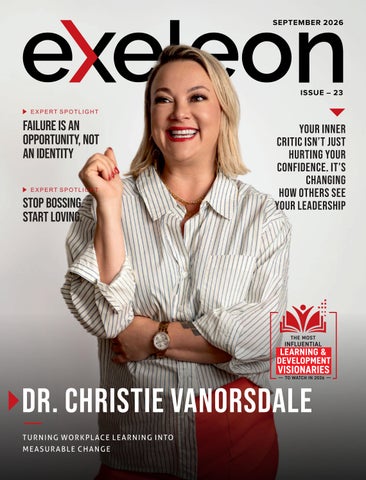
SEPTEMBER 2026
ISSUE – 23 EXPERT SPOTLIGHT
Failure Is an Opportunity, Not an Identity EXPERT SPOTLIGHT
STOP BOSSING. Start Loving.
Your Inner Critic Isn’t Just Hurting Your Confidence. It’s Changing How Others See Your Leadership
Dr. Christie Vanorsdale T U R N I N G W O R K P L AC E L E A R N I N G I N TO MEASURABLE CHANGE
exeleon_magazine
exeleon_magazine
exeleon_magazine
exeleon_magazine
exeleon_magazine
exeleon_magazine
FOLLOW ON INSTAGRAM
exeleon_magazine
exeleon_magazine
exeleon_magazine
exeleon_magazine
exeleon_magazine
Embracing Excellence 600 N Broad St 5 Middletown, DE 19709, United States +1 302-907-9110
Editor-in-Chief – Daryl Yeung Art Director – Naomi Lam Managing Editor - Matt Reis Creative Director – Akshay Panzade
Project Manager – Richard Dann Marketing Manager – Sofia Brown Customer Relationship – Natasha Green Business Development – Mayank Saxena, Josh Wilder, Anish Miller
Copyright © Exeleon Media LLC. All rights reserved. The design, images, and content in this issue should not be reproduced in any manner or by any means, i.e. mechanical, electronic, recording, photocopying, or otherwise, without any permission from Exeleon Media.
MESSAGE
from
THE EDITOR
L
eadership development is no longer about delivering more content. It is about helping people think differently, act with condence, and translate learning into meaningful results. That conviction shapes Exeleon Magazine’s latest edition, The Most Inuential Learning & Development Visionaries to Watch in 2026. On the cover is Dr. Christie Vanorsdale, Founder and Principal Consultant of Vanorsdale Learning Lab. Her work challenges organizations to examine why training fails before investing in another course, platform, or workshop. By placing diagnosis, evidence, and measurable behavior change at the center of learning strategy, she offers a timely model for leaders seeking stronger outcomes from their people and programs. This edition also brings together exclusive insights from Jessica Reid Sliwerski, Genevieve Piturro, Dani Luffey, and Beth Goff-McMillan. Each approaches growth from a distinct perspective, yet their stories share a belief in the power of purposeful leadership, human connection, and continuous learning. Together, these visionaries show that development is not measured by attendance or information delivered. Its value appears in what people can do afterward, how condently they lead, and the change they create around them.
Daryl Yeung Editor-in-Chief
CONTENTS
12 DR. CHRISTIE VANORSDALE
CONTENTS
22 JESSICA REID SLIWERSKI
CONTENTS
28 GENEVIEVE PITURRO
CHRI Vanorsdale DR.
12 | SEPTEMBER 2026
EXELEON MAGAZINE
C O V E R S T O RY
ISTIE WWW.EXELEONMAGAZINE.COM
SEPTEMBER 2026 | 13
C O V E R S T O RY
Organizations invest heavily in training, technology, and professional development, yet many struggle to determine whether those investments actually change how people perform. When results fall short, the usual response is to create more content, schedule another workshop, or purchase a different learning platform. Dr. Christie Vanorsdale believes this approach addresses the wrong problem. As Founder and Principal Consultant of Vanorsdale Learning Lab, Christie helps organizations diagnose why their training investments underperform and build learning systems that produce measurable changes in workplace behavior. Her work brings together psychology, international education, instructional technology, organizational strategy, and learning science, all grounded in a conviction that effective learning must be understood within the system surrounding it. “I am in the business of behavior change, and behavior lives inside a context,” Christie explains. “Change the system around a person and you change what becomes possible for them.”
DIAGNOSE
14 | SEPTEMBER 2026
The Questions That Started It All Christie's journey began with a degree in psychology and two questions that still guide her work: How do people come to believe what they believe and do what they do? How does the world around them inuence both? After graduating, she moved to South Korea to teach English. Working with students in a language new to them turned the classroom into what she describes as her rst laboratory. To make learning effective, she had to reduce instruction to its essential components, including attention, memory, and the careful sequencing of complexity. The experience also showed her that learning is inuenced by more than cognition. Culture shaped how students asked questions, requested assistance, and created meaning through their rst and second languages. Learning to teach within a different culture and language deepened her curiosity about how people acquire knowledge and apply it. Christie returned home to complete a Master of Science in Education with a specialization in English as a Second Language. She then spent the next decade in teacher education across the United States and Asia, including a faculty appointment in Seoul, where she trained TESOL teachers in second-language acquisition and intercultural
IDENTIFY
EXELEON MAGAZINE
communicative competence. She later taught similar subjects at Duquesne University in Pittsburgh. Across languages, cultures, and learning environments, she noticed one recurring pattern. Strategies grounded in how the brain processes information consistently improved learning. That insight led Christie to pursue a Doctorate in Instructional Technology, focusing her dissertation on cognitive theories of multimedia learning. She subsequently published research on teacher education and the design of multimedia learning environments. When she later moved from academia into organizational learning, she carried this foundation with her. Diagnosing Before Designing Vanorsdale Learning Lab operates as a comprehensive learning and development partner. It helps established organizations connect learning strategy to meaningful business outcomes through competency architecture, curriculum, technology, measurement, and governance. Many clients approach the rm after previous workshops, content libraries, or platforms have failed to deliver the expected results. Rather than immediately proposing
PRIORITIZE
WWW.EXELEONMAGAZINE.COM
another program, Christie begins with data and diagnosis. The team examines the entire environment in which learning must operate, including business goals, workplace expectations, leadership behavior, available technology, measurement practices, and the realities faced by learners. This process identies where the system is breaking down before resources are committed to a solution. “Training failure is a systems problem, and the industry keeps treating it as a content problem,” Christie says. When an initiative fails, commissioning new material without investigating the underlying conditions often produces the same outcome. The content may be engaging, but employees could lack opportunities to practice. Managers may not reinforce the desired behavior. Incentives may contradict the training, or the program may solve a problem unrelated to the organization’s actual priorities. Christie founded Vanorsdale Learning Lab to address this systemic gap while bringing established learning science into corporate environments. Decades of research explain how people acquire, retain, and transfer skills, yet much of that knowledge never reaches the average workplace program.
EXECUTE
SEPTEMBER 2026 | 15
C O V E R S T O RY Her goal is to treat learning and development as a business function with outcomes that can be evaluated rather than an activity measured primarily through attendance and completion. Depth Over Volume The principles Christie applies to clients also guide how she leads her own company. The rst is diagnosis before design: evidence establishes direction. The second is depth over volume. Vanorsdale Learning Lab limits its fullexecution work to two concurrent clients because transformational projects require sustained attention. Christie prefers to work deeply with a smaller number of organizations rather than sacrice quality in pursuit of volume. Evidence over trend is another dening principle. Learning and development frequently encounters new platforms, theories, and tools promising rapid transformation. Before adopting an approach, Christie asks what credible research demonstrates and what the client’s own data reveals. She also leads with candor. Organizations hire her to identify what is preventing their learning systems from succeeding, including ndings that may be
16 | SEPTEMBER 2026
EXELEON MAGAZINE
Creating The Learning Blueprint Report™ Christie developed The Learning Blueprint Report™ after repeatedly seeing organizations invest six or seven gures in learning without rst determining what was broken. The xed-scope diagnostic examines an organization's complete learning system, from business objectives and learner realities to technology, governance, and measurement. It then provides a prioritized, evidence-based roadmap explaining where the system is working, where it is failing, what those weaknesses are costing, and which improvements should be addressed rst.
For executives, the report provides a business document upon which investment decisions can be made condently. Internal learning teams receive an actionable plan grounded in evidence rather than assumptions. The framework reects Christie’s belief that organizations should not begin by asking what course they need. They should begin by identifying the behavior that must change, understanding the system inuencing it, and determining how improvement will be measured.
“ WWW.EXELEONMAGAZINE.COM
SEPTEMBER 2026 | 17
C O V E R S T O RY
uncomfortable. Her team is expected to operate with the same honesty. This commitment to evidence and directness has supported major engagements, including the design of a leadership competency framework for a national mental health nonprot serving more than 600 afliate organizations. Christie has also developed a ten-competency leadership framework and curriculum for a national open-book management organization’s practitioner training program. Finding Value Beyond Content Articial intelligence is rapidly reducing the time and cost required to produce learning content. For Christie, this development does not diminish the importance of L&D, but it changes where the function must demonstrate value. “AI is collapsing the cost of producing content, so content ceases to be where L&D earns its value,” she explains. The organizations that benet most will be those capable of diagnosing accurately, designing according to how people learn, and determining whether workplace behavior actually changed. These capabilities become more valuable as content becomes faster and cheaper to create. Christie is currently architecting the design and development program behind the relaunch of a major digital health and wellbeing platform. The work uses AI to transform thousands of existing content assets into a new competency structure while developing learning pathways based on backward design and behavior-change principles. She is also training the organization’s AI tool to perform instructional design work that would otherwise require a team months to complete. The process reduces that work to hours, with a subject matter expert reviewing, rening, and approving the result.
18 | SEPTEMBER 2026
Earning a Place at the Strategy Table Christie expects workplace learning measurement to advance beyond completion rates and satisfaction scores. These gures can show whether people attended a program or enjoyed it, but they reveal little about whether employees developed a skill or applied it effectively. “L&D leaders who can answer in behavior change and business terms will earn a seat at the strategy table,” she says. “Those who report attendance will keep losing budget.” Her long-term vision is for Vanorsdale Learning Lab to become proof that L&D can operate as a strategic business function, diagnosed through data, designed using evidence, and measured against outcomes that matter to leadership.
“
Through its podcast, newsletter, keynote presentations, and published frameworks, the company is encouraging executives to expect more from learning investments and helping practitioners deliver against those expectations. Christie wants three questions to become standard before an organization spends money on training: What behavior needs to change? What does the surrounding system reward? How will we know the initiative worked?
Those questions capture the philosophy behind her career. From psychology and international classrooms to academic research and organizational consulting, Christie has remained focused on understanding how people learn and what allows learning to become action. For Dr. Christie Vanorsdale, workplace learning succeeds not when content has been delivered, but when people can do something meaningful that they could not do before.
@christievanorsdale-learning www.vanorsdalelearninglab.com EXELEON MAGAZINE
WWW.EXELEONMAGAZINE.COM
SEPTEMBER 2026 | 19
Unlock Your DIGITAL SUBSCRIPTION! Ready to fuel your ambition and receive your dose of inspiration directly to your digital doorstep? Subscribe to Exeleon Magazine today, and enjoy the following perks:
• Convenience at Your Fingertips • Exclusive Extras • Community Connection
EXELEON INSIGHT
Failure Is an Opportunity, Not an Identity - Written By Jessica Reid Sliwerski
I
n my early twenties, I stood in front of a classroom of elementary school students in the Bronx and realized something terrifying: I had no idea how to teach them to read.
I had a degree, a certication, and the best of intentions. What I didn’t have was the science of how kids actually learn to read. For my rst two years in the classroom, I watched bright, capable students struggle to decode text, and I wasn’t equipped to help them. It was absolutely agonizing. When you fall short in a job where the stakes are high, it’s easy to turn the setback into a verdict on who you are: I am a failure. It took me time to understand that my struggle wasn’t a verdict. It was an opportunity, a chance to get better, not proof that I sucked. My training had failed me, not the other way around. Once I stopped treating it as a referendum on my worth and started treating it as something to grow from, everything changed. That early disappointment didn’t end my career. Instead, it became the blueprint for it. It planted the seed for what would later become Ignite Reading, the early literacy organization I built with an ambitious vision: eliminating our country’s literacy crisis by ensuring every child learns to read on time. That distinction between failing and being a failure is where I think leadership is actually built. Leaders who treat failure as identity get defensive and rigid. They stop taking risks. Leaders who treat it as an opportunity get better. Here's what that looks like in practice. 1. Look for the Lesson, Not the Verdict When something breaks, whether it’s a lesson plan, a marketing strategy, or a product launch, the instinct is emotional: Why did I mess this up? The better question is: What can this teach me?
22 | SEPTEMBER 2026
EXELEON MAGAZINE
WWW.EXELEONMAGAZINE.COM
SEPTEMBER 2026 | 23
EXELEON INSIGHT When I realized my classroom methods were failing, I didn’t quit teaching. I found a school that invested in teachers and used an evidence-based curriculum. I committed to becoming the best reading teacher possible and rigorously re-educated myself until my students began making meaningful gains. Years later, when I founded Ignite Reading, we applied that same mindset. We didn’t just hope our model worked. We partnered with researchers at Johns Hopkins University to study our outcomes and identify where we could improve. Rening our delivery model until every child makes measurable progress is core to our mission.
4. Leadership Starts Above the Line Leading through turbulence, whether that's a market shift or a personal crisis like the breast cancer diagnosis I received as a new mother, requires staying “above the line.” When pressure mounts, human nature pulls us “below the line" into defensiveness, blame, and victimhood. Staying above the line means taking radical ownership of outcomes. It means looking at a crisis or a missed milestone and saying, "This is the reality of where we are. What can I learn from it, and what do I do next?”
2. Failure Claries Your Non-Negotiables
When you stop treating setbacks as an indictment of your competence, you have more energy left to actually solve the problem and grow from it.
When you treat setbacks as a chance to grow instead of a verdict on who you are, bad-t opportunities become much easier to spot and reject.
The Work of Iteration
In the early stages of a startup, the temptation to accept “bad-t revenue,” such as funding or partnerships that stray from what you actually do well, is strong. But I’ve learned what happens when you compromise on the fundamentals. At Ignite Reading, our north star is our First Grade Promise: ensuring every child reads by the end of rst grade. If a prospective partner asks us to dilute our model or compromise on evidence-based practices to cut costs, the answer is no. Declining revenue feels scary, but protecting the integrity of your delivery is the only way to scale sustainably.
Success is rarely a straight line. It’s the sum of thousands of small corrections, each one made possible by clear, honest feedback. If I had let those early struggles in my classroom in the Bronx dene who I was, Ignite Reading would not exist today, and thousands of children might still be waiting for the literacy support they deserve. The next time a project fails, a deal falls through, or a strategy misses the mark, resist the urge to make it mean something about who you are. Strip away the ego, look at what actually happened, and treat it as the opportunity it is.
3. High Standards Require Psychological Safety
About the Author You cannot hold high standards in an organization if your team is afraid to report bad news. If failure equals personal shame, people hide mistakes, manipulate metrics, and defend broken systems. Building that kind of culture means separating performance from personal dignity. At Ignite Reading, we hold exceptionally high expectations because the children we serve cannot afford mediocrity. But high standards have to be paired with psychological safety. When a pilot program stumbles or a metric dips, we treat it as a problem to x and an opportunity to improve, not a reason to blame someone. When your team knows bad news won’t be used against them, they bring you problems immediately, and you can x them before they compound.
24 | SEPTEMBER 2026
Jessica Reid Sliwerski is the CEO and co-founder of Ignite Reading, a San Francisco Bay Area-based education technology organization providing virtual, one-on-one, high-dosage tutoring to K-2 students in under-resourced schools across the country. Backed by a research partnership with Johns Hopkins University, Ignite Reading has helped thousands of students learn to read. Jessica lives in Oakland, California.
@jessicareidsliwe ignite-reading.com @msreidreads
EXELEON MAGAZINE
EXELEON SPOTLIGHT
STOP BOSSING. Start Loving.
Why the future of leadership depends on empathy, vulnerability, and the power of human connection.
-Written By Genevieve Piturro
“
If this is the next 30 years of your life, is this enough?” That's the question my inner voice asked me at the height of my successful, workaholic corporate life. I had spent 12 years climbing the television industry ladder in New York City, watching the mostly male bosses above me and counting the days until I became a boss too. My female self was all in. And then I walked away. I had no plan, no role model, and, as a spender rather than a saver, essentially no resources. All I had was that haunting question and a growing conviction that there had to be another way to live. What I found was another way to lead. That leap eventually led me to found Pajama Program/Beyond Bedtime, a national nonprot that has spent 25 years delivering more than 9 million pajamas and books to children facing uncertainty and hardship. But it took years to nd success in this new venture. I couldn’t command people to believe in a mission. I couldn’t raise funding by focusing only on money. I couldn’t manage volunteers into giving their hearts. I tried, but I couldn’t build a national movement through my old friend: control.
28 | SEPTEMBER 2026
My old ways of being a boss weren’t working, and I woke up every morning asking myself another question: “What am I doing wrong? Is being a woman holding me back?” I got my answer at an event one evening when I collapsed in tears in front of a group of strangers while sharing stories about some of the children I had met in shelters. Instead of seeing my emotion as weakness, they saw my humanity, and they shared theirs. I began noticing something I hadn't seen in the corporate world: men allowing themselves to show emotion. In those moments, I didn't see them as less capable. No one did. We saw them as more human, more relatable, and more real. Right then, I began my “home schooling” in the difference between a boss and a leader. Being a woman wasn’t the issue. The belief that emotion weakened leadership was. I had watched women be told that emotion was a weakness rather than a leader’s strength. It took me years to realize just how wrong we had it. That day, everything changed.
EXELEON MAGAZINE
WWW.EXELEONMAGAZINE.COM
SEPTEMBER 2026 | 29
EXELEON SPOTLIGHT Today, as we navigate disengagement, burnout, quiet quitting, and the rapid transformation brought by AI, we keep looking for better systems, better technology, and better ways to manage people.
It’s not the Power of One that changes things. It’s the Power of One Another that moves mountains and moves people. That lesson has stayed with me for 25 years.
But what if the leadership crisis we’re facing isn’t a people problem with a technology solution, but a love problem with a people solution? We might be executives, but we are human rst. When we stop hiding that humanity and recognize that the world is driven by emotion, we unlock a different and more powerful way to lead. For women, that humanity can be an advantage we have been taught to hide. What if the qualities women have often reserved for life outside the ofce, including empathy, intuition, and emotional intelligence, are exactly what leaders need most in the workplace right now? Love in leadership is not a soft idea. It is a practical strategy through which vulnerability, emotional intelligence, and genuine care can strengthen team performance and produce meaningful results wherever people come together with purpose. Men and women were drawn to Pajama Program because they cared, and they stayed because they connected. When I learned to connect with my heart, my North Star, and invited others to do the same, we discovered something powerful:
Whether we're leading a corporation, a nonprot, a classroom, a family, or simply ourselves, the principles are the same. We have basic human needs that don't disappear when we walk through the workplace door. We want to feel passion. We want to be recognized. We want to communicate and collaborate. We want to inspire and be inspired. We want to belong to a team. We want to celebrate together. We want our success to mean something beyond ourselves. Ultimately, we want to leave a legacy worth remembering: an impact that mattered, a voice that resonated, and a world that moved forward because we were here. The leaders who thrive won’t necessarily be the ones with the most power, the loudest voices, or all the answers. They will be the ones who know how to stop bossing and start loving. Because we don’t move mountains for a boss. We move mountains for one another.
About the Author Genevieve Piturro is an award-winning author, TEDx speaker, and leadership advisor. Formerly a New York City television executive, she left the corporate world after an inner voice asked her a simple question. She went on to found Pajama Program/Beyond Bedtime, now celebrating 25 years. Her work focuses on Leading with Love and the power of human connection, purpose, and legacy.
30 | SEPTEMBER 2026
EXELEON MAGAZINE
EXELEON SPOTLIGHT
Your Inner Critic Isn’t Just Hurting Your Confidence. It’s Changing How Others See Your Leadership - Written By Dani Luffey
32 | SEPTEMBER 2026
EXELEON MAGAZINE
E
arly in my career at Procter & Gamble, I regularly presented work in rooms lled with people whose credentials seemed far more impressive than mine. There were PhD scientists, corporate attorneys, MBA marketers, and people with deep expertise in subjects I was still learning. I knew why I was there. I had done the work and understood the communication strategy I was there to present. That did not stop the voice in my head from saying, They are smarter than you. You don’t belong here. For a long time, I thought that was a condence problem I needed to solve privately. I assumed that if I became condent enough, the voice would disappear. It didn’t. What changed was my understanding of what that voice could make me do. When I believed it, I would over-explain a point, soften something I knew well, rush through an important idea, or stay quiet when I had something useful to contribute. I wasn’t suddenly less capable. But I communicated in ways that made me appear less certain and gave other people a reason to question my capability. The inner critic may speak privately, but the communication behaviors it triggers are visible. That is when a condence issue can become a leadership communication issue. I saw this again recently with a group of entrepreneurs and business professionals. I asked them to write down anonymously what their inner critic says during high-pressure situations when they need to sound condent.
WWW.EXELEONMAGAZINE.COM
SEPTEMBER 2026 | 33
EXELEON SPOTLIGHT
The messages were familiar:
The inner critic usually doesn’t give us a specic communication instruction. It doesn’t say, “Start talking faster,” “Add three more minutes of background,” or “Put ‘I think’ in front of that statement.”
• Maybe you contribute easily with your own team, then become an observer when someone with more authority enters the room.
It gives us the warning. Then our behavior responds.
• Maybe you are comfortable answering questions until someone asks one you didn’t expect. Then you start talking while you are still trying to determine what you think.
We add more explanation because we want to prove that we know what we’re talking about. We rush because we want to get through the uncomfortable moment. We hedge because making a denitive statement suddenly feels too risky. We stay quiet because saying nothing feels safer than saying the wrong thing.
Your pattern may be different. What matters is becoming familiar enough with it that you can recognize it while it is happening, not three hours later when you are replaying the conversation in your head.
That is why I have learned to treat my inner critic as data rather than instructions. For me, the voice tends to get louder when something feels unfamiliar, important, visible, or risky. I see it as protective. It would prefer that I avoid being embarrassed, rejected, exposed, or wrong. I now know that I can notice the voice without handing it control over what I do next. For leaders who recognize this pattern in themselves, I recommend starting with three things. 1. Learn Your Behavioral Tells Most people have some idea of what their inner critic sounds like. Fewer have paid attention to what changes in their communication when it appears. • Maybe you are normally concise, but when speaking with senior leaders, you start providing every piece of background before getting to the point.
34 | SEPTEMBER 2026
2. Decide What You Want to Do Before the Pressure Arrives High-pressure situations are difcult places to invent a new response. If you know a situation tends to activate your inner critic, think in advance about the behavior you want to avoid or replace. If They know more than you do tends to make you overexplain, decide beforehand what your central point is and how much context your audience actually needs. If Wait until you're sure keeps you quiet, decide that you will contribute while the conversation is still developing instead of waiting until you have constructed the perfect comment. If unexpected questions make you rush, give yourself permission to pause before answering. That last one sounds almost too simple, but I use it with clients often. Take a breath.
EXELEON MAGAZINE
You do not have to answer the instant someone stops speaking. A breath gives you space to hear the question, decide what you think, and choose how you want to respond instead of letting your rst surge of discomfort answer for you. Sometimes, I tell a client to use a sentence that creates a little thinking time: “That's an interesting question. Give me a moment to think about the most useful answer.” You can also ask for more information: “Thank you for your question. Can you give me a little more context so I can make sure I provide the most relevant information?” A thoughtful pause is a response.
Recovery is a communication skill, too. My inner critic still shows up. There are still rooms where someone has more degrees than I do, greater technical expertise, more tenure, or a title that can awaken the younger version of me who wants to prove she deserves to be there. I still occasionally catch myself talking too fast or providing more explanation than the moment requires. The difference now is that I catch it sooner. Sometimes, I pause. Sometimes, I shorten the answer. Sometimes, I stop halfway through an explanation and tell the person what I most want them to remember. I don’t need to wait until I feel completely condent to make that adjustment.
3. Learn How to Recover While You’re Still in the Moment Preparation helps, but sometimes you will catch the behavior after it has already started. That does not mean the moment is lost. Over-explaining is a good example. People often realize they are rambling but keep talking because they don't know how to get themselves out of it. Stop. Then use language such as: “I know I've given you a lot of information. The key point I want you to take away is…” Then give them the one point that matters.
About the Author Dani Luffey is a leadership communication strategist and the founder of DVA Brand Communications. Her career includes roles at Procter & Gamble, Ketchum Public Relations, and NBCUniversal. Today, she helps highperforming professionals strengthen their executive presence, condence, and inuence by understanding how communication behaviors shape the way they are experienced at work. She has been quoted in Forbes and speaks at conferences on leadership communication and executive presence. She holds a master’s degree in communication from the University of Southern California.
You can do the same thing if you realize you have wandered away from the question: “Let me come back to your original question.” If you hear yourself rushing, take a breath before the next sentence.
@daniluffey @daniluffey
If you nd yourself cushioning every statement because you are worried about being wrong, stop adding qualiers and say what you know.
WWW.EXELEONMAGAZINE.COM
SEPTEMBER 2026 | 35
OVER 3500+ BRANDS HAVE SHARED
Ad
Be the next brand to be p Because Your Jo
D THEIR STORIES ON OUR PLATFORM.
™
Ad
part of Exeleon Magazine. ourney Matters.
EXELEON SPOTLIGHT
THE LEADERSHIP REINVENTION THAT HAPPENS AFTER 50 F
or most of my career, urgency was fueled by purpose. There was always something to accomplish, another relationship to build, another conversation to have, another opportunity to elevate an industry I believed deserved far more recognition than it received. I wasn't driven by proving myself as much as I was driven by proving what our profession could be. I believed our industry deserved to be recognized for the expertise it brought to the table. The spaces we create shape how people collaborate, innovate, heal, learn, and lead, and I was passionate about helping others understand that impact. For years, that mission consumed me in the best possible way. I wanted to help transform how our industry was perceived, moving it from a supporting role to a strategic partner in shaping culture, collaboration, and performance. Then the pandemic happened, and almost overnight, the conversations we'd been having for decades about humancentered design became conversations
38 | SEPTEMBER 2026
everyone was having. Suddenly, the importance of space wasn’t something we had to explain. It was something the world had experienced rsthand. Around that same time, I turned 50. Those two moments intersected in ways I couldn’t have anticipated. It wasn't a dramatic reckoning or a single dening event. It was a quiet reorientation. For decades, I'd been asking, “How do we continue moving this industry forward?” As that mission began to take hold, a different question emerged: “Where can I create the greatest impact now?” That question changed the way I think about leadership. It shifted my focus from building an industry to building people, from changing perceptions to developing the next generation of leaders. Looking back, I don’t think I reinvented myself at 50. I redirected my energy toward the work that only this season of life has prepared me to do.
EXELEON MAGAZINE
WWW.EXELEONMAGAZINE.COM
SEPTEMBER 2026 | 39
EXELEON SPOTLIGHT
The Performance Trap What no one tells young leaders is that much of what we call leadership in our earlier years is actually performance. We perform condence when we are uncertain. We perform composure when we are rattled. We perform certainty to keep teams steady and strength to keep competitors at bay. There is a version of that performance that serves your team, and I want to be honest about that. The version that eventually becomes a liability is the kind driven entirely by ego. Ego-driven leadership is exhausting precisely because it is defensive. Every decision becomes a referendum on your worth. Every setback lands harder than it needs to. Every challenge from your team starts to feel like a threat rather than an invitation. You stop listening deeply and start managing perception instead. WHAT ENERGY-LED LEADERSHIP ACTUALLY LOOKS LIKE We have spent decades in business treating hustle as the highest virtue, and I ran on it for a long time. What I have come to understand is that hustle and energy aren't the same currency. Hustle is about how much you can produce. Energy is about what is actually fueling you and whether that source is sustainable enough to carry you through the work that genuinely matters.
handled it perfectly. It means I can hold space for my team's uncertainty without internalizing it as my own failure. Effective power is often quiet. Some of the most impactful leadership I have witnessed and practiced comes from listening with intention, asking the right questions rather than providing expected answers, and creating conditions in which the best ideas surface, regardless of whose name is on them. THE BURNOUT NOBODY SEES COMING The burnout I've seen take down the most capable leaders rarely looks like falling apart. It looks like a person who is fully functional and completely disconnected at the same time. The calendar stays full, the results keep coming, and the team stays intact. Somewhere in the middle of it all, the leader has lost touch with what any of it is actually for. I've seen this in myself and in leaders I deeply respect. The real danger is continuing to function while losing the thread of what made the work matter in the rst place. This is a far more insidious form of burnout because nothing on the outside signals that anything is wrong. Recovery comes from doing the right things for the right reasons. It comes from being ruthlessly honest about where your energy is actually going and whether it is producing the outcomes you care about, not just the ones that look good. For me, that meant acknowledging that I was spending signicant energy managing my image in rooms that didn't serve my mission. It meant learning to say no to things that were impressive on paper but misaligned in practice. It meant recognizing that empathy without clarity becomes its own path to exhaustion because you end up carrying what should belong to the collective.
When I lead from energy, I'm asking different questions. Does this decision align with what I'm actually here to build? Does it serve the people I am responsible for? Does it require me to be present, curious, and honest, or does it require me to be impressive? That distinction sounds simple. In practice, it requires a kind of discipline that egoled leadership never asks of you.
STAYING RELEVANT WITHOUT BURNING OUT
Leading from energy means I can sit in a room with colleagues who are 20 years younger, who move faster and know things I don't, and feel genuinely curious instead of threatened. It means I can make a hard decision, communicate it clearly, and carry its weight without needing everyone to believe I
There is a fear that settles in for many leaders around this age that is not discussed honestly enough: the fear of no longer being the most relevant person in the room. The pace of change makes that fear feel urgent. Industries are transforming, and the next generation of leaders is rising with different instincts
40 | SEPTEMBER 2026
EXELEON MAGAZINE
WWW.EXELEONMAGAZINE.COM
SEPTEMBER 2026 | 41
EXELEON SPOTLIGHT and uencies. The impulse is to close that gap through sheer output: more hours, more visibility, and more effort, as though relevance were simply a matter of trying harder. My daughter directly challenged that assumption for me. She asked why I kept directing my energy toward people my own age, people who already understood what I had learned. Her question was pointed: “Why aren't you talking to people my age?” It was one of those moments when the most clarifying thing someone can do is simply name what you have been avoiding. It redirected the way I think about where impact actually lives. The leaders who remain energized and inuential aren't the ones who out-hustle the next generation. They are the ones who shift from doing to enabling, from performing to discerning, and from proving themselves to drawing on what only time and lived experience can provide. THE QUESTION THAT GUIDES ME NOW
“
Designing intentional spaces has been the work of my career. It is grounded in the belief that environment shapes behavior in ways that go far deeper than aesthetics. A space designed with genuine care tells people something about their own worth that no policy or program can replicate. Leadership creates the same kind of environment, whether intentionally or not. What gets said, what gets heard, who gets developed, and who gets seen all reect the choices a leader is making, consciously or otherwise. The question that guides me now is: What am I making possible for the people around me? The leaders who sustain themselves over the long arc of a career are often the ones who have the courage to ask harder questions at exactly the moment when the easier path would be to simply keep going. They discover that leading from a more honest and enabling place is the foundation on which everything else worth building rests.
42 | SEPTEMBER 2026
EXELEON MAGAZINE
C O M PA N Y S P O T L I G H T
and the Mission to Protect
30,000 Workers by 2030 How the CEO of Assist Group is combining workforce education, preventive health, and measurable goals to protect 30,000 people by 2030.
M
ost businesses measure success in revenue, market share, or headcount. James Aldridge, CEO of Assist Group, measures it in something less common, the number of people his company helps keep from serious harm or illness. That focus shapes how he runs the business because the cost of workplace injury and non-workplace illness remains signicant and, in many cases, preventable. • The International Labour Organization estimates around 395 million non-fatal workplace injuries each year. Work-related injuries and diseases together are estimated to cost almost 4% of global GDP. • Safe Work Australia records around 140,000 to 145,000 serious workers' compensation claims each year, depending on the reporting year. • Body stressing, the strain of lifting, pushing and repetitive movement, is the single largest cause, with a median claim of around $15,000 to $16,000 and about seven weeks off work. A goal you can count Assist Group has set what it calls its Big Audacious Noble Goal, or BANG for short, to save approximately 30,000 people from serious injury or ill health through its medical testing and health screening services by 2030. This is a ‘stretch target’ to measure our social capital impact. The gure is intended to be a measurable target rather than a marketing slogan. Assist Group, an Australian
46 | SEPTEMBER 2026
occupational health provider founded in 1986, has been building toward it for years, and says it has already helped protect 19,000 people on the way to that target. Aldridge frames the mission in business terms as much as ethical ones. ‘We want to look out for employee health and wellness and at the same time, help companies to boost their productivity,’ he says. ‘This ultimately reduces costs linked to workplace and non-workplace illness, and a potential reduction in workers’ compensation premiums.’ Why workforce health reaches the boardroom Many organisations still treat workforce health as an HR issue rather than a business performance issue. Aldridge argues that health and human resources belong together, and that when they are managed as one the result is a healthier, more productive workforce and lower healthrelated costs. For Aldridge, the scale of workplace injury reinforces the value of identifying health risks before they contribute to incidents. One approach begins before employment, using preemployment medical assessments to determine whether a candidate can safely perform the inherent physical requirements of the role. Handled well, the same issue can become a source of advantage. 'By implementing occupational health and safety policies, medical testing, and training, employers can demonstrate to their stakeholders that their business is socially responsible, while meeting their obligations under relevant WHS legislation and supporting a range of
EXELEON MAGAZINE
WWW.EXELEONMAGAZINE.COM
SEPTEMBER 2026 | 47
The mission becomes tangible in areas like hearing. Noise-induced hearing loss is one of the most common and least visible workplace injuries, and it is permanent. A 2025 study in the journal 'Frontiers in Public Health’ found that the global burden of occupational noise-induced hearing loss more than doubled between 1990 and 2021, and is projected to keep climbing toward 2040, with manufacturing, construction, mining, and transport among the highest-risk sectors. Regular audiometric testing helps detect early changes in hearing so employers can investigate noise exposure and strengthen hearing conservation measures before further damage occurs. Aldridge is direct about the culture that allows it. ‘In Australia, there is still a culture in some sectors of just getting the job done, no worries. But at what cost?’ he says. ‘Prevention is better than cure, however in this case, there is no cure for noise-induced hearing loss.’ Regulation has caught up. In New South Wales, businesses must now provide hearing tests for workers regularly exposed to hazardous noise. Existing workers were required to have baseline hearing tests by January 2026 under the transitional arrangements.
48 | SEPTEMBER 2026
corporate goals and objectives,’ Aldridge says. A workplace injury costs more than the compensation claim alone. Lost productivity, replacement stafng, training and increased insurance premiums can all add to the overall compounding impact. The same principle applies across industries and countries. What other leaders can take from it Aldridge’s approach offers lessons for organisations well beyond occupational health. The rst lesson is to make purpose measurable. A target of 30,000 people gives employees, employers, stakeholders and leaders a clear outcome to work towards, rather than a general commitment to wellbeing. The second is to treat prevention as strategy. Leaders who wait for an incident before addressing workforce health tend to pay for it twice, once in harm and once in lost productivity. The third is that responsibility and performance are not in tension. As Aldridge’s own framing shows, protecting people and building a stronger business can be the same decision rather than competing ones. A mission worth measuring Assist Group still has ground to cover before 2030, and Aldridge is candid that the goal is a stretch. This aligns all stakeholders around a common shared goal. For other leaders, the lesson is less about the specic number and more about the discipline behind it, identifying the risks your organisation is best placed to reduce and measuring progress over time. Few commitments say more about what a company values.
EXELEON MAGAZINE
C O M PA N Y S P O T L I G H T
WWW.EXELEONMAGAZINE.COM
SEPTEMBER 2026 | 49
NEWSROOM
Critical Thinking Moves to the Center of Workplace Learning as AI Reshapes Jobs
A
s companies race to equip employees with articial intelligence skills, new research from IBM suggests that one of the most important capabilities in an AI-enabled workplace may have little to do with mastering the technology
itself.
A global study released by the IBM Institute for Business Value on September 21 found a notable disconnect between what HR leaders believe employees need and what workers themselves currently prioritize. Among the 1,500 CHROs surveyed, 71% identied the ability to supervise, validate, and override AI outputs as the most essential workforce skill. Yet only 29% of the 8,800 employees surveyed ranked judgment as important. The ndings point to a growing challenge for Learning & Development teams. As AI assumes more routine, analytical, and process-driven work, employees may increasingly be responsible for evaluating machine-generated recommendations rather than producing every output themselves. That places greater emphasis on critical thinking, problem framing, judgment, and the condence to question an AI system when something appears wrong. IBM found that 60% of employees are concerned that AI could erode their skills, with critical thinking cited most often among the capabilities at risk. Among employees who expressed concern about skills erosion, three-quarters said they already believe AI has begun weakening at least some of their abilities. The research also raises questions about how organizations are managing the human side of AI adoption. Forty-three percent of employees said they are blamed when something goes wrong with AI, while 41% of CHROs believe employees may not feel safe challenging or overriding AI-generated outputs. IBM found considerably stronger employee condence in organizations where judgment is deliberately built into the workow. For L&D leaders, the implication is signicant. AI training can no longer be limited to teaching employees how to prompt a system or use a new platform. Organizations also need to develop the skills required to evaluate what those systems produce. The next generation of workplace learning may therefore focus as heavily on human judgment as technical uency. As AI becomes more capable, knowing when not to trust it could become one of the most valuable skills an employee brings to the workplace.
50 | SEPTEMBER 2026
EXELEON MAGAZINE
WWW.EXELEONMAGAZINE.COM
SEPTEMBER 2026 | 51
NEWSROOM
Coursera's Project Helix Signals a Shift From Course Completion to Proven Capability F or years, enterprise Learning & Development programs have relied on familiar measures such as course enrollments, completion rates, training hours, and certications. Coursera believes the next generation of corporate learning will require companies to measure something more meaningful: whether employees can actually demonstrate the skills the business needs.
On September 9, Coursera previewed Project Helix, a new AI-native enterprise learning platform designed to connect skills discovery, personalized development, assessment, and veried capability within a single system. The platform is expected to become broadly available to enterprise customers during the rst half of 2027. The initiative reects a broader change in how companies are approaching
52 | SEPTEMBER 2026
workforce development. Instead of placing employees into standardized course catalogs and measuring participation, Project Helix is being designed to begin with an organization's business objectives and identify the capabilities employees need to achieve them.
Learners and business leaders will be able to describe goals using natural language, with the platform generating adaptive learning pathways based on a person's role, existing capabilities, organizational requirements, and labormarket signals. Coursera says the system will draw from a combined ecosystem of more than 30,000 instructors and content partners. More importantly for L&D teams, the platform is intended to measure whether learning translates into actual capability.
EXELEON MAGAZINE
Coursera plans to combine assessments, practical observation, credentials, and continuous skills tracking, eventually creating a portable record that reects what an employee can demonstrably do rather than simply which courses they have completed. The approach addresses a longstanding challenge within corporate learning. Organizations may invest substantially in training without having clear visibility into whether new knowledge is being applied in everyday work. AI could change that by making development more personalized while continuously adjusting learning pathways as skills and business priorities change.
WWW.EXELEONMAGAZINE.COM
Project Helix also illustrates how the role of L&D technology itself is evolving. Traditional learning management systems primarily organized and distributed content. Emerging platforms are increasingly being designed around skills intelligence, workforce readiness, and business outcomes. For learning leaders, that could mean a gradual shift in the questions executives ask. Instead of wanting to know how many employees completed a program, leadership may increasingly ask which capabilities the workforce gained and whether those capabilities changed performance.
SEPTEMBER 2026 | 53
NEWSROOM
US Leads Global Demand for AI Skills as Companies Face a Growing Upskilling Challenge
D
emand for articial intelligence capabilities is rising across global labor markets, but new research from SHRM shows that the pace of adoption varies considerably between countries, occupations, and individual AI skills. SHRM's latest analysis examined active job postings in information technology and computer science across 27 countries. Employer demand for AI-related skills increased in every market studied between June 2025 and June 2026, with the United States recording the highest 12-month average share of IT and computer science postings mentioning AI skills at 28.5%. Canada followed closely at 28.1%, while Argentina, Singapore, and Ireland also ranked among the markets with particularly strong demand. The numbers, however, reveal more than a simple increase in demand for employees who understand AI. Different occupations are being affected at very different rates. Across the countries analyzed, the median share of postings requiring AI skills ranged from just 4.7% in network and systems support roles to 55.1% among data analysis and mathematics positions. The type of AI knowledge employers seek is also evolving. General articial intelligence terminology still dominates, appearing in 60.3% of AI-related postings analyzed by SHRM. Generative AI was mentioned in 15.3%, while AIagent skills appeared in 13.9%.
54 | SEPTEMBER 2026
For Learning & Development leaders, the ndings point toward a challenge that cannot be solved by providing the same AI course to an entire workforce. A data scientist, software engineer, marketing professional, HR executive, and operations manager may all need greater AI uency, but the knowledge required to perform their jobs effectively can differ substantially. Organizations will increasingly need to identify which roles face the greatest changes and build learning pathways around specic job requirements. The ndings also strengthen the case for internal upskilling. As demand for AI expertise spreads across occupations, recruiting every required capability from the external labor market may become increasingly difcult and expensive. L&D teams are therefore moving closer to the center of workforce strategy. Their challenge will not simply be teaching employees about AI, but determining where capability gaps exist, how quickly those gaps are changing, and which combination of technical expertise and human skills each part of the workforce will require. For organizations competing for AI-ready talent, developing those capabilities internally may become just as important as hiring them.
EXELEON MAGAZINE
WWW.EXELEONMAGAZINE.COM
SEPTEMBER 2026 | 55
w w w. e x e l e o n m a g a z i n e . c o m