GLENIFFER LAKE RESORT BOARD MEMBERS_EDUCATION_20241015
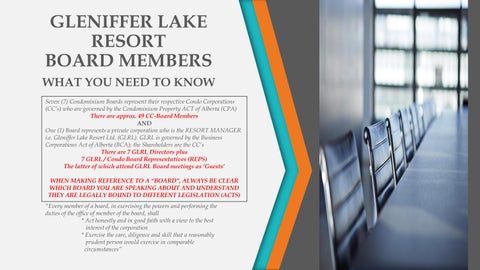
GLENIFFER LAKE RESORT BOARD MEMBERS
WHAT YOU NEED TO KNOW
Seven (7) Condominium Boards represent their respective Condo Corporations (CC’s) who are governed by the Condominium Property ACT of Alberta (CPA) There are approx. 49 CC-Board Members AND
One (1) Board represents a private corporation who is the RESORT MANAGER i.e. Gleniffer Lake Resort Ltd. (GLRL). GLRL is governed by the Business Corporations Act of Alberta (BCA); the Shareholders are the CC’s There are 7 GLRL Directors plus 7 GLRL / Condo Board Representatives (REPS)
The latter of which attend GLRL Board meetings as ‘Guests’
WHEN MAKING REFERENCE TO A “BOARD”, ALWAYS BE CLEAR WHICH BOARD YOU ARE SPEAKING ABOUT AND UNDERSTAND THEY ARE LEGALLY BOUND TO DIFFERENT LEGISLATION (ACTS)
“Every member of a board, in exercising the powers and performing the duties of the office of member of the board, shall
* Act honestly and in good faith with a view to the best interest of the corporation
* Exercise the care, diligence and skill that a reasonably prudent person would exercise in comparable circumstances”
Director Qualifications & Competencies Condo Corp vs. GLRL
Condominium Corporations (CC)
Directors are voted in by CC members (lot owners) at the AGM for 2-year term. If nominations are below the stated allowance of Directors (typ. 7 max), then Director(s) can be acclaimed into the position i.e.. no need for AGM voting procedure
* There are no established qualifications to be a successful Condo Board member. Each Corporation will establish its own eligibility requirements and those requirements can vary widely among Corporations. Some common qualifications say that candidates for the position of Board member must or should be:
1. Current with their condominium contributions
2. Of Sound Mind
3. Over the age of 18 years
4. Willingness to understanding and govern your Condominium Corporation
5. It is always preferential to have collective business acumen skills among various Board members in the areas of budgets, capital maintenance, operations, accounting and finance
Some Bylaws restrict Board members to persons who are owners. Others allow tenants and non-residents to be members of the Board. The representative of the developer or a mortgage lender or Canada Mortgage and Housing Corporation may wish to sit on the Board.
Gleniffer Lake Resort Ltd. (GLRL)
Directors are appointed, one from each of the elected CC- Phase Director group. GLRL-CC Reps are appointed by the CC- Directors to sit as “Guests” at GLRL Director’s meetings
Although the initial Governance Document (Terms of Reference) has not yet been finalized, the following general and abbreviated elements are under review:
Directorship Attributes (General)
• Commitment to an agreed vision for the Resort as dictated by the Shareholders
• Possess intellectual capacity to serve on a Board of a private company
• Strategic Thinking and Leadership
• Communication with abilities to balance advocacy and inquiry
• Held positions in leadership capacity in managing small, medium or large companies at a senior, executive or Board level
• Experience in all the elements of risk management
• Experience in legal exposure, process and claim mitigation
• Full understanding of “Value Proposition”
• Ability to assess ‘impact to’ and ‘rights of’ all stakeholders including shareholders, employees & human resources, area residents and municipal jurisdictions
• Comprehensive understanding of contractual obligations and legal binding of the Corporation
CONDOMINIUM BOARD OF DIRECTORS
ROLES AND RESPONSIBILITIES
PRESIDENT
• Sets agenda and chairs all meetings including the AGM
• Maintains order and keeps discussion on topic
• Primary CC-Board contact to management
• Delegate tasks
• Mediate if disagreements may rise
VICE PRESIDENT
• Takes over the duties of the president in their absence
• Takes on additional tasks and responsibilities as needed
CONDOMINIUM BOARD OF DIRECTORS
ROLES AND RESPONSIBILITIES
TREASURER
• Closely monitor the monthly financial reports
• Ensure the expenditures align with budgets
• Work closely with management with budgeting
• Reports to the rest of the board on the financial health of the Condominium
SECRETARY
• Imperative that the minutes are recorded accurately
• Document the proceedings of Board meetings in minutes and distribute to Board of Directors for approval
• Once approved forward to management to post for lot owners
Construction Committee
• Appointed members of the Board to oversee construction applications in accordance with Phase and County bylaws
EXPECTATIONS OF CC - BOARD MEMBERS
WHEN IT ACTS
• The Condominium Property Act (CPA) requires every Corporation to have a Board but leaves it to each Corporation, through its Bylaws, to determine how the Board is created. Section 28(1) of the CPA says:
• “A corporation shall have a Board of Directors that is to be constituted as provided by the bylaws of the corporation.”
• The Board must remember that it is administering the corporation’s affairs in much the same manner as running a business.
• Therefore, its view of all matters is that of the Corporation’s. Agenda’s which are believed to be representative of the members are welcome; personal agendas should be left at home.
• At the same time, the Board must be cognizant of its fiduciary role, as its actions impact the owners’ property and their condominium contributions. THE BOARD SHOULD
• Always be acting to carry out the statutory and Bylaw obligations required of it or the Corporation.
• Board members work to balance the competing interests that come from dealing with people’s homes, businesses, lives and families.
STANDARD OF CONDUCT AND ETHICS
The actions of the Board are subject to constant scrutiny by the owners, the occupants and the public at large. In some cases, the actions of the Board are challenged by an Owner and become subject to the scrutiny of the Courts.
Maintaining a high standard of conduct is fundamental to the success of Board members and Managers alike. This standard of conduct is best expressed as:
• Meeting the fiduciary duty
• Acting within the authority of the Bylaws and the CPA and Regulation
• Acting in accordance with other legislation, like the Human Rights, Citizenship and Multiculturism Act
• Acting within responsibilities of the elected role
• Acting fairly, and reasonably and without conflict of interest
• Acting honestly, and in good faith
• Acting ethically
Board members who do not meet these standards of conduct may find their decisions, subject to claims of improper conduct overturned and subject to legal sanction. Yet others may face personal liability for actions which harm the Corporation or an owner.
MEETING THE FIDUCIARY DUTY
Definition: held or founded in trust or confidence
The Board has a fiduciary duty when it exercises the powers assigned by the Corporation. A fiduciary duty arises because the Board is managing and maintaining the property and condominium contributions of the owners, IN TRUST, for the benefit of the owners.
This trust relationship means that Board members must remain cognizant of who owns the property and the money of the Corporation. The Board must always act in the best interests of the Corporation, as a whole. This means that the Board should not waste the money of the Corporation, or make improper investments, or let the common property fall into disrepair.
ACTING WITHIN THE AUTHORITY OF THE BYLAWS AND THE CPA
Acting within the authority of the Bylaws and the CPA means doing what must be done, even if it means taking an unpopular stand. It means the Board cannot ignore a breach of the Bylaws once it becomes aware of it. Of course, the obligation to act reasonably may temper the steps taken in a particular situation
This standard of conduct also means that Board members cannot make decisions for which they have no authority. By way of example of extremely inappropriate behavior is: “while it may be popular to suggest that owners or Board members need not pay condominium contributions, the Board has no authority to waive the payments of contributions”
ACTING IN ACCORDANCE WITH OTHER LEGISLATION
Boards must be aware of other legislation that may affect their decisions. For example, human rights legislation may require a Board to allow an animal in the complex to assist a sight or hearing impaired or otherwise disabled owner. Legislation may require the Board to make changes to the common property or allow changes to be made to a unit to accommodate the needs of disabled owners, such as ramps or lifts.
ACTING WITHIN THE ELECTED ROLE
Board members are elected to make decisions and take actions on behalf of the Corporation. Board members are not elected to abstain. They need to carefully consider and vote on all matters coming before them. The only exception should be where a Board member has a conflict of interest, in which case they should take the following steps:
❖ Members of the Board should disclose any conflict of interest. This means that they should reveal to the Board if they have any business or personal interests in a decision which is being made by the Board. For example, a Board member who operates a landscaping company which has bid on a contract with the Corporation, must reveal that interest.
❖ Further, a conflicted Board member should not engage in the discussion leading up to the vote on the issue.
❖ The conflicted Board member must abstain from voting on the issue. This is best achieved if the member leaves the meeting until the discussion and vote is complete.
❖ Minutes of the meeting must record the disclosure and the abstention from voting. Board members with a conflict of interest cannot be included in the numbers necessary to establish a quorum for a meeting.
ACTING FAIRLY AND REASONABLY
Acting fairly and reasonably means treating all owners equally and with respect. It means recognizing the entirety of the circumstances, not just the legal aspects. Boards who act fairly do not make arbitrary decisions or act to discriminate against an Owner or group of owners. Fair Boards do not give or even request preferred treatment to Board members or others. They investigate all matters as required before making decisions. These Boards record their decisions and actions in the meeting minutes.
Boards who act fairly give owners notice of any complained breaches of the Bylaws. They give the owners time to comply. These boards take consistent steps to enforce their Bylaws regardless of the identity of the offender. They impose similar penalties for similar breaches. Fairness includes giving the Owner a chance to address the Board about the complained conduct before the Board makes its final decision. It means advising the owners of the decision of the Board.
Acting reasonably, or taking the best step in the circumstances, requires the Board to investigate the matter to obtain all the facts reasonably available before making a decision. It means weighing all of the options and choosing the best one.
Board members should have and display a professional attitude. This means Board members must set aside personal differences and concerns.
ACTING HONESTLY, IN GOOD FAITH & ACTING ETHICALLY
Owners expect Board members and Managers to act honestly and in good faith. This means that everything done is done “above board”. Being honest means “not given to lies, cheating or theft; not making false or misleading statements; free from fraud; being frank, open and sincere.”
Acting in good faith means getting the information needed to make decisions. It means making the proper decisions with the information obtained. It means doing the best possible job.
Acting ethically means recognizing the difference between what is morally right and wrong and acting accordingly. For example, it is wrong for a Board member to act for personal gain. In other cases, while a decision may be legally right, it may not be the best thing to do in the circumstances providing legalities are not breached
KEY COMPONENTS TO REMEMBER
MAKE THE COMMITMENT
Each Board member must be committed to placing the interests of the Corporation before his/her own.
TAKE THE TIME
Take the time to do the job properly and have a genuine interest in the Corporation
AQUIRE THE KNOWLEDGE Board members need to become familiar with the way the business runs. He/she can:
* Begin by reading the CPA, the Regulation, the Corporation’s Bylaws and rules or policies
• Review materials such as:
• Minutes of previous meetings
• Financial statements
• Insurance policy
• Reserve Fund Study, the Report, the Plan and annual reserve fund statement
• Become familiar with the physical layout and structure of the Condominium. Gleniffer Lake Condo Corps are “Bare Land Condominiums”
2. Confidentiality and Non-Disclosure Agreement – Condo Corp Directors
3. Signing Authorities for Banking
4. Resolution in Writing of the Directors (commonly termed “Agency Agreement”)
*Appointment of Agent to act on behalf of Condo Corp re: Sections 4.9(a),(b),(c),(d) of the Unanimous Shareholders Agreement (see next slide)
Gleniffer Lake Resort Ltd. Board Documents
1. Code of Ethics - GLRL
2. Confidentiality and Non-Disclosure Agreement – GLRL Directors and representatives
3. Criminal Records Check – RCMP (for GLRL appointed Directors only
* Submission to AGLC (Alberta Gaming, Liquor and Cannabis); for GLRL Directors only
4. Signing Authorities for Banking
5. Signing Authorities for Contracts & Legal (Officer appointments) -
RESOLUTON IN WRITING OF THE DIRECTORS (AGENCY AGREEMENT)
4.9 Matters Requiring Other Shareholder Approval
(verbatim from Unanimous Shareholders Agreement)
The Corporation shall not take any of the following actions except with prior approval of not less than five (5) of the seven (7) Shareholders, by way of (i) a resolution approved through their votes cast in favour thereof in person or by proxy at a duly constituted meeting of such Shareholders or at any adjournment thereof; or (ii) a written resolution in one or more counterparts signed by such Shareholders:
a. the hiring and termination of a general manager for the Resort;
b. annual approval of the operating and capital budgets for the Resort;
c. any amendments to the bylaws of the Corporation; and
d. the entering into of any agreement or the making of any commitment of the Corporation in a fiscal year which is not contained in the annual budget approved for such fiscal year as required by Section 4.9(b) if such agreement or commitment would result in aggregate financial obligations of the Corporation for such fiscal year in excess of $10,000.
The Agency Agreement authorizes the appointed GLRL Director to vote on behalf of the Shareholder in respect of the above matters. Often times, even though the GLRL Director has authorization he/she may return to the Condo Board for further advice or confirm intended voting.
REFERENCE DOCUMENTS FOR KNOWLEDGE
• Unanimous Shareholder Agreement
-Legal Agreement between The Shareholders of Gleniffer Lake Resort Ltd. (7 Condominium Corporations within Gleniffer Lake Resort) and Gleniffer Lake Resort Ltd.
• Road Cost Sharing Agreement
- A binding commitment between Gleniffer Lake Resort Ltd. and the 7 Condominium Corporations within Gleniffer Lake Resort Ltd.
• Administration & Maintenance Agreement and process sample (GLRL/CC’s)
-The Administration and Maintenance (A&M) Agreement is an agreement between each of the seven Condo Corporations and GLRL to provide the specified services for a specified fee.
• The services specified are: Common - Specific, Common - General, Administration & Management, Landing.
• Condo Corporation Bylaws and Part 18 of Red Deer County Land Use Bylaws
• Condominium Property Act of Alberta (CPA)
-GLRL/Condo Corps have a membership with Canadian Condominium Institute (North Alberta Chapter) (https://www.ccinorthalberta.com/). A great source of all things Condo including tutorials/articles/etc.
REFERENCE DOCUMENTS FOR KNOWLEDGE CON’T
• Engagement Agreements (if applicable) – outside service providers e.g., Cassels Brock LLP, Cornish Harder Niederle, Willis Law
• Facility and Utility Encumbrances (caveats on Title)
• Reserve Fund Study (Directors should have good knowledge of this document)
• Life Cycle Assessment Report (LCA); Directors should have good knowledge of this document
• Construction/Dwelling Permitting Process including Excavation Depth Regulation
• Condo Corp-
• Financials (Monthly/Annual)
• AGM Material
• Board Minutes
• Current Year Budget
• Director & Officer Job Descriptions
• Certificate of Insurance
REFERENCE DOCUMENTS FOR KNOWLEDGE CON’T
• GLRL –
• Corporate or Resort Organization Chart (dated version)
• Strategic Plan (evergreen document)
• Security Framework (evergreen document)
• Financial Reports
• Board Minutes (non-In Camera only)
• Condo Corp Operating Policies (if applicable)
Operating Policies must be re-visited and re-approved annually by the Board to be enforced
GLENIFFER LAKE RESORT LTD. APPOINTED
DIRECTORS REFERENCE DOCUMENTS
• GLRL Bylaws (for GLRL Director, at minimum)
• GLRL Strategic Plan (evergreen)
• Life Cycle Assessment Report (LCAR); GLRL Directors should be familiar at minimum
7. Outside Services Agreements & Engagements specific to GLRL e.g. Cassels Brock, CHN, etc.
8. Marina License Agreement
9. Store Lease (if applicable)
10. AENV Leases e.g. FW Intake, ball diamond, off-lease area, beach area, etc.
11. Corporate Permits and Licenses e.g. AGLC, effluent dispersion, etc.
12. Employee Contracts: Standard form example
13. Business Corporations Act of Alberta and other ACTS as may be applicable
IF A DIRECTOR WANTS TO PROPERLY SERVE THEIR MEMBERS AND/ OR SHAREHOLDERS, THERE IS MUCH TO KNOW!!!
Primarily
MANAGING THE RESORT – ORGANIZATIONAL STRUCTURE
Business Corporations Act of Alberta (BCA)
CorporateBylaws
Unanimous Shareholders Agreement (USA)
GovernanceDocument (Terms of Reference)
(GLRL-CC's) **Gov't Leases/Licenses
Gleniffer Lake Resort Ltd. (GLRL)
Important Notes
GLRL is the Resort Manager, and is a private ‘for profit’ company governed by legislation under the Business Corporations Act of Alberta (BCA)
Seven (7) individuals perform their responsibilities as fiduciaries and serve as Directors to BOTH a Condominium Corporation and GLRL, each of which are governed by different ACTS
• The Reps who attend GLRL Board meetings, do so as ‘Guests’, and the BCA does not allow proxy votes, and therefore only Directors of the Corporation are duly authorized to vote on Motions and Resolutions. Anything to the contrary could be challenged if subsequent disagreement prevails.
• It is intended Condo Corp Reps’ primary duty is to represent the interest of their Condo Corp at the GLRL Board meetings, while the appointed Director represents the sole interest of GLRL.
• Provides balance to both of these interests, which is paramount to the successful management of the Resort for all stakeholders.
• Historically this has not presented issues, since generally speaking “what’s good for GLRL is good for the Condo Corps”.
Gleniffer Lake Resort Ltd. (GLRL) Important Notes
(cont’d)
FOR PROFIT
Preliminary investigations to become a “not-for-profit’ private corporation have yielded a “do not proceed decision, primarily due to cost, GLRL tax consequences, and potential jeopardy to the Condo Corp’s tax exempt status
GLRL currently has business unit equivalents as follows:
• Administration & Maintenance: provides services to the Condo Corps and their Members
• The services specified in the A&M Agreement are: CommonSpecific, Common - General, Administration & Management, Landing.
• The A&M Agreement excludes the following operations: Golf Course, Marina,, Wastewater Treatment, Storage Compound.
• Food & Beverage Operations: Landing restaurant, pro-shop, caddyshack. Note: The General store is owned by P1 and leased to an independent operator
• Communications tower lease
• Storage Yards (X 2): RDC stipulates only leasable to Resort owners
Any net income that is generated is for the benefit of GLRL Shareholders
Cost Centres (no revenues)
• AENV Leases – ball diamond, beach, FW intake, boat launch, etc.
• Indoor / Outdoor Pools
• Maintenance Building & chattels
• Utility Assets
• Fresh Water (FW) intake (lake) and FW treatment plant
• Sewage Treatment Facility
• Waste collection & lift stations
• Pumps, irrigation & dispersion
• Electrical facilities, outside the confines of Condo Corp boundaries
• Marina boat launch
• Slips & docks (licensed to owners, managed by Marina Association)
• Common roads & facilities (tennis courts, playgrounds, etc.)
Gleniffer Lake Resort Ltd. (GLRL)
Important Notes (cont’d)
Accounting Procedures
Managing a number business units and 7 Condo Corps, and a private company has its challenges. All Business Units have an extensive cost allocation procedures i.e. splitting shared costs in accordance with procedures that have passed external accounting tests of reasonableness and internally review for required changes Did You Know?
• There is a monthly accounting allocation procedure which splits invoices many ways to various Condo Corps and Business Units to allow a reasonable assessment of true net income or true cost, as the case may be.
• E.g. Phase 1 power bill (single meter) is split a total of 125 ways, due to the uniqueness of their power meter placements
• Many time sheets and equipment usage are split to Condo Corps and utilize time sheets and other criteria to allocate costs appropriately to the CC’s or BU’s
• Direct costs outside defined services of the A&M Agreement are line items in CC-Budgets, and are paid for by GLRL, then “reimbursed” by the Condo Corps. These are termed “reimbursable expenses”
• e.g. property taxes, electricity, insurance, certain wages, chemicals, treatment expenses, security, etc.
• Special Project funds reside in Condo Corp bank accounts and NOT held in-trust by GLRL
• GLRL is a member of RECA (Real Estate Council of Alberta), an independent governing authority who regulates and enforces standards for property and condominium management
• GLRL’s Condominium Administration Manager, Tammy Campbell has passed all qualification requirements
• Reserve Fund monies also reside in Condo Corp bank accounts and are NOT held in-trust by GLRL. Any monies transferred to GLRL for payment are duly authorized by your Board of Directors
Gleniffer Lake Resort Ltd. (GLRL)
EDUCATION CHALLENGES – ON GOING
CHALLENGES AHEAD
Education of all present and future Directors is an ongoing challenge.
There are 49 Directors among all of the seven Phases, 14 of which attend GLRL Board meetings. For those who have been part of the GLRL Board since inception and the Advisory Board pre-acquisition, constantly changing Directors have presented numerous education challenges.
Queries relating to historical decisions are never-ending, and therefore it is paramount that all Directors educate themselves upon being elected to their Condo Board and/or appointed to the GLRL Board.
From an accounting perspective, virtually everything must be done…SEVEN times, PLUS extensive workloads for the private company, GLRL.
Gleniffer Lake Resort Ltd. (GLRL) LOOKING FORWARD
FOR CONSIDERATION - AMALGAMATION
Amalgamation of all 7 Condo Corps and dissolution of GLRL (or other preferred tax effective consolidation) into one large Bare Land Condo Corp. was contemplated as part of the acquisition process (July 2019), but was considered too onerous to undertake at that time.
In fact a legal opinion supporting this potential dates back to 2013, however (for understandable reasons) the developer did not want to pursue. In addition, dating back to approx. 2008 these discussions have taken place.
There are numerous BENFITS and CHALLENGES to this undertaking, however it is becoming increasing apparent the pro’s would far outweigh the con’s.
Inherent risks, conflicting interpretations and competing views associated with a private ‘for-profit’ company (incorporated under the BCA) managing ‘non-profit’ tax exempt Condo Corps (incorporated the CPA) would be removed
Although this would be a costly and time consuming undertaking (current ball park cost estimates of $300 to $600 per lot), considerable cost savings would yield a return on investment (e.g. the cost savings of external accountants alone has been estimated at approx. $30,000 per annum)
YOUR RESORT IS UNIQUE
Gleniffer Lake Resort is Unique:
• We are not aware of any other Condominium Corporation or Management ownership structure like it in Canada
• With 7 separate Condominium Corporations as Shareholders of the private Management company (GLRL), which owns the assets outside the lot owner’s and Condominium specific assets, there are many variables that need to be considered.
• Seek the expertise of the Condo Manager and team for answers to questions that you may have.