www.executive-global.com | Summer 2018
Productivity | Strategy | Profitability
JOHN WILLIAMS
On considerations for the next crisis
MICHAEL PENTO
Can Mario Draghi save the Euro?
JOHN MILLS
Brexit and the way forward
+
LESLIE KAVANAUGH
Profitability in Beverly Hills real estate
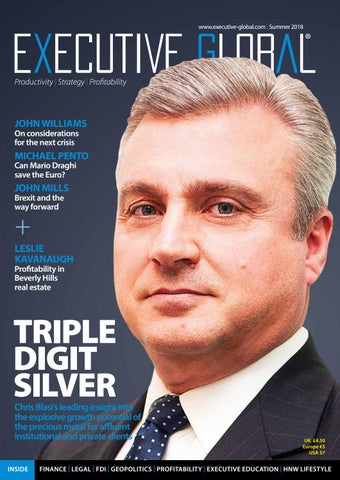
TRIPLE DIGIT SILVER
Chris Blasi’s leading insight into the explosive growth potential of the precious metal for affluent institutional and private clients
INSIDE
UK £4.50 Europe €5 USA $7
FINANCE | LEGAL | FDI | GEOPOLITICS | PROFITABILITY | EXECUTIVE EDUCATION | HNW LIFESTYLE
AFR A M E R I C A N
8 8 8 . 212 . 3752
FA R M+R A NCH
K AMBAKO GAME RESERVE
Mozambique, AFRICA / 700,000± Acres / Request Price AFR INTERNATIONAL SPORTING PROPERTIES 888.212.3752 / AmericanFarmandRanch.com
VALLEY PARK R ANCH
A M E R I C A N FA R M A N D R A N C H .CO M
GREER FARM
Daingerfield, TX / 385± Acres / $2,650,000 CENTURY 21 HARVEY PROPERTIES 800.785.8495 / C21Farm-Ranch.com
DOUBLE DOVE R ANCH
Lipscomb Co., TX / 1,219± Acres / $3,300,000 CLIFT LAND BROKERS 806.333.2346 / CliftLandBrokers.com
Waller County, TX / 199± Acres / $4,600,000 DEITRA ROBERTSON REAL ESTATE, INC. 832.642.6789 / IKnowRanches.com
KUBAL A RETREAT
T WO CREEKS LODGE ON TOM MINER
Groveton, TX / 299± Acres / $2,500,000 JACOBS PROPERTIES 936.597.3301 / TXLand.com
AFR INTERNATIONAL
SPORTING PROPERTIES Marketing to the World
Paradise Valley, MT / 20± Acres / $1,324,000 LEGACY LANDS, LLC 406.223.6872 / LegacyLandsLLC.com
YOUR SOURCE for the FINEST rural REAL ESTATE • Invitation-Only Rural Broker Network • Farm & Ranch Management
ELK MOUNTAIN RESORT
Ouray County, CO / 275± Acres / $17,950,000 LONE EAGLE LAND BROKERAGE, INC. 970.209.4400 / EagleLand.com
SPECIE WILDERNESS RANCH – AUCTION: 9/17 Placerville, CO / 551.80± Acres / $5,950,000 RANCH MARKETING ASSOCIATES 970.948.1333 / RMABrokers.com
UNDEVELOPED COASTAL PROPERT Y Collegeport, TX / 79.159± Acres / $925,000 TAYLOR LAND INVESTMENTS 281.679.5101 / TaylorLandInvestments.com
• International Estate Program
THE OW R ANCH
Sheridan Co., WY / 48,975± Acres / $25,000,000 POWERS LAND BROKERAGE 307.217.2777 / PowersLandBrokerage.com
EL COR A ZON R ANCH
Waller, TX / 381± Acres / $13,950,000 SUPERIOR TOWN & COUNTRY REALTY 800.275.3892 / SuperiorTownandCountry.com
RUDIO MOUNTAIN R ANCH
Dayville, OR / 24,178± Acres / $27,950,000 THE WHITNEY LAND CO. 541.278.4444 / WhitneyLandCompany.com
R E C A L L C A PI TA L S E We offer tailor-made financing and trading solutions
The drop-story is simple, if we do it right once the clients spread the word just like rings in the water. AND we don’t want to be considered as just another wave in the ocean. We do things differently and more efficient.
W E H E L P L I S T E D C O M PA N I E S G R O W.
R E C A L L C A PI TA L S E Enhagsvagen 18 187 40 Taby Sweden Email info@recallcapital.com Web www.recallcapital.com Call +46 (0) 8 33 9040
CONTENTS
SUMMER 2018
EXECUTIVE GLOBAL
32
26
24 EDITOR-IN-CHIEF John Marshall
HEAD OF PRODUCTION Peter Green EDITORIAL Thomas Hughes, Rachel Smith, Oliver Taylor ART DIRECTION & DESIGN Stormcues Limited BUSINESS DEVELOPMENT Steve Williams, David Warmann, Jack Moore, David Goldwin, Mike Walsh COMMERCIAL DIRECTOR Luke Francis PHOTOGRAPHY James Drake, Sarah Dean Executive Global Magazine is published by: Stormcues Limited 405 Kings Road Chelsea London SW10 0BB Tel: +44(0)207 993 4782 www.executive-global.com ADVERTISING advertising@executive-global.com EDITORIAL editorial@executive-global.com The information in this publication has been obtained from sources the proprietors believe to be correct, however no legal liability can be accepted for any errors. No part of this magazine may be reproduced without the consent of the publisher. Executive Global is registered trademark ® of Stormcues Limited. Copyright © 2018 Stormcues Limited. All Rights Reserved.
4
• Productivity, Strategy, Profitability
COVER FEATURE Triple Digit Silver
The ultimate margin call 26
24
Oliver Taylor comments on Central Bank policy, drawing paralells with the 2011 feature film.
Our cover feature and CEO Profile examines opportunities for investment in an undervalued asset as we look at the prospects for Triple Digit Silver in an interview with Chris Blasi, President of Neptune Global Holdings.
Distributed ledger technology
PROFITABILITY
Jersey and Private wealth
Profitability in Beverly Hills
Alexa Saunders, Partner at Carey Olsen, looks at Jersey’s appeal for private wealth restructuring.
22
Executive Global’s bespoke series of interviews on Productivity, Strategy, and Profitability. Leslie Kavanaugh, CEO of Leslie Kavanaugh Homes, talks to us about luxury Beverly Hills real estate.
Guernsey’s private wealth sector 34 Russell Clark and Chloe Carnachan discuss trust and private wealth matters for HNWIs.
16 Harnessing slowly, riding fast
18
John Wiliams provides his expert analysis on the economy and financial markets.
Can Mario Draghi save the Euro? 20 Michael Pento delivers his expert analysis on macroeconomic trends and banking.
32
Gomez Tomiczek on the benefits of incorporation in this dynamic jurisdiction.
Ian Gillies, Partner at Hamilton Wealth Management discusses family office solutions.
Investment considerations
LEGAL & ADVOCACY
Company formation in Panama 36
FINANCE How the wealthy invest
30
Oliver Taylor reports on the blockchain.
38
Vladimir Biriulin of Gorodissky & Partners speaks about anti-piracy legislation in Russia.
A Rare Offering 1 4 0 5 C E D A R AV E . C O M F O R M O R E D E TA I L S C A L L F O R A P R I VAT E S H O W I N G . $ 2 , 9 9 5 , 0 0 0
Elegant Victorian Farmhouse in Historic Downtown Napa offers classic architectural details with all the modern conveniences required by today’s most discriminating buyer. 3168 SF Main Residence, 3 bed, 2.5 bath • 720 SF Guest Residence - perfect caretaker unit, au pair or income producing opportunity • Situated on 2 parcels totaling 1.25 acres. • Magnificent setting along the Napa Creek with Majestic heritage trees • Abundant Outdoor Amenities • Stunning Style in Every Room • Attention to Detail is Unmatched • Build in 1872, extensively remodeled 2014-2016 • Fully Furnished
ELLEN POLITZ
Associate Partner (707)363-2133 epolitz@terrafirmaglobalpartners.com www.rereader.com/epolitz
terrafirmaglobalpartners.com
CONTENTS
SUMMER 2018
EXECUTIVE GLOBAL
66
40
68 FDI & INWARD INVESTMENT The possibilities in Panama
AVIATION
40 Choosing quality with Air Canada 54 Willow Creek Estancia
Thomas Hughes reports on the advantages of doing business in Panama.
Rachel Smith looks at luxury travel experiences with Air Canada First and Business class.
A taste of the TCI
42 Extravagance or We look at why this beautiful destination is also efficient planning? favourable for business and banking.
Liechtenstein as a jurisdiction
44
The impressive Learjet 60XR
GEOPOLITICAL AFFAIRS
EXECUTIVE EDUCATION
The future of the Petrodollar
50
Thomas Hughes comments on the notion of a Federal European Superstate and the ramifications for sovereign nations.
Brexit: The way forward
52
John Mills looks at the ‘no deal’ scenario and future prospects for British businesses.
6
60
Mariella Olivos Rossini delivers her insight into entrepreneurship.
48 Future of management education 62
Oliver Taylor looks at developments with the PetroYuan and implications for the USD.
The United States of Europe
58
We see why the Learjet 60XR is ranked one of the top luxury private jets on the market.
46 Management education
Rachel Smith reports on the global impact of the recent punitive Trump Tariffs.
56
Chris Tofts, CEO of 365 Aviation, on the advantages of travelling by private jet.
Stefan Kremeth, CEO and Co-Founder at Incrementum AG, on what makes the region attractive for wealth management services.
Tariffs and trade wars
LUXURY LIFESTYLE
• Productivity, Strategy, Profitability
Professor Tony Travaglione on how high quality management education can help us solve bigger problems in our global society.
Saudi Arabian business education 64 Andrew Main Wilson, Chief Executive of the AMBA, looks at Saudi Arabia’s transition to a knowledge-based economy.
66
Patricia Kramer and Cathy Gilchrist-Colmar lead us to an extraordinarily rare find of a property which is one of the most significant ranches in the Covenant of Rancho Santa Fe.
The Super Jumbo mortgage Thomas Hughes explores luxury home financing options for affluent individuals.
68
IN HOUSTON, TEXAS Luxury HOMES
SHADYSIDE | 2 Longfellow Lane Offered at $15,000,000
TOMBALL | 19055 Hufsmith Kohrville Road Offered at $11,995,000
MEMORIAL | 3 Greenbay Circle Offered at $2,675,000
TANGLEWOOD AREA | 5202 Green Tree Road Offered at $2,999,500
MEMORIAL | 526 W Friar Tuck Price upon request
RIVER OAKS | 3210 Ella Lee Lane Offered at $2,995,000
RIVER OAKS | 1721 River Oaks Boulevard Offered at $10,950,000
Let Walter give you a video tour of these homes at
WalterBering.com
Martha Turner Sotheby’s International Realty #1 Top Producer | 2007, 2011, 2013 & 2017
Contact me with all your real estate needs:
Walter Bering BROKER ASSOCIATE | Circle of Excellence, Hall of Fame
713.851.9753 | walter.bering@sothebyshomes.com
“Historic La Canada Flintridge Williamsburg Colonial” A PAU L W I LL I A M S S I G N AT U R E H O M E
Brent A. Ballard (818) 919-0282 www.soldbyballard.com ballardbrent@outlook.com CalBRE# 01297151
• 4 bedrooms • 6 bathrooms • 5400 sq. ft (measured) • 26,021 sq. ft lot (per assessor) • Paul Williams designed in 1929 • Home of Katharine B. Flint (wife of Senator Frank Flint) • Original columns, wood floors, and moldings • Spacious living room with fireplace • Formal dining room • Mahogany wood paneled office • Gourmet granite kitchen with butler’s pantry • Four private upstairs suites • Custom wine cellar • 3 car garage plus motorcycle garage • Outdoor patio with mountain views • Spacious grass area • Swimming pool and spa • La Canada Flintridge Landmark Home!
524 DARTMOUTH PLACE, LA CANADA FLINTRIDGE, CA
Originally built in 1929 for Katherine B. Flint, the widow of La Canada Flintridge developer, Senator Frank Flint, this American Colonial home is the product of world renowned architect Paul Williams. The classic columns, moldings, and floorplan epitomize the work of William’s historic California legacy. Upon entering this 5400 sq. ft home, your eyes will be drawn to the timeless moldings, hardwood floors, interior columns, and marble fireplace found in the living room. Glass doors lead to a stunning mahogany wood paneled office with custom built ins. The dining room continues the theme of decorative moldings and leads to the butler’s pantry, updated kitchen and family room. Other first floor amenities include a powder bath, work-out/spa room, laundry, and access to a custom-built wine cellar. The grand stair case leads to three en-suite bedrooms, including the master that boats a walk-in closet and jacuzzi tub. A back staircase leads to a fourth upstairs bedroom suite and sitting area, ideal for in-laws or guests. The backyard is prime for entertaining and refined living starting with the veranda/patio off the family room and ending with the spacious grass area, swimming pool, and spa. Designed by an architectural legend, host to dignitaries and politicians, and loved and cared for over the years by its homeowners, 524 Dartmouth Place truly is a historical La Canada Flintridge landmark estate.
OFFERED AT $4,398,000 www.524dartmouth.com
Anderson Ballard Companies, Inc. 1313 Foothill Blvd Suite 8, La Cañada www.AndersonBallard.com
EDITOR NOTE
Foreword
EXECUTIVE GLOBAL Editor’s Note
Government Interventionism & The Market Markup The illusion of stability in the market maintains our hopes in the economy and the alleged success of our governments. Our faith in the system depends on economic prosperity, on the idea that business is going well, that this system promotes good conditions for trade and the avenues for profit are constantly growing. The reality, however, is a little different from the expectation. he global markets are currently in a precarious position, reaping the fruit of erstwhile glut and going through a period of volatility. Letting it be put on display, of course, would be detrimental to the general confidence in the government’s ability to ensure the smooth functioning of the economy. Therefore, central banks around the world have been endeavouring corrective action and actively buying stocks. This practice distorts the real stock prices, because central banks - with their purchasing power - have little care for the value of the shares they acquire as they focus on the task of pumping more money into the market. The influx is thus artificial and the banks’ venture into the realm of investment brings with it potentially dire consequences for the health of the global economy, as increasingly greater reserves are being invested into corporate bonds, equities and other chancy assets. Stock market valuations are not real. The central banks have nowhere else to unwind their balance sheet, thus they have turned to the equity markets. Of course, as they are buying up all the stock to conceal much deeper economic issues at hand, what it could lead towards is a market melt-up. Could the practice of central banks buying major stocks bring the DOW up to 50,000 and deter investors from buying bonds altogether? If you are questioning the gravity of those implications and the depth of the central banks’ reach in the free market, consider the fact that the Central Bank of Switzerland, for example, currently holds the most shares in Facebook, as
T
10
executive global • Productivity, Strategy, Profitability
well as a significant proportion in major companies such as Apple, Google, Microsoft and Amazon. Central banks are investing into some of the world’s greatest businesses with money that exists only because the central banks themselves have conjured it. This approach is invasive, interventionist and alarmingly reminiscent of the central planning that is characteristic of communist regimes. In fact, central banking itself is one of the major planks of the communist manifesto. The velocity of money has hit its lowest point and there is now a liquidity crisis underway, leading big companies to buy and sell their own stock in order to accrue their stock prices, ensure better market capitalisation and hopefully survive an illiquid market. The interventions of central banks and governments attempt to keep the feeble house of cards that is the economy from crashing down, however their practice only amplifies the imminent impact. The true path to profitability can only be achieved by allowing free market enterprise and individual liberty to remain unadulterated by government intervention. EG
John Marshall John Marshall Editor-in-Chief, Executive Global
Offered For Sale at
$10,680,000 Located in the prestigious Point Dume area, this exquisite Nantucket home has been meticulously remodeled with the utmost of care to detail. The home has 6 bedrooms, 7 baths and a 2-story/2 bedroom guest house. Amenities include home theater, pool and spa, outdoor entertainment area, Zen Garden, all on over an acre of land with unobstructed views featuring Queens Necklace. This is truly a unique property!
LesLie Kavanaugh
REALTORÂŽ DRE License #00807553
Office: 310.432.7232 Cell: 310.413.1171 Leslie@Kavanaughhomes.com www.LeslieKavanaugh.com Rodeo Realty, Inc. does not guarantee the accuracy of square footage, lot size or other information concerning the property provided by the seller or obtained from public records or other sources. This is not intended as a solicitation if your property is already listed.
WILLOW CREEK ESTANCIA
RANCHO SANTA FE, CALIFORNIA Discover this remarkable estate in the Rancho Santa Fe Covenant, an affluent coastal community in North San Diego County. The owner carefully selected these seven adjacent parcels to create a secluded luxury property comprised of more than 77 acres complete with its own private bass-filled lake. Located just minutes from beaches, the Del Mar Racetrack, and several golf courses, the immaculate grounds offer a private setting of quiet riding trails, majestic trees, and colorful gardens. Designed by renowned architect Marc Appleton, the 15,000 SF main residence emulates classic Santa Barbara architecture and celebrates indoor/outdoor living with a spacious airy ambiance, intimate settings, and formal rooms for elegant entertaining. For the equestrian, there is a main barn with 27 stalls, a six-horse walker, multiple grooming areas, several tack rooms, zoned water systems, and a farrier area. Ensuring an unmatched Southern California lifestyle, this compound offers multiple amenities including a guest house, recreation pavilion, pool, and tennis court, plus mesmerizing beauty at every turn.
Call for pricing and private showing. PATRICIA KRAMER
DRE #00825701
858.945.4595 | patricia.kramer@sothebysrealty.com
CATHY GILCHRIST-COLMAR
DRE #00517562
858.775.6511 | cathy@ranchosantafeca.com Sotheby’s International Realty® is a registered trademark licensed to Sotheby’s International Realty Affiliates LLC. An Equal Opportunity Company. Equal Housing Opportunity. Each Office is Independently Owned And Operated. DRE #01767484
L u x u r y h o t e l s , exc l u s i ve p e r k s , and best rates guaranteed K I W I C O L L E C T I O N .C O M
Mondrian South Beach | South Beach, United States
FINANCE
Hamilton Wealth Management
How the Wealthy Invest and how aspiring investors can access similar solutions The wealthy investor and how to access family office solutions without running a family office. Article by
Ian Gillies
PARTNER, HAMILTON WEALTH MANAGEMENT
ealthy investors invariably seek the most efficient avenues through which to invest. As the value of their wealth grows investors, particularly single-family groups, turn to family offices for investment purposes. One of the earlier examples of family office investing is believed to have been applied by the House of Medici in Florence in the 15th century. Since then many other wealthy families have taken similar approaches to stewardship of their wealth. Whilst there may be many different versions of a family office there are two key structures used by wealthy families for investing. These are a singlefamily office (SFO) used by individuals or singlefamily groups or a multifamily office (MFO) which manages the wealth of several individuals and/or families. A single-family office (SFO) in the purest sense is an office established and staffed to manage one family’s wealth. Reasons why a family office may be established include governance and management structures to ensure the wealth is managed in a transparent manner thereby reducing potential
W
16
family conflicts; alignment of interest with financial advisers who may be engaged by the SFO; separation of the family business from the family wealth; central management of risk as well as other services (wills, estates, trusts, tax, accountancy etc), financial and strategic planning as well as concierge style services. The office will also decide on which investment assets will be managed in house and which assets will be managed by external parties. SFOs are not usually established until the family has a minimum of $150 million of investable or investment assets. A Multi Family office (MFO) is a family office established to provide family office-like services to wealthy individuals who either choose not to establish their own SFO or have not yet sufficient wealth accrued to warrant establishing their own office. One reason is that the cost of establishing one’s own SFO may prove prohibitive based on the investor’s goals and services they wish to insource. In some cases a SFO may extend its service offering outside of the family to other wealthy investors seeking similar services effectively becoming a MFO. Multifamily office service offerings invariably require a minimum investable asset balance (e.g. $30 to 50 million) to be committed by external parties to use the MFO services. The advantages offered by Family Office structures come at a cost, specifically the cost establishing and operating the office. Wealthy individuals and families
• Productivity, Strategy, Profitability
are usually very adept at identifying the cost benefit analysis in creating a family office. If they see value in doing so they will if not they don’t. In many cases this may also be a reason why an investor will seek MFO investing. INVESTING AS AN SFO OR MFO Investing as either a SFO or MFO allows the investor to utilise institutional style investment with the attendant cost and return advantages. Other advantages Family offices have is being able to originate their own deals and invest in deals bought to them as they have the due diligence capability in-house. Often, they will consider co-
INVESTING AS EITHER A SFO OR MFO ALLOWS THE INVESTOR TO UTILISE INSTITUTIONAL STYLE INVESTMENT WITH THE ATTENDANT COST AND RETURN ADVANTAGES.
FINANCE
Hamilton Wealth Management Photo: imageBROKER / Alamy Stock Photo
investing with other family offices. Over the years the increasing number of Family Offices has meant that many more are electing to invest directly into private equity deals and other opportunities rather than in deals brought to them by bankers and investment advisers. This allows for the Family Office intellectual property to be applied to all manner of investment opportunities if it meets the desired hurdles and due diligence. Family offices are often much nimbler in making their investment decisions. This is very true of offices where the original wealth generator is still active. There are almost as many versions of family offices as there are wealthy families, although all are established for one key purpose and that is the efficient, effective management of their wealth. An additional advantage of family offices is that they enable investors to benefit from institutionalstyle investment opportunities with their attendant economies of scale. The style of investing may vary with a SFO compared to a MFO, as whilst both may choose to invest for much longer investment time horizons, the SFO is often best suited to do so with long term patient capital, as there is only one family unit. Family offices firstly identify the goals, intentions, values and attitudes – their investment filter through which they will consider investments and subsequently make their investment decisions. www.executive-global.com
Many of these offices are increasingly placing an Environmental, Social and Governance (ESG) lens over investments they are considering. Multi family may act in concert with other investors and co-invest. Family offices approach investing similarly to institutional investment houses, but often with different investment parameters (e.g. time horizon, risk tolerance). Family offices also value discretion and confidentiality with their investing activities and investing through either of the structures with an institutional investment outlook affords the investor the valued discretion. EMERGING TRENDS With the increasing investor interest in investing similarly to Family Offices but not yet having the capital to meet the threshold for investment through a multifamily office, how does one invest? Managers who offer direct access to their style of investment in an institutional market to family offices are increasingly commencing to offer their investment through an investment structure which mirrors their direct institutional investment, but allows for lower minimum investment commitments. As the investment is now under a structure there are often tax, reporting and fee differentials which one must consider and these vary from one jurisdiction to another. But how does one invest like a SFO or MFO if
one doesn’t have the required investment balance to access family office investment? Investment managers are generally making institutional style investments available to the market at large. In some jurisdictions one must satisfy a minimum value of wealth- much lower than what is required to become a client of a MFO, before one can access these funds. One key trait of Family Office investing these days is that they tend to be quite active as investors. If not in all asset classes they invest in, certainly amongst most of the classes invested in. For private investors there are active funds available which target an above index return rather than use passive funds which aim to copy the return of a market - a similar strategy to the family office. One investment style now available to investors in addition to venture capital and private equity investors is Early Stage Investing through managed style funds in successive rounds of financing (Series A, B, etc.) before a company lists. Investing in this area requires a sound and detailed working knowledge of the business model being financed and many companies do not make it to the listing stage. WEALTH AND OPPORTUNITIES Most investors in this arena expect that 7 out of 10 investments made will fail and aim for the other two or three to be successful and perform very well, in order to get an acceptable return on the initial capital invested. There are now several ‘managed’ funds for venture capital which may be accessed that allow investors to allocate funds through their structure to invest in early stage financing of company start-ups. Most of the interest these days for investors in this area focuses on IT start-ups. Investors who do not have desirable Family Office options available to them are able to access similar services from a range of other providers. There are many boutique investment and advisory houses which now offer investment advice with the specialist manager or fund alternatives sourced from a range of capable, competent and successful fund managers. These alternatives may also include direct investment on a co-investment basis like MFOs. These providers almost always offer investment advice and often one can select from a suite of other services such as financial planning, philanthropy, reporting and record keeping, governance and strategy, estate and wealth transfer, advisory and succession planning which they may provide. The investor must take time to properly undertake a scoping study to identify what services they need. The next step is to choose who will deliver those services and agree to terms for both cost and deliverables. As one becomes wealthier the investment opportunity universe appears to increase in number and offer greater personalisation. However, with the right plan and assistance it is possible to access similar investment opportunities in most cases with appropriate advice to replicate a similar outcome albeit on a smaller scale. EG
For further information, please visit: www.hamiltonwealth.com.au Summer 2018 •
17
FINANCE
ShadowStats
Investment Considerations for the Next Financial Crisis Economy and Financial Markets Are Just Booming Along, or Are They? Article by
Walter J. ”John’’ Williams FOUNDER AND ECONOMIST, SHADOWSTATS.COM
iven a recent query as to how the next financial crisis might affect interest rates, as well as personal-investment and asset-management strategies, my response here, written in early-July 2018, is predicated on no major shift in control of the U.S. Congress coming out of the November 6, 2018 elections. In that circumstance, the next financial crisis would be a fair possibility to hit sometime between now and the end of 2019. In the event the current Administration loses control of one or both Houses of Congress, market concerns for pending, debilitating political turmoil likely would trigger immediate financial-market instabilities. In the event the Administration not only retains control of both Houses of Congress, but also gains enough additional, friendly Congressional support to make a meaningful attempt to bring the federal budget deficit under control, the next financial crisis could be pushed off indefinitely (see “Extraordinary Crises and Opportunities Continue” in the Spring 2018 issue of Executive Global). Again, though, presuming no major shift in control of Congress, the “next” financial crisis easily could hit before the end of next year, with the following considerations: • The U.S. and global economies and financial systems remain well shy of full recovery from the “last” crisis, and that should become increasingly obvious to the financial markets in the months ahead. • Accordingly, the “next” crisis would be a double-dip extension, a second-stage or a moresevere down-leg to the near-collapse of the U.S. and global banking and financial systems in 2008. • That “second-stage” circumstance should lead
G
18
to much-stronger headline inflation than seen at present, along with market forces beginning to push interest rates meaningfully higher, barring massive, new quantitative easing by the Fed. • Those shifts in inflation, interest rates and accompanying financial-market instabilities should trigger an increased shift of investments into store-ofwealth assets, such as precious metals and real estate (see “Handling Difficult Times in the Markets and the Economy” in the Summer 2018 Executive Global). U.S. STOCK MARKET REMAINS AT ELEVATED LEVELS, ALTHOUGH OFF PEAK Positive stock-market hype is common within the popular U.S. financial media. Most financialmarket advertisers and media-quoted pundits, from similar institutions, look to encourage public investment in equities. That simply is the nature of the industry. In 1989, for example, as an independent, private economist, I predicted a U.S. recession in 1990, which happened. The forecast was based on a number of factors, including a year-to-decline in inflation-adjusted broad U.S. Money Supply growth, a systemic liquidity constraint that traditionally provides a leading indication to the onset of a formal recession (a similar circumstance currently is unfolding, with the Fed tightening in an environment of rising headline inflation). At the time, my outlook was far from the Wall Street consensus. Yet, I was invited to present my view on a popular business television show, along with a counter-point “consensus” view from the chief economist of a major Wall Street financial institution. We talked before the show in the studio’s Green Room. The “consensus” economist asked my view, which I gave. He shocked me with his response, “I think that pretty much is the consensus outlook.” When we got on air, though, I presented my story, and he predicted nothing but a “booming economy” in the year ahead. That was his job. Where the top two U.S. stock market indices hit historic highs in January 2018, they currently
• Productivity, Strategy, Profitability
are off those peaks by 4% to 8%. Popular-media hype remains strong both for the U.S. stock-market outlook and for purported strong economic activity, with the headline unemployment recently at an historic low. Yet all is not consistently good, as headlined. RECORD LABOUR-MARKET STRESS CONTRADICTS LOW UNEMPLOYMENT The May 2018 headline U.S. employment rate dropped to 3.75%, its lowest level since the unemployment series was redefined in 1994. Otherwise, it was at the lowest level since December 1969, when Richard Nixon was President of the United States. That should have been great economic news, but in context, it was not. Where headline June 2018 unemployment just increased to a still-very-respectable 4.25%, a problem continued with indications of a high level of stress in the U.S. labour market. The Employment-to-Population Ratio and the Labour Force Participation Rate (Labour Force/ Working-Age Population), traditional measures of relative labour-market strength or stress, should have been at record highs (strength) along with unemployment rates at record lows. Instead, these measures were near record lows (stress), still at levels that had triggered comments of concern in the last year by then-Federal Reserve Chair Janet Yellen, and more recently by the current U.S. Treasury Secretary Steven Mnuchin.
FINANCE
ShadowStats tax brackets, using understated inflation to deflate economic numbers, boosts “real” or inflation-adjusted growth in those series, such as the Gross Domestic Product (GDP). Most other countries have followed similar practices in adjusting inflation estimates. The difference of the lowered-inflation impact on headline U.S. GDP growth amounts to about twopercentage points a year, and has accounted for nearly all of the headline recovery and expansion since the 2009 trough of the popularly-named Great Recession. Expansion is measured in terms of growth above the pre-recession high, currently up by 15.9% for the GDP. Such expansion has not been matched by any other significant economic series, including employment. Major sectors of the economy such as Manufacturing and real Construction Spending remain shy of initial recovery, showing no expansion whatsoever.
Photo: Jeff J Daly / Alamy Stock Photo
Consistent with those near-record stress numbers would have been headline 10% unemployment, which would have shown the capacity for an increased employment level of an added 11 million, versus the headline-reported unemployment and employed detail. The problem and the conflict with the headline numbers out of the Bureau of Labour Statistics is that the current unemployment series was redefined at the onset of NAFTA in 1994, so as not to count “discouraged workers” for more than one year. Otherwise that population (and share of the total population) would aggregate, rather than be retired after twelve months.
PULLING THESE VARIED CIRCUMSTANCES TOGETHER SUGGESTS THAT NEITHER U.S. ECONOMY, NOR ITS STOCK MARKET, IS AS HEALTHY OR ROBUST AS PRESUMED OR ADVERTISED.
www.executive-global.com
Subsequent to the redefined series, the U.S. economy collapsed into its most severe downturn since the Great Depression, from 2007 into 2009, and as the headline unemployment rate dropped in recent years, a private, broader measure continued to track the continuing net accumulation of discouraged and displaced workers. The ratio differences here reflect issues with that population count. Some argue the difference is due to an increased portion of the population entering retirement. While that is a partial factor, it is well shy of the discrepancy. Many who had planned to retire find they cannot afford to do so, at present, as originally planned. Allowing for the build-up of the discouraged/displaced worker population otherwise fully accounts for the discrepancies in these labourmarket headline details. U.S. GDP EXPANSION MARRED BY NON-EXPANDING U.S. MANUFACTURING The U.S. government altered inflation-reporting methodologies over the last several decades to understate headline inflation, against traditional methods and common experience (see “Gold Covers Actual Inflation Risks: Irrespective of Government Reporting Games” in the Autumn 2017 issue of Executive Global). Aside from cutting government expenses such as cost-of-living adjustments for Social Security Recipients and from boosting tax payers into higher
CURRENT INTEREST RATES VERSUS INFLATION SIGNAL ONGOING SYSTEMIC CRISIS Another major signal that the economic/ financial crisis has not ended is that the three-month Treasury Bill yield remains below the headline (albeit understated) annual U.S. Consumer Price Index (CPI), a circumstance most common to meaningful recessions. Where interest rates usually float on top of headline inflation, so that investors can beat inflation, such is not possible at present, with current Treasury yields and the CPI. Separately, as a further indication of sub-normal functioning of the U.S. banking and credit markets, consider that real consumer borrowing and credit outstanding still have not recovered and have not moved beyond their pre-recession (pre-banking crisis) peak levels of activity. FALTERING ECONOMY TO PUMMEL DOLLAR, SPIKE INFLATION AND FLIGHT-TO-QUALITY Pulling these varied circumstances together suggests that neither U.S. economy, nor its stock market, is as healthy or robust as presumed or advertised. These circumstances offer parallel risks for the global economic and financial system at large. As common recognition mounts of currently deteriorating U.S. economic and liquidity conditions and softening equity-market fundamentals, pressures will increase on the Federal Reserve to ease anew. That circumstance should trigger heavy selling of the U.S. dollar, with sharply rising domestic inflation rates and upside fundamental pressures on interest rates. For those looking to move their assets into the long-term inflation hedge of real estate, consider that mortgage yields likely will be rising there, as well, along with what likely would be tightened lending conditions. Throughout the economic and financial crises of the last decade or so, holding physical gold has remained the best long-term hedge, irrespective of near-term price volatility. Held for the long-term, physical gold and silver will preserve the value and purchasing power of the funds invested in them. EG
For further information, please visit: www.ShadowStats.com Summer 2018 •
19
FINANCE
Pento Portfolio Strategies
Does Mario Draghi Have “Whatever it Takes” to Save the Euro? Michael Pento, CEO of Pento Portfolio Strategies returns to once again deliver his expert analysis on macroeconomic trends, derivatives, and the state of European banking.
Article by
Michael Pento
CEO, PENTO PORTFOLIO STRATEGIES
n the summer of 2012, the “PIIGS” (Portugal, Italy, Ireland, Greece and Spain) were finding it increasingly expensive to raise money in debt markets. Years’ worth of stagnant growth and ballooning debt caused interest rates to spike; leading investors to further question if debt service costs would soon spiral out of control. Italy, for one, had been stuck in economic malaise since the 2008 recession. To dig out of debt and spend its way to better times, the Italian government borrowed money from The European Commission, European Central Bank (ECB) and International Monetary Fund (IMF) via the three-pan European institution referred to as ‘Troika.’ During this time, Italy’s government and private debt sky-rocketed. When better times didn’t arrive, and the Eurozone slipped into a subsequent recession in 2011, Italy’s crisis simply worsened. In Greece, the crisis began in 2009. The fallout of the Great Recession, along with structural weaknesses in the Greek economy and news that previous levels of debt and deficits had been underreported by the Greek government, led to a spike in bond yields and a rising cost of risk insurance on credit default swaps compared to the other Eurozone countries--particularly Germany. In April of 2010 credit rating agencies had downgraded Greek debt to junk, leaving Greece in danger of sovereign default if they didn’t get a bailout. Once again, the three-party European
I
20
institution Troika gave Greece a €110 billion bailout loan with the condition they implement austerity measures, structural reforms, and privatisation of government assets. To satisfy these demands the Greek government enacted tax increases, spending cuts, and reforms to the chagrin of the Greek people; who subsequently rioted and led nationwide protests against austerity and the European Union (EU). THE EFFECTS OF ECB MONETARY POLICY In July of 2012, in response to civil and market unrest and soaring interest rates in the “PIIGS,” Mario Draghi addressed an audience of business leaders in London promising the ECB would ”do whatever it takes to preserve the euro.” Soon after, Draghi introduced a monetary policy that featured a massive “QE” program, which grew the ECB’s balance sheet from €2.0 trillion at the end of 2014 to roughly €4.5 trillion in late May of 2018. This intervention caused the bank’s official
• Productivity, Strategy, Profitability
borrowing rate to plummet to slightly below zero percent by June of 2014 In Italy, the liquidity and reduced yields provided by Draghi’s QE provided a temporary salve to the nation’s debt service cost but didn’t do anything to reduce its debt loads—in fact; it only exacerbated the insolvent condition. In order to save the euro currency, what Mr. Draghi actually accomplished was to ensure Italy’s eventual debt default. Today Italy is drowning in debt; government debt is 130% of GDP--the second highest in the Eurozone and the fourth highest in the world. But, its private sector and bank debt are even worse: Italian banks are saddled with nearly $300 billion
ITALY GOVERNMENT DEBT TO GDP 131.8 129
131.5
132
135 130 125
123.3
115.4
131.8
120
116.5
115
112.5
110 105
102.4 2008
2010
2012
2014
2016
100 2018
SOURCE: TRADINGECONOMICS.COM | NATIONAL INSTITUTE OF STATISTICS (ISTAT)
FINANCE
Pento Portfolio Strategies Photo: Alexandros Michailidis / Shutterstock.com
in non-performing loans that were never written off their balance sheets after the 2008 financial crisis. Today Italy is reminiscent of Japan in the 1990’s, with zombie banks and an economy embroiled in a lost decade of growth. Despite being the Eurozone’s third-largest economy, Italy is plagued with high unemployment and rising poverty and has grown less than any of its partners since the start of the monetary union in 1999. This year Italy was hoping for a 1.5% rise in growth, however, with the second quarter forecasted at 0.2%, many economists are now anticipating full-year expansion of just a lacklustre 1.2%. This assumes an early truce in the incipient U.S. vs. the rest of the world trade war and quiescence in European borrowing costs. As the elites in Europe bask in the wealth created by their dalliance with globalism--the middle class in Italy, Greece and the other ‘PIIGS’ countries are suffering. This has led to a rise in the populist movement 5-Star in Italy and SYRIZA in Greece. Austerity that had sought to reduce spending and related debt loads has been usurped by calls for Universal Basic Income and other spending measures that would add even more to the debt. Greece currently has a public debt burden of close to €500 billion (contingent liabilities included) that is supported by a private sector that is just €80-90 billion. In total, thanks to low borrowing costs provided by the ECB, the Greek debt to GDP ratio has soared to 180% of its economy. And like Italy, its banks are infected with non-performing loans, and it has a staggering www.executive-global.com
youth unemployment rate of over 30%. Italy is the latest country in the PIIGS riding the anti-elitist wave, and it could prove to be the most troubling for the entire Eurozone. The Italian economy accounts for about 15% of Eurozone GDP and 23% of the region’s government debt. To put this in perspective, when the crisis hit Greece, it had just over 3% of Eurozone public debt. PAN EUROPEAN BANKING CRISIS Up until now the Troika and the European elites have done a good job in squashing populist EU-resistance governments as they emerge—just like they did with SYRIZA in Greece. And after some initial grandstanding followed by a huge spike in Italian bond yields, Italy’s new coalition government seems to have fallen in line, at least for now. Economic Minister Giovanni Tria recently assured that Italy has no intention of leaving the euro and plans to focus on cutting debt levels. However, Italians may soon realise that unlike Greece, they are too big to fail because their private banking system is technically insolvent. Threats to withhold lending to Italy’s central bank would lead to contagion in French banks, such as Credit Agricole and BNP Paribas; and with German banks, like Deutsche Bank, that also have huge exposure to Italian debt. Furthermore, financial instability in the region has led TARGET2 divergences to widen. TARGET2 is an interbank payment system for the real-time
processing of cross-border transfers throughout the EU. Even though following TARGET2 levels is about as interesting as watching a member of the FOMC give a lecture on the Phillips Curve model, it is important to have a cursory understanding of how this affects the region. When the Greek debt crisis began in 2010, money started to pour out of Europe’s periphery and went mostly into Germany, increasing the imbalance of TARGET2 with the PIIGS. A PRECARIOUS SITUATION Today those balances are bigger than ever with surpluses totalling €1.3 trillion during March in Germany, Finland, Luxembourg, and the Netherlands. The rest of the Eurozone has a net deficit of €1.0 trillion. If one of the central banks were to renege on its obligations, the countries most on the hook for that debt is proportioned according to their capital balances. This is the socialisation of risk the European elites have placed on the more prosperous member countries. With massive liabilities in the PIIGS, if one were to exit the Eurozone and declare insolvency, Germany’s liability would amount to 33% of their unpaid balances according to the ECB capital key. Since Italy’s public debt it is seven times bigger than Greece, the nation is not only too big to fail, but it may also be too big for Mario Draghi’s “whatever it takes”. This is because the amount of money the ECB would have to print to monetise Italian debt should be enough to completely destroy faith in the euro as a viable reserve currency. This is the fattail risk investors need to consider: whether Italy is rescued by the ECB or ends up in a divorce from Brussels, the end of the euro currency could be nigh. An “Italeave” would open the door for the other PIIGS to thumb their noses at the EU and restart their individual domestic printing presses. The truth is the idea of a failed euro should not lie that far outside the norm. Remember, there has been no fiat currency that has ever withstood the test of time. To have faith that the euro is an unbreakable proxy of European accord is to forget the centuries of war the continent has suffered amongst itself. To believe Eurozone unity is now indestructible solely because it has temporarily cobbled together a monetary union, which is plagued by balkanised fiscal policies, is combatting the whole of history and economics. The truth is the euro is bound to fail--and there isn’t much Draghi or his successor, can do to stop that inevitability. And while the U.S. dollar continues on an inexorable course to lose its world’s reserve currency status, the collapse of the euro should buy the Greenback just a little more time. Nevertheless, the most important take away is that the accesses evident in the Eurozone economy were not at all confined to just the PIIGS. In fact, the globally synchronised recovery mantra from Wall Street is now behind us due to the impending collapse of the worldwide credit bubble. This just happens to coincide with the apogee of euro influence, which is now quickly fading in the rearview mirror. EG
For further information, please visit: www.pentoport.com Summer 2018 •
21
PRODUCTIVITY STRATEGY PROFITABILITY
Leslie Kavanaugh Homes
PROFITABILITY
Profitability in Beverly Hills real estate Interview with
Leslie Kavanaugh PRESIDENT & CEO, LESLIE KAVANAUGH HOMES
Our special interview on Profitability with LESLIE KAVANAUGH of Kavanaugh Homes, a Luxury Division of Rodeo Realty in Beverly Hills, California, delves into the familiar world of multimillion dollar luxury real estate as Executive Global profiles one of the top producing agents in Los Angeles serving the Westside communities of Bel Air, Hollywood, Santa Monica, Brentwood, Pacific Palisades, Malibu and Beverly Hills for the inside scoop on a highly attractive market that can maximise returns for investors.
As an award-winning real estate professional with Rodeo Realty, and among the top 1.8% of NRT’s 54,000 agents, what three factors do you feel make a successful realtor? The key factors to success are perseverance, LK knowledge of the market place and superior service to the client. What are some of the main features that EG make Beverly Hills such an attractive location for real estate? On a personal level, I grew up in Beverly Hills LK and Beverly Hills has remained a part of my life. It is a community that has a diversity of types of homes from the flat areas through the hills with views including the most beautiful and elegant neighbourhoods in the world. Beverly Hills is a thriving suburb with world famous Rodeo Drive and rivals cities anywhere for the best public services and schools. Although, it is in the heart of a big metropolis, the residents are involved in maintaining Beverly Hills as one of the most desirable and livable cities. What is the biggest real estate deal you have EG ever done and what enabled you to succeed here? In order to answer this properly, I need to LK extricate myself from the price and focus on the buyer and seller. It is not about how big the deal is (my biggest deal has been in the tens of millions EG
22
and I currently representing a $25M and an $11M property), but is it about the negotiation process, bringing the buyer and seller and any of their business managers, professional managers or consultants to the table so that each side feels confident their needs have been met. No matter how large or how small the deal is, the principles remain the same. In what ways does having a thriving film and EG entertainment industry on your doorstep affect profitability in this market? The film industry and the music industry both LK bring an allure to the area. The community is filled with entertainment peripheral employment from talent to attorneys to agents to managers to support staff. Because Beverly Hills is such a desirable city in which to live with a limited number of properties, the prices are driven up as is profitability. You are involved in a lot of charitable EG organisations. How important is giving back to the community? Yes, I am involved with Jewish Big Brothers LK Big Sisters Los Angeles, Friends of Robinson Gardens, AVIVA Family and Children’s Services, Stop Poaching Now, Blue Ribbon, Los Angeles Ballet, Art of Elysium, Cedars Sinai and City of Hope. My father was a philanthropist and my mother recalled stories of my Nana who, during World War II, invited strangers into her home to
• Productivity, Strategy, Profitability
have them join her dining table so no one would go hungry. Giving back has always been a very integral part of my life. What crucial factors are necessary to EG successfully sell a property at the maximum asking price in Beverly Hills? The crucial factor is the initial pricing of the LK property, as this attracts buyers who are knowledgeable of properties in these price ranges. No matter what the vintage of the house, having it in its best possible condition so that it shows well, is important. Lastly, the availability to show the property, whenever a buyer wants to view it, is key. You have stellar reputation. What can EG affluent clients expect when having their luxury homes represented by you? They can expect that I will bring excellence, LK integrity, honesty, commitment and experience to the selling of their home. My team and I are truly “hands-on” and available each step of the way to provide the best possible service in marketing, showing the property, client relationships, agent to agent relationships, negotiations, expertise and knowledge to all parties involved. EG
For further information, please visit: http://lesliekavanaugh.com Leslie@Kavanaughhomes.com 310-432-7232
The key factors to success are perserverance, knowledge of the market place and superior service to the client
FINANCE
Central Banking
Central Banking and The Ultimate Margin Call The financial crisis of 2007-2008 was the work of greed, enabled by the power of credit. It was a groundbreaking event that shook the American, the western and the worldwide economy at its very foundations and though central banks do their best to project an illusion of stability after the collapse has rocked their system, the crisis continues to affect the lives of millions of Americans to this day, writes Oliver Taylor. s a matter of fact, some even say that the crisis has never truly ended and we are simply sailing the end of the first wave until the next one comes crashing over our heads even harder. Whilst credit is a powerful economic device when it is used wisely, it can also lead to a catastrophe when it is abused for shortsighted, rapacious profit. On one hand, in reasonable amounts, credit can benefit the inauguration or the expansion of a business, which in its own turn will create new jobs and contribute to the growth of the economy. On the other hand, new lines of credit are not fished out of a bottomless well, thus if the country’s economy relies too much on debt, when it reaches the limit of viability everything begins to crumble. What transpired in 2008, was the result of unrestricted, unregulated credit that became commonplace over the course of the previous decade. Cheap credit resulted in an increased supply of money, which made people feel richer and consequently spend more, however as they all flocked to the same product - real estate, the increased demand caused inflation which resulted in a massive real estate bubble. Mortgage loans
A
24
became ever more daring and risky, while mortgage brokers released themselves from any obligation or responsibility by passing on these dangerous mortgages to others under the guise of packaged investments - mortgage backed assets. Considering how easy it has become to obtain a loan, people took out loans that were much greater than what they could actually afford, bought houses with those loans then sold them for profit. Whilst many people did get very rich off this system, many more mortgage packages that were sold off by the brokers were toxic and it was just a matter of time before they poisoned the credit-based American market. Surely enough, as the U.S. was and still is at the forefront of the global economy, any collapse within the country would be inevitably felt across the entirety of the world. EXCESSIVE LEVERAGE Consequently, the bubble burst at last and the housing market went down, dragging along with it the rest of the economy. As thousands of individuals defaulted on their mortgages due to the sudden rise in adjustable mortgage rates, it turned out to be a back-breaking problem for the financial institutions
• Productivity, Strategy, Profitability
and investors that were left with the responsibility for these loans by the cunning machinations of mortgage brokers. With mortgage backed securities crashing in value, investment firms and banks found themselves losing massive amounts of money, while more and more people chose to simply abandon their homes rather than pay their mortgage due
THE DIFFERENCE, WHICH IN FACT MAKES THE NEXT COLLAPSE THAT MUCH MORE SUBSTANTIAL, IS IN THE INSTITUTIONS THAT WILL BE UNLOADING THEIR TICKING TIME BOMBS OF TOXIC ASSETS.
FINANCE
Central Banking Photo: AF archive / Alamy Stock Photo
to a drop in real estate value. In response to this fiasco, banks attempted to overturn the situation by implementing stricter lending conditions, however at this point it was already too late. As a result, many institutions were bought out, others have merged, some were fortunate to benefit from government bailouts and some simply collapsed. Seeing as the effects of the 2008 financial crisis have continued to upset the economy throughout the following decade and the market has never truly been stabilised, the possibility of another, even greater crash is becoming ever closer to reality and, according to some economists such as James Rickards and Harry Dent, the next crisis is to be expected within the coming 3 years if it has not already begun. Knowing well that credit is exactly what has initially landed us in this predicament 10 years ago, banks have deliberately resumed giving out new debt in order to sustain the economy in its current unstable state, which is understandable, because the American economy fundamentally functions on credit. However, in order to remain maintainable, that credit must come with safeguards and lending regulations to keep it from degenerating. After all that has happened, one would think that they have learned from erstwhile mistakes, www.executive-global.com
yet once again, we find ourselves in a situation where the inadequate use of debt threatens to treat the world to another grand disaster. A MARGIN CALL FOR CENTRAL BANKS If we are to expect a new catastrophe, in order to understand and to prepare for the upcoming collapse, it is crucial to know what financial institutions have grasped from the events of 2008 and what they may be willing to do in the future. So what did happen behind the doors of investment banks and other financial institutions during the last crisis? Margin Call - a 2011 American independent drama film, offers us first row seats to the manoeuvres of investment bankers faced with the inevitability of a collapse. It tells the tale of an investment bank during the early stages of the 2008 financial crisis, focusing on a group of employees that takes action to mitigate their losses on the eve of the imminent collapse. The film is based on a true story, which is not surprising, as several firms must certainly have done the same. In a nutshell, a junior analyst learns of the danger that mortgage-backed securities pose to his company, putting it under the threat of bankruptcy as the volatility of its mortgage-backed
securities portfolio is about to overreach its value at risk due to excessive leverage. If the firm’s assets decrease by 25%, the loss will be greater than the actual value of the firm itself and it will find itself in ruin. As the information is passed up the chain of command and finally reaches the CEO, the latter devises a plan to salvage the firm by selling off all of their toxic assets before the rest of the market learns of their worthlessness. By doing so, the company will be effectively wrecking its professional integrity and jeopardising the trust of its counter-parties and investors, while its traders will be ending their careers as they compromise relationships with their clients. However, were the company to become insolvent, none of it would matter, therefore it opts for the sell-off and successfully gets rid of its toxic assets. While this manoeuvre averts the disaster for the firm itself, it consequently sets in motion the events that lead up to the global collapse that still haunts us to this day. The most interesting and perhaps the most important merit of Margin Call is its ability to demonstrate not merely the ravenous greed that is at the root of the crisis, but the consequences of that greed upon institutions and individuals, and the action that people are prepared to take when their financial welfare is at the risk of failure. In the effort to save its own hide, the investment firm readily sets up its peers by dumping its problems on them and in the process, those problems proliferate to catastrophic proportions. WHEN THE BALANCE SHEETS UNWIND Although Margin Call was based on the events that transpired in 2007-08, it is still very much relevant today, as we stand on the verge of a new crisis. The similarity with the crisis then and the one upcoming is the presence of toxic assets that were created as a result of unrestricted credit. The difference, which in fact makes the next collapse that much more substantial, is in the institutions that will be unloading their ticking time bombs of toxic assets. Whilst the financial crisis of 2008 came to be due to rampant credit practices that fuelled the greed of mortgage brokers and forced the hand of investment firms, the next wave is going to involve central banks, for they too are not exempt from the consequences of the poor use of debt. Years of unsterilised monetary intervention through quantitative easing and interest rate suppression in order to maintain an illusion of economic stability, will inevitably catch up with them as well and just like the investment bank in Margin Call, the central banks will at some point find themselves in a position where they must unload their toxic derivatives upon a beguiled populace that has been sold the greatest marketing campaign in modern history - quantitative easing. The same people that were lead to believe that the economy was back into its normal course, the same people that trusted the central banks when the latter reassured them that the markets are fine, they will be the same people that will be left holding the bag when the banks have to absolve themselves of the consequences of destroying the value of currency. EG Summer 2018 •
25
CEOPROFILE
Chris Blasi
President & CEO, Neptune Global Holdings
For traders of precious metals the gold-to-silver price ratio has been a long-time indicator and guide for entering or exiting the market.
26
• Productivity, Strategy, Profitability
CEOPROFILE
Chris Blasi
President & CEO, Neptune Global Holdings
TRIPLE DIGIT SILVER In our special interview on Triple Digit Silver with CHRIS BLASI, President of Neptune Global Holdings, Executive Global takes an exclusive look behind the operation of a unique firm delivering unparalleled diversification, transparency and liquidity, to retail investors, wealth managers, broker dealers and institutional investors worldwide. We gain a critical insight into the future explosive potential of silver bullion for investment and industrial application, as we profile the Wall Street insider and creator of the patented PMC Ounce™ to talk about allocation into precious metals investments as a measure of hedging against geopolitical and fiat currency risk, against the backdrop of global bond monetisation.
Whereas gold has always been the mark of wealth, silver has grown to become an essential part of almost every industry. Will we be seeing more demand for it, given the advancement of technology? EG
Gold is essentially a monetary metal however, silver is both a monetary metal and industrial metal. Silver’s unparalleled attributes in electrical and thermal conductivity, in conjunction with its antimicrobial and non-toxic qualities, make this precious metal an indispensable component for a wide range of industrial and consumer products. Additionally, the industries, products, and applications whereby silver is a critical component are those with strong rates of growth and therefore I believe that the demand for silver will continue to expand well into the future. CB
So silver is a nearly indispensable material, thus it is being depleted more and more. How will it affect the productivity of mining companies and consequently the metal's trade in the foreseeable future? The steady growth in the industrial application CB of physical silver is now attributed to more than 50% of [its?] annual demand. Additionally, EG
www.executive-global.com
there are no viable substitutes for physical silver when it is used as a critical industrial input in the production of the world’s most dynamic and indemand products. Simultaneously, while demand for silver is robust and expanding, an annual supply/ demand imbalance for physical silver recorded its fifth consecutive annual deficit in 2017. Contrary to conventional logic, and frustrating many silver investors, five consecutive years of physical supply deficits running in parallel with increasing demand have not led to a commensurate rise in the silver price. At the start of silver’s recent annual physical deficit streak in 2013, this precious metal was being had for just over $30 per ounce. At the time of this writing, silver is trading around $16.30 per ounce. Silver’s ongoing price depression, especially in comparison to its more heady years such as 2011 when it fetched over $40 an ounce, has been responsible for the shuttering of numerous mining operations which are not able to realise profitability with a sub $25 per ounce market price. Giving hope to silver investors is the rationale that at some point on-going physical deficits in a world of strong demand will force silver prices higher. Furthermore, a modest rise in the silver price will not automatically spin-up mining capacity and thereby
Summer 2018 •
27
CEOPROFILE
Chris Blasi
President & CEO, Neptune Global Holdings
Investors taking a long position in silver at current prices will be positioned for outsized gains when the inflection point in the physical silver market is reached. CV CHRIS BLASI BORN New Jersey, USA ALMA MATER La Salle University, USA EXPERIENCE 1986 Lead internal operations auditor for Fortune 100 Company 1990 Investment manager with international broker dealer and Boutique M&A Firm 1997 Software and data processing sales executive 1999 Information and data management systems global sales executive 2005 Chairman Neptune Global Holdings LLC 2008 President of Neptune-GBX
threatens to possibly flood the market with supply. Prices must not only get to a point of profitability for currently shuttered operations to resume, but they must demonstrate that pricing power can and will remain elevated. Additionally, resuming operations is not akin to just flipping a switch. Bringing a mine back on-line requires substantial capital and effort, among other factors. Silver’s chronic supply/demand imbalance in conjunction with the costs, operational and logistical barriers, and assurances of sustainable profitability needed before new supply would come into the market, are why prospects for an inevitable and rapid rise in the silver price is banked on by bullion investors. The continuous and dramatic cycles in the silver market have cemented silver’s historic reputation for violent and explosive price moves to both the upside and downside. In the same context, will it positively affect the profitability of trading in silver? Investors taking a long position in silver at CB current prices will be positioned for outsized gains when the inflection point in the physical silver market is reached. EG
How many years are we looking at for the change to take place, if it isn’t already in motion? Actually, silver’s price reflation resumed in CB 2016 following a low around $13.58 per ounce in January of that year. This positive trend change has not put silver on most investors’ radar because the overall gains since then have been modest and the price action has been choppy. EG
EXECUTIVE RECOMMENDATIONS
» PRODUCTIVITY
Genuine growth is constrained by the headwinds of overcapacity.
» STRATEGY
Resist the temptation to make decisions that do not support and benefit both the client and enterprise strategically.
» PROFITABILITY
Business cycles and the slack periods associated with times of reinventing one’s core offering will always be an ongoing challenge.
28
As blockchain technology carves out its place in the global economy, are there any implications of this new development for the precious metals market? Blockchain has captured the attention and CB affection of most investors, analysts and pundits. Blockchain is a dynamic and early stage technology that will ultimately revolutionise most business-related processes. Fascination with the technology has unleashed a herculean effort to apply blockchain’s capabilities and promise to every conceivable process requiring some form of recordkeeping. As with all booms, promoters in every segment of enterprise will seek to leverage the public’s eager willingness to invest in an idea that somehow employs or is associated with the item of adoration. In regard to physical precious metals
• Productivity, Strategy, Profitability
EG
investing and ownership, adding incremental value to tangible bullion by layering blockchain atop the asset is marginal at best. As to the domain of physical precious metals trading and ownership, what blockchain realistically offers so far is the creation of a reconstituted warehouse receipt in digital form. Also, digitising physical precious metals in the cryptocurrency sense and casting them into cyberspace will in turn generate genuine challenges such as the invoicing and payment for vault storage without having to devalue the asset for payment of insured custodial fees, like an ETF. With the ratio of silver to gold being out of proportion right now, should we expect it to even out soon? For traders of precious metals the gold-to-silver CB price ratio has been a long-time indicator and guide for entering or exiting the market. While there is no hard number for what the ratio should be in relation to gold and silver, being at a place of price equilibrium, a widely espoused metric is around 35 to 1, meaning it would take thirty-five ounces of silver to buy one ounce of gold. For some time now, the ratio has been quite extreme with readings around 80-to-1. Currently, the ratio is moderated a bit and stands around 75-to-1. The anticipated reversion to a tighter ratio that is more in-line with historic price spreads in conjunction with the burgeoning supply/demand imbalance has buoyed investors faith that silver will outperform gold in the next big precious metals market up-leg and that the hour of truth is in sight. EG
Considering the current state of fiat currency and its potential downfall, should we be gearing up for precious metals to reclaim their place as the conduit of wealth in the world? To paraphrase a timeless axiom, do not listen CB to what they say, do what they do. In the context of precious metals, it has not been the practice for the vast majority of wealth advisors and other “mainstream” financial pundits to recommend investors take a meaningful position in physical precious metals. Yet, we see many sovereign powers, such as China and Russia, stockpiling gold over the last several years in what appears to be preparation for a new financial order or global financial disruption. Additionally, other foreign powers, including Germany and Turkey, have been repatriating their nationally owned gold from its long term storage in the US. These actions, which came after several decades of indifference regarding EG
CEOPROFILE
Chris Blasi
President & CEO, Neptune Global Holdings
vis-à-vis precious metals is basically assured, as history will attest. Also, in the midst of the global currency and trade wars manifesting themselves presently, the wildcard of a major sovereign power introducing a gold backed currency is not too farfetched. In either scenario, economies would be ravaged by inflation when calibrated against the pure fiat currencies and the associated across-the-board financial dislocations would take place. Interestingly, if Central Bank policies deviate from the expected and they allow deflation to take root, general asset values would collapse and the gold price would also fall. But the decline in the gold price in relation to the collapsing prices of other assets would be less and gold would actually gain purchasing power. The notion of gold benefiting in deflation, when measured in increased purchasing power and not the decrease in the nominal price, is not understood by many. The bottom line is that in either a hyperinflationary or deflationary environment, the exclusive and timetested attributes of physical precious metals as an unparalleled store of wealth will be of paramount value to their holders and position the precious metals investor with the resources necessary to capitalise handsomely after the financial maelstrom.
ABOUT CHRIS BLASI Chris is a veteran of the financial and investment world with over 25 years experience. Starting as an internal auditor with a Fortune 100 firm, Chris expanded and refined his expertise with both major Wall Street investment houses and boutique M&A/merchant banking firms gold ownership and possession, would seem to indicate a coming shift in the status and function of precious metals. Moreover, should we also look into obtaining the shares of mining companies? Physical ownership of precious metals is CB distinctly different from investing in mining companies. The fundamental difference between physical precious metals and mining shares is that unencumbered physical bullion ownership is free of counterparty risk whereas a mining company is an operating business with all the normal associated EG
ACCOMPLISHMENTS
» Created and awarded a patent for a new financial product
» Received a patent for the development of a financial technology
» Developed an industry leading platform for
trading, account management, and reporting
» Awarded by leading international technology firm for financial services solution sales
» Founded Neptune Global Holdings, LLC www.executive-global.com
Tell us about your patented PMC Ounce™ investment asset? The PMC Ounce™ was architected to CB incorporate the best attributes of both physical precious metals investing along with the efficiencies and ease-of-trade associated with the exchange type products investors have come to value and appreciate. Specifically, several of the key attributes, differentiators, and objectives which define the PMC Ounce include; a logically weighted allocation across the four primary precious metals, mitigation of volatility via diversification, real-time pricing and trading, 100% backing by LBMA approved bullion, and the assignment of ownership at the depository level. To sum it up, the PMC Ounce delivers a fully turn-key diversified physical precious metals portfolio within each PMC Ounce along with the insured vaulting and accountability astute investors value. It was thru bridging the gap between the securitised world of precious metals, whose products are often referred to as “paper gold,” and the realm of physical ownership that categorised the PMC Ounce as a true innovation. By marrying the most beneficial attributes from both sides of the investment spectrum and making the end product available in a scalable and tradable asset, the PMC Ounce was awarded a patent in 2013. Since that time, this dynamic investment product has been widely accepted and continues to gain favour among investors and with numerous well respected advisors and analysts. EG EG
risks along with the counterparty risk associated with an exchange traded product. This is not to say that adding mining shares to one’s portfolio does not present an opportunity for financial benefit, just that the research and due diligence required to best allocate investment resources to the mining sector is materially different than taking a position in precious metals as a means of wealth preservation. Exter’s Pyramid lists gold at the bottom as the most reliable asset. Would it be right to assume that silver also fits into that base? While silver has not been a reserve asset for CB central banks and has commonly been referred to as “poor man’s gold,” silver would definitely be positioned close to gold within Exter’s Pyramid if it was included in that classic visual organisation of the major asset classes. EG
What implications would a shift from fiat currency to precious metals have on the economy and sectors such as real estate, for example? I do not see fiat currencies vanishing from the CB scene to be replaced by metallic money, though some may disappear only to be replaced by a new fiat currency, possibly including digital currencies. That said, the probability of a more accelerated debasement of the world’s fiat currencies EG
For further information, please visit: www.neptuneglobal.com Summer 2018 •
29
FINANCE
Cryptocurrencies
Distributed Ledger Technology and State Autocracy Many were enchanted by the technological savvy of Bitcoin when it first appeared, and all enthusiasts shared a degree of delight over the innately unbundling power of the decentralised ledger – unbundling, as it did, power and dominion, writes Oliver Taylor. ot only does it represent an avenue of life where people can interface directly with others without any government oversight, it is also an unimaginably liberating currency system that puts paid to current electronic money and central banking methods. It is by far the most democratic value transfer mechanism imagined or ever attempted. The beauty of being able to sidestep the big, controlling corporate entities and trade without trust, yet with greater trust, and in a communal spirit, was a large part of the ethos that began in 2009 and remains to this day. To speak of cryptocurrencies as even being in their infancy feels premature at times, so novel is the concept and so young the accompanying ecosystem. It is safe to say, nonetheless, that blockchain technology is a giant leap forward and likely to affect every human being, no matter where in the world they may be. At this stage, it is still impossible
N
30
to predict what will happen a few years on, or what the arena will look like. Yet from a former position of “out there,” blockchain and its digital coins are now no longer running a separate race. Big business and governments are right up alongside fringe startups and out-of-the-box outfits when it comes to developing decentralised ledgers. While giants are toeing the line together with everyone else, it might not prove to be a fair race. Enthusiasts are still enjoying the fundamental polarity of “us and them,” but that has already changed. With massive hiring resources and further billions to invest in development, big businesses and governments alike are eclipsing the original movement. Many exchanges and other blockchain projects are, unsurprisingly, the handiwork of banks who, together with other industries’ big players, may still be familiarising themselves with the new technology
• Productivity, Strategy, Profitability
and foreign financial system as they roll out these projects. The reality remains nonetheless: with the hefty resources, networks and reach of the average bank or government regime, these corporate and regulatory interests could surge ahead into a very rapid, wholesale dominance of cryptocurrency. THE POTENTIAL OF BLOCKCHAIN TECHNOLOGY The elegant Nakamoto shuffling manifest in blockchain not only frees citizens from the giant controllers, it also frees up business and government - many who are those same controllers - to better manage their affairs, enjoying the same benefits as anyone else. Possibly “enhanced” by AI – a move that could further pervert many aspects of the fundamental anonymity and freedom of the blockchain – or rolled out by government regimes in any manner that suits them, the blockchain could find its innate wonder snuffed out.
FINANCE
Cryptocurrencies Photo: Anton Chechotkin / Alamy Stock Photo
Developers, venture capitalists and executives are most productive when unencumbered by state intervention. These same people would do well to create and fund cryptosphere solutions that keep the world free of such control. Any centralisation of any aspect of blockchain technology not only flies in the face of the ethos of it all, but also practically denatures the blockchain, corrupting it into a semicentralised ledger. That word, very much like the term “state cryptocurrency,” is an oxymoron. Far more beneficial, prosperous and profitable for every citizen is the organic evolution of the current model, where private teams launch cryptocurrency projects and people as a whole decide on the accompanying token’s value. That could all change. With governments holding the law in their hands, there has never been a level playing field. There is no reason to assume that anyone with clout is going to play nicely in the cryptocurrency industry. Not only blockchain, but Hashgraph too, a decentralised construct that employs different hash algorithms, is being adopted by governing regimes around the world. Optimists see stuffy institutions keeping up with modern life. Realists understand that the construction of giant platforms could enable the biggest control, and possibly abuse, of private wealth, sovereignty and individual freedom ever witnessed. A FEW CONSIDERATIONS Just as Bitcoin was once an unthinkable unknown, it cannot yet be fully imagined what a mature crypto-enabled world will look like. Banks, big businesses and governments, however, have the www.executive-global.com
attitude, resources and power to get ahead of the pack. That has been the historical business model, keeping individuals in debt in the case of the banks, or keeping individuals compliant in the case of government. They are unlikely to relinquish that power, rather likely co-opting cryptocurrencies. Seen from the formal banking sector and governing regime’s point of view, after the implementation of a state-backed digital currency, the existing system remains intact. It can be minted in infinite supply and printed endlessly. Taxes upon taxes could be foisted upon the population too, as the entire system is engineered for the benefit of a few. This would be even worse that the current fractional reserve banking system, where citizens can at least use cash in private transactions, retaining a degree of financial autonomy. COULD STATE CRYPTOS ONE DAY OBLITERATE PRIVATE COINS: Turkish authorities are considering the creation of a state-controlled “national Bitcoin” called ‘Turkcoin.’ Backed by the state’s sovereign wealth fund, Turkey’s former Industry Minister Ahmet Kenan Tanrikulu, said that “The world is advancing toward a new digital system. Turkey should create its own digital system and currency before it’s too late.” Venezuelan president Nicolas Maduro has introduced the Petro. Bizarrely, because citizens are prohibited from buying foreign currencies, they couldn’t buy in as the local Bolivar wasn’t acceptable payment. Maduro has since mooted a “petro gold” coin to be backed by gold reserves. That a cryptocurrency needs “backing” is already a perversion of the ethos and fundamental nature of the blockchain. Russia’s Finance Ministry has legalised the CryptoRuble while the Swedish Government is investigating the use of cryptocurrencies to facilitate many aspects of the regulatory and fintech arenas. The BRICS nations are entertaining the quite Orwellian notion of a supranational cryptocurrency. Even draconian China, while effectively banning cryptocurrencies, remains enamoured of the idea of a state-owned digital currency. TOLERANCE OF CRYPTOCURRENCIES COULD TURN TO OWNERSHIP 2018 saw global regulators broadly accommodating of virtual currencies - with some preclusions - a different picture is coming into view. Far from letting the population get on with their affairs while simply keeping a “consumer protection” eye on things, governments and big business have adopted the technology and could move quickly to monopolise and control all manner of tokens, digital coins included. With both capacity and, in the case of government, legislative control, the entities prized today for their openness to virtual coins may be tomorrow’s dark masters. Governments banning existing altcoins in favour of state-issued and sanctioned ones opens the prospect of a perpetual global QE4, the fourth round of quantitative easing enacted by the U.S. Federal Reserve. The initiative allowed the Fed to take up credit it generated to print an unlimited money
supply, something that would be greatly enabled with cryptocurrencies run by regimes. With digital money, the spectre of governments being the controlling interests behind cryptocurrency in the not too distant future is looming. If governments and central banks wrest control of distributed ledger technology from the existing community, it’s goodbye freedom. DECENTRALISATION, BANKS, AND GOVERNMENTS It is anathema to Bitcoin and any other cryptocurrency that anyone should be precluded from the community. Whereas before the community was a collection of individuals like crypto developers
NOT ONLY BLOCKCHAIN, BUT HASHGRAPH TOO, A DECENTRALISED CONSTRUCT THAT EMPLOYS DIFFERENT HASH ALGORITHMS, IS BEING ADOPTED BY GOVERNING REGIMES AROUND THE WORLD.
and enthusiasts alongside innovative startups, now it includes many previous masters of the traditional system. The greatest hope to counteract a possible hostile takeover is that a large enough number of existing bank clients will decline uptake of any bankcontrolled currency, much as the broad citizenry will have to do when offered state-backed coins. Once blockchain establishes within these entities, they have the biggest clout and ability to launch, control and regulate digital coins. While the cryptocurrency community was once ahead and divorced from the formal sector, investment bankers, traditional banks, businesses and governments are now as awake to cryptocurrency as everyone else. In this scenario, who will emerge on top? Governments talk democracy but govern for special interests. Banks talk value-added services and security, but in reality, encumber people financially. In truth, it tends to be forgotten in all of the enthusiasm for blockchain that there is no reason why banks, for example, won’t usurp and dominate the cryptosphere. Governments have been exercising behavioural control over people for centuries, just as banks have exercised financial control. In short, Bitcoin’s arrival did force accountability onto governments and authoritative financial institutions. However, looking at these entities’ historical ability to fight for survival, it is possible that the world will awaken to find that cryptocurrencies are no longer ‘the people’s cash’, but have been placed into a system dominated perhaps by miners, bankers and rulers. A virtual return - no puns intended - to the old order. EG Summer 2018 •
31
LEGAL & ADVOCACY
Carey Olsen (Jersey) LLP
Jersey and Private Wealth Jersey is a leading international finance centre that continues to be the jurisdiction of choice for private wealth structuring. This article explores why that is the case and what Jersey has to offer to families wishing to safeguard their wealth. Article by
Alexa Saunders PARTNER, CAREY OLSEN
ersey is an internationally recognised, well-regulated jurisdiction that has focused on providing financial services to an international client base for over 50 years. Over 13,000 professionals work in Jersey’s financial services industry and there are almost 200 regulated trust company service providers in Jersey, so there is significant experience and expertise in the Island. It is estimated that assets totalling £1.3 trillion are held in or through Jersey, of which £400 billion is held in Jersey trusts. Unlike other international finance centres, the finance industry in Jersey has been regulated for nearly 20 years, since 2001, so it has a mature regulatory system that is able to support and help maintain the finance industry. Jersey has been recognised internationally as a jurisdiction with high regulatory standards. For example, in November 2017 Jersey became one of six countries in the world to be found to be entirely compliant with the standards set by the Organisation of Economic Development. Moneyval has also assessed Jersey as having the joint highest ranking for compliance with international standards. Jersey also has a (non-public) central register of beneficial ownership that meets international standards. Its regulatory regime means that Jersey is able to balance the importance to clients of preserving their confidentiality, whilst also complying with international standards. Further, and importantly, Jersey’s regulatory system gives comfort to clients that any assets they place in Jersey will be safeguarded. Regulation is key to the success of the Island’s private wealth industry, as is the Island’s political
J
32
and economic system. Jersey is not part of the UK and has its own directly elected legislative assembly and accordingly Jersey is responsible for its own domestic (including fiscal) policy. Jersey has a stable political and economic system, whose government fully supports the Island’s financial services industry and recognises that it is key to Jersey’s economy. Part of Jersey’s success as a finance centre is due to the active and constructive dialogue between finance industry bodies, the regulator and government, and government has committed to maintain and promote Jersey’s strong reputation as an international finance centre. WHY DO INDIVIDUALS CHOOSE TO SET UP PRIVATE WEALTH STRUCTURES? Private wealth structures, such as trusts or foundations, are set up by wealthy individuals for any number of reasons. Some examples are given below. These examples are given in the context of why someone might wish to establish a trust, but would equally apply to foundations.
WITH A FINANCE INDUSTRY THAT HAS BEEN IN OPERATION FOR OVER 50 YEARS, JERSEY HAS A REPUTATION AS A STABLE, SECURE AND ROBUST JURISDICTION IN WHICH TO ESTABLISH A PRIVATE WEALTH STRUCTURE.
• Productivity, Strategy, Profitability
ASSET MANAGEMENT AND PROTECTION Individuals capable of handling their own investments may be concerned about the ability of their heirs to do so after their death. A trust can be established reserving investment powers to the settlor during his lifetime. On the death of the settlor, either a person nominated by the settlor or the trustees may assume responsibility for the investment of the trust fund. Settling assets onto trust can also serve important asset protection functions, so long as the trust is not established with the intention of defrauding creditors and the settlor does not reserve to himself unrestricted powers to revoke the trust or otherwise recover trust assets. Transferring assets to a trustee on the terms of a discretionary trust can serve to ensure that the assets are not available to creditors and that the assets are protected in the event of family breakdown among members of the beneficial class. AVOIDANCE OF PROBATE FORMALITIES Assets owned by an individual usually pass on death in accordance with the terms of a will. If the assets are held in a wide variety of countries it may be necessary to obtain a grant of probate to the will in each country where assets are located. This can be onerous, expensive and time-consuming. In addition, there may be estate duties and taxes payable before the estate can be settled and the assets distributed to
LEGAL & ADVOCACY
Carey Olsen (Jersey) LLP Photo: Gordon Shoosmith / Alamy Stock Photo
the heirs of the deceased. However, if such assets are held in a trust, they can continue to be held for the benefit of succeeding generations in accordance with the terms of the trust instrument. The death of the individual should have no detrimental consequences for the continued operation of the trust. PRIVACY, CONFIDENTIALITY AND ANONYMITY Trusts are generally created by a private document to which the settlor and the trustees are the only parties. The trust instrument does not have to be filed with any public body in Jersey and information relating to the trust is not accessible by the general public. There are however certain exceptions to this, in particular, beneficiaries of a trust may be entitled to financial information relating to the trust. FORCED HEIRSHIP Assets held in a trust can be distributed in any manner that the settlor desires. An individual from a country with rigid legal or religious inheritance laws may wish to arrange for a distribution of assets on his death that is different to that required under the law of that person’s country of domicile. By establishing a trust outside that country in Jersey, and depending on the location of the assets that will constitute the trust fund, the assets can often be distributed in the manner desired by the settlor. www.executive-global.com
PREVENTION OF DIVISION OF ASSETS An individual who has built up a sizeable private company may have some children who are interested in the running of the business and some who are not. The individual may wish to benefit the children equally but would not like any of them to be able to dispose of their interest in the family company to non-family members. Such arrangements can be achieved through the use of a trust. Family assets may also take the form of works of art or real estate which, by their nature, cannot be divided but from which a number of individuals benefit. Such property can be held in trust for the beneficiaries without disturbing the underlying property. CONTROL OF SPENDING In some cases, individuals may be unfit to manage their own affairs due to age, infirmity or profligacy. A trust structure can allow trustees to help in the management and preservation of wealth by controlling the manner in which trust funds are spent. WHY CHOOSE JERSEY? Having given some examples of why an individual might wish to establish a private wealth structure, why would that person choose Jersey? In addition to Jersey’s strong regulatory regime, Jersey’s legal framework for private wealth structures is robust, modern and flexible. Jersey’s trusts law has formed the model for
trust legislation adopted in other jurisdictions and is the subject of regular review by industry experts to ensure that it remains robust and fit for purpose. Similarly, Jersey’s foundations law is flexible and offers many of the attractions of a trust arrangement, as well as a number of the benefits that come with a company structure, such as separate legal status. A private wealth structure can range from a simple structure with a trust and one or more underlying companies, to a more complicated arrangement with a large number of trusts, foundations and underlying companies. These structures can be managed by one of Jersey’s experienced trust company businesses. Alternatively, and increasingly, private trust companies (PTCs) are being used for the more complex and high value structures. A PTC is a corporate trustee established by a family to act as trustee of the trusts established for the benefit of that family. Under Jersey’s regulatory regime, such PTCs are exempt from regulation as they are not providing services to the general public. Jersey is also seeing an increasing number of family offices being established in the Island to hold and manage the wealth of a single family (a single family office) or a small number of different families (a multiple family office). The role of the family office might range from managing the family’s wealth for the present and future generations, to assisting the family with more day to day life management tasks (often referred to ‘concierge’ services) to managing the family’s philanthropic efforts. Jersey’s regulatory regime and its experienced workforce with significant expertise make Jersey an attractive place in which to establish a family office. WHAT ABOUT PHILANTHROPY? Wealthy families are increasingly looking to dedicate some of their wealth to philanthropic purposes. Jersey’s private wealth industry allows families to do that. Both trusts and foundations are well suited to philanthropic giving; they are flexible and robust and can be tailored to each family’s particular philanthropic goals and an increasing number of philanthropic structures are being established in the Island. CONCLUSION With a finance industry that has been in operation for over 50 years, Jersey has a reputation as a stable, secure and robust jurisdiction in which to establish a private wealth structure. It has a robust yet flexible legal system and financial service providers with significant experience and expertise, which enables private wealth structures ranging from the simple to the high value and complex to be established in the Island. Jersey’s place as a leading international finance centre is demonstrated by the significant number of private wealth structures that have been and continue to be established in the Island. EG
For further information, please visit: https://www.careyolsen.com/ Alexa Saunders is a partner in Carey Olsen’s trusts and private wealth practice in Jersey.
Summer 2018 •
33
LEGAL & ADVOCACY
Carey Olsen (Guernsey) LLP
The Continued Evolution of Guernsey’s Private Wealth Sector 2018 is a year of notable legislative anniversaries for Guernsey’s private wealth industry.
Article by
Article by
PARTNER, CAREY OLSEN
ASSOCIATE, CAREY OLSEN
Chloe Carnachan
Russell Clark
he first of these on 8 January marked five years since the introduction of the Foundations (Guernsey) Law, 2012 (the ”Foundations Law”), while 17 March signalled 10 years since the Trusts (Guernsey) Law, 2007 (the ”Trusts Law”) came into effect. Together, these anniversaries are a reminder of the jurisdiction’s ability to innovate and to adapt to changing market conditions. Trusts are established for any number of reasons, including asset protection, estate planning, tax planning or to circumvent forced heirship regimes. The introduction of new Trusts Law in Guernsey on 17 March 2008 replaced in its entirety the previous 1989 legislation and created a more flexible framework for local industry. The Trusts Law was ahead of its time and that continues to be the case today with many of its innovations still being adopted in other jurisdictions. Some of the key changes that were introduced when the new Trusts Law came into force were; • the introduction of (non-charitable) purpose trusts, which can be established to hold property or to exercise functions without conferring benefit to any person, • the removal of a time limit on the duration of a trust so that a Guernsey trust can be established for an unlimited period, and • clarification around both the position of retiring trustees and the rights of beneficiaries to information. Clarifying the circumstances under which information has to be given to beneficiaries is a notable element of the Trusts Law. Under the Trusts Law the terms of a trust may expressly exclude beneficiaries’ rights to information. This is something that had become increasingly pertinent for many
T
34
settlors who worry that if successive generations rely upon the family wealth, rather than making their own way in the world, then this may be an impediment to their personal development and character. The Trusts Law also confirms that a trustee is not obliged to disclose documents which reveal his deliberations and decisions. The beneficiaries do however have a right to apply to the court for information in a proper case and a trustee always has an irreducible fiduciary duty to account for his trusteeship. The Trustee is obliged to account to someone within the class of beneficiaries. If it is a particular concern of the settlor that some beneficiaries should not even be aware of the fact that they are beneficiaries then, as you will see below, a Guernsey foundation which allows for ”disenfranchised beneficiaries” might offer a suitable solution. The introduction of reserved powers provisions was also particularly welcome. It was always the case that a properly crafted trust could reserve or grant certain powers to the settlor or a third party, but the position was usefully codified in the Trusts Law. The powers which may be reserved or conferred in this way include the power to revoke or vary the terms of the trust; appoint trust property; direct the trustees in relation to the management of trust property; appoint or remove trust officials and to change the proper law of the trust. Whilst the introduction of these provisions has gone a long way to providing certainty that a trust will be not be invalidated by the reservation of powers, it remains an area where professional advice is essential. Whether in any given case it is a good idea to have these powers reserved to the settlor or granted to someone else, is a different matter entirely. For those settlors whose primary concern is to protect their assets, the Trusts Law contains a
• Productivity, Strategy, Profitability
Photo: Luke Carre / Alamy Stock Photo
robust “firewall” provision to confirm that all issues regarding the capacity of the settlor to create a trust, the interpretation of the trust and its administration will be a question of Guernsey law alone. This helpful provision offers significant protection from hostile claims of creditors, spouses and beneficiaries made outside of Guernsey, as well as protecting the trust from foreign forced heirship rules. FOUNDATIONS The introduction of the Guernsey foundation five years ago provided clients with a solution to use alongside or instead of a traditional trust. It marked
WE WERE PLEASED TO HAVE ESTABLISHED THE FIRST ‘PRIVATE TRUST FOUNDATION’ WHERE, IN AN INTERESTING COMBINATION OF COMMON LAW AND CIVIL LAW IDEAS, A FOUNDATION WAS CREATED TO ITSELF ACT AS TRUSTEE OF A TRUST.
LEGAL & ADVOCACY
Carey Olsen (Guernsey) LLP relatively small number of Guernsey foundations registered to date belies the success of the introduction of foundations in Guernsey. Whilst relatively small in number, many of the foundations which have been registered in Guernsey hold exceptionally high value assets, the management and administration of which is taking place locally. It is not the case that foundations are better than trusts, or vice versa, but with the introduction of the Foundations Law, Guernsey has an additional tool in the toolbox. THE FUTURE The introduction of foundations legislation locally has given us an additional platform from which to meet client needs. This is particularly true for clients from civil law countries and other regions such as the Middle East, which has emerged as a key market in recent years for fiduciary business coming into Guernsey for asset protection and estate planning reasons. The island’s stability and strong rule of law provide reassurance in uncertain times, while trusts and foundations established in Guernsey also enable settlors to pass assets to successive generations outside of the rigidity of foreign forced heirship regimes (such as those imposed by Shari’a law) that would otherwise apply to their estates. It is understandable that those who have worked hard to build their wealth, will wish to protect it. Properly advised structures, like those found in Guernsey with good corporate governance, are an essential tool in preserving family wealth. an important development for Guernsey, which has a long association with the trust, a commonlaw concept, but one that was arguably less well understood in civil law jurisdictions and some of the emerging markets. While foundations are not a new concept in the private client world, Guernsey has developed its own structure allowing enhanced flexibility compared to other jurisdictions while retaining the solidarity needed to instil confidence and bring familiarity for those seeking to use them. It was always envisaged that Guernsey foundations could be established for philanthropic purposes and a sizeable new stream of business is emerging here for local service providers. Modern day philanthropists are looking for innovative ways in which to structure their philanthropic endeavours. Their prime focus is often not the tax advantages of charitable status, but rather a desire to effect social change or promote political reform or other causes. They are often highly successful entrepreneurs who wish to be actively engaged in philanthropy during their lifetimes. At Carey Olsen, we have helped to set up several substantial philanthropic foundations since the introduction of foundations in Guernsey. These structures are often established to hold shares in the client’s multinational businesses, so that profits generated can be used for the benefit of their chosen causes. As well as philanthropic establishments, foundations have been used as an alternative to trusts for some families and as holding vehicles for family www.executive-global.com
offices. The Guernsey Foundations Law, which more closely follows the model of the civil law foundation, is quite different from that in Jersey and provides families with a choice. There are now a significant number of foundations in the island being used in both the private wealth and investment industries in a variety of novel ways. We were pleased to have established the first ‘Private Trust Foundation’ where, in an interesting combination of common law and civil law ideas, a foundation was created to itself act as trustee of a trust. The distinctive facet of a Guernsey foundation is the ability to create classes of enfranchised beneficiaries and disenfranchised beneficiaries with different rights in respect of accessing information about the foundation. Enfranchised beneficiaries are entitled to information about the foundation and are entitled to make certain applications in relation to the foundation in court. Disenfranchised beneficiaries are not entitled to any information about the foundation, nor do they have any standing to make any applications to the court. Conveniently, the Constitution of a foundation may provide a mechanism by which a disenfranchised beneficiary may become an enfranchised beneficiary and vice versa. This may be useful where the circumstances of a beneficiary or the composition of the foundation assets could change, which would make it in the interests of the foundation or its beneficiaries to limit a beneficiary’s access to information. At the start of 2018, the number of foundations registered in Guernsey was nearing 100. The
GUERNSEY Guernsey is conveniently located with only a 40-minute flight time to London, the time zone is BST and the island’s official language is English. There is a significant level of trust and private wealth expertise to be found in Guernsey and a wellestablished infrastructure of professional support including in the legal, accounting, audit, tax and actuarial fields. Guernsey’s reputation as a well-regulated and transparent jurisdiction with first class fiduciary expertise is making Guernsey the jurisdiction of choice for many corporate and individual clients. Being a small jurisdiction, Guernsey has the ability to innovate and to do so quickly. Government and industry can work together to introduce laws which ensure that the excellent reputation of the jurisdiction is retained, whilst also meeting the needs of a sophisticated and discerning client base. EG
For further information, please visit: www.careyolsen.com Russell Clark is the managing partner of Carey Olsen’s Guernsey office and heads up the firm’s trusts and private wealth group in the island. Chloe Carnachan is an associate in the Guernsey trusts and private wealth team, advising trustees and high net-worth individuals on a wide range of trust and private wealth matters.
Summer 2018 •
35
LEGAL & ADVOCACY
Gomez Tomiczek International Group
Panama Legal Papers Company Formation in Panama few years ago, not so many people knew Panama. In fact, its geographical location was unknown to many. It has always been associated with the Panama Canal and the Caribbean. Over the years, the “Panama Papers” have remained current, making Panama even more known as time goes by. For this reason, Panama keeps present in the mind of everyone. However, the importance of this situation, is that Panama has always been related to papers, that is…the Panama Legal Papers. Photo: Mabelin Santos / Shutterstock.com
Article by
Abel Gomez
FOUNDING PARTNER, GOMEZ TOMICZEK INTERNATIONAL GROUP
ut, why Panama? The answer is simple: Panama has it all. It is one of the few countries in Latin America that has an investment grade and represents a dynamic hub for the region. The country offers a developing and stable jurisdiction, which attracts international investors to carry out import and export activities, the development of oil and/or mining activities, the settlement of regional offices, the provision of tourist services, and of course, the well-known “offshore” operations. Incorporating a company in Panama is simple. In fact, a company can be incorporated in an average of 48 to 72 hours, once all of the required information is available and payments have been made. In Panama, “Corporations” are the most common type of companies used to carry out different commercial activities or to safe guard assets (as a “holding” company). To incorporate a Corporation, a minimum of three Officers or Directors of any nationality or place of residence are required. The management of the company’s business is conducted by the Board of Directors, but the supreme authority are the shareholders (whose identity remains private). Corporations do not require their Share Capital to be paid on incorporation, and after registration in the Mercantile Section of the Public Registry of Panama, a tax number (RUC) will be assigned to each new company. A company in Panama may engage in any activity as long as it has a lawful purpose. In order to start a commercial, industrial or service provision activity within the territory of the Republic of Panama, a commercial license called a “Notice of Operations” is required. There are licenses with and without previous requirements, and they can be processed (depending on the activity) in an average term of 24 hours.
B
36
ANY PROFIT DERIVED FROM ACTIVITIES CARRIED OUT FROM OUTSIDE THE PANAMANIAN TERRITORY, ARE EXEMPT FROM INCOME TAX IN PANAMA. THIS IS WHERE THE ‘‘OFFSHORE COMPANIES’’ ORIGIN LIES.
• Productivity, Strategy, Profitability
One of the great advantages of Panamanian Corporations is its fiscal system: Only income and profits derived from a Panamanian source are subject to taxation. Any profit derived from activities carried out outside the Panamanian territory, are exempt from income tax in Panama. This is where the “offshore companies” origin lies. The only tax imposed is the payment of the Annual Franchise Tax, and the annual legal fees for the services of an Authorised Agent in the Republic of Panama called the “Registered Agent”. The Registered Agent must be a Lawyer in Panama or a Panamanian Law Firm, and acts as your main point of contact for any question or concern regarding the management of your company in Panama. Investment in Panama yields many benefits. EG
For further information, please visit: www.gomitom.com
ďŹ ve continents. one solution.
Maximizing returns and minimizing investment risks. Achieved by Aristoteles the digital platform for investors and ďŹ nancing institutions dedicated to renewable energies and our future. www.aristoteles.energy
a service provided by
Kaiserwetter
Energy Asset Management
The leading Data as a service Company.
LEGAL & ADVOCACY
Gorodissky & Partners
Harnessing Slowly, Riding Fast It is exactly five years since the so called “Anti-piracy Law” came into effect in Russia. For a long time Russia was the subject of reproach for not observing authors’ rights, and not without reason. Indeed, intellectual piracy was widespread until the year 2013 saw the implementation of legislation introducing amendments to “The Law on Information, Information Technologies and Protection of Information”. Photo: evgenii mitroshin / Shutterstock.com
Article by
Vladimir Biriulin MANAGING PARTNER, GORODISSKY & PARTNERS
ccording to that law, if the owner of content finds that he is the subject of infringement on the Internet, he files a complaint with the Moscow City Court which immediately issues a ruling to Roscomnadzor (The Federal Service for Supervision in the Field of Communications and Information Technologies) for provisional blocking of the site, who afterwards, consider the complaint. The court holds liable not only the owners of distributed information, but also the hosting providers. These however are liable if 1) they did not initiate the transmission of information; 2) if they do not change the substance of information and if they do not know that the content they host is unlawful.
A
PREVENTING INFRINGEMENT Initially, the anti-piracy law was aimed at blocking unlawful video content. Later amendments to the law extended the scope of protection to other copyrightable matters, such as music, literary works, computer software, and other intellectual property. From 2015, it became possible to block permanently pirated sites. This judgment may be issued if the content owner proves that unlawful content was placed on the Internet twice or more. For instance, access to Rutracker was limited in January 2016 and the number of website visitors curtailed to 2 million as compared to 2015, when there were 8 million visitors. The owners of Rutracker.org gave detailed instructions on how to get around the blocking, hence failure to close it it completely. On the other hand- another source of content, Dailymotion.com was permanently blocked and it lost its attendance completely. The law made it difficult for the infringers to continue their unlawful activities. They sought ways to bypass the court judgments. Initially the judgments concerned the infringing websites and in response, infringers created so called ‘mirror’ websites which were in fact, copies of the infringing websites. The IP owners had to initiate a case again
38
which concluded with the same result. The law responded with more amendments providing for the blocking of these duplicate websites in a simplified procedure. The decision on recognition
of the site as a mirror site is taken by The Ministry of Communications and from the date of the adoption of this provision (October 2017) 2,421 mirror sites were blocked.
IT IS NOT YET POSSIBLE TO CLAIM THAT INTERNET PIRACY HAS BEEN COMPLETELY DEFEATED, BUT THE LAW QUICKLY RESPONDS TO THE NEW CHALLENGES AS SHOWN ABOVE.
PROTECTING INTELLECTUAL PROPERTY The law also restricted the use of anonimizers, such as a Virtual Private Network (VPN). The set of laws responding to the needs of content owners made dramatic changes in the practice of the enforcement of authors’ rights. They created new techniques in the enforcement of IP rights on the Internet and a Unified Register of Infringers of Copyrights and Neighbouring Rights has been created, which is updated by Roskomnadzor. It is not yet possible to claim that Internet piracy has been completely defeated, but the law quickly responds to the new challenges as shown above. EG
• Productivity, Strategy, Profitability
For further information, please visit: www.gorodissky.com
FDI & INWARD INVESTMENT
Panama FDI
The Possibilities in Panama While Panama has a strange history and unique manifestation stemming from its American interests over the years, it has also been seen historically as something of a gateway to deeper South America, states Thomas Hughes. he country has enjoyed an industry level the envy of its neighbours, based largely on American influence over the Panama Canal. The canal facilitates a massive amount of daily traffic, and enables innumerable dollar-backed shipments to float on into the wider ocean. Apart from the logistical value and investment centered thereon, the country is also attractive to investors for a host of other reasons.
T
PANAMA FACTS AND FIGURES A Central American nation, Panama is bordered to the north by the Caribbean Sea and the Pacific Ocean on its south side. Costa Rica sits to the west, with Colombia defining the eastern boundary. The capital is Panama City, whose metropolitan area is home to nearly half of the country’s four million people. As per the World Economic Forum’s Global Competitiveness Index, Panama has been the region’s second-most competitive economy since 2010. The country has always benefited from canal revenue, and is thus somewhat shielded from the numerous economic woes that play out in the region as a whole. As a special upshot of this revenue, for the last 80 years or so, Panama has built and established the biggest regional financial center in Central America, with consolidated assets now worth over three times the nation’s GDP. The Panamanian banking sector is a direct employer to over 24,000 people, and the county’s fintech arena typically accounts for some 10 percent of annual GDP. When seen against the backdrop of productive logistics and agricultural sectors, it is clear that the country has not been idle in putting its canal revenues to good use. Investors looking for a stable and yet dynamic space in which
40
to shop for bargains would do well to include the country in their appraisal. OFFSHORE IN PANAMA Well established as a safe Caribbean tax haven, the Republic of Panama is on a par with others like the Isle of Man and smaller principalities who have survived and thrived by offering tax incentives to a global population looking to safeguard their wealth. After the failed attempt to complete the canal by Suez canal builder Ferdinand de Lesseps, the USA took over the project - and American cash flow, profit and expansion have dominated the country’s thinking ever since. Presenting a polished fintech arena and dynamic business activity, Panama has the added benefit of its peculiar tax structures and concessions that enable businesses both local and foreign to thrive. For foreign investment, tailored offshore banking , company incorporation and trust formation are all presented seamlessly for prompt uptake. Other benefits many American and other citizens enjoy include the registration of ships in Panama, something that carries down line benefits aplenty for foreign freight carriers. Offshore companies pay no tax if their business pursuits are externally focused. In other words, if an American company registers in Panama yet does the bulk of its business with the Eastern seaboard, for instance, they will incur no tax liabilities. Really defining what a “tax-free” structure means, foreign companies that incorporate in Panama, as well as the owners, pay no capital gains tax, income tax, corporate tax, withholding taxes, estate or inheritance tax or even local taxes. In a nutshell, companies can uproot and incorporate in Panama yet conduct business as usual
• Productivity, Strategy, Profitability
with American or other clients, all the while paying zero taxes. If legitimate local business is pursued and conducted, local taxes are levied, but the majority of offshore entities in the country structure things to avoid paying any tax at all. PANAMA PRIVATE FINANCES Having had over a century to define and tweak the legislation that enables business and investment so capably in Panama, extensive laws now exist that protect corporate and individuals’ financial privacy. Although the world is currently abuzz with constant amendments to consumer privacy legislation - largely on the back of the emergence of blockchain fintech - it’s old hat in Panama. Very strict confidentiality laws apply to the details of offshore companies, foundations and trusts. In contrast to most other countries, compromise of this confidentiality carries stiff criminal penalties, with the strong prospect of civil action arising from such disputes. As a case in point, it is not required to list the names of corporate shareholders in order to become publicly registered. Panama’s banking secrecy laws are also comprehensive and onerous. Simply put, Panamanian banks are prevented from sharing
FDI & INWARD INVESTMENT
Panama FDI
Photo: Gualberto Becerra / Shutterstock.com
WITH NO EXCHANGE CONTROLS, MOVING ANY CURRENCY IN AND OUT OF THE COUNTRY IS UNFETTERED AND REQUIRES NO PERMISSIONS, NOR DOES IT ATTRACT ANY FEES.
information concerning offshore bank accounts and account holders. Indeed, the only circumstances under which this is flouted is a direct instruction from a court of law, in a bid to facilitate criminal investigations, something that seldom happens. Another uniquely Panamanian stance is reflected in the fact that the country has very few tax treaties with the countries most involved with it www.executive-global.com
economically. Where typically, trading partners tend to homogenise their tax structures to facilitate trade, Panama has somehow remained aloof on the issue, possibly due to its tremendous clout of the canal. This too goes to the anonymity and protection of offshore interests. There are no exchange controls in Panama. On a par with other tax havens like Bermuda, any offshore entity bringing forex into the country or shipping it out for that matter, faces no reporting obligation. With no exchange controls, moving any currency in and out of the country is unfettered and requires no permissions, nor does it attract any fees. Moreover, money transfers effected by offshore entities have no cap - companies or individuals can transfer as much as they like in and out of Panama. The Panamanian service sector represents around 75 percent of Panama’s economy, based as it is on mining, tourism, banking and commerce industries. The city of Colón also has a “free zone,” an economically nominated and exempt zone that generates around 10 percent of the country’s GDP. As so many other countries around the world bemoan economic hardship and stagnant growth, between 2011 and 2014, the country posted GDP
growth of around 10 percent. As everyone looks at China’s phenomenal growth that habitually sits at around 8 percent, Panama is quietly upping the economy while avoiding dismantling any tax concessions for foreign investment. That said, current rates hover around 5 percent, yet the figure remains respectable indeed and one that many other nations can only dream of. One small niggle in the country, however, is a rising unemployment rate which has grown to a current 6.1 percent, with 2018 figures only due in later this year. OECD AND FATF BLACKLISTING Although alongside many other offshore locales, Panama published a letter of commitment to the Organisation for Economic Co-operation and Development (OECD) in 2001. After consensus was reached on the implications of the EU’s Savings Tax Directive in 2003, Panama subsequently complained to the OECD about the absence of a “level playing field,” saying that it no longer felt bound by its previous commitments to accommodate others’ wishes on financial matters. Panama is a model hard to argue with, with a robust economy and many happy offshore companies. In April 2009, the OECD placed the country on its “gray list” of territories that have shown acceptance of the internationally agreed-upon standards of tax transparency and information sharing, yet not implemented any legislative changes. Panama has since signed a number of other agreements on the issues of tax and transparency, yet continues to trade with a strong hand, still largely unaffected by other nations’ demands. Panama has also been targeted by the Financial Action Task Force on Money Laundering (FATF) and labeled a “non-cooperative tax haven.” As a result thereof, June 2000 saw Panama added to a list of 14 other tax jurisdictions negatively listed by the FATF. All offenders were given a year to remedy their structures at the time. In its release of an annual report in June 2001, the FATF removed Panama from its blacklist. Remarkably, although this occurred because of Panama’s attempts to meet a set of 40 criteria for improvement, somehow the country has managed to maintain is wholesale freedom for offshore interests. The agency wholly removed Panama from the list in 2016. Investors justifiably still view Panama as a legitimate, unfettered tax haven. Notwithstanding the tremendous increase in privacy and other consumer protection legislation across the globe, Panama’s core offering remains unchanged. Of some 100 registered banks, around 30 have international licenses, further aiding global business. Panama is also distinguished by having the world’s largest shipping registry. Where once upon a time it might have been fair to caricature Panama as a drug-riddled dark spot, rife with money-laundering and other illicit activity, modern Panama is a far cry from that depiction. Dynamic, proactive and dripping tax benefits, any investor or venture capitalist would do well to analyse Panama’s overall offer, as the merits are pronounced. EG Summer 2018 •
41
FDI & INWARD INVESTMENT
Turks & Caicos Islands FDI
A Taste of the Turks and Caicos Islands The Turks and Caicos Islands are more than a beautiful holiday destination. They’re somewhat of an open secret among high net worth individuals, having been astutely steered by their regime for a long time to become attractive to business and banking, reports Thomas Hughes. ith such limited landmass, islands the world over face a common issue in the absence of a strong artisanal or commodities industry. As a result, governments go to great lengths to compensate economically for the land limits, and in some cases, isolation. While very few have successfully modelled themselves as banking and investment relief valves for the world’s wealthy, the TCI have exceeded expectations. Some tax havens have a simple offer of zero tax on anything. In response, the TCI join suit, yet impose almost negligible charges for the privilege of being there. Albeit small amounts indeed, they somehow remain sufficient to have assuaged international ire over the years. From a different perspective, it would appear that the TCI have structured their benefits in such a modest and transparent way that the islands haven’t faced pressure on trade or other fronts over their architecture. The islands remain a haven, not a pariah. There are fairly strong fishing and tourism industries on the islands, but the banking and investment sector is the lucrative third pillar. Isolated yet so close, these two groups of tropical Lucayan Archipelago islands are connected by daily flights to and from London, Miami and Halifax. Very much like Bermuda and other strongly autonomous tax regions, the TCI have had a detailed, cosmopolitan past. The TCI Caribbean islands are officially considered a “mostly autonomous” British colony. After corruption in government prompted a UK intervention and subsequent bailout around 2009, the UK has had
W
42
a stern grip on matters. In spite of this, the islands remain overwhelmingly attractive to investors. The landmass of some 430 km² supports around 32,000 born and settled residents. The island chains justifiably enjoy a reputation for their typical AfroCaribbean culture and lifestyle, and the combination of balmy beauty and an English-speaking lifestyle has prompted many modern American tourists to fly past the Bahamas and on toward the TCI. TURKS AND CAICOS ISLANDS TAXATION The Turks and Caicos Islands have historically levied no taxes, besides a variable roster of import duties. There is stamp duty on land transfer and sundry official documents, as well as a business licensing fee. The islands also levy nominal sundry travel taxes, and collect a probate duty of two percent of residents’ assets. This is however
WHILE VERY FEW HAVE SUCCESSFULLY MODELLED THEMSELVES AS BANKING AND INVESTMENT RELIEF VALVES FOR THE WORLD’S WEALTHY, THE TCI HAVE EXCEEDED EXPECTATIONS.
• Productivity, Strategy, Profitability
capped at $550 in the islands’ dollar economy. For many Americans and others, in comparison to the complex and onerous tax burdens placed on citizens, the TCI presents a simple and pleasantly minimal alternative. On the TCI, there is no income, inheritance, capital gains or even sales tax. Although the UK intervention persisted at least until 2014 and contained an insistence on introducing VAT, this was later defeated in elections. The Turks and Caicos Islands’ attraction as a corporate domicilium started as long ago as 1981’s Companies Ordinance. Ensuing decades have seen the will to present as a business hub and logical store of wealth remain largely intact. As isolated as the islands are from their master, is as difficult and costly British intervention in affairs can be. For this simple reason and a few less significant others, and in spite of the islands’ recent political ineptitude, the TCI still offer dramatic benefits for companies and high net worth individuals alike. As a further sign of the islands’ autonomous and largely absent tax structure, mutual assistance arrangements with other nations don’t extend to financial matters, whether criminal or otherwise.
FDI & INWARD INVESTMENT
Turks & Caicos Islands FDI
Photo: Jo Ann Snover / Shutterstock.com
TCI FUNDS AND INVESTMENT The TCI’s financial services sector saw rapid development during the 1990s, and today there are well over 20,000 offshore companies registered in the jurisdiction. The most significant offshore enterprises are players in the banking, investment and insurance sectors, mostly licensed as International Business (exempt) companies. These sectors have a good level of professional expertise, and combined with lower costs in comparison to many other global locales, make for a modern, dynamic service industry. Investment on the TCI takes the form of a mutual fund or unit trust offering. Although the TCI have not been exempt from the increasing international alarm that is pushing modern regulators to promulgate AML and KYC legislation, the islands are probably the least offensive application of such legislation. The islands’ Financial Services Commission oversees company registration and, unless a fund falls into the exempted category, it will need a license to trade. The TCI FSC evaluates the business history and overall credentials of any entity seeking to register a financial management offering. Amendments to standing legislation just before the turn of the last www.executive-global.com
century also mean that fund managers have designated fiduciary duties in managing investors’ holdings. Four different fund types can be constituted on the islands, and registered mutual funds formed within the TCI jurisdiction are the most homegrown. They are authorised to issue equity only to investors that meet certain prescribed qualifications. These prescriptions can be circumvented, if the equity interests happen to be listed on a recognised stock exchange. Secondly, there are recognised mutual funds that have been constituted outside of the TCI’s jurisdiction, but with equity interests listed on a recognised exchange. Thirdly, “licensed mutual funds” are those that fall outside of the scope imagined by conventional descriptions, but are nonetheless approved to operate on the TCI. The fourth and final category of fund is the exempt mutual fund, where equity interests are spread among no more than 15 investors. In addition, the majority of these investors must be able to appoint or remove the fund operator of the fund. TCI funds are structured as a partnership, a company or a unit trust. There is also legislation in the form of the Investment Dealers Licensing
Ordinance of 2003. This allows authorities to license, regulate and supervise investment advisors, asset managers and securities brokers. As is standard conservative practice the world over, the law stipulates that such licensees need to maintain a minimum capital in the form of liquid assets. Such assets need to reside within the TCI, although the rate is typically low, pegged around 2.5 percent of funds under management. The islands have succeeded in ironing out their governance affairs, avoiding customary tax burdens on residents as well as providing a highly efficient fintech sector service to international clients. The TCI is also an activist member of the London Stock Exchange (LSE) and was vocal in its insistence on a certain agenda around that company’s leadership during 2017. Wielding a club disproportionate to its size, the TCI have undergone rapid fintech and service sector expansion since the early 1990s, and today are recognised as a favourable banking and investment hub. THE TURKS AND CAICOS ISLANDS IN A NUTSHELL For many multinational companies, the TCI is hard to beat as an offshore haven of operations, but the islands’ value extends to individuals as well. With absent or negligible rates of taxation on a host of fronts more typical of life elsewhere, easy and cheap registration is doubled up in value with the ensuing lack of any tax burden. Individuals who invest in island funds face remarkably few [if any] liabilities on their income, and for this reason many enjoy the almost autopilot experience of dramatically simplifying their investments. All this while upping derived income, free as it comes of the usual bites governments take out of everyone’s money elsewhere. The historical ethos of freedom from taxation perseveres on the TCI, and indeed is entrenched by government legislation. For the purposes of shedding establishment, taxation and even operational costs, international businesses can often easily justify incorporating in the TCI’s jurisdiction. For individuals looking for minimal interference and subsequent taxation when investing, the islands are extremely attractive too. In today’s digitised world, a person’s ability to optimise investment across various platforms and geographic locales is pronounced, while the emergence of digital currency can only enhance cross-border money movement. Looking at the TCI as an offshore financial and investment centre, particularly individuals would do well to compare apples for apples when looking at profitable investment havens. The islands boast enough professional regulation to be considered extremely low risk, yet also come with sufficiently little other government demands, making them even more attractive. Because blunt tax and business realities can be so easily listed in structures of this nature, it becomes easy to compare categories like personal, business and sales tax between jurisdictions. Anyone doing so will quickly appreciate that the TCI deserve serious consideration, even based solely on the liberating absence of many legacy tax obligations. EG Summer 2018 •
43
FDI & INWARD INVESTMENT
Incrementum AG
Liechtenstein as a jurisdiction for wealth and investment management Why would wealthy individuals choose wealth management services from Lichtenstein based asset managers? Liechtenstein is a small country, where many people in the business environment still know and respect each other. It is situated right in the heart of Europe. Article by
Stefan M Kremeth CEO AND CO-FOUNDER, INCREMENTUM AG
iechtenstein has no sovereign debt and its currency, the Swiss Franc, is among the most stable ones worldwide. During the Great Financial Crisis of 2007/2008 none of the large Liechtenstein banks needed government support. Healthy balance sheets, realistic risk aversion and prudent management helped avoiding the sort of calamities that happened to financial institutions in other financial centres. The country is almost run like a business. Competition and transparency are seen as something quite positive and according to the Liechtenstein constitution individual municipalities are even entitled to secede from the union if they do not agree with the principality’s politics anymore and a majority of the people from within vote for it. Since Liechtenstein is a member of the European Economic Area (EEA), including all EU nations, Iceland, Liechtenstein and Norway, it follows European Financial Markets Law. The Markets in Financial Instruments Directive II (MiFID II) and Markets in Financial Instruments Regulation (MiFIR) provide for a harmonised regulatory environment for investment services across the member states of the European Economic Area. It is this directive’s main objectives to increase competition and consumer protection in investment services across the EEA member states. These laws are not applicable in Non-EEA member states and especially when it comes to consumer protection, regulation in countries outside the EEA is lagging behind at current stage. Its financial centre possesses some very unique features in its organisational architecture that make it a prime location for financial services. First of all, the Financial Services Industry of Liechtenstein has a long and prominent history
L
44
Photo: Bumble Dee / Shutterstock.com
...RISK AVERSION AND PRUDENT MANAGEMENT HELPED AVOIDING THE SORT OF CALAMITIES THAT HAPPENED TO FINANCIAL INSTITUTIONS IN OTHER FINANCIAL CENTRES.
and Liechtenstein based asset managers are generally very knowledgeable. Furthermore, the University of Liechtenstein has a well-established faculty for financial sciences researching new
• Productivity, Strategy, Profitability
trends and challenging existing financial markets theories. Asset management and investment services providers in Liechtenstein, as in the rest of the EEA, need approval by Financial Markets Authorities (FMA). The system of “self-regulating organisations” as applied in other financial centres is not legit within the EEA member states and leads to better enforcement of control mechanisms by the regulator and thus should to guarantee higher levels of consumer protection. In addition, all financial intermediaries in the EEA need to affiliate with a “Deposit Guarantee and Investor Compensation Foundation” as in Liechtenstein or a local equivalent of it, again very much unlike in many other global financial centres. All in all, this makes Liechtenstein a great place for investment management services for private and institutional investors. EG
For further information, please visit: https://www.incrementum.li/en/
GEOPOLITICAL AFFAIRS
Bi-Lateral Trade
Tariffs and Trade Wars: Trump, China and The World It’s official: the planet’s two biggest economies are currently involved in a trade war. After U.S. president Donald Trump imposed a punitive 25 percent tariff on Chinese goods worth $50 billion, China's commerce ministry issued a statement of retaliation, states Rachel Smith. he “Trump tariffs” are a spate of tariffs imposed by incumbent U.S. president Trump in a bid to counter unfair domestic tax structures and trading protocols by other nations. The policy largely targets China, but Canada, the EU and all other trading partners are also fair game in the bid to assert American interests. Trump has pledged to lower the trade deficit between America and China to end what is considered to be Beijing’s unfair trading practices with the president also reprimanding China for poaching American technology and intellectual property. A “trade war” is essentially an economic conflict derived of incongruous protectionism in various nation-states. As one country acts in the interests of its citizens, its trading power and tax coffers, so does another. While typically negotiated in a far quieter manner, some may state that the American president’s actions have precipitated the current antagonism between the two countries. It is usual, however, that tariffs are employed as a responsive mechanism after establishment. In other words, in an existing trading arrangement, one partner will tweak things to their favour - only for the other to do likewise. Donald Trump made much of renegotiating existing trade deals during his 2016 presidential campaign. At the time, he went on record with the editorial board of the New York Times, saying that he planned to tax Chinese imports by at least 45
T
46
percent. He has been a frequent critic of the North American Free Trade Agreement, notably referring to it the “worst trade deal the U.S. has ever signed.” On the global front, Trump also indicated that the Trans-Pacific Partnership was the ‘’death blow for American manufacturing,” as a result of it placing foreign interests above those of the United States. Observers have noted that all of this is a poor formula with which to attempt to address American profiteering, and has basically chased cost savings all the way to China. Top-down legislative amendments may not be able to mask economic realities. China knows it has the United States in a tight spot in many ways, having become the world’s dynamic manufacturing arm. China also “owns” America in
PRESIDENT TRUMP ALSO RECENTLY EXPRESSED SUPPORT FOR A BOYCOTT OF HARLEY DAVIDSON IN THE EVENT OF THE COMPANY MOVING PRODUCTION OVERSEAS.
• Productivity, Strategy, Profitability
a real sense, calculated by looking at outstanding loans and the indebtedness of the United States to the Asian giant. Responding to Trump’s actions, Beijing announced plans to impose tariff responses on American goods equal to Trump’s punitive escalation. American goods affected include chemicals, soybeans, automobiles and aircraft. Enjoying a sense of powerful righteousness (powerful, because China has become the port of call for global business on the back of cost and efficiencies, and Beijing knows it), the Chinese regime remarked that “China and the U.S. have conducted several rounds of consultations on economic and trade issues…The U.S. has kept changing its mind and now launched a trade war.” TARIFFS AND GLOBAL TRADE Looking at the global impact of these policies, it is not only China that is ostensibly now in the enemy camp. In a self-serving stroke of wisdom, although it stands as a valid comment on the state of the global economy, China has called on all other countries to band together against the tariff reforms currently sweeping the U.S., as according to Beijing “In today’s era, launching a trade war is not in the global interest.” While China’s response
GEOPOLITICAL AFFAIRS
Bi-Lateral Trade
Photo: ROPI / Alamy Stock Photo
...AND THE SECOND HALF OF 2018 WILL MORE THAN LIKELY SEE A SPATE OF PUNITIVE MEASURES FOLLOWED BY COUNTER MEASURES, WITH NO CLEAR WINNERS YET IN SIGHT.
may be seen as self-serving, it is nothing more than a statement of truth about the global economy. In many ways, China is the big dog - and that is a fact that can only really be enjoyed in China. All other countries both love and fear it for its formidable output, cost-effectiveness and aggressive ambitions. Beijing further said that they are calling on “all countries to take joint action…and firmly defend the common interests of mankind.” Finding itself www.executive-global.com
in a favourable position having not initiated the disruption of existing trade agreements, the Chinese ministry of commerce stated that it did not favour a trade war, but that it had an obligation to “firmly defend the interests of the country and the Chinese people.” Worlds apart, Wall Street was inevitably affected after the introduction of these new tariffs. Boeing, for one, a big exporter to China, shed 1.7 percent after the news, whilst Caterpillar, another American giant, dipped 1.6 percent, in addition to agricultural sector big-hitter Bunge shedding 3 percent. Historically, America was the global giant, coercing its partners to its favour for decades. THE GLOBAL STATE OF AFFAIRS While less economically developed countries are generally seen as more vulnerable than affluent nations in trade conflicts, China is now the world’s most dynamic economy. It is also significantly larger, eclipsing United States growth by a wide margin. Trump’s administration also targeted the EU, Mexico and Canada with a 25 percent hike in steel tariffs and 10 percent on aluminium. These tariff increases were not well received, with spoken retaliations against U.S. goods becoming an increasingly prevalent trend
as other countries react to the punitive changes. The European Commission threatened a legal challenge at the World Trade Organisation (WTO). Commentators, however, have noted the great irony in EU outrage- as it simultaneously holds the UK over a barrel on the Brexit issue. Having already imposed higher tariffs on washing machines, solar panels and other goods, the Trump administration’s aluminium and steel tariff hikes made the trade war official. While the Chinese targeting has come in two phased packages of staggered tariffs, other countries have felt an immediate effect. India for one, suffered trade penalties on $1.2 billion worth of steel and aluminium exports, to the value of $241 million. Even far-flung countries like Australia have expressed concern over the ramifications of trade wars erupting across the globe, as no country remains immune to tussles of this nature in today’s global economy. In a nutshell, America largely seems to be trying to tax its trading partners to compensate for years of offshoring, outsourcing and the pursuit of profit above all other considerations. The Indian response targets around 30 American products for tariff hikes of up to 50 percent. Harley Davidson will feel a 50 percent tariff increase, while apple imports will be subject to a 25 percent tax. President Trump also recently expressed support for a boycott of Harley Davidson in the event of the company moving production overseas. Other imports like walnuts and almonds would incur a new 20 percent tax. In a written submission to the WTO during June 2018, India stated that it wished to ‘’clarify that suspension of concessions shall be equivalent to the amount of trade affected by the United States’ measures.” Recently, the Trump Administration issued a warning to the EU, threatening to impose tax levies of 20 percent unless the trade barriers placed on American corporations were lifted and President Donald Trump has also been highly critical of America’s current trade imbalance with several nations. TRADING BLOWS, FOR NOW When speaking at the recent Canadian G7 summit, Donald Trump said that Canadian Prime Minister Justin Trudeau’s reactions to the new tariff structure were likely to be detrimental to Canadian interests. With China making the world, literally, and America only really attractive on those terms due to its still sizeable consumption, most trading partners have become at least a little bewildered by the Trump Administration’s bold actions in disrupting standing arrangements. It remains to be seen what the net effect of the new tariffs will be on the American economy, but with aggrieved partners all round and a visible deficit years old, Trump’s new tariffs may well prove to be the incident that delineates the new world order along economic lines. At the time of announcing his intentions, the American president forewarned U.S. Western allies of his intentions to tax imports from the EU, Canada and Mexico. No positive reviews were forthcoming, however, and the second half of 2018 will more than likely see a spate of punitive measures followed by counter measures, with no clear winners yet in sight. EG Summer 2018 •
47
GEOPOLITICAL AFFAIRS
Bi-Lateral Trade
The Future of the Petrodollar in Global Trade China’s recent launch of yuan-denominated oil futures on the Shanghai International Energy Exchange is much more than business as usual. Indeed, the move is a focus point for a growing tendency among nations to buck the dominance of the petrodollar, reports Oliver Taylor. s the world’s largest economy by most metrics, the internationalisation of the yuan can now only grow. While the new batch of rising global executives may find it hard to believe, the last few decades played out under a virtual U.S. hegemony on oil. By establishing the U.S. dollar as the oil trade’s currency at the Bretton Woods Conference of 1944, the U.S. controlled world oil supply and trade in both subtle and overt ways. America did not stick to the rules, however, as proved in President Nixon’s 1971 shock announcement in taking America off the gold standard. Although various attempts to free the oil trade from U.S. dollar influence were made over the years, none were successful. Among them, the now-deceased Mummer Gaddafi once considered introducing a regional gold dinar currency for OPEC nations. All such attempts failed, either due to a lack of political or financial clout, or in the case of Gaddafi, credibility. The “America first!” stance that has dominated world energy and especially oil is, however, now not merely threatened, but also appearing a remnant from a dying era. The former geopolitical realities are fading, and the future of the petrodollar seems at best a competitive one, if not possibly darker still. Expert commentators have predicted that the growing strength of the yuan in international financial markets will diminish the primacy of the U.S. dollar. Billed a “long-term economic trend,” the realities of a shifting global stage are troubling Washington no end. It has taken China almost a
A
48
quarter of a century to list its own oil futures, but the trading pace and volume from the outset have massive implications for the future. WHO’S THE BIGGEST DOG IN THE YARD? If buying power determines market politics - and it does, especially in the commodities market - then the yuan-denominated crude futures being offered in Shanghai are set to change a great many things. China has become the world’s manufacturing arm, and no one can compete with their enviable annual growth. In a market of supply and demand, China’s yuan is now head to head with the U.S. dollar, the previously mandated fiat currency employed to settle oil contracts. On the back of the blunt actualities of both economies, the dollar hegemony has to erode and expire. Old orders die hard at times, and as one of the most politically engineered and lucrative industries in the world, the oil trade’s currently dominant interests are not going to vanish overnight. Many predict an ugly battle behind the scenes, where old and new powers coerce or pay their way into maintaining control. On the back of simple, current economic calculations, China has to win this fight, unless some dramatic collapse lies in its future for reasons unimagined. The United States has had over a decade of sub-par growth and is effectively in a depression. China startled the world when it swung headlong into tolerance of capitalist pursuits and an emerging Chinese middle class around 1980. That initial surprise has simply been bested year-on-year, to
• Productivity, Strategy, Profitability
the point where China is now the globe’s economic big gun, beyond dispute. It seems the fate of the petrodollar is to gradually accept playing second fiddle to the yuan - a formerly unthinkable scenario. In one of many relevant inputs into the currently novel and potentially disruptive emergence of Chinese oil futures, commentators note that yuan crude oil contracts have grown to 12 percent of the global trade since America pulled out of the Iran nuclear deal. To contextualise this, it sat at around
THE GLOBAL POLITICAL LANDSCAPE HAS CHANGED. AT THIS POINT, THE FATE OF THE PETRODOLLAR SEEMS A MICROCOSM OF THE FATE OF DOLLAR-DOMINATED BUSINESS THE WORLD OVER.
GEOPOLITICAL AFFAIRS
Bi-Lateral Trade
Iran, employing the Euro to settle oil contracts there. More a snub than a provocation, the speed with which old orders are crumbling gives the real clue as to what a future projection might look like. A more real allegiance is emerging in Europe, where neighbours (especially those who pipe gas to each other) have flouted previous American control over who can do business with who. Previous transatlantic allegiances also cannot hold on the same terms as before. The Anglo-American alliance will remain, but in a different form - and it won’t be on America’s terms. With cavalier, wholesale breakouts by China, Russia, India and others, the message is clear: the world no longer needs to hold onto the dollar. Unlike previous paper tigers, this time around, the threats against the petrodollar aren’t going to blow over. Remnant of a bygone era when things were easily divided into East and West, Capitalist or Communist, the previous system generated an artificial demand for U.S. dollars all over the globe on the back of the oil demand. Nations that tried to buck American control were marginalised, yet now those politics no longer hold so much water.
Photo: ZUMA Press, Inc. / Alamy Stock Photo
8 percent in March 2018. A four percent increase might be small in other markets, but it is a substantial rise in the oil trade. It also indicates a willingness for trading partners to go where the money is. THE PETROYUAN BY NUMBERS, IS BIGGER Forgetting for a moment that currency is really a debt instrument as currently manifest in the world, a look at peripheral symptoms of the demise of the petrodollar helps paint a bigger picture. The first day of the recent St. Petersburg International Economic Forum (SPIEF) gathering hosted many discussions on ways to escape the dominance of the U.S. dollar in global trade. While Russia and America are frequently at loggerheads politically, this kind of thinking in Russia is exerting influence elsewhere in Europe. Indeed, Russia, Iran and India, alongside South American and other players like Cuba, are also looking to shed the petrodollar noose. In another bold move, China has launched a yuan-backed metals futures on the London exchange, challenging the U.S. dollar. All of these movements that break the former mechanism, together form a body of sentiment that has no regard for what has gone before. If anything, many www.executive-global.com
opting to move away from the petrodollar may have good reason to actively dislike the United States. Coupled with the emergence of resource-grabbing, space-traveling and hard-working China, it means that choices are emerging where before none existed. With the arrival of the Petroyuan on the global scene, other nations now openly trade with alternatives to the petrodollar. Although it was always assumed that nations circumventing the existing system would lead to rising geopolitical tensions, the emergent reality is far quieter and often more logical. PETROPOLITICS MUST HAVE A WINNER AND A LOSER The global political landscape has changed. At this point, the fate of the petrodollar seems a microcosm of the fate of dollar-dominated business the world over. Some economists predict a solid run for the petrodollar, noting that it won’t simply be bumped off its perch. The timeline might be accurate - it could take a while before China is demonstrably huge in comparison to the U.S. on this front - but the mathematics point to an inevitability that the petrodollar can’t escape. Typical US allies like Germany, France and the UK have recently bypassed American sanctions against
WHAT DOES IT ALL MEAN FOR GLOBAL TRADE? Not much. A boost actually. Diversity. Currency backed by a still rising powerhouse economy and sheer numbers. Although the U.S. is already experiencing reduced clout as it loses political influence over a myriad of satellite interests, there is unlikely to be a wholesale eviction of the petrodollar. New interests are simply fighting for their share. Unfortunately for the U.S., big and bold as it is, these new interests have at least as much financial muscle and connectivity, often more. Another factor delaying any dramatic toppling of the petrodollar is the fact that U.S. crude oil outputs are running at all-time highs. Even a move like Saudi Arabia deciding to conduct most of their oil trade in Chinese yuan would be insufficient to dislodge the petrodollar. Due to America’s comparatively relaxed attitude towards markets and capital controls as opposed to China, the U.S. dollar is still more attractive to many nations than the yuan. It’s likely that, much as China has taken three decades to become the world’s manufacturing powerhouse, the yuan will follow a similarly slow and gradual rise in world markets overall. The Chinese regime is likely to build confidence in its currency methodically, maintaining its economic growth, further liberalising its fiscal policies as well as copious foreign engagement. Although happening in the here and now, the yuan’s rise and the soft rebellion of many other oil trading countries against the rule of the petrodollar will take time to manifest as a fundamental market shift. Although some recent moves are alarming by old school standards, entrenched relationships and protocols will take a long time to present as a forever changed landscape. The petrodollar won’t simply keel over and die. Far from it. But the old landscape has shifted and is destined to look entirely different a decade or two from now. EG Summer 2018 •
49
GEOPOLITICAL AFFAIRS
European Politics
Photo: Mark Kerrison / Alamy Stock Photo
The United States of Europe: ‘Our Way or the Highway’ Politics It is not fiction, nor speculation. As awkward as the “United States of Europe” may sound, or as Orwellian as the “European superstate” brand may seem, the concept of the European federation is more than just a fantasy - it is a plan that is rooted within the reality of the current European Union system, states Thomas Hughes. ssentially, it is the endeavour to unify Europe under one banner, as a sovereign entit y g overne d by a c entra l administration. In fact, this isn’t unlike how the EU already operates at the moment, seeing as its organisational construct does have distinct characteristics reminiscent of federalism. Akin to the structure of the United States of America, the concept of the United States of Europe entails that every constituent nation of the European Union would become a state as part of one country that is represented by the European federation. Martin Schultz, the former leader of the Social Democratic Party of Germany, a member of the Bundestag - the German federal parliament, and the
E
50
President of the European Parliament between 2012 and 2017, has called for an immersive integration of EU member states. At the end of 2017, he had clearly voiced his intention to officialise a constitutional treaty to establish the bloc into a federal entity, turning the speculation about the United States of Europe into potential reality. Whilst it is naught more than a suggestion at the moment, Schultz has already projected it for the year 2025, and set an ultimatum: “Those who are against it will simply leave the EU.” SUPRANATIONALLY UNDERMINING This approach is nothing if not characteristic of how the European Commission rules over its subjects - it is our way, or the highway. Of course,
• Productivity, Strategy, Profitability
on the surface, it is decorated with the most noble and selfless goals that would allegedly serve the best interest of European citizens. Proponents of a federal Europe may argue that the EU’s weakness is its lack of a centralised constitution, military, taxation system and common foreign policy. The absence of a single justice system that would allow the EU to hold trials separately from local courts, is presented as a deficiency, hindering the prosecution of corruption within individual member states. However, the countries have managed to do just fine without it by governing themselves, and most of the woes of crisis that have ravaged several constituent nations have been caused by the EU’s meddling in their economy more than their own shortcomings.
GEOPOLITICAL AFFAIRS
European Politics
it is advertised to be. The cover of an intermediary that facilitates communication, collaboration and trade hardly conceals the authoritarian rhetoric spearheaded by the European Parliament. Unfortunately, in its endeavour to control its members, the EU is suffocating their progress and thus undermines its own advancement. Interfering with Brexit is not only undemocratic, but it also isolates the constituent nations and creates poor conditions for their economies to grow. In essence, the independence of the UK can only be an improvement for the nation, as well as the EU member states that do plenty of business with Britain. Sovereign and free from the suffocating grasp of the European Commission, European Parliament and the European Central Bank, the UK will be able to rekindle a competitive economy that is unhindered by irrelevant regulations currently imposed by the EU.
UNDER THE PRETEXT OF GREATER DEMOCRACY AND INCREASED EFFICIENCY OF THE EU, THE TREATY OF LISBON WAS ENABLED DESPITE IRELAND’S VOTE AGAINST IT.
In fact, history itself would reveal that the EU’s encroachment upon its member states’ is uncompromising and smothering in nature. Its policies leave little room for adaptation when it comes to the individual countries in its roster. A look at the Lisbon Treaty would showcase just how adamant the bloc is when it comes to pushing its own agenda through. Under the pretext of greater democracy and increased efficiency of the EU, the Treaty of Lisbon was enabled despite Ireland’s vote against it. The first Irish referendum held on 12 June 2008 had opposed the Treaty, yet it was discarded and followed by a second referendum on 2 October 2009, where the EU made sure to obtain the “Yes” vote. In similar fashion, the Dutch and the French have also experienced the bloc’s uncompromising will when their rejection of the Treaty Establishing A Constitution for Europe had been overturned. The EU has no reservations when it comes to having its way and it vehemently pursues its campaign against an independent, sovereign Britain. Ever since the British people have voted in favour of regaining autonomy from the bloc, the EU has made no effort to hide its desire to disrupt Brexit and keep the UK within its grasp. Without any regard for the interests of those that do not serve its agenda, the EU actively strives to establish itself as a powerful superstate rather than the democratic coalition that www.executive-global.com
The UK is the fifth largest economy in the world and the second most important financial supporter of the Union, preceded only by Germany. In 2015, Britain contributed £12.9 billion to the Union, which went up to £13.1 billion the next year. Only a portion of these funds returns to the country as subsidies and grants, while the rest is syphoned into avenues that do little to serve Britain’s best interest. Paired to the independency of the pound sterling from the euro, the UK’s freedom to manage its own finances would prove most beneficial to the country’s economy and, consequently, to the European nations that conduct an important amount of their business with Britain. THE GREAT BENEFITS OF AUTONOMY The Brexit opposition likes to argue that the nation’s departure from the EU will result in considerable losses of trade opportunities as it leaves the EU’s single-market economy. That belief, however, is misguided, for Britain’s disassociation from the bloc will hardly damage its economy and restrict its business with other European countries. Whilst there most certainly is going to be a period of uncertainty during which the pound sterling will fall weaker against the euro, the exports that it will invigorate shall prove to be the foundation for a rapid and prosperous recovery. The UK will at last be able to negotiate free trade deals on its
own accord - business opportunities that a subject of the European Union simply would not have the authority to broker. The autonomy of decision-making is important due to the fact that the economic progress within the European Union is stagnant, thus in order to progress, nations must have confidence in their own power to make the right decisions for their best interest. Britain, for instance, will be able to turn to the World Trade Organisation to protect itself from punitive duties that the EU may consider imposing upon the UK for daring to leave. Fortunately, the UK has taken the independent route and will be able to develop without the Union’s hindrance. FEDERALISM VS SOVEREIGNTY Other countries have not been so lucky as to have the will to separate themselves from the bloc. Gearing up for the role of a federal, pan-European superpower, the EU really leaves no compromise when it comes to enforcing its policies. When the EU has introduced economic penalties against Russia, it seemingly did not consider the repercussions such a decision would have on its own constituent countries. The 2015 ban on Russia’s food imports has been felt by many European nations. Poland, for instance, normally exported 700,000 tonnes of apples to Russia, which it no longer could, due to Moscow’s food embargo as a retaliation against the EU. Poland was not alone. Greece, whose economy has been through rough times, has suffered hundreds of millions worth of losses on its fruit. French produce has experienced a similar fate. Even Germany saw its exports dwindle dramatically. In 2017, Germany lost on the opportunity to make more than €618 million due to the sanctions imposed by Brussels in 2014. In total, the EU has collectively forfeited more than €30 billion since it traded sanctions with Russia over the latter’s conflict with Ukraine. Such is the approach of the EU administration, that it would sacrifice the welfare of its members in order to pursue its agenda. Ironically, while Brussels uncompromisingly condemn Russia, they are themselves pushing for a superstate with an autocratic leadership and top-down decisionmaking that could very well be the beginning of the EUSSR. How would confining all European nations under one flag, one government, one parliament, one Central Bank, one currency and one anthem possibly be beneficial to those countries, if they are already being suffocated by the overarching EU Commission and EU Parliament? Even without the status of a federation, the EU already employs the “our way or the highway” approach, which is too autocratic to be trusted with control over a superpower like the United States of Europe would be. Progress and prosperity comes from reclaiming sovereignty, not from handing it off to a group of people whose only investment is in their own interest. Let this ordeal then be a wake-up call for the European nations, let it be a reminder of the benefits of sovereignty that they could still reclaim. EG Summer 2018 •
51
GEOPOLITICAL AFFAIRS
JML Group Ltd
Brexit: The Way Forward Perhaps the ‘no deal’ scenario may not be as bad as advertised. Whilst the outcome of Brexit negotiations may seem unclear, whatever the future holds is unlikely to be much more difficult for British businesses to handle than the problems companies usually face every day, writes John Mills. Article by
John Mills
CHAIRMAN, JML GROUP LIMITED
n June 2016 – much to the surprise of many people who had got dangerously out of touch with what was going on in much of the country – the UK electorate voted by a small but decisive majority to leave the EU. The main reason for the Leave result was widespread discontent with the way the country had been run, particularly since the 2008 financial crash. More than half the UK population had seen their living standards stagnating or reduced over the previous ten years while those responsible for the crash had got away almost entirely scot-free. People felt that they had lost control of their lives, with the EU seen as a symbol of unaccountable bureaucracy. Immigration was certainly a factor, but polling evidence showed that “taking back control”, for which having some say on who was allowed to come and work in the UK was an important component, and a bigger factor. What did those who voted Leave think was going to happen when their side won the referendum? Up to that point, surprisingly little detailed work had been done by anyone on what the consequences might be – either by the government, the civil service, academia or the organisations which campaigned for a Leave vote. The outline of what
I
52
a Leave vote meant in practice, however, was clear – and had been reflected in numerous statements made by both sides running up to the referendum. The UK would leave the EU’s Single Market and Customs Union and would seek a comprehensive free-trade deal with the EU on a similar basis to the one which had just been concluded between the EU and Canada. This was very much the thrust of successive speeches made by the Prime Minister, Theresa May. If negotiations along these lines had gone ahead, they might have provided an outcome which both pleased the Leave camp and one with which Remainers could live. Trade with the EU would have become slightly more complicated but not much. Co-operation on all the main issues from terrorism to climate change, on which it obviously makes sense for the UK to work together with our near neighbours – and vice versa – could have continued. The UK, as a major net contributor to the EU budget and with a huge balance of payments deficit with the EU 27, was in quite a strong negotiating position. But this does not now look like the case being the way that events are going to unfold. Why not? What went wrong? CURRENT NEGOTIATIONS WITH THE EU Essentially, three things have blown the negotiations off course. One was an early decision to put discussions of the border between Northern Ireland and the Republic of Ireland, citizenship and money ahead of trade, which bogged down negotiations on ground favourable to the EU 27. The
• Productivity, Strategy, Profitability
Photo: dpa picture alliance / Alamy Stock Photo
second was the general election in 2017, which was intended to increase the Conservative majority in the House of Commons, but which in fact achieved the opposite, leaving no majority in Parliament for a clean break with the EU. The third was the behaviour of many members of the House of Commons and particularly in the Lords who were against Leave in principle and who believed they had the right to use legislative amendments effectively to reverse the rest of the EU referendum. The result is that, as time is running out, we are now drifting towards a series of potential outcomes to the Brexit negotiations, all of which have major disadvantages. The only way to negotiate any kind of reasonable deal involves being prepared to walk away from a really poor offer, but the unwillingness of a majority of MPs – let alone members of the House of Lords – to contemplate a clean break with the EU means that this option does not, at least at the moment, exist. Furthermore, even if there was a change of heart so that it did, it is no longer clear that there would be time to implement all the changes in customs facilities, which would make this option operationally viable. In these circumstances, all the negotiating cards fall into the hand of the EU 27. In consequence, the deal which is likely to
GEOPOLITICAL AFFAIRS
JML Group Ltd
come before Parliament in the autumn of 2018 will probably be a very tough one from the UK’s point of view. It is likely that we will be offered continuing membership of both the Single Market and the Customs Union, but on the basis that very little changes from what we have now, except that going ahead we will have no say in the way in which the EU develops because we will no longer be a voting member. We will continue paying large net sums into the EU budget, with no border control, subject to
IT IS, HOWEVER, ALSO POSSIBLE THAT PARLIAMENT WILL NOT ACCEPT WHAT THE EU 27 OFFER - AND WHAT HAPPENS THEN BECOMES MUCH MORE DIFFICULT TO CALL.
www.executive-global.com
the European Court of Justice, still in the Common Agricultural and Common Fisheries Policies, and unable to strike our own trade deals outside the EU. This is a substantially worse position than we would have been in if the EU referendum had gone the other way and we had stayed in the Union. STABLE PROSPECTS FOR UK BUSINESS Will Parliament accept such a deal? Possibly, especially if MPs feel by then that they have no alternative which isn’t worse, and especially if this arrangement is described as “temporary”, even though it might be very difficult to move away from it once it has become established as the norm. It is, however, also possible that Parliament will not accept what the EU 27 offer – and what happens then becomes much more difficult to call. The recent proceedings surrounding Parliament having a “meaningful vote” mean that Parliament will have a substantial say in what then occurs although the government, if it survives, will be in final charge. What might happen then? It is likely that the position will further polarise. If the deal on offer from the EU27 has been rejected, a possible outcome would be a choice between a clean Brexit or the UK trying to re-join the EU. The
clean Brexit option would entail the UK coming out of the Single Market and the Customs Union, and trading with the EU on WTO terms, perhaps with a free-trade agreement in place. If the UK was to consider re-joining the EU, a second referendum would almost certainly be required, especially as by the time this happened the UK would probably have left the EU. Any new referendum therefore would not be on whether the UK should stay in the EU but whether we should apply to re-join – quite possibly with an additional obligation to join the euro and on more onerous financial terms than we have now, if we were to lose our rebate. Even if the EU27 wanted us back at all. In these circumstances, it is far from clear that the referendum result would be any different from the last one. If Leave won again, there would be little alternative other than a WTO-term Brexit. It is the starkness of these two choices which makes it likely that the eventual outcome will be some kind of fudge; a deal that leaves trade between the UK and the EU continuing to operate on much the same terms as it does now, nominally outside the EU but effectively still bound to it. Will this be a stable position? Probably not but “temporary” arrangements have a habit of lasting a long time. Norway voted not to join the EEC as it then was in 1972. Forty-six years later it is still in the European Economic Area, which is essentially the type of relationship in which the UK might find itself for a long time ahead. So, faced with all this uncertainly, what should businesses do? My advice is that they should hold their nerves and assume – with a large amount to justify this view – that in the end, Brexit will not make a huge difference to their trading prospects. Neither a fudge, nor re-joining the EU, nor trading with the EU on WTO terms would make that much difference in trading terms to what happens at present, even though there is a possibility that a reversion to WTO terms may happen very late with inadequate preparations. If this does occur, however, sterling is likely to fall sharply, giving the economy the same boost as happened after the 2016 referendum result. Whatever the Brexit negotiations outcome, therefore, the prospects for most UK business looks fairly stable from an EU trading standpoint. Indeed, other non-Brexit-related risks are likely to turn out to pose a much greater threat. Our future economic and business prospects depend hugely on both the internal economic policies pursued by the UK government and what happens externally, not least on the stability of the EU itself – and particularly the eurozone. Businesses are used to dealing with uncertainty. The outcome of the Brexit negotiations may be unclear but whatever the future holds it is unlikely to be much more difficult for UK businesses to manage than problems about the future which businesses face every day. EG
For further information, please visit: https://johnmillsblog.com/about/ John Mills is Chairman of JML, a UK consumer goods company which exports to more than 80 countries worldwide.
Summer 2018 •
53
AVIATION
Air Canada
Choosing Quality with Air Canada If you’re still trying to decide which jet to buy and need to get around in the interim, Air Canada Business Class might be a good excuse to take your time to think about it, reports Rachel Smith. ery much like many other aspects of the country, Air Canada’s First and Business Class options are an open secret that seasoned travellers know to look out for. Lacking the glamour and marketing campaigns of many “sexier” airlines, Air Canada’s top-tier seats, however, lack nothing in comparison with competitors. If anything, the modern experience of flying premium with the carrier is right up there with any of its peers. Unusually for any airline, however, it has also successfully ensured that the experience of luxury for top-end travellers starts in the waiting lounge. Differing from several other carriers, Air Canada is at home with building an end-to-end experience for people willing to pay for it. There are discernible, valuable differences between the First, Business, and Coach classes on Air Canada.
V
AIR CANADA: A MODERN CARRIER WITH STYLE The Canadian airline has been around the block. Over the last several decades, the global economy has had fits and starts, and airlines in particular weather certain downturns poorly. That said, while some hale carriers have folded since circa 1990 to the present day, Air Canada isn’t one of them. Sporting a new fleet with promising longevity ahead, Air Canada in 2018 presents as a modern, reputable carrier with huge legitimacy to offer top-tier travel. The largest airline in Canada by dint of its fleet and annual traffic, although it’s an ephemeral point, Air Canada the successful business makes flying First or Business Class all the more rewarding. Traveling in the top seats with this carrier just somehow feels more real. It’s a combination of new fleet, well thought-out offers and great crew that define luxury travel. Air Canada has all of it and more. Counting its affiliates together, the airline makes an average of 1,602 daily flights. Air Canada has
54
more than 20 Maple Leaf Lounges at all the major Canadian airports. London’s Heathrow has one too, and so does New York, Frankfort, Paris at Charles de Gaulle and also Los Angeles. Maple Leaf Lounge access is reserved for Business Class and Star Alliance Gold Members, as well as a few other select categories. Passengers who have membership of affiliated Star Alliance lounges also enjoy access to Maple Leaf Lounges. Far from merely a building upgrade - something that can be said of many other carriers’ VIP lounges - Air Canada’s waiting areas for top-tier clients truly are different to the norm. As opposed to simply attempting to improve flying on that level, they have succeeded in many small ways in making traveling enjoyable, rather than a simple A to B journey. Unlike several competitors, Air Canada lacks much of the fanfare around its top offers, but don’t be fooled into thinking the experience isn’t sexy. The lounges that await upmarket travellers are stylish, modern and professionally welcoming. With an eye on the constant comms required by passengers, connectivity follows one everywhere and small touches demonstrate the effort that has
AS TESTAMENT TO ITS PEOPLE-CENTRIC APPROACH, THE AIRLINE’S SUBSIDIARY, AIR CANADA VACATIONS, OFFERS VACATION PACKAGES THAT FERRY PASANGERS TO OVER 90 DESTINATIONS.
• Productivity, Strategy, Profitability
been made to present as a truly first-class experience. The carrier commenced operations in 1937 and has had the good fortune, based on various market inputs over the years, to be able to focus on defining a truly different experience for First and Business Class. Air Canada is a founding member of the Star Alliance and the carrier flies to more than 200 destinations worldwide. Headquartered in Montreal, the airline flies the Airbus A330, Boeing 777, Boeing 767, and the Boeing 787 Dreamliner, a wider-body aircraft used on long-haul flights. Shorter routes usually see the carrier flying the Airbus A320, Embraer E190 and Boeing 737 MAX 8. As testament to its people-centric approach, the airline’s subsidiary, Air Canada Vacations, offers vacation packages that ferry passengers to over 90 destinations. INTO THE SKY WITH AIR CANADA Once off the ground, the real test of luxury ensues. Frequent, seasoned travellers who can compare Business Class experience on a variety of carriers tend to confirm: Air Canada is a great experience. Seats in the top-end section seem a combination of a smart, welcoming home and an office cubicle. If that sounds weird, it doesn’t look or feel weird, and if anything, Air Canada has hit a sweet spot with their upmarket travel environs. All First and Business Class passengers have their own just-well-enough enclosed area that seems a perfect combination of privacy and connection. Passengers wishing to be left alone will become addicted to this airline, as respect and privacy pervade the top-end cabins. Each passenger has their own desk surface and console, apart from a luxurious seat that also sleeps wonderfully. Ergonomics are sometimes hard to compare and even harder to define, but the overall “flow” of an Air Canada Business Class seat and surrounds, for example, is intuitive, comfortable and
AVIATION
Air Canada
Photo: Ian Schofield / Alamy Stock Photo
luxuriously so. Spacious enough for every passenger to feel wholly alone and unaffected, Air Canada has managed to make good on the promise of a superior experience. With airline food the brunt of jokes all over the world, there will be no laughing from the premier seats on Air Canada. A great menu and even better wine list accompanies the stylish surrounds. If anything, the carrier has succeeded in presenting an honestly welcoming experience through its lounges and succeeds in taking value to the next level once airborne. Small touches that make all the difference abound in First Class and Business Class. While many airlines equate Business Class, for example, with simply more room and more “stuff ”, Air Canada’s offer lacks any signs of cheap assembly. If anything, the apparent desire of the airline is have its top passengers experience something besides flying while en route. Air Canada’s luxury seats are akin to relaxing in your lounge at home, and transform any travel angst into an upmarket moment in time. In The U.S., the carrier’s premium product is Business Class. BUSINESS CLASS SEATS THAT ARE WORTH IT Air Canada’s frequent flyer program is Aeroplan, the program that replaced the previous loyalty program. First and Business Class fliers will accrue benefits quicker than standard travellers. The frequent flyer package is another testament to the www.executive-global.com
airline’s global competitiveness, as it affords people who often fly to accrue genuine benefits and freebies. As a loyalty program, it rewards. There is another “internal rewards” program as well - Altitude and it operates alongside Aeroplan to provide a comprehensive experience across tiers. Aeroplan is essentially a frequent flyer rewards program, while Altitude determines a passenger’s status level. There are five membership levels to Air Canada’s Altitude program: the carrier instituted a minimum spend level for rankings in the program, called Altitude Qualifying Dollars. First and Business Class clients are not going to experience anything more on any other airline, and frequent top-tier travellers point to the consistency of Air Canada’s service as a game-changer. While some airlines tend towards either over-compensating or intermittence in their top-end offers, Air Canada has built a loyal following precisely because of consistently great service. When everyone has big, comfy seats and good legroom, something has to differentiate offers in the upper echelons. With consistency of service, benchmarking against other Star Alliance members and a quiet, persistent dynamism, Air Canada is among the first choices for the professional that needs to get somewhere in comfort. With a well planned and performed top-class experience on the carrier, it is fair to say that it’s a good sign when around half the freebies and goodies made available to top-end fliers goes
unused. Oversupplying on comfort rather than making it “just enough,” the benefits of flying First or Business Class with Air Canada are easily outlined by comparing dimensions and counting freebies. A truly seamless and upmarket flight experience, however, comes down to more than the sum of its parts, as any seasoned flier will confirm. To the extent that the necessary je ne sais quoi of the whole experience defines it, Air Canada has tons. It is really when one starts looking for faults that one realises that, on this ship, there aren’t really any to moan about. Nothing is stingy and every effort is genuine. And that’s a statement that one cannot necessarily make about other carriers, even if you are flying First Class. The benefits of flying Air Canada can be easily counted along a different route - passenger numbers. Although approximating First and Business Class carriage of other airlines, loyal top-tier fliers will tell you - it’s the Air Canada difference that counts! EG Summer 2018 •
55
AVIATION
365 Aviation
Extravagance or Efficient Planning? Private Aviation Charter for Business Travel Private jet travel has, for a long time, been regarded as the sole domain of the super-rich or cosseted stars who couldn’t bring themselves to travel on commercial flights. But over the past decade that image has been changing thanks to a forward-thinking industry which recognised that private jet travel was poorly understood and many potential clients were missing out on its many advantages. Article by
Chris Tofts CEO, 365 AVIATION
65 Aviation recently commissioned a piece of independent research that explored the lost time spent travelling to, from and within airports. The research partner, Censuswide, polled over 2,000 HNW individuals and found that, on average, travellers spend over three and a half hours in airports pre- and post-flight. Add on the average time travelling to and from the airport (2.76 hours) and that’s a staggering 6.3 hours of wasted time per trip. That’s before the flight itself, let alone any delays. According to the Financial Times, the average C-Suite Executive’s hourly pay is £1,000, so when one takes into account lost productivity, suddenly private jet travel doesn’t seem like an extravagance at all, more like efficient planning. Co-founder, Colin Baker, a finance professional who launched 365 Aviation partially based on his observance of this lost productivity, said “Many delays are outside of the travellers’ control, and if it results in missing meetings or important family occasions, not to mention PA’s time spent rescheduling itineraries, you suddenly realise that it makes sense to pay a small premium to minimise these risks. Ever tightening airport security has exacerbated the situation to the point that it was no longer cost effective to spend the best part of a day trying to get to a one hour meeting to close a deal. Founding the business came out of a determination to prove that private aviation charter could save time for the people whose professions demand a great deal of it.” Business also requires flexibility and when meetings move time or location, private charter companies can react quickly saving time and money. “Efficient private charter companies are a PA’s best friend” says Rosemary Parr, founder of the Global
3
56
BUSINESS ALSO REQUIRES FLEXIBILITY AND WHEN MEETINGS MOVE TIME OR LOCATION, PRIVATE CHARTER COMPANIES CAN REACT QUICKLY SAVING TIME AND MONEY. PA Association, which represents tens of thousands of PAs internationally. “When your job is to get the company Chairman from A to B in the most efficient
• Productivity, Strategy, Profitability
way possible, charter jet companies are a Godsend to a busy executive assistant. Meetings aren’t always in convenient locations and schedules can change at a moment’s notice. A flexible and knowledgeable charter partner who can have an aircraft on the tarmac in a couple of hours is an essential part of a top assistant’s arsenal.” Today Baker sees many of his clients using private charter travel to visit multiple destinations in a short period of time. He explains, “A private jet can leave from a closer airport, requiring just 20 minutes to check in, clear security and board, allowing passengers to fly to Milan in the morning, be in Frankfurt for lunch and back to London by mid-afternoon. That’s just not possible if you fly commercial.” EG
For further information, please visit: http://www.365aviation.com
755 BURGUNDY ROAD, INCLINE VILLAGE, NEVADA, NV 89451
The stunning views of Lake Tahoe on this nearly 2 acre estate in prestigious Incline Village will capture your heart from the moment you arrive. Willow Creek Estate is nearly 8500 SF with 5 Bd & 6 BA, offers comfort, elegance, and exceptional privacy. The luxurious master-suite features stunning views of Lake Tahoe, has a stone fireplace, 2 bathrooms, spa tub, walk-through shower, and double walk-in closet. You will delight in the chef’s kitchen with its large Quartz island, granite counters, cherry wood cabinets, high quality built-in appliances, and adjacent breakfast room with lake views.
Live in comfort, elegance, and privacy at Willow Creek Estate, in prestigious Incline Village, Nevada on the North Shore of Lake Tahoe. This elegant home has a spectacular view of Lake Tahoe and sits on almost two acres of beautifully landscaped grounds with a rushing stream running through part of the property and unbuildable parcels all around for ultimate privacy. In addition to the main house, there is a charming Guest House decorated in Tahoe fashion with the soothing sounds of the creek right outside. Incline Village is the most coveted community on Lake Tahoe and being in Nevada, residents can take advantage of Nevada’s many tax benefits including no state income tax, no corporate tax, and lower property taxes than many other states. Incline Village is the only community on the lake with its own recreation amenities including private beaches, golf courses, tennis center, indoor and outdoor swimming pools and fitness center. Plus, dozens of hiking and biking trails, and close proximity to many high-class ski resorts. Incline Village is perfect for both a vacation home and full-time residence. Come and enjoy the Lake Tahoe lifestyle!
$7,795,000
The separate Guest House is a delight, with 1 Bd plus living room, mini-kitchen, and rushing creek.
PEG AUGUSTUS
This impressive estate exudes quality with its home theater, sunny exercise room, private office, and 4-car garage.
775-831-2846 Direct Line 775-336-8631 Cell
INCLINE VILLAGE REAL ESTATE EXPERTS
www.InclineRealEstateExperts.com peg@inclinerealestateexperts.com 954 Lakeshore Blvd, Incline Village, NV 89451
AVIATION
Learjet 60XR
The Impressive Learjet 60XR The Learjet 60XR is ranked as one of the top luxury private jets on the market, with principal users typically business executives, fractional jet operators and government officials. The clincher for most is the aircraft’s thrilling climbing power, ascending 41,000 feet in 20 minutes powered by its Pratt & Whitney Canada 305A turbofan twin jet engines, says Rachel Smith. he aircraft is undeniably stylish, sporting interior trim that well contends its throne and spares nothing for comfort, convenience and performance. Headroom down the trenched centre aisle is a comfortable 5.7 feet, and due to a fuselage stretch of around 43 inches, users enjoy a cabin 18 inches longer. Many aerodynamic refinements also accompany the Learjet model. On the ground, better braking has pushed the 60XR into an improved experience over the previous Model 55. In addition, the 60XR has the lowest hourly operating cost for aircraft in its class. The official unrefueled range when carrying two crew and four passengers is a plentiful 2,400 nautical miles, and the emulation of the Rockwell Collins Pro Line 4, four-screen display is apparent from the avionics system, making this jet a winner in its class. Most importantly for people who have to land this powerful jet, the brakes and engines are both improvements on the Model 55. With maximum capacity at a two-man crew and eight passengers, the single-floor jet is undeniably spacious with consideration of passenger legroom built in its design. Most models sport cream leather seats with retractable tables and soft brown carpet flooring. Additional items like a microwave, fax machine and assorted bespoke coffee machines are optional extras.
T
POINTS TO CONSIDER ON THE LEARJET 60XR Three words no pilot wants to hear are “hydraulic-system failure.” To be fair, it can happen to any aircraft, but the 60XR is not immune - beating the unfortunate tag of the highest accident rate in its class. That said, virtually all accidents happen while landing, hence it’s advisable to leave the anti-skid braking system turned on. The comparatively small tyres and brakes demand uncompromising skill from the pilot. Although improved from the 55, the brakes are
58
Photo: idp geneva collection / Alamy Stock Photo
THE AIRCRAFT IS UNDENIABLY STYLISH, SPORTING INTERIOR TRIM THAT WELL CONTENDS ITS THRONE AND SPARES NOTHING FOR COMFORT, CONVENIENCE AND PERFORMANCE.
• Productivity, Strategy, Profitability
ultimately a larger version of what has come before. Huge thrust reversers aid immeasurably in slowing the plane down upon landing, and as long as the pilot doesn’t compromise on the mandated landing procedures, all will be well. Despite the negative press, this is a smart jet that will avoid mishap as long as users stay within recommended paradigms. IN SUMMARY The Learjet 60XR is comfortable with heavy loads, and takes off from a 5,000-foot-long runway. The average cruising speed of 484 mph is a breeze in the 60XR, with the listed top end a heart-stopping 522 mph. Is is no wonder that the sleek, sharp-nosed jet is ranked the best in its class. If you still were not convinced, here’s one more piece of good news: It’s resale values are typically generous, with only the Hawker 800XP obtaining a higher amount. The Learjet 60XR currently retails at $14,674,000. EG
EXECUTIVE GLOBAL ®
Productivity | Strategy | Profitability
Subscribe now to Executive Global magazine ��� ��������� �������� ANNUAL ����T�SUBSCRIPTION – £�� SINGLE ����T�ISSUE – £4.�� E�A�L����������������������������������� Quote ��� ������� ���� WEALTH
Executive Global subscription benefits: – Global access to the engaging app for iOS, Android, and Kindle devices – Prizes including the chance to win nights in a 5* Five-Star luxury hotel – Expert opinion and insight into global business and financial markets – VIP listings, special offers, and promotions from our select sponsors
If you are interested in any of the products, services, or information offered in this issue of Executive Global, please email: marketing@executive-global.com
WWW.EXECUTIVE-GLOBAL.COM
EXECUTIVE EDUCATION
Latin American Council of Management Schools
Management Education: The Challenge for being an Entrepreneur Henry Ford, Richard Branson, Steve Jobs, Bill Gates, Muhammad Yunus are just a few names associated with leadership, risk adoption, and were revolutionary human beings that were able with their intelligence and passion to transform industries, build empires, resolve problems and to transform lives and society. Article by
Mariella Olivos Rossini PH.D, EXECUTIVE COORDINATOR, CLADEA
owadays, higher education and business schools that provide management education are focused on bringing world class tuition in entrepreneurship to the table, but what does entrepreneurship mean? An interesting definition, the meaning of this word in rooted in the French word ”pioneer” as the ”first in their field” and ”among the earliest.” This is key as the idea for a process, a venture or for a business. Could a merger within the industries of fashion, robotics and psychology be possible? Let’s ask the Dutch designer Anouk Wipprecht, who created the smart-spiderdress with Intel-Edison that combines fashion with robotics and wearable technology, to express the wearer’s emotions and protect people of all ages in their personal space. Despite the increasing recognition of entrepreneurship education as a source of selfemployment initiatives, regional development and economic dynamism, the concept of entrepreneurship should be defined more clearly. ”Entrepreneurship is more than simply ”starting a business”, it is a process through which individuals identify opportunities, allocate resources and create value, through the identification of unmet needs or identification of opportunities for change” (Afolobi et al 2017)
N
DEFINING THE ENTREPRENEUR Entrepreneurial spirit is characterised by innovation, risk-taking, and is an essential part of a nation’s ability to succeed in an ever-changing and increasingly competitive global marketplace, and for that reason it is imperative to be trained in curriculums not just in management education, but in all levels of the education system from a very early age and with no restriction in any professional field. Furthermore, when training managers,
60
ENTREPRENEURIAL SPIRIT IS CHARACTERISED BY INNOVATION, RISK-TAKING, AND IS AN ESSENTIAL PART OF A NATION’S ABILITY TO SUCCEED IN AN EVER-CHANGING AND INCREASINGLY COMPETITIVE GLOBAL MARKETPLACE.
business schools must challenge them to discover and generate disruptive solutions for business sustainability, considering the social and economic impact of their actions with an ethical component. The market is changing and management practices must adapt to this scenario and innovate.
The Latin American Council of Management Schools (CLADEA) is the largest international network of business schools in the region that works under the premise of contributing and supporting research in administrative sciences. Within our portfolio of services, we have strengthened a real impact on the community through projects that have a global approach such as the Latin Administrative Sciences Observatory, the CLADEA Awards and others. For members, this provides the ideal opportunity to enhance strategic relationships with their peers. CLADEA EVENTS Additionally, the CLADEA runs different events that create an opportunity for worldwide academics who are active leaders in their institutions to discuss previously established topics of pertinence. Being part of the CLADEA means participating in initiatives aimed at integrating Latin American countries. The 2018 Annual CLADEA Conference will be held in San Jose, Costa Rica on October 7-9th, 2018. EG
For further information, please visit: www.cladea.org
• Productivity, Strategy, Profitability
Afolabi et al., (2017). Effect of Entrepreneurship Education on Self-Employment Initiatives among Nigerian Science & Technology Students. Journal of Education and Practice, [online] Volume 8(15), p. 51.
Oulu Business School at University of Oulu is an international research and educational institute for economic sciences. Oulu, Finland, a modern growth centre, creates an inspiring and stimulating environment for business studies, work and leisure. www.oulu.fi/oulubusinessschool
EXECUTIVE EDUCATION
Australian Business Deans Council
The Future of Management Education Professor Tony Travaglione provides his expert insight into new developments, trends and the unique benefits of a high quality management education that delivers cross-disciplinary collaboration to solve bigger problems in our global society. Article by
Photo: Matej Kastelic / Shutterstock.com
Professor Tony Travaglione PRESIDENT, AUSTRALIAN BUSINESS DEANS COUNCIL
hey have been seen as passports to wealth and power; the gold standard that opens doors to new careers, promotions and higher pay. But the Master of Business Administration or MBA – the staple of the world’s business schools – is having to adapt to online learning, specialist degrees, changing societal expectations and radical shifts in how we work. ‘MBAs have been very, very successful in the past but now there is also a strong trend towards more specialised post-graduate offerings like niche Graduate Certificates, specialist Masters, MBAs with close links to industries and even so-called MicroMasters with select subjects,’ the President of the Australian Business Deans Council, Professor Tony Travaglione, says. ‘Modes of learning are also becoming more flexible to meet the needs of a more mobile workforce and the expectation that continuous lifelong learning is the way ahead, rather than simply doing a degree that sets you up for life,’ he says. ‘We are bringing more cross-disciplinary collaboration to solve real-word problems into business programs and developing stronger global connections that enable double Masters degrees with, for example, a student studying in Australia and then abroad in a partner institution.’ Australia, a country of just under 25 million people, punches well above its weight as one of the top five international student destinations. International education, which grew by 13% last year alone, is Australia’s third biggest export and its business schools graduate more than half the nation’s international university students. The Australian Business Deans Council, which represents the 39 university business schools, recently conducted in-depth interviews with 20 business leaders from different industries to understand more about future business and
T
62
management education needs. The common messages were clear. ‘Industries are looking at a graduate’s ability to continuously learn, adapt, quickly assimilate large amounts of information and apply it practically; work effectively in teams; work with different world views and demonstrate high levels of emotional intelligence,’ Professor Travaglione says. Increasingly business schools need to teach
AUSTRALIA, A COUNTRY OF JUST UNDER 25 MILLION PEOPLE, PUNCHES WELL ABOVE ITS WEIGHT AS ONE OF THE TOP FIVE INTERNATIONAL STUDENT DESTINATIONS.
• Productivity, Strategy, Profitability
what can’t be automated, because those jobs are disappearing, and skills that can’t be Googled, because information is changing so fast. ‘Any job that is predictable can be replaced by machines and this makes strong life skills – including communication and the development of emotional intelligence and growth mindsets – all the more important for our graduates. Even the more technically based jobs, like accounting, need to be able to craft narratives about how the knowledge applies to the business and how it will move the business/industry forward,’ he says. Businesses are becoming increasingly customercentric, so the ability to work well with customers or clients is vital. What is learned outside business courses is also critical: extra-curricular university activities and gaining work experience through immersive workintegrated learning in courses, internships and even unpaid work like volunteering can vastly improve a graduate’s employability. EG
For further information, please visit: www.abdc.edu.au
EXECUTIVE EDUCATION
Association of MBAs
Photo: HansMusa / Shutterstock.com
Shaping the future of Saudi Arabian business education AMBA CEO Andrew Main Wilson visited Saudi Arabia earlier this year, to meet with representatives from Business Schools in the region and learn more about how the Kingdom is becoming a knowledge-based economy. Article by
Andrew Main Wilson CHIEF EXECUTIVE, ASSOCIATION OF MBAS
n May this year, AMBA had the opportunity to hold its first-ever event in Saudi Arabia at The Prince Mohammad Bin Salman College (MBSC) in King Abdullah Economic City. I joined 10 Business Schools from across the region at the event, to discuss the ongoing transformation reshaping the Saudi economy. Saudi Arabia’s Crown Prince, Mohammad Bin Salman Al Saud, has started an initiative which has been designed to move the country’s economy from a resource-extraction based economy to a knowledgebased one. This plan, known as Vision 2030’ outlines all the steps the Kingdom will have to take in order to reach that point, and one of the most essential elements is training a new generation of entrepreneurs which is an obvious task for Business Schools.
I
VISION 2030 Vision 2030, however, has caught several Business Schools in the region off-guard, and they are now looking to implement modules within their MBA programmes, which will give students
64
the knowledge to start and run their own business. MBSC has demonstrated tremendous success in this area. Its MBA experience is designed for students who want to develop an entrepreneurial mindset, and the School is already reporting encouraging results, with a high proportion of students in the process of setting up their own businesses. MBSC is a young Business School, and this has allowed it to build around the concept of Vision 2030 from the ground-up. Many of the other Business Schools in Saudi Arabia have been around for decades, and are having to radically redesign their programmes to fit the goals of Vision 2030. This is where AMBA can help play a positive role as both our AMBA Development Network
...THEY ARE NOW LOOKING TO IMPLEMENT MODULES WITHIN THEIR MBA PROGRAMMES, WHICH WILL GIVE STUDENTS THE KNOWLEDGE TO START AND RUN THEIR OWN BUSINESS.
• Productivity, Strategy, Profitability
(ADN) and AMBA’s accreditation service stress the importance of entrepreneurial thinking. Delegates from the 10 Saudi Business Schools were informed how the ADN’s mentorship services can help them implement entrepreneurial modules into their business programmes. THE AMBA DEVELOPMENT NETWORK We also showed them how the ADN can lead to successful AMBA accreditation through our desktop review process, which aims to consult with Business Schools on best industry practice as well as offer recommendations on changes they could make in order to attain accreditation. MBSC’s Dean, Dr Nabeel Koshak and MBA Director, Pablo Martin de Holan, presented on the regional opportunities that now exist for Business Schools through Vision 2030, and how MBSC designed its MBA around the concept of fuelling a new generation of entrepreneurs. My team and I are proud to play a part in these exciting times for Saudi Arabian Business School education, in which we can support Schools in achieving their goals and raising the standard of their MBA programmes. We look forward to welcoming even more of these Business Schools into the AMBA family in the near future. EG
For further information, please visit: www.mbaworld.com
3RD ANNUAL
CENTRAL AMERICA Where Miners, Investors & Service Providers Coverge in Latin America
LANYARD SPONSOR
4 - 5 SEPTEMBER 2018
Panama City, Panama
www.mininginvestmentcentralamerica.com @MiningInvmt Mining Investment Mining Investment Events Mining Investment Conferences
Organised by
HNW LIFESTYLE
Pacific Sotheby’s International Realty
Photo: Willow Creek Estancia
Willow Creek Estancia The creation of a world-class horse ranch. Article by
Article by
LUXURY REALTOR, PACIFIC SOTHEBY’S INTERNATIONAL REALTY
LUXURY REALTOR, PACIFIC SOTHEBY’S INTERNATIONAL REALTY
Patricia Kramer
t started with a vision. Enchanted with the remarkable estancias enjoyed during a trip to Argentina, one couple was inspired to create their own ranch reflecting the same passion for horses and relaxed ambiance. Rancho Santa Fe was the ideal spot to fulfil that dream, a rural enclave in a desirable metropolitan city. The prestigious Southern California community has the perfect location and climate for enjoying San Diego’s abundance of outdoor activities with easy access to the Del Mar Race Track, famous surf spots, trails for biking, hiking and horseback riding, and multiple championship golf courses.
I
A PICTURESQUE ESTANCIA Their search for an available property with enough contiguous acreage to support their dream, and close to where their five children attended school, led them to Willow Creek Ranch. The property had been used as a training site for a young Olympic hopeful and consisted of flat land with a 27-stall barn, multiple pastures, several arenas, and a hay barn. This provided them with
66
Cathy Gilchrist-Colmar
a starting point for creating their own picturesque estancia. Shortly after acquiring their first parcel, the couple met the highly acclaimed architect, Marc Appleton. When they discovered their shared background growing up on ranches in the midwest, the owners knew they had the right fit. Under Mr. Appleton’s direction, the property began the transformation into a gracious family compound, beginning with the main residence, designed in the timeless Santa Barbara-style. The understated elegance of the home, which is entered by a gated private drive, is framed by mature trees, a bougainvillea-draped veranda, and lush plantings. The estate has continued to grow and evolve over the years as they purchased and enhanced surrounding parcels. It now includes all of the amenities that complement a competitive horse program and support a variety of disciplines. Additions include an eight-stall family barn adjacent to a tennis court and pavilion, and a detached 2,000 sq. ft. recreation room complete with a two-lane
• Productivity, Strategy, Profitability
bowling alley, a variety of arcade games and gaming tables, a full caterer’s kitchen and bar, and a separate exercise room. They also added two beautiful guest suites detached from the main house, so that when their parents visited they could enjoy their family, as well as their own privacy. Family and friends have gathered to experience Willow Creek and all it has to offer. The owners have celebrated many birthdays, countless family holidays, and held their daughter’s wedding at the ranch. Fellow horse enthusiasts bring their motorhomes and horses to camp at the 20-acre lake where they fish, paddle canoes, and ride the trails along the San Dieguito River to the east. They have also hosted many wonderful events to support their local charities. While the Willow Creek estancia has been their pride and joy - and home - for many years, now that their children are grown, the couple has made their primary residence in Wyoming, where they continue to pursue their ranching career. AN EXTRAORDINARY PROPERTY Comprised of seven parcels totalling more than 77 acres in a neighbourhood known as the Covenant of Rancho Santa Fe, this property is one of the most significant ranches in the region, and an extraordinarily rare find. EG
For further information, please visit: www.willowcreekestancia.com
HNW LIFESTYLE
Luxury Real Estate Finance
Financing luxury: The Super Jumbo Mortgage Expect creative solutions from the lender you partner with while buying your luxury home or vacation getaway. Lending challenges such as being self-employed, having unpredictable income, wanting a lower down payment to keep your cash invested, or assets or citizenship in another country can be solved. Creativity rules in the Super Jumbo Mortgage market where lenders are eager to establish strong relationships with clients, states Thomas Hughes. s a wealthy individual, you are more likely to approach the purchase from an investment perspective than an emotional one. You want options that allow you to maximise the return on your overall portfolio. When you are shopping for a mortgage between $1 and $5 million, you have a lot of choices. As the mortgage amount increases, the number of lenders declines. Lenders will require you to have a credit score above 700, a six month reserves in the bank, a stable income history, a down payment of at least 10% with some lenders requiring as high as 30 – 50% down, and they may require appraisals from more than one appraiser to qualify for a Super Jumbo Loan.
A
BORROWING CONDITIONS Each loan is individually evaluated by sophisticated lenders that understand complex financial situations. Available loans include fixedrate, Adjustable Rate (ARMs), interest only, and negative amortising ARMs. The interest rate will be higher than conventional loan interest rates. Some loans give you the ability to make lump sum payments when you receive large influxes of cash. Although Super Jumbo lenders do not have to satisfy the regulations required for conforming loans, they still have to manage the risk. Lenders are free to develop unique loan programs for borrowers and they are motivated to do so in order to cement a long-term relationship with high net worth families. Ask for creative ways to keep your cash working for you. Some lenders will agree to let you put up stock as collateral in lieu of a high down payment. This strategy is borrowed from margin loans investors use to create leverage. Similar arrangements can be made with cash and other liquid and semiliquid assets. Although you may be able to pay for the mortgage in cash, other investment opportunities or lost opportunity costs involved in tying up assets
68
Photo: Jeff Greenberg / Alamy Stock Photo
ASK FOR CREATIVE WAYS TO KEEP YOUR CASH WORKING FOR YOU. SOME LENDERS WILL AGREE TO LET YOU PUT UP STOCK AS COLLATERAL IN LIEU OF A HIGH DOWNPAYMENT.
• Productivity, Strategy, Profitability
in your home make that decision less attractive. Super Jumbo lenders typically have set criteria for loans up to a maximum of $5 - $20 million. Requests for larger loans are evaluated on a caseby-case basis. Each lender defines its own acceptable risk. The relationship the lender establishes with sophisticated investors controls how flexible the lender can be. SOURCES OF FINANCE The Private Bank or Wealth Management divisions of large banks including First Republic Bank, Citibank Private Bank, BNY Mellon Wealth Management, Wells Fargo, and Bank of America are viable options for smaller loans in this market. For larger Super Jumbo Loans, niche players such as Bank of Internet USA with its ”makes sense” underwriting approach, Boston Private, and Five Star Mortgage are worth considering. EG
THE ADDISON PA N O R A M I C D I R E C T O C E A N V I E WS
ELEGANT & EASY LIVING 1400 S OCEAN BLVD #601 BOCA RATON, FL 33432 OFFERED AT $4,100.000
Curvilinear mirror image towers perched at the edge of the sand, The Addison is both a bold architectural statement and a lifestyle of quiet luxury. Panoramic direct ocean views from this corner wraparound 3BR, 3.5BA oceanfront aerie are spectacular and ever changing. The one of a kind floorplan, strikingly minimalist in its clean and simple design, has been reconfigured and remodeled to maximize the unobstructed views. meticulous planning, fine materials, & attention to even the smallest details have created a soothing, elegant, yet easy living home.
ML #RX-10403157
Michele Burda, P.A. SELLING ROOMS WITH A VIEW SINCE 1980
561.271.1581 michele.burda@floridamoves.com www.floridamoves.com/michele.burda
ONE SOUTH OCEAN BLVD., BOCA RATON, FL 33432
900 I Moraga Drive
4 Bedrooms + 4 Bathrooms - 1 Power Room | 4,800 SqFt | 25,136 SqFt Lot
mpressive Home with the most exquisite attention to detail, located in the sought out area of Bel Air! The Prestigious Estate is nestled on a tree-lined street with a dramatic entry to a two-story foyer. Soaring ceilings, French Arched Windows and an impressive open floor plan is carried throughout the home. The main level features a spacious living room with a grand fireplace, built in cabinetry and French bifold doors opening up to the lush landscaping and outdoor entertaining area. A private formal dinning room with a custom vine cellar flows over to a Chefs Kitchen with Thermador appliance and infinite marbled center island. The upstairs includes the master suite, generous in its size overlooking the gardens, boasting a fireplace and lounge area flowing to a double sink vanity in the master bathroom and a walk-in-closet. The additional en-suite features walk-in-closet, lots of natural sunlight and a private balcony. A serene outdoor, is the perfect entertainment area with built in cooking grounds wrapped around in sitting areas with a fire pit. Privacy evoked by lavish greenery completes the oasis with a zero edge pool, grassy pads and secluded terraces. Desirable location near LAs finest Restaurants, Entertainment and The Getty Museum. Minutes away from top ranked schools!
A59060 Katya Bakalinska - Moraga Brochure.indd 2
7/6/18 10:55 AM
900 Moraga Drive Los Angeles
Katya Bakalinskaya RealtorÂŽ DRE #01924610
323.590.2999
katyarealestates@gmail.com www.katyarealestates.com A59060 Katya Bakalinska - Moraga Brochure.indd 1
This is not a solicitation if your property is currently listed with another broker. Information deemed reliable, but not guaranteed. Printed by www.myprintXpress.store 818.861.7722 THIS IS PRINTED ON ECO-FRIENDLY PAPER. • #A59060
7/6/18 10:55 AM
9260 Tournament Canyon Drive Las Vegas, Nevada 89144
EXTRAVAGANT LUXURY EXPERIENCE. Just ask Siri about “luxury.”
Extravagant resort style living is experienced in this 6 bed/8 bath, traditional, hi-tech & exquisitely furnished home. Smarthome features start with your smartphone app that remotely controls all 7,605 square feet by using 5-to-1 Crestron system integration; which controls lighting, heat & air conditioning, house music & 12 LCD TV’s. The movie theater is computer engineered to the highest audio & video standards. Custom wine cellar has Brazilian cherry shelves lined with Rain Forest marble holding 1,200 wine bottles that are protected by dedicated back-up systems. Features also include two “power” offices, state-of-the-art video security system, Caribbean-inspired pool w/outdoor range & zen space. Ideal for primary or 2nd home. Meticulously well kept with many unexpected upgrades. Exclusively offered; including all custom imported furnishings, statues, artwork, linens & tableware. Just bring your toothbrush and start living your dream. Appraised for $5,500,000 USD
Fifty years of real estate experience spanning across three generations. Contact with an inquiry: Deven@DevenChaseRealty.com or +1 702 937 6168