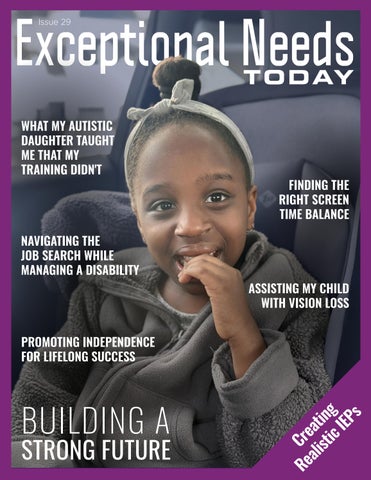
Exceptional Needs Issue 29
T O D AY
WHAT MY AUTISTIC DAUGHTER TAUGHT ME THAT MY TRAINING DIDN'T
NAVIGATING THE JOB SEARCH WHILE MANAGING A DISABILITY
FINDING THE RIGHT SCREEN TIME BALANCE
ASSISTING MY CHILD WITH VISION LOSS
BUILDING A
STRONG FUTURE
Re Cre ali at st ing ic IEP s
PROMOTING INDEPENDENCE FOR LIFELONG SUCCESS
Contents
S e p t e m b e r 2 0 2 6, I ssue 2 9
OUR COVER STORIES WHAT MY AUTISTIC DAUGHTER TAUGHT ME THAT MY TRAINING DIDN'T
8
Dr. Kimberly Idoko, JD, MD A neurologist reflects on the lessons her autistic daughter taught her, revealing why parents' observations matter and how trusting your instincts can change a child's future.
26
NAVIGATING THE JOB SEARCH WHILE MANAGING A DISABILITY OR MENTAL HEALTH CONDITION
J. Edwards Holt Searching for work while managing a disability or mental health condition can be daunting. Discover practical guidance for building confidence and pursuing a meaningful career on your own terms.
34
FINDING THE RIGHT SCREEN TIME BALANCE FOR CHILDREN WITH SPECIAL NEEDS Tessa Dodson Explore practical frameworks to help children with exceptional needs use technology in ways that support learning, communication, well-being, and healthy independence
40
ASSISTING MY CHILD WITH VISION LOSS IN BEING SUCCESSFUL AT SCHOOL
Dr. Ronald I. Malcolm, EdD What does real support at school look like for a child with vision loss? This piece offers a practical roadmap for advocacy, independence, and success.
50
ALL THINGS OT
NEW SCHOOL YEAR, NEW ROUTINES: PROMOTING INDEPENDENCE FOR LIFELONG SUCCESS
Laura Ryan, OT, OTR, OTD A practical, uplifting look at how small routines and thoughtful strategies help children build independence and essential life skills as a new school year begins.
70
BUILDING REALISTIC IEPS FOR THE REAL WORLD
Audrey Allen, MSc A special educator shares practical strategies for creating realistic Individualized Education Programs, fostering independence, and preparing diverse learners with the skills they need to succeed.
ARTICLES 12 SUPPORTING YOUR NEURODIVERGENT CHILD’S NERVOUS SYSTEM IN THE NEW SCHOOL YEAR
22 BEYOND REFUSAL: WHY NEURODIVERGENT LEARNERS SHUT DOWN DURING SCHOOLWORK
16 EXCEPTIONAL ADVICE FROM MESHELL ALLOWING EXCEPTIONAL CHILDREN TO MAKE MISTAKES: HOW PARENTS CAN SUPPORT GROWTH AND INDEPENDENCE
30 PROMOTING SCHOOL READINESS FOR KINDERGARTEN STUDENTS
Heather Tournas, LCSW Guidance for easing neurodivergent children into the school year, highlighting play, predictability, and connection as tools for supporting their nervous systems through big transitions.
Meshell Baylor, MHS, MSW Discover practical strategies to help exceptional children build resilience, confidence, and independence while preparing for success in school, work, and everyday life.
Zachary James, MSEd, MEd-EdL Learn why neurodivergent learners sometimes shut down, how executive functioning and nervous system regulation affect learning, and practical ways to replace pressure with meaningful support.
Dr. Rose Adams, OTD, OTR/L Starting kindergarten is a big transition. Learn practical strategies to build school readiness, boost confidence, support emotional regulation, and help children thrive from their first day.
38 NATURE NOTES THE VALUE OF INCORPORATING NATURE INTO OCCUPATIONAL THERAPY SESSIONS
Riley Carpenter, OTD, OTR/L An inspiring look at how nature journaling—and simple outdoor adaptations— can enrich occupational therapy, helping people connect with the natural world in accessible ways.
44 KATE MAKES IT GREAT! HELPING NEURODIVERGENT CHILDREN TO RECEIVE OUR NOURISHMENT, LOVE, AND CARE Kate C. Wilde Gentle guidance for parents seeking to help neurodivergent children accept care, offering practical ways to build trust and connection so support feels comforting rather than overwhelming.
EXCEPTIONAL NEEDS TODAY
46 MY NEURODIVERGENT SON’S DEVOTED SEARCH FOR ROMANCE
Exceptional Needs
T O D AY
Jennifer Blood A mother shares her son’s heartfelt search for love, offering a moving perspective on independence, safety, and the universal desire to find someone who truly understands you.
54 SAFETY GOALS WITH NICOLE EMPOWERING INDIVIDUALS TO ADVOCATE FOR THEMSELVES AND SET BOUNDARIES AT SCHOOL
Nicole Moehring This piece serves as a powerful reminder that every student has a voice: exploring how self-advocacy and healthy boundaries help individuals with disabilities stay safe and take charge of their school experiences
56 THE FRIENDSHIP & DATING DUO HOW TO SUPPORT A YOUNG AUTISTIC ADULT WHO IS LONELY BUT RESISTANT TO HELP
Jeremy and Ilana Hamburgh When an autistic adult resists help, it may be fear, not unwillingness. Learn compassionate strategies for starting conversations that foster relationships without creating pressure.
60 LIFE WITH ASPERGERS VISITING DOCTORS AND DENTISTS: MY TIPS AS AN AUTISTIC PATIENT
Julie Day An autistic adult shares firsthand advice for making doctor and dentist visits less overwhelming, offering practical tips to help families find compassionate healthcare providers.
62 THE IMPORTANCE OF BUILDING A SUPPORT NETWORK FOR SPECIAL NEEDS DADS LIKE ME
John Fela, MEd A special needs dad shares how finding a community of fathers offered him hope, practical support, and a reminder that no parent should face caregiving alone.
66 HOW MY AUTISTIC SON PREPARED ME FOR A PHD
JC Ellinger A mother’s journey advocating for her autistic son became the foundation for her PhD studies, teaching her valuable lessons about disability, identity, and lifelong learning.
76 JENNIFER'S JAM FROM SUMMER VACATION TO HOLIDAY TRAVEL: HOW I PREPARE FOR TRIPS AS AN AUTISTIC ADULT
Jennifer McAvoy, Med Discover how thoughtful planning, sensory-friendly strategies, and selfadvocacy help one autistic adult navigate travel with greater confidence.
78 WHAT OLGA TAUGHT ME: LEARNING TO SUPPORT AN ADULT WITH SMITHMAGENIS SYNDROME
Dawn M. Frim, BSEd, MSEd, MS A special educator reflects on 21 years supporting a woman with Smith-Magenis syndrome, revealing how one mother's wisdom transformed her understanding of behavior and connection.
80 SISTERLY LOVE: TIPS FOR INTERACTING WITH PEOPLE WITH DEVELOPMENTAL DELAYS OR PHYSICAL DISABILITIES Brooke Meli A heartfelt guide to connecting with people who have developmental or physical disabilities—offering practical tips that foster respect and friendship in every shared space.
82 FINANCIAL FOCUS PROTECTING YOUR LOVED ONE: THE MANY FACETS OF GUARDIANSHIP
Ryan F. Platt, MBA, ChFC, ChSNC, CFBS A look at guardianship—why it matters, how to choose the right approach, and what options help families protect loved ones with disabilities throughout adulthood.
Our mission is to educate, support, and energize families, caregivers, educators, and professionals while preparing all families for a healthy future. exceptionalneedstoday.com Founder/Publisher Amy KD Tobik, BA Founder | CEO Lone Heron Publishing, LLC Magazine Staff Editor-in-Chief: Amy KD Tobik, BA Associate Editor: Emily Ansell Elfer, BA Digital Marketing Coordinator & Social Media: Dione Sabella, MS Graphic Designer: Annie Rutherford, BA IT & Digital Solutions Specialist: Jared Cochran Interns: Thea Gross, Eva Ng
Professional Consultants Jeanetta Bryant Dr. Stephanie C. Holmes, BCCC J. Edwards Holt Dr. Ronald I. Malcolm, EdD Ryan F. Platt, MBA, ChFC, ChSNC, CFBS Ron Sandison, M Div Amy Wagenfeld, PhD, OTR/L, SCEM, EDAC, FAOTA
Contact Us editor@exceptionalneedstoday.com advertising@exceptionalneedstoday.com submissions@exceptionalneedstoday.com
Exceptional Needs Today is a bimonthly publication produced by Lone Heron Publishing. Disclaimer: Advertised businesses and products are not endorsed or guaranteed by Exceptional Needs Today, its writers or employees. Always follow medical advice from your physician.
EDITOR’S LETTER
From the Editor’s Desk W
atching the nightly news can sometimes feel overwhelming, with issues like special education rights, civil rights, and medical coverage constantly changing. While handling our daily tasks and struggles, it’s easy to lose sight of long-term goals. In this issue, we explore ways to prepare our lives today to build a stronger future. Whether you're a parent or self-advocate, these insights can help you empower yourself over time. If you’re an educator or work in healthcare, these articles can give you a better understanding of what people managing special needs experience. Aligned with the theme of planning for the future, our Financial Focus columnist, Ryan F. Platt, MBA, ChFC, ChSNC, CFBS, has addressed the complex subject of guardianship. I’ve met so many families who have faced challenges with this crucial topic. In “Protecting Your Loved One: The Many Facets of Guardianship,” Ryan explains the various levels of guardianship, whether you need an attorney, what supported decision-making involves, and the alternatives available. Meanwhile, as the traditional school year begins, we have several articles focused on managing education today and tomorrow. Heather Tournas, LCSW’s piece, “Supporting Your Neurodivergent Child’s Nervous System in the New School Year,” addresses the sometimes-challenging transition back to school. She discusses ways to establish consistent daily routines to provide a stable foundation as children navigate the unpredictable aspects of returning to school. She also explains how to give their nervous system permission to relax once they are home. Her advice can help support our children’s sense of self and regulate their nervous systems during this time of change. Zachary James, MSEd, MEd-EdL’s piece, “Beyond Refusal: Why Neurodivergent Learners Shut Down During Schoolwork,” examines how academic environments are inherently focused on grades, completion, and compliance. Zachary has developed a framework to help parents and educators better understand and support neurodivergent and trauma-impacted learners. Don’t miss educator Audrey Allen, MSc’s article, “Building Realistic IEPs for the Real
World.” She clarifies that Individualized Education Programs (IEPs) are not meant to eliminate every challenge a student faces. Instead, they aim to provide support so students can overcome obstacles, develop skills, and access a fair education. She emphasizes that educators and parents must ensure equal educational opportunities so students can live with dignity and independence. Looking beyond school to the world of work, advocate and author J. Edwards Holt has written “Navigating the Job Search While Managing a Disability or Mental Health Condition.” In this piece, J. openly shares the fears that come with job hunting when your life doesn’t neatly align with society’s expectations. Living with Tourette syndrome, attention-deficit/hyperactivity disorder (ADHD), and other diagnoses, the author discusses the anxiety of being misunderstood and explains ways to recognize your strengths and limits, prepare for interviews, and stay steady after landing a job. We are excited to feature the nine-year-old daughter of Dr. Kimberly Idoko, JD, MD, on our cover. As a board-certified neurologist and children’s rights attorney with degrees from four prestigious universities, Kimberly jokes that she should understand the brain and its systems better than most. However, she says it’s her special needs daughter who taught her what no lecture could. Don’t miss “What My Autistic Daughter Taught Me That My Training Didn't.” One of our core goals at "Exceptional Needs Today" is to bring the special needs community together. We can learn from understanding each other's challenges, whether we are self-advocates, caregivers, educators, or medical professionals. Let's continue to work together to understand, support, and guide one another. Best,
Amy KD Tobik
Editor-in-Chief, Exceptional Needs Today Publisher, Lone Heron Publishing
PLEASE JOIN OUR EXCEPTIONAL COMMUNITY 6 | Exceptional Needs Today | Issue 29
Exceptional Needs Today | Issue 29 | 7
MY WORD
8 | Exceptional Needs Today | Issue 29
MY WORD
What My Autistic Daughter Taught Me That My Training Didn't By Dr. Kimberly Idoko, JD, MD
I
hold degrees from four prestigious universities that are supposed to mean I understand the brain, people, and systems better than most. They prepared me for a great deal, but the classroom that taught me the most turned out to be my own home. My daughter showed me what no lecture could, and much of what I understand now about how the brain asks for help, I learned by watching her. So, if you’re parenting a child with exceptional needs, I want you to know you’ve been in that classroom, too, regardless of whether anyone gave you credit for the education.
was the asymmetry, the way one side of her body worked harder than the other to carry her forward. She was doing beautifully by any ordinary measure, and still, I sensed something was off. I was reading her biology in real time, in the texture of an afternoon that no record would ever capture, and I noticed the pattern before I had a name for it. My training had taught me to wait for a picture to become unmistakable. She taught me that by the time it’s unmistakable, the earliest and most dynamic window may already have closed.
Medical training is built to understand the brain in the aggregate. I learned to read scans and reflexes, to recognize syndromes that announce themselves loudly, and to measure a person against averages. That education is real, and I’m grateful for it. But it has a blind spot: it trains you to look for what’s overtly broken rather than what’s subtly straining. A child can pass every screening in the room and still be working harder than they should to hold an ordinary day together. The chart rarely shows it early, and a 15-minute visit rarely catches it, but the parent who’s there all day senses it in their bones.
You know this even if no one has ever validated it for you. You’re the one who sees the small shifts that don’t fit on a form. You notice when the day starts to fray, when recovery from a hard moment takes longer than it used to, when something in your child’s rhythm changes and won’t change back. People may have told you that you’re anxious, or reading too much into it, or that you should wait and see. I'm a neurologist, and I'm telling you that what you observed was data.
The education you earn in your own home, watching your own child, is as real as anything I learned in a lecture hall. You Are the Expert I knew all that in theory before my daughter taught me to feel it. She was eight months old, army-crawling across our family room rug with as much skill as she could muster, and I sat watching the effort it took her. What caught me
Parents who spend every day with a child become exquisitely sensitive to changes in rhythm, effort, recovery, and regulation. They often notice those shifts long before a test, a screening tool, or a specialist visit captures them. The education you earn in your own home, watching your own child, is as real as anything I learned in a lecture hall. And often, it reaches the truth first. The quieter injury is what the dismissal does over time. Hear enough times that you’re overreacting, and you start to wonder whether you are, and second-guess the very perception that was serving your child best. I’ve watched capable, attentive parents talk themselves out of what they plainly saw, because the people with the credentials kept insisting there was nothing to see. If that’s happened to you, I want to be clear: the doubt was taught to you; the knowing was yours first. There’s a reason this knowing gets dismissed so easily, and it has little to do with you. The systems we lean on were built to process rather than to understand, and they reward speed over curiosity. A parent who says, “Something's off, and I can’t prove it yet” is offering the most valuable Exceptional Needs Today | Issue 29 | 9
MY WORD information in the room, and it’s exactly the kind that systems are worst at holding. Noticing often gets filed under 'worry,' and the waiting continues. Autism is one wellstudied example. It can often be reliably identified by age two, yet the average child still isn't diagnosed until close to five. That gap, between what a parent senses and what the system is willing to name, is where children lose ground they can't easily recover. For many of you reading this, a label has already arrived. Maybe it came after years of being told to wait, and maybe it brought relief, or grief, or some of both. But even a diagnosis can obscure something essential: the label names a category, but you read the child. The system is built to see your child in slices, one specialist for the gut, another for sleep, another for behavior, each holding a piece and none holding the whole. You’re the only one in the room who takes it all in at once. That was true before anyone named it, and it stays true long after. A diagnosis still matters. It can unlock services, support, and understanding. But it doesn’t replace the daily observations that brought you there in the first place.
Learning From My Child What my daughter taught me is that expertise and authority aren’t the same thing. A physician can carry all the expertise in the building, but the authority over what’s happening inside a child, day to day, belongs to the parent who’s present for all of it. For a long time, I assumed that training put the expert at the center of that picture. My daughter taught me that the expert’s job is to recognize what a parent already knows. My daughter is on the cover of this issue, and that feels exactly right. She’s the one who taught me. Every parent reading this has a teacher like her at home. The lessons rarely come with credentials attached, but they count.
Your observations can still change the course of things, even years in. There was a stretch when my daughter was falling as often as 40 times a minute, and the therapies we were offered brought only limited benefit. I could have accepted that as her ceiling; instead, I kept reading, this time deep into the science of neuroplasticity, the brain’s capacity to rewire itself through experience. That reading led me to Anat Baniel and a method built on small, varied movements meant to wake up the nervous system rather than drill it. I tracked her down, and in 2019, I brought my daughter to a weekend training she was holding in Henderson, Nevada, for people apprenticing in her approach. My daughter participated as the subject. Over that single weekend, the falling stopped. Just like that. I don’t know whether another child would have responded the same way. I only knew that improvement was possible long after we'd been encouraged to lower our expectations. What carried me there was a refusal to treat “limited benefit” as the end of the story, and a trust that my daughter’s brain was still capable of more than anyone expected. That trust came from watching her, the same watching that started on the family room floor when she was eight months old.
Dr. Kimberly Idoko, JD, MD, is a board-certified neurologist, children’s rights attorney, entrepreneur, and author of The Miswired Child: How Modern Childhood Harms the Brain.
10 | Exceptional Needs Today | Issue 29
EMOTIONAL HEALTH
Exceptional Needs Today | Issue 29 | 11
EXCEPTIONAL ADVOCATE
Supporting YourTogether: Neurodivergent Joining Empathy Over in the Child’sChoosing Nervous System Division in Autism Advocacy New School Year By Heather Tournas, LCSW By Jeanetta Bryant
12 | Exceptional Needs Today | Issue 29
ANXIETY MANAGEMENT
S
ummer has come and gone, and parents and students are getting ready for the big transition…back-toschool season.
I recently met with the parents of one of my five-year-old clients around back-to-school season. They expressed their excitement to get their child back into a set routine and schedule, hoping that he would feel less anxious with “fewer variables” than summer had provided. Then the first week of school happened. I was quickly met with concerns around increased big behaviors, meltdowns, and disrupted sleep. Then I re-met with the parents to reflect on what else came with the back-to-school season beyond the routine and structure, and how many hidden variables were at play.
wait until the first day of school to start supporting these transitions. Has the first day already happened? That’s OK too. Small, consistent, and positive actions before and after school can create a meaningful difference in how children experience the back-to-school transition. Connecting with our children in a way that makes sense for them is our first step. Play is one of the most powerful forms of communication a child has. We know that play is a primary mechanism through which young children learn and develop (Yogman, Garner, Hutchison, Hirsh-Pasek, & Golinkoff, 2018). So, let’s dive in and join the play to help guide them through a time that can spark a multitude of thoughts, feelings, and behaviors in our children.
Back to routine and structure, two things many parents know their children thrive with. But with those more concrete factors come new schools, new friendships, new teachers, and new demands. And that… that is scary. Research has shown that students' success depends on recognizing that a new school year is a multidimensional transition (Boyle, Grieshaber, & Petriwskyj, 2018). Beyond the routine shift from summer days to school days, new social developments are arising, rebuilding trust in new adult supports, and navigating new grade-level expectations. All these factors and more take an emotional toll. Add challenges with emotional regulation, masking, and lack of familiarity, and it is expected that children may crash once they’re home.
While we can't eliminate every unknown that comes with a new school year, we can create consistency in the parts of the day that are within our control.
Transitions, we know, are something that everyone struggles with to some degree. And while many neurodiverse children do see success with structure and routine, a new school year has so many unspoken variables that can “appear fun” but feel very scary. Supporting these factors across our children’s environments should be a focus at the start of the school year to help set our children up for the greatest possible success.
Before School Starts…
•
Want to drive? Awesome, play a fun, child-centered playlist while you take a spin.
Schools that provide a variety of transition supports to help adjust to a new year, grade level, and expectations have been shown to lead to better child adjustment in the educational setting (López & Benner, 2025). Ensuring these educational supports are in place and continuing to build the transition support at home can better support our young ones. And this isn’t to mean we drive academics at home. But instead, bolster connections with our children in strengthening their self-worth, self-regulation, emotional competence, and positive relationships (Sandiols & Rimm-Kaufman, 2025). Although the transition back to school may bring challenges, proactive preparation and supportive caregiving can significantly assist in easing the adjustment for young children, particularly those who are neurodivergent. So, the good news is you don’t have to
• •
Nice weather? Take a walk and play “I Spy.”
•
Ask to set up walk-throughs at the school to practice walking through the entrance, to their classroom(s), and back out the dismissal doors.
If your school year has not yet begun, take time to explore the transition with your children. And while you could ask them how they are feeling, let’s dive deeper. Firstly, take fun trips to visit your child’s school.
If your child’s school has a playground, plan multiple park trips to enjoy the playground and have fun. Let’s utilize play to bring back (or introduce if it’s a new school) the feelings of being back at school.
Familiarity reduces uncertainty. Using play within the safety of a trusted relationship can further reduce this uncertainty. It isn’t about getting rid of the nerves or expecting no anxiety. It’s about supporting the nervous system through familiarity, play, and safety. Exceptional Needs Today | Issue 29 | 13
ANXIETY MANAGEMENT
Day-to-Day Predictability Many neurodivergent children thrive when their environment feels predictable. While we can't eliminate every unknown that comes with a new school year, we can create consistency in the parts of the day that are within our control. Maintaining regular sleep schedules and familiar morning and evening routines, even on weekends, can help build a sense of predictability and structure. These consistent rhythms provide a stable foundation as they navigate the more unstable and unknown parts of back-to-school. These strong habits help reduce the “Sunday Scaries” that can be especially difficult for neurodivergent children.
Play Before Pressure School requires children to use executive functioning, emotional regulation, social thinking, and sensory processing skills all day long. For neurodivergent children, especially, this can require immense cognitive and emotional energy. Once they're home, their nervous system may finally have permission to relax. That release can often look like meltdowns, irritability, withdrawal, or 14 | Exceptional Needs Today | Issue 29
other big behaviors. This release is not because they're "misbehaving" or “bad.” Instead, let’s rename the behavior for what it is: emotional depletion. Instead of filling the after-school hours with more demands, create space for connection first. Engaging in low-demand, screen-free play gives children the opportunity to coregulate alongside a trusted adult, helping them process the day, regulate their emotions, and feel safe before moving on to the next expectation. Utilize the play that best fits your child and have fun with it. Maybe your child loves some pretend play and wants to be the teacher. Or maybe they need some quiet time to engage in parallel play and build some LEGO bricks. Maybe they need to lie down and cuddle to feel a sense of safety and closeness. Or maybe your child has more energy to release and could use a fun dance party. When children know they will come home to a predictable period of rest, play, and connection before jumping into homework, additional responsibilities, or even the well-intentioned (but often dreaded) question, "How was your day?" they begin to anticipate this sense of calm and safety. This predictable rhythm helps support their nervous system and makes
ANXIETY MANAGEMENT it easier to recover from the demands of the school day, lessening the post-school crash.
But, What If? What if they still have behaviors? What if they sleep in after a tough week? What if sports go over late? What if there’s a family party? What if, what if, what if? Perfection is never the purpose. The purpose is to help support our children’s sense of self and nervous system during a time of so many changes and shifts. A successful back-to-school transition doesn’t mean a child never struggles. It means they have supportive adults, predictable routines, opportunities to play, and a safe relationship to
return to when back-to-school feels hard. And perhaps most importantly, they know they don't have to navigate those hard moments alone. References: Boyle, T., Grieshaber, S., & Petriwskyj, A. (2018). An integrative review of transitions to school literature. Educational Research Review, 24, 170–180. https://doi.org/10.1016/j.edurev.2018.05.001 López, B. A., & Benner, A. D. (2025). Challenges in the transition to kindergarten and children's well-being through elementary school: Do school transition supports matter? Early Childhood Research Quarterly, 71, 193–204. https://doi.org/10.1016/j.ecresq.2025.01.001 Sandilos, L., & Rimm-Kaufman, S. (2025). School readiness and the transition to kindergarten: Developmental domains, systemic influences, and the role of context. In R. E. Tremblay, M. Boivin, & R. DeV. Peters (Eds.), Encyclopedia on Early Childhood Development Yogman, M., Garner, A., Hutchinson, J., Hirsh-Pasek, K., & Golinkoff, R. M. (2018). The power of play: A pediatric role in enhancing development in young children. Pediatrics, 142(3), Article e20182058. https://doi. org/10.1542/peds.2018-2058
Heather Tournas, LCSW, is a Licensed Clinical Social Worker and a Certified AutPlay Therapy Provider. She is the owner of Growing Hope & Kindness, LLC in Cheshire, CT, and specializes in working with neurodivergent children ages 2.5 to 10. She uses a mix of play and connection interventions to help not just the child but also support family systems. Heather also utilizes animal-assisted therapy through her work with young children.
Exceptional Needs Today | Issue 29 | 15
EXCEPTIONAL ADVICE FROM
MESHELL
Allowing Exceptional Children to Make Mistakes:
How Parents Can Support Growth and Independence By Meshell Baylor, MHS, MSW "The only real mistake is the one from which we learn nothing” Henry Ford
As
summer comes to an end and a new school year approaches, many parents find themselves watching their children grow in ways that feel both beautiful and emotional. There is something powerful about witnessing a child move from one stage of life into another, learning new skills, developing independence, and slowly becoming more confident in who they are. It can feel like watching a miracle take shape, or like seeing a flower bloom right in front of you. For parents and caregivers of exceptional children, this journey can be especially meaningful. There are days filled with joy as you watch your child work hard to develop communication skills, strengthen social connections, and become more comfortable moving through the world around them. You notice the milestones, sometimes quietly and sometimes all at once. One accomplishment is reached, then another follows. What once seemed impossible begins to happen through patience, repetition, and determination.
Mistakes can feel uncomfortable for both children and parents, but they are often one of the greatest teachers. your child to work through the difficulty, or do you move quickly into parent mode and help remove the obstacle? For many of us, the answer is not always simple.
Navigating Mistakes
We want to protect our children. We want to make things easier for them. We want to step in when we see them feeling discouraged, anxious, or overwhelmed. Yet part of preparing our children for life is allowing them to experience challenges in a safe and supported way. Mistakes are not proof that they are incapable. In many cases, mistakes are proof that they are trying.
What happens when your child struggles with a certain skill? What happens when a goal takes longer than expected, or when they become frustrated by the process of trying to become more independent? As parents, it can be difficult to know what to do in those moments. Do you sit back and allow
This is especially important as more students with disabilities spend time learning in inclusive educational settings. Among school-age students served under IDEA (Individuals with Disabilities Education Act) who attended regular schools, the percentage who spent 80% or more of the school day in general
But alongside those milestones comes another reality: mistakes.
16 | Exceptional Needs Today | Issue 29
EXCEPTIONAL ADVICE FROM MESHELL
education classes increased from 61% in fall 2012 to 67% in fall 2022. (National Center for Education Statistics (NCES)). As children grow in these environments, they are constantly building academic, social, emotional, and practical life skills. With that growth naturally comes trial and error. As a social worker, I have always been drawn to the principles of Cognitive Behavioral Therapy (CBT), which teaches that our thoughts, feelings, and behaviors are deeply connected. One of the most valuable lessons from CBT is the ability to turn a negative thought into a more helpful and empowering one. When a child feels discouraged after making a mistake, that moment can become an opportunity. Instead of believing they failed, they can begin to learn: “I am still learning.” Instead of thinking, I cannot do this, they can begin to believe, “I cannot do this yet.” That shift can make a world of difference. When our exceptional children are learning independence, they need room to practice. They need opportunities to try, stumble, regroup, and try again. They also need to know that support is still nearby. Independence does not mean isolation. It means gradually building the confidence to do more for themselves while knowing trusted support is present when needed. That balance shows up in many real-life moments. It can happen during school assignments, social situations, community outings, or new responsibilities at home. It can also happen as our children grow older and begin taking on bigger milestones. For example, when my son Christopher is applying for jobs, I stay close by in case he needs me. I want him to have the space to answer questions, complete tasks,
and build his confidence, while also knowing that support is available if needed. That is often what supportive parenting looks like for exceptional children: not taking over, but staying near enough to guide, encourage, and reassure. This kind of support honors both who our children are now and who they are becoming.
Why Mistakes Matter Mistakes can feel uncomfortable for both children and parents, but they are often one of the greatest teachers. A child who never gets the chance to struggle may never fully learn how to recover. A child who is always rescued may begin to doubt their own ability to solve problems. On the other hand, a child who is allowed to make mistakes in a safe environment can build resilience. Resilience does not mean getting everything right. It means learning how to keep going after something goes wrong. For exceptional children, that lesson is especially valuable. They may already be navigating systems, expectations, and challenges that require extra effort. They may need more time, more repetition, or more support in certain areas. That does not make them less capable. It simply means their growth may look different. And different does not mean less meaningful. When parents allow children to work through mistakes with support, they help them develop:
•
Problem-solving skills: because children begin thinking about what to do next.
•
Self-confidence: because they learn they can survive frustration and keep trying. Exceptional Needs Today | Issue 29 | 17
EXCEPTIONAL ADVICE FROM MESHELL more clearly, remind them that their effort matters. Positive feedback helps children stay encouraged, especially when a task feels difficult.
Praise effort, not just the outcome Children benefit from hearing that trying is valuable. When you praise effort, persistence, patience, and courage, you teach them that success is not just about perfection.
Assist if allowed Help is important, but so is autonomy. Ask your child if they would like support before stepping in. This respects their independence and teaches them that receiving help can be a choice rather than a takeover.
Stay close Sometimes support means being nearby without interfering. Your child may need the reassurance that you are there, even if they are doing the task themselves. This is the approach I take with my son Christopher when he is applying for jobs. I stay close by in case he needs me, while still allowing him the opportunity to step forward and try.
Normalize mistakes Let your child know that everyone makes mistakes. Mistakes are not a sign of failure; they are a normal part of learning, growing, and gaining confidence.
Use encouraging words
•
Self-advocacy: because they begin to recognize when and how to ask for help.
•
Emotional regulation: because they practice calming themselves through disappointment.
•
Independence: because they discover they can do more than they first believed.
These are life skills that extend far beyond childhood. They matter in school, friendships, higher education, employment, and community life.
Practical Ways to Support Your Child Below are some meaningful ways parents and caregivers can support exceptional children as they learn from mistakes and grow toward greater independence.
Provide positive feedback Whether your child is completing homework, learning a routine, practicing a life skill, or trying to communicate 18 | Exceptional Needs Today | Issue 29
Phrases such as “You are doing your best,” “Keep trying,” and “It is OK to learn at your own pace” can make a child feel emotionally safe during moments of frustration.
Model calm behavior Children pay attention to how adults respond under stress. When you remain calm and solution-focused, you show your child that problems can be worked through without panic or shame.
Break large tasks into smaller steps Big goals can feel overwhelming. Breaking the task into smaller parts makes it feel more manageable and allows children to experience success one step at a time.
Give extra processing time Some children need more time to think, respond, and organize themselves. Allowing that pause can reduce pressure and support independence.
Ask guiding questions
EXCEPTIONAL ADVICE FROM MESHELL Instead of immediately giving answers, ask questions such as “What do you think you can do next?” or “What worked last time?” These questions encourage reflection and problem-solving.
Celebrate small wins Progress is not always dramatic. Sometimes a small step forward is a major victory. Recognizing those moments builds motivation and confidence.
Use social praise Children often respond well to kind, specific encouragement. Let them know when you see their effort, patience, courage, or willingness to keep trying.
Teach self-advocacy Help your child learn how to express needs, ask questions, request support, and speak up when something feels difficult. These are critical skills that will help them far beyond childhood.
Create safe opportunities to practice independence Let your child take on age-appropriate responsibilities, such as choosing clothes, ordering food, helping with errands, introducing themselves, or managing simple routines.
Do not rush to fix everything It can be hard to watch your child struggle, but not every difficulty needs immediate rescue. Some of the most valuable lessons come when children are allowed to work through manageable challenges.
Reflect after the moment has passed When emotions have settled, talk through what happened. Ask your child what felt hard, what helped, and what they may want to do differently next time.
Help reframe negative thoughts If your child says, “I cannot do this,” help them shift the thought to “This is hard, but I can keep learning.” This simple Cognitive Behavioral Therapy (CBT)-based approach can build resilience over time.
Protect your child's dignity Correction should always come with respect. Children need guidance, but they also need to feel valued and capable, even when they are struggling.
Avoid overcorrecting Too many corrections at once can make a child feel defeated. Focus on what matters most in the moment and leave room for growth.
Remind them of past success When your child is discouraged, remind them of something difficult they have already overcome. This helps them remember that progress is possible, even when the present moment feels hard.
Support major milestones with a quiet presence As your child grows, independence may include applying for jobs, preparing for interviews, learning workplace expectations, or exploring college and training programs. During these moments, support can look like reviewing steps together, offering encouragement, and staying close by if needed while still allowing your child to lead.
The Parents' Role in Building Independence Parenting an exceptional child often means learning the delicate balance between protection and preparation. We want to shield our children from disappointment, but we also want to prepare them for a world that will require confidence, resilience, and self-advocacy. That balance is not always easy.
Exceptional Needs Today | Issue 29 | 19
EXCEPTIONAL ADVICE FROM MESHELL There will be moments when stepping in is necessary. There will also be moments when the most loving thing a parent can do is pause, stay nearby, and allow the child to work through the situation. That does not mean withdrawing support. It means offering support in a way that strengthens rather than replaces the child's own ability. Independence is not built in a single moment. It is built through repetition, practice, setbacks, encouragement, and trust. It grows when children are given opportunities to participate meaningfully in their own lives. It grows when parents believe in their child's ability to keep learning. It also grows when mistakes are treated not as endings, but as part of the journey. For many families, this path may look different from what it does for others. Some children will need more support for longer periods. Some will move toward independence in gradual steps. Some will surprise everyone with strengths that were once hidden beneath fear or uncertainty. All of that is part of the process. What matters most is that our children know they are capable, supported, and never defined by a single hard moment.
In Closing Every day, your child is growing. One day, they may walk across a graduation stage, attend college, complete job applications, go through interviews, or enter the workplace with determination and hope. They may build friendships, learn routines, advocate for themselves, and discover strengths that continue to unfold over time. None of that growth requires perfection. It requires practice, patience, and support. Often, it also requires the freedom to make mistakes and learn from them.
References & Special Needs Resources:
As parents and caregivers, we can give our exceptional children one of the greatest gifts possible: the confidence to keep going. We can remind them that mistakes do not take away their worth. We can stay close when they need us, just as I do with Christopher when he is applying for jobs, while still allowing them the space to rise.
The National Center for Education Statistics (NCES) reports that among school-age students served under IDEA who attended regular schools, the percentage who spent 80% or more of the school day in general classes increased from 61% in fall 2012 to 67% in fall 2022.
In the end, our goal is not to raise children who never make mistakes. Our goal is to raise children who believe they can learn, grow, and move forward.
For family-centered support on education, services, disability resources, and long-term planning, Navigate Life Texas offers helpful information for parents and caregivers.
National Center for Education Statistics (NCES) A broader federal overview of students with disabilities, IDEA participation, and related education data is also available through NCES Fast Facts. NCES Fast Facts
Meshell Baylor, MHS, is a mother of four children—two of whom are on the autism spectrum. She serves her community as a social worker and advocate in the Los Angeles area. She has a Bachelor’s degree in human services from Springfield College and a Master of Science degree in human and social services. Meshell continues volunteering and giving within her local area while serving the special needs community. 🌐 meshellbaylor.wixsite.com INSTAGRAM @imalittlebigb 🌐 Center for Autism and Developmental Disabilities
20 | Exceptional Needs Today | Issue 29
LEARNING STRATEGIES
Autism Advocacy Interrupted is more than a book—it’s a wake-up call for anyone who cares about the autism community.
In today’s advocacy landscape, families often face a storm of competing voices: infighting, ego-driven agendas, and fragmented messages that do little to meet real needs. Jeanetta Bryant, both a mother and seasoned advocate, has lived through the confusion, frustration, and heartbreak this division causes. With unflinching honesty and compassion, she lifts the veil on the hidden fractures in the movement, introducing four distinct advocate types—Revolutionists, Trailblazers, Mavericks, and Disruptors. Through these portraits, Bryant invites readers to examine who they follow, why their message matters, and whether the noise is helping or hurting the very people we claim to serve. She challenges us to trade division for unity, volume for vision, and personal agendas for purpose.
This is not a call to choose sides—it’s a rallying cry to rebuild the foundation of autism advocacy so that dignity, wellbeing, and future opportunity for those on the spectrum come first.
If you’re ready to reflect, engage, and make a difference, Autism Advocacy Interrupted will give you the insight, courage, and clarity to be part of lasting change.
Exceptional Needs Today | Issue 29 | 21
EXCEPTIONAL EDUCATION
Beyond Refusal:
Why Neurodivergent Learners Shut Down During Schoolwork By Zachary James, MSEd, MEd-EdL
E
very parent, caregiver, or educator who has supported a neurodivergent child knows some version of this moment.
Just minutes ago, your child was happily building with LEGO bricks, talking about dinosaurs, or telling you every detail of their day. Then, you place a worksheet on the table. The assignment is not new. They have solved problems or completed something like this before. The pencil is in their hand, the directions are clear, and you know they’re capable of doing the work. Yet nothing happens. They stare at the page. They ask for a snack. They suddenly need to use the bathroom. They sharpen their pencil until
22 | Exceptional Needs Today | Issue 29
the lead breaks, then sharpen it again and again. Or perhaps they simply become quiet, sinking into their chair as though the assignment has drained every ounce of energy from their body. For me, this scene plays out at my dining room table with my son. As both a father and an educator, I’ve learned that these moments are easy to misunderstand. It is incredibly easy for adults to label this behavior as laziness, defiance, avoidance, or a lack of motivation. Academic environments are inherently built around outcomes: grades, completion, and compliance. When a child stalls, our immediate questions reflect this focus: Why aren't they trying? Why won't they just start?
EXCEPTIONAL EDUCATION But these questions assume the problem is motivation or willpower. For many neurodivergent learners, including those with attention-deficit/hyperactivity disorder (ADHD), autism, learning disabilities, anxiety, or developmental trauma histories, the more revealing question is: What is making this task inaccessible right now? That single question changes everything. Instead of asking why a child won’t learn, we begin asking what is preventing them from accessing learning. We replace compliance with curiosity. We stop measuring willingness and start looking for barriers. Because one of the most important truths educators and parents can understand is: Ability and access are not the same thing. A child may possess the skills needed to complete a task while temporarily lacking access to those skills in the moment. Recognizing that difference does not lower expectations, it changes where we begin.
One of the greatest misconceptions is that learning happens only in the thinking brain. In reality, children cannot consistently engage in higher-order thinking when their nervous systems are overwhelmed. The Invisible Bridge of Executive Functioning To understand why a capable child refuses an assignment, we first need to understand executive functioning—the brain’s management system. Executive functioning allows us to organize information, plan, prioritize tasks, manage time, regulate emotions, sustain attention, and transform an intention into action. In many ways, it serves as the bridge between knowing what to do and doing it. When an adult asks, “Did you finish your homework?” and a child quietly answers, “Yes,” we naturally focus on the finished product. What we rarely see is the enormous amount of invisible work that made that answer possible.
Before a single math problem is solved or a sentence is written, the brain has already initiated the task, remembered directions, organized materials, filtered distractions, regulated emotions, and monitored progress. Most of this work happens silently, making it easy for adults to overlook. Executive functioning skills are neurological currency, and for many neurodivergent learners, the transaction fees are incredibly high. Every direction remembered, every distraction resisted, and every emotion regulated draws on a limited reserve of cognitive energy. A child may fully understand a lesson yet lack the neurological resources needed to begin the work independently. Understanding something and being able to access that understanding are different.
Why Dysregulation Shows Up So Often During Schoolwork Executive functioning, however, does not operate in isolation. It depends on something more foundational: the state of the nervous system. One of the greatest misconceptions is that learning happens only in the thinking brain. In reality, children cannot consistently engage in higher-order thinking when their nervous systems are overwhelmed.
Exceptional Needs Today | Issue 29 | 23
EXCEPTIONAL EDUCATION
A child may possess every academic skill necessary to complete an assignment, yet if their brain is busy managing overwhelm, anxiety, sensory input, or emotional distress, those skills become difficult—or temporarily impossible—to access. Learning is not simply about intelligence; it is about accessibility. Consider the hidden cognitive load behind a seemingly "simple" worksheet. To complete it, a child must:
• • • •
Initiate the task against internal resistance
•
Tolerate the emotional uncertainty of making a mistake
many neurodivergent children, however, each step must be performed manually, drawing heavily on a limited pool of daily cognitive and emotional energy. When the demands of a task exceed the brain’s available resources, the nervous system prioritizes safety over performance. Academic learning steps back while survival takes over. What appears to be school refusal is often a nervous system protecting the learner.
The Quiet Signs of Dysregulation
Physically organize their workspace and materials
When people hear the word “dysregulation,” they often imagine explosive behaviors: yelling, tearing up papers, slamming doors, or full-scale meltdowns.
Sustain attention while actively filtering out sensory distractions
Those children certainly exist. But many of our most dysregulated learners never raise their voices at all.
Hold multi-step directions in working memory
None of these demands appear on the worksheet, yet they often require more effort than the academic question itself. For many neurotypical learners, these processes run efficiently in the background, like automated software. For 24 | Exceptional Needs Today | Issue 29
Their distress is entirely internalized. They are the children who stare at a blank page for 45 minutes without writing a word, or who cover their papers with a bent arm and slowly withdraw from interaction. Adults frequently misinterpret this quiet withdrawal as stubbornness, opposition, or passive-aggressive noncompliance.
Neurologically, this shutdown is a classic freeze response. The brain is not making a calculated decision to defy authority or avoid responsibility. It is shifting into protection mode, reducing input and output to survive what it perceives as overwhelming. This is not manipulation. It is self-protection. It is armor for the child, not a sword. This explains the inconsistency that leaves so many parents and teachers confused. A child may breeze through a math assignment on Tuesday, then struggle to begin a nearly identical worksheet on Wednesday. Their intelligence has not changed overnight. Their access has. Their processing capacity, emotional reserves, and nervous system state have.
Shifting our focus to accessibility doesn’t mean lowering expectations or removing accountability. It means recognizing that expectations are only meaningful when children have genuine access to meeting them. Our role is not to eliminate challenges. Understanding changes how we respond. Rather than increasing pressure, we first help regulate the nervous system. We reduce barriers by simplifying the starting point, making expectations visible through supports like checklists or visual schedules, and adjusting the cognitive load to match the child’s capacity in that moment. These accommodations do not lower expectations—they increase access to learning.
Breaking the Cycle: Moving from Pressure to Access
The Ultimate Goal: To Be Understood
When a child stalls, our natural instinct is to offer verbal encouragement: "Just get started," "You know how to do this," or "Come on, just do the first five minutes." While wellintentioned, this approach often backfires.
When we look beyond school refusal, something remarkable happens. We stop seeing a child who won’t work. We begin seeing a child who cannot consistently access the neurological systems learning requires.
Beginning a task requires executive functioning. As pressure increases, stress rises, reducing access to the very skills children need to get started. Pressure cannot dismantle armor—it only convinces children they were right to put it on in the first place.
That shift changes everything.
To break this cycle, we must look for the patterns beneath the resistance. Does the refusal spike at a specific time of day? Is starting the task harder than finishing it? Are transitions from preferred activities triggering the freeze response? These patterns are clues, marking exactly where a child's regulation is most vulnerable. If a child lacks an academic skill, they need instruction. If they lack an executive functioning skill, they need scaffolding. If they are experiencing nervous system overload, they need regulation and co-regulation before either of those things can be effective. The challenge is not simply identifying what a child struggles with. It is recognizing why they are struggling in that moment. That shift—from assuming unwillingness to investigating accessibility—is where meaningful support begins.
We stop pursuing compliance and start increasing accessibility. We stop assuming unwillingness and begin investigating barriers. We stop fighting children and begin working alongside them. The greatest gift we can give neurodivergent learners is not another reward system, stricter consequence, or more persuasive lecture. It is the confidence that the adults in their lives are willing to look beneath the behavior before judging it. It is a framework designed to help parents and educators better understand, navigate, and support neurodivergent and trauma-impacted learners. Children who feel understood begin to trust. Children who trust begin to regulate. Children who regulate gain greater access to learning. Not because we demanded more from them—but because we finally made learning more accessible.
Zachary James, MSEd, MEd-EdL, is an educator and administrator with over 16 years of experience supporting students across diverse learning environments. His work focuses on executive function, neurodivergence, and trauma-informed practices, helping educators better understand the connection between behavior, cognitive load, and learning. He is the founder of Adaptive Learning Academy, where he developed The Regulation-First Learning Framework within The Adaptive Learning Pedagogy Framework centered on regulation, connection, and engagement as the foundation for meaningful learning. 🌐 adaptivelearningacademy.org
Exceptional Needs Today | Issue 29 | 25
SKILLS FOR LIFE
Navigating the Job Search While Managing a Disability or Mental Health Condition By J. Edwards Holt
T
here’s a certain kind of fear that comes with looking for work when you know your life doesn’t fit neatly into the usual expectations. Some people worry about whether they’ll like the job, whether the pay will be enough, or whether the commute will be too long. Those are real concerns, of course. But for someone living with a disability, mental health condition, neurological difference, or other exceptional need, the questions often go deeper and include:
• • • • •
Will I be understood? Will my symptoms get in the way? Should I tell the employer? What happens if I have a bad day? Can I really do this?
26 | Exceptional Needs Today | Issue 29
I know those questions because I’ve lived with them. My own life has been shaped by Tourette syndrome, anxiety, depression, obsessive-compulsive disorder (OCD), and attention deficit/hyperactivity disorder (ADHD). I’ve carried these diagnoses through school, relationships, daily responsibilities, and the workplace. I’ve tried to hide symptoms. I’ve tried to push through exhaustion. I’ve tried to prove I could handle things when, truthfully, I was barely holding myself together. I’ve also learned that a diagnosis may explain part of your story, but it doesn’t get the final word. The next step isn’t always dramatic. Sometimes it’s filling out one application. Sometimes it’s asking someone you trust to help you practice interview questions. Sometimes it’s deciding that a certain type of work isn’t right for you,
SKILLS FOR LIFE even if other people think it should be. Sometimes it’s admitting that you need accommodations, structure, or support. None of these steps is small when you’re the one taking them.
honest about what a job requires from us, what support we need, and what kind of environment allows us to function without destroying ourselves in the process.
My First Lessons in the Workforce My first job was in fast food when I was 16. For many teenagers, that’s a fairly ordinary beginning. For me, it was my first real lesson in what it meant to bring Tourette syndrome into the workforce. I had to take orders, interact with customers, listen to instructions, communicate with coworkers, and move quickly from one task to another. All the while, I was trying to control tics that didn’t care whether I was standing at a cash register or sitting quietly at home. There were moments when a vocal tic would slip out in front of a customer. There were times when I had to explain myself quickly, hoping the person on the other side of the counter would understand. Sometimes they did. Sometimes they didn’t. The awkwardness stayed with me longer than I wanted. Still, I kept showing up. That may sound simple, but anyone who has had to work while managing symptoms knows that showing up can be an act of courage. It’s not just the work itself. It’s the mental labor of wondering how others perceive you. It’s the physical strain of holding symptoms back. It’s the emotional weight of wanting to be judged by your effort and ability rather than by the thing people notice first. Later, when I became a teacher, the pressure changed. In fast food, I worried about customers and coworkers. In the classroom, I worried about students and faculty, and about the responsibility that came with being the adult in the room. Teaching required focus and energy. It also required me to manage my tics in a public setting for hours at a time. I tried hard not to become “the teacher with tics.” I wanted to be known as the teacher who cared, who taught, who listened, who showed up prepared. To do that, I often suppressed my symptoms until the day ended. Then, when I got to my car, the tics I had held back would come rushing out. Some days, I had to sit there before I could safely drive home. Other days, I pulled over along the road because the tics became too strong to manage while driving.
Success Shouldn’t Mean Suffering in Silence That experience taught me something I wish I had understood earlier: success at work can’t be measured only by whether you made it through the day. Sometimes we survive a workday while quietly paying a price no one sees. That doesn’t mean we’re weak. It means we need to be
Start with Self-Knowledge For people with exceptional needs, the first step in looking for work isn’t always the résumé. Sometimes the first step is self-knowledge. Ask yourself the following questions:
• • • • •
What drains you?
•
Are you able to manage a noisy workplace, or do you need quiet?
• •
Do you need written instructions instead of verbal ones?
What helps you focus? What kinds of settings make your symptoms worse? Do you work better with routine or variety? Can you handle constant customer interaction, or would that leave you depleted?
Do you need breaks, flexibility, reminders, or a predictable schedule?
These questions aren’t excuses. They’re tools that help you look for work with wisdom instead of panic.
Know Your Strengths and Your Limits When I was younger, I often believed I had to prove myself by enduring whatever was placed in front of me. If the job was difficult because of my symptoms, I assumed I just needed to try harder. If anxiety made the day feel impossible, I thought I needed to hide it better. But maturity has a way of changing how we define strength. Strength isn’t pretending we have no limits. Strength is learning our limits well enough to work with them.
Exceptional Needs Today | Issue 29 | 27
SKILLS FOR LIFE That matters when choosing a career path. Many people are told to follow their passion, and there’s truth in that advice. But passion alone isn’t enough. A person also needs to consider capacity. A dream job that constantly overwhelms your nervous system may not be sustainable. A respectable job that leaves you emotionally empty may not be the right fit. A position that looks impressive to other people may still be wrong for the life you’re truly living. This doesn’t mean lowering your expectations; it means setting honest expectations. If you’re preparing to enter the workforce, begin with a clear inventory of your strengths. People with exceptional needs are often taught, directly or indirectly, to focus on what is difficult for them. We can become experts in our own struggles while forgetting to name our abilities. Maybe you’re creative, or you notice details other people miss. Maybe you’re compassionate because you know what it feels like to be misunderstood. Maybe you’re persistent. Maybe you solve problems differently. Maybe you’re good with routines, technology, writing, organizing, caregiving, art, or hands-on work. Write down those strengths. Don’t wait until you feel confident. Confidence often comes after action, not before it.
people make the mistake of focusing only on job titles. The same job can feel completely different depending on the workplace. A supportive manager can make hard work manageable. A chaotic environment can make even simple work feel unbearable. A team that communicates clearly can help you succeed. A workplace filled with confusion and unpredictability can wear you down quickly. When possible, ask practical questions before accepting a job. What does a typical shift look like? How are instructions given? How much interaction is expected? Is the schedule consistent? Who provides training? How are mistakes handled? These questions aren’t unreasonable. They show that you’re thinking seriously about whether you can do the job well.
Should You Disclose? Then comes the question many people with diagnoses wrestle with: Should I disclose? There’s no single answer that fits everyone. Some people need formal accommodations and therefore choose to disclose certain information. Others may not need to share a diagnosis at all. Some prefer to explain specific needs without naming the condition. For example, a person might say, “Written instructions help me complete tasks more accurately,” or “I work best when I know the order of priorities.” That can be more useful than offering a label and hoping the employer understands it. Disclosure should be thoughtful. It should serve a purpose. You’re not obligated to tell everyone everything. Your story belongs to you. At the same time, there should be no shame in needing support. I spent years trying to appear unaffected by things that affected me every day. Looking back, I can see how exhausting that was. We all want dignity and independence. But dignity isn’t found in pretending we have no needs. It’s found in recognizing that every human being needs something, and some of us simply need to name those needs more carefully.
Preparing for the Interview
Choosing the Right Work Environment Next, think about environments. This is where many 28 | Exceptional Needs Today | Issue 29
Preparation can also make a major difference. Before an interview, practice answering common questions out loud. Not just in your head, but out loud. If anxiety is part of your life, familiar words can help when your mind goes blank. Prepare a short explanation for gaps in experience or changes in direction. Practice talking about your strengths without apologizing for them. Choose clothing that’s appropriate but comfortable enough that you’re not distracted the entire time. Plan your transportation. Give
SKILLS FOR LIFE yourself more time than you think you need. Small preparations can quiet large fears.
Staying Steady After You Get the Job Once you have the job, the next step becomes learning how to stay steady. That means building routines around work, not just during work. For some people, staying steady means protecting sleep, eating regularly, keeping medication or therapy schedules, exercising, praying, creating, or just making room for quiet. I’ve learned through my own life that coping isn’t usually one big solution. It’s often a collection of small practices repeated often enough to keep us from falling apart. For me, writing became one of those practices. It gave me a place to put thoughts that otherwise circled endlessly. It helped me turn struggle into something useful. But everyone needs a place where they are more than their symptoms. For one person, that may be music. For another, it may be gardening, cooking, volunteering, or building things with their hands. A career shouldn’t consume the whole person. Work is important, but it’s not the only measure of a life.
When the Path Changes There may also come a time when you realize that the next step is a change. That can be frightening. Leaving a job, changing fields, returning to school, or starting over can feel like failure. It’s not. Sometimes wisdom looks like adjustment. Sometimes growth requires us to admit that the path we’re on no longer fits. I began by pursuing education, and that part of my life still matters. Teaching shaped me. It taught me responsibility and the weight of showing up for others. But I also followed my heart toward writing. Today, as an author and mental health advocate, I can see how the pieces connect. The jobs I held, the struggles I carried, the classrooms I stood in, the symptoms I tried to hide, and the stories I learned to tell all became part of the same larger calling. That’s something I hope readers remember. Your career path may not look straight. Mine certainly hasn’t. A crooked path can still lead somewhere meaningful.
For Those Who Support Someone with Exceptional Needs For parents, caregivers, educators, and professionals supporting someone with exceptional needs, I offer this: listen before you advise. It’s tempting to push someone toward what seems practical or safe. Those things matter, but the person’s lived experience matters too. Ask what feels manageable. Ask what feels frightening. Ask what kind of support would help. Encourage ambition, but don’t confuse ambition with forcing someone into a mold they can’t survive.
Take One Step Forward For the person looking for work, I say this: you’re allowed to move at a human pace. You don’t have to solve your entire future in one afternoon. Apply for one job, make one phone call, update one section of your résumé, or research one training program. One step is still movement. And when rejection comes, because it comes for everyone, don’t treat it as a verdict on your worth. A missed opportunity may hurt, but it doesn’t define you. A difficult interview doesn’t define you. A job that didn’t work out doesn’t define you, and a diagnosis doesn’t define you either. Tourette syndrome, anxiety, depression, OCD, and ADHD do not define me. They have shaped my experiences, yes, and they made school, work, and daily life harder. But they don’t take away my purpose. They don’t erase my gifts or decide what my life could become. The same is true for you. The next step toward a job or career may feel uncertain. It may be uncomfortable. It may require help and courage you’re not sure you have yet. Take it anyway. Not because the road will be easy, but because your future is worth participating in. You’re more than what challenges you. You’re more than the hardest day you have ever had. Take the next step. Then take another. Over time, those steps can become a path. And that path, even if it bends in ways you never expected, can still lead to purpose.
J. Edwards Holt is a bestselling American author renowned for his fantasy novels and children's books. Transitioning from education to writing, Holt has captivated audiences with his Barrenworld trilogy and the award-winning The Jealous Little Ogre. As an ordained minister, he integrates his Christian faith into his works, promoting messages of hope. One of his most celebrated stories, The Crossing: A Wayfarer's Chronicles, continues to enchant readers with its rich storytelling. Committed to community service, Holt's contributions extend beyond literature, impacting lives through advocacy and service.
Exceptional Needs Today | Issue 29 | 29
Promoting School Readiness for Kindergarten Students By Dr. Rose Adams, OTD, OTR/L
30 | Exceptional Needs Today | Issue 29
EXCEPTIONAL EDUCATION
Kindergarten Here We Come Kindergarten, here we come… So, we thought they were ready. When our boys started kindergarten, it was a challenging time. It was during the COVID-19 pandemic, and we were navigating being first-time parents. Our boys seemed excited in their kindergarten t-shirts, ready to go, backpacks packed, and snack bags full of their favorite treats. The moment that we pulled up to the school, the tears came flowing (theirs and mine). One of our boys hid behind my husband, while the other held back tears, but we saw a bit of fear, sadness, and all kinds of emotions. Though we knew these feelings were to be expected, we also knew they might not be fully ready. After all, due to the pandemic, they spent most of the year at home, with very little to no interaction with other kids. But here we were: Kindergarten here we come! One of their activities on their first day was to draw a picture. One of our boys drew a sad face because that’s exactly how he felt at drop-off, and perhaps throughout the entire day. The other drew a picture of something that looked like a spaceship. Perhaps he was thinking of taking a trip far away from school. We don’t know, but this reminded me of how important it is to support children’s socialemotional readiness before making the transition to “big kid” school.
Back-to-School Readiness A few years ago, with my career coach's advice, I reached out to our local school district and proposed a summer enrichment program to help preschool-aged children prepare for kindergarten. The proposal was approved! I created a theme-based curriculum of daily, structured activities in which children would engage in small groups
to learn and practice key preparation skills. The program would highlight pre-academic skills but primarily focus on social-emotional and regulation tools that children would take with them both outside the program and into school. This was the start of Back-to-School Readiness Camps. The camp runs as a district-offered, partial-day program that welcomes children with all strengths, interests, and needs. Our facilitators are pediatric occupational therapy (OT) practitioners and volunteers. The program runs at a local school where some of the children who registered would also attend. If you’re not sure whether your local school district offers similar programs, I will share a few things to look for when exploring kindergarten-readiness programs. Why is readiness so important? Let’s take a closer look.
Readiness Builds Confidence “Readiness Builds Confidence” is the slogan behind our camps. Children are likely to feel nervous about change (Adams, 2024; Griebling & Gilbert, 2020). This is especially true for big changes, like starting at a new school. I recall one student who enrolled in our camp a few years ago. On the first day, he hid behind his parents and appeared shy. His parents shared that they weren’t sure whether he would make it through the day because he is “very shy.” We provided him with the time and space that he needed to feel comfortable. We introduced the activities and assured him that, when he was ready to join, we would be right there. Within the first hour, he was smiling and participating in the activities. By the end of the camp week, he was leading some of his favorite activities and excitedly sharing what he did at camp. It also helps that our programs are held at local school buildings where some of the children enrolled also attend. Exceptional Needs Today | Issue 29 | 31
EXCEPTIONAL EDUCATION This helps reduce the anxiety they might feel going into a new building for the first time (Griebling & Gilbert, 2020). Many schools offer parent orientations for incoming students as well as kindergarten orientations to help children get acclimated to their new school and meet their teachers. Sometimes, these are done during a kindergarten screening. However, we’d like to look for something a little longer. Parents, try asking your school about programs or other community resources that may help children reduce anxiety before the first day of school (Adams, 2023; Alberque & Matthews, 2024; Griebling & Gilbert, 2020).
Practicing Routines is Key! If you don’t have an opportunity to join a program in your area, practice routines at home and in your community. For example, in the mornings, establish simple morning tasks such as brushing teeth, eating breakfast, getting dressed, and picking a fun daily activity. Practicing the same routines each day helps get children ready to follow classroom routines in kindergarten. Routines also help to provide the structure that children need to create a more predictable environment. Often, there’s so much happening in the environment that children might feel overwhelmed or out of control. Routines help them feel a sense of control, which supports regulation (Adams, 2024; Duncan et al., 2018; Griebling & Gilbert, 2020).
Understanding Emotions Other important concepts include emotions and regulation. These are crucial components for supporting school readiness (Duncan et al., 2018; Griebling & Gilbert, 2020). Over time, children not only identify their own emotions but also observe the emotions of others and practice ways to manage their own. Does this sound like heavy work for kids? It is. The goal is to make an introduction that leads to success, not to achieve mastery through a single program. When children learn to identify and understand how their emotions might help them cope or handle changes in their environment, they also learn to accept co-regulation support, and even advocate by asking for help when those emotions are “too big” for them to handle (Adams, 2022). For example, turn-taking is a common practice in smallgroup work. Sometimes this can bring up strong emotions, as waiting can be hard. I appreciate when educators provide outlets for expressing emotions, such as the "Draw a Picture About My First Day of School" activity our boys completed. These types of activities provide access to information from an internal world that is most likely seeking support. Can you think of other activities that may help identify and support children in managing their emotions? 32 | Exceptional Needs Today | Issue 29
EXCEPTIONAL EDUCATION
Celebrating Differences Look for programs or camps that are inclusive. We found that there were few summer programs that welcomed children with diverse strengths, interests, and support needs. Inclusive programs provide opportunities for neurodiverse children to participate alongside their neurotypical peers. This was one of the reasons we created the school-readiness programs. I recall another situation where a parent enrolled in our program because her neurodiverse child was not successful at another camp. We were happy to have the student participate! By the third day, we were happy to see the smiles and how proud the parents felt that their child was successful and having fun at camp. Additionally, having built-in support, such as occupational therapy practitioners with a unique lens and perspective when supporting children at all levels of development, is beneficial.
Built-in Support Programs with built-in support from professionals such as occupational therapy (OT) practitioners, special educators, speech-language pathologists, social workers, and others might help identify areas or gaps in your child’s performance and provide avenues to mitigate and support them. These professionals might also help to advocate for your child’s needs by sharing observations and recommendations for supporting your child at home. When parents are equipped with the tools and resources they need to support their child at home, they can be better positioned to advocate for what their child might need when they start school (Adams, 2023; Alberque & Matthews, 2024; Griebling & Gilbert, 2020).
Bringing it All Together Helping children get ready for kindergarten may not be easy, but it is possible with the right supports and programs designed to meet children exactly where they are. Preparation starts with exploring programs in your local community, asking around, or even collaborating with
others to create one. Find inclusive programs that recognize and celebrate differences. Find opportunities for children to engage in activities based on shared interests with their peers to promote socialization. Seek support from local providers who are experts in child development and understanding how transitions might individually impact your child. Try to incorporate routines at home and in the community, especially when school is out. This is preparation for the many routines that are ahead. Practicing and discussing emotions may be a step in the right direction. Children will need help navigating them. Understanding that children will have big emotions about starting kindergarten is also important. When you know what’s ahead, you can begin to create a support plan. Lastly, be courageous and brave enough to ask questions as the amazing advocate you already are for your child. You’ve got this! References: Adams, R. (2024, April). I’m not ready: Supporting differently abled kids through changes in routine. Exceptional Needs Today, 16, 18-20. https:// www.exceptionalneedstoday.com/ Adams, R. (2023, March). Parents as partners: Promoting collaboration between home and school. Exceptional Needs Today, 12, 10-13. https:// www.exceptionalneedstoday.com/ Adams, R. (2022, July). Giving kids a voice: Promoting early self-advocacy among children with disabilities. Exceptional Needs Today, 9, 18-21. https://issuu.com/exceptionalneedstoday/docs/ent_issue_9 Alberque, K., & Matthews, S. (2024). Exploring parental perspectives on the transition to kindergarten for children with disabilities. Developmental Disabilities Network Journal, 4 (2). https://doi. org/10.59620/2694-1104.1088 Duncan, R. J., Schmitt, S. A., Burke, M., & McClelland, M. M. (2018). Combining a kindergarten readiness summer program with a selfregulation intervention improves school readiness. Early Childhood Research Quarterly, 42, 291–300. https://doi.org/10.1016/j. ecresq.2017.10.012 Griebling, S., & Jaesook, G. (2000). Examining the value of a summer kindergarten transitioning program for children, families, and schools. School Community Journal, 30 (1), 191-208. https://files.eric.ed.gov/ fulltext/EJ1257659.pdf
Rose Adams, OTD, OTR/L is an occupational therapy practitioner with a clinical focus in pediatrics. She works with children and families of children on the autism spectrum, multiple disabilities, and other neurodiverse needs. Dr. Adams has worked in schools, private practice settings, and community-based programs. She is the executive director at Changing Lives Occupational Therapy, P.C., where she provides occupational therapy services, summer camps and enrichment programs, professional development trainings, mentorship, and parent support workshops. Dr. Adams is a graduate of Boston University’s online Post Professional Occupational Therapy Doctorate (PP-OTD) program and currently serves as an academic mentor. Her doctoral project focused on using song-based interventions to support young children with autism and related disabilities participate in school-based occupations. Dr. Adams is also a continuing education course instructor at Aspire OT. When she is not working, she enjoys writing, baking, singing, and sharing time exploring the outdoors with her school-aged twin boys. 🌐 changinglivesot.com LINKEDIN linkedin.com/in/dr-rose-adams-5068b316/ INSTAGRAM @changinglives_ot
Exceptional Needs Today | Issue 29 | 33
FAMILY SUPPORT
Finding the Right Screen Time Balance for Children with Special Needs By Tessa Dodson
34 | Exceptional Needs Today | Issue 29
FAMILY SUPPORT
S
creen time is one of the biggest paradoxes in modern education and parenting, especially for those needing extra attention. A screen, like a tablet, can help learners communicate or control their hypersensitivities. However, it can also contribute to a series of harmful side effects that screens are known for. Whether you’re caring for a special needs child or teaching these students, it is vital to strike a balance of productive coping mechanisms and guilt-free leisure.
The Screen Time Guilt Spiral Parents may hand their child a screen to distract them, which can cause guilt. Teachers may feel anxious if they rely too much on digital tools to support their learners. These negative emotions detract from the benefits screens can provide for kids with special needs. While many sources may recommend a hard-and-fast rule on how many hours of screen time per day is acceptable for children with varying abilities, there is only vague guidance. It is generally considered that up to two hours a day isn’t harmful for students with special needs, especially if they are already using it to augment their abilities and learning.
from a threat to a bridge, seeing the content as the thing to measure, not hours. If the content is productive, helpful, and educational, a child could use it for more than two hours and still gain significant value and support.
Many variables influence a student’s capability and maturity with screens, including age, learning environment, and disability. For some, a screen is a distraction, and for others, it is an extension of themselves, allowing them to communicate and feel empowered in the world. A tablet can be the voice of a person unable to speak, or it can deliver peace of mind and accessible learning in stressful environments. This is why several frameworks exist to help educators and guardians understand how to best incorporate screens into kids’ lives.
•
Diving deep into your child’s interests and exposing them to relevant documentaries, YouTube channels, or educational games.
•
The "Why" Framework
Using apps that create shared experiences between adults and kids with special needs, such as collaborative games or art.
•
Sharing stories with other children with special needs, helping them navigate social interactions, and fostering empathy.
With this framework, the idea is to discover what the screen is for. Ask what its primary functionality is, as this will help you understand the limitations and rules to set. You can also use existing screen time data to see how the child leverages it the most. For example, they may have high screen time in a videowatching app, but it might be because they watch a familiar, comforting video on repeat. Ask your child kindly how they use apps if there is any confusion. You can also observe how they interact with their screen-based tools to notice any trends.
The "Content as a Bridge" Framework You may need to adjust your perception of screen time, especially if you have a loaded relationship with your devices or social media. Change your view of the metric
You can curate the type of content by doing a few things:
The "Energy” Framework You can design both physical and digital environments that foster rest. While this is more complex on screens, it can still be restorative and stimulating. Research shows 64.2% of young adults with autism spectrum disorder choose screen-based activities during free time, like playing video games or watching television. Screen-based activities are low-demand, which can help learners with physical differences or those whose social batteries are easily overwhelmed. Everyone has different thresholds of what they can handle, and this mindset can help parents alleviate the guilt associated with “giving in” to screen time. Exceptional Needs Today | Issue 29 | 35
FAMILY SUPPORT
The “Whole Child” Framework Hyperfocus on screen time can become unhealthy. It can cause parents to pay less attention to their children, as they fixate on ways to optimize it. Instead, find balance by viewing screen time in the greater context of their lives. Ask questions, like:
• • • • •
Are they sleeping well? Do they seem happy? Do they have a good time with their friends? Are they physically active and eating well? Do they feel engaged with what they learn?
These will reveal how well a screen fits into their lives. If you notice any of these wellness areas starting to be neglected, check whether it’s tied to excessive screen time or potential screen dependency. Then, you can revise habits as necessary.
The "Scaffolding” Framework The most harmful way to interact with a screen is passive consumption. These are mindless forms of entertainment that can be distracting for people of all types. It can contribute to shortened attention spans and poorer emotional regulation, which may worsen symptoms in many children with special needs. Combat this by setting an example. Be an active consumer of your devices by:
•
Only including apps that are relevant, not ones focused on aimless scrolling.
•
Playing and viewing alongside the child and talking to them about why and how to interact with content.
•
Using timers to help maintain awareness of how much time is passing.
The Happy Medium It is possible to have a positive relationship with screens, especially if they help a child with special needs live a more fulfilling and accessible life. Parents and teachers are responsible for creating an environment that fosters healthy behaviors and boundaries. Doing so will help kids feel empowered in learning and social interactions while giving them a productive way to relax when they need a break for fun.
References: https://spsp.org/news/character-and-context-blog/wolfers-nabi-walterparents-children-screen-time-guilt https://ccaeducate.me/blog/supporting-children-with-special-needs/ https://www.autismparentingmagazine.com/screen-time-kids-withasd/?srsltid=AfmBOoq9PdxXayuCNRzgCsNc0VjpTQyjuFyTi8HyMVCPiFSWcVna6JA https://www.scienceabbey.com/2025/07/02/the-science-of-screen-timehow-screens-shaped-our-eyes-minds-and-culture/
Tessa Dodson is the Senior Writer at Classrooms.com and is passionate about supporting parents, educators, and students in fostering inclusive environments. She is especially passionate about diverse classroom resources, special education trends, mental health considerations, and practical strategies that help teachers, parents, and their children succeed. 🌐 classrooms.com
36 | Exceptional Needs Today | Issue 29
FAMILY SUPPORT
medical experts
fertility tips
webinars
Self-help audio
real life journeys
e-magazines
menopause support
Your body, your health, your blog.
@femalehealthandfertility
Exceptional Needs Today | Issue 29 | 37
PARENTAL SUPPORT
Nature Notes
The Value of Incorporating Nature into Occupational Therapy Sessions By Riley Carpenter, OTD, OTR/L
I am delighted to turn this edition of the Nature Notes column over to my colleague, Riley Carpenter. She is an occupational therapist working with older adults. Riley recently graduated from Western Michigan University and completed her doctoral capstone project with The Learning Network of the Nature and Health Alliance. She is passionate about incorporating nature into her occupational therapy sessions with clients and about advocating for the benefits of connecting with nature for improved health and well-being. One way to make this connection is through nature journaling. –Amy Wagenfeld, PhD, OTR/L, SCEM, FAOTA
N
feel fulfilling and meaningful. As an occupational therapist passionate about the benefits of nature, I am eager to find ways to modify and adapt garden activities so people can do them more easily.
Occupational therapists are skilled at analyzing the physical, cognitive, sensory, and social-emotional aspects of an activity and recommending new strategies or equipment to help people participate in their daily activities in ways that
Let's take observing nature and completing a journal as an example. Perhaps someone has trouble accessing their outdoor environment to observe nature because of mobility difficulties on uneven terrain where nature journaling could take place, low vision or other sensory challenges, feeling unsafe outside, or unsafe weather conditions. A great way to modify this activity and complete a nature journal would be for a friend or family member to gather natural materials like fallen leaves, acorns, pinecones, shells, or seeds and place them on a table inside or on a patio, deck, or balcony for nature journalists to interact with. These materials are
ature journaling is the process of observing or reflecting on experiences in nature and recording them, most often in written form, through drawings, thoughts, and feelings. Nature journaling can be done in any outdoor setting or by reflecting on previous experiences you have had in the natural environment. Journaling compels us to slow down, engage our senses, and notice what is happening around us. Therefore, we are encouraged to unplug from devices (unless situations call for doing audio journaling), connect with nature, and be mindful of our own feelings and thoughts.
38 | Exceptional Needs Today | Issue 29
NATURE NOTES style using a recording device, like an app on your phone. Here are some nature prompts to get your journal started:
rich in sensory qualities, such as textures, colors, and smells, which lend themselves to a vibrant nature journal entry. An engaging nature journal prompt for this scenario could be, “Imagine you are describing your natural object to someone who has no idea what you have in front of you. Using four of your five basic senses (smell, hearing, seeing, and touching), describe it in as much detail as you can so that someone reading or listening to your journal entry can figure out what your object is.” This is a bit of an “I Spy” activity! Nature journaling often involves writing, a common finemotor activity (involving small hand movements) that occupational therapists address with their clients almost daily. If writing is difficult, don't worry, there are many other ways to connect with nature and record your experience. You can observe nature, then have a conversation with a friend or family member about your experience. Try selecting a fun prompt from below to get your conversation started! You can also collect natural materials, such as fallen leaves, twigs, or seeds, from the ground and glue or tape them into your nature journal. This is a great way to visually represent the unique treasures you found during your observation and helps you remember this experience in the future. Another great way to complete a nature journal is to use your voice to share what you want to put on paper and have a friend or family member write it in a journal for you. Similarly, speech-to-text is a useful option if you have a communication device, laptop, or smartphone to transcribe your thoughts. Finally, if you are into it, go a step further and try recording your observations in podcast
•
Head outside and explore nature for a few minutes. What do you notice? What questions about nature or yourself do you have?
•
Share a memory from when you were younger that involves being outside. What can you remember about it? What makes this memory special?
•
Take a deep breath in and relax your shoulders, give them a roll forward and back if it feels good, and try to be present in the moment. What feelings or emotions does being outside in nature evoke for you?
•
What interesting animals or plants do you see outside? Describe and sketch them as you see fit.
•
Consider all the ways we use our senses when immersed in nature. Do you like to sniff fresh flowers, marvel at a colorful sunset, or feel the breeze wafting through your hair? What is your favorite way to engage your senses while outdoors?
•
Draw a picture that summarizes everything that you see outside.
•
What season is it where you live? How does this season make you feel? Do you feel nostalgic, hopeful, calm, or excited? Do you notice any signs of changing seasons? If so, what are these signs?
Try challenging yourself in all four seasons and set a nature journal goal. Can you complete a nature journal daily? Weekly? Monthly? Set a goal that works for you. Any connection with nature is important and beneficial, and there is no better time to start than the present. Happy journaling! This article was adapted with permission from The Learning Network of the Nature and Health Alliance. The content of the materials was originally written by Riley Carpenter. All photos are the property of Riley Carpenter.
Riley Carpenter, OTD, OTR/L, is a 2026 graduate of Western Michigan University’s occupational therapy doctoral program. She is currently working with older adults, a population she is passionate about.
Exceptional Needs Today | Issue 29 | 39
EXCEPTIONAL EDUCATION
Assisting My Child with Vision Loss in Being Successful at School By Dr. Ronald I. Malcolm, EdD
Y
ou are about to send your child with a significant vision loss into the real world to begin attending school. Your fears may center on how your child will successfully navigate the world beyond the safety of your home. Here are some simple tips to help you guide your child with vision loss throughout their day at school.
Degrees of Vision Loss It will be important for you to educate yourself on the degrees of vision loss. This will be a topic you may need to explain to others as they begin working with your child at school. Vision loss is measured in two main ways. An ophthalmologist (eye doctor) will examine your child and measure their visual acuity and their visual fields. A determination will be made as to whether your child has normal vision, low vision, or is legally blind or blind. 40 | Exceptional Needs Today | Issue 29
While not every child with normal vision has 20/20 vision, they may be able to wear glasses and have their vision concerns addressed. With their glasses on, their vision may be corrected to as close to 20/20 as possible. A child with “low vision” is considered to have approximately 20/70 visual acuity when wearing their glasses. That means that what you can see clearly from 70 feet away, they need to be 20 feet away from to see the same thing. Children who are “legally blind” are considered to have visual acuity of approximately 20/200 or worse with their glasses on. An object you can see from 200 feet away would require them to be 20 feet away to see. Children who are blind generally have visual acuity greater than 20/200. Some blind children see nothing. But that is
EXCEPTIONAL EDUCATION not the case for all blind children. Some have only light perception and can tell when a light is on or off. Others may see shadows or figures. However, most blind people struggle with accessing print-related information. Some children will have a degree of vision loss due to restricted visual fields, not their visual acuity. If your child has a visual field of less than 20 degrees, then they are considered “legally blind.” Some legally blind children present with both a visual acuity concern of greater than 20/200 and a restricted visual field of less than 20 degrees.
Correct Terminology As parents of a child with vision loss, it will be important for you to model for others the correct terminology to use when referring to the status of your child’s vision. Most adults in the Blind Community do not prefer to be referred to as “visually impaired.” For members of the Blind Community, this term suggests a level of “less than” or possibly something that is “broken” and should be “repaired.” The majority of the Blind Community strives to be as independent as possible. They don’t want the sighted world to view them as “impaired.” If you must refer to your child’s eyesight, then consider using the terms “low vision,” “legally blind,” or “blind.”
Involving Educators If your child is attending a public school, it will be essential that their classroom teacher understands their vision loss. As a parent, you may need to educate them. This is especially true if your child’s teacher has never taught a child with significant vision loss before. Your child should also be receiving services from a licensed Teacher of the Blind. They can assist your child’s classroom teachers in understanding the various accommodations needed in the classroom to ensure your child's success.
Braille Services and Signage If your child cannot access print visually with large print or a magnifier, they will need access to Braille services. A Teacher of the Blind will need to be included on your child’s Individualized Education Program (IEP) to provide Braille instruction. Books may need to be accessed through the Library of Congress in Braille. Knowing the textbooks your child will need in advance will allow your Teacher of the Blind to order them, so they arrive in time for your child to use. You also need to speak with the school's administration to ensure Braille signage is installed throughout the school. If your child uses Braille, they will need Braille signage to know when they have arrived at various locations within the
school. These locations could include: the correct bathroom, the school library, the school cafeteria, the front office, and various other classrooms throughout the school.
It can be fun and exciting for you and your child with vision loss to explore the various forms of assistive technology available to them. Orientation and Mobility Services Students who are legally blind or blind may need to use a “white cane” at school. You’ll need to advocate for an Orientation and Mobility Specialist (O&M) to work with your child. They will assist your child in safely navigating the school and finding the various locations they need to access as they travel daily. They will also assist them with boarding the school bus and safely departing the bus. As they navigate the school and community, it will again be important for you, as a parent, to use proper terminology when referring to their “white cane.” Don’t refer to it simply as a “stick” or a “cane.” If you use the correct terminology, others in your environment will adopt it as well.
Large Print Some children who have low vision or are legally blind prefer to access their print-related materials in “large print.” Someone at the school will need to be trained and responsible for providing their textbooks and large-print reading materials. This may be a trained Teacher of the Blind, a Special Education Teacher, or a paraprofessional within the Special Education Department. Some students with vision loss may also require specialized lighting devices, such as a gooseneck lamp, placed on their desk to see items more clearly.
Assistive Technology Over the years, Assistive Technology available to students with various vision losses has exploded. In the past, we had to rely on tape recorders for books on tape and the use of a Perkins Brailler to produce Braille. The more you educate yourself as a parent as to the various forms of assistive technology available to your child, the more you’ll be able to effectively advocate for them. Many students with vision loss Exceptional Needs Today | Issue 29 | 41
EXCEPTIONAL EDUCATION today access CCTV to enlarge their reading materials. Some of these CCTVs are even portable now. Others utilize screen readers such as Job Access with Speech (JAWS) or Nonvisual Desktop Access (NVDA). Smart canes that detect various physical obstacles along the path of a child with vision loss are also becoming popular. It can be fun and exciting for you and your child with vision loss to explore the various assistive technologies available to them.
Daily Living Skills An essential part of being successful in life is learning to perform daily living skills independently. These are skills that can be practiced and reinforced at home. Many children with vision loss can benefit from tactile dots on microwaves, dishwashers, stoves, washers, dryers, and other appliances. These dots will help your child function independently with daily living skills, such as laundry and cooking. Braille labelers can assist them with labeling their clothing, so they know what colors they are wearing. Even identifying your own money can be done with a portable electronic currency reader.
drop dangerously low? These are all situations that can be addressed and practiced at home with your child.
The Blind Community Unless your child attends a School for the Blind, they may be the only legally blind or blind student at their public school. That sense of isolation can often be difficult. Finding ways for your child to engage with other children who have low vision, are legally blind, or are blind can help them develop a healthy sense of self-esteem. If you happen to live close to a School for the Blind, you may consider allowing your child to attend some social events at the school. Check your own community to see if there is a local Blind Community that has regular meetings or hosts social events. Bring your child to these events so they can interact with other individuals with low vision or who are legally blind. This will help them understand that they are not alone in this world.
Driving is a rite of passage for most teenagers. Of course, many teenagers with vision impairments are not afforded the luxury of driving independently. Learning daily living skills for accessing public transportation will assist them with their independence as they mature and begin traveling alone.
Medication Management Not all individuals with vision loss experience their blindness in the same fashion. Some are born with a vision loss, and others acquire it because of an accident, illness, or a variety of syndromes. If your child takes medication daily, they will need to learn at an early age how to manage this independently. Many children may have diabetes that impacts their vision. They may require a “talking” blood sugar meter to understand their own blood sugar levels throughout their school day. They may also need to learn how to handle their own diabetic devices. How will they handle a situation at school if their continuous glucose monitor (CGM) malfunctions? What if their insulin supply at school runs out or they break their insulin vial? Do they know whom to contact at school for assistance if their blood sugar levels
Dr. Ronald I. Malcolm, EdD, is an Assistant Director of Student Services and Special Education for a public school district and a Special Graduate Faculty member at the University of Kansas. He has Bachelor level Degrees in English and Special Education. He holds Master level Degrees in Counseling, Special Education and School Administration. His Doctorate Degree is from Northern Arizona University in Educational Leadership. His Post Graduate Degrees are in Positive Behavior Supports and Autism Spectrum Disorders. He has worked for the past 41 years with students between the ages of 3-21 with autism and various medical needs in various school and community-based settings
42 | Exceptional Needs Today | Issue 29
Exceptional Needs Today | Issue 29 | 43
KATE MAKES IT GREAT!
Helping Neurodivergent Children to Receive Our Nourishment, Love, and Care By Kate C. Wilde
H
ello again, thank you all for sending in your questions! Wherever you are in the world, please know that I am thinking of you, cheering you on, and would love to hear how you and your loved ones are doing. This issue's question is a great one.
Julia from Bristol, UK asks: My daughter, Izzy, is five years old and autistic. She is constantly on the move and resists almost everything I offer, even her favorite foods, a hug when upset, or a coat when she’s visibly cold. She acts as if I am asking her to do awful things. How can I get her to know I’m just trying to help her feel comfortable? Julia, you are a star for sending in such a great question! Your situation addresses a topic many parents face: how to help our neurodivergent loved ones receive the nourishment, love, and care we offer. Here are five simple, profoundly effective steps to help your daughter feel safe accepting your support:
1. Become a Low-Pressure, Celebratory Presence Neurodivergent individuals often face unseen sensory challenges. When we urgently push for a hug, food, or a coat, we can accidentally trigger sensory overload, making it harder for them to accept our help. Let go of the need for an immediate "yes." Instead, adopt this mindset: "No now doesn’t mean 'no' later." If she says, “No, it’s OK,” you can offer again later. Assume she is 44 | Exceptional Needs Today | Issue 29
doing her best. She isn't being difficult; she is battling unseen challenges. Notice and celebrate all that she is doing, like smiling, laughing, taking your hand, giving you an object, or taking an object from you, her sounds, or words. We all gravitate toward people who celebrate us. Find as many things as possible to cheer her on. The side benefit is that, when we celebrate more, our brain chemistry changes, helping us build a more consistent inner feeling of peace.
2. Be Consistently Predictable Check your daily routines to ensure your answers are consistently "yes" or "no." It can be easy to accidentally mix signals about screen time, bedtime, or treats, depending on our energy levels. Children with autism thrive on predictability, so clear, unblurry boundaries help them feel safe. (Check the "Exceptional Needs Today" archives for my previous articles on how to set clear boundaries). Also, my book Autistic Logistics has a whole chapter dedicated to this.
3. Allow and Respect "Stimming" Stimming is Izzy’s preferred repetitious, exclusive activity. This could be focusing on an object, such as flicking through pages in a book or looking at things that spin. Or physical movement, such as pacing or jumping. It can be a verbal stim, such as talking at great length about a specific topic or reciting video scripts. You mentioned that she is always on the move; one of hers could be moving. Her stim is a vital tool she uses to regulate her nervous system. Embrace it. When she
KATE MAKES IT GREAT stims, tell yourself, "This is OK." It is helping her get to a place where she can eventually accept a hug or eat food. Avoid interrupting. Even if she stims for an hour or more, push through any fears that it is not good for her and let her regulate. Once they are regulated, I often see children seek out their caregivers for connection. If you take a minute to think about it, I am sure you will find you have experienced this. Seemingly out of the blue, she may have come to you and connected in some way, if only for a brief minute. Give her the space and time to come to you. If you do this, you will most likely be sweetly rewarded. From this regulated place, you can offer your help and care, and she will be more able to receive it.
her more downtime. This might involve cutting back on the number of after-school therapies or activities she attends. Each environment she is in adds to her overload, even the park. The wind, the traffic noise, and the other children all contribute to her overall sensory overload. Cut back on one or two activities per week in favor of staying home. That's it for now. See you all in the next issue!
4. Give Her Control and Time to Process When you offer a hug or a coat, give both of you plenty of time to respond. State your intention verbally in detail: "I am feeling a lot of love for you and would love to give you a quick hug if you're ready for one." Provide a physical prompt: Open your arms wide in anticipation of the hug. Wait patiently. Give her 30 seconds, a minute, or even two. Processing a request can take longer for our loved ones. Think to yourself, she is getting herself ready to respond. I have often worked with children who can take up to five minutes to respond. If we move on too quickly, we can miss the response. Experiment with pausing for extended periods to understand her processing timeline. Never force: Knowing you will never force her helps her trust that she is safe to receive your affection without the threat of it being too much. A great tip that I have found useful is to stop the hug before she does. That way, she never has to push you away, letting her feel more in control and more likely to come back for more.
5. Reduce Overall Sensory Overload When your child constantly says "no," it often indicates that their daily schedule is too demanding. The quickest way to alleviate this resistance and reduce her stress is to scale back her daily activities and give Kate C. Wilde has spent the past 30 years working with children and adults on the autism spectrum and their families, as well as with therapists, educators, and schools. She is the author of the acclaimed books Autism Abracadabra: Seven Magic Ingredients to Help Develop Your Child's Interactive Attention Span, Autistic Logistics: A Parent's Guide to Tackling Bedtime, Toilet Training, Tantrums, Hitting, and Other Everyday Challenges, and The Autism Language Launcher: A Parent's Guide to Helping Your Child Turn Sounds and Words into Simple Conversations, and is renowned for the well-attended courses she teaches throughout the U.S., Europe, and Asia. Her YouTube autism quick-tip videos, delivered with her trademark infectious enthusiasm, have garnered a worldwide following. 🌐 www.katecwilde.com 🌐 www.safetoconnectapproach.com
Exceptional Needs Today | Issue 29 | 45
MY WORD
My Neurodivergent Son’s Devoted Search for Romance By Jennifer Blood
W
anting to find a partner in life is not reserved for typically developing, non-neurodivergent individuals. I saw this firsthand with my 21-year-old neurodivergent son. At four years old, Jonathan was diagnosed with developmental delay and a below-average IQ. The specialists determined Jonathan had a language-based learning disability, was on the autistic spectrum, had attention-deficit/hyperactivity disorder (ADHD), and obsessive-compulsive disorder (OCD). These challenges didn’t dissuade him from seeking a romantic partner. As a parent, it was challenging for me, but my goal was to make sure he was safe in the process. On a recent weekday evening, Jonathan told me I should not make plans for him for the weekend. He told me he was meeting a friend he had met on Instagram. She didn’t go to school with him, didn’t know any of his friends, he didn’t know her name, and she lived out of state. I was alarmed. 46 | Exceptional Needs Today | Issue 29
“Who is she?” “She’s Special Ed, like me,” he responded. “How do you know?” “I know, Mommy, she acts like me.” Was the person he was communicating with really a girl? What if they were a con artist or a syndicate? Throughout the week, I didn't bring up the meeting again. I hoped it had somehow been forgotten, canceled, or even postponed. No such luck. On Friday night, I learned that this young woman was coming to the city to pick up the keys to an apartment she was renting, and that she would be staying in a hotel that Saturday night.
MY WORD “Jonathan, do not go to her hotel. Whatever you do, do not go to her hotel.”
My heart ached. I wanted to run over to him and hug him. I wanted to tell him everything was going to be OK, but I continued with my subterfuge. “Stop it,” he screamed. A standard reaction to anything he disagreed with. I pressed on, “Promise me. Please, she’s a stranger. She might lure you to her hotel. You don’t know; you met her online. Promise me you won't go to her hotel room!" “Stop it! Stop it,” he screamed even louder, then threw his hands up in the air and left the room. After we had both calmed down, I approached Jonathan again. I found out he was meeting her at noon at the entrance to Central Park, at 59th Street and Columbus Circle. I knew my next move was to follow them, even on a bitter, below-freezing day in February. The morning arrived. My plan was to get to the park earlier than their arrival, suss out a good hiding spot, and then follow them. To be honest, I really didn’t know what I was doing. Noon approached, and there was no sign of Jonathan. 12:30 came, and he was still not there. 12:45 came and went. I called Jonathan.
meeting. He was concerned, too, but not enough to follow them on a freezing Saturday. He could make a phone call, and he did. After a few moments, he called me back. "What happened?” I asked anxiously. "He met her already. They are walking in the park." “What? How did I miss them? Is he OK? I gotta find them! I'll call you back.” I hung up and tried not to panic as I imagined Jonathan being kidnapped and tortured. At just that moment, as if scripted, not far off in the distance, I saw a bright orange knit Mets cap bopping along with a familiar stride. It was Jonathan! But… no girl. I called his dad again. "I spotted him, but he's not with the girl. Did they meet?”
“Hey, how are you?” I asked casually.
"I don't know. I thought they did. Sometimes I don't understand what he says."
“Fine”
"I've got to go. I don't want to lose him."
“Ah... how are things? Did you meet up?”
After I hung up, with my toes about to freeze off, I realized I should have had a better plan.
Among the sea of park visitors, Jonathan’s orange cap was my beacon. Suddenly, he stopped. I stopped. He sat on a bench and pulled out his phone. I found a spot to remain inconspicuous (behind a monument with a ledge where I could perch). He stared at the phone for a while. She must have texted him, and he was trying to decipher what she wrote. He then put his phone back in his pocket and sat quietly.
2:00 pm came, no Jonathan. Fortunately, I had spoken to his dad earlier in the week and informed him of Jonathan’s
Experts explained that when Jonathan looks at words, the letters are scrambled and each time they are scrambled in
“No, we’re meeting at 2:00 pm. She’s running late” “Oh, OK. See you later!”
Exceptional Needs Today | Issue 29 | 47
MY WORD a different way. Luckily, when he was about eight years old, Jonathan had a teacher who was determined to teach him to read. She used hand motions with phonetics to help him identify letters. Jonathan reads at a first-grade level, but we never thought he would be able to read at all. Once more, Jonathan took out his phone. He looked at it for a few minutes and then was on the move again, heading back downtown. I circled around my monument as he crossed a few feet in front of me. I kept pace with him as he passed Sheep Meadow, the new Tavern on the Green, Heckscher Playground, and as he headed east toward Wollman Rink. At each landmark, I was hoping his internet girlfriend would materialize. As we approached the carousel, I was sure she'd be there. If this were a movie, she'd be there holding a balloon. No girl...lots of balloons. Just beyond the carousel, Jonathan stopped and sat on another park bench. Again, the phone came out, and again he stared at it. I sat on the bleachers and was easily hidden by the baseball fencing. It had been three hours since I called again. I watched him as he picked up the phone.
Jonathan kept up his brisk pace. We traveled west, south, north, east, west, east, south, north. Just off Central Park South, I lagged a bit behind as he went up over the hill. I dashed to catch up, but on the other side, he had vanished. No orange Mets cap. I had lost him. I stood a moment, hoping to conjure him up. I knew I was pressing my luck. How many times a day can you ask a favor of the universe? I had to let go. Jonathan would have to handle this situation on his own. I thanked all the Gods of the universe that Jonathan made it home safely that evening. He never met up with the Instagram girl. He said she had to go back home earlier than she had expected, and they planned to meet the following Saturday. The next Saturday came and went. No meeting. Jonathan’s search for companionship didn’t stop because of this no-show. I continued to monitor him. No doubt I have overreacted and butted in where I shouldn’t have. Jonathan knew what he wanted as he clearly explained to me.
“Hey, Jon, it’s Mom. How are you?”
"Mom, I don't care what she looks like. People make fun of me. But I don’t care. I want someone like me, a Special Ed kid.”
“Fine.”
Dear Jonathan, you are incredible.
“How’s it going?” “Good” “Ah...mm, did you meet the girl?” “No, she’s running late.” My heart ached. I wanted to run over to him and hug him. I wanted to tell him everything would be OK, but I continued with my subterfuge. “Oh, really? When are you going to meet her?” “5:00 o’clock” “OK, great. Have a good time. See you later” Again, my heart ached. Jonathan looked like any other young man in the park that day. Happy-go-lucky, independently bouncing along on his way, trying to live his best life. I wanted that to be possible even as I lurked in the bushes spying on him. Jennifer Blood is now semi-retired after working primarily in television production for over 40 years. She raised both her children in Hell’s Kitchen in New York City. Being a parent of a special needs child has taught her many things, and the most important thing she feels is the meaning of love. She wants to thank New York State for its program and support, which has enabled her neurodivergent son to live his best life. 🌐 IMDB
48 | Exceptional Needs Today | Issue 29
Exceptional Needs Today | Issue 29 | 49
ALL THINGS OT
New School Year, New Routines:
Promoting Independence for Lifelong Success By Laura A. Ryan, OT, OTR, OTD
F
or some, the new year starts on January 1st, while for others, the logical new year occurs on the first day of school! The summer break and start of the new school year are often good times to build independent skills, as the academic and social stress of the school year is relieved during the summer and doesn’t build until school is well underway.
Why Build Independence? Increasing responsibility builds confidence and increases self-esteem, solidifies one’s place within a family unit, and facilitates problem-solving, resilience, and self-advocacy. A 2023 study found that life skills training had positive effects on interpersonal relationships and interpersonal skills, as well as on communication and problem-solving (Winarnsunu et al., 2023). Additionally, life skills training gives children practical skills they will use throughout their lives. A recent survey of parents of college-aged children found that only 18% knew how to make toast, and only 23% knew how to make their beds. The study done by Winarnsunu (2023) also noted an increase in self-esteem, specifically, a reduction in anxiety. Teaching children essential life skills can give them a strong sense of agency and control over their lives. At the very least, they can make a snack and sleep in a tidy bed! Additionally, children as young as kindergarten age who had regular chores showed an increase in their sense of 50 | Exceptional Needs Today | Issue 29
ALL THINGS OT self-competence that carried over into academic success. Follow-up longitudinal data showed increased math scores in 3rd grade (White et al., 2019). What is important to note about this study is that these successes were not contingent on the child's gender, family income, or parents’ educational level. This is especially relevant because it shows that, over time, through task and environmental modifications, essential life skills are within reach of many children.
Teaching children essential life skills can give them a strong sense of agency and control over their lives. Theoretical Tips for Building Your Child’s Independence Below are some theoretical tips for building independence and some practical tips to add to your morning routines.
Habit stacking A practical method to add new independent routines is to attach the new routine to an already established one. This is called “habit stacking” and serves to change behavior by linking the new behavior (or expectation) to a familiar and successful routine. For example, if your child is successfully brushing their teeth and you would like them to wash their face, you would place the expectation that they wash their face after brushing their teeth. Practically, you can facilitate this by adjusting the environment to add visual cues (a “first then” sequence taped to the bathroom mirror or a stack of facecloths placed on the counter beside the toothbrush holder) and adding a mantra to the routine, such as “first teeth then face.”
Backward chaining Backward chaining is another method to build skills while simultaneously building confidence and pride. It involves assisting with the task while leaving the final step for the child to complete independently. Over time, this process is worked backward from the first step until the child completes each step without help. So, using dressing the lower body as an example, the caregiver helps the child put on their undergarment, pants (including fasteners), socks, and one slip-on shoe, then leaves the child to put on their second slip-on shoe on their own. The second day of dressing would see the child donning both slip-on shoes,
then moving on to the socks. It is important to note that the speed of this process is guided by the child’s level of success with the step they did on their own. You should not feel any pressure to keep moving towards the beginning until you feel the step they completed is solid and they feel secure in their success. There may be several days where they stay on the same step, and that’s OK!
Procedural Tips for Building Your Child’s Independence Here are some procedural tips to help increase independence in life skills:
Keep items simple Remember, motor skills can, and most likely will, decrease under stress. Dressing routines involving buttons, zippers, and tying can become more cumbersome as motor skills decline. Easing this stress could include dressing in clothing that doesn’t require fine motor skills or setting the clothing up to reduce the need for manipulation. This could look like keeping sweatshirts partially zipped to pull over the head, wearing slip-on shoes, and wearing elastic-waist pants. Motor skills extend to other morning tasks, such as zipping up a backpack. Using a larger backpack without interior pockets can be helpful when packing it in the morning. Keeping it clutter-free helps as well! Exceptional Needs Today | Issue 29 | 51
ALL THINGS OT
Morning School Routine Sample 7:00 AM
Wake up
7:10 AM
Get out of Bed
7:15 AM Use visuals and checklists Visuals are hugely helpful in making nebulous routines more concrete. Creating checklists for showering, grooming, dressing, and out-the-door routines can give your child something to hold in their hand and follow step by step. For children who get distracted, inserting a time element on each line can be helpful. This element could look like the passage of time (such as “it should take you five minutes to brush your teeth,” with a clock indicating what five minutes looks like) or an actual time of day (for example, “Brush your teeth from 7:00-7:05 am.”). To reduce the need to figure out specifics, consider including details like the color of the coat your child should wear when leaving the house. It is also very helpful to include a picture of them fully ready for school (for example, wearing their coat, holding their backpack, smiling widely to show off their clean teeth, and standing at the front door). Having a picture of the end goal, which is clean, dressed, and ready for school, gives your child a clear visual of what’s expected. For children who make more sense of auditory information, consider having them build a playlist of their favorite songs to guide them as they get ready for the day. When a particular lyric comes along, they know this is the cue to brush their teeth. Another option is to use a timer on their personal device or an external timer, such as one on a home device like Alexa or Google Home. A lower-tech option would be to use multiple alarm clocks or kitchen timers. If increasing independence is a goal for you and your family this coming school year, it may be worthwhile to visit Your Therapy Source, where there are several free parent handouts and other resources to put that goal in action.
7:18 AM 7:20 AM 7:22 AM 7:25 AM
Set timer for 1 minute (1:00) Put on the deodorant with the red cap Set timer for 2 minutes (2:00) Brush teeth-top, bottom, left and right sides You should be halfway through your routine! Set timer for 1 minute (1:00) Comb hair using green comb Set timer for 3 minutes (3:00) Wash face with white washcloth and warm water
7:30 AM
Go downstairs and eat breakfast (granola bar, english muffin or box of cereal)
7:40 AM
Get backpack and put on blue coat
7:45 AM
Stand by the front window and watch for the van
References & Resources: James Clear Habit Stacking Your Therapy Source Helping Children Become more Independent White, E.M., DeBoer, M.D. & Scharf, R.J. (2019). Associations between household chores and childhood self competency. Journal of Developmental and Behavioral Pediatrics, 40(3), pp. 176-182. doi: 10.1097/DBP.0000000000000637. Winarsunu, T., Iswari-Azizaha, B. S., Fasikha, S. S., and Anwar, Z. (2023). Life skills training: can it increase self esteem and reduce student anxiety? Heliyon, 9(4). doi: 10.1016/j.heliyon.2023.e15232
Laura A. Ryan, OT, OTR, OTD, is an occupational therapist who grew up on a large horse farm in Massachusetts. She has been practicing for over 30 years and has been using hippotherapy as a treatment tool since 2001. She enjoys seeing the happiness and progress each person has achieved through the therapeutic impact of the horse. Laura has also developed a program for breast cancer rehabilitation using therapeutic input from the horse. ✉ hooves4healingot@gmail.com
52 | Exceptional Needs Today | Issue 29
FAMILY SUPPORT
medical experts
fertility tips
webinars
Self-help audio
real life journeys
e-magazines
menopause support
Your body, your health, your blog.
@femalehealthandfertility
Exceptional Needs Today | Issue 29 | 53
SAFETY GOALS WITH
NICOLE
REDUCING THE RISK OF ABUSE WITH CHILDREN WITH DISABILITY
Empowering Individuals to Advocate for Themselves and Set Boundaries at School By Nicole Moehring
As
a new school year begins, many parents and caregivers focus on academics, schedules, and routines. While these are important, another skill deserves equal attention: teaching individuals to advocate for themselves and establish healthy boundaries. For individuals with disabilities, this can be especially important. Research consistently shows that individuals with disabilities are at a significantly greater risk of abuse, neglect, exploitation, bullying, and manipulation. One of the most powerful tools we can give them is the ability to recognize their rights, express their needs, establish boundaries, and confidently speak up when something does not feel right. Self-advocacy does not happen overnight. It is a skill that develops through practice, encouragement, and real-life opportunities. As parents, caregivers, educators, and professionals, we can help by allowing individuals to participate in age-appropriate decisions. This may be as simple as encouraging them to tell a teacher when they need help, ask questions when they do not understand something, or express their preferences during meetings and discussions about their education and support services. It is also important to help individuals understand that their voice matters. Too often, decisions are made around individuals with disabilities instead of including them in the conversation. Even when communication looks different, every individual deserves the opportunity to be heard, 54 | Exceptional Needs Today | Issue 29
respected, and involved in decisions that affect their lives. When individuals are encouraged to express their thoughts, feelings, and concerns, they gain confidence in their ability to make decisions and advocate for themselves. Equally important is teaching boundaries. Boundaries help individuals understand that they have the right to feel safe, respected, and comfortable in all relationships. They should understand that it's OK to say "No," walk away from situations that feel uncomfortable and seek help from a trusted adult. Start by having open conversations about personal space, privacy, consent, and respectful relationships. Teach individuals that they are allowed to set boundaries with peers, adults, family members, service providers, and anyone else in their lives. Reinforce that safe and trustworthy people will respect those boundaries. It is also important to discuss the difference between safe secrets and unsafe secrets and remind individuals that secrets involving touching, fear, threats, or discomfort should always be shared with a trusted adult. One of the most important messages we can teach is that they will never be in trouble for telling a trusted adult that something happened to them or made them feel uncomfortable. Many individuals who experience abuse, bullying, exploitation, or manipulation are threatened, intimidated, or convinced that they will get into trouble if they tell someone. Others may worry they will disappoint
SAFETY GOALS WITH NICOLE
someone they care about or get another person into trouble. Reassure them often that their safety comes first and they can come to you with anything. They should know that speaking up is brave, they will be supported, and they will never be blamed for reporting something that made them feel unsafe. Role-playing can be an effective way to build confidence. Practice situations they may encounter at school, on the bus, during extracurricular activities, in the workplace, or online. Help them learn simple phrases such as “I don’t like that,” “Please stop,” “I need help,” or “I want to talk to my parent, guardian, or trusted adult.” These statements may seem small, but they can become powerful tools that help individuals communicate discomfort, advocate for their needs, and protect themselves. Another important step is helping individuals identify trusted adults. Create a list together of people they can go to if they feel scared, confused, uncomfortable, or unsafe. Review this
list regularly and remind them that asking for help is a sign of strength, not weakness. Encourage them to keep telling trusted adults until someone listens and takes action. As parents and caregivers, it can be difficult to step back and allow individuals to navigate challenges independently. We naturally want to protect them from every obstacle. However, empowering them to make choices, solve problems, and use their voice prepares them for greater independence, confidence, and selfdetermination in the future.
Closing Thoughts This school year, challenge yourself to seek opportunities to encourage self-advocacy and boundary-setting in everyday situations. Celebrate your child’s efforts, isten to their concerns, and remind them often that their thoughts, feelings, and experiences matter.
Nicole Moehring is a devoted mother, international award-winning author, and nationally recognized disability advocate. Her work is not theoretical; it was born from lived experience and unimaginable pain. Nicole’s journey into advocacy began after both of her children were victims of sexual abuse and assault. Her daughter, who is neurotypical, was believed, protected, and supported through the systems meant to provide justice and healing. Her son, who has autism and Fragile X syndrome, was not afforded the same compassion or protection. Instead, Nicole watched as bias, disbelief, and systemic failure denied him the dignity, safety, and resources he deserved. In fighting for his recovery, she encountered barriers at every turn, revealing a painful truth about how society treats individuals with disabilities. Out of that injustice, Nicole chose action. Alongside her daughter Maci, she co-founded Voices of Change 2018 (VOC18), a disability-led national nonprofit currently piloting its groundbreaking programs in Ohio. VOC18 is dedicated to preventing abuse before it occurs by educating, empowering, and protecting individuals with disabilities. Grounded in lived experience and strengthened through partnerships with law enforcement, medical professionals, mental health experts, and community organizations, VOC18 is helping build a national framework for prevention, accountability, and change. Nicole is also the author of Evan’s Voice and Evan Says, using storytelling as a powerful tool for truth, healing, education, and systemic reform. Through her advocacy, writing, and leadership, Nicole is changing how the world sees and safeguards individuals with disabilities, ensuring their voices are not only heard, but believed, protected, and empowered. 🌐 voicesofchange2018.org
Follow VOC18 on Facebook, Instagram, LinkedIn, and Pinterest: Voices of Change2018
Exceptional Needs Today | Issue 29 | 55
EXCEPTIONAL EDUCATION
THE FRIENDSHIP & DATING DUO
How to Support a Young Autistic Adult Who is Lonely but Resistant to Help By Jeremy and Ilana Hamburgh
T
here’s a particular kind of bittersweet email that Ilana and I receive all the time. Usually, it’s from a mom. And almost every version of the email goes something like this:
• • •
“I watched your free training, and it described my son perfectly. Everything you said resonated with me. I truly believe your program could help him, but every time I try to bring up something that could help, he shuts it down. He says he doesn’t need help, or he refuses to talk about it. I don’t know what to do.”
And understanding that distinction can change everything.
Underneath the parent’s email is usually a profound mix of hope, frustration, and exhaustion:
• • •
Hope because they finally found something different, and they feel strongly that it could be the answer they've been looking for. Frustration because they have spent years watching their adult child struggle socially, but they’re resistant to getting help or trying something new. Exhaustion because they have already tried therapists, social programs, support groups, social groups, and a hundred other things that didn’t work.
What we’ve found over the years is that the resistance parents face isn’t really pushback against getting help. It’s really one or more of three things: 56 | Exceptional Needs Today | Issue 29
Resistance to shame. Resistance to change. Resistance to trying and failing.
The Mistake Many Well-Meaning Parents Make When parents discover something they believe could help their adult child socially, they often feel a sense of urgency. Of course, they want to help their loved one if they’re feeling lonely, or they desperately want friendship but keep getting hurt, or they talk about wanting a relationship but have no idea where to start. The problem is that a parent’s urgency can accidentally feel like pressure on their son or daughter. And pressure tends to trigger defensiveness. Many autistic and neurodivergent adults have spent years feeling corrected, analyzed, coached, pushed, or compared. So, when a parent enthusiastically says, “I found this program, and I think you need it,” what their loved one may hear is: “You’re failing socially. You need to change. And you can’t do it by yourself.” That is not what the parent means, of course, but that’s how the well-meaning suggestion lands emotionally.
THE FRIENDSHIP & DATING DUO
Resistance Is Usually a Defense Mechanism
The Goal Is Not to “Convince” Them to Get Help
One of the biggest misconceptions parents have is that their son or daughter’s resistance to social coaching means they don’t care about human connection. This couldn’t be further from the truth. Most care deeply. Sometimes painfully deeply.
This is one of the most important mindset shifts parents can make. Your job is not to win the argument.
They may desperately want friendship, a romantic partner, or a feeling of belonging. But they may be equally desperate to avoid anything that reminds them how hard those things have been for them. That kind of avoidance is not laziness. It's a defense mechanism designed to protect their emotional well-being. Think about the emotional history many autistic and neurodivergent adults carry:
• • • • • • •
Social rejection Bullying Failed friendships Dating disappointments Feeling misunderstood Being pushed into programs that felt infantilizing Repeated experiences of trying and failing
After enough painful experiences, people naturally start protecting themselves. Some withdraw, some become cynical, some insist they do not need help, and some shut down the conversation before it even begins. It’s the easiest way to protect themselves from disappointment, shame, and vulnerability.
As parents, we know you can’t force your loved one to get help or be excited that something better may be out there for them. Instead, your goal is simply to create curiosity that can blossom into more. That requires moving away from the pressure, urgency, lectures, and “You need this” conversations that can create stress and strife. Instead, the key is to share the idea in a collaborative and respectful way, while making your loved one feel they have autonomy and control over their path and the decision. The truth is that adults – especially neurodivergent ones – are far more likely to explore an idea when they feel ownership over the final decision. So, even though you may be supporting them financially, you’re deeply worried about their future, and you’re objectively correct that the right support could be lifechanging… people resist feeling controlled. And that’s especially true when they already feel behind, judged, or stuck.
Here’s What Actually Helps After a few back-and-forth emails with parents, they often ask us, “So, what do we do and what do we say?”
Exceptional Needs Today | Issue 29 | 57
THE FRIENDSHIP & DATING DUO The answer is surprisingly simple: change how you present the idea so that it feels less emotionally charged and less pressurizing. The more emotionally loaded the conversation becomes, the more likely your loved one is to shut it down. So, instead of approaching the conversation like: “I found a program that you need to do because you’re lonely and sitting at home is making it worse,” try approaching it like: “I found something interesting and wanted to share it with you to get your opinion on if it’s worth finding out more.”
Notice the pattern? It’s less about fixing a problem and more about reconnecting them to their goals. It’s less about pressure and more about creating curiosity.
One More Important Truth Parents Should Hear Sometimes parents hope: “If I say this perfectly, my adult child will immediately be excited.” That’s not usually how it works.
That subtle shift can completely change the tone of the conversation.
Sometimes the first conversation plants a seed. Sometimes the second conversation lowers defensiveness.
Scripts That Tend to Work Better
Sometimes your loved one starts by saying no because they’re not emotionally ready yet.
Here are a few examples of language that often creates less defensiveness and more openness around getting help.
None of those things means the conversation failed. Timing matters. Readiness matters. Buy-in matters.
Instead of: “You need help socially.”
Remember, many people need time to consider an idea before they’re open to pursuing it. That’s totally natural!
Try this: “I’ve noticed you’ve been talking a lot about finding new friends and even dating, and I came across something that you might be interested in learning more about.” Instead of: “I think this program would be good for you.” Try this: “I watched this training and thought some of the ideas were really interesting. I’d love to hear what you think about it.” Instead of: “We need to schedule a consultation with them.” Try this: “Would you be open to one conversation with them and seeing if any of it resonates with you? If it doesn’t, you can thank them for their time and end the conversation.” Instead of: “You need to work on your social skills.” Try this: “I know social situations haven’t always been easy for you, and I wonder if having better tools and greater confidence might make meeting new people more fun and less daunting.”
Social Growth Requires Vulnerability The deeper truth is that building a social life requires vulnerability. Going into a social space requires vulnerability. Community requires vulnerability. Friendship requires vulnerability. Dating requires vulnerability. And vulnerability is hard for people who have repeatedly been hurt. That is why parents should meet their child’s resistance with compassion, not frustration. Because underneath the resistance is often someone thinking, “What if I try again and it still doesn’t work?” That fear is real. But so is hope and sometimes hope needs to be nurtured carefully.
Jeremy and Ilana Hamburgh are friendship and dating coaches who empower autistic and neurodivergent adults to find community, form friendships, start dating, and build meaningful relationships. With Ilana's 16 years of experience as a special education teacher in New York City and Jeremy's 15 years as a social coach, their clients benefit from their depth of knowledge and an unparalleled sense of compassion. Their cutting-edge program, Social Life 360, teaches clients how to meet new people in new places with more confidence by decoding social situations for their clients in an innovative way: They break down the complexities of social and dating strategies into formulas, diagrams, checklists, and step-by-step processes that are more intuitive for people with neurodivergent minds. The Social Life 360 program also provides its clients with a warm, inclusive, and vibrant online community of other clients and graduates from all across the United States, and different corners of the world, so clients feel embraced on their social journey from day one. Learn more and take their free training at MyBestSocialLife.com. Parents can schedule a complimentary family Strategy Session here. Autistic and neurodivergent adults can schedule a complimentary family Strategy Session here.
58 | Exceptional Needs Today | Issue 29
Exceptional Needs Today | Issue 29 | 59
LIFE WITH ASPERGER’S
LIFE WITH
ASPERGERS Visiting Doctors and Dentists: My Tips as an Autistic Patient By Julie Day
I
know a lot of autistic children hate going to the doctors and dentists. I can understand it. It is a sensory nightmare with all the other patients there, the smells, the noise, and the lights. And that's before you get into the chair.
At the Doctor's Office I have been lucky with my general practitioner clinic. Since I was about four or five years old, I have been going to the same clinic, which is only a short walk from my house. I remember one of the first doctors I saw was really nice. He would give my brother and me jelly tots (small round jelly sweets) as a treat. Over the years, the clinic has changed, and doctors have come and gone. Now there are only a few doctors I know there. They understand how I feel about needles and let me go there to have a blood test instead of having to travel somewhere else. Ever since the COVID-19 pandemic, the seating there is different. Instead of rows of chairs inside, which used to be near the reception queue, they are now placed around the back walls, with a few opposite each other in the nurses’ area. This is ideal for autistics, as no one is sitting too close to each other. So, I believe that having a good clinic means one that is close to where you live, so if anything happens, you can get home quickly to a safe, familiar space. Also, try to find a doctor who understands autism, is sensitive to your child’s needs, understands if you/they don't like needles, and appreciates any sensitivity to smells and noise. 60 | Exceptional Needs Today | Issue 29
Also, try to choose a clinic with seating arranged so you're not too close to anyone else, except your parent/caregiver.
At the Dentist I believe that dental appointments are worse than doctor appointments for autistic people, because of having someone look inside your mouth with an instrument, as well as all the other sensory challenges there. When I was a child, I went to a dentist in my local shopping area, but after a few years, I was transferred to a teaching hospital. I don't know why. Whether it was because I found it too difficult to cope with or they couldn't cope with me because of my health issues, I am not sure. Either way, it proved to be a good move for me as I was under the care of the head of Pediatric Dentistry. The woman was so kind, caring, and understanding with me. I was under her care until I reached 18 and then had to go to the adult department. I hated it. I was seen by dental students who were supervised by their tutor. It wasn't the same level of care I'd had before. On one occasion, I think I had a filling, which hurt me, and I asked them to stop. They did after a few minutes, and I had to go sit in the waiting area to calm myself down. About a year or so later, I started working full-time in the department that handled administrative matters for medical and dental students. The man who was now my co-manager on the dental side of my job got me transferred from the hospital I was under to where I worked, as that, too, was a teaching hospital. I was under the care of a nice man who oversaw a new dental department. I was seen by
LIFE WITH ASPERGER’S where I live. I must pay a small fee for the appointment, but I feel it is worth it because it is local. I don't have to pay for transport to and from there. I don't have to wait to be collected or to get home. I go when I am ready and leave when the visit is over. The dentist I had there was nice, and he understood me and autism, because he told me that his brother is autistic. What were the chances of that! We had a brief chat about autism. The clinic is small and clean, with no smells, unlike the private one my mum used to go to, which had the reception desk by the lab, and the smells were strong and chemical. I was worried about what it would be like to go to a new dentist, but I feel relieved to have found this one, especially since it's so close to me. dental graduates, and one or two recognized me from the department. I was then seen regularly by a dental hygienist. Having a heart condition, if I had to have intrusive work, including a hygienist clean, I had to take an antibiotic an hour before my appointment. The antibiotic looked like it was banana-flavored, but it certainly didn't taste like it. As I worked at the same hospital, I would either take the work bus to the other campus or walk to the building on my campus and take the lift. Like most people during the pandemic, I didn't get to go to the dentist in 2020. In 2021, things changed. After I came out of the hospital and Mum couldn't come with me due to being bed-bound, I had to book hospital transport. I had to rely on a vehicle coming to pick me up and bring me home. Sometimes it took up to two hours to get home, including waiting for transport and having it drop off other patients along the way. Then, last year, I was told they were too busy to keep me on, and I had to find another dentist. I had four fillings done over two months. During the second visit for the larger filling, I began to experience sensory overload from the drilling in my mouth. I asked the dentist to stop, which she did after a few seconds, finishing what she needed to do. Then I went to the toilet. Those few minutes' break calmed my mind, and I was able to go back and finish the rest of the work. After that, I left it for a year to find another dentist. I found the ideal one. It is literally just around the corner from
So here are my tips for doctor and dentist visits if you or a loved one is autistic:
1. Find one that's local to you. This means you can get home quickly to a familiar environment.
2. Explain autism and how it affects you or your child at the dentist.
3. Find a dentist who understands autism and will support you.
4. Find a card or lanyard that explains autism. If you can't, make your own.
5. Most dentists might say if it gets too much, just ask
them to stop, but if they don't, do tell them to. Then, if it gets too much, ask for a few minutes' break away from the room.
I will say that I totally understand why autistic children and adults don't like going to the dentist. I used to hate having X-rays of my teeth because the bit they ask you to put in your mouth to bite on used to make me gag. It would take three attempts for me to get it in and have the X-ray done. For some reason, now I can just put it in on the first go and be OK with it. X-ray done. No idea why. So, good luck. I hope you find the right doctor and dentist for you or your child. It makes a big difference when you feel comfortable with them, and they are understanding.
Julie Day lives in South East London, UK. She writes magical realism fiction for adults and children, and her children's books feature autistic characters. She has also published her memoir Endocarditis – My Journey' About Coping With This Rare Serious Infection And Its Recovery. She also writes short stories in anthologies and fillers for magazines. She blogs about her life with Asperger’s and her memoir. 🌐 julieaday.co.uk BLOGGER julieaday.blogspot.com SQUARE-FACEBOOK AuthorJulieDay INSTAGRAM @juliednomo YOUTUBE @julieday9517
Exceptional Needs Today | Issue 29 | 61
PARENTAL SUPPORT
The Importance of Building a Support Network for Special Needs Dads Like Me By John Fela, MEd
I
have a story I frequently tell in both live presentations and online or podcast interviews. The story is called “A Tale of Two Parking Lots,” which, as you can imagine, involves me sitting in parking lots at two distinct moments in my life. The first part of the story took place in the summer of 2012, as I was sitting in my car outside the church we attended at the time. I was early for a weekly men’s group on Friday nights. Since I had some extra time, I decided to make a couple of phone calls: one to my best friend from high school and the other to my college roommate. Both were married with no kids yet, but since they were two of my oldest, closest friends, I felt I could trust them with what I needed to talk about. I was experiencing the most
62 | Exceptional Needs Today | Issue 29
challenging season of my life up to that point, as it felt that everything that could go wrong did. My wife and I were overwhelmed with how best to support our son, Chris, who was diagnosed with autism a couple of years earlier and was nonverbal. He was only four at the time, we had struggled to find a good daycare or preschool placement for him, and it was becoming abundantly clear the level of support he required. On top of that, we struggled financially, not just because of the number of copays and out-of-pocket expenses for all the therapies and evaluations we now found ourselves doing, but because I had suffered a job loss as well. Our marriage, because of all the stress and anxiety, was also hanging by a thread, and we had spoken openly more than once about separating.
PARENTAL SUPPORT Being at a point where I was grasping at straws for any kind of advice or refuge, I called my two friends, thinking they may have some words of support for me. The first, my college roommate, who was going through difficulties in his own marriage, really had nothing to say, other than “It’s hard, it always is.” The second, my high school friend, got a little more personal with me, but his advice wasn’t any more helpful; in fact, he told me the situation was just that crazy and that “If I were you, I'd just walk away.” Knowing that I couldn't and never wanted to do that, he said to just keep him posted with how things were going. Following that call, I went to my men’s group meeting, still feeling down from the last two calls, but also thinking there might be some hope in sharing with these guys. They were, after all, mostly 20 or 30 years my senior, and I thought they might have some sage wisdom for me. We did our usual group sharing around the circle at the beginning of the meeting, and when they finally got to me, I shared in detail what was going on. Some of it was not new, as they all mostly were aware of what I was going through. However, after I was finished, the room was filled with stunned silence. After about 30 seconds, the group leader finally chimed in by saying, “Wow, that’s really tough. I’m sorry to hear that. But what you need to know is that it’s going to be OK.”
The friendships I made with other parents, especially special needs dads, were the real treasure I uncovered. A Journey to Community It was at that moment that it hit me…I had no real community as a special needs dad. I had family who cared and definitely a few friends, but none who really understood me or my journey. Even the guys in the men’s group who I thought might be kind of supportive turned out not to be at all. This moment and the realization of my situation eventually led me to my advocacy work and to building a real community of dads like me. But I had to figure out what that even meant, as I had no idea what even existed for dads like me, and if I was going to create or build something myself, where would I start? And who would join me? While my wife at the time had developed friendships with moms she had met, relationships with the dads weren’t coming naturally, aside from a few experiences at kids’ birthday parties or social gatherings. It was also, as I learned, an issue of how
guys operated: most dads weren’t interested in going out of their way to meet other dads like them or to share the more personal aspects of their lives. While the moms were more than eager to get together and connect, men seemed to hold their emotions close to their chests and carried a lot of guilt and shame about their situation. So, I headed out on a journey to intentionally build and find community. The first approach was to connect with families and dads in my community, the same families whose kids were in the special education program at my son’s school. This led us to make some good, close friendships with these parents and families, and it was always nice to have them over for holidays or weekends and to be in a judgment-free zone with each other's kids. The next step was my attempt to start a dads' support group that could meet monthly in person in the neighborhood. My initial meetup had a pretty good turnout, with about 10 dads from the elementary school, and we seemed to have a good time connecting. The next month, it dipped to two other dads, the following month, one other dad. I stopped that group after seeing the regular interest wasn’t there. But I kept the idea in mind for later use. Then, in the fall of 2017, I connected with a dad in my area through a Facebook group for special needs dads. The group was run by a guy who organized in-person meetups for dads. It was about an hour's drive away from me, so it was not really an option. But a guy had posted an inquiry about any dads who would be up for starting an in-person group in his area, and I jumped at the chance. We connected, and I was able to secure the basement party room at the same restaurant where I had tried the earlier versions of the group. This time, however, the group stuck. We held regular monthly meetings for several years, and we developed a strong core of about five to 10 regular dads who would come out. Sometimes, to generate more interest, I would have a guest speaker, including special needs attorneys, Individualized Education Program (IEP) advocates, and many, many other disability consultants. Even during COVID-19, we continued to meet online, though attendance was lower due to what I assumed was “Zoom fatigue.” Once we started meeting in person again, attendance was still solid. Although I closed the group earlier this year after moving away from the area where I hosted it, it was a wonderful place of connection for many years. The lessons I learned from engaging with other dads and disability experts, as well as hosting, organizing, and planning the meetings, were invaluable. It was about the same time that I started the group that I began blogging for a small disability ministry in southern Wisconsin. I started on the recommendation of a special Exceptional Needs Today | Issue 29 | 63
PARENTAL SUPPORT needs mom I met through Joni and Friends, a Christian organization that hosts retreats for families with disabilities. Although I wasn't sure if it was something that I wanted to do or something I would even be good at, I knew I wanted to spread my wings creatively, and this might be a good outlet for that, as well as a way to connect with other special needs parents and advocates in other places. The ministry I started writing for merged several months later with a larger organization called Key Ministry, based in Ohio, which had a much larger platform and hosted events, including an annual conference just outside Cleveland. I continued to submit an article each month, as I had with the previous organization, though I began expanding the length and content of my pieces and gained confidence as a writer. The next-level experience for me was being invited to speak at their annual conference, on a panel with two other dads, about our experiences as special needs fathers. Both dads were writers with their own platforms supporting families like ours, and it was a true blessing to be at events where I could meet new people and develop friendships. Like me, most in attendance were special needs parents who found their calling in disability advocacy and ministry. Because of my continued work with this organization and several others like it around the country, I had more opportunities to develop my speaking and presentation skills and to build solid relationships overall. My desire to lean into my creative outlets not only helped me to build a platform but also allowed me to access resources and experts that benefited my own family. My newfound advocacy work led me to develop these relationships and resources, but the friendships I made with other parents, especially special needs dads, were the real treasure I uncovered. Having struggled greatly years ago with a lack of community, support, and even purpose, I discovered all of these when I leaned into intentional relationship building. One great example of this was my connection with the Special Fathers Network. Founded by a financial executive, it is a national organization that supports dads of kids with
special needs, regardless of age or condition, through a variety of outreach and resources. Through this experience, I was able to not only assist in putting together in-person and virtual conferences but also participate in virtual support groups with dads around the country. Through that involvement, I met and became friends with some incredible guys, some of whom became part of my in-person support group, and others I just loved spending time with and getting to know. The best part of relationships like that was getting to see our kids interact at social outings or gatherings. Bringing our families together had a real impact. One guy had his son specifically ask to meet up with my son and me at a local outdoor festival, a genuine example of how much his dad's relationship with us mattered.
My Catalog of Resources and Support I mentioned my “Parking Lot” story at the beginning of this piece, but I wanted to share the second part of it now. This took place on Black Friday, the day after Thanksgiving in 2019, as I found myself sitting in the parking lot of a large retail area near my home. While this is normally a huge shopping day for folks, I wasn’t there because I was out looking for a bargain. Rather, I was sitting in my car trying to get a hold of myself, just a few minutes after my thenwife handed me divorce papers out of the blue. In my shock and panic, I decided I needed to get out of the house, to just drive and go somewhere to clear my head. While I sat in the car, I reflected on my predicament and wondered what my next move needed to be. Unlike my experience years before, I now had people to reach out to. I had other special needs dads, both married and divorced; I had special needs attorneys, advocates, specialists, counselors, pastors, and friends I could turn to. The first guy I reached out to was a special needs attorney who was also a special needs dad and divorced (the perfect person, I thought, who could understand me). I never would have had any of these resources or support if I hadn’t intentionally chosen to engage with others, build relationships, support others where I could, and be willing and open to receiving the help I needed as a parent.
John Fela, MEd, is a national disability advocate who works with both faith-based and non-faith-based disability organizations. He previously worked for Joni and Friends, a global disability ministry. Prior to that, he spent almost 20 years in education, serving in a variety of roles, including classroom teacher in both public and private school settings, mentor teacher, and school director. He is a public speaker, a blogger for a variety of disability advocacy platforms, and the author of Faith Like My Father, a memoir of his journey as a parent of a child with a disability. John lives in Lyons, IL, with his wife, Faith, and is father to his son Christopher (who is on the autism spectrum and is nonspeaking). He holds certifications in both Montessori and traditional teaching methods and is trained in a variety of specializations, including English Sign Language (ESL) and Special Education. 🌐 johnfela.com SQUARE-FACEBOOK JohnsSpecialNeedsBlog INSTAGRAM @john_fela_1
64 | Exceptional Needs Today | Issue 29
Exceptional Needs Today | Issue 29 | 65
MY WORD
How My Autistic Son Prepared Me for a PhD By JC Ellinger
At
45 years old, I arrived on a college campus carrying an education that would never appear on a transcript.
For more than a decade, my classroom had been waiting rooms, Individualized Education Program (IEP) meetings, therapy offices, school conferences, and endless hours spent reading online articles and secondhand autism books. As if parenting isn’t hard enough, figuring out how to work within inflexible structures and systems became a necessity and a survival skill. I learned to read rules, laws, and the fine print—not simply to follow them, but to understand where they bent and where they could be challenged. As caregivers, we navigate bureaucracies, advocate across institutions, and 66 | Exceptional Needs Today | Issue 29
translate between worlds. None of these experiences count as academic credentials, yet each demands the kind of inquiry, critical thinking, and rhetorical analysis that higher education claims to value. When I began pursuing graduate studies, it was, in many ways, an attempt to reclaim a part of myself that had been suspended for years. My identity had been put on pause so I could become exactly what my children needed me to be. By then, I had been out of the workforce for as long as the age of my son—my measure of time. My days had been shaped not by semesters or annual reviews but by doctor appointments, specialists, school meetings, evaluations, and the countless unseen responsibilities that accompany raising a child with special needs, each of these time markers fusing into one long, continuous strand.
MY WORD As parents of those with exceptional needs, we sacrifice. People tell us, "I admire you," or "You're doing such a great
All my caregiving experiences as a researcher, advocate, and parent seamlessly intertwined into my role as an educator and scholar. job." Those words are kind, but admiration doesn't replace lost wages, interrupted careers, or years spent outside the workforce. Society applauds caregiving while rarely recognizing it as work.
associated with academic inquiry, even though it occurred far from a university classroom. We, as caregivers, are translating and decoding on a daily basis, right? Our loved ones sometimes speak in dialects that have no origin but themselves. I have a note section dedicated just to T to jot down his many memorable phrases. My first “T Journal” entry dictation: “I have love in all my veins” (after giving me a kiss). Part of what made this knowledge difficult to recognize was the way caregiving is often understood within traditional family structures. Critical caregiving work and one’s identity associated with such work are examined in a piece written by Cara A. Chiaraluce: “…details how tangible changes associated with the ASD journey—loss of peer groups, homes, and jobs, strained marriages and family tensions, and “dirty” looks and judgmental “bad mother” stares in public—can dismantle caregivers’ previously stable identities and participation in dominant American family life.”
The first days of my doctoral program brought severe anxiety. I felt anxiety bead into sweat that caught the fluorescent lights of my basement-level classroom. As I walked into my English 101 classroom full of impressionable 18-year-olds, I was met with Alex1—my first in-person student with accommodations2. In that moment, I realized I had crossed from one side of the table to the other. Having spent years advocating for educational accommodations for my autistic son, I was starkly reminded of the work that I sought out to do. Alex’s puzzled expressions, staying after class regularly for assignment clarification, and need for extra support revealed something I had not yet fully understood: the skills and knowledge I had developed through caregiving had already shaped my teaching approach. Stepping into my educator position wasn’t just about enacting patience and attentiveness because, in my book, that is expected; students like Alex were also my son. From that point on, all my caregiving experiences as a researcher, advocate, and parent seamlessly intertwined into my role as an educator and scholar. Caregiving and advocacy require selflessness. SmithYoung et al. examine parents’ advocacy with their autistic children, describing advocacy as “any action taken by a parent on behalf of their child or other children with ASD [autism spectrum disorder] to ensure adequate support, proper level of care, and basic human rights.” I did not realize it at the time, but advocacy was teaching me how to think. At each IEP meeting, evaluation report, and difficult conversation, I gathered evidence, interpreted competing perspectives, and constructed arguments for my son's needs. The work mirrored many of the intellectual practices
Much of the labor associated with raising a child with special needs—researching services, coordinating care, attending meetings, managing paperwork, and advocating across institutions—is frequently absorbed into cultural expectations of motherhood. Because this work is framed as caregiving rather than expertise, the intellectual labor it demands often remains invisible. Yet, the skills I developed through years of advocacy were no less rigorous than those I would later draw upon in graduate school. The difference was not the complexity of the work, but the value assigned to it. For many years, I viewed my absence from the workforce as evidence that my life had somehow fallen out of step with the trajectories I saw around me. Friends had careers, earned paychecks, and accumulated professional accomplishments, while I collected files of IEP meeting notes, summaries of Exceptional Needs Today | Issue 29 | 67
MY WORD doctor appointments, and therapy notes. Researchers have noted that families of children with disabilities often find themselves at odds with cultural ideals of the "standard" family, particularly expectations surrounding work, caregiving, and parental roles. In many ways, I measured my life against those expectations and found myself frequently fearing missing out, which contributed to my depression. It would take years before I recognized that caregiving had not interrupted my intellectual development—it had become its own form of education. As I am called, a “nontraditional” or “post-traditional” graduate student, I’m often asked not only what motivated me to pursue a doctorate while raising teenagers, but also why I chose disability studies as an area of research. The answer is that I didn't choose it so much as I lived it. My research is simply an extension of the questions caregiving first taught me to ask. And more importantly, the questions and demands my son continues to verbalize: “Why can’t they [teachers] teach me in a way that makes sense to me?” or “I need more examples!” Years of advocating for my son taught me that language matters. The words professionals use, the assumptions embedded in reports, and the ways educators talk about students and to students all shape opportunities for learning and belonging. Despite the visual contrast of a mom with teenagers as a student among a sea of youth, I don’t dwell on not belonging or feeling out of place as much as I reflect on the journey that brought me here. My son, alongside my other children, was my compass all along. References: Pseudonym given for privacy purposes
1
At most colleges and universities in the United States, students with documented disabilities may register with the institution's disability or accessibility services office to receive reasonable accommodations, such as extended testing time, note-taking assistance, assistive technology, flexible attendance when appropriate, or other individualized supports intended to ensure equitable access to learning. While these accommodations can be essential, they do not eliminate all of the barriers students with disabilities may encounter. 2
Chiaraluce, C. A. (2018). Narratives on the Autism Journey: “Doing Family” and Redefining the Caregiver Self. Journal of Family Issues, 39(10), 2883–2905. https://doi.org/10.1177/0192513X18765048 Smith-Young, J., Chafe, R., Audas, R., & Gustafson, D. L. (2022). “I know how to advocate”: Parents’ experiences in advocating for children and youth diagnosed with autism spectrum disorder. Health services insights, 15, 11786329221078803.
JC Ellinger (also publishes as Juliet Ellinger-Cruz) is a doctoral student in English at the University of Cincinnati. As a mother of an autistic son along with two other amazing children, her lived experiences continue to shape both her scholarship and her teaching. Her journal article, "Pedagogical Engagement and Extension: Pragmatic Approaches to Teaching First-Year College Writing to Struggling Writers," appears in Insights into Learning Disabilities. Outside of her research and teaching, she enjoys exploring the outdoors, trying new foods, and, whenever possible, combining both adventures with her family and rescue dog, Remy.
68 | Exceptional Needs Today | Issue 29
STAYING SAFETY FITSTRATEGIES & HEALTHY
Exceptional Needs Today | Issue 29 | 69
EXCEPTIONAL EDUCATION
Building Realistic IEPs for the Real World By Audrey Allen
I
have worked in education for 13 years, and for 12 of those years, I was in special education. I LOVE working with kids. My teachers growing up were some of the most influential people in my life, and I have always wanted to be that safe place for students who need one. Some of my toughest kids are my favorite ones to work with. I love their personalities, their humor, and all the little quirks that make them who they are.
What an Adapted Room Is Really Like Over the years, I have worked with a diverse group of learners, and one thing remains true: every student is unique. They are all memorable, and they all deserve to 70 | Exceptional Needs Today | Issue 29
live lives filled with dignity and as much independence as possible. Occasionally, it can be harder to find joy in some students than in others. I make it a point to find at least one positive thing about every student I work with and to remind myself regularly that, at the end of the day, these are kids. Nothing should be taken personally. A bad day is just a bad day. It should never define a student. I also remind myself that not all students are created equal. Everyone comes to school with different home lives, cultural backgrounds, trauma, and experiences before we even begin discussing learning disabilities or exceptionalities. This diversity exists throughout every school building, but it is especially evident in a special education classroom.
EXCEPTIONAL EDUCATION Within my adapted classes, I work with students who have:
A Hard Pill to Swallow
• • • • • • • • • •
Here is the hard truth: when educators refuse to adapt or differentiate, the disservice is done to the students, not to administrators, parents, or anyone else we may feel frustrated with. Working with kids is not a comfortable career. We are often tasked with the impossible, given minimal resources, and still expected to perform miracles. Many days begin with multiple problems to solve before lunchtime. Honestly, though, kids are often the least stressful part of my job.
Autism Dyslexia Attention Deficit/Hyperactivity Disorder (ADHD) Attention Deficit Disorder (ADD) Oppositional Defiant Disorder (ODD) Emotional Disturbance Intellectual disabilities Epilepsy Anxiety Down syndrome
Sounds like a lot, right? Let me break it down even further. Many of my students have multiple diagnoses. For example, one student may have a primary diagnosis of autism while also having ADHD or Oppositional Defiant Disorder. Nothing in special education is ever black-andwhite. Just when you think you have seen it all, something new comes out of left field. So, how can one person possibly accommodate all those different needs in one classroom? The truth is, you can’t, at least not with traditional teaching models alone. Meeting students where they are requires differentiation, flexibility, creativity, and thoughtful use of technology. It requires educators who are willing to constantly adapt. Providing an equitable education means understanding that fairness does not look the same for every student. Fairness means giving each student what they need to succeed.
Sometimes the most difficult parts come from the systems surrounding them: administrators who have not spent meaningful time in a classroom for decades making curriculum and budget decisions, or general education teachers who may not realize that my 10 students can require as much—and sometimes more—support than a class of 25. To be clear, teaching is hard for everyone. General education teachers do not have it easy. What I am saying is that sometimes educators unintentionally make things harder for one another. Some of the hardest parts of teaching are things we, as adults, can improve. Also, and I will say this with my whole chest, 10 toes on the ground: there is no such thing as truly being “on grade level.” It is a construct designed to fit students into standardized expectations and testing systems. While the COVID-19 pandemic exposed many educational issues, I believe those problems already existed. The pandemic simply forced us to have more open and honest conversations about the fractures within our education system. So, what can we realistically do as individual educators? We can become safe places for our students. We can help provide equitable education opportunities, so students have a chance to live with dignity and independence.
Learned Helplessness and Executive Functioning Skills I will also be the first to admit that I am far from a perfect parent. At times, I have been overly permissive because of exhaustion from work and life. In this profession, we regularly see children living in heartbreaking conditions: children without stability, without support, and sometimes without adults who love them unconditionally. Seeing those situations daily affects how I parent. There have been moments where I parented out of guilt because I know how fortunate my own child is and how precious childhood can be. Sometimes, as parents, we love our children so deeply that we unintentionally set them up for failure. Over the years, Exceptional Needs Today | Issue 29 | 71
EXCEPTIONAL EDUCATION I have seen a dramatic increase in what is often called “learned helplessness.” This phenomenon has spread even among highly capable students and has become frustrating for educators and parents alike. While our goals are usually the same, it can sometimes feel like we are unintentionally working against each other. It is easy to do things for our children because it is faster, easier, or because we do not want them to feel frustrated. However, when we remove every obstacle, we unintentionally rob them of opportunities to problem-solve, persevere, and build independence. Discomfort at school is often viewed negatively. A student struggles with a concept, becomes frustrated, and shuts down. A schedule change creates anxiety, and the student attempts to avoid the situation altogether. I have a three-year-old daughter who occasionally ends up with a random Barbie doll because Mommy had a difficult day handling abuse and neglect cases at work and simply does not have the emotional energy left to manage another meltdown at home. I am not a perfect parent, but I am trying to recognize my own shortcomings. I share this because we have all been there at some point, and most parents truly do have the best intentions. The reality is that life will not always be comfortable. Our children will eventually face situations where they must problem-solve independently and regulate their emotions without us stepping in to rescue them. As a parent myself, I understand that deeply. We all want the best for our children. We want them to be successful, happy, and safe.
Realistic IEPs for Real-World Success Individualized Education Programs (IEPs) are not designed to remove every challenge from a student’s life. They are meant to provide support so students can overcome barriers, build skills, and access an equitable education. As educators and parents, we need to maintain realistic expectations. Accommodations should be meaningful, sustainable, and transferable across different schools and environments. We cannot assume that one teacher or one building will always be there to provide support. Life changes. Families move. Staff changes happen. Future teams need to clearly understand and reasonably implement the supports outlined within an IEP. The goal should not be what is easiest for adults; it should be what best serves the student in the long term. It is equally important that we continue to hold students accountable for their behavior. School is not forever. Eventually, students will enter the real world without the constant protection and structure provided in school 72 | Exceptional Needs Today | Issue 29
EXCEPTIONAL EDUCATION
settings. An IEP will not save someone in adulthood if they become dysregulated in the middle of a grocery store and lack the coping skills needed to self-regulate. Discomfort is a part of life. Learning new skills is uncomfortable. Growth is uncomfortable. Avoidance does not prepare students for adulthood. We want our students to live healthy, independent lives with dignity. That means preparing them for a future where we are not always there to step in and help. Advocate for your child, absolutely, but also allow them opportunities to struggle, problem-solve, and work through frustration. Those moments of discomfort are temporary, but the skills developed through them can last a lifetime.
Modern Classrooms and Diverse Learners This is where the Modern Classrooms model has completely changed my teaching. Using the Modern Classrooms approach allows me to function as both a facilitator and instructor simultaneously. I can provide direct instruction, monitor progress, accommodate individual needs, and still work one-on-one or in small groups with students. Yes, it takes significant preparation up front, but the payoff is worth it for both my students and me. As a Language Arts teacher, I use prerecorded instructional videos and read-alouds for novel studies. This approach satisfies multiple IEP accommodations at once while also creating accessible resources for students who are chronically absent or frequently placed in In-School Suspension (ISS). Setting measurable goals for students is another essential component of my classroom. Every Monday morning, my students create their own SMART goals
for the week. SMART goals provide a simple framework for creating clear, realistic, and achievable objectives:
• •
Specific: Clearly identify what you want to accomplish.
•
Achievable: Make sure the goal is realistic and attainable.
•
Relevant: Ensure the goal connects to your overall priorities or needs.
•
Time-bound: Set a clear deadline or timeframe for completion.
Measurable: Include a way to track progress and success.
For many special education students, this framework can initially feel overwhelming. So, I simplify it into three questions:
1. What is your goal? 2. How are you going to achieve it? 3. How will you know you are making progress? At the end of each week, I meet with students to reflect on their goals. We discuss the choices they made, what worked well, what they may want to change moving forward, and what they are excited or frustrated about. These conversations give students genuine ownership and a real voice within their education. Too often, students are “heard” without truly being listened to. SMART goals create opportunities for students to actively participate in shaping their learning experiences.
Exceptional Needs Today | Issue 29 | 73
EXCEPTIONAL EDUCATION One of the most essential parts of my classroom setup is the use of prerecorded read-alouds embedded directly into our learning platform. Students can listen and follow along as they answer guided questions embedded in the lesson. This process requires planning and preparation, but once the resources are created, they can continue being reused year after year unless the literature changes. Videos are uploaded to platforms such as Google Classroom, Canvas, Blackboard, or e-Chalk, making them accessible anytime students need them. This structure also frees me up to work in small groups, monitor progress, or provide direct intervention while another group independently engages with instruction. I often split my classroom into rotations, where one group works through online instruction while I directly teach another group. Once you establish a system that works, you can continue adjusting it to fit your students’ needs. A common question I receive is: “How do you know students are actually engaging with the videos?” That is where formative and summative assessments become essential. I consistently build checkpoints into lessons, so students demonstrate they are:
1. Following along with the material 2. Understanding the content I also incorporate review games through Kahoot, Gimkit, and Blooket (which my students love), along with quizzes, writing assignments, and weekly assessments. These tools help me monitor student understanding, identify where adjustments are needed, and ensure students are engaging with the content rather than simply clicking through lessons. Many of the things you find yourself doing may already be implemented in your classroom; the presentation is simply different from what you are used to.
messy. It is emotional, exhausting, and frustrating, but when you see a student advocate for themselves for the first time, regulate their emotions independently, and read something they once thought they never could, you know why this work matters. Our students do not need perfection from us. They need consistency, patience, accountability, and people who believe they are capable of growth. Sometimes the greatest thing we can do for our kids is not remove every obstacle from their path but walk beside them as they learn to deal with the adversity life brings. Special education is among the most underfunded and understaffed areas, yet it serves one of the fastest-growing groups of at-risk students in our buildings. We all know we deserve more. More funding, more staffing, more resources, more support… all we can do in the meantime is get by with the tools we have. I’m in no way advocating for lesser funding or scarce resources… We shouldn’t have to worry about these things in our job. What we are asked to accomplish with the resources we do have is like attempting to rebuild New York City with popsicle sticks; it’s nearly impossible to be done with fidelity, and yet we find a way to make it work. As Whitney Houston said, “I believe the children are our future. Teach them well and let them lead the way. Show them all the beauty they possess inside. Give them a sense of pride to make it easier.”
Kids Are Resilient, and Adults Aren’t Perfect At the end of the day, none of us is going to get this right all the time. Parents, teachers, administrators… We are all human beings trying to do the best we can with the tools we have. What matters is that we continue showing up for our kids, continue listening, and continue being willing to adapt when something is not working. Special education is
Audrey Allen, MSc, is a Wichita, Kansas–based educator, mother, animal lover, and advocate for inclusive education with more than a decade of experience working with diverse learners. She holds a Master of Science degree in High Incidence Special Education and is passionate about creating supportive, student-centered environments where every child feels valued and capable of learning. Audrey is dedicated to building meaningful relationships with students and families while promoting empathy, independence, and equity in education. She currently teaches at Robinson Middle School in Wichita, Kansas, where she is committed to strengthening her school and the greater Wichita community through mentorship, outreach, and advocacy.
74 | Exceptional Needs Today | Issue 29
Exceptional Needs Today | Issue 29 | 75
PARENTAL SUPPORT
JENNIFER'S JAM From Summer Vacation to Holiday Travel:
How I Prepare for Trips as an Autistic Adult By Jennifer McAvoy, MEd
As
summer vacation memories fade into the colors of autumn, I find myself reflecting on the joys and challenges of family gatherings. The lessons I learned during one family vacation have changed how I plan for every gathering that follows. The strategies that helped me enjoy our summer trip are quickly becoming my blueprint for navigating holiday travel. For many people, preparing for a family gathering means packing a suitcase and deciding what to wear. As an autistic adult, my preparation runs much deeper. It takes careful planning, but that planning allows me to spend less energy managing anxiety and more energy enjoying the people I love. I live in Arizona's high desert, where summer temperatures can be relentless. Escaping to the cooler mountain air is a popular tradition, and this past summer, my husband and I joined my elderly parents for a mountain getaway. The peaceful setting made for wonderful family memories, but traveling away from home added another layer of complexity. One of my first priorities was choosing accommodations that would support my sensory needs. As I researched hotels, I looked for more than a comfortable bed—I searched for a place where I could regulate, decompress, and recharge. I also wanted to avoid crowded environments and have room to retreat when needed. I eventually found a boutique property with cabins and renovated Airstreams spread across several acres. What drew me there wasn't luxury. It was three simple things: swings, water, and space. The property featured porch swings overlooking a large community lawn where guests could relax or play outdoor games. Swinging has always been deeply regulating for 76 | Exceptional Needs Today | Issue 29
me, so having access to a swing while away from home felt essential. I also researched nearby parks with swings and exercise equipment because movement is one of my most effective ways to reduce stress. As I think ahead to winter travel, I may look for hotels with fitness centers so I can meet those same sensory needs indoors. Making time for regular sensory breaks through movement proved invaluable throughout the trip. Water is another powerful regulator for me. Swimming has always helped calm my nervous system. Something about being immersed in water can transform me from overwhelmed to grounded within minutes. Although mountain destinations don't often have swimming pools, many have hot tubs. My hotel offered a hot tub instead of a pool, and it turned out to be exactly what I needed. The buoyancy, gentle pressure, warmth, and steady sound of the water created a calming sensory experience that helped me reset. Perhaps the most important feature of the hotel was the amount of physical space it offered. Whenever I needed a break, I could step away from the activity and find a quiet place to recharge. Having those peaceful retreats allowed me to return to family activities feeling refreshed instead of depleted. By planning for my sensory needs, I was able to be more present with the people I had traveled so far to see. Preparation extended well beyond choosing a hotel. To reduce my anxiety before the trip, I researched many of the places we were likely to visit. I studied restaurant menus in advance to ensure my safe foods would be available. Yes, I probably ate grilled cheese sandwiches and French fries more often than the average vacationer, but familiar foods gave me one less thing to worry about. When options were limited, I packed snacks and wasn't afraid to ask whether small modifications could be made to a meal.
JENNIFER'S JAM
I also spent time exploring the area virtually through online photos and maps. Becoming familiar with restaurants, parks, and local attractions before arriving made everything feel more predictable. That familiarity reduced my anxiety and allowed me to focus on connecting with my family instead of constantly adapting to unfamiliar surroundings. Of course, no amount of planning can prevent every unexpected challenge. Something will inevitably go wrong, which is why every good plan includes an exit strategy. Before leaving, I talked with my therapist about my fear of becoming overwhelmed in public. Together, we created a plan. My husband and I rented a car for the trip, and I knew I would have reliable access to it whenever I needed a break. The car became my mobile sensory retreat. Inside, I kept my weighted blanket, headphones, fidgets, and other calming tools. If I started feeling overstimulated, I always had a quiet, familiar place where I could step away, regulate, and return when I was ready. As I think ahead to holiday travel, I know many of these same strategies will remain part of my routine. My parents and sibling live several hours away, so traveling is simply part of celebrating together. The details may change with
the season, but the foundation will stay the same: choosing sensory-friendly accommodations, reducing uncertainty by researching destinations in advance, and always having an emergency exit plan. Traveling—and even gathering with the people I love—can create significant anxiety for me as an autistic adult. But it is worth every bit of preparation. I often return to a quote by artist Georgia O'Keeffe that I have saved on my phone: "I've been absolutely terrified every moment of my life—and I've never let it keep me from doing a single thing I wanted to do." Those words remind me that courage is not the absence of fear. Sometimes courage is simply preparing well enough that fear no longer gets to make the decisions.
Final Thought This season, and every season, I want the freedom to travel, celebrate, and create memories with the people I love. I am learning that this freedom is possible—not because my autism disappears, but because I have learned how to prepare for it. I may travel differently from many people, but I refuse to let those differences keep me from living the life I want to live.
Jennifer McAvoy, MEd, earned a Master’s Degree in Education from Arizona State University. She has also obtained a graduate-level certificate in Positive Behavior Support from Northern Arizona University. She has spent more than 20 years working to support individuals with unique needs. She has worked as a classroom teacher, behavioral consultant, and clinical liaison. Currently, Jennifer works to assist in the oversight of behavior treatment planning in her home state.
Exceptional Needs Today | Issue 29 | 77
MY WORD
What Olga Taught Me:
Learning to Support an Adult with Smith-Magenis Syndrome By Dawn M. Frim, BSEd, MSEd, MS
S
he walked into my special education classroom at Malden High School 21 years ago, wearing five rainbow headbands stacked one on top of the other. She was 15 years old, had a thick Russian accent, and had Smith-Magenis syndrome (SMS)—a rare genetic condition I had never worked with before. Her name was Anna Kuznetsova. And her mother, Olga, was about to teach me something no graduate program ever had.
Understanding Smith-Magenis Syndrome SMS is a rare chromosomal condition caused by a deletion or mutation on chromosome 17, occurring in roughly 1 in 25,000 people. It brings a complex profile: intellectual disability, sleep disturbances, behavioral challenges, and— perhaps most importantly for those who live and work alongside people with SMS—an intense, neurologically rooted drive toward human connection and sensory input. This is not the social withdrawal many associate with other developmental conditions. It is the opposite. Anna moves toward people. She arrives with open arms, a string of questions, and a love-name she has already chosen for you. Her nervous system is oriented toward closeness, deep pressure, and relationships. For 21 years, that reality has shaped every approach we’ve taken together.
The Lesson That Changed Everything When Anna first joined my classroom, I was struggling. I have 34 years of experience in special education, two master’s degrees, and a long track record with complex 78 | Exceptional Needs Today | Issue 29
Olga taught me that the most powerful behavioral intervention available is love—expressed clearly, in a language the person speaks.
MY WORD In practice, it looks like this: when Anna is frustrated and calls me the “Wicked Witch of the West,” I don’t redirect or correct. I ask her: “Am I the Wicked Witch, or am I Glinda the Good Witch?” She smiles. She says, “Glinda.” The moment shifts without shame, without a chart, without a confrontation. When words aren’t coming, and something is clearly wrong, I use her love-name — Kafoofy, a nickname that was born from my complete inability to pronounce her Russian surname 21 years ago. That name signals: you are safe here. You are known. When things escalate, I reach for humor before I reach for authority. I have sung “I Will Survive” in a Panera Bread. I have been Medusa, Glinda, Ms. Auntie, and Fairy Godmother—sometimes all in the same afternoon.
Twenty-One Years Later
behavioral profiles. None of it was landing the way it should. My go-to tools (structure, behavioral charts, and clear authority) were creating friction instead of trust. A few weeks into the school year, Olga appeared at my classroom door. She was warm, direct, and completely honest. What Anna needed, she told me, wasn’t a wall to push against. It was a pivot. What worked at home wasn’t discipline; it was humor, secret language, a look of sadness rather than frustration, and the willingness to soften when the world around her hardened. I told Olga that day: “While a teacher might have the wave, the mother has the ocean.” I meant it then. Now, 21 years later, I mean it more.
What It Looks Like in Practice What Olga gave me doesn’t have a clinical name. It has no acronym, no chapter in any manual. It’s the kind of knowledge that gets passed from a mother who has spent 36 years learning one extraordinary person to a teacher willing to set aside what she thought she already knew.
Anna is 36 years old now. Three days a week, she attends Program Fairy Godmother, a private support program she named herself. She collects eggs from our backyard chickens. She folds my husband John’s laundry with YouTube tutorial precision. She greets every Amazon delivery as if it were Christmas morning. She introduces me to strangers with a question she never tires of asking: “Do you want to know how she became my Fairy Godmum?” The answer is Olga. Olga taught me that the person in front of you is not a diagnosis. She taught me that the most powerful behavioral intervention available is love—expressed clearly, in a language the person speaks. She taught me that when the frozen mocha isn’t on the Panera menu, you make one yourself — honey, iced coffee, cream, and whipped cream. You put it in front of her. She covers her face with both hands. She says, “You are my Fairy Godmom.” For families, educators, and caregivers supporting someone with Smith-Magenis syndrome: find your version of the mother’s method. It won’t look exactly like ours. But it exists. The person you love and support already has a language, a logic, and a set of love-names waiting to be discovered. The behavioral chart is a starting point. The heart-centered relationship is the destination.
Dawn M. Frim, BSEd, MSEd, MS, is a dedicated educator, artist, and author. She began her career running Dawn’s Dance Studio in Malden, Massachusetts, before a back injury led her to special education. A proud Lesley University alumna, Dawn spent 34 years teaching special needs students in Malden Public Schools, concluding her career running Malden High School's PACE Program. For the last three and a half years, she has provided specialized individual support to Anna, a young woman she first taught 21 years ago. Published in The Daily Item and author of the children's book Someone Like You, Dawn holds two master's degrees. She lives in Peabody with her husband, John, their two Boston Terriers, and a flock of chickens. She is the proud mother of two adult sons and a grandmother to seven—two biological and five bonus, all entirely hers.
ADVERTISEMENT
Exceptional Needs Today | Issue 29 | 79
Sisterly Love:
Tips for Interacting with People with Developmental Delays or Physical Disabilities By Brooke Meli
80 | Exceptional Needs Today | Issue 29
EXCEPTIONAL ADVOCATE
M
y sister and I have joined some dance practice groups, and, knowing we’re not your typical duo, we thought we’d share some general information about individuals with developmental delays or physical disabilities. We want to thank all the wonderful groups that have welcomed us with open arms.
only likely to have a new best friend, but they will often also become your biggest fan, cheering you on for any accomplishment, no matter how big or small. Often, people with developmental differences have great memories, so they won’t forget something like your birthday. They also genuinely care and want to know how your day went.
Here are some interaction tips that we learned along the way:
•
Please ask before helping someone, as outside assistance is often not needed.
•
Having said that, opening doors or clearing paths is usually appreciated.
•
Let a person’s caregiver guide you regarding their level of physical and cognitive limitations. Some activities are for physical development, while others are more for mental stimulation.
•
Many limitations are not visible. You might find that someone can be shy but is often eager to be social.
•
When socializing, it is important to understand that, while a person’s trusting nature and instant friendship can be endearing, it is also complex. Many people with disabilities have limited opportunities for social interaction, so their friendships become very important to them. They bond quickly and can be intense, requiring careful consideration and, at times, the assistance of their caretaker. If their approach to friendship ever makes you feel uncomfortable, please know this is not their intention; it is just a lack of understanding of social norms. Tell their caregiver, and it will be addressed.
•
Interact slowly, but talk normally, and adjust your conversation accordingly using the golden rule: treat others as you would want yourself or your family member to be treated. If you’re not comfortable with interacting, it’s ok to not engage, to kindly excuse yourself from a conversation, or detour them back to their caretaker.
No matter what, do remember some of the best reasons to engage with someone different from you. You are not
Brooke Meli is six years younger than her sister Nicole or “Cole,” as she prefers to be called. Brooke devotes herself to including Cole in activities, outings, vacations, and concerts. In return, Cole brings laughter, love, and sunshine to the world. When Cole was born, the doctors told her family to put her in a home; she would never amount to anything. Her life expectancy wouldn’t reach the teens. Through sheer willpower, seven surgeries, and multiple sets of braces, she overcame the odds given to her. Today she is in her 40’s, and lives in a studio that her brother-in-law, James, built. She lives with Brooke and James in her studio not far from their bedroom. With the use of a walker and wheelchair for long distances, she ambulates herself. When Brooke started spin class (riding a stationary bike), she ordered Cole one that she sits on, with her feet on the pedals, controlling the speed. She would laugh and say that Brooke had gotten carried away with speed. The class welcomed her with open arms. James has her place at work and assigns her tasks. The day Brooke joined dance class, she had no idea how much Cole would come to love it.
Exceptional Needs Today | Issue 29 | 81
FINANCIAL FOCUS
Protecting Your Loved One: The Many Facets of Guardianship By Ryan F. Platt, MBA, ChFC, ChSNC, CFBS
In
this issue’s column, we will be discussing guardianship. The first thing to know is that guardianship needs to be considered in two scenarios:
1. While parents are still alive 2. When parents die Let’s consider the scenario of the parents passing away and their child still needing someone to care for them. The next person to take on this role is considered a guardian. This decision can be challenging for many parents, so if it is challenging for you, you are not alone. We have developed a Guardian Selection Tool to help parents make that decision. Once you make your decision, you will have to include that information in your Will. A Will is a legal document that tells the court system your wishes, including who you want to legally make decisions for your child, called a guardian.
can become your child’s Guardian when they turn 18, and if by the time they are 30 years old, they are able to make their own decisions, you can petition the court to rescind the guardianship.
I have heard there are different levels of guardianship. Is that true? In one word, yes. You can apply for different types of guardianship. You can apply to be a General Guardian, which means you are the Guardian of the Estate (their money) and the Guardian of the Person (day-to-day decisions). You can also apply just for Guardian of the Estate or just for Guardian of the Person. You can even apply for Limited Guardianship. Wow, this decision has suddenly become much more complicated, but let’s dive deeper and identify the reasons behind each type.
The second type of guardianship is when your child reaches the age of 18. At 18, they become a legal adult, meaning all their decisions are their own and they are legally responsible for them. This includes decisions about money, education, and healthcare. If your child has exceptional needs and requires help in making these decisions and, more importantly, understanding the impact of these decisions, then you may want to proceed with guardianship and begin that process by the time your child reaches the age of 17.
A General Guardian will be appointed when someone lacks the capacity to make decisions regarding their own care and finances. This type of guardianship is less common for individuals with disabilities because many intentionally do not hold assets in their own name in order to qualify for government benefits. Rarely does an individual with a disability need a General Guardian or a Guardian of the Estate because they don’t have an estate; however, they often need a Guardian of the Person to help make decisions about healthcare, housing, and day-to-day living.
One of our team experts, herself a mother of an adult with a disability, poses a simple question to all parents when discussing the need for guardianship: “What is the intellectual or developmental age of your child?” She goes on to explain that if your answer is 14, 15, 9, or 3 years old, then your next question should be, “Would you allow your nine-year-old to make decisions about their own health care, get a credit card, enter into a binding contract, or conduct their own IEP (Individualized Education Program)?” If your answer to that is “of course not,” then you may want to consider becoming your child’s guardian when they turn 18, so you can legally stay in that parental decision-making role.
Limited Guardianship is used when parents want to preserve specific options for their child. One of the most widely discussed options is the ability to drive a car and obtain a driver’s license. If driving a car is an option you want your child to have, then you need to “carve” that option out of guardianship. You can still be your adult child’s guardian and preserve their right to have a driver’s license; you just need to be deliberate and communicate this as you go through the guardianship process.
Please know that if your answer to the question is age 15, and your child is continuing to develop their decisionmaking skills, guardianship does not have to be forever. You 82 | Exceptional Needs Today | Issue 29
Can I do guardianship myself, or do I need an attorney? In most areas of the United States, you can apply for guardianship yourself without the assistance of an attorney. You will need to contact your County Clerk of Courts to request the guardianship paperwork. You will
FINANCIAL FOCUS If you are unsure about guardianship, you may want to consider Powers of Attorney (Durable and Healthcare). These documents allow your child to choose who they would like to make decisions for them, but only in cases where they lack capacity. If your adult child signs a Power of Attorney, the lawyer who has them sign those documents is attesting that your child has capacity at that moment of signing. This means your adult child understands the documents themselves, can explain what they do, and recognizes the impact of their healthcare and financial decisions. The Power of Attorney only comes into effect when your adult child no longer demonstrates the ability to have capacity, which is more likely to happen in an emergency, such as an accident that causes them to become unconscious or even comatose. Powers of Attorney are not a substitute for guardianship and do not grant you the same legal rights to be the final decision-maker for your child. need to confirm the type of documentation you will be required to provide to the court for guardianship to be granted. Your child will receive their own court-appointed representative, a Guardian Ad Litem, who is there to ensure that guardianship is necessary. This is not a confrontational relationship; it is purely informational to ensure the court is doing the right thing for your child and for you in granting guardianship. You will also have a hearing at which a judge will make the final determination regarding guardianship. In some areas of the country, this can be informal, while in others it will be a more formal court proceeding. If you are considering a more limited guardianship and want to reserve certain rights and privileges for your child, such as a driver’s license, it is best to hire an experienced guardianship attorney to ensure all the details are handled properly.
Are there alternatives to guardianship? The answer to this question depends on the definition of “alternatives.” Guardianship is a legal proceeding that gives one person’s legally binding decision-making authority to another person. There is no alternative to that from the court’s perspective. However, there may be other options that suit your family.
What is supported decision-making? Supported decision-making is becoming more popular, or at least part of the conversation, in helping adults with special needs make decisions, including medical, housing, and dayto-day life choices. Adults with a disability create a pseudoBoard of Directors, comprised of trusted friends, family, and professionals, who help them make decisions about their lives. A handful of states offer formalized supported decision-making agreements that provide guidelines for the decision-making process and the roles of each team member. This type of arrangement does not offer legal protection for the adult with a disability like guardianship does, but it is certainly something to consider if it fits for your family and your loved one. Please feel free to reach out to our team at A Special Needs Plan to discuss guardianship and any other questions regarding Special Needs Planning. Contact a financial advisor who specializes in serving families with special needs for more information on how to prepare for the future. The team at A Special Needs Plan is driven by their purpose of Leading Families to Independence through an ongoing, multi-generational plan. We are passionate about families confidently moving forward.
Ryan F. Platt, MBA, ChFC, ChSNC, CFBS, is a registered representative of and offers securities, investment advisory, and financial planning through MML Investors Services, LLC, Member SIPC. Securities and investment advisory services are offered through qualified registered representatives of MML Investors Services, LLC, Member SIPC. A Special Needs Plan is not a subsidiary or affiliate of MML Investors Services, LLC, or its affiliated companies. This article is not a recommendation or endorsement of any products. 🌐 aspecialneedsplan.com SQUARE-PHONE 704-326-7910 MAP-MARKER-ALT101 N. McDowell Street, Suite 120, Charlotte, NC 28204
Exceptional Needs Today | Issue 29 | 83
Autism Advocacy Interrupted is more than a book—it’s a wake-up call for anyone who cares about the autism community.
In today’s advocacy landscape, families often face a storm of competing voices: infighting, ego-driven agendas, and fragmented messages that do little to meet real needs. Jeanetta Bryant, both a mother and seasoned advocate, has lived through the confusion, frustration, and heartbreak this division causes. With unflinching honesty and compassion, she lifts the veil on the hidden fractures in the movement, introducing four distinct advocate types—Revolutionists, Trailblazers, Mavericks, and Disruptors. Through these portraits, Bryant invites readers to examine who they follow, why their message matters, and whether the noise is helping or hurting the very people we claim to serve. She challenges us to trade division for unity, volume for vision, and personal agendas for purpose.
This is not a call to choose sides—it’s a rallying cry to rebuild the foundation of autism advocacy so that dignity, wellbeing, and future opportunity for those on the spectrum come first.
If you’re ready to reflect, engage, and make a difference, Autism Advocacy Interrupted will give you the insight, courage, and clarity to be part of lasting change.