HOW A PUB-NIGHT PUNCHLINE BECAME A LIFESTYLE BRAND.
HOW A PUB-NIGHT PUNCHLINE BECAME A LIFESTYLE BRAND.
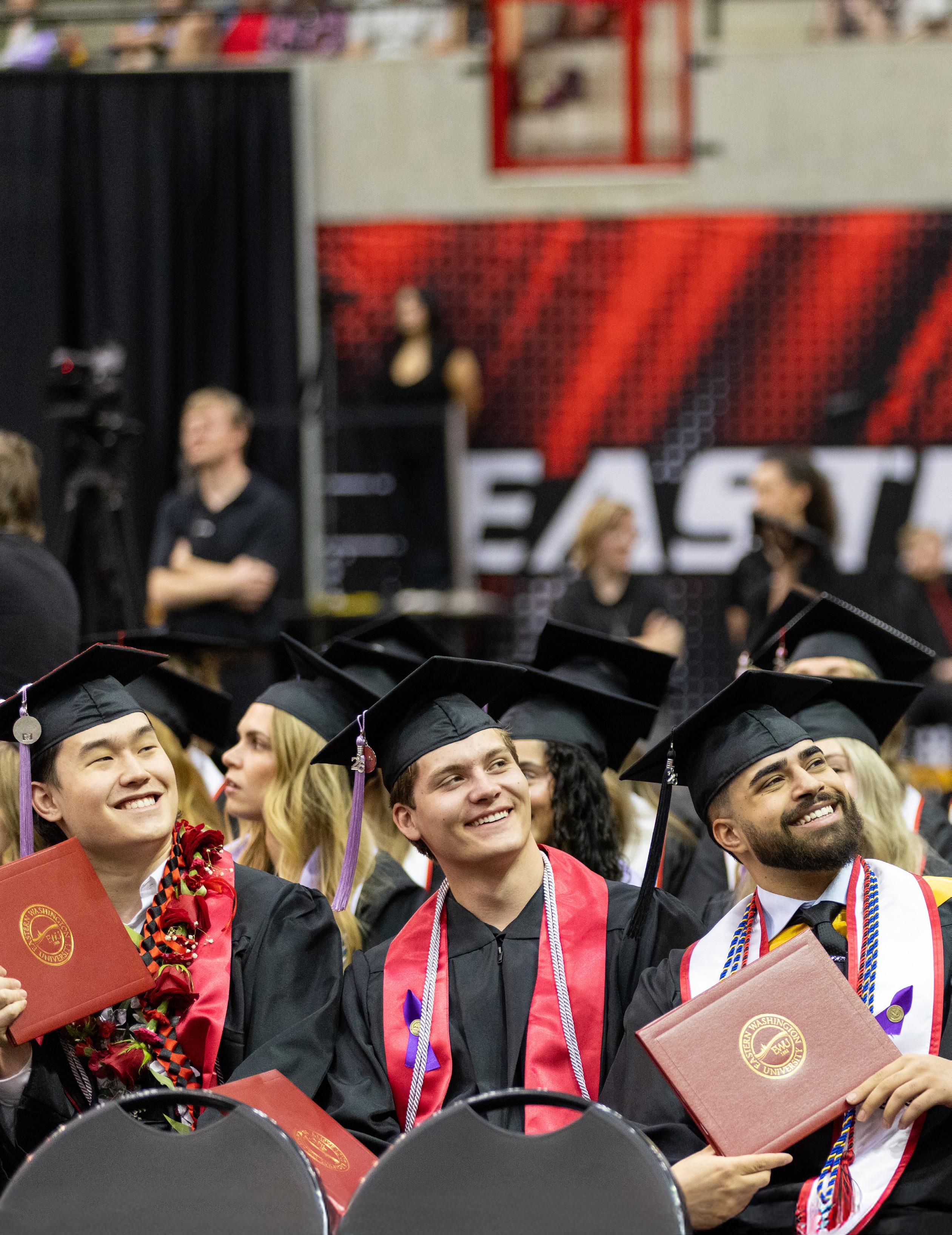
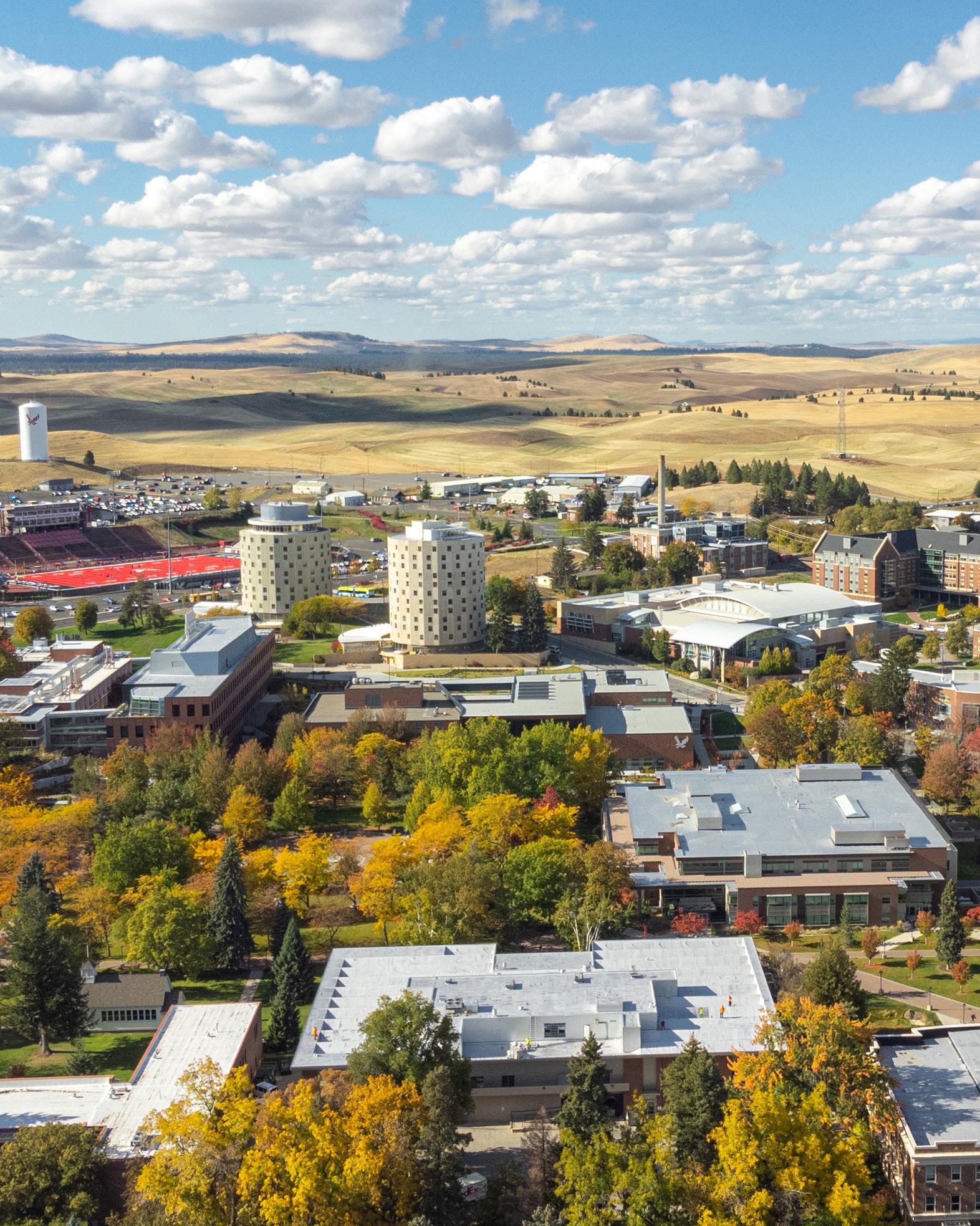
Graduates All: Each year a commencement ceremony in May honors semester students who have earned degrees from the College of Health Science and Public Health. At this year’s celebration, hundreds of friends and family members packed the lower stands at EWU’s Reese Court to see these newly minted Eagle alumni collect their diplomas. It’s been just two years since commencement ceremonies were moved back to Cheney, part of EWU President Shari McMahan’s effort to reaffirm Eastern’s main campus as the center of the university’s academic life.
Photo by Luke Kenneally.
Knowledge, Explored and Applied
At the Creative Works and Research Symposium this spring, our campus came alive with discovery. Students filled both the Art Building and PUB Nysether Community Room, sharing original research, creative projects and applied solutions to realworld challenges. From health sciences to the humanities, engineering to the arts, the breadth of our student’s work was a powerful reminder of who we are as a university, and who we are becoming.
At EWU, innovation is not a distant aspiration — it is a daily practice, grounded in our commitment to students and the evolving needs of our region. As we look ahead, we are embracing thoughtful growth that positions us for a strong and sustainable future.
A key step forward is the strategic consolidation of our College of Health Science and Public Health programs into the Catalyst and SIERR buildings in Spokane (see story, Page 7). By bringing these programs together into a unified health sciences hub, we are strengthening interdisciplinary education while deepening partnerships with healthcare providers and industry leaders. This alignment expands opportunities for collaboration, research and workforce development in one of Washington’s most critical sectors.
At EWU, innovation is not a distant aspiration — it is a daily practice, grounded in our commitment to students and the evolving needs of our region. As we look ahead, we are embracing thoughtful growth that positions us for a strong and sustainable future.
At the same time, this transition allows us to reinvigorate our Cheney campus.
As programs such as business, accounting, design and creative writing return from the Catalyst, they will be more fully integrated into campus life and create new opportunities for connection, collaboration and student engagement. Cheney remains the heart of EWU, and this moment represents an exciting renewal of its role as the principal home of our vibrant academic community.
Of course these moves are about more than location — they are about possibility. By bringing disciplines into closer proximity, we are fostering an environment where innovation thrives at the intersections of ideas and where students are prepared to address complex challenges.
All of this is reflected in our continued work on EWU’s 10-
year campus master plan. This long-term vision ensures that our physical spaces align with our academic priorities, support student success, and reflect the dynamic future we are building together. As we evaluate how best to position Eastern for the years ahead, one thing will never change: our belief in the transformative power of education. The work happening across our campuses continues to inspire confidence in what lies ahead.
Our future is bright because of the people who make this university what it is. Together, we are shaping an Eastern that is innovative, resilient and deeply connected to the communities we serve.
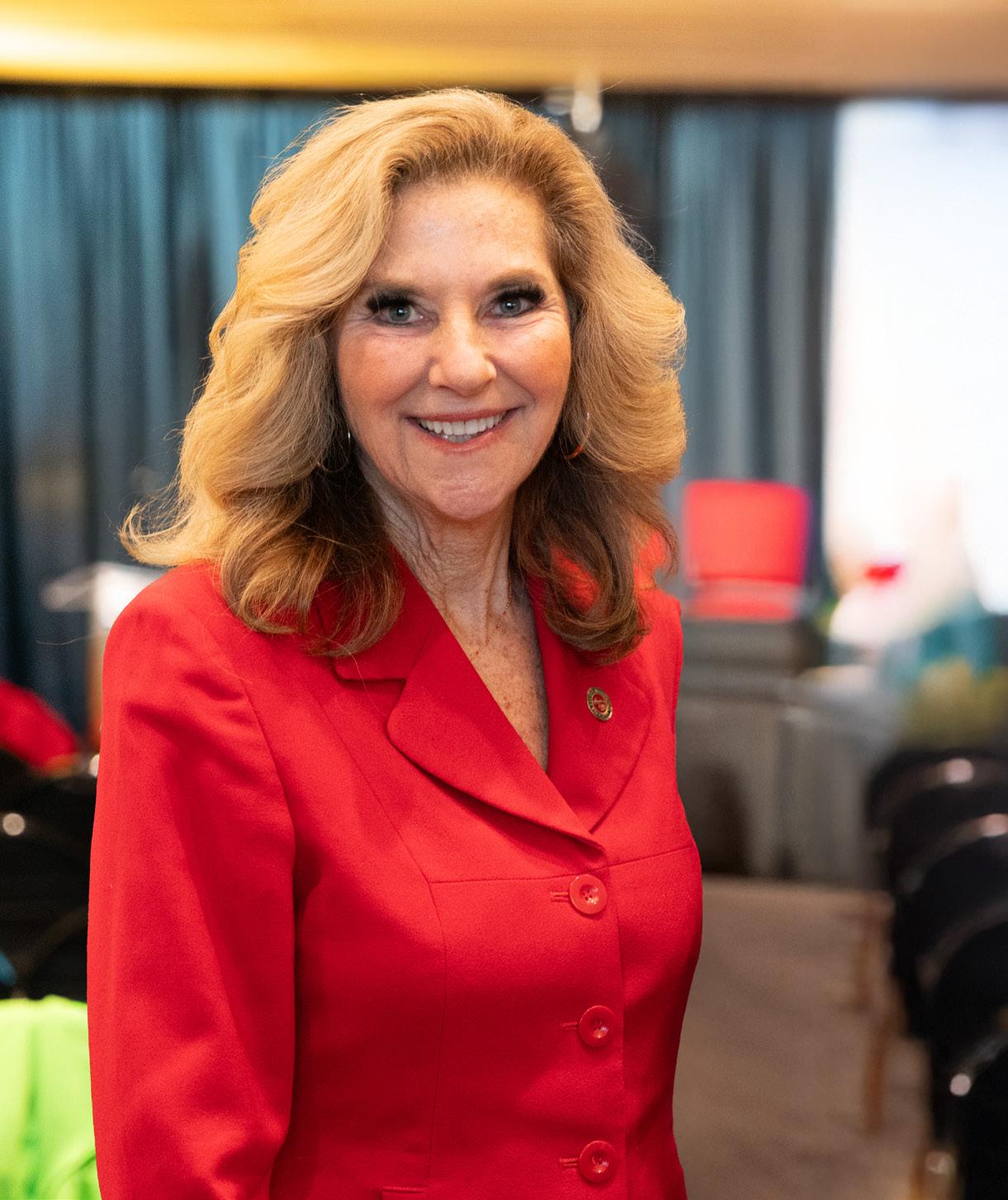
Shari McMahan, PhD EWU President
EASTERN MAGAZINE SPRING /SUMMER 2026
EDITOR
Charles E. Reineke
ART DIRECTOR
Ryan Gaard ’02
CONTRIBUTING DESIGNER
Emily Auseré ’22
CONTRIBUTING WRITERS
Linn Parish
Melodie Little ’91
Rachel Weinberg
PHOTOGRAPHY
Luke Kenneally Aaron Weer
ASSOC. VICE PRESIDENT FOR UNIVERSITY ADVANCEMENT
Eric Limburg
DIRECTOR OF ALUMNI RELATIONS
Kelsey Hatch-Brecek ’21
EMAIL
easternmagazine@ewu.edu
WRITE
Eastern Magazine 102 Hargreaves Hall Cheney, WA 99004-2413
Eastern magazine is published twice each year by University Advancement and is mailed free to alumni and friends in the United States. View this and previous issues of Eastern online at ewu.edu/magazine
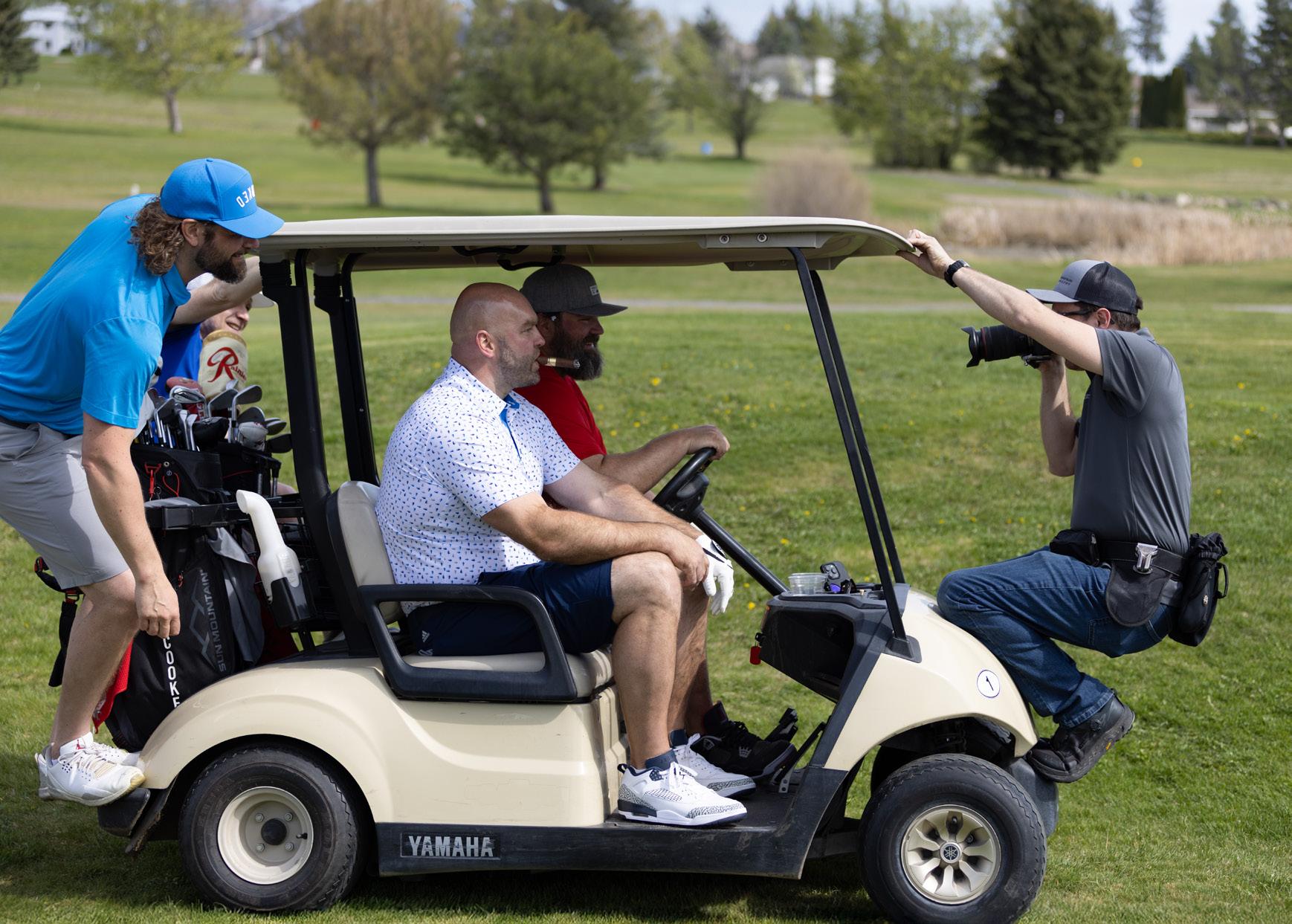
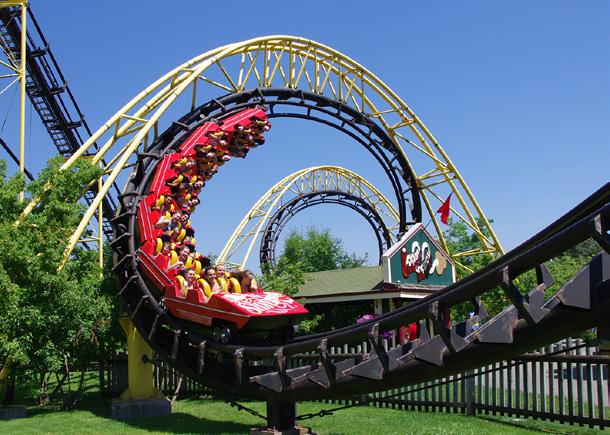
On the Cover: The Cooked As A Goat crew on course for success. Photo by Chris Thompson.
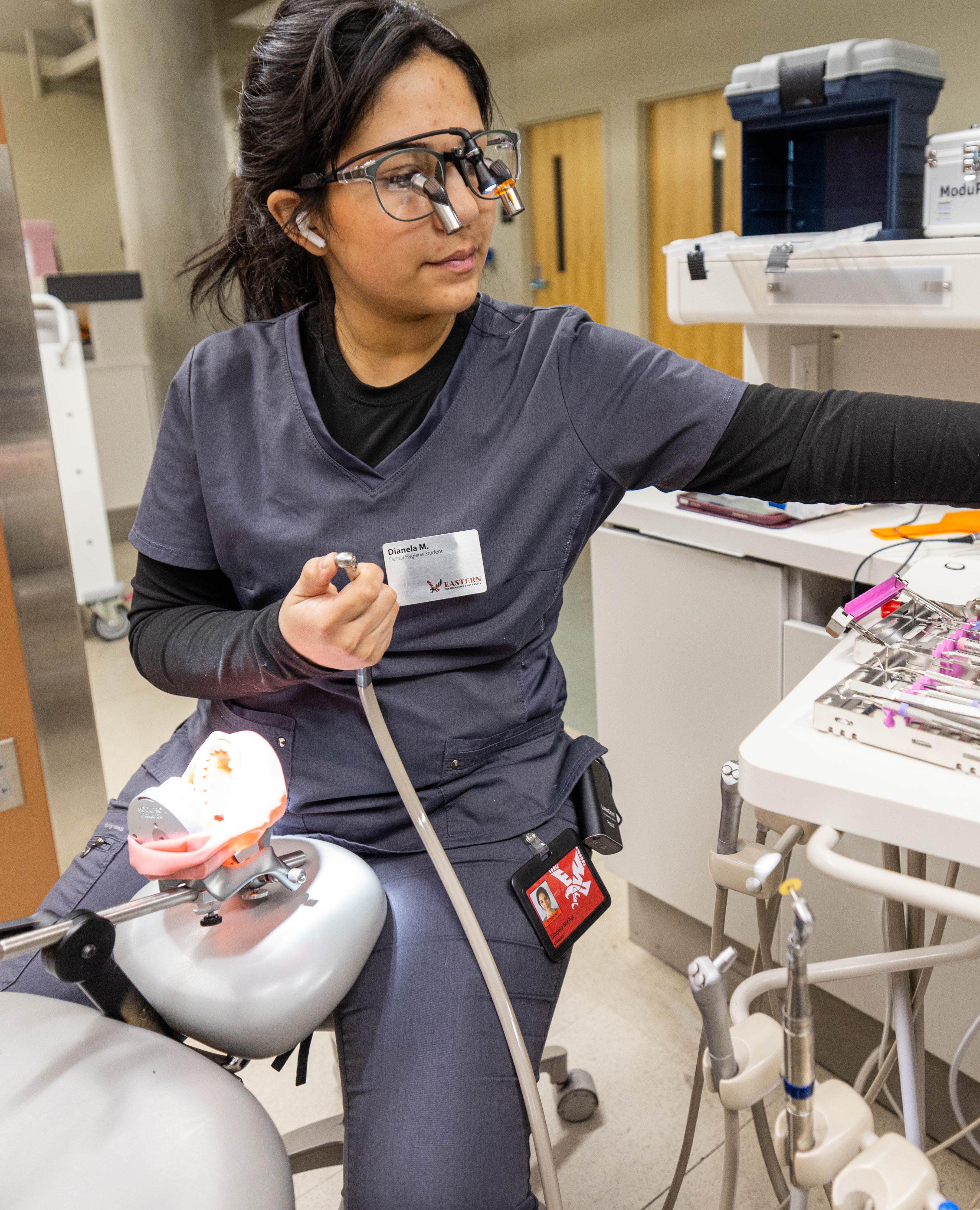
Dainela Michel leans into EWU’s hands-on dental hygiene curriculum. In 2028, a new dental therapy training program is poised to expand Eastern’s already considerable contribution to regional oral health.
Photo by Chris Thompson.
Dentistry’s Missing Middle
A new dental therapy program aims to address a gap in need.
Across much of Washington, getting a toothache is a pain that goes well beyond a throbbing jaw — even for those who can afford treatment. Thanks to a shortage of rural practitioners, dental patients can wait weeks for an appointment, face long drives to a clinic and, too often, experience care deferred to the point of crisis.
According to a 2023 report by the Washington Department of Health, 38 of 39 counties are federally designated as complete or partial Dental Health Professional Shortage Areas. Our situation is hardly unique. Millions of Americans lack reliable access to even basic dental services. The pipeline of dentists has simply not kept pace with the nation’s needs.
Into the gap steps an old idea that’s gaining new momentum: the “dental therapist,” a mid-level provider operating under the supervision of a dentist who is trained to do more than a typical hygienist. Dental therapists examine patients, administer anesthetics, fill cavities, place temporary crowns and, in some cases, pull teeth. The model is common in dozens of countries and has been used in parts of the United States, particularly in tribal communities, for more than a decade.
Unfortunately, academic training for dental therapists is rare. Only three programs in the country hold accreditation from the Commission on Dental Accreditation, and just one offers a master’s degree. Eastern intends to become the next. Backed by a $10.5 million commitment from the Legislature and a $1 million grant from Delta Dental, EWU is developing a master’s-level dental therapy program in the College of Health Science and Public Health. Dawn Lewis-Kinnunen, the college’s dean, says accreditation work is underway, with a target of enrolling the first cohort of students in fall 2028. “Rural communities don’t have adequate access to oral care in Washington state,” Lewis-Kinnunen says. “Our goal is to improve availability by educating a new tier of providers.”
Development of the dental therapy master’s program is occurring as EWU enters the beginning stages of its plan to create a health sciences hub in Spokane’s University District. The new program will be located in the SIERR Building, adjacent to EWU’s Dental Hygiene program and the university-run clinic that provides oral health services to underserved members of the Spokane community.
The dental programs also will be in close proximity to the School of Nursing, which is also housed in SIERR. The Regional Initiatives in Dental Education (RIDE) program, meanwhile, a partnership between EWU and the University of Washington School of Dentistry, will stay in the 840 Building located next door.
“This is the ideal plan for the interprofessional work we want to foster,” says Lewis-Kinnunen. “It’s going to be pretty, and productive.”
Rent Too High?
There’s an algorithm for that, says an Eagle student researcher.
Across the Pacific Northwes t, renters have spent
Creative Energy, Shared Vision
Eastern brings on board a ‘strong advocate’ to head its new graduate studies office.
This July, EWU will open its first Office of Graduate Studies and Research, a move that aims to grow graduate enrollment, promote more research funding, boost industry collaborations, and better position students to contribute to our region’s workforce needs.
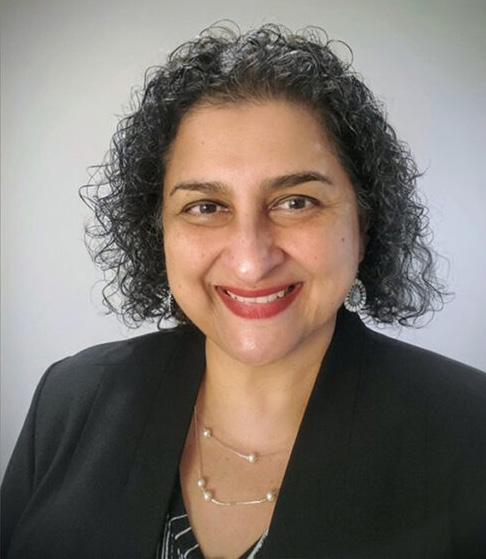
Sushma Krishnamurthy, currently graduate dean at the University of Louisiana at Monroe, will serve as
visit, I immediately gathered that the aspirations are many — developing new degree programs, grant support, professional development and services for students. I am ready to meet all the stakeholders and begin my work.”
Krishnamurthy will be a strong advocate for workforce-aligned graduate education and her leadership will promote innovative curricula, graduate policy, international partnerships and sustained graduatestudent success.
Decanting Scholarships
Lorenzo Smith, provost and vice president for academic affairs at EWU, said Krishnamurthy will be “a strong advocate for workforce-aligned graduate education” and that her leadership will promote “innovative curricula, graduate policy, international partnerships and sustained graduatestudent success.”
Smith went on to highlight Krishnamurthy’s many accomplishments in her current position, including her proven track record of success as a graduate dean. Under her leadership, graduate enrollment at ULM more than doubled. She also implemented a strategic plan for its graduate school, and strengthened its academic quality and compliance.
In addition, Krishnamurthy is a noted biological sciences researcher who, with over 30 years of experience in aquatic-systems studies, has contributed important findings related to heavy-metal pollution. She holds a Bachelor of Science degree from Bangalore University/St. Joseph’s College, and earned both master’s and doctoral degrees from the University of Maryland Eastern Shore.
“She is a respected leader, and we know EWU will be better with her as part of our team,” Smith says.
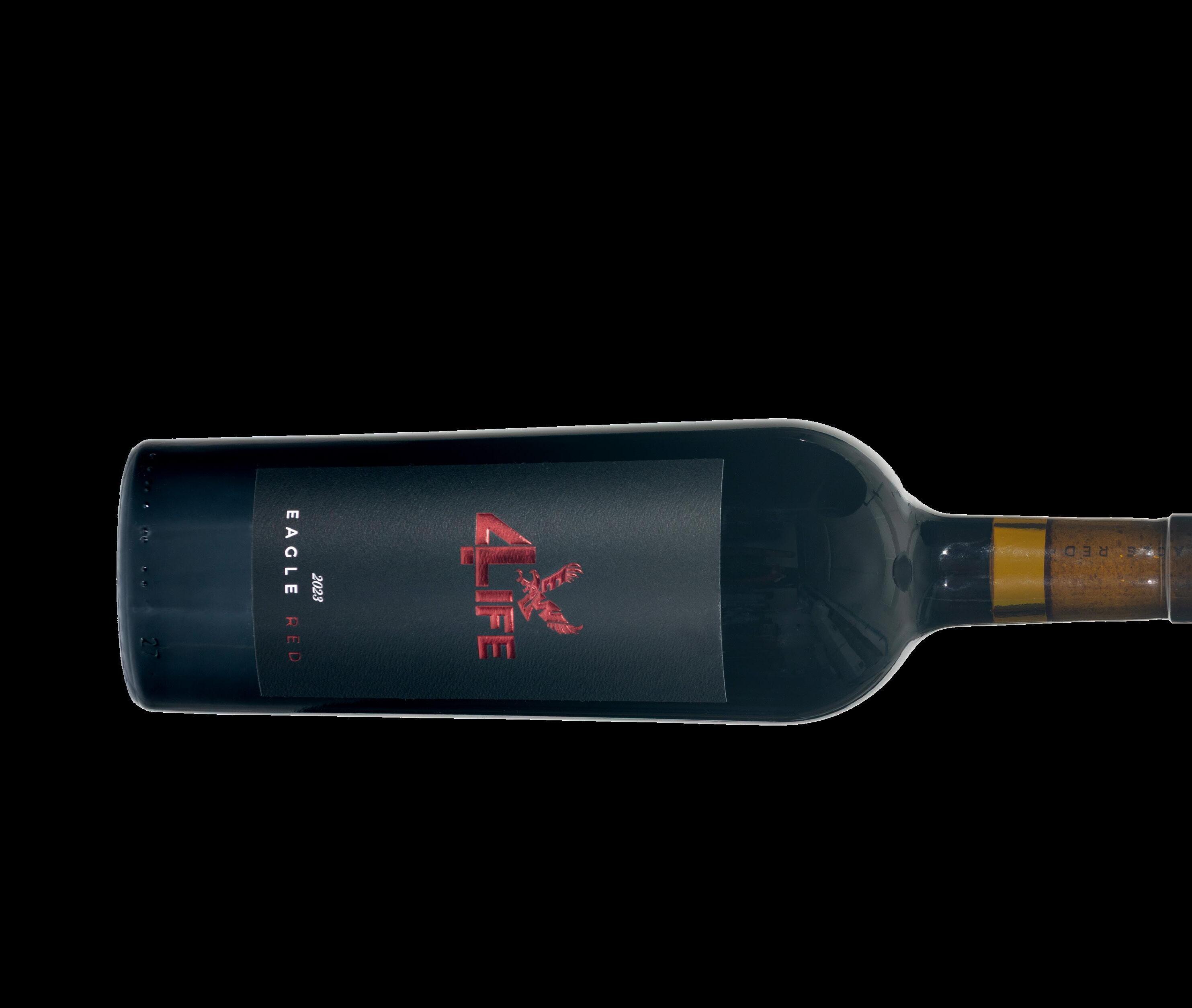
An EWU-licensed wine, Eagle Red, made its debut this spring.
where winemaker Reid Klei ’05 works his vinification magic using some of Horse Heaven Hills’ finest fruit, the wine is a bold custom cuvée crafted with Eagle pride.
A portion of each bottle sold will go to EWU’s Alumni Legacy Scholarship, meaning, for the first time, that a student’s education may be subsidized in part by an Eagle alum having a special bottle at dinner. “I think it represents the Eastern alumni well,” Klei says. “Everyone is bringing their own strengths to the table, but together we’re stronger.”
The collaboration is the fruit of a twoyear effort led by Kelsey Hatch-Brecek, Eastern’s director of alumni relations, who
worked closely with Klei on the blend and its distinctive packaging. Bottles are dressed in matte black, with a sleek Eagle4Life logo alongside the EWU insignia — more boutique Walla Walla than Eagle Store.
Eagle Red’s first run is limited to 200 cases. The wine will also appear in the fall shipment for the Eagle Flights Wine Club, and will be available for a time in the McKinley Springs tasting room in Prosser, Washington.
“I’m super excited to roll out this bold new wine, and to raise our profile among the state’s community of wine connoisseurs.” Hatch-Brecek says.
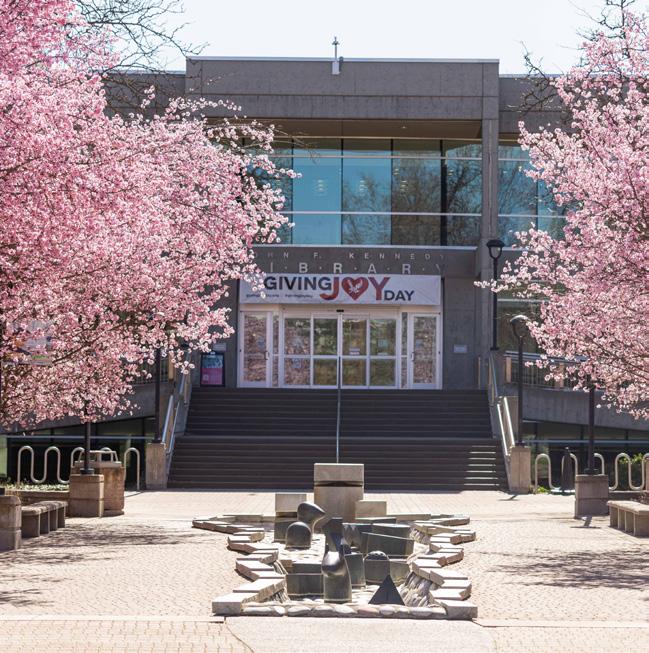
Giving Joy Day Delivers
Once again, donors make EWU’s annual giving event a success.
This year’s Giving Joy Day , the tenth installment of Eastern’s celebratory service and philanthropy event, saw Eagles from across the nation make over 400 gifts to support dozens of university funds.
By day’s end, the university had raised more than $400,000 for student scholarships, aid programs and other university priorities, says Linda Safford, senior director for annual giving.
At the center of the festivities was an event at Eastern’s PUB, where Kelsey Hatch-Brecek, director of alumni relations, led a gathering of students, faculty and staff who shared stories of donors’ impact.
President Shari McMahan also addressed the event, highlighting how Eastern has always been a place of access and opportunity. “We transform lives, that is the bottom line,” she told the crowd. “And these generous donations might mean a student can stay in school, access an internship and feel a sense of belonging.”
ASEWU Vice President Johnny Curtis confirmed the role scholarships play in the success of students like him. “I can say with complete honesty that without the support of donors and fundraising efforts, I would not be standing here preparing to graduate this June.”
This year’s Giving Joy come as the university enters its eighth year of its ongoing “Build Our Future: the Campaign for Eastern” fundraising effort. The $100 million comprehensive campaign, EWU’s first-ever, is aimed at positioning Eastern to ensure its students succeed in ways that sustain vibrant, prosperous communities. Thanks to the donors’ generosity thus far, the Build Our Future campaign has received contributions totaling more than $86 million toward its goal.
Miss your chance to join in the Joy? Visit ewu.edu/give to learn how you can help.
Seamus Mahoney
Subject to Debate
Resolved: Competitive argument is a most worthy Eastern activity. It’s not because I like going to other colleges to argue— though I do enjoy that,” Mahoney says with a laugh, “but because of the community that it fosters…
Competitive, formal debate remains one of the places where young people learn to do something genuinely difficult: listening to an opposing argument and responding with evidence. The payoff, education researchers say, is a lifelong edge in reasoning, persuasion and the capacity to think clearly while holding two ideas in tension. Sadly, debate programs have been disappearing from college campuses for decades, casualties of budget pressures and shifting institutional priorities. EWU’s team, for example, had gone dormant. And then Tony Penders arrived.
Penders, an adjunct instructor, joined Eastern’s history faculty four years ago. He had previously directed the debate program at the University of Indianapolis and, because he’s convinced that debate helps students succeed in college and beyond, he was keen on reviving Eastern’s. Soon after his arrival in Cheney he did
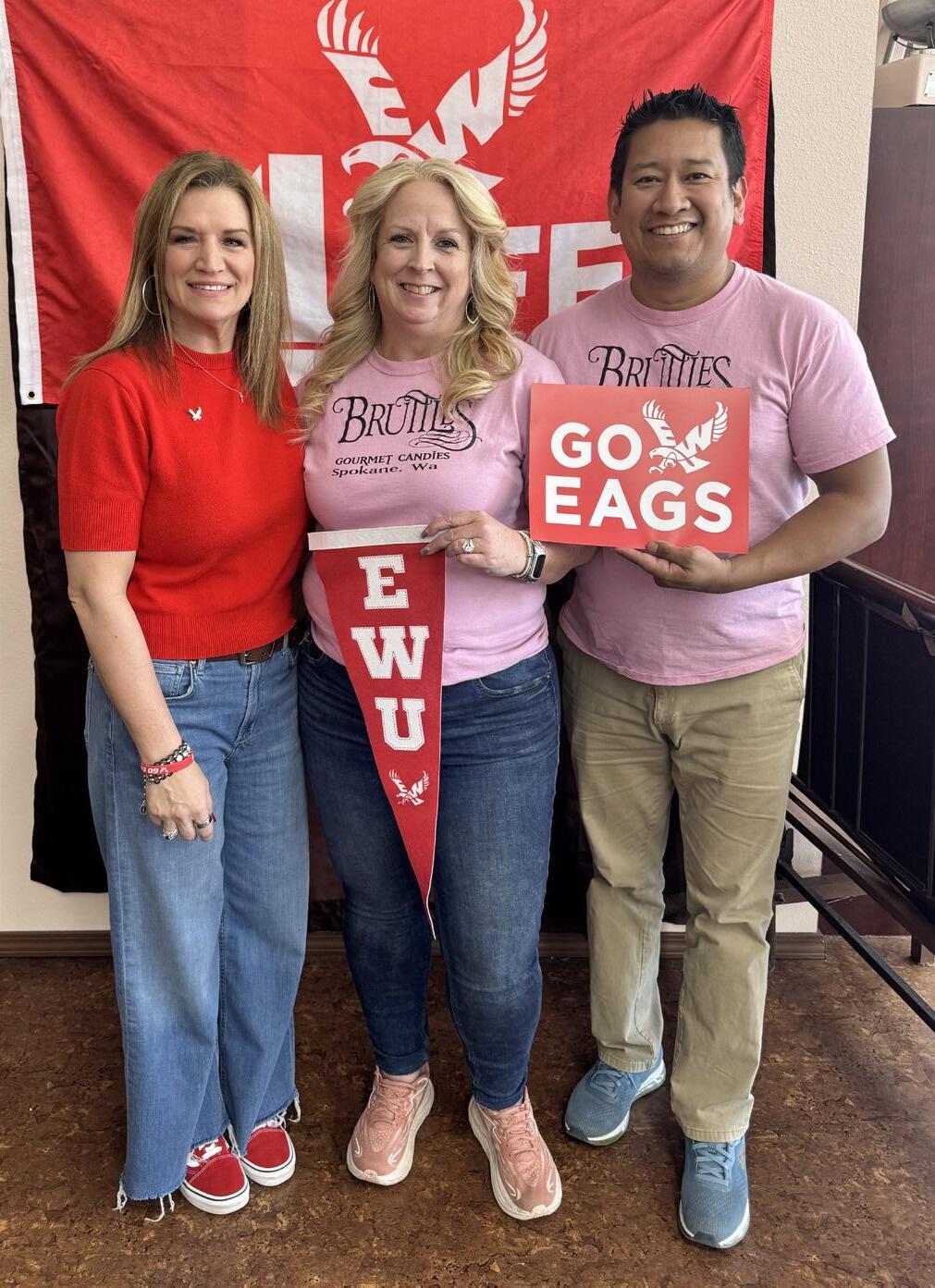
From right: Bruttles Gourmet Candies owners John ’04 and Jessica Slack, with EWU Foundation Board member Jennifer Mandarino ’94.
Home Sweet
Hall
A new, $50 million residential facility is slated to replace Dryden Hall.
When it comes to university residence halls, the cinder-block doubles and communal bathrooms of old no longer reflect how undergraduates want to live (if they ever did). These days, an affordable mix of privacy, kitchen access, and high-end features typically tops the list of student priorities. Institutions that fail to listen — and modernize accordingly — risk losing students to those that do.
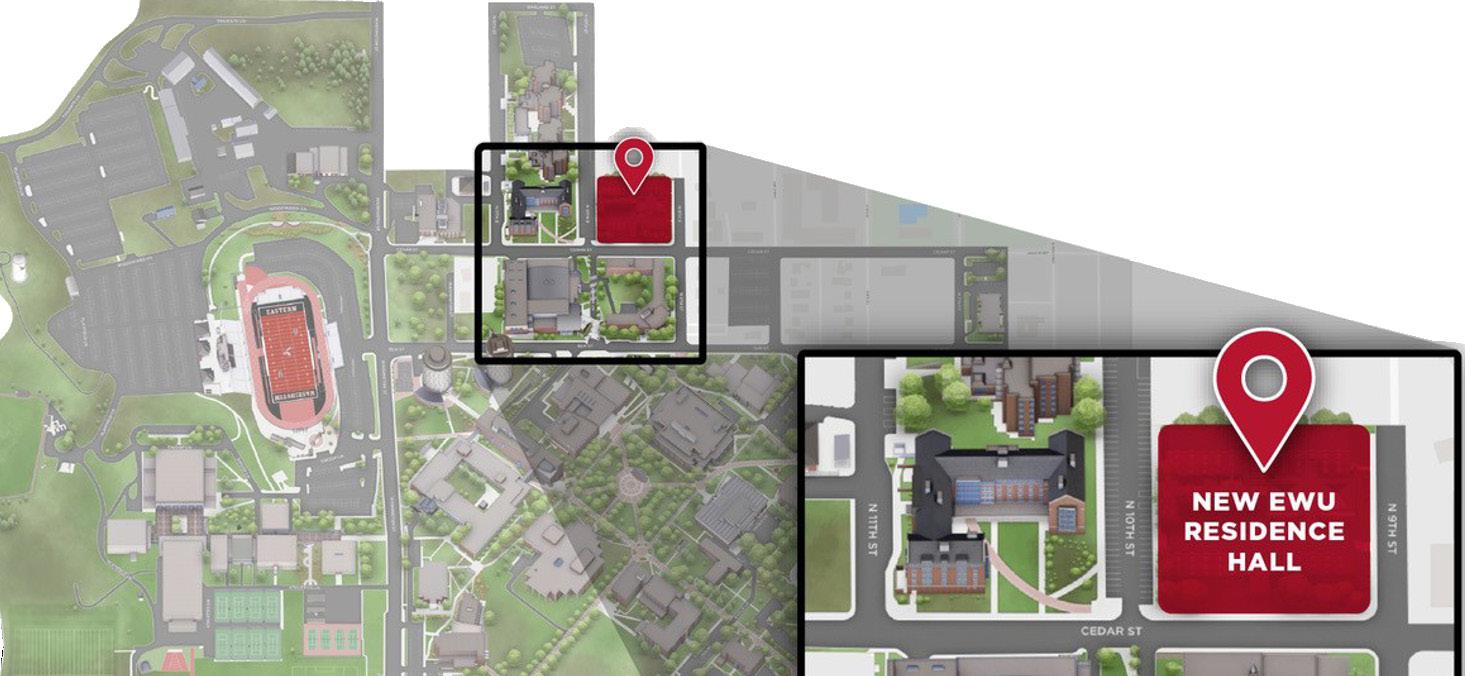
Eastern is on board. Earlier this spring, planning began for a new residence hall, a $50.2 million project that will replace Dryden, the venerable but now vacant 61-yearold dormitory at the northwest corner of Ninth and Cedar. The yet-to-be-named facility will house 350 to 400 students in configurations that are still to be decided — though you can be sure comfortable, amenity-rich suites will be on the table.
“The vision is to create modern student housing that supports academic success and community engagement,” says Max Baca, vice president of business and strategy. Design decisions, he adds, will be informed by market research emphasizing the priorities of Eagle students.
NAC Architecture of Spokane will lead the project, extending a relationship that stretches back 45 years and dozens of campus projects. The firm brings considerable
just that, and today the seven-member Eagle Speech & Debate Club team competes in events across the nation. “People think speech and debate is all about speaking,” Penders says, “I always tell people it’s really more of a listening event.” One can’t, in other words, rebut what one hasn’t absorbed. Or find weakness in a claim you weren’t attentive enough to understand. Penders’ roots in debate traced back to his own undergraduate years at Gonzaga, a Jesuit university where formal argumentation is ingrained in its DNA. Now with students of his own, Penders remains convinced that verbal jousting doesn’t just provide tools for arguing more effectively, it also serves as a “foot in the door” for leadership and career opportunities. Another benefit, he says, is the thrill of competing against students from
experience to the job, with a national portfolio valued at roughly $500 million that includes work for Gonzaga University and the University of Washington. Melanie Potts, EWU’s director of housing and residential life, says the university has sought to be proactive in making the new residences super student friendly. “We are [engaging] our students and market research to make intentional decisions that will contribute to the success and belonging of EWU students for many years to come,” she says.
Design work is expected to begin shortly, with construction targeted for early 2027. Move-in is planned ahead of the 2028-2029 academic year.
The new residence hall will join the six residential properties — four traditional residence halls and two apartment complexes — that EWU currently operates.
other universities. At the end of January, for example, Penders and the Eagle team participated virtually in a tournament based in New York City, where Seamus Mahoney, the Speech & Debate Club president, placed second overall. A junior majoring in environmental policy and planning, Mahoney transferred to EWU from Lower Columbia College, a two-year community college in Longview, Washington. He says he arrived at Eastern already convinced that debate was for him.
“It’s not because I like going to other colleges to argue—though I do enjoy that,” Mahoney says with a laugh, “but because of the community that it fosters within the institution and the connections that I can make beyond.”
East With the Eagles
A study trip to Japan yields a wealth of
transformative insights.
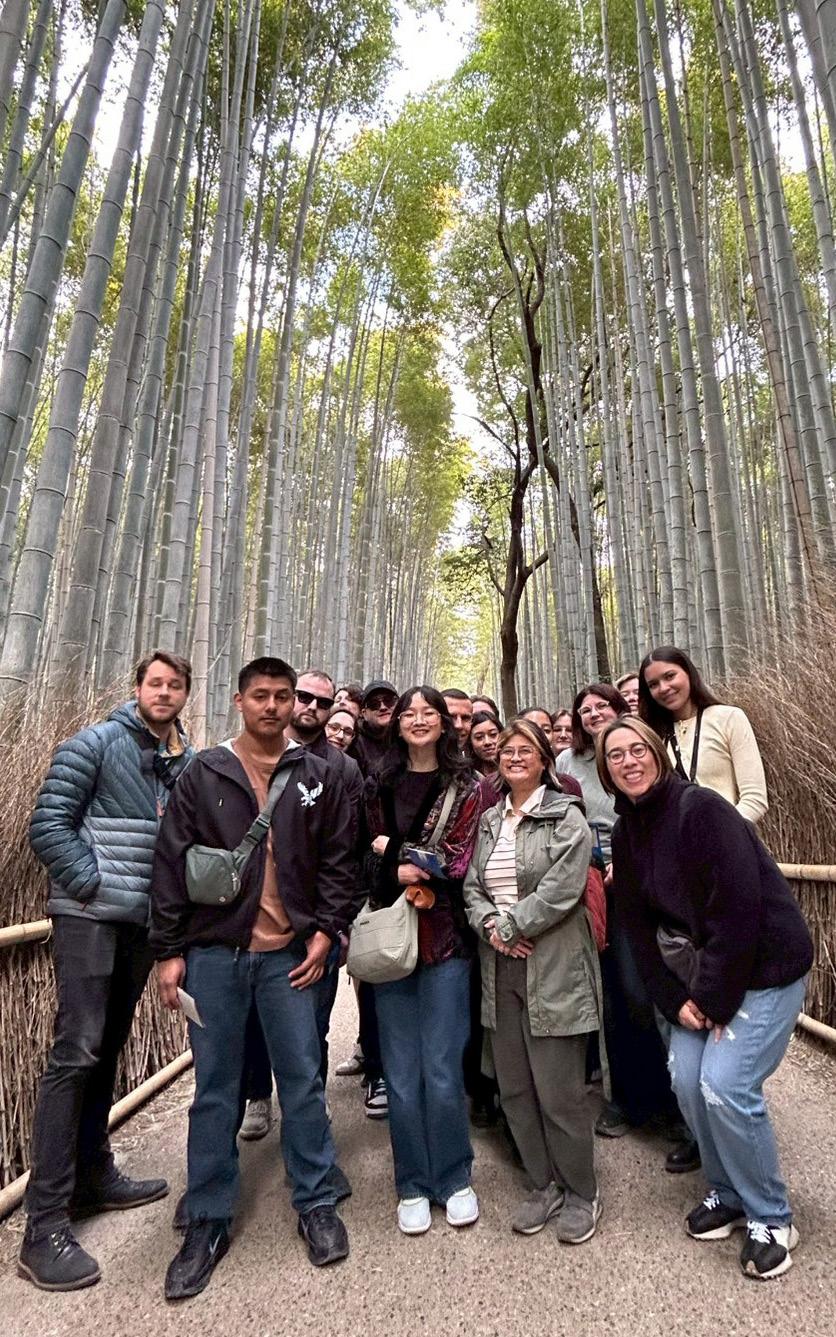
Earlier this spring a group of more than a dozen EWU students participated in a first-of-its-kind, 10day study abroad program in Japan. Accompanied by trip organizer Erina Romanowich, a senior lecturer in Japanese studies at EWU, the students used skills acquired in their winter-term coursework to more fully experience the language and culture of Tokyo and Kyoto.
The trip had something for everyone. Design program students examined how aesthetics, functionality and cultural values shaped everyday spaces; Japanese language students strengthened their skills and cultural depth by practicing Japanese in their daily interactions; and urban and regional planning students were challenged by fundamentally different approaches to urban organization.
“Students were able to see the contrast between traditional Japanese culture and its modern culture,” Romanowich says. By experiencing, for example, Kyoto, Japan’s ancient center of governance, then contrasting it with
today’s capital city of Tokyo, the traveling Eagles got a heady mix of timeless history and hyper-modernity, she adds.
Yoko Parks, an EWU senior who recently completed her minor in Japanese, said she was awe-struck by her newfound — and hard-earned — ability to interact in a language her audience could understand. “My grandma told me that if you speak a language someone knows, you speak to their head,” Parks says. “If you speak their native language, you speak to their heart.”
A lot of students said they wanted to come back to Japan on their own which, as a native Japanese citizen, is a really cool thing to hear.
Parks, who is now fluent in Japanese, makes a point of giving credit to her instructor. “Erina-sensei is second to none in Japanese linguistics,” she says of Romanowich. “I think her dedication to teaching her home language is admirable and something to emulate.” Parks adds that she hopes to one day move to Japan to work in its booming tech sector.
For many of the students on the trip, it was their first experience traveling outside of the country, making the journey both academically and personally transformative. The program culminated in student presentations that connected observations from the trip with concepts learned in class, an exercise that highlighted the value of experiential learning.
“A lot of students said they wanted to come back to Japan on their own,” Romanowich says, “which as a native Japanese citizen, is a really cool thing to hear.”
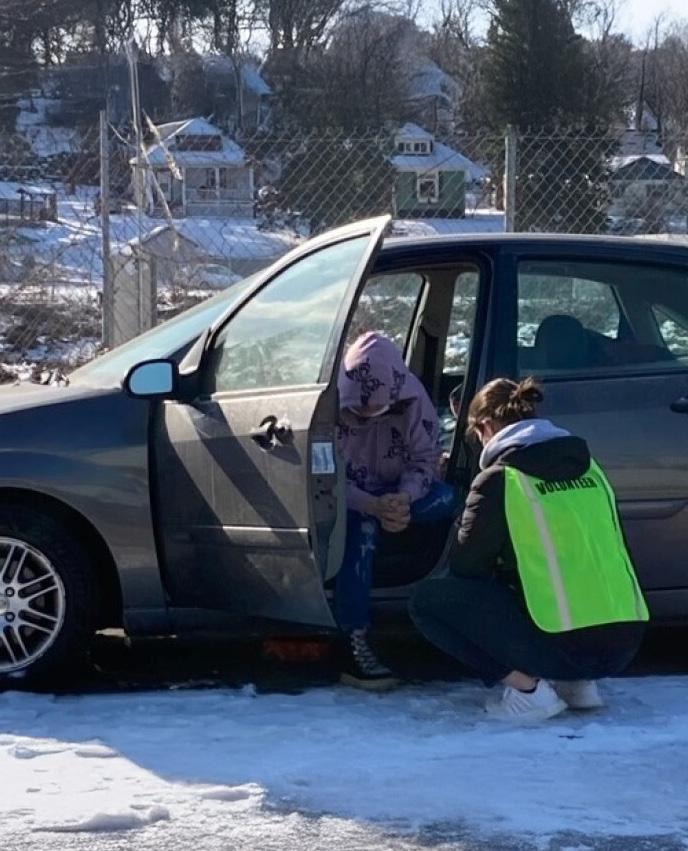
Every year , on a single night in January, dozens of volunteers fan out across the nation’s cities and towns to tally the number of people living without shelter. The federally mandated exercise, called the Point-in-Time Count, is part census, part reality check. And for several years now, a team from Eastern has played a key role in making it work locally.
Matt Anderson, an EWU professor of urban and regional planning and co-chair of Spokane’s Continuum of Care Board, heads up the university’s role in the count. His students help staff the effort, and afterward analyze what the numbers reveal. The goal is to give local political leaders, social service agencies and charitable organizations a data-driven picture of who is unhoused in Spokane, and why.
The scale of the problem has shifted dramatically. From 2015 to 2023, Spokane’s count rose from roughly 1,000 to more than 2,300. (It has since retreated to just over 1,800.) Each year between 7,000 and 8,000 people typically cycle through the city’s shelter system. Anderson and his students say their data routinely challenges popular assumptions. Chief among these is that Spokane’s homeless population has migrated from elsewhere: The most recent count found that about 80 percent were locals, many of them lifelong residents. “You’re likely to draw
Eastern’s Erina Romanowich (right) and her students traverse a forest path during their study sojourn in Japan.
Out of the Shadows
Eastern students hit the streets in a data-driven approach to homelessness.
People feel OK about the criminalization of being homeless,” she said, in part because “they think all homeless people are dangerous.
conclusions that are going to be skewed if you’re only considering the unhoused population in the downtown core,” Anderson said, “because it’s a skewed segment of the population that’s concentrated down there.”
Allison Zimmerman, an Eastern student who participated in the 2024 count, said her experience underscored how much homelessness remains invisible, and how this shapes public attitudes. “The public often overlook those that are ‘hidden,’” she says. That lack of awareness, she adds, makes it easier for people to accept punitive policies. “People feel OK about the criminalization of being homeless,” she said, in part because “they think all homeless people are dangerous.”
The count, by design, captures only a single days’ snapshot and almost certainly undercounts the true population. But, Anderson says, it remains the best tool available.
“We have a long way to go,” he says, “but we’re at least trending in the right direction.”
Restored and Repurposed
A treasured transportation landmark gets new life.
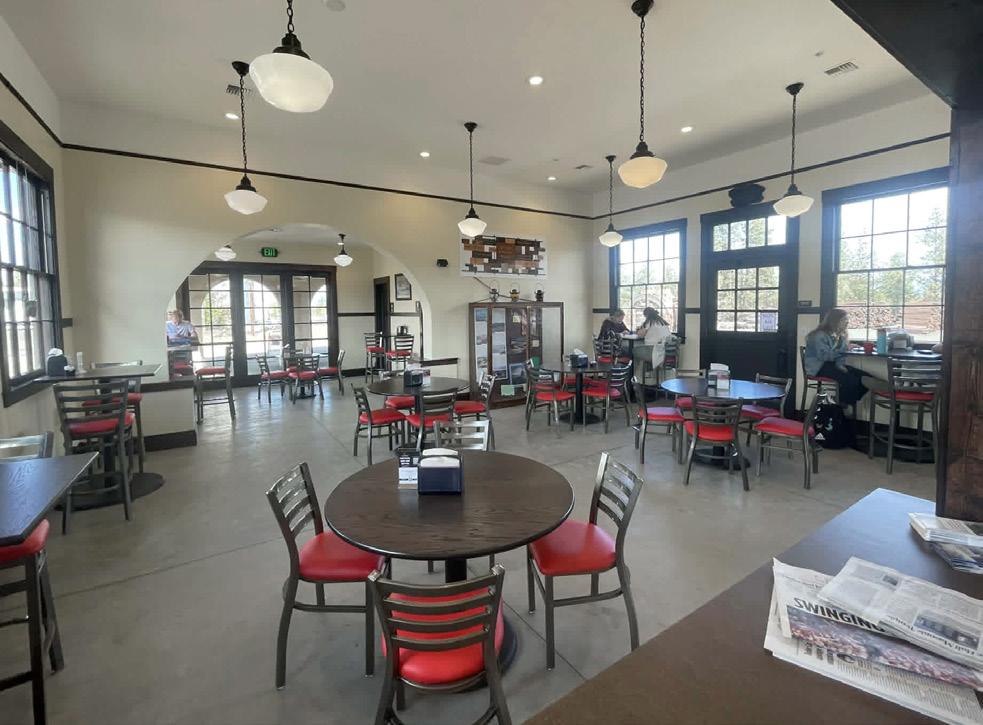
Thanks to the dogged persistence of a small group of rail and history buffs, a seminal part of EWU’s history — one that it shares with its hometown — has been preserved and repurposed for another century or more of service.
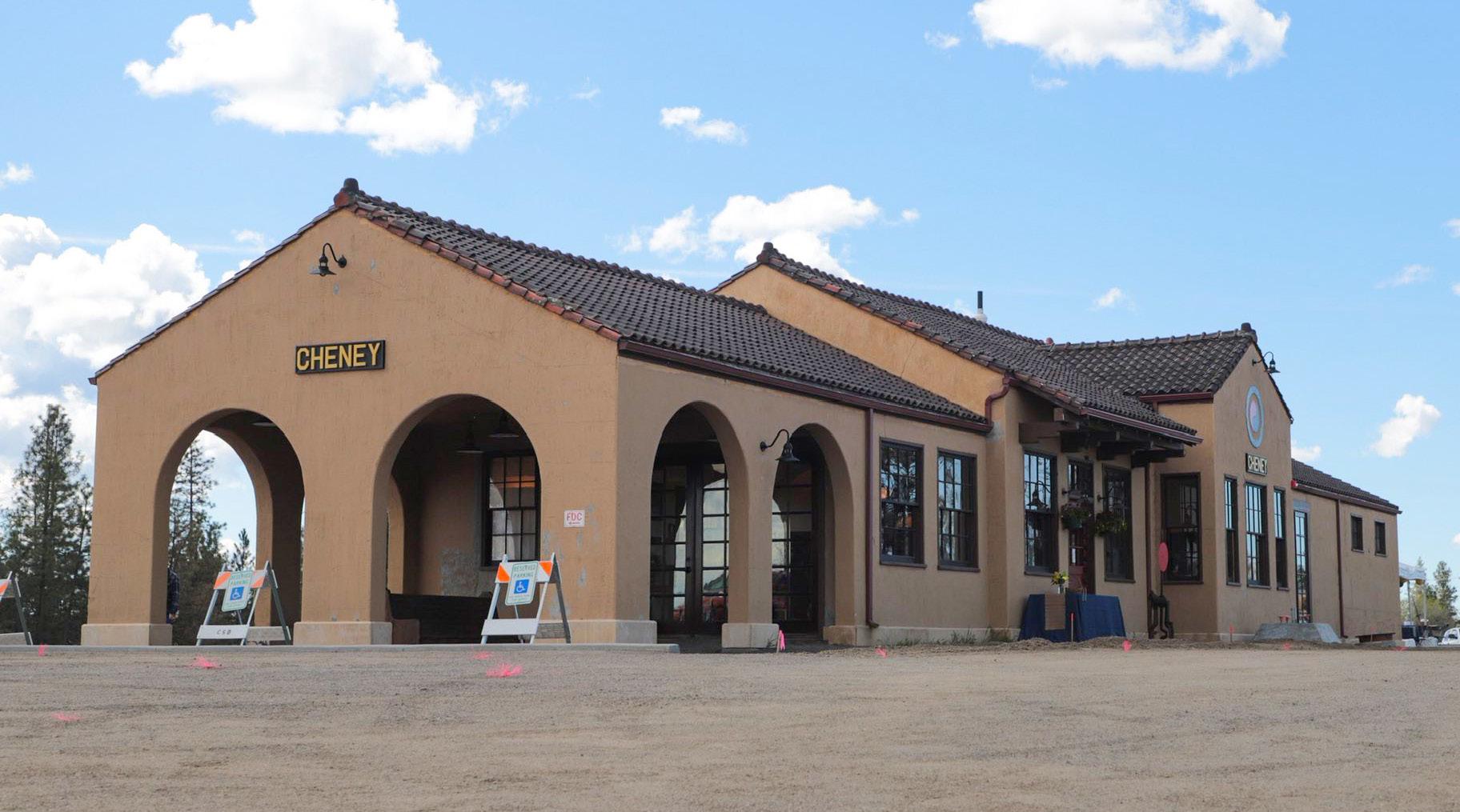
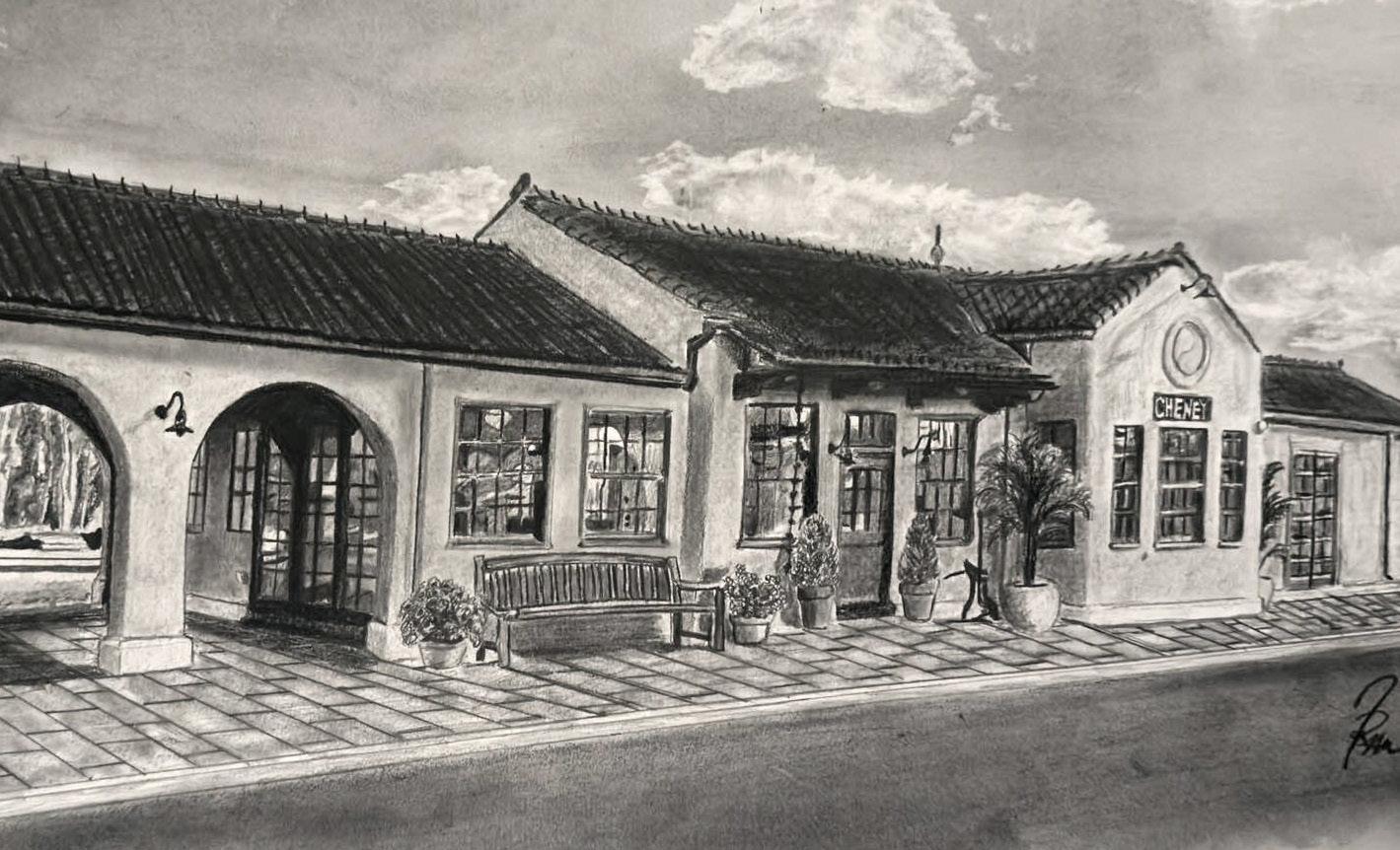
The Cheney Depot, a charming Spanishcolonial style structure completed in 1929, for decades served as a primary means of connecting generations of Eastern students to Spokane and the wider world. But after passenger service came to an end in 1971, and freight operations terminated a few years later, the abandoned station gradually fell into disrepair.
After the railroad announced plans to demolish it in 2014, a local group, the Cheney Depot Society, was formed to save it. Their audacious $2.2 million
rescue plan involved first stabilizing and relocating the structure, then recruiting both professional and volunteer labor to refurbish it. When finished, the society proposed, the space would be a perfect home for select local retailers or other small businesses.
It wasn’t easy to keep things moving forward — particularly during the pandemic years — but earlier this spring Depot Society members announced that the structure, now fully restored and resituated at a new location on 1st Street, was ready to return to service.
At a grand opening event in April, Eastern alumnus Rick Mount, the society’s chair, told a packed house that the project demanded a lot from the volunteers, donors and other supporters. It’s been a “long process,” he said, but one that had been “a truly rewarding experience for all of us who have put in so much time and effort to make this dream come true.”
The depot, located on Union Street about two blocks from its original location, is once again serving both EWU students and community members, this time as the outpost of an artisanal coffee shop. The business, Eastern Coffee Roasters, will feature an outdoor patio and indoor dining areas from which coffee roasting will be on view. There will also be dedicated spaces for meetings and study sessions, the owners say.
A Season of Signature Performances
Eagle standouts portend golden days for track and field.
During both their indoor and outdoor seasons this year, Eastern’s men’s and women’s track and field teams have been stacking personal records, climbing all-time program lists, and leaving their coaches sounding unusually bullish about the future.
On the women’s side, the performances have been nothing short of dazzling. Sprinter Gilana Wollman has been a double threat all season, sweeping the 100m and 200m at a recent home invitational. Judith Koumedzina, meanwhile, has climbed into the top five of EWU’s all-time lists in both events, and is key part of a women’s 4x100m relay squad that has blasted to the No. 2 spot in program history.
In the hurdles, Jordyn Grady has been on a tear, setting personal bests at consecutive meets while posting a 400m hurdles time that is EWU’s second best ever. “That school record is going down soon,” says Erin Tucker, Eastern’s director of track and field and cross county.
Then there is Lexi Meyer, who perhaps delivered the signature performance of EWU’s season: an 800m effort at the OSU High Performance Invite that didn’t just break her own school record — it obliterated it by nearly two full seconds.
The men have been equally compelling. Sprinter Kris Phennicie has vaulted to Eastern's No. 2 all-time in the 100m rankings, while Enoch Okoh, his frequent relay partner, holds the No. 4 spot. Distance runner Owen Higgins quietly moved into second place all-time in the 800m, and thrower Cort Gebbers has Tucker promising seismic events in the discus circle. “Cort is about to unload something crazy,” he says. “Stay tuned.”
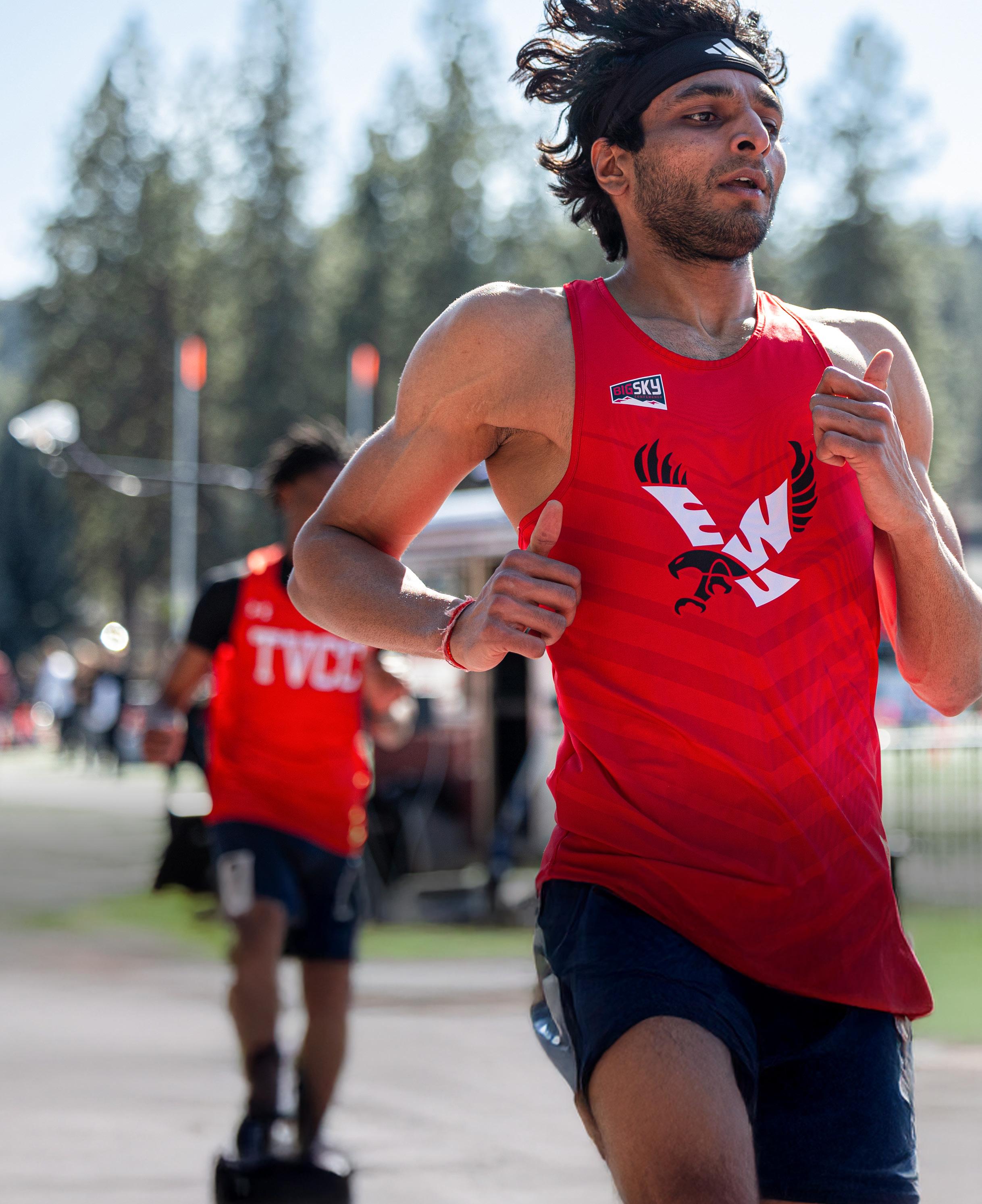
If EWU’s season has a subplot that transcends the conference standings, it belongs to Madhvendra “Maddy” Shekhawat, a senior sprinter, hurdling specialist and two time All Big Sky athlete from Jaipur, India. Since his breakout season in 2025, Shekhawat has been turning
heads on two continents. At Eastern, he’s been virtually unbeatable in the 60m hurdles, winning at every meet he has entered this season and posting consistent times that have India’s growing number of track and field fans paying close attention.
The stakes are clear. Shekhawat’s personal best of 13.70 seconds in the 110m hurdles sits just a few hundredths of a second from the Asian Games qualification standard — a gap that sounds negligible but is, even for elite sprint hurdlers, a real challenge. His recent successes have been understood, in both Jaipur and in Cheney, as evidence that he is closing it. The future is indeed looking bright.
“We are moving in the right direction and are on the cusp of putting together a great conference meet,” Tucker says of Maddy and the rest of his up-and-coming team. “We will fight for a ton of first-place finishes and destroy a few school records along the way.”
YOU CAN HELP EWU BUILD A PATH TO SUCCESS FOR EASTERN'S STUDENTS
EWU’s first-ever comprehensive fundraising campaign is about supporting the students who will create solutions for tomorrow’s challenges.
Thanks to your support, we've raised $86,000,000 of our $100,000,000 goal.
Support our push to the finish line. Vist us at ewu.edu/buildourfuture
EWU’s Madhvendra “ Maddy ” Shekhawat.
Photo by Braeden Harlow.
An Alumni
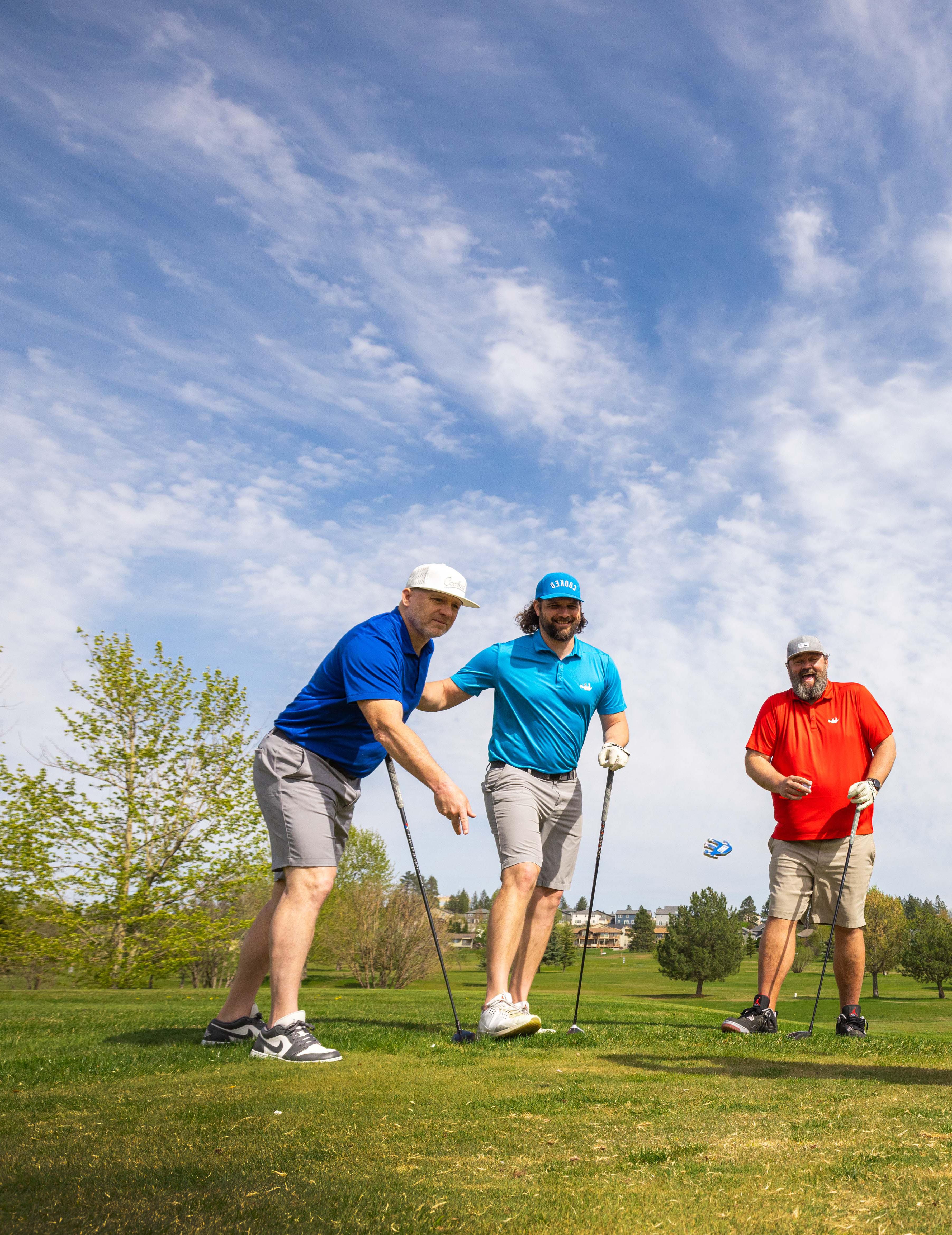
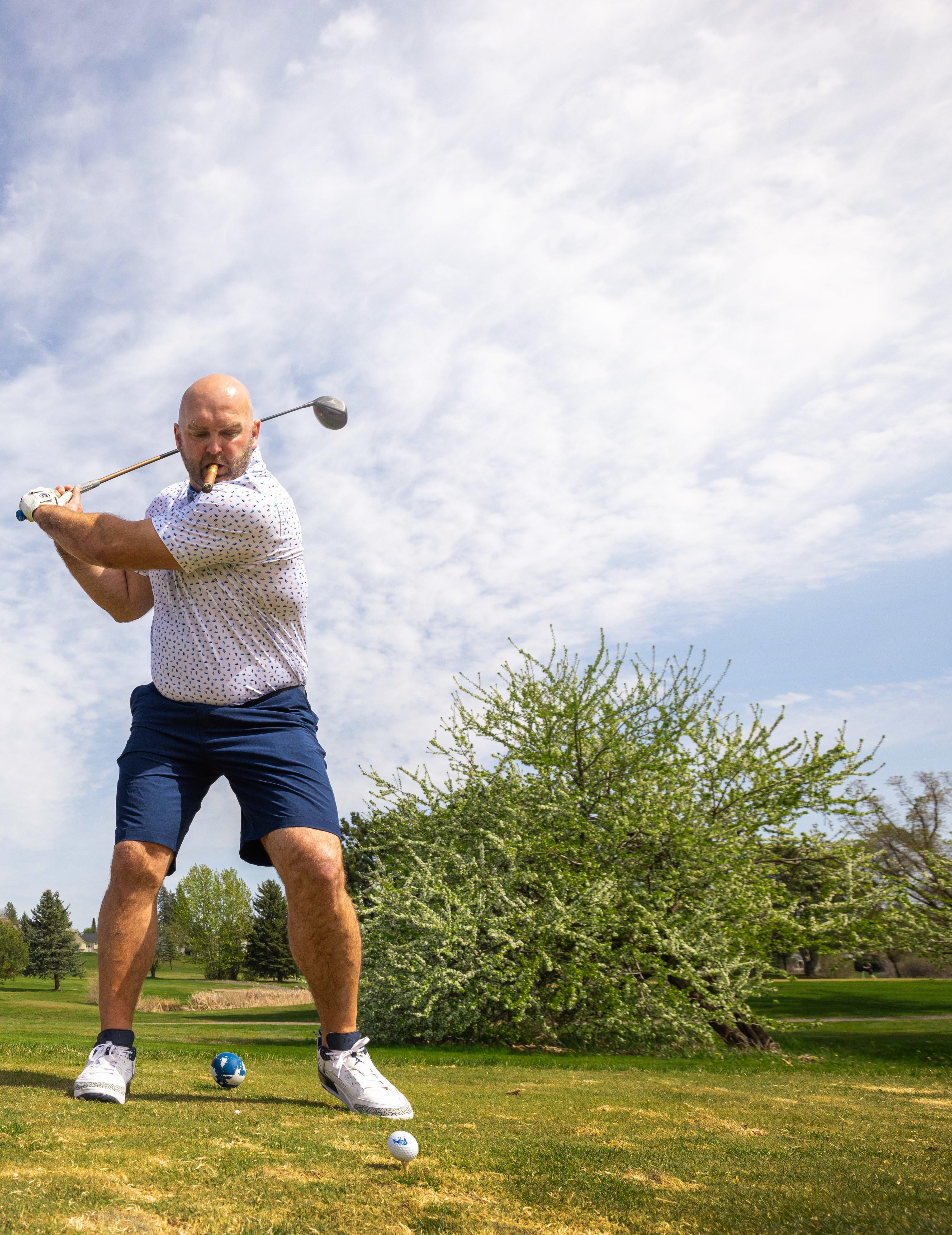
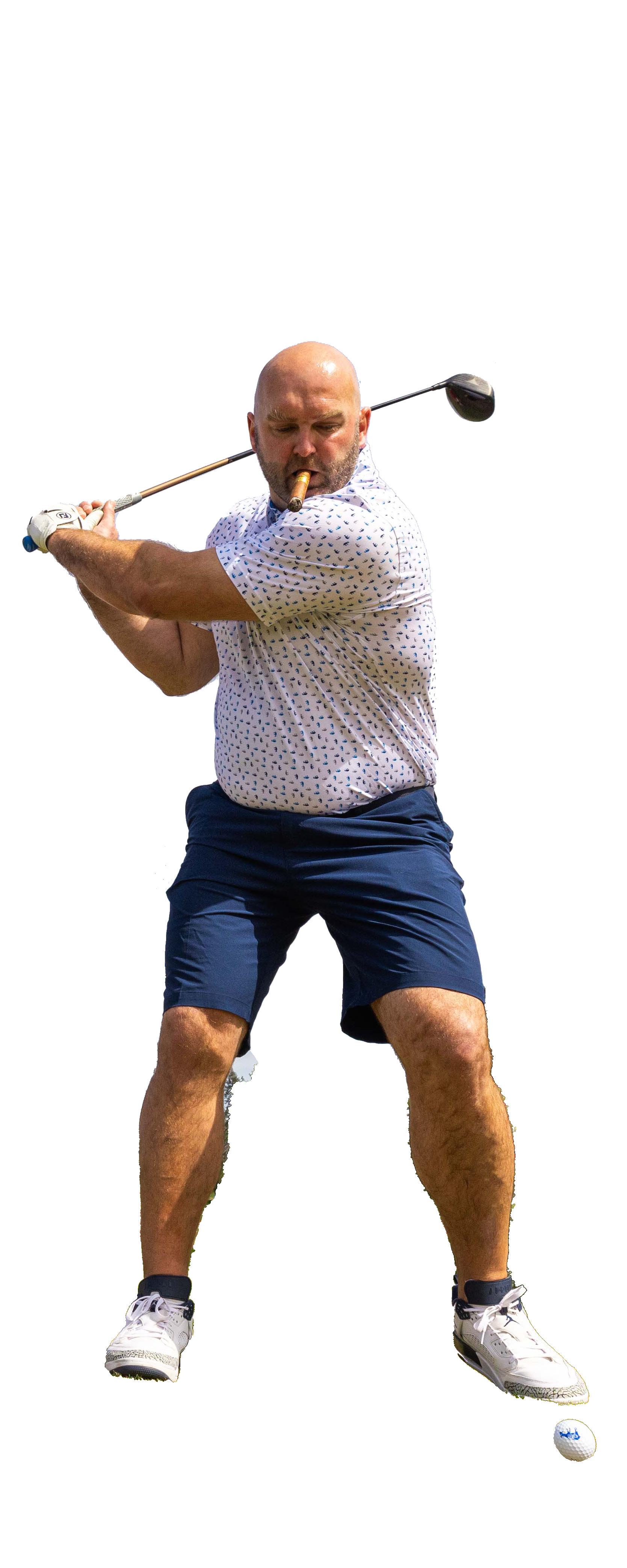
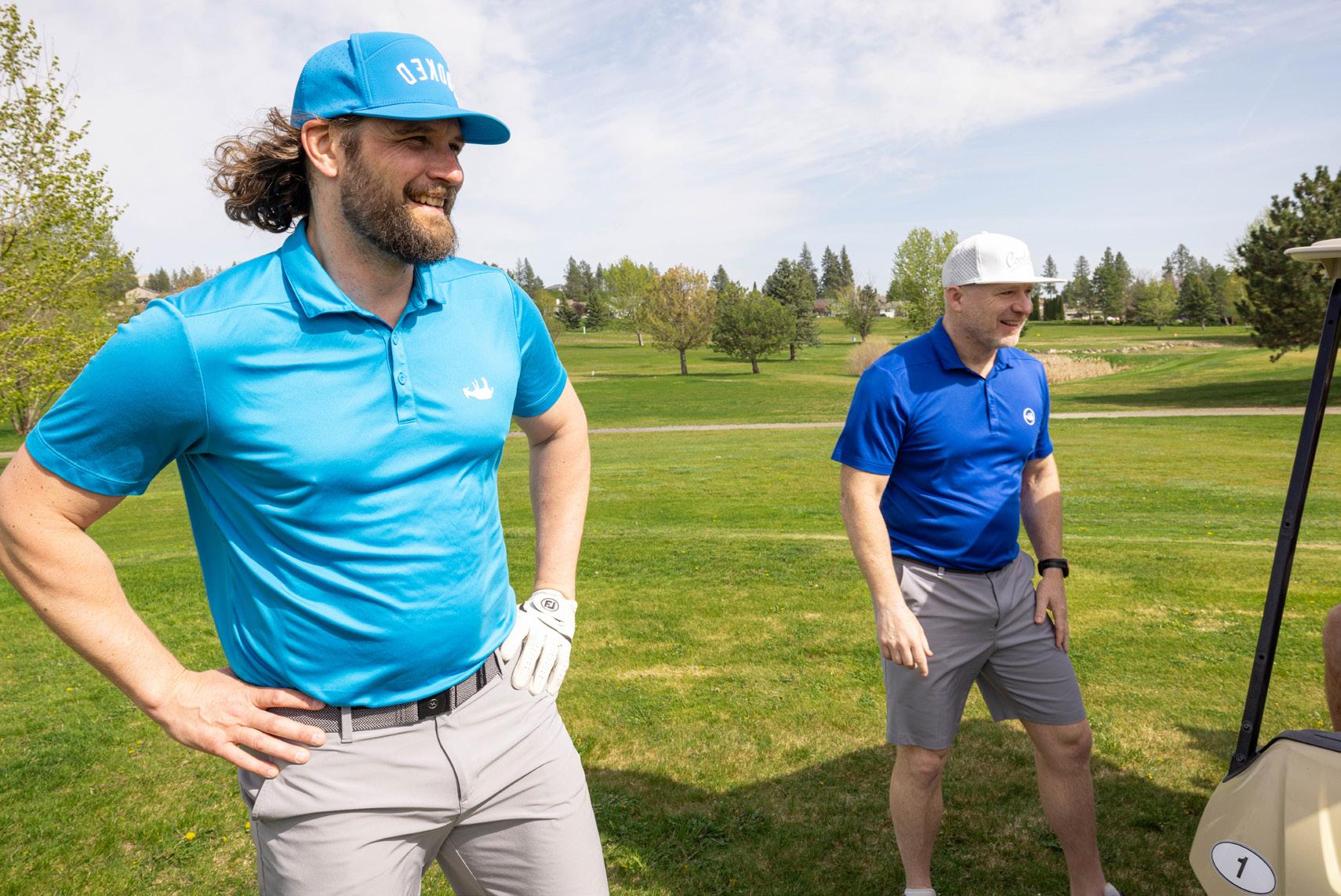
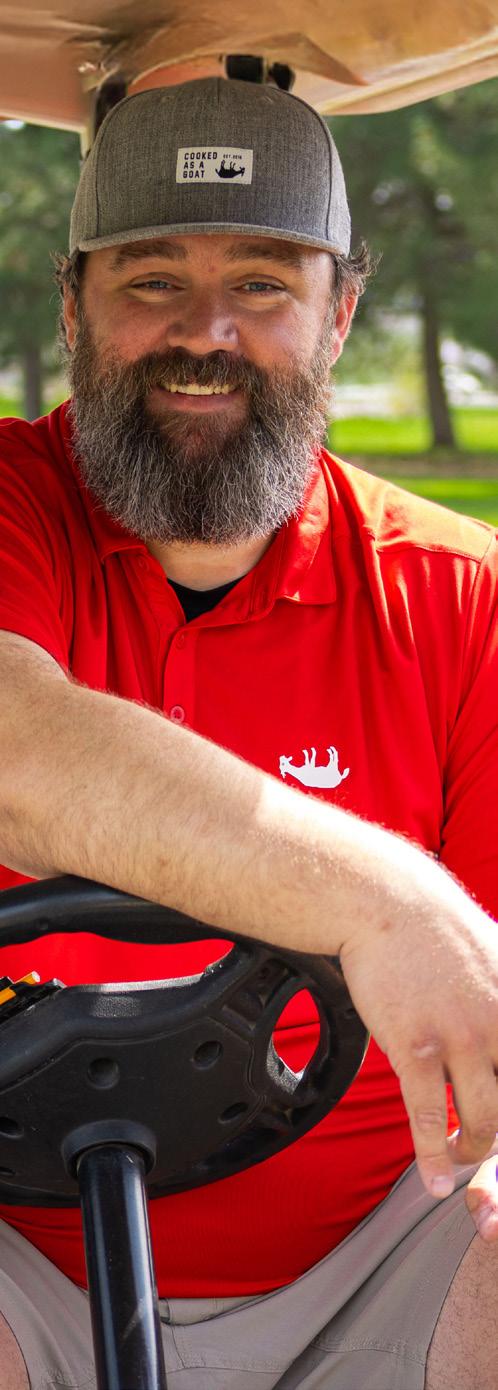
From left: Kory Kelly ’98, Paul Terrell ’05, Jeff Christiansen ’05 and Michael Roos ’05 on the No. 9 tee at Cheney’s The Plains Golf Course. Photos by Chris Thompson.
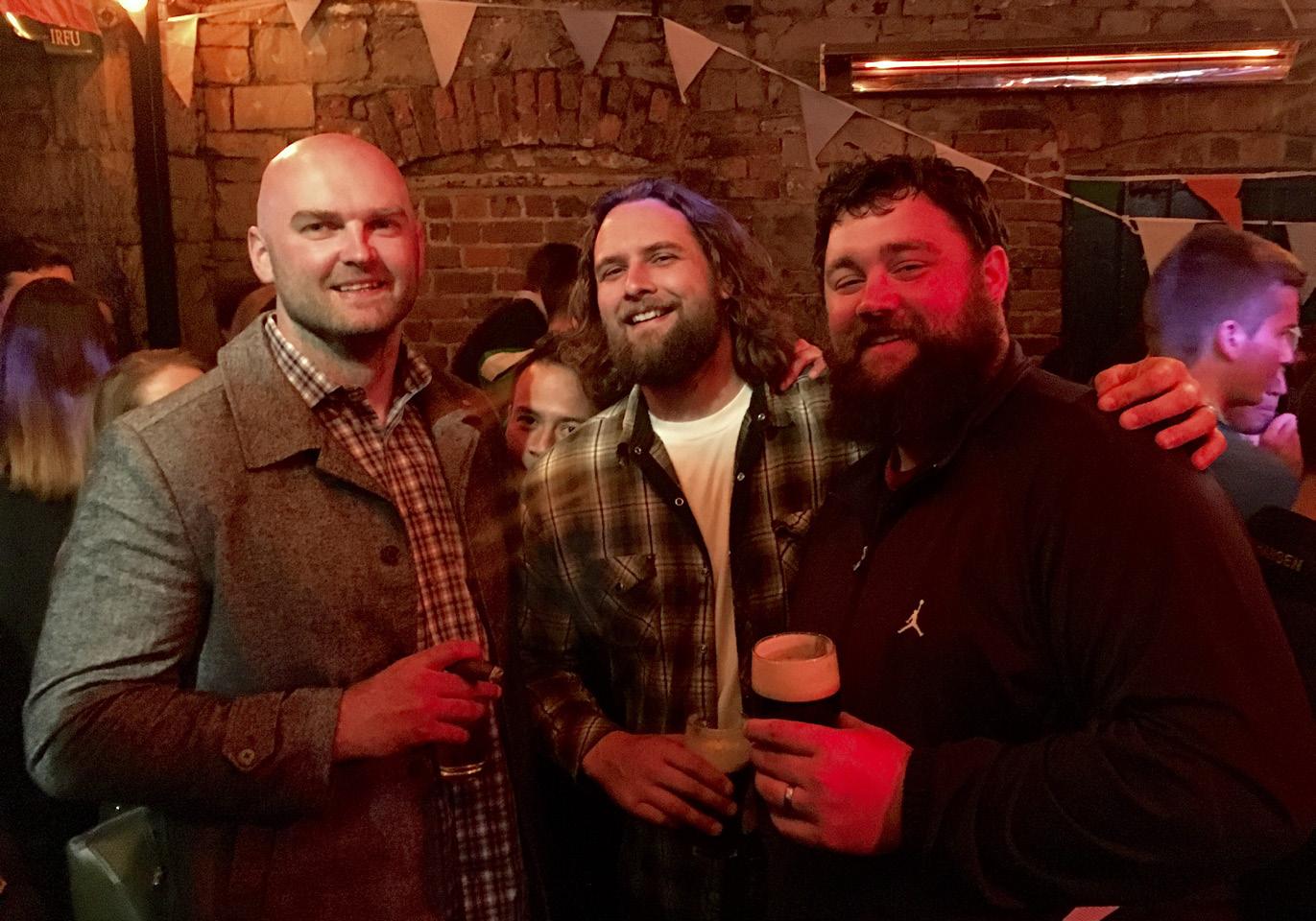
Four Eagle alums walk into a pub in Ireland. It sounds like the start of a joke. Which it is, kind of, since there were plenty of laughs on this particular evening of merrymaking, especially after a comical men’s room encounter left the (somewhat inebriated) group in stitches. What isn’t a joke — though all four would tell you they’re having fun with it — is the growing business venture that took its inspiration from that night 10 years ago.
That venture, Cooked As A Goat LLC, is a lifestyle apparel retailer started by Kory Kelly ’98 and three former EWU offensive linemen: Jeff Christiansen, Paul Terrell and, most famously, former Tennessee Titan and Eagles football legend Michael Roos, all 2005 graduates.
Since its formal launch last January, the company has built a customer base with its online store and pop-up retail presence, while also making in-roads into the
co-branded merchandise market as they navigate the crowded collegiate gear licensing landscape.
“We’re very excited about it, and it really feels like we’re gaining some very strong momentum,” says Kelly, whose legendary enthusiasm for his alma mater earned him the EWU Alumni Association’s Eagle4Life Spirit Award in 2023. “Our goal was to leverage local, and I absolutely think we’re doing that. And even a bigger spot than we probably could have imagined.”
Eags fans might have seen the Goat gear for sale at tailgates in the upper parking lot outside of football games last fall, or at Reese Court occasionally during home basketball games. Avid sports fans, if they were paying close attention, might also have spotted NFL Hall of Famer Jared Allen wearing a Cooked As A Goat t-shirt on the ManningCast show that’s hosted by fellow football legends Peyton and Eli Manning.
This spring, patrons of Qualchan Golf Course in southwest Spokane will be able to peruse a small selection of gear featuring both the course and the Goat. Other courses will likely offer the apparel in the near future and, if talks with the Eagle Store continue to progress, shirts, hats and other pieces could soon be co-branded with the EWU logo and the Goat insignia— a
‘You have to come get me,’ they overhear the man say in a charming but barely intelligible brogue. ‘I’m cooked as a goat.’
relationship that would generate royalties for Eastern.
But while the business is off to a good start — both profitable and self-sustaining in less than 18 months — all involved say they’re committed to keeping their years-long friendship as the primary priority.
“All four of us are friends first,” Jeff Christiansen says. “From the beginning we said, ‘If we do this, how do we structure it so we can maintain the friendship first; so the Goat doesn’t become more important than the friendship?’”
“The friendship is 100 percent,” adds Terrell, who is himself an Eagle4Life Spirit Award winner. “If this ever gets in the way in any form or fashion, it’s simple: We’re done. That’s one of the pillars of doing this.”
Another pillar is building their brand by word-of-mouth awareness, a strategy that is already paying dividends. On the South Hill in Spokane recently, a different set of four guys walked into a local watering hole, this time a coffee shop. While they’re ordering their morning caffeine blasts, one of the baristas says, “You have to tell me about your sweatshirt.”
Paul Terrell, who is part of this ensemble, doesn’t miss a beat as he launches into his now familiar explanation of the Cooked As A
Goat logo. Maybe you’ve seen it already: an upside-down goat with legs in the air and X’s for eyes, the suggestion being that the goat depicted is likely no longer with us.
The explanation of the Cooked As A Goat brand is that it’s activewear for people who “go hard, go all-in and get cooked,” regardless of where their passion lies — from golf to skateboarding to a multitude of other activities. The four Eagles are well-versed in the elevator pitch.
Sometimes they even tell the origin story.
It’s the spring of 2016, and the three former linemen and Kelly traveled to Ireland to celebrate St. Patrick’s Day — on the golf course, of course. They spend the evening of the big day in a famously festive pub. Fast forward to the early morning hours. Christiansen and Terrell need to make a stop at the restroom, or “the jacks” in the parlance of Ireland. There they happened upon a fellow patron, unsteadily doing his business, phone pinned precariously between his ear and shoulder.
“You have to come get me,” they overhear the man say in a charming but barely intelligible brogue. “I’m cooked as a goat.”
The two former football players look at each other, trying not to laugh. They then returned to their party and relay what they’d heard.
The rest, as they say, is a retail-origins history.
“Cooked as a goat” quickly became an inside joke for the four Eagles and their golfing friends, particularly when those friends were, uh, cooked. With Terrell, a graphic designer by trade, taking the lead, they soon crafted a handful of custom apparel items featuring the
Cooked As A Goat is activewear for people who ‘go hard, go all-in and get cooked,’ regardless of where their passion lies — from golf to skateboarding to a multitude of other activities.
Terrell (foreground) and Kelly in their latest Cooked As A Goat gear.
stylized goat. These were meant to be one-offs for themselves.
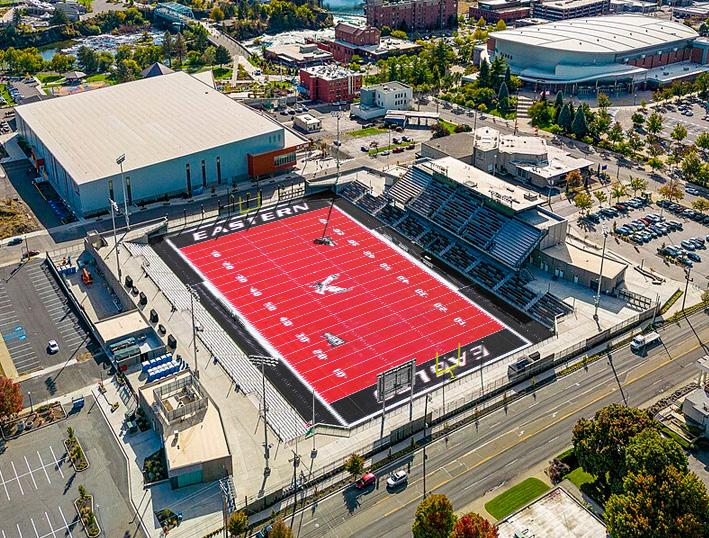
Still, before long they found themselves sharing “goat stuff” with their other golfing buddies, a cluster of roughly 15 men largely assembled by Roos (who, we should note, was inducted into the EWU Athletics Hall of Fame in 2016 and whose name currently adorns EWU’s football stadium).
The group began referring to each other as goats and talked about “getting cooked.” Yes, the saying has its roots in excessive drinking. But for these friends the meaning began to evolve into something deeper, and they’d talk about getting cooked when referring to going all-in on an endeavor; to giving it their all.
Early on, they noticed that the apparel sparked conversation, similar to the exchange with the South Hill barista. Over time, they began to ponder whether they had developed something with wider appeal than just their friends group.
They’d talk about starting a business together. On the surface, it appeared they had all the pieces to make a go of it. Terrell had the design chops, and Kelly had built a career in sales. Christiansen works in lending at STCU and understood business finance, while Roos brought all the contacts from his 10-year NFL career.
Christiansen says one initial challenge involved learning how to communicate about business together.
“There are two types of conversations you have, the one with your buddies and the one that’s more business oriented,” he says. “Early on, I think there were some lost-in-translation pieces as we were talking about what we wanted out of it; what we thought was most important. We never fought about it, but we’d have a conversation, circle back, and realize that’s not what the person meant at all.”
owners expects to quit their day jobs. Nor do they have illusions about making big money. Instead, they’re reinvesting revenue generated by sales into the company.
‘If you were to run this by a business class at Eastern, they might say, “Why didn’t you raise funds or do a big national advertising blitz?” But that’s not what we’re really about...’
But they kept going on golf trips together, usually to Ireland or Scotland, and kept talking through the idea.
Terrell refers to himself as “the biggest heel dragger” in the group, at least when it comes to going into business with friends. “I do some apparel work for clients, and I know what it involves. It’s parallel to the line of work I’m already doing. So, I had concerns about some of the reality of the business versus the excitement.”
Indeed, the sports apparel market is saturated, and the fact that the Goat concept doesn’t fit into one niche — such as a company that makes golf apparel exclusively, for example — has both the advantages of broader appeal and the drawbacks of a more diluted marketing focus. In 2024, the four of them took a trip to Las Vegas to decide, once and for all, whether to go for it. They came home committed to the concept.
While the business is off to a strong start, none of the four co-
“If it happens, wonderful,” Terrell says, “but that’s not necessarily the goal. This approach gives us the opportunity to grow slowly and navigate that growth properly.”
Christiansen concurs, adding, “If you were to run this by a business class at Eastern, they might say, ‘Why didn’t you raise funds or do a big national advertising blitz?’ But that’s not what we’re really about. It could be years before we even see a penny back.”
As the business evolves, the golf trips continue. They still largely involve visits to Ireland and Scotland, though they don’t typically revolve around St. Patrick’s Day anymore. Many of the courses don’t open until early April these days, in order to better preserve the grounds.
Why keep going back to Irish and Scottish courses? In response, Kelly quips, “How much time do you have?” Adding, “it’s so green, so open. It is one of the birthplaces of golf. Some of these courses are older than America. You don’t get that type of culture, history in the U.S., especially on the West Coast.”
And while there aren’t any direct links between the apparel and EWU — yet— the four partners view Eastern as sort of an informal, honorary silent partner in the venture.
“It’s such a big part who we are and what we do for fun. Almost all of our friends are Eastern folks. It’s hard to have Eastern be such a big part of your life and not have that tie-in to what we’re doing,” Christiansen says. “And I think the brand fits with Eastern. To be successful there, at some point, you have to get cooked.”
Former Eagle teammates (from left) Roos, Terrell and Christiansen at Nancy Blake’s pub in Limerick, Ireland, just prior to the fateful 2016 encounter in “the jacks.”
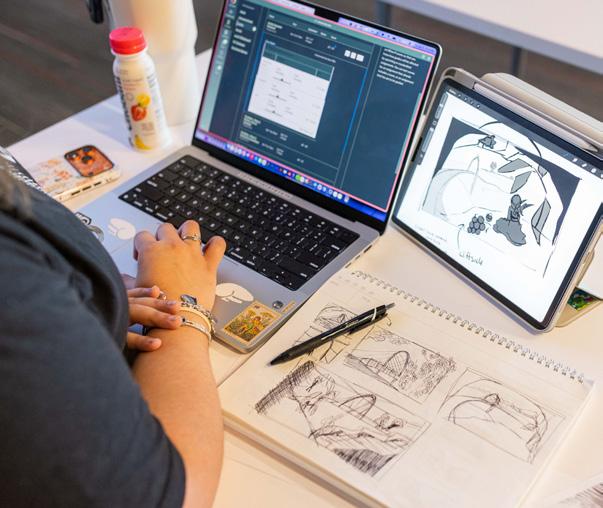
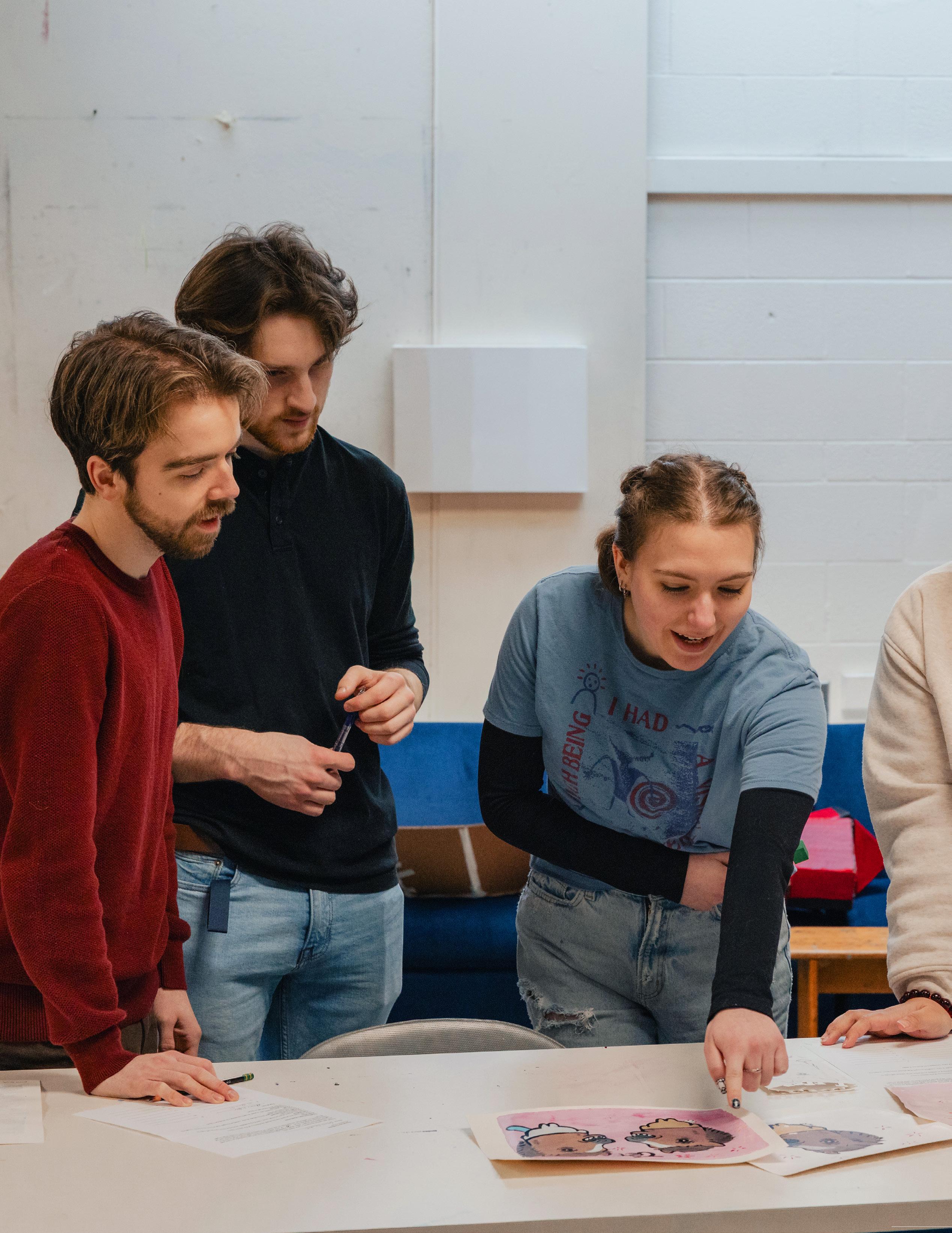
Art students (from left) Jonny Roohr, Devon Weir, Emma Reincke, and Vi Quach confer on an assignment for Art 202, "Techniques and Materials.” Photo by Tro Trujillo.
ANDART DESIGN
INTERTWINED
Eastern’s departments of art and design navigate a long-hoped-for union.
By Charles E. Reineke
BACK IN 1919, AMIDST THE CHAOTIC FERMENT of postWorld War I Germany, a visionary architect named Walter Gropius was chosen to head a newly organized, state-sponsored school of architecture.
Gropius began his term with an audacious declaration: “The ultimate aim of all creative activity is building!” he wrote in the founding manifesto of the institution, the Staatliche Bauhaus. “There is no essential difference between the artist and the craftsman. The artist is an exalted craftsman. In rare moments of inspiration, transcending the consciousness of his will, the grace of heaven may cause his work to blossom into art.”
With this assault on the status quo began an institution that, in its day, was less well known for its academic instruction than for its glorious impertinence; one that refused to recognize a meaningful distinction between art and craft, between the painter’s vision and the typographer’s grid, between the potter’ s hands and the industrial designer’s blueprint. The Bauhaus insisted that form and function were not opposites to be balanced. They were a single language to be mastered whole.
That conviction echoed through the 20th century, shaping how creative programs were
organized at universities across America and Europe. Today’s foundational, first-year art and design curriculum — exercises in color theory, composition, line and form — descends in nearly unbroken lineage from the workshops Gropius ran in Dessau more than a century ago.
For the past few decades at Eastern, however, the erstwhile “inseparable disciplines” of art and design have not only occupied different administrative homes, they’ve been located in different buildings in different towns, domiciles that in many ways reflect the divide at EWU that separated them in the first place.
The Fine and Performing Arts Department, part of the College of Arts, Humanities and Social Sciences, is housed in Cheney’s Art Building, a structure suited to the beautifully messy pursuit of manual creativity: ceramics, printmaking, sculpture, painting. Design, meanwhile, is located in Spokane’s gleamingly modern, tech-heavy Catalyst building, where students and faculty members work under the auspices of the College of Science, Technology, Engineering and Mathematics, or CSTEM.
This arrangement, administrators long argued, made sense from an organizational perspective. Pedagogical sense? Creative sense? Maybe not so much.
JENNY HYDE CAME TO EASTERN
in 2007 as a visiting assistant professor filling in for a colleague on leave. She assumed she would stay for a year before heading back east. Seventeen years later, Hyde is now professor and chair of fine and performing arts at EWU. She still seems mildly astonished by the institutional logic that kept art and design apart for so long.
“When I came here, it was surprising to me that design wasn’t part of art,” she says during a recent conversation in Isle Hall, one that included her colleague Mindy Breen, professor of design and the department chair.
Hyde did her undergraduate work at Seattle University’s Cornish College of the Arts, where, she says, the disciplines were very much commingled. “Art, design, theater, music, dance — all in the same building." At Alfred University in New York, where she completed a graduate fellowship in integrated electronic arts, the disciplines were even more intertwined. “And then Eastern…” she begins, and then pauses.
“I’m glad that we’re seeing a shift in the culture at Eastern,” she continues. “When I first got here, it seemed as if the art program wanted nothing to do with design. It was a cultural thing, which was confusing to me.”
Confusing maybe, but, as Hyde acknowledges, it’s a boundary that has remained familiar and persistent: The idea that fine art inhabits a realm of pure creative expression uncorrupted by utility; while design, on the other hand — though indisputably a vital and inventive medium — is merely work in the service of someone else’s agenda, executed for a paycheck.
Mindy Breen has been a faculty member in design since 2000. Unlike Hyde, she didn’t start out studying art or design. But at Notre Dame, where she did her undergraduate work, Breen found her way into that world pretty quickly.
“My freshman year I took an econ class, and the professor put up these charts and graphs and was talking about economic theory,” she recalls. “I looked at them and I’m like, ‘I can’t understand a thing these are trying to tell me.’ It really was frustrating, because they were supposed to convey information, and I was having a really hard time understanding. That catapulted me away from business and into design… By the end of freshman year I was no longer a business major. I was a graphic design major and really interested in the idea of the design of information.”
Breen says her program’s origins, like her own background, do indeed point to a decidedly instrumentalist (i.e., ideas as instruments for action) pedigree.
“The design program, really the origin of design at EWU,” Breen says, “was a ‘printing technology’ program, originally in the Department of Manual Arts, as it was called.” There were photography courses, printing facilities and applied technical skills, she says. Pragmatic arts rather than the fine ones.
Over the ensuing decades the department evolved through a succession of names and organizational homes‚ the Department of Technology, then Engineering, Technology and Multimedia Design, then Engineering and Design, and finally, in 2020, simply Design. But it never quite shed the utilitarian antecedents those early roots implied.
What is perhaps most striking about EWU’s art–design divide, in retrospect, is how artificial it often felt to the students experiencing it. In the mid-2000s, Breen says she began to notice that a significant number of them were double-majoring across the two programs, voting, as it were, with their schedules for a curriculum integration that nobody had thought to offer.
In response, the two departments collaborated on creation of a Bachelor of Fine Arts in Visual Communication Design, a co-located degree drawing equally from art and design coursework. It was the first cross-disciplinary, cross-college degree in the university’s history. And it worked, at least for a while.
“The students who graduated with that degree‚ it was such a great experience,” Breen says. “They got the best of both worlds: the conceptual, hands-on studio practice, and also the applied, skills-based design work.” But the arrangement proved labor-intensive for faculty, and structurally awkward. When a key faculty member departed for
Olivia Higgins, a senior psychology major, explores the art of making books.
the University of Denver, the load became unmanageable. The shared degree quietly dissolved and the programs resumed their parallel trajectories.
THE STORY MIGHT HAVE ENDED THERE, the two adjacent disciplines operating in polite proximity, were it not for a confluence of pressures that made the current merger feel, as Breen puts it, “like finishing something we started years ago.”
The immediate trigger was classic academe: a set of course proposals from one department that duplicated offerings in the other. “We had a conversation,” Breen recalls, “and it was like, ‘This is ridiculous‚ neither of us wants this.’”
explain to students what the difference is. It just became another layer of heaviness that doesn’t really need to be there.”
emphasis on bringing health sciences instruction together on its Spokane campus, the Catalyst building’s space was needed for health sciences and other CSTEM programs. With Design slated to return to Cheney, the case for continued separation became harder to make. More fundamentally, as Hyde said, it was becoming ever more difficult to explain to prospective students how, say, a photo class in design was different from the photo class in art, or why a student passionate about visual storytelling needed to choose a program affiliation before understanding what each could offer.
to land here and be interested in art and design, but then have two separate places to navigate,” Hyde says. “For me, that was a major
incentive: Can we just get all the students that are interested in visual creativity and visual things to start in one place, and then be able to go from there?”
When Breen and Hyde brought the merger proposal to the deans of the two affected colleges, both were supportive. The provost’s office signed on. There was, as Breen notes with some relief, “not much of a case that needed to be made.”
Now that it’s settled, there remains only the pedagogical tension that needs navigating, that friendly friction between those who see art as pure vision and those who see design as applied problem-solving. The most obvious resolution at EWU is, in its essentials, the Bauhaus resolution: an understanding that the distinction is less meaningful
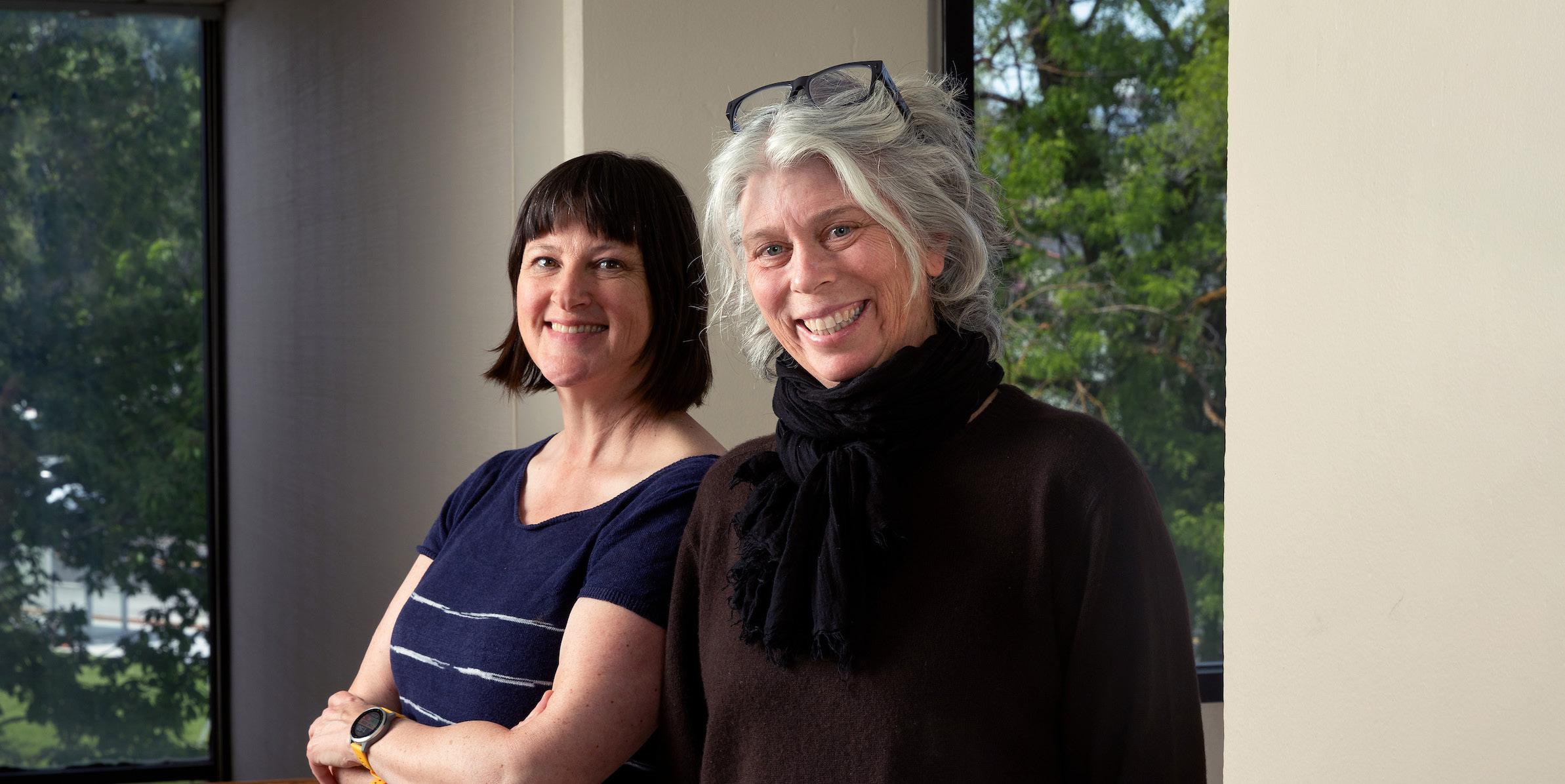
Jenny Hyde (left) is the chairperson for Fine and Performing Arts. Mindy Breen chairs Design.
Photo by Luke Kenneally
classes, the main foundation classes that you’ll see typically in most art and design programs link directly to the principles and rules of design and art that were formed in Bauhaus.”
What the Bauhaus artists understood, and what the EWU merger implicitly argues, is that the capacity to solve visual problems and the capacity to make visually meaningful art are not separate faculties. They’re aspects of a single, cultivable sensibility.
Photo by Charles Reineke
The question of whether that argument survives contact with the job market is another matter. The professional logic that originally pushed Design toward CSTEM, the idea that employers respond more readily to programs that provide legible, outcome-oriented credentials, remains a primary consideration. Breen says design students often choose their major partly because “at least I can explain to my parents that I might get a job in web design with this.” The merger, she hopes, will give those same students access to the fine arts without requiring them to ghost their moms and dads.
“When they have a choice,” Breen says, “they can then say, ‘Oh, right‚ let’s think about that beautiful creative aspect,’ that maybe they wouldn’t have gotten had we not had art classes available to them.”
Hyde says she’s comfortable with the exchange also running in the other direction. “I’d love for all of our art majors to take typography and graphic design,” she says. “I don’t care if AI is doing that work. They still need to understand what it is.
“There’s something really important about understanding process in the use of making something. It is part of the problem-solving exercise from start to finish.”
Or, as Breen puts it: “Craft. Understanding craft, absolutely.”
THESE DAYS, OF COURSE,
terms such as “process” and “craft” are very much implicated in the “AI question,” that specter haunting any conversation about creative education. When the topic came up during the conversation with Breen and Hyde, both were ready with answers. But their ambivalence was clear.
“Our students are using AI as a tool right now,” Breen says, “but they also need the humanities. What the humanities have to offer is an approach of how best to use it, how best to include it in their process.”
“Or when not to use it,” Hyde adds.
The fine arts might be expected to harbor more resistance to AI than
design disciplines, for reasons that go deeper than technophobia. If design has always been to some degree a conversation with tools and materials, fine art has been, at least in the ways it thinks about itself, a practice whose value is inseparable from individual consciousness and intention. Generative AI doesn’t participate in that conversation. It iterates. It approximates. It produces, at dizzyingly high speed, outputs that often look like what has come before.
Tro Trujillo is a junior who studies both art and design at EWU while working as a photographer for Fine and Performing Arts. He sits, one might say, squarely in the middle.
Trujillo’s path to Eastern was classically “nontraditional.” He spent a decade as a hairdresser, followed by a stint as an EMT during the early days of Covid and then enlistment as an Army medic with the 101st Airborne Division at Fort Campbell, Kentucky.
He came to EWU planning to use his veteran’s benefits to study business, but was redirected to design by a perceptive admissions counselor. He eventually found himself drawn to both art and design, something that the programs’ separation made administratively complicated and, at times, financially painful.
“I fought tooth and nail,” he says of his efforts to get the VA’s vocational rehabilitation program to approve art courses alongside his design coursework. “And both my design and art advisors have to work together in tandem when building out my [VA required] four-year plan to get approval.” An earlier merger, in his view, would have made the path much smoother.
“I would have loved for this merger to have already been completed before I started Eastern, because I think it would have accelerated my trajectory, rather than everybody figuring out workarounds.”
On AI, Trujillo is an unabashed enthusiast, at least insofar as he typically deploys it. “I use AI as an idea generator,” he says. “I have a hard time staring at a blank canvas.” But he’s alert to the tensions the technology produces.
“You’ll find that a lot of the design students are against it and a lot of them are for it,” he says. “The art department really doesn’t like AI.” After a quick pause, he adds. “I think they fear it takes identity away from the works being created.”
Trujillo’s sense of AI’s value mirrors that of his academic advisor, EWU design professor and nationally recognized AI expert Travis Masingale (see our Fall/Winter 2024-25 issue).
Masingale’s approach to AI offers one possible model for how the merged program might navigate the technology; not as a replacement for craft, but as a way of building tools that serve it. “His vision, at least as I understand it, is something like this: If I run into a problem, I should have the opportunity to use AI in creating my own tools to deal with it,” Trujillo says.
WHILE AI INTEGRATION IN SOME FORM
will undoubtedly be the future at EWU, the past is certain to continue to assert itself. It’s easy, for instance, to imagine how a renovated Isle Hall, the 70-year-old building into which Design will
move this summer, might serve as a not-sosubtle anamnesis to new generations of young artists and designers.
It sits on the west end of Eastern’s central campus, a two-story red-brick structure built in the post-WWII boom years when American universities were expanding rapidly, and architectural ambitions were running high.
On the clear May morning of the conversation with Breen and Hyde, its warm brick facade glowed auburn under cobalt blue sky. Indoors it asserted a worldly self-confidence: Solid, purposeful, comfortable with its eccentricities.
“I think it’s a gem,” Hyde says. She says she first encountered the building through a storage room the art program had been using, and came away converted. “When I was in here, I was like, ‘What? Design just needs to move in here. It’s amazing.’’’
Breen has loved the building even longer. “Back when Anthropology was in the building, I would spend a lot of time in here,” she says. She and her colleagues have already begun thinking about furnishings, mid-century desks and chairs and lighting that belong to the aesthetic of the space. The building’s history adds layers. Isle Hall served for years as the university’s student union, and many Eastern readers will fondly remember the bowling alley (gone) and the fireplace (still stands).
The plan is for it to eventually house a “makerspace” open to students across disciplines, equipped with laser cutters, 3D printers, and large-format printing equipment. This will be built out alongside faculty offices, classrooms and a projection-mapping installation that students are already developing around the building’s exterior. Design students have been asking about murals.
Design is slated to move into Isle Hall in the summer of 2026. Curricular changes will be drafted and submitted for approval in 2027, with new integrated programming taking effect in 2028. The question of which college the combined program will ultimately inhabit, whether art moves to CSTEM, design moves to CAHSS, or some new arrangement is negotiated, remains open. “We haven’t figured that out yet,” Breen says.
What they have figured out is that students, the ones, at least, who are already moving between the programs, are almost uniformly in favor. Trujillo, who may be the Eagle most personally inconvenienced by the current separation, expressed a sentiment that the department chairs echoed from their own vantage point.
“We are already integrated,” Trujillo says. “Making it official isn’t going to be this big, scary thing. We already implement design in art, and art into design. So the fact that Eastern is facilitating that, and just making it easier for students to get what they need out of their program, I think that can only be a good thing.”
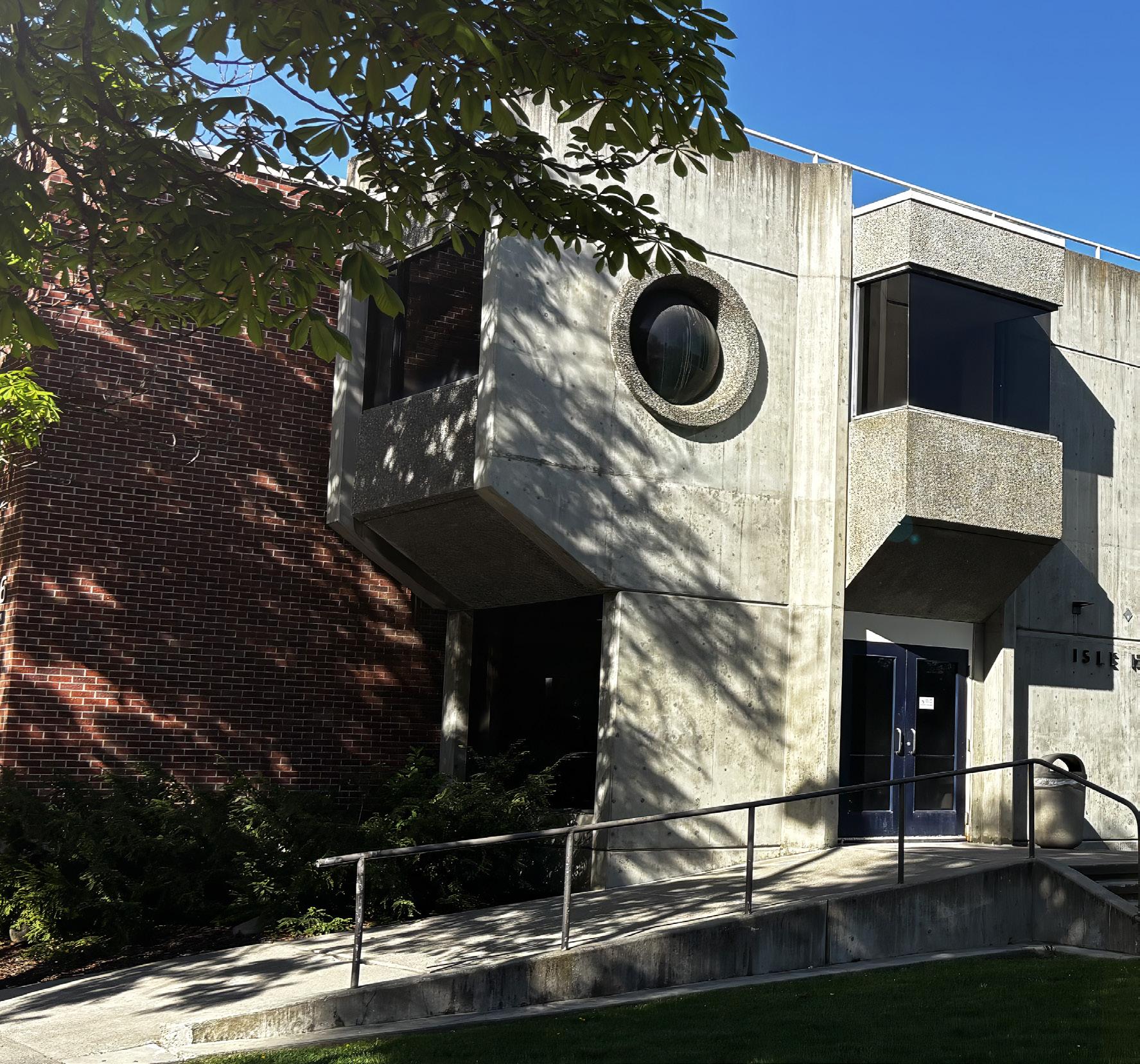
Isle Hall's iconic “tower” features flourishes reminiscent of the Bauhaus movement.
AN EVENING OF EAGLEAchievement
GORDON
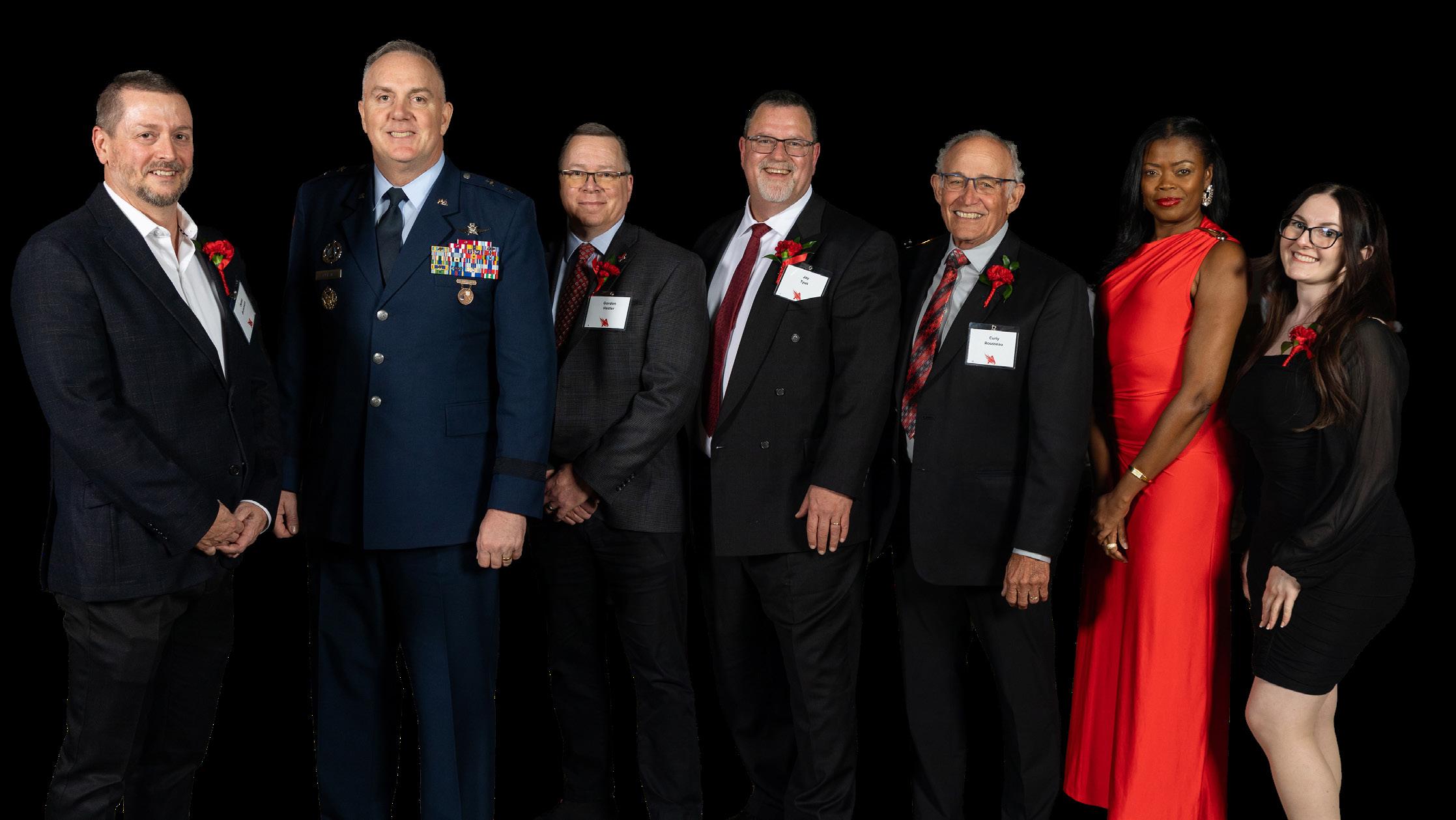
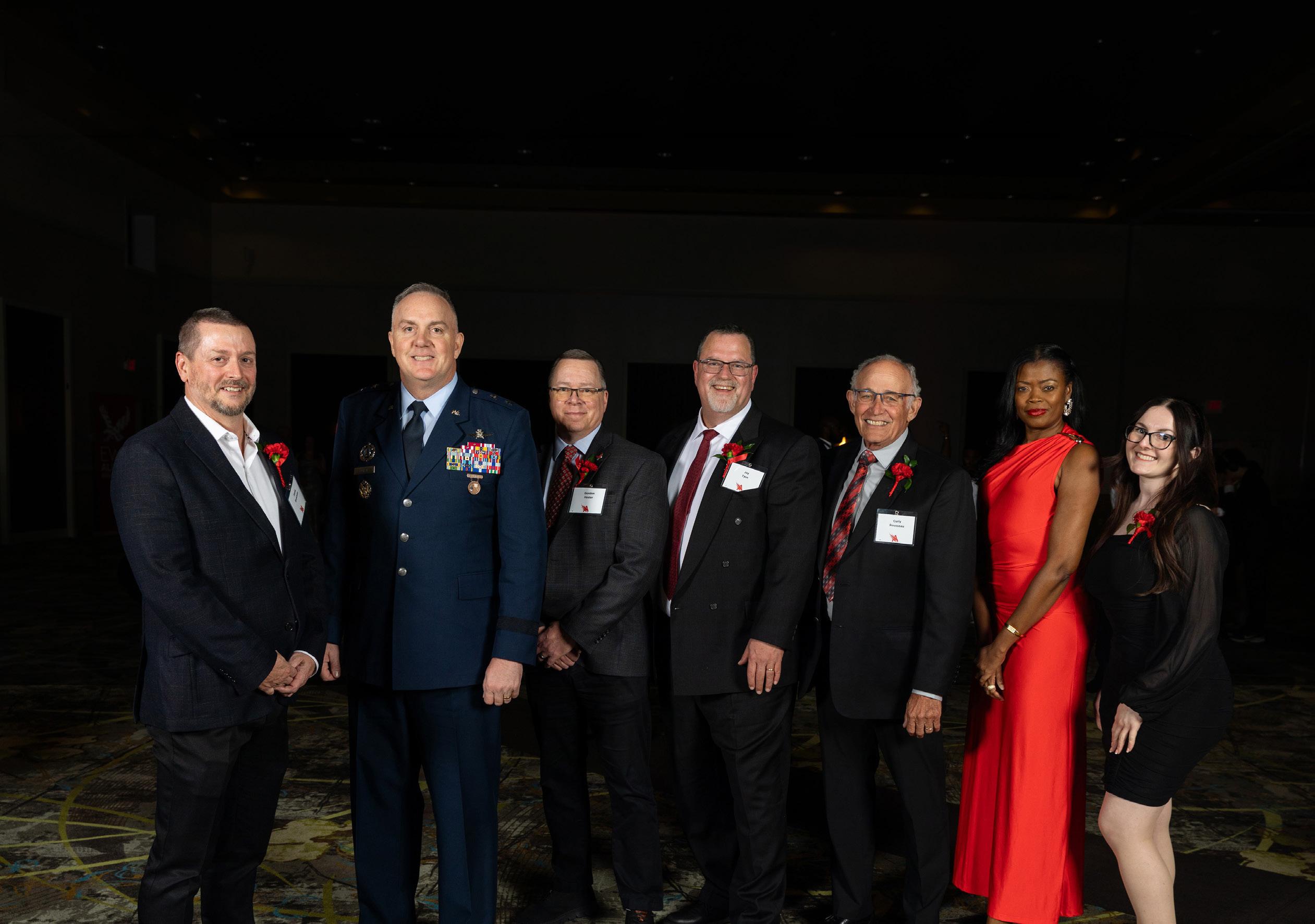
OnSaturday, April 25, Eastern alumni and friends packed the Pend Oreille ballroom at Spokane’s Northern Quest Resort & Casino to honor seven graduates whose achievements in service and spirit make us all proud to be Eagles.
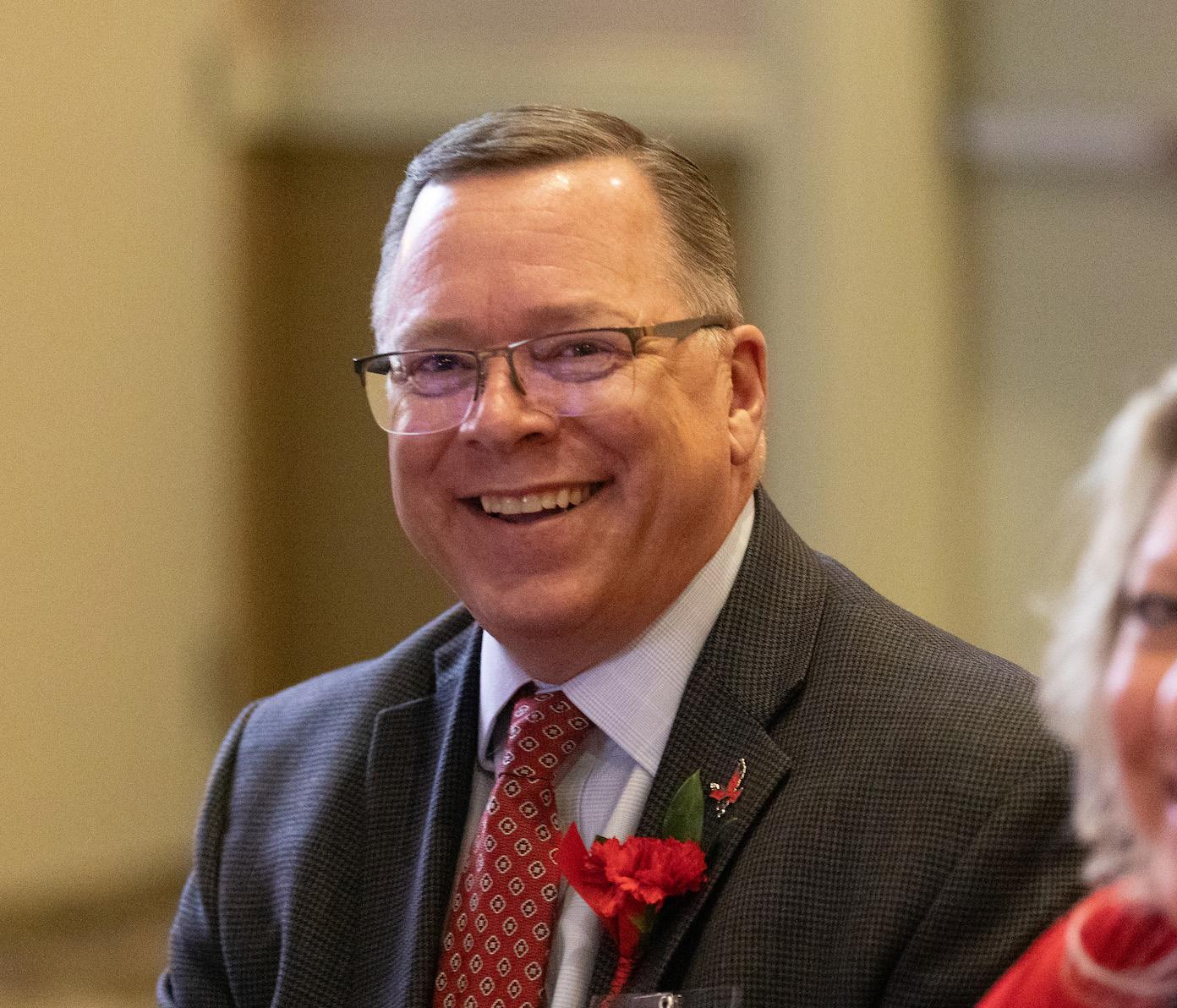
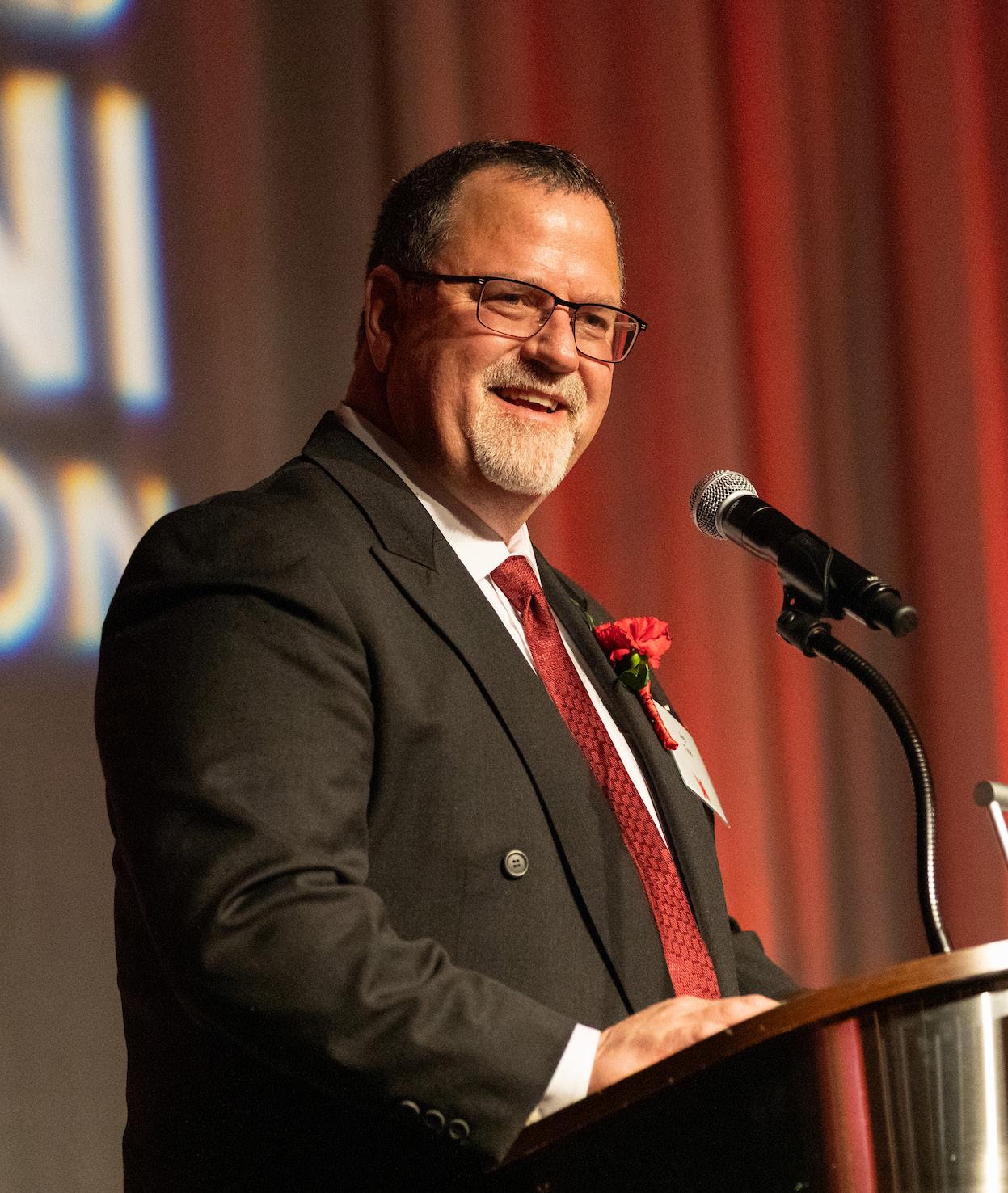
It is perhaps ironic that one of those graduates, Gordon Hester ’89, our Benjamin P. Cheney Lifetime Achievement Award winner, began his tenure as a high-flying Eagle quite literally underground. After transferring from WSU, Hester helped fund his undergraduate studies at EWU by working part-time at the Rozell Physical Plant, maintaining equipment in the mechanical tunnels that run for miles beneath campus.
After graduation, Hester joined Kiemle Hagood, one of Spokane’s leading commercial real estate firms. He began as an assistant property manager and, over the next 35 years, worked his way up
pretty much every rung of the ladder — senior property manager, director, vice president — before assuming the role of president and CEO in 2020. Along the way, he became a respected voice in the industry, chairing national committees for the Building Owners and Managers Association and serving as president of BOMA's Pacific Northwest Region.
But Hester’s story isn't just about business. In 2008, a brushfire near his property introduced him to the world of volunteer firefighting, and he spent the next decade responding to emergency calls — often before dawn — then heading to the office to run a company. He earned his EMT certification, rose to station captain, and in 2020 was elected fire commissioner for Spokane County Fire District 10, where he’s hired new firefighters and stabilize the district’s budget.
Hester’s long history of giving back is both public and personal.
His son Mason, born with a congenital heart defect, survived three surgeries before the age of eighteen. Hester has since been a dedicated supporter of the Providence Foundation. He’s also been a generous benefactor to the university that gave him his foundation for success: he’s created an endowed scholarship for business students; a fund honoring his wife, Brenda, that supports student teachers; served on the university’s first College of Professional Programs Advisory Board and held a position on the EWU Foundation Board.
by
Photos
Luke Kenneally
OLIVIA GENT
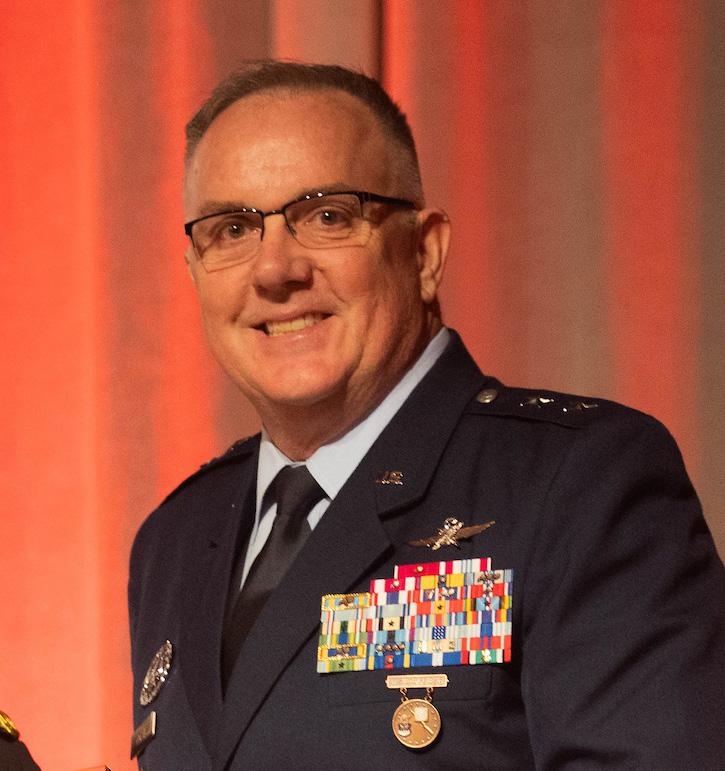
Thecontributions of Gent Welsh ’95,’03, our Lt. Col. Daniel M. Carter Military Service Award winner have truly spanned the globe.
Gent Welsh grew up in Vale, Oregon, and enlisted in the Air Force in 1988, starting his career as a security policeman at RAF Lakenheath in England. From there he transferred to the Washington Air National Guard, earned his commission, and began a steady climb through the ranks — from second lieutenant to major general — in deployments that took him to Saudi Arabia, Bosnia and Iraq along the way.
While building that military career, Welsh also became an Eagle for Life, first earning a bachelor’s degree from Eastern, and then a master’s degree eight years later.
Today he serves as the Adjutant General of Washington, the commanding general of all of our state’s Army and Air National Guard forces. Among his many duties is oversight of the state’s Emergency Management Division, the Enhanced 911 program and the Youth ChalleNGe Academy, a program that provides disciplined, safe and professional learning environments to help at-risk youth improve their education and employment prospects.
He also serves in the position of Homeland Security Advisor to the governor and manages federal homeland security grants across the state. First appointed by Gov. Jay Inslee, then reappointed by Gov. Bob Ferguson, he is a member of the Governor’s Executive Cabinet.
Welsh’s leadership shows up when it matters most. When, for example, historic flooding hit Western Washington last year, Welsh mobilized over 400 Guard members for sandbagging, swift-water rescue, aviation hoist missions, and levee stabilization — protecting homes, infrastructure and lives.
Through it all, he has never forgotten his alma mater. For years Welsh has been a steadfast supporter of EWU’s Army ROTC program, approving cadet internships with Air National Guard units, opening Guard facilities for training, and promoting Eastern to prospective students.
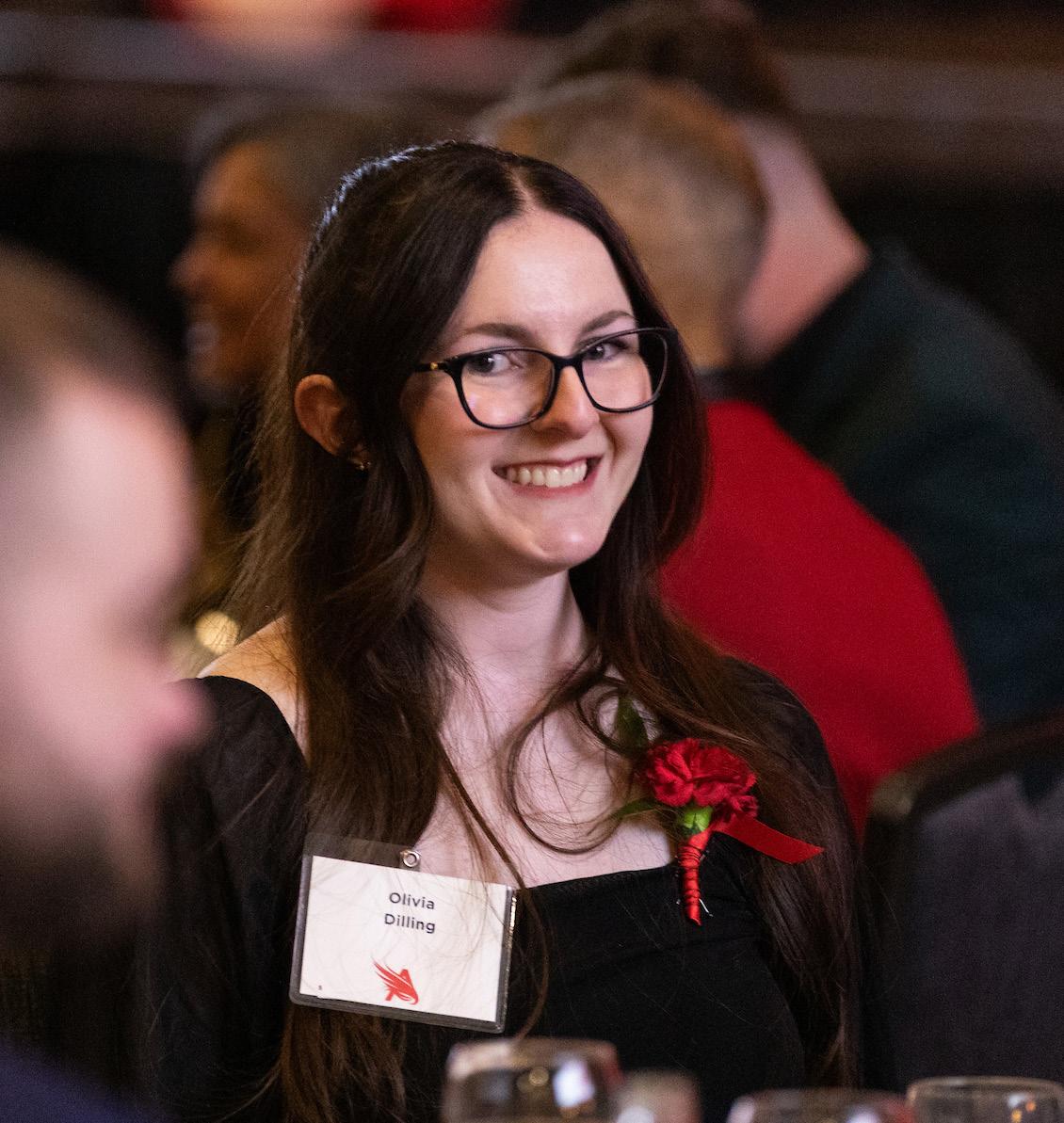
OliviaDilling ’23, ’25, our 2026 Rising Eagle Award winner, is just beginning her own journey of achievement and service. She arrived at Eastern in 2019 and immediately started making the most of every opportunity the university had to offer. She joined Alpha Omicron Pi sorority, where she served as house manager for two years. She was elected president of the Panhellenic Council, bringing together Greek organizations around shared values of leadership, service and connection.
Next, she worked as an undergraduate employee in the Student Engagement office, helping to create the sorts of campus experiences that turn a university into a community. All the while she was excelling in the classroom — graduating cum laude with a bachelor's degree in psychology in 2023.
But Dilling wasn't content to just study psychology from a textbook. Alongside her research partner and faculty advisor, she coauthored a study on interpersonal trauma and social desirability that she presented at the Western Psychology Association conference in Los Angeles. That same year, she was named both Sorority Woman of the Year and Psychology Student of the Year — two honors that capture the full picture of who Olivia is: someone who leads with heart and backs it up with substance.
Then she came back for more. Dilling returned to Eastern to earn a Master of Social Work degree, a program that she completed just last year. During her studies, she logged over a thousand hours of internship experience at Inland Northwest Behavioral Health hospital, where she supported individuals who were navigating serious mental health challenges.
All of this came full circle after graduation, as Dilling began her professional career as a social worker at the very same psychiatric hospital where she trained. She went from learning in those hallways to a valued professional working in them — each day making contributions that involve compassionate, person-centered care for people who find themselves in some of their most difficult moments of their lives.
Malisea
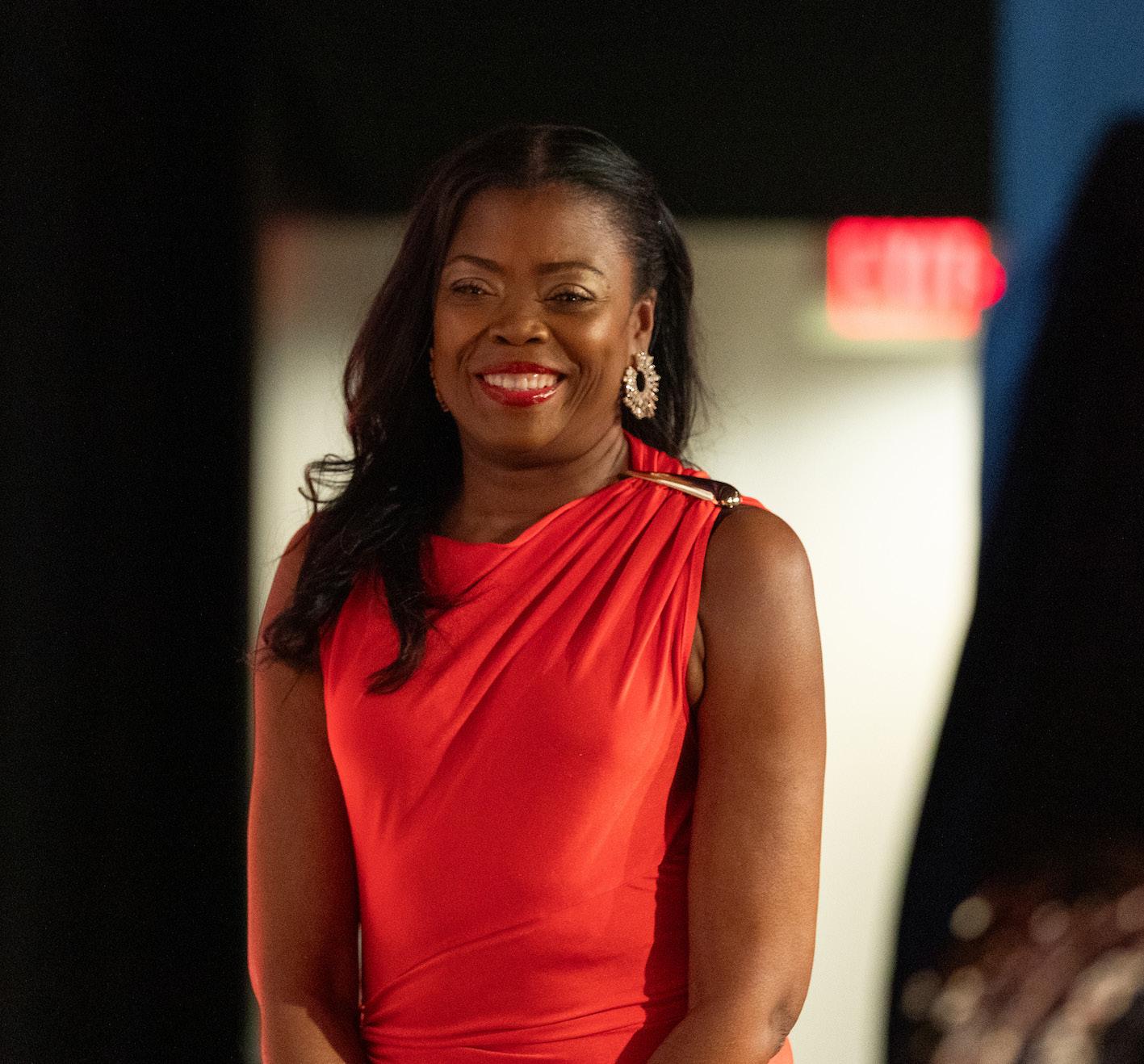
“Lisa” Gardner ’05, this year’s Sandy Williams Trailblazer Award winner, is deeply involved in the types of person-centered service that reflect the achievements of our awards’ namesake: activism, community journalism and an unwavering belief that every voice matters.
LISA JAY
Gardner is a proud legacy Eagle. Her father and two aunts attended Eastern before her, making her time on campus part of a multigenerational tradition. As a communications major, Lisa was active in campus life — she pledged Zeta Phi Beta Sorority under the mentorship of Angela Jones, last year’s Sandy Williams Trailblazer recipient, and found her voice working at campus radio station KEWU. It turns out she was just getting warmed up.
After graduating in 2005, Gardner built an impressive career that took her from public relations work with McDonald’s and a copy writing role at Microsoft, to directing sales and marketing at a boutique hotel in Baltimore and coordinating important clinical operations at the National Institutes of Health. Then she came home to Spokane and really got to work.
Today, Gardner serves as the director of communications and community engagement for the Spokane City Council, where she bridges the gap between city leadership and the communities it serves. She has championed language access, recruited bilingual and multilingual staff, and worked to recognize people striving to make a more just and inclusive city. In recognition of her efforts she was named a 2025 Spokane Journal of Business’ Person of Influence and a 2026 YWCA Woman of Achievement.
But it’s her community leadership that truly reflects the spirit of this award. Just over a year ago, Gardner became president of the Spokane NAACP, where she has revitalized the organization’s Youth Council, a program started by her late grandmother, Sarah Gardner, a prominent activist and entrepreneur in Spokane’s Black community. She has also launched the “Challenging the Narrative” conversation series to confront difficult topics head-on, partnering with the Inland Refugee Center on digital equity, collaborating with Providence Health Services to promote healthcare careers to communities of color, and helping to revitalize The Black Lens, the community newspaper that Sandy Williams founded.
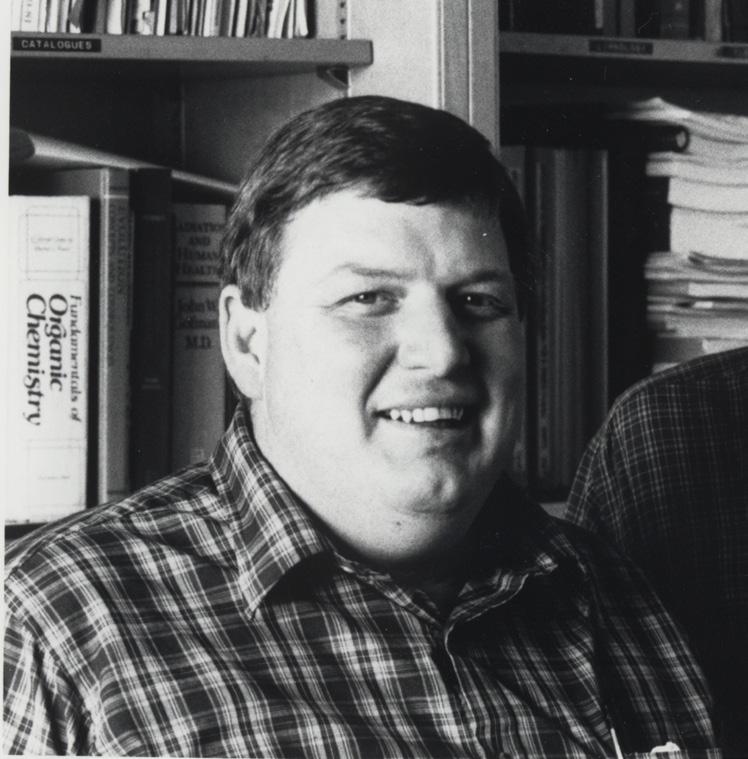
JayTyus ’91, ’94, our Gov. Clarence D. Martin Educator of Year Award winner, was also an Eagle legacy student. He arrived at Eastern in the fall of 1986, a kid from Reardan who followed his older brother Gordon to Streeter Hall’s 5th Floor South. He majored in chemistry and walked on to the EWU football team as an undersized offensive lineman with, in his own words, “a big heart and a long way to go.”
Tyus launched his teaching career at Ephrata High School in 1991. There his science classroom became famous for controlled chaos — flames, explosions and experiments that turned skeptical teenagers into curious learners.
On the football field, meanwhile, Coach Tyus taught young men that winning mattered, but that becoming a person of character mattered more. His players didn’t just respect him, they loved him.
From his perch in Ephrata, Washington, Tyus built a career specializing in turning around schools — among them Waterville, Mabton, Tonasket, and the Mead School District — earning state and national recognition along the way.
Today he serves as superintendent of the Wilbur and Creston Cooperative School Districts, where every week he reminds his community that, “it’s a great day to be a Wildcat, where each Wildcat belongs, learns and thrives.” At his district, he’s brought innovative programs such as drone-farming applications to rural students, worked local farms to generate scholarship money for graduates, and testified before legislative committees on behalf of students.
A line in his nomination materials perhaps put it best: “Jay Tyus could make friends with a honey badger.” That gift for connection has left a lasting mark. Fifteen years after Tyus led a two-day training module at a colleague's high school, teachers there still reference his strategies by his name. And Jay’s Eagle spirit? It runs deep. His wife Julie is a graduate. And Jay himself returned to EWU a few years ago to earn a master’s degree.
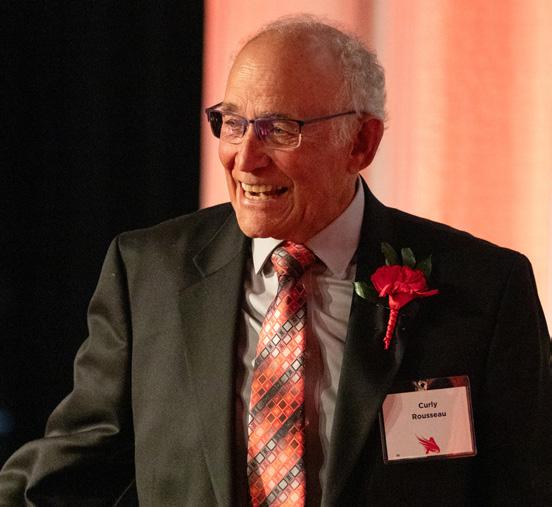
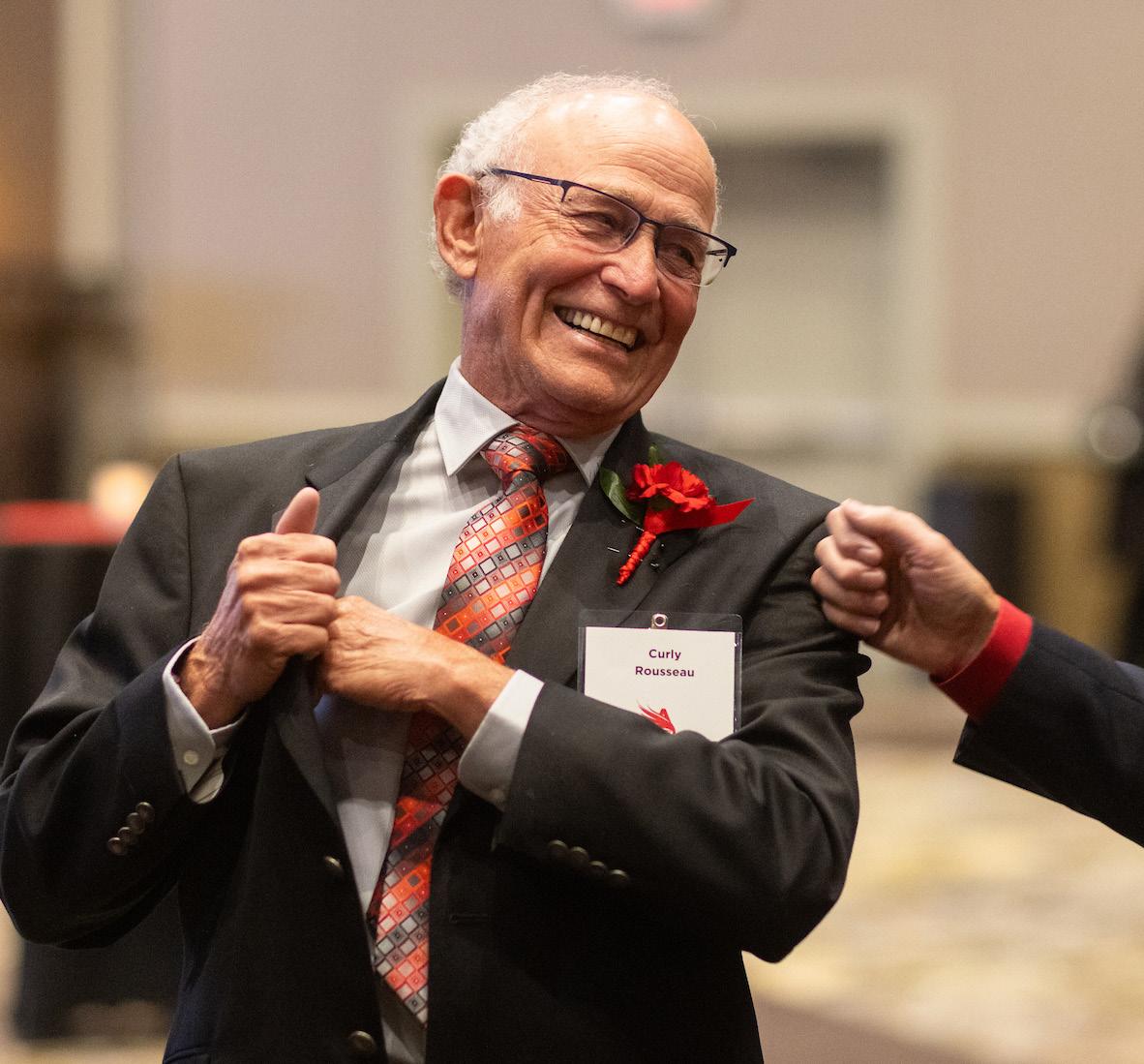
CURLY
It’spretty common to list “service” on your résumé.
Richard “Curly” Rousseau ’71, ’74, our Tawanka Service Award winner, has put it on his to-do list every single day for about 50 years. And somehow, he’s still not done.
Rousseau graduated from Eastern in 1974. A star pitcher on Eastern’s varsity baseball team — team captain, first team allconference, the only EWU pitcher ever to earn honorable mention All-American honors — he also found the time to become president of Scarlet Arrow, a men’s service organization. Right from the start, Rousseau was mixing competition with community.
After Eastern, Rousseau built careers in education and the insurance industry, but what he really built were opportunities for other people. Early on, as a teacher at Central Valley High School, his work helped the Key Club student service organization dramatically grow. He also created a “Christmas Shopping Spree” that allowed high schoolers to help disadvantaged elementary kids buy gifts for their siblings. And he launched a program in which students “adopted” residents with development disabilities at Lakeland Village, visiting them weekly throughout the school year. The Spokane Jaycees took notice, naming him their Outstanding Young Citizen.
Rousseau was just getting warmed up. When he reconnected with Eastern, he threw himself back in with everything he had. He served five terms as president of the Eagle Athletic Association, sat on the EWU Foundation Board for six years, and emceed fundraising events entirely from memory — no notes, just genuine knowledge of, and affection for, the people in the room. He and his wife Lori pioneered the “overnight tailgate” experience, arriving on Fridays and feeding TV crews, student workers and anyone who showed up cold and hungry on pre-game nights and game-day mornings. They opened their home to entire EWU teams — soccer, volleyball, basketball, cheer — creating a place where student-athletes were known by name and fed a home-cooked meal.
The Tawanka Service Award takes its name from the Eastern women’s organization whose motto was simply “to help.” Whether he’s hosting a team dinner, mentoring a struggling student or navigating a soggy infield before sunrise, Rousseau shows up to help — not for recognition, but because people matter to him.
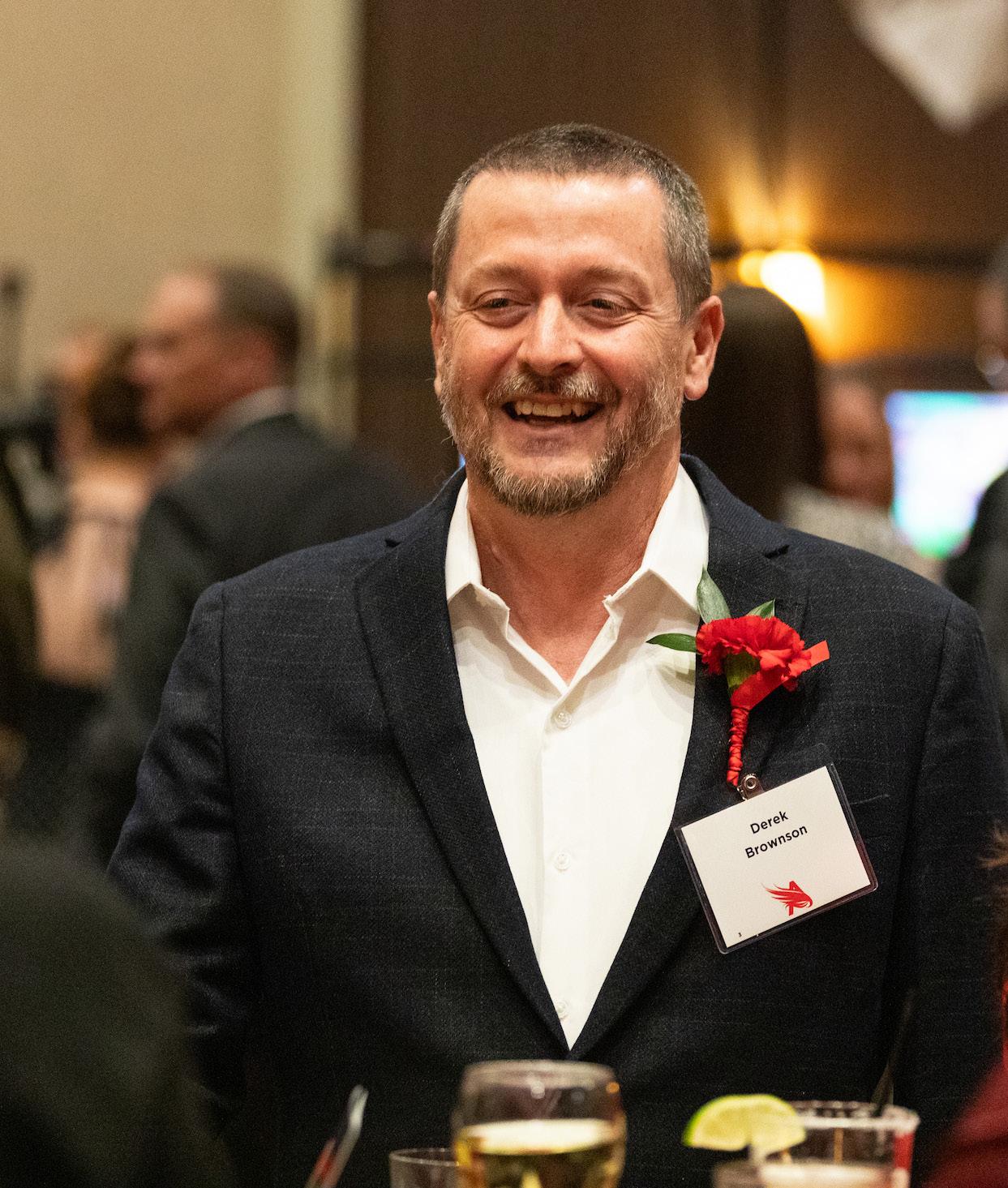
DEREK
Ifyou’ve ever been to an EWU football tailgate, there’s a good chance you’ve been greeted by a man standing next to a big RV, offering you smoked beef and asking if you’re ready for kickoff. That man is Derek Brownson, our Eagle4Life Spirit Award winner. And he’s been earning his spirit award every Saturday — and pretty much every day in between — for the past three decades.
During his undergraduate days, Brownson was a proud resident of Streeter Hall’s 3rd South, where he built friendships that have lasted a lifetime. He was also a fixture at Fast Fitness and, as some would have it, an intramural basketball legend.
After graduation, Brownson launched a career in banking that took him to Beverly Hills, Phoenix and Las Vegas. But no matter his ZIP code, his heart never left Cheney. He has served on the Alumni Association Board of Directors, become the driving force behind the popular Tri-Cities Friends of EWU Athletics Facebook page, and has raised substantial funds to keep Eagles connected across the region.
He’s also a leader in the Eagle Football Network and a regular contributor to other EWU programs. Eastern’s athletic director, Tim Collins, says he doesn't know anyone who spends more time and energy supporting all things Eagles. On social media, for example, Brownson is a one-man hype machine, amplifying every EWU achievement the moment it happens.
And then there are the tailgates.
At home games, Brownson and his wife, Kylee, regularly smoke 30 pounds of tri-tip — that's right, 30 pounds — to share with alumni, parents and players’ families. He also hosts awaygame gatherings so Eagles always have a place to connect. At every event, he feeds student-athletes’ families, and then makes a point of sending the leftovers home with their kids.
Win or lose, that’s the kind of Eagle4Life spirit we can all take pride in celebrating.
ON THE ROAD
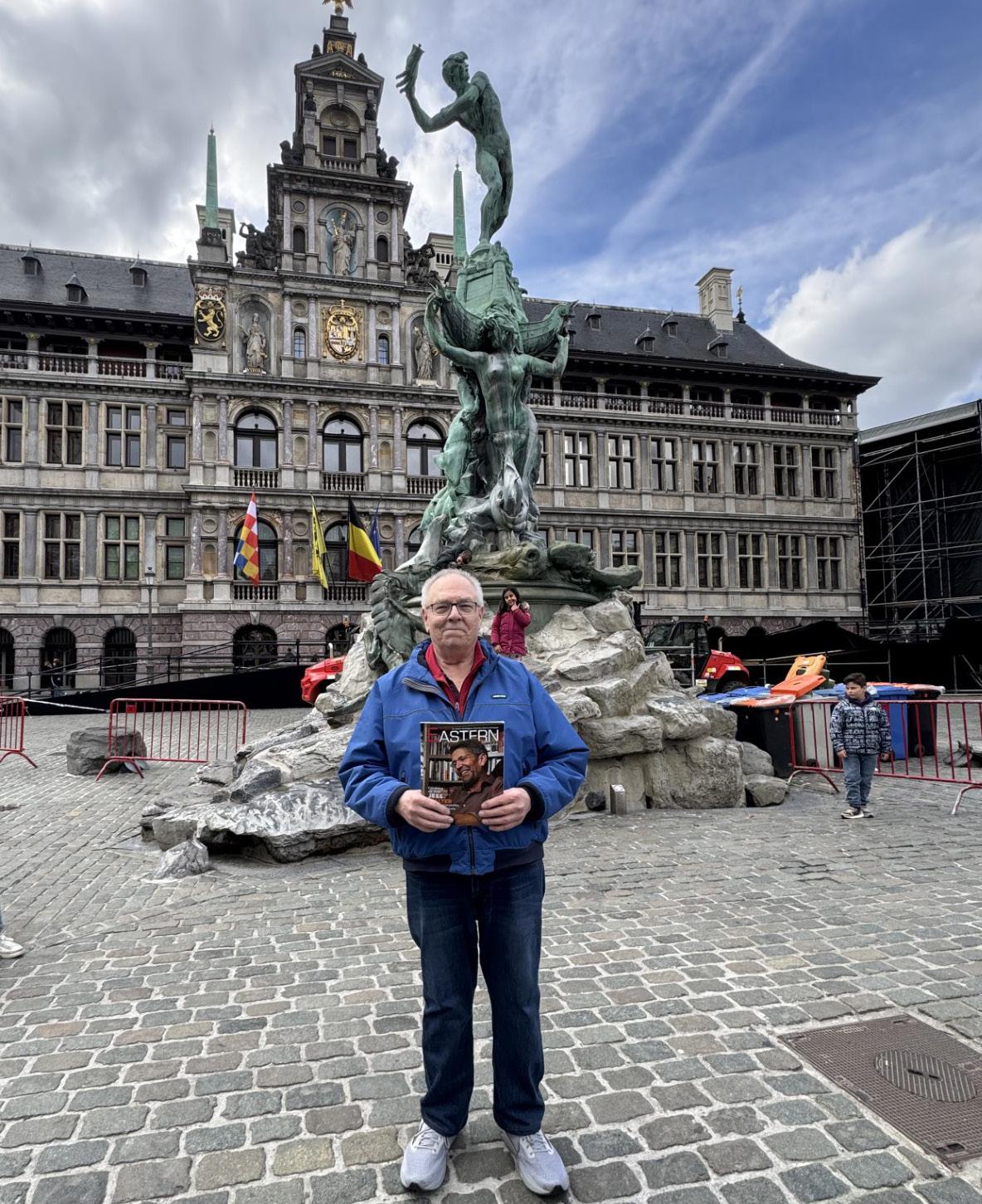
1. While visiting Europe for a river cruise, Harry Kautzman ’91 took time out to admire 19th century sculptor Jef Lambeaux’s famed Brabo Fountain located in the central square of Antwerp, Belgium.
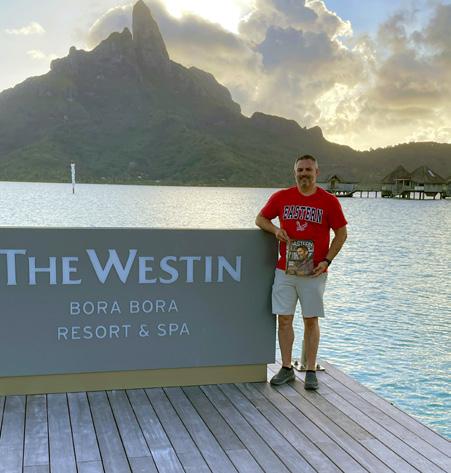
2. Andrew Nye ’08 brought his adventurous spirit, and his Eastern magazine, to the island jewel of Bora Bora, one of French Polynesia’s most spectacular islands. “I’m beyond proud to represent Eastern Washington University around the world,” he told us.
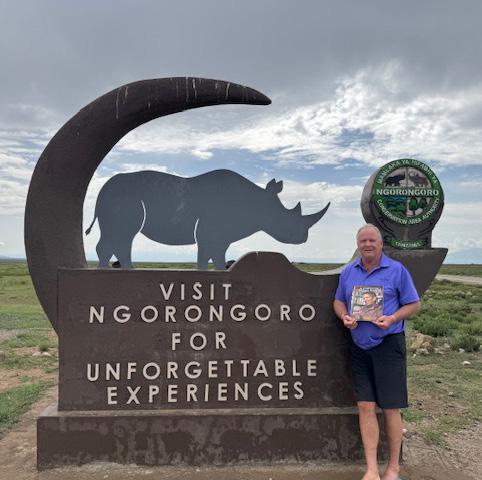
3. In February, Doug Kelley ’83 traveled to Tanzania’s Ngorongoro Conservation Area, protected lands adjacent to the Serengeti National Park. The area is not only home to a spectacular array of wildlife, but also Olduvai Gorge, arguably the world’s most important paleoanthropological site.
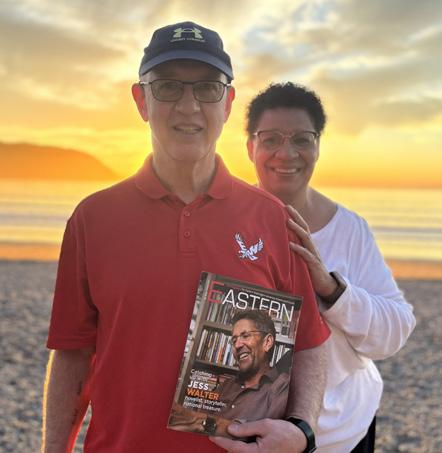
4. During a weeklong family sojourn in Costa Rica, Dan Obenchain ’79, ’82 and his wife, Maria, were treated to a stunning sunset on Playa Pochote, a tranquil Pacific Ocean beach locale in Puntarenas Province.
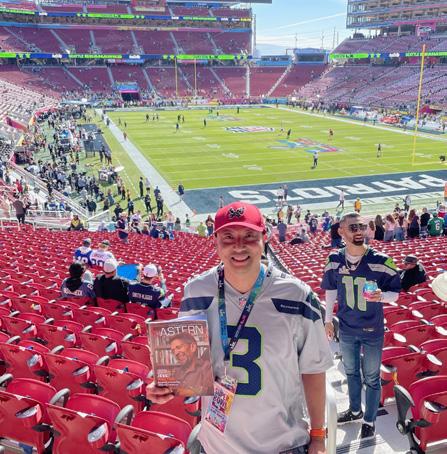
5. On a sunny Sunday at Levi’s Stadium in Santa Clara, California, Yome Hong ’00 displayed both Eagle and Seahawks pride just before the start of Super Bowl LX.
Where will Eastern magazine be spotted next? Share a photo of you, our latest issue and the details of where your travels have taken you. We’ll print as many as we can, with extras appearing on our website. Send to easternmagazine@ewu.edu.
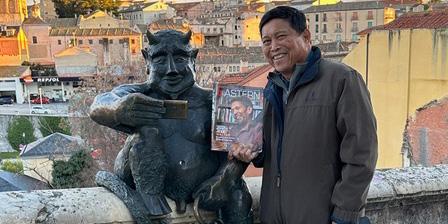
6. After joining his fiancé on a recent business trip to Spain, Lance Obra ’80, struck a pose with José Antonio Abella’s whimsical, selfie-taking devil on Segovia’s Calle San Juan. Legend has it that the devil built the city’s massive Roman aqueduct in a single night. 5 3 2 4 6
1970s
’78 Bill Simer, BA accounting, was named an Inland Northwest Business Icon by Spokane’s Journal of Business. A retired partner at Eide Bailly LLP, a regional certified public accounting and business advisory firm, Simer was cited for being among the Inland Northwest’s “business pioneers and innovators who shaped our region and positioned it to be the vibrant, prospering community it is today.”
1980s
’83 Bernie Barnes, BA accounting, was featured in a March 4 Spokesman-Review article celebrating his uninterrupted participation in each of the past 49 Bloomsday Run events. Barnes, 67, joined the small, select group of Bloomsday perfectionists — many of whom are EWU grads — when he finished the race’s 50th anniversary run on May 3.
’83 Gavin Cooley, BA accounting, is the director of strategic initiatives at the Spokane Business Association. In January, he was named one of Spokane’s Journal of Business’ people of influence. The recognition honors influential newsmakers whose contributions are helping to shape the Inland Northwest.
’85 Paul Read, BA English, is the publisher of the Tri-Cities Area Journal of Business and Spokane’s Journal of Business. In April, he was named Distinguished Alumni of the Year by the Spokane Colleges Foundation. The award honors a SFCC or Spokane Community College alumnus who exemplifies the colleges’ legacy of learning and who have made significant contributions to the community.
1990s
’95, ’97 Gwendolyn L. Cash-James, BA, MA English, in March was named vice president for academic affairs and provost of North Idaho College, a public community college in Coeur d’Alene,
Idaho. Prior to joining the faculty at NIC, Cash-James, who also holds an education doctorate from Northwestern University, served as associate vice provost at EWU.
’96, ’00 Jennifer Hansen, BA, ME education, has since 2024 been the coowner of Cheney’s Barrelhouse Pub & Pizza, a longtime student favorite. Hansen and her business partner, Matt Lazarus, recently opened a second Barrelhouse Pizzeria on Howard Street in downtown Spokane.
2000s
’00, ’07 Kimberly Yahne, BA, MA education, in February was named “Nonstop Local Teacher of the Month” by KHQ television news. Yahne is a classroom teacher at Hutton Elementary School in Spokane.
’02 Denton Norwood, BS wellness and movement sciences, was honored with a District 10 Service Award by the Northwest Athletic Trainers Association. Norwood is a health sciences professional with Yakima’s East Valley High School.
’02 Tresa Schmautz, MSW social work, is the co-founder of Dignified Workday, an employment nonprofit that works in partnership with Spokane-based Career Path Services. In January she was named one of Spokane’s Journal of Business’ people of influence. The recognition honors influential newsmakers whose contributions are helping to shape the Inland Northwest.
’04 John Slack, BS occupational therapy, and his wife, Jessica, own Bruttles Gourmet Candy Shoppe, a decades old Spokane institution. Readers of the Inlander voted Bruttles’ candy the “Best of the Inland Northwest” in the weekly newspaper’s most recent annual reader’s poll.
’05 Malisea “Lisa” Gardner, BS communication studies, is the president
of the NAACP’s Spokane branch and serves as director of communications and community engagement for the Spokane City Council. In January, she was named a 2026 Women of Achievement in Government and Public Service by YWCA Spokane. More recently, she was honored as one of EWU’s Alumni Awards winner (see story Page 26).
’06, Danielle Knapp, BA, art history, is the McCosh Curator at the University of Oregon’s Jordan Schnitzer Museum of Art. She recently mounted a retrospective exhibition of acclaimed contemporary artist James Lavadour at Spokane’s Museum of Arts and Culture.
’06 LaFewt Knox, BA business, earlier this year joined the Bristol Bay Native Corporation as a senior director of financial planning and analysis. Knox will support “corporate strategy through advanced financial modeling, investment performance analysis, and long-range financial planning.”
’06 Lars Slind, BA international affairs, is an actor and producer based in Lancaster, California. His work with director Paul Sadowski on the recent true crime documentary, The Vanishing of Dolores Wulff, earned “Best Documentary Feature Film” at the 2026 Cinquest film festival.
2010s
’13 Chip Burgess, BA interdisciplinary studies, in January was elected to serve as the business manager and secretary treasurer of the Laborers International Union of North America, a labor organization with more than 500,000 members in the United States and Canada.
’14 Shane Moses, BA journalism, earlier this spring was named the editor-inchief of The Tribal Tribune, a newspaper published by the federally recognized Confederated Tribes of the Colville Reservation.
’15 Isaiah Grant, BS computer science, and ’15 Karl WatsonHardiman, BA business administration, in June launched an independently developed video game on Steam, the world's largest digital distribution platform for PC gaming, after three years of development.
’17 Jennyfer Mesa, BA public administration, earlier this year was named executive director of Seattle’s Casa Latina, a nonprofit that aims to advance the city’s Latino immigrants “through employment, education, and community organizing.” Mesa previously served as executive director of the nonprofit Latinos en Spokane.
2020s
’22 Kelton Earl, BA professional programs, in February joined Black Talon Security, a national cybersecurity solutions firm, as a cyber risk specialist. His role, the company says, will involve “guiding clients in the dental and healthcare sectors to understand the cyber threat landscape and implement optimal solutions to reduce risk.”
’25 Eva Khamphouy, BA criminal justice, was sworn in as a police officer serving the city of Astoria, Oregon during a meeting of the Astoria City Council on Feb. 2.
’25 Jaime Stacy, MS professional programs, is the founder and executive director of SWAG, Strong Women Achieving Greatness, a nonprofit that seeks to create “safe, supportive spaces for girls to explore leadership, self-confidence, and goal setting while breaking down systemic barriers.” In January she was named a 2026 Women of Achievement in community enhancement by YWCA Spokane.
Biologist With a Mission
Allan Scholz studied how salmon navigate by smell, then used his findings to help restore Inland Northwest fisheries.
BACK IN 1980, Al Scholz, a fisheries specialist armed with a newly awarded doctorate from the University of Wisconsin, arrived in Cheney to begin work with Eastern’s biology faculty. He was a good fit, and it wasn’t long before his teaching appointment blossomed into a four-decadelong research and instruction career centered on regional fish, most notably, salmon. It was work that would bind him, permanently and profoundly, to the Native peoples for whom salmon are not a resource but a central part of their historical, cultural and spiritual identity.
One of Scholz’s first acts at EWU was striking in its directness. After securing funding from the Bonneville Power Administration, he telephoned every Native student at the university and invited them to work in his laboratory. Eventually more than
2020s
’25, Ashlee Cantilero, age 24, died March 19, 2026.
’24, Zoltán Szilágyi, age 59, died Feb.22, 2026.
’21, Kelli Beseler, age 27, died Dec. 31, 2025.
2010s
’07, Sherrie Cornia, age 77, died March 13, 2026.
’12, ’17 Maria E. Estrada-Loehne, age 60, died Feb. 24, 2026.
’10, Justin Parrish, age 45, died Sept. 21, 2025.
2000s
’00, Zack McInelly, age 49, died Dec. 11, 2025.
1980s
150 students would pass through Scholz’s lab, many of them tribal members who went on to careers in fisheries research and management.
Within two years he had also helped the five tribes of the Upper Columbia—the Coeur d’Alene, Colville, Kalispel, Kootenai, and Spokane—establish the Upper Columbia United Tribes, a consortium devoted to science-based stewardship of fish and water.
Scholz was best known for his findings related to olfactory imprinting and homing in salmon—the mysterious capacity of a fish to smell its way back to the stream where it was born. His applied work was equally consequential. A 1986 feasibility study led by Scholz, for example, contributed to the construction of tribal hatcheries that now produce millions of kokanee salmon annually
’85, Kevin Dover, age 64, died Dec. 7, 2025.
’84, Gerald Beyersdorf, age 79, died Jan. 22, 2026.
’84, Harold Tanguay, age 82, died Jan. 8, 2026.
’80, Jim Mach, age 91, died Jan. 21, 2026.
’80, Steve Stageberg, age 69, died Sept. 19, 2025.
1970s
’79, John Blalock, age 74, died May 11, 2025.
’79, Jesse Briones, age 71, died Jan. 14, 2026.
’79, Linda Hodge, age 86, died Jan. 3, 2026.
for Washington’s Lake Roosevelt. His work established kokanee runs at multiple sites and helped transform the reservoir’s fishery.
Over the course of his career, Scholz published six books on Eastern Washington’s fishes, authored 147 technical reports and secured 145 research grants, all while teaching full courseloads. The Sierra Club awarded him its Watershed Hero distinction in 2015. He retired the same year, then showed up at his office the next morning and kept working for another decade.
Allan T. Scholz, professor of biology emeritus, died on Feb. 15, 2026. He was 78 years old.
’75, William Blessing, age 82, March 4, 2026.
’75, Ronald Migaki, age 76, Jan. 11, 2026.
’74, ’77 John Donovan, age 88, Jan. 2, 2026.
’73, Dolores Gahler, age 90, Jan. 18, 2026.
’73, David Anderson, age 78, Nov. 16, 2025.
’73, Jerald Oberst, age 82, Feb. 2, 2026.
’72, James McClintock, age 68, March 7, 2026.
’71, ’79 Flora Balcom, age 97, Jan. 23, 2026.
’71, Larry Lester, age 80, Dec. 4, 2025.
’71, William Stutz, age 76, Dec. 22, 2025.
’70, John Boots, age 78, Feb 4, 2026.
’70, Daniel Nichols, age 77, Jan. 28, 2026.
1960s
’69, ’85 Amy Bragdon, age 79, Jan. 27, 2026.
’69, ’71 Joan Donen, age 87, Oct. 27, 2025.
’68, James Bennett, age 81, Jan. 2, 2026.
’68, Bernard Johnson, age 87, Jan. 4, 2026.
’67, Jack Buss, age 89, Jan. 20, 2026.
’67, ’72 Ronnie Ragsdale, age 85, Feb. 25, 2026.
’65, Gary Johnson, age 85, Feb. 25, 2026.
’61, ’64 Robert Grambo, age 89, April 16, 2026.
’60, James Smith, age 89, April 24, 2026.
1950s
’57, Karan Croft, age 86, Jan. 9, 2026
’50, Gerri Cobb, age 97, Jan. 8, 2026.
Faculty and Staff
Gordon Budke died on Jan. 24, 2026. After earning a bachelor’s degree in accounting at EWU in 1963, Budke went on to play an enormously influential role in Spokane’s commercial and civic life. Among his many personal and professional accolades, Budke was inducted into the Spokane Citizen Hall of Fame, was named a Spokane Journal of Business Icon, and was honored with an EWU Alumni Association Lifetime Achievement Award. Beginning in 1997, he served for 12 years as a member of EWU’s governing Board of Trustees.
Pamela Elkind died on March 12, 2026. A professor and chair of sociology, Elkind gained prominence for her important insights into the health and environmental challenges faced by rural and agricultural communities. In addition to her teaching and research at EWU, she established Washington’s Center for Farm Health and Safety. She retired in 2010 after 29 years of service.
Tom McGill, died on March 6, 2026. McGill, a respected law enforcement and public safety professional, served as EWU’s chief of police for 11 years. He retired in 2006.
Jeffrey Sodano, died on March 3, 2026. A U.S. Air Force veteran, Sodano had served since 2000 as a stationary engineer at the Rozell Physical Plant, where he died following a medical emergency. “You can’t replace a guy like Jeff,” his coworkers wrote. “We can only hope to live up to his expectations.”
Thorne Tibbitts, died on Dec. 17, 2025. Tibbitts joined Eastern’s Athletics staff in 1960 as a physical education instructor and men’s gymnastics coach. In 1965, he led his Eagle squad to a second-place finish at the NAIA Championships. That same year he volunteered to coach men’s golf, taking two golfers to the NCAA Championships. Tibbitts left EWU in 1976, but remained a life-long Eagle booster. He was inducted into the EWU Athletics Hall of Fame in 2007.
Duane Thompson, died on Nov. 3, 2025. Thompson, an emeritus professor of applied psychology, also served as Eastern’s provost. He retired in 1992 after 24 years of service.
Roger Christianson died on March 12, 2026. A U.S. Navy veteran, Christianson served as a steam plant engineer with Eastern’s Facilities Maintenance department. He retired in 2002 after 30 years of service.
First Among Eagles: Eastern’s early days as a State Normal School were decidedly difficult. In spite of spirited local support, fire, funding and organizational woes all contributed to a decided sense of impermanence. That changed with the arrival of Noah David Showalter in 1911. Showalter brought to his leadership impeccable academic credentials (WSU, Stanford and Columbia University) and a single-minded devotion to the advancement of public education. As principal and later president of the school, he recruited highly qualified faculty members, expanded enrollment, professionalized the curriculum and oversaw construction of the building (below) that now bears his name. Perhaps most importantly, he took steps to ensure graduates teaching in rural schools stayed connected to the institution, a move that eventually established Eastern as a truly regional college. By the time he left to become the state’s Superintendent of Instruction — 100 years ago this spring — Showalter was widely recognized as the “father” of Eastern Washington University.
After the 1912 loss of the Cheney State Normal School’s Administration Building, construction of a replacement began in 1914. The building, completed a year later, was named for Noah Showalter in 1940.