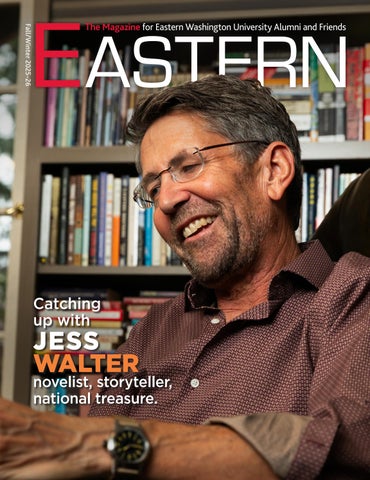
Fall/Winter 2025-26
Catching up with
JESS WALTER
novelist, storyteller, national treasure.
Photo by Luke Kenneally.
Fall Fest: Every autumn at EWU, a host of on- and off-campus groups gather together for Neighborfest, a joyful rite of information sharing that kicks off the new academic year. The 2025 festival, held under crystalline blue skies at the Arevalo Mall, was one of the biggest ever, with close to 150 groups participating. Among them was EWU’s Theatre Department, pictured here, which maintained perhaps the most consistently boisterous of all the event’s tables.
Photo by Chris Thompson
SPRING/SUMMER 2025
TAKING FLIGHT
Toward a Bright Future
I
’ve said it often over the past two years: The future is bright. Every day, the work happening across our campus inspires me. Our students are engaged in scientific inquiry, creative expression and scholarly discovery that stretches far beyond the classroom. Learning at Eastern is collaborative and intentional, creating meaningful opportunities that build confidence, spark curiosity and foster a sense of belonging. Applied learning is transforming lives, and the results reaffirm the vital role public higher education plays in shaping strong, resilient communities. But we also recognize that the pathway to college is not equally accessible for every student in our state. Washington continues to experience some of the lowest college-going rates in the nation — an urgent challenge that demands a holistic approach. Strengthening this pathway means supporting families,
engaging students early in their K-12 journey, and smoothing the transition from high school to college. It is essential not only for individual success, but for the long-term health and vitality of our regional economy. Eastern is committed to doing its part. We are expanding support systems, deepening external partnerships and ensuring every student who dreams of higher education feels welcomed, encouraged and prepared to thrive. And we are profoundly grateful for our community of supporters who sustain our mission. You show up for our students and continue to believe in the potential of every new Eagle. That enduring commitment is one of our greatest strengths, and it keeps this university moving forward, together.
Shari McMahan, PhD President, Eastern Washington University
The Spirit of Eastern
O
ne of my greatest privileges as alumni director is witnessing the impact of our graduates. Each day I am reminded of the passion, pride, and unwavering commitment that define our 125,000-strong alumni community. I see Eagles stepping up—mentoring students, attending regional gatherings, cheering on our teams, sharing their stories and carrying the spirit of Eastern into their communities and workplaces around the world. Your engagement matters. Whether you join an event, volunteer your expertise, support scholarships or simply wear your red on Fridays, you help strengthen the Eagle4Life experience for generations to come. Our team is here to help, and we remain focused on building meaningful opportunities that keep you connected—to each other, to campus, and to the future of EWU. I encourage you to get involved in whatever way fits your life right now. Each
4
EASTERN MAGAZINE
action—large or small—strengthens our community and helps shape the future of Eastern. In 2026, the Alumni Association is expanding opportunities for you to engage—on campus, on the road and online. From career networking to regional meet-ups and enhanced traditions, we’re creating more ways for you to stay connected, give back and celebrate what it means to truly be an Eagle. Thank you for your continued enthusiasm, generosity and love for this university. Together, we are writing the next chapter of what it means to be an Eagle4Life. Go Eags!
Kelsey Hatch-Brecek, Director of Alumni Relations
EASTERN MAGAZINE FALL/WINTER 2025-26 EDITOR Charles E. Reineke
20
ART DIRECTOR Ryan Gaard ’02 Photo by Margaret Albaugh ’23
04
Taking Flight
06
Eastern Etc.
16
26
31
Class Notes
Features
33
16
35
A New Era of Discovery
In Memoriam Back Story
The Science Building’s refresh brings EWU’s polytechnic future into focus.
CONTRIBUTING DESIGNER Emily Ausere ’22 CONTRIBUTING WRITERS Melodie Little ’91 Rachel Weinberg PHOTOGRAPHY Luke Kenneally Aaron Weer ASSOC. VICE PRESIDENT FOR UNIVERSITY ADVANCEMENT Eric Limburg DIRECTOR OF ALUMNI RELATIONS Kelsey Hatch-Brecek ’21
LET US KNOW WHAT YOU THINK!
20
EMAIL easternmagazine@ewu.edu
Where the Story Started
WRITE
Jess Walter, one of the nation’s most beloved novelists, reflects on his path to literary stardom.
Eastern Magazine 102 Hargreaves Hall Cheney, WA 99004-2413
26
Eastern magazine is published twice each year by University Advancement and is mailed free to alumni and friends in the United States. View this and previous issues of Eastern online at ewu.edu/magazine.
A Future Beyond the Fields
Eastern’s CAMP program is giving the children of migrant parents a shot at college.
On the Cover: Jess Walter ’87 in his Spokane office. Photo by Luke Kenneally.
FALL/WINTER 2025-26
5
EASTERN ETC.
Kate MacDonald surveys the stacks at Paperbound Books. Photo by Luke Kenneally.
6
EASTERN MAGAZINE
Where Books Abound An Eastern undergraduate brings bookselling back to Cheney.
O
nce upon a time, not so very long ago, the Nashville-based author turned bookseller Ann Patchett was asked why she was so passionate about bookstores. “I think a big component of loving books is the desire to share them and to talk about them and to recommend them to other people,” she said. “We have to take responsibility for the places where this happens, not wait for them to go away and then miss them terribly.” For many years, Cheney has been missing such a place, and terribly. No longer. Hidden away behind 1st Street’s Mason Jar restaurant, Paperbound Books is a tiny, impossibly cute gathering place for readers. It’s proprietor, Kate MacDonald, 25, is an Eastern undergraduate studying music technology. She runs the store pretty much on her own — a solitary labor of love that allows her to serve as content curator to a diverse clientele. “Books make people happy. You just have to match them with the right one,” she says. Even as a little girl growing up in Idaho, MacDonald loved books. “I had a 300-book, thrift-store collection by the time I was 12, and they were all alphabetized in a notebook,” she says. The idea for Paperbound came after she moved from Spokane to Cheney and found herself lamenting the lack of a bookshop. “I’d always wanted to start something on my own,” she says. “I was like, ’Why can’t I do something like that here?’” So MacDonald set to work. She typed, “How do you write a business plan?” into Google, then honed a strategy with several local experts. Next she created a website and started amassing inventory, collecting tomes from wherever people were divesting themselves of used volumes. She started selling at pop-ups and the Cheney farmer’s market, all the while keeping her eyes open for potential brick-and-mortar storefronts. Her ambitions got a big boost from Douglas LaBar, the Mason Jar’s owner, who told her his building had a great little space available. He then proceeded, with the help of his father-in-law, the building’s owner, to personally complete Paperbound’s charmingly bohemian build-out. “We just want a bookstore in here,” LaBar told MacDonald. “And this is going to be yours.” In spite of the challenges facing all booksellers these days, Paperbound has been a success. After recently celebrating the shop’s one-year anniversary, MacDonald is optimistic that her many customers represent a resurgence of interest in the printed word. “People stopped reading printed books for a really long time because of e-books, digital and social media, all of that,” MacDonald says. “But I’m confident that the pendulum is swinging back from digital media to physical objects. Especially with Gen Z, books are definitely back in style.” As are, she might have added, cozy places to connect with them.
FALL/WINTER 2025-26
7
EASTERN ETC.
ROTC Cadet Sergeant Major Cooper Thomas at the 9/11 Memorial Stair Climb. Photo by Aaron Weer.
Stepping Up for Fallen Heroes A recent graduate revives EWU’s 9/11 Memorial Stair Climb.
F
ew days in our nation’s history can match the shock and horror of Sept. 11, 2001. As we approach the 25th anniversary of that dreadful morning, it’s especially important that succeeding generations of Americans remember the attacks and, especially, the heroism of the firefighters and police officers who sacrificed their lives to save others. This fall, thanks in large part to Denise Quiroga ’25, a student-turned-alumna who wasn’t yet five years old in 2001, Eastern’s 9/11 Memorial Stair Climb returned to the Cheney campus. The event challenges participants to complete a strenuous stair assent in remembrance of the New York City firefighters and police officers who rushed into the burning twin towers — some of whom climbed as many as 110 flights of steps — in an attempt to reach trapped office workers and visitors. Quiroga, who graduated last June with a bachelor’s degree in biology, spearheaded the effort remotely in partnership with other members of Eastern’s “Easy Come, Easy Grow” garden club. This year’s climb, which originated in Dressler Hall before being halted due to Covid-19, was, at Quiroga’s urging, relocated to Roos Field. Mark Este, director of EWU community
8
EASTERN MAGAZINE
engagement, recently gave Quiroga a shout-out for her outstanding work. “She pulled in all these different campus departments, such as facilities, the police department, the veterans resource center, sustainability, community engagement, our office, to try to make this happen and get all the moving parts in place,” Este says. “It’s a really cool, collaborative effort.” Roos Field proved to be an ideal fit for the event, in part thanks to the day’s sunny skies and mild temperatures. Of the 100 people who attended, more than 50 participated in stair climbs and walks. Nathan Henson, captain at the Cheney Fire Department, turned out to Roos with several colleagues. “We’re pretty excited to see this happening again,” Henson said. Henson said firefighters and police rarely think of the dangers to themselves when they are serving their communities: Answering the call of those who need them simply comes as second nature to most first responders. “I think [the memorial event] is a good reminder of why we do what we do,” Henson says. “A lot of times you don’t think about the loss side of things; you are just going and doing a job because you enjoy doing it, and you enjoy serving your community.”
Polytechnic, With Distinction Eastern gains national recognition for preparing its students for real-world success.
E
a s t e r n Wa s h i n g t o n University has only recently adopted an official identity as “the region’s polytechnic.” But for years it has earned national acclaim for what academic administrators like to call “prioritizing the application of knowledge to professional practice.” This year is no exception. Just prior to the beginning of the current academic term, EWU was designated a 2025-26 College of Distinction by an Austin, Texas-based organization that ranks universities according to their effectiveness in helping students “learn, grow, and succeed.” The honor represents, in effect, a national seal of approval for Eastern’s impressive track record of preparing students for real-world success. Eastern didn’t just earn an overall “College of Distinction” designation — it was also recognized in eight specific program areas, as well as for its overall affordability and support for military students. “EWU has a proud history of providing a transformative undergraduate experience that prepares our students to thrive in the workforce and
to serve as leaders in their communities,” Shari McMahan, Eastern’s president, wrote in a statement following the award announcement. “Being recognized as a College of Distinction across such a wide range of fields reaffirms our strength in hands-on learning, as well as our commitment to affordability and academic excellence.” Through research and interviews, Colleges of Distinction honors universities that “make a meaningful impact on students’ lives, not just the institutions that fight their way to the top of the more traditional rankings lists.” The recognition criteria is based on what they call the “four distinctions”: engaging students, great teaching, vibrant communities and successful outcomes. The Colleges of Distinction honor comes on the heels of a coveted status upgrade from the Carnegie Foundation, which last year designated EWU as one of the nation’s Research Colleges and Universities. Both designations were important acknowledgments of Eastern’s success in boosting collaborations and student opportunities. Or, as Tyson Schritter, COO at Colleges of Distinction, puts it: “EWU’s programs reflect the kind of innovation and intentionality that prepare students for life after graduation.”
Respect and Commitment An update aims to boost the impact of Eastern’s land acknowledgment.
T
he formal acknowledgment that Native peoples are the original inhabitants and stewards of the land where EWU now resides has for years been a part of Eastern’s milestone events — from convocation to commencement. In addition to recognizing EWU’s relationship with area tribes, most notably the Spokane Tribe of Indians, the acknowledgments are meant to serve as a reminder of the often violent displacement of our region’s Indigenous peoples. They also seek to raise awareness of Native peoples’ ongoing presence, and to signal EWU’s commitment to reconciliation. Earlier this year, under the leadership of Cola Boyer ’20, EWU’s director of tribal relations, the university unveiled an update to its official acknowledgments statement, one that reflected students’ desire for something more “impactful and meaningful.” “That was probably the very first task that was given to me by the students, and I was more than happy to take it on,” Boyer says of the acknowledgment update. She says she began by exploring the origins of Eastern’s previous statement, then looked outside the university for inspiration. “I looked at other universities’ land acknowledgments and came
up with something that I felt met the mission and the feeling of Eastern Washington University and the Native American students who study here,” Boyer says. After drafting a new version, she shared it with a group that included Professor Margo Hill, director of American Indian Studies, Evanlene Melting Tallow, program coordinator and recruiter for American Indian Studies, and with Native students. Together they made revisions that addressed tribal sovereignty issues and more fully confronted the systemic hardships area tribes have endured. Boyer says the new land acknowledgment is more than just a formal recognition that Native people lived on the lands of the Cheney campus. “It’s giving a history of the tribe — the Spokane Tribe that was here — and it’s giving a deeper meaning to what this institution is now, and what it is rooted on.”
FALL/WINTER 2025-26
9
EASTERN ETC.
Building Healthy Communities 80%
REACHED
THE GOAL
$100 MILLION TRANSFORMATIVE IMPACT Your Support Helps Build Better Futures for Students ACCESS & AFFORDABILITY
$14,150,000 for 5,642 Scholarships. HANDS-ON LEARNING
$118,575
for the Prairie Restoration Project.
$26,500
for the Lucy Covington Initiative.
BUILD HEALTHY COMMUNITIES
$675,600
for Future Nurses.
COMMUNITY THROUGH ATHLETIC EXCELLENCE
$4,037,700
for the Eagle Athletic Fund.
$5,162,150
for the Stadium Renovation Fund.
10 EASTERN MAGAZINE
Our region needs nurses. EWU’s $100 million ‘Build Our Future’ campaign is prioritizing solutions.
S
omething was wrong with 6-year-old Anthony Orozco. He was always tired. His belly hurt. He stopped jumping on his trampoline. His skin was turning blue. Anthony’s dad rushed him to a Yakima clinic. A doctor pushed on his stomach, and Anthony cried out in pain. A nurse held his hand while someone poked his small arm with a long needle. The little hand squeezed the bigger hand: “It’s going to be okay, Anthony,” the nurse said. Soon the doctor delivered the diagnosis: childhood leukemia, a form of cancer. Anthony and his mom boarded a helicopter that day to Seattle Children’s Hospital. They would spend the next 14 months in treatment there. Through it all, Anthony remembers friendly nurses calming his fears and making him smile. “The nurses were super helpful, caring and loving. They left a huge impact on me. Since the day I became cancer free and got to go home, I knew I wanted to become a nurse when I grew up,” says Anthony, 21, now a junior in the EWU School of Nursing and a recipient of the EWU Nursing Scholarship. Everyone — from birth to end of life — will need a nurse’s help. Unfortunately, there is a nationwide critical shortage of nurses. The federal Health Resources and Services Administration recently projected a gap of close to 64,000 full-time registered nurses by 2030. After graduating its first cohort of 40 students last spring, EWU’s School of Nursing, housed in the SIERR Building in Spokane’s University District, is now teaching four cohorts simultaneously, meaning 80 students could graduate each year with a fully accredited Bachelor of Science in Nursing degree. Want to support students like Anthony Orozco and help ensure our region is adequately staffed with nurses? Find a scholarship or program fund at ewu.edu/give/funds. You can also make a transformational gift by naming the School of Nursing, a classroom, study area, skills lab or other space. Contact Kaarin Appel, EWU senior director of philanthropy for the College of Health Science and Public Health, at kappel@ewu.edu or (509) 220-4418.
Wilderness Pastoral A group of Eastern music students finds inspiration in the great outdoors.
D
uring the summer of 1829, the German composer Felix Mendelssohn, age 20, journeyed with a family friend to the Hebrides. Then, as now, these remote Scottish islands contained all the ingredients of Romantic fascination: towering cliffs battered by powerful storms, sun-dappled hillsides spiked with basalt, ghostly moorlands haunted by Celtic mysteries. Little wonder that some of Mendelssohn’s greatest work emerged from the place. The sublime national parks and wildlands of the American West have long been the setting for similar flights of inspiration, as a group of young EWU composers recently discovered for themselves. Led by Jonathan Middleton, an EWU professor of music theory and composition, eight members of Middleton’s composition course in September spent a week at one of the greatest of these Western treasures, Grand Teton National Park. There they sought, as Mendelssohn did in Scotland, to find inspiration for 3-to-5-minute “pastoral” compositions, several of which will be performed by the Spokane Symphony Orchestra during a joint appearance with the EWU Orchestra in Showalter Auditorium on March 12. James Lowe wasn’t born in the Hebrides, but the native of Scotland knows well their allure. As the Spokane Symphony’s conductor and
music director, he also knows that using music to convey the magic of such places isn’t easy. During a visit to Middleton’s class this fall, Lowe gently probed and prodded the young composers, helping them articulate their ideas and ambitions. He also apprised them of the challenges involved in preparing music for performance. One recurring theme? Don’t overdo it. “Here’s my thing,” Lowe said. “The greatest music expresses everything you want in the simplest possible way.” The Tetons trip was funded in part by a $5,000 donation from a music-loving donor, as well as a grant from the recently established Youngs Endowment for National Park Studies (see our Spring/ Summer 2025 issue). For the student participants, the experience was priceless. “Thank you for giving us this opportunity to learn and grow as composers,” wrote one of them, Joey Gagne. “I will remember it for the rest of my life.”
Emphasis on Engaging A newly reopened Office of Community Engagement helps Eagles help others.
T
his fall, Eastern celebrated the reopening of its Office of Community Engagement, reviving a campus resource that had been shuttered for nearly four years. The office, located on the first floor of Showalter Hall, will function as a hub for student volunteerism, service-learning and internships. The October event, which drew a number of current and potential community partners, marked the office’s official return to campus life. “There’s definitely a lot of potential to build deep connections with our local community here — and people are ready for it — both on campus and off campus,” said Mark Este, newly appointed director of the office. “Hopefully we can just get in there and be that bridge for all the great work that is already being done.” The revitalized engagement office, Este adds,
focuses on three key areas: volunteerism, service-learning and internships — all experiences that will “benefit students while helping the larger community.” This will require maintaining and sometimes reestablishing partnerships with local and regional businesses, government agencies and nonprofit organizations. The ultimate goal, Este says, is to create pathways for students to gain experience as they work to address those groups’ needs. In her remarks during the event, Shari McMahan, Eastern’s president, said the reopening reflects the university’s role at the center of our region’s intellectual and economic life. “This is what we do; we are an anchor institution. We are tied to our community,” McMahan said.
FALL/WINTER 2025-26
11
EASTERN ETC.
Out-of-Sight Infrastructure Key component upgrades bring reliability, sustainability and safety improvements to Eastern’s Rozell Physical Plant.
W
Newly installed cooling towers line Rozell’s roof.
12 EASTERN MAGAZINE
eaving his way through a warren of ductwork, piping and electrical conduits, past boilers and chillers, condensers and blowers, Matt Deppa, chief engineer at EWU’s physical plant operation, pauses in front of a 10-inch programmable logic control display. After a quick look, he turns toward a visitor. “Here’s the thing,” Deppa says, his voice rising to be heard above the rumble and whirr of machinery, “a lot of people really don’t know what we do in here.” “In here,” is EWU’s Rozell Physical Plant building, an unprepossessing structure perched above the corner of Elm and Washington streets. What they “do” in there is operate and maintain the heating, ventilation and air conditioning systems that keep Eastern comfortably habitable through every season of the year. Now, thanks to a combination of a $20 million state budget appropriation and targeted grants, Deppa and the rest of the Rozell crew are two years into a multi-faceted overhaul, one that includes key structural and component changes. The goal? To boost the reliability, sustainability and safety of Eastern’s heating and cooling systems for decades to come. Upgrades already in place include two new high-efficiency, lowemission boilers that provide safer, more consistent heating with less fuel. There are also five new liquid-cooled “chillers” — massive units that cool water used by campus buildings for air conditioning — along with four new cooling towers that boost the chilling system’s performance. Electrical upgrades include moving high-voltage switches previously located in Eastern’s tunnel loop, to safer, above-ground locations. For the crew members who operate and maintain this dizzyingly complex array of infrastructure — many of whom, like Deppa, learned the trade while serving on ships with the U.S. Navy and Marine Corps — changes in the 1970s-era facility were welcome indeed. On a recent tour, Steve Schmedding, EWU’s facilities engineer and senior project manager, joined up with Deppa to show off the new additions. Schmedding, a Navy veteran, explained how identifying modernization priorities, then obtaining funding and moving forward, has been a 10-year-long process. “Our plans are in a binder that’s 80-pages thick, at least,” Schmedding says. He estimates that work on the whole of the plan is just over half-way to completion. For his part, Deppa says showing off the fruits of this planning is something he’s always happy to do. Usually that means tours for students, faculty members and community groups. “It’s great when people are interested,” Deppa says. “We’re definitely proud of the work we do here.”
New Degrees, More Security Newly established programs will allow Eagle cybersecurity students to fly even higher.
E
ven as it celebrates its 20th year on the EWU campus, Eastern’s cybersecurity program continues pushing forward to better equip its graduates for the challenges of the future. Its latest move? This spring, cybersecurity faculty members conferred degrees on 10 students from two new programs, both of which will help bolster our region’s digital defenses: the Bachelor of Science in Cyber Operations and Master of Science in Cyber Defense. “These students have an incredible skill set that has really developed through our program,” said Stu Steiner, an associate professor of computer science and director of EWU’s Cybersecurity Institute. “Watching them from when they came in as freshmen to graduating as seniors, they have grown so much. They have had so much hands-on learning.” The recent graduates are not only strong on the technical side of cybersecurity, Steiner added, but also possess outstanding “soft skills,” such as communication and collaboration. “They are all going to be incredible assets to whatever businesses they are going to,” he says. Each of the 10 grads have already been hired in the cybersecurity field, or have gone on to graduate studies. Two of those new alumni, Lilly Carlascio, 23, from Yakima, and Alex Moomaw, 27, of Omak, Washington, were the first to receive the new
An archival view of Steve Simmons, mathematics professor and founder of EWU’s computer science program.
master’s degree in cyber defense during Eastern’s College of STEM commencement ceremony in June. After three summers of interning at Pacific Northwest National Laboratory in Richland, Washington, Carlascio was recently offered a permanent position. “I’m really excited to get there and start full time,” she says. Carlascio credits her success to a supportive faculty, hands-on learning, cyber competitions and a great cohort of students. “I think it’s an amazing program,” she says. Moomaw, a member of the Confederated Tribes of the Colville Reservation, was the first person in his family to earn a college degree. “It feels great that everything I’ve worked hard for the last six or seven years now is finally coming to fruition,” Moomaw says. He is currently a finalist for a U.S. Department of Defense cyber operations position.
Generosity of Crowds
can apply through the EagFunder website. After approval, project teams receive training and guidance ‘Eagfunder’ will help students and faculty from EWU’s Annual Giving office to ensure they are prepared to engage supporters and maximize results. A members bring their ideas to life. key strength of EagFunder is its emphasis on personal eagfunder.ewu.edu networks, says Safford. Successful crowdfunding begins with project leaders reaching out to the people they know best— specially when budgets are tight, even the most promising friends, family, classmates, colleagues and alumni connections. By building projects can face significant funding challenges. Eastern on trusted connections, she says, project leaders can turn individual students and faculty now have a new way to turn their dreams relationships into broader communities of support. into reality — by enlisting the Eagle community to chip in. One of the first campaigns to take advantage of the platform, a drive to EagFunder is a new crowdfunding platform designed to install new diving boards in the EWU Aquatics Center, has already received help raise funds for projects, events, research, competitions and a $10,000 gift that brought it close to completion of its $11,500 goal. service initiatives. It’s designed to efficiently connect the Eagle Other projects underway include funding to support the comeback community—including alumni, parents, faculty, staff and friends— of business fraternity Alpha Kappa Psi, support for the EWU wheelchair with opportunities to invest directly in student experiences and basketball team, and conference travel expenses for physical therapy and academic innovation. occupational therapy student associations. You can check out the live projects “Crowdfunding has become a powerful way to connect passion now at eagfunder.ewu.edu. with philanthropy,” said Linda Safford, the senior director of annual “EagFunder gives our students and faculty the opportunity to tell their giving at EWU, who led the platform’s launch. stories,” Safford says. “It will also inspire gifts that make a difference.” Students, faculty and staff who seek to launch their own campaign
E
FALL/WINTER 2025-26
13
EASTERN ETC.
Back On Course
Eastern’s newly revived men’s golf program completes its inaugural season.
I
n the fall of 2024, Eastern announced the return of varsity men’s golf after an absence of close to 25 years. Soon after, Tim Collins, Eastern’s athletics director, brought on Russell Grove to restart the program. Grove, a certified PGA class member who came to EWU after a decade coaching at North Idaho College, is the sixth head coach in EWU men’s golf history. “I look forward to building a program focused on fostering connections, building tradition and providing our studentathletes with opportunities to excel academically and athletically,” he said in a statement to local media. This year’s inaugural campaign saw the fledgling Eagles compete in a fall schedule that took them to WSU for the Washington State Palouse Collegiate tournament; the Tindall tournament, hosted by the
14 EASTERN MAGAZINE
University of Washington; the University of Colorado’s Mark Simpson Invitational; and, finally, the Oregon State Beaver Invitational at the Illahe Hills Country Club in Salem, Oregon. Tournament results were mixed, and there were predictable growing pains. But there was also plenty to feel good about, perhaps most notably the play of freshman standouts Cal Anderson and Eli McNelly, along with the consistent contributions of junior transfer Hogan Park. At season’s end, Park underscored his promising future by qualifying as an amateur for the PGA’s World Wide Technology Championship held this fall in Los Cabos, Mexico. “It was super exciting and nerve wracking to be able to play in a PGA event and competing with the best in the world,” he said. Eastern brought back men’s golf after the program was discontinued
EWU’s Ethan Parker, a senior from Austin, Texas. Photo by Braeden Harlow.
PATHWAYS TO A BRIGHTER
following the 2001-2002 academic year. The 10-member Eagle team is competing as an NCAA Division I member of the Big Sky Conference. To make room for men’s golf, EWU discontinued its varsity men’s tennis program. “It has been a valuable learning experience,” Grove said at season’s end. “We’re going to have to work really hard over the off-season to get our scores where they need to be heading into the spring. It is also an important time to make some adjustments; of getting the core culture and competitiveness of this team headed in the right direction to establish what this program can and will be.” That spring season isn’t far off. The now-more-seasoned Eagle men’s golfers will be back on the links beginning Feb. 23 at the Wyoming Desert Intercollegiate in Palm Desert, California.
TOMORROW
///// // /// ////
/// /
Your EWU degree provided the pathway to a successful career. Now, you can return the favor by investing in the future of today’s students: • Transfer appreciated stock: Avoid capital gains tax by transferring stock directly through your broker. • Use your IRA (if 70 1/2+): Donate directly from your IRA to avoid income tax on the distribution. • Establish an endowed scholarship: Secure annual support for students, either now or through your estate.
To explore these and other giving options, please contact our office. EWU Foundation | Office of Gift Planning COURTNEY GRAY Senior Director of Gift Planning cgray37@ewu.edu 509.359.6703 Visit: ewulegacy.org
A New Era of Discovery With its Science Building renovation nearing completion, Eastern’s polytechnic future comes into focus.
EWU Senior Project Manager Troy Bester points the way toward the renovation’s completion.
16 EASTERN MAGAZINE
B
ack in 2022, just three weeks after the inauguration
of EWU’s gleaming new Interdisciplinary Science Center, construction began on the renovation of the 148,000-squarefoot Science Building next door. The second and final phase of that $110 million project is now nearing completion, its new laboratories, faculty work spaces and areas for student engagement just months away from full occupancy. When the final ribbon is cut and all the doors opened, the conjoined Science Building and Interdisciplinary Science Center will represent the culmination of perhaps the most significant research and development investment in Eastern’s history, one that promises to usher in a new era of faculty discovery and student learning. For an institution now proudly known as the region’s polytechnic, the moment represents a watershed, albeit one occurring during a period of significant political headwinds for higher education and scientific research.
Eastern’s new chief academic officer, Provost Lorenzo Smith, joined EWU earlier this year after serving in a similar position at Stephen F. Austin State University in Texas. Smith holds a PhD in engineering, and arrives at Eastern with a distinguished background as an educator, entrepreneur and researcher. “I really have a passion for teaching,” Smith says. “But when I learned about the polytechnic designation, it got me very excited because it showed that EWU is a hands-on type of institution. Very applied. And to me, that’s where the rubber meets the road.” While the term “polytechnic” typically conjures up images of engineering labs and computer-science classrooms, Smith emphasizes that applied learning has a place in every field — from English majors working with nonprofits, to history students identifying racially restricted property deeds. It’s all about applied learning, he says, taking classroom knowledge and putting it to work in internships, capstone projects and community partnerships. Research faculty members such as Jason Ashley, an associate professor of biology who specializes in the cellular and molecular processes involved in bone generation, is fully on board with the polytechnic transformation. But for now, he’s focused on facilities. “We’ve been able to make good progress on our research projects in our temporary spaces that are spread across the Interdisciplinary Science Center, but I’m excited to have everything centralized.” Resource upgrades, he says, are only the beginning. “Another benefit of the renovation will be to bring all biology faculty back into a single building. I’ve found that some of my most exciting ideas came from spontaneous discussions with my colleagues from biological disciplines that are quite different from mine.” For Ashley, the state’s investment signals something important about EWU’s trajectory. “I think that the investment in our research infrastructure is a sign that we’ve gotten better at showcasing what we accomplish and what more we can achieve with the right resources,” he says. Like Smith, he doesn’t see this as a departure from Eastern’s
teaching mission. “As a scientist, I welcome a greater institutional interest in research and development. Our students’ learning isn’t limited to classrooms, and an increased research capacity will create more educational opportunities for them to develop critical skills.” Yet even as EWU invests in its research future, headwinds have been gathering at the federal level. The current administration has taken a markedly different approach to federal research funding than previous administrations of both parties, calling into question decades of bipartisan consensus that university-based research is crucial to American innovation, economic strength and national security. According to the American Association of Universities, federal science budgets for three major research funders, the National Science Foundation (NSF), Department of Energy, and the National Institute for Standards and Technology are at a 25-year low, while additional grantmaking agencies across the government have also found themselves under fiscal pressure. Other nations, meanwhile, are ramping up their spending. According to recent data from the Organization for Economic Co-operation and Development, China, for example, is rapidly closing their deficit with the U.S. in research and development spending, potentially reshaping the balance of scientific power. Cuts and priority changes at NSF are particularly concerning to EWU faculty members such as Charlotte Milling, an assistant professor of biology at EWU. Milling and her students are part of a multistate effort to preserve the critically endangered pygmy rabbit, along with the sagebrush ecosystem that it depends upon for survival. Earlier this winter, Milling and her project collaborators at the University of Idaho submitted a $500,000 grant proposal to NSF. Their aim is to use the funding to better understand how sagebrush-dependent animals and plants are responding to climate change. The timing was fraught: The application was due just days after the presidential inauguration, and Milling knew that during the incoming president’s previous term, language related to climate change had been scrubbed from NSF funding lines. “We had a list of words that were flagged, basically saying: ‘you can’t be using these in any of your applications,’” Milling recalls, adding that this left researchers in the dark on key questions. “How fluid is this list? Is ‘climate change’ going to hit it? I mean, we were applying for a climatechange-specific grant.” Despite the uncertainty, she and her colleagues carried on. “Both my collaborators and some of my colleagues here at Eastern just emphasized: Until you hear otherwise, pretend like it’ll go through,” Milling says. “Invest in putting it together.” The application did, in fact, go to reviewers at NSF, where it received positive feedback. Milling remains hopeful that the proposal, if not now then at some point, will be approved. “No work that we do is ever wasted. It’s always an investment in the future,” she says. Still, concern for that future is a common theme among universitybased scholars and scientists, especially those early-career faculty researchers who feel they’ve been left, as Milling puts it, “without a road map.” FALL/WINTER FALL/WINTER 2025-26 2025
17
There are also questions around the training of those who have yet to begin their careers — federal grant support is typically the driver for funding graduate and undergraduate research assistants. Without that support, investigators like Milling fear we may find ourselves struggling to fill the ranks of nextgeneration scientists and scholars.
This line of reasoning is not new. In the months just before the end of WWII, Vannevar Bush, a leading intellectual who served as president of Carnegie Science, submitted a landmark assessment of how the United States might best position itself to thrive in the postwar world. His report, Science: The Endless Frontier, made two key points: that scientific research was vital for the country’s continued security and economic well-being, and that governmental, industrial and academic research could create far more value in partnership than in isolation.
For Ashley, too, the sense of uncertainty is palpable. He currently receives funding from a National Institutes of Health grant that’s designed to support research at primarily undergraduate institutions. It funds his investigations while also providing tuition waivers for graduate students. “I’ve got a little over two years left on this grant, which means it’s time to start writing a renewal to avoid a lapse in funding,” he says. “I hope that the R16 mechanism that I’m currently funded under continues. Otherwise, it will mean fewer graduate and directed-study students.” Nicholas Burgis, professor and chair of chemistry, biochemistry and physics, finds himself in a similar situation. The current three-year extension of his NIH grant, which funds the molecular-level investigation he and EWU Professor Yao Houndonougbo are pursing into a rare but lethal genetic disorder affecting infants, is moving forward. But worries remain. “Research is a very challenging and time-consuming endeavor,” Burgis says. “Additional barriers to participating in that endeavor will only leave the USA behind the competition. I have serious concerns about future funding and my ability to take the next steps necessary to advance my research.” Students these days are wise to the challenges. Ashley says he used to assume they didn’t pay much attention to the intricacies of research funding. “But our students are now acutely aware of how science and education policies can directly impact their experiences as students and their future careers,” he says. Burgis echoes this sentiment, particularly when it comes to STEM workforce needs. “We have to pass the torch. The Boomers are retiring and Gen X is a smaller generation. There will be lots of vacant jobs, especially considering our leaky pipeline from high school to professional positions.”
18 EASTERN MAGAZINE
Think of today’s research as a great return
We have to continue to reinforce how seriously we take applied learning here at EWU, and how we want to grow it. – Provost Lorenzo Smith
“The open nature of academia encourages collaboration and sharing,” he continues, “unlike the environment of corporate America. We can’t simply shift innovation to businesses. They don’t have the capacity to do it at scale, and they carefully guard their intellectual property.” For his part, Provost Smith recognizes funding uncertainty requires universities to be more strategic and diversified in their approach. By focusing on teaching and learning — along with applied research with community partners and undergraduate research experiences — Smith says EWU can play to its strengths while reducing dependence on federal grants and contracts. Smith also makes a point of emphasizing the value of research to the public. “We have to show that higher education is worth it,” he says. “And I think the polytechnic model helps us do that because we’re very focused on applied learning, on career outcomes, and on partnerships with industry.”
on the investment envisioned by Vannevar Bush, both Burgis and Ashley say. “In strictly economic terms, every dollar the NIH spends generates more than two dollars of economic activity; the only federal spending that beats that return is education. Support of university research accomplishes both,” Ashley says. Recent studies back them up. According to a new report from the nonprofit United for Medical Research (as cited by the Harvard Gazette), every research dollar funded by the National Institutes of Health delivered just over $2.50 in economic activity. In the previous fiscal year, the report found, NIH awarded more than $36.9 billion to researchers whose work supported more than 408,000 jobs and generated over $94.5 billion in new economic activity nationwide. Closer to home, the report found that NIH expenditures in the state of Washington totaled some $1.2 billion and supported 12,250 jobs. Ultimately, however, the case for university research needs to rest on more than economics. “Our students are doing fantastic work and, if we showcase that, people will notice,” Ashley says. “If we continue to make necessary investments in faculty and infrastructure, I’m confident we can both grow our research corpus and continue to produce graduates that thrive.” Seven months into his tenure, Smith also remains upbeat. “Yes, we have a long way to go. Not because we haven’t done a lot, but because we have very high aspirations. We just have to continue to reinforce how seriously we take applied learning here at EWU, and how we want to grow it. I’m feeling good about the future.” — By Charles E. Reineke
//
//
E W U F O U N DAT I O N 2024 - 25 AN N UA L R EP OR T
// ///// // /
I N V E ST M E N T R E P O R T A N D
CO M PA R AT I V E E N D OW M E N T P E R F O R M A N C E AS OF JUNE 30, 2025
ENDOWMENT POOL
VALUE
Funds in the EWU Foundation endowment are managed as a single investment. Like an individual who invests in a mutual fund, an endowed fund purchases units in the endowment pool and participates in a per-unit allocation of investment pool earnings and distributions. This investment and comparative endowment performance report illustrates the performance of the pooled investment for the fiscal year July 1, 2024-June 30, 2025.
INVESTMENT OBJECTIVES AND OVERSIGHT The EWU Foundation manages the investment pool with direct oversight provided by the EWU Foundation Investment Committee. The committee actively works with Northern Trust Institutional Investment Services to select asset allocations and achieve a well-diversified asset mix that balances maximum return with acceptable risk over time. Northern Trust, founded in 1889, has core principles of service, expertise and integrity.
ENDOWMENT MARKET VALUE $40M
$35M
$30M
$25M
$20M
$15M
INVESTMENT AND DISTRIBUTION PERFORMANCE FOR THE PERIOD JULY 1, 2024 TO JUNE 30, 2025 $10M
• EWUF endowment value: $41.23 million • The endowment fund distributed $2.19 million in support
of 762 scholarships to EWU. • Endowment received designated gifts totaling more than
2018
2019
2020
2021
2022
2023
2024 2025
$4.34 million.
I’m working really hard toward my goal of graduating and getting into the occupational therapy program. This scholarship sends a powerful message. It truly stands as evidence that there are individuals who believe in students like me. - Kamry Christensen, Senior, Health Psychology Build Our Future, EWU’s first comprehensive fundraising campaign, is about coming together to position our students, faculty and university to tackle widespread societal challenges today and into the future. From fending off cyber-attacks to delivering healthcare to underserved communities, EWU graduates are prepared to make a difference. EWU.EDU/BUILDOURFUTURE
P E R F O R M A N C E BENCHMARKS The EWU Foundation (EWUF) endowment investment goal is to match or exceed the return of a benchmark consisting of public market indices weighted to asset allocation targets.
EWUF ENDOWMENT RETURNS COMPARED TO BENCHMARKS All figures represent returns net of fees 25%
EWUF Endowment Return EWUF Blended Benchmark
20%
NACUBO Commonfund*
15% 10% 5% 8.58 8.77
7.6
7.15
2018
7.62
5.8
4.45 5.97
2019
1.9
27.6
25.9
2021
2020
27.3
10.03 9.81
2022
9.8
2023
-12.78 -12.26 -10.66
11.75 12.79 11.2
11.43 12.77 TBA
2024
2025
*An industry standard, the NACUBO-Commonfund Study of Endowments is based on data received annually from over 800 U.S. college and university endowments and affiliated foundations.
ACTUAL ASSET ALLOCATION COMMODITIES 2.9%
ALLOCATION RANGE
PRIVATE EQUITY 2.9%
COMMODITIES 5.8% CASH 4.2%
REAL ESTATE 7.9% HIGH YIELD 3.9%
REAL ESTATE 7.9%
U.S. CAP 36.4%
FIXED INCOME 15.7% INTERNATIONAL EMERGING 7.1%
CASH 4.2%
FIXED INCOME 19.6%
EQUITY 62.5%
INTERNATIONAL DEVELOPED 19%
TOTAL SCHOLARSHIP SUPPORT
FUNCTIONAL EXPENSES $2.4M
$2.5M
n 2024 n 2025 $2.1M
$2M $1.8M $1.5M
$1.5M $1.2M
$1M
$.9M $.5M
2018
2019
2020
2021
2022
2023
2024
2025
MANAGEMENT & GENERAL
FUNDRAISING UNIV. PROGRAM SUPPORT & DEVELOPMENT
STUDENT SCHOLARSHIP
F O U N D AT I O N F I N A N C I A L
H I G H L I G H T S F Y 25 ASSETS Cash and cash equivalents Certificates of deposit Promises to give, net Accounts receivable Other assets Property and equipment, net Assets held under split-interest agreements Beneficial interest in charitable trusts held by others Beneficial interest in perpetual trusts Investments TOTAL ASSETS
2025
2024
$11,514,161 3,100,767 7,858,090 246,965 633,841 2,482,696 47,604,038 $73,440,558
$7,506,818 5,279,470 6,422,845 250,619 608,364 2,331,761 39,996,391 $62,396,268
LIABILITIES AND NET ASSETS Accounts payable Program support payable Liabilities under split-interest agreements TOTAL LIABILITIES
$100 2,500,000 424,538 $2,924,638
503,177 3,000,000 447,737 $3,950,914
NET ASSETS Without donor restriction Undesignated Designated by the Board for endowment With donor restriction TOTAL NET ASSETS TOTAL LIABILITIES AND NET ASSETS REVENUE, SUPPORT, AND GAINS Contributions Net investment return Marketing revenue Event Revenue Other revenue Support provided by Eastern Washington University Change in value of split-interest agreements held by the Foundation Distributions from and change in value of beneficial interests in assets held by others Net assets released from restrictions TOTAL REVENUE, SUPPORT, AND GAINS
EWU FOUNDATION FY25 BOARD OF DIRECTORS JEFF STANNARD EWUF Chair DAVID COPLEY CURTIS GRIFFIN SEAN HOAGLAND EWUF Treasurer CLAUDETTE KENMIR JAY KIRKPATRICK RICHARD MARLL EWUF Secretary
$2,155,360 198,500 2,353,860 68,162,060 70,515,920
$2,759,348 187,462 2,946,810 55,498,544 58,445,354
$73,440,558
$62,396,268
RICHARD MOUNT STACEY RASMUSSEN CRAIG SANDERS STU STEINER VIN VU TAMMIE WALKER
$11,153,212 5,058,290 534,711 317,660 28,869 2,324,205
$6,600,871 4,298,067 397,813 199,920 71,192 2,211,226
199,612
104,097
86,874
66,473
$19,703,433
$13,949,659
$4,264,571
$4,519,275
1,826,555 1,541,741 3,368,296
1,725,453 1,439,229 3,164,682
TOTAL EXPENSES
7,632,867
7,683,957
CHANGE IN NET ASSETS
12,070,566
6,265,702
NET ASSETS, BEGINNING OF YEAR
58,445,354
52,179,652
NET ASSETS, END OF YEAR
$70,515,920
$58,445,354
EXPENSES Program services expense Support provided to/for EWU Support services expense Management and general Fundraising and development TOTAL SUPPORTING SERVICES
THE EWU FOUNDATION
has a responsibility to be accountable to our constituencies; to our board of directors (who serve without remuneration and at their own expense); to EWU and its leadership, faculty, staff and students; to our donors; to our volunteers; and to the advancement staff.
EWU FOUNDATION | 102 HARGREAVES HALL | 616 STUDY LANE CHENEY, WA 99004-2413 | 509.359.6252 | EWU.EDU/GIVE
KAREN WEIS EWUF Vice Chair BRETT WRIGHT EX-OFFICIO (voting) WENDY REPOVICH EWURA Representative EX-OFFICIO (non-voting) SHARI MCMAHAN EWU President BARB RICHEY VICKI WILSON EWU Board of Trustees Representative BENJI ESTRELLADO Real Estate Sub-committee Volunteer
SCAN THE QR CODE TO GIVE TODAY.
EWU.EDU/GIVE
>>> >> >
AD
THE REGION’S POLYTECHNIC / ////
FROM CLASSES TO CAREERS. Eastern Washington University graduates know the power of an education that’s rooted in experiential learning. That ‘hands-on’ legacy has helped establish EWU as the region’s polytechnic, and we’re committed to continuing this proud tradition as we prepare the next generation of professionals who will shape the future of our region.
Explore how we are focused on the future as the region’s polytechnic.
ewu.edu/polytechnic
///
///
Author Jess Walter ’87 in the loft of his carriage-house workspace in Spokane. Photo by Luke Kenneally.
Where the StoryStarted Jess Walter reflects on how class, ambition, and a fifteen-dollar decision shaped his path to literary stardom. By Charles E. Reineke
T
he backyard of Jess Walter’s house on Summit Boulevard isn’t huge, but there’s plenty of room to spread out. To the left is a patch of close-cropped lawn; on the right a concrete patio next to a tarp-covered swimming pool. Back near the alley sits a carriage house, constructed circa 1910. It’s been beautifully restored, with doublewide doors and sturdy, river-rock walls. This is where Walter ’87, arguably Eastern’s most famous alumnus, creates the work that has made him a beloved, bestselling author. The “office,” he likes to call it. The writing happens in the loft above the place where the carriages used to go. It’s a comfortable space, nothing fancy. There’s a plain wooden desk and a black office chair. A computer and a monitor. A saggy cinnamon-colored couch for napping; an upholstered leather armchair for reading. There’s also, lined up under a sloping part of the ceiling, an untidy stack of cardboard boxes. Most are of the bankers’ box variety. Others are shoeboxes left over from the kicks that Walter, a basketball fanatic and keen student of the game, wears when shooting hoops. He’s got on a pair of low tops now. It’s an unseasonably warm day in November. Looking fit and relaxed, Walter chats with a reporter and photographer as he approaches the line of boxes, a three-inch-thick sheaf of unbound paper in hand. Turns out the boxes are filled with notes and ideas for new projects, along with manuscripts for most of the many books he’s published. The papers are the
typescript for So Far Gone, his latest novel, a work published to universal acclaim just a few months ago. “Like closing a door,” he says as pages drop down and the box-top goes on. “A lot of these are full of notes for projects I want to work on,” he says, surveying the pile. “They all get thrown in there, and they eventually become drafts.” It’s not the sort of filing system one would expect of a writer who has published short stories, essays, criticism and eleven books. One who has been a finalist for the National Book Award and a Pulitzer, won an Edgar Award, and has written four bestsellers, including Beautiful Ruins, which reached No. 1 on The New York Times list. But, clearly, whatever Jess Walter is doing, it’s working for him.
I
t’s been just under a decade since Eastern magazine last visited with Walter. He’s still in Spokane, the place where he was born, grew up and, against what might have seemed like long odds, traveled down the road to EWU. “I’ve just turned 60, and it’s my 30th year of publishing,” he says. “You start to look back, to think about which things are important.” Eastern, Walter says, is very much one of those things. The working-class son of a pipefitter, Walter was the first of his family to go to college. A smart kid who loved to read, both his mom and dad encouraged him to get a degree. It was his dad, however, that made him an Eagle. Walter likes to tell the story when he gives public lectures and readings. Never fails to get a laugh. It goes like this. After being advised by a counselor FALL/WINTER 2025-26
21
Ralph Walter ’91 (left) and his brother, Jess, join Swoop on the sideline of a 2017 EWU football game.
at East Valley High School that his exceptional SAT scores made him a can’t miss college prospect, Walter came home from school one day with applications from the University of Washington, Washington State and Eastern. “I said to my dad, who was going to help pay for school, ‘alright, these are the places I want to apply.’” His dad pointed out that each of the applications cost $15. “So pick one!” his dad said. “Well, I guess the University of Washington,” Walter said. “That one’s too expensive,” replied his dad. “Washington State?” “Nope.” “How about Eastern?” “Good choice!” The decision made, Walter was admitted to EWU and its Honors College. There he thrived while studying under academic luminaries such as the late English professor Don Wall, while at the same time reporting for The Easterner student newspaper. It was at EWU that he also began the single-minded pursuit of what Walter describes as his “improbable dream,” that of becoming a professional writer of fiction. It was never easy. At age 19, Walter and his girlfriend, Danette Driscoll, also an Eastern undergraduate, discovered they had conceived a child. They’d only been dating for five months. Walter proposed, they got married and Danette ’87, ’03 gave birth to a daughter, Brooklyn (today age 40, an educator with a PhD in English). Both parents, now amicably divorced, stayed in school and graduated in four years. “I was so proud of us,” Walter says of his parenting experience. “I came back from class one day with a sweatshirt that said, ‘Eastern Dad.’ I said to my wife, ‘Look! They make sweatshirts for guys like me!’”
22 EASTERN MAGAZINE
She was only mildly amused. “I’m not sure you are the type of dad they had in mind,” she said. Even at the time, Walter knew having a daughter was going to change things. He made the most of it. “Suddenly, when you’re 19, just turning 20, you’ve got another human being relying on you. Your ambitions move to another level,” Walter says. “I had always been ambitious as a writer, but now I had to get serious about paying the bills.” He worked at Gatto’s Pizza. He wrote tickets for EWU parking and transportation services. He even had a security gig on campus. “It was a job I could do from midnight to 2 a.m.,” he says. All the while, Walter moved forward with his studies and his work at The Easterner. Success at both led to an internship at The Spokesman-Review, a prized gig in those days. After graduation, Walter parlayed this foot-in-thedoor start, followed by a long string of unpaid positions, into a staff job. “Even getting in at The Spokesman was a leap,” he recalls, adding that The Spokesman in those days almost exclusively hired young writers from the nation’s top journalism programs. Walter never doubted, at least not outwardly, that he was as good as any of them. “You first want to prove yourself as a reporter,” Walter recalls, pausing for a moment before continuing. “And I was also reading all the time, thinking about that other, secret desire to be a novelist. This all sounds now like it came from a place of confidence. It probably came from the opposite place; a place of deep insecurity, a desire to prove yourself.” Walter admits he began his career with a chip on his shoulder, a need to show that an EWU grad could play with the big boys. He knew there was a class system out there; that meritocratic principles were often little more than window dressing. It kind of pissed him off. “You want to show up everyone who went to a ‘better’ college, you want to show everyone who’s on the list of best novels of the year that you belong. At some point that insecurity shifts to something a little healthier. I don’t know that it ever lands totally in the land of confidence, but it’s just offshore.”
A
t The Spokesman, it took a while before his newsroom colleagues caught on that the kid from Eastern had staying power. But after grinding through the internships and unpaid gigs, he finally merited a graveyard shift on the cops-and-courts beat. Walter loved it, filed good stories, and soon moved up to daytime work. A couple of years later, his big break came. In the summer of 1992, word reached Spokane of an armed standoff across the state line in rural Boundary County, Idaho. Soon the entire nation was transfixed by what became a deadly siege at Ruby Ridge, as federal agents sought to enforce a firearms warrant against a resistant Randy Weaver and his well-armed family. Through the type of dogged reporting that would be at home in one of his novels, Walter — even though he wasn’t initially assigned to the team working the story — managed to track down a relative of the Weavers that the FBI was about to bring to Ruby Ridge to speak with the family, mid-siege. That point of contact, which led other family sources to open up to him, turned out to be a major reporting breakthrough, one that helped bring to light facts that complicated — to put it mildly — the narrative offered by federal officials. Walter’s reporting on the siege and its aftermath eventually became the basis for his first book, Every Knee Shall Bow (reissued as Ruby Ridge). That non-
Photo by Kathy Plonka, The Spokesman-Review
Walter at a local book event with Shawn Vestal, author and faculty member with EWU’s creative writing program.
fiction title, both a critical and commercial success, remains the definitive account of what many now recognize as a watershed moment in contemporary American history. It also showed, with its expertly drawn character sketches, perfect pacing and keen eye for detail, that Walter was a born storyteller. No accident that several critics pointed out that the book “reads like a novel.” Ralph Walter ’91, Jess’ younger brother, is today the sports editor for The Spokesman-Review. He says no one in the family was particularly surprised by Jess’ successes. Even as a little kid, it was obvious there was something special about him. One early anecdote stands out, Ralph says. They were at their grandparents’ house in the country. All the young cousins were there, and the kids were expected to entertain themselves. Jess thought it’d be cool to do a magazine. “He called it Reader’s Indigestion,” Ralph recalls. “I think I was maybe 4 or 5 years old at the time. He would have been 8 or 9. Jess would have me draw a picture, and that would be one of pages. All the cousins would write something. We had that thing going for probably five or six years. It was just so obvious that Jess was something different. So creative.” Walter’s childhood publishing effort might not have been so remarkable, Ralph adds, were it not for
Seven years of writing stories, sending them out and getting rejected. And it was brutal. But it was also necessary. I wasn’t good enough yet.
the milieu in which it was executed. Their Spokane Valley community, he suggests, was a long way from Bloomsbury. “One day our bikes got stolen,” Ralph says. “I remember being in the front yard with Jess. The kids who stole them rode by — on our bikes — just laughing.” Of course, Ralph also recollects happier moments in the ’hood. Like when the local youth would gather at the Walters’ house, put on oversized boxing gloves and, as Ralph put it, “beat on each other.” “It was, you know, tough,” he says with a laugh. "You just had to survive.” Turns out that surviving, or at least developing a thick skin, was key to Walter’s perseverance in his quest to make it in fiction. Even after the success of the Ruby Ridge book, publishers were slow to pick up on his potential. Walter spent seven long years collecting “no thank you” letters before selling his first piece of short fiction. “Seven years of writing stories, sending them out and getting rejected,” he says. “And it was brutal. But it was also necessary. I wasn’t good enough yet.” Getting better, Walter believes now, owed much to his newsroom experience. Constant deadlines conditioned him to write — not just when the spirit moved him, but every day, day after day. That’s an essential skill for a novelist, he says. “If you’re waiting for inspiration, you’re not going to write very much.”
FALL/WINTER 2025-26
23
Skipping stones along the Spokane River earlier this fall. Photo by Margaret Albaugh ’23.
Journalism also gave him important insights into our shared human experience, lessons that continue to inform his work today. “I remember early on, I was afraid to interview certain people, to go talk to them,” Walter says. “There was a woman who had been shot to death in a robbery, and my editor wanted me to go talk to her boyfriend. He was living in a little trailer behind the convenience store where she worked. I didn’t want to. He said, ‘Just go. Go talk to him.’” Walter remembers knocking on the trailer door. “I explained what I was doing. I said, ‘You don’t have to talk.’ And he said, ‘No, no, I’d like to talk.’ So we just sat. He told me about his girlfriend. I took notes. His grief was so profound, and I sat there with my notebook watching him struggle. He’d look around the trailer for help—for some object that might help him describe who this person was, what she meant to him. “I distinctly remember thinking that the inability to express your deepest emotions is not the same thing as not having the deepest emotions. I thought to myself, ‘This is my job as a reporter: to translate the untranslatable.’” It’s also been his job as a novelist, especially when it comes to characters who are often far less sympathetic. It’s a skill that other professional writers have long marveled over. One of them, novelist Richard Russo, put it like this: “Here are characters who seem to live of their own volition, who talk out of a terrible inner need to make themselves known and understood, who reveal not just themselves but the yearning heart of our great flawed democracy.”
W
alter, who stands all of 5-feet, 10-inches tall, sometimes gets asked what he would have done if he couldn’t be a novelist. “Professional basketball player,” he answers. Maybe not the NBA, he adds, though he admits he long dreamed of becoming a point guard for
24 EASTERN MAGAZINE
the Seattle SuperSonics. On this day he’s wearing a SuperSonics t-shirt. “I imagined myself more as like a small college basketball player. And then maybe I’d become a coach,” he says. “I’m like the second assistant at a liberal arts college somewhere. And my favorite thing about it is that, at this small college, various writers come through, and I get to go sit in the back and imagine being a writer.” In real life, of course, he doesn’t need to imagine. He’s a full-time professional, writing with both determination and discipline pretty much every day. “I jokingly tell the story that my dry periods tend to lead to a solid chiding in my journal, where I write, ‘You need to get back to work and stop whining,’” he says. Both the discipline and determination paid off spectacularly with Beautiful Ruins, his 2012 novel that became a surprise No. 1 bestseller, spending months on The New York Times list. The book had been 10 years in the making. Even then, Walter wasn’t sure it was ready. Warren Frazier, Walter’s agent at John Hawkins & Associates — the oldest literary agency in the country — has represented him since 2000. Among Frazier’s other clients are Joyce Carol Oates, Adam Johnson, and Robert Olen Butler, all internationally acclaimed novelists. Frazier remembers the long wait for Beautiful Ruins, reading drafts that he thought were amazing, but that Jess thought weren’t quite there yet. “And I think that’s part of what makes him such a good writer,” he says on a phone call from his office in New York. “He’s always trying to make the work better. He’s never satisfied with just good enough. Jess is one of those writers who just keeps getting better. Every book is better than the last one. That’s rare. I mean, a lot of writers, they have a great book or two and then they kind of plateau.” Yet Walter, Frazier continues, keeps pushing, challenging himself,
trying new things. “I think that is what’s made his career so successful. Readers can tell that he’s not just phoning it in; not just repeating himself. He’s always trying to do something new, something interesting, something that will surprise both him and the reader.” The success of Beautiful Ruins, his sixth novel, changed things for Walter. People recognized him on the street. He got calls from Europe wanting him for events. Hollywood asked him to write scripts. It was cool, Walter admits, and he took what he calls “a slightly longer victory lap.” But soon enough he was back at work on Summit Boulevard, hunkered down for hours each day in the “office.” This is not to suggest Walter is a literary recluse. After finishing a novel, in fact, he’s usually had more than enough “me” time, and welcomes the touring that invariably accompanies new releases. For these events, Walter, a self-professed “extroverted introvert,” says he’s perfected the art of mixing eight minutes of jokes, 15 minutes of reading and 20 minutes of chatting. “I was always kind of a class clown, so to be in front of the class and have people have to listen isn’t the hardest thing.” What surprises him most about his audiences are their quality, depth and genuine interest in his work: “They’re excited to meet you, and you share this common thing, this book. It’s great fun. Really is one of my favorite parts.” There tends to be lots of curiosity about his process, he adds. Lots of questions about craft, about how he manages to keep moving forward with his work. His advice to aspiring writers is both practical and, unexpectedly, spiritual. “Read everything. Write every day,” he says. “Don’t wait for permission or validation. And be patient with yourself. Becoming a good writer takes time. The seven years it took me to publish my first story was humbling. But it was also necessary. You have to put in the work.” But, he continues, try not to think of the work as work. “Treat your writing time the way some people treat their religious practice. Make it sacred. Read that way too — find yourself transported and transcended in the way people are by their faith. One of my great writing times used to be on Sundays. I would trudge out and write on Sunday mornings and then again at night after the kids went to bed (Walter and his wife, Anne, have two children, Ava, now 28, and Alec, 25). Approach writing, I always say, with the same kind of reverence and faith that some people bring to a Sunday service.” Of course, this being Jess Walter, he punctuates this high-minded counsel with a joke. “When I give this advice, people usually just stare at me, like, ‘All I wanted was your agent’s name.’ So I give them Warren’s name, and we part ways.”
T
hrough it all, Walter has remained deeply connected to his eminently affordable alma mater. His passion for Eastern football and basketball, for example, seems boundless. He’s also contributed to EWU publications (including this one), engaged with student writers, and in 2016 gave a celebrated commencement address to Eastern graduates. A newly endowed Jess Walter scholarship and writer’s fund, meanwhile, will likely help other first-generation college students who want to pursue writing. He’d love it, Walter says, if it eased the
financial stress on some student who followed as unlikely a path as his own. He is also ramping up his engagement with Eastern in other ways. In February, the university will be honoring Walter with a week-long series of celebrations highlighting his life and work: a public “Evening With Jess Walter” at the Catalyst building; a student symposium on the Cheney campus; an EWU-organized exhibition at the Spokane Public Library on the historical antecedents of Walter’s critically acclaimed 2020 novel, The Cold Millions; and a special shout-out during halftime of an upcoming Eastern men’s basketball game. These valedictory moments might suggest Walter is resting on his laurels. Nope. Even now, in his sixth decade, Walter shows no sign of slowing down. He’s still thinking about the boxed-up ideas ranged against the carriage house wall. A basketball novel about ambition is in the mix, he says. Maybe a book about Robert Oppenheimer’s self-imposed, post-ManhattanProject exile in the Caribbean. What else might emerge? “The next book could be about a circus clown because, who knows what I’ll actually finish?” Does he ever think about taking a break? “Weirdly, if you’re a rock star, no one would have a problem with you pissing off to the south of France to live in a village,” he says. “But I think if you’re lucky enough to get to do this thing for a living, why would you stop?” One of Walter’s favorite scenes in So Far Gone portrays a hapless Christian Identity group member who, in the midst of an armed confrontation, is mostly concerned about the well-being of his truck’s new tires. “I just can't imagine a better way to spend a day than writing a scene like that,” Walter says. “It’s the same reason we read — to be thrilled by some discovery. So much of writing is just play. When I’m thinking like that — when I’m trying to find great sentences— things tend to go well. I always talk about how I take great inspiration from my musician friends, you know? They never say ‘I’m going to work’; they say they’re ‘playing.’” Jess Walter is still playing. The boxes are still full, and he’s still walking across the lawn to the office every day. The chip on the shoulder is still there, too, that formidable drive to be heard that turned a working-class kid from Spokane into one of America’s finest novelists. “The thing I fear the most,” he says, “is that I won't have stories to tell, things to imagine.” Not likely.
Read everything. Write every day. Don’t wait for permission or validation. And be patient with yourself. Becoming a good writer takes time.
FALL/WINTER 2025-26
25
A FUTURE BEYOND THE
FIELDS For more than two decades, Eastern’s CAMP program gave the children of migrant parents a better shot at obtaining a college education. When budget cuts threatened to close its doors, donors stepped up. BY LINN PARISH
D
URING LONG, HOT SUMMERS back in the late 2000s, Tanya Núñez
would spend 10 to 12 hours a day harvesting crops in the fields of central Washington. A high schooler at the time, those sweaty days harvesting corn, onion and cabbage suggested to Tanya that maybe a career different from her parents would be best. “I remember telling myself, ‘I can’t do this for the rest of my life,’” Núñez ’12 says. “It was a rude awakening: You need to go to college, and you need to study.” That epiphany led her to Eastern Washington University and its CAMP program in 2008. CAMP stands for College Assistance Migrant Program. The program got its start back in 1972, developed by the federal Office of Economic Opportunity to support migrant students in college. It was transferred to the Department of Education in 1980. Eastern’s participation began 23 years ago, and, in the years since, the program has provided crucial support services for first-generation Eagles from migrant families. The goal? Helping students succeed in their studies and, ultimately, earn a degree.
T
ANYA MET ALL OF THE CRITERIA FOR CAMP. Her father, who
was born in Mexico, and her American mother have spent most of their working lives in farm fields, much of that time moving from harvest to harvest before settling in Othello, Washington. While Tanya is in the first generation of the Núñez family to attend college, she’s not the first of her siblings to attend EWU, nor is she the first to benefit from CAMP. She was preceded at Eastern by her sister, Jennifer, and her brother, Ricky. For the Núñezes, CAMP is thus
a family affair, though they’ve all taken different paths to the program. Jennifer is the oldest of the Núñez children. Nine years her sister’s senior, she came to EWU before CAMP was established. She says she was drawn to the university because it was located in Cheney, a town somewhat similar in size to Othello and an ideal distance from family. Though her matriculation predated CAMP, she says she found a great deal of support in Eastern’s Chicano/a/x Studies program, especially with the late professor Carlos Maldonado serving as a mentor. By the time Jennifer ’05, ’18 graduated, Eastern’s CAMP program was up and running, a development that benefitted Jennifer and Tanya’s brother Ricky. He was already a CAMP veteran, having participated in Columbia Basin College’s program before he transferred to EWU. (He now works as a real estate agent in Othello.) Having two older Eagles in the family meant Tanya received lots of sound advice about Eastern. Both siblings urged her to take advantage of what CAMP had to offer. “I remember my sister said, ‘I want you to focus on college and not have the struggles that I had as the first-generation,” Tanya recalls. “And I never understood that, right? But as I’m older now, I’m able to reflect and be appreciative of the opportunities that I was able to have with Eastern, especially as part of CAMP.” Tanya pursued a couple of different degree programs before committing to social work. Despite this circuitous path to her major, she graduated in four years, went on to earn a master’s degree at Walla Walla University, and is now working in her chosen field as a clinical manager at Renew Behavioral Health & Wellness in Moses Lake.
Photo by F. Armstrong Photo – stock.adobe.com
FALL/WINTER FALL/WINTER 2025-26 2025
27
But as I’m older now, I’m able to reflect and be appreciative of the opportunities that I was able to have with Eastern, especially as part of CAMP.
“I love Eastern. I love the opportunities and the network it provided for me,” she says. “It felt like a home away from home.” The Núñez siblings’ time in CAMP didn’t end when Tanya graduated from the program. Jennifer had served as an adviser and recruiter for the Chicano/a/x Studies program from 2005 to 2009, eventually serving as its coordinator. Jennifer (left) and Tanya Núñez at the Monroe Hall office of EWU’s CAMP program. During her tenure with the program, she worked closely with CAMP, often referring students who came from families of migrant workers to the program. Migrant workers Rangel adds, are predominantly, but not exclusively, Federal funding for EWU’s CAMP program has ebbed and flowed of Latino descent —one in five are from other backgrounds. By extension, through the years, and in the early 2010s, the program for a time lost participants in CAMP are predominately of Latino descent, but the its revenue source. When that funding was restored in 2014, Jennifer program isn’t specifically for Latinos. became the director. She held that position until 2019. Rangel points out students from migrant families face challenges “I very much related to the challenges students faced when when moving from one state to another during an academic year. School transitioning from their high school communities to higher ed,” districts in different states frequently have different curricula, which says Jennifer, who currently serves as director for dual/concurrent can lead to a loss of credits. Often, those students must take enrollment and summer sessions with EWU’s Running Start make-up classes during the summer months. and College in the High School programs. For those who reach college there can be significant barriers, among them financial instability, cultural IKE JENNIFER NÚÑEZ, ROCIO RANGEL, and language hurdles, and a lack of familial or WASHINGTON UNIVERSITY EWU’s current CAMP director, grew up in institutional support. CAMP at EWU provides a migrant family. A Texas native, Rangel was one-on-one counseling, financial assistance, a benefactor of one of the longest running and a series of social events meant to CAMP programs in the United States, which help mitigate these potential obstacles to started at St. Edwards University, a small success. I S TA N C E C O L L E G E TA PS RS O private school in Austin, Texas. “This is a community away from your N G A R R AM MIG Initially, Rangel says, she was reluctant to community to make sure that you feel like go into CAMP, because she didn’t want to be you have a sense of place,” she says. stereotyped with a “migrant” label. “It wasn’t a Jennifer Núñez says the program also can good thing in high school,” Rangel says. “When certain help those students deal with issues that go deeper teachers saw my peers going into a migrant meeting, they than just homesickness. “A lot of migrant students are would treat them differently. And then I got to college and providers for their own households and help them to make realized none of that mattered.” ends meet,” Núñez says. “And so I think there's a lot of guilt behind leaving Through the years, she says, the word “migrant” has been politicized that community and not being able to provide that day-to-day support.” and frequently is lumped in with “immigrant.” But a migrant worker At EWU, up to 40 incoming freshmen enter the program each fall. simply is someone who travels from one place to another for seasonal Each receives a modest, $500 quarterly stipend, in addition to specialized work, she says. While it frequently describes agricultural workers, the advising, registration assistance, peer mentoring, student leadership term technically applies to workers in a host of other industries. skills training and other benefits. The hope is that more than 80 percent
L
28 EASTERN MAGAZINE
EASTERN
. . . M A P C
of CAMP participants have a successful first year, defined as earning 36 credits with at least a 2.0 grade-point average. Another goal is that some 90 percent of the students move on to their sophomore year. “That’s a high percentage,” Rangel says, “and we reach it every time.” Despite this track record of success, and what would appear to be an indisputably positive return on taxpayer investment, securing federal funding for CAMP has at times been elusive. Back in the 1990s, for example, the Clinton Administration at one point sought to zero out CAMP’s budget. An uproar ensued, and Congress acted to ensure the program remained solvent.
A
MORE RECENT CHALLENGE has come from the current administration, which has called for an end to the program. The White House has also effectively frozen funding already appropriated by Congress, a move that has plunged the nation’s CAMP programs into crisis. CAMP receives federal funding commitments in fiveyear cycles. EWU’s funding ended this year, and the U.S. Department of Education announced it wouldn’t be holding a competition for renewals. Other universities throughout the U.S., having no funding alternative, were forced to shutter their programs. Here in the Inland Northwest, the University of Idaho announced it would close its CAMP program. Fortunately, Eastern donors have stepped up to help. Most crucially, the university announced earlier this year that it had secured a five-year, $2.1 million commitment from the Krumble Foundation — funds which will allow EWU to both sustain and expand CAMP. One goal is to provide more services to CAMP participants during their sophomore years, an initiative meant to ensure that even more participants graduate. CAMP already has a rolling six-year graduation rate of about 60 percent, which is typically 15 to 20 percentage points higher than the university as a whole. CAMP and foundation leaders share the goal of further improving that rate. The Krumble Foundation, founded by Burke and Muriel Blevins after the couple sold Spokane Valley-based manufacturer VPI Quality Windows Inc., is dedicated to addressing the need for more skilled workers in the Inland Northwest by providing post-secondary education opportunities for people from disadvantaged backgrounds. The foundation has in the past made seven-figure contributions to EWU scholarship programs. The move to dedicate resources to CAMP represents an expansion of its philanthropy. Last September, Burke Blevins explained the rationale to a Spokesman-Review reporter. “For our region to be economically viable, we need an institution that provides a high-quality education at as reasonable costs as possible …” he said. “That’s why Eastern is really essential to the Spokane region. And this is a program that’s aimed at the kind of people that really drive our economy; those who are going to college, the first generation in their family, and making socioeconomic movements for generations to come.” It’s unclear when or if the federal funding will return. Regardless, EWU’s program is secure for the near future. That’s good news for Rangel, her staff and their students. What’s more, she says, “all of the goals from the Krumble Foundation are aligned with what we already want to do”. While Jennifer Núñez hasn’t been involved directly with CAMP for a number of years, she’s also relieved that it is surviving and thriving. “Being able to see the students, so timid their first year, go on to graduate and then, in most cases, move on from that goal to something bigger… it’s just so nice,” she says. “And I think that’s definitely because of the help from CAMP — the resources, the staff and the mission — that has given them the start they need to accomplish their goals.”
RANGEL HONORED FOR DISTINGUISHED SERVICE Rocío Rangel, CAMP’s director, recently received Eastern’s 2025 Distinguished Service Award — recognition of her leadership, innovation and commitment to student success. Rangel has led the CAMP program for the past four years. During her tenure, she has both improved financial efficiencies while enhancing services for the firstgeneration and migrant students who depend on the program, the award citation said. Among her other notable successes, Rangel introduced an innovative staffing model that replaced a recruiter position with a second advisor, allowing for more direct student engagement and improved program outcomes. The change streamlined operations and strengthened the program’s capacity to serve students more effectively. Her emphasis on communication, meanwhile, has led to dramatic reductions in students-facing financial holds during registration. Rangel made this happen by creating bilingual outreach materials and a communications plan that ensures students clearly understand financial aid processes and deadlines. Rangel and her staff have also emphasized supporting and building relationships with Spanish-speaking parents, helping them manage delays and tech issues to maintain a 100% financial aid submission rate among the program’s first-year students — something the team has accomplished every year since 2020. FALL/WINTER FALL/WINTER 2025-26 2025
29 33
ON THE ROAD Where will Eastern magazine be spotted next?
1. During a three-week-long trip to New Zealand and Australia, Dwayne Deckard and Danice Deckard ’84, along with Matt Portch and Linda Portch ’80 (pictured from left) took in the spectacular scenery at Milford Sound, a UNESCO World Heritage site on New Zealand’s South Island.
Share a photo of you, our latest issue and the details of 2 taken you. We’ll print as many where your travels have as we can, with extras appearing on our website. Send to easternmagazine@ewu.edu.
2
2. Former Eastern roommates Joyce Callison ’63, (left) Linda Murphey ’63 (standing), and Susan Stannard ’63, ’79 this summer got a prime view of the vastness of Grand Coulee Dam, a marvel of Depression-era engineering that remains America’s largest hydropower provider.
3
3. Under a picture-perfect summer sky, Terry ’95 and Crissy Robinson ’95, enjoyed a commanding view of the Medieval walls surrounding the historic city center of Dubrovnik, Croatia. 4. This fall Jennifer Hicks ’94 visited the famed City Mosque in Kota Kinabalu, Malaysia. The majestic structure, also known as the “floating mosque,” is modeled on the Masjid an-Nabawi in Medina. 5. Eagle pride took center stage as Ryan ’86 and Marcie Rader ’87 (left) along with Gary ’86 and Peggy Smith ’86, earlier this year traveled to fabulous Las Vegas to experience a concert at the Sphere, that city’s impressively immersive concert venue. 6. Jim ’99 and Kristin Williams ’99 recently visited the Gate of Heaven at the Amarta Penida restaurant on Nusa Penida, Bali. The Williams journeyed to the Indonesian archipelago to celebrate the 50th birthday of Kristin’s brother, Bob.
6
4
5
1
CLASS NOTES
1980s ’86 Colin Cowherd, journalism, longtime host of the popular sports-radio show The Herd with Colin Cowherd, was inducted into the Museum of Broadcast Communications’ Radio Hall of Fame during an October ceremony in Chicago. As an undergraduate, Cowherd served as sports director at EWU’s campus radio station, 89.5 KEWU-FM. ’88, ’89 LaRae Wiley, BA history, BA education, earlier this fall was honored by The Courage Project, a MacArthur Foundation-supported nonprofit that recognizes “the quiet, often unseen acts of heroism that reflect the best of the American spirit... .” Wiley earned the honor for her work with the Salish School of Spokane, which she co-founded.
1990s ’92 Dave Kishel, MBA business administration, and his wife, Doreen, were earlier this year honored by Catholic Charities of Eastern Washington with the 2025 Bishop’s Medal award for “exceptional and decades-long service to the community.” The Bishop’s Medal is the highest award given to parishioners in the Diocese of Spokane. ’93 Dennis Worsham, BA healthcare administration, in June was appointed by Gov. Bob Ferguson to serve as Washington’s secretary of health, the state’s top public health official. Worsham’s “decades of experience and broad skillset will help chart a new vision for public health in Washington state,” Gov. Ferguson said. ’95 Tabitha Mires, BA education, was elected president of the Washington Association of School Administrators, a professional organization for state education leaders. Mires, superintendent of the Manson (Washington) School District, will assume the presidency in July 2026.
’96 Jason Vail, BA business administration, in October was named director of the American Bar Association Center for Professional Responsibility. The center provides leadership in developing and interpreting standards and scholarly resources in legal and judicial ethics, professional regulation, professionalism and client protection. ’97 Erin MacDonald Peck, BA wellness and movement sciences, was recently named one of six vice presidents for the national council of Alpha Xi Delta, a women’s fraternity founded in 1893. In her role as a vice president, Peck provides leadership, oversight and guidance to fulfill the fraternity’s vision of “inspiring women to realize their potential.” ’98 Dj Search, BA education, recently completed his first season as head football coach at Pasco High School. Search, a former Eagles’ wide receiver, told Kennewick’s KVEW TV that his coaching focus is on character development that he believes will translate to success on the field. "We are trying to create winners as people,” he said. ’99 Brent Osborn, BA education, in March was named the 2026 Secondary Principal of the Year by the Association of Washington School Principals. Osborn, who has served as principal at Lakeside High School in Nine Mile Falls for 14 years, was recognized for “transforming student lives through intentional, compassionate and equity-focused leadership.”
2000s ’01 David Stingley, BA interdisciplinary studies, is the music director at Onalaska (Washington) Middle/High School. He was recently selected as the Northwestern Division recipient of the 2026 Dr. William P. Foster Project Community Development Award for “success in using [his] band program to enrich their community.”
’02 Ciara Johnson, BA education, is a scholar currently serving on the faculty of the United World College campus in Changshu, China. She recently published a study, Using Climate Simulators to Facilitate Peacebuilding: A Study of Practice, in the journal In Factis Pax. The article explores how data-based decision making could one day mitigate the worst effects of climate change. ’02 Karl Otterstrom, BA public administration, in July was named chief executive officer of the Spokane Transit Authority. Otterstrom, who has logged 15 years of service at STA, was chosen to lead the regional transportation agency following the retirement of fellow Eagle Susan Meyer ’80, ’89. ’05, ’19 Lori Gagnon, BA, MA education, earlier this fall published her first novel: Dressler: An Eagle Love Story. The book, set in Cheney and on the Eastern campus, highlights “strength found in vulnerability and the joyous, messy journey of finding your person.” ’08 Brandon Hanson, BA English, in July was appointed to serve as a member of the Chewelah (Washington) City Council. Hanson is the former managing editor of Chewelah’s Independent newspaper, and has also served as an economic development specialist for the Tri County Economic Development District in Colville, Washington. ’08 Diane Torres, BS wellness and movement sciences, in May was named one of 11 honorees for the “young professional of the year” award by the TriCities Area Journal of Business. Torres serves as an emergency response activity manager for Hanford Mission Integration Solutions, a Richland-based services partner tasked with aiding in nuclear cleanup efforts at the federally owned Hanford Site in Benton County.
FALL/WINTER 2025-26
31
CLASS NOTES
2010s ’10 Francis Adewale, MPA public administration, in October was named president of the Washington State Bar Association, the organization authorized by the state Supreme Court to license and regulate the nearly 40,000 legal professionals working in Washington. ’12 Jessica James, BA music, last year sold her debut novel to Penguin Random House/Berkley Publishing as part of a two-book deal. The first book, For One Night Only, is scheduled for release in January. ’14 Jennifer Cork, MSW social work, in November published What’s Your Anxiety Level? Cognitive Behavioral Therapy for Neurodivergent Children and Teens with Co-Occurring Anxiety Disorders. The book, published by Routledge, provides mental health clinicians with a curriculum for neurodiverse children and teens with co-occurring anxiety disorders. ’16 Joey Gunning, BA business administration, in July was named a 2025 “Rising Star” by Spokane’s Journal of Business. Gunning is the director of economic development for Greater Spokane Inc., a business development organization. The Rising Star award honors individuals under 40 years old who demonstrate excellence and leadership.
NOMINATE AN EAG! 2026 Alumni Award nominations are officially OPEN! We are honoring seven alumni who are making a difference in their communities. Submit your nominations by Friday, February 13.
2020s ’22, ’23 Kori Jackson, BS healthcare administration, MBA business administration, in August was named interim principal by the board of the Paschal Sherman Indian School. The school, located within the Confederated Tribes of the Colville Reservation, serves students from local and neighboring tribes.
32 EASTERN MAGAZINE
Nomination forms can be found at
ewu.edu/nominations
IN MEMORIAM
‘Student Success-Oriented’ Leader During his two-year tenure, Alexander Schilt brought energy and enthusiasm to Eastern’s top job.
B
y his own admission, Alexander “Alex” F. Schilt — the scholar who became Eastern’s 22nd president — was never a great student. But he did have a knack for perseverance and, especially, effective leadership. In high school he was elected student body president. At the University of Wyoming, he was known for effectively representing fellow undergraduates who ran afoul of the student affairs dean. As both a scholar and university administrator, Schilt never lost this passion for helping students — especially strivers like him — make the most of their collegiate opportunities. He brought this passion to EWU after H. George Frederickson retired as Eastern’s president in early 1987. EWU’s Board of Trustees had convened a national search for Frederickson’s successor, and Schilt, who at the time was serving as chancellor of the
2020s ’25, Tom Reimer, age 57, died on Nov. 2, 2025. ’22, Joseph McConnell, age 35, died on Oct. 8, 2025. ’22, Sydney Roybal, age 24, died on Sept. 17, 2025.
2010s ’14, Cody Crim, age 36, died on Nov. 11, 2025. ’10, Nicolas Borden, age 39, died on May 25, 2025. ’10, Kyle Marshall, age 38, died on Oct. 20, 2025.
2000s ’09, Brandie Valdez, age 41, died on Aug. 6, 2025.
University of Houston’s downtown campus, was selected. He assumed Eastern’s highest office later that year. “Just looking at Alex, you see energy and enthusiasm for Eastern Washington University,” Mike Ormsby, then chair of the EWU Board of Trustees, told this magazine. “He has a strong background in student services; he knows how to work with people; and he has worked in both urban and rural areas.” Schilt’s tenure included the first major renovation of the Science Building, upgrades to collections’ organization at JFK Library and securing legislative approval for development of what is now the University District in Spokane. Early in his term, however, Schilt gained a degree of notoriety for his decision to forego campus residency and instead move into an EWU Foundation-owned house in Spokane. He thus became the first Eastern
president to decline to reside in University House, also known as the President’s House, since completion of its construction in 1929. The house regained its status as home to the university’s leaders in 1998. After two years of service, Schilt resigned the EWU presidency in September 1989. He returned to the University of Houston, where he served as system chancellor until 1995. He is remembered there as a visionary, student success-oriented leader who “laid the foundation for its future growth.” Alexander “Alex” F. Schilt died on July 9, 2025. He was 84 years old.
’07, Mark Powell, age 68, died on Oct. 27, 2025.
’85, Mary Lou Wade, age 78, died on Sept. 19, 2025.
’75, Ernie Vollmer, age 88, died on May 21, 2025.
’02, Sandra DuBois, age 43, died on May 9, 2025.
’81, Byron Rhoades Jr., age 72, died on Nov. 9, 2025.
’74, Jeff Gunderson, age 73, died on May 6, 2025.
1990s
’80, Susan Clutter, age 87, died on Oct. 12, 2025.
’73, Daniel Hansen, age 80, died on Oct. 20, 2025.
’96, John Hawkins, age 69, died on Sept. 26, 2025.
1970s
’72, Genon Anderson, age 87, died on Jan. 9, 2025.
’91, James Cain, age 61, died on June 2, 2025.
’79, Bob Thompson, age 68, died on Oct. 2, 2025.
’72, Don Grim, age 79, died on Oct. 24, 2025.
’91, Timothy Driscoll, age 60, died on Nov. 3, 2025.
’77, Gloria J. Hoskins, age 70, died on Oct. 11, 2025.
1960s
1980s
’76, Vaughn Hagen, age 70, died on Aug. 6, 2025.
’69, ’91 Marjie Miles, age 86, died on Oct. 13, 2025.
’89, Colleen Ross, age 63, died on Sept. 2, 2025.
’76, Richard Patterson, age 91, died on May 4, 2025.
’68, Karen Garrison, age 80, died on Oct. 26, 2025.
’87, David Sharp, age 60, died on July 22, 2025.
’75, Laurie Myers, age 73, died on June 23, 2025.
’67, Carolyn Freeman, age 83, died on July 29, 2025. Continued next page.
FALL/WINTER 2025-26
33
IN MEMORIAM
’67, Dan Zimmerman, age 80, died on Oct. 10, 2025. ’66, James Gustafson, age 85, died on Oct. 17, 2025. ’63, Monte Morgan, age 85, died on Nov. 17, 2025. ’63, Nathan Narrance, age 87, died on Sept. 2025. ’62, Gwen Winger, age 86, died on June 28, 2025.
1950s ’50, Del Muse, age 97, died on July 30, 2025.
Faculty and Staff David Daugharty died on June 12, 2025. A professor of mathematics, Daugharty’s student-centered approach was built upon an adherence to his “lifelong pledge to bring an understanding of the complexities of math to people.” His 30-year tenure as a member of the Eastern’s faculty was also distinguished by his reasoned, passionate advocacy for causes involving issues of civil rights and social justice. Patrick Foster died on June 30, 2025. A technology expert who also excelled at building guitars, Foster served for 15 years as director of EWU’s Modern Languages Computer Lab. He retired in 2014. Mark Lester died on Aug. 22, 2025. During Lester’s long career in academia, he gained prominence as a textbook author, educator and administrator— achievements that sprung from his passion for helping others understand the structure and rhythm of the English language. Lester joined the EWU English faculty
34 EASTERN MAGAZINE
in 1982, where he authored textbooks, taught, mentored students and served his colleagues as department head. He retired in 1999. John Mager died on Nov. 18, 2025. In addition to several publications and appearances at national and international academic conferences, Mager, a professor of marketing, taught both graduate and undergraduate students on EWU’s Cheney and Spokane campuses. He was a lifelong learner who had a passion for both research and teaching — a passion he shared with his students over two decades of service at EWU. Chuck Roper died on July 10, 2025. Roper served as an accounting professional in Eastern’s Office of the Controller. He retired in September 2024 after 47 years of service. Alexander “Alex” F. Schilt, died on July 9, 2025. During a two-year tenure from 19871989, Schilt served as president of Eastern Washington University (See story Page 33). Bill Smithpeters died on June 25, 2025. In his 18 seasons as head coach of EWU women’s basketball, Smithpeters led the Eagles to 290 wins, the most by any head coach in EWU women’s basketball history. His teams won 20 or more games six times. In 1987, his Eagles won the Mountain West Athletic Conference title and advanced to the program’s first-ever NCAA Tournament appearance. Smithpeters was inducted into the EWU Athletics Hall of Fame in 2010.
FEATURING: EWU DAY AT SPRING TRAINING
FEB. 23-25, 2026 JOIN US FOR SPRING TRAINING AND OTHER EVENTS IN PEORIA, ARIZONA!
WHITE SOX VS. MARINERS TUESDAY, FEB. 24 | 1:10 P.M.
Let’s cheer on the AL West Champs as they take on the Chicago White Sox. Tickets include game ticket, private area in left field with shade and patio furniture, and catered buffet with non-alcoholic drinks.)
Join the excitement! Grab your tickets for EWU Day at Spring Training now:
ewu.edu/eagsindesert
BACK STORY
Camping in Cheney: When Seattle was awarded an NFL expansion franchise 50 years ago, one of the first orders of business was establishing a site for the team’s summer training camp. In those days, the hardboiled owners who ran the league were convinced that, during the crucial preseason training period, their mostly youthful players should be housed as far away from “distractions” as possible. The EWU campus, with its relative isolation, seemed to fit the bill. The team would summer in Cheney until 1985, then again from 1997-2006. Pictured is Chuck Knox, the Seahawks’ head coach from 1983–1991, talking to reporters during his first trip to EWU.
Photo courtesy of University Archives and Special Collections.
UPCOMING EVENTS NOW-AUG. 26
BEST OF BROADWAY (SPECIAL DISCOUNT FOR EWU ALUMNI)
JAN. 30
EWU NIGHT AT THE SPOKANE CHIEFS SPOKANE ARENA
JAN. 30-MAR 22 FEB. 23-25
CIRQUE DU SOLEIL ECHO SEATTLE, WA EAGS IN THE DESERT + SPRING TRAINING ARIZONA
FEB. 28
ALUMNI & FAMILY DAY BASKETBALL DOUBLEHEADER VS. NAU
MAR. 7
SORORITY & FRATERNITY LIFE SUMMIT EWU CAMPUS
MAR. 7-11
BIG SKY BASKETBALL CHAMPIONSHIPS BOISE, ID
APRIL 25
ALUMNI AWARDS GALA NORTHERN QUEST RESORT & CASINO
MAY 9
A NIGHT OF CHAMPIONS THE DAVENPORT GRAND
JULY 19
EWU DAY AT THE MARINERS T-MOBILE PARK Eagles! Connect with us, near and far! Keep up-to-date on all events:
ewu.edu/alumnievents