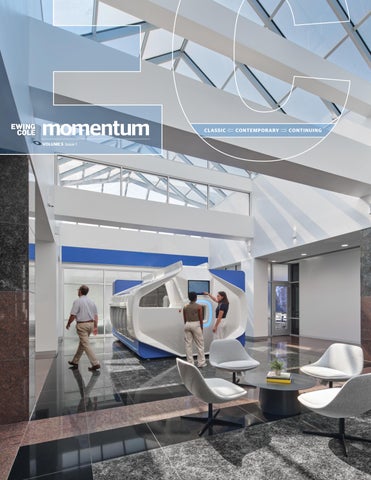
momentum VOLUME 5 Issue 1
CLASSIC ⇐ CONTEMPORARY ⇒ CONTINUING
CLASSIC ⇐
momentum
CLASSIC ⇐ CONTEMPORARY ⇒ CONTINUING
VOLUME 25 Issue Issue 31
A LETTER FROM THE PRESIDENT Dear Readers, I'm pleased to welcome you to this issue of Momentum, as this is my first chance to introduce the stories in these pages as President of EwingCole. Science & Technology is a fitting place to begin. I joined EwingCole as an engineering intern in 1999, and much of my career since has been shaped by work in Science & Technology. The field requires us to understand highly technical environments while never losing sight of the people who rely on them. They also teach us to anticipate change because our clients' needs rarely stand still for long. As this issue illustrates, that way of thinking has deep roots at EwingCole. Decades ago, our firm recognized that designing for scientific discovery required specialized knowledge and a willingness to learn directly from the researchers and professionals using these spaces. Today, those same principles guide us as we address challenges that could scarcely have been imagined then.
CONTENTS
Having spent much of my own career working alongside professionals in this field, I have seen how quickly a discovery, technology, or way of working can change what our clients need from us. Our responsibility is to keep learning alongside them, bring the right expertise to the table, and design environments that can support what comes next. I hope you enjoy this issue and the people, ideas, and history behind it. Warm regards,
4.
CLASSIC Ahead of the Game: Science & Tech Expertise is Decades in the Making
8.
CONTEMPORARY Breaking the Bottleneck: Designing Cell & Gene Therapy for Scale
14.
CONTINUING The Long View: Lessons from Sara Eastman’s Past that will Define the Future
Jason E. Fierko, PE, CEM, LEED AP President
⇐ CONTEMPORARY ⇒
⇒ CONTINUING
CLASSIC ⇐
Designline, EwingCole's newsletter from the '80s and '90s
AHEAD OF THE GAME: Science & Tech Expertise is Decades in the Making
TODAY’S RESEARCH AND DEVELOPMENT FACILITIES RESULT NOT ONLY FROM SCIENTIFIC PROGRESS BUT ALSO FROM DECADES OF FINE-TUNING IN ARCHITECTURE, ENGINEERING, AND PLANNING.
T
he labs of yesterday lagged in what they could provide to a burgeoning industry. Their requirements became more complex, demanding, and unpredictable. They were head-scratchers for architects as much as for their clients. In 1985, EwingCole embraced the change with a simple premise: architects needed to understand the nature of scientific discovery before they could design for it. In the pages of Designline, the firm’s newsletter at the time, Ewing Cole Brouwer described a service line focused on “specialty services not traditionally provided by architectural, engineering, and interior design firms.” The language feels measured by today’s standards, but the ambition behind it marked a shift in how the firm understood the built environment for scientific research. Alex Brouwer, president of Ewing Cole Brouwer, framed the significance of
these spaces clearly in the fall of 1985: “The first impression of a company is often formed by the appearance of its research and development facility. Its laboratories give an impression of how a company works and its corporate attitude.” That observation predates the rise of biotech campuses, innovation districts, and life sciences real estate booms. At the time, many laboratories still reflected postwar industrial thinking. Between the end of World War II and the 1980s, companies often built labs with little regard for the work conducted within them. Research spaces operated as afterthoughts to production facilities. Function took precedence over adaptability, collaboration, or user experience. EwingCole recognized that research environments demanded something different. Scientists needed flexibility. Companies needed facilities that could evolve alongside rapidly changing
Alex Brouwer, EwingCole Corporate Portrait circa 2000
technologies. Researchers also needed spaces that supported concentration, collaboration, and recruitment in an increasingly competitive field. The questions confronting laboratory designers in 1985 still sound familiar today. How do you plan for scientific breakthroughs that may fundamentally reshape a facility’s workflow, or equipment that does not yet exist? How do you create buildings that can support/ both present operations and future needs? “We almost need a crystal ball to create a building of the future based on the requirements and demands of the present,” said Brouwer at the time. “A
CLASSIC ⇐ building designed for today that works only for today is a failure.”
chemical, academic, biotechnology, and medical research.
That philosophy shaped EwingCole’s approach long before flexibility became a standard talking point within science and technology design. Brouwer understood that successful laboratory planning required more than technical coordination. It also demanded careful listening.
The tools have changed dramatically in the last 40-plus years. Designers now rely on advanced modeling software, simulation tools, and digital coordination platforms far from the development methods used in the early years of Ewing Cole Brouwer. Medicine itself has also transformed. In 2017, the FDA approved Novartis’s Kymriah, the first chimeric antigen receptor T-cell (CAR-T) therapy to treat leukemia, opening a new chapter in medicine. Kite Pharma brought the second-ever approved CAR-T therapy (Yescarta) to market that same year. EwingCole’s seniority as a design expert in the field led to the design and development of manufacturing facilities for both companies.
Stakeholder involvement became central to the process. Scientists, researchers, technicians, and operations staff informed decisions from the earliest stages of planning. Their input shaped adjacencies, workflows, support spaces, and long-term operational strategies. The planning process relied as much on conversations and observation as drawings and diagrams. That collaborative mindset still defines EwingCole’s work today. Brouwer's work led to a proven discovery process for lab planning and programming, applied to over 12 million square feet of research space for major institutions, including government, pharmaceutical,
Gene therapies, precision medicine, and advanced biologics have introduced entirely new building requirements ever since, yet the core challenge remains remarkably consistent. Laboratory buildings must adapt to science that outpaces construction cycles. Facilities must
support both specialized technical demands and the people carrying out the work. “A laboratory building must be designed to meet present technical requirements,” said Brouwer, capturing that balancing act. “Yet, it must be flexible enough to accommodate future changes and provide a positive working environment.” Forty years later, the statement still reads less like archival commentary and more like a design mandate. The launch of Ewing Cole Brouwer did not simply establish a new specialty within the firm. It reflected a broader recognition that scientific research would shape the future of architecture, industry, and healthcare, and that it would pose its own set of challenges and demands, requiring specific attention. EwingCole positioned itself accordingly by investing early in expertise that many firms had yet to define. That investment helped EwingCole become one of the industry's leading national science and technology studios. EC
EwingCole led the master planning and design of Novartis’s Morris Plains, NJ facility, which later enabled the drug maker to implement commercial manufacturing of the Kymriah therapy. Kymriah is manufactured for each individual patient using their own cells.
EwingCole was the lead planner, architect, and engineer of Kite Pharma’s El Segundo, CA facility. The project includes ISO-7 cleanroom suites for T-cell manufacturing, quality control laboratories, training areas, GMP warehouse facilities, and flexible office zones.
⇐ CONTEMPORARY ⇒
BREAKING the BOTTLENECK: Designing Cell & Gene Therapy for Scale
THE FIRST CELL AND GENE THERAPIES ARRIVED QUIETLY. NOT WITH THE SPECTACLE OF A MOON LANDING OR THE UNVEILING OF A NEW AUTONOMOUS VEHICLE, BUT THROUGH A SERIES OF CLINICAL MILESTONES THAT STEADILY RESHAPED MODERN MEDICINE.
I
n research hospitals and biotech laboratories, patients once given limited options began receiving treatments engineered from their own cells or from donor-derived cells. Diseased genes were edited. Immune systems were retrained to recognize cancer. Conditions once managed indefinitely suddenly carried the possibility of a cure. The science moved with startling speed. The facilities needed to translate that science into treatment struggled to keep pace. For decades, pharmaceutical manufacturing had been built around repetition and scale. Vast production environments were designed to produce millions of identical doses with mechanical consistency. Cell and gene therapy, however, introduced an entirely different reality. Rather than relying exclusively on traditional massproduction models, these therapies
introduced complex biological processes, ranging from individualized treatments derived from a patient's own cells to donor-derived products capable of treating multiple patients. A delay in manufacturing no longer meant a missed shipment. It could mean a missed treatment window. The physical and operational demands of scientific research and manufacturing began to change with science itself. Laboratories evolved from static equipment rooms into dynamic operational ecosystems shaped by logistics, automation, computational modeling, and human movement. Scientists, manufacturers, and designers all confronted a dual challenge: keeping pace with a rapidly advancing field while accommodating the unique manufacturing processes and requirements of individual therapies. No two products followed
precisely the same path from discovery to production, and the processes required to manufacture them could evolve just as quickly as the science itself. Together, these challenges raised a fundamental question: How do you design for a science that may transform years, or even months, after a facility is complete? The urgency surrounding that question intensified as investment flooded into the industry. Over the past decade, the U.S. Food and Drug Administration (FDA) has approved dozens of cell and gene therapies, while thousands more are in development worldwide, spanning preclinical research through pre-registration. Venture capital surged. Pharmaceutical companies raced to establish manufacturing capacity. Entire regions positioned themselves as future hubs for advanced therapies. Yet the industry’s greatest challenge increasingly was not scientific discovery alone. It was turning discovery into reliable, repeatable production. Manufacturing was becoming the bottleneck. Unlike traditional biologics, cell therapy manufacturing must synchronize patient-specific material, cleanroom capacity, staffing, equipment availability, and tightly choreographed workflows within narrow time windows. Each therapy introduces distinct manufacturing requirements, and
⇐ CONTEMPORARY ⇒ every handoff matters. Adding to this complexity is a rigorous regulatory framework in which FDA approval encompasses not only the therapy itself, but also the manufacturing processes, controls, and facilities used to produce it. Changes to an approved process can trigger additional validation and regulatory review, making early decisions about facility design and operational workflows especially consequential. For manufacturers, the challenge extends beyond accommodating today's science. Facilities must support a diverse range of therapies while maintaining the consistency and control required for regulatory compliance. In many facilities, throughput limitations are created not by the capacity of manufacturing technology itself, but by friction embedded within the larger operational systems. Shift changes create gowning queues. Minor QC sampling delays ripple outward into occupancy conflicts and production slowdowns. Equipment sits idle while personnel movement stalls. A facility’s theoretical capacity can differ dramatically from the sustainable rhythm it achieves in practice. In response, a new philosophy of laboratory planning is emerging. Flexibility is replacing permanence. Dynamic modeling is replacing static assumptions. Increasingly, facilities are designed less as buildings and more as adaptive systems capable of evolving alongside the therapies themselves. At the center of that evolution is a deceptively simple idea: before building the facility, build the operation digitally. For EwingCole, that approach takes shape through a two-phase simulation modeling methodology used to identify, understand, and address operational bottlenecks before they become physical constraints. Using discrete-event simulation, EwingCole’s design researchers create
digital environments that model the interactions between people, materials, cleanrooms, equipment, and workflows over time. The process allows teams to test operational scenarios long before concrete is poured or equipment is purchased.
bottleneck itself,” said Erdman. The model reveals where time and space collide: gowning areas overwhelmed during shift transitions, biosafety cabinet conflicts during media changes, or quality-control backlogs that quietly restrict
“SIMULATION GIVES TEAMS A WAY TO EXAMINE HOW THE PROPOSED OPERATION WILL PERFORM AS A WHOLE. WE CAN TEST COMPETING ASSUMPTIONS, SEE WHERE CONSTRAINTS EMERGE, AND USE THAT EVIDENCE TO GUIDE DECISIONS ABOUT SPACE, EQUIPMENT, AND STAFFING.” - Adrienne Erdman, Director of Design Research, EwingCole
“Simulation gives teams a way to examine how the proposed operation will perform as a whole,” said Director of Design Research Adrienne Erdman, LSSGB. “We can test competing assumptions, see where constraints emerge, and use that evidence to guide decisions about space, equipment, and staffing.” The first phase focuses on discovering the “ground truth” of a manufacturing operation. Standard operating procedures, staffing conditions, launch timing rules, cleaning cycles, gowning sequences, and QA/QC turnaround times are translated into a living operational model. Rather than relying solely on theoretical assumptions, the simulation reveals how the facility is likely to perform under real-world operating conditions. Queues, constraints, and hidden dependencies begin to surface. “What emerges is not simply a diagram of inefficiencies, but a map of the
throughput before equipment capacity is ever reached. Sensitivity scans then identify which operational variables most strongly influence performance, whether they involve staffing policies, incubator counts, launch cadence, or maintenance timing. “Resolving one bottleneck doesn’t mean the whole system is ready to scale. A major constraint can mask several smaller ones that only become apparent when throughput increases. It can feel like whack-a-mole: you address one issue, and another surfaces. Simulation helps us look beyond the first fix to understand what will limit performance next.” The second phase shifts from diagnosis to optimization and scale-up. Once the current operational state is validated, the simulation begins testing targeted interventions designed to safely increase throughput without compromising compliance or patient safety. Additional incubators and
EwingCole designed Cell & Gene Therapy Manufacturing Expansion warehouse complete with robotics in New Jersey
EwingCole designed Cell & Gene Therapy Manufacturing Expansion in New Jersey
⇐ CONTEMPORARY ⇒
EwingCole designed Cell & Gene Therapy Manufacturing Expansion in New Jersey
isolators are introduced digitally. Batch launch schedules are staggered. Automation strategies are modeled. Shift structures are adjusted Maintenance outages are stress-tested. Instead of asking how much more space is needed, the team can ask a more consequential question: What combination of space, equipment, staffing, and process will actually increase capacity? This is where the bottleneck begins to break. Simulation modeling transforms manufacturing planning from reactive troubleshooting into predictive operational strategy. Instead of discovering failures after occupancy, teams can identify and resolve constraints before construction even begins. Problems that once required costly renovations or operational disruption can potentially be addressed digitally, when changes are faster, less disruptive, and less expensive to make. That thinking moves simulation beyond an analytical exercise. It becomes a design tool, connecting operational
performance directly to decisions about space, infrastructure, equipment, and future expansion. At a Cell & Gene Therapy Manufacturing Expansion in New Jersey, this systems-based approach informed the planning and design of a 118,000-square-foot facility conceived not simply as a manufacturing plant, but as a flexible framework capable of evolving alongside rapidly changing therapeutic technologies. Production spaces, laboratories, warehouse operations, shipping infrastructure, and administrative functions were consolidated into a single integrated environment designed around movement, coordination, and adaptability rather than rigid separation. The project reflects a broader shift occurring across laboratory design. Historically, planning often began with equipment and the spaces required to accommodate it. Increasingly, on the starting point is the system: how people, materials, equipment,
information, and processed interact over time. “Discrete-event simulation (DES) captures the interactions between people, equipment, materials, and cleanroom spaces, essentially building a digital twin of the manufacturing system. Teams can then safely test changes to policies, staffing, or facility layout before committing capital,” said Erdman. That systems-oriented thinking extended beyond physical planning into long-term operational adaptability. The facility was intentionally designed as a scalable model that can be replicated at future domestic and international sites. Adjacent shell space was incorporated into expansion strategies, allowing operational capacity to grow substantially over time without disrupting core production systems. “A repeatable platform gives future sites a proven starting point. The challenge is deciding what to standardize and where to preserve
flexibility, so each facility can accommodate different therapies and grow with demand.”
the technical rigor of cleanroom environments through curved geometries, acoustic cloud forms,
This emphasis on adaptability signals a profound evolution in architectural thinking itself. Twentieth-century institutional architecture often pursued permanence through monumentality. Contemporary laboratory environments increasingly pursue longevity through responsiveness. Buildings survive not because they resist change, but because they accommodate it gracefully. That shift has altered not only how laboratories function, but how they feel. As advanced manufacturing becomes more visible and collaborative, these highly technical environments are also being asked to communicate culture, purpose, and the human impact of the science taking place within them. At this site, dedicated visitor circulation routes provide visual access into production and laboratory environments, transforming manufacturing into part of the architectural experience itself. Collaborative spaces soften
Perhaps most importantly, projects like this one reveal how architecture itself has become increasingly
“THESE DECISIONS SIT AT THE INTERSECTION OF SCIENCE, OPERATIONS, AND DESIGN. BRINGING THOSE PERSPECTIVES TOGETHER EARLY HELPS US UNDERSTAND WHAT A PROCESS REQUIRES OF THE BUILDING AND WHETHER THE BUILDING CAN SUPPORT THE INTENDED OPERATION.” - Adrienne Erdman, Director of Design Research, EwingCole
and color palettes derived from the company’s proprietary technology. The gesture reflects a broader transformation occurring across science and technology industries. Innovation is no longer hidden behind closed doors. It is collaborative, visible, and deeply human.
Adrienne Erdman, Director of Design Research, EwingCole
interdisciplinary. Today’s laboratory planners operate simultaneously as architects, operational analysts, researchers, and strategists. Their decisions are shaped by logistics modeling, manufacturing analytics, simulation research, staffing behavior, and long-term operational forecasting. “These decisions sit at the intersection of science, operations, and design. Bringing those perspectives together early helps us understand what a process requires of the building and whether the building can support the intended operation.” For cell and gene therapy, that convergence may prove essential to achieving scale. Scientific breakthroughs can only reach their potential if the facilities supporting them can translate discovery into reliable production. Designing those environments therefore requires more than providing enough space for today’s process. It requires understanding how the entire system behaves, where it will encounter constraints, and how it can adapt to what comes next. The laboratory, in other words, is no longer simply a container for science. It is becoming part of the infrastructure that determines how quickly science can reach the people it was created to serve. EC
⇒ CONTINUING
American Red Cross Pomona Facility
THE LONG VIEW: Lessons from the Past will Help Define the Future SARA EASTMAN HAS WITNESSED THE EVOLUTION OF MODERN BIOTECHNOLOGY FROM THE FRONT ROW; NOW, AS EWINGCOLE’S NEW VICE PRESIDENT, SHE AIMS TO APPLY THOSE LESSONS TO THE FIRM’S NEXT GENERATION.
I
n February of 2001, the Human Genome Project (HGP), biology’s “moonshot”, published its landmark initial sequencing of the human genome. The achievement promised to fundamentally reshape molecular science and medicine forever.
early in her career. Fresh out of school, she joined the design team for Alcon, currently one of EwingCole's longeststanding client relationships, where she worked with engineers and architects who continue to shape the practice today.
At nearly the same moment that life sciences were entering this new era, Sara Eastman, AIA, NCARB, EwingCole’s new vice president, joined the firm. Over the next 25 years, Eastman witnessed the biopharmaceutical industry’s evolution in real time, growing as a professional alongside it while helping design environments that supported that progress. She would go on to collaborate with clients such as Alcon, LabCorp, REGENXBIO, Pfizer, United Therapeutics, WuXi STA and others, building a career around an industry defined by rapid, and at times uneasy, evolution.
That foundation quickly led to an opportunity that would influence the trajectory of her career. As EwingCole secured a long-term program with the American Red Cross, Eastman was selected to support the Pomona Red Cross facility project.
GROW AS YOU GO Eastman was exposed to the industry
“I was asked to move out to Irvine, California, which was a great opportunity very early in my career as we expanded our footprint on the West Coast.” What began as project support also became part of EwingCole's own growth. The Pomona Red Cross facility allowed Eastman to immerse herself in every stage of the design and construction process, while helping
Sara Eastman, AIA, NCARB, EwingCole’s New Vice President
EwingCole establish a foothold in Southern California, one of the nation’s major biopharmaceutical markets. She remained on the project for nearly three years, seeing it from concept through completion. “That was a really unique experience for me. I think it gave me a lot more comfort in terms of what we draw and how it gets constructed, understanding that whole process and how it is interpreted in the field. Additionally, navigating the challenges of a construction project gave me a very well rounded perspective on the work that we do in general.”
CONTINUING ⇒ Over time, she took on various leadership roles in other markets, including EwingCole’s Health & Wellness practice. She was ultimately drawn back to Science & Technology, not just because of her early experience, but because of her upbringing. “My parents were both pharmacists. They ran their own business, so I worked in the pharmacy in high school,” she said. “I was familiar with all the various pharmaceutical company names, and I had a respect for what the industry does to help people.” Rather than viewing each new role as a departure, Eastman saw them as another steppingstone toward broadening her perspective. That mindset not only helped define her own career but now informs how she mentors the next generation of professionals across EwingCole. “I evolved with every couple of years, switching into a new role and responsibility, and I think that's important; looking to the larger team and asking people to move up and do something a little bit different,” she said. “It can help grow your career, and it also helps grow our organization. It's really critical that we encourage that.” That willingness to move beyond familiar roles would eventually shape not only Eastman’s career, but her view of how EwingCole itself could work differently.
Pfizer Bioplace
THE PLAYBOOK FOR A NATIONAL PRESENCE Completed in 2019, Pfizer’s R&D and Process Development facility, or BioPlace, represented a major milestone in Eastman’s career. Its scale and level of complexity required EwingCole’s Science & Technology team to work differently across offices, disciplines, and geography.
“We worked together across the firm in a collaborative way that I hadn't seen before,” she said. “Prior to that, we were a little bit more siloed. We were doing good work out of each office, but we weren't building on that talent as a true national practice as much as we could have. To me, that project was a great blueprint for our approach to the future of the firm.”
“I recognized a shift in S&T when we started working on the Pfizer project. It was a very large program for us, with a
More than seven years later, that lesson has taken on a new relevance. EwingCole’s new executive leadership
“TO ME, THAT PROJECT WAS A GREAT BLUEPRINT FOR OUR APPROACH TO THE FUTURE OF THE FIRM.” - Sara Eastman on EwingCole's approach to working on Pfizer's BioPlace
broad mix of lab space,” she said. “At the time, we were growing as a practice. But we weren't necessarily collaborating as much as we could nationally.” BioPlace’s location, removed from EwingCole’s primary S&T offices, required team members from the East and West Coasts to meet regularly in the American Heartland. The project became an early example of EwingCole deploying a cross-office, multidisciplinary delivery model at significant scale.
team, of which Eastman is a member, is spearheading an effort to strengthen cross-office collaboration, enhance project delivery, and organize the firm more intentionally around its collective expertise. Drawing on her experience from BioPlace, Eastman knows expertise becomes more valuable when geography does not limit who can contribute to it. The Pfizer project was completed in 2019 ahead of schedule and went on to support work associated with
Pfizer Bioplace
⇒ CONTINUING
“THE GOAL IS TO CONTINUE CREATING OPPORTUNITIES FOR EVERYONE.” - Sara Eastman on EwingCole's approach to building on the firm's past successes
American Red Cross Pomona Facility
the research and development of the Pfizer-BioNTech COVID-19 vaccine. The project offered an unusually visible example of how facilities designed years earlier can support scientific challenges no one could fully anticipate when design began. It also reinforced a lesson that would become central to Eastman’s leadership philosophy: build teams and environments capable of adapting to what comes next. STEADYING THE LADDER When Eastman joined EwingCole, less than 20 percent of registered, licensed architects or professional institute members were women, compared to roughly thirty percent today. Twentyfive years later, she has become
EwingCole’s first female vice president, giving her an opportunity not simply to climb the ladder, but to help steady it for those following behind. “I think we've done a lot here at EwingCole to create more parity [for women], make our firm more equitable,” she said. “We have increased female leadership at the Board, Principal, Director and Associate levels. Ultimately making sure that we continue to grow the pipeline of women in the firm and in leadership positions is incredibly important to me.” In her new role as Vice President, Eastman leads EwingCole’s expertise and talent initiatives, supporting
employee growth and development. Her focus is on strengthening recruitment, onboarding, and career development, while expanding mentorship and training opportunities across the firm. In many ways, the strategy reflects her own career. Eastman was given consequential opportunities early. Now, she wants to make those opportunities more intentional and accessible to others. “One of the things we are trying to achieve is to expand opportunity for client-facing aspects of our business to team members earlier in their careers. This creates more opportunities to manage projects and clients and grow our firm for the future.”
The goal, Eastman said, is not simply to develop staff who can take work off someone’s plate. It is to build capability throughout the organization, distributing knowledge, experience, and responsibility across all levels rather than concentrating them among a small group of senior leaders.
and training of staff. Training spans across multiple topics from soft skills training to project management training. This includes the expansion of mentorship. It's really about building our pipeline of growth in multiple areas, ultimately supporting career growth for everyone here at EwingCole.”
Mentorship is central to that strategy. For Eastman, it cannot depend solely on informal relationships or individual initiative. It must become a more intentional part of how EwingCole develops its people, supported by leadership and reinforced across the firm.
AN UNCERTAIN FUTURE The mapping of the human genome presented the biopharmaceutical development and manufacturing industry with seemingly limitless opportunities and launched science and medicine into an era of uncertainty. Uncertainty, and knowing how to plan for an uncertain future, defined Eastman’s career. Building upon the lessons of each opportunity
“We're looking at a number of things from recruitment, retention, culture,
throughout her 25 years prepared her for that future. As the Science & Technology practice, and EwingCole itself, moves into its next chapter, Eastman and EwingCole’s new executive leadership team aim to build on the successes of the past. They know that as the practice grows, and the firm becomes more integrated, they’ll need a strengthened foundation to build upon. Their strategy centers on creating more leaders encompassing all levels through increased exposure, mentorship, and responsibility. “The goal is to continue creating opportunities for everyone.”
EC
C L A S S I C
⇐
C O N T E M P O R A R Y
⇒
momentum READ. SHARE. ENJOY.
EWINGCOLE.COM
C O N T I N U I N G