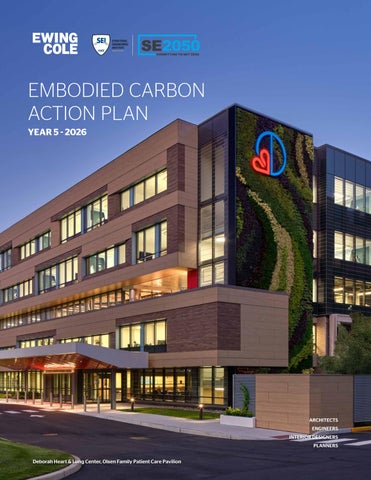
EMBODIED CARBON ACTION PLAN YEAR 5 - 2026
ARCHITECTS ENGINEERS INTERIOR DESIGNERS PLANNERS
Deborah Heart & Lung Center, Olsen Family Patient Care Pavilion
EwingCole, NY Office
TABLE OF CONTENTS
EWINGCOLE’S COMMITMENT ........................................................................... 4
01 OUR MISSION ......................................................................................................... 7 Who We Are Connection to Values Thrive@EC
02 SE 2050 VALUES ................................................................................................ 15 Education Reporting Reduction Strategies Advocacy
03 FIRMWIDE SUSTAINABILITY GOALS .......................................................32
SE 2050 COMMITTEE............................................................................................ 34
2 Embodied Carbon Action Plan
ewingcole.com
EWINGCOLE’S COMMITMENT
EwingCole, a 400+ person, interdisciplinary firm with nine offices located across the country, is hereby signing on to the SE 2050 Commitment Program. We support the vision that all structural engineers shall understand, reduce, and ultimately eliminate embodied carbon in their projects by 2050. The places where we live, work and play represent the largest source of greenhouse gas emissions in America, as well as around the world. The design and construction industry has made significant strides toward creating high performance buildings, of all types and uses, by deeply reducing operational energy use and improving efficiency. As a result, the industry is positioned to have a profound impact by now committing equal focus to reducing the embodied carbon of building materials, therein reducing building related greenhouse gas emissions globally. As engineers and architects, we understand the need to exercise leadership in our role in creating the built environment. Consequently, we believe we must alter our profession’s actions and encourage our clients and the entire design and construction industry to join with us to change the course of the planet’s future. Altering current practices of design and construction to realize significant reductions in embodied carbon aligns with our commitments to tracking and improving upon building energy performance each year, and to selecting building materials that support health, equity, and ecosystems around the globe.
4 Embodied Carbon Action Plan
Our commitment to SE 2050 is a multi-year, continuous improvement effort that begins with growing our understanding of embodied carbon reductions, improving our project workflows, and meeting SE 2050 program requirements for tracking and reporting. We look forward to joining this coalition and industry effort to achieve the goals of the SE 2050 Program. Respectfully Submitted, EwingCole SE 2050 Committee, in partnership with Thrive@EC
Robert A. McConnell, AIA President
Paul Constantini, PE, SE Principal – Director of Structural Engineering
“WE HAVE BEEN FOCUSED ON SUSTAINABILITY FOR DECADES. IN THE PAST, THE FOCUS WAS ON ENERGY CONSERVATION, LONG-TERM OPERATIONAL AND LIFE-CYCLE COST REDUCTIONS AND SUSTAINABLE MATERIALS AND RESOURCE MANAGEMENT. NOW WE NEED CONCERTED ACTION TO ELEVATE THE CONVERSATION AND CONSIDER THE GLOBAL COMMUNITY. WE NEED TO ENGAGE IN REDUCING CARBON EMISSIONS AND THE IMPACTS OUR BUILDINGS HAVE ON GLOBAL WARMING.” - Robert McConnell, AIA President, EwingCole
Colleen Blackwell, PE, Principal, SE 2050 Embodied Carbon Reduction Champion
Maria R. Papiez, AIA, NCARB Director of Sustainable Design
ewingcole.com
Cooper University Health Care, Cooper Specialty Care at Cherry Hill
01
6 Embodied Carbon Action Plan | Our Mission
OUR MISSION
ewingcole.com
WHO WE ARE
WHAT WE DO
WHY WE DO IT
We explore and design inventive solutions to complex projects that better our clients’ everyday life, our community, and our world. Our clients are leaders in their respective industries. We partner with them to bring the latest thought leadership to each project, and to deliver buildings, spaces and places that advance their mission. Our diverse group of professionals take that responsibility seriously. As their trusted advisors and stewards of responsible design, we are always looking for opportunities that enable us to make a positive impact.
Our vision is to design places that elevate the human experience; our goal is to build a design culture that can transform the most common buildings and landscapes into meaningful experiences. We believe that great design emerges from a visionary response to an everyday need. The places we design are used by people in all walks of life, yet each design must reach beyond the ordinary. Our collective journey requires that we challenge ourselves to ask the right questions and search for the right responses. We nurture a work culture that values and cultivates these ideas.
HOW WE DO IT
WHAT WE VALUE
We bring together research, creativity, and technology through a rigorous process to create places where people live, learn, heal, work, and play. Design is an iterative and interactive process that works best when ideas are measured, discussed and challenged. Our process is informed by a deep understanding of the program, the site, and the science of buildings, but it starts with the need to discover a project’s full potential. Our expertise, knowledge and resources are most effective when we listen to one another, work with one another, and learn from one another.
– Collaboration
Our common vision is to transform every day buildings and landscapes into meaningful experiences.
8 Embodied Carbon Action Plan | Our Mission
– Communication – Creativity – Innovation – Social Responsibility – Investing in the Future
We are committed to creating a studio culture that fosters professionalism, creativity, communication, positive energy, and mutual respect. When our people are equipped to work at their fullest potential, we can live out and realize our philosophy of “innovation through partnership”.
ewingcole.com
CONNECTION TO VALUES 2005
2009
2015
2018
2019
2020
2021
2022
2023
We believe that human wellness depends on the health of the environment that surrounds us. This belief grows from our desire to deepen our connection to the communities and ecosystems in which we design, as well as from our professional responsibility to protect health and wellbeing. We are rooted in the core principles of sustainability - equity, environment, and economy - locally, regionally, and globally.
1st LEED Platinum
First LEED Project Certified
1st WELL Certification
LEED Platinum Lab / Office
50 LEED Projects Certified
AIA 2030 Commitment Signed
On the Boards Sustainable Projects Highlights Sustainable Commitments
10 Embodied Carbon Action Plan | Our Mission
Thrive@EC Formed
1st Net Zero Verified
Net Zero Carbon cGMP Facility
Our collective journey requires that we challenge ourselves to ask the right questions and search for the right responses. We nurture a work culture that values and cultivates these ideas, striving toward a built environment that is in alignment with the health of our communities and the planet.
Net Zero Carbon Office
AIA Materials Pledge Signed
SE 2050 Commitment Signed
Started Publishing Thrive@EC Annual Reports
1.5 °C COP26 Communique Signed
MEP 2040 Commitment Signed
Starting from this value-based foundation, we are motivated to create places where all of nature (planet & people) can thrive. These are places that reach beyond the ordinary, and that are elegant and broad in their positive influence.
Firmwide Sustainability Action Plan Published
Our world-class engineers and architects understand the need to exercise leadership in our role in creating the built environment. Altering current practices of design and construction to realize significant reductions in embodied carbon aligns with our commitments to tracking and improving upon building energy performance each year, and to selecting building materials that support health, equity, and ecosystems around the globe. As a firm, these four commitments – SE 2050 Commitment, AIA 2030 Commitment, MEP 2040 Commitment and AIA Materials Pledge – frame our accountability for deep reductions in operational and embodied carbon emissions and keep us focused on the core principles of sustainability – equity, environment, and economy.
ewingcole.com
THRIVE Thrive@EC’s mission is to build sustainability resources and education to support projects and operations.
BUILDING ENCLOSURE & STRUCTURE
Thrive@EC works in interdisciplinary focus groups to explore and develop new content for firm use, lead initiatives that advance our sustainability goals, and organize education sessions and other opportunities to share developments. Primary focus groups include:
Thrive@EC brings together subject matter experts and sustainability-oriented professionals from multiple disciplines to collaborate across office regions. Formalized in 2017, the group has expanded to include representatives from most of our practices, disciplines, and offices.
– Building Enclosure & Structure – Energy & Systems – Materials Health & Carbon – Sustainability Commitments
SUSTAINABILITY COMMITMENTS PEOPLE OFFICE DISCIPLINES
19 4 5
21 4 5
29 5 5
2019
12 Embodied Carbon Action Plan | Our Mission
Focus Groups
ENERGY & SYSTEMS
38 7 5
MATERIALS HEALTH & CARBON
14 4
2018
Thrive @ EC
2020
2021
2022
ewingcole.com
Concord Public Schools, Ellen Garrison Building at Concord Middle School, Tracking LEED V4 Silver
02 SE 2050 VALUES
14 Embodied Carbon Action Plan | SE 2050 Values
ADVOCACY
EDUCATION
REDUCTION STRATEGIES
REPORTING
ewingcole.com
School District of Philadelphia, Lewis C. Cassidy Academic Plus School, Tracking LEED Schools V4/V4.1 Gold
EDUCATION LOOKING BACK LEADERSHIP EwingCole signed onto the SE 2050 Commitment in September of 2021, creating a dedicated SE 2050 Committee. This committee works together with EwingCole’s multi-office and multi-disciplinary sustainable design committee, Thrive@EC, to develop and implement actionable sustainability goals. Some of our goals have been to identify topics for continuing education and develop educational resources for the firm, and to serve as the lead sustainable design personnel on projects pursuing sustainability. During the first two years of participation in the Commitment we developed a series of internal continuing education webinars that introduced the firm to our four guiding commitments - AIA 2030, AIA Materials Pledge, SE 2050, and MEP 2040 - which included topics such as, embodied carbon, operational carbon, and life cycle assessment. We have compiled sustainable design resources from SE 2050, AISC, NRMCA, and product manufacturers that are hosted on our internal Microsoft Teams Commitment page and shared with our employees. EDUCATION During the past year, our SE 2050 Committee has been conducting research into ways to improve our concrete, masonry, steel, and wood specification language to incorporate a base level of sustainability into all projects. We have hosted webinar viewings with the structural engineers across our offices addressing these topics. Some sources of these webinars have been the NRMCA, OneClick LCA, the NCMA, and WoodWorks. Through these resources we have been able to begin editing our specifications to request EPDs for all structural products,
16 Embodied Carbon Action Plan | SE 2050 Values
and provide parameters for recycled content for structural steel products. We have also worked with our firm’s recently formed Sustainability Department, through a series of discipline focus groups, to better understand how our engineers’ expertise can be tapped earlier in a project’s design to help set the project up for sustainability success from the beginning. Through this process, the Sustainability Department created a Design Performance Process Map to help define firmwide expectations for all design decisions, including sustainability decisions, through each phase of a project. We began working on educational sessions for our engineers to learn how structural design decisions will fit into this process map, with the plan to complete and begin implementing them in 2026.
LOOKING FORWARD COLLABORATION Members of EwingCole’s SE 2050 Committee will continue to collaborate with the other sustainable design committees and working groups to develop short format education sessions and reference documents as required to communicate the firm’s sustainability goals. The goals identified in 2024 for incorporating “best practice” sustainable design choices into our modeling templates is still underway and set to be completed by the end of 2026. ONGOING TRAINING Embodied Carbon education and development of best practices for building design are an ongoing process to which the SE 2050 Committee is dedicated. External continuing education presentations are an excellent platform to further educate our engineers on the trends
emerging in each material sector of the construction industry. Whenever available, these education opportunities are shared with our structural engineers, and with the whole firm when applicable.
requirements will be an important way for the firm to guide design for future projects. These lessons learned can be shared as case studies with the firm, and inform how we can communicate the impacts of design decisions to our clients.
Identifying lessons learned from our projects as more and more are incorporating low embodied carbon design ewingcole.com
Smithsonian Environmental Research – The Smithsonian Institution, Charles McC. Mathias Laboratory, LEED-NC Platinum, 2015
18 Embodied Carbon Action Plan | SE 2050 Values
ADVOCACY
EDUCATION
REDUCTION STRATEGIES
REPORTING
ewingcole.com
REPORTING
our sustainability commitments. This internal database allows us to upload project-specific data and visualize the carbon emissions improvements that need to be made each year until 2050.
LOOKING BACK
– Reporting structural material quantities to the SE 2050 database for all major projects
Last year, our SE 2050 Committee had a number of goals that were set in EwingCole’s firmwide Sustainability Action Plan (SAP).
GWP BASELINES
– Establishing a company baseline GWP from which we can set specific targets for improved project performance – Performing a Structural LCA on a minimum of 5 projects that year
Memorial Sloan Kettering, MSK Nassau, LEED-NC Silver, 2020
20 Embodied Carbon Action Plan | SE 2050 Values
We have made significant progress towards establishing a company baseline GWP by using Tally to analyze Revit models from our catalog of past projects; we have modeled a total of (12) projects across (6) different market sectors to date. EwingCole has built an internal Sustainability Database as a repository to document and track progress on all
WHOLE BUILDING LCA This year we further refined and clarified the language and our goals around LCA modeling. We learned where we needed to further define our reporting parameters to be able to reach established targets. Project eligibility was one core parameter, and we built a better understanding of how to identify projects in each of our market sectors that meet criteria. The next parameter was defining the difference between our firmwide goal to perform more WBLCA engaging
all design disciplines, and our SE 2050 specific goal to perform LCA on building structures. While our firmwide WBLCA modeling ramps up, our SE 2050 Committee has been able to identify a number of our new projects that are eligible for structural LCA, of which a total of (5) were performed this past year. STRUCTURAL QUANTITIES Last year, our team identified projects that would be completing the construction documents phase in 2025 as the most applicable for calculating structural material quantities. Moving forward, we are considering how to incorporate the inclusion of structural material quantities accounting when LCAs are performed in earlier phases of a project.
United Therapeutics, Discovery & Innovation Building
ewingcole.com
University of Pennsylvania, Burk-Bergman Boathouse Rehabilitation
REPORTING LOOKING FORWARD LCA REQUIREMENTS Our SE 2050 Committee members have used Tally to perform all of the structural Life Cycle Assessments this past year by pulling in the materials used from the project Revit models. Through this process we have gained a significant amount of knowledge of how to use Tally and what its limitations are. We have also defined the scope boundary for the level of detail that a structural only LCA would seek, versus a WBLCA that may require additional consideration of finishes and assemblies attached to the structural elements in the Revit model. In order to streamline the LCA process, this year the SE 2050 Committee, along with members of our Building Enclosure & Structure Focus Group within Thrive@EC, will be working on LCA guidance documents that will address the following: – Outline the process for determining project eligibility for an LCA – Define the scope of what to include in the LCA – Explain when and how to perform the LCA during the different project phases. IMPROVING PERFORMANCE
improvement on those goals. Specific items that have been outlined in EwingCole’s firmwide SAP include the following: – Identifying a handful of projects that will attempt to achieve a 10 percent reduction in GWP from our established baseline – Perform WBLCA on 25 percent of this year’s active projects – Continue running Structural LCA on a minimum of (5) active projects In order to achieve these goals we will work closely with the leaders of our other commitments to determine an appropriate company baseline, and identify candidate projects for performing life cycle analyses. We will continue to use Athena Building Impact Estimator for concept and schematic level designs before a robust Revit model is created. Once Revit models are populated during the design development phase, we will continue to use Tally to run Life Cycle Assessments from the models, and the EC3 database to help refine specific material selections based on sustainable performance. This year members from Thrive@EC will test the capabilities of OneClick LCA to compare its limitations to those of Tally to make software determinations for the future.
Additional goals we have planned for 2026 include, continuing the ongoing efforts started with our goals for 2024, and aspiring to take a leap forward with continued
22 Embodied Carbon Action Plan | SE 2050 Values
ewingcole.com
William Penn Charter School, Richard A. Balderston OPC’69 Lower School, Tracking LEED V4.1 Schools Gold
24 Embodied Carbon Action Plan | SE 2050 Values
ADVOCACY
EDUCATION
REDUCTION STRATEGIES
REPORTING
ewingcole.com
REDUCTION STRATEGIES LOOKING BACK EwingCole has worked with many clients seeking LEED design standards in the past and continues to foster client relationships centered around the incorporation of sustainable design practices. The structural design team
William Penn Charter School, Richard A. Balderston OPC’69 Lower School, Tracking LEED V4.1 Schools Gold
has participated, and will continue to participate, in new project design charrettes. SPECIFICATIONS & INDUSTRY PROGRESS Our firm’s structural concrete and steel specifications have been updated to include embodied carbon performance criteria (GWP, recycled material content, etc.), including the requirement for submission of Type III Environmental Product Declarations. We have also updated the language in our general notes to incorporate the NRMCA regional GWP benchmark values by concrete strength. We have had a handful of projects enter into construction with these sustainability requirements incorporated and have had about (8) projects across the United States successfully meet all of the data submission requirements, including EPDs. While we have started seeing success with more product manufacturers producing EPDs, many of the products, especially concrete mixes, have not yet been able to meet the GWP benchmark targets we have specified. Many of our projects have still not been able to meet these requirements, particularly for concrete mixes. We hope to see more improvement in this area as contractors and suppliers become more accustomed to these sustainability requirements.
PROJECT AND PROCESS INCORPORATION
concrete, masonry, steel, and wood specifications
Some of our goals from last year that are still being worked on and we hope to have completed by the end of 2026 include the following:
– Develop a Biogenic material resource guide detailing the design criteria for when and how biogenic materials can be included in projects.
- Updating our Revit templates to support consistent material integration in Tally
2027 & BEYOND
The firm’s early design guidance documents have been updated to include considerations for embodied carbon from design onset, and training sessions for the project leads involved in early design decisions are planned for this year. 2026 GOALS Our goals for 2025 include the following:
Looking beyond 2026, EwingCole has outlined a number of longterm goals in our firmwide SAP. – Grow our portfolio of mass timber projects – Encourage clients to pursue enhanced sustainability goals striving for net-zero carbon structures by 2030 – Specify products with EPDs that can make a 30% improvement of GWP over the company baseline – Develop design resource guides and specifications for designing structures for disassembly.
– Update sustainability metrics in our miscellaneous United Therapeutics, WARP10 Drug Product Manufacturing Facility, Tracking LEED BD+C V4.1 Gold
LOOKING FORWARD EwingCole’s Embodied Carbon Reduction Strategies will be ever evolving as our firm develops its understanding and implementation of embodied carbon reduction. This year the SE 2050 Committee will continue to collaborate in an internal focus group with members of our firm’s three other framing commitments to help guide our projects in implementing sustainable design best practices as a baseline, and work towards more specific reduction goals.
26 Embodied Carbon Action Plan | SE 2050 Values
ewingcole.com
United Therapeutics, WARP10 Drug Product Manufacturing Facility, Tracking LEED BD+C V4.1 Gold
2828Embodied Embodied Carbon Carbon Action Action Plan Plan | SE 2050 Values
ADVOCACY
EDUCATION
REDUCTION STRATEGIES
REPORTING
ewingcole.com
Lincoln Public Schools, Ballfield Road Campus, Net Zero Ready Suggested
ADVOCACY LOOKING BACK CLIENT OUTREACH Many of the clients EwingCole works with have an interest in incorporating sustainable design into their buildings but may not be aware of the impact that the building’s structure has on the overall sustainability of the project. As a firm we have worked to educate and inform a handful of our clients on the embodied carbon impact of a building’s structural system.
Announcing our firm’s commitment to the SE 2050 Program on the company’s social media platforms and website was the first step in the journey of spreading the news and informing our clients. EwingCole’s SE 2050 Committee has also worked with our Director of Sustainable Design, company executives, and our marketing department to develop marketing materials and proposal language related to the SE 2050 Commitment. Our goal will be to include this information as standard in the materials we market to all clients so that the sustainability efforts the firm is making may become the norm across the construction industry.
NETWORK COLLABORATION The goal of reducing, and ultimately eliminating embodied carbon from building design is one that the construction industry must work together to achieve. The local NCSEA chapter of our Philadelphia office, the Structural Engineers Association of Pennsylvania, formed a Sustainable Design Committee, championed by its member firms, to advocate for and share knowledge on embodied carbon reduction with local design firms and product suppliers. EwingCole has participated with our colleagues at the other member firms to develop sustainable design best practices that can be used by all firms in their designs.
United Therapeutics, Unisphere, LEED-NC Platinum, 2019
LOOKING FORWARD
U. S. Military Academy West Point, The Cyber & Engineering Academic Center, Tracking LEED V4 Silver
OUTREACH & COLLABORATION In 2026, we would like to investigate collaborating with our general contracting affiliate company, EC Build, in a whole building sustainable design process. Our direct connection with materials suppliers and sub-contractors through EC Build will allow us to advocate for embodied carbon reduction throughout the design and construction industry. We will continue to communicate with our clients our commitment to reducing structural embodied carbon, as well as participate in our local office sustainability committees to advocate within the construction industry. Finally, we have set a target to send one advocacy letter to a product manufacturer, for every project, in support of lowering product GWP values.
30 Embodied Carbon Action Plan | SE 2050 Values
ewingcole.com
Department of Defense Education Activity, Hanscom Middle School, Designed LEED for Schools V2009
WHERE WE ARE
WHERE WE ARE HEADING
ACTION ITEMS FOR FUTURE
A forecasting and broadening of perspective. We are striving to look beyond the bounds of an individual building 1) in time, to how it will perform and what it’s impact will be in 20, 40, and 60 years from now, and 2) in geography, to learn how material selection and carbon emissions impact not just our site, but the region and world.
– Elevate sustainability as a key priority in our project selection process.
To utilize these resources effectively, we are developing a framework of priority, specific assignments of content, and further dedication of time and funding. We are also shifting our mindset to include not just urgency, but celebration of the benefits new knowledge brings to our team.
– Collaborate with Human Resources to regularly update onboarding materials in support of our 4 sustainability commitments.
To more deeply integrate sustainability reporting, we will add specific layers to our QA process: evaluation of performance, confirmation that criteria are met, and verification that data has been reported.
– Finalize the new Sustainable Design Database
Our next cultural steps involve adding breadth and regularity to create more frequent connections among projects and our aspirations and sustainability commitments – from supporting a sustainability champion on each team, to initiating Friday Roundtable discussions, to visual celebrations such as an EUI Wall or Regenerative Material Palettes.
– Develop an internal research project process to award funding to 2 projects per year based on submissions tied to current priorities.
To add our collective voice to the call for design for people and planet, we will strive to establish regional and national leadership through participation in industry, government, and/or professional organizations outside the firm.
– At the firm scale, a renewed focus and incentive toward participating in advocacy will come together through firmwide discussion.
DESIGN PROCESS
03
FIRMWIDE SUSTAINABILITY GOALS
Our process is informed by a deep understanding of the program, the site, and the science of buildings, and it starts with the need to discover a project’s full potential.
– Update our Fundamental Design Report template to include dedicated performance targets for EUI, embodied carbon, and holistic material selection.
EDUCATION
The SE 2050 Commitment is a core pillar of our broader EwingCole Sustainability Action Plan. A series of overarching goals and action items apply to and support every one of our four sustainability commitments, including SE 2050. These broader goals are defined under the following headings: – Design Process – Education – Tracking & Reporting – Culture – Outreach & Advocacy
EwingCole Continuing Education (ECCE), our Associates Group, Thrive@ EC, and our membership to USGBC Education provide an extensive set of resources and content for escalating our learning on key sustainability topics
– Develop a matrix for training on design processes and tools that includes training needs by discipline, role, and years of experience. Incorporate this training requirement as part of annual reviews.
TRACKING & REPORTING We pride ourselves on the rigor of our multi-disciplinary, quality assurance evaluation for projects, taking a meticulous and methodical approach to ensure not only health, safety, and wellbeing of future occupants, but compliance with any number of regulations, codes, and market-specific requirements.
– Expand the voices involved in sustainability beyond core design disciplines to include marketing, communications, and IT
CULTURE With more people back in our offices than any other time in the past two years, we are reigniting and reinventing community activities that bring people together; from studio pin-ups, to project presentations, to events around Earth Day and International Women’s Day.
OUTREACH & ADVOCACY We have shared some of our most high performing, successful projects at conferences around the country, and more than 10% of our staff already participate in community and professional organization leadership and activism.
32 Embodied Carbon Action Plan | Firm Sustainability Goals
– At the product scale, we will develop resources to support outreach to our material and product suppliers.
ewingcole.com
West Point Association of Graduates, Michie Stadium Preservation Project
SE 2050 COMMITTEE STRUCTURAL ENGINEERING Paul L. Constantini, PE, SE Director of Structural Engineering, Principal Philadelphia, PA Colleen F. Blackwell, PE Principal, Embodied Carbon Reduction Co-Champion Philadelphia, PA Taryn Napolitano, PE Philadelphia, PA James Pyne, PE Embodied Carbon Reduction Co-Champion Philadelphia, PA
SUSTAINABLE DESIGN Maria Papiez, AIA, NCARB Director of Sustainable Design Irvine, CA / Raleigh, NC William Smarzewski, RA Associate, Sustainability Manager Philadelphia, PA Arunima Dubey Sustainable Design Specialist Philadelphia, PA
LEARN MORE Our Sustainability Services
CONNECT WITH US!
34 Embodied Carbon Action Plan | SE 2050 Committee
ewingcole.com
Atlanta 3535 Peachtree Road, NE Suite 320 Atlanta, GA 30326 404.725.5057 Baltimore 810 Light Street Baltimore, MD 21230 410.837.5040 Charlotte 801 Central Avenue, Suite C Charlotte, NC 28204 980.321.4400 Fort Worth 301 Commerce Street, Suite 1301 Fort Worth, TX 76102 817.522.7100 Irvine Discovery Business Center 15231 Laguna Canyon Road, Suite 200 Irvine, CA 92618 949.417.7550 New York 330 Seventh Avenue 11th Floor New York, NY 10001 212.897.4033 Philadelphia Federal Reserve Bank Building 100 N. 6th Street Philadelphia, PA 19106 215.923.2020 Raleigh 4509 Creedmoor Road, Suite 640 Raleigh, NC 27612 919.460.6700 San Diego 401 West A Street, Suite 320 San Diego, CA 92101 949.417.7550 Wayne, PA 650 Swedesford Road, Suite 401 Wayne, PA 19087 215.923.2020 ewingcole.com
36 Sustainability Action Plan