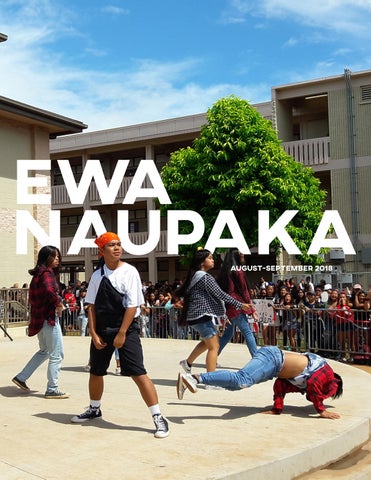
EWA NAUPAKA AUGUST-SEPTEMBER 2018
01 Ewa Naupaka | TOC
Editors: Keona Blanks Maile Morrell Staff: D’Ajanai Bray Nisla Flores-Manrique Raelynn Foster Annika Leone Charlise Limjoco-Ragasa Akala-Pua Momohara Cheziree Pascual Petriese Peralta Brianna Rivera Jolynn Togafau-Tarui Chloe Toribio-Ayers Adviser: Jo Ann Mastin
letter from the editors Welcome to the first publication of James Campbell High School’s newspaper, the Ewa Naupaka, in over a year. The Ewa Naupaka features the work of student journalists who capture the stories of our sizeable community and present it as fairly as possible for public consumption. Our work, with its steps of drafting, interviewing, and peer reviewing, is done in a spirit of service to our community. Impartiality is a characteristic modern media often lack, resulting in a shortage of independent thinkers. The power of expression is beneficial in the hands of the righteous, but, as history has shown, can be dangerous if misused. Our staff thus strives for objectivity in our news reports to encourage independence in collectivity––diversity in unity. Without further ado, thanks to an inspiring advisor and a resolute staff, we invite you to peruse these pages and contemplate the dynamic perspectives our school has to offer. Respectfully, Keona Blanks & Maile Morrell Editors-in-Chief
Table of Contents More articles are published on our website at:
ewanaupaka.com
Ewa Naupaka is a “Public Forum” of student expression that strives to reflect the mission of James Campbell High School. James Campbell High School is a safe, positive place where life skills are learned and applied to meet the challenges of a changing society. If you have any questions, please contact us via email: jchs.ewa.naupaka@gmail.com
02
Photo by Keona Blanks
03
Photo by Maile Morrell
06
Photo credit: NASA
News........Building Up, Protecting the Message Insert............Fear of the Fee, The Chaos After the Storm FEATURES ...........Homecoming, One of the 15
News | Ewa Naupaka 02
p u g n i build in. the inugnd suilgdro k a B e r T b w g e dinN ew T-Buil
making
N
Artist’s impression of T-building Photo credit: G70
by Nisla Flores-Manrique & Keona Blanks, Reporters With classrooms of thirty or more kids, air-conditioning in only 20% of classrooms, and teachers displaced as floaters, James Campbell High School (JCHS) was home to over 3,000 students in 2015 (Bussewitz, 2015). In 2018, however, 90% of JCHS is air-conditioned and the school is projected to welcome a new sustainable and energy efficient building in the Spring of 2020: T-Building. The cost for the project is approximately $41 million. “This is our first step in relieving the overcrowding issue,” said Assistant Superintendent Dann Carlson, Office of School Facilities and Support Services (Cruz, 2018). With 27 classrooms, T-Building is estimated to have a 900-student capacity. “If there were about 30 people in a class, it could accommodate about 900 stdents. But not quite that much; we’ll still try to spread the students out,” said Shayne Greenland, Vice Principal in charge of facilities. Bryce Tomatani, a teacher at JCHS, has to quickly pack and unpack his teaching materials and rush from class to class during passing alongside his students because he, like many teachers at JCHS, is a floating teacher. “Once the new building is done, we shouldn’t have anymore floating teachers. Some of the rooms will even be able to open into bigger spaces, so if we decided to do different student activities, it could be in a great big room with air conditioning,” Greenland said. The extra breathing room will also possibly free up a few classrooms around campus for staff meetings and guest-speaker events.
Construction site in April 2018 Photo by Keona Blanks
Some students and teachers are pleased with the new addition but are not content with process. T-Building has affected many on campus––some impacts being less positive than others, such as the construction site’s wooden fence blocking the eastern windows of J-Building, the rerouting of student passageways, and the noise produced by the construction equipment. Construction site in October 2018
Photo by Keona Blanks Despite the slight disturbance caused by the site, the new building’s aerodynamic design is a novelty that will meet the needs of JCHS’s 21st century learners. T-Building will stick out among the many campus buildings that were built in the 1960’s. “It’s very modern; it will be different colors and have all brand new stateof-the-art stuff like kitchens, a mini theatre for Hawaiian education, an herb garden, a few general science classes, labs updated with today’s technology, and windows made completely of glass,” said Greenland. “We’ve got to prepare kids for the future; so, as a school, we have to prepare.”
our 03 Ewa Naupaka | Features
journey through time
by Chloe Toribio-Ayers, Reporter Photos by Sherwin Acidera
At 10:55am on September 24th, the tense silence of period two was pierced by the lunch bell and the roar of ‘60s music that reverberated through the heart of James Campbell High School’s (JCHS) campus, heralding this year’s Homecoming Spirit Week. The vibrancy of the ‘60s starkly contrasted with the drab features of the school’s sand-colored buildings as freshmen, sophomores, juniors, and seniors alike poured out of their second period classes and pooled around Saber Hall’s stage to compete in an all-out war of class supremacy. Individual students could prepare all they like, but the key to victory lies in collective spirit---a class characteristic that often comes only with time. newest addition to James Campbell High School is the Class ‘22 The of 2022. Being the newest to the school, outgoing participation can be frightening in the face of seasoned upperclassmen. “We were nervous because we already know we might lose and the other classes are older than us. I bet when we are older, we will have more spirit,” JCHS freshman Tiana Gonzalez said. Ostentatious shows of school spirit often require daring individuals with strong senses of class unity––a feature difficult to develop in the mere month and a half freshmen spent together at the school before Spirit Week. Despite this, the freshmen and their council fervidly made their mark.
one year of JCHS Spirit Week experience, new advisors, and ‘21 With a new attitude, the Class of 2021 started off with a bang. “We are more mature [than last year],” Sophomore Council member Clara Chun said. They took inspiration from their upperclassmen and released the spirit of a newfound class unity. Despite this year being only their second year of high school, the sophomores refined their use of a strategic tool in class unity: social media. Andrie Stewart-Twiggs said, “We used social media like Snapchat streaks to our advantage and asked our classmates to repost our cheers.”
all classes are competitive, the Class of 2020 was one ‘20 Although of the wildest classes this homecoming. Two years of experience
united the whole class under one mission: defeat the seniors and place first. Kandi Respicio, the Junior Council historian, said, “Our council has put in a lot of effort. I know the seniors are going out there, but I feel like we are going above and beyond.” As the week sped on, the juniors labored to bring in donations and hype up their class. The Class of 2020 may have seemed chill, but they were determined to seize victory.
last chance to get it right, one last shot to take victory––this ‘19 One year, the Class of 2019 had to make up for the lack of universal
participation in previous years. “I never dressed up until this year,” senior Ai Erbe said. Thanks to the Senior Council’s hard work and the collective spirit of the class, however, the seniors turned the tables against all odds. The seniors’ exultant cheers at the Homecoming game when news of their triumph echoed throughout the football field made this homecoming a truly defining week for the seniors before they take their bow and face adulthood together this May.
Features | Ewa Naupaka 04
Swin gin’ 60s
s 0 7 y v Groo
Homecoming Spirit Week
Lookbook
This year’s homecoming theme, A Journey Through Time, focused on travelling back in time to the 60’s, 70’s, 80’s, and 90’s. James Campbell High School students and teachers got into the spirit by embracing the various fashion trends unique to each decade. With that said, hopefully everyone had a swingin’, groovy, hip, and rad Homecoming!
d a R
Hip 80s
s 0 9
$ 05 Ewa Naupaka | Features
by Petriese Peralta, Reporter
A E F R
There is a big difference between the cost of college decades ago and the cost of college in 2018. Funding a college education can be one of the most stressful experiences of a student’s life. According to College Board, the average one-year tuition cost for the 2017-18 year ranged between $9,000 to $35,000 depending on a multitude of factors. When students think about the thousands of dollars needed for higher education, they tend to forget that there are fees to apply. Imagine having to pay to just apply for a college when it could be in vain if you’re not accepted.
OF THE
We Broke or Whatevah Colleges change their application fees depending on the number of applicants and how selective the process is. US News found that the average college application fee is $41, with Stanford retaining the most expensive application fee at $90. “I applied to around six colleges and only paid $100 total for all six because I had some free waivers. Without the waivers I probably would have had to pay around $250,” said Alex Bartones, a senior at The Colorado School of Mines.
FEE
PrepScholar reports that the average student applies to six to eight colleges. Now, take the average application fee and multiply that by eight. Applying to eight colleges alone could add up to $328.
Though it would be a dream for college applications fees to be a bit more affordable, there is not much that can be done to change that. So, here’s some advice: 1. Prioritize what colleges to apply to. Apply to your top, realistic colleges first, and budget any remaining funds for other schools.
2. Although it might be too late to join any AVID programs by the time college application season comes around, certain SAT scores may qualify for free waivers. Improve your SAT score to raise your chances at qualifying for waivers. 3. If any underclassmen are reading this, find a way to have a personal fund to pay for applications fees to save yourself and your parents the stress down the line. Also, make sure to keep those grades up. The myth that freshmen and sophomore year are insignificant and do not require good work ethic will only damage your GPA and lead to future reapercussions. Start with a strong GPA early to qualify to become a Dean’s Candidate. 4. It doesn’t hurt to call the admissions office and ask for any waiver and scholarship opportunities. Show a college you’re interested and you’ll make a good first impression.
Evil Economy Because a majority of college applicants are seniors in high school, most parents are often their child’s main source for financing college--even if the parents themselves still have college debt. A 2012 study by the Institute of College and Success found that the average debt for college graduates with is $29,400. Not only do these college application fees stress students, but they also stress the parents who still have college debt. The Loophole College application waivers are a solace in times of financial frustration. Waivers can be acquired through programs like AVID, becoming a Dean’s Candidate, or even having a qualifying SAT score. Many students, however, are not eligible or given the opportunity to obtain them. Dean’s Candidates waivers are given only to students with eligible GPA’s, and the AVID waivers are given only to AVID students. “To be competitive you have to apply to many colleges, and if you apply to multiple colleges it just all adds up you know?” said James Campbell High School teacher Lindsay Fassett. Applying to many colleges just doesn’t seem to be worth the cost if, at the end of the day, you’ll only attend one--and the rest of the money spent will simply go to waste. Those are a few hundred dollars that could have contributed to the college tuition overall. Although the application fee might not change, it is always possible to change how to approach issues like these. It may be tough, but many tend to overlook that before going to college and paying the tuition, there is an application fee that comes beforehand. Don’t be that person, start early!
APPLY FOR FEDERAL STUDENT AID Create a Federal Student Aid ID https://fsaid.ed.gov
Fill out the Free Application for Federal Student Aid (FAFSA) https://studentaid.ed.gov/sa/fafsa
Bring the following documents: -Federal Student Aid ID# -Copy of 2017 Federal Tax Return -2017 W-2 Tax Form -Social Security #s for Parents & Students
-Current Statements from savings, investments (including IRAs, 401Ks employer/ retirement plans, etc.)
Features | Ewa Naupaka 06
The Chaos
after the Storm
In the wake of Typhoon Jebi, the Hokkaido Earthquake, and Hurricane Florence, it’s important for Campbell to be prepared this hurricane season. by Akala-Pua Momohara, Reporter Natural disasters are unpredictable; that much is certain. Some strike during school days, like the most recent storm to visit the islands: Hurricane Lane. Weather systems may not be able to predict earthquakes and volcanic eruptions, but they are able to see when a hurricane is forming. As students who live on an island, it is imperative to know what to look out for and what to do to help disaster survivors.
whether it be at home or overseas. But if someone may not have the money to purchase extra supplies, there are other ways they can help:
James Campbell High School teacher Ty Shitanaka emphasizes the importance of putting safety first. Classes should be closed before the disaster strikes, and parents must be notified via a letter sent home with their student before school closure. This way, students and parents do not have to risk their safety by going to school.
Donating spare supplies is another option. Even after destructive hurricanes such as Florence, plenty people may still have extra provisions. Donating a few bottles of water or a hot meal to a family in need makes all the difference in the recovery efforts. These donations can even be in the form of time and energy spent to rebuild homes.
In the event of a natural disaster, all schools should immediately follow the protocol set in place. Therefore, teachers should know where their Emergency Preparedness handbook is and where the proper escape route is for the sake of their students’ safety.
Spreading awareness is another vital contributor to proactivity and disaster relief. Talk about what creates a hurricane or earthquake. Let people know the dangers of lava, especially the gas it produces. Most of all, make sure people know what to do in case of an emergency. Proactivity makes all the difference.
Parents and teachers should discuss the power of remaining calm with their students. Any life-or-death situation can be stressful; students, especially younger ones, need to know that the best strategy is to remain calm and follow instructions given by their teacher. Knowing the health and safety risks of natural disasters is one thing; knowing how to relieve them is another. Each donation of one item—such as water or food—can help a family in need,
The most notable way is to volunteer at the Red Cross, though there are some restrictions. For example, minors cannot volunteer their services overseas. For those who are over 18, a clean background check is required before joining the Red Cross.
If your teacher doesn’t have an emergency handbook, politely ask if they can find one. Plan escape routes with your family, such as where to shelter in case of a tsunami or where to meet up in case of a wildfire. Protect your property with an insurance plan; the most common one in Hawaii should cover tsunamis and hurricanes.
Communication is always the best way to prepare. If you and your community know what to do, then when the time comes, universal safety is likely. Be safe, be prepared, and do your part for the community and for yourself.
According to the Ready Campaign, a basic emergency supply kit could include the following recommended items: Water - one gallon of water per person per day for at least three days, for drinking and sanitation Food - at least a three-day supply of non-perishable food Battery-powered or hand crank radio and a NOAA Weather Radio with tone alert Flashlight First aid kit Extra batteries Whistle to signal for help Dust mask, plastic sheeting and duct tape (to help filter contaminated air and to shelter-in-place) Moist towelettes, garbage bags and plastic ties (for personal sanitation) Wrench or pliers (to turn off utilities) Manual can opener (for food) Local maps Cell phone with chargers and a backup battery
07 Ewa Naupaka | Features
one of the
15
“Out of 100 people, 50 say they want to change the world. Probably 25 decide to change the world, and 15 actually pursue it.” —Shannon DeRego by Keona Blanks, Reporter
On an early Saturday morning, instead of flicking through Snapchat stories or TV channels, James Campbell High School senior Shannon DeRego pulled out of her driveway and drove to the USFS Honouliuli National Wildlife Refuge in Ewa that morning, Hawaiian station 93.8 F.M. buzzing through her car’s speakers. DeRego was not set on pursuing a career in environmental science when she fastened her galoshes and tightened her gloves. It was only after stepping foot in the marsh that the endemic birds ‘Alae ‘ula and A’eo call home that she found her calling. “I’m really passionate about cleaning the environment and saving endangered species. I want to help us to live another thousand years so the future generations can be in marshes like this and see these native Hawaiian animals,” said DeRego. Volunteers donning rain boots and sun hats came from all over O’ahu to meet the needs of the Wildlife Refuge and make it an optimal learning center for elementary school students. Amber O’reilly, an AP Environmental Science and Biology teacher from Kahuku High School, said, “Being an educator out here and seeing kids experiencing and learning about nature is so much fun, because then they want to take care of it. We’re passing on this desire to conserve.” Ultimately, through service to humanity, it is possible to develop a desire to DeRego on her first visit to the marsh. Photo by Keona Blanks pursue a profession with impacts such as providing a community with an environmentally conscious future generation. “I want to do something that improves society, the community, and the world at the same time. After I finish my service-learning project, get my grade, and make my presentation, that’s not it. I’m not going to stop there. I’m going to work until I officially make a difference,” DeRego said. For volunteer opportunities at the USFS Honouliuli National Wildlife Refuge as well as opportunities at other sites with the Hawaii Nature Center, email volunteer@hawaiinaturecenter.org.
News | Ewa Naupaka 08
Protectin
g the
M E S SAG E
Ending cens orship in sch oolsponsored stu dent publica tions by Maile Morrell, Reporter When she was still in high school, Chavonnie Ramos struggled with writing relatable and enticing stories for her school’s newspaper because administrators kept a tight grasp on the type of content published. Discouragement from her superiors ultimately resulted in the publication of “safe” articles that resembled advertisements more than hard hitting news. As the Ka Leo Sports Editor, Ramos reflected on the freedom she now has working for an independent publication– the kind of freedom she did not have in high school. The Hawaii Scholastic Journalism Association (HSJA) put out a press release regarding school-sponsored student publications at the 2018 University of Hawaii Manoa Journalism Day. The HSJA is fighting to change a policy that affects many student journalists concerning the censorship of student publications in favor of free and inclusive expression. Advocates for the revision argue that Policy 101-9, which currently states, “staff of school-sponsored student publications have the authority to determine the content of their publications subject to the limitations of this policy, other Board policies and state and federal law,” prevents the discussion of controversial topics in public schools. James Campbell High School Principal Jon Henry Lee does not enforce a strict censorship policy regarding any of the school’s various student media. “I believe in our teacher and I believe in our
students. They have done a wonderful job and have held themselves to a high standard so there hasn’t been a need for administrative review before publishing,” said Lee. He believes when you have dedicated people who are passionate about what they do, it’s wise to give them support and get out of their way. The same mindset, however, is not shared by many other administrators across the state or even across the nation. The national New Voices movement is gaining momentum through campaigns for new legislation from high school students and teachers to protect them against censorship. Student testimony shows that topics relevant to today’s generation such as sexual assault, LGBTQ rights, and exposés on school happenings are commonly considered taboo, and schools can prevent works from being published under the current policy. Yet these are the issues that attract readers to student publications. “By getting topics that are relatable to your school and your community, they’re more likely going to want to say something,” said Ramos, who shared her testimony on censorship to current high school journalists in a press conference. She experienced the full effects of Policy 101-9 in high school in the form of missed deadlines and suppressed content. An article highlighting the poor bathroom facilities at her high school was enough of a controversy to spark conflict between news-
paper staff and administrators over the reputation of the school, thus preventing the story from being published. Kailanianna Ablog, Ka Leo Opinions Editor, had a similar experience at her Catholic, all girls, private school that does not adhere to the regulations of the Hawaii Department of Education (HIDOE). “There were a few articles that I did not want to pitch only because I knew right away that the adviser, or perhaps other teachers, and the headmaster of the school would not approve,” said Ablog. “We do have to uphold a specific image for the school and even though censorship is not good, I can understand the reasons behind it.” President of the Hawaii Publishers Association and HSJA member, Jay Hartwell, explained how public school students can take action to enact a policy change. He recommends submitting testimonies showcasing how administrative control over content prohibits learning to the HIDOE and advocating for change in the form of editorials and news stories. To many like Hartwell, the New Voices movement is an important one in our schools: “You’re there to be learning how to think, and ideally to think critically, and to take risks in your development,” said Hartwell. “If a principal is inhibiting that from happening, then what kind of citizens are we creating?”