RTK Fix Ratio Under Tree Canopy and Rain Summary edition – Screenshot-level field review of multi-receiver RTK logs: Eview HB56 (Septentrio mosaic-X5) and HB56H (Septentrio mosaic-H) under half-sky, tree canopy and rain Revision R1.3-EN · 21 October 2026 · By Jack W., Eview GNSS · Test data supplied by the test team and used with permission
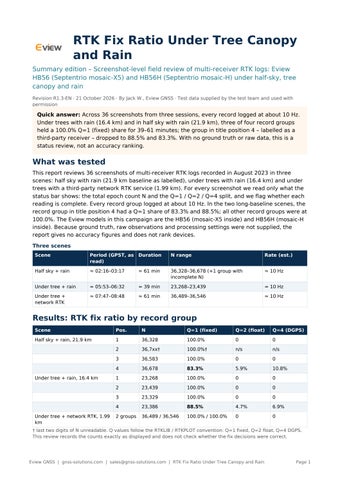
Quick answer: Across 36 screenshots from three sessions, every record logged at about 10 Hz. Under trees with rain (16.4 km) and in half sky with rain (21.9 km), three of four record groups held a 100.0% Q=1 (fixed) share for 39–61 minutes; the group in title position 4 – labelled as a third-party receiver – dropped to 88.5% and 83.3%. With no ground truth or raw data, this is a status review, not an accuracy ranking.
What was tested This report reviews 36 screenshots of multi-receiver RTK logs recorded in August 2023 in three scenes: half sky with rain (21.9 km baseline as labelled), under trees with rain (16.4 km) and under trees with a third-party network RTK service (1.99 km). For every screenshot we read only what the status bar shows: the total epoch count N and the Q=1 / Q=2 / Q=4 split, and we flag whether each reading is complete. Every record group logged at about 10 Hz. In the two long-baseline scenes, the record group in title position 4 had a Q=1 share of 83.3% and 88.5%; all other record groups were at 100.0%. The Eview models in this campaign are the HB56 (mosaic-X5 inside) and HB56H (mosaic-H inside). Because ground truth, raw observations and processing settings were not supplied, the report gives no accuracy figures and does not rank devices. Three scenes Scene
Period (GPST, as Duration read)
N range
Rate (est.)
Half sky + rain
≈ 02:16–03:17
≈ 61 min
36,328–36,678 (+1 group with incomplete N)
≈ 10 Hz
Under tree + rain
≈ 05:53–06:32
≈ 39 min
23,268–23,439
≈ 10 Hz
Under tree + network RTK
≈ 07:47–08:48
≈ 61 min
36,489–36,546
≈ 10 Hz
Results: RTK fix ratio by record group Scene
Pos.
N
Q=1 (fixed)
Q=2 (float)
Q=4 (DGPS)
Half sky + rain, 21.9 km
1
36,328
100.0%
0
0
2
36,7xx†
100.0%†
n/s
n/s
3
36,583
100.0%
0
0
4
36,678
83.3%
5.9%
10.8%
1
23,268
100.0%
0
0
2
23,439
100.0%
0
0
3
23,329
100.0%
0
0
4
23,386
88.5%
4.7%
6.9%
2 groups
36,489 / 36,546
100.0% / 100.0%
0
0
Under tree + rain, 16.4 km
Under tree + network RTK, 1.99 km
† last two digits of N unreadable. Q values follow the RTKLIB / RTKPLOT convention: Q=1 fixed, Q=2 float, Q=4 DGPS. This review records the counts exactly as displayed and does not check whether the fix decisions were correct.
Eview GNSS | gnss-solutions.com | sales@gnss-solutions.com | RTK Fix Ratio Under Tree Canopy and Rain
Page 1
Fig. 4-1 Ground track (slide 4L)
Fig. 4-6 Ground track (slide 6R)
Pos. 1 | N = 36,328 | Q=1 36,328 (100.0%)
Pos. 4 | N = 36,678 | Q=1 30,547 (83.3%); Q=2 2,165 (5.9%); Q=4 3,966 (10.8%)
Track starts in the south-west and, after several turns, runs north-east.
Ground track concentrated in the upper right, showing a short continuous path.
Fig. 5-13 Position scatter (slide 16L)
Fig. 5-6 Ground track (slide 12R)
Pos. 1 | N = 23,268 | Q=1 23,268 (100.0%)
Pos. 4 | N = 23,386 | Q=1 20,690 (88.5%); Q=2 1,092 (4.7%); Q=4 1,604 (6.9%)
Per-epoch E/N/U points tightly grouped around each centre value.
Irregular out-and-back segments, centre to lower area.
What this data can and cannot tell you This is a position link, not a model conclusion. In the slide titles, position 4 is labelled with the third-party receiver, but no serial numbers or full file names were supplied to confirm which physical unit it was. We therefore write “the record group in title position 4”, not “model X performed worse”. A Q=1 share describes the status distribution of the logged record. It does not show that positions were close to the truth or that status was assigned correctly. Without ground truth, baseline vectors and raw observations, this report does not compute RMS, CEP or horizontal error, and does not rank devices.
• Sample: one device and one session per title position, so unit-to-unit and model-to-model differences cannot be separated.
• Attribution: record group ↔ model is inferred from title order and N, not confirmed by serial number.
• Possible mis-ordering: Figures 4-8 and 5-14 show the same N as position 1 on the same slide; not counted as independent samples.
Eview GNSS | gnss-solutions.com | sales@gnss-solutions.com | RTK Fix Ratio Under Tree Canopy and Rain
Page 2
• Configuration: elevation mask, ambiguity strategy and multipath settings were not recorded and could explain part of any difference.
• Correlation: adjacent 10 Hz epochs are correlated, so N is not the number of independent samples; no confidence intervals or significance tests are given.
How to test RTK under trees properly • Control: same site, baseline and correction source; cross dry/wet with open-sky/under-tree; at least 3 repeats per cell.
• Truth: a known control point or a long static baseline solution, with the coordinate frame stated. • Logging: antenna height, canopy photos, rain intensity, temperature, firmware, processing settings, satellites used, PDOP, C/N0.
• Sample: at least two units per model; dual-antenna units should log heading at the same time. • Analysis: decimate to 1 Hz before statistics, state the effective sample size and do not derive confidence intervals from raw N.
Frequently asked questions Why can’t the three scenes be compared directly? Obstruction, baseline length, site, correction source and weather all changed between the three sessions, so this is not a controlled test. Differences between scenes cannot be attributed to any single factor; the report only describes the status distribution observed under each combination. Is the Q=1 share the same as the RTK fix rate? In RTKLIB’s convention Q=1 means a fixed solution, so the Q=1 share is the fix rate as reported by the logging software. It describes the status distribution only; it does not show that positions were close to the truth or that the fix decisions were correct. Why can’t this data show which receiver is better? Each title position had one device and one session, so unit and model differences cannot be separated. Record groups were matched to devices by title order and epoch count, not by serial number, and without ground truth any accuracy ranking would have no basis.
Receivers in this review • Eview HB56 – Septentrio mosaic-X5 inside: multi-band, multi-constellation RTK with AIM+ interference protection and SD-card logging, for drones, survey, robotics and integration projects. The mosaic-X5 records in this review use this platform.
• Eview HB56H – Septentrio mosaic-H inside: dual-antenna heading and attitude, for platforms where a magnetic compass is unreliable or redundant heading is needed. The mosaic-H records in this review use this platform.
• Eview HB10 – Septentrio AsteRx-m3 inside: board-level high-precision positioning for size- and power-sensitive integration. Full 27-page report with all 36 figures: gnss-solutions.com/rtk-fix-ratio-under-tree-canopy-rain-field-review/ · sales@gnss-solutions.com
Sources and credits • Test data, screenshots and site photos: field test of 24 August 2023, supplied to Eview GNSS by the test team as a 22-slide deck and a two-part Chinese technical report (R1.2). Used with permission; the original files are not publicly available.
• Plots: RTKPLOT from RTKLIB, the open-source GNSS positioning package – www.rtklib.com.
Eview GNSS | gnss-solutions.com | sales@gnss-solutions.com | RTK Fix Ratio Under Tree Canopy and Rain
Page 3
• GNSS modules referenced: Septentrio mosaic-X5, mosaic-H and AsteRx-m3 family (official product pages).
• Interference protection: Septentrio AIM+. • No third-party product images are used in this report.
Eview GNSS | gnss-solutions.com | sales@gnss-solutions.com | RTK Fix Ratio Under Tree Canopy and Rain
Page 4