How to Choose an RTK GNSS Receiver A practical selection guide for surveying, GIS, drones, robotics and machine guidance By Jack W., Eview GNSS
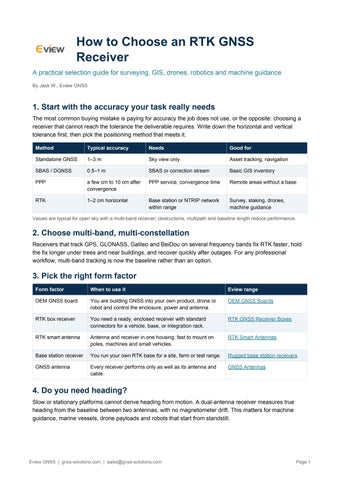
1. Start with the accuracy your task really needs The most common buying mistake is paying for accuracy the job does not use, or the opposite: choosing a receiver that cannot reach the tolerance the deliverable requires. Write down the horizontal and vertical tolerance first, then pick the positioning method that meets it. Method
Typical accuracy
Needs
Good for
Standalone GNSS
1–3 m
Sky view only
Asset tracking, navigation
SBAS / DGNSS
0.5–1 m
SBAS or correction stream
Basic GIS inventory
PPP
a few cm to 10 cm after convergence
PPP service, convergence time
Remote areas without a base
RTK
1–2 cm horizontal
Base station or NTRIP network within range
Survey, staking, drones, machine guidance
Values are typical for open sky with a multi-band receiver; obstructions, multipath and baseline length reduce performance.
2. Choose multi-band, multi-constellation Receivers that track GPS, GLONASS, Galileo and BeiDou on several frequency bands fix RTK faster, hold the fix longer under trees and near buildings, and recover quickly after outages. For any professional workflow, multi-band tracking is now the baseline rather than an option.
3. Pick the right form factor Form factor
When to use it
Eview range
OEM GNSS board
You are building GNSS into your own product, drone or robot and control the enclosure, power and antenna.
OEM GNSS Boards
RTK box receiver
You need a ready, enclosed receiver with standard connectors for a vehicle, base, or integration rack.
RTK GNSS Receiver Boxes
RTK smart antenna
Antenna and receiver in one housing: fast to mount on poles, machines and small vehicles.
RTK Smart Antennas
Base station receiver
You run your own RTK base for a site, farm or test range.
Rugged base station receivers
GNSS antenna
Every receiver performs only as well as its antenna and cable.
GNSS Antennas
4. Do you need heading? Slow or stationary platforms cannot derive heading from motion. A dual-antenna receiver measures true heading from the baseline between two antennas, with no magnetometer drift. This matters for machine guidance, marine vessels, drone payloads and robots that start from standstill.
Eview GNSS | gnss-solutions.com | sales@gnss-solutions.com
Page 1
5. Plan for interference Jamming from in-vehicle devices, nearby electronics and spoofing signals is increasingly common. Receivers powered by Septentrio modules include AIM+ interference mitigation, which detects and suppresses narrowband and wideband interference and flags spoofing attempts. Read more on anti-jamming and anti-spoofing GNSS.
6. Check integration details early • Interfaces: UART, USB, Ethernet, CAN; NMEA and binary output; 1PPS and event inputs. • Corrections: NTRIP client, RTCM 3 input, radio or cellular link to your base. • Autopilots: for Pixhawk, ArduPilot and PX4 drones, confirm the driver, baud rate and GPS-for-yaw support. See RTK GNSS receivers for drones and UAVs. • Power and size: weight and power draw matter on small UAVs and battery-powered robots. • Environment: ingress rating, operating temperature and vibration for field use.
7. Quick selection checklist • Required accuracy (horizontal and vertical) and update rate • Correction source available on site: own base, NTRIP network or PPP • Single antenna, or dual antenna for heading • Board, box, smart antenna or base station form factor • Interference environment and need for anti-jamming / anti-spoofing • Interfaces, protocols and autopilot or software compatibility • Size, weight, power and environmental rating
8. Eview receivers at a glance Eview designs and manufactures GNSS receivers powered by Septentrio modules for civil and commercial users. Module family
Strength
Typical use
mosaic-X5
Compact multi-band RTK receiver
Survey, GIS, drones, robotics
mosaic-H
Dual-antenna RTK with heading
Machine guidance, marine, UAV payloads
mosaic-G5
Very small, low-power RTK
Small UAVs, wearables, portable devices
AsteRx-m3 Pro+
High-end RTK and heading
Demanding integration and reference applications
Need help choosing? Tell us your accuracy target, platform and correction source and we will recommend a receiver and antenna. Email sales@gnss-solutions.com or visit gnss-solutions.com. Septentrio, mosaic and AsteRx are names of Septentrio NV modules used inside Eview products.
Eview GNSS | gnss-solutions.com | sales@gnss-solutions.com
Page 2