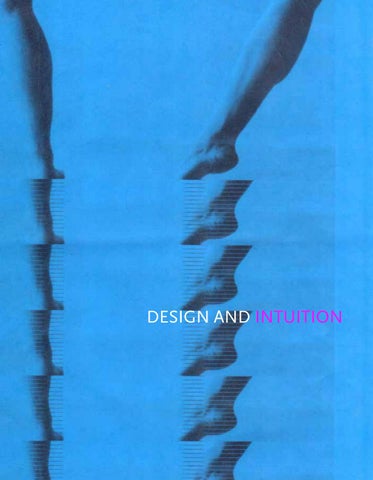
DESIGN AND INTUITION
eve white 1
Eve White MFA Candidacy Proposal Expected Year of Graduation 2019 Department of Graphic Design Virginia Commonwealth University Spring 2018
INTRODUCTION
The crucial point is to talk about that moment; to talk about the moment when you decided ‘it should be like this.’ Daniel van der Velden
“Today, cognitive scientists think of intuition as a set of non-conscious cognitive and affective processes; the outcome of these processes is often difficult to articulate and is not based on deliberate thinking, but it’s real and (sometimes) effective nonetheless,” says psychologist, professor and PhD Massimo Pigliucci. Because of its elusive nature, intuition has often been discounted. I believe it shouldn’t be. Graphic designer Daniel van der Velden, of Metahaven spoke of the potential of designers who mine their intuition, telling online publication That New Design Smell, “The crucial point is to talk about that moment; to talk about the moment when you decided ‘it should be like this’.” I endeavor to address this through my design practice –– to examine the conscious reasoning that exists on all sides of the intuitive ‘aha’ moment –– and to use what I learn to inform and propel my creative process. It is my hope that in doing so I will contribute to demystifying intuitive processes so that they maybe harnessed in graphic design.
intuition at work
For a ballerina, a performance is a dance between executing the technique, staying one step ahead of the music, and intuiting how to deliver information seamlessly to the audience. Being a former classical dancer is what sparked my interest in the role of intuition in the creative process. Emphasis on analytical thinking in graphic design is what inspired me to investigate it. Through my investigation, I discovered that the graphic design practitioners who were championing intuitive making –– while continuing to provide only a tenuous road map as to what this meant –– tended to have experiences in their backgrounds that already lent themselves to intuitive processes. Take for example, surfer turned graphic designer David Carson, who says of intuition, “I think it’s not the only ingredient in design, but possibly the most important. It’s something everybody has. It’s not a matter of teaching it; in fact, most of the schools tend to discount intuition as an ingredient of your working process because they can’t quantify it: it’s very hard to teach people the four steps to intuitive design, but we can teach you the four steps to a nice business card or a newsletter. So it tends to get discounted.”
As dancers we are taught that our body is an instrument and we learn to tune it to the music and the choreography. Similarly, Carson is a surfer –– a skill in which tuning into your surroundings is essential. He came to graphic design, just as I did, with a lot of practice listening to his intuition. How can designers who enter the field without this proclivity bring intuitive processes into their practice? How can I can I use visual communication to spark a conversation about the necessary dance between intuition and analytics?
eve white 5
INTUITIVE PROCESSES
Intuitive processing has been embraced in some realms of the arts –– most notably by musicians, painters and dancers. Painter Robert Rauschenberg cited musician John Cage in an interview with US art critic Barbara Rose, where he said: “He (Cage) gave me permission to go on thinking . . . he was the only one who gave me permission to continue my own thoughts.” Cage’s cohort, dancer/choreographers like Trish Brown and Merce Cunningham, were all masters of improvisation, an intuitive processes of “continuing one thoughts.” Dancer, painter, and performance artist Carolee Schneemann said, “Bob was an initiator — of impulse, intuition, and visionary certainty. And, as we all know, he became this indelible influence. Artists today using so-called intermedia, using their bodies, mixing materials — this all has a route back to Rauschenberg.”
One such artist that Rauschenberg influenced was Jean-Michel Basquiat . . . intuition at work
eve white 7
Painter Jean-Michel Basquiat was deeply influenced by Rauschenberg and even visited him. Basquiat also drew influence from the practice of author William Burroughs.
Life is a cut up. As soon as you walk down the street your consciousness is being cut by random factors. The cut-up is closer to the facts of human perception than a linear narrative. William Burroughs Jean-Michel Basquiat, Pegasus, 1987 Acrylic, graphite, and colored pencil on paper on mounted on canvas 88 x 90 in (223.5 x 228.5 cm)
intuition at work
eve white 9
HEURISTICS AND INTUITION
This wall hanging reads “Make your psyche demand its rights and become self sufficient. The best part is you don’t have to be afraid. Now you can do all your living with your mind.” (from Kurt Vonnegut’s short story, UnReady to Wear). It was installed in my bedroom so that the daylight and personal nature of the location would add texture and context. Second year MFA candidate Minjee Jeon critiqued it for Lauren Thorson’s Fall 2017 Workshop, saying “When visual representations are a form of translation, it activates the reader’s consciousness to detect perceptible pieces that eventually weave into their understanding—for it is how we see and transform the world through contextualizing and giving forms. Therefore we read images, but when the art itself is presented in a text, we enter a comfort zone where the legibility might correlate to the accessibility of the work. After all, with a little attention, White’s wall hanging piece is readable although the letters are in all caps and have no spaces in between.” Nobel prize winning psychologist Daniel Kahneman echoes Jeon saying, “The confidence people have in their beliefs is not a measure of the quality of evidence but of the coherence of the story that the mind has managed to construct.”
Investigating the potential of our unconscious mind . . .
intuition at work
eve white 11
ASSEMBLAGE AND INTUITION
I employed the spontaneity of my unconscious mind with my Illustrated Paper (right) by creating an assemblage of three studies. It was printed on fabric with the intention of introducing movement but also with the intention of delineating between the studies and hanging them separately. However, when I printed them together, a new conversation was born between the forms of the collages, the forms of the light and the form of the body. intuition at work
eve white 13
intuition at work
eve white 15
INTUITIVELY EXPLORING
Creating from found objects or textures came with connotations that I wanted to move beyond. So I began to explore paint and gesture. This series –– focusing on the daily cycle of cabbage groundsels growing in Mount Kenya Africa –– shows my evolution from fixed collage to free-form gestural paintings based on nature. Previous page (right): An assemblage of photographs depicting sculptures made in sixty seconds using found objects.
intuition at work
eve white 17
Abstract Stalactite Series
intuition at work
eve white 19
INTUITIVELY GATHERING An integral part of my process, in addition to painting, is creating a bank of disparate source materials, including monotypes, chalk pastels, polaroids and collages.
intuition at work
eve white 21
CONSCIOUSLY SYNTHESIZING While creating this bank of source materials, I consciously kept a list of content and subject matter in mind.
The way that this strategy was synthesized is best shown in the following studies . . . intuition at work
eve white 23
CONSCIOUSLY SYNTHESIZING
Neoclassical ballet choreographer George Balanchine created a ballet where he depicted four temperaments (or humors) rooted in phrenology: melancholic, sanguinic, phlegmatic, and choleric. I combined chalk pastel and acrylic to create a visual response to Balanchine’s choreography. I focused on melancholic and choleric. Aspects of every day life, what we studied and read in class, and my own photographs informed the translation of these temperaments. This synthesis of intuitive gathering and conscious application forged The Little Book of Melancholia (page 25) and The Pruitt-Igoe Studies (on page 26–27.)
intuition at work
eve white 25
Pruitt-Igoe was a St. Louis, Missouri urban housing development that housing authorities used to disenfranchise residents in the 50s and 60s. The myth surrounding the failure of the architecture has been used to further erase the history of the people who lived there. Here I combined the mythical photographs of the building’s implosion with my chalk pastel representations of a manic mood.
intuition at work
eve white 27
INTUITIVELY ADDING LETTERING
Using digital fonts to create an ineffable quality and pulling text pulled from magazines or books to add dimension led to the next logical step, to create my own lettering . . .
My Page in VCU First Year’s Collaborative Zine at Printed Matter’s New York Art Book Fair followed by Dear Sir, Why Did You Cross Me Out? a collage study, featuring a passage from Sally Mann’s Hold Still: A Memoir with Photographs. intuition at work
eve white 29
Planets Streaked in Shadow followed by After the Rain II
intuition at work
eve white 31
THE TEXTURE STUDIES
Excerpts from small edition publications –– The Texture of Intimacy and The Texture of Rebellion. Much like movement, texture is a mainstay in my work. For the Are You Going To A Funeral? poster, I created and then scanned a 2 ft x 2ft tapestry that I made out of faux leather, boucle, velvet and tulle, polaroids of my own black clothing and a wide variety of collected prose on the color (which is hidden behind the I, N, G, T and O and is rendered invisible by the scan.) intuition at work
eve white 33
MOVING FORWARD I plan to continue using hand generated text and texture to evoke the energy and dynamism that working intuitively can bring to graphic design.
I aim to use mixedmedia to create visual communications that drive the discussion about the necessity of intuitive processes such as meditation and improvisation.
Page from Texture of Rebellion. Analog background (left) and final poster (right) for the Hardworking Goodlooking lecture at VCU.
intuition at work
eve white 35
KEY QUESTIONS
PRECEDENTS
How do we build a strong partnership between intuitive thinking and analytical thinking in our practice? How can our generation of designers learn to factor in space for intuitive processes that encourage listening to our surroundings as well as ourselves? What happens when we bring in kinesthetic learning or methods that rely on unconscious reasoning such as meditation? Why don’t we talk about the dynamic dance between intuition and analytics and the partnership they have with each other? How can I use graphic design to challenge the common interpretation of intuitive processes as less-than rational thought? What does brain or body activity look like when these intuitive processes are occurring? How do these intuitive processes factor into how we receive or interpret visual language? How can these processes be represented with material explorations?
1. Jean-Michel Basquiat: energy and irreverence 2. Robert Rauschenberg: synthesis, collaboration and layering 3. Ed Ruscha: prose, clarity and color 4. Ed Fella: hand-done, wild lettering 5. Cy Twombly: energy and scale 6––7. Tracey Emin: personal inspiration, emotional resonance, catharsis 8. David Carson: use of text and imagery to create landscape and atmosphere
intuition at work
eve white 37
BIBLIOGRAPHY
Twombly, Cy, Untitled (Bacchus). 2008. Tate. Presented by the Cy Twombly Foundation 2014. http://www.tate.org.uk/.
Carson, David. TED2003: Design and Discovery. ted.com/talks/david_carson_on_design. 2003.
Yukawa, Hideki with translation by Bester, John. Creativity and Intuition: A Physicist Looks at East and West. Kodansha International Ltd. ––Tokyo, New York, San Fransisco. First Edition, 1973.
Collaborative Issue: That New Design Smell Issue n° 0. The Politics of Aesthetics: What does it mean to design? Interview with Daniel van der Velden/Metahaven. http://thatnewdesignsmell.net/danielvan-der-velden-explains-himself. 2011. Emin, Tracey. Everyone I Have Ever Slept With 1963-1995. February 19th 1995. Tracey Emin Studio. traceyeminstudio.com. © Tracey Emin Studio 2018. Hatje Cantz. Curated by Buchhart, Dieter. Nahmad Contemporary, New York. Exhibition catalogue published in conjunction with the exhibition Words Are All We Have: Paintings by Jean-Michel Basquiat. May 2 –– June 18, 2016. Fella, Ed. Words –– and Images ––on Ed Fella. Dooley, Michael. http://www.printmag.com/interviews/ words-and-images-on-ed-fella. 2013. Jobey, Liz. Robert Rauschenberg: In the Gap Between Art and Life. Financial Times. 2016. Kahneman, Daniel. Thinking, Fast and Slow. Farrar, Straus & Giroux. 2012. Pigliucci, Massimo. Answers for Aristotle: How Science and Philosophy Can Lead Us to A More Meaningful Life. Basic Books, A Member of the Persus Books Group, New York. 2012. The Pruitt-Igoe Myth –– a Documentary. pruitt-igoe.com. Rauschenberg, Robert. Last Turn –– Your Turn [print for Earth Summit ’92 the United Nations Conference on Environment and Development, Rio de Janeiro, Brazil] 1991. rauschenbergfoundation.org/. © 2018 Robert Rauschenberg Foundation. Ruscha, Ed. America, Her Best Product. 1974. Hamilton-Selway Fine Art. artnet.com/ artists/ed-ruscha/. © 2018 Artnet Worldwide Corporation. Tharp, Twyla with Reiter, Mark. The Creative Habit: Learn It and Use It for Life. Simon & Schuster Paperbacks –– New York, London, Toronto, Sydney. 2003.
intuition at work
eve white 39
intuition at work