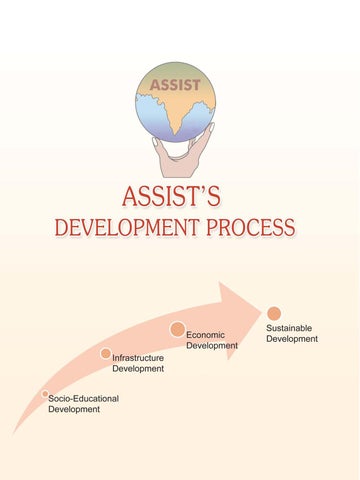
ASSIST’S Development Process
ASSIST’S Development Process
We are grateful to End of Poverty (EoP) Foundation, The Netherlands, for their support in data compilation, editing and publishing of this document.
Mr. Evert de Blok
Mr. Frits Penning
Mr. Leo Zwagemaker
Chairman, End of Poverty Foundation, The Netherlands
Treasurer, End of Poverty Foundation, The Netherlands
Chairman, RRDF, The Netherlands
ASSIST’S Development Process
PREFACE In the last 25 years, ASSIST has left an indelible mark on the lives of poor and underserved communities in rural India. Due to the organisation's sincere vision, commitment and ability to help backward communities attain self-reliance, ASSIST has achieved great results in the villages, while gaining the trust of many donors, governments, suppliers, specialists and most importantly - the people themselves. Starting out in 1985 with a simple but earnest vision to impart change with a difference, ASSIST spent many years evolving a philosophy of development practice that could serve as a guide for the organisation to contribute meaningfully in this field. Through countless trials and tribulations, ideas formed, expanded, contracted, adapted and solidified only after great reflection and scrutiny. And thus, after a quarter century of rich experience and experimentation, a clear methodology has finally come about. And what better time to present this development process than at an important milestone such as the Silver Jubilee - a moment that boasts of ASSIST's longevity, and thus indirectly, proves the worthiness of its philosophy. This methodology document is the outcome of years of serious reflection on the impact that ASSIST has had on the field of rural development in Andhra Pradesh over the last quarter century. Documenting its vision, philosophy and implementation process, this guide provides a detailed understanding of the development process, as it evolved from the formation of ASSIST until the present day. Within the document, great merit lies in the range of programmes that are elaborated, the three-step development process framework that is detailed, and the insights that are provided on the specific context of rural development in India. Additional points of interest include a section on 'lessons learned', exploring many engaging theoretical and practical questions that anyone interested in development would find most relevant. In short, the range of topics covered and the thorough and methodical manner in which this document has been written lends it considerable value and use to individuals, organisations, and institutes grappling with notions of grassroots, people-centered, integrated community development. We trust that with the documentation of ASSIST's approach to sustainable development, a milestone has been reached to ensure a continuously updated availability of knowledge to future members of the ASSIST organisation and their target communities, as well as a worthy contribution to our understanding of effective development practice. With the documentation of this work, ASSIST has once again demonstrated its professional aptitudes and attitudes towards sharing knowledge in a period of rapidly changing global realities and ever-shifting aid paradigms. We share the belief that openness to new ideas, and a willingness to learn, adapt and reflect on new situations and insights is the key to progress in this field of work.
Mr. Evert de Blok
Mr. Frits Penning
Mr. Leo Zwagemaker
Chairman, End of Poverty Foundation, The Netherlands
Treasurer, End of Poverty Foundation, The Netherlands
Chairman, RRDF, The Netherlands
i
ASSIST’S Development Process
J. RANGA RAO
K.S.R. MURTHY
Operational Director
Executive Director
ii
ASSIST’S Development Process
FOREWORD ASSIST is very privileged to release a document attempting to summarise its experiences over the past 25 years - a journey that has followed a systematic development process in attaining the sustainable development of poorer communities through the promotion and strengthening of people's organisations.
After having started, we realised that it was a strenuous and sometimes difficult
task of recollecting all of our efforts over the past years. Admittedly, the whole organisation went through a deep reflective process of two to three months in order to bring out this document. As the title implies, the purpose of this document is to share our knowledge in the field of development in the hopes that different actors involved in this sector may draw lessons from it, and find it useful for their own work. We would like to take this opportunity to express our extreme gratitude to: Mr. Evert de Blok, Chairman of End of Poverty Foundation (EoP) - The Netherlands, Mr. Leo Zwagemaker, Chairman of Rural Relief and Development Foundation (RRDF) - The Netherlands, and Mr. Frits Penning, member of EoP and a personal advisor for ASSIST. These three people were instrumental in motivating the ASSIST team to go through with this endeavour. We would also like to thank the respective board members of ASSIST, RRDF and EoP, without whose support and encouragement this gigantic task would not have been possible. We will be failing in our duty, at this juncture, if we do not mention a word of appreciation to the enormous contributions made by Mr. Shunmuga Paramasivan, Director, Wherever the Need - India and Ms. Runa Reta, who came as a volunteer from Canada, for editing and re-editing and finally making a document what it is today. We also feel it necessary to extend our appreciation to all the supporters of our mission right from the inception of ASSIST, especially to those who have continuously shared their beliefs and experiences with us in bringing change to the lives of the poor. Similarly, we are thankful to all the target communities who have given us an opportunity to be involved in their lives, helping them strive for brighter futures. Finally, ASSIST expresses thanks to its operational team, consisting of Associate Director (Projects) Mrs. Vianney Katakam, Associate Director (Personnel) Mr. Y. Murali Krishna, and Mr. B.P. Singh, Associate Director (Finance) along with 20 committed Coordinators, who have been directly involved in producing this document. At the same time, ASSIST recognises the contributions of all the grassroot level workers who have laboured intensively in realising this task. Finally, ASSIST's operational team would like to express appreciation to all the Executive Committee members under the leadership of Fr. T Innaiah sj and Dr. Ravi Vadlamani for continuously encouraging us and giving us a free hand in our work. Dedicating this document to the silent workers at the grass-roots level, we remain, with thanks to one and all,
Chilakaluripet, 12th January 2011
K.S.R. Murthy
Ranga Rao Jashti
Executive Director
Operational Director
iii
ASSIST’S Development Process
Table of Contents An Introduction
1
Development Process
8
A. Socio-Educational Development
9
1.
Village Study
11
2.
Awareness Generation
12
3.
People's Organisations
14
4.
Capacity Building
20
5.
Women Empowerment
22
6.
Child Development
25
7.
Community Health
29
B. Infrastructure Development
32
1.
Secured shelter / Social housing
34
2.
Water
36
3.
Sanitation
42
4.
Communications
46
5.
Educational Institutions
46
6.
Land development & reforestation
46
7.
Health
48
C. Economic Development
49
1.
Sustainable Farming
51
2.
Skill up-gradation & training
54
3.
Livestock
56
4.
Micro Enterprises
57
5.
Non-Conventional Energy
59
Difficulties and Challenges
60
Conclusion
63
iv
ASSIST’S Development Process
AN INTRODUCTION In the last fifty years, India witnessed a phenomenal growth of organisations professing to make interventions for the development of the masses who have been marginalised and alienated from the development process in the Country. Organisations have adopted different shades of ideology and analysis in their work; in fact, one can find a plethora of ideas and activities initiated by these groups.
Today it would seem that the charity orientation of development work has, to a large
extent, disappeared at least in written and spoken form. However, one may still find a fairly high level of charity and welfare orientation in actual interventions.
One irresistible factor that has
emerged is that voluntary organisations have come to stay, and the character of these elements has acquired the proportions of a marketing venture in a capitalistic economy. Therefore, denuded of all philanthropic and altruistic motivation, the reason for the very existence of voluntary organisations for development is being questioned on one hand, while on the other hand, the inevitability of their existence is being accepted. It is in this ironical situation that a few of us young professionals working in the development sector for the last two decades (social scientists and workers, educationists, doctors, advocates and spiritual leaders), have debated the issue of expressing commitment for the poor, but "WITH A DIFFERENCE" - this quest culminated in the birth of ASSIST. ASSIST - A Society for Integrated Rural Development - was born in 1985 on the premise that "Development in India can take place only in proportion to the development of VillageIndia". ASSIST strongly believes that "There is no freedom for India unless its villages are free" (Mahatma Gandhi).
VISION
"Where the mind is without fear and the head is held high, into that heaven of freedom, my Father, let my Country Awake" Rabindranath Tagore
ASSIST's main aim is visualising an ideal society: all people need to focus their attention first on the liberation of the victims of an unjust society; a total liberation that is personal and social, economic and political. In the building of an ideal society, it is crucial to:
. . . . . .
improve our communication, learn to listen, express our insights, dialogue with one another about our needs, analyse the causes of our problems, and plan and act together in teams, organisations and movements.
1
ASSIST’S Development Process
Both theory and well cited examples give us hope that "there is a possibility of building a new type of socialism based on community and not on bureaucracy".
Thus, the guiding principles of the
organisation are:
.
The "COMMUNITY" is the centre of development, and therefore, the members of the community should first be organised to mutually respect and feel the need to help one another (cohesive community).
.
In the second stage, the community "PARTICIPATES" in analysing the micro and macro realities, and begins a process of planning to intervene in different stages of development.
.
The third stage is one where the community begins "A PROCESS OF ACTION" for its own betterment.
Part of this process is also the realisation of the need for inter-linking with
neighbouring communities for common cause.
This is also the stage where the economy of
the community is made more stable.
.
The fourth and final stage is one where the community is able to "SUSTAIN ITS UNITY AND VALUE SYSTEM" and carry forward the work. The community should demonstrate self-reliance with strong unity and leadership, and with a value system that places importance on sharing resources among members of the community, and possessing deep feelings of concern for fellow human beings.
Independence must begin at the bottom. Thus, every village will be a republic or panchayat, having full powers. It follows, therefore, that every village has to be self-sustained and capable of managing its affairs, even to the extent of defending itself against the whole world. -Mahatma Gandhi GENESIS With a small beginning in 1985, the organisation has today become one of the well-known voluntary initiatives in the State of Andhra Pradesh.
The unique feature of the organisation has been in
developing strategies periodically through its experience, in order to achieve its over-all objective: "Making the community a viable unit for its own development". The founders had the commitment and unflinching faith inherited from the "Village Reconstruction Organisation" (VRO) founded by Prof. Michael Anthony Windey, a Belgian Jesuit, as well as the experience gained in working together as a team and organising the communities to invest for the success of ASSIST. These human investments paid off, as ASSIST has - within a short period of 25 years - left indelible marks in the history of voluntarism in Andhra Pradesh. It has been an uphill task for ASSIST, confronting and surmounting the social, economic and political realities within which the NGO sector operates.
However, given these limitations, ASSIST has
continued to explore various possibilities for becoming more relevant to the needs of the 2
ASSIST’S Development Process
disadvantaged poor in Prakasam, Guntur, Krishna, Ranga Reddy and Mahaboobnagar Districts where the Organisation works.
Since its inception, the organisation has tried to relate its work to the
aims and objectives enunciated in its foundation, and at the same time to read the signs of the times and respond to emerging challenges.
As such, the Organisation has evolved responding to
the emerging trends and needs, while remaining true to its original aims, objectives and philosophy. This balance has been achieved through regular evaluation (or "reflection") following the end of projects, in order to adapt and improve further interventions.
"Action - Reflection - Action" has been the continuous process followed by the organisation in achieving its goal of making communities into viable units for their own development. The key to development impact is to generate a movement starting from a micro intervention first at the village level, followed by the regional level, and then the broader level. As such, the strategy developed by ASSIST has been to begin with an identified target community and involve the whole village. The villages are linked into an area; the areas are linked to the broader level of the district. In this way, the communities are horizontally linked on account of micro-level action, while the villages are vertically connected in terms of awareness and macro response.
The methodology
thus focuses on integrating people's participation with increasing intensity from the micro to macro levels. ASSIST's involvement began with the issue of child labour. Gradually, this involvement broadened to address more fundamental problems in society that lie at the heart of the child labour problem. Hence, even while starting with child labour rehabilitation programmes, the process also entailed the generation of peoples' movements on issues like social housing, sanitation, drinking water, community health, savings, credit, income generation, self-reliance and ecology, encompassing the whole community, area and district.
In all cases, the poorest of the poor have been a natural
option for ASSIST interventions; these vulnerable groups include scheduled castes and tribes, fishermen, artisans, agricultural labourers, small and marginal farmers and migratory workers.
In
addition to these target groups, programmes have been designed to focus on the most vulnerable category of society; namely, women and children. Due to the attention being given to these various population, a number of vulnerable group-based movements have emerged, such as village leadership movements, women's movements and child care movements. The pace and intensity of these groups have varied from one to the other because they have been emanating at different points of time in relation to micro interventions. Over the years, ASSIST has made efforts to study the problems of these various groups, and to help enable them to emerge from their state of poverty. ASSIST has been responding in a scientific manner to the requests coming from vulnerable communities in order to address their problems. Drawing from a wealth of experience gained in the last decade, ASSIST has evolved the following strategy to attain sustainable development in a community.
3
ASSIST’S Development Process
SELECTION OF TARGET AREAS The first step in the strategy is to examine whether the new area being considered for developmental work has suffered from disparity in terms of social, political, economic and/or cultural aspects. These regions are then prioritised using a point system for each aspect of disparity. Having selected the areas scoring the highest points of disparity, the same scoring is used to determine the target villages. In these villages, the poorest of the poor are identified through a village survey. From this survey, a target group is selected in the particular community for ASSIST intervention, and from there, an intensive base-line survey is conducted to understand the problems prevailing in the community. The survey itself is done in a participatory manner so that the people are involved in collecting the data and in understanding the causes of their underdevelopment.
Following the
survey, problems are identified by conceptualising the data, and they are presented to the community along with possible solutions.
Finally, a project is proposed to begin the process of social
transformation in the community.
PROCESS OF EMPOWERMENT The Mahatma's approach to the question of development was very practical and pragmatic.
He
made a very accurate assessment of the socio-economic and political ethos of the country and formulated the pro-village, pro-agriculture and pro-people's power strategy for achieving development. This philosophy motivated the founders of ASSIST to adopt an ideology of empowerment of the poor through the creation of people's organisations. As such, right from the beginning of its involvement, ASSIST has been working with the principles that people should make programmes on their own and ASSIST should only be a facilitator; they should not work for the people but with the people. It is inevitable that at one point or the other ASSIST will leave the areas where it is working. Thus, there is a great emphasis placed on forming, activating and strengthening the local people's organisations to carry through the work, long after ASSIST has departed. It is in this context, after struggling for the last two and a half decades, that ASSIST is able to claim with a fair degree of confidence that it has achieved the qualitative dimension of empowering the poor through the emergence of self-sustaining people's organisations at the grass-roots level. The leadership qualities and management abilities of people's organisations have been indelibly inscribed in the minds of the sangham leaders.
They have been motivated, trained in all the aspects of
duties, and prepared to take up total responsibility for the activities that the voluntary organisations have initiated. The most important element is the development of community-based monitoring systems to ensure that the established processes are properly followed, and the impact is clearly visible. Accordingly, community leaders are sufficiently trained in this area, and systems are formulated to ensure that sustainable development processes are followed throughout.
4
ASSIST’S Development Process
OPERATIONAL AREAS ASSIST, at present, is engaged in the comprehensive development of 349 villages, following the self-help approach through a variety of educational, economic, cultural and social related programmes. The programmes have included a variety of educational initiatives, ranging from environmental improvements to economic development, with continuous training built into all phases. Notably, ASSIST works with great prudence, understanding that a viable solution for a particular problem in one village may not be appropriate in another. As such, the strategies and interventions taken up by ASSIST differ from one village to another, while the process to be followed remains unique. The operational area, consisting of 349 villages, is divided into the following 14 areas: District 1.
2.
Prakasam
Guntur
Area
Villages
1.
Ballikurava
26
2.
Vetapalem
29
3.
Markapur
44
4.
Ongole
32
5.
Kondepi
25
6.
Uppugunduru
21
7.
Bollapalli
33
8.
Gutlapalli
25
9.
Chilakaluripet
15
10. Edlapadu
20
11. Piduguralla
17
3.
Krishna
12. Avanigadda
15
4.
Ranga Reddy
13. Puduru
44
5.
Mahaboobnagar
14. Weepanagandla
Total
3 349
PROGRAMME EXECUTION The Area Coordinator is the over-all in-charge at the area level, who looks after both administrative and extension works. He or she is supported by Programme In-charges, who are professionals in various fields. Each area is again sub-divided into 4 to 6 clusters based on the geographic location. Each cluster has one community organiser, who is responsible for all the programmes in his or her
5
ASSIST’S Development Process
cluster, and working in the respective communities with the aim of making these communities viable units for their own development. At the central level, supportive cells are constituted to extend professional guidance to the field staff in order to enable them to fulfil their specified tasks. ASSIST has an in-built Monitoring and Evaluation Cell, which ensures timely reviews through the involvement of both the staff and villagers. It also has a Training sector incorporated into the Monitoring and Evaluation Cells. The training sector updates the skills, abilities and knowledge of the staff by organising training camps in accordance with the yearly training schedule.
Besides these two supportive sectors, an Extension
team with professionals in different disciplines has also been formed to develop the latest trends in relation to research and development taking place at the macro-level.
With the objective of
attaining organisational sustainability, ASSIST has established the Resource Development Cell. Apart from these technical wings, ASSIST has Personnel, Finance and Liaison wings to carry on different administrative tasks.
MONITORING MECHANISM Monitoring of the programmes is done at various levels as follows:
.
Cluster level: Weekly targets are fixed in cluster-wide meetings for all concerned staff, and their performance is reviewed.
Material resources required to accomplish the set targets are
tabulated and submitted to the Area Coordinator for approval and necessary action.
.
Area level: Meetings are organised monthly in the area headquarters, where work performance is reviewed as per the set targets in the previous monthly meeting. Monthly targets are fixed, based on the yearly action plan of the area. Reasons for failures or successes are identified in these meetings, and solutions are worked out.
The material resources required to fulfil the
targets of the month are consolidated at the area level, and the concerned sectors at central level are requested to ensure appropriate action.
.
Central level: Monthly coordinators' meetings are organised to measure the impact of various programmes executed in the areas. information is disseminated.
Information from different areas is shared, and new
Personnel and material requirements from the central office are
submitted in these meetings for follow-up action by those concerned.
6
ASSIST’S Development Process
The organisational structure followed in achieving the organisational objectives is given below:
General Body
Executive Committee
Executive Director
Operational Director
Associate Director (Personnel)
Personnel & Training
Associate Director (Projects)
Documentation & Monitoring
Project Support unit
Associate Director (Finance)
Micro Finance
Finance & Accounts
Area Coordinator
Programme Incharge
Community Education
Cluster Incharge Community Organiser
Village Development Society
7
Supportive staff
ASSIST’S Development Process
DEVELOPMENT PROCESS In the efforts of supporting those making moves towards their desired goals, ASSIST helps individuals in these communities to acquire the necessary attitudes, skills and competencies to find effective and democratic solutions to the problems being faced. After 25 years of practical experience working with a variety of different communities, ASSIST has developed a theoretical development process model based on the progression of changes that take place in a community in terms of social, educational, infrastructural and economic criteria. Though the development of a community from one condition to another cannot be separated in practical terms, for the sake of broad theoretical understanding, ASSIST's development process can be categorised into three phases. The primary stage is called the "Socio-Educational Development Phase", followed by the "Infrastructural Development Phase" and finally the "Economic Development Phase". Crucially, the order of implementation of these phases is always determined by the capacities and competencies acquired by the people during the development process in the field. Normally, development cycle in a village is planned to take three to five years, with the assumption being that even if target group mobilisation is delayed by a few months in the first year, all the phases would be enacted in the second year, and would continue simultaneous execution in the remaining period.
Broadly, it may be possible to divide this 3-5 year period into three zones,
beginning with the first six months of intensive education and mobilisation, followed by 18-54 months of activity-centred mobilisation, and then 6 months of tapering off, consolidation of achievements, and dovetailing of micro level initiatives into broader movements. This being said, there have been occasions where the total village development process took up to 7 years. This can be attributed to the fact that in those situations, there was a slow momentum among the target community and limited cooperation from external sources including the Government Departments and Financial Institutes.
8
ASSIST’S Development Process
A. SOCIO-EDUCATIONAL DEVELOPMENT ASSIST strongly believes that sustainable communities can only be promoted through the formation and strengthening of people's organisations. Through a systematic development process in these target communities, ASSIST envisages that community members should emerge to own, manage and control people's organisations, and that they should acquire all the required capacities to solve the problems hindering the progress of the community on their own, with the support of government and other initiatives.
In the process, activities may take longer to come to fruition,
due to initial ignorance and lack of skills and abilities, but in the long-run, activities initiated by the people with external support will be much more sustainable than the reverse case. With this premise, ASSIST emphasises the promotion and strengthening of people's organisations as the first phase of its intervention to attain sustainable development. Thus, once formed, these organisations should strive to execute activities independently, and attain the confidence to ensure the sustainable development of their respective communities. The process of forming relations at the community level, and working with villagers to increase their capacities to act independently for their own growth, is quite extensive. The following interventions that ASSIST normally undertakes in the Socio-Educational Development Phase are enumerated below:
SocioEducational Development
9
ASSIST’S Development Process
Interventions 1. Village Study
Anticipated Results
. .
Total understanding of the community and its resources, constraints, problems and leadership factors. All categories of people in the community are aware of the human and natural resources available in the community through participatory learning appraisal techniques.
2. Awareness Generation
.
Everyone in the community is conscious of the problems prevailing in their community, and is prepared to overcome them through their united action.
3. People's Organisations
.
Self-Help Groups are formed among women, and they have developed the habit of compulsory savings, internal credit
.
and linkage with the Government and financial institutions. A
Village
Development
Society
is
promoted
and
strengthened in every target village with the representation of all the families in the community and it has started working for their sustainable development. 4. Capacity Building
.
Leaders of Self-Help Groups and Office bearers of the Village Development Society are capacitated sufficiently to effectively perform their roles and responsibilities.
5. Women Empowerment
. . .
Women have equal representation in the functioning of the Village Development Society in their community. Women enjoy due respect and equal status to men in the community. Women are given due respect in decision making at the household level and at the community level as well.
6. Child Development
.
All children in the age group of 5-14 are going to school, with educational standards fulfilling their needs.
7. Community Health
. .
Community has trained health personnel to cater to the needs of the sick and needy. Community has improved health, hygiene and sanitary environment and all the categories of people are following better practices.
10
ASSIST’S Development Process
1. Village Study: The very first activity taken up by ASSIST upon entering into a new area of operation is to conduct a detailed baseline survey to identify eligible communities and families for intervention.
These
communities are not selected solely based on social conditions, but also on economic and cultural factors, as well as on infrastructural facilities. Once these communities are identified, a Participatory Resource Appraisal (PRA) using Participatory Learning and Action (PLA) techniques are used with the majority of the communities. This participatory exercise helps community members to quickly assess the prevailing problems, and also lends to the start of serious discussions on the reasons for such troubles. The discussions further lead to the identification of solutions that are most appropriate and manageable by the people. Most importantly, this process ensures that a participatory approach is followed when deciding the activities and roles to be played for the execution of plans. The leaders, too, gain clarity on the plans, and ensure their involvement in the monitoring and evaluation of activities. Baseline surveys are conducted annually to measure the results of the development process initiated in these communities, and to serve as action plans for the coming year in each specific community, based on detailed analysis of the data.
House to House Baseline Survey
Aware of human & Natural resources available
Understand the Constaints
Village Study
PRA/PLA Exercises Understand the problems
Focus Group Discussions
11
Understand the Leadership Factors
ASSIST’S Development Process
2. Awareness Generation: The target communities that ASSIST works with are the poorest, most underprivileged segments of society. Having faced great misery in their lives, these villagers often develop negative apprehensions towards the present and future, feeling little hope that they and their children could ever escape their fate of poverty, which has been passed on for generations. These strong feelings of despair and resignation lead to aversive behaviours towards society in general, converting many youth into anti-social elements. Hence, an immediate task at the beginning is to help transform the mindsets of those targeted to believe that change is possible. Though these negative attitudes are deeply ingrained and difficult to alter, it is nevertheless a critical task to undertake as a first step in the development process within these communities. ASSIST has tried many different methods, including regular house-visits, group meetings, and mass meetings; however, the most successful tool has proven to be delivering messages through cultural performances. The organisation has recognised that one simple skit can achieve what might take many meetings or visits to people to change their mindsets. Based on this realisation, ASSIST has formed a professional cultural team from its field workers. They have been assigned the task of identifying problems in the target communities during the daytime, and performing events tailored to the specific villages such as songs, dances, skits, and play-lets in the evenings. In this way, people are able to reflect on their problems, which in turn raise confidence among the poor.
In all the villages, such events are organised by the cultural
team, as a means of complementing the awareness-raising efforts of the Community Organisers, who conduct follow-ups through house visits, group meetings, mass meetings, etc. Rallies: Another important activity as part of awareness generation is organising mass rallies in cluster headquarters (covering 4-5 villages) on various issues such as child labour, women's empowerment, water conservation, usage and management, community health, etc.
Rallies are organised with
the involvement of children, youth, women and representatives of people's organisations as a means of assembling the public for debate and discussions around these different topics.
Charts,
placards, and banners are among the methods used to get the attention of the target population. Posters & Wall Paintings: Another important item that draws the attention of the people is the creation of posters or paintings, with pictures posing an array of questions about the status of their village. Solutions to any problem 12
ASSIST’S Development Process
can only occur by instigating a discussion, argument or debate on that particular issue.
As such,
posters and paintings are useful starting points for discussion on the burning problems prevailing in these villages. Posters and paintings are exhibited in all villages, covering various topics such as education, water, health, hygiene, sanitation, farming practices, etc. Special events: ASSIST conceived of an idea for organising special events around important global occasions such as Women's Day, Human Rights Day, and Water Day, to highlight the universality of these issues to the target population. These special days include celebrations, exhibitions, demonstrations, and the invitation of special guests to help underscore the prevailing problems in the community, and to create a lasting impact on the people. These occasions also provide an opportunity for people of different target villages to exchange ideas, as it is organised at area level. In past years, some of the people's organisations have used these events to share their success stories in heading various activities in their respective villages, which in turn has motivated others to seek similar achievements in their own communities.
House Vists
Group/MACS Meetings
Conscious of the problems prevailing
Cultural Performance
Rallies
Awareness Generation
Community is prepared to unite
Posters/Wall Paintings/Banners Special Events (Women’s Day, Human Rights Day, Water Day)
Looking ways and means to overcome the problems
Counselling
Trauma Counselling: Trauma counselling and education is gradually emerging as one of the tools to tackle varied psychological conditions being experienced in the day-to-day lives of many in the targeted population. Common psychological problems include depression, which is mostly due to societal neglect. This kind of depression, affecting many of the poorest, can ultimately push people into deeper conditions of vulnerability. Psychological ill effects are particularly acute in cases of trauma after a disaster, and among children. Because ASSIST operates in areas with high incidence of natural calamities 13
ASSIST’S Development Process
(eg. cyclones, fire accidents, floods and tsunamis), ensuring positive mental health of the target population is of particular importance. Elevated rate of psychological distress, including posttraumatic stress disorder (PTSD) among the people is a serious concern for ASSIST. Unless these problems are addressed directly, development processes can be greatly delayed. Hence, ASSIST has developed a practical trauma assessment checklist to identify problematic cases to take further action.
3. People's Organisations: The cornerstone of ASSIST's operations depends on the establishment and sustainability of people's organisations at the village level. It is these groups that will be empowered to voice the demands of the community, and that will eventually act independently to enact development works. Below is a summary of people's organisations and their critical importance to ASSIST's development process. Why the people need to be organised:
. . . . . .
To inculcate unity in the villages To find solutions for the problems and necessities of the villages To implement developmental activities in the villages To encourage enterprising members to become good leaders in the villages To mobilise funds from Government and Non Government Organisations for Village Development activities To motivate villagers to participate in village development activities
What role the people's organisations play:
. .
Identifying the problems of a community and the solutions to overcome them Mobilising resources to execute activities, and to create a sustained asset in the community
How the people's organisations are promoted:
. . . . .
Conducting house visits in the villages to explain the importance of social groups Giving cultural performances in the villages Encouraging Village Developmental activities as a group through Shramadan (free labour) Conducting rallies and explaining developmental activities using flip charts and posters Organising exposure visits and tours to the villages where successful people's organisations exist
What is the impact achieved?
. . . . . . .
A sense of unity is developed in the villages Villagers are aware of existing Governmental and Non Governmental schemes Village Developmental activities are undertaken as a community Selfless leaders are motivated to direct Village Developmental activities Group misconceptions among the people and individual differences are reduced Common funds are collected for the Village Developmental activities Good qualities among village leaders are increased
14
ASSIST’S Development Process
. . .
Village people develop their working skills while working with Governmental and Non Governmental organisations Number of developmental activities increase when compared to situation prior to the formation of people's organisations A well developed and self-reliant village emerges
The membership details, governance and functions of different people's organisations are specified below:
Members
Governing council
Functions
Village Development Society (VDS)
All families in a village are
A VDS is governed by an The VDS is the responsible
members of the VDS
elected Executive Committee body for any developmental (EC).
The
number
EC activities to be planned and
of
members varies from 7 to 11 - implemented in the village. depending upon the size of the Further, sub-committees are community. A VDS will have an formed which are headed by elected Chairperson, Treasurer one or two of the EC members and
Secretary
its for specific activities in the
among
Executive members. It is village.
Example:
Sub-
registered as a society under committee for Water Supply, the
Indian
Societies Education, Land Development,
Registration Act XXI of 1860. Irrigation Management, etc.
The EC has the following The sub-committee reports back responsibilities: to the EC at monthly meetings,
. . . . . . .
Preparing by-laws
and the minutes of the meetings
Establishing procedures
are documented.
Collecting Membership Fees Tracking
Records
and
Registers Fixing savings amounts Opening bank account(s) Registering the VDS
15
ASSIST’S Development Process
Members
Governing council
Functions
Self Help Groups (SHGs)
.
Any individual female from
.
The membership consists of
.
SHGs, with their monthly
the community can become
10-15 women per group.
savings, lend internally for
a member in the SHG.
The group has two leaders
consumption purposes and
elected
them.
for emergency needs. The
Members are admitted with
among
group meets monthly on a
a membership fee, and
fixed date to discuss their
thereafter,
are
problems and difficulties. At
encouraged to deposit a
the same time, the leaders
fixed amount of savings
collect
monthly. The leaders are
repayments
on
responsible for maintaining
loans.
Government
records and registers with
encourages regular savings
all the details of members
and timely repayments of
and
their
all
savings.
savings The
and
internal
The
internal lending, and it
group, with the consent of
extends support in different
all members, will open a
forms: through matching
bank
their
grants, revolving funds and
savings, which is operated
linkages to banks for major
jointly by both the leaders.
loans.
account
for
Mutually Aided Co-operative Thrift and Credit Society (MACTS) - Model - I
MACTS
villages are brought together
members are registered under
discuss
to form a MACTS, which is a
the cooperative act in the State
difficulties, and identifies
legal entity allowing groups to
of Andhra Pradesh.
take up more viable income
A MACTS is managed by a
generating activities. Though
committee of 7 to 11 members.
the membership fee, share
SHGs
the
A Chairperson, Treasurer and
capital
are
membership
grouped, is
given
with
250
to
500
.
Group of SHGs in a cluster of
.
Meets
every
month
problems
to and
solutions to overcome them. Starting assets come from and
matching
to
a Secretary are elected among
contribution, if any, from
individual women members of
the committee members. The
ASSIST.
SHGs.
committee is responsible for:
.
Providing through
. . .
.
an
All members make monthly contributions of savings to
memberships
MACTS as well as to SHG at
individual
member fee
the community level; the
Linking with the local bank
amount varies based on
for matching funds
capacity.
Maintaining records and
.
registers
Loans are extended for income
Opening a bank account for the MACTS
.
generation
purposes Tie-ups with banks and financial institutions are
16
ASSIST’S Development Process
Members
Governing council
Functions developed
to
extend
sufficient loans A MACTS tries to help its members appropriate
identify and
viable
means of income generation based on their skills, talents, raw
material,
market
demands and profitability. Professional
support
is
received from ASSIST and other organisations for this Mutually Aided Co-operative Thrift and Credit Society (MACTS) - Model - II
Because all families in the community may not be represented in the first model of MACTS, ASSIST has started promoting MACTS covering all the families in a community or cluster of communities. With this system, membership is given to a family and all the families are covered. The functions and make-up of the governing council remain similar to the first model of MACTS.
17
ASSIST’S Development Process
Building Capacity of Village Development Societies: The formation of a Village Development Society (VDS) is the only solution for true, communityowned development. In order to create a VDS, Awareness Generation Camps inclusive of cultural programmes are organised in all the target villages to promote the importance of such an organisation.
Once local demand has been created for a VDS, leadership training camps are
organised area-wide to help members of these organisations to be as effective and efficient as possible in their roles. A VDS has many critical functions, including: organising periodic meetings, maintaining records and registers, discussing problems and finding solutions in a democratic fashion, and following transparency in programme and finance management. In short, many skills must be strengthened to run a well-managed VDS. Thus, qualities and responsibilities of a good leader are well explained in these training camps, and strategies are discussed for dealing with diverse group dynamics at different times.
Managerial tasks and duties to be performed by a leader are also
taught at this time. In the end, these trained leaders are expected to not only practice, but also share their new skills with others in their respective villages at regular meetings or special orientations. Intensive leadership training camps are provided to summon the inherent talents of individuals, as well as to impart knowledge on managing an effective organisation.
Past experience has taught
ASSIST that these camps help enable distressed and depressed communities to identify potential leaders among them. It is clearly visible in the villages where ASSIST has phased out its support that these leaders have now become the elected representatives of their respective communities.
Setting up Self Help Groups and Mutually Aided Co-operative Thrift Societies: The concept of pursuing microfinance with women in the developing world is not a new one; women have far better credit ratings than their male counterparts, are more likely to use funds to improve the family's quality of life, and are able to raise their status in the home and community when able to manage savings and loans. Thus, ASSIST too focuses on empowering women with the skills to run micro-credit groups for everyone's benefit. As a first step towards setting up MACTS, women's Self Help Groups (SHGs) are formed, and individuals are given different trainings to increase their confidence and empower them to participate in all the developmental activities. Necessary trainings help build their capacity to think and decide on political, economical and social aspects with sustainable empowerment. The main purpose of the MACTS is to meet the financial demands of those wanting to take up
18
ASSIST’S Development Process
viable income generation activities, which are not possible with the internal lending money from SHGs. Since MACTS is a registered entity having substantial share capital and regular savings on record, it attracts financial institutions to lend money at lower rates of interest. More than meeting the financial needs, MACTS also create a platform to discuss vital issues hindering growth and prosperity in the villages. As they become united, MACTS develop as a cohesive force not only to demand but also to fight for their social and economic rights. Another important activity planned is to form SHGs based on a family concept, and mobilise them to join into Mutually Aided Co-operative Thrift and Credit Societies (MACTS) at the cluster level. While the Self-Help Groups (SHGs) have become successful ventures to meet the domestic needs of their members, they are getting stuck by questioning what further. Confederating Self-Help Groups and promoting MACTS are wonderful legal platforms created by the Government of Andhra Pradesh to sustain the growth of women's movements further and further.
However, it is necessary that
MACTS are promoted while keeping the identity and functioning of SHG intact. It is visibly clear that groups get less attention and feel paralysed after the formation and functioning of MACTS. Keeping this in view, and having learnt from previous experiences, new MACTS are being promoted under ASSIST, exclusively with the group membership. It implies that in order to join MACTS, the entire group has to join, and one or two leaders should represent it; part of the group is not eligible to join MACTS. To attain the overall goals of promoting sustained village communities through people's organisations and to continue the process of sustainable development, it is necessary to support the POs to take up a variety of developmental activities with matching assistance.
Phase out: Although the 'phase out' status of a particular community comes at the end of the development process, ASSIST feels that it is worth addressing it here in the Socio-educational development stage, because the phase out is heavily determined by the strengths and capacities acquired by the People's Organisations. ASSIST strongly believes that its task is achieved when the people are able to make decisions after having obtained the capability to analyse problems, find feasible and amicable solutions, translate the solutions into action, and monitor the activities independently.
It is difficult to fix specific
parameters for when a village is considered completely "developed", however, the following indicators have been created to guide ASSIST in determining when its role is completed in a particular community:
. . .
When the Village Development Society (VDS) is strong, united and follows a democratic process in taking decisions, When decisions taken by the VDS are strictly followed, implemented and respected by all the people, When the VDS is practising transparency in maintaining accounts, executing the planned activities, etc. 19
ASSIST’S Development Process
.
When the VDS is capable of developing linkages with the village panchayat, and the other Government and non-Governmental machineries for taking up any community development in
.
the village, When the people develop the feeling that the self-help approach is an appropriate one for their own development
Of course, even once the VDS is determined to be a strong and reliable structure for sustaining community development, one of the key priorities for individuals and organizations alike is still to have lasting options for economic security and access to credit. As a result of a series of meetings about the transfer of responsibility to village sanghams, one of the most vital solutions that emerged was to set up a Revolving Fund, Common Fund and Corpus Fund at the village level. These three funds are aim at meeting the basic needs of the people, by enhancing their economic status and helping them cross the poverty line. Additionally, MACTS are another means by which families can secure loans for income generation activities. SHG's, VDS & MACTS formed
House Visits Sense of unity is developed Aware of Govt. & Non Govt. schemes available
Cultural Performances
Village Development activities undertaken Misconception & differences among the people reduced
Peoples organisations
Common funds collected for the village development
Rallies Good qualities among village leaders increased
Develop their working skills
Increased development activities
Exposure Visits Selfless Leaders develop a self-reliant village
4. Capacity Building: Once awareness is raised and positive attitudes are developed among the target population, the formation of people's organisations commences. However, in the process, lack of managerial skills, knowledge and abilities become the major obstacles for effective functioning of these bodies. Hence, right from the formation stage, efforts are made to inculcate the necessary skills, knowledge, capacities and capabilities for the effective management and execution of programmes by these people's organisations.
20
ASSIST’S Development Process
POs are strengthened and supported especially at the initial stages to tackle internal problems. More than not, POs need direction and guidance on how to go about solving problems, and the leaders require much encouragement and training. As such, training camps tend to focus on individual leadership strengthening, as strong leaders lend to capable people's organisations. Office bearers are the key actors in any society; the success of any community depends on the active performance, commitment and dedication of the team of office bearers.
These members
should possess the zeal to work decisively and honestly towards the development of their village. Through the intensive leadership training camps for these office bearers, ASSIST has been successful in promoting good leadership qualities, which has often led to these individuals being chosen by their community to act as their representatives. Despite these initial trainings, ASSIST found that there were still large gaps in knowledge and ability that needed to be filled. After studying the present status of the villages, it was felt that the office bearers should be equipped with more information and required knowledge to adequately govern their respective communities. Training camps for villagers are organised in their cluster base centres so that participants feel free to share their thoughts and learn new things. Subjects of common interest are discussed, problems are analysed and solutions are derived.
Office bearers are provided intensive training on the
Leadership Trainings
Sharing the details on Govt. Programmes
Capacity Building
Training on Group Dynamics & Conflict resolution
Exposure Visits
Training on Documentation, Planning, Execution, Monitoring, Evaluation and followup
21
Improved skills and techniques in executing developmental programmes
People's Organisations with Good Governance
Learned on group dynamics and conflict resolutions
Increased habit of savings to solve their long pending problems
Motivated to raise common funds
ASSIST’S Development Process
following topics: leadership, government programmes, documentation, problem identification, planning, execution, group dynamics, conflict resolution, monitoring, evaluation and follow-up. In addition to the leadership training camps, exposure visits are organised to successful village, in order to further strengthen the capacities and capabilities of these leaders.
These visits provide
an opportunity for office bearers to interact directly with similar leaders of successful People's Organisations, and to learn the skills and techniques in executing various developmental programmes.
Group dynamics, conflict resolution and working with different Governmental
departments are some of the crucial elements that can be learned through these exposure visits. If it is assumed and agreed that the POs are the real vehicles of change, much effort must be placed into strengthening them.
In addition to the training camps, opportunities are created so
that the groups can gain real confidence by solving some of the problems that have been obstacles to their development, on their own.
As an example, the PO's are motivated to raise a Common
Fund in the form of savings and small contributions from the target families, which is then used to take up small-scale developmental programmes on their own in their respective communities.
In
order to inculcate the habit of savings for the purpose of solving long-pending problems on their own, the common fund is taken up as an entry point activity in the formation stage of people's organisations.
Under these activities, ASSIST provides matching grants to the POs to the sum
equal to the amount raised by the target families. This amount can only be used to cater to village needs, such as community centres, water and sanitation works, infrastructure development for schools, drains, roads and electrification.
5. Women Empowerment: Women are the axle around whom the family,
centuries, millions of women, especially in rural
"Unless women are empowered, issues like health, literacy, population will remain unsolved problems"
India, have been carrying the burdens of
Amartya Sen, Nobel Prize Winner
community and society revolves.
Over the
poverty, ignorance, superstitions, and outmoded customs and traditions.
Despite the multitude of social disabilities and economic
deprivations,
these women have been the embodiment of sacrifice, surrendering all their comforts for the welfare of children, other members of the family, and indirectly, for the welfare of the community. In fact, one can call them the unsung heroines, who, without any glare of publicity, contribute their best to the welfare and progress of the Country. It is a known fact that the contribution of women in the field of agriculture, animal husbandry and other rural-based occupations is higher than that of men. Rural women work over 13-14 hours per day engaged in chores like fetching water for the family, fodder for the cattle and toiling in the fields for food production and processing. Long working hours, frequent abuse and exploitation, and the consequential stresses have serious physical and psychological implications.
22
ASSIST’S Development Process
One of the greatest problems that women face in rural India is the lack of access to medical care. In case of maternal mortality, many women die in childbirth, not only because of want of proper pre and post-natal care, but also because of lack of timely help in cases of emergency. Early marriage, low nutritional levels and unplanned and repeated pregnancies are additional problems that seriously affect the health of women. The reasons are many and obvious, but nobody can deny the fact that, even today, women are still considered secondary citizens of the Nation, being denied opportunities for basic education, nutrition, health, employment and an equal place in decision-making processes. In sum, the present condition of women leaves much to be desired, as they are still far from gaining equal status to men. Considering this general scenario of deprivation, particularly among female population in the rural areas, ASSIST's immediate goal has been to empower women in two major ways: first, by encouraging their organisation into POs like SHGs in order to build their confidence to fight for greater equality and second by building their capacities and enhancing their knowledge about women's rights.
“Unless a strong movement for women is generated using the basic needs programme it is not possible to prevent the falling rates of growth and marginalisation of a large segment of the population.� The strategy includes the following:
. . . . . .
mobilising women to organise themselves by emphasising that there is great strength in getting united; undertaking activities for the promotion and development of women; promoting savings and credit as an instrument of socio-economic change and development; increasing the knowledge of women on child care, health and hygiene, nutrition and sanitation; sensitising on existing government delivery mechanisms, and increasing the visibility of poor women as a vital and viable clientele with conventional financial institutions; forming village-level people's organisations in all the communities to take up developmental activities, particularly those related to improving the living and working conditions of women in
. .
the villages; forming SHGs in order to develop the economic base of women and enabling them to be liberated from exploitation; Eventually, enabling all women to join the SELF-HELP MOVEMENT by establishing SAVINGS AND CREDIT UNIONS;
23
ASSIST’S Development Process
The following are the package of activities that ASSIST implements at a macro-level:
. . . . . . . . .
Disseminate information on women's legal rights Educate women on social, political and economic aspects Adult literacy programme Monitor government programmes for women Conduct workshops to promote women's development to solve the problems of gender equality, dowries, child marriages, traditions, customs and illiteracy Provide legal literacy training to empower women Give women access to information and training to make women empowered socially, economically, politically and in all aspects Give skills trainings to women in small-scale industries so as to have individual earnings in a sustainable manner Report on events and occurrences
Though there are still many miles to go in empowering women, one can find a marked difference and improvement in gender development issues in ASSIST working communities. Women now have a voice within their families, representation in people's organisations, prominent participation in group activities, and strong leadership within federations and working women's cooperatives (such as the all-women run SHGs and MACTS).
Training on legal rights
Adult Literacy and education on social, Political & Economic aspects
Marked difference and improvement in gender development issues
Women have a voice within their families.
Training on Govt. Programmes Representation for women in People's organisation
Women Empowerment Workshop on Gender Equality, dowry, child marriages, tradition & customs
Training to Women and give access to informations to empower socially, econimically, politically and in all aspects
Skill trainings in small scale industries
24
Prominent participation of women in group activities
Strong Leadership within federations and working women's cooperations
ASSIST’S Development Process
6. Child Development: Today's
children
tomorrow's
are
considered
prospective
citizens.
to
be The
development of our society and nation is completely dependent on our children's development. With the prevailing illiteracy, poverty and with poor communication facilities, many do not have an opportunity to dream of their futures. With continuous drought and an inability to meet the needs for higher investment in agriculture, many families turn to industries requiring labour. Due to the poor salaries paid by such industries, parents are often forced to send their children for any job available to meet the needs of the family. Children are frequently employed as labourers in slate quarries, lime industries, and handloom industries; they may also be sent to coastal villages for fishing. Lack of regular and adequate income - necessary for the provision of healthy foods - lends to children being physically weak and anaemic through malnutrition. Early marriages and the continuity of severe poverty among the respective families are forcing an increase in the child labour problem, and creating an even greater distance for children to realise their rights for better health, safe living and education. The key constraints to ensuring children's rights and protection are:
. . .
Family poverty, ignorance, and illiteracy that can block co-ordination efforts for child protection Insufficient motivation and support from parents that may lead to children dropping out of school Community structures and culture forming stumbling blocks for child protection, namely in securing their rights, dignity and development
There are 54 universally recognised rights for the children; these are clustered into 4 basic rights of children:
. . . .
the right to survival - to life, health, nutrition, name and nationality the right to development - to education, care, leisure, recreation the right to protection - from exploitation, abuse, neglect the right to participation - to expression, information, thought and religion
25
ASSIST’S Development Process
The recognition of children as individuals with rights, paves the way for future action. In the absence of this, all efforts are sporadic, addressing only some symptoms, and not the root causes of the problems affecting the children of this country. As such, there is a clear need for a holistic development approach, rather than one that works with children alone. There must be
consideration given to supporting the
family as a whole with income generating activities, and with facilities (such as housing and sanitation) to live healthy.
Child labour and the right to education: A contradiction The existing law on child labour allows children to work in occupations that are not part of the schedule of occupations considered harmful to children. This, however, contradicts the right of every child to receive free and compulsory education. Implementing the child's right together with education can make an important difference. Realising the above, ASSIST initiated a comprehensive approach to implementing children's rights by providing development support to the family, and education to children in the most affected of its working villages. In Prakasam district, the Markapur area is famous for its slate quarries. Because parents could not cope financially, they used to take their children to work in the slate quarries, carrying mud, operating the cranes, painting the slates, fitting the frames to slates, etc. In turn, ASSIST worked to reduce the child labour problem by establishing special schools that provided mid-day meals. Further to this, ASSIST's Melukolupu Cultural team conducted performances to inform the villagers about the importance of education. The main aim of the ASSIST cultural team is to create awareness among the parents in understanding the rights of their children, the ill effects of child labour, and the importance of admitting their children into schools. Regular follow-up visits by the ASSIST field staff to the families and to the surrounding factories have been key elements in promoting child development, and in helping to eradicate child labour in the targeted areas. Once children demonstrate a capacity to join mainstream schools, they have been helped to continue their studies. Simple vocational education and training has also been provided to those children who are lagging behind in their studies. This is mainly to prevent children
26
ASSIST’S Development Process
from returning to hazardous jobs, and to help them gain confidence about their future with additional skills. The formation of vigilance teams for the elimination of child labour (in slate quarries, lime kilns, domestic works, etc.) and the sensitisation of factory owners, trade unions, labourers, contractors and Government officials, have produced considerable changes in the attitudes of all. There are industries that now proudly claim that there is no child labour in their factories and regular events are conducted to keep the issue of child development at the forefront of discussions. Parents are now well-aware of the importance of education for their children. As a result, there was abnormal increase in the enrolment rate of child labourers in educational institutions, and more importantly, an increase in the girl child enrolment.
"The child labour project is good and running excellently well. This is one area where every one of us has to concentrate. I appreciate the collective efforts of ILO, DfID and the executing agency ASSIST" Mr. Nara Chandrababu Naidu, Ex-Chief Minister of Andhra Pradesh Transitional Education Centres: Transitional Education Centres are often initiated by the village members themselves. It is owned and operated by the villagers, and therefore is suited to the needs of their children. These centres provide a realistic alternative to work, and creates an opportunity for education for poorer children for whom a mainstream school may not yet be a possibility.
Once the children are habituated to
attending these centres, their skills, knowledge and talents are improved through non-formal educational methods. In particular, children are taught the importance of good habits, sports and games, songs and dances, in addition to Mathematics, Science, English and Telugu. They organise competitive examinations periodically to exhibit their talents and to promote a competitive spirit. Through this, within a short span of time, the children's social and educational standards are quickly lifted, later allowing them to be admitted into the mainstream. In sum, this activity aims at ensuring that all children in the age group of 6-14 attend schools regularly, and are adequately prepared to enter into the mainstream system.
Training to Teachers and Village Education Committee members: Another important problem identified - particularly in the rural areas - is the lack of good will among teachers towards villagers, and vice versa.
The teachers often complain that the parents do not
show interest in the education of their children, and the villagers complain about the performance and seriousness of the teachers. It is important to develop a cordial relationship between teachers and parents in order to provide the best possible learning environment for the children of the particular village. Hence, ASSIST organises training camps for teachers and members of the Village 27
ASSIST’S Development Process
Education Committees to come up with shared goals and to create dialogue on the necessity to work together to promote high levels of education and literacy in the target villages.
Vocational Training for Adolescents: Vocational centres cater to adolescents from rural communities who have little or no education, and few opportunities to obtain a skilled job.
Within these centres, adolescents attend classes in
areas such as Leather Goods Making, Radio and TV Mechanism, Carpentry, Tailoring, Motor Winding, Medical and Lab Technology, Computer Literacy, Corporate Employability, etc. Classes are catered to the specific job demands of a particular area, and as such, adolescents receive training that is relevant and applicable, and able to lead them directly into decent employment. The young people who participate in vocational training have - due to varying unfortunate circumstances - been unable to complete their studies; these centres aim to compensate for a lack of education by training them so that they too may have a chance for a better future. In addition to skills training, the youth are exposed to all the required managerial skills, marketing skills and day-to-day skill upgrading techniques.
Importantly, vocational training also provides an
opportunity for youth to mix with one another, thus teaching them how to live with healthy social habits and manners, as part of a community.
Cultural Programmes on importance of Education
Create awareness among parents on the rights of their children, ill effect of child labour and importance of admitting children into schools
Child Development
Formation of vigilance team for the elimination of child labour Sensitisation of factory owners, trade unions, labourers, contractors and Govt. officials Training to teachers and village education committee members
Vocational, Managerial, Marketing skill training to youth
28
Considerable changes in the attitude of all parents
Parents are well aware of the importance of education for their children
Increase in the enrolment rate of child labourers in educational institutions
An increase in the girl child enrolment
ASSIST’S Development Process
7. Community Health: Community Health has been identified as one of the most problematic sectors in the target areas. Poor sanitary conditions, improper drainage systems, lack of safe water and unhygienic conditions are visible in almost all the villages.
ASSIST strongly believes that it is necessary for people to
realise these problems at first before proceeding further to improve the situation.
Experience in
this area has taught us that "lack of individual sanitary latrines in a village may be noticed as a problem by an outsider, but for a villager living in a community it is not seen as a problem". Hence, the major task for ASSIST staff is to encourage people to realise the problematic conditions that they are living in, and to prepare them to have a dialogue on the priorities and solutions within the particular community. these purposes.
Preliminary data generally reveals the need to organise special camps for
Additionally, ASSIST organises massive health check-up camps in remote areas
where the people could not dream of seeing a specialist such as a ophthalmologist, gynaecologist, cardiologist, orthopaedician, etc. because of cost and distance. A Second activity undertaken is the promotion of primary health care through intensive health education and the encouragement of values to help attain positive health in these communities. Particular focus is placed on women in the reproductive age group as well as children under five. Through concentrated efforts, positive changes were observed in this most vulnerable sector. The following items are covered in ASSIST's community health programme:
. . . . . . . .
Family welfare; Environmental sanitation and personal hygiene; Mother and child care; Immunisation; Drinking water; Nutrition; Care of handicapped; Patient care
Kitchen gardens and backyard poultries are promoted in order to improve the nutritional status of rural poor living in these communities. The target families are motivated to raise kitchen gardens and improve backyard poultries.
In addition, high yielding varieties of pulses have also been
proposed for each family to grow in their own backyards.
HIV/AIDS Education and Care Centres: The first AIDS case was reported in India in 1986, right about the time that ASSIST was starting out. Since then, millions of cases have been reported, with the State of Andhra Pradesh accounting for some of the highest rates in the country. HIV prevalence has been found to be low among the general population, but disproportionately high among high risk groups such as female sex workers.
29
ASSIST’S Development Process
For this reason, ASSIST has developed strategies to increase awareness generation and services to these specific population. With the help of People's Organisations, the following strategy to combat the problem of HIV/AIDS has been adopted:
.
Raising public awareness and social consciousness on the problem of HIV infection and AIDS among the target area inhabitants
.
Working with all stakeholders to promote dialogue, and eliminate stigma and discrimination of people living with HIV/AIDS
.
Identifying High Risk Groups (HRGs) and ensuring that they practice preventive measures so that HIV/AIDS is not spread to others
.
Establishing Education Centres on HIV/AIDS for the general public, and providing services such as screening opportunities for HRGs
.
Rehabilitating sex workers through the provision of alternate employment opportunities, such as establishing a Revolving Fund owned, managed and controlled by Associations for High Risk Groups
This strategy is to be adopted in four phases:
.
Education Phase : The primary task should be to bring sufficient awareness and consciousness among the target population on the problem of HIV/AIDS. The target population should realise the consequences that society at large will face if the alarming situation of HIV/AIDS infections continue. Without first achieving public awareness, any investment on preventive measures, screening measures and rehabilitation measures are in vain.
.
Prevention Phase : Once the target population recognises the problem of HIV/AIDS, the next phase is to ensure that High Risk Groups practice preventive measures.
In order to make it
possible, High Risk Groups need to be organised, and they have to be educated in groups, rather than in ones or twos. Because of Indian cultural standards, these High Risk Groups do not want to be seen as High Risk Groups in the eyes of public.
As such, a system of group
organisation creates a safe and enabling environment for members to discuss and enact preventative measures to the spread of HIV/AIDS.
.
Establishing Education Centre on HIV/AIDS with screening provision : Once awareness is brought among High Risk Groups in particular, they are encouraged to take precautionary measures to avoid contracting or spreading HIV. They will also be able to get screened for HIV to know their status, and act accordingly.
30
ASSIST’S Development Process
.
Rehabilitation Phase : The last phase after a successful awareness and prevention programme is rehabilitating adolescents from families of High Risk Groups by providing alternative employment opportunities. This is only possible if the earlier programmes succeed; meaning, once High Risk Groups are organised and have some financial security through the revolving fund, and once members have had attitudinal changes that allow them to believe that the next generation should take up a different vocation.
ASSIST is currently working to raise awareness and reduce stigma around the issue of HIV/AIDS in the target areas, mainly through cultural performances. It is also helping refer those living with HIV to services that will enhance their health and nutrition. Because of the predominant silence that still surrounds this topic in India, ASSIST will continue promoting dialogue, and hopes to eventually set up education centres where information will freely be distributed to the general public on this very important issue. Schema - Community Health
Educate people to realise the problematic conditions that they are living in
Raising public awareness and social consciousness
Health education, personnel hygiene
Environmental sanitation
Community Health
Family welfare, mother and child care, immunisation and nutrition
Improved Hygiene practices
Increased awareness on environmental sanitation
Drinking water
Care of patient and handicapped
31
Community participation in drinking water sources maintenance
ASSIST’S Development Process
B. INFRASTRUCTURE DEVELOPMENT Once the people's organisations become active and are able to respond to the problems of their community, they are encouraged to take up infrastructure development programmes with the support of the local Government. This phase provides an opportunity for villagers to improve their living environment. The activities most felt needed in this phase are secured shelter, household sanitary installations, water conservation, usage and management, and other infrastructures needed for the development of the community. These activities aim at creating greater pride, confidence and dignity among the target families, who may be living in very poor conditions. Once living standards are improved, the target population can focus greater attention on giving more care, attention and education to their children, following better health and hygiene practices, and maintaining cleanliness in and around their houses. A good environment is the right index of human development. direct and indirect impact on its surroundings.
Any development activity has a
Thus, the crystallisation of development activities
should be in conformity with the fragile living environment; only then can "growth" be added with enriched sustenance at equal parlance. For this to occur, villagers need to be educated on concerns relating to the environment and its implications on the present society. Below is a list of infrastructural interventions that ASSIST is involved with:
32
ASSIST’S Development Process
Interventions 1. Secured Shelter/
Anticipated Results
. . . .
All the families in the community live in a proper house with sanitary facilities, and other basic amenities. Distressed and deprived families can acquire a sense of pride and dignity in society. Housing provides families with greater hope and desire for further development of their families and children. All families are making proper use and maintaining their respective houses.
2. Water
. . .
Community has access to safe drinking water and is able to maintain the source properly. Available water sources are explored to bring their dry and unutilised wastelands under utilisation. Community is taking care of proper maintenance, usage, restoration and conservation of water sources.
3. Sanitation
. .
Total population of the community is utilising sanitary installations and proper disposal system is in use. Community follows good practices in taking care of environmental sanitation and the drainage system.
4. Communications
5. Educational
. . .
Community has proper accessibility to all means of communications. Internal roads are being maintained systematically. Community has good quality school infrastructure with all the amenities, including playground, and it is being maintained properly.
6. Land Development and Reforestation
. .
Total land available for the community is being used. Community maintains good percentage of forest cover especially on the coastline.
7. Health
.
Community has access to primary health infrastructure facilities within reach.
33
ASSIST’S Development Process
1. Secured Shelter / Social Housing The concept of "social housing" has been widely debated by many NGOs involved in rural development, with some seeing it as an end in itself, and others, as a means to an end. While looking back at twenty-five years of experience in implementing this programme, ASSIST has learned that more often than not social housing serves as an entry point to a more comprehensive community development programme. Social housing is not just about building shelters; it is critical to rural development. It paves the way for better living conditions and creates a host of run-off benefits such as reduced migration, increased savings, improved family health and increased opportunities for children to attend school. Additionally, while there are many programmes able to create awareness on problems, find solutions, and build up strength to demand rights, it is housing that provides scope for the whole family and community to participate in a shared activity, and that gives equal benefit for all the families irrespective of socio-economic status. It is an activity that, on the one hand, responds to a basic need (one that is an unfulfilled dream to a poor family), and on the other hand, simultaneously satisfies the urge for ownership, and thus creates optimism and hope. The participation of the people in housing gives them a sense of pride and belonging, ideally setting the stage for an attack on other problems. In sum, housing gives scope to a change of attitudes through the process of united action, decision making, shared wisdom and resources. Such an experience builds up the community to organise themselves for bigger things. It is evident from our experiences that the leadership built in a village through housing tends to create momentum for further developmental activities in the community. The Government of Andhra Pradesh has taken up a housing programme on a large scale for the benefit of the poor. However, the amount that the Government provides is not sufficient to construct the designed house. As a result, the real poor are not able to come up with the remaining funds to take advantage of this housing programme; the ultimate benefits accrue to other categories of people.
Because the poorest segments of society are not gaining sufficiently from these provisions,
and because of the calamitous nature of its target areas (due to regular cyclones, flooding and fire accidents), ASSIST has motivated People's Organisations in all its operational villages to demand maximum support from the Government. Though villagers contribute some cash from their meagre savings, it is not enough for the successful completion of houses. very difficult for the target group to have a secured shelter.
Without external support, it is
Hence, ASSIST provides matching
support in the form of required material to enable the construction of secured shelter. The people
"Shelter is a fundamental human need. People require protection from the elements, somewhere to bring up their families, a place to work from and a home to call their own. Yet, at present, a fifth of the world's population are either homeless or live in very poor housing" 34
ASSIST’S Development Process
must lead the efforts of planning and implementation on the ground. "Secured Shelter creates good hope in the minds of people to lead better future. It attains a greater pride and dignity among the poor families who had been living in great distress and despair.� This is not merely a saying, but a true observation found in the rural areas of Prakasam, Guntur, Krishna, Rangareddy and Mahaboobnagar districts of Andhra Pradesh, where ASSIST has taken up a massive housing programme for the disadvantaged poor under the cyclone/flood rehabilitation programme. ASSIST has extended its support to over 18,781 families for permanent housing, and as a result, it has noticed many improvements and changes in the lives of the poor. ASSIST's interventions have received very good recognition in society, and are well appreciated by the Government, as well as by the donors. The housing programme is one of the major activities for which ASSIST has gained such a positive reputation.
Multipurpose Community Centres: One of the most vital items proposed under infrastructure development is the promotion of multipurpose community centres.
These centres are used for various types of village meetings,
cultural festivals, village celebrations, functions like marriages, etc. These centres have also been used by small income generation units as a venue to raise their common fund.
Once villagers
demonstrate a felt need for such a centre and raise their common fund for its construction, apart from obtaining the required site and the possibilities of obtaining local Government support, ASSIST will also lend a helping hand in the realisation of the project.
Secured Shelter / Social Housing
Analyse the present living condition
All families live in proper houses
Discussion on safe and secured house
Sanitary and other basic amenities are available
Discuss on the available Government housing programme
Housing provides greater hope and desire for further development
Develop house designs with community participation and according to their needs
Gives a sense of pride and dignity in the society
35
ASSIST’S Development Process
2. Water: In spite of continuous efforts made by the Governmental departments and Non-Governmental sector, it is very sad to state that there are still major challenges in providing safe drinking water to the masses, both in urban and rural areas of this region.
The immediate solution to address the
current water problems has been either to drill bore wells or to supply water in trucks to the problematic villages.
However, when analysed in depth, the reality of the problem is in basic
provision of water for all needs: drinking, domestic consumption, irrigation and industry. Thus, to ensure the proper provision of water to satisfy all these needs, one must address problems in conservation, usage and management of the supply.
Bore wells: Lack of safe and potable water is a central problem in many villages. Drought-prone areas suffer for want of safe water all through the year, particularly in the summer months.
The situation is
more severe with the failure of monsoon rains year by year. Whenever bore wells were provided, the government used to concentrate on the main villages, as they have voice and power to get things done.
As a result, the disadvantaged poor have often been neglected for minimal basic
amenities. Safe drinking water is becoming a scarce commodity day by day, despite great need and rising demand caused by vast population growth in the rural areas. Thus, optimum use of drinking water sources is the urgent need of the hour. In light of this situation, ASSIST has developed the following guidelines for the provision of drinking water bore wells: 1.
A new bore well should be provided only in a community where a group of people are living permanently.
2.
A new bore well should only be fixed in a community place and not in a private place. If there is no possibility for a public place in that specific locality, a private place may be used for the provision of a bore well only with the written agreement from the respective owner.
The agreement should specifically
mention that the facility can be used by all the needy in the locality, irrespective of caste or creed. 3.
The new bore well should cater to the needs of a minimum of 150 people or 30 families. It should be open to all categories of people in the community, irrespective of caste or creed. 36
ASSIST’S Development Process
4.
A minimum distance of 100 metres should be maintained from the existing drinking water or irrigation bore well.
5.
Participation of the local community is a must for the provision of a new drinking water bore well.
Based on the socio-economic status of the specific target community, maximum
participation has to be obtained. Over the past 25 years, ASSIST has helped to install over 1,654 bore wells, which the respective Village Development Societies are responsible for proper maintenance, including the disposal of wastewater and drainage. In order to ensure the proper usage and maintenance of these water sources, a number of activities are followed by ASSIST:
.
Potential youth (two or three per village) are identified to work as mechanics and caretakers in order to ensure the safe and proper maintenance of water sources in their respective communities.
These youth are given intensive training in cleaning, greasing and tightening
the hand pumps on a regular basis.
.
WATSAN (water and sanitation) committees are promoted in all communities as part of the promotion and strengthening of the POs.
This committee plays a vital role in mobilising the
people and implementing all the planned activities to finally achieve the intended objectives of the programme.
To perform all these tasks and to improve their capacities and capabilities,
training camps are organised for the representatives of these committees.
Protected Water Supply Schemes: Another viable solution to overcome the problem of lack of potable water in the villages is to take up a protected water supply scheme to cover one or a group of communities. This is most feasible where the ground water is not at all usable, and where the permanent solution could be to draw water from a far water source such as a deep bore well, an open well or canal water. This is one of the methods followed by the Government. However, in some of the villages the Government may overlook the provision of an extension of pipeline to the deserving communities if they do not have a strong voice. ASSIST tries to identify such communities, and plans to either take up the scheme exclusively for them or extend the existing schemes to them wherever feasible. From the beginning of planning up to completion of the water supply scheme, the VDS members and general public are
37
ASSIST’S Development Process
involved at every stage. The VDS forms a WATSAN committee, and clearly indicates its roles and responsibilities in ensuring that the scheme is self-sustainable. Based on this, every family pays a nominal fee for the water on a monthly basis to cover the fees for expenditures such as paying the operator, the electricity tariff and attending to minor repairs.
Water Treatment Plants: Another intervention is to provide safe drinking water through Reverse Osmosis Technique for villages affected with excessive fluoride and other dangerous chemicals in the groundwater. Prakasam is one of the problematic districts in the State of Andhra Pradesh, with a high prevalence of excess fluoride content in the ground water.
Latest government reports
identify excess fluoride content above the permissible limits in 322 habitations. People living in these habitations have no alternative except to consume the available water, and as a result entire population are affected from a variety of teeth and bone disorders. Thus, Reverse Osmosis Plants (ROPs) offer a viable solution for removing dangerous chemicals from the water, and hence making it fit for human consumption. The first activity of this intervention is to find a suitable site within the community to establish the plant. The requisite land is acquired as the voluntary contribution from the villagers or local panchayat. The second activity involves the drilling and installation of the ROP with all the required filters to purify the raw water. During these processes, it is a MUST that the community collectively agrees to take responsibility for the usage and management of the plant upon completion. This is ensured by hiring an in-charge operator that will be responsible for storing and distributing water, collecting fees and changing the filters every 6 months. All of the associated salary and maintenance expenses for the plant are paid from the collection of a nominal fee for the provision of water. ASSIST experience has shown that villagers greatly collaborate in these kinds of projects, as they soon realize improvements in their health (such as a reduction in constant body pains due to excess fluoride), and are therefore willing to maintain the plant in the best possible condition. As an added measure of sustainability, special Water Committees are also formed in each village to ensure the proper handling of any water-related issues.
Desalination Plants: Another intervention is to provide safe drinking water through Desalination Plants for the villages having the availability of only brackish water adjacent to the Bay of Bengal.
38
ASSIST’S Development Process
The Krishna district has pockets of islands along the Krishna river adjacent to the Bay of Bengal. Communities living on these islands have major problems due to the non-availability of potable water sources within their dwelling locations. These communities are surrounded by brackish water, as the Krishna River is polluted with the salinated waters of the Bay of Bengal. Average total dissolved solids (TDS) levels in this brackish water are 30,000 ppm. The normal reverse osmosis technique cannot be employed to purify water in this case, as it is not able dissolve elements greater than 10,000 ppm. Hence, the only alternative is either to purify the brackish water with a desalination plant or to provide a water pipe line from inland areas, which is quite expensive. Lack of safe water has become a major obstacle for the development of these communities. Many people are forced to migrate to other places for their own survival, often leaving their fields on these islands. If the situation continues, there is a danger that these islands will become empty and the fertile land will become barren. The health conditions of people in these communities are also affected very badly, as they suffer from chronic diseases and lack proper health care. Waterborne diseases are common and visible in these villages, and almost all categories of the population are affected by the consumption of polluted water.
Renovation of existing water sources: Poor maintenance of the existing water sources in remote villages is one of the major problems, which is lending to poor health particularly among women and children.
Renovation of existing
water sources is one of the felt-needs of the people to promote a good sanitary environment in their dwelling places.
Most of the problems with regard to existing water sources are broken
platforms, damaged hand pumps, improper drainage facilities and stagnation of water around the hand pump.
Respective People's Organisations are motivated to take up these water source
issues on a priority basis, and see that they are resolved promptly, ensuring that proper environmental sanitary conditions prevail. After the renovation, People's Organisations are charged with the maintenance of the hand pumps by identifying responsible persons from the body in that particular locality.
Water for Irrigation The cropping pattern in ASSIST operational areas is largely oriented towards food production and maintenance of livestock.
In recent times,
however, the pattern has shifted towards horticulture in the upland areas, while in coastal areas the emphasis is being placed on timber cultivation.
In certain areas along the coast,
39
ASSIST’S Development Process
fertile food producing lands have been converted into fish and prawn tanks.
This type of shift in
land use though, has only been possible for rich farmers and urban businessmen who are able to invest sufficient money for changing the natural conditions of the land, especially irrigation and land development. The small and marginal farmers are gradually losing their land to big farmers, and are struggling to cope with adverse climatic conditions such as recurrent droughts, untimely rains and floods. Additionally, the pressure of switching to commercial agriculture has also become very expensive. Indebtedness and crop failure are said to be inevitable outcomes of the corporate model of industrial agriculture being introduced in India through globalisation.
The value of dry
land is fluctuating yearly according to the level of indebtedness of the farmers. If the farmers have lost the crop and are in debt, the land value automatically plummets that year. The end result is that more and more small and marginal farmers are selling their land after poor yields at throwaway prices, leaving them landless and in need of work. Water has come to play a very important role in defining agricultural production relationships. Wellto-do farmers are able to invest in developing water sources for their lands. For example, water is available for irrigation provided one could lift it to the lands.
Therefore, the rich farmers in rural
areas, joined by businessmen in urban areas, are ready to buy the land where the possibility for getting water exists, particularly at the side of rivers and drains, as a commercial venture. Such options do not exist for the small and marginal farmers. It is under these circumstances that ASSIST took up the challenge to work for the small and marginal farmers. The methodology of supporting this target population has been to form them into groups according to the location and continuity of their lands, make them aware of various issues related to their lives, impart training on leadership qualities, and finally, make them collectively explore solutions to their irrigation needs.
The process of enabling them to crystallise the needs and
solutions usually takes about a year. During this period, the government departments are contacted to represent their problems, the local elected representatives are approached to pursue the matter at appropriate higher levels, and ultimately, the technical plans and cost estimates are worked out for implementation of a lift irrigation system for the identified lands. During this process, ASSIST is continuously encouraging and motivating the people. For implementation, the beneficiaries are formed into a committee, which takes care of raising local contributions by way of labour and cash, and liaises with the government. After the completion of the scheme, the farmers are constituted into a Water Users Association, which then manages the system. During this period of involvement, ASSIST also entrusts the Village Development Society to oversee management of these interventions. At the area level, the village development societies are formed into an APEX Body, which takes up common issues pertaining to the area; responsibilities include conducting awareness camps and lobbying the government on problems faced by farmers in agriculture such as supply of seed, fertilisers, power, pesticides, water and marketing of produce. Using this methodology, ASSIST has implemented several lift irrigation schemes benefiting small and marginal farmers in Guntur and Prakasam Districts. Even during the course of implementation
40
ASSIST’S Development Process
of these schemes, the programme has had a tremendous influence on small and marginal farmers in particular.
The farmers from other villages are immediately able to sense the fact that these
people in ASSIST areas are now very confident of themselves, and holding their heads high. The cost of the land in the area has already shot up, increasing the economic status of the families. The leadership in the community has also improved and their ability to lobby with the government and officials is clearly visible. Seeing these obvious changes and having become aware of the methodology of getting water for their lands, the farmers from other villages have started forming village level groups, making adjustments amongst themselves to consolidate contiguous land in their ownership, and locating possible water lifting points on the rivers or rivulets closer to them.
This process has generated
significant interest from all sections of the farming community, and ASSIST has once again been compelled to come to centre stage to take up more of such schemes.
Watershed Development: Watershed development is critical for the prevention of environmental problems, and for the maintenance of the ecological balance.
ASSIST organises the POs and
facilitates the process to take up needy and suitable measures in relation to water, soil and vegetative conservation in the identified watershed area. Watershed management involves the management of land, water and greenery with special reference to socio-economic aspects of a watershed.
Practically
speaking, it refers to the management of the land area such that the overland flow does not carry any soil load during the rains. It implies growing green foliage on lands through proper utilisation of the water resources, arresting soil erosion, and thus allowing only clear water out of the watershed.
In due course, it renders the villages self sufficient in food, fodder, fibre, firewood,
fruits, fats, vegetables and clothing, which subsequently leads to the enjoyment of good education, health and hygiene.
Thus, watershed management is a pragmatic programme for restoring soil
regimen, reviving green foliage and rebuilding the rural economy.
41
ASSIST’S Development Process
Analyse the water availability
Organise cultural programmes Educate the relationship of water quality and quantity with health and economy
Water Form Water committee Train youths on the maintenance of pumping equipments Training on the need for water conservation, recharging and management.
Aware on the need for safe and adequate water
Aware on the need for water conservation and recharging
Active water committee to manage and maintain the water sources
Trained mechanics in all villages
Improved hygiene practices
3. Sanitation Safe sanitation and hygiene practices are hugely lacking across India. In ASSIST areas, poor hygiene practices in these communities clearly relate to their poor economic conditions.
It has become a
normal pattern of living as work places such as tobacco factories, ginning mills, shops, establishments, petty tea shops, etc. do not provide the scope to practice proper health and hygienic practices. As both urban and rural areas, with the exception of metropolitan cities, are not provided with an adequate number of storm water drains, the rainwater and sullage stagnates at many low-lying areas becoming a breeding ground for mosquitoes, thereby causing an unhygienic environment in the communities. Further, when human excreta and industrial waste are not properly disposed of, it results in the contamination of surface water, ground water and even the soil, causing serious health hazards for the people.
The communities also face high mortality and morbidity rates for
children between 0-5 years of age.
The common diseases transmitted because of poor water
quality include diarrhoea, cholera, typhoid and certain viral diseases like infectious hepatitis. In ensuring better sanitary standards to improve the general health of the people, the proper collection of refuse, its haulage and subsequent disposal with the minimum possible risk or harm to public health is a MUST.
Household Sanitation: In addition to the provision of shelter, the construction of individual sanitary latrines is taken up after the people have been sufficiently motivated about their use and maintenance. The problems
42
ASSIST’S Development Process
encountered in the village due to open-air defecation are explained in detail through a variety of media until the people feel the necessity of having individual sanitary latrines in their communities. Studies carried out in all the proposed villages reveal that only 6.08% of families have household latrines, and the remaining population use open fields and road margins for defecation. The majority of families allow their small children to defecate either in or in front of the house, leaving the defecated waste to be eaten by pet animals (ie. dogs, birds, fowls, etc.), or to be swept into the open drains or road sides. Lack of knowledge on environmental hygiene leads to improper disposal of solid, liquid and animal waste; pools of drain waste around the bore wells result in the most unhygienic living conditions, making it a breeding ground for mosquitoes.
These practices can only
be changed by creating awareness among the people. Thus, great emphasis is placed on educating rural inhabitants to realise the best sanitary practises through various awareness generation activities, and in getting the support of the POs to promote the construction of low-cost household latrines with local materials through the establishment of Water and Sanitation Committees.
ECOSAN - Ecological Sanitation Approximately half of humanity lacks any kind of sanitation. The situation is unlikely to change any time soon so long as conventional approaches are continually promoted. With rapid urbanisation, population growth, growing income disparities and increasing water scarcity, conventional approaches are becoming increasingly too costly, too complex, or simply technically inappropriate. In addition to a changing world affecting sanitation solutions, conventional sanitary approaches are leading to other problems. Underlying the conventional approach to sanitation is an assumption that excreta are a waste suitable only for disposal; the conventional technologies are thus designed to dispose of excreta. These linear approaches fail to recycle nutrients, to prevent pollution or to protect health. Thus, surface and ground water become contaminated and the resulting soil infertility leads to costly measures and pollution. Because conventional approaches are not available to half of humanity, high rates of infectious disease and infant mortality continue to exist. What is "EcoSan"? Ecological sanitation is an ecosystem approach to waste disposal based on three key principles: sanitation should be safe from a health perspective, non-polluting, and based on principles of reuse and recycling of the valuable nutrients in human excreta. In other words, ecological sanitation is an approach to human excreta disposal that aims at recycling nutrients back into the environment and into productive systems. These processes have been used in many cultures and societies, and are widely applied in rural communities in China and Vietnam, and in urban areas in Yemen. In addition to the obvious health and environmental benefits, ecological sanitation is crucial because without it, we fail to return natural fertilizer to the land, which means we deplete the soils of nutrients, and ultimately, we diminish the food supply.
43
ASSIST’S Development Process
Benefits of EcoSan System: Ecological sanitation systems can make an invaluable contribution to sustainable livelihoods and poverty reduction, including in urban areas, by increasing food security through the return of nutrients from excreta to the soil, the increase of soil fertility, and by reducing pollution and health risks. Such
. . ..
systems also impact positively on food security through better management of
Safe and affordable especially in high water table and/or water scarce areas. Does not pollute the ground or surface water, or the soil. Does not produce flies or smell. Uses less water than any other toilet. A water flush toilet for a family of five needs 54,000 litres of water a year for flushing; the compost toilet saves all this water.
scarce water resources, and contribute to health through reducing transmission of disease and increasing nutritional intake. The compost produced can be sold or used for household food production. The establishment of home gardens and sale of produce can be facilitated, and the resulting increase in income can lead to greater nutritional well-being for families. The establishment of an ecological sanitation system can create opportunities for local entrepreneurs to design and build toilets, as well as provide training on the building of toilets and the use of the end product, creating further income generation potential. Ecological sanitation approaches are thus far more appealing than conventional sanitation systems, both financially and environmentally, and they offer more from a sustainable livelihood and poverty reduction perspective. While both the government and ASSIST provide only the technical guidance and supply of all the required building materials with the help of field staff, the actual work is done by the villagers. The villagers provide their contribution through unskilled labour as well as small cash contributions. So far, 13,673 toilets have been built in the working villages.
School Sanitation: School sanitation is a crucial element in improving the sanitary conditions in a particular village. Because older generations have followed traditional habits for ages, it is difficult to change the habits of these people. However, it is easier to convince children, and to use them as agents of change for both family and community. Hence, ASSIST places greater emphasis on the provision of sanitary installations in schools, and ensures their compulsory use by children so that they can propagate the same habits at home. Classes are also given on hygiene practices in the school by the Cluster In-charges, with the help of teachers.
44
ASSIST’S Development Process
Drainage: Improper drainage systems in the rural areas and urban slums are a major hurdle for promoting better environmental sanitation. As people still do not feel it is a necessity, ASSIST concentrates more on bringing the essential attitudinal changes, and tries to create some concrete models to improve their localities. This is being done in several ways depending on the appropriate solution in that particular community to improve the environmental sanitary conditions. It could be done by developing a proper wastewater disposal system without any stagnation based on the levels and water flowing directions. Wherever necessary, permanent drainage might have to be constructed to bring water from dwelling places to a pit.
Urban Sanitary Complexes: The access to sanitation in cities is no different when compared to villages. In fact, the conditions in villages are far better because open spaces are available whereas in the urban areas, with the congested lanes and with dense population, there is limited space available for open defecation. The combination of no sewerage system and a high population density means that the conditions are much worse than in rural areas. Thus, where the demand is clearly expressed, ASSIST works with people's organisations to construct sanitary complexes in busy commercial areas that can be managed and maintained by these groups through small public user fees.
Cultural performance to generate awareness
Improved Environmental sanitation
Awareness Generation camps on environmental sanitation
More demand for sanitary latrines
Create demand for household sanitary latrines
Increased usage of Sanitary facilities
Train the school children on usage of Sanitary facilities and hygiene practices
Improved hygiene practices
Sanitation
45
ASSIST’S Development Process
4. Communications: Basic mobility within the community and from one community to another is an essential need to improve the social condition of the people living in remote areas. It is quite common that most of the isolated communities do not have proper access to the rest of the world.
As a result, they
continue to live in isolation with ignorance, illiteracy and a different mindset generally characterised by negative attitudes. Not only is there a danger that they will become depressed and remain removed from society, but this level of ignorance can make them vulnerable to exploitation when it comes to managing their land, human and other resources. Accordingly, ASSIST - by strengthening the respective People's Organisations - tries to improve accessibility and contact to the rest of the world in order to broaden knowledge and enable those in remote areas to lead better lives. These goals can be achieved through the formation of internal roads, access to nearby main roads, and access to work places, postal, radio and telecommunications.
5. Infrastructure for Educational Institutions: While ASSIST endeavours to set up non-residential centres so that it is easier to transition working children into mainstream schools, the velocity of the problem varies across the region.
Whereas
non-residential centres are feasible in villages, it is extremely difficult to run non-residential centres in the squatters.
Support for children's education in these areas is highly ineffective, as young
people are generally situated right next to work zones, where they can be regularly removed from school for labour purposes. Additionally, the environment can be hostile and hazardous, making it inadvisable to start centres in such an unhealthy atmosphere.
Accordingly, the only solution is to
build residential complexes for the children living in the squatters. These centres are built in a safe, child-friendly rural setting, at close enough proximity for families to visit on foot. These centres offer a favourable environment for promoting mainstream education for these working children. It is clearly observed that the existing infrastructure facilities in the villages are inadequate, and are not meeting the needs of the children attending the schools.
The problems identified in the
villages are: lack of educational material and equipment, congested rooms, lack of sitting benches for the children, absence of table and chairs for the teachers, and no sanitation facilities.
These
are some of the problems contributing to child drop-out rates. More than this, the existing school infrastructure is not creating child-friendly atmospheres that could encourage students and their parents to attend regularly.
Hence, ASSIST focuses its efforts on making these schools
environmentally friendly to the stakeholders.
6. Land development and reforestation: Rural Development takes place within a physical environment of land, climate, vegetation and animal order. The diversity of this environment presents opportunities and challenges in any effort
46
ASSIST’S Development Process
of Rural Development. Land is the most vital resource for development in any part of India. ASSIST tries to understand the following elements for consideration while taking up interventions related to land development and reforestation:
. . . . . . .
location - whether inland, coastal, ease of transportation; extent of available land owned by the community; terrain - its nature, whether slope or on a plain; access to fresh water - surface versus underground; soil - quality and its viability for use; hazards likely to be faced by this land from floods, salt water, tides, etc.; mineral resources available from the land, determined through soil testing;
Land Reclamation after Tsunami Disaster: Following the Tsunami of 26th December 2004, fishing communities experienced dissatisfactory results, which frightened them for the first time into thinking about alternate livelihood opportunities.
These fishermen were of the
opinion that the disaster had disturbed the natural environment in the sea in the region, and that continued fishing might not yield future results. As an alternative, the people started looking at the only other resource available: land. Back in the 1980s and 90s, these communities were able to use the land for various incomegenerating purposes, most notably through aqua farming. Unfortunately, due to frequent cyclones, floods, indiscriminate use of fertiliser and change in climatic conditions, aqua farms started suffering with viral infections; beginning in 1995, aqua farming began to fail miserably, and the Tsunami of 2004 made the situation much worse, as salt water seeped into parts of these lands on the coast in Prakasam, Guntur and Krishna Districts. Fishermen in 12 coastal villages affected by the Tsunami in Krishna District requested for the reclamation of these abandoned lands converted under aqua culture as it is an alternative livelihood for their survival after the disaster.
Private enterprises holding aqua farms had already converted
47
ASSIST’S Development Process
their lands and started making use of them by cultivating agricultural crops.
Hence, the villagers
were convinced that their lands, too, could be converted by undertaking reclamation works and desalinising them with the use of gypsum and fresh water. Accordingly, abundant lands to the tune of 2,960 acres (1,184 hectares) owned by the fishermen community were identified for land reclamation in these 12 Tsunami-affected villages under two mandals of Krishna District. All these families were hit by the Tsunami and were not in a position to get their lands cultivable by large financial investment. However, they strongly felt the need to bring their tiny land holdings back under cultivation to try and gain an assured annual income from the land resource.
Tree plantation: Tree plantation is another activity that is taken up by the POs to improve the vegetative conservation in the proposed villages.
Plantation will occur in vacant places, backyards and on the roadside.
The POs identify potential areas, and recommendations are sought from the expertise of the department of Social Forestry prior to plantation.
Even after the trees are planted, the POs take
the responsibility to protect and grow the plants; they take care of watering and other safety measures required to ensure their healthy growth.
6. Health: As part of promoting and strengthening the Community Health Programme in order to attain sustainable development in the target communities, ASSIST acts as a facilitator to enhance the infrastructural facilities occasionally being provided by the Government.
Primary Health Centres: Primary Health Centres (PHC) are the nearest hospitals or referral centres for the target population. The majority of centres lack basic infrastructure such as buildings, equipment, etc. ASSIST attempts to enhance these basic facilities so that the poor can have access to primary health services within their vicinity. The construction of basic health clinics within remote villages are also promoted where it is difficult for the people to reach PHCs. ASSIST supports these initiatives with training for the resident health worker as well as through provision of basic equipment and medicines.
48
ASSIST’S Development Process
C.
ECONOMIC DEVELOPMENT
The third major phase of intervention is Economic Development. Whatever efforts one makes in enhancing human development indicators have to be linked with income generation to achieve sustainability. Economic development and poverty reduction are major policy goals for the poorer communities. While sustainable poverty reduction is inherently linked to local economic growth, it is also connected to the creation of responsive and accountable public institutions that bring marginalised population into the governance process.
Hence, this phase aims at improving the
economic status of the target families by identifying permanent and sustainable income sources. Working children may be withdrawn from work after motivating the parents, but in order to sustain this change and ensure that the parents are not forced to send their children back to work, livelihood promotion opportunities must be enhanced, and the income levels raised among target families. With this focus, ASSIST aims at making provisions for people's organisations to take up viable income generation schemes continuously. After building strong community organisations, discussions take place on how to improve the economic status of the target families and community in general. The common solution derived in these regions is to optimize the utilisation of land, water and human resources.
Land-based
activities to improve production and increase profit, and work units to upgrade people's skills in order to market their products are the best solutions in ASSIST's target areas. Once some solutions have been identified, the next step is to support People's Organisations to take up Economic Development activities in relation to livelihood promotion such as providing matching grants to MACTS, initiating household income generative units, and simultaneously installing irrigation wells and other land development activities to ensure sustainable farming. The following are a list of different interventions that constitute the process of Economic Development:
49
ASSIST’S Development Process
Interventions 1. Sustainable Farming
Anticipated Results
.
Farmers are practicing sustainable farming techniques to have constant returns from their fields.
.
Farmers are inclined towards organic farming measures by controlling the usage of fertilisers and pesticides.
.
A crop rotation system is being followed to safeguard the soil and its fertility.
2. Skill up-gradation &
.
Vocational Trainingare
Human resources have been studied in depth and their skills upgraded to match the present trends in order to obtain a reasonable income.
.
Adolescents are exposed to different trades and are trained to enhance their economic status.
3. Livestock
.
The majority of families are rearing livestock in a profitable manner and are improving their economic status.
4. Micro Enterprises
.
Feasibility studies are conducted, and the most viable income generation opportunities in the community have been identified based on the available resources, raw material and market demands.
.
Target families have established respective units and are making good profits in their ventures.
.
Community has a sufficient revolving fund owned, managed and controlled by the target families.
5.
Non-Conventional Energy
.
Community is conscious of protecting and safeguarding the environment and making optimum use of natural resources.
.
Appropriate non-conventional measures are in practice in the community, making use of waste material in order to protect the community, society and environment in general.
50
ASSIST’S Development Process
1. Sustainable Farming: During the 1970s, the barter system was used in much of rural India, where people exchanged essential commodities for their living. Since then, new technologies have created more opportunities for income generation; however, the quality of life of rural dwellers has not improved. In fact, the livelihoods of these people are in greater peril now than ever before. Seventy percent of people today depend on agriculture for their livelihood sources, out of which most are small farmers. In previous years, farmers mostly cultivated tobacco, but then gradually started taking up cotton cultivation, a commercial cash crop. Farmers did not practice crop rotation methods to enrich the soil; instead, they continuously cultivated cotton crops year after year, which depleted the fertility of the soil. Due to the unlimited use of fertilizers and pesticides, the soil became infertile and pests developed resistance to pesticides. Heavy losses in cotton cultivation led to farmers becoming increasingly indebted, with some farmers even going to the extent of committing suicide. All of these consequences occurred because there was an insufficient spread of technical knowhow that could inform farmers on the latest farming practices. In some areas, due to the presence of granite industries, the entire area has become a dumping ground for noxious gases and toxic elements. In others, infertile soils have forced farmers to leave their lands, and migrate to the cities in search of work. The gap is also widening between marginal and rich farmers, as the latter is able to utilize the latest technologies and expertise on farming practices, which the former cannot afford. At present, small farmers are seldom able to have their soil samples tested, and accordingly, apply needed nutrients to the crops in the fields. The resulting situation is one of over-dosage of fertilizers, which in turn leads to increasing investment costs and further burdens on the farmer. In light of these circumstances, ASSIST's programme is mainly intended for the betterment of small and marginal farmers, particularly in seeing to it that farmers will never incur losses in cultivation. ASSIST promotes demonstrative farms to expose farmers to the latest technical knowledge on farming practices, and to teach farmers how to produce quality agricultural products that will fetch better market prices. Crop rotation methods and organic farming to produce crops with low investment (and thus save the fertility of soil for years to come) are the main areas attended. Nursery farms are formed to raise healthy, disease-free seedlings to be distributed to farmers at minimum cost. Through nursery demonstration plots, farmers are able to learn seed treatment against fungal and bacterial diseases, which largely reduces the need for pesticide application after transplantation. Through organic farming demonstration plots, farmers learn the latest technical methods in cultivating mainly vegetable and fruit crops. Generally, the heavy application of pesticides leaves residues in these farm products, which have an adverse affect on the health of consumers. Nowadays, consumers of farm products are more aware of their health, and are interested in purchasing vegetables, pulses and other cereal grains produced under organic farming practices. Through Vermicompost demonstration units, farmers are taught to produce organic manure from farm waste and cattle dung, and to use it for growing vegetable and cereal crops that fetch higher prices in the markets.
51
ASSIST’S Development Process
Through a dairy farm demonstrative unit, farmers learn to rear high yielding milch animals. Women members of farming families can take up the rearing of milch animals as a subsidiary income unit. When drought prevailed in the target areas, farmers completely depended on the income derived from milch animals, which were low yielding animals. This type of demonstration farm can help farmers to learn proper rearing methods to gain higher yields. In the social forestry demonstration unit, various types of forestry plants are grown to show farmers how they can protect the soil from erosion and prevent annual crops from winds and gales, in addition to providing income to farmers every four years. The farmers of this area are facing much difficulty in getting their soils tested to understand the levels of different nutrients, and to take the necessary measures to make the soil more productive. Soil test reports would help inform the appropriate application of plant nutrients to crops for better growth, and the means of obtaining greater yields with less investment. Training camps and exposure visits are conducted for farmers to create awareness on various aspects including dairy farming, nursery raising, organic farming and social forestry. Farmers are trained in bio-pesticide preparations, and integrated pest and disease management. Farmers are also trained in collecting soil samples for analysis. Every year, it is essential to collect soil samples after the crops have been harvested to know the available nutrients in the soil for taking up the next crop. Thus, farmers can potentially save in the application of excess dosages of fertilizers and other micronutrients.
Training camps: This is one of the major activities to educate identified farmers in the target villages. covered in the training camps are as follows:
. . . . . . .
Soil management technology Crop rotation system Seed production Weed management Water management / drainage facility Integrated nutrient management IPM / IDM (Integrated Pest Management / Integrated Disease Management)
52 .
The topics
ASSIST’S Development Process
. . . . . . . .
Marketing management Soil selection and cultivation package of management practices of various orchards Different propagation and multiplication of various floriculture plans Cultivation of various vegetable crops Income generative activities related to agro-based products Maintenance of milch animals and Heifers Poultry management Pest and disease management in cattle, sheep and goats
Cultural camps: The cultural performances are the best medium to educate and convince farmers on the above said topics. Through small skits, songs, dances, role-plays, street plays and palle suddulu (traditional plays), the farmers are provided with important information. ASSIST's well-experienced cultural team lies at the centre of bringing awareness among the farmers on the various problems and issues.
Farmers' Field Schools (FFS): In addition to the training camps, Farmers' Field School activities have been organised in all the target villages. The FFS is a school without walls organised in a farmer's field itself. The objective of this activity is to educate farmers on the various pests and diseases that attack from time to time in their fields, and allow them as professionals to identify various measures to overcome the identified problems.
With this
approach, farmers can learn various monitoring techniques to control pests occurring in their fields, and take immediate action as a result.
Exposure visits: Exposure visits are another means of educating the identified farmers on various measures that are being followed by progressive farms to achieve sustainable farming.
ASSIST identifies such farms, and the identified farmers from the working
villages are taken there to have direct interaction with these successful farmers. They are also able to witness first-hand the various practices being adopted at these farms, and thus are more easily convinced of their benefit.
53 .
ASSIST’S Development Process
Opening of Demo Plots: In addition to the above-mentioned activities, ASSIST has promoted the creation of demonstration plots by selected farmers in all the villages. In each village, a one- acre plot is used for demonstration, where all the IPM / IDM practices are adopted by the farmers.
The purpose of this activity is to
impart practical education to the farmers on IPM / IDM practices and to enable them to practice strictly without any deviation. This is the best way of educating other farmers in the village. Once the neighbouring farmers practice all the IPM methods, it is easier to convince other farmers too. In addition to the Demo plots, check plots also have to be maintained in the same villages to assess the performance of the Demo plots and to do comparative studies.
Vermicompost Demo units: To attain the ultimate objective of getting farmers to internalise the importance and benefits of sustainable, organic farming, ASSIST promotes Vermicompost demo units in all the target villages to educate farmers on the usage of organic manure. The necessary knowledge to set up and maintain a Vermicompost is imparted through training camps. Training camps on Soil Management, Crop Rotation system, Seed Production, Water Mgmt.
Improved Agricultural practices
Training camps on maintenance of milch animals and heifers Training camps on Poultry
Sustainable Farming
Better crop and water management
Cultural Programmes
Farmers Field Schools / visits
Increased milk production leads increased income
Demonstration plots
Vermi composting unit Demonstration
More organic farming practices for sustained production
2. Skill up-gradation & vocational training: As India grows in leaps and bounds, rural India still struggles with basic issues such as lack of employment, education and health care. There is a pressing need to bridge this divide in order to enable a more harmonious social and economic order. India has seen high economic growth rates
54
ASSIST’S Development Process
for over a decade now and with globalization, the economy has opened huge avenues for employment. Indian youth today are keen to pursue education, which makes them capable of taking advantage of these opportunities, but a large section of youth belonging to the underprivileged strata of society are constrained in doing so primarily because of their poor socioeconomic conditions. Young people having studied up to High School or Higher secondary level find themselves without skills relevant for employment in the job market. The result is widespread unemployment and unrest among the youth, creating social stress and upsetting the whole nation's development.
Skill constraints: In the last few years, the service sector has been at the forefront of Indian economic growth, and sectors like Retail Marketing are in huge employment demand. Sadly, many sectors such as Retail, IT, BPO, and Banking are facing huge mismatches between their need for skilled personnel (market demand), and their supply, especially at the bottom of the delivery chain. The situation is alarming and acute, and the need of the hour is quality secondary education and good technical skills among prospective employees, especially among the underprivileged. ASSIST's thrust is on providing access for youth to education, employment, health and other services to afford them better living conditions. In the other words, efforts are made to provide youth with ample opportunities to develop their skills, capabilities, and personality to become good citizens of the country.
Important features: Fishing and agriculture are generally the only sources of occupation available at the village level. Hence, youth, having no alternate employment opportunities are forced to continue the same occupation pattern as their parents. In order to meet the needs of these young people (especially adolescents), ASSIST feels that the most viable alternative is to provide vocational training in specific skills or trades, depending on the aptitude of the respective adolescents.
Groups of
adolescents (both male and female) above the age of 14 are identified yearly to be trained in various trades.
. . . . . . . .
Some of the trades are as follows: Carpentry Cement fabrications Plastic moulding Leather works Tailoring and Embroidery Computer Applications Corporate Employability Skills
. . . . . . .
Toy making
55
Masonry Radio and television mechanism Electrical wiring Medical Lab Technology Motor Winding Four Wheel Driving Weaving
ASSIST’S Development Process
These trainings provide important, practical skills as well as non-formal education for adolescents to improve their academic standards. These youth are also trained on marketing and on how to be an entrepreneur, once they have attained the successful completion of a particular skill. Based on the skill involved, individuals are trained between six and nine months. After this time, they are assisted in establishing either individual or group work units to enhance the economic status of their families by arranging loans from the MACTS.
3. Livestock: Prakasam district is currently the second largest producer of milk in the State of Andhra Pradesh. As the ownership of livestock is more evenly distributed
Milk being highly perishable commodity, requires proper storage facility to protect them from wastage until it reaches the market.
in the coastal districts among landless labourers and marginal farmers, the progress in this sector resulted in a more balanced development of the rural economy. The diseases that commonly attack an animal's health like rinder-pest have been eradicated from the region due to the wide network of milk cooperatives, and through better dissemination of knowledge and practices of animal rearing. The rearing of milch animals is done on an individual basis, which means that there has been no collective effort to work on the problems related to the livestock, such as insurance or green fodder. Though all input services were provided during and after the project period, the families were not able to access the many services required for livestock management such as veterinary care. Hence, to sustain the process of livelihood development in these villages, ASSIST identified the need to take up long-term measures and interventions through an integrated delivery approach. After identifying the gaps, ASSIST developed a strategy to incorporate the following:
.
Fodder cultivation:
ASSIST will provide adequate technical and financial assistance to the
local community to raise fodder. The activity is carried out on common lands, and in the absence of suitable lands, the program may consider providing financial assistance to lease the lands.
.
Capacity Building Programs: Capacity building on livelihood context is about strengthening the ability of community organisations and its members to lead, govern and manage their business to deliver outcomes.
.
Village Level Volunteers: Training personnel so that the community is self-reliant in attending to the immediate and basic health needs of the animals.
.
Provision of animals:
ASSIST identifies vulnerable households, and provides assistance to
buy animals. The beneficiaries must repay these loans to the community revolving fund, which will then give an opportunity to extend the facility to the other needy families in the region.
.
Formation of Producer cooperatives:
ASSIST provides technical, managerial and financial
assistance to set up a producer cooperative in each village. Efforts are made to congregate the smaller units through the promotion of an apex body, which would govern and manage
56
ASSIST’S Development Process
the cooperatives. Care is taken to see that the asset is insured on an individual basis. Microinsurance services are complemented with other financial services like credit or savings with beneficiary contributions, to facilitate concrete protection to the milch animal.
Sustainability plan The use of manure from the livestock is a viable alternative to the farming community buying it from the outside. This intervention ensures that the women are also empowered through these various activities, thus encouraging greater gender equality in the community as well as in their families. Enriching small farmers and landless labour families through a more holistic and self-reliant approach will not only result in terms of improvement of income, employment and nutritional status, but also in terms of fostering community development, gender empowerment and protection of the environment. As such, the larger canvas of 'rural development' is accomplished using dairy as a tool.
Promotion of Renewable Technologies An increase in the animal population paves the way for the adoption of indigenous renewable technologies. The people can use the dung for natural energies and gas, thus bringing down the costs on fuel consumption for cooking, as well as electricity for lighting. Furthermore, the use of Vermicompost units can fetch additional income for the families. Both biogas technologies and Vermicompost units require animal dung as a by-product for energy production; with the provision of dairy in the target villages, the availability of dung increases, thus opening the doors for villagers to take up these new technologies. Establishment of these units is now being subsidised by the Government, enabling the beneficiaries to access them more easily.
4. Micro Enterprises: While the target population possesses basic skills about production processes, they may be outdated in their knowledge, or may require some value additions to be able to explore market potential and come into line with market realities. A further gap that has been identified among many farmers is a lack of knowledge on marketing techniques. To give an example, the packing of a product is a great
Producers in the target communities have to be oriented towards product promotion
art, which can greatly serve in attracting a consumer. In fact, consumers are often tempted to buy products that appear neat and tidy, irrespective of the quality (although, the quality of a product is also important in later stages). Hence, the producers in our target communities should be oriented on product-promotion activities. 57
ASSIST’S Development Process
Livelihood Promotion Activities: To break the cycle of the poverty, ASSIST believes in the necessity of providing some livelihood promotion opportunities depending on the skills and capabilities of the target population. Possible schemes include sheep and goat rearing, poultry boxes, dairy, and occupational activities. Sometimes loans are arranged to help village members to start their own petty businesses. These schemes are the starting point for increased economic stability, which creates the conditions necessary for improving other areas of well-being, such as health and education. Income generation schemes make it easier for parents to send their children to school, and in the case of working children, it can offset the costs of wages that the child would have earned, so that the family does not suffer financially.
Social Forestry: Social forestry is the process by which an ecological balance is maintained by planting trees on unused and fallow lands. It is also a means of creating income-generating options through the use of timber, fuel wood and fodder. This intervention is being executed through the following four activities in ASSIST: a) Jungle clearance and Levelling the land: The first step of social forestry on community lands is to clear any jungle area manually. Once the jungle clearance is over, the land is levelled with tractors to start the cultivation of various plants. This process optimizes the use of land, and ensures the free flow of water to the entire area. b) Restoration of seepage ditches for water sources: Seepage ditches ("Doruvu" in Telugu), which are traditional ponds, are famous in sandy soils along the coast. These ponds are deepened manually to increase their storage capacity for the purposes of watering newly planted seedlings.
c) Procurement and planting of Casuarinas plants: Casuarina plants are popularly sown in areas where soils are hard and not good for any crop cultivation, or where there is a scarcity of water; this is because casuarinas have a stronger resistance to environmental hazards. Procured Casuarinas plants are planted at a rate of 3,000 plants per acre, and after initial maintenance, the belt is handed over to the community to guard the planted species by community watching and monitoring.
58
ASSIST’S Development Process
Agro Forestry Agro forestry is done on individual lands where the soil conditions are not suitable for regular cropping, and also where limited water is available to meet the demand of the crops. The seedlings of fruit bearing trees are purchased from the nursery and planted in the farms. In most cases, intercropping is encouraged which is mostly rain fed. The advantages of intercropping are to have better vegetative cover, which reduces the soil erosion as well as adds some income to the farmers. The varieties promoted are also considered for fodder to the cattle. A limited number of water sources can be created for the planted seedlings; watering is particularly important in the first summer to save the seedlings.
5. NON-CONVENTIONAL ENERGY: Energy is clearly an area of priority concern and its consumption is linked with economic progress and environmental resources. 400 kg of Coal equivalent.
The annual per capita energy used in Andhra Pradesh is at least
This emphasises the necessity of conservation of energy resources in
rural areas. The high dependence of villagers on traditional fuels, coupled with an increased need for land area to grow food for the masses, has led to the decimation of village forests. This has resulted in the reduced availability of fuel wood and an increase in its prices; this itself is a warning against the destruction of forests, and the scarce availability of this commodity in the future. It is therefore essential to educate people on different conservation methods of fuel wood to mitigate an environmental crisis in rural areas. Half a century ago, firewood was so abundant that it would have seemed strange to pay for it. People could collect dry sticks almost at their doorsteps. Large shady trees were a normal feature in most of the villages; the spread of banyan and other large trees being the customary gathering place of the elders. Naturally, the growth of trees depends on the fertile conditions of the soil; but the banyan, peepal, tamarind and neem (Azadirachta Indica) are valuable, shady and long-life trees growing in any area. With the difficulties being faced, those who have cattle use its dung as alternatives to firewood. This practice, however, lessens the availability of manure going to the soil, which causes farmers to spend more on buying the equivalent in inorganic fertilizers. Based on this reality, ASSIST seeks to educate villagers on alternative solutions for getting energy, such as using compressed paddy husk stoves or biogas plants. By motivating communities and linking them to the NREDP (National Renewable Energy Development Programme), ASSIST was able to facilitate the construction of the first bio-digester plant in all of Andhra Pradesh in 2009. This system produces gas that can be used for all cooking needs, as well as a slurry output that can be put back into the earth as healthy nutrients for the soil. Moreover, these energies are solely produced from the collective human and food waste of a community, which makes this system perfectly sustainable and environmentally friendly. Thus, ASSIST will look to promote this form of renewable energy among other villages in the future.
59
ASSIST’S Development Process
DIFFICULTIES AND CHALLENGES One might read this document and come to the conclusion that the evolution of ASSIST's development process has been akin to walking through a path full of flowers. This in fact is not so; it has been more like treading carefully through a trail of thorns. One has to be constantly alert and prepared to remove the thorns, and to proceed with patience, determination and confidence to achieve the stated goals. While ASSIST has gone through several difficulties over its 25 years of experience, the major challenges faced can be summarized as follows: 1.
Most of the poorer communities have developed negative apprehensions and feelings of apathy after 60 years of independence with few signs of improvement to their daily lives. Their desperation stems from the feeling that nothing has changed from generation to generation, and that their fate is to continue as labourers forever. In such a state of withdrawal, rural communities are often not receptive to listening and understanding the concept of sustainable development through a community-based approach. They do not believe that they have the power to bring change. As such, it has been a big challenge for ASSIST to build confidence and trust in the communities to start the process of sensitisation that would lead to greater development goals.
2.
Strong, age-old traditional structures of leadership linked to existing political or higher caste leadership in the village limits the formation of people's organisations in the respective communities. Often, it is a Herculean task for the actors to promote people's organisations owned, managed and controlled by the respective families in a democratic way.
3.
Another challenge is in building the capacities of people's organisations from their original state of ignorance, illiteracy, dependency, and most of all, lack of confidence.
4.
Lack of sincerity among the policy makers and executors perpetuates the improper designing of programmes aimed for the development of the poor, which naturally increases the dependency among the poor.
5.
Very rare coincidence of acceptable and understanding partnerships between the funding agencies and the executing organisations can thwart the systematic development process that is in line with the community and its need and priorities.
6.
Human resource potentiality of the executing organisations is often affected by the discontinuation of project funding.
7.
Unfortunately, discontinuation of funding on many occasions creates a bad working environment between the executing organisations and its personnel, which has resulted in controversies.
8.
A major limitation today is that there is no sound theoretical support for NGO work in the macro context. That is why it often appears lost after achieving a limited amount of success in its work. NGOs often believe that one particular approach is the only solution to all the problems
60
ASSIST’S Development Process
faced by the poor. This belief is steeped in theoretical, not practical notions, and the NGOs need to grow out of this way of thinking. Reality often calls for the need to evolve a particular approach for a particular issue in a specific geo-political zone. Since the issues are different, the contexts are diverse and the forces that operate in each situation vary, there is a need for different approaches in each context. 9.
Social transformation is a macro process and therefore needs to be initiated, sustained and consolidated on a larger scale, in macro contexts. This is made possible by the formation of collectives where the macro context can be operationally defined by a delimited geo-political area, based on a key issue of the belt, shared commonly by an ethnic group, or a social group or a class or gender, within a social stratum.
10. Of all the above-stated difficulties and challenges, the biggest one being faced by many of the grassroots-based voluntary organisations is being able to obtain and keep a committed task force that will follow the systematic development process in their target villages. As the concept of voluntarism is almost turning into non-governmental private initiative, many such organisations are coming up even from the corporate sector and the demand for human resources is increasing day by day. Hence, it is becoming extremely difficult to obtain the services of the necessary qualified people for a long duration at lesser remuneration, compared to the private or public sectors.
LESSONS Keeping in view the challenges mentioned above, one has to be very cautious while following a systematic development process to attain the sustainable development of a community. ASSIST has learned that the most important factors to remember are as follows: 1.
In order to attain the sustainable development of a community, a participatory approach is essential. The most important factor here is: who is participating in whose programme? As an implementing organisation, one has to be cautious and see that the community feels the ownership of the programme, and that the external organisation understands that it is partnering with them in their programme, and not vice versa. The implementing organisation should never create a feeling that it is their programme, and they should always ensure that the community is executing the programme with their support. This is crucial.
2.
While entering into a village, one might be disturbed by the poverty-stricken conditions of the area. Often as an external person, one might conclude that certain works have to be attended to first. However, people in the community have been living in that situation for decades, and they are habituated to living in those circumstances. They may not see or believe in the urgency of certain issues. They might feel that earning daily bread is a greater priority, for instance. Hence, the actors have to sensitise the population sufficiently to ensure that they realise the problems prevailing in their community as problems.
61
Hence, one should not be
ASSIST’S Development Process
haste in jumping to conclusions and drawing up priorities in a community, unless the community feels it as a priority. 3.
The biggest lesson that ASSIST has learnt over the years is to ensure that the community mobilises resources for any activity to the "optimum level" - this is the level where communities feel the strain of their commitments (financial or otherwise) but it is still just manageable. This has become a fundamental element in the history of ASSIST, as it tries to mobilise resources to the optimum extent both within the community and from the government, prior to seeking external aid. Not only does this system engender a feeling of pride and ownership among the target families, but it creates (at least partial) accountability from the government, and also shows initiative to donors in raising funds. Local involvement also reduces external dependency on aid, and ensures greater sustainability of projects over time.
4.
In spite of the changing development trends in society, the poor are still considered as beneficiaries in the nomenclature used by the Government.
Bureaucrats act as benefactors
even though it is simply tax money being collected and coming back as a subsidy. Unfortunately, the same trend is continuing even in the development sector.
If one would like to see true
sustainable development, this attitude needs to change, and the poor have to be considered as the partners in progress. In fact, it is the poor who providing us the opportunity to extend our helping hands, and as such, it is necessary to treat them with due respect. 5.
Another caution worth mentioning - especially at times of disaster or emergency - is that outside organisations are not aware enough of their effects in disturbing the balance of systematic development.
After the Tsunami of 2004, for instance, a massive influx of
organisations appeared in the area for a few years, and then disappeared.
Now, it is up to
the local actors to restore normalcy in the region and untie the dependency that was created during this time. One of the major defects in executing rehabilitation programmes by these agencies was that some planned to give fixed amounts based on discussions with the government, while others gave much more. Because these relief organisations are not in the field of development, they did not analyse whether their various interventions could be replicated across villages. For instance, permanent housing was done at the cost of 2,000 USD per family, without the involvement of the respective family or government, and the house was handed over to the family as the beneficiary. This disturbed the whole development balance in the region, by creating false expectations from other villages that were not participating in their programmes. Hence, one has to be extremely cautious in executing a programme in a village by questioning whether the same can be replicated either by the Government or another organisation. If it is not feasible, it should be considered as "disturbing the development process" in that particular region.
62
ASSIST’S Development Process
CONCLUSION It is always a valuable exercise to periodically review one's progress over time, and to highlight both the successes and stumbling blocks within that process. In the past 25 years, ASSIST's value base, ethos, and vision have been seriously challenged in many regards. The organisation has had to tread carefully as a lack of resources and also their excess have changed the dynamics of people's demands on the ground. The role of resource agencies - their control and compulsions have been understandable but often restricting in terms of responding to the real and immediate needs of a given situation. The changing landscape of development work and the entry of professionals has provided a fundamentally different way of serving communities, for better or for worse. At the same time, increasing global warming has caused new strains on the environment that challenge even the brightest minds in the ever-expanding field of science and technology. All of these shifts have tested ASSIST's resolve over 25 years, and have affected the poor and the larger society in ways that may take many more years to fully digest. However, it is valuable to be aware of some of these trends, and to know that the organisation has been able to evolve an operational strategy that has influenced (if not changed) the course of certain trends within its power. Working from a strong value base, ASSIST has striven to infuse new dreams, aspirations, hopes and vision among the poor, and it has been encouraging to see the many ways in which people's power has emerged as a result of this prolonged work with the marginalised. The foremost achievements of ASSIST have been in establishing a grass root link. Truly, after the missionaries it was and is the NGOs that have reached the villagers, tribals, the dalits, the women, and the poor on a much larger scale. The difference here is that this NGO has showed the people an alternative way of coping with their problems. Wherever ASSIST has spread, it has organised the people in to groups, be it in the name of People's Organisations, Self Help Group, Youth Associations, Sanghams or beneficiaries. People remain at the centre of all efforts. People have been organised, educated, and empowered to resist exploitation, be it caste based or class based. People have been able to demand their rights and get the benefits meant for them from the government, and they have done this by creating their own forum called Village Development Society. ASSIST's work has uncovered the clear contradictions and total failure of the approach followed by the government to change the existing conditions of the poor. A powerful resistance has been put up in opposition to the dominant model of development, namely, the modernisation model. Special focus has been given to the problems of Dalits, tribals, the landless, and the plight of women and children.
Issues like declining water resources, ecological crises, environmental degradation, and
the non-functioning of the government machinery in light of these problems, have been brought to the forefront. Sensitising the bureaucracy, government officials and the media to the issues of the poor, the environment and the overall functioning of the system which still does not cater enough to the poor has been partly accomplished. Influencing government policy formation and even playing
63
ASSIST’S Development Process
a limited role in evolving schemes within the system, however marginal they may be, have been no small achievements. The exploration of alternative systems to education, health, and farming, as well as alternative power bases - all opposed to the dominant model of development - have been attempted by ASSIST. However, funding patterns that generally come in fits and starts with no guarantee for long term investment has made it particularly challenging for the organisation to explore these various alternate endeavours with full vigour. Social transformation is a political process necessitating confrontation with the beneficiaries and custodians of the system. It therefore requires a critical proportion of those who are marginalised by the system to organise themselves into people's organisations to serve as the vanguard for issue-based movements. This will ensure a sustained process of "power struggle" in order to gain access to the decision- making structures, and transform social, economic and political institutions. Social transformation is a continuous process and it warrants a sustained struggle in different forms. Such struggles can be sustained only from within, by the people themselves. Therefore, the formation of people's organisations, their cadre and alliance building is the crux of the social transformation process. Promotional NGOs and support organisations can play a crucial but limited role in such a process. As long as promotional NGOs are sustained by external resources, they can only be considered as interventionists from outside. Their role, the need for their involvement, and the form it takes should be determined by the people's organisations themselves. Hence, NGOs and support institutions should always remain primarily be accountable to the people, for it is from their will and strength that true transformation will take place across rural India.
64
ASSIST’S Development Process
ASSIST’S Development Process
ASSIST Building Rural India Head Office : Chilakaluripet - 522 616, Guntur District, Andhra Pradesh, INDIA Tel : +91 8647 253971, 254934, Fax : +91 8647 254815 E-mails : assistranga@gmail.com; ranga@assist.org.in
6th Line Ramnagar, Ongole - 533 001. Prakasam District Andhra Pradesh, India. Tel : +91 8592 233776 E-mail : murthy@assist.org.in assistog@hotmail.com
321, Mayuri Apartments, 6/15 Brodipet, Guntur - 522 002. Guntur District Andhra Pradesh, India. Tel : +91 863 2252153
Web : www.assist.org.in
Sree Lakshmi Press, Guntur-2 Ph: 2230643
Liaison Offices :