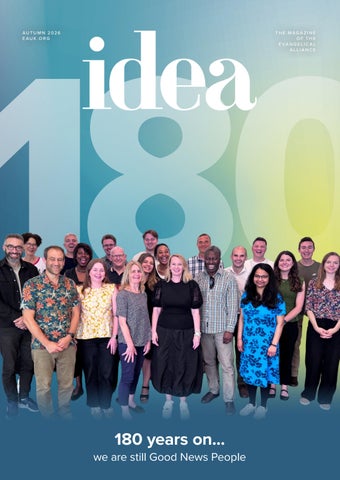
180 AUTUMN 2026 E AUK .ORG
idea
180 years on...
we are still Good News People
THE MAGA ZINE OF THE E VA N G E L I C A L ALLIANCE
eauk.org Facebook-square evangelicalalliance Twitter-square EAUKnews INSTAGRAM evangelicalalliance Membership queries and updates 020 7520 3830 membership@eauk.org Advertising 020 7520 3830 sales@eauk.org Design Sarah Fisher sarahfisher.co.uk Evangelical Alliance Leadership group Gavin Calver, CEO; Peter Lynas, UK director; Theresa Stone, director of communications and engagement; John Gibson, director of membership, finance and operations; Hil Sewell, director of people and culture; Danny Webster, director of advocacy and research; Alicia Edmund, head of public policy; David Smyth, head of Evangelical Alliance in Northern Ireland; Tim Rowlands, head of Evangelical Alliance in Wales; Lynne Paterson, head of Evangelical Alliance in Scotland Evangelical Alliance offices Head office 176 Copenhagen Street London N1 0ST tel 020 7520 3830 info@eauk.org Northern England 1a The Mailbox 1 Exchange Street, Stockport Gt Manchester SK3 0GA Northern Ireland First Floor, Ravenhill House 105 Ravenhill Road Belfast BT6 8DR tel 028 9073 9079 nireland@eauk.org Wales 40 The Hayes, Cardiff, CF10 1AJ tel 029 2022 9822 wales@eauk.org Scotland Challenge House 29 Canal Street Glasgow G4 0AD tel 0141 353 0150 scotland@eauk.org The Evangelical Alliance. A company limited by guarantee. Registered in England and Wales No. 123448. Registered Charity No. England and Wales: 212325, Scotland: SC040576. Registered Office: 176 Copenhagen Street, London, N1 0ST idea is published in accordance with the Evangelical Alliance’s Basis of Faith, although it is impossible in every article to articulate each detail and nuance of belief held by Evangelical Alliance members. Articles in idea may therefore express views on which there is a divergence of opinion or understanding among evangelicals. idea accepts advertisements and inserts to offset printing costs. Advertising in idea does not imply editorial endorsement. The Evangelical Alliance reserves the right to accept or refuse advertisements at its discretion. Articles may be reproduced only with permission from the editor.
Welcome idea AUTUMN 2026
I
am deeply honoured and grateful to God for His faithfulness as I bring you this special edition of idea magazine, celebrating 180 years of the Evangelical Alliance making Jesus known. Inspired by the chapters of Gavin Calver and Phil Knox’s book, Good News People, in these pages we celebrate the legacy of the Evangelical Alliance and the organisations that have grown from it, including Tearfund and Home for Good. We look back at significant moments in our history, from supporting early missions to Billy Graham’s first UK crusade, while also looking ahead to the opportunities before us today. You’ll find insights on how we can engage our nation through brave conversations around politics and laws that affect us as evangelicals, as well as practical wisdom on sharing the gospel with young adults while remaining faithful to scripture. We also share some of the work ahead, inspired by our latest research, Understanding UK Evangelicals,
Contents
|
which explores where evangelicals are found across the UK and reveals some surprising and encouraging findings. For 180 years, we have sought to live out the call set out in John 17:18: to be sent into the world. Today, that means continuing to resource the church, speaking up in corridors of power and sharing the good news of Jesus across the UK. We are deeply grateful for every individual, church and organisational member who has journeyed with us – those who have been there from the beginning and those who have joined us along the way. As we face the challenges of our present day, may we be spurred on to make the most of this missional moment and the spiritual openness we are seeing across our nation. Here’s to the next 180 years – and beyond! Nicola Morrison Editor
HOPEFUL AND REALISTIC
06 Understanding UK Evangelicals
23 Faith in Focus
10 When better communication opens doors
15 Church life
30 A call to Hull: tears, hope and the gospel
CULTURALLY RELEVANT WITHOUT SELLING OUT
BRAVE AND KIND
04 Taking the good news message to the airwaves
16 Brave conversations 29 Prayer in a cancel culture Steve Uppal
GO FOR DECISIONS AND MAKE DISCIPLES
02 So that the world may believe Dr David Hilborn
hil Knox P Evangelical Alliance
avin Matthews G Solas
26 Reaching young people without abandoning biblical convictions haun Hornsby S Youth for Christ
UNITED AND DIVERSE
12 A legacy of 24 United and hope: bringing diverse: one change where it’s new humanity needed most in Christ arryn Pegna T Tearfund
athaniel Jennings N OMF
01
icola Morrison N Evangelical Alliance
anny Webster D Evangelical Alliance
nthony Delaney A Ivy Church Manchester
licia Edmund A Evangelical Alliance
20 When the church says yes ania Bright T Home for Good
REFLECTIONS FROM OUR CEO
32 180 years, one unchanging mission
avin Calver G Evangelical Alliance
hil Irvin P Light Church Hull
All Nations Church and Movement
32
02
|
180 years on...
So that the world may believe Dr David Hilborn traces the 180-year story of the Evangelical Alliance, exploring how Jesus’ prayer for unity has shaped its history and enduring commitment to making Jesus known.
180
years ago, a remarkable group of Christians gathered in London around a simple but ambitious idea: that if the church could stand together for the gospel, more people would come to know Jesus. It was hardly a new idea. A century earlier, John Wesley had envisioned what he called a “national union of evangelical clergy”. Having spearheaded a revival that transformed the spiritual and social life of Britain, Wesley believed that gospel-centred Christians from different denominations should work more strategically together to consolidate the gains made in that revival. After all, Jesus Himself had prayed, “May they be one... so that the world may believe” (John 17:21). Yet Wesley’s hopes were never fully realised. Frustrated by the enduring divisions he encountered, he famously dismissed those who failed to unite as “a rope of sand”.
Yet the vision for unity refused to disappear. At the turn of the 19th century, evangelical Christians increasingly recognised that while they might worship in different church streams, they shared the same passion for taking the good news of Jesus to the world. Organisations such as the London Missionary Society and the British and Foreign Bible Society were founded in this period, and impressively demonstrated what could happen when Christians worked together across traditional boundaries. That growing spirit of co-operation reached a defining moment in August 1846, when more than a thousand leaders from Britain, Europe and America gathered in London to form ‘The World’s Evangelical Alliance’. They came from different churches, cultures and regions, but with a common conviction: to “manifest and promote the unity of Christ’s people.”
idea AUTUMN 2026
|
03
Right: Rev Billy Graham speaks to a huge congregation at an open air meeting in Trafalgar Square during his Greater London crusade tour, 1954
From its very beginning, the Alliance understood that proclaiming the gospel and living out the gospel belonged together. That conviction was tested almost immediately when attendees debated whether slaveholders should be admitted into membership. The discussions were difficult and revealed deep divisions, particularly between the British and American contingents. An eventual compromise left the Alliance with a more decentralised structure than initially planned. This allowed different national Alliances to respond to their own contexts, but weakened the Alliance as a cohesive global body. Even so, the British Alliance became a powerful advocate for religious freedom, speaking out for persecuted Christians across Europe and beyond. As the 20th century unfolded, the Alliance repeatedly found itself asking the same question: how can Christians remain united without losing sight of gospel truth? That question shaped the British Alliance’s contribution to missionary efforts spurred by the Empire Exhibition of 1924 and its support for the German Confessing Church during the Nazi era – and, ultimately, to the reconfiguration of ‘The World’s Evangelical Alliance’ along more integrated lines as the World Evangelical Fellowship in 1951, later to be called the World Evangelical Alliance. Throughout these changing circumstances, the central founding vision remained remarkably consistent: unity not as an end in itself, but as a means of making Christ known. Perhaps no episode captured that spirit more vividly than the Billy Graham mission of 1954.
From its very beginning, the Alliance understood that proclaiming the gospel and living out the gospel belonged together.
When Graham wanted to bring an evangelistic campaign to London, some were hesitant, but the Alliance committed significant time, energy and finance to supporting him. The risk proved worthwhile. What began as a four-week campaign extended to more than three months, eventually drawing over 2 million people. Thousands publicly responded to the gospel, countless churches were encouraged in evangelism, and the impact echoed down the generations. The decades that followed brought fresh challenges. The Anglican John Stott and the independent Martyn Lloyd-Jones clashed in 1966 on whether evangelicals should remain in ‘mixed’ denominations. In 1968, The Evangelical Alliance Relief Fund (Tearfund) was founded to further the original commitment of the Alliance to common action alongside common proclamation. Pentecostal, House Church and Black Majority church movements came to play more prominent roles in British Christian life. Britain itself became increasingly multicultural and later, increasingly post-Christian. Rather than retreating, however, the Alliance broadened its vision of who should be around the table. With Clive Calver as general director, personal membership rose dramatically in the 1980s and 90s, while Joel Edwards and Steve Clifford advanced Calver’s commitment to a truly UK-wide Alliance, with national offices in Scotland, Wales and Northern Ireland, and initiatives like the One People Commission and the Gather Network reflecting the greater ethnic and
regional diversity of 21st century British evangelicalism. Today, under Gavin Calver’s leadership, methods of communication and co-operation continue to evolve. Digital resources, podcasts, the Ethos pathway for spiritually curious people and research projects such as Finding Jesus all seek to equip and unite Christians for witness. Much has changed since that inaugural conference in 1846. Society has changed. The church has changed. Forms of media have changed. But the good news of Jesus has not. And the passion to share that good news as one people in Christ has remained definitive. For 180 years the Evangelical Alliance has sought to answer Jesus’ prayer for unity so that more people might know Him. Today’s strapline – “Together making Jesus known” – is not a novel concept. It is the latest expression of the same calling that drew those thousand or so evangelical Christians together almost two centuries ago, and the same mission that continues to inspire the Evangelical Alliance today.
Dr David Hilborn is academic dean and senior lecturer in theology and church history at the London School of Theology. Prior to that, he held senior posts at Moorlands College, St John’s College, Nottingham, and St Mellitus College. He was head of theology at the Evangelical Alliance from 1997–2006 and chaired its Theological Advisory Group from 2016–2024.
04
|
180 years on...
Phil Knox shares the vision behind The Good News People podcast, in partnership with Premier Radio and the Evangelical Alliance, and why he is excited that they are back for a second season.
Taking the good news message to the airwaves
G
avin and I are not instinctive podcast hosts and are much more at home in the pulpit. But we are good news people with a story to tell about the brilliant things God is doing in the UK right now and so Ness Wilson
we were willing to lean in, and started on this amazing journey, spreading His good news message in a different way... The beating heart of every episode is to enthuse the listener with stories of hope and inspire them to move closer to God. We preach in a different church every week and want to give our listeners a front-row seat as we describe the beauty and breadth of evangelicals across the UK. Jesus is transforming lives everywhere. We think that is worth talking about. We were blown away by the response to season one. The podcast had over 60,000 listens and downloads and as we travelled around the country we met with people of all
ages who had heard us on the airwaves. Gavin even met an eleven-year-old boy who listened to each episode weekly with his dad. Our sense is that with the relentless stream of bad news stories, there is a growing longing to fix our eyes on good things and have our hearts lifted by a better story. The format of each episode starts there. We each share a recent moment where we’ve seen lives transformed by the gospel or a church making a big impact in their community. The tone is very conversational, owing to the fact Gavin and I have been mates for over 20 years! We share many things in common but are also different in lots of ways. One thing that unites us is a wholehearted desire to see people put their faith in Jesus. But our friendship means that we can give our listeners an insight into our worlds and talk about the highs and lows of preaching in a variety of diverse (and sometimes quirky) contexts. We also explore a ‘big idea’ around how we live as good news people as
idea AUTUMN 2026
|
05
Left: Omar Beckles Below: Glen Scrivener
Our sense is that with the relentless stream of bad news stories, there is a growing longing to fix our eyes on good things and have our hearts lifted by a better story. well as being joined by a weekly guest. We love meeting people, hearing their stories and gleaning their wisdom. In the first season, we heard about a surge in baptisms and spiritual openness among young adults from Damilola Makinde and Glen Scrivener. Ness Wilson shared powerfully about maintaining an eternal perspective through the grief of losing a child. Nims Obunge gave us insights into the diversity of the UK church and the power of unity. They were really powerful conversations! And you are more than welcome to listen back. I pray you will be amazed, as we were. Season two, which started at the beginning of September, is centred
around the theme of ‘spiritual springtime’. Over the last few years the statistics and the stories have all pointed to an encouraging openness to the gospel. We would say that what we are experiencing is not revival, but it is a new season. So we discuss the characteristics of the season we are in and how we might respond and join in with what God is doing. We explore the rise in young men coming to faith, people turning up to church having had spiritual experiences, how we create church services that are compelling for unchurched people and more. Our guests include Bishop Jill Duff, professional footballer Omar Beckles, Les Isaac, founder of Street Pastors, and Dave Smith, who leads Kingsgate Church in Peterborough. We would love you to check it out and hope you are as encouraged as we were by their captivating stories and perspectives. We are so grateful to all those who have joined us on the journey so far. We are thankful for the expertise and the
partnership of Premier, who produce the podcast and broadcast it across their channels. Our prayer is that we continue to bring encouragement to a world that needs it and that it would cause Christians to be even more confident in being good news people to those around them. We long to be the antidote to the bad news we are bombarded with daily. We are desperate to be the remedy to a divided and fractured society whose algorithms serve us content that makes us angry and disillusioned. We were made for more. May we lift our eyes to the good and true news, our Saviour.
Phil Knox is head of gospel impact at the Evangelical Alliance. He loves seeing people meet Jesus and studying journeys of faith. Phil is the author of Story Bearer: How to Share Your Faith, The Best of Friends and, with Gavin Calver, Good News People.
06
|
180 years on...
Evangelical Christians in the UK are younger and more diverse
Danny Webster, director of advocacy and research, unpacks our timely, major research project which uncovers who evangelical Christians in the UK are, how many there are and what they believe.
idea AUTUMN 2026
|
07
UK evangelicals: identity and belief
Broad Evangelicals
7.9%
Identity Evangelicals
11.4%
of UK population
8.0 million people
of UK population
Belief Evangelicals
5.5 million people
14.1%
Classic Evangelicals
of UK population
9.9 million people
3.8% of UK population
2.6 million people
UK evangelicals based on identity and belief, showing Broad and Classic Evangelicals. Circle areas are drawn in proportion to population size. Figures are applied to a total UK population of 70 million.
T
he story that we have heard for many years is of Christianity’s decline and faith becoming less relevant to life in modern Britain. While the religious makeup of the UK has certainly changed, the decline of Christian belief, and particularly evangelical belief, has been greatly exaggerated. What we found paints a picture of a young and diverse movement of evangelicals, more numerous than previously thought, but also more complex in its identity and beliefs. We found that just under 40% of Christians in the UK – or about 17% of the adult population – are somewhat
evangelical. This means that they either identify as an evangelical or they hold core evangelical beliefs. Within this, we found that 7.9% of UK adults both identify as an evangelical and agree with four core evangelical beliefs: the authority of the Bible, personal conversion, the centrality of the cross, and the importance of faith being put into action. If applied to the whole UK population, this would equate to 5.5 million people, a group we have called Broad Evangelicals. This is far more than previous estimates, which suggested there were around 2 million evangelical Christians in the UK. Within that Broad Evangelicals group, are what we have termed Classic
Working with Whitestone Insight we surveyed 8,407 UK adults as a representative sample of the UK population. Of this group 45% identified as a Christian and were asked follow-up questions about their identity, belief and religious practice.
Evangelicals; these are Protestant Christians who identify as an evangelical and strongly agree with the four core belief statements. This makes up 3.8% of UK adults, or approximately 2.6 million people. These two groups are the focus of our research, and we will be producing a further report on them. However, two other groups also offer a fascinating insight into the breadth and complexity of evangelicalism. The first is that, in churches across the UK, there are many Christians who share evangelical beliefs, but would reject the label. Making up approximately 4.3 million people, these might be considered as undiscovered Belief Evangelicals. The second is that, to our surprise, we found around 2.4 million people were Identity Evangelicals, who would accept the label, but did not agree with all four beliefs. This group was also less likely to attend church regularly.
08 |
180 years on...
Two thirds of practising Christians are evangelicals Our research found that 7.2% of UK adults meet the criteria of a practising Christian: someone who attends church at least once a month, and reads the Bible and prays at least weekly. When looking at this group in detail, we found that almost two-thirds (64%) are Broad Evangelicals, and almost all (85%) share evangelical beliefs. Most of the people attending churches across the UK and practising their faith are evangelical Christians.
Evangelicals are younger and ethnically diverse Age distribution of Classic Evangelicals 18–24
19.4%
25–34
24.1%
35–44
19.7%
45–54
10.8%
55–64
10.8%
65–74
7.6%
75+
7.6%
While one of the primary cultural narratives about Christianity in the UK has been that it is ageing, anecdotal accounts and other research in recent years have suggested young adults are increasingly exploring faith. Our research adds to this picture, showing that adults under 35 are the most likely to identify as evangelical and to hold evangelical beliefs, making up 43% of our Classic Evangelical group. When compared to the age profile of the UK, evangelical Christians are disproportionately young.
Ethnic distribution of Classic Evangelicals Mixed or multiple ethnic background 3.5%
White 65.4%
Asian or Asian British 2.2%
Black, Black British, Caribbean or African 27.9%
Any other ethnic group 1.0%
When the data is broken down by denomination, it is clear that traditional denominations are older, while younger adults are more prevalent in Pentecostal and independent churches. Another popular narrative has been the increasing ethnic diversity of the UK church. This research confirms that among evangelical Christians, a significant minority, at least a quarter on the widest definition and around 35% for Classic Evangelicals, are from ethnic minority groups. Our ambitious research project is uncovering more than we have ever known before about the profile of evangelicals in the UK. This knowledge helps the Evangelical Alliance to speak with greater confidence as we seek to influence public life, and engage with more understanding as we work for unity together to make Jesus known.
Explore the research and discover what it reveals about the people, beliefs and identity shaping evangelicalism today. Download at: eauk.org/research or scan the QR code. Understanding ls angelicading Understan UK Ev ? ls Evangelica UKthey Who are Who are they?
Research conducted Insight with Whitestone Research conducted with Whitestone Insight
10
|
180 years on...
When better communication opens doors
Great questions and attentive listening are the foundations of meaningful connection, Gavin Matthews explains.
M
ary* worked for a ministry which taught Bible study methods. However, she nursed a deep sense of regret – one many of us can relate to – that she rarely had conversations with nonChristians about Jesus. We met her in Scotland at a seminar led by Solas’ director, Andy Bannister, entitled, ‘How to talk about Jesus without looking like an idiot’. There he outlined several questions we can use to open up spiritual conversations, sensitively diffuse hostility, and handle objections. On the flight home she was seated several rows from her family and so gave it a go with the passenger alongside her. She wrote to tell us, in surprise as much as delight, “It really worked, I shared the gospel with someone for the first time in ages!” At the youth seminar, a Christian teenager called Cameron* sat soaking it all in. The very next day he was confronted by a classmate who said, “What is a Christian doing in a science lab?” The idea that faith is incompatible with science had been directed at the Christian student. It was a hugely stressful moment, but using the training he’d just received, Cameron didn’t become defensive or seek to brilliantly refute the flawed premise of his accuser; instead, he remembered he’d been taught to calmly respond. From there a conversation began which led to speaking about the gospel. It turned out that the fellow student was using the science vs faith argument as a smokescreen, behind which lay deep questions about the presence of suffering and his perception of an absent God. What was the key in both situations? Mary and Cameron had been taught to ask good questions, which opened up gospel opportunities, diffused tensions and revealed the real issues hidden behind hostility. The importance of all this is amplified by the fact that we are witnesses for Christ in a society which is facing a loneliness crisis, and a deficit of deep conversational connection. We swim in cultural waters longing for genuine community, while technology, home-working, and the long-shadow cast by lockdown all make it harder to find. The mainstream media has been pumping out vast amounts of material to help us navigate this, under headlines such as ‘How to talk to anyone: the experts guide’, ‘The new rules of small talk: how to nail every conversation’, and ‘How to be a better conversationalist (and why meaningful conversation is dying out)’.1 Common to all this Andy Bannister, director of Solas, analysis is the human hunger speaking at Keswick
idea AUTUMN 2026
|
11
for connection, our struggles to converse, and the power of questions and deep listening to forge connections between people. As Christians we shouldn’t be surprised, because Jesus asked over 300 questions in the Gospels. But also, because scripture tells the story of how humanity, created in God’s image and designed to know and be known, fell into sin and experienced alienation from God and one another. So, when Christ came to restore the fracture of the fall, He came both as the Lamb of God who died for the sins of the world and the master of conversation – engaging people with His redemptive work, at meal tables, on roadsides and in synagogues. As Jesus conversed, He did so in a world gripped by questions about religious orthodoxy, Roman occupation and the future of the nation. Today, we are living in a world in which a ‘new openness’ is replacing the ‘new-atheism’ (which itself is looking rather old!). Back in the 1990s, social psychologist Roy Baumeister was right to argue that the questions which would dominate Western culture would be those of identity, meaning, value and agency: Who am I? What am I for? What am I worth? And, can I make a difference? These are powerful questions to bring into conversation and to which the gospel brings stunning answers. Along with many fellow-travellers in UK evangelicalism, at Solas we invest a huge amount of time training Christians to be great conversationalists who know how to ask and answer great questions and listen well. We do this through our Confident Christianity conferences and training seminars, and use of books such as Andy Bannister’s, How to Talk About Jesus Without Looking Like an Idiot, or Questioning Evangelism by the late Randy Newman. Our experience – like that of Cameron and Mary, and churches all around the country – is that learning to be a good question-asking conversationalist is a skill which, like speaking a foreign language, can be learned with practice; and can lead to deep connections and life-giving gospel opportunities. Not only that – but we also get to become a bit more Christlike in the process.
Rosie Ifould, The Guardian, Sat 28 Nov 2015. Zoe Williams, The Guardian Wed 9 July 2025. Josh Smith, Marie Claire, 20 Feb 2026. 1
*Names changed
Gavin Matthews is assistant director (Scotland) of Solas, an organisation that provides resources, training and inspiration for sharing the good news of Jesus practically and persuasively. He has been married to Elaine since 1996, and they have three adult children. He is a member of Perth Baptist Church.
12
|
180 years on...
A legacy of hope: bringing change where it’s needed most Tearfund was born out of the Evangelical Alliance almost 60 years ago. Tarryn Pegna highlights its early history and how they continue to respond practically to a world in need.
T
earfund was born in May 1968. Martin Luther King had been assassinated the previous month, the Vietnam War was escalating, and student protests in France were bringing that country to a halt. Not unlike now, the world then cried out for love – the kind of love that saw the need and the pain and felt called to offer a practical solution. The kind of love that would follow Jesus where the need was greatest.
Early seeds
How it started
The seeds of Tearfund had already been sown eight years earlier. 1960 was the UN’s World Refugee Year, bringing into the spotlight the 40 million people globally who had been forced to flee their homes because of disasters or violent conflicts. It sparked a spontaneous influx of money and other items arriving at the Evangelical Alliance office from Christians who wanted to help those in need. That year, a fund was set up to distribute these gifts, starting by providing care for refugees in Hong Kong.
In that month, The Evangelical Alliance Relief Fund Committee (soon to become Tearfund), was set up by Morgan Derham, general secretary of the Evangelical Alliance, and six others. Morgan had a vision to see Christians getting hands-on in responding to poverty around the world. He’d hired student Mary Jean the year before to research where the needs were and what the possibilities were for a viable relief fund. Her work led to Tearfund’s first official appeal in support of refugees in Amman, Jordan.
Almost 60 years since Tearfund’s official conception, the staff has grown and the work has spread to more than 50 countries across the globe. And the need for it is still great. Right now, there are 41.6 million refugees around the world and a further 67.8 million people displaced within their own countries. 2.1 billion people do not have access to safe drinking water. Around 1 in 11 people go hungry every day.
How it’s going
Above: Members of a village savings association in Uganda meet to collect savings for the group. Setting up savings groups is one of the ways Tearfund helps communities build their way out of poverty. The name of this group means ‘fighting poverty in the household’. Credit: Tom Price/Tearfund
idea AUTUMN 2026
|
13
Tearfund believes as deeply now as in 1968, that it is our responsibility, as Christ followers, to respond wherever the need is greatest. To do this, we work directly or alongside local partners and churches around the world: to provide humanitarian aid quickly when disasters and conflicts happen; to equip communities to lift themselves out of poverty in a lasting way; and to challenge unjust policies and practices at a local, national and global level.
Esther’s story One of Tearfund’s most effective ways of working is through a programme called Transforming Communities. Starting with the local church, Tearfund provides training and various other resources, depending on the needs of the community, to help people identify and implement sustainable solutions to the challenges they are facing – whether that be hunger, lack of water, a prevalence of sexual and gender-based violence, limited access to healthcare or education, or tensions within the community that make it difficult to work together. Esther in Bangui, Central African Republic, took part in Transforming Communities training. Now, because of the changes she has been inspired to make, people in her community have more opportunities to thrive.
Tearfund’s Transforming Communities training helps people find and implement solutions to overcome poverty. Drawing on what she learnt from Tearfund, Esther in Central African Republic has been helping equip young women to lift their families out of poverty through education. Credit: Elijah Muweza/Tearfund
Tearfund has responded to many humanitarian crises over the years. Currently, in the Democratic Republic of Congo, staff and partners are supporting local communities with hygiene supplies and handwashing stations to help prevent the spread of disease. Credit: Elijah Muwaza/Tearfund Where she lives, many people face severe financial struggles, and a series of violent attacks since 2013 have forced people from their homes and robbed them of possessions and loved ones. Esther says these experiences have left the community’s young people “aggressive, violent and fearful”. Drawing on what she learned from Tearfund, she has been helping equip young women to lift their families out of poverty through education – teaching them to read, write and do basic maths. She’s also introducing them to other incomegenerating skills, such as soap making, and helping them set up savings groups, where they meet each week to save money together to invest in small businesses. Esther says, “If a woman has some education, she will start to instil it in the family, and this will also help the country move forward. That’s what Tearfund taught us to help these women.” And, Esther has also been sharing the knowledge she’s gained with other women who asked to be involved when they saw the excellent results. Now, they support widows and take care of orphans, and the training Esther received has even impacted her husband’s preaching. He now preaches about whole-life transformation that has very practical outworkings in the community, and doesn’t stop at personal acceptance of salvation. As one Tearfund staff member says, “I work for Tearfund because we witness God’s work. Hope exists.” Tarryn has worked for Tearfund on and off, in various roles, since 2007. She’s been writing for Tearfund since 2019.
Now with 50% off fees for smaller churches
Theological training to help you thrive in Christian Ministry • Foundation Award • Undergraduate courses • Postgraduate courses *NEW & FLEXIBLE* • MA in Contemporary Christian Leadership
Find out more at oakhill.ac.uk/study
Bible teaching on TWR-UK Scan to listen: Internet Radio YouTube Online TV Apps
idea AUTUMN 2026
Church life: ANTHONY DELANEY As the Evangelical Alliance marks 180 years, Rev Anthony Delaney reflects on its enduring influence and why its mission continues to inspire his own ministry.
I
t was a few months ago, while watching the World Cup that I found myself reflecting on leadership: following a great goal against a relentless opposition that continually fought dirty, England lost the game by bringing on more defenders – rather than pressing their opponents and scoring again. Which got me thinking. Our instinct when culture inevitably shifts can be to react to the next problem rather than reach the next person. The church has never advanced because Christians agreed on every issue, but when we keep Jesus at the centre and work together that still feels like the winning game plan. He did not call us to build the church, nor did He commission us to manage decline. We are commanded to make disciples who make disciples – that’s how we win. When I was a police officer my favourite job was to wield ‘The Big Key’ – the battering ram that knocked in the doors of drug dealers or criminal lairs. That’s always what comes to mind when I read The Message rendering of Matthew 16 where the Lord says His church is “so expansive with energy that not even the gates of Hell will be able to keep it out.” Gates are defensive. They don’t advance. But they break when the church does. Throughout history opponents have confidently announced the death of Christianity, but whenever and wherever the church has moved forward in this way it remains God’s unstoppable force on the Earth.
“We have to go to church.” When big Olli first walked into our church a year ago you couldn’t miss him. I asked what brought him to Ivy Church and he said his mum had died a little while ago. When he was talking about her with his wife in the garden,
“A white feather dropped down from the sky and landed on my hand… so I said, ‘We have to go to church.’” That’s a shift many are seeing in our day. Here at Ivy, week after week, people come in with questions about Jesus, searching for truth following spiritual encounters. We live in exciting times – are you ready for them? Olli’s whole family have now given their lives to the Lord and through Ivy’s discipleship pathway he’s now passionately sharing Jesus – even going out on the streets to witness alone as well as with our teams. As the Evangelical Alliance’s Talking Jesus research encourages us, they find curiosity more than rejection and many people are open to prayer and an invitation – the fields are white unto harvest, if we go out into them.
Resilient faith This year we’ve held multiple baptism services as we continually equip newcomers through our discipleship mentoring. We have conducted surveys that show an increase in members reading scripture for themselves. Another showed that over 80% of those who are part of our church self-described as ‘very resilient’ to facing the difficulties life throws at us – imagine if you could bottle that for society! We are discovering the power of regular fasting and our prayer gatherings are pregnant with expectancy. None of this makes headlines, but Heaven knows something’s happening. Next year I intend to film a teaching series on the seven churches in Revelation on location. Those letters remind us from the very start that churches lose their light when they lose their first love or compromise on biblical convictions. But in every generation, when we proclaim the good news clearly, pray together in unity, pursue justice and promote righteousness in every sphere of influence, we overcome.
|
15
16 |
180 years on...
Brave conversations in a cancel culture Alicia Edmund shares how we can disagree well without alienating others.
F
or the past five years, I have been the head of public policy at the Evangelical Alliance. In that time, I have represented our members on some of the most contested issues of the day, including: raising concerns with commissioners and advising the government on the non-statutory definition of Islamophobia, highlighting the need to protect free speech, ensuring that gospel proclamation online or on the streets are not wrongly prosecuted as hate speech, campaigning for policies to strengthen the right to life at beginning and end of life as well as cautioning politicians on introducing progressive policies on sexuality and transgender identity. There have been many policy victories and some discouragements. Christian witness in a progressive and humanist culture will often cause offence, but it is crucial Christians have the courage to engage on difficult issues and articulate Jesus’ vision for humanity and society. In my work, I am often reminded of Jesus’ words: “If the world hates you, keep in mind that it hated me first”(John 15:18). Two words that inform my tone on controversial issues are rooted and relational.
The state of our nation needs more than vibes politics. Instead, our politics needs heavenly wisdom in building community and caring for the vulnerable. As disciples of Jesus, we must remain rooted in His word. Psalm 119 is a beautiful psalm. Throughout, it reiterates the importance of the word of God bringing hope, life and purpose. Verse 116 in the Tree of Life translation says, “Sustain me according to your word, so I may live, and let me not be ashamed of my hope”. This verse gets to the heart of one’s motive and asks us: are we ashamed of God’s ways? The hope revealed in scripture is different from what culture presents. Jesus is our hope and His way ushers in true hope. Therefore, it is incumbent on Christians to embrace the totality of scripture and re-present it to a society in search of hope. Secondly, being relational means being affable, not just with those I like but especially towards those I disagree with. I can remember the summer of 2025, when following the Commons vote to decriminalise abortion and legalise assisted suicide in England and Wales, I felt prompted to write to Christian MPs who voted in support of both. The email was sent to over 40 MPs yet only one accepted the invitation to meet in-person. It was a difficult conversation. At times I felt myself fighting back tears because of the blatant disregard and justification of ignoring the freedom and rights of the unborn child. I wasn’t able to convince the MP to change their stance (should there be a future vote on the issue), but we were able to disagree well. The exchange taught me a valuable lesson on the power of proximity and relationship. Jesus ate with and ministered alongside Judas for three years, knowing Judas would go on to betray Him.
Being relational means being affable, not just with those I like but especially towards those I disagree with.
idea AUTUMN 2026
|
I learned it is far easier to withdraw from people we disagree with and let our opinions be known via social media or in how we speak of them to others. But as disciples we must be open to the possibility that the Holy Spirit may prompt us to pray prayers of blessing or to maintain contact with them. Why? Because sometimes wanting to win souls is better than winning arguments. In 1 Peter 3:10–11 in the NASB translation there are three ‘musts’ that I keep in mind when engaging with parliamentarians or the media or whenever I’m speaking: 1. “The one who desires life, to love and see good days, must keep his tongue from evil and his lips from speaking deceit. 2. He [or she] must turn away from evil and do good. 3. He [or she] must seek peace and pursue it. At a time when we are living amongst political chaos and societal fragmentation, as Christians, we should not shrink back from speaking out within local communities and in workplaces on the issues facing the nation. There remains a need for the church to speak up for the unborn, on policies that harm the mental and physical welfare of children, undermine the sanctity of life or dilute truth in the public square. So in all things let’s be reminded by the ‘musts’ of 1 Peter 3:10–11 and have brave and kind conversations.
Alicia joined the Evangelical Alliance as head of public policy in August 2021. Since then, she has worked on a range of public policy areas including immigration reform, freedom of religion in the UK and overseas, health and social care, and the role and importance of the church in addressing community cohesion. Alicia leads the advocacy team’s parliament and Whitehall engagement and is focusing all legislative engagement on three core themes: dignity, freedom and justice.
17
Helping ministries flourish.
Different seasons in your ministry can mean that changes to your policies and procedures are needed. For help reviewing or updating your governance documents, employment policies, or for property advice contact:
edwardconnor.com info@edwardconnor.com 01858 411568
EMPLOYMENT
DATA
CHARITY LAW
EQUALITIES
PROPERTY
idea AUTUMN 2026
We hope you are enjoying idea magazine!
If you aren’t already, why not become a member today? Visit eauk.org/membership or scan the QR code Advantages of becoming a personal member: • Resources to equip and encourage you. • idea, our quarterly magazine, which is full of good news stories, great ideas and opportunities to hear what God is up to around the UK.
You will also: • Be the first to hear of events, gatherings, training opportunities, new resources, advocacy campaigns and prayer initiatives through our emails and appeals. • Gain representation on a national and UK-wide scale as we speak up on behalf of the church and the vulnerable to government and the media. • Be able to invite an Evangelical Alliance speaker to your church or organisation to share our experiences of what God is doing in the UK today.
|
19
20 |
180 years on...
Maggie (right) carer to her two grandchildren and Elsa (left) her Family Support Volunteer and friend
When the church says yes! M
Tania Bright highlights how the church’s response to a simple vision has transformed the lives of children and families for the better.
ore than a decade ago, a simple but urgent question was being asked: what would it take for the church to ensure that every child in the UK who needs a safe and stable home could find one? Thousands of children were waiting for adoptive families, and the shortage of foster carers was, and remains, deeply concerning. Young people who are leaving the care system without a permanent support network were disproportionately represented in
homelessness statistics and long-term hardship. The situation demanded a response rooted not only in compassion, but in action. In March 2013, the Evangelical Alliance UK, alongside Care for the Family and Thirtyone:eight launched a collaborative campaign that would become Home for Good. The vision was bold: raise awareness within churches about the urgent need for foster and adoptive families, and through the church, meet that need. We believed that if Christian communities truly understood the scale of the challenge, they would step forward. And they did.
Within the first 18 months, the campaign reached more than 250,000 Christians. Churches across the country began engaging with the issue in new ways. One significant milestone was the launch of the first national Adoption Sunday, where hundreds of congregations prayed for children in care, celebrated families who had opened their homes, and considered how God might be calling them to respond. In pockets across the UK, churchgoers began to step forward as foster carers in unprecedented numbers. It was clear that something significant was happening; a movement was emerging.
idea AUTUMN 2026
|
21
Left: A family support volunteer sharing a hug with the child of a family she’s been walking alongside
By September 2014, it became evident that this could no longer remain a temporary initiative. The momentum, the stories, and the growing network of families required a permanent home. Home for Good was established as an independent charity, carrying forward the original vision while expanding its mission. As the charity grew, Home for Good’s work developed into a two-pronged approach: recruiting new families willing to open their homes to children
who need temporary or permanent care and equipping and supporting churches to become wraparound communities for these families. Alongside supporting families and churches, Home for Good has become a trusted voice in policy discussions, working with government to champion reforms that prioritise children’s need for family, stability and belonging. In September 2024, Home for Good merged with Safe Families, a charity focused on preventing children entering care through early intervention and support for isolated families. Both organisations share a deep commitment to strengthening families, supporting children, and mobilising the church as a force for compassion in action.
Annabel’s story
Tania speaking at Spring Harvest on how the church is called to care
“My husband Justin and I have two sons, but I always felt there was room for more children in our hearts and home. Friends at church who fostered children showed us that opening our home was possible. Although I felt inspired by reading the Home for Good book, I wrestled with questions about how our sons would cope, and whether God was calling us to foster. Everything changed when I heard about Safe Families at church. I saw an opportunity for my family to help another whilst figuring out whether fostering was right for us. We were matched with a mother who needed respite care for her baby son, and for over a year we welcomed him every other weekend. The experience built our confidence, and I am still in touch with the mum to this day.
Through volunteering with Safe Families, we realised fostering babies and toddlers would suit our family. After prayer and reflection, we became foster carers for children aged 0–3 years old. We connected with the new Home for Good worker in our area and together we set up a network of local Christian foster carers and adopters to support each other. While I already had a Christian community that prayed for me, there is something unique about connecting with others who are experiencing the same thing as you, and their support was priceless.” Since the start of both charities, more than 12,000 families have received support through early intervention programmes, while we have journeyed with and referred 1,823 potential adoptive parents, foster carers and supported lodgings hosts. Today, Home for Good stands as a powerful network of thousands of individuals, local co-ordinators, and hundreds of churches across the UK. It has shifted the cultural conversation around care within the British faith community, transforming the abstract concept of ‘social care’ into a tangible, deeply personal mission of hospitality, family, and love.
Tania Bright is the Co-CEO of Home for Good and Safe Families, a national charity with a bold vision to see children and families flourish.
Break bread together
as the early Church did When you take your church away, you make room for deeper fellowship and time with God. At High Leigh, The Hayes and Highgate House, you’ll find welcoming manor house venues dedicated to Christian groups. We serve everything from team retreats of 12 to conferences of up to 400, with prices from £99 per person per night*.
Where the Church gathers
cct.org.uk
rt e comfo h t l e e F family of your
*Terms and conditions apply.
TRY A THEOLOGY SHORT COURSE A flexible, accessible way to study Theology, without the commitment of a full programme or accredited qualification. Some of our non-accredited modules available to study online:
Introduction to the Old Testament Introduction to the New Testament Introduction to Doctrine Spiritual Theology 1 Old Testament Hebrew 1 Introduction to Greek 1 Introduction to Greek 2 Biblical Texts Theology of Worship Preaching Pastoral Care
For more information:
lst.ac.uk/life-long-learning
FAITH IN FOCUS
Steve Uppal Senior leader of All Nations Church and Movement and has lived across the UK, USA, Poland and India. We explore family, ministry and what it was like for him to grow up in a multi-generational, multi-religion home.
Nicola Morrison explores faith, challenge and hope through honest and candid conversations with four faith leaders in this new web series. Special guests include Steve Uppal, Natalie Williams, Alisa Latty-Alleyne and Mark Holden.
Natalie Williams
Alisa Latty-Alleyne The former UK director of the global Christian Broadcasting Network, opens up about how the unexpected death of her first husband led to an unhealthy addiction and how God brought her back from a spiral of destruction.
The CEO of Jubilee+ explores how not fitting the mould of a ‘typical’ Christian, alongside her experience of poverty and hardship, has shaped her identity and continues to influence her ministry today.
Mark Holden Church leader and author of Surviving a Stabbing, shares his powerful testimony and his spiritual and physical journey to recovery.
All four episodes are available now. Visit: eauk.it/faith-in-focus or scan the QR code.
24
|
180 years on...
United and diverse: one new humanity in Christ
Nathaniel Jennings outlines why diversity and unity are not mutually exclusive but essential in a fractured world.
D
iversity is from God and reflects His very nature. The Trinity perfectly models diversity without division: unity without uniformity. Father, Son, and Holy Spirit are distinct in identity and
role, yet perfectly one. Their differences enrich rather than divide. The Trinity also shows how this is possible: through deep mutual love, service, honour, and delight in one another. There is no self-seeking or competition, only perfect co-operation and harmonious community. From our triune God came the beauty and diversity of creation, including men and women made in His image. Humanity was created to flourish in both diversity and unity, reflecting its Creator. I was reminded of this recently
when a Ukrainian woman livestreamed from her church to family back home, introducing them to her new Iranian brothers and sisters in Christ. Having grown up believing Iranians were her enemies because of their government’s support for Russia’s war, she told her family, “They are nothing like we were told. They are beautiful people.” In Christ, old hostilities gave way to a new family. This, however, is not how the world naturally works. God’s good design was shattered when humanity rejected His
idea AUTUMN 2026
|
25
In Christ we receive forgiveness and grace, and we are freed to extend that same forgiveness and grace to others.
wisdom and chose its own way. Sin has left us self-centred and ethnocentric. The results are evident in violence, tribalism, division, dehumanisation, and hostility within our communities and across the world. Yet there is hope. God offers a better way through Christ. The damage is real, and generations of hostility have left deep wounds. God’s answer is reconciliation: first, vertical reconciliation with Himself, and then horizontal reconciliation with one another across every social, cultural, and ethnic boundary. Ephesians 2 tells us: “Because of His great love for us, God, who is rich in mercy, made us alive with Christ even when we were dead in transgressions – it is by grace you have been saved.” It goes on to remind us that God is our peace and His purpose was to create in Himself one new humanity and to reconcile both Jews and Gentiles through the cross. This is the fullness of the gospel. In Christ we receive forgiveness and grace, and we are freed to extend that same forgiveness and grace to others. The gospel brings together people who would otherwise remain enemies. A minister friend once told me about a White working-class man who introduced himself by saying, “Pastor, you need to know I’m a racist.” Ten years later, at his thanksgiving service, the church was filled with people from different ethnicities, cultures, and social backgrounds giving thanks for his friendship and kindness. That is not
merely behaviour modification. It is the transforming power of the gospel. God has entrusted us with a ministry of reconciliation. This is both personal and communal. Christian communities should display the fruit of the gospel by becoming kingdom communities that reflect Christ through intercultural worship, fellowship, and witness. This is the hope for our fractured United Kingdom and our world. Diversity need not lead to division; in Christ it can lead to flourishing for all. Yet we do not begin with a blank page. We seek to become one family despite deep historical and present-day wounds. As Ephesians 2:22 reminds us, God is building His diverse people together into a dwelling where He lives by His Spirit. As the architect, He has also shown us how. The journey begins with lament. Together we grieve the brokenness in our hearts and relationships – not assigning blame but honestly mourning what sin has done. We then invite God to search our own hearts, revealing our prejudices, attitudes, words, and actions. None of us are innocent. All of us need repentance. From there we seek and extend forgiveness before recommitting ourselves together to pursue God’s kingdom, marked by love, mercy, justice, and transformed lives. I have seen churches live this out. In one town, a Filipino-led church now includes African and White British believers worshipping together. After racist graffiti declaring “White only” appeared locally, an elderly White British woman stood during a service and prayed, “Lord, thank you for
bringing these wonderful people to bless our town.” The surrounding culture spoke exclusion; the church embodied the kingdom. At the heart of it all must be reconciliation. We must remember the grace and mercy God has shown us and extend that same grace and mercy to one another. I recently spoke with a Chinese Christian in Belfast who shared the fear and anxiety he has experienced following race-related riots. Yet he said, “When I see those local young people involved, I feel sad for them. They are so lost. I wish I could show them a better way.” That response reflects the heart of Christ – meeting hostility not with hatred but with compassion. This is the transforming power of the gospel. Christ not only reconciles us to God; He reconciles us to one another. In Him, diversity becomes a gift, unity becomes possible, and the world catches a glimpse of the kingdom of God.
Nathaniel Jennings did his master’s degree through Queens University Belfast with his dissertation focusing on church in Muslim contexts. Nathaniel served as OMF’s area representative for Ireland for several years before becoming their intercultural ministries director in 2022. He leads a team helping churches across the UK and Ireland grow into places where people of all backgrounds are welcomed in Jesus’ name and share His love with others.
26 |
180 years on...
Reaching young people without abandoning biblical convictions Shaun Hornsby, director of national evangelism at Youth For Christ, shares how we can navigate being culturally relevant with young people without compromising on the message of the gospel.
A
t British Youth For Christ, everything we do is anchored in one major principle: to see young people’s lives changed by Jesus. We are driven by the belief that Jesus is the Light of the World and the ultimate hope for all humanity. Right now, something incredibly exciting is happening across our nation. The tide is changing, and we are meeting a generation of young people who are remarkably open, deeply curious, and searching for spiritual connection. Yet, while our mission is clear, we also see the challenges. Today’s young people are growing up in a world that can often feel overwhelming. They have constant access to information, are navigating competing and conflicting worldviews, and face unprecedented pressure to choose who they are before they’ve even had a chance to grow. In the midst of these complexities, it is understandable that navigating truth can be challenging. Despite these realities, we at Youth For Christ see a generation who are still searching for meaning, identity and truth. So, how do we reach them? How do we introduce young people to Jesus in an extremely complex world without abandoning our biblical convictions? We may not have every single answer, but we do want to share some thoughts that may help.
idea AUTUMN 2026
|
27
Holding firm, reaching far
The method changes, the message does not Throughout history, every generation has found different ways to share the gospel. From the early church proclaiming Jesus in homes and marketplaces, to the medieval church using art and architecture to tell God’s story, to more recent expressions through social action, media and youth ministry, the methods have continued to evolve. Whilst we believe the message of Jesus and the biblical convictions that shape our faith remain unchanged, we also believe the way we communicate that message should be flexible. As theologian Karl Barth is often quoted as saying, “Preach with the Bible in one hand and the newspaper in the other.” This captures the sentiment of remaining rooted in the unchanging truth of scripture while communicating the gospel relevantly. Using different methodologies such as contemporary music, visual arts, testimony, film or spoken word to communicate the message of Jesus does not weaken our convictions; it is often an expression of them. Our aim is not to alter the truth of scripture, but to remove unnecessary barriers that may prevent young people from encountering Jesus. The method can change, but the message should not.
If I could offer a short sentence which helps unpack the essence of evangelism, it would be this: helping others take one step closer to Jesus. We can do that without abandoning the biblical convictions we hold. Young people aren’t looking to disengage with difficult truths, if anything, many young people today are deeply hungry for authenticity. In a world where so much of life is edited, curated and often falsified online; they are searching for what is real, trustworthy and true. Rather than watering down the gospel, we should present it with honesty and integrity, confident that young people are capable of engaging with its depth and challenge. We can hold firm whilst reaching far, having the courage to lovingly say to young people, “This is what we believe because this is what scripture teaches”, even when it is unpopular. This should also be actioned by encouraging young people to explore scripture for themselves, as we trust that God’s word is living and active. Whilst doing this, we must ensure when sharing our beliefs with young people we communicate with care, humility and compassion. Rather than expecting agreement with our belief system, we need to walk alongside them, creating space for honest conversations while faithfully pointing them towards Jesus. We have a unique opportunity presented to us in this moment. The question is whether we are willing to embrace it. Young people need followers of Jesus who are committed to building bridges, not barriers. They need people who hold firmly to biblical truth while sharing it with wisdom. They need those who are willing to listen well and earn trust. So, how could you begin praying for them? What spaces could you help create where they feel safe to ask honest questions, explore scripture, and encounter Jesus without fear of being dismissed or judged? As we pray, listen, love, and point young people to Jesus, we can trust that God is already at work. He is the one who transforms lives and we have the privilege of joining in with what He is doing. If you would like to join us in this mission, or discover how you or your church can get involved, visit: yfc.co.uk Shaun Hornsby is based in Exeter and is the director of national evangelism for British Youth For Christ, an organisation passionate about seeing young people encounter Jesus.
SUDAN’S BLOODSHED
IS VISIBLE FROM SPACE. BUT IGNORED BY THE WORLD. Today, over 12 million displaced refugees are cut off from food, clean water, and vital healthcare. And for many, the only way to deliver help is by air. Your donation of £31.50 could help fly a medical specialist 25 miles, bringing vital medical support closer to refugee settlements in South Sudan.
Donate today: maf-uk.org/sudan-crisis4
FREEPOST RTKH–HJEY–BTJL, MAF UK, Castle House, Castle Hill Avenue, Folkestone CT20 2TQ 01303 852819
supporter.relations@maf-uk.org
MAF-UK.ORG
Registered charity in England and Wales (1064598) and in Scotland (SC039107) ® Registered trademark 3026860, 3026908, 3026915
idea AUTUMN 2026
Bold in truth, rich in grace
|
29
A prayer by Steve Uppal Father, we come to you in a time of volatility, a nation fractured by politics, a church at risk of confusing your kingdom with our tribes. Forgive us where we have reached for a flag before we have knelt before the cross, where politics has discipled us more than you have. In the noise, keep us God-centred, not politically positioned, kingdom-oriented and not culturewar focused. Let our first loyalty be to Christ, and Him crucified, not to any party, platform or nation. Make us brave – willing to speak truth and stand for justice even when it costs us. But guard us fiercely from anger dressed up as conviction. Where others meet division with judgement and accusation, let us respond with kindness, for love, not outrage, is the mark you gave us to be known by. Like David before Goliath, let our courage come not from natural strength but from knowing you. Give us discernment to know which battles are truly yours to fight. Raise up a generation who look more like Jesus than like the loudest voice in the room. In Jesus’ name, Amen.
Steve Uppal has served as senior leader of All Nations Church and Movement, a growing family of churches across the UK, USA, Poland and India, since 2001. He has been involved in leadership at All Nations since 1992 and has served as senior leader since 2001. Steve is married to Esther, and they have four grown, married children and several grandchildren. He is the author of six books and has travelled to over 40 nations, equipping and encouraging leaders around the world. He is passionate about developing healthy churches and mobilising the church to fulfil its missional mandate, particularly in reaching unreached nations.
30
|
180 years on...
A call to Hull: tears, hope and the gospel Phil Irvin, lead elder at Light Church Hull, shares why he is hopeful and realistic about the mission to transform his city.
H
ull – officially Kingston upon Hull – is a city with a remarkable story. Sitting on the east coast of Yorkshire, it is known as the home of William Wilberforce, the evangelical Christian abolitionist and probably Hull’s most famous son. But Hull is also a city of deep need, stubborn hope and, I believe, a fresh work of God. For many years, Hull was home to Europe’s largest deep-sea fishing fleet. Its boom years stretched from the 1920s to the 1960s, before the complete and devastating collapse of the industry in the 1970s following the Icelandic Cod Wars. That collapse, together with the slow pace of post-war recovery, left deep scars: catastrophic unemployment, deprivation, poor housing, and serious
challenges in education and health. Some of the most deprived wards in the UK are here in our city. The church in Hull, from the 1960s until recent years, has also known decline, with many churches and chapels closing their doors. Hull has often had a reputation for being a hard place for the gospel, with one of the lowest church attendance rates anywhere in the UK.
Try tears William Booth’s Salvation Army was heavily involved in Hull, with Booth preaching here many times in the late 1800s amid the poverty of that era. On one occasion, two of his officers reported back that things were hard and the work was failing. Booth replied with a telegram: “TRY TEARS”.
idea AUTUMN 2026
That phrase has stayed with me. Many Christians have prayed and wept over this city, me included: tears for the lost, the poor and the broken. There have been many calls to prayer, nights of prayer, weeks of prayer, and churches uniting across different traditions to seek God together. I believe God records our tears and hears our prayers.
“put my tears in your bottle. Are they not in your book?” Psalm 56:8
We cannot look away William Wilberforce once said, “You may choose to look the other way, but you can never again say you didn’t know”. Once you have seen the poverty, crime, addiction, hopelessness and brokenness, you cannot simply look the other way. I was called back here in 1993, and I could not leave. I see God at work here, and there is still so much to do among the lost and the poor. At Jubilee Church Hull, our parent church, one of our projects is our Homeless Drop-In. We provide showers, laundry and refreshments for people who are homeless in the city centre. I was moved to tears again by a young pregnant girl, hopelessly addicted and sleeping rough; and a blind man in a terrible state after being given a potent drug by a dealer looking for a new victim. We must care for the poor, facing the need head on with all the love and compassion we can give, to be the hands and feet of Jesus. This is what our staff and volunteers do every week.
|
31
Pat was on the streets and addicted. He started coming in for a shower, got to know the people, came to church, and is now born again, free and settled as part of the church. He was baptised earlier this year. Then there’s Rich. He was addicted to crack and spice. After coming to the Homeless Drop-In for many years, Rich came to church, received Jesus, and is now part of the church. He is looking to go to a Christian rehab any day now.
Signs of hope After 33 years here as a Christian, I do believe we are seeing change in the church. Not every church is growing, and I am not claiming we are in revival; but something of God is happening, and we want more of that. Churches are seeing the lost saved and baptised, including local Hull people. A year ago, we were sent by Jubilee Church Hull to start a new church plant called Light Church. We went into one of Hull’s most deprived areas, HU3, to share the gospel and care for the poor. At Christmas, we hired an old church building to host a carol service. At this stage, we were a church of about 30 people. We had contact with local primary schools and had done some street outreach, so, in faith, we put out 80 chairs. Well, our faith was not big enough, because more than 140 people from the local area turned up. It was amazing. Hull still faces major issues, yet we are seeing breakthrough. People we know, who have battled addiction, are escaping from their old lives and learning to live free. It is wonderful to see the truth that the Lord is “near to the broken hearted, and saves those who are crushed in spirit” (Psalm 34:18). Phil Irving is married to Debs, and they have two adult children and are grandparents to baby Tobias. After receiving Jesus in his twenties while working in Switzerland he returned to Hull in 1993, along with his wife. Since then, they have served as leaders in several churches and, more recently, planted Light Church Hull. Phil is passionate about the gospel: he regularly trains people in evangelism and loves going out to share the good news.
32
|
180 years on...
180 years, one unchanging mission Gavin Calver reflects on a remarkable legacy – and why he believes we should approach this moment in the UK with renewed expectation.
T
here are moments in history when you realise afresh that you are standing on the shoulders of giants. For me, celebrating 180 years of the Evangelical Alliance is one of those moments. Since 1846, generations of evangelicals have chosen to stand together, to make Jesus known, and serve the church and wider society. They have prayed, shared the gospel, spoken into corridors of power, planted churches, cared for the vulnerable and shared hope in challenging times. We are beneficiaries of their faithfulness. One of those monumental moments happened in the early 1950s when the Evangelical Alliance took a bold financial risk to help bring Billy Graham’s evangelistic mission to Harringay and then London more
widely. Investing all its money, including its own reserves, in the belief that the potential kingdom impact was worth the cost. What followed became one of the most significant evangelistic events in British history, reaching millions and seeing thousands respond to the gospel. The impact of the mission has lasted for decades. Today many people say that their faith journey started with those meetings, and many people became Christians later on because of their parents or grandparents attending the mission. Churches were encouraged to reach out to their communities too, and many became more confident in sharing the gospel as a result. At the Evangelical Alliance, we have remained committed to keeping our focus on the gospel ever since. We are standing on the shoulders of the people who came before us, and we also want to
be a people who share the good news in our day too. The way we do things may have changed, but the mission has not. That is why I believe the Evangelical Alliance’s 180th anniversary is about far more than looking backwards. It is an invitation to look forwards with expectation. Our calling remains beautifully simple: to be good news people in a bad news world. To hold firmly to Jesus, remain rooted in scripture, live with courage and kindness, and take every opportunity to share the hope we have found in Christ. The UK desperately needs good news and I believe the church has it. So, as we celebrate our 180th anniversary, we are thankful to God for how He has moved over the years, and as we look to the future, we want to play our part in sharing the gospel as we continue to make Jesus known together.
“Speak up for those who cannot speak for themselves, for the rights of all who are destitute. Speak up and judge fairly; defend the rights of the poor and needy.” Proverbs 31:8–9
Will you help us keep fighting the good fight ? For over 160 years, we have been fighting for people who are vulnerable and marginalised. Will you help us be there – and stand up and speak out for people who need us most in years to come? At The Salvation Army, we believe that every life is worth fighting for. That’s why, tonight and every night, our Lifehouses offer people who are experiencing homelessness a safe place to sleep.
LPR092607
It’s why our officers are out there, in the poorest communities, week in and week out, helping families feed their children. And it’s why our doors are always open to older people who urgently need our friendship and support. Inspired by our belief in God and his love for all people, we fight for
everyone who needs us – without judgment or discrimination. It’s a fight we continue with love and compassion, 24 hours a day, 365 days a year.
The Salvation Army in your Will. You can find out more in our Will guide – which you can get absolutely free today.
To do this, we depend on gifts in the Wills of friends like you. With you on our side, we will continue our shared mission: fighting – without discrimination – for our disadvantaged brothers and sisters for generations to come. We understand that your main priority is to provide for your family. But once you have done this, it’s easy to include a gift to
0800 954 1057
Take the next step with your FREE guide
Quoting code
TSA7 Simply call or visit salvationarmy.org.uk/gifts-wills/ideamag The Salvation Army, UK Territorial Headquarters,1 Champion Park, LONDON SE5 8FJ. A Christian Church and Registered Charity No. 214779, and in Scotland SC009359.
Scan code Scan thisthis QR QR code to to download your guide now download your guide now
Jesus Didn’t Make this Optional. Christians are called to care for people facing poverty and homelessness. It's something Jesus cares about - and we do too. What if where you put your savings, could be part of God's answer to homelessness? Since 1999, Green Pastures has given thousands of Christians a way to do just that — lending their savings to restore lives and help people into a home of their
own, then receiving their capital back at the end of the loan term. As a thank you, you can choose to earn up to 5% annual return.
It's more than giving. It's faithfully stewarding what God has entrusted to you to help change lives.
Discover how your money can change lives. greenpastures.co.uk/invest
Currently housing over 1,500 people through local projects all over the UK
greenpastures.co.uk 0300 365 4500
Registered with the Financial Conduct Authority