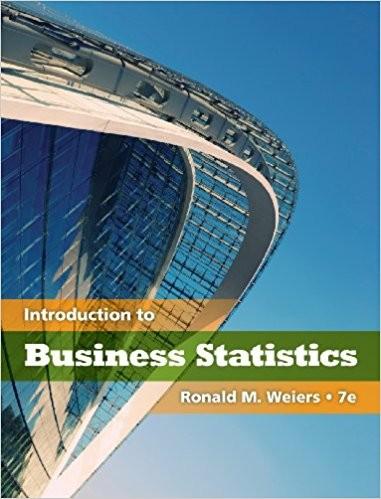
To Connor, Madeleine, Hugh, Christina, Aidan, Mitchell, Owen, Emmett, Mr. Barney Jim, and
With loving memories of our wonderful son, Bob, who is swimming with the dolphins off Ocracoke Island
This page intentionally left blank
B R I E F C O N T E N T S
Part 1: Business Statistics: Introduction and Background
1. A Preview of Business Statistics 1
2. Visual Description of Data 15
3. Statistical Description of Data 57
4. Data Collection and Sampling Methods 101
Part 2: Probability
5. Probability: Review of Basic Concepts 133
6. Discrete Probability Distributions 167
7. Continuous Probability Distributions 205
Part 3: Sampling Distributions and Estimation
8. Sampling Distributions 244
9. Estimation from Sample Data 270
Part 4: Hypothesis Testing
10. Hypothesis Tests Involving a Sample Mean or Proportion 311
11. Hypothesis Tests Involving Two Sample Means or Proportions 364
12. Analysis of Variance Tests 411
13. Chi-Square Applications 467
14. Nonparametric Methods 505
Part 5: Regression, Model Building, and Time Series
15. Simple Linear Regression and Correlation 551
16. Multiple Regression and Correlation 600
17. Model Building 644
18. Models for Time Series and Forecasting 687
Part 6: Special Topics
19. Decision Theory 737
20. Total Quality Management 758
21. Ethics in Statistical Analysis and Reporting (Online Chapter) Appendices
A. Statistical Tables A-1
B. Selected Answers B-1
Index/Glossary I-1
Chapter 4: Data Collection and Sampling Methods
4.1
4.2 Research
4.4 Experimentation and Observational
PART 2: PROBABILITY
Chapter 5: Probability: Review of Basic Concepts
5.1 Introduction
5.2 Probability: Terms and Approaches
5.3 Unions and Intersections of Events
5.4 Addition Rules for Probability
5.5 Multiplication Rules for Probability
5.6 Bayes’ Theorem and the Revision of Probabilities
5.7 Counting: Permutations and Combinations
5.8 Summary
Chapter 6: Discrete
6.1
6.2
6.4
6.5 Simulating Observations
Chapter
7.1
7.2 The
7.3 The
7.4 The
7.5
7.6
PART 3: SAMPLING DISTRIBUTIONS AND ESTIMATION
PART 4: HYPOTHESIS TESTING
10.2 Hypothesis
10.7 The Power of a Hypothesis
Integrated Case: Thorndike Sports
(A)
Seeing
Applet 12: z-Interval and Hypothesis
Chapter 11: Hypothesis Tests Involving
11.2 The Pooled-Variances t-Test for Comparing the Means of Two Independent Samples
11.3 The Unequal-Variances t-Test for Comparing the Means of Two Independent Samples
11.4 The z-Test for Comparing the Means of Two Independent Samples
11.5 Comparing Two Means When the Samples Are Dependent
11.6 Comparing Two Sample Proportions
11.7 Comparing the Variances of Two Independent
Circuit Systems, Inc. (A)
Seeing Statistics Applet 14: Distribution of Difference Between Sample
Chapter 12: Analysis of Variance Tests
14.5
14.6
PART 5: REGRESSION, MODEL BUILDING, AND TIME SERIES
Chapter
15.2
15.3
15.4
15.5
15.6
Chapter 16: Multiple Regression and Correlation
16.1 Introduction
16.2 The Multiple Regression Model
16.3 Interval Estimation in Multiple Regression 609
16.4 Multiple Correlation Analysis 615
16.5 Significance Tests in Multiple Regression and Correlation 617
16.6 Overview of the Computer Analysis and Interpretation 622
16.7 Additional Topics in Multiple Regression and Correlation 632
16.8 Summary 634
Integrated Case: Thorndike Sports Equipment 639
Integrated Case: Springdale Shopping Survey 640
Business Case: Easton Realty Company (A) 641
Business Case: Circuit Systems, Inc. (C) 643
Chapter 17: Model Building
17.1 Introduction
17.2 Polynomial Models with One Quantitative Predictor Variable 645
17.3 Polynomial Models with Two Quantitative Predictor Variables 653
17.4 Qualitative Variables
17.5 Data Transformations
17.6 Multicollinearity
17.7 Stepwise Regression
Integrated Case: Thorndike Sports Equipment
Integrated Case: Fast-Growing Companies
Business Case: Westmore MBA Program
Business Case: Easton Realty Company (B) 685
Chapter 18: Models for Time Series and Forecasting
18.1 Introduction 688
18.2 Time Series 688
18.3 Smoothing Techniques
18.4 Seasonal Indexes
18.5 Forecasting
18.6 Evaluating Alternative Models: MAD and MSE 713
18.7 Autocorrelation, The Durbin-Watson Test, and Autoregressive Forecasting 715
18.8 Index Numbers
18.9 Summary 729
Integrated Case: Thorndike Sports Equipment (Video Unit Five) 735
PART 6: SPECIAL TOPICS
P R E F A C E
Philosophies and Goals of the Text: A Message to the Student
A book is a very special link between author and reader. In a mystery novel, the author presents the reader with a maze of uncertainty, perplexity, and general quicksand. Intellectual smokescreens are set up all the way to the “whodunit” ending. Unfortunately, many business statistics texts seem to be written the same way—except for the “whodunit” section. This text is specifically designed to be different. Its goals are: (1) to be a clear and friendly guide as you learn about business statistics, (2) to avoid quicksand that could inhibit either your interest or your learning, and (3) to earn and retain your trust in our ability to accomplish goals 1 and 2.
Business statistics is not only relevant to your present academic program, it is also relevant to your future personal and professional life. As a citizen, you will be exposed to, and perhaps may even help generate, statistical descriptions and analyses of data that are of vital importance to your local, state, national, and world communities. As a business professional, you will constantly be dealing with statistical measures of performance and success, as well as with employers who will expect you to be able to utilize the latest statistical techniques and computer software tools—including spreadsheet programs like Excel and statistical software packages like Minitab—in working with these measures.
The chapters that follow are designed to be both informal and informative, as befits an introductory text in business statistics. You will not be expected to have had mathematical training beyond simple algebra, and mathematical symbols and notations will be explained as they become relevant to our discussion. Following an introductory explanation of the purpose and the steps involved in each technique, you will be provided with several down-to-earth examples of its use. Each section has a set of exercises based on the section contents. At the end of each chapter you’ll find a summary of what you’ve read and a listing of equations that have been introduced, as well as chapter exercises, an interesting minicase or two, and in most of the chapters—a realistic business case to help you practice your skills.
Features New to the Seventh Edition
Data Analysis PlusTM 7.0
The Seventh Edition makes extensive use of Data Analysis PlusTM 7.0 , an updated version of the outstanding add-in that enables Microsoft Excel to carry out practically all of the statistical tests and procedures covered in the text. This excellent software is easy to use, and is available on the premium website that accompanies this text.
The Test Statistics and Estimators Workbooks
The Excel workbooks Test Statistics and Estimators accompany and are an important complement to Data Analysis PlusTM 7.0. These workbooks enable Excel users to quickly perform statistical tests and interval-estimation procedures by simply entering the relevant summary statistics. The workbooks are terrific for solving exercises, checking solutions, and especially for playing “what-if” by trying different inputs to see how they would affect the results. These workbooks, along with Beta-mean and three companion workbooks to determine the power of a hypothesis test, accompany Data Analysis PlusTM 7.0 and are also available on the premium website at www.cengage.com/bstats/weiers.
Updated Set of 82 Computer Solutions Featuring Complete Printouts and Step-By-Step Instructions for Obtaining Them
Featuring the very latest versions of both Excel and Minitab—Excel 2007 and Minitab 16, respectively—these pieces are located in most of the major sections of the book. Besides providing relevant computer printouts for most of the text examples, they are accompanied by friendly step-by-step instructions written in plain English.
Updated Exercises and Content
The Seventh Edition includes a total of nearly 1600 section and chapter exercises, and more than 300 of them are new or updated. Altogether, there are about 1800 chapter, case, and applet exercises, with about 450 data sets for greater ease and convenience in using the computer. The datasets are in Excel, Minitab, and other popular formats, and are available on the text’s premium website. Besides numerous new or updated chapter examples, vignettes, and Statistics in Action items, Chapter 20 (Total Quality Management) has been expanded to include coverage of Process Capability indices and measurement. In response to user preferences and for greater ease of use, the normal distribution table is now cumulative, and it is conveniently located on the rear endsheet of the text.
Continuing Features of Introduction to Business Statistics
Chapter-Opening Vignettes and Statistics In Action Items
Each chapter begins with a vignette that’s both interesting and relevant to the material ahead. Within each chapter, there are also Statistics In Action items that provide further insights into the issues and applications of business statistics in the real world. They include a wide range of topics, including using the consumer price index to time-travel to the (were they really lower?) prices in days gone by, and surprisingly-relevant discussion of an odd little car in which the rear passengers faced to the rear. Some of the vignette and Statistics in Action titles:
Get That Cat off the Poll! (p. 116)
Proportions Testing and the Restroom Police (p. 467)
Time-Series-Based Forecasting and the Zündapp (p. 687)
Probabilities, Stolen Lawn Mowers, and the Chance of Rain (p. 138)
The CPI Time Machine (p. 728)
A Sample of Sampling By Giving Away Samples (p. 126)
Gender Stereotypes and Asking for Directions (p. 364)
Extensive Use of Examples and Analogies
The chapters continue to be packed with examples to illustrate the techniques being discussed. In addition to describing a technique and presenting a smallscale example of its application, we will typically present one or more Excel and Minitab printouts showing how the analysis can be handled with popular statistical software. This pedagogical strategy is used so the reader will better appreciate what’s going on inside the computer when it’s applied to problems of a larger scale.
The Use of Real Data
The value of statistical techniques becomes more apparent through the consistent use of real data in the text. Data sets gathered from such publications as USA Today, Fortune, Newsweek, and The Wall Street Journal are used in more than 400 exercises and examples to make statistics both relevant and interesting.
Computer Relevance
The text includes nearly 200 computer printouts generated by Excel and Minitab, and the text’s premium website contains data sets for section and chapter exercises, integrated and business cases, and chapter examples. In addition to the new Data Analysis PlusTM 7.0 software and the handy Test Statistics and Estimators workbooks that accompany it, the Seventh Edition offers the separate collection of 26 Excel worksheet templates generated by the author specifically for exercise solutions and “what-if” analyses based on summary data.
Seeing Statistics Applets
The Seventh Edition continues with the 21 popular interactive java applets, available at the text’s premium website. Many of these interesting and insightful applets are customized by their author to specific content and examples in this textbook, and they include a total of 85 applet exercises. The applets are from the award-winning Seeing Statistics, authored by Gary McClelland of the University of Colorado, and they bring life and action to many of the most important statistical concepts in the text.
Integrated Cases
At the end of each chapter, you’ll find one or both of these case scenarios helpful in understanding and applying concepts presented within the chapter:
(1)
Thorndike Sports Equipment Company
The text continues to follow the saga of Grandfather (Luke) and Grandson (Ted) Thorndike as they apply chapter concepts to the diverse opportunities, interesting problems, and assorted dilemmas faced by the Thorndike Sports Equipment Company. At the end of each chapter, the reader has the opportunity to help Luke and Ted apply statistics to their business. The text’s premium website offers seven Thorndike video units designed to accompany and reinforce selected written cases. Viewers will find that they enhance the relevance of the cases as well
as provide some entertaining background for the Thorndikes’ many statistical adventures.
(2) Springdale Shopping Survey
The Springdale Shopping Survey cases provide the opportunity to apply chapter concepts and the computer to real numbers representing the opinions and behaviors of real people in a real community. The only thing that isn’t real is the name of the community. The entire database contains 30 variables for 150 respondents, and is available from the premium website accompanying the text.
Business Cases
The Seventh Edition also provides a set of 12 real-world business cases in 10 different chapters of the text. These interesting and relatively extensive cases feature disguised organizations, but include real data pertaining to real business problems and situations. In each case, the company or organization needs statistical assistance in analyzing their database to help them make more money, make better decisions, or simply make it to the next fiscal year. The organizations range all the way from an MBA program, to a real estate agency, to a pizza delivery service, and these cases and their variants are featured primarily among the chapters in the latter half of the text. The cases have been adapted from the excellent presentations in Business Cases in Statistical Decision Making, by Lawrence H. Peters, of Texas Christian University and J. Brian Gray, of the University of Alabama. Just as answers to problems in the real world are not always simple, obvious, and straightforward, neither are some of the solutions associated with the real problems faced by these real (albeit disguised) companies and organizations. However, in keeping with the “Introduction to …” title of this text, we do provide a few guidelines in the form of specific questions or issues the student may wish to address while using business statistics in helping to formulate observations and recommendations that could be informative or helpful to his or her “client.”
Organization of the Text
The text can be used in either a one-term or a two-term course. For one-term applications, Chapters 1 through 11 are suggested. For two-term use, it is recommended that the first term include Chapters 1 through 11, and that the second term include at least Chapters 12 through 18. In either one- or two-term use, the number and variety of chapters allow for instructor flexibility in designing either a course or a sequence of courses that will be of maximum benefit to the student. This flexibility includes the possibility of including one or more of the two remaining chapters, which are in the Special Topics section of the text.
Chapter 1 provides an introductory discussion of business statistics and its relevance to the real world. Chapters 2 and 3 cover visual summarization methods and descriptive statistics used in presenting statistical information. Chapter 4 discusses popular approaches by which statistical data are collected or generated, including relevant sampling methods. In Chapters 5 through 7, we discuss the basic notions of probability and go on to introduce the discrete and continuous probability distributions upon which many statistical analyses depend. In Chapters 8 and 9, we discuss sampling distributions and the vital topic of making estimates based on sample findings.
Chapters 10 through 14 focus on the use of sample data to reach conclusions regarding the phenomena that the data represent. In these chapters, the reader
will learn how to use statistics in deciding whether to reject statements that have been made concerning these phenomena. Chapters 15 and 16 introduce methods for obtaining and using estimation equations in describing how one variable tends to change in response to changes in one or more others.
Chapter 17 extends the discussion in the two previous chapters to examine the important issue of model building. Chapter 18 discusses time series, forecasting, and index number concepts used in analyzing data that occur over a period of time. Chapter 19 discusses the role of statistics in decision theory, while Chapter 20 explores total quality management and its utilization of statistics.
At the end of the text, there is a combined index and glossary of key terms, a set of statistical tables, and answers to selected odd exercises. For maximum convenience, immediately preceding the back cover of the text are pages containing the two statistical tables to which the reader will most often be referring: the t-distribution and the standard normal, or z-distribution.
Ancillary Items
To further enhance the usefulness of the text, a complete package of complementary ancillary items has been assembled, and they are available at the premium website accompanying the text:
Student Premium Website
This website available at www.cengage.com/bstats/weiers, contains Data Analysis PlusTM 7.0 Excel add-in software and accompanying workbooks, including Test Statistics and Estimators; Seeing Statistics applets; datasets for exercises, cases, and text examples; author-developed Excel worksheet templates for exercise solutions and “what-if” analyses; and the Thorndike Sports Equipment video cases. Also included, in pdf format, are Chapter 21, Ethics in Statistical Analysis and Reporting, and the Chapter 19 appendix on the expected value of imperfect information.
Instructor’s Suite Resource
The Instructor’s Resource CD (IRCD) is available to qualified adopters and contains author-generated complete and detailed solutions to all section, chapter, and applet exercises, integrated cases and business cases; a test bank in Microsoft Word format that includes test questions by section; ExamView testing software, which allows a professor to create exams in minutes; PowerPoint presentations featuring concepts and examples for each chapter; and a set of display Seeing Statistics applets based on those in the text and formatted for in-class projection.
Also Available from the Publisher
Available separately from the publisher are other items for enhancing students’ learning experience with the textbook. Among them are the following:
Student Solutions Manual (Weiers)
This manual is author-generated and contains complete, detailed solutions to all odd-numbered exercises in the text. It can be purchased electronically via Cengage Brain at www.cengagebrain.com.
Instructor’s Solutions Manual (Weiers)
The Instructor’s Solutions Manual contains author-generated complete and detailed solutions to all section, chapter, and applet exercises, integrated cases and business cases. It is available to qualified adopters and is in Microsoft Word format on the password-protected instructor’s website at www.cengage.com/bstats/weiers.
Test Bank (Doug Barrett)
Containing over 2600 test questions, including true-false, multiple-choice, and problems similar to those at the ends of the sections and chapters of the text, the computerized Test Bank makes test creation a cinch. The ExamView program is available from the text’s premium website and on the IRCD.
PPTs: (Priscilla Chaffe-Stengel)
The PowerPoint slides contain the chapter learning outcomes, key terms, theoretical overviews, and practical examples to facilitate classroom instruction and student learning. The PowerPoint files are available from the text’s premium website and on the IRCD.
Minitab, Student Version for Windows (Minitab, Inc.)
The student version of this popular statistical software package. Available at a discount when bundled with the text.
Acknowledgements
Advice and guidance from my colleagues have been invaluable to the generation of the Seventh Edition, and I would like to thank the following individuals for their helpful comments and suggestions:
J. Douglas Barrett
University of North Alabama
David Bush
Villanova University
Priscilla Chaffe-Stengel
California State University-Fresno
Fred Dehner
Rivier College
Jim Ford
University of Delaware
Jeff Grover
Dynamics Research Corporation
Janice Harder
Motlow State Community College
Farid Islam
Utah Valley State College
Yunus Kathawala
Eastern Illinois University
Linda Leighton
Fordham University
Edward Mansfield
University of Alabama
Elizabeth Mayer
St. Bonaventure University
Rich McGowan
Boston College
Patricia Mullins
University of Wisconsin
Alan Olinsky
Bryant University
Deborah J. Rumsey
The Ohio State University
Farhad Saboori
Albright College
Dan Shimshak
University of Massachusetts
Kathy Smith
Carnegie Mellon University
Debra K. Stiver
University of Nevada, Reno
Mark A. Thompson
University of Arkansas at Little Rock
Joseph Van Metre
University of Alabama
I would also like to thank colleagues who were kind enough to serve as reviewers for previous editions of the text: Randy Anderson, California State University—Fresno ; Leland Ash, Yakima Valley Community College ; James O. Flynn, Cleveland State University; Marcelline Fusilier, Northwestern State University of Louisiana; Thomas Johnson, North Carolina State University; Mark P. Karscig, Central Missouri State University; David Krueger, Saint Cloud State University; Richard T. Milam, Jr., Appalachian State University; Erl Sorensen, Northeastern University ; Peter von Allmen, Moravian College : R. C. Baker, University of Texas-Arlington ; Robert Boothe, Memphis State University ; Raymond D. Brown, Drexel University; Shaw K. Chen, University of Rhode Island; Gary Cummings, Walsh College; Phyllis Curtiss, Bowling Green State University ; Fred Derrick, Loyola College ; John Dominguez, University of Wisconsin—Whitewater; Robert Elrod, Georgia State University; Mohammed A. El-Saidi, Ferris State University; Stelios Fotopoulos, Washington State University; Oliver Galbraith, San Diego State University ; Patricia Gaynor, University of Scranton ; Edward George, University of Texas—El Paso; Jerry Goldman, DePaul University; Otis Gooden, Cleveland State University; Deborah Gougeon, Appalachian State University ; Jeffry Green, Ball State University ; Irene Hammerbacher, Iona College; Robert Hannum, University of Denver; Burt Holland, Temple University ; Larry Johnson, Austin Community College ; Shimshon Kinory, Jersey City State College ; Ron Koot, Pennsylvania State Universit y; Douglas Lind, University of Toledo; Subhash Lonial, University of Louisville; Tom Mathew, Troy State University—Montgomery; John McGovern, Georgian Court College ; Frank McGrath, Iona College ; Jeff Mock, Diablo Valley College; Kris Moore, Baylor University; Ryan Murphy, University of Arizona; Buddy Myers, Kent State University; Leon Neidleman, San Jose State University; Julia Norton, California State University—Hayward; C. J. Park, San Diego State University; Leonard Presby, William Patterson State College; Harry Reinken, Phoenix College; Vartan Safarian, Winona State University; Sue Schou, Idaho State University; John Sennetti, Texas Tech University; William A. Shrode, Florida State University; Lynnette K. Solomon, Stephen F. Austin State University; Sandra Strasser, Valparaiso State University; Joseph Sukta, Moraine Valley Community College; J. B. Spaulding, University of Northern Texas; Carol Stamm, Western Michigan University ; Priscilla Chaffe-Stengel, California State University— Fresno; Stan Stephenson, Southwest Texas State University; Patti Taylor, Angelo State University ; Patrick Thompson, University of Florida—Gainesville ; Russell G. Thompson, University of Houston; Susan Colvin-White, Northwestern State University; Nancy Williams, Loyola College; Dick Withycombe, University of Montana; Cliff Young, University of Colorado at Denver; and Mustafa Yilmaz, Northeastern University.
I would like to thank Vince Taiani for assistance with and permission to use what is known here as the Springdale Shopping Survey computer database. Thanks to Minitab, Inc. for the support and technical assistance they have provided. Thanks to Gary McCelland for his excellent collection of applets for this text, and to Lawrence H. Peters and J. Brian Gray for their outstanding cases
and the hands-on experience they have provided to the student. Special thanks to my friend and fellow author Gerry Keller and the producers of Data Analysis PlusTM 7.0 for their excellent software that has enhanced this edition.
The editorial staff of Cengage Learning is deserving of my gratitude for their encouragement, guidance, and professionalism throughout what has been an arduous, but rewarding task. Among those without whom this project would not have come to fruition are Charles McCormick, Acquisitions Editor; Suzanna Bainbridge and Elizabeth Lowry, Developmental Editors; Kelly Hillerich, Content Project Manager; Bill Hendee, Vice President of Marketing; Stacy Shirley, Art Director; Eleanora Heink, Editorial Assistant; Suellen Ruttkay, Marketing Coordinator, and Libby Shipp, Marketing Communications Manager. In addition, the world-class editorial skills of Susan Reiland and the detail-orientation of Dr. Jeff Grover, Dr. Debra Stiver, and Dr. Doug Barrett are greatly appreciated.
Last, but certainly not least, I remain extremely thankful to my family for their patience and support through seven editions of this work.
Ronald M. Weiers, Ph.D.
Eberly College of Business and Information Technology Indiana University of Pennsylvania and
Adjunct, H. John Heinz III College Carnegie Mellon University
Another Random Scribd Document with Unrelated Content
PLEASE READ THIS BEFORE YOU DISTRIBUTE OR USE THIS WORK
To protect the Project Gutenberg™ mission of promoting the free distribution of electronic works, by using or distributing this work (or any other work associated in any way with the phrase “Project Gutenberg”), you agree to comply with all the terms of the Full Project Gutenberg™ License available with this file or online at www.gutenberg.org/license.
Section 1. General Terms of Use and Redistributing Project Gutenberg™ electronic works
1.A. By reading or using any part of this Project Gutenberg™ electronic work, you indicate that you have read, understand, agree to and accept all the terms of this license and intellectual property (trademark/copyright) agreement. If you do not agree to abide by all the terms of this agreement, you must cease using and return or destroy all copies of Project Gutenberg™ electronic works in your possession. If you paid a fee for obtaining a copy of or access to a Project Gutenberg™ electronic work and you do not agree to be bound by the terms of this agreement, you may obtain a refund from the person or entity to whom you paid the fee as set forth in paragraph 1.E.8.
1.B. “Project Gutenberg” is a registered trademark. It may only be used on or associated in any way with an electronic work by people who agree to be bound by the terms of this agreement. There are a few things that you can do with most Project Gutenberg™ electronic works even without complying with the full terms of this agreement. See paragraph 1.C below. There are a lot of things you can do with Project Gutenberg™ electronic works if you follow the terms of this agreement and help preserve free future access to Project Gutenberg™ electronic works. See paragraph 1.E below.
1.C. The Project Gutenberg Literary Archive Foundation (“the Foundation” or PGLAF), owns a compilation copyright in the collection of Project Gutenberg™ electronic works. Nearly all the individual works in the collection are in the public domain in the United States. If an individual work is unprotected by copyright law in the United States and you are located in the United States, we do not claim a right to prevent you from copying, distributing, performing, displaying or creating derivative works based on the work as long as all references to Project Gutenberg are removed. Of course, we hope that you will support the Project Gutenberg™ mission of promoting free access to electronic works by freely sharing Project Gutenberg™ works in compliance with the terms of this agreement for keeping the Project Gutenberg™ name associated with the work. You can easily comply with the terms of this agreement by keeping this work in the same format with its attached full Project Gutenberg™ License when you share it without charge with others.
1.D. The copyright laws of the place where you are located also govern what you can do with this work. Copyright laws in most countries are in a constant state of change. If you are outside the United States, check the laws of your country in addition to the terms of this agreement before downloading, copying, displaying, performing, distributing or creating derivative works based on this work or any other Project Gutenberg™ work. The Foundation makes no representations concerning the copyright status of any work in any country other than the United States.
1.E. Unless you have removed all references to Project Gutenberg:
1.E.1. The following sentence, with active links to, or other immediate access to, the full Project Gutenberg™ License must appear prominently whenever any copy of a Project Gutenberg™ work (any work on which the phrase “Project Gutenberg” appears, or with which the phrase “Project Gutenberg” is associated) is accessed, displayed, performed, viewed, copied or distributed:
This eBook is for the use of anyone anywhere in the United States and most other parts of the world at no cost and with almost no restrictions whatsoever. You may copy it, give it away or re-use it under the terms of the Project Gutenberg License included with this eBook or online at www.gutenberg.org. If you are not located in the United States, you will have to check the laws of the country where you are located before using this eBook.
1.E.2. If an individual Project Gutenberg™ electronic work is derived from texts not protected by U.S. copyright law (does not contain a notice indicating that it is posted with permission of the copyright holder), the work can be copied and distributed to anyone in the United States without paying any fees or charges. If you are redistributing or providing access to a work with the phrase “Project Gutenberg” associated with or appearing on the work, you must comply either with the requirements of paragraphs 1.E.1 through 1.E.7 or obtain permission for the use of the work and the Project Gutenberg™ trademark as set forth in paragraphs 1.E.8 or 1.E.9.
1.E.3. If an individual Project Gutenberg™ electronic work is posted with the permission of the copyright holder, your use and distribution must comply with both paragraphs 1.E.1 through 1.E.7 and any additional terms imposed by the copyright holder. Additional terms will be linked to the Project Gutenberg™ License for all works posted with the permission of the copyright holder found at the beginning of this work.
1.E.4. Do not unlink or detach or remove the full Project Gutenberg™ License terms from this work, or any files containing a part of this work or any other work associated with Project Gutenberg™.
1.E.5. Do not copy, display, perform, distribute or redistribute this electronic work, or any part of this electronic work, without prominently displaying the sentence set forth in paragraph 1.E.1
with active links or immediate access to the full terms of the Project Gutenberg™ License.
1.E.6. You may convert to and distribute this work in any binary, compressed, marked up, nonproprietary or proprietary form, including any word processing or hypertext form. However, if you provide access to or distribute copies of a Project Gutenberg™ work in a format other than “Plain Vanilla ASCII” or other format used in the official version posted on the official Project Gutenberg™ website (www.gutenberg.org), you must, at no additional cost, fee or expense to the user, provide a copy, a means of exporting a copy, or a means of obtaining a copy upon request, of the work in its original “Plain Vanilla ASCII” or other form. Any alternate format must include the full Project Gutenberg™ License as specified in paragraph 1.E.1.
1.E.7. Do not charge a fee for access to, viewing, displaying, performing, copying or distributing any Project Gutenberg™ works unless you comply with paragraph 1.E.8 or 1.E.9.
1.E.8. You may charge a reasonable fee for copies of or providing access to or distributing Project Gutenberg™ electronic works provided that:
• You pay a royalty fee of 20% of the gross profits you derive from the use of Project Gutenberg™ works calculated using the method you already use to calculate your applicable taxes. The fee is owed to the owner of the Project Gutenberg™ trademark, but he has agreed to donate royalties under this paragraph to the Project Gutenberg Literary Archive Foundation. Royalty payments must be paid within 60 days following each date on which you prepare (or are legally required to prepare) your periodic tax returns. Royalty payments should be clearly marked as such and sent to the Project Gutenberg Literary Archive Foundation at the address specified in Section 4, “Information
about donations to the Project Gutenberg Literary Archive Foundation.”
• You provide a full refund of any money paid by a user who notifies you in writing (or by e-mail) within 30 days of receipt that s/he does not agree to the terms of the full Project Gutenberg™ License. You must require such a user to return or destroy all copies of the works possessed in a physical medium and discontinue all use of and all access to other copies of Project Gutenberg™ works.
• You provide, in accordance with paragraph 1.F.3, a full refund of any money paid for a work or a replacement copy, if a defect in the electronic work is discovered and reported to you within 90 days of receipt of the work.
• You comply with all other terms of this agreement for free distribution of Project Gutenberg™ works.
1.E.9. If you wish to charge a fee or distribute a Project Gutenberg™ electronic work or group of works on different terms than are set forth in this agreement, you must obtain permission in writing from the Project Gutenberg Literary Archive Foundation, the manager of the Project Gutenberg™ trademark. Contact the Foundation as set forth in Section 3 below.
1.F.
1.F.1. Project Gutenberg volunteers and employees expend considerable effort to identify, do copyright research on, transcribe and proofread works not protected by U.S. copyright law in creating the Project Gutenberg™ collection. Despite these efforts, Project Gutenberg™ electronic works, and the medium on which they may be stored, may contain “Defects,” such as, but not limited to, incomplete, inaccurate or corrupt data, transcription errors, a copyright or other intellectual property infringement, a defective or
damaged disk or other medium, a computer virus, or computer codes that damage or cannot be read by your equipment.
1.F.2. LIMITED WARRANTY, DISCLAIMER OF DAMAGES - Except for the “Right of Replacement or Refund” described in paragraph 1.F.3, the Project Gutenberg Literary Archive Foundation, the owner of the Project Gutenberg™ trademark, and any other party distributing a Project Gutenberg™ electronic work under this agreement, disclaim all liability to you for damages, costs and expenses, including legal fees. YOU AGREE THAT YOU HAVE NO REMEDIES FOR NEGLIGENCE, STRICT LIABILITY, BREACH OF WARRANTY OR BREACH OF CONTRACT EXCEPT THOSE PROVIDED IN PARAGRAPH
1.F.3. YOU AGREE THAT THE FOUNDATION, THE TRADEMARK OWNER, AND ANY DISTRIBUTOR UNDER THIS AGREEMENT WILL NOT BE LIABLE TO YOU FOR ACTUAL, DIRECT, INDIRECT, CONSEQUENTIAL, PUNITIVE OR INCIDENTAL DAMAGES EVEN IF YOU GIVE NOTICE OF THE POSSIBILITY OF SUCH DAMAGE.
1.F.3. LIMITED RIGHT OF REPLACEMENT OR REFUND - If you discover a defect in this electronic work within 90 days of receiving it, you can receive a refund of the money (if any) you paid for it by sending a written explanation to the person you received the work from. If you received the work on a physical medium, you must return the medium with your written explanation. The person or entity that provided you with the defective work may elect to provide a replacement copy in lieu of a refund. If you received the work electronically, the person or entity providing it to you may choose to give you a second opportunity to receive the work electronically in lieu of a refund. If the second copy is also defective, you may demand a refund in writing without further opportunities to fix the problem.
1.F.4. Except for the limited right of replacement or refund set forth in paragraph 1.F.3, this work is provided to you ‘AS-IS’, WITH NO OTHER WARRANTIES OF ANY KIND, EXPRESS OR IMPLIED,
INCLUDING BUT NOT LIMITED TO WARRANTIES OF MERCHANTABILITY OR FITNESS FOR ANY PURPOSE.
1.F.5. Some states do not allow disclaimers of certain implied warranties or the exclusion or limitation of certain types of damages. If any disclaimer or limitation set forth in this agreement violates the law of the state applicable to this agreement, the agreement shall be interpreted to make the maximum disclaimer or limitation permitted by the applicable state law. The invalidity or unenforceability of any provision of this agreement shall not void the remaining provisions.
1.F.6. INDEMNITY - You agree to indemnify and hold the Foundation, the trademark owner, any agent or employee of the Foundation, anyone providing copies of Project Gutenberg™ electronic works in accordance with this agreement, and any volunteers associated with the production, promotion and distribution of Project Gutenberg™ electronic works, harmless from all liability, costs and expenses, including legal fees, that arise directly or indirectly from any of the following which you do or cause to occur: (a) distribution of this or any Project Gutenberg™ work, (b) alteration, modification, or additions or deletions to any Project Gutenberg™ work, and (c) any Defect you cause.
Section 2. Information about the Mission of Project Gutenberg™
Project Gutenberg™ is synonymous with the free distribution of electronic works in formats readable by the widest variety of computers including obsolete, old, middle-aged and new computers. It exists because of the efforts of hundreds of volunteers and donations from people in all walks of life.
Volunteers and financial support to provide volunteers with the assistance they need are critical to reaching Project Gutenberg™’s goals and ensuring that the Project Gutenberg™ collection will
remain freely available for generations to come. In 2001, the Project Gutenberg Literary Archive Foundation was created to provide a secure and permanent future for Project Gutenberg™ and future generations. To learn more about the Project Gutenberg Literary Archive Foundation and how your efforts and donations can help, see Sections 3 and 4 and the Foundation information page at www.gutenberg.org.
Section 3. Information about the Project Gutenberg Literary Archive Foundation
The Project Gutenberg Literary Archive Foundation is a non-profit 501(c)(3) educational corporation organized under the laws of the state of Mississippi and granted tax exempt status by the Internal Revenue Service. The Foundation’s EIN or federal tax identification number is 64-6221541. Contributions to the Project Gutenberg Literary Archive Foundation are tax deductible to the full extent permitted by U.S. federal laws and your state’s laws.
The Foundation’s business office is located at 809 North 1500 West, Salt Lake City, UT 84116, (801) 596-1887. Email contact links and up to date contact information can be found at the Foundation’s website and official page at www.gutenberg.org/contact
Section 4. Information about Donations to the Project Gutenberg Literary Archive Foundation
Project Gutenberg™ depends upon and cannot survive without widespread public support and donations to carry out its mission of increasing the number of public domain and licensed works that can be freely distributed in machine-readable form accessible by the widest array of equipment including outdated equipment. Many
small donations ($1 to $5,000) are particularly important to maintaining tax exempt status with the IRS.
The Foundation is committed to complying with the laws regulating charities and charitable donations in all 50 states of the United States. Compliance requirements are not uniform and it takes a considerable effort, much paperwork and many fees to meet and keep up with these requirements. We do not solicit donations in locations where we have not received written confirmation of compliance. To SEND DONATIONS or determine the status of compliance for any particular state visit www.gutenberg.org/donate.
While we cannot and do not solicit contributions from states where we have not met the solicitation requirements, we know of no prohibition against accepting unsolicited donations from donors in such states who approach us with offers to donate.
International donations are gratefully accepted, but we cannot make any statements concerning tax treatment of donations received from outside the United States. U.S. laws alone swamp our small staff.
Please check the Project Gutenberg web pages for current donation methods and addresses. Donations are accepted in a number of other ways including checks, online payments and credit card donations. To donate, please visit: www.gutenberg.org/donate.
Section 5. General Information About Project Gutenberg™ electronic works
Professor Michael S. Hart was the originator of the Project Gutenberg™ concept of a library of electronic works that could be freely shared with anyone. For forty years, he produced and distributed Project Gutenberg™ eBooks with only a loose network of volunteer support.
Project Gutenberg™ eBooks are often created from several printed editions, all of which are confirmed as not protected by copyright in the U.S. unless a copyright notice is included. Thus, we do not necessarily keep eBooks in compliance with any particular paper edition.
Most people start at our website which has the main PG search facility: www.gutenberg.org.
This website includes information about Project Gutenberg™, including how to make donations to the Project Gutenberg Literary Archive Foundation, how to help produce our new eBooks, and how to subscribe to our email newsletter to hear about new eBooks.
Welcome to Our Bookstore - The Ultimate Destination for Book Lovers
Are you passionate about testbank and eager to explore new worlds of knowledge? At our website, we offer a vast collection of books that cater to every interest and age group. From classic literature to specialized publications, self-help books, and children’s stories, we have it all! Each book is a gateway to new adventures, helping you expand your knowledge and nourish your soul
Experience Convenient and Enjoyable Book Shopping Our website is more than just an online bookstore—it’s a bridge connecting readers to the timeless values of culture and wisdom. With a sleek and user-friendly interface and a smart search system, you can find your favorite books quickly and easily. Enjoy special promotions, fast home delivery, and a seamless shopping experience that saves you time and enhances your love for reading. Let us accompany you on the journey of exploring knowledge and personal growth!