DISCUSSION PAPER 25 NOVEMBER 2026
Options for Britain: keep out or get in
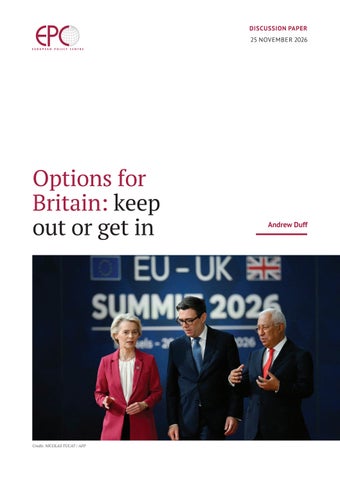
Credit: NICOLAS TUCAT / AFP
Andrew Duff
Table of contents Executive summary
3
Enlargement revisited
4
The British reset
4
Association agreements
5
Associate membership
6
Defence imperative
7
Democracy download
7
The decision
8
The negotiation
8
The campaign
9
Endnotes
11
ABOUT THE AUTHOR
Andrew Duff is an Academic Fellow of the European Policy Centre.
ACKNOWLEDGEMENTS / DISCLAIMER The support the EPC receives for its ongoing operations, or for its publications specifically, does not constitute an endorsement of their contents, which reflect the views of the author only. Supporters and partners cannot be held responsible for any use that may be made of the information contained therein.
Executive summary This paper examines the latest evolution of British European policy. It places UK developments in the wider context of the EU’s neighbourhood policy, including Canada and Ukraine. Prime Minister Burnham has set a course of action that in the end will leave his government with no good alternative to either rejoining the Union or remaining with the status quo. No variety of associated status short of full membership is a viable option for the UK or EU.
The discussion paper looks at how the British government and parliament might reach a strategic decision on the EU relationship and then mount a successful campaign to reverse Brexit. It speculates on what kind of member state the UK will be, and looks at the likely reaction of its European partners.
3
Enlargement revisited After a decade of wrangling, confusion and constitutional turmoil, the United Kingdom is reverting to a more sober and rational debate about its place in Europe. Prime Minister Andy Burnham intends to “initiate a discussion with our EU partners about options for our long-term relationship, recognising that both Britain and the EU are very different to what they were”.1 He promises to put alternative choices before parliament as part of a much anticipated Ten-Year Plan, but no strategic decisions are expected until after the next election. One of those options is certain to be full accession to the EU.
Simultaneously, after more than a decade of arrested development, the European Union has restarted its enlargement policy. If it is not blocked by its neighbour Croatia, Montenegro is likely to join as a full member state in 2028, albeit with cautious transition arrangements and safeguards against backsliding. Ukraine, Moldova and Albania may not be far behind.2 According to the Commission, “Russia’s war of aggression against Ukraine and wider threats to European security have made enlargement a geopolitical imperative”.
The British reset At the UK-EU summit meeting in Brussels on 20 November, a modest package of significant measures was announced that will increase the size of the British economy by 0.5% of GDP (€20 billion). A wide-ranging statement reviewed the incomplete operation of Boris Johnson’s minimalist 2020 Trade and Cooperation Agreement (TCA). Four new deals were hatched.3 A Youth Experience Scheme will allow 100,000 young people to move each way to live for up to three years in the EU or UK. The EU insists that agreement must be reached within six months to lower the level of tuition fees charged by British universities to EU students. Negotiations on a sanitary and phytosanitary area (SPS) are successfully concluded for the movement of food, plants and animals. Likewise, the two emission trading systems (ETS) are to be linked, exempting the UK from the EU’s Carbon Border Adjustment Mechanism.
blame for their own broken promises and the country’s poor economic performance.5 Britain’s pro-European voices are starting to be heard again.6
Talks will continue to admit the UK into the EU’s internal electricity market in return for UK payments into the EU’s cohesion funds. Efforts will persist to reach agreement on the mutual recognition of professional qualifications of architects. Closer cooperation is sought on matters of migration. A new forum will be created in digital and technology matters. Dialogue on the resilience of industrial supply lines will be strengthened, and the UK promises to “ensure outcomes consistent with the relevant EU measures”. British inclusion in the EU’s ‘Made in Europe’ policy is contingent on London adopting similar protectionist measures against China.
Britain’s pro-European voices are starting to be heard again.
The Brussels summit agreement was not easy to deliver. It took over five years and engaged five British prime ministers in complicated, costly and protracted talks with Brussels and other EU capitals. As they learned over the recent Gibraltar settlement, the British should remember that since Brexit they are the underdogs in any EU negotiation.7 It is obvious that fiddling around on the edges of Johnson’s Brexit deal tests the patience of the Commission and Council.
Burnham is dropping the red lines of his Labour predecessor, Keir Starmer, which, tediously, ruled out not only rejoining the Union but also seeking a new customs union or single market agreement involving the freedom of movement of people. His years away from the Westminster bubble as Mayor of Manchester seem to have immunised him from the need to pretend to ‘respect’ Brexit. Although he represents a formerly Brexit-leaning constituency in the Commons, he seems bold enough to challenge the idea that the slender majority of under 52% that voted against the EU in the referendum of 2016 is somehow sacred. The conduct of that ill-conceived referendum is exposed as flawed, grounded on false hopes and untruths peddled by Russian sources and the American far right.
General reaction to the Brussels summit from British business, industry and farmers’ representatives is broadly favourable. The ceiling did not fall in. Kemi Badenoch, the Conservative opposition leader, who is ideologically hostile to the EU, rehearses her usual eurosceptic litany but raises no logical objection to the efforts by the government to improve on the terms of the TCA. Nobody can be found to laud the way successive governments have executed Brexit, wasting huge amounts of taxpayers’ money.4 Arch Brexiteers are casting around for others to
4
The prime minister has little first-hand experience of the workings of the EU: he is learning fast. “Incremental steps will only take us so far”, he told the Brussels press. Once the summit package is implemented, we should expect no new initiatives before a general election. Burnham is right to consult the Union about future options while he corrals support among his own party and cabinet.8 He suggests a ‘brainstorming’ with EU partners on future scenarios, which Commission President von der Leyen welcomes. But if the prime minister is impatient to move on, he will have to call an election much sooner than the scheduled date of summer 2029. In the course of the next year, the UK will be facing up to new fiscal rules at the same time as the potential of its EU ‘reset’ will have run into the sand.
to prepare the argument that the national interest may best be served by going back into the EU as soon as possible, as a full member state. A commitment to open a bid for EU membership by triggering Article 49 of the Treaty on European Union (TEU), the accession clause, will surely be coupled with a promise of another referendum to reverse the verdict of 2016 once the details of accession are known.
Burnham is right to consult the Union about future options while he corrals support among his own party and cabinet.
Burnham must know that once all options have been considered, and inferior ones dismissed, the straightforward objective of full membership will remain standing. In any case, he will be well advised
Association agreements Since the days of Anthony Eden, many in Britain have been seduced by the idea of a looser form of association agreement with the mainland bloc short of full membership.9 Some of these ideas formed part of the circular and ultimately fruitless discussions under Theresa May’s government from 2016–2019.
benefit the automotive industry. But would the small EFTA members accept the much larger UK back into the fold on these terms? The defining feature of EFTA, after all, is that it rejects the EU customs union and is not tied to the EU’s commercial policy and external tariffs. Norway, in particular, has openly expressed doubts about a British takeover.12 Furthermore, how likely is it that the EU Court of Justice would accept the UK into the EU’s commercial policy if it were also, Janus-like, tied to the external free trade of EFTA?
One such is mooted today by the indubitably proEuropean Liberal Democrats who propose a Growth and Defence Partnership.10 Lib Dem policy is for the UK to rejoin the European Free Trade Area (EFTA), negotiate a new customs union agreement with the EU, and apply to join the European Economic Area (EEA), alongside Iceland, Norway and Liechtenstein, in order to gain membership of the EU’s internal market. Yet assembling such a package, which would put the UK in a unique position vis-à-vis the EU, would have to overcome several legal and political obstacles.
Norway and Iceland are inside the EU’s single market for historic reasons, having baulked at full membership. But their constitutional position is precarious. The EEA states are obliged to download about 800 EU rules and laws each year and then transpose them into national law. Although they may be consulted by Brussels at the drafting stage, they have no vote in the passage of this legislation. Reflecting the inevitable primacy of EU law, Protocol 35 of the EEA Agreement says that EEA rules incorporated into national law take precedence over conflicting domestic legislation.13
For the avoidance of any doubt, in EU terms ‘joining the single market’ means adopting, at least as a minimum, EU rules on free movement of goods, free movement for workers, the right of establishment and freedom to provide services, and free movement of capital, as well as EU common policies on company and intellectual property law, competition policy, state aid, financial services, transport, and consumer and health protection. The EEA Agreement, signed in 1992, also provides for close cooperation in the common policy sectors that flank the single market, such as social and environmental policy, and R&D.11 The EEA states have joined the Schengen Area arrangement to ease cross-border travel.
The EEA transposition arrangement for EU law has become overburdened and no longer works smoothly either for the EEA or the Commission, often resulting in litigation.14 For their privileged access to the single market, the EEA states pay significant sums into the EU’s cohesion funds for poorer EU regions: Norway paid €3.3 billion in the current MFF period, as well as making additional voluntary contributions towards the EU’s funding of Ukraine.
A new EU-UK customs union agreement would certainly reduce friction by lifting rules of origin requirements on trade in goods across the Channel and between Great Britain and Northern Ireland. This would particularly
The EFTA states are outside the EU’s Common Agriculture and Fisheries Policies. This is a matter of evident comfort to distant, conservative, Icelandic and Norwegian farmers and fisherfolk. A similar romantic 5
attachment to fisheries holds in certain parts of British public opinion too, but the more modern and productive part of UK agriculture and fisheries with export potential wants to be back inside the EU’s huge internal market.
The arduous nature of the compromises reached at the Brussels summit is only a foretaste of what a Swiss-type negotiation could entail. It would be certain to last very many years and fire up much nationalist reaction. The EEA and Switzerland have no automatic right of integration with the EU’s common interior affairs and justice policies, although their Schengen status obliges them, yet again without a say-so, to accept EU asylum and immigration policies. If the UK were to stay out of Schengen, it would not regain automatic admission to the EU’s common asylum system. The EU is fast evolving its common policies in these areas and implementing them increasingly effectively.16 Further complex and separate negotiations would be unavoidable if the UK as a non-EU member and non-Schengen country wanted to cherrypick from the EU’s asylum and migration regime, enjoy untrammelled access to the crucial immigrant database of Eurodac, and draw on the services of Frontex on border control or Europol on combatting crime or Eurojust on transnational court proceedings.
The Swiss odyssey is not one which the EU is willing to repeat with the UK.
EFTA member Switzerland presents another alternative to full EU membership. Having rejected both EU and EEA membership in a referendum in 1992, Bern and Brussels have been forced to negotiate 120 separate bilateral agreements, including Schengen, over the ensuing decades. They are still negotiating.15 The Swiss odyssey is not one which the EU is willing to repeat with the UK.
Associate membership Then along comes Canada. On 16 September, Ursula von der Leyen surprised the European Parliament, and even possibly herself, in calling for Canada to become the EU’s “first associate member”. Mark Carney, Canadian prime minister, responded cautiously to the unexpected nomenclature, but welcomed the offer of closer integration with the EU. Reactions elsewhere were more sceptical, especially from the prickly Germans who recoil nowadays from constitutional innovations.17 But at a summit in Montreal on 30 October, Canada and the EU delivered a substantive statement on a projected ‘Alliance for the Future’.18 Von der Leyen explained that her concept of associate membership is only available for non-European states which cannot qualify for EU membership under the terms of Article 49.19 Instead, the joint communiqué talked of the goal of “an ever closer association of Canada to the EU, short of full membership itself”.
national interest in the European context, but associate membership is not appropriate for the UK. Canada is not seeking the membership of the single market which Britain so badly needs.
Canada is not seeking the membership of the single market which Britain so badly needs.
The concept of associate membership is more relevant for Ukraine, which already has a sophisticated association agreement with the EU. President Zelensky says that associate membership would relegate Ukraine to a second-class status. Yet Kyiv needs to read Brussels more skilfully. I have argued previously that there is no point in Ukraine joining an EU which is badly governed and closed to reform.20 But joining the Brussels club, no matter how it works, is infinitely preferable for Ukraine than surrendering to Kremlin tyranny. Democratic Ukraine as a full member state of the EU would be bound to press for more European integration, especially in security and defence.
The two parties will build on their existing agreements, notably the Comprehensive Economic and Trade Agreement (CETA), to take their relationship to a new level across many sectors, including the defence of Ukraine. Greater collaboration is foreseen on digital, research and communications technologies; critical raw materials and energy; financial services and markets; security and preparedness; and people-to-people exchange. The purpose is openly strategic, consonant with Carney’s ambition for the world’s ‘middle powers’ to become more assertive.
Pending an end to hostilities, associate membership as a transition to full accession makes perfect sense for Ukraine, which needs to be anchored to the EU as it continues to fight off Putin and to ready its economy for the rigours of the EU internal market.
Given that CETA is already deeper than the UK’s TCA, the addition of associate membership puts Ottawa way ahead of London in its relationship with the EU. There are some lessons for Burnham here about how best to put 6
Associate membership would make both Canada and Ukraine the most privileged partners of the Union, creating a structured relationship with the EU institutions at ministerial and official level. Under the
umbrella of associate membership, systemic engrenage between governments, parliaments, banks and courts would help to build trust and lessen any latent hostility towards EU enlargement.
Defence imperative The Starmer government concluded a security and defence partnership agreement with the EU in 2025.21 The Brussels summit went some way to build upon it. Norway’s position is somewhat similar to Britain’s. Oslo is invited to align itself with common security positions adopted by the EU, including sanctions, and to participate in some EU defence missions. Both Norway and Ukraine (but not the UK) have bilateral arrangements with the European Defence Agency.
for an integrated military. The EU needs to be in a position to take over from NATO as and when the US decides it will no longer be involved in the collective defence of Europe.
With its global security interests and nuclear status, the UK would be an important defence partner for the EU, even a leader.
Discussions proceed among the European members of NATO about how to incorporate Ukraine more firmly into the western security nexus. Co-opting the UK and Canada as trusty military partners would be welcomed by the EU. There is talk of a new intergovernmental treaty to bind more tightly together the ‘coalition of the willing’ that has evolved to help Ukraine.22 One element of these discussions involves establishing a European Security Council to be convened in times of emergency.
With its global security interests and nuclear status, the UK would be an important defence partner for the EU, even a leader. But to date, and despite the rhetoric, the British contribution to collective European defence is mixed. It would be a great mistake for the UK to imagine it still has the prowess in military matters that will carry it far in terms of EU negotiations. Doubt persists about the capacity of Burnham and Chancellor John Healey to match their promises to rebuild British armed forces.
It is important to note, however, that the main purpose of the EU’s innovative defence arrangements is to render operational the EU’s own common defence clause, Article 42(7) TEU. This will involve much more than joint arms procurement, capability studies and sharing of intelligence, and will include eventual command and control structures
Democracy download Where the UK wholly diverges from Norway and Switzerland is on the matter of governance. Were Britain to follow the EFTA route, it would end up, after tough, costly, complex and lengthy negotiations, with heavy obligations but only limited rights to be informed and consulted. It would have no right to participate directly in EU law and policy making: no British Commissioner, no Members of the European Parliament, no judges or advocates at the European Court of Justice, few officials at working parties, and no ministers at the Council or prime ministers at the European Council. British business and industry would also lack clout in Brussels. UK nationals would remain deprived of the privileges of EU citizenship which include protection under the Charter of Fundamental Rights, the right to vote in local and European elections wherever resident in the Union – and to enjoy much shorter passport queues at EU passenger terminals.
negotiations and kept distant from constitutional and strategic discussions about the future of Europe, with no central role in developing the Union as a capable federal polity. The UK would be left waiting for invitations from Brussels to participate in meetings as a privilege, not as a right: losing sovereignty without diplomatic or democratic gain, fixated on the arrival of the next pdf to download from EUR-Lex. With no disrespect to the small EFTA associates, what may have been an acceptable fall-back position from failed accession over 30 years ago is a wholly inadequate solution for the much larger UK that has been a member state for nearly 50 years. During that time the depth and scope of European integration has dramatically developed and continues to do so. As Article 49 states, the EU is for joining.
Under an EU association agreement, the UK would have to accept dynamic regulatory alignment with EU rules it had no part in forming. It would be frozen out of EU budgetary 7
The decision No doubt argument about various forms of UK association with the EU will continue for many months, especially among those who do not know Britain well. Gradually, however, the truth will dawn that Britain’s historic commitment to parliamentary democracy makes it unconscionable to accept proposals to become, in effect, a second-class member of the Union. It will be practically impossible for Parliament at Westminster to accept anything less than full EU membership. MPs of different factions will unite to protect their own prerogatives. And the House of Lords, stuffed as it is with important exmandarins, MEPs and party hacks, will not be persuaded that Britain should be relegated to a lowly second tier in Europe. In truth, the only real alternative to moving towards full membership is standing still.
Ireland. The devolved assemblies in Edinburgh, Cardiff and Belfast would be on board. We would hear the hurrah from Brussels. Less certain is the impact of that proposal on the Conservative opposition. Previous membership bids split both government and opposition. Indeed, in 1971 Edward Heath’s proposal to join the European Communities would not have carried the day had it not been for the 69 rebel Labour MPs who followed Roy Jenkins across the floor of the House. Although there seem to be very few Tory MPs nowadays who maintain pro-European positions in public, there must be many Tory voters in the country who do not share the rightward lurch of the party under Badenoch.23 Their better spokesman may prove to be John Major, prime minister from 1990–1997, who advises against alienating Europe. A key test will be the Tory party’s attitude to leaving the European Convention on Human Rights (ECHR), famously crafted with the blessing of Winston Churchill. Badenoch is attempting to whip up hostility against the ECHR, a truly astonishing act of self-harm which if executed would scupper not only all the UK’s previous (and future) treaty commitments with the EU (including the TCA) but also the Good Friday Agreement which manages, just, to maintain the ceasefire in Northern Ireland. It is not inconceivable that a successful application under Burnham to join the EU would split the Tory party asunder for good.
It will be practically impossible for Parliament at Westminster to accept anything less than full EU membership.
As and when the Burnham government triggers Article 49 with no ifs and buts, it will be joined in the endeavour by the Lib Dems, Greens, the Scottish and Welsh nationalists and the sensible parties from Northern
The negotiation Before it triggers Article 49, a UK government White Paper is called for that spells out in full the reasons for the new accession bid. That statement, tabled for approval before Parliament, will help the Commission as it drafts its own formal Opinion on the UK’s application. The purpose of the Opinion is to assess a candidate’s eligibility for membership and inform the Council as it agrees a mandate for the accession negotiations. There will be consultation between Brussels and London during this initial process. When the Commission document is published the British will discover much about how the EU has changed since Brexit; they may also find something about themselves they did not know. Points of potential divergence or friction between the two parties should be revealed, such as gene editing and AI regulation. The Commission will take note of any bilateral issues with member states, notably Cyprus, Ireland and Spain.
leadership and is constantly preoccupied with resolving its internal disputes through institutional machinery that is complex and opaque. It is very good at putting off reform.
The reality of impending enlargement should encourage the European Union to reflect more deeply on its own system of government. As it is, the EU often lacks clear
So what kind of member state will Burnham’s Britain be? The UK has to decide whether it wants to be a participant or a bystander – and if a participant, a
The English establishment, with its characteristic mixture of arrogance and ignorance, likes to preach about a reformed Europe built on old nation states rather than modern member states.
8
conservative or a reformer. The English establishment, with its characteristic mixture of arrogance and ignorance, likes to preach about a reformed Europe built on old nation states rather than modern member states. Andy Burnham has the chance to break with this dreary record: he should throw his weight behind what is called, loosely, ‘more Europe’.
of economic and monetary union, including the single currency. But joining the euro, which in truth is not compulsory, is subject to additional convergence criteria none of which the UK remotely attains. Burnham and Healey should make the case for a reformed economic and monetary union with closer fiscal integration where joint debt supports investment in public goods with genuine European added value. The City of London, when it stops whining about the latest renversement des alliances, should play a leading role in building a properly regulated European capital markets union.
The representative character of the EU institutions deserves full British endorsement. Learning from past mistakes, when Britain failed to fulfil its membership potential, there is a good British case waiting to be made for a more federal Europe – with an effective executive in the Commission, more qualified majority voting in Council with fewer national vetoes, and a robust European Parliament. EU membership implies an enduring constitutional settlement that should command the loyalty of EU citizens. Multicultural Britain could respond to this new democratic dimension, engage in aid of liberal democracy, combatting racism, nationalism and xenophobia across the continent.
As far as the EU is concerned, the bitter experience of negotiating secession under Article 50 TEU suggests that, so long as the legacy of Britain’s past membership endures, the negotiation of a new membership will be simpler and quicker to conclude than anything less ambitious. The selective integration of Britain into only parts of the acquis communautaire but not the whole would be much more complicated than a straightforward bid for full membership. A half-hearted UK accession will be unwelcome as far as EU capitals are concerned, where fears of cherry-picking and freeloading by perfidious, even prodigal, Brits are never far from the surface. It is important, moreover, that the EU maintains some consistency in its approach to all third-country partners.
Much attention will be paid to the UK’s intentions with regard to the euro and Schengen. Joining Schengen would only be possible in lockstep with Ireland. The UK, like all new member states, will need to subscribe to the goal
The campaign Andy Burnham intends to lead the national ‘conversation’ into a true understanding of what EU membership really means for Britain’s security and prosperity. The debate will not be polite. The campaign is certain to be embittered by Brexiteers with bullying manners spouting dubious trade and budget statistics at befuddled BBC journos. We know that the worst of the Brexiteers have scant respect for the facts. The right-wing press continues to loathe Europe; and social media, especially Elon Musk’s X, is vile. Wounds opened up by plebiscites can take a long time to heal.
The Yes campaign can be positive and unapologetic but avoid exaggeration. EU membership will not resolve all the nation’s problems at once but it is the essential starting point. Brexit reduced Britain’s GDP by between 4% and 8%, and its economy cannot significantly recover unless it gets back inside the EU single market and works together with EU partners to boost productivity. The recommendations of Mario Draghi in his important report on competitivity are equally applicable to the UK as to EU member states.
For the pro-EU camp, therefore, the next referendum cannot just be a re-run of 2016: only fresh arguments (and new people) will shift opinion. The campaign needs very careful preparation, unlike Cameron’s botched effort in 2016. The popular vote should not be held until the terms and conditions are known, the accession treaty is signed and endorsed at Westminster.
In the end, it may be the security dimension that has greater impact on the result of the campaign than economics. In troubled times, for Britain as for everyone else, there is safety in numbers. Luckily for Burnham, British public opinion has been softening on Europe for many months just as it is turning more hostile towards Trump’s America. According to a poll of polls, over 60% would now prefer to be within the EU, and 75% want closer relations in any case.24 Remainers are enthusiastic about rejoining, although still hesitant about freedom of movement. Labour, naturally, is anxious not to upset its traditional, nationalist-leaning, working-class vote, but it knows that that cohort is a steadily declining portion of the electorate, even literally dying out.25
The popular vote should not be held until the terms and conditions are known, the accession treaty is signed and endorsed at Westminster.
The peculiar Brexiteer obsession with national sovereignty – “taking back control” – is out of tune with the socially liberal, better educated, cosmopolitan generation of voters. Anybody with their wits about 9
them knows that the British state rarely does things well nowadays: Brexit is top of a long list of public policy failure, including HS2, the Covid pandemic, the NHS, immigration and housing. Boris Johnson’s appeals to patriotic boosterism seem absurdly dated.
will ensure that the votes cast by Britain’s pro-European majority will be properly reflected in seats won in the House of Commons. The EU will not tolerate more chopping and changing of British European strategy: Brussels will be fully justified in insisting on the emergence of a bipartisan approach at Westminster.
The younger electorate tends to be critical of Britain’s traditional alliances with Israel and the US. They understand that many problems, like irregular immigration, climate warming or Islamist terrorism, are far beyond the capacity of the UK to tackle alone. Many hope that Europe can act more capably on the world stage, whereas in the past the EU’s relatively feeble posture in global affairs made it an underwhelming proposition. In an irony that cannot be lost on anybody, British public opinion supports Ukraine, and the UK government strongly backs Ukraine’s EU membership bid. The EU with Ukraine as a member state will be a more attractive proposition for the British.
The EU with Ukraine as a member state will be a more attractive proposition for the British.
Andy Burnham hopes to have ended “a decade of drift and division” between Britain and Europe. Yet it is clear that only a more dynamic Britain set on reform at home will be a viable new member state of the Union. If so, there are no insuperable obstacles to the UK’s early accession. That Britain will be a net contributor to the EU’s hard-pressed budget has not gone unremarked. It can certainly be a good fit in the EU’s new dimension of security and defence. Whatever misgivings there may be about the many trade-offs involved, enlarging the Union is the geopolitical imperative as much for Britain as for the rest of Europe.
Clearly, the government will have to make a special effort to explain that freedom of movement does not mean anarchic free-for-all. It will need to register the status of EU citizens resident in the UK and to verify financial selfsufficiency. The economic and cultural opportunities for British people to live elsewhere in the EU should be given equal prominence to those famous Polish plumbers on EasyJet flights to Luton. At the summit on 20 November, the leaders put great emphasis on the benefits of their package to young people. Burnham should fire up the campaign to reverse Brexit by linking it to his wish to reform the electoral procedure for the House of Commons. Proportional representation
10
Prime Minister’s Office, 10 Downing Street and The Rt Hon Andy Burnham MP, “PM speech at the Lord Mayor’s Banquet: 16 November 2026”, GOV.UK, 16 November 2026, https://www.gov.uk/government/ speeches/pm-speech-at-the-lord-mayors-banquet-16-november-2026. 2 European Commission (2026), Preparing for a wider Union, COM(2026) 705 final, Brussels. https://commission.europa.eu/ document/download/19022e79-d2b4-4d13-bdc6-0185da92856a_ en?filename=COM-2026-705_en.pdf; European Commission (2026), 2026 Communication on EU enlargement policy, COM(2026) 690 final, Brussels. https://enlargement.ec.europa.eu/ document/download/f91ff0c2-b20c-4db7-822a-a6495397e8b5_ en?filename=COM_2026_690_1_EN_ACT_and_Annexes.pdf. 3 European Union and the United Kingdom Summit, “Joint Statement of the European Union and the United Kingdom Summit, 20 November 2026”, 20 November 2026. https://ec.europa.eu/ commission/presscorner/detail/en/statement_26_2512. 4 EUobserver, “€120m in totally unused border facilities is the latest bill for the monumental waste that was Brexit” 9 November 2026, https://euobserver.com/247911/e120m-in-totally-unused-borderfacilities-is-the-latest-bill-for-the-monumental-waste-that-wasbrexit/. 5 See, for example: Springford, John and Anton Spisak (2026), “The cost of Brexit, ten years on”, Centre for European Reform. https:// www.cer.eu/sites/default/files/JS_AS_brexit10_18.6.26_final.pdf; and Wachowiak, Jannike, et al., “Ten Years On: What Next for UK EU Relations?” 15 June 2026, UK in a Changing Europe. https:// ukandeu.ac.uk/reports/ten-years-on-what-next-for-uk-eu-relations/. 6 Grant, Charles, “Brejoin? Ten reflections on Britain rejoining the EU” 12 November 2026. https://mailings.cer.eu/publications/archive/ essay/2026/brejoin-ten-reflections-britain-rejoining-eu. 7 UK Government, “UK-EU Agreement in respect of Gibraltar”, 14 July 2026, https://www.gov.uk/government/collections/uk-eu-agreementin-respect-of-gibraltar. 8 I have previously suggested a Royal Commission to inquire into options: Duff, Andrew, “The Case for a Royal Commission on Britain and Europe: Cutting through Parliamentary Paralysis”, Verfassungsblog, 22 August 2025, https://verfassungsblog.de/thecase-for-a-royal-commission-on-britain-and-europe/. 9 Duff, Andrew (2023), “The before and after of Brexit: Britain and the Schuman Plan”, EU3D Insights, University of Oslo. https://www. eu3d.uio.no/publications/eu3d-insights/eu3d-insights-march-2023duff.pdf. 10 Liberal Democrats, “A new Growth and Defence Partnership with Europe”, 17 June 2026. https://www.libdems.org.uk/news/article/anew-growth-and-defence-partnership-with-europe. 11 European Economic Area (1992), Agreement on the European Economic Area, Porto. https://www.efta.int/sites/default/files/ media/documents/legal-texts/eea/the-eea-agreement/Main%20 Text%20of%20the%20Agreement/EEAagreement.pdf.
Lund Nielsen, Magnus, “EEA is here to stay, says Norway’s Eide”, 29 October 2026,Rapporteur. https://www.rapporteur.com/news/ eea-is-here-to-stay-says-norways-eide/. 13 EFTA Surveillance Authority, “ESA takes Iceland to court for failing to ensure EEA rights prevail”, 30 September 2026. https://www. eftasurv.int/newsroom/updates/esa-takes-iceland-court-failingensure-eea-rights-prevail. 14 Lund Nielsen, Magnus, “Brussels threatens EEA countries over backlog on EU laws”, 22 September 2026, Rapporteur. https:// www.rapporteur.com/news/brussels-threatens-eea-countries-overbacklog-on-eu-laws/. 15 The Federal Council of Switzerland, “Swiss-EU relations”, https:// www.admin.ch/en/swiss-eu-relations (accessed 21 November 2026). 16 European Commission, “Commission launches second annual migration management cycle”, 5 November 2026. https://homeaffairs.ec.europa.eu/news/commission-launches-second-annualmigration-management-cycle-2026-11-05_en. 17 Duff, Andrew, “Associate Membership of the EU”, 25 September 2026, Verfassungsblog, https://verfassungsblog.de/associatemembership-of-the-eu/. 18 Canada, European Union (2026), EU-Canada Joint Statement, Brussels, 30 October 2026. https://www.consilium.europa.eu/ media/0znlxsox/30102026can-eu-joint-statement-en-rev1.pdf. 19 Wittingly or not, her definition puts a contemporary gloss on the age-old question about whether Turkey is a truly European state. 20 Duff, Andrew (2026), “Unready for enlargement: and what the European Union should do about it”, Discussion Paper, European Policy Centre. https://www.epc.eu/publication/unready-forenlargement-and-what-the-european-union-should-do-about-it/. 21 Foreign and Commonwealth Office, Ministry of Defence (2025), “UK-EU Security and Defence Partnership”, https://www.gov.uk/ government/publications/uk-eu-security-and-defence-partnership. 22 Duff, Andrew (2026), “Unlocking enlargement and building common defence: next steps for the European Union”, European Policy Centre. https://www.epc.eu/publication/unlocking-enlargement-andbuilding-common-defence-next-steps-for-the-european-union/. 23 Davidson, Denzil, and Saunders, Simon (2026), “The UK and the EU: The choices ahead”, Prosper UK. https://assets.nationbuilder.com/ prosperuk/pages/3961/attachments/original/1795090147/The_UK_ and_the_EU_-_The_choices_ahead_%281%29.pdf?1795090147. 24 What UK Thinks: EU, “Post-Brexit Poll of Polls” (accessed 21/11/2026), https://www.whatukthinks.org/eu/opinion-polls/pollof-polls-uk-eu/. 25 Kellner, Peter, “Britain’s pro-Brexit majority has literally died out”, October 2026, Encompass Europe. https://encompass-europe.com/ comment/britains-pro-brexit-majority-has-literally-died-out.
1
12
11
The European Policy Centre is an independent, not-for-profit think tank dedicated to fostering European integration through analysis and debate, supporting and challenging European decision-makers at all levels to make informed decisions based on sound evidence and analysis, and providing a platform for engaging partners, stakeholders and citizens in EU policymaking and in the debate about the future of Europe.
EUROPEAN POLICY CENTRE | 14-16 RUE DU TRÔNE/TROONSTRAAT | B -1000 BRUSSELS | BELGIUM | WWW.EPC.EU