Liza Saris is a Project Manager and Policy Analyst at the
ACKNOWLEDGEMENT / DISCLAIMER
This document was produced with assistance from AI tools. AI (Claude) was used within a closed research environment to screen and organise official MFF documents, identify relevant programmes and references, and support the calculation of aggregate funding totals. The author reviewed, verified, and refined all outputs generated by AI. The analysis, views, interpretations, and conclusions contained herein are the author’s own and do not represent those of the EPC. The author has independently verified all factual claims and takes full responsibility for the content.
The author would like to thank Johannes Greubel, Vanna Curin and Talisa Mazzoni for their support during the research of this paper.
The support the European Policy Centre receives for its ongoing operations, or specifically for its publications, does not constitute an endorsement of their contents, which reflect the views of the author only. Supporters and partners cannot be held responsible for any use that may be made of the information contained therein.
Executive summary
Democracy in Europe is under growing strain from both internal and external forces, just as the funding landscape that sustains it is contracting. As major public and private actors redirect support, civil society is increasingly reliant the EU budget — one of the last substantial funding sources.
Yet this support is already overstretched: its core instrument, the Citizens, Equality, Rights and Values programme (CERV), already rejects up to 92% of applications due to a lack of funding, despite often ‘excellent’ quality.
Against this backdrop, on 12 November 2025 the Commission unveiled the Democracy Package, the Democracy Shield and the first dedicated EU-wide Civil Society Strategy. Its funding, however, is subject to negotiation in the next Multiannual Financial Framework (MFF).
This paper examines how the EU supports democracy, and civil society in particular, within its own borders through the MFF, treating the budget as the point where political priorities are translated into funding realities.
Mapping six core democracy priorities against funding streams in the current and proposed MFF, the analysis shows only a marginal increase in democracy funding,
with its relative share rising by approximately 0.09%. At the same time, the proposed architecture largely reorganises existing instruments, including merging digital programmes into a new democracy programme, AgoraEU. The absence of clear earmarking increases uncertainty for the sector, while funding priorities shift towards digital and research-related areas, in line with the Democracy Package’s focus on digital and foreign threats.
Three gaps stand out: First, a predominantly defensive framing focusing on shielding democracy from disinformation, FIMI and hostile foreign actors rather than rethinking or rebuilding trust in democratic systems within member states. Second, enforcement mechanisms remain weak. Third, funding remains uncertain in both scale and design: the headline increase is contingent on ongoing MFF negotiations and is unlikely to compensate for the loss of other funding sources.
Closing these gaps will require action beyond the Commission, including from member states, philanthropy and civil society itself. Negotiators should look beyond headline funding tools and focus on the architecture of programmes while also exploring complementary avenues outside the MFF to sustain support for democracy.
Introduction
Democratic decline in Europe has become structural. Institutional trust is weakening, polarisation is deepening and checks and balances are under sustained pressure.1 Illiberal movements are a central force in this shift, advancing agendas that contest liberal democratic norms, weaken pluralism and increasingly shape political debate and governance across Europe and within EU institutions. At the same time, foreign interference, disinformation and foreign information manipulation are intensifying these threats by exploiting digital spaces and existing social divisions. Across the Union, independent institutions face political pressure and critical voices encounter growing administrative and political obstacles. Taken together, these trends point to a systemic challenge to the resilience and future of liberal democracy in Europe.
Civil Society Organisations (CSOs) are an important pillar of healthy liberal democracies. They contribute not only to accountability, but also to the overall quality and resilience of democratic governance. Beyond their watchdog role, CSOs act as intermediaries between citizens and institutions, represent diverse societal public interests and enabling participation in policymaking processes.2 They contribute to informed public debate, support the implementation of fundamental rights and play a key role in monitoring the rule of law and exposing corruption. Importantly, civil society also provides democratic infrastructure in contexts where institutional capacity is weak or contested, including through service provision, civic education and community-level engagement. A strong and pluralistic civil society is an active builder of democratic systems, contributing to trust, legitimacy and the adaptability of democratic institutions in times of crisis. Support for civil society is one of the conditions that sustains democratic systems within the EU.
Yet precisely because civil society serves as an independent and critical voice, it is increasingly becoming a political target. CSOs are being politicised by being framed as political actors executing lobbying for governing parties rather than representing public interest.3 In several member states, political parties have requested research into NGO spending and public funding,4 questioning their contribution to public debate. In parallel, regulatory changes, such as foreign funding restrictions, have been used to frame CSOs as politically suspect or even as ‘agents’ of foreign governments.5 In several countries, far-right parties have created a hostile environment for CSOs by introducing administrative hurdles and deploying smear campaigns to undermine their legitimacy.6 These actions are contributing to tighter restrictions on advocacy, reduced access to public funding and an overall normalisation of efforts to delegitimise CSOs’ role in policymaking.
While these strategies draw on an authoritarian playbook, their effectiveness lies in their diffusion into mainstream politics. The framing of civil society as a political actor
is no longer confined to explicitly illiberal forces; it is increasingly reflected in broader governance practices across Europe. This dynamic is increasingly visible at the EU level, where political contestation around NGO funding has intensified, including through initiatives such as the European Parliament’s 2025 scrutiny working group on civil society financing.7 As a result, the operating environment for civil society in Europe is not only shrinking, but becoming more politicised and contested.8 This shift is weakening a core pillar of liberal democracy9 at a time when democratic systems are already under strain from polarisation, economic pressures and hybrid threats.
The framing of civil society as a political actor is no longer confined to explicitly illiberal forces; it is increasingly reflected in broader governance practices across Europe.
A crucial part of this changing landscape is funding. The accessibility of funding for civil society is shrinking as key actors withdraw or reorient their support. In 2025, the new US administration pulled USAID funding while several EU member states drastically reduced their development budgets.10 In this new context, the EU budget is one of the few remaining substantial funding sources, on which pressure is intensifying. Yet the EU’s CERV programme, currently the main funding instrument for civil society working on EU values and democracy and running until 2027, was already overburdened. According to the Commission’s own midterm report, up to 92% of applications were rejected for lack of funding, despite often being assessed as of ‘excellent’ quality.11 The figure predates both the withdrawal of major international funding streams and the intensifying political scrutiny of civil society funding at EU and national level. The consequences are already visible: in the 2025 CERV funding round, many organisations reported losing operational funding on which they had previously relied.12
These pressures coincide with the Commission’s proposal for the next MFF, unveiled in July 2025 and marking the start of one of the EU’s most consequential policy negotiations. The proposal strongly resembles the overarching policy priorities of the von der Leyen Commission – such as competitiveness, defence and security – as it is the instrument to define the priorities for the next decade.13 The MFF functions as the Union’s central tool for translating these priorities
into long-term spending commitments. In line with these trends, the proposal prioritises simplification, resulting in a significant redesign of the seven-year budget. In this new architecture, programmes are merged and reorganised, while key design elements remain intentionally open to allow for flexibility in implementation. While this responds to institutional demands for simplification and adaptability, it also introduces a high degree of uncertainty. This new, flexible design, leading to a lack of clarity on programme structures and no earmarked smaller scale priorities within the larger programmes makes it more difficult for civil society and other non-state actors to engage effectively in negotiations between the Council and the European Parliament, which follow the Commission’s proposal.14
Against this backdrop, on 12 November 2025 the European Commission unveiled the Democracy Package, including the Democracy Shield and the first dedicated Civil Society Strategy. Together, these initiatives set out the Commission’s emerging approach to protecting democracy and supporting civil society within the EU, while also extending aspects of that agenda to candidate countries. At their core is a strong focus on protecting democracy from digital and foreign threats, identified as among the principal risks to democratic resilience in the Union.15 Both the Democracy Shield and the Civil Society Strategy locate the future funding of this agenda in the next MFF for 2028–2034. This creates a direct link
between the Union’s evolving democracy strategy and the budget negotiations currently under way.
These ambitions can only be realised through the budget that underpins them. Yet those budget negotiations are taking place in a political climate of increasing hostility towards civil society16 and contestation over public funding for these organisations. Understanding what the MFF can and cannot do for democracy funding is therefore essential – not only for informing the current negotiations, but also for shaping the broader debate about how civil society in the EU should be sustained in the coming decade.
This paper examines how the EU supports democracy, particularly civil society, within its own borders through the MFF, and what is likely to change under the proposed framework for 2028–2034. Rather than treating the budget as a technical exercise, it looks at how political priorities are translated into funding realities. It asks, in practical terms, how far the EU’s democracy agenda is reflected in the distribution of resources; whether the proposed architecture provides new funding or primarily reorganises existing instruments; and how the balance between competing priorities is shifting. It then considers what the emerging gaps imply for the future of democracy support in Europe, and what role actors beyond the Commission, such as member states, philanthropy and civil society itself, may need to play.
Foreign threats and internal challenges
The Political Guidelines (2024–2029) of Commission President Ursula von der Leyen’s second term outline the institution’s policy priorities until the next elections.17 The Guidelines set the overarching direction for how the Commission approaches democracy across its policy areas and within the work programmes of individual Commissioners, announcing the Democracy Shield and the Civil Society Strategy as central pillars. In addition, the Commission’s annual work programme translates these priorities into action. Taken together, the Political Guidelines, Democracy Package and 2026 work programme provide the main framework through which the Commission’s evolving democracy strategy can be understood.
Democratic backsliding and shrinking civic space are positioned as key challenges in this framework. However, the policy challenges are not new. Over the previous two Commission cycles, the EU progressively developed a toolbox to address pressures emerging from within the Union itself. Examples include the Article 7(1) procedures launched against Poland (2017) and Hungary (2018), which were followed by the strengthening of the Commission’s Rule of Law Toolbox. The 2020 European Democracy Action Plan and the 2023 Defence
of Democracy package extended this agenda to media freedom, electoral integrity and the protection of civic space, while the Conference on the Future of Europe (2021–2022) reflected a parallel effort to improve the Union’s own democratic processes through citizen participation. These actions focused on internal reform while building instruments to counter disinformation and foreign manipulation.18
The 2025 Democracy Package marks a new phase in the EU’s democracy policy framework, notably through the inclusion of the first dedicated EU-wide Civil Society Strategy. The Strategy acknowledges shrinking civic space inside the Union and the need for stronger monitoring and protection of CSOs at member-state level.19 The Democracy Package also introduces the Democracy Shield as its second core component.
However, the two instruments differently frame the challenges to European democracy. The Civil Society Strategy leaves largely unsaid which actors drive the shrinking of civic space, resulting in a more cautious framing. By contrast, the Democracy Shield explicitly identifies internal sources of pressure, including the role of illiberal movements within member states.20
2020
European Democracy Action Plan
European Commission
PILLARS
— Protect integrity of elections and participation
— Media freedom & pluralism
— Countering disinformation
EU DEMOCRACY PACKAGES
EU DEMOCRACY PACKAGES
Source: Data compiled by the author.
EU DEMOCRATIC RESILIENCE · 2020 - 2025
2023
Defence of Democracy Package European Commission
INCREASED FOCUS ON
— Transparency of foreign interest representation
— Inclusive & resilient electoral processes
— Participation of citizens and civil society
2025 Democracy Package European Commission
Consists of the Democracy Shield and the Civil Society Strategy
Democracy Shield PILLARS
— Safeguarding the information space
— Strengthening institutions, elections and free media
— Citizens’ resilience and engagement
Civil Society Strategy PILLARS
— Strengthening engagement
— Support and protection for an enabling civic space
— Funding
Figure one shows how the 2025 Democracy Package builds on the previous democracy packages such as the Democracy Action Plan (2020) and the Defence of Democracy Package (2023). This package emphasises external pressures such as foreign information manipulation and interference (FIMI), disinformation campaigns and hostile state actors, and the digital environments through which these operate. The package’s three pillars reflect this orientation: situational awareness on FIMI, protection of elections and media from external interference, and societal resilience built through media and digital literacy. Its establishment of the European Centre for Democratic Resilience links this agenda to the EU’s broader preparedness, defence and internal security framework.21
The Democracy Package is also informed by earlier frameworks. These include the strategy for the implementation of the Charter of Fundamental Rights and the development of the Rule of Law Mechanism, which is mostly translated into the civil society strategy (see figure 2).
In November 2025, the Democracy Package was positively received by both the European Parliament and civil society representative organisations in Brussels. Both welcomed the ambition, firm stance to protect democracy, framing of the challenges to democracy and acknowledgment of the need for an EU level Civil Society Strategy. The Civil Society Strategy, in particular, reflects input from civil society, including via stakeholder meetings, public consultations and open letters.22
At the same time, civil society reporting continues to highlight internal EU challenges. Organisations note that political pressure on CSOs, high scrutiny of NGOs and persistent democratic backsliding remain strategic challenges for European democracy in 2025.23
These observations are also reflected in more critical assessments of the Democracy Package, particularly regarding the Democracy Shield.24 First, some critics see the package primarily as a strategy that brings together existing actions, rather than introducing new initiatives or boosting innovating. Second, they note that its strong focus on digital and foreign threats, while reflecting recent geopolitical developments, may be overstated. The concern is that this focus risks underestimating internal pressures. Third, because the package’s funding is directly linked to the next MFF, critics note that its overall scale and allocation remain uncertain.
The package’s three pillars reflect this orientation: situational awareness on FIMI, protection of elections and media from external interference, and societal resilience built through media and digital literacy.
STREAM A
Disinformation & elections
EEAS & Commission
groundwork that flowed into EDAP and the Shield.
STREAM B Civil society & civic space
Successive instruments empowering CSOs and protecting civic space.
STREAM C Rule of law
Monitoring architecture.
2015 Strategic Communication Action Plan
EEAS
First EU response to disinformation; East StratCom Task Force.
2020
Charter Strategy
European Commission
Empowering civil society organisations to defend rights.
2019 European Rule of Law Mechanism
European Commission
New annual monitoring cycle covering all Member States.
EXTRA STREAMS
EXTRA STREAMS
2016 Joint Framework on countering hybrid threats
European Commission
Hybrid-threat lens; cross-sector coordination.
2018 Action Plan against Disinformation
European Commission
Rapid Alert System, Code of Practice on Disinformation.
2022
2021
Council conclusions on civic space
Council of the EU
Protecting an enabling environment for civil society.
Charter Report
European Commission
Annual stocktake; focus on civic space.
2022
EP resolution on shrinking civic space
European Parliament
Parliament call to address pressure on CSOs.
2020
Beginning of the Rule of Law Reports
European Commission
First annual report; ongoing series, refined in subsequent years.
How these connect — The disinformation stream feeds primarily into Democracy Shield (2025). The civil-society stream culminates in the 2025 Civil Society Strategy, which sits alongside the Shield as the 2025 Democracy Package. The rule-of-law stream provides the monitoring backbone.
Source: Data compiled by the author.
The architecture of the MFF
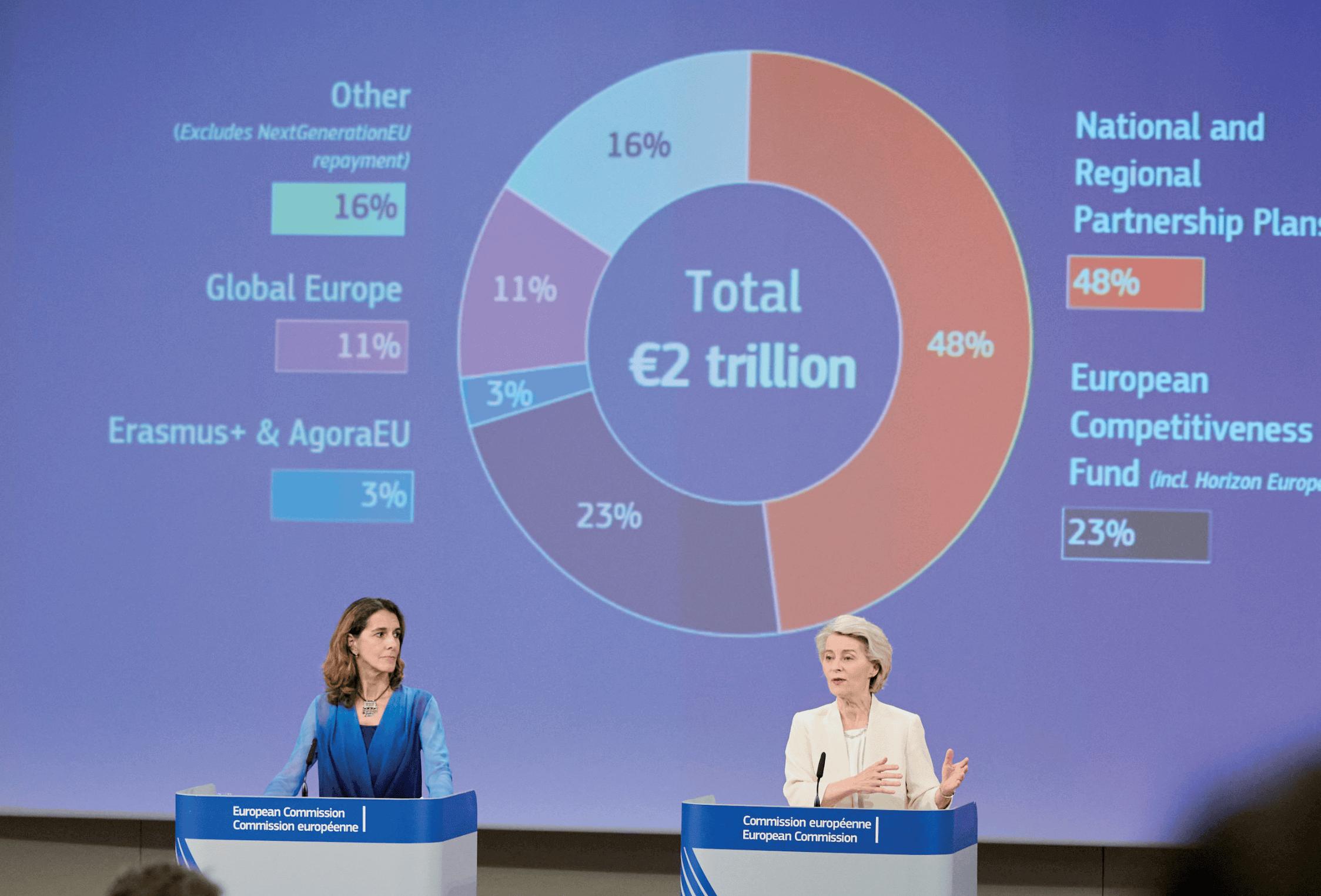
The proposal of the European Commission for the 2028–2034 MFF opened a two-year negotiation process between the European institutions, expected to conclude end of 2027 and define the EU’s budgetary priorities for the following seven-year period. The Commission’s proposal introduces a significant shift in the architecture of the budget. It reduces the current structure from seven headings to four, merges programmes and reorganises spending in national and geographical structures.
For example, the new first heading, ‘National and Regional Partnership Programmes’ (NRPP), would consolidate several previously independent funding streams, including cohesion budgets, agricultural funding, the Social Climate Fund, CAP income support and fisheries.
Each NRPP would be drawn up by the relevant member state in partnership with regional and local authorities and other stakeholders, including civil society organisations. The plans would set out the reforms, investments and other interventions needed to address priorities identified through the European Semester, the Rule of Law Report and related processes.
This simplification is not only structural, but also political. The consolidation of headings and programmes and renationalisation risks centralising decision-making, reducing the granularity of the European Parliament’s oversight, and increasing discretion for both the Commission and member states in the use of funds. At the same time, the shift from a thematic to a more geographical orientation makes it more difficult to trace specific policy priorities within the budget architecture. As a result, less prominent policy areas risk being overshadowed or reduced.
The consolidation of headings and programmes and renationalisation risks centralising decision-making, reducing the granularity of the European Parliament’s oversight, and increasing discretion for both the Commission and member states in the use of funds.
THE ARCHITECTURE OF THE EU BUDGET: CURRENT AND NEXT MFF
THE ARCHITECTURE OF THE EU BUDGET: CURRENT AND NEXT MFF Main headings as a share of the total MFF (commitments). NextGenerationEU shown alongside / on top of each structure.
29.6% 2. Competitiveness, Prosperity & Security ECF €362.3bn (incl. Horizon) 10.8% 3. Global Europe Global Europe Fund €176.8bn 2.1%
6. Neighbourhood & the World 6.8%
7. European Public Administration 5.9% 4. Administration
Totals & prices. Current MFF: €1,074.3 bn in 2018 prices (the legal ceiling) = €1,246.6 bn in 2025 prices. Next MFF: €1,763.0 bn in 2025 prices = €1,984.9 bn in current prices, of which NGEU repayment €149.3 bn (2025 pr.) / €168 bn (current pr.). Shares are each item’s percentage of its own MFF total and are price-base independent.
NextGenerationEU. In 2021–2027 the €750 bn (2018 prices) recovery instrument was financed by EU borrowing and sat outside the MFF ceilings (shown as the separate bar beside the current MFF, same scale). In 2028–2034 only its repayment instalments appear, kept under the ceilings within Heading 1 — shown as a separate block on top of the headings rather than nested inside.
Sources: Council Reg. (EU, Euratom) 2020/2093, Annex I (OJ L 433 I/21), p.11; EPRS Briefing PE 782.646 (Feb. 2026) pp.2–3; Commission Communication MFF annex (COM(2025)571); MFF Staff Working Document 1, §4.6 & p.70; NGEU envelope: Council Reg. (EU) 2020/2094 (EURI).
Sources: Council Reg. (EU, Euratom) 2020/2093, Annex I (OJ L 433 I/21), p.11; EPRS Briefing PE 782.646 (Feb. 2026) pp.2–3; Commission Communication MFF annex (COM(2025)571); MFF Staff Working Document 1, §4.6 & p.70; NGEU envelope: Council Reg. (EU) 2020/2094 (EURI).
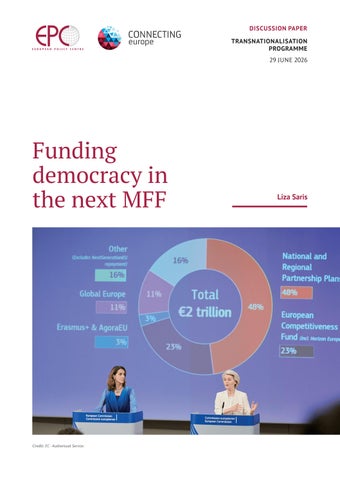
In overall terms, the size of the budget proposed by the European Commission amounts to close to € 2 trillion in current prices, which resembles 1.26% of the EU Gross National Income (GNI) per year, compared to 1.13% in the current MFF. This also includes 0.11% repayment of the NextGenerationEU loan.
Within this broader simplification, the Commission created a new programme, AgoraEU, which integrates Culture, CERV and media funding programmes of the current MFF. Structurally, the new programme is placed within Heading 2 – Competitiveness, prosperity and security. The Commission presents AgoraEU as the main programme funding the Democracy Package, effectively translating the umbrella function of the Democracy Package into the architecture of the MFF.25
Figure 3 provides an overview of the Commission’s proposed structure and illustrates how programmes are consolidated under the new headings. All figures used in this analysis are based on the Commission proposal, which remains under negotiation.
The proposal represents the starting point of these ongoing negotiations. On 28 April 2026, the European
Parliament adopted its interim report, calling for a 10% increase in the overall budget, including by excluding the repayment of the NextGenerationEU loan from the expenditure ceiling.26 The Council is currently negotiating both the overall size of the budget and the detailed architecture of programmes, with final figures expected towards the end of 2026. However, in late May 2026, ahead of the General Affairs Council of 26 May, a group of net-contributor (“frugal”) member states met informally and reiterated calls for a smaller budget.27
On 11 June the Cyprus Presidency of the Council presented their Presidency Negotiation box, presenting a total cut of 2% compared to the Commission’s proposal and a 4% cut for AgoraEU.1 The AgoraEU cut is not targeted but part of the total cut of 4% of Heading 2 – Competitiveness, Prosperity and Security, against a marginal 0.5% cut in Heading 1 – NRRPs.28
These different starting positions matter. They shape the core dynamics of negotiations that will ultimately determine the final structure, size and priorities of the MFF.29 However, the Commission’s proposal forms the basis of those negotiations, and therefore the basis of understanding the MFF.
1 A presidency negotiation box is drawn up by the closing presidency holder. It is not a formal Council position nor binding to any delegation. Furthermore, this box explicitly states that the totals do not yet represent concluding debates or compromises. However, it does present first figures signalling the direction of negotiations.
EU democracy policy priorities
This paper examines how the EU supports democracy, and in particular civil society, within its own borders. Treating the budget as the place where political priorities become funding realities, it asks how far the EU’s democracy agenda is reflected in the distribution of resources, how much new funding is provided in the proposed architecture or if it mainly reorganises existing instruments and how the balance between priorities is shifting. To answer these questions, the analysis first establishes key parameters of the EU’s democracy agenda.
This research identifies EU democracy policy priorities by cross-referencing the Democracy Package, the Political Guidelines (2024–2029) and the 2026 Work Programme. This results in six core democracy priorities which structure the analysis (see Box 2).
In this research, these six policy priorities are used as the basis for defining what constitutes EU democracy funding. This allows for a direct comparison between policy priorities and their translation into budget allocations.
Beyond political priorities, this definition is also grounded in the Treaty framework of the EU. The EU budget is by design an instrument to uphold these values. This research deliberately uses this framework as its point of departure to facilitate direct comparison between stated political priorities and actual budget allocations.
“Democracy funding” refers to EU budget expenditure directed at non-governmental actors and independent institutions that support the conditions necessary for democracies within the EU. This includes funding aimed at enabling civic space and civil society organisations (CSOs), independent media, watchdog actors, access to justice, fundamental rights protection, civic participation, the integrity of the information space and participatory processes, particularly where such actors contribute to accountability, pluralism, rule of law, informed public debate and citizen engagement.
1. Protecting the integrity of the information space
All documents identify disinformation and FIMI as central threats to democracy. The Democracy Shield defines this as its first pillar, including coordination through the European Centre for Democratic Resilience.
2. Free and independent media
The protection and financial sustainability of independent media is reflected in the Work Programme through media resilience actions, while the Civil Society Strategy links an enabling civic space directly to independent media.
3. Electoral integrity and democratic institutions
Protecting free and fair elections forms the second pillar of the Democracy Shield and is reflected in legislative initiatives.
4. Rule of Law and anti-corruption
Rule of Law is treated as a foundation of democracy, with links to conditionality mechanisms and anti-
The Democracy Shield and the Political Guidelines connect democratic resilience to the digital environment, identifying disinformation and FIMI as direct risks to democracy.
corruption strategies. The Civil Society Strategy explicitly connects this priority to the role of civil society in monitoring and exposing corruption.
5. Citizen participation and democratic engagement
Strengthening deliberative democracy and citizen engagement is reflected across all documents, including citizens’ panels and the inclusion of civil society in policymaking. Democratic engagement is also channelled through the Civil Society Strategy, in which CSO inclusion in policymaking is mentioned as a priority to help safeguard the values on which the EU is founded.
6. Civil Society: protection, support and enabling environment
The protection of civil society is the central objective of the Civil Society Strategy, while also appearing in the Democracy Shield and the Work Programme as a cross-cutting element in delivering democracy policy priorities.
BOX 2: SIX CORE DEMOCRACY PRIORITIES
BOX 1: DEFINITION
BOX 3: INCLUSION AND EXCLUSION CRITERIA
Included:
q Digitally framed spending where the primary beneficiary is a non-governmental democratic actor.
q Where the main purpose is enabling democratic participation or protecting the integrity of the information space.
Examples:
q Detection and analysis of disinformation and FIMI.
q Independent fact-checking capacity.
q Monitoring by journalists, think tanks and watchdog CSOs.
q Early-warning systems for information manipulation.
q Digital protection tools for journalists and civil society.
The Democracy Shield and the Political Guidelines connect democratic resilience to the digital environment, identifying disinformation and FIMI as direct risks to democracy. This creates definitional complexity: not all digitally framed spending can be considered democracy funding, but some of it clearly contributes to democratic resilience.
The current and proposed MFFs differ significantly in their structure. This structural change requires a comparative mapping approach that accounts for both the existing architecture and the proposed redesign to assess how the democracy policy priorities are translated into EU budget streams.
Excluded:
q Spending primarily aimed at protecting technical systems or infrastructure.
q Spending whose main beneficiary is a government body, security agency or company.
Examples:
q Cybersecurity infrastructure for elections.
q The Cybersecurity Reserve.
q National security infrastructure.
q Administrative or compliance tools linked to DSA, DMA or AI Act enforcement.
The funding programmes in both frameworks were systematically reviewed, with the support of AI.
The funding programmes in both frameworks were systematically reviewed, with the support of AI. First, programmes were screened and mapped against the six priorities, with AI used to identify the main funding programmes in the current MFF and provide the basis for a more detailed analysis.2 Each step has been cross referenced and overseen by the author.
Within each programme, the strands and sub-strands were then analysed to identify their objectives, their contribution to the defined democracy priorities, and the share of funding allocated to those priorities.
On this basis, the programmes are organised into two tiers:
q Tier 1 comprises programmes that directly fund democracy priorities fitting fully within the definition.
q Tier 2 comprises programmes that contribute indirectly, such as Horizon Europe and Erasmus+. These programmes support activities that research, enable or contribute to democracy, such as research on democratic governance or civic education, but do not directly fund the democratic activities carried out by civil society. They only partly fit within the set definition.
2 All formal documents establishing the regulations for the current MFF and all communicated legal documents of the Commission’s proposal of the next MFF were uploaded in a Claude Project. Within this closed environment, Claude screened the documents using the provided definition, policy priorities and a list of derived keywords. It then produced overviews identifying which programmes fund which democracy-related policies, with references to the relevant documents and page numbers. These overviews were checked by the author and further distilled into the current list of programmes and funding totals. Claude was then used to support the calculations of the totals.
Horizon Europe (2021–2027) is the EU’s programme for research and innovation. It functions as a large, multiannual, excellence-based grant instrument: funding is awarded competitively, mainly to research-performing organisations such as universities and research institutes operating in transnational consortia. The programme is structured across three pillars and, within Pillar II (Global Challenges and European Industrial Competitiveness), a set of thematic clusters. Democracy-relevant research sits in the cluster Culture, Creativity and Inclusive Society, which includes democracy and governance. The Horizon+ proposal (2028–2034) keeps this focus, placing research on “migration,
disinformation, and the safeguarding, strengthening and promotion of democracy” under the renamed Pillar II, Competitiveness and Society.30
Erasmus+ enters this study solely through its Jean Monnet actions, which support teaching, learning, research and debate on European integration, including the Union’s “future challenges and opportunities”. This strand is in scope because the programme’s own rationale links it to fostering a European sense of belonging at a time of “challenges to the common values on which the Union is founded” and in which “citizens show low levels of engagement”.31
Figure 4 provides an overview of the identified democracy funding streams in both the current (2021–2027) and the proposed MFF (2028–2034), including their relative share within the overall budget. The comparison illustrates how the number of programmes contributing to democracy
In-scope
funding is reduced in the next MFF as several previously distinct programmes are merged within larger funding structures. The relative share of democracy funding grows approximately by 0.09%.
WHERE DEMOCRACY FUNDING SITS IN THE MFF ARCHITECTURE
WHERE DEMOCRACY FUNDING SITS IN THE MFF ARCHITECTURE
WHERE DEMOCRACY FUNDING SITS IN THE MFF ARCHTECTURE
CURRENT MFF 2021–2027 · + €1,074.3 bn (2018 pr.)
In-scope programmes and sub-strands by heading, with each programme’s democracy funding as an (approx.) share of the total MFF
MFF 2028–2034
In-scope programmes and sub-strands by heading, with each programme’s democracy funding as an (approx.) share of the total MFF Percentages are approximate: in-scope democracy amounts (current/mixed prices, from MFF_numbers.xlsx)
Horizon Competitiveness & Society (democratic part)
Jean Monnet
Horizon Competitiveness & Society (democratic part)
Jean Monnet
Jean Monnet
The Tier 1 streams, CERV (CERV+ under AgoraEU) is the EU’s core instrument for civil society, rights, values and citizens’ participation; Creative Europe MEDIA (MEDIA+) supports independent media, journalism and media literacy; the Digital Europe Programme funds tools to counter disinformation and FIMI, such as EDMO and the fact-checker network; and
the Justice Programme supports the rule of law and access to justice.
The Tier 2 streams contribute through their wider objectives: Horizon Europe (FP10) funds research on democracy and information integrity, and Erasmus+ supports civic education, mobility and media literacy.
FUNDING PROGRAMMES CURRENT AND NEXT MFF
CURRENT MFF (2021–2027)
Funding stream
CERV
Creative Europe – Cross strand
Digital Europe – information integrity
Multimedia Actions
Horizon Europe – Democracy & governance
Erasmus+ – Jean Monnet
What it funds
Core fund for civil society, rights, values and citizens’ participation
Cross-sectoral cooperation across culture, media and civic fields
Countering disinformation and FIMI (EDMO, fact-checker network)
Independent media reporting on EU affairs
Research on democracy and governance
Teaching and research on European integration
NEXT MFF (2028–2034, COMMISSION PROPOSAL )
Funding stream
AgoraEU – CERV+
AgoraEU – MEDIA+
AgoraEU – Cross strand
What it funds
Civil society, rights, values and democratic participation
Independent media, journalism and countering disinformation
Cross-sectoral culture, media and civic cooperation
AgoraEU · Horizon Europe (FP10) · Erasmus+ — Commission proposals, current
ECF – Situational Awareness on Information Integrity FIMI situational-awareness capacity
Horizon FP10 – Competitiveness & Society Research on democratic values
Erasmus+ – Jean Monnet
Civic and citizenship education
PROPOSED BUDGETS AND SUBSTRANDS – NEXT MFF 2028-2034
PROPOSED BUDGETS AND SUBSTRANDS — NEXT MFF 2028–2034
AgoraEU · Horizon Europe (FP10) · Erasmus+ — Commission proposals, current prices (EUR million) Circle areas are proportional within each programme only; sizes across programmes are compressed and not to scale.
named in the proposal but not separately quantified (“pm” — pro memoria).
Sources: AgoraEU — COM(2025) 550 final: total in Art. 11(1) (p. 31); strands in Legislative Financial Statement §3.2.1.1 (p. 13). Horizon Europe (FP10) — COM(2025) 543 final: total and Part I–IV breakdown in Art. 6 (p. 24). Erasmus+ — COM(2025) 549 final: total in Art. 9(1) (p. 35); budget lines 06 02 01 / 06 02 02 shown “pm” in Legislative Financial Statement §3.2.1.1. Cross-check — Commission Communication on the MFF 2028–2034, Annex table, current prices (p. 30). Notes: “pm” = pro memoria (no amount allocated to the line in the proposal). CERV+ = budget line 06 03 03 “Democracy, Citizens, Equality, Rights and Values”. AgoraEU strands sum to €8,583M (€1M rounding vs the €8,582M envelope). Part II of Horizon = Competitiveness (€68,270M) + Society (€7,606M).
(p. 35); budget lines 06 02 01 / 06 02 02 shown “pm” in Legislative Financial Statement §3.2.1.1. > Cross-check — Commission Communication on the MFF 2028–2034, Annex table, current prices (p. 30). Notes
Figure 5
Figure 6
Figure 6 shows the totals of the funding programmes discussed in this paper in the next MFF (2028–2034) as proposed by the European Commission. The circles are not to scale, as the Horizon programme would dwarf the other programmes, showing how significant the Horizon Europe budget is compared to both Erasmus+ and especially AgoraEU. As there is no earmarking for the substrands of Erasmus+ those circles do not provide numbers.
Not all funding figures are complete in either the current or the proposed MFF, which limits the mapping exercise. For the current MFF, the analysis is not limited to the establishment documents of programmes, but also incorporates annual work programmes and published calls for proposals. This allows for a more accurate reflection of actual spending priorities beyond formal programme design. However, for certain instruments, particularly those with currently evolving allocations such as the Digital Europe Programme, some of the figures rely on estimations based on previous spending years.
For the next MFF, uncertainties are more pronounced. In many cases, specific earmarking within programmes
has not yet been defined, making it unclear how funding will be distributed across different policy priorities. As a result, the mapping of the next MFF should be understood as an informed estimation based on currently available information.
Where necessary, estimates are derived from the distribution of funding in the current MFF and are indicated accordingly. However, these distributions are not yet confirmed and may change during the negotiation process. This is particularly the case for programmes such as Jean Monnet, the democracy strand of Horizon+ and allocations within AgoraEU, including the share of crosscutting strands.
Figure 7 provides a visualisation of the flows between the different programmes in the current and next MFF. AgoraEU will combine funding from the various civil society, media and digital programmes into one programme. Due to the lack of earmarking, the smaller sub strands of the current MFF flow into the larger pool of the proposed programmes such as AgoraEU; at present, analysis is unable to parse AgoraEU’s internal budget.
FUNDING STREAMS CHANGES IN THE CURRENT AND NEXT MFF
Creative Europe / Cross €231.1M Multimedia Actions (x7) €142.8M Digital Europe / SO5
/ Jean Monnet
/ Jean Monnet* €608.0M
Figure 7
The current CERV programme (2021–2027) demonstrates the substantial impact of earmarking in bringing democracy priorities into focus. CERV is earmarked at two levels: it is split across the four strands, and binding subpercentages inside the strands, with a legal cap on how far the Commission may deviate.
Sub-earmarking within the strands translates policy priorities into concrete numbers. In Art. 7(5), within the Union values strand, at least 50% goes to activities carried out by civil society organisations, of which at least 40% to local and regional CSOs. In Art. 7(7), within the Citizens’ engagement (c), at least 65% to democratic participation and 15% to remembrance. In Art. 7(8), the Commission may not depart from the percentages in paragraphs six and seven by more than 10 percentage points.32
The advantage of this earmarking is that it clarifies the total budget for each actor and activity, increasing the predictability of funding availability. The disadvantage is, as stated by the European Commission, the lack of flexibility needed to react to a quickly changing geopolitical landscape.33
AgoraEU (2028-2034) is established as a single programme structured into three strands: 1) Creative Europe–Culture, 2) MEDIA+, and 3) (CERV+). These are held together by a common set of objectives: promoting cultural and linguistic diversity and heritage; increasing the competitiveness of the cultural and creative sectors, in particular the media and audiovisual industries; safeguarding artistic and media freedom; and protecting and promoting equality, active citizenship, rights and values, as enshrined in the Treaties and the Charter. These all service democratic participation and societal resilience.
The most democracy-relevant content sits in two of the three strands: CERV+ and MEDIA+.3 The MEDIA+ strand pursues two specific objectives: contributing to the cultural diversity and competitiveness of the audiovisual and
video-games industries (‘audiovisual’); and contributing to a free, viable and diverse Union information ecosystem by supporting free and independent journalism and news media, enhancing citizens’ access to trustworthy information and tackling disinformation (‘news’).
The CERV+ strand pursues three goals: protecting and promoting fundamental rights, equality, nondiscrimination and Union citizens’ rights, including those of free movement and an empowered civil society (‘rights, equality, citizens and civil society’); fighting gender-based violence and violence against children and other groups at risk (‘Daphne’); and enhancing democratic participation and upholding the rule of law. The programme also allocates for cross-cutting and horizontal activities intended to build synergies between the cultural, media and civic spheres.
In the next step visualised in figure 9, the totals of each strand are collected into a comparison on the distribution of the programmes within total democracy funding across both the current and the proposed MFF cycles. The visualisation distinguishes between Tier 1 and Tier 2 funding, with the inner ring representing core democracy funding and the outer ring capturing programmes that contribute more indirectly.
In the second donut, the share of CERV in the totals of the core democracy funding decreases while the share of the cross programme and media programmes34 increase. The donuts also show a slight shift towards digital and research related democracy funding, in line with the Democracy Package’s focus.
Digital-information instruments (Horizon FP10’s democracy strand, the MEDIA+ strand of AgoraEU and the proposed ECF Digital Leadership window) gain weight. The total reinforcement of the new democracy budget ends up around an increase of a factor of 1.87. For tier 1, that figure is 1.69.
ALLOCATION OF THE CURRENT MFF ACROSS CERV STRANDS (2021–2027)
Strand
(a) Union values
(b)+(d) Equality, rights & gender equality + Daphne
(c) Citizens’ engagement & participation
Flexible (any objective)
Art. 7(4)
43.00% (≤ €344,000,000)
23.07% (≤ €184,560,000)
23.93% (≤ €191,440,000)
10.00% (≤ €80,000,000)
3 In this research, the Creative Europe strand is not considered democracy funding in the next MFF. This is because its policy goals contains no details about percentages allocated to CSOs or cultural centres, meaning this project could only consider total funding rather than granular allocations of democracy-relevant funding. To avoid potential conflation, Creative Europe has therefore been excluded from analysis.
Figure 8
DISTRIBUTION DEMOCRACY FUNDING
Current MFF (2021–2027)
€2,810M
Next MFF (2028–2034)
€5,248M*
CERV AgoraEU / CERV+
Creative Europe / Cross AgoraEU (across strands)
Multimedia Actions AgoraEU / News Digital Europe / SO5 ECF / SAOC Horizon / Cluster 2 Horizon-ECF Erasmus / Jean Monnet (unchanged)
All figures in €M, 2025 prices. *Jean Monnet next MFF estimated at €608M (1.49% of Erasmus+ €40.8bn). AgoraEU Cross-strand (€760M in 2025 prices) not shown — not separately budgeted in Art. 11; delivered from within the three strands.
The comparison shows a shift in the composition of democracy funding. The share of the CERV programme within core democracy funding increases, while the relative share of cross-cutting and media-related programmes decreases. This reflects a broader rebalancing of funding streams within the new architecture. Elements that were previously considered part of digital policy are now included within democracy funding categories under the AgoraEU programme.
The Democracy Package and MFF negotiations introduce a set of interlinked uncertainties. First, the Democracy Shield is pulling together scattered actions and corresponding funding streams into one democracy agenda and funding programme, AgoraEU. Yet this redesign has not been transparently translated into the budget architecture, particularly in terms of detail and earmarking. Second, questions of adequacy emerge:
Gaps and opportunities
This paper examined how the EU supports democracy, particularly civil society within its own borders, through the MFF, and what is likely to change under the proposed framework for 2028–2034. The previous chapters explored how the political priorities are translated into funding realities, showing only a marginal increase for democracy funding and the inclusion of digital funding areas into the democracy instruments such as AgoraEU. It also discussed the effects of the lack of earmarking within the proposal and how this increases uncertainty for the sector.
What follows is the assessment of the adequacy of the Commission’s policy priorities and funding framework to address the challenges facing European democracies. Three core gaps stand out in relation to the implementation of the Commission’s policy priorities (Part 1) on civil society and democratic strategy.
GAP 1: INTERNAL REFORM VERSUS DEFENDING DEMOCRACY
The first gap concerns the defensive framing of the democracy agenda. The Democracy Shield is heavily structured around protecting democracy from disinformation, FIMI and hostile foreign actors, but contains a weaker comparable strategy for renewing the quality of democratic life within member states. Internal democratic erosion – such as political pressure on independent institutions, restrictions on assembly, administrative hurdles and in cases, repression for critical voices, and polarisation connected to declining institutional trust – is acknowledged in the Democracy Shield, Civil Society Strategy and the Rule of Law Reports. However, these challenges are not matched with an equivalent operational architecture.36
whether the increased focus on digital and foreign threats, and the corresponding funding streams, are sufficient to address the broader range of pressures facing democracy and civil society within the EU.35
Questions of adequacy emerge: whether the increased focus on digital and foreign threats, and the corresponding funding streams, are sufficient to address the broader range of pressures facing democracy and civil society within the EU.
As can be seen in the core six policy priorities and political documents such as the Political Guidelines, the current approach focuses on shielding democracy rather than rethinking or rebuilding trust in democratic systems. AgoraEU and specifically CERV+ in their current form do not fill this gap in neither the funding package nor architecture. While the current proposal leaves open which type of projects and organisations will be funded, the focus of the democracy package and guidelines suggest a more defensive and digital focus. These plans only in limited terms suggest a forwardlooking strategy to rebuild democracy. For example, the Democracy Shield flags Horizon as the instrument to support research in this direction.
GAP 2: ENFORCEMENT
The second gap relates to enforcement. The Civil Society Strategy proposes a meaningful toolkit, including an early warning system based on increased monitoring and a Civil Society Platform, a knowledge hub on civic space. While these tools are relevant, the architecture surrounding them remains difficult to enforce. The only mechanism with structured consequences is the civic space component of the Rule of Law Report.
Yet this mechanism remains a questionable enforcement tool: Liberties’ analysis of the Commission’s 2025 Rule of Law Report found that 93% of recommendations were repeated from previous years and only 6% were fully implemented, indicating that the report functions more as a monitoring exercise than as an instrument that drives change on the ground.37
With the 2028–2034 MFF, the Commission is proposing to mainstream the Conditionality mechanism based on the Recovery and Resilience Facility’s ‘reform-for-funds’ architecture, under which funds are disbursed only when policy and governance reforms or investment are complete. This system would mostly apply to NRPPs.38 This part of the proposal is being heavily negotiated among all three institutions and, in all likelihood, will be scaled-down.4
funding is conditional on ongoing MFF negotiations. ‘The Frugals’ will aim to reduce the budget proposed by the Commission which is already reflected in the Cyprus Presidency Box. On top, the increase of funding as proposed by the Commission will not be enough to cover the loss of other sources of funding, such as USAID and national budgets, which will still leave a gap in funding for CSOs.
Considering the absence of robust enforcement instruments, the Democracy Package risks overstating EU-level progress – advancing the right narrative without the tools needed for implementation.
The design of the internal structure of the AgoraEU programme remains largely undefined, given both the limited earmarking between strands and the lack of indication on type of funding. As the current EU instruments are positioned to provide a form of operational funding, as found in the mid-term evaluation of the current CERV,41 this role is not directly translated yet in the current proposal due to the simplification and flexibility focus.42 Combined with a growing focus on digital policy, this creates a risk that other transnational democratic action will be merely squeezed between headline funding objectives (security, defence and competitiveness) and policy priorities.
Furthermore, connecting the conditionality to the Rule of Law report would also risk further politicising the Rule of Law Report, which in turn could lead to reduced recommendations. In order for this proposal to be effective, the MFF needs to further account for effective or institutionalised inclusion of local and regional stakeholders in the plans, which is also yet to be defined.39
Considering the absence of robust enforcement instruments, the Democracy Package risks overstating EU-level progress – advancing the right narrative without the tools needed for implementation at national and local levels, thus limiting tangible changes on the ground.
GAP 3: FUNDING UNCERTAINTY
The third gap concerns funding uncertainty, both in scale and design. While the Commission already acknowledge that according to their studies, their proposal is the minimum of what is needed to support all the funding goals of AgoraEU,40 the headline doubling5 of AgoraEU
This uncertainty is reinforced by the politicisation of civil society funding, which directly shapes funding availability, access conditions and the range of activities that can realistically be supported.
Still, the restructuring of funding under AgoraEU creates opportunities. By consolidating civil society, media, cultural and digital programmes, the new architecture could enable new forms of collaboration. Rather than focusing primarily on funding measures to defend democracies from external threats and disinformation, the restructuring could place greater focus on experimentation in public-interest journalism, civic technology, participatory processes, institutionalised civil society inclusion and cross-sector coalitions to rebuild trust in democratic institutions from within. Whether this potential is realised depends on the objectives of each strand within the overall architecture of the AgoraEU funding. Creating stronger linkage to other funding programmes, such as Horizon, could play a role in growing democratic trust as well.
Funding in the next decade
The gaps identified in the current policy approach and funding architecture point to a broader challenge for the coming decade: how can the EU move beyond a model of defending democracy towards one that actively invests in its renewal? While shielding democratic systems from foreign and digital threats remains necessary, it is not sufficient: the Union must to address the internal pressures on democracy. Strengthening democratic resilience requires an architecture that supports civil society not only as a service provider, but as an active builder of democratic systems, including in advocacy, participation and the renewal of democratic practices.
4 At the time of writing, however, this approach was still referenced in the decommitment provisions under Heading 1 of the Cyprus Presidency’s Negotiation Box. 5 The headline doubling is in fact short of doubling in real numbers.
LOOKING BEYOND THE TOTALS
The proposed AgoraEU programme on its own is unlikely to compensate for the broader funding pressures on and the changing political environment for civil society. At the same time, the political feasibility of significantly increasing the overall envelope remains limited. However, cutting the Commission’s proposal would severely undermine the effectiveness of AgoraEU, all the while it represents only a marginal portion of the total budget. Therefore cutting the proposed budget would not solve the Council’s need to decrease the budget.
The political environment places greater importance on the internal design of the funding architecture: what is funded, which types of organisations are supported, what activities are supported and how funding is distributed across levels and priorities. While the Commission proposal provides the basis for the negotiations on the next MFF, it is within these negotiations that the balance between priorities, funding types and implementation mechanisms will be defined.
➔ Treat civil society as a partner in democratic systems: Policy and funding choices signal whether civil society is supported or constrained. Democratic alliances in the Council and the European Parliament should use the MFF negotiations to clearly state the roles and connected funding for civil society. Defining the type of eligible actors, activities, roles and projects will create a reliable programme.
There is a need for a stronger role for operational funding across all levels, as well as for regranting mechanisms that can ensure that funding reaches smaller and locally embedded organisations. Without this, there is a risk that the consolidation of funding under larger programmes will reinforce existing imbalances in access and capacity. The design of AgoraEU offers a potential entry point for innovation, but only if it explicitly builds in funding objectives aimed at innovation and longer-term strategies with operational funding and research grants. In this context, operational funding is not only a stabilising instrument, but also a precondition for organisations to engage in longer-term and more transformative work.
➔ Strengthen operational funding across all levels (local, national and EU): Operating grants should play a central role in the architecture, enabling civil society organisations to maintain long-term capacity and independence. This would also allow AgoraEU to be an instrument for innovation and experimentation.
The role of civil society itself is also central in this transition. The current architecture increasingly creates opportunities for collaboration across sectors, particularly through the consolidation of media, cultural, digital and civil society programmes under AgoraEU. Making use of this potential requires civil society to invest in resilience, build shared infrastructure and develop cross-sector coalitions.
It also requires a reflection on its own role in a changing political environment, in which access, legitimacy and funding conditions are becoming more contested.
Nailing down these design questions would provide an important safeguard against further politicisation of civic space by removing them from annual budget negotiations. It would also send a strong signal by formalising how the EU defines the role of CSOs and how public funding supports these roles.
➔ Clarify the role of civil society within the funding architecture: Democratic alliances should formalise the role of CSOs in the EU beyond that of service providers. This means recognising their role in policymaking in the funding design of the MFF, and by linking the monitoring of the Civil Society Strategy to concrete indicators that can feed into enforcement tools such as the Rule of Law report. In turn, this would clarify how public funding supports these functions, reducing uncertainty and limiting politicisation in budget negotiations.
LOOK BEYOND AGORAEU
It is not sufficient to maintain existing structures that are already under strain. The EU must create space for foresight, experimentation and the rethinking of democratic practices. This raises the question of how other EU instruments can contribute to this agenda. Large-scale and politically prominent programmes such as Horizon already contain significant capacity, but remain only partially connected to the democracy agenda. There is therefore a potential to better align research funding with the needs of democratic actors, including by facilitating access for smaller research institutes and think tanks and strengthening the link between research and implementation in a shorter time horizon than traditional academic cycles. This would also be carried by the goals as set out in the Democracy Shield.
➔ Leverage larger programmes, such as Horizon, Erasmus and NRPP: Clear earmarking choices are needed to prevent democracy support from being reduced or overshadowed within larger programmes such as Horizon and Erasmus. Negotiators and stakeholders should leverage the potential of these larger, politically popular programmes to increase the total share of democracy support and include architecture for non-academic research institutions to more easily access funds. Local stakeholders should also enforce inclusion in the creation of the NRPPs as part of democratic oversight.
BUILD A SUSTAINABLE FUNDING LANDSCAPE
Beyond the EU budget, the sustainability of democracy funding will depend on a broader ecosystem. Member states remain central in this regard, both through
their role in shaping the MFF and through domestic policy frameworks. The invitation in the Civil Society Strategy to create enabling legal and fiscal environments remains voluntary, but its implementation will be decisive. Measures such as cross-border philanthropy, tax incentives and the removal of regulatory barriers can play a significant role in expanding the available funding base. At the same time, they signal how civil society is positioned within national political systems. Strengthening the conditions for philanthropic action at EU level, including through the completion of the single market for philanthropy, remains an important element of this broader funding ecosystem.43
➔ Complement EU funding with national frameworks for civil society support: The MFF should act as a base, not a ceiling. Domestic mechanisms that complement the EU budget remain essential.
➔ Create enabling legal and fiscal environments for civil society and philanthropy: This includes cross-border philanthropy, tax incentives and removing barriers to funding flows both on national and EU levels. This could include implementing the European Cross-Border Associations (ECBA) Directive as well as including better coordination with the philanthropic sector.
Philanthropy is increasingly expected to fill part of the gap in funding, but its current focus on projectbased funding is not well aligned with the needs of organisations operating in a constrained and politicised environment. Shifting towards longer-term, operational or thematic funding, including through pooled mechanisms or endowment structures, would better complement EU instruments.
In turn, philanthropists need to have the courage to step into this gap for funding democracy actions. Currently, this space is perceived as too political. However, filling this gap would demonstrate that investing in democracy should not be seen as political or partisan, but the default. Trusted foundations entering this space with strong messaging explaining the non-partisan nature of democracy support could contribute to depoliticising the civic space.
➔ Shift from project-based funding to long-term, thematic support: Long-term funding is essential for organisational resilience in a constrained and politicised environment.
➔ Develop pooled funding mechanisms and shared instruments: Endowments and joint funding structures can strengthen sustainability and scale.
➔ Step more actively into funding democracy: While supporting democracy is often perceived as political, CSOs should not be framed as partisan, but as a component of healthy democracies. Trusted foundations stepping into the civic space can reinforce the message that supporting democracy is a shared responsibility rather than a partisan matter.
DEPOLITICISE FUNDING
The context in which funding decisions are made remains decisive. The growing politicisation of civil society funding, including increased scrutiny at EU level, risks undermining both its legitimacy and effectiveness. Addressing this dynamic is not only a technical challenge but has been made a political one by illiberal actors. Pro-democratic actors need to step into this debate with clear messaging that defending democracy should not be perceived as a partisan matter, but as a common good. This also requires an explicit and consistent stance on the role of civil society within democratic systems.
Taken together, these dynamics suggest that the next phase of EU democracy funding will be shaped less by the overall size of the budget than by its architecture and by interactions between public, private and civil society actors. While the MFF can provide a baseline, the effectiveness of support will depend on how these elements are combined and operationalised in practice.
➔ Depoliticise civil society funding: Politicisation risks undermining both legitimacy and impact. Safeguarding clear and stable support for independent civil society is a precondition for any funding architecture to work. Instead, support for democracy must be framed as a common good.
1 Nord, Marina et al (2025), “Democracy Report 2025: 25 Years of Autocratization – Democracy Trumped?”, University of Gothenburg: V-Dem Institute; Freedom House (2025), “Nations in Transit 2025”, Freedom House; Youngs, Richard, (2025), “European Democracy support Annual review 2025”, European Democracy hub.
2 Saris, Liza (2025), “Guarding the Foundations: EU Civil Society in a changing geopolitical landscape”, European Policy Centre.
3 Narsee, Aarti (2026), “Civic Space Report 2026, European Civic Forum”, p. 6.
4 For example: Fürstenau, Marcel, “Germany: Conservatives scrutinize state support for NGOs”, Deutsche Welle, 3 February 2025.
5 Fundamental Rights Agency (2026), “Civic Space Update: Enabling Civil Society to Uphold EU values and Strengthen democracy”, p. 9.
6 Narsee, Aarti; Willamo, Kerttu; Goodwin, Bejamin (2025), “Civic space report 2025”, European Civic Forum.
7 Neslen, Arthur, Rightwing MEPs threaten huge funding freeze for environmental NGOs, The Guardian, 4 February 2025.
8 Saris, Liza (2025), “Guarding the Foundations: EU Civil Society in a changing geopolitical landscape”, European Policy Centre.
9 Saris, Liza (2025), “Securing Europe’s civic space: Investing in democracy in the next MFF”, European Policy Centre.
10 For example France: Coordination Sud, Aide publique au développement en 2025 : recul confirmé au niveau mondial, décrochage catastrophique pour la France, France, 9 April 2026 and The Netherlands : First development budget cuts announced : overhaul of grants for NGOs, 11 November 2024.
11 European Commission (2024), Funding to Promote, protect and enforce fundamental rights 2024, Annual report on the application of the EU Charter of Fundamental Rights, Brussels, COM(2024)456 final, p. 8.
12 Eccles, Mari, “Euroskeptic think tanks on the rise as Brussels slashes funding for pro-EU groups,” Politico Europe, 9 April 2026.
13 See figure 1 for overview.
14 Earmarking refers to the allocation of specific portions of a budget to predefined policy priorities or activities, specifying in advance how funds should be used and limiting the flexibility of institutions and member states in their implementation.
15 Youngs, Richard (2025), “European Democracy support Annual review 2025”, European Democracy hub.
16 Saris, Liza (2025), “Guarding the Foundations: EU civil society in a changing geopolitical landscape”, European Policy Centre.
17 Von der Leyen, Ursula, “Europe’s choice – Political guidelines for the next European Commission 2024-2029”, Brussels: European Commission, 18 July 2024.
18 Bressanelli and Bernardi, “Strengthening Resilience Towards the European Democracy Shield”, JUST Policy department, European Parliament, October 2025, p.8.
19 European Commission (2025), EU Strategy for Civil Society, Brussels, COM(2025) 790 final, 12 November 2025.
20 Hegedüs, Daniel (2026), “How to Better Protect and Support Civil Society in the EU?”, AUTHLIB Policy Papers, Series 2026:1, AUTHLIB.
21 European Commission and High Representative of the Union for Foreign Affairs and Security Policy (2025), European Democracy Shield: Empowering Strong and Resilient Democracies, Brussels, JOIN(2025) 791 final, 12 November 2025.
22 Civil Society Europe, “The EU Civil Society Strategy is here – What is civil society’s reaction?”, Brussels: 12 November 2025.
23 For example: Youngs, Richard (ed) (2025).
24 See: Dolan, Carl (2025), “Democracy shield: Defense or distraction?” European Policy Centre; and Quaritsch, Louise (2025), “The European Democracy Shield – Papering over the cracks,” Jacques Delors Centre.
25 See, for example, Simona Constantin, Member of Cabinet of Commissioner McGrath responsible for the Democracy Shield, at the EPC event: “Investing in Democracy in the next MFF and beyond”, 26 May 2026.
26 European Parliament (2026), Interim report on the proposal for the multiannual financial framework for 2028-2034, Strasbourg, P10_ TA(2026)0111, 28 April 2026.
27 Connely, Ton, “Ireland declined invite to ‘frugals’ meeting in Brussels”. RTE, 26 May 2026.
28 Council of the European Union (2026), Multiannual Financial Framework 2028-2034, Negotiation box, 11 June 2026, 10058/26
29 Council of the European Union (2025), Multiannual Financial Framework (MFF) 2028-2034 — Progress report, Brussels, 16031/25, 5 December 2025.
30 European Commission (2021), establishing Horizon Europe – the Framework Programme for Research and Innovation, laying down its rules for participation and dissemination, Regulation, (EU) 2021/695.
31 European Commission (2021), establishing Erasmus+: the Union Programme for education and training, youth and sport, Regulation (EU) 2021/817.
32 European Commission, establishing the Citizens, Equality, Rights and Values Programme, Regulation (EU) 2021/692, p. 12; p. 6; Annex I, p. 19.
33 Commission Staff Working Document, A dynamic EU budget for the priorities of the future: the Multiannual Financial Framework 2028–2034, SWD(2025) 570 final, Brussels, p.1.
34 The substrand percentages are estimations as the sub priorities are not earmarked. For example: In order to calculate the democracy part of the Media strand, the audiovisual budget of the current MFF has been doubled and deducted from the proposed Media+ Strand budget.
35 See on the adequacy of the MFF budget (2021-2027): Scott, Mark (2026), “The case for supporting Democratic Resilience”, Atlantic Council.
36 European Commission, Communication on the European Democracy Shield, COM(2025) final, 12 November 2025, pp. 2–3; Communication on the EU Strategy for Civil Society, COM(2025) 790 final, November 2025, pp. 11–12; European Commission, 2025 Rule of Law Report, civic-space sections.
37 McCourt, Kersty, Day, Jonathan and Polezhaeva, Anastasiia (2025), “European Commission’s Rule of Law Report 2025: Gap Analysis”, Civil Liberties Union for Europe
38 Maurice, Eric (2025), “Conditionality vs Juste-retour, In Financing Europe’s future: Can the Commission’s MFF proposal deliver?”, European Policy Centre.
39 Maurice, Eric (2025), “Conditionality vs Juste-retour, In Financing Europe’s future : Can the Commission’s MFF proposal deliver?”, European Policy Centre.
40 Simona Constantin, Member of Cabinet of Commissioner McGrath responsible for the Democracy Shield, at the EPC event: “Investing in Democracy in the next MFF and beyond”, 26 May 2026.
41 European Commission (2024), Funding to Promote, protect and enforce fundamental rights 2024. Annual report on the application of the EU Charter of Fundamental Rights, Brussels, COM(2024)456 final.
42 European Court of Auditors, Opinion No 1/2026 On the proposal for a regulation establishing the AgoraEU Programme (2028-2034), March 2026, p. 17.
43 See: Philea Funding Democracy Manifesto or Civil Society Europe ECBA Directive open letter.
The European Policy Centre is an independent, not-for-profit think tank dedicated to fostering European integration through analysis and debate, supporting and challenging European decision-makers at all levels to make informed decisions based on sound evidence and analysis, and providing a platform for engaging partners, stakeholders and citizens in EU policymaking and in the debate about the future of Europe.
Connecting Europe is a project of the European Policy Centre and funded by Stiftung Mercator. Established in 2017, its objective is to connect civil society organisations with EU decision-makers and to give those organisations more visibility in Brussels. A network project with 65+ partners from 16 countries, Connecting Europe actively works to improve the links between the national capitals and Brussels to discuss EU policy in a European fashion.