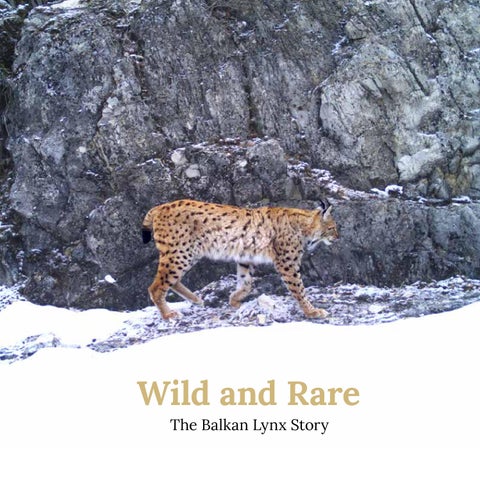
Wild and Rare The Balkan Lynx Story
� Sebastian Kennerknecht
� Sebastian Kennerknecht
NOT EVALUATED
DATA DEFICIENT
LEAST CONCERN
NEAR THREATENED
VULNERABLE
ENDANGERED
NE
DD
LC
NT
VU
EN
The Balkan lynx (Lynx lynx balcanicus) is a secretive wild cat found only in a few parts of the Western Balkans, like Albania, North Macedonia, Kosovo, and Montenegro. It’s listed as Critically Endangered by the International Union for the Conservation of Nature, with fewer than 50 adult lynx left in the wild. This tiny population is threatened
CRITICALLY ENDANGERED CR
EXTINCT IN THE WILD
EXTINCT
EW
EX
by habitat loss, illegal killing, and risks associated with low genetic diversity. Conservation groups are working hard to protect their homes, stop poaching, and help local communities living alongside these elusive cats to give the Balkan lynx a chance to survive.
Once Upon a Forest Lynx once roamed the entire Balkan Peninsula. Following major eradication of large carnivores in Europe by humans, the Balkan lynx suffered as well. It is believed that the population experienced a major drop even before World War II, dwindling to just 15 to 20 mature individuals in the wild. By then, the Balkan lynx had already disappeared from most of the peninsula and its presence was restricted to the Southwestern Balkans. The population gradually started to recover when it was granted protection status in 1949 and several protected areas were declared in former Yugoslavia in late 1940s
and throughout the 1950s. This enabled some recovery, with 280 individuals by the 1970s. Still, at the end of the 20th century, civil unrest in the countries of the Southwestern Balkans led to a decline in prey species populations, massive poaching and largescale deforestation, causing yet another decimation of the Balkan lynx population. It wasn’t until 2005 that the first conservation activities for the lynx in the range countries took place, sparking what would become one of the longest continuous conservation projects in the region.
� Sebastian Kennerknecht
Legend Balkan lynx distribution - year 1800 Balkan lynx distribution - year 1900 Current Balkan lynx distribution
From Concern to Action The Balkan Lynx Recovery Programme (BLRP) was launched in 2006 in response to the critical status of the Balkan lynx. It was initiated as a transboundary effort involving national conservation organisations responsible for the implementation of field activities in North Macedonia (Macedonian Ecological Society, MES) and Albania (Protection and Preservation of Natural Environment in Albania, PPNEA) with scientific support from Switzerland (KORA) and coordination from Germany (EuroNatur). Since 2013, the BLRP has expanded to Kosovo (Environmentally Responsible Action group, ERA). From its modest beginnings, tracking lynx footprints in the snowy trails of Mavrovo National Park, BLRP over the years evolved into a comprehensive programme bringing together many people – rangers, hunters, locals, farmers, foresters, tourist guides, journalists, livestock breeders, teachers, schoolchildren, volunteers, students – united under one noble cause: to save the Balkan lynx.
� Sebastian Kennerknecht
The Big Picture BLRP is dedicated to restoring a stable wild population of the Balkan lynx. The project is built around several key pillars, each focusing on an essential part of securing a future for the Balkan lynx.
Research and Monitoring Provides reliable monitoring and targeted research to gain vital insights into the ecology and needs of the Balkan lynx.
Policy Lobbying for better legislation and improved law enforcement to address key threats and ensure longterm protection of lynx and their habitats.
Natural Resource Management Expanding protected areas, such as national parks, while also promoting sustainable forest and wildlife management in surrounding non-protected areas to improve the conservation and protection of the Balkan lynx and its prey.
Communication and Education Raising awareness about the Balkan lynx and its ecosystem through targeted education and communication, while fostering cooperation with communities, hunters, and authorities to promote coexistence and reduce illegal killing.
Lynx at First Glance Short, stubby tail ending with a black tip
Ears tipped with long black tufts of hair Thick, yellowbrownish coat with distinct or no spots
Sharp eyes framed by a fur ruff
Strong legs and large furry paws
Spot the Difference The coat pattern of the Balkan lynx varies between individuals and serves as a key feature for identification. Each lynx has a
unique combination of markings, which may include spots, rosettes, or in some cases, a uniform coat without spots.
Notes from a Taxonomist The Balkan lynx has fascinated scientists since the early 20th century. In 1941, Bulgarian zoologist Ivan Buresh highlighted that this lynx lived in the region and deserved its own subspecies name, Lynx lynx balcanicus. Back then, the lynx had vanished from Bulgaria and wasn’t even in the Sofia museum’s collection. Although Buresh didn’t provide a detailed description, he noted the skull suggested it was distinct from other Eurasian lynx. Almost 40 years later, Serbian scientist Đorđe Mirić studied museum specimens closely, measuring skulls and legs, and confirmed the Balkan lynx as a unique subspecies naming it Lynx lynx martinoi. Later, the name was switched back to balcanicus because, according to the International Code of Zoological Nomenclature, the earliest valid name takes priority.
Rooted in the Balkans Genetic research has shown that the Balkan lynx carries unique DNA markers found in no other lynx population, pointing to an early split from its relatives. After surviving in isolation for thousands of years, this rare subspecies developed distinct genetic traits. However, occasional male lynx from the nearby Carpathian population have wandered in over time, mixing their genes and slightly reducing the genetic differences in the Balkan lynx’s DNA.
Habits and Habitat The elusive cat lives in mountainous, forested regions, favouring dense woodlands that offer cover for hunting and denning. Old-growth forests and diverse landscapes rich in vegetation are critical to supporting the lynx’s prey, ensuring a stable food supply. Lynxes are typically found at elevations ranging from 600 to 2,000 meters above sea level.
� Sebastian Kennerknecht
The lynx in the Balkans is highly territorial, with each individual establishing its own home range, similar to other Eurasian lynx populations. Male lynx have larger home ranges, typically spanning 220–700 km², while females maintain smaller ranges of 100–200 km². Their overlapping territories of male with females allow for breeding, ensuring the continuation of the species.
Young lynx are born in late spring, usually between May and June, after a gestation period of around 70 days, following mating in winter or early spring. They stay with their mother for up to 10 months, learning vital survival skills before venturing out to establish their own territories. During this dispersal phase, males tend to travel greater distances, while females often settle near their birthplace.
� Panajot Choroski
� Sebastian Kennerknecht
The Balkan lynx is an ambush predator that primarily hunts small ungulates such as roe deer and chamois. In regions where these prey species are less abundant, lynx may also rely on brown hares, as well as a variety of alternative prey, including rodents, bats, and even martens and foxes. The lynx’s ability to thrive is closely linked to the availability of suitable prey and the overall quality of its habitat.
� Betim Chodari
� Betim Chodari
On the Edge An unfortunate combination of threats causes uncertainty and may push the Balkan’s largest cat towards extinction.
Stray dogs
Illegal killing
in rural areas are adding pressure on the lynx. These dogs often form packs that hunt and disturb wildlife. They also scavenge from lynx kills, which threatens the well-being of this elusive predator.
poses a serious threat to the already tiny Balkan lynx population, where losing even one individual can have a big impact. Additionally, poaching of prey species like roe deer and chamois reduces the lynx’s food supply, further endangering its survival.
Habitat loss is another serious issue that jeopardises the lynx. Human activities causing deforestation, infrastructure development, and wildfires are destroying and fragmenting suitable habitats. Again, this not only affects the lynx, but its prey species too!
Genetic problems pose another hidden threat slowly undermining the lynx’s health. The small, isolated population suffers from inbreeding and low genetic diversity, likely reducing their reproductive success. Urgent action is needed to reinforce the Balkan lynx population and prevent its extinction.
Paths to Survival The survival of the Balkan lynx depends heavily on key ecological corridors that link their main habitats across the region. Lynx move in two main ways: young lynx disperse to find and settle new territories, while adults roam within their large home ranges. This dispersal is crucial because it helps prevent inbreeding and allows genetic exchange, keeping the population healthy. It also plays a key role in expanding their range, which is especially important for repopulating areas where lynx have disappeared.
PRISHTINA
XKX
SKOPJE
MKD
TIRANA
ALB
Legend 1. Mavrovo NP
11. Munella Nature Reserve
2. Shar Mountain NP
12. Cukal-Munella-Balgjaj-Matanesh
3. Jasen Multipurpose Area
13. Shebenik NP
4. Bukovikj
14. Polis-Valamara-Rungaj-Gramoz
5. Stogovo-Karaorman-Jablanica
15. Stravaj-Sopot
6. Ilinska-Plakenska Mts.
16. Guri i Nikës-Valamarë-Lenie
7. Galichica NP
17. Albanian Alps NP
8. Pelister NP
18. Bjeshkët e Nemuna NP
9. Sharri NP
Protected areas
10. Korab-Koritnik Nature Reserve
Bio-corridors
Eyes, Ears, and Tech Since the Balkan lynx is a very rare animal, on top of being a nocturnal and elusive species, studying it presents a major challenge. It’s not everyday that you spot the spotted cat in nature. Therefore, wildlife researchers have come up with several methods to establish lynx presence and conduct scientific research.
� Silvio Augusto Rosmigo
Tracks and signs With careful observation, signs of a lynx can be found without seeing the animal. Tracks in snow or mud, though faint, are recognizable to trained eyes. A change in gait may indicate a marking spot; yellow snow and a strong scent can confirm it. Lynx kills also reveal their presence through how the prey is killed, eaten, or hidden. Scat near a kill provides further evidence and insight into their diet.
Camera traps These digital devices use motion sensors to capture images or videos of passing animals. Silent and discreet, they cause minimal disturbance. Camera traps are typically placed along forest paths and game trails, often used by lynx as they travel long distances in search of food or mates. Researchers place two cameras on opposite sides of a trail to capture both flanks of passing lynx. This enables individual identification through their unique coat patterns, which in turn allows researchers to estimate population density. � Sebastian Kennerknecht
� Sebastian Kennerknecht
� Sebastian Kennerknecht
Radio-tracking Wildlife telemetry provides invaluable insights into lynx movement and behaviour, offering data that would be nearly impossible to gather through observation alone. GPS tracking delivers regular location fixes that, over time, reveal individual territories, distances travelled, kill sites, resting areas, potential dens, and even interactions between individuals. To collect this data, researchers occasionally carry out live captures using box traps. Captured lynx are handled according to a strict protocol: after sedation, vital signs are carefully monitored, measurements are taken, and blood and hair samples are collected. The procedure concludes with the fitting of a GPS radio collar, after which the lynx is released back into the wild. � Sebastian Kennerknecht
� Slavcho Hristovski
Genetic sampling
� Sebastian Kennerknecht
Understanding the condition of individual lynx helps build a clearer picture of the population’s overall health and demographics. This information is essential for planning effective conservation efforts for such a critically endangered species. That’s why collecting genetic material is so important. Blood and hair samples taken during captures offer valuable insights, while urine also provides useful genetic data. Even scat reveals both health and genetic information. Simply put, the more samples we collect, the more we can learn.
The Lynx in Our Stories
Animals have shaped human life for ages – and the lynx is no exception. Although shy and hidden, the lynx still held a powerful place in folk beliefs and medicine. In the Balkans, lynx claws set in silver or gold were thought to protect against nightmares and epilepsy. In Shar Mountain, people believed lynx fangs shielded children from curses, while in Mavrovo, claws and ear tufts were carried as lucky charms. Seen as a supernatural “fiend,” the lynx’s claws were often hung on walls or worn around waists to safeguard children.
Today, the lynx is a cherished symbol of wilderness, a rare and stealthy presence that continues to inspire awe. Though rarely seen, the lynx plays a meaningful role in the daily lives of many across the Balkans. In North Macedonia, the lynx is featured on the five-denar coin, appeared on a 1994 postage stamp, and serves as the mascot for the Macedonian national football team. In Albania as well, the Balkan lynx has been honoured as a national symbol: since 2017, it has appeared on an Albanian postage stamp, highlighting its importance to the country’s natural heritage. More recently, Kosovo’s Balkan Lynx Rugby Club was founded and features the country’s only women’s rugby team. By choosing the Balkan lynx as their symbol, the team celebrates this elusive native species while breaking cultural barriers and promoting gender equality through sport.
� Balkan Lynx Rugby Club
Meanwhile, colourful lynx murals supported by BLRP are brightening walls across Albania, North Macedonia, and Kosovo. These eye-
catching artworks inspire communities to protect the Balkan lynx and its forest home for generations to come.
Sowing Seeds of Nature Education Teaching children about the Balkan lynx has always been a key part of its protection. Across Albania, North Macedonia, and Kosovo, kids, teens, and teachers have joined outdoor events and fun learning activities in lynx habitats. A special Balkan Lynx EduKit was created for primary schools and used in lynx distribution areas. The programme mixes indoor lessons
on lynx biology with outdoor adventures – like tracking prints, exploring forests, and learning through play. A storytelling book and outdoor theatre brought the lynx to life for young minds, while “little scientist” games sparked curiosity. Even teachers received special training, creating a growing network of lynx-friendly classrooms across the region.
A Day for the Lynx Every year on 11 June, International Lynx Day is marked across the world, celebrating lynx in the wild. It is also an occasion to spotlight the critically endangered Balkan lynx. Across Balkan lynx range countries, the BLRP team organises fun and educational events that bring people closer to nature. Children, parents, park rangers, and nature lovers come together for storytelling, nature walks, creative art, and games, all designed to celebrate the lynx and inspire action to protect its forest home.
Why Do We Need to Protect the Balkan Lynx? The Balkan lynx should be protected not only because it plays an important role at the top of the food chain, but also because the species is valuable in its own right. As a top predator, the lynx helps keep nature balanced by controlling the number of animals it hunts, which supports a healthy environment. Its presence is a sign of a functioning, balanced environment. But beyond these ecological benefits, the Balkan lynx is a unique and irreplaceable part of the region’s natural heritage. It is a distinct subspecies with specific genetic and behavioural traits, and its continued existence matters simply because it is a part of the world’s biodiversity.
Many people in the Balkans identify with the lynx as a symbol of the wild beauty and resilience of their landscapes. Its survival is tied to a sense of regional identity and pride. With so few individuals left, losing the Balkan lynx would mean the permanent extinction of an animal that has lived in the region for thousands of years. Protecting it means we value not just what it does for ecosystems, but the fact that it exists at all. Sometimes, the reason is as simple and profound as this: we want the lynx to be there, not just for what it offers, but because its presence enriches the natural and cultural fabric of the region.
A Day in the Field
� Andrej Mihajlov
� Andrej Mihajlov
� Silvio Augusto Rosmigo
� Sebastian Kennerknecht
� Sebastian Kennerknecht
� Sebastian Kennerknecht
� Sebastian Kennerknecht
� Sebastian Kennerknecht
Production Balkan Lynx Recovery Programme Editor Aleksandar Pavlov Maps Vasko Avukatov and Slave Nakev Design
Unless otherwise stated, all photographs in this brochure are the property of the Balkan Lynx Recovery Programme and are protected by copyright law. Unauthorised use, reproduction, or distribution is prohibited without prior written permission.
www.balkanlynx.com