SEPTEMBER 2026/5 September 5 / 2026 Eurofish Magazine
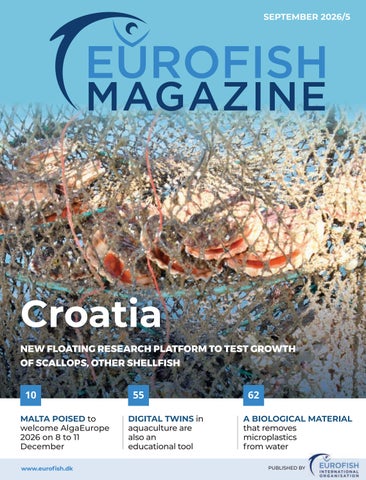
Croatia NEW FLOATING RESEARCH PLATFORM TO TEST GROWTH Eurofish International Organisation
OF SCALLOPS, OTHER SHELLFISH
10
55
62
MALTA POISED to welcome AlgaEurope 2026 on 8 to 11 December
DIGITAL TWINS in aquaculture are also an educational tool
A BIOLOGICAL MATERIAL that removes microplastics from water
www.eurofish.dk 01_Cover 4p.indd 1
PUBLISHED BY
23/09/26 6:06 PM
Get the fisheries and aquaculture sector in Europe delivered straight to your inbox
IMPRINT Publisher
Eurofish International Organisation H.C. Andersens Boulevard 44-46 DK-1553 Copenhagen V Denmark
diary dates
Tel.: +45 333 777 55, info@eurofish.dk eurofish.dk Managing editor
Marco Frederiksen
Editorial offices
Behnan Thomas (bt) H.C. Andersens Boulevard 44-46 DK-1553 Copenhagen V Denmark Tel.: +45 333 777 64 behnan@eurofish.dk
29 September-1 October Aquaculture Europe 2026* Ljubljana, Slovenia eas@aquaeas.eu www.aquaeas.org
Dr. Manfred Klinkhardt (mk) Redaktionsbüro Delbrück Franz-Stock-Straße 23 D-33129 Delbrück Germany Tel.: +49 5250 933416 manfred.klinkhardt@web.de Advertising
Mads Tj rby FRONTMEDIA Ny Banegårdsgade 55 8000 Aarhus C Denmark
6-8 October 2026 Conxemar Vigo 2026* Vigo, Spain Tel.: +34 986 433 351 www.conxemar.com
Mob.: +45 2750 7080 Tel.: +45 4822 4450 mads@frontmedia.dk
for free.
Frequency
6 issues per year
Circulation
2500 copies
Subscription details
Price: EUR 100,– To subscribe send an email to info@eurofish.dk Unless otherwise stated, the copyright for articles in this magazine is vested in the publisher. Articles may not be reproduced without written permission from the copyright holders. An electronic copy is available on request to adverts@eurofish.dk ISSN 1868-5943
19-21 October 2026 IFFO Annual Conference Buenos Aires, Argentina Tel.: +44 2030 539199 secretariat@iffo.com www.iffo.com
4-6 November 2026 Busan International Seafood & Fisheries EXPO Busan, South Korea Tel.: +82-51-740-7518 bisfe@bexco.co.kr https://www.bisfe.com/eng/
Order your free trial info@eurofish.dk
Eurofish.dk/sign-up
Read the Eurofish Magazine online at www.eurofish.dk
30 Nov.– 2 Dec. 2026 XI Congreso Nacional de Acuicultura Puerto Montt, Region de Los Lagos, Chile aquaculture2026@uchile.cl https://congresoacuicultura2026.cl/
8-11 December 2026 AlgaEurope 2026* Valletta, Malta Tel.: +31 85 401 73 97 info@dlg-benelux.com www.algaeurope.org
17-18 February 2027 AquaFarm* Pordenone, Italy Tel.: +39 0434 232111 pdeodorico@fierapordenone.it https://www.aquafarm.show/en/
9-11 March 2027 North Atlantic Seafood Forum – NASF Bergen, Norway andre@nor-seafood.no https://nor-seafood.com/
20-22 April 2027 Seafood Expo Global/ Seafood Processing Global Tel.: +1 207-842-5504 sales-global@seafoodexpo.com https://www.seafoodexpo.com/ global/
* Eurofish will be attending
eurofish.dk
01_Cover 4p.indd 2
23/09/26 6:06 PM
in this issue SELECTED ARTICLES
CROATIA’S AQUACULTURE PRODUCTION TOUCHES A NEW HIGH Croatian aquaculture must contend with climate change which affects marine and freshwater production through warmer water and drought among other impacts. Despite this, aquaculture production achieved a record in 2025. Farmed shellfish production is an area the government would like to expand, and it is therefore promoting measures that will protect farms from predation, boost the supply of spat, and diversify the range of species farmed. A new floating research platform will explore the potential to increase production of mussels and oysters as well as of scallops. Other measures aim to encourage small farmers to come together in PAGE producer organisations and develop joint branding and marketing activities.
The Smart Mussel Farm Šibenka near Šibenik in Croatia is a floating research platform for testing technologies under commercial mariculture conditions. Developed within the MARBLE Centre of Excellence it combines environmental monitoring with underwater observation and experimental farming systems. Researchers are studying how changing conditions affect mussel and oyster performance. They are also examining seabream predation and biofouling while testing possible control methods. Scallop cultivation forms another part of the research programme. By linking environmental data with farm performance Šibenka aims to provide producers with practical guidance that in the PAGE long-term goal should contribute to more predictable and resilient fish and shellfish farming across Europe.
Artificial intelligence is increasingly changing aquaculture by turning data from sensors and cameras into practical farm decisions. Systems can estimate biomass and optimise feeding while also monitoring water quality and detecting signs of disease. These applications can lower feed waste and improve animal welfare while increasing production efficiency. Adoption remains uneven because equipment is costly and staff need suitable training. Small producers in developing countries face particular barriers. Even so technology costs are falling and algorithms are improving. These trends could extend data-driven management across aquaculture PAGE enabling automated farm control on a wider cross section of farms, species, and environments.
The VeriFish project has developed a nutritional scoring system that analyses how different seafood species contribute to the diet. The framework uses harmonised composition data and accounts for differences between species and processing methods. Nutrient amounts are related to established dietary reference values so that different foods can be assessed on a common basis. Users can see an overall nutrient-density score together with information explaining the result. While the score does not measure environmental sustainability nor provide personalised dietary advice, it compares nutrients provided by different seafoods. The data underlying the score remain traceable, so the PAGE system can be updated when better evidence becomes available or food composition records change.
Europe’s hot and dry summer of 2026 revealed how vulnerable pond aquaculture is to climate change. Low rainfall reduced water supplies while higher temperatures increased evaporation and oxygen stress. Farmers in Czechia and Hungary responded by reducing feeding and increasing aeration. Some transferred water between ponds or harvested fish early. The loss of many fish can affect production for several years because carp farming relies on long production cycles, so farmers do their utmost to prevent it. Because fishponds offer several environmental services such as supporting biodiversity and storing PAGE water within landscapes, low pond water levels can have wider consequences.
Mr.Goodfish3.0 seeks to help consumers make more sustainable seafood choices by communicating scientific recommendations in an appealing and accessible way. The project involves citizens and seafood professionals in shaping how information is presented. Outputs from the project include an app and a website as well as educational materials and seasonal recommendations. Pilot activities show that cooking skills and cultural familiarity can promote interest in unfamiliar species. The project also works through chefs and retailers while engaging with schools and public institutions. Among its objectives is to determine whether greater awareness of fish PAGE and seafood leads to lasting changes in purchasing behaviour.
22
13
19
38
52
57
Eurofish Magazine 5/2026
02_In_This_Issue.indd 3
03
23/09/26 6:32 PM
table of contents CROATIA’S FISHERIES 22 BALANCE PROTECTION WITH PRODUCTION NEWS 6
International News
D
EVENTS 10
Malta to host AlgaEurope 2026
11
Polfish 2026 reveals the dynamism of the local seafood sector
AQUACULTURE 13 Data-based decisions increase production efficiency
16
Small and medium fish farms can also benefit from AI
19
Summer 2026 exposed the vulnerabilities of European pond aquaculture
04
03_TOC.indd 4
CROATIA 22
Croatia’s fisheries balance protection with production
27
Processing low value species for a better price
30
Recycled fishing gear leads to fashion clothing line
SPAIN
32
FLAG Galeb builds value into Croatia’s coastal fisheries
35
From carp angling to cage aquaculture
38
Šibenka brings smart technology to shellfish farming
Eurofish Magazine 5/2026
24/09/26 1:05 PM
table of contents 51
EU-funded FIDEL project kicks off in Volos, Greece
52
VeriFish communicates the nutritional value of seafood
EDUCATION 55
Digital twins in aquaculture education
NORWAY
ESTONIA
DENMARK
LATVIA LITHUANIA
ROMANIA
CROATIA
N
ITALY
ALBANIA
41
Tuna Adria adds value to Croatia’s wild bluefin tuna
43
Fish for buyers prioritising quality
46
On Vis, FLAG Škoji is key to developing fisheries
Enabling consumers to make sustainable seafood choices
PROCESSING 59
POLAND HUNGARY
57
TÜRKIYE
Breadings and coatings enhance appearance and bite
ENVIRONMENT 62
Novel research on marine microplastic capture and removal
48
Restaurant Peškarija 1911 adds value to locally caught fish
PROJECTS 50
Seadeep accelerates the energy transition in fisheries
GUEST PAGE 64
Freshwater aquaculture at a crossroads
SERVICE 67
Diary Dates, Imprint
Eurofish Magazine 5/2026
03_TOC.indd 5
05
24/09/26 1:05 PM
news EUROPE
Drought puts freshwater aquaculture under growing pressure Persistent drought and high temperatures are increasingly threatening freshwater aquaculture across Europe, as falling water levels, warmer water, and reduced oxygen availability place additional pressure on pond and flowthrough farms. In early August 2026, around 37% of the area covered by the European Environment Agency’s member and cooperating countries was experiencing drought conditions, affecting 37 countries. Climate projections indicate that droughts are likely to become more frequent, prolonged, and severe in many parts of Europe.
The impact is already visible in freshwater production. In Hungary, around 1,588 hectares of fish ponds have dried out, while nearly 280 tonnes of fish have been lost, with estimated revenue losses of over EUR 3 million. Producers elsewhere in Central and Eastern Europe are responding by reducing feeding, increasing aeration, transferring fish, or using additional oxygenation. Such measures can limit immediate mortality but also raise production costs and slow growth. Longer-term resilience will increasingly depend on improved water storage and retention,
Counting only the EU-27 states, around 42% of the total area was affected by drought in summer 2026
adapted stocking densities, monitoring systems, and clearer rules for allocating scarce water resources.
NORWAY
Seasonal Norwegian mackerel arrives in Japan The first Norwegian mackerel of the season arrived fresh in Tokyo on 11 September under the Saba Nouveau concept, which is now in its sixth year. Saba Nouveau uses mackerel caught between August and November, when Atlantic mackerel have spent several
months feeding and are in particularly good condition. Fat content can reach 28%, contributing to the flavour and texture valued by Japanese consumers. The promotion also draws on the Japanese tradition of hatsumono, the appreciation of the first produce of a new season.
Saba Nouveau mackerel from Norway arrives at Haneda, Tokyo courtesy Japan Airlines (archive photo).
06
Japan has long been one of the most important markets for Norwegian mackerel. In 2015 it was Norway’s largest direct export market for the species. In 2025 Norway exported 207,927 tonnes of mackerel globally, worth NOK8.5bn. Volumes fell 34% from the previous year, but higher prices pushed export value to a record. Around 40% of Norwegian mackerel ultimately went to the Japanese market. Not all this fish is shipped directly. An important part of the trade passes through processing countries such as Vietnam and China before reaching Japan. Whole Norwegian mackerel entering Japan directly faces a 7% tariff and fillets 10%, whereas mackerel processed in Vietnam can enter duty-free. The Saba Nouveau arrival coincided with the Norway Seafood Festival in Tokyo from 11 to 13 September. This year the event also featured Norwegian herring for the first time, alongside salmon and mackerel.
Eurofish Magazine 5/2026
04_News_INT.indd 6
22/09/26 11:59 AM
news SPAIN
Galicia backs climate-resilient aquaculture research with €680,000 The Xunta de Galicia is investing more than €680,000 in an aquaculture research project designed to help the sector adapt to climate change. Funded through the regional government’s Nexos programme, the Mitakua project will combine biosecurity, nutrition, and production-system research to improve resilience under changing environmental conditions. A central element will be the development of a monitoring programme for potential pathogens and other biosecurity risks affecting farmed species. Researchers will also assess feeds and ingredients that could help fish cope with thermal stress during periods of high water temperatures. In parallel, project partners plan to design recirculating aquaculture systems for marine species that are better adapted to climate-related changes in water chemistry and biology. The initiative brings together aquaculture companies and research organisations, and includes a programme to disseminate its findings to industry, public authorities, and the scientific community. The wider 2026–2028 Nexos funding call supports 37 projects involving 138 companies, with €22.6 million in regional and European funding expected to mobilise almost €40 million in total investment.
The research programme will develop a monitoring programme for potential pathogens and other biosecurity risks affecting farmed fish.
ITALY
EU aid scheme worth EUR285m approved for higher fuel costs in Italy The European Commission has approved a €285 million Italian aid scheme to support businesses facing higher fuel costs linked to the crisis in the Middle East. Fisheries and aquaculture companies are included in the package alongside the agricultural sector. Support will be provided through direct grants and tax advantages, with the scheme remaining in force until 31 December 2026. For fisheries and aquaculture operators, the amount of aid will be calculated on the basis of estimated fuel consumption. However, the share of the total package that will be allocated specifically to the seafood sector has not been specified.
Energy costs present one of the highest and most volatile cost aquaculture operations.
The measure was approved under the EU’s Middle East Crisis Temporary State Aid Framework, introduced in April 2026 to help businesses manage higher energy and input costs. Similar support schemes have already been approved in several other EU Member States. The Commission concluded that the Italian scheme complies with EU State aid rules and is necessary and proportionate to address the economic impact of elevated fuel prices.
DENMARK
Rare warm-water by-the-wind sailors reach Danish coast An unusual warm-water marine visitor has been recorded along Denmark’s North Sea coast, where several bythe-wind sailors (Velella velella) have washed ashore. The small, blue organisms normally occur in warmer parts of the world’s oceans, including the Mediterranean, and are only rarely reported in Danish waters. By-the-wind sailors live at the sea surface and have a flat, dark-blue floating disc topped by a small sail. They generally grow to around 5–7 cm and are carried largely by wind and surface currents rather than active swimming. Marine specialists believe particular wind and current
Velella use stinging tentacles to prey on plan ton and fish eggs.
conditions are likely to have transported the animals unusually far north. Several specimens were reported along the north-western Danish coast in early August. Despite their striking appearance, the organisms are not considered dangerous to people and do not sting in the same way as some jellyfish. Direct contact can, however, cause mild itching or skin irritation.
Eurofish Magazine 5/2026
04_News_INT.indd 7
07
22/09/26 11:59 AM
news NORWAY
Sharp fall in share of ‘production fish’ The share of Norwegian farmed salmonids classified as “production fish” fell to 10.6% of harvest volume in the first half of 2026, its lowest first-half level since 2019. This compares with 17.7% in the same period of 2025 and 30% in 2024. At the same time, Norway recorded its highest-ever harvest volume for the first six months of a year. Production fish are salmon, trout, or rainbow trout found at slaughter with wounds, deformities, or other quality defects. Under Norwegian rules, they cannot be marketed for human consumption until these defects have been removed through domestic
processing. The proportion discarded entirely remained low and stable.
roduction fish is a regulatory quality category. Farmed salmonids are classified as production fish at slaughter when they have wounds, deformities, or internal quality defects.
The Norwegian Food Safety Authority says the lower share may indicate improved fish welfare because several classification criteria relate to injuries and signs of disease, but stresses that the statistics alone cannot establish the cause. The improvement also appears to be relatively widespread geographically. The authority’s public dataset, based on mandatory industry reporting, provides quarterly slaughter volumes and quality classifications dating back to 2018.
GREENLAND
Royal Greenland reshapes executive management Royal Greenland is reshaping its executive management team, with its finance director and sales director due to leave the Greenlandic seafood group at the end of August 2026. The changes follow the arrival of a new chief executive, who took up the position in late 2025 and has been reviewing the composition of the company’s senior leadership. Royal Greenland said the departures form part of the chief executive’s assessment of the management structure required for the company’s future development. It stressed that the decision is not related to the two executives’ performance, professional capabilities, integrity, or conduct. Both departing directors have contributed to the group’s commercial and financial development. The sales function has also been involved in strengthening Royal Greenland’s global sales organisation and establishing a European shared service centre.
08
Royal Greenland AS has around 1.600 total employees worldwide as of March 2026.
The management changes come as the state-owned company continues to pursue operational improvements and strategic investments across its
North Atlantic activities. Royal Greenland did not announce replacements for the two positions when presenting the leadership changes.
Eurofish Magazine 5/2026
04_News_INT.indd 8
22/09/26 11:59 AM
news International Catfish Conference to bring science and industry together in Győr Széchenyi István University in Győr, Hungary, in cooperation with EUROFISH and HUNATiP, will organise the first International Catfish Conference (ICC) on 5–9 April 2027. Designed as an industry-focused international event, the conference will bring together catfish producers, processors, researchers, technology providers, policymakers, and other stakeholders from Europe and from major catfish-producing regions around the world. According to Prof. Béla Urbányi, Chair of the Organising Committee, African catfish (Clarias gariepinus) in particular is attracting growing interest among European aquaculture producers. The conference therefore aims to create a common platform where researchers and industry experts working with different catfish species and production systems can exchange knowledge, discuss practical challenges, and develop new cooperation efforts that support the growth and competitiveness of the European catfish sector.
The planned programme reflects this strong connection between science and industry. Scientific and technical sessions will address feeds and nutrition, genetics and breeding, production technologies and animal welfare, and processing and marketing. A dedicated farmers’ session will discuss the practical challenges and opportunities facing European catfish producers, while policy discussions will consider the future development of freshwater aquaculture more broadly. The event will also include an Open Catfish Day with product tasting and cooking demonstrations, networking and industry activities, sessions on digitalisation, climate change impacts, and the energy transition in freshwater aquaculture, as well as a technical tour to commercial catfish production and processing facilities. The organisers expect the first ICC to attract around 150–200 participants from Europe, Africa, Asia, and the Americas, establishing a new international platform for cooperation
African catfish ill be highlighted at the upcoming international catfish conference in y r, Hungary than s to its suitability for recirculation systems and its popularity among consumers.
and knowledge exchange across the catfish value chain. Abstract submission and registration will open soon on the conference website, www.unicatfish.com, where further information and programme updates will also be available.
FRANCE
Pure Salmon clears environmental hurdle for French RAS project Pure Salmon has secured environmental authorisation for its planned 10,000-tonne land-based salmon facility in France, clearing another important regulatory step for the project. The approval, granted on 3 August 2026, follows a building permit issued in June and favourable assessments from the relevant environmental and public review bodies. The project, which will operate as Saumon du Médoc, is planned as a recirculating aquaculture system facility with an integrated processing
plant. Pure Salmon says production will take place without antibiotics and will draw on operational experience from its Japanese facilities, which began operating in May 2026. The company expects the French development to create around 250 jobs and contribute to domestic salmon production in a market that currently relies heavily on imports. Its feed strategy is intended to use fish-processing by-products as the exclusive source
Pure Salmon plans to produce salmon in a land-based facility in France.
of marine ingredients for fishmeal and fish oil, rather than fish caught specifically for feed production.
Eurofish Magazine 5/2026
04_News_INT.indd 9
09
22/09/26 12:00 PM
events
Malta to host AlgaEurope 2026 AlgaEurope 2026 will take place from 8 to 11 December at the Hilton Malta, bringing together researchers, industry representatives, technology providers, policymakers and other stakeholders from across the international algae sector.
O
rganised by the European Algae Biomass Association (EABA) and DLG Markets Benelux, AlgaEurope has developed into one of the leading international meeting places dedicated to algae biomass. The conference combines science, technology and business and is expected to welcome more than 400 participants from over 45 countries to Malta. The four-day event will provide a platform to exchange the latest knowledge and developments in both microalgae and seaweed. The programme covers the complete algae value chain, ranging from cultivation technologies, photobioreactors and offshore production to biorefining, food and feed applications, high-value products, biotechnology, sustainability and commercialisation.
Europe remains a small producer in a global market Algae are already a major aquaculture crop globally, but production is concentrated overwhelmingly in Asia. FAO recorded 39 million tonnes of farmed algae in 2024, of which China produced 24 million tonnes. EUMOFA, using FAO data, reported EU-27 catches of wild seaweed at 93,774 tonnes in 2022, compared with just 1,019 tonnes of farmed algae. Wild harvesting therefore accounted for about 99% of recorded EU algae production, with France and
10
Participants at AlgaEurope 2026 in Malta from 8-11 December can expect a comprehensive programme covering developments in Europe and Asia in algae production techniques, applications, and markets (archive photo).
Ireland together responsible for 94% of EU seaweed catches. The EU is nevertheless an important algae market. In 2023, extra-EU imports of seaweed and other algae reached 141,660 tonnes worth EUR 124.4 million, according to EUMOFA, while exports totalled 48,174 tonnes worth EUR 37.6 million. Material for further industrial processing accounted for 93% of import volume, with Iceland and Norway the main suppliers by volume. The figures suggest that European demand already exceeds the capacity of domestic production. Microalgae are usually cultivated on land in ponds, photobioreactors or fermenters, and are often directed towards higher-value applications such as food and supplements, aquafeeds, nutraceuticals, cosmetics, pharmaceuticals, fertilisers and plant biostimulants. In aquaculture, microalgae are well established as hatchery feeds for
bivalves and in feeding systems for fish and crustacean larvae. Commercial products also include omega-3 oils and pigments such as astaxanthin.
International experts take the stage At AlgaEurope several internationally recognised scientists have already been confirmed as keynote speakers. Carlos Duarte of King Abdullah University of Science and Technology (Saudi Arabia) will address the multiple roles and opportunities of seaweed farming, while Jang K. Kim of Incheon National University (South Korea) will focus on innovations for building climate-resilient seaweed aquaculture in a warming ocean. Fayza Daboussi of INRAE-TIBH in France will explore the potential of advanced genetic
Eurofish Magazine 5/2026
05_NEWS EV.indd 10
22/09/26 12:16 PM
events engineering for microalgae, while Laurent Picot of La Rochelle University will discuss emerging and unexpected applications of microalgae. In addition, Hans Verhagen, Food Safety & Nutrition Consultancy, the Netherlands, will join AlgaEurope as a special guest to address the regulatory landscape for alternative proteins and precision fermentation novel foods in the EU and UK. The final scientific programme will largely be shaped by the algae community itself. AlgaEurope follows a bottom-up approach in which submitted scientific and innovation abstracts are independently evaluated before being selected for oral or poster presentations. Interest in the 2026 edition is already strong, with 213 abstracts received to date from researchers and industry experts wishing to contribute to the programme. In response to continued demand, the abstract submission deadline has been extended to 30 September, giving the international algae community a final opportunity to contribute to the programme.
China becomes AlgaEurope’s first partner country
A closer look at aquaculture innovation in Malta
A new feature for 2026 is the introduction of the AlgaEurope partner country programme, designed to strengthen international cooperation between Europe and important algae-producing countries. China has been selected as the inaugural partner country, with the China Algae Industry Association serving as the official partner. As the world’s largest producer of algae biomass and home to an extensive seaweed and microalgae industry, China is expected to bring an important additional international dimension to the conference. The initiative reflects the increasingly global nature of the algae sector and AlgaEurope’s aim to connect European research and industry with leading algae regions worldwide.
The conference will conclude on Friday, 11 December, followed by an optional site visit to AquaBioTech Group. Participants will visit the company’s headquarters and research facilities in Malta, where the company works on aquaculture research, testing and engineering. The visit will offer insight into areas including fish health and nutrition, Recirculating Aquaculture Systems (RAS) and Integrated Multi-Trophic Aquaculture (IMTA), demonstrating how algae can form part of broader developments in sustainable aquaculture. With Malta’s position at the heart of the Mediterranean, the 2026 edition also provides an appropriate setting for discussions about the future of marine biotechnology, aquaculture and the blue bioeconomy.
Polfish 2026 reveals the dynamism of the local seafood sector Walking through Polfish 2026 in Gdańsk reveals an enthusiastic and remarkably diverse Polish seafood sector. Officially opened by Jacek Czerniak, Secretary of State at Poland’s Ministry of Agriculture and Rural Development, the fair brings together major processors, producers, technology suppliers and sector organisations, alongside a significant international presence.
S
almon is highly visible at Polfish, reflecting the strength of Poland’s processing industry, but it is only one part of the picture. Carp and sturgeon underline the continuing importance of freshwater production and traditional consumption, while Baltic oysters and other marine and freshwater species add to the diversity on display. Alongside conventional products, companies such as Wolin offered fish in small, readyto-eat formats, from pickled and dried
Eurofish Magazine 5/2026
05_NEWS EV.indd 11
11
22/09/26 12:16 PM
events
olfish
as the place to be to
itness the sophistication of the
products to croquettes. The company is catering to demand for convenient ways to eat fish at work, while travelling, or as part of a busy daily routine. Technology is adapting in response. Sismatec presented automated lines suited to smaller individual portions, while Paula Fish demonstrated the breadth of the processing sector through salmon, whitefish, and fish oils.
Lively cooking shows highlight both modern and traditional Polish cuisine But Polfish is not simply a place to display products and machinery. Cooking is an unusually visible part of the fair.
12
olish fish processing industry, the second largest in urope.
Energetic demonstrations by Polish chefs turn the products exhibited a few metres away into dishes that visitors can see, smell, and taste, showing how seafood can fit both established Polish cuisine and more exotic fare. Sturgeon, for example, appeared in soups prepared using oil obtained from the same fish. Preserved seafood retains familiar flavours while being combined with ingredients to create new and innovative products. Beetroot remains a recognisable accompaniment, but curry and avocado also appear in combinations extending beyond their now familiar use in sushi. Alongside these preparations, fish served raw or with minimal transformation reminds visitors that innovation does not necessarily mean abandoning the product itself. At Polfish traditional freshwater species stood alongside salmon and other
marine fish. Processing covers thawing, gutting, filleting, individual portions, and other formats; while new culinary influences are driving the manufacture of everything from well-known salads, as well as smoked, marinated, and breaded items, to highly value-added ready-to-cook and ready-to-eat products, some of which call for increasingly, specialised technology. International participants, including the Norwegian Seafood Council, Spain’s Petaca Chico, and Iceland Pelagic, showed the importance of Polish processing for raw material suppliers. Polfish presented a sector firmly rooted in Polish production and food traditions but with a vast and internationally facing processing industry, that closely follows European trends in fish consumption. Ixai Salvo, Eurofish, ixai@eurofish.dk
Eurofish Magazine 5/2026
05_NEWS EV.indd 12
22/09/26 12:16 PM
aquaculture
Data-based decisions increase production efficiency Artificial intelligence (AI) is in the process of revolutionising aquaculture. Where fish farmers once stood at the pond edge with a measuring device, algorithms now analyse data on water quality, temperature, and animal behaviour in real time. With this information feed costs can be reduced and diseases detected at an early stage, making aquaculture more successful, sustainable, environmentally compatible, and ultimately more profitable.
S
ince the US company OpenAI enabled access to the ChatGPT chatbot as a new artificial intelligence (AI) tool in 2022, the media have speculated extensively about the possible consequences of this technology. While some spoke enthusiastically about the opportunities, others conjured up more gloomy scenarios. AI, they said, would make some professions redundant and fundamentally change the world of work as we know it. Some concerns appear justified, because the potential of this technology is vast. In the past, developments usually served to solve an existing problem; with AI, the situation is reversed: a revolutionary technology has been developed, and people are now looking at all the areas in which it can be used. And almost all experts agree that aquaculture is among the particularly promising fields of application for AI. Aquaculture is currently experiencing a veritable explosion of innovation. Around half of all software applications in this sector have been introduced in the past five years. More than half of them use computer vision and image
Recirculating aquaculture systems are largely unaffected by extreme weather conditions or the use of surface water and therefore lend themselves better to automated farm management.
recognition algorithms, and nearly 70 per cent already use deep-learning algorithms. Artificial intelligence is supposedly achieved when, in a conversation, it is no longer possible to distinguish whether an answer comes from a human or a machine. Many ChatGPT answers are clearly formulated and so
comprehensive that distinguishing between human and machine is difficult. Not every AI response is correct and coherent, of course, but that is hardly unusual among human interlocutors either. In any case, a great deal of money is currently flowing into equipping aquaculture with AI. Investors see
Eurofish Magazine 5/2026
06_AQUACULTURE (AQ).indd 13
13
22/09/26 12:26 PM
aquaculture
Farming in freshwater earthen ponds, as widely practised in the Czech Repulic, Poland, Romania, and Hungary among other countries, also benefits from devices that can monitor and analyse water quality.
tempting profit opportunities here, because while market prices for fish and seafood are rising, the costs of the new technology are already beginning to fall. The claim that AI is the key to the future of aquaculture is becoming widespread. The use of artificial intelligence in aquaculture, especially machine learning, only began after 2010. In 2015, just one company in ten used AI. Today it is one in two, and the number is steadily growing. Analysts often describe data as the “new oil”. Data are indeed the fuel that keeps algorithms, as the engine, running continuously. From 2010 to 2020, the estimated volume of digital data on Earth increased thirtyfold. This period also corresponds directly with the introduction of AI-driven applications in aquaculture. If data are the new oil, sensors are to AI what boreholes are to the oil industry. Water-quality sensors, cameras, satellite images, and hydroacoustic equipment pump enormous quantities of data into the world every second, which can only be evaluated and managed with intelligent algorithms. More than 75 per cent
14
of aquaculture companies are reportedly already using at least one type of sensor in their daily routines. What is the secret behind this enormous success? What can AI do that “normal” software cannot? The main difference is probably that AI can be trained to learn from datasets. Its “hunger for data” is enormous. The more data it is fed, the “smarter” AI becomes. On the basis of this increased “intelligence”, it can achieve remarkable results in prediction, automation, and classification. This ability makes AI particularly suitable for aquaculture, with its many complex processes and procedures. AI can make aquaculture more efficient, resource-saving, and environmentally friendly. With the help of data from underwater cameras and sensors, algorithms analyse fish behaviour, estimate biomass, and adjust feed quantities in real time. This preserves water quality, reduces waste, and enables the early detection of diseases or parasites.
More and more useful areas of application The capabilities of AI are already remarkable, and more are constantly being added. Water-quality data such as oxygen content, pH, and temperatures, where actual and target values are compared, provide rapid support for decision-making. Recorded parameters on growth, biomass, and movement patterns provide indications of possible stress in the species being farmed. Such data are collected with underwater cameras and analysed with the help of image-recognition algorithms. AI is particularly effective, however, in feed and feeding management, which together account for around half of aquaculture operating costs. One third of AI applications are used in this area. This figure is exceeded only by AI-based biomass estimates combined with growth forecasts, which account for
41 per cent. Visual object-recognition technologies make it possible to count the fish in a stock, measure their size, and estimate biomass and growth. Advanced sensor technology combined with AI algorithms detects emerging problems, supports decision-making, and often even provides recommendations for action to avert risks. One area in which the use of AI quickly pays off is the evaluation of measured oxygen levels in the water. Such measurements are part of the daily routine at almost all aquaculture farms. AI, however, goes beyond merely recording data in real time and identifies trends and patterns in fluctuating values, allowing adverse developments and emerging threats to be predicted. On this basis, the aquaculture producer can take appropriate countermeasures in good time, such as increasing aeration, reducing feeding, or exchanging the water. Some of the capabilities of artificial intelligence are already extremely remarkable, yet other developments are just starting to gain momentum. AI-supported systems, for example, use underwater cameras and sensors to analyse the feeding behaviour of fish. The algorithm recognises when the animals are satiated and adjusts the amount of feed in real time. This prevents feed wastage and protects the water from unnecessary pollution. Image-recognition systems using machine learning monitor the behaviour, appearance, and swimming patterns of fish. As soon as they detect deviations from normal values that could indicate stress or disease, they raise an alarm, enabling clinical checks and the initiation of necessary treatment. Such early-warning systems are available not only for fish species, but also for shrimp, where, under real-time farm conditions with high stocking densities, they allow early analysis of individual sizes, growth, numbers, mortalities, and stress. This, too, is an important contribution to improved animal welfare in aquaculture.
Eurofish Magazine 5/2026
06_AQUACULTURE (AQ).indd 14
22/09/26 12:26 PM
aquaculture AI can take over complete farm management The “supreme discipline” of AI-supported process control is probably autonomous farm management, in which all processes, from monitoring the life cycle of the fish to water quality and animal behaviour, are controlled largely by AI algorithms. For this the entire aquaculture facility must be monitored continuously with sensors and cameras. To create optimum growth conditions, parameters such as oxygen content, pH, and temperature must be regulated autonomously in all ponds and tanks, digital early-warning systems must be installed, and animal behaviour checked for deviations from normal patterns. In terms of sensor and computer technology, all this already appears to be feasible, but the costs
would be enormous, jeopardising the economic viability of such operations. Moreover, implementation would require the facility to be largely shielded from external influences such as severe weather, solar radiation, or the supply of surface water. Automatic management concepts are therefore probably most likely to be feasible in recirculating aquaculture systems (RAS). AI-based monitoring programmes provide important information about farmed fish within fractions of a second. Without removing fish from the water, AI technologies such as machine learning and computer vision can use image analysis to estimate fish size, weight, and numbers. On this basis, the programmes then calculate growth rates and feed requirements. If the size distribution of fish in ponds or tanks reaches critical values, grading of the stock is recommended. Everything is aimed at ensuring optimum growth under the prevailing conditions and avoiding fish losses caused by disease. To achieve this, fish behaviour, willingness to feed, and social interactions are monitored continuously and combined with water parameters such as nitrate, nitrite, oxygen, and organic loads. The AI-based monitoring programmes visualise all data in real time, thereby providing a solid basis for controlling and optimising farm operations.
What stands in the way of widespread use
A device that monitors oxygen levels and releases oxygen when thresholds are breached is used here on a trout farm gro ing the fish in race ays.
Such advantages are, in fact, convincing arguments for the widespread use of AI technologies in aquaculture practice. While they are already being used increasingly in many companies in major aquaculture nations such as Norway, Canada, and Chile, the introduction of this software elsewhere often still meets with reservations. Asia’s aquaculture sector, for example, produces around 90 per cent of all
farmed fish and seafood worldwide, yet has generated only 23 per cent of the technology companies in this sector. Despite the advantages, the introduction of AI applications is often viewed sceptically there. One obstacle is the high purchase and maintenance costs, which are beyond the means of many small-scale producers. AI systems also require a wealth of data, which in turn demands sensors, cameras, and other modern equipment, and staff must be appropriately trained to operate and maintain it. People probably also fear that AI and automation could lead to job losses. However much effort is made locally to create greater awareness of modern technologies, and incentives are sometimes offered for their introduction, AI applications are so far removed from everyday realities and traditional production methods in many developing countries that it may take generations before they actually achieve widespread impact. Given this situation, can it really be claimed that digital technologies and AI are revolutionising aquaculture, and that they are the future of this sector? Is it really only a matter of time before these innovative technologies are also used on a broad scale in low-income countries? There is no denying that AI has the potential to reshape the aquaculture industry. It offers innovative solutions to challenges that are currently holding back the sector’s development. With AI, aquaculture can become more productive, sustainable, and efficient. There are encouraging signs. Modern technologies are becoming cheaper, sensor costs are falling, and algorithms are getting better all the time. The internet offers more opportunities for online learning, making education and training more accessible and less expensive. This also strengthens the hope that, with these developments, AI can play an increasingly important role in intelligent, data-driven decision-making throughout the aquaculture value chain. Manfred Klinkhardt
Eurofish Magazine 5/2026
06_AQUACULTURE (AQ).indd 15
15
22/09/26 12:26 PM
aquaculture
Small and medium fish farms can also benefit from AI Global aquaculture production of aquatic animals reached 103 million tonnes in 2024, according to FAO, accounting for 53% of total aquatic animal production. Since the late 1980s, almost all growth in aquatic proproduction management and ocean enmonitoring. Junichi Taniduction has come from vironmental guchi, who leads international business development at Umitron, spoke at the aquaculture. Further recent Eurofish conference on seafood expansion will depend processing, certification, and trade in Istanbul. He describes technology as an partly on producing “amplifier”— while the farmer still decides the overall production strategy, AI more efficiently while can analyse the data generated by onsite coping with climate equipment such as cameras and sensors help the farmer optimise farm opchange, labour shortag- and erations. es, and stricter environOptimising feeding mental constraints. regimes saves costs and ased in Japan and Singa- reduces environmental pore, Umitron, a technology company founded in 2016, impacts
B
combines machine learning with IoT equipment, farm management software, and satellite remote sensing. Its products range from an autonomous feeder to software for
16
Feed commonly represents more than half of production costs in finfish farming, and overfeeding wastes money, increases nutrient discharge, and can
impair water quality. A 2025 review of computer vision in fish feeding found that conventional timed feeding often fails to respond adequately to changing appetite. Machine vision, by contrast, allows feeding behaviour to be assessed continuously and without handling the fish. The company’s solar-powered feeder, christened Cell, learns fish feeding behaviour and releases feed only when the fish are hungry. It carries a camera that films fish feeding activity. The footage is processed by software which delivers a Fish Appetite Index value (FAI). Based on this value, feeding speed, pauses, and stopping points can then change automatically and autonomously according to thresholds set by the farmer. The processing occurs locally in the unit, so the feeder can continue operating even in cases where internet access is patchy. The system is decentralised so that the feeding parameters for each cage will be calculated based on an analysis of the feeding behaviour of the fish in that
Eurofish Magazine 5/2026
06_AQUACULTURE (AQ).indd 16
22/09/26 12:26 PM
aquaculture Junichi Taniguchi, Head of Inaternational Business, Umitron
Umitron’s solar-powered feeder, Cell, uses a camera to monitor fish feeding behaviour. Analysing the footage the feeder then automatically feeds the fish hen they are hungry.
Farm-management software developed by the company records production variables including feed use, mortality, water temperature, and costs, and calculates C and cost per fish or per production unit.
specific cage. To accurately analyse footage of fish feeding behaviour the AI has been trained on 10 years of farmers’ data, says Mr Taniguchi. Umitron has continued to improve the system. A 2025 update allowed FAI models to be adapted more closely to species, environmental conditions, and individual producer requirements. In his Istanbul presentation, Mr Taniguchi reported feed-cost reductions of 20–25% and a reduction in farm-site working hours of more than 50%. In one Japanese case, he said, feed consumption fell by 30%, while profitability more than doubled. The same farmer was using a zero-fishmeal feed while maintaining a comparatively low feed conversion ratio. Feeding efficiency also contributes
to a 22% reduction in feed-related CO2 emissions, according to Mr Taniguchi. Currently, the feeding units and the software go together, that is, a farmer cannot use the AI capabilities offered by Cell with feeders from another supplier as the two will not be compatible.
Data can also help farms respond to climate risk Feeding optimisation becomes more valuable as environmental conditions become less predictable. Mr Taniguchi points to rising summer
water temperatures in Japan, where farmers producing Seriola species can face higher mortality rates when high temperatures coincide with low oxygen availability and elevated metabolic demand. Another Umitron product, Pulse, combines satellite and other environmental data covering variables including temperature, chlorophyll, dissolved oxygen, salinity, waves, wind, and currents. Users can access 48-hour forecasts and alerts for environmental risks. One Umitron customer began combining water-temperature information with observations of fish appetite and behaviour. Mr Taniguchi says this gave the farmer greater confidence to stop feeding altogether when conditions became unfavourable, rather than continuing because withholding feed seemed commercially risky. Neighbouring farms suffered mortality during difficult conditions, he says, while the Umitron user was better able to adapt. For aquaculture site selection, Umitron currently places greater weight on historical observations than on forecasts decades into the future. After criteria such as biological suitability (temperature, salinity, etc.), and structural suitability (wave height, depth, current, wind etc.) have been defined for each species, the Aquaculture Potential Map combines this information with socio-economic constraints (protected areas, presence or absence of infrastructure, competing uses of space) to identify areas suited to particular forms of aquaculture.
Eurofish Magazine 5/2026
06_AQUACULTURE (AQ).indd 17
17
22/09/26 12:27 PM
aquaculture Existing farm records are a trove of information useful for an AI Another opportunity comes from information already generated on farms. Umitron Farm, another product, is a platform that records production variables such as feed use, mortality, water temperature, fish movements between pens, and costs. It calculates indicators including FCR and cost per fish or production unit. Cell feeding records can enter the system automatically, while farms without Umitron feeders can also use the Farm software. Umitron has also added a generative-AI interface that allows users to query their farm data orally. Instead of searching spreadsheets or compiling reports manually, an operator could ask the system about past feeding performance or production costs and retrieve information from stored records. That may prove one of the less spectacular but more useful applications of generative AI. Aquaculture businesses collect increasing amounts of operational data, yet data has little value if staff cannot retrieve or interpret it easily. Natural-language interfaces could reduce that barrier, particularly for smaller farming operation farms that may lack IT expertise. Disease detection attracts considerable interest because cameras and sensors can identify changes in appearance or behaviour before a problem becomes obvious to farm staff. Research has investigated computer vision for external disease signs, abnormal swimming, and other indicators. Image-based systems can provide non-invasive monitoring, although reflections, poor images, turbidity, and the three-dimensional aquatic environment complicate diagnosis. Researchers also point to the shortage of standard, shared datasets for training models. Mr Taniguchi feels
18
that in principle, an AI model could learn to recognise behaviour associated with infection if sufficient reliably labelled data were available. A recent review of decision-support systems and digital twins found rapid growth in research on disease detection, water quality, and feeding, but only a relatively small proportion of studies reported sustained deployment on commercial farms. Models that perform well under controlled conditions still need to cope with the exigencies of a commercially operating farm.
beyond one company. AI becomes more powerful when models can learn from larger datasets, but producers have legitimate reasons to control who can use commercially valuable information on, for example, mortality, feed efficiency, growth, and costs.
Common standards for greater interoperability should boost AI use on farms
Perhaps the most distinctive part of Umitron’s approach concerns who can use smart farming equipment. Much aquaculture automation has developed around large operations with reliable electricity, broadband connections, feeding barges, and sufficient capital to support centralised infrastructure. Many farms in Japan, the Mediterranean, and emerging aquaculture regions operate under very different conditions. Cell, the solar-powered feeder, was designed around those constraints. Solar power removes the need for an external electricity supply, while edge processing allows feeding decisions to continue locally when connectivity drops. Data can be transmitted to cloud services when a connection becomes available. The implications of using AI extend beyond feed efficiency. Mr Taniguchi describes a Japanese farmer whose son reconsidered taking over the family business after automatic feeding reduced the physical burden associated with hand feeding. For an industry facing ageing producers and having trouble recruiting skilled staff, automation can change the character of the job as well as its cost. The technology can improve feeding, detect patterns that people may miss, and turn accumulated farm records into usable information. Its value, though, will ultimately depend on systems working reliably under commercial conditions and taking decisions that farmers can trust.
Aquaculture does not lack data-generating equipment. The problem is often that cameras, feeders, environmental sensors, and farm management systems come from different suppliers and cannot exchange information easily. A 2024 review of AI adoption in aquaculture identified data collection, standardisation, model interpretability, and integration with existing farm systems among the persistent obstacles to deployment. Mr Taniguchi concurs. Farmers may want one company’s feeder and another company’s management system, he says, only to discover that “they don’t talk to each other”. Umitron partly avoids that problem with Cell because the feeder can operate independently. Yet as farms add more digital equipment, common data standards and clear rules on ownership will become increasingly important. Mr Taniguchi says Umitron treats management data, such as mortality and production records, separately from the behavioural data used to develop its feeding AI. Farm management data belongs to the producer, he says, and use for research requires the farmer’s agreement. That question extends well
AI can optimise performance on farms of all sizes
Eurofish Magazine 5/2026
06_AQUACULTURE (AQ).indd 18
22/09/26 12:27 PM
aquaculture
Summer 2026 exposed the vulnerabilities of European pond aquaculture The summer of 2026 has given Europe’s pond fish farmers a sharp warning about the speed at which climate pressure can become a production emergency. In mid-August, drought conditions remained critical across much of Europe, with alert conditions extending through large parts of the Danube basin, including Hungary, Czechia, and Romania.
A
s temperatures rose across Europe this summer and precipitation dwindled, exceptionally low river flows were reported on several major European rivers. For pond farms, however, the crisis was often visible even earlier: feeder streams weakened or stopped, canals ran low, evaporation accelerated, and shallow ponds became progressively warmer. Pond aquaculture is especially exposed to such conditions because the production environment is directly connected to the weather and the surrounding catchment. Traditional Central and Eastern European carp ponds are generally shallow, and many depend on precipitation, small watercourses, canals, or reservoirs for replenishment. In Hungary, for example, valley-dammed ponds can be particularly vulnerable when the streams draining their relatively small catchments lose flow. Unlike a closed or highly controlled system, a pond farm cannot simply compensate for a prolonged regional water deficit. Once the supplying catchment runs short of water, the farmer’s room for manoeuvre rapidly narrows.
onger and armer summers brought about by climate change may benefit carp farmers by increasing feeding activity—but only up to a point, as warmer water has a reduced capacity to hold dissolved oxygen.
Shallow waters offer narrower safety margins Temperature is one of the main factors controlling fish physiology. Common carp grows best in warm water, with an optimum growth range commonly cited at 23–30 °C. Moderate warming can therefore lengthen the growing season
and increase feeding activity. But there is a limit to the benefit. As water warms, its capacity to hold dissolved oxygen falls, while fish metabolism and oxygen demand generally increase. The result can be a physiological squeeze precisely when ponds are also losing water through evaporation. Low water levels exacerbate the problem. A smaller water volume heats more quickly, while organic matter, nutrients, and fish biomass become more concentrated. Algal blooms
Eurofish Magazine 5/2026
06_AQUACULTURE (AQ).indd 19
19
22/09/26 12:27 PM
aquaculture can intensify, and when algae or other organic material decompose, additional oxygen is consumed. In shallow Central European ponds, hypoxia is already a recurring late-summer risk. Research has shown that low oxygen can restrict carp to better-oxygenated parts of the water column and interfere with normal bottom feeding. Under extreme heat and drought, this risk becomes more acute. Lower water levels also make fish more visible and accessible to fish-eating vertebrate predators, including birds and mammals. As ponds shrink, fish are crowded into fewer and shallower refuges, escape distances are reduced, and predation pressure can increase just when fish are already weakened by heat and oxygen stress. As a result, feeding can decline, and fish may concentrate close to the surface or around inflows where conditions are more favourable. Prolonged oxygen stress reduces growth and feed utilisation and, in severe cases, causes mortality. Heat and deteriorating water quality also raise animal-welfare concerns. Fish subjected to chronic high temperature, low oxygen, crowding in shrinking water volumes, or repeated handling face additional stress. Disease risks may also change, although the relationship is not straightforward: warming favours some pathogens while suppressing others, and the outcome depends on the fish species, pathogen, and environmental conditions.
Weather changes the technology Extreme weather therefore changes not only the pond environment, but also day-to-day farming technology. Feeding regimes have to be adjusted to fish appetite, oxygen levels, and water temperature. Harvesting, grading, and transport may need to be organised differently, with particular attention to oxygen supply and handling stress in warm water. Warmer transport water, for example, increases oxygen demand and reduces the number of fish that can safely be carried. In an emergency, farmers may have to choose between maintaining growth and simply keeping fish alive. This was clearly visible in Czechia during August. Fish farmers reduced or suspended supplementary feeding to lower oxygen consumption and aerated ponds more intensively. Some ponds were harvested earlier than planned. In the Třeboň area, part of the 200-hectare Koclířov pond was drained and fish were transferred to holding facilities. Reports indicated that more than a third of the water was missing from the region’s famous pond network, while the water level in Lake Svět had fallen by 98 cm. Hungarian producers used similar emergency measures. The Hungarian Aquaculture and Fisheries Inter-branch Organisation (MA-HAL) reported
Higher water temperatures also threaten farms such as this one in Romania growing trout in cages in a dam lake.
20
round-the-clock monitoring, continuous oxygen measurements, careful rationing of the limited incoming water, aeration where possible, and emergency harvesting. In some cases, water from a pond being emptied was transferred or pumped to another pond that could still be kept operational. The production objective changed from maximising yield to avoiding a disaster.
Losses continue for years The economic effects of fish mortality are not confined to the summer in which it occurs. This is particularly important in carp farming, where the production cycle commonly lasts three or four years. Losing a cohort of fry, juveniles, or market fish changes the farm’s production structure for subsequent seasons. A mortality event in 2026 can therefore mean lower availability in 2027 or 2028, in addition to the immediate loss of fish, feed, labour, and income. Romanian producers know this cumulative effect well. Cătălin Platon, the ROMFISH president noted this summer that the sector was still feeling the consequences of severe droughts in 2023 and 2024. Losses at one stage of a carp cycle pass through the production chain. Rebuilding stocks takes time, and repeated drought can prevent farms from returning to a normal age structure before the next shock arrives. In Hungary, figures reported in late August indicated that around 1,588 hectares of fishponds had dried out and nearly 280 tonnes of fish had died at 20 farms. Severe incidents such as that at the Rétimajor–Rétszilas pond system also demonstrated how production losses and ecological damage can overlap. The system is not only a fish farm, but also part of a Natura 2000 site and a Ramsar wetland supporting important bird and amphibian habitats. Extensive and semi-intensive fishponds support biodiversity, retain water in the
Eurofish Magazine 5/2026
06_AQUACULTURE (AQ).indd 20
22/09/26 12:27 PM
aquaculture landscape, regulate water flows, cycle nutrients, and preserve traditional cultural practices. A European Commission study published in January 2026 highlighted biodiversity enhancement, water-quality regulation, nutrient cycling, and sediment stabilisation among the ecosystem services associated with fish farming in ponds and wetlands. The Hungarian organisation MA-HAL estimates that around 27,000 hectares of fishponds can, under favourable conditions, retain up to 350 million cubic metres of water. When such ponds dry, the loss is therefore not measured only in tonnes of fish but also in the impact on habitat, local water storage, and the resilience of the surrounding landscape.
Drought brings co-related risks The summer of 2026 also showed that climate risks rarely arrive in isolation. Extreme heat and dryness contributed to an exceptional European wildfire season. By 5 August, more than 500,000 hectares had burned in the EU, according to the European Commission’s Joint Research Centre. Even where fire does not directly reach a fish farm, a burned catchment can later create a water-quality problem. Rain falling on fire-damaged land can deposit ash, sediment, nutrients, metals, and other contaminants into streams, reservoirs, and ponds. A similar principle applies to erosion and landslides following intense rainfall. Heavy precipitation can trigger floods, landslides, and erosion, and can rapidly move soil and pollutants into watercourses. For a pond farm this may mean increased turbidity and sediment loads, damaged feeder channels, or abrupt changes in incoming water quality. Climate adaptation therefore needs to take the condition and management of the entire catchment into account as they can influence both the quantity and quality of water reaching the farm.
Perhaps the most important lesson of 2026 is that individual farms cannot solve water scarcity alone. Aquaculture shares water resources with crop irrigation, drinking-water supply, nature conservation, industry, energy production, and navigation. The exceptionally low Danube was a textbook illustration of how the same drought affected agriculture, transport, power generation, ecosystems, and communities. Farmers can improve monitoring, install aerators, deepen refuge areas, manage sediments, or move fish between ponds. These measures are valuable, but decisions about storage, allocation, and drought priorities must be made at catchment and national level and, where river basins cross borders, through international cooperation.
Prevention before the next summer Europe’s response must consequently shift from being reactive to becoming proactive. Water needs to be retained when and where it is available. Improving the ability of soils and landscapes to absorb rainfall also helps replenish groundwater rather than allowing precipitation to leave the catchment rapidly as surface runoff. Managers of the different water consumption systems— agriculture, aquaculture, municipalities etc.—need to collaborate from the outset rather than competing after scarcity has already become critical. At the European level the European Water Resilience Strategy calls for restoration and protection of the water cycle from source to sea, greater use of green infrastructure, and measures that increase water retention in the landscape. It specifically recognises the need to restore the landscape’s natural “sponge” function and strengthen water resilience across economic sectors. For pond aquaculture, this should translate into clearer drought-management and
water-allocation rules, investment in water-retention infrastructure, stronger catchment monitoring, and formal recognition of the water-storage and biodiversity services provided by well-managed ponds. At farm level, adaptation will also require the implementation of measures such as reliable monitoring, suitable emergency holding areas, pond maintenance and sediment management and, where feasible, deeper areas that provide fish with refuge during extreme conditions. In this context, smart systems become increasingly important. Sensors for dissolved oxygen, temperature, water level, pH, and turbidity can warn farmers of potential threats and, when connected to pond management software, can support faster decisions, reduce unnecessary energy and feed use, and help prioritise intervention before a pond reaches a critical threshold.
Policies need to adapt to a new reality Public support should recognise the public goods delivered by extensive and semi-intensive pond systems. Policymakers should therefore encourage the uptake of smart monitoring and decision-support tools to enable farmers to react quickly when a drought looms or temperatures spike. Summer 2026 is showed that the future of pond farming depends on producers planning for low water levels and high temperatures in conjunction with other users of water. Retaining more water during wetter periods, protecting catchments, and agreeing how scarce water will be shared are no longer peripheral environmental issues but imperatives to enable European pond aquaculture to thrive under adverse conditions. Eva Kovacs, Eurofish, eva@eurofish.dk; Prof. Bela Urbanyi, Széchenyi István University
Eurofish Magazine 5/2026
06_AQUACULTURE (AQ).indd 21
21
22/09/26 12:27 PM
croatia
Croatia’s fisheries balance protection with production For Ante Mišura, director of fisheries in the Croatian Ministry of Agriculture, Forestry and Fisheries, the main challenge he faces regarding the fisheries and aquaculture sector is to protect the biological basis of fishing while ensuring that fishing and aquaculture remain viable activities in coastal and island communities.
D
ue to its semi-enclosed geography, climate, and hydrological features the Mediterranean is critically affected by global warming. Among the countries affected is Croatia which has 5,835 km of coastline (mainland + islands) in the Adriatic Sea. Fisheries and mariculture play an important socioeconomic role in coastal economies, so the threat from the impacts of global warming has potentially severe consequences. Ante Misura, fisheries director in the Ministry of Agriculture, Forestry, and Fisheries, says that the negative impacts of climate change on aquaculture production can already be seen both at sea and on land. For example, unusually heavy precipitation can cause declines in salinity particularly in sheltered and semi-enclosed farming areas. Inland aquaculture production faces the consequences of decreased precipitation and drought periods that affect the availability of fresh water necessary for terrestrial ponds. In its National plan for aquaculture development for the period until 2027 (NPAD), the administration seeks to mitigate climate change by encouraging the sector to invest in technologies that foster sustainability by, for example, using less water, or generating fewer emissions, as
22
well as by striking a balance between aquaculture expansion and nature protection. In the sea, rising water temperatures negatively affect growing conditions for some valuable finfish and shellfish production, while ocean acidification has a negative impact on shellfish growth. Shellfish farms are also affected by predation, with species such as gilthead seabream causing considerable damage to cultured bivalves.
Raft of measures to increase bivalve farming The latter are grown mainly on small, family-owned farms producing relatively small quantities. Their products are mainly sold on local markets, with demand strongly influenced by the tourism season. This relatively small-scale structure, together with limited production capacity and market dependence, can constrain the competitiveness and economic resilience of the sector. Another increasingly important constraint is the reduced availability of naturally occurring seed. Since the collection of wild spat has traditionally been the main source of seed for Croatian shellfish farms, the decline in natural spat availability reported by producers in
Ante Mišura, Director of Fisheries, Croatian Ministry of Agriculture, Forestry and Fisheries
Eurofish Magazine 5/2026
07_CROATIA (HR).indd 22
23/09/26 6:22 PM
croatia recent years represents a significant threat to the continuity and further development of production. The administration is therefore promoting measures including the development of shellfish hatcheries, diversification of species farmed, and the development and implementation of more effective measures to protect farms from predators. Moreover, fragmentation in the sector is being countered by encouraging farmers to establish and join producer organizations to consolidate production, and develop joint branding and marketing activities. This has resulted in the establishment of two producer organizations in the shellfish farming sector, one for mussel producers and one for oyster producers, the two main bivalve species. To encourage the expansion of aquaculture production the government is further harmonising administrative procedures and strengthening cooperation between the competent authorities. For example, the Directorate of Fisheries has created a webpage to inform the public about administrative procedures. This improves transparency and provides potential investors and producers with clear information on requirements, procedures, and competent authorities. The digital system “FishNet” has been established, the goal of which is to accelerate and simplify the process for applying Fisheries and Aquaculture Fund (EMFAF) measures and to enable the submission of applications for grants and payments to all fishers and fish farmers. Spatial planning plays an important role in reducing uncertainty for investors, as the suitability and availability of areas for aquaculture can be established before licensing and concession procedures begin. Further digitalisation and harmonisation of procedures should also help reduce the administrative time and costs faced by producers and, all else being equal, should encourage growth in the aquaculture sector.
Aquaculture production in Croatia (kg) Marine aquaculture species
2022
2023
2024
2025*
Bluefin tuna
3,270,688
3,271,537
4,365,246
4,927,290
European seabass
10,034,408
8,514,987
7,927,882
9,440,297
Gilthead seabream
7,505,668
8,922,276
10,355,816
9,393,870
European flat oyster
89,630
93,429
75,837
78,074
1,006,004
937,986
827,040
821,427
(Meagre, common dentex, greater amberjack, Mediterranean scallop)
1,194,692
1,442,775
1,436,482
1,812,610
Total marine aquaculture
23,101,091
23,182,990
2,458,607
2,294,280
2,738,681
3,063,073
European catfish
61,208
59,869
48,732
90,193
Grass carp
229,226
240,722
176,575
246,736
Silver carp, bighead carp
889,675
538,426
628,446
802,680
Rainbow trout, sea trout
424,037
438,277
658,249
699,248
54,810
104,994
180,892
188,552
4,117,563
3,676,567
4,431,575
5,090,482
27,218,654
26,859,557
29,419,876
31,564,050
Mediterranean mussel Other species
24,988,302 26,473,568
Freshwater aquaculture species Common carp
Other species
(Pike perch, pike, tench, bream, sterlet etc.)
Total freshwater aquaculture Total freshwater + marine aquaculture
Source: Directorate of Fisheries, *provisional
Smoother permitting procedures in some counties In Croatia spatial planning for the aquaculture sector is largely the responsibility of regional governments primarily at the county level. As each county has its own development strategy and their own spatial plans, the approach to identifying and designating areas for aquaculture varies considerably between counties. Consequently, the planning
of areas suitable for aquaculture has not been developed to the same extent throughout the country. For marine aquaculture spatial plans aim to identify the most suitable areas and classify them into three categories: A1, where aquaculture has priority; A2, where aquaculture has priority, but other activities are also permitted; and A3, where only limited forms of aquaculture are permitted alongside other dominant activities. Zadar and Dubrovnik-Neretva, the counties with the most farming activity, have recognised aquaculture as an important contributor to regional economic
Eurofish Magazine 5/2026
07_CROATIA (HR).indd 23
23
23/09/26 6:22 PM
croatia development and have incorporated the necessary environmental and other requirements into the planning process to simplify and shorten subsequent concession procedures. While Croatia has a long history of farming seabass and seabream, production, though growing significantly, is still relatively small and fragmented. This makes it difficult to provide a continuous and standardised supply, increases production costs and thus leaves smaller producers in a weaker negotiating position compared with the largest domestic and foreign producers of these species. However, despite these challenges, Croatian producers of marine finfish have several very strong competitive advantages including quality, freshness, proximity to the market, recognisable origin, and the possibility to diversify income streams by combining tourism, gastronomy, and aquaculture. This is particularly important for Croatia due to its large domestic tourist market. Around 30–35% of total production remains on the domestic market, while the majority is exported. The export orientation is particularly pronounced for white fish, around 70% of which is exported, and for tuna, where exports
account for approximately 90% of production. Domestic consumers’ perception of farmed marine fish is generally positive, although some still consider aquaculture products to be less valuable than products from commercial fishing. This could, however, be seen as an opportunity to further improve the perception and increase consumption.
Farmed fish and seafood output touches a new high Despite the impacts of climate change, aquaculture production reached a record 31,564 tonnes in 2025 in contrast to capture fisheries sector production which, compared to 2024, declined 8% to 38,891 tonnes. Capture fisheries is dominated by small-scale vessels up to 15 m in length. According to preliminary data from the fisheries directorate, in 2025 these accounted for 97% of the fleet or 6,423 vessels. Small-scale coastal fishing represents an important source of income and employment for coastal and island
Capture fisheries production in Croatia Groups
g
2022
2023
2024
2025*
3,405,392
3,290,329
2,960,551
2,783,967
Cephalopods
665,768
671,449
655,758
698,905
Chondrichytes
269,646
275,277
314,897
387,644
Small pelagics
56,298,617
48,977,262
36,365,717
33,339,664
Crustaceans
1,074,357
1,192,660
952,845
966,661
Bivalves
194,377
144,068
108,102
112,502
Large pelagics
294,494
323,898
296,609
302,467
Other
458,569
328,040
249,151
298,927
Total
62,661,220
55,202,983
41,903,630
38,890,738
Demersal
Source: Directorate of Fisheries, *provisional
24
communities, contributes to the supply of fresh fishery products to local markets, and is crucial for preserving traditional knowledge, skills and cultural heritage. It is particularly important for maintaining economic activity on islands and in smaller coastal areas, where alternative employment opportunities are often limited. For its multifaceted contribution to society this segment is acknowledged at the European level too as evidenced by an aid intensity of 100% of eligible expenditure for certain support measures directed at this group of fishers. The idea of the measures is to modernise and improve the safety and sustainability of small-scale fisheries to ensure its long-term viability. For the economic success of this fleet is tied to the future of coastal and island communities whose livelihoods and identities have been shaped by fisheries for centuries. In the context of generational renewal Mr Misura points to the success of community-led local development (CCLD) initiatives that have strengthened the competitiveness of the sector, created employment opportunities and, by demonstrating that fishing can be a promising career opportunity, helped attract and retain young people in small-scale fisheries. Commercial fishers have suffered from fuel prices that have risen in particular since the hostilities in the Middle East. Further increases will have a direct and substantial impact on operating costs, profitability and ultimately the economic viability and sustainability of fishing activities. The government has therefore implemented two crisis support measures for fisheries, aquaculture, and fish processing companies that extend in the first instance to the end of the year. The administration is also trying to reduce the sector’s dependence on fossil fuels in part by ensuring that information on available financing opportunities and new technologies reaches the
Eurofish Magazine 5/2026
07_CROATIA (HR).indd 24
23/09/26 6:22 PM
croatia operatives in the sector, for example, through the ETP (Energy Transition Partnership) Pilot Ambassador Programme 2026 which aims to bring energy transition-related issues closer to stakeholders at both national and local levels. The ministry is also keen to modernise the legislative framework to allow support for the modernisation of the fleet through the purchase of new vessels and the modernisation of existing ones, something that is either not permitted or highly restricted in the current programming period. Mr Misura also believes that investments in innovative technologies that improve, for example, energy efficiency, may help attract younger generations to fisheries contributing thereby to the renewal of the sector.
Short-term pain can lead to long-term gain More important perhaps for potential young fishers is for them to know that they are joining a thriving sector, not one that is in decline. To secure fish stocks, Croatia has taken an active role in shaping the management framework for fisheries in the Adriatic as described in the GFCM 2030 strategy. Mr Misura acknowledges that such measures may create operational and economic pressures for fishers in the short term but firmly believes that effective management is essential for rebuilding stocks. The Jabuka/Pomo Pit fisheries restricted area illustrates this approach. Its special management regime, first developed through bilateral cooperation and subsequently established at GFCM level, has been in place for more than a decade now. Protecting one of the main spawning and nursery areas for demersal species, together with the GFCM multiannual management plan for demersal fisheries, has helped to stop and reverse long-standing negative trends
Vessel numbers in the Croatian fishing eet in By length
Number
<15 m
6,423
>=15 m
225
Total
6,648
By gear Trawl
305
Purse seine for small pelagics
140
Other small purse seines
73
Passive fishing gear
5,905
Total
6,648
(gillnets, trammel nets, longlines, pots etc.)
Source: Directorate of Fisheries, *provisional
as regards stock status. Recent scientific assessments indicate a substantial improvement in the status of several important demersal stocks, including common sole, red mullet, Norway lobster in the central Adriatic and hake. The recently established no-take zone in the Kvarnerić channel area will contribute to the recovery of Norway lobster in the eastern Adriatic, as scientific evidence identifies this area as an important spawning and nursery ground for this and other key demersal species in this part of the Adriatic. Since 2025, catches of sardine and anchovy have been regulated through a quota system under a multiannual plan for small pelagics adopted in 2021. However, the stocks are still not within safe biological limits, particularly sardine. Croatia considers that this situation is not necessarily a result of fishing pressure alone as other types of human pressure cannot be ignored. Moreover, climate can be seen as an important driver affecting recruitment and changes in food-web dynamics including interactions between species. Climate and ecosystem considerations must therefore become a standard part of stock assessments, scientific advice and management decisions. At present, these pressures are still not sufficiently
understood or consistently reflected in fisheries management. Mr Misura adds that stronger compliance and enforcement are important for Croatia because management measures can only work if they are applied equally throughout the region.
Digitalisation will contribute to more efficient fisheries Another tool for improving the efficiency, competitiveness and sustainability of the Croatian fisheries and aquaculture sector is digitalisation. The administration is therefore supporting the gradual introduction of digital solutions for data collection, reporting, monitoring, traceability and production management. Aquaculture producers already use the Commercial Fisheries Portal to submit production and statistical data electronically, reducing administrative work and facilitating data management. The further development of the Fisheries Information System is also expected to improve the integration and use of digital data across the sector. The uptake of more advanced
Eurofish Magazine 5/2026
07_CROATIA (HR).indd 25
25
23/09/26 6:22 PM
croatia
Farmed oysters and mussels placed in tanks ready for sale to consumers.
technologies in production process, such as sensors, automated monitoring systems, farm management software and artificial intelligence, is still developing among Croatian producers. The administration’s role is to create favourable conditions for their introduction, including financing mechanisms through EU and national funding programmes. Within the European Maritime, Fisheries and Aquaculture Fund (EMFAF), support for innovation, modernisation, improved environmental performance and competitiveness provide opportunities for producers to invest in new technologies and equipment.
Seafood consumption on the right track The consumption of fisheries and aquaculture products in Croatia has stabilised in the last few years at over 20 kg/per capita with a peak of almost 23 kg/per capita in 2023. Fresh/chilled fish is consumed the most, and among marine species, pelagic species, cephalopods, demersal species, and finfish play an important role. The share of products from capture fisheries in 2024 was 81%, while aquaculture accounted for the remainder. Of the total consumption of 21.59 kg per capita,
17.47 kg came from capture fisheries and 4.12 kg from aquaculture. Fish consumption varies by socio-demographic groups with women, the elderly, the more educated, non-smokers, and the more physically active consuming more fish than other groups, a 2022 study by researchers from the Teaching Institute of Public Health in Rijeka and the University of Rijeka showed. To improve customer perception and increase the level of trust in aquaculture products, the ministry in cooperation with HGK (Croatian Chamber of Economy) conducts regular campaigns in which both fisheries and aquaculture products are promoted on TV, radio, and through social networks. Among the actions foreseen for increasing consumption is to encourage partnerships between aquaculture producers and institutional buyers, such as schools and kindergartens, as new forms of cooperation that would encourage public consumption and thus create healthy eating habits among the youngest population. The application of new innovative technologies in diversification of aquaculture products and the value added, as well as directing production and linking it with processing activities are also recognized as the interventions which will contribute to increasing consumption and strengthening the competitiveness of the aquaculture sector.
Limits for individual species in a mixed fishery In 2025 separate catch limits for sardine and anchovy were introduced in the Adriatic (GSAs 17 and 18) which was a major change for Croatian fishers who were used to limits on the combined catch of both species which was easier to apply in a mixed fishery where sardine and anchovy are caught together and cannot always be targeted separately. During the first year of implementation, however, the quotas did not significantly restrict fishing activity, as catches remained within the permitted quantities. Overall catches appear to have been limited by several other factors, including reduced fleet capacity, unfavourable weather during important fishing periods, tuna predation and lower fish availability. Fishers have raised reasonable concerns about managing each species separately in a mixed fishery and in a complex ecosystem such as the Adriatic. While the new system is supported by extensive scientific monitoring and data collection, its rules and scientific basis must remain clear and understandable to those who must comply with them.
26
Eurofish Magazine 5/2026
07_CROATIA (HR).indd 26
23/09/26 6:22 PM
croatia Expectations of the budgetary allocations for 2028 to 2034 are high EU budget negotiations for the 20282034 programming period are ongoing. While hoping for greater emphasis on the conservation and sustainable management of fisheries resources, Mr Misura would also like to see more flexibility regarding the modernisation and gradual renewal of the fishing fleet. He feels this should include the purchase of new vessels (vessel replacement),
the modernisation of existing ones, and the removal of bottlenecks in capacity management. Stronger support for the energy transition of the fleet, including investments in more energy-efficient engines, new propulsion technologies and the development and deployment of low-emission alternative fuels are also Croatian priorities. In the aquaculture sector the administration would like to see stronger financial backing for investments that increase the resilience of the sector, strengthen biosecurity, and facilitate climate change adaptation. Assistance is also needed to combat emerging threats, including invasive species and other organisms
that may negatively affect farmed species and production. Above all, the means to ensure generational renewal should continue, enabling young people to enter the sector more easily, access investment and modern technologies, and benefit from conditions that make fisheries and aquaculture an attractive professional opportunity. In this regard Mr Misura highlights again the role of CLLD and the work of fisheries local action groups (FLAGs) in connecting local stakeholders, strengthening the resilience and competitiveness of local fisheries sectors, and creating new development and employment opportunities for coastal areas.
Processing low value species for a better price An attempt to establish an auction 12 years ago by the Adria fishing cooperative in Tribunj has given way to activities that achieve the same goal but through other means.
T
welve years ago, the Adria fishing cooperative in Tribunj was trying to strengthen the position of local fishers by creating a wholesale fish auction. The idea was to bring catches together, increase transparency, reduce the influence of intermediaries, and improve first-sale prices. Unfortunately, the auction never took off, partly because of resistance from vested interests along the supply chain, partly due to the generally conservative nature of fishers. Today, however, the organisation is pursuing the same underlying goal but by different means. Under Matea Lovrić, the manager, Adria combines port management and first sale with processing, product
Ms Matea ovri , manager of Adria, a fishing cooperative based in ribun .
Eurofish Magazine 5/2026
07_CROATIA (HR).indd 27
27
23/09/26 6:23 PM
croatia development, environmental work, and an effort to put locally caught Adriatic fish on Croatian plates.
EU fisheries funds support many developments The cooperative was founded in 2007, following an earlier fishermen’s association created to secure a safe harbour for the local fleet. It now has 12 active members, comprising purse seiners and trawlers, whose landings are about a third of the total landings at the port. Adria manages the fishing port under a concession running to 2035, and this base is one of the strongest incentives for membership. Members have berths, ice, electricity, water, and access to the cooperative’s fish handling and marketing infrastructure. When a fisher has no buyer, the cooperative can take the catch and find a market for it. Moreover, through projects managed by the cooperative and funded by the EU’s fisheries fund, fishers have been supplied with clothing, weighing machines for their boats, and thermal boxes for fish storage. The cooperative has installed solar panels on its building and is working on a proposal to install them on each vessel.
However, cooperation among fishers is not always simple. Membership of the cooperative places some constraints on the fishers. In addition, because they are not all fishing the same species, some target demersal fish, others pelagics, their interests are not always aligned. Ante Sladoljev has been working with the fishing sector for years, including at the Cooperative Adria, and now leads Galeb, a Fisheries Local Action Group (FLAG). He says fishers are reluctant to work together if it means compromising their independence. Ms Lovrić explains that a fisher may prefer to sell to an external buyer offering slightly more on the day, even though the cooperative has provided infrastructure and can offer a stable price for the fish. Adria does not oblige members to sell their catches through it. Instead, it tries to make membership valuable enough that fishers choose to do so.
Processing the landed fish boosts prices and has created a market Ms Lovrić says the cooperative normally adjusts the prices it pays fishers only once or twice a year, rather than following every short-term movement in the market. But the model comes under pressure from imports. She gives squid as an example:
last year the cooperative was paying its fishers EUR15/kg while restaurants could find imported squid for around EUR12/ kg. Depending on availability, Adria might then sell its local squid for EUR20-25/kg. Competing on price alone is therefore difficult; the cooperative must compete on the fish’s origin and freshness. Processing the raw material is also a way to add value to the catch and has become central to the cooperative’s strategy. It started in 2017, and Ms Lovrić says demand for Adria’s processed products has risen strongly over roughly the last four years as Croatian consumers have become more interested in Adriatic seafood. The cooperative sells fresh and processed fish through its markets in Tribunj and Tisno, supplies Metro, and works with specialist food shops in Zagreb and along the coast. Fresh and processed products are sold within Croatia, while some fresh fish has been exported to Italy and, in smaller quantities, to Slovenia. The range reflects the mixed catches of the local fleet: hake, red mullet, squid, shrimp, sardines, anchovies, and other permitted species from the Adriatic. Some products are cleaned and frozen, while sardines and anchovies are salted. Capacity remains a constraint. Two women carry out much of the processing manually. Therefore, when the volumes of small pelagic fish landed are high, some of the catches go to factories equipped for high-volume processing.
Some of the value-added products that are manufactured by Adria and sold to local restaurants and to specialised delicatessen shops in Zagreb and along the coast.
28
Eurofish Magazine 5/2026
07_CROATIA (HR).indd 28
23/09/26 6:23 PM
croatia Adding value to lesser-known species Smoking is a newer way of extracting more value from fish that otherwise struggle to find a market. With support through Mr Sladoljev’s FLAG, Galeb, and the EU’s fisheries fund, Adria obtained a purpose-built smoking chamber and other processing equipment. The European Commission has highlighted the initiative as an example of combining traditional preservation techniques with modern food-safety requirements and applying them to lesser-known species. The idea, Ms Lovrić explains, is that when species are landed for which there is little demand as fresh fish, smoking can turn them into a distinctive and often unique product. She knows because she does some of the smoking herself and has learnt that consistency is not automatic. Fillet thickness and humidity affect the result, and on some occasions a batch has had to be discarded, because of unsuitable conditions in the chamber. You cannot get the same result every time, she says, as individuals of even the same species are not the same. Adria has begun supplying smoked fish to several of the local restaurants. Smoked seafood is still unfamiliar to many consumers in Dalmatia, where smoking is much more strongly associated with meat. The cooperative therefore also uses tastings and dishes such as red mullet pâté to show what can be done with species people may otherwise overlook. The Commission reports that the processing initiative has created employment, strengthened demand for local catches, and helped women enter parts of the fisheries value chain where they have traditionally been less visible. Adria’s activities also extend beyond commercial sales. Three years ago, it began working with kindergartens to introduce more Adriatic fish into meals for young children. Ms Lovrić says the
hese bins from the nterreg pro ect ishNo aste are used to store aste generated by fishers or collected from the sea. ltimately the aste ill be disposed of by the municipality.
cooperative now works with five or six kindergartens, reaching more than 1,000 children who eat Adriatic fish twice a week. The effort is linked to FLAG-supported projects that help kitchens obtain equipment and train staff to prepare seafood. Familiarising children with local seafood will hopefully foster an interest in consuming fish, shellfish, and cephalopods that will stay with them for the rest of their lives.
Socially-useful initiatives for the environment and for promoting fish consumption Environmental work has become another part of Adria’s role. Since 2014 it has cooperated with the Institute of Oceanography and Fisheries in Split on marine litter brought up in fishing gear. Fishers are encouraged to bring waste ashore rather than return it to the sea, and the material is analysed by the scientists to understand its composition. The cooperative also
organises annual clean-ups in and around the port, involving divers, children, schools, and local organisations. Old fishing nets are collected and passed to partners for recycling. Under the Interreg FishNoWaste project, which seeks better ways to manage waste in Adriatic fishing ports, containers were installed in the port where fishers could deposit their own waste as well as material they pick up from the sea. For disposal of waste from the port Ms Lovrić says the cooperative pays the municipality about EUR800 a month, including material fishers have recovered from the sea rather than generated themselves. The organisation itself is small. Adria currently has seven staff, and Ms Lovrić estimates that it is short of at least three more. Recruiting for fish processing is difficult despite wages that she says compare well with jobs in other sectors. The work is physically demanding, and Croatia is facing labour shortages more generally. With a small team, office staff must be prepared to sometimes help with the fish processing when colleagues are absent. Since 2007 Adria has proven adept at reinventing itself, a skill that will no doubt stand it in good stead in the future as well.
Eurofish Magazine 5/2026
07_CROATIA (HR).indd 29
29
23/09/26 6:23 PM
croatia
Recycled fishing gear leads to fashion clothing line A Croatian initiative led by Božidar Blaslov, a fisher, is showing how end-of-life fishing gear can be kept out of the environment and returned to productive use. Working with WWF Adria, Aquafil (a manufacturer of yarn made by recycling complex nylon waste), and designer Kristina Burja of Krie Design, the project links fishing with recycling and fashion while exposing practical obstacles to a genuinely circular system for nets.
F
or Božidar Blaslov, the project began with an ordinary maintenance job. Mr Blaslov manages the family fishing business in Kali on the island of Ugljan and mainly targets sardines and anchovies with a purse seiner. In 2023, during the seasonal closure in January to allow for sardine spawning, his crew repaired a net and removed around two tonnes of worn material. Disposing of it through the municipal waste collection system would have shifted the material elsewhere rather than recovered its value. As he says, I would have solved my problem, but for nature, the problem was not solved.
Italian company offers a solution Mr Blaslov began looking for alternatives and found Aquafil, the Italian-headquartered group whose Slovenian operation regenerates nylon 6, or PA6, through the ECONYL regeneration process. He contacted the company and agreed to start supplying old fishing nets. These he collected from other fishers including fellow members of the fishers’ cooperative Omega 3, where he serves on the board. The aim was to
30
Bo idar Blaslov, the initiator of a pro ect to recycle fishing nets, at the factory that converts the old nets into a yarn that can be woven into products.
keep usable polymer out of landfills, informal dumping sites, incinerators, and the sea, and return it to manufacturing. The reality proved more complicated. Fishing nets that look alike may be made from PA6, PA66, polyethylene, PET, or other polymers. Repairs can introduce patches or sections of a different material into a net creating a mosaic of polymers that are invisible until the net is spread out. Colour is not a reliable guide, and moisture can
interfere with identification. Aquafil’s chemical regeneration process requires a suitable PA6 stream, so contamination, particularly with PA66, must be avoided. Sorting therefore became central. Nets are collected from ports, fishing companies, storage areas, and, in some cases, from the sea or coast. Floats, ropes, and other components are removed, while the composition of the netting is checked. The work is labour-intensive, and unrolling and rolling up a large
Eurofish Magazine 5/2026
07_CROATIA (HR).indd 30
23/09/26 6:23 PM
croatia purse seine or other net demands a certain degree of fishing knowledge.
WWF Adria helps turn collection into a system WWF Adria has helped move the initiative beyond an improvised collection effort. According to Mr Blaslov, cooperation with WWF Adria and WWF Mediterranean led to a three-year agreement under which he received a portable spectrometer capable of identifying polymers in the field. The instrument allowed the team to test samples before transport and to separate PA6 from other materials. Although the instrument enabled rapid identification, it could not do so if the net was black, a challenge that is yet to be solved. For WWF, the project aligns with their wider work on abandoned, lost, and discarded fishing gear in the Mediterranean. Its Ghost Gear programme focuses on preventing gear loss and developing circular solutions for end-of-life equipment. WWF Adria says it has worked with Mr Blaslov to collect more than 100 tonnes of old fishing gear on land and send it for recycling, alongside separate operations to recover lost gear from the sea. Much of the material handled by the project is not ghost gear recovered from the sea but discarded equipment stored in ports, sheds, or other locations where it could eventually leak into nature—an outcome prevented by recycling.
From PA6 to ECONYL Once sorted and baled, the PA6 nets are sent to Aquafil in Slovenia, where they enter the ECONYL regeneration process along with other nylon 6 waste. Mr Blaslov points out that PA6 can be recycled indefinitely. At the Aquafil facility the final product from the recycling process can be supplied as polymer or yarn that can be woven into fishing nets among other products. In fact, on his
A portable spectrometer donated by Adria and Mediterranean allo s the composition of the nets to be quickly ascertained. Only one kind of nylon A can be chemically recycled at the A uafil plant.
vessel, Mr Blaslov uses nets made from the recycled material as he feels strongly that initiatives that reduce pressure on the environment are critical to the future of the fishing industry. Quoting the American poet and novelist Wendell Berry, who said, “we do not inherit the earth from our ancestors; we borrow it from our children,” Mr Blaslov wants to leave the environment in better shape than what he inherited. He therefore takes the project to schools and kindergartens. He has produced children’s picture books explaining net recycling and responsible use of the sea, while an application he has had developed allows people to report abandoned or discarded gear. While researching uses for regenerated nylon, Blaslov came across Kristina Burja, founder and designer of Zagreb-based Krie Design. Ms Burja had already used ECONYL in her collections and made sustainability central to her brand. Mr Blaslov proposed connecting the recovery of Croatian fishing nets with a finished product that people could see and wear. The Krie x Provir collaboration was launched publicly in 2024. In July 2026, the Future Adriatic Experience in Dubrovnik showed how far the collaboration had developed. The programme included education, demonstrations of net recovery, and products made with regenerated materials. Krie
Design reported that the initiative had by then collected more than 120 tonnes of discarded fishing nets.
Policy is moving in the same direction The initiative is developing as EU waste policy places more responsibility on the fishing-gear value chain. Under the Single-Use Plastics Directive, Member States must establish extended producer responsibility schemes for fishing gear containing plastic. Producers are expected to cover separate collection from appropriate port reception facilities, as well as subsequent transport and treatment. Member States with marine waters must also set minimum annual collection rates for waste fishing gear for recycling. EU port reception rules require adequate facilities for waste from ships and separate collection where this facilitates reuse and recycling. The Waste Framework Directive, meanwhile, puts prevention ahead of disposal through municipal waste management systems and establishes extended producer responsibility as a central principle of European waste policy. However, a European Commission report published in April 2026 found that about 22,900 tonnes
Eurofish Magazine 5/2026
07_CROATIA (HR).indd 31
31
23/09/26 6:23 PM
croatia of plastic-containing fishing gear were placed on the EU market in 2022, while only around one third was collected as waste. Mr Blaslov’s experience suggests that collection alone is not enough as recycling also depends on identifying polymers and separating incompatible materials economically. He makes
therefore a strong case for greater standardisation in net manufacture. Clear information on polymer composition, or consistent design conventions for material types, would make sorting faster and cheaper. By teaming up with other fishers, NGOs, companies that can
recycle nets, and others that can use the recovered material, Mr Blaslov has shown that modest initiatives can grow into movements with a substantial impact. It is a step towards his dream of leaving his children an environment in better shape than it was in his own youth.
FLAG Galeb builds value into Croatia’s coastal fisheries
Community-led local development (CLLD) has long been a pillar of rural development in the EU. Under CLLD, local institutions, municipalities, civic bodies, and citizens come together in a local action group (LAG) to identify the challenges, set priorities, prepare a local development strategy, and implement solutions in their communities. Support for projects is available from EU funds subject to approval by the country’s managing authority.
I
n Tribunj, Croatia, as along other parts of the coast, fishing communities face several challenges, not least stagnant or declining catches of fish. This has led to calls to process the catch and thereby capture more of its value rather than allowing operators further down the supply chain to play this role. By supporting the creation of infrastructure, the FLAG (LAGUR) Galeb, a fisheries local action group based in Tribunj, has been assisting fishers through their producer organisations to seize more of the value of their catch. Established in 2016, Galeb covers the towns of Vodice and Skradin and the municipalities of Tribunj, Tisno, Murter-Kornati, and Pirovac in Šibenik-Knin County. Its membership brings public authorities and businesses together with civil society organisations, and includes the Adria fisheries cooperative in
32
Ante Sladol ev, president of Croatia s national and currently manager of the FLAG Galeb
A
net or from
to
,
Eurofish Magazine 5/2026
07_CROATIA (HR).indd 32
23/09/26 6:23 PM
croatia Tribunj. The FLAG’s role is to translate community-led local development into investments that respond to practical needs in fisheries, fish processing, and the local seafood market. Ante Sladoljev, the president of Croatia’s national FLAG network from 2019 to 2025, is today the manager of the FLAG Galeb. He says one of the most persistent weaknesses in Croatian fisheries is fragmentation. Many fishers are accustomed to operating independently, even though closer cooperation could improve their bargaining position and access to investment. The advantages of cooperation are becoming increasingly visible, he says, but building confidence in collective structures takes time. Over the years, a growing number of Croatian fishers have recognised these benefits and joined cooperatives, several of which have subsequently obtained recognition as producer organisations. This status provides more favourable conditions for support from EU funds. Rather than treating them simply as organisations eligible for grants, the FLAG sees them as vehicles through which fishers can process and market their catch more effectively, while strengthening their position in the supply chain.
Adding value in Tribunj The Adria fisheries cooperative provides a concrete example. With €110,000 in public support, a project financed through FLAG Galeb’s community-led local development strategy equipped the cooperative with a smoking chamber, a vacuum-packing machine, worktables, and equipment for hand-salting sardines and anchovies. Workers were trained in the new processes, while product and packaging design were also developed. The investment allowed Adria to introduce smoking and salting, launch new products, create one new job, and retain three existing jobs. More importantly, it addressed a problem Mr Sladoljev sees across much of the sector, namely that
ith , of public support the cooperative Adria as supplied ith several machines (such as this smoking chamber) that enabled it to add value to the catch hich in turn led to higher prices for the fishers.
fishers often sell whole fish with little or no processing and therefore capture only a limited part of the final value. They return from a fishing trip and then sell the catch without doing anything with it, he says. The result is pressure to catch larger volumes simply to cover costs. Processing the fish, on the other hand, enables the fisher to earn more from the same raw material and also creates products that can be sold beyond the narrow window immediately after landing. The cooperative
model gives fishers a structure through which investments can be shared. Mr Sladoljev emphasises that cooperation does not eliminate the independence of individual businesses. Rather, it can provide a platform for activities that are difficult to finance or organise alone. For many fishers, joining a cooperative remains a significant step. Continued outreach is therefore needed to demonstrate that cooperation can strengthen their market position without compromising their individual independence.
Eurofish Magazine 5/2026
07_CROATIA (HR).indd 33
33
23/09/26 6:23 PM
croatia Equipping restaurants to deal directly with fishers One of Galeb’s most successful initiatives helped to retain a greater share of the value of the fish within the local community. To achieve this, the FLAG supported restaurants registered as first buyers of the fish with grants to improve their facilities. Tourism creates strong summer demand for seafood along the Croatian coast, but demand falls sharply outside the peak season. Restaurants may want to buy local fish during quieter months, yet without suitable refrigeration and storage facilities their ability to do so is limited. Galeb responded by allowing restaurants to apply for support to improve their infrastructure for receiving, preparing, processing, preserving, storing, and presenting seafood. The intention was to strengthen the direct relationship between local fishers and an important local market segment rather than sending catches through longer supply chains. The FLAG provided approximately €200,000 for investments in 17 restaurants under the measure. According to Mr Sladoljev, official fisheries data showed the quantity of fish bought by participating restaurants rising from about 4.7 tonnes in 2019 to 8.4 tonnes in 2022, an increase of roughly 79%. For the fishers, the advantage is that restaurants with better storage facilities can purchase fish when it is available, including outside the tourist season, and store it properly for later use. This can improve prices for producers through stronger demand and increased purchases of local fish. More generally it boosted the consumption of locally sourced food, reduced the carbon footprint of the fish due to the short supply chain, and retained jobs. The restaurant measure grew from a much smaller initiative. In 2017, FLAG Galeb launched “Fishermen
34
Recommend”, a pilot designed around the idea that fishers were the ones who knew which restaurants genuinely buy and serve locally caught fish. The initiative created a quality label and a bilingual website presenting participating restaurants together with the fishers and vessels supplying them. The first pilot involved 12 restaurants and six purseseine fishers targeting sardines and anchovies. Particular attention was paid to small pelagic fish because of their nutritional value and their importance for diversified seafood consumption. The pilot cost around €5,000, but it attracted wider attention and was later presented as a good-practice example within the FARNET network. By testing the relationship between restaurants and fishers on a small scale, the FLAG identified the practical investment needs that later shaped the grant measure for restaurants acting as first buyers.
Building trust calls for a long-term commitment That relationship is especially important in a sector where, according to Mr Sladoljev, distrust of outside organisations has often been strong. His own work with fishers, including projects involving WWF, has convinced him that trust is built through long-term involvement rather than one-off advice. Project support can extend from education and preparation of applications through implementation until an investment is completed. The only way to gain the trust of the fishers is to demonstrate that you are as invested in the project as they are, he says, and even then the relationship is fragile. There is considerable potential to develop and implement projects in this sector, as public aid can cover up to 100% of eligible costs for smallscale fishing, except in cases involving engine replacement or the first
These headed, smoked, and skin-packaged fish ere among the products the cooperative started to sell.
acquisition of a vessel by a young fisher. This preferential treatment reflects the sector’s social importance, its contribution to employment in coastal communities and the policy objective of encouraging sustainable fishing practices. The network of Croatian FLAGs has expanded considerably. Croatia had 14 FLAGs in the previous programming period and now has 23. He sees that growth as evidence that community-led local development through the FLAGS has been recognised as an effective way to have projects funded for the benefit of the local community. FLAGs, says Mr Sladoljev, have achieved a lot for the sector in terms of creating and retaining jobs as well as of boosting incomes, but the future of the programme is in doubt and in the next programming period it may be that individual countries can decide whether they want to continue with FLAGs or not. He and other FLAG managers are highlighting the programme’s achievements to relevant decision-makers and advocating for its continuation. For Mr Sladoljev, the continuing challenge is to build on those results while persuading more fishers that cooperation can strengthen their independence as a group. In a fishery facing pressure from operating costs, changing markets, and environmental impacts that may be one of the most important forms of local development the FLAG Galeb can support.
Eurofish Magazine 5/2026
07_CROATIA (HR).indd 34
23/09/26 6:23 PM
croatia
From carp angling to cage aquaculture From a small town in the heart of continental Croatia, family-run Kamber Tech is finding customers far beyond the Adriatic for its automatic, solarpowered feeding systems designed around the practical needs of fish farmers.
K
amber Tech began with a request from a group of carp anglers. They wanted an easier way to distribute large quantities of boilies without relying on throwing sticks or bait boats. Boilies are essentially a dough rolled into balls which are cooked to harden the outer layer. They are often used to fish for carp. A throwing stick is a long hollow tube bent at the top that is used to hurl boilies into the water. Basic sticks can fling boilies 60 to 80 m, while graphite models can shoot a boilie up to 120 m. Ivan Kamber, an engineer by training, took up the challenge and developed what became a boilie cannon, an automatic launcher capable of delivering boilies accurately over long distances.
Family-run company— for now For Marina Kamber and her husband, the success of this invention suggested that there might be a business behind Ivan Kamber’s instinct for solving practical problems. Kamber Tech was established in 2020 in Grubišno Polje, a town of around 3,000 inhabitants in the middle of continental Croatia. The timing was hardly ideal, coinciding with the Covid-19 pandemic, but the fledgling company was supported by a local incubator that made available an affordable
Marina Kamber, C O of Kamber ech, a company supplying feeding e uipment for the aquaculture industry.
production space. From that starting point, Kamber Tech began moving into the aquaculture sector, a much larger field. However, the company remains a distinctly family-run enterprise. Marina Kamber handles sales, marketing, purchasing, and much of the commercial work, while Ivan Kamber is responsible for engineering, design, calculations, programming, and production. Both have continued to hold full-time positions while building the business. For the moment the company has one permanent employee with additional
workers brought in temporarily when larger orders require it. The main product for aquaculture farmers is the MariFeeder, a solar-powered, remotely controllable feeder intended for cage farms and ponds. The feeder can be programmed to distribute feed according to any feeding regime, for example at fixed intervals, continuously, on alternate days, or whatever the farmer decides. The device is aimed at fish farms where the feeding is manual, and the production volumes do not justify the investment in a feeding barge.
Eurofish Magazine 5/2026
07_CROATIA (HR).indd 35
35
23/09/26 6:23 PM
croatia
he Mari eeder is a solar po ered, remote controlled feed distributor for use on fish and shrimp farms.
The company works directly with farmers, finding out how they feed, which species and pellet sizes they use, and how their cages or ponds are configured, to adapt the equipment precisely to the farmer’s needs. Close contact is maintained with the customer so that any feedback can be used to further develop the machine. The basic principle behind the feeder is straightforward. Feed is stored in a hopper mounted on a floating platform and released through a rotating spreading unit. The spinning spreading unit can distribute feed at different distances, allowing pellets to be spread evenly across the cage rather than concentrated in one place. According to Ms Kamber, this is especially useful because all the fish
36
in a cage need simultaneous and equal access to feed to ensure they grow at roughly the same rate. The spreading unit can also be adapted to different pellet sizes.
Feedback from customers used to introduce improvements The MariFeeder is solar powered, incorporates an internal battery, and communicates by radio with software that allows feeding schedules to be programmed remotely. The feeder can operate for up to five days without sun.
Versions with hopper capacities from 30 kg to 700 kg, are available in HDPE. The spreading unit is made of polycarbonate, while HDPE is used extensively for the floating structures because of its resistance to marine conditions. As customers have suggested features, Kamber-Tech has added functions. An internet bridge has been developed for farms that want to manage feeders over Wi-Fi from an office some distance from the cages. Sensors can also be integrated. A dissolved oxygen probe, for example, can stop feeding if oxygen drops below an appropriate level, helping farmers avoid wasting feed when fish are unlikely to eat. Feed efficiency is one of the company’s main selling points. Feed is the
Eurofish Magazine 5/2026
07_CROATIA (HR).indd 36
23/09/26 6:23 PM
croatia single largest operating cost on a fish farm, and poorly timed or uneven manual feeding results in higher costs as well as negative environmental impacts. According to Ms Kamber, trials with a company farming tilapia in Honduras indicated a potential payback period of about three months thanks to improvements in mortality and feed conversion compared with manual feeding. International expansion has come surprisingly quickly for such a small company. In Croatia, customers have included marine farms producing species such as sea bass and sea bream. But Kamber Tech has also supplied feeders to Italy, Malta, Morocco, and Uganda. In Uganda, the company installed two large feeders at a tilapia operation on Lake Victoria owned by one of the biggest producers of this species. The cages there are 35 m in diameter and Kamber Tech supplied feeders with a 700 kg capacity.
Interest from countries around the world Latin America is another important area of interest. Kamber Tech has placed feeders for testing with a wellknown tilapia farming company and with a shrimp producer in Honduras, and Ms Kamber has attended trade fairs in Ecuador and Mexico. Shrimp farming, however, requires another element if the company is to compete for feeding larger animals: hydrophones that detect the sounds shrimps make when ready to feed and which can trigger feed delivery. Mr Kamber is developing such a system which, Marina Kamber says, has shown promising results in trials. Rather than trying to enter every possible market, Kamber Tech is concentrating on places where it believes farmers lack suitable alternatives. In highly developed markets such as Norway, for example, sophisticated feeding systems are already widely available.
A fulfilled order for t elve feeders
aits to be transported to taly.
Smaller farms in southern Europe, tilapia producers in Africa, and selected Latin American markets offer a better fit with the company’s technology and scale. The approach also reflects the company’s current production capacity. The company owns its CNC and other manufacturing equipment and carries out cutting, plastic welding, assembly, and testing at its facility in Grubišno Polje. Motors, batteries, solar panels, electronics, and raw materials are sourced from several European and Asian suppliers. A recent order for 12 platforms and feeders from Italy required around three weeks of intensive work, with the family and additional labour contributing to production.
Expanding production will call for some tough decisions Scaling up will therefore require decisions about staff, space, and service and, not least, about their current jobs. Kamber Tech has already received enquiries involving quantities far beyond its current output, including a request
for a quotation for 1,000 units. However, the company is cautious about growing faster than it can manage. The priority, says Ms Kamber, is to build a reputation, keep close contact with customers, and improve the machines in real farming conditions. A system of after-sales service also needs to be developed and implemented. A small Croatian manufacturer cannot fly to Honduras every time a component fails, so the company is working to establish local partners able to handle maintenance and spare parts in different countries. The same principle applies to distribution. In Ecuador, for example, the company has been discussing cooperation with a local business already serving shrimp farms. For Kamber Tech, being small is both a constraint and an advantage. It limits how many feeders can be produced at once, but it also allows the company to respond quickly when a farmer asks for a change. That willingness to listen has taken a product developed in a small Croatian workshop to cages on Lake Victoria and trials in Central America. The next stage will be to preserve that flexibility while building the production and service structure needed for a wider market.
Eurofish Magazine 5/2026
07_CROATIA (HR).indd 37
37
23/09/26 6:23 PM
croatia
Šibenka brings smart technology to shellfish farming A new floating research platform near Šibenik, Croatia is intended to study the everyday challenges of shellfish farming. The Smart Mussel Farm “Šibenka”, which officially opened at Martinska Bay on 15 June 2026, is one of the pilot sites being developed by the Centre of Excellence MARBLE.
T
he purpose of Šibenka, a new floating research platform near Šibenik, Croatia, is to provide researchers and producers with a working mariculture site where sensors, underwater imaging, robotics, and experimental farming systems can be tested under commercial conditions. The project brings together the Ruđer Bošković Institute and DIH AgriFood Croatia with MARBLE, while Dalmatia Seafood provides an important link to the farming sector. Krešimir Kovač, director of Dalmatia Seafood, has been working with Neven Cukrov, senior scientist at the institute’s Division for Marine and Environmental Research, to identify the practical questions that the infrastructure should address. For Mr Kovač, the starting point was a list of problems familiar to fish and shellfish farmers in Croatia and elsewhere in Europe. The idea, he says, is to work through those problems one by one and use the MARBLE infrastructure to test possible solutions.
Understanding the factors affecting shellfish growth This approach is particularly relevant in the Krka estuary, where shellfish
38
Kresimir Kova , Dalmatia Seafood, and Neven Cu rov,
farming takes place in a highly dynamic water column. Freshwater from the river lies above more saline water entering from the sea, while the thickness of these layers changes with the season and weather conditions. In winter, freshwater can extend several metres downwards. In summer, reduced river flow can allow warm seawater to penetrate more deeply. For mussel farmers, the choice of cultivation depth is therefore critical. Moving shellfish deeper can protect them from unfavourable
u er Bo
ovi
nstitute
surface conditions, but growth may slow because the most productive feeding zone is often closer to the interface between river and sea. Understanding this variability is one of Šibenka’s main tasks. The platform is equipped for continuous environmental monitoring and real-time data exchange. Multiparameter probes can record water quality through the water column, while cameras, imaging sonar, acoustic systems, and a remotely operated vehicle provide information from
Eurofish Magazine 5/2026
07_CROATIA (HR).indd 38
23/09/26 6:23 PM
croatia
he research platform includes office and
or shop space, scientific e uipment, cages for studying fish, and tan s for shellfish.
around the farm. The research team can relate changes in temperature, oxygen, chlorophyll, currents, and other environmental conditions to the growth and condition of the shellfish.
(ROV) can be launched for underwater work. The platform is mobile so that, if needed, it can be moved from its current location to take measurements in another part of the estuary. For Dr Cukrov, an important part of the work is building long term datasets. The Ruđer Bošković Institute’s marine station Martinska near Šibenik has long monitored the estuarine and coastal environment, and its work has increasingly combined geochemistry with biological observations. An underwater camera that was initially used simply to count fish has, with newly developed artificial-intelligence software, become capable of recognising dozens of Adriatic fish species. Such observations, when repeated over several years, allow researchers to identify trends in the occurrence of particular species and to estimate whether populations are growing or shrinking.
A laboratory in the sea The physical infrastructure comprises a platform of approximately 200 square metres, with an office and workshop unit of about 70 square metres. It is built on high-density polyethylene pontoons and combines solar panels with batteries for longterm energy autonomy. Experimental equipment includes a four-cage aquaculture pontoon and a separate Spanish-style raft from which shellfish lines can be suspended. A crane can lift culture units for inspection, while the remotely operated vehicle
Studying seabream predation The ability to observe can also be applied directly to one of the shellfish sector’s persistent problems—predation by sea bream. Dalmatia Seafood has found that protective measures can work for a time, only for the fish to find a way around them. At Šibenka, cameras and sonar can be combined to detect fish approaching the farm and to study their behaviour. The longer-term ambition is to develop an early-warning system and to test acoustic deterrence methods, including low-frequency ultrasound. The platform will also allow researchers to examine how shellfish respond to different parts of the water column. Mr Kovač describes eight separate experimental tanks that can be supplied
Eurofish Magazine 5/2026
07_CROATIA (HR).indd 39
39
23/09/26 6:23 PM
croatia independently with water pumped from different depths. Flow and other parameters can be controlled, making it possible to compare the performance of shellfish exposed to different conditions while remaining in the marine environment. This should help establish which depths and flow regimes are best suited to mussels, oysters, or other species at different times of year. Biofouling is another practical issue on the research agenda. Organisms growing on ropes, rafts, baskets, and on the bivalves themselves compete for food and can reduce growth rates and meat condition. The platform includes a hot-water treatment system inspired by equipment used in France. Oyster baskets or other culture units can be exposed very briefly to water heated to 80–90°C, killing fouling organisms on the outside while leaving the shellfish unaffected by the short treatment. The researchers intend to test the method with oysters and mussels and assess whether it can improve performance under local conditions.
Exploring the cultivation of other species The research programme is broader than the name Smart Mussel Farm suggests. Dalmatia Seafood has already carried out small-scale experimental farming of scallops, using spat collected from the wild and growing the animals towards commercial size. The species is native to the area and has historically been abundant in the deeper parts of the Krka estuary, but fishing pressure has reduced stocks. The partners hope that better collection and culture techniques could support production while also contributing to the recovery of local biomass. A Spanish-style suspended-culture raft at the pilot site will allow scallops and other shellfish to be tested under controlled conditions. The
40
work builds on Dalmatia Seafood’s experience of farming mussels and oysters in the estuary. The company has deliberately tried to introduce more scientific monitoring into a sector that has traditionally depended heavily on experience and observation. Temperature, chlorophyll, oxygen, and other parameters are already being profiled through the water column to help explain differences between farming sites and seasons. Mr Kovač points out that neighbouring production areas of similar size can yield very different quantities of shellfish because depth, currents, and local environmental conditions vary considerably. Šibenka is one component of a considerably larger research strategy. MARBLE, whose full name is the Centre of Excellence in Maritime Robotics and Technologies for Sustainable Blue Economy, is a Horizon Europe project running from 2025 to 2030 with an EU contribution of just under EUR 15 million. It is coordinated by the University of Zagreb Faculty of Electrical Engineering and Computing. Croatian participants include the Ruđer Bošković Institute (IRB) and DIH AgriFood Croatia, while the project has strategic partnerships with the Norwegian University of Science and Technology and Italy’s National Research Council. Its research encompasses maritime robotics, autonomous systems, the maritime Internet of Things, and digital twins, with aquaculture and fisheries among the sectors in which these technologies will be applied. Funding for the construction of the Šibenka infrastructure came through Croatia’s National Recovery and Resilience Plan for 2021–2026. The platform forms part of a network of MARBLE research facilities that also includes the Smart Marina in Rijeka and the IRB marine station Martinska. The latter combines shore facilities with an underwater communications network and equipment for testing autonomous vehicles.
esearchers are investigating hether scallops can be cultivated both for commercial production and to support the recovery of local biomass.
Turning data into solutions Mr Kovač stresses that the infrastructure has been designed around problems faced by the industry and is intended to remain in operation beyond the lifetime of a typical research project. For producers, that could ultimately mean better information on where to position shellfish, earlier warning of predators, and proven methods for dealing with fouling or changing environmental conditions. For researchers, meanwhile, Šibenka offers a permanent field laboratory where biological processes can be studied alongside new technologies. Scientific studies will help to make shellfish farming more predictable and perhaps lead to the development of tools farmers can use to improve yields which, in the long term, will contribute to a more productive and resilient European aquaculture sector.
Eurofish Magazine 5/2026
07_CROATIA (HR).indd 40
23/09/26 6:23 PM
croatia
Tuna Adria adds value to Croatia’s wild bluefin tuna In Vodice on Croatia’s central Adriatic coast, the Tuna Adria fishing cooperative shows that small-scale fisheries can secure more value from their catch by doing more than simply landing fish. Established in 2020, the cooperative brings together seven fishermen who operate their own vessels and share an interest in strengthening their position in the market. Its slogan, “One hook, one fish at a time”, highlights the selective fishing approach used to catch tuna.
T
he Tuna Adria cooperative was formed because small-scale tuna fishers in Croatia had limited collective representation. At the time it was established, existing cooperatives and producer organisations were largely associated with purse seiners (small pelagics) and trawlers (demersal fish), according to Suzana Srdarev, the secretary of the cooperative. Tuna Adria’s members all operate vessels under 12 metres, and four hold quotas for bluefin tuna and swordfish under ICCAT rules. The vessels may be small, but they can operate offshore for several days typically with two people on board. For 2026, their combined bluefin tuna quota is close to 42 tonnes while for swordfish it is 20 tonnes. The fishers target wild bluefin tuna in the Adriatic with hook-and-lines, while swordfish is caught mainly on longlines. The tuna fishery is particularly selective as unwanted fish can generally be released alive. The other three members catch demersal species including hake, lobster, seabream, mullet, and octopus. According to Ante Sladoljev, the manager of the Fisheries Local Action Group (FLAG) Galeb, there are
Zoran and Suzana Srdarev, respectively the head of the supervisory board and secretary of the cooperative, Tuna Adria
17 small scale tuna fishers in Croatia in total. Tuna Adria is hopeful that the 13 who are not members will realise the advantages of membership and join the association at some point in the future. But before that we want to stabilise our operations, says Ms Srdarev, as new members are likely to be a distraction.
Controlling the links in the value chain For Tuna Adria, catching the fish is only the start. The cooperative’s main strategic objective is to control more of what happens further down the value
Eurofish Magazine 5/2026
07_CROATIA (HR).indd 41
41
23/09/26 6:23 PM
croatia chain. If you don’t have a brand, if you don’t process, it’s impossible, says Ms Srdarev, as fishermen face an increasingly fast-moving market. By pooling catches and sharing processing, marketing, and sales functions, the association aim to improve its bargaining power and, importantly, offer a better price to the fishermen. To achieve this, it has invested in a processing and education facility in Vodice. The project covers reception, storage, cleaning, filleting, freezing, packaging, and further processing of wild-caught bluefin tuna, together with a sales point and tasting facilities. The investment was close to EUR1m of which over 80% was supported by the EU fisheries fund. While the processing section is now operating, some of the remaining facilities will be completed later in 2026. Handling quality is critical for a high-value species such as bluefin tuna. Fish arriving at the plant are chilled, inspected, and processed quickly. Whole fish are packed in boxes with ice separated from the fish by paper, while fresh fillets are wrapped and vacuum packed. The cooperative also has deep-freezing capacity at -60°C for products intended for longer storage and export. Products are assigned a barcode that provides traceability from catch to delivery. Fresh fish, however, remains the preferred product in Croatia and roughly 90% of the production is sold fresh. Local consumers and restaurants account for much of the market, and direct sales can generate better returns than export. Small quantities have gone to Italy and Germany but, Ms Srdarev, says export prices have not always justified the trade. The product range is expanding beyond whole fish and fillets. Tuna Adria produces bluefin tuna fillets preserved in sunflower oil, with a limited version in olive oil for the Christmas period. The cooperative sees these products as a way to extend the value of the catch and, with its brand, build a recognisable identity around Croatian wild tuna.
42
Bluefin tuna in ars is among the products una Adria offers for sale.
Outreach efforts with children to promote their interest in fish The processing facility is also intended to bring consumers closer to the fishery. Visitors can observe processing operations through a window, watch how tuna and swordfish are handled, and then move to an education centre with a kitchen and tasting area. Demonstrations are planned around both raw tuna and Croatian preparations to diversify people’s idea of bluefin tuna away from sushi. The cooperative is also working with schools and kindergartens. To stimulate their interest, children are allowed to help unload fish, weigh it, and pack it on ice—they are not, however, involved in knife work. Culinary students are another target group, and plans include hosting classes offering instruction on how to prepare sushi. This educational role reflects a concern that knowledge about preparing fish is being lost. Ms Srdarev argues that busy households increasingly want fish that is already cleaned and easy to cook, while younger consumers may no longer learn traditional preparation methods at home. Selling cleaned fish, demonstrating recipes, and introducing children to wild seafood are therefore different strands of a strategy to make fish easier to use and to create future customers.
Members of the cooperative are also involved in pesca tourism, giving visitors a chance to experience fishing at sea. The cooperative’s facility is close to local wine and olive oil producers enabling tourists to experience all three primary products in a food-tourism offer. As a Croatian saying, quoted by Zoran Srdarev the chairman of the supervisory board, puts it, fish swim three times, first in the sea, then in olive oil, and finally in wine. A longer-term ambition is to certify Croatia’s hook-and-line tuna fishers to the MSC standard that vouches for the sustainability of the stock, the fishing method, and the catch volume.
A complementary range of activities Tuna Adria is still a young organisation, and its development has coincided with the pandemic, inflation, higher fuel and construction costs, and uncertainty in catches. Staffing is another challenge; four people currently work with Ms Srdarev in the cooperative, but another five will be needed when the facility is fully operational. But with the help of European funding the cooperative is building a model in which selective fishing, processing, direct marketing, and consumer education reinforce one another for the benefit of its members.
Eurofish Magazine 5/2026
07_CROATIA (HR).indd 42
23/09/26 6:23 PM
croatia
Fish for buyers prioritising quality A fishing cooperative on the island of Vis plays a role in embedding the fishery in the economic, social, and cultural identity of the island.
R
ibarska zadruga Komiža, on the Croatian island of Vis, is a fishers’ cooperative comprising around a dozen fishermen, a modest facility in Komiža, and a fleet of independently owned boats working from one of Croatia’s most remote inhabited islands. It occupies an important position between an ancient fishing culture and the demands of a modern seafood market by giving local fishermen bargaining power, organising sales and transport, and devising and executing projects that add value to the catch.
Fishers face several headwinds The cooperative was established around the turn of the century. Its purpose, according to Tonči Božanić, the co-founder, who is also a former state secretary in the Croatian Ministry of Agriculture, Fisheries and Rural Development, was to strengthen the bargaining power of fishermen by getting them to work acting together. Dino Božanić, the president of the cooperative and an active fisherman, says fishers must deal with several challenges. Although fishing quotas are not decreasing and, in some cases, are even increasing, fishers’ actual catches are becoming smaller. Reduced fish availability and lower catches are among the key challenges facing the fisheries sector, particularly in a period of high inflation. The purchase and
on i Bo ani , co founder of the fishing cooperative, Ribarska zadruga Komiža on the island of Vis
market prices of fish are not keeping pace with the cost of living and operating costs, further undermining the economic viability of fishing operations. A growing concern is also the reduced number of available working days, as weather and other conditions increasingly prevent fishers from going to sea. Fishers face rising labour costs, he adds. The activity is physically demanding, unpredictable and often hazardous. It is carried out on small vessels, at sea, and in changing—often adverse—weather conditions. These circumstances make it difficult to attract and retain workers. A particular
challenge is the disadvantaged position of longline fishers compared with trawlers in accessing fishing grounds. Longline fishers, who use more selective and traditional fishing gear, often face less favourable conditions when it comes to access to certain fishing areas. This situation further complicates the operations of small-scale coastal fishers and the preservation of traditional fishing practices. Additional pressure on domestic fishers comes from the activity of fishers from neighbouring countries, with whom Croatian fishers share Adriatic Sea fish stocks. This issue directly
Eurofish Magazine 5/2026
07_CROATIA (HR).indd 43
43
23/09/26 6:23 PM
croatia Fishers freed from marketing, sales, and delivery
Dino Bo ani , president of Ribarska zadruga Komiža
affects fish availability, catch levels and the overall sustainability of Croatian fishing operations, and it should therefore be considered within the broader framework of managing shared fishery resources. Climate change, rising sea temperatures, and changes in the marine ecosystem including the emergence and spread of invasive species are also becoming increasingly significant challenges. These changes affect the distribution, availability and migratory patterns of fish stocks, and consequently the predictability of fishing activity and the security of fishers’ income.
EU support is welcome but comes with too many strings While the European Union provides substantial investment in fisheries and opportunities to modernise vessels, equipment, business operations and processing, support schemes are often complex and administratively demanding, making it more difficult for small-scale fishers to access available funding and use it effectively.
44
Collective organisations like the cooperative gain a legal and administrative status that carries more weight with local and national authorities than that enjoyed by an individual fisher. The fishermen own the cooperative, however, and this shapes the way the cooperative works. Rudolf Šaravanja, the manager, stresses that the cooperative is not a conventional fish-trading company seeking to buy as cheaply and sell as dearly as possible. The margin between the price paid to members and the eventual selling price is intended to cover operating costs, including vehicles and logistics, while the economic benefit ultimately returns to the fishermen. Prices are discussed openly and payment on time is fundamental, he says. The cooperative members mainly operate relatively small boats, and longlining is central to their activity. Mr Šaravanja identifies hake and swordfish as core species, with fishermen switching gear and fishing patterns according to season and target species. A typical boat of around nine or ten metres may land roughly up to half a tonne of high-value fish after one to three days at sea, although catches vary widely. Some fish is sold locally, but much of it must reach buyers on the mainland quickly.
This makes marketing almost inseparable from fishing. While boats are still at sea, fishermen send the cooperative information about species and estimated quantities. Mr Šaravanja starts contacting customers immediately. In his words, the cooperative often “sells the fish before we catch the fish”. Once the vessels return, the catch is weighed, chilled, loaded, and moved onwards, often for delivery the following morning. Weekends, public holidays, bad weather, and ferry-linked island logistics all complicate the process. The cooperative’s role is therefore not merely to find a buyer but to manage a narrow window in which premium fresh fish must be landed and delivered. The system also allows the cooperative to defend a consistent price. Mr Šaravanja says buyers are not offered
udolf aravan a, manager of Ribarska zadruga Komiža
Eurofish Magazine 5/2026
07_CROATIA (HR).indd 44
23/09/26 6:24 PM
croatia Ante Sladoljev
a lower unit price simply because they take a larger quantity. If one customer will not accept the price, the cooperative approaches another. This position would be difficult for an individual fisherman with a perishable catch and few immediate alternatives, and it illustrates the benefits of cooperative membership. The advantages have not, however, persuaded every fisherman in Komiža to join the cooperative. Mr Božanić explains that long-established commercial relationships can be hard to break. Some fishermen historically received loans or equipment from private buyers and repaid these obligations through fish deliveries, creating durable ties between vessel and buyer. Others simply prefer complete independence. The cooperative therefore currently consists of 12 fishers out of a total of around 50 registered on the island.
Projects improve fish quality, sustainability At the same time, its institutional role has expanded. The European Commission’s current list of recognised fisheries producer organisations records Ribarska zadruga Komiža as a producer organisation as of 20 December 2024. This gives formal recognition to a function the cooperative has long performed in practice including coordinating producers, marketing catch, and strengthening their position in the supply chain. In addition, as a producer organisation, it is entitled to favourable funding terms when implementing projects. Investment supported through FLAG Škoji has also moved the cooperative beyond basic first sale. Its “Komiška sabljarka” project received EUR74,197.24 in public support at 100% aid intensity. The project financed a specialised refrigerated vehicle with insulated containers, a solar installation at the cooperative’s premises, handling and cleaning equipment, and educational activities. It
High uality s ordfish caught by members of the fishing cooperative, Ribarska zadruga Komiža, is ready for delivery to the mainland.
also branded Komiža swordfish under GEOfood, the food initiative developed within UNESCO Global Geoparks. Manuela Antičević, programme leader at the FLAG Škoji describes this as Croatia’s first fishery product to carry the GEOfood brand. The investment addresses several pressures at once. Better cold-chain logistics protect quality during the journey from island to buyer. Solar power reduces energy requirements from conventional sources, while branding aims to highlight a high-value local catch freshly caught using sustainable gear to distinguish it from imported
frozen fish. While the cooperative and the FLAG Škoji offer the fishers a way to move up the value chain and help to embed them in the local economy, one of the most significant long-term concerns remains the declining interest of young people in entering the fishing profession, alongside the increasing difficulty of finding qualified workers. If this trend continues, the issues of generational renewal, knowledge transfer and the long-term survival of fisheries—particularly on islands and in smaller coastal communities—will become even more pronounced, says Mr Božanić.
Eurofish Magazine 5/2026
07_CROATIA (HR).indd 45
45
23/09/26 6:24 PM
croatia
On Vis, FLAG Škoji is key to developing fisheries On the central Dalmatian islands of Hvar, Vis, and Šolta, FLAG Škoji is using community-led development to strengthen fisheries contribution to the wider island economy. Working with the Vis Archipelago UNESCO Global Geopark, the FLAG shows how investment in fishing can also support research, heritage, education, and the marketing of local seafood.
T
he fisheries local action group (FLAG) Škoji was founded in 2016 by the cities of Hvar, Vis, Stari Grad, and Komiža, the municipalities of Jelsa, Sućuraj, and Šolta, fisheries businesses, and local civil-society organisations. FLAGs bring public authorities together with representatives of business and civil society to apply the EU’s community-led local development approach, under which local partnerships decide how development funding should respond to local needs. FLAG Škoji’s territory covers 475 sq. km, and alongside the three larger inhabited islands includes 117 islands, islets, and rocks, and has almost 16,000 inhabitants. For the 2021–2027 programme period, close to EUR2.3 million has been allocated to its local fisheries development strategy.
Longlining study shows importance of fishing to Komiža According to the available national data the area’s fishing sector includes 231 fishing licences of which 209 represent small-scale vessels, i.e. those measuring less than 12 m. On the island of Vis, the towns of Komiža and Vis demonstrate
46
Manuela Anti evi , programme leader of the
why fisheries remain so important. A 2022 study of open-sea bottom longlining in the central Adriatic identified 84 vessels that could be regarded as predominantly engaged in this fishery. Of these, 43 were based in Komiža and another four in Vis. Komiža vessels accounted for 71% of the open-sea bottom-longline catch recorded in the study. The
A
oi
fishery is highly selective and generates relatively little discard, but it catches mainly mature fish, particularly hake and tub gurnard. The study warned against increasing fishing effort or fleet capacity and noted that rising fuel and bait costs were placing profitability under pressure. It consequently recommended exploring diversification and adding
Eurofish Magazine 5/2026
07_CROATIA (HR).indd 46
23/09/26 6:24 PM
croatia value through measures such as branding, traceability, and improved marketing rather than relying on increased catches. Developed from the existing rural Local Action Group, the FLAG Škoji is registered as a non-profit association. Its work revolves around connecting fishermen with municipalities, associations, scientists, educators, artists, and tourism businesses. Ms Antičević describes “connecting” as an imperative and argues that each project should create value for the wider community. In 2019 the archipelago, which includes Vis and surrounding islands such as Biševo, Sveti Andrija, Brusnik, Jabuka, and Palagruža, became a UNESCO Global Geopark. The designation explicitly connects geological heritage with the area’s other natural and cultural values and with sustainable development.
Sustainable economic activity is permissible in a geopark Lana Schmidt, Expert Associate Biologist at the Vis Archipelago Geopark, argues that geology provides the physical foundation on which the island’s biodiversity, settlement, food production, tools, stories, and fishing traditions developed. The geopark is therefore not conceived as a protected area intended to exclude economic activity. People are considered part of the territory, and sustainable development depends on finding a workable relationship between human activity, including fisheries, and the environment. The archipelago’s geopark status remains subject to external scrutiny. The Vis Archipelago Geopark underwent its latest UNESCO revalidation mission from 22 to 26 June 2026. The process examined its management, international cooperation, local involvement, educational work, heritage interpretation, and contribution to sustainable development. As of September 2026, UNESCO
continues to list Vis Archipelago among Croatia’s UNESCO Global Geoparks. GEOfood offers one mechanism for turning the connection between territory and food into economic value. GEOfood is not a UNESCO certification but an independent initiative used by participating UNESCO Global Geoparks. Its criteria require products to have a defined geographical connection to the geopark and place considerable emphasis on communicating origin and geological context. Fishery products must originate within the geopark area or an approved buffer zone. In Ms Schmidt’s words food cannot be separated from the place where it is produced. Climate, sea, geology, and local knowledge influence both available ingredients and the way communities use them. GEOfood is an attempt to tell the story behind the product rather than a quality label. Today the Vis Archipelago Geopark works with 17 local GEOfood partners.
GEOFish inspires the Komiža swordfish project Among the projects supported through the FLAG Škoji for adding value to fisheries and aquaculture products was one called GEOfish. Led by the Vis Archipelago Geopark, the project combined fisheries research with culinary workshops, promotional work, and a conference that brought together scientists, civil-society organisations, educational institutions, fishers, hospitality businesses, and artists. Researchers examined local fish resources and their potential for commercial use and gastronomy, while workshops explored how local seafood could be incorporated into contemporary cooking. Its wider purpose was to connect fisheries with tourism while encouraging sustainable management of marine resources. GEOfish also became a demonstration of how a non-profit initiative could lead to a commercial fisheries investment. Ms Antičević recalls that, after fishermen and
ana Schmidt, pert Associate Biologist at the Vis Archipelago Geopark
the Komiža fishing cooperative had seen the potential of GEOfood, the cooperative decided to apply the concept to swordfish leading to the Komiža swordfish (Komiška sabljarka) project. The cooperative received EUR74,000 in support for a specialised refrigerated vehicle, a solar installation at its premises, handling and cleaning equipment, and educational activities. The project also placed Komiža swordfish under the GEOfood brand. In December 2023 the cooperative and the geopark formalised their cooperation, with the geopark identifying swordfish caught in the Vis Archipelago as the first Croatian fishery product to carry GEOfood branding. Ms Antičević points to the refrigerated vehicle as an example of product promotion. Its graphics communicate messages about Komiža, fisheries, and GEOfood while the vehicle transports fish to the mainland. FLAG-supported work has included Komiža’s fishing collection, the mapping of maritime heritage, illustrated publications, and activities for children. The organisation’s Naši su Škoji – tvoji i moji campaign linked schools on Hvar, Vis, and Šolta and reused knowledge generated by earlier FLAG projects. Ten smart screens were supplied to schools, while online events involving 140 pupils addressed marine life, island heritage, and responsible relationships with the sea.
Eurofish Magazine 5/2026
07_CROATIA (HR).indd 47
47
23/09/26 6:24 PM
Fisheries development has many facets Ms Antičević makes a case for relatively small projects that can help make island life more attractive, particularly for younger people and families. A thriving local community is critical to maintaining fisheries which in turn contribute to the economic wellbeing of the community. FLAG Škoji supports locally selected priorities and bring sectors together enabling fishers and fishing cooperatives to develop products and services. Under its 2014–2020
strategy the FLAG implemented 14 projects. Its 2021–2027 programme has five priority measures covering the recognition and availability of local fisheries products, services for the sector, environmental resources, the social and cultural valorisation of fisheries and maritime heritage, and development of fisheries and processing businesses. Projects that preserve product quality, expand markets, transfer knowledge, or keep more economic value within the community all count as fisheries development. The cooperation between FLAG Škoji and the Vis Archipelago Geopark shows how it is not necessarily about increasing catch volumes.
Ante Sladoljev
croatia
he truc for the delivery of fish to the mainland is also used to promote the story of Komi a s ordfish.
Restaurant Peškarija 1911 adds value to locally caught fish A restaurant on the Croatian island of Vis provides a textbook example of adding value to fish caught in the surrounding waters.
F
or well over a decade, EU policy has sought to strengthen the position of small-scale fishers within the value chain by helping them retain a greater share of the value of their catch through processing, branding, improved product quality, and direct or short-chain sales. The underlying objective is to enable fishers and fishing communities to earn more from the fish they catch rather than increasing catches. Small-scale fisheries receive particular attention because of their importance for employment and for the economic and social fabric of many coastal communities. European fisheries funds, both the EMFF (2014– 20) and the EMFAF (2021–27), have
48
rom left, oni in ir, his ife, elica, and their son, vo, run an upmar et seafood restaurant on Vis, a Croatian island.
Eurofish Magazine 5/2026
07_CROATIA (HR).indd 48
23/09/26 6:24 PM
croatia supported measures that can add value to catches, including direct sales, quality improvements, cold storage, small-scale processing, labels of origin, links between fishers and restaurants, and fishing tourism. In Croatia this approach has been applied through measures supporting value addition and income diversification, as well as projects designed to shorten supply chains and connect fishers more directly with consumers and restaurants.
for fish retail and restaurant service without separate facilities for each activity. Besides, too few professional fishers on the island needed a small public fish market. Many already had buyers or sold directly from their vessels. The restaurant therefore became the main activity and the long stone fish counter, dating from 1911, survived the renovation and is now the central communal table, with seating for around 30 people.
A fish market is resurrected as a fish restaurant
Menu features small pelagic species
A good example is Peškarija 1911, a restaurant occupying the former fish market on the waterfront in Vis town, where the Linčir family has created a direct link between fishing, value addition, and short supply chains. Toni Linčir, owner of the restaurant and a fisher by trade, supplies the restaurant with its requirements for fish and sells the remainder of the catch to processors and other buyers on the mainland. The building was constructed as the Vis fish market in 1911 and for generations was a place where local fishers sold their daily catch. According to Mr Linčir, trading activity declined over time due to a lack of fishers supplying the market, which eventually stopped functioning about a decade ago. For a period, the building was used for storage before the Linčirs saw an opportunity to again use the space for an activity involving fish. The original concept was that Peškarija would operate as a fish market in the morning, then reopen as a bistro and wine bar later in the day. However, sanitary and administrative requirements made it impractical to use the same premises
Mr Linčir operates two vessels that target species from the surrounding Adriatic. Sardines and anchovies are particularly important, while the restaurant also serves species such as mackerel and greater amberjack, a species targeted by only a small number of boats. The bulk of the small pelagics catches is sold to processing companies as Peškarija uses only a small fraction—about one tonne of sardines and one tonne of anchovies annually. The menu gives small pelagic fish a more prominent role than they generally have in the island’s restaurants. In an interview to journal.hr Mr Linčir’s son, Ivo Linčir, mentions that sardines, anchovies, and mackerel had been unfairly neglected in local restaurant cooking, something he wants to remedy. Peškarija serves traditional preparations alongside more contemporary ones using species associated with everyday fishing to create innovative and unusual dishes. Fish from the surrounding sea is not the only local product served at the restaurant. The wine too comes from the island, while one of the desserts on the menu is based on a carob flour produced in Komiža, a neighbouring town. The restaurant thus provides a platform
for other island products alongside his own catch. Peškarija remains open for most of the year even though business is heavily concentrated in the tourist season. Mr Linčir explains that this is a deliberate strategy to provide fulltime around-the-year employment to a core team of four or five island residents because experienced seasonal workers are difficult to find. The team includes cooks trained in the local hospitality school which strengthens the connections between local institutions and contributes to the island’s economy even when there are no tourists. Permanent employees understand the fish they serve and the traditions behind it, so though keeping trained local staff through the quiet months may cost more, it means the restaurant retains people with knowledge of its products and its history.
Younger generation shows little interest in fishing Fewer people want to become professional fishers when income can be earned more easily from renting rooms and apartments, says Mr Linčir. He is now the only fisherman operating this type of fishery in the immediate area. From his perspective, fishing has also become more difficult: catches are lower than before, fish are sometimes smaller, and different species increasingly appear mixed in the same schools. He points as well to pressure from predators such as tuna and dolphins, while describing the rules, regulations, and reporting requirements as increasingly time-consuming. As a result he is more optimistic about the future of his restaurant—which he expects to be able to supply with fish for the foreseeable future.
Eurofish Magazine 5/2026
07_CROATIA (HR).indd 49
49
23/09/26 6:24 PM
projects
Seadeep accelerates the energy transition in fisheries A new three-year Horizon Europe project, Seadeep—Sustainable Energy Advancement through Digitalisation for Energy Efficient Production in Aquaculture and Fisheries, will demonstrate how digital technologies and energy-efficient solutions can help reduce energy use, greenhouse gas emissions, and operating costs in aquaculture and fisheries. The project runs from June 2026 to May 2029 and brings together 30 partners from 11 countries.
The Seadeep consortium at the kick-off meeting on 10 September. The granite fish ife represents the omen ho used to dominate the fish trade at the Copenhagen fish mar et until it closed in .
50
T
he consortium, which brings together research organisations, technology developers, aquaculture and fisheries operators, industry networks, and others, met in Copenhagen on 10–11 September 2026 for the project kick-off meeting. Partners used the opportunity to get to know each other and establish the basis for the work ahead.
Optimising production in aquaculture and fisheries Seadeep focuses on three areas where energy use, production efficiency, and digitalisation offer considerable scope for improvement. These are recirculating aquaculture systems (RAS), macroalgae cultivation, and smallscale fisheries. Its overall objective is to develop and demonstrate digital and energy-efficient solutions under real operating conditions, improving productivity while reducing environmental impacts. Technologies will be tested and validated at nine demonstration sites in the North Sea and Baltic Sea regions, enabling not only their technical performance to be assessed, but also their adaptability to different production systems and environmental conditions. In land-based RAS, the project will investigate solutions ranging from energy-efficient pumping and water treatment to digital twins, artificial intelligence-based production optimisation, fish welfare monitoring, microbiome management, and automated
Eurofish Magazine 5/2026
08_PROJECTS_PRJ.indd 50
22/09/26 6:41 PM
projects environmental, social, and governance reporting. For macroalgae production, Seadeep will demonstrate low-energy drying, drone-mounted LiDAR for biomass estimation, and optical technology for measuring nitrogen content. In small-scale fisheries, sensors, real-time monitoring, and AI-supported decision tools will be tested to improve route planning, monitor fuel use, and help vessels operate more efficiently.
Solutions developed with and tested by commercial partners An important feature of the project is its emphasis on demonstration and
replication. Rather than developing technologies only under laboratory conditions, Seadeep will work with commercial operators to test solutions in everyday production environments. The project aims for energy and greenhouse gas emission reductions of around 15–30% at demonstration sites, while also examining economic viability, regulatory barriers, user acceptance, and the potential for wider market uptake. The project is coordinated by the IVL Swedish Environmental Research Institute, and partners include the research organisations Fraunhofer, NIVA, Gdynia Maritime University, and AZTI; as well as technology companies specialising in sensors, artificial intelligence, monitoring, automation, and energy-efficient systems.
Aquaculture and seaweed producers, including Oceanloop, Danish Salmon, SmögenLax, Nordic SeaFarm, Ocean Forest, Norfolk Seaweed, and Vetik, will provide real-world demonstration environments, while fishing-sector partners in Poland and Denmark will support the small-scale fisheries trials. European networks and clusters, including the Submariner Network, Food & Bio Cluster Denmark, EATiP, and Eurofish, will contribute to stakeholder engagement, communication, capacity building, market uptake, and policy outreach. For more information visit https://www. seadeep.eu/. Eva Kovacs, Eurofish, eva@eurofish.dk
EU-funded FIDEL project kicks off in Volos, Greece European fisheries are under increasing pressure to deliver sustainability, transparency and compliance while remaining economically viable. Overfishing, discards, bycatch and illegal, unreported and unregulated fishing continue to undermine marine ecosystems and weaken trust in seafood supply chains. Yet fragmented, delayed, or paper-based reporting, widespread among small-scale and recreational fisheries, is the data source for many monitoring, control and surveillance systems.
F
IDEL, a Framework for Integrated Data-Driven IntelligEnce in Fisheries Monitoring, ControL and Surveillance, has been designed to address this gap. The project brings together fisheries expertise and digital technologies to support a new generation of fisheries control systems. Its central ambition is to make fisheries data more accurate, interoperable and useful for all stakeholders. Technologies include smart vessel monitoring, satellite surveillance, IoT-enabled gear tags, and electronic logbooks. By combining these and other sources, FIDEL aims to move towards integrated monitoring that can provide a clearer picture of fishing
Eurofish Magazine 5/2026
08_PROJECTS_PRJ.indd 51
51
24/09/26 1:23 PM
projects
ro ect partners at the launch of the D pro ect in Volos, reece. he ob ective is to combine smart fisheries monitoring technologies ith other data sources to better understand fishing activity.
activity from sea to shore. AI-based image recognition will support automatic species identification of target species, bycatch, and sensitive species. Portable DNA-based assays will add another layer of verification, helping to strengthen confidence in landing declarations.
FIDEL will also explore secure data exchange through distributed ledger technologies, creating tamper-proof records and enabling information-sharing between competent authorities. Anomaly detection and pattern recognition will help identify
possible irregularities and support near real-time detection of suspicious activity. A central dashboard will allow authorities to cross-check logbooks with landing declarations, sensor data, and environmental information. Moreover, FIDEL places strong emphasis on training and stakeholder engagement. The project will validate its framework through four pilot cases: small-scale artisanal fisheries in Madeira, as an EU Outermost Region; small-scale fisheries in Cyprus; recreational fisheries in Croatia and Hungary; and EU long-distance fisheries in Mauritius and the Indian Ocean. These pilots will allow the project to test its solutions under realistic conditions with fishers, competent authorities and other stakeholders, while assessing usability, scalability and transferability across different fisheries contexts. By linking pilot demonstrations with commercially available reporting solutions, FIDEL aims to accelerate uptake across Europe and beyond.
VeriFish communicates the nutritional value of seafood The VeriFish project has developed a nutritional score for seafood that enables the nutritional value of different species to be compared.
S
eafood is often described simply as “healthy”, but this broad label conceals substantial differences amongst species and products. Oily fish may provide high concentrations of long-chain omega-3 fatty acids and vitamin D, whilst shellfish can be rich
52
in iodine, selenium or vitamin B12, but white fish still provides meaningful amounts of micronutrients; in some cases, more than animal protein sources (pork, chicken, and beef). Processing and the edible portion assessed can affect the nutritional profile and, therefore, meaningful comparisons require
more than a general recommendation to eat fish/seafood. It requires reliable data, common definitions and a transparent way of communicating what different seafoods contribute to the diet. This challenge was being addressed by VeriFish, (grant agreement number 101156426) an EU-funded project tasked with developing a verifiable indicator framework, bringing together environmental, socio-economic, and nutrition and health information, to support responsible communication around seafood sustainability and consumption.
Eurofish Magazine 5/2026
08_PROJECTS_PRJ.indd 52
22/09/26 6:42 PM
projects From nutrient data to nutritional indicators The nutrition and health pillar began by identifying the characteristics needed to describe seafood accurately including species, edible portion, processing state, and nutrient composition. Such distinctions matter: a value reported for raw fillet cannot automatically be applied to a cooked product, or a range of products cooked in different ways,
or canned product stored in different media (e.g., brine, spring water, vegetable oil). The nutritional indicators are measurable characteristics, principally quantities of selected nutrients per 100 g of the edible product. They are not opinions about whether a food is good or bad, but provide evidence required to understand potential contribution to the diet. This evidence was drawn from EuroFIR FoodEXplorer, which provides access to harmonised food composition data from national and
specialised databases. Before these data could be compared, foods and nutrients had to be described consistently, which was challenging because historically there are known issue with seafood composition data ranging from lack of specificity regarding species – the primary determinant of nutrient content – to mixed units and missing components. Species names, edible portions and processing states were aligned, whilst nutrient definitions, units and data provenance were checked against EuroFIR and
ample of nutrient outputs for selected ra fish and seafood products across several fish categories included in the Veri ish app. Bars sho the cumulative contribution of each nutrient per g, e pressed as a percentage of the Daily eference Value D V . ndividual nutrient contributions are uncapped and may e ceed of the D V. Omega is defined as A DHA. Sodium and saturated fat ere used as limiting nutrients.
Eurofish Magazine 5/2026
08_PROJECTS_PRJ.indd 53
53
22/09/26 6:42 PM
projects FAO/INFOODS standards. This harmonisation is essential because apparent differences between foods can arise from incompatible units, conflicting analytical definitions, or treatment of missing values rather than genuine differences in composition. Indicators were selected using three main considerations: relevance to public health in Europe, availability of an appropriate dietary reference value, and sufficient data coverage across foods being compared. A nutrient could be biologically important but still unsuitable for comparative scoring if values were unavailable for most seafood products. The resulting framework covers 25 beneficial nutritional contributions and two components, intakes of which should generally be limited (i.e., sodium/salt and saturated fat). Nutrients represented include macronutrients such as protein and long-chain omega-3 fatty acids EPA and DHA, and micronutrients including vitamin D, vitamin B12, iodine and selenium.
What does the VeriFish nutritional score show? A list of nutrient concentrations is scientifically useful but difficult for most consumers and actors in the value chain to interpret. Milligrams of one nutrient cannot be compared directly with micrograms of another, and a numerically large amount does not necessarily represent a large dietary contribution. VeriFish therefore developed a scoring approach that relates amounts of each selected nutrient to an established dietary reference value. Reference values were drawn primarily from the European Food Safety Authority, including population reference intakes and adequate intakes. This normalisation places nutrients measured in different units
54
on a common health-related basis, i.e., contribution to daily nutritional requirements, which can be further refined using population-specific values to consider, for example, dietary needs of children. Individual contributions can then be combined to provide an overall indication of relative nutrient density per 100 g of edible portion of a seafood. Importantly, the score does not measure environmental sustainability, ethical production, or fisheries management. These aspects are assessed through other VeriFish indicators. Nor is the nutritional score a health claim, personalised dietary recommendation, or assessment of the risks and benefits of eating a particular product. Instead, it is a structured way of comparing nutrients provided by different seafoods—and, where appropriate, other commonly consumed protein sources—under the same assumptions. The score is accompanied by underlying information rather than presented as an unexplained number. Users can see which nutrients contribute to the result and approximately how much of the relevant dietary reference value is supplied. This guards against a common weakness of composite scores: two foods might obtain similar totals for quite different nutritional reasons. For consumer-facing communication, products were assigned to relative nutrient-density categories, ranging from lower to very high. Presentation also identifies when 100 g of a product provides a nutritionally significant amount of a nutrient. The thresholds correspond to established European and Codex basis for “source of ” and “high in” nutrition claims: at least 15% and 30%, respectively, of the relevant reference value. A colour-coded display separates macronutrients, vitamins and minerals, allowing users to move from the overall category to the nutrients behind it.
A system that allows for changes when necessary The VeriFish Knowledge Base does more than store figures. It links food composition information to clearly described species and products whilst retaining the source of each value and a route for future updates. This means that the scoring process can be repeated when corrected or more recent data become available. That traceability is particularly important because food composition data are not fixed. Values may vary with season, production system, feed, geography, analytical method and processing. National databases may also differ in the foods and nutrients they cover. The score should therefore be understood as a transparent interpretation of the best harmonised data currently available, not an immutable ranking of species. For businesses, policymakers and communicators, this approach provides a more defensible basis for discussing seafood nutrition. It replaces generic claims with evidence showing what a product contributes, how that contribution was assessed and where data originated. The wider value of the VeriFish framework lies in keeping nutritional quality visible alongside environmental and socio-economic considerations without collapsing these distinct dimensions into a single verdict. Responsible seafood choices involve several questions: how the product was produced or caught, how people were treated, and what the food contributes nutritionally. VeriFish has created a common evidence base needed to answer each question clearly, or show that relevant information is not available now, and communicate answers without losing the detail behind them. Siân Astley, Secretary General, EuroFIR AISBL, sa@eurofir.org
Eurofish Magazine 5/2026
08_PROJECTS_PRJ.indd 54
22/09/26 6:42 PM
education
A digital twin combines an accurate 3D representation of the physical asset with real-time data from sensors connected through IoT and cloud-based systems.
Digital twins in aquaculture education The proliferation of data generated by fish farms can be used to virtually reproduce a farm site where students of aquaculture learn to manage production without risking the stock.
A
quaculture is increasingly moved by data. Sensors, connected equipment, and automated systems have become daily tools, while artificial intelligence and predictive models are gradually changing how farms are monitored and managed. This shift creates an obvious challenge for education: how can students be prepared for increasingly digitalised production environments when access to commercial
farms for practical training is necessarily limited? At the Centro Tecnológico Naval y del Mar (CTN) in Murcia, Spain, digital twins and immersive training environments are being explored as part of the answer. The objective is not to replace practical experience on a farm. Instead, these technologies can help students arrive better prepared—familiar with the infrastructure, processes, and decisions they will encounter once they enter a real production environment.
José Luis Sáez Martínez, strategic partnerships manager in aquaculture and fisheries at CTN, emphasises that a visit to a working aquaculture facility will always have an impact that a virtual environment cannot fully reproduce. Digital training can, however, help students make better use of the limited time they have in real facilities.
More than a digital model A digital twin goes beyond monitoring or visualising production data. At CTN the model combines an accurate 3D representation of the physical asset with real-time data from sensors, connected through IoT and cloud-based systems. A full digital twin can also communicate in the opposite direction, sending commands to actuators in the real facility. This bidirectional link is what distinguishes it from a conventional monitoring platform. Artificial intelligence and predictive models add simulation capabilities, allowing the system not only to show current conditions but also to anticipate how the farm or infrastructure
Eurofish Magazine 5/2026
09_EDUCATION (EDU).indd 55
55
23/09/26 6:22 PM
education may respond to future scenarios. The data required depend on the application: offshore farms may monitor waves, currents, oxygen, salinity, and structural loads, while computer vision, hydrophones or structural sensors can provide information on biomass, feeding activity, mooring tension or net deformation.
provide recommendations, while decisions affecting animal welfare, safety, compliance, or farm operations remain subject to human validation. Uncertainty should also be clearly communicated. Predictions should include confidence levels, uncertainty ranges, and information about their limitations rather than being presented as definitive answers.
From data to prediction
Preparing students before they reach the farm
Artificial intelligence becomes useful when relationships between variables are too complex for simple rules or traditional models. Deep-learning approaches can analyse large datasets and combine different types of information, including time series, images, audio, text, and structured production data. CTN has applied these principles in aquaculture. One example is SICA-SAVEFEED®, an intelligent feeding control system that uses hydrophones to detect the noise produced by fish during feeding. Human observation is initially used to label feeding behaviour alongside the acoustic data. Once sufficient data have been collected, the model can learn to identify when fish stop feeding and help operators avoid unnecessary feed input. Another example is DigiSafeCage, where environmental information such as waves and currents is combined with structural measurements from offshore aquaculture infrastructure. By relating these conditions to mooring tension and net deformation, predictive models can estimate how the structure may respond to future sea conditions. Shortterm weather forecasts can then be used to anticipate structural stress and support maintenance decisions before problems occur. This shift from monitoring to prediction is one of the main advantages of digital twins. However, Mr Sáez stresses that this should not remove the operator from the decision-making process. Under a Human-in-the-Loop approach, AI can automate routine or low-risk tasks and
56
These technologies have clear applications in vocational education. An immersive environment can reproduce an aquaculture facility and break down complex procedures into manageable tasks, allowing students to practise routine operations, and to understand how individual actions fit into the wider production system, says Mr Sáez. Exercises can include measuring water quality with a multiparameter probe, removing mortalities, controlling feeding, carrying out maintenance, repairing nets, or responding to changing environmental conditions. One of the main advantages is repetition. Procedures that may be difficult to practise several times during a short placement can be repeated multiple times in a virtual environment without interfering in production or affecting infrastructure. CTN’s immersive training environment can also develop broader skills. Multiuser functions allow students to complete tasks collaboratively, supporting teamwork and coordination, while detailed 3D environments help them develop spatial awareness of the installation. Assessment is based not only on correct answers, but also on time spent on activities, tasks completed, accuracy, and the reasoning behind decisions. Students may also be required to consult technical documentation and justify their choices. Artificial intelligence
could further personalise this process. While dynamically adapting complete 3D scenarios remains technically difficult, AI can analyse student performance in theoretical modules and adjust subsequent questions or learning materials to individual progress.
Keeping education aligned with technological change As technologies such as AI, IoT, and digital twins continue to develop, vocational education has an opportunity to evolve alongside them. Rather than trying to teach every new technology as it appears, Mr Sáez highlights the importance of developing transferable skills such as data interpretation, critical thinking, decision-making, and the ability to work with uncertainty. Teachers do not need to become AI specialists, but they should have enough digital competence to integrate these tools effectively into training. Wider adoption will also depend on practical factors such as the cost of sensors and infrastructure, access to operational data, interoperability between systems, and connectivity. Addressing these challenges can help digital tools move beyond individual pilot projects and become more widely available. Successfully implementing the technology will require continued investment in teacher training, and close cooperation between companies, technology centres, public authorities, and educational institutions. Integrating digital tools directly into curricula will also help ensure that they become a regular part of aquaculture training. The outcome should be professionals who understand the systems they work with, can interpret digital information critically, and know when human judgement is required. Ixai Salvo, Eurofish, ixai@eurofish.dk
Eurofish Magazine 5/2026
09_EDUCATION (EDU).indd 56
23/09/26 6:22 PM
education
Enabling consumers to make sustainable seafood choices Consumers have access to more information about sustainable food than ever before. But more information does not necessarily make choosing seafood easier. Labels, environmental claims, seasonality, origin, fishing methods, and production systems can leave even informed consumers unsure about what to buy. Enter Mr.Goodfish3.0, a project that aims to facilitate informed decision-making among consumers.
T
his gap between awareness and action is at the centre of Mr.Goodfish3.0, the latest iteration of an initiative that has promoted responsible seafood consumption since 2010. The project is expanding its approach across European sea basins and inland waters, while broadening its scope to include freshwater and aquaculture products. But the change is not only geographical. Mr.Goodfish3.0 is also moving away from a model in which experts simply provide information to consumers. Instead, citizens, seafood professionals, educators and other stakeholders are being involved in shaping how that information is presented and how responsible consumption can fit into everyday life.
Listening before designing
he Mr. oodfish app provides consumers enabling more sustainable choices.
ith information about fish species
In Mr.Goodfish3.0, while scientific institutions and experts remain responsible for the evidence underpinning seafood recommendations, citizens contribute through interviews, surveys, workshops, consultations and co-crea-
tion activities that explore how people actually choose, buy and prepare seafood. At the beginning of the project, stakeholder mapping, interviews, consumer surveys and contextual analyses were conducted in three pilot re-
gions in France, Norway and Cyprus. Consumers were joined by educators, researchers, fishers, producers, retailers, restaurants, policymakers and other actors from the seafood value chain. Their input has subsequently
Eurofish Magazine 5/2026
09_EDUCATION (EDU).indd 57
57
23/09/26 6:23 PM
education fed into the development of the new Mr.Goodfish app, website, educational materials and engagement activities. For example, consumers were recently invited to submit their favourite seafood recipes for possible inclusion in the website and app. Beyond generating content, the initiative gives people an opportunity to bring their own culinary traditions into the project. Other feedback has resulted in more substantial changes. The previous Mr.Goodfish platform displayed recommended species that were in season. Consumer feedback showed that this could cause confusion, with users potentially interpreting the absence of other species as meaning that they were unavailable or should never be consumed. The new version therefore also displays out-of-season species while making the distinction clearer.
Cases reveal different approaches to the same goal Perhaps the more difficult challenge comes after consumers understand the recommendation. Seafood purchases are influenced by price, convenience, availability, taste, tradition and cooking skills alongside environmental considerations. Mr.Goodfish3.0 therefore tries to connect sustainability information with the factors that determine what people eventually put in their shopping basket or order in a restaurant. In Norway, work with young consumers revealed reluctance to purchase unfamiliar fish partly because people did not know how to prepare it and were concerned about wasting food. A workshop was developed around monkfish, presented by the project as a locally abundant but underused
58
species. Participants learned how to prepare the fish, turning an unfamiliar species into something they could cook. In Cyprus, the challenge was different. Activities around lionfish connected seafood consumption with the presence of an invasive species affecting local ecosystems. Instead of relying primarily on messages about environmental responsibility, the project approached consumers through culinary curiosity and local identity. The principle behind both examples is similar: telling consumers that they should make a different choice may be less effective than removing the practical or cultural barriers preventing them from making it.
Nudging people to make sustainable choices The digital tools being developed follow the same reasoning. The Mr.Goodfish app translates scientific information into species profiles and recommendations intended for everyday use. An interactive map provides information about species origins and fishing areas, while recipes connect recommended species with practical ways of preparing them. Users can save favourites and receive information related to seasonal species, recipes and nearby committed restaurants, fishmongers or producers. The project’s resources also include socalled Nudging Toolkits designed to encourage sustainable choices without relying on prescriptive messages. Digital communication is only one part of the system. Chefs, restaurants, fishmongers and retailers can be particularly influential because they encounter consumers at the moment when choices are being made.
A recommendation from a trusted fishmonger or chef can make somebody more willing to try a species they would otherwise overlook. Schools, aquariums, museums and science centres have a different but complementary role. Mr.Goodfish3.0 is working with teachers and students to develop educational resources including learning scenarios, workshops, a board game and a Nudging Toolkit for Educators. The emphasis is again on participation and practical experience rather than simply delivering information.
The difficult question of influencing behaviour Whether these activities produce lasting changes in seafood consumption is harder to establish. The project acknowledges this challenge. Website visits, app downloads, social media interactions and participation figures can show that people have been reached, but they do not demonstrate that consumers have changed their buying habits. Mr.Goodfish3.0 will use feedback, surveys and engagement data to evaluate its activities. However, whether awareness develops into a sustained behavioural change remains a more complex question. After years of sustainability communication, the challenge is increasingly not simply how to provide consumers with more information, but how to encourage them to make responsible choices. Mr.Goodfish3.0 is testing whether presenting the information in a way that enables responsible consumption to become a part of daily life can help close the distance between knowing what a responsible seafood choice is and actually making one. Ixai Salvo, Eurofish, ixai@eurofish.dk
Eurofish Magazine 5/2026
09_EDUCATION (EDU).indd 58
23/09/26 6:23 PM
processing
Breadings and coatings enhance appearance and bite Products with breadcrumb or batter coatings are now indispensable in the fish and seafood sector. Whether fish fingers, kibbeling, or battered fish, it is the crisp coating that turns a good product into an outstanding one. The choice of breading machines with which small businesses, large-scale caterers, and professional users can apply coatings of every type and particle size is extensive and leaves little to be desired.
T
he classic breading line of flour, beaten egg, and breadcrumbs is now familiar even to every respectable domestic cook. With patience and growing experience, they usually achieve quite satisfactory results. But when speed, quality, and reproducibility of breading results are required, or even a complete all-round coating for irregularly shaped products, many reach their limits. In such cases, mechanical assistance is often unavoidable. Whether a
craft-scale breading station for a snack bar or a compact industrial system for the needs of fast-food chains, each is a valuable kitchen aid that transfers manual work into machine processes. In the food industry, breading machines are available for almost every conceivable application, from wet and dry breading to flour pre-dusting. Their capacity can often be gauged simply from the width of the conveyor belt, which may range in several increments between 25 and 100 cm. Machines made from
Natural fillets and shaped fillet pieces in crisp breading are standard items in the free er cabinets of fish retailers.
high-grade stainless steel usually prove very robust and durable in demanding day-to-day operation. Despite minor differences and certain technical refinements, the breading process is almost always the same, or at least very similar, because it usually follows the sequence of the traditional breading line. To bind the coating securely to the product, it is normally pre-dusted with flour at the start of the process and provided with a protein layer whose adhesive properties form
Smaller piece product formats, such as trimmings or nuggets, can also be mar eted very effectively ith a suitable coating.
Eurofish Magazine 5/2026
10_PROCESSING (PRO).indd 59
59
22/09/26 5:01 PM
processing with both fine and coarse breading materials such as crushed cornflakes or pretzel sticks. Some manufacturers of breading systems quote belt speeds of up to 30 metres per minute for their machines. Despite this enormous speed, the coatings are applied evenly and with an attractive appearance, making every bite a culinary experience.
roducts made from highly comminuted and therefore bone free fillet meat, hich are held in shape by their breading, are ideal for children.
ure mussel meat is made more visually appealing by applying a breading and can also be prepared ith little time and effort.
the basis for the breadcrumbs applied afterwards. However, the breading should not only adhere firmly to the product, but also cover it completely on all sides. For this purpose, the product is placed on a bed of breadcrumbs and generously showered with more from above. Vibrating shaker plates or rollers press the still loose coating more firmly into place. Excess breadcrumbs that do not adhere to the product after this procedure are blown off again in a strong stream of air. Once any lumps have been removed, the material is returned to the process and reused. All this takes place at high speed,
60
Breading systems for different applications Although the basic idea of breading remains unchanged, machine manufacturers have altered and adapted the “classic process” in some details. This is partly due to the differing requirements of users. At the same time, the range of convenience products sold in breaded form has become considerably broader. Where schnitzel, fish fingers, and battered fish once dominated the market for coated products, prawns, nuggets, fish cakes, surimi products, cheese sticks, and vegetarian and vegan alternatives are now offered just as routinely with a wide variety of coatings. It is also often overlooked that the diversity of breading media is growing steadily, both in terms of particle sizes from fine to coarse, and of the materials used for coating. Breadcrumbs made from ground white bread, or the Japanese variant panko, remain classics. Today, however, crushed cornflakes, nuts, oats, pumpkin seeds, sesame or poppy seeds, almonds, cashews, and crushed biscuits, crackers, pretzel sticks, or crispbread are also mixed into breadings. An Italian-inspired variation (“Milanese breading”) is enriched with a pinch of Parmesan or Pecorino. Each of these mixtures can create the glossy golden-brown crust with a crisp crunch that are expected and valued in breaded products. Instead of the traditional wheatbased flours, some manufacturers
prefer maize flour or maize starch, which produce a particularly light, crisp coating. Rice starch and rice proteins are also gaining ground rapidly because they are especially crisp and, thanks to their small particle size, bind the coating more firmly to the product. Such innovations are driven by modern food trends such as Asian-style and finger food, and by the growing health awareness of many consumers, who may deliberately choose gluten-free or plantbased alternatives to fish and seafood products. Suitable coatings can give often rather bland substitutes, which usually also lack sufficient structure, enough appeal to make them at least remotely resemble the texture, flavour, and bite of real fish flesh. Developments in breading mixtures are of course also driven by the desire of many manufacturers to offer customers something new time and again, and to stand out from competitors. Original breadings or batter and beer-batter coatings make this possible easily, quickly, and cost-effectively with comparatively little effort. The selection of ready-made industrial breading mixtures in different colours and blends is already very large and continues to grow. For suitable order volumes, most manufacturers are even prepared to develop individual recipes to customer specifications. This also makes unusual breading mixtures with special ingredients possible, for example with crispy inclusions or a smoky BBQ flavour. With additional equipment, industrial production lines can even apply coatings that give the finished product a hand-made appearance.
Optimised breading technologies From a process-engineering perspective, a distinction is made between wet
Eurofish Magazine 5/2026
10_PROCESSING (PRO).indd 60
22/09/26 5:01 PM
processing
Battered fish is no offered not only fro en, but also chilled in modified atmosphere MA pac s.
and dry breading, although in practice the advantages of the two methods are often combined. As the term “wet” suggests, wet-coating systems primarily use free-flowing liquid media. The products travel on a mesh conveyor through one or more dipping baths, in which the various components of the intended coating are applied in succession. Alternatively, they can pass through curtains of liquid egg and coating medium. Overflow devices and curtains of the medium ensure that the products are uniformly coated on all sides. These methods are also suitable for applying viscous batter, beer batter, or tempura batter to irregularly shaped products such as prawns or pure mussel meat. As already mentioned, wet breading is often used in combination with pre-dusting and the application of a dry breading. In such cases, the “wet” medium mainly serves to apply an adhesion layer for the subsequent dry coating. At the same time, wet coatings are also very well suited to distributing salt, spices, and flavourings precisely over the products. One challenge for manufacturers of breading machines is the complete and even distribution of liquid media, which quite often have different viscosities. The spectrum ranges from oil-based marinades to thick-flowing
ra ns in a crispy coating are a universally popular snac for the finger food segment.
batters. Many processes therefore initially work with an excess of coating medium, which is then removed again in a second process step, usually with compressed air through an adjustable blow-off system, so that only a coating of the desired thickness remains on the product. To save resources and material, the removed excess is collected and returned to the process. However, trouble-free recirculation is possible only if the viscosity and flow properties of the medium are kept constant at the required level. The recovered coating material therefore passes continuously through sieves and filters that remove coarse particles. Some machine manufacturers also offer, as an option, cooling equipment for tanks and storage vessels. This can be especially useful with highly perishable substances such as liquid egg.
Breading machines and breading materials form a single system Dry breadings are generally said to be especially crisp and to form a kind of “protective shell” that keeps juices and flavour inside the product. This
desirable effect, however, depends greatly on the breading medium itself and on its particle size. As a rule, the finer the breadcrumbs, the more evenly and completely they can be applied. Such assessments also sometimes overlook the considerable influence that pre-dusting and the subsequent adhesion layer have on the final result of dry breading. This applies particularly to very coarse breadings such as cornflakes or oats. Breadings are now also available that adhere very well to moist surfaces, and therefore do not require additional adhesive layers such as beaten egg or other materials serving the same function. All this already gives an indication of the requirements that modern breading equipment and systems have to meet. They can handle a very wide range of free-flowing coating media, work cleanly, quickly, and with little material loss, and deliver breading results of impeccable quality. Many products can of course also be breaded by hand, but above a certain throughput, breading machines and systems are practically indispensable. Thanks to convincing performance parameters, they relieve users of tedious kitchen routines and give them more time to use their creativity to develop new product ideas. Manfred Klinkhardt
Eurofish Magazine 5/2026
10_PROCESSING (PRO).indd 61
61
22/09/26 5:01 PM
environment
Novel research on marine microplastic capture and removal
Researchers at North Carolina State University have developed a material derived from biological sources that could potentially help remove micro and other plastic particles from water bodies.
M
arine plastic pollution is a global issue and presents a major challenge to marine ecosystems, with a continuous stream of around 9-14 million metric tonnes of plastic entering the ocean annually. The situation is similarly alarming in rivers, lakes, and even aquifers. Removing these particles is difficult because plastics differ widely in size, shape, density, and chemical composition. In addition, they degrade over time due to environmental factors such as ultraviolet radiation, oxidation,
salinity and mechanical forces. The resulting microplastics, ranging from 0.1 µm to 5 mm, dominate the measured plastic counts and tend to adsorb greater amounts of pollutants and microbes because of their high surface-to-volume ratio. They can also enter the food chain and pose health risks to marine ecosystems and humans alike. Conventional filtration can remove larger particles, but becomes less practical for very small plastic fragments, as filters may clog and membranes can lose efficiency. Other removal methods are generally effective only for a limited range of particle sizes.
At least 85% of marine waste is plastic, with estimates of 75 to 199 million tonnes of plastic waste in the ocean today Source: Haeleen Hong, Byeunggon Kim, Mesbah Ahmad, and Orlin D. Velev; Artificial Neptune balls: Superadhesive biomimetic networks for broad-size microplastics capture and removal; Sci. Adv. 12 (32), eaeg0819; DOI: 10.1126/sciadv.aeg0819
62
Microplastic removal method inspired by natural processes Researchers at North Carolina State University have now developed a material that attempts to address this problem by taking inspiration from natural processes in marine ecosystems. Their study, published in Science Advances, focuses on the way Sargassum seaweed and seagrasses collect plastic particles. Floating Sargassum can retain plastic debris among its branches, while fibrous remains of seagrass can form compact structures known as “Neptune balls”. These structures naturally trap plastic fragments before sinking to the seabed or washing ashore. The researchers recreated some of these properties using alginate and chitosan, two materials derived from biological sources. Alginate is obtained from brown algae, while chitosan is produced from chitin, which is commonly found in crustacean shells. The materials were processed into highly branched particles and then assembled into porous balls and meshes. The mesh combines two different forms of capture. Larger pieces of plastic are physically retained in its openings, while much smaller particles attach to a
Eurofish Magazine 5/2026
11_ENVIRONMENT (ENV).indd 62
22/09/26 5:03 PM
environment fine, fibrous coating on its surface. The large surface area of these fibres creates many points of contact between the material and plastic particles. Electrostatic interactions and van der Waals forces then help to keep the particles attached. The authors compare this principle to the way the fine structures on a gecko’s feet create strong adhesion.
New material shows exceptional promise in laboratory studies Laboratory tests showed that the mesh could capture plastics across a much wider size range than many existing approaches. When tested with polystyrene particles ranging from 300 nm to 100 µm, the material achieved removal efficiencies above 90% by weight across all tested sizes. The researchers also tested plastics with different chemical properties, including polystyrene, polyethylene, polyethylene terephthalate, and polypropylene. Capture efficiency varied between the different polymers, partly because some plastics floated while others settled, which affected how often they came into contact with the mesh. The material nevertheless retained all four types. Any solution for capturing and removing plastics must be able to deal with particles that vary widely in their properties. The researchers also examined whether salt water would affect the performance of the mesh. High salinity can weaken some electrostatic interactions, but the overall capture efficiency remained high even at salt concentrations above those normally found in seawater. The mesh also remained structurally stable during agitation. Using plastic collected from Kamilo Beach in Hawaii, the researchers further tested the mesh with a more realistic mixture of particles. The samples contained particles ranging from around 200 to 300 nm to fragments larger than 5 mm. Millimetre sized particles were
Overview of the biomimetic microplastic capture and removal system. A: Illustration of the natural microplastic removal mechanisms found in Sargassum rafts and “Neptune ball” bundles from aggregated seagrass. B: Concept of the hierarchically fibrillar mesh for microplastic capture inspired by these structures. C: Example of mesh testing for microplastic removal. Source: Sci. Adv. 12 (32), DOI: 10.1126/sciadv.aeg0819
trapped within ten minutes, while most of the smaller particles were removed within 24 hours. Overall, a mesh containing 5 mg of material captured 11 mg of plastic, corresponding to a removal efficiency of 92%.
Testing under real life conditions is necessary The results show the potential of the material, but the researchers also point to several questions that need to be answered before it could be used on a larger scale. The experiments were conducted under controlled laboratory conditions, and the concentrations of microplastics were considerably higher than those normally found in natural waters. Conditions in rivers, lakes, coastal areas, or the open sea are considerably more complex. Organic matter, microorganisms, biofilms, currents, and changes in salinity could influence both the rate at which plastics are captured and the long-term stability of the material. Another challenge is
bringing the plastic particles into contact with the mesh. In the laboratory, the water and meshes were moved to increase contact between them. A larger system used in natural waters would therefore need water circulation or another way of ensuring that particles encounter the collecting material. The researchers suggest that the concept could also be applied as a coating on more permanent meshes or sieves, allowing existing systems to capture smaller plastic particles in addition to larger debris. Since the artificial Neptune balls are made from alginate and chitosan, they also have the advantage of being based on biodegradable, biologically derived materials. Whether they can ultimately be developed into a practical tool for cleaning natural waters will depend on further testing under realistic conditions. For now, the study shows how structures already found in marine ecosystems can provide ideas for tackling one of the more difficult aspects of plastic pollution. Justus Dohmen, Eurofish, justus@eurofish.dk
Eurofish Magazine 5/2026
11_ENVIRONMENT (ENV).indd 63
63
22/09/26 5:03 PM
guest page
Freshwater aquaculture at a crossroads Professor Johan Verreth has spent most of his professional life watching aquaculture change. Now, as European freshwater producers confront warmer water, tighter access to resources, stubbornly flat production, and an increasingly demanding market, his message is less about finding one transformative technology than about changing the way the sector thinks.
T
he contrast between European aquaculture production and developments elsewhere is stark. FAO estimates that globally farmed output of aquatic animals exceeded 100 million tonnes for the first time in 2024. In the EU, by comparison, total aquaculture output was about 1.05 million tonnes in 2023 and has fluctuated between roughly 1 million and 1.1 million tonnes since 2008. Freshwater fish represented 9% of EU aquaculture output in 2023, and production in that category was 14% below its 2008 level. Europe is also heavily dependent on imported seafood: its self-sufficiency rate for fishery and aquaculture products was only 38% in 2023. A specialist in aquaculture, Professor Verreth’s career has taken him from Latin America to Southeast Asia and then to Wageningen University in the Netherlands, where he ultimately
64
became chair of the aquaculture and fisheries group. After retiring from the university in 2017 he continued for several years with a WorldFish project and remains involved in academic review and scientific advisory work, as well as specialist publishing. His many years in the sector give him a useful vantage point from which to consider an industry under pressure from several factors, not least climate change, shifting consumer expectations, and the economics of production.
Climate is changing the equation Prof. Verreth sees cold-water trout production as particularly exposed to impacts from climate change. Where summer temperatures become too high, he expects production conditions to become progressively more difficult, potentially favouring areas farther north. A 2024 study of temperate cold-water farms in central Europe concluded that 37–77% of the facilities examined could face suboptimal climate conditions in the future. Water scarcity is also no longer a southern European problem alone. The European Environment Agency says 28% of EU territory experienced water scarcity during at least one season in 2023, with climate change expected to intensify drought risks. For farms relying on flowing surface water or groundwater, competition for a resource that is also required for households, agriculture, and industry will increasingly influence where, and how, fish can be produced. For carp, the picture may be more ambiguous. A
longer warm season could lengthen the period of active growth in ponds, Prof. Verreth argues, though only up to a point. Consumer demand and production economics may matter more than an extra few weeks of growth. Recirculation aquaculture systems (RAS) can greatly reduce water dependence, give farmers tighter control over temperature and water quality, and improve opportunities to capture waste. But their pumps, filtration, oxygenation, and temperature management require energy, while capital and operating costs remain substantial. Moreover, such systems’ complexity adds to the challenges of deploying them. They are thus of little use for low-value species, but he expects recirculation aquaculture to continue to expand where the economics and fish welfare can justify it.
More research-based production Along with continued intensification Prof. Verreth expects a shift towards production grounded more deeply in research. Where health management, for example, once centred heavily on pathology and diagnosis, he sees genetics, immunology, prevention, and vaccine development as well as research into feed ingredients becoming increasingly important. These priorities closely match the European Commission’s aquaculture strategy to 2030, which places resilience, environmental performance, knowledge, and innovation among its core areas for action. Yet he is wary of defining innovation too narrowly. Some technologies that could
Eurofish Magazine 5/2026
12_GUEST PAGES (GP).indd 64
23/09/26 6:23 PM
guest page
Climate change impacts such as warmer water or lower water volumes will affect trout farming in particular and may result in production moving to areas in the north of Europe. Shown, a trout farm in Romania.
help aquaculture grow may appear further down the value chain. For example, better processing, packaging, and methods of preserving freshness could make farmed fish more convenient and attractive. Digital traceability could provide consumers with information about where a fish was raised and how the product was handled. These developments could also help counter the reputational burden aquaculture carries in some quarters. Prof. Verreth points to perceptions of antibiotic use that can survive long after practices have changed. But while better communications could help create a more sympathetic narrative around aquaculture, the industry must also respond substantively to concerns over welfare, stocking densities, medicines, and environmental discharges. A study involving Spanish consumers found that science-based information produced a small but significant improvement in perceptions of aquaculture. The latest EU Eurobarometer also
indicates that shoppers want concrete information: 69% of respondents considered the date of catch or harvest important, while production method and origin remain among the information they expect to see. At the same time, price has become the strongest influence on seafood purchasing decisions, implying that sustainability must still coexist with affordability.
Research into feed ingredients follows many different strands When it comes to ingredients for fish and crustacean feeds, aquafeed manufacturers have already reduced the proportion of marine ingredients in many diets and continue to investigate algae, insect meals, microbial biomass, and food-industry side-streams. FAO similarly describes the future feed basket as
a mixture of plant by-products, algae, insects, fish and animal by-products, and single-cell proteins. Prof. Verreth is especially interested in giving food-processing residues a second life. Brewery streams, bakery by-products, fish trimmings, and other materials may have potential but, as he says, this depends on more than overcoming the technical challenges of producing them in the requisite quality and quantity and at a competitive price. A recent editorial in One Earth (https://www.cell.com/one-earth/ fulltext/S2590-3322(26)00180-6?lid=tk5tvhoynjfp), an online journal, discussing alternative proteins points out that producing protein from legumes, fungi, or fermentation may be technically feasible but may also result in trade-offs between sustainability and nutritional value. Circularity is an area where he believes Europe has something to learn from Asian aquaculture. His extensive work in Southeast Asia exposed him to farming systems in which different species or production stages can make
Eurofish Magazine 5/2026
12_GUEST PAGES (GP).indd 65
65
23/09/26 6:23 PM
guest page use of nutrients generated elsewhere in the system. He cites examples from Vietnam where shrimp production is linked with organisms such as oysters and seaweeds, so that outputs from one stage become inputs for another. The European equivalent is often discussed under integrated multi-trophic aquaculture. Research confirms its potential to recycle nutrients, but commercial adoption in Europe has remained difficult because biological, regulatory, operational, and market constraints vary considerably between sites. Prof. Verreth therefore does not advocate trying to transplant Asian systems to Europe. What Europe should import, he says, is the mindset—a willingness among producers to innovate in their search for greater ecological balance.
A wider range of farmed species will depend partly on consumer acceptance Diversifying the species mix could help European production expand. He mentions catfish, tilapia, jade perch, and Arctic char as examples of freshwater species that could occupy particular European niches. However, the decisive issue is whether farmers can produce it at a viable cost and persuade consumers to buy it. Europe’s large seafood import requirement creates an opportunity, but not every technically successful species will become a commercial one. Prof. Verreth believes land-based production will expand, but he does not expect production to rival marine cages in volume for the foreseeable future. Among species where production has taken hold on land, he mentions yellowtail kingfish because relatively rapid growth reduces the payback period for the expensive infrastructure and provides the liquidity to cover operational costs. Atlantic salmon presents
66
Recirculation aquaculture systems use little water and give greater control over a number of parameters, but they are energy intensive and expensive to install, which makes them suitable primarily for high-value species.
a tougher financial proposition because capital remains tied up through a longer production cycle. Research has demonstrated that market-size salmon can be produced entirely in freshwater RAS, but other studies continue to flag capital costs, energy demand, and biological problems such as early maturation as constraints. Climate change could nevertheless alter that equation. Cage farming faces its own exposure to warming waters and associated biological changes. RAS should therefore be seen less as the inevitable successor to cages than as one production model whose advantages become stronger under certain environmental, biological, and market conditions.
Other food production systems could be a source of inspiration A strong proponent of research-based aquaculture, Prof. Verreth mentions
several areas including genetics, fish health, nutrition, physiology, welfare, and production-system design, that show promise. Another field he would like to see receive greater attention is the design of more integrated and circular production systems. Here his thinking stretches beyond aquaculture. Looking at developments in terrestrial agriculture in the Netherlands, he sees researchers and farmers reconsidering monoculture and searching for production systems that encourage greater ecological balance. Greater diversity can reduce certain pest pressures and improve the functioning of the wider farming environment. These developments offer lessons for aquaculture and are in keeping with his conclusions from a lifetime in the sector. Namely, to look beyond the borders of aquaculture and not assume that answers must originate within the discipline itself. Examine how other farmers organise biological production, how other industries reuse resources, and how different regions combine species and production processes.
Eurofish Magazine 5/2026
12_GUEST PAGES (GP).indd 66
23/09/26 6:23 PM
Get the fisheries and aquaculture sector in Europe delivered straight to your inbox
IMPRINT Publisher
Eurofish International Organisation H.C. Andersens Boulevard 44-46 DK-1553 Copenhagen V Denmark
diary dates
Tel.: +45 333 777 55, info@eurofish.dk eurofish.dk Managing editor
Marco Frederiksen
Editorial offices
Behnan Thomas (bt) H.C. Andersens Boulevard 44-46 DK-1553 Copenhagen V Denmark Tel.: +45 333 777 64 behnan@eurofish.dk
29 September-1 October Aquaculture Europe 2026* Ljubljana, Slovenia eas@aquaeas.eu www.aquaeas.org
Dr. Manfred Klinkhardt (mk) Redaktionsbüro Delbrück Franz-Stock-Straße 23 D-33129 Delbrück Germany Tel.: +49 5250 933416 manfred.klinkhardt@web.de Advertising
Mads Tj rby FRONTMEDIA Ny Banegårdsgade 55 8000 Aarhus C Denmark
6-8 October 2026 Conxemar Vigo 2026* Vigo, Spain Tel.: +34 986 433 351 www.conxemar.com
Mob.: +45 2750 7080 Tel.: +45 4822 4450 mads@frontmedia.dk
for free.
Frequency
6 issues per year
Circulation
2500 copies
Subscription details
Price: EUR 100,– To subscribe send an email to info@eurofish.dk Unless otherwise stated, the copyright for articles in this magazine is vested in the publisher. Articles may not be reproduced without written permission from the copyright holders. An electronic copy is available on request to adverts@eurofish.dk ISSN 1868-5943
19-21 October 2026 IFFO Annual Conference Buenos Aires, Argentina Tel.: +44 2030 539199 secretariat@iffo.com www.iffo.com
4-6 November 2026 Busan International Seafood & Fisheries EXPO Busan, South Korea Tel.: +82-51-740-7518 bisfe@bexco.co.kr https://www.bisfe.com/eng/
Order your free trial info@eurofish.dk
Eurofish.dk/sign-up
Read the Eurofish Magazine online at www.eurofish.dk
30 Nov.– 2 Dec. 2026 XI Congreso Nacional de Acuicultura Puerto Montt, Region de Los Lagos, Chile aquaculture2026@uchile.cl https://congresoacuicultura2026.cl/
8-11 December 2026 AlgaEurope 2026* Valletta, Malta Tel.: +31 85 401 73 97 info@dlg-benelux.com www.algaeurope.org
17-18 February 2027 AquaFarm* Pordenone, Italy Tel.: +39 0434 232111 pdeodorico@fierapordenone.it https://www.aquafarm.show/en/
9-11 March 2027 North Atlantic Seafood Forum – NASF Bergen, Norway andre@nor-seafood.no https://nor-seafood.com/
20-22 April 2027 Seafood Expo Global/ Seafood Processing Global Tel.: +1 207-842-5504 sales-global@seafoodexpo.com https://www.seafoodexpo.com/ global/
* Eurofish will be attending
eurofish.dk
01_Cover 4p.indd 2
23/09/26 6:06 PM
SEPTEMBER 2026/5 September 5 / 2026 Eurofish Magazine
Croatia NEW FLOATING RESEARCH PLATFORM TO TEST GROWTH Eurofish International Organisation
OF SCALLOPS, OTHER SHELLFISH
10
55
62
MALTA POISED to welcome AlgaEurope 2026 on 8 to 11 December
DIGITAL TWINS in aquaculture are also an educational tool
A BIOLOGICAL MATERIAL that removes microplastics from water
www.eurofish.dk 01_Cover 4p.indd 1
PUBLISHED BY
23/09/26 6:06 PM