events Algamar encourages Europeans to eat more seaweed
A
lgamar is a Galician company that helped introduce seaweed as a food ingredient in Spain. Founded in 1996, it is the first Spanish company dedicated exclusively to harvesting, drying, and preparing marine macroalgae for human consumption, says Sergio Baamonde López, technical manager R & D. Seaweed has little culinary tradition in Spain and had historically been used more as a resource in times of scarcity, or as fertiliser. Drawing inspiration from France and from Asia, the founders built the company around native Atlantic macroalgae from Galicia. Seaweed is harvested from the wild following the seasons for when different species are available and respecting the biological capacity of the ecosystem. The company operates under an annually approved “Waters Exploitation Plan” from the Galician fishing authority, which is intended to ensure renewable harvesting and ecosystem balance. Fresh algae are checked, selected, washed, and dried at low temperature to preserve nutritional value. Mr Baamonde says its stainless-steel equipment can dry up to 10 tonnes of freshly harvested algae per day, resulting in about one tonne of dehydrated product. The company designed its own 16-metre washing machine, using bubble cleaning and x-ray scanning to detect small crustaceans attached to the algae. Drying is supported by solar energy and recycled forest biomass from Galicia, collected as part of regional forest-cleaning programmes. Algamar’s range covers dried seaweeds, salted and deep-frozen products, flours, canned lines, and prepared foods. Products include wakame, dulse, sea lettuce, codium, nori (which is imported), agar, spirulina, and salad mixes. These
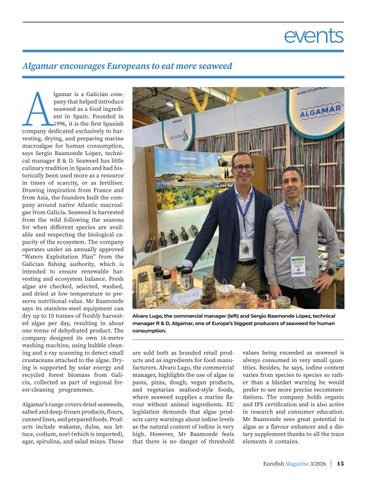
l aro o theco ercial ana er left an er io aa on e pe technical ana er l a ar oneof rope s i estpro cersofsea ee forh an cons ption
are sold both as branded retail products and as ingredients for food manufacturers. Alvaro Lugo, the commercial manager, highlights the use of algae in pasta, pizza, dough, vegan products, and vegetarian seafood-style foods, where seaweed supplies a marine flavour without animal ingredients. EU legislation demands that algae products carry warnings about iodine levels as the natural content of iodine is very high. However, Mr Baamonde feels that there is no danger of threshold
values being exceeded as seaweed is always consumed in very small quantities. Besides, he says, iodine content varies from species to species so rather than a blanket warning he would prefer to see more precise recommendations. The company holds organic and IFS certification and is also active in research and consumer education. Mr Baamonde sees great potential in algae as a flavour enhancer and a dietary supplement thanks to all the trace elements it contains.
Eurofish Magazine 3/2026
05_NEWS EV.indd 15
15
21/05/26 1:47 PM