
VCOMP

Can governments rely on citizens to comply without coercion? Professor Yuval Feldman and colleagues Rinat Merkovich and Michaela Assouline, through the ERC-funded VCOMP project, examine when voluntary compliance works, when it fails, and how trust, behavioural insights and regulatory design interact across countries and policy domains.
Modern governments depend on citizens doing the right thing. Paying taxes honestly. Following public health guidelines. Reporting corruption. Reducing environmental harm. Much of the regulatory state rests not on constant surveillance, but on everyday acts of cooperation.
Yet traditional regulatory theory has often assumed the opposite. For decades, governance models have been built around monitoring, sanctions and deterrence, grounded in the belief that individuals will evade rules whenever the opportunity arises. Compliance, in this view, is secured through fear of punishment or financial incentive rather than intrinsic motivation. This assumption has shaped everything from tax enforcement regimes to environmental inspections and public health mandates. However, heavy enforcement is costly, politically sensitive, and not always effective in the long term. More importantly, it may overlook a crucial reality: many citizens are willing to comply voluntarily – if the conditions are right.
The COVID-19 pandemic brought this tension sharply into focus. Governments across the world discovered that they could not police every behaviour. They needed citizens to self-isolate, wear masks, vaccinate, and protect others without constant oversight. Compliance became not merely a legal obligation, but a test of trust between state and society.
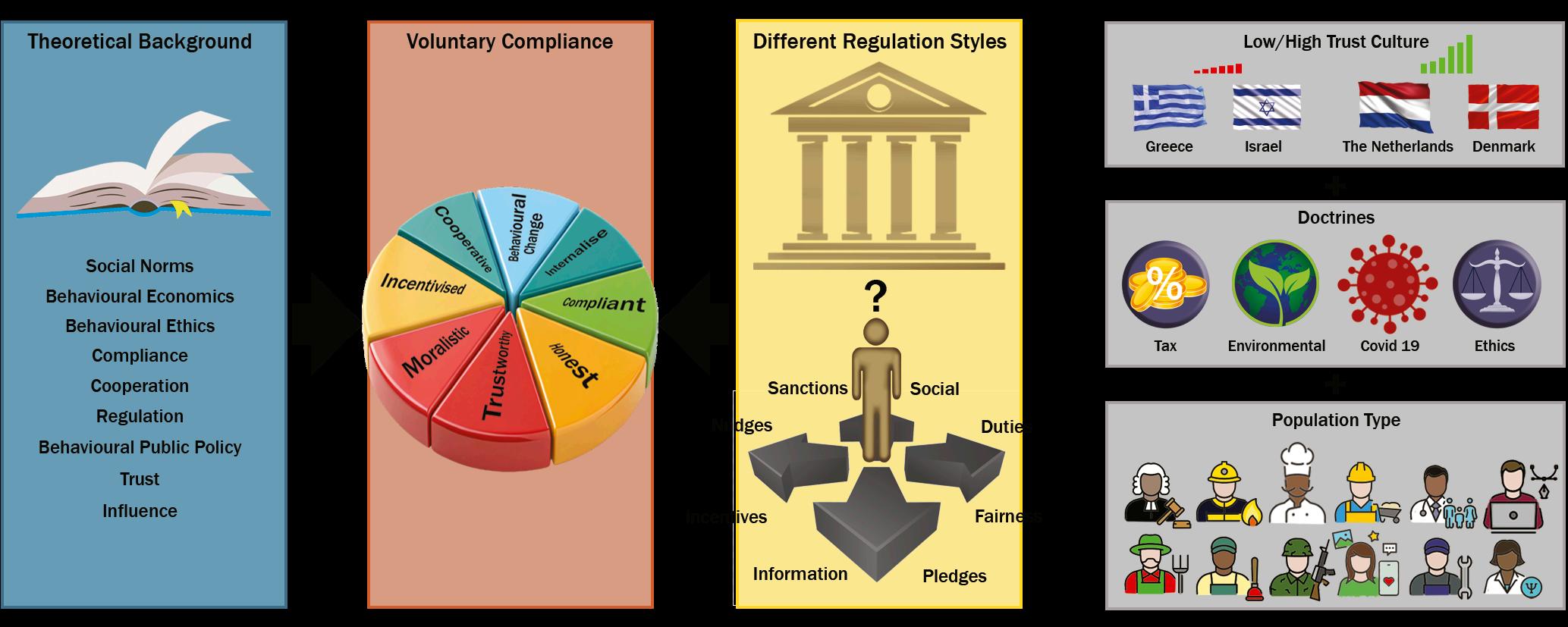
It is within this broader context that the VCOMP project – Generating Voluntary Compliance Across Doctrines and Nations – was launched. Led by Professor Yuval Feldman at Bar-Ilan University and funded by the European Research Council, the initiative seeks to rethink the foundations of regulatory governance. Rather than asking how to punish non-compliance more efficiently, VCOMP investigates when governments can trust citizens to comply voluntarily - and how behavioural insights,
issue: while research has long examined whether citizens trust governments, far less attention has been given to whether governments can trust citizens.
The implications are significant. Heavy monitoring and sanctioning are expensive and may erode intrinsic motivation. If people comply only due to threat of punishment, behaviour may disappear once enforcement weakens. Voluntary compliance, by contrast, tends to be more stable over time. As Assouline explains:
“Voluntary compliance is not only less costly for governments – it is much more predictable in the long term and far more stable.” ... Michaela Assouline.
institutional design and cultural context shape that cooperation.
The project asks a deceptively simple, yet profoundly consequential question: can the public be trusted?
Beyond deterrence
The idea gained urgency during the COVID-19 pandemic. Governments quickly realised that enforcement alone was insufficient. Citizens were asked to isolate, vaccinate, test their children, and change daily routines in ways that could not be easily monitored.
“It was clear that governments needed cooperation, not just obedience,” Feldman explains. The pandemic exposed a deeper
“Voluntary compliance is not only less costly for governments – it is much more predictable in the long term and far more stable.”
Yet regulators are often risk-averse. As Feldman notes, they may assume the worst about citizens because the political cost of misplaced trust is high. Over-trusting may lead to visible failure; under-trusting rarely does. The result is an overreliance on coercive mechanisms.
Citizens as partners
One strand of VCOMP, led by postdoctoral researcher Rinat Merkovich, examines citizens as “regulatory intermediaries”. Across domains such as environmental harm or child protection,
governments increasingly depend on ordinary people to report violations.
Merkovich’s research explores which features of reporting systems matter to citizens in these contexts. Surprisingly, people often prefer voluntary, nonincentivised reporting systems over those offering financial rewards. Institutional fairness, protection for reporters and the capacity of authorities to intervene effectively all influence willingness to report. The findings also reveal heterogeneity. Pro-social individuals are more inclined to report serious wrongdoing and are also more sensitive to signals that authorities can meaningfully intervene and protect them. More self-interested individuals, however, are negatively inclined to report serious wrongdoing and react particularly negatively to mandatory reporting regimes, perceiving them as a loss of autonomy.
Encouragingly, the proportion of individuals who are consistently unwilling to comply or report is small. Most citizens show a baseline tendency to cooperate, provided that regulatory design aligns with their perceptions of fairness and effectiveness.
Trust across contexts
A central dimension of VCOMP is crosscountry comparison. Assouline leads multiple studies across domains including taxation, health and environmental regulation. One completed analysis covering 15 European countries identified a counterintuitive “substitution effect”: higher institutional trust correlated with greater cooperation in taxation, but not necessarily in health compliance.
In high-trust contexts, citizens may delegate responsibility in certain domains, assuming authorities will manage risks. Trust, therefore, does not operate uniformly. Its effect depends on policy area and cultural context.
Other ongoing research spans up to 27 countries, examining how psychological predictors of compliance vary internationally. The results suggest there is no one-size-fits-all regulatory strategy. Effective design must combine general behavioural principles with context-specific considerations.
This insight is especially relevant in policy debates such as reducing sugar consumption. Feldman contrasts coercive measures, such as sugar taxes, with informational approaches like warning labels. While taxes may be more forceful, they can provoke
backlash. Informational nudges preserve choice but may be perceived as weaker commitments by regulators.
Assouline’s team is experimentally comparing enforcement, nudges and control conditions to assess not only behavioural impact but also public perceptions of regulatory commitment and legitimacy. The expressive effect of regulation – what it signals about government priorities – is itself a key variable.
Designing smarter regulation
Beyond empirical studies, the team is developing a conceptual framework for “predictive experimentation” in regulatory design. The goal is to evaluate ex ante – before implementation – whether a regulatory intervention is likely to succeed.
This approach raises challenging questions. What counts as success? Is it higher compliance rates, strengthened trust, or long-term norm internalisation?
And how should predictive tools, including AI-based modelling, be balanced against concerns about democratic legitimacy and profiling?
These broader normative questions are explored further in Professor Feldman’s recent book, Can the Public Be Trusted?, published by Cambridge University Press during the project period. Drawing on insights from VCOMP, the book offers a legal and philosophical roadmap for rethinking the relationship between the state and its citizens in an era of behaviourally informed regulation. It asks not only whether trust works, but when it is justified.
As the project enters its final phase, dissemination and dialogue are intensifying.
A forthcoming conference on Behavioural Trust Enhancement Regulation will bring together legal scholars, psychologists and public policy experts. Engagement with policymakers and international organisations is also underway.
Ultimately, VCOMP reframes governance not as a battle between enforcement and evasion, but as a dynamic relationship shaped by trust, perception and institutional design. It suggests that most citizens are not chronic rule-breakers, but responsive actors whose cooperation depends on fairness, legitimacy and context.
If governments learn when and how to trust the public wisely, they may not only reduce enforcement costs but also strengthen democratic resilience.
The question is no longer simply whether citizens trust institutions – but whether institutions are prepared to trust citizens.
Generating Voluntary Compliance Across Doctrines and Nations: Interlocking the Behavioral and Regulatory Aspects of Governments’ Ability to Trust Public’ Cooperation, Ethicality and Compliance Project Objectives
VCOMP examines the conditions and drivers of voluntary compliance with laws and when governments can rely on trust-based approaches without undermining policy goals. Integrating insights from law, psychology and behavioural economics, it clarifies what voluntary compliance means and how it varies across contexts. The project explores how different regulatory tools shape compliance and translates these insights into guidance for more effective and legitimate policymaking.
Project Funding
This project is funded by a European Research Council (ERC) Advanced Grant under Grant agreement ID: 101054656.
Project Partners
• Prof. Eyal Peer (Hebrew University) • Hajin Kim (University of Chicago) • Lucia Reisch (Cambridge University) • David Levi-Faur (Hebrew University) • Sanchayan Banerjee (King’s College London) • Koen Verhoest (Antwerp University) • Matle Dewis (Cambridge University) • Žiga Puklavec (Bar-Ilan University) • Elena KantorowiczReznichenko (Erasmus University Rotterdam) • Tamar Kricheli-Katz (Tel-Aviv University) • Benjamin Van Rooij (University of Amsterdam)
Contact Details
Project Coordinator, Yuval Feldman Bar Illan University Ramat Gan 5290002 Israel E: vcomplab@gmail.com W: https://www.voluntary-compliance-lab.org/



is Professor of Legal Research at Bar-Ilan University and head of the Voluntary Compliance Lab, specialising in behavioural law, ethics, and regulation.
Dr. Rinat Merkovich holds a PhD in Cognitive Psychology and is a postdoctoral fellow at the University of Antwerp, researching how behavioural science can improve public policy design and implementation.
Dr. Michaella Assoulin researches public administration, political psychology, and behavioural policy. She leads ERC and Horizon Europe projects and lectures at Reichman University on governance and citizen–state interactions.