Using Bee hotels to boost urban biodiversity Biodiversity is in decline across much of the world, and citizen scientists can play an important role in gathering data to guide conservation work. The UrbanBEE project team is providing bee hotels to citizens in five cities across Europe and Southern Africa, and the data they provide can then inform efforts to boost urban biodiversity, as Prof. Chevonne Reynolds and Sage Naidoo explain. The urban environment is commonly associated with roads, buildings and energetic commercial activity, yet cities are often also home to extensive green spaces and gardens, which act as havens for wildlife. With global biodiversity in decline, city dwellers can help by making their own gardens more attractive for wildlife, a topic at the heart of the UrbanBEE project. “UrbanBEE is really about trying to heighten public interest in urban biodiversity,” explains Chevonne Reynolds, Associate Professor at the University of Witwatersrand (Wits) in Johannesburg, the project’s Principal Investigator. This involves providing ‘bee hotels’ to residents in five cities across Europe and Southern Africa, who will place them in their gardens and then monitor the results. “People participating in the project in Johannesburg for example got a free bee hotel, built to a standard size and shape by a local company,” says Prof. Reynolds.
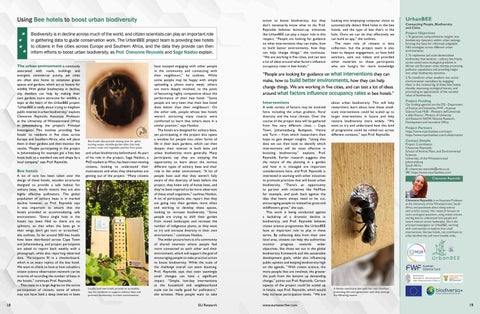
Bee hotels A lot of care has been taken over the design of these hotels, wooden structures designed to provide a safe habitat for solitary bees, docile insects that are also highly effective pollinators. The global population of solitary bees is in marked decline however, so Prof. Reynolds says it was important to ensure that the hotels provided an accommodating, safe environment. “Every single hole in the hotels has been filed so there are no splinters, so that when the bees go in their wings don’t get torn or scratched,” she outlines. So far around 500 bee hotels have been distributed across Cape Town and Johannesburg, and project participants are asked to report back weekly with a photograph, while also reporting observed data. “Participants fill in a checkerboard, which is an exact replica of the bee hotel. We want to check to look at how valuable a citizen science observation network can be in terms of recording the number of bees in the hotels,” continues Prof. Reynolds. This rests to a large degree on the active participation of citizens, some of whom may not have held a deep interest in bees
18
Bee hotels also provide nesting sites for aphidhunting wasps, valuable garden allies that help protect roses and vegetable patches from pests.
and urban biodiversity beforehand. As part of his role in the project, Sage Naidoo, a PhD student at Wits, has been interviewing citizens, looking to understand their motivations and what they themselves are getting out of the project. “Many citizens
Locally built bee hotels provide an accessible way for residents to support solitary bees and promote biodiversity in urban environments.
have enjoyed engaging with other people in the community and connecting with their neighbours,” he outlines. While some people may be happy with simply uploading a photo every week, others are more deeply involved, to the point of becoming highly competitive about the performance of their bee hotel. “Some people are very keen that their bee hotel does better than their neighbours’. On the other side, people whose bee hotels weren’t attracting many insects were comforted to learn that others were in a similar position,” says Naidoo. The hotels are designed for solitary bees, yet participating in the project also opens a window for people into other forms of life in their back gardens, which can then deepen their interest in both bees and urban biodiversity more generally. Many participants say they are enjoying the opportunity to learn about the various different types of solitary bees and their role in the wider environment. “A lot of people have said that they weren’t fully aware of this diversity of bees before the project, they knew only of honey bees, and they’ve been inspired to be more observant of these small organisms,” outlines Naidoo. A lot of participants also report that they are going into their gardens more often and working to develop these spaces, looking to increase biodiversity. “Some people are trying to shift their garden from mixed landscapes and increase the number of indigenous plants, as they want to try and increase diversity in their own environment,” continues Naidoo. The wider picture here is of a community of shared interests where people feel more connected to each other and their environment, which will support the goal of encouraging people to take practical action to boost biodiversity. While the scale of the challenge overall can seem daunting, Prof. Reynolds says that even seemingly small changes can have a significant impact. “Simple, low-key interventions at the household and neighbourhood scale can be really good for pollinators,” she stresses. Many people want to take
EU Research
action to boost biodiversity, but they don’t necessarily know what to do; Prof. Reynolds believes bottom-up initiatives like UrbanBEE can play a major role in this respect. “People are looking for guidance on what interventions they can make, how to build better environments, how they can help change things,” she continues. “We are working in five cities, and can test a lot of ideas around what factors influence occupancy rates in bee hotels.”
looking into employing computer vision to automatically detect filled holes in the bee hotels, and the type of bee that’s in the hole. Once we can do that effectively we can build an app,” she outlines. The main role of citizens is data collection, but the project team is also keen to deepen engagement, so have held seminars, sent out videos and provided other materials to those participants who are hungry for more knowledge
“People are looking for guidance on what interventions they can make, how to build better environments, how they can help change things. We are working in five cities, and can test a lot of ideas around what factors influence occupancy rates in bee hotels.” Interventions A wide variety of factors may be involved here, including the urban gradient, floral diversity and the local climate. Over the course of the project data will be gathered from five very different cities – Cape Town, Johannesburg, Budapest, Vienna and Turin – from which researchers then hope to gain deeper insights. “Using that data we can then look to identify which interventions will be most effective in boosting biodiversity,” explains Prof. Reynolds. Earlier research suggests that the nature of the planting in a garden and how it is managed are important considerations here, and Prof. Reynolds is interested in working with other initiatives to promote practices that will boost urban biodiversity. “There’s an opportunity to partner with initiatives like NoMow for example, and push back against the idea that lawns always need to be cut, encouraging people to instead let grass and wildflowers grow,” she says. This work is being conducted against a backdrop of a dramatic decline in biodiversity, and Prof. Reynolds believes citizen science programmes like UrbanBEE have an important role to play in these terms. By collecting data from their own local area, citizens can help the authorities monitor progress towards wider objectives, like those set out in the global biodiversity framework and the sustainable development goals, while also influencing public opinion and keeping biodiversity high on the agenda. “With citizen science, the more people that are involved, the greater the push from the bottom up demanding change,” points out Prof. Reynolds. Certain aspects of the project could be scaled up in future, says Prof. Reynolds, which would help increase participation levels. “We are
www.euresearcher.com
about urban biodiversity. This will help researchers learn about how these smallscale interventions could be scaled up to larger interventions in future and help restore biodiversity more widely. “We want to try and understand how this kind of programme could be rolled-out across different contexts,” says Prof. Reynolds.
UrbanBEE
Connecting People, Biodiversity and Cities
Project Objectives
1. To generate comprehensive insights into biodiversity dynamics within urban settings, forming the basis for informed, adaptable NbS strategies across different urban environments; 2. To implement and scale decentralised biodiversity interventions – solitary bee hotels, across varied socio-ecological gradients in African and European cities, thereby promoting pollinator populations and providing insight into urban biodiversity dynamics; 3. To transform urban dwellers into active environmental custodians by engaging them in the monitoring of these bee hotels, thereby improving ecological literacy and promoting an appreciation of the societal value of biodiversity.
Project Funding
Our funding agencies are the DSI - Department of Science and Innovation; FWF - Austrian Science Fund; MUR - Ministero dell’Università e della Ricerca / Ministry of University and Research; NKFIH National Research, Development and Innovation Office.
Project Partners
https://www.myurbanbee.com/team https://www.myurbanbee.com/collaboration
Contact Details
Project Coordinator, Chevonne Reynolds School of Animal, Plant, and Environmental Sciences University of the Witwatersrand Johannesburg South Africa E: chevonne.reynolds@wits.ac.za W: https://www.myurbanbee.com/
Chevonne Reynolds
Chevonne Reynolds is an Associate Professor at the University of the Witwatersrand, South Africa and passionate about doing science with and for society. Her research focuses on socio-ecological questions, using citizen science and big data to understand how people and nature interact across landscapes. She is the principal investigator on UrbanBEE, working with communities to explore how small interventions, like bee hotels, can contribute to urban biodiversity and more liveable cities.
A female membrane bee seals her nest chamber, protecting the next generation until they emerge the following season.
19